Driveways · Two-Families · Garden Co-ops · Main Street Stores · Warehouses · Auto Shops
CCTV installation in Queens starts at $950: four house-brand cameras wired to a recorder in your cellar or back office, set up on your phone, holding two weeks of footage, with nothing to pay each month. Driveways, two-families, garden co-ops, shops and warehouses from Astoria to the Rockaways; your survey is booked within 2 hours of the call.
Quick answer: In Queens, a four-camera CCTV package runs from $950 (A Series, 1080p DVR) to $1,392 (C or D Series, 8MP 4K), and a four- to eight-camera home system with an NVR and PoE wiring typically lands between $1,062 and $2,500. Commercial CCTV for stores, restaurants, offices, warehouses and multi-story buildings runs $1,500–$5,000+. There is no monthly fee, and anything beyond the package, such as extra cameras or wiring hidden inside finished walls, is priced per camera after we confirm the layout.
Updated November 2026 by Abstract Enterprises Security Systems, NYS license #12000287431 · Sources: NYPD CompStat, Patrol Borough Queens North and Queens South, week of November 2–8, 2026; U.S. Census Bureau, American Community Survey 2019–2023 5-year estimates, table DP04, Queens County; Queens District Attorney press release, May 8, 2025; WABC-TV, October 29, 2020; NYC Landmarks Preservation Commission, Queens historic district maps; NYS Labor Law §203-c; NYS Penal Law §§250.05 and 250.45; NYC Administrative Code §22-1202
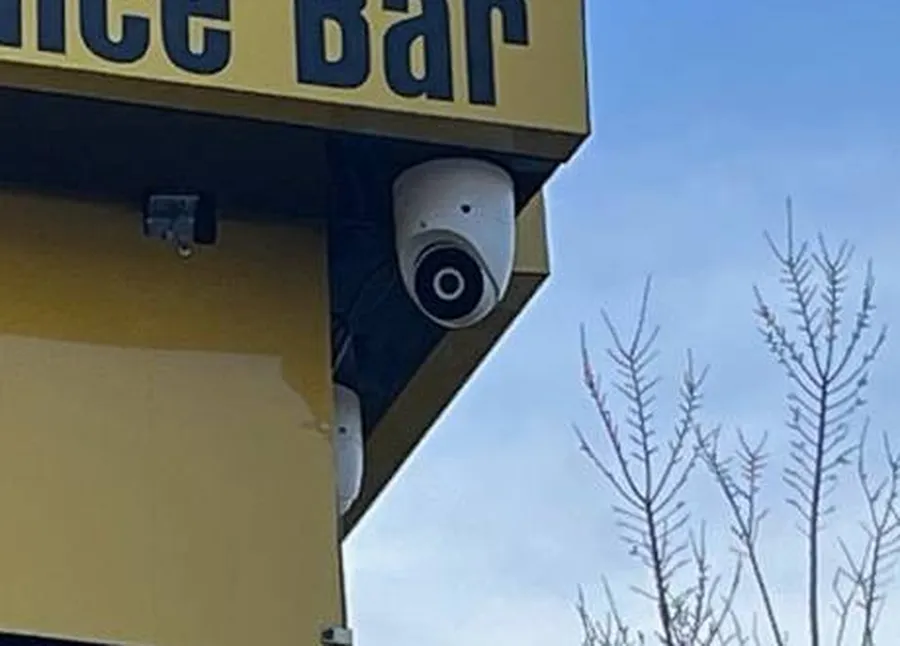
From one of our CCTV jobs (a Manhattan corner deli): a white turret camera tucked under the corner of the awning, out of reach and out of the rain. The same mount works on the awnings along Queens shopping streets.
Queens CCTV Request
House, store, co-op or warehouse: tell us what you need covered
✅
Request Sent!
Got it. A Queens scheduler calls or texts back to set the survey, most often inside 2 hours.
25+
Years Experience
2 Hr
Booking
100%
Licensed & Insured
4.7★
201 Google Reviews
Owner-operated since 2002 · Thousands of jobs completed · Booked within 2 hours
The Neighborhood
Why Queens Properties Need CCTV Installation
Queens is the borough of driveways. Walk almost any side street in Bayside, Middle Village, Hollis, Howard Beach or Whitestone and you see what Manhattan almost never has: a curb cut, a strip of concrete, a car parked a few feet from the front door, and a detached garage or a fenced yard behind it. That changes what a CCTV system is for. In a borough of walk-ups the camera mostly watches a hallway. In most of Queens it watches a car, a side gate, a back door that opens onto a yard, and the sidewalk where a stranger decides whether the house is worth a second look.
The housing numbers back that up. The U.S. Census Bureau's American Community Survey 2019–2023 estimates for Queens County count 903,598 housing units. Of those, 19.1 percent are one-family detached houses (172,141 homes), 9.3 percent are one-family attached houses (83,924), and another 19.4 percent sit in two-unit buildings. Put together, almost half of all Queens homes are in one- and two-family houses, and 44.9 percent of occupied homes are owner-occupied. Those are owners who decide for themselves where a camera goes, who pay for it themselves, and who usually want it to cover the driveway first.
The age of those houses matters on the install. The same survey shows 30.3 percent of Queens housing was built in 1939 or earlier, 14.1 percent in the 1940s and 19.7 percent in the 1950s, which puts close to two-thirds of the borough's homes before 1960. That is the era of brick-faced attached rows, stucco and frame two-families, Tudor-style detached houses and the post-war garden apartment complexes. Under the siding you find plaster on wood lath, balloon-framed walls with open bays from cellar to attic, and cellars with low joists where the boiler, the meters and now the recorder all share space. A good CCTV installer reads those walls before deciding where a cable can run.
The theft picture in Queens has its own shape too. The NYPD reports CompStat for two patrol boroughs here, Queens North and Queens South. Through November 8, 2026, Queens North recorded 1,099 burglaries, down 33.1 percent from 1,642 a year earlier, but 2,471 grand larcenies of autos, up 12.2 percent from 2,203. Queens South logged 1,465 vehicle thefts, down 12.7 percent, alongside 819 burglaries. Across both patrol boroughs that is 3,936 stolen vehicles in ten months, compared with 1,918 burglaries. In Queens the car in the driveway is a bigger target than the house behind it, and a CCTV plan that ignores the driveway is solving the wrong problem.
Prosecutors here have said the same thing in plain words. When the Queens District Attorney's office announced the Operation Hellcat indictments in May 2025, a ring charged with stealing 126 cars, 52 of them in Queens, District Attorney Melinda Katz said: “With these indictments, we have dismantled a criminal enterprise that stole at least $4.6 million worth of vehicles from our streets and driveways.” (Queens District Attorney, May 8, 2025). The release describes thieves breaking a door lock with a screwdriver and programming a new key fob through the car's diagnostic port. A camera does not stop that by itself. What it does is put a face, a time, a direction of travel and often a plate on the recorder, and that is what turns a report into a case.
Queens numbers we plan CCTV jobs around
3,936 vehicle thefts across Queens North and Queens South in 2026 through November 8, against 1,918 burglaries (NYPD CompStat, preliminary).
Vehicle theft up 12.2% in Queens North year over year, from 2,203 to 2,471, even as burglary there fell 33.1% (NYPD CompStat).
8,534 retail theft complaints in the two Queens patrol boroughs this year: 5,559 in Queens North (down 14.8%) and 2,975 in Queens South (down 5.7%).
47.8% of Queens homes are one-family detached, one-family attached or two-unit houses (Census ACS 2019–2023, DP04).
About 64% of Queens housing was built before 1960, so plaster, lath, brick fronts and low cellars are the norm on our jobs (Census ACS).
13 historic districts in Queens, from Jackson Heights and Sunnyside Gardens to Addisleigh Park, Douglaston and Ridgewood, where facade work answers to the Landmarks Preservation Commission (LPC).
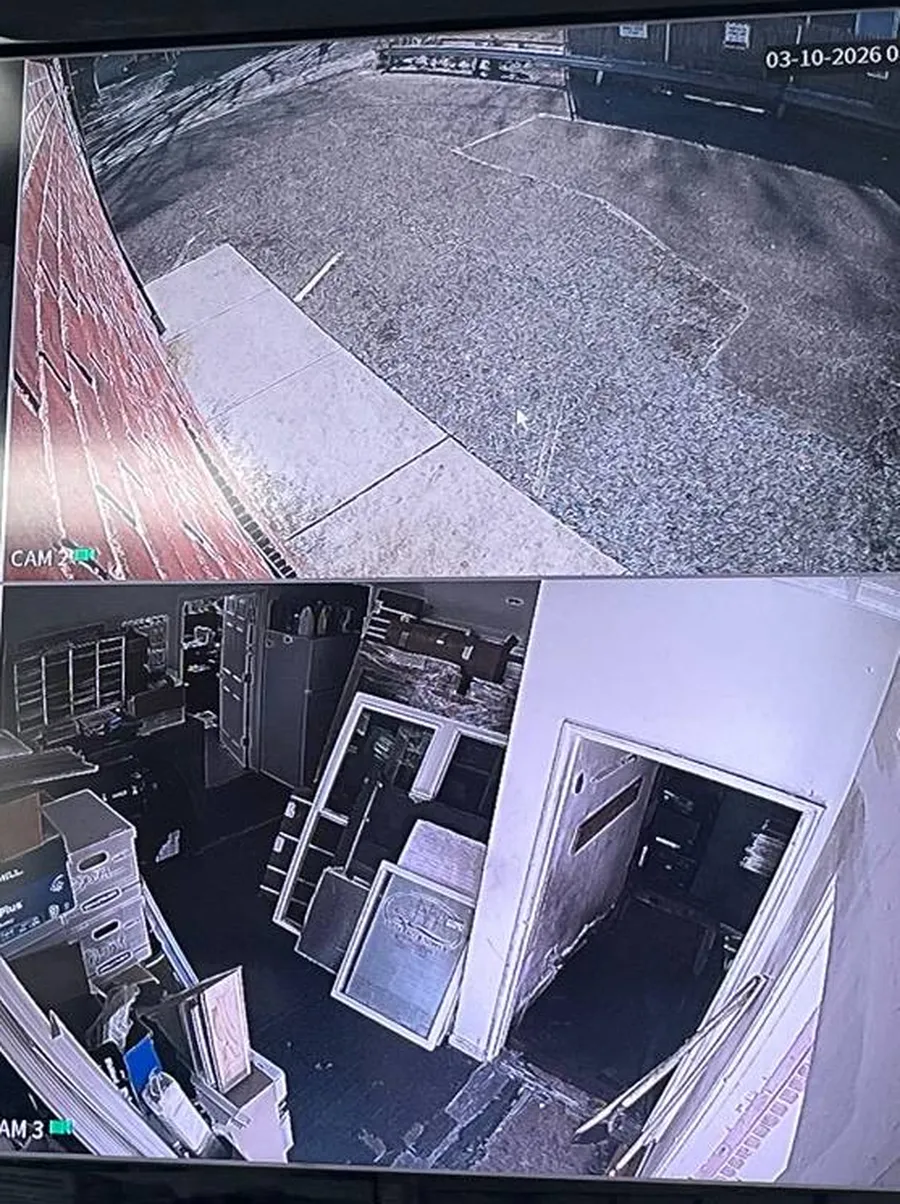
From one of our CCTV jobs (a Nassau County showroom): the top tile watches a gravel side lot along a brick wall, the bottom tile a storeroom. A Queens driveway camera is framed the same way, along the wall toward the street.
North Queens, South Queens and the waterfront
The borough is too big for one pattern. In the northwest, Astoria, Long Island City, Sunnyside and Woodside mix attached brick rows, six-story walk-ups, new glass towers along the East River and the industrial blocks between the Sunnyside rail yards and Newtown Creek. Jobs there look like city jobs: shared walls, narrow lots, cellars, and owners who need a camera on the front door, the areaway and the back yard. Across northeast Queens, Bayside, Douglaston, Little Neck, Whitestone and Fresh Meadows lean toward detached houses on wider lots, many with a garage at the end of a long driveway, and garden co-ops with shared courtyards and parking bays.
Central Queens, from Forest Hills and Rego Park to Kew Gardens and Briarwood, adds tall pre-war and post-war co-ops along Queens Boulevard, where cameras are a board decision and the job looks more like a Manhattan elevator building. Southeast Queens, in Jamaica, St. Albans, Hollis, Cambria Heights, Laurelton and Springfield Gardens, is mostly detached and semi-detached houses with driveways, plus the warehouse and freight-forwarding blocks around JFK. And the Rockaways are their own world: beach bungalows, newer town houses, ocean wind, salt air and sand, which decide which cameras and housings survive a winter.
Abstract Enterprises Security Systems has worked across this borough since 2002, dispatched from our Bronx office at 460 E Fordham Rd. We are a licensed New York State low-voltage contractor, not a referral service, so the same crew that walks your driveway or your stockroom on the survey is the crew that pulls the cable and hands you the app at the end.
What We Install
CCTV Installation Services in Queens
Our CCTV installation services in Queens are built around a recorder you own, cameras wired back to it, and footage you can pull on your phone without a subscription. The mix changes with the property: a Bayside house needs a driveway view that reads a face at the car door, a Roosevelt Avenue shop needs the register and the door, and a Maspeth warehouse needs the truck yard after dark. These are the services we sell most in the borough.
🚗
Driveway and garage CCTV
One camera framed on the car doors at face height, one wider view of the driveway apron and curb cut, and one on the garage or side gate. This is the most requested home CCTV setup in Queens, and the one the vehicle-theft numbers argue for.
🏡
Whole-house residential CCTV
Front door and stoop, porch, side alley, back door, patio and backyard, with the recorder in the cellar or a closet and motion alerts that ignore passing traffic on the street.
🏘️
Two-family and attached houses
One recorder, two households: separate logins so the owner upstairs and the tenant downstairs each see the shared entrances, and nobody sees the other unit's door unless both agree.
🌳
Garden co-op and condo CCTV
Courtyards, walkways, building entrances, laundry rooms and parking bays for post-war garden complexes, with a camera plan the board can approve before any drilling.
🛒
Store and restaurant CCTV
Doors, registers, aisles, coolers, delivery doors and the sidewalk out front for shops on Main Street, Roosevelt Avenue, Steinway Street, Jamaica Avenue and Liberty Avenue.
🔧
Auto shop and lot CCTV
Service bays, the key board, the customer lot and the gate, with plate-readable views at the entrance for repair shops, tire shops and used-car lots along Northern Boulevard and the borough's other auto corridors.
📦
Warehouse and logistics CCTV
Loading doors, dock plates, trailer rows and fence lines for freight forwarders near JFK and distribution buildings in Maspeth, Long Island City and College Point.
🗄️
Recorder, drive and app setup
NVR installation and DVR installation, hard drives sized to a real retention target, time sync, user accounts and remote viewing on every phone that needs it.
♻️
Upgrades, repairs and moves
DVR to NVR upgrades, analog to IP conversions, dead cameras replaced, cameras moved after a renovation, and old systems from a previous owner brought back to life.
One note on how our pages split the work. Our security camera installation in Queens page is the place to start if you are weighing doorbells, plug-in Wi-Fi cameras and the broader menu of camera options for a home. This page is about CCTV in the stricter sense: a closed circuit of wired cameras and a DVR or NVR recorder you own, the kind of system that suits driveways, two-families, garden co-ops, stores and industrial buildings that need footage you can rely on.
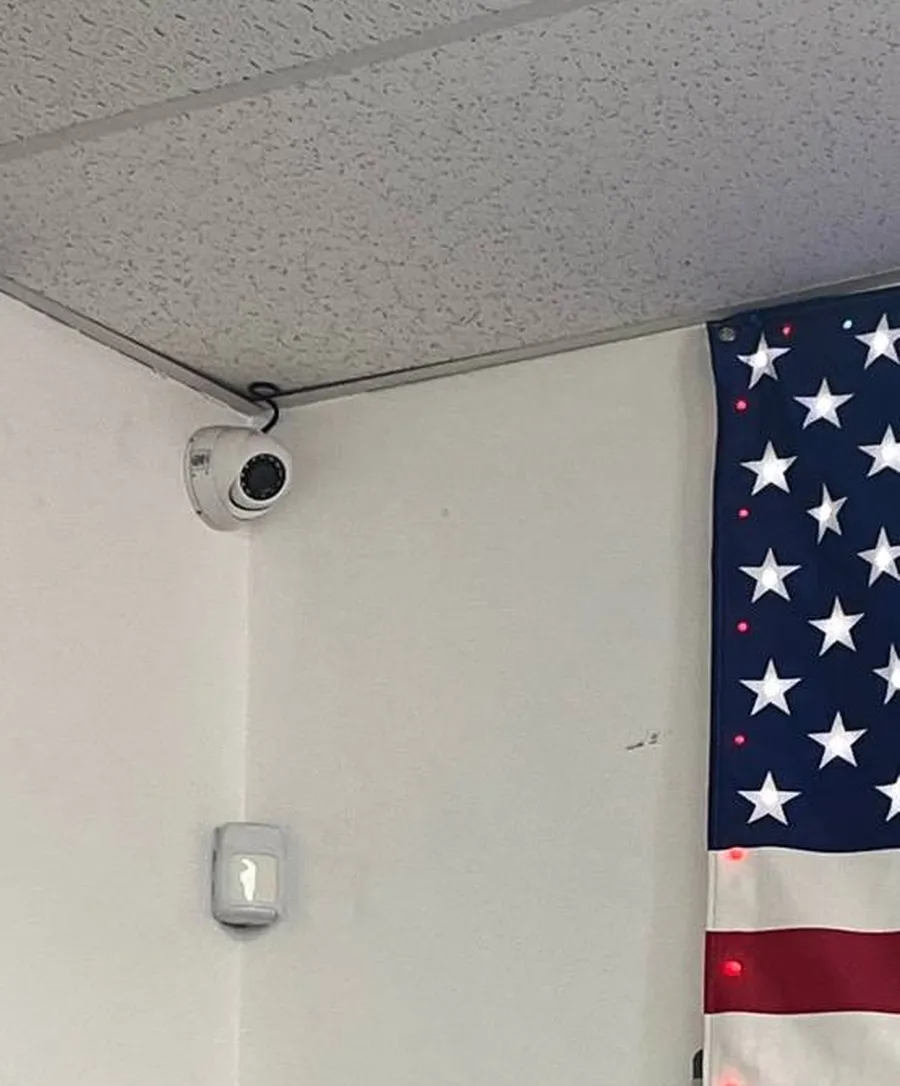
From one of our CCTV jobs (a Nassau County showroom office): a dome tucked into the ceiling corner, with the alarm's motion sensor below it on the same wall, so one corner watches the whole room.
Closed circuit television, explained for a Queens homeowner
Closed circuit television installation means the video never leaves your property unless you ask it to. Each camera sends its picture down its own cable to the recorder, and the recorder writes it to a hard drive in your cellar or closet. That is different from the plug-in cameras sold in big-box stores, which usually send clips over Wi-Fi to a company server and charge a monthly fee to keep them. A CCTV setup can still send alerts to your phone and let you watch live from work or from a trip to see family overseas, but the recording itself does not depend on your internet staying up.
There are two families of CCTV systems we put in. HD analog systems use HD-TVI, HD-CVI or AHD cameras on coax cable to a digital video recorder. They are a good fit when a house or store already has coax in the walls from an older system. IP systems use network cameras on Cat6 cable to a network video recorder, with power delivered over the same cable (PoE). They are our default for new work because one cable does everything, resolution goes up to 4K and beyond, and adding a camera later is simple. Wireless CCTV installation is possible too, but every wireless camera still needs power, and Queens brick and stucco cut Wi-Fi signal hard.
What the job includes, start to finish
CCTV installation and setup on our crews always covers the same ground. We plan each view on the survey. We run and label the cable, choosing the path that keeps it out of sight on the front of the house. We mount the camera on the right base for the surface, whether that is aluminum siding, stucco, face brick or a soffit. Then comes the part most cheap installs skip: CCTV installation and configuration of the recorder, which covers recording schedules, motion and smart detection zones that ignore the street, night settings, the correct time zone and daylight saving, drive formatting, user accounts and strong passwords. We finish with remote viewing on your phone and a short lesson on finding and exporting a clip.
After the install, CCTV installation and maintenance go together. Lenses near a busy avenue collect grime, spiders love an infrared camera under an eave, and a hard drive in a warm boiler room wears out sooner than one in a cool closet. We offer maintenance visits, repairs and replacements, and we take service calls on systems we did not install once we know what equipment is on the wall.
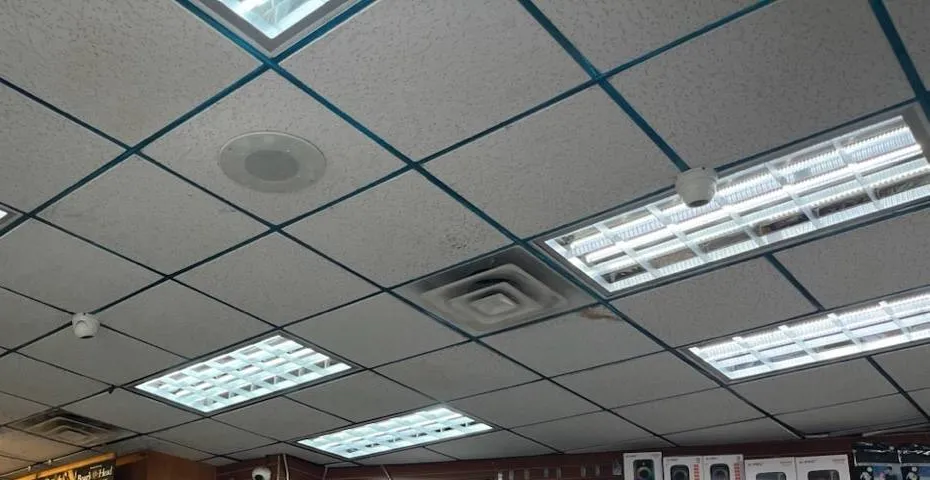
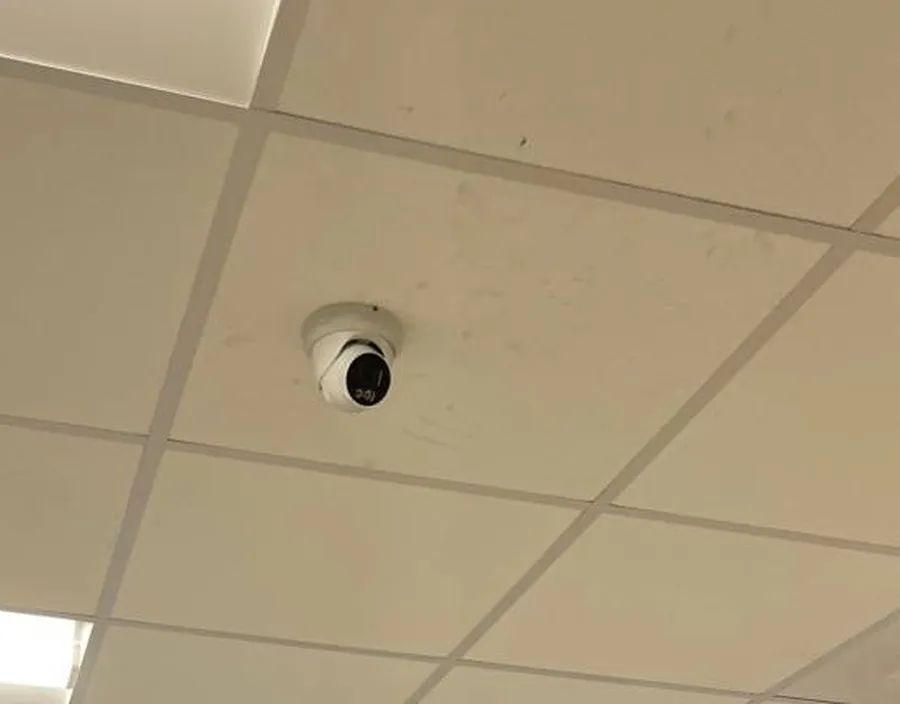
From one of our CCTV jobs (a Manhattan corner deli): small domes on the drop-tile ceiling, set between the light panels and the air vent so the fixtures never sit in the middle of the picture.
The moments Queens owners call us
Most calls arrive at a few predictable points. The morning after a car disappears from the driveway, when the owner learns the old camera faced the street and caught only a blur. After a package theft from the porch or the vestibule of a two-family. When a house is bought and the new owner inherits a recorder nobody has the password for. Before moving in, when the walls are open for painting and running cable costs the least. When a store is getting ready for the holiday shopping season and the Black Friday rush. When a business opens a new location, and the grand opening is a few weeks away. And when a property sits vacant between tenants or during an estate sale, which is when copper, appliances and anything in the garage go missing. Each one leads to a different first camera, which is why we ask what happened before we talk about equipment.
Building Specialists
CCTV Installation for Queens' Architecture
Queens has more kinds of houses than any other borough, and each one hides the cable in a different place. These are the building types our crews see every week, and what each one does to a CCTV plan.
🏠
Detached houses
Frame or brick houses with a driveway down one side and a garage behind. The attic and cellar give clean cable paths, so most cameras end up under the eaves or soffits with no wire showing on the facade.
🧱
Attached brick rows
Middle Village, Ridgewood, Glendale and Jackson Heights rows share side walls and often a common driveway behind the houses. Cameras go on the front and the rear walls only, and the rear view has to respect the neighbors' half of the drive.
🏘️
Two-family houses
Two meters, two front doors, often a separate basement unit. The recorder belongs to the owner, and we split viewing rights so each household sees only the shared entrances, the driveway and its own door.
🌳
Garden co-ops
Two- and three-story brick buildings around lawns and courtyards, with parking bays and laundry rooms spread across a campus. Cable crosses between buildings underground, in conduit on the exterior, or by fiber, and the board approves every camera.
🏢
Elevator co-ops and rentals
Six- to twenty-story buildings along Queens Boulevard, in Kew Gardens, Rego Park, Forest Hills and Jackson Heights, with a lobby, a package room, a garage ramp and a super who holds the keys.
🏖️
Rockaway bungalows and beach houses
Small frame houses and newer town houses near the boardwalk, where salt air corrodes cheap mounts and sand gets into every connector. Weatherproof housings and sealed junction boxes are not optional here.
For larger multi-unit properties there is more on our apartment building security camera installation in Queens page, which covers lobbies, package rooms and management access in detail. The notes below are the parts of a CCTV job that change with the building type.
Balloon frames, plaster and lath
Many Queens frame houses from the 1920s and 1930s were built with balloon framing: wall studs that run from the sill in the cellar to the roof plate with no break at each floor. For a CCTV contractor that is good news. A cable can often be dropped from the attic straight down an exterior wall bay and pulled out in the cellar, which lets us put a camera under the front eave and land the cable at the recorder with no visible wire. Platform-framed houses from the post-war years have a top plate at every floor, so the same run means drilling through plates from the attic or using a closet as a chase. Plaster on wood lath cracks if it is cut carelessly, so we use small access holes, patch them, and tell you before we start where any patching will be.
Brick fronts, stucco and aluminum siding
The facade decides the mount. On face brick we fasten into solid brick or mortar joints with sleeve anchors and a junction box, so the cable connection sits inside a sealed box rather than hanging in the weather. On stucco we seal every penetration, because water behind stucco is a slow, expensive problem. On aluminum and vinyl siding we use a mounting block so the camera sits on a flat, solid base and the siding is not crushed. And on houses with a brick first floor and siding above, which is common in Flushing, Fresh Meadows and Bayside, we usually mount on the soffit, where the cable comes straight down from the attic.
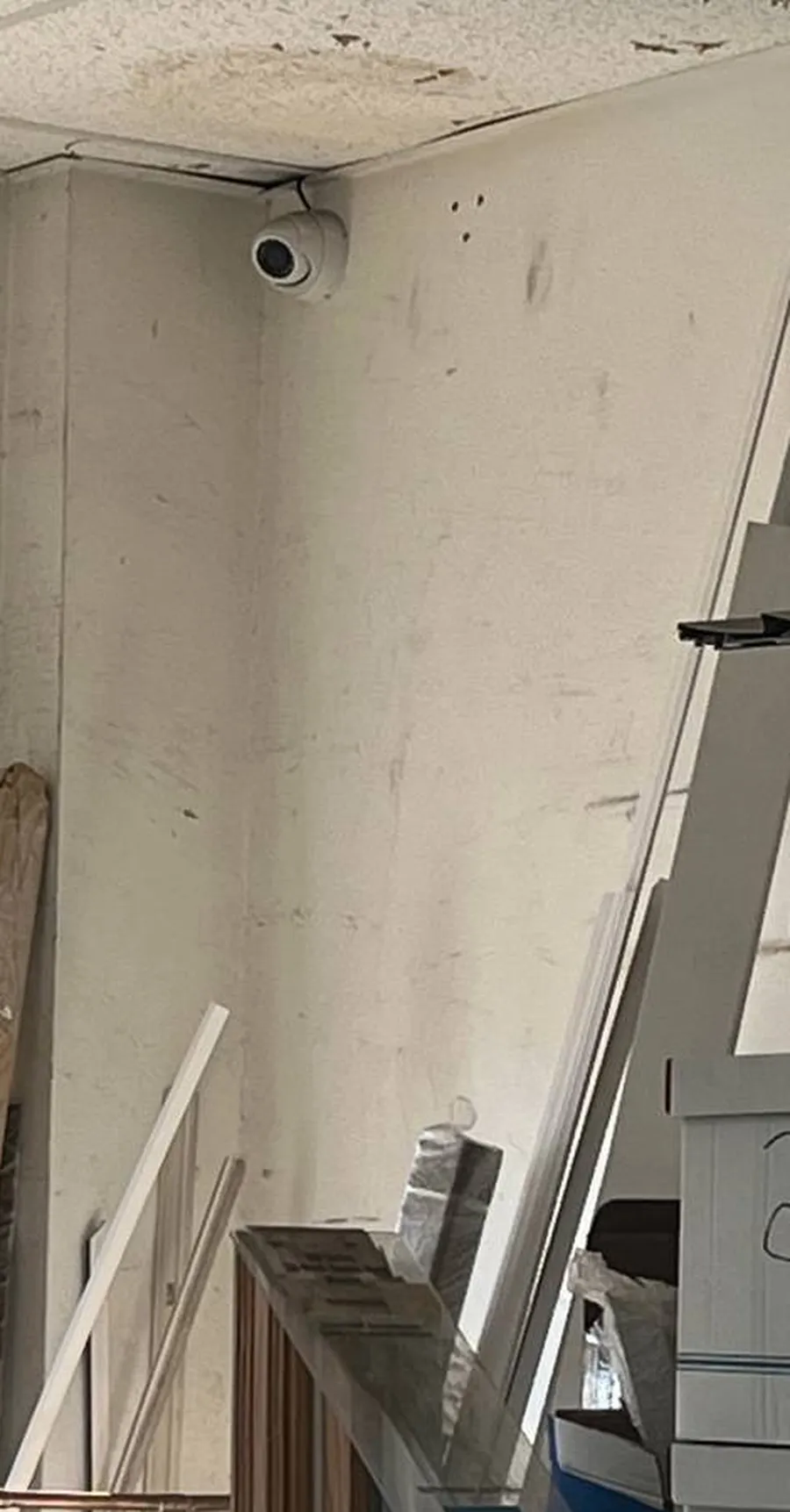
From one of our CCTV jobs (a Nassau County storeroom): a dome high in the corner under a stained ceiling tile, with stock leaning against the wall below. Queens cellars and back rooms look a lot like this, which is why we keep recorders and cameras away from the drip line.
Keeping the recorder above the high-water line
In a Queens house the recorder almost always ends up in the cellar. It is central to the cable paths, it is out of sight, and a burglar who grabs the box by the TV upstairs leaves the evidence behind. Cellars here also flood. Southeast Queens and the low blocks near Jamaica Bay have had real basement flooding in heavy rain, and plenty of houses in every neighborhood see water at the foundation in a bad storm. So we mount the recorder on a shelf or a wall bracket well above the floor, away from the boiler and the water heater, with a battery backup under it, and we keep the drive's location out of the path of any pipe that has ever dripped. In a two-family, the recorder sits in the owner's part of the cellar, behind a lock if the tenant shares the space.
Shared driveways and common walls
A lot of attached and semi-detached houses in Queens share a driveway down the middle, each owner holding half of it or an easement over the other's half. A camera on your wall that looks down the shared drive is common and usually reasonable, but it records your neighbor coming and going too. We frame driveway cameras on your car, your door and the approach from the street, rather than on the neighbor's side door or yard, and we can mask parts of the image in the recorder so a window or a neighbor's back door is blacked out. The same applies to cameras that look over a low fence into the next yard. Talking to the neighbor before installation solves most of these issues before they start.
Garden co-ops: campuses, not buildings
Post-war garden co-ops are spread across many low buildings with lawns, paths and parking courts between them. A CCTV plan for one of these complexes looks more like a small college campus than an apartment house. We usually put a recorder in a central management office or boiler room, run PoE switches in the basements of outlying buildings, and connect the buildings with fiber or with Cat6 in conduit where the run is short enough. Exterior cameras cover building entrances, walkways, the parking courts and the laundry rooms, where most incidents and complaints happen. The board approves the camera list and the policy for who can view and export footage before we pull any cable.
Historic districts in Queens
Thirteen Queens neighborhoods or blocks are designated historic districts by the Landmarks Preservation Commission, among them Jackson Heights, Sunnyside Gardens, Addisleigh Park, the two Cambria Heights districts, Central Ridgewood, Ridgewood North and South, Douglaston, Douglaston Hill, Fort Totten, Hunters Point and Stockholm Street. Work on the street-facing parts of buildings in those districts generally needs an LPC permit. For cameras, the commission's permit guidance favors small, discreet cameras placed at mortar joints or plain surfaces, with conduit kept out of sight. We check whether an address is inside a district during the survey, design the front-facade cameras to the commission's guidance from the start, and supply the camera cut sheets for the application. Rear and side cameras are usually simpler, and that is often where the driveway view is anyway.
Basement apartments and the tenant question
Many Queens homeowners rent a basement or ground-floor unit. A camera on the shared side door or the driveway is a normal part of protecting the house, but it records the tenant's comings and goings as well. We keep cameras out of the tenant's living space, point them at shared approaches rather than into a unit's windows, and suggest the owner tell the tenant in writing which areas are recorded. Giving the tenant a view-only login to the shared door camera is an easy way to make the system feel like it protects both households, which in practice it does. This is general information, not legal advice; your lease and local rules control.
High-rise co-ops along Queens Boulevard
Building CCTV installation in an elevator co-op is mostly about the risers and the board. These buildings usually have a telephone or cable-TV riser, a lobby desk or a super's office, a garage ramp and a package room that did not exist when the building opened. Where the board allows it, we pull Cat6 up an existing riser to a PoE switch every few floors and bring the whole building onto one NVR, with separate accounts for the managing agent, the super and the lobby staff. Elevator cab cameras need the elevator maintenance company, because the signal has to travel in the cab's traveling cable or over a wireless bridge the elevator company approves.
Commercial CCTV
Business CCTV Installation in Queens
Commercial CCTV installation in Queens splits into two very different worlds. On the shopping streets it is small-business work: bakeries, pharmacies, phone stores, restaurants, money transfer counters, beauty supply shops and family groceries, many run by owners who work the register themselves. In the industrial belts it is freight, trucks and fences: warehouses, distribution buildings, air cargo forwarders, contractors' yards and auto shops. Commercial CCTV for stores, restaurants, offices and multi-story buildings in Queens runs $1,500–$5,000+, depending on the camera count, the recorder, how much cable has to be hidden and how many sites share one app. Our commercial security camera installation in Queens page goes deeper on retail and office layouts.
Corridors where we install business CCTV
Main Street and Roosevelt Avenue in downtown Flushing: dense blocks of restaurants, bakeries, malls-within-buildings and upstairs offices, with signs in Chinese and Korean and very heavy foot traffic.
Roosevelt Avenue under the 7 train, Jackson Heights to Corona: jewelry stores, money transfer shops, restaurants and phone stores under the elevated tracks, where the steel structure and passing trains shape every camera angle.
Jamaica Avenue and 165th Street: apparel, sneaker and discount stores, plus the busy blocks around the Jamaica Center and Parsons/Archer transit hubs.
Steinway Street and 30th Avenue in Astoria: cafes, restaurants, hookah lounges, salons and small groceries, many in two- and three-story buildings with apartments above.
Liberty Avenue in Richmond Hill and Ozone Park: groceries, sari and jewelry shops, roti shops and money transfer counters under the elevated A train.
Northern Boulevard: car dealerships, auto repair and tire shops, gas stations and strip-front stores, with lots where plate-readable entrance views matter as much as the showroom.
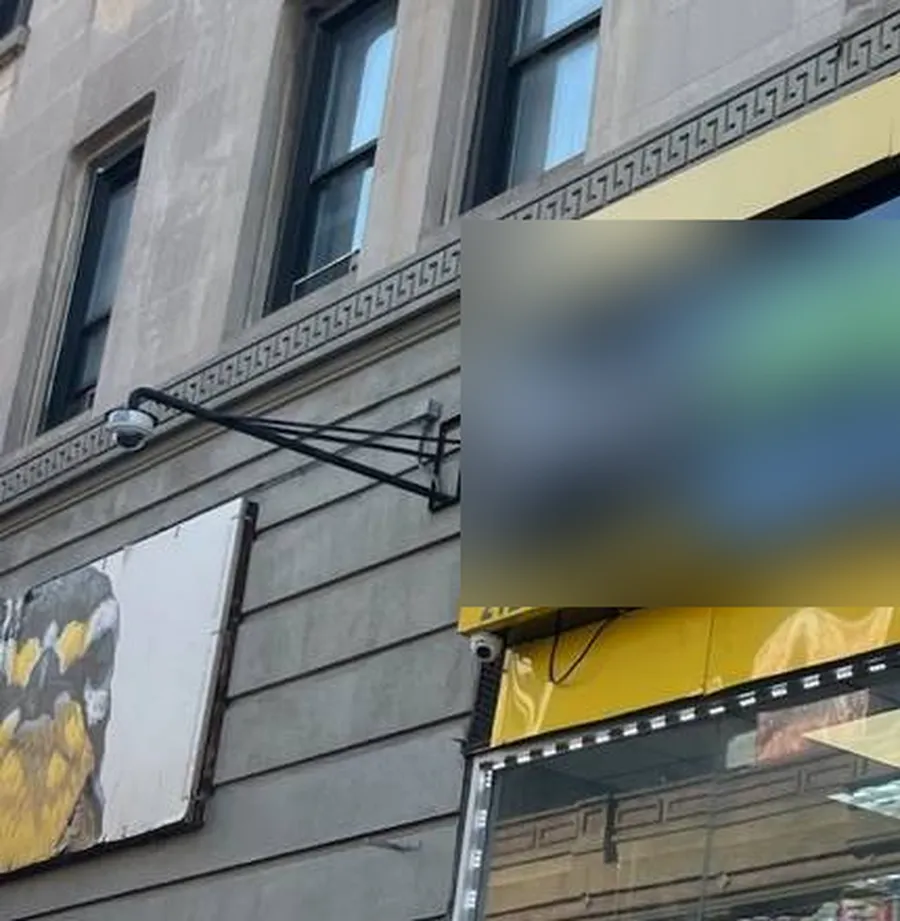
From one of our CCTV jobs (a Manhattan corner store, sign blurred): a dome on a black steel arm projecting from the facade below the apartment windows, so it can look along the sidewalk instead of straight out at the street.
Multilingual storefronts and family-run shops
Business CCTV installation on the shopping streets of Queens usually means talking to an owner, a spouse and an adult child, often in more than one language, and setting up a system all three can use. We keep the design simple: a camera over the door at face height, one on the register from above and behind the counter, domes down each aisle, one at the back door or delivery door, and one or two on the sidewalk from under the awning. The recorder goes in the back office or the cellar, not under the counter. Each family member gets a separate login on the app, with only the owner allowed to delete footage or change settings. When the staff changes, the owner removes one account instead of changing the password everyone knows.
Restaurants, bakeries and supermarkets
Restaurant CCTV installation in Queens has to deal with grease, steam and long hours. Kitchen cameras go in sealed housings away from the fryers, cable in the kitchen runs in conduit, and the cameras we point at the dining room avoid shining into the eyes of customers at window tables. The views that matter most are the register, the host stand or counter, the back door where deliveries and garbage go out, and the walk-in or storage room. Supermarket and grocery store CCTV installation adds aisle coverage, the produce racks out front, the beer cooler, and the loading area where pallets arrive in the early morning. A bakery that opens at 5 a.m. usually wants the door and the sidewalk covered before anything else, because that is when the street is emptiest.
Auto repair shops, dealerships and gas stations
Auto repair shop CCTV installation is one of the most common commercial jobs in the borough. Shops along Northern Boulevard, in the blocks of Long Island City and Maspeth, and on Rockaway Boulevard keep customers' cars overnight, sometimes on the street or in an open lot. The priorities are the lot and the gate at night, the bay doors, the key board or key cabinet, and the counter where customers drop off and pay. Car dealership CCTV installation adds the showroom floor, the service drive and long rows of inventory, where vehicle detection keeps the recorder from flagging every swaying tree. Gas station CCTV installation covers the pumps, the kiosk window and the register, with a plate view at each driveway in and out of the station.
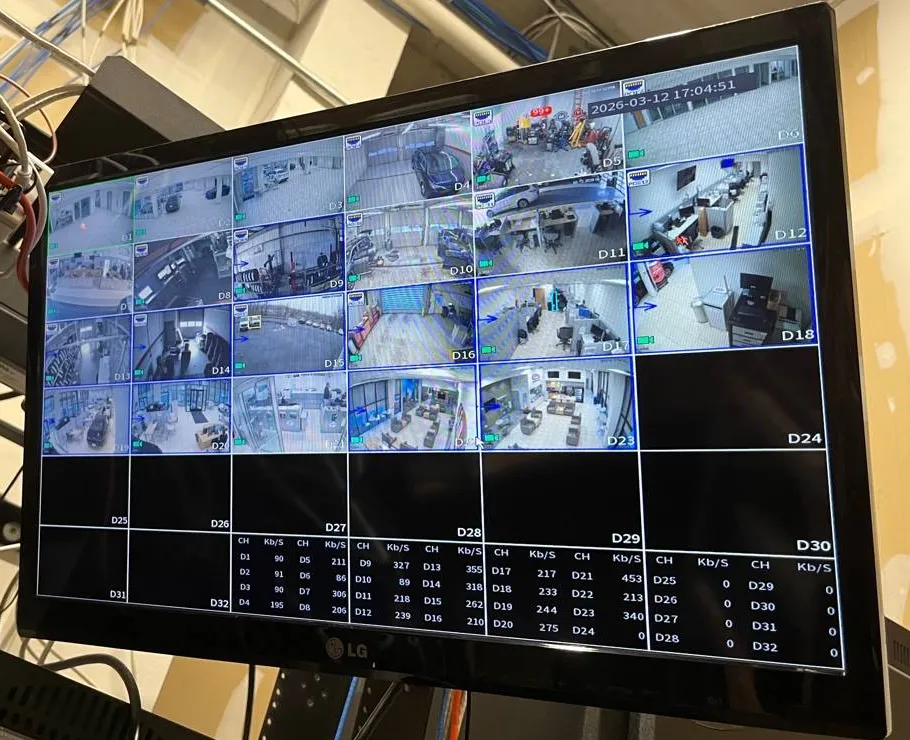
From one of our CCTV jobs (a Rockland County car dealership): the NVR's 32-channel grid with live tiles on top and a bitrate table for every channel below. That table is how we check that each camera is streaming what the drive was sized for.
Warehouses, freight forwarders and the JFK cargo belt
Warehouse CCTV installation in Queens is shaped by two industrial zones. In the west, Long Island City, Maspeth and Ridgewood's industrial edge hold distribution buildings, food wholesalers, printers, contractors' yards and storage businesses along Newtown Creek and the rail lines. In the south, the blocks around JFK Airport in Springfield Gardens, Jamaica and Rosedale hold air cargo forwarders and logistics facilities where trucks queue for pickups around the clock. Our warehouse security camera installation in Queens page covers high-ceiling and dock layouts in more depth.
Air cargo is a reminder of why the paperwork side of a pickup matters as much as the door. In October 2020, Queens District Attorney Melinda Katz and the Port Authority Police announced charges against a crew accused of using forged documents to collect about $6 million in designer goods from an air cargo importer at JFK. “The safety and security of this county's airports are a top priority,” Katz said (WABC-TV, October 29, 2020). According to the charges, one trailer from the heist was later found abandoned on 56th Road in Maspeth, and surveillance video showed defendants going in and out of a closed storefront in Jamaica used to store the goods. For a freight business, that is the case for a camera at the release counter that records the driver's face and the paperwork, a plate camera at the yard gate, and dock cameras that show which pallets left in which truck.
Distribution center CCTV installation follows a set pattern. Every dock door gets a camera inside, looking out at the trailer and the dock plate, so a loading clip shows the pallet and the trailer number in the same frame. The truck yard gets bullet or varifocal cameras with long infrared range, often on light poles or the building corners, with a plate camera at the gate. The perimeter fence gets cameras with smart detection so a person along the fence at 3 a.m. triggers an alert and a raccoon does not. Long runs across a yard go over fiber or with PoE extenders, because Cat6 tops out around 100 meters, and the recorder sits in a locked office on a battery backup.
Self storage, construction sites and parking lots
Self storage CCTV installation covers the gate keypad, the office, every corridor of units and the loading area, with cameras that read the plate and the face at the keypad. Construction site CCTV installation is temporary by design: a recorder in a locked job box, cameras on poles or on the hoist, temporary power, and a plan to move the cameras as the building goes up. Parking lot CCTV installation and parking garage CCTV installation start at the entrance lane, with one tight camera on the plate and one wider camera on the car and the driver, then overview cameras along the rows where break-ins happen.
Field Notes
What our crew checks first on a Queens driveway survey. We stand where the car is parked at night and look back at the house. The camera has to see the driver's door and the face of anyone standing at it, so it goes on the wall or soffit closest to that door at roughly eight to ten feet, not on the far corner of the garage. We check where the streetlight sits, because a light behind the car turns a face into a silhouette, and we note the neighbor's motion floodlight if it points across the drive.
Then we follow the cable path back to the cellar: attic or wall bay, soffit or brick, and whether the run passes a gutter that overflows in a storm. We find the spot for the recorder above the high-water line and near an outlet for the battery backup. Last, we ask the owner how they want alerts. Most say "only when someone walks up the driveway," so the detection zone stops at the curb cut and the street stays out of the alerts. All of that goes into the written scope before anyone drills.
Offices, medical suites, pharmacies and banks
Office CCTV installation in the borough runs from a two-room accounting office above a Flushing storefront to a full floor in a Long Island City building. Cameras cover the suite entrance, reception, the server or IT closet and sometimes a supply room. Medical office and dental office CCTV installation keeps cameras out of exam and treatment rooms and away from screens showing patient information, and points them at the entrance, waiting room and front desk. Pharmacy CCTV installation focuses on the pickup counter, the front-end shelves near the door and the delivery entrance. Bank and financial office CCTV installation, including check cashers and money transfer counters, covers the teller line, the entry vestibule and any ATM, with higher-resolution cameras on the counter.
Houses of worship, schools and daycares
Church and house of worship CCTV installation is a big part of our community work in Queens, which has churches, mosques, temples, gurdwaras and synagogues on nearly every major avenue. Most want the entrances, the parking area, the donation box or office, and the sanctuary doors after hours, with cameras kept out of prayer and private counseling rooms. School CCTV installation and daycare CCTV installation focus on entrances, drop-off and pick-up areas, hallways and the play yard, with viewing limited to the staff the operator chooses. Any CCTV for a school or daycare is designed with the operator's own policies and licensing requirements in mind; we install to the plan they approve.
Compliance callouts for Queens businesses
Restrooms, locker rooms and changing rooms are off limits.NY Labor Law §203-c prohibits employers from video recording employees in those rooms. A camera aimed at the hallway door is fine; one inside is not.
Microphones need a decision, not a default.NY Penal Law §250.05 makes recording a conversation without at least one participant's consent a crime. We set audio-capable cameras with audio switched off unless the owner chooses otherwise after getting advice.
Face matching triggers a posting duty. A shop, restaurant or venue in the city that turns on face-matching or any other biometric collection has to post a notice where customers enter, and cannot sell or trade the data, under section 22-1202 of the NYC Administrative Code. Our installs leave those features off.
Private spaces stay private.NY Penal Law §250.45 covers recording people where they have a reasonable expectation of privacy. Upstairs apartments, changing areas and neighbors' windows are not part of any view we set.
This list is general information, not legal advice. It is what we go over with every Queens business owner before the cameras go up, so the system protects the business without creating a new problem.
Your Questions Answered
CCTV Installation in Queens: Questions Answered
What does a driveway-and-backyard CCTV setup cost on a Queens one-family house?
Our four-camera house-brand packages in Queens start at $950 for the A Series and $998 for the F Series, and go up to $1,157 for the E Series IP system and $1,392 for the C or top-tier D Series in 4K. A typical one-family layout with the driveway, the front door, the back door and the yard fits a four-camera package; a four- to eight-camera home system with an NVR and PoE wiring usually comes in between $1,062 and $2,500. Cameras beyond the package and wiring hidden inside finished walls are priced per camera after we confirm the layout.
Which camera angle actually catches a face or a plate in a Queens driveway at night?
Not the one on the far corner of the garage looking at the street. For faces, the camera goes close to where the car is parked, around eight to ten feet high, aimed down the length of the car so anyone at the driver's door faces it. For plates, a second camera sits lower and closer to the curb cut, framed tightly on the spot where the car slows down to turn in. Streetlights behind the car are the usual enemy at night, so we check the light on the survey and choose a camera with wide dynamic range or color night vision where the light allows.
Can one recorder cover both units of a two-family house, with a separate login for the tenant?
Yes, and it is the setup we recommend. One NVR in the owner's part of the cellar records every camera, so there is one drive, one battery backup and one system to maintain. The owner holds the admin account. The tenant gets a view-only login limited to the cameras that make sense for them, usually the shared side door, the driveway and the front walk. Neither household's account shows the other's private entrance unless the owner chooses to share it, and the tenant cannot delete or export footage.
Who decides where cameras go on a driveway shared by two attached houses?
Each owner controls cameras on their own wall, but a shared driveway is a shared space, and a camera that records the whole drive records the neighbor too. The practical answer is to frame your camera on your car, your door and your half of the approach, and to use privacy masking in the recorder to black out the neighbor's door or windows. If your deed or an easement agreement covers the driveway, it may say more. This is general information, not legal advice. In our experience a short conversation with the neighbor first, sometimes ending with them asking for a view of their own car, avoids most disputes.
Can a garden co-op put cameras on courtyards, paths and parking bays between its buildings?
Yes. Those areas are common property, so the co-op board decides, and they are where most complaints in garden complexes start: packages, car break-ins, people cutting through, dumping near the garbage area. We design a campus layout with a central recorder in the management office or a boiler room, switches in outlying basements, and cameras on building corners and light poles. Cameras point at paths, doors and parking, never into apartment windows on the ground floor. The board approves a written camera list and a viewing policy before we start.
Can my CCTV camera look at the street, the sidewalk or my neighbor's yard?
Recording the street and sidewalk in front of your own house is common, and in many cases it is the only way to see a car pull up or someone walk away. Aiming a camera into a neighbor's windows or a fenced private yard is a different matter, and New York's unlawful surveillance law covers recording people where they expect privacy. We aim cameras at your property and its approaches, and we use privacy masks to black out neighbors' windows that fall inside the frame. If a neighbor complains, a mask can be added in minutes without moving the camera. Not legal advice.
Can a camera stop a key-fob or diagnostic-port car theft from my driveway?
No camera physically stops a thief who has a programming device, and we will not tell you otherwise. The Queens DA's Operation Hellcat release describes thieves punching a door lock and programming a new fob through the car's diagnostic port in minutes. What CCTV does is make the driveway a worse place to try it: an active-deterrence camera with a siren and strobe that fire when a person stands at the car after midnight, a phone alert that wakes you, and a recording of the face, the time and the getaway car's plate for the police. Pair it with a steering lock or a port lock for real protection.
How should a loading door and truck yard be covered at a warehouse near JFK or in Maspeth?
Start inside each dock door, looking out at the trailer, so a clip shows the pallet going in and the trailer number in one frame. Add a plate camera at the yard gate and a face camera at the dispatch or release window where drivers hand over paperwork. Cover the trailer rows and fence line with long-range bullets or varifocal cameras and person detection for after hours. Runs across a big yard go over fiber or PoE extenders, and the recorder lives in a locked office on a battery backup.
Should an auto repair shop record the service bays, the lot, or both?
Both, and the lot first. Most losses at Queens auto shops happen after hours, when customers' cars sit in the lot or on the street out front, and most disputes happen during the day, when a customer says a scratch was not there at drop-off. So we put a plate and face camera on the gate or curb cut, overview cameras on the lot, one camera per bay pair aimed at the vehicle, and one over the counter and key board. A clip of the car arriving at drop-off settles most damage arguments in a minute.
Can staff at a Flushing or Jackson Heights store use the CCTV app in their own language?
Usually, yes. The phone apps for most of the recorders we install follow the language setting on each person's phone, and many include Chinese, Korean, Spanish and other languages, while the recorder's own screen menu can often be switched too. Language support varies by maker and model, so tell us which languages your staff read when you ask for a quote and we will confirm it before ordering. We also label every camera with a short, clear name like "Register" or "Back door" so the tiles make sense to everyone.
How many recorder channels should I buy if I may add the basement unit or the garage later?
Buy for the system you will have in three years, not the one you need this month. A four-camera house that may add the garage, a basement entrance and a side gate is a candidate for an 8-channel NVR from day one, and a store with eight cameras today usually belongs on a 16-channel recorder. The price difference between channel sizes is small next to replacing the recorder later. We note planned cameras on the camera map so the next cable pull goes straight to a free port.
Is a 4K camera worth it for a long Queens driveway, or is 4MP enough?
For a typical driveway of 30 to 60 feet, a well-placed 4MP or 5MP camera with the right lens usually gives a clear face at the car door, and that is what most of our Queens house jobs use. An 8MP (4K) camera earns its price when one camera has to cover a long, wide area, such as a deep driveway with a garage at the back, a corner lot, or a store lot, because it lets you zoom into recorded footage and still see detail. It also uses roughly twice the storage, so we size the drive to match.
Can I see my store's cameras and my home's cameras in one app?
Yes. Each property keeps its own recorder, so an internet outage at the store does not affect the house, and both recorders are added to the same app on your phone. You switch between sites with one tap, and each site can have different users: your cashier sees only the store, your family sees only the house. Many Queens owners who run a restaurant in one neighborhood and live in another ask for exactly this.
Does a Queens store need a sign saying the premises are under video surveillance?
For ordinary video in the public areas of a store, New York has no general sign requirement that we know of, but a clear sign at the door is still a good idea, because it deters some theft before it starts. The rule that does require a sign in New York City applies to collecting biometric identifiers, such as face geometry, under Administrative Code section 22-1202. If you turn on face-matching features, a sign is required at customer entrances. Please confirm your own situation with a lawyer; this is not legal advice.
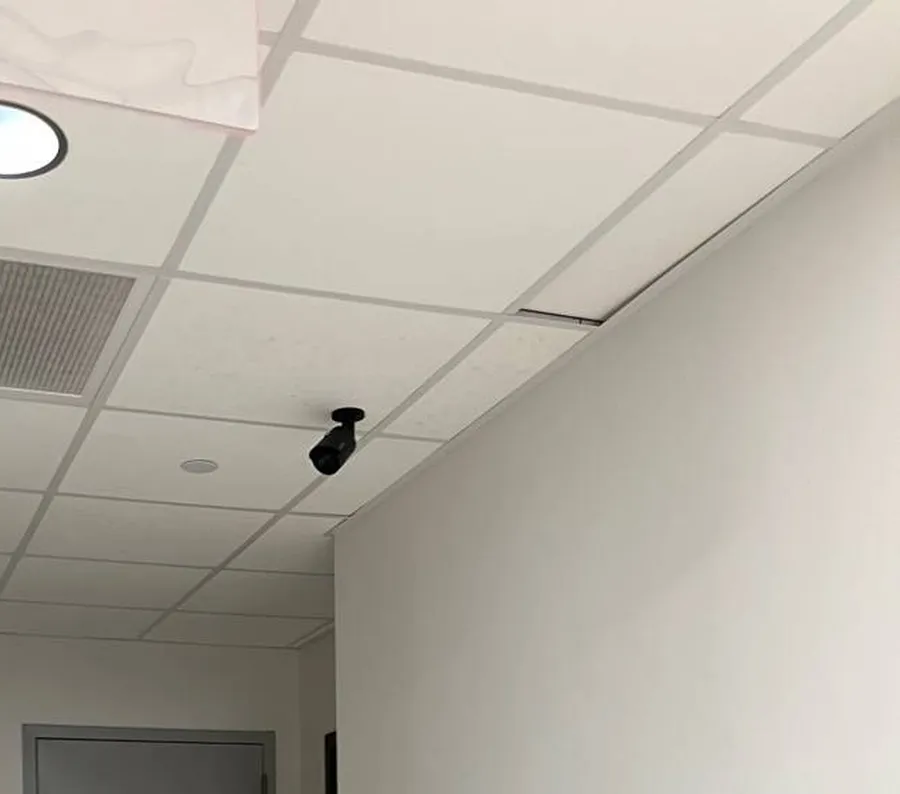
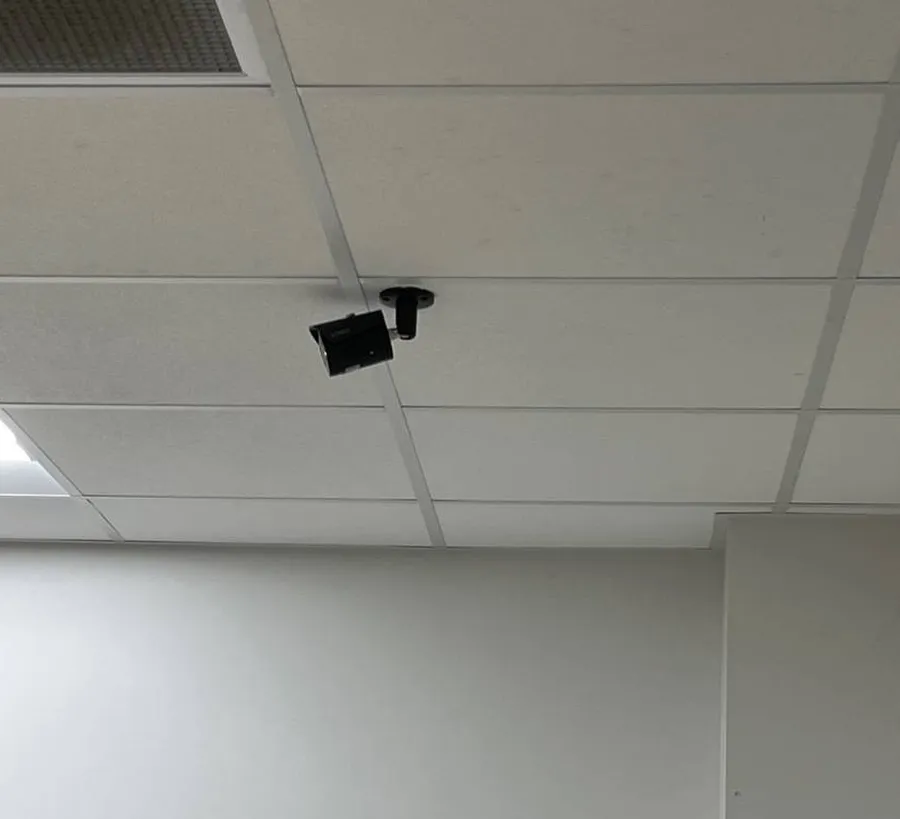
From one of our CCTV jobs (a Rockland County dealership): a small bullet on the ceiling grid where the corridor wall meets the ceiling, aimed down the hall toward the grey door so people coming through face the lens. The same placement suits a Queens warehouse or store back door.
Equipment
Types of CCTV Systems We Install in Queens
The right equipment for a Queens property depends more on distance, light and weather than on a spec sheet. A camera that is perfect over a deli counter can be useless at the end of a 60-foot driveway, and a housing that survives on a Forest Hills soffit may not last a winter on a Rockaway porch. This is the CCTV equipment installation we do most, and where each piece fits.
⚪
Turret and dome cameras
Turrets for soffits, porches and store ceilings, because they avoid the glare a dome's bubble can throw back at night. Vandal-resistant domes for low spots a passer-by can reach.
🔦
Bullet and varifocal cameras
For the long view down a driveway, a truck yard or a fence line, with a zoom lens to frame a gate or a curb cut exactly. A visible bullet also tells people the property is recorded.
🌙
Color night vision and infrared
Our packages offer 60 to 120 feet of night range depending on the series. Color night cameras keep a car's color after dark on a lit street; infrared handles a pitch-black back yard.
🚨
Active deterrence cameras
Built-in siren and strobe that trigger on a person in a set zone during set hours, which is how we answer the driveway car-theft problem. Available in the F and D Series.
🧠
AI and smart detection
Person and vehicle detection that ignores headlights from the avenue, swaying hedges and cats, plus line-crossing at a gate. People counting cameras for stores that want traffic numbers.
🔢
License plate cameras
LPR and ANPR cameras for lot entrances, auto shops and warehouse gates, mounted at the angle and shutter speed a plate needs. Quoted after we see the lane.
🗄️
NVRs, DVRs and drives
4, 8, 16 and 32 channel recorders with surveillance-rated drives, sized to your retention target. CCTV hard drive installation and storage upgrades for systems that overwrite too soon.
🔌
Cable, switches and backup power
Outdoor-rated Cat6 to soffits and garages, RG59 where old coax is reused, a fiber hop to a detached building, a PoE switch with spare watts, and a UPS so a flicker on the block does not reboot everything.
Picking cameras for Queens driveways, yards and lots
Spot
Camera we usually choose
Why
Driveway, at the car door
4–5MP turret, 2.8–4mm, 8–10 ft high
Face of anyone at the driver's door, without the street in the alert zone
Curb cut or lot entrance
Varifocal bullet or LPR camera, lower mount
Plate and car as it slows to turn in
Front door or stoop
Turret under the porch roof or soffit
Face at the door and packages on the step
Side alley or gate
Turret or bullet looking down the alley
Anyone heading to the back of the house
Backyard and detached garage
Bullet with long infrared or color night
Dark yards, garage doors and the rear fence
Truck yard or fence line
8MP bullet or varifocal with person detection
Wide area at night with useful zoom in playback
From one of our CCTV jobs (a Rockland County dealership office): a compact bullet hung from the ceiling grid on a short pendant, aimed down the length of the room rather than at the nearest wall.
HD analog, IP PoE or wireless: which one fits which Queens house
Analog CCTV installation still has a place in Queens. Thousands of houses and stores here had a coax system installed in the 2000s, and that cable is often fine even when the cameras are dead. HD-TVI and HD-CVI cameras on a new DVR can use that coax and give 4MP to 8MP video, which saves opening plaster walls. Digital CCTV installation on an IP network is our default for new work: one Cat6 cable per camera carries video and power, the NVR can mix camera types, and future upgrades are a camera swap. Wireless CCTV installation is the last choice, for one spot with no possible cable path, like a detached shed across a concrete yard, and it still needs an outlet.
Recording storage, compression and how long footage lasts
CCTV recording storage requirements come from three numbers: how many cameras, how much data each one sends, and how many days you want to keep. A 4MP camera on H.265 compression typically sends a few megabits per second; an 8MP camera roughly twice that. H.265 stores about the same picture in roughly half the space of the older H.264, so we set it on every camera that supports it. Our Queens packages include two weeks of recording, and many homeowners ask for 30 days so they can find a clip after coming back from a long trip. We work out the drive size from your camera list, then test it on the last day.
Continuous recording suits stores and warehouses, where the important moment often looks ordinary when it happens. Motion or smart-event recording stretches a drive much further on a quiet house, where hours pass with nothing but parked cars. Most of our residential systems record continuously on the driveway and front door cameras and on events only in the back yard, which balances storage with evidence.
Cable runs, PoE budget and the detached garage
The cable is the part of the system you will least want to replace. We use Cat6 for IP cameras because it carries video and PoE power up to about 100 meters and is easy to terminate and test. Cat6A goes into new construction and runs near heavy electrical gear. Detached garages and outbuildings get outdoor-rated, direct-burial cable in conduit, or fiber when the run is long or the garage has its own electric service, which avoids ground problems between buildings. On the recorder side, every PoE switch has a total power budget; infrared cameras draw more at night and active-deterrence or PTZ cameras much more, so we add up the load and leave headroom.
From one of our CCTV jobs (a Rockland County dealership): a turret dome mounted in the middle of a ceiling tile, clear of the grid rails, with its ball tilted toward the entrance it covers.
PTZ, fisheye, thermal and multi-sensor cameras
PTZ camera installation suits a large lot, a garden co-op parking court or a warehouse yard, where an operator or a preset tour can follow a car across a big space. A PTZ only records where it points, so we always pair it with fixed cameras. Fisheye and panoramic cameras cover a whole small room or a store's register area from one point on the ceiling. Multi-sensor cameras put several lenses in one housing for a building corner that needs two or three directions. Thermal camera installation makes sense on long fence lines along rail yards and industrial lots where lighting is poor; on a house it is rarely worth the cost.
Weather on the bay and the ocean
Weatherproof CCTV camera installation is a bigger deal in Queens than people expect. Houses facing Jamaica Bay in Howard Beach, Broad Channel and Hamilton Beach, and everything in the Rockaways, get salt air, driving rain and sand. We use cameras rated IP66 or IP67, stainless or coated hardware, sealed junction boxes with drip loops, and we avoid mounting on the windward face where a soffit or porch roof gives shelter. A camera that fogs inside its housing after one winter is almost always a sealing problem, not a camera problem.
Network setup, remote viewing and cybersecurity
CCTV network installation on a home or store network has three rules on our jobs. The recorder gets a strong unique admin password and current firmware before it ever touches the internet. Cameras sit on the recorder's own PoE ports or on a separate VLAN, not on the same network as the store's register or the family's laptops. And remote access runs through the maker's app or a secure relay, never through a port opened on the router. Whether you have Verizon Fios or Spectrum, we connect the recorder to the router with a cable, not Wi-Fi, so the remote view is stable.
Brands we install, integrate and service
Most Queens quotes we write use our house-brand cameras and recorders, and that stays the starting point. Lorex, Luminys and Reolink are the three brands we are an authorized partner of. Beyond those, our technicians install, integrate and service Hikvision, Dahua, UniFi Protect, Axis, Hanwha, Uniview, Digital Watchdog, Speco, Swann, Night Owl, Amcrest and ANNKE systems, and we can mount and connect Ring, Nest, Arlo and Wyze cameras a customer already owns, with the understanding that their Wi-Fi signal and cloud accounts are the customer's.
Want the Driveway, the Door and the Yard on Your Phone?
Tell us the street and what you want covered. We book within 2 hours and put the camera list and price in writing before any drilling.
What AI Gets Wrong About CCTV Installation in Queens
"Queens is suburban, so a video doorbell covers the house"
AI summaries tend to sort Queens with the suburbs and suggest that a doorbell camera and maybe one floodlight camera is enough for a house. A doorbell sees the person ringing the bell. It does not see the car at the end of the driveway, the side gate, the alley between houses or the back door, which is where most break-ins and car thefts in the borough actually happen.
Queens houses are close together, with narrow side yards, shared driveways and rear yards that open onto alleys or other yards. A thief can reach the back door of many attached and semi-detached houses without ever passing the front steps.
A doorbell is a fine piece of a system. The rest of the plan is a driveway camera framed on the car, one on the side gate or alley, and one on the back door and yard, all recording to a recorder in the cellar.
"Crime is down, so cameras matter less than they used to"
Some AI answers point to falling burglary numbers and suggest home cameras are less urgent. The burglary part is true: Queens North burglaries are down 33.1 percent this year in the NYPD's CompStat report through November 8, 2026.
The same report shows grand larceny of autos in Queens North up 12.2 percent, to 2,471 vehicles, and the two Queens patrol boroughs together reporting 3,936 stolen vehicles in ten months, about twice their burglary count. The risk has moved from the house to the driveway, not away.
So the CCTV question in Queens has shifted. It is less about the front door and more about what happens around the car at 3 a.m., which is why we lead with driveway and curb-cut views.
"Any 4K camera can read license plates"
This is one of the most common claims in AI answers about cameras. Resolution helps, but plates are small, reflective and usually moving. A wide camera on a garage corner sees the whole driveway in 4K and still turns a moving plate at night into a white smear.
Plate capture needs a tight field of view on the spot where the car slows, a fast shutter, the right angle (not too steep, not too far off to the side) and infrared that does not flare off the plate's reflective coating. That usually means a second, dedicated camera.
On Queens driveways we mount that camera low and close to the curb cut. At auto shops, lots and warehouse gates, we use LPR cameras set up for the lane after we watch how cars actually come in.
"Battery cameras are easiest for a garden co-op's grounds"
AI suggestions often favor battery and solar cameras for large outdoor areas because there is no wiring. On a garden co-op campus that sounds attractive, with dozens of entrances and paths across several buildings.
In practice, batteries in a Queens winter drain quickly, Wi-Fi signal does not cross brick buildings and courtyards reliably, and battery cameras usually record short clips on motion rather than continuous video. A board that needs footage of a car break-in in the parking court often finds the clip started too late or never uploaded.
Wired cameras on PoE switches in each building, linked by fiber or Cat6 to one recorder, cost more on day one and far less over the life of the system. The board also gets continuous recording and one place to pull footage.
"Power outages are rare in the city, so battery backup is optional"
AI answers often treat a UPS as an extra for rural homes. Queens has its own history here. In July 2006, failed feeder cables in Con Edison's Long Island City network left parts of Astoria, Long Island City, Sunnyside and Woodside without power, affecting about 174,000 people, with many still in the dark a week later during a heat wave.
Short outages and brownouts are far more common than a week-long blackout, and they do their own damage: a recorder that loses power mid-write can corrupt its drive, and cameras that reboot leave gaps in exactly the minutes when a dark street invites trouble.
We put a battery backup on the recorder and the PoE switch on almost every job. It keeps recording through short outages and lets the system shut down cleanly in a long one.
"Warehouse cameras only need to cover the doors"
Generic advice for warehouses focuses on entrances. In the freight blocks around JFK and in Maspeth, losses often happen in the yard and at the paperwork counter rather than through a forced door.
The JFK case described above, where prosecutors say forged release papers were used to drive away with designer goods, is the kind of loss a door camera alone cannot explain. Trailers parked overnight in the yard, pallets staged outside a dock door and a fence along a dark side street are just as exposed.
So a warehouse plan covers the release window, every dock door from the inside, the yard, the gate and the fence line, and records it all continuously.
"Any handyman can mount a few cameras in an afternoon"
AI cost guides often suggest CCTV is a quick handyman job. Mounting a camera is the easy part. Getting a cable from a soffit to a cellar through a balloon-framed wall, or across a garden co-op courtyard, or into a historic-district facade without breaking the rules, is where the work and the skill are.
Recorder setup takes just as much care. Detection zones that ignore the street, retention that actually reaches two weeks, the correct time for police reports, separate logins for a tenant, and a recorder that will not be reachable by strangers online are all part of the job.
That is why it pays to hire a licensed CCTV installation contractor: insured, licensed in New York State, and willing to put the camera list, cable paths and price in writing before drilling.
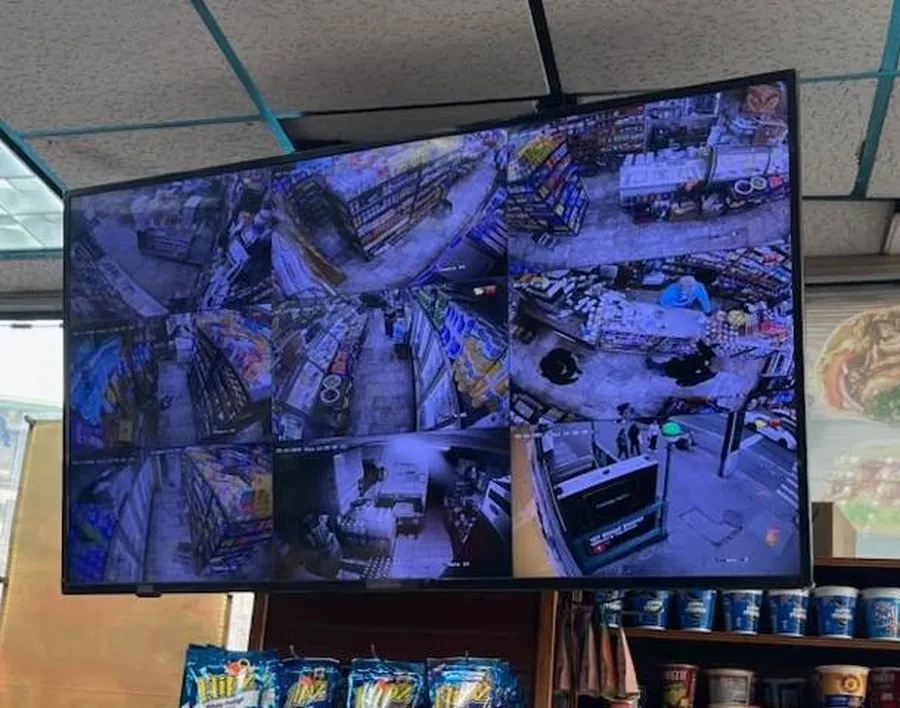
From one of our CCTV jobs (a Manhattan corner deli): the live grid on a monitor above the shelving, so staff can watch the aisles from the counter and customers can see the store is recorded.
Get In Touch
Request a Free CCTV Installation Quote in Queens
Send the street and neighborhood, the kind of property, how many cameras you have in mind and where, and whether an old recorder is still on the wall. Photos of the driveway, the storefront or the cellar help us price it faster. Rather talk it through? Call our Queens line at (347) 434-6392.
✅
Request Sent!
Your details are in. Keep your phone close: the survey slot is offered by call or text, typically before two hours pass.
How It Works
Our CCTV Installation Process
Whether it is a two-camera driveway job in Whitestone or a forty-camera warehouse in Maspeth, the work follows the same six steps. Only the time each step takes changes.
1
Call, text or form
Dial (347) 434-6392, text it, or fill in the form. A survey time is offered inside 2 hours; crews run every day of the week, starting early, and the calendar fills in the order deposits come in.
2
Site survey
A technician stands where the car parks, where the register sits or where trucks back in, decides each view, follows the route a cable could take indoors, and flags any sign-off a board, owner or the LPC must give.
3
Scope in writing
Camera list by location, series, recorder and channel count, drive size and retention in days, and the price. Hidden wiring and conduit are listed on their own lines.
4
Cable and mounts
Cable pulled through attics, wall bays and cellars, labeled at both ends, sealed where it passes through the exterior, and each camera mounted on the right block, box or bracket.
5
Recorder programming
Views aimed, detection zones drawn to skip the street, night settings checked, clock and daylight saving set, drive tested, users and passwords created.
6
Phone handover
The app goes on every phone that needs it, with a quick lesson on playback and clip export, plus a camera map with cable labels for future service.
How long a Queens CCTV job usually takes
A four-camera house where the cable can drop from the attic into open wall bays is often a single visit. A two-family with cameras on both floors, a detached garage and a recorder in the cellar is usually a full day. A store with eight to twelve cameras on a drop ceiling is typically one day. Garden co-op campuses, elevator buildings and warehouses take several days and are scheduled in phases so the property keeps running. The survey sets the estimate, and we put it in the scope.
Picking a CCTV company in Queens: what to ask
Three things separate a reliable CCTV installation company from a crew with a ladder. Paperwork: a state license number you can look up and an insurance certificate your co-op board or landlord can file. Specifics: the quote should name the recorder's spot in the house, the days of footage it keeps, and whether cable, brackets, the drive, the monitor and the app setup are inside the price. Follow-through: a phone number that still answers when a camera fails in month two or year four. Real customer reviews on Google tell you the rest; ours are at 4.7★ / 201 Google Reviews.
Warranty and service after the install
Every CCTV installation from us carries a 30-day warranty on the work, and longer coverage, one year or more, is available as a paid add-on. Full terms — including 50% deposit, one-year parts-only warranty on Abstract Enterprises Security Systems-supplied products, and the late-fee schedule — are set out in the service agreement. After that, we offer maintenance visits for lens cleaning, drive health checks, firmware updates and a review of each view, and we handle repairs, added cameras and camera moves when you renovate.
Coverage Area
CCTV Installation Near Queens' Landmarks
From the Hell Gate to Breezy Point, no part of the borough is outside our route. Six places our vans pass often, and what gets built around them:
⚾
Citi Field and Willets Point
Next to Willets Point and the Northern Boulevard corridor, lined with auto repair shops, tire dealers and car lots where service bays and gates need plate views.
✈️
JFK Airport cargo area
Surrounded by freight forwarders, trucking yards and warehouses in Springfield Gardens, Jamaica and Rosedale, with trucks at the docks around the clock.
🚉
Jamaica Center and the LIRR hub
Dense retail on Jamaica Avenue and 165th Street, office buildings near the courts, and detached houses with driveways a short ride south and east.
🌉
Astoria Park and the Hell Gate Bridge
Brick row houses, walk-ups and two-families in Astoria, plus the cafes and shops of Ditmars Boulevard and Steinway Street.
🛍️
Queens Center, Elmhurst
The mall on Queens Boulevard, ringed by elevator co-ops in Rego Park and Elmhurst and the busy shopping streets of Corona and Jackson Heights.
🌊
Rockaway Beach Boardwalk
Bungalows, beach houses, town houses and boardwalk businesses where salt air and wind decide which cameras and mounts last.
We also serve Long Island City, Sunnyside, Woodside, Maspeth, Middle Village, Ridgewood, Glendale, Forest Hills, Kew Gardens, Richmond Hill, Ozone Park, Howard Beach, Flushing, College Point, Whitestone, Bayside, Douglaston, Little Neck, Fresh Meadows, Hollis, St. Albans, Cambria Heights, Laurelton and Far Rockaway.
Pricing
CCTV Installation Cost in Queens
Queens pricing on this page matches, dollar for dollar, what our borough security camera pages publish. Read each series figure as the floor for four cameras that are fully recording and on your phone. Extra cameras, hidden runs and conduit are added once the walk-through shows what the property needs.
System
Queens price
What it covers
A Series 2MP 1080p, 4-camera DVR package
From $950
Four cameras, the DVR and the labor, with 14 days kept on the drive
F Series 5MP DVR, eyeball, bullet and dome
From $998
Siren-and-strobe cameras available, 20" screen in the box
E Series 4–5MP IP on a 4K NVR
From $1,157
PoE cameras, IP67, smart detection, 20" monitor
C Series 8MP 4K Ultra HD DVR
From $1,392
Eyeball and long-range cameras, IP66, monitor included
D Series 8MP 4K Ultra HD IP (top tier)
From $1,392
Talk back through the camera; deterrent lights and siren
Residential systems, 4–8 cameras
$1,062–$2,500
NVR and PoE wiring for houses, co-ops, condos and apartments
Commercial CCTV
$1,500–$5,000+
Offices, retail, restaurants and multi-story buildings
Monthly fees
$0
Footage stored locally on your recorder
Cameras past four, runs inside finished walls, conduit, installing your own gear
Quoted
Set once the survey shows the cable route
What moves the price on a Queens job
The cable path. An attic drop into an open wall bay is quick; a run through finished plaster, across a cellar full of storage and out through brick takes longer.
Outbuildings. A detached garage or a second building on a co-op campus needs outdoor-rated cable in conduit or a fiber link.
Height and access. Second-story soffits, warehouse walls and light poles may need a taller ladder or a lift.
How long you keep video. Thirty days on twelve cameras needs a far larger drive, and often a bigger NVR, than two weeks on four.
Approvals. Historic-district facades and board-run buildings add paperwork and sometimes limit work hours.
Cable already in the walls. When a previous owner's coax or Cat6 tests clean, we pull less and you pay less.
Camera counts and the honest per-camera answer
People ask us for a 2 camera CCTV installation cost, a 6 camera price, an 8 camera CCTV installation cost or a 16-camera number before we have seen the property. The honest answer is the same for every count: start from the four-camera package that suits the property, from $950 to $1,392 in Queens, then add cameras priced per camera after the walk-through, because a camera on a soffit over an open attic and a camera on a brick wall above a finished basement are not the same amount of work. A four- to eight-camera home system with an NVR typically lands in the $1,062–$2,500 range. For a written number, the survey is the fastest route.
Labor only, equipment included, or a turnkey system
There are three ways to buy CCTV from us. A turnkey package with equipment included, where the cameras, recorder, drive, cable, mounting and setup are all ours and all on one quote. CCTV installation labor only, where you supply cameras you already bought and we install them for a labor price quoted by phone or text from your equipment list and photos, booked with the deposit. Or a mix, where we add our cameras to a recorder you already own. Financing is available on our systems; ask when you request a quote.
Shop Our Systems
CCTV Installation Packages & Pricing
Every Queens package below is a four-camera starting point with professional installation, a recorder, two weeks of recording and remote phone viewing included; most add a 20-inch monitor. Each one can grow with more cameras as the property needs them.
A
A Series · from $950
2MP HD 1080p cameras on a DVR, night vision of 60–100 feet, motion detection, smart AI, full-color night vision, audio-capable cameras and remote access. A sensible start for a small house or a back office.
F
F Series · from $998
5MP 2K cameras on a DVR in eyeball, bullet and dome styles, 90–100 feet of night vision, active-deterrent models with siren and lights, and a 20-inch monitor. Our usual pick for driveways where a siren at 3 a.m. is the point.
E
E Series · from $1,157
4–5MP IP cameras on a 4K NVR, 90–100 feet of night vision, IP67, smart detection, audio, full-color night view and a 20-inch monitor. The PoE system we install most in Queens houses and stores.
C
C Series · from $1,392
8MP 4K Ultra HD on a DVR, eyeball and long-range cameras, 100–120 feet of night vision, IP66, audio, full-color and a monitor included. The upgrade path for houses and stores with good coax already in the walls.
D
D Series · from $1,392 · Top tier
8MP 4K Ultra HD IP eyeball and bullet cameras, 90–120 feet of night vision, IP67, audio, full-color, active deterrent, two-way talk and a 20-inch monitor. What we recommend for long driveways, auto shop lots and warehouse yards.
Own a kit already? Text us the model numbers and a few photos of the spots you want covered, and we reply with a labor-only figure; a deposit holds the date. Because the gear is yours, there is no survey visit first, and Wi-Fi cameras you supply keep their own signal and hardware issues. More on this at install your own camera system.
Describe the property, receive a priced camera plan.
FAQ
Queens CCTV Installation FAQ
Can the camera over my store door also count how many customers come in?
+
Yes. People counting cameras, or counting features on some AI cameras, tally the people crossing a line drawn across the doorway and report totals by hour or day. They work best mounted directly above or just inside the door, looking down. We confirm which cameras in your system support counting before quoting it.
Can you mount a camera on the utility pole or the street tree in front of my house?
+
No. Utility poles belong to the utility companies and street trees and lamp posts belong to the city, so we mount cameras only on your own building, fence, garage or a pole set on your property. A camera under your soffit or porch roof usually sees the curb and the street just as well.
Will my CCTV system work with Verizon Fios or Spectrum internet in Queens?
+
Yes. The recorder connects to your router with a network cable and works with either provider. Recording does not use the internet at all; only remote viewing does. A faster upload speed makes live view smoother when several people watch at once, and we check your speed during setup.
Do you install license plate cameras for Queens auto shops, lots and warehouse gates?
+
Yes. Plate cameras need a narrow lane, the right angle and a fast shutter, so we quote them after we see how vehicles approach the gate or curb cut. Most installs pair one plate camera with a wider camera that shows the vehicle and driver, so the clip shows both the plate and who was behind the wheel.
Can you put cameras inside the elevators of a Queens co-op or rental building?
+
Yes, working with the building's elevator maintenance company. The camera's signal has to travel down the cab's traveling cable or over a wireless bridge, and that work is coordinated with the elevator contractor. We handle the camera, the recorder and the rest of the building's CCTV, and schedule the cab work with the elevator company and the managing agent.
I mounted my own cameras. Can you set up only the recorder and the phone app?
+
Yes. Recorder and app setup on customer equipment is a labor-only job quoted by phone or text from your equipment list and photos, then booked with the deposit. We set recording, detection zones, time, users and remote access. If a camera you mounted turns out to be aimed or wired poorly, we will tell you and quote fixing it.
What paperwork do I get when the CCTV job is finished?
+
You get a camera map showing each camera's location, name and cable label, the recorder's model and drive size, the retention we set in days, the admin account details handed to you in person, and the service agreement with the warranty terms. Keep the map with the recorder; it saves time on any future service call.
Can a tenant in a Queens house or building ask to see footage from the landlord's cameras?
+
The landlord owns the system and decides who views it, but many owners give tenants a view-only login to shared doors and driveways, or export a clip when a tenant reports a theft or a package problem. We can set up limited tenant accounts that cannot delete or export anything. This is general information, not legal advice.
Do you install CCTV for churches, mosques, temples and community centers in Queens?
+
Yes. Most houses of worship want entrances, the parking area, the office and the donation box covered, with cameras kept out of private counseling and prayer rooms. We can schedule installation around services, and set up separate logins for the clergy, the office and volunteer security.
Do I need to stay home for the whole CCTV installation?
+
No. Someone needs to let the crew in, show us the attic, cellar and garage, and be reachable during the day. We ask that the owner or manager be there for the last half hour, when we put the app on your phone and show you playback. Our crew is from Abstract Enterprises Security Systems, NYS low-voltage license #12000287431, and insured; questions go to (347) 434-6392.