Poughkeepsie rental, Route 9 storefront, Millbrook barn or Beacon shop? Wired DVR and NVR systems that record on your own property. Dutchess County line: (845) 640-3835
Recorders You Control · Coax or Cat6 Cabling · Rentals, Retail & Farms · Outage-Ready
CCTV installation in Dutchess County, NY means a wired camera system whose recorder sits on your property, writes to its own drive, and answers to you, not to a cloud account or a public network. Abstract Enterprises Security Systems installs closed circuit television for two-families and three-families in the City of Poughkeepsie, stores and plazas along Route 9 in the Town of Poughkeepsie, Wappingers Falls and Fishkill, Main Street shops in Beacon and Rhinebeck, and barns and long drives from Millbrook to Amenia. House-brand 4-camera systems with the recorder, the wiring, the installation and two weeks of recording start at $1,299 here, with $0 monthly fees, and every recorder we set up keeps recording through an internet outage.
Written and checked by the Abstract Enterprises Security Systems install team (NYS license #12000287431), last revised November 16, 2026. Data used on this page: NYS DCJS Index Crimes by County and Agency, 2024 (data.ny.gov); U.S. Census Bureau ACS 2023 5-year estimates, DP04; Mid Hudson News, September 25, 2026; The Highlands Current, October 16, 2026; Dutchess County Government press release, November 14, 2024; Daily Freeman, July 5, 2026
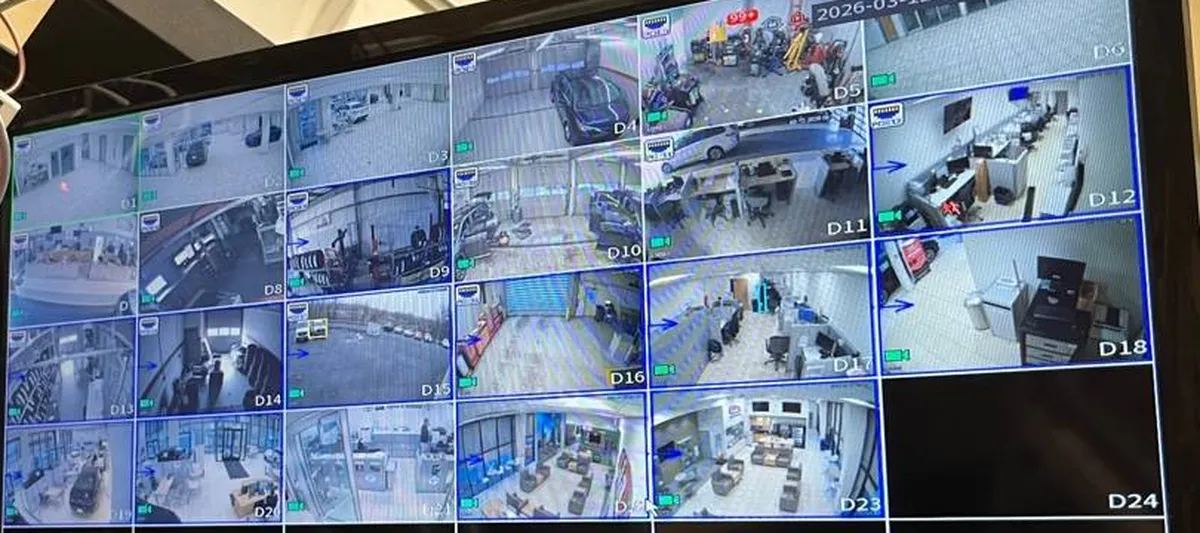
Rockland County car dealership job photo: a close view of the recorder's live grid, with tiles for the lobby, the lot, the service desks and the offices, labeled by channel, and an empty tile at the corner where the next camera will go.
Dutchess County CCTV Request
Town or city, type of property, and what you want the cameras to prove
✅
Request Sent!
Thanks. Expect a call or text to set up your Dutchess County CCTV visit, normally within 2 hours of your request.
25+
Years Experience
2 Hr
Booking
100%
Licensed & Insured
4.7★
201 Google Reviews
In business since 2002 · One local number for Dutchess: (845) 640-3835 · We call back to book within 2 hours
Quick answer: CCTV installation Dutchess County NY pricing starts at $1,299 for a house-brand 4-camera A Series system, recorder, wiring, installation and two weeks of recording included. Business CCTV systems run $1,500 to $5,000+, and there are no monthly fees. The other house-brand series start at $1,347, $1,506 and $1,741, and 4- to 8-camera home systems on an NVR with PoE wiring land between $1,452 and $2,500. Extra cameras, runs to a barn or a detached garage, conduit and hidden wiring are priced once we confirm the layout. We book within 2 hours, schedule 7 days a week with early-day visits, and take dates first come, first served once the deposit is in.
Cat6-powered IP cameras or HD-analog coax cameras, both feeding a recorder kept in your own building; licensed New York low-voltage work, #12000287431
You hold the admin login and decide who sees the footage; nothing is shared with anyone unless you share it
Battery backup offered on every recorder, because Central Hudson outages are part of life here
Why Dutchess County Properties Need CCTV Built for Their Own Address
Dutchess is three counties in one. The southern end, from Beacon and Fishkill through Wappingers Falls, feels like an extension of the commuter suburbs, with subdivisions, plazas and I-84 warehouses. The middle is Poughkeepsie, which is really two places with two police departments: a small, dense, old city of multi-family houses, and a large suburban town that holds most of the county's big retail along Route 9. North and east of the Taconic, the county turns into horse farms, orchards, estates and villages like Millbrook, Rhinebeck, Red Hook, Pine Plains and Amenia. A camera plan that suits one of those places is wrong for the other two.
That is why we do not sell a single Dutchess package and stop there. A three-family on a Poughkeepsie side street needs cameras on a shared porch, a back stair and a driveway that two tenants use, with the recorder somewhere no tenant can unplug it. A clothing store in a Route 9 plaza needs faces at the exit door and a clean angle on the register far more than it needs a camera on the roof. A horse property near Millbrook needs a barn camera that survives dust, cold and a long cable run. Each of those is a closed circuit television system, and each one starts with a different question.
What the state's crime data says about Dutchess
The New York State Division of Criminal Justice Services publishes index crime counts for every police agency in the state. For 2024, Dutchess County as a whole reported 268 burglaries, 2,548 larcenies and 142 motor vehicle thefts. The interesting part is where those numbers fall. The Town of Poughkeepsie Police Department alone reported 984 larcenies, about 39% of the county's total, which tracks with the malls, plazas and big-box stores on Route 9 in the town. The City of Poughkeepsie reported 84 burglaries and 411 larcenies. Between them, the city and the town account for more than half of all larcenies in the county.
Police agency (2024)
Burglary
Larceny
Vehicle theft
Town of Poughkeepsie PD
59
984
25
City of Poughkeepsie PD
84
411
41
State Police in Dutchess (11 months reported)
39
350
22
Dutchess County Sheriff
40
288
14
Fishkill Town PD
7
118
6
East Fishkill Town PD
7
114
10
Beacon City PD
11
88
10
Hyde Park Town PD
16
61
13
Dutchess County total
268
2,548
142
Larceny is the crime CCTV is best at documenting. It covers shoplifting, package theft, tools lifted from a truck bed, bikes taken from a porch and items taken from unlocked cars. A burglary is often discovered hours later; a larceny is usually a few seconds in front of a door or a register, and the only witness is whatever camera was pointed at that spot. The rural towns, policed mostly by the Sheriff and the State Police, report far fewer incidents, but those incidents tend to happen far from neighbors, at a barn or an outbuilding where the camera may be the only record at all.
The housing stock behind the camera plans
The Census Bureau's 2023 American Community Survey counts 122,636 housing units in Dutchess County. Countywide, 62.6% are detached single-family houses, 31.2% of occupied homes are rented, and 18.0% were built before 1940. The two cities look very different from that average:
City of Poughkeepsie: 14,254 housing units, only 27.0% detached houses, 16.1% two-unit buildings and 19.3% in buildings of three or four units. Some 60.8% of occupied homes are rented, and 39.3% of the housing was built before 1940.
City of Beacon: 6,658 housing units, 52.5% detached, 40.5% renter-occupied, and the same 39.3% built before 1940.
The rest of the county: mostly owner-occupied detached houses, from 1950s capes and raised ranches near Wappingers and Hyde Park to newer colonials in LaGrange and East Fishkill and farmhouses in the northeast towns.
Old multi-family housing changes CCTV work in three ways. The wiring routes run through balloon-framed walls, fieldstone or brick foundations and attics that were never meant for cable. Several households share the entrances, so camera placement has to respect each tenant's privacy. And the owner frequently does not live there, so remote viewing and health alerts matter more than a monitor in the kitchen.
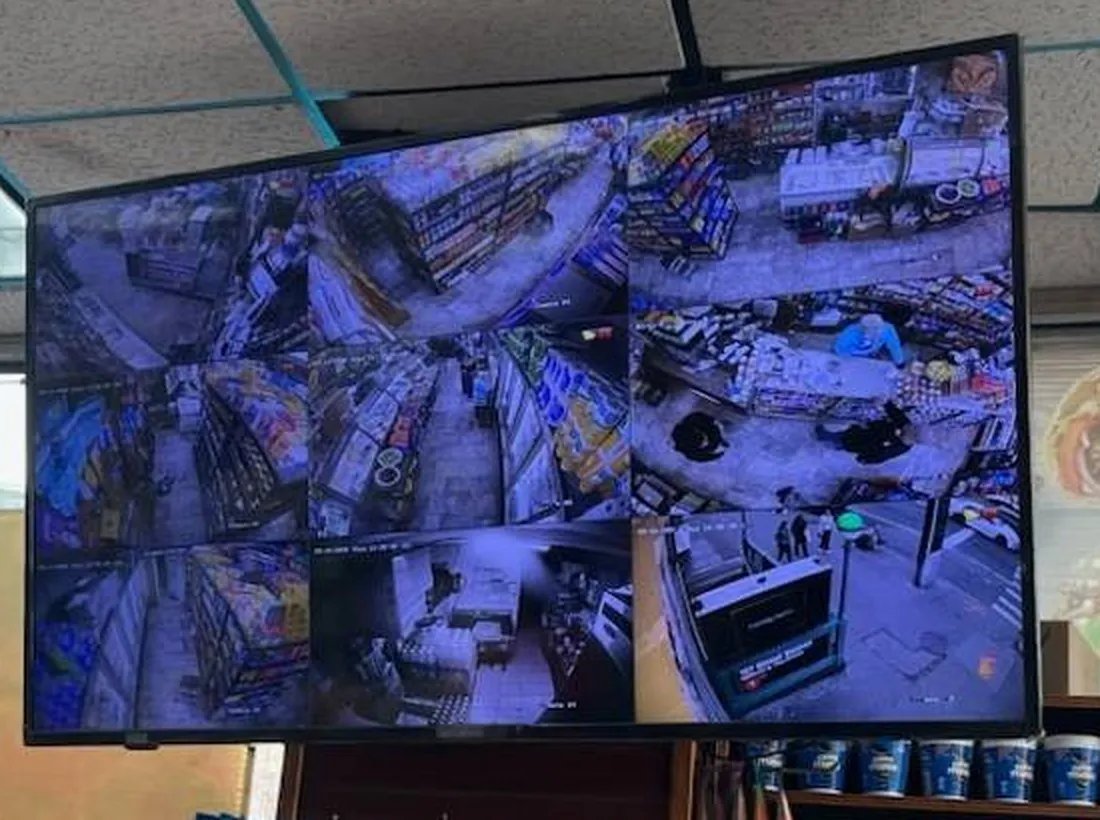
Manhattan corner deli job photo: a wall TV over the snack shelves shows every camera in the store at once, aisles, counter and entrance, so staff and customers can see the system is live.
Who Holds the Footage
Public Cameras Came Down This Fall. Your Recorder Is Still Yours.
Dutchess spent much of 2026 arguing about cameras. In November 2024 the county announced a Real-Time Crime Center at the Law Enforcement Center in Poughkeepsie, and the Legislature approved $200,000 to launch it, money that the county said would cover new cameras for high-crime areas and equipment to integrate existing municipal and community cameras. The center, run jointly by the Sheriff and the District Attorney as the Analysis and Real-Time Crime Intelligence Center, relied on Flock license plate readers.
In September 2026, after a public forum in Pleasant Valley where residents spoke against the plate readers, Sheriff Kirk Imperati and District Attorney Anthony Parisi announced that they were withdrawing support for the county's continued use of Flock. On October 13 the County Legislature voted unanimously that any county-owned plate reader still up on November 1 be covered. The Highlands Current reported that the resolution applied to 65 county-owned cameras, while 372 others sat on private land or roads controlled by the state and municipalities, including seven in Beacon, and that in the 30 days before October 14 the county's cameras recorded the plates of 435,928 vehicles.
“But believing a technology can be useful does not mean government should continue using it when the people it serves have raised serious concerns. Public safety depends on public trust. We cannot lose sight of that.” Dutchess County Sheriff Kirk Imperati, quoted in Mid Hudson News, September 25, 2026
We are not taking a side in that debate, and this page is not about public surveillance. It matters to a homeowner or a store owner for a narrower reason: the argument was about who controls camera data, how long it is kept and who can search it. Those are exactly the questions to ask about your own system. A private CCTV system we install records to a recorder on your property. You hold the admin password. Footage is overwritten on a schedule you choose, usually after two weeks. Nobody, including us, can browse it unless you give them a login or hand them a clip.
Legislator Lisa Kaul, who represents part of the Town of Poughkeepsie, put the cloud question plainly at the October meeting: “Cloud-based surveillance technology raises serious questions about who can access our information, how long it is retained, where it can be shared and how it can be used” (The Highlands Current, October 16, 2026). Whatever you think of plate readers on public roads, those four questions have simple answers on a local recorder: the people you choose, as long as you set, wherever you take a clip, and only for what you decide.
What that means for the system we design
Local recording first. Every camera records to a DVR or NVR on site. Phone viewing is an add-on to that, not a replacement for it.
Your login, not ours. We set the admin account in your name, write the password on the handover sheet and give staff or tenants limited logins only if you ask.
A retention period you choose. Two weeks is included. Longer is a drive-size decision, and shorter is a setting.
Cameras aimed at your property. Doors, drives, lots, registers and stairs, not a neighbor's windows or the whole public road. Privacy masking blacks out anything a camera should never record.
Sharing is your call. If police ask for footage after an incident, you export the clip and decide what to give them. Some departments have run voluntary camera lists; before the September 2026 decision, the county's ARTCIC site invited residents to register existing cameras through Flock's Community Connect. With the county leaving Flock, ask your local department what, if anything, replaces it.
A one-page camera policy for a business or a rental
Larger organizations write video policies. A Dutchess shop, office or rental owner can get most of the benefit from one page, and we help draft the camera list for it at handover. It should name every camera and what it covers, who has logins and at what level, how many days the recorder keeps, who is allowed to export a clip, and what happens when police, an insurer, a tenant or a customer asks for footage. Keep it with the password sheet. When a request arrives at a busy moment, the person on duty knows the answer is "the owner decides" and does not hand over the recorder or a login on the spot.
None of this is legal advice. If you run a business that may receive a subpoena or a records request for video, talk to your attorney about how long you should keep footage and who should handle requests.
What We Install
CCTV Installation Services Across Dutchess County
Our CCTV installers handle the whole job: survey, cable, mounts, recorder, network, app and handover. One company plans it, one company stands behind it, and you get one phone number, (845) 640-3835, when you need something changed. If what you want is a doorbell camera or a single wireless add-on, our security camera installation service for Dutchess County homes and businesses covers that end of the market; this page is about wired CCTV systems and the DVR or NVR recorder at their center.
📹
Full CCTV system installation
One crew plans and builds the lot: lenses, mounts, cable, the recorder and its drive, the switch and the app. A Dutchess house usually begins with four to eight views; a shop or office with eight or more.
🏘️
Rental and multi-family CCTV
Shared porches, back stairs, laundry and parking for two- and three-families and small apartment houses, with a locked recorder and separate logins where the owner wants them.
🛒
Retail and plaza CCTV
Exit doors, registers, fitting-room corridors, stockrooms and rear doors for stores along Route 9, Route 44 and Route 52, sized to the hours the store is open and the hours it is not.
🐎
Barn, estate and farm runs
Fiber, PoE extenders or a point-to-point bridge to barns, run-in sheds, gates and equipment buildings, with housings chosen for dust, damp and cold.
🖥️
DVR and NVR installation
An NVR when the cameras are IP on Cat6, a DVR when they ride on coax. If the cameras are fine and only the box failed, see NVR installation page for Dutchess County.
🔁
Old system upgrades
Analog to IP, DVR to NVR, or a hybrid recorder that keeps good coax and adds IP cameras. See our Dutchess DVR upgrade options.
🔋
Battery backup and surge
A UPS under the recorder and switch, surge protection on outdoor runs and a recorder circuit on the generator where there is one.
🛠️
Repair and service calls
Black tiles on the monitor, a drive that quit, a mount loosened by ice. The Dutchess County camera repair crew also services systems another company put in.
📦
Labor-only installs
Bought your own kit? Text us the model numbers and the layout, get a labor price back, and the deposit holds your date.
Most first visits combine several of those. A Poughkeepsie landlord might want four cameras on a three-family, the old analog DVR in the basement removed, and the new recorder on a small battery. A store owner in a Wappingers plaza might want twelve cameras, a recorder in the back office, the network kept separate from the card terminals, and phone access for two managers. A horse farm in Washington or Stanford might want the house, the barn and the gate on one recorder. We plan all of them by asking what each camera has to prove before we choose a single part.
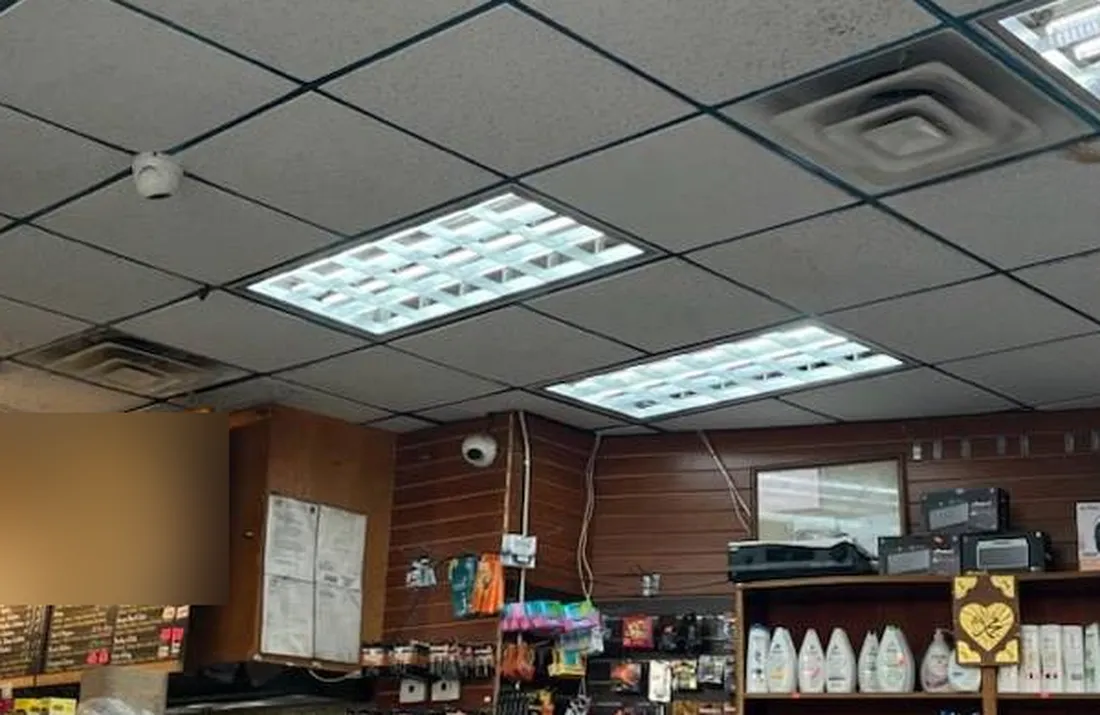
Manhattan corner deli job photo: a small white dome on the ceiling grid near the air vent, and a second dome on the wood-paneled wall above the shelves, covering the aisle and the approach to the counter.
Poughkeepsie
CCTV Installation Poughkeepsie: The City Blocks and the Route 9 Town
People say Poughkeepsie and mean either one of two municipalities. The City of Poughkeepsie is about five square miles of older neighborhoods around Main Street, Mill Street, Academy Street, the waterfront below the Walkway and the streets climbing up from the river. The Town of Poughkeepsie wraps around it and runs north toward Hyde Park and south toward Wappingers, with Marist on Route 9 to the north, Vassar on the city's eastern edge, the Poughkeepsie Galleria and dozens of plazas to the south, and subdivisions in between. CCTV installation Poughkeepsie owners ask us about falls into those two very different jobs.
In the city: two-families, three-families and houses split into apartments
With 60.8% of city households renting and more than a third of buildings in the two-to-four-unit range, most city calls come from landlords. The typical building is a wood-frame house from before the Second World War, sometimes with a brick or stone foundation, a deep front porch, a side driveway and a back stair. The best first cameras are usually the front porch and mailbox area, the side door, the driveway or parking pad, and the back stair or yard. Inside, a camera in a shared front hall is common; a camera that looks into any apartment door or window is not.
The recorder goes somewhere locked that no tenant controls: a locked closet, a cage in the basement, or a small lockbox on the wall with its own outlet. On buildings where the owner lives on one floor, the recorder can sit in the owner's unit. We run the cable through the basement and up the original stud bays where we can, and we keep exterior runs tight to trim boards and painted to match where we cannot.
Near the colleges: student rentals
Marist University, Vassar College and Dutchess Community College all sit in or next to Poughkeepsie, and a lot of the housing around them is rented by the room or by the semester. Those houses see more coming and going, more bikes and packages on the porch, more cars in a shared driveway and more late nights. The cameras that pay off there are the ones that document the porch, the parking and the doors, so a missing bike, a dented car or a damage dispute at move-out has a timestamp. Cameras inside bedrooms, bathrooms or any tenant's private space are out of bounds, and we will not install them.
In the town: Route 9, the Galleria and the plazas
The Town of Poughkeepsie Police Department's 984 larcenies in 2024 came mostly from the commercial strip. Route 9 between the city line and the Wappingers border is lined with the Galleria, big-box stores, grocery stores, dealerships, banks, pharmacies, fast-food restaurants and medical offices. For a retailer there, the theft that hurts is usually a walk-out during business hours, not a break-in at night, so the camera plan is built around the exit doors, the registers and the high-value aisles, with the parking lot as a second priority. For dealerships and service shops, the lot and the key drop come first.
Vehicles matter as much as faces on this stretch. A shopper who walks out with unpaid goods usually drives away within a minute, and the lot camera that shows which car and which direction often gives police more to go on than the face at the door. We aim lot cameras at the rows nearest the entrance and at the lot exits onto Route 9 or the side road, where every car has to slow down and turn.
Plaza tenants share a building with a landlord, so before we drill we confirm who owns the roof, the facade and the parking lot cameras, and whether the landlord's own system already covers the lot. Inside the tenant's space, the tenant usually owns the system and the footage.
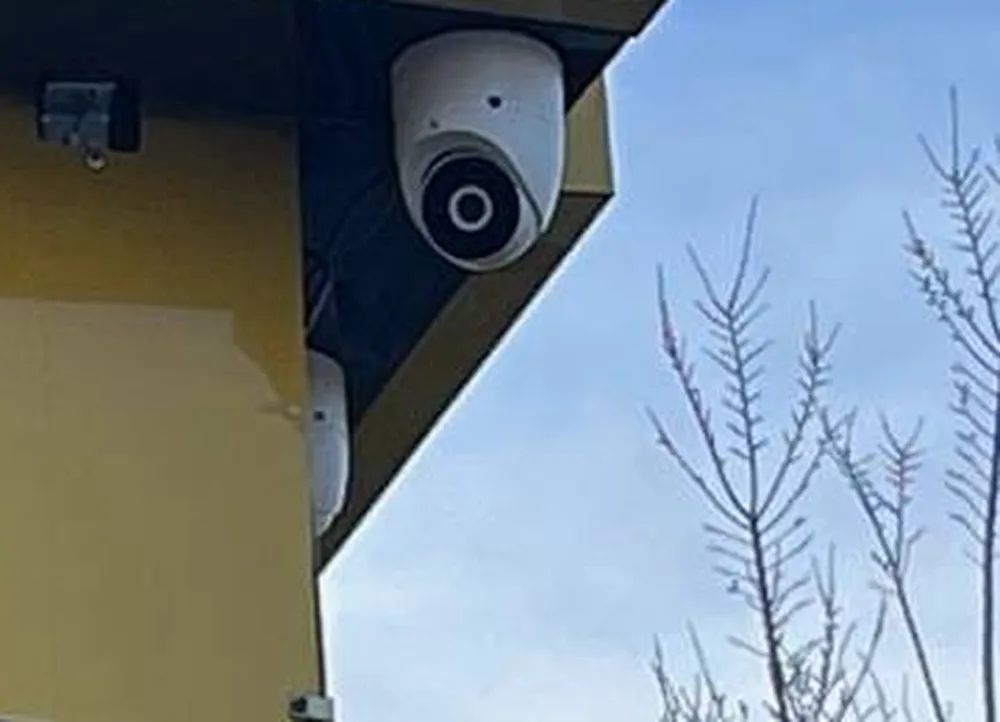
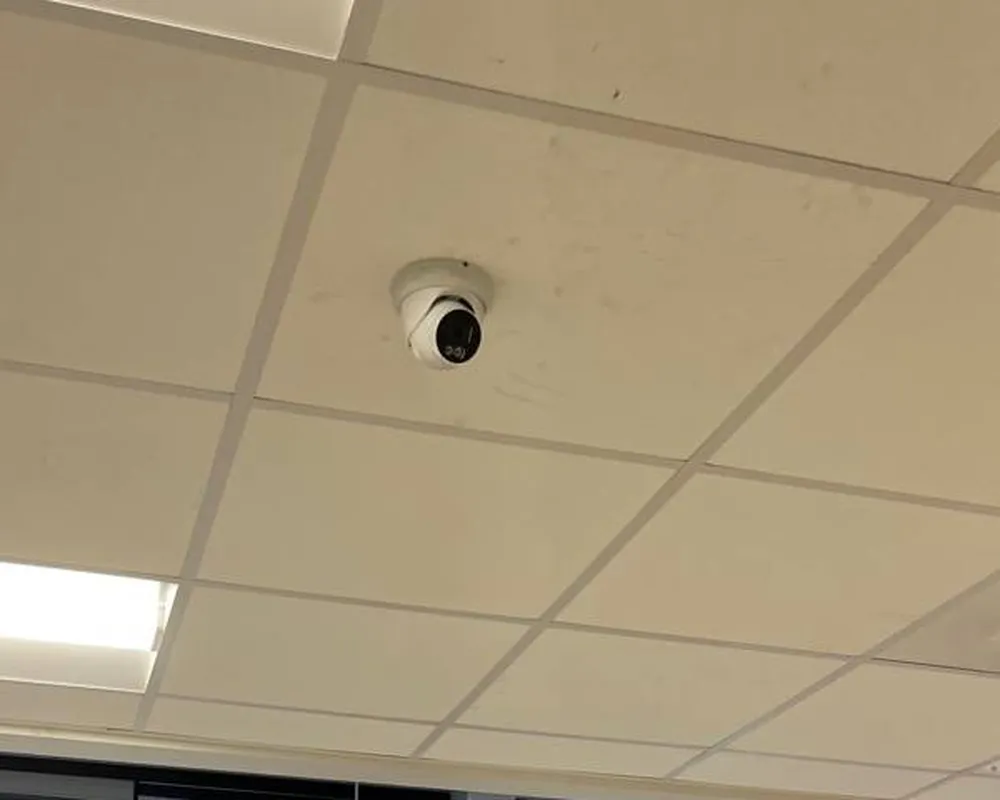
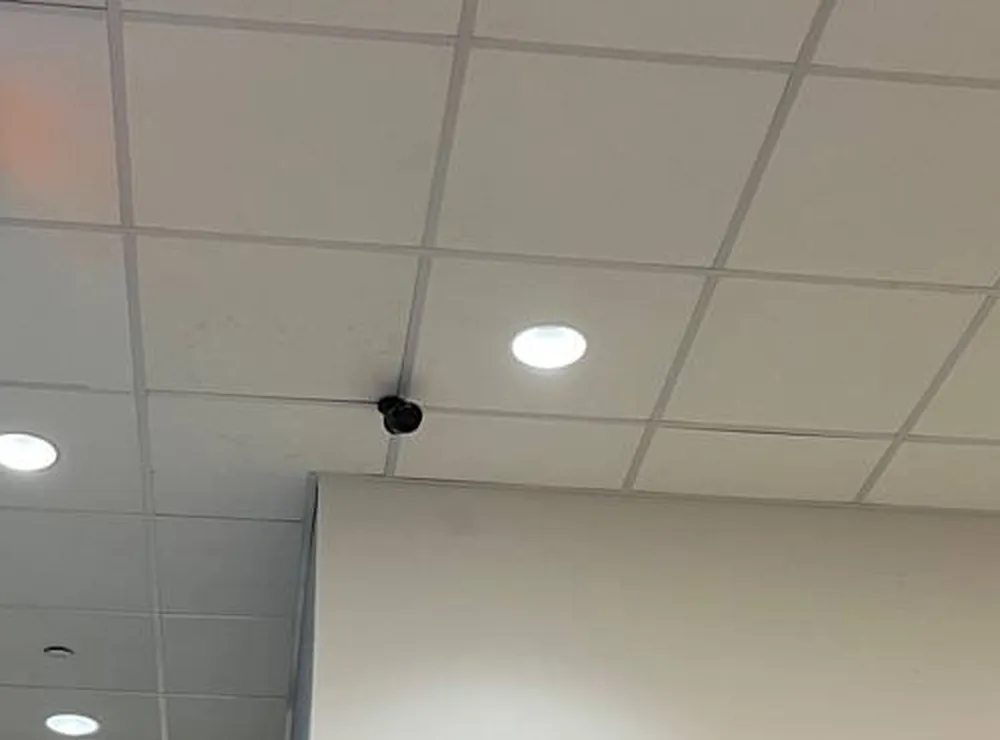
Manhattan corner deli job photo: a white turret dome tucked under the corner of the yellow canopy, where the overhang keeps rain and snow off the lens and the camera sees down both sidewalks.Rockland County car dealership job photo: a white turret camera fixed to a ceiling tile beside a light panel, set back from the glass entry wall so the door and the front desk stay in frame.
Building Specialists
CCTV for Dutchess County's Mix of River Cities, Suburbs and Horse Country
Outside Poughkeepsie, the property type decides almost everything about a residential CCTV installation or a property CCTV installation: where the cable can travel, where the recorder lives and which camera fits each wall. These are the buildings we see most often across the county.
🏚️
Beacon's brick and frame blocks
Nineteenth-century row buildings and frame houses along and off Main Street, many converted to apartments over shops. Shared walls, old masonry and owners who want the cameras discreet.
🏡
Postwar capes and raised ranches
Hyde Park, Wappingers, Fishkill and Poughkeepsie subdivisions from the 1950s to the 1970s. Attics and unfinished basements make tidy hidden wiring possible on most of them.
🏠
Newer colonials
LaGrange, East Fishkill, Pleasant Valley and Union Vale developments with attached garages, open attics and room for a recorder in the basement mechanical area.
🐎
Horse farms and estates
Millbrook, Washington, Stanford, Amenia and Dover. Long drives, stone walls, stables, indoor arenas and gates far from the house.
🍎
Orchards and farm markets
Red Hook, Milan, Clinton and LaGrange. Cash at a counter, a packing barn, and a parking field that is packed in October and empty in February.
🏛️
River estates
Hyde Park, Staatsburg, Rhinebeck and Tivoli, where large old houses sit far back from Route 9 and Route 9G with carriage houses and outbuildings.
🏭
Flex, industrial and warehouse
The I-84 and Route 52 corridor in Fishkill and East Fishkill, including the former IBM campus, plus newer distribution and contractor buildings.
⛪
Churches, camps and clubs
Congregations, summer camps, retreat centers and private clubs with buildings spread across a campus and a lot that fills only part of the week.
How the building changes the install
Balloon-framed houses. Many city and village houses built before about 1930 use balloon framing, where the wall studs run in one piece from the sill to the roof. That leaves open cavities a cable can drop through from the attic to the basement, which makes concealed CCTV wiring easier than in a modern house. It also means the house has no built-in fire blocking in those cavities, so every hole we make at the top or bottom is sealed with fire-rated material when we are done.
Mixed-use buildings in Beacon and the city. A shop on the ground floor with one or two apartments above is the standard building on Beacon's Main Street and on several Poughkeepsie streets. The shop owner and the building owner are often different people, and the apartments have their own entrance beside the store. We keep the store's cameras and recorder inside the store's space and aim them at its doors, counter and back room, run any cable for the residential entrance through the cellar rather than through a tenant's unit, and get the building owner's sign-off before anything goes on the facade. When the owner wants both the shop and the apartment entrance on camera, two recorders, or one recorder with separate user accounts, keep each party's footage apart.
Fieldstone and brick foundations. Common in the cities and on farmhouses. We drill through mortar joints, not stone, use sleeves for any cable that passes through, and seal the opening so water and mice stay out. Where a foundation is too thick or too fragile, the cable goes through the wooden rim joist instead.
Vinyl and aluminum siding. Most postwar houses and nearly every subdivision. Cameras go on a mounting block or junction box so the siding can move, and cable comes out of the wall behind the camera base, the usual answer to how to install CCTV cameras without visible wires on a sided house.
Barns and arenas. Cameras mount on framing, never on loose siding, with cable in conduit or high on the trusses where horses and equipment cannot reach it. A barn on its own electric service gets surge protection where the camera cable enters, and the link back to the house is the place to use fiber.
Industrial and flex space. Steel deck, block walls and high bays. Cable runs in conduit or on J-hooks above the ceiling, cameras go on poles, wall arms or the building corners, and the recorder lives in the IT room on its own network segment. Owners of distribution and storage buildings can read our warehouse security camera installation guide for Dutchess County for dock and truck-court coverage.
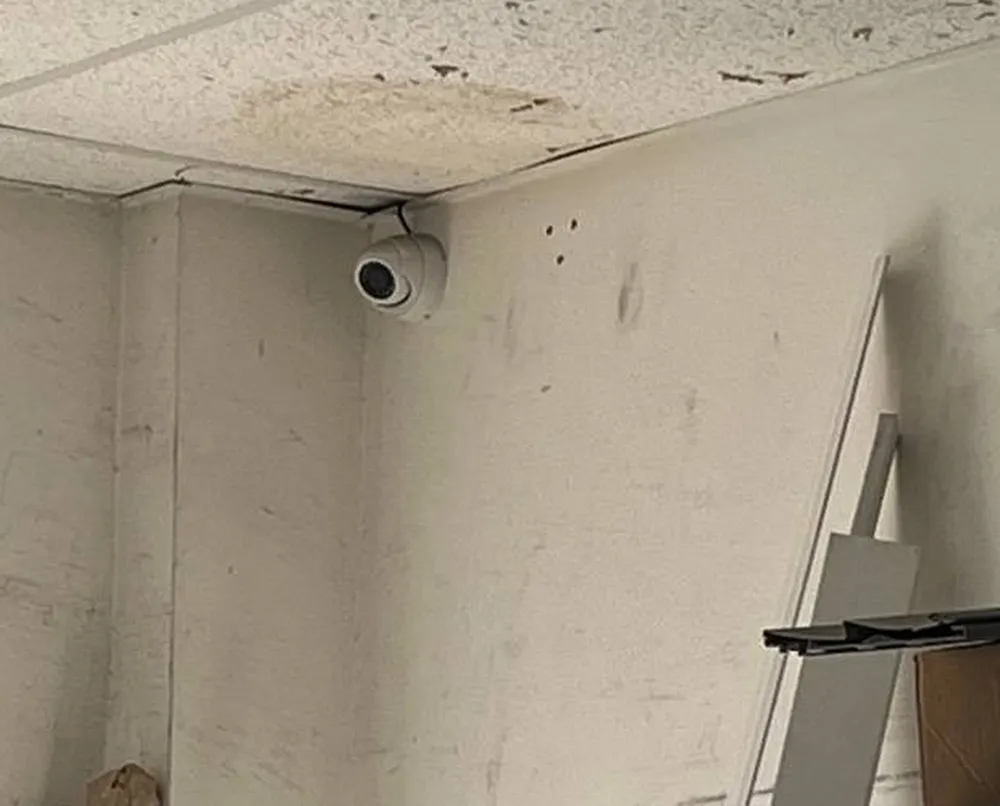
Nassau County window and door showroom job photo: a white dome fixed in the corner where a water-stained drop ceiling meets an old wall, looking down over the trim and doors stored in the back room.
Commercial CCTV Installation
Business CCTV Installation on Dutchess County's Main Corridors
Ask where commercial CCTV installation work comes from in Dutchess and the answer is a short list of roads, each with its own mix of tenants and its own blind spots.
Route 9 from Fishkill to Hyde Park. The county's retail spine: the Galleria, big-box and grocery anchors, strip plazas, dealerships, banks, urgent care and restaurants. Busy daytime traffic, wide lots and exits onto a fast road.
Main Street, Beacon. A mile of independent shops, galleries, cafes, bars and restaurants between the Metro-North end and the mountain end, many in old buildings with apartments upstairs and limited ceiling space.
Main Street and the arterials in the City of Poughkeepsie. Corner stores, takeout restaurants, salons, barbershops and offices, often open late, often on the ground floor of a mixed-use building.
Route 44 and Route 55. Pleasant Valley, Millbrook, LaGrange and Freedom Plains: gas stations, convenience stores, contractors' yards and small plazas.
Route 52 and the I-84 interchanges. Fishkill and East Fishkill hotels, flex buildings, warehouses and the industrial campus that grew up around IBM.
Village centers. Rhinebeck, Red Hook, Millerton, Pawling and Wappingers Falls, where a shop or restaurant usually needs a small, neat system rather than a big one.
On any of those roads, we judge a finished business system by three tests. Does every entrance and exit give us a usable face? Is the footage still on the drive three weeks later, when the insurer finally calls? Can the owner find and save a clip alone, at night, without phoning us? Commercial CCTV systems in Dutchess run $1,500 to $5,000+ depending on camera count, the building and the cabling, and each one is quoted in writing after we confirm the layout. For the full commercial picture, including access control and intercom tie-ins, see our commercial security camera installation page for Dutchess County businesses.
Retail and grocery
Retail CCTV installation and grocery store CCTV installation in a Route 9 plaza start at the exit. A camera mounted inside the door at about head height, looking at people as they walk out, captures more usable faces than any camera on the ceiling. Then come the registers, the self-checkout area, the high-value aisles, the stockroom door and the receiving door at the back. We finish store jobs before the holiday shopping season whenever we can, because Black Friday and December traffic is when a missing angle becomes obvious.
Restaurants, bars and cafes
Restaurant CCTV installation on Beacon's or Poughkeepsie's Main Street covers the register, the bar, the back door, the walk-in and the dining room. Kitchens are hot and greasy, so cameras stay out of the hood line. Bars want a clear view of the door and the end of the bar at closing time, which is when most disputes start.
Offices, medical and dental
Office CCTV installation and medical office CCTV installation cover entrances, reception, hallways and medication or records storage, never exam rooms or treatment areas. Recorders sit in a locked room, and logins are limited to the practice or office manager. Many offices near Vassar Brothers Medical Center and along Route 9 share a building with other tenants, so we coordinate with the landlord on common hallways.
Hotels, campuses and houses of worship
Hotel CCTV installation near the I-84 exits covers the lobby, the desk, side doors, stairwells and the lot. Camps, retreat centers, private schools and churches spread across several buildings, so the cameras are tied together by fiber or outdoor cable to one recorder. For school-specific planning, our school security camera page for Dutchess County goes further.
Construction, lots and storage
New subdivisions and commercial builds across the southern county leave copper, tools and equipment on site overnight. CCTV installation for construction sites there usually means cameras on a pole or a trailer with their own power, recording locally and sending clips over cellular; our construction site camera service in Dutchess covers it. For lot coverage and plate capture at a business, see our parking lot camera installation for Dutchess County.
Rules that apply to every business camera in New York
Four state rules shape where a business camera can and cannot go. We summarize them for planning only; ask your lawyer how they apply to your premises.
Bathrooms, lockers and changing space for staff. Video there is barred for New York employers unless a judge orders otherwise (Labor Law §203-c).
Microphones. Capturing a conversation that no participant agreed to record is eavesdropping, a crime in this state (Penal Law §250.05). Our business installs ship with audio turned off; switching it on is the owner's decision, with signage.
Fitting rooms and anywhere people undress. The unlawful surveillance statute (Penal Law §250.45) makes hidden recording of someone dressing or undressing a crime, so fitting rooms, bathrooms and bedrooms never get a lens.
Signage. A visible notice at the door costs a few dollars, discourages casual theft and answers a question insurers often ask.
Your Questions Answered
Dutchess County CCTV: Questions Answered
These are the questions Dutchess owners, landlords and managers bring to us, many of them shaped by this year's camera debate, the age of the housing and the distances in the north county.
With the county's Flock plate readers switched off, does a privately owned CCTV system still help police in Dutchess?
Yes, and for a different reason than the plate readers did. Those cameras watched roads and logged vehicles passing by. A private system watches your doors, your register, your porch and your driveway, the exact places where a theft or break-in happens. When a detective follows up on a burglary or a shoplifting case, the most useful video is almost always from a camera a few feet from the event, not one on a road a mile away.
The value depends on the clip being clear and still on the recorder when it is needed. That is why we set the recording to keep at least two weeks, tune the cameras that face doors for faces rather than wide scenery, and show you how to export a clip to a USB stick or your phone in a couple of minutes. You decide whether to give it to anyone.
If police ask for video from my recorder, do I have to hand it over?
When an officer simply asks, sharing is voluntary. Plenty of owners are glad to help, and we show you how to export just the minutes that matter rather than handing over the recorder or a login. On a system we install, nobody holds standing access except the people you give logins to: the recorder is on your network, remote viewing runs through the manufacturer's app on your account, we keep no back door, and we do not enroll your cameras in any program.
A formal legal demand is different. A subpoena or a search warrant can require you to produce footage, the same as any other record you keep, and deleting video after you know it has been requested can create its own legal problems. If your business is likely to see requests like that, ask your attorney to help set a retention period and name who handles them. This is general information, not legal advice.
What cameras make sense outside a house rented to Marist, Vassar or Dutchess Community College students?
Start with the front porch and steps, the driveway or parking area, the side and back doors, and any spot where bikes and packages pile up. Those four or five views answer most of the questions a student-rental landlord gets: who left the door open, who scraped which car, when the bike disappeared, and whether a guest caused the damage found at move-out. A camera on the trash and recycling area can also settle disputes with the hauler or a neighbor.
Keep cameras out of bedrooms, bathrooms and anything that functions as a tenant's private room. A shared kitchen or living room in a house rented by the room is a gray area that we generally advise against, because tenants reasonably treat it as part of their home. Tell tenants in writing which cameras exist and where they point.
Should landlords change the camera logins every time a student lease turns over?
Yes, if any tenant had a login. Some landlords give a house representative view-only access to the porch camera so the tenants can check on deliveries. When that group moves out in May, their app still works until the account is removed. We set tenant logins as separate users with view-only rights on specific cameras, so you can delete one user without touching your own access or the other cameras.
At the same time, change the Wi-Fi password if the recorder or cameras connect to the tenants' network, and check that the recorder's clock and storage look right. It takes ten minutes each turnover and closes the most common gap we see on rental systems.
Does balloon framing in an old City of Poughkeepsie house make camera wiring easier or harder?
Usually easier. In a balloon-framed house the studs run continuously from the foundation to the roof, so a cable can drop from the attic to the basement inside one wall cavity, with no floor plate to drill through at each story. That is a big reason we can hide most wiring in the city's older houses without opening walls.
The catch is fire safety. Those same open cavities let fire travel from basement to attic, and the house may have little or no fire blocking. Every penetration we make at the top or bottom plate is sealed with fire-rated material, and we avoid cavities with old knob-and-tube wiring, which we point out to the owner when we see it.
Our Route 9 store loses stock to daytime walk-outs, not break-ins. How should the cameras be aimed?
At people leaving. Most shoplifting cameras in older stores look down from the ceiling over the aisles, which shows the top of a hat and a hand reaching for a shelf. For identification, the most valuable camera is a narrow view at the exit, mounted around seven to eight feet high and looking into the faces of people walking out. Pair that with a camera on the register lane and one covering the highest-loss aisle, and you have the sequence a detective or loss-prevention manager needs: the person, what they took and how they left.
Add a lot camera that sees the store entrance and the cars parked closest to it, because a vehicle and a plate often matter more than a face. We size the recorder so those key cameras record at full quality all day, and the less critical views record at lower settings.
Will dust and ammonia in a horse barn ruin a camera?
They shorten the life of cheap cameras. Barn dust coats lenses and gets into poorly sealed housings, and ammonia from urine in stalls corrodes exposed metal and connectors over time. We use cameras with sealed housings rated at least IP66 or IP67, put the cable connections inside sealed junction boxes, and mount the cameras high in the aisle and away from directly over the stalls.
Good ventilation in the barn helps the horses and the cameras alike. Plan on cleaning the lenses a few times a year; a damp cloth and a soft brush are enough, and our maintenance visits include it.
Should the camera system go on the generator's essential-loads circuit?
If the house has a standby generator, yes. Put the recorder, the PoE switch and the internet modem on a circuit the generator feeds. During the July 4, 2026 storms, 27,816 Central Hudson customers in Dutchess were still without power on the Sunday evening afterward, according to the Daily Freeman (July 5, 2026). A camera system on generator power keeps recording through outages like that.
Keep a small UPS under the recorder anyway. A standby generator takes several seconds to start and transfer, and a recorder that loses power even briefly reboots and can miss the minutes that matter. Your electrician wires the generator circuit; we handle the low-voltage side and the UPS.
Should a bar near the colleges point a camera at the ID check at the door?
Yes, and the angle matters. Bars and late-night spots around Raymond Avenue, Main Street and the Route 9 strip near Marist deal with fake IDs, crowding at the door and arguments at closing. A camera just inside the entrance, looking out at the spot where the door staff checks IDs, records who came in, when, and that the check happened. That footage helps if the bar's practices are ever questioned and if a dispute at the door turns into a complaint.
Aim for faces and the transaction, not the card. A camera close enough to read the printed details on a driver's license captures more personal information than the bar needs to keep. Pair the door camera with one on the bar itself and one on the sidewalk outside, and keep audio off. If the bar scans IDs with a separate device, that system has its own data rules; the camera's job is simply the record of who stood at the door.
When in a new build should the CCTV cabling go in?
During rough-in, after the electrician has run power and before insulation and drywall. That is when cable can go anywhere in minutes. Plan the camera spots with the builder: soffits at each corner, above the garage, by each entry door, and a home run to the basement or a utility closet where the recorder and switch will live. Add a spare cable or two to likely future spots; extra cable at rough-in is cheap, and fishing it later is not.
New subdivisions in LaGrange, East Fishkill and Fishkill are good candidates. The cameras themselves go up after the siding and trim are finished, so the job happens in two short visits.
Can I put a camera where it watches my car at the Beacon or Poughkeepsie train station lot?
No. Station lots belong to the railroad or the municipality, and private cameras cannot be mounted on their poles, fences or buildings. What you can do is cover your own driveway or garage so a car that is parked at home overnight is on video, and dashcams with parking mode are an option for the car itself.
If you own a business next to a station, your own building and lot can have cameras, aimed at your property. A view that happens to include part of a public street is generally fine; a camera aimed to watch someone else's property is not something we install.
Does old electrical wiring in a pre-war house cause problems for a camera system?
Usually not for the cameras themselves. PoE cameras take their power from the low-voltage switch through the same Cat6 cable that carries the video, so they never touch the house wiring. What does need a sound outlet is the recorder, the switch and the battery backup, which together draw about as much as a small TV. In many City of Poughkeepsie and Beacon houses, the basement where we want to put them still has two-prong outlets, overloaded circuits or remnants of knob-and-tube.
We do not do line-voltage electrical work. If the best recorder location has no grounded outlet, we flag it on the survey and you have a licensed electrician add one before install day; it is a small job that protects the recorder and the drive. A grounded outlet also matters for surge protection, which cannot do its job on an ungrounded circuit.
What should a camera cover at a self-serve farm stand with an honor box?
Drive the back roads of Red Hook, Clinton, Milan or Pine Plains in summer and you pass plenty of unstaffed stands with eggs, produce, flowers or firewood and a locked cash box or a payment sign. Most of the time the honor system works. When it does not, the losses are small but steady: the box pried open, an armload of firewood with nothing paid, a cooler emptied at dawn. One camera aimed at the table and the box, mounted on the stand's roof edge or a nearby post a few feet back, records hands and faces. A second, wider camera on the pull-off catches the vehicle and, with the right lens, the plate.
Power and connection are the real design questions. If the stand is within reach of the house or barn, we run outdoor cable in conduit back to the recorder. If it sits out by the road with nothing nearby, a solar or cellular camera that records to its own card is the honest compromise, and we will tell you what it can and cannot do before you buy it. A small sign that the stand is on camera does a good share of the work by itself.
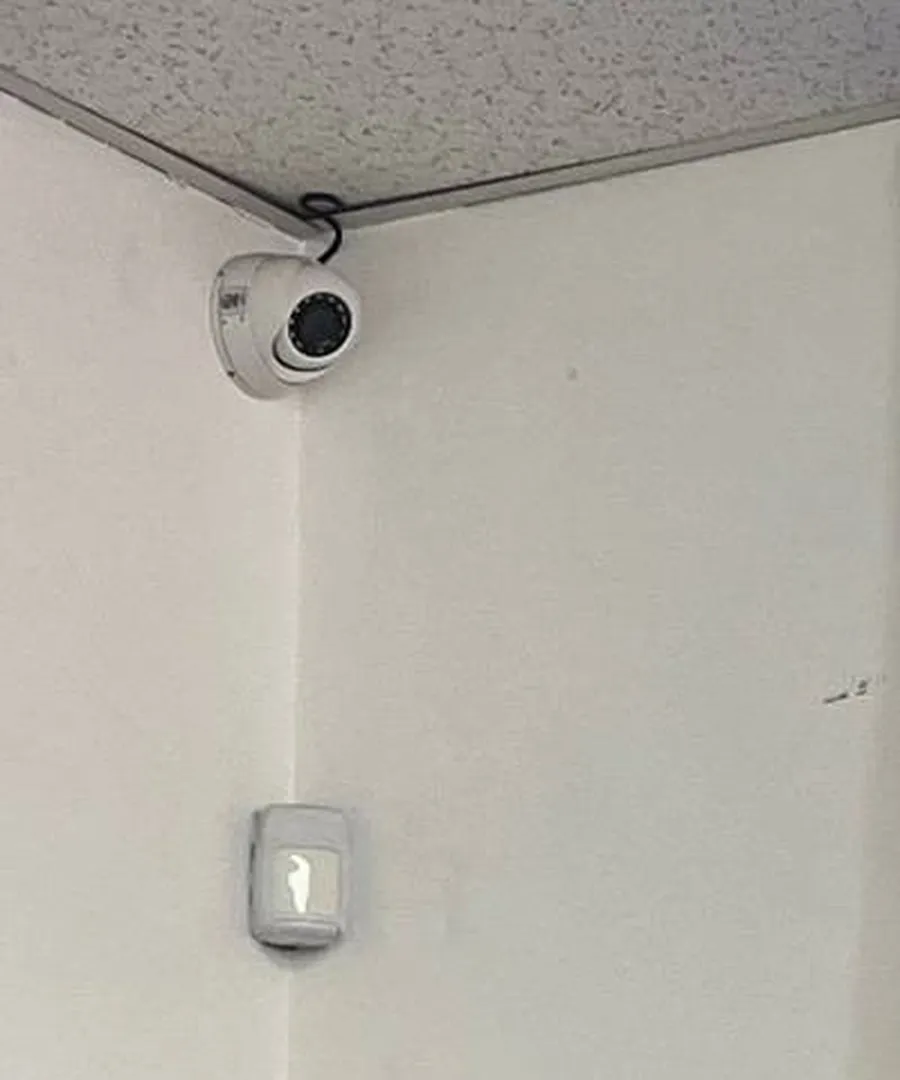
Nassau County window and door showroom job photo: a white dome fixed in the upper corner of the office, with the burglar alarm's motion sensor lower on the same wall, so camera and alarm cover the room without blocking each other.
Equipment
Cameras, Recorders and Cable for Dutchess County CCTV Jobs
Unless you ask for something else, a Dutchess quote is built on our house-brand cameras and recorders, which we stock, know inside out and price publicly. Lorex, Luminys and Reolink are the three brands we carry as an authorized partner. Owners who already run Hikvision, Dahua, UniFi Protect, Axis, Hanwha or another make can keep it; we install, integrate and service those systems without claiming any badge from those makers.
⚪
Turret and dome cameras
Dome camera installation and turret camera installation on porches, back stairs, counters and office ceilings: short distances, low profile, and a housing that shrugs off a broom handle.
🎯
Bullet and varifocal cameras
Bullet camera installation for driveways, lots and long barn aisles; varifocal camera installation lets us zoom the lens to the exact width a view needs on the day of the install.
🌙
Night vision and color at night
Infrared camera installation where a yard or barn aisle goes pitch black, and color night vision camera installation where a streetlight or a lit sign leaves a little light to use.
🔊
Active deterrence
Active deterrence camera installation for contractor yards and back lots: a strobe and a siren go off when a person crosses a zone you set for after-hours.
🔭
PTZ, fisheye and multi-sensor
PTZ camera installation where someone watches live, fisheye camera installation for a single view of a whole room, and multi-sensor camera installation for one mount that covers a parking field.
🚗
Plate and vehicle cameras
LPR camera installation at a private gate or a business entrance, aimed at your own drive or lot, with the narrow lens and shutter settings that make a plate readable at night.
💾
DVRs, NVRs and drives
DVR installation, NVR installation, CCTV hard drive installation and storage upgrades, sized by camera count, resolution and the number of days you want to keep.
🔌
Switches, racks and power
CCTV PoE switch installation within the power budget, CCTV rack installation for larger commercial systems, and CCTV UPS installation under every recorder we can.
🧵
Cat6, Cat6A, coax and fiber
Cat6 CCTV installation inside, Cat6A on long or high-power runs, coax reuse on analog upgrades, and fiber optic CCTV installation between buildings. See our fiber installation service in Dutchess County.
DVR, NVR or hybrid: which recorder fits which Dutchess property
Recorder
Cameras it takes
Where it fits in Dutchess
Trade-offs
DVR (HD-analog)
Coax cameras in the TVI, CVI or AHD formats
Older houses and stores with good existing coax from an analog system
Each camera needs power; fewer smart features than IP
NVR with built-in PoE
IP cameras on one Cat6 cable each
New installs on houses, rentals and small shops
100 m per run; port count fixed by the model
NVR with separate PoE switches
IP cameras across several closets or buildings
Plazas, offices, campuses and farms with outbuildings
More equipment to house and protect; needs a planned network
Hybrid recorder
Both coax and IP cameras
A building half wired with sound coax, half with new Cat6
Channel mix varies by model; plan expansion up front
Recorder and camera settings we tune on every job
Compression. H.265 stores roughly the same picture as H.264 in noticeably less space, so it is our default wherever the cameras and recorder support it. That choice, together with sensible frame rates, is how a system keeps its two weeks on one drive. When people compare CCTV H.264 vs H.265, storage per day is the practical difference.
Frame rate and shutter. More frames per second makes video smoother, but a fast shutter is what keeps a moving face or a plate sharp. We set doorway and lot cameras for a shutter that freezes motion, and save storage by running quiet indoor cameras at a lower frame rate.
Power over the cable. Every port on a PoE switch has a ceiling, 15.4 watts for 802.3af and 30 watts for 802.3at, and the switch has a total budget on top of that. A camera that sips power at noon can draw far more at 2 a.m. in January with its infrared and housing heater running, so the CCTV PoE power budget is figured on the coldest, darkest hour.
Network security. On business systems the cameras go on their own network segment or VLAN, default passwords are replaced, unused services are turned off, and remote access runs through the manufacturer's app, not an open port on the router. CCTV camera cybersecurity is part of the install, not an extra.
Camera placement. We plan CCTV coverage from the property line inward: what must each camera prove, from how far, at what time of day. Doors get cameras at roughly seven to ten feet for faces; lots and drives get higher mounts and narrower lenses. Every camera's field of view is checked in daylight and again in darkness, because infrared changes what a lens sees.
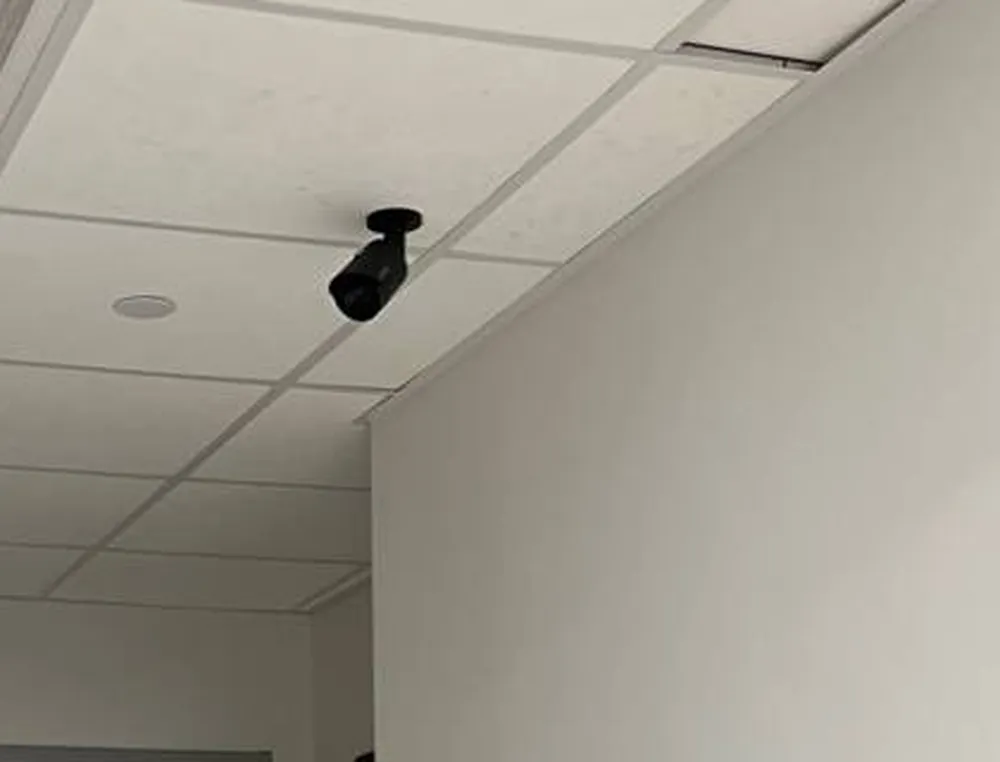
Rockland County car dealership job photo: a black bullet on a short bracket fixed to the drop ceiling right at the edge of a tall wall, angled down a corridor toward a door.
Landlord, store owner or farm owner in Dutchess?
Send the address or the town, a few phone photos of the outside and of any old recorder, and the spots you want covered. We will tell you which house-brand series fits, which runs need extra work, and what the written quote will include.
Search summaries, chatbots and the big lead sites such as Angi, HomeAdvisor and Fixr answer camera questions for an average American house. Dutchess has a city with 60.8% renters, a retail strip with 984 larcenies in one year, horse farms and a utility that loses tens of thousands of customers in a bad storm. Here is where the generic advice goes wrong.
“Police and county cameras cover the area, so you don't need your own”
Even before this fall, public cameras in Dutchess watched roads, not front doors. The county's plate readers logged vehicles passing on main routes, and they are being covered and removed. No public camera looks at your porch, your back stair, your register or your barn door.
Investigators still ask neighbors and businesses for private footage after an incident, because that is where the close-up view lives. If your cameras are not recording, or the footage was overwritten before anyone asked, there is nothing to give.
What we do: aim cameras at the places an incident would happen on your property, keep at least two weeks of footage, and show you how to export a clip yourself.
“Cloud cameras are always safer because the video is off-site”
Off-site copies do protect against a stolen recorder. But a camera that only records to the cloud stops recording when the internet drops, and in Dutchess the internet usually drops along with the power. It also means a company you have never met stores your video under its own terms, which is exactly the concern people raised about public cameras this year.
Cloud plans also bill monthly per camera, and continuous upload from many cameras strains the upload speed of a typical home or small-business connection.
What we do: record locally first, hide or lock the recorder, put it on a battery, and send alerts and clips to your phone. If you want an off-site copy of important events, that goes on top of local recording.
“The owner of a rental house decides where every camera goes”
Owning the building does not make every space fair game. Tenants have a reasonable expectation of privacy inside their units, and New York's unlawful surveillance law, Penal Law §250.45, makes secret recording where people undress a crime. Audio recording of conversations runs into the state's eavesdropping law.
In a Poughkeepsie two- or three-family, the defensible cameras are the exterior, the shared entrances, the shared halls and stairs, the laundry area and the parking. A camera that looks through a tenant's window or into an open apartment door is a complaint waiting to happen.
What we do: map every camera before install, add privacy masks where a view clips a tenant's window, and recommend telling tenants in writing where the cameras are. This is general information, not legal advice.
“If you have a generator, you don't need a battery for the recorder”
A standby generator takes several seconds to detect an outage, start and transfer the load. A recorder with no battery shuts off the instant the power drops, reboots when the generator kicks in, and may take a minute or two to start recording again. The gap lands right at the moment a storm knocks the power out, which is also when a tree hits the garage or someone tries the door.
Portable generators are worse, because someone has to go outside, start one and plug things in, often hours later.
What we do: a small UPS under the recorder, switch and modem bridges the gap, and the generator-fed circuit carries the load once it is running.
“A single 4K camera is enough for a big Route 9 lot”
A 4K camera spread across a large lot on Route 9 gives a nice overview and very few pixels on any one person or plate. The farther the subject, the fewer pixels land on it, and a face or plate at the far end of a lot may be a smudge even in daylight.
At night, a wide camera also has to light the whole lot with infrared, which it cannot do at distance, so it depends on the lot lights.
What we do: use one wide camera for the overview and narrower cameras at the entrances and the busiest rows, where identification actually happens.
“Professional installation only pays off for big businesses”
The hardware is only part of a camera system. The rest is the cable route, the weatherproof connections, the mounting height, the recorder settings, the drive size and the remote-access security. A kit with good cameras and poor installation produces video that is too dark, too wide, too blurry or already overwritten when it is finally needed.
Small properties benefit as much as large ones. A two-family with four well-placed cameras does more than a store with twelve badly aimed ones.
What we do: answer the question of whether professional CCTV installation is worth it with a specific plan, so you can see what each camera will prove before you pay for it. If you would rather mount your own cameras, we also offer labor-only and recorder-only setups.
“Higher frame rates always mean better evidence”
Thirty frames per second looks smooth on a screen, but evidence depends on whether each frame is sharp. A camera at a high frame rate with a slow shutter still blurs a face that is walking fast or a car that is moving. Many recorders also store twice as much data at 30 fps as at 15 fps, which cuts the number of days you can keep.
For most doors and registers, 12 to 15 frames per second with a fast shutter gives clearer stills and longer retention than a higher frame rate on default settings.
What we do: set frame rate, shutter and bitrate per camera, then review a real recording from each camera before we leave.
Field Notes
Field Notes: Four Tiles, One Small Showroom
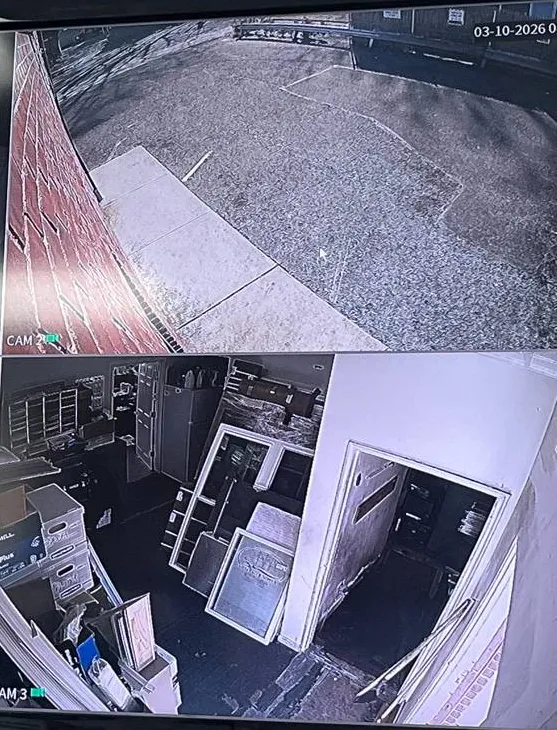
Plenty of Dutchess businesses are the size of the window and door showroom where these photos were taken: one sales floor, one office, one back room full of stock, and a lot along the side of the building. That job was in Nassau County, and the monitor in its office shows four camera tiles, which is a good picture of how four well-placed cameras can carry a shop like that. One tile looks out at the front entrance and the sidewalk. One looks along the brick side wall to the gravel lot. One covers the office desks. One looks into the stockroom, where doors and trim are stacked against the wall.
Two details are worth copying. In the office, the dome camera sits high in the corner and the alarm system's motion sensor sits lower on the same wall, so neither blocks the other and both see the room. In the stockroom, the dome is fixed right at the corner where the ceiling meets the wall, the one spot that sees the whole room and the door at once. A Route 9 or Main Street shop with the same layout can start with the same four views and add cameras later without changing the recorder, if we choose one with spare channels at the start.
Nassau County window and door showroom job photo: two of the four recorder tiles, one camera looking down the brick side wall to the lot, one looking into the stockroom where doors and frames lean against the wall.Rockland County car dealership job photo: a compact black camera screwed into a white ceiling tile, with two round downlights nearby and a dropped soffit just below it.
Before You Hire
How to Choose a CCTV Installer in Dutchess County
Whether you hire us or someone else, these questions tell you quickly whether a CCTV company plans systems or just hangs cameras. Ask them in writing and compare the answers side by side.
Whose name is on the admin account? It should be yours, on a recorder that sits in your building.
Does anything need a monthly plan? Watching on your phone should not.
Is a battery backup in the price? In Central Hudson territory, a quote without one is missing a line.
How long until footage is overwritten? Get it in days, worked out for your cameras, not a range.
Which views will show a face? An installer who planned the job can point to them on the quote.
What is the cable route? For an old house or a far barn, the answer should name walls, basements and methods.
What is your New York low-voltage license number? Then look it up on the state's license search, and ask for proof of insurance.
What is left behind when you go? Logins, a cable diagram, a list of cameras and a short lesson in finding and saving clips.
We answer every one of those in writing on our quotes. Abstract Enterprises Security Systems is licensed by New York State for low-voltage work under license #12000287431, carries general liability insurance, and is rated 4.7★ across 201 Google reviews, which are the place to read what customers say about us.
When Owners Call Us
The Times of Year Dutchess Owners Call About CCTV
Late summer, before move-in. Landlords near Marist and Vassar call in July and August, before students arrive. A porch, driveway and door system installed then documents the condition of the house and the cars on day one, which is the best protection in a move-out dispute.
Before the holiday retail season. Route 9 and Main Street stores want cameras running before Black Friday and through Christmas retail traffic. Booking in September or October gets the work done before the busiest weeks.
The week after something happens. A smashed window, a stolen generator, spray paint on the storefront: CCTV installation after a break-in is the call that cannot wait. The views that would have caught the last incident go up first, and the recorder moves out of sight.
Fair season and harvest. Farms, orchards and businesses near the Dutchess County Fairgrounds in Rhinebeck see their biggest crowds from August through October. Cameras on the cash counter, the parking field and the storage barn go in before the rush.
Before winter. Second-home owners in the north county and anyone leaving for the season want remote viewing, health alerts and a recorder on a battery before the first ice storm. Exterior work is easier before the ground freezes.
New business openings. A store or restaurant opening in a Fishkill or Poughkeepsie plaza wants cameras live on opening day. We schedule after the ceilings close and before inspection, so the cameras go up once.
When a building sits empty. Probate, a gut renovation, a listing that drags into spring, a framed house with copper and appliances inside: CCTV installation for a vacant property means local recording, person-and-vehicle alerts to your phone and, often, temporary power.
Get In Touch
Request a Free Dutchess County CCTV Quote
Tell us the city, town or village, the kind of property, about how many cameras you want and where, and where a recorder could live. Phone photos of the outside of the building, of any old recorder and of the spot you are most worried about help us quote faster. If it is a rental, tell us how many units; if it is a farm, tell us how far the barn is from the house. Prefer to talk it through? Call (845) 640-3835.
✅
Request Sent!
Thanks. Expect a call or text to set up your Dutchess County CCTV visit, normally within 2 hours of your request.
How It Works
How a Dutchess County CCTV Installation Runs
The same six steps apply to a four-camera porch-and-driveway system on a Poughkeepsie two-family and to a multi-building system on a Millbrook farm.
1
Tell us about the property
Call (845) 640-3835 or send the form with the town, the property type, the spots that matter and photos of any old equipment. We book within 2 hours of your request.
2
Plan the cameras
A straightforward house can be laid out from your photos. Multi-family rentals, storefronts and anything with a barn or a long run get a visit to walk routes and choose a lockable recorder location.
3
Sign a written quote
One page itemizing the series package and each extra, from added cameras to conduit. Half up front holds your slot, and slots go in the order deposits arrive.
4
Run cable and mount
Concealed routes through attics, basements and wall cavities wherever possible, outdoor-rated cable or conduit outside, fire-rated sealing in old framing and weather sealing at every hole.
5
Configure and verify
We bring the recorder online, tune each camera's stream and alert zones, mask anything off-limits, put the admin login in your name, and watch a test recording from every channel by day and by night.
6
Hand over the keys
We load the app for whoever you name, practice pulling a clip with you, leave the written logins and diagram, then look over alert counts and drive use once the system has run a week.
Coverage Area
CCTV Installation Near Dutchess County's Landmarks
Our crews cover the whole county, from the Beacon waterfront to the Columbia County line and from the river towns to the Connecticut border. These landmarks mark the places we drive past most.
Walkway Over the Hudson
The rail bridge turned park above the Poughkeepsie waterfront, with the city's older streets of two- and three-family houses climbing the hill behind it.
Poughkeepsie Galleria
The regional mall on Route 9 in the Town of Poughkeepsie, at the center of the county's busiest corridor of plazas, big-box stores and dealerships.
Dia Beacon
The contemporary art museum in a former printing plant by the Beacon waterfront, a short walk from the Metro-North station and the west end of Main Street.
FDR Presidential Library, Hyde Park
The Roosevelt home and library on Route 9 in Hyde Park, among the river estates, postwar neighborhoods and the culinary college campus north of Poughkeepsie.
Dutchess County Fairgrounds, Rhinebeck
Home of the late-summer county fair and events through the year, surrounded by Rhinebeck village shops, farms and estates.
Vassar College and Marist University
Two campuses on either side of the city, with the student rental streets, apartments and shops that grow up around them.
We also serve Wappingers Falls, Fishkill, East Fishkill, Hopewell Junction, LaGrange, Pleasant Valley, Hyde Park, Staatsburg, Red Hook, Tivoli, Millbrook, Washington, Stanford, Pine Plains, Amenia, Millerton, Dover Plains, Pawling, Beekman, Union Vale and Clinton, and the back roads between them.
Pricing
CCTV Installation Cost in Dutchess County
Our CCTV and security camera pages for Dutchess share one price list, so the figures below match. Every series price is a four-camera job installed by our crew, with its recorder, a drive that holds two weeks, and the phone app.
System
What it is
Starting price
A Series
Entry DVR kit, four 1080p (2MP) cameras
from $1,299
F Series
DVR kit, four 2K (5MP) cameras with siren-and-light deterrence
from $1,347
E Series
4K NVR kit, four 2K IP (4–5MP) cameras with smart alerts
from $1,506
C Series
DVR kit, four 4K (8MP) coax cameras, long-range models available
from $1,741
D Series, top tier
NVR kit, four 4K (8MP) IP cameras with deterrence and talk-back
from $1,741
Homes with 4 to 8 cameras
PoE-wired NVR system sized to the house
$1,452 to $2,500
Business systems
Storefronts up to campuses, quoted per site
$1,500 to $5,000+
Ongoing fees
None; recording stays on site
$0 a month
What moves a Dutchess quote up or down
The series price covers a standard 4-camera installation. Extra cameras, larger drives for longer retention, a UPS, PoE switches, extenders, fiber or a wireless bridge to an outbuilding, conduit, trenching, pole and gate mounts, and concealed wiring through finished walls are each priced per item once we confirm the layout. CCTV installation cost per camera depends mostly on the route the cable takes to reach it, which is why a porch camera and a barn camera are separate lines on the quote.
Three common Dutchess layouts show how that plays out. A raised ranch in Wappingers or Hyde Park with an attached garage usually fits a 4-camera package as is: front door, back door, driveway and side yard, wired through the attic and the basement. A Poughkeepsie three-family usually needs the 4- to 8-camera range, because each entrance, the back stair and the parking all matter, and the recorder needs a locked home. A horse property near Millbrook starts with the house package and adds barn and gate cameras plus the link to reach them, each priced after the layout is set. A plaza store on Route 9 typically falls in the commercial range.
If you already own the cameras, the CCTV installation labor only price comes back by phone or text once we see the model list and where each one goes; the deposit then books it. Ask about financing on the call. There are no crossed-out "regular" prices on this page and no countdown specials; what is listed is what we charge.
Our installation workmanship carries a 30-day warranty, and longer coverage, one year or more, is available as a paid add-on. Full terms — including 50% deposit, one-year parts-only warranty on Abstract Enterprises Security Systems-supplied products, and the late-fee schedule — are set out in the service agreement.
Shop Our Systems
CCTV Installation Packages for Dutchess County Properties
Pick a series by three questions: does the property already have coax worth reusing, do you want alerts that tell a person from a passing car, and how far does the longest view have to reach? Each card below is the four-camera starting point.
A
A Series · from $1,299
Where it fits: a cape, a ranch or a one-room shop. What is in the box: models A1, A2 and A3, four 1080p (2MP) cameras on a DVR, infrared to 60–100 ft, full-color night mode, motion detection, smart AI, audio and remote access.
F
F Series · from $1,347
Where it fits: an older house or store with coax that still tests good. What is in the box: models F1 through F6 in eyeball, bullet or dome shapes, 2K (5MP) on a DVR, infrared to 90–100 ft, siren-and-light active deterrent, and a 20" monitor.
E
E Series · from $1,506
Where it fits: rentals and family houses that want alerts for people and cars, not leaves. What is in the box: models E1, E2 and E3, 2K IP cameras (4–5MP) on a 4K NVR, IP67, infrared to 90–100 ft, smart detection, full color, audio, remote access and a 20" monitor.
C
C Series · from $1,741
Where it fits: a long drive or a lot where 4K over coax is the easy route. What is in the box: models C1, C2 and C3 in eyeball and long-range shapes, 4K Ultra HD (8MP) on a DVR, IP66, infrared to 100–120 ft, full color, audio and a monitor.
D
D Series · top tier · from $1,741
Where it fits: farms, estates, stores and offices that want everything at once. What is in the box: models D1 through D5 in eyeball and bullet shapes, 4K Ultra HD IP (8MP), IP67, infrared to 90–120 ft, full color, audio, active deterrent, two-way talk and a 20" monitor.
Bringing your own cameras? Labor-only works too
Bought a kit online or at a store on Route 9? We install customer-supplied CCTV equipment for a labor-only price. Send the model numbers, the camera count and a description or photos of the layout, and we quote by phone or text and book the job with the deposit. We do not do site walk-throughs for customer-supplied equipment, and if your kit uses wireless cameras, their signal and the hardware itself are your responsibility, not ours. If a kit is a poor fit for the property, such as Wi-Fi cameras meant for a barn far from the house, we will say so before we book.
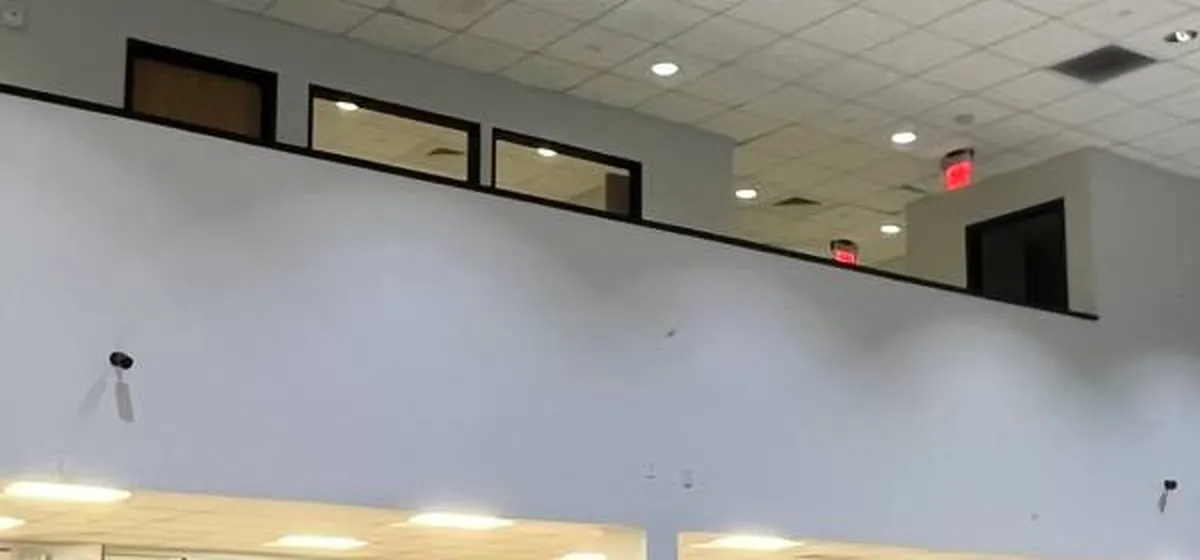
Rockland County car dealership job photo: up on the plain white balcony wall, under a row of second-floor office windows, the camera looks down across the sales floor; a red exit sign and ceiling lights sit further back.
Complete Services
Every CCTV-Related Service We Offer in Dutchess County
Cameras rarely stand alone. These related Dutchess services often end up on the same quote.
What does CCTV installation cost in Dutchess County, from a 4-camera house to a Route 9 business?
+
House-brand 4-camera systems start at $1,299 for the A Series, $1,347 for the F Series, $1,506 for the E Series and $1,741 for the C and D Series, each with the recorder, wiring, installation and two weeks of recording included. Home systems of 4 to 8 cameras on an NVR with PoE wiring run $1,452 to $2,500, commercial CCTV systems run $1,500 to $5,000+, and there are no monthly fees. Extra cameras and long or concealed runs are priced after we confirm the layout.
Does the starting price change between the south county and the farm towns up north?
+
No. The house-brand series prices are the same in Beacon, Poughkeepsie, Rhinebeck or Amenia. What changes a quote is the property itself: how far the farthest camera is from the recorder, whether the cable has to reach a barn or cross a lane, and whether walls are finished. Those items are listed separately on the written quote, so you can see exactly what each one adds.
Do you cover the Harlem Valley and the northeast towns along Route 22?
+
Yes. We install CCTV in Pawling, Dover Plains, Wingdale, Amenia, Millerton and Pine Plains as well as the river towns. Properties there are often far apart with long drives and outbuildings, so we usually confirm the layout on site, and we plan for local recording because internet service varies from road to road.
Can a CCTV system run with no cloud account at all?
+
Yes. The cameras record to the recorder on your property, and the recorder writes to its own hard drive, so recording needs no cloud account and no internet. You can watch on the monitor at the property. Phone viewing does use the manufacturer's app and an internet connection, but it does not require a paid cloud plan, and you can leave it switched off if you prefer.
Is the footage on my private recorder a public record that anyone can request?
+
No. New York's Freedom of Information Law applies to records held by government agencies, not to video a homeowner or business keeps on its own recorder. If you hand a clip to a police department, that copy becomes part of the agency's file and is handled under the agency's rules. Footage can still be demanded through a subpoena or warrant. This is general information, not legal advice.
Can part of a camera's view be blacked out so it never records a neighbor's window or yard?
+
Yes. Most of the recorders and cameras we install support privacy masking, which blocks out a chosen area of the picture so it is never recorded or shown. We use it when a driveway or porch camera's view clips a neighbor's window, a tenant's door or a yard next door, and we can adjust the mask later if a view changes.
Does every house-brand package come with a monitor?
+
Not every one. The F, E and D Series listings include a 20-inch monitor and the C Series includes a monitor, while the A Series listing does not mention one. If you want a screen at the property with an A Series system, ask and we will quote it, or you can watch on a TV you already own if the recorder can reach it.
Can a gate camera on a long private drive work with the gate opener and intercom?
+
Often, yes. A camera at the gate can record every vehicle and visitor, and a video intercom at the same post lets you see and talk to them from your phone. Whether the app can also open the gate depends on the gate operator and the intercom model, so we check both on the survey and tell you which parts can be tied together.
Do you install cameras at camps, retreat centers and other properties that close for part of the year?
+
Yes. Summer camps, retreat centers and seasonal venues in the county usually need cameras on the entrance road, the main buildings and any equipment storage, with a recorder in a heated building. We set health alerts so you hear about a camera going offline in the off-season, and we size storage for the busy months.
Where do you hide the recorder so a burglar can't walk off with the evidence?
+
Somewhere out of sight and hard to reach: a locked closet, a basement corner behind stored items, an attic hatch, a ceiling space above a drop tile or a small lockbox bolted to the wall. The spot needs power, a little airflow and a cable route to the cameras, and it should not be the first room a burglar walks into. In a rental or a shop, it should also be somewhere no tenant or employee can unplug it. Phone alerts and a camera on the room where the recorder lives add a second layer.
All Areas Served
Beyond Dutchess: Our Hudson Valley CCTV Hub
This page covers Dutchess County. For the region-wide view, including how we handle long runs, outbuildings and weather across all six counties, see our Hudson Valley CCTV installation hub.
Dutchess calls and texts: (845) 640-3835. Licensed and insured under New York State low-voltage license #12000287431, with 201 Google reviews averaging 4.7★. Our office is at 460 E Fordham Rd, Bronx, NY 10458. This page was last revised on November 16, 2026.