Clarkstown, Orangetown, Ramapo, Haverstraw or Stony Point: tell us the town and the property, and we book your Rockland County CCTV visit within 2 hours. Direct line (845) 640-3835
DVR & NVR Recorder Systems · Wired IP & HD-Analog · Battery-Backed · $0 Monthly
CCTV installation in Rockland County means a wired camera system, with the cameras, the cable and a DVR or NVR recorder all kept on your own property, laid out for the town you live or work in and for the building you actually have. Abstract Enterprises Security Systems puts these systems into raised ranches in New City, 1950s capes in Pearl River, two-family houses in Spring Valley, village storefronts in Nyack and Haverstraw, and stores and dealerships along Route 59. A house-brand 4-camera system with the recorder, the wiring, the installation and two weeks of recording starts at $1,099, with no monthly fee, and we put the recorder on a battery so an Orange & Rockland outage does not cut a hole in the footage.
Updated November 16, 2026 by Abstract Enterprises Security Systems, NYS license #12000287431 · Sources: NYS Division of Criminal Justice Services, Index Crimes by County and Agency, 2023–2024 (data.ny.gov); U.S. Census Bureau ACS 2023 5-year, DP04 by town; Orange & Rockland storm update, December 19, 2025; Clarkstown Police Department camera registration program; Rockland County Times, May 3, 2018
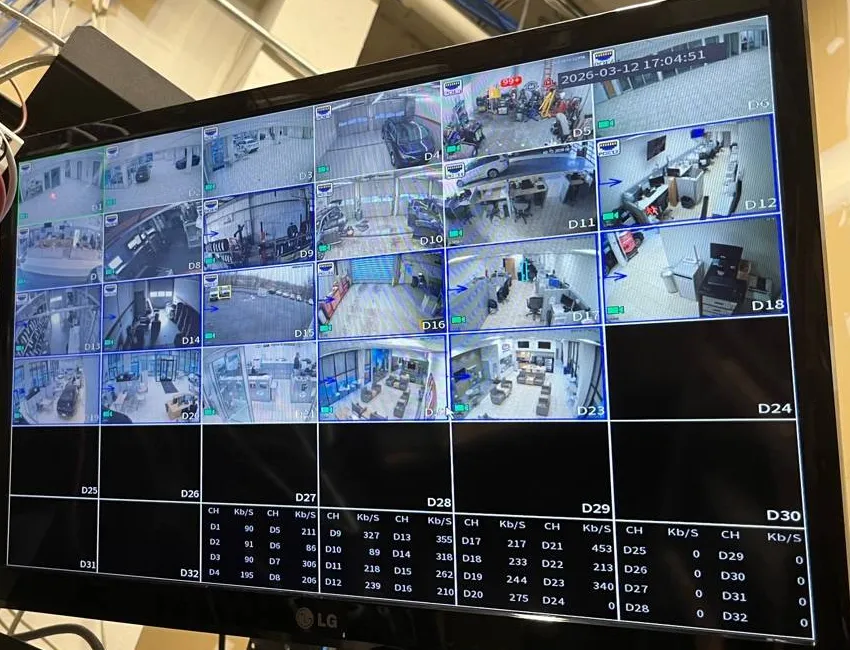
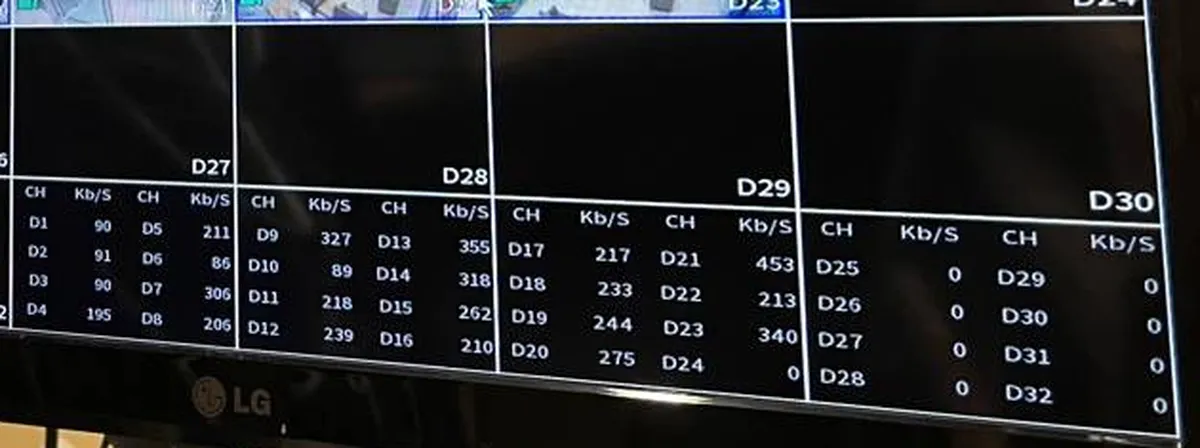
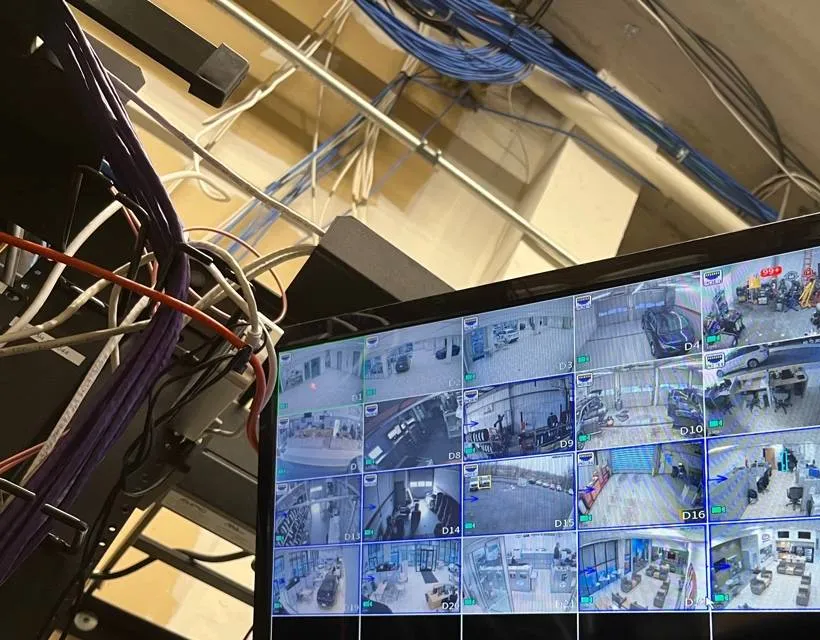
From one of our CCTV jobs (Rockland County car dealership): the recorder's screen, cropped to the monitor, with live tiles for channels D1 to D23, black tiles for the unused channels D24 to D32, and the per-channel stream table along the bottom.
Rockland County CCTV Request
Town or village, the building, and the views you need
✅
Request Sent!
Thanks. We will call or text to set up your Rockland County CCTV visit, normally within 2 hours.
5
Towns Covered
2 Hr
Booking
$0
Monthly Fees
4.7★
201 Google Reviews
Owner-operated since 2002 · Licensed & insured · Scheduled 7 days a week
Quick answer: CCTV installation Rockland County homeowners can book starts at $1,099 for a house-brand 4-camera system, recorder, wiring, installation and two weeks of recording included; a 4- to 8-camera home system with an NVR and PoE wiring runs $1,228 to $2,500, and commercial CCTV runs $1,500 to $5,000+. Monthly fees are $0 because the footage lives on your recorder, not in a paid cloud. Concealed wiring, conduit, extra cameras and long runs are priced per camera after we confirm the layout. Call or text (845) 640-3835; we book within 2 hours and schedule 7 days a week, first come first served once the deposit is paid.
Our crew, not subcontractors, under NYS license #12000287431: PoE network cameras or HD coax cameras, recording to a recorder in your building
Recorder and PoE switch on a battery backup, sized to your camera count
App set up on your phone and tested off your home Wi-Fi before we leave
Rockland is small on the map, about 200 square miles and 338,329 people at the 2020 census, but it is split into five towns that build, police and wire very differently. Clarkstown is the suburban middle, with New City, Nanuet, West Nyack, Congers and Valley Cottage. Orangetown runs along the New Jersey line and the river, from Pearl River and Tappan to Orangeburg, Blauvelt and Sparkill, with the village of Nyack at its northeast corner. Ramapo, the most populous town at 148,919, holds Spring Valley, Suffern, Monsey, Airmont and most of the county's villages. Haverstraw holds the brick village on Haverstraw Bay, West Haverstraw and the hamlets around Garnerville and Thiells. Stony Point, the smallest at 14,655, is quiet streets, the battlefield and the river.
For a CCTV installer that split matters more than the county line. The town decides what kind of house you probably live in, whether there is an attic or a crawl space to run cable through, how many families share the driveway, who answers when you call the police, and even which police department keeps a list of private cameras. A system that is right for a detached colonial on a cul-de-sac in Stony Point is wrong for a three-unit house on a narrow lot in Spring Valley, and both are wrong for a store sharing a parking field on Route 59.
The housing numbers, town by town
The Census Bureau's 2023 American Community Survey counts 108,576 housing units in Rockland. A little over half are detached single-family houses, which is what most people picture, but a third of all units sit in buildings with two or more homes in them. That share swings hard by town. In Stony Point more than eight in ten homes are detached houses and almost nine in ten are owner-occupied. In Ramapo fewer than half are detached, 44.8% sit in buildings with two or more units, and 45.3% of households rent.
Two numbers in that table drive a lot of our planning. Orangetown has the oldest housing in the county, with 21.4% of homes built before 1940 and another 21.7% built in the 1950s, which is why Pearl River, Nyack and Tappan jobs so often mean plaster walls, balloon framing and tight attics. Ramapo and Haverstraw have the most shared buildings, which means a recorder that several households can trust, cameras on shared entrances and driveways, and logins split by unit.
Planning notes for each town
Clarkstown. Mostly detached houses, 69% of the stock, on quarter- and half-acre lots in New City, Bardonia, Nanuet, Congers and Valley Cottage, plus the county's heaviest retail along Route 59 in Nanuet and West Nyack. Residential jobs here are usually the most straightforward in the county: split-levels and colonials with a basement or lower level that hides the recorder and the cable. Commercial jobs are the busiest, with shared parking fields, long store hours and the county's highest larceny count.
Orangetown. The oldest houses in Rockland, from the village blocks of Nyack and Piermont to the 1950s capes of Pearl River, Orangeburg and Blauvelt. Expect plaster, tight attics, small basements and porches that change where a door camera can sit. Tappan and Palisades carry historic-area rules, and the Route 303 office and industrial parks bring loading doors and fenced yards.
Ramapo. The largest and densest town, with Spring Valley, Monsey, Suffern, Airmont and a dozen villages. Two-family and small multi-unit houses are everywhere, so a single recorder often serves several households, and the right answer is separate logins rather than separate systems. Big families, many cars and busy driveways mean the driveway and side-entrance cameras earn their keep.
Haverstraw. A mix of older brick and frame buildings in the village, garden apartments and newer waterfront housing, and the hamlets of Garnerville and Thiells. Renters make up more than a third of households, so landlords are a big share of our calls, and shared entrances, laundry rooms and parking areas are the usual first cameras.
Stony Point. The most owner-occupied town in the county, with larger lots, detached garages and longer drives up toward Tomkins Cove and the Bear Mountain edge. These jobs look more like the rest of the Hudson Valley: a camera at the foot of the drive, one on the detached garage, and cable runs long enough to plan carefully.
What the police numbers say, department by department
Rockland does not have one police force. The state's crime tables list a separate department for each town, plus village departments in Spring Valley, Suffern and Piermont. The Village of Nyack has been covered by Orangetown police since January 1, 1991, when the village board voted to disband its own department, and South Nyack dissolved as a village on March 31, 2022, so both now sit inside Orangetown's numbers. Countywide, the NYS Division of Criminal Justice Services counted 3,710 property crimes in 2024: 255 burglaries, 3,346 larcenies and 109 motor vehicle thefts, each slightly up on 2023.
Read the larceny column first, because larceny is the crime cameras help with most. Clarkstown alone logged 1,427 larcenies in 2024, about 43% of the county's total, which tracks with where the shopping is: the Palisades Center in West Nyack, The Shops at Nanuet and the long Route 59 strip all sit inside Clarkstown. The burglary column tells a different story. Spring Valley went from 21 burglaries in 2023 to 64 in 2024, roughly tripling, while Orangetown nearly halved. Haverstraw's vehicle thefts went from 2 to 20. None of these numbers is large next to a city borough, and Clarkstown's supervisor has written that the town is consistently rated among the safest communities in the nation, but a single break-in or a stolen car is the whole story for the owner it happens to, and the recording is what decides whether that story gets an ending.
A police camera list that only one town keeps
Clarkstown Police run a voluntary Video Surveillance Camera Registration Program. Homeowners and businesses list where their cameras are, and when something happens nearby, detectives know whose door to knock on and can ask for footage from a specific date and time. The department is clear that registration does not give officers a way into your recorder.
“It is important to note that the Police Department does NOT have unfettered, direct and remote access to the cameras that are registered. This is an enhanced Community Watch program for the 21st century.” Clarkstown Supervisor George Hoehmann, Rockland County Times, May 3, 2018; program page: Clarkstown Police surveillance camera registration
That “specific date and time” detail is why we treat the recorder's clock as part of the installation, not an afterthought. A request for 9:40 p.m. last Tuesday is easy to answer when the recorder's time is right and the clip export works. It is a wasted evening when the clock drifted twenty minutes, the drive was set to overwrite after four days, or nobody knows the password. We cover all three on every Rockland job, registered or not.
The power line runs through your footage
Orange & Rockland Utilities supplies electricity to about 300,000 customers in New York and New Jersey and issues its storm updates from Pearl River. On the night of December 19, 2025, its 9:30 p.m. update counted 2,596 Rockland customers still without power, including 1,430 in Clarkstown, 394 in Spring Valley and 340 in Orangetown, with gusts of 40 to 50 mph still forecast. A PoE camera gets its power from the recorder or the switch, so when the house goes dark every camera on the system goes dark with it, unless the recorder and switch sit on a battery. Rockland's tree-lined streets and overhead lines make that a when, not an if.
Everything below is done by our own CCTV installers, written into one quote and finished with a walk-through on your phone. This page covers recorder-based closed circuit television, the wired kind with a DVR or NVR that you own. If you are comparing doorbells, single Wi-Fi cameras and smaller add-ons, our security camera installation page for Rockland County walks through those choices; here the focus is the cable, the recorder and the system behind the cameras.
📹
Full CCTV system installation
Cameras, recorder, surveillance hard drive, PoE switch, cable, mounts and the app, planned as one system. Most Rockland houses land between four and eight cameras.
🧵
CCTV wiring and cable management
Cat6 for IP cameras, RG59 or RG6 coax for HD-analog, fished through walls and joists where the house allows, labeled at both ends and dressed neatly at the recorder.
🖥️
NVR installation and DVR setup
Recorder placement, drive sizing, recording schedules, smart detection and user accounts. Recorder-only work has its own page: NVR installation in Rockland County.
A battery under the recorder and switch, sized so the cameras keep recording through a short outage and the recorder shuts down cleanly on a long one.
📲
Remote viewing and alerts
CCTV installation with remote smartphone viewing, set up on each phone you name, with person and vehicle alerts drawn around your doors and driveway rather than the whole street.
➕
Added cameras and relocations
Additional CCTV camera installation on an existing recorder, camera relocation when a view gets blocked, and repositioning after renovations or new siding.
Cameras sitting in a box in the garage? Send the model numbers; the labor is priced by text or phone and the date is held with a deposit.
Most first visits combine three or four of those. A typical Clarkstown homeowner wants four to six wired cameras on the doors and the driveway, the recorder in a basement closet on a battery, and the app on two phones. A typical Ramapo landlord wants the same, plus separate views for each household and a camera on the shared walk to the side door. A typical Route 59 retailer wants the register, the front door, the back door and the lot, and a recorder in a locked room. The parts are similar. The planning is not, which is why we start every quote with what each camera has to prove and only then pick the camera.
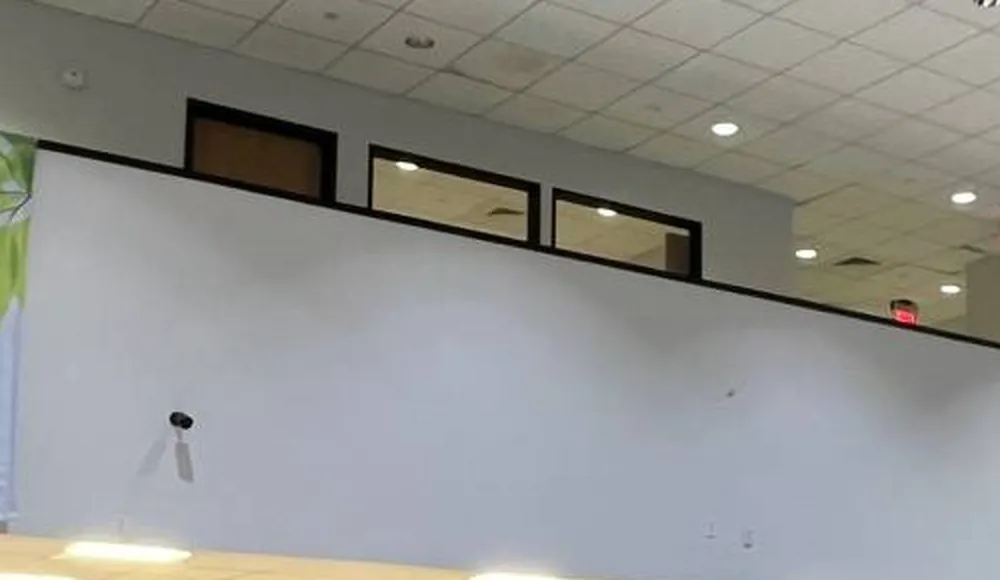
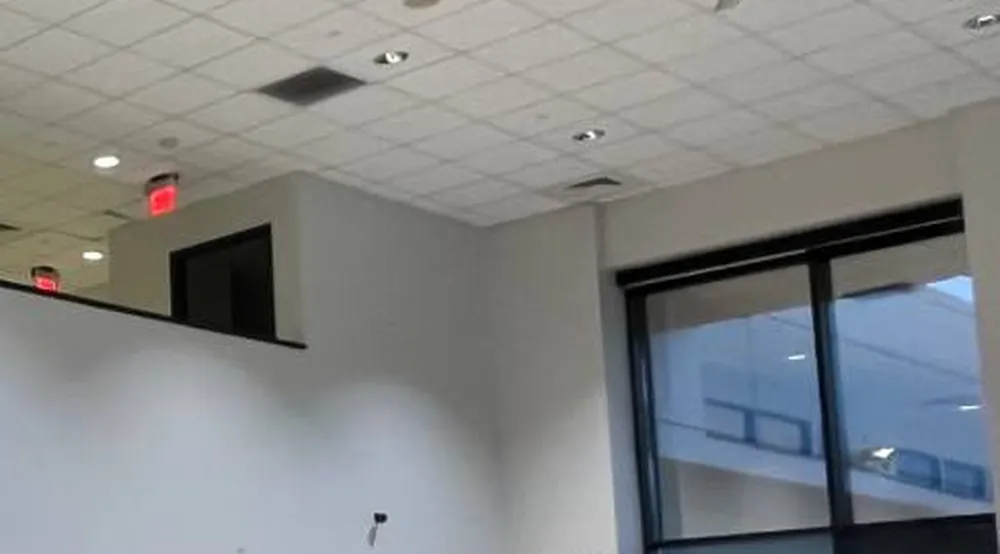
From one of our CCTV jobs (Rockland County car dealership): a small black camera on the tall white wall below the mezzanine windows, high enough to look down over the glass-fronted offices and the floor in front of them.
Building Specialists
CCTV Installation for Rockland's Split-Levels, Capes and Two-Families
Rockland's housing was mostly built in three waves: river villages before the war, the 1950s and 1960s boom after the Palisades Parkway and the Tappan Zee Bridge opened the county to commuters, and the denser two-family and multi-unit building of the last few decades in Ramapo and Haverstraw. Each wave hides its cable routes in a different place, and each changes where a camera can sit.
🏠
Raised ranches and split-levels
The classic Clarkstown and Ramapo house. The front door sits between two floors, the garage tucks under the bedrooms, and the lower level often has a finished den with a drop ceiling, which is a gift for cable.
🏡
1950s capes and small colonials
Pearl River, Orangeburg, Blauvelt and Nanuet are full of them. Finished knee-wall attics, shallow soffits and plaster in the older ones make cable routing a puzzle that rewards patience.
🏘️
Two-family and multi-unit houses
Common in Spring Valley, Monsey and Haverstraw. Shared driveways, separate entrances, a basement unit and several households who all need to trust the same recorder.
🏛️
Village houses and mixed-use blocks
Nyack, Piermont, Haverstraw and Suffern have pre-war frame and brick buildings with shops below and apartments above, where a neat, small system beats a big one.
🏢
Garden apartments, condos and townhouses
Two- and three-story complexes around New City, Nanuet, Pearl River and Pomona, with carports, mail kiosks and a board that approves anything on the common elements.
🌳
Larger lots up north and west
Stony Point, Pomona, New Hempstead and the edges of Wesley Hills and Montebello have longer drives and detached garages, closer to the Hudson Valley country jobs.
How each building changes the install
Split-levels and raised ranches. The best recorder spot is usually the lower-level utility room next to the panel and the internet modem, which keeps the recorder cool, near power and away from the front door. Cable climbs inside the garage wall or through the joist bays above the lower-level ceiling, then out through the rim joist to the cameras on the eaves. The awkward camera is the one for the front door. Mounted on the soffit above the upper floor, it sees the tops of heads; mounted beside the door at about eight feet, it sees faces as people climb the half-flight of steps. We usually do the second and add a wider camera on the garage corner for the driveway.
Capes and older colonials. A cape's upper floor often has knee walls with a narrow crawl space behind them, which is where we run cable to the gable-end cameras. Where plaster and lath walls stop a fish tape, we go through a closet or follow a downspout line on the outside in painted raceway rather than tearing open plaster. These are also the houses where concealed CCTV wiring costs the most labor, so it is the line we explain most carefully in the quote.
Two-family houses. Each household gets its own login that shows only the cameras that concern it, the shared cameras on the driveway and side walk go to both, and the admin password stays with the owner. The recorder goes somewhere neither tenant passes every day, and the battery backup keeps it running when someone flips the wrong breaker in the basement.
Village buildings. On brick, we anchor into mortar joints rather than the face of the brick, so the holes can be patched invisibly later. On frame storefronts, we use the sign band or the cornice to hide the cable. On mixed-use blocks, the landlord, the store tenant and the apartment tenants often all want cameras; we separate their systems or their logins up front so nobody ends up watching someone else's hallway.
Condo and townhouse complexes. Common elements belong to the association, so the board approves where cameras go and who holds footage before we drill. Owners who want a building-wide plan for entries, mail kiosks and carports should read our apartment building camera systems for Rockland County page, which goes deeper into resident privacy, tenant access and board approvals.
Historic areas. Orangetown protects historic areas in the hamlets of Tappan and Palisades. Under the town's code, building permit applications for structures in those areas go to the Historical Areas Board of Review. If your camera work is part of a project that needs a permit there, plan for that review; either way, we keep cameras and conduit small, low on the facade and painted to match, which is also what makes a camera less of a target.
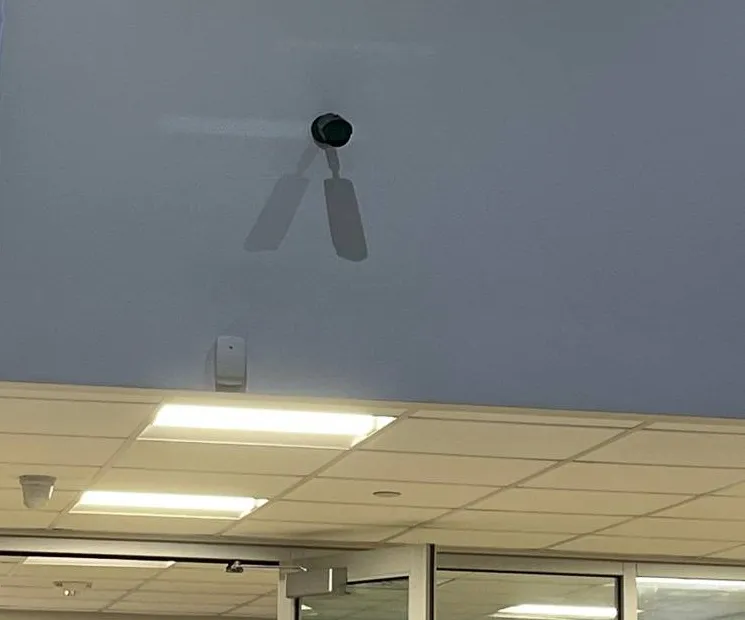
From one of our CCTV jobs (Rockland County car dealership): a black bullet camera high on the white wall, a separate white motion sensor just below it, and a small white dome on the drop ceiling over the entry area.
Commercial CCTV Installation
Business CCTV Installation in Rockland County
Commercial CCTV installation in Rockland follows a handful of roads. Each one has its own kind of building and its own reason for cameras, and a commercial CCTV contractor who knows the difference saves you cameras you do not need.
Route 59, Suffern to Nyack. The county's main retail spine: big boxes, strip centers, dealerships, collision shops, gas stations, restaurants and medical offices through Airmont, Monsey, Spring Valley, Nanuet, West Nyack and Central Nyack. Shared parking fields and rear service lanes are the hard part.
Route 303, Orangeburg to Congers. Office parks, light industrial buildings, contractor yards and distribution space through Orangeburg, Blauvelt, West Nyack and Valley Cottage, where loading doors and fenced yards matter more than storefronts.
Route 9W along the river. Village shops and restaurants in Nyack and Haverstraw, marinas and boatyards, and auto businesses through Congers, Haverstraw and Stony Point.
Downtown Pearl River. Central Avenue's independent shops, bars, restaurants and offices near the train station, many in older two-story buildings with apartments above.
Main Street, Spring Valley, and Lafayette Avenue, Suffern. Dense village retail with small storefronts, long hours and roll-down gates.
Main Street and Broadway, Nyack. Galleries, restaurants and boutiques in pre-war buildings, with heavy evening and weekend foot traffic.
CCTV installation for retail stores in these corridors centers on the door, the register, the high-value shelf and the back door, recorded at a quality that shows a face and a hand. Business CCTV installation for offices is quieter work: the reception desk, the entry, the server or records closet and the parking area. Commercial CCTV systems run $1,500 to $5,000+ depending on the camera count, the building and the cable routes, and every business job is quoted in writing after we confirm the layout. For the full commercial picture, including access control tie-ins and multi-tenant rules, see our commercial camera installation for Rockland County businesses.
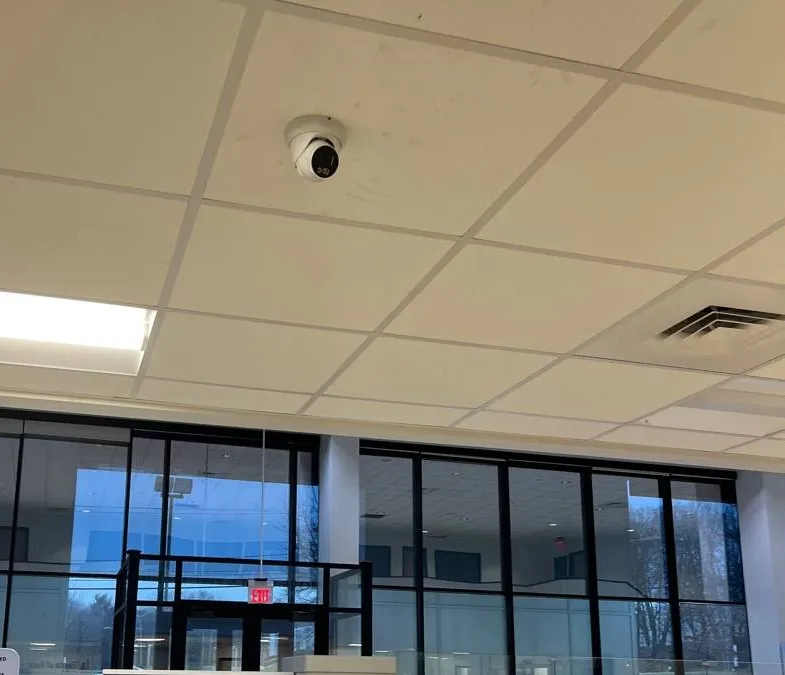
From one of our CCTV jobs (Rockland County car dealership): a white turret dome on the ceiling just inside the glass front of the building, with the entry doors, the parking lot and the trees beyond visible through the windows.
Car dealership CCTV installation: the walls, not the lot
The photos on this page come from our CCTV job at a car dealership in Rockland County, a 23-camera recorder system inside a building with a two-story showroom, glass offices, a guest services window, back hallways and work areas. The lesson we take from that building is about where the cameras are allowed to live. Tall painted walls, a mezzanine and drop ceilings give a camera height and a clean background, and height is what turns a view of a crowded showroom into a view of who was standing where. Inside a glass storefront, a turret dome on the ceiling looks out over the entry and the first rows of the lot, which is often a better first look at an arriving car than a camera fighting the glare outside.
Dealerships also run long hours with many people moving through, so the recorder and the network gear sit behind a door away from the sales floor, and the cable is carried above the ceiling grid to that room. The same thinking applies to an auto repair shop CCTV installation or a gas station on Route 59: keep the equipment out of reach, put cameras where people have to pass, and give the busiest views the most storage.
Warehouses, yards and Route 303 buildings
Warehouse CCTV installation along Route 303 and in the industrial pockets of Valley Cottage, Orangeburg and Haverstraw is about dock doors, the truck court, the fence line and the inside aisles where pallets get picked. High bays need different lenses and mounts than a showroom, and steel buildings need careful cable support. Our warehouse and yard camera installation in Rockland County page covers that work in depth, including dock and yard layouts.
Other Rockland businesses we wire
Restaurants and bars. Restaurant CCTV installation covers the register, the bar, the back door and the walk-in. On Nyack's Main Street and in Pearl River, many kitchens sit in older buildings with low basements, so the recorder often goes in the office rather than downstairs where it is damp.
Medical and dental offices. Entrance, waiting room, reception and medication storage; never exam rooms or anywhere a patient undresses. Medical buildings along Route 59 and near the hospitals in Nyack and Suffern usually come with a landlord's rules on cable routes, too.
Houses of worship and schools. Rockland has a large number of synagogues, churches and private schools, often in converted houses or small purpose-built buildings with busy lots at fixed times. Entrances, drop-off loops and parking come first; see our school camera installation page for Rockland County for campus work.
Construction sites. New multi-family and commercial projects in Ramapo and Haverstraw keep copper, tools and machinery on site overnight. CCTV installation for construction sites usually means temporary cameras on poles or trailers; our construction site camera installation in Rockland page covers those setups.
Parking lots. A Rockland strip-center or office lot is wide and often dark at the far rows, so the cameras go high on a pole or the building, aimed down the drive aisles. Entrances and plate reads are covered on parking lot camera installation in Rockland County.
Rules that apply to business cameras in New York
This is general information, not legal advice; your attorney should confirm what applies to your business.
Staff bathrooms and locker areas. Under New York Labor Law §203-c an employer may not video record employees in a restroom, a locker room or a room used for changing, short of a court order, so those rooms get no cameras at all.
Audio needs consent. Under New York's eavesdropping law (Penal Law §250.00 and §250.05), recording a conversation you are not part of without the consent of at least one person in it is a crime. We install with audio switched off at businesses and only enable it where the owner decides it is lawful and appropriate.
No secret recording where people undress. Penal Law §250.45, unlawful surveillance, makes it a crime to secretly record people in places where they have a reasonable expectation of privacy, such as bathrooms and fitting rooms.
Signs help. A posted notice that the premises are recorded is good practice for stores and landlords, and insurers often ask about it.
From one of our CCTV jobs (Rockland County car dealership): a second small camera on the far end of the tall showroom wall, near a lit exit sign, a ceiling fan and the tall windows at the corner of the building.
Your Questions Answered
Rockland County CCTV Installation: Questions Answered
These come from calls and texts we get from Rockland owners, sorted by what people usually ask first: what kind of system, how it is wired, where the cameras go on Rockland houses, and what happens after the crew leaves.
Should my house get a DVR or an NVR?
A DVR, digital video recorder, records HD-analog cameras that connect over coax. An NVR, network video recorder, records IP cameras that connect over network cable, and most NVRs also power those cameras through the same cable. If your house already has coax running to the old camera spots from a system installed ten or twenty years ago, a DVR that speaks the modern HD-analog formats (HD-TVI, HD-CVI or AHD) can give you a big jump in picture quality without pulling new cable. If we are running new cable anyway, an NVR with IP cameras is the better long-term choice: one cable per camera, smarter detection, simpler expansion and higher resolutions.
There is also a middle path. Hybrid recorders take both kinds of camera, so a Pearl River cape can keep two coax cameras on the back of the house where the old cable is sound and add new IP cameras on the front where we have a clean route. On our price list, the A, F and C Series are DVR-based and the E and D Series are NVR-based, which is why the quote always starts with what cable you already have.
Does a PoE camera need an outlet next to it, or an electrician?
No outlet and no electrician for the cameras themselves. PoE, power over Ethernet, sends low-voltage power and video down the same Cat6 cable, so the camera on your eave gets everything it needs from the recorder or switch in the basement. That is why PoE CCTV installation is the default on most of our Rockland jobs: there is no plug hanging off the soffit, no transformer in the attic and no high-voltage work outside. A standard PoE port supplies up to 15.4 watts and a PoE+ port up to 30 watts, which covers fixed cameras with infrared; PTZ cameras and cameras with built-in heaters or deterrent lights need more, and we budget the switch for that.
What does need a normal outlet is the recorder, the switch and the battery backup, all in one place. In a split-level that is usually the lower-level utility room; in a store, the office or a back room. If there is no outlet where the equipment should go, a licensed electrician adds one before install day. We are licensed for low-voltage work, and we keep the two trades separate on purpose.
From one of our CCTV jobs (Rockland County car dealership): a black bullet camera on a short pendant mount fixed through a drop ceiling tile, with its cable carried above the grid to the equipment room.
What cable goes outside on a Rockland house, and why not the cheapest roll?
Inside walls we use solid-copper Cat6 for IP cameras. Outside, on a run along the eaves, down a corner board or across to a detached garage, we use outdoor-rated, UV-resistant Cat6, and in the ground we use direct-burial cable or put the run in conduit. For HD-analog systems the cable is RG59 or RG6 coax with a power pair. The cheap rolls sold online are often copper-clad aluminum, which looks the same but carries power badly over distance and corrodes at the connectors, and indoor cable left in the sun cracks within a few seasons.
Every wall penetration is drilled with a slight downward slope toward the outside, sealed, and covered by the camera base or a junction box, so rain running down vinyl siding does not follow the cable into the wall. Every cable is labeled at both ends. That labeling is the difference between a ten-minute repair and a half-day hunt two winters from now.
Where should the camera for the front door go on a raised ranch or split-level?
Beside the door, not above the upper floor. On a raised ranch the front door sits at the landing between the two levels, so a camera up on the soffit looks almost straight down and records the tops of heads. A camera mounted on the wall next to the door at roughly eight feet, angled slightly down the steps, sees faces as people climb toward it, which is what you need when someone takes a package or tries the knob.
The garage on these houses usually sits under the bedrooms, so the second camera goes on the garage corner with a wider lens to cover the driveway and the street end of the walk. A third on the back deck or the slider and a fourth on the side gate finish a typical four-camera layout. Larger split-levels with a separate side entrance to the lower level add one more there.
How do you get cable to the cameras on a 1950s cape with a finished upstairs?
Through the knee-wall spaces. Most Rockland capes have a finished second floor with short walls under the roof slope, and behind those walls is a narrow triangle of attic that runs the length of the house. We get in through the small access doors many capes have, or through a closet, and pull cable along that space to the gable ends and down to the eave cameras. From the basement, a second route usually climbs inside the wall beside the chimney or a plumbing chase.
When a wall is plaster on wood lath, as in many prewar and early postwar houses in Pearl River, Nyack and Haverstraw, fishing cable through it is slow and risks cracks. In those spots we sometimes run a short length of painted raceway along an inside corner or follow a downspout outside instead. You decide which trade-off you prefer, and the quote shows the difference.
Does joining Clarkstown's police camera list let officers see into my recorder?
No. Joining tells the police where your cameras are; it does not give them a way into your system, and for Clarkstown homes and businesses it is worth considering for that reason. The Clarkstown Police Department's voluntary program records only where registered cameras are, so detectives can ask owners near an incident to check footage for a particular date and time. The department's own release says the program does not give remote access to registered cameras, and you decide what to share when they call.
Whether you register or not, the useful preparation is the same. Know how to find a time on the recorder, know how to export a clip to a USB stick or your phone, and keep enough days of recording that a request a week later still has something to find. We show every owner how to do all three at handover. Outside Clarkstown, call your own department's non-emergency line to ask whether it keeps a similar list.
Can a store's lot camera settle a fender-bender or a slip-and-fall claim?
It can help a great deal, if the footage still exists when the claim arrives. Parking-lot bumps, a cart rolling into a car, a customer who says they slipped at the door: on Route 59 and in the Nanuet and Suffern lots, these are the incidents owners most often go back to the recorder for. The trouble is timing. A letter from an insurer or a lawyer can show up weeks after the day in question, long after a two-week drive has overwritten it.
So two habits matter more than camera count. First, a lot camera and a door camera with views wide enough to show the whole event, not just the moment of contact. Second, a rule that whoever hears about an incident exports the clip that day and saves it somewhere safe, even if nobody has complained yet. We show managers how to do that at handover, and for businesses that expect claims we size the drive for a longer retention period. What the footage proves is for you, your insurer and your attorney to judge.
Will new cameras clash with the alarm system's motion sensors on the same wall?
They can share a wall without trouble if they are planned together. Many Rockland homes and businesses already have a burglar alarm with passive infrared motion sensors high in the corners, and those are often exactly where a camera wants to go. We keep cameras clear of the sensors' field of view so a camera does not block a sensor, we do not aim a camera's infrared illuminator straight into a sensor a few feet away, and we keep CCTV cable separate from the alarm wiring so a later alarm service call does not disturb the cameras.
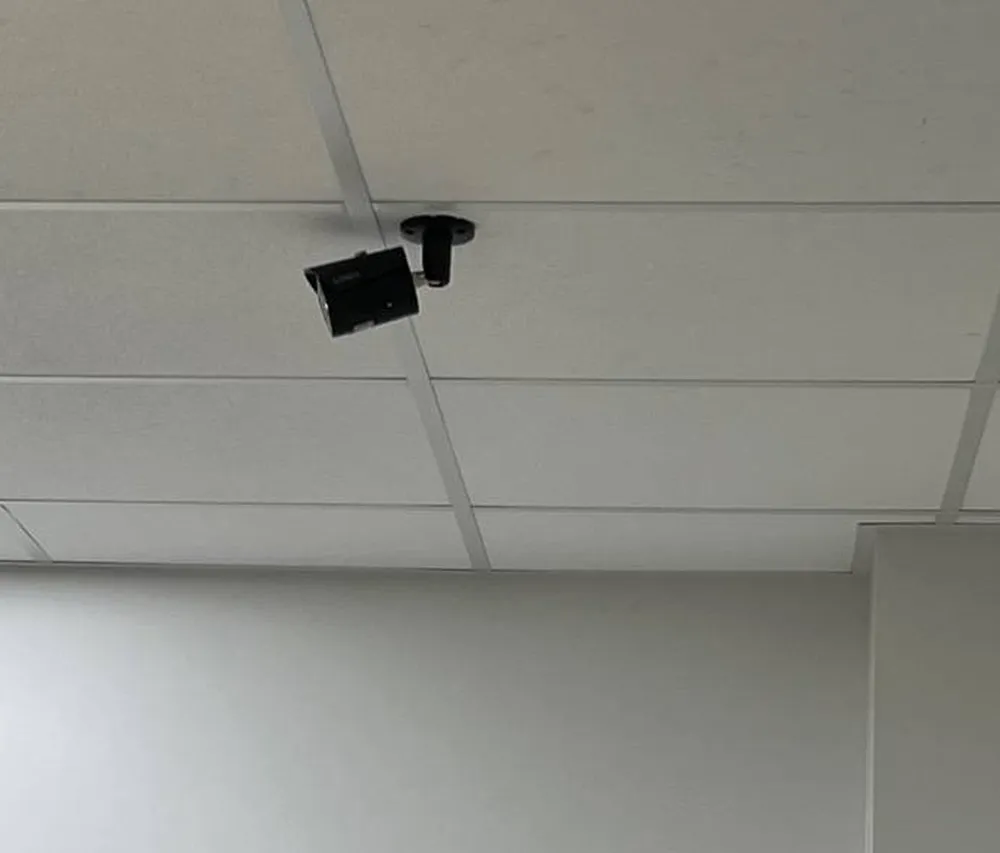
On the dealership job in our photos, two of the cameras sit on the same tall walls as white motion sensors, mounted above them with clear space between. If you would like the two systems to talk, for example so an alarm event bookmarks the camera footage or sends you a clip, many current recorders can take an alarm input; we wire that only where your alarm company agrees.
Can I see each camera's actual view before it is screwed down?
Yes, and we prefer it. During the install we power each camera on a temporary connection, hold it at the planned spot and show you the live view on a phone or the recorder monitor before drilling the final holes. You see what the driveway camera actually covers, whether the neighbor's floodlight washes out the side gate view, and whether the front door camera catches faces on the steps. Moving a camera a foot at that stage costs nothing; moving it after the mount and the sealed cable entry are finished means patching siding.
We repeat the check after dark for cameras that depend on infrared, because night vision changes what a camera sees. A view that looks perfect at noon can glare off a white garage door at night, and a slight angle change fixes it.
What does the per-channel number table on my recorder screen tell me?
It shows how much data each camera is sending at that moment, usually in kilobits per second. On the dealership recorder in our hero photo, the live channels ranged from 86 Kb/s on the quietest views to 453 Kb/s on the busiest, about five times apart, and the unused channels D24 through D32 read zero. Busy scenes with people moving, waving trees or rain send more; empty hallways send less.
For an owner it is a quick health check. A camera reading zero when it should be live is offline. One camera reading far above all the others with nothing happening in its view may be set to a frame rate or quality it does not need, and it is quietly eating the hard drive. We check that table before we leave every multi-camera job, and you can glance at it any time something looks off.
From one of our CCTV jobs (Rockland County car dealership): the bottom of the recorder screen, enlarged, listing each channel from D1 to D32 with its live rate in Kb/s; the unused channels D24 to D32 show 0.
What should cameras at a house of worship cover when the lot fills for services and holidays?
The entrances people actually use, the lot entrance from the road, the walk from the lot to the door, and any side door that stays unlocked during services. A congregation in Monsey, New City or Spring Valley may go from an empty lot to a full one in fifteen minutes, so the lot camera needs a wide view at height, and the entrance cameras need to see faces at the doors, where everyone has to pass close to the lens.
Two scheduling details matter for these buildings. Many are empty most of the week, so alerts after hours are worth more than live viewing during services, and some congregations do not want anyone using phones during holy days, so automatic recording and alerts to a designated person who is not attending matter more than an app everyone checks. We set schedules to match the calendar you give us.
Can each person in the family get only the alerts they care about?
Yes. Each person gets their own user on the recorder or app, and each user can have their own cameras, alert types and quiet hours. A parent might want person alerts from the driveway and the back door only at night; a teenager might only need the front door camera; a grandparent who watches the kids after school might only want the side gate between 3 and 6 p.m. Nobody needs to share one login, and you can remove a user without changing everyone's password.
For businesses the same setup gives managers alerts and playback, while staff can see live views at the counter without being able to delete or export footage. We write down who has which permissions in the handover notes so you can change it later.
How should a strip-center store cover a rear delivery door on a lane it shares with other tenants?
With a camera mounted on your own wall, looking along your own door and the stretch of lane directly behind it, high enough that a box truck does not block it. On Route 59 and Route 303 strip centers, the rear lane is often shared by every tenant and owned by the landlord, so the lease decides what you can mount outside. Cameras on your wall facing your door are usually acceptable; cameras that sweep the whole lane can need the landlord's consent.
Inside, a second camera faces the back door from the stockroom, so every delivery and every exit is seen from both sides. The pair answers the usual questions: who opened the door, what came in or went out, and which vehicle was at the door at that time. Ask your landlord before we mount anything on a shared surface; we can supply a short camera plan for that conversation.
How do you mount a camera on the foam-and-stucco front of a strip-center store?
Carefully, because that finish is thinner than it looks. Many Route 59 and Route 303 storefronts are clad in EIFS, a synthetic stucco laid over foam board, and a camera screwed straight into it pulls loose in the first windy winter and lets water into the wall behind. We find the framing or the sheathing behind the foam, use a mounting block or standoff sized for EIFS, and seal every fastener and the cable entry with a sealant made for that finish.
Where the facade belongs to the landlord, which is usual in a strip center, we mount under the canopy or on the sign band when the lease allows it, and keep cable runs inside the store wherever possible. That keeps the landlord's facade warranty intact, keeps the camera out of reach from the sidewalk and puts the cable where no one can cut it from outside.
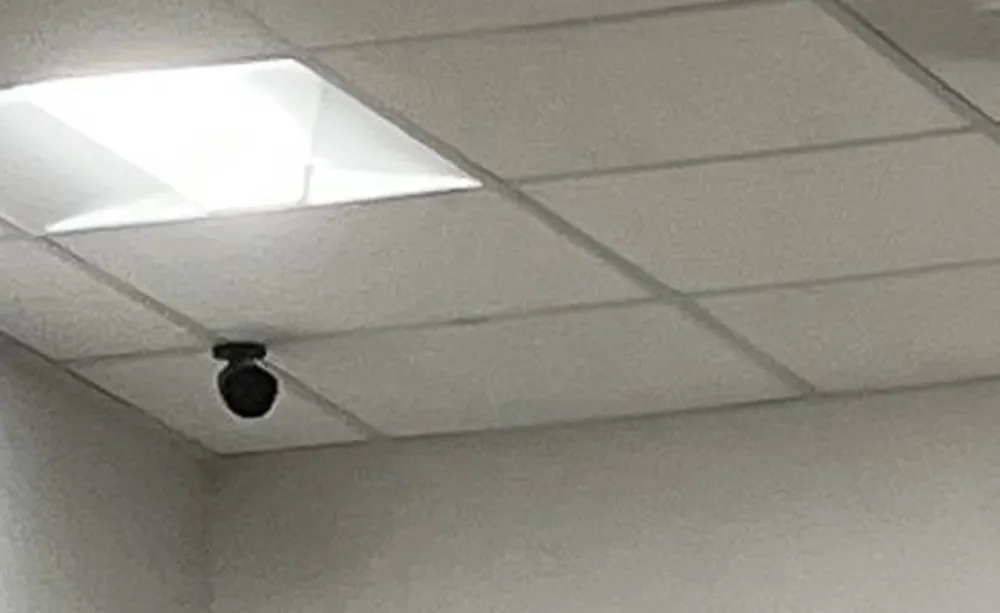
From one of our CCTV jobs (Rockland County car dealership): a small black dome tucked into the corner of the drop ceiling where it meets a tall white wall, next to a light panel.
Equipment
CCTV Systems and Cameras We Install in Rockland
Our own house-brand system is the default on most jobs, because we can stand behind it for years and get parts quickly. We are an authorized partner for Lorex, Luminys and Reolink, and we also install, integrate and service other recorders and cameras, including Hikvision, Dahua, Hanwha, Axis, UniFi Protect and Uniview, when an owner already has them or prefers them. Brand matters less than layout: a well-placed 4MP camera beats a badly placed 4K camera every time.
⚪
Turret and dome cameras
Turret camera installation and dome camera installation for front doors, porches, store counters and offices, where the camera is close to people and should look tidy.
🎯
Bullet cameras
Bullet camera installation for driveways, side yards, long hallways and lot edges, where a narrower view has to reach farther.
🔭
Varifocal lenses
Varifocal camera installation lets us zoom the view on site, which helps on Rockland's deep driveways and on store aisles where a fixed lens is too wide.
🌙
Night vision and color night vision
Infrared night vision for dark backyards against the woods, and color night vision where a porch light or lot light gives the camera something to work with.
🚨
Active deterrence
Active deterrence camera installation with a light and siren that trigger on a person in a set zone, useful on a car lot, a contractor yard or a back door after closing.
🤖
AI and smart detection
Smart detection CCTV installation that separates people and vehicles from deer, headlights and blowing leaves, so alerts stay worth reading.
🔢
License plate cameras
LPR camera installation at a lot entrance or a long driveway, with a tight lens and fast shutter so plates read at night.
🖥️
NVRs, DVRs and hybrids
4, 8, 16 and 32 channel recorders, sized with room to grow, with surveillance-rated drives that are built to write around the clock.
🔌
PoE switches, racks and UPS
CCTV PoE switch installation sized to the power budget, small wall racks for business systems, and a UPS for the whole equipment stack.
Picking the system type for a Rockland building
System
Cable
Typical Rockland fit
Trade-off
HD-analog on a DVR
Coax with a power pair
Houses and shops with an older camera system whose coax is still sound
Fewer smart features; each camera needs power over the coax pair or locally
IP cameras on a PoE NVR
One Cat6 per camera
New installs on split-levels, capes, two-families, offices and stores
Runs over 100 meters (328 feet) need an extender or fiber
Hybrid recorder
Coax and Cat6 together
Upgrades done in stages, old coax at the back, new IP at the front
Channel mix has to be planned up front
Wi-Fi cameras
Power only, video over Wi-Fi
A single spot with no cable route at all
Drops when the router is busy or the signal is weak; battery models wake late
Fiber link
Fiber to a far building, PoE switch there
A detached garage, a second building on a business lot, a yard trailer
Needs a converter box and an outlet in the far building
Compression. The recorders we install use H.265, the newer video codec, whenever the camera on the other end supports it. Next to H.264 it typically halves the file size of the same scene, and that saving is what lets a 4-camera house-brand package hold its two weeks on a single drive.
Retention. Every system we sell includes two weeks of recording. If a business policy, an insurer or a landlord wants a month, we add drive space rather than lowering the quality, and we show you the real number of days after the first week of recording.
Recording modes. Continuous recording on the cameras that matter most, such as the register or the front door, and event recording on quiet views, such as a back hallway, stretches the drive further without losing what you need.
Network security. Every default password is changed, the recorder's firmware is updated on install day, and remote access goes through the manufacturer's app rather than an open port on your router. On business systems the cameras sit on their own network segment or VLAN, away from the point-of-sale and office computers.
Placement. We plan from the outside in: where a person or a car first reaches the property, every door that opens, and the places where something valuable sits. Faces at doors want a camera at about eight to ten feet; lots and drives want height and a narrower lens; and every view is checked in daylight and again in the dark.
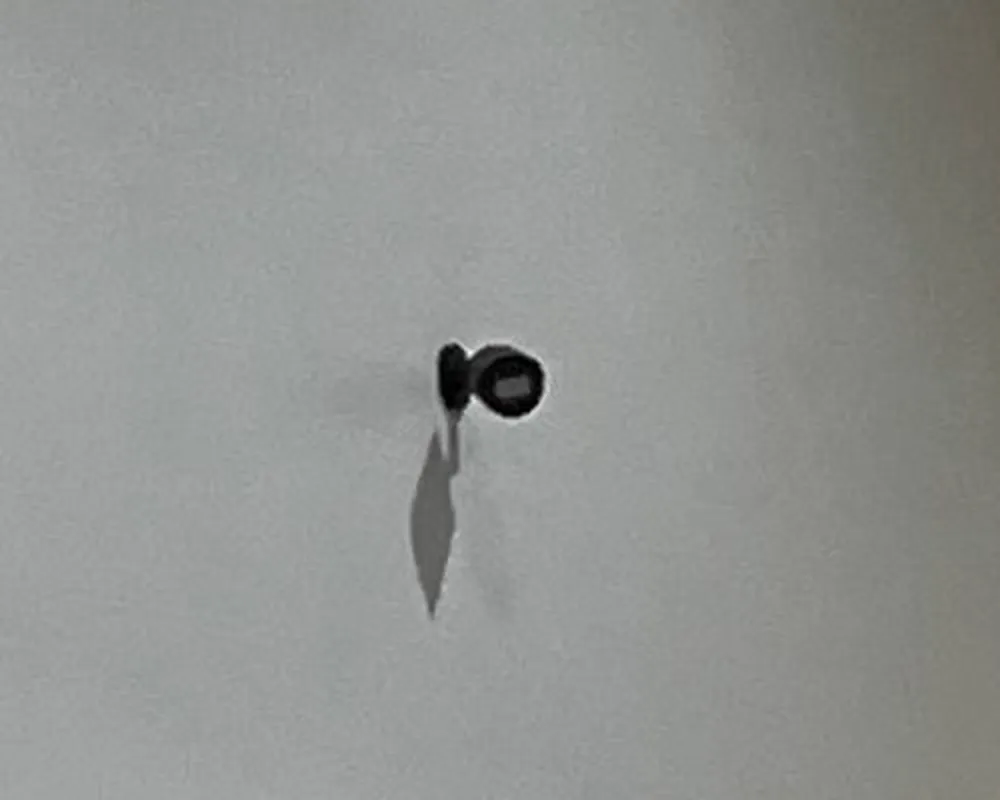
From one of our CCTV jobs (Rockland County car dealership): a close view of a small black bullet camera on a short arm against a plain white wall, its shadow falling below it, mounted well above reach.
Old DVR in the basement and half the cameras dark?
Text a photo of the recorder's label and a few of the cameras, plus your town. We will tell you which cameras and cable can stay, what a new recorder costs, and whether a battery backup is worth adding before the next storm.
Search summaries, chatbots and national cost sites such as Angi, HomeAdvisor and Fixr give camera advice for an average American house. Here is where that advice goes wrong in Rockland, and what we do instead.
“Rockland is a low-crime suburb, so a doorbell camera is all you need”
Rockland is quieter than the city, but the state's 2024 figures still count 3,346 larcenies and 255 burglaries in the county, with Clarkstown alone logging 1,427 larcenies. Package theft, car break-ins in driveways and shoplifting on Route 59 do not care about the county's reputation.
A doorbell sees one door from one angle and usually records to a cloud account in short clips. It does not see the driveway, the side gate, the back slider or the detached garage, and it misses the seconds before motion wakes it.
A small wired system with four cameras covers the doors and the drive, records continuously to a recorder in your basement, and still works with the doorbell you already like.
“PoE cameras keep running in a blackout because the cable carries power”
The cable carries power from the recorder or the switch, and those plug into the wall. When O&R loses a line, as it did for 2,596 Rockland customers on the night of December 19, 2025, the switch stops, and every PoE camera stops with it.
The fix is a UPS battery under the recorder, the switch and the modem. It keeps recording through short outages and lets the recorder shut down cleanly before the battery runs out, which protects the drive.
If the house has a standby generator, we put the equipment on a circuit the generator covers, so the battery only has to bridge the seconds before the generator starts.
“If you register cameras with the police, officers can watch them live”
Not in Clarkstown. The town's voluntary registration program lists where cameras are so detectives can ask owners for footage from a date and time. The department states plainly that it does not get remote access to registered cameras.
Nothing about registration changes how your system is installed or who holds the passwords. You stay the administrator, and you decide what to share when someone asks.
What registration does reward is preparation: an accurate clock, enough days of storage and an owner who knows how to export a clip. Those are part of every handover we do.
“National average prices tell you what CCTV should cost in Rockland”
National cost guides average together cheap DIY kits, single cameras and big commercial jobs from every state, then call the middle a typical price. They do not know whether your camera wires go through an open basement in New City or through plaster in a Nyack village house.
Our Rockland prices are written down: $1,099 for a house-brand 4-camera A Series system with recording, up to $1,541 for the 4K C and D Series, $1,228 to $2,500 for a 4- to 8-camera home system on an NVR, and $1,500 to $5,000+ for commercial systems.
Anything that changes the price, such as concealed wiring, conduit or a longer run, is listed separately in the quote after we confirm the layout, so you can compare it line by line with anyone else's.
“Any recorder keeps accurate time on its own”
Many recorders ship with a clock that drifts, a time zone set to wherever they were built, and daylight saving switched off. After a power cut, some revert to a default date until someone corrects them.
That matters in Rockland because police and insurers ask for footage by date and time. A clip stamped forty minutes off is harder to find and easier to question.
We sync the recorder to an internet time server, set the Eastern time zone with daylight saving, and compare it to a phone before we leave. On properties without internet, we set it by hand and show you where to check it.
“Put the recorder in the attic so burglars cannot find it”
An attic hides the recorder, but a Rockland attic in July is one of the hottest places in the house, and heat is what kills hard drives and power supplies early. In winter, an unheated space swings the other way.
We would rather put the recorder in a conditioned closet, a lower-level utility room or a locked office, where it stays cool, sits near the modem and the panel, and can be reached when you need to export a clip in a hurry.
If hiding the recorder is the priority, we can lock it in a small cabinet, keep it out of sight lines from windows, and add an off-site copy of key events so a stolen recorder does not take everything with it.
“More cameras always means better coverage”
Ten cameras pointed at the same front yard give you ten views of the same lawn. On a quarter-acre lot in Nanuet or a narrow two-family lot in Spring Valley, the useful views are few: each door, the driveway, the side passage and the back of the house.
Extra cameras also add storage, bandwidth and more alerts to sort through, which on a busy street turns into notification fatigue.
We plan each camera around one job, such as identifying a face at the door or seeing a car enter the drive, and leave spare channels on the recorder so you can add views later if a real gap appears.
Field Notes
Field Notes: The Rack Room Behind a Rockland Dealership's Cameras
Most photos of a camera job show cameras. The most useful one from our Rockland County dealership job shows the room where they all end up. The recorder's monitor hangs beside an open equipment rack, and above it the ceiling is crossed by bundles of blue network cable, with purple and white runs dropping into the rack on the left. Every camera on the system comes home to that corner, which is why it is the first place we look when a single channel misbehaves.
Three things on that screen are worth copying on any multi-camera job in the county. The recorder's own clock reads 2026-03-12 17:04:51, a Thursday in March just after five, and it is the time stamp every exported clip will carry. The layout is a 32-tile grid with 23 live cameras, so the business has nine open channels, D24 through D32, for future views without buying a new recorder. And the per-channel table shows which views are busiest, which tells us where the drive space goes.
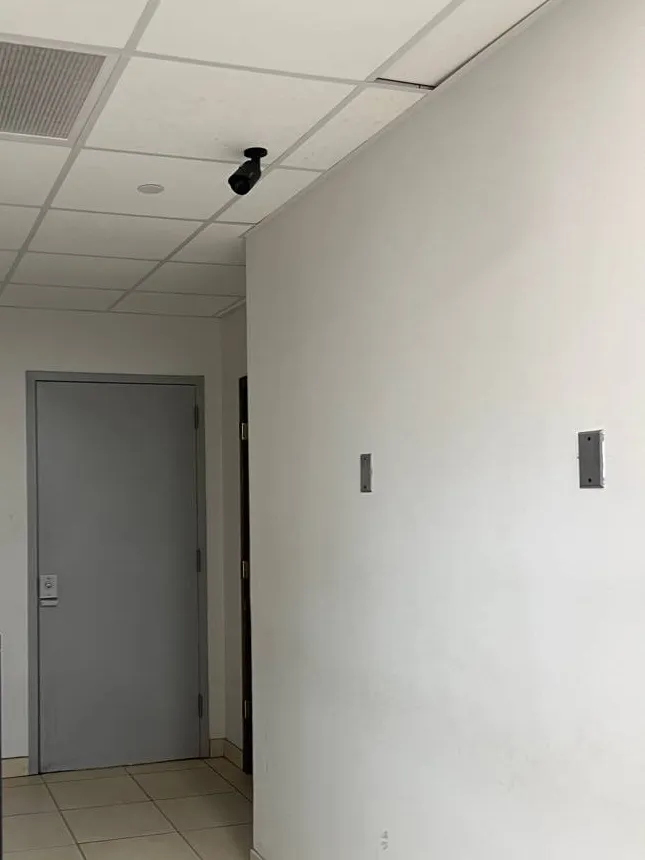
From one of our CCTV jobs (Rockland County car dealership): bundles of blue network cable running across the ceiling, purple and white cables dropping into the rack on the left, and the edge of the recorder monitor on the right.From one of our CCTV jobs (Rockland County car dealership): a black bullet camera on the drop ceiling of a short tiled hallway, aimed at the grey door at the far end, with switch plates on the white wall to the right.
The hallway camera is the other quiet lesson. A short corridor that ends at a single grey door gives a camera something rare: everyone who uses that door walks straight at the lens, under even light, with nothing to hide behind. One camera there does more than three cameras scattered across an open room. Rockland homes have their own version of that corridor, the side passage between a split-level and its neighbor, or the walk from a two-family's driveway to the basement door, and it is usually the first view we recommend after the front door.
One more habit from that job applies to every house we wire: the alarm motion sensors on the showroom walls stayed exactly where they were, with the cameras placed above them and out of their way. We work around what a building already has rather than moving it, and we note every device we work near in the handover sheet.
Before You Hire
How to Choose a CCTV Installer in Rockland County
Whoever you call, these questions separate a CCTV installation company that plans a system from one that hangs cameras. Ask every installer the same ones and compare the answers in writing.
Is the recorder on a battery, and for how long? In O&R territory the answer should be specific to your camera count.
Which cable, and where does it run? Outdoor-rated Cat6 or coax, through the house where possible, labeled at both ends.
How many days will I actually keep? A number for your cameras and resolution, not “weeks.”
Who holds the admin password? You should, with your own login, not a reseller account.
Is the clock synced and the time zone set? Ask them to show you on install day.
Can I see each view before you mount it? A good installer welcomes the question.
Whose license is on the job? New York low-voltage work should be done under a license number you can look up, with insurance behind it.
What paperwork is left behind? At minimum a list of cameras and what each covers, where every cable runs, and the login details in your name.
Our written quotes answer every one of those before you sign. For the record: Abstract Enterprises Security Systems holds New York State low-voltage license #12000287431, carries general liability insurance, and has been owner-operated since 2002, with thousands of jobs behind it. For what customers say, read our Google reviews, rated 4.7★ from 201 reviews; we do not hand out client lists or write testimonials for ourselves.
When Owners Call Us
When Rockland Owners Usually Call for CCTV
After a break-in, a car break-in or vandalism. CCTV installation after a burglary is the most urgent call, and it often follows a neighbor's incident on the same block. We book quickly, cover the entry points that were used first, and put the recorder where a second visitor will not find it.
Before the winter storm season. Owners who lost power in a December storm call about battery backup for an existing recorder as often as about new cameras. A UPS can usually be added to a system in one short visit.
Before the holiday shopping rush. Stores on Route 59 and in Nyack, Pearl River and Suffern want cameras running before Black Friday and the Christmas weeks, when traffic and shrink both peak. We like to finish retail jobs by early November.
Big local weekends. Pearl River's St. Patrick's Day parade weekend and Nyack's Halloween parade bring crowds onto residential and downtown streets, and businesses along the routes ask about door and storefront views ahead of time.
Buying a house or renting out a unit. New owners want the previous owner's system reset or replaced before they move in, and landlords adding a tenant in a two-family want a shared-entrance camera and separate logins in place before the lease starts.
A new business opening. A store or office fitting out a space in a Route 59 or Route 303 building wants cameras live on opening day. We schedule around the ceiling and the inspections so cameras go up after the grid is in and before the doors open.
Get In Touch
Request a Free Rockland County CCTV Quote
Tell us the town or village, the kind of building, roughly how many cameras you want and where, and whether there is an old recorder or old camera cable already in place. Phone photos of the outside of the house or store, and of any existing recorder's label, let us quote faster. Prefer to talk? Call (845) 640-3835.
✅
Request Sent!
Thanks. We will call or text to set up your Rockland County CCTV visit, normally within 2 hours.
How It Works
How a Rockland County CCTV Installation Runs
The same six steps apply whether it is four cameras on a Stony Point colonial or a multi-camera recorder system for a store on Route 59.
1
Send the basics
Town or village, building type, the doors and areas you care about, and photos of any old recorder or cameras. We reply and book within 2 hours.
2
Plan the views and the cable
Simple houses are planned from photos and a call; businesses and tricky houses get a site visit to trace cable routes and pick the recorder spot.
3
Approve the written quote
Each camera, cable run, recorder, drive and battery listed with the series price; extras priced per item. A 50% deposit holds the date.
4
Install and preview
Cable pulled and labeled, each camera previewed live with you before final mounting, wall penetrations sealed and sloped to shed water.
5
Configure the recorder
Clock synced, time zone and daylight saving set, streams, schedules, detection zones and users configured, battery backup tested.
6
Hand over and check back
App on every phone you name, playback and clip export practiced, password sheet and camera list handed over, alerts reviewed after the first week.
Coverage Area
CCTV Installation Near Rockland County's Landmarks
Our crews work in all five towns and every village. These are the places we pass most often on the way to Rockland jobs.
The Shops at Nanuet, Route 59
The open-air center in the middle of Clarkstown's retail strip. CCTV installation Nanuet businesses ask for usually means a shared lot, a rear service lane and long evening hours.
Main Street and Broadway, Nyack
The village's restaurants, galleries and shops in pre-war buildings. CCTV installation Nyack owners need is small, neat and anchored into mortar, with apartments upstairs kept out of view.
Central Avenue and the station, Pearl River
Downtown shops and offices near the Pascack Valley Line stop, ringed by 1950s capes. CCTV installation Pearl River houses need often starts in the knee-wall attic.
Main Street, Spring Valley
Dense village retail and two- and three-family houses on tight lots. CCTV installation Spring Valley landlords ask for centers on shared entrances, driveways and separate logins.
Haverstraw Bay waterfront
The brick village on the widest part of the Hudson, with older row buildings and new waterfront housing. CCTV installation Haverstraw jobs mix both, often in the same block.
Rockland Lake State Park, Valley Cottage
The park off Route 9W at the north end of Clarkstown. CCTV installation Valley Cottage requests split between hillside houses near the lake and the industrial buildings along Route 303.
We also cover New City, West Nyack, Congers, Bardonia, Orangeburg, Tappan, Blauvelt, Sparkill, Piermont, Grand View-on-Hudson, Upper Nyack, Suffern, Airmont, Monsey, Chestnut Ridge, Montebello, Wesley Hills, New Hempstead, New Square, Kaser, Hillburn, Sloatsburg, Pomona, West Haverstraw, Garnerville, Thiells, Stony Point and Tomkins Cove.
Pricing
CCTV Installation Cost in Rockland County
Nothing here is a special Rockland CCTV rate: the table repeats the figures on our Rockland County security camera page. Each house-brand series is priced as four cameras plus the recorder, wiring, installation and two weeks of recording.
System
What you get
Price
A Series
Four 1080p (2MP) cameras recording to a DVR
Starting at $1,099
F Series
5MP coax cameras whose lights and siren fire on intruders
Starting at $1,147
E Series
Four IP cameras (4–5MP) on a 4K NVR that sorts people from cars
Starting at $1,306
C Series
Four 4K (8MP) cameras over coax, including long-range styles
Starting at $1,541
D Series (top tier)
Four 4K IP cameras that can flash, sound a siren and talk back
Starting at $1,541
Residential system
Home system of four to eight cameras on an NVR, PoE cable pulled by us
$1,228 – $2,500
Commercial CCTV
Offices, retail, restaurants and multi-story buildings
$1,500 – $5,000+
Monthly fees
Footage stored locally on the recorder
$0 / month
What moves a Rockland quote up or down
A 4-camera residential system in Rockland typically costs $1,099 to $2,000 for a single-family home. The CCTV installation cost per camera beyond the package depends mostly on the cable route to that camera: a camera on the eave of a raised ranch with an open lower-level ceiling is quick, while a camera on the gable of a plaster-walled cape with no attic access takes far longer. Additional cameras, concealed wiring through finished walls, conduit outside, runs to a detached garage, larger drives for longer retention and a UPS are each priced per item after we confirm the layout.
Three Rockland examples show how that plays out. A Clarkstown split-level with a drop-ceiling den usually fits the 4-camera package with little added. A Pearl River cape with plaster walls often adds a line for concealed wiring or painted raceway. A Spring Valley two-family usually moves into the 4- to 8-camera residential range, with extra cameras on the shared driveway and the side entrance and a login for each household.
If you only need hands, not hardware, the CCTV installation labor only price comes back by text once we know the camera models and where they go, and the deposit locks in the day. Ask about financing on our own systems when you call. There are no inflated “was” prices and no seasonal specials that exist only on paper: the prices in the table are the prices.
Installation workmanship carries our 30-day warranty, and extended coverage of one year or more is available as a paid add-on. Full terms — including 50% deposit, one-year parts-only warranty on Abstract Enterprises Security Systems-supplied products, and the late-fee schedule — are set out in the service agreement.
Shop Our Systems
CCTV Installation Packages for Rockland Homes and Businesses
Five house-brand series, each a complete 4-camera CCTV installation package. The choice comes down to the cable you have, how far the cameras need to see, and whether you want smart alerts or a deterrent light and siren.
A
A Series · starting at $1,099
2MP HD 1080p camera packages with DVR. Night Vision 60-100 FT, Motion Detection, Smart AI, Full-Color Night Vision, Audio, Remote Access. Models: A1, A2, A3. Incl. 2 wks recording. A practical start for a small cape or a single storefront.
F
F Series · starting at $1,147
5MP DVR 2K HD cameras, Eyeball, Bullet & Dome. Night Vision 90-100 FT, Active Deterrent with Siren & Lights, 20" Monitor. Models: F1 to F6. Incl. 2 wks recording. Good for reusing sound coax from an older system.
E
E Series · starting at $1,306
4-5MP IP 2K HD cameras, 4K NVR. Night Vision 90-100 FT, IP67, Smart Detection, Audio, Full-Color, 20" Monitor, Remote Access. Models: E1, E2, E3. Incl. 2 wks recording. Our usual pick for new PoE wiring on split-levels and two-families.
C
C Series · starting at $1,541
8MP 4K Ultra HD DVR, Eyeball & Long Range. Night Vision 100-120 FT, IP66, Audio, Full-Color, Monitor Included. Models: C1, C2, C3. Incl. 2 wks recording. 4K detail over coax for deep driveways and lots.
D
D Series, the top of the range · starting at $1,541
8MP 4K Ultra HD IP, Eyeball & Bullet. Night Vision 90-120 FT, IP67, Audio, Full-Color, Active Deterrent, Two-Way Talk, 20" Monitor. Models: D1 to D5. Incl. 2 wks recording. For stores, offices and owners who want every feature.
Your own cameras, our labor
A Lorex box from a warehouse club, a Reolink kit from an online order, a recorder a relative passed on: we mount and wire equipment you supply and charge for labor only. Text the model numbers, the camera count and a rough sketch, and the price comes back the same way; the deposit books the date. There is no site walk-through for owner-supplied gear, and when the kit is wireless, the Wi-Fi signal and the cameras themselves stay your responsibility rather than ours. If a kit looks wrong for the building, say Wi-Fi cameras meant to reach a garage behind a brick house, we will tell you before any labor is booked.
Can some cameras record all the time while others record only when something moves?
+
Yes. Each camera on the recorder has its own schedule. Most Rockland owners keep continuous recording on the front door, the driveway or a store register and set quieter views, such as a back hallway or a side yard, to record on person or vehicle events. That keeps the important views complete and makes the hard drive last longer.
What happens to the footage when the recorder's hard drive is full?
+
The recorder overwrites the oldest footage first and keeps going, so it never stops recording because the drive is full. That is why the number of days the drive holds matters. Every system we install keeps at least two weeks, and if you need a clip kept longer, you export it to a USB stick or your phone before it rolls off.
I bought a Rockland house that already has cameras. How do I get the previous owner off the system?
+
The safest route is a reset done in person: we identify the recorder, reset or recover the admin account, remove the old owner's app access and any cloud link, change every camera password and set the system up under your name. If the old recorder is too dated to secure properly, we tell you which cameras and cable can be reused with a new one.
Will I see a camera plan before I pay the deposit?
+
Yes. The written quote lists each camera, where it goes and what it is meant to show, along with the cable route, the recorder spot and every priced item. For larger houses and businesses we add a simple marked-up sketch or photo set. You approve the plan first; the 50% deposit only books the date.
Is there any CCTV work you turn down?
+
Yes. We do not hide cameras in bathrooms, bedrooms, changing areas or anywhere people expect privacy, we do not aim cameras into a neighbor's windows or yard, and we do not switch on audio recording at a business without the owner confirming it is lawful there. We will also talk you out of Wi-Fi cameras for spots they cannot reliably reach.
What if I forget the password to my CCTV recorder?
+
Call us. Password recovery usually needs someone at the recorder with the right tools and proof that you own the system, and some recorders need the manufacturer's reset code. On a service visit we recover or reset the admin account, set a new password you choose, and update the app on your phones so nothing else breaks.
Do outdoor cameras keep working through a hard January cold snap in Rockland?
+
Weather-rated outdoor cameras are built for winter; the cameras in our E and D Series are rated IP67 and the C Series IP66. The weak points in deep cold are cheap power supplies, cracked cable jackets and snow building up on a lens, so we use outdoor-rated cable, mount cameras under eaves where we can, and avoid long, unprotected outdoor runs.
Should a home EV charger or a business's charging spaces have a camera?
+
If the charger is outside, it is worth covering. Charging cables and connectors are tempting targets, and a camera on the charger also shows who parked and plugged in. In a driveway the driveway camera can usually be aimed to include the charger; at a business, the charging spaces are often covered by the lot camera with a slightly tighter view.
What does H.265 on a recorder spec sheet mean for me?
+
H.265 is the video compression standard most current cameras and recorders use. It stores about the same picture as the older H.264 in roughly half the space in typical scenes, which means more days of recording on the same drive and lighter streams when you watch from your phone. We switch it on wherever both the camera and the recorder support it.
Does a CCTV system add much to the electric bill?
+
Not much. A fixed camera typically draws a few watts, well under the 15.4 watts a standard PoE port can supply, and the recorder, switch and battery backup add a modest amount on top. A typical home system runs around the clock on roughly the power of a few household light bulbs, though cameras with heaters, PTZ motors or deterrent lights draw more.
All Areas Served
CCTV Installation in Rockland and the Wider Hudson Valley
Rockland is one of six Hudson Valley counties our CCTV crews cover. For the regional view, including longer runs to barns and outbuildings farther north, see our CCTV installation guide for the Hudson Valley.
This page serves Clarkstown, Orangetown, Ramapo, Haverstraw, Stony Point and all of their villages and hamlets. Office: 460 E Fordham Rd, Bronx, NY 10458. Direct line (845) 640-3835. Licensed NYS low-voltage contractor #12000287431, insured. Rated 4.7★ / 201 Google Reviews. Updated November 16, 2026.