From Amityville to Montauk: wired CCTV for long driveways, barns, farm stands, flex buildings and houses that sit empty all winter. Suffolk line: (631) 407-2884
Long Cable Runs · Fiber & PoE Links · DVR & NVR Recorders · No Monthly Fee
CCTV installation in Suffolk County is mostly a problem of distance. The lots get bigger the farther east you drive, the garage or the barn sits a few hundred feet from the house, the farm stand is out by the road, and the owner of a Hampton Bays cottage may be watching from Manhattan for half the year. Abstract Enterprises Security Systems designs wired camera systems that carry video across that distance: Cat6 where copper will reach, fiber or a powered extender where it will not, a DVR or NVR recorder in a dry, conditioned spot, a battery backup sized for PSEG Long Island outages, and a phone app that tells you when a camera or the whole site goes dark. Recording stays on your own premises, so there is nothing to pay each month.
Reviewed and updated November 16, 2026 by Abstract Enterprises Security Systems, NYS license #12000287431 · Sources: Suffolk County Comprehensive Emergency Management Plan (2024); U.S. Census Bureau ACS 2023 5-year (DP04, B25004); NYS DCJS Index Crimes by County, 2022–2024; Office of the NYS Comptroller, A Profile of Agriculture in New York State; Regional Plan Association, Hauppauge Industrial Park study; Newsday (September 2026); RiverheadLOCAL (July 2026); Riverhead News-Review (August 2026); NY Penal Law §250 and Labor Law §203-c
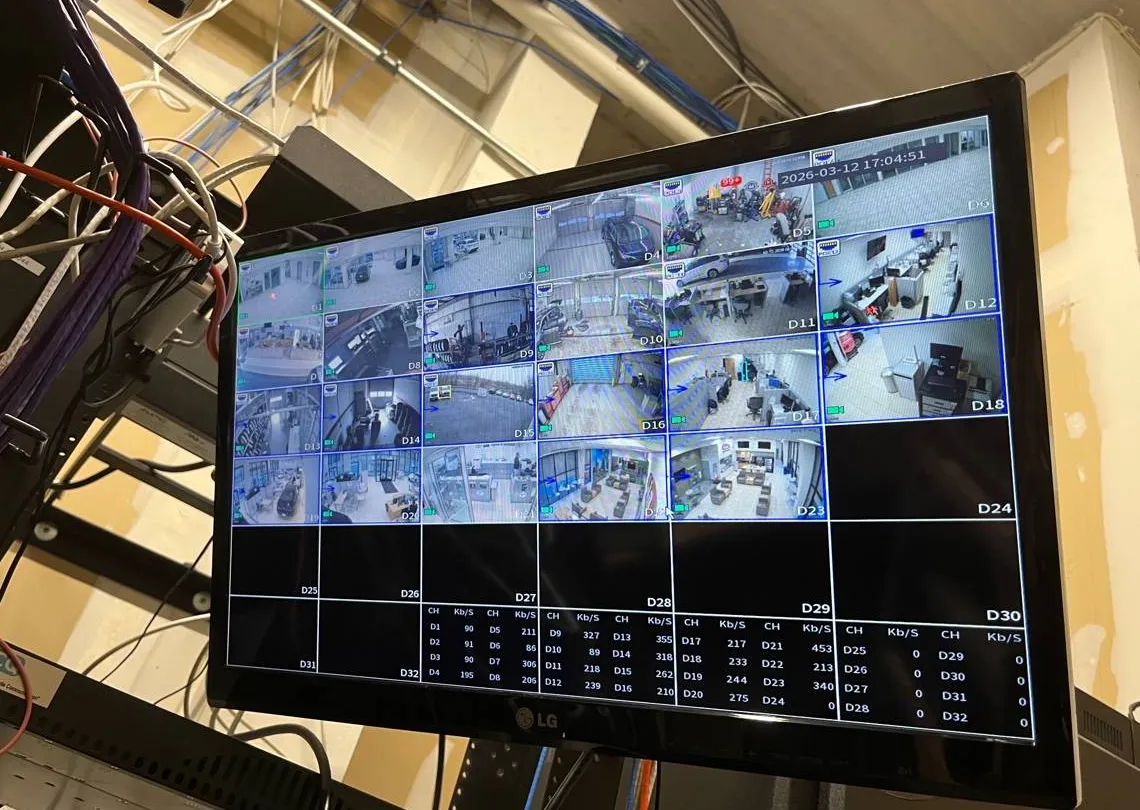
From one of our CCTV jobs (Rockland County car dealership): two dozen live channels on one NVR, with the bundled Cat6 coming down beside the screen. On a spread-out Suffolk property the same recorder can take cameras from the house, the garage and an outbuilding.
Suffolk County CCTV Request
Town or hamlet, property type and camera count
✅
Request Sent!
Thank you. We book Suffolk County CCTV jobs within 2 hours of a request and will be in touch shortly.
25+
Years Experience
2 Hr
Booking
100%
Licensed & Insured
4.7★
201 Google Reviews
Owner-operated since 2002 · Thousands of jobs completed · Booked within 2 hours
Price first: $1,099 buys a complete four-camera CCTV system in Suffolk County, recorder and two weeks of recording included. Homes wanting 4 to 8 PoE cameras on an NVR land between $1,228 and $2,500. Shops, offices, flex buildings and warehouses run $1,500 to $5,000+. Long runs to a barn, a gate or a dock, trenching and fiber are priced per camera after we confirm the layout. There is no monthly fee. Call or text (631) 407-2884: we book within 2 hours of your request and schedule 7 days a week with early-day starts, first come, first served once the deposit is in.
Four series from $1,099 (2MP HD on a DVR) to $1,541 (8MP 4K on coax or on PoE)
Tell us the distance to your farthest camera; that number shapes the quote more than anything else
Bought a kit already? A text with the models and spot photos gets you a labor-only number
Why Suffolk County Properties Need CCTV Installation
Suffolk is the long half of Long Island. The county's own emergency plan counts 10 towns and 33 villages, running from Babylon and Huntington at the Nassau line out to the two forks, Shelter Island and Montauk Point. The western towns look like the suburbs most people picture: ranches, capes and colonials on quarter-acre lots, office parks along Route 110, and the industrial blocks of Hauppauge, Bohemia and Ronkonkoma. The farther east you go, the more the property itself changes. Lots open into acres, houses sit at the end of a long gravel drive, a pole barn or a pool house stands well away from the main house, and the neighbor across the road is a vineyard or a sod farm.
That spread is why CCTV in Suffolk is planned differently. A camera is only as good as the cable or link that brings its video back to the recorder, and on a Suffolk property the hardest camera is rarely the front door. It is the one on the barn, the gate at the end of the drive, the boat in the side yard or the farm stand by the road. Copper Ethernet carries a PoE camera about 100 meters, or 328 feet, before the signal and power need help. Past that, we plan a fiber link, a PoE extender, a switch in the outbuilding or a point-to-point wireless bridge, and we decide which one before anyone digs a trench.
The second Suffolk pattern is the empty house. Census figures count 44,038 homes in the county that are held for seasonal, recreational or occasional use, about two of every three vacant housing units. Many sit on the South Fork, the North Fork and Shelter Island, but plenty are bay cottages in Mastic Beach or Hampton Bays and lake houses inland. Those owners want CCTV that can be trusted for months with nobody on site: cameras that keep recording through a storm, a recorder that reports when it loses power, and an app that answers the question “is everything still running out there?” from a desk in the city.
The third pattern is farm and roadside commerce, which is bigger here than anywhere else in the state. Newsday reported in September 2026 that operators of self-serve farm stands on the East End are increasingly reporting thefts, with crops taken and cashboxes smashed. A month earlier, the Riverhead News-Review published camera stills of a masked man with a crowbar prying a cash box off the counter of an Aquebogue farm market at 1:50 in the morning. Those stories are the reason we design farm and stand systems around the cash box, the road and the vehicle, not just the field.
“It’s discouraging, but the fact that we still have so many farm stands that operate on the honor system, I think, is a reflection of the character of this community and the good ethics of the people in this community.”
— Southold Police Chief Steven Grattan, quoted by Newsday, September 5, 2026
Suffolk County numbers we design around
579,790 housing units, 79.9% of them single-family detached houses, and 81.9% of occupied homes owner-occupied (U.S. Census Bureau, ACS 2023 5-year, DP04). In other words, most CCTV decisions in Suffolk are made by the person who owns the walls.
44,038 homes held for seasonal, recreational or occasional use, out of 67,510 vacant units (ACS 2023 5-year, B25004). That is roughly 7.6% of every home in the county.
Burglaries fell from 1,018 in 2022 to 816 in 2023 and 710 in 2024 across all Suffolk police agencies, while motor vehicle thefts dropped from 1,534 to 1,241 between 2023 and 2024 (NYS DCJS, Index Crimes by County, County Total rows).
Larceny was 15,811 of the county's 19,213 index crimes in 2024, about 82% by our arithmetic from the same DCJS table. Theft, not break-ins, is what most Suffolk cameras end up recording.
578 farms on 33,821 acres sold $364.2 million of products in 2022, and Suffolk's 79 wineries harvested 4,683 acres of grapes (Office of the NYS Comptroller, from the 2022 Census of Agriculture). The same report says Suffolk farms lead the state in sales made directly to customers.
About 1,300 companies and more than 55,000 employees work in the Hauppauge Industrial Park, around 5% of the jobs in Nassau and Suffolk combined (Regional Plan Association).
Field Notes
Field Notes: Measuring the Far Camera First
We do not have a Suffolk job in the photos on this page yet; every picture here is from a real CCTV job of ours in Rockland County, Nassau County or Manhattan, and each caption says which. What we can describe is how our crew starts a Suffolk survey, because it is different from a survey in a city or an inner suburb. On a city storefront the first question is where the recorder can go. On a Suffolk property with a detached garage, a barn, a stand or a dock, the first question is how far the far camera is from that recorder, measured along the path the cable will actually take, not as the crow flies.
That path includes every turn: up the inside wall of the house, across the attic, down the soffit, along the foundation, under the driveway and across the lawn to the outbuilding. A barn that looks 200 feet away on a satellite map is often 280 feet of cable once the route avoids the septic field, the irrigation lines and the drip edge of the roof. If the total is comfortably inside the 328-foot Ethernet limit, a single outdoor-rated Cat6 run in conduit does the job. If it is close to the limit or past it, we change the design instead of hoping the camera works: a small PoE switch in the outbuilding fed by fiber, an extender at the halfway point, or a wireless bridge between two buildings that can see each other.
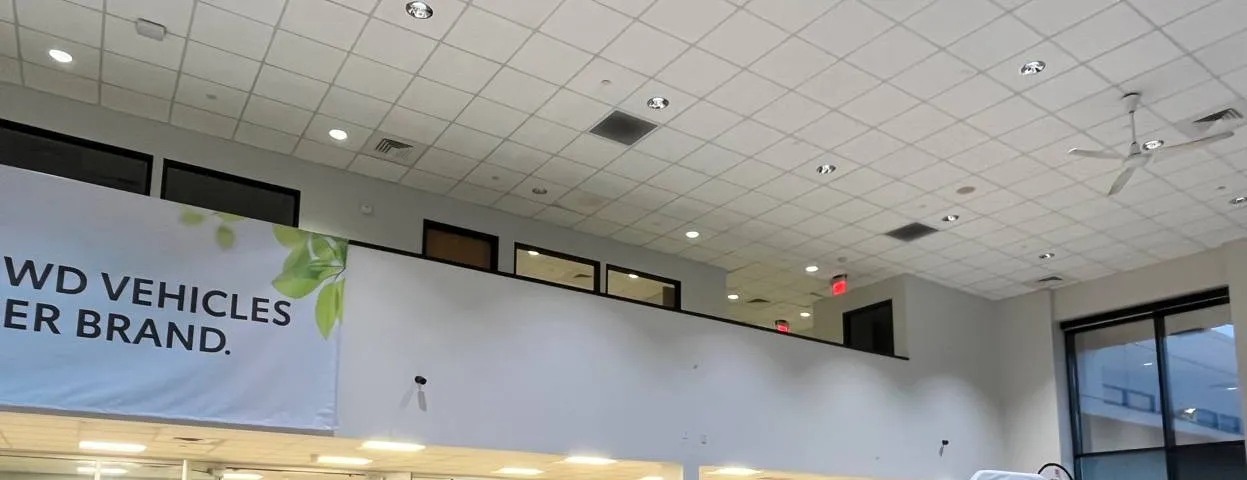
From one of our CCTV jobs (Rockland County car dealership): a two-story showroom where the cameras sit high on the mezzanine wall and the ceiling grid. Tall pole barns and equipment buildings on Suffolk farms raise the same questions about height, lift access and cable paths.
The second thing we check is power at the far end. Many Suffolk barns, stands and docks have a single outlet or a subpanel that is switched off in winter. A PoE camera takes its power from the recorder or the switch at the house end, which avoids that problem as long as the cable reaches. A switch in the barn needs its own circuit, and we ask whether that circuit stays live when the farm is closed for the season. The third check is the ground: sand on the South Shore, clay and stone on the North Shore moraine, roots near hedgerows. It decides whether a trench is an afternoon or a day.
A line our crew repeats on every large-lot survey: “Tell us where the far camera goes before you tell us how many cameras you want.” The camera count sets the recorder size. The distance to the farthest camera sets almost everything else in the price.
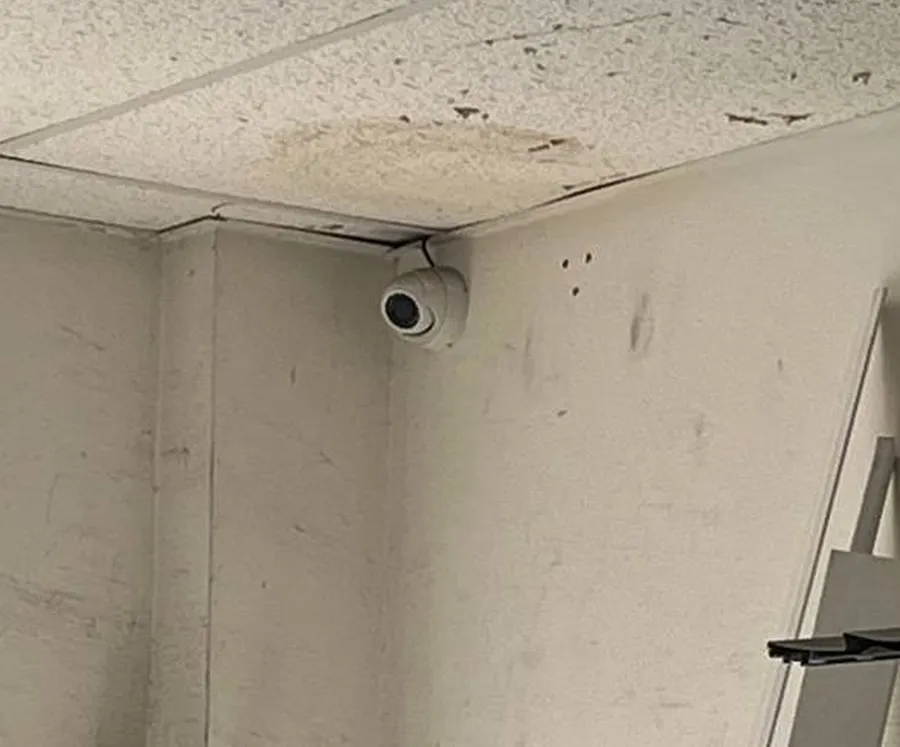
From one of our CCTV jobs (Nassau County window-and-door showroom): a dome fixed to the solid wall corner of a storage room instead of a ceiling tile. Outbuildings in Suffolk get the same treatment, with the camera on framing or masonry that will not shift.
What We Install
CCTV Installation Services in Suffolk County
Every CCTV installation service we sell in Suffolk includes the planning, the cable, the mounting, the recorder setup, the network and the app on your phone, done by our own licensed crew. The cards below are the jobs Suffolk customers ask for most often, from a ranch in Commack to a vineyard in Cutchogue.
🏡
Residential CCTV Installation
Home CCTV installation for ranches, capes, colonials, high ranches and newer center-hall houses: front door, driveway, garage, backyard, pool gate and the side yard where the trash cans live. Recorded on a DVR or NVR in a closet or basement, viewed on your phone, with motion alerts limited to people and cars.
🚜
Farm, Stand & Nursery CCTV
Cameras for farm stands, greenhouses, nursery yards, equipment barns and fuel tanks on the North Fork, the South Fork and in Calverton, Manorville and Riverhead. Designed around the cash box, the road and the vehicle, with long links back to a recorder in the farmhouse or office.
🍇
Winery & Brewery CCTV
Tasting rooms, barrel rooms, loading doors, event tents and the parking field. Staff get a live-view login for the bar, while playback and export stay with the owner or manager.
🏖️
Second-Home & Rental CCTV
Exterior coverage for houses that sit empty in winter or rent by the week in summer: driveway, doors, pool, beach or bay stairs. Health alerts tell you when a camera, the recorder or the internet goes offline. Interior cameras only where the law and your renters allow.
🏭
Industrial & Flex Building CCTV
Commercial CCTV installation for the industrial parks of Hauppauge, Bohemia, Ronkonkoma, Edgewood, Deer Park and Yaphank: loading docks, overhead doors, truck courts, employee lots and shared lobbies, often with separate camera groups for each tenant.
🛍️
Retail & Restaurant CCTV
Store and restaurant CCTV for Route 110, Jericho Turnpike, Route 25A, Sunrise Highway, Montauk Highway and the village main streets: the door at face height, the register, the stockroom, the back door and the dumpster corral. Retail CCTV installation is usually finished before the summer season out east and before the holidays up west.
🔗
Long-Run, Fiber & Bridge Links
Fiber optic CCTV installation, outdoor-rated Cat6 in conduit, PoE extenders and point-to-point wireless bridges for cameras beyond the reach of a single cable: barns, gates, docks, pump houses and second buildings on the same lot.
🔁
Upgrades & Replacements
CCTV installation and upgrade work on older systems: a DVR that stopped recording, analog cameras that went soft, a 4-channel box that is full, or a system the last owner of the house left with an unknown password. DVR to NVR upgrade or 4K over existing coax.
🧰
Labor-Only Installs
CCTV installation for customer supplied cameras: text the brand and models, a photo of each spot and the rough distance to the far camera, and we quote labor by phone or text. Booked with the deposit; no walk-throughs on customer equipment.
Need more than cameras? The broader security camera installation in Suffolk County page covers doorbell cameras, wireless cameras and combined camera-and-intercom jobs. This page stays on CCTV: wired cameras, a recorder on your premises and the cable or link between them.
Building Specialists
CCTV Installation for Suffolk County's Architecture
Suffolk's housing is younger than most people expect. The ACS puts about 38% of the county's homes in the 1960s and 1970s, when farms in Commack, Smithtown, Centereach, Holbrook and Selden became subdivisions, and the East End kept building houses for summer use the whole time. Each type of building gives our crew a different path for cable and a different place for the recorder.
🏠
1960s–70s Ranches
The one-story ranches of Commack, Centereach, Selden, Lake Ronkonkoma and Bay Shore usually have a walk-in attic over the whole house and a basement or crawlspace under it. Cameras go on junction boxes under the eaves and the cable drops straight to a closet or the basement. These are the quickest Suffolk houses to wire.
🪜
High Ranches
The raised ranch puts the living space upstairs over a half-buried lower level with the garage and the utility room. The lower level is the natural home for the recorder, and the garage ceiling gives us a path to both ends of the house without opening finished walls.
🏛️
Colonials & Center-Halls
Two-story colonials in Dix Hills, Northport, Stony Brook, Setauket and Smithtown often have finished attics with small access hatches. We route cable through knee walls and closet chases, and pick camera positions under the deeper eaves so the lens sits out of the rain.
🌲
Shingle-Style & Shake Houses
Cedar shingle and shake on Shelter Island, Sag Harbor, Southampton and much of the North Fork. We mount on a flat block or a junction box set into the shingle course, seal every penetration, and avoid nailing through the shingle where water runs.
🏝️
Beach & Bay Cottages
Slab or pier-built cottages in Mastic Beach, Hampton Bays, Fire Island communities and along the bays have little attic and no basement. The recorder lives in a closet, high off the floor, and cable runs on the exterior in painted raceway where it cannot go inside.
🌾
Farmhouses & Barns
Older farmhouses on Sound Avenue, Main Road and the back roads of Mattituck, Aquebogue and Bridgehampton, with pole barns, potato barns and equipment sheds behind them. Barns get their own switch or a long Cat6 or fiber link back to the house.
🏘️
Condos & Townhouse Communities
Condominium and townhouse complexes in Ronkonkoma, Patchogue, Riverhead and Port Jefferson: entrances, mailbox kiosks, clubhouses and parking courts. Common-area CCTV is a board decision; we work from the board's written approval.
⚓
Waterfront Houses
Bayfront and canal houses in Babylon and West Islip, on the canal streets of Lindenhurst and Copiague, and along the creeks of the North Fork, many raised after storms. Cameras stay above flood height and the recorder stays upstairs.
Getting cable to a building across the lawn
For a garage, pool house or barn on the same lot, our first choice is outdoor-rated, gel-filled Cat6 inside conduit in a trench, entering each building through a sealed sleeve. Conduit costs more than direct-burial cable on day one, and it pays back the first time a camera needs a new run, because we pull a new cable through the old pipe instead of digging again. Where a trench is not practical, a short aerial run on a messenger wire between two buildings is sometimes an option, and where neither works, a pair of wireless bridge radios with clear line of sight carries several cameras across. Every link is labeled at both ends so the next technician knows what it is.
Recorder placement in a Suffolk house
The recorder needs a steady temperature, a short run to the internet router and a place nobody trips over. In western Suffolk that is usually the basement or a utility room. Out east, many houses have no basement, and summer houses are often heated to just above freezing in winter or not at all. A hard drive in an unheated closet at 35 degrees, or in an attic that bakes all August, will not last. We put the recorder in the most stable room the house has, often a bedroom closet, with the battery backup next to it and the router on the same backup.
Mounting on shingle, stucco and vinyl
Each siding gets a different mount. On vinyl we use a mounting block made for the profile so the camera does not crush the siding or let water behind it. On cedar shingle we set a block or box at the butt line of a course and seal the hole with exterior sealant behind the block. On stucco we drill with a masonry bit, anchor into the substrate and seal around the anchors. We avoid mounting a camera where a gutter drips on it or where a downspout will sheet water across the lens in a nor'easter.
Commercial CCTV
Business CCTV Installation in Suffolk County
Commercial CCTV installation in Suffolk splits into two very different jobs. In the western towns, it is mostly industrial and office space: flex buildings with loading doors, office parks with big surface lots, and plazas on the main roads. Out east, it is seasonal retail, restaurants, farms, wineries and marinas, where the business is crowded in July and quiet in February. Here are the corridors we work in most, and what the cameras usually have to see.
🏭
Hauppauge Industrial Park
Long Island's largest industrial park, with about 1,300 companies. Typical jobs: dock doors and truck courts, the employee lot, shared lobbies in multi-tenant buildings, and high-value storage rooms. Long walls and high ceilings mean longer lenses and lift work.
🛣️
Route 110 Corridor
From Amityville and Farmingdale through Melville to Huntington Station: office towers and parks, car dealerships, plazas and restaurants. Office CCTV installation here usually means entrances, elevator lobbies, server rooms and the parking field.
✈️
Ronkonkoma & MacArthur Area
Warehouses, logistics buildings, hotels, airport parking and contractor yards around Long Island MacArthur Airport, Bohemia, Holbrook and Ronkonkoma. Distribution center CCTV installation focuses on docks, gates and trailer drops.
🛒
Route 58 & Tanger, Riverhead
Big-box plazas, outlet stores and restaurants along Route 58 and around Tanger Outlets. Seasonal staff turnover means separate user accounts that can be switched off the day someone leaves.
🍷
Route 25 & Sound Avenue
Wineries, farm markets, breweries and stands from Riverhead through Jamesport, Mattituck, Cutchogue, Peconic and Southold. Cash boxes, tasting bars, barrel rooms and parking fields that fill on fall weekends.
⛵
Harbors & Main Streets
Port Jefferson, Northport, Patchogue, Sag Harbor, Greenport and Montauk: restaurants, shops, boatyards and marinas on tight lots by the water. Marina cameras need salt-rated housings and mounts above the reach of storm surge.
Multi-tenant buildings and shared systems
Many Suffolk flex buildings hold four or five businesses under one roof, each with its own overhead door and its own office. The landlord usually wants the exterior, the shared lot and the common lobby; each tenant wants its own space and does not want the neighbors looking in. One recorder can do both. We create camera groups and user accounts so the landlord sees the outside and the lobby, and each tenant sees only its own cameras. Where tenants insist on full separation, each gets its own small recorder, and the landlord's system covers the shell. Either way, the agreement about who owns which camera goes in writing before installation.
Seasonal businesses out east
A Montauk restaurant or a Greenport shop may employ five people in March and forty in August. CCTV for a seasonal business has to cope with that: user accounts for seasonal managers that expire when the season ends, a register camera at a height that reads cash and the screen, and alerts that stay quiet in the busy months and become strict once the place is closed for the winter. We set separate schedules for the season and the off-season so the owner is not buried in motion alerts in July and does not miss a broken door in January.
Privacy law for Suffolk employers, shops and farms
This is general information, not legal advice. New York Labor Law §203-c prohibits video recording in restrooms, locker rooms and changing rooms used by employees. Penal Law §250.45 makes it a crime to record people without their knowledge where they have a reasonable expectation of privacy, such as a bathroom or a bedroom. Audio is treated more strictly than video: under Penal Law §250.05, recording a conversation you are not part of, without the consent of at least one person in it, is eavesdropping, so we leave audio off on employee and customer areas unless a lawyer has said otherwise. Some towns and villages regulate signs, poles and anything freestanding; check with the town or village building department before a new pole or post goes up.
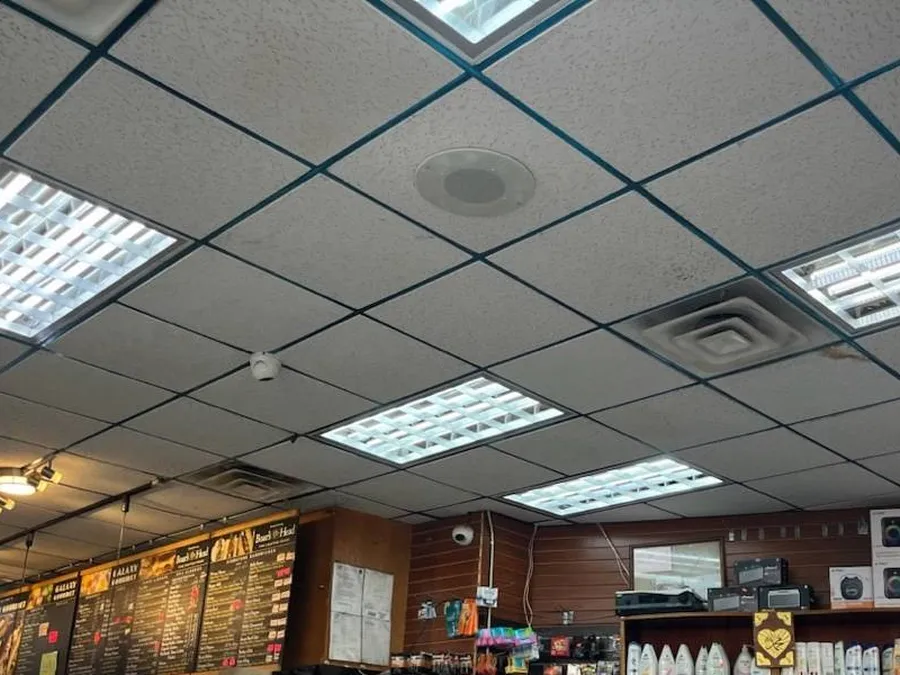
From one of our CCTV jobs (Manhattan corner deli): domes in the drop ceiling over the aisles, spaced so each covers a run of shelving. A farm market or a village shop in Suffolk uses the same layout over its counters and coolers.
Getting Video Back From the Barn, the Gate and the Dock
The question that separates a Suffolk CCTV job from a city one is how the video gets home. Every camera on a property has to reach the recorder somehow, and the method changes with distance, with what lies between the two points and with whether the far building has power. These are the five links we use, roughly in order of preference.
Link
Typical reach
Best for
Watch out for
Single Cat6 run with PoE
Up to 328 ft (100 m) of cable
Garages, pool houses, gates and sheds within that distance
The real route is longer than the straight line; every bend and wall counts
Cat6 plus a PoE extender
Adds another segment past 328 ft
A single camera a little too far out, such as a gate at the end of a drive
Each extender is one more device that has to stay dry and powered
Fiber to a switch in the outbuilding
Hundreds to thousands of feet
Barns, stands and second buildings with several cameras
Needs power at the far switch and a small media converter at each end
Point-to-point wireless bridge
Depends on line of sight
Two buildings that can see each other where trenching is not allowed or practical
Trees in leaf, heavy rain and a bumped mount can weaken the link
Separate recorder at the far site
Any distance with internet
A farm stand or a second parcel across the road with its own internet
Two recorders to look after, though both can show in one app
Fiber is the link we recommend most often for a Suffolk barn or stand with three or more cameras. Glass does not carry electricity, so a lightning strike near the barn is far less likely to travel back to the recorder in the house, and the distance limit is effectively out of the picture for a farm. The trade-off is that the far end needs its own power for the switch and the cameras, and that circuit has to stay on when the building is closed. Where a farm turns the barn's power off in winter, we either keep one circuit live for the cameras or design around a building that stays on.
Wireless bridges are useful, but we treat them as a link of last resort on long runs, not the first choice. A pair of directional radios on two roofs can carry a group of cameras several hundred feet, and they suit a property where the town, a wetland setback or a paved courtyard rules out a trench. They need a clear view between the two mounts, and a Suffolk tree line that is bare in March can block the signal by June. We check the path in the season you will rely on it and mount the radios on solid framing, not on gutters.
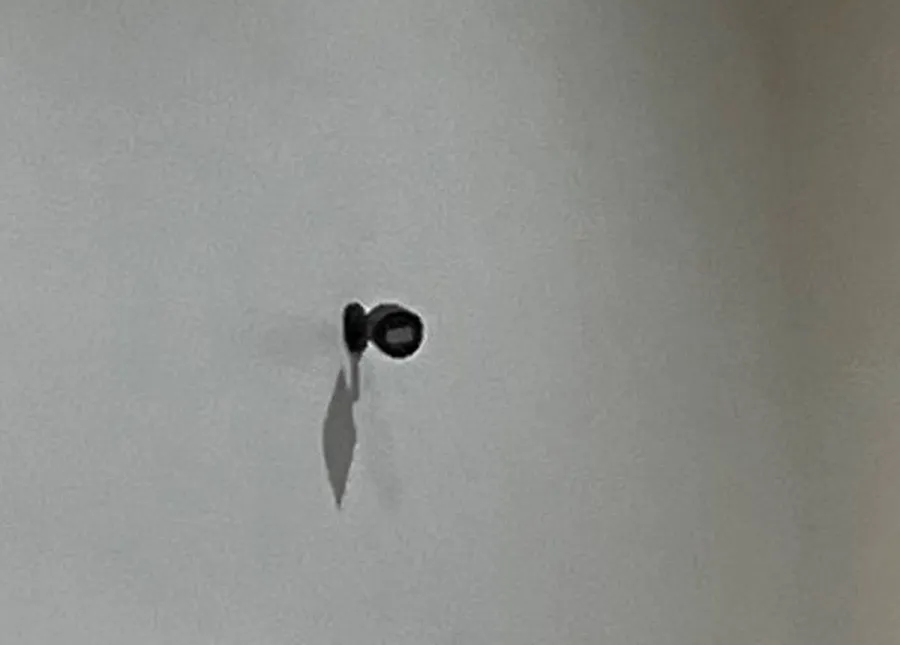
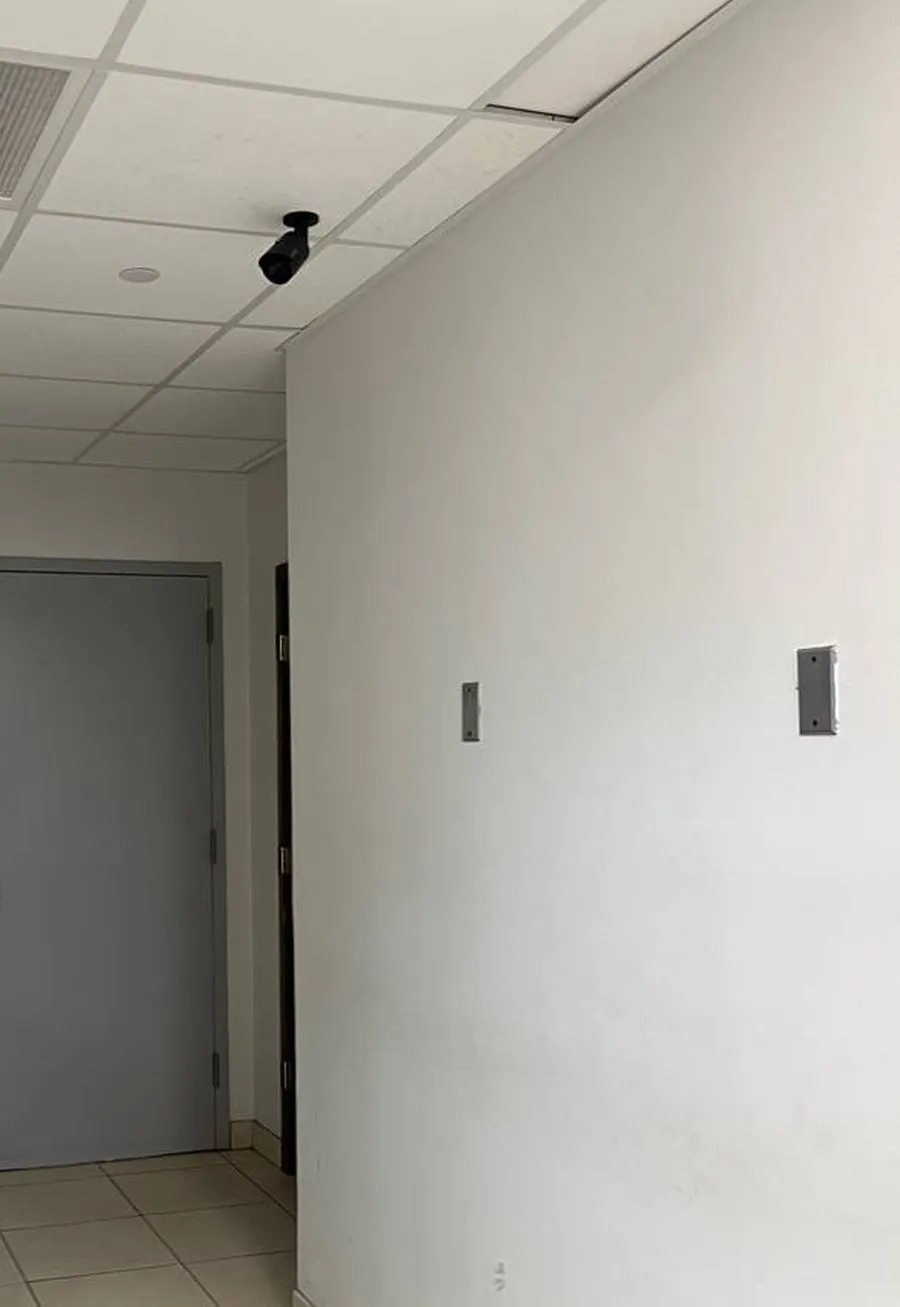
From one of our CCTV jobs (Rockland County car dealership): a small bullet high on a two-story wall. In a Suffolk pole barn or equipment building, the same high mount keeps the camera above trucks and tractors and out of easy reach.
What a long-run job costs and why
Our package prices cover a house with ordinary cable runs. A long run adds three things: material (outdoor Cat6 or fiber, conduit and the converters at each end), trenching or boring, and the time to terminate and test a link at both ends. We price that per camera after we confirm the layout, and we tell you which part of the number is the distance so you can decide whether the far camera is worth it. Often there is a cheaper answer, such as a camera on the corner of the house with a long lens aimed down the drive instead of a camera at the gate itself.
Second Homes
CCTV for Suffolk Houses That Sit Empty Half the Year
CCTV installation for vacant property is a big part of our Suffolk work, and it has its own rules. With nobody on site for weeks, the system has to report on itself as well as on visitors. A camera that quietly stopped recording in December is worse than no camera, because the owner believes the house is covered. These are the settings and habits we build into every second-home system.
Health alerts, not just motion alerts
We turn on the recorder's notifications for a camera going offline, a hard drive error and the recorder itself dropping off the internet. If the power fails and the battery backup runs out, the recorder disappears from the app, and the silence is itself the alert. Owners learn to read the difference: one camera offline usually means a cable or a camera, everything offline at once usually means power or internet at the house.
Exterior coverage that does not depend on lights
Summer houses are dark in winter. We choose cameras with strong infrared or color night vision for the driveway, the doors and the pool, and we do not rely on motion floodlights that a timer or an outage can turn off. Where a long drive matters, a camera on the corner of the garage with a varifocal lens reads the cars that turn in without needing a pole at the road.
Caretakers, rental agents and renters
A caretaker who checks the house on Fridays, a pool service, a rental agent and the owner may all need different access. We create a user for each, so the caretaker can see live views and the owner keeps playback, export and the admin password. During a rental, interior cameras stay off and the renters are told in the listing and in writing which exterior cameras record; that keeps everyone on the right side of New York's surveillance law and avoids a bad review.
Closing and opening the house
When the house closes in the fall, walk around with the app open and check every view, because summer landscaping and new patio furniture change what each camera sees. When it opens in spring, wipe the lenses and check that the night view still covers the doors. CCTV installation in winter is easier than in summer for most East End houses: the trees are bare, the cable paths are visible and no renters are in the way.
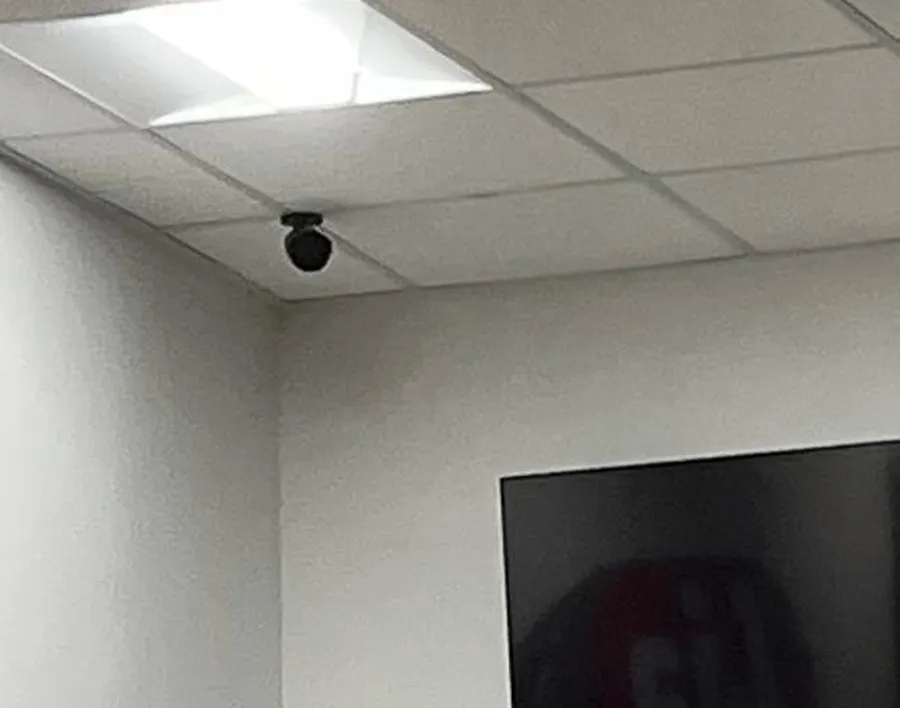
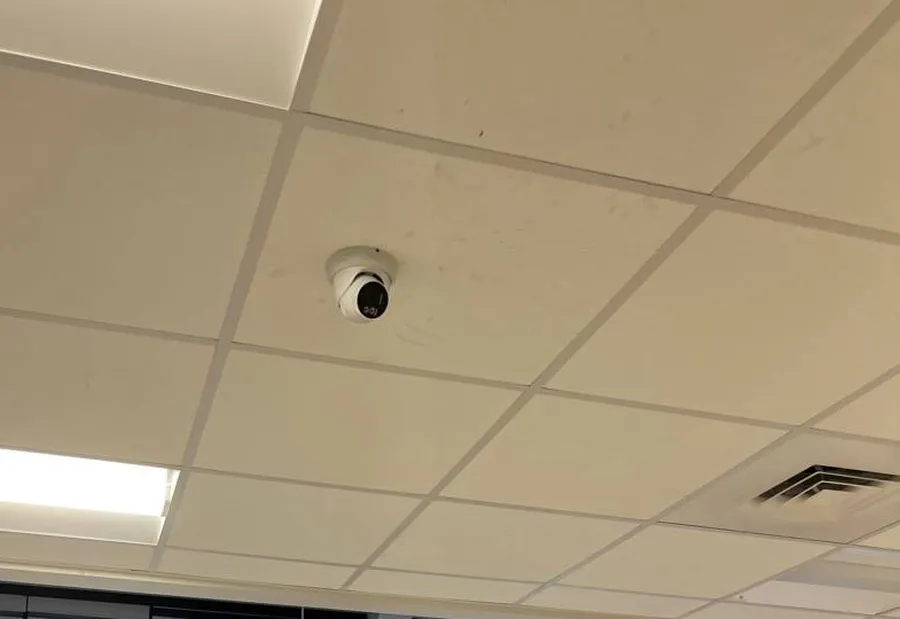
From one of our CCTV jobs (Rockland County car dealership): a compact dome tucked into the upper corner of a room. In a Suffolk rental, a camera like this belongs in a garage, a mudroom or an owner's locked storage space, never where guests sleep or change.
Farms & Stands
CCTV for Farms, Farm Stands, Nurseries and Wineries
Suffolk is the state's leading farm county by direct sales to customers, and much of that money changes hands at a stand by the road or a counter in a barn. The thefts in the news are small in dollars and large in aggravation: a cash box ripped off a counter for a handful of quarters, a bucket of strawberries gone, a stand smashed overnight. The farmer quoted in the Riverhead News-Review in August 2026 put the follow-up cost plainly: after a theft, “that’s two hours of my time with them trying to get the video.” A farm CCTV design should make the clip easy to find and easy to hand over, as well as recording it.
The stand: three views that matter
At a roadside stand, one camera watches the cash box or the payment sign from above and slightly in front, close enough to see a hand. A second covers the produce tables and the person walking up. The third, and the one that most often helps, looks at the pull-off and the road to record the vehicle, its color and its direction of travel. If the stand has no power, the link to the farmhouse is a fiber or Cat6 run, or a separate small recorder with its own internet.
Barns, fuel and equipment
Tractors, mowers, irrigation pumps, fuel tanks and tools are what a farm actually loses. Cameras on the barn doors and the fuel tank, with motion alerts limited to people and vehicles after hours, give you a time stamp and a direction. Inside the barn, dust and birds are the enemies of a lens, so we pick sealed housings and mount them where swallows will not nest on top.
Nurseries and greenhouses
Nursery CCTV installation covers long rows of stock, greenhouse doors and the loading area where trucks pick up. Plastic greenhouse walls glare at night and reflect infrared, so we mount outside the film or use cameras set to switch to color with the yard lights on. Wind moves the plants all day, which is why person and vehicle detection matters more than plain motion detection here.
Wineries, breweries and event barns
A tasting room on Route 25 or Sound Avenue needs the bar, the register, the entrance and the parking field, plus the barrel room and the loading door behind the scenes. Fall weekends bring crowds and buses, so we place a camera at the entrance with a wide view of the line and a second on the lot. Staff get live view only; recordings stay with the owner.
Shellfish farms, hatcheries and bay-side shops
The Comptroller's report counts 155 Suffolk farms in the aquaculture and other-animal category, many of them oyster and clam operations on Peconic Bay, Great South Bay and the harbors of the North Fork. Their gear sits in the water, but the valuable things on land are the work boats, the upwellers, the coolers and the shed where the harvest is graded. Cameras on the dock head, the cooler door and the parking area, with marine-rated housings and stainless hardware, cover what usually goes missing, and a fiber or wireless link keeps the recorder in a dry building away from spray.
Motels, inns and bed-and-breakfasts
From the hotels by the airport in Ronkonkoma to the motels of Montauk and the inns of Greenport and Southampton, lodging on Long Island's east end needs cameras on the lobby desk, the entrances, the parking lot, the pool gate and the housekeeping and laundry areas. Guest rooms and anything guests use as private space stay off camera. The night clerk gets a live-view screen; the owner keeps playback.
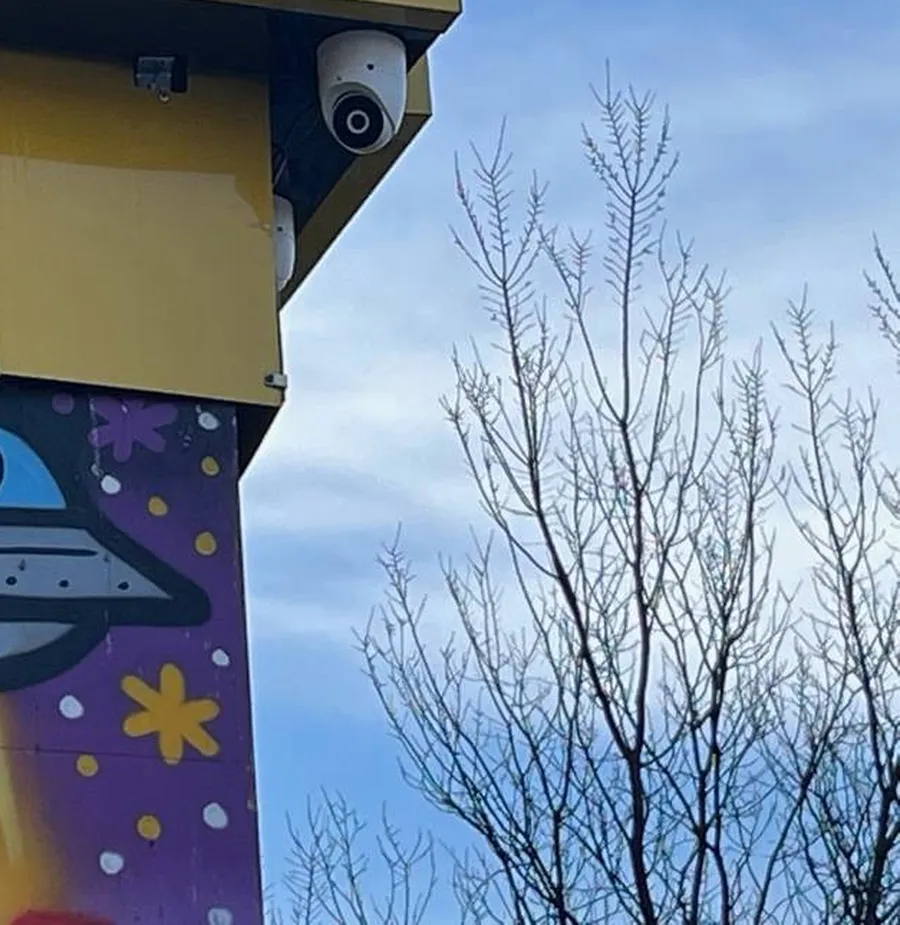
From one of our CCTV jobs (Manhattan corner deli): an outdoor dome tucked under the sign band at the building corner, where it sees both frontages. On a Suffolk farm market or tasting room, the same corner spot covers the door and the parking field at once.
Storms & Power
Keeping Suffolk Cameras Recording Through Storms and Outages
Eastern Suffolk gets the strongest wind on Long Island, and the overhead lines on its tree-lined roads come down with it. On the night of July 4, 2026, a fast-moving thunderstorm toppled at least 50 trees in Riverhead Town alone, and a National Weather Service trained spotter reported an 87 mph gust in Baiting Hollow. By 9 the next morning PSEG Long Island counted 13,789 customers out across its system, more than 3,700 of them in Riverhead Town, according to RiverheadLOCAL.
“While outages are scattered across the service area, eastern Suffolk County received the worst weather, with more than 70 MPH wind gusts, hail and heavy rain.”
— PSEG Long Island statement, July 5, 2026, quoted by RiverheadLOCAL
A storm like that is exactly when people want to look at their cameras, and exactly when most systems go dark. The fix is simple and cheap compared with the cameras: a battery backup (UPS) on the recorder, the PoE switch and the internet modem and router, sized to ride through the short outages and give the recorder time to shut down cleanly in a long one. With PoE cameras, the cameras draw power through the recorder or switch, so the UPS keeps them recording too. Coax HD-analog cameras often run from a separate power box, which then also has to be on the UPS.
Many Suffolk houses now have a standby generator. A generator takes several seconds to start and transfer, and without a UPS the recorder reboots every time the power blinks. With a UPS in between, the switch-over is invisible to the system. We also put the modem on the UPS, because a recorder that is still recording but cannot reach the internet looks, from the city, exactly like a recorder that is off.
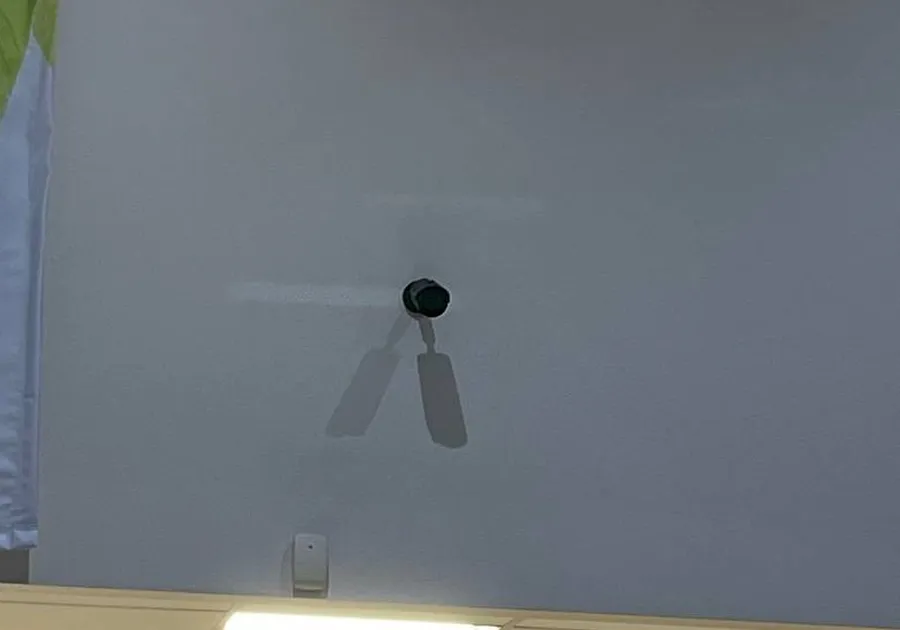
From one of our CCTV jobs (Rockland County car dealership): a compact camera on a short mount on a bare wall, with its cable fed through the wall behind it so nothing is exposed to weather or a pair of pliers.
Commissioning
The Hand-Over Tests We Run Before Leaving a Suffolk Property
CCTV system commissioning is the part of the job customers rarely see and most often regret when it is skipped. On a spread-out Suffolk property there are more things that can fail quietly: a fiber connector at the barn, a bridge radio a few degrees off its partner, an extender at the end of the drive. Before our crew packs up, every system goes through the same tests, and the results go on the hand-over sheet.
Far-end link test. Each long run is checked for speed and errors at the far switch or camera, not only at the recorder, so a marginal link is fixed while the trench is still open.
Battery pull. We unplug the UPS from the wall and watch the recorder, the switch, the modem and the cameras stay up, then note roughly how long the battery will last at that load.
Night check. Every outdoor view is checked after dark or with the lights off, so infrared glare from a soffit, a window or a white fence is caught before the first real night.
Alert check. We walk into each detection zone and drive into the driveway zone, and confirm that the right alerts reach the right phones and the wrong ones do not.
Offline check. One camera is unplugged on purpose to prove that the offline notification arrives.
Export check. The owner or manager exports a short clip to a phone or USB stick while we watch, so the first export is not during an emergency.
Clock and labels. The recorder time is synced, each camera is named for what it shows (“Barn door”, “Stand cash box”, “Dock 3”) and each cable end carries the same label.
These checks add time to the last hour of the job, and they are the reason a Suffolk system keeps working in its first winter without a return trip. If anything on the list fails and cannot be fixed that day, it goes on the sheet with the date we will be back.
Your Questions Answered
CCTV Installation in Suffolk County: Questions Answered
Farmers, weekenders, flex-building tenants and year-round homeowners call with different worries. Below are the ones that come up most on Suffolk calls, sorted into three groups.
Big lots, fields and outbuildings
How do I keep a mower, a plow or a landscaper from damaging buried camera cable?
Put the cable in conduit, bury it below the depth that edgers, aerators and fence posts reach, and keep a record of where it runs. We follow driveway edges and existing paths where we can, cross under the driveway in a sleeve rather than through the gravel, and leave you a sketch or photos of the route with distances. A plow damages what sits on the surface, so we never leave cable or junction boxes at grade along the drive. If a landscaper will be installing irrigation or plantings later, give them the sketch; most cable cuts we see come from a new fence post or a sprinkler line dug straight through an unmarked run.
What are the options for a camera in a vineyard block, nursery field or paddock with no power nearby?
There are three. If the spot is within reach of a cable from a building, a PoE camera gets both power and data over one Cat6 run, which is the most reliable choice. If it is farther, a small weatherproof enclosure at the edge of the field with a switch, fed by fiber and a power circuit, can serve several cameras. If neither is possible, a solar-powered camera or a solar surveillance trailer in Suffolk County is the fallback, with the caveat that short winter days limit how much it can record at night. We recommend the wired route wherever the budget allows.
Can a camera watch the oil tank, propane tank or generator at a house we rarely visit?
Yes, and on rural and East End properties it is worth doing. Fuel theft from outdoor tanks and tampering with generators are real problems on houses that sit empty, and a camera on the back corner of the house that covers the tank, the generator pad and the fill pipe records anyone who walks up to them. It also shows you whether a delivery happened. A camera cannot read a tank gauge reliably at night, so treat it as a record of visits, not a fuel monitor.
Second homes and summer rentals
Are cameras allowed inside a house I rent out for the season?
This is general information, not legal advice. Owning the house does not give you the right to record renters in private spaces. New York Penal Law §250.45 makes it a crime to record someone without consent in a place where they have a reasonable expectation of privacy, which includes bedrooms and bathrooms, and recording conversations you are not part of can violate the eavesdropping law in §250.05. Many rental platforms also ban indoor cameras outright. Our practice for Suffolk rentals is exterior cameras only, disclosed in the listing and the lease, with any indoor camera limited to an owner's locked storage area and switched off while guests are in the house.
How much upload speed does a Suffolk house need for watching cameras away from home?
Viewing one camera at a time from your phone needs only a modest upload, roughly 1 to 2 megabits per second for a smooth substream picture. Watching four cameras at once, or playing back full-resolution 4K footage, needs much more. Some East End and North Fork houses still have slow upload on DSL or older cable plans. The recorder records locally at full quality regardless of the internet; only remote viewing is limited. We set each camera's second stream low for phone viewing so the app works on a weak connection, and you can download a full-quality clip when you need one.
Should I keep the internet service on at a house that closes for the winter?
If you want to see the cameras or receive alerts, yes. The recorder keeps recording without the internet, but nothing reaches your phone, and you will not know the system has stopped until you open the house in spring. Many owners downgrade to the cheapest plan the provider offers rather than suspend service. Where the provider will not keep a plan active, a small cellular router with a data plan can carry alerts and an occasional live view, though not hours of streaming.
Why does the time on the recorder matter, and how is it kept right after an outage?
A clip with the wrong date or time is weak evidence and confusing to the police and your insurer. Recorders keep time with an internal clock that can drift or reset after a long outage. We set each recorder to synchronize its clock with an internet time server and to adjust for daylight saving time automatically, and we check the camera overlays match the recorder. On a house with no internet over the winter, check the time on the first visit in spring before you rely on any footage from the off-season.
Farms, harbors, businesses and institutions
Can anyone on staff export a clip for police without the admin password?
Yes, and setting this up is one of the most useful things a business can do. We create an operator account with permission to search playback and export to a USB stick or the app, but not to delete footage or change settings. We show the manager how to find a time range, save the clip and note the camera name and time. When a farm stand, a shop or a flex-building tenant gets a visit from the police, the clip is ready in minutes instead of hours.
Will my CCTV system see through the fog that rolls in off the Sound and the ocean?
Not well, and no camera does. At night, a camera's own infrared light reflects off fog, rain and snow and washes out the picture, the same way high beams do in a car. Two things help: mounting the camera so its infrared does not shine straight through the fog close to the lens, and using cameras with good low-light color sensors where there is some outdoor lighting, so the camera can turn its infrared off. On waterfront houses on the forks, we also add a camera closer to the door, because a short view through fog beats a long view of grey.
What should cameras cover at a boatyard where boats are stored on the hard over winter?
The gate and the road first, so every vehicle that comes in after hours is on record. Then the rows of boats on stands, usually from poles or the shop roof with long-range bullets, plus the shop doors, the parts room and the fuel area. Shrink-wrapped boats block views, so cameras look down the aisles between rows rather than across them. Salt air and wind demand marine-rated mounts and stainless hardware, and the recorder goes in the office, not the shop.
What should a tenant in a Suffolk flex building or plaza clear with the landlord before adding cameras?
Read the lease first. Most commercial leases require written consent for anything attached to the building's exterior, for roof or wall penetrations and for cable through common areas. Ask whether the landlord already has cameras on the lot, whether you may put a camera on the outside wall above your door, where your cable is allowed to run, and who pays to patch holes when you move out. Get the answers by email. We work from that approval, keep exterior holes to a minimum and label your cables as yours so the next contractor does not cut them by mistake.
What should a Suffolk school district, library or fire district ask for in a CCTV bid?
Ask for a camera schedule that lists every location and what it must show, the recorder size and the retention period in days, the cable type and where it will run, who will hold the administrator account, and how many staff logins are included. Ask whether the system can export clips in a standard format and whether the bidder will support it after installation. Public bodies usually have their own procurement rules and board approvals; we provide itemized quotes and insurance certificates for those packages.
From one of our CCTV jobs (Rockland County car dealership): a ceiling camera aimed down a back hall at a staff door. Schools, libraries and flex buildings in Suffolk need the same coverage on every secondary door, not just the front entrance.
Equipment
Types of CCTV Systems We Install in Suffolk County
Our quotes default to our house-brand cameras and recorders, which we stock and can support for years. If you prefer one of our partner brands, or you already own another brand, we work with that. This is what a Suffolk system is typically built from.
🔭
Long-Range & Varifocal Bullets
Bullet and varifocal camera installation for long drives, field edges, boat rows and truck courts. We set the zoom on site so a car at 80 or 120 feet fills enough of the frame to identify.
🔘
Turret Cameras
Turret camera installation under soffits, porch ceilings and barn overhangs. No dome bubble to fog, scratch or reflect infrared, which matters on damp coastal mornings.
🛡️
Vandal-Resistant Domes
Dome camera installation for shop entrances, farm-market counters, school hallways and low ceilings in reach of a hand.
🌗
Color Night Vision & Deterrence
Color night vision camera installation and active deterrence cameras with a light and siren for stands, gates and back lots that are dark and empty at night.
🧠
Person & Vehicle Detection
AI CCTV camera installation that tells a person or a car from a deer, a swaying hedge or blowing snow, so a big property does not flood your phone with alerts.
💡
Fiber, Extenders & Bridges
Media converters, outdoor fiber, PoE extenders and point-to-point wireless bridges to bring outbuildings onto the main recorder.
💾
DVRs & NVRs
DVR installation for coax systems and NVR installation for IP systems, 4 to 32 channels, with drives sized for the retention you choose.
🔋
UPS, Surge & Switches
CCTV UPS installation, surge protection on long outdoor runs and PoE switches in conditioned spaces or sealed outdoor enclosures.
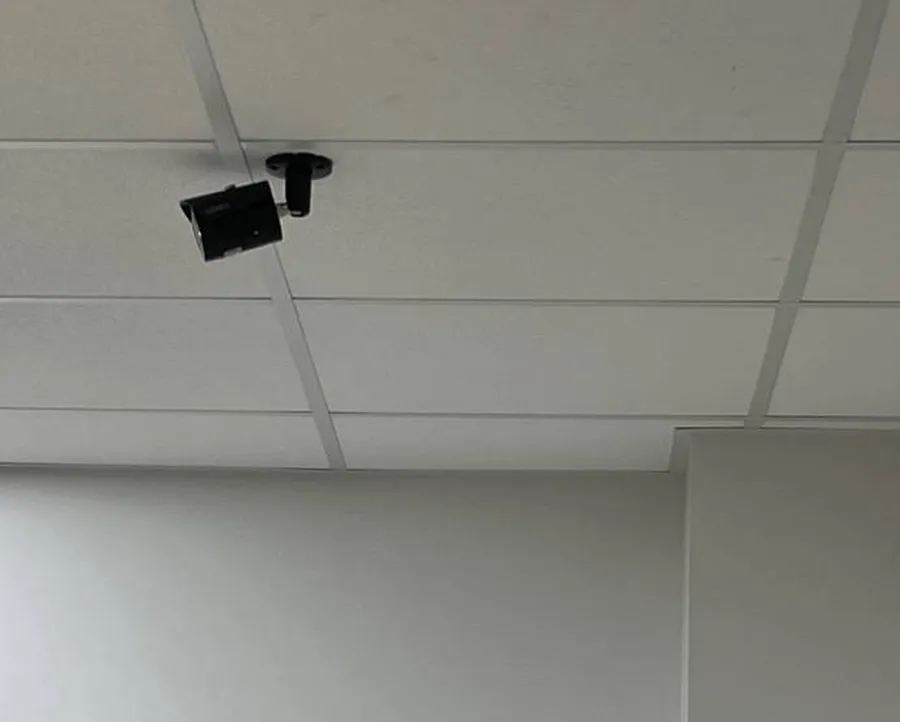
From one of our CCTV jobs (Rockland County car dealership): a bullet on a short pendant mount from the ceiling grid, aimed across the room. Flex-building offices in Hauppauge and Bohemia use the same mount where the walls are glass or partitions.
Coax, Cat6 or wireless for a Suffolk property
On a house with existing RG59 coax from an older system, HD-analog cameras (HD-TVI, HD-CVI or AHD) on a new DVR can reach 8MP 4K and reuse the cable, which is often the least disruptive upgrade. On new work we run Cat6 and use IP cameras on an NVR with PoE, because one cable carries power and video, cameras can be added more easily, and fiber links to outbuildings plug straight into the same network. Wi-Fi cameras have their place for a single temporary view, but on large lots they suffer from distance, walls, trees and the same router outages that take a smart home offline. Wireless CCTV installation from us means a wired camera on a wireless bridge, not a battery camera relying on house Wi-Fi.
How much storage a Suffolk system needs
Retention depends on resolution, compression and whether the recorder records all the time or only on events. As a rough guide, an 8MP camera using H.265 at about 6 megabits per second fills around 65 gigabytes a day if it records continuously, so eight of them need close to 7 terabytes for two weeks. Event-only recording on a quiet winter property uses far less. Every package includes two weeks of recording at its standard settings; for a farm or a business that wants a month or more, we size the drives to that number and note it on the quote. Footage beyond what the drives hold is overwritten oldest first.
Brands we install and service
Abstract Enterprises Security Systems is an authorized partner of Lorex, Luminys and Reolink. We also install, integrate and service systems from other manufacturers that customers already own, including Hikvision, Dahua, Uniview, Axis, Hanwha, Ubiquiti UniFi Protect, Swann, Night Owl, Amcrest and others, without claiming dealer status for them. For new Suffolk systems, the house brand is our default because it is what we keep in stock and can replace quickly when the East End is a long drive away.
How Far Is Your Farthest Camera?
Send the town or hamlet, a few photos and a rough distance from the house to the barn, the gate or the stand. We book within 2 hours and put the camera list, the link type and the price in writing before anyone digs.
What AI Answers Miss About Suffolk County CCTV on Big Lots and Empty Houses
AI summaries and directory sites such as Angi, HomeAdvisor and Thumbtack describe CCTV for a generic quarter-acre suburb. Much of Suffolk is not that. Here are seven claims we hear repeated, and what actually happens on Suffolk properties.
“Wi-Fi cameras are good enough for any property”
The claim comes from small houses where the router sits a room or two from the camera. It is true there, and battery and Wi-Fi cameras sell well because they need no wiring.
On a Suffolk lot of an acre or more, the camera that matters is often 150 to 400 feet from the router, behind two walls and a row of privet or pines. Wi-Fi at that distance drops in and out, batteries die faster in the cold, and motion-triggered clips start a second or two late, which is often the second that showed the face.
Wired cameras record continuously to a recorder in the house regardless of the router. Where a wire truly cannot go, a dedicated point-to-point bridge carries the video, not the household Wi-Fi.
“Just run a network cable out to the barn”
Many how-to answers say to “just run Ethernet to the barn” without mentioning distance, so people buy a 500-foot spool and expect it to work.
Standard Ethernet, and the PoE power that rides on it, is specified for 100 meters, or 328 feet, of cable. Past that, the camera may not power up, may drop frames or may work in summer and fail in winter. The measurement is along the cable route, not across the lawn.
For longer runs we use fiber to a switch at the far building, a PoE extender part way, or a wireless bridge. The choice is made at the survey and written into the quote.
“A vacant house only needs motion alerts”
Motion alerts are the feature every camera ad leads with, so it is natural to assume they are what an empty house needs.
On a house that sits closed from October to May, the bigger risk is silent failure: a camera that stopped after a power outage, a hard drive that failed in a cold closet, or an internet plan that lapsed. Motion alerts never fire from a system that is not running.
We switch on offline and drive-error notifications, put the recorder, switch and router on a battery backup and set the clock to sync automatically, so the owner knows the system is alive as well as what it sees.
“Crime is falling, so cameras matter less”
The numbers do show a drop. NYS DCJS figures put Suffolk burglaries at 1,018 in 2022 and 710 in 2024, and motor vehicle thefts fell from 1,534 in 2023 to 1,241 in 2024.
But larceny, at 15,811 cases, made up about 82% of the county's index crimes in 2024. Theft from stands, sheds, boats, trucks and porches is what Suffolk cameras mostly record, and those cases are hard to solve without a clear picture of a person or a vehicle.
Falling burglary is good news. It does not change what the cameras are for: a time stamp, a face, a plate and a direction of travel when something goes missing.
“You need a cloud subscription to watch your cameras remotely”
Consumer camera brands often tie remote viewing and history to a monthly plan, so many people think every system works that way.
A CCTV recorder on your premises stores the footage on its own drives and streams to your phone through the manufacturer's app at no monthly charge. That is how our systems are delivered: $0 a month for viewing and playback.
Cloud backup still has a role for a few owners who want an off-site copy of key clips in case the recorder is stolen, and we can set that up. It is an option, not a requirement.
“Solar cameras solve the power problem at a barn or a stand”
Solar battery cameras are marketed as a no-wiring answer for remote spots, and for a summer-only view they can do the job.
Suffolk winters are short on sun. In December a small solar panel may not refill the battery that night vision drains, and most of these cameras record only short clips when triggered. A farm that most needs coverage in the dark months gets the least from them.
A wired PoE camera or a fiber-fed switch with a live circuit records all night, every night. We use solar only where a wire is impossible, and we say so on the quote.
“You can put cameras anywhere inside a house you own”
Ownership feels like it should settle the question, and AI answers often stop at “it's your property.”
In a summer rental, renters have a reasonable expectation of privacy in bedrooms and bathrooms, and New York Penal Law §250.45 makes recording them there a crime. Audio adds eavesdropping risk under §250.05. Rental platforms add their own rules on top.
This is general information, not legal advice. Our approach on Suffolk rentals is exterior cameras, disclosed in writing, with no cameras in guest spaces.
Get In Touch
Request a Free CCTV Installation Quote in Suffolk County
Tell us the town or hamlet, what kind of property it is and roughly how many cameras you want. For large lots, add the approximate distance from the house or office to the farthest camera, and a photo of anything in the way: a driveway, a field, a hedgerow, a pool. Already own the cameras? List the brand and models for a labor-only price. Prefer to talk? Call the Suffolk line at (631) 407-2884.
✅
Request Sent!
Thank you. We book Suffolk County CCTV jobs within 2 hours of a request and will be in touch shortly.
How It Works
Our CCTV Installation Process
Six steps take a Suffolk CCTV job from the first text to a system you can open from your phone in the city, on the ferry or at the farm stand.
1
Send the property and the distance
Call, text or use the form with the town or hamlet, the property type, the camera count and the rough distance to the farthest camera. Photos of the house, the drive and any outbuilding help. For your own cameras, send the model list for a labor price.
2
Choose the links and the recorder spot
We agree on what each camera must show, where the recorder and battery backup live, and how each camera connects: Cat6, fiber, an extender or a bridge. Large or commercial sites are confirmed on site. The price comes in writing.
3
Book the date
Expect a booking reply within 2 hours. Crews run Monday through Sunday starting early in the day; whoever pays the deposit first gets the earliest open slot, East End trips included.
4
Trench, run and mount
Trenches are cut and backfilled, conduit and building sleeves go in, fiber or Cat6 is pulled and tagged at both ends, cameras go up on blocks with every hole sealed, and the recorder, switch and UPS are set in their spot.
5
Aim, tune and test after dark
Each camera is focused on its target, detection zones and schedules are set, health alerts are switched on, the clock is synced, and the night picture is checked before we leave.
6
Hand over the app and the logins
Owners, managers, caretakers and staff get the accounts they need. We show you how to find an event and export a clip, and leave a sheet with cable routes, passwords to change and the camera list.
Coverage Area
CCTV Installation Near Suffolk County's Landmarks
Our crews drive the whole county, from the Route 110 corridor to the tip of each fork. These landmarks mark the routes we travel most, with the kind of CCTV work we do near each.
✈️
Long Island MacArthur Airport, Ronkonkoma
Hotels, parking lots, warehouses and contractor yards in Ronkonkoma, Bohemia and Holbrook, plus ranches and high ranches on the side streets.
🎓
Stony Brook University
Student rental houses, offices and shops in Stony Brook, Setauket and Port Jefferson Station, and colonials on the North Shore hills.
🐟
Long Island Aquarium, Riverhead
Downtown storefronts and restaurants on the Peconic riverfront, and the farm stands and wineries that start just east of town.
🌉
Shinnecock Canal, Hampton Bays
Marinas, fish docks and bay cottages on the canal, and second homes from Hampton Bays east into Southampton.
⛴️
Greenport & the Shelter Island Ferries
Village shops, boatyards and inns in Greenport, and shingle houses on Shelter Island reached by the North and South Ferry.
🗼
Montauk Point Lighthouse
Motels, restaurants, surf shops and houses in Montauk that run full in summer and sit quiet all winter.
We also install CCTV in Babylon, Lindenhurst, Deer Park, Huntington, Northport, Commack, Smithtown, Hauppauge, Brentwood, Central Islip, Bay Shore, Islip, Sayville, Patchogue, Medford, Coram, Selden, Shirley, Mastic, Riverhead, Mattituck, Southold, Southampton, Sag Harbor and East Hampton, along with every other hamlet and village in the county.
Pricing
CCTV Installation Cost in Suffolk County
CCTV installation pricing in Suffolk comes down to three things: the number of cameras, the distance each camera's video has to travel, and how easily we can reach each spot. We publish the package prices for a standard 4-camera system and price everything that depends on the property after we confirm the layout.
What you need
Suffolk County price
Included
4-camera house-brand package
$1,099 A Series; $1,541 buys C or D
Everything for four views on one recorder, two weeks of footage capacity
Residential system, 4–8 cameras
$1,228 – $2,500
Home system on an NVR with PoE wiring by our crew
Commercial CCTV
$1,500 – $5,000+
Offices, retail, restaurants and multi-story buildings
Cameras on outbuildings, gates, stands or docks
Priced per camera after we confirm the layout
Long Cat6 or fiber run, conduit, far-end switch or bridge as needed
Additional cameras beyond a package
Priced per camera after we confirm the layout
Camera, cable, mount and recorder channel
Labor only on your equipment
Quoted by phone or text
Our crew hangs, cables and programs gear you bought
Monthly fee
$0
Recording stays on your recorder
What moves a Suffolk CCTV quote
On a standard lot in the western towns, a 4-camera package usually covers the job: the cameras mount on the house and every run stays inside it. The price moves when the property spreads out. A detached garage adds a trench or a sleeve; a barn or a stand adds a long run, a fiber link or a bridge; a gate at the end of a drive adds a camera that may need its own power. Shingle and stucco take longer to mount and seal than vinyl. On commercial jobs, high ceilings and lift work, after-hours installation and the number of separate tenant spaces matter most. Reusing good coax or Cat6 from an older system lowers the cost.
Choosing 4, 8 or 16 channels
A 4-camera system suits most Suffolk houses on a normal lot: front, driveway, back and one side. Eight cameras suit houses with a pool, a detached garage or a long drive, and small shops that need a register, a door, a stockroom and a back lot. Sixteen is typical for farms with a stand and barns, wineries, multi-tenant flex buildings and marinas. We usually leave spare channels on the recorder so a camera can be added later without replacing it.
From one of our CCTV jobs (Rockland County car dealership): a dome on the ceiling just inside a wall of windows, set back so the glass and the daylight behind it do not blind the picture.
Warranty, deposit and terms
Our installation work comes with a 30-day warranty, and one-year or longer coverage is available as a paid add-on. Full terms — including 50% deposit, one-year parts-only warranty on Abstract Enterprises Security Systems-supplied products, and the late-fee schedule — are set out in the service agreement. Equipment you supply carries its manufacturer's warranty, and the signal and hardware of your own wireless cameras remain your responsibility. Financing is available on our packages; ask when you call.
Shop Our Systems
CCTV Installation Packages & Pricing
Each series is a complete four-camera CCTV system, installed with the recorder, cable, mounting, two weeks of recording and the app on your phone. Choose by how much detail you need at the distance that matters on your property.
A
A Series · 2MP HD 1080P Cameras
Starting at $1,099 incl. 2 wks recording. 4 camera packages with DVR, night vision 60–100 ft, motion detection, smart AI, full-color night vision, audio, remote access. Models A1, A2, A3. Fine for a ranch on a small lot.
F
F Series · 5MP DVR 2K HD Cameras
Starting at $1,147 incl. 2 wks recording. Eyeball, bullet and dome, night vision 90–100 ft, active deterrent with siren and lights, 20″ monitor. Models F1–F6. Suited to dark back lots and stands.
E
E Series · 2K HD, 4–5MP IP Cameras
Starting at $1,306 incl. 2 wks recording. 4K NVR, night vision 90–100 ft, IP67, smart detection, audio, full-color, 20″ monitor, remote access. Models E1, E2, E3. Our entry PoE system and the easiest to extend to an outbuilding.
C
C Series · 8MP 4K Ultra HD DVR
Starting at $1,541 incl. 2 wks recording. Eyeball and long range, night vision 100–120 ft, IP66, audio, full-color, monitor included. Models C1, C2, C3. 4K on existing coax.
D
D Series · Top Tier 8MP 4K Ultra HD IP
Starting at $1,541 incl. 2 wks recording. Eyeball and bullet, night vision 90–120 ft, IP67, audio, full-color, active deterrent, two-way talk, 20″ monitor. Models D1–D5. Best for long drives and fields.
Bought your own cameras? CCTV installation labor only
We install customer-supplied systems all over Suffolk, from a warehouse-club kit to a box of PoE cameras ordered online. Text the brand and the model numbers of the cameras and the recorder, how many there are, a photo of each mounting spot and the distance to the farthest one. The labor price comes back by phone or text, and the date is held once the deposit is in. We do not do walk-throughs on customer equipment. Because you chose the hardware, the hardware and any Wi-Fi signal your wireless cameras depend on remain your responsibility; if a camera you supplied is dead or will not connect, we show you on the spot and you decide what to do next. More detail on our got your own system? page.
Do you cover the East End and Shelter Island, or only western Suffolk?
+
We cover the whole county: the western towns of Babylon, Huntington, Islip, Smithtown and Brookhaven, and the East End towns of Riverhead, Southold, Southampton, East Hampton and Shelter Island, including the villages inside them. Jobs on the forks and on Shelter Island are scheduled the same way as jobs up west, booked within 2 hours of the request and placed on the calendar first come, first served once the deposit is in. For long trips we plan the day so the crew arrives with every part the job needs.
Can a camera help stop illegal dumping on my vacant lot or farm road?
+
It can help identify who is doing it. Dumpers usually arrive by truck or van, so the camera that matters is the one that records the vehicle as it turns in, ideally with a view of the plate and a time stamp, rather than one aimed at the pile. On a lot with no building, that means a camera on a post fed from the nearest power and network, or a solar trailer for a short period. Report what you record to the police department that covers your town and keep the original clip on the recorder.
Can my cameras keep recording if someone cuts the cable or phone line outside the house?
+
Yes, if the system is wired the way we wire it. The cameras send video to the recorder inside the house over their own cables, not over the internet, so cutting the internet line stops remote viewing and alerts but not recording. We run camera cables inside walls or in conduit where they would otherwise be easy to reach, and the recorder on its battery backup keeps going through a power cut. When the internet comes back, you can play back everything recorded while it was down.
Can cameras help settle a damage dispute with a summer tenant or a contractor?
+
Exterior footage often does. A clip of a car backing into the garage door, a contractor's truck crossing the lawn, or the condition of the deck on the day renters arrive and leave is far more persuasive than a description. Make sure the cameras and what they record are disclosed in the lease or the contract, keep the original files, and export the relevant clips with their date and time on the day you notice the damage, before the recorder overwrites them.
Can I watch my horses in the barn overnight from my phone?
+
Yes. A barn camera system for a horse property usually covers the aisle, each stall you want to watch, the tack room door and the paddock gate, with infrared or low-light cameras that do not need the barn lights on. Dust, cobwebs and moisture are hard on cameras in a barn, so we use sealed housings and mount them out of reach of curious horses. A long Cat6 or fiber link brings the barn back to the recorder in the house, and the app shows the stalls on your phone through the night.
Does a freestanding camera post on my own land need a town permit?
+
It depends on the town or village and on where the post goes. A camera mounted on an existing house or barn is usually treated as ordinary equipment, but a new pole, a post near the road, anything in a wetland setback, or work on a property with a historic designation can bring in the town or village building department. Anything in the road right-of-way belongs to the town or the county, not you. Ask your building department before we set a new pole; this is general information, not legal advice.
Can a gate camera let me talk to a delivery driver at the end of the driveway?
+
Yes. Several of our cameras include a speaker and a microphone for two-way talk, so you can open the app and tell a driver where to leave a package or to wait. At a gate several hundred feet from the house, that camera needs a power and data link like any other, and the audio is only live while you are talking through the app. Because it carries sound, we set it to record audio only when you start a conversation, which keeps it on the right side of New York's eavesdropping law.
Do you install CCTV at Suffolk gas stations and convenience stores open overnight?
+
Yes. A typical layout covers each pump island so the plate and the face at the pump are both on record, the store entrance at face height, the register and the night window if there is one, the cooler doors, the stockroom and the back of the building. We install in stages so the store stays open, and the recorder goes in the office with a monitor at the counter showing the pumps for the overnight clerk.
Do you install CCTV for veterinary hospitals and kennels in Suffolk?
+
Yes. Veterinary and boarding clients usually want the reception desk and the front door, the drug storage area, the kennel runs so staff can check animals overnight from home, and the parking lot. Exam rooms are often left out, or recorded without audio, depending on the practice's policy. Kennel areas are wet and loud, so cameras get sealed, washable housings and mounts out of reach. Staff can be given live-view access to the kennel cameras only.
Is there a minimum number of cameras for a Suffolk CCTV job?
+
No. We install single cameras and two-camera additions as well as full systems. Our published packages start at four cameras because that is where most houses begin, and smaller jobs or additions to an existing recorder are priced per camera after we confirm the layout. If you are adding one camera to a recorder that is already full, we will tell you up front whether that means a larger recorder.
Call or text the Suffolk number, (631) 407-2884. Jobs are scheduled from our office at 1282 Troy Ave, Brooklyn, NY 11203. Licensed under NYS low-voltage license #12000287431 and insured for general liability; rated 4.7★ from 201 Google Reviews.
Last review: November 16, 2026. Sources behind the numbers on this page: DCJS county totals (2022 to 2024) for crime, the 2023 ACS 5-year release for housing, and the State Comptroller's agriculture profile for farms. Package prices are the ones on our Suffolk security camera page today.