CCTV installation in Brooklyn starts at $850 for a four-camera house-brand recorder system with the cameras, cable, mounting, phone setup and two weeks of recording included. We book your visit within 2 hours of your request and work out of our own Brooklyn office at 1282 Troy Ave, so the crew already knows the stoops, side alleys, cellars and loading doors of this borough.
Quick answer: In Brooklyn, a four-camera CCTV system costs from $850 (A Series DVR) up to $1,292 (C Series 4K DVR or D Series 4K NVR) installed. A four- to eight-camera home system on an NVR with PoE wiring for a brownstone, row house or two-family runs $950–$2,500. Commercial CCTV for stores, restaurants, offices and multi-story buildings runs $1,500–$5,000+. Two weeks of recording is included; a month of storage is $180. Monthly fees: $0.
Reviewed and updated November 16, 2026 by Abstract Enterprises Security Systems, NYS license #12000287431 · Sources: NYPD CompStat, Patrol Boroughs Brooklyn North and Brooklyn South, week of November 2–8, 2026; U.S. Census Bureau, American Community Survey 2019–2023 (table DP04, Kings County); Brooklyn Chamber of Commerce survey as reported by Spectrum News NY1, March 20, 2024; NYS Department of Taxation and Finance, Commercial Security Credit; Brooklyn Navy Yard Development Corporation; NYC Landmarks Preservation Commission Permit Guidebook; NYS Penal Law §250.45; NYS Labor Law §203-c
From one of our CCTV jobs (a Manhattan corner deli): a white dome at the corner of the sign band and a small black bullet camera along the same band. Brooklyn avenue storefronts get the same treatment — cameras tucked under the sign, cable hidden behind it.
Brooklyn CCTV Request
House, store or building — tell us the address and how many views you need
✅
Request Sent!
Got it. Someone from the Troy Ave office will call or text to set up your visit.
25+
Years Experience
2 Hr
Booking
$0
Monthly Fees
4.7★
201 Google Reviews
Owner-operated since 2002 · Brooklyn office at 1282 Troy Ave · Call or text (347) 934-8335
The Neighborhood
Why Brooklyn Properties Need CCTV Installation
Brooklyn is a borough of small owners. Walk down almost any side street in Flatbush, Bensonhurst, Bay Ridge, Canarsie or Bushwick and you pass house after house with two doorbells, two mailboxes and two electric meters by the cellar door. The owner lives on one floor and rents the other, or rents both and lives around the corner. That one fact shapes CCTV work here more than anything else: the person paying for the cameras is usually also the landlord, the super, the person who takes out the garbage and the person tenants text when a package disappears.
The Census Bureau's American Community Survey puts numbers on it. Of the roughly 1,090,187 housing units in Kings County (2019–2023 estimates, table DP04), 16.1 percent sit in two-unit buildings and another 15.7 percent in buildings with three or four units. Put together, that is about 346,000 homes — nearly one in three — in two- to four-family houses. Another 8.6 percent are single-family attached homes: the brownstones, limestones and brick row houses. And 47.1 percent of all Brooklyn housing was built in 1939 or earlier, which means brick party walls, plaster, wood lath, and cellars that were laid out for coal, not for a recorder and a network switch.
Seventy percent of occupied homes in the borough are rented (70.3 percent in the same survey). In a two-family house that changes the camera plan. The stoop, the shared vestibule, the side alley, the backyard and the cellar entrance are spaces both households use. The owner wants to see them; the tenants want to know what is recorded and who can watch it. A good CCTV system for a Brooklyn house is designed around that line from day one, with cameras on the shared and outdoor spaces, nothing pointed into anyone's home, and separate app logins so the owner's phone and a tenant's phone see only what they should.
Businesses here carry their own weight. Brooklyn's avenues — Flatbush, Nostrand, Utica, Church, 86th Street, Kings Highway, Knickerbocker, Fifth Avenue in Sunset Park — are lined with independent stores that open early and close late. Along the waterfront, the Brooklyn Navy Yard alone holds more than 550 businesses and 13,000 jobs on about 300 acres, according to the Brooklyn Navy Yard Development Corporation, and Sunset Park, Red Hook, Greenpoint and East Williamsburg add block after block of warehouses, studios and truck yards. Those sites need long fence-line views, loading-door coverage and recorders that keep working through a winter in an unheated building.
When the Brooklyn Chamber of Commerce surveyed its members about 2023, 48 percent of business owners said they felt less safe than the year before and 40 percent said they had installed security cameras, as Spectrum News NY1 reported. The same story described a bar owner whose surveillance video showed a burglar rifling through her register, and who hoped to "rip all of my old cameras out and put something in that's functional." That sentence sums up a lot of the calls we take: the cameras exist, but they don't produce a picture anyone can use.
Brooklyn North and Brooklyn South: what the precinct numbers say
The NYPD splits Brooklyn into two patrol boroughs. Brooklyn North covers roughly Downtown Brooklyn, Fort Greene, Williamsburg, Greenpoint, Bushwick, Bedford-Stuyvesant, northern Crown Heights, Brownsville and East New York. Brooklyn South covers the rest of the borough, from Red Hook, Park Slope and Sunset Park down through Flatbush, Bay Ridge, Bensonhurst, Sheepshead Bay, Coney Island and Canarsie. The weekly CompStat reports for the week of November 2–8, 2026 give year-to-date figures for each:
2026 year to date (through Nov 8)
Brooklyn North
Brooklyn South
Brooklyn total
Burglary
1,307 (−14.0%)
1,172 (−7.4%)
2,479, down from 2,784
Retail theft
3,868 (−5.0%)
4,232 (−9.0%)
8,100, down from 8,720
Grand larceny auto
1,177 (−11.9%)
1,459 (−7.0%)
2,636, down from 2,905
Petit larceny
10,739 (−0.2%)
11,352 (−1.5%)
22,091
Figures are preliminary, from the NYPD CompStat pages for Brooklyn North and Brooklyn South. Every major property category is lower than a year ago. But the same Brooklyn South report shows vehicle thefts over the most recent 28 days at 154, up 30.5 percent from 118 in the same 28 days of 2025, and petit larceny — the package-off-the-stoop category — barely moved in either half of the borough. Falling totals still leave more than 22,000 petit larcenies and 8,100 retail thefts in ten months. For an owner, the practical point is simple: when something does happen, a clear clip with the right time stamp is what turns a report into a case and an insurance claim into a payout.
Package theft on the stoop
Read the Brooklyn and Bushwick boards on Reddit for a week and package theft comes up again and again: threads titled "Package theft from our building is out of control," tenants asking whether they can put their own camera in a lobby, a renter whose own camera disappeared. The advice other residents give is consistent — get a camera on the entrance and file a police report every time, so there is a record. The weak point in most of those stories is the camera itself: a battery doorbell that missed the moment, or a cheap camera that someone simply unscrewed and took.
A wired camera mounted high under a cornice or inside the vestibule ceiling is much harder to reach, never needs a battery, and records to a drive the thief can't see. Pair it with a second view of the mailboxes or the gate and most package complaints in a small building come down to a clip, a time stamp and a report number.
Brooklyn facts that shape a CCTV design
About 346,000 homes — 31.8 percent of Brooklyn's housing — are in two-, three- and four-unit buildings, where cameras cover space shared by an owner and tenants (ACS 2019–2023, DP04).
47.1 percent of Brooklyn housing units were built in 1939 or earlier: brick, plaster and lath, with cellar mechanical rooms (ACS 2019–2023).
70.3 percent of occupied homes are renter-occupied, so most residential camera plans have to respect tenants' space (ACS 2019–2023).
2,479 burglaries borough-wide in 2026 through November 8, down 11 percent from 2,784 (NYPD CompStat, Brooklyn North + South, preliminary).
8,100 retail thefts in the same period across both patrol boroughs, down about 7 percent (NYPD CompStat).
550+ businesses and 13,000+ jobs at the Brooklyn Navy Yard alone, on more than 300 waterfront acres (Brooklyn Navy Yard Development Corporation, FY25 impact report).
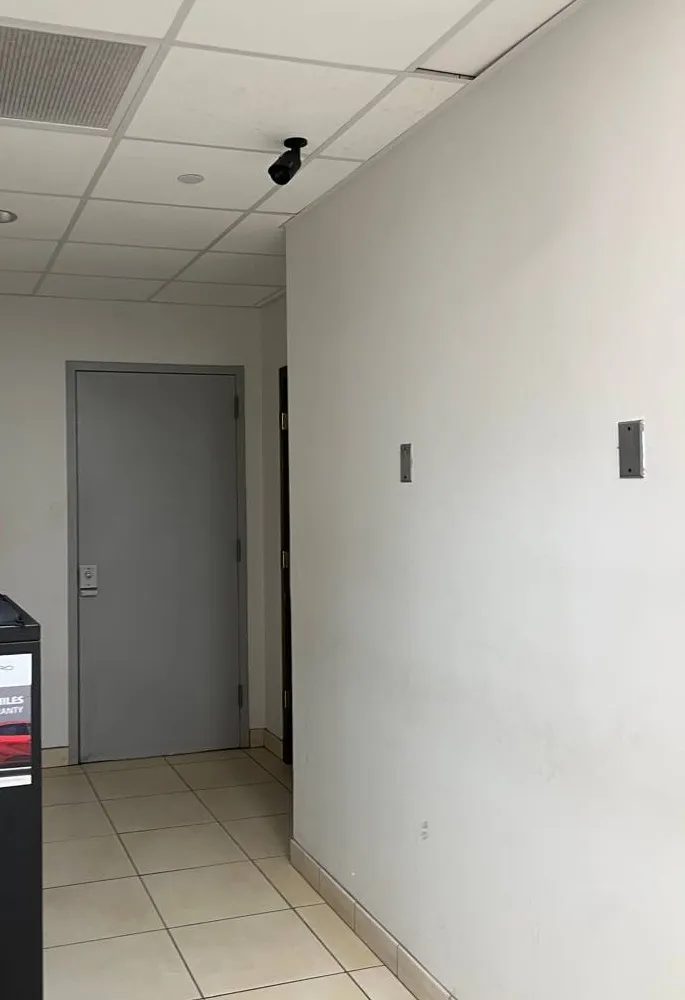
From one of our CCTV jobs (a Rockland County car dealership): one camera on the ceiling looks straight down a narrow hall to the rear door. In a Brooklyn two-family, the same idea covers the hallway from the shared vestibule to the cellar or back door.
The owner-occupied two-family: the most common Brooklyn CCTV job
Most of our Brooklyn residential requests start the same way. An owner who lives upstairs, or on the parlor floor, wants to see the front gate and stoop, the shared entry door, the mailboxes, the side or rear yard, and the cellar or garbage area. Often there is a third unit in a finished basement with its own door under the stoop, and that entrance needs its own view. Sometimes there is a detached garage off a shared driveway — common in Marine Park, Mill Basin, Midwood and parts of Canarsie — and the owner wants to know who is opening it.
That is usually six to eight cameras. A four-camera kit off a store shelf covers half of it, and a doorbell camera covers only the front step. A wired eight-channel recorder with room to grow is the better fit: one cable per camera, one hard drive in a locked spot in the owner's space, and an app that shows the owner every view while the tenants, if the owner chooses, get access only to the front door and mailbox cameras.
A typical camera plan for a Brooklyn two-family
Position
What it answers
Usual camera
Under the cornice or porch roof, aimed at the gate and stoop
Who came up the steps, who took the package, which car stopped out front
Turret or varifocal, wide dynamic range
Inside the vestibule, over the mailboxes
Who entered the shared door, deliveries left inside, mail tampering
Small dome or turret
Under the stoop at the basement-unit door
Comings and goings at the lowest, darkest door of the house
Turret with infrared
Side alley or shared driveway
Anyone heading toward the yard, bins or garage
Bullet aimed along the alley, not across it
Rear wall over the yard
Fence line, yard door, cellar windows, rear fire escape
Bullet or turret with color night
Cellar or garbage area
Boiler room door, meters, trash and recycling, cellar hatch
Dome
Detached garage (if any)
Garage door and the car inside
Bullet or active deterrence
Not every house needs every row. A row house with no side alley drops one; a house with a garage under the front stoop combines two. But the list is a useful check before you buy anything, because most owners only think about the front door until something goes missing from the back.
The camera positions are not hard to choose once someone has stood on the stoop and walked the alley. What takes skill is getting the cable from each spot to the recorder in a house with brick party walls, a finished basement apartment and no attic. That is the work we are paid for, and it is where most do-it-yourself and handyman installations fall apart.
What We Install
CCTV Installation Services in Brooklyn
Every Brooklyn job we take is one of the services below, or a mix of them. All of it is wired closed circuit television: cameras on their own cables, recording to a DVR or NVR on the property, with remote phone access added on top. Our house-brand systems are the default; we also install, integrate and service other brands.
🏠
Two- and three-family house CCTV
Stoop, gate, shared vestibule, mailboxes, basement-unit door, alley, yard and garage on one recorder, with separate app users for the owner and tenants.
🧱
Brownstone and row house CCTV
Areaway, stoop, parlor door, garden door and rear fence, with cable routed through the cellar instead of across the facade wherever the house allows.
🏪
Avenue storefront CCTV
Entrance, register, aisles, back room and the sidewalk under the awning for stores on Flatbush, Church, 86th Street, Kings Highway, Knickerbocker and Fifth Avenue.
🏭
Warehouse, loft and yard CCTV
Loading doors, truck gates, fence lines and high-bay aisles in Sunset Park, Red Hook, East Williamsburg, Greenpoint and the Navy Yard area.
🔌
Wired IP and PoE systems
Network cameras powered and connected over a single Cat6 run each, recording to an NVR. Our default for new Brooklyn installs.
📼
HD analog (HD-TVI, HD-CVI, AHD)
Coax cameras on a DVR. The smart choice when a house or store already has decent RG59 in the walls from an older system.
🗄️
DVR and NVR installation
Recorder sizing, surveillance drives, retention set in days, clock sync, user accounts, and a locked or hidden location away from the front door.
➕
Added cameras and system expansion
New cameras on an existing recorder, a second recorder for a new unit, or a camera moved after a renovation or a new fence.
🛠️
CCTV repair and replacement
Dead cameras, lost video, a recorder that stopped recording, a burnt power supply, or a drive full of errors. Diagnose first, then fix or replace.
🧰
Labor-only installs
Own a kit already? Send the model list and a few photos; the labor quote comes back by text and the deposit holds your slot.
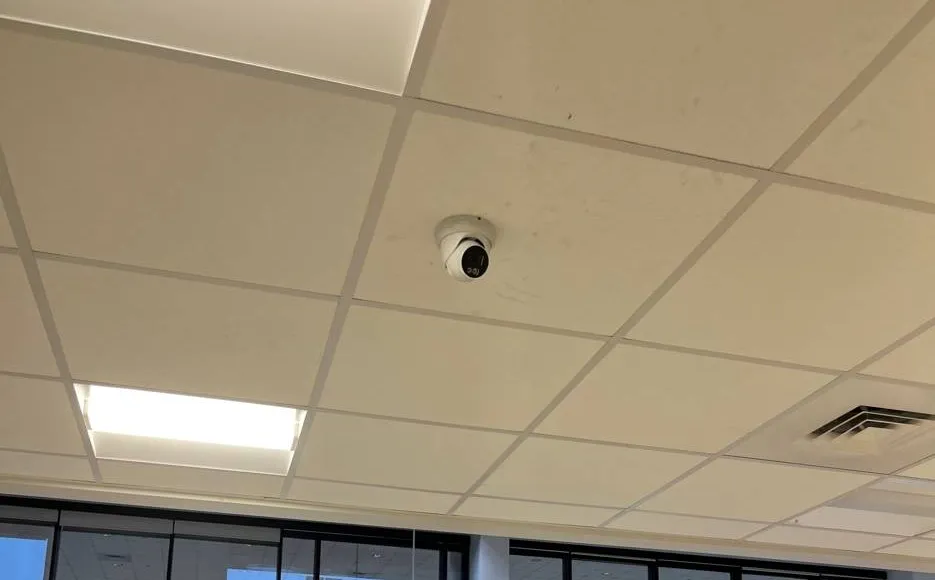
From one of our CCTV jobs (a Rockland County car dealership): a turret dome sits in the middle of the ceiling grid, aimed at the glass entrance and front desk. Offices along Court Street and Downtown Brooklyn suites get the same kind of indoor camera.
Closed circuit television, explained for a Brooklyn homeowner
"Closed circuit" means the cameras send video to a recorder on the property over cables that belong to you, not to a cloud server owned by a camera company. The recorder — a DVR for coax cameras or an NVR for network cameras — writes every camera to a hard drive, around the clock or on motion, and keeps the oldest footage until the drive fills and starts overwriting. The phone app is an add-on window into that recorder, not the place where the video lives.
That design suits a Brooklyn house. If the cable company's internet drops, the cameras keep recording. If a tenant's Wi-Fi is weak through two brick walls, it does not matter, because the cameras are not using Wi-Fi. And there is no monthly fee per camera, because the storage is a drive you own.
Residential CCTV installation for owners who rent part of the house
A landlord's camera plan is different from a single-family homeowner's. We place cameras on the shared and outdoor areas, set privacy masks where a view would catch a tenant's window, keep audio off unless there is a clear reason and the right notice, and set up user roles so the owner decides who sees what. Tenants appreciate a camera on the mailboxes and the front door; nobody appreciates a lens that seems to look into their kitchen. A short written camera list for tenants avoids most arguments before they start. For larger walk-ups and multifamily buildings, our apartment building security camera installation in Brooklyn page covers lobbies, stair halls, roofs and laundry rooms in more depth.
Commercial CCTV installation for a single store or a few
For a store, the system is designed backwards from the evidence you will need: a face at the door, a hand at the register, the aisle where the expensive stock sits, the back door where deliveries arrive. A recorder in a locked back room or an enclosure above the drop ceiling keeps the footage away from anyone who might try to take it. Owners with two or three stores across Brooklyn can watch all of them in one app.
Customer-supplied equipment
If you already bought a kit, we can install it. The labor price is quoted by phone or text from your equipment list and a few photos of the house or store, and the job is booked with the deposit. We don't do walk-throughs to look at customer-supplied equipment, and the signal and hardware of a customer's own wireless cameras are not something we can stand behind. Wired kits generally install cleaner than wireless ones in Brooklyn's brick buildings.
Building Specialists
CCTV Installation for Brooklyn's Architecture
Brooklyn's housing changes every few blocks, and the cable route changes with it. Here are the building types we wire most often, and what each one asks of a CCTV installer.
🏘️
Frame two-families with siding
Flatbush, East Flatbush, Canarsie, Midwood and parts of Bushwick. Wood framing under vinyl or aluminum siding means cable can often drop inside an exterior wall bay; mounts go on a proper block, not straight into the siding.
🧱
Brick row houses and semi-attached
Bensonhurst, Dyker Heights, Bay Ridge, Gravesend and Sheepshead Bay. Solid brick fronts, a garage under the house on many blocks, and a shared driveway in the back. Cable usually enters at the cellar and rises inside.
🏛️
Brownstones and limestones
Park Slope, Bedford-Stuyvesant, Fort Greene, Clinton Hill, Prospect Heights and Crown Heights. Stoop, areaway, parlor door, garden floor and rear yard; many blocks are inside historic districts.
🏡
Detached Victorians and wide-lot houses
Ditmas Park, Prospect Park South, Manhattan Beach and Marine Park. Porches, side yards and detached garages need longer runs and more outdoor cameras than a row house.
🏬
Mixed-use avenue buildings
A store on the ground floor with two or three apartments above. The store's cameras and the residential entrance cameras are often separate systems with separate owners.
🏭
Lofts, warehouses and yards
Concrete, steel deck, high ceilings and long fence lines in Sunset Park, Red Hook, Greenpoint, East Williamsburg and the Navy Yard area. Long runs, lifts, sometimes fiber.
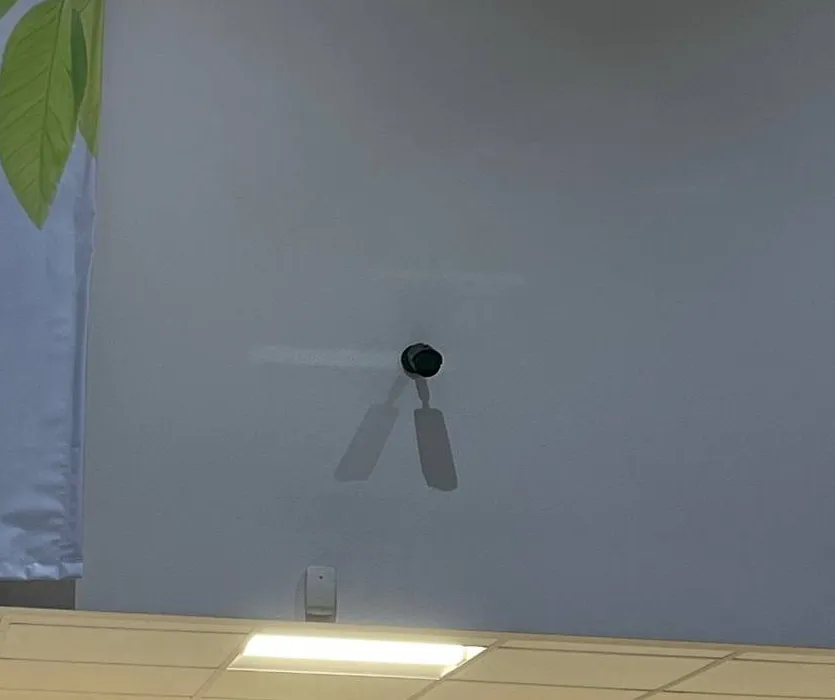
From one of our CCTV jobs (a Rockland County car dealership): a small bullet camera sits high on a double-height wall, well above the hung ceiling, so it looks down across the whole floor. Brooklyn lofts and two-story store interiors use the same high mount.
Cable routes in a two-family house
The recorder almost always lives in the owner's part of the house — a closet in the owner's apartment, the owner's side of the cellar, or a locked cabinet in a utility room. From there, every camera needs one cable. In a frame house we can often fish down an exterior wall bay from the top floor or up from the cellar without opening the walls. In a brick house, the usual path is through the cellar ceiling and out through a small, sealed core in the foundation wall or rim joist, then up behind a downspout or along a mortar line to the camera.
The basement apartment is the obstacle that catches most installers out. Its ceiling is the cellar ceiling, it is finished, and the tenant lives there. We plan routes that avoid opening a tenant's ceiling: along the boiler room or the owner's storage side, through an existing chase, or outside in a painted raceway where nothing else works. If a route would mean working inside a tenant's apartment, the owner arranges access and notice first.
Brownstones: the stoop, the areaway and the garden
A brownstone or limestone has two front doors: the parlor door at the top of the stoop and the garden-level door under it, behind the areaway gate. Both need a view, and the stoop itself blocks a camera that sits too low. The usual answer is one camera under the cornice or lintel looking down the stoop and sidewalk, and one tucked inside the areaway looking at the garden door and gate. The back gets one or two cameras on the rear wall covering the garden and fence.
Front cable on a brownstone stays out of sight: in through the cellar, up inside, and out at the camera position through the smallest hole that will take the cable and a sealed grommet. Nobody wants a white cable stapled across a brownstone face.
Historic districts and the Landmarks Preservation Commission
Large parts of Brooklyn — Brooklyn Heights, Park Slope, Fort Greene, Clinton Hill, Cobble Hill, Stuyvesant Heights, Prospect Lefferts Gardens, Ditmas Park and others — are designated historic districts. Work on the exterior of a building in a district can need a permit from the NYC Landmarks Preservation Commission. The Commission's Permit Guidebook chapter on health and safety work covers security cameras: cameras should be discreet, attached through mortar joints or plain surfaces rather than ornament, and conduit should be concealed or kept short and painted to match. Cameras inside the areaway or on the rear wall are often far simpler than cameras on a decorated front. This is general guidance, not legal advice; check the guidebook or ask the Commission before exterior work on a landmarked house.
Brick, stone and siding: what each surface needs
Brick gets sleeve anchors in the mortar joint, not the brick face, so a camera can be moved later without leaving a cracked brick. Brownstone is soft and spalls; we mount on a junction box fixed into joints or to the iron railing or wood trim where possible. Vinyl siding gets a mounting block so the camera sits flat and the siding can still expand and contract. Aluminum siding needs care with the cable entry so water does not track behind it. Every exterior hole is sealed, and every camera base is weather-sealed or sits on a junction box.
Houses with a garage under the front
On many blocks of Bay Ridge, Dyker Heights, Bensonhurst, Gravesend and Marine Park, the house sits above a garage with a steep driveway down from the sidewalk and the front door up a short stair to the side. The garage and the driveway are the first things owners want covered, because cars, bikes and tools live there. A camera on the garage header looks straight down the driveway to the curb and catches anyone walking in from the street. A second camera at the front door covers the stair. Cable from both usually reaches the cellar or the garage ceiling in a few feet, which makes these some of the quicker houses to wire in Brooklyn. The tricky part is light: a driveway that drops below sidewalk level is dark at night, so we choose cameras with strong infrared or color night, or pair the camera with the owner's motion light.
Mixed-use buildings on the avenues
A three-story building on Church Avenue or Fifth Avenue might have a nail salon on the ground floor and four apartments above. The salon owner rents the store and wants cameras on the door and register; the building owner wants cameras on the residential entrance, the stairs and the roof door. Those are two separate CCTV systems with two separate recorders, unless the owner and the tenant agree otherwise in writing. We often install both in the same visit at the owner's request, keeping the cables and recorders separate and labeled.
Industrial buildings on the waterfront
Warehouse and loft jobs in Sunset Park, Red Hook, Greenpoint and the Navy Yard area are a different trade. Ceilings run 16 to 30 feet; walls are block or concrete; trucks back up to dock doors all day. Cameras mount high on brackets or poles, cable runs in conduit or on J-hooks along the steel, and runs to the far end of a long building can exceed the distance a single network cable is rated for. When that happens, we add a switch partway, or run fiber to a remote switch. Our warehouse security camera installation in Brooklyn page goes deeper on docks, racks and yards.
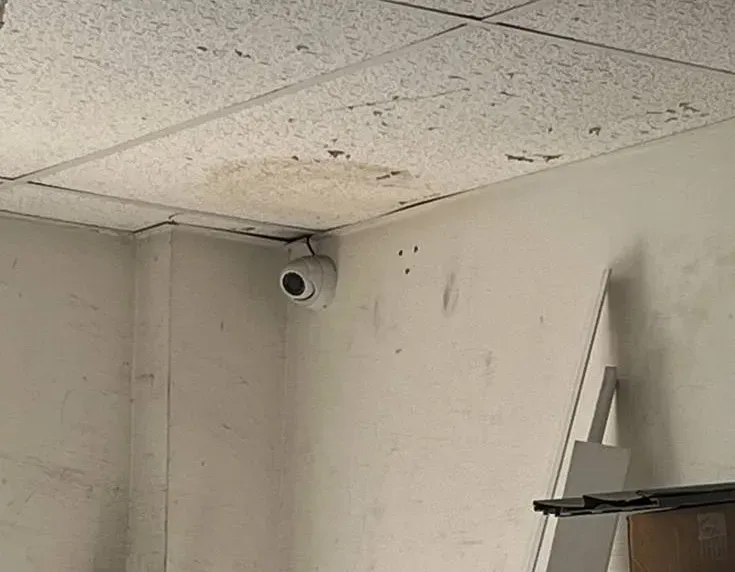
From one of our CCTV jobs (a Nassau County showroom): a dome in the upper corner of a storage room watches the whole space and the doorway. Brooklyn cellars and store back rooms usually need exactly this one camera.
Keeping the recorder away from water, heat and other hands
In a house, we would rather put the recorder in the owner's apartment than in a shared cellar, because a recorder anyone can reach is a recorder anyone can unplug. If the cellar is the only option, the recorder goes in a locked, ventilated cabinet, away from the boiler and off the floor in case of a leak. Brooklyn's low-lying blocks near the water — Red Hook, Gowanus, Coney Island, Sheepshead Bay, Gerritsen Beach — get recorders above the flood line, never on the cellar floor.
New condo buildings and conversions
Downtown Brooklyn, Williamsburg and the Gowanus rezoning area have a lot of new and converted buildings with drywall, ceiling cavities and a telecom closet on each floor. These are easy to wire by Brooklyn standards. The work is mostly about the board's or developer's approvals, a certificate of insurance on file and coordinating with the building's existing access control or intercom.
Commercial CCTV
Business CCTV Installation in Brooklyn
Brooklyn's business owners mostly run one store, one restaurant, one shop floor or one warehouse, and they run it themselves. A CCTV system for them has to be simple to use at midnight on a phone, cheap to own, and good enough that the footage settles the question — who came in, what they took, which delivery driver left the door open. For multi-camera recorder jobs in stores, restaurants and offices, our commercial security camera installation in Brooklyn page shows more of the business side.
The corridors we work on most
Flatbush Avenue and Church Avenue. Long runs of phone stores, beauty supply shops, bakeries, pharmacies and takeout counters, open late, many in mixed-use buildings.
Nostrand, Utica and Rogers Avenues. Groceries, roti shops, barbershops, laundromats and check-cashing stores between Crown Heights and Flatbush, minutes from our Troy Ave office.
86th Street and Kings Highway. Bay Ridge, Bensonhurst and Midwood retail under the elevated train and along busy two-way traffic, with chain stores beside family businesses.
Fulton Street and the Fulton Mall. Downtown Brooklyn's dense retail strip, with high foot traffic and early openings.
Knickerbocker Avenue and Broadway. Bushwick's shopping streets, with groceries, clothing stores and restaurants under the J and M lines.
Fifth and Eighth Avenues in Sunset Park. Two busy commercial strips, one with a strong Latin American retail presence and one with a dense Asian market district.
Pitkin Avenue and Avenue U. Brownsville's historic shopping street and southern Brooklyn's restaurant and grocery corridor.
Store layouts: door, register, aisles, back room
A typical Brooklyn storefront is narrow and deep. The camera at the door is aimed inward so every face is lit by the street, not silhouetted against it. The register camera sits above and slightly behind the counter so it sees hands, cash drawer and customer face in one frame. Aisle cameras run the length of the store from the front. The back room and rear door get their own camera, because that is where a lot of shrinkage actually happens. Outdoor coverage of the sidewalk under the awning is a bonus, aimed at the store's own frontage.
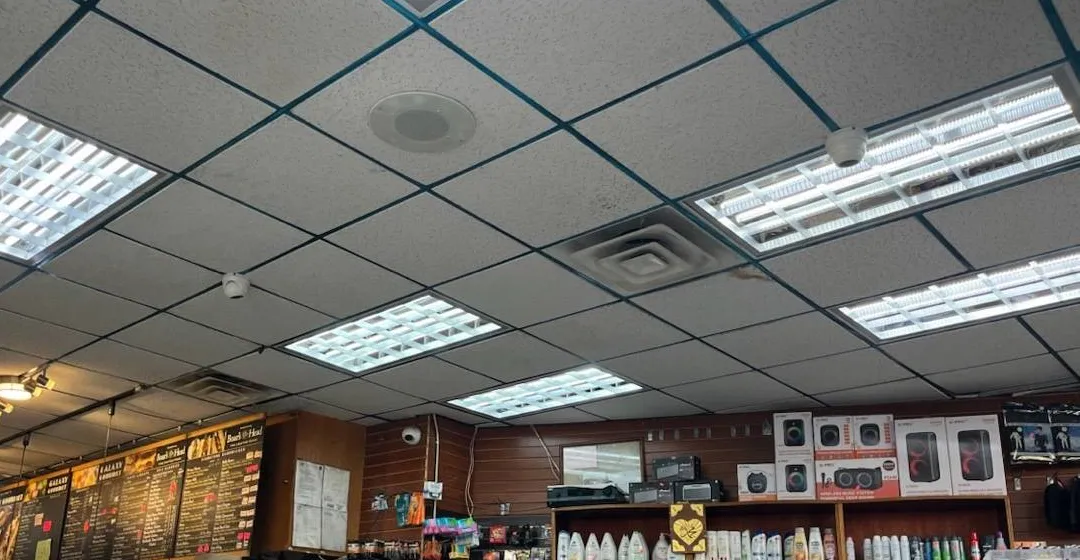
From one of our CCTV jobs (a Manhattan corner deli): small domes are spaced across the drop ceiling so every shelf run and the menu counter are covered. Narrow Brooklyn groceries and delis are wired the same way.
Restaurants, bakeries and takeout counters
Restaurants need the register, the pickup counter, the front door, the delivery door and sometimes the kitchen line. Grease and heat shorten a camera's life, so kitchen cameras are sealed models mounted away from the hood. Delivery-app disputes — an order that "never arrived" — are settled fast when the pickup shelf has its own camera.
Laundromats, barbershops and salons
Service businesses on Brooklyn's avenues have different risks from a grocery. A laundromat has coin and card machines, a change machine and customers who leave bags unattended; the cameras watch the machines, the counter and the folding tables, and the recorder lives in the locked office. A barbershop or salon wants the entrance and the front desk, where cash and product sit, and rarely needs more than four cameras. Many of these shops are open seven days, so we book installations early in the day or after closing so the chairs stay full.
Warehouses, auto shops and truck yards
Industrial Brooklyn needs CCTV for docks, gates and yards. That means bullet or varifocal cameras on long views, plate-reading cameras at a gate where the lane is narrow enough, infrared for unlit yards, and recorders sized for many channels. Auto repair shops along Coney Island Avenue, McDonald Avenue and in East New York ask for the bays, the lot and the key cabinet. Self-storage and construction sites get cameras with built-in deterrence lights and sirens.
Medical, dental and professional offices
Offices on Court Street, Montague Street, Avenue J and the Downtown Brooklyn towers want the reception desk, entrance and records room, never treatment rooms. Cameras stay out of exam rooms and bathrooms, and the recorder sits in a locked closet or the server rack.
The New York commercial security tax credit
New York created a refundable Commercial Security Credit for small retail businesses that spend on retail theft prevention, which explicitly includes security cameras. According to the NYS Department of Taxation and Finance, the credit is $3,000 for each qualifying New York retail location, and the business must first receive a certificate from the Division of Criminal Justice Services, which decides eligibility. The state's tax expenditure report says qualifying expenses must exceed $4,000 per location for businesses with 25 or fewer employees, or $6,000 for those with 26 to 50. Allocation years and availability change, so check with DCJS and your accountant before counting on it; this is not tax advice. We provide an itemized invoice that shows the camera system as a separate line.
Holiday season, break-ins and new openings
Calls pick up in Brooklyn in three moments: before the holiday shopping rush, right after a break-in or a smashed door, and in the weeks before a new store opens. For a new opening, the best time to plan cameras is during the build-out, before the ceiling closes — cable then costs a fraction of what it does later. After a break-in, the first visit is often about finding out why the old system failed: a dead drive, a recorder that was stolen, or cameras that recorded only a blur. For holiday coverage, more cameras at the register and the door and a quick lesson on exporting a clip to the police are usually more useful than a camera on every aisle.
Owners with several Brooklyn stores
Owners who run two or three locations — a bakery in Flatbush and another in Crown Heights, or three phone stores across the borough — can view every recorder in one app, with each store's manager seeing only their own store. Each site keeps its own recorder, so an outage at one location does not affect the others.
Compliance callouts for Brooklyn businesses
No cameras in bathrooms, locker rooms or changing rooms for employees under NYS Labor Law §203-c, and recording people in private places can be unlawful surveillance under Penal Law §250.45.
Audio recording raises eavesdropping questions under Penal Law Article 250; we leave audio off unless the owner has a reason and has taken advice.
Biometric features such as face recognition trigger signage and use rules for retail and food businesses under NYC Administrative Code §22-1202; we ship cameras with those features off.
Landlord approval is usually needed for cameras or cable on a building facade the store does not own.
Not legal advice. These are general rules; an attorney can advise on a specific situation.
Your Questions Answered
CCTV Installation in Brooklyn: Questions Answered
These are the questions Brooklyn owners, landlords and store managers actually ask us on the phone and during surveys. Each answer is specific to how houses and businesses in this borough are built and run.
Which views matter most if a two-family starts with only four cameras?
Start with the places where most trouble begins and ends. In order, we usually suggest: the front gate and stoop, the shared front door and mailboxes inside the vestibule, the rear yard and fence, and either the side alley or the basement-unit door, whichever is darker and less visible from the street. That leaves the cellar, the garbage area and any garage for a second phase. Buying a recorder with spare channels from the start means phase two is only cameras and cable, not a new box, and the full plan for a typical two-family with a basement apartment ends up at seven or eight cameras.
Who should hold the admin password on a CCTV system in a house with tenants?
The owner, and only the owner. The admin account can delete footage, change recording settings and add users, so it should never be shared with a tenant, a super or a handyman. We create the admin account in the owner's name with a strong unique password, then add limited accounts for anyone else: a live-view-only login for a trusted tenant if the owner wants one, or a playback login for a family member who helps manage the house. If a tenant moves out or a super leaves, the owner deletes that one account without touching the rest of the system. We don't keep a copy of the admin password after handover.
As a landlord in my own two-family house, can I record the shared hallway and the yard?
Generally, an owner can record common areas and the outside of the property with visible cameras, but there are firm limits. New York Penal Law §250.45 makes it a crime to record people in places where they have a reasonable expectation of privacy, such as inside their home, a bathroom or a bedroom. Audio is a separate issue under the eavesdropping provisions of Penal Law Article 250. Your lease may also say something about cameras. So we aim cameras at entrances, hallways, the yard and the alley, never at a tenant's windows or into an apartment, and we leave audio off. This is general information, not legal advice; a landlord-tenant attorney can review your exact situation.
Should the mailboxes and the package drop spot have separate cameras?
In most Brooklyn two- and three-family houses, yes. The mailboxes are usually inside the vestibule, while couriers leave boxes on the stoop, behind the gate or under the stairs, out of sight of a single camera. We put one camera on the mailboxes and aim another at the spot where packages actually land, and we suggest the owner tell couriers and tenants to use that spot. When a box disappears, the owner can then pull the clip in minutes. Note that, as Brick Underground has explained to renters, a landlord generally isn't obligated to show tenants building footage, but most owners choose to share a clip with the tenant or the precinct, and the export takes a few taps.
How do I stop anyone in the building from unplugging the recorder?
Put it where only the owner can reach it, and make it tell you when something goes wrong. We install the recorder in a locked closet or cabinet in the owner's space, never in the shared vestibule or the open cellar next to the tenants' laundry, and plug it into a battery backup so a flipped breaker or a pulled plug doesn't end recording instantly. The app can push an alert to the owner's phone when the recorder goes offline, when a camera loses video or when the drive reports an error. If the recorder ever does disappear, the clips you exported earlier are still on your phone. The recorder needs one outlet, airflow and, for remote viewing, one network cable to the owner's router.
Will cameras on vinyl or aluminum siding stay put, and how do you seal the holes?
They stay put when they are mounted correctly. On vinyl, we use a mounting block made for siding, so the camera's base sits flat and the siding can still move with temperature. On aluminum, we fix through to the sheathing and wall framing behind it. Every cable hole gets a sealed grommet or a weatherproof junction box behind the camera, so wind-driven rain cannot run inside the wall. A camera screwed straight into soft siding with an unsealed hole is the most common failure we fix on frame houses in East Flatbush and Canarsie.
Can a camera cover the rear fire escape on a walk-up or a mixed-use building?
Yes, from the wall, not from the fire escape. Rear fire escapes are a common way into the back apartments of Brooklyn walk-ups and the upper floors over avenue stores, so owners often want them watched. We mount the camera on the rear wall or the yard fence aimed up the fire escape, with infrared for the dark yard, and never attach anything to the fire escape itself or put cable where it could obstruct the exit path. Privacy masks block the windows of the apartments along the fire escape so the camera sees the ladder and landings, not inside the homes.
What camera catches a face at the top of a brownstone stoop?
One mounted higher than the head of the person at the parlor door, angled down only slightly, with a narrower lens than the default. Brownstone stoops put the parlor door five to eight feet above the sidewalk, so a camera at the door frame looks down onto the tops of heads. Mounting it under the lintel or cornice, a few feet above the door, and choosing a lens that frames the landing rather than the whole block gives a usable face. A second camera in the areaway covers the garden door. Wide dynamic range matters on east- and west-facing stoops that get direct morning or afternoon sun.
Can I watch my Brooklyn cameras on a TV in my apartment as well as on my phone?
Yes. The recorder has a video output, and most of our packages include a 20-inch monitor, so the simplest setup is a monitor next to the recorder in the owner's space. If you want the cameras on a living-room TV on another floor, we can run a cable to it, or you can open the camera app on a smart TV or streaming device that supports it. Many owners in two-families keep a small monitor by the door of their own apartment so they can check the stoop before answering the bell.
Can my Brooklyn store claim the state commercial security credit for a new CCTV system?
Possibly. New York's Commercial Security Credit is $3,000 per qualifying retail location for small retail businesses with 50 or fewer employees, and security cameras are one of the listed retail theft prevention measures. Eligibility is decided by the Division of Criminal Justice Services, which issues a certificate you file with your tax return, and the spending threshold depends on employee count. Ask your accountant whether you qualify in the current allocation year. We give you an itemized invoice either way.
Will cameras and a recorder in an unheated Brooklyn warehouse survive the winter?
Yes, if the equipment is chosen and placed for it. Outdoor-rated cameras are built for freezing temperatures and many have small heaters; indoor cameras mounted in an unheated loft or garage should be outdoor-rated too. The bigger risk is the recorder. Hard drives don't like cold starts and condensation, so we put the recorder in the heated office, a ventilated cabinet or a small enclosure off the floor, on a battery backup, and run cable from there. Cable entering from a cold space gets a drip loop and a sealed entry to stop condensation from tracking along it into the recorder.
What does it cost to keep a month of footage instead of two weeks?
On a standard four-camera system, two weeks of continuous recording is included (a $100 drive allowance). A one-month storage upgrade is $180, two months is $270, three months is $360 and four months is $450. These are the same storage prices shown on our Brooklyn security camera page. More cameras or higher resolution use more storage, so for larger systems the drive is sized on the quote after we know the camera count and the recording mode.
Should a Brooklyn store's camera monitor face the customers or stay behind the counter?
Often both. A public-view monitor near the entrance or above the shelves shows every customer that the store is recorded, which discourages casual theft; it should show wide views only, never the register close-up or the back office. A second monitor or the owner's phone behind the counter shows the full set of cameras, including the cash drawer and stock room. Many Brooklyn groceries and phone stores on the avenues use exactly this split, and the monitor that comes with most of our packages can serve either role.
Should the cameras in a two-family share the tenants' internet connection?
No. The recorder belongs on the owner's internet service, connected by a cable to the owner's router. If it sits on a tenant's Wi-Fi, the owner loses remote viewing whenever the tenant changes the password, moves out or stops paying the bill, and the tenant's network can see the recorder. If the owner has no internet in the house at all — common in houses that are fully rented — the system still records to its own drive, and a small internet plan or a cellular router can be added later for remote viewing.
What happens to the CCTV system when I sell the house?
Usually it stays with the house, and the buyer gets a working system instead of a mystery box in the cellar. Before closing, the seller should remove their own phone app access, and the recorder's admin password should be reset and handed to the buyer with the camera map. If the system was installed by us, we can do that reset as a short service call and set up the new owner's accounts. Whether the system is included in the sale is a matter for the contract of sale, so mention it to your attorney.
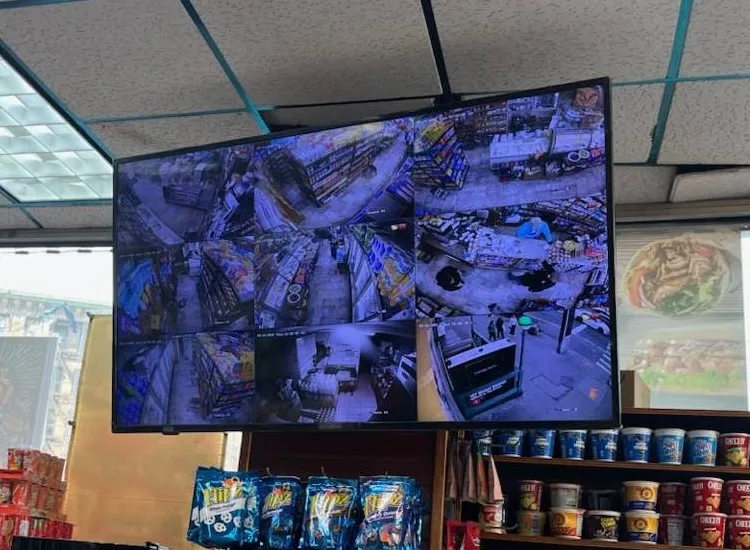
From one of our CCTV jobs (a Manhattan corner deli): a wall TV above the shelves shows the camera split, so staff and customers can see the store is recorded. Many Brooklyn store owners ask for the same public view monitor.
Equipment
Types of CCTV Systems We Install in Brooklyn
The right equipment depends on the walls, the light and the distance. These are the pieces we install most often in Brooklyn, and where each one earns its place.
⚪
Turret and dome cameras
For stoops under a cornice, vestibules, store ceilings and hallways. Turrets avoid the infrared glare that a dirty dome bubble can cause at night.
🔦
Bullet cameras
Long, narrow fields of view: a side alley, a shared driveway, a yard fence or a dock apron. The visible housing also tells people they are on camera.
🔭
Varifocal cameras
Adjustable zoom for a narrow target: the parlor-door landing, a register, a truck gate or a plate at a yard entrance.
🌙
Color night and infrared
Color night models use streetlight and porch light to keep color after dark; infrared covers backyards and yards with no light at all.
🚨
Active deterrence
A light and siren triggered by a person in a zone after hours. Good for yards, construction fences and store rear doors.
🧠
Smart detection
Person and vehicle detection so phone alerts aren't triggered by cats, rain and swaying trees in a Brooklyn backyard.
🗄️
DVRs and NVRs
4, 8, 16 and 32-channel recorders with surveillance-grade drives, sized for the cameras you will add over the next few years.
🔋
Switches, cable and UPS
PoE switches sized to the power budget, Cat6, RG59 or fiber as the distance requires, and battery backup on the recorder.
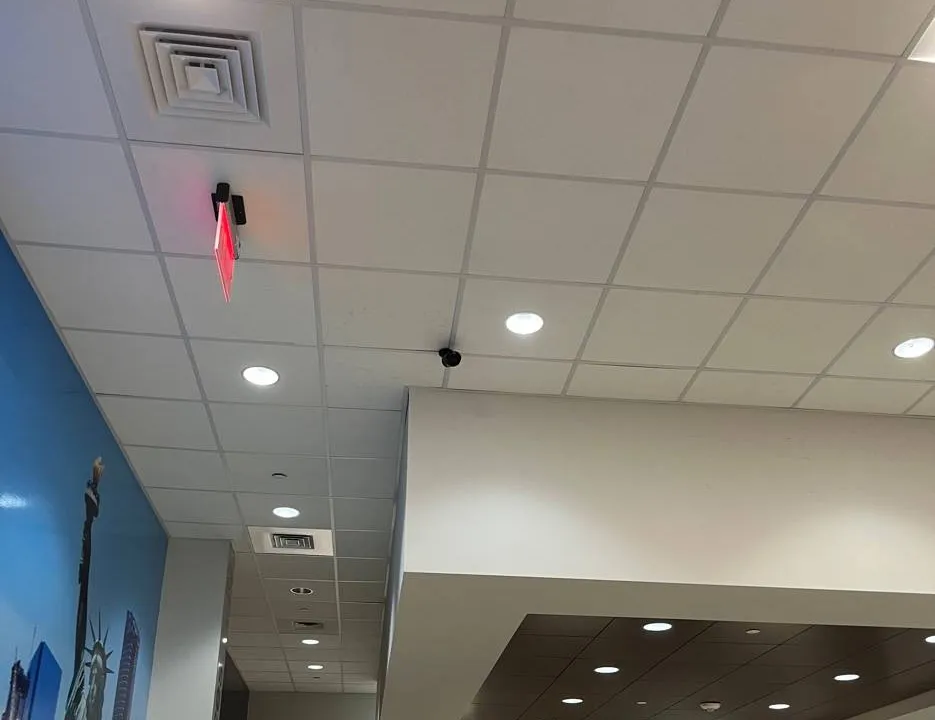
From one of our CCTV jobs (a Rockland County car dealership): an active-deterrence camera with its red light ring on the lobby ceiling, with a second small camera further in. In Brooklyn these go on yards, rear doors and construction fences.
Choosing between wired IP/PoE and HD analog
For a new system, wired IP on PoE is our default. Each camera gets one Cat6 cable that carries power and video, the recorder or a switch powers everything, and the picture is sharper per dollar than on coax. For a house or store that already has coax from an older system, HD analog (HD-TVI, HD-CVI or AHD) on a new DVR can reuse that cable and deliver 4K-class images at a lower cost than rewiring. The decision comes down to the condition of the old cable, which we test during the survey.
Wireless cameras have a place — a single camera at the far end of a long lot, or a temporary camera on a renovation — but Brooklyn's brick and plaster walls block Wi-Fi badly, and wireless cameras still need power. In practice, most wireless installations we are called to replace failed on signal, not on picture quality.
Lens choice for narrow Brooklyn lots
A standard Brooklyn row-house lot is 20 feet wide or less, and the typical camera's wide lens sees far beyond that — into the neighbor's yard and windows on both sides. We choose lenses and aim cameras to cover the owner's own property: a slightly narrower lens down a side alley, a camera aimed along the fence rather than across it, and privacy masking on any part of the frame that shows a neighbor's window. The result is footage with more detail where it matters and fewer complaints from next door.
Storage, bitrate and H.265
Every camera streams at a bitrate, and the recorder's drive fills at the total of all of them. H.265 compression roughly halves the space compared with older H.264 at the same picture quality, which is why our recorders default to it. Motion-only recording stretches retention further but can miss the lead-up to an event; continuous recording with motion flags is the safer default for most Brooklyn stores and houses. We set retention in days on the quote, and test it after a week or two of real recording.
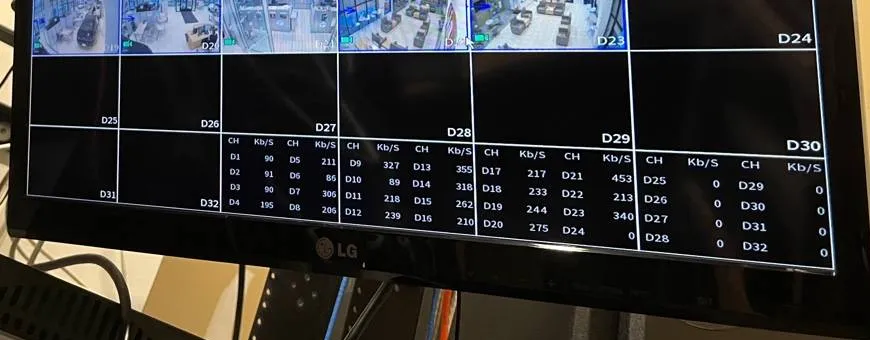
From one of our CCTV jobs (a Rockland County car dealership): the recorder's channel table lists each camera's live bitrate in Kb/s. We read this screen during commissioning to confirm how many days of footage the drive will really hold.
Recording settings for a rental house
For a two- or three-family, we usually set the outdoor cameras to record continuously at a moderate bitrate, with motion events flagged so the owner can jump to them on the timeline, and the indoor common-area cameras to record continuously as well. Phone alerts are limited to the cameras and hours the owner cares about — the yard and alley after midnight, for example — so the phone does not buzz every time a tenant takes out the recycling. Privacy masks block any part of a frame that shows a window or doorway into a unit, and those masked areas are not recorded at all.
Cable types: Cat6, coax and fiber
Cat6 is standard for IP cameras and carries both power and data. RG59 or RG6 coax carries HD analog video, usually with a separate power pair (Siamese cable). Fiber connects buildings or covers runs too long for copper, and it doesn't carry lightning surges or electrical noise between buildings. Outdoor runs use cable rated for UV and moisture; runs through cellars and between floors are firestopped where they pass fire-rated walls and floors.
The PoE power budget
A PoE switch or recorder can only supply so many watts in total. Cameras with infrared, heaters or deterrence lights draw more than basic models, especially at night. We add up the cameras' rated draw, leave headroom, and choose the switch accordingly. Undersized PoE is the reason some cameras reboot every night when the infrared turns on.
Salt air, wind and water near the waterfront
Houses and businesses in Coney Island, Brighton Beach, Sheepshead Bay, Gerritsen Beach, Red Hook and along the Gowanus get salt and wind that wear out cheap housings and connectors. We use weather-rated cameras, sealed junction boxes, stainless or coated hardware where available, and drip loops so water runs off the cable before it reaches the camera.
Specialty cameras: PTZ, fisheye, plate reading and thermal
PTZ cameras suit large yards and lots where a guard or owner actively watches. Fisheye cameras cover a whole store floor or a square lobby from one ceiling point. License plate cameras need a narrow lane, the right angle and controlled speed to work — a yard gate or a garage entrance, not a wide avenue. Thermal cameras detect people in total darkness along long fence lines. Each is quoted per camera after we confirm the layout.
Brands we install
Unless you ask for something else, the quote is written around our own house-brand cameras and recorders. Lorex, Luminys and Reolink are the three manufacturers we are an authorized partner of. Beyond those, our technicians install, integrate and service Hikvision, Dahua, UniFi Protect, Axis, Hanwha, Uniview, Digital Watchdog, Speco, Swann, Night Owl, Amcrest and others, including systems a previous owner left behind in a house you just bought.
Network and remote viewing security
Remote viewing is set up with strong unique passwords, current firmware and no default accounts left open. Where the store or house network allows, cameras sit on their own network segment behind the recorder so they are not reachable from the internet directly. Owners get their own accounts; installers don't keep a back door.
Want Footage You Can Actually Use?
Send the address or cross streets and a few photos. Our Brooklyn office books within 2 hours and puts the camera plan in writing before anyone drills.
AI search summaries, Angi and HomeAdvisor cost guides and generic "best cameras" lists tend to describe a suburban single-family house. Brooklyn is mostly something else. Here are seven claims we hear from callers who read them first, and what we actually find on Brooklyn jobs.
"A video doorbell is all a two-family house needs"
The claim comes from consumer reviews written about one-family houses with one door. A Brooklyn two-family has a gate, a stoop, a shared door, a basement-unit door, an alley, a yard and often a cellar hatch. A doorbell camera sees one of those, from waist height, through a fisheye lens.
A package left at the gate or at the bottom of the stoop can sit outside a doorbell camera's frame entirely. Break-ins at the rear of a row house, through a yard door or a cellar window, are invisible to it entirely.
A doorbell camera can be part of the plan, and we often integrate one. But the coverage that answers "what happened" in a Brooklyn house comes from wired cameras on the shared and outdoor spaces, recording to a drive the owner controls.
"Crime in Brooklyn is rising, so you need cameras everywhere"
Some summaries still repeat headlines from a few years ago. The NYPD's current CompStat reports say otherwise: burglary in Brooklyn North is down 14.0 percent year to date and in Brooklyn South down 7.4 percent, through November 8, 2026. Retail theft is down in both.
That doesn't mean nothing happens. The same Brooklyn South report shows a recent 28-day jump in vehicle thefts, and petit larceny — the category that covers most package theft — is essentially flat. Brooklyn still logged more than 22,000 petit larcenies in ten months.
The honest answer is fewer, better-placed cameras: the gate, the doors, the yard and the register, framed so the footage identifies someone. Ten cheap cameras that record blurry shapes are worse value than five that record faces.
"You can't put cameras anywhere tenants can see"
This one overcorrects. Owners can generally record shared entrances, hallways and the outside of their property with visible cameras. What is off-limits is recording inside someone's home or in private spaces such as bathrooms, which New York Penal Law §250.45 addresses directly.
The practical boundaries in a two-family are simple: cameras on common areas, nothing aimed into a unit or through a window, audio off, and a clear note to tenants about what is recorded. Many Brooklyn tenants want a mailbox camera as much as the owner does.
This is general information, not legal advice. When an owner has a specific dispute or lease clause, an attorney is the right person to ask; we design the camera plan to be easy to defend either way.
"Wireless cameras are easier in an old frame house"
AI tools often assume wireless means easy. In a Brooklyn frame house, the Wi-Fi router is usually in the owner's apartment on the second floor, and the cameras that matter are at the stoop, the alley and the backyard — through floors, plaster and, in many houses, aluminum siding that blocks radio signals.
Every wireless camera also needs power. Battery cameras need charging, and in January they drain faster. A plug-in camera needs an outlet or a power cable, which is half the work of a wired camera anyway.
Frame houses are, in fact, among the easiest Brooklyn buildings to wire, because wall bays run from cellar to roof. A wired camera installed by a crew that knows the route is more reliable and usually not much more expensive.
"Angi and HomeAdvisor ranges are what a Brooklyn job will run"
Angi, HomeAdvisor and Fixr publish national ranges built from jobs all over the country, mostly in houses with attics and crawlspaces. They don't account for brick party walls, finished basement apartments, Landmarks rules or the time it takes to park a van on a Brooklyn block.
Our Brooklyn prices are published: a four-camera house-brand system from $850, four to eight cameras on an NVR for a brownstone, row house or two-family from $950 to $2,500, and commercial systems from $1,500 to $5,000 and up. Those include the recorder, cable, mounting, setup and two weeks of storage.
What moves a Brooklyn price is the cable route, not the cameras. That is why we price larger and concealed-wiring jobs after confirming the layout instead of guessing from a national average.
"Keep footage off-site; a recorder can be stolen"
The argument is that a burglar can steal a recorder. True, which is why the recorder goes in a locked closet, a cabinet in the owner's space or a hidden enclosure, not on a shelf by the front door.
Cloud plans charge a monthly fee per camera and depend on upload speed. A two-family with eight cameras uploading continuously would need a strong upstream connection and a subscription forever. Our systems have $0 monthly fees.
The key clips — the ones you need for a police report or an insurance claim — can be exported from the app to your phone in minutes, which gives you an off-site copy of what matters without paying to store everything.
"A warehouse just needs more cameras"
Summaries treat industrial coverage as a camera count. On Brooklyn's waterfront, the limits are usually distance, light and height: a 300-foot fence line, an unlit yard, a dock door 25 feet from the nearest wall.
More cameras on a cable run that is too long, or on a PoE switch without enough power for the infrared at night, simply produce more blank tiles after dark. The fix is fiber or a mid-run switch, infrared or added lighting, and long-lens cameras aimed along the fence.
Brooklyn Chamber of Commerce President and CEO Randy Peers described the cost side for small businesses this way: "It could be security cameras. It could be a new buzzer system on the door. It could be configuring the space in a way that makes it harder to take things. These are real costs for a small business." (Spectrum News NY1, March 20, 2024) That is exactly why we design for the fewest cameras that cover the site properly.
Field notes from our Brooklyn crew
Our crew works out of 1282 Troy Avenue, between East Flatbush and Crown Heights, so most of our Brooklyn CCTV visits start within a short drive. A few things we check on almost every Brooklyn house before quoting: where the owner's space ends and the tenants' begins, whether the basement apartment's ceiling is finished, how the cellar has handled water in past storms, and whether the house sits in a historic district.
On storefronts, we look at the awning and sign band first, because that is where the cable can hide, and at the back door, because that is where the losses usually are. On warehouse jobs we measure the longest run before anything else, since it decides whether we need fiber.
As the crew puts it: "We don't put a camera up until we know where its cable goes." Every quote lists each camera's position and route for that reason.
Get In Touch
Request a Free CCTV Installation Quote in Brooklyn
Give us the address or cross streets, the type of building, how many views you need and whether an old recorder is still on site. Photos of the stoop, the alley, the storefront or the cellar help us quote quickly. Prefer to talk? Call or text (347) 934-8335.
✅
Request Sent!
Received. Expect a call or text from our Brooklyn office to set the survey date.
How It Works
Our CCTV Installation Process
The same six stages apply to a four-camera row house and a thirty-camera Sunset Park warehouse. What changes is how long the cable work takes.
1
Call, text or form
Your request is answered and booked within 2 hours. Visits run every day of the week, early slots included; paid deposits are scheduled in the order they arrive.
2
Survey at the property
We stand where each camera will go, trace the cable route to the recorder, check the cellar and note tenants, landlords or Landmarks rules that affect the plan.
3
Written camera plan and price
Each camera by position and series, the recorder and drive, retention in days and the total, with concealed wiring or conduit itemized.
4
Cable and mounts
Runs pulled and labeled at both ends, holes sealed, firestopping where required, and mounts chosen for brick, brownstone, siding, tile or steel.
5
Setup and testing
Each view framed, privacy masks set, recording mode and detection zones configured, clock synced and night images checked.
6
Handover on your phone
Owner and user accounts installed, a walk-through of playback and clip export, and a printed camera map for the next service visit.
Timing on Brooklyn jobs: one visit or two
A four- to six-camera job on a frame two-family with an easy cellar route is often finished in one visit. An eight-camera brick house with a finished basement apartment, where cables have to avoid the tenant's ceiling, can run longer or into a second visit. Storefronts with a drop ceiling are quick; warehouses and multi-building lots are planned in days. The survey tells us which one you have, and the time estimate goes on the written quote. We don't promise same-day installation.
How to compare Brooklyn CCTV contractors
Put the quotes side by side and check the same lines on each: the number of cameras and where each one goes, the recorder's channel count, the drive size in terabytes and the retention in days, the cable type, whether concealed wiring is included, the mounting method on your walls, the warranty and who you call later. Ask for the New York State license number and proof of insurance. Read recent Google reviews from real customers — ours stand at 4.7★ / 201 Google Reviews. A low headline price that leaves out the drive, the cable or the setup is not the low price.
Maintenance after the install
Outdoor lenses near busy Brooklyn avenues collect grime and spider webs that ruin night images; drives in warm cellars wear out; firmware needs updates. We offer maintenance visits that clean the cameras, check drive health, update firmware and review every view, and our Brooklyn security camera maintenance page explains them.
Our installations come with a 30-day warranty on the work, and longer coverage can be added for a fee. Full terms — including 50% deposit, one-year parts-only warranty on Abstract Enterprises Security Systems-supplied products, and the late-fee schedule — are set out in the service agreement.
Coverage Area
CCTV Installation Near Brooklyn's Landmarks
We install CCTV across every part of Brooklyn from our office at 1282 Troy Avenue. These landmarks are a quick way to picture the building stock around each part of the borough.
⚓
Brooklyn Navy Yard
More than 550 businesses on 300-plus waterfront acres, surrounded by the warehouses of Vinegar Hill and the row houses of Fort Greene and Clinton Hill.
🏗️
Industry City, Sunset Park
Converted industrial buildings beside working warehouses, with Fifth and Eighth Avenue shopping strips and brick row houses a few blocks inland.
🏛️
Brooklyn Museum, Eastern Parkway
Grand apartment houses and limestone row houses in Crown Heights and Prospect Heights, close to our Troy Avenue office.
🛍️
Kings Plaza, Flatbush Avenue
Southern Brooklyn's big mall, near the detached houses and shared driveways of Marine Park, Mill Basin and Bergen Beach.
🎡
Coney Island Boardwalk
Salt air and wind for every outdoor camera, from Brighton Beach apartment buildings to Sheepshead Bay homes along the water.
🏟️
Barclays Center, Atlantic Avenue
Downtown Brooklyn towers, the Fulton Mall shopping district, and the brownstone blocks of Boerum Hill and Park Slope nearby.
We also serve Williamsburg, Greenpoint, Bushwick, Bedford-Stuyvesant, Crown Heights, Flatbush, East Flatbush, Canarsie, Brownsville, East New York, Cypress Hills, Bay Ridge, Dyker Heights, Bensonhurst, Borough Park, Midwood, Kensington, Windsor Terrace, Red Hook, Carroll Gardens, Cobble Hill, Brooklyn Heights, Gravesend, Sheepshead Bay and Gerritsen Beach.
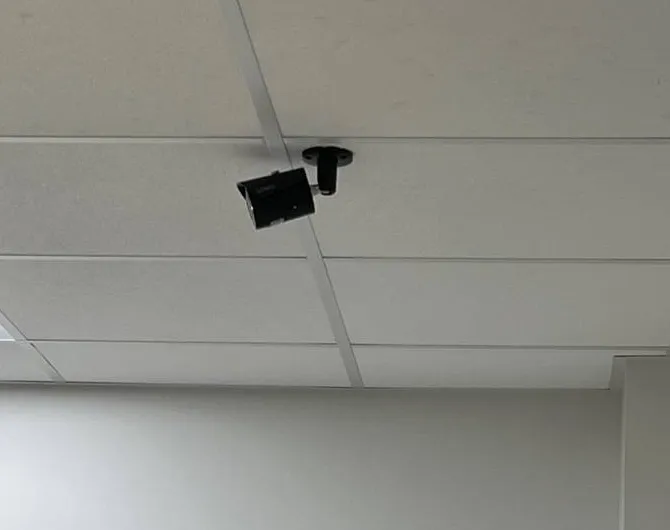
From one of our CCTV jobs (a Rockland County car dealership): a mini bullet hangs from the drop ceiling on a short mount, aimed across a work area. Service counters and offices in Brooklyn get the same compact ceiling camera.
Pricing
CCTV Installation Cost in Brooklyn
The prices below are the same ones published on our security camera installation page for Brooklyn. Each series price is the starting price of a complete four-camera system — cameras, recorder, drive, cable, mounting, setup and phone app — and it already includes two weeks of recording. Extra cameras, concealed wiring and conduit are priced per camera after we confirm the layout.
System
Brooklyn price
What it is
A Series · 4-camera DVR
From $850
Entry DVR kit; night vision 60–100 ft; smart motion alerts
F Series · 5MP DVR
From $898
2K cameras in three housing styles, siren-and-light deterrent models, monitor
E Series · PoE network kit, 4K recorder
From $1,057
One Cat6 per camera, IP67 housings, color after dark, monitor
C Series · 8MP 4K DVR
From $1,292
4K picture on existing or new coax, long-range models, monitor
D Series · 8MP 4K IP (top tier)
From $1,292
Top-tier 4K network cameras with talk-back and deterrent lights
Residential · 4–8 cameras, NVR, PoE wiring
$950–$2,500
Brownstones, townhouses, apartments and homes across Brooklyn
Commercial CCTV
$1,500–$5,000+
Retail stores, restaurants, offices and multi-story buildings
For most Brooklyn houses, two to four weeks of footage is plenty, because a package theft or a break-in is usually noticed within days. Stores that deal with chargeback disputes or insurance claims often choose one to three months. When the drive is full, the recorder overwrites the oldest footage automatically.
What moves the price on a Brooklyn job
The route from camera to recorder. A frame-house wall bay is quick; a brick cellar wall, a finished basement ceiling or a run across a yard takes longer.
Camera height and reach. A cornice on a three-story brownstone, a warehouse wall or a pole in a yard may need a tall ladder or a lift.
How many channels and days. More cameras and longer retention mean a larger recorder and drive.
Approvals and access. Historic-district permits, landlord consent for a store facade or tenant notice for work inside a unit add time.
Reusable wiring. If the last owner left sound coax or Cat6 behind, testing and reusing it trims the labor on an upgrade.
CCTV installation cost per camera, labor only and package questions
People search for a single per-camera number. The honest answer for Brooklyn is to start from the four-camera series price that fits the building and add cameras, each priced after we see where its cable goes. A sixth camera on the same drop ceiling as the first five costs far less than one at the end of a 90-foot driveway. Labor-only installs on equipment you already own are quoted by phone or text from your equipment list and photos. Financing is available on our systems; ask when you request the quote.
What your written Brooklyn quote shows
Each camera by location and series; the recorder and its channel count; the drive size and the retention you should expect; cable type and any concealed wiring or conduit; mounting hardware per surface; the monitor if included; the number of app users; any landlord, tenant or Landmarks step and who handles it; and the warranty terms. If a line isn't on the quote, it isn't in the price.
Shop Our Systems
CCTV Installation Packages & Pricing
Every series is a four-camera starting package that grows with your house or business. Installation, a recorder, two weeks of recording and remote phone access come with each one, and most add a 20-inch monitor.
A
A Series · from $850
The entry kit. A DVR with four HD cameras, night vision reaching 60–100 feet, motion and smart alerts and remote access. Right-sized for a one-family row house, a garage or a small office suite.
F
F Series · from $898
2K (5MP) picture on a DVR, with a choice of housings and models that flash and sound a siren when someone lingers after hours. Comes with a 20-inch monitor for the counter. Popular on Brooklyn avenue storefronts.
E
E Series · from $1,057
Network cameras (4–5MP) powered over a single Cat6 each and recorded on a 4K NVR. Weatherproof to IP67, color after dark, person and vehicle alerts, 20-inch monitor. What we suggest first for a two-family.
C
C Series · from $1,292
Full 4K (8MP) on coax. If a house or shop already has decent coax from an older system, this series reuses it, adds long-range models that see 100–120 feet at night and includes a monitor.
D
D Series · from $1,292 · Top tier
Our best network system: 4K cameras that can talk back through a speaker, warn with lights and siren, and see up to 120 feet in the dark, all IP67 and paired with a 20-inch monitor. Built for yards, driveways and busy entrances.
Your cameras, our labor. Text us the make and model of the kit you bought and photos of where it should go; the labor-only price comes back the same way, and a deposit books the date. Customer-owned equipment is priced without a site walk-through, and the Wi-Fi reach and hardware of your own wireless cameras stay your responsibility. See installing your own camera system.
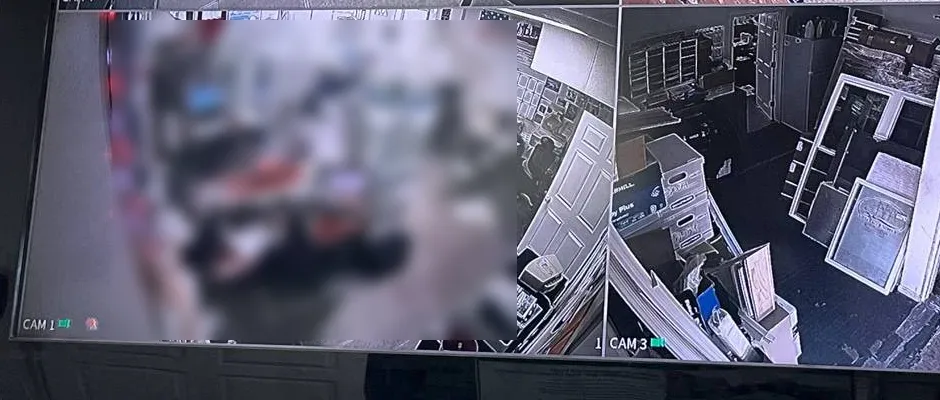
From one of our CCTV jobs (a Nassau County showroom): two of the four camera tiles on the office monitor, one over the sales desk and one in the storage room. People in the frame are blurred for privacy.
Will the cameras' night lights bother my neighbors?
+
Normally not. Infrared night vision is invisible to the eye apart from a faint red glow on some models. Color night cameras and active-deterrence models can switch on a white light, so on narrow Brooklyn blocks we limit those lights to the owner's own yard, alley or driveway, set them to trigger only on people in a defined zone, and keep them off the street side unless the owner wants them there.
Can you install CCTV at a Brooklyn house I own but don't live in?
+
Yes. Many owners rent out every unit or keep a house empty between tenants or during a sale. We install the recorder in a locked spot, set up remote viewing and motion alerts on your phone, and add a battery backup so short outages don't stop recording. Someone needs to let us in for the survey and the installation.
Where do you put the recorder in a Brooklyn house near the water that has flooded before?
+
Above the flood line, never on the cellar floor. In low-lying parts of Red Hook, Gowanus, Coney Island, Sheepshead Bay and Gerritsen Beach we mount the recorder and the PoE switch high on a wall or move them to an upper floor, and use outdoor-rated cable and sealed connections for anything below.
Can you add cameras to the recorder my house already has?
+
Often, yes, if the recorder has free channels and still works well. We check its model, channel count, drive health and firmware during the survey. New cameras must match the recorder type: coax cameras on a DVR, network cameras on an NVR. If the recorder is old, full or failing, replacing it can cost less over time than nursing it along.
Can a camera on my house record my car parked on the street?
+
Usually yes, if the car is parked along your own frontage. A camera under the cornice or on the porch aimed along the curb can show who approaches the car. Reading a plate on a moving car on a Brooklyn street is a different job; that needs a dedicated plate camera at a controlled lane, which a residential street rarely is.
Do you install CCTV in Brooklyn bars and nightlife spots that open late?
+
Yes. Bars and late-night venues usually want the door and the line outside, the bar and register, the back door and the storage room for stock. Cameras need good low-light performance because the room is dim, and the recorder belongs in a locked office away from the bar. If an ID scanner or a door counter is used at the entrance, we can place a camera to record the door station as well.
Can you set up CCTV on a Brooklyn construction site or a house under renovation?
+
Yes. For gut renovations and new construction we install cameras that can be moved as the work progresses, often with active-deterrence lights and sirens, and a recorder in a locked box with battery backup. When the job ends, the cameras can be moved to permanent positions on the finished building.
How much is the deposit for a Brooklyn CCTV job?
+
Half. Once the camera plan and price are agreed in writing, a 50% deposit books the job, and dates are assigned first come, first served once paid. The service agreement sets out the deposit, the warranty and the late-fee schedule in full.
Can the cameras match a brownstone, dark brick or dark siding?
+
Often, yes. Many camera models come in black or white, and we choose the color that blends in with the trim, cornice or siding. On historic facades a darker camera mounted in a shadow line is usually the least visible option.
Can a camera inside my apartment record the street through the window?
+
In daylight, reasonably well; at night, usually not. A camera behind glass picks up reflections, and its own infrared lights bounce off the window and blind it after dark. If a window camera is the only option, we turn off its infrared, press it close to the glass with a hood, and rely on streetlight. For a clear night picture of a Brooklyn stoop or sidewalk, a camera mounted outside is the better choice.
Can a camera go on a fence or a pole in a Brooklyn backyard?
+
Yes, if it is your fence or your pole. We mount cameras on sturdy posts or a short pole set for the purpose and run outdoor-rated cable to the house underground or along the fence. Cameras on a shared fence need the neighbor's agreement, and we aim them at your yard, not theirs.