Old Dahua recorder dying on a rowhouse cellar shelf, packages disappearing from a walk-up vestibule, or a storefront camera knocked off its bracket? Brooklyn Luminys installation line, same-day estimates: (347) 934-8335
Wired PoE Through Brick · Old Dahua Cameras Kept Where They Test Good · Landmark-Aware Mounting · Brooklyn Base Rate
Brooklyn is a borough of old masonry. Census figures put the median year built for its housing at 1943, and more than half a million of its homes went up in 1939 or earlier. That means cameras here are fixed to brick, brownstone and limestone, cabled through cellars and plaster, and recorded on a box that often sits next to a boiler. Luminys is the company that took over Dahua's North American business in 2024, and it sells its NDAA-compliant cameras, recorders and LumiCenter software through installers rather than store shelves. We are an authorized Luminys partner working from our Troy Avenue office in Brooklyn. This page explains how a Luminys system is planned for the buildings Brooklyn actually has: a two-family rowhouse with a landlord downstairs, a six-story courtyard building on Eastern Parkway, a glass tower near the Williamsburg waterfront, a store on Fulton Street or Kings Highway. It covers where cameras can and cannot go, how old Dahua cameras can stay in service, who gets to see which feed, and how the price is built on our Brooklyn list.
Reviewed and updated November 6, 2026, against Luminys's own compliance program page, LumiCloud and LumiCenter FAQs, its LPR physical installation guide and its camera-accessory mount guide (v1.4, September 18, 2026); Security Info Watch on the FCC's February order and its later order clearing Luminys equipment; The Register on the sale of Dahua's US business; ADI and B&H Luminys listings; IPCamTalk installer threads on Luminys and Dahua compatibility; New York General Business Law Article 6-D and the Department of State installer application; the LPC Rules and Permit Guidebook chapter on health and safety equipment; HPD's Tenant Data Privacy Law page; U.S. Census ACS 2023 five-year tables for Kings County; the NYC Independent Budget Office on rent-stabilized housing; the NYC Health Department's flooding and health data story; CBS New York, PIX11 and News 12 Brooklyn reports on lobby and package theft, the Boerum Hill light-pole dispute, the Gravesend laundry-room burglary and NYPD camera additions; The Guardian on Atlantic Plaza Towers; NYC SBS's business improvement district directory; Brownstoner and Suzanne Spellen on brownstone plaster and Brooklyn apartment-house history; HDC on Brooklyn historic districts; and NYC Parks on Ocean Parkway. Reddit gave us only search excerpts, Yelp review text and Google's live People Also Ask and AI Overview were not reachable in our build environment, and we found no other Brooklyn installer that names Luminys. · Anwar Timothy, NYS license #12000287431 · crews dispatched from our Troy Avenue office in Brooklyn
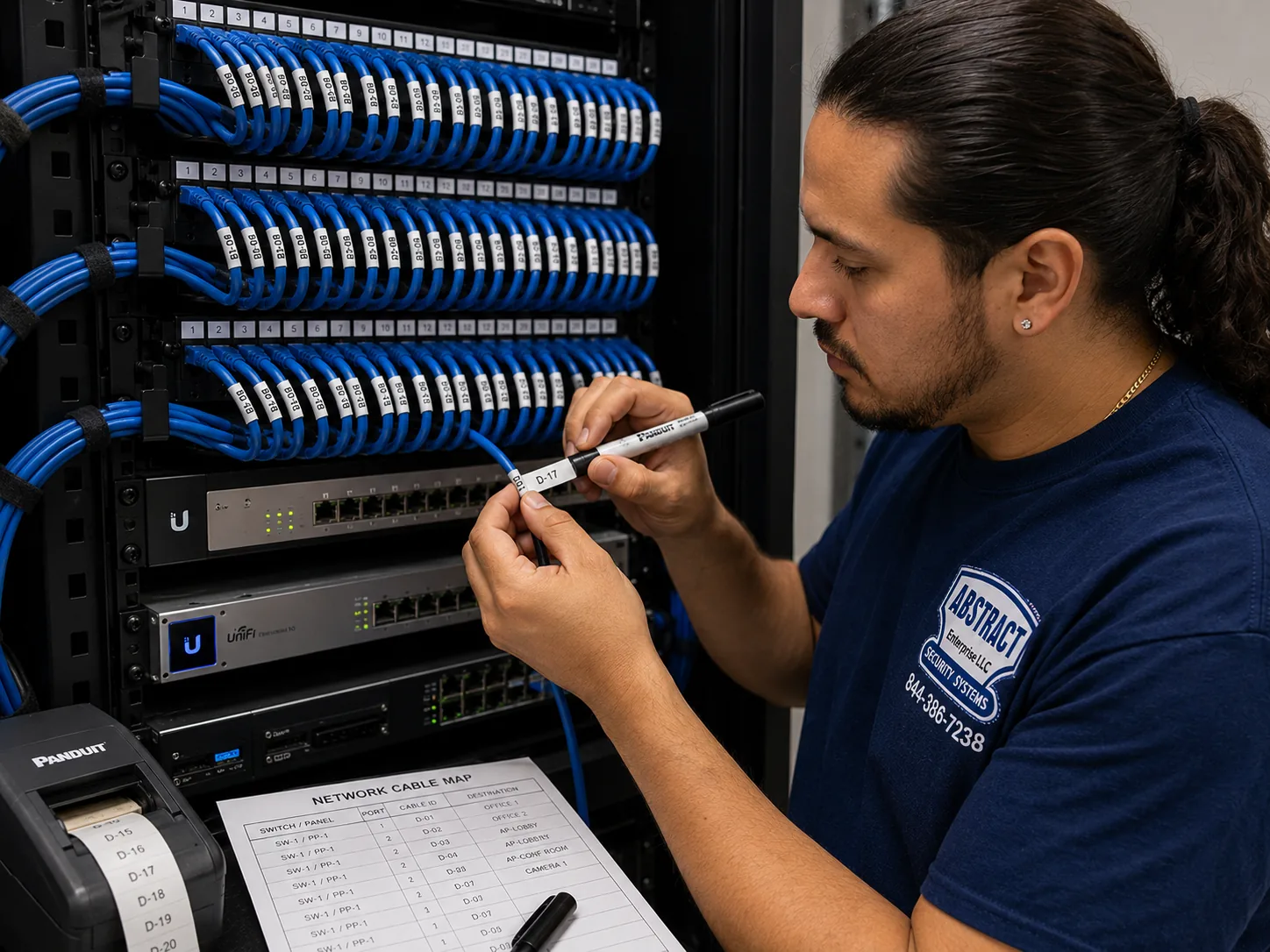
A photo from the AESS job library, not taken in Brooklyn: a technician printing labels for a patch panel with the printed port map taped beside it. It is a network job rather than a camera job, but it is the same habit we bring to a Luminys install in a Park Slope rowhouse or a Crown Heights courtyard building: every cable that leaves the recorder gets a label at both ends that matches a written map, so the next person who opens the cellar closet knows which wire goes to the stoop and which goes to the rear yard.
Brooklyn Luminys Camera Request
Rowhouse, walk-up, tower, store or house of worship: tell us the cross streets and what you want covered, and a technician calls back to book the walkthrough
✅
Request Sent!
Thank you. A technician will call you about the Brooklyn address and book the walkthrough.
25+
Years Experience
✓
Same-Day Estimates
100%
Licensed & Insured
4.7★
201 Google Reviews
Owner-operated since 2002 · Thousands of jobs completed · Booked within 2 hours
Luminys camera installation in Brooklyn is billed at our Brooklyn base rate, the rate every other area on our list is measured against, and each line of the quote comes from the Brooklyn Luminys price page. A typical job includes the Luminys cameras, a Luminys network video recorder with drive space sized to how long you want to keep footage, wired PoE cable from each camera back to the recorder, the mounts and adapters each wall needs, battery backup for the recorder, phone access for the people who should have it, and an hour of showing you how to find and save a clip. If the building already has Dahua cameras that still test well, we can often keep them on the new Luminys recorder and only replace what has failed. We book a walkthrough within two hours of your request, and the written plan names every camera, what it sees and where its cable runs, so the total is settled before anyone drills.
The fastest way to a firm number is four photos: the front entrance from the sidewalk, the inside of the vestibule or lobby, the spot where the old recorder or the internet modem lives, and the rear yard or back door. Send them with your cross streets to (347) 934-8335 or on WhatsApp.
All work is done under New York State license #12000287431, and a certificate of insurance goes to your landlord, managing agent, board or landmark consultant before the visit.
If you rent, manage or share the building, tell us who owns the walls. In Brooklyn, that one fact decides more of the plan than the choice of camera.
The Neighborhood
Why Brooklyn Properties Need Luminys Camera Installation
Brooklyn was its own city until its voters chose to join New York in 1898, and by then it had already filled most of Kings County with rowhouses, flats and churches. It was called the "city of homes and churches," and the name still describes the job. The 2020 census counted 2,736,074 people in the borough. The Census Bureau's 2023 five-year survey counts 1,090,187 housing units in Kings County, with a median year built of 1943. Of those units, 513,629 were built in 1939 or earlier, and another 92,848 in the 1940s. Two-unit buildings account for 175,805 homes and buildings with three or four units another 170,655, which is the two-family rowhouse and the small walk-up that line block after block from Bay Ridge to Bushwick. For a camera installer, those numbers translate into a few plain facts. The walls are masonry. The wiring has to find its way through cellars, chimney chases and plaster that was put on by hand. And the recorder, in a lot of buildings, ends up in a cellar that is damp in summer and wet when the sewers back up.
Ownership is the second fact. The same census tables count 709,570 renter-occupied homes in Kings County against 300,026 owner-occupied ones, so roughly seven households in ten rent. The city's Independent Budget Office reported in 2026 that Brooklyn has about 279,000 rent-stabilized apartments, more than any other borough. That changes who asks for cameras and who has to agree to them. A brownstone owner wants to see the stoop and the rear yard. A tenant in a walk-up wants to know who is taking packages from the vestibule. A managing agent wants coverage of lobbies, stair halls and the cellar door without anyone arguing later that the cameras are being used to watch particular tenants. A co-op board wants the common areas covered and the paperwork in order. A Luminys system can be set up for every one of those people, with separate accounts and separate views, but only if the plan starts by asking who owns which wall and who should see which feed.
The third fact is the one people call about. Brooklyn's lobby and stoop thefts are well documented in local news. CBS New York reported suspects in a Park Slope building cutting open packages and taking what was inside while they stood in the lobby. An older CBS New York report showed a man on a Bushwick building's surveillance video carrying parcels off the lobby floor of a building on Lawton Street, coming back twice for larger boxes. PIX11 reported in January 2025 that a man at a building near Fulton Street and Washington Avenue in Clinton Hill rang a bell, got through the first door and went for the packages and mail in the lobby before a resident confronted him. CBS New York also covered a stoop theft near Montgomery Street and New York Avenue in Crown Heights. A thread on r/Brooklyn, which we could only read as a search excerpt, describes thieves getting into a building to take packages left in the main hallway by swiping the main door behind a resident. All of these share one detail: the useful camera is the one inside the vestibule, aimed at the door at face height, not the one on the corner of the building looking at the street.
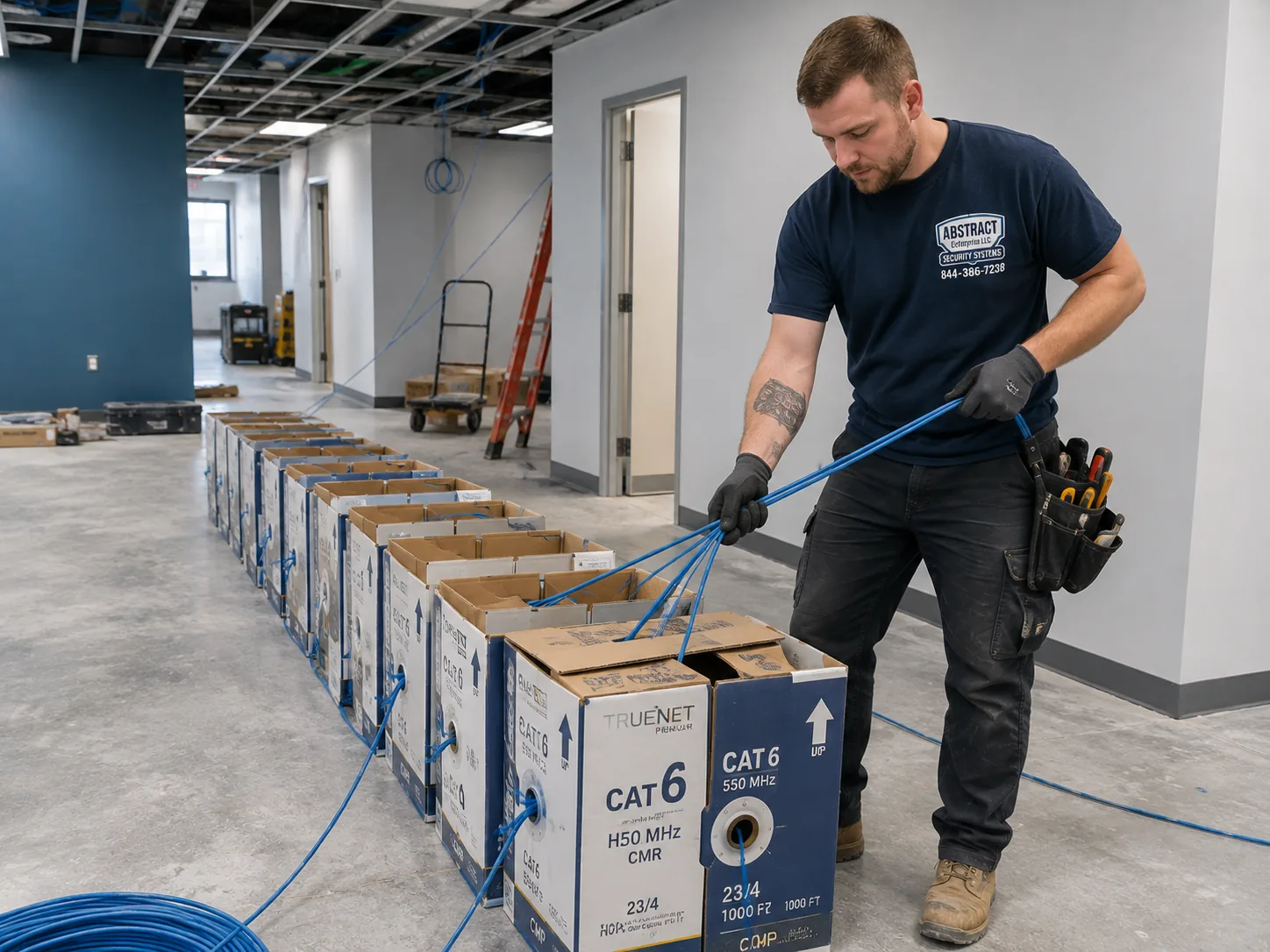
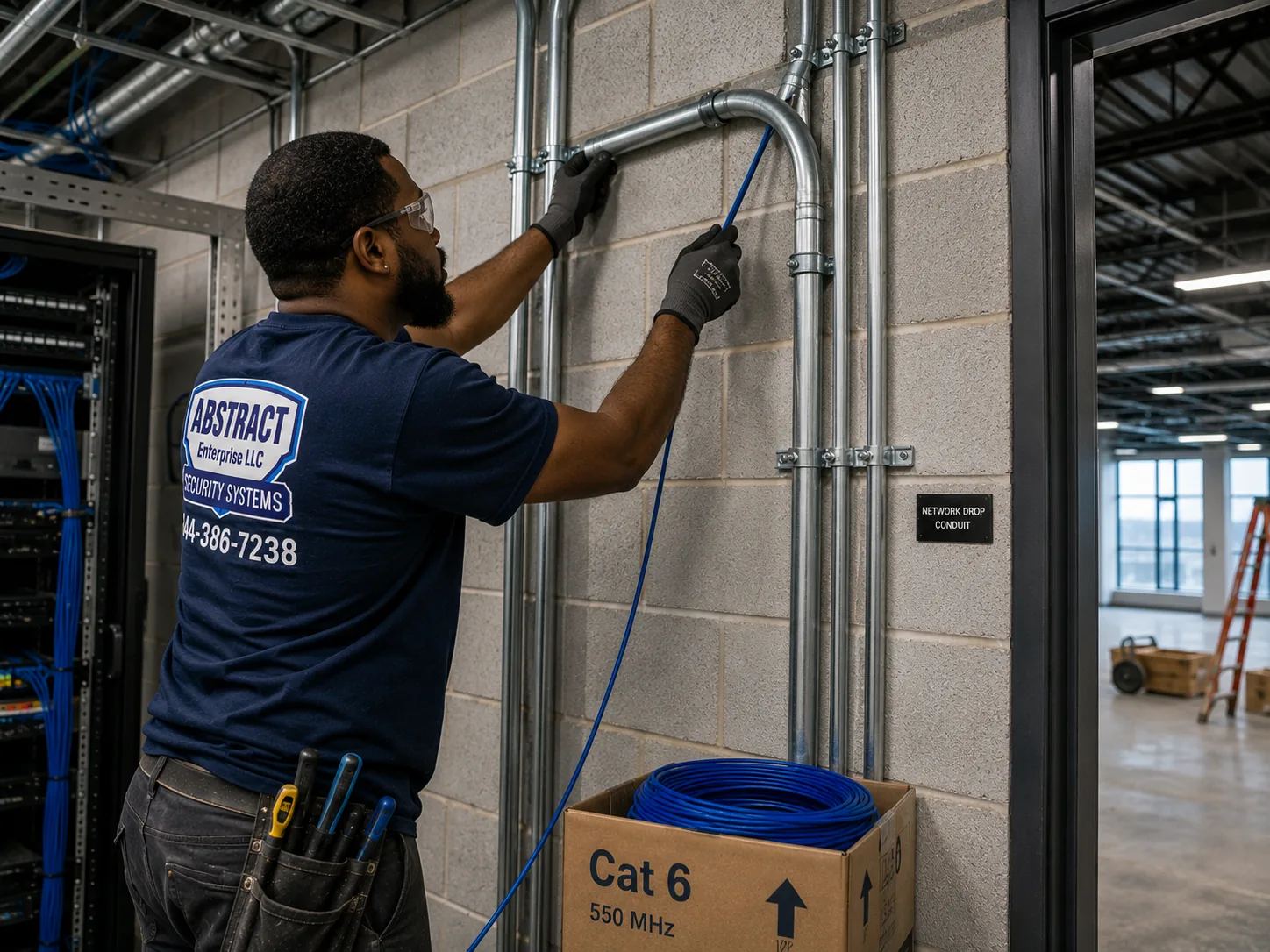
A photo from the AESS job library, not taken in Brooklyn: boxes of cable staged on a working premises before a multi-drop pull. A Luminys system in a Brooklyn walk-up is pulled the same way, several runs at once from the cellar up a riser or a chase, one for the stoop, one for the vestibule, one for each stair-hall landing and one for the rear yard, so the cable goes into the building in one visit instead of four.
Why Luminys in particular? Luminys Systems exists because Dahua sold its North American business in early 2024. The Register reported the US subsidiary went to a buyer in Taiwan, with dealer emails signed by Luminys System Corp. and Foxlink. The new company sells cameras, recorders and the LumiCenter management software that it describes as NDAA-compliant, through distributors such as ADI to installers. In February the FCC ordered Luminys to justify its equipment authorizations over national-security concerns, and in a later order the FCC concluded that Luminys is not an entity on the Covered List and that its equipment is not currently barred from authorization. For a Brooklyn owner, the practical consequence is this. If your building already runs an older Dahua system, installers report that a Luminys recorder will generally run Dahua cameras, while Luminys cameras will not run on an old Dahua recorder, and Dahua firmware cannot be loaded onto Luminys products. That is usually the cheapest way out of a failing system: replace the recorder and the dead cameras, test the rest and keep the ones that still give a clean picture.
The street sets its own limits. In Boerum Hill, residents who wanted a camera on a city light pole were told by the Department of Transportation that it does not allow private entities to attach that kind of equipment to city property, and that homeowners could mount it on their buildings instead. The same residents pointed out that most houses on their street sit behind trees that create blind spots. In Gravesend, a burglar was recorded disabling a laundry-room camera before stealing from the room, which is an argument for mounting height and tamper alerts. In Midwood, a house on East 15th Street drew attention for having more than fifty cameras around its perimeter, which is a reminder that coverage comes from planning, not from counting. And in many of the borough's best-known blocks, from Brooklyn Heights, the city's first historic district, to Park Slope and Prospect Lefferts Gardens, a camera on the street face of a designated building is a matter for the Landmarks Preservation Commission before it is a matter for a drill.
Six Brooklyn facts that shape a Luminys camera plan
The housing is old masonry. Kings County's median year built is 1943, and 513,629 units date from 1939 or earlier. Brick, brownstone and plaster on brick stop Wi-Fi and reward wired PoE cameras, which take power and data on one cable.
Small buildings dominate. Two-unit buildings hold 175,805 homes and three-to-four-unit buildings 170,655. Most of our Brooklyn plans cover a stoop or front door, a vestibule, a stair, a rear yard and a cellar door, not a parking lot.
Most people rent. 709,570 of the borough's occupied homes are rented, and Brooklyn has about 279,000 rent-stabilized apartments. Owner, tenant and agent accounts are separated from the start.
Landmarks are common. Brooklyn Heights became New York City's first historic district in 1965, with 1,284 protected sites, 684 of them older than the Civil War. HDC lists dozens more districts across the borough.
City poles are off limits. DOT told Boerum Hill residents that private cameras cannot go on city light poles. Every camera we install is fixed to a building, with the owner's permission.
Cellars flood. The NYC Health Department says Hurricane Ida dropped a record 3.5 inches of rain an hour in 2021 against a sewer capacity of 1.75 inches an hour. The recorder goes up off the cellar floor, or out of the cellar entirely.
Where this page applies. It covers the whole of Kings County, from Greenpoint and Williamsburg on the East River down to Coney Island and Sheepshead Bay, and from Red Hook and Sunset Park east to Brownsville, East New York and Canarsie. Every Brooklyn address is quoted on the same Brooklyn rate, and the full line-by-line list lives on our Brooklyn Luminys installation prices page. For buildings in other boroughs and the city-wide overview, start at our Luminys camera installation NYC page. Owners with property further out can use our Long Island Luminys installation and Hudson Valley Luminys installation pages.
Same-Day Repair in Brooklyn
Need Repair in Brooklyn? A Recorder That Stopped Saving, Cameras Gone Black, or a System Nobody Has the Password To
The repair calls we get from Brooklyn buildings fall into a few patterns. The first is a recorder that still shows live pictures but has not saved anything for weeks, which usually means a failed hard drive or a drive that filled and stopped overwriting. Nobody notices until the day footage is needed. The second is one or two cameras gone black, most often the outdoor ones on the stoop or the rear yard, where years of rain have reached a connector, or where a cable was stapled along a cornice and has cracked in the sun. The third is the inherited system: a building bought or managed by someone new, with a recorder in the cellar that nobody has the password for, cables with no labels and a phone app tied to someone who moved away. The fourth is damage from water, especially in cellars and basements that took water in the 2021 storms, where the recorder was sitting low.
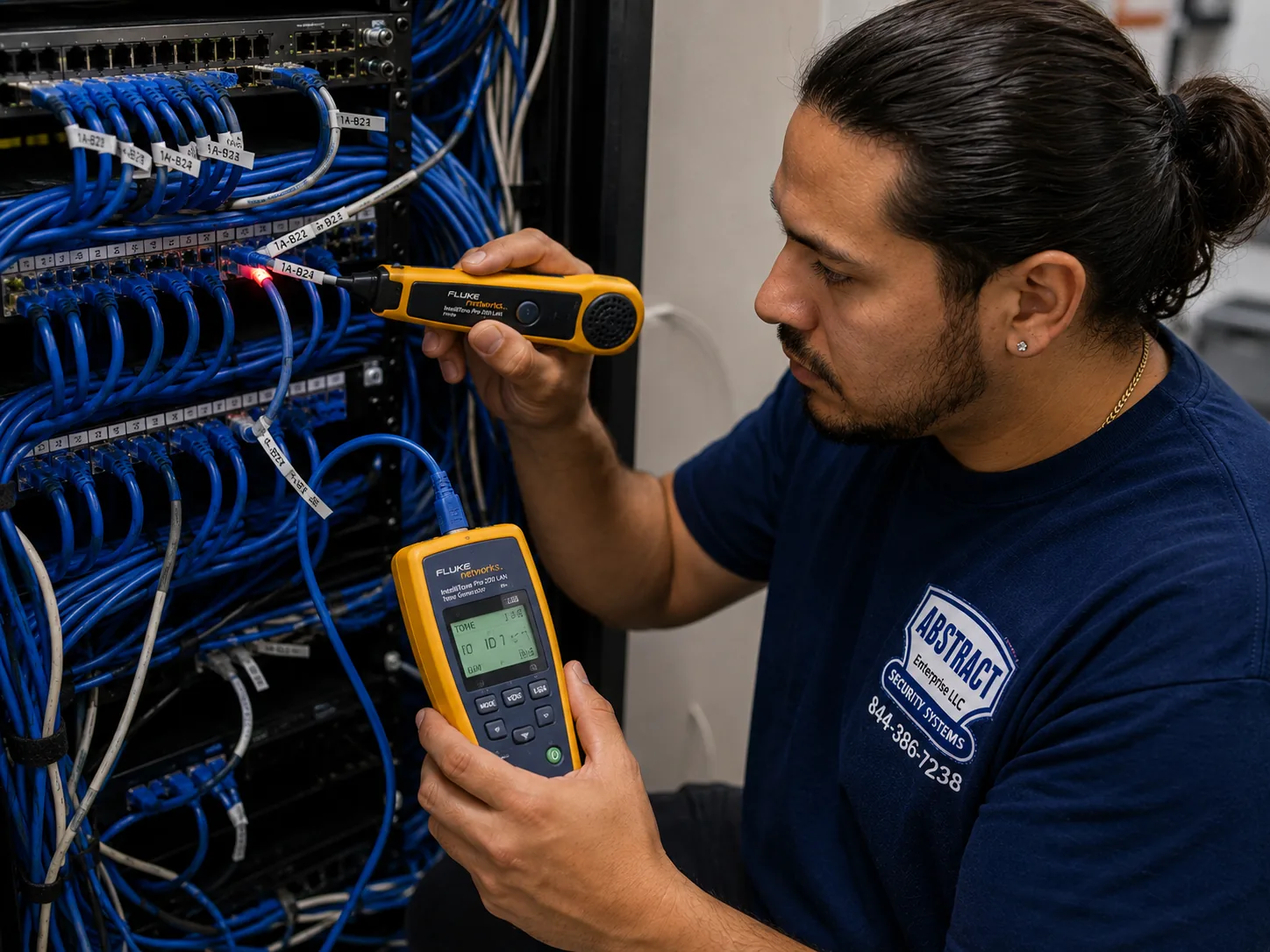
A photo from the AESS job library, not taken in Brooklyn: a technician tracing an unlabeled cable at a patch panel with a tone generator and probe. It is exactly what an inherited camera system in a Brooklyn cellar needs first, because the cable that disappears into the ceiling beside the boiler could go to the stoop, the stair hall or the yard, and the tone tells us which before we condemn a camera that might be fine.
The first visit on a repair is about finding out what is worth keeping. We test each camera on a known-good cable and a test monitor, check each run for continuity and shorts, and trace unlabeled cables with a tone generator. Cameras that give a clean picture stay. Runs that test bad get cut back and re-terminated before anyone talks about pulling new cable, and only runs that are truly damaged get replaced, often using the old cable as a pull string. If the recorder is an older Dahua unit and it is the part that has failed, a Luminys recorder is usually the replacement we suggest, because installers report it will take the existing Dahua cameras, and we confirm that camera by camera on site rather than promising it on the phone. If a camera has failed and the old recorder is still good, we tell you plainly that a new Luminys camera will not run on a Dahua recorder, so the choice is a matching replacement for now or a recorder change. Call (347) 934-8335; we book within two hours of the call, and the repair is priced from our Brooklyn list before the work starts.
If you are the owner and you do not have the recorder password, have the deed, the lease or the management agreement ready. We reset a recorder only for someone who can show they control the building, because in a borough where so many people share walls, a camera system is also a privacy question.
What We Install
Luminys Camera Installation Services in Brooklyn
Each service below is priced from the same Brooklyn list. The building decides the cable path and the mounts, the people decide the accounts, and the camera count follows from the entrances, not the other way round.
Rowhouse and brownstone systems
Stoop, under-stoop door, parlor entrance, rear yard and cellar door coverage on brownstone, limestone and brick rowhouses, with cable run from the cellar up through closets and chases rather than across the facade.
Walk-up lobby and stair-hall coverage
Vestibule cameras aimed at the inner and outer doors, a view of the mailboxes and package shelf, a camera on each stair landing where needed, and the cellar and roof doors, all on one Luminys recorder.
Dahua-to-Luminys recorder upgrades
Replacing a failing Dahua recorder with a Luminys NVR, testing each existing camera on it, keeping the ones that pass and swapping only the dead ones, so a working system is not thrown out for one bad box.
Courtyard and elevator buildings
Six-story prewar buildings with wings, courtyards and long corridors, where cameras cover several entrances, the courtyard gate, the elevator lobby and sometimes the cab, wired through risers with sealed penetrations.
Storefront and avenue businesses
Counter, entrance, stockroom and rear-door cameras for stores on Fulton Street, Fifth Avenue, Kings Highway and the other avenues, installed before opening or after closing, with staff accounts that see only what they need.
Houses of worship, schools and nonprofits
Entrance, side-door and perimeter coverage for churches, synagogues, yeshivas and community programs, with a written scope that can be matched to a security grant application.
Building Specialists
Luminys Camera Installation for Brooklyn's Architecture
Six kinds of building account for nearly every Brooklyn camera call. They differ in what the walls are made of, where a cable can travel without being seen, where the recorder can safely live, and who besides you gets a say. A Luminys system in each one uses the same cameras and the same software, but almost nothing else about the install is the same.
The brownstone or limestone rowhouse
Single-family or owner-plus-rental townhouses on 20-foot lots, plaster on brick inside, a stoop and an under-stoop door in front, a yard behind, and often a historic district around it.
The two- and three-family brick house
The workhorse of Brooklyn's side streets, from Sunset Park to Flatbush: stacked apartments, a shared hall and stair, a cellar, and usually an owner living on one floor.
The prewar walk-up
Four- and five-story tenements and flats with a vestibule, mailboxes, a narrow stair, a roof bulkhead and a cellar door to the yard, many of them rent-stabilized.
The six-story courtyard building
The elevator apartment houses of Eastern Parkway, Ocean Parkway, Flatbush and Crown Heights, with wings joined by corridors, several entrances and one grand lobby.
The new tower or condo
Downtown Brooklyn and the Greenpoint and Williamsburg waterfront, built mostly since the 2004 and 2005 rezonings, with concrete, glass, garages and an office that wants paperwork.
The loft, warehouse and industrial space
Brick and concrete buildings in Sunset Park, Red Hook, Gowanus, Bushwick and the Navy Yard, with high ceilings, loading doors and long cable runs through conduit.
The brownstone or limestone rowhouse: work from the cellar up, keep the front quiet
Most of Brooklyn's brownstone and limestone rowhouses sit on lots close to the city's standard 20 by 100 feet. Urban Omnibus counted about 217,000 row houses across the city in 2016, with an average lot of roughly 1,900 square feet. Inside, Brownstoner's history of brownstone plaster explains why these houses fight a cable installer: the earlier houses used lime plaster, and on exterior walls the first coat was applied straight onto the brick, a bond that is still hard to break after a hundred years. Interior partitions are wood studs with lath. So a cable cannot be fished down an outside wall the way it can in a framed house. It has to travel inside, through partition walls, closets, the stair wall, the old chimney chase or an existing pipe chase, and come out to the camera through the shortest possible hole in the masonry.
That shapes where a Luminys recorder goes and where the cameras go. The recorder usually ends up in the cellar or on the garden floor, on a high shelf or in a ventilated cabinet, close to the internet modem and on battery backup. From there, the cameras that matter most are often the easiest to reach: a camera under the stoop watching the garden-level door and the areaway gate, a camera inside the vestibule looking at the front door, and a camera on the rear wall covering the yard and the cellar door. The street face is where we are most careful. If the house is in a historic district, the LPC's permit guidebook allows staff to approve security cameras that meet its criteria, and those criteria favor discreet spots, such as beneath a band course, underneath a stoop, behind an areaway wall or fence or behind plantings, with the camera attached at mortar joints or plain masonry rather than through cast iron or carved surfaces, the conduit hidden or kept to a short visible run painted to match, and the equipment as small as possible. For small residential buildings the guidebook limits cameras to two per 25 feet of street frontage. On a 20-foot house, that is two cameras on the front at most, so we plan the rest of the coverage from inside the vestibule and the rear.
The equipment side matters more than people expect. One installer on IPCamTalk complained that the mounts listed on a Luminys data sheet were almost twice as big as he expected in person. On a brownstone, where the only acceptable spot may be the underside of a narrow band course or the soffit of a stoop, the size of the mount decides whether a camera can go there at all. We check the actual accessory against the spot before ordering, and Luminys's own mount guide, revised in September 2026, lists adapters such as the LUM-AC09 gang box adapter for mounting over an existing box. Where a dome or turret has to be seen from the street, we paint it to match the stone, as the LPC guidance asks for domes.
The two- and three-family brick house: two households, one recorder, separate views
In a two-family or three-family house, the person who pays for the system is usually the owner, and the person who wants the camera most is often a tenant. Both can be served by one Luminys recorder. The usual plan covers the front door and stoop, the shared hall and stair, the rear door and yard, and the side alley if the house has one. The recorder goes in the owner's space, typically the cellar or a closet on the owner's floor. Then the accounts are split. The owner sees everything. A tenant can be given the front door and the hall, so they can see who is ringing and who took the package, without seeing the yard where the owner's family sits or the owner's own entrance. Those choices are written down at the walkthrough and set up on the day, and they can be changed later by the owner without calling us.
Wiring in these houses is easier than in a brownstone, but not by much. The front wall is usually brick, sometimes with a newer face of siding or stucco, and the interior is plaster on lath in the older houses and drywall in the renovated ones. We run cable up the cellar ceiling to a point under the hall, up the hall wall inside a closet or behind the stair stringer, and out through the masonry at the camera. Outdoors, the rear camera is mounted high enough to be out of reach from the yard, which is the lesson of the Gravesend laundry-room video, where the camera was the first thing the burglar dealt with.
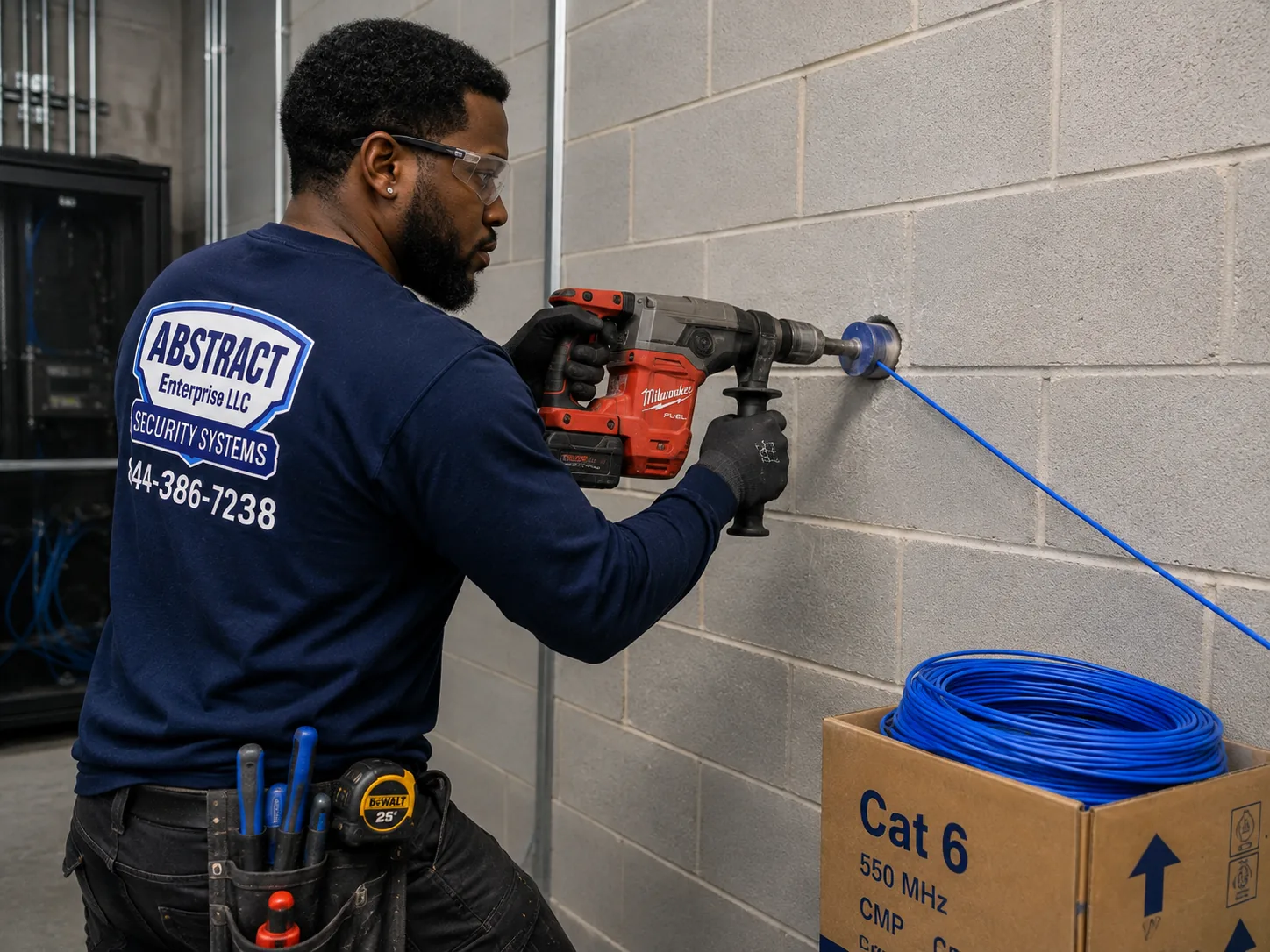
A photo from the AESS job library, not taken in Brooklyn: a technician core drilling a block wall so cable can pass through to a network room. In a Brooklyn two-family or walk-up, the same tool takes a camera cable from the cellar out through a foundation wall to the rear yard, or from a hall closet through the front masonry to a camera above the door, and the hole is sealed once the cable is in.
The prewar walk-up: the vestibule is the whole point
Walk-ups are where most of Brooklyn's package-theft calls come from, and the plan follows the stories in the news. The outer door, the inner door and the space between them, the vestibule, is where an intruder shows their face. The lobby or hall behind it is where the mailboxes and the package shelf sit. So the first two cameras in a walk-up go inside: one in the vestibule aimed at the outer door at face height, and one in the hall aimed at the mailboxes and the inner door. A camera outside over the door adds the street side and the stoop. After that, the order depends on the building. A stair camera on the top landing covers the roof door and the bulkhead. A camera at the cellar door covers the yard and the trash area. Cameras on each floor's landing are possible, but in a rent-stabilized building we talk through who will watch them and why before suggesting them.
Walk-ups usually have a cellar and a single riser or a set of chases from cellar to roof, and that is where the cable goes. Hub research from other city installers describes the standard method, which is ours: drops pulled through the interior riser, with rated penetrations fire-stopped. Where there is no usable chase, a surface raceway painted to match the stair hall is the honest alternative to opening plaster walls. The recorder goes in the super's room, the boiler room on a high shelf, or a locked closet off the hall, with battery backup, and it is never left in the vestibule where whoever is being recorded can unplug it.
The six-story courtyard building: several entrances, long corridors, a lobby worth protecting
Suzanne Spellen's history of the Cohn Brothers, the architects behind hundreds of Brooklyn apartment houses, explains why so many of the borough's elevator buildings are exactly six stories: after about 1923, the building code required only the first two floors of a six-story building to be fireproof, so "six it was." The larger corner buildings were planned as four or five wings joined by corridors around one or more courtyards, sometimes with separate entrances and one grand lobby finished in terrazzo, marble or tile. Brownstoner's history of Eastern Parkway notes how quickly the parkway filled with buildings of this kind after the subway was announced in 1903, including the Martinique Apartments at 163–169 Eastern Parkway from 1916 and Turner Towers at 135 Eastern Parkway, fifteen stories and 181 apartments from 1927. Ocean Parkway's service roads, laid out by Olmsted and Vaux and built between 1874 and 1876, carry a similar run of prewar co-ops and rentals south toward Coney Island.
For a Luminys system, these buildings mean more cameras on one recorder and longer cable runs. A typical plan covers each street entrance, the courtyard gate, the main lobby, the elevator landing on the ground floor, the mailroom or package room, the laundry room, the cellar doors and the service entrance. The lobby finishes are the delicate part: drilling marble or terrazzo is avoided wherever a ceiling, a plaster wall above the wainscot or a door frame offers a fixing instead. A recorder with enough channels for the building, such as one from Luminys's 16-channel R4 mainstream series with built-in PoE ports, often sits in the super's office or a locked utility room, with a monitor at the front desk if the building has one. Management offices in these buildings usually want a certificate of insurance and set working hours, and we work within them.
The new tower or condo: concrete, garages and an office with rules
The Downtown Brooklyn Partnership's Regina Myer told CBS New York in 2024 that the 2004 rezoning had brought nearly 10,000 housing units to an area that used to be offices, courts and parking lots; the Partnership counts 32 million square feet of new development since then, crowned by the Brooklyn Tower at 9 DeKalb Avenue, Brooklyn's first supertall at a reported 1,066 feet. On the waterfront, Greenpointers reported that as of May 2024 Greenpoint and Williamsburg had added 26,253 housing units over thirteen years, many on or near the water after the 2005 rezoning along West Street, Kent Avenue and Commercial Street. These buildings were usually delivered with a camera system already, installed by the developer's contractor, so our calls there come from condo boards adding coverage, owners of commercial units at the base, and buildings whose original system has started to fail.
Concrete changes the method. Cable cannot be fished inside a poured wall, so it travels above corridor ceilings on J-hooks or in conduit to the telecom room, and cameras go on ceilings and soffits rather than walls. Garages need cameras at the ramp and the gate, and if the board wants plates read, Luminys's own license-plate camera installation guide says the angle between the camera lens and the edge of the farthest lane cannot exceed 30 degrees, which on a narrow Brooklyn ramp usually means a camera set back and aimed down the ramp rather than one on the side wall. Roofs and terraces that need a pan-tilt-zoom camera can use mounts such as the LUM-R01 parapet bracket that ADI lists for select Luminys P-Series PTZ cameras. If the building's doors use fobs, an app or biometrics, the city's Tenant Data Privacy Law applies to the entry data, which is a separate question from the camera recordings, and we cover it in the compliance notes below.
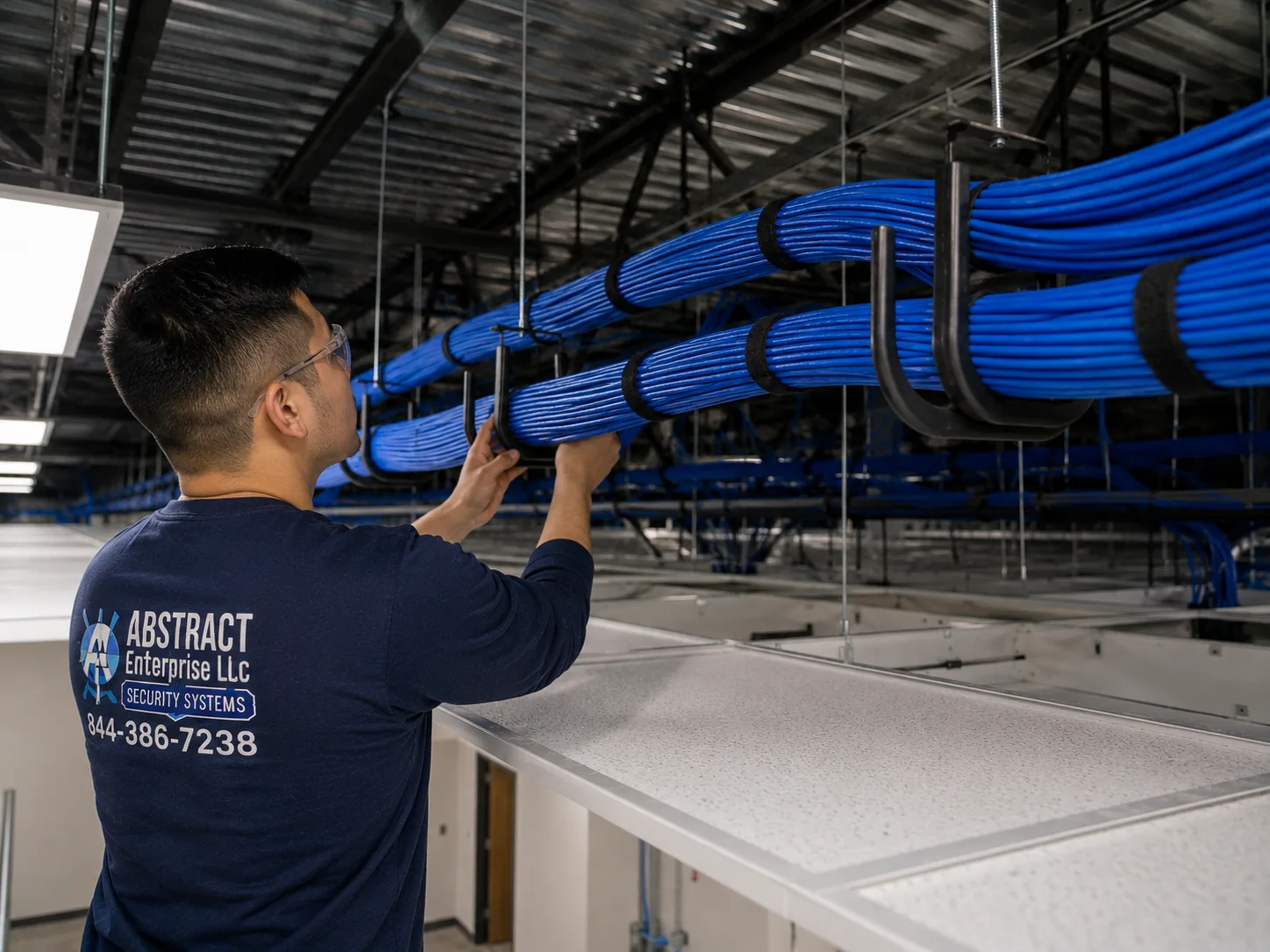
A photo from the AESS job library, not taken in Brooklyn: dressed bundles of cable carried on J-hooks across a commercial ceiling. In a concrete tower in Downtown Brooklyn or on Kent Avenue, camera cables travel this way above the corridor ceiling to the telecom room, supported every few feet instead of lying on the ceiling tiles, so the next contractor can find them and nothing sags onto a light fixture.
The loft, warehouse and industrial space: distance, conduit and loading doors
Brooklyn's working waterfront is still working. Industry City in Sunset Park, the former Bush Terminal, runs across sixteen former factory buildings and calls itself a six-million-square-foot ecosystem. The Brooklyn Navy Yard says it spans more than 300 acres and is home to over 550 businesses supporting more than 13,000 jobs. Between and around them, Red Hook, Gowanus, East Williamsburg and Bushwick have brick and concrete loft buildings with tenants of every kind. In those spaces the challenges are distance and exposure. A loading dock camera may be two hundred feet from the recorder. Cable runs in exposed conduit through spaces where forklifts and carts move. Ceilings are high enough that the right camera is a varifocal bullet that can be zoomed onto the dock door after mounting.
Many of these buildings already have analog cameras on coax. Luminys's own documentation makes the point that for many businesses the biggest obstacle to upgrading an analog system is the wire, not the cameras, and we treat old coax the same way: test it, and keep it if it carries a clean signal, before pricing a full rewire. Landlords of multi-tenant industrial buildings often control the shared spaces, so a tenant's cameras stay inside the tenant's own space and at its own doors unless the landlord agrees otherwise in writing.
A photo from the AESS job library, not taken in Brooklyn: a technician feeding cable into EMT conduit next to a telecom room in an industrial building. In a Sunset Park or Red Hook loft, a camera cable that crosses a loading area or runs down a column at forklift height goes into conduit like this, because exposed cable in a working space does not survive the first busy month.
Field Notes
Field Notes: What a Technician Checks in a Brooklyn Building Before Choosing a Single Camera
These notes describe how our technicians walk a Brooklyn building. They are our practice, not a story about any one address.
Start at the door people actually use. In a walk-up, that is usually the outer vestibule door, not the corner of the building. The technician stands outside, rings the bell, waits, walks in behind the door as it closes and notes where a stranger's face is clearest. That spot is camera one.
Go down before going up. The cellar tells us where the recorder can live and where the cable can go. We look for the riser, the chimney chase, old cable entering from the street, the high-water marks on the walls, the boiler, the modem and the outlets. A recorder that has to sit on the floor is a recorder that has to move.
Test what is already there. Every existing camera and cable is tested before it is condemned. In an older Dahua system, a camera that still gives a clean picture on a test monitor is a camera that can probably stay on a Luminys recorder, and we confirm it on the recorder itself on install day.
Look at the street face from across the street. On a rowhouse in a historic district, the technician crosses the street and looks at the front the way the Landmarks Preservation Commission would, finding the band course, the stoop underside, the areaway wall and the plantings, and counting the street frontage.
Ask who should see what. Before leaving, the technician writes down who owns the building, who lives in it and who manages it, and which of them should see which camera. That list becomes the account setup, and in a shared building it prevents most of the arguments that cameras can start.
Come back in leaf season. If the walkthrough happens in winter and a street tree sits in front of the stoop, we note it, because the camera that sees the sidewalk perfectly in February may see nothing but leaves in June.
Cable, Recorder and Power
Brick, Plaster and Cellars: How a Luminys System Is Wired Into a Brooklyn Building
The cameras are the visible part of a Luminys system, but in Brooklyn the cable and the recorder decide whether it still works in five years. Here is how we approach each piece, and why.
Wired PoE first. Power over Ethernet carries power and data to each camera on a single cable, so there is no outlet to find at the top of a stoop and no battery to change. Brick, brownstone and plaster applied straight onto brick are hard on Wi-Fi, and a wireless camera on the back of a rowhouse often ends up reaching the router in the parlor through two or three masonry walls. We use wireless only where a cable truly cannot go, and we test the signal at the camera position before committing to it.
Inside routes, short outside holes. Every cable we can keep inside the building, we do: along the cellar ceiling, up a riser, through a closet, behind a stair stringer, inside a pipe chase. The hole through the masonry to the camera is as short and as straight as we can make it, drilled at a mortar joint or into plain brick or stone where the wall allows, and sealed afterwards so water and insects do not follow the cable in.
Fire-stopping where cable crosses floors. Where a cable passes through a rated floor or wall in a multiple dwelling, the penetration is sealed with fire-stop material. It is the kind of detail that no one sees and that matters when it is missed.
Reuse what tests good. Old Dahua cameras that pass testing can usually stay on a Luminys recorder. Old Ethernet cable that tests clean stays. Old coax from an analog system is tested and, where it carries a clean signal, kept for the cameras that use it, rather than torn out of a plaster wall you would then have to repair.
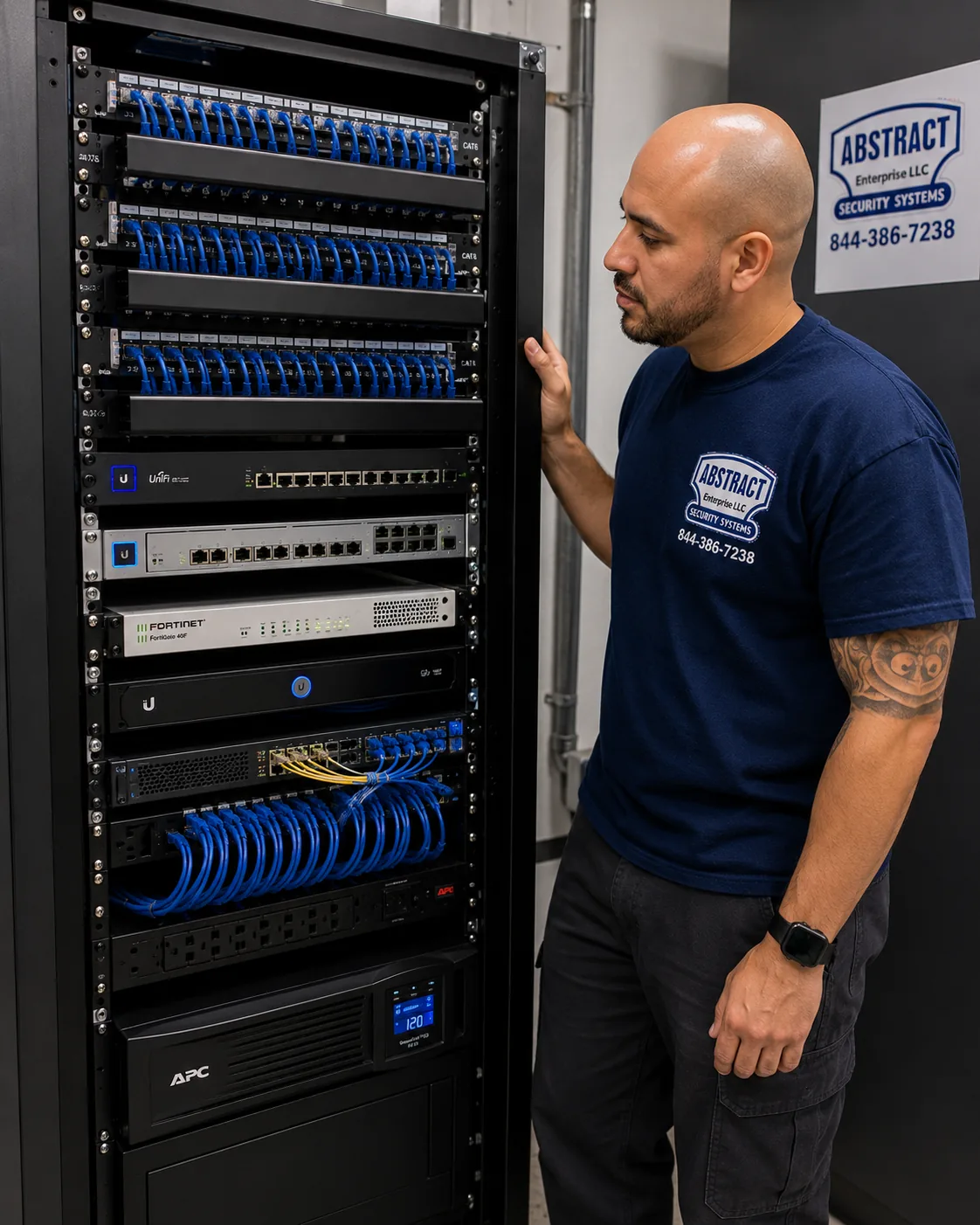
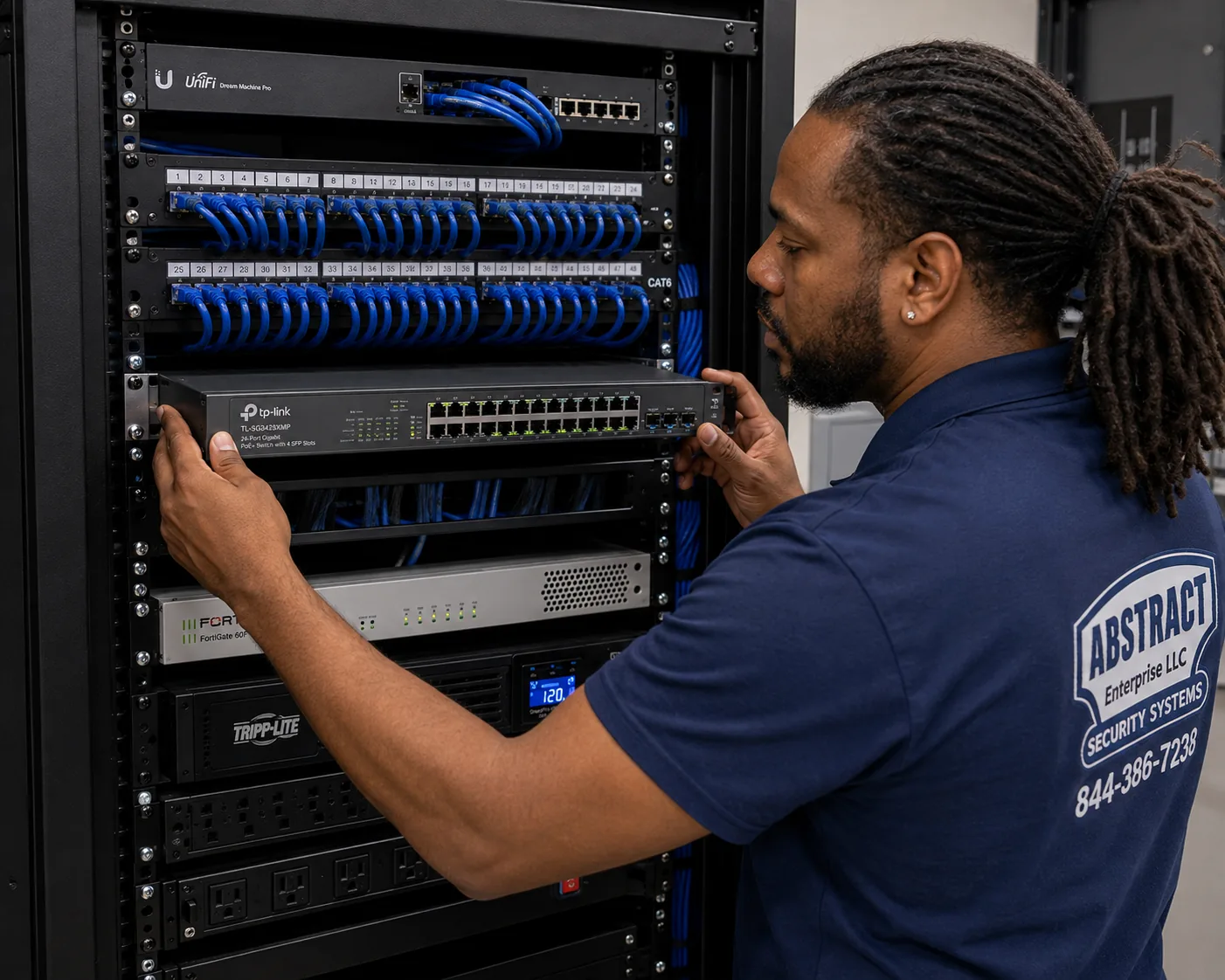
A photo from the AESS job library, not taken in Brooklyn: a finished network rack with patch panels, switching, a firewall and a battery backup, every cable dressed and identified. A Luminys recorder in a Crown Heights courtyard building or a Fulton Street store is set up the same way when the space allows, off the floor, on battery backup, with every camera cable labeled to match the written plan.
Where the recorder lives
The NYC Health Department's data story on flooding and health describes how Hurricane Ida dropped a record 3.5 inches of rain an hour in September 2021, against a sewer capacity of 1.75 inches an hour, causing unprecedented inland flooding, especially in low-lying areas and basement apartments. Its earlier look at Sandy flagged southern Brooklyn as especially vulnerable. A recorder sitting on a cellar floor or a low shelf near the boiler is a recorder that may be lost in the same storm that brings the most reasons to need it. So the Luminys recorder goes high: on an upper shelf, wall-mounted, in a cabinet above the flood line, or upstairs in a closet when the cellar has taken water before. It goes somewhere ventilated, because recorders and hard drives do not like boiler-room heat. And it goes somewhere locked or out of sight, because a recorder that a thief can reach is a recorder that leaves with them.
Power when the lights go out
Every Luminys recorder we install is put on a battery backup sized for the recorder and, where it shares the space, the internet modem and router. With PoE, the cameras are powered by the recorder or its switch, so keeping the recorder up keeps the cameras recording through a short outage and lets the system shut down cleanly in a long one. The recorder saves locally to its own drives, so footage is still recorded when the internet goes down; what stops is remote viewing on your phone until the connection returns.
Phones, passwords and the open-port problem
Older camera systems were often set up for remote viewing by opening ports on the building's router, which leaves the recorder exposed to anyone on the internet who finds it. We do not set up Luminys systems that way. Remote viewing goes through Luminys's own LumiViewer app and LumiCloud service. Sellers of Luminys recorders describe LumiCloud Lite as included at no extra charge for basic remote viewing, with paid LumiCloud plans for cloud recording, and Luminys says that if a LumiCloud license ever expires, owners keep full local access to their cameras and recorders. Each person gets their own account and password; nobody shares the admin login, and the admin password is handed to the owner, in writing, at the end of the job.
Owners, Tenants and Boards
Who Has to Agree: Landlords, Tenants, Co-op Boards and Landmarks in a Brooklyn Camera Job
With seven in ten Brooklyn households renting, the question of permission comes up on most of our calls. We are installers, not lawyers, and nothing here is legal advice. What follows is what the public sources say and what we have learned from doing the work, so you can ask the right questions before booking.
Owners decide the building. Cameras on the outside of a building, and in its common areas, are the owner's decision. In a co-op, the hallway is common area controlled by the board, so a shareholder cannot put hardware there alone; a peephole camera that replaces existing door hardware tends to raise the fewest questions. In a condo, the board or managing agent controls the common elements. In a rental building, the landlord decides, and in a rent-stabilized building, the state's housing agency and the courts take seriously anything that could look like harassment of a stabilized tenant, which is one more reason to keep common-area cameras on doors and shared spaces rather than on particular apartment doors.
Nobody films inside someone else's home. A camera installed covertly inside someone's apartment can support a charge under Penal Law 250.45, a felony. We do not install cameras inside apartments other than the customer's own, and we do not aim common-area cameras into apartments, windows or a neighbor's yard. Where an outdoor camera's view takes in a window across the way, privacy masking blacks out that part of the picture permanently.
Signs and notice. Sources disagree about whether New York law requires signs or written notice before cameras go into the common areas of a rental building. One vendor says a city law requires notices in every common area with cameras, another says signage is not always required by statute, and law-firm and blog sources on tenant notice also conflict. We have not seen the question settled, so our advice is practical rather than legal: tell your tenants or residents, post a simple sign at each camera-covered entrance, and keep a copy of the notice. It costs little and it heads off most disputes.
Smart-access data is its own question. The city's Tenant Data Privacy Law, Local Law 63 of 2021, covers class A multiple dwellings whose doors use smart access, meaning key fobs, RFID cards, apps or biometrics. Owners of those buildings must give tenants a data retention and privacy policy, get express consent, collect only minimal data, destroy authentication data within 90 days unless it is anonymized, and never sell it or use it for anything beyond access and monitoring entrances. One vendor's reading is that the law does not reach ordinary camera feeds that are not used for entry. In practice that means that a plain Luminys camera recording a lobby is not a smart-access system, but a camera tied into door entry by face matching would be, and we treat it that way.
Landmarks come before drills. If the building is an individual landmark or sits in one of Brooklyn's historic districts, any camera on a visible facade needs LPC approval. The LPC's rules section on health, safety and utility equipment covers security cameras, and its permit guidebook lets staff approve cameras that meet the criteria described in the rowhouse section above. Rear facades that cannot be seen from the street have an easier path, as Sherman Architects notes about LPC review generally. We prepare the photos and the mounting details your filing needs, and we do not drill the street face until the approval is in hand.
The city's property is off limits. As DOT told the Boerum Hill residents, private cameras cannot go on city light poles or other city property. When a block wants a view of the street, the answer is a camera on a cooperating owner's building at each end of the block, each recording to its own owner's system.
Commercial Luminys Camera Installation
Business Luminys Camera Installation in Brooklyn
The city's Department of Small Business Services lists 24 active business improvement districts in Brooklyn, and they are a fair map of where the borough shops: Fulton Mall, Pitkin Avenue, Kings Highway, the Park Slope Fifth Avenue district, the Bay Ridge Fifth Avenue district, Graham Avenue, Myrtle Avenue, Atlantic Avenue, Sunset Park, Brighton Beach, Coney Island, DUMBO, MetroTech and more. Most Brooklyn businesses on those streets rent ground-floor space in a building with apartments above, which shapes every commercial camera job. The cards below describe the kinds of corridor and business we work on; we do not name any business as a customer.
Fulton Mall and Downtown Brooklyn
The pedestrian and transit mall on Fulton Street between Flatbush Avenue and Adams Street, where stores with deep floor plans need entrance, aisle, register and stockroom coverage on long cable runs.
Park Slope's Fifth and Seventh Avenues
The neighborhood's two main commercial streets, lined with restaurants and small shops in rowhouse-scale mixed-use buildings, where the front is often in a historic district.
Fulton Street through Bed-Stuy
The shopping street that runs the length of Bedford-Stuyvesant, with storefronts below apartments and roll-down gates that need a camera covering them after hours.
Kings Highway, Avenue J and Avenue M
Midwood's busy corridors, with bakeries, pharmacies, clothing stores and offices that often need a counter camera, a door camera and a rear-alley camera.
Bay Ridge's Fifth Avenue
The business district from 65th to 85th Streets, with restaurants and services where the dining room, the bar and the back door each need a view.
Nostrand, Flatbush and Rogers Avenues
Two- and three-story tapestry-brick buildings from 1912 onward with a store below and one or two apartments above, common south of Eastern Parkway, where the store and the tenants share walls.
A Brooklyn store's camera plan usually starts with four views: the entrance, so every face is caught coming in; the register, at an angle that shows hands and the counter rather than the back of the cashier's head; the stockroom or back door; and the front gate after closing. Deli and bodega robberies in the borough are routinely identified from surveillance video; the NYPD released store footage of a Brooklyn bodega robbery in May 2026, and video captured four men in printed "NYPD" jackets robbing a Bed-Stuy deli. In each case, the camera that matters is the one with a clear, close view of a face at the door, not the wide shot from the ceiling corner. That is why, on a commercial Luminys system, we often pair one wide camera with one close camera at the entrance.
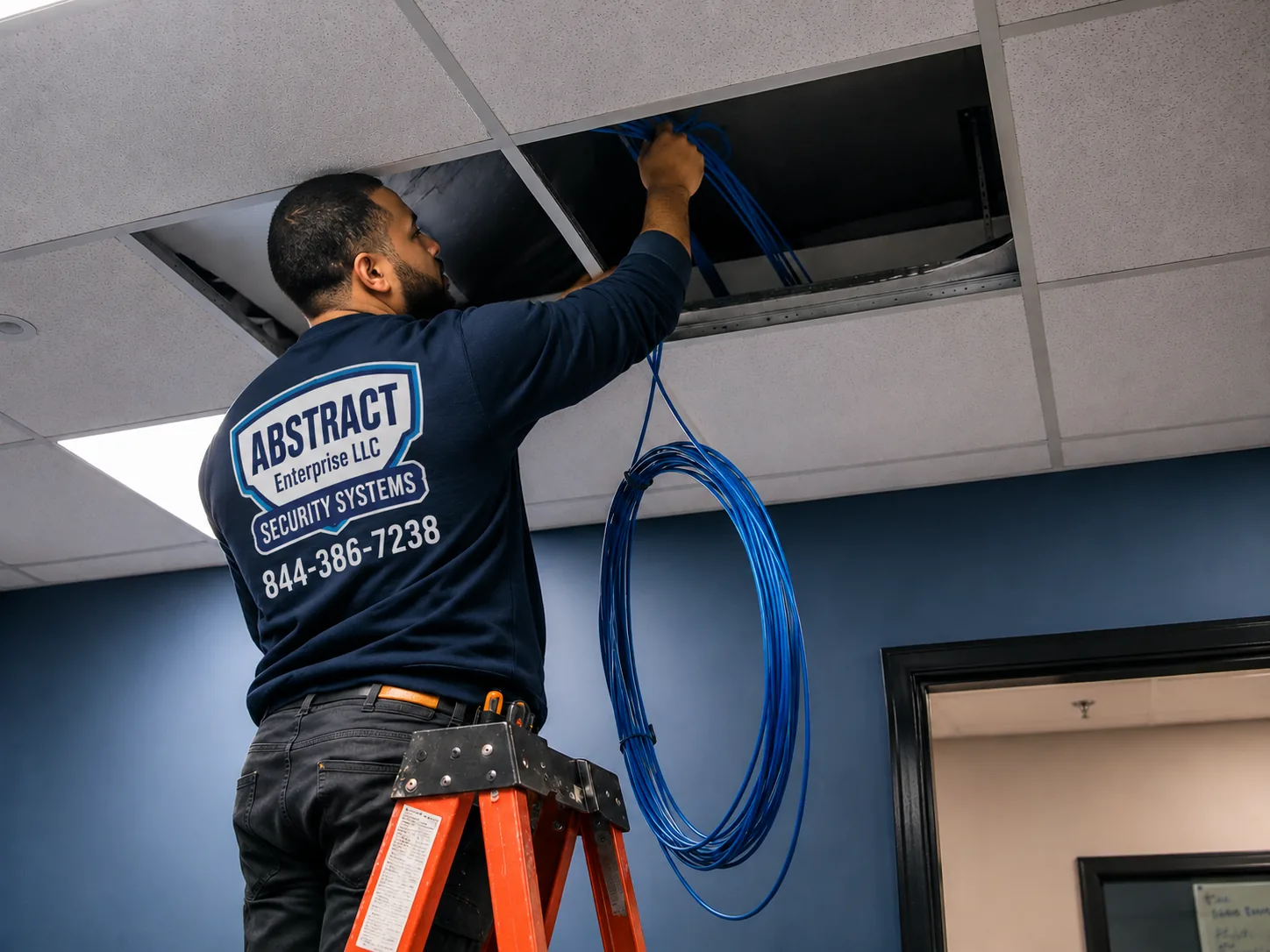
A photo from the AESS job library, not taken in Brooklyn: a technician feeding cable through the ceiling of a commercial space that is still in use. A store on Kings Highway or Fifth Avenue is wired the same way, through the ceiling or along the back wall, with the work arranged around the hours the business is open so customers and staff are not stepping over cable.
Houses of worship and religious schools are a large part of Brooklyn's commercial work. News 12 Brooklyn reported in May 2025 on a Kensington Jewish school broken into three times in a few months, with only the last incident caught on camera, and in 2012 on a man who broke into a Borough Park yeshiva during Shabbat and tried to cover a surveillance camera. Nonprofits and houses of worship in New York can apply to the state's Securing Communities Against Hate Crimes grant; the 2026 round closed on July 8, 2026. For these customers we write the camera scope camera by camera, with each location's purpose, so it can be matched to an application or a grant award, and we schedule the install around services, classes and holy days.
Garages, lots and loading docks bring license-plate questions. Luminys's installation guide for its plate-reading cameras sets the 30-degree limit between the lens and the farthest lane edge, and in a Brooklyn garage entrance or a narrow lot driveway that usually means mounting the camera back from the gate and aiming down the lane. We plan those cameras on site, because the right position depends on the slope, the gate and the light.
Compliance notes for Brooklyn businesses and buildings
State licensing. New York's General Business Law Article 6-D says no one may engage in the business of installing, servicing or maintaining security systems without a license. The Department of State's application notes that owners installing on their own property are not "in the business" and treats passive, non-detecting devices differently, and sources disagree on how cameras fit. We hold NYS license #12000287431 either way.
Intercoms are required; cameras are not. Administrative Code §27-2045 requires landlords of multiple dwellings to maintain a working door intercom or buzzer system, and HPD can issue violations when one fails. There is no general city law requiring cameras in apartment buildings.
Landmarked storefronts. Cameras on the visible front of a designated building need LPC approval. Staff-level permits favor small, painted equipment in discreet spots and limit counts per 25 feet of frontage.
Fire-stopping and exits. Cable through rated floors and walls is sealed, and no camera, cable or recorder is placed where it blocks an exit, an exit sign, a sprinkler head or a fire alarm device.
Smart access in mixed-use buildings. If a residential entrance above a store uses fobs, an app or biometrics, the Tenant Data Privacy Law governs that entry data. Store cameras stay on the store's own doors and spaces.
NDAA paperwork for public contracts. Luminys describes its branded products as NDAA-compliant but says legacy non-Luminys-branded products or leftover third-party stock in distributor or customer channels should be verified individually. If a contract requires it, we document the model of every device installed.
Your Questions Answered
Luminys Camera Installation in Brooklyn: Questions Answered
These are the situations Brooklyn owners, tenants, managing agents and businesses describe when they call: trees in front of the stoop, packages taken from the vestibule, landlords downstairs, cellars that took water, and buildings with a lot of people who all want to see a different camera. Each is answered here in full and not repeated in the FAQ further down.
Rowhouse fronts, street trees and the sidewalk
A big street tree in front of our house blocks the view of the stoop from upstairs. Where can a camera actually see past it?
Below the canopy, not above it. The Boerum Hill residents who fought DOT over a light-pole camera made the same point: most houses on their street sit behind trees that create blind spots. A camera on the parlor or second floor looks down through branches and, from late spring, through leaves. A camera under the stoop or at the areaway gate, at about head height, looks along the sidewalk beneath the canopy and sees faces instead of crowns. On many rowhouses the best pair is one camera under the stoop watching the garden-level door and the gate, and one inside the vestibule looking at the front door, which no tree can block. If the walkthrough happens in winter, we position the camera with the summer canopy in mind and check it again in leaf season if you want.
Our block association asked whether a camera could go on the street light in front of the building. Can you mount one there?
No. When residents in Boerum Hill asked, the Department of Transportation said it does not allow private entities to attach this type of equipment to city property and suggested homeowners mount it on their buildings. We follow the same rule. What usually works for a block is a camera on a cooperating building at each end, aimed along the sidewalk, each recording to that owner's own Luminys system. The owners can agree among themselves to share clips when something happens, but each keeps control of their own recordings. That arrangement also avoids the question of who owns and maintains a camera nobody owns.
We read that some Luminys mounts are bigger than the drawings suggest. Will they fit the narrow spots on an old facade?
Sometimes they will not, which is why we check before ordering. An installer on IPCamTalk wrote that the mounts listed on a Luminys data sheet were almost twice as big in person as he expected. On a brownstone, the acceptable spots are often the underside of a band course, the soffit of a stoop or the frame of a door, and a mount that overhangs the edge looks wrong and may not satisfy a landmark review. So at the walkthrough we measure the spot, and on install day we bring the actual mount and camera and hold them in place before drilling. Luminys's mount guide lists adapters such as the LUM-AC09 gang box adapter, and if no Luminys mount fits a particular spot, we say so and pick a different spot rather than force it.
Vestibules, lobbies, laundry rooms and elevators
People keep slipping past our outer door and taking packages from the hall. What should the cameras actually capture?
A clear face at the door, and the packages themselves. The Brooklyn cases in the news follow a pattern: a man rings a bell and gets through the first door in Clinton Hill, suspects cut open packages inside a Park Slope lobby, thieves follow residents in through the main door in a thread on r/Brooklyn. The camera that identifies someone is inside the vestibule, aimed at the outer door at about face height, so it catches each person as they turn to come in. The second camera covers the package shelf or the mailbox wall from the inner door, so you can see what was taken. A camera outside over the door adds the stoop and the street. A Brooklyn property manager told Brick Underground that face masks make identification harder, which is one more reason to put the camera close and level rather than high and wide.
Somebody got into our laundry room and knocked the camera off the ceiling before anything else. How do we stop that next time?
Make the camera harder to reach and make its loss noticed. In Gravesend, CBS New York showed a burglar disabling a laundry-room camera and then stealing from the room. The fixes are plain. Mount the camera high and in a corner where it cannot be reached from a machine or a chair. Use a dome in a vandal-resistant housing rather than an exposed bullet. Put the cable in conduit or behind the ceiling so it cannot be pulled. Add a second camera covering the doorway that can also see the first camera, so whoever reaches for it is recorded doing it. And set the recorder to alert the owner or super when a camera goes offline, so a dead camera is known about the same day rather than the next time someone needs footage.
Our six-story building has one elevator. Can a camera be installed inside the cab?
Yes, but the elevator company has to be part of it. A camera inside the cab cannot be cabled like a hall camera, because the cab moves. The standard method, described by other New York building installers as well as ours, is to run the camera through the elevator's traveling cable, the flexible cable that hangs from the cab to the machine room or hoistway. That work is coordinated with your elevator maintenance contractor, who controls the cab and the hoistway. Residents of the Gowanus Houses put elevator cameras forward in the city's participatory budgeting process as a way to prevent trespassing, which tells you how often the request comes up. If the elevator contractor will not allow it, a camera on each landing facing the elevator doors gives most of the same picture.
Shared houses, tenants and building rules
We own a two-family and rent the upstairs. If we put in a Luminys system, who sees which cameras?
Whoever you decide. One Luminys recorder can carry several user accounts, each with its own login and its own set of cameras. In a two-family, the usual arrangement is that the owner sees everything, and the tenant sees the front door and the shared hall, so they can check who rang and where a package went, without seeing the yard, the owner's entrance or the cellar. The recorder lives in the owner's part of the house. We write the arrangement down at the walkthrough, set it up on the day, and show the owner how to change it later, for example when a tenant moves out and the account has to be closed. That last step matters more than people think: an account that outlives the tenancy is a former tenant still watching your front door.
Our managing agent mentioned adding face matching to the lobby door. What happened when a Brooklyn landlord tried that?
It became one of the best-known tenant disputes in the city. The Guardian reported in 2019 that the owner of Atlantic Plaza Towers in Brownsville wanted to replace keys and fobs with facial recognition at the front door, and more than 130 tenants filed a formal complaint with the state. Because the buildings were rent-stabilized, the change needed approval from the state housing agency, and the landlord withdrew the application in November 2019. Two years later the city passed the Tenant Data Privacy Law, which now requires consent, a written privacy policy and destruction of authentication data within 90 days for buildings that use biometrics or other smart access. Our advice is to keep the cameras recording and the door on keys or fobs, and to treat face matching as a separate decision with its own legal advice.
HPD wrote up our building for an intercom that does not work. Would a new camera system clear that?
No, and it is worth knowing why before spending money on the wrong thing. Administrative Code §27-2045 requires landlords of multiple dwellings to maintain a working door intercom or buzzer system, and HPD can issue a violation when one fails. There is no general city law requiring cameras in apartment buildings, so a camera system neither satisfies nor replaces the intercom requirement. The violation is cleared by repairing or replacing the intercom. Cameras are a separate choice the owner makes for the building's security. If you are doing both, we can plan the camera cable and the intercom work together so the vestibule is opened once, but the intercom has to work on its own.
A house on our block has dozens of cameras around it. How many does a rowhouse really need?
Usually far fewer than that. A Midwood house on East 15th Street drew attention for having more than fifty cameras around its perimeter, which puzzled its neighbors. One Brooklyn vendor suggests four to six cameras give solid coverage for a single-family brownstone, and our plans usually land in that range: under the stoop, the vestibule, the rear yard, the cellar door, and perhaps the side passage or the top-floor hall. If the house is landmarked, the LPC's guidebook limits a small residential building to two cameras per 25 feet of street frontage anyway. The right number is the number of places a person can come in or leave, each covered once clearly, plus any spot where something valuable sits. More cameras than that add footage nobody watches and give neighbors the impression they are being filmed.
Cellars, cable and power
Our cellar took water in the 2021 storms, and the old recorder sits on a shelf down there. Where should the Luminys recorder go?
Up, and if possible out of the cellar. The NYC Health Department records that Ida brought a record 3.5 inches of rain an hour against a sewer capacity of 1.75, with unprecedented flooding in low-lying areas and basements. If water has reached your cellar once, plan for it again. The best spot is a closet on the garden or parlor floor near the internet modem, with cable from the cameras coming up through the same chase the old cable used. If the recorder must stay in the cellar, it goes on a wall-mounted shelf or in a cabinet well above any high-water mark, away from the boiler's heat, on a battery backup that is also off the floor. We look for the old water line on the walls during the walkthrough and plan the height from that.
Why run cable at all? Can't the cameras just use Wi-Fi through our brick walls?
They can try, but Brooklyn's walls are the reason we rarely recommend it. Brownstoner's history of brownstone plaster explains that on exterior walls the plaster was applied directly to the brick, and many party walls are solid masonry. A Wi-Fi camera on the back of a rowhouse often has to reach a router through two or three of those walls, and the picture drops when the signal does, which is usually the moment you need it. A wired PoE camera gets power and data on a single cable, records without interruption and has no battery to change. Where a cable truly cannot go, such as a detached shed across a yard you do not want trenched, we test the wireless signal at the exact camera position before recommending it.
Congregations, schools and the police
Our congregation is applying for a state security grant. Can the camera plan be written so it lines up with the application?
Yes. Nonprofits and houses of worship in New York can apply to the state's Securing Communities Against Hate Crimes program, and the 2026 round closed on July 8, 2026. Grant programs generally want a specific scope, so we write the plan camera by camera: where each one goes, what it covers and why, which recorder it records to and how long footage is kept. That document can be attached to an application or used to match an award to the work. We cannot promise that any grant will be approved or what it will cover, and the application belongs to your organization, but a clear scope makes it easier to write and easier to carry out once the money arrives.
The NYPD is adding cameras on our avenue. Do we still need our own?
For most buildings, yes. CBS New York reported the NYPD's plan to install 100 new cameras in Williamsburg, Crown Heights and Borough Park, and police cameras are valuable on public streets. But they watch the street, not your vestibule, your mailboxes, your rear yard, your stockroom or your cellar door, which is where most of the problems our customers describe happen. They are also not yours: you cannot pull up last Tuesday's footage on your phone. Your own Luminys system covers your own spaces and keeps the footage under your control. If you want the police to know your cameras exist, the city runs a voluntary registry, but that is entirely your choice and not part of the install.
Equipment
Types of Luminys Cameras and Recorders We Install
We choose models after the walkthrough, because the spot decides the camera. These are the kinds of Luminys equipment we fit in Brooklyn buildings, with the specific products we can name from the research behind this page.
Turret cameras
Compact eyeball-style cameras for vestibules, stair halls and under stoops, where a small body matters. Luminys sells kits such as the K54-4L1A2, a 4-channel 4K recorder with four 5MP LumiLuxLite turrets.
Dome cameras
Ceiling-mounted domes in vandal-resistant housings for laundry rooms, lobbies, mailrooms and store ceilings, where a camera within reach needs to be hard to knock out of position.
Bullet and varifocal cameras
Longer cameras for rear yards, alleys, loading docks and lot entrances, with zoom set after mounting so a dock door two hundred feet away fills the frame.
PTZ cameras and parapet mounts
Pan-tilt-zoom cameras for building roofs and large lots, including the LUM-R01 parapet bracket ADI lists for select Luminys P-Series PTZ cameras.
License-plate cameras
Plate-reading cameras for garage ramps and lot gates, placed to stay within the 30-degree angle limit in Luminys's LPR installation guide.
Network video recorders
Luminys NVRs with built-in PoE ports, such as the 16-channel R4 mainstream series, sized to the building and fitted with drives for the retention you need, plus LumiCenter software for multi-site owners.
A photo from the AESS job library, not taken in Brooklyn: a technician mounting a managed PoE switch below patch panels in a commercial rack. When a Brooklyn courtyard building or a Navy Yard tenant needs more cameras than the recorder's own PoE ports can power, a switch like this feeds the extra cameras from the same rack, on the same battery backup.
A boxed kit, a cloud-only camera, or an installed Luminys system for a Brooklyn building
Plenty of Brooklyn owners start with a camera from a store or a doorbell-style cloud camera, and for a single apartment door either can be a reasonable choice. The table compares them on the things that matter in Brooklyn buildings, not on the quality of any brand.
What the building needs
Boxed kit, self-installed
Cloud-only consumer camera
Luminys installed by AESS
Getting signal through brick
Wired, but you pull the cable through the masonry
Wi-Fi, which drops through thick walls
Wired PoE through inside routes, short sealed holes
Recording when the internet drops
Yes, to the kit's recorder
Depends on the brand and plan
Yes, to the local Luminys recorder on battery backup
Remote viewing
Depends on the kit
Usually tied to the brand's plan
LumiViewer with LumiCloud Lite, sold as included
Keeping old Dahua cameras
Rarely
No
Tested one by one on the Luminys recorder
Separate owner, tenant and staff views
Possible, set up yourself
Varies
Written at the walkthrough, set up on the day
Landmark, board and landlord paperwork
Yours to handle
Yours to handle
Photos, mount details and certificate of insurance prepared
AI Overview Reality Check
What AI Gets Wrong About Luminys Camera Installation in Brooklyn
We could not capture Google's AI Overview for this topic in our build environment, so nothing below quotes it directly. These are claims that show up in generic online answers and in national cost guides such as Angi, HomeAdvisor and Fixr, paraphrased, each followed by what Brooklyn's buildings and the public record actually show.
"Luminys is just Dahua, so all the old parts and apps work together"
Many quick answers treat Luminys as Dahua with a new label and conclude that anything Dahua will mix freely with anything Luminys, in both directions.
Installers who have worked with both report something narrower. A Luminys recorder generally runs older Dahua cameras, but Luminys cameras do not work on an old Dahua recorder, and Dahua firmware cannot be loaded onto Luminys products. For a Brooklyn walk-up with a failing Dahua system, that one-way street decides the whole upgrade: the recorder is what gets replaced first.
We test every existing camera on the Luminys recorder before promising it will stay, and we tell you in advance which pieces will need replacing.
"Wireless cameras are the easy choice for any home"
Generic guides recommend Wi-Fi cameras because they avoid running cable, and many cost guides price wireless as the simpler job.
Brooklyn's housing has a median year built of 1943, and its brownstones carry plaster bonded straight onto brick. Wi-Fi struggles through those walls, and a camera that drops off the network is a camera that misses the event.
Wired PoE through inside routes is more work on day one and far less trouble after. Wireless stays an exception, tested at the exact spot first.
"You can put a camera anywhere on the outside of your house"
General answers say owners can mount exterior cameras wherever they like, and some suggest a pole or a tree for a better angle.
On a designated Brooklyn building, a camera on a visible facade needs Landmarks Preservation Commission approval, with criteria on location, attachment and count, and small residential buildings are limited to two cameras per 25 feet of street frontage. City light poles are off limits entirely; DOT told Boerum Hill residents it does not allow private equipment on city property.
We check designation and frontage at the walkthrough and plan the street face around the rules, not after the drilling.
"A national average tells you what installation will cost"
Cost guides publish a single New York average and a range, built from many jobs and many kinds of property, and AI answers repeat them as if they apply to any building.
An average does not know that your recorder has to move out of a flooded cellar, that your cable has to climb four floors of a walk-up inside a chase, that your front is landmarked, or that half your old Dahua cameras can stay. Those are the things that move a Brooklyn total up or down.
Our Brooklyn Luminys price list is published line by line, and the written plan shows which lines apply to your building before you agree to anything.
"The FCC banned Luminys equipment"
Some answers still repeat the early headlines from the FCC's February order questioning Luminys's equipment authorizations.
The later order concluded that Luminys is not an entity on the Covered List and that its equipment is not currently prohibited from receiving equipment authorization. Luminys itself adds a caveat: legacy non-Luminys-branded products and leftover third-party stock should be verified individually for NDAA status.
We install current Luminys-branded equipment and, for buyers with contract requirements, document the model of every device.
"More cameras means more security"
Generic advice often suggests covering every angle with as many cameras as the recorder can take.
A Midwood house with more than fifty cameras mostly puzzled its neighbors. Meanwhile, the Gravesend laundry-room burglar dealt with the single camera first. What protects a building is a clear view of each entrance, cameras out of reach, and an alert when one goes offline, not a large count.
We plan from the entrances outward and stop when every way in is covered once, clearly.
"Lobby cameras are a simple, uncontroversial tenant upgrade"
Some answers treat any camera at the front door as a straightforward safety improvement that tenants will welcome.
In Brownsville, Atlantic Plaza Towers' plan to add facial recognition at the door drew a complaint from more than 130 tenants and was withdrawn in 2019, and the city's Tenant Data Privacy Law now governs smart-access entry data in rental buildings. In a borough with about 279,000 rent-stabilized apartments, how cameras are aimed and who watches them matters.
We keep common-area cameras on doors and shared spaces, separate who sees what, and keep door entry and recording as separate decisions.
Give us the cross streets, the kind of building, how many entrances it has, where any old recorder lives and who owns or manages the building. A technician will call back to book the walkthrough, or you can call (347) 934-8335 right now.
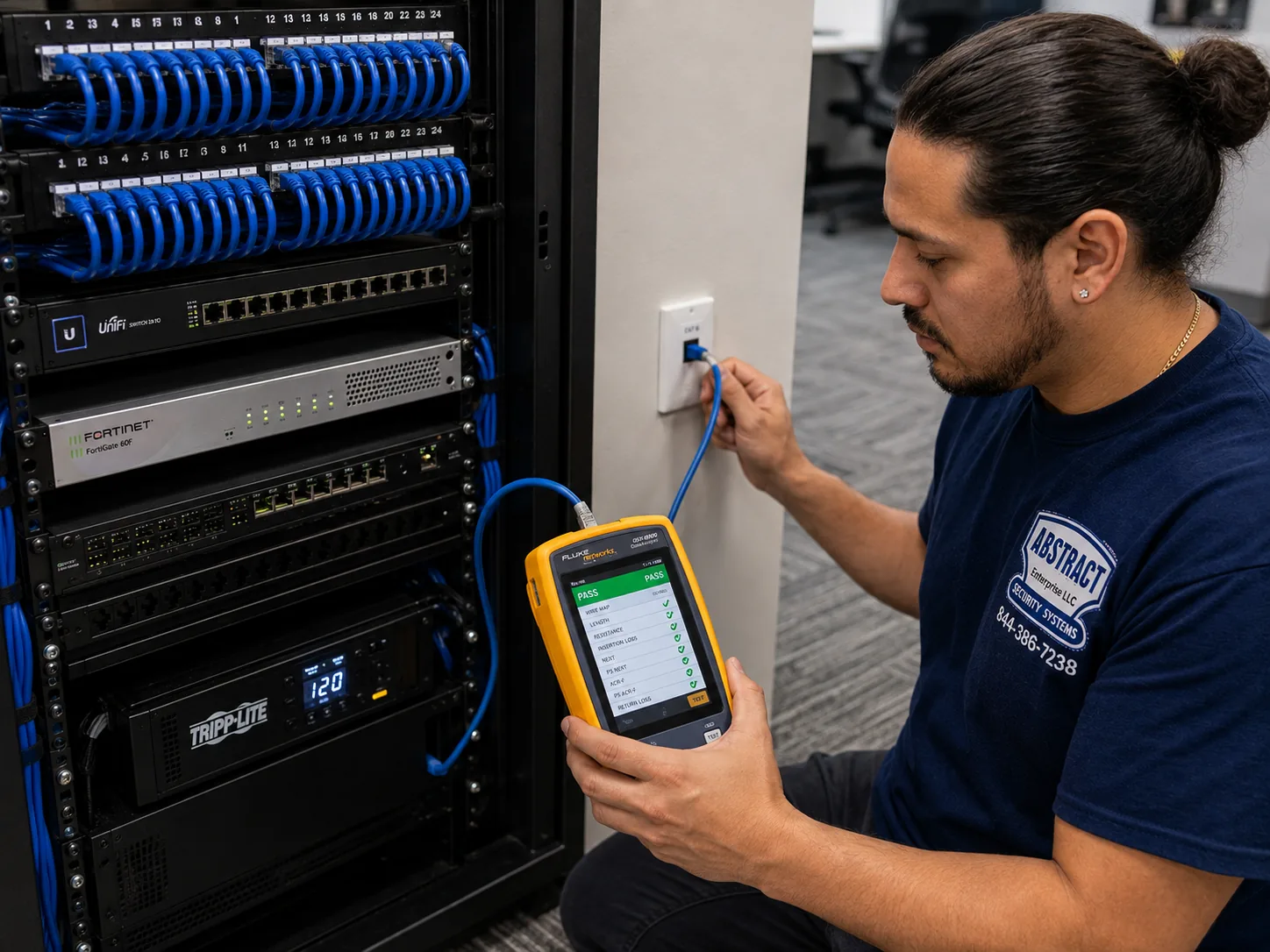
A photo from the AESS job library, not taken in Brooklyn: a technician certifying a data drop with a cable analyzer that shows a PASS result. When you tell us on the form that the building has old cable from a previous system, this is the test each run gets before we decide whether it stays, because in a plaster-and-brick Brooklyn building a good old cable is worth far more than a new one pulled through a finished wall.
✅
Request Sent!
Thank you. A technician will call you about the Brooklyn address and book the walkthrough.
How It Works
Our Installation Process
1. Send photos and book
The front entrance, the vestibule, the recorder or modem spot and the rear, with your cross streets. We book a walkthrough within two hours of your request.
2. Walk the building
Stoop, vestibule, halls, cellar, yard and roof access. Old Dahua cameras and cable are tested, and we note who owns and approves each wall.
3. Written plan and quote
Every camera, its view, its mount, its cable path and the recorder, priced line by line from the Brooklyn Luminys list.
4. Clear the paperwork
Landlord, board, managing agent and landmark questions settled, certificate of insurance sent and working hours confirmed before drilling.
5. Cable and mounts
PoE cable through the cellar, closets, risers and chases, penetrations sealed, mounts set into mortar joints, plain masonry or framing.
6. Recorder setup
The Luminys NVR goes in a dry, ventilated, protected spot on battery backup; each camera is added, aimed, named and set to record.
7. Phones and accounts
Owners, tenants, supers and staff each get their own login with only their cameras, and remote viewing runs without open ports.
8. Test, label and hand over
Each camera checked, each cable labeled, clip export shown, and the plan and admin password handed to the owner in writing.
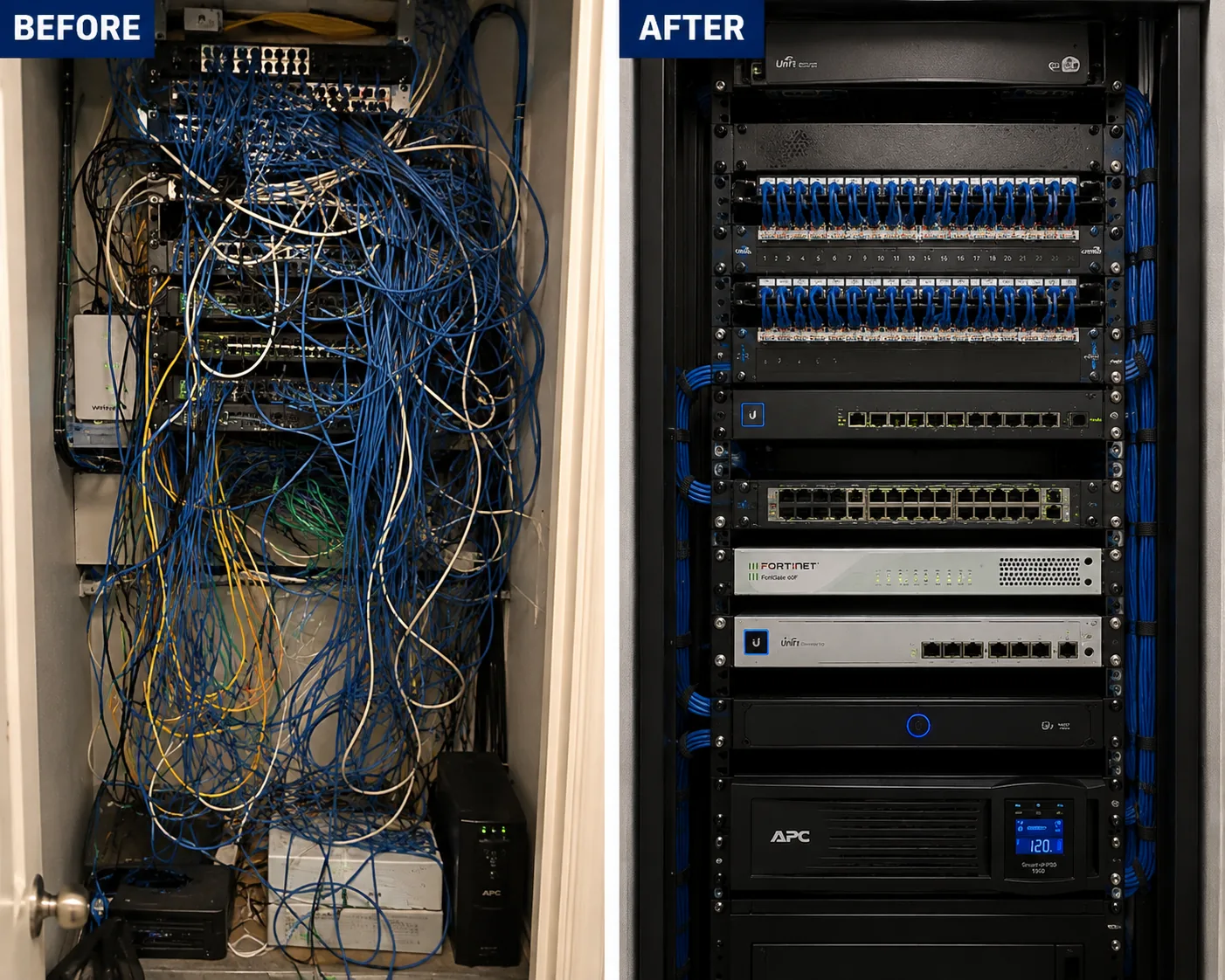
A photo from the AESS job library, not taken in Brooklyn: a network rack shown before and after cleanup, from an unlabeled tangle to dressed, identified cable. Step eight on a Brooklyn job looks like the right half of this picture, and it is usually what a building that inherited an old Dahua system needs most, whether the recorder sits in a cellar in Bed-Stuy or a utility room on Ocean Parkway.
Coverage Area
Luminys Camera Installation Near Brooklyn's Landmarks
Brooklyn Heights Historic District
New York City's first historic district, designated in 1965, where 24 Middagh Street from 1824 is the oldest surviving house and every street-facing camera starts with LPC review.
Fulton Mall
The pedestrian and transit mall on Fulton Street between Flatbush Avenue and Adams Street, at the heart of Downtown Brooklyn's stores and new towers.
Kings Theatre
The Flatbush Avenue movie palace that opened on September 7, 1929, seats 3,250 and reopened after restoration in 2015.
Brooklyn Navy Yard
More than 300 acres on the East River and home to over 550 businesses, from film studios to manufacturers.
Industry City
The former Bush Terminal in Sunset Park, sixteen factory buildings turned into a six-million-square-foot workplace.
Riegelmann Boardwalk
2.7 miles from West 37th Street to Brighton 15th Street, first opened in 1923, fronting the flood-exposed blocks of southern Brooklyn.
Brooklyn is our base rate. Every other area on our list is priced as a multiple of it: Queens at 1.05 times, Staten Island at 1.10, Manhattan at 1.25, and Long Island and the Hudson Valley higher still. The exact line items, the equipment and the calculator where you can build your own system are all on our Brooklyn Luminys camera installation prices page, so this section explains what moves a Brooklyn total rather than repeating the list.
What moves the price
Why it matters in Brooklyn
How it shows on the quote
Number and type of cameras
Set by the entrances: stoop, vestibule, hall, yard, cellar door, store counter
One line per camera, by model
Cable path
Masonry, plaster on brick, risers, chases and fire-stopped floors
Per run, with masonry penetrations listed
Recorder and drives
Channel count for the building, retention you want, battery backup
Recorder, drives and backup as separate lines
Reusing Dahua cameras or old cable
Cameras and runs that test good stay, which lowers the total
Testing and re-termination instead of new equipment
Mounts and finishes
Gang box adapters, parapet brackets, painting to match landmarked stone
Accessory lines per camera
Height and access
Roofs, parapets, tall lobbies and walk-up stairs
Access lines where they apply
Moving the recorder
Out of a cellar that has flooded, or away from boiler heat
Relocation and new home-run cable if needed
Two things never appear on a Brooklyn quote as surprises. If a wall turns out to be different from what the walkthrough suggested, you hear about it and agree to any change before more drilling. And if an old camera we expected to keep fails on the Luminys recorder, we show you the result and quote its replacement before installing it.
Full terms — including 50% deposit, one-year parts-only warranty on AESS-supplied products, and the late-fee schedule — are set out in the service agreement.
Shop Our Systems
Luminys Camera Installation Packages & Pricing
Three typical Brooklyn starting points. Each is priced line by line on the Brooklyn price page, and each is adjusted at the walkthrough to the building you actually have.
Rowhouse starter
Four Luminys cameras on a four-channel recorder: under the stoop, inside the vestibule, the rear yard and the cellar door. Wired PoE from the cellar, recorder up off the floor on battery backup, owner and tenant accounts.
Walk-up standard
Eight cameras on a larger recorder: outside the front door, vestibule, mailbox and package wall, top landing and roof door, cellar door, laundry room and yard. Cable through the riser, penetrations sealed, offline alerts to the owner or super.
Building or storefront premium
A 16-channel Luminys recorder for a courtyard building, a tower's common areas or a large store: every entrance, lobby, elevator landing, mailroom, stockroom and gate, with LumiCenter for owners who manage more than one property.
Bring your own equipment. If you have already bought Luminys cameras or a recorder, we install them at the labor lines on the price page, as long as the equipment is genuine and suits the spot. If you bought older or discounted stock and you need it to meet NDAA requirements, keep the receipts and model numbers handy, because Luminys says legacy non-Luminys-branded products and leftover third-party inventory should be verified individually. If you are reusing an old Dahua recorder, remember the one-way rule: it will not run new Luminys cameras.
Complete Services
Every Luminys Camera Installation Service in Brooklyn
New Luminys systems
Rowhouses, walk-ups, towers, stores and congregations. Request a quote
Is a boxed four-camera Luminys kit enough to cover a Brooklyn brownstone?
+
Often it is a good start. Luminys sells kits such as the K54-4L1A2, a four-channel recorder with four turret cameras, and one Brooklyn vendor suggests four to six cameras for a single-family brownstone. Four cameras usually cover under the stoop, the vestibule, the rear yard and the cellar door. If the house has a side passage or a rental unit with its own entrance, plan for one or two more and a recorder with spare channels.
An online seller offered us older stock at a discount. Is every box covered by Luminys's NDAA statement?
+
Not automatically. Luminys says certain legacy non-Luminys-branded products and leftover third-party inventory in distributor or customer channels should be verified individually for NDAA status. If NDAA compliance matters to you, for a contract or an insurer, check the exact model on every box before buying and keep the paperwork. We document the model of each device we install.
How do we hand a clip to a neighbor or a detective after something happens on the block?
+
At handover we show the owner how to search the recording by camera and time, mark the start and end of the event and export it to a USB drive or share it from the phone app. Export only the minutes that matter, note the camera and time, and keep a copy yourself. Deciding who gets your footage is always the owner's call.
How many days of footage will the recorder keep before it starts writing over the oldest?
+
It depends on the number of cameras, their resolution, how much motion they see and the size of the drives. We ask how far back you want to be able to look and size the drives to match. For comparison, NYCHA's recent upgrades set 21 days of retention, and Luminys's direct-to-cloud cameras carry an SD card that its seller says holds up to 27 days at 720p.
How quickly can someone come out to look at our building?
+
We book within two hours of your call or request. The walkthrough itself is scheduled around your building's access, the super's hours or the store's opening times, and same-day estimates are available on most weekdays.
What should we have ready before the walkthrough?
+
Access to the cellar or utility room, the roof door if cameras may go up there, and the old recorder if there is one. The recorder password helps, and if you do not have it, proof that you own or manage the building. A short list of who should see which cameras saves time too.
Will running the cable leave holes all over the plaster in our parlor?
+
We work hard to avoid that. Cable travels along the cellar ceiling, up risers, through closets and behind stair stringers, and comes out only at the camera. Where a short run in a finished room cannot be avoided, it goes in a painted raceway or through a small hole that is patched. Each opening is listed in the written plan so you know in advance.
Where are your technicians based?
+
Our Brooklyn crews are dispatched from our office on Troy Avenue in Brooklyn. The business has been owner-operated since 2002, and all work is done under New York State license number 12000287431.
Another installer started our system and never finished. Can you take it over?
+
Usually, yes. We test what is already in place, trace and label the cables, check that the equipment suits the spots it is in, and give you a written plan for finishing the job. Anything that was installed badly is listed honestly, and you decide what to keep.
Is the Brooklyn rate different from what a building in Manhattan or Staten Island would pay?
+
Yes. Brooklyn is our base rate. Queens is priced at 1.05 times Brooklyn, Staten Island at 1.10 and Manhattan at 1.25, and each area has its own Luminys price page so the lines always match where the building is.
Will you take away the old cameras and recorder we replace?
+
We can remove and take away the equipment that comes down, or leave it with you if you would rather keep it. If the old recorder holds footage you may need, we set it aside unplugged so the drives are not wiped.
What happens to phone viewing if we switch internet providers later?
+
The cameras keep recording to the recorder, because recording is local. Phone viewing may stop until the recorder is connected to the new router, and changes to the internet, router or phone are outside the warranty, so plan the switch and we can reconnect it at the service rate on our list.
Ready to Put a Luminys System on Your Brooklyn Building?
Send photos of your entrances, your cellar and any old recorder with your cross streets, and we will tell you what can stay, what should change and what it comes to on the Brooklyn list. Call or text (347) 934-8335, message us on WhatsApp, or use the request form. Authorized Luminys partner, licensed under NYS license #12000287431, rated 4.7★ across 201 Google Reviews, with same-day estimates on most weekdays.