CCTV installation in Staten Island means a wired camera system that records to a recorder you own, sized for houses with driveways, side yards and garages, for strip-plaza stores on Hylan Boulevard and Richmond Avenue, and for the yards and loading doors of the West Shore. Complete four-camera systems start at $999 installed, with two weeks of recording and phone viewing included, and we book your visit within 2 hours of your call or form.
Quick answer: On Staten Island, a four-camera CCTV system costs from $999 (A Series DVR) to $1,441 (C Series 4K DVR or the top-tier D Series 4K NVR), installed. A four-camera job on a single-family home typically lands between $999 and $2,000. Commercial CCTV for stores, offices, restaurants and multi-story buildings runs $1,500 to $5,000 and up. Every package includes the recorder, two weeks of recording and the phone app. Monthly fees: $0.
Reviewed and updated November 16, 2026 by Abstract Enterprises Security Systems, NYS license #12000287431 · Sources: NYPD CompStat, Patrol Borough Staten Island, Vol. 33 No. 45 (week of November 2–8, 2026); U.S. Census Bureau, American Community Survey 2019–2023, table DP04, Richmond County; NYC Special Initiative for Rebuilding and Resiliency report, chapter 1; NYC Building Code Appendix G; Staten Island Advance (SILive.com), July 24, 2026; Con Edison outage figures reported by Fox Business, August 5, 2020; NYS Penal Law §250.45; NYS Labor Law §203-c
From one of our CCTV jobs (a Manhattan corner deli): a white dome sits on the outside corner of the sign band, where it can see two sidewalks at once. Strip-plaza stores along Hylan Boulevard and Forest Avenue get the same corner placement.
Staten Island CCTV Request
House, store, warehouse or building — give us the neighborhood and the views you need
✅
Request Sent!
Thanks. We will call or text to set up the Staten Island survey.
25+
Years Experience
2 Hr
Booking
$0
Monthly Fees
4.7★
201 Google Reviews
Call or text first.(347) 934-8335 reaches the office that schedules Staten Island crews.
Quote in 60 seconds. Send the address and three photos through the quote form; the written plan follows the survey.
Licensed and insured. NYS low-voltage license #12000287431, general liability coverage, 4.7 stars from 201 Google reviews.
The Neighborhood
Why Staten Island Properties Need CCTV Installation
Staten Island does not look like the rest of New York City, and the camera plans we draw here don't either. Drive down Amboy Road through Eltingville or Annadale, or along the side streets off Victory Boulevard in Westerleigh, and you see what the borough is built from: houses that stand on their own lots, a curb cut and a driveway, a side gate, a deep backyard, often a detached garage or a shed at the back, and two or three cars in the family. A CCTV system on that kind of property is not about a lobby or a hallway. It is about the ground around the house — the length of the driveway, the dark side yard between two houses, the back fence that meets a wooded strip, the garage door nobody can see from the kitchen.
The Census Bureau's numbers show how different the building stock is. In the American Community Survey for 2019–2023, Richmond County had about 184,074 housing units. Of those, 34.5 percent were one-family detached houses and another 25.6 percent were one-family attached or semi-attached houses — the rows of townhouses that went up across Mid-Island and the South Shore in the 1970s and 1980s. Two-unit houses added 22.7 percent. Put together, more than eight in ten Staten Island homes are one- or two-family buildings, and 67.9 percent of occupied homes are owner-occupied. Buildings of 20 or more units make up only 9.9 percent of the borough's housing.
That shapes every design decision. On a Staten Island house, the cable runs are longer than in a Brooklyn row house, because the cameras sit at the corners of a wider building and sometimes at a garage 60 or 80 feet behind it. The camera you need at the end of a driveway is a different lens from the one under the porch roof. The recorder usually ends up in a basement or a utility room — and on the East and South Shores, that is exactly where the water came in during Hurricane Sandy.
The storm question nobody else asks
The city's own post-Sandy report, written by the Special Initiative for Rebuilding and Resiliency, records that storm surge reached 14 feet above ground at Tottenville. Of the 43 New Yorkers who died in the storm, 23 were on Staten Island, ten of them in Midland Beach alone. The report names the East and South Shores of Staten Island among the five coastal areas hit hardest, and it notes that 120,000 customers on Staten Island and in the Rockaways lost power because of substation damage. Since then, many East Shore houses have been raised, others were bought out, and the city's flood-resistant construction rules in Appendix G of the NYC Building Code now require utilities and their equipment in flood zones to sit at or above the design flood elevation.
A CCTV recorder is not a boiler, but the same logic protects it. A recorder and a PoE switch on a basement floor in Midland Beach, New Dorp Beach, Ocean Breeze or Great Kills lose every hour of footage the first time the basement takes water — and they lose it at the moment a homeowner most needs to show an insurer what happened. Placing the recorder high, on an upper floor or in a raised utility space, and putting it on a battery backup, is the single most Staten Island-specific thing we do. The power side matters just as much away from the water: when Tropical Storm Isaias came through in August 2020, Con Edison reported about 29,000 Staten Island customers out of service at one point, mostly from trees and branches falling on overhead lines.
What the police numbers say about Staten Island
Staten Island is the city's lowest-crime borough in most categories, and its burglary count has fallen sharply. But one property crime is moving the other way, and it is the one a driveway camera is built to record. The NYPD's CompStat report for Patrol Borough Staten Island for the week of November 2–8, 2026 shows these year-to-date figures:
Vehicle theft (grand larceny auto): 256 reports so far in 2026, up 24.9 percent from 205 at the same point in 2025.
Burglary: 222 reports, down 21.6 percent from 283 — and down from 3,641 burglaries in the whole of 1990.
Retail theft: 1,378 reports, down 30.2 percent from 1,973.
Petit larceny: 2,764 reports, down 19.8 percent from 3,447 — the category that covers most package thefts from porches and stoops.
Grand larceny: 1,271 reports, roughly flat against 1,285.
The vehicle-theft rise was big enough to draw a public response in the summer. In July, the Staten Island Advance reported 163 vehicle thefts through July 19 against 111 a year earlier, a 47 percent jump, and District Attorney Michael E. McMahon said: “We are closely monitoring the recent increase in auto thefts manifested in [NYPD’s] CompStat numbers which reflect a troubling trend that demands immediate attention.” In the same story, the NYPD was candid that theft crews wear masks and gloves and work fast, so video often confirms a theft without identifying the people. That is the honest case for good CCTV on a Staten Island driveway: framed and lit so it shows the vehicle that pulled up, the direction it came from and the time down to the second, footage that investigators can line up with plate readers and other evidence.
The figures are preliminary and change week to week; they come straight from the NYPD's published borough report. Read them as context, not as a sales pitch. A house on a quiet cul-de-sac in Annadale can go years without trouble and still be glad of the recording the one night a car is broken into or a package disappears.
Geography adds one more wrinkle. Staten Island is policed by four precincts — the 120th across the North Shore, the 121st on the West Shore and Mid-Island, the 122nd along the East Shore and the middle of the island, and the 123rd on the South Shore — and it is connected to the rest of the region by just four bridges and the ferry. A stolen car or a van full of tools leaves the island over the Verrazzano, the Goethals, the Bayonne Bridge or the Outerbridge Crossing within minutes. That is one reason we put weight on capturing direction of travel and an accurate time stamp: a detective who knows a vehicle turned toward Richmond Avenue at 2:14 a.m. can narrow the search to a short list of routes off the island.
Most Staten Island homeowners pair cameras with lighting and a doorbell view. A motion light over the driveway makes a camera's night picture far better than infrared alone, and a video doorbell at the front door covers the face-to-face moment. If you want both in the same visit, see doorbell camera installation on Staten Island and floodlight cameras on Staten Island.
What We Install
CCTV Installation Services in Staten Island
Every job below is done by our own crew, wired back to a recorder you own, and handed over on your phone. We plan the cable route first and the camera second, because on a Staten Island property the route is what decides how long the job takes and how well the system survives the weather.
01
Home CCTV installation for detached houses
Front door and porch, both ends of the driveway, the side gate, the backyard and the garage. Residential CCTV installation sized to the lot, with cameras placed so each one overlaps the next and nobody can reach the back door unseen.
02
Driveway and curb CCTV for vehicle theft
A wide view over the cars and a narrower one aimed down the driveway toward the street, so footage shows the approach, the vehicle and the getaway direction. Motion-triggered light where the street is dark.
03
Storm-ready recorder placement
Recorder and PoE switch moved off the basement floor to an upper level or a raised shelf, on a battery backup sized for the cameras, with surge protection on the incoming lines. For houses in the Sandy inundation zone, this comes first.
04
Townhouse and HOA camera systems
Shared parking courts, mailbox clusters, pool gates and common walkways in the townhouse complexes of Mid-Island and the South Shore, wired to one recorder the board controls, with owner logins limited to the views they are allowed.
05
Commercial CCTV installation for strip plazas
Register, door, aisles, stockroom and the shared parking lot for stores, delis, pizzerias, salons and pharmacies on Hylan Boulevard, Richmond Avenue, Forest Avenue and New Dorp Lane. Business CCTV installation with one recorder per tenant or one per plaza.
06
Warehouse and yard CCTV
Dock doors, truck yards, fence lines and gates on the West Shore, in Bloomfield, Travis and Charleston, using long-range cameras, fiber or mid-run switches where cable runs pass 300 feet, and lighting where a yard goes black at night.
07
DVR to NVR upgrade
Old analog DVR systems from the 2000s replaced with HD or IP. Where the coax is sound we reuse it with HD-analog cameras; where it isn't, we pull Cat6. Older recorders that can't reach the phone app get replaced.
08
CCTV repair and expansion
Dead cameras, video loss after a storm, a recorder that stopped recording, a drive that filled up. Additional CCTV camera installation on a system that still works, and camera relocation when a renovation or a new fence blocks the old view.
09
Labor-only CCTV setup
Cameras and a recorder you already bought, installed and configured by our crew. Quoted by phone or text from the model numbers and photos, booked with a deposit; your own wireless cameras' signal and hardware stay your responsibility.
Not sure which line fits? Most callers start with the first three: a homeowner on the South Shore wants the driveway and backyard covered and the recorder somewhere a storm can't reach. Business owners usually start with the fifth or sixth. Either way, the survey turns the list into a written plan with a camera count and a price before anyone drills a hole.
Building Specialists
CCTV Installation for Staten Island's Architecture
Staten Island's houses were built in waves, and each wave leaves the crew a different set of walls, crawlspaces and cable paths. The ACS figures show it: 15.5 percent of the borough's homes date from the 1980s, 16.1 percent from the 1970s and 10.5 percent from the 1990s — the building boom that followed the Verrazzano-Narrows Bridge — while 17.8 percent were built before 1940, mostly on the North Shore. Here is how we approach each type.
A
Detached house on its own lot
Split-levels, high ranches, colonials and newer custom homes from Todt Hill to Tottenville. Four corners of the house, the driveway, the side yards and the back. Attic and basement give us clean cable paths; the challenge is distance to a detached garage or a back-fence camera.
B
Semi-attached townhouse rows
The 1970s and 1980s rows of Great Kills, Eltingville, Bulls Head and Heartland Village: a garage under the living space, a short shared driveway, a small yard behind. One camera often covers two garage doors, so we agree the view with the owner and keep it off the neighbor's windows.
C
Two-family house with a basement or garden unit
Common across Mid-Island and the North Shore. Separate entrances, a shared driveway and a tenant who may also want to see the front door. One recorder, an owner account with full access and a tenant account limited to the shared entrance.
D
Raised house in a former flood zone
East Shore homes lifted on piers or a new foundation after Sandy, with an open or enclosed space below the first floor. That space floods by design, so cameras mount on the raised structure and the recorder goes above the design flood elevation, never in the enclosure.
E
Townhouse complex or condo HOA
Shared parking courts, a pool or clubhouse gate, mailbox kiosks and a perimeter fence. The board owns the system; we put the recorder in a locked common room and give each manager or board member a login with the views they are entitled to see.
F
North Shore apartment building
Pre-war walk-ups near St. George, Stapleton and Tompkinsville, and the mid-rise and garden complexes beyond. Lobby, mailroom, elevator landing, laundry, trash room and rear door. See our apartment building security camera installation on Staten Island for building-wide systems.
Siding, stucco, brick and the salt air
Most Staten Island houses wear vinyl or aluminum siding over a wood frame, which is easy to drill and hard to seal. A camera screwed straight through vinyl lets water track behind the siding and pulls the mount loose as the panel expands in summer and contracts in winter. We use a siding mounting block cut to the profile of the lap, fix it into the sheathing or a stud, and run the cable through the block so the penetration sits behind a sealed plate. On stucco we drill with a masonry bit, set anchors in the substrate rather than the finish coat, and seal around the junction box. Brick fronts, common on newer two-family houses and older North Shore homes, get sleeve anchors in the brick face, never in the mortar alone.
Close to the water, in South Beach, Midland Beach, Great Kills Harbor and along the Kill Van Kull, salt air is hard on metal. We choose camera housings rated IP66 or IP67, use stainless or coated hardware, fit drip loops on every outdoor cable and seal each connector with weatherproof boots or gel-filled junction boxes. A cheaper camera with an exposed RJ45 plug on the back can corrode in a single winter at the shore.
Where the cable goes in a Staten Island house
CCTV installation with concealed wiring is the default on finished houses. In a split-level or high ranch, cable usually travels through the garage ceiling and into the basement or lower level; in a colonial, up through an interior wall into the attic and down to each eave camera. Semi-attached rows often have no attic access at all, so we route along the garage ceiling, through a soffit and behind trim. Where a run has to cross a driveway or a backyard to reach a garage or a fence camera, we use outdoor-rated direct-burial cable in conduit, or an aerial run along an existing structure when trenching isn't practical. Every hole through the building envelope is sealed, every cable is labeled at both ends, and we write the route on the camera map you keep.
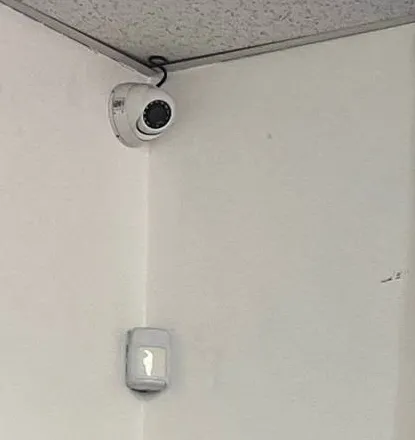
From one of our CCTV jobs (a Nassau County showroom office): the dome sits tight in the corner where the walls meet the ceiling, with the alarm motion sensor below it. In a Staten Island house the same corner placement covers a garage entry or a basement door.
Garages, sheds and the back of a deep lot
Garage CCTV installation is one of the most common requests we get on the island, because the detached garage is where the tools, the bikes, the second fridge and sometimes the boat or the classic car live. A camera on the house aimed at the garage door shows who walks up; a second camera inside the garage, wired from the house, shows what they touch. Where the garage is 60 to 100 feet from the house, a standard Cat6 run still works well within the 100-meter (328-foot) Ethernet limit. Beyond that, or across a lot with no practical cable route, we use a small PoE switch in the garage fed by one cable, or a point-to-point wireless bridge between two buildings — a fixed link, not a battery camera hoping to reach the house Wi-Fi.
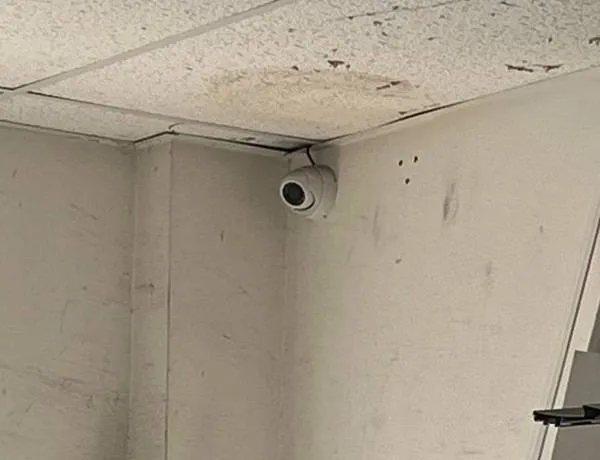
From one of our CCTV jobs (a Nassau County storage room): a single corner dome watches the whole room and its doorway. The water-stained tiles above are a reminder of why, in Staten Island basements that flood, the recorder never lives at floor level.
A quick note on what we don't do in this section of the work: we don't open walls or patch drywall beyond the small holes the cable needs, and we don't do electrical work that needs a licensed electrician, such as a new outlet on a garage wall. If a camera location needs new line-voltage power, we tell you at the survey and plan the camera to run on PoE from the recorder instead, which avoids the outlet entirely.
New construction and rebuilt houses
Staten Island still sees a steady stream of new houses, teardowns and gut renovations, from infill lots in Rossville and Charleston to rebuilt homes on the East Shore. CCTV installation for new construction is the cheapest camera work there is, because the walls are open: we pull Cat6 to each future camera spot while the framing is bare, leave the cable coiled and labeled behind a blank plate or a sealed box at the eave, and run every line back to a planned recorder spot on an upper floor. When the siding and drywall are finished, the cameras go up in hours instead of a day, and nothing is surface-mounted. If the house is being built in a flood zone, we coordinate the recorder and UPS location with the builder so it sits with the other equipment above the design flood elevation. We work alongside the electrician and the general contractor rather than in place of them.
Commercial CCTV
Business CCTV Installation in Staten Island
Staten Island's businesses mostly sit in strip plazas with their own parking lots, along a handful of long commercial roads, rather than in storefront rows on a sidewalk. That puts the parking lot and the back of the building inside the camera plan, not just the counter. It also means the landlord, not the tenant, often controls the roof, the sign band and the lot poles. Our commercial security camera installation page for Staten Island covers multi-site and larger systems; here is how CCTV for business security plays out on the island's main corridors.
Hylan Boulevard, from Dongan Hills to Tottenville
Hylan Boulevard runs the length of the East and South Shores past plaza after plaza: supermarkets, pharmacies, pizzerias, nail salons, dental offices, bagel shops and bank branches. Retail CCTV installation here usually means the front door and register, the aisles, the stockroom and the rear delivery door, plus one or two cameras on the storefront looking across the tenant's share of the lot. Plaza owners sometimes add a separate lot system with cameras on the light poles. When both exist, we keep the tenant's recorder separate and the views coordinated so the plaza and the store don't end up watching the same spot twice.
Richmond Avenue, the Staten Island Mall area and New Springville
Richmond Avenue between Victory Boulevard and the Staten Island Mall carries big-box stores, car-wash bays, fast-food drive-throughs and medical offices. Restaurant CCTV installation along this stretch adds the drive-through window, the kitchen door and the cash office. Medical office CCTV installation focuses on the entrance, the waiting room and the records area, with no cameras in exam rooms. Further south, around the Bricktown Centre in Charleston, the same layout repeats at a bigger scale.
Forest Avenue, Victory Boulevard and Port Richmond Avenue
The North Shore's older retail roads have more traditional storefronts, often with an apartment above. Convenience store CCTV installation here looks a lot like a Brooklyn bodega job: domes over every aisle, a camera on the register from behind the customer, one on the door and one under the awning facing the sidewalk. Bars and late-night spots along Forest Avenue add the entrance line and low-light cameras over the bar.
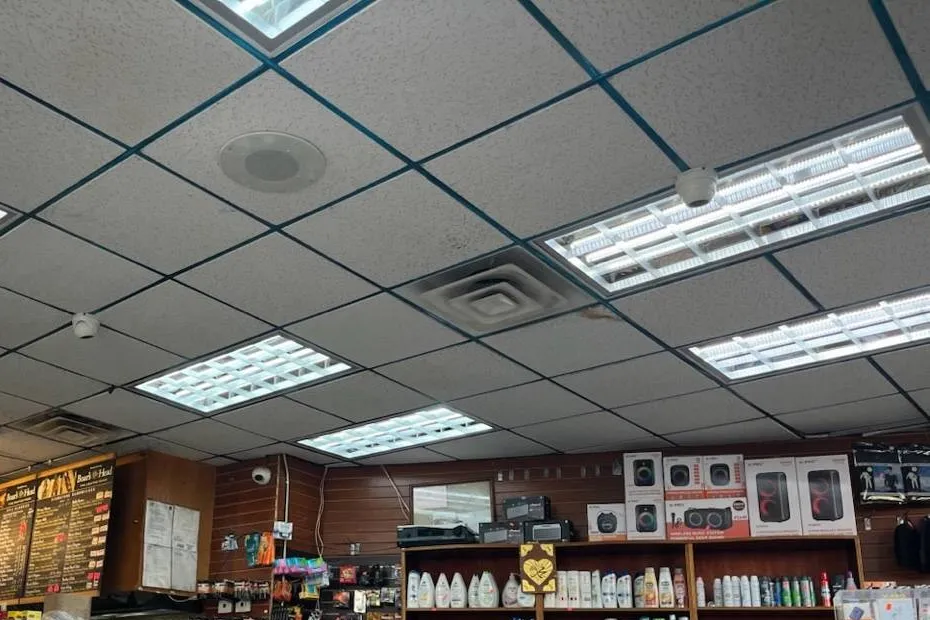
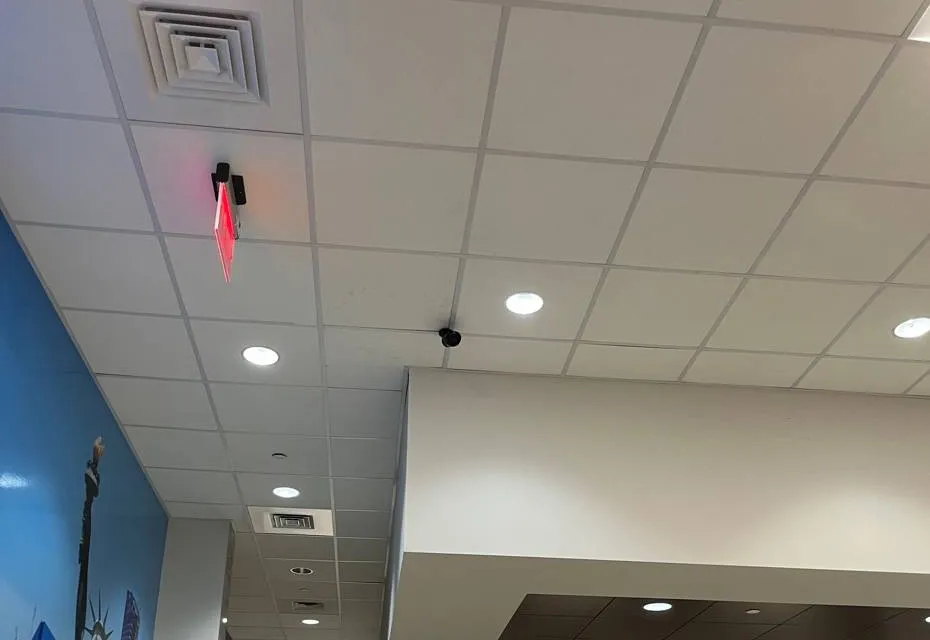
From one of our CCTV jobs (a Manhattan corner deli): small domes on the drop ceiling cover the shelving wall and the menu counter. Delis and convenience stores on Forest Avenue and Port Richmond Avenue use the same layout.
New Dorp Lane, Bay Street and St. George
New Dorp Lane's restaurants and shops, and the Bay Street corridor from St. George through Stapleton, mix storefront retail with offices, bars and the waterfront crowds that come off the ferry. Empire Outlets in St. George and the busy ferry-terminal area mean more foot traffic than most of the island sees. Office CCTV installation in these buildings concentrates on reception, the suite entrance and the server or file room.
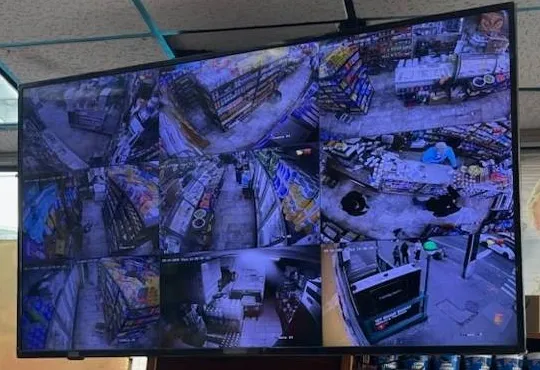
From one of our CCTV jobs (a Manhattan corner deli): a TV mounted over the shelving shows the nine-camera split to staff and customers alike. Plaza stores on New Dorp Lane and Hylan Boulevard often ask for the same public-view screen near the register.
The West Shore: Bloomfield, Travis, Charleston and the logistics parks
The West Shore is Staten Island's industrial side, along the Arthur Kill and the West Shore Expressway. Matrix Global Logistics Park sits on a site of roughly 400 acres near the foot of the Goethals Bridge in Bloomfield, and in 2020 the Staten Island Advance reported Amazon leasing a 975,000-square-foot building there. Around those big sites sit smaller warehouses, contractor yards, bus depots, self-storage buildings, auto body shops and the Staten Island Teleport office park. Warehouse CCTV installation and logistics facility CCTV installation here are about distance and darkness: long fence lines, wide truck yards, dock doors and gates, often with nothing lit past the building wall. We plan long-range bullet cameras along the fence, cameras at every dock door aimed so the trailer number and the forklift are both in frame, and a gate camera framed for plates. Our warehouse security camera installation page for Staten Island goes deeper into dock and yard layouts.
Auto shops, body shops and car lots
Repair shops, tire shops, body shops and used-car lots are spread along Hylan Boulevard, Richmond Avenue, Forest Avenue and the roads of the West Shore. With vehicle theft rising on the island, owners ask for two things: proof of what was on the lot at closing, and a record of every vehicle that enters and leaves. Auto repair shop CCTV installation usually means a camera on each bay door, one on the customer counter, wide views of the lot from the building, and a gate or driveway camera framed tight enough to read a plate at the lot entrance, where cars slow down. Car dealership CCTV installation adds the showroom, the key box and the service drive. The recorder goes in the office with a battery backup so an overnight outage doesn't blind the lot.
Schools, daycares and houses of worship
Daycares, private schools, parish halls, churches, temples and mosques across the island ask for cameras at the entrances, the drop-off area, hallways and the parking lot, with nothing in restrooms or changing areas. School CCTV installation and daycare CCTV installation lean on clear face views at the door and a live view at the front desk, so staff can see who is at the entrance before buzzing them in. Footage access stays with the director or the board.
Taken on a CCTV job of ours at a Rockland County car dealership. The camera nearest the lens carries a red strobe that fires when a person walks into its zone; a mini dome sits deeper in the room. Staten Island owners put the strobe type over truck doors, yard gates and the back lots behind plazas.
Rules a Staten Island business should know
No video in restrooms, locker rooms or changing rooms. New York Labor Law §203-c bars employers from video recording in those spaces. Cameras in a break room or office are allowed; the restroom corridor door is as close as we go.
No hidden recording of private spaces. NYS Penal Law §250.45 makes recording a person in a place where they have a reasonable expectation of privacy, without consent, a crime.
Audio is a separate question. Many cameras have microphones. Recording conversations you aren't part of can fall under the state's eavesdropping law, so we install with audio off unless the owner decides otherwise after taking advice.
Biometric signage. If a store, restaurant or venue uses face recognition, NYC Administrative Code §22-1202 requires a clear sign at customer entrances. Most of our commercial systems don't use it.
Landlord approval. Plaza leases usually require the landlord's written OK for anything on the facade, sign band, roof or lot poles. We supply cut sheets and a camera map for that request.
These notes summarize the statutes in plain words; they are not legal advice, and a lawyer should review any particular case.
Your Questions Answered
CCTV Installation in Staten Island: Questions Answered
These are the questions Staten Island callers actually ask us, grouped the way the survey runs: the ground around the house first, then cars, then storms, then businesses. Each answer comes from how we plan and install, not from a brochure.
Driveways, side yards and hills
Is a camera on a post at the end of the driveway better than one mounted on the house?
Usually the house is better, with one exception. A camera under the eave or on the garage header has power and cable right behind it, is out of reach, and looks down the driveway toward the street, so it sees a person's face as they walk toward the house and the side of any car that pulls in. A post at the curb is closer to the street, which helps on a very long driveway, but it is within reach of anyone passing, needs a buried cable back to the house and catches more headlight glare at night.
The exception is a driveway longer than about 80 feet, or one that bends so the house can't see the entrance. There we set a sturdy post or use an existing lamp post, put the camera at nine to ten feet, run the cable underground in conduit, and aim it across the driveway entrance rather than straight at oncoming lights. On most Staten Island lots, though, two house cameras — one wide over the parked cars, one narrower down the driveway — do the job without anything at the curb.
What camera covers the narrow side yard between two Staten Island houses?
The side yard between two detached houses, often four to eight feet wide with a gate at the front and the trash cans halfway down, is the path most break-ins on a detached house use, because neither neighbor can see into it. A wide-angle camera does a poor job here; it wastes most of its picture on two walls.
We mount a bullet or turret camera high on the back corner of the house aimed forward toward the gate, with a lens of about 2.8 to 4 millimeters, so the frame runs the length of the passage and anyone walking through it fills the picture. If the gate is the weak point, a second camera above it looks back the other way. Infrared works well in a side yard because the walls bounce light back, but we check the night image on the spot, since a white vinyl wall a foot from the lens can wash the picture out.
What changes when the driveway is steep, as on Todt Hill, Grymes Hill or Emerson Hill?
On the hills of the island's spine, driveways climb from the street to a house set well above it, sometimes with a retaining wall and a turn. A camera on the house looks down on cars from a steep angle, so it sees roofs instead of doors and windshields. A camera at the bottom looks up at headlights.
The fix is a mid-slope view: a camera on the garage or a wall partway down, angled across the driveway rather than along it, plus a camera at the front door for faces. Long cable runs downhill need outdoor-rated cable in conduit and drainage-aware routing, so a run doesn't sit in the path of rainwater coming down the slope. The recorder still goes inside the house, never in a detached garage at the bottom of the hill where it would be the first thing taken.
What camera works on a block with no streetlight in front of the house?
Plenty of South Shore and Mid-Island blocks are dark at the curb, especially between widely spaced streetlights or where trees cover them. Standard infrared cameras still see in that dark, but only in black and white and only as far as their own infrared reaches, usually 60 to 120 feet depending on the model. That is enough for a driveway and a front walk.
For color at night, we use cameras with larger sensors and a warm white light that comes on with motion, or we add a separate motion floodlight that lights the driveway for the camera. A light that switches on with motion does two jobs: it makes the picture usable, and it tells a person in the driveway they have been seen. We aim lights at your property, not your neighbor's bedroom window.
Can a camera keep an eye on a boat, trailer or RV stored in the driveway over winter?
Yes, and on Staten Island this is a common request in the off-season, when boats from Great Kills Harbor and the island's marinas come home on trailers. A boat on a trailer is tall and blocks the view behind it, so one camera rarely covers both sides. We usually place one camera on the house covering the hitch end and the trailer tongue, where a thief would connect a vehicle, and a second covering the far side from the garage or a post.
We set an alert zone around the trailer so that a person walking up to it at night sends a notification to your phone, while cars passing in the street don't. A wheel lock and a hitch lock still matter more than any camera; the camera tells you when someone is trying them.
Vehicle theft
Which footage actually helps police after a car is taken from a Staten Island driveway?
The NYPD was candid about this in the Staten Island Advance this summer: organized theft crews wear masks, gloves and hoods, and work in minutes, so video often confirms a theft without showing who did it. That doesn't make cameras useless; it changes what they need to capture. The useful clips are the ones that show the vehicle that dropped the thieves off, its color, shape and any visible damage, the direction it came from and left in, and the exact time.
So the camera plan for a driveway includes a view of the street in front of the house, framed wide enough to see a car passing in both directions, and the recorder's clock is synchronized automatically so its time stamp matches other cameras on the block and the plate readers investigators use. We also show you how to export a clip in its original format from the app, which preserves the time stamp, rather than recording your phone screen.
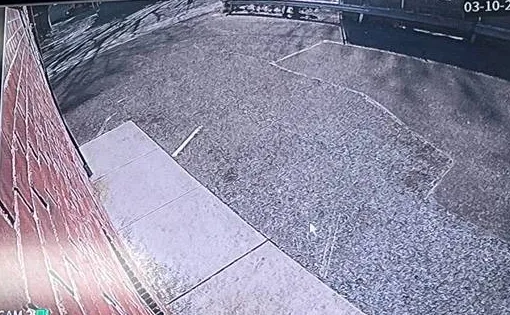
Screen capture from a CCTV job of ours at a Nassau County showroom: a single tile of the four-way split, shot along a brick wall over gravel and pavement. On a Staten Island house we frame the driveway camera the same way, hugging the wall and pointing out to the curb.
Storms, floods and outages
Can cameras be mounted on a raised East Shore house without going into the flood-vent enclosure below it?
Yes, and they should be. Many houses in Midland Beach, New Dorp Beach, Ocean Breeze and Oakwood were lifted after Sandy onto piers, columns or a raised foundation, leaving an enclosure underneath with flood vents that is designed to let water flow through. Anything installed in that space has to be able to get wet. Under the city's flood-resistant construction rules, utilities and their equipment in these buildings belong at or above the design flood elevation.
We mount the cameras on the raised structure itself, under the first-floor overhang or on the fascia, looking down at the stairs, the parking area beneath and the yard. Cable drops into the living space from above, not up through the enclosure. Where a camera has to cover the space under the house, it hangs from the underside of the floor framing with a sealed connection and drip loop, and its cable runs up into the house rather than along the enclosure wall.
What should we do with the CCTV system when a coastal storm or hurricane warning is issued?
Three things, all of them quick. First, export any footage you might need later, such as clips from a recent incident, to your phone or a cloud folder, because a recorder that loses power for days or takes water can lose recent footage. Second, check that the battery backup's indicator shows it charged and that the recorder and switch are plugged into its battery outlets, not its surge-only outlets. Third, if the recorder sits anywhere water could reach, move it up now; it is a ten-minute job for a homeowner with the cables labeled.
Leave the cameras running. During and after the storm they record what the wind and water did to the property, and that footage is often the most useful thing you have when filing a claim. Don't unplug outdoor cameras to protect them; they are sealed units built for rain.
How do we check the cameras and recorder after a storm, before the insurance adjuster arrives?
Open the app and look at every camera's live view and its recording for the storm hours. A camera that shows a black tile, a frozen image or a fogged lens is the one to inspect. On the recorder, the event log shows power loss and restore times, and the recording timeline shows whether anything was missed. Screenshots of both, with the date and time visible, are worth keeping for the claim.
If a camera is down, a call or text to us books a service visit, and the technician checks the cable, the connection and the camera before anything gets replaced. Storm damage to equipment is generally an insurance matter, not a product defect, so we document what we find in writing for your adjuster.
Businesses
How should a West Shore contractor yard be covered when trucks and equipment sit outside overnight?
Contractor yards in Travis, Bloomfield, Charleston and Rossville tend to be fenced lots with trucks, trailers, excavators and material piles, a small office or container, and darkness everywhere past the building. Theft from these yards is usually catalytic converters, tools from truck boxes, copper and fuel, carried out through a cut fence or an unlocked gate.
The plan starts at the gate, with a camera framed to see every vehicle that enters and leaves, then covers the fence line with long-range bullets aimed along it rather than across it, so a person climbing or cutting anywhere on that side shows up. Active-deterrence cameras that flash and sound a siren when a person enters a zone after hours work well here, because nobody is around to hear an alarm. The recorder goes inside the office in a locked box, with a battery backup, and the owner gets alerts only for people in the yard after closing.
What camera layout suits a pizzeria or restaurant with a drive-through or pickup window?
Restaurants on Richmond Avenue, Hylan Boulevard and Victory Boulevard usually need six to ten cameras: the front door, the counter and register from behind the customer, the dining room, the pickup or drive-through window from inside, the kitchen line, the back door, the walk-in or storage room and the dumpster area. The drive-through window camera is framed tight on the transaction so cash and orders can be checked against the receipt.
Kitchen cameras need housings that tolerate heat and grease, and they go where steam from the line won't fog the lens. Many owners also want a view of their own delivery drivers loading up at the door, which settles disputes about late or missing orders.
What should a self-storage facility record at the gate and along the unit rows?
Self-storage buildings on the West Shore and along the island's commercial roads run mostly unattended, so the cameras do the watching. The gate keypad gets a camera that sees the driver's face through the window and the front of the vehicle at the same moment, so every access code entry can be matched to a person. The gate itself, the office counter, the loading area and each elevator or stair landing come next.
Along the unit rows and indoor corridors, cameras look down each aisle from the end, so a person moving between units is always in frame. The recorder's timeline is set up so a manager can search by time when a tenant reports a break-in, and footage is kept long enough to cover a tenant who visits only once a month.
What should a Staten Island dental or medical office keep off camera?
Exam and treatment rooms, restrooms and changing areas stay off camera entirely. Waiting rooms, the reception desk, the entrance, the hallway, the records and supply rooms and the parking area are normal places for cameras. Screens showing patient information should be outside every camera's frame, and the front-desk camera is aimed at the patient side of the counter, not at the monitors.
Footage access belongs to the practice owner or office manager, not every staff member, and the recorder lives in a locked room. Audio stays off. Practices with specific privacy obligations should confirm the plan with their compliance advisor; we design it so the camera map is easy to review.
Can the cameras send a clip to my phone whenever the burglar alarm goes off?
Yes, if the alarm panel and the recorder can talk to each other. Many recorders have alarm inputs, and many alarm systems can trigger an output when they go into alarm. Wired together, the recorder tags the moment, and your phone shows the camera clip alongside the alarm notification, so you can see whether it is a real intrusion or the cat.
Where the alarm and cameras run in separate apps, we can still set each camera's own person detection to alert you, which covers most of the same ground. We check what your panel supports at the survey; our alarm installation team on Staten Island handles the panel side.
Field notes — what our crew checks first on a Staten Island house
Before we look at camera spots, we go to the basement. On the East and South Shores we ask whether the house took water in 2012 or in any storm since, and we look for a water line on the walls, a sump pump, or new drywall that stops a few feet up. That decides where the recorder lives. Then we walk the lot from the street: driveway, curb, side yards, back fence, garage, shed. We stand where each camera will go and look at what it will see at night, which on many South Shore blocks means very little without a light.
Our crew's rule on these houses is simple: the recorder goes where the water doesn't, and every outdoor connection gets sealed as if the next storm is next week. The photos on this page come from our jobs in Manhattan, Nassau County and Rockland County, captioned with where they were taken; we show them because the mounting, sealing and recorder work is the same here.
Equipment
CCTV Equipment We Install on Staten Island
Our house-brand systems are the default because we know every model, stock the parts and can replace a camera without changing the recorder. We also install and service systems from Lorex, Luminys and Reolink, the three manufacturers that list us as an authorized partner, and we integrate other brands a customer already owns. Here is the equipment that shows up most on Staten Island jobs.
1
Turret and dome cameras
Turrets for eaves, porches and garage headers, where they resist spider webs and glare better than glass domes. Vandal-resistant domes for plaza storefronts and ceilings within reach.
2
Bullet and long-range cameras
For driveways, fence lines, lots and yards. Varifocal lenses let us set the zoom on site so a camera 100 feet from a gate still shows a person clearly.
3
Color night and active-deterrence cameras
Warm-light color at night, plus models that flash red and blue and sound a siren when a person enters a zone. Useful on dark blocks and empty yards.
4
NVRs and DVRs
Network video recorders for IP and PoE cameras; DVRs for HD-analog cameras on coax. 4, 8, 16 and 32-channel units with drives sized to the retention you want.
5
PoE switches and Cat6
One Cat6 cable per IP camera carries both power and video. Outdoor-rated and direct-burial cable for runs across yards and to garages, in conduit where it crosses a driveway.
6
Battery backup and surge protection
A UPS sized for the recorder, the switch and the cameras' PoE draw, plus surge protection on power and incoming coax or network lines. Standard on our storm-zone installs.
IP, PoE, HD-analog and wireless: which fits a Staten Island property
IP CCTV installation with PoE is our first choice on new systems: a single Cat6 cable per camera, 4K-capable cameras, smart detection that separates people and vehicles from leaves and headlights, and room to add cameras later on the same switch. HD-analog CCTV installation makes sense when a house or store already has decent coax from an older system; HD-TVI and HD-CVI cameras on a modern DVR reach 4K over the same cable without opening walls again. Analog camera installation on the old standard-definition format is something we replace, not install.
Wireless CCTV installation has a narrow but real place: a camera on a shed or a dock with no practical cable route, or a temporary view during a renovation. We use a fixed point-to-point bridge or a PoE camera with a wireless link back to the network, not a battery camera relying on house Wi-Fi through two walls and a garage door. Battery cameras drain fastest in exactly the cold, windy weeks when a South Shore house is most likely to be empty.
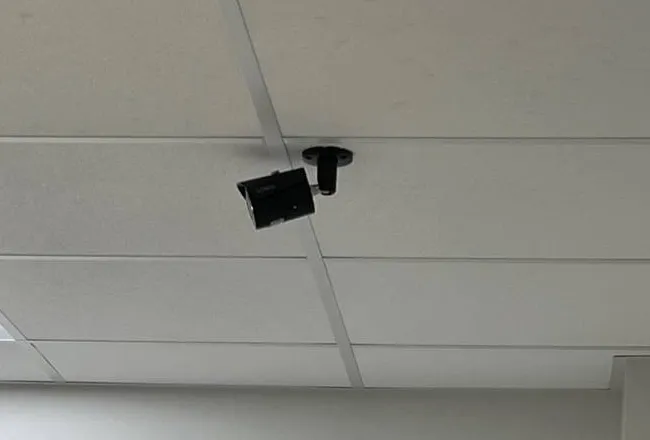
From one of our CCTV jobs (a Rockland County car dealership): a black bullet camera on a short pendant mount, fixed through the drop-tile grid. West Shore warehouse offices and plaza back rooms get the same compact ceiling mount.
Resolution, storage and remote viewing
4MP (2K) and 8MP (4K) cameras are what we fit most. 4K CCTV installation pays off where a camera covers a wide area, such as a lot or a long driveway, because you can zoom into the recording afterward. For a front door or a side yard, 4MP is plenty and uses less storage. Every system records continuously, 24 hours a day, with motion events marked on the timeline so you can jump to them, and the recorder overwrites the oldest footage when the drive is full. Two weeks of recording is included in every package.
Remote viewing runs through the manufacturer's app with no monthly fee. We create owner and user accounts on the recorder, turn on two-factor sign-in where the app supports it, change every default password, and keep the cameras on their own network segment behind the recorder so they never face the internet directly. That is the core of CCTV remote viewing security, and it is set up before we leave.
How much storage a Staten Island system needs
Storage depends on three things: how many cameras, how sharp the picture is, and how much movement each camera sees. A camera watching a quiet backyard at night produces far less data than one aimed at a busy plaza lot. Modern recorders use H.265 compression, which needs roughly half the storage of the older H.264 standard for the same picture, so a drive that once held a week now holds about two. We read each camera's actual bitrate on the recorder during commissioning and set the drive size to the retention you asked for, rather than guessing from a chart. For a house, two weeks covers almost every situation, because a stolen package or a damaged car is noticed within a day or two. Businesses that deal with disputed charges, injury claims or insurance timelines often keep longer. When the drive fills, the recorder overwrites the oldest footage without anyone touching it.
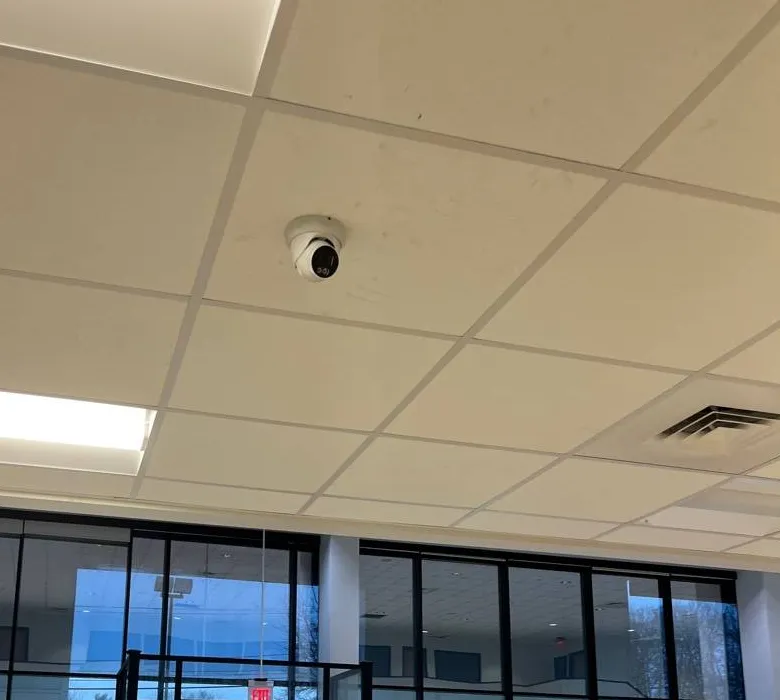
From one of our CCTV jobs (a Rockland County car dealership): a white dome in the ceiling grid looks toward the glass entrance wall. Offices at the Teleport and showrooms along Hylan Boulevard use the same entry view.
Is Your Recorder Above the Water Line?
Send the neighborhood and a photo of where your recorder sits today. We book Staten Island surveys within 2 hours and write the camera plan down before any drilling starts.
Before they call, many Staten Island homeowners have already read an AI search summary, an Angi or HomeAdvisor cost page, or a Fixr guide. Those sources are written for an average American house, and Staten Island is close enough to that average that their advice sounds right. Here are seven claims we hear on surveys, and where they part ways with what we see on the island.
"Put the recorder in the basement, out of sight"
Generic installation guides recommend the basement because it is hidden, cool and close to the cable runs. On a large share of Staten Island's East and South Shore houses, the basement is the one place the recorder should never be. The city's Sandy rebuilding report lists those shores among the five areas hit hardest by the 2012 surge, and the water reached 14 feet above ground at Tottenville.
A recorder on a basement floor is also the first thing to fail in a heavy rainstorm that backs up a drain, which happens far from the beach too. The basement is fine for cable routes; the recorder itself belongs on an upper floor, in a closet, or on a raised shelf in a utility room, with a battery backup.
We still hide it. A locked closet on the first or second floor, a cabinet in a home office or a small wall enclosure keeps it away from a burglar's eyes without putting it where a storm can drown it.
"Skip the cable; Wi-Fi cameras do the same job"
This advice assumes a compact house with a strong router in the middle. A Staten Island detached house often has its router in a front room and cameras at the far end of a driveway, on a detached garage and on a back fence, with aluminum siding, a brick chimney and a garage door in the way. Wi-Fi cameras at those spots drop out, especially in wind and rain.
Battery cameras add a second problem: they need recharging, and cold weeks shorten battery life. A house left empty for the winter, or for weeks after a storm, is exactly when a dead battery camera stops recording.
Wired PoE cameras get power and network from one cable and keep recording through a power cut as long as the recorder's battery backup lasts. Where a cable truly can't reach, we use a fixed wireless bridge between buildings, not a camera's built-in Wi-Fi.
"Staten Island is safe, so cameras aren't worth it"
Part of that is true. Staten Island's burglary count is down 21.6 percent year to date in the NYPD's November report, and in 2025 the borough logged 328 burglaries against 3,641 in 1990. Retail theft is down 30.2 percent.
But vehicle theft is up 24.9 percent year to date, to 256 reports, and the summer spike was enough for the District Attorney to call it a troubling trend. Petit larceny, which covers most package thefts, still ran at 2,764 reports through early November. A homeowner in Elm Park told the Advance last year that a package was taken in daylight in full view of a big camera.
Cameras don't stop every theft. What they do on Staten Island is record the vehicle, the time and the direction of travel, show you what happened to the property during a storm, and give an insurer or a detective something to work with.
"Cameras will identify the thieves"
AI summaries often promise that good cameras catch criminals. The NYPD, speaking about Staten Island car theft crews in July, said the opposite about masked, gloved crews: video may confirm the commission of the crime but rarely identifies the individuals responsible.
That shifts the design goal. A face camera at the front door is still worth having, because most porch thieves and opportunists don't wear masks. For cars, the higher-value footage is the getaway vehicle and its direction, captured by a wider view of the street, with an accurate clock.
We set the recorder to synchronize its time automatically and show you how to export clips in the original format with the time stamp intact. That is what makes your footage fit alongside plate readers and other cameras on the block.
"Angi and HomeAdvisor averages tell you what it costs"
National averages from Angi, HomeAdvisor and Fixr blend thousands of installs across the country, many of them a few cameras plugged into outlets. They don't account for a 90-foot cable run to a detached garage, a buried conduit across a driveway, or a recorder relocation to get it out of a flood zone.
Our Staten Island prices are published on the page: complete four-camera systems from $999 to $1,441 installed, typically $999 to $2,000 for a four-camera job on a single-family home, and $1,500 to $5,000 and up for commercial CCTV. Two weeks of recording and the phone app are included, with no monthly fee.
What moves the price is distance and surfaces. That is why extra cameras, buried runs and concealed wiring are priced per camera after we confirm the layout, not guessed from a national number.
"A 4K camera fixes poor night images"
More pixels don't add light. On a dark South Shore block between streetlights, a 4K camera with weak infrared records a sharp image of the first 30 feet and black beyond it. The camera's infrared reach, the sensor size and any added lighting matter more than resolution after dark.
We check night images on site, after sunset where the schedule allows, and adjust: a camera with longer infrared reach on the driveway, a color-night model where there is a porch light to work with, or a motion floodlight added to the camera plan.
4K is still worth it on wide views such as a lot or a long yard, where zooming into a recording afterward matters. On a front door, 4MP is usually enough.
"A UPS isn't needed; outages are rare in the city"
Generic advice treats a city address as a reliable power address. Staten Island's tree-lined streets tell a different story: Con Edison has announced single Staten Island outages from downed wires affecting 14,000 customers across Dongan Hills, New Dorp, Grant City and nearby neighborhoods. When Tropical Storm Isaias hit in August 2020, Con Edison reported about 29,000 Staten Island customers out of service at one point, and Sandy's substation damage cut power to 120,000 customers on Staten Island and in the Rockaways.
A recorder without a battery backup goes dark the second the power drops, and an outage is when burglars know alarms and lights may be off. A properly sized UPS keeps the recorder, the switch and the cameras running through short outages and lets the recorder shut down cleanly in a long one, which protects the hard drive.
We size the battery to the system's actual power draw and tell you roughly how long it should last, rather than adding a small unit that powers the recorder but not the cameras.
Get In Touch
Request a Free CCTV Installation Quote in Staten Island
A short note gets things moving: which part of the island you're in, what kind of building it is, which spots worry you most, and anything left over from a previous camera system. Snap the driveway, the rear yard, the store entrance or the basement corner where a recorder would go, and the quote comes back faster. Prefer to talk? Call or text (347) 934-8335.
✅
Request Sent!
Thank you. A scheduler will call or text you to set the Staten Island survey.
How It Works
Our CCTV Installation Process
A four-camera townhouse in Eltingville and a forty-camera yard in Bloomfield go through the same six stages. The difference is how many days the cable work takes and how much planning the recorder location needs.
1
Request and booking
Call, text or send the form. We answer and book the survey within 2 hours, with early-day slots seven days a week; paid jobs are scheduled first come, first served.
2
Walk the lot and the basement
We check flood history and the recorder location first, then walk the driveway, side yards, back fence and garage, and mark every camera spot and cable route.
3
Written plan and price
Each camera by spot and series, recorder and drive size, days of recording, battery backup, buried or concealed runs itemized, and the total. A 50% deposit books the date.
4
Cable, mounts and sealing
Runs pulled and labeled, siding blocks or masonry anchors fitted, every outdoor connection sealed with drip loops, and buried runs in conduit where they cross the yard.
5
Configure and test after dark
Views framed, detection zones drawn around driveways and gates, privacy masks set, clock synced, battery backup tested, and night images checked before sign-off.
6
Phone handover
Owner and family logins on the app, a lesson in playback and clip export, and a printed camera map with every cable route for the next visit.
How long a Staten Island job takes
A four- to six-camera install on a house with an open basement ceiling and attic access is often a single visit. Add a buried run to a detached garage, a recorder move out of a flood-prone basement, or a split-level with no attic access, and it can take longer or carry into a second visit. Plaza stores with drop ceilings move quickly; yards and warehouses are scheduled in days, sometimes with a lift. The written quote states the expected time, and we don't promise same-day installation.
Comparing Staten Island CCTV contractors before you sign
Compare quotes line by line: camera count and spots, recorder channels, drive size and days of retention, cable type, whether buried or concealed wiring is included, how cameras are mounted on your siding or brick, whether a battery backup is included, and the warranty. Ask for the New York State license number and proof of insurance. Read recent Google reviews from real customers; ours stand at 4.7★ / 201 Google Reviews. A quote that leaves the recorder in a basement that flooded in 2012 has left something out, however low the price.
Warranty and service
Every CCTV installation carries our 30-day warranty on the work, and coverage of one year or longer can be added as a paid option. Full terms — including 50% deposit, one-year parts-only warranty on Abstract Enterprises Security Systems-supplied products, and the late-fee schedule — are set out in the service agreement. For yearly lens cleaning, drive checks and firmware updates, see security camera maintenance on Staten Island.
Coverage Area
CCTV Installation Near Staten Island's Landmarks
Our crews cover the whole island, all four police precincts from the 120th on the North Shore to the 123rd on the South Shore. These landmarks are a quick way to picture the property types around each one.
⛴️
St. George Ferry Terminal and Empire Outlets
The North Shore's busiest corner: ferry crowds, outlet stores, Bay Street restaurants and the older apartment buildings and frame houses climbing the hill behind.
🛍️
Staten Island Mall, New Springville
The center of the Richmond Avenue retail strip, surrounded by big-box plazas, medical offices and the townhouse rows of Heartland Village and Bulls Head.
🌿
Snug Harbor, Livingston
The cultural center on Richmond Terrace, next to the Victorian houses of West Brighton and New Brighton and the Kill Van Kull waterfront.
🏖️
FDR Boardwalk, South Beach
The East Shore beach strip, with Midland Beach and Ocean Breeze behind it: many raised and rebuilt houses, salt air and the flood-zone recorder question.
🏛️
Historic Richmond Town
Mid-Island's historic village near Richmondtown and Lighthouse Hill, where detached houses on wooded lots need long driveway and back-fence views.
🌊
Conference House Park, Tottenville
The island's southern tip, where Sandy's surge reached 14 feet; detached houses, marinas and small businesses along Main Street and Hylan Boulevard.
We also install CCTV in Great Kills, Eltingville, Annadale, Huguenot, Prince's Bay, Rossville, Woodrow, Charleston, Arden Heights, New Dorp, Oakwood, Grant City, Dongan Hills, Grasmere, Rosebank, Clifton, Stapleton, Tompkinsville, Port Richmond, Mariners Harbor, Elm Park, Westerleigh, Castleton Corners, Willowbrook, Travis, Bloomfield, Todt Hill, Emerson Hill and Grymes Hill.
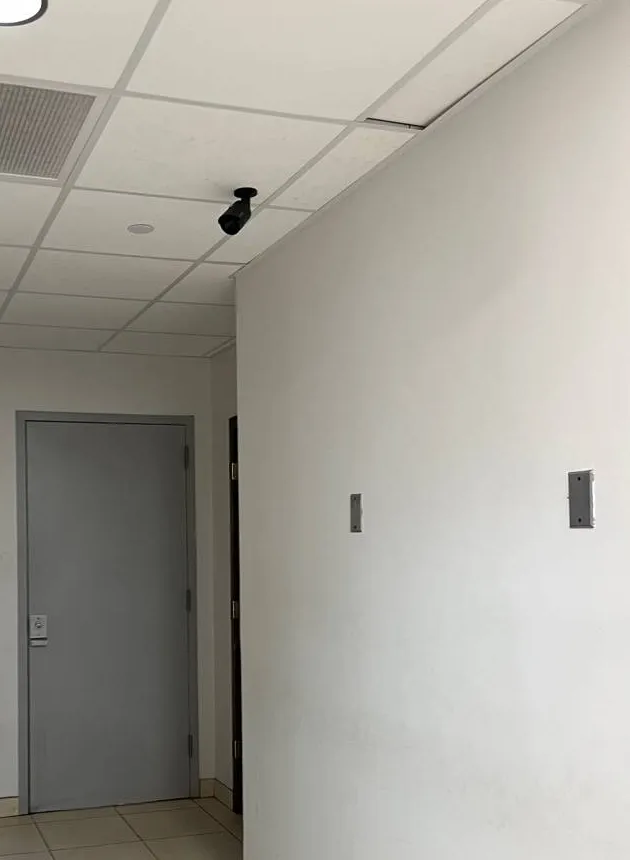
From one of our CCTV jobs (a Rockland County car dealership): a small camera at the ceiling line looks straight down the corridor to the grey rear door. Staten Island plaza stores use the same view on the hallway to the delivery door.
Pricing
CCTV Installation Cost in Staten Island
Every figure in this table is copied from our published prices for security camera installation on Staten Island; we don't quote different numbers for the CCTV wording. A series price buys a whole working system with four cameras: recorder and hard drive, the cable runs, brackets and mounting, configuration and the app on your phone, plus fourteen days of footage storage. Additional cameras, buried runs, concealed wiring and conduit are priced per camera after we confirm the layout.
Package or job type
Staten Island price
What it covers
A Series · 2MP 1080p, 4 cameras with DVR
Starting at $999
Night vision 60–100 ft, motion detection and smart AI alerts, full-color night vision, audio, remote access
F Series · 5MP DVR, 2K cameras
Starting at $1,047
Eyeball, bullet and dome housings, active deterrent with siren and lights, 20″ monitor
Eyeball and long-range models, night vision 100–120 ft, IP66, monitor included
D Series (top tier) · 8MP 4K Ultra HD IP
Starting at $1,441
Eyeball and bullet, IP67, active deterrent, two-way talk, 20″ monitor
4-camera single-family home
Typically $999–$2,000
Four cameras with recorder and professional installation on a Staten Island house
Commercial CCTV
$1,500–$5,000+
Stores, restaurants, offices and buildings of several floors, with intercom and door-access tie-ins on request
Monthly fees
$0
Footage stays on your recorder; the phone app is free
Extra cameras, buried runs, conduit, labor-only
Quoted
Set camera by camera once the survey fixes each cable route
What drives the price on a Staten Island property
Distance. Corner cameras on a compact townhouse are quick; a camera on a garage 90 feet back, or at the end of a long driveway, adds cable, conduit and time.
Crossing the yard. A buried run under a lawn or a driveway, or an aerial run along a fence, is priced separately from cable inside the house.
Getting the recorder out of harm's way. Moving it from a basement to an upper floor adds cable length and sometimes a new route between floors.
Battery backup. A UPS large enough to run the cameras as well as the recorder costs more than a small one, and is worth it here.
Surfaces and height. Vinyl siding with mounting blocks, stucco, brick, a raised house's fascia, or a warehouse wall that needs a lift.
Recorder size. A sixth or ninth camera can push a job from a 4-channel to an 8- or 16-channel unit, and keeping footage longer than two weeks means a larger drive.
Per-camera cost, labor-only rates and what a package really includes
Searchers want one number per camera, but on Staten Island it depends almost entirely on where the camera's cable goes. The honest way to price is to start with the four-camera package that fits the property and add each extra camera at a price based on its route: a fifth camera on the same eave as the first four costs far less than one on a back-fence post. For cameras you already bought, labor-only CCTV installation is quoted by phone or text from your equipment list and photos, and a deposit books the date. Financing is available on our systems; ask when you request a quote.
What your written quote lists
Our Staten Island quotes are itemized so you can hold us to them. Expect to see a numbered camera list matched to a sketch of the house or building, the series for each, then the recorder with its channels and terabytes and the number of days that drive should hold. Cable is broken out by type, with any trench, conduit or concealed section on its own line, followed by the UPS, the mounting method for siding, stucco or brick, the monitor, how many people get app access, who obtains HOA, landlord or plaza sign-off, and the warranty. Anything missing from that list is not included.
Shop Our Systems
CCTV Installation Packages & Pricing
Think of the five series as starting points, each built on four cameras and expandable as far as the recorder's channels allow. Whichever you pick, our crew installs it, sets up the app for remote viewing and leaves two weeks of footage on the drive; most series ship with a 20-inch monitor for a desk or kitchen counter.
A
A Series · from $999
The starter: a DVR with four 1080p cameras, night vision out to 60–100 feet and smart alerts. Good for a compact townhouse with a garage underneath, or a small shop's door, counter and back room.
F
F Series · from $1,047
2K cameras on a DVR with deterrent models that flash and sound a siren. Popular for a plaza store's rear door or a backyard that backs onto woods or an empty lot.
E
E Series · from $1,206
Network cameras powered over one Cat6 each, recorded on a 4K NVR, with person and vehicle detection. Our usual first suggestion for a detached house with a driveway and a garage.
C
C Series · from $1,441
True 4K on coax, ideal when an older system left usable coax in the walls. Long-range models see 100–120 feet at night, for deep lots and long driveways.
D
D Series · from $1,441 · Top tier
Our best: 4K network cameras with talk-back, lights and siren, IP67 housings for salt air, and a 20-inch monitor. Built for driveways, yards and loading doors.
Have your own kit? We'll mount and set up cameras you bought yourself. Send us the model numbers by text along with pictures of each spot; we reply with a labor-only figure, and paying the deposit puts you on the calendar. Owner-supplied gear is quoted remotely rather than with an on-site walk-through, and if those cameras are wireless, their Wi-Fi reach and the devices themselves are on the owner, not us. More on installing your own camera system.
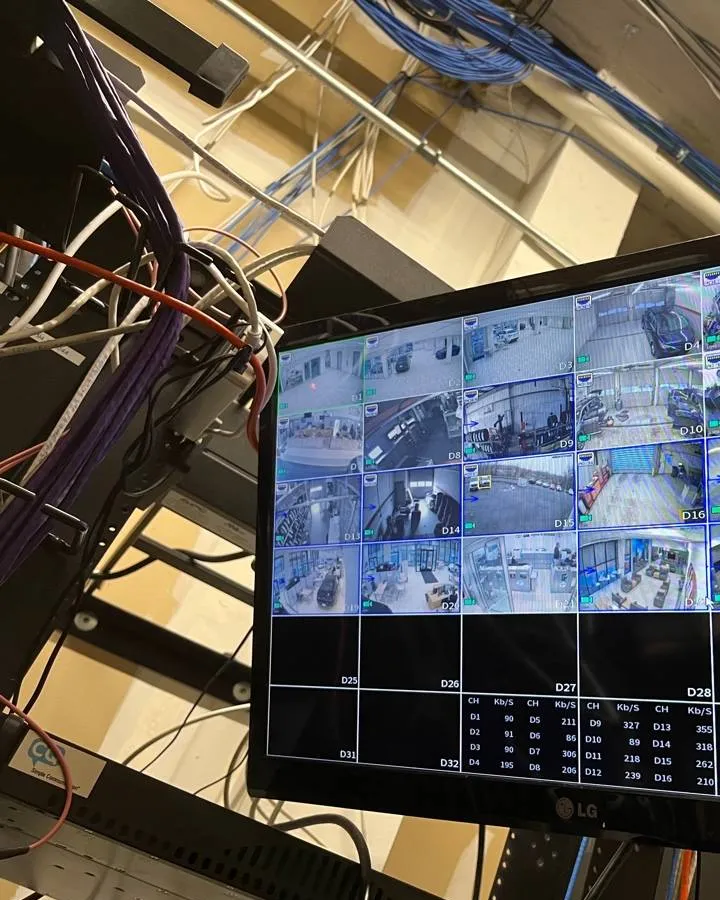
From one of our CCTV jobs (a Rockland County car dealership): bundled cable runs come down beside the recorder screen, which shows the camera grid. A West Shore warehouse or a large plaza ends up with the same head end, labeled cable by cable.
Is the $999 starting price realistic for a typical Staten Island detached house?
+
It is realistic for four cameras, which covers the front door, the driveway and two corners of a compact house. Most detached houses on the island end up with five to eight cameras once the side yards, the backyard and a detached garage are added. A four-camera job on a single-family home typically lands between $999 and $2,000 depending on the series and the cable routes, and each camera beyond four is priced after we confirm where its cable goes.
Will a new CCTV recorder work alongside the Ring or Nest doorbell I already use?
+
Yes, side by side. A Ring or Nest doorbell keeps working in its own app, and the CCTV recorder covers the driveway, yards and garage in ours. Most of those doorbells don't record into a third-party recorder, so the two systems stay separate, but we set the CCTV camera nearest the front door so it overlaps the doorbell's view and gives you a second, wider angle of the same moment.
How do you keep camera lenses clear of salt spray and spider webs near the water?
+
Placement does most of the work: cameras under an eave or a soffit stay out of the direct spray, and turret cameras avoid the night glare a salty or dusty dome cover causes, because their infrared lights sit beside the lens instead of behind a shared cover. Near South Beach, Midland Beach or Great Kills Harbor, a gentle rinse and wipe of each lens a few times a year keeps night images sharp. Our maintenance visits include that cleaning along with drive and firmware checks.
Will the cameras slow down our home internet when we watch them from work?
+
Not in normal use. The cameras record to the recorder inside your house over their own cables, which never touch your Wi-Fi. Internet bandwidth is used only while someone is watching live or playing back a clip on a phone, and the app sends a lighter sub-stream for small screens. Watching one or two cameras at a time from work uses about as much upload as a video call.
Will the crew need to get into the attic, the garage ceiling and the basement on install day?
+
Usually yes, because those are the routes cables take between the cameras and the recorder. Please clear a path to the attic hatch, the basement ceiling near the recorder spot and the garage walls where cameras will mount, and move cars out of the driveway if we are working on the garage front. We cover floors where we walk and clean up the cable scraps before we leave.
What happens when a tree grows or a neighbor's new fence blocks a camera view?
+
Call or text us and we book a service visit to move or re-aim the camera. Relocating a camera usually means a short cable extension and a new mount, not a new system. Trees on Staten Island lots grow fast between visits, so at handover we also show you how to check each camera's view in the app every few months, before a branch fully blocks it.
Does the warranty cover cameras damaged by a storm surge or a lightning strike?
+
Storm and surge damage isn't a product defect, so it isn't something the parts warranty is meant to cover; it is generally a homeowner's insurance matter. We document the damage in writing for your adjuster and quote the repair. Installing a battery backup with surge protection and keeping the recorder above the flood line is what limits that damage in the first place. Your service agreement sets out exactly what the warranty includes.
Do you put up stickers or signs saying the property is under video surveillance?
+
Signs aren't part of a standard package, but we recommend them. For a house, a small sign by the front walk or the driveway is a useful deterrent alongside the visible cameras. For a business, a sign at the entrance tells customers and staff that the premises are recorded; a store that uses face recognition must post a clear sign at customer entrances under NYC Administrative Code section 22-1202.
Can you install CCTV for a business that is opening in a new Staten Island plaza space?
+
Yes, and it is easiest before the fit-out finishes. If we run cable while the ceiling is open and before shelving and counters go in, the cameras land exactly where you want them and the wiring stays hidden. Send the floor plan and your opening date; we book within 2 hours of your request, and dates are assigned first come, first served once the deposit is paid, so earlier is better.
Can I record a nanny, a house cleaner or a contractor working inside my house?
+
In general, New York allows video recording inside your own home, with limits. Bathrooms and any space where someone undresses are off limits under Penal Law section 250.45, and recording conversations you aren't part of can fall under the state's eavesdropping law, so we install indoor cameras with audio off. Many families tell household workers that cameras are present. This is general information, not legal advice.
Can you finish a store's CCTV job before the holiday shopping rush?
+
If you book early, yes. Plaza stores on Hylan Boulevard and Richmond Avenue that want cameras working before Black Friday should call in September or October, when there is room in the schedule. We don't promise same-day installation; we book within 2 hours, work seven days a week with early-day slots, and schedule paid jobs in the order the deposits arrive.