Licensed NYS Low-Voltage Contractor · Five Boroughs
CCTV Installation in NYC
DVR · NVR · IP PoE · HD Analog · Storefronts · Walk-Ups · Co-ops
CCTV installation NYC starts at $850 for a four-camera house-brand system with the recorder, wiring, installation and two weeks of recording included, and we book your visit within 2 hours of your request. Our crew wires storefronts, walk-ups, co-ops and offices in all five boroughs, with $0 monthly fees.
Quick answer: A four-camera CCTV system in New York City runs from $850 (A Series DVR) to $1,292 (C or D Series 4K), with the recorder, cable, mounting, setup, phone viewing and two weeks of local recording included. Commercial CCTV systems for stores, restaurants, offices and multi-unit buildings run $1,500–$5,000+. Repairs, DVR/NVR troubleshooting and analog-to-digital upgrades run $150–$800. Larger or concealed-wiring jobs are priced after we confirm the layout.
Updated November 2026 by Abstract Enterprises Security Systems, NYS license #12000287431 · Sources: NYPD CompStat citywide report, week of November 2–8, 2026; Citizens Housing & Planning Council, from the 2023 NYC Housing and Vacancy Survey; NYC Landmarks Preservation Commission Permit Guidebook, Chapter 11; NYC Mayor's Office release 383-24; NYC Administrative Code §22-1202; NYS Labor Law §203-c; NYS Penal Law §§250.00, 250.05 and 250.45
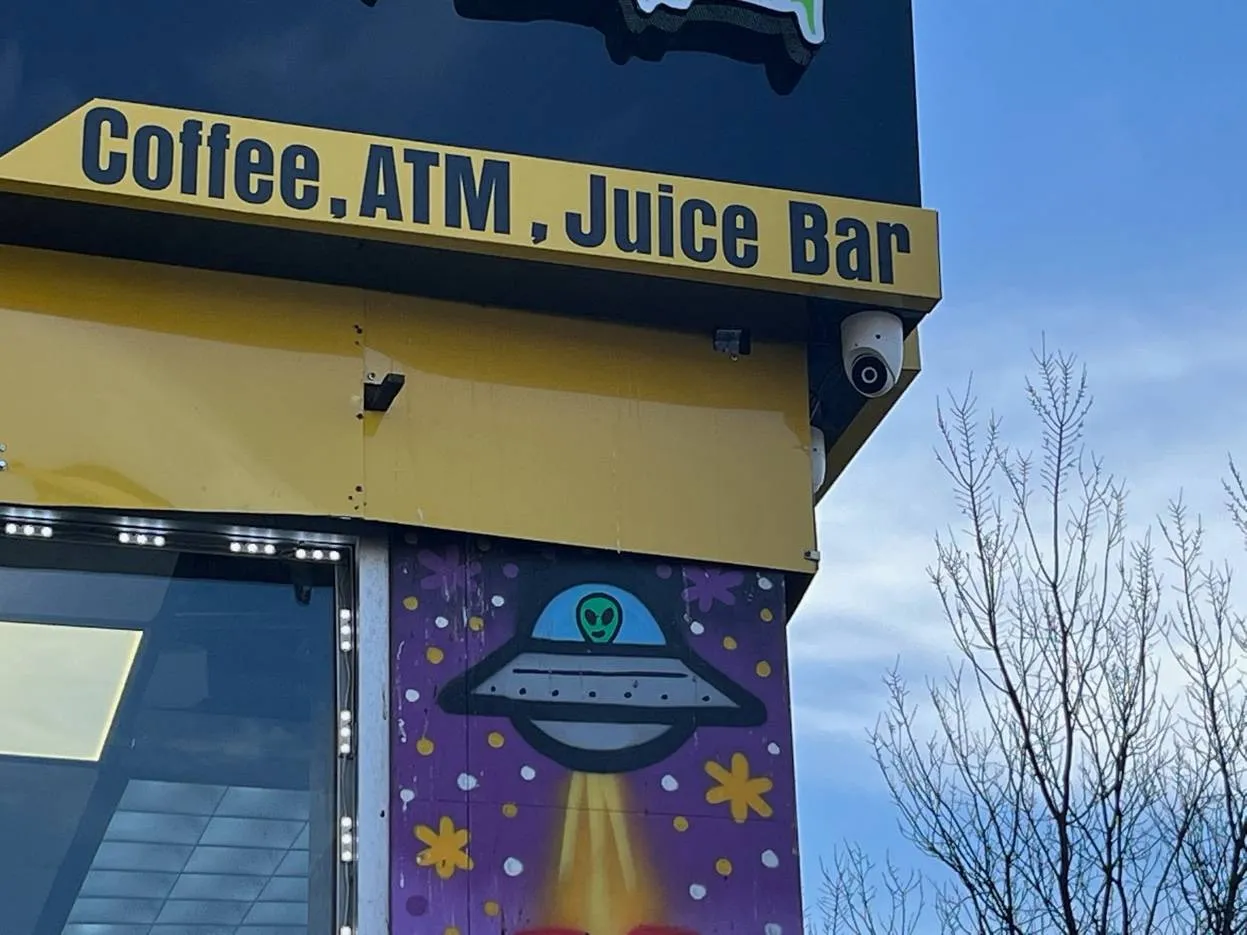
From our Manhattan corner deli CCTV job near the 157 Street station: a white turret dome sits at the corner of the awning, just under the sign band, where it can look down both sidewalks.
NYC CCTV Request
Tell us the building, the borough and roughly how many cameras
✅
Request Sent!
Thank you. We will be in touch to book your CCTV visit, usually within 2 hours of your request.
25+
Years Experience
2 Hr
Booking
100%
Licensed & Insured
4.7★
201 Google Reviews
Owner-operated since 2002 · Thousands of jobs completed · Booked within 2 hours
The Neighborhood
Why New York City Properties Need CCTV Installation
New York is a city of shared walls, shared stairs and shared sidewalks, and that changes how a CCTV system has to be designed. A camera on a suburban house watches one driveway. A camera on a Washington Heights corner store watches two sidewalks, a subway entrance, a cellar hatch and the door of the apartment building next door. A camera in a Bushwick walk-up hallway sees every tenant, every delivery and every stranger who slipped in behind a resident. Density means more people pass each lens, more angles need covering, and more owners, boards and neighbors have a say in where a camera can go.
It also means older buildings. According to the Citizens Housing & Planning Council's analysis of the 2023 New York City Housing and Vacancy Survey, about 54 percent of the city's housing, roughly two million homes, was built before 1947, and 62 percent of units sit in buildings with six or more apartments. In Manhattan the figure is 97 percent. Those numbers are the daily reality of CCTV work here: brick and plaster instead of drywall, cellar boiler rooms instead of a utility closet, stair halls with no ceiling cavity, and storefronts carved into the ground floor of a 1920s apartment house.
The theft numbers matter too, and they are more nuanced than most sales pages admit. The NYPD's CompStat citywide report for the week of November 2–8, 2026 shows 39,978 retail theft complaints so far this year, down 12.2 percent from 45,555 at the same point in 2025, and 9,537 burglaries, down 14.1 percent. Crime is falling, but nearly forty thousand retail thefts in ten months is still a lot of stolen merchandise, and every one of those complaints is stronger when the store can hand over a clear clip with a correct time stamp. When we install CCTV here, the goal is evidence that holds up, not a blinking box that makes a store look protected.
So the right CCTV system for New York City is rarely the box on a big-box store shelf. It is a wired system planned around the building: where cable can actually run, where the recorder will be safe from a smash-and-grab, which sidewalk the board or landlord will allow a lens to see, and how the owner will pull footage on a phone at 2 a.m. when the alarm company calls. That planning is what a CCTV installer is really paid for.
New York City facts that shape every CCTV job
39,978 retail theft complaints citywide in 2026 through November 8, down 12.2% year over year (NYPD CompStat, preliminary).
9,537 burglaries citywide in the same period, down 14.1% from 11,099 (NYPD CompStat).
About 54% of homes were built before 1947, which means masonry, plaster and cellar equipment rooms on most jobs (CHPC from the 2023 NYCHVS).
62% of units are in buildings of six or more apartments, so most residential CCTV is a common-area, board or landlord decision (CHPC).
35 businesses in Flushing's 109th Precinct joined the first NYPD camera registration and integration pilot in June 2023, later expanded to nine more precincts (NYC Mayor's Office).
Two cameras per 25 feet of street frontage is the staff-level limit on small landmarked buildings, under the Landmarks Preservation Commission's permit guidance.
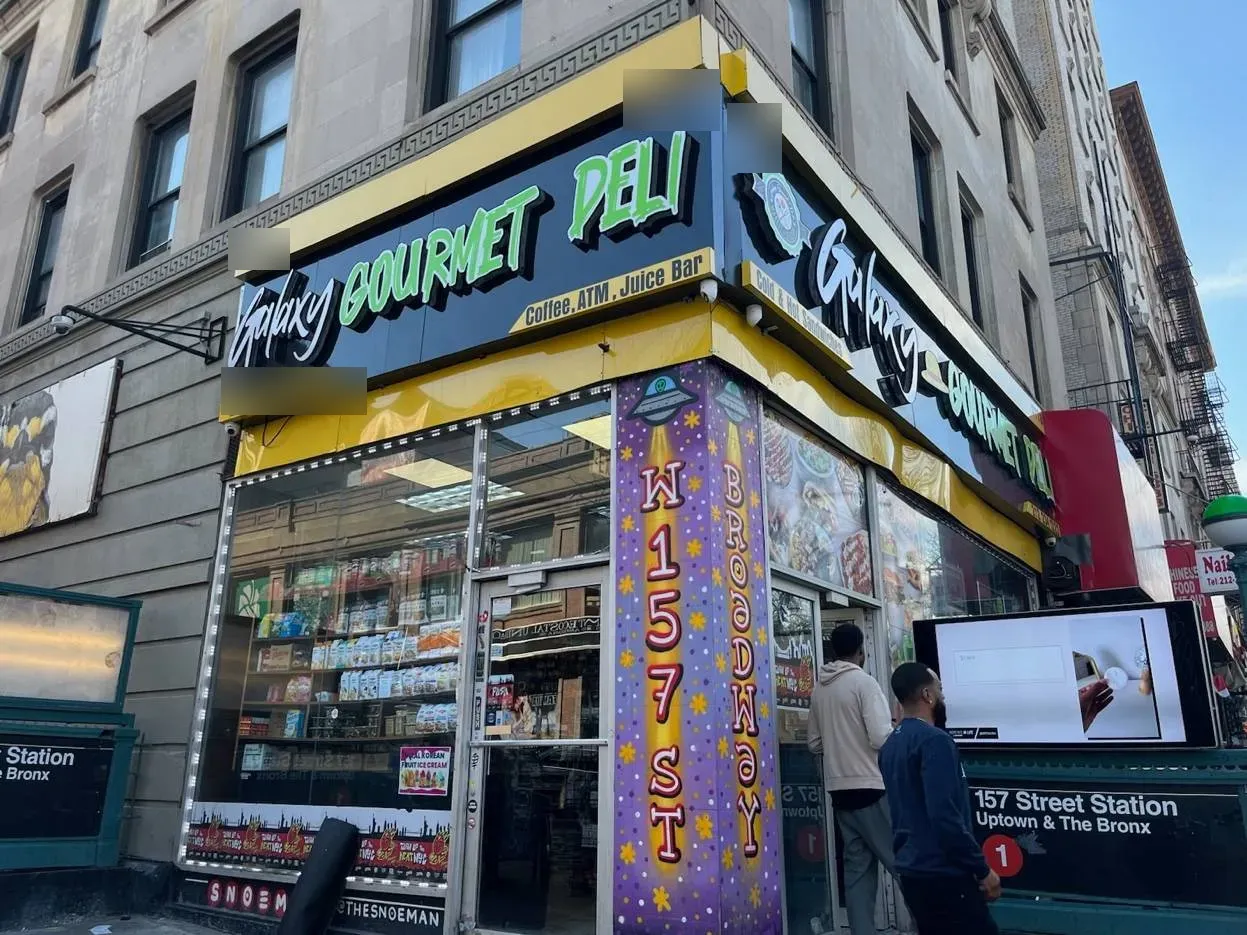
The same Manhattan corner deli: small cameras sit under the awning edge on both frontages and a camera on a black steel arm projects from the stone facade, a few steps from the 157 Street subway entrance.
How CCTV jobs differ across the five boroughs
Manhattan is storefronts under apartment houses, elevator co-ops, office suites and a lot of landmarked frontage. Jobs here are about tight access hours set by managing agents, certificates of insurance before the crew is allowed upstairs, and cameras that have to pass a board's or the Landmarks Preservation Commission's eye. Upper Manhattan, from Harlem to Inwood, adds dense rows of corner stores and five- and six-story walk-ups where the recorder almost always ends up in the cellar.
Brooklyn mixes brownstone and row-house blocks with walk-ups, newer condo buildings and industrial lofts. Homeowners ask for the stoop, the areaway, the garden and the back fence; landlords of small walk-ups ask for the front door, the mailboxes and the roof hatch; warehouse and studio tenants in the industrial pockets ask for loading doors and long fence lines.
Queens covers everything from the busy retail of Main Street in Flushing and Jamaica Avenue to attached two-family houses with driveways and detached homes with yards. Driveway and garage coverage comes up far more often here than in Manhattan, and so do multi-camera systems for small restaurants and markets.
The Bronx has large pre-war elevator buildings along the Grand Concourse, walk-ups in every neighborhood, the shopping strip on Fordham Road and industrial blocks in Hunts Point and Port Morris. Big-building jobs often start with an old analog system: we test what is there, keep the good coax, and move the building onto a new recorder.
Staten Island is mostly one- and two-family homes, so residential CCTV looks more like a suburban job: driveways, side yards, garages and porches. Commercial work centers on strip-center stores, auto shops and parking lots, where plate-readable views of the entrance are the priority.
Abstract Enterprises Security Systems has worked in this building stock since 2002 from our offices at 1282 Troy Ave in Brooklyn and 460 E Fordham Rd in the Bronx. We are not a national dispatch network that sends whoever is closest. The same crew that surveys your building installs it, and the same office answers when you need a camera moved or a hard drive replaced two years later.
What We Install
CCTV Installation Services in NYC
Every CCTV installation service we sell ends the same way: cameras mounted where they see faces and plates, cable dressed and labeled, the recorder set to keep the footage you need, and the system on your phone before we leave. What changes from job to job is the mix below.
📹
Complete CCTV system installation
Cameras, recorder, hard drive, cable, mounting, programming and phone app in one visit plan. Our house-brand four-camera systems include two weeks of recording, and most come with a 20-inch monitor for the counter or the super's office.
🔌
IP and PoE CCTV installation
Network cameras powered over one Cat6 cable each from a PoE recorder or switch. This is our default for new work: one cable per camera, 4K-capable, and easy to add to later.
📼
HD analog CCTV installation
HD-TVI, HD-CVI and AHD cameras on coax to a DVR. When a building already has good RG59 runs, an HD analog upgrade reuses them and avoids opening walls.
🏪
Storefront and retail CCTV
Bodegas, delis, pharmacies, phone stores and laundromats: door and register coverage, aisle domes, sidewalk views and a monitor customers can see. More on this in the commercial section below.
🏢
Apartment building CCTV
Lobby, vestibule, mailroom, stair halls, roof door, cellar, laundry room and trash area for walk-ups, elevator buildings, co-ops and condos, with footage the managing agent can pull on request.
🗄️
NVR and DVR installation
Recorder sizing, drive selection, retention settings, time sync and remote access. A recorder that overwrites in four days is the most common failure we find on older systems.
🔄
Upgrades and replacements
DVR to NVR, analog to IP, 1080p to 4K, dead cameras replaced, cameras relocated after a renovation, and recorders swapped when the old one no longer talks to a phone.
🛠️
CCTV repair and troubleshooting
Video loss, night picture gone white, no remote view, drive errors, power supply failures and water in a connector. Repairs, DVR/NVR troubleshooting and analog-to-digital upgrades run $150–$800.
📱
Remote viewing and mobile app setup
We set up the app on the owner's and manager's phones, create separate users with the right permissions, and show you how to export a clip for the police or your insurance company.
🧰
Labor-only installs
Already bought a kit? We install customer-supplied cameras for a labor price quoted by phone or text and booked with the deposit.
From one of our CCTV jobs: a small white dome on a drop-tile ceiling, set beside, not under, the light panel so the fixture does not flare the image.
What is CCTV installation, in plain terms?
CCTV stands for closed circuit television: cameras that send video over a private cable to a recorder you control, rather than broadcasting it. Closed circuit television installation used to mean analog cameras, coax and a VCR. Today the same idea covers HD analog cameras on coax to a digital video recorder (DVR) and IP cameras on network cable to a network video recorder (NVR). The video still lives on your recorder, on your premises. The internet is only used when you choose to view it remotely.
A CCTV installation job has five parts: design (which camera, which lens, where, and why), cabling (the path each cable takes from the camera to the recorder), mounting (the right box, bracket or arm for the surface), commissioning (recording schedules, motion and smart detection zones, night settings, time sync, user accounts and remote access) and handover (showing you how to find and export footage). Skipping any one of them is how a city building ends up with eight cameras that record nothing useful.
Residential CCTV for houses, brownstones and two-families
Home CCTV installation in the city is usually four to eight cameras. A typical brownstone gets one camera over the stoop looking down at visitors' faces, one at the areaway gate under the stoop, one on the rear facade over the garden, and one inside the parlor-floor hall. A Queens or Staten Island two-family adds the driveway, the side alley and the garage door. We put the recorder in the basement or a closet, give each household its own login if it is a two-family, and set up motion alerts that ignore the sidewalk so the phone only buzzes when someone comes onto the property.
Package theft from vestibules and stoops is one of the most common reasons homeowners call. A camera at the right height, aimed at the door rather than the street, records the face of whoever picks up the box, which is what a police report or a building manager needs. A wide camera across the whole street usually does not.
Offices, medical and dental suites
Office CCTV installation in a Manhattan or downtown Brooklyn tower is a tenant job inside the landlord's rules. The building's own cameras cover the lobby and elevators; the tenant's system covers the suite entrance, reception, the server or IT closet and sometimes a storage room. Medical and dental offices keep cameras out of treatment and exam rooms and away from screens with patient information, and point them at the entrance, the waiting room and the front desk instead. Cable usually runs above the hung ceiling to a small recorder in the IT closet, on the tenant's own network rather than the building's, and the landlord's engineer often wants to see the plan before we open the ceiling.
When people call us
Most CCTV calls in New York City come at one of a few moments. After a break-in or a burglary, when the owner discovers the old DVR overwrote the footage or never recorded at all. Before the holiday shopping season, when stores want the aisles and register covered before Black Friday traffic. At a new business opening or grand opening, when the build-out is the cheapest time to run cable. When a building changes hands or a new board takes over and inherits a mix of dead cameras. And when a property sits vacant during a renovation, where copper theft and squatters are the concern. Each one points to a slightly different system, which is why we ask what happened before we talk about cameras.
Building Specialists
CCTV Installation for New York City's Architecture
Most of the time on a city CCTV job is not spent mounting cameras. It is spent getting cable from where the camera has to be to where the recorder can safely live, through walls that were built before anyone imagined a network cable. These are the building types we see most, and how each one changes the plan.
🧱
Pre-war walk-ups
Four to six floors, a single stair, brick bearing walls, plaster on lath and often no hung ceiling anywhere. Cable usually rides an existing riser chase, the dumbwaiter shaft, or surface raceway painted to match the stair hall, and the recorder goes in the cellar or a locked closet off the first-floor hall.
🏛️
Co-ops and condos
The board or managing agent approves every camera in a common area, and often wants a written camera list before anyone drills. We prepare a placement plan the board can review, keep lenses off apartment doors where the house rules require it, and set up separate viewer logins for the managing agent and the super.
🏠
Brownstones and row houses
Stoop, areaway, garden door and the back yard are the four views owners ask for. Brownstone and limestone fronts are often inside historic districts, so front-facade cameras follow Landmarks Preservation Commission rules, while the rear facade is usually simpler.
🏬
Mixed-use storefront buildings
A store on the ground floor and apartments above. The store's CCTV belongs to the tenant, the building's lobby cameras belong to the landlord, and the cable paths and recorder locations have to stay separate so each party controls its own footage.
🏙️
Elevator rentals and towers
Telecom closets on each floor, a shared riser, a lobby desk and sometimes an existing analog system from the 2000s. These jobs are mostly about reusing good risers, adding PoE switches per floor and putting the whole building on one NVR with clean labeling.
🏚️
Vacant and under-renovation buildings
Copper theft, squatters and dumping are the worries. We install a compact recorder with a battery backup in a locked enclosure and cover entrances, the cellar door and the yard, then extend the system when the building is occupied.
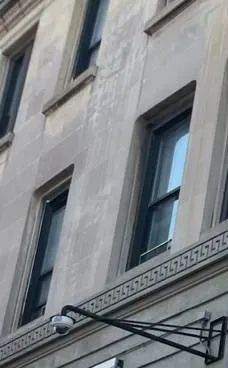
From one of our CCTV jobs: a dome camera on a black steel wall arm, fastened to plain stone below a carved band, so the decorative work is left untouched.
Cable through masonry, plaster and pressed tin
CCTV wiring in a pre-war building is a set of choices, not a single technique. Through solid brick we core small holes at mortar joints so the patch disappears and the wall face is not cracked. Inside plaster-on-lath walls we fish where cavities exist, often from the cellar up inside a closet partition, and stop where fire blocking or a masonry return makes fishing impossible. Pressed-tin and plaster ceilings in older stores are a no-drill zone unless the owner wants it, so cable travels behind crown moldings, inside soffits or in slim raceway. Every opening we make into a rated wall or floor is closed with firestop material, because a CCTV cable through a fire separation is still a penetration.
Cellar recorder rooms
The cellar is where most New York City recorders end up: it is central to the cable paths and out of a burglar's reach. It is also damp, dusty and shared with boilers and meters. We mount the NVR or DVR on a shelf or a small wall rack off the floor, away from the boiler's heat, on a battery backup, and in a locked cabinet when the cellar is shared with other tenants. The live view goes upstairs to the monitor over a single cable, so the box that actually holds the evidence never sits behind the counter where it can be carried out.
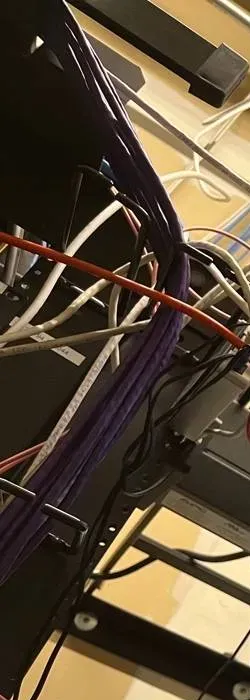
From one of our CCTV jobs: purple and white cable bundles dressed down the side of an equipment rack, with a red cable crossing to the gear.
Shared risers and conduit paths
Many elevator buildings already have a telephone or cable-TV riser running floor to floor. Where the landlord or board allows it, we pull Cat6 up that path to a small PoE switch on each floor or every few floors, so no single camera cable has to travel the full height of the building. Cat6 carries power and video about 328 feet (100 meters) per run; a twelve-story building with the recorder in the cellar quickly passes that, so floor switches or fiber between floors are part of the design rather than an afterthought. Exterior runs, cellar runs exposed to damage and runs in commercial kitchens go in conduit.
Landmarked buildings and historic districts
If the building is an individual landmark or sits in a historic district, cameras on the street facades need a Landmarks Preservation Commission permit. The LPC Permit Guidebook lets staff approve security cameras when the installation meets its criteria: cameras well spaced, no more than two per 25 feet of street frontage on small buildings and three on large ones, attached at mortar joints, plain masonry, wood or metalwork, never through cast iron or decorative surfaces, and conduit concealed, with only about ten inches of visible conduit allowed and painted to match. The application needs the camera's cut sheet. We design landmarked jobs to those rules from the start, provide the cut sheets and photos, and wait for the permit before mounting anything on the primary facade. Anything outside the staff criteria can go to a public hearing, which is slower, so we try hard to stay inside them.
Vestibules, stair halls, mailrooms and roofs
Apartment building CCTV in the city comes down to a short list of choke points. The outer door and the vestibule between the two doors, where a camera inside the inner door records faces as people buzz in. The mailboxes and package area, where most theft complaints start. The stair at the first floor and the roof landing, because the roof door is how people get in from the next building. The cellar door, the laundry room and the trash or recycling area, which is where tenants' complaints about strangers and illegal dumping usually point. In an elevator building, a camera in the elevator lobby on the ground floor and one in each car are common requests. Cameras that look into individual apartments are not part of any plan we draw.
Stair halls are the hardest spot to light and the easiest to get wrong. A camera at the top of a flight looking down sees the top of every head; one at the landing looking toward the door sees faces. Hallway lighting on timers or motion sensors also matters, because a camera that switches between infrared and daylight every few minutes gives grainy, flickering footage. We note those fixtures on the survey and set the cameras to match.
Outdoor mounting on brick, stone and awnings
Outdoor CCTV installation on city buildings means fastening to a surface that is a hundred years old. On brick, we anchor into solid brick or mortar joints with the right anchors and a junction box so the cable connection is not exposed to rain. On stone, we avoid carved bands, cornices and lintels. Under awnings, we mount to the awning frame or the sign band only when it is solid enough, and run the cable inside the frame. Every exterior camera gets a weatherproof junction box or back box and a drip loop, because water in a connector is the single most common reason outdoor cameras die after a winter.
Taking over an old analog system in a large building
Many large Bronx, Upper Manhattan and Brooklyn buildings already have a CCTV system from the 2000s: a dozen or more analog cameras, coax up the risers and a DVR in the super's office that may or may not still record. Before quoting a new system we test each cable run, note which cameras still work, and check whether the old cable paths reach the places the board or owner now cares about. Good coax gets reused with HD analog cameras or Ethernet-over-coax adapters; damaged or water-soaked runs get replaced with Cat6. The old recorder comes out, the new one goes in somewhere secure, and every camera gets a new label that matches the camera map. Owners usually end up with a 4K-capable system on much of the cable they already paid for.
Who owns the footage, and who can see it
In a multi-unit building, the question of who can view CCTV footage matters as much as where the cameras go. In a rental, the landlord owns the system and decides who views it. In a co-op or condo, the board usually sets a written policy: who has live view (often the super or the doorman), who can review recordings (often the managing agent), and how a resident asks for footage of an incident. We set up the recorder to match that policy, with separate accounts for each role, so live view at the front desk does not come with permission to export or delete recordings. In a mixed-use building, the store's recorder and the building's recorder stay separate, so each party controls its own footage.
Co-op board and landlord approval
In a co-op or condo, hallways, lobbies and facades are common elements, so cameras there are a board decision. As attorney Ricardo M. Vera of Newman Ferrara LLP explained in a Cooperator News Q&A, condo documents typically bar owners from changing common elements without board approval, and cameras that record audio raise bigger concerns under New York Penal Law. Renters face the same thing with the landlord: a store tenant may install CCTV inside the leased space but usually needs written consent before drilling the facade or the shared hallway. We ask who has signed off before we schedule, and we do not install on common elements without it. This is general information, not legal advice; your board's documents and your lease control.
Commercial CCTV
Business CCTV Installation in NYC
Commercial CCTV installation in New York City is mostly small business work: delis, bodegas, pharmacies, restaurants, salons, laundromats, phone repair shops and the offices upstairs from them. Commercial CCTV systems for stores, restaurants, offices and multi-unit buildings run $1,500–$5,000+, depending on the number of cameras, the recorder, how much of the cable has to be concealed and how many locations share one app.
The corridors we work on most
Broadway in Washington Heights and Inwood: corner delis, bodegas and phone stores beside the 1-train entrances, many in 1910s–1920s apartment houses with stone fronts.
125th Street in Harlem: national chains next to family stores; the 125th Street BID is one of the areas in the NYPD's camera integration pilot.
Fordham Road in the Bronx: apparel, sneaker and discount stores with deep sales floors and high theft pressure around the holidays.
Fulton Street and Flatbush Avenue in Brooklyn: busy retail strips with rolling gates, narrow frontages and stockrooms in the cellar.
Main Street in Flushing and Jamaica Avenue in Queens: dense mixed retail, restaurants and upstairs offices; the 109th Precinct in Flushing hosted the first NYPD camera registration pilot.
Staten Island's Richmond Avenue and Forest Avenue: strip-center stores with parking lots, where plate-readable views of the lot matter as much as the register.
Bodegas, delis and corner stores
Corner stores are the most common commercial CCTV job we do in the city, and they follow a pattern. Two or three cameras look down both sidewalks from under the awning so the entry approach is recorded from each street. One camera sits over the door at face height on the way in. One covers the register and the cash drawer from behind and above the clerk. Domes over each aisle and the cooler doors, one over the deli counter, one in the stockroom or cellar, and one at the back door or the cellar hatch. That is usually eight to twelve cameras for a typical corner store, which is why a 16-channel recorder is the sensible size even if you start with eight.
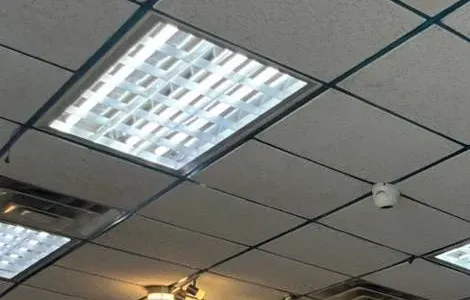
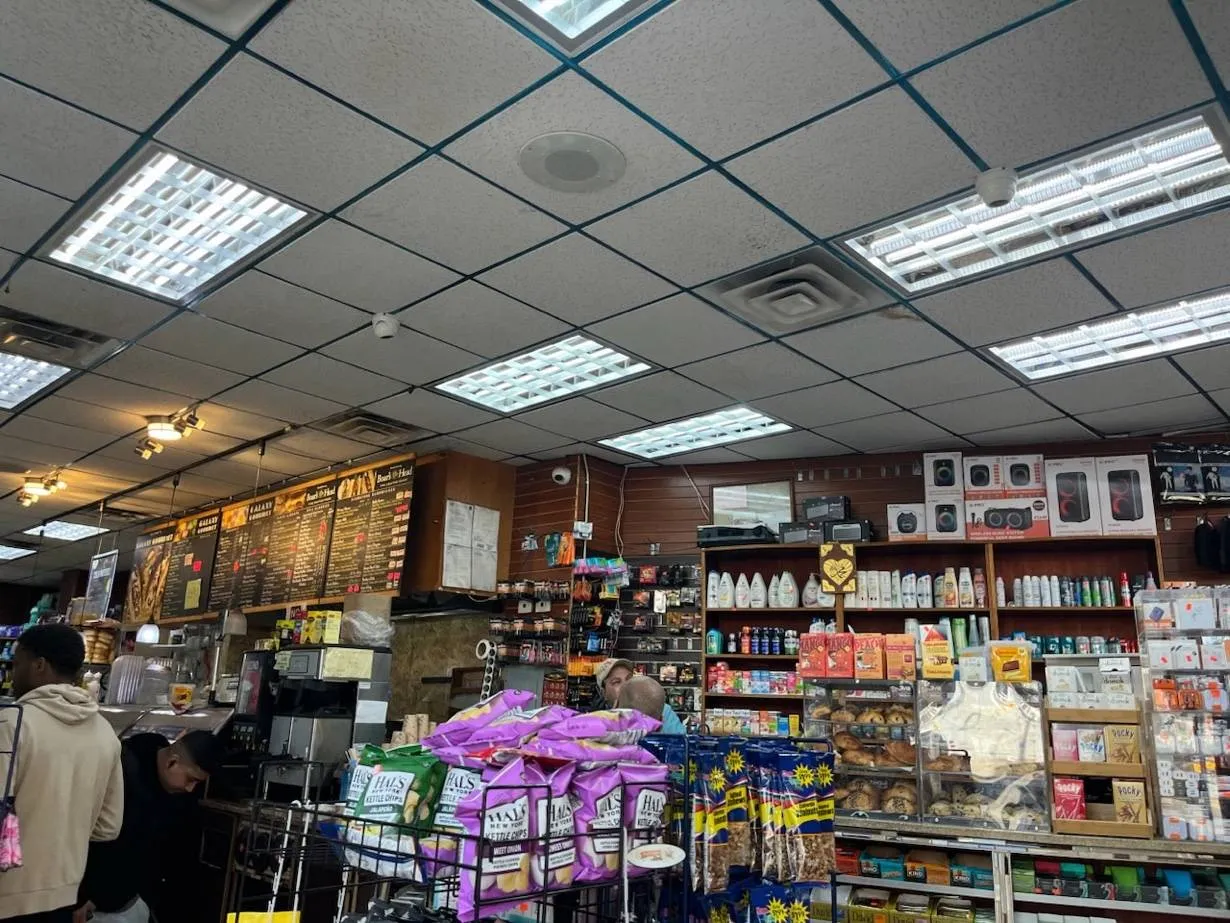
Inside the Manhattan deli: small white domes on the drop-tile ceiling between the light panels, covering the aisles, the snack racks and the sandwich counter.
Field Notes
A Manhattan corner deli near the 157 Street station. This store sits on the corner of Broadway, in the ground floor of a stone-fronted apartment house, a few steps from the 157 Street subway entrance. The photos on this page are from that job. Outside, a white turret dome is tucked under the corner of the yellow awning, right below the sign band, where it can look down both frontages and is out of easy reach. A second camera rides a black steel wall arm off the stone facade at the far end of the storefront, and smaller cameras sit under the awning edge along both frontages. Inside, small domes sit on the drop-tile ceiling over the aisles, the snack racks and the sandwich counter, placed between the light panels so the fixtures do not wash out the image at night.
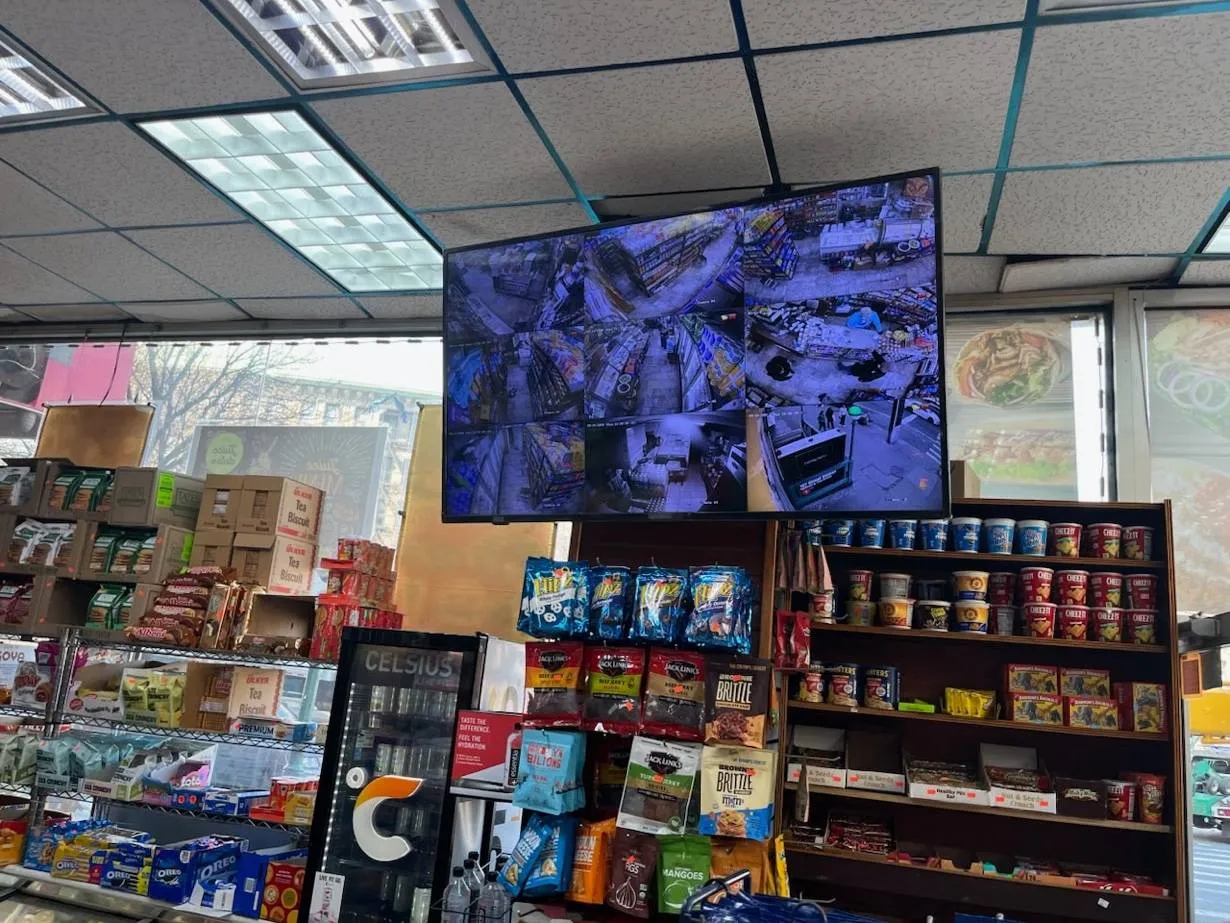
The owner wanted to see the whole store from the counter, so a wall-mounted TV over the shelving shows the multi-camera grid: aisles, the register, the cooler wall and the entrance in one view. That monitor does two jobs. Staff can watch the floor while they make sandwiches, and every customer who walks in sees that the store is recorded. On a corner store, that visible monitor often does as much as the cameras themselves.
The live view in the Manhattan deli: a wall-mounted TV above the shelving shows the camera grid, so staff can watch the floor and every customer can see the store is recorded.
Pharmacies, phone stores, laundromats and liquor stores
Each small-store type has its own weak spot. Pharmacies need the counter, the front-end shelves of health and beauty products and the delivery door. Phone and electronics stores need tight views of the display cases and the repair bench, where the most expensive items sit. Laundromats run long hours with one attendant, so owners want the change machines, the folding tables and the door, plus a phone view to check on the store from home. Liquor stores need the register and the top-shelf wall, where bottles worth a hundred dollars sit within arm's reach. We plan each of these around the items that actually go missing, which the owner usually knows better than anyone.
Why a recorder in the back beats a box under the counter
The most common mistake we see in city stores is a DVR on the shelf under the register, beside the monitor. A burglar who knows anything about cameras takes the recorder first, and the footage leaves with it. Our corner-store installs put the recorder in the cellar, a locked office or a hidden enclosure, run one display cable to the monitor at the counter, and set up the phone app so the owner can pull clips even if the store is closed. It costs little extra at install time and it is the difference between a police report with video and one without.
Holiday season, Black Friday and after a break-in
Retail CCTV calls peak twice a year: in the weeks before the holiday shopping season, and in the days after a store has been hit. Before the holidays, the priority is the register, the high-value shelves near the door and the stockroom where seasonal inventory piles up. Owners who book in October or early November get the system in and tested before Black Friday traffic; owners who call the week of Thanksgiving are competing for the same install slots as everyone else. After a break-in, the first job is a look at what the old system actually recorded. Usually the answer is that the recorder overwrote the night within days, the clock was hours off, or the camera over the door was pointed at the ceiling after someone bumped it. We fix those first, then add what was missing.
New stores and build-outs
A new business opening is the cheapest time to install CCTV, because the ceiling is open and the walls are not painted yet. If you are building out a storefront, a restaurant or an office, bring us in when the electrician is roughing in. We pull camera cable to each location, leave it coiled and labeled, and come back after the ceiling and finishes are done to mount cameras and set up the recorder. That avoids opening a finished ceiling later and keeps the cable completely hidden.
Restaurants, salons and offices
Restaurants want the host stand, the bar, the register, the back door and the delivery pickup shelf; kitchens get conduit and cameras rated for grease and steam. Salons and medical or dental offices usually need the entrance, reception and the cash area only, with treatment rooms left alone. Offices want the suite door, reception and the server closet. In every case we design the views around a question: if something happens here, which camera gives you the face, and which one gives you the time and direction of travel?
Warehouses, garages and lots
Industrial blocks in the South Bronx, Sunset Park, Long Island City and Maspeth bring loading docks, high ceilings and long fence lines. These jobs use bullet and varifocal cameras with longer infrared range, plate-readable views at the gate, and fiber or PoE extenders where runs pass 300 feet. See our warehouse camera page for that work in more depth.
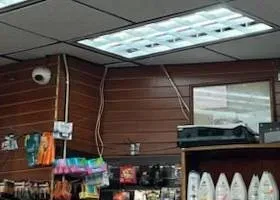
From one of our CCTV jobs: a dome camera mounted near the ceiling above a wood-panel wall, looking over the shelving below.
Parking garages, lots and construction sites
Garage and lot CCTV is built around the entry lane. One camera framed tight on the lane at plate height and an angle the plate can be read from, one wider camera showing the car and the driver, and overview cameras covering the rows where break-ins happen. Garage ramps under buildings are often dark and wet, so we use cameras rated for the conditions and mount them out of the way of tall vans. Construction sites need something different: temporary power, cameras on poles or the hoist, a recorder in a locked job box, and a plan to move cameras as the building rises. Our parking lot camera page covers lot layouts in more depth.
Owners with several stores or buildings
Many New York owners run more than one location: two delis in different neighborhoods, a few walk-ups across two boroughs, or a restaurant group. For multi-site CCTV we keep each location on its own recorder, so a broken internet line at one site does not affect the others, and put all the sites in one app on the owner's phone. Every site uses the same camera naming, the same retention target and the same password rules, so the manager who covers a shift at the second store already knows where to look. When the owner opens a new location, the system matches the others from the first day.
Compliance callouts for NYC businesses
No cameras in restrooms, locker rooms or changing rooms. New York Labor Law §203-c bars employers from video recording in those rooms. We will not install there.
Audio is a separate decision. New York's eavesdropping law (Penal Law §250.05) makes it a crime to record a conversation unless at least one party consents. Cameras with microphones can be ordered with audio off, and we leave it off unless the owner decides otherwise after taking advice.
Biometric signs. Under NYC Administrative Code §22-1202, in force since July 2021, retail stores, food and drink establishments and entertainment venues that collect customers' biometric identifiers, such as face geometry, must post a clear sign at customer entrances and may not sell or share that data.
Unlawful surveillance.Penal Law §250.45 covers recording people where they have a reasonable expectation of privacy, such as dressing or undressing. Camera views stop at your property's private spaces.
Police access is voluntary. The NYPD's camera program lets a business register or integrate its CCTV with the local precinct for free, and the owner chooses how and when police can see it.
None of this is legal advice. It is the short list we walk through with every store owner so the system we install is one they can defend.
Your Questions Answered
CCTV Installation in NYC: Questions Answered
How much does CCTV installation cost in New York City for a four-camera system?
Our house-brand four-camera systems start at $850 for the A Series, $898 for the F Series, $1,057 for the E Series and $1,292 for the C Series or the top-tier D Series. Each price includes the cameras, the recorder, the wiring, the installation and two weeks of recording, with no monthly fee. Extra cameras, concealed wiring through finished walls and conduit are priced per camera after we confirm the layout, because a camera on a drop ceiling and a camera fished down three floors of plaster are not the same job.
Do I need permission from my co-op board or landlord before CCTV installation in an NYC building?
For anything outside your own unit or leased space, usually yes. Lobbies, hallways, facades and roofs are common elements in a co-op or condo and the landlord's property in a rental, so the board, managing agent or owner has to approve cameras there. Inside a store you lease, you can typically install CCTV, but drilling the facade or running cable through the cellar still needs the landlord's consent. Get it in writing; we ask for it before scheduling.
Can you mount cameras on a landmarked brownstone or pre-war facade in NYC?
Yes, with the right permit. In a historic district or on an individual landmark, the Landmarks Preservation Commission's staff can approve cameras that are well spaced, sized discreetly, fastened at mortar joints or plain masonry rather than decorative stone or cast iron, and fed by concealed conduit. Small buildings are limited to two cameras per 25 feet of frontage at staff level. We lay out the job to those rules and supply the camera cut sheets for the application.
Where should CCTV cameras go in a New York City bodega or corner deli?
Start with the door, the register and the sidewalk approach, because those three views identify who came in, what they did at the counter and which way they left. Then cover each aisle, the cooler wall, the deli counter, the stockroom or cellar and the back door. Under-awning domes facing both streets catch faces before the hood goes up. A visible monitor near the counter tells every customer the store is recorded.
How many CCTV cameras does a five-story NYC walk-up need?
A typical twenty-unit walk-up gets eight to twelve: the street door from outside, the vestibule and mailboxes, the first-floor hall, one camera per stair landing or every other landing, the roof door, the cellar door, the laundry or boiler room and the trash area or rear yard. The exact count depends on how the stair turns and whether the board wants every floor covered or only the entry points. We count on the walk-through, not from the street.
Where does the recorder go in a building with no closet space?
In most city buildings, the cellar. It is central to the cable paths and hard to reach for anyone who does not belong there. We mount the NVR or DVR off the floor, away from the boiler, on a battery backup and in a locked cabinet if the cellar is shared. In a store with no cellar access, a locked enclosure above the hung ceiling or in the office works. The recorder should never sit on the counter where a thief can grab the evidence along with the cash.
Can CCTV wiring be hidden in pre-war plaster and brick walls?
Often, but not always all the way. We fish cable inside partition walls and closets, route through cellar ceilings and existing chases, and hide runs behind moldings and in soffits. Where solid brick or a masonry return leaves no cavity, a short length of slim raceway painted to match is the honest answer, and we tell you where that will be before we start. Concealed wiring is priced after we confirm the layout.
Is it legal to record audio on CCTV cameras in a New York store?
Recording video in the public areas of your own store is generally allowed. Audio is different: New York's eavesdropping law requires at least one party to a conversation to consent, and a camera recording customers talking at the counter is not a party to that conversation. That is why we ship audio-capable cameras with audio switched off. Talk to a lawyer before turning it on; this is not legal advice.
Should my store register its cameras with the local NYPD precinct?
It is your choice. Under the program the Mayor's Office announced in May 2024, a business can register its CCTV so the precinct knows where cameras are, or integrate it so officers can view feeds, with the owner deciding how and when police get access, and it costs nothing. Either way, keep your own recorder, keep its clock correct, and know how to export a clip, because the detective will still ask for the file.
How long should an NYC business keep CCTV footage, and how much storage does that take?
Most stores find out about a theft days later, so we set retention at two weeks as a minimum and a month where the drive allows. Storage depends on cameras, resolution, compression and how much motion each view sees. As a rough guide, one 4MP camera on H.265 recording around the clock uses roughly 15–25 GB a day; eight of them for 30 days needs several terabytes. We size the drive to your retention target and test it before we leave.
Will you install CCTV cameras I already bought, and what does labor-only cost?
Yes. We install customer-supplied cameras and recorders for a labor price quoted by phone or text from your camera list, layout and photos, then booked with the deposit. We do not do walk-throughs for customer equipment, and we can't take responsibility for a customer's own wireless cameras' signal or hardware. If a kit camera will not suit a location, we will say so.
How fast can you book CCTV installation in NYC, and do you work weekends?
We book within 2 hours of your request and schedule seven days a week, with early-day visits. Slots are first come, first served once the deposit is paid. We do not promise same-day installation, because the right system for your building depends on the survey, and a rushed install is how cameras end up pointed at ceilings.
Can I watch my NYC CCTV system on my phone without paying a monthly fee?
Yes. Our systems record locally to the recorder's hard drive, so there is no cloud subscription and $0 in monthly fees. Remote viewing runs through the recorder maker's free app. We set it up on your phone and your manager's phone with separate logins before we leave, and show you how to scrub back through the night's footage.
Can you upgrade an old analog DVR system in an NYC building without pulling new cable?
In many buildings, yes. If the existing coax is in good shape, HD analog cameras and a new DVR reuse it and give you 4MP to 8MP video on the same runs. If you want IP cameras, Ethernet-over-coax adapters can carry network and power over that coax for moderate runs. We test the old cable first; corroded connectors and kinked runs from the 2000s are common, and those get replaced. Our DVR upgrade NYC page covers this in more detail.
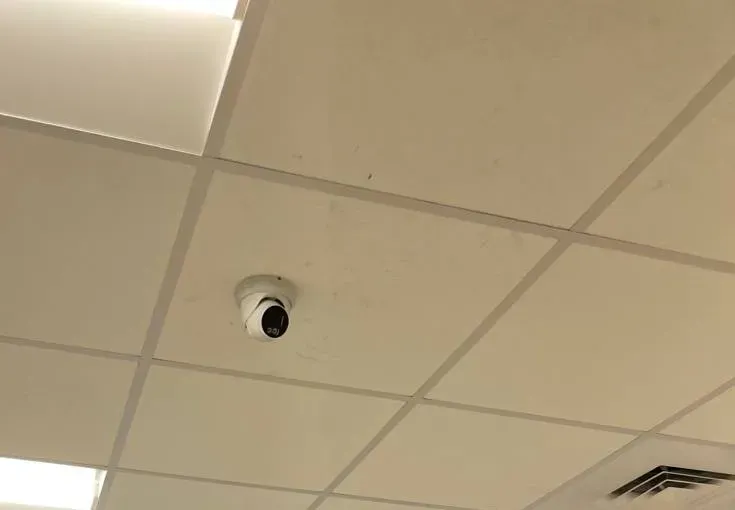
From one of our CCTV jobs: a white turret camera on a ceiling tile, between a light panel and an air vent.
Equipment
Types of CCTV Systems We Install in NYC
The camera on the wall matters less than people think. The recorder, the cable, the lens and the night settings decide whether you get a usable face at 3 a.m. Here is what we install and where it fits in a city building.
⚪
Turret and dome cameras
Our first choice for ceilings, awnings and stair halls. Turrets avoid the infrared glare a glass dome can get; vandal-resistant domes go where they can be reached or hit.
🔦
Bullet cameras
For long views down a block, an alley, a yard or a loading dock, and for walls where a visible camera is the point.
🔭
Varifocal cameras
Adjustable zoom to frame a gate, a register or a plate exactly, instead of a wide view where the face is a few pixels.
🌙
Color night vision and infrared
Color night models use a small amount of light to keep color after dark; infrared works in total darkness. Our series offer night range from 60 to 120 feet depending on the model.
🚨
Active deterrence
Cameras with a built-in siren and strobe that trigger on a person in a zone after hours. The F and D Series include active-deterrent models.
🧠
Smart detection
Person and vehicle detection cut false alerts from headlights and cats, so phone alerts mean something. License plate recognition cameras for garages and lots are quoted after we see the approach.
🗄️
NVRs and DVRs
4, 8, 16 and 32-channel recorders with surveillance-rated drives. We size channels for the cameras you will want in two years, not just today. See our NVR installation NYC page.
🔌
PoE switches, cable and UPS
Cat6 for IP cameras, RG59 for HD analog, fiber between buildings or floors, PoE switches sized to the power budget, and a battery backup so a power blip does not erase the night.
HD analog vs IP PoE vs wireless CCTV for New York buildings
Factor
HD analog (DVR)
IP PoE (NVR)
Wireless / Wi-Fi
Cable
Coax (RG59) plus power, often reusable from an old system
One Cat6 per camera carries video and power
Still needs power at each camera; video over Wi-Fi
Best fit in NYC
Older buildings with good existing coax
New installs, renovations, larger systems
Single rooms or spots where no cable path exists
Resolution
Up to 8MP (4K) on our C Series
4MP to 8MP (4K) on our E and D Series
Varies by brand
Through brick and plaster
Unaffected
Unaffected
Masonry walls cut signal sharply
Expansion
Limited by DVR channels
Add a switch and a camera
Limited by Wi-Fi coverage
Our series
A, F and C Series
E and D Series
Installed on request; labor only for customer kits
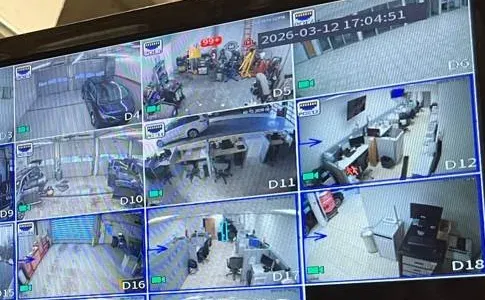
From one of our CCTV jobs: a recorder live view with labeled camera tiles of a vehicle area, a workshop and office floors, and the date and time stamped at the top.
Storage math, H.264 vs H.265 and the PoE budget
Three numbers decide whether a CCTV system keeps the footage you need. The first is bitrate: a 4MP camera might send 2–4 Mbps, an 8MP camera 4–8 Mbps, and a busy aisle sends more than an empty cellar. The second is compression. H.265 typically stores the same picture in roughly half the space of H.264, which is why we set every compatible camera to H.265. The third is the retention target. Multiply bitrate by seconds in a day and days to keep, and the drive size falls out; we do that math for your camera list rather than guessing.
On IP systems the PoE power budget matters as much. A recorder or switch has a total wattage it can deliver; a turret camera may draw 5–7 watts, an infrared bullet more, and an active-deterrence or PTZ camera much more. We add up the cameras and leave headroom, so the night the infrared turns on is not the night the switch drops a port.
What cables are used for CCTV installation
The cable is the part of a CCTV system you will least want to replace, so we choose it for the next camera, not just this one. Cat6 is our standard for IP cameras: it carries video and PoE power up to about 100 meters, and it is the cable most building owners already recognize. Cat6A is worth the extra cost in new buildings and long runs near heavy electrical equipment, because it is better shielded from interference and leaves room for future high-bandwidth cameras. RG59 coax, often bundled with a power pair as "siamese" cable, is the HD analog standard and what most older city systems already have in the walls. Fiber goes between buildings, between a store and a detached garage, or up a tall riser where copper would pass its distance limit. Outdoor and cellar runs use jacket ratings suited to the location, and cable in plenum ceilings is plenum-rated.
PTZ, fisheye, thermal and license plate cameras
Specialty cameras have their place, but they are not where most New York systems should start. A PTZ camera can pan and zoom across a large lot or a building plaza, but it only records where it is pointed at that moment, so it should be added to fixed cameras, not replace them. A fisheye or panoramic camera covers a whole small room from the center of the ceiling and works well over a register area or a small lobby, though faces at the edges are distorted. Thermal cameras detect people in total darkness and through light fog on long fence lines; in a city they mostly make sense for rail yards, large lots and industrial perimeters. License plate recognition cameras need a narrow, well-lit lane, the right angle and the right shutter speed; we quote them after seeing the driveway or garage ramp, because a plate camera placed at the wrong angle reads nothing.
Camera placement: height, angle and field of view
Where CCTV cameras should be installed is the question behind every other question. Our rules of thumb in city buildings: entry cameras at roughly 7 to 9 feet, aimed slightly down at the door so they catch a face under a hat brim, not the top of a head. Overview cameras high in a corner, covering the room and the direction people walk. Register cameras above and behind the clerk, framing the counter, the drawer and the customer's hands. Outdoor cameras under an eave, awning or sign band, out of reach and out of the rain. And every camera aimed so that the brightest part of the scene, usually a glass door or a window, is not filling the frame.
Field of view is a trade. A wide lens of around 2.8mm sees a whole small store but makes a face at the far wall tiny. A 4mm or 6mm lens, or a varifocal camera, narrows the view and gives more pixels on the subject. Good design uses a few wide cameras for the overview and a few tighter ones on the door, the register and the gate. That is how a system with eight cameras gives better evidence than one with sixteen.
Spot
Typical camera
What it should capture
Store or building entrance (inside)
Turret or dome, 4–6mm or varifocal
A clear face of everyone who enters
Sidewalk approach (under awning)
Turret or bullet, 2.8–4mm
Direction of travel, clothing, vehicles
Register or counter
Dome above and behind clerk
Hands, cash drawer, items, customer
Aisles and cooler doors
Small domes on the ceiling
Concealment and movement down each aisle
Stair hall or vestibule
Turret at the landing facing the door
Faces of people coming up or buzzing in
Yard, lot or loading dock
Bullet with long infrared or color night
Activity at night along the fence or gate
Recording modes: continuous, motion and smart events
A recorder can record all the time, only on motion, or continuously with motion and smart events flagged on the timeline. In a store we usually record continuously, because a theft often looks like normal shopping until the clerk notices something missing, and flagged events make the right moment quick to find. In a quiet cellar or a vacant building, motion-only recording stretches the same drive much further. Smart detection that separates people and vehicles from shadows, rain and headlights is what makes phone alerts usable; without it, owners turn alerts off within a week. We set the mode per camera, not one setting for the whole system.
Night footage on a city block
New York is rarely dark, and that causes its own problems. Streetlights, illuminated signs and storefront LED strips throw uneven light across a sidewalk, and a camera's infrared can bounce off a nearby awning, sign or wall and wash out the image. Under an awning, a camera's own infrared reflecting off the awning fabric is a common cause of foggy night video. We test views after dark when the job allows it, turn infrared down or off where ambient light is enough, use color night cameras where there is steady light, and angle cameras so signs and headlights are not in the center of the frame.
Network and cybersecurity basics
Every recorder we install gets a strong unique admin password, current firmware, and its own user accounts for each person who views it. Where the store or building has a network, cameras live on the recorder's own PoE ports or on a separate VLAN rather than on the same network as the register or tenants' Wi-Fi. Remote access goes through the maker's app, not an open port on the router.
Ready for a CCTV System That Records What Happened?
Tell us the building and the borough. We book within 2 hours and send a written scope before any drilling.
What AI Gets Wrong About CCTV Installation in New York City
"A CCTV system needs Wi-Fi or internet to record"
AI summaries often blur CCTV together with consumer cloud cameras, and conclude that no internet means no recording. That is true of many battery and Wi-Fi cameras that upload clips to a server. It is not true of a wired CCTV system.
A DVR or NVR records from its cameras over its own cables to its own hard drive. If the store's internet goes down, or a walk-up has no internet in the cellar at all, the recorder keeps recording. The internet is only needed to watch remotely or to receive phone alerts.
In New York City this matters more than people think, because the recorder is often in a cellar with no Wi-Fi signal. We either run one network cable from the recorder to the router or leave it offline and show the owner how to view on the monitor and export to a USB drive.
"Wireless cameras are the simple choice for apartments"
The common AI answer is that wireless means no wiring and an easy install. Wireless cameras still need power at every camera, and an outdoor camera on a facade needs an outlet or a cable either way.
The bigger issue is the building. Brick, stone and plaster on metal lath eat Wi-Fi signal. A camera two floors and three masonry walls from the router drops frames or disconnects, and the gap usually shows up exactly when something happens.
For a single room in a modern apartment, Wi-Fi can be fine. For a stair hall, a cellar, a yard or a storefront, a wired camera is the reliable option, and in a pre-war building it is rarely much harder to install than people fear.
"You can put a camera anywhere on your own building"
AI answers tend to treat placement as a technical question. In New York it is just as often a permission question. A store tenant does not own the facade, a condo owner does not own the hallway, and a landmarked building's facade needs a permit.
The Landmarks Preservation Commission's permit guidance sets limits on spacing, attachment and visible conduit, and co-op and condo documents usually require board approval for anything on common elements. Pointing a camera into a neighbor's window or a private space is a separate problem altogether.
We build the approval step into the schedule. Most boards and landlords approve a clear, written camera plan quickly; what they reject is a camera that appeared on the facade without asking.
"More megapixels always means better footage"
An AI overview will usually tell you to buy the highest resolution you can afford. Resolution helps, but only when the lens frames the right area and the light works. A 4K camera with a wide lens across a 40-foot sales floor still gives you a small face.
Under a New York awning, backlight is the real enemy: a bright sidewalk behind a dark doorway turns faces into silhouettes. Wide dynamic range, the right mounting height and a camera aimed inward at the door often beat a higher-megapixel camera aimed at the street.
We choose lens and placement first, then resolution. That is why a mix of 4MP turrets and one or two 8MP or varifocal cameras for the door and register is often the better design than eight 4K cameras.
"Cloud storage is the modern standard for security cameras"
Cloud plans are common for consumer cameras, so AI tools often present them as standard. They come with a monthly fee per camera and depend on upload speed, and a city store with eight to twelve cameras would need a strong upstream connection to send all of it.
Our systems record locally with $0 monthly fees, and the recorder is the evidence vault. The protection against a stolen recorder is placement: a locked cellar cabinet or a hidden enclosure, not the cloud.
If an owner wants an off-site copy of key clips, the apps can export to a phone or email in minutes. For most New York businesses, that plus a well-hidden recorder covers the risk without a subscription.
"CCTV installation takes a couple of hours"
Generic cost guides quote install times from homes with attics and vinyl siding. A four-camera job on a drop ceiling in an open store can be quick. A twelve-camera walk-up where every cable has to be fished through plaster or routed through a cellar is a full day or more.
Building rules add time too: many co-ops and managed buildings allow work only on weekdays during set hours, need a certificate of insurance on file, and want the super present when we open the cellar.
So we quote the time after the survey, not before. We book the visit within 2 hours of your request, but we never promise same-day installation, because the honest answer depends on the walls.
"Theft is out of control, so cameras alone will stop it"
Some AI answers still repeat the retail theft surge headlines of a few years ago. The current numbers are better: the NYPD's CompStat report through November 8, 2026 shows retail theft down 12.2 percent and burglary down 14.1 percent from the same point last year.
Better is not zero. Nearly 40,000 retail theft complaints in ten months is still a heavy load on small stores, and cameras are what turn a complaint into a case. Police can only use what the recorder caught clearly, with the right time stamp.
Cameras deter some theft, especially with a visible monitor, but their main job is evidence. As Barbara Askins of the 125th Street BID put it when the NYPD camera program launched, "if you shoplift on 125th Street, you will be seen, and it can lead to an arrest." (NYC Mayor's Office, May 16, 2024)
Get In Touch
Request a Free CCTV Installation Quote in NYC
Send the address and borough, the type of property, roughly how many cameras and where, and whether there is an old recorder on site. Photos of the storefront, the hallway or the cellar help us quote faster. Prefer to talk? Call (800) 486-0943.
✅
Request Sent!
Thank you. We will be in touch to book your CCTV visit, usually within 2 hours of your request.
How It Works
Our CCTV Installation Process
Six steps, the same on a two-camera office suite and a forty-camera apartment complex. The only thing that changes is how long each one takes.
1
Request and booking
Call, text or send the form. We book within 2 hours and schedule seven days a week with early-day visits, first come, first served once the deposit is paid.
2
Survey and camera plan
We walk the building with you, mark each camera view, find the cable paths and the recorder location, and note any board, landlord or LPC approvals needed.
3
Written scope and price
You get the camera list, the series, the recorder size, the retention target and the price in writing. Concealed wiring and conduit are listed separately.
4
Cabling and mounting
Cable pulled, firestopped and labeled at both ends; cameras mounted on the right box, bracket or arm for brick, stone, tile or drop ceiling.
5
Commissioning
Views framed, recording schedules and detection zones set, night settings tuned after dark when needed, clock synced, drive tested, passwords and users created.
6
Handover
App on your phones, a short lesson on playback and exporting a clip, and a camera map with the cable labels for whoever services the system next.
How long does a CCTV install take in a walk-up versus an open store?
For planning, a four-camera system in an open store with a drop ceiling is often a single visit. An eight- to twelve-camera corner store is usually a full day. A walk-up or elevator building with cameras on several floors, cable through plaster and a recorder in the cellar can take more than one day, especially where building rules limit work hours. Survey first, then a time estimate in the scope, so the store knows when to plan around the crew.
How to choose a CCTV installer in New York City
Ask for a New York State license number and a certificate of insurance; buildings in the city will ask for both anyway. Ask where the recorder will go and how long it will keep footage, in days. Ask whether the price includes cable, mounting hardware, the hard drive and the phone setup, or whether those are extras. Ask what happens if a camera fails in the first month and who you call in year three. Look at the company's Google reviews for real customers' experiences; ours are at 4.7★ / 201 Google Reviews. A good CCTV contractor answers all of that in writing before drilling.
After the install: maintenance
CCTV systems in the city need a little care. Outdoor lenses collect soot and spider webs, which ruin night images. Hard drives in warm cellars wear out, and a dead drive records nothing without warning unless alerts are set. Firmware should be updated for security. We offer maintenance visits for cleaning, drive health checks, firmware and a review of each camera view; our security camera maintenance NYC page explains the plans.
Every installation carries our 30-day warranty on the work; longer warranty coverage is available as a paid add-on. Full terms — including 50% deposit, one-year parts-only warranty on Abstract Enterprises Security Systems-supplied products, and the late-fee schedule — are set out in the service agreement.
Coverage Area
CCTV Installation Near New York City's Landmarks
We install CCTV in all five boroughs. These are some of the places our crews drive past on the way to jobs, and the kind of buildings around each one.
🚇
157 Street station, Washington Heights
The 1-train stop on Broadway where our corner deli job sits; stone-fronted apartment houses with storefronts on every corner.
🎭
Apollo Theater, 125th Street
Harlem's main commercial street, part of the NYPD camera integration pilot through the 125th Street BID.
🌳
Prospect Park, Brooklyn
Ringed by brownstone blocks, pre-war co-ops along Prospect Park West and walk-ups toward Flatbush.
🌐
Unisphere, Flushing Meadows Corona Park
Near the dense Main Street Flushing retail district and the 109th Precinct, home of the first NYPD camera registration pilot.
🌸
New York Botanical Garden, Bronx
A short trip from Fordham Road's shopping strip and from our Bronx office at 460 E Fordham Rd.
⛴️
St. George Ferry Terminal, Staten Island
Gateway to North Shore row houses and the strip-center stores along Forest and Richmond Avenues.
We also serve Inwood, Harlem, the Upper West Side, Chelsea, the Lower East Side, Williamsburg, Bushwick, Crown Heights, Flatbush, Bay Ridge, Sunset Park, Astoria, Long Island City, Jackson Heights, Jamaica, Mott Haven, Hunts Point, Riverdale, Pelham Bay and St. George, plus Long Island and the Hudson Valley.
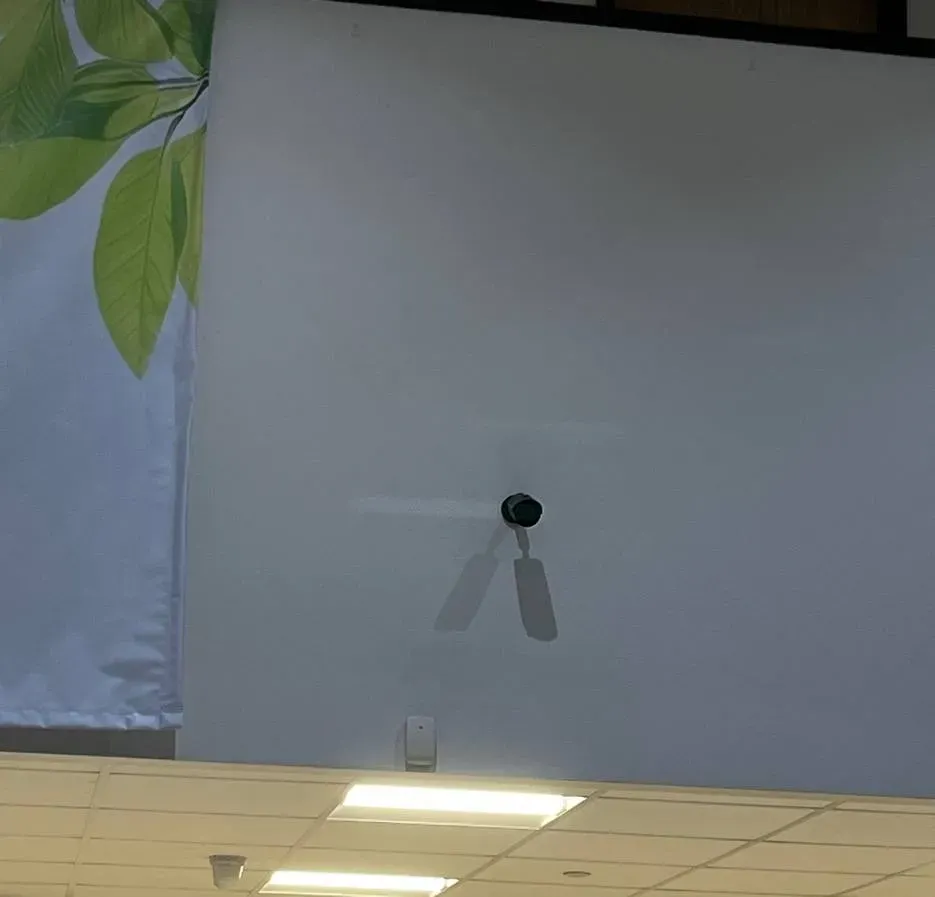
From one of our CCTV jobs: a bullet camera mounted high on a white wall above the hung ceiling, with a motion sensor below it.
Pricing
CCTV Installation Cost in NYC
These are the same prices published on our security camera pages for New York City. We do not run teaser prices: the series price is the starting price for a four-camera system with everything needed to record, and anything beyond that is quoted per camera after we confirm the layout.
What you get
Price
Notes
A Series 4-camera DVR system
From $850
Entry series; recorder, wiring, installation, 2 weeks of recording
F Series 5MP DVR system
From $898
Eyeball, bullet and dome options; active-deterrent models
E Series 4–5MP IP system
From $1,057
4K NVR, PoE cameras, 20" monitor
C Series 8MP 4K DVR system
From $1,292
4K over coax, long-range models, monitor included
D Series 8MP 4K IP system (top tier)
From $1,292
4K IP, active deterrent, two-way talk, 20" monitor
Extra cameras, concealed wiring, conduit, labor-only installs
Quoted
Priced per camera after we confirm the layout
What moves the price in a New York building
Cable path. A camera on a drop ceiling over the recorder is quick; a camera fished down a plaster wall or run across a cellar and up a facade takes longer.
Height and access. Facade cameras above the awning, stair-hall ceilings and loading-dock walls may need a taller ladder or a lift.
Recorder size and retention. More channels and longer retention mean a bigger recorder and drive.
Approvals. Landmarked facades and board-managed buildings add paperwork and sometimes scheduling limits.
What can be reused. Good existing coax or Cat6 lowers the cost of an upgrade.
What a written CCTV quote from us lists
Every quote names each camera by location and model series, the recorder and its channel count, the hard drive size and the retention target in days, the cable type and any concealed wiring or conduit, the mounting hardware for each surface, the monitor if one is included, the phone app setup and the number of user accounts, and the warranty terms. If the building needs a board approval, a certificate of insurance or a Landmarks permit, the quote says so and says who handles it. If something is not on the quote, it is not in the price. That is how you compare us with any other CCTV installation company: line by line, not by a headline number.
The 2-camera, 6-camera, 8-camera, 12-camera and 16-camera questions all have the same honest answer: start from the four-camera series price that fits the building and add cameras priced per camera after the walk-through. Financing is available; ask when you request your quote.
Shop Our Systems
CCTV Installation Packages & Pricing
Our house-brand systems are the default on every quote: professional installation, a recorder, two weeks of recording and remote phone access included, with most packages adding a 20-inch monitor. Each series is a four-camera package you can expand.
A
A Series · from $850
Our entry 4-camera DVR package with HD cameras, night vision of 60–100 feet, motion and smart detection, audio-capable cameras and remote access. A good start for a small office or a two-family house.
F
F Series · from $898
5MP DVR package in eyeball, bullet and dome styles, 90–100 feet of night vision, active-deterrent models with siren and lights, and a 20-inch monitor. Popular for delis and corner stores.
E
E Series · from $1,057
4–5MP IP cameras on a 4K NVR, IP67 weather rating, smart detection, full-color night view and a 20-inch monitor. Our standard PoE system for stores and walk-ups.
C
C Series · from $1,292
8MP 4K Ultra HD on a DVR, eyeball and long-range cameras, 100–120 feet of night vision, IP66 and a monitor included. The upgrade path for buildings with good coax.
D
D Series · from $1,292 · Top tier
8MP 4K IP eyeball and bullet cameras, 90–120 feet of night vision, IP67, active deterrent, two-way talk and a 20-inch monitor. Our recommendation for corner stores, lobbies and lots.
Bring your own equipment (labor only). Bought cameras online or from a store? We install customer-supplied CCTV equipment for a labor-only price quoted by phone or text from your equipment list and photos, booked with the deposit. We don't do walk-throughs on customer equipment, and we can't be responsible for a customer's own wireless cameras' signal or hardware. See install your own camera system.
Send the building details and get a written scope.
FAQ
NYC CCTV Installation FAQ
Do you install CCTV in all five boroughs of New York City?
+
Yes. Our crews install CCTV systems in Manhattan, Brooklyn, Queens, the Bronx and Staten Island, working from our offices at 1282 Troy Ave in Brooklyn and 460 E Fordham Rd in the Bronx. We also cover Long Island and the Hudson Valley.
Is Abstract Enterprises Security Systems licensed and insured for CCTV work in New York?
+
Yes. We are a licensed New York State low-voltage contractor, license #12000287431, and carry general liability insurance. Managed buildings and co-ops can request a certificate of insurance before the visit.
What warranty do you give on a new CCTV system in New York City?
+
Our installations carry a 30-day warranty on the work, and longer coverage is available as a paid add-on. The service agreement sets out the full terms, including the deposit, the one-year parts-only warranty on equipment we supply and the late-fee schedule.
Will my CCTV system keep recording during a power outage?
+
Only if it has backup power. We recommend a battery backup (UPS) on the recorder and the PoE switch, which keeps the system recording through short outages and protects the hard drive from sudden shutdowns. Run time depends on the number of cameras and the battery size.
Can a renter install a CCTV camera outside an apartment door in NYC?
+
Usually not without permission. The hallway belongs to the landlord, or to the co-op or condo as a common element, so a camera there needs written approval. A camera inside your own apartment, or a peephole-style door camera the building allows, is a simpler route.
Will a CCTV recorder in a cellar with no internet still record?
+
Yes. A wired CCTV system records to the DVR or NVR hard drive over its own cables, with or without internet. Internet is only needed to view the cameras on a phone away from the property or to get motion alerts.
Do you service CCTV systems after the installation?
+
Yes. We handle repairs, added cameras, camera moves after renovations, hard drive replacement and recorder upgrades, and we offer maintenance visits for cleaning, drive health and firmware checks. Systems we did not install can be serviced too after we identify the equipment.
Which camera brands are you an authorized partner for?
+
We are an authorized partner of Lorex, Luminys and Reolink. Our house-brand systems are the default on quotes, and we also install, integrate and service other brands such as Hikvision, Dahua, UniFi Protect and Axis.
Do you need to visit before giving a CCTV quote?
+
For a new system, yes, a survey lets us see the cable paths, the recorder location and any approvals the building needs before we price it. Labor-only jobs on customer-supplied equipment are quoted by phone or text from your equipment list and photos.
Can I turn on facial recognition on my store cameras in NYC?
+
Some cameras offer face detection features, but New York City Administrative Code section 22-1202 requires retail stores, food and drink businesses and entertainment venues that collect customers’ biometric identifiers to post a clear sign at customer entrances, and it bars selling or sharing that data. Get legal advice before enabling it; we set cameras up with those features off by default.
Is financing available for a CCTV system for a store or building?
+
Yes, financing is available on our systems. Ask about it when you request your quote and we will send the details with your written scope.