Barn, gate and driveway out of Wi-Fi range? Dealership lot that needs every row on one recorder? Book a Hudson Valley CCTV survey in Westchester, Rockland, Orange, Putnam, Dutchess or Ulster: (800) 486-0943
Wired NVR & DVR Systems · Long Cable Runs · Fiber to Outbuildings · Local Recording
CCTV installation Hudson Valley owners can count on starts with one honest fact: the properties here are bigger and farther apart than anywhere else we work. Abstract Enterprises Security Systems installs wired closed circuit television systems across Westchester, Rockland, Orange, Putnam, Dutchess and Ulster counties, from a 4-camera kit on a colonial in Carmel to a 23-camera recorder at a car dealership in Rockland County. We run the cable past the 100-meter Ethernet limit with fiber or PoE extenders when a barn or a gate sits far from the house, put the recorder on a battery so a Central Hudson or O&R outage does not leave a hole in the footage, and set the system to record locally whether or not the property has reliable internet. House-brand 4-camera systems with recorder, wiring, installation and two weeks of recording start at $1,099, with $0 monthly fees.
Updated November 2026 by Abstract Enterprises Security Systems, NYS license #12000287431 · Sources: NYS Division of Criminal Justice Services Index Crimes by County, 2024 (data.ny.gov); U.S. Census Bureau American Community Survey 2023 5-year estimates (DP04, B25004); Ulster County Executive press release, September 25, 2025; Daily Freeman, July 5, 2026
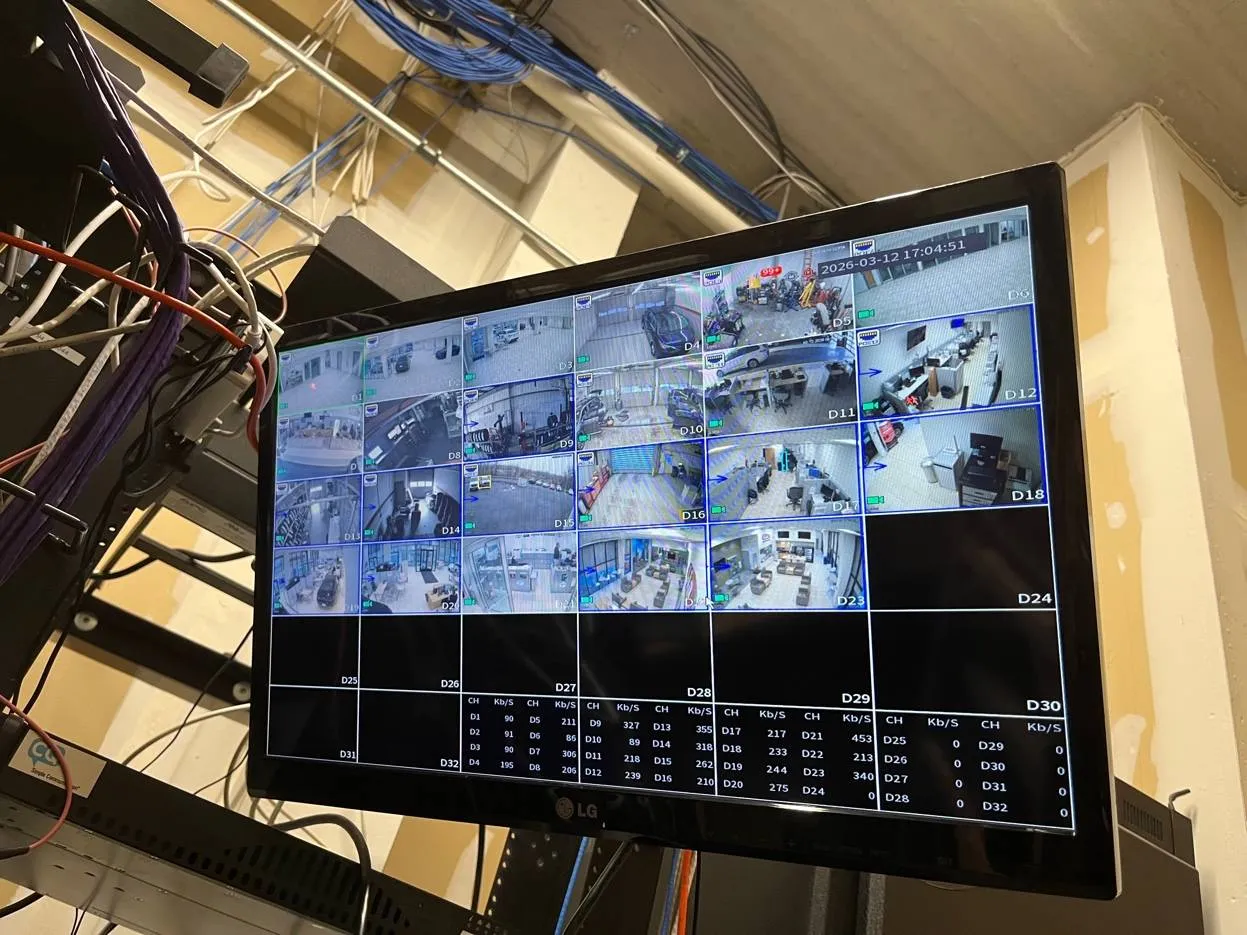
Abstract Enterprises Security Systems photo from a CCTV job at a car dealership in Rockland County: the recorder's monitor shows 23 live camera tiles labeled D1 to D23, nine empty tiles ready for more cameras, and a table of each channel's stream rate, with blue network cable bundles running along the ceiling above the rack.
Hudson Valley CCTV Request
Tell us the town, the property, and how far the farthest camera is from the house or office
✅
Request Sent!
Thank you. We will call or text to book your CCTV visit, usually within 2 hours of your request.
25+
Years Experience
2 Hr
Booking
100%
Licensed & Insured
4.7★
201 Google Reviews
Owner-operated since 2002 · Thousands of jobs completed · Booked within 2 hours
Quick answer: CCTV installation Hudson Valley pricing starts at $1,099 for a house-brand 4-camera system with the recorder, the wiring, the installation and two weeks of recording included, and commercial CCTV systems run $1,500 to $5,000+, with $0 monthly fees. Long runs to barns, gates and detached garages, fiber links, conduit and concealed wiring are priced after we confirm the layout, because a camera 40 feet from the recorder and a camera 600 feet down a driveway are different jobs. We book within 2 hours of your request and schedule 7 days a week, with early-day visits, first come first served once the deposit is paid.
Wired IP (PoE) and HD-analog systems on a local NVR or DVR, installed by Abstract Enterprises Security Systems under NYS license #12000287431
Recording that keeps running with no internet, and a battery backup option for the recorder and switch
Phone viewing set up and tested before we leave, on your phone, not ours
Why Hudson Valley Properties Need CCTV Installation Done for Distance
Most camera advice online is written for a house on a quarter-acre lot or a storefront with the recorder ten feet from the door. The Hudson Valley is not built that way. A horse property outside Millbrook has a barn 500 feet from the kitchen. A house on a ridge in Putnam Valley has a gated drive that curves out of sight before it meets the road. A farm stand in the black dirt fields near Pine Island sits beside a cooler shed with no network at all, and a winery on the Shawangunk Wine Trail has a tasting room, a crush pad and a parking field spread over several acres. Even in southern Westchester, where lots are smaller, a single property often has a detached garage, a pool house or a carriage house that the homeowner wants on the same recorder.
That is the real reason CCTV installation in this region is a different trade from city work. In a Bronx apartment building the problem is getting cable through masonry and up a stairwell. Here the problem is getting a clean signal and steady power across open ground, through winter frost, past lightning-prone hilltops and through outages that can last days. The camera on the wall is the easy part. The cable route, the surge protection, the recorder location and the backup power decide whether the system is still recording in February.
The numbers back that up. The Census Bureau's 2023 American Community Survey counts 896,080 housing units across the six counties, and 54.8% of them are single-family detached houses. In Putnam the share is 77.7%, in Ulster 68.6%, in Dutchess 62.6% and in Orange 62.4%. Detached houses mean four sides to watch, driveways instead of shared lobbies, and outbuildings instead of storage rooms. The same survey counts 18,380 homes held for seasonal, recreational or occasional use across the six counties, including 6,545 in Ulster alone, which is why so many of our calls are from owners who are not there most of the week and want to see the property from the city.
Property crime is lower here than in the five boroughs, but it is not rare. The New York State Division of Criminal Justice Services reports 1,808 burglaries, 18,704 larcenies and 1,278 motor vehicle thefts across the six counties in 2024. Larceny is the one that matters most for CCTV: package theft from long rural driveways, tools taken from open barns and construction trailers, catalytic converters cut from vehicles parked out of sight, and shoplifting along the retail corridors of Route 59, Route 9 and Central Park Avenue. Recorded video with a clear face or plate is what turns a report into a case.
Distance. A copper Ethernet run is good for 100 meters (328 feet) including patch cords. Barns, gates, docks and far parking rows are often past it, so the run becomes fiber, a PoE extender or a point-to-point wireless bridge.
Internet that comes and goes. Ulster County's own figures counted nearly 1,300 homes, businesses and community buildings with no reliable broadband in 2025. A recorder that stores everything locally keeps working when the connection does not.
Outages. Central Hudson, Orange & Rockland, NYSEG and Con Edison in Westchester all lose lines to storms and falling trees. A recorder on a battery keeps recording through short outages and shuts down cleanly on long ones.
Lightning and long copper. A long outdoor cable to a hilltop barn behaves like an antenna in a summer storm. Surge protection at both ends, a proper ground, and fiber where the run is longest protect the recorder.
Wildlife. Deer, bears, raccoons and swaying branches set off simple motion detection all night. Smart person and vehicle detection is the difference between ten useful alerts and four hundred useless ones.
Winter. Ice and snow load on mounts, condensation inside cheap housings, and frozen ground that stops trenching from December to March. We pick weather-rated housings and plan buried runs around the season.
“Thanks to the NYS ConnectALL award and Verizon’s substantial match, nearly 1,300 homes, businesses, and community anchor institutions in rural Ulster County will finally be connected with reliable fiber optic service.” Ulster County Executive Jen Metzger, Ulster County press release, September 25, 2025
Until that fiber reaches every road, plenty of Hudson Valley properties will keep running on a slow DSL line, a fixed-wireless antenna, a satellite dish or a phone hotspot. None of that stops a well-built CCTV system from doing its job. The cameras talk to the recorder over cable we install, the recorder writes to its own hard drive, and the internet is only needed when you want to watch from somewhere else. That design choice, local recording first and remote viewing second, runs through everything on this page.
County by county: how CCTV work changes across the six counties
Westchester. The most built-up of the six, with 391,861 housing units and the lowest share of detached houses at 43.5%. Southern Westchester, from Yonkers to New Rochelle and White Plains, looks more like the city: condos, garden apartments, mixed-use blocks and offices, where the job is clean cable through finished buildings and coverage of shared entrances and garages. North of I-287 the lots grow quickly, and Bedford, Pound Ridge and North Salem bring the long drives and horse barns that define the rest of this page. Westchester also reported the region's highest property crime counts in 2024, with 831 burglaries and 7,679 larcenies, and 812 motor vehicle thefts.
Rockland. Compact and suburban, with 57.1% detached homes, a dense commercial spine along Route 59 and the busiest retail traffic west of the river. Rockland reported 255 burglaries and 3,346 larcenies in 2024, roughly the same as the year before. Most of our Rockland work is colonials and split-levels in Clarkstown, Orangetown and Ramapo, plus businesses along Route 59, Route 303 and Route 9W, including the dealership on this page.
Orange. The biggest mix: suburban developments around Monroe and Chester, older city blocks in Newburgh and Middletown, warehouses along I-84 and Route 17K, horse farms near Goshen and the black dirt farms around Pine Island and Florida. Orange counted 148,460 housing units, 62.4% of them detached, and 3,430 larcenies in 2024. Orange County jobs are where we most often combine a house, a farm building and a long lane on one recorder.
Putnam. The most single-family county in the region at 77.7% detached, and the lowest crime counts, with 38 burglaries in 2024. Putnam's challenge is terrain rather than crime: rock ledge under thin soil, steep driveways, lakefront houses around Mahopac and Lake Carmel, and wooded lots where Wi-Fi gives up a few yards from the house. Fiber and bridges earn their keep here.
Dutchess. From Beacon and Fishkill in the south through Poughkeepsie to Rhinebeck, Millbrook and the farm towns near the Connecticut line. Dutchess has 122,636 housing units, 62.6% detached, and 2,759 homes held for seasonal use. It was also the county hit hardest by the July 2026 storms, with 27,816 Central Hudson customers still dark on the Sunday afternoon after, which is why we push battery backup on Dutchess jobs.
Ulster. The most rural county we serve, with 68.6% detached homes, the region's highest vacancy rate at 15.2%, and 6,545 homes held for seasonal or occasional use. Kingston and New Paltz have village and city work, but most Ulster calls come from weekend houses, farms and properties up the Rondout and Esopus valleys, many of them among the locations the county itself counted as lacking reliable broadband. Local recording and smart alerts matter more here than anywhere else on our map.
What We Install
CCTV Installation Services in the Hudson Valley
Every job below is done by our own crew, quoted in writing, and finished with a walk-through on your phone. Our CCTV installers do the cable, the mounts, the recorder, the network settings and the app, so there is one company to call when something needs attention later. If you came here looking for the broader security camera installation service across the Hudson Valley, including doorbell cameras and wireless add-ons, that page covers it; this page is about wired closed circuit television systems and the recorder behind them.
📹
Complete CCTV system installation
Cameras, recorder, hard drive, PoE switch, cable, mounts, monitor and phone app, installed as one system. Most homes start with four to eight cameras; most businesses start at eight and grow.
🌾
Long runs to barns, gates and outbuildings
Fiber, PoE extenders or a point-to-point wireless bridge when a camera sits past the 100-meter Ethernet limit, with surge protection at both ends of any outdoor copper.
🖥️
NVR and DVR installation
Network video recorder setup for IP cameras and DVR setup for HD-analog coax. See our NVR installation in the Hudson Valley page for recorder-only jobs.
🔁
DVR to NVR and analog to IP upgrades
Keep good coax where it is, replace it where it is not, and move the system to a recorder that supports smart detection. Our DVR upgrade service in the Hudson Valley explains the options.
🔋
UPS and surge protection
A battery backup for the recorder and switch, surge protectors on long outdoor runs, and a clean ground, so storms and utility outages do not erase the night you needed.
📱
Remote viewing and app setup
Secure phone and computer access with your own login, push alerts tuned for people and vehicles instead of every deer, and a written note of every password we set.
Already bought a kit? We install customer-supplied cameras for a labor price quoted by phone or text and booked with the deposit.
Each of those services can be part of the same visit. A typical first job on a country property is a 4-camera or 8-camera wired system on the house and driveway, with one long run to the barn or the gate, a battery under the recorder, and the app on every phone in the family. A typical business job is more cameras, a bigger recorder and more attention to the parking lot and the cash or key areas. We plan both the same way: decide what each camera must prove, then pick the lens, the mounting height and the cable route that make it possible.
Abstract Enterprises Security Systems photo from a CCTV job at a car dealership in Rockland County: the two-story showroom with cameras on the white mezzanine wall looking down over the vehicle on display, the sales desks and the reception counter.
Building Specialists
CCTV Installation for the Hudson Valley's Estates, Farms and Village Streets
The six counties hold almost every kind of property there is, and each one changes where the recorder goes, how the cable travels and which camera fits. These are the property types we see most, and how residential CCTV installation and property CCTV installation differ across them.
🏡
Estates and gated drives
Northern Westchester, Putnam and the Dutchess horse country around Millbrook have long private drives, stone pillars and electric gates. The gate camera is usually the longest run on the job and the one that matters most.
🐄
Farms, barns and stables
Timber and pole barns, hay lofts, equipment sheds and paddocks in Orange, Dutchess and Ulster. Dust, moisture and animals mean sealed housings, careful cable protection and detection zones that ignore livestock.
🍇
Wineries, orchards and farm stands
Seasonal crowds, cash at a counter, a cooler or storage barn and a parking field. Coverage peaks from September apple picking through the holidays, then the site sits quiet for months.
🏘️
Colonials, capes and split-levels
The suburban core of Rockland, lower Orange and much of Westchester: siding over sheathing, attached garages, a basement or attic where the recorder can live and a driveway that ends at the street.
🌲
Lake houses and second homes
Around Lake Mahopac, Greenwood Lake, the Ashokan and the Catskill edge of Ulster. The owner watches from the city, so remote viewing, power backup and a camera on the propane tank or boat dock come first.
🏬
Village main streets and mixed-use
Brick and frame storefronts with apartments above in Nyack, Beacon, Cold Spring, New Paltz, Warwick and the Kingston Stockade. Shared walls, limited ceiling space and landlord approval shape the job.
🏢
Condos, HOAs and garden apartments
Clusters of two- and three-story buildings with shared parking, mailrooms and pool gates. CCTV installation for apartment complexes like these spreads cameras over several buildings tied back to one recorder.
🏗️
New construction
Spec houses and subdivisions in Orange and Dutchess. Pre-wiring before the drywall is the cheapest time to install CCTV with hidden wiring, and the site itself often needs temporary cameras during the build.
Materials and methods, by building type
Vinyl and fiber-cement siding. Most suburban homes here are sided. We mount on a proper mounting block or junction box so the camera sits flat and the siding can still move with the seasons, and we seal every penetration. Cable usually travels through the attic or the basement rim joist and comes out behind the camera base, which is the most common way to install CCTV cameras without visible wires on a sided house.
Fieldstone, brick and stucco. Older farmhouses and village buildings have stone foundations, brick fronts and stucco walls. Drilling into old stone takes the right bit and a careful anchor; in many cases the better answer is to mount on a wooden fascia or soffit and run the cable inside. On stucco we seal the hole and the anchor so water does not get behind the finish.
Timber, pole and steel barns. Barns move, flex and get wet. We fix cameras to framing rather than siding, run cable in conduit or inside the building where animals cannot reach it, keep the cameras above the reach of horses and machinery, and choose housings rated for dust and water. A barn needs its own surge protection where the cable enters, and if the barn has its own electric service, the run between buildings is the place where fiber pays for itself.
Log and post-and-beam homes. Few hollow walls to fish cable through. We plan routes along beams, inside closets and through the basement, and use surface raceway painted to match where there is no hidden route, so the job stays tidy without cutting into exposed timber.
Condo and HOA buildings. Common elements belong to the association, so the board approves camera locations and the recorder's home before we start. Cameras on parking areas, mailrooms, dumpster enclosures and entry doors usually connect over existing building cable or new runs through common ceilings to a recorder in a locked utility room. Owners can also ask for an apartment building security camera system for Hudson Valley multifamily properties, which goes into resident privacy and access rules in more depth.
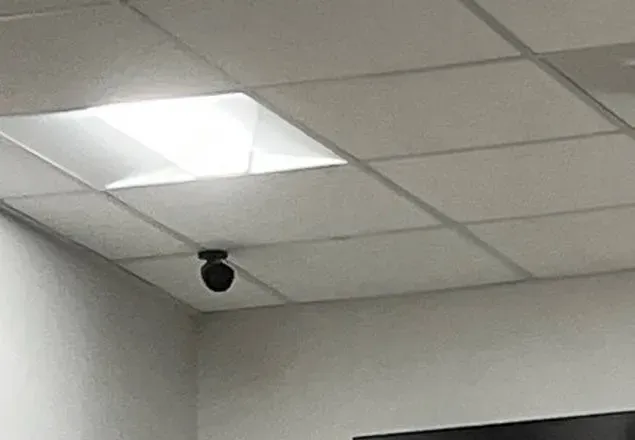
Abstract Enterprises Security Systems photo from one of our CCTV jobs: a black dome camera fixed to a drop ceiling tile near the corner of a tall white wall, next to a recessed light panel, aimed down over the room.
Commercial CCTV Installation
Business CCTV Installation in the Hudson Valley
Commercial CCTV installation in the region follows the highways. The busiest corridors are where stores, dealerships, restaurants and medical offices cluster, and each one has its own camera problems.
Route 59 in Rockland County. From Nyack and West Nyack through Nanuet toward Spring Valley and Suffern: car dealerships, collision shops, strip centers, restaurants and the big retail around the Palisades Center. Wide lots, many entrances and evening traffic.
Route 9 in Dutchess County. Through Poughkeepsie, Wappingers Falls and Fishkill: dealerships, shopping plazas, chain stores and medical buildings, with lots that face a fast road where a plate must be captured in a second or two.
Route 211 and Route 17 in Orange County. Around Middletown, Goshen, Harriman and Central Valley: auto service, retail and the outlet traffic headed to Woodbury Common.
Central Park Avenue and the Route 119 / I-287 office belt in Westchester. Retail, restaurants and multi-tenant office parks, where the camera system usually has to fit an existing IT network and a landlord's rules.
Village main streets. Kingston, New Paltz, Beacon, Cold Spring and Warwick: independent shops, bars and restaurants in older buildings where a small, neat system is worth more than a big one.
For any of these, the commercial CCTV contractor's job is the same: cover every door, every register and every route a vehicle takes in and out, record it long enough to matter, and make it easy for the owner to pull a clip for the police or the insurer. Commercial CCTV systems run $1,500 to $5,000+ depending on the number of cameras, the building and the cabling, and every business job is quoted in writing after we confirm the layout. Owners who want the full commercial picture, including access control and intercom tie-ins, can read our commercial security camera installation page for the Hudson Valley.
Car dealership CCTV installation: what we did in Rockland County
The photos on this page come from a CCTV job at a car dealership in Rockland County. It is a good example of what a commercial system here looks like once it grows past a handful of cameras. The recorder's monitor shows 23 live cameras on a 32-channel layout, leaving nine channels open for future cameras. The cameras cover the main lobby and waiting area, the glass entrance from the inside, the guest services window, the front desk, the showroom floor from the mezzanine wall, a back hallway that ends at a grey door, and the office areas. Inside, the building is mostly drop ceilings and tall painted walls, so most cameras are ceiling or high-wall mounts, with cable carried above the grid back to the equipment area where the recorder, the monitor and the network rack live.
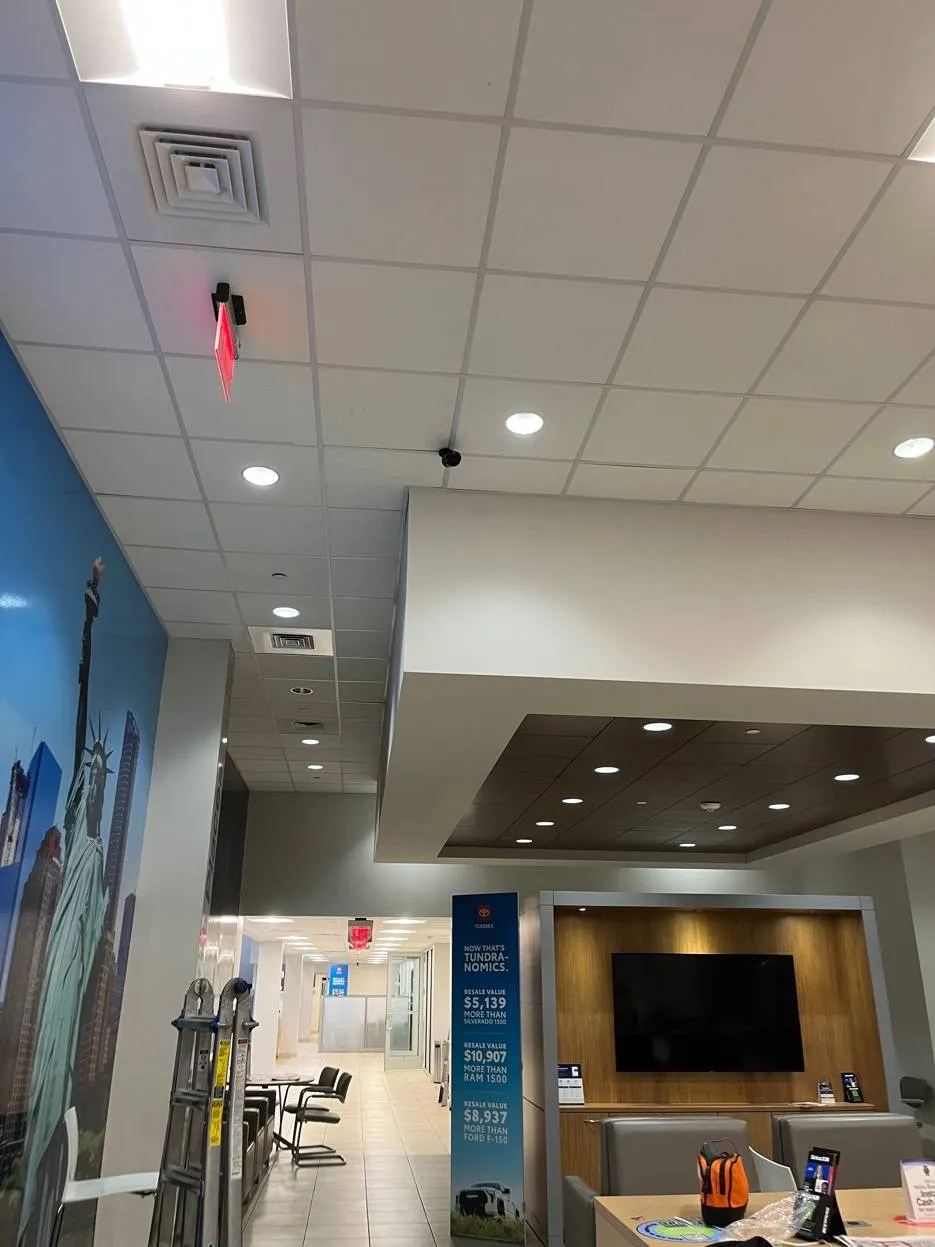
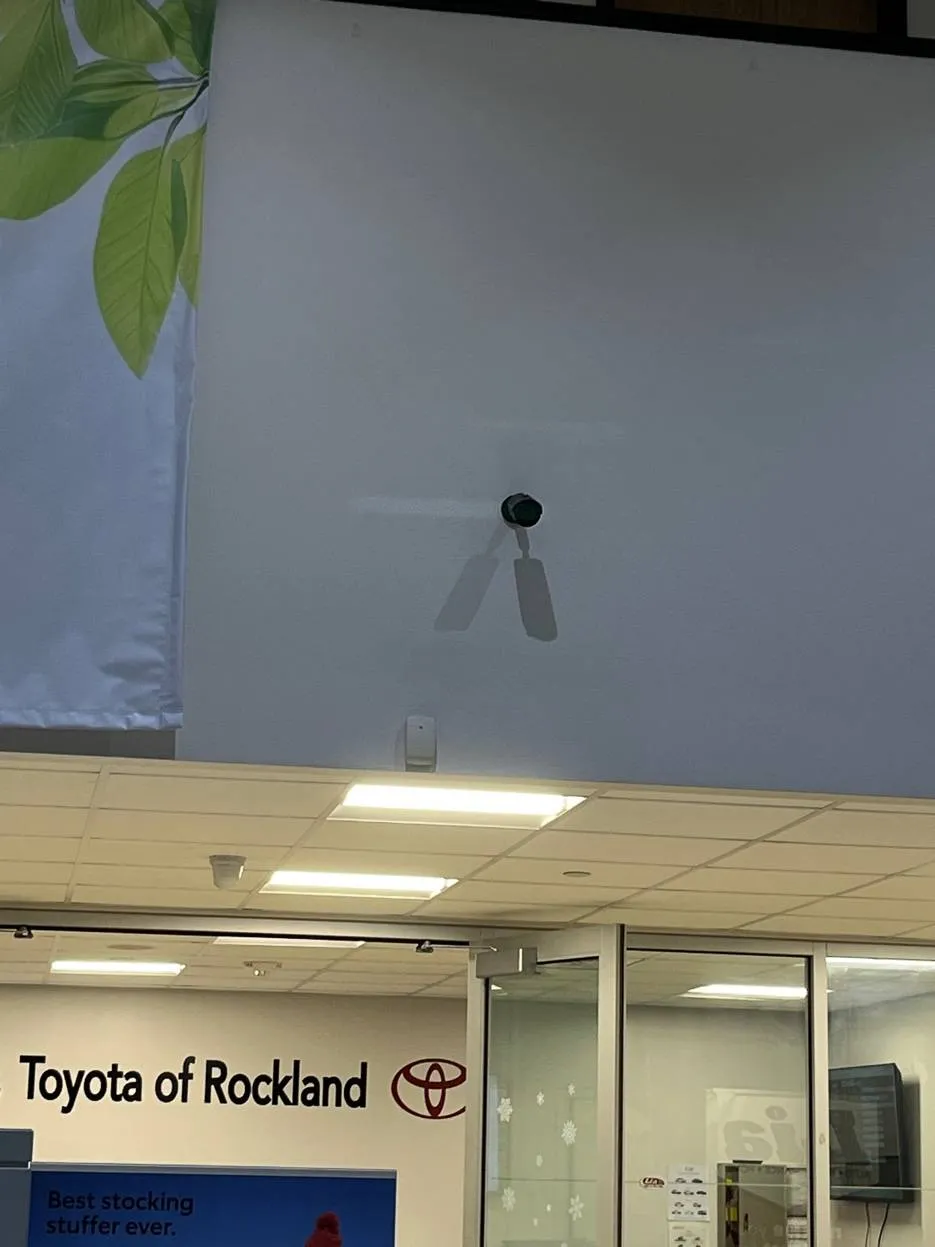
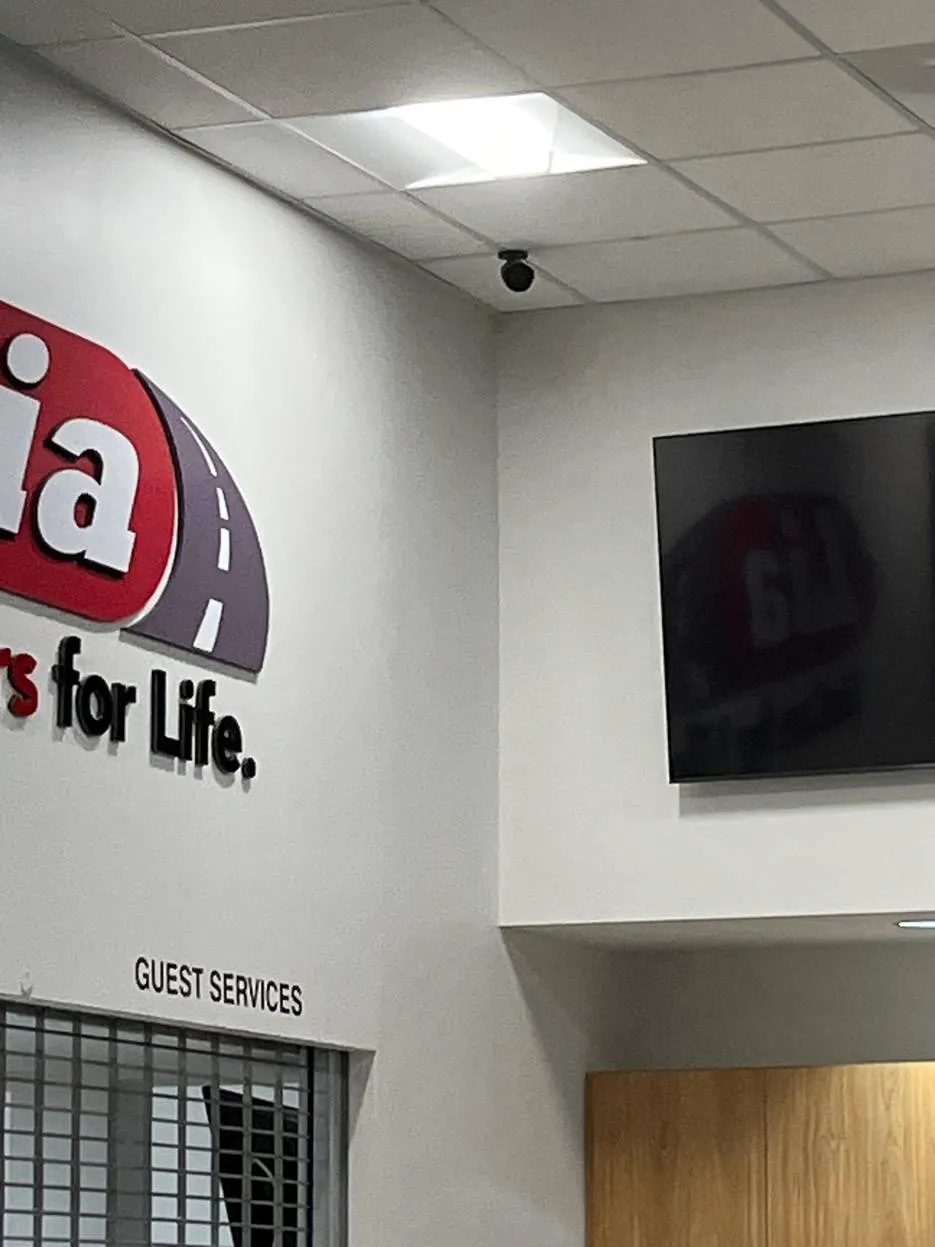
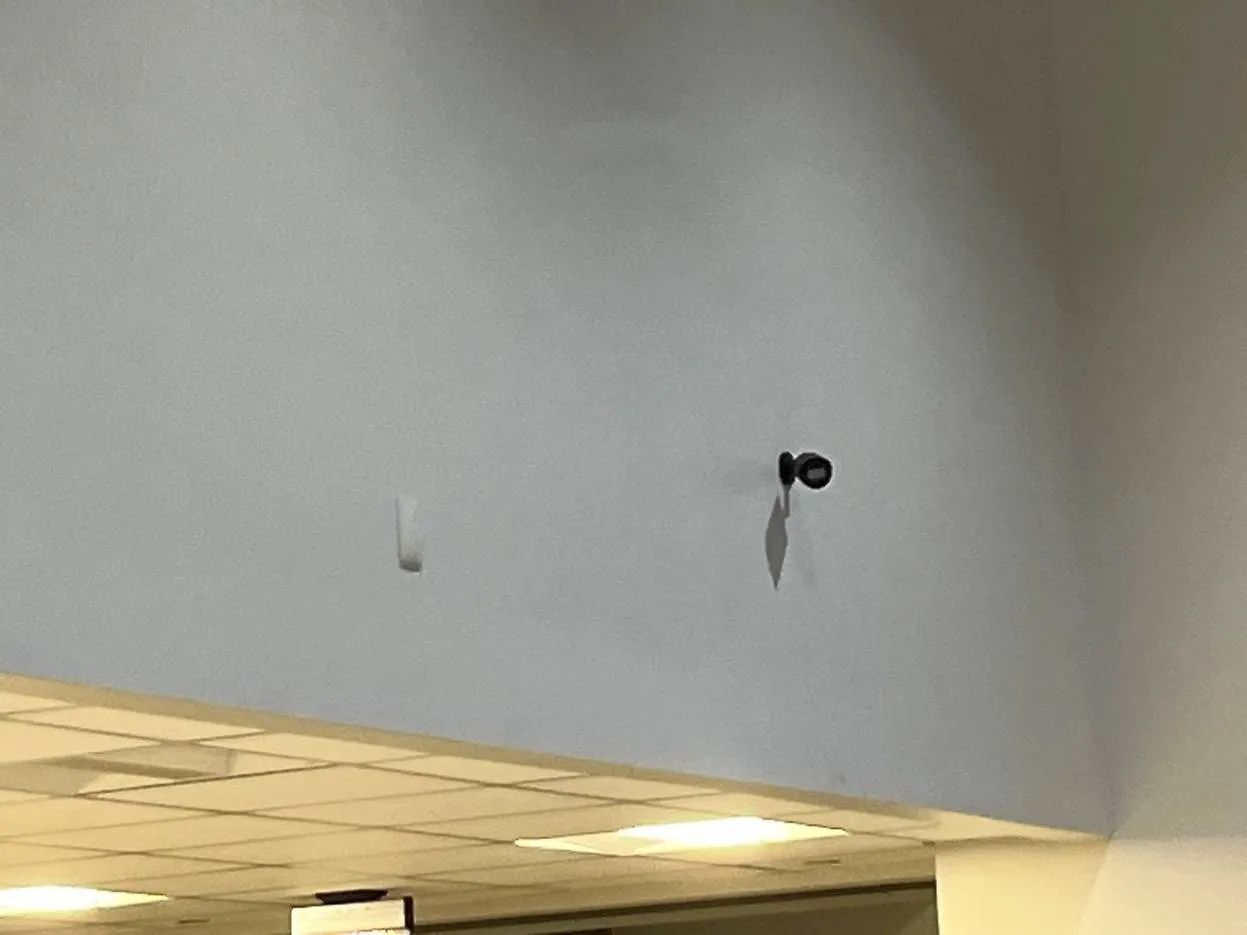
Abstract Enterprises Security Systems photo from the Rockland County dealership job: a compact black active-deterrent camera on the drop ceiling looks over the lobby, with a skyline mural on the left, waiting chairs and a TV wall below.Abstract Enterprises Security Systems photo from the same job: a bullet camera mounted high on the white wall above the drop ceiling, aimed down toward the glass entry doors.
Three choices made the system work. First, mounting height: the showroom has a two-story ceiling, so the cameras on the mezzanine wall see the whole floor without being in anyone's reach. Second, camera type by job: domes where a camera is close to people, like the guest services window and the front desk, and bullets where a camera has to look a long way, like down the hallway or across the entrance. Third, stream settings: the bitrate table on the recorder screen shows each channel's live stream, and keeping each stream sized to its job is how a 23-camera system keeps weeks of footage on one recorder instead of days.
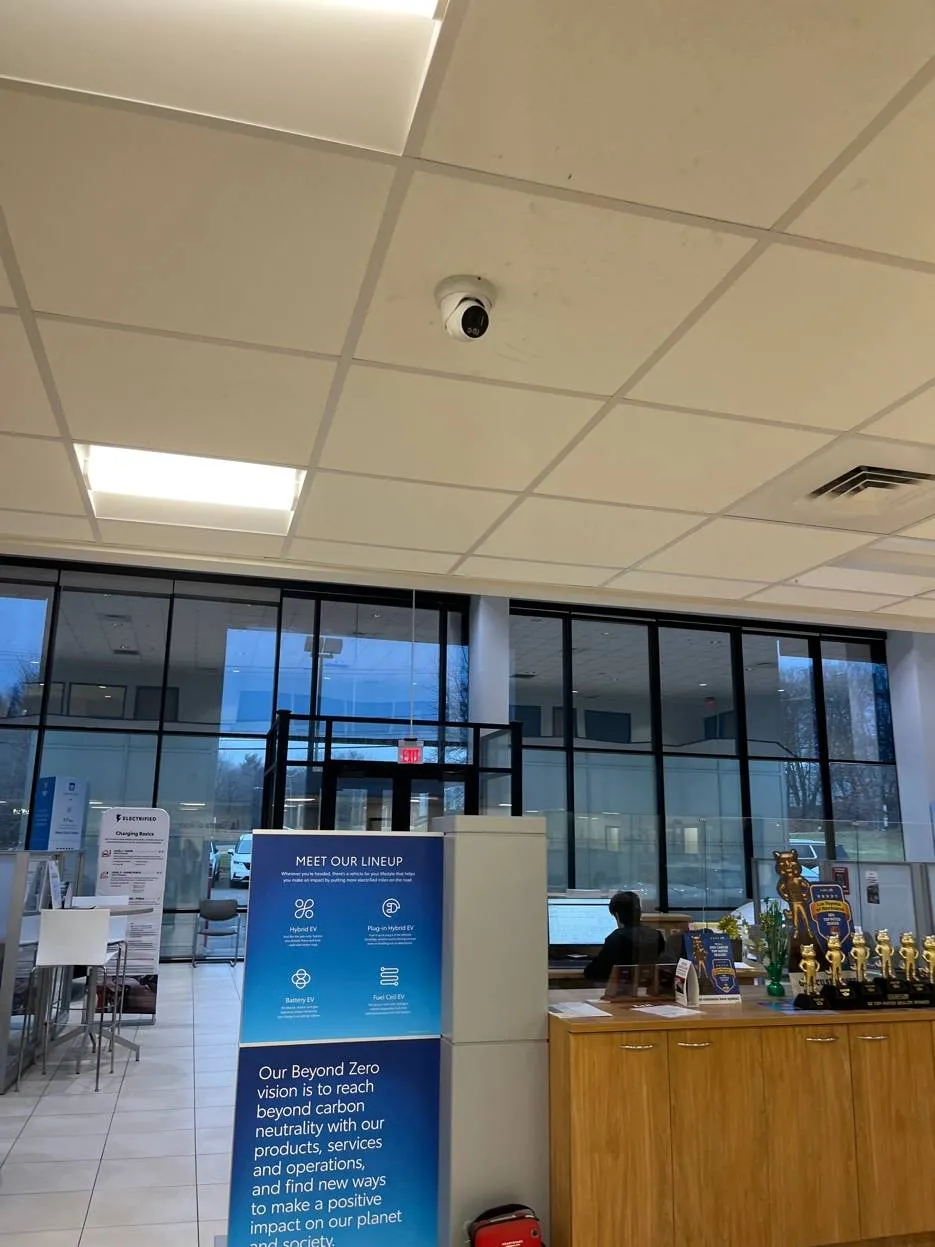
Abstract Enterprises Security Systems photo from the dealership job: a small black dome on the ceiling grid above the Guest Services window, next to a wall-mounted TV.Abstract Enterprises Security Systems photo from the dealership job: a white turret-style dome on the ceiling over the front desk, with the glass storefront and the parking area visible through the windows behind.
Other businesses we wire across the region
Retail and grocery. Retail CCTV installation and grocery store CCTV installation focus on entrances, registers, high-value aisles, the stockroom door and the loading area. Holiday shopping season, Black Friday and Christmas retail traffic are when a missing camera becomes obvious, so we like to finish store jobs before November.
Restaurants, bars and breweries. Restaurant CCTV installation covers the register, the bar, the back door and the walk-in. Kitchens are hot and greasy, so we keep cameras out of the hood line and use housings that clean easily.
Medical and dental offices. Medical office CCTV installation and dental office CCTV installation cover the entrance, waiting room, reception and medication storage, never exam rooms. Recorders sit in a locked room and logins are limited to the practice manager.
Schools, daycares and houses of worship. Entrances, drop-off loops, hallways and parking, planned with the administrators and the board. These are often multi-building jobs connected by fiber.
Construction sites and contractor yards. CCTV installation for construction sites usually means cameras on a pole or a trailer with their own power, recording locally and uploading clips over cellular. Tools, copper and machinery left overnight are the target.
Privacy and compliance for business CCTV in New York
A few rules apply to every business camera system in New York State. They are listed here so you can plan; this is general information, not legal advice, and your attorney should confirm what applies to your situation.
No cameras in restrooms, locker rooms or changing rooms. New York Labor Law §203-c bars employers from video recording in restrooms, locker rooms and rooms designated for changing clothes, except under a court order.
Audio is different from video. New York's eavesdropping law (Penal Law §250.05, with definitions in §250.00) makes it a crime to record a conversation unless at least one party to it consents. We leave audio off by default at businesses and turn it on only where the owner decides it is appropriate and posts notice.
No cameras where people expect privacy. Penal Law §250.45 (unlawful surveillance) makes it a crime to secretly record people dressing or undressing in places where they expect privacy, such as bathrooms, bedrooms and changing rooms. We will not aim a camera into a neighbor's windows or yard.
Signs. Posted notice of video recording is good practice for businesses and landlords, and many insurers ask for it.
Your Questions Answered
Hudson Valley CCTV Installation: Questions Answered
These are the questions Hudson Valley owners actually ask us on the phone, most of them about distance, power, internet and weather rather than about cameras themselves.
How far from the recorder can a CCTV camera sit on a property with a barn or a long driveway?
On plain copper Ethernet, 100 meters, or 328 feet, is the limit for one run including the short patch cords at each end. That covers most houses, most garages and most stores. It does not cover a barn across a pasture, a gate at the end of a quarter-mile drive or a dock at the bottom of a hill. Past 100 meters a camera may still light up on a long run, but it drops frames, loses power at night when the infrared turns on, and fails first in the cold.
For those runs we use one of three methods. A PoE extender sits in a weatherproof box partway along the route and gives the signal and power a second 100 meters. Fiber optic cable, with a small media converter at each end, can cover hundreds or thousands of feet, carries no electricity and is immune to lightning on the cable itself. A point-to-point wireless bridge, two small dishes aimed at each other, works where trenching is impossible and there is a clear line of sight. Which one is right depends on whether the far building has power, whether we can trench or use existing conduit, and how many cameras sit at the far end.
Can CCTV cameras record without internet at a rural property that only has satellite or a hotspot?
Yes. In a wired system the cameras record to a recorder on site over cable we install, and the recorder writes to its own hard drive. The internet plays no part in recording. It is only needed to watch from somewhere else, to get alerts on your phone, or to update firmware. On a property with no internet at all, the system still records everything, and you watch it on the monitor in the house or the office.
Where the internet is slow or capped, as it often is with satellite, fixed wireless or a cellular hotspot, we set the recorder to send only small substreams and short event clips to the app, so watching a camera remotely does not eat a month of data in a weekend. Cloud-only cameras are the wrong choice for these properties: when the connection drops, they stop recording.
What keeps the cameras recording when Central Hudson, O&R or NYSEG power goes out?
A battery backup, called a UPS, under the recorder and the PoE switch. A camera system draws modest power, so a properly sized UPS can keep a typical home system recording through a short outage and then shut the recorder down cleanly before the battery is empty, which protects the hard drive. Without it, every flicker reboots the recorder and the minutes around a storm are the ones you lose.
Long outages are a real risk here. During the July 4, 2026 thunderstorms, about 50,000 Central Hudson customers lost power at the height of the storm, and the utility's senior vice president of engineering and operations, Eric Kiszkiel, said the storm “caused extensive tree-related damage across the central portion of our service territory, creating a large number of individual repair locations that crews must address before power can be restored” (Daily Freeman, July 5, 2026). If the house has a standby generator, we put the recorder circuit on it; the UPS then only has to bridge the seconds until the generator starts.
How do you protect cameras on a hilltop barn or gate from lightning?
Long outdoor copper cable picks up voltage from nearby strikes, and that surge travels straight back to the recorder and switch. We put surge protectors at both ends of any outdoor run, bond them to a proper ground, and keep camera cable away from the electric service where we can. Mounting brackets and poles are bonded too.
On the longest and most exposed runs, fiber is the real fix. Glass carries no electricity, so a strike near the barn cannot travel down the cable to the house. The camera at the barn still needs local protection, but the expensive recorder and everything else on the network are cut off from the surge.
How do you stop deer, bears and swaying branches from sending motion alerts all night?
Basic pixel-change motion detection reacts to anything that moves: headlights, shadows, snow, insects in the infrared beam and a lot of wildlife. On a wooded lot that means hundreds of alerts and people turning notifications off within a week. We use cameras and recorders with smart detection that classifies people and vehicles, then draw detection zones that cover the driveway, the doors and the barn entrance but not the tree line or the bird feeder.
We also tune sensitivity during the first week. The recorder still records everything that happens in view, so a deer at 3 a.m. is on the drive if you want it, but your phone only buzzes for a person at the door or a car in the drive. On farms we set zones so livestock in the paddock do not trigger alarms while a person at the tack room door does.
How many CCTV cameras does a country house with a long driveway and a detached garage need?
Usually six to ten. A practical layout is one camera on the driveway entrance or gate that can read a plate in daylight, one on the main approach to the house, one on each door people use, one covering the garage doors and one or two on the detached garage or barn. Four cameras cover the doors of a compact house well, but on a large lot four leaves the drive, the outbuildings and the back of the property blind.
We plan from what each camera must prove, not from a box size. A camera that should identify a face needs to be close and at a sensible height; a camera that should show a vehicle arriving can be wider and farther. That is why our 4-camera systems are a starting point and why the recorder we pick usually has room for more channels than you fill on day one.
Where should cameras go at a farm stand, orchard or winery that is busy only part of the year?
At the cash counter or register, at the entrance and exit of the parking field, on the cooler or storage barn door, and on any equipment parked overnight. Pick-your-own orchards and tasting rooms get crowds from late summer through the holidays and then sit quiet for months, so the system has to cover both: crowds and cash in season, an empty property out of season.
CCTV installation for a seasonal business like this usually means more storage than a house needs, because busy weekends produce a lot of footage, and good remote alerts in winter, because nobody is on site. We also cover the long farm lane or entrance road, since that is how anyone arrives after hours.
How much hard drive space does an 8-camera system need to keep two weeks of video?
As a rule of thumb, a 4MP camera recording all day in H.265 at about 2 megabits per second uses around 21.6 GB per day. Eight of them use about 173 GB a day, or about 2.4 TB for 14 days, so a 4 TB drive keeps roughly three weeks in normal conditions. A 4K (8MP) camera needs about twice that. Night scenes with rain, snow or moving trees use more; quiet indoor rooms use less.
Every system we sell includes two weeks of recording. If you need longer for insurance, for a business policy or because you are away for a month at a time, we size a larger drive or a second drive, and we can set some cameras to record continuously and others only on events. We check the real numbers after a few days of recording and adjust before we close the job.
Can I watch my weekend house's cameras from the city, and what happens when nobody visits for weeks?
Yes. We set up the app on your phone and anyone else you choose, test it from outside the property's network before we leave, and set alerts for people and vehicles. When nobody is there for weeks, the recorder keeps recording locally and the battery backup rides through short outages. We also turn on the recorder's health alerts so you hear if a camera goes offline or the hard drive reports a problem.
For second homes we like a camera on the driveway, one on each entry door, one on the propane tank or generator, and one inside at the main door. If the house is shut for winter with the heat turned down, we choose a recorder location that stays above freezing, such as a heated basement, rather than an unheated garage.
Does an HOA or condo board have to approve cameras on common areas before installation?
In almost every case, yes. Parking lots, mailrooms, pool gates and building exteriors in a condo or HOA community are common elements, so the board decides where cameras go, who can view them and how long footage is kept. We prepare a camera map and a simple written scope that the board can review at a meeting, and we install only after approval.
Unit owners who want cameras on their own doors or decks should check the association's rules first. A camera that looks out over a shared lawn or a neighbor's windows is a common cause of complaints, so we aim private cameras at the owner's own entry and driveway.
Can the old coax cameras on my barn stay when the recorder is replaced?
Often they can. Many older analog systems were wired with RG59 coax, sometimes with a power pair in the same jacket. If that coax is still in good shape, it can carry modern HD-analog video, the kind marketed as HD-TVI, HD-CVI or AHD, at much better quality than the old cameras. Coax also runs farther than Ethernet without help, which is a real advantage on a long barn run.
We test the old cable first. If the coax is cracked, waterlogged or chewed, or if you want smart detection and higher resolution on that camera, we replace it with outdoor-rated Cat6 or fiber. Many Hudson Valley upgrades end up hybrid: new IP cameras on the house, HD-analog on the reused coax to the barn, all on one recorder.
Is wireless CCTV good enough where we cannot trench across the property?
It depends on what you mean by wireless. Wi-Fi cameras that connect to the house router struggle at distance, through trees and through stone or metal barn walls, and battery models sleep until motion wakes them, so they miss the start of an event. A point-to-point wireless bridge is different: two small antennas aimed at each other carry a wired camera's signal across a field or a road with a clear line of sight, and the camera itself is wired and powered at the far end.
If the far building has power, a wireless bridge plus wired cameras is often the best answer where trenching is impossible. If there is no power at all, a solar-powered or cellular camera is a workable compromise, with the limits that come with it. We tell you which camera does what before you buy anything.
Can buried CCTV cable be installed in winter, or do we wait for spring?
Most of the job can be done any month. Cameras, the recorder, the house wiring and aerial runs on existing structures are not affected by frozen ground. What winter limits is trenching: once the ground freezes, digging a new trench to a barn or gate becomes slow and messy, and in deep cold it is not worth doing.
In winter we often install everything else, connect the far camera temporarily over a wireless bridge or a protected surface run, and come back in spring to bury the permanent cable or fiber in conduit. That way you are recording from the first visit, and the long run is done properly when the ground allows it.
Can one recorder handle the house, the barn and a guest cottage on the same property?
Yes, and on most country properties it should. One recorder means one app, one place to search footage and one hard drive to look after. The house usually holds the recorder, the main PoE switch and the battery backup; each outbuilding gets a small weatherproof switch fed by fiber, an extender or a bridge, and its cameras plug into that switch. On the recorder, every camera shows up on the same timeline, so you can follow a vehicle from the gate to the barn without changing screens.
The exception is a property where buildings belong to different people, such as a rented cottage or a shared barn. There we can give each person access to only their own cameras, or install a separate recorder so footage and passwords stay apart.
Abstract Enterprises Security Systems photo from the Rockland County dealership job: a small black bullet camera mounted high on a white wall above the edge of a drop ceiling, out of reach and with a clear view down over the floor.
Equipment
Types of CCTV Systems and Cameras We Install
Our default is our own house-brand system, chosen because it holds up on Hudson Valley properties and because we can support it for years. We also install Lorex, Luminys and Reolink as an authorized partner, and we install, integrate and service other brands such as Hikvision, Dahua, UniFi Protect, Axis and Hanwha when an owner already has them or prefers them.
🎯
Bullet and long-range cameras
Bullet camera installation for driveways, gates, lots and long hallways. Varifocal and long-range lenses let one camera see far down a drive without losing detail at the end.
⚪
Dome and turret cameras
Dome camera installation and turret camera installation for doors, porches, offices and counters, where a camera is close to people and should look tidy and hard to knock off.
🌗
Color night vision and infrared
Night vision camera installation with infrared for dark rural yards, and color night vision where there is some light from a porch, a pole light or a lot fixture.
🚨
Active deterrence cameras
Active deterrence camera installation with a built-in light and siren that switch on when a person is detected in a set zone, useful on barns, gates and dealer lots after hours.
🔄
PTZ and panoramic cameras
PTZ camera installation for large lots and farm yards where a person watches live, and panoramic or multi-sensor cameras where one mount should see a whole parking field.
🔢
License plate (LPR) cameras
LPR camera installation at a gate or a lot entrance, with a narrow lens, the right angle and shutter settings so plates are readable at night and at speed.
🖥️
NVRs and DVRs
Network video recorders for IP cameras, DVRs for HD-analog coax, and hybrid recorders that take both. Sized for camera count, resolution and the retention you need.
🔌
PoE switches, extenders and fiber
CCTV PoE switch installation sized to the power budget, PoE extenders for runs past 100 meters, and fiber with media converters to far buildings.
🔋
UPS, surge and racks
CCTV UPS installation for the recorder and switch, surge protection on every outdoor run, and wall-mount racks or cabinets for larger commercial systems.
Analog HD vs IP PoE vs wireless vs fiber: which fits your property
System
How it connects
Distance per run
Best for in the Hudson Valley
Watch out for
HD-analog (TVI / CVI / AHD) on a DVR
Coax for video, with power on a separate pair or at the camera
Longer than Ethernet on good coax
Upgrading old analog systems and reusing existing barn coax
Fewer smart features than IP; each camera needs power
IP cameras on a PoE NVR
One Cat6 cable carries video and power
100 m (328 ft) per run
Houses, offices, stores, dealerships and most new installs
Needs extenders, fiber or a bridge past 100 m
Wi-Fi or battery cameras
Home Wi-Fi to an app or cloud
Limited by router range and walls
A single camera where no cable route exists
Drops through trees and stone; battery models miss the start of events
Fiber link to an outbuilding
Fiber between buildings, PoE switch at the far end
Hundreds to thousands of feet
Barns, gates, docks and second buildings far from the house
Media converters and a powered switch at the far end
Point-to-point wireless bridge
Two aimed antennas, wired cameras at the far end
Line of sight across a field or road
Places where trenching is impossible
Needs clear sight and power at both ends
The install details that decide whether a system lasts
Cable. Inside, we use Cat6 for IP cameras; on longer or higher-power runs, Cat6A. Outside and underground, we use outdoor-rated cable, direct-burial or in conduit, because indoor cable cracks and wicks water. Analog upgrades reuse RG59 coax where it tests good. Between buildings, single-mode or multimode fiber, depending on distance and the gear at each end. Every cable is labeled at both ends.
PoE power budget. A standard 802.3af PoE port supplies up to 15.4 watts and an 802.3at (PoE+) port up to 30 watts. Most fixed cameras use well under that, but infrared at night, heaters in cold-weather housings, PTZ motors and active-deterrence lights all add load. We add up the worst-case draw of every camera and pick a switch or NVR with headroom, so cameras do not drop out on the coldest night when everything is drawing at once.
Compression. H.265 stores roughly the same picture in much less space than the older H.264, which is why we use it wherever the cameras and recorder support it. Combined with a smart-codec setting and sensible frame rates, it is how a system keeps two weeks or more on one drive.
Camera placement. Good CCTV system design starts at the property line and works inward. We ask what each camera must prove: that a vehicle came up the drive, who rang the bell, who opened the barn, which car left the lot. Then we choose a mounting height of roughly 8 to 10 feet for faces at doors, higher for lots and fields, keep the sun and headlights out of the lens, and check the field of view in daylight and again at night, because infrared changes what a camera sees.
DVR to NVR upgrades. Many Hudson Valley properties still run a DVR installed ten or fifteen years ago, with analog cameras that show grainy video and no smart detection. An analog to IP CCTV upgrade does not always mean replacing every cable. Where the coax is sound, an HD-analog DVR or a hybrid recorder lifts picture quality right away; where we are pulling new cable anyway, IP cameras on a PoE NVR give the best detection and the simplest future expansion. We document what we found and what we changed, so the next upgrade is easier.
Network. On businesses we keep the cameras on their own network segment or VLAN, change every default password, turn off features we do not use, and give remote access only through the manufacturer's secure app or a properly configured connection, never by opening the recorder straight to the internet.
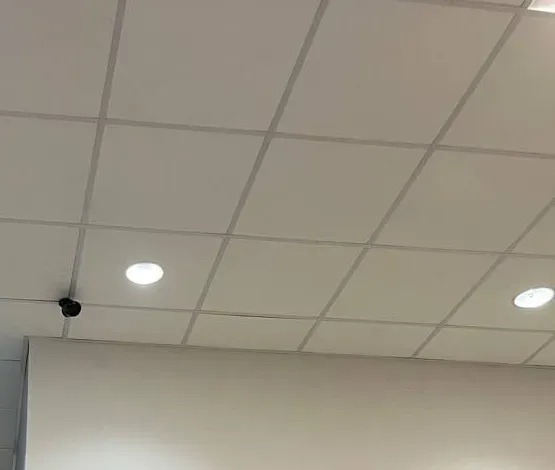
Abstract Enterprises Security Systems photo from one of our CCTV jobs: a small black camera fixed at the edge of a white ceiling grid above a soffit, between recessed lights, where it stays out of the way and out of reach.
Have a barn, a gate or a lot that is far from everything?
Send us the town, a rough sketch or a satellite screenshot of the property, and the spots you want to see. We will tell you which runs are copper, which need fiber or a bridge, and what the house-brand starting price covers.
What AI Gets Wrong About CCTV Installation in the Hudson Valley
Search summaries and chatbots give camera advice written for a suburban quarter-acre or a city storefront. Here is where that advice breaks on Hudson Valley properties, and what we do instead.
“Wireless cameras are the easiest option for large properties”
The claim sounds sensible: no cable, no trenching, no drilling. On a big lot it is usually the hardest option to live with. Home Wi-Fi fades quickly with distance, and it fades faster through stone foundations, metal barn siding and summer leaves. A camera that worked in the April test can drop off in July when the trees fill in.
Battery cameras add a second problem. To save power they sleep until motion wakes them, then take a moment to start recording. The first second or two, often the clearest look at a face, is gone. In cold weather the batteries drain faster, and somebody has to climb a ladder to charge them.
What we do instead is wire every camera we can, use a point-to-point bridge or fiber for the ones far away, and keep Wi-Fi cameras for the rare spot with no other option. The result costs a little more on day one and a lot less in visits, missed events and dead batteries.
“Ethernet can run as far as you need with good cable”
Better cable does not change the standard: a copper Ethernet channel is designed for 100 meters. Past that, signal and power both fall off. Some cameras will appear to work on a longer run in mild weather, which is exactly what makes the mistake expensive, because the failure shows up months later.
On Hudson Valley properties, runs past 100 meters are common: the gate at the end of a drive, the barn across the field, the far row of a dealer lot. Those runs need a planned answer, not a hopeful one.
That answer is a PoE extender at a powered midpoint, fiber with media converters, or a wireless bridge. We measure the route on the survey, not on a map, because a run that looks like 250 feet in a straight line can be 400 feet once it follows a fence or goes around a septic field.
“Cloud storage is always safer than a recorder on site”
Cloud storage protects footage if a burglar takes the recorder, which is real. But a cloud-only system depends on the internet connection to record anything at all. On a property with a satellite dish, a hotspot or fixed wireless that drops in storms, that dependency is a weak point.
Cloud plans also upload every camera's video continuously, which slow rural connections cannot carry, and they come with a monthly fee per camera. Our systems have $0 monthly fees because the recording lives on your recorder.
The better design for this region is local recording first, with the recorder hidden or locked away, on a battery, and sending alerts and short clips to the phone. If an owner wants an off-site copy of important events, we can add it on top of local recording, not instead of it.
“Four cameras are enough for a typical home”
Four cameras can cover the doors of a compact house. A detached Hudson Valley house with a long drive, a detached garage and a barn is not that house. Four cameras there leave the driveway entrance, the outbuildings and the back of the property unseen.
The count should follow the property: one camera for each place a person or vehicle arrives, one for each door, and one for each building or area you care about. On many country properties that is six to ten.
That is why we start with a 4-camera system price and size the recorder with spare channels. You can begin with the cameras that matter most and add the rest without replacing the recorder.
“More megapixels always mean better evidence”
Resolution helps, but it is not the whole story. A 4K camera aimed across a whole field still shows a person as a few pixels. A plate at the end of a 300-foot drive needs a narrow lens, not just more megapixels, and at night it needs the right shutter speed or the plate blurs.
Higher resolution also uses more storage and more network bandwidth, which matters on systems with many cameras or long fiber links.
We pick resolution and lens together for each camera's job: wide coverage where you want to see what happened, tighter views where you want to identify who did it.
“Motion detection will tell you when someone is on the property”
Plain motion detection reacts to any change in the picture. In the Hudson Valley that means deer, bears, foxes, raccoons, blowing snow, swaying branches and headlights on the road. Owners get so many alerts that they switch them off, and then the one alert that mattered never arrives.
Smart detection that recognizes people and vehicles, combined with zones drawn around the drive, the doors and the barn entrance, fixes most of that. It is now standard on our house-brand recorders and on the partner brands we install.
We tune it over the first week, because every property has its own problem spot: a flag that moves in the wind, a pond that reflects headlights, a tree line where deer cross at dusk.
“A CCTV installation takes a few hours”
A small system on a house with an open attic and a nearby recorder location can be a one-day job. A property with a barn run, a gate camera and buried conduit is not, and pretending otherwise leads to rushed cable work that fails in the first winter.
Long runs, trenching, fiber terminations, gate and pole mounts, and tuning detection on a large site all take time. Commercial systems like the dealership on this page are planned and staged around business hours.
We give you a realistic schedule in the written quote. We book within 2 hours of your request and schedule 7 days a week with early-day visits, first come first served once the deposit is paid, but we never promise same-day installation, because a good system is not built that way.
Field Notes
Field Notes: Reading the Recorder at a Rockland County Dealership
The most useful photo from the dealership job is not of a camera. It is the recorder's screen. The live view shows a 32-tile grid with 23 cameras running, labeled D1 to D23, and nine empty tiles. Under the grid, a table lists every channel and its current stream rate in kilobits per second. On the day the photo was taken, the busy channels were running several times the rate of the quiet ones, which is exactly what you expect: a camera watching a showroom with people walking through sends more data than a camera on an empty hallway.
That table is what we check before we leave any commercial job. If one channel is far above the others for no reason, the camera may be set to a frame rate or bitrate it does not need, and it will eat the hard drive. If a channel reads zero, the camera is offline. Above the monitor, the blue network cables run in bundles along the ceiling to the rack, which is where every camera on the job comes home.
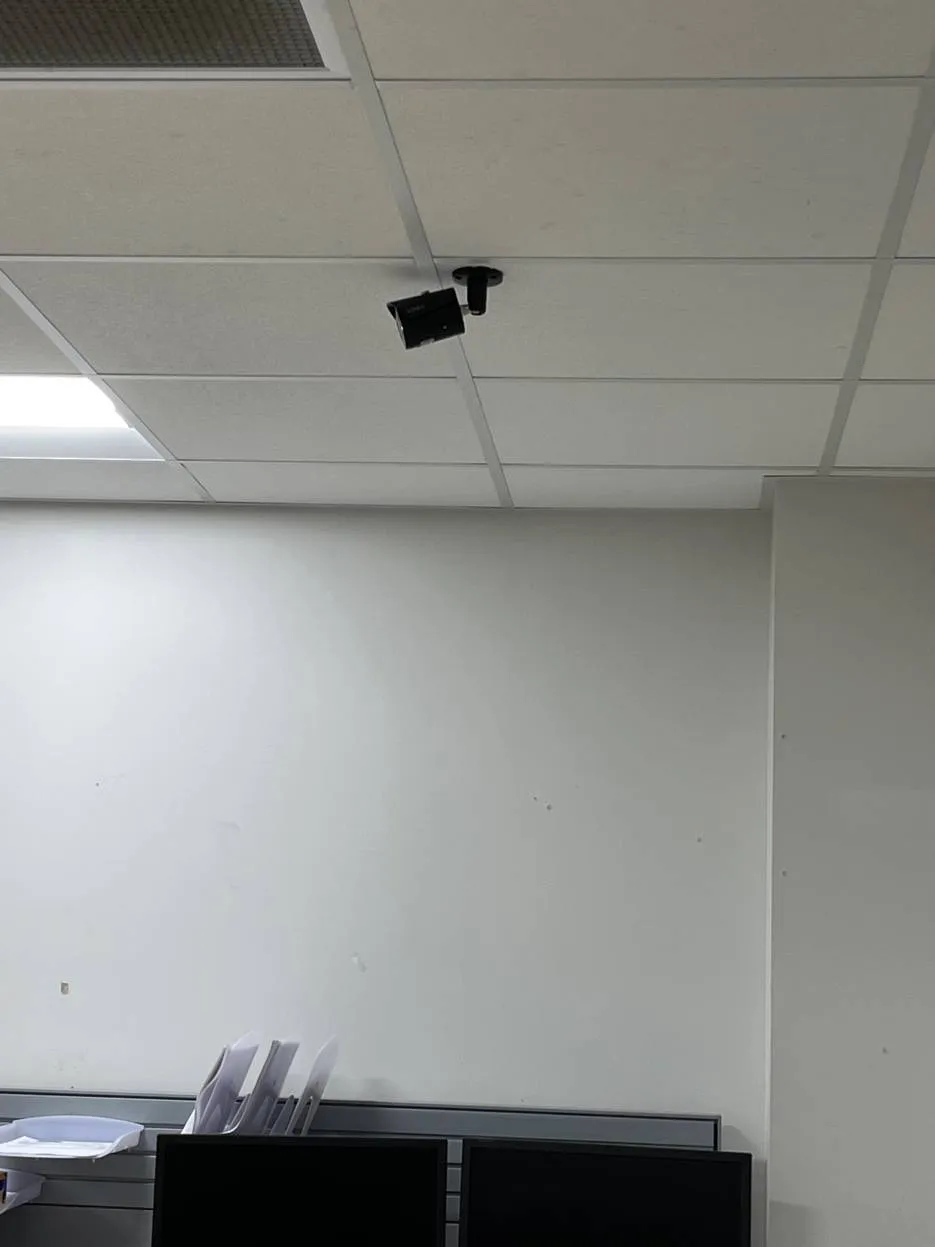
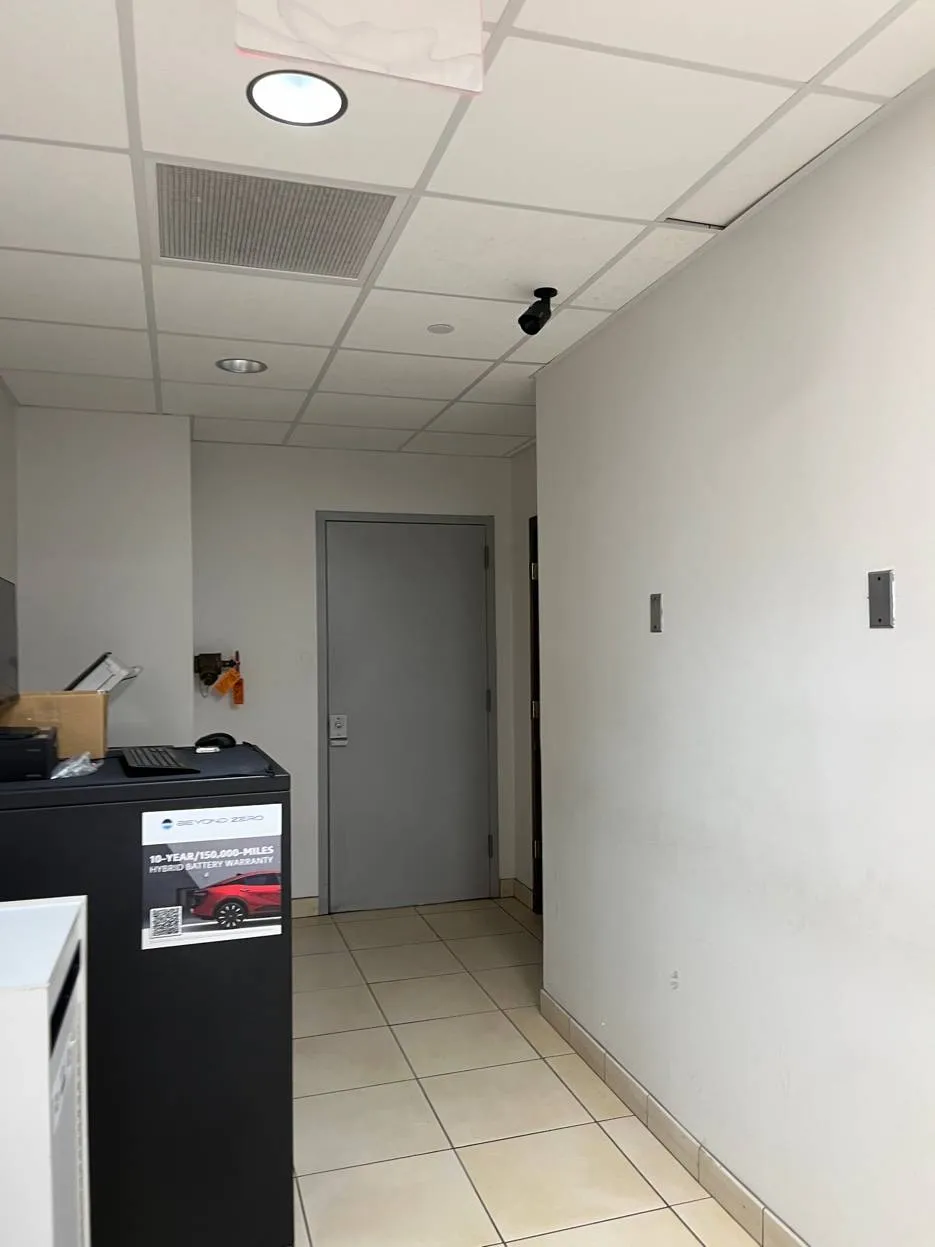
Abstract Enterprises Security Systems photo from the dealership job: a black bullet camera on a short ceiling mount fixed through a drop ceiling tile, looking over a work area with two computer monitors and a paper tray.Abstract Enterprises Security Systems photo from the dealership job: a black bullet camera on the drop ceiling looks down a short tiled hallway toward a grey door, past a black cabinet with a keyboard on top.
Two more lessons from that building apply to most Hudson Valley businesses. Ceiling-mounted bullets on short brackets work well over work areas, because the camera clears light fixtures and looks down at desks and screens at an angle that shows hands and faces. A single camera at the end of a hallway is often the best value on a job: everyone who uses that door walks straight toward the lens.
Before You Hire
How to Choose a CCTV Installer for a Hudson Valley Property
Whoever you hire, a few questions separate an installer who has done country properties from one who has only done townhouses. Use this as a checklist when you compare quotes.
How will you reach the farthest camera? If the answer for a barn 500 feet away is “a long Ethernet cable” or “Wi-Fi should reach”, keep looking. Ask for the method in writing: extender, fiber or bridge.
What happens when the power goes out? Ask whether a UPS is included or quoted, and how long the recorder runs on it.
What happens when the internet goes out? The right answer is that recording continues locally.
What surge protection goes on outdoor runs? Every long outdoor copper run should have protection at both ends and a ground.
How many days of recording will I get? Ask for the number at your camera count and resolution, not a generic “weeks”.
Who owns the passwords? You should get the admin login, not a reseller account you cannot control.
Are you licensed for low-voltage work in New York, and insured? Ask for the license number and check it.
What do I get at the end? A camera list, a cable map, the password sheet and a walk-through of playback and export.
We answer all of these in writing in every quote. For what our customers say about us, read our Google reviews, rated 4.7★ from 201 reviews; we do not hand out client lists.
When Owners Call Us
The Moments That Bring Hudson Valley Owners to CCTV
After a break-in or vandalism. CCTV installation after a burglary is the most urgent call we get. We book quickly, put the cameras that would have caught the last event in first, and make sure the recorder is somewhere a burglar will not find it. If there was property damage, we photograph mounts and cable routes so the repair and the new system are documented for the insurer.
Before a long trip or a winter away. Owners who leave for a month, or close a lake house for the winter, want to see the property and know the system will keep running. That means remote viewing, health alerts, a heated recorder location and a battery that outlasts short outages.
Before moving in. A new house is easiest to wire before the furniture arrives. Attics and basements are empty, and concealed wiring takes less time when nobody is living around it.
New business openings and holiday retail. A store, restaurant or office opening on Route 59 or Route 9 wants cameras running on opening day, and retailers want them before Black Friday and the Christmas season. We plan around fit-out schedules and inspections so the cameras go up after the ceilings close and before the doors open.
Harvest season and summer homes. Orchards and farm stands call in August before picking season; summer-home owners call in spring before the first long weekend. Booking a few weeks ahead of the rush gets you the date you want.
A vacant property or a construction site. Empty houses during an estate sale or renovation, and new construction where copper and tools sit overnight, need cameras that record locally, alert on people and vehicles, and keep running on temporary power.
Get In Touch
Request a Free Hudson Valley CCTV Installation Quote
Tell us the town and county, the type of property, roughly how many cameras you want and where, and the distance from the house or office to the farthest spot you want to see. A few phone photos of the outside of the house, the barn or the lot, and of the place where an old recorder sits if there is one, help us quote faster. Tell us too whether the property has reliable internet. Prefer to talk? Call (800) 486-0943.
✅
Request Sent!
Thank you. We will call or text to book your CCTV visit, usually within 2 hours of your request.
How It Works
Our CCTV Installation Process in the Hudson Valley
Every Hudson Valley CCTV job runs through the same six steps, whether it is four cameras on a cape in Pearl River or a multi-building farm in the Rondout Valley.
1
Send the property details
Town and county, property type, the spots you want covered, distance to the farthest camera, internet at the site, and photos of any existing recorder. We book within 2 hours.
2
Confirm the layout
By phone, photos and satellite view for simple homes; on site for long runs, outbuildings and businesses. We measure real cable routes, check power at far buildings and find a safe recorder spot.
3
Approve a written quote
Every camera, lens, cable run, extender, fiber link, UPS and labor item listed, with the house-brand series price and any extras priced after we confirm the layout. A 50% deposit books the date.
4
Run cable and mount cameras
Hidden routes through attics, basements and ceilings where possible, outdoor-rated cable or conduit outside, surge protection on every outdoor run, sealed penetrations on every wall.
5
Set up the recorder and network
Recorder, drive, PoE switch and UPS installed; streams, retention, smart detection zones and passwords set; recording verified on every channel.
6
Hand over and tune
App on your phones, a walk-through of playback and clip export, the password sheet and cable map, then a check of alerts and storage after the first week.
Coverage Area
CCTV Installation Near the Hudson Valley's Landmarks
We work in all six counties, from the Bronx line north to the Catskill edge of Ulster. These landmarks mark the areas where our crew is on the road most often.
Palisades Center, West Nyack
The big Rockland retail hub off Route 59 and the Thruway, surrounded by the dealerships, strip centers and restaurants we wire for business CCTV.
Woodbury Common, Central Valley
The Orange County outlet center by Route 17 and the Thruway, at the center of a corridor of shops, hotels and restaurants with large parking fields.
Walkway Over the Hudson, Poughkeepsie
The old railroad bridge turned park between Poughkeepsie and Highland, linking Dutchess and Ulster neighborhoods of older homes, village shops and Route 9 businesses.
Rondout waterfront, Kingston
Kingston's historic harbor district of brick buildings, restaurants and marinas, close to the farms and second homes of central Ulster.
Ridge Hill, Yonkers
A large Westchester shopping and residential complex near the Thruway, typical of the southern county's denser mix of condos, retail and offices.
Main Street, Cold Spring
Putnam County's riverside village of small shops and older homes below the Hudson Highlands, where country estates begin a few miles inland.
We also serve Peekskill, Mount Kisco, Bedford, Ossining, New City, Pearl River, Haverstraw, Monroe, Warwick, Newburgh, Middletown, Goshen, Carmel, Brewster, Mahopac, Beacon, Fishkill, Millbrook, Rhinebeck, Hyde Park, New Paltz, Saugerties, Woodstock and Ellenville, and the roads in between.
Pricing
CCTV Installation Cost in the Hudson Valley
These are the same starting prices shown on our Hudson Valley security camera page. Each house-brand package is a 4-camera system with the recorder, the wiring, the installation and two weeks of recording included.
System
What it is
Starting price
A Series
2MP HD 1080p cameras on a DVR, 4-camera package
from $1,099
F Series
5MP 2K HD cameras on a DVR, active deterrent with siren and lights
from $1,147
E Series
4–5MP IP 2K HD cameras on a 4K NVR, smart detection
from $1,306
C Series
8MP 4K Ultra HD cameras on a DVR, long-range options
from $1,541
D Series (top tier)
8MP 4K Ultra HD IP cameras, active deterrent, two-way talk
from $1,541
Commercial CCTV systems
Offices, retail, restaurants, warehouses and multi-building sites
$1,500 to $5,000+
Monthly fees
Local recording, no cloud subscription required
$0
What changes the price on a Hudson Valley job
The series price covers a standard 4-camera installation. Additional cameras, long runs past 100 meters, PoE extenders, fiber links and media converters, wireless bridges, trenching or conduit, concealed wiring through finished walls, pole and gate mounts, larger drives for longer retention, and a UPS are all priced per item after we confirm the layout. CCTV installation cost per camera depends mostly on the cable route to that camera, which is why a camera on the porch and a camera on the barn are not the same line on the quote.
Three common Hudson Valley layouts show how that works. A colonial in Rockland with an attached garage and a short driveway usually fits a 4-camera package as is: front door, back door, driveway and the side yard, all wired through the attic and basement. A country house in Dutchess with a detached garage and a barn usually starts with the 4-camera package on the house, then adds cameras on the garage and the barn and a fiber or extender run across the yard, each priced after the layout is confirmed. A small business on Route 9 or Route 59 usually falls in the commercial range, with cameras on every entrance, the register, the back door and the lot.
CCTV installation labor only, for cameras you already bought, is quoted by phone or text from the model numbers and the layout, and booked with the deposit. Financing is available on our systems; ask when you call. We do not run inflated “was” prices or fake specials: the series prices above are the prices.
Installation workmanship is covered by our 30-day warranty, and extended coverage of one year or longer is available as a paid add-on. Full terms — including 50% deposit, one-year parts-only warranty on Abstract Enterprises Security Systems-supplied products, and the late-fee schedule — are set out in the service agreement.
Shop Our Systems
CCTV Installation Packages for Hudson Valley Properties
Five house-brand series, each sold as a 4-camera package with professional installation, the recorder and two weeks of recording. Which one fits depends on how far the cameras need to see, whether you want smart detection, and whether old coax can be reused.
A
A Series · from $1,099
2MP HD 1080p cameras on a DVR. Night vision 60–100 ft, motion detection, smart AI, full-color night vision, audio and remote access. Models A1, A2, A3. A sensible start for a compact house or a small shop.
F
F Series · from $1,147
5MP 2K HD cameras on a DVR in eyeball, bullet and dome styles. Night vision 90–100 ft, active deterrent with siren and lights, 20" monitor. Models F1 to F6. A good fit for reusing old coax to a barn.
E
E Series · from $1,306
4–5MP IP 2K HD cameras on a 4K NVR. Night vision 90–100 ft, IP67, smart detection, audio, full color, 20" monitor. Models E1, E2, E3. Our usual pick for houses on wooded lots where smart alerts matter.
C
C Series · from $1,541
8MP 4K Ultra HD cameras on a DVR in eyeball and long-range styles. Night vision 100–120 ft, IP66, audio, full color, monitor included. Models C1, C2, C3. For long driveways where 4K over coax makes sense.
D
D Series · top tier · from $1,541
8MP 4K Ultra HD IP cameras in eyeball and bullet styles. Night vision 90–120 ft, IP67, audio, full color, active deterrent, two-way talk, 20" monitor. Models D1 to D5. For estates, farms and businesses that want everything.
Bring your own equipment: labor-only CCTV installation
Already bought cameras online or at a store? We install customer-supplied CCTV equipment for a labor price, quoted by phone or text once you send the model numbers, the number of cameras and the layout, and booked with the deposit. We do not do walk-throughs for customer-supplied equipment, and if you bring your own wireless cameras, their signal strength and the equipment itself are not covered by us. We will tell you honestly if a kit will struggle on your property, for example a Wi-Fi camera meant for a barn 400 feet away.
What is CCTV installation, and how is it different from putting up a doorbell camera?
+
CCTV, closed circuit television, is a set of cameras wired to a recorder on your property that stores video locally and shows it on a monitor and your phone. A doorbell camera is a single Wi-Fi device that usually records to a cloud account. CCTV installation means planning the camera positions, running and protecting the cable, mounting the cameras, setting up the recorder and hard drive, and configuring recording, detection and remote viewing so the whole property is covered by one system.
Which Hudson Valley counties and towns does your CCTV crew cover?
+
All six: Westchester, Rockland, Orange, Putnam, Dutchess and Ulster, from Yonkers and Nyack up through Newburgh, Poughkeepsie, New Paltz and Kingston to the edge of the Catskills. Our offices are at 1282 Troy Ave, Brooklyn and 460 E Fordham Rd, Bronx, and our crews travel to Hudson Valley jobs from there.
How do I book a CCTV installation, and how soon can you come?
+
Call (800) 486-0943 or send the form with your town, property type and what you want covered. We book within 2 hours of your request and schedule 7 days a week, with early-day visits, first come first served once the deposit is paid. We do not promise same-day installation, because long runs and outbuildings need proper planning.
Will you install CCTV cameras I already bought online or at a store?
+
Yes. Labor-only installation of customer-supplied cameras is quoted by phone or text once you send the model numbers, how many cameras there are and where they go, and it is booked with the deposit. We do not do walk-throughs for customer equipment, and we cannot be responsible for the signal or hardware of customer-supplied wireless cameras.
What warranty comes with a CCTV installation from Abstract Enterprises Security Systems?
+
Installation workmanship is covered for 30 days, and extended coverage of one year or longer is available as a paid add-on. Products we supply carry a one-year parts-only warranty, and the deposit, warranty and late-fee terms are written into the service agreement you sign before the job.
Are you a licensed and insured CCTV contractor in New York State?
+
Yes. Abstract Enterprises Security Systems is a licensed New York State low-voltage contractor, license #12000287431, and carries general liability insurance. We have been owner-operated since 2002 and have completed thousands of jobs. For what customers say, read our Google reviews, rated 4.7 from 201 reviews.
Do you offer financing, deals or seasonal specials on CCTV systems?
+
Financing is available on our systems; ask about it when you call. We do not run inflated sale prices: the starting prices on this page are the real prices, from $1,099 for a 4-camera A Series system with recording, and every quote is written so you can compare it line by line.
Can you take over a camera system that another installer put in and no longer supports?
+
Usually. We identify the recorder, the cameras and the cable, test what is working, and recover the admin login where possible. Then you get a written choice: keep and service the existing system, upgrade the recorder and keep good cameras and cable, or replace it. Old coax and Cat6 that tests good is often reused.
Which camera brands do you install besides your own house brand?
+
Our house brand is the default. We are an authorized partner for Lorex, Luminys and Reolink, and we also install, integrate and service systems from brands such as Hikvision, Dahua, UniFi Protect, Axis, Hanwha, Uniview and Digital Watchdog when an owner already has them or prefers them.
Can CCTV footage help with a police report or an insurance claim after a break-in?
+
Yes, if the cameras captured the event clearly and the footage was kept long enough. At handover we show you how to find an event and export a clip to a USB drive or your phone, which is what police and insurers usually ask for. Systems we install keep at least two weeks of recording, and we can size for longer.
Is it legal to record audio on security cameras in New York?
+
New York's eavesdropping law requires at least one party to a conversation to consent to recording it, so microphones that pick up conversations among other people raise legal risk, especially at businesses. We leave audio off by default at businesses and discuss it with you before enabling it anywhere. This is general information, not legal advice.
What should I have ready before the CCTV installation survey?
+
A list or sketch of the spots you want to see, the distance to the farthest one, where you would like the recorder and monitor, whether outbuildings have power, the name of your internet provider, and the login for any existing recorder. For condos and HOAs, have the board's approval or the contact who can give it.
All Areas Served
CCTV Installation Across New York's Three Service Regions
Abstract Enterprises Security Systems runs CCTV crews in three regions. Each hub page covers its own area's buildings, prices and rules.
Hudson Valley counties covered from this page: Westchester, Rockland, Orange, Putnam, Dutchess and Ulster. Offices: 1282 Troy Ave, Brooklyn and 460 E Fordham Rd, Bronx. Licensed NYS low-voltage contractor #12000287431, insured. Rated 4.7★ / 201 Google Reviews. Updated November 2026.