Village, town or hamlet, hi-ranch or Hempstead Turnpike storefront: wired CCTV that records on your own premises, quoted in writing. Nassau line: (516) 346-5778
CCTV installation in Nassau County means a wired camera system, recorded on a DVR or NVR inside your own house or business, designed around the way Nassau is actually built: postwar capes and hi-ranches on 60-foot lots, driveways that face the street, strip stores on Hempstead Turnpike and Sunrise Highway with a service lane behind them, and offices around Garden City and Mineola. Abstract Enterprises Security Systems plans each camera for a face, a plate or a doorway, runs the cable through attics, crawlspaces and drop ceilings, and hands you a system you can watch on your phone with nothing to pay each month. We also tell you which of the county's 2 cities, 3 towns and 64 villages your address falls in, because that decides which police department will ask for your clip and whose code applies to anything you build.
Reviewed and updated November 16, 2026 by Abstract Enterprises Security Systems, NYS license #12000287431 · Sources: New York State and Nassau County municipal listings; U.S. Census Bureau ACS 2023 5-year (DP04); NYS DCJS Index Crimes by County, 2023–2024; Newsday (November 2024); ABC7 New York (October 2017, January 2024); Herald Community Newspapers (September 2026); Nassau County Police Department Alarm Permit Section; NY Penal Law §250 and Labor Law §203-c
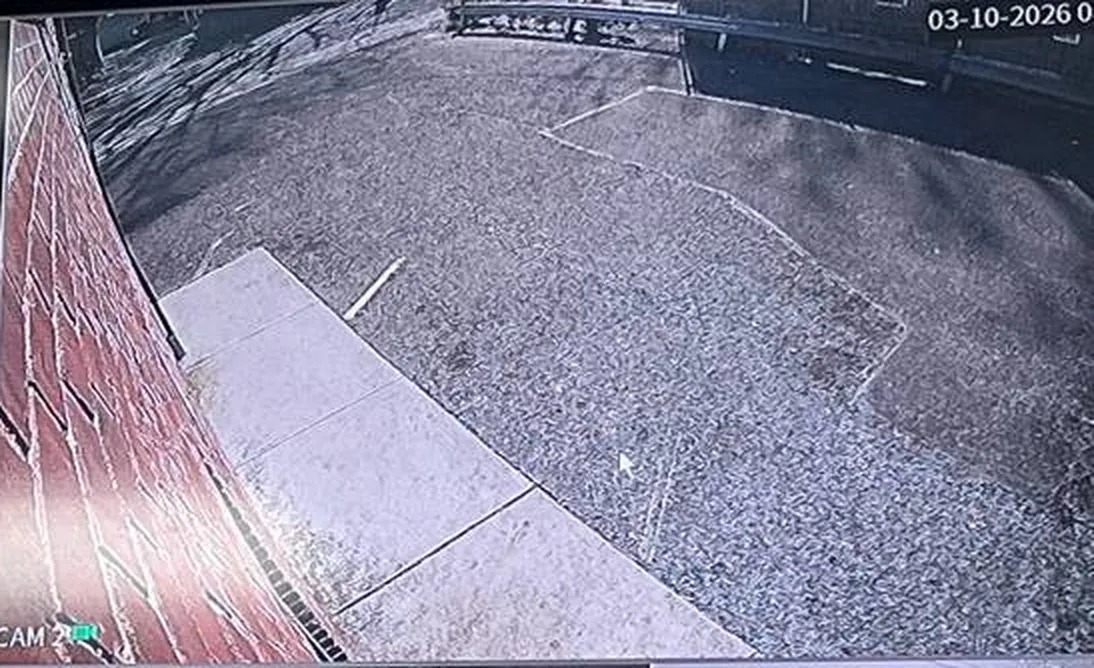
From our Nassau County job in South Hempstead: the side camera's tile on the office monitor. The wide lens bends the brick wall at the left edge, but the walk, the curb line and the whole lot stay in one frame, with the date stamp in the corner.
Nassau County CCTV Request
Village or hamlet, property type and camera count
✅
Request Sent!
Thank you. We book Nassau County CCTV jobs within 2 hours of a request and will be in touch shortly.
25+
Years Experience
2 Hr
Booking
100%
Licensed & Insured
4.7★
201 Google Reviews
Owner-operated since 2002 · Thousands of jobs completed · Booked within 2 hours
A complete 4-camera CCTV system installed in Nassau County starts at $999 with the recorder, cabling, mounting and 2 weeks of recording included; a 4–8 camera home system on an NVR with PoE wiring runs $1,117 to $2,500, and commercial CCTV for stores, offices and warehouses runs $1,500 to $5,000+. Footage stays on the recorder in your building, so there is no monthly fee. Call or text (516) 346-5778: we book the job within 2 hours of your request and schedule 7 days a week, with early-day starts, first come, first served once the deposit is in.
Entry price $999 for 2MP cameras on a DVR; 8MP 4K on coax or on PoE tops out the range at $1,441
Coax HD-analog or Cat6 PoE, chosen after we see your attic, crawlspace or ceiling
Own the cameras already? Send the model list and we text back a labor price
Why Nassau County Properties Need CCTV Installation
Nassau looks like one continuous suburb from the Long Island Expressway, but on paper it is a patchwork. The state lists two cities (Glen Cove and Long Beach), three towns (Hempstead, North Hempstead and Oyster Bay), 64 incorporated villages and more than 60 unincorporated hamlets inside the county line. A house in Levittown is in a hamlet governed by the Town of Hempstead and patrolled by the Nassau County Police Department. A house two miles away in Garden City is in an incorporated village with its own building department, its own code and its own police force. That split matters more to a camera owner than most people expect: it decides who reviews a pole or a fence you want to put a camera on, which detectives knock on your door after a break-in on the block, and how quickly the clip you export reaches the right desk.
The houses are the second thing that shapes a Nassau CCTV design. Census figures put 76.3% of the county's 477,860 housing units in single-family detached houses, and 47.5% of all units were built between 1940 and 1959, the years when potato fields in Levittown, Hicksville, East Meadow and Wantagh became subdivisions of capes and ranches. Add the hi-ranches and split-levels of the 1960s and you have the homes we wire most often. Their quirks are predictable once you have been in a few hundred of them: a cape whose upstairs was finished into bedrooms with a knee-wall crawlspace behind each one, a hi-ranch whose lower level is half below grade with the boiler and the electric panel, a split-level where the attic over the bedrooms is reachable but the attic over the living room is not. Each one gives us a different cable path to the soffit, and that path decides how clean the outside of the house looks when we leave.
The third thing is the driveway. Nassau houses sit close to the street with the car parked in plain view, and police have said as much about why thieves pick a block. When the Nassau County Police Department announced a multi-agency burglary and stolen-car task force in January 2024, ABC7 New York reported that police believe burglars are attracted by cars parked in driveways, and that the task force followed an attempted burglary at a Lake Success home. The good news is in the state numbers. New York's Division of Criminal Justice Services counts 551 motor vehicle thefts in Nassau County in 2024, down from 889 in 2023, and burglaries fell from 1,241 to 1,030 over the same year. Fewer cases means each one gets investigated harder, and the first thing an investigator asks a homeowner on a quiet street is whether a camera saw the car arrive.
Finally, Nassau's police have been building their own camera networks, and the village departments lean on private cameras more than people realize. Newsday reported in November 2024 that police departments across the county had installed nearly 70 license plate reading cameras in recent months, and that the Old Westbury department expected its plate readers to be complemented by 160 security cameras at golf clubs, schools and businesses that had agreed to share their video with police. A plate reader on a village corner tells detectives a car passed; your camera at the end of the driveway shows who got out of it. The two work best together, which is why we set up every Nassau system so the owner can find and export a time-stamped clip in a couple of minutes.
“I can’t convince criminals not to commit crimes, but I can convince them not to commit crimes in Old Westbury.”
Detached, owner-occupied and postwar: 76.3% of 477,860 housing units are single-family detached, 81.9% of occupied units are owner-occupied, 34.6% of units were built in the 1950s alone and 19.5% in 1939 or earlier (U.S. Census Bureau, ACS 2023 5-year, table DP04).
Property crime falling, but not gone: county totals for 2024 were 1,030 burglaries, 12,385 larcenies and 551 motor vehicle thefts, against 1,241, 13,698 and 889 in 2023, a drop of about 17%, 10% and 38% (NYS DCJS Index Crimes by County; percentages are our arithmetic).
Village plate-reader networks: nearly 70 license plate reading cameras installed by Nassau police departments in the months before November 2024, including 34 in Old Westbury and 34 more across the nine villages patrolled by the Muttontown–Upper Brookville, Old Brookville, Brookville and Oyster Bay Cove departments (Newsday).
Storms still cut power: during the September 2026 nor’easter the governor declared a state of emergency for Nassau and Suffolk, and PSEG Long Island had restored power to more than 34,600 customers by the next afternoon (Herald Community Newspapers).
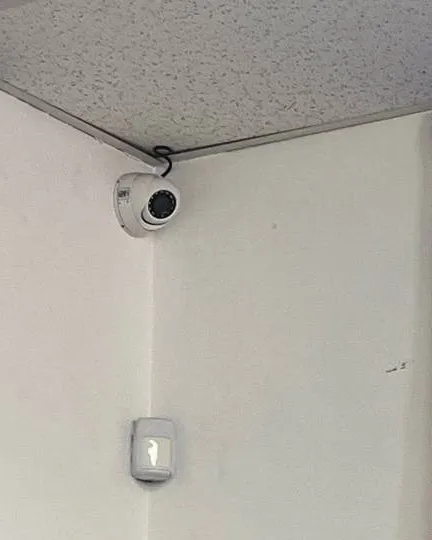
From our Nassau County job: the office dome sits in the ceiling corner directly above the existing alarm motion sensor, so the camera and the alarm watch the same doorway and the cable drops above the tiles instead of down the wall.
Put those four things together and the Nassau brief looks like this: know whose rules and whose police apply to your address; wire the house the way that particular house wants to be wired; point the most important camera at the driveway and the front walk where a face and a plate are close to the lens; and keep the recorder running on a battery when the next storm takes the power out. Our security camera installation service for Nassau County covers cameras in general, including doorbells and single cameras. This page is about CCTV in the narrower sense: multi-camera systems wired to a DVR or NVR that you own, which is what most Nassau businesses and a growing share of homeowners want once they have lived with Wi-Fi cameras that drop offline.
Field Notes
Field Notes: What the Four Tiles Told a South Hempstead Showroom
The job we point Nassau customers to is a window-and-door showroom with a working office in South Hempstead, a hamlet in the Town of Hempstead, which means Nassau County Police territory rather than a village department. The owners did not ask for a lot of cameras. They asked to be able to look up from his desk and answer four questions without getting up: who is walking toward the front door, who is pulling into the side lot, who is at the counter, and is anyone in the back room. Four cameras on a recorder, shown as four tiles on a wall monitor, answer exactly those four questions, and the way each tile looks on the screen is the real test of the installation.
The front camera covers the sidewalk and the door at the same time, so a customer is on video from the curb to the handle. Its tile shows the building number on the door, which is useful to an investigator and is the reason that tile stays out of the photos on this page. The side camera runs along the brick wall toward the lot; we used a wide lens there on purpose, accepting a little curve at the edge of the frame, because the goal was to see a car and a person anywhere in that lot rather than to read a plate at the far fence. The office camera watches the counter, the desks and the inside of the door, and the back-room camera watches the stock and the rear doorway.
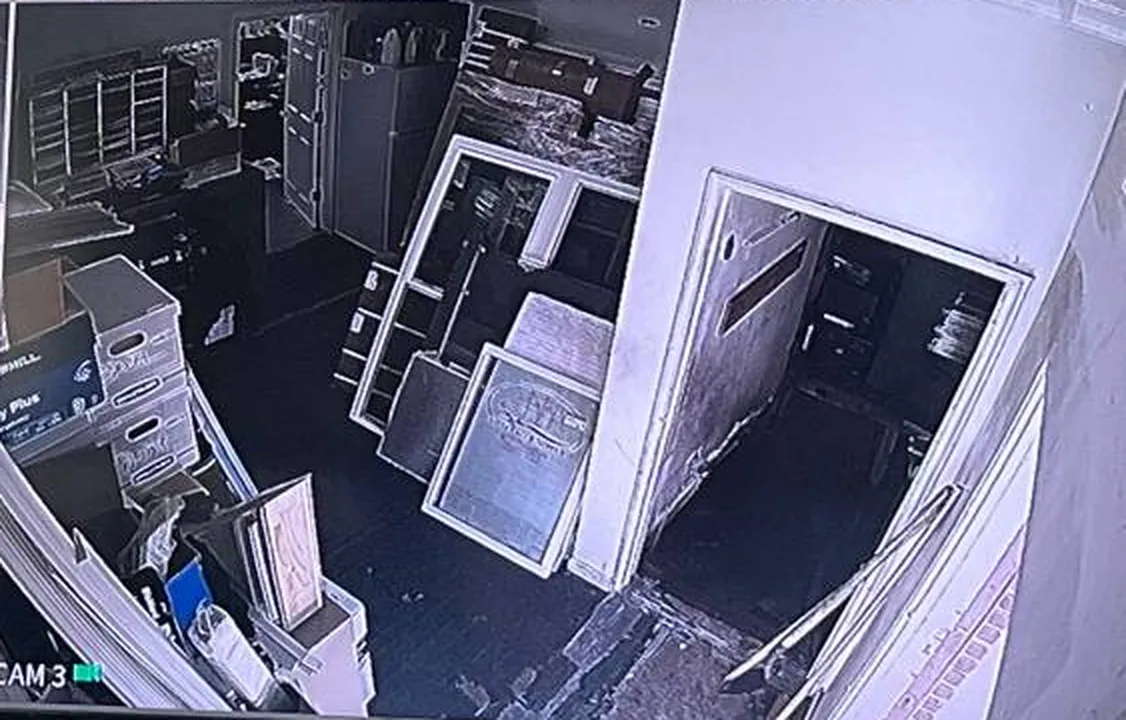
From our Nassau County job: the CAM 3 tile. The back-room camera sees the boxes, the stacked glass and the rear doorway in one view, so anything carried out the back passes through the frame.
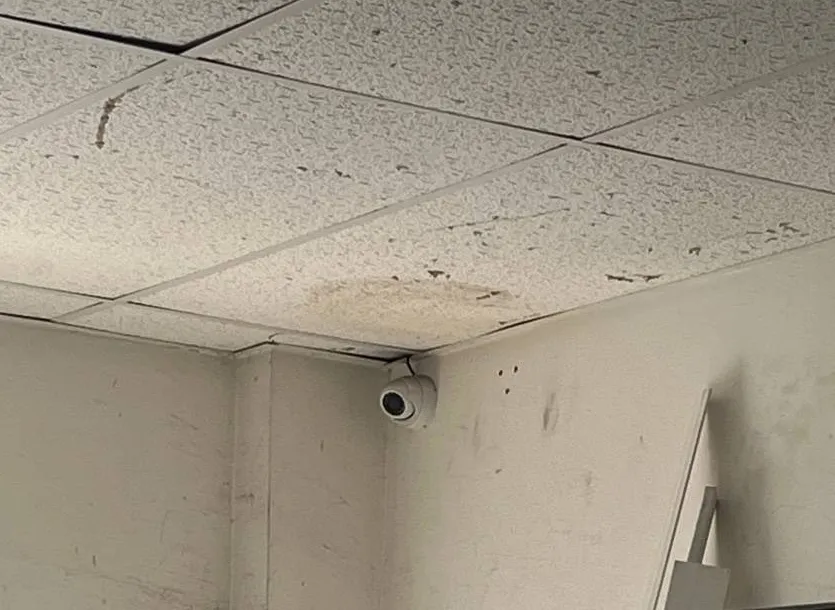
Two details made the difference in that back room. The ceiling tiles were stained from an old leak, so we fixed the dome to the solid corner of the wall rather than to a tile that might be replaced or sag, and we kept the cable above the grid where it cannot be snagged by the trim stock leaning against the walls. And the monitor shows the date and time in the corner of every tile, which sounds trivial until you need to hand a clip to a detective; a recorder whose clock has drifted is the most common reason footage gets questioned. We set the clock to sync automatically before we left.
From our Nassau County job: the back-room dome on the wall corner, below the stained tiles. Mounting to the wall instead of the tile keeps the view steady when the ceiling is opened for repairs.
Nothing on that job was complicated, and that is why it is a good model for a small Nassau business. Most storefronts along Grand Avenue, Merrick Road or Hempstead Turnpike need the same four answers, plus maybe a fifth camera on the register and a sixth on the dumpster side. If your business looks like that, a 4-camera house-brand package or a small NVR system covers it, and the recorder in your back office keeps every tile on the screen whether the internet is up or not.
What We Install
CCTV Installation Services in Nassau County
Our crew handles every part of a CCTV installation service in Nassau County from the first sketch to the phone handover: camera placement, cable runs, mounting, the recorder, the network, the app and a short lesson on pulling a clip. These are the jobs Nassau customers book most, from a single driveway camera added to an existing recorder to a multi-building system for a plaza or a co-op complex.
🏡
Home CCTV Installation
Residential CCTV installation for capes, ranches, hi-ranches, split-levels and colonials: front walk, driveway, side gate, backyard and detached garage, recorded on a DVR or NVR in a closet, a basement or the lower level. Smartphone viewing, motion alerts and night recording are set up before we leave.
🛒
Store & Restaurant CCTV
Retail CCTV installation for the strip stores, delis, bagel shops, nail salons and pizzerias along Hempstead Turnpike, Sunrise Highway, Jericho Turnpike and the village main streets. Register, front door at face height, stockroom, rear door and the service lane, with the recorder locked away from the counter.
🏢
Office & Medical Office CCTV
Office CCTV installation for professional buildings around Garden City, Mineola, Lake Success and Jericho: entrances, reception, records rooms and parking, with cameras kept out of exam rooms, restrooms and any space where patients change.
🔌
IP & PoE CCTV Installation
IP CCTV installation over Cat6 with each camera powered by a PoE switch or a PoE recorder. One cable per camera carries video and power up to 100 meters. It is our default for new systems wherever we can reach a soffit, a ceiling or a wall.
📺
HD-Analog CCTV & DVR Setup
Analog CCTV installation using HD-TVI, HD-CVI or AHD cameras on coax and a DVR. Many Nassau houses and shops already have RG59 coax from a 2000s-era system; if it tests clean, we reuse it and put sharp new cameras on the old runs.
🚪
Gate, Drive & Estate CCTV
Perimeter CCTV installation for North Shore properties with a gate, a long drive and outbuildings, from Old Westbury and Muttontown to the Brookvilles and Lattingtown. Plate-angle cameras at the gate, overview cameras on the drive, and switches in outbuildings to keep cable runs short.
🏘️
Co-op, Condo & Garden Apartment CCTV
Multi-family CCTV installation for garden apartments and co-ops in Great Neck, Mineola, Hempstead, Valley Stream and Long Beach: lobbies, mailrooms, laundry rooms, parking courts and trash enclosures, with board-approved access rules for who can view and export.
🔁
CCTV Upgrades & Replacements
CCTV installation and upgrade work on systems another company left behind: a DVR that stopped recording, cameras that went blurry, a lost admin password, or a jump from analog to IP. We tell you what to keep before we quote anything new.
🧰
Labor-Only Installs
CCTV installation for customer-supplied cameras: send the brand, the model list and photos, and we quote labor only by phone or text and book it with the deposit. We mount, wire and configure what you bought; the equipment and any Wi-Fi signal remain your responsibility.
CCTV Installation for Nassau County's Architecture
Nassau's housing was built in waves, and each wave left a different kind of house to wire. Before we quote, we ask what kind of house it is and when it was built, because a 1949 cape and a 1965 hi-ranch on the same street need completely different cable paths.
🏠
Levittown-Era Capes
The postwar capes of Levittown, Hicksville, Wantagh and Bethpage often have a finished upstairs with knee-wall crawlspaces at the eaves. Those crawlspaces are our route to the soffits on the long sides of the house. Dormers that were added later can block the path, so we check each side before we promise hidden wire.
🏚️
Ranches
One-story ranches in East Meadow, Plainview, Syosset and North Merrick usually have the simplest wiring on the Island: an open attic over the whole footprint. Cameras go under the eaves on junction boxes, the cable drops to a closet or the basement, and almost nothing shows outside.
🪜
Hi-Ranches
The raised ranch, called a hi-ranch here, puts the bedrooms upstairs over a half-buried lower level with the garage, the boiler and often a den. The upper attic reaches the high soffits; the garage and lower-level cameras come up from the utility room. The recorder usually lives on that lower level near the modem.
📐
Split-Levels
Split-levels in Seaford, Massapequa, Merrick and Plainview have two or three roof planes, and the attic over the living room is often a sealed void. We run the bedroom-side cameras from the reachable attic and route the others along the basement rim joist and up through the sill, so the front face stays clean.
🏛️
Tudors & Colonials
The prewar Tudors and center-hall colonials of Garden City, Rockville Centre, Malverne and Manhasset have plaster walls, stucco, half-timbering and slate or cedar roofs. We mount on trim boards and mortar joints rather than through decorative stucco, and fish cable through closets and chases instead of opening plaster.
🌳
North Shore Estates
Gold Coast properties in Old Westbury, Muttontown, Laurel Hollow and the Brookvilles have gates, long drives, pool houses and carriage houses. We put a small switch in each outbuilding, link it back with buried Cat6 or fiber, and keep each camera's run short enough to stay powered and reliable.
🌊
Raised South Shore Homes
After Sandy, many houses in Long Beach, Island Park, Oceanside, Baldwin Harbor, Freeport and Massapequa were lifted onto new foundations. The living space is a full story up, the area below is open or used for parking, and the recorder and switch belong upstairs, never at grade where water can reach them.
🏘️
Garden Apartments & Co-ops
Two- and three-story garden complexes from the 1940s through the 1960s spread entrances across a courtyard. Each building gets a small switch or recorder in a common closet, linked back to a main recorder, with cameras on doors, mail areas, laundry rooms and parking. Larger buildings are covered on our Nassau apartment building camera page.
Cable paths we use most on Nassau houses
On a house with any attic access, the cleanest path is attic to soffit: we drill down through the top plate or the soffit board, set a weatherproof junction box under the eave and mount the camera on the box, so the only thing visible outside is the camera itself. On a cape with a finished upstairs, the knee-wall crawlspaces do the same job for the long sides, and the gable ends are reached from the small attic above the ceiling. Where a section of roof has no reachable space above it, which is common over a 1970s family-room addition or a cathedral ceiling, we come from below instead, along the basement or crawlspace and up through the sill plate. Detached garages, common in the older parts of Valley Stream, Lynbrook, Malverne and Rockville Centre, get either a buried run in conduit or an aerial cable on a messenger, and we price each so you can choose.
Siding, shingles and stucco
Nassau houses wear just about every kind of skin: vinyl and aluminum siding on the postwar streets, cedar shingles on older South Shore and North Shore homes, brick veneer on the 1950s and 1960s ranches, and stucco on the Tudors. On siding we use a mounting block so the base sits flat and water runs around it. On shingles and brick we fix to solid backing and seal every penetration. On stucco we drill once, at a planned point, and seal it right away, because cracked stucco lets water into the wall behind it. If you are re-siding or re-roofing in the next year, tell us; it is cheaper to pre-wire and leave a labeled cable behind the new siding than to come back.
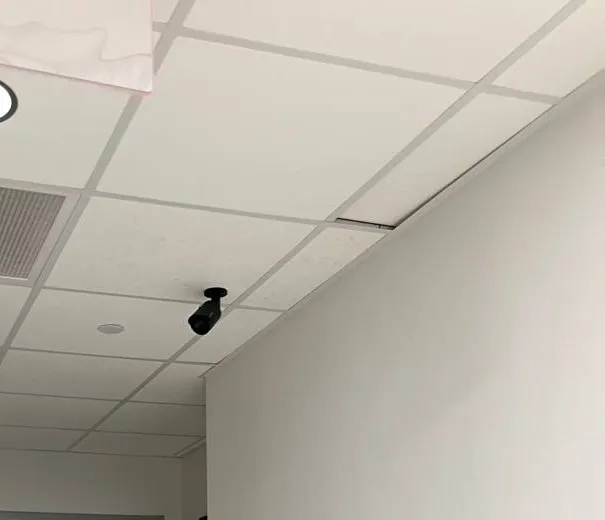
From one of our CCTV jobs (Rockland County car dealership): a small bullet on the ceiling grid near the return vent, aimed down a corridor so anyone walking toward the door faces the lens. Long, narrow spaces in Nassau offices and co-op hallways get the same treatment.
Where the recorder should live in a Nassau house
The recorder needs three things: a steady temperature, a network connection to the router, and a spot a burglar will not find in the first minute. In a cape, that is usually a bedroom closet upstairs or a basement shelf near the modem. In a hi-ranch, it is the lower-level utility room or a den closet. In a raised South Shore house, it is upstairs, above any water. We avoid unconditioned attics, where summer heat shortens hard-drive life, and detached garages, where a thief can carry the recorder off with the car. Wherever it goes, it sits on a small battery backup with the switch and the modem.
Commercial CCTV
Business CCTV Installation in Nassau County
Commercial CCTV installation in Nassau usually means a building on a busy road with a parking field in front, a service lane behind and neighbors on both sides who share both. The cameras that earn their keep are the ones customers barely notice: the door, the register, the back door and the far end of the lot. Each of the county's main commercial roads has its own pattern, and these are the ones our crews work most.
🛣️
Hempstead Turnpike
From Elmont through Franklin Square, West Hempstead, Uniondale, East Meadow and Levittown, a long run of delis, auto shops, phone stores, restaurants and small plazas. Most have a curb cut straight onto a busy road, so a camera on each driveway entrance is worth more than a wide view of the lot.
🚆
Sunrise Highway
The South Shore stretch from Valley Stream through Lynbrook, Rockville Centre, Baldwin, Freeport, Merrick and Massapequa mixes car dealerships, gas stations and strip centers along the LIRR line. Dealership lots need long-range cameras on the rows and a camera on the key drop.
🛍️
Old Country Road & Roosevelt Field
The retail and office corridor through Garden City, Carle Place, Westbury and Hicksville, around Roosevelt Field. Medical suites, banks and pad-site restaurants share parking fields, so we agree camera coverage with the landlord before mounting anything on a shared pole.
🏬
Jericho Turnpike
From New Hyde Park and Mineola through Westbury, Jericho and Syosset: plazas, auto dealers, diners and professional buildings. Wide frontages and two-way traffic call for a narrow camera on each entrance plus overview cameras on the building corners.
⚓
Village Main Streets
Rockville Centre, Garden City's Seventh Street, Great Neck's Middle Neck Road, Port Washington, Oyster Bay and Sea Cliff: storefronts with apartments above, rear lots and municipal parking. Village rules on signs and exterior fixtures apply here, so we keep exterior hardware small and tidy.
🏭
Industrial Areas
Bethpage, Hicksville, Inwood, Garden City Park and Farmingdale have warehouses, contractor yards and shops. Warehouse CCTV installation there means high mounts, dock doors, yard gates and fence lines; see our warehouse camera installation page for Nassau County.
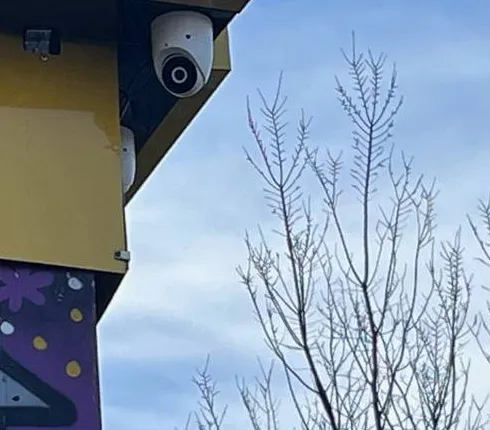
From one of our CCTV jobs (Manhattan corner deli): a turret dome tucked under the corner of the sign band, high enough to stay out of reach but low enough to see faces at the door. Strip stores on Nassau's turnpikes use the same corner.
Who owns the cameras in a strip center
Most Nassau strip centers have two layers of CCTV, and the confusion between them causes most of the arguments after an incident. The landlord's system, if there is one, covers the parking field, the light poles and sometimes the service lane. Your system covers the inside of your store, your door and your stretch of the rear. The landlord's footage belongs to the landlord, retention is whatever they set, and you may not be able to get a copy quickly. That is why we recommend that each tenant covers its own rear door and its own slice of the parking field from its own building wall, even if the landlord has cameras too. Before we mount anything on the building, we check the lease or ask the property manager, because most commercial leases require approval for exterior attachments.
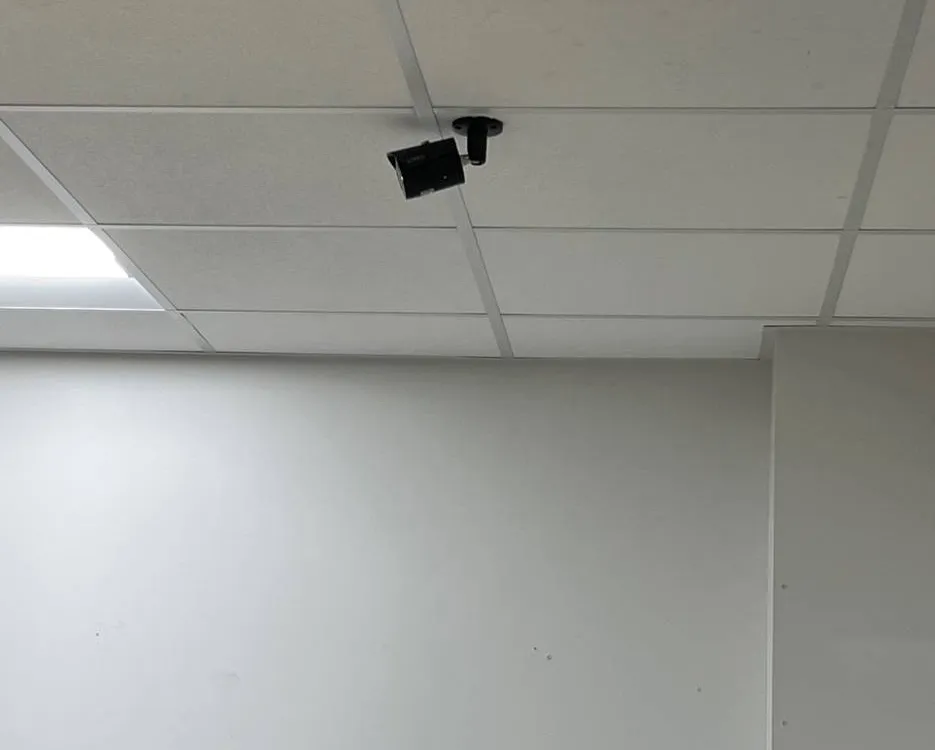
From one of our CCTV jobs (Rockland County car dealership): a bullet camera on a short pendant from the drop ceiling, aimed across the office floor. Suspending it a few inches below the tiles clears the light fixtures and gives a straighter angle on the room.
A typical Nassau business system
For a single store or office, the usual commercial CCTV installation is eight to sixteen cameras on an NVR with PoE, a battery backup for the recorder and switch, and a monitor where the owner or manager can see it. Restaurants add the kitchen back door and the grease-bin corner. Medical and dental offices add reception and the records room. Car dealerships and auto shops add the lot rows, the service bays and the key box. We set separate logins for owners, managers and staff, turn on motion alerts only for after-hours zones, and lock the recorder in a closet or cabinet. More on larger projects is on our commercial security camera installation page for Nassau County.
Compliance points before a business adds cameras
This is general information, not legal advice. New York Labor Law §203-c prohibits employers from video recording in restrooms, toilets, showers, locker rooms and changing rooms, and we will not install a camera in any of them. New York's eavesdropping law (Penal Law §250.00 and §250.05) makes it a crime to record a conversation without the consent of at least one party, so we leave audio off on business cameras unless there is a clear reason and posted notice. Penal Law §250.45 covers recording people where they have a reasonable expectation of privacy. Many Nassau villages have sign and exterior-fixture rules on their main streets, and commercial leases often require landlord approval for exterior mounts; we confirm both before drilling. A posted notice that video recording is in use is good practice for staff and customers.
Local Rules
Villages, Towns, Cities and Your Cameras
We have not come across a Nassau permit requirement for a camera mounted on an existing house or storefront, but the local layer still touches CCTV in a few predictable places. Because the county is split among so many governments, the first thing we do on a Nassau quote is identify which one your address belongs to. Your tax bill or the county's land records will tell you; so will the name of your police department. Here is what that answer changes. None of this is legal advice, and when a rule matters to your project, we tell you to confirm it with the village or town building department.
Village, town or hamlet
If you live in one of the 64 incorporated villages, such as Garden City, Rockville Centre, Freeport, Lynbrook, Mineola, Massapequa Park or Port Washington North, the village has its own building department and its own code. If you live in a hamlet, such as Levittown, East Meadow, Hicksville, Merrick, Elmont, Uniondale or South Hempstead, the town (Hempstead, North Hempstead or Oyster Bay) is your building authority. Glen Cove and Long Beach are cities with their own codes. For cameras mounted on an existing house, this rarely means a permit. It matters when the plan includes something new: a freestanding pole at the end of a drive, a camera post at a gate, a trench across a front lawn near a sidewalk, or exterior work on a building in a historic district, which some villages regulate.
Which police department answers
Most of the county is patrolled by the Nassau County Police Department through its precincts, but a number of villages and both cities run their own departments, among them Freeport, Garden City, Floral Park, Hempstead, Lynbrook, Malverne, Rockville Centre, Old Westbury, Kings Point, Lake Success and Sands Point, along with the Glen Cove and Long Beach police. After a break-in, the detective who asks for your footage comes from whichever department covers your address. Some village departments have built their own camera and plate-reader networks and invite residents and businesses to share video, as the Old Westbury department told Newsday. Sharing is voluntary. What we control is making sure your recorder can hand over a clean, time-stamped clip on a USB stick or by download in a couple of minutes.
The county alarm permit is not a camera permit
People often confuse CCTV with the burglar alarm permit. The Nassau County Police Department's Alarm Permit Section issues permits for alarm systems, with application and renewal fees listed at $100 for a residence and $200 for a business. That program is built around alarms that can bring a police response and the fines that follow false alarms. A camera system that records to a recorder in your closet is a different thing. If we add an intrusion alarm to your cameras, or your existing alarm company is involved, the alarm side follows the permit rules; ask us or the alarm company before the install.
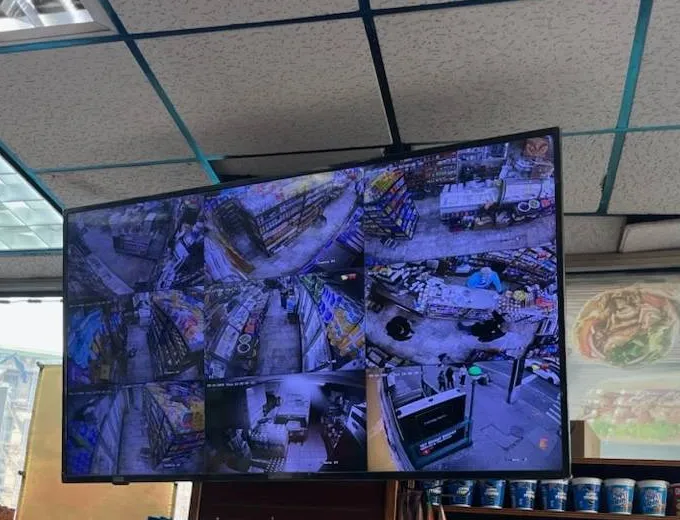
From one of our CCTV jobs (Manhattan corner deli): the camera grid on a wall TV above the shelves. A visible monitor tells customers the store is recorded, which is the same signal a posted notice gives.
Neighbors, trees and privacy
On small Nassau lots, a camera aimed at your own side yard can easily take in a neighbor's patio. Villages have noticed. In October 2017, ABC7 New York reported that the Village of Flower Hill was considering an ordinance after a resident complained that a neighbor had mounted two cameras high in a tree aimed toward her backyard; the proposed text aimed to “preclude the installation and use of an imaging device with no legitimate purpose other than viewing or recording another person in an area of that person’s property where the person would not otherwise be visible.” Whatever any village adopts, state law already makes it a crime to record people where they have a reasonable expectation of privacy. Our practice is simple: aim at your own approaches, use the recorder's privacy masks to black out a neighbor's windows or yard when a view clips them, and never mount on a tree or a fence you do not own.
HOAs, co-ops and condos
Nassau has plenty of private communities with their own rules: gated developments on the North Shore, condominium townhouse complexes, and co-op garden apartments. Their governing documents can control exterior attachments and common areas regardless of what the village allows. For common-area systems, the board decides who can view and export footage, how long it is kept and where the recorder sits, and we set the system up to match that decision in writing.
Inherited Systems
When You Buy a Nassau House That Already Has Cameras
Nassau houses change hands constantly, and a lot of them come with a camera system the seller left on the wall. Sometimes it is a good system. Often it is a DVR in a basement closet with a password nobody knows, four analog cameras that went soft years ago, and an app that stopped connecting when the old internet account was closed. Before you rip it out or pay for a new one, it is worth an hour to find out what you actually inherited.
The cable is usually the valuable part. RG59 coax or Cat6 that already reaches the soffits of a cape or a hi-ranch saves the hardest labor on the job, and coax in good condition will carry modern HD-analog video up to 8MP 4K. We test each run, look at the connectors where they enter the house, and check whether any cable was stapled in a way that kinked it. Runs that test clean stay; runs that fail get replaced one at a time rather than all at once.
The recorder is usually the part to replace. A DVR from the early 2010s may not accept today's cameras, may not have had a firmware update in years, and almost always has the previous owner's admin account on it. Even when it still works, we recommend a factory reset at minimum so that you, and only you, hold the master password, and so the seller's phone no longer receives your alerts. If the old recorder cannot be reset, it gets replaced; a CCTV system you cannot fully control is a liability, not a feature.
The cameras are judged one by one. A camera aimed at the wrong thing is common, because the previous owner's car, fence or pool may be gone. We re-aim what is worth keeping, replace what is blurry or failing at night, and add a camera where the old layout missed the approach that matters to you, which on Nassau houses is usually the driveway mouth or the side gate. Done this way, an inherited system often turns into a good one for well under the cost of starting over, and we tell you which path costs less before any work begins.
Through the Year
A Nassau County CCTV Calendar
The calls we get from Nassau follow the calendar closely. Planning around it means the cameras are up and tested before the busy weeks instead of being installed in the middle of them.
October and November: before the holiday rush
Stores in the plazas around Roosevelt Field, Green Acres and along the turnpikes carry their heaviest stock and their longest hours from Black Friday through New Year's. CCTV installation for the holiday shopping season belongs in October and early November, when the crew can work around normal hours and the staff has time to learn the app. For houses, the same weeks bring the year's heaviest package deliveries, so the front walk and the curb need a clear view of both the package and the vehicle that stopped. A camera on the step is half the answer; the other half is a camera that sees the street.
Nor'easter and hurricane season
From late summer into spring, coastal storms bring wind, rain, flooding on the South Shore and outages across the county; the September 2026 nor'easter put Nassau under a state of emergency. Before the season, check that the recorder's battery backup still holds a charge, that outdoor mounts are tight, and that the recorder in a South Shore basement sits above any water line. During a storm, the cameras let you see whether a tree came down on the car or water reached the garage, from a relative's house if you had to leave.
Summer: vacations and empty houses
Nassau empties out in July and August as families head east, upstate or abroad. CCTV installation before a vacation should happen a couple of weeks ahead, so you can confirm that alerts reach your phone, that every camera looks right at night and that the recorder holds enough days to cover the whole trip. If someone is watering plants or feeding a cat, give them their own app login or none at all, never yours.
Back to school, openings and renovations
September brings school-year routines, and with them the question of who came home when. A front-door camera answers it without a phone call. It is also the start of the busy season for store openings and renovations: CCTV installation for a new business opening is cheapest while the ceilings are open during the fit-out, and construction site CCTV installation on a house being raised, extended or rebuilt protects materials during the weeks when nothing locks. After a burglary or vandalism, we put a camera on the point of entry first and plan the rest of the system properly afterward.
Your Questions Answered
CCTV Installation in Nassau County: Questions Answered
These are the questions Nassau homeowners, store owners and office managers ask us before booking, grouped by topic and answered the way we answer them on the phone.
Your address and the local rules
How do I know whether my address is in a village, a town or a hamlet, and why should a camera installer care?
Look at your property tax bill or the county's online land records: an incorporated village shows up as a separate village tax line, and a hamlet address is governed directly by the Town of Hempstead, North Hempstead or Oyster Bay. The name of your police department is a quick check too. We ask because it decides whose building department reviews anything freestanding, such as a camera pole at the end of a drive or a gate post, and which police department will be asking for your footage. For cameras mounted on the house itself, the answer rarely changes the job, but it is better to know before the first hole is drilled.
Which police department would ask for my footage after a break-in, and how do I hand it over?
Whichever department patrols your address: a Nassau County Police precinct in most hamlets and many villages, or the village or city department in places such as Freeport, Garden City, Rockville Centre, Lynbrook, Old Westbury, Glen Cove and Long Beach. The detective will want the original clip with the recorder's date and time stamp, not a phone video of your screen. Before we leave a job, we show you how to search by date and time, trim the clip to the event and export it to a USB stick or your phone, and we set the recorder's clock to sync automatically so the stamp is accurate.
Do I need the Nassau County alarm permit for a camera system?
The county police's permit program is for alarm systems, with fees listed at $100 for a residence and $200 for a business, and it exists mainly because alarms can send police to your door. A CCTV system that only records to your own recorder is not an alarm. If your project includes a monitored intrusion alarm, or cameras that trigger your existing alarm company, the alarm side follows that program, and we will point it out when we quote. This is general information, not legal advice.
Nassau houses and how they are wired
On a corner lot, does each street side need its own camera?
Usually, yes. A Nassau corner house has two frontages, and the side street is often where people park, cut across the lawn or try the side door because it is out of view of the main road. One camera on each front corner, aimed along each frontage toward the corner, covers both sidewalks and both curbs; a third on the driveway side catches cars turning in. We keep the angles tight enough that the houses across both streets are not filling the frame, and mask out their windows in the recorder.
How do you cover the gate and the drive on a North Shore estate?
We treat the gate as the front door. One camera sits at the gate pillar or on a short post just inside it, at a height and angle where a car's front plate and the driver's window are both in frame as it stops. A second camera watches the gate from the house side to catch anyone on foot. The drive gets one or two overview cameras, and the house, garages and pool house are covered like any other home. Because the gate can be hundreds of feet from the house, we put a switch near it and link it back by buried Cat6 or fiber in conduit, priced after we confirm the layout.
Can the recorder go in the attic or the garage of my house?
We avoid both. A Nassau attic can pass well over 100 degrees in July, which shortens hard-drive life, and an unheated garage swings the other way in January. A detached garage also puts the recorder where a thief is already standing. A bedroom closet, a basement shelf near the modem, or the lower-level utility room of a hi-ranch is better. If the only spot near the modem is a hot one, we run one network cable to a cooler closet and put the recorder there.
We are re-roofing and re-siding next spring. Should the cameras wait?
Install the cameras now if you need them now, and tell us about the work. We can mount them on junction boxes that the roofer or siding crew can unscrew and set aside, and we label every cable end. Better still, if the siding is coming off anyway, we can come back during that window and leave cable behind the new siding for any future camera spots. What you want to avoid is a crew cutting cables they did not know were there; a labeled junction box at each camera solves that.
Should the pool and the pool gate have their own camera?
On most Nassau lots with a pool, yes. A camera on the back corner of the house that sees the pool gate, the deck and the fence line shows you when the gate is left open, who came over the fence, and what happened at a party you were not home for. We aim it so it covers your yard only, set a motion zone on the gate itself for alerts, and leave the rest of the yard recording without notifications so your phone does not buzz every time a leaf lands on the cover.
Stores, offices and day-to-day use
Who should own the parking-lot cameras in a Nassau strip center, the landlord or the tenant?
Usually both have a part. The landlord covers the parking field and the poles; each tenant covers its own interior, its own door and its own stretch of the rear lane. If you rely only on the landlord's cameras, you depend on the landlord's retention settings and the property manager's response time when you need a clip. We recommend at least one camera of your own on your rear door and one on the parking spaces in front of your store, mounted on your own wall with the landlord's written approval if the lease requires it.
Should a nail salon or a barbershop record the client chairs?
Most salon owners in Nassau record the front door, the reception desk and the register, and many add a wide view of the floor so disputes over a service or a payment can be checked. What stays off camera is any back room where clients change, the restroom and staff changing areas, and we leave audio off because recording conversations at the chair without consent runs into New York’s eavesdropping law. A posted notice at the door that video recording is in use is good practice. This is general information, not legal advice.
Can I get an alert only when a car pulls into my driveway, not for every car on the street?
Yes. On cameras with person and vehicle detection, we draw a line or a zone across the mouth of the driveway and set the alert to trigger only for vehicles that cross it. Cars passing on Merrick Road or a busy side street stay on the recording but never ping your phone. We test it before we leave by pulling a car in and out, and we adjust the zone if the headlights of passing traffic trip it at night.
Should one camera look down the block from a second-floor window or dormer?
It is tempting, because a dormer on a cape or the front bedroom of a colonial has the best view on the house. Behind glass, though, a camera’s infrared bounces off the window at night and the picture turns into a white glare, and screens and reflections soften the day image too. When a high view down the block is worth having, we mount the camera outside under the eave above that window instead, with the cable dropping straight into the attic, and turn its infrared off if a streetlight already lights the street.
What happens to my cameras when the internet company swaps my router?
The cameras keep recording, because they talk to the recorder, not to the internet. What usually breaks is remote viewing: a new Optimum or Verizon router can hand the recorder a new address or block the connection the app relies on. Recording on site is unaffected, and getting the app working again is normally a short fix on the recorder’s network settings. If you know a router swap or an upgrade is coming, tell us before the technician arrives and we will plan the recorder settings so it reconnects to the new equipment.
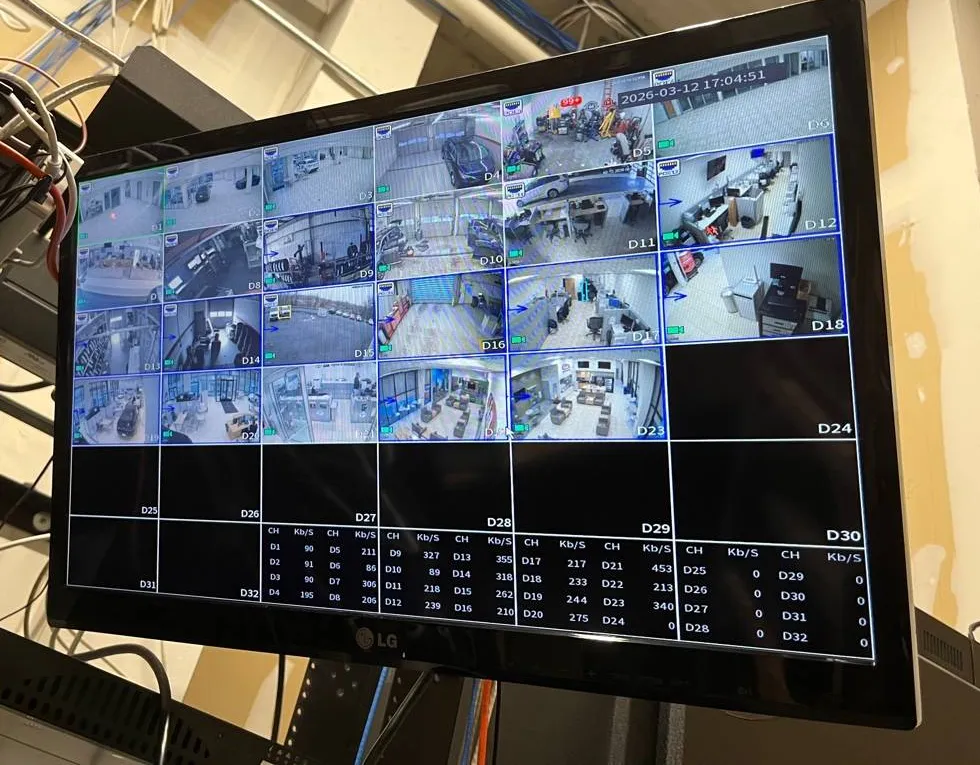
From one of our CCTV jobs (Rockland County car dealership): the recorder's live grid with the channel bitrate table below it. A quick look at that table shows whether every channel is sending video, which is the fastest health check a business owner can do.
Equipment
Types of CCTV Systems We Install in Nassau County
Unless you ask for a specific brand, the quote you get lists our house-brand hardware: it is what we keep on the truck and what we can still get parts for in five years. If you already own another brand, we work with that instead. Below is what a typical Nassau job is built from, piece by piece.
🔘
Turret Cameras
Turret camera installation under soffits and porch ceilings. The ball-in-socket design avoids the infrared glare a dome cover can cause at night, which matters on the short eaves of capes and ranches.
🛡️
Vandal-Resistant Domes
Dome camera installation for store entrances, garden-apartment hallways and low ceilings within reach. Impact-rated housings resist a hand or a broom handle.
🔦
Bullet & Long-Range Cameras
Bullet camera installation for driveways, lot rows and fence lines. Longer bodies hold bigger lenses and stronger infrared for dealership lots and long North Shore drives.
🔭
Varifocal Cameras
Varifocal camera installation where a plate or a gate is 40 feet or more away. We zoom and focus the lens on site to frame exactly the spot that matters.
🌗
Color Night Vision & Deterrence
Color night vision camera installation for dark service lanes, plus active deterrence cameras that flash a light or sound a siren when a person enters a zone after hours.
🧠
Person & Vehicle Detection
Smart detection CCTV installation: the camera itself decides whether movement is a person, a car or just a swaying hedge, which is what keeps a driveway on Merrick Road from pinging your phone all evening.
💾
DVRs & NVRs
DVR installation for coax systems and NVR installation for IP systems, with drives sized to your retention, a monitor output and app access for every user.
🔋
PoE Switches, UPS & Cable
CCTV PoE switch installation, outdoor-rated Cat6, weatherproof junction boxes and a UPS for the recorder, switch and modem, plus fiber between buildings on larger sites.
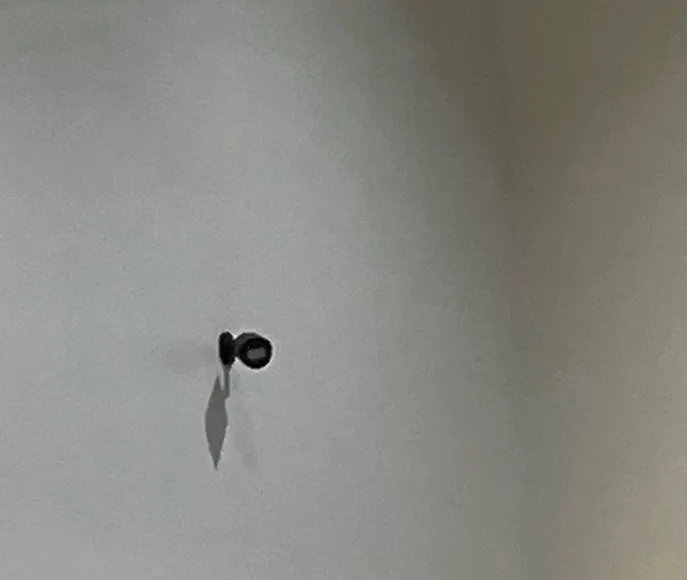
From one of our CCTV jobs (Rockland County car dealership): a compact bullet mounted high on a plain white wall above the ceiling line, small enough to blend in and high enough to see over displays.
Coax, Cat6 or Wi-Fi: matching the system to a Nassau property
Situation
Best fit
Why
Older house or shop with working coax
HD-analog on a DVR
Reuses existing RG59 runs; new cameras up to 8MP 4K on the C Series
Cape, ranch or hi-ranch with attic access
IP PoE on an NVR
One Cat6 per camera through the attic to the soffit, power included
Store, office or medical suite
IP PoE on an NVR
Drop ceilings make runs easy; more channels and user permissions
Estate gate or outbuilding far from the house
Remote PoE switch linked by Cat6 or fiber
Keeps every camera run short and powered from one place
One temporary spot or a rental you cannot drill
Wi-Fi camera
Quick to place, but depends on the router and often a cloud plan
How much storage a Nassau system needs
Retention is a hard-drive question. A 4MP camera recording all the time at about 4 megabits per second writes roughly 43 GB a day, so eight of them write about 345 GB a day and two weeks takes close to 5 TB. H.265 compression, which our recorders use, shrinks that substantially, and recording the quiet cameras on motion only shrinks it again. Every package we sell includes 2 weeks of recording. Businesses that need 30 days for an insurer, and condo boards with a written retention policy, get a larger drive, and we tell you the cost before we install.
Network and password hygiene
Every recorder we install gets a new admin password that you own, a separate user account for each person who views it, current firmware, and remote access through the manufacturer's secure app rather than an open port on your router. On business networks we put the cameras on their own VLAN or a separate switch, so a camera can never be a way into the computers that run your register or your patient records.
Brands on Nassau jobs
Three manufacturers, Lorex, Luminys and Reolink, list Abstract Enterprises Security Systems as an authorized partner. Nassau pages for them: Lorex camera installation in Nassau County, plus installed price lists for Luminys and Reolink. Plenty of the systems we walk into run something else, and we install, integrate and service those too: Hikvision and Dahua recorders left by a previous installer, UniFi Protect or Axis on a business network, Amcrest, Swann, Night Owl or ANNKE kits bought online, Hanwha Vision, Uniview and Digital Watchdog in offices, and Ring, Nest, Arlo or Wyze cameras on the front door. None of that changes the default; the house brand is what appears on a new quote.
Want Your Driveway, Door and Back Lane on One Screen?
Send the village or hamlet, a few photos and how many cameras you have in mind. We book within 2 hours and put the camera list and price in writing before anything is drilled.
What AI Gets Wrong About CCTV Installation Across Nassau's 64 Villages, 3 Towns and 2 Cities
AI answers about CCTV are written for an imaginary average suburb. Nassau is a particular one: dozens of local governments, a housing stock built mostly in two postwar decades, a plate-reader network run by village police, and coastal storms that take the power out. Directory sites such as Angi and HomeAdvisor add their own national averages on top. Here are seven claims we hear repeated and what our crews actually find on Nassau jobs.
“Nassau is one county, so the same rules apply everywhere”
It is a reasonable assumption if you have never looked at a Nassau tax bill. AI summaries tend to describe a county as if it had one building department and one police force.
The state counts 2 cities, 3 towns, 64 incorporated villages and more than 60 hamlets in Nassau. A camera pole at the end of a drive in Garden City goes to the village; the same pole in Levittown goes to the Town of Hempstead. A burglary in Freeport is investigated by the Freeport police; one in Merrick by a county precinct.
For most camera installs on an existing house, none of that changes the work. It changes who you call about anything freestanding, and who calls you asking for footage, so we check it on every quote.
“Every suburban house can be wired the same way”
Generic guides describe one house: an open attic, a basement, vinyl siding. Nassau has that house, and it also has five others.
With almost half of the county's housing built between 1940 and 1959, we spend our days in capes with knee-wall crawlspaces, hi-ranches with half-buried lower levels, split-levels with sealed attic voids, Tudors with stucco and plaster, and South Shore houses lifted a full story after Sandy. Each one has a different path from the recorder to the soffit, and a different set of places where a cable simply cannot go without opening a wall.
That is why we ask what kind of house it is, and when it was built, before we promise hidden wire anywhere.
“A license plate camera reads every car that drives by”
The village plate readers in the news have made people expect any camera labeled LPR to read every plate. Dedicated plate-reading cameras do that well, but only because they are installed for it.
A plate is readable when the camera sees it nearly head-on, at a narrow choke point, with a short shutter speed and infrared that does not bloom off the reflective plate at night. A wide camera on the corner of a house, looking across a 50-foot front lawn at cars moving 30 miles an hour, will capture the car and its color but rarely the plate.
If plate capture matters, we put a narrow camera at the driveway or the lot entrance where cars slow down, and we tell you honestly what the overview cameras will and will not read.
“Cameras only help if you pay for professional monitoring”
Alarm companies sell monitoring, and AI answers often fold cameras into the same monthly plan. Monitoring is useful for an alarm, which needs someone to call the police at 3 a.m.
A CCTV system's main job is evidence: the clip that shows who came up the driveway and what they took. That footage sits on your own recorder with no monthly charge, and you can watch live or play it back from your phone. Alerts for people or vehicles in set zones reach you directly.
If you want both, an alarm can be monitored while the cameras record locally. You do not have to put the cameras on a subscription to get value from them.
“Wired cameras fail in snow and ice, so wireless is safer in winter”
This one gets the physics backward. A wired PoE camera is fed power continuously through its cable, and outdoor-rated models are built to keep running through freezing nights.
The cameras that struggle in a Nassau January are battery models: cold drains batteries faster, and a camera on the edge of the house Wi-Fi drops frames when wet snow sits on the siding between it and the router. Wired cameras do have one winter enemy, which is snow or ice sitting on the lens, and the fix is placement under an eave or a sunshield rather than a different kind of camera.
We mount outdoor cameras under the roof overhang wherever we can, and we seal every cable entry so meltwater cannot follow the wire into the wall.
“You need a permit before installing security cameras”
Searches for Nassau camera rules turn up the county police's alarm permit, and AI summaries sometimes stretch it to cover cameras.
The Alarm Permit Section's program covers alarm systems, with fees listed at $100 for a residence and $200 for a business. A camera system that records to your own recorder is not an alarm. Where local approval does come in is for something you build, such as a freestanding pole or a gate post, or for exterior attachments under a lease, an HOA or a co-op board.
We tell you which, if any, applies to your plan before we start, and we recommend confirming with your village or town building department when a structure is involved.
“Your property, your camera, so you can aim it anywhere”
On a one-acre lot that is close to true. On a typical Nassau lot, where the neighbor's patio is 15 feet from your side door, it is not.
New York already makes it a crime to record people where they have a reasonable expectation of privacy, and recording conversations without a party's consent is eavesdropping. Villages have also weighed their own rules: Flower Hill considered an ordinance in 2017 after a resident complained about cameras in a neighbor's tree aimed at her backyard.
We aim cameras at your own approaches, mask out neighbors' windows and yards in the recorder when a view clips them, and leave audio off. That keeps the footage useful and keeps you out of a dispute.
Get In Touch
Request a Free CCTV Installation Quote in Nassau County
Tell us the village or hamlet, the kind of house or business, and roughly how many cameras you want. Photos of the front of the building, the driveway or lot, the back door and the spot where the modem sits let us price it faster. Already own the cameras? List the brand and model for a labor-only price. Rather talk? Call the Nassau line at (516) 346-5778.
✅
Request Sent!
Thank you. We book Nassau County CCTV jobs within 2 hours of a request and will be in touch shortly.
How It Works
Our CCTV Installation Process
Six stages separate a photo of your driveway sent from your phone and a working Nassau County CCTV system you can open from anywhere.
1
Tell us the address type
Call, text or use the form with the village or hamlet, the kind of house or business, the number of cameras and a few photos. For cameras you already own, send the model list for a labor-only price.
2
Plan the views and the cable
We agree on what each camera must show, where the recorder lives, and how cable reaches each spot through the attic, crawlspace, basement or ceiling. Larger commercial sites are confirmed on site. You get a written price.
3
Book the day
Your job goes on the calendar within 2 hours of the request. Crews run all seven days with early starts, and open dates go to whoever has paid the deposit first.
4
Mount and wire
Our licensed crew runs and labels the cable, mounts cameras on junction boxes or mounting blocks, seals every exterior penetration, and installs the recorder, switch and battery backup.
5
Aim, tune and test at night
We focus each camera on its target, set recording, motion zones, driveway and gate alerts, privacy masks and the recorder clock, then check the night image before we pack up.
6
Hand over
Everyone who needs the app gets it on their phone. We walk you through finding last night's footage and saving a clip, then leave a sheet listing each camera, the recorder model, the drive size and how many days it holds.
Coverage Area
CCTV Installation Near Nassau County's Landmarks
We install CCTV in every city, town, village and hamlet in Nassau. These landmarks are on the routes our crews drive every week, with the kind of CCTV work we do around each one.
🏟️
UBS Arena & Belmont Park, Elmont
Delis, auto shops and two-family houses on Hempstead Turnpike and the side streets of Elmont and Franklin Square.
🛍️
Green Acres Mall, Valley Stream
Strip stores and restaurants on Sunrise Highway and Rockaway Avenue, plus capes and colonials in Valley Stream and the Five Towns.
🎓
Hofstra University, Hempstead
Rental houses, small apartment buildings and storefronts around Hempstead Village, Uniondale and West Hempstead.
🌳
Eisenhower Park, East Meadow
Ranches and hi-ranches in East Meadow, Westbury and Salisbury, and medical offices along Hempstead Turnpike and Merrick Avenue.
🌷
Old Westbury Gardens
Gated North Shore estates in Old Westbury, the Brookvilles and Muttontown, with long drives, pool houses and carriage houses.
🏖️
Long Beach Boardwalk
Raised houses, beach bungalows and oceanfront co-ops in Long Beach, Lido Beach, Point Lookout and Island Park.
We also serve Garden City, Mineola, Hicksville, Levittown, Massapequa, Massapequa Park, Seaford, Wantagh, Bellmore, Merrick, Freeport, Baldwin, Oceanside, Rockville Centre, Lynbrook, Malverne, Great Neck, Manhasset, Port Washington, Roslyn, Glen Cove, Oyster Bay, Syosset, Plainview, Bethpage and Farmingdale. Nassau is part of our Long Island CCTV installation coverage, scheduled from our Brooklyn office at 1282 Troy Ave.
Pricing
CCTV Installation Cost in Nassau County
What CCTV installation costs in Nassau depends on how many cameras you need, how far each cable has to travel and how the house or building lets us reach each spot. We publish package prices for the common 4-camera system and quote everything that depends on the property after we confirm the layout.
What you need
Nassau County price
Included
4-camera house-brand package
$999 for the A Series, up to $1,441 for the C or D Series
Four cameras plus the recorder, cable runs and mounting; two weeks of footage on the drive
Residential system, 4–8 cameras
$1,117 – $2,500
4–8 cameras on an NVR, PoE cabling run by our crew
Commercial CCTV
$1,500 – $5,000+
Offices, retail, restaurants and multi-story buildings
Extra cameras beyond a package
Priced per camera after we confirm the layout
Camera, cable run, mount and recorder channel
Labor only on your equipment
Quoted by phone or text
Mounting, wiring and setup of cameras you supply
Concealed wiring, conduit, trenching
Priced after we confirm the layout
Wire fished inside finished walls, conduit outdoors, trenches to a gate or garage
Monthly fee
$0
Recording stays on your recorder
What pushes a Nassau quote up or down
Access is the biggest variable. A ranch with an open attic is about as quick as CCTV gets, and a 4-camera package price usually covers it. A cape with a finished upstairs takes longer because we work through knee-wall crawlspaces; a split-level with a sealed attic over the living room may need one run along the basement instead; a stucco Tudor takes care at every penetration. Distance is next: a detached garage behind a Lynbrook colonial or a gate 300 feet down a Muttontown drive adds cable, conduit or a remote switch. On commercial jobs, ceiling height, the number of separate rooms, and after-hours work in a store that cannot close all affect labor. Reusing good coax or Cat6 from an older system can bring the price down.
How many cameras, and what that means for the recorder
A 4-camera system is where most Nassau houses start: front walk, driveway, backyard and one side. An 8-camera system suits corner lots, houses with a detached garage or a pool, and small shops that need the register, the door, the stockroom and the rear lane. Sixteen cameras is common for a medical office with several entrances, a dealership lot or a garden apartment complex. Recorders come in 4, 8, 16 and 32 channels, and we usually leave a few spare so you can add a camera later without replacing the recorder. Anything beyond a package is priced per camera after we confirm the layout.
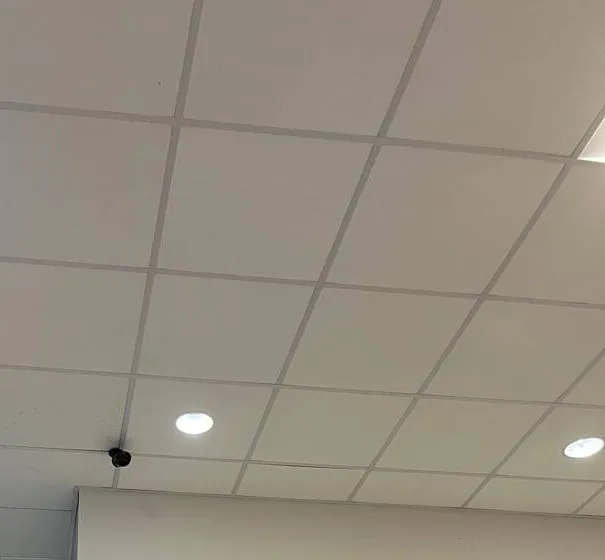
From one of our CCTV jobs (Rockland County car dealership): a small camera on the drop ceiling between recessed lights, placed off to the side of each light so the fixture does not wash out the picture.
Warranty, deposit and terms
Our installation work carries a 30-day warranty, and coverage of one year or longer is available as a paid add-on. Full terms — including 50% deposit, one-year parts-only warranty on Abstract Enterprises Security Systems-supplied products, and the late-fee schedule — are set out in the service agreement. Cameras and recorders you supply are covered by their manufacturer, and the signal and hardware of your own wireless cameras stay your responsibility. Financing is available on our packages; ask when you call.
Shop Our Systems
CCTV Installation Packages & Pricing
Pick a series by the detail you need: plain HD for a front walk, 2K or 4K where a face or a plate has to hold up when you zoom. All five are four-camera systems that leave with the recorder mounted, the cable run, two weeks of footage capacity and the app on your phone.
A
A Series · 2MP HD Cameras with DVR
Starting at $999 incl. 2 wks recording. Night vision 60–100 ft, motion detection, smart AI, full-color night vision, audio and remote access. Models A1, A2, A3. A sensible start for a cape or ranch.
F
F Series · 5MP DVR, 2K HD Cameras
Starting at $1,047 incl. 2 wks recording. Eyeball, bullet and dome styles, night vision 90–100 ft, active deterrent with siren and lights, 20″ monitor. Models F1–F6. Good for homes and shops that want to scare someone off.
A kit from a warehouse club or an online order is fine with us. Text the brand, the model numbers of the cameras and the recorder, how many there are and a photo of each spot; the labor price comes back by phone or text, and the date is held once the deposit is paid. There is no site walk-through for customer equipment. Since you picked the hardware, the hardware itself, and the Wi-Fi signal any wireless camera depends on, remain your responsibility; if something you supplied is dead on arrival or will not talk to the recorder, our crew shows you on the spot and you choose the next step. See also got your own system?
Photos in, a written number back before anything is drilled.
FAQ
Nassau County CCTV Installation FAQ
Can you install CCTV in a Nassau house before we move in?
+
Yes, and it is the easiest time to do it. With the rooms empty, we can reach closets, attics and crawlspaces without moving furniture, and the system is recording on the day the moving truck arrives. You will need access to the house and an internet connection for phone viewing; the cameras record to the recorder without it. If you are still in contract, wait until closing, because the work becomes part of the house.
Do you install CCTV at car dealerships and used-car lots in Nassau County?
+
Yes. Dealership work usually means long-range cameras down each row of the lot, a camera on the entrance and exit at a plate-reading angle, coverage of the key drop and the service drive, and interior cameras on the showroom, the finance offices and the parts counter. Lots on Sunrise Highway, Jericho Turnpike and Northern Boulevard often need poles or building-mounted arms, priced after we confirm the layout.
Do you install CCTV for Nassau swim clubs, beach clubs and golf clubs?
+
Yes. Clubs usually need the entrance gate and the parking lot covered, plus the pro shop, the clubhouse doors, the pool deck entrance and equipment or cart storage, while locker rooms and changing areas stay off camera by law. Spread-out grounds mean a switch or a small recorder in outbuildings linked back by Cat6 or fiber. Some Nassau clubs also share video with their village police, as Newsday reported in Old Westbury; that is the club's decision, and we set up exports either way.
Should the inside of an attached garage have a camera?
+
Often, yes. Many Nassau burglaries start at a garage door left open or a side door into the garage, and the door from the garage into the house is rarely watched. One camera inside the garage, aimed at the overhead door and the house door, shows whether the door was left up, who came in and what went out. We mount it high and away from the opener so it does not catch the headlights straight on.
What should I do when snow or ice covers a camera?
+
Most of the time, nothing: cameras mounted under an eave rarely get covered, and frost on the lens usually clears once the sun reaches it. If wet snow plasters a camera on an exposed corner, brush it off gently with a soft broom from the ground rather than climbing a ladder on ice. A camera that keeps getting covered is a placement problem, and we can move it under the overhang or add a sunshield.
Can I keep the cameras running while my house is listed for sale and buyers are touring it?
+
You can keep exterior cameras running, and many sellers do. Indoors, turn off audio recording during showings, because recording conversations you are not part of can violate New York's eavesdropping law, and tell your listing agent that video cameras are in use so buyers can be informed. When the house sells, we can reset the recorder for the new owner or remove the system, depending on what your contract says.
Can I watch my Nassau cameras on a computer at work, not just on my phone?
+
Yes. Most of the recorders we install have a desktop client and a web or app login, so you can keep the camera grid open on a second monitor at the office. We create a separate user for that computer, limited to live view and playback if you prefer, so nobody at work can change the recorder's settings.
Can I check on an elderly parent's house in Nassau through a CCTV system?
+
Yes, with your parent's agreement. Families often ask us for cameras on the front door, the driveway and the back steps of a parent's house so they can see deliveries, visitors and whether the doors are closed. We keep cameras out of bedrooms and bathrooms, set up the app on the family members' phones, and make the system simple enough that nobody in the house has to touch it.
Can a camera watch my mailbox at the curb?
+
Yes. A camera on the front corner of the house or the garage can cover a curbside mailbox and the street in front of it. Because the mailbox sits near the sidewalk and the road, we frame the shot on the box and the car that stops beside it, and mask out the houses across the street. Mail theft is a federal matter, so a clear clip of the vehicle is what helps most.
A neighbor asked for our footage after a break-in on the block. Should we share it?
+
That is your decision. Many Nassau neighbors share clips with each other and with the police after an incident, and a short export of the relevant minutes is usually all anyone needs. Share the clip, not your login, and keep the original on your recorder or a USB stick in case the police ask for it later. If you are unsure, give the clip directly to the police department handling the case instead.
Nassau line (516) 346-5778. Our crews are dispatched from 1282 Troy Ave, Brooklyn, NY 11203. NYS low-voltage license #12000287431; general liability insurance on every job; 4.7★ / 201 Google Reviews.
Page checked November 16, 2026 by Abstract Enterprises Security Systems. Nassau prices match our current package list. Crime figures: NYS DCJS county totals, 2023 and 2024. Housing figures: Census ACS 2023 5-year.