Apartment building in Yonkers or Mount Vernon, storefront in New Rochelle, office in White Plains, or a house north of I-287? Book a Westchester CCTV survey: (914) 877-2578
Multi-Camera NVR & DVR Recorders · Wired IP / PoE & HD-Analog · 30-Day Retention Builds · Yonkers to North Salem
CCTV installation in Westchester County costs from $1,099 for a house-brand 4-camera system that includes the recorder, the cabling, the labor and two weeks of recording, while business and building systems fall between $1,500 and $5,000+, and none of them carry a monthly fee. Abstract Enterprises Security Systems plans each job around which half of the county the property sits in. In Yonkers, Mount Vernon, New Rochelle and White Plains, most of our work is closed circuit television for apartment buildings, downtown towers, storefronts and offices, where the recorder has 16 or 32 channels and the cable has to climb through brick, plaster and concrete. Past I-287 it is houses and estates, with fewer cameras and longer runs. Either way you get wired cameras, a recorder that keeps working through internet and power drops, and the app on your phone before we leave.
Written for Westchester owners and boards, last revised November 2026 · Abstract Enterprises Security Systems, NYS license #12000287431 · Data from: NYS Division of Criminal Justice Services, Index Crimes by County and Agency, 2024 (data.ny.gov); U.S. Census Bureau, American Community Survey 2023 5-year, table DP04; City of Yonkers Code Chapter 84, Video Camera Systems; Office of the Governor press release, July 25, 2024; Con Edison storm release, June 7, 2026
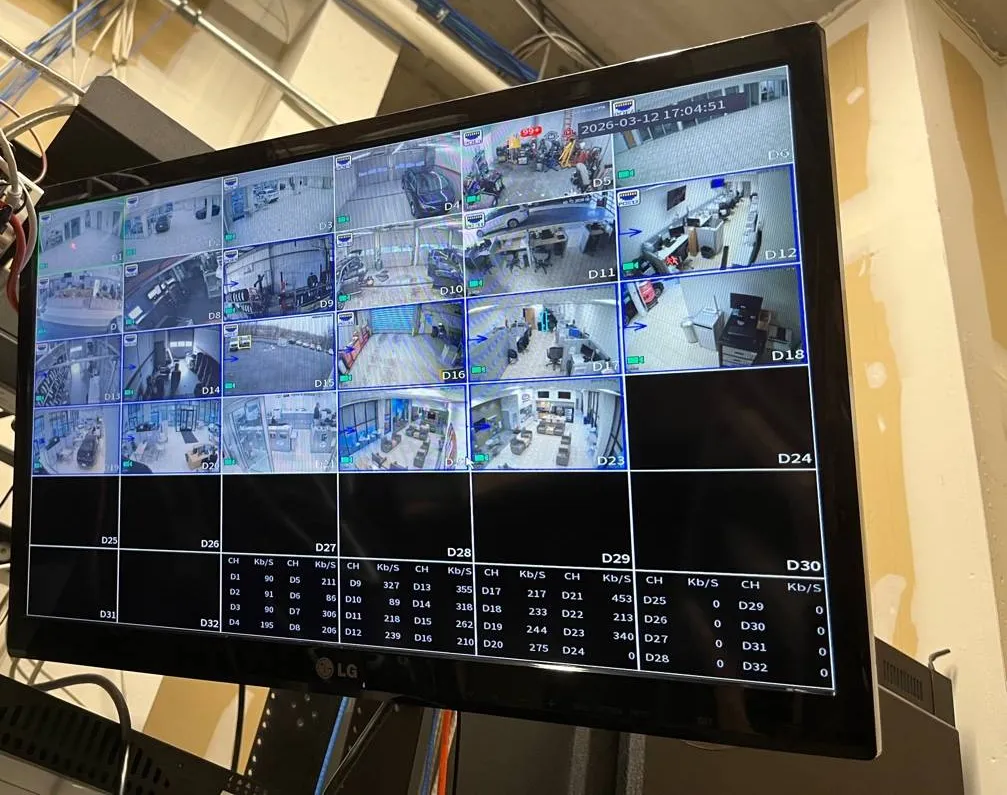
From one of our CCTV jobs (Rockland County car dealership): the recorder's monitor, hung from the ceiling next to the equipment rack, shows a grid of live camera tiles with empty tiles waiting for more cameras and, under them, a table that lists each channel's stream rate. This is the kind of 30-plus-channel recorder we put in Westchester apartment buildings and stores.
Westchester CCTV Request
Tell us the city or town, the building, and roughly how many cameras
✅
Request Sent!
Thank you. We will call or text to book your Westchester CCTV visit, usually within 2 hours of your request.
25+
Years Experience
2 Hr
Booking
100%
Licensed & Insured
4.7★
201 Google Reviews
Owner-operated since 2002 · Westchester direct line (914) 877-2578 · Scheduled from our 460 E Fordham Rd office in the Bronx
The short version: a Westchester house usually starts with a 4-camera house-brand package from $1,099, a 4- to 8-camera home system with an NVR and PoE wiring usually lands between $1,228 and $2,500, and a store, office or apartment building usually lands between $1,500 and $5,000+. There is no monthly fee, because the footage lives on your own recorder. Extra cameras, concealed cable in finished walls, conduit, riser work, bigger drives for 30-day retention and battery backup are priced per item after we confirm the layout. Booking happens within 2 hours of your request; we schedule 7 days a week with early-day visits, first come first served once the deposit is in.
Closed circuit television on a local NVR (wired IP / PoE) or DVR (HD-analog over coax), installed under NYS license #12000287431
Recording sized to the rule that applies to you, including the 30-day minimum in the Yonkers business camera law
Remote viewing tested on your own phone, plus a camera map and password sheet you keep
Why CCTV Installation in Westchester County Is Really Two Different Jobs
People outside the county picture Westchester as one long suburb of lawns and two-car garages. That picture fits Chappaqua, Bedford and Pound Ridge. It does not fit the southern edge of the county, where four cities sit shoulder to shoulder with the Bronx and Long Island Sound. Yonkers, Mount Vernon, New Rochelle and White Plains are dense, mostly rented and full of elevator buildings. For a CCTV installer, that is the gap between four cameras on a colonial and a 32-channel recorder feeding six floors, a garage ramp and a mailroom.
The Census Bureau's 2023 American Community Survey puts numbers on that split. Westchester County as a whole has 391,861 housing units, and 43.5% of them are single-family detached houses. The four cities together hold 173,236 of those units, about 44% of the county, and in every one of them the detached house is the minority. In White Plains, nearly half of all homes, 49.5%, are in buildings with 20 or more units. Yonkers is at 38.0%, New Rochelle at 37.1% and Mount Vernon at 33.8%, against 24.8% for the county overall. Renting is the norm too: 57.9% of occupied homes in Mount Vernon are rented, 52.8% in Yonkers, and close to half in New Rochelle and White Plains, compared with 37.8% countywide.
Crime follows the same line on the map. The New York State Division of Criminal Justice Services counted 831 burglaries, 7,679 larcenies and 812 motor vehicle thefts in Westchester County in 2024. Add up the four city police departments and they account for 487 of those burglaries (58.6%), 4,266 of the larcenies (55.6%) and 593 of the vehicle thefts (73.0%). In plain terms, the cities that hold a little under half of the county's homes reported well over half of its property crime, and nearly three in four of its stolen cars. That is simply where the stores, garages, stations and people are, and it is why our closed circuit television work here leans so heavily south.
The age of the buildings matters as much as the count. More than a third of New Rochelle's and Mount Vernon's housing units, 34.9% in each city, were built before 1940, and so were 30.4% in White Plains and 26.7% in Yonkers. Those are the brick walk-ups, the six-story elevator buildings with terra cotta trim, the two-family frame houses with a porch on each floor and the mixed-use blocks with stores at street level. At the other end, New Rochelle's downtown has been adding towers faster than anywhere else in the county: 1.5% of the city's homes were built in 2020 or later, three times the county-wide share of 0.5%. Westchester gives us plenty of both kinds of job.
“As the fastest growing city in Westchester County and a designated Pro-Housing Community by Governor Hochul, buildings like Highgarden Tower ensure that New Rochelle remains a livable and accessible city for all.” New Rochelle Mayor Yadira Ramos-Herbert, on the opening of the 219-unit, 19-story Highgarden Tower beside the New Rochelle train station, Office of the Governor press release, July 25, 2024
New buildings like that one open with a developer-designed camera system. A year or two later the calls are about its gaps: a garage ramp with no camera, a package room that overflows, a ground-floor tenant that wants its own recorder, or a board that wants longer retention than the original drive holds.
CCTV Installation Yonkers: the county's biggest city and its own camera law
Yonkers has 83,851 housing units, almost as many as New Rochelle, Mount Vernon and White Plains combined, and it has a local law that tells certain businesses they must have a video camera system. Chapter 84 of the Yonkers City Code, adopted by the City Council in October 2014, applies to bars and stores licensed to sell alcohol, businesses open to the public at any time between midnight and 4 a.m., check-cashing businesses, licensed secondhand dealers in precious metals, licensed pharmacies and pawn shops. For those owners, CCTV installation Yonkers work is not optional, and we cover what the law asks for in detail further down this page.
Yonkers buildings vary block by block: pre-war elevator buildings with crowded risers around Getty Square and South Broadway, older houses on Park Hill's steep lots, garden apartments and co-ops along Central Park Avenue and McLean Avenue, and one- and two-family blocks near the Cross County Parkway. Yonkers also reported 315 vehicle thefts in 2024, the most of any agency in the county, so garage, driveway and lot cameras that can actually show a plate are a large share of what we install there.
CCTV Installation Mount Vernon: two-family houses, walk-ups and the busiest streets per square mile
Mount Vernon is small in area and packed with buildings: 30,890 homes, only about a quarter of them detached houses, and the highest renter share of the four cities at 57.9%. A typical call is an owner of a two- or three-family house on the north side who wants the front porch, the driveway, the side alley and the back yard covered, with a separate login for a tenant. The other typical call is a landlord with a walk-up or a six-story building near Fourth Avenue or Gramatan Avenue who needs lobby, mailbox, stairwell and rear-door coverage on one recorder in the basement.
Mount Vernon's police department reported 193 vehicle thefts and 97 burglaries in 2024. For CCTV installation Mount Vernon jobs that means paying attention to the driveway and the curb, where cars sit overnight, and to the back doors and basement entrances that burglars use in older buildings. Many of these houses and buildings still have an old DVR and analog cameras from fifteen or twenty years ago, which is why a lot of our Mount Vernon work is an upgrade: test the coax that is already in the walls, keep what is sound, and swap the recorder and cameras for HD models that make a face readable.
CCTV Installation New Rochelle: a growing downtown, the Sound shore and the North End
New Rochelle is really three places for camera work. Downtown, around Main Street, Huguenot Street and the train station, it is new towers, mixed-use buildings, parking structures and storefronts, with more under construction. The Sound shore, from Davenport Neck and Glen Island toward Larchmont, has larger houses near the water. The North End, up toward Wykagyl and the Scarsdale line, is mostly single-family houses on quiet streets. The DCJS numbers show New Rochelle with 985 larcenies but only 50 burglaries in 2024, which matches what we hear: package theft, shoplifting and things taken from cars are the everyday problems, more than break-ins.
CCTV installation New Rochelle requests split the same way. A building manager downtown wants more cameras in a package room and a garage. A shop owner on Main Street wants the register, the door and the stockroom on one recorder with clear clips to hand the police. A homeowner in the North End wants the front door, the driveway and the back patio, with motion alerts that ignore cars passing on the street.
CCTV Installation White Plains: the county seat, office towers and a shopping downtown
White Plains has the highest share of large buildings in the county: nearly half of its homes are in buildings of 20 or more units. Downtown, around Mamaroneck Avenue, Main Street and the area near the Metro-North station, condo and rental towers sit next to office buildings, the courts, hotels and restaurants, with The Westchester mall on Westchester Avenue at the edge of downtown. Out along Westchester Avenue and the I-287 corridor, corporate office parks spread toward Harrison, Purchase and Rye Brook. The city reported 1,006 larcenies in 2024, the most of any Westchester agency after Yonkers, which is what you expect in a retail and office center.
CCTV installation White Plains work therefore leans commercial: office suites that need cameras on reception, server closets and back doors without touching the landlord's base-building system, restaurants that want the bar, the kitchen door and the dining room, and retailers that need entrances and registers covered before the holiday season.
North of I-287: Westchester's houses, colonials and estates
Cross I-287 heading north and the county changes fast. Scarsdale, Bronxville, Larchmont, Rye and Harrison in the south-central belt are mostly older colonials and Tudors on modest lots, with stucco, brick and slate that need careful drilling. Further up, in Chappaqua, Armonk, Bedford, Pound Ridge, Katonah and North Salem, lots grow to several acres, driveways run long, and a property may have a pool house, a barn or a detached garage. Those jobs have fewer cameras and longer cable runs; we handle the long-distance side of them the same way our Hudson Valley crews handle country property, with fiber or PoE extenders where a copper run would go past its 100-meter limit.
On both sides of the highway the recorder needs protecting from power cuts. Con Edison's June 7, 2026 storm release reported more than 5,000 Westchester customers out after trees came down across parts of Bronxville, Mount Vernon, New Rochelle, Pelham Village, Scarsdale, White Plains and Yonkers. A battery under the recorder and PoE switch keeps recording through nights like that.
What We Install
CCTV Installation Services Across Westchester County
Our CCTV installers handle the whole system, start to finish: the camera plan, the cable, the mounts, the recorder and hard drive, the network settings and the phone app. You deal with one licensed CCTV contractor from the first text to the last test clip. If you are mainly shopping for a few cameras on a house, doorbell cameras or a wireless add-on, our security camera installation page for Westchester County homes and businesses is the better starting point. This page is about closed circuit television in the stricter sense: wired cameras feeding a DVR or NVR on site, usually more than four of them, often across a whole building.
🏢
Whole-building CCTV systems
Lobbies, vestibules, mailrooms, package rooms, stairwells, laundry rooms, garages and rear doors on one recorder, with camera names that a super can read at a glance.
⚖️
Yonkers Chapter 84 business systems
Cameras at every customer and staff entrance framed for a full face, 8 frames per second or better, 30-day retention and export to a USB drive, built for bars, pharmacies, late-night stores and pawn and check-cashing shops.
🖥️
NVR and DVR installation
Network video recorders for IP cameras, DVRs for HD-analog coax and hybrid recorders for buildings that have both. For recorder-only work, see our NVR installation service in Westchester County.
Cat6 up existing chases, through basements and above hallway ceilings, in surface raceway where there is no hidden route, labeled at both ends so the next technician can follow it.
🔋
Battery backup and surge protection
A UPS under the recorder and switch so a Con Edison or NYSEG flicker does not reboot the system, and surge protection on any cable that runs outdoors.
📱
Remote viewing and user accounts
The app on the owner's phone, separate view-only logins for supers, managers or tenants, and alerts tuned to people and vehicles instead of every passing headlight.
Cameras sitting in boxes at home? Send us the model numbers and the layout; the labor-only price comes back by phone or text, and the deposit holds your date.
Most Westchester jobs combine several of these. A Yonkers deli that sells beer and stays open past midnight usually needs a Chapter 84 system plus coverage of the register and the stockroom. A Mount Vernon two-family needs an upgrade from an old DVR plus a new driveway camera. A New Rochelle condo board needs more channels on the recorder in the garage, a bigger drive and a few more cameras in the package room. We write each quote so you can see which part of the work is which, and so a board or an owner can approve the parts in stages if the budget calls for it.
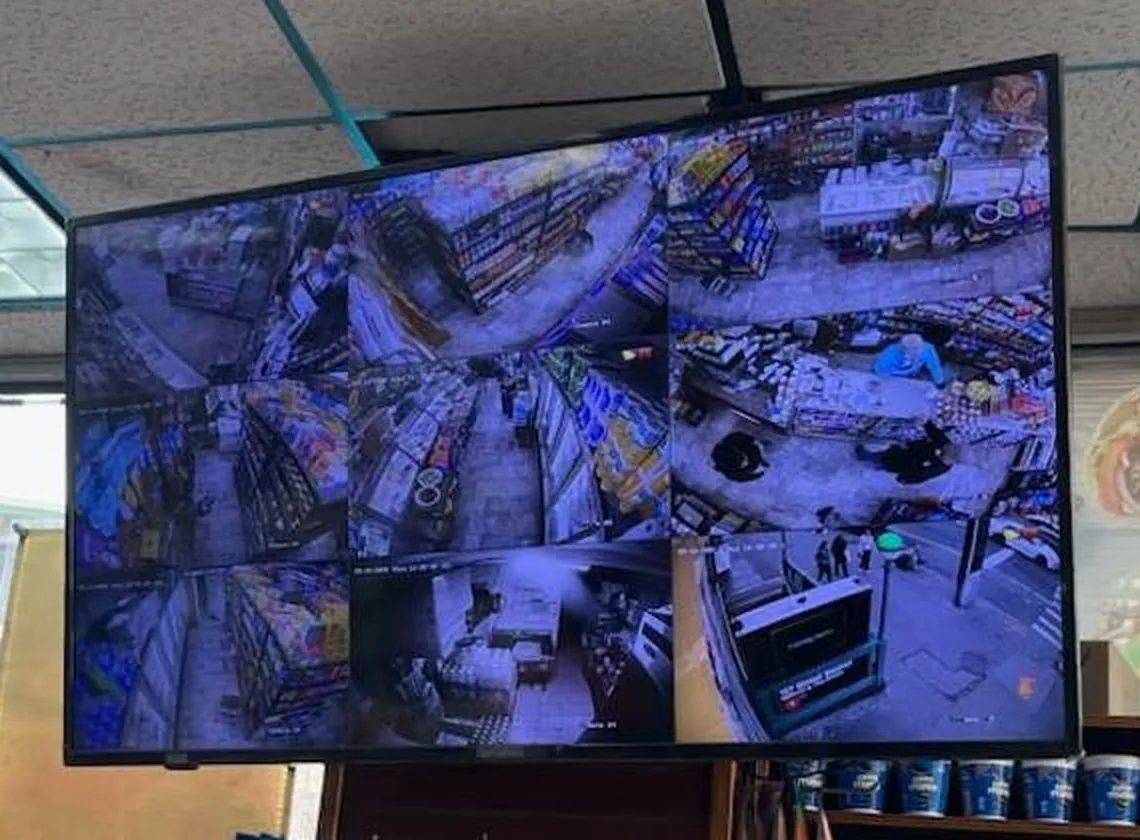
From one of our CCTV jobs (Manhattan corner deli): a large monitor hung from the ceiling over the snack shelves shows nine camera tiles covering the aisles, the counter and the front of the store, so staff and customers can see the system is live. The same setup suits a Westchester deli, pharmacy or liquor store.
Building Specialists
CCTV Installation for Westchester's Apartment Buildings, Towers and Houses
The type of building decides where the recorder lives, how the cable travels and how many cameras the system needs before anyone talks about brands. These are the buildings we see most often across the county, from the city line to the Connecticut and Putnam borders.
🧱
Pre-war elevator buildings
Five- and six-story brick buildings in Yonkers, Mount Vernon and New Rochelle with a basement boiler room, a crowded riser and long tiled hallways. The recorder goes in a locked room in the basement; cable climbs an existing chase.
🏙️
New downtown towers
Concrete towers in downtown New Rochelle and White Plains with garages, package rooms, amenity floors and a developer-installed system. Work is usually expansion, retention upgrades and tenant-side systems.
🌳
Garden apartments and co-ops
Two- and three-story buildings around courtyards in Hartsdale, Yonkers, Tuckahoe and White Plains, with shared parking, laundry rooms and several entrances tied back to one recorder.
🏘️
Two- and three-family houses
Frame houses with stacked porches in Mount Vernon, Yonkers, New Rochelle and Port Chester. One recorder, cameras on each entrance and the driveway, separate logins for owner and tenants.
🏡
Colonials, Tudors and capes
Scarsdale, Bronxville, Larchmont, Pelham, Eastchester and Rye: stucco, brick, clapboard and slate, finished basements and tight attics. Neat mounts and hidden cable matter here.
🌲
Estates and large lots
Bedford, Pound Ridge, North Salem, Armonk and Chappaqua: long driveways, gates, pool houses and detached garages, with runs that can exceed the 100-meter copper limit.
🏬
Mixed-use blocks
Stores below apartments on Main Street in New Rochelle, Gramatan Avenue in Mount Vernon, Mamaroneck Avenue in White Plains and Westchester Avenue in Port Chester, often with the store and the building on separate systems.
🏗️
New construction and gut renovations
Buildings and houses still open to the studs, where CCTV wiring can be run before drywall, and job sites that need cameras while copper and tools sit on site.
Walls, ceilings and cable routes, building by building
Brick and terra cotta. Westchester's pre-war buildings are solid masonry outside and plaster on clay tile or brick inside. We drill exterior masonry with masonry bits, set anchors into the brick rather than the mortar joint where the facade allows, and seal every penetration so water stays out. Inside, cable usually follows the building's existing chases and the space above hallway ceilings. Where nothing is hidden, a painted surface raceway along the ceiling line is cleaner than cutting into plaster that may be a hundred years old.
Poured concrete towers. In New Rochelle's and White Plains' new towers, any core drilling needs the building's approval, so we start with the sleeves, conduits, garage cable trays and telecom risers the developer left. Riser access and the low-voltage drawings, requested from the managing agent at the start, decide how long the job takes.
Stucco and half-timber Tudors. Common in Scarsdale, Bronxville and the Pelhams. Careless drilling cracks stucco and lets water in, so cameras go on junction boxes anchored into framing, every hole is sealed, and cable runs inside through the attic or basement.
Clapboard and vinyl siding. On the two-family houses in Mount Vernon and Yonkers and the capes and colonials further north, we fix cameras to a mounting block so the base sits flat on the siding, then bring the cable through the block from inside. That is how most CCTV installation with concealed wiring is done on a sided house, and it is also what keeps the camera from loosening as the siding moves with the seasons.
Co-ops, condos and rental buildings. In any building with a board or a managing agent, the common areas belong to the building, so the board approves the camera locations and who may view the footage. For residents and boards who want to go deeper into resident privacy, the mailroom, tenant notices and how multifamily systems are run, our apartment building security camera page for Westchester County covers it. Here the focus is the recorder side: one NVR per building in most cases, sized with spare channels, in a locked room that only the super and the manager can open.
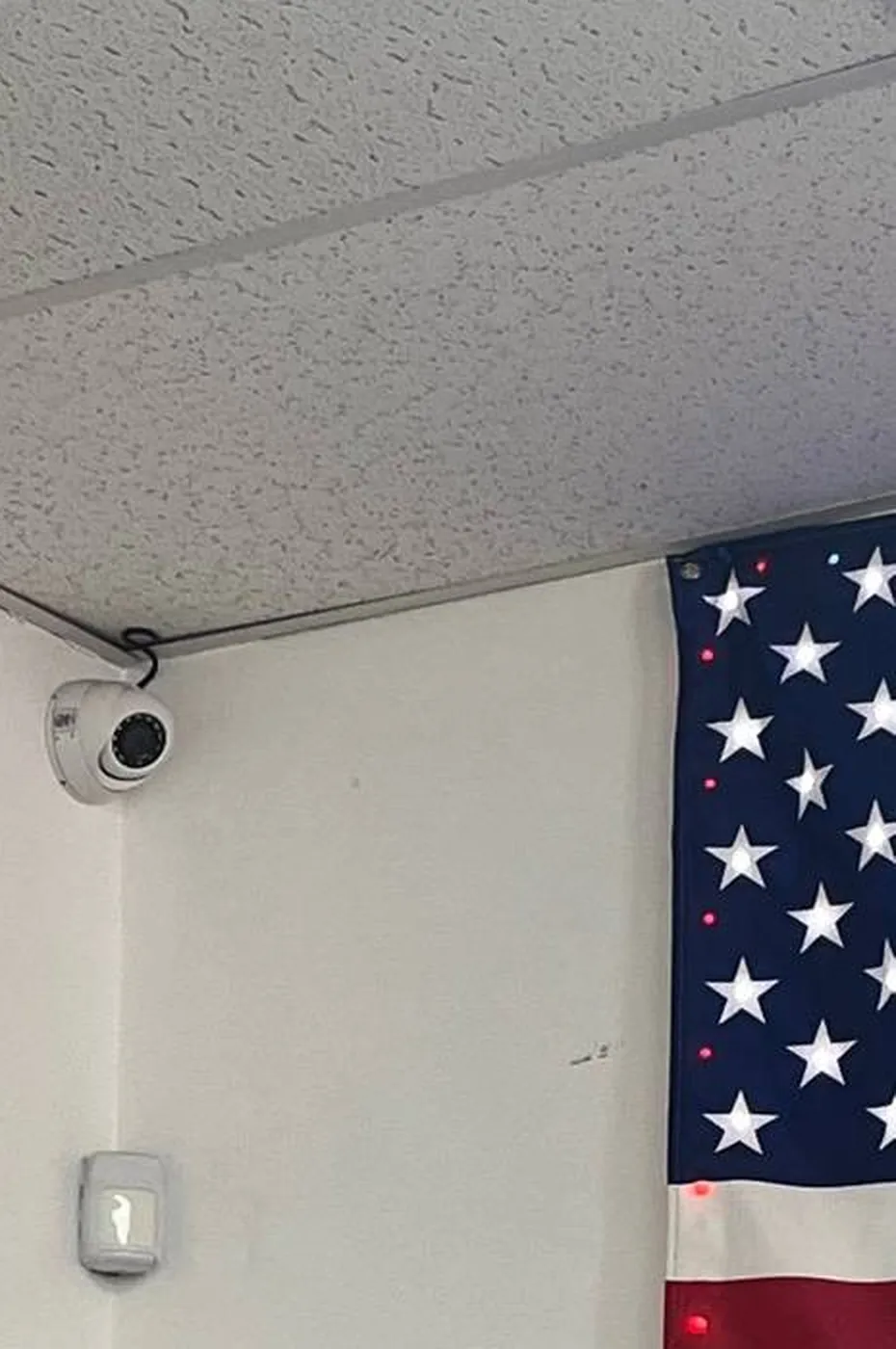
From one of our CCTV jobs (Nassau County window and door showroom): a white dome camera set into the top corner of an office wall, with an alarm motion sensor below it and an American flag hanging beside it. A corner mount like this sees the whole room and keeps the camera out of reach, the same approach we use in Westchester offices and building lobbies.
Commercial CCTV Installation
Business CCTV Installation in Westchester County
Commercial CCTV installation in Westchester follows a handful of busy roads. Each one brings its own mix of businesses and its own camera problems, and knowing the street often tells us half of the layout before we arrive.
Central Park Avenue. From the Yonkers line through Greenburgh, Hartsdale and Scarsdale, a long strip of shopping plazas, car dealers, gas stations, restaurants and big-box stores with wide parking lots and several driveways each.
Downtown Yonkers. Getty Square, South Broadway, Warburton Avenue and the waterfront: delis, pharmacies, check-cashing offices, bars and late-night stores, many of them covered by the city's video camera law.
Mamaroneck Avenue and Main Street, White Plains. Restaurants, bars, salons and shops in a walkable downtown, plus the hotels, offices and the courthouse district.
Main Street and North Avenue, New Rochelle. Independent stores, restaurants and services under new towers and older mixed-use buildings.
Fourth Avenue and Gramatan Avenue, Mount Vernon. Small storefronts, beauty supply, groceries and takeout, often with the owner's apartment upstairs.
The I-287 and Westchester Avenue office corridor. Corporate campuses and multi-tenant office parks from Tarrytown and Elmsford through White Plains to Harrison, Purchase and Rye Brook, where cameras have to fit the tenant's IT rules and the landlord's.
Route 1 through Port Chester, Mamaroneck and Larchmont. The Boston Post Road's mix of auto shops, restaurants, marine businesses and small plazas.
On any of these streets, the test of a business system is simple: can the owner hand a detective a clean clip of the person at the door, the hand at the register and the car leaving the lot, from three weeks ago? Westchester commercial CCTV systems run $1,500 to $5,000+ by camera count, building and cabling, quoted in writing once the layout is confirmed. For the bigger commercial picture, including access control and intercom tie-ins, see our commercial security camera installation page for Westchester businesses.
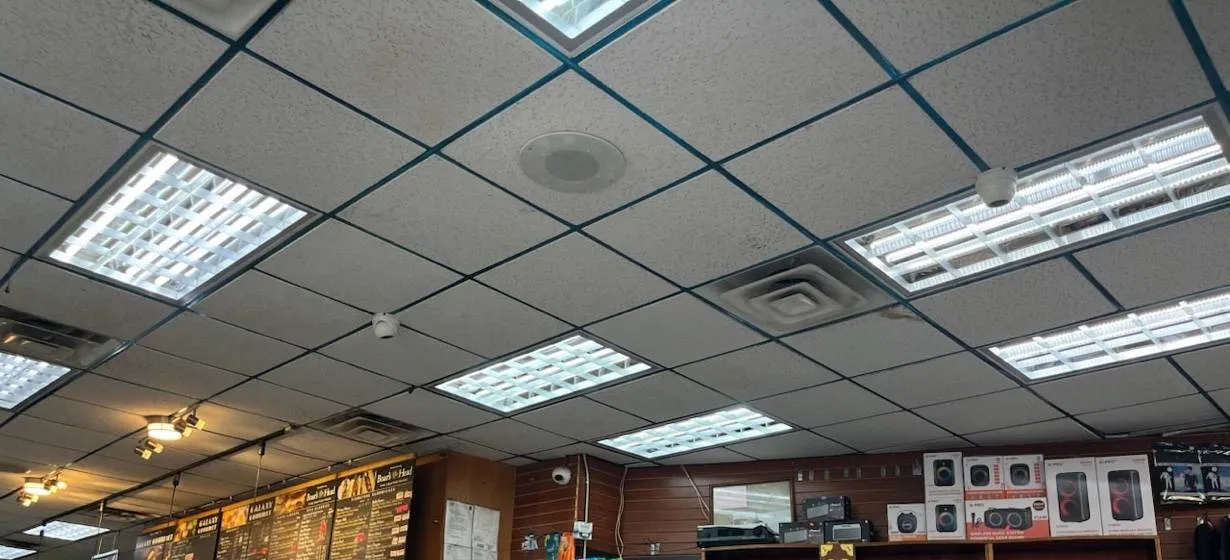
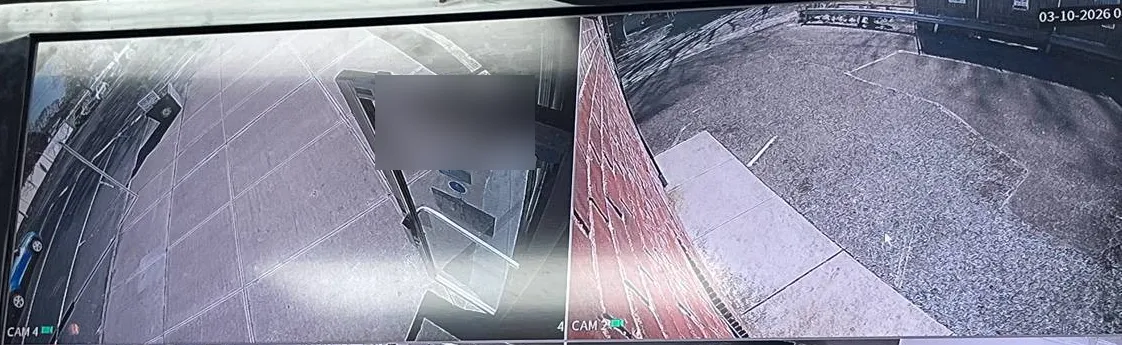
From one of our CCTV jobs (Manhattan corner deli): small dome cameras fixed to the drop ceiling between the light panels, looking down over the counter and the shelves.From one of our CCTV jobs (Nassau County showroom): two tiles on the recorder screen, one watching the front door and the sidewalk, the other the brick side wall and the side lot. The street number on the door has been blurred.
The Yonkers video camera law, explained for owners
Chapter 84 of the Yonkers City Code spells out its camera standards in unusual detail. It covers six kinds of business: those licensed by New York State to sell alcohol for drinking on or off the premises, any business regularly open to the public at some point between 12:00 midnight and 4:00 a.m., check-cashing businesses, licensed secondhand dealers that buy and sell precious metals, pharmacies licensed by the state, and pawn shops licensed by the city. A Yonkers business in any of those groups needs a system that meets this list:
Every entrance and exit. Cameras must be at or near each entrance or exit regularly used by customers or employees, aimed to record a full frame of a person's face coming in or going out and, as far as practical, the activity within 15 feet of each door.
Readable faces, day and night. The cameras must be light-sensitive enough and have enough resolution, with extra lighting if necessary, to record discernible and accurate facial images at all times.
At least 8 frames per second. A recorder set to save space with very low frame rates does not meet the rule.
A digital recorder that exports. The recorder must be digital and able to transfer recordings to portable digital media, and recordings must be indexed by date and time.
Recording hours. The system must record during all business hours and for two hours after closing. Audio is not required.
30 days of footage. Recordings must be kept for at least 30 days and handed to the Yonkers Police Department on demand for an official investigation.
Locked storage and an access log. Recordings must be kept so that only authorized staff can reach them, and the business must log every request for, access to and release of footage.
Inspection and an annual certificate. The system must be open to inspection by the city's Building Department and Police Department while the business is open, and the business must file a compliance certification with the Police Department, on the department's form, by January 31 each year.
The code also says the installation must follow the New York State Uniform Fire Prevention and Building Code and the City of Yonkers code. Violations of the retention, police access, storage and logging rules are treated more seriously in the code than the other provisions. This is a summary for planning, not legal advice; read Yonkers City Code Chapter 84 on eCode360 and confirm with the city what applies to your business.
For a contractor, the 30-day rule is the part that changes the equipment. Our standard systems include two weeks of recording; a Chapter 84 system has to hold at least 30 days at a frame rate and resolution good enough for faces at every door. That means a bigger drive or a second drive, H.265 compression and sensible stream settings, all priced after we confirm how many doors and cameras the business has. We set the recorder's clock and time zone, show the owner how to export a clip to a USB stick, put the recorder in a lockable cabinet or room, and leave a camera list that the owner can attach to the January certification.
Other businesses we wire across the county
Retail and grocery. For supermarket CCTV installation and store CCTV installation we start at the front doors and the checkout lanes, then the aisles where shrink is worst, the stockroom and the receiving door. Shops near The Westchester, Ridge Hill and Cross County feel the gaps most in the weeks before Christmas.
Restaurants, bars and nightlife. Restaurant CCTV installation and bar CCTV installation cover the register and the bar, the back door, the walk-in and the dining room, with cameras kept out of the hood line in the kitchen. In Yonkers, a bar with a liquor license also falls under Chapter 84, so the entrance cameras and the 30-day drive are part of the plan from the start.
Pharmacies, medical and dental offices. Pharmacy, medical office and dental office CCTV installation stays in the public and storage areas: doors, waiting room, front desk, drug storage. Treatment rooms stay off camera.
Offices and office parks. Corporate office CCTV installation in the I-287 corridor usually means cameras on the suite entrance, the reception desk, the network closet and the back stair, recorded on an NVR that sits on its own network segment, separate from the company's computers.
Car dealerships, gas stations and auto shops. Along Central Park Avenue and the Post Road, car dealership CCTV installation and gas station CCTV installation center on lot rows, pumps, the service drive, the key drop and the cashier.
Warehouses, garages and yards. The industrial pockets in Elmsford, along the Saw Mill River Road in Yonkers, and in Mount Vernon and Port Chester have loading docks, truck courts and fenced yards. Our warehouse security camera installation page for Westchester covers dock and yard work in detail.
Schools, daycares and houses of worship. School CCTV installation, daycare CCTV installation and church CCTV installation cover entrances, drop-off loops, hallways and parking, planned with the administration or the board. See also our school security camera page for Westchester.
Construction sites. CCTV installation for construction sites in the downtowns usually means temporary cameras on the site fence or a trailer, recording locally and alerting on people after hours. Our construction site camera page for Westchester has more.
Privacy rules every Westchester camera owner should know
These New York State rules apply everywhere in the county, in addition to any local law like Yonkers Chapter 84. They are general information, not legal advice; ask your attorney what applies to your building or business.
Bathrooms and changing areas stay camera-free for staff. Under Labor Law §203-c, a New York employer may not video record employees in a restroom, locker room or room set aside for changing, unless a court orders it.
Audio needs consent. Under New York's eavesdropping law (Penal Law §250.05), recording a conversation without the consent of at least one party is a crime, so we leave microphones off by default at businesses and in common areas.
No cameras into private spaces. Penal Law §250.45, unlawful surveillance, makes it a crime to secretly record people dressing or undressing where they expect privacy. We aim cameras at your own doors, halls, lots and yard, not at neighbors' windows.
Post notice. Signs saying the premises are under video recording are good practice for stores, offices and apartment buildings, and many insurers expect them.
Your Questions Answered
Westchester County CCTV Installation: Questions Answered
These are the questions Westchester owners, managers and boards ask us most, and most of them come from the four cities, where the buildings are bigger and the rules are tighter.
What does Yonkers' video camera law require from a bar, pharmacy, pawn shop or late-night store?
If your business sells alcohol under a state license, is open to the public at any point between midnight and 4 a.m., cashes checks, buys and sells precious metals as a licensed secondhand dealer, is a state-licensed pharmacy or is a city-licensed pawn shop, Chapter 84 requires a working video camera system. The cameras must cover every entrance and exit used by customers or staff, record a full-frame face, record at 8 frames per second or more, run during business hours and for two hours after closing, and keep footage for at least 30 days.
The business must also keep recordings locked away from unauthorized staff, log every request for and release of footage, let the Building and Police Departments inspect the system while open, and file a compliance certificate with the Yonkers Police Department by January 31 each year. We design and install the system to those standards; the certification is the owner's filing, made on the police department's form.
How big a hard drive does a store need to hold 30 days of footage?
It depends on the number of cameras, their resolution, the frame rate and how busy the scene is. As a working figure, a 4MP camera recording continuously in H.265 at around 2 megabits per second fills roughly 21 to 22 GB a day. A small Yonkers store with six cameras recording all day for 30 days needs about 3.9 TB before any headroom, so a 6 TB drive is a sensible minimum and an 8 TB drive leaves room for a seventh or eighth camera.
Busy scenes, rain and snow at night, and higher resolutions push that up; quiet stockrooms push it down. A recorder that only saves motion events stores far longer, but a law that says record during business hours is safest met with continuous recording on the door cameras. We check the recorder's real daily usage after a few days and adjust the settings before closing out the job, so the 30 days is measured rather than assumed.
What cable do you run in a pre-war Yonkers or Mount Vernon building, and what changes in a new tower?
In older brick buildings we usually run Cat6 for IP cameras, using the existing chases, the space above hallway ceilings and the basement to reach a recorder in a locked room. Where the building already has coax from an old analog system and it tests clean, we often keep it and fit HD-analog cameras on a DVR, which saves opening walls. Where neither route exists, painted surface raceway is the tidy fallback.
In a concrete tower the cable choice is the same Cat6 or Cat6A, but the route is set by the building: telecom risers, sleeves through the slabs, cable trays in the garage. Long vertical runs past 100 meters, or runs between a tower and a separate garage, go on fiber with a small switch at the far end. Before we quote a tower, we ask for riser access and the low-voltage drawings, because those decide the labor more than the camera count does.
How do you size the PoE switch when a building needs 30 or more cameras?
We add up the worst-case power draw of every camera, not the average. An 802.3af PoE port supplies up to 15.4 watts and an 802.3at (PoE+) port up to 30 watts, but the switch also has a total budget that is often less than every port at full power. Infrared at night, heaters in outdoor housings, PTZ motors and deterrence lights all draw more when it is cold and dark, which is exactly when cameras drop off an undersized switch.
On a 30- or 40-camera building we often split the load across two switches, one for the outdoor and garage cameras and one for the interior, so one failure never blacks out the whole building. Both switches and the recorder go on the battery backup, and the switch model, the port map and the power budget are written into the handover pack for whoever services the system next.
Is a fisheye camera a good choice for a lobby or a mailroom?
Sometimes. A fisheye camera on the center of a ceiling sees the whole room in one circle of video, which is useful in a square mailroom or a small lobby where you want to know who was there and where they went. The recorder or the app can flatten the circle into normal views. One camera instead of three saves cable and channels.
The weakness is detail at the edges. A face near the wall is small and distorted in a fisheye image, so a fisheye does not replace a camera aimed at the entrance door at face height. In most Westchester buildings the best mailroom plan is one fisheye or wide dome for the room and one tighter camera on the door or on the package shelves where the disputes happen.
What lens does a camera need to cover a long apartment corridor?
A long, narrow hallway is where a varifocal lens earns its cost. A fixed wide-angle camera at one end makes the far end of a 100-foot corridor tiny, so a person at the elevator door is a few pixels tall. A varifocal camera lets us tighten the view so the far door fills more of the frame, while a second camera at the other end, or a wider camera near the stairwell, covers the near half.
Corridor mode, which turns the image on its side, fills the frame with the hall instead of the walls. In L-shaped pre-war halls we mount at the bends so each camera looks straight down one leg.
Can a restaurant on Mamaroneck Avenue or Main Street record its outdoor dining tables?
Video of your own outdoor seating area, the sidewalk in front of your door and your entrance is common and generally reasonable, the same way a store records the sidewalk at its door. Keep the cameras aimed at your tables, your service path and your entrance rather than at neighbors' windows across the street, and post a notice that the premises are recorded.
Audio is where restaurants get into trouble. A microphone over a patio full of diners records conversations the owner is not part of, which runs into New York's eavesdropping law, so we install outdoor dining cameras with audio turned off. If the outdoor seating sits on city property under a permit, read the permit's conditions as well; this is general information, not legal advice.
Can office cameras share the company network in a White Plains or I-287 office park without exposing it?
They can share the wiring without sharing the risk. We put the cameras and the recorder on their own VLAN or a physically separate switch, so a camera can never reach the company's computers or file servers, change every default password, turn off services the cameras do not need, and keep firmware current. Remote viewing goes through the manufacturer's secure app or a properly configured connection, never by opening the recorder straight to the internet.
In multi-tenant office parks, we also check the landlord's rules before we touch the building's network or ceilings, and we coordinate with the tenant's IT provider so the camera network appears in their documentation. The handover pack lists every camera's IP address, the VLAN, the recorder's admin account and who holds it.
When does a PTZ camera make sense on a Westchester property?
A pan-tilt-zoom camera makes sense where a person actually watches live and needs to follow something: a large parking lot at a plaza on Central Park Avenue, a car dealer's rows, a big estate where the owner wants to look around the grounds from a phone. It can zoom across a lot to read a plate or follow a vehicle to the exit.
Where nobody watches live, a PTZ pointed one way is not recording the other. Unattended properties get fixed cameras that always cover their zone, with a PTZ only as an extra for live use.
Can cameras cover a building's bike room and storage cages without looking into residents' cages?
Yes. The camera goes at the bike room or storage room door and along the main aisle, aimed so it records who enters, who leaves and what they carry, not the contents of each locked cage. In a long basement storage room we usually add a second camera at the far end of the aisle so a person cutting a lock is visible from the front and the back.
Basements in Westchester's older buildings are dim and often damp, so we choose cameras with good low-light performance, keep them clear of pipes that drip, and run the cable in raceway along the ceiling. The same plan works for package overflow rooms and laundry room doors.
How often does a CCTV hard drive need replacing in a recorder that writes around the clock?
A surveillance-rated drive writing continuously usually lasts several years, but it is the part of a CCTV system most likely to fail, and recorders in hot closets or dusty basements wear drives out faster. The real risk is not the failure itself but not noticing it. A recorder with a dead drive can keep showing live video while it has stopped recording, and owners discover it on the day they need footage.
We set the recorder to send a health alert when a drive reports errors or recording stops, and we check drive health at every maintenance visit. For buildings and Chapter 84 businesses, where losing footage is a compliance problem, we can add a second drive so recording continues on one while the other is replaced. CCTV hard drive replacement and storage upgrades are priced per drive after we confirm the recorder model.
Can you move cameras when a store renovates or changes its layout?
Yes. CCTV camera relocation is common in Westchester's downtowns, where shops change fixtures, add a counter or split a space with a new tenant. We take down the cameras that will be in the way, protect or pull back the cable, and re-mount and re-aim once the new layout is set. Where a renovation opens the ceiling, it is the right time to reroute cable neatly and add cameras.
The best timing is to call before the contractor closes the ceilings. Cable that goes in while the grid is open costs less than cable fished in after, and the cameras can go back up with the new light fixtures. For Yonkers businesses under Chapter 84, keep the entrance cameras recording or replace them the same day, because the law does not pause for a renovation.
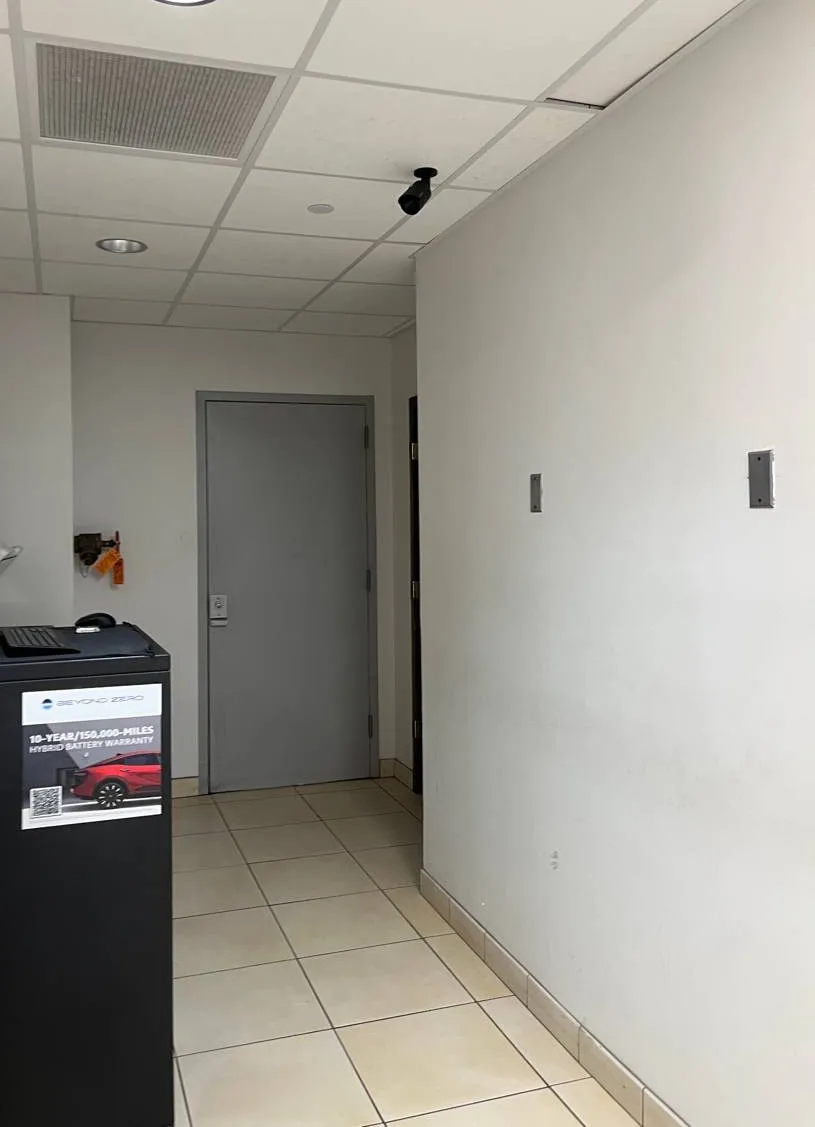
From one of our CCTV jobs (Rockland County car dealership): a black camera on the drop ceiling looks down a tiled back hallway to a grey steel door, past a black cabinet. Anyone using that door walks straight toward the lens, which is why one camera like this is often the best value in a Westchester building's rear corridor.
Equipment
Cameras, Recorders and Switches for Westchester Jobs
Unless you ask otherwise, a Westchester job gets our house-brand cameras and recorder, because we can stock parts and support them for the life of the building. Lorex, Luminys and Reolink are the three brands we carry as an authorized partner. When a building already runs Hikvision, Dahua, UniFi Protect, Axis, Hanwha, Uniview or Digital Watchdog equipment, we install, integrate and service it rather than ripping it out.
⚪
Dome and turret cameras
Our first choice inside lobbies, halls and offices: dome camera installation and turret camera installation put a compact, tamper-resistant camera within a few feet of the people it records.
🎯
Bullet and varifocal cameras
Bullet camera installation and varifocal camera installation for long corridors, garage ramps, driveways and parking rows, zoomed to the distance each view needs.
◯
Fisheye and panoramic
Fisheye camera installation and panoramic camera installation for square rooms, mailrooms and lots where one mount should see the whole space.
🌗
Night vision and color night
Infrared camera installation for dark alleys and rear yards, and color night vision camera installation where a light fixture gives the camera something to work with.
🚨
Active deterrence
Active deterrence camera installation with a light and siren that trigger when a person enters a set zone after hours, useful on rear doors, dumpster areas and lots.
🔢
LPR and vehicle cameras
License plate recognition camera installation and vehicle detection camera installation at garage entrances and lot exits, with the narrow lens and shutter settings plates need at night.
🖥️
NVRs, DVRs and hybrids
Network video recorder installation for IP cameras, digital video recorder installation for HD-analog coax, and hybrid recorders for buildings mid-upgrade, sized in 8, 16, 32 and 64 channels.
🔌
Switches, racks and power
CCTV PoE switch installation, CCTV rack installation and CCTV UPS installation for buildings and offices, with labeled ports and a printed port map.
🧯
Vandal-resistant and weatherproof
Vandal resistant camera installation and weatherproof CCTV camera installation for garages, rear courts, bus-stop-facing storefronts and anywhere a camera may get hit or soaked.
Which recorder fits which Westchester building
Property
Typical cameras
Recorder
Cable
Watch out for
Colonial or cape north of I-287
4 to 8
8-channel NVR
Cat6 through attic and basement
Long driveways and detached garages past 100 m
Two- or three-family house in Mount Vernon or Yonkers
6 to 10
8- or 16-channel NVR, or a DVR on reused coax
Cat6 or existing RG59
Separate logins for owner and tenants
Pre-war elevator building
16 to 32
32-channel NVR in a locked basement room
Cat6 up chases and above hall ceilings
Crowded risers and plaster walls
Downtown tower in New Rochelle or White Plains
32 to 64
32- or 64-channel NVR, or expanding the existing one
Cat6A in risers, fiber to garages
Developer system compatibility and riser access
Yonkers Chapter 84 business
4 to 12
NVR with drive sized for 30 days
Cat6
8 fps minimum, faces at every door, export and logs
Office suite on the I-287 corridor
6 to 20
NVR on its own VLAN
Cat6 above the ceiling grid
Landlord rules and the tenant's IT policy
The settings that decide whether footage is useful
Compression. H.265 stores a similar picture in much less space than H.264, so we use it wherever the cameras and the recorder support it. That is what makes 30-day retention affordable for a Yonkers business and keeps a 40-camera building's drive from filling in a week.
Frame rate and bitrate. A door camera that has to catch a face needs a steady frame rate, and the Yonkers law sets a floor of 8 frames per second. A camera on an empty stairwell can run lower. We set each stream for its job instead of one setting for every channel.
Mounting height and angle. Faces need a camera at roughly 7 to 10 feet, angled down only slightly, close to the door. Cameras mounted at ceiling height in a tall lobby look down on the tops of heads. We place door cameras for faces and higher cameras for the overview.
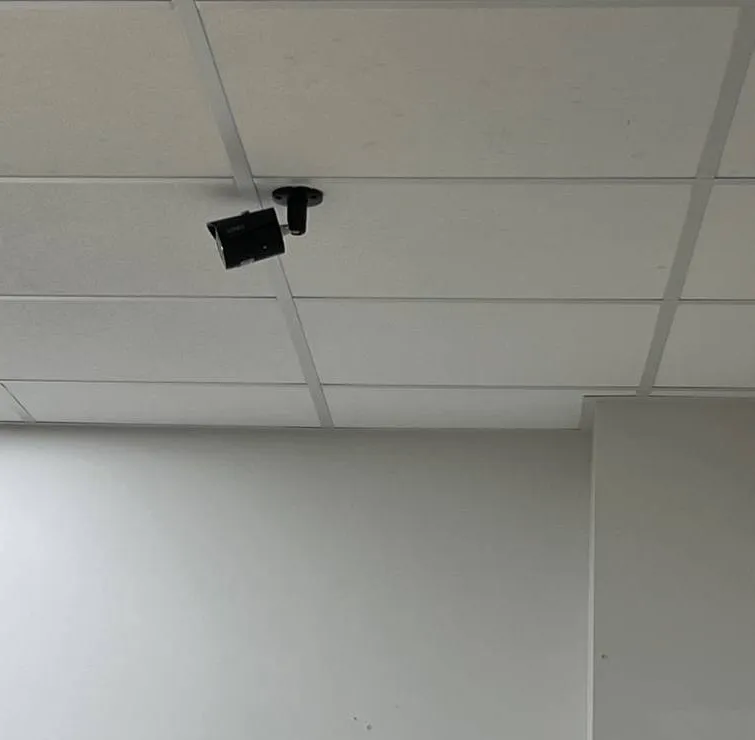
From one of our CCTV jobs (Rockland County car dealership): a black bullet camera on a short bracket fixed through a drop ceiling tile, looking down over a work area. The bracket drops the camera below the light fixtures so the view is clean.
Got an inspector's notice or a board deadline?
Text us the address, a photo of any old recorder and the doors that must be covered. We will reply with what the system needs and what it costs.
Search summaries tend to treat Westchester as one uniform suburb. Here is where that advice breaks in the county's cities and buildings, and what we do instead.
“Westchester is suburban, so a few cameras on the house are all anyone needs”
That holds for a cape in Somers. It does not hold for the 173,236 homes in Yonkers, Mount Vernon, New Rochelle and White Plains, where roughly half of all homes sit in buildings of five or more units, from 44.5% in New Rochelle to 59.2% in White Plains, according to the Census Bureau's 2023 estimates. In those buildings the cameras belong to the building, not to the tenant, and the system has to cover shared doors, halls, mailrooms and garages.
A building needs more channels, a locked recorder room, accounts for the super and the manager, and a plan the board can approve. Stacking house kits just multiplies apps and drives nobody checks.
What we do is start from the building: count the entrances, the floors, the common rooms and the parking, then size one recorder with spare channels for everything the board wants now and later. On houses we still start small, but we plan the cable so a fifth or sixth camera does not mean a new system.
“Any security camera satisfies a city requirement for business video”
Yonkers Chapter 84 is specific. It wants a camera at each entrance and exit used by customers or staff, framed for a full face, at 8 frames per second or more, with facial images that are discernible at all times, footage kept 30 days, export to portable media, and recording until two hours after closing. A doorbell camera, a single Wi-Fi camera over the register or a cloud camera that only saves motion clips can miss several of those at once.
Small details fail: a door camera mounted too high, a two-week drive that overwrites day-20 footage, a recorder clock that drifted. None of it shows until someone asks for video.
We build Chapter 84 systems against the code's list, set the clock and retention, test an export with the owner and leave a written camera list for the annual certificate. If a business in another Westchester city wants the same standard voluntarily, we build it the same way, because it is a good standard for any store with late hours.
“Two weeks of recording is enough for any business”
Two weeks is our standard on new systems, and for most houses it is plenty: you know within a day or two if something happened. For businesses, two weeks can be short. A shoplifting pattern, an insurance claim or a slip-and-fall complaint may surface three or four weeks after the event, and by then the footage is gone.
For Yonkers businesses under Chapter 84, two weeks is simply below the legal minimum of 30 days. For apartment buildings, boards often decide on 30 days so that a resident's complaint about a damaged car or a missing package can still be checked after the first reply.
Retention is a design choice, not an accident of the drive that came in the box. We ask how long you need, then size the drive, the compression and the frame rates to hit it, and confirm it with real usage after the first week.
“Cloud cameras are simpler for apartment buildings”
Cloud cameras are simple to buy and easy to view. In a building they create three problems. Every camera uploads video continuously, which a building's internet connection may not carry for 30 or 40 cameras. Every camera usually carries a monthly fee. And when the internet drops, cloud-only cameras stop recording at the moment you most need them.
Boards also lose clear answers to who sees the footage, how long it is kept and how police get it.
Our building systems record locally on an NVR with $0 monthly fees, send alerts and short clips to the phones of the people who need them, and keep working through an internet outage. If a board wants an off-site copy of important events, we add it on top of local recording, never instead of it.
“A recorder doesn’t need a battery in a well-served suburb”
Westchester's big trees are part of its appeal, and they are also what brings the lines down. In June 2026, one evening of thunderstorms left more than 5,000 Con Edison customers in Westchester without power, with trees down across parts of Bronxville, Mount Vernon, New Rochelle, Pelham Village, Scarsdale, White Plains and Yonkers. Northern towns on NYSEG lines see the same in summer storms and winter ice.
Without backup, a recorder reboots on every flicker and loses the minutes when doors and lights are out, and hard shutdowns wear the drive.
A battery backup under the recorder and switch rides through short outages and shuts the recorder down cleanly on long ones. In buildings with an emergency generator, we ask the engineer whether the camera equipment can go on a generator-backed circuit, with the UPS bridging the gap until it starts.
“Building owners may aim cameras wherever they like on their property”
Landlords and boards have wide latitude over common areas like lobbies, halls, laundry rooms and garages. They do not have latitude over private spaces. New York's unlawful surveillance law makes it a crime to secretly record people dressing or undressing where they expect privacy, and employers may not video record restrooms, locker rooms or changing rooms under Labor Law §203-c.
Audio is the other trap: a lobby or laundry-room microphone records residents' conversations without consent, so building audio stays off by default.
We plan building cameras around the shared spaces, show the board exactly what each camera sees before we finalize it, and keep views off apartment doors' interiors and neighbors' windows. This is general information, not legal advice, and boards should confirm their own policies with counsel.
“More megapixels will fix a camera that can't see faces”
Most of the camera complaints we hear in Westchester buildings are not about resolution. They are about position: a camera at the top of a two-story lobby, a camera facing a glass door in afternoon sun, a camera at the wrong end of a hallway. Swapping in a 4K camera in the same spot gives a sharper picture of the same useless angle.
It also costs storage: moving a 30-camera building to 8MP across the board can roughly halve retention.
We fix the angle first, then choose resolution per camera. Entrance cameras get the detail; overview cameras get the width. That is cheaper, and it is the change that actually turns a blurry figure into a face.
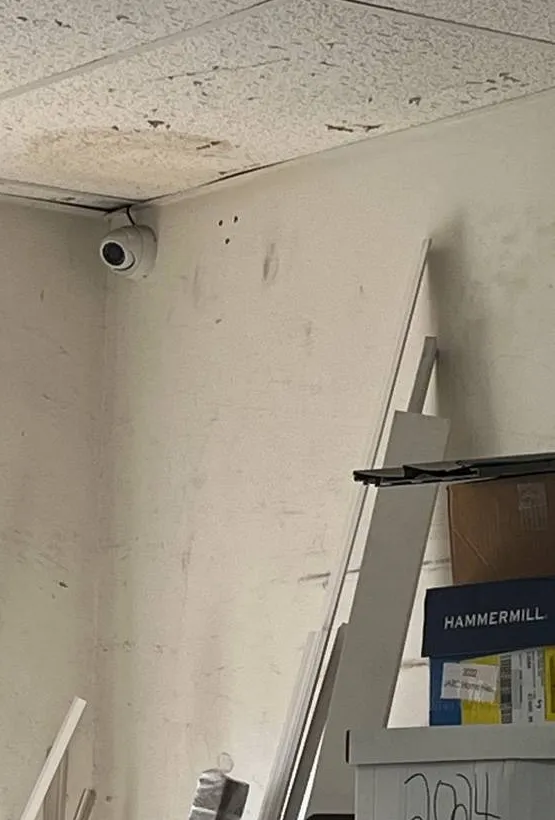
From one of our CCTV jobs (Nassau County showroom): a white dome camera in the top corner of a storage room with a stained ceiling, looking down over ladders, lumber and boxes stacked against the wall. Back rooms like this are where Westchester stores lose inventory without anyone at the counter noticing.
Field Notes
Field Notes: Three of Our CCTV Jobs and What They Teach a Westchester Owner
The photos on this page come from three real CCTV jobs by our crew: a corner deli in Manhattan, a window and door showroom in Nassau County, and a car dealership in Rockland County. None of them is in Westchester, and we say so in every caption. Each matches a property type common here, and the lessons carry over.
The deli: show the system, then cover the counter. In the Manhattan deli, a large monitor hangs over the shelves with the camera grid on it, in plain view of customers. Shoppers see the system is live before they reach the register. The cameras are small domes between the ceiling light panels. Yonkers and Mount Vernon delis get the same layout, and a Yonkers deli that sells beer or stays open late also falls under Chapter 84.
The showroom: the side lot matters as much as the front door. At the Nassau showroom, one of the four cameras watches the front door and sidewalk, and another runs along the brick side wall to the side lot. The side and rear are where people come and go unseen, and a storage room camera covers stock nobody at the counter can see. For Westchester storefronts on Gramatan Avenue, Main Street or the Boston Post Road, the rear door, the alley and the stockroom deserve the same attention as the front.
The dealership: a 30-plus-channel recorder needs managing. The Rockland dealership runs a large recorder whose monitor shows a grid of live camera tiles, with empty tiles left for future cameras, and a table listing each channel's stream rate. That table is how we spot a camera that is eating the drive or one that has gone offline. The same discipline applies to a Westchester apartment building with 30 or 40 cameras: someone has to look at the channel list now and then, and we set up health alerts so a dead camera announces itself instead of waiting to be discovered.
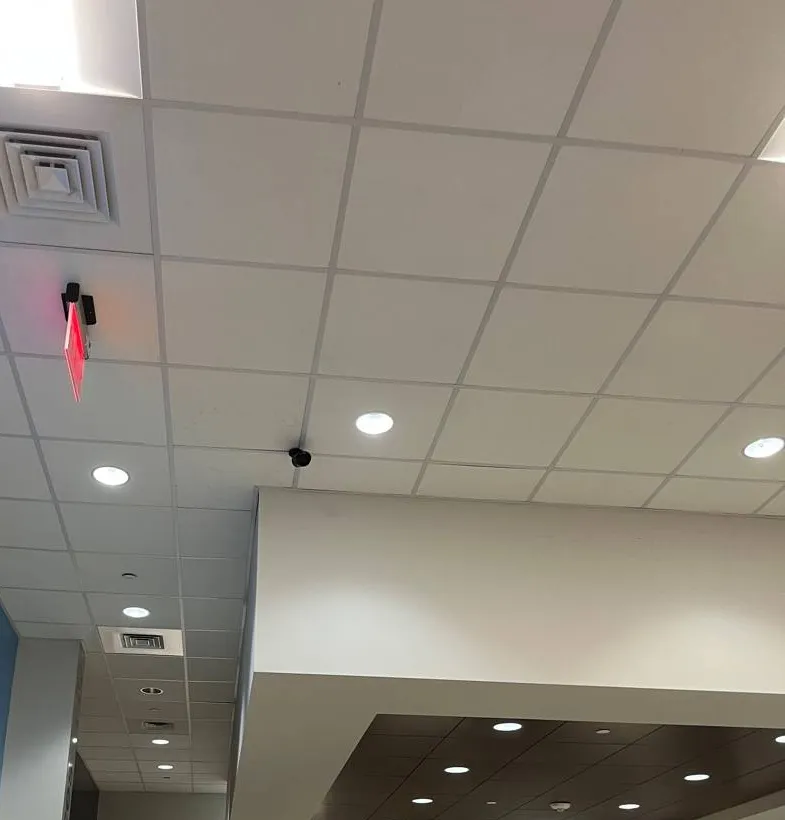
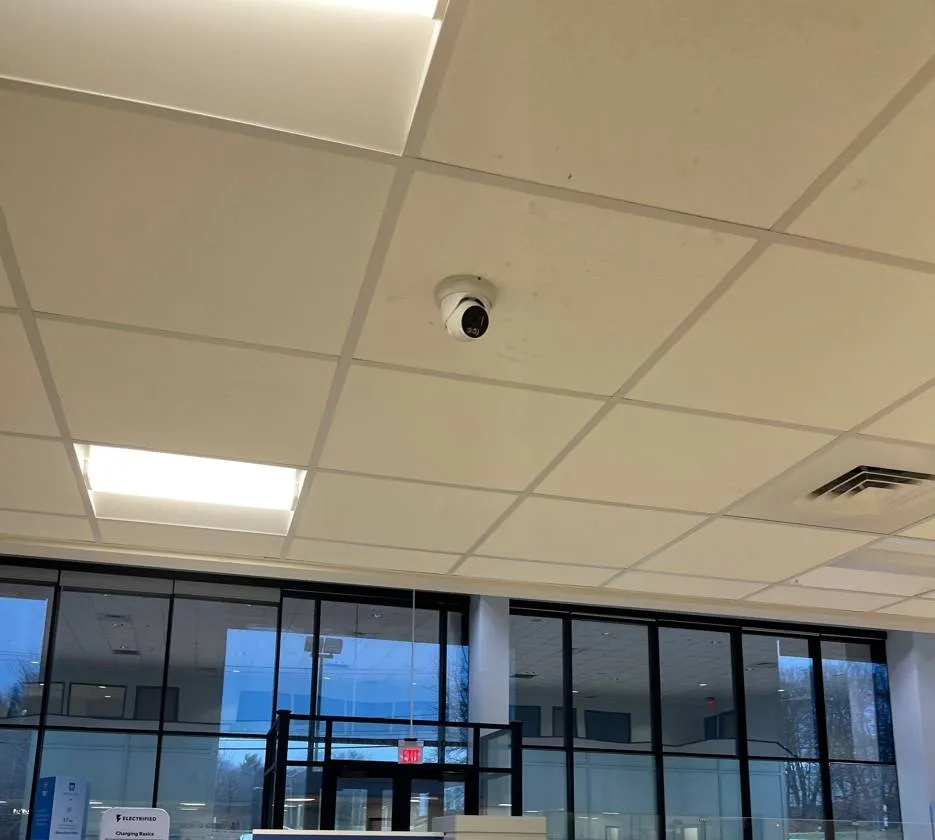
From one of our CCTV jobs (Rockland County car dealership): a compact black camera on the white drop ceiling of the lobby, between recessed lights, with a red exit sign and an air vent to one side and a dark soffit with its own lights below.From one of our CCTV jobs (Rockland County car dealership): a white turret-style dome on the drop ceiling near a light panel and an air vent, with the tall glass storefront and the exit doors below. Glass fronts like this are common in White Plains and New Rochelle retail spaces and call for cameras that handle bright backlight.
A last lesson for Westchester lobbies: in a two-story space, a camera high in the middle of the ceiling, like the one above, gives the overview but not faces. The tall glass-front lobbies of the county's newer towers need two layers, one camera for the room and one at face height by the door.
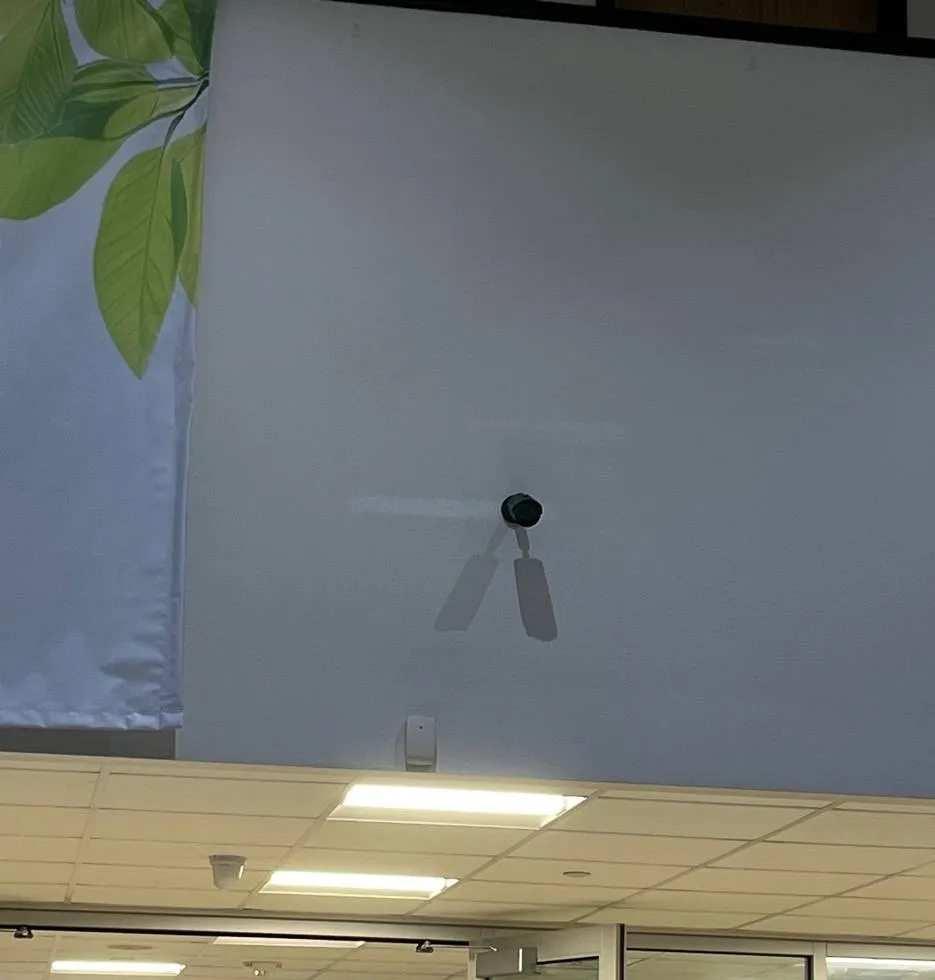
From one of our CCTV jobs (Rockland County car dealership): a small black camera on a pale grey wall high above the drop ceiling, with glass office partitions and ceiling lights below. Mounting this high keeps the camera out of reach and gives a clear view across a large open floor.
Before You Hire
Questions to Put to Any Westchester CCTV Contractor
Every quote looks alike until you ask the right questions. These separate a CCTV installation company that has done Westchester apartment buildings and regulated businesses from one that mostly hangs doorbell cameras.
Are you licensed by New York State for security installation work, and insured? Ask for the license number and the certificate of insurance, and check the license with the state. Ours is NYS license #12000287431, with general liability insurance.
How many days will this system actually keep? Ask for the number at your camera count and resolution. For a Yonkers business under Chapter 84, the answer has to be at least 30.
Where will the recorder live, and who can open it? In a building it belongs in a locked room or cabinet, on a battery backup, with access limited to the people the board names.
How will you get cable up the building? A good answer names the riser, the chase or the raceway route. “We'll figure it out” usually means surprise charges.
Which cameras catch faces at the doors? Ask to see the planned height and angle for each entrance camera, not just a camera count.
Who owns the admin password? The owner or the board should hold it, not the installer.
What do we get at the end? A camera list, a cable and port map, the password sheet, a demonstration of clip export and a check after the first week.
Our written quotes answer each of those points. To hear from past customers, the place to look is Google, where 201 reviews give us a 4.7★ rating; we do not write testimonials or hand out client lists.
When Owners Call Us
The Moments That Bring Westchester Owners to CCTV
A notice from the city or an insurer. A Yonkers business covered by Chapter 84 can be inspected by the city's Building or Police Department at any time it is open, and an insurer may ask for cameras after a claim. Either way the clock is running. We book within 2 hours of your request and schedule on a first come, first served basis once the deposit is paid, so the sooner the call, the sooner the date.
After a burglary, a car break-in or vandalism. The first cameras up are the ones that would have recorded what just happened, and the recorder goes where the next intruder will not look for it. Damaged mounts and cut cables get photographed for the insurance claim.
A package problem in the building. As downtown buildings in New Rochelle and White Plains fill up, package rooms overflow and disputes follow. Cameras on the shelves and the delivery door let a missing box be traced in minutes.
Opening a new business. Shops, restaurants and offices moving into new downtown spaces want cameras running on opening day. We fit CCTV installation for a new business opening between ceiling close-up and final inspection.
The holiday shopping season. Retailers near The Westchester, Ridge Hill and Cross County, and along Central Park Avenue, want registers, entrances and stockrooms covered before Black Friday.
Moving in or buying a building. New owners of two-family houses in Mount Vernon and Yonkers, and buyers of small apartment buildings, often inherit an old DVR with no password. Replacing it before move-in, with rooms empty, is easiest.
A vacant property or a renovation. An empty storefront or a building mid-renovation needs local recording and after-hours person alerts while copper and tools sit inside.
Get In Touch
Request a Free Westchester CCTV Installation Quote
Tell us the city or town, the type of building, roughly how many cameras you want and where, and who controls the building (you, a board, a landlord or a managing agent). If there is an old recorder, a phone photo of it and of the cable coming into it helps us quote faster. Yonkers businesses: tell us your business type and opening hours so we can size the system for Chapter 84. Prefer to talk? Call (914) 877-2578.
✅
Request Sent!
Thank you. We will call or text to book your Westchester CCTV visit, usually within 2 hours of your request.
How It Works
Our CCTV Installation Process in Westchester County
Every Westchester CCTV job follows the same six steps, whether it is a two-family in Mount Vernon or a 40-camera tower in White Plains.
1
Share the building and the rules
City or town, building type, the doors and areas to cover, who approves the work, and any rule that applies, such as Yonkers Chapter 84. We book within 2 hours.
2
Walk the routes
Photos and a call for houses; a site visit for buildings and businesses, checking the riser, the basement, the ceilings and where a locked recorder room can be.
3
Approve the written scope
One document lists the cameras, routes, drive size and switches next to the package price and any per-item extras. Paying the 50% deposit locks in the install date.
4
Cable, mount and label
Cable up chases, above ceilings or in raceway, cameras set at face height on doors, penetrations sealed, both ends of every cable labeled.
5
Program the recorder
Streams, frame rates, retention, clock, smart detection zones, user accounts and battery backup set; recording checked on every channel.
6
Hand over and check back
App on your phones, an export test to USB, the camera list and password sheet, then a look at storage and alerts after the first week.
Coverage Area
CCTV Installation Near Westchester County's Landmarks
We cover the whole county, from the Bronx line to the Putnam border. These landmarks mark the places our crew drives past most.
Ridge Hill, Yonkers
The shopping, dining and apartment complex off the Thruway and the Sprain Brook Parkway, at the heart of Yonkers' busiest retail and residential corridor.
Cross County Center, Yonkers
The open-air shopping center at the Cross County Parkway and the Thruway, surrounded by co-ops, garden apartments and one- and two-family streets.
St. Paul's Church National Historic Site, Mount Vernon
The colonial-era church on South Columbus Avenue, near the industrial south side and the residential blocks of Mount Vernon's eastern edge.
Glen Island Park, New Rochelle
The county park on Long Island Sound, next to the waterfront neighborhoods of Davenport Neck and a short drive from New Rochelle's growing downtown.
Westchester County Center, White Plains
The county's events hall at the edge of downtown White Plains, close to the office towers, condos and restaurants around the Metro-North station.
Kensico Dam Plaza, Valhalla
The county park below the Kensico Dam, just north of White Plains and the I-287 office corridor, where the county's larger lots begin.
We also serve Port Chester, Rye, Rye Brook, Harrison, Mamaroneck, Larchmont, Pelham, Bronxville, Eastchester, Tuckahoe, Scarsdale, Hartsdale, Ardsley, Dobbs Ferry, Hastings-on-Hudson, Irvington, Tarrytown, Sleepy Hollow, Elmsford, Valhalla, Pleasantville, Ossining, Croton-on-Hudson, Peekskill, Yorktown, Mount Kisco, Chappaqua, Armonk, Bedford, Katonah, Pound Ridge, Somers and North Salem.
Pricing
CCTV Installation Cost in Westchester County
Every number below matches our Westchester security camera price list; CCTV work is not priced separately. Each lettered series is a four-camera package, with recorder, cabling, labor and two weeks of storage built in.
System
What it is
Starting price
A Series
Four 1080p (2MP) cameras, DVR recorder
from $1,099
F Series
Four 5MP 2K cameras, DVR, siren-and-light deterrence
from $1,147
E Series
Four 4–5MP IP cameras, 4K NVR, person/vehicle detection
from $1,306
C Series
Four 8MP 4K cameras, DVR, long-range models available
from $1,541
D Series (top tier)
Flagship IP set: four 8MP cameras, siren lights, speak-through
from $1,541
Residential systems
4–8 camera home system with NVR and professional PoE wiring
$1,228 – $2,500
Commercial CCTV systems
Offices, retail, restaurants and multi-story buildings
$1,500 – $5,000+
Monthly fees
Video kept on the recorder in your building
$0
What moves a Westchester quote up or down
The series price covers a standard 4-camera installation. Everything beyond that is listed per item after we confirm the layout: additional cameras, longer or concealed cable runs, work in risers and chases, surface raceway, conduit, fiber to a garage or a second building, larger or additional drives for 30-day retention, a second PoE switch, a rack or lockable cabinet, and battery backup. CCTV installation cost per camera depends far more on the cable route to that camera than on the camera itself, which is why a lobby camera ten feet from the recorder and a garage camera four floors down are separate lines on the quote.
Three common Westchester layouts show how this works in practice. A colonial in Scarsdale or Eastchester with an attached garage often fits one 4-camera package: front door, back door, driveway and the side yard, wired through the attic and the basement. A two-family house in Mount Vernon usually falls in the 4- to 8-camera residential range, with a camera on each entrance, the driveway and the yard, and separate logins for the owner and the tenant. A Yonkers deli covered by Chapter 84, or a small apartment building's lobby, mailroom and rear door, usually falls in the commercial range, with the drive sized for 30 days.
Own the cameras already? Text the model numbers, the count and a sketch of where they go, and the CCTV installation labor only price comes back the same way; the deposit books it. Financing can be arranged on our systems. There are no fake markdowns or limited-time specials here; the table is the price list.
Installation workmanship carries our 30-day warranty, and one-year or longer coverage is available as a paid add-on. Full terms — including 50% deposit, one-year parts-only warranty on Abstract Enterprises Security Systems-supplied products, and the late-fee schedule — are set out in the service agreement.
Shop Our Systems
CCTV Installation Packages for Westchester Homes and Buildings
Five house-brand series, each sold as a 4-camera package with professional installation, a recorder and two weeks of recording. Buildings and businesses usually start from one of these and add channels, cameras and storage.
A
A Series · from $1,099
Models A1–A3. DVR with four 1080p (2MP) cameras; 60–100 ft night vision in infrared and full color; smart AI with motion detection; audio; remote access. Fits a small Westchester house or a single storefront on a budget.
F
F Series · from $1,147
Models F1–F6. DVR with four 5MP 2K cameras (eyeball, bullet or dome); 90–100 ft night vision; siren-and-light deterrence; 20" monitor. A strong pick when a Mount Vernon or Yonkers building already has good coax.
E
E Series · from $1,306
Models E1–E3. 4K NVR with four 4–5MP 2K IP cameras rated IP67; 90–100 ft night vision with full color; smart detection; audio; 20" monitor. Our usual starting point for new wired IP systems in houses and small buildings.
C
C Series · from $1,541
Models C1–C3. DVR with four 8MP 4K Ultra HD cameras, eyeball or long-range, rated IP66; 100–120 ft night vision with full color; audio; monitor in the box. 4K detail over existing coax.
D
D Series · top tier · from $1,541
Models D1–D5. Four 8MP 4K Ultra HD IP cameras, eyeball or bullet, rated IP67; 90–120 ft full-color night vision; deterrence lights and siren; two-way talk; audio; 20" monitor. For estates, larger stores and owners who want every feature.
Already bought your cameras? Labor-only CCTV installation
Bring-your-own jobs are labor only. The price is worked out by phone or text from your model numbers, camera count and layout, and the deposit secures the visit. There is no site walk-through for customer-owned gear, and with customer-owned wireless cameras, Wi-Fi signal problems and hardware faults stay with the owner. If a kit is a poor match for the building, for example a Wi-Fi camera meant for a garage three floors below the router, we will tell you before we start.
Who sends the January 31 compliance certificate to the Yonkers Police Department, the business or the installer?
+
The business does. Chapter 84 of the Yonkers City Code says each covered business must submit a certification report to the Police Department, on the department's own form, by January 31 every year, certifying that it complies. We do not file it for you, but we leave a written camera list, the recorder model, the retention we set and the date of the last export test, which is the information the certificate asks you to stand behind. This is general information, not legal advice.
Will CCTV cameras work on the building-wide internet that a new Westchester tower gives its residents?
+
Wired cameras do not need that internet to record; they talk to the recorder over cable, and the recorder writes to its own drive. The building's internet only matters for watching remotely. Many new towers run a managed network that blocks devices residents plug in, so for a unit owner's camera we either use the resident's own internet service or the manufacturer's app connection, and for a board's system we ask the building's network provider for a separate connection or segment for the recorder.
How can I check that a CCTV company is really licensed in New York State?
+
Ask for the license number and the name the license is issued to, then look it up with the New York State Department of State, Division of Licensing Services, which licenses security and fire alarm installers. The name should match the company on your quote and your contract. Ours is NYS license #12000287431. Ask for a certificate of general liability insurance too, especially for work in a co-op, condo or managed building.
Is a 4- to 8-camera house system in Westchester priced as a package or per camera?
+
Both. The house-brand series are priced as 4-camera packages, from $1,099 for the A Series up to $1,541 for the C and D Series, each with the recorder, wiring, installation and two weeks of recording. A 4- to 8-camera home system with an NVR and PoE wiring typically falls between $1,228 and $2,500. Cameras beyond the package, concealed runs through finished walls and longer cable routes are priced per item after we confirm the layout.
How should a Westchester restaurant cover its takeout pickup shelf so orders stop disappearing?
+
Put one camera above and slightly in front of the pickup shelf, close enough to show the face of whoever takes a bag and the label on the bag, and a second camera on the door they leave through. Name the cameras clearly so staff can find the minute a customer says their order was taken. Keep the shelf inside the camera's view and away from the bright front window, which can turn people into silhouettes in the afternoon.
Can a pharmacy record its pickup counter without capturing customers' prescriptions?
+
Yes. A camera above and slightly in front of the counter can show the pharmacist, the customer's face and the bag changing hands without being close enough to read labels or screens. We avoid aiming at computer monitors, keep cameras out of any private consultation room, and leave audio off. Licensed pharmacies in Yonkers are among the businesses covered by Chapter 84, so their entrance cameras and 30-day retention are planned at the same time.
Can a Westchester daycare let parents watch the classroom cameras?
+
Technically, yes: we can create view-only accounts limited to certain cameras and certain hours. Whether a program should is the operator's decision, and it raises questions about other children's privacy, who keeps the logins and what happens when a family leaves. Check your licensing rules and your insurer first. Many daycares choose staff-only viewing of rooms and parent-visible cameras only at the entrance. This is general information, not legal advice.
Do check-cashing and tax-preparation offices need special camera coverage?
+
They need tighter coverage at the counter than most offices. Plan for a camera at each entrance at face height, one over each teller or service window that shows the customer's face and the transaction, one on the safe or cash room door, and one on any back or staff door. Check-cashing businesses in Yonkers are named in Chapter 84, which adds 30-day retention, 8 frames per second, an access log and the January certificate.
Can I put a camera on my own balcony or terrace in a Westchester condo tower?
+
Often, but read the condo's rules first, because balconies and exterior walls are frequently common elements even when only you use them, and many boards restrict anything mounted to the facade. Where it is allowed, we use a camera that clamps or sits on a stand rather than drilling the facade, aim it at your own terrace and door, and keep it off neighbors' windows. A camera inside your unit looking at your own entry door is usually the simpler approval.
Do you install cameras for Westchester tenant associations or block associations?
+
We work for whoever controls the property where a camera is mounted. A tenant association can ask its landlord or board to add common-area cameras, and we can quote that work for the owner to approve. A block association usually arranges for members to put cameras on their own houses, each with its own recorder, aimed at their own frontage and the street in front of it. Sharing clips after an incident is then each owner's decision.
Will the building lose power or internet while you install the recorder?
+
Normally no. Cameras and the recorder plug into ordinary outlets or a dedicated circuit the building's electrician provides, and the PoE switch powers the cameras, so we do not shut off the building's electricity. Connecting the recorder to the internet takes one cable to the router or network switch and a few minutes of setup. If the building wants the recorder on a new dedicated circuit, that is electrical work we coordinate with your electrician.
How do you name the cameras so a super or manager can find the right one fast?
+
We name every camera by floor and place in plain words, such as Lobby Door, B1 Mailroom, 4th Floor East Hall or Garage Ramp Exit, and keep the channel numbers in a logical order from the basement up. The same names go on the camera list, on labels at both ends of each cable and in the phone app. When the police ask for footage from the rear door at 2 a.m., the super should find it in under a minute.
All Areas Served
CCTV Installation Across Westchester and the Hudson Valley
Call or text the Westchester line at (914) 877-2578; jobs are dispatched from our office at 460 E Fordham Rd, Bronx, NY 10458. NYS license #12000287431 · general liability insured · 4.7★ / 201 Google Reviews · page revised November 2026.