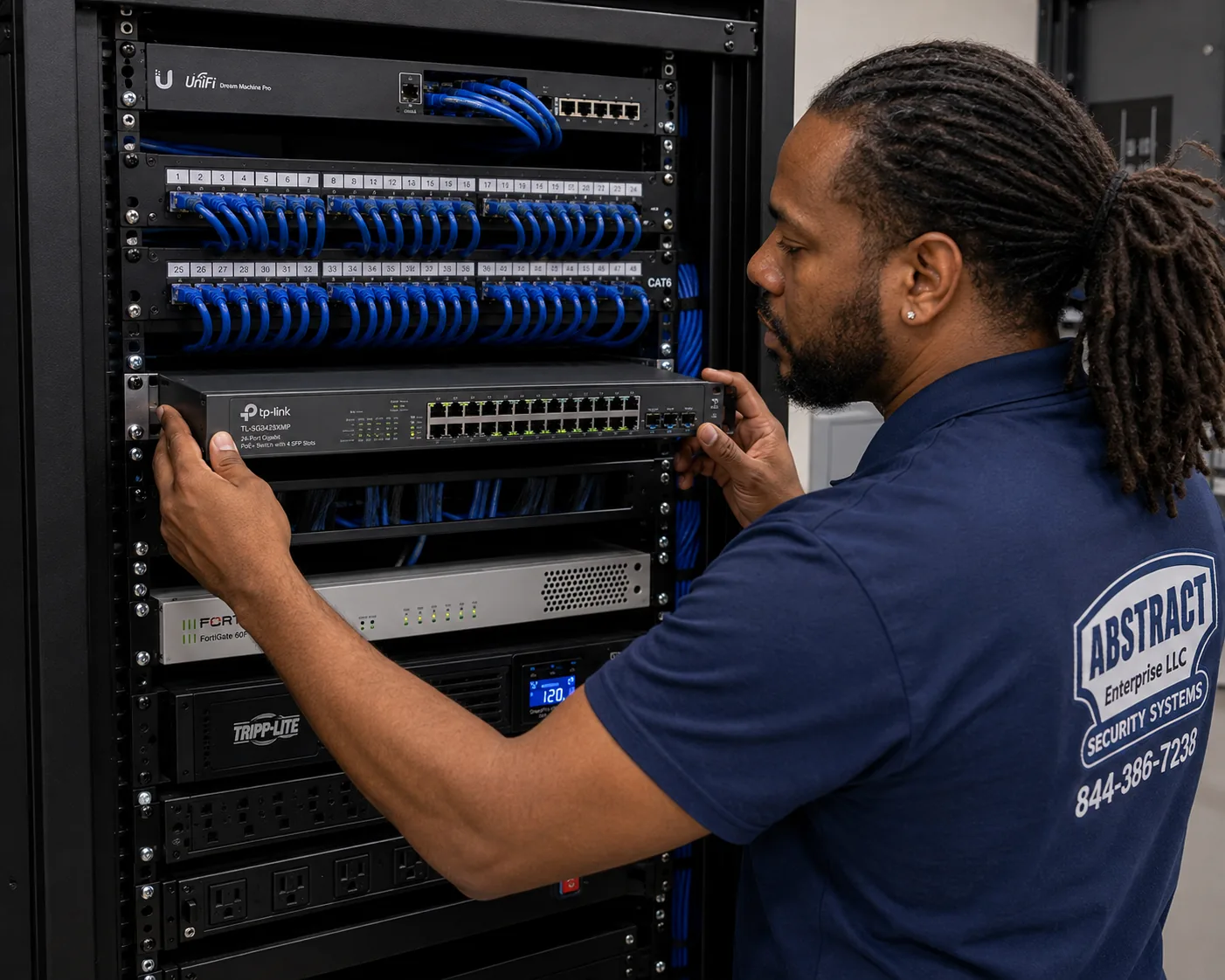
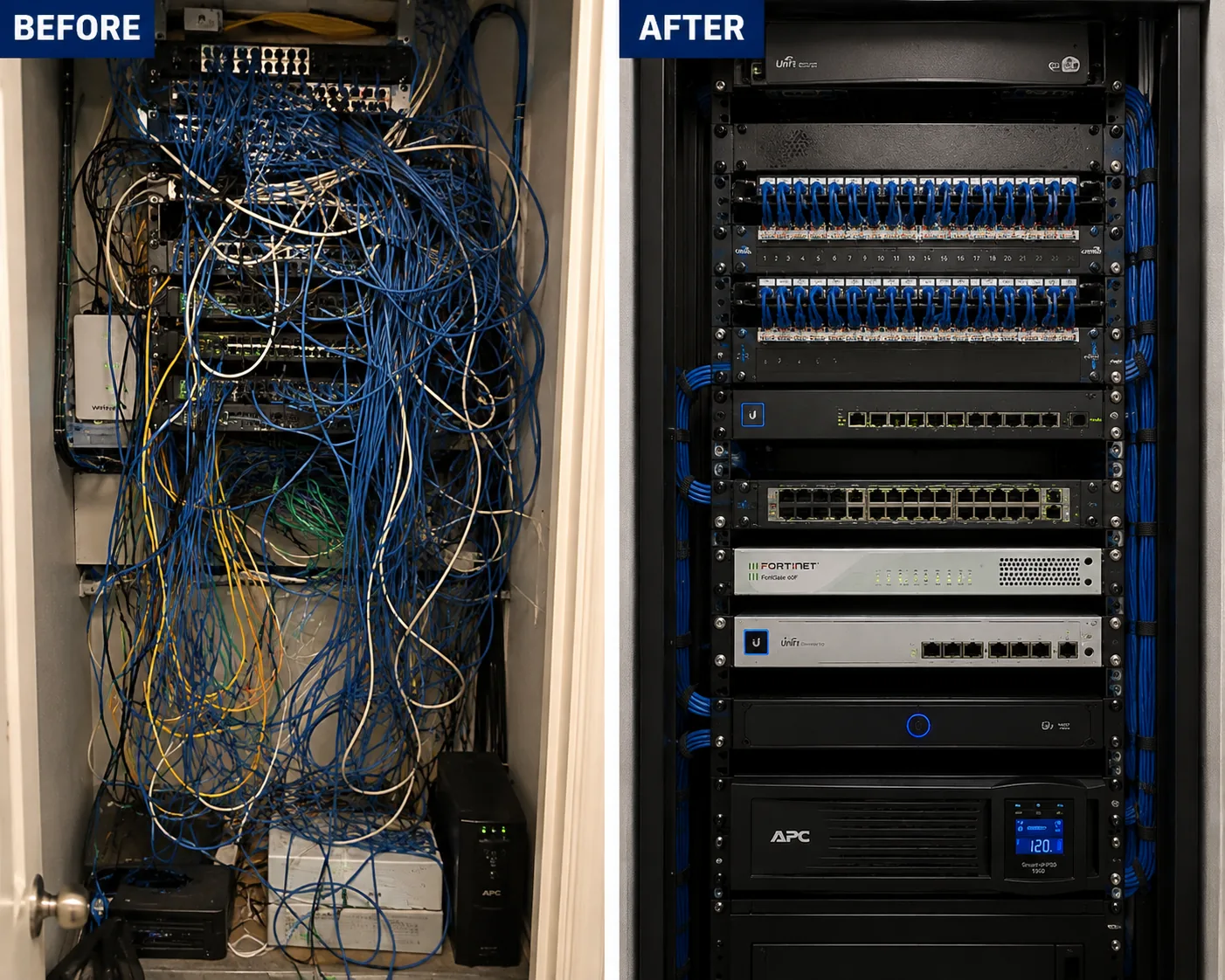
See every Reolink camera price in Brooklyn and build your own system →
Wired PoE Through Brick ยท Landmark-Aware Mounts ยท Recorder Kept Above the Flood Line ยท Brooklyn Base Rate
Reolink camera installation in Brooklyn starts with the building, not the box. The Census Bureau's 2023 American Community Survey counts 1,090,187 homes in Kings County, with a median year built of 1943, and 513,629 of those homes sit in buildings finished in 1939 or earlier. Two-unit buildings account for 175,805 homes and three- and four-unit buildings for another 170,655, and about seven in ten occupied homes in the borough are rented. In practice that means most Reolink jobs here happen on brick walls a foot or more thick that swallow Wi-Fi, on rowhouse lots that run about a hundred feet from the stoop to the back fence, in buildings where a landlord, a co-op board or the Landmarks Preservation Commission has a say in what goes on the facade, and in cellars where the recorder has to stay dry. This page walks through how we wire Reolink PoE cameras through Brooklyn masonry, when a Wi-Fi, battery, solar or 4G Reolink model makes more sense, where the recorder should live, what owners, renters and boards need to settle first, and how the job is priced at our Brooklyn base rate.
Reviewed and updated November 6, 2026, against U.S. Census Bureau American Community Survey 2023 five-year housing tables for Kings County; the NYC Landmarks Preservation Commission's permit pages and Permit Guidebook chapter 11 on security cameras; Brownstoner on brownstone construction, plaster walls, Brooklyn's historic districts, Eastern Parkway and the 2025 designations; the Historic Districts Council's Brooklyn borough page; Suzanne Spellen on the Cohn Brothers' apartment buildings; NYC Parks on Ocean Parkway; the Downtown Brooklyn Partnership and CBS New York on the 2004 rezoning; Greenpointers on the 2005 waterfront rezoning; the NYC Independent Budget Office on rent-stabilized housing; The Guardian on Atlantic Plaza Towers; HPD on the Tenant Data Privacy Act; the NYC Health Department's flooding data story; CBS New York, News 12, PIX11 and NBC New York reporting on package theft, camera vandalism and the Belt Parkway path; NYC 311 on the NYPD camera program; the City Council's June 30, 2026 release on storefront grilles; Reolink's installation and doorbell support pages; the SBS business improvement district directory; and Yelp's Brooklyn installer listings. Google's People Also Ask, related searches, AnswerThePublic, Bing, DuckDuckGo and Reddit returned nothing we could capture for Reolink in Brooklyn, and we could not capture Google's AI Overview in our build environment. ยท Anwar Timothy, NYS license #12000287431 ยท crews dispatched from our Troy Avenue office in Brooklyn

Owner-operated since 2002 ยท Thousands of jobs completed ยท Booked within 2 hours
Quick answer. A professionally installed Reolink system in Brooklyn is billed at our Brooklyn base rate, the 1.00ร rate that every other area we serve is measured against, and the itemized kit, camera and labor prices sit on our Reolink camera installation prices for Brooklyn page, where you can build your own system. A standard visit covers planning the views, running network cable through the building, mounting each camera on a sealed junction box, placing the recorder somewhere dry, certifying and labeling every cable, and setting up the Reolink app on your phone. We book within 2 hours of your request, and the total is agreed before anyone drills.
Brooklyn was a separate city until 1898, when its voters joined New York City, and by then it had already spent most of a century filling Kings County with houses. The Fulton ferry of 1814 made Brooklyn Heights a place to live for people who worked across the river, and the earliest row houses there, up to about the 1850s, were built of wood. The Brooklyn Bridge opened in 1883. After it came block after block of brick and brownstone row houses, and then the walk-ups, flats and six-story apartment buildings that followed the subway lines. The 2020 census counted 2,736,074 people in the borough. Most of them live in buildings that were designed long before anyone thought about running a network cable from the cellar to the cornice, and that is the single biggest fact about installing Reolink cameras here. A Reolink kit is designed to be easy. A Brooklyn building is often not.
The construction explains why. Brownstoner's architectural writing makes a point that surprises many owners: a "brownstone" front is usually a brick house with a facing of brown sandstone only four to six inches thick. Behind that veneer is brick, and inside, on most older houses, is lime plaster. Suzanne Spellen's Brownstoner series on plaster walls explains that on exterior walls the first coat of plaster was applied straight onto the brick, and that a century later the bond is still hard to break. Interior partitions were wood studs with lath and plaster. That combination of stone, brick and dense plaster is very good at keeping weather out and very good at keeping Wi-Fi in. A Reolink Wi-Fi camera that works perfectly in a suburban demo can lose its signal one wall away from the router in a Bedford-Stuyvesant or Park Slope row house. It is the reason we lean toward wired PoE Reolink cameras on most Brooklyn masonry, where one network cable carries both power and video, and save the wireless models for the spots where a cable truly cannot go.
The second fact is who owns the wall. The same census tables count 709,570 renter-occupied homes in Kings County against 300,026 owner-occupied ones. In a two-family house the owner may live downstairs and rent the upstairs; in a walk-up there may be a landlord who lives elsewhere; in a co-op the board controls the lobby and the roof. Brick Underground's guidance for tenants says plainly that you need your landlord's permission to put any equipment in the common areas of your building, and an installer guide aimed at Brooklyn renters notes that a wired camera means drilling and possibly electrical work, which needs written permission. A Reolink PoE system is a wired system by definition, so the permission question comes before the shopping list. We ask it on the first call, and we help you put it to the owner or the board in a way they can say yes to.

The third fact is what people are actually trying to see. Brooklyn's local news gives a clear picture. In Crown Heights, near Montgomery Street and New York Avenue, CBS New York reported a package thief who sat on a homeowner's yard wall and opened packages right in front of the house; the owner said "I checked the cameras, and I see this shocking scene unfold right in front of my house." In Bushwick a man took packages from a stoop on Eldert Street. In Park Slope, thieves were filmed cutting open packages inside a building lobby, and in Bay Ridge a lobby camera caught a thief stacking stolen Christmas gifts into a shopping cart. On Lexington Avenue a suspect was apparently buzzed into a building and walked off with hallway packages. News 12 reported in December 2025 that about 90,000 packages are stolen every day in New York City, citing the Department of Transportation, and Security.org's annual survey found apartment residents more than three times as likely as other households to have had a package stolen in the previous three months. The pattern is the stoop, the vestibule, the lobby and the hallway, which is exactly where Brooklyn buildings were not built to hold a camera.
Then there is the street itself. In October 2026 PIX11 reported that several surveillance cameras at the Church Avenue subway station in Flatbush had been sprayed with red paint. In Gravesend, CBS New York reported a burglar on video disabling a security camera before stealing from a laundry room. After a runner was killed near the Belt Parkway path in November 2026, NBC New York reported that officials asked for new lighting, security cameras and more patrols. Cameras that can be reached get painted, turned or pulled down, and cameras that cannot see at night miss what matters. So in Brooklyn we think about mounting height, tamper alerts and lighting as much as resolution. And because a good share of the borough is low-lying, we think about water too. The city Health Department's flooding data story notes that during Hurricane Ida rain fell at 3.5 inches an hour against a sewer capacity of 1.75 inches an hour, and that ten of the fourteen deaths in the city were in basement apartments. A recorder sitting on a cellar floor is a recorder waiting to drown.
Where this page applies. This is our borough-wide page for Reolink camera installation, from Greenpoint down to Coney Island and from Brooklyn Heights out to East New York and Canarsie. Every Brooklyn address is billed at the same Brooklyn base rate, and the itemized numbers are on the Brooklyn Reolink price page. For the citywide picture, including what changes in Manhattan, Queens, the Bronx and Staten Island, see our Reolink camera installation in NYC page.
The Reolink calls that cannot wait usually fall into three groups. The first is a camera that drops off the app, often a Wi-Fi model mounted at the back of a row house, two or three brick walls away from the router, that worked in the summer and stops working when the leaves change, the neighbor adds a network, or someone moves the router into a cabinet. The second is a PoE camera that went dark after rain. On a rear facade that usually points to water reaching the connection where the camera's short pigtail meets the network cable, or to a cable crushed where it passes through a window frame or under a coping stone. The third is deliberate: a camera knocked upward, sprayed or pulled half off its bracket by someone who knew it was there, like the station cameras PIX11 reported painted red at Church Avenue or the laundry-room camera the Gravesend burglar disabled.
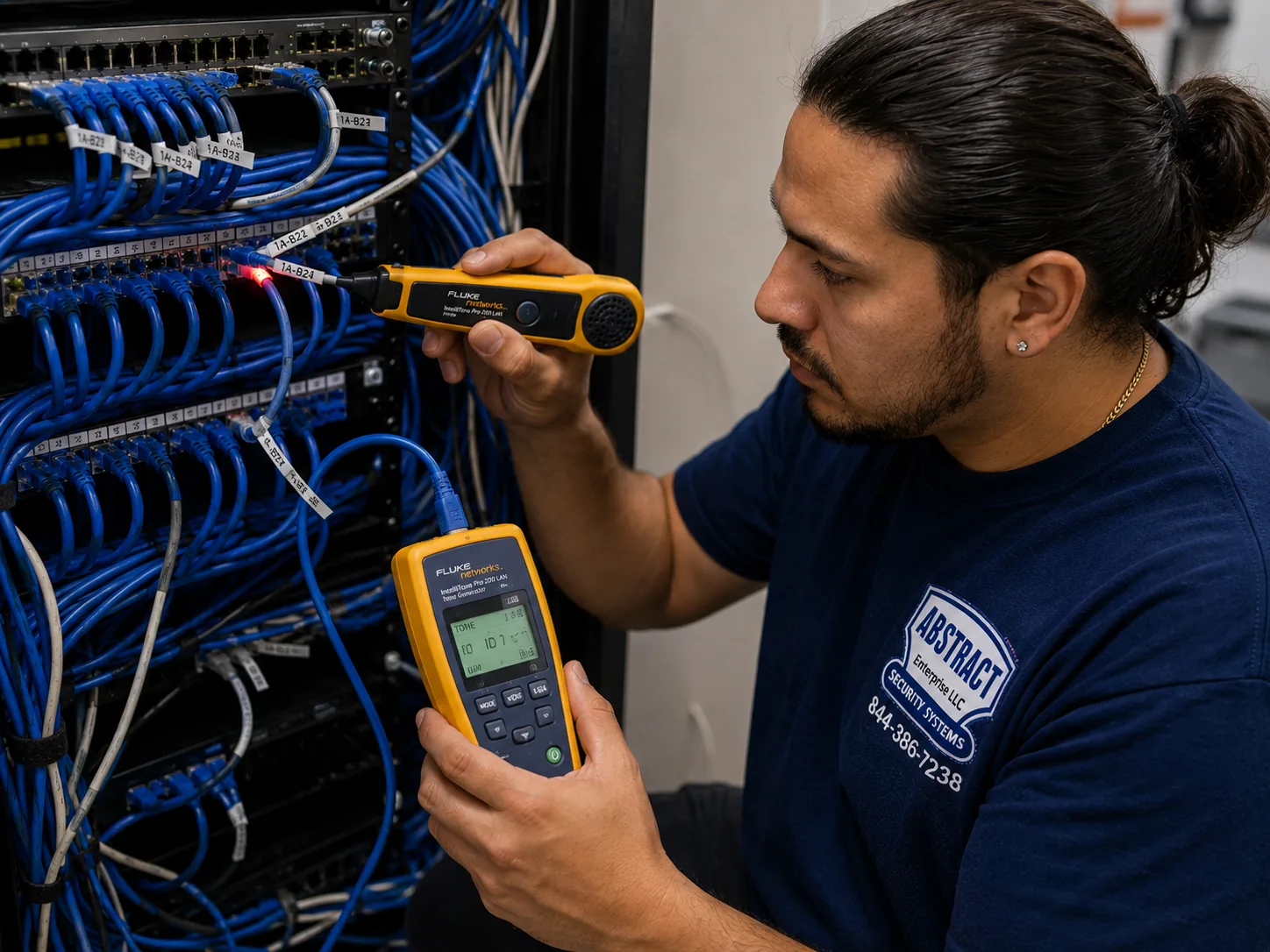
If a camera is offline, check the obvious first: is the recorder powered and showing the other cameras, has the router or internet service changed, and did anything get unplugged in the cellar. If one PoE camera is dark and the rest are fine, the problem is almost always in that one cable or its connection, not in the recorder. Call (347) 934-8335 and tell us which camera, where it is mounted and what changed. On the visit we trace the run with a tone generator, test it end to end, and either re-terminate the connection, replace the damaged length or move the camera onto a sealed junction box so it does not happen again. If the camera was attacked, we look at why it could be reached and raise it, turn it, cage it or add a second camera that watches the first.

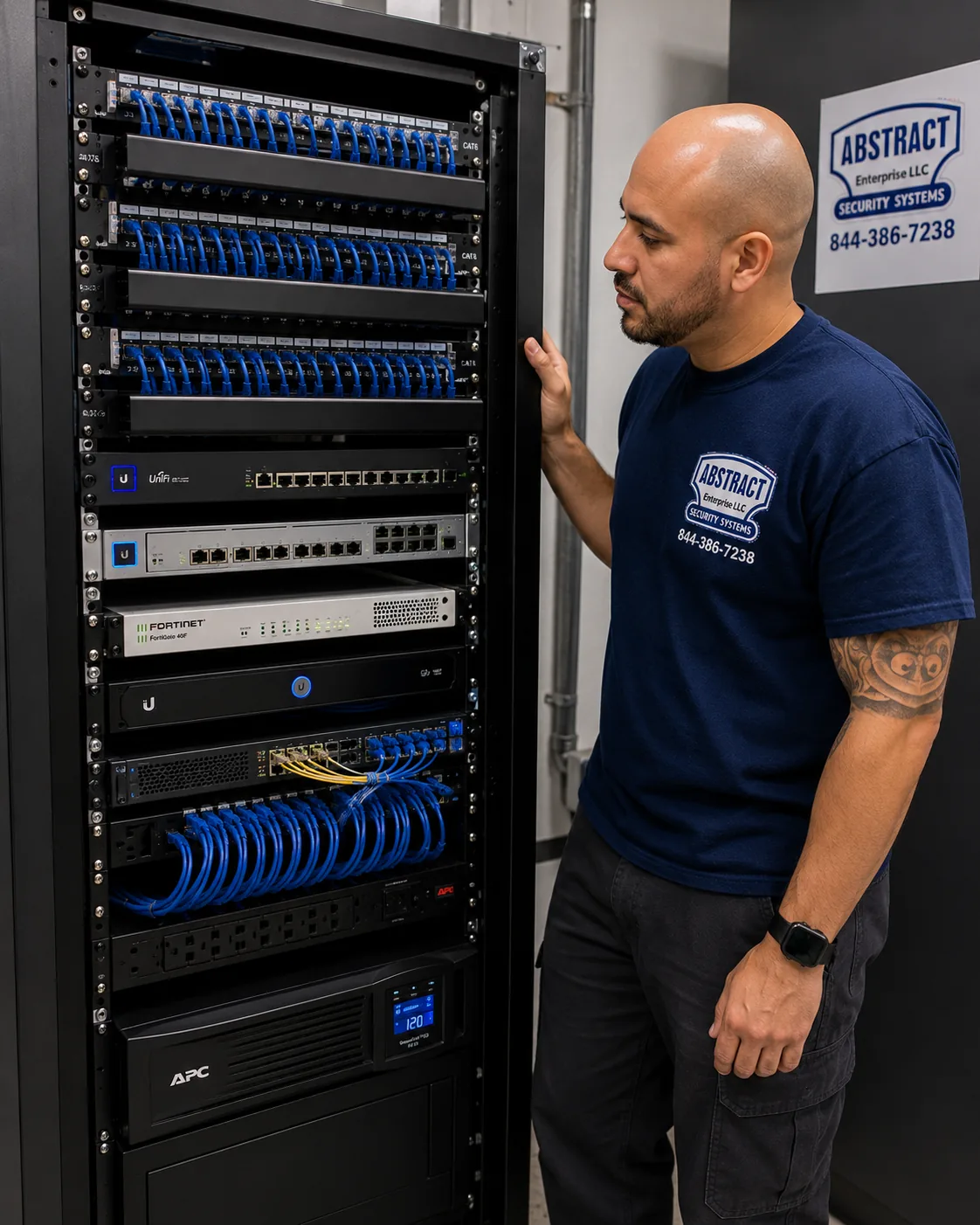
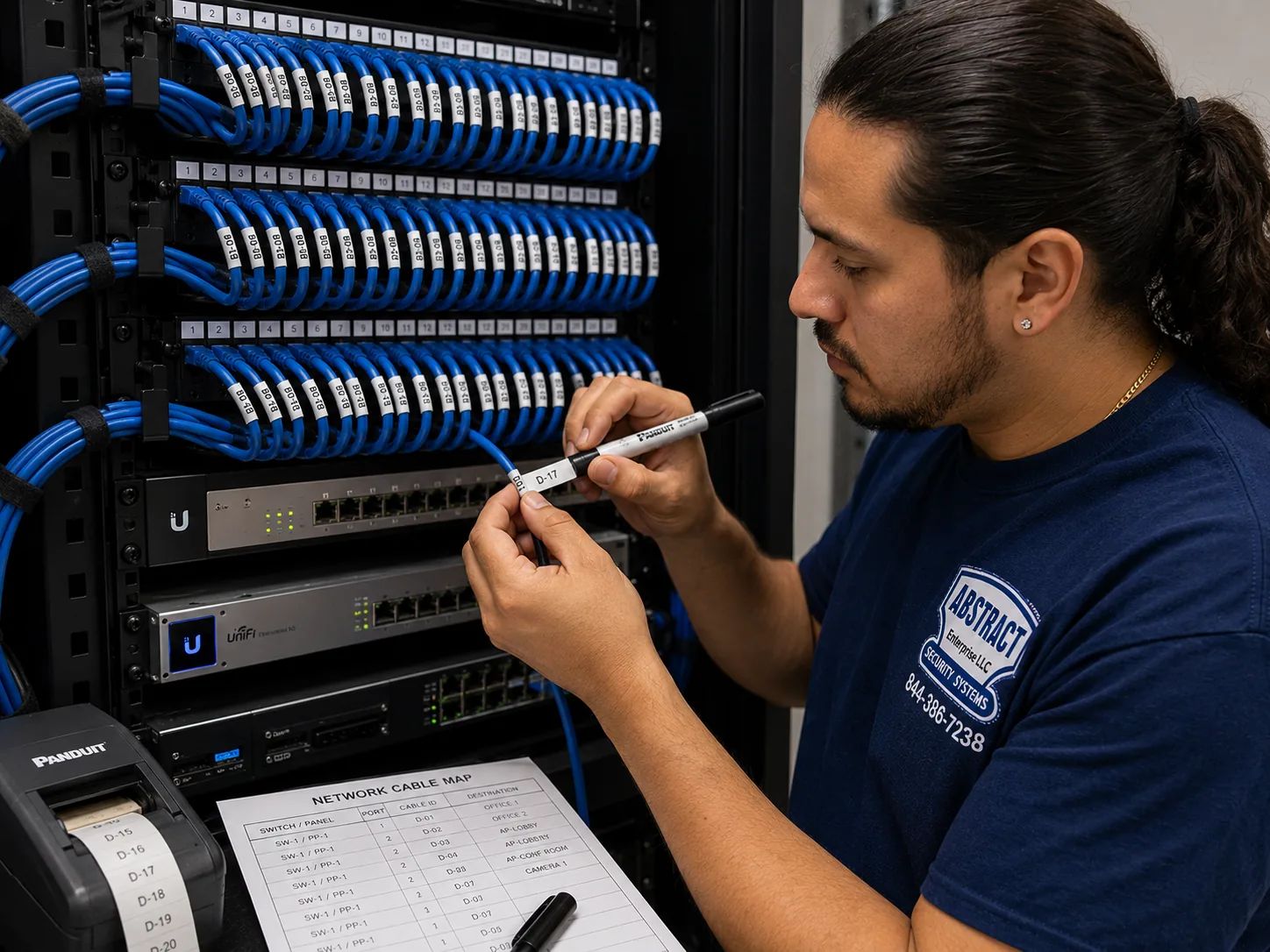
The other common repair is inherited. A Brooklyn house changes hands, or a building gets a new managing agent, and nobody knows the recorder's password, which cable goes where, or why two cameras show the same view. We reset and reclaim the recorder where the owner can prove ownership, label every run, remove dead cameras and cables that no longer go anywhere, and hand over a port map like the one in the photo at the top of this page. A system you can read is a system you can fix.
Each service below is priced from the same Brooklyn list. The building decides how the cable travels, the views decide which cameras, and the people in the building decide who gets access to what.
Four, eight or more PoE cameras on a Reolink recorder, with network cable fished up from the cellar or down from the roof of brownstones, two-families and walk-ups, and every run certified and labeled.
Cameras placed to catch faces at the stoop, the buzzer panel and the mailboxes, where most of the package thefts in Brooklyn's local news happened, set high enough that they are hard to reach.
Reolink floodlight and dual-lens cameras for the hundred-foot rowhouse lot, the shared alley between attached houses, and the back door that nobody watches.
Wi-Fi Reolink cameras with a mesh node where the signal needs help, and battery, solar or 4G LTE models for garages, gates and yards where no cable can go.
PoE or Wi-Fi Reolink doorbells on stoop doors, gates and apartment doors, wired to the existing doorbell transformer or fed by network cable, depending on the door.
Registers, stockrooms, sidewalks and gates for shops on Brooklyn's commercial corridors, and hallway, elevator-landing and laundry-room cameras for buildings, with separate access for staff, supers and owners.
Six kinds of building make up nearly every Brooklyn Reolink call. They differ in what the walls are made of, how a cable can get from the recorder to each camera, and who besides you decides what goes on the outside of the building.
A brick house, often with a thin stone face, on a lot about twenty feet wide and a hundred deep. Stoop in front, yard behind, cellar below, and frequently inside a historic district.
Stacked apartments with one front door, one yard and often an owner on one floor. The most common building in the borough by the census count of homes in two- to four-unit buildings.
Four- to six-story buildings with a vestibule, a stair hall and a roof bulkhead. Packages pile up in the hall, and the stair is the natural cable path.
Six-story buildings from the 1920s and 1930s along Eastern Parkway, Ocean Parkway and the avenues of Crown Heights and Flatbush, with wings, courtyards and a grand central lobby.
Concrete and steel buildings from the Downtown Brooklyn and GreenpointโWilliamsburg rezonings, with a management office, a security desk and strict rules on what can be drilled.
Two- and three-story mixed-use buildings on corridors like Nostrand, Flatbush and Rogers Avenues, where the shop's cameras and the tenants' entrance share one front.
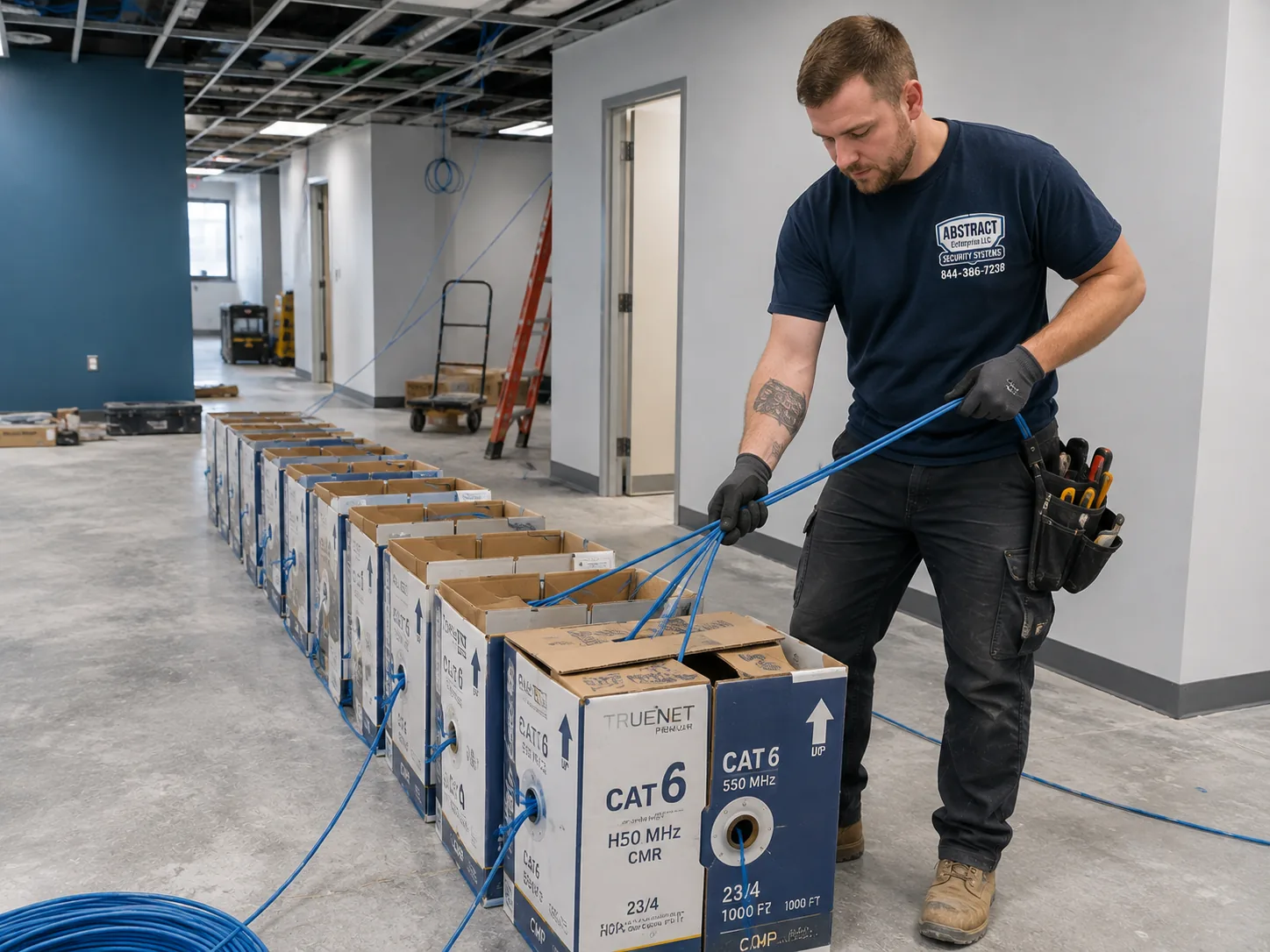
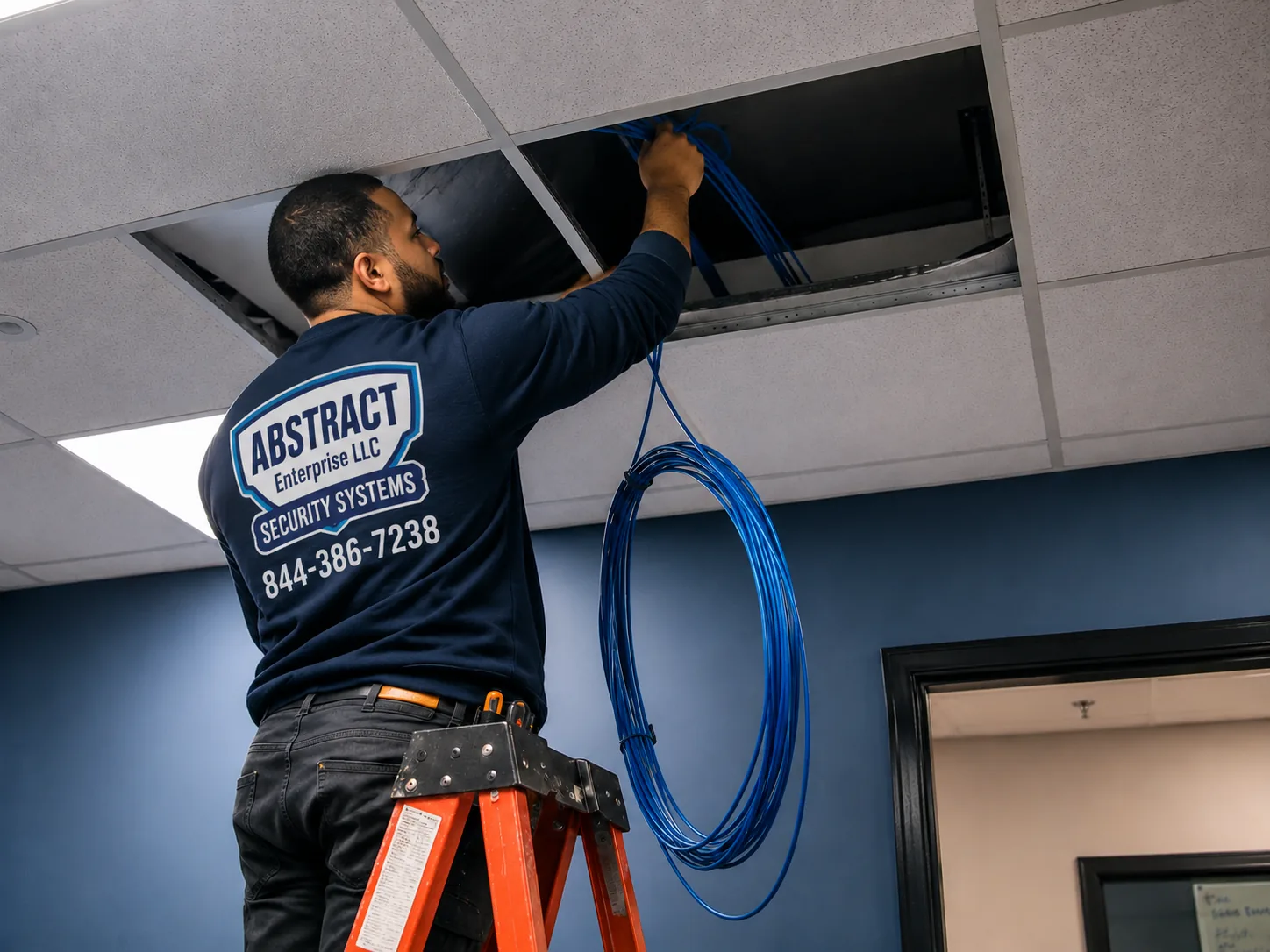
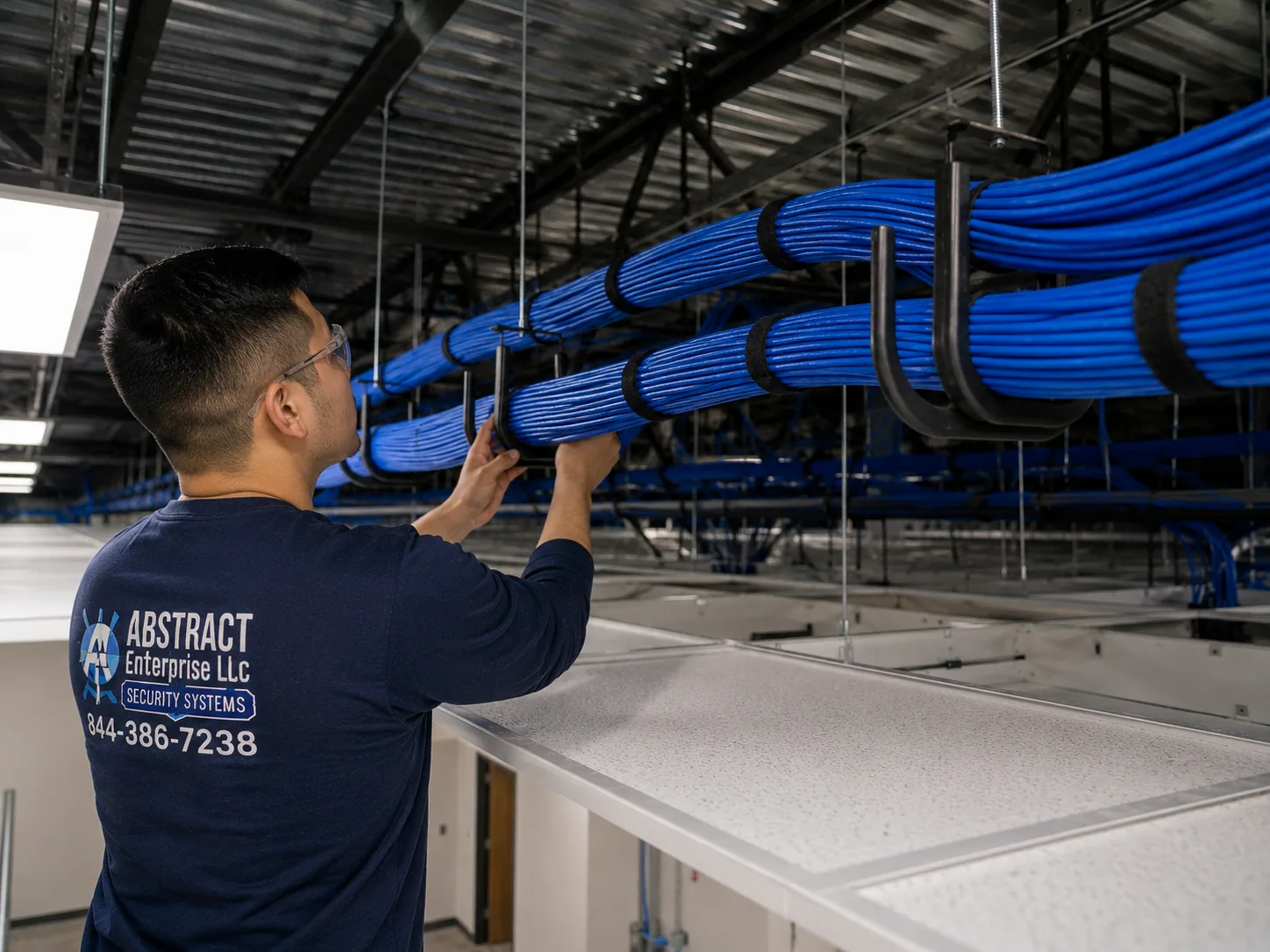
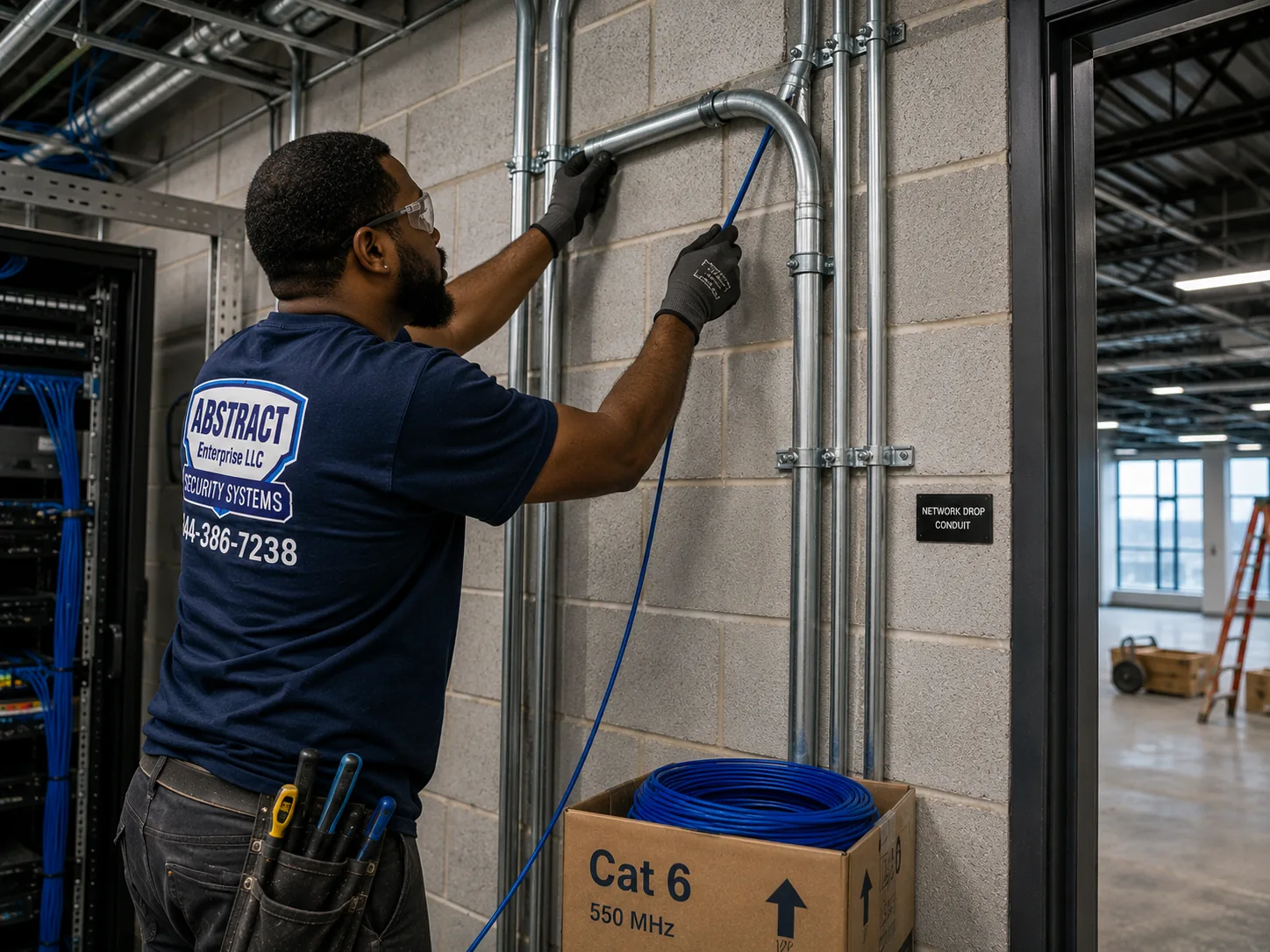
Urban Omnibus's count of the city's row houses put the average lot at about 1,900 square feet, very close to the classic 20-by-100-foot New York lot. On a Brooklyn row house that means the recorder in the cellar may be eighty or ninety feet from a camera at the back fence and three floors below a camera under the cornice. A Reolink camera's stock network cable is far too short for that, so every run is pulled fresh. The usual paths are the ones the house already gives us: up through the cellar ceiling into a closet or a chase beside the chimney breast, along the line where an old gas pipe or radiator riser climbs, or down from the roof through the bulkhead or a rear wall. Coming from the roof often means less drilling inside finished rooms, and on many houses the rear facade is plain brick where a cable can be clipped neatly into a mortar line and painted.
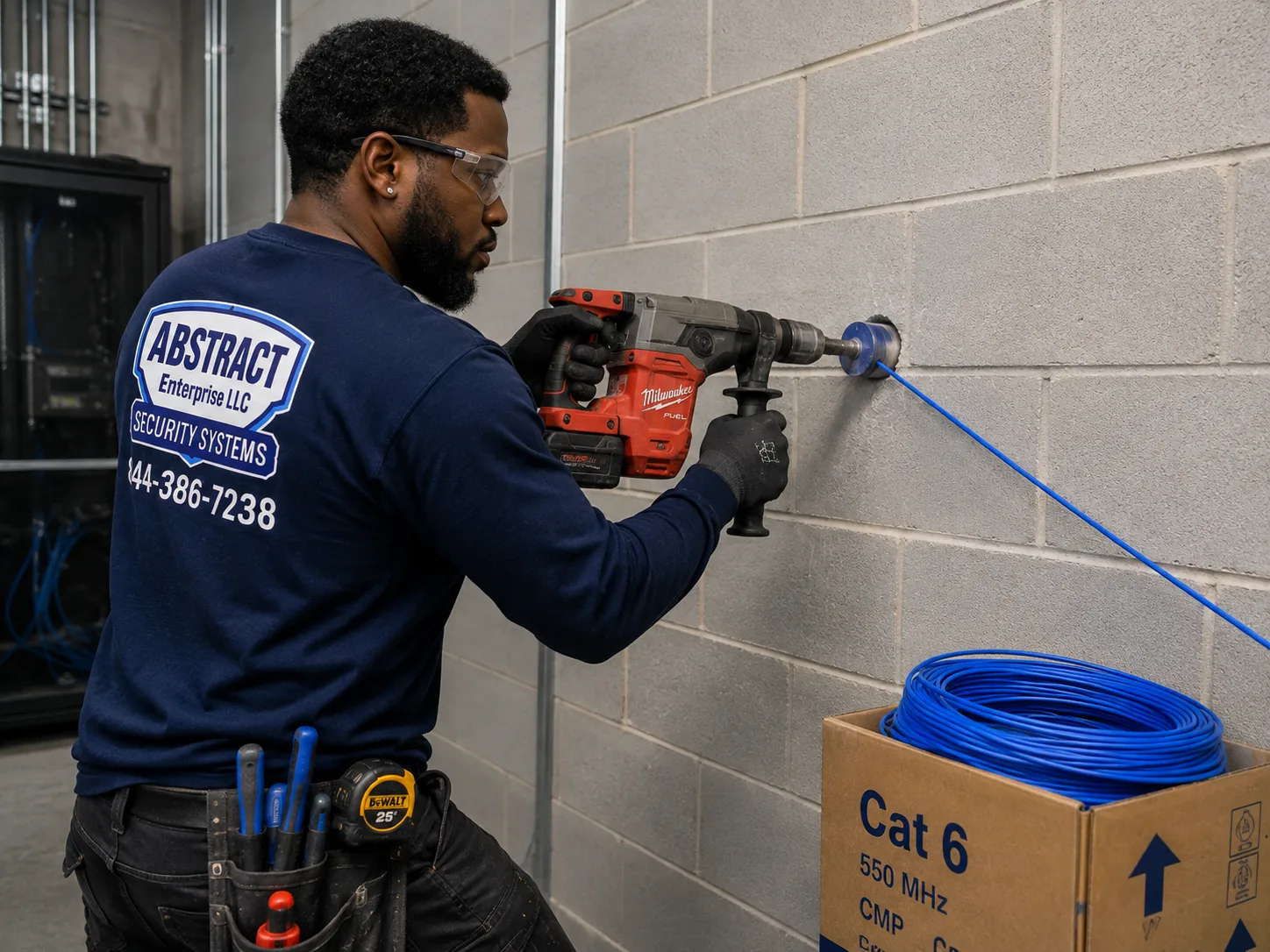
The facade decides how a camera is anchored. Because the brown sandstone face is only a few inches thick and can spall when it was set with the grain the wrong way, we do not hang a bracket from decorative stone, a carved lintel or a cornice. On the front, we anchor into brick or into mortar joints, under the stoop or beneath a band course where the Landmarks Preservation Commission's guidance points, and on the rear, into plain brick. Every camera sits on a weatherproof junction box. Reolink's own installation notes warn that mounting straight to a wall without a box means a hole about three-quarters of an inch wide for the camera's pigtail, and on old brick a hole that size is both an ugly scar and a path for water. The box keeps the connection dry and the wall intact.

The two- and three-family house is the backbone of large parts of Brooklyn, from Bushwick and Ridgewood's edges to Sunset Park, Flatbush and Bensonhurst. Sunset Park alone, as its historic district research notes, holds one of the city's largest concentrations of two-family masonry row houses, mostly built from 1885 to 1912. In these buildings the cameras usually watch shared ground: the front door everyone uses, the yard that the ground-floor tenant may have the right to, the alley the garbage goes down. So the technical plan and the household plan get settled together. Where does the recorder live, the owner's cellar or the owner's closet? Who sees which cameras? A Reolink recorder lets us create separate user accounts, so an upstairs tenant can be given the front door camera and nothing else, while the owner sees everything.
The wiring in these houses is often easier than in a single-family brownstone because there are more vertical chases: two kitchens stacked over each other, two bathrooms, sometimes two sets of risers. A cable for a front camera on the top floor can often climb beside a riser from the cellar. Where the stone or brick front is in a historic district, the same Commission criteria apply as on a single-family house. Where the house has an attached garage or a shared driveway in the outer parts of the borough, we run the cable through the garage ceiling rather than across the yard. And because the household changes over the years, we label every cable and leave the port map with the owner, not the tenant.
Walk-ups put most of their risk in two places: the vestibule and the stair hall. That is where buzzed-in strangers walk, where couriers leave packages, and where the Park Slope and Lexington Avenue thefts in Brooklyn's news happened. A Reolink camera in the vestibule needs to see a face at the inner door, not the top of a head, and it needs to be high enough that it is hard to reach. Each floor's landing can take a small turret or dome. The cable path is usually the stair itself: a run of surface raceway up the stair wall, painted to match, or cable fished up beside the stair stringer, with the recorder and PoE switch either in the cellar or in a locked closet the owner controls. In many walk-ups the roof bulkhead at the top of the stair is the easiest place to bring a cable out to a camera on the rear or the roof.
The walls are the problem. Partitions may be plaster on lath, but the walls between buildings and around the stair are often masonry, and in buildings of this age interior walls can be hollow clay tile that cracks if drilled carelessly. We use slow drilling, small holes and the right anchors, and we keep cameras on plain surfaces rather than on decorative plaster, old tin or marble wainscot. Landlords of walk-ups often worry about tenants objecting. Under New York Penal Law ยง 250.45, a camera may not record in a place where people have a reasonable expectation of privacy without consent, so we never aim into apartments, bathrooms or laundry areas where people change, and we set privacy masks so a camera that faces an apartment door cannot look inside when the door opens.
Suzanne Spellen's history of the Cohn Brothers, among the most prolific architects of Brooklyn apartment houses, explains why so many six-story buildings line Eastern Parkway, Ocean Parkway and the avenues of Crown Heights and Flatbush. After about 1923, the building code required only the first two floors of a six-story building to be fireproof, so six stories became the standard. The big corner buildings were laid out in four or five wings joined by corridors around one or more courtyards, sometimes with separate entrances but one central grand lobby, finished in terrazzo, marble, tile or Gothic detail. On Eastern Parkway, Turner Towers at No. 135 rose to fifteen stories in 1927 with 181 apartments. For a camera system that means long distances, many entrances and finishes nobody wants drilled.
The answer in these buildings is usually more than one PoE switch. A single recorder in the basement can feed cameras across several wings, but a network cable has a length limit of about 100 meters, so we place small switches in closets or the elevator machine area of each wing and link them back to the recorder. In the lobby we look for a plain plaster ceiling, a dropped soffit or a corner already occupied by an older camera, rather than drilling marble. Courtyards are often the blind spot: windows face them, packages get thrown into them, and people cut through them. A wide or dual-lens Reolink camera high on a courtyard wall can cover what four older cameras used to. These buildings are often co-ops or rent-stabilized rentals, so the board's approval, the managing agent's insurance requirements and, for stabilized buildings, written notice to tenants come first.
The towers are a different world. The Downtown Brooklyn Partnership says about 32 million square feet of new development followed the 2004 rezoning, and its president told CBS New York in 2024 that the area now has nearly 10,000 housing units, including the Brooklyn Tower on DeKalb Avenue, the borough's first supertall. Along the Greenpoint and Williamsburg waterfront, Greenpointers reported that roughly 180 rezoned blocks added 26,253 housing units in the thirteen years to May 2024. These buildings usually have a building-wide camera system already, a security desk, and a management office that controls the risers, the roof and every penetration. A Reolink job here is most often inside a unit, in a terrace or private roof area, or in a commercial space at the base of the building.
Inside a condo the walls are typically drywall on metal studs, and the slab is concrete, so cable runs inside the unit go through the partition walls and behind the millwork rather than through the floor. The recorder can sit in a media closet with the router. If the owner wants a camera on a terrace, the office will usually want to approve the location, the mounting method and the cable entry, because the terrace wall may be part of the building's waterproofing. We send the certificate of insurance, a short description of the work and photos of the proposed spots before the visit, and we work within the building's contractor hours.
From about 1912, Spellen writes, builders put up two- and three-story buildings of tapestry brick with a store on the ground floor and one or two apartments above, and they are especially common along Nostrand, Flatbush and Rogers Avenues south of Eastern Parkway. The shop wants cameras on the register, the stockroom, the door and the sidewalk; the tenants upstairs want to know who comes through their separate door. One Reolink recorder can serve both if the owner wants it to, with separate accounts so the shop staff never see the residential door and the tenants never see the register. Or the shop and the building can have separate systems, which is often cleaner when the store's lease and the building's ownership are separate.
Facades on these buildings carry a sign band, a roll-down gate box and often an awning, and the camera has to work around all three. The best spot for a sidewalk camera is usually just under the sign band at one end, angled along the sidewalk rather than straight out, so it sees faces approaching the door without staring across the street. As of July 1, 2026, the City Council says security grilles on business and mercantile buildings must allow at least 70 percent visibility from the sidewalk, so stores replacing solid gates can now place an interior camera that sees through the gate at night. Cable from the store usually runs up into the ceiling and back to an office or the basement, and the recorder goes somewhere locked, not on the counter.

Brooklyn Heights became the city's first historic district on November 23, 1965, and it has plenty of company now. Brownstoner counted 33 Brooklyn historic districts as of April 2016, and in 2025 the Landmarks Preservation Commission added Beverley Square West and Ditmas Park West. The Commission's 2016 figures put Park Slope's districts at 2,853 protected buildings, the most of any district, and an installer's tally puts Bedford-Stuyvesant and Crown Heights next. In 2024 the Commission designated the Willoughby-Hart Historic District in Bed-Stuy, where all the homes were built within about twenty years beginning in 1871. If your house is on one of these blocks, the front facade is not entirely yours to change. The Commission's own permit page says most exterior changes to the front and rear facades of buildings in historic districts require its review.
For cameras, the Commission's Permit Guidebook, chapter 11, lays out the criteria its staff use to approve cameras by permit. We read them as follows, and we suggest every owner read the guidebook directly before filing. Cameras should be well spaced to avoid a cluttered, haphazard appearance. On small residential or commercial buildings, the guidebook allows no more than two cameras per 25 feet of street frontage, and on large buildings no more than three. Cameras should not go on or in front of a primary facade unless there is no feasible alternative; when they must, they should sit in a discreet location, such as beneath a band course, underneath the stoop, behind an areaway wall or fence, or behind plantings. They should attach at mortar joints, plain masonry, wood or metalwork, not through cast iron or decorative surfaces. Conduit should be concealed through plain masonry behind the installation, or kept to about ten inches of visible conduit, painted to match and secured into mortar joints. And the equipment should be as small as possible and painted to blend.
Those rules shape which Reolink cameras we propose on a landmarked front. A small turret or mini dome tucked under the stoop, finished dark to disappear into the shadow, usually works better than a large bullet on the parlor wall. A camera under the stoop can see the areaway gate, the garden-level door and the bottom of the stoop steps, which is where packages are left, and a Reolink doorbell at the door sees the face of whoever rings. On the rear facade, which is usually less visible from the street, there is more room for a floodlight camera or a dual-lens model covering the whole yard, though the Commission's review can still apply where the rear is visible from a public street. Architects who work with the Commission note that it is most concerned with what is visible from the street. We plan the front first with the guidebook open, propose the minimum, and leave the filing to the owner or their expediter, with photos and a drawing of each camera position if they need them.
Two more Brooklyn notes. First, the city will not let you put your camera on its property. When residents on a Boerum Hill block asked to mount cameras on a city light pole, CBS New York reported, the Department of Transportation said it does not allow private entities to attach this type of equipment to city property and suggested homeowners mount cameras on their own buildings. Second, the same block's residents pointed out that most houses on the street sit behind trees that create blind spots. Brooklyn's street trees are part of what makes historic blocks worth protecting, and a camera plan has to work with them, usually by placing cameras lower, under the stoop and at the door, rather than higher on the facade where the canopy blocks the view.
These notes describe how our technicians work in Brooklyn buildings. They are our practice, not a story about any one address.
Start in the cellar. The cellar tells us more about a Brooklyn house than the parlor does. We look at where the joists run, where the old risers come up, where the boiler and water heater sit, whether there is a high-water mark on the foundation wall, and whether the router or the cable company's line enters here. If the cellar has taken water before, the recorder does not go on the floor, full stop.
Stand where the camera will be. With a test phone and a camera on a pole or held at the bracket position, we check the actual view: does the stoop camera see faces or hats, does the yard camera see the back gate or just the fence, does the street tree block the sidewalk in summer. Changing a planned position takes seconds; moving a mounted camera means a second hole in old brick.

Find the cable's way. Before drilling anything, we decide the whole route for each camera: cellar to closet, closet to roof, roof to rear wall. We prefer paths the house already has, such as a chase beside a chimney breast or an abandoned dumbwaiter, and we avoid finished plaster ceilings and decorative woodwork.
Drill the brick, not the stone. On the front we anchor into brick or mortar joints, never into carved or veneer stone, and we size each hole for the cable, not the pigtail, because the junction box houses the connection.
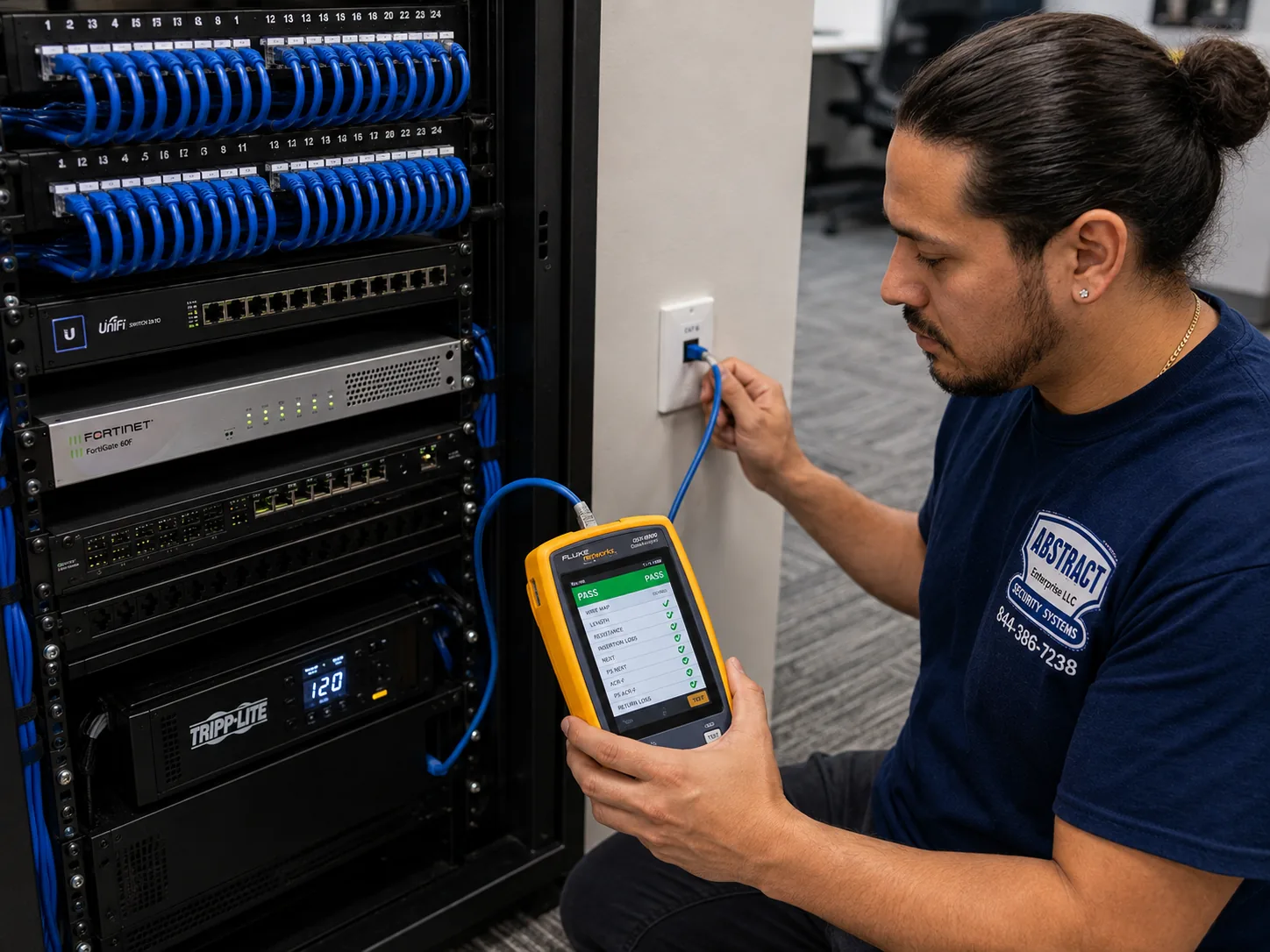
Test before mounting, certify after. Each cable is checked before the camera goes up and certified when it is finished. A run that fails is fixed then, not discovered in the next storm.
Reolink makes cameras that connect in five different ways, and on most Brooklyn jobs we use two or three of them on the same property. The choice for each camera comes down to three questions: can a cable reach it, can Wi-Fi reach it, and does it need to record all the time or only when something moves. Here is how those answers usually play out in Brooklyn buildings.
Power over Ethernet means one network cable from the recorder or a PoE switch carries both power and video to the camera. There is no outlet needed at the camera, no battery to charge and no Wi-Fi to drop. A Reolink PoE camera on a Reolink recorder records continuously to the recorder's hard drive, and the app reaches it through the recorder. On a row house with a foot of brick between the router and the yard, PoE is the only connection that does not care how thick the walls are. The trade-off is labor: every camera needs a cable pulled to it, and in an old Brooklyn house that is the real work of the job. One buyer on a deal forum summed up the frustration: good cameras, "but man these are hell to install." That is why the labor is the bigger part of a Brooklyn Reolink price, and why it is worth having it done once and done right.
PoE has limits we design around. The Ethernet standard allows a single cable run of about 100 meters, which is plenty for a row house but not always for a large courtyard building or a long commercial lot, where we add a switch midway. The cable has to be suitable for where it goes: outdoor-rated where it is exposed, and run inside conduit where it passes through a damp cellar or along an exterior wall. And the connection at the camera has to stay dry, which is why we use sealed junction boxes rather than leaving the connector tucked into a hole in the brick.
Reolink's Wi-Fi cameras plug into a nearby outlet for power and send video over the home network. They suit a camera inside the house, a camera at a window, or an exterior camera on the same side of the house as the router. They do not suit a camera on the rear wall of a brownstone when the router is in the front parlor. Where a Wi-Fi model is the right camera for the job but the signal is weak, the fix is to bring the network closer: a mesh node, such as an Eero, Google Nest Wi-Fi or TP-Link Deco unit, placed in the back of the house where it can see the yard. Even better, a mesh node fed by a network cable from the router, which gives the back of the house real coverage instead of a relay of a relay. We measure the signal at the camera position before we mount, and if it is not strong and stable, we say so and propose a cable instead.

Battery Reolink cameras, such as the Argus family, need no cable at all and can be charged by a small solar panel. On our other Brooklyn pages we have pointed to the Argus PT Ultra, a solar pan-tilt model, as a sensible choice for brownstones where a cable to the rear is impossible, for example a rented garden apartment where the owner will not allow drilling. The catch is that a battery camera wakes up and records when it detects motion, rather than recording all day, and it still needs Wi-Fi to send clips. In a Brooklyn rear yard boxed in by five-story buildings, a solar panel may also see only a few hours of direct sun in winter. We place the panel where the sun actually reaches, not where it looks tidy, and we tell you honestly where a battery camera will and will not be enough.
Reolink's Go models, such as the Go PT Ultra and the Go Plus, use a cellular data SIM instead of Wi-Fi. They suit places with no internet and no power: a detached garage at the back of a lot in Marine Park or Midwood, a construction site on a block between owners, a parking area behind a store, or a gate on a vacant lot. They also need a data plan from a carrier, which is a running cost the customer chooses and pays to the carrier, not to us. We set them up where the cellular signal is strong, which in a deep yard between tall buildings is worth checking with a phone before buying the camera.
The recorder holds every hour of video, so its location matters more than any single camera. In a Brooklyn house the obvious spot is the cellar, close to the router and the cable entry. It is also the spot most at risk from water, heat from the boiler and water heater, and anyone who goes looking for it after a break-in. The city Health Department's account of Ida, with rain arriving twice as fast as the sewers could take it, is reason enough to get the recorder off the floor. Our default is a shelf or wall bracket well above the floor, away from the boiler, in a locked closet or cabinet where possible, with a small battery backup for the recorder and the router so a short outage does not stop recording. In southern Brooklyn, which the city's flood vulnerability work singles out as especially exposed, we often put the recorder on the parlor floor or higher and bring the cellar cables up to it.
Reolink makes its video doorbell in a PoE version and a Wi-Fi version, and Reolink's support pages suggest mounting it about 48 inches off the ground. On a Brooklyn stoop the door is often recessed in a deep stone or wood frame, so the doorbell may need an angled wedge to see the visitor rather than the side of the vestibule. A commenter on a deal forum made a fair point about replacing an existing doorbell button: running network cable to an old stoop door is often harder than it sounds. Where the existing doorbell wires and transformer are usable, the Wi-Fi model wired to them is the simpler choice; where there is a clear path for network cable, the PoE model gives the most dependable recording. We look at the door frame, the existing wires and the signal before recommending either.
We are installers, not lawyers, and nothing here is legal advice. With about seven in ten Brooklyn households renting, though, permission comes up on most of our calls, so here is what the public guidance says and how we handle it in practice.
Tenants inside their own apartment. Reolink's own guidance for apartment renters notes that most landlords do not allow drilling for camera placement or wiring, and points renters toward battery or Wi-Fi door cameras. That matches what we see. A Wi-Fi Reolink camera on a shelf facing your own door, or a battery camera on a removable bracket, can watch your space without a single hole. Anything wired, and anything outside your unit, is a different matter. Installer guidance aimed at Brooklyn renters is direct: a wired camera means drilling and possibly electrical work, and that needs the landlord's written permission.
Tenants and common areas. Brick Underground's advice to tenants is that you need your landlord's permission to install equipment in the common areas of your building. A legal Q&A answered for a Brooklyn tenant added that if a tenant puts a camera in a common area without consent, the landlord can remove it. If you want a camera on the stoop, the stair hall or the yard of a building you rent, the practical path is to ask the owner to install one for the building, or to ask in writing for permission for yours, describing exactly where it goes and what it sees.
Owners of small buildings. In a two- or three-family house or a walk-up, the owner can usually install common-area cameras, but how it is done affects how tenants feel about it. Cameras that watch the entrances, the mailboxes and the yard gate, not apartment doors at close range and never inside apartments, are easy to explain. Penal Law ยง 250.45 makes it a crime to record people in places where they reasonably expect privacy without their consent, so laundry rooms where people change, bathrooms and the inside of any unit are off limits. We set privacy masks on any camera whose view includes an apartment door or a neighbor's window.
Rent-stabilized buildings. Brooklyn has about 279,000 rent-stabilized apartments, by the Independent Budget Office's 2026 count. Advice to owners of these buildings is to document the security reason in writing before installing cameras, using incident reports, police reports or an insurer's recommendation, and to notify tenants in advance. Brooklyn has a well-known example of what happens when that goes wrong. In 2019, The Guardian reported, more than 130 tenants at Atlantic Plaza Towers in Brownsville filed a formal complaint with the state over their landlord's plan to replace keys with facial recognition at the front door; because the buildings were rent-stabilized, the change needed state approval, and the landlord withdrew the application in November 2019. A Reolink system for recording entrances is not facial recognition, but the lesson is the same: tenants accept cameras that protect the building and resist cameras that feel like monitoring people.
Smart access and tenant data. If cameras are part of a wider upgrade that adds key fobs, app entry or anything biometric to a multiple dwelling, HPD's page on the Tenant Data Privacy Act, Local Law 63 of 2021, sets out duties for owners who use smart access systems, including giving tenants a data retention and privacy policy. A plain Reolink recording system does not unlock doors, but if your project combines the two, read that law first.
Co-ops and condos. Common-area cameras in a co-op or condo typically need the board's approval and a licensed, insured contractor with a certificate of insurance naming the building and the managing agent. A Justia Q&A from April 2026 about outdoor cameras in a New York co-op said surveillance is legal as long as the camera is not aimed to look into an apartment when its door is open. We send the insurance certificate, a camera schedule and photos of each proposed position to the managing agent before the visit, which usually turns a board question into a quick approval.
The city's Small Business Services directory lists 24 business improvement districts in Brooklyn. These are some of the corridors where Reolink systems for shops, offices and workshops come up most, and what each kind of street asks of a camera. We describe kinds of business, not named customers.
A pedestrian street and transit mall on Fulton Street between Flatbush Avenue and Adams Street. Heavy foot traffic, deep stores and stockrooms, and storefronts where the camera at the door sees hundreds of faces an hour.
Park Slope's main shopping street and the Bay Ridge 5th Avenue BID from 65th to 85th Streets: restaurants, cafes and boutiques in mixed-use buildings with apartments above.
Shops, restaurants and showrooms from Downtown through Boerum Hill and beyond, often in older buildings where the sign band, awning and gate box crowd the facade.
Two long, busy retail strips with their own BIDs, full of family-run stores where the owner wants to check the register and the door from a phone after closing.
Tapestry-brick stores with apartments above along Nostrand and Flatbush, and Brooklyn Chinatown's markets and restaurants along Eighth Avenue in Sunset Park, co-named in October 2026.
The Brooklyn Navy Yard's industrial park of more than 300 acres and some 550 businesses, and Industry City's six million square feet in the former Bush Terminal, where workshops and studios need cameras inside large, high spaces.
Business jobs in Brooklyn rarely happen in a building the business owns. A shop on Fifth Avenue may have a landlord above it who wants to approve anything fixed to the front, and a studio at the Navy Yard sits inside a property managed for the city, with gate check-in and its own rules for contractors. So before a business job we confirm three things: who has approved the work on the walls and ceiling, when the space can be worked in without customers in the way, and who receives the certificate of insurance. Most store installs are planned for before opening or after closing, with the cables pulled in one session and the cameras mounted and aimed with the owner standing at the register.
Store cameras do different jobs. A camera over the register should see hands and the cash drawer, not the customer's back. A camera at the door should be set at face height as people come in, which in a narrow Brooklyn storefront often means a small turret at the back of the shop looking toward the door, so it catches faces against the daylight without being washed out. A camera on the stockroom door watches who goes in and out. A camera outside, under the sign band, watches the sidewalk, the gate and the delivery drop. A Reolink recorder can push motion alerts from the stockroom or the front door after hours to the owner's phone, and the app lets the owner check the store from anywhere without anyone else needing the password.

Two city programs are worth knowing about. The NYPD's camera program, described by 311, lets any business with a security camera register its camera locations at NewYorkCityConnect.org and share live video with the NYPD during emergencies; Reolink systems can take part. And in June 2026 the City Council announced Int. 553-A, which would require the Department of Small Business Services to set up a program offering financial help to small retail businesses buying and installing security technology, while Int. 623-2026 would pilot cameras and plexiglass for small businesses in ZIP codes with high retail-theft rates. Neither is a grant you can apply for today from this page, but if your store is on a Brooklyn corridor, keep an eye on your BID's announcements. Houses of worship and nonprofits have a separate path: New York State's security grant program for communities at risk of hate crimes ran a 2026 round that closed on July 8, 2026.

These are the situations Brooklyn owners, tenants, boards and shopkeepers describe when they call. Each is answered here in full and not repeated in the FAQ further down.
It depends on the model. Reolink PoE cameras need only a network cable, because Power over Ethernet sends both power and video down the same cable from the recorder or a PoE switch, so no outlet is needed at the camera. Reolink Wi-Fi cameras need a power source, usually a plug-in adapter at a nearby outlet, and send video over Wi-Fi; floodlight models are typically hardwired to a junction box on line voltage. Battery and solar models need neither. On a Brooklyn row house, where an outlet on the rear wall is rare and Wi-Fi struggles through brick, PoE is usually the simplest answer: one cable per camera, back to a recorder in a dry, locked spot. Where a floodlight model needs line power, that connection is made by a licensed electrician.
Because the route is much longer than the straight line. Reolink's own install notes describe the stock cable as gray and 60 feet long, which is fine for a camera beside the recorder. On a typical Brooklyn lot about a hundred feet deep, a cable from a recorder near the front of the cellar to a camera at the back fence has to travel along the cellar ceiling, up a chase, out through the rear wall and along the facade, which can easily add up to well over a hundred feet. We pull new cable sized to the actual route, outdoor-rated where it is exposed, and keep each run under the roughly 100-meter limit for Ethernet. The stock cables stay in the box or become short patch cords at the recorder.
Two reasons: the wall and the water. Reolink's installation notes point out that mounting a camera straight to a wall without a box means a hole around three-quarters of an inch wide for the camera's pigtail and connector. In old brick, a hole that size is a lasting scar, and on a landmarked front it is the kind of damage the Commission's guidelines try to avoid. The connector also ends up inside the wall, where condensation and wind-driven rain reach it. A weatherproof junction box sits between the camera and the wall, holds the connection in a sealed space, and needs only a small hole for the cable itself. When a camera is later replaced or moved, the box often stays and the new camera mounts on it.
Not directly. Reolink's wired cameras are IP cameras that run on network cable, while older DVR systems sent analog or HD-over-coax video down coaxial cable. Adapters that carry a network signal over existing coax do exist and can help where pulling new cable is truly impossible, but on most Brooklyn houses the old coax is more useful as a pull string: we tie the new network cable to it and draw it through the same path, so the route that was hard to find once does not have to be found again. We check the old runs first, because coax that was stapled into plaster or crushed under a floorboard will not pull. If you would rather keep the coax cameras, that is a recorder upgrade rather than a Reolink installation, and we can talk through both.
Only with the owner's agreement, because the back wall is part of the building, not your apartment. A floodlight camera is a wired fixture: it usually replaces an existing outdoor light or needs a new line-voltage connection, and it means drilling the facade. Brick Underground's guidance and Brooklyn renter advice both say that kind of work needs written permission from the landlord. Many owners are glad to say yes, because a lit and recorded rear yard protects the whole house. Ask in writing, say exactly where the light will go and which way it will face, and offer that the camera will not record the upstairs windows or the neighbor's yard. If the owner says no, a battery or solar Reolink camera on a removable bracket inside your fence line, or a Wi-Fi camera behind your own rear window, can watch the yard without touching the wall.
Not unless you give your landlord access. A Reolink camera you buy and set up is tied to your own Reolink account and your own home network, and only the people you add as users can view it. The landlord's building system, if there is one, is a separate system on a separate recorder. The one overlap is the network: if your camera uses Wi-Fi provided by the landlord, set a strong password on your camera and your Reolink account, and change the default recorder password if you have one. When we set up a system for a household, we create the accounts, show you how to add and remove users, and leave the passwords only with you.
Boards usually want four things. First, a certificate of insurance from a licensed contractor that names the building and the managing agent. Second, a camera schedule: how many cameras, where each one goes and what it sees, which shows that no camera looks into an apartment. Third, a description of how cables will run and how lobby finishes such as marble, terrazzo or tile will be protected. Fourth, who will hold the recorder password and how footage will be retrieved when a shareholder asks. We prepare all four for the managing agent before the visit, with photos of each proposed position, and we follow the building's contractor hours and elevator rules.
The Landmarks Preservation Commission's Permit Guidebook asks that camera equipment be as small as possible and painted or finished to blend with the building, and that it attach at mortar joints, plain masonry, wood or metalwork rather than through cast iron or decorative surfaces. In practice that means small turrets or mini domes in a dark finish under a stoop or band course, rather than large bullet cameras on the parlor wall, and visible conduit kept short, painted to match and fixed into mortar joints. The guidebook also limits small buildings to two cameras per 25 feet of street frontage. We propose Reolink models that fit those criteria and leave the filing with the owner or their expediter.
No. When residents of a Boerum Hill block asked to mount cameras on a city light pole, CBS New York reported, the Department of Transportation said it does not allow private entities to attach this type of equipment to city property and suggested homeowners mount cameras on their own buildings. A camera on your facade, your areaway fence or under your stoop is the legal alternative, and from under the stoop it often sees the sidewalk in front of your house better than a pole would, because it looks along the block at eye level instead of down onto the tops of heads.
Go under it rather than through it. The same Boerum Hill residents pointed out that most houses on their street sit behind trees that create blind spots, and that is true across Brooklyn's historic blocks. A camera high on the facade looks down into the canopy; a camera under the stoop, at the areaway gate or at the door looks under it. We usually pair a Reolink doorbell or small turret at the door, which sees faces at close range, with a second camera under the stoop or on the areaway fence that looks along the sidewalk. Pruning a street tree is the Parks Department's business, not ours, so the camera plan has to work with the tree as it is.
Mostly it shows who did it, and that matters more than people expect. Brooklyn's news is full of lobby and stoop thefts that were caught on camera, from Park Slope to Bay Ridge to Crown Heights, and the footage is what lets police and neighbors identify the person. A visible camera at the door does put off some casual thieves, and the State Attorney General's 2024 consumer alert recommends doorbell cameras or video systems for exactly that reason. What prevents more theft is the combination: a camera that sees faces at the inner door, packages kept out of the vestibule, and a door that does not get buzzed open for anyone who rings. We place lobby cameras so they capture a clear face at the moment someone picks something up, not just a figure in a doorway.
Make them hard to reach and quick to report. The cameras PIX11 reported painted red at the Church Avenue station, and the laundry-room camera disabled in the Gravesend burglary, were within reach. We mount exterior cameras high enough that they cannot be touched from the stoop rail, a garbage can or a car roof, choose turret or dome housings that are harder to grab than a bullet, and where a camera has to be lower, add a protective cage or a second camera that watches the first. Reolink recorders can send an alert when a camera goes offline, so a camera that is pulled down tells you within minutes instead of the next time you check.
Yes, and usually for the better. The City Council says that from July 1, 2026, security grilles on business and mercantile buildings must allow at least 70 percent visibility from the sidewalk. With a solid gate, the only camera that could see the sidewalk after closing had to be outside, under the sign band. With a see-through gate, a camera inside the store, mounted high at the back and looking toward the front, can watch both the sales floor and the gate at night, protected from the street. We usually keep one exterior camera for the sidewalk and add an interior camera aimed through the new grille, with night settings adjusted for the streetlight glare that will now come through.
These are the kinds of Reolink equipment we fit in Brooklyn homes, buildings and businesses. Exact models and prices for each are on the Brooklyn Reolink price page.
The workhorses of a wired Reolink system: small turrets under stoops and band courses, domes in lobbies and stair halls, and bullets on plain rear walls and store backs.
Models such as the Reolink Duo 3, a 16MP dual-lens PoE camera with a 180-degree view, that can cover a whole rowhouse yard or a courtyard from one position.
Reolink floodlight models, including the Duo Floodlight Wi-Fi with its 180-degree view, for brownstone rear yards, side alleys and driveways, wired to a junction box where an outdoor light already exists.
The PoE and Wi-Fi versions of the Reolink video doorbell for stoop doors, garden-level doors, gates and apartment doors, mounted at the height Reolink recommends.
The Argus family, including the Argus PT Ultra and Argus 4 Pro, for places without cable, and the cellular Go PT Ultra and Go Plus for garages, lots and gates with no Wi-Fi.
Reolink network video recorders, such as the NVS8 8-channel 12MP PoE NVR, plus PoE switches for multi-wing buildings, mounted off the floor with battery backup.

Many Brooklyn households compare a Reolink system with ADT, Ring or SimpliSafe. Each can be a reasonable choice, and their plans and terms change, so check them directly. The table below is about the questions that matter on a Brooklyn building, not about the quality of any company.
| Question for the building | ADT, Ring or SimpliSafe | Reolink installed by AESS in Brooklyn |
|---|---|---|
| Where is the video stored? | Ask whether recording depends on a cloud plan | On a Reolink recorder in your building, kept dry and locked |
| Will it work through brick and stone? | Ask how wireless cameras will reach the router | Wired PoE through the building where Wi-Fi cannot reach |
| Who runs the cable? | Often the owner, or a separate contractor | Our licensed technicians, every run certified and labeled |
| Landmark and board paperwork | Ask what they provide | Camera schedule, photos and certificate of insurance before the visit |
| Separate access for tenants or staff | Ask how users are managed | Separate Reolink accounts set up per person and camera |
We could not capture Google's AI Overview for this topic in our build environment, so nothing below quotes it directly. These are claims that show up again and again in generic online answers and in national cost guides such as Angi, HomeAdvisor and Fixr, paraphrased, each followed by what Brooklyn buildings actually show.
Generic answers describe a Reolink kit as plug-and-play: mount the cameras, plug in the cables, scan the code.
The cameras are easy; the building is not. On a Brooklyn row house, every PoE camera needs a cable pulled from the cellar through joists, chases and a foot of brick, and the camera at the back fence may be a hundred feet of route from the recorder. That is the part buyers describe as "hell to install," and it is where most of the cost and most of the mistakes are.
If your cameras can all sit close to the recorder on one floor, a kit really is a weekend job. If they cannot, plan the cable before buying the cameras.
Many answers suggest skipping cable entirely with Wi-Fi models.
In a house with a median build year of 1943 and walls of brick, stone and lime plaster, Wi-Fi often does not reach the yard. A Wi-Fi camera still needs power, which usually means an outlet that the rear wall of a brownstone does not have.
Wi-Fi works where the signal has been measured at the camera position, often with a mesh node in the back of the house. Elsewhere, PoE is less work in the long run.
Generic placement advice treats every wall as available.
In Brooklyn's historic districts, the Landmarks Preservation Commission's guidebook limits small buildings to two cameras per 25 feet of frontage and asks that front cameras sit in discreet spots like under the stoop. Common areas in rented buildings need the landlord's permission, and city poles are off limits.
The best view is the best view you are allowed to use, and on many Brooklyn blocks that starts under the stoop and at the door.
Cost guides publish national per-camera averages, and even Reolink's own pages quote a typical range per camera.
A national average does not know that one camera in your plan sits beside the recorder and another sits at the back fence of a hundred-foot lot. In Brooklyn, the cable route, the wall material and the building's paperwork move the price far more than the number of cameras.
Our Brooklyn Reolink price page lists the items so you can see what actually drives your total.
Many answers say the basement is the natural home for a recorder.
During Ida, rain fell at twice the rate the sewers could carry, and the city's own data story describes unprecedented flooding of basements. A Brooklyn cellar can also be hot beside the boiler and easy to find for anyone who breaks in.
The basement is fine if the recorder is high, dry, ventilated and locked. In flood-prone parts of southern Brooklyn, a closet upstairs is better.
Some answers say that if you own the building, you can point cameras anywhere.
New York's Penal Law ยง 250.45 makes recording people where they expect privacy without consent a crime, and in rent-stabilized Brooklyn buildings the Atlantic Plaza Towers dispute showed how quickly tenants push back on systems that feel like monitoring.
Owners can cover entrances, halls, mailboxes and yards; they should keep cameras out of private spaces and mask views into apartments.
Product roundups often treat the megapixel count as the deciding number.
A 4K camera behind a street tree, aimed at the tops of heads from the parlor floor, or within reach of a can of paint, records very little that helps. Brooklyn's news shows cameras being painted, disabled and blocked by trees.
Height, angle, lighting and tamper alerts decide whether footage identifies anyone. Resolution helps only after those are right.
If you are not sure whether your building needs PoE, Wi-Fi or a mix, or where the recorder should live, ask first. Call now at (347) 934-8335, send a fast quote request, or send photos of the front, yard and cellar to a tech on WhatsApp. Same-day estimates are available on most weekdays, and we book within 2 hours of your request.
Give us the cross streets, the kind of building, what you want to see, where the router is and whether you own or rent. A technician will call back with a plan and the total for your Brooklyn address, or you can call (347) 934-8335 right now. If the building is in a historic district or run by a board or managing agent, say so, and we will include the paperwork they usually ask for.
The front, the yard, the cellar or closet for the recorder, and the router, with your cross streets. We call back and book within 2 hours of the request.
Who owns each wall, whether the block is landmarked, and what the landlord, board or managing agent needs, including the certificate of insurance.
We stand at each camera spot with a test phone, check the real view and mark the bracket before drilling anything.
Cellar up, roof down, rear facade or an existing chase, with every run kept under the Ethernet length limit.
Recorder and PoE switch off the floor, away from the boiler and the flood line, with battery backup where wanted.
Each cable pulled, each camera on a junction box anchored in brick, mortar or framing, every penetration sealed.
Every run certified and labeled at both ends, and every camera checked for day and night views on the recorder.
Owner, tenant or staff accounts, motion zones and privacy masks, a lesson on exporting a clip, and the port map left with you.

The city's first historic district, designated in 1965, where front-facade cameras follow the Landmarks Commission's criteria.
Olmsted and Vaux's 585-acre park, completed in 1873, ringed by the row houses and apartment buildings of Park Slope, Prospect Heights, Flatbush and Prospect Lefferts Gardens.
The 3.8-mile road credited as the world's first parkway, lined with six-story courtyard buildings and towers like Turner Towers from 1927.
The pedestrian and transit mall on Fulton Street between Flatbush Avenue and Adams Street, at the heart of Downtown Brooklyn's stores.
The Flatbush Avenue movie palace that opened on September 7, 1929, seats 3,250 and reopened after restoration in 2015.
Coney Island's 2.7-mile boardwalk, first opened in 1923, on the low-lying southern shore where recorders belong above the flood line.
Beyond Brooklyn, we install Reolink systems across the city and the suburbs. See the Queens Reolink prices, Staten Island Reolink prices and Manhattan Reolink prices, or our Long Island Reolink installation page for Nassau and Suffolk.
Every Brooklyn address is billed at our Brooklyn base rate, which is the 1.00ร rate the rest of our service area is measured against. Queens, Staten Island, Manhattan, Long Island and the Hudson Valley are priced from it with their own area adjustments. The full itemized list of Reolink cameras, recorders, kits and labor for Brooklyn, with a calculator for building your own system, is on our Reolink camera installation prices for Brooklyn page. Rather than repeat it here, this section explains what moves a Brooklyn total up or down, so the price page makes sense when you open it.
| What drives the price | Why it matters in Brooklyn |
|---|---|
| Cable route length and difficulty | A camera at the back of a hundred-foot lot or under a cornice takes far more labor than one beside the recorder |
| Wall material | Brick, stone veneer, hollow tile and concrete each need different drilling and anchors |
| Number and type of cameras | PoE, dual-lens, floodlight, doorbell, battery, solar and 4G models are priced separately |
| Recorder size and storage | Channel count and hard-drive size set how many cameras and how many days of video you keep |
| Recorder protection | Shelving, a locked cabinet and battery backup keep video safe from water, heat and theft |
| Extra switches for large buildings | Multi-wing courtyard buildings may need a PoE switch per wing to stay within cable limits |
| Your own equipment | If you already bought a suitable Reolink kit, you pay for labor and materials only |
The certificate of insurance for a board or managing agent comes with the job. The total is agreed in writing before the visit, and if the building turns out to differ from what the photos showed, for example a wall that is hollow tile rather than brick, the technician tells you before drilling.
Full terms โ including 50% deposit, one-year parts-only warranty on AESS-supplied products, and the late-fee schedule โ are set out in the service agreement.Three typical Brooklyn systems. Each one is priced, item by item, on the Brooklyn Reolink price page, and we adjust the camera count and models to your building.
Four wired Reolink PoE cameras on a four-channel recorder: the stoop, the areaway or garden door, the rear door and the yard. Recorder placed high and dry in the cellar, every run certified and labeled, app set up for the household.
Eight PoE cameras on an eight-channel recorder such as the NVS8: front door and stoop for both units, stair hall, rear yard, side alley and cellar door, with a Reolink doorbell and separate accounts for owner and tenants.
A larger system for a walk-up, courtyard building or store: lobby, every landing or sales floor, mailboxes, courtyard or stockroom and sidewalk, with PoE switches per wing, battery backup and a full port map.
Bring your own equipment. If you already bought a Reolink kit, or extra Reolink cameras, we install them at labor and materials pricing, as long as the equipment suits the building. We check the model list from your photos first, so you find out before the visit whether a Wi-Fi camera you bought will reach the yard or whether a cable is the better plan.
Every Reolink camera, kit and labor item at the Brooklyn rate. Reolink prices in Brooklyn
How Reolink installs work across all five boroughs. Reolink camera installation NYC
The citywide Reolink price list for comparison. Reolink prices in NYC
Send the building and the views you need. Request a quote
Reolink for Nassau and Suffolk houses and businesses. Reolink installation Long Island
Reolink for Westchester and the counties north. Reolink installation Hudson Valley
For most Brooklyn homes and small buildings it is a strong choice, because Reolink offers PoE, Wi-Fi, battery, solar and 4G models that can share one app, and its recorders keep video in your own building. We install several brands, and if a different system suits your building better, we will say so before you buy anything.
We size the recorder to the camera count with room to grow. An eight-channel PoE recorder such as the Reolink NVS8, an 8-channel 12MP PoE NVR, covers both units' doors, the stair hall, the yard, the alley and the cellar door with a spare channel or two, and the hard-drive size is chosen for how many days of video you want to keep.
Usually yes. Where an outdoor light already has a junction box on the rear wall, a Reolink floodlight camera can often mount on it, with the line-voltage connection made to code by a licensed electrician. It lights the yard and records it at the same time, which suits the deep rear yards and side alleys behind Brooklyn row houses.
A battery Reolink with a solar panel, such as the Argus PT Ultra, if your Wi-Fi reaches the yard, or a cellular model such as the Go PT Ultra if it does not. Both record when they detect motion rather than all day, and the solar panel has to go where the sun actually reaches between the surrounding buildings.
Yes. We set up the Reolink app on each phone and create separate user accounts on the recorder, so the owner can see every camera while a tenant sees only the front door, or store staff see the sales floor but not the office. Access can be removed later without changing anyone else's login.
PoE cameras and the network cable that feeds them are low-voltage work, which is what our license covers. A floodlight camera on a line-voltage box, a new outlet for a recorder or a Wi-Fi camera, or any change to the building's wiring is electrical work, and that part is done to code by a licensed electrician.
New York State runs a security grant program for nonprofits and houses of worship at risk of hate crimes, and its 2026 round closed on July 8, 2026. Watch for the next round from the state. We can prepare a camera plan and a written scope that you can attach to an application.
Yes. We install customer-supplied Reolink equipment at labor and materials pricing, as long as it suits the building. Send us the model list or a photo of the box first, so we can tell you whether each camera will work where you want it before the visit.
Yes. Abstract Enterprises Security Systems is an authorized Reolink partner, and our installation work is done under New York State license #12000287431 by our own technicians from our Troy Avenue office in Brooklyn.
We book within 2 hours of a request. A technician calls back, looks at any photos you sent, and gives you a plan and a total. Same-day estimates are available on most weekdays.
No. Every Brooklyn address, from Greenpoint to Coney Island, is billed at the same Brooklyn base rate. What changes a total is the building itself: cable routes, wall materials, the number of cameras and how the recorder is protected.
Access to the router and its Wi-Fi password, a phone with the Reolink app downloaded, keys to the cellar, roof bulkhead and any locked closets on the cable route, and the landlord's or board's written approval if the work touches common areas or the facade. Clear a path along the cellar ceiling where you can.
Reolink Camera Installation NYC hub | 5 Boroughs ยท Reolink Camera Installation Long Island Hub, NY ยท Reolink Camera Installation Hudson Valley Hub | 6 Counties
Send photos of the front, the yard, the cellar and the router with your cross streets, and we will tell you which Reolink cameras fit, how the cable will travel and what the job costs at the Brooklyn rate. Call or text (347) 934-8335, message us on WhatsApp, or use the request form. Itemized prices are on the Brooklyn Reolink price page, and the citywide guide is on our NYC Reolink installation page. Licensed under NYS license #12000287431, rated 4.7โ across 201 Google Reviews, owner-operated since 2002, with same-day estimates on most weekdays.
Reolink Camera Installation by neighborhood: Brooklyn, Brooklyn reolink camera installation