Property management security in Suffolk County starts with a $250 service call at any rental, complex or seasonal house you manage between the Nassau line and Montauk, and new systems are priced in writing after a free on-site assessment. We book requests within 2 hours, schedule visits early in the day seven days a week, and one licensed low-voltage contractor handles the entry, the readers, the cameras and the long cable runs out to the barns, pool houses and parking fields that make Suffolk properties different.
Quick answer: A Suffolk portfolio is usually a mix: year-round garden complexes in the western towns, apartments over shops on village main streets, new buildings near the Ronkonkoma station, and houses on the East End that rent by the week in summer and sit empty in winter. Repairs start with the $250 service call. Prices already published on our Suffolk pages include $250–$525 for an apartment intercom station, $1,200–$4,500+ for a multi-unit intercom system, $1,600–$2,800 for a lobby fob reader, elevator readers from $1,800 per car and four-camera systems from $1,099. Anything that covers a whole property is quoted after we walk it.
Last updated November 27, 2026 by Abstract Enterprises Security Systems, NYS license #12000287431 · Sources: Suffolk County government (county size and distances); FRED / U.S. Census ACS homeownership estimate for Suffolk County (2024); Town of Southampton Housing Plan (2022) and Town Code ch. 270; Town of East Hampton Code ch. 199; Town of Islip Code ch. 68; Town of Brookhaven rental registration law; Suffolk County Police Alarm Management Program and County Code ch. 290; Office of the Governor on Station Yards, Ronkonkoma (2024); PSEG Long Island storm update (July 6, 2026); NY Multiple Residence Law §3; NY Multiple Dwelling Law §50-a
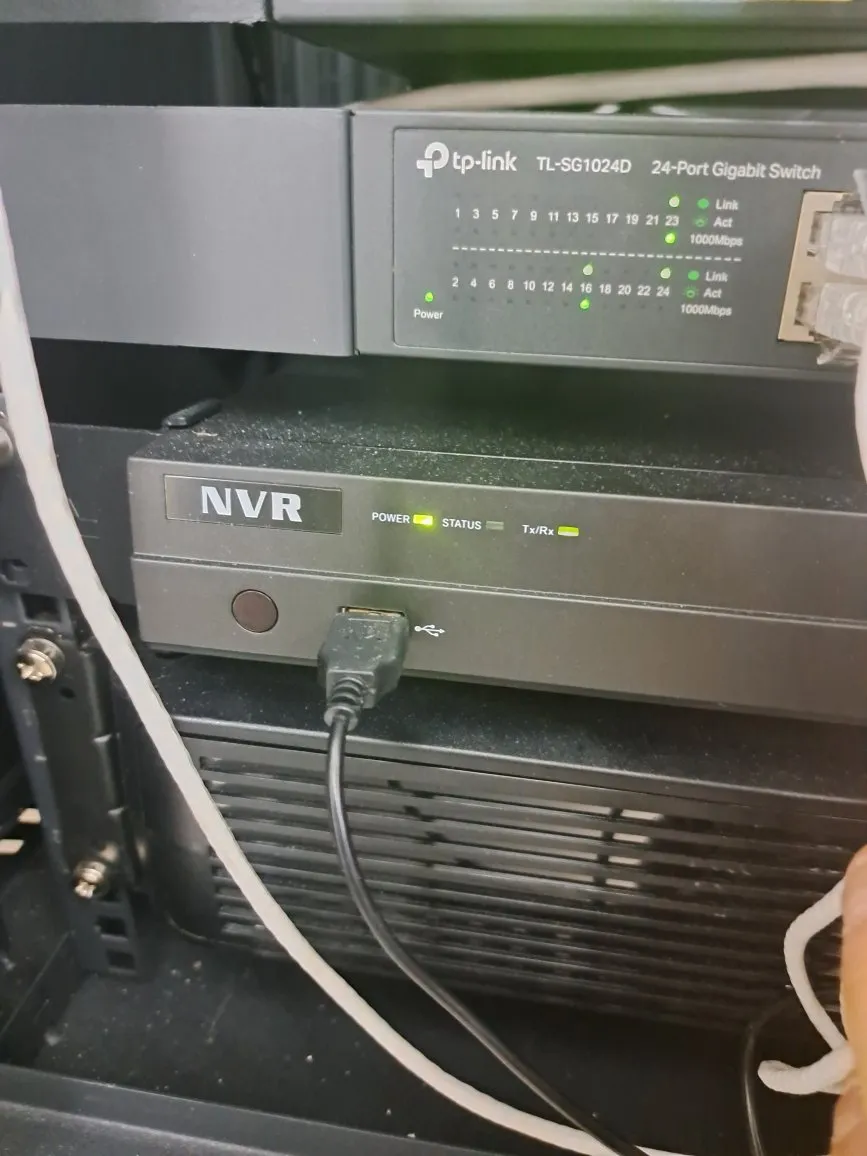
Real job photo from our files: a 24-port gigabit network switch sitting above a network video recorder in an equipment rack, with a USB cable in the recorder's front port and white cable running past. On a Suffolk complex, a shelf like this is where every building's cameras come home.
Suffolk Property Manager Request
Year-round, seasonal or both — list the properties
✅
Request Sent!
Thank you. We will reach out to set the visit, usually within 2 hours of your request.
25+
Years Experience
2 Hr
Booking
100%
Licensed & Insured
4.7★
201 Google Reviews
Owner-operated since 2002 · Thousands of jobs completed · Booked within 2 hours
The Neighborhood
Why Suffolk Rentals Need a Security Contractor Who Plans for Distance, Seasons and Outbuildings
Suffolk County is big enough that a property manager's list behaves like two or three different markets at once. The county government describes Suffolk as about 1,000 square miles covering the eastern two-thirds of Long Island, with 86 miles between the Nassau County border and Montauk Point and 26 miles from the Sound to the ocean at its widest point. A firm based in Hauppauge or Melville can have a garden complex in Babylon, a block of apartments over stores in Patchogue, a new building beside the Ronkonkoma station and a dozen summer houses in the Hamptons, and every one of those needs a different security plan. What ties them together is not a single type of equipment. It is the need for one contractor who knows how long it takes to get to each address, what each building's weak point is, and which town office will ask questions about which piece of work.
Ownership patterns shape the work too. The Census Bureau's five-year estimate, published through the St. Louis Fed's FRED database, puts Suffolk's homeownership rate at about 84.9 percent for 2024, one of the highest figures for any large county in the state. Rental housing here is the exception, so it tends to be concentrated: in garden-apartment complexes built after the war along the South Shore and in the central towns, in apartments over shops on village main streets, in newer buildings near train stations, in accessory apartments carved out of houses, and in the seasonal rentals of the East End. Many local security companies are built around homeowners and monitoring contracts. Far fewer are set up to work through a managing agent's list, write a separate scope for each owner, and come back each spring to check what the winter did to the equipment.
The East End is where Suffolk most clearly parts ways with any other area we serve. The Town of Southampton's 2022 Housing Plan says plainly that “almost half of the housing units in Southampton are occupied on a seasonal basis,” and it puts the share of units known to be occupied by renters at 22.3 percent in 2018. That combination produces a type of property management that barely exists in the city: houses that change occupants every week from June to September, sit closed for months, and are owned by people who may be hundreds of miles away when something goes wrong. Security for those houses is less about a lobby intercom and more about keeping control of who has the door code, whether the cameras and the internet survived the winter, and whether anyone noticed when the pool house door was left open in February.
The western and central towns look more like the rest of Long Island, with a few twists. Station-area construction is changing parts of Brookhaven and Islip. The state describes Station Yards, also called the Ronkonkoma Hub, as a 53-acre transit-oriented development planned for 1,450 residential units, with 489 delivered in a first phase in 2020 and another 388 homes in its second phase, next to a station the state calls Suffolk's busiest. Buildings like that open with cloud entry systems, readers on every amenity door and dozens of cameras, and a management company inherits all of it the day the developer's installer leaves. A few miles away, a 1960s garden complex may still be running a buzzer system on wire that has been buried under a lawn for sixty years. A Suffolk property manager often needs both kinds of work from the same vendor in the same month.
Weather and power belong on the list as well. On July 6, 2026, PSEG Long Island reported that a fast-moving storm two days earlier, with gusts up to 84 miles an hour, hail and heavy rain, had knocked out power to tens of thousands of its 1.2 million customers, and that crews had restored more than 34,800 of them overnight. Outages like that are routine on the island, and they hit spread-out properties hardest: gate operators that will not open, cameras on a far outbuilding that never reconnect, and a summer house whose router stays dark until someone drives out. Planning for power is part of every Suffolk security scope we write, not an add-on discussed after the first storm.
Finally, Suffolk does not run under the New York City rules that most online security advice assumes. The intercom and self-locking door requirement in section 50-a of the Multiple Dwelling Law sits in a law that covers cities of 325,000 or more people; Suffolk's towns and villages fall under the Multiple Residence Law and local codes instead. City HPD violations, the city's notice rules for entering apartments and the city's smart-access privacy law do not follow a landlord across the county line. What does apply is a patchwork of town rental permits, seasonal rental registries, county and local alarm registration and local building departments. That patchwork is the reason this page exists separately from our Long Island property management security page, which covers both counties at a higher level.
Suffolk facts a property manager should have on hand
About 1,000 square miles and 86 miles end to end, from the Nassau border to Montauk Point, per Suffolk County government. Drive time is the biggest single variable in Suffolk scheduling.
About 84.9% homeownership in Suffolk (ACS five-year estimate for 2024, via FRED). Rentals cluster in complexes, downtowns, station areas, accessory units and seasonal houses.
Almost half of Southampton's housing units are occupied seasonally, according to the town's 2022 Housing Plan; about 22.3% of units were renter-occupied in 2018.
Two-year rental permits in Southampton (Town Code ch. 270, unincorporated areas), issued after an on-site inspection unless the owner supplies a licensed architect's or engineer's certification; a valid permit is a condition of collecting rent.
Two-year rental registrations in East Hampton (Town Code ch. 199, adopted 2015), with a sworn inspection checklist and a registry number that must appear in rental listings; failure to publish the number carries a fine of $150 to $1,500.
Alarm registration inside the county police district costs $50 for a residence or $100 for a commercial location, and a registered address gets two false alarms a year with no service fee. The five East End towns and some villages with their own police sit outside that program.
1,450 planned homes at Station Yards beside the Ronkonkoma LIRR station, 877 of them in its first two phases (Office of the Governor, 2024).
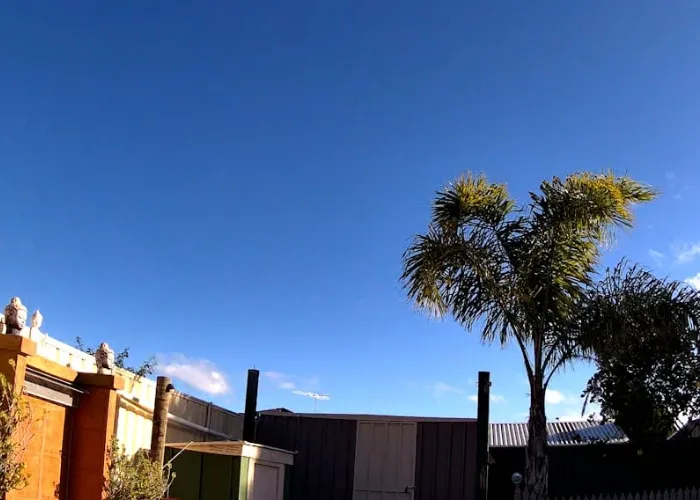
Partner product photo (Reolink): a wide daytime view from an outdoor camera, mostly sky, with palm trees and a low wall at the bottom of the frame. A camera aimed this high wastes most of its picture; on a Suffolk lot we aim at the drive, the doors and the gate instead.
What We Install
Property Management Security Services in Suffolk County, System by System
Each system below starts with the question a Suffolk manager usually brings to us, gives a short answer from the field, and links once to the Suffolk service page where the details and published prices live. Board-run buildings have their own pages: co-op security systems in Suffolk County for cooperative boards and their agents, and condo security systems in Suffolk County for condominium boards and homeowner associations. This page is for the people who run rental properties, seasonal houses and owner-held buildings for someone else.
Entry panels and intercoms: from a twelve-vestibule complex to one front door
On a Suffolk garden complex, “the intercom” is rarely one thing. Each two-story building tends to have its own small vestibule, its own row of buttons and its own door release, and the buildings may or may not share a power supply in a basement somewhere. When an office calls to say the intercom at a complex in Bay Shore or Coram is out, our first job is to find out which panels are failing and why. It might be one transformer feeding four buildings, a cable cut by a contractor digging for a sprinkler line, or panels that have simply worn out after decades of salt air and freeze-thaw cycles.
Repairs start with the $250 service call. The prices on our door buzzer repair page for Suffolk County run $250–$525 for an apartment station, $250–$475 for a door release relay or button, $325–$650 for a 24-volt transformer, $450–$950 for an electric strike with alignment, $650–$1,800 for lobby panel work and $850–$2,400 for riser pair repair or re-termination. Gate and long-run work is quoted separately, because the condition of a buried run cannot be priced until it is tested.
When the panels are beyond repair, the choice is between new panels on the existing wire, panels that call tenants' phones over the internet, or new network cable to each building. Our intercom installation page for Suffolk County lists $400–$1,800 for an audio or video intercom at a house or small building and $1,200–$4,500+ for a multi-unit building system. For faults on an existing system, our page on intercom repair in Suffolk County explains how we diagnose them. On the East End, where many rentals are single houses, the “intercom” is often a video doorbell at the front door and a call box at the driveway gate, which changes the whole conversation.
Fobs, keypads and codes: controlling access when the people change every week
Access control in a year-round complex is about turnover measured in months. Access control in a seasonal rental is about turnover measured in days. Both come down to the same question: can the office change who gets in without sending someone with keys? On a garden complex, fob readers on building doors, laundry rooms, storage areas and the maintenance garage let the office cancel a departing tenant and enroll a new one from a computer. On a summer house, a keypad or app-controlled lock on the main door, a code on the side gate and a separate code for the pool service and the cleaners do the same job for a population that changes every Saturday.
Our access control installation page for Suffolk County publishes $1,600–$2,800 for a lobby fob reader, $2,500–$5,500 for a gate with a reader and a video intercom, and $4,500–$16,000 for a multi-door system covering a gate, a front door and service doors. For the apartment and house doors themselves, the options and models are on our smart lock installation page for Suffolk County. Whatever the hardware, we set it up so the management office, not us, issues and cancels codes and credentials, and we train the staff who will do it.
Where the system is managed matters more in Suffolk than almost anywhere else we work. A manager in Hauppauge cannot drive to Montauk every time a guest loses a code. A system that the office can run from a laptop, with codes that expire on their own at checkout, saves dozens of trips a summer. New York City's Tenant Data Privacy Act, which regulates smart-access systems in city apartment buildings, does not apply in Suffolk; we still recommend that owners run any face or fingerprint reader past their own counsel before putting it on a residential door, and we do not give legal advice on it.
Elevator floor control in Suffolk's newer buildings
Elevators are uncommon in Suffolk's older rental stock and standard in the four- to six-story buildings rising near stations such as Ronkonkoma and Patchogue. In those buildings, floor control keeps delivery drivers on the ground floor, limits the roof terrace or the fitness room to tenants, and keeps the garage level from becoming a back door to the residential floors. Our elevator access control page for Suffolk County lists a card, fob, code, phone or video reader in the car from $1,800 per car and face, fingerprint or iris readers from $3,000 per car. Floor-by-floor restriction is quoted per building, and the elevator company's licensed mechanic makes the connection inside the controller on a date we coordinate with them.
Door hardware: the part that decides whether anything else works
A reader or a keypad on a door that does not close and latch by itself is decoration. On Suffolk garden buildings the vestibule doors are often original, the closers are tired and the frames have moved with sixty winters of frost. On seasonal houses, the sliding doors to the deck and the French doors to the pool are usually the weakest openings, and they are the ones renters leave unlocked. Before we quote a reader we look at the closer, the latch, the frame and the hinges, and any door repair goes on the scope as its own line so the owner can see what it costs. Magnetic locks suit some glass doors in newer buildings, but they need a request-to-exit device and a code-compliant release, and the local building department has the final word on hardware that changes how people get out. We handle the low-voltage and door hardware side; any new high-voltage circuit is the property's electrician, because we do not do electrical work.
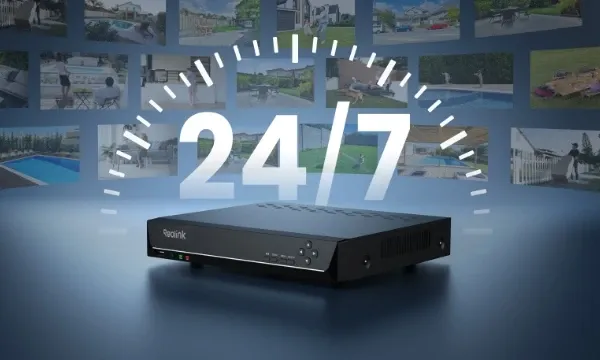
Partner product photo (Reolink): a black network video recorder shown under a large round-the-clock recording graphic and rows of camera thumbnails. Continuous recording only helps if the recorder is powered, so we put a battery on it.
Cameras: grounds, parking fields, mailbox areas and the back of the property
Camera work on Suffolk rentals is mostly outdoor work, and the expensive questions are distance and light. Where does the recorder live, how does the signal reach a camera three hundred feet away at the end of a parking field, and is there any light out there at night? A single complex with an office on site usually records every building in one place. A scattered list of houses gets a small recorder or a cloud-connected camera set per property, viewed by the office from one app. The specific placement, retention and pricing questions for rental buildings are covered on our page on apartment building security camera installation in Suffolk County. Four-camera systems start at $1,099 on our Suffolk County camera price list, and most managed properties need more than four.
Seasonal houses add a twist that year-round buildings do not have: privacy expectations of short-term guests. We install cameras on driveways, gates, entry doors, pool gates and outbuildings, aimed at the approaches rather than into living spaces, outdoor showers or anywhere a guest would expect privacy. Recording audio raises separate state eavesdropping questions, so our outdoor cameras record video only unless the owner's counsel says otherwise. What the listing must disclose is a question for the owner, the rental agent and the booking platform's rules; we make sure the cameras are where the owner says they are and nowhere else.
Parking fields, driveway gates and long private roads
Parking takes up a larger share of a Suffolk rental property than it does almost anywhere in the city. A garden complex in Medford or Holbrook may have more square feet of asphalt than of apartments, and a rental community near the expressway may have a gated entrance and visitor spaces at the far end. Most incidents managers hear about happen here: catalytic converter thefts, cars that belong to nobody on the lease, dumped mattresses and hit-and-run damage. Cameras on parking rows work best mounted high, aimed along the rows rather than across them, and placed where the lot lights already reach. Our parking lot camera installation page for Suffolk County goes into detail on placement.
On the East End the parking problem changes shape. Estate-style rentals often sit at the end of a long private drive behind a gate. The gate call box, the keypad on its post and the camera that shows who is waiting all need power and a signal, sometimes hundreds of feet from the house. We plan those runs in conduit where the ground allows, use wireless bridges where it does not, and keep the gate operator itself with the gate company that services it; we connect our keypad, reader and call box to it rather than replacing it.
Mailboxes, packages and deliveries
Garden complexes were built for letters, not daily parcels. Cluster boxes sit in open vestibules or out by the parking field, and cartons pile up on stoops. Where each building has a vestibule, a small camera over the mailboxes and a reader on the inner door keep packages behind a lock. Where the complex has a leasing office, a single package room with a reader and a camera can replace a dozen exposed drop points. At seasonal houses, deliveries arrive for guests who have not checked in yet, and a camera on the front step and a locked side porch or garage with a delivery code solve most of it. We install the doors, readers and cameras; we do not run a package service or sell package lockers.
Alarms for leasing offices, maintenance shops and closed-up houses
Intrusion alarms make the most sense in three places on a Suffolk list: the leasing or management office, the maintenance shop where tools and spare appliances are stored, and any house or apartment that sits empty for weeks at a time. Central-station monitoring through our provider is $30 a month keypad-only or $45 a month with the phone app, the two tiers on our alarm installation page for Suffolk County. Commercial alarm installation for a small business typically runs $1,500–$3,000 on that page for a standard setup; larger layouts are quoted after the walk.
Every monitored alarm in Suffolk also comes with paperwork, and where the property sits decides which paperwork. Inside the Suffolk County Police District, alarm owners register with the county under chapter 290 of the county code, at $50 for residences and $100 for commercial locations, and registered locations get two false alarms a year without a service fee. Several towns and villages with their own police departments, including all of Riverhead, Southampton, East Hampton, Southold and Shelter Island, are outside the county program and follow their own rules. We tell the office which applies to each address and program the panel to keep false dispatches down; the registration itself is in the alarm owner's name.
Seasonal houses need a different alarm setup from year-round ones. A house that is empty from October to May benefits from temperature and water sensors as much as door contacts, because a burst pipe in January can do more damage than a burglar. Those sensors report through the same panel and the same app, so the owner and the office see the same alert. We keep the arming codes simple for renters in summer and lock the house down to staff codes once the season ends.
Cable, links and the distances between buildings
Ethernet cable, which carries most modern cameras, readers and IP intercoms, is limited to about 100 meters, or 328 feet, between active devices. On a city lot that almost never matters. On a Suffolk property it matters on the first walk: the far building of a complex is across a lawn, the camera for the back parking field is 400 feet from the office, and the barn behind a rental farmhouse on the North Fork is further still. The answers are fiber between buildings, a powered switch at a midpoint, a point-to-point wireless bridge, or a cellular camera where nothing else makes sense. Each option has a cost, an ongoing fee or a failure mode, and we write the choice into the scope rather than leaving it to install day. Per-drop structured cabling is $150–$300 on our structured cabling page for Suffolk County; long outdoor runs are priced on the walk.
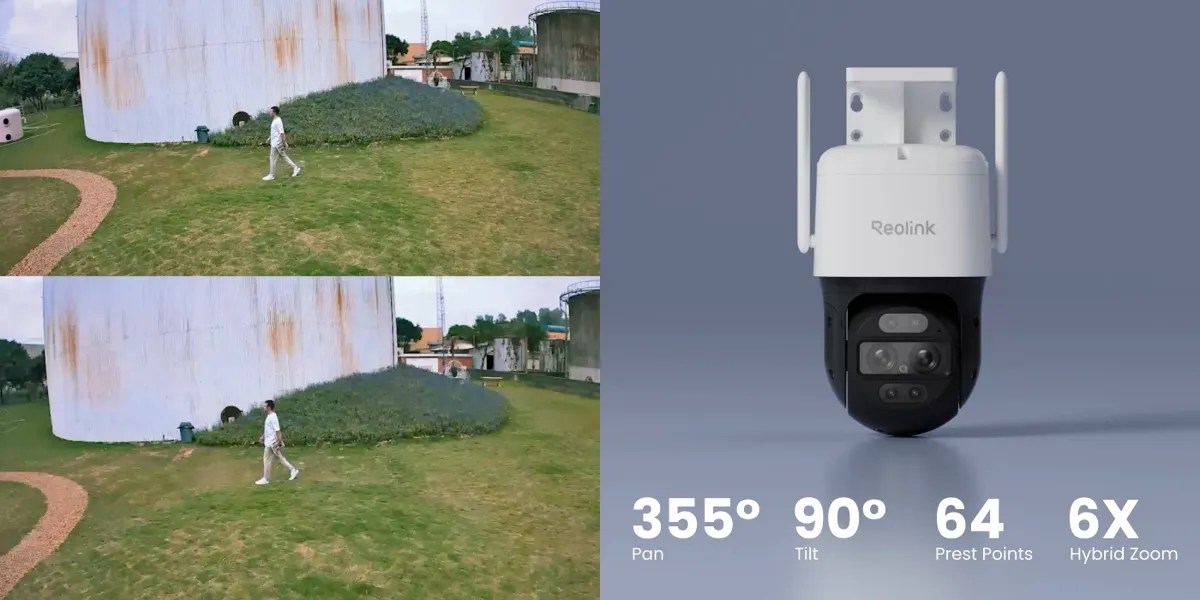
Partner product photo (Reolink): a white pan-tilt camera with two antennas next to two sample views of a lawn, labeled with its rotation, tilt and zoom figures. On a parking field or a long lawn, one camera that turns and zooms can follow what fixed cameras see only in pieces.
Power, storms and battery backup
Suffolk properties live closer to the weather than most of our city buildings. Nor'easters, summer thunderstorms and the occasional hurricane knock out power for hours or days, south-shore basements take on water, and lightning finds long outdoor cable runs and gate posts. A system that dies with the power leaves a complex with doors that will not release and a summer house whose cameras recorded nothing during the one night the owner needed. We size battery backup for door controllers, recorders, network switches and the router that keeps a seasonal house online, and we tell the office plainly how long that backup is expected to last. Outdoor runs get surge protection at both ends, and equipment that once sat on a basement floor moves up the wall when we replace it.
Maintenance agreements across a Suffolk portfolio
We write maintenance agreements for Suffolk portfolios after surveying the properties they will cover. The agreement lists each property and its systems, the checks we make and when (for seasonal houses, an opening visit in spring and a closing visit in fall make the most sense; for year-round complexes, a spring check after the salt and the plows), how service calls are requested and how they are billed. Prices and terms are set per portfolio; we do not publish tiers, offer guaranteed response times or sign service level agreements. Calls and texts are answered by our AI receptionist outside office hours, a person responds from 8 a.m. to 8 p.m. every day, and visits are booked first come, first served once approved and paid, early in the day, seven days a week. For camera systems on their own, our security camera maintenance page for Suffolk County describes the checks in more detail.
Seasonal Rentals
Security for East End Seasonal Rentals: Weekly Turnover, Empty Winters and Owners Far Away
Managing summer rentals on the South Fork, the North Fork and Shelter Island is a business with its own calendar, and security has to follow it. From Memorial Day to Labor Day a house may have a new group of guests every week, a cleaning crew between each stay, a pool company twice a week, landscapers on Mondays and a caretaker who checks in when something breaks. From October to April the same house may see nobody but the caretaker. The owner might live in Manhattan, in Florida or overseas, and expects to hear about a problem before the next guest does. The equipment is ordinary; the way it is set up and handed over is what makes it work for a seasonal portfolio.
Codes that start and stop with the booking
Physical keys and lockboxes are the weak point of most seasonal rentals. Keys get copied, lockbox codes get shared in group chats, and the house has no record of who came in when. A keypad or app-controlled lock on the main door, with a code created for each booking that turns on at check-in time and stops working at checkout, removes most of that. Cleaners, the pool company and the caretaker each get their own codes, limited to the days and hours they work. When the owner asks who was in the house on a given Tuesday, the lock's log answers in seconds. We install the locks, set up the account in the owner's or the management company's name, and show the office how to create and cancel codes itself.
Closing a house for the winter
A closed house is a different security problem from an occupied one. Burglary is part of it, but the bigger losses on the East End often come from water and cold: a pipe that freezes after a power failure, a sump pump that stops, a boiler that quits in January with nobody there to notice. A winter setup usually means the alarm armed with staff-only codes, temperature and water sensors reporting through the same panel, cameras on the driveway, the main doors and any outbuilding, and battery backup on the router and the recorder so the house can still report when the power comes back. Guest codes are cleared at the end of the season, and the owner and the office both get alerts.
Opening a house in spring
Spring is when the winter's damage shows up. Before the first booking we check that every camera still connects and records, that the recorder's clock did not drift after outages, that the keypad batteries are fresh, that the gate call box survived the plows and the salt, and that the internet service the owner suspended for the winter is back on. The owner gets a short written note of what was fixed and what needs approval. Booking an opening visit in April or early May leaves time for any part that has to be ordered; waiting until the week before Memorial Day does not.
Rental registries and permits on the East End
Two East End towns run registration programs that every seasonal manager deals with. The Town of East Hampton's rental registry law, chapter 199 of its code, adopted in December 2015, makes it unlawful to rent a rental or seasonal rental property without first registering it with the town Building Department and obtaining a registry number. The registration form includes a notarized inspection checklist sworn by the owner or a licensed architect, engineer or home inspector, registration runs two years, and failing to publish the registry number is punishable by a fine of $150 to $1,500. The Town of Southampton's rental properties law, chapter 270, applies to the unincorporated parts of the town; permits are valid for two years, and the town inspects the property on site unless the owner provides a certification from a licensed architect or engineer. The Southampton code also makes a valid rental permit a condition of collecting rent.
Neither law is about cameras or intercoms, and we do not claim they are. What they change for a security contractor is the paperwork rhythm of a seasonal portfolio: houses come up for renewal on a cycle, inspectors or licensed professionals walk them, and owners want anything we did to doors and locks to pass that walk without comment. We keep egress hardware simple, leave every door openable from the inside without a key or special knowledge, and note on the property record exactly what we installed at each opening.
Caretakers, rental agents and the owner's phone
Seasonal properties usually involve more people than a year-round building: the owner, a rental agent who books guests, a caretaker who lives nearby, sometimes a separate property manager, plus the cleaners and the pool service. Every one of them wants some view of the security system and none of them should have all of it. We set up the account so the owner holds the master login, the management company or caretaker has administrator rights for codes and cameras, the rental agent sees booking-related codes only, and service companies have time-limited codes with no camera access at all. When the house changes hands or changes managers, the owner revokes one set of rights rather than calling us to rebuild the system.
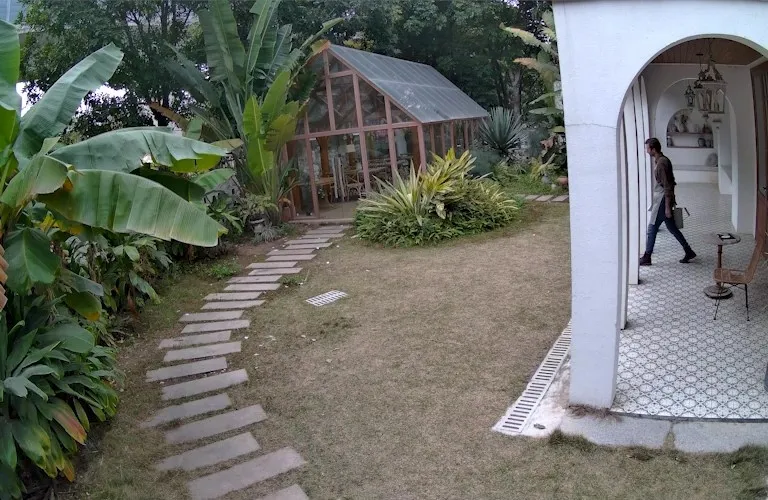
Partner product photo (Reolink): a sample camera view across a stone garden path toward a glass greenhouse, with a white archway on the right. Behind a seasonal rental, this is the kind of approach an outdoor camera should cover.
Outbuildings & Long Runs
Pool Houses, Barns, Detached Garages and the Property Beyond the Main Building
The single biggest difference between a Suffolk security scope and a city one is how much of the property sits outside the main building. A North Fork farmhouse rental may have a barn, a potting shed and a detached studio. A Hamptons rental usually has a pool house, a pool equipment enclosure and a detached garage. A garden complex in Lindenhurst has a maintenance garage, a laundry building and carports. Each of those is a door that can be left open, a store of valuable equipment, or a blind spot in the camera coverage, and each sits some distance from wherever the network starts.
Deciding which outbuildings get coverage
Not every shed needs a camera. We rank outbuildings with the office on three questions: what is stored inside and what it would cost to replace, whether people other than staff have access to it, and whether anything there could hurt someone if it were tampered with. A pool equipment room with chemicals and a heater ranks high. A pool house with furniture that guests use ranks in the middle. A shed of garden tools at the back of the lot ranks low and may only need a contact on the door that reports to the alarm. The scope we write shows that ranking, so the owner can approve the top of the list now and the rest later.
Getting a signal out to the far end of the lot
Once an outbuilding is chosen, the question is how to reach it. If there is existing conduit or a trench is already open for another trade, network cable or fiber is the most reliable answer. If the run is long and the ground is finished lawn or paving, a pair of small wireless bridge antennas with a clear line of sight can carry several cameras' worth of video without digging. Where neither works, a cellular camera with its own data plan covers a single spot. Battery and solar cameras have a place at the very edges, but Suffolk winters shorten battery life and trees shade solar panels for months, so we do not build a property's core coverage on them. Our wireless camera installation page for Suffolk County covers those options in more detail.
Light where the cameras need it
Cameras at night are only as good as the light near them. The back of a Suffolk property is often completely dark, and infrared alone gives a grainy black-and-white picture of a figure rather than a face or a plate. Floodlight cameras on an existing exterior fixture can help, and our floodlight camera installation page for Suffolk County describes them; any new circuit or site lighting for a dark area is the property's electrician, and we mark those areas on the survey so the owner knows where lighting would change what the cameras can see.
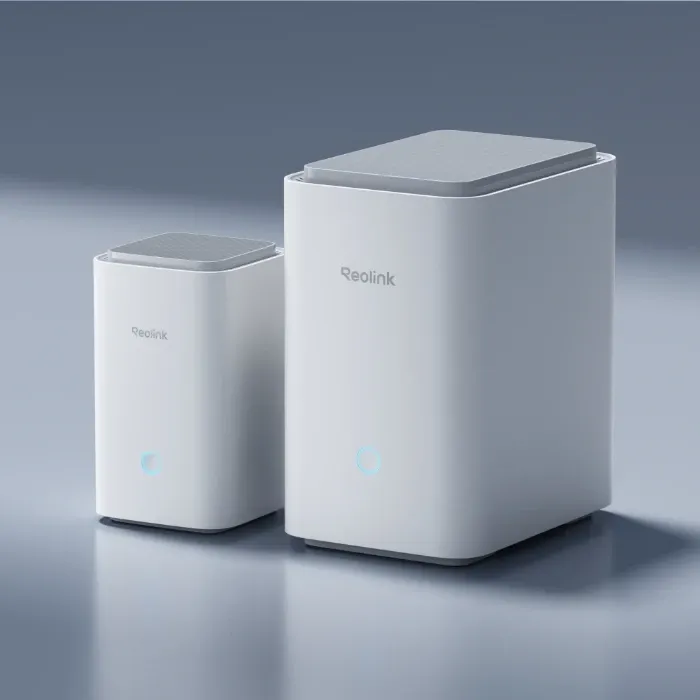
Partner product photo (Reolink): two white box-shaped hubs, one small and one larger, each with a small lit button. At a single rental house, a compact hub like these can hold the recordings indoors, behind a locked closet door the guests cannot open.
Building Specialists
Property Management Security for Suffolk's Rental Building Types
Six kinds of rental property make up most Suffolk lists, and the same request, say “put the doors on keypads,” turns into a very different scope for each. These notes come from walks rather than catalogs.
South Shore and central garden complexes
Two-story brick or frame buildings around lawns and parking courts, many from the 1950s to the 1970s. Separate entrances for each building, old buzzer wire buried between them, laundry rooms in basements and very little exterior lighting.
Station-area buildings
Newer four- to six-story rentals near LIRR stations, with one lobby, a garage or surface lot, elevators and a developer-chosen system that is often cloud-based with a monthly fee.
Main-street mixed use
Apartments over shops in downtowns such as Patchogue, Huntington, Bay Shore, Babylon Village and Riverhead. A narrow residential door beside a storefront, a rear lot shared with the stores, and retail tenants with their own vendors.
Seasonal houses
Single-family rentals on the East End and along the shore, booked weekly or monthly in summer and closed in winter. Keypad locks, gate call boxes, outdoor cameras and winter sensors matter more than any intercom.
Accessory apartments and two-family houses
Apartments above garages or downstairs in houses, owned by small investors and covered by town rental permits. Usually one doorbell camera, one keypad on a shared door and a couple of outdoor cameras.
Commercial property in the same portfolio
Many lists also include retail strips, small offices and light-industrial space on Route 110, Veterans Memorial Highway, Route 58 and Sunrise Highway, which call for recorder cameras, after-hours alarms and employee cards.
Garden complexes: tracing a system that was installed in pieces
The first walk on a Suffolk garden complex is mostly detective work. We open every vestibule panel, find where each building's power comes from, and check whether the buildings share a master unit. It is common to find that an earlier vendor upgraded three buildings and left the rest, so the office runs two systems with two sets of fobs and two support numbers. The scope we write usually standardizes on one platform and phases the buildings so tenants in each building switch over on one day. The buried cable between buildings decides most of the cost: where it tests clean, panels can reuse it; where it does not, phone-calling panels with their own internet or a wireless bridge from a central building are often cheaper than trenching across a lawn and a parking court.
Station-area buildings: taking over from the developer's installer
Newer buildings near stations tend to open with everything installed: a touchscreen lobby panel, phone-based entry, readers on garage and amenity doors and a few dozen cameras on a cloud platform. The trouble starts when the installer finishes the punch list and leaves. The management company inherits administrator accounts in someone else's name, a platform subscription it never negotiated and no drawings. Our first visit is an inventory: what is installed, who controls each account, what is still under warranty and with whom, and which subscriptions the building actually needs. Lease-up schedules make timing tight, so we work around the move-in calendar the leasing office gives us.
Accessory apartments and small investor properties
Many Suffolk towns regulate rentals through permits and inspections. The Town of Islip issues a rental occupancy permit after an on-site inspection and renews it every two years, and Brookhaven's rental registration runs fifteen months and requires an inspection by the town or a licensed professional. Those laws focus on safety items such as smoke and carbon monoxide alarms rather than security systems. For these properties we keep the security side simple and easy for a small owner to run: a wired video doorbell or a small door station at each entrance, a keypad lock on any shared entry, and a couple of cameras on a small recorder the owner can check from a phone. Our doorbell camera installation page for Suffolk County covers the doorbell side.
Commercial properties managed alongside the rentals
Plenty of Suffolk management companies also run strip centers, small office buildings and industrial units. Those need recorder-based cameras over the lot and the loading area, after-hours alarms with their own registrations, and card access for tenants' employees. Keeping them in the same vendor relationship as the rentals means one certificate of insurance on file, one point of contact and one invoice format. For recorder-based camera systems on commercial property, our CCTV installation page for Suffolk County has the details.
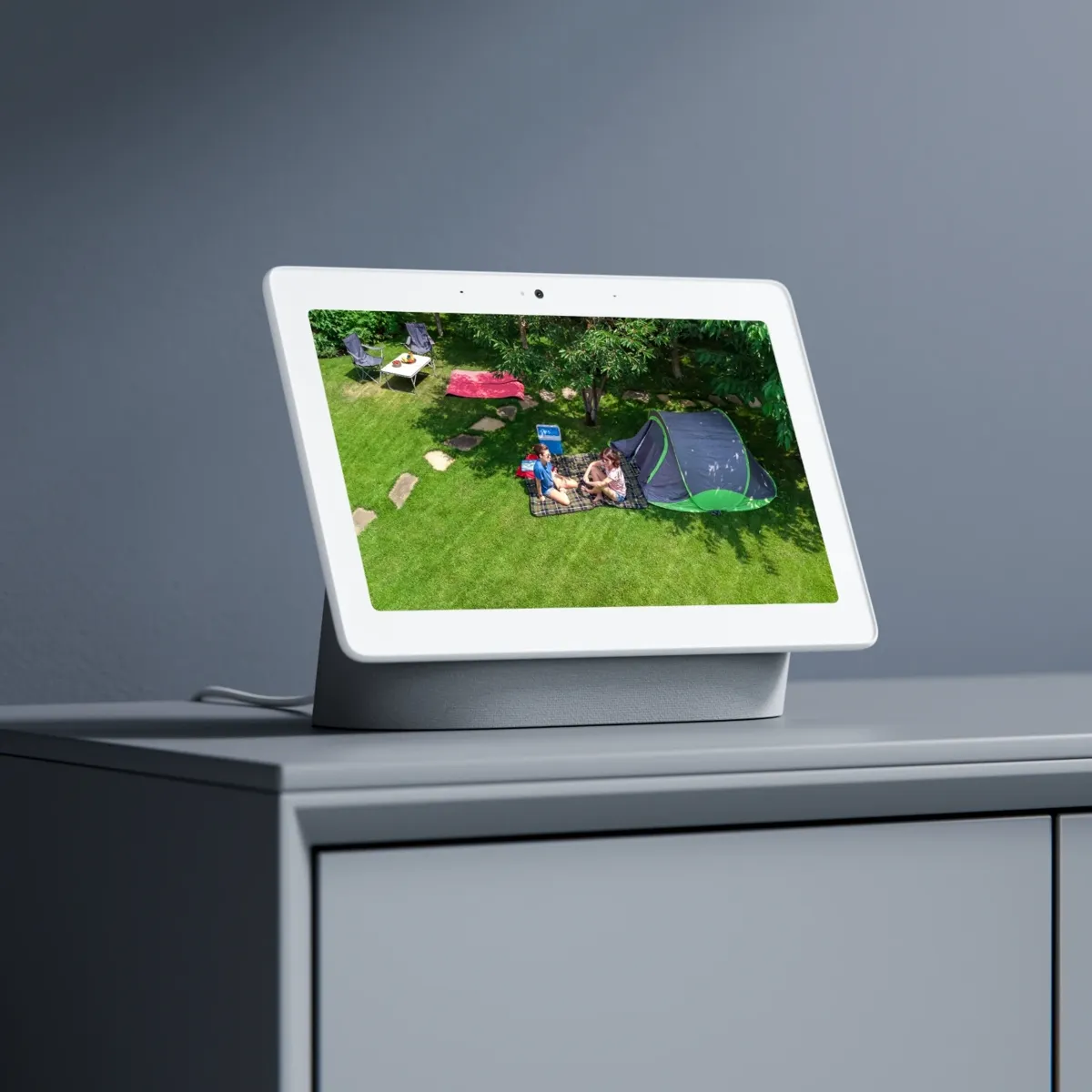
Partner product photo (Reolink): a smart display on a grey cabinet showing a live camera view of a lawn with a tent and chairs. An owner or a caretaker can keep an eye on the grounds from a screen like this without opening an app.
For Management Companies
Vendor Setup, Scheduling and Day-to-Day Work for Suffolk Property Managers
Becoming a vendor in your system
Suffolk management companies onboard vendors the same way firms elsewhere do, and we fit the usual process. We complete your vendor application, supply a W-9 for the contracting company and review and sign a master service agreement. The certificate of insurance naming the owner and the management company as additional insureds is issued when a job is awarded, to your exact wording; it is easier to get right once the scope is fixed, and requirements vary by owner. Being set up in your payables system means your office can pay us. It is not a claim that we sit on any company's approved vendor list.
Scheduling across 86 miles
The drive from the Nassau line to Montauk can take longer than the job at the end of it, especially on a summer Friday. We group visits by area, so a technician working in Babylon or Islip handles the next property nearby rather than crossing to the North Fork and back. East End properties are usually the first or last stop of a day, and in summer we avoid putting technicians on the roads east of the canal at the hours when traffic is worst. Visits are booked into two-hour arrival windows early in the day, technicians arrive inside the window and never ahead of it, and requests go on the schedule first come, first served once approved and paid.
One phone number for every Suffolk property
Your office reaches us at (631) 407-2884 for every property in the county, from a complex in Amityville to a house in Orient. Each request is tied to that property's record, so the technician arrives knowing what is installed, where the power supplies and recorders are, and what was done on the last visit. Tenants and summer guests should go through your office or caretaker rather than calling us directly; that keeps work orders, approvals and billing in one place and stops us from being sent to a property the owner has not authorized.
Working in occupied rentals without the city's rules
New York City's rule setting notice periods for entering apartments is a city regulation. Outside the city, access to an occupied unit is mostly governed by the lease and general state landlord-tenant law, and owners should follow their own counsel on how much notice to give. In practice we work the same way everywhere: apartment and house visits are scheduled through the office, the office sends the notice it uses, we keep to daytime hours unless the occupant asks otherwise, and anything that needs someone at home is grouped into as few visits as possible. For seasonal rentals, we schedule work on changeover days or in the off-season so guests are never disturbed in the middle of a stay.
Turnover on a year-round complex
Move-outs never stop on a Suffolk complex of a few hundred apartments, and every one leaves a trail of access to undo: the departing tenant's fobs, the directory entry at the door, any app account, the parking sticker and often a lock. We set the access system up so cancelling a tenant in the office removes that person's credentials everywhere at once, and the new tenant's credentials are issued at the lease signing. Directory entries on the entry panels are edited from the same place, so a new name appears at the door on move-in day rather than whenever someone drives out to update it.
Bid requests and proposals
We respond to requests for proposals from management companies and owners, from a single complex to a program covering a whole list. A useful bid request lists each property with its town or village, year-round or seasonal use, the number of buildings, outbuildings, units and entrances, what is installed now and what the owner wants at the end. We answer with a scope per property, each item on its own line, and note anything that depends on testing existing cable. The certificate of insurance, vendor forms and signed agreement follow when the job is awarded; we do not hand out client references, and managers who want to know how we work can read our Google reviews.
Payment, deposits and financing
A visit goes on the schedule once payment is in. Smaller jobs, under $500, are paid at booking; larger ones take half up front and the rest at completion, as our service agreement sets out. Equipment is ordered after the deposit, and anything special-order gets an arrival date from us only once the maker ships it. Financing is available through Wisetack, subject to approval.
Full terms — including 50% deposit, one-year parts-only warranty on Abstract Enterprises Security Systems-supplied products, and the late-fee schedule — are set out in the service agreement.
Compliance points for Suffolk properties
Which state housing law applies. Section 50-a of the Multiple Dwelling Law, the source of the familiar intercom and self-locking door rule, reaches only cities of 325,000 people or more. Suffolk’s towns and villages work under the Multiple Residence Law and their own codes, and we do not claim the Multiple Residence Law requires an intercom.
Town rental laws. Islip and Brookhaven permit and register rentals after inspections; Southampton issues two-year rental permits in its unincorporated areas; East Hampton requires a two-year registration and a registry number on listings. None of these is a security-equipment rule, but door hardware we install must leave every exit openable from inside.
Alarm registration. Inside the county police district the county keeps the alarm registry under chapter 290; in the East End towns and the villages with their own police, the local department sets the rules.
Who does what. Our work is low-voltage, under New York State license #12000287431; a licensed electrician handles any new circuit, outlet or site light the project needs.
Privacy. The city’s law on smart-access systems stops at the city line. Because recorded sound can raise eavesdropping issues under state law, our cameras capture picture only unless the owner’s lawyer advises otherwise, and none points into bedrooms, bathrooms or outdoor showers.
Fire alarm systems. These are a separate, code-driven trade with their own drawings and inspections, and this page does not cover them.
Your Questions Answered
Property Management Security in Suffolk County: Questions Answered
Seasonal houses
Which systems should be switched off, and which left running, when a summer rental closes for the winter?
Leave on everything that reports: the alarm, any temperature and water sensors, the cameras on the driveway and the doors, and the router and recorder that carry them, ideally on battery backup. Turn off or clear what guests used: all guest codes, any guest Wi-Fi the owner does not want running, and interior cameras if the owner chose to have any in shared indoor areas during the season. If the owner suspends internet service for the winter, the house goes blind, so we usually advise keeping a basic plan or a cellular backup for the alarm.
How do weekly summer guests get in without anyone handing them a physical key?
A keypad or app-controlled lock on the main door, with a code created for each booking that starts at check-in time and expires at checkout. The rental agent or the office sends the code with the booking confirmation. If a guest arrives early, the office can open the door remotely after checking who is there on the doorbell camera. No key changes hands, nothing has to be rekeyed when a guest forgets to return something, and the lock keeps a record of every entry.
Can the system show us when the cleaners finished at each house on changeover day?
Yes, if each crew has its own code. The lock records when the cleaning crew's code opened the door, and the alarm records when they armed it on the way out. Many offices also put a camera on the driveway, which shows the crew's vehicle arriving and leaving. On a busy Saturday that gives the office a simple list: which houses are finished, which are still in progress, and which the crew never reached, before the next guests pull in.
How do we keep renters out of the owner's locked closet and storage areas during a stay?
Put the owner's closet, wine room or storage area on its own keypad or smart lock with codes that only the owner and staff hold, and leave guest codes off it entirely. A door contact on that door, reporting to the alarm, tells the office if it is opened during a stay. Equipment such as the recorder and the network gear belongs behind the same kind of door, so a guest cannot unplug it by accident.
Renters ask whether there are cameras at the house. What should the owner be ready to tell them?
Exactly where the cameras are. We install them on the approaches to the house, the doors, the driveway, the gate and outbuildings, never in bedrooms, bathrooms, outdoor showers or other private spaces, and we record the location of each one on the property record. What the listing must disclose is set by the rental platform's rules and the owner's own counsel, not by us. The owner can hand that list to the rental agent so the description and the house match.
Spread-out properties
A farmhouse rental on the North Fork has no cable internet. Can it still have cameras the owner can check from away?
Yes. The usual answer is a cellular router or cellular cameras, which need a data plan that the owner pays for directly with the carrier. Video is set to record locally and upload only clips or snapshots, so the plan stays affordable. If a fixed wireless or satellite service is available at the address, it can carry more video. We check signal strength at the house and at each outbuilding during the walk, because coverage on parts of the forks is uneven.
A pool house, a barn and a detached studio sit behind the main house. Which of them really need cameras?
Rank them by what is inside, who can get in and what could hurt someone. The pool equipment room usually ranks first because of chemicals, heaters and the pool itself; the studio ranks high if guests use it; the barn depends on what is stored there. Low-ranked buildings may only need a contact on the door that reports to the alarm. We put that ranking in the scope, so the owner can approve the top items now and add the rest later.
After a thunderstorm the driveway gate stopped opening. Is that a job for you or for the gate company?
Often both. The gate operator, its motor, its arm and its safety sensors belong to the gate company that services them. The keypad, the reader, the call box and the wiring that tells the operator to open are ours if we installed them. When a storm knocks a gate out, we check our side first, because a surge-damaged keypad or call box is a common cause, and we tell the office plainly if the fault is in the operator so the office can call the gate company right away.
Year-round complexes and downtown buildings
Visitors at our garden complex near Ronkonkoma park far from the buildings. Where should the call box go?
Usually at the main pedestrian entry to each building cluster, not out at the parking field, because a visitor needs to reach the door that opens. Where the complex has a vehicle gate, a call box at the gate lets tenants admit guests before they park. The worst arrangement is a single panel at the leasing office that buzzes a door the visitor then has to walk five minutes to reach before it relocks. We map the walking routes on the site plan before choosing panel locations.
A homeowners association inside our portfolio wants its own control over the gate codes. How do we split control?
Most access platforms allow separate administrator roles. The association's board or its manager can control codes for its own gate and amenities, while your firm keeps administrator rights for the rental buildings and the shared entrance. We set up those roles at installation and write down who holds which login. If the association later hires a different manager, its administrator rights move without touching the rental side.
A store on the ground floor of our Patchogue building stays open late. How do we keep the apartment stair door secure after hours?
Keep the residential door on the building's own system, separate from the store. The stair door locks at all times and opens with tenant credentials or the apartment intercom; the store's staff have no code for it. If the store and the apartments share a rear exit, that door is set to exit only on the residential side, with a camera covering it on the building's recorder. That way the store's hours never change who can walk up to the apartments.
Is battery backup worth paying for when most outages here are fixed within a day?
For the door controller and the recorder, yes. The hours right after a storm are when doors fail to release, when gates stick and when nobody is watching a dark property. A modest battery keeps entry working and recording continuous through a typical outage, and it protects the equipment from the surge when power comes back. For a seasonal house, backup on the router and the alarm is what lets the house report a cold or flooded basement after the storm has passed.
Which equipment fails first in buildings near the water, and what do you put in instead?
Outdoor panels, keypads and camera connectors on the south-facing and water-facing sides go first, along with anything mounted low where salt spray and road salt splash. We replace them with weather-rated housings and stainless hardware, seal cable entries with drip loops, move power supplies indoors and off the floor, and check the seals during each spring visit. It does not stop corrosion; it moves the replacement date years further out.
Partner product photo (Reolink): a black network video recorder below an Up to 16TB graphic. Drive size decides how many weeks of video a property keeps; a seasonal house that sits empty all winter needs enough to cover the gap between visits.
Equipment
Types of Property Management Security Equipment We Install in Suffolk County
Entry panels and call boxes
A one-button station at a small vestibule, a scrolling directory at a larger complex, a panel that dials tenants’ phones when the buried wire is gone, and a call box on a post at the driveway or community gate.
In-unit answering
Whatever suits the building inside each unit: a plain audio handset, a little video monitor, or none at all when calls go straight to tenants’ phones.
Keypad and app locks
For seasonal houses and accessory units: codes per booking, per crew and per caretaker, with logs the office can read.
Readers and credentials
Laundry, storage, the maintenance garage, the pool gate, the gym and the building doors themselves, each opened by fob, card, PIN or phone and each controlled from the office.
Cameras for grounds
Weatherproof cameras picked for the spot: long-lens bullets down a parking field, turrets over doors, pan-tilt units at a gate, floodlight models where the nights are dark.
Recorders and viewing
Usually one recorder per complex and one per house, all visible to the office and the owner in a single app, with download rights given only to named staff.
Links between buildings
Ways to reach a building that ordinary cable cannot: fiber in conduit, a PoE switch halfway out, a pair of wireless bridge antennas, or a cellular router.
Alarm panels and environmental sensors
Door contacts and motion detectors for offices and closed houses, plus temperature and water sensors for winter.
Power and protection
Enough battery to keep the gate keypad, the door controller and the house router alive until the utility finishes its repairs, with surge suppression on every run that leaves a building.
Choosing between the main options on a Suffolk property
Decision
Option A
Option B
What usually settles it
Main door of a seasonal house
Keys and a lockbox
Keypad or app lock with codes per booking
How often guests change and how far the office is
Entry at a garden complex
New panels on the existing wire
Phone-calling panels with their own internet
How the buried cable tests
Reaching an outbuilding
Cable or fiber in conduit
Wireless bridge or cellular camera
Open trenches, line of sight and ongoing fees
Recording
One recorder for the whole property
A recorder per building
Distances and links between buildings
Winter protection
Alarm with door contacts only
Alarm plus temperature and water sensors
Whether the house sits empty in cold months
We supply equipment from manufacturers we have relationships with, including our partners Lorex, Luminys and Reolink, and we install and service other brands that owners already have or prefer. Managers whose own staff look after small properties can see what we supply, installed or equipment-only, on our security camera equipment page for Suffolk County.
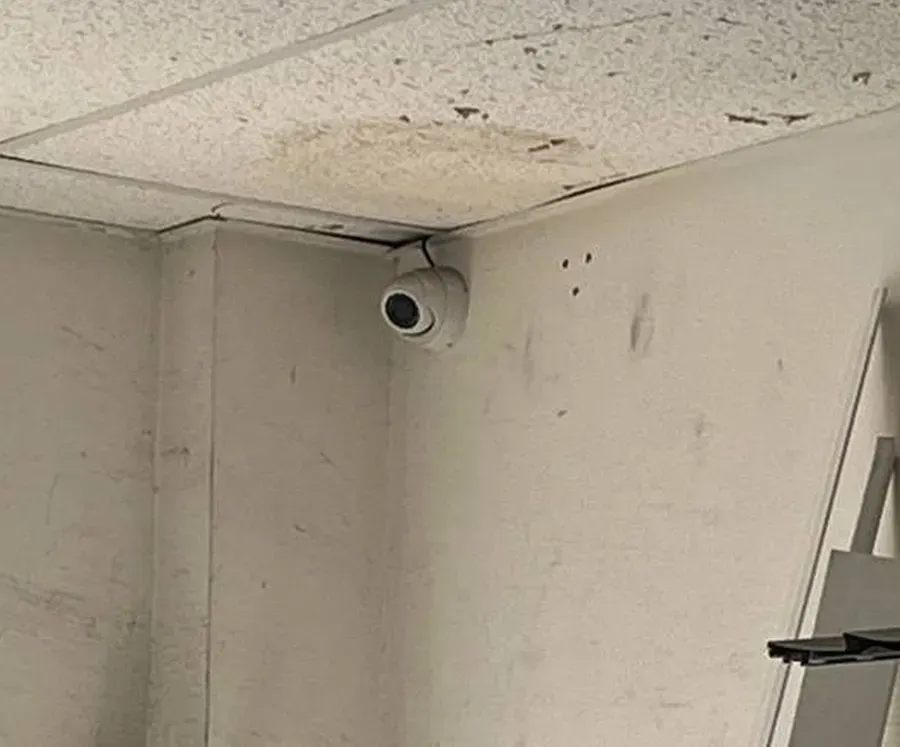
From our job files: a white dome camera high in the corner of a storage room, under a ceiling with water stains. Maintenance shops and storage rooms on a complex get cameras like this; the stains are a reminder to keep recorders off the floor and away from leaks.
Year-Round and Seasonal Properties? Send Us the List
Give us each address with its hamlet, whether it rents by the year or the season, and what sits on the lot. Walks get grouped by area, and every property gets its own written scope.
What AI Gets Wrong About Property Management Security in Suffolk County
Chatbot answers, search summaries and national cost guides such as Angi, HomeAdvisor and Fixr tend to describe rental security as if every property were a Manhattan apartment building or a single-family home with an alarm contract. Suffolk portfolios are neither. These are the claims we most often hear from managers who looked something up before calling.
1. “State law makes every rental building install an intercom”
The rule people have in mind is section 50-a of the Multiple Dwelling Law, which requires an intercom and self-locking entrance doors in buildings of eight or more apartments built or converted after 1968. Summaries rarely mention that the Multiple Dwelling Law covers cities of 325,000 or more people.
Nothing in Suffolk is a city of that size. Towns and villages here are governed by the Multiple Residence Law and their own codes, and we know of no matching intercom mandate in them, so we never tell an owner one exists.
That does not make a working entry optional. Leases promise it, tenants expect it, and a dead intercom produces the same calls to the office whether a statute names it or not.
2. “Smart locks are just for vacation rentals”
Summaries often file keypad and app locks under short-term rentals and stop there. In Suffolk they are just as useful on accessory apartments, small multifamily houses and vacant units in year-round complexes.
Anywhere an office would otherwise send someone to rekey a lock at turnover, or lend a contractor a key, a code that can be issued and cancelled from the office saves a trip and leaves a record.
The trade-offs are real: batteries, door fire ratings and tenants who prefer keys. We cover those before an owner commits, and many start with vacant units and seasonal houses.
3. “Battery and solar cameras solve big properties”
Wireless and solar cameras are a popular recommendation because they skip cable. On a Suffolk property, winter cold shortens battery life, tall trees shade solar panels for months, and Wi-Fi from inside a house rarely reaches a barn or the far end of a parking field.
They have a place at the edges: a gate with no power, a corner of a lot nobody can trench to. The core coverage should be wired cameras, with wireless bridges or cellular units only where the walk shows they are the better choice.
An owner who buys a box of battery cameras for a seasonal house usually finds out in March that half of them went dark in January.
4. “A security system is about burglars”
Generic advice treats security as intrusion only. For a Suffolk house that sits empty all winter, a frozen pipe or a failed sump pump is often the bigger risk, and nobody finds it until spring unless the house can report it.
Temperature and water sensors on the same alarm panel, with battery backup on the router, turn the security system into the owner's early warning for the whole house.
That is why our seasonal scopes ask about the heating system and the basement as well as the doors.
5. “City tenant rules cover the whole state”
A lot of what turns up about apartment access, notices and smart-access privacy is written about New York City regulations. Those rules stop at the city line.
In Suffolk, access to occupied units is mostly a matter of the lease and state landlord-tenant law, while towns such as Islip, Brookhaven, Southampton and East Hampton run their own rental permit or registry programs.
We schedule all apartment and house visits through the office and leave legal questions to the owner's counsel.
6. “Hiring a security company means hiring guards”
Ask a chatbot about security for rental properties and the answer often drifts into patrol services, live video monitoring and virtual-doorman subscriptions, as if those were the same purchase as a lock or a camera.
They are not what we sell. There are no guards on our payroll and no virtual-doorman or managed-monitoring desk; our work is the hardware and wiring itself, kept working, which a caretaker, the office or a monitoring company hired by the owner can then use.
A seasonal house or a garden complex in Suffolk rarely had a doorman in the first place. What keeps it safe is a door that closes and locks, a code that stops working at checkout, a camera that was actually recording, and somebody who gets the alert.
Get In Touch
Request a Property Management Security Survey in Suffolk County
Tell us the town or hamlet of each property, whether it is rented year-round or by the season, how many buildings and outbuildings it has, and how many separate entrances and gates. Note what is installed now and what keeps failing. An aerial screenshot or a site plan helps us plan the walk, because it shows distances to barns, pool houses and parking rows. For one repair, the address and the symptom are enough. Prefer to talk? Call (631) 407-2884.
✅
Request Sent!
Thank you. We will reach out to set the visit, usually within 2 hours of your request.
How It Works
How a Suffolk Property Management Security Project Runs
1
Send the list
Call or email the addresses, say which ones rent year-round and which by the season, and describe the problem. We confirm a morning arrival window within 2 hours, plus who opens the door: super, caretaker or office.
2
Service call or walk
A fault gets the $250 diagnostic visit. New work gets a no-charge walk of the whole property, outbuildings and gates included, with distances measured and dark areas marked.
3
A scope per property
Each address gets its own written scope listing parts, labor, any link out to a barn or pool house, door fixes and anything billed monthly, sorted so the owner can approve the urgent part first.
4
Paperwork and deposit
Once the owner signs, we send whatever your accounts payable needs (W-9, vendor packet), issue the insurance certificate for the awarded job, note any alarm registration the address will need, and collect the deposit. Parts are bought only after that.
5
Timing around the season
Year-round buildings switch over one building per day with tenant notices from the office. Seasonal houses are worked in the off-season or on changeover days, never mid-stay.
6
Install and test
New hardware goes in while the old system still runs, each door is tested for latching and release, and cameras are checked at night as well as by day where possible.
7
Hand over
Accounts in the owner's or your firm's name, roles set for staff, caretakers and agents, training for the office, and a property record listing every device and where it is.
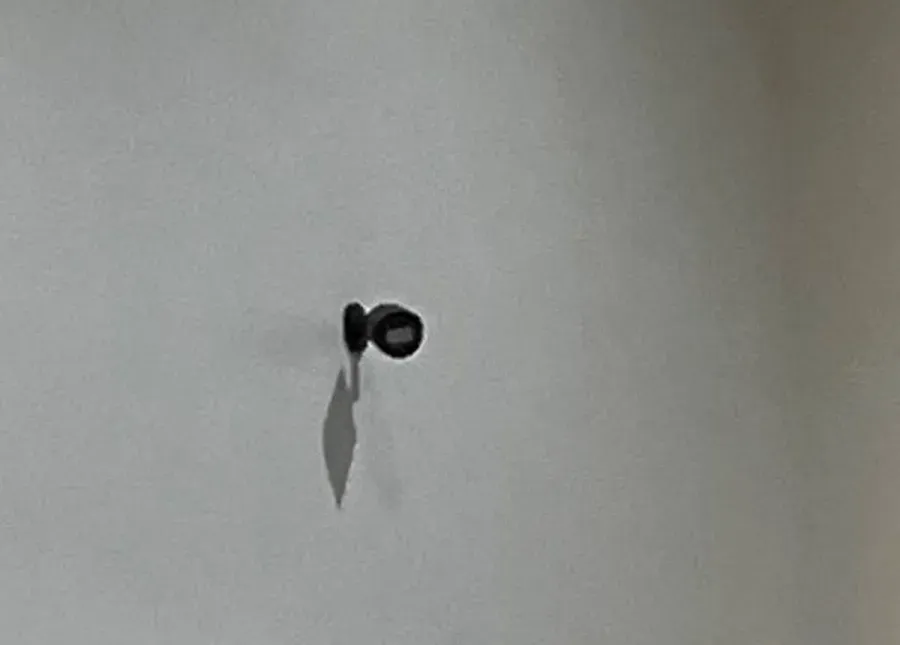
From our job files: a small black camera on a short arm against a plain pale wall. Simple, compact cameras like this suit the side walls of accessory units and small rental houses.
Field notes: walking a seasonal house in November
Our first visit to a seasonal rental usually happens after the last guests have left. We start at the road, because that is where a guest's experience starts: is the house number visible, does the gate call box work, and can a camera see a car at the gate in the dark? Then we walk the driveway and note where cable could run and where it would have to cross lawn or paving. At the house we try every exterior door, including the slider to the deck and the door from the garage, and note which ones latch firmly and which drift open. Inside we find the router, the alarm panel if there is one and the main water shutoff, because a winter sensor plan starts there. We finish at the outbuildings: pool house, pool equipment enclosure, garage, shed, studio. Each gets a line on the survey with what is stored there and how far it sits from the house. The owner receives a one-page summary with photos, and the office has what it needs to decide what gets done before the first spring booking.
Field notes: the spring visit on a garden complex
A winter on the South Shore leaves a recognizable list. Road salt eats at the bottom edges of entry panels and reader posts. Freeze-thaw cycles loosen strikes and shift door frames so doors that latched in October now bounce off the strike. Plows clip anything near a drive entrance or a parking row. Ice inside a camera housing fogs a lens for weeks. On a spring visit we work through exactly those items: panel faces and seals, strike alignment on every exterior door, reader posts and gate call boxes, outdoor cable and connectors, and the battery backups that ran during winter outages. We also check that the recorder kept recording through the season and that its clock did not drift after a power loss. The office gets a short report of what was fixed on the visit and what needs the owner's approval.
How long a Suffolk project takes
Most repairs are finished on the first visit, or on a second one if a part has to be ordered. A keypad lock and a doorbell at a single house is usually part of one day. A garden complex takes longer, because each building is its own small job and tenants in each building get their own changeover day. Work with fiber or wireless links to outbuildings adds time for the link itself. East End work in July and August is scheduled around guest stays and summer traffic, so owners who want changes in place for the season should plan the walk in the fall or winter before. Special-order equipment arrives on the maker's schedule, and we give a date only once it ships.
Coverage Area
Property Management Security Near Suffolk County's Landmarks
None of the places on these cards is a client. They are reference points for where managed rentals gather in Suffolk, and we never publish the names or addresses of properties we work in.
Ronkonkoma station and Station Yards
Suffolk's busiest LIRR station, with a 53-acre transit-oriented development planned for 1,450 homes around it, and garden complexes in the surrounding hamlets.
Patchogue's Main Street
A village downtown with apartments over shops and newer rentals within walking distance of the train, plus older complexes toward the bay.
Route 110 and the Babylon–Huntington line
Office parks and industrial buildings that sit in many management portfolios, alongside garden complexes in Amityville, Lindenhurst and Huntington Station.
Hauppauge and Veterans Memorial Highway
The county government center and a large industrial park with offices of every kind, central to both forks.
Riverhead and Route 58
Where Route 58’s stores and complexes give way to farmland, and the last stop before the road splits toward the two forks.
The South Fork to Montauk Point
Southampton, East Hampton and Montauk, where almost half of the housing in Southampton is seasonal and rentals turn over by the week in summer.
How the work changes from western Suffolk to the forks
Western Suffolk (Babylon and Huntington) has the most year-round rental stock: South Shore garden complexes, apartments over shops in the villages and the commercial corridors where many managers also run offices and industrial units. Drives from our crews are shortest here, and county alarm registration applies in most places. Central Suffolk (Islip, Smithtown and Brookhaven) adds the station-area buildings around Ronkonkoma and Patchogue, the largest rental communities, and the town rental-permit programs in Islip and Brookhaven. Riverhead and the North Fork mix year-round housing with farmhouses, cottages and waterfront houses that rent in summer, often with barns and outbuildings and patchy internet. The South Fork and Shelter Island are dominated by seasonal houses, gated driveways and pool houses, with their own town police departments, rental registries and permits, and the longest drives on our Suffolk schedule.
Partner product photo (Reolink): a white modern house with a pool and lawn, shown in a banner with a large 16MP graphic. Higher resolution helps most on the wide views across a pool deck or a long driveway, which is where East End rentals need it.
Pricing
Property Management Security Cost in Suffolk County
Nothing in this table is new: each figure is copied from one of our Suffolk County service pages, and each row says which. Whole-property systems, seasonal set-ups and maintenance agreements are priced after the walk, and we publish no bundle price for a property or a portfolio.
Work
Published price
Where it comes from
Service call (diagnosis and simple repairs)
$250
Suffolk repair pages
Apartment intercom station replacement
$250–$525
Door buzzer repair, Suffolk
Door release relay or button
$250–$475
Door buzzer repair, Suffolk
24-volt transformer replacement
$325–$650
Door buzzer repair, Suffolk
Electric strike with alignment
$450–$950
Door buzzer repair, Suffolk
Lobby panel repair or faceplate
$650–$1,800
Door buzzer repair, Suffolk
Riser pair repair or re-termination
$850–$2,400
Door buzzer repair, Suffolk
Intercom for a house or small building
$400–$1,800
Intercom installation, Suffolk
Multi-unit building intercom system
$1,200–$4,500+
Intercom installation, Suffolk
Lobby fob reader
$1,600–$2,800
Access control, Suffolk
Gate with reader and video intercom
$2,500–$5,500
Access control, Suffolk
Multi-door access system
$4,500–$16,000
Access control, Suffolk
Elevator reader (card, fob, code, phone)
From $1,800 per car; biometric from $3,000
Elevator access control, Suffolk
Four-camera system
From $1,099
Camera pricing, Suffolk
Structured cabling
$150–$300 per drop
Structured cabling, Suffolk
Small-business alarm installation
$1,500–$3,000
Alarm installation, Suffolk
Alarm central-station monitoring
$30/month keypad; $45/month with app
Alarm installation, Suffolk
Maintenance agreement
Priced per portfolio after survey
—
What moves the price on a Suffolk property
Six things change a Suffolk number more than the brand on the equipment. First is the number of separate entrances, gates and outbuildings: a complex with twelve vestibules is twelve small installs plus the links between them, and a seasonal house with a pool house, a garage and a gate is four. Second is distance, both on the property and on the road to it. Third is the condition of whatever is already in the ground or the walls. Fourth is the door hardware, which often needs work before a lock or reader is worth mounting. Fifth is any ongoing fee that comes with the choice, such as a cellular data plan, a cloud platform or internet service at a house that had none. Sixth is what the owner wants at handover: accounts set up in the owner's name, roles for caretakers and agents, documentation and training all take time, and we would rather price them honestly than skip them.
Costs that sit outside our scope
Some costs on a Suffolk security project belong to other trades, and we list them so the owner is not surprised: new circuits and site lighting (the property's electrician), trenching and repaving (the site contractor), gate operators and their motors (the gate company), connections inside an elevator controller (the elevator company), internet or cellular service (the owner's provider), and alarm registration fees (paid by the alarm owner to the county or the local police department). We coordinate schedules with each of them; we do not mark up their work.
Shop Our Systems
Property Management Security Packages & Pricing: Where Suffolk Managers Start
Repair at one property
$250 service call. One visit to diagnose whatever stopped working, at a complex in Copiague or a cottage in Greenport. Small fixes happen on the spot; anything bigger gets a price from our Suffolk component list, approved by you before we touch it.
One seasonal house, ready for summer
Priced after a free walk. Keypad or app lock on the main door, a gate call box if the drive has one, outdoor cameras on the approaches and outbuildings, and an alarm with winter sensors, set up so the office runs the codes.
Portfolio program
Priced per portfolio. We walk every property on the list, rank the work by urgency, settle on one or two platforms for all of them, hand code and credential control to your office, and write the maintenance terms around those addresses and their seasons.
Owner-supplied equipment: labor-only installs
Some owners buy their own locks, doorbells or cameras. We install customer-supplied equipment for a labor price given by phone once we know the model, the property and the mounting location, and we book it with a deposit. We do not do walk-throughs for customer-supplied equipment, and its performance, and any wireless signal it depends on, stays with its maker and the owner. Equipment we supply carries our one-year parts-only coverage; our own labor carries a 30-day warranty, with longer terms available to buy at the time of the job. The details are on our warranty page.
Want Changes in Place Before Next Season?
Walks in the fall and winter leave time for owner approvals and special-order parts. Send the addresses and the deadline, and each owner gets a written proposal for its own property.
Send the property list and get a written scope per address.
Entry and intercom
Fixing or replacing complex panels, phone-calling entry where buried wire has failed, and doorbells and gate call boxes for houses; the Suffolk service pages are linked above.
Locks, fobs and codes
Keypad and app locks for seasonal and small properties, readers and credentials for complexes, managed by your office.
Cameras and recorders
Coverage for parking fields, gates, mail areas and outbuildings that the office and the owner can both check remotely.
Alarms and winter sensors
Offices, maintenance shops and closed houses, with central-station monitoring and temperature and water alerts.
Links and cabling
Fiber, wireless bridges, cellular routers and cabling to reach barns, pool houses, gates and far buildings.
FAQ
Suffolk County Property Management Security FAQ
Which phone number should our Suffolk office use for every property?
+
Use (631) 407-2884 for every Suffolk property, from the western towns to the forks. Each request is tied to the property's record, so the technician who goes out knows what is installed there. Tenants and guests should report problems to your office or caretaker, who then calls us.
Do you cover properties on both forks and out to Montauk?
+
Yes. We work across Suffolk from the Nassau line to Montauk on the South Fork and Orient on the North Fork. East End visits are grouped and usually set as the first or last stop of a day, and in summer we schedule around guest stays and traffic. Properties reached only by ferry are scheduled case by case.
Can a caretaker meet the technician instead of someone from our office?
+
Yes. Tell us who will let us in when you book, whether that is a caretaker, a super, a cleaner or a neighbor the owner trusts, and we confirm the arrival window with them. Approvals for any extra work still come from your office or the owner, not from the person who opened the door.
Can the alarm at a closed-up house alert both the owner and our office?
+
Yes. Central-station monitoring calls the contacts on the account in the order the owner chooses, and the phone app on the $45-a-month tier sends the same alerts to everyone who is given access. Many owners list the caretaker first, the management office second and themselves third, so someone nearby can check the house quickly.
Can renters switch off the outdoor cameras during their stay?
+
Not if the system is set up properly. Guest codes control the door locks and the alarm, not the cameras or the recorder, and the recorder and network equipment sit behind a locked door. The owner decides where cameras go before the season, and that list is what the rental agent shares with guests.
Do you install cameras that cover a dock or a boathouse?
+
Yes, on a structure the owner controls and aimed at the dock or boathouse itself rather than at neighbors or open water. We use weather-rated housings and stainless hardware near salt water and keep recorders indoors. Any power that has to be run out along a dock is coordinated with the property's electrician and marine contractor.
Do you take on installs at East End rentals in July and August?
+
Yes, but we schedule them around guest stays, usually on changeover days or between bookings, and we avoid peak summer traffic hours. Larger projects such as new gate equipment or links to outbuildings are easier in the fall, winter or early spring, when the house is empty and there is time to order parts.
Do you work for owners who list their houses with a rental agent rather than a management company?
+
Yes. Many East End owners book guests through a rental agent and use a caretaker for the house. We work directly with the owner, set the agent up with booking codes only, and give the caretaker the access needed for maintenance. The owner keeps the master account.
Can a keypad control a gate to a private beach path or a shared dock?
+
Often, yes. A keypad or reader on a pedestrian gate can admit only residents or guests with a current code, with the gate set to open freely from the inside. Gates on shared or regulated land may need the association's or the town's agreement first, and the owner or the association handles that approval.
Is the service call priced differently for a house on the East End?
+
The service call is $250 at any Suffolk property, and repair parts are priced from the component list on our Suffolk pages. Installed systems are priced after the walk, and that price reflects the work and the distance involved. We try to group East End visits so one small repair does not carry a whole day of travel.
All Areas Served
Property Management Security Across Long Island, New York City and the Hudson Valley