Entry panel silent after a storm, pool reader dead before opening weekend or a recorder nobody can log into? Suffolk County condo boards and HOAs reach us at (631) 407-2884
For Suffolk County Condo Boards, HOAs, Seasonal Owners & Managing Agents · Served From Our Brooklyn Office
Condo Security Systems in Suffolk County
Intercoms · Readers · Pool & Clubhouse Locks · Outage Backup · Video
Condo security systems in Suffolk County begin with a $250 service call whenever an entry panel, fob reader, gate station, pool lock or camera recorder fails, while a new system for the whole association is priced line by line after a free on-site assessment. Abstract Enterprises Security Systems, licensed by New York State as a low-voltage contractor under #12000287431, plans, installs, repairs and supports the intercoms, access control, elevator readers and cameras that Suffolk condominium associations rely on, from townhouse rows off Route 110 and 55-and-over campuses in Brookhaven to harbor-village buildings on the North Shore and second-home condos on the East End.
Quick answer: Suffolk condos stretch across a county where the drive from one association to the next can take longer than the repair, many units sit empty for half the year, and coastal storms knock out power for days. A good plan answers three questions before it names any equipment: what keeps working when the power is out, what the board can change from a laptop without a truck coming out, and which doors matter in January versus July. Repairs start with the $250 visit, which covers the trip, the diagnosis and minor fixes and is credited if a larger repair follows. Building-wide intercom, fob and camera work is quoted in writing after we walk the property. We book every request within 2 hours, schedule seven days a week with visits early in the day, and work first come, first served once a job is paid.
Last updated November 26, 2026 · Written by the Abstract Enterprises Security Systems team, NYS license #12000287431 · Public sources: Suffolk County government (towns and villages list); Town of East Hampton housing market study (2023 data) and Town Code Chapter 199 rental registry; 27east census reporting; Town of Brookhaven Division of Fire Prevention permit requirements; Suffolk County News and Fire Island News reporting on Superstorm Sandy; MLS-based 55-plus condo community count (The DeVito Team); Phases & Spaces new-construction report (Nov 12, 2026); NY Real Property Law Article 9-B; NY Multiple Residence Law §3; NY General Business Law Article 6-D and §395-b
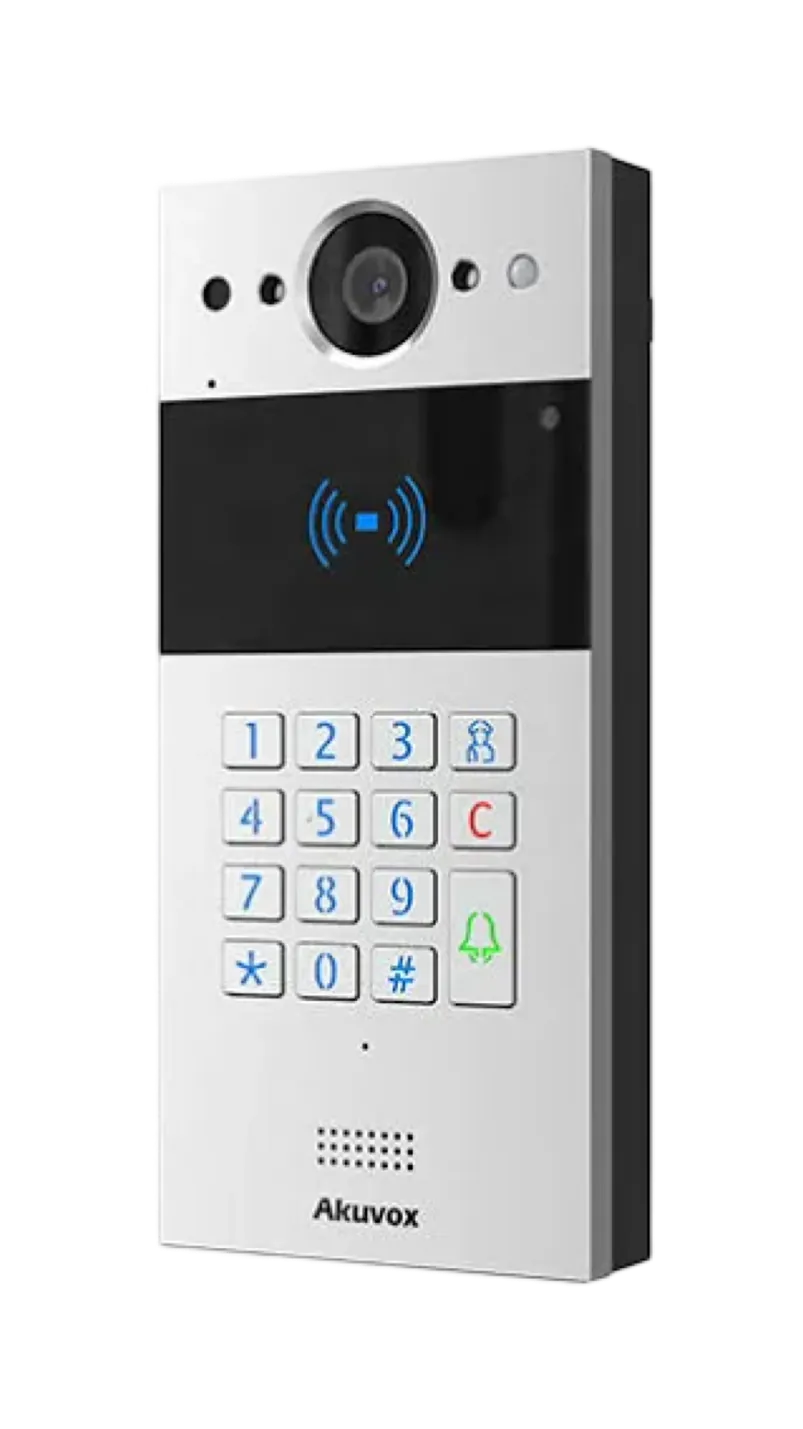
Manufacturer product photo of a steel entry station that combines a camera, a contactless reader and a keypad. On a Suffolk County condo, one unit like this can let owners in by fob, give the landscaper a seasonal code and show the visitor's face to whoever answers.
Suffolk County Condo Security Request
Board members, HOA officers, unit owners and managing agents
✅
Request Sent!
Thank you. We will call or text to set up the Suffolk County visit.
25+
Years Experience
2 Hr
Booking
$250
Service Call
4.7★
201 Google Reviews
Licensed contractor with crews out of Brooklyn · Every request booked within 2 hours · Seven-day scheduling · Phone or text (631) 407-2884
The Neighborhood
Why Suffolk County Condo Communities Need Security Built for Distance, Seasons and the Shoreline
Suffolk is the county where a condo board's security plan meets geography. An association in Huntington Station and one in Montauk share a county name and very little else: the first is a short hop off the Long Island Expressway with owners home every night, the second may be a two-hour drive from anywhere and half dark from October to May. Condominium security in Suffolk County has to be designed around that spread. The equipment is the same equipment we install in Brooklyn or Queens; what changes is how much the system can do on its own, how it rides out a storm and how often someone has to drive out to touch it.
The county's government lists ten towns, from Babylon and Huntington on the Nassau line to East Hampton, Southold and Shelter Island at the forks, and its own service directory counts 32 incorporated villages inside them. Each town runs its own building department, and in many places its own fire marshal's office as well, so the approval path for a gate pedestal in Smithtown is not the path for a condo inside a village such as Port Jefferson or Patchogue. Most condo security work needs no permit at all, but the parts that do, chiefly fire alarm work and anything that changes a site plan, follow the town or village where the condo stands.
What Suffolk condos look like on the ground
Very few Suffolk condominiums are towers. The typical one is a townhouse community: rows of two-story attached homes with their own front doors and garages, private roads, a clubhouse and a pool, governed by a condo board that often sits inside a larger homeowners' association. A second large group is the age-restricted community. A Suffolk real estate team that tracks MLS records counts 74 condo developments in the county whose listings show them as 55-and-over. Then come the smaller families of buildings: harbor-village condos in walking distance of a main street, converted inns and cottages on the East End, garden buildings near the South Shore bays and a handful of new elevator buildings near train stations.
New for-sale construction is arriving slowly. A Long Island brokerage's November 2026 review of public filings reports that the Town of Huntington created a Melville Town Center district along Maxess Road and Baylis Road in late 2024, that the town board approved a project there 4–1 in April with 110 condominiums in the plan as proposed, and that a 77-unit condominium in Port Jefferson is advertised for spring 2027. The same review notes that most recent building near Route 110 has been rentals or age-restricted communities. For security planning that means two things: older communities with aging equipment far outnumber new ones, and the new ones will reach their first board turnover within a few years.
Second homes change the security problem
On the East End, a large share of homes are not anyone's primary residence. The Town of East Hampton's own housing market study reports that of 44,227 housing units in its study area in 2023, 20,952, or 47 percent, were held for seasonal, recreational or occasional use, against 41 percent occupied by owners as a primary home. Reporting on census data in the East Hampton Press found the share of vacant homes in East Hampton Town rising from 58 to 60 percent over a decade. Condo associations from Westhampton to Montauk and on the North Fork live with the same pattern on a smaller scale.
An empty unit is not a security problem in itself. It becomes one when nobody notices a forced door for six weeks, when a frozen pipe floods two units below, or when the only person who knows the pool lock code winters in Florida. The systems that work best for seasonal condos are the ones that report problems to a phone instead of waiting for someone to walk by, and that let the board or managing agent change credentials and schedules from a distance.
Storms are a design input, not an afterthought
Suffolk's shoreline runs along the Sound, the Peconic bays, the Great South Bay and the ocean, and recent history shows what storms do to condo systems. Fire Island News, looking back ten years after Superstorm Sandy, described the storm damaging hundreds of the roughly 4,000 structures on the island. Suffolk County News, in its own ten-year retrospective for the South Shore communities it covers, reported that about 35 percent of homes there were still without power by the end of the storm's first week. A condo intercom that dies with the grid, a gate that will not open without power, or a recorder in a basement that floods takes the whole association's security down at the moment owners most need to get home and check on their property.
That is why every Suffolk proposal we write says plainly what happens in an outage: which doors fail locked and which fail open, how many hours the battery backup should carry the entry panel and readers, whether the gate can be opened by hand, where the controller and recorder sit relative to any level that has taken water, and how the system comes back once power returns.
Summer renters and the rules boards write about them
Many East End and South Shore condos allow owners to rent in season, within whatever their declaration and town code permit. The Town of East Hampton, for example, runs a rental registry under Chapter 199 of its Town Code, and a town press release from June 2022 describes the code as allowing a maximum of two short-term rentals of less than two weeks within a six-month period. We do not interpret those rules for any association. What we can do is give the board tools that match whatever rules it adopts: credentials for a renter that start and end on set dates, guest codes limited to the pool and the front door, and a record of which credential opened which door.
What Suffolk condo boards tell us is going wrong
The calls repeat. The entry panel at a townhouse row still dials owners' landlines and half of them disappeared years ago. The pool gate runs on a key that every summer renter has copied. The clubhouse fob list has former owners on it. The gate station went dark after a thunderstorm and nobody knows if the surge took the controller too. The cameras were installed by a developer, recorded to a box in the sales office that is now someone's storage room, and nobody has the password. Each of those can be fixed, usually without replacing everything at once, but each one is easier to prevent than to repair at the start of July.
Suffolk County condo facts that shape the work
Local government: ten towns and 32 incorporated villages (Suffolk County government directories), each with its own building department; fire prevention permits are issued by the town or village fire marshal.
Fire alarm permits: in the Town of Brookhaven, the Division of Fire Prevention takes permit applications for new or significantly altered fire detection systems through an online portal and requires the installer to hold a New York State fire alarm license or registration with the Department of State.
Age-restricted stock: 74 condo developments in Suffolk show as 55-and-over in MLS records, according to a local real estate team's count.
Seasonal homes: 47 percent of housing units in the East Hampton study area were held for seasonal, recreational or occasional use in 2023 (Town of East Hampton market study).
New condos: 110 condominiums in the Melville Town Center plan approved by the Huntington town board in April, and a 77-unit Port Jefferson condo advertised for spring 2027 (Phases & Spaces review of public filings, Nov 12, 2026).
Storm exposure: about 35 percent of homes in its South Shore coverage area still had no power at the end of Sandy's first week, per Suffolk County News's ten-year retrospective.
What the association owns: the statute's default list of common elements reaches parking, recreational facilities and "all apparatus and installations existing for common use", and a declaration can change it (Real Property Law §339-e).
State housing statute: Section 3 of the Multiple Residence Law extends it to "all towns and villages", so the city-only Multiple Dwelling Law has no reach here.
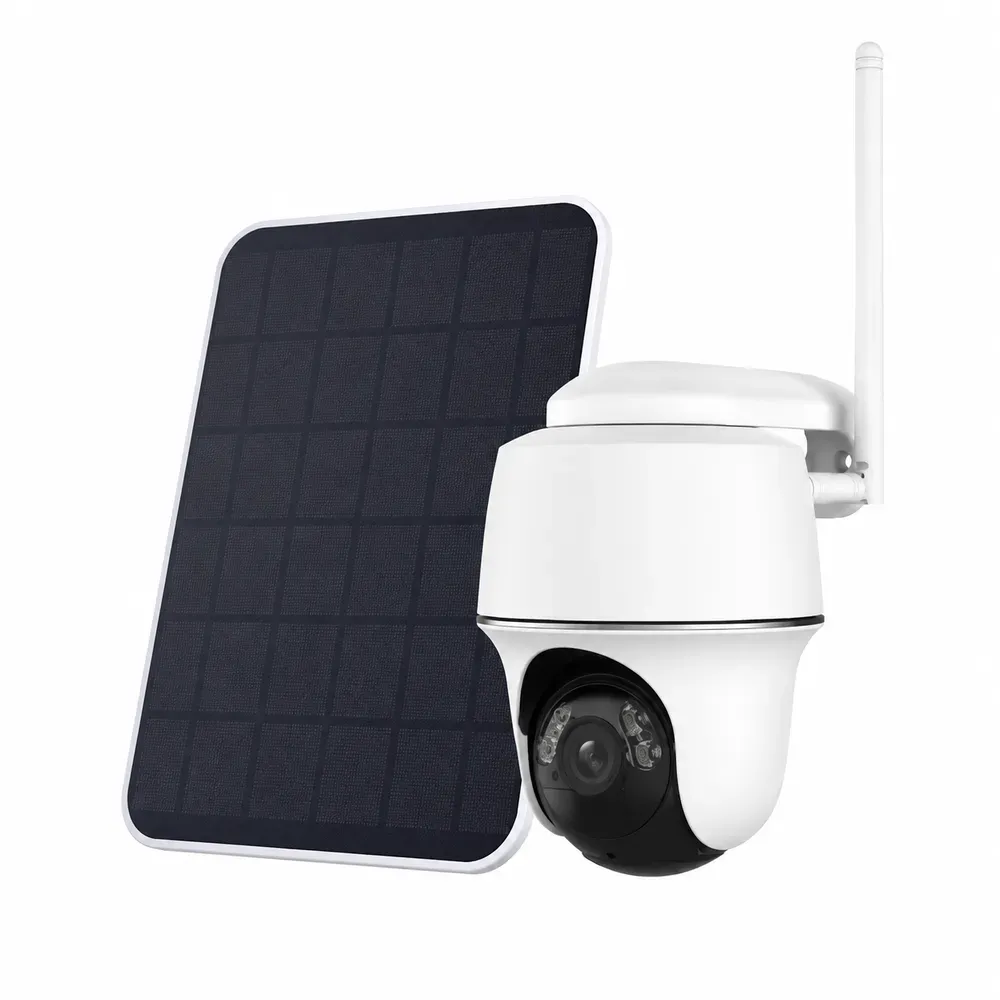
Manufacturer product photo of a pan-tilt camera with its own solar panel. On a spread-out Suffolk County condo, a unit like this can watch an overflow lot or a boat-trailer area where no cable runs, with the limits on winter sun explained in the FAQ below.
What We Install
Suffolk County Condo Security Services: Entries, Amenities, Power and Video
This page is written for condo boards, HOA officers and managing agents who need the whole picture before they pick a single device. Every heading below gives the condominium version of the question and then points to the Suffolk County service page that covers that work in detail. The crew is the same on every one of them, which matters on a large property: the technician who fixes your pool reader in June can be the one who plans next year's entry panel replacement.
1
Entry intercoms
Panels at townhouse rows, building doors and lobbies, with answering on indoor stations, phones or both.
2
Fobs and readers
A single tag per household that the board can point at any shared door, from the gym to the boat-trailer lot.
3
Gates and call stations
Driver-height call boxes at private roads, wired into whatever gate motor already works.
4
Remote administration
Credentials, schedules and alerts the board or agent manages from a browser, wherever they spend the winter.
5
Outage and storm planning
Battery backup, surge protection, equipment above flood levels and clear rules for how each door behaves without power.
6
Cameras and recording
Video of shared ground, from the front road to the mail kiosk, stored on a box the board holds the password to.
Condo intercom replacement and repair across a spread-out property
The intercom is where most Suffolk condo projects start, because it is the system owners touch every day and the one most likely to be decades old. In a townhouse community the "intercom" is often a row of small panels, one per building or per cluster of doors, each wired back to its own power supply with no central equipment at all. In a harbor-village or downtown building it is a lobby panel with a directory and a handset in each unit. Either way, a board eventually asks whether to keep repairing or to replace, and the answers depend on parts availability, the condition of the wiring in the walls and how owners want to answer the door. Our intercom installation work in Suffolk County covers the equipment side in detail; a separate condo intercom replacement guide for boards is in preparation.
Condo intercom modernization in Suffolk usually takes one of three routes. A like-for-like video panel can reuse the existing two-wire or multi-wire cable to every unit, so owners keep an indoor station and nobody opens a finished wall. A cloud-connected panel can ring owners' phones, which suits seasonal owners who are rarely home to answer an indoor station but brings a recurring platform fee and depends on a reliable internet connection at the building. A hybrid gives each owner the choice. When a board writes an RFP for a condo intercom upgrade, we suggest it ask every bidder the same things: what cable is reused, how an owner without a smartphone answers, what the yearly fees are and who pays them, who holds the administrator account, and how the old system stays live until the new one is tested.
Board or HOA approval comes before anything is ordered. Under New York's Condominium Act the bylaws decide how the board acts and what share of owners must agree to decisions that bind everyone, so a large intercom upgrade may need an owner vote in one association and a simple board resolution in another. We prepare the proposal so it can be read at a board meeting and circulated to owners as written, with each entrance, each piece of equipment and each price on its own line.
When the panel or a handset just needs fixing
Plenty of Suffolk intercom calls end with a repair, not a replacement. A whole row that went silent after a storm may have lost one power supply; a single owner who hears nothing may have a failed handset or a corroded splice at the building junction box. The $250 service call finds the fault and covers small fixes on the spot, and anything larger is priced before work starts. Our pages on intercom repair in Suffolk County and door buzzer repair for Suffolk buildings explain the common failures and the repair ranges in more depth.
One condition applies to every condo intercom repair: units on the same cable run usually share the fault, so the technician needs access to each affected unit during the same visit. In a community full of second homes, that means the managing agent arranges keys or an owner's representative before the visit is booked. A repair that can reach two of five silent units cannot be closed out, and the remaining units would need a second trip.
Key fobs and readers that the board controls
Condo access control in Suffolk is mostly about amenities. The clubhouse, the pool, the fitness room, a tennis or pickleball enclosure, a boat-trailer lot and the maintenance garage all need a lock that owners can open and outsiders cannot, and in a community where units change hands or rent for the summer, a metal key fails that test within a season. A single access platform gives each household one credential, lets the board decide which doors and hours apply to whom, and keeps a record of every opening. Details, equipment options and Suffolk price ranges are on our access control installation page for Suffolk County.
The feature that matters most for Suffolk associations is remote administration. A board treasurer in Florida or a managing agent in Hauppauge can add a buyer, suspend a renter's fob at the end of a lease, change pool hours for a heat wave or lock the clubhouse for a storm from a browser, without a technician driving out. We set up the administrator accounts in the association's name, train whoever will run them, and document every login in writing.
Elevator readers in the newer buildings
Most Suffolk condos have no elevators, but the mid-rise buildings near village downtowns and the new projects near train stations do. A reader in the car limits each fob to the owner's floor plus shared floors such as the lobby and garage, and the elevator maintenance company handles its own connection. Our Suffolk County elevator access control page explains the levels and per-car pricing.
Pools, clubhouses and amenity schedules
The pool season is short and busy, and it is when most amenity complaints reach the board. Readers on the pool gate and clubhouse doors let the association open the pool only during posted hours, give lifeguard and pool company staff their own limited credentials, and shut everything with one command for a thunderstorm or a chemical treatment. The pool gate's self-closing, self-latching hardware stays in place; the reader and electrified lock are added beside it. Clubhouse rooms can follow different schedules: a fitness room that opens at dawn, a party room that opens only for the owner who reserved it, an office that only staff can enter.
Package deliveries in a community of front stoops
Townhouse condos rarely have a package room, so deliveries land on dozens of separate stoops and porches. Some associations add a parcel area or smart lockers at the clubhouse or mail kiosk; when they do, we install the door control, the network connection and a camera at the entrance, and we integrate with the locker provider the association chooses rather than selling lockers ourselves.
Condo security cameras, briefly
Cameras have a short section here on purpose, because condo camera work has its own page coming for condo security camera installation in Suffolk County. For multifamily camera systems now, see our page on apartment building security camera installation in Suffolk County. The order we suggest to boards: entrances and the mail kiosk first, then the clubhouse and pool doors, then lots and paths. Record on a recorder the association owns, kept in a locked closet on battery backup, and decide in writing who may view and export footage.
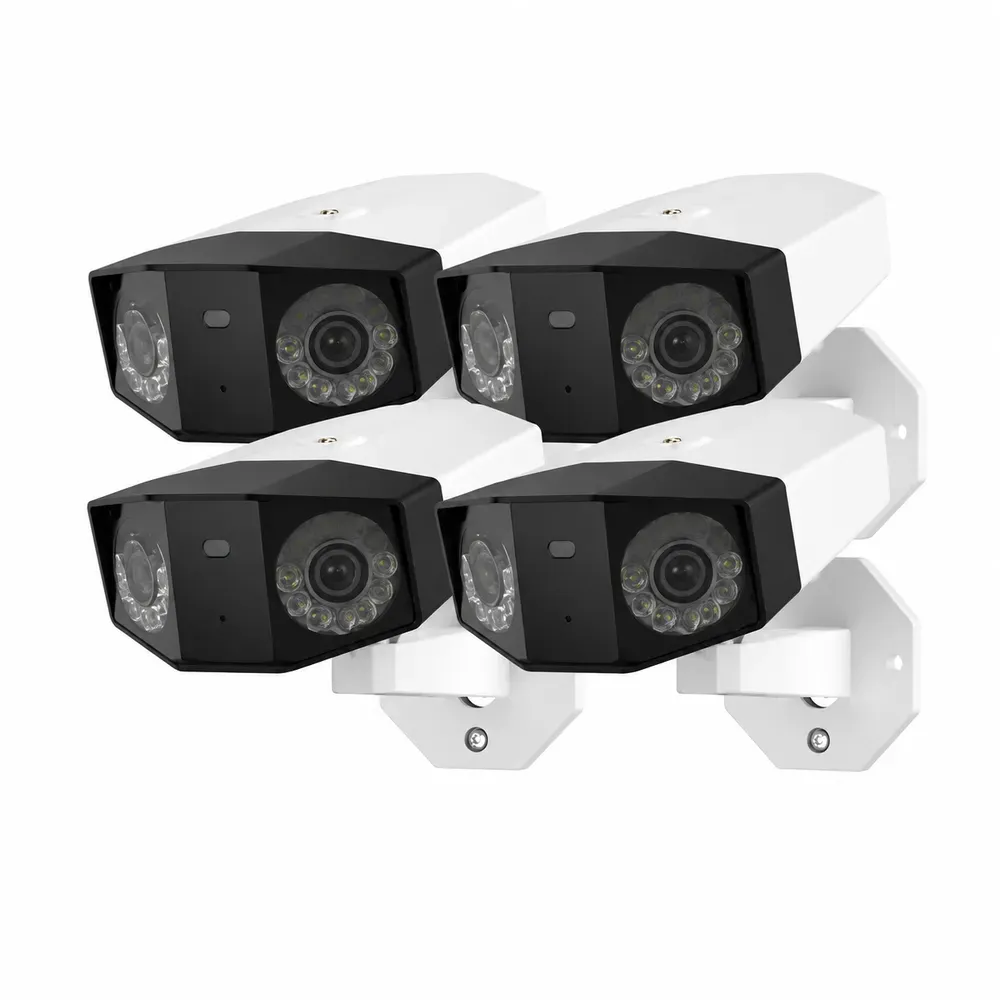
Manufacturer product photo of four dual-lens bullet cameras on wall brackets. A wide two-lens view suits the long, shallow parking courts in front of Suffolk County townhouse rows, where one camera has to see several driveways at once.
Alarms for owners and second homes
An alarm inside a unit is the owner's own system and a private agreement between that owner and us, separate from the association's equipment. For seasonal owners it can do more than detect a break-in: the same panel can carry water-leak and low-temperature sensors that report to the owner's phone. Central station monitoring through our provider is $30 a month with a keypad or $45 a month with the phone app. Our alarm installation page for Suffolk County explains equipment and monitoring for individual homes.
Fire alarm work in Suffolk condos
Suffolk is inside our fire alarm service area. Condo fire alarm work follows engineer- or architect-prepared drawings and the permit and inspection process of the town or village fire marshal where the building stands; in Brookhaven, for example, the Division of Fire Prevention takes those applications online and requires a state-licensed or registered fire alarm installer. The full process is explained on our page on fire alarm installation in Suffolk County. Fire alarm work is quoted per building after the drawings exist; we do not publish fire alarm prices.
Cable, network and power across a campus
Suffolk properties are wide, and the cable between buildings is often the most expensive part of a project. Where conduit exists under lawns and drives we reuse it; where it does not, a point-to-point wireless link from building to building can avoid trenching through landscaping or wetland buffers. Security devices belong on their own network, separated from owners' internet service, with a managed switch, surge protection on every outdoor run and a battery that keeps the network alive as long as the readers it serves. Our network installation services in Suffolk County cover the cabling side. Any new high-voltage circuit is the building's electrician's work; we do not do electrical work.
Patrols, guard services and virtual doorman offers
Some Suffolk communities hire a patrol company, a few staff a gatehouse, and boards are increasingly pitched remote concierge or "virtual doorman" subscriptions. We provide none of those services. We install the entry panels, readers, cameras and booth equipment that patrols, gate staff or a remote provider would use, and we connect to a provider the association already has. A board comparing those services against equipment should know that the equipment keeps working whether or not the service contract is renewed.
Seasonal maintenance visits
Associations that would rather prevent failures than react to them can book two visits a year: one in spring before the pool opens and owners return, one in fall before the first storms. We test every reader, lock and battery, check recorder drives and storage, update firmware, clean camera housings, confirm surge protectors are intact, and review the credential list with the board. Support calls on systems we installed are free, and our camera maintenance service in Suffolk County covers recurring video upkeep.
Condo or co-op: a different audience, a separate page
Suffolk has cooperatives as well as condominiums, especially garden complexes along the South Shore. A co-op board answers to shareholders under a proprietary lease, a condo board to unit owners under a declaration and bylaws, and the approvals, budgets and responsibilities differ. Boards of cooperatives should read our page on co-op security systems in Suffolk County.
Who calls us
Condo boards of managers, HOA boards that sit above several condo regimes, managing agents and property management firms, resident superintendents, sponsors during construction and turnover, and individual owners who want something for their own unit. We take the work order from whoever signs it, coordinate access and insurance with the managing agent, and give the board every administrator credential in writing at handover.
Building Specialists
Condo Security for Suffolk County's Architecture: Six Kinds of Condo Property
The building type decides where cable can travel, where the equipment closet ends up, how much of the budget goes into the ground between buildings and which devices face weather. These are the six we meet most often across the county.
A
Townhouse rows off the expressway
Attached two-story homes with private entries and garages along Route 110, Route 347 and the LIE corridor; the association owns the roads and amenities.
B
Age-restricted campuses
Large 55-and-over condos with a clubhouse at the center, indoor and outdoor pools and dozens of buildings on loop roads.
C
Harbor-village buildings
Smaller condos near the main streets of North Shore villages, often with a shared entry, stairs and a small lot.
D
East End second-home condos
Cottage clusters, converted inns and resort-style buildings where most owners arrive in May and leave after Labor Day.
E
Bay-front garden condos
Low buildings near the Great South Bay and the canals, exposed to wind, salt and the occasional tidal flood.
F
Downtown and station-area buildings
New or converted elevator buildings with a lobby, a garage and sometimes stores at street level.
Townhouse rows: the association's systems live at the edges
In a townhouse condo every owner has a front door, and many have an attached garage, so there is no lobby to protect. The association's security sits where owners share space: the community entrance, visitor parking, the clubhouse, the pool, the mail kiosk and any storage or maintenance building. Owners add their own doorbells and cameras within whatever the rules allow. Our job for the board is the shared layer, and the most useful single change in many of these communities is replacing keyed amenity doors with readers tied to one owner list.
Cable is the cost driver. Townhouse communities from the 1980s often have direct-buried low-voltage cable from the clubhouse to the pool and to any old entry station, and some of it has been nicked by every irrigation repair since. We test what exists before we price anything. Where it is sound, we reuse it; where it is not, we compare new conduit against a wireless link and show the board both numbers.
Age-restricted campuses: one clubhouse, many doors, residents home all day
The 55-and-over communities are some of the largest condo properties in the county, and unlike the East End they are full most of the year. The clubhouse is the hub: library, card rooms, fitness center, indoor pool, ballroom and management office under one roof, each with its own hours. That makes a scheduled access platform worth more here than almost anywhere, since one credential can open the fitness room at six in the morning, the card room at noon and nothing after the building closes. These communities also tend to have the oldest original intercoms and the most residents who prefer an indoor station to an app, so we plan for both.
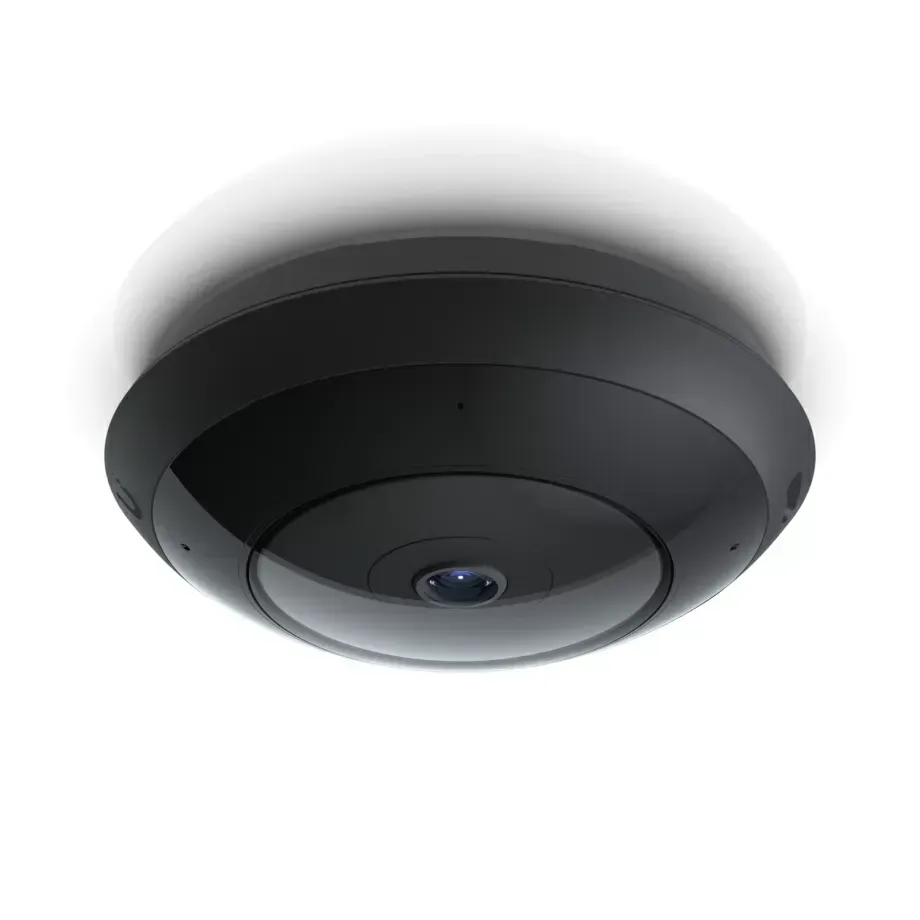
Manufacturer product photo of a black fisheye camera for ceilings. A Suffolk County condo ballroom or card room can be covered end to end by one of these at the center of the ceiling.
Harbor-village buildings: small boards, historic streets
Northport, Port Jefferson, Huntington village, Sag Harbor and Greenport all have small condo buildings within a few blocks of the water and the main street. They run on volunteer boards, sometimes without a managing agent, and they need simple, dependable equipment: an entry panel that works, readers on the front and back doors, a camera on the entry and the mail area. Several of these villages have architectural review or historic district rules for anything mounted on a facade, so we propose devices that are small, finished to match and mounted where they are least visible from the street, and the board confirms with its village before installation.
East End second-home condos: built to run unattended
From Westhampton Beach to Montauk and along the North Fork, condo communities fill in summer and empty in fall. Security for them is mostly about the months nobody is there. Cloud-managed access lets the board keep doors locked and still let in the plumber or the insurance adjuster with a one-day code. Cameras should send alerts for activity at times the property should be quiet, and the recorder and network need enough battery to report an outage rather than simply go dark. Inside the units, owners who want it can add leak and temperature sensors to their own alarm panels so a burst pipe in February is a phone alert instead of a spring surprise.
Some East End condos operate like small resorts, with a front desk that handles rentals for owners who opt in. For those, the desk becomes an administrator on the access system with permissions limited to issuing and ending guest credentials, while the board keeps control of everything else.
Bay-front garden condos: weather is the enemy of every outdoor device
Condos along the Great South Bay and the canals of Babylon, Islip and Brookhaven towns take salt air, wind-driven rain and, in the worst storms, water at ground level. Outdoor panels, readers and cameras should carry ratings for that exposure, with stainless or coated housings and sealed cable entries. Controllers, recorders and network switches belong high in a building, not in a ground-floor utility closet, and every outdoor run should pass through surge protection before it reaches the equipment indoors.
Downtown and station-area buildings: a city building with a parking lot
The newer condos near Long Island Rail Road stations and in the revived downtowns look much like buildings in Queens: concrete or steel, an elevator, a lobby with an entry panel and a garage. The security plan resembles one, too, with a lobby panel, a reader on every door between garage and lobby, elevator floor control and cameras at entrances and the package area. The difference is that residents arrive by car far more often, so the garage-to-lobby door does more work than the street door.
Materials and methods by property type
Wood-frame townhouses: cable through attics, basements and garages rather than finished living space; we leave patching and painting to the association's contractor.
Shingle and clapboard exteriors: each outdoor device sits on a purpose-made base that bridges the uneven shingles, with the cable hole caulked from the top down.
Masonry and poured concrete: we look for unused pipe sleeves before drilling anything, and any new core hole waits for written sign-off from the board.
Far-flung buildings: copper data cable tops out near 100 meters, so the pool house at the back of a property usually gets glass fiber or a rooftop radio pair.
Wetland and bluff areas: wireless links where town permits make trenching slow or impractical.
Salt exposure: stainless hardware, sealed connectors and housings rated for the coast.
Commercial Condo Security
Office Condos, Front Desks and Clubhouses: Business Condo Security in Suffolk County
Some of Suffolk's condominiums are not homes at all, and some residential ones run businesses inside their gates. Both need security that treats different owners and staff differently.
Office and industrial condos
Office and flex-space condominiums sit along the Route 110 corridor, around the Hauppauge industrial area and near Ronkonkoma. Each unit owner runs its own business, but the association controls the shared entrances, corridors, parking and loading areas. The design rule is simple: every owner's staff reaches the common doors during business hours and its own suite at any hour, and nobody else's. Each suite can have its own reader on the same platform, with the association administering the common doors and each owner managing its own staff list. Camera permissions follow the same split.
Resort condos with a front desk
Where an East End condo runs a rental desk, the desk issues credentials to guests, the housekeeping and maintenance staff need access to units on a schedule, and owners who do not rent want their units excluded entirely. A single platform with role-based permissions handles that: the desk issues guest credentials only for units enrolled in the rental program, housekeeping credentials open common doors during working hours, and the board retains administrator control. Unit locks themselves may be a separate system, which we coordinate with rather than replace.
The clubhouse as a workplace
A large condo clubhouse has a management office with owner records, staff, vendors, events and sometimes a cafe or bar run by a concessionaire. It needs an intrusion alarm with separate staff codes, a reader on the staff entrance, cameras at the entrances and front desk, and a schedule that opens event rooms only when they are booked. Locker rooms, restrooms and showers are off limits to cameras; New York's General Business Law §395-b prohibits knowingly allowing devices that secretly view those spaces. Cameras go at the entrances to those rooms, never inside.
Landscapers, pool companies and the seasonal workforce
Suffolk condos depend on contractors who change with the seasons: landscapers and pool crews in summer, plow contractors in winter, painters and roofers in between. Each should have its own credential or code limited to the doors, gates and days it needs, created by the managing agent and set to expire. Shared codes that never change are the most common gap we find, and closing it costs almost nothing once readers are in.
Lots, trailer storage and maintenance yards
Car break-ins, catalytic converter theft and stolen equipment from a maintenance garage are the complaints we hear most from larger Suffolk communities. Lighting comes first, then a camera at each entrance to a lot rather than one camera trying to see everything. A maintenance yard holding mowers, utility carts and fuel deserves a reader on its gate, a camera on the gate and the garage door, and an alarm contact on the building.
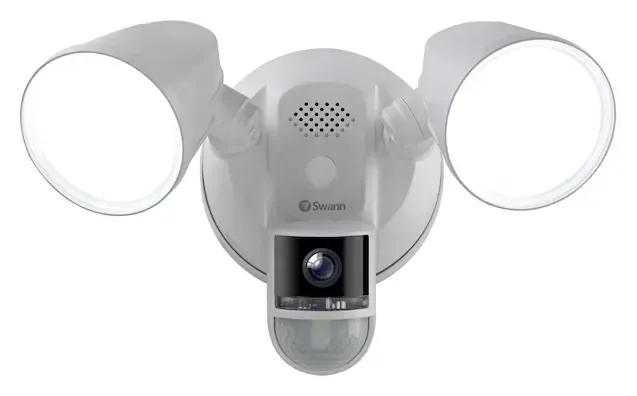
Manufacturer product photo of a twin-ring floodlight camera with a motion sensor. Above a Suffolk County condo maintenance garage, the sudden light tells a would-be thief they have been seen and lets the lens catch a usable image.
Compliance callouts for Suffolk County condo security work
Condominium law: Real Property Law Article 9-B defines common elements (§339-e) and sets out what the bylaws must cover, including the board's powers, how owners adopt binding decisions and optional reserves "for major and minor maintenance, repairs, additions, improvements, replacements" (§339-v). The declaration and bylaws control the specifics.
City rules stay in the city: intercom mandates and the smart-access privacy law written for the five boroughs have no force on a condo out here; state statutes and town codes are what count.
Licensing: General Business Law Article 6-D requires a Department of State license to install or service security or fire alarm systems; ours is #12000287431.
Fire alarm permits: issued by the town or village fire marshal; Brookhaven's Division of Fire Prevention requires a NYS fire alarm license or registration for new fire detection installations.
Camera placement limits: state law bars knowingly allowing hidden viewing devices where people undress or bathe, such as clubhouse locker rooms (General Business Law §395-b).
Rentals: town codes such as East Hampton's Chapter 199 rental registry regulate rentals; the association's own rules sit on top. Access settings follow whatever the board adopts.
Free exit: a powered lock may never trap someone inside; the push bar, motion sensor or button that releases it is reviewed with the local code official and tied to the fire alarm where one exists.
Certificates: our insurer lists the association and its agent as certificate holders once the board awards the work; a bid reply does not include one.
We are a security contractor, not a law firm. Treat the list above as a pointer to the sources, and have counsel or the code enforcement office confirm anything your board relies on.
Your Questions Answered
Condo Security Systems in Suffolk County: Questions Answered
Every question below came up on a Suffolk walkthrough or a call from a board, an agent or an owner. Read the first paragraph for the answer; the second explains why.
Distance and owners who aren't there
Our condo is near the end of the North Fork. Can a problem be diagnosed before anyone drives out?
Often, yes. Send a photo of the panel, reader or recorder screen and a short description, and on cloud-managed equipment we can usually log in and check status, error logs and device connections remotely. That tells us whether the visit needs a part, a different technician or no trip at all.
Some faults can only be found on site, such as a cut cable or a burned door strike, and those still begin with the $250 service call. The point of a remote look is to make sure the truck that does come out carries the right part, so a long drive ends in a repair rather than a second appointment. Newer systems we install are set up so the association can grant us temporary remote access for exactly this.
Most of our units are second homes. Can an owner's alarm warn them about a leak or a cold unit over the winter?
Yes. An owner's alarm panel can carry water sensors near the water heater and under sinks and a low-temperature sensor near exposed plumbing, and those report to the owner's phone just as a door alarm would. With central station monitoring, the station can call the owner's chosen contact as well.
This is the owner's own system and contract, separate from anything the association installs. Boards sometimes encourage it in their winterization notices because one burst pipe in an empty townhouse can damage the units beside it. We set the sensors where the owner's plumber recommends and test each one before we leave.
Owners leave keys in a lockbox for cleaners and contractors while they are away. What should replace that?
A keypad or app-controlled lock on the unit door, with a separate code for each cleaner or contractor that can be limited to certain days and turned off remotely. The owner sees in an app which code opened the door and when, which no lockbox can tell them.
Whether an owner may change the lock on a unit door depends on the declaration and the board's rules, since some associations need a master key or emergency access. We install the lock the owner chooses within those rules and, where the association's own readers cover the building door, the contractor gets a matching temporary credential from the managing agent. Our smart lock installation in Suffolk County page covers the lock side.
Storms, outages and lightning
Should outdoor entry panels and cameras come down before a hurricane?
No. Properly rated outdoor panels, readers and cameras stay mounted; taking them down and putting them back costs more than the risk and leaves the property blind during the storm. The preparation that matters happens indoors and on the network.
Before a named storm, confirm the battery backups are charged, move anything stored on the floor of the equipment closet, and make sure the board knows how to open the gate by hand and which doors will unlock if the batteries run out. After the storm we check every outdoor device for water entry and damaged mounts, reset what tripped, and replace any surge protector that sacrificed itself. A board can book that check in advance so it is on the schedule as soon as roads are open.
How long should the batteries keep our entry panels and readers running when the power goes out?
Long enough to cover the outages the property has actually had, or until a generator takes over if the association has one. For most Suffolk condos that means sizing in hours for the entry panels, controllers and network switch, with the recorder and cameras on a separate battery so video does not drain the doors.
Battery capacity is a trade-off between cost, closet space and the number of devices it feeds, so we list each battery, what it powers and its expected run time in the proposal. If the board has a standby generator, its electrician handles the circuit connection and we size the batteries to bridge the seconds or minutes before it starts. Batteries lose capacity with age, which is why they get tested on every maintenance visit.
Lightning hit near our entrance and took out the call station and a camera. Can surge protection prevent a repeat?
It reduces the risk considerably. Surge protectors on every outdoor cable where it enters a building, a solid ground for the equipment and fiber or wireless links between buildings in place of long copper runs all limit how far a strike's energy travels.
No protection makes equipment immune to a direct strike, and lightning and power-surge damage is excluded from our warranty coverage, so the goal is to keep a nearby strike from taking out the controller and recorder along with the device that was hit. We price the protection as its own line so the board can see what it costs against the equipment it guards.
Seasons and the summer rush
How far ahead should we book pool gate and clubhouse access work before the season opens?
Plan the work in winter and have the order placed by early spring. Readers and locks for a pool gate are quick to install, but some panels and controllers are special order and arrive when the maker ships them, and the weeks before Memorial Day are the busiest of the year.
The sequence that works: the board approves the proposal at a winter meeting, the deposit is paid, equipment is ordered, and installation is scheduled once it arrives, with credentials handed out before opening weekend. A board that waits until the pool company is filling the pool is often choosing between a rushed install and another summer on keys.
Our entrance faces west. Why are evening clips from the gate camera washed out, and what fixes it?
A camera pointed toward the setting sun is fighting glare it cannot fully overcome. The fix is a combination of aiming the camera so the sun is not in the frame, choosing a model with strong wide dynamic range, adding a sun hood and, where possible, a second camera that looks back from the opposite side.
For identification at a gate, the best results usually come from a camera placed past the gate and looking back toward the arriving car, so the sun is behind the camera at the hour that matters. We set the position during a site visit at the time of day the problem happens.
Manufacturer product photo of a bullet camera with a built-in sun hood. At a Suffolk County condo entrance that faces the evening sun, the hood and careful aiming keep plates and faces readable at the hour glare is worst.
Bugs and spider webs keep blurring our cameras on summer nights. Is something wrong with them?
Usually not. Infrared illuminators on many cameras attract insects, and spiders build webs where insects gather, which produces blurry images and endless motion alerts on warm nights near water and woods. The cure is maintenance and placement, not new cameras.
Regular cleaning of the housings during the summer, cameras that use visible white light in place of infrared where lighting allows, and mounting points away from porch lights all reduce the problem. On our seasonal maintenance visits we clean every housing and adjust motion zones so a moth crossing the lens does not count as an event.
Property types and practical layouts
Our condo rents units for owners through a front desk. Can the desk issue access for each stay?
Yes. The desk can be given a limited administrator role on the access platform that lets it issue a guest credential for an enrolled unit with start and end dates, and nothing more. The credential stops working at checkout without anyone remembering to cancel it.
The board keeps full control of permissions, schedules and owner records, and owners who do not participate in the rental program can be excluded from the desk's view. If the units themselves have a separate hotel-style lock system, we coordinate the common-door credentials with it rather than replacing it.
Our maintenance yard holds mowers, utility carts and fuel. What is the best way to secure it?
A reader on the yard gate and garage door with credentials for maintenance staff only, a camera on each, and an alarm contact on the building that alerts the managing agent outside working hours. Lighting at the gate makes all three work better.
Equipment theft from condo yards tends to happen at night and off season, when nobody is watching the back of the property. A log of who opened the gate also helps the board settle disputes with contractors over missing tools or fuel.
Approvals, budgets and agents
Who designs and files the plans when a Suffolk condo replaces its fire alarm?
A licensed engineer or architect prepares the drawings, and the permit application goes to the fire marshal of the town or village where the building stands, filed with the installer's state fire alarm license or registration. The installer then builds to the approved drawings and the fire marshal inspects before acceptance.
The board's first step is hiring the designer, not the installer, and we can work from drawings the association already has. Where the fire alarm releases fob-controlled doors, we coordinate that interface so the access system and the fire alarm behave as the approved drawings require. We quote fire alarm work only after drawings exist.
The access log shows an owner's fob opening the pool while they were out of state. What happened?
Almost always one of two things: the owner lent the fob or a spare to someone, or the fob is an older proximity type that someone copied. Either way the fix is the same: suspend that credential, issue a new one and, if the community still uses 125 kHz fobs, plan the move to encrypted credentials.
The log is doing its job when it catches this. Boards that want to act on it should have a written rule on lending credentials and on how many each unit may hold, and the managing agent can pull a report of credentials used while their owners are known to be away. We help set up those reports; enforcing the rule is the board's decision.
Our managing agent runs several condos in the same town. Can visits be grouped to save trip time?
Yes. When an agent sends requests for several properties close together, we try to book them on the same day in consecutive two-hour arrival windows, each with its own work order and invoice for its own association.
Each association still pays only for its own work, and urgent faults are never held back to wait for a group. Grouping works best for maintenance visits and assessments, which can be planned weeks ahead.
Equipment
Types of Condo Security Equipment We Install in Suffolk County
1
Entry panels and call stations
Video panels with directories, keypads and readers for building doors, lobbies, gates and amenity entrances.
2
Indoor stations and apps
Wall monitors for owners who want one, phone answering for owners who travel, both on one system.
3
Readers and credentials
Encrypted tags owners can't duplicate, phone passes, dated codes for trades and vehicle stickers for the gate lane.
4
Locks and door hardware
Strikes in wood frames, mag locks on glass doors and the push bars that keep exits free.
5
Cameras and recorders
Outdoor and indoor cameras, deterrence models with lights and audio, and recorders the association owns.
6
Power and protection
Batteries rated in hours, surge arrestors where cable enters a building, and a switch the board's network can't interfere with.
Choosing equipment for Suffolk's conditions
Condition
What to specify
Why it matters here
Salt air near bays and ocean
Stainless or coated housings, sealed connectors
Corrosion shortens the life of ordinary outdoor hardware near the water
Grid outages after storms
Batteries sized in hours, not minutes; clear fail-safe or fail-secure choice per door
Owners still need to get in when the power has been out for days
Thunderstorms and lightning
Surge protection at every building entry, solid grounding, fiber or wireless between buildings
Long copper runs across open ground carry surges into controllers
Owners away for months
Cloud-managed access and alerts, remote support access
Problems are reported instead of discovered in spring
Long distances between buildings
Fiber, intermediate switches or point-to-point wireless
Standard network cable stops at about 100 meters
Evening sun and dark lots
Wide dynamic range, sun hoods, color low-light cameras
Gate and lot footage has to identify cars and people at the hours incidents happen
Credentials: what works for owners, renters and contractors
Owners get an encrypted fob or card, a phone credential or both. Older 125 kHz proximity fobs can be copied by inexpensive devices, so any Suffolk condo replacing a reader platform should move to encrypted credentials at the same time. Renters and guests get credentials with start and end dates. Contractors get keypad codes or credentials limited to the doors and days their work requires. Vehicles at a gated entrance can use long-range windshield tags, which are tied to one car and harder to share than a handheld remote.
Locks, gates and pool hardware
Building doors usually take an electric strike in the frame; glass and aluminum doors in newer buildings often take a magnetic lock with a motion sensor or button for free exit. Pool gates keep their self-closing hinges and self-latching hardware, and we add the reader and an electrified lock beside them. At gated entrances we connect the access controller to the existing gate operator wherever the operator is in good condition, so a new entry system does not mean a new gate.
Manufacturer product photo of a pan-tilt camera with red and blue warning lights. At a Suffolk County condo pool after closing, a camera like this can flash its lights and play a recorded warning when someone climbs the fence, without anyone watching live.
Deterrence cameras and recorded warnings
Some current cameras can switch on a light, flash red and blue LEDs and play a recorded message when they detect a person in a defined zone during set hours. For a pool after closing, a beach-access path at night or a dumpster area, that often stops the problem without anyone watching live. These are automatic responses programmed into the camera; they are not a monitoring service, and the board decides the zones, hours and message.
Recorders, retention and who can see what
The association's recorder belongs in a locked, ventilated closet above any flood level, on battery backup, with storage sized for the retention period the board chooses. Board members and the managing agent can view live and recorded video from a phone or computer with their own logins, and the system records who exported what. A board policy on who may view footage, how long it is kept and how requests from owners or police are handled should be written before the first incident, not after.
Manufacturer product photo of a rack recording server. The big age-restricted campuses in Suffolk County, with cameras on dozens of buildings, often need server-class storage like this in the clubhouse equipment room.
National alarm brands versus a local installer for a condo association
Owners sometimes ask whether ADT, Ring or SimpliSafe would be simpler. Those systems are built for one household: a hub, door sensors, a doorbell and monitoring. They work well inside a unit, and owners are free to use them there within the association's rules. They are not designed to run an entry panel that rings many units, a reader on a shared pool gate, a credential list for hundreds of owners and contractors, or a recorder the board controls. Condo common areas need a commercial access and intercom platform administered by the association, installed by a licensed contractor, with the logins in the board's hands.
We install and service the major intercom and access families, including Aiphone, Comelit, ButterflyMX, 2N, Akuvox and DoorBird, and we quote our own non-branded camera systems by default, naming specific brands when a board asks. We do not claim manufacturer certifications we do not hold.
AI Overview Reality Check
What AI Gets Wrong About Condo Security Systems in Suffolk County
Search for condo security advice and the answers you get from AI assistants and from national cost guides such as Angi, HomeAdvisor and Fixr are built for apartment towers or single houses. Suffolk condos are neither. Here are seven claims we see repeated and how they hold up on a Suffolk County property.
1. "Long Island is one market, so Nassau advice applies in Suffolk"
Many answers treat Long Island as a single place. In practice Suffolk differs from Nassau in ways that change a condo project: distances are longer, many more units are seasonal, and permits and inspections follow ten separate town governments and their villages, each with its own building department and fire marshal.
Those differences show up in the design. A Suffolk plan leans harder on remote administration and alerts, budgets more for cable between buildings, and schedules visits to make the most of each trip east.
A contractor quoting a Suffolk condo as if it were a Nassau garden complex an hour closer to the city has not looked at the property. Ask any bidder which town or village approvals apply and how they plan to support you from a distance.
2. "A cloud system means nobody ever has to visit the property"
Cloud management is valuable for Suffolk associations, but it does not replace hands on a door. Locks wear out, strikes go out of alignment as buildings settle, batteries age, and lightning does not care where the software lives.
What cloud management does change is how many visits are needed. Credentials, schedules, guest access and much of the troubleshooting can happen from a browser, so trips are reserved for physical work.
A realistic plan pairs remote administration with a spring and fall maintenance visit. That combination costs less over five years than waiting for failures and driving out for each one.
3. "Battery backup is a minor add-on"
Generic advice often treats a battery as optional. On a Suffolk condo it is one of the most important decisions in the proposal, because outages after coastal storms can last days, not minutes.
Without enough backup, a power failure leaves magnetic locks unlocked, electric strikes either locked or unlocked depending on how they were wired, entry panels silent and the recorder dark exactly when owners are anxious about their property.
We specify battery capacity in hours for each piece of equipment, state in writing how every door behaves when the batteries are exhausted, and show how the system connects to a generator if the association has one.
4. "Any outdoor camera is fine near the water"
Outdoor ratings protect against rain, not years of salt air. Ordinary housings and mounting hardware near the Great South Bay, the Peconic bays or the ocean corrode, connectors fail and images fog long before the camera's electronics wear out.
Waterfront condos need housings and hardware made for the coast, sealed cable entries and maintenance visits that include cleaning and inspection. The extra cost is small compared with replacing cameras every few seasons.
The same applies to entry panels and readers. A panel that faces the bay should be chosen for that exposure, and its controller should sit indoors and above any level that has flooded.
5. "Condo security costs a fixed amount per unit"
Per-unit numbers appear in AI summaries and cost guides all the time. They hide the things that set a Suffolk price: how far apart the buildings are, whether conduit exists, how many doors and gates the association controls, and whether the property needs storm-grade power and protection.
Two townhouse communities of 150 units each can differ by thousands of dollars in cable alone. One may have conduit to the pool and clubhouse; the other may need a wireless link across a wetland buffer and a new equipment closet.
That is why the only fixed condo price we publish is the $250 service call, alongside the Suffolk ranges for specific items shown in the pricing section below. A community-wide plan is quoted after we walk it.
6. "Summer renters can just borrow the owner's fob"
Some answers suggest owners lend their credentials to renters and guests. That defeats the purpose of access control: the log shows the owner entering when it was a stranger, and the fob often leaves with the renter.
A properly configured system gives each renter a separate credential with start and end dates, limited to the doors the board allows. The owner or managing agent requests it, the credential expires on its own, and the record shows who actually came and went.
How rentals are allowed at all is a matter for the association's governing documents and the town code, not for the security contractor. The system simply enforces the rules the board adopts.
7. "A technician can be at any Long Island condo within the hour"
Generic answers promise help in minutes. We book every request within 2 hours, schedule seven days a week with visits early in the day, and work first come, first served once a job is paid. We do not promise same-day service, and we do not advertise round-the-clock dispatch.
For a board on the East End, the practical response is to plan for the gap: keep a mechanical override at the gate, know how to lock the pool by hand, and report problems the day they appear rather than at the start of a holiday weekend.
Remote diagnosis shortens that gap for many faults, and seasonal maintenance prevents a large share of them. Both cost less than a rushed repair in July.
Talk to a Technician About Your Suffolk County Condo
Text a photo of the panel, reader or recorder screen and a line about what stopped working. The visit gets a date within 2 hours, and the technician arrives knowing what to bring.
Request a Free Quote for Your Suffolk County Condo
Tell us the town or village, roughly how many units, whether owners live there year-round or seasonally, and what the board wants fixed or replaced. Photos of the equipment closet, the entry panel or the pool gate help. You can also call or text (631) 407-2884.
✅
Request Sent!
Received. Someone in our office will be in touch shortly with appointment choices for your Suffolk County property.
How It Works
Our Installation Process for Suffolk County Condos
A one-door fix and a forty-building plan pass through the same seven stages. On big jobs the slowest stage is nearly always the board's deliberation, so time the proposal for the season you actually want the work done in.
1
Describe the property
On the first call, from whoever makes it, we record the town or village, unit count, building types, seasonal or year-round occupancy and what has failed or is wanted.
2
Remote look or free assessment
Failures get a remote check from your photos and then a $250 technician visit if one is needed. New projects get a free tour of every entrance, amenity and equipment room.
3
Itemized written proposal
Doors, devices, routes, backup power and dollars appear row by row, bundled into stages a board can approve one budget year at a time.
4
Board approval, deposit and insurance
Hardware is purchased only after the vote and the down payment; at the same point the association and agent receive insurance certificates.
5
Notice to owners and renters
Our office drafts the dates and the disruptions in plain words; the board emails it to owners and pins it in the clubhouse.
6
Installation entrance by entrance
We cut over one doorway at a time and leave the old hardware live until the new one passes testing.
7
Programming, remote access and handover
Owner records and tags are loaded, alert recipients and remote admin are set, a board member walks every door with us, and the logins are written down and handed over.
Making the most of each trip east
Every visit is booked in a two-hour arrival window, and the crew arrives inside it. For properties far out on the forks we schedule early in the day, confirm owner access and keys beforehand, and load the truck from the remote diagnosis so the visit ends with a finished repair. Outdoor work that depends on weather, such as trenching or mounting on exposed facades, is scheduled for workable conditions.
What the notice to owners should say
A good notice answers five things in plain language: the date and arrival window, which entrance or amenity is affected, how long it will be out of service, how owners and renters will receive new credentials, and who to call with questions. For seasonal communities, send it by email as well as posting it, since many owners will not see a notice on the clubhouse door. We supply the technical details; the notice goes out under the association's name.
Deposit, ordering and financing
Our service agreement calls for 50 percent down before installation, and equipment is ordered only after that payment clears. Some panels and readers are special order and arrive when the maker ships them, which is outside our control, so we set the installation date once the equipment is in hand. Financing is available through Wisetack, subject to approval.
Full terms — including 50% deposit, one-year parts-only warranty on Abstract Enterprises Security Systems-supplied products, and the late-fee schedule — are set out in the service agreement.
After the job
Workmanship is covered for 30 days as stated on our warranty page, and an association buying a new system can add a paid extension of a year or longer at the time of sale. Manufacturers stand behind their own equipment under their own warranties. Support calls on systems we installed are free.
Manufacturer product photo of a slim desktop recorder. Small harbor-village condos in Suffolk County with six or eight cameras rarely need more than this, kept on a shelf behind a locked door and plugged into its own battery.
Coverage Area
Condo Security Near Suffolk County's Landmarks
Condo housing in Suffolk clusters around a few recognizable places. The cards describe the property types near each one; we never name the associations we work for.
1
Huntington village and Northport Harbor
Small condo buildings near the main streets and harbor, run by volunteer boards and subject to village facade rules.
2
Smithtown and St. James along Route 25A
North Shore hamlets where 55-plus campuses and attached-home condos share the 25A corridor with older estates and small village centers.
3
Ronkonkoma station and Lake Ronkonkoma
Garden condos and newer buildings near a major LIRR station in central Suffolk, where commuter parking meets resident lots.
4
Bay Shore and the Fire Island ferry terminals
Bay-front garden condos exposed to salt, wind and tidal flooding, with summer traffic at the docks.
5
Peconic Riverfront in downtown Riverhead
Downtown buildings and nearby 55-and-over campuses where the North and South Forks meet.
6
Montauk and the South Fork villages
Second-home and resort-style condos that fill in summer and need security that runs unattended the rest of the year.
We also work in condo communities in Melville, Dix Hills, Commack, Hauppauge, Stony Brook, Setauket, Coram, Medford, Patchogue, Sayville, Islip, Babylon, Lindenhurst, Mastic, Westhampton Beach, Southampton, Sag Harbor, Mattituck and Greenport. Crews travel from our Brooklyn office at 1282 Troy Avenue.
Pricing
Condo Security System Cost in Suffolk County
The one condo price that is fixed before we arrive is $250 for a technician to come out, find the fault and make minor fixes, credited toward any larger repair that follows. Individual items carry published Suffolk ranges, listed below from our service pages. A plan for the whole community is quoted in writing after the free assessment, because on a Suffolk campus the distances, conduit, storm protection and number of controlled doors often outweigh the cost of the devices themselves.
Published Suffolk County ranges that apply to condos
Item
Published price
Where it is posted
Diagnostic visit by a technician, with the fee applied if you approve a bigger repair
Building-wide intercom with door panel and unit handsets
$1,200 to $4,500+
Suffolk intercom installation page
Single door or gate: keypad, fob reader, smart lock or gate controller
$1,600 to $5,500
Suffolk access control page
Lobby fob reader
$1,600 to $2,800
Suffolk access control page
Gate with RFID reader and video intercom
$2,500 to $5,500
Suffolk access control page
Multi-door property, such as gate, pedestrian door and front door
$4,500 to $16,000
Suffolk access control page
Elevator access, Level 1 card, fob, code, phone or video reader
From $1,800 per car
Suffolk elevator access control page
Elevator access, Level 2 face, fingerprint or iris reader
From $3,000 per car
Suffolk elevator access control page
Central station monitoring for an owner's alarm
$30 a month keypad, $45 a month with app
Suffolk alarm installation page
Typical repair ranges for entry and intercom parts
Ranges below match our door buzzer and intercom repair pricing and the Suffolk buzzer repair page. The technician names the actual figure for your failed part and waits for a yes.
Repair
Typical range
Unit intercom station replaced
$250 to $525
Door release relay or button
$250 to $475
24V transformer replaced
$325 to $650
Electric strike replaced and door aligned
$450 to $950
Entry panel repair or faceplate
$650 to $1,800
Riser or buried cable pair repair
$850 to $2,400
How Suffolk associations usually fund security work
The Condominium Act allows bylaws to provide reserves "for major and minor maintenance, repairs, additions, improvements, replacements" (Real Property Law §339-v), and established associations generally plan capital work from a reserve study. Security equipment belongs on that study with an expected life for each component. Larger projects are typically paid from reserves, a special assessment or a phased budget over several years, depending on what the governing documents allow and what the board decides. We do not advise boards on how to fund a project; we give them an itemized proposal that can be phased cleanly.
What moves a community-wide quote in Suffolk
Distance on the site plan: reusing spare underground pipe is the cheapest route, fresh excavation the costliest, and a radio bridge sits somewhere between.
Door count: every extra gate or door on the plan carries its own hardware and setup labor.
Power and protection: battery hours, surge protection and generator connections sized to the property's outage history.
Answering method: indoor stations in every unit, phone answering, or both.
Exposure: coastal-rated housings and hardware for buildings near the water.
Video scope: number of cameras and the retention period the board chooses.
Subscriptions: any yearly software, SIM or hosting charge appears as its own line so the board sees the five-year cost.
Who pays: a master HOA, an individual condo regime or a commercial owner, each priced on its own lines.
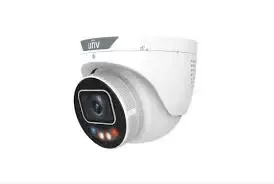
Manufacturer product photo of a compact turret camera with an LED ring. Mounted under the eave of a Suffolk County condo clubhouse or over a mail kiosk, a turret this size records faces at the door without drawing attention.
Shop Our Systems
Condo Security Packages and How They Are Priced in Suffolk County
We don't sell boxed kits to associations here, because no two Suffolk properties share a layout. What we do have is three ways a job usually begins.
1
Get it working again
$250 service call. A technician traces the fault, handles what can be handled during that trip and writes up anything bigger with its price before touching it.
2
Upgrade one entry or amenity
Quoted in writing after a free assessment. For a board tackling a single item this year, such as the pool gate, with the figure checked against the Suffolk table.
3
A plan for the whole community
Quoted in writing after a free assessment. The whole property designed at once, from power to cameras, then cut into stages the reserve fund can carry.
Equipment the association already owns
If the association has bought equipment itself, send us the model numbers and where each piece should go, and we will give a labor-only price by phone. Equipment we did not supply stays under its maker's warranty only, and we cannot vouch for its wireless range or its software.
Phasing around the calendar
Suffolk boards get the most from a phased plan when the phases follow the seasons. Platform decisions and ordering happen in winter, amenity readers go in before the pool opens, outdoor cable and building panels follow in late summer and fall, and cameras come after. Each phase joins the same platform, so the association never ends up with three systems that cannot share an owner list.
RFPs and board bid requests
We respond to condo RFPs and managing agents' bid requests in whatever format the board uses, with each line priced and every assumption stated. We do not provide client references or name client properties; boards can read our Google reviews. Certificates of insurance naming the association and the managing agent are issued when the job is awarded.
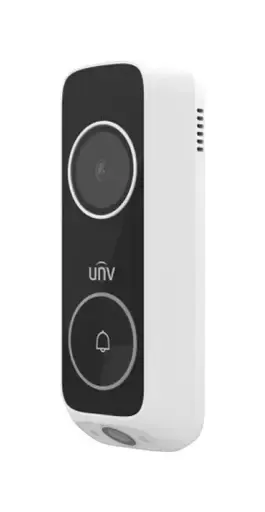
Manufacturer product photo of a slim video doorbell with a second lens near the base for packages on the step. Townhouse owners in Suffolk County condos often ask for one at their own door; the association's rules decide where it may be mounted and what it may record.
Field notes from our Suffolk County crews
On a Suffolk condo walkthrough, the first thing we ask for is the storm history. Which buildings lost power for how long after the last big storm, which basement or ground-floor closet took water, and what the board did to get owners in when the entry panels went dark. The answers decide where the controller and recorder go, how much battery we specify and which doors should fail open or stay locked, before we look at a single device.
Next we follow the cable. Older townhouse communities often have low-voltage wire buried straight in the ground from the clubhouse to the pool and the old entry stations, and a meter tells us in minutes whether it can carry a new system or has been nicked by years of irrigation and landscaping work. That single test can move a quote by thousands of dollars in either direction.
Last, we ask who will run the system from a distance. In a community where the treasurer winters elsewhere and the managing agent's office is an hour away, the administrator accounts, the remote support access and the alert recipients matter as much as the hardware. We set them up in the association's name and leave the board a written list of every login.
FAQ
Suffolk County Condo Security Systems FAQ
Will the entry panel's screen be readable in direct summer sun?
+
Most current outdoor panels have bright, anti-glare screens, but a panel facing south or west can still wash out at certain hours. We check the sun's path during the assessment and either choose a panel with a sunlight-readable display, add a hood or angle the mount so visitors can read the directory.
Can the system alert the board when a fob is tried at a door it doesn't open?
+
Yes. Access platforms log denied attempts, and the board or managing agent can receive an email or app notification when a suspended or out-of-schedule credential is tried, such as a former renter's fob at the pool after the lease ended.
Can a solar-powered camera cover a lot where there is no electricity?
+
Yes, for a camera with modest power needs, a solar panel and battery can run it and send video over cellular or Wi-Fi. Short winter days limit how much it can record, so we use solar for low-traffic spots like overflow or trailer lots and wire cameras wherever cable can reach.
Can the association mount cameras on the outside walls of owners' townhouses?
+
Often, if the declaration makes exterior walls common elements and the board approves it. We aim those cameras at shared roads, walks and parking, never into windows, and the board should tell affected owners before installation.
Can the board require a PIN as well as a fob on the management office door?
+
Yes. Most readers with a keypad can require both a credential and a personal code at chosen doors or hours, so a lost or borrowed fob alone will not open the office, the server closet or the maintenance garage.
Can the gate stop one resident tag from letting in two cars in a row?
+
Yes. Anti-passback settings make a credential unusable at the entrance again until it has been used to exit, or until a set time passes, which stops one owner's tag from being handed back to a second car.
Can the board check the backup batteries without cutting the power to test them?
+
Partly. Many controllers and power supplies report battery voltage and charging faults to the management software, and some send an alert when a battery is failing. A true run-time test still needs a technician, which we do on each maintenance visit.
Can cameras record in color at night without floodlights on every building?
+
Many current cameras record in color in low light using a large sensor and a small built-in white light, so modest existing path lighting is often enough. Fully dark areas still need some light for color video.
Can the board see a record of who changed settings in the access system?
+
Yes. Most platforms keep an audit trail of administrator actions, showing who added or removed a credential, changed a schedule or unlocked a door remotely, and when. We give each administrator a personal login so the record means something.
How do you keep rodents from chewing low-voltage cable in crawl spaces and garages?
+
We run cable in conduit or protective sleeve where it crosses crawl spaces, garages and other places rodents travel, and we seal the openings we make. Exposed cable in those areas is a common cause of intermittent faults.
Can owners set quiet hours for calls from the entry panel?
+
On most app-based intercoms, yes. Each owner can mute or schedule notifications in the app, and the board can decide whether calls still ring an indoor station during those hours.
Will the board get a record of where every device and cable run ended up?
+
Yes. At handover we give the board a device list with locations, model numbers, network addresses and installation dates, a marked-up site plan of the cable routes, and the administrator logins, so any future contractor can pick up where we left off.
All Areas Served
Condo Security Systems Across Long Island and New York
From Huntington to Montauk: One Licensed Team for Suffolk County Condos
Storm-damaged entry panel, a pool gate on keys or a full community plan, the same licensed crew designs, installs and supports it. Repairs start with a $250 visit; new projects start with a free walk of the property.