Condo security systems in Queens start with our $250 service call, which sends a licensed technician to find and fix the fault, and a building-wide intercom, access control or camera program for a condominium is quoted in writing after a free on-site assessment. Abstract Enterprises Security Systems holds New York State low-voltage license #12000287431 and works for condo boards of managers, condo associations, HOA boards, unit owners and managing agents from the Long Island City and Hunters Point waterfront through Astoria, Flushing, Forest Hills, Rego Park, Jamaica and Bayside, on everything from the touchscreen panel in a glass tower lobby to the garage reader under a Flushing podium and the gate call box of a townhouse association near the Nassau line.
Quick answer: One licensed contractor can handle a Queens condominium's entry panels, fobs, package room, amenity and garage doors and cameras. When something already installed stops working, the $250 service call covers the trip, the diagnosis and quick fixes, and that $250 is credited if a bigger repair follows. When the board wants a replacement or a new system, we walk the property at no charge and write a proposal broken out by door and by phase, so it can be paid from reserves, the operating budget or an assessment. We book every request within 2 hours, seven days a week, with early-day visits.
Last updated November 26, 2026 · Prepared by the Abstract Enterprises Security Systems team, NYS license #12000287431 · Public records and reporting relied on: NY Real Property Law §339-e and §339-v (Condominium Act); NY Multiple Dwelling Law §50-a; NYC Local Law 63 of 2021; NYC Department of City Planning (Long Island City Special District 2001, LIC Neighborhood Plan C 250176, Jamaica Plan 2007); HPD Housing Maintenance Code violations, NYC Open Data; The Real Deal; QNS; r/longislandcity
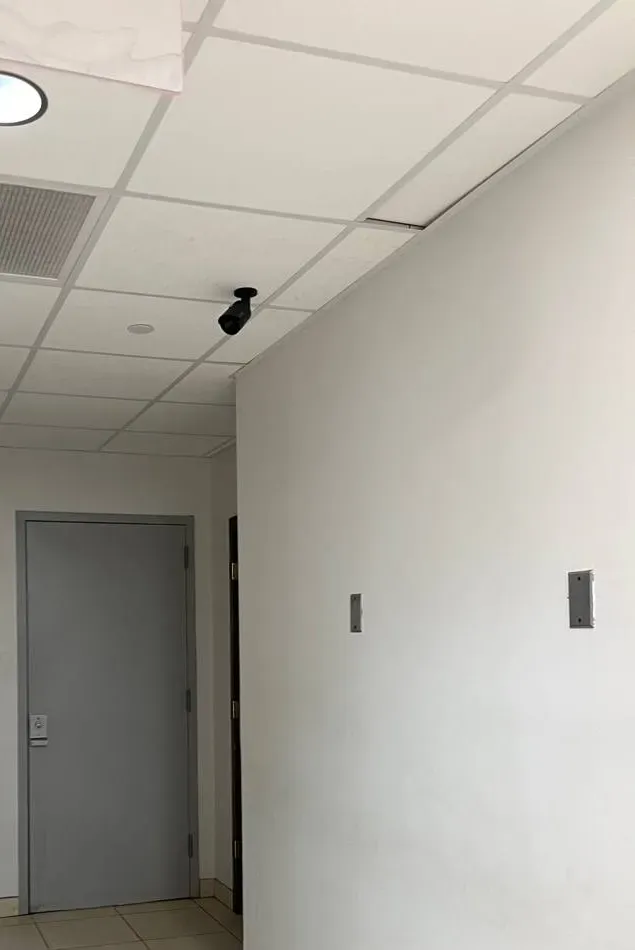
From our job library: a compact camera mounted near the ceiling, aimed down a plain hallway toward a grey steel door. Service and stair doors like this one are where a Queens condo association usually learns, after an incident, that nobody was watching.
Queens Condo Security Request
Board officers, HOA members, unit owners, resident managers and agents
✅
Request Sent!
Thanks. Someone from our office will call or text to set a date for your Queens building.
25+
Years Experience
2 Hr
Booking
$250
Service Call
4.7★
201 Google Reviews
Owner-operated since 2002 · Thousands of jobs completed · Booked within 2 hours · Call or text (347) 434-6392
The Neighborhood
Why Queens Condominium Buildings Need Condo Security Systems Built for How They Were Developed
Ask ten Queens condo boards what their building needs and you will hear ten versions of the same complaint: the security equipment came with the building, and nobody who lives there chose it. A large share of the borough's condominiums were planned, financed and fitted out by a sponsor within the last two decades. The sponsor picked the lobby panel, the fob platform, the garage reader and the recorder, the integrator programmed it all before the first closing, and then both moved on to the next tower. What the owners inherited is a working system with a short memory: no drawings, a directory frozen at the first sales, and logins that sit with someone who no longer returns calls. Most of the condo work we do in Queens begins at that point.
The law gives the board of managers a clear place to start. New York's Condominium Act defines common elements in Real Property Law §339-e, and unless a building's declaration says otherwise the list includes the "halls, corridors, lobbies, stairs, stairways, fire escapes, and entrances and exits of the building," the "recreational or community facilities, parking areas and storage spaces," and "all apparatus and installations existing for common use." Read against a modern Queens condo, that covers the vestibule door, the amenity floor, the garage and, in most declarations, the intercom and reader hardware that serve them. The same section describes the "operation of the property" as including "the maintenance, repair and replacement of, and the making of any additions and improvements to, the common elements."
Who decides, and how, comes from the bylaws. RPL §339-v requires them to spell out "the powers and duties of the board" and the percentage of owners "necessary to adopt decisions binding on all unit owners," and it lets them set aside reserves for "major and minor maintenance, repairs, additions, improvements, replacements." That is why we never assume a dollar limit or a vote requirement for a Queens association. A 300-unit Hunters Point tower and a 14-unit Astoria walk-up can have very different thresholds, and the board's attorney, not the contractor, reads them. Our part is to price the job so the board can follow whatever its own papers say.
Long Island City: two decades of towers on one waterfront
No neighborhood shows the sponsor-built pattern more clearly. On May 23, 2001, the City Planning Commission unanimously approved special zoning for "37 centrally located blocks in Long Island City," and the towers that followed changed the skyline around Court Square, Queens Plaza and the waterfront. The Planning Commission's 2025 report on the Long Island City Neighborhood Plan puts a number on it: "the construction of over 21,000 housing units within a half-mile radius from the project area since 2010." The same report says Hunters Point South, the city-led waterfront district south of Gantry Plaza, "will contain approximately 5,000 units of housing" when complete, with 3,249 already built on five parcels.
Plenty of those homes are rentals, and many of the Hunters Point South units are income-restricted. But the condominiums in the mix share a profile we see constantly: a staffed or partly staffed lobby, a resident app, readers on a gym, a pool or roof terrace and a bike room, a parking level with its own pedestrian door, and a camera system on a rack the original integrator built. Demand has not slowed either. QNS, reporting on a SERHANT market study, counted 173 closed condo sales in Long Island City in the second quarter of 2025, up from 106 a year earlier, with one-bedroom units accounting for 104 of them. Every one of those closings is a directory edit, a set of fobs to switch off and a set to issue.
Flushing and the condo complex model
Downtown Flushing grew its condos a different way: as large complexes sitting on top of shopping centers and garages. The Real Deal described the area as "a hotbed for condominium projects" because "its residents prefer to own real estate," and pointed to the Sky View Parc complex on 13 acres between Roosevelt Avenue, College Point Boulevard and 40th Road, which "includes a pair of condominiums with nearly 1,200 units, a 1.2 million-square-foot shopping center and a wellness center." The same report notes the City Council's approval of a 29-acre special waterfront district along Flushing Creek allowing "13 buildings with more than 1,700 residential units."
Security in a complex like that is a boundary problem. Residents, shoppers, retail staff, delivery fleets and parking customers move through the same podium, and the condo association owns only some of the doors. The residential elevators, the garage levels reserved for owners, the amenity spaces and the mail and package rooms have to be closed off from the public parts of the property without trapping anyone or breaking egress rules. Credential groups, door schedules and the camera layout have to follow those boundaries exactly, and they have to be written down, because the retail owner's security vendor works the other side of the same walls.
Jamaica, Forest Hills, Astoria and the rest of the borough
Downtown Jamaica is the next wave. The Department of City Planning records that on September 10, 2007, the Jamaica Plan, a zoning and planning strategy "for 368 blocks in Jamaica, Queens," was adopted, opening the area around the rail hub to taller residential buildings. Along Queens Boulevard in Forest Hills and Rego Park, newer mid-rise condos sit beside prewar co-ops. Astoria and Ditmars have filled in with six- to ten-story boutique condominiums on former one- and two-family lots. And out east, in Bayside, Douglaston and near the Nassau line, the condo stock leans toward townhouse-style associations and low-rise communities where the "lobby" is a gate and a shared parking lot. One borough, four or five very different security problems.
Where Queens entry systems fail, by community board
HPD publishes every Housing Maintenance Code violation it writes. We pulled 2025 Queens violations from the HPD violations dataset on NYC Open Data whose description mentions an intercom and grouped them by community board. The borough total was 342, far below Brooklyn or the Bronx, and the count was concentrated in the older rental districts rather than the new condo neighborhoods.
Queens community board
Main neighborhoods
HPD intercom violations issued in 2025
QCB 8
Fresh Meadows, Briarwood, Jamaica Hills
50
QCB 7
Flushing, College Point, Whitestone
49
QCB 3
Jackson Heights, East Elmhurst
48
QCB 6
Forest Hills, Rego Park
35
QCB 12
Jamaica, Hollis, St. Albans
35
QCB 2
Long Island City, Hunters Point, Sunnyside, Woodside
26
QCB 1
Astoria, Ditmars, northern Long Island City
20
QCB 11
Bayside, Douglaston, Little Neck
4
All Queens
14 community boards
342
Read that table with care. HPD violations come mostly from tenant complaints in rental buildings, so the numbers describe renters' broken intercoms, not condo intercoms, and condo owners almost never call 311 on their own association. What the spread does tell a Queens condo board is that new construction does not fail loudly. Long Island City, with tens of thousands of new homes, produced 26 violations; Bayside produced 4. In the buildings we visit there, the panel still lights up, but the app stopped ringing two floors, the fob platform license lapsed, or the recorder filled its drive months ago and quietly began overwriting. Those failures never reach an inspector. They reach the board at the next meeting.
What Queens condo residents complain about
On r/longislandcity, the neighborhood's busiest forum, the threads that touch security are rarely about hardware. A resident recently described how building staff handed their spare key to a stranger who then entered the apartment, a rental-building story but the clearest possible argument for credentials that are logged and tied to a name rather than keys in a drawer. Another thread notes a 44-story condo breaking ground in LIC, which is to say the next sponsor-built system is already on order.
The list we hear on walk-throughs is consistent from Hunters Point to Jamaica. Fobs from tenants who moved out still open the gym. Couriers follow residents through the vestibule. The garage gate hangs open while a car climbs the ramp. Owners who spend months overseas cannot answer the door from abroad. The commercial tenant on the ground floor props the shared service door for deliveries. Nobody on the current board can log in to the cameras. Each item is a narrow problem with a narrow fix, and most cost less than the board expects once someone separates the hardware fault from the settings fault.
Queens condo facts that shape our work
37 blocks, May 23, 2001: the Long Island City special zoning approved by the City Planning Commission (DCP press release).
Over 21,000 housing units built within a half-mile of the LIC Neighborhood Plan area since 2010 (City Planning Commission report C 250176).
About 5,000 homes at Hunters Point South when finished, 3,249 already built on five parcels (same report).
Nearly 1,200 condo units in the two condominiums at Sky View Parc in Flushing (The Real Deal).
368 blocks: the Jamaica Plan adopted September 10, 2007 (DCP).
173 closed LIC condo sales in Q2 2025, up from 106 (QNS, citing SERHANT).
342 HPD intercom violations in Queens in 2025, 26 of them in Community Board 2 and 4 in Community Board 11 (NYC Open Data).
Condo boards in Queens who call us about the front entrance usually add the garage and amenity doors to the same proposal, because once owners see the lobby fixed, the stuck parking gate and the gym reader that admits everyone become the next agenda item.
What We Install
Condo Security Services in Queens, One System at a Time
A Queens condo association rarely buys "a security system." It buys a lobby panel one year, garage readers the next, a recorder after an incident, and it ends up with five vendors and five logins. We work as the single condo security contractor for all of it: one licensed integrator that installs, programs, repairs and maintains every low-voltage device in the common elements, so the managing agent has one phone number and the board keeps one document listing every account. Each part below answers what condo boards in the borough actually ask about that system and then points to our dedicated Queens service page for the technical detail.
Condo intercom replacement, modernization and repair
Nearly every Queens condo project touches the intercom first, because it is the one device every owner, renter, guest, dog walker and courier uses. Our intercom work runs from simple repairs, a dead call button, a station that hums, a door release that clicks but won't open, to complete condo intercom replacement. In the borough's older condominium conversions that often means moving from audio handsets on a multi-wire riser to video panels that call phones. In the newer towers it more often means a modernization: dropping a cloud platform whose per-unit fees the board no longer wants, linking a second entrance or the garage call station to the same directory, or replacing a lobby panel the sponsor's integrator installed with parts nobody local stocks.
Boards ask us less about technology than about money and process. Is the failing panel a repair the agent can approve from the operating budget, or a capital replacement that belongs in the reserve study and, under some bylaws, before the owners? Our intercom proposals are written to work either way. The repair figure stands alone. The replacement scope lists every entrance and panel, what happens inside each apartment (a new monitor, the existing station kept, app-only answering, or owner's choice), the riser or network path, the door hardware, any manufacturer subscription on its own line with a five-year total, and what the association must provide. That layout drops straight into a condo intercom RFP, lets a board compare our bid with others line for line, and gives owners a clear answer when they ask what the modernization budget actually bought. Background on the hardware itself is on our page for intercom installation in Queens; when an existing system has simply stopped working, the right page is intercom repair in Queens. A separate guide for boards weighing a full condo intercom replacement, covering repair-versus-replace, upgrade paths, cost drivers, bid comparison and owner notices, is being published now.
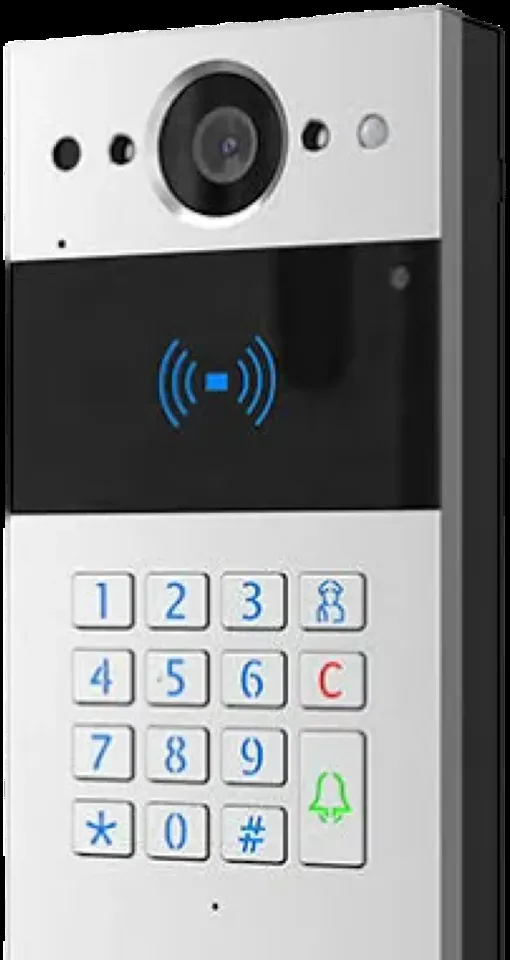
Manufacturer product photo: a slim silver station with a camera at the top, a contactless reader zone and a numeric keypad. One unit like this can serve as the visitor call point, the resident fob reader and the code pad at a Queens condo side entrance.
Door buzzers in boutique and walk-up condos
Plenty of Queens condominiums still answer the door with a button and a speaker. Across Astoria, Sunnyside, Woodside, Elmhurst and parts of Jackson Heights, small developers built six-, eight- and twelve-unit condo buildings with a plain button panel at the door, a talk station in each unit and an electric strike. When one owner can't let anyone in, the cause could be that unit's station, a pair cut during a kitchen renovation upstairs, the transformer in the cellar or the strike itself. We trace it on a service call, replace the failed part and test the release from every apartment before leaving. Part-by-part ranges are listed on our door buzzer repair in Queens page, and a board that wants a fresh panel and stations rather than another patch can read about door buzzer installation in Queens.
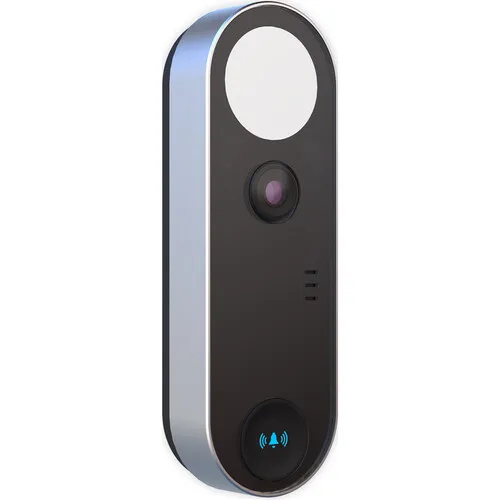
Manufacturer product photo: a narrow rounded video station with a lens at the top and a lit call strip at the bottom. Compact stations of this shape suit the narrow door frames of Queens boutique condos where a full directory panel won't fit.
Fobs, cards and phone credentials
Ask a Queens board to count its controlled doors and the first answer is usually two; the real list, once we walk it, is closer to a dozen: the vestibule, the garage pedestrian door, the elevator lobby on each parking level, the mail and package rooms, the gym, the pool, the roof terrace, the bike room, storage cages, the trash and recycling rooms and, in a growing number of towers, the elevator cars. We install the readers, strikes, magnetic locks, door contacts and request-to-exit devices, plus the controller and software that hold the credential list and the entry log. For a board of managers the real benefit is at resale and lease turnover: when a unit closes or a renter leaves, those credentials are switched off and the new occupant's are issued, with nothing re-keyed and no master key copied. The full service, including the move from easily copied proximity fobs to encrypted cards and phone credentials, is on our page for access control installation in Queens.
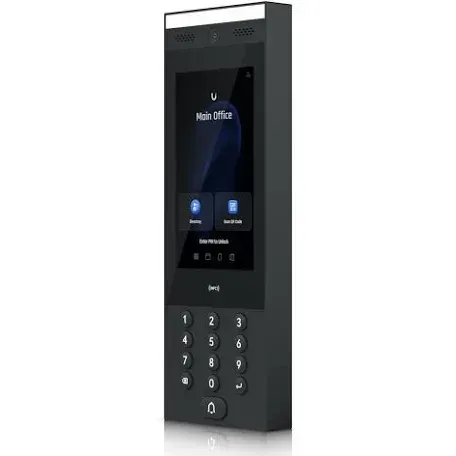
Manufacturer product photo: a tall dark entry panel with a touchscreen directory above a numeric keypad. In a staffed Queens tower lobby, a panel like this lets visitors search by name while residents use a fob or their phone.
Package rooms, mailrooms and courier access
In most Queens condos the package problem is really a door problem. Couriers who can't get in leave boxes in the vestibule; couriers who can get in leave them on the lobby floor, where anyone following a resident can pick them up. A dedicated package room with a reader, a camera and a lock that releases only for owners, staff and approved couriers solves both, and a courier-only credential on the outer door can keep drivers out of the rest of the building. We supply and install the reader, the door hardware and the camera, and we set courier time windows where the platform allows it. Parcel lockers are made and serviced by locker companies; when a board has one or wants one, our part is the door, intercom and access integration around it, not the locker.
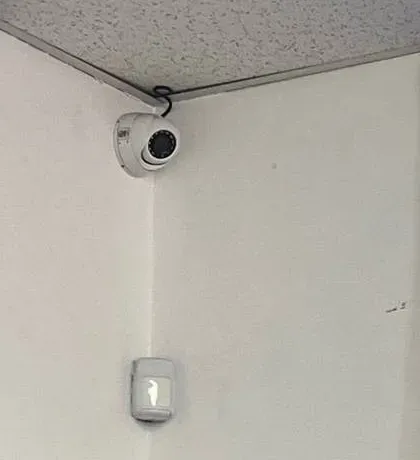
From our job library: a white dome camera tucked into a ceiling corner, with a motion sensor mounted on the wall below it. A corner view like this covers both the door and the shelving in a small Queens condo package room.
Amenity floors: gyms, pools, roof terraces and party rooms
Many newer Queens condos have more amenity doors than entrances. Each raises the same questions for the board: who may enter, at what hours, and what happens when an owner brings a guest. Readers on schedules answer the first two, and a camera on the door settles arguments about the third. For a pool or roof terrace with posted hours, the reader can lock automatically at the board's closing time while the resident manager keeps an override for approved events. Rooms that owners reserve, a party room, guest suite or screening room, can be tied to a booking so the reader opens only for that owner during the reserved slot.
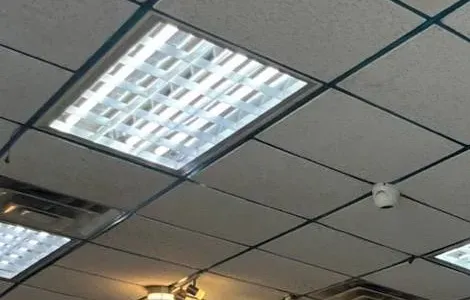
From our job library: a small dome camera set into a drop ceiling next to a bright light panel. In a Queens condo gym or party room, a ceiling dome placed off to the side of the lights avoids glare on the recording.
Cameras: a short section here, a full page elsewhere
Camera lists in Queens condos look alike once the board sits down with a floor plan: front and side doors, the mail and parcel rooms, both ends of the garage, the pool and gym entrances, the loading and trash doors, and possibly the elevators. Recording stays on a recorder inside the building, retention is set to match the board's written policy, and named board officers or the managing agent get their own logins rather than sharing one. Condo security camera installation in Queens is getting a page of its own in this series. Until it goes live, our page on apartment building security camera installation in Queens covers the multifamily camera side in depth.
Elevator access control
Towers with private-landing penthouses, a residents-only amenity floor or parking levels shared with the public often want the elevator itself to check credentials. We mount the reader in the cab and install the relay hardware that tells the elevator which floor buttons a given fob may press. The elevator maintenance company remains the only party that touches its controller, and we schedule our visit to overlap with theirs. More detail is on elevator access control installation in Queens.
Garage gates, parking levels and vehicle access
Parking is a bigger part of condo security in Queens than in Manhattan or most of Brooklyn. Flushing complexes stack owners' parking under public retail levels, Long Island City towers put garages beneath the podium, and eastern Queens associations often have open lots behind a gate. We connect the vehicle readers or remote receivers at those openings to the building's own credential list, add a call station at the gate or ramp for visitors, place a camera on the ramp and another inside the door, and coordinate with the garage door company that maintains the operator. When an owner sells, their parking credential goes off with their fob, which a stack of loose gate remotes can never do.
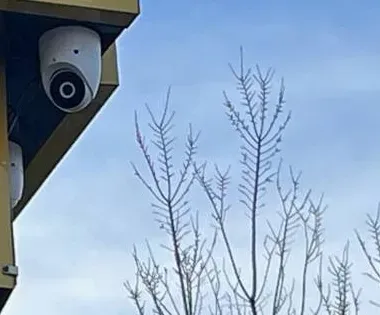
From our job library: an outdoor dome camera mounted under the edge of a fascia, with bare winter branches behind it. An eave mount like this keeps rain and snow off the dome at a Queens condo garage ramp or gate.
Alarms for owners and commercial units
The association's system protects common areas; owners sometimes want protection inside their own homes, and ground-floor commercial condo owners often need a monitored alarm for their insurer. We install intrusion alarms with central station monitoring for individual units and storefronts, kept separate from the building system so the board never pays for or answers an owner's alarm. Our alarm installation in Queens page explains the equipment and the two monitoring options we offer.
Fire alarm work within our licensing scope
Condo boards often ask whether the same contractor can handle the fire alarm panel. We take fire alarm work in Queens only within our licensing scope, and every such job follows the engineering drawings, FDNY approval and inspection steps that apply to the building. We do not publish fire alarm prices; each building is scoped from its drawings. How that process works is laid out on our fire alarm installation in Queens page.
Cabling, network closets and power
Video panels, readers and IP cameras all depend on cable, switches and power that residents never see. In Queens towers those usually sit in a telecom room shared with the internet provider; in older conversions, they may be on a shelf in the boiler room. We pull and label Cat6, install PoE switches and battery backups, and keep the security network apart from residents' and staff Wi-Fi. Our license covers low-voltage work only, so we do not do electrical work: where a lock power supply or a new switch needs a 120-volt outlet that isn't there, the association's electrician installs it, and we write that requirement into the proposal before anything is ordered.
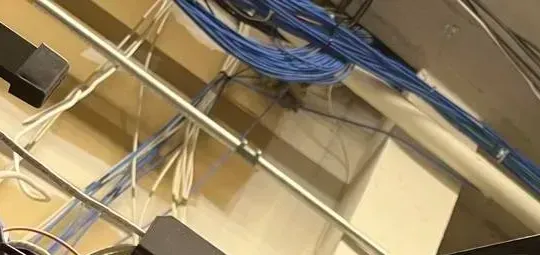
From our job library: bundles of blue and white low-voltage cable crossing over a beam above an open ceiling. Runs like these carry the intercom, reader and camera signals from each Queens condo door back to the equipment room.
After the sponsor leaves
Turnover from sponsor to owner-controlled board is the moment Queens condos most often call. The new board wants three things: a list of what is installed and where, administrator access to every platform in the association's name, and an honest view of which equipment is worth keeping. We inventory panels, readers, controllers, switches and recorders door by door, try every login the board has been given, and document which accounts still sit with the developer, the original integrator or a former manager. Locally managed equipment can usually be reset and handed to the board. Cloud platforms often require the current account holder to transfer ownership, which may need the sponsor's cooperation or the manufacturer's own process, and we tell the board plainly which path applies.
Guests, renters and short stays
Queens condos have a high share of investor-owned units, so renters and their guests are part of daily life. Modern access platforms can issue temporary credentials that expire on a set date, one-time visitor codes and app invitations for a lease term, all logged by name. We set those features up to match whatever rules the board adopts. We don't advise on what the bylaws, house rules or city short-term rental law permit; that is for the board and its counsel to decide, and the equipment simply carries out their decision.
A five-point check for a Queens condo board
Accounts: can a current board officer log in to the intercom, fob and camera platforms today, and are the accounts in the association's name?
Directory and credentials: does the intercom list match the current owner and renter roll, and when were sold units' fobs last turned off?
Doors: does every common door, including garage, roof and service doors, close and latch on its own?
Recording: how many days does the recorder actually hold, and has anyone pulled a clip in the last six months to prove it works?
Power and network: is there a battery backup on the switch and controller, and is the security equipment kept off the residents' Wi-Fi?
Service calls, check-ups and support
When something stops working, the board or agent calls, we set an arrival window inside 2 hours of the request, and a technician arrives early in the day, seven days a week, first come first served once the visit is paid. Boards that would rather prevent failures can book a check-up whenever they like, many choose spring and the weeks before the holiday delivery rush, to test panels, readers, door hardware, batteries and recorder drives. Phone help for the resident manager or board is free. We do not sell a monthly security plan, a virtual doorman or a remote concierge service; if the association already pays a remote-attendant company, we install and maintain the panel, camera and lock hardware that company relies on and connect it to their service.
Building Specialists
Condo Building Security for Queens Condominium Architecture
The right system for a Queens condominium depends less on the number of units than on the shape of the building and how people move through it. Six building types account for nearly every condo we work in across the borough.
A
Waterfront and Court Square towers
High-rise glass condos in Long Island City and Hunters Point: staffed or part-time desks, amenity floors, podium garages and fully IP-wired systems.
B
Podium condo complexes
Downtown Flushing buildings stacked above retail and parking: shared podiums, separate residential cores and strict credential boundaries.
C
Boutique mid-rise condos
Six- to ten-story buildings in Astoria, Ditmars, Sunnyside and Woodside, usually unstaffed, often self-managed.
D
Queens Boulevard mid-rise
Newer condos in Forest Hills, Rego Park and Kew Gardens sharing blocks with prewar co-ops: tight lobbies, garages off side streets.
E
Downtown Jamaica new construction
Mixed-income and condo towers near the rail hub: high foot traffic, ground-floor retail and transit-adjacent entrances.
F
Townhouse and low-rise associations
Bayside, Douglaston, Whitestone and the Nassau border: gates, shared lots, mail kiosks and many separate front doors.
Waterfront towers: scale, staffing and the amenity floor
In a 40- or 50-story Long Island City condo the lobby is the easy part. The hard part is everything above and below it: an amenity floor with a pool, gym, lounge and terrace, each with its own hours; a garage under the podium shared, in some buildings, with a rental tower next door; bike rooms and storage cages; and service corridors that connect the loading dock to the freight elevator. These buildings almost always run IP intercoms, fob readers and cameras on one network, so the first question we ask is where that network lives and who maintains it. A desk that is staffed only part of the day changes the design too: after hours, the lobby panel has to do the doorman's job, calling residents' phones and releasing a courier door on its own.
Waterfront exposure matters as well. Entrances facing the East River take wind-driven rain off the water, and panels, readers and outdoor cameras there need weather ratings and mounts with drip edges. When a tower's facade panel fails every winter, the fix is often a hood or a relocated mount, not another panel.
Podium complexes: drawing lines through shared space
In Flushing's podium developments the condo association may control the residential lobbies, elevators, amenity levels and a block of parking, while a separate owner controls the mall, the retail corridors and the public garage. The security design has to start with a floor-by-floor map of who owns which door. Residential elevator lobbies on parking levels get readers. Stair doors from public levels into residential floors are locked against entry from the public side while staying free to exit, and egress rules are checked before any hardware is chosen. Cameras covering the boundary are positioned so that each owner's recorder holds its own side. The result is a written credential plan: owners, renters, building staff, retail staff with limited residential access, and couriers, each group with its own doors and hours.
Boutique mid-rise condos: low cost of ownership
A ten-unit Astoria condo with no super and a volunteer board needs equipment that keeps working without anyone watching it. That usually means a video panel that calls owners' phones with no per-door monthly fee, a single reader on the cellar or bike room, a two- or four-camera recorder in a locked closet, and a battery backup. We keep the design simple on purpose: one app, one set of logins kept by the board, and parts that a technician can replace from stock. Many of these buildings were wired with Cat5e or Cat6 to each unit during construction, which makes video answering inside the apartments affordable if the owners want it.
Queens Boulevard mid-rise: tight lobbies and side-street garages
Condos built in the last twenty years along Queens Boulevard in Forest Hills and Rego Park often sit on narrow lots between older apartment houses. The lobby may be no deeper than the vestibule, the mail and package room may share a wall with the elevator, and the garage entrance usually opens onto a residential side street where neighbors notice a gate that won't close. Compact surface-mount panels, a reader on the package room, and a gate camera with a clear view of the sidewalk are the usual core. On streets where the building sits within a historic district, any facade-mounted device needs to suit landmarks rules, and we plan placement with that in mind.
Downtown Jamaica: transit, traffic and retail at the base
Buildings rising under the 2007 Jamaica Plan sit within a few blocks of the AirTrain, the LIRR and the subway, with storefronts on the ground floor. The front door sees a high volume of people who don't live there, so vestibule design matters: a two-door entry where the outer door admits couriers and the inner door admits only residents, a panel inside the vestibule rather than on the sidewalk, and cameras that capture faces at the inner door rather than backs at the outer one. Where the building mixes condo and income-restricted rental floors, credential groups follow the ownership structure the declaration sets out.
Townhouse and low-rise associations in eastern Queens
Out toward Little Neck and the Nassau line, a condo or HOA community may be thirty separate front doors around a private drive. Nobody needs a lobby panel; the association needs a call box and reader at the vehicle gate, a pedestrian gate on the same credential list, cameras at the entrance and over the shared parking, and perhaps a reader on a clubhouse or pool. Long cable runs between the gate and the clubhouse are the main cost, and trenching or aerial paths are decided at the walk-through. Owners' private front doors and garages stay their own business unless the declaration says otherwise.
Materials and methods that change from one building type to the next
Glass curtain-wall lobbies: readers and panels go on mullions or freestanding posts; cable runs through the frame or a floor core, never surface-mounted across the glass.
Concrete podiums and garages: core drilling through slabs is planned with the building engineer; conduit is used where cable crosses parking areas.
Brick and block walk-ups: surface raceway painted to match in common halls where opening walls isn't practical, with the method spelled out in the proposal.
Steel garage and service doors: heavy-duty strikes or mag locks rated for the door weight, plus door closers adjusted so they latch every time.
Outdoor gates: weather-rated readers and call boxes on posts, with surge protection on long runs.
Commercial Condo Security
Mixed-Use and Commercial Condo Security in Queens
A large share of Queens condominiums sit above shops, restaurants, medical offices or banks, and many of those spaces are commercial condo units with their own owners. The residential association and the commercial owner share walls, a trash room, sometimes a service corridor and a loading door, and each has its own security needs and budget. Getting that split right on paper prevents most of the disputes we are later called in to untangle.
Where mixed-use condos concentrate in Queens
Main Street and Roosevelt Avenue, Flushing: podium complexes and mid-rise condos over retail, with heavy pedestrian traffic and delivery activity.
Jackson Avenue and Court Square, Long Island City: towers with ground-floor restaurants and services facing busy sidewalks.
Jamaica Avenue and Sutphin Boulevard, Jamaica: new construction over storefronts near the transit hub.
Queens Boulevard, Forest Hills and Rego Park: mid-rise buildings with medical and professional units at street level.
Steinway Street and 30th Avenue, Astoria: boutique condos over cafes and shops.
Bell Boulevard, Bayside: low-rise mixed-use buildings with offices and retail below apartments.
Keeping the residences and the commercial units separate
The cleanest arrangement gives each side its own system for its own space and a shared, documented arrangement for the few doors both use. A shared service corridor gets a reader that admits building staff and the commercial owner's staff during set hours, a camera on each end, and an entry log the managing agent can review. The residential side never hands the commercial tenant a master fob, and the commercial owner's storefront alarm and cameras never ride on the association's recorder unless both sides sign off. When a restaurant props the shared door for a delivery, the door alarm tells the resident manager within a minute, and the log shows whose credential opened it last.
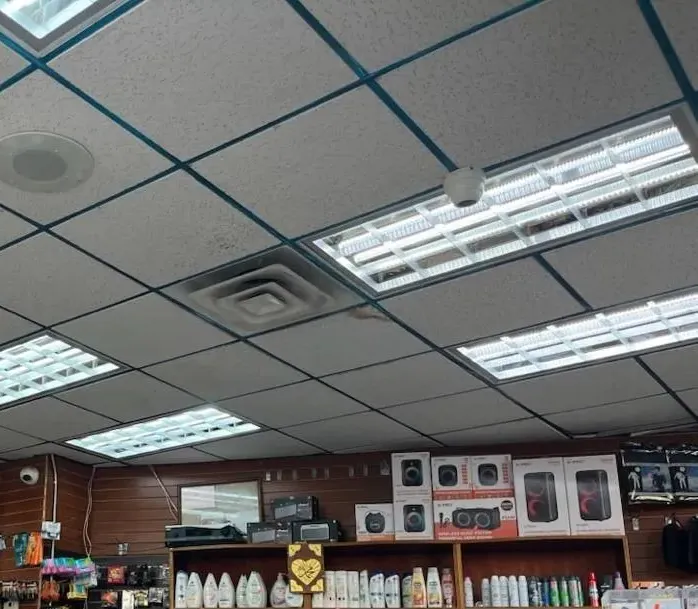
From our job library: a drop ceiling with light panels over a store's stocked shelves and wall displays. Ground-floor shops like this one are often commercial condo units with their own camera system, kept separate from the residential association's equipment.
The commercial owner's own system
Commercial unit owners hire us directly for their own storefront cameras, alarms and access control. We treat that as a separate client, with a separate proposal and invoice, and we design it so it doesn't interfere with the building system. If both sides want a shared view of the sidewalk or loading door, we can give each recorder its own camera rather than sharing one, which avoids arguments about who owns the footage.
From our job library: a small dome camera at the ceiling over a wood-slat wall stocked with merchandise. A storefront owner's camera like this one records to the shop's own recorder, not the condo association's.
Loading docks, trash rooms and deliveries
The back of the building is where most mixed-use security fails. Trash rooms open to the street for collection, loading doors open for deliveries, and both connect to corridors residents use. A reader with a schedule, a door contact that reports a door left open, and a camera on each opening let the board see what happens there without posting staff. For collection days, the schedule can unlock the trash room's street door for a set window and lock it again automatically.
The rules that apply
Multiple Dwelling Law §50-a: class A multiple dwellings erected or converted after January 1, 1968 with eight or more apartments must have self-locking entrance doors and an intercom system that lets residents speak with visitors and release the door from their apartments (NY Senate). Whether and how that applies to a given condominium is a question for the board's counsel.
Local Law 63 of 2021 (Tenant Data Privacy Act): buildings that use smart access systems face rules on written privacy policies, consent and deleting authentication data (law text). Its application to owner-occupied condo units is for the association's attorney; we configure retention and consent features to match the policy the board adopts.
NYC Building Code egress provisions: electrically locked doors in a means of egress must release as the code requires, including on fire alarm activation and power loss where applicable; door hardware is chosen with that in mind.
Low-voltage permits: the NYC Administrative Code exempts most low-voltage signaling and data wiring from electrical permits, with exceptions for life-safety systems; fire alarm work follows its own approval path.
None of this is legal advice. We cite these rules so a board knows which questions to put to its attorney, and we design the system to meet whatever the attorney and the building's own documents require.
Your Questions Answered
Condo Security Systems in Queens: Questions Answered
These are the questions Queens condo board officers, HOA members, managing agents and owners put to us on walk-throughs and phone calls, grouped by topic and answered directly.
Boards, sponsors and bids
Our building still has unsold units held by the sponsor. Who signs off on security work?
Whoever the bylaws say controls the board at that moment. In many new Queens condos the sponsor still holds seats or votes because it owns unsold units, and some offering plans restrict what a board can spend while the sponsor is in control. We take direction from the board of managers as constituted, with the managing agent as our contact, and we write the proposal to the condominium itself, not to the sponsor or to any one owner, so it survives the transition to an owner-controlled board.
Our ground-floor commercial owner uses the same service door as residents. Who pays for its hardware?
The declaration usually answers that by classifying the door as a general common element, a limited common element serving certain units, or part of a unit. Shared service doors are often common elements whose cost is allocated under the declaration's formula, but some buildings assign them to the commercial unit. We price the door as its own line, so the board and the commercial owner can apply their split without reworking the whole proposal.
How should our board compare three security bids that propose different equipment?
Line them up by door, not by total. For each entrance and common door, put down what each bidder installs, how the units answer, what happens to existing wiring, and what recurring fees apply over five years. Then check what each bid leaves to the association: electrical work, wall repair, access to units, freight-elevator time. The lowest total often hides a monthly platform fee or an assumption that the building's electrician does half the job. We are glad to have our proposal compared this way, and the format we use is built for it.
Can the work start while the building is still under the developer's construction warranty?
Usually yes, but read the warranty terms first. Some sponsor or contractor warranties cover the original security equipment for a period after turnover and may exclude devices that another company has altered. We document the existing equipment and its condition before touching it, so if the board wants to make a warranty claim later, the record shows what failed and what we changed.
Our management office is in Manhattan and the building has no full-time staff. Who needs to be on site?
One named contact with keys to the equipment room, the roof and any units we must enter, for the arrival window and long enough to let us in. That can be a board member, the part-time porter, or someone from the agent's office. For multi-day jobs we agree on a key arrangement in writing at the start. Our crew arrives inside the scheduled two-hour window, never earlier, so the contact isn't waiting around.
Intercom and entry
Some owners want a screen on the wall and others only want the app. Can one system do both?
Yes, and that mix is common in Queens condos with both owner-occupants and investors. Most current platforms let each unit answer on an in-unit monitor, a phone app, a regular phone call, or several at once. The board can decide whether in-unit monitors are a building standard paid by the association or an option owners buy for their own units, and the proposal prices both ways.
Many of our owners spend months overseas. Can they still answer the lobby from abroad?
If the system calls a phone app over the internet, it generally works wherever the owner's phone has a data connection, at no international calling cost. Systems that dial a regular phone number may not reach foreign numbers, depending on the platform and the account. We confirm how the proposed system handles this before the board chooses it, and we set the owner's account to forward to a local relative or the managing agent if they prefer.
Can a visitor at the garage level call up to an apartment?
Yes, by adding a call station at the garage gate or the parking-level elevator lobby on the same directory as the front door. Visitors who park can then reach the unit they are visiting, the resident releases the gate or the elevator lobby door, and the call is logged like any other. In Flushing and Long Island City buildings with public parking on lower levels, this keeps visitors from wandering into residential cores looking for a way up.
Will our doors stay locked or swing open if the power fails?
It depends on the hardware, and the board should choose deliberately. Magnetic locks release when they lose power, which keeps exits free but leaves the door unsecured. Many electric strikes can be set to stay locked from outside while the inside lever still opens the door. Egress doors must meet code regardless. A battery backup on the lock power supplies, controller and network switch keeps the system running through most outages, and we write down how each door behaves so the resident manager knows what to expect.
Access, packages and amenities
Can owners reserve the party room or guest suite and have the door open only for their booking?
On platforms that support it, yes. The reservation can grant the booking owner's credential access to that room for the reserved hours and remove it afterward, or the resident manager can issue a temporary code for the slot. Where the building already uses a separate booking app, we check whether it can talk to the access platform before promising an integration.
How do we stop dog walkers and cleaners from keeping fobs after an owner lets them go?
Issue service providers their own credentials, tied to the owner who sponsored them, limited to the doors and hours they need, and set to expire on a date. When the owner ends the arrangement, or simply doesn't renew it, access stops without anyone chasing a physical fob. The entry log also shows whether a provider's credential is being used outside the agreed hours.
Our package room overflows in November and December. Should we add lockers or a second room?
Look at the numbers first: how many packages arrive on the busiest days, how long they sit, and how much floor space is free. A second secured room with a reader and camera is often the cheapest fix if the building has a storage room to convert. Lockers make sense when space is short and the board is willing to work with a locker company. Either way, we handle the doors, readers, intercom link and cameras.
Can bike room access be limited to owners who registered a bike?
Yes. A separate credential group for the bike room, added when an owner or renter registers with the managing agent, keeps the room to the people who use it. Combined with a camera on the door, it also ends the common argument about whose bike was moved or taken.
Cameras and footage
How long should a Queens condo keep its camera recordings?
That is a board policy decision, but it should be written down and matched to the recorder's real capacity. Many associations choose somewhere between two weeks and a month, long enough to cover incidents reported late, such as a package taken while an owner was away. We size the recorder's drives for the retention the board picks and set it to overwrite automatically, then confirm by pulling a clip from the oldest day.
What should the board do when police ask for a video clip?
Have a named person, usually the managing agent or a designated officer, handle the request under a written procedure the board approves with its attorney. That person exports the clip for the requested time and cameras, records what was given and to whom, and keeps a copy. We set up the export function and give that person a login with export rights, so nobody has to share the master password at a stressful moment.
Equipment
Types of Condo Security Equipment We Install in Queens
The equipment list for a Queens condominium falls into six groups. Our default proposal uses our own unbranded line; when a board names a brand, we price that brand instead, and in existing buildings we work on Aiphone, Comelit, ButterflyMX, Akuvox, 2N, DoorBird and plenty of older, unlabeled gear.
1
Entry panels
Video directory panels for tower lobbies, compact stations for boutique buildings, gate call boxes for townhouse associations and parking ramps.
2
Answering devices
In-unit video monitors, audio stations, phone apps and plain phone calls, mixed unit by unit if the board allows.
3
Credentials and readers
Encrypted cards and fobs, phone credentials, keypads, long-range vehicle tags for garages and readers in elevator cabs.
4
Door hardware
Electric strikes, magnetic locks, door contacts, request-to-exit sensors, door-prop alarms and closers adjusted to latch.
5
Controllers and recorders
Access controllers sized for future doors, network video recorders with drives matched to the board's retention policy.
6
Network and power
Cat6, PoE switches, battery backups, surge protection on outdoor runs and a dedicated security network.
Entry technologies compared for Queens condos
Approach
Fits best
Watch for
IP video panel with in-unit monitors
Towers and newer mid-rises with Cat6 to every unit
Monitor cost per apartment; firmware support from the maker
IP or cellular panel answered by app and phone call
Investor-heavy buildings, owners who travel, boutique condos
Per-unit monthly fees on some platforms; residents without smartphones
Two-wire video on existing conductors
Older conversions with a sound riser
Riser condition, tested before ordering
Audio replacement on the existing riser
Small walk-up condos on a tight reserve
No video; limited future options
Gate call box with readers
Townhouse and low-rise associations, garage ramps
Long cable runs, weather, vehicle damage
Locking hardware compared
Electric strikes keep a door's existing lock and latch and release only the keeper; they suit most wood and hollow-metal doors and can be set to stay secure without power. Magnetic locks hold the door with a magnet and release when power drops or the exit sensor triggers; they suit glass storefront doors and frames where a strike won't fit, but they need properly arranged egress release. Electrified hardware built into the lever or exit device is the cleanest look on new doors and the most expensive. We choose per door, and we write the choice and the reason into the proposal.
Credentials: what to retire and what to adopt
Many Queens condos built before about 2015 still use 125 kHz proximity fobs, which can be read and copied with inexpensive devices. Moving to encrypted cards or fobs, or to phone credentials, closes that gap and makes revoking access at resale reliable. Phone credentials also help in investor-owned units: the owner's managing company can issue and cancel access remotely. Biometric readers raise privacy questions under city law and need a policy first, which is why we raise them with the board but don't push them.
Recorders and what they tell you
A recorder that is quietly failing looks fine until someone needs footage. Every system we install or take over gets a check of each channel's recording status and the real retention in days, written down for the board, and we set alerts for drive failure and lost cameras where the recorder supports them.
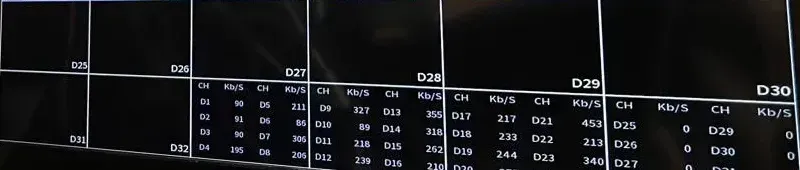
From our job library: a recorder's status screen listing each camera channel with its data rate. A table like this tells a Queens condo board at a glance which cameras are recording and which have dropped off.
Our systems compared with the national brands
ADT, Ring and SimpliSafe sell mostly to single homes, with self-installed devices or monitoring contracts. None of them designs a building-wide entry and access system for a condo board, takes over a sponsor's platform or answers to a managing agent. An owner who wants a doorbell camera inside their own unit is welcome to buy one, subject to the board's rules; for the common elements, a condominium needs one licensed contractor who documents every door and hands the board the keys to every account.
AI Overview Reality Check
What AI Gets Wrong About Condo Security Systems in Queens
Ask a chatbot, or read a national cost guide from Angi, HomeAdvisor or Fixr, about securing a condominium, and the answer is built from national averages and single-family assumptions. Seven of those claims come up again and again, and each one misleads a Queens condo board in a specific way.
1. "A new building's security system is good for years"
Summaries often suggest a newly built condo can ignore security for a decade. In Queens, the opposite is often true in the first few years after turnover.
The equipment may be new, but the accounts, directories and credential lists were set up for a sales office, not a self-governing association. Platform licenses lapse, sponsor staff hold the logins, and fobs issued during sales and construction are never switched off. A building with 173 closings in a quarter, like Long Island City in spring 2025, changes hands faster than any volunteer can track.
The first job in a young condo is usually administrative: recover access, clean the directory, retire construction-era credentials. It costs far less than new hardware and fixes most of what owners complain about.
2. "Condo intercom replacement costs a set amount per unit"
Cost guides quote per-unit averages as if every building were the same. Two 60-unit Queens condos can differ by several times in price.
The drivers are the number of controlled doors, whether units get monitors or answer by app, whether the existing riser or Cat6 can be reused, the door construction, building rules on hours and freight access, and recurring platform fees. A Flushing podium building with three residential lobbies and parking call stations is a different job from a single-lobby Astoria mid-rise with the same unit count.
That is why we publish repair ranges and a $250 service call, but price whole-building work only after walking it.
3. "Cloud intercoms are always cheaper to own"
AI answers often call app-based entry the low-cost modern choice. The hardware may be cheaper; the five-year cost often isn't.
Some platforms bill monthly per apartment or per door. In a 200-unit Hunters Point tower, those fees can pass the price of the hardware within a few years, and if the association stops paying, the panel may stop working. Other systems run locally with optional cloud features and no per-unit charge.
We put any recurring fee on its own line with a five-year total, so the board compares real cost of ownership, not sticker price.
4. "The association is responsible for every device in the building"
General answers assume a condo association owns all security equipment. In New York, the declaration decides.
RPL §339-e treats lobbies, entrances and shared apparatus as common elements unless the declaration says otherwise, and the declaration often does say otherwise for pieces inside or attached to a unit. Apartment monitors, a townhouse unit's own front door or the storefront camera of a ground-floor shop owner can all fall on the owner's side. When a board pays for those by assumption, the next owner asks for the same, and the annual meeting turns into a negotiation.
We ask for the relevant declaration pages on large jobs and name the component on every invoice, so the board can apply its own rules.
5. "A camera system deters package theft by itself"
Many summaries treat cameras as the answer to package theft. Cameras record theft; doors prevent it.
In the Queens buildings we visit, packages disappear from vestibules and open lobbies that anyone can enter behind a resident. A locked package room with a reader, a courier credential limited to the outer door, and a camera that captures the face of whoever opens the room changes the outcome. A camera over an open lobby mostly produces footage of the back of a hood.
We design package security around the door first and the camera second.
6. "Switching security vendors is a quick phone call"
AI answers make changing contractors sound simple. In a condo, it depends on who owns the accounts.
If the previous integrator or the sponsor registered the platform in its own name, the board may need a formal transfer before anyone else can manage it. Local controllers and recorders may have unknown passwords that require a reset, sometimes clearing the credential list in the process.
We document what can be taken over cleanly and what can't before the board ends its old arrangement, so residents don't lose access in the gap.
7. "A security upgrade will lower the building's insurance"
Some answers promise premium discounts for cameras or access control. We don't make that promise, and neither should a contractor.
Insurers set their own terms, and any discount is between the association, its broker and the carrier. What we can provide is a clear description of what was installed and how it works, which a broker may find useful.
The real return on a Queens condo security project is fewer incidents, fewer disputes and a board that can answer owners' questions with records.
Put a Number in Front of Your Queens Condo Board
Send the symptom, a photo of the panel or the reserve study line that is coming due, and we come back with a date inside 2 hours.
A short note is enough: the neighborhood or cross streets, roughly how many units and doors, whether there is a garage or a staffed desk, and what is bothering owners. Photos of the front panel, the equipment shelf and any door that won't latch help a lot. You can also call or text (347) 434-6392.
✅
Request Sent!
Thank you. We will call or text shortly to set a date for your Queens building.
How It Works
How a Queens Condo Security Project Runs
A single garage reader and a tower-wide modernization follow the same seven steps. Larger projects just spend longer at the board-approval stage.
1
Reach out
A board officer, HOA member, managing agent, resident manager or owner calls, texts or sends the form with the building's location, unit and door count, and the problem or goal.
2
Service call or walk-through
Failed equipment gets the $250 diagnostic visit. A replacement or new system gets a free tour of every door, closet and parking level with the agent or an officer.
3
Proposal to the condominium
A written proposal addressed to the condominium lists each door, each phase and any recurring fee on separate lines so the board can vote on it item by item.
4
Approval and deposit
After the board approves under its bylaws, a 50% deposit is paid, equipment is ordered and dates are set; insurance certificates are issued once the job is awarded.
5
Notice to owners and renters
The agent sends a short notice giving the date, the two-hour arrival window, the units we need to enter and what will change for residents.
6
Install or repair
Work moves entrance by entrance, never leaving residents without a way in, and stays within the hours the building permits contractors.
7
Program and hand over
We load the directory, credentials and schedules, test each door from both sides, and hand the board a written list of every admin account and how each door behaves.
Scheduling around a Queens building
Our calendar runs every day of the week with morning starts, and each appointment gets a two-hour arrival window that the crew keeps; they never show up before it opens. A tower with a desk will see us sign the contractor log, book the freight car in advance and work to its insurance rules. A building without staff needs one person with keys to closets and units. Where specific apartments must be entered, list them in the notice and line up a key or an escort for any owner who will be out.
Writing the owner notice
Five items are enough: what is being worked on, the date and arrival window, which units need access, how residents get in during the work, and what changes afterward, such as a new app, new fobs to pick up or a new visitor code. In buildings with many renters or owners who live abroad part of the year, send it by email and post it in the lobby, and have it translated if the board knows its residents read other languages. We supply the facts; the board or managing agent sends it.
Deposits, payment and financing
Installation work requires a 50% deposit under our service agreement, and nothing is ordered until it clears. Special-order panels ship on the manufacturer's schedule, which we don't control, so the installation date is set once the equipment is in our hands. Associations and management companies can pay by check. Financing is available through Wisetack, subject to approval.
Warranty
Our labor carries the 30-day warranty listed on our warranty page; coverage for a year or longer can be purchased with a new system. Equipment carries its manufacturer's warranty, and phone support for the board or resident manager is free. Full terms — including 50% deposit, one-year parts-only warranty on Abstract Enterprises Security Systems-supplied products, and the late-fee schedule — are set out in the service agreement.
Coverage Area
Condo Security Near Queens Landmarks
Technicians dispatched from 460 E Fordham Rd reach condominiums anywhere in the borough. Condo buildings in Queens bunch up around a handful of reference points, and each card below names one along with the security issue that comes up most there. None of them refers to a client.
1
Gantry Plaza State Park
Hunters Point waterfront towers: weather-exposed entrances, amenity floors and podium garages.
2
Court Square and Queens Plaza
Long Island City high-rises over retail: part-time desks, courier traffic and shared service corridors.
3
Main Street and Roosevelt Avenue
Downtown Flushing podium complexes: separating residential cores from public retail and parking levels.
4
Astoria Park and Ditmars Boulevard
Boutique mid-rise condos: unstaffed lobbies, self-managed boards and app-based entry.
5
Queens Boulevard, Forest Hills and Rego Park
Mid-rise condos on narrow lots: compact lobbies, package rooms and side-street garage gates.
6
Jamaica Center and Sutphin Boulevard
New construction near the rail hub: two-door vestibules, heavy foot traffic and ground-floor retail.
We also serve condominiums in Sunnyside, Woodside, Jackson Heights, Elmhurst, Corona, Maspeth, Ridgewood, Middle Village, Kew Gardens, Richmond Hill, Briarwood, Fresh Meadows, College Point, Whitestone, Bayside, Douglaston, Little Neck, Hollis, St. Albans and the Rockaways.
Pricing
Condo Security System Cost in Queens
One condo price in Queens is set before we arrive: the $250 service call, which sends a technician to find the fault and fix what can be fixed on the spot, with the $250 credited toward any larger repair that follows. Common repair parts have published ranges, shown below. Building-wide systems are priced in a written proposal after a free walk-through. We don't quote a per-unit price for a condominium, because a 40-unit Long Island City tower floor with Cat6 to every door and a 40-unit Flushing building split across two lobbies and a garage are not the same job.
What the proposal gives a Queens condo board
Addressed to the condominium by its legal name, with the management company on the cover, so the secretary can attach it to the minutes as is.
A door schedule: each entrance, gate, parking-level door and amenity door on its own row, showing what gets mounted there and how it locks.
How units will answer: in-unit monitors, existing stations kept, app and phone call, or owner's choice.
A cable and equipment plan: which runs are reused, which are new, and where switches, controllers and the recorder will live.
The setup we will load on day one: who appears in the directory, which groups get which doors (owners, renters, porters, dog walkers and cleaners, the commercial tenant, couriers), the hours for each door, and who gets a recorder login.
What the association provides: access to listed units, outlets by the electrician where needed, a named contact and freight-elevator time.
A price for each line and each phase, the deposit, the warranty term, and any recurring platform fee with its five-year total.
A proposal laid out this way becomes the board's record of what it approved, which matters when owners who missed the meeting ask what the money bought.
Published repair ranges
There is no condo premium. A Sunnyside walk-up and a Hunters Point tower pay the same ranges shown on our door buzzer and intercom repair pricing page, and the technician confirms the price with whoever ordered the visit before replacing any part.
Repair
Typical range
Service call (diagnosis and simple fixes; credited toward a larger repair)
$250
In-unit intercom station
$250 to $525
Door release relay or button
$250 to $475
24V transformer
$325 to $650
Electric strike replaced and door aligned
$450 to $950
Lobby panel work
$650 to $1,800
Riser repair inside occupied walls
$850 to $2,400
What moves a building-wide quote in Queens
Controlled openings: a boutique Astoria condo may have two; a Flushing complex with parking levels and amenity floors may have thirty.
Inside the apartments: whether each home gets a wall monitor or answers on phones moves the total more than any other choice the board makes.
What's already in the walls: a riser that tests clean or a Cat6 home run to each unit shortens the job by days, while broken cable behind plaster and tile pushes it the other way harder than anything else.
Doors and gates: glass lobby doors, heavy garage-level steel doors and outdoor vehicle gates each need different hardware.
Building logistics: permitted hours, freight elevator bookings, insurance requirements and shared spaces with a commercial owner all affect scheduling.
Subscriptions: some platforms bill every month for each apartment or door, and over five years that can exceed the equipment price, which is why we show the five-year sum separately.
Camera figures for the borough are on our Queens security camera pricing page, and our intercom pricing page explains how a site visit turns into a number for a new entry system. One rule protects the board from surprises: anything that might add cost on install day, such as an old riser pair that could fail testing, is named in the proposal up front, because equipment can't be returned once it is ordered.
Shop Our Systems
Condo Security Packages and How They Are Priced in Queens
Most Queens associations spend on security in three sizes, depending on whether the money comes from this month's operating budget, a single reserve line or a multi-year capital plan. We price to match each size, and nothing obliges a board to go past the first.
1
Repair what failed
$250 service call. A technician finds out why the panel, reader, gate or recorder stopped, fixes small faults on the spot and puts any larger repair in writing, with the $250 credited toward it.
2
Replace one system
Written proposal after a free walk-through. One target, such as the lobby panel, the package room, the garage gate or the amenity floor readers, priced on its own.
3
Modernize the building
Written proposal after a free walk-through. A full plan for doors, credentials, video and cabling, with each phase priced so the board can spread it across several fiscal years.
Equipment the association or an owner already bought
Sponsors sometimes leave spare panels or readers in a storage room, and owners sometimes buy their own doorbell camera or smart lock. We install and program equipment bought elsewhere and price it as labor only: send the model number and photos of the mounting spot by text, we give the labor price, and a deposit books the appointment. We don't do site visits for customer-supplied equipment, and warranty claims on that equipment go to its manufacturer or seller.
Building a system in phases
A thin reserve doesn't have to mean a patchwork. Queens associations we work with often fix the most visible pain first, the front panel, the garage gate or the mailroom door, and schedule the amenity floor and cameras for later budget years. The first phase is sized for what follows it: a controller with open door slots, a switch with free ports and a credential database that later doors simply join. That way year-one equipment is never ripped out in year three.
In the newer Queens condos the first thing we check is the directory, not the panel. A lobby station that rings half the building usually has nothing wrong with it; the list behind it still carries buyers from the sales office days, renters who left two leases ago and phone numbers nobody updated. Fixing that list fixes the "broken intercom" more often than any part we carry.
The second thing is the garage. Owners judge a building by its gate, and a gate that sticks open or eats a remote gets reported faster than a dead camera. We look at the reader, the loop or sensor that tells the gate a car has cleared, and the battery backup, then we show the board which of those belongs to us and which belongs to the gate company.
The third is the equipment room. In shared telecom rooms we regularly find the security switch stacked on the internet provider's box with no ventilation. Moving it to a shelf with airflow and a battery backup ends the summer outages residents blame on the intercom. Then we write down every login and hand the list to the board, not to one volunteer.
FAQ
Queens Condo Security Systems FAQ
Can you match the entry hardware already installed in the other buildings of our Queens condo complex?
+
Usually, yes. If the other buildings run a platform we can buy and program, we extend it so every building shares one directory and credential list. If that platform is discontinued or tied to a vendor that won't sell to us, we say so and propose a path that keeps all the buildings on one system.
Will someone from your company present the proposal at our condo board meeting?
+
For building-wide projects we can join a board meeting, in person or by video, to walk through the proposal and answer questions. Send the date with enough lead time for the proposal to reach board members before the meeting.
Can the condo association pay by check from its operating account?
+
Yes. Associations and management companies often pay deposits and final invoices by check. Card payments are also accepted, and financing is available through Wisetack, subject to approval.
Can you put a reader on the trash room or recycling area door in a Queens condo?
+
Yes. A reader on a schedule keeps the room open to residents at set hours, lets staff in anytime and can unlock a street-side door for collection windows. A door contact reports if the door is left open.
Do you install license plate cameras at a condo garage entrance?
+
Yes, as an add-on to a garage camera system. A plate camera needs a tight, well-lit view of the lane where cars slow down, so placement is decided at the walk-through and priced with the rest of the cameras.
Do you take away the old intercom panels and equipment when you replace them?
+
We remove replaced devices from common areas and the equipment room and either dispose of them or leave them for the board if it wants spares. Old in-unit stations are removed when new ones go in; we don't patch or paint walls, so the proposal notes where a cover plate or touch-up will be needed.
How long does a lobby entry replacement take once the equipment has arrived?
+
Swapping a single lobby panel and its door hardware is typically a day's work. Adding monitors in every apartment, new readers on many doors or new cable runs takes longer and depends on unit access, so the proposal gives a working schedule rather than a promised date.
Do you train the resident manager and board officers to run the software?
+
Yes. At handover we show whoever the board chooses how to add and remove residents, issue and cancel credentials, change door schedules and export video, and we leave written steps. After that, questions by phone are free.
Is there a charge to review another company's security proposal for our Queens condo?
+
If we are also pricing the job, our walk-through and proposal are free, and we are happy to point out where another bid is unclear. We don't charge consulting fees for comparing bids, but we won't critique a competitor's work without seeing the building.
Can you help our board write house rules for fobs, guests and camera footage?
+
We can explain what the equipment can and cannot do, which helps the board draft workable rules. The rules themselves are adopted by the board under its bylaws, ideally reviewed by its attorney, and we then program the system to follow them.
Can the roof door sound an alarm if someone props it open?
+
Yes. A door contact with a local sounder, or an alert from the access system, flags a roof or stair door held open past a set time. It has to stay compatible with the door's egress requirements, which we check before installing.
Can individual owners order extra fobs directly from you?
+
Credentials for common doors are issued through the board or managing agent so the building's list stays accurate. We supply blank credentials to the association in bulk; owners request extras through management under the board's policy.
One Licensed Contractor for Every Common Door in Your Queens Condo
Lobby panels, package rooms, garages, gates and amenity floors, handled by one crew with one set of records for the board. A failed device is a $250 service call; a new system is a written proposal after a free walk-through.