Lobby panel dark, garage reader rejecting tags or package room door stuck? Westchester County condo boards and managing agents reach us at (914) 877-2578
For Westchester County Condo Boards, HOA Boards, Unit Owners & Managing Agents · Served From Our Bronx Office
Condo Security Systems in Westchester County
Lobby Intercoms · Garage Access · Fobs & Readers · Elevator Control · Package Rooms · Cameras
Condo security systems in Westchester County start with a $250 service call when a lobby entry panel, garage reader, fob system, package room door or camera recorder fails, and any building-wide or community-wide project is priced in writing after a free on-site assessment with the board or the managing agent. Abstract Enterprises Security Systems is a New York State licensed low-voltage contractor (license #12000287431) that repairs, replaces and maintains the intercoms, access control, elevator readers and cameras Westchester condominium associations rely on, from station-area towers in White Plains and New Rochelle to riverfront developments on the Hudson and townhouse condo groups in the northern towns.
Quick answer: In Westchester, most condo security problems sit at the places commuters and deliveries pass: the lobby panel, the garage door and the door from the garage into the building, the package room and the elevator. A failed device starts with the $250 visit: trip, diagnosis and minor fixes included, with the fee applied to any larger repair we then do. New intercom, fob, elevator or camera work is quoted line by line after a free walk of the property, so the board can vote on it and fund it from reserves, an assessment or in phases. We book every request within 2 hours, schedule seven days a week with early-day visits, and work first come, first served once a job is paid.
Last updated November 26, 2026 · Westchester facts on this page come from OneKey MLS (October 2026 county report), The Journal News on Sleepy Hollow's riverfront and Ida in Mamaroneck, the City of White Plains alarm code (§4-18-3), Westchester County Consumer Protection, and New York's Condominium Act (RPL §339-e, §339-v), Multiple Residence Law §3 and General Business Law Article 6-D · Abstract Enterprises Security Systems, NYS license #12000287431
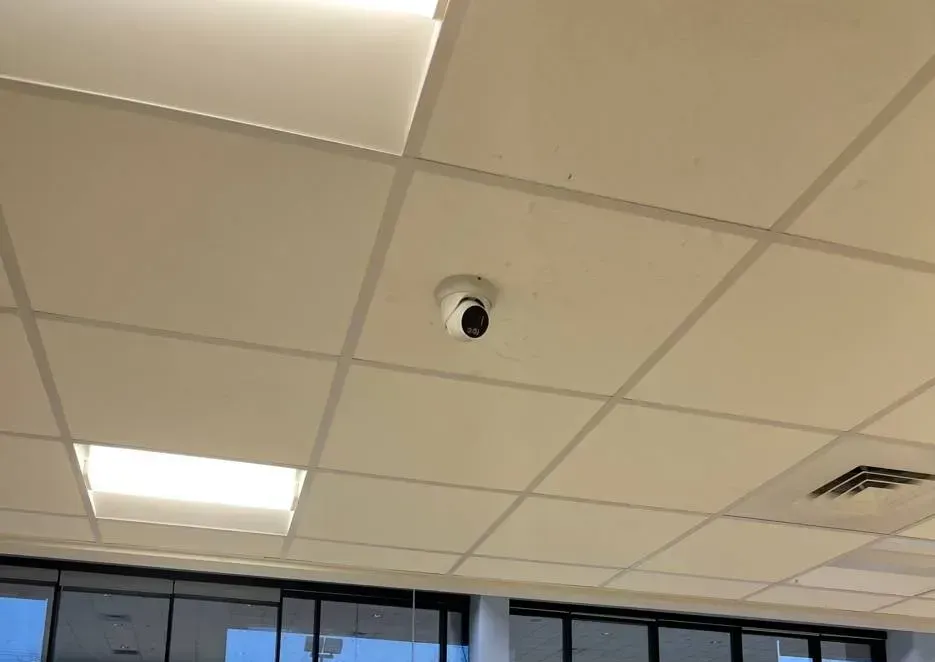
Job photo: a small dome camera set into a drop ceiling, looking toward a long run of glass windows. Westchester's newer condo lobbies are often glass on the street side, which decides where cameras and readers can be mounted.
Westchester County Condo Security Request
Board officers, HOA members, unit owners and managing agents
✅
Request Sent!
Thanks. We will call or text to set the Westchester County visit.
25+
Years Experience
2 Hr
Booking
$250
Service Call
4.7★
201 Google Reviews
Owner-operated since 2002 · Thousands of jobs completed · Booked within 2 hours · Call or text (914) 877-2578
The Neighborhood
Why Westchester County Condos Need Security Built Around Commuters, Garages and Shared Grounds
A Westchester condo owner's day usually starts and ends at a door. They leave the garage before the 7 a.m. train, come back after dark, and in between a cleaner, two delivery drivers, a dog walker and a contractor all need to get in. The building's security system is the thing standing between those people and the owner's front door, and in Westchester it is spread across more places than a city board usually expects: a street lobby, a garage ramp, a package room, an elevator, sometimes a pool deck or a gate on a private road. Condo building security in this county is less about one strong front door and more about the handoffs between all of them.
The market keeps those handoffs busy. OneKey MLS counted 1,250 Westchester condo sales in the twelve months through October 2026, up 4.5 percent, at a twelve-month median price of $560,000, and the typical unit sold in 47 days. Every one of those closings means a seller whose fobs, garage remote, app login and directory listing should stop working and a buyer who needs all of them on day one. In a 150-unit building with normal turnover, the managing agent is changing credentials every few weeks, which is why a system that makes those changes easy matters as much as the hardware at the door.
Four kinds of condo, four different jobs
We see four broad condo landscapes in the county. Downtown station-area buildings in White Plains, New Rochelle and Yonkers are elevator buildings with lobbies, garages and amenity floors, built close to Metro-North and often next door to rental towers. River and Sound waterfront communities, from Yonkers and Sleepy Hollow to Mamaroneck and Rye, add glass lobbies, public walkways beside private doors and weather that tests every outdoor device. Village condos in places such as Port Chester, Tarrytown, Ossining and Peekskill are smaller elevator or walk-up buildings, sometimes converted from older structures. And in the northern towns, large townhouse condominium communities spread hundreds or thousands of homes across private roads with clubhouses, pools and gates.
Each one fails differently. The downtown tower's weak point is usually the garage, where cars hold doors open and the door from the parking level into the building is left on a key. The waterfront building fights corrosion, flooding and visitors from the public path. The village condo has an older intercom and no full-time staff, so a broken door release turns into a complaint chain that lands on a volunteer board officer. The townhouse community has distance: long cable runs, many separate condo groups and a master association that owns the shared roads and amenities. We plan each of those differently, and we say so in the proposal.
Nested associations in the northern towns
Northern Westchester has some of the largest condominium communities in the state, and they are rarely one association. A local listings site for one Somers community describes it as 2,600 condos clustered into 30 condo groups. In communities built that way, the master association usually controls the entrance, the clubhouse and the recreation areas, while each condo group controls its own buildings. A security system has to respect that split: shared gates and amenities on one credential list the master association manages, building doors on permissions each group can see and change, and billing that goes to the right board.
That structure is why we ask, on the first call, which board is calling and what it actually owns. Under New York's Condominium Act, halls, lobbies, entrances and exits, parking areas, recreational facilities and "all apparatus and installations existing for common use" are common elements unless the declaration says otherwise (Real Property Law §339-e). In a nested community the declarations decide which of those belong to the group and which to the master association, and we price the work accordingly.
Resales without an interview
Condo boards in New York typically do not interview and approve buyers the way co-op boards do; on a resale the usual tool is a right of first refusal set out in the declaration. That difference has a practical security consequence. Nobody from the board necessarily meets the buyer before closing, so the moment the deed changes hands is easy to miss, and the old owner's fob, garage remote and phone app can keep working for months. The fix is administrative as much as technical: one system that holds every credential, a closing checklist the managing agent actually uses, and audit reports that show which credentials have not been used in ninety days.
Storms, flooding and the garage level
Westchester's condo garages and lobbies sit in places water reaches. When the remnants of Ida came through in September 2021, The Journal News photographed families wading along Mamaroneck Avenue as they evacuated, and a day later the same street was lined with belongings ruined by flood water. The paper later wrote simply that "Ida devastated Mamaroneck." Access controllers, power supplies and recorders installed on the lowest level of a building are exactly the equipment that does not survive a night like that. On Sound Shore and riverfront condos we look at where water has been before we decide where the head-end goes.
The people around a Westchester condo security decision
Several people shape a project before any equipment is ordered. The board, or in a nested community the master association and the condo group's officers, approves the scope and the money. The managing agent, often a firm that runs dozens of associations across the county, writes the notices, collects the certificates of insurance and becomes the system's day-to-day administrator. A resident manager or superintendent, where there is one, knows which doors get propped and where the old cable runs. Owners care most about getting in quickly and not losing packages. Renters of owners, cleaners and contractors are the people the system has to let in without giving them more than they need. We talk to each of them during the assessment, because a system that suits the board but frustrates the agent ends up with doors propped open again within a month.
What Westchester condo boards tell us first
The complaints are specific. The lobby panel rings an owner's old landline. The app the developer installed has an administrator account nobody can reach. Owners who sold years ago still open the garage. The package room is a closet with a combination lock that every courier knows. The elevator lets anyone ride to any floor. The camera recorder has been writing to a failed drive since last winter. Most of these can be fixed in stages, and the stages can be timed to the board's budget year.
Westchester County condo facts that shape the work
Sales and turnover: 1,250 condo sales in the twelve months through October 2026 at a $560,000 median, 47 days on market; 114 sales in October 2026 alone at a $542,500 median (OneKey MLS, Westchester County report, October 2026).
Downtown growth: New Rochelle adopted form-based zoning for its downtown in December 2015, and the city reports a boom in residential and mixed-use development across 279 downtown acres since then (City of New Rochelle financial report, 2022).
Riverfront redevelopment: on the former General Motors plant site in Sleepy Hollow, a 70-acre community is planned for 1,177 townhomes, condos and apartments, a 140-room hotel, retail, offices and 16 acres of parkland (The Journal News, June 2025, updated March 2026).
Nested associations: one Somers condominium community is described as 2,600 condos in 30 condo groups (local listings site).
Who owns the doors: the Condominium Act treats lobbies, halls, garages, amenities and shared apparatus as common elements unless a declaration says otherwise (RPL §339-e), and lets bylaws set up reserves for "major and minor maintenance, repairs, additions, improvements, replacements" (RPL §339-v).
Housing law: New York's Multiple Residence Law applies to cities under 325,000 people and to all towns and villages (MRL §3), which covers every Westchester municipality; the city's Multiple Dwelling Law and NYC local laws do not.
Flood exposure: Ida flooded downtown Mamaroneck in September 2021 (The Journal News).
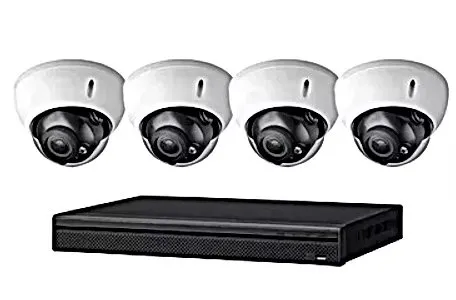
Manufacturer product photo of four white dome cameras above a slim recorder. In a Westchester condo, a set this size can cover the lobby door, the garage-to-elevator door, the package room and the mail area as a first phase.
What We Install
Westchester County Condo Security Services: Lobbies, Garages, Elevators and Package Rooms
Start here if you sit on a Westchester condo board, run an association's office, own a unit or manage the building for a firm. Every system a condominium buys from us has its own block below, written for the way condos decide and pay, with a link to the county page where that system is covered in full. One licensed crew handles all of them, so a call about a single dead garage reader can become a property-wide plan later without a second vendor, a second insurance certificate or a second set of logins.
1
Lobby intercom replacement
Video panels at the street door that ring owners on a wall station, a phone or both, with a directory the agent edits online.
2
Garage and parking control
Garage door readers, long-range car tags, and the door from the parking level into the building.
3
Fobs and access control
One credential list for lobbies, side doors, amenity rooms, storage and bike rooms.
4
Elevator readers
Floor restriction so a credential reaches only the owner's floor and shared floors.
5
Package rooms
Reader-controlled rooms with cameras and delivery codes that can be changed and audited.
6
Cameras and recording
Entrances, garages and package rooms recorded on equipment the association owns.
Condo intercom systems: repair, replacement and modernization
The intercom is where most Westchester condo projects start, and it is where the most money gets wasted when a board replaces the wrong thing. A lobby panel that shows a blank screen may need a new power supply, not a new system. A building where half the units cannot hear visitors may have one failed riser pair. On the other hand, an analog audio panel from the 1990s with a resident directory printed on paper and no spare parts is a replacement project no matter what the first repair costs. Our service visit tells the board which one it has before anyone votes.
When replacement is right, the decision a Westchester condo board actually faces is how owners will answer. Some buildings keep a monitor in every unit, which means work inside each apartment and an access schedule for every owner. Others move to answering on owners' phones through an app, which can reuse the building's existing wiring to the lobby and skip the units entirely. Many choose a mix: phone answering for most owners and a wired station for those who want one. Video panels with a built-in reader let the same device take visitor calls and owner fobs. We write each option into the proposal with what it changes for owners, what it costs to run each year and which parts carry a provider's subscription, so the board compares the whole cost and not just the panel.
Condo intercom replacement is also a governance project. The board approves the scope, the managing agent issues the notice, and owners need to know when the old panel goes dark and how their new credentials arrive. Condo boards preparing that decision can read our condo intercom replacement guide (coming soon), and the full range of entry systems for the county is on our Westchester County intercom installation page. If the panel simply stopped working, start with intercom repair in Westchester.
Door buzzers and door releases in smaller condos
Village condos and converted buildings with eight or twelve units often still run a basic buzzer: a button panel at the door, a speaker and release button in each unit, a transformer and an electric strike. These systems are simple and cheap to keep alive, and most failures are a single part. A strike that no longer releases, a transformer that has cooked itself in a hot vestibule, a unit station with a broken button: each is a known repair with a published price, and our door buzzer repair page for Westchester County lists them. A small condo does not need to replace a working buzzer to get better security; adding a reader to the same door often does more.
Condo access control and key fobs
A Westchester condo usually has more locked doors than owners realize: the lobby, a side entrance, the door from the garage, a service or trash door, the roof, storage cages, the bike room, a gym and a party room. When those run on separate keys and separate combination locks, nobody knows who can open what. Access control puts them on one list. Each owner, renter, staff member and vendor has one credential, each door has its own schedule, and the managing agent can switch off a lost fob from a browser in a minute.
Two choices matter most. The first is the credential itself: older 125 kHz proximity fobs can be copied with inexpensive tools, so new systems use encrypted fobs and cards, phone credentials, or both. The second is who administers it: a cloud platform lets the agent manage several buildings from one screen but carries a yearly fee per door or user, while an on-site controller avoids the fee but needs someone on the property to run it. Our access control installation in Westchester County page covers hardware, locks and published Westchester ranges in detail.
Garages: where Westchester condo security actually happens
In a station-area tower most owners never use the front door. They drive in, park and take the elevator, so the garage is the real lobby. Three points need attention. The vehicle door needs credentials that work from the car, typically long-range tags on the windshield or a reader at driver height, plus a camera that sees each plate. The pedestrian door beside it should not be propped. And the door from the parking level into the elevator lobby needs a reader of its own, because anyone who walks in behind a car otherwise has the run of the building.
Garage equipment lives in the harshest part of the building: exhaust, road salt tracked in all winter, temperature swings, and in low-lying buildings, the occasional flood. We mount controllers and power supplies above the lowest level where we can, use outdoor-rated readers at the ramp and leave service loops so a damaged reader can be replaced without pulling new cable.
Condo elevator access control
Elevator readers decide where a credential can go once someone is inside. In a Westchester condo tower the common setup is simple: an owner's fob lights their own floor plus the lobby, garage and amenity levels, a cleaner's credential reaches one floor on a weekday schedule, and a visitor buzzed in from the lobby is sent to the floor of the owner who answered. The elevator maintenance company has to make its part of the connection inside the controller, so we coordinate the date with them. Published per-car prices and the levels of control are on our Westchester elevator access control page.
Package rooms and deliveries
Westchester condos that were designed before online shopping took off usually have nowhere to put packages, and buildings without a full-time doorman end up with boxes stacked in the vestibule. The fix we install most often is a dedicated package room with a reader on the door, a camera that sees both the shelves and the door, and delivery codes the managing agent can change monthly. Couriers enter with a code that only opens that room, owners pick up with their own fob, and every entry is logged with time and credential. Where a board prefers smart lockers, we install the access control, power and network the locker provider needs; the lockers themselves and their software come from the locker company.
Condo security cameras, in brief
Cameras support every other system on this list: they show who followed a resident through the garage door, who took a box from the package room and whose car clipped the gate arm. In a Westchester condo they belong at entrances, the garage ramp and the door into the building, the package room, the mail area, elevator lobbies, storage rooms and amenity doors, recorded on equipment the association owns. Detailed placement and per-camera Westchester pricing are on our Westchester condo security camera page (coming soon) and on our apartment building security camera installation in Westchester page.
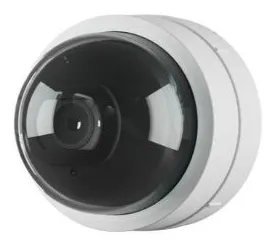
Manufacturer product photo of a white dome camera with a clear cover. In a Westchester condo package room, a dome like this goes on the ceiling where it sees both the shelves and the door.
Alarms for owners, clubhouses and management offices
Individual owners often want an alarm for their own unit, and townhouse condo owners in particular want door contacts, motion sensors and a siren like any house. Associations want one for a clubhouse, management office or maintenance building. We install both, with central station monitoring at $30 a month keypad-only or $45 a month with the phone app. Several Westchester cities regulate alarms; in White Plains, for example, false alarms that police or fire respond to carry escalating fees. Details are on our alarm installation in Westchester County page.
Devices owners add at their own doors
Owners in townhouse condos and in some elevator buildings ask about video doorbells, smart locks or cameras at their own entries. Whether they may install them, and where a camera may point, is a question for the association's rules and the declaration, since the door, the frame and the corridor outside are often common elements or limited common elements. When the board allows it, we install for owners the same way we install for the association, keep the device off the building's security network, and aim any camera at the owner's own entry rather than a neighbor's door or a shared hallway.
Fire alarm work, within our scope
Fire alarm systems in condominium buildings are code-required life-safety systems, and they follow their own path: engineered drawings, filing with the local code enforcement official or fire marshal under the New York State Uniform Code, installation to the approved plans and an acceptance test. The Hudson Valley is within our fire alarm scope. We tie access control into the fire alarm where the code calls for doors to release, and we handle fire alarm work itself through our fire alarm installation in Westchester County service, quoted per building after a survey. Fire alarm work is never priced on this page.
Cabling, network and backup power
Modern condo intercoms, readers and cameras run on network cable, and the security network should be separate from owners' Wi-Fi and from the management office's computers. We pull the cable, install the switches and label both ends, and we put battery backup on the controller, the recorder and the entry panel so the doors behave predictably in an outage. Our structured cabling installation in Westchester County page covers the cabling side. We do not do electrical work: where a new 120-volt outlet or circuit is needed, the association's licensed electrician installs it, and Westchester County requires electricians to hold a county trade license.
Virtual doormen, guards and managed security
Some Westchester condos look at a virtual doorman service, where a remote attendant answers the lobby panel and watches cameras. We do not run that kind of service and we do not provide guards. What we do is install and maintain the intercom, readers and cameras such a provider or the building's own staff would use, and connect to an existing provider's platform where its equipment allows it. Boards weighing a provider should ask who owns the equipment if the contract ends.
Service calls, maintenance and support
After the install, most of what a condo needs is small and regular: a reader that stops reading in cold weather, a recorder drive that needs replacing, a directory that needs updating, a firmware update. Service visits start at $250. Associations that want scheduled visits can book them before the busy seasons, and the board or agent can call for tech support on the system we installed at no charge. Our installation labor carries the 30-day warranty listed on the site, with longer coverage available as a paid add-on; manufacturer warranties on equipment are the manufacturer's.
Who we work with
We work for condo boards, master and sub-associations, HOA boards, self-managed associations, unit owners and the management companies that run Westchester condos. Co-op boards have a separate page: see co-op security systems in Westchester County. Condo associations elsewhere in the region are covered on our Hudson Valley condo security systems hub.
Building Specialists
Condo Security for Westchester County's Architecture: Six Property Types
Westchester's condo stock spans almost every building type in the region. The cards below are the six we work in most, followed by what changes in the equipment and the installation for each.
1
Station-area elevator towers
Lobbies, garages, amenity floors and package rooms in buildings a short walk from Metro-North.
2
Riverfront master-planned communities
Townhomes, condo buildings and apartments sharing roads, parks and retail on former industrial land.
3
Sound Shore village condos
Mid-rise and low-rise buildings in flood-exposed downtowns, often with ground-floor shops.
4
Townhouse condo groups
Hundreds of attached homes in many sub-associations under a master association, with clubhouses and pools.
5
Converted and older buildings
Former rental, school, office or industrial buildings turned into condos, with original masonry and wiring.
6
Garden and mid-rise complexes
Three- to six-story buildings around parking lots, each with its own entry and a shared office.
Station-area elevator towers: run it like a city building, with a bigger garage
The newer condo buildings near White Plains, New Rochelle and Yonkers stations look like Manhattan buildings and need most of the same things: a lobby panel with a directory, readers on every common door, elevator floor control, a package room and cameras throughout. The difference is the car. Residents arrive by garage far more often than by lobby, so the garage door, the parking-level vestibule and the elevator carry most of the traffic. We size the system around those three points first and treat the front door as the visitors' entrance.
Materials are concrete and steel, so cable rides in existing conduit, risers and ceiling space rather than through walls. Concierge desks, where they exist, get an answering station and a screen that shows the lobby and garage cameras, and the system has to work the same when the desk is empty overnight.
Riverfront master-planned communities: one site, several owners
Westchester's riverfront redevelopments mix housing types on one property. The Journal News described the former General Motors site in Sleepy Hollow as a "village within a village" with 1,177 townhomes, condos and apartments planned alongside a hotel, retail, offices and parkland. A condo association in a community like that shares roads, parking and paths with rental buildings, a hotel and the public. Its own system has to keep its doors on its own credential list while working alongside neighbors' systems and the master association's equipment at shared entrances.
Riverfront buildings also bring glass lobbies, salt and wind off the water, and walkways where the public walks past a private side door. We specify stainless or coated hardware outdoors, mount readers on mullions or freestanding posts where glass leaves no wall, and put readers on every door that faces the public path, not just the front.
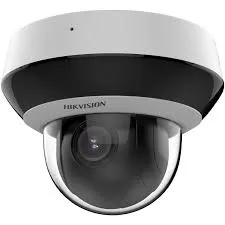
Manufacturer product photo of a compact pan-tilt-zoom dome camera. At a Westchester condo garage, one unit like this can be set to watch the ramp door and swing to the pedestrian door when it opens.
Sound Shore village condos: water first, then doors
In Mamaroneck, Rye, Port Chester and New Rochelle's waterfront, condos tend to be mid-rise buildings in compact downtowns, often over stores. Flooding shapes everything we do there. The access controller, the recorder and the intercom's power supply belong above the level water has reached, cable entries into the basement are sealed, and readers at street level are outdoor-rated even when they are technically inside a vestibule. Ground-floor retail owners usually want their own cameras and alarm, kept separate from the residential system.
Townhouse condo groups: distance and permissions
The large northern communities, in towns such as Somers, Yorktown and Cortlandt, are spread out. The security work is mostly outside: a gate or guard booth at the entrance road, a clubhouse, pools, tennis or pickleball courts, mail kiosks and maintenance buildings, joined by long underground or overhead cable runs or point-to-point wireless links. Owners have private entries, so in-unit intercoms are rare; owners answer visitor calls from the gate on their phones. The hard part is permissions: the master association manages the shared places, and each condo group may want its own codes for its own buildings or facilities.
Converted and older buildings: respect what is there
Some of the county's condos began life as something else: rental apartment houses, schools, office buildings or factories. They have thick masonry, original lobbies boards want to keep, and wiring from several eras. We look for the paths previous contractors used, reuse sound cable where we can, and choose entry panels that fit the existing opening so the lobby does not need patching. Patching and painting are not our trade; we leave a clean installation and the association's contractor handles finishes if any are needed.
Garden and mid-rise complexes: many entries, one office
Complexes of three- to six-story buildings around parking lots, common in Yonkers, Mount Vernon, Eastchester and Greenburgh, have a separate entry door for each building and one management office. A single system with a panel at each entry and one shared directory keeps administration in one place, and buildings can be converted one at a time over several budget years.
What changes with materials and methods
Concrete and steel towers: existing conduit and risers, cored penetrations where needed, fire-stopping restored by the appropriate trade where cable passes through rated assemblies.
Wood-frame townhouses and garden buildings: attics, crawl spaces and exterior conduit; siding mounting blocks for outdoor devices.
Masonry conversions: surface raceway painted to match where walls cannot be fished, panels sized to existing openings.
Glass lobbies: readers on mullions or posts, panels on the one solid wall, and cable hidden in door frames where possible.
Waterfront and flood-exposed sites: stainless or coated outdoor hardware, head-end equipment above the lowest level, sealed entries.
Campuses: buried conduit, aerial cable where poles already exist, or wireless bridges between buildings with clear line of sight.
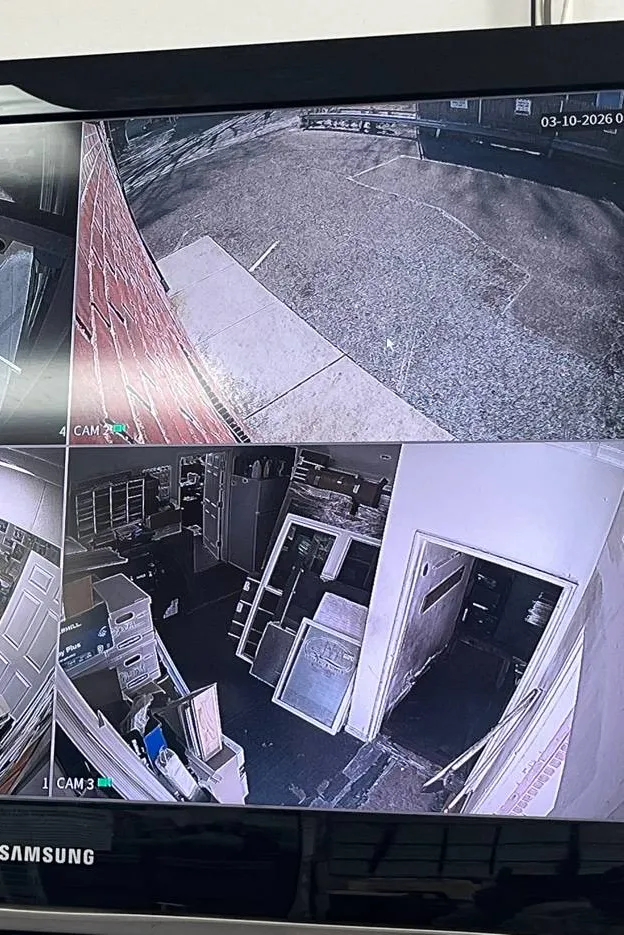
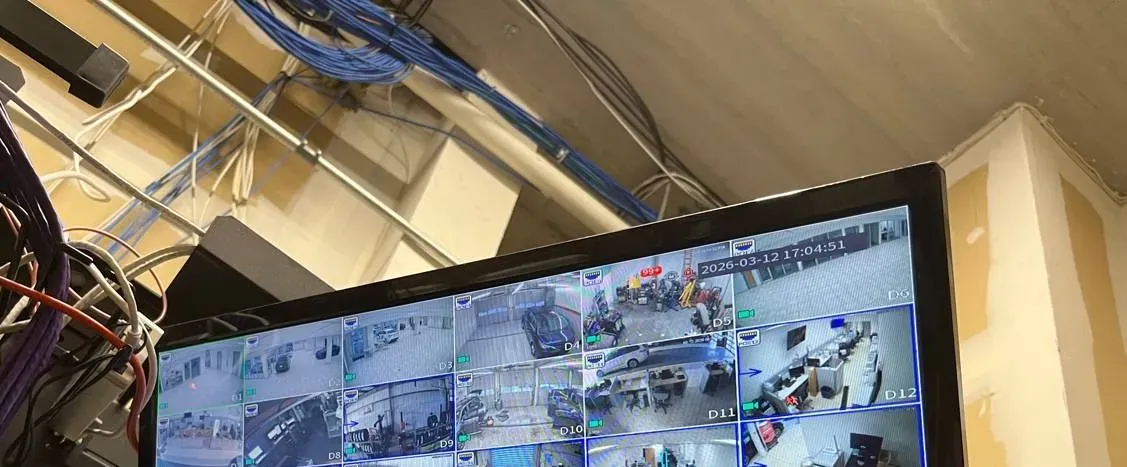
Job photo: a recorder monitor split into camera views, one along a brick wall and walkway, one of a cluttered storeroom with its door open. Side paths and storage rooms are the views Westchester condo boards most often ask to pull clips from.
Commercial Condo Security
Business Condo Security in Westchester County: Mixed-Use, Office and Shared-Site Buildings
Not every Westchester condo is purely residential. Downtown buildings put shops and restaurants on the ground floor, riverfront communities mix condos with hotels and offices, and office and medical condominiums sit in every larger town. Each of these has a commercial owner or tenant with different hours, different visitors and different insurance requirements than the residents upstairs.
Where mixed-use condos appear
New Rochelle's downtown rezoning, Yonkers' waterfront, White Plains around the train station and the Sleepy Hollow riverfront are the places in the county where residential and commercial uses stack or share a site. Port Chester's Westchester Avenue and Main Street and the downtowns of Ossining and Peekskill have smaller buildings with a store below and a few condo units above.
Keeping commercial and residential doors apart
The rule we design to is simple: a store's customers and staff should never be able to reach residential floors, and residents should not be able to wander into the store after hours. That means separate entrances where the building has them, readers on every door between the two, and elevator programming that keeps the commercial floors and residential floors apart. Where the two share a loading dock or trash room, those doors go on schedules both owners can live with.
Shared garages with neighboring buildings
Downtown condos sometimes sit beside or on top of parking used by other buildings or the public. When that happens, the line between the shared garage and the condo's own space is where its security begins: a reader on every door from the parking levels into the condo's stair and elevator lobby, cameras on those doors, and elevator controls that will not take a garage passenger to a residential floor without a condo credential.
Office and medical condominiums
Office condos in White Plains, Harrison, Purchase and along the Saw Mill and Sprain corridors have owners who are businesses, not residents. They need access schedules tied to business hours, visitor management at a front desk or panel, and cameras on entrances and parking. Medical condos add patient privacy concerns at the front door and in waiting areas; we place cameras at entrances and corridors, never in exam rooms, restrooms or similar private rooms.
Hotels, shops and offices on the same site
Where a condo shares its site with a hotel or retail, as on the larger riverfront redevelopments, the association's system meets neighbors with very different traffic: hotel guests at all hours, shoppers on the walkways, delivery trucks for the stores. The useful questions are which doors, drives and loading areas are shared, who owns each one, and whose cameras cover them. We map those boundaries on the site plan with the board and the master association before pricing, so the condo pays only for what it controls and can still get footage from shared areas through an agreement with its neighbors.
Management companies and portfolio agents
Many Westchester condos are run by management companies that handle dozens of associations. They want a vendor who submits certificates of insurance when a job is awarded, invoices the association rather than the manager, and leaves written records of every login and credential. We work that way by default.
Compliance callouts for Westchester County condo security work
Licensing: anyone in the business of installing or servicing burglar and fire alarm systems needs a New York Department of State license (General Business Law Article 6-D); ours is #12000287431, and boards can ask any bidder for theirs.
Electrical work: Westchester County requires plumbers and electricians to hold a county trade license; any new high-voltage circuit is the association's licensed electrician's job, never ours.
Housing law: the Multiple Residence Law, not New York City's Multiple Dwelling Law, applies in Westchester's cities, towns and villages (MRL §3). NYC local laws such as the city's smart-access privacy law do not apply here.
Common elements and reserves: RPL §339-e and §339-v; the declaration and bylaws decide who approves and pays for security work, and we do not give legal advice on them.
Egress: locked doors must still let people out; magnetic locks need code-compliant release devices and, where required, a tie to the fire alarm. The local code enforcement official has the final word.
Alarm ordinances: some cities regulate alarms; White Plains charges escalating fees for false alarms that police or fire respond to (City Code §4-18-3).
Privacy: no cameras inside restrooms, locker rooms, showers or similar private rooms; audio recording raises separate legal questions and is off by default on cameras we install.
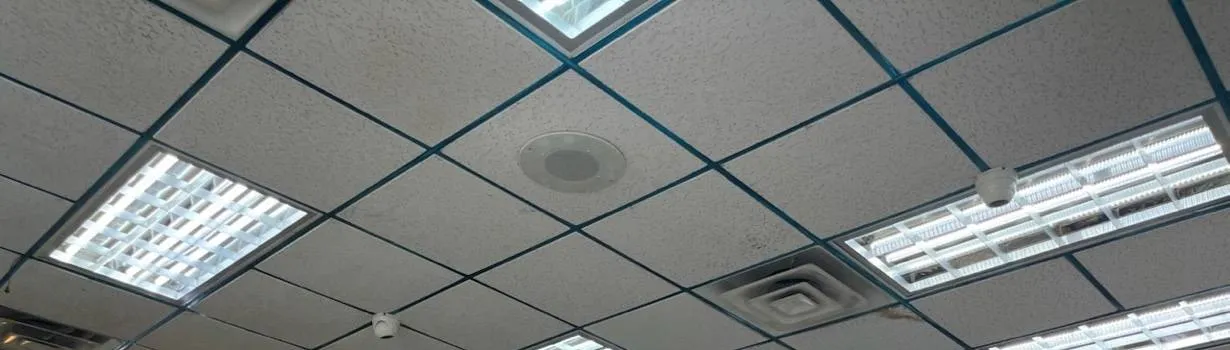
Job photo: several small domes spaced across a drop ceiling with light panels. Ground-floor retail units in Westchester's mixed-use condo buildings usually run their own cameras, separate from the residential system.
Your Questions Answered
Condo Security Systems in Westchester County: Questions Answered
Twelve questions from Westchester condo officers, master associations, owners and agents, sorted into three themes. Each reply opens with the short answer and then explains it.
Sites, garages and neighbors
Our garage is shared with the rental building next door. How do we keep its tenants off our elevators?
Put a reader on every door that leads from the shared garage into your condo's stair and elevator lobby, and program your elevators so a garage-level call only goes to residential floors with one of your own credentials. Neighbors can still park; they just cannot enter your building.
Cameras on those doors back it up. When someone holds a door for a stranger, the recording shows when, and the board can follow up with the owner whose fob opened it. If the garage operator controls the ramp door, we coordinate with them so the two systems do not fight each other.
Our community is several condo groups under one master association. Can each group keep its own codes while the master association runs the shared gates?
Yes. Current access platforms divide one system into separate sites or partitions. The master association administers the entrance gate, clubhouse and pools for everyone, and each condo group's officers see and change only their own buildings and doors.
Each group can have its own reports and its own invoices, and an owner still carries one fob or one phone credential that works everywhere they are entitled to go. Setting this up needs the declarations to be clear about who owns what, so we ask for that map before we price it.
Our building backs onto a public waterfront park. How do we stop park visitors from using our side doors?
Treat every door facing the public path as an entrance: a reader, a door closer that actually latches, and a door position contact that reports when the door is held open. Exit-only doors get no outside hardware at all.
A camera at each door and a held-open alert to the managing agent or concierge usually ends the problem within weeks, because it stops being the easy way in. We do not point cameras across the park itself; coverage stops at your property's doors.
Construction crews for the next phase use our road every day. How do we keep them out of finished buildings?
Give contractors their own credentials that open only the construction gate or lane and expire on the date the developer gives, and keep residential doors on owner credentials only. Where crews share an entrance, a separate lane or a gate schedule keeps the two flows apart.
We also look at the temporary doors builders leave behind: unfinished stairwells, construction elevators and trailers that connect to occupied buildings. Those are where finished buildings get entered after hours, and they belong in the plan until the last phase is done.
Doors, lobbies and hardware
Our riverfront lobby is mostly glass. Where can an entry panel and readers go?
On the solid wall if there is one, on an aluminum mullion, or on a freestanding post just outside the door. Slim panels and narrow readers are made for exactly this, and cable can usually run inside the door frame or the post.
We confirm with the storefront or door manufacturer before drilling a frame, and we avoid anything that would compromise the glazing seal. Where the only solid surface is far from the door, a post-mounted panel at the walkway works better than a reader the visitor cannot see.
Can a reader go on a fire-rated stair or corridor door without voiding its rating?
Usually yes, using hardware listed for fire doors, such as fail-secure electric strikes or electrified locksets rated for the door, and keeping the door self-closing and self-latching. What you cannot do is drill or modify the door or frame in ways the listing does not allow.
Stair doors also have re-entry and release requirements, so we confirm the arrangement with the building's code official before the work and tie the locks to the fire alarm where the code requires them to release.
Each townhouse in our community has its own garage door. Should those openers be part of the association's access system?
Generally no. A private garage on an owner's unit is usually the owner's to manage, and adding hundreds of openers to the association's system creates cost and liability the board does not need. Shared gates, carports and parking structures are a different matter and belong on the association's list.
The exception is a garage door that opens into a shared space, such as a common hallway or courtyard. Those openings affect everyone's security, and the declaration and house rules usually say who controls them. We follow whatever the board's documents provide.
Will a fob reader on our mailroom door lock out the mail carrier?
It does not have to. The Postal Service uses arrow-lock key keepers so carriers can get into unstaffed multifamily lobbies, and the local post office arranges that lock. We keep the carrier's path working when we add readers, and we note it in the handover.
Couriers are different: they get delivery codes from our system that open only the package room or lobby, which the managing agent can change whenever a code spreads too widely.
Owners, credentials and policy
Owners who commute want the lobby door to open as they walk up from the train. Is hands-free entry safe?
It can be. Phone credentials using Bluetooth can unlock a door when an owner's phone is close and unlocked, so the owner does not have to stop and present anything. The safeguards that matter are short read range, a requirement that the phone be unlocked, and logging every entry.
We usually recommend hands-free only on the main lobby or garage vestibule, with standard tap-to-open on side and amenity doors. Owners who prefer a fob can keep one; the two work side by side.
Can the association charge owners for replacement fobs?
That depends on your house rules and bylaws, not on the hardware. Many boards set a replacement fee in the rules so lost fobs are reported and switched off quickly; we do not decide that for you.
What the system can do is make the policy easy to apply: the agent deactivates the lost fob at once, issues a new one, and the log shows how many each household has. Phone credentials cost nothing to replace, which is one reason boards add them.
Do residential corridors need cameras, or are entrances enough?
For most Westchester condos, entrances, the garage, the package room, elevator lobbies and stair doors give the evidence a board actually needs. Cameras on every corridor add cost and make owners uneasy without adding much.
Where there is a specific problem on one floor, such as repeated damage or trash dumping, a camera at that floor's elevator landing usually settles it. We never aim a camera into a unit or through an owner's door.
Non-residents keep using the EV chargers in our garage. Can access control help?
Indirectly, yes. Most chargers run on their own network and payment or card system, which the charger company manages. What we control is who reaches the garage level at all: vehicle tags or readers at the ramp, a reader on the pedestrian door and a camera covering the charging bays.
Once only credentialed cars and people can get down to the parking level, charger misuse usually drops to owners' guests, which is a house rules matter. The camera gives the board a record of plate and time if the rules are broken.
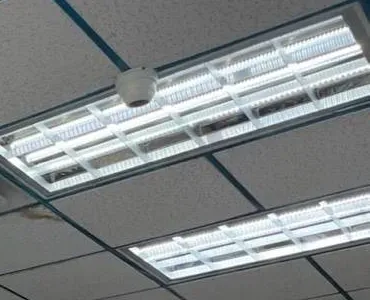
Job photo: a white dome camera on a drop ceiling between two light panels. On residential floors of a Westchester condo, a dome placed like this sits at the elevator landing rather than outside owners' doors.
Equipment
Types of Condo Security Equipment We Install in Westchester County
1
Lobby entry panels
Video panels with resident directories, built-in readers and phone or in-unit answering.
2
Garage readers and tags
Long-range windshield tags, driver-height readers and pedestrian-door readers at the ramp.
3
Readers and controllers
Encrypted fob, card and phone-credential readers, with controllers on battery backup.
4
Locks and door hardware
Electric strikes, electrified locksets, magnetic locks with code-compliant releases, closers and door contacts.
5
Elevator readers
In-car readers and controller interfaces for floor-by-floor restriction.
6
Cameras, recorders and network
Garage, lobby and package room cameras feeding an association-owned recorder on a separate security network.
Owner answering options compared for Westchester condos
Option
Best for
What to weigh
Phone app answering
Commuter towers and townhouse communities
Provider subscription on many platforms; owners must keep the app current
In-unit video monitor
Buildings with many older owners or no cell signal inside
Work inside every unit; access schedule for each owner
Mix of app and monitors
Most mid-size condos
Two answering methods to support, one directory to keep
Concierge desk station
Buildings with a staffed desk part of the day
Rules for routing calls when the desk is empty
Audio-only buzzer kept, reader added
Small village condos with a working buzzer
Lowest cost; no video record of visitors
Credentials, from keys to phones
Metal keys cannot be switched off. 125 kHz proximity fobs are cheap but easy to copy. Encrypted fobs and cards resist copying and are the default on new systems. Phone credentials cost nothing to issue or replace and suit buildings with high turnover, and long-range vehicle tags keep the garage moving at rush hour. Most Westchester condos end up with encrypted fobs for everyone, phone credentials for owners who want them and tags for cars.
Locks for lobbies, garages and amenity doors
Electric strikes suit most single doors with existing hardware. Electrified locksets suit stair and corridor doors with fire ratings. Magnetic locks hold glass and aluminum storefront doors well but must release for egress under the code, with a motion sensor and push button or another approved arrangement. Gates and garage doors take a relay from the access controller into the operator, so the operator itself stays as it is.
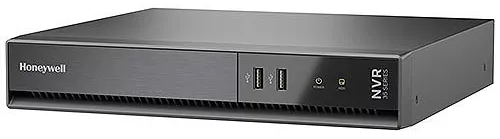
Manufacturer product photo of a compact network video recorder with two USB ports on the front. A recorder like this fits a Westchester condo management office shelf; the front ports are how a clip is exported for an owner or the police.
Recorders, retention and getting a clip out
A recorder in a locked closet, sized to keep the retention period the board chooses, is still the most dependable way for a condo to keep video. Cloud backup of key cameras protects against theft of the recorder itself. The test that matters is simple: can the managing agent export a clip of a specific door at a specific time in under ten minutes? We train the agent and a board officer until the answer is yes.
ADT, Ring and SimpliSafe vs a local condo security installer
National consumer brands sell good products for single homes, and a townhouse owner may be well served by one at their private entry. They are not built to run a building: they do not manage a shared directory, do not control a garage ramp or elevator, and store common-area video in individual owners' accounts. A condo association needs one system it owns, administered by the board or its agent, and serviced by a licensed local installer who can be on site.
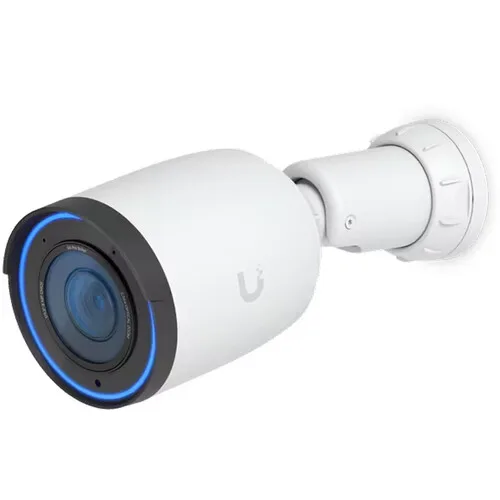
Manufacturer product photo of a white bullet camera with a blue lens ring on an adjustable mount. Westchester condos with surface lots or garage ramps use bullets like this to look along a drive aisle.
AI Overview Reality Check
What AI Gets Wrong About Condo Security Systems in Westchester County
AI assistants and national cost guides blend advice from city apartment buildings and single-family houses. Seven claims we hear repeated, and how they hold up in a Westchester County condominium.
1. "Westchester condos are suburban, so house-style security is enough"
Generic advice often treats anything outside the city as a collection of houses. Many Westchester condos are elevator buildings with lobbies, garages and package rooms that need building systems, and even the townhouse communities have shared gates, clubhouses and pools.
A doorbell camera on every unit does not control who enters a garage, rides an elevator or opens a package room. Those are common elements, and the association needs equipment it owns and controls to manage them.
The better starting point is a count: how many shared doors, gates and amenity entrances does the association control, and which of them carry the most traffic? That list decides the system, not the suburb.
2. "The condo board approves every buyer, so the owner list stays current"
That is how co-op boards work. In most New York condominiums the board's role on a resale is a right of first refusal under the declaration, not an interview and approval, so the sale can close without anyone on the board meeting the new owner.
The security result is that credentials outlive ownership. Sellers keep fobs, garage tags and app access unless someone actively switches them off, and renters of owners arrive and leave without the board hearing about it.
A good condo system makes the change routine: the managing agent closes out the old owner's credentials on the closing date, issues the new owner's, and runs a report of unused credentials every quarter.
3. "Flooding is an insurance problem, not a security problem"
When a storm floods a garage, the access controller, power supplies and recorder on the lowest level go first. After Ida flooded downtown Mamaroneck in 2021, buildings across the Sound Shore found out how much of their door and camera equipment lived below grade.
Insurance may pay to replace equipment, but it does not keep the garage door working the night after the storm or the cameras recording while the building is open to contractors and cleanup crews.
Where a building has flooded before, we move head-end equipment up, seal cable entries and put battery backup on what controls the doors. That is a design decision made before the next storm, not a claim filed after it.
4. "One app can run every building in a master-planned community"
Platforms that handle many buildings do exist, but a community with a master association, several condo groups, rental buildings and commercial owners needs more than one login. It needs permissions that match who owns what.
If every group's officers can see and change every door, sooner or later someone changes a schedule they had no right to change. If only the master association can make changes, sub-associations wait days for simple updates.
The answer is partitioning: one platform, divided by owner, with shared doors administered by whoever owns them. It takes an hour of planning with the declarations in hand, and it saves years of arguments.
5. "Any security contractor can do the electrical work too"
Security installers work on low-voltage wiring: readers, panels, cameras and the cable that connects them. New 120-volt circuits are electrical work, and Westchester County requires electricians to hold a county trade license.
We do not do electrical work. When an entry panel, controller or recorder needs a new outlet or dedicated circuit, the association's electrician provides it, and we schedule around that visit.
Asking for both in one proposal is reasonable; expecting the low-voltage contractor to run line-voltage circuits is not. Boards should check that anyone running new circuits holds the county license.
6. "False alarms cost nothing"
In several Westchester cities they do cost something. White Plains, for example, charges $25 for the first false alarm police or fire respond to in a calendar year, rising to $50, $75, $100 and $250 per false alarm as the count grows (City Code §4-18-3).
The city's definition is broad. It covers mechanical failure, improper installation or use and some power losses, and in the words of the ordinance it "includes all alarm signal activation in which investigation by police or fire personnel reveals no evidence of an emergency condition."
For a clubhouse or management office alarm, that means proper installation, entry delays that match how staff use the building, and registration where the city requires it. We set those up and walk the board through the local rules.
7. "National averages tell you what a condo system costs"
Cost guides on Angi, HomeAdvisor and Fixr publish ranges for intercoms and access control based on national data and mostly smaller jobs. They cannot know how many doors a Westchester condo controls, how far the garage is from the head-end or what is already in the walls.
Two buildings with the same unit count can differ by a factor of three: one has a single lobby and an existing riser, the other has a garage ramp, two side doors, an elevator and a package room with no cable to any of them.
The honest numbers are the published Westchester ranges on our service pages and a line-by-line quote after a free walk of your property. That is what boards should vote on.
Speak to a Technician About Your Westchester County Condo
Send a photo of the failing panel, reader or garage door and a few lines about the building. A date goes on the calendar within 2 hours.
Request a Free Quote for Your Westchester County Condo
Tell us the city, town or village, roughly how many units, elevator or walk-up or townhouse, whether there is a garage, and the problem owners raise most. A photo of the lobby panel or the equipment closet saves a step. You can also call or text (914) 877-2578.
✅
Request Sent!
Received. Our scheduler will be in touch shortly to set a two-hour window that suits the building's managing agent.
How It Works
Our Installation Process for Westchester County Condos
Every Westchester condo job runs in the same order. On a building-wide project, most of the calendar time sits between the proposal and the board's vote, not in the installation itself.
1
First call or form
We take down the municipality, unit count, garage and amenities, plus the symptom or the board's goal, from whoever reaches us first.
2
Service visit or free assessment
A failure gets a $250 diagnostic visit. A new project gets a free walk of lobbies, garage, closets and amenities.
3
Written, itemized proposal
The board gets a document it can vote on: door by door, with hardware, wiring route and cost, and natural break points for phasing.
4
Board approval and deposit
A yes vote plus the deposit releases the purchase order; certificates of insurance go out to the parties the agent lists.
5
Notice to owners
We draft the schedule and what owners will notice; the agent sends it under the board's name.
6
Installation and cutover
Entrances switch one at a time, with the old system left running until the new one is tested.
7
Credentials, training and handover
We load owners and credentials, train the agent and a board officer, and hand over every administrator login in writing.
Scheduling around commuters and owners
Westchester condos empty out on weekday mornings and fill up again in the evening, which suits us: noisy work and lobby cutovers go in mid-morning, when most owners are at work and deliveries have not yet peaked. Garage work avoids the morning and evening rushes. We give two-hour arrival windows, book seven days a week with early-day visits, and confirm with the agent the day before.
What the notice to owners should cover
Which entrances change on which days, and how owners get in during the switch.
How new fobs, tags or phone invitations will reach each household, and when old credentials stop working.
Whether anyone needs to be home, and for how long, if work inside units is part of the scope.
Who to call with questions: the managing agent for building matters, us for technical problems on the new equipment.
What we check on the first visit
The garage ramp, the pedestrian door beside it and the door from the parking level into the building.
The lobby panel, its directory, how owners answer and what happens when a call goes unanswered.
Every common door: side entrances, service and trash doors, roof, storage, bike, gym and party rooms.
The package arrangement and where couriers actually leave boxes.
The elevator controller room and the maintenance company's contact.
The equipment closet: controller, recorder, switches, batteries, logins and the condition of the cable.
Signs of past water on the lowest level.
Deposit, payment and financing
Equipment is ordered after the deposit is received, and installation is scheduled once it arrives; special-order panels or readers can take longer, and we give the arrival date once the distributor confirms it. Financing is available through Wisetack, subject to approval. Associations may pay by check from the operating or reserve account, and invoices go to the association, not the manager.
After the job
The board and agent receive a written record of every device, its location, its login and its warranty. Tech support on the system we installed is free, and service visits after the warranty period start at $250.
Job photo: bundles of blue and white low-voltage cable running along the ceiling above a monitor split into camera tiles. Every Westchester condo system ends at a closet like this, and how tidy it is decides how fast a fault gets found.
Coverage Area
Condo Security Near Westchester County's Landmarks
Six parts of the county and the condo buildings found in each. We describe building types only; client buildings are never identified on this page.
1
Downtown White Plains
Elevator condos within walking distance of the Metro-North station and the courts, with garages under or beside the towers and concierge desks that are not staffed all night.
2
Downtown New Rochelle
A downtown rezoned in 2015, where new residential towers, mostly rental, now share blocks with older condo buildings near the station and the waterfront.
3
Yonkers waterfront and Getty Square
Riverfront and downtown buildings beside the Hudson Line station, where condos sit among rental towers and public waterfront walkways.
4
Sleepy Hollow and Tarrytown riverfront
The former General Motors plant site, now a mix of townhomes, condos, apartments, a hotel and parks, and older condo buildings in Tarrytown's village center.
5
Mamaroneck, Rye and Port Chester
Sound Shore downtown condos, often over stores, in villages that know flooding well.
6
Somers, Yorktown and the northern towns
Large townhouse condominium communities with many condo groups, gates, clubhouses and pools on private roads.
The work changes as you move through the county. In the southern cities, Yonkers, Mount Vernon, New Rochelle and White Plains, condos are mostly elevator buildings and the job looks like city work with bigger garages. Along the river villages from Hastings-on-Hudson to Croton-on-Hudson, buildings are smaller and older, often conversions, with walk-up entries and tight vestibules. On the Sound Shore, flooding and salt air decide the hardware. In the central towns around White Plains, office and medical condos mix with residential ones. And north of Route 35 and through the Route 6 and Route 202 corridors, the condos are communities rather than buildings, where most of the work is outdoors and the distances between doors are measured in hundreds of feet.
We also work in condo buildings in Mount Vernon, Scarsdale, Eastchester, Hartsdale, Harrison, Purchase, Rye Brook, Dobbs Ferry, Irvington, Ossining, Croton-on-Hudson, Peekskill, Cortlandt, Mount Kisco, Armonk and Bedford. Crews are dispatched from our Bronx office at 460 E Fordham Rd, and our office books Westchester visits at (914) 877-2578.
Pricing
Condo Security System Cost in Westchester County
Westchester condo boards can count on exactly one number in advance: the $250 service call, which pays for the trip, the diagnosis and minor fixes, and comes off the bill if a bigger repair follows. Individual items have published Westchester ranges, listed below from our county service pages. A building-wide or community-wide plan is quoted in writing after the free assessment, because the cable paths, the garage and the number of doors drive the price more than any single device.
Published Westchester County ranges that apply to condos
Work
Published range
Where it is listed
Service call and diagnosis
$250
Intercom and door buzzer repair pricing
Video intercom, 4 to 8 units
$1,200 to $3,500
Westchester intercom installation
Multi-unit video intercom with directory
$1,200 to $5,000
Westchester intercom installation
IP intercom with phone answering, larger buildings
$2,500 to $8,000+
Westchester intercom installation
Single-door fob or keypad access
$1,500 to $2,500
Westchester access control installation
Multi-door access (lobby, service, basement)
$4,000 to $15,000
Westchester access control installation
Full building with elevator restriction
$15,000 to $40,000+
Westchester access control installation
Vehicle gate with video intercom and transponders
$2,500 to $7,000
Westchester access control installation
Elevator reader, Level 1, per car
From $1,875
Westchester elevator access control
Elevator biometric reader, Level 2, per car
From $3,125
Westchester elevator access control
Building cameras, per camera installed
$625 to $1,875
Westchester apartment building cameras
Central station monitoring for an owner or clubhouse alarm
$30 a month keypad, $45 a month with app
Westchester alarm installation
Typical repair ranges for intercom and entry parts
Single-part repairs in Westchester condos fall in the ranges below, taken from our door buzzer and intercom repair pricing. Before any part is swapped, you hear the exact figure for it. More detail on intercom costs is on our intercom pricing page.
Repair
Typical range
Apartment intercom station
$250 to $525
Door release relay or button
$250 to $475
24V transformer
$325 to $650
Electric strike replaced and door aligned
$450 to $950
Lobby panel repair or faceplate
$650 to $1,800
Riser pair repair or re-termination
$850 to $2,400
How Westchester boards usually budget security work
Boards typically pay for repairs from the operating budget, plan replacements through the reserve study, and use a special assessment or a phased plan when a project is larger than the reserves allow. Phasing works well for security: lobby and garage first, then side doors and amenities, then elevators and cameras. How a particular association funds the work, and what it may charge owners, is set by its declaration and bylaws; we give the board the numbers, not financial or legal advice.
The running costs boards forget
The install price is only part of the cost of a condo security system. Cloud access platforms and app-based intercoms usually carry a yearly fee per door, per unit or per building; recorders need a replacement drive every few years; batteries in controllers and panels wear out; and readers at garage ramps take the most abuse of anything we install. A board comparing proposals should ask each bidder for a ten-year view: the install, the yearly subscriptions, expected replacement parts and what happens to the system if the association stops paying a subscription. We include that view with every building-wide proposal.
What moves a building-wide quote
The number of controlled doors, gates and elevators, not the number of units.
Whether usable cable already runs from each door to the closet, or new cable has to be pulled through finished space.
Garage distance and conditions: long runs, outdoor-rated hardware, and vehicle tags.
Answering method: phone app, in-unit monitors or both, and any provider subscription.
Glass storefronts, fire-rated doors and other hardware that needs listed or special components.
Flood-proofing and battery backup for head-end equipment.
Full terms — including 50% deposit, one-year parts-only warranty on Abstract Enterprises Security Systems-supplied products, and the late-fee schedule — are set out in the service agreement.
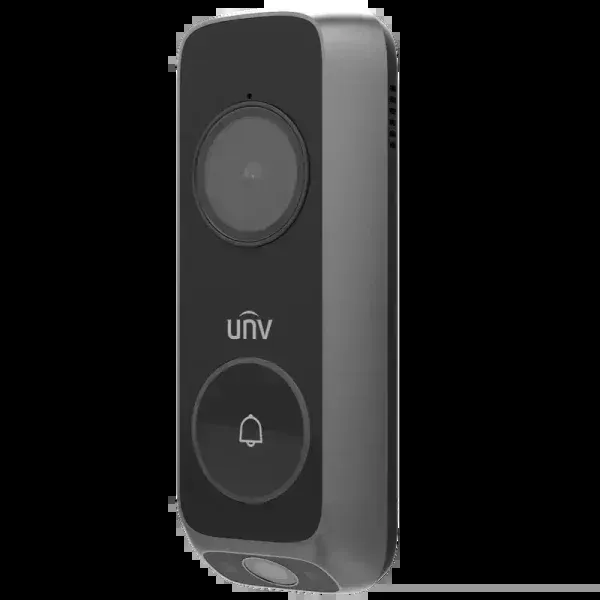
Manufacturer product photo of a slim black video doorbell with a camera at the top and a bell button below. Owners of Westchester townhouse condos sometimes want one at a private entry, which the association's rules may govern.
Shop Our Systems
Condo Security Packages and How They Are Priced in Westchester County
Westchester condos vary too much for a fixed bundle. Almost every job we take falls into one of three levels of work, and each is priced the way it is described here.
1
Get it working again
$250 service call. A technician traces the fault in the lobby panel, garage reader, door lock or recorder. Small fixes are done on the spot; anything bigger gets a written price before work starts.
2
Replace one system
Quoted in writing after a free assessment. The lobby intercom, the garage access or the package room, measured against the published ranges above.
3
One plan for the whole property
Quoted in writing after a free assessment. Lobby, garage, side doors, amenities, elevators and cameras, phased over the budget years the board chooses.
Equipment the association already bought
If a board or developer already purchased panels, readers or cameras, we quote installation labor by phone or text from the model numbers and quantities, and book the install with a deposit. The equipment's own warranty stays with its seller, and wireless equipment's signal and performance are the owner's responsibility rather than ours.
Spreading a project over several years
A phased plan should start with the parts that carry the most risk and traffic: in a station-area tower that is usually the garage and the lobby, in a townhouse community the entrance and the clubhouse. We design phase one so later phases plug into it, which keeps the board from paying twice for the same controller or cable.
Responding to RFPs and board bid requests
We answer requests for proposals from boards and management companies in the format they ask for, with itemized pricing, equipment cut sheets and a schedule. Certificates of insurance are issued when the job is awarded, naming the parties the association and agent require. We do not provide client references; Google reviews of our work are public.
Complete Services
Every Condo Security Service in Westchester County
In a Westchester condo tower we start in the garage, not the lobby. We stand at the ramp for a few minutes around the time owners come home and watch what happens: how long the overhead door stays open, whether the pedestrian door beside it is propped with a cone, whether people walking in from the sidewalk follow a car down. That ten minutes usually tells the board more than the lobby panel does.
Then we find the closet. In buildings that changed management companies, the access controller is sometimes in a room nobody on the current staff has a key to, with a login written on tape inside the door, or none at all. We reset what we can, document every device and password, and leave copies with the board and the agent.
Last, on the Sound Shore and along the river, we look at the walls of the lowest level for a water line. If there is one, the head-end equipment goes above it, whatever the original drawings said.
FAQ
Westchester County Condo Security Systems FAQ
What does a false alarm cost a condo owner or clubhouse in the City of White Plains?
+
Under White Plains City Code section 4-18-3, the fee for each false alarm police or fire respond to in a calendar year is $25 for the first, $50 for the second and third, $75 for the fourth and fifth, $100 for the sixth through eleventh and $250 from the twelfth on. Alarms are registered and renewed through the city's alarm program.
Does your company need a Westchester County license for this work?
+
Security installers in New York are licensed by the state; our NYS license is #12000287431. Westchester County requires its own trade license for plumbers and electricians, which is one reason we leave any new high-voltage circuit to the association's licensed electrician.
Who coordinates with the elevator maintenance company when a reader goes into a car?
+
We do. Our crew installs the reader, controller and cable, and the elevator company makes its connection inside the elevator controller. We schedule a shared date with them and the managing agent, and test every floor together before the car goes back into service.
How high should the lobby entry panel be mounted so every visitor can reach it?
+
We mount the buttons and screen within the reach ranges of the accessibility standards the local code official applies, which generally means operable parts no higher than 48 inches for a forward approach, and we check that the camera still frames a standing visitor's face.
Can the managing agent get a monthly access report by email without logging in?
+
Most current platforms can email scheduled reports, such as door activity by week, credentials unused for 90 days or doors held open, to the agent and board officers. We set up the reports the board wants during handover, so nobody has to remember to log in and look.
Can the lobby screen that shows visitors also display building notices to residents?
+
Some video entry panels and lobby displays can show announcements between visitor calls. Where a board wants a larger lobby notice screen, we install displays and the cabling for them as well, kept separate from the security network.
Can the board run the intercom, fobs and cameras from one login?
+
Many current platforms combine entry, access control and video in one account, and we favor them for condos with part-time boards. Where a building already has separate systems, we can often link them so a door event opens the matching camera clip.
Can courier delivery codes work only during daytime hours?
+
Yes. Each delivery code can carry its own schedule, for example 8 a.m. to 8 p.m. on the package room door only, and the agent can change or cancel a code at any time. Late-evening deliveries then wait for an owner or staff member instead of leaving a code that works all night.
Can an owner see the record of who entered with their own fob?
+
That is a board policy decision. The system logs every entry by credential, and the managing agent can share an owner's own entries on request. Some platforms let owners see their household's history in the app if the board turns that on.
Will elevator card readers get in the way of firefighters during an emergency?
+
No. Elevator access control is connected so the elevator's firefighters' emergency operation takes priority over the readers, and the elevator company makes that connection inside its controller. We confirm the arrangement with the elevator contractor and the code official before the car returns to service.
Can the board try a new reader on one door before buying for the whole building?
+
Yes. Many boards start with one door, usually the garage-to-elevator door or the package room, on the system they intend to expand. Owners get used to the credential, the agent learns the software, and the rest of the building is added later without replacing that first door.
Can new readers go in while our lobby or facade is being renovated?
+
Yes, and it is often the cheapest time. With walls and ceilings open, cable goes in without surface raceway. We coordinate with the general contractor so conduit, backboxes and door hardware prep happen in the right order, and we install devices after finishes are done.
All Areas Served
Condo Security Systems Across the Hudson Valley and New York
Lobbies, Garages, Elevators and Package Rooms: One Licensed Vendor in Westchester County
Station towers, riverfront buildings, Sound Shore walk-ups and northern townhouse communities all get the same licensed crew and the same written records. Broken equipment starts with a $250 visit; new projects start with a free walk of the property.