Lobby panel silent, garage gate stuck, a campus fob that still opens doors for a seller? Bronx condo boards and managing agents reach us at (646) 490-0629
Condo security systems in the Bronx start at $250, the service call that sends a technician to find and fix a failed intercom, fob reader, door release or camera, while a building-wide or campus-wide program for a condominium association is quoted in writing after a free on-site assessment. Abstract Enterprises Security Systems is a New York State licensed low-voltage contractor working out of 460 East Fordham Road, and we install, replace, repair and maintain the entry panels, credentials, garage and parking controls, package room locks and video recorders that Bronx condo buildings run on, from multi-building converted complexes in the east Bronx to Riverdale elevator condos and small new buildings near the Throgs Neck shore.
Quick answer: One licensed vendor can handle a Bronx condominium's whole low-voltage security picture: intercom, fobs, garage and lot gates, package room and cameras. If something already installed has quit, the visit is $250, which covers diagnosis and small fixes and is credited to any bigger repair. If the association wants new or replacement equipment, we walk every entrance and closet at no charge and hand the board a proposal priced door by door and building by building, so it can be approved in one vote or funded over several budget years. Every request gets a booked appointment within 2 hours, seven days a week, with early-day visits.
Last updated November 26, 2026 · Written by the Abstract Enterprises Security Systems team, NYS license #12000287431 · Records and reporting cited: NY Real Property Law §339-e and §339-v (Condominium Act); NY Multiple Dwelling Law §50-a; NYC Admin. Code ch. 30 (Local Law 63 of 2021) and HPD guidance; NYC Comptroller homeowner market spotlight (2024); NYCEDC Lower Concourse project page; Bronx Times; Parkchester Times; The Riverdale Press; 6sqft; Marketproof neighborhood guides; Wikipedia (Parkchester)
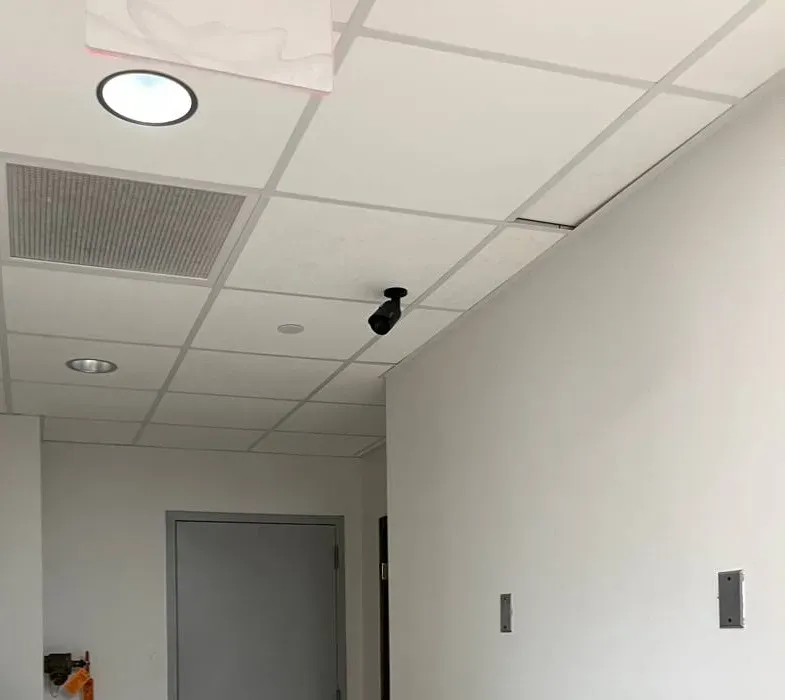
From our job library: a small bullet camera on a drop ceiling watching a hallway that ends at a grey steel door. Back halls and service doors like this one are where most Bronx condo complexes have the least coverage.
Bronx Condo Security Request
For board officers, owners, managing agents and building staff
✅
Request Sent!
Thanks. Our Bronx office will call or text you to set up the visit.
25+
Years Experience
2 Hr
Booking
$250
Service Call
4.7★
201 Google Reviews
Owner-operated since 2002 · Thousands of jobs completed · Booked within 2 hours · Call or text (646) 490-0629
The Neighborhood
Why Bronx Condo Buildings Need Condo Security Systems Planned for Campuses, Garages and Rented Units
Ask most New Yorkers to picture a condominium and they imagine a glass tower with a doorman. The Bronx breaks that picture. Its single largest block of condo homes sits in brick buildings put up before the Second World War and converted from rentals decades later. Its Riverdale condos share streets and boards' associations with co-ops. Its east-side condos include garden-style complexes, townhouse rows and gated waterfront communities that look more like a suburb than the city. And in the South Bronx, where the cranes are busiest, most of what is going up is rental, so the condos that do exist there are small and scattered. Condo building security in the borough has to fit all of those shapes, and the system that suits one rarely suits the next.
What those buildings share is the legal frame. Under New York's Condominium Act, unless a building's declaration says otherwise, the common elements include "halls, corridors, lobbies, stairs, stairways, fire escapes, and entrances and exits of the building," along with "basements, cellars, yards, gardens, recreational or community facilities, parking areas and storage spaces" and "all apparatus and installations existing for common use" (Real Property Law §339-e). Read that list with a security contractor's eye and it covers almost every place a condo association puts a reader, a lock, a panel or a lens: the front entrance, the cellar, the courtyard, the parking lot, the bike room. That is why, in most Bronx condominiums, the board of managers is the client for the building's security and the common charges pay for it.
The same statute leaves the details to each building. Section 339-v requires the bylaws to state how the board is elected, what it may decide on its own, whether it may hire a managing agent, and how owners adopt "decisions binding on all unit owners," and lets them set up reserves for repairs and replacements. In a 40-unit Riverdale condo, that usually means a five-person board, a managing agent who collects bids and a reserve line for the lobby. In a multi-building complex it can mean several layers: a board for each condominium section, a shared management company and sometimes an umbrella body that controls the grounds, the garages and the security staff. Before we scope anything large, we ask who in that chain signs, because a proposal addressed to the wrong body is a proposal that sits in a drawer.
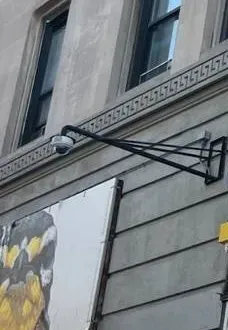
From our job library: a dome camera held off a stone facade on a steel arm, just below the cornice band. Arms like this let a camera look along a prewar Bronx building front without drilling into the carved stone itself.
Parkchester: the borough's largest condo community
No discussion of Bronx condo security gets far without Parkchester. Metropolitan Life built it as a planned community, showing a scale model at the 1939 World's Fair, with 51 groups of buildings planned for 12,000 families. Today the complex is made up of 171 brick buildings of eight or thirteen stories arranged around the two-acre Aileen B. Ryan Oval. In 1974 roughly a third of it was converted to condominiums, and the rest, now Parkchester South Condominium, converted in 1986 (Parkchester history). The complex also has its own special patrol officers, licensed by the NYPD, which shapes how security work there is organized: a building-level intercom or camera project sits inside a campus that already has staff walking it.
The residents' own reporting shows where the gaps are. In October 2024 the Bronx Times described residents rallying for the second time in a month for "more lighting, cameras and increased law enforcement engagement," after a break-in in which a resident found that her apartment door "is hollow and quite easy to break." One protester's sign read, "I should not have to rely on my neighbor's Ring Doorbell" (Bronx Times, Emily Swanson). A few months later the Parkchester Times ran a Parkchester South resident's appeal about package theft that urged neighbors to download "security footage before it auto-deletes" and to "only buzz in people you know or deliveries you are expecting" (Parkchester Times, June 18, 2025).
Those two articles read like a scope of work. Lighting is not our trade, but every camera we install depends on it, and a board that funds cameras before fixing dark paths gets grainy footage of nothing. Footage that auto-deletes before an owner can ask for it is a retention and request-process problem, not a camera problem. And "only buzz in people you know" is advice residents give each other when the entrance itself can't tell a courier from a stranger. Each of those is something a condominium association can fix with the right entry system, a sensible credential policy and a recorder whose settings someone has actually written down.
Riverdale: elevator condos in a co-op neighborhood
Riverdale's condominiums are mostly mid- and high-rise elevator buildings on the slopes above the Hudson, mixed in among a larger stock of co-ops. Owners there tend to organize. The Riverdale Press reported in July 2024 that the local association of cooperatives counts "more than 100 co-operatives and condominiums" among its members and runs workshops on "code compliance, legal parameters, green energy and local law 11" (The Riverdale Press). For a security contractor that means a Riverdale condo board usually arrives informed: it has compared notes with neighboring buildings, it has a managing agent with a vendor list, and it wants a proposal that lines up against two others.
Riverdale condo projects also share a calendar with heavy building work. Facade programs, roof replacements and elevator modernizations are common capital items in these buildings, and each one touches security equipment: a sidewalk shed blocks the camera that covered the entrance, an elevator overhaul is the moment to add a cab reader, a lobby renovation is the moment to change the panel. We ask boards for their capital calendar up front so the security work lands next to the project that disturbs it, not a year before.
The east Bronx: garden complexes, townhouse rows and gated waterfront communities
East of the Bronx River the condo stock spreads out. Marketproof's neighborhood guide notes that in Throgs Neck "condo developments have arrived on Schurz Avenue, as well as gated co-op communities with single family homes" (Marketproof, Throggs Neck), and describes Pelham Bay as a mix where "tree-lined homes" sit beside "newer apartments," with the 6 train "spurring on apartment building development" next to Pelham Bay Park (Marketproof, Pelham Bay). Condo associations out here often manage something closer to a campus than a building: several low-rise buildings, a shared parking lot, a gate, a mail area and a perimeter fence.
That changes the security design. A garden-style condo complex can have a dozen entrances and no lobby at all. The parking lot matters as much as the front door. A vehicle gate needs a reader or remote receiver, a call box for guests and a camera that can see a plate. Near the water, outdoor equipment takes salt air and wind that a Grand Concourse lobby never sees. A system planned for a single high-rise does a poor job here; what works is a single credential list that spans every door and gate, with readers rated for outdoor mounting and cameras placed for the lot as well as the buildings.
The South Bronx: plenty of construction, few condos
The south end of the borough is where new housing is rising fastest, and it is easy to assume new condos come with it. The record says otherwise. NYCEDC describes how, "in 2009, this 30-block stretch along the Harlem River was rezoned to allow for residential and commercial development," and the first phase of the waterfront project that followed calls for "approximately 540 units of 100% permanently affordable housing" (NYCEDC, Lower Concourse). 6sqft's roundup of notable new Bronx buildings lists Mott Haven projects such as a seven-tower waterfront complex and a 12-story building on Bruckner Boulevard, all of them rentals (6sqft).
So the condominiums we meet in Mott Haven, Port Morris and around the lower Concourse tend to be small: a converted loft, a handful of new units over a storefront, a boutique building whose owners form the whole board. Their security needs are compact but sharp. The entrance usually faces a busy commercial street, the ground floor is often a business, and the association has no staff at all. A video panel that rings phones, a reader on the cellar or bike room and two or three well-placed cameras do most of the work, and the board needs one clear price rather than a menu.
Rented units change the math
Bronx condo boards deal with a lot of residents who are not owners. Citywide, the NYC Comptroller counts "318,000" occupied condominium apartments and reports that "18% of condo units citywide are owned by LLC's," noting that some owners "subsequently vacated and are renting out their units" (NYC Comptroller, March 2024). The Comptroller's report gives no Bronx-only figure, and we don't invent one, but in converted complexes where investors bought units at conversion, renters are a familiar part of the resident mix. Every one of those households needs entry, a directory listing and a fob, and every lease that ends is a credential somebody has to switch off. A condo security system that can't keep up with turnover leaks access month by month.
Bronx condo facts that shape the work
171 buildings, 8 or 13 stories: the Parkchester complex, originally planned for 12,000 families (Wikipedia, Parkchester).
1974, then 1986: Parkchester went condo in two stages, about a third of the complex first and the section now called Parkchester South twelve years later (Wikipedia, Parkchester).
100+ co-operatives and condominiums: the membership of Riverdale's building owners' association in 2024 (The Riverdale Press).
30 blocks, 2009: the Lower Concourse rezoning along the Harlem River (NYCEDC); the new buildings that followed are largely rentals (6sqft).
18%: the share of New York City condo units owned by LLCs, a rough signal of how many units are rented rather than owner-occupied (NYC Comptroller).
Eight apartments, built or converted after 1968: the point at which state law expects a self-locking entrance with a working intercom (MDL §50-a).
Associations that start with the intercom almost always end up adding the parking lot gate or the package room to the same proposal, because once residents see one entrance working properly, the next weak point becomes obvious.
What We Install
Condo Security Services in the Bronx, From the Lobby to the Parking Lot
We work as the condo security company a Bronx association can hand every low-voltage problem to: entry panels, credentials, door hardware, gates, cameras and the cable behind them. One licensed installer means one invoice format for the managing agent, one set of administrator logins for the board and one phone number for the superintendent. Each system below starts with the question boards actually bring us, then points to our Bronx service page where the technical depth lives.
Condo intercom replacement, upgrades and repair
The entry intercom is the system every resident touches and the one most Bronx condo boards call about first. In prewar converted buildings it is often an audio system with a speaker panel, a riser running up the stair hall and a handset in each apartment, patched over the years with parts from three different makers. In Riverdale elevator condos it may be a newer video panel with a concierge connection. In small South Bronx buildings it is frequently an app-based panel the developer chose. We repair all of them, and when repair stops making sense we carry out a full condominium intercom replacement: audio to video, wired handsets to monitors or phone answering, a four-button plate to a scrolling directory, or a single entrance to several entrances on one system.
The money question comes before the hardware question. Is this a repair the agent can approve from the operating budget, or a capital replacement that belongs in the reserve plan and possibly in front of the owners? We write condo intercom proposals so a board can tell. The failing component gets its own repair line. The replacement scope lists every entrance and every panel, says what happens in each apartment (new monitor, existing handset kept, phone or app answering only), shows the riser or network path, names the door release hardware and puts any maker's subscription on a separate line with its yearly cost. That layout drops straight into an RFP and lets a board compare three bids without translating them. Installation detail lives on our Bronx intercom installation page, and faults in an existing system are covered on intercom repair in the Bronx. Boards planning a full replacement can also read our condo intercom replacement guide on budgeting, bid comparison and owner notices.
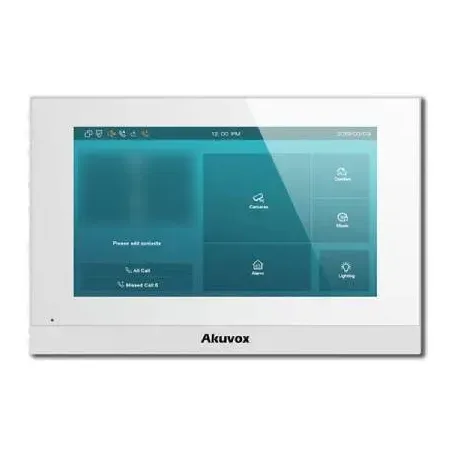
Manufacturer product photo: a white wall-mounted touchscreen monitor that answers the lobby panel from inside an apartment. Whether every unit gets one of these or answers on a phone instead is the biggest single cost choice in a Bronx condo intercom replacement.
Buzzer systems in walk-up and garden condos
Low-rise condos across the east Bronx often still run on a plain buzzer: a button plate at each entrance, a talk unit in each apartment and a strike on the door. In a garden complex with eight or ten entrances, a single dead buzzer usually affects one line of apartments, and the fault can sit in the station, the cable, the transformer in the cellar or the strike. We trace it on the service call, replace what failed and test the release from every apartment on that line. Prices by component are on our door buzzer repair in the Bronx page; boards that want to start fresh on a small building can look at door buzzer installation in the Bronx.
Condo access control: fobs, cards and phone credentials
A Bronx condo's controlled openings add up fast. Beyond the lobby there is the cellar, the laundry room, the bike or storage room, the trash room, the roof, the community room, a garage door or two and, in campus-style complexes, every building entrance on the grounds. We install readers, electric strikes, magnetic locks, door contacts and request-to-exit devices, then the controller and software that hold the credential list and the entry log. The main benefit for an association is control at turnover: when an owner sells or a renter's lease ends, their fob stops working that day and nobody re-keys a cylinder. Hardware and pricing are covered on our page for access control installation in the Bronx, and condo owners around the Oval can see local context on access control in Parkchester.
One credential list across many buildings
The Bronx's large condo complexes raise a problem a single tower never does: a resident of one building should usually open their own entrance, the shared laundry and the parking lot, but not the lobby of the building across the courtyard. Staff, patrol officers and contractors need wider access on set schedules. We set this up as credential groups on one networked system rather than a separate box in every building, so the management office edits one list and the entry log shows every door on the campus in one place. Where buildings are too far apart for cable, the controllers talk over the network, and we plan that path during the walk-through.
Package rooms and delivery access
Package theft is the complaint we hear most often from Bronx condo residents, and the fix is almost always about the entrance rather than the camera. A carrier who can't get in leaves the box at the door; a carrier buzzed in by a random resident leaves it in an open lobby. A package room with its own reader and a camera on its door, or a delivery credential that opens only the vestibule during set hours, closes both gaps. We install the reader, the lock and the camera and set the delivery schedule if the platform supports one. Parcel lockers come from locker companies; where a board has one or wants one, we wire and integrate the doors and intercom around it rather than selling the locker itself.
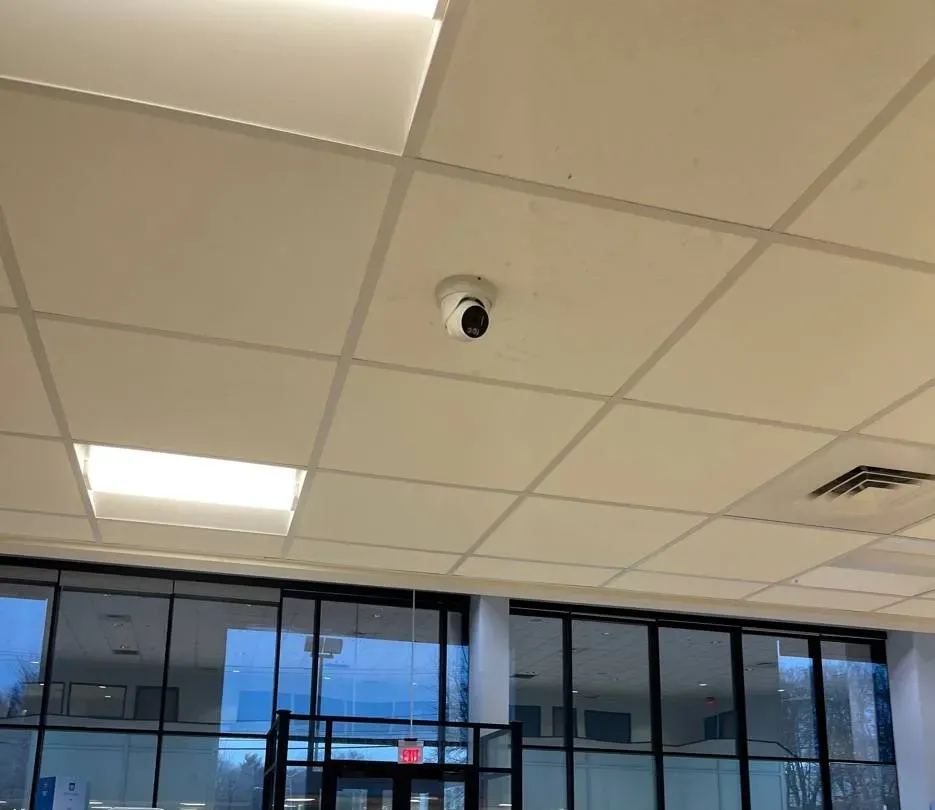
From our job library: a turret camera on the ceiling grid looking toward a wall of glass entrance doors. A view like this records who comes in behind a resident, which is the usual way packages leave Bronx condo lobbies.
Community rooms, laundry rooms and other shared spaces
Bronx condos have fewer rooftop pools and more laundry rooms, community rooms, playgrounds and storage areas. Each shared space raises the same board questions: who may use it, when, and with whom. A reader on a schedule answers the first two; a camera on the door settles the arguments about the third. Community rooms rented out for parties get a temporary credential for the host that expires at the end of the booking, and laundry rooms can close overnight without anyone holding a key.
Cameras: covered briefly here
Video for a Bronx condo usually starts at the doors people actually use: main and side entrances, mail areas, the lot and its gate, garage doors, then laundry, storage and trash rooms, and the elevators only if the board votes for it. We record to equipment locked inside the building, keep footage for exactly the number of days the board writes into its policy, and issue separate logins to each person the board approves. A dedicated page on condo security camera installation in the Bronx is coming to this series; for now, recorder sizing and camera placement in multifamily buildings are explained on our page about apartment building security camera installation in the Bronx.
Elevator access control
Elevator condos in Riverdale and the taller converted buildings sometimes want the cars to stop residents from riding to floors they don't live on, or to keep the roof and the garage level for credentialed users only. We mount the reader in the cab and install the relay interface that tells the controller which buttons a credential may light; the elevator maintenance company stays responsible for the controller itself, and we schedule our visit alongside theirs. Details are on elevator access control installation in the Bronx.
Parking lots, garages and vehicle gates
Parking is a bigger security question in the Bronx than in most of the city, because so many condo complexes have surface lots, garages or both. A vehicle gate takes a reader or a long-range tag receiver, a call box so guests can reach a resident, and a camera placed to read plates at the speed cars actually move. Garage pedestrian doors and the doors from the garage into each building go on the same credential list as the front entrances, so a lost fob is switched off everywhere at once. The gate operator and its motor belong to the gate company; we connect our readers and cameras to it and coordinate visits when both trades are needed.
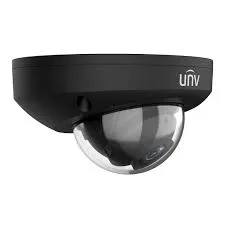
Manufacturer product photo: a black vandal-resistant dome. Domes with a hard shell like this suit low garage ceilings in Bronx condo complexes, where a camera is within reach of anyone walking past.
Alarms for owners and ground-floor businesses
Intrusion alarms are mostly a unit-level purchase in Bronx condos. The association protects its common doors with access control and video, while an owner of a ground-floor home, a commercial condo or a storage unit may want sensors, a keypad and a monitored panel of their own. We install those for owners and connect them to central station monitoring; setup is described on alarm installation in the Bronx.
Fire alarm work, only within our scope
Fire alarms come up on nearly every condo access job, because magnetic locks on exit paths generally have to release when the building alarm activates. Fire alarm systems themselves are a separate, engineered trade in New York City that starts with sealed drawings and an FDNY filing and is priced building by building. We take on fire alarm work only within our licensing scope; fire alarm installation in the Bronx walks through the approval path.
Cable, network and power behind it all
Video panels, readers and cameras ride on Cat6, PoE switches and a riser path, and in prewar Bronx buildings that path is the hard part: thick masonry, plaster stair halls, and cellars where three generations of wiring share the same ceiling. We run, label and document the security side so the next technician can follow it, and we reuse existing conduits and sleeves wherever they are sound. Bigger cabling scopes sit on our structured cabling installation in the Bronx page. We don't do electrical work: if a controller, panel or lock power supply needs a new 120-volt outlet or circuit, the association's electrician supplies it.
Taking over a system nobody can log into
Converted complexes and newer boutique condos share one problem: the original installer is gone and nobody on the current board has the administrator password. In a converted building the system may date from a management company that no longer runs the property; in a new building, the developer's integrator may have opened the cloud account in an employee's name. We start with a service call that inventories what is installed at each door and in each closet, identifies which parts are cloud-managed and who holds those accounts, resets local equipment where the maker allows it, and gives the board a written list of what to keep, what to replace and what is under subscription. Where a platform requires the account holder's cooperation to transfer ownership, we tell the board exactly whom to ask.
Guests, caregivers, contractors and short stays
Visitors are a constant in any Bronx condominium: relatives staying for a week, a tenant on a two-year lease, a cleaner on Thursdays, a contractor gutting a kitchen. A board that can't see those credentials can't switch them off. We configure access so the office can hand out a fob or phone pass that opens chosen doors until a chosen date, and so owners can send a single-use code from the intercom app where the platform offers it. The house rules, and city law, decide whether short-term stays are allowed in a given building; that call belongs to the board and its counsel, and our settings simply carry out whatever they decide.
A one-hour self-check for Bronx condo boards
A board officer or superintendent can learn a lot in an hour on foot before calling anyone. Our free walk-throughs follow the same route:
Walk the perimeter: every entrance, gate, garage door, cellar door and fire exit. Which close and latch on their own, and which are propped, taped or broken?
Count the credentials: keys, fobs, gate remotes and app users, and who holds them (owners, renters, staff, patrol, contractors, the commercial tenant). When was the list last checked against the owner roll?
Test the front door like a stranger: call three apartments from the panel, watch a delivery arrive, and see what happens when nobody answers.
Pull a clip: ask whoever has the recorder login to find yesterday's footage of the main entrance. How long did it take, and how many days back does it go?
Open the equipment room: note where the controllers, network switches, recorder and door power supplies sit, whether anyone could walk in, whether it overheats in August, and whether a battery keeps it running in a blackout.
Look at the lighting: walk the lot and the paths after dark. A camera can only record what the lights show it.
Boards that run this list usually find their real exposure is narrow: one gate that never closes, one recorder that stopped writing months ago, one door closer that gave out in the winter. Those fixes cost far less than a full replacement and belong at the top of any plan.
Repairs, maintenance visits and support
Fixing a Bronx condo security fault begins with our $250 service call. Boards that prefer a planned check, say each spring or before the board turns over at the annual meeting, can schedule a maintenance visit that goes through panels, readers, gates and the recorder in one trip. Questions by phone about a system we put in cost nothing. What we do not offer is a managed security plan, a video watch service or a virtual doorman: our role is the equipment that staff or an outside provider relies on, and we will tie into a provider the board already pays.
1
Intercom replacement and repair
Lobby and building-entrance panels, apartment monitors, phone answering and directories.
2
Campus-wide credentials
One fob list for every building, gate, laundry and garage, edited by the management office.
3
Parking and gates
Vehicle gate readers, guest call boxes and plate-capable camera views.
4
Package and delivery access
Package room readers, delivery schedules and locker integration.
5
Cameras and recorders
Entrances, lots, mail areas and back halls, recorded on site.
6
Takeovers and upkeep
Login recovery, system inventory, labeled cable and scheduled check-ups.
Building Specialists
Condominium Building Security for the Bronx's Condo Building Types
The same fob reader costs a different amount, takes a different schedule and needs different paperwork depending on whether it goes on a 1940s brick entrance in a converted complex, a Riverdale elevator lobby or a gate at the edge of a waterfront parking lot. These are the condo building types we plan around in the borough.
A
Converted prewar complexes
Brick buildings of eight to thirteen stories on shared grounds, converted from rentals to condominiums. Many entrances, a management office, campus staff and residents who have lived there for decades.
B
Riverdale elevator condos
Mid- and high-rise buildings on the hills above the Hudson. Staffed or part-staffed lobbies, garages, informed boards and managing agents who bid every job.
C
Garden-style condo complexes
Two- and three-story buildings around courtyards in the east Bronx. Separate entrances for each building, a shared lot and no lobby.
D
Townhouse and gated communities
Rows of attached homes with private front doors and a shared gate, common grounds and parking near the Throgs Neck and Pelham Bay waterfront.
E
Small new condo buildings
Five- to thirty-unit buildings on side streets in Pelham Bay, Throgs Neck and Morris Park. App intercoms, keyless locks and modest reserves.
F
Mixed-use and loft condos
Converted industrial buildings and new units over storefronts in Mott Haven and Port Morris, with a business on the ground floor and no staff.
Converted prewar complexes: many doors, long-time residents
A converted complex is a security job measured in buildings rather than doors. Each building has a front entrance, often a rear or courtyard entrance, a cellar door and a laundry or storage room, and the campus adds parking, a management office and paths between the buildings. The entry systems were usually specified when the property was still a rental, and many were replaced piecemeal afterward, so the same complex can hold four generations of intercom side by side. We start these jobs with a survey of every building's panel, riser and door hardware, and we price a standard that each building moves to as its old system fails or as the reserve allows. Residents in these complexes have often lived there for decades and include many older owners, so any new system needs an answering option that works without a smartphone and a directory large enough to read.
Riverdale elevator condos: staff, garages and bid packages
A Riverdale condo tower behaves like a small campus stacked vertically. A doorman or concierge may cover the lobby for part of the day, residents answer the panel on monitors or phones after hours, and the garage has its own vehicle door, pedestrian door and elevator landing. Work there is about sequencing: one entrance changed while the other stays live, elevator time booked through the agent, programming done when the desk is quiet. Boards in these buildings expect a scope that matches their RFP line for line and a single contact for scheduling. For the neighborhood itself, see intercom installation in Riverdale.
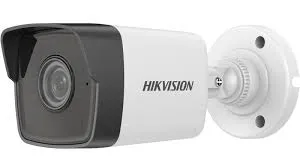
Manufacturer product photo: a bullet camera built to record in color under low light. On Bronx garden complexes we pair cameras like this with the lot lighting and check each view in winter and in full summer leaf.
Garden-style complexes: a dozen entrances and no lobby
Garden condos spread their residents across low buildings, each with its own door to the street or courtyard. There is no lobby to staff and no single place for packages to land. The work is mostly repetition done carefully: a matching panel or buzzer plate at each entrance, strikes sized to doors that see heavy weather, and one controller that can see every reader. Underground cable between buildings is often the most expensive line item, so we look first for existing conduit and, where there is none, for a network path that avoids trenching.
Townhouse rows and gated communities near the water
In a townhouse or gated condo community, each owner's front door is usually part of their unit, while the gate, the shared drive, the parking and the grounds are common. That split decides who pays for what. The association's system is typically the gate reader, a call box that rings each home, cameras at the entrance and on the shared parking, and perhaps readers on a clubhouse or pool. Owners who want a video doorbell or a smart lock on their own door can hire us directly for that, as long as the community's rules allow it. Near the Throgs Neck and Pelham Bay shoreline we specify outdoor-rated, corrosion-resistant hardware for the gate and any exposed camera.
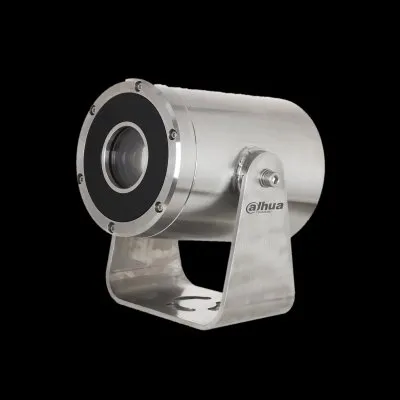
Manufacturer product photo: a camera in a stainless steel housing on a matching bracket. Sealed stainless housings are what we consider for gates and docks in Bronx waterfront condo communities, where salt air works on ordinary painted mounts.
Small new condo buildings: watch the running costs
The newest Bronx condos tend to be compact buildings with an app-based intercom, keyless locks on the entrances and sometimes a subscription charge per door or per apartment. Their boards ask two questions: what will this cost every year, and what happens if the platform raises its price or drops support? We answer with a several-year cost for the system they have and for one alternative without a recurring fee where one exists, so the owners can decide with numbers rather than sales copy.
Mixed-use and loft condos in the South Bronx
Condos in Mott Haven and Port Morris often sit in or beside former industrial buildings, with heavy masonry, freight-size doors and a business on the ground floor. Readers and strikes have to suit oversized steel doors, cable paths have to work around brick that won't take a quick fish, and the residential credential list must stay separate from the commercial tenant's so a store employee can't wander upstairs.
Materials and methods by building type
Prewar brick and stone entrances (converted complexes, Riverdale): surface-mount panels or panels set into existing openings, and steel arms that hold cameras off carved stone instead of drilling it.
Plaster stair halls (prewar buildings): we meter the old intercom conductors floor by floor and pull fresh cable only on the runs that fail, which keeps work inside apartments to a minimum.
Aluminum and glass doors (newer lobbies): an electromagnetic lock or a strike hidden in the frame, with an exit sensor and, where a building alarm exists, a release tied to it.
Exterior gates and fences (garden and gated communities): outdoor-rated readers on posts, gooseneck stands for drivers and sealed junction boxes.
Steel service and garage doors (every type): heavy strikes or mag locks rated for the door weight, and a working closer confirmed first, since no reader can secure a door that hangs open.
Between buildings (campuses): existing conduit reused where sound, otherwise network links between controllers rather than new trenches.
Boards replacing an intercom across several buildings often add readers to the laundry and storage rooms in the same project, because the controller, cable and programming visit can be shared.
Commercial Condo Security
Commercial and Mixed-Use Condo Security in the Bronx
Plenty of Bronx condominiums have a business downstairs: a pharmacy on the corner, a row of shops along an avenue, an office unit on the ground floor of a Riverdale building, a restaurant under new units in Mott Haven. Legally the commercial space is often a separate unit with its own owner. Physically it shares walls, a cellar, a trash area and sometimes a corridor with the residential association. Condo building security has to respect that line every day.
Bronx corridors where condos meet storefronts
East Tremont Avenue: the shopping street that runs through Throgs Neck and past Parkchester, with residential buildings and storefronts side by side.
Johnson Avenue and Riverdale Avenue, Riverdale: neighborhood retail at the base of and beside elevator buildings.
Westchester Avenue, Pelham Bay: stores under the elevated 6 line, with newer apartment buildings on the side streets.
Bruckner Boulevard and Third Avenue, Mott Haven: new residential construction over and beside ground-floor commercial space.
Fordham Road: the borough's busiest shopping street and the home of our Bronx office.
Schurz Avenue area, Throgs Neck: newer condo developments close to the water, with parking and gates rather than storefront lobbies.
Keeping the business and the residents apart
A typical request from a Bronx mixed-use condo: the pharmacy or deli downstairs needs its staff in the cellar and at the trash area, and the residents want those same employees kept out of the upstairs halls. One controller handles both with two separate groups. Fobs issued to the business open only the doors its deed or a signed agreement covers, only during hours the board approves, and the log shows which group used which door, which ends most arguments about who left the cellar unlocked.
The commercial owner's own system
Shops and offices on the ground floor usually buy their own video and alarm. We are glad to do that work for the business owner too, but we keep it apart from the association: its own recorder, its own passwords, its own invoice. Feeding a store's cameras into the building recorder raises awkward questions about who gets to watch whom, and keeping the two systems fully separate avoids them.
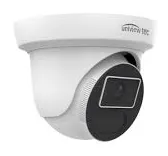
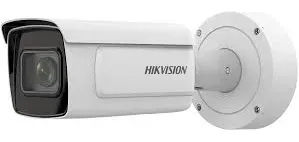
Manufacturer product photo: a white eyeball turret. A compact turret like this suits a Bronx condo cellar or storage room that the commercial unit and the residential association both use.
Rules that apply
The state intercom requirement.Multiple Dwelling Law §50-a applies to class A multiple dwellings built or converted after January 1, 1968 with eight or more apartments. It calls for a self-closing, self-locking entrance door and an intercom allowing "voice communication between the occupant of each apartment and a person outside," with the door released "from the apartment." Older buildings fall under it when a majority of the residents ask in writing, and the section makes it a misdemeanor to "wilfully destroy, damage, or jam" that equipment. Converted Bronx complexes and most Riverdale condos have far more than eight homes, but how the law reads for a particular condominium is a question for the association's attorney; our job is to keep the equipment that satisfies it working.
Privacy rules for digital entry. The city's Tenant Data Privacy Law, Local Law 63 of 2021 (codified as chapter 30 of the NYC Administrative Code), covers "smart access systems" in class A multiple dwellings, which include fob and card readers, entry apps and biometric devices. HPD explains that owners using them owe residents a written statement of what data is gathered and how long it is retained. Whether that duty reaches a condominium association with renters in the building is for its lawyer to say. What we do is leave off any data capture the board's policy doesn't require and point to the exact device or cloud account where entry records live.
Permits, power and paperwork. Low-voltage security wiring generally doesn't need an electrical permit in the city, apart from life-safety work, and any 120-volt circuit is the association's electrician's job, since our license is limited to low voltage. Our general liability certificate, naming the condominium and its managing agent as the paperwork requires, is issued once the job is awarded rather than sent with a bid.
Your Questions Answered
Condo Security Systems in the Bronx: Questions Answered
We grouped what Bronx boards, agents, supers and unit owners most often raise during site visits and calls under six headings. Each answer is the one we would give standing in your lobby.
Boards, budgets and bids
Our condo is one section of a big multi-building complex. Does our board decide on security, or someone above it?
That depends on how the complex was set up, and the governing documents answer it, not us. In some Bronx complexes each condominium section controls its own buildings while a shared management company or an umbrella body runs the grounds, garages and patrol. In others a single board covers everything. Practically, we ask for a one-page chart of who owns which doors before scoping: building entrances, courtyard gates, lots, laundries. A proposal then goes to the body that controls those openings, and anything shared between sections is shown on its own line so each board can see its share.
How should a Bronx condo board compare three security bids that don't match line for line?
Make the bids match before comparing prices. Write one list of every door, gate and camera position and ask each contractor to price against it. Then check five things side by side: what each apartment gets (monitor, existing handset or phone answering), whether the old cable is reused or replaced, what door hardware is included, which recurring platform fees exist and for how long, and what the association must provide, such as electrical outlets or escorts. A cheap bid that leaves out the door hardware or assumes every riser is good often ends up the most expensive one. Our own proposals follow that layout so the comparison is easy.
Can a large condo add cameras one building at a time without buying a new recorder for each?
Yes, if the first phase is designed for it. On campus-style properties we size the first recorder, or a small server, with room for the later buildings, and we connect each building back to it over the network. Each phase then adds cameras and a switch rather than a whole system. The alternative, a separate recorder in every building's cellar, multiplies the logins, the hard drives that can fail and the places someone has to go to pull a clip. Phasing that way also lets the board spread the spending across several budget years without ending up with mismatched systems.
Entrances and doors
Half of our entrance doors don't close and latch on their own. Is that an intercom problem or a door problem?
Usually a door problem that looks like an intercom problem. If a closer is worn, a hinge sags or the strike sits out of line, the door drifts open, the release seems unreliable and residents stop trusting the panel. We check every door's closing and latching before touching electronics, adjust or replace strikes as part of the job, and tell the board when a closer, a hinge or the door itself needs a door contractor or locksmith. A reader on a door that never shuts is money wasted, so this is often the cheapest first step in a Bronx condo security plan.
Our residents say their apartment doors feel flimsy. What can a security contractor actually do about that?
Be honest about the line between trades. Replacing or reinforcing apartment doors and frames belongs to a door contractor or locksmith, and who pays for a unit door depends on whether the declaration treats it as part of the unit. What we add is detection and evidence around those doors: a camera covering the corridor, a door contact or alarm on a unit for an owner who wants one, and a building entrance that keeps strangers out of the halls in the first place. Most corridor break-ins start with someone getting through the front door, so the entrance is where an association gets the most for its money.
How many entrances can one condo intercom system run in a garden-style complex?
Far more than most boards expect. A modern networked entry system treats every entrance panel as one more device on the same directory, so a complex with twelve building doors and a vehicle gate can share one resident list, one management login and one call log. The practical limits are cable or network reach between buildings and the cost of a panel at each door, not the software. On the walk-through we map how each entrance would connect back and price any door that needs a long run separately, so the board can see which entrances are cheap to add and which aren't.
Can the lobby panel ring residents who only have a landline?
Often, yes. Many entry systems can dial a regular phone number for each apartment as well as, or instead of, an app or an in-unit monitor, and residents press a key to open the door. That option matters in Bronx buildings where many owners are older or simply don't want a smartphone app. It may require a phone or cellular line at the panel, and some platforms charge for it, so our proposal states the answering methods each apartment will have and any recurring cost that comes with them.
Credentials, staff and deliveries
Can our private patrol officers and porters have their own credentials and a record of where they've been?
Yes. Staff and patrol credentials go in their own groups, each with the doors and hours that role needs, and every swipe lands in the entry log with a name and time. Some boards use that log as a simple tour record, checking that the back doors and cellars were actually visited overnight. A lost staff fob is switched off from the office at once, and a new one is issued without touching the residents' credentials. If the patrol uses its own radio or guard-tour system, the access log works alongside it rather than replacing it.
Where can a package room go in a walk-up condo with no spare room?
Usually in space the building already has: part of a cellar near the entrance, a disused storage closet, a vestibule that can take a second inner door, or a corner of a laundry room partitioned off. What matters is that the room is close to the entrance couriers use, can take a reader and a lock, and can be seen by a camera. In buildings with no space at all, a delivery credential that opens only the vestibule, combined with a camera there, still beats boxes left on the stoop. We look at the options on the walk-through and price the ones that fit.
Can the parking lot gate and the building doors work from the same fob?
In most cases, yes. The gate gets a reader on a post at driver height, or a long-range reader that sees a tag on the windshield, wired to the same controller as the building doors. Owners then carry one credential, and the office switches off a sold unit's access to the lot and the buildings in one step. Where the gate still runs on old remotes, we can usually add a reader alongside them and let the board phase the remotes out as residents switch over.
Video and lighting
An owner's package was taken from the lobby. How quickly do they need to ask for the video?
As soon as possible, and the board should publish the deadline. Recorders overwrite the oldest footage automatically when the drive fills, so a clip that exists today may be gone in a week or two, depending on the camera count, the resolution and the drive size. We set retention to the number of days the board's written policy names and tell the board what that number actually is. The policy should also say who an owner contacts, how quickly that person saves the clip and how it is shared, so requests don't wait for the next board meeting.
Should a condo fix its lighting before adding more cameras?
Usually, yes. Infrared cameras see in the dark at short range, but identifying a face or reading a plate across a parking lot or a path needs light. If the paths, lots and entrances are poorly lit, more cameras mostly produce more dark footage. We walk the property after dark when we can, mark the spots where lighting limits what a camera will capture, and pass that list to the board for its electrician or lighting contractor. Lighting and cameras planned together give a far better result than either alone.
Weather and the waterfront
Does salt air near the Throgs Neck shore shorten the life of outdoor readers and cameras?
It can. Shoreline air works on painted mounts, exposed screws, connectors and the hinges and strikes of gates. For condo communities near the water we specify outdoor-rated equipment with sealed housings, stainless or coated hardware where it is available, drip loops and sealed junction boxes, and we mount panels where an overhang protects them. A maintenance visit once a year to clean and check exposed equipment is cheap insurance against corrosion that otherwise shows up as an intermittent fault in the middle of winter.
Access and scheduling
A repair needs every apartment on the line, and several are rented out. How do we get in?
Through the owners, with enough notice. The association tells each owner the date, the two-hour arrival window and why their unit is needed, and the owner arranges access with their tenant or leaves a key with the management office. We ask for the list of affected units when the job is booked, because a wired intercom repair can't be closed until every apartment on the line has been tested. One or two units that can't be reached usually means a second visit, so the extra notice pays for itself.
Is there an added charge for condos at the far edges of the borough, like Riverdale or City Island?
No. The $250 service call is the same at any Bronx address, and building-wide proposals use the same pricing whether the building is in Riverdale, Mott Haven or out past Pelham Bay. Our office on East Fordham Road sits near the middle of the borough, which keeps travel reasonable in every direction.
Equipment
Types of Condo Security Equipment We Install in the Bronx
Strip away the brand names and every Bronx condominium system we build uses the same six kinds of parts. The differences are quantity, how well each part handles weather, and whether it is managed on site or through a cloud account. Our proposals default to our own unbranded equipment; a board that wants a particular maker gets that priced instead.
1
Entrance panels
Large directory screens where many apartments share one door, keypads for mid-size entrances, a one-button station for a townhouse gate or a small walk-up.
2
Ways to answer
Apartment video monitors, audio handsets kept from the old system, landline or cell phone dialing and resident apps, alone or mixed.
3
Readers and credentials
Proximity and encrypted readers, PIN pads, tag readers that see a windshield from a car length away, phone passes, and face terminals only if the board's policy permits them.
4
Locks and releases
Electric strikes, magnetic locks, exit buttons and motion sensors, gate relays and door position contacts.
5
Controllers and recorders
The brain boxes that decide who opens what, sized for one building or a whole campus, plus the video recorder and its drives.
6
Network and power
Powered network switches, indoor and burial-rated cable, links from building to building and batteries that ride through outages.
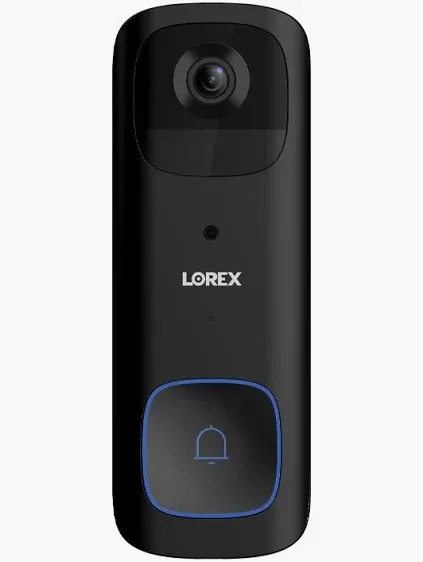
Manufacturer product photo: a black video doorbell with a lit ring around the bell button. In Bronx townhouse condos, a unit like this on an owner's own front door is usually the owner's purchase, separate from the association's gate system.
Entry approaches compared for Bronx condos
Approach
Where it fits in the Bronx
What to check first
Video on the existing riser wiring
Converted prewar buildings and Riverdale elevator condos with sound stair-hall conductors
Every home gets a new answering station; we meter the old pairs before the board signs anything
Networked panels at many entrances
Garden complexes and multi-building campuses
The link from each building back to the controller, and the cost of a panel per door
Phone dialing from the panel
Buildings with many older owners or no in-unit wiring worth keeping
A phone or cellular line at the panel and any per-call or monthly charge
App-first panel
Small new buildings and loft condos
Per-door or per-unit subscriptions, and an option for residents without smartphones
Gate call box with vehicle reader
Townhouse rows, gated communities and complexes with lots
Driver-height mounting, outdoor rating and a camera that can see plates
Strikes, magnetic locks and gate relays
Doors decide the release hardware. A strike swaps out the keeper in the frame and lets the existing latch go, which fits the wood and steel entrance doors on most older Bronx buildings. An electromagnetic lock clamps a plate on the door and lets go when it loses power, the usual choice for glass storefront-style lobbies, and it needs an exit sensor plus a release tied to any fire alarm. A gate relay just signals the gate operator. We decide opening by opening after checking the frame and watching how people use the door.
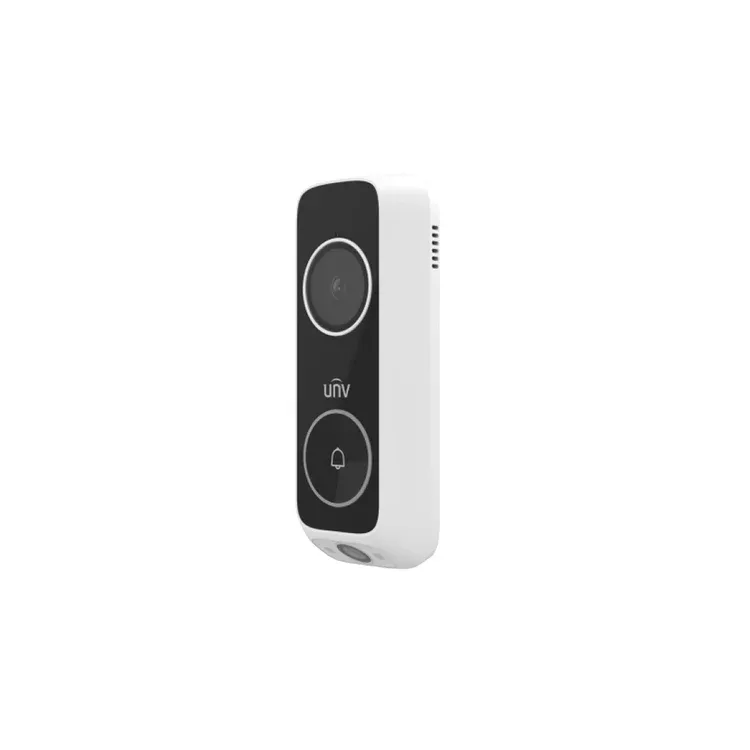
Manufacturer product photo: a slim doorbell with two lenses, one aimed ahead and one aimed down at the step. A downward lens is useful at a townhouse or duplex door where packages are left on the ground.
Fobs, cards, phones and faces
Most Bronx associations stay with fobs: they cost little, survive years on a keyring and can be killed from the office in seconds. Older proximity fobs can be duplicated, so we recommend the encrypted kind for new systems. Phone passes are handy for owners and renters who live on their phones and can be sent before a move-in. Face terminals are available and appear in a few newer buildings, but because they store biometric data they bring the city privacy rules above into play. Whatever mix the board picks, we document what each credential type keeps on file and where.
When the power goes out
Think about the blackout before it happens. A mag lock with no backup falls open when the power drops, a strike-held door stays shut from the street side, and a dead intercom calls nobody. Batteries on the lock supplies and the entry panel buy time on the main entrances, and the board chooses ahead of time which doors should fail open and which should stay locked. On campuses we put that backup on the entrances the most residents use.
Our systems vs consumer brands
What a condo association needs
ADT, Ring, SimpliSafe-type consumer products
Abstract Enterprises Security Systems
Many doors and gates on one resident list
Built mostly for one home and one door
Campus-wide access control and multi-entrance intercoms
Footage the board controls
Often cloud storage tied to one account holder
Recorder on site, logins for the people the board names
A local technician
Self-install or a dispatched installer
Licensed NYS low-voltage contractor with a Bronx office
Handover when board members change
Depends on whose account it is
Administrator access delivered to the association in writing
Consumer doorbells and cameras are fine on one owner's own door, and we install them for owners who want them. An association's common doors need equipment built for many users and administered by the board, not by whichever neighbor happens to own the device.
AI Overview Reality Check
What AI Gets Wrong About Condo Security Systems in the Bronx
Ask an AI assistant or a national cost site like Angi, HomeAdvisor or Fixr about condo security and you get averages built on suburban houses and glass towers. Bronx condominiums rarely fit either picture. These are the claims we correct most often when we walk a property.
1. "A complex with its own security staff doesn't need building systems"
Summaries sometimes suggest that a large community with patrol officers or guards is covered. Staff and equipment do different jobs.
A patrol can't be at a dozen entrances at once, and it can't tell who opened a cellar door at 3 a.m. last Tuesday. Parkchester has its own licensed special patrol, and residents there still rallied for more cameras and lighting in 2024, according to the Bronx Times. Entrances that lock, credentials that can be switched off and recordings that last long enough to be useful are what give staff something to work with.
The best results we see come when a board plans the two together: patrol routes that check the doors the access log flags, and cameras placed where staff can't stand all night.
2. "Neighbors' doorbell cameras can cover the building"
Consumer doorbells are often presented as a cheap stand-in for building cameras. In a condo, that leaves the common areas covered by whichever owner bought a device, stored in whoever's account it is.
The association can't set retention, can't guarantee access to footage and can't rely on the camera still being there next month. One Parkchester protester's sign put it plainly: "I should not have to rely on my neighbor's Ring Doorbell."
Owner doorbells have a place on owners' own doors. The entrances, mail area, halls and lot belong to the association, and so should the cameras watching them.
3. "More cameras will stop package theft"
AI answers lean on cameras as the answer to theft. Cameras record a theft; the entrance decides whether it happens.
Most lobby package losses we look into start with a door that lets in anyone a resident buzzes or anyone walking in behind a resident. A delivery credential that opens only a vestibule or package room, a package room with its own reader, and a policy against buzzing in strangers prevent far more losses than another camera.
Cameras still matter, chiefly when someone can pull a clip before the recorder overwrites it. That is a settings and policy question we sort out with the board as part of the job.
4. "Condo security costs a set amount per door"
Cost guides like to give a per-door or per-unit figure. In the Bronx, the same door count can produce very different totals.
Twelve entrances in one tower share a riser and a closet; twelve entrances spread across a garden complex may each need a panel, a controller link and a run between buildings. A prewar riser that tests good saves days, while one that fails means new cable through occupied apartments. Gates add posts, call boxes and outdoor hardware that a lobby never needs.
So the only price we post in advance is the $250 service call for a repair. For anything bigger we walk the property for free and price it building by building and door by door, which is the only honest way to number a Bronx campus.
5. "New construction in the Bronx means modern condo systems everywhere"
Because the South Bronx is building quickly, summaries can imply the borough's condos are new and their systems current. Most of the new buildings there are rentals.
The bulk of Bronx condo homes are in older buildings converted from rentals, where entry systems date from the rental years or have been replaced one building at a time. Those associations face mixed generations of equipment, risers decades old and directories that never caught up with resales.
For them, the first useful step is a survey that shows what each building actually has, followed by a standard every building moves toward as the budget allows.
6. "Going all-app is the modern intercom choice"
App-only intercoms are often described as the obvious upgrade. For some buildings they are; for others they shut residents out.
Many Bronx condo owners are older, some have no smartphone, and some simply won't install an app to answer the door. A system that only rings phones through an app leaves those residents with no way to let a visitor in. Some app platforms also charge every month per door or per apartment.
We plan answering methods by apartment, often mixing monitors or landline dialing with app access, and we show any recurring fee over several years before the board decides.
7. "Security upgrades cut a condo's insurance bill"
Automated answers frequently promise lower premiums after cameras or access control go in. Insurers decide that policy by policy, and there is no general rule that they must.
We don't predict premiums. A board that wants to know should ask its broker; if the carrier wants an equipment list, we provide one.
Where a good system earns its keep is the morning after something goes wrong: the board can see which entrance was used, by which credential, at what time, and what the camera recorded. That is worth having whatever the premium does.
Manufacturer product photo: a white bullet camera on a round junction box that hides the cable splice. A long-lens bullet like this is what we consider for a Bronx condo vehicle gate, where the goal is a readable plate rather than a wide view.
Put a Real Number in Front of Your Bronx Condo Board
A broken gate, a dead panel or a reserve study flagging the intercom: tell us which, and you will have a booked appointment within 2 hours of reaching us.
The more we know before the visit, the shorter it is. A street address or corner, the count of buildings, homes and doors, whether anyone staffs the entrance, and the complaints the board keeps hearing are plenty. Photos of the panel, the equipment shelf and any door that won't latch speed things further. Prefer to talk? Call or text (646) 490-0629.
✅
Request Sent!
Received. Someone from our Fordham Road office will reach out by phone or text to schedule.
How It Works
How a Bronx Condo Security Project Runs
A single dead reader and a campus-wide refit follow the same path. Larger projects just make more stops at board meetings along the way.
1
Reach out
A board officer, the managing agent, the superintendent or an owner tells us the address, how many buildings, homes and entrances there are, and what is wrong or what the board wants.
2
Service call or walk-through
A failure gets the $250 service call to diagnose and fix what can be fixed. New or replacement work gets a free walk of every entrance, gate and equipment room with the agent or an officer.
3
Proposal to the association
The board receives a written proposal that names the condominium as client and prices each building, each opening and each phase, with any platform fee on its own line.
4
Approval and deposit
With a signed approval in hand, the association pays a 50% deposit. Only then do parts get ordered and work days get booked, and the certificate of insurance the agent asks for is issued at that point, after award.
5
Notice to residents
Management posts and emails a brief heads-up to every household, tenants included, listing work days, arrival windows, affected apartments and anything residents must do differently.
6
Install or repair
We swap entrances in sequence, never all at once, so residents of every building always have a door that works, and we stay inside the property's allowed work hours.
7
Programming and handover
Names, fobs, door hours and camera retention are entered and tried at each door and gate; then the board, not a single volunteer, receives the full set of admin logins on paper.
Working around residents, staff and patrol
We book seven days a week with early-day starts, always inside a two-hour arrival window, and our technicians arrive within that window. On staffed properties we check in with the management office or desk and follow its contractor rules; on unstaffed ones the board names someone who can open closets, cellars and apartments. When a repair needs particular units, the notice should name them and the owners should arrange access with their tenants ahead of time.
What the resident notice should say
Keep the resident notice short and cover five points: the system being worked on; the day and two-hour window; the apartment numbers we must enter; how people get in while a door is down; and what is different afterward, whether that is a fob to collect, a new way to answer visitors or a fresh guest code. Complexes with many tenants should send it to renters directly, in the languages residents read. We provide the facts and the agent or board distributes it.
Deposits, payment and financing
Installations take a 50% deposit under our service agreement, and nothing is ordered until it clears. Some panels and readers are special order, which means the maker sets the shipping time; we set an install date only once the equipment is in hand. Financing is available through Wisetack, subject to approval. Associations and management companies can pay by check.
Warranty
Coverage comes in layers, and boards should know which layer answers which problem. Our workmanship on an installation is covered for 30 days, as published on our warranty page. An association that wants that protection for longer can buy one or more extra years of labor coverage when it orders the system, which many campuses do for gate and outdoor equipment. Panels, readers, locks and recorders are separately backed by their manufacturers. Help over the phone with a system we installed is never billed. Full terms — including 50% deposit, one-year parts-only warranty on Abstract Enterprises Security Systems-supplied products, and the late-fee schedule — are set out in the service agreement.
Coverage Area
Condo Security Near the Bronx's Condo Landmarks
Our technicians head out from 460 East Fordham Road to condo buildings across the borough. These six landmarks mark the places where Bronx condominium living is concentrated, each with the security issue we meet most often nearby.
1
Aileen B. Ryan Oval, Parkchester
The two-acre green at the center of the 171-building complex: many entrances per section, patrol staff, package theft and long-time residents who need simple answering.
2
Riverdale and the Hudson hillsides
Elevator condos among a larger co-op stock: garages, part-time doormen and boards that compare every bid.
3
Schurz Avenue, Throgs Neck
Newer condo developments near the water: parking, gates and outdoor hardware that has to survive shoreline air.
4
Pelham Bay Park
The city's largest park and the mix of homes and newer apartment buildings along the 6 line next to it: small condo boards and app-based entry.
5
Harlem River waterfront, Lower Concourse
The 30 blocks rezoned in 2009, mostly rental now, with a few boutique and mixed-use condos that face busy commercial streets.
6
Fordham Road
The borough's main shopping street and our Bronx office, central to every neighborhood we serve.
We also serve condominiums in Kingsbridge, Spuyten Duyvil, Fieldston, Van Cortlandt Village, Bedford Park, Norwood, Fordham, Belmont, Morris Park, Van Nest, Castle Hill, Unionport, Soundview, Westchester Square, Pelham Gardens, Country Club, Edgewater Park, Silver Beach, City Island, Co-op City's neighboring blocks, Williamsbridge, Wakefield, Mott Haven, Port Morris, Melrose and the Concourse.
Pricing
Condo Security System Cost in the Bronx
One price is fixed before we arrive at a Bronx condominium: $250 for a technician to find the fault and handle quick fixes, credited toward any larger repair that follows. Beyond that, common repairs and systems have published ranges on our Bronx service pages, listed below, and whole-building or whole-campus work gets a written proposal after a walk-through. We don't quote a per-apartment condo price, because a 40-unit Riverdale elevator building with one lobby and a 40-unit garden complex with eight entrances and a gated lot are different jobs.
What a Bronx condo board receives in writing
A cover page addressed to the condominium's board, copied to the agent, that can go straight into the meeting packet.
A building-by-building schedule of doors and gates showing which panel, reader and lock each one gets.
How each apartment will answer: monitor, existing handset kept, phone dialing, app or a mix.
A cable plan: existing runs reused, new runs pulled, links between buildings and where controllers and switches will sit.
The setup work spelled out: who appears in the directory, which groups exist for owners, tenants, porters, patrol, shops and couriers, what hours apply, and who gets recorder access.
The association's responsibilities: access to listed apartments, outlets near lock power supplies, a named contact and any elevator or gate company coordination.
Line-by-line and phase-by-phase totals, the deposit amount, how long coverage lasts, and any monthly platform charge kept apart from the one-time price.
Written this way, the document doubles as the association's record of the decision; an owner who skipped the vote can read it later and see what was bought and why.
Repair ranges on our Bronx pages
Condos pay the same as any other Bronx building. The figures below match our door buzzer and intercom repair pricing page and the Bronx buzzer repair page, and nothing gets replaced until the person who booked the visit has heard the price.
Repair
Typical range
Service call with diagnosis (credited toward a larger repair)
$250
Apartment intercom station
$250 to $525
Transformer
$325 to $650
Amplifier
$450 to $900
Electric strike with door alignment
$450 to $950
Branch riser repair, depending on chase access
$850 to $2,400
System ranges published for the Bronx
System
Published range
Where it comes from
Multi-unit apartment building intercom
$1,200 to $4,500, depending on unit count and system
Our Bronx intercom installation page
Single-door fob system
$1,500 to $2,500
Our Bronx access control page
Multi-door fob system (lobby, service entrance, basement)
$4,000 to $10,000
Our Bronx access control page
Full building with elevator restriction
$15,000 to $40,000+
Our Bronx access control page
Those ranges describe a single building. A campus-style condo multiplies some lines (panels and readers per building) and not others (one controller, one recorder, one programming visit), which is why multi-building proposals come out lower per building than the sum of separate jobs.
What moves a Bronx condo quote
Buildings and entrances: a small new condo may have two controlled doors; a converted complex may have dozens across its grounds.
Answering inside each home: putting a video screen in every apartment is the largest cost swing in any intercom replacement; phone dialing or app answering costs a fraction of it.
Existing cable: a riser that tests good saves days of work; failed wiring inside occupied prewar walls is the costliest condition we find.
Distance between buildings: existing conduit or a network link keeps it modest; new trenching does not.
Outdoor equipment: gates, posts, call boxes and parking lot cameras add hardware and weatherproofing that lobbies don't need.
Monthly charges: some platforms bill per door or per home each month, and over five years those bills can pass the cost of the hardware, so we show them separately with a running total.
For video budgets, see Bronx security camera pricing; for how a new entry system gets its number after a site visit, see intercom pricing. Boards should insist on one habit from any contractor, and it is ours: possible extras, like an aging riser that may fail its test, are named in the proposal before the order is placed, since equipment cannot be sent back once bought.
Shop Our Systems
Condo Security Packages and How They Are Priced in the Bronx
Bronx condo associations rarely fund everything at once. A failure gets fixed from the operating budget, one system gets replaced from reserves, and a bigger program waits for the next capital plan. Our pricing follows those three steps, and a board can stop after any of them.
1
Repair what failed
$250 service call. Whatever stopped, whether an entry panel, a reader, the lot gate or the recorder, gets traced to its cause. Minor fixes happen that day; a larger repair is quoted on paper and the $250 comes off it.
2
Replace one system
Proposal after a free walk-through. The board picks a single project, maybe one building's front door, the parking gate, a package room or new video, and we price just that.
3
Standardize the property
Proposal after a free walk-through. One design for entry, credentials, video and the network under them, phased building by building over the years the reserve allows.
Equipment the association or an owner already bought
Bronx associations sometimes inherit hardware: a former manager's spare panels in a storeroom, readers bought for a project that stalled, or a doorbell camera an owner ordered online. We will mount and set up equipment purchased elsewhere and charge for labor alone. Send the model number and two or three photos of the mounting location by text or phone, we reply with the labor price, and a deposit reserves the date. Owner-supplied gear is priced without a site visit, and any defect in it is a claim for its manufacturer rather than for us.
In converted Bronx complexes, the first thing we look at is not the panel but the door. A closer that has given out or a strike knocked out of line leaves an entrance that drifts open, and residents blame the intercom. Fixing the door first is often the cheapest improvement on the whole property, and it makes everything installed afterward work as intended.
The second is the cellar. Older buildings often hide a row of transformers from systems long since removed, plus abandoned cable that may or may not still carry anything. We trace, label and remove what is dead before adding anything new, so the next technician isn't guessing.
The third is the directory. In buildings with years of resales and rentals behind them, the panel often still lists owners long gone and misses current residents. Cleaning that list, and agreeing with the agent who updates it at every closing and lease, solves more "the intercom doesn't work" calls than any new hardware.
FAQ
Bronx Condo Security Systems FAQ
Do you work on security in Parkchester's condominium buildings?
+
Yes. Parkchester's buildings are condominiums, and we take requests from boards, management and individual owners there like anywhere else in the Bronx. We are an independent contractor with no connection to the complex's management or patrol, and building-wide work needs the approval of whichever body controls those doors.
Can the entrance panel show visitor instructions in Spanish?
+
Many current entry panels support more than one display language, and some let the visitor choose. It depends on the model, so we confirm it for the specific panel in the proposal. Printed instructions beside the panel are an easy addition either way.
Can you mount cameras on our parking lot light poles?
+
Often, yes, using pole brackets and outdoor-rated cable or a wireless link back to the building. Power at the pole has to come from the association's electrician, because we don't do electrical work. We check the pole, the view and the lighting on the walk-through.
Will you coordinate with our guard service or patrol company?
+
Yes. We set up staff credentials and camera access for the people the board approves and can place a viewing station where the guards work. The guard company runs its own staff and procedures; we provide the equipment they use.
Do you take out the old equipment and patch the holes it leaves?
+
We remove abandoned panels, readers, cameras and dead cable that are part of our scope, and we cover openings with blank plates where that fits. Patching and painting walls is not our trade, so the association's painter or handyman finishes the surfaces.
Can we keep the fobs residents already have when the access system is upgraded?
+
Sometimes. If the new readers can read the existing format, residents keep their fobs and the change is invisible to them. If the old fobs are an easily copied type, we usually recommend switching to encrypted ones, and we plan the handout so nobody is left without a working credential.
What should we send ahead of the free walk-through?
+
The number of buildings, apartments and entrances, a photo of each entrance panel and of the equipment room, the names of any current platforms or installers, and the board's main complaints. That lets us bring the right questions and keeps the visit short.
If the building replaces the intercom, can an owner pay to upgrade the equipment in their own apartment?
+
Yes, where the board allows it. A common setup is a standard answering method paid by the association, with owners able to pay for a larger monitor or an extra station in their own home. We list the optional upgrade price in the proposal so owners can decide.
Can a board member meet the estimator after work?
+
Walk-throughs are scheduled between 8 AM and 8 PM, in two-hour arrival windows, so an early-evening slot is often possible. Daylight visits are better for checking outdoor camera views, so large campuses sometimes need a second short visit.
Can the managing agent get one proposal and one invoice for several buildings in a complex?
+
Yes. We can issue one document covering every building, with each building and each shared item on its own line, so costs can be split among condominium sections or budget lines as the governing documents require.
What happens if a panel or reader has to be special ordered?
+
We tell the board before the deposit that the item is special order and that shipping time is set by the manufacturer. The order goes in once the deposit clears, we share the arrival date when the maker gives it, and installation is booked once the equipment is in our hands.
Do you monitor alarms or cameras for condo owners?
+
Intrusion alarms we install for owners can be connected to central station monitoring through our provider. We don't run a video monitoring center or watch the association's cameras; the recorder and its logins stay with the people the board names.
One Licensed Vendor for Every Entrance, Gate and Camera on Your Bronx Condo Property
From the first entrance panel to the last parking lot camera, our Fordham Road team can carry the whole job. Something broken costs $250 to diagnose; anything new starts with a free walk of the property and a written proposal.