What are you looking for?
About Us Contact Us Careers Get a Free Quote (800) 486-0943
Pick a service
✅ Got Your Own System?
🎬 Home TheatreQuote 🎶 AV SoundQuote 🔑 Access ControlQuote
Now pick your area
Pick your area
Long Island
Hudson Valley
Services available
Pricing & Tools
Pick a service for pricing
🚪 Intercom Pricing 🔔 Buzzer Repair Pricing
Calculators
📹 Camera System Calculator 🚨 Alarm Calculator ⚡ Cabling Quote Builder ✅ Got Your Own System?
Select your area
Deciding between a DoorBird and a 2N video intercom? A licensed New York installer that puts in both will tell you which one fits your door: (800) 486-0943
Home › Best Security Camera Brands › DoorBird vs 2N
Video Intercom Comparison · Cameras, Readers, Apps, Fees and Apartment Scale · Specs From doorbird.com and 2n.com · NYS Licensed

DoorBird vs 2N:
Which Video Intercom Is Better?

DoorBird vs 2N, model by model: DoorBird D22x and A1121 · 2N IP Verso 2.0, IP Style, IP One and IP Solo · Updated November 2026

DoorBird vs 2N is a split decision, and the building decides it: for one-, two- and three-family houses, brownstones and small walk-ups we would usually put in DoorBird, and for apartment buildings, co-ops, condos and commercial entrances we would usually put in 2N.

Quick answer: For a house, brownstone or small building with up to 18 doorbells, pick DoorBird: a 5 MP, 180-degree camera, card and Bluetooth access, a free app with no fee to answer on your phone, and over 50 finishes. For an apartment building, co-op, condo or office entrance, pick 2N: modular IP Verso 2.0 or touchscreen IP Style stations, secured card readers, cloud or on-site management, and a 5-year warranty. We install both in New York City. Our NYC intercom page lists 2N IP video intercom systems from $900 installed, DoorBird stations are quoted per building after we see the door, and we book requests within 2 hours.

Both are true IP video intercoms that run on a network cable, answer on your phone and release a door strike or magnetic lock, so neither is a bad choice. The difference is scale: DoorBird is built around a beautiful single door and the owner's app, and 2N, part of the Axis group since 2016, is built around a lobby full of residents, cards and a manager who has to keep it all straight.

If you searched it the other way round, 2N vs DoorBird, this is the same page and the same answer. Every specification below comes from the makers' own product pages and data sheets on doorbird.com and 2n.com, read on November 15, 2026, and every opinion comes from the doors we wire, program and fix in the five boroughs.

Reviewed and updated November 15, 2026, against DoorBird's D2203V, D2101V, D2104V–D2118V and A1121 data sheets, the D22x shop listing, the Cloud Pro, warranty, Crestron integration and About pages (doorbird.com, Bird Home Automation, part of ASSA ABLOY); 2N's IP Verso 2.0, IP Style, IP One and IP Solo product pages, the My2N app page, the My2N pricing page, the management-platform comparison table and the About page (2n.com, part of Axis); and a live search of what ranks for "DoorBird vs 2N" and "2N vs DoorBird" (a Crestron dealers' forum thread, smart-home blogs, installer pages in Latvia, Los Angeles and elsewhere, Reddit and Home Assistant threads among them). Where a maker's page did not state something, this page says so instead of guessing. Our installed prices come from our NYC intercom installation page and sit in their own section. · Checked by the Abstract Enterprises Security Systems team (NYS license #12000287431), Troy Avenue, Brooklyn
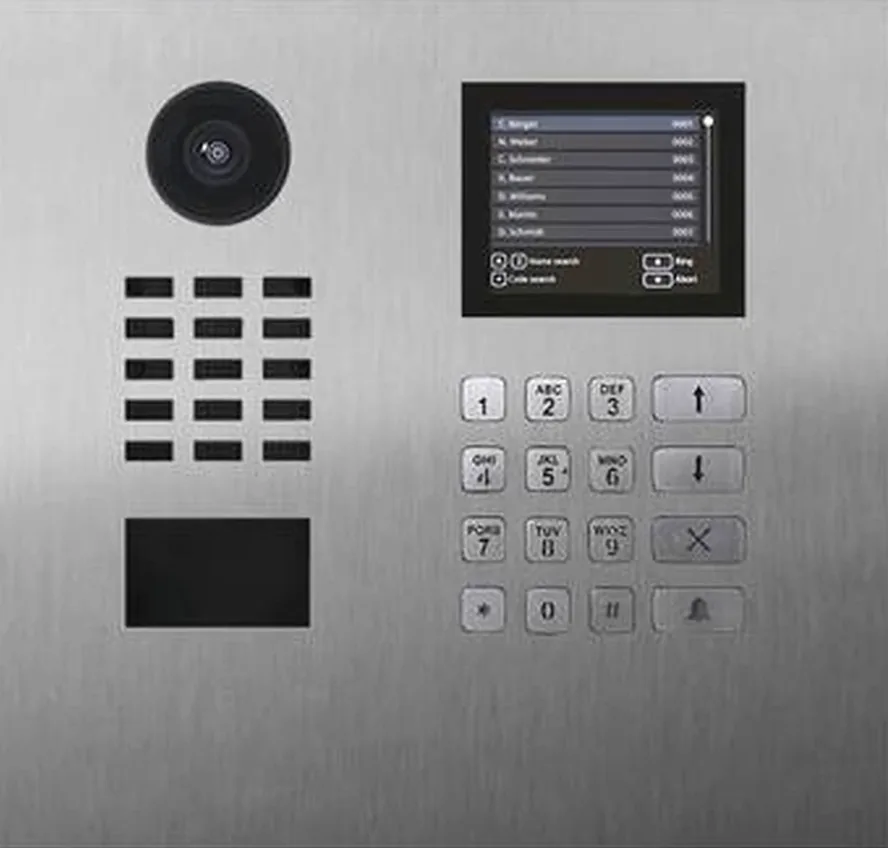
DoorBird D21DKH brushed stainless door station with camera, 15 speaker slots, name display and keypad, DoorBird vs 2N NYC
A DoorBird product photo of the D21DKH in brushed stainless steel: the round camera lens at top left, fifteen speaker slots below it, a small screen at top right listing residents' names with apartment numbers, a metal keypad with arrow, cancel and bell keys, and a dark reader window. This is the model we installed at the front and back doors of a residential building we service in October 2026, each station releasing a magnetic lock. It belongs to DoorBird's D21x series; DoorBird says existing D21x installations can be moved to the current D22x series, with its 5 MP camera, by replacing the main electrical unit.
DoorBird or 2N for Your Door?
Tell us about the building and the door, and an installer calls back with a straight recommendation and an installed price.

✅
Request Sent!
Thanks. A licensed intercom technician will call you inside 2 hours on business days.
25+
Years Experience
Both
DoorBird and 2N Installed
100%
Licensed & Insured
4.7★
201 Google Reviews

Owner-operated since 2002 · Thousands of jobs completed · Booked within 2 hours
The short version. A DoorBird station and a 2N station do the same basic job. Each one sits beside the street door, rings one or more people when a visitor presses a button, shows them live video and two-way audio on a phone or an indoor screen, and closes a relay that releases the lock. Both connect to the building's network over a single cable that also carries power, both speak SIP so they can ring an ordinary office phone system, and both work with the big smart-home controllers. If the door were all that mattered, you could flip a coin.

The door is not all that matters in New York. A brownstone owner wants the station to look right against a 120-year-old doorway, wants it to ring three phones, and does not want a yearly fee. A co-op board wants forty apartments in a directory, fobs that cannot be copied at the corner kiosk, a super who can delete a lost card from his phone, and a contractor who will still be able to get parts in ten years. Those are two different jobs, and the two brands were built for them in that order: DoorBird started with the single-family front door and has grown upward, and 2N started with the intercom for the lobby and the office and has grown downward.

We are a licensed New York State security installer (license #12000287431) on Troy Avenue in Brooklyn, and we install, program and service both brands, alongside Akuvox, ButterflyMX, Aiphone, Comelit and the older audio buzzer systems still found in most of the city's walk-ups. The rest of this page goes through the differences that decide a real job: cameras, call buttons and directories, readers and mobile access, wiring in old buildings, the apps and what they cost to keep running, management, warranties, and which brand we would put on which kind of property. If you already know you want a building-wide system, our apartment intercom systems page covers the wider choice, and our NYC intercom installation page covers every brand we carry.

Side by Side

DoorBird vs 2N in One Table

Here are the two brands side by side on the points that come up on real New York jobs. Figures are the makers' own, from the model pages and data sheets named under each row's topic further down; where a figure differs between models, the model is named.

What mattersDoorBird2N
Who makes itBird Home Automation GmbH, Berlin, Germany; part of the ASSA ABLOY Group since October 20222N Telekomunikace, Prague, Czech Republic, founded in 1991; part of the Axis group since 2016
Where it is madeDesigned, developed and built in DoorBird's own plant in BerlinDeveloped, tested and manufactured in Prague, according to 2N
Current lines we compareD22x video stations (D2201V to D2218V, keypad, fingerprint and display versions), A1121 keypad-and-reader unitIP Verso 2.0 (modular), IP Style (10.1-inch touchscreen), IP One and IP Solo (single-button)
CameraD22x: 5 MP with HDR; older D21x: 720pIP Style: up to 2560 × 1920; IP Verso 2.0 and IP One: up to 1920 × 1440; IP Solo: 1280 × 960 stills, 640 × 480 calls
Field of view180° diagonal, 140° horizontal, 100° vertical, straightened imageIP One 156° × 116°; IP Style 138° × 114°; IP Verso 2.0 125° × 105° (138° in peephole mode); IP Solo 128° × 95°
Night viewLight sensor, IR-cut filter, 2 infrared LEDs on the D2203V (12 on D21x)Infrared on all four; WDR on Verso 2.0 and One, forensic WDR on Style; Verso 2.0 rated to 0.8 lux and One to 0.3 lux without IR
Call buttons and directory1 to 18 buttons on the D22x; display-and-keypad D22DKV and D22DKH versionsVerso 2.0: up to 20 combinable modules, including buttons and a touch display; Style: on-screen directory for up to 10,000 users; One and Solo: 1 button
Card and phone access125 kHz and 13.56 MHz RFID, up to 3,000 tags; Bluetooth LE with DoorBird's key fobOptional 125 kHz, 13.56 MHz and secured readers (HID iClass, Seos, MIFARE DESFire, NFC); Bluetooth WaveKey; PIN, QR codes, fingerprint module on Verso
Wiegand, OSDPD22x hardware ready for Wiegand, OSDP and RS-485, to be enabled by a later software update; A1121 has a Wiegand output nowWiegand and OSDP modules for Verso 2.0; Wiegand module for Style
Relays and powerTwo relays (24 V, 1 A), 12 V 0.48 A output for a strike; PoE 802.3at on the D22xOne relay contact (30 V, 1 A) plus an active output; PoE 802.3af on Verso, One and Solo, PoE+ 802.3at on Style; extra relays by add-on
Weather ratingIP65 and IK08; −25 to +55 °CIP54 and IK08 (Verso 2.0, Solo); IP65 and IK08 (Style); IP66 and IK08 (One); −40 to +60 °C on Verso 2.0, One and Solo, −30 to +60 °C on Style
AppDoorBird app, free; push, live video, geofenced door openingMy2N app; video calls, guest QR and PIN codes, delivery codes, call log with snapshots
Fee to answer on a phoneNone stated; the app and image history of the last 50 events are permanently freeFree in residential projects within 2N's license limits; always paid in non-residential projects
Video recordingCloud Pro (paid): HD clips, 7 days; or a local NAS or recorderONVIF Profile S stream to a camera recorder; call log snapshots in My2N
ManagementApp and web administration per stationMy2N cloud platform (apartment buildings, free apart from premium services) or 2N Access Commander on site (commercial, licensed)
Smart home and SIPSIP; native Crestron (RAVA), Control4, Loxone, KNX, Home Assistant and others; open APISIP over UDP, TCP or TLS; Control4, Crestron, Savant, RTI; Genetec, Milestone, CCURE, AMAG and others
Warranty24 months5 years, plus at least 8 years of firmware support
Best forHouses, brownstones, townhouses, small walk-ups, design-led entrances, smart homesApartment buildings, co-ops and condos, offices, mixed-use, buildings that need card management

Two lines in that table carry most of the decision. The first is the call buttons and directory row: DoorBird stops at 18 buttons on one station, while 2N's touchscreen IP Style handles a directory of thousands of names. The second is the management row: a DoorBird is run station by station from its app, while a 2N building can be run from one cloud dashboard where a manager adds and removes residents and their cards. Everything else, camera, audio, weather rating, is close enough that the building, not the spec sheet, should decide.

Who Should Buy Which

Who Should Pick DoorBird, and Who Should Pick 2N

Pick DoorBird if…

  • You own a one-, two- or three-family house, a brownstone or a townhouse, and the intercom is for your household and maybe one or two tenants.
  • You care how the door looks. DoorBird lists more than 50 materials and colors for its front panels, including brushed stainless, bronze and brass finishes and dozens of RAL powder coats, and it sells a 3D configurator to see the result.
  • You want to answer on your phone with no subscription. DoorBird calls its basic cloud service, with live video and image history of the last 50 visitors, permanently free.
  • You run a smart home on Crestron, Control4, Loxone, KNX or Home Assistant, and you want the doorbell inside that system. DoorBird lists all of them as integrations and says its stations support Crestron's RAVA intercom protocol natively, with no gateway.
  • The building has up to 18 doorbells and one main entrance, and a resident or owner, not a management company, will look after it.

Pick 2N if…

  • The building has more apartments than buttons make sense for. The IP Style's 10.1-inch touchscreen directory scrolls through names instead of rows of buttons.
  • A board or management company wants to control access centrally: add a new tenant, cancel a lost fob, give the dog walker a code that works on Tuesdays. 2N's My2N platform does that from a browser, and 2N calls it free apart from premium services.
  • You want card readers that are hard to copy. 2N offers secured 13.56 MHz readers that read HID Seos, iClass SE and MIFARE DESFire credentials, and its own PICard secured cards.
  • The entrance takes abuse. 2N rates the IP Verso 2.0, IP One and IP Solo for −40 °C, the IP One to IP66, and it gives a 5-year warranty on its whole range.
  • It is an office, medical suite or mixed-use building where the intercom must ring a reception desk on the phone system, show up in a video management system, or tie into a commercial access control platform.

If you fall in the middle, a three- to eight-unit walk-up with one owner who lives on site, both brands work. In that case we usually look at two things: whether the owner wants to manage residents' credentials from a dashboard or is happy doing it on the station, and whether the old buzzer wiring can carry a network signal. We go through both below.

One more honest point: a lot of New York buildings do not need either. If the building is large, turnover is high and the board wants residents to buzz in from their phones with no handsets at all, the systems on our ButterflyMX installation page or an Akuvox setup may fit better, and if the budget is tight and the wiring is good, repairing the existing buzzer through our NYC intercom repair service is sometimes the right first step.

Who Makes Them

Who Makes DoorBird and 2N in 2026

Both brands now belong to large Swedish security groups, which matters more to a building than it sounds: it decides who will be making parts, firmware and replacement stations when the intercom you buy this year needs service in the 2030s.

DoorBird: a Berlin maker, now inside ASSA ABLOY

DoorBird is the brand of Bird Home Automation GmbH. Its About page says the company develops and manufactures IP video door intercoms, access control devices, indoor stations and accessories, that its headquarters and production plant are in Berlin, with sales offices in San Francisco and Jacksonville, Florida, and that DoorBird has been part of the ASSA ABLOY Group since October 2022. ASSA ABLOY is the lock company behind brands many New York supers already know from door hardware, and DoorBird now lists ASSA ABLOY and Yale locks among its integrations.

The first DoorBird series product shipped in 2015. The company says almost 40 people work in its own Berlin production facility and more than 130 across the business, that it has been audited by TÜV Saarland to the ISO/IEC 27001:2024 information security standard, and that its D21x series has been certified to the UL 62368-1 safety standard with Intertek, which it describes as suitable for commercial and multi-family residential applications. That last point answers a question we hear from building owners who assume DoorBird is only a doorbell for houses.

2N: the Prague company that made the first IP intercom

2N was set up in Prague in 1991 by three friends and started with telephone exchanges. Its About page says it invented the first IP intercom in 2008, the 2N Helios IP Vario, which it sold for ten more years, and that it became part of the Axis group in 2016. Axis is one of the world's largest network camera makers, which is why 2N stations share Axis processors, video codecs and the ONVIF camera standard. 2N says all of its technology is still developed, tested and manufactured in Prague.

The family tie shows on the product pages: the IP One runs on an Axis ARTPEC-7 processor, the IP Verso 2.0 and IP Style stream H.265 and Axis Zipstream video, and Axis accessories such as the AXIS T8120 PoE midspan and the AXIS A9210 network relay are sold alongside 2N stations. For a building that already records on Axis or other ONVIF cameras, a 2N station drops into the same recorder as another camera.

What the ownership means for you

Neither brand is a start-up that might vanish. In practice the bigger difference is the sales channel: DoorBird sells an online shop with listed prices as well as through installers, while 2N sells through distributors and installers and does not list prices on its product pages. That is one reason homeowners find DoorBird first, and property managers usually meet 2N through their integrator. On our side, both are ordered through the trade and installed the same way.

Purple, white and red network cable bundles dropping down into a black equipment rack, DoorBird vs 2N NYC
From our own job files, not tied to a specific New York address: a thick bundle of purple cables and looser white and red runs curving down into a black equipment rack, with a power strip at the bottom. Both DoorBird and 2N stations are network devices, so the riser cable and the switch that powers them matter as much as the station on the wall. No intercom brand is identified in this photo.
Models Compared

Which DoorBird and 2N Models This Page Compares

Both catalogs are large, so here are the models that matter for New York entrances, and the ones this page compares.

DoorBird: the D22x series and the A1121

DoorBird's current outdoor station line is the D22x series. Its shop lists the D2201V to the D2218V, with one to eighteen call buttons, each in a surface-mount or flush-mount version; keypad versions (D2201KV, D2202KV and the horizontal D2201KH); fingerprint versions with DoorBird's Fingerprint 50 or an ekey sLine reader; the D22DKV and D22DKH with a display and keypad for a name directory; and the D2200E and D2200EA, the second an accessibility version. We use the D2203V data sheet, a three-button station for houses and buildings with up to three units, as the reference for D22x specifications below.

A lot of DoorBirds already on New York doors are the older D21x series, such as the D2101V and the D2104V to D2118V, and the D21DKH we installed in October. DoorBird's D2203V data sheet says existing D21x installations can be upgraded by replacing the main electrical unit, which keeps the front panel and the hole in the wall. The DoorBird A1121 is a separate keypad-and-reader unit, with no camera, for back doors, garages, storage rooms and elevators.

2N: IP Verso 2.0, IP Style, IP One and IP Solo

The 2N IP Verso 2.0 is the modular workhorse: a main unit with a camera, in nickel or black, that can be combined with 20 different modules, from button rows and a touch display to keypads, card readers, a fingerprint reader and an induction loop for hearing aids. The 2N IP Style is the flagship for lobbies, a glass-fronted station with a 10.1-inch touchscreen. The 2N IP One is a slim single-button aluminium station that 2N pitches at family homes, and the 2N IP Solo is its compact, older single-button model, with or without a camera.

2N also makes the very rugged IP Force 2.0 for gates, garages and industrial doors. Its first-generation IP Force is being discontinued, with a final order date of June 30, 2026, according to 2N. We mention it because many parking-garage and gate intercoms in the city are IP Forces, and an owner replacing one today will be offered the 2.0.

Indoor stations

Both brands sell indoor touchscreens for residents who want a screen on the wall rather than, or as well as, a phone. 2N's range includes the Indoor View, Indoor Compact, Indoor Talk and Clip, plus the IP Phone D7A desk phone with a 7-inch touchscreen. DoorBird sells its A1101 indoor video station with a touch display. On a 2N residential job the indoor station also changes the phone-app licensing, which we explain in the apps section.

Camera and Video

Camera and Night View: 5 MP and 180° Against 2N's Four Cameras

Every review site leads with megapixels. On an intercom, the field of view and how the camera copes with a bright street behind a dark face matter more, because the job is to see who is standing at the door, often with a hood up, at 7 a.m. in January.

DoorBird D22x: 5 MP behind a 180-degree lens

DoorBird's D2203V data sheet lists an HD 5-megapixel camera with HDR behind what it calls a high-end ultra-wide-angle hemispheric lens: 180 degrees diagonally, 140 degrees horizontally and 100 degrees vertically, with the image straightened. Night vision uses a light sensor, an automatic IR-cut filter and two 850 nm infrared LEDs. The older D21x stations, which we still service, have a 720p camera behind the same 180-degree lens and twelve infrared LEDs.

The DoorBird also carries what it calls a 4D motion sensor, built on a 24 GHz radar module, with a range you set from 1 to 10 meters in one-meter steps. It can tell whether someone is coming or leaving and trigger an action, such as switching on an outside light between 9 p.m. and 6 a.m. On a stoop facing a busy sidewalk, we turn the range down so every passer-by does not ping the owner's phone.

2N: four cameras for four jobs

2N publishes more camera detail. The IP Style has a 5-megapixel-class chip, streams up to 2560 × 1920, covers 138 degrees horizontally and 114 vertically, and adds forensic wide dynamic range. 2N also lists adaptive face zooming, where the station detects a face in the frame and zooms in for the person answering, and bi-directional video, so a visitor can see the receptionist, which 2N notes lets hearing-impaired visitors sign.

The IP Verso 2.0 uses a 1/2.7-inch color CMOS sensor at up to 1920 × 1440 and 30 frames per second, a 125 × 105 degree view or a 138-degree peephole mode, wide dynamic range and infrared, rated to 0.8 lux without the infrared on. The IP One has the widest 2N view, 156 by 116 degrees, with WDR and a 0.3 lux rating. The IP Solo camera is the modest one: 1280 × 960 stills and 640 × 480 video calls across 128 by 95 degrees.

What we see on real doors

On a brownstone stoop or a narrow walk-up vestibule, the DoorBird's 180-degree lens is a real advantage: it shows the person at the door and the package on the step, even when the station has to sit to one side of the door frame. In a lobby, where the visitor stands square in front of a wall-mounted station, the 2N IP Style's higher resolution and face zoom give a sharper, closer face, and the 2N recording stream is easy to send to the building's camera recorder over ONVIF.

Glass vestibules are the hardest light in the city. A visitor in front of a sunny street turns into a silhouette on any camera without good wide dynamic range, so on a south-facing glass entrance we lean toward the IP Style or IP Verso 2.0, or we move the station a few feet to put a wall, not the street, behind the visitor. DoorBird lists HDR on the D22x but does not publish a lux rating or a WDR figure, so we judge it on site.

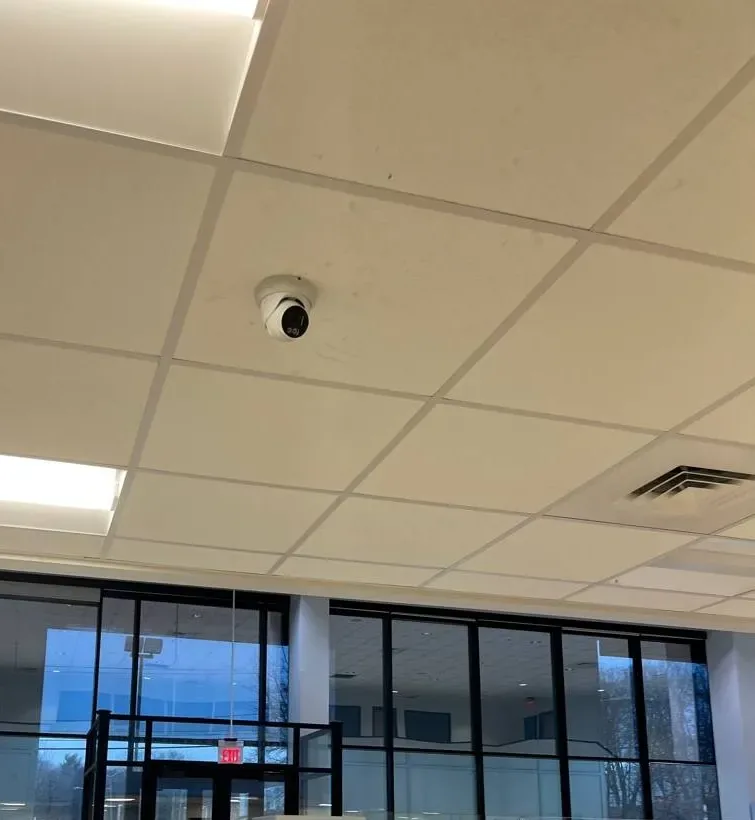
White turret camera on a tiled ceiling above a glass entry vestibule with a lit exit sign, DoorBird vs 2N NYC
From our own job files, not linked to an address: a small white turret camera on a tiled ceiling, looking toward a two-story glass entrance with a vestibule and a lit exit sign. A bright glass entrance like this is the hardest scene for an intercom camera at midday, when visitors stand against the light. The camera brand is not identified, and it is not a DoorBird or 2N product.

Installation height matters more than any spec line. DoorBird gives a minimum lens height of 145 cm, about 57 inches, and asks installers to check the best height before cutting the wall. On stoops, where the visitor stands one or two steps below the door, we measure from where people actually stand, not from the landing.

Audio

Audio on a Loud New York Street

Audio is where cheap intercoms fail first in New York, because traffic, buses and wind on an avenue drown out a small speaker. Both brands use full-duplex audio with echo cancellation, which means both sides can talk at once without the conversation cutting in and out.

DoorBird

DoorBird's data sheets list a speaker and microphone with noise reduction and echo cancellation (ANR and AEC) and two-way, full-duplex audio streaming. It does not publish a speaker wattage or a sound-pressure figure, so on a loud street we test the volume with the owner on the phone before we close up the wall.

2N

2N publishes the numbers. The IP Style has two built-in microphones and two 4-watt speakers and rates its maximum sound pressure at 85 dB at one meter. The IP Verso 2.0 has a 5-watt Class D amplifier driving a 2-watt speaker, rated 78 dB at one meter, and a line output. The IP One has a 5-watt amplifier and a 3-watt speaker. All of them have automatic adaptive volume and full duplex with echo cancellation, and they support wideband G.722 audio as well as standard telephone codecs.

Our call on audio

For a house on a side street, either brand is clear enough. For a building on a truck route, a bus stop or under an elevated train, the IP Style's two microphones and higher output are the safer choice, and the IP Verso 2.0 can add an induction-loop module for visitors with hearing aids, which helps an accessible entrance. DoorBird lists an optional hearing loop with PMR symbols as a separate accessory for the D22x.

Apartment Scale

Call Buttons, Directories and How Many Apartments Each Can Handle

This is the section that settles most building jobs, because it decides whether a visitor can find the right apartment and whether the station still makes sense when the building has 30, 60 or 120 units.

DoorBird: up to 18 buttons, or a display and keypad

DoorBird's D22x stations come with one to eighteen illuminated call buttons, each with a nameplate, so every apartment gets its own button. Above that, or where the owner does not want names on the facade, the D22DKV and D22DKH versions combine a display with a keypad, and the visitor scrolls or types a code. Our D21DKH job used that layout: a scrolling list of names with apartment numbers on the screen, arrow keys, and a bell key.

For a three-family house or a 12-unit walk-up, DoorBird's button rows are simple and hard to get wrong. Past about 18 apartments, the visitor experience on a button station gets crowded, and the display versions become the DoorBird answer.

2N: modules, a touchscreen and a big directory

2N's IP Verso 2.0 builds its front panel from modules held in frames, which 2N lists in one-, two- and three-module sizes for surface or flush mounting. A building can have rows of five-button modules, a keypad, a card reader and a touch display that scrolls a directory, all in one surface or flush-mounted panel. The IP Style replaces all of that with its 10.1-inch, 1280 × 800 touchscreen, an on-screen keypad and a directory that 2N lists as handling 10,000 users in an office or residential mode.

On the My2N side, 2N lists a maximum of 500 devices in one installation and up to five devices called from one speed-dial button, which is more than enough for any building we see in the five boroughs.

Dark recessed lobby ceiling panel with rows of round downlights above a pale wall, DoorBird vs 2N NYC
From our job photo library, not a specific New York building: a dark recessed ceiling panel set with rows of small round downlights above a pale lobby wall. Lobby lighting changes what an intercom camera sees at night, which is why the wide dynamic range and infrared figures on DoorBird and 2N data sheets are worth reading. No intercom appears in this photo.

Which layout we use

Up to about a dozen apartments, we like buttons: visitors understand them, couriers find them fast, and a dead button is easy to spot. Between 12 and 30, either a DoorBird display version or a 2N IP Verso 2.0 with a touch display works, and the choice comes down to management, below. Over 30 apartments, we nearly always quote the 2N IP Style or a Verso 2.0 with a display, because the directory, the resident list and the access cards all live in the same platform and the management company can keep them current without a service call.

Access Control

Cards, Codes and Phone Access: DoorBird Readers Against 2N WaveKey

A modern intercom is also the building's front-door access control: residents get in with a fob, a code or a phone, and visitors get buzzed. Both brands do this, but the depth is different.

DoorBird readers and the A1121

The D22x has two RFID readers built in, 125 kHz and 13.56 MHz, each managing up to 3,000 tags, plus Bluetooth Low Energy that works with DoorBird's Bluetooth key fob remote. The 13.56 MHz reader reads the card serial number of MIFARE Classic, MIFARE DESFire EV1 and EV2 and other ISO cards; DoorBird notes that encrypted reading of those cards requires a DoorBird Cloud Pro or Cloud Enterprise license. Schedules can be set per tag, for example a cleaner's fob that only works on Wednesday mornings.

The DoorBird A1121 is the piece we use on back doors and service entrances. Its data sheet describes a compact keypad with up to 500 PIN codes, 125 kHz and 13.56 MHz readers (one or the other, chosen in setup) for up to 500 transponders, Bluetooth, a tamper sensor, two relays, a Wiegand output for an existing access control or alarm panel, and Wi-Fi or a network cable with PoE. DoorBird says all functions keep working on the local network if the internet drops, and that pairing it with the A1081 I/O door controller adds up to three more doors, gates or elevators.

2N readers, WaveKey and secured cards

2N treats access as a core product line. The IP Verso 2.0 takes reader modules for 125 kHz cards (EM4xxx and HID Prox on the right versions), 13.56 MHz cards (HID iClass, FeliCa, MIFARE and NFC from the My2N app) and secured versions that read HID Seos, iClass SE, MIFARE SE and MIFARE DESFire credentials. There are keypad and touch-keypad modules, combined touch keypad and reader modules, and a fingerprint module that 2N says is certified to an FBI standard with fake-finger detection. The IP Style has the readers built in and adds 2N's PICard secured DESFire EV2 and EV3 cards.

Phone access runs on 2N's WaveKey Bluetooth technology, with four modes: touch, tap in the app, card mode and motion. On its IP Style page, 2N says its developers opened a door 15,000 times with 100 different phones and the door opened in under one second in 98 percent of cases. 2N stations also accept QR codes, which suit one-time visitors and deliveries.

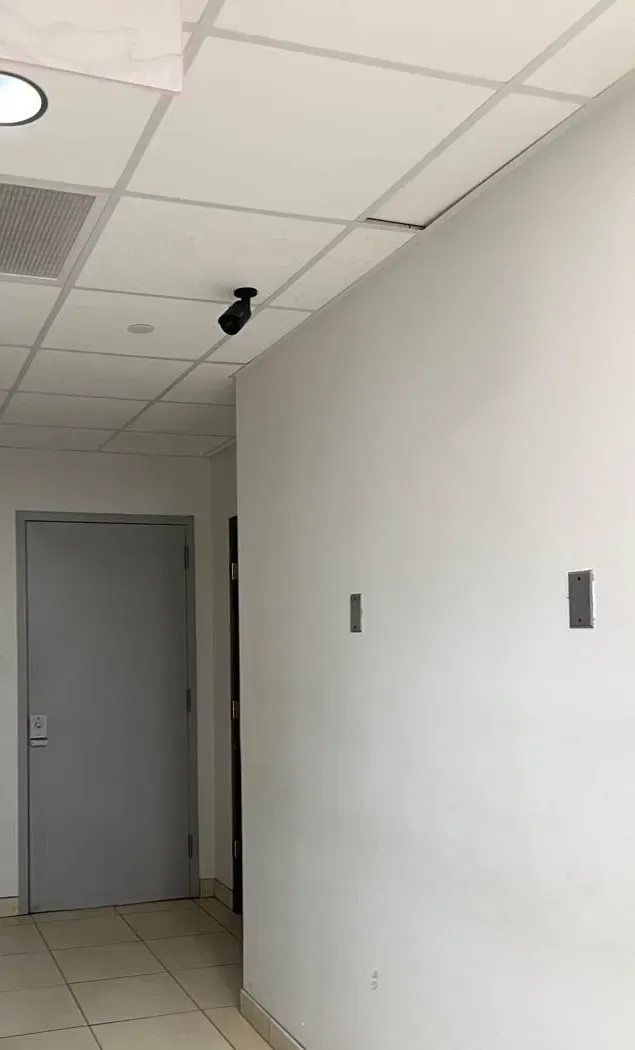
Tiled corridor leading to a grey steel back door with two small plates on the white wall beside it, DoorBird vs 2N NYC
From our job files, not a specific New York building: a tiled corridor running to a grey steel door with a lever handle, a white wall with two small dark plates, and a small black camera high on the wall under a drop ceiling. Back and side doors like this one are where a keypad-and-reader unit, such as DoorBird's A1121 or a 2N access unit, often makes more sense than a second video station. The devices in this photo are not identified by brand.

Wiegand and OSDP

If the building already has an access control panel, the intercom has to talk to it. 2N sells Wiegand and OSDP modules for the IP Verso 2.0 and a Wiegand module for the IP Style. DoorBird's D22x data sheet lists Wiegand input and output, OSDP and RS-485 as hardware ready, to be enabled later with a software update; the A1121 has a working Wiegand output today.

For a co-op that already runs card readers on several doors, that difference is real: with 2N we can wire the front station into the existing controller now. With DoorBird we would either use the A1121's Wiegand output, run the front station on its own, or wait for the software update DoorBird describes.

Our call on access

For a family house or a small building where the owner hands out a few fobs, DoorBird's built-in readers and the A1121 for the back door are plenty. For any building that cares about cards being copied, that has more than one controlled door, or that wants residents to open doors with their phones without fumbling, 2N is the stronger system. Our NYC access control installation page covers readers, mag locks and controllers in more depth, and our elevator access control page covers lift readers.

Locks and Power

Relays, Locks and Power at the Door

The intercom only lets someone in if its relay can drive the lock on that door, so this is where we spend time on every survey.

DoorBird

The D22x has two bistable relays, each switching up to 24 volts AC or DC at 1 amp, with normally open, common and normally closed contacts, so it can control two doors or a door and a gate from the app. It also has two external inputs, for example for a request-to-exit button, and a 12 V DC output at 0.48 amps that can power a small electric strike directly. It is powered by PoE to the 802.3at standard. DoorBird's I/O Door Controller can add relays or move them inside the building, where a thief cannot reach the wires by prying off the station. The older D21x took 802.3af PoE or a 15-volt supply.

2N

The IP Verso 2.0 has one passive switch contact, normally open or normally closed, rated 30 volts at 1 amp, one input, and an active output of 8 to 12 volts at up to 400 mA; it takes standard 802.3af PoE or a 12-volt, 3-amp supply. The IP Style needs PoE+ (802.3at) or a 12-volt, 4-amp supply, and has a 30-volt, 1-amp switch output, a 12-volt, 600 mA active output and three inputs. The IP One has a normally open contact, a 12-volt, 600 mA output and one input on 802.3af PoE. For more doors, or to keep the lock wiring inside, 2N sells a Security Relay and external IP relays with one or four outputs, plus the AXIS A9210 network I/O relay module.

Mag locks, strikes and the release time

Most New York street doors we work on have either an electric strike in the frame or a magnetic lock on the header. Neither brand's relay should drive a large mag lock directly; we put a separate lock power supply in, with the intercom relay switching it, and add the exit button and any fire-alarm release the door needs. On our two-door DoorBird job, each station switches a mag lock and the owner asked for a 30-second release, which both brands let us set.

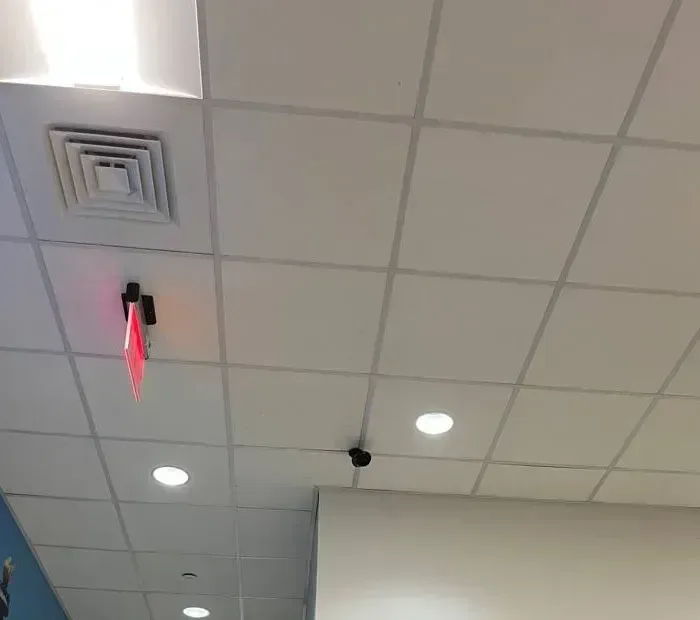
Drop ceiling with an air vent, a lit red exit sign, round downlights and a small black camera, DoorBird vs 2N NYC
A photo from our own job files, not tied to an address: a white drop ceiling with a square air vent, a red exit sign glowing at an angle, round downlights and a small black camera mounted where the ceiling meets a lower soffit. Exits and egress paths shape how any intercom door release is wired, whether the station on the street side is a DoorBird or a 2N. No intercom brand is identified here.

Whichever brand goes up, we install the lock side the same way: a supply sized for the lock, the relay wired so that a pried-off station cannot open the door, and every release tested from the app, the indoor station and the exit button before we leave.

Old Buildings

Wiring Old New York Buildings: New Cable, Bell Wire and the Old Panel Hole

Here is the part no spec sheet mentions. Most New York walk-ups and brownstones still have an audio buzzer system from decades ago: a panel at the street door, handsets in each apartment, and thin bell wire running up a riser shaft that was closed in long ago. Both DoorBird and 2N are network devices. So the first question on any job is not which brand, but how a network signal gets from the street door to a switch, and from the switch to the apartments.

Running new cable

Where we can, we run a new Cat6 cable from the street door to a PoE switch in the cellar or a closet, which is what both makers expect. 2N recommends Cat-5e or better for the IP Verso 2.0. In a brownstone that often means a neat run through the vestibule ceiling and down to the cellar; in an older walk-up it can mean fishing through a plaster wall or running surface raceway in a stairwell, which the owner needs to see before agreeing to it. Our NYC network installation page explains how we run and test that cable.

Blue and white low-voltage cable bundles running over a metal ceiling beam beside a light fixture, DoorBird vs 2N NYC
A photo from one of our jobs, not linked to an address: bundles of blue and white low-voltage cable laid over a metal ceiling beam, with a light fixture and ceiling grid below. In a New York building, getting one network cable from the street door to the switch is often the hardest part of a DoorBird or 2N install. The brand of the equipment served by these cables is not identified.

Using the old buzzer wire

When a new cable is impossible, both brands have an answer. DoorBird says its stations can connect through a network cable or, with a two-wire converter, over existing bell wire to an RJ45 socket that carries PoE and data. 2N sells the 2N 2Wire, a set of two converter units that carry audio, video and power over existing analogue wiring between the intercom and a switch, and lists NVT PoLRE switches and PhyLink adapters among the accessories for its stations.

Old wire is a gamble, and we treat it as one. Before we promise video over a 60-year-old pair, we trace it, check it for splices and shorts, and test the converter link on the real run. If the wire fails, the honest quote includes new cable, and we would rather tell you that at the survey than after the station is on the wall.

Filling the old hole

Replacing an old panel almost always leaves a cut-out that does not match the new station. 2N sells Retrofit Intercom Cover Plates in small, medium and large sizes to cover the old opening under a new IP Solo, IP Style or Verso. DoorBird sells surface-mount and flush-mount housings and a protective hood, and its 50-plus finishes make it easier to match a painted or stone facade. On a landmark-district brownstone, we photograph the old panel and the opening before ordering, so the cover and the finish are right the first time.

Inside the apartments

Residents do not need to keep the old handsets. With either brand most people answer on a phone, and the wiring question inside the building only comes back if they want an indoor screen. A 2N or DoorBird indoor station needs its own network connection, so for a building where every apartment wants a wall screen, we price the riser cabling, not just the stations.

Apps and Fees

Apps and Phone Answering: What Each One Costs to Keep Running

This is where the two brands differ most in money over the years, so read it before you compare quotes.

DoorBird app and Cloud Pro

The DoorBird app is free on iOS and Android. When someone rings, every phone set up for that button gets a push notification with live video and two-way audio, and the owner can open the door or gate from the app. DoorBird calls its basic service Cloud Free and describes it as permanently free: live video, event history with images, download to the phone, and storage of the last 50 visitors and motion events.

Cloud Pro is the paid upgrade. DoorBird lists HD video recordings of doorbell events and motion events with no limit on the number, kept for 7 days, with search filters and a flexible response function. It needs an extra 0.5 megabits per second of upload bandwidth per station. DoorBird also says you can record to a local NAS or network video recorder instead, with Synology among its examples. The app adds geofencing, opening a door or gate automatically as you come home, which we set up carefully, and only where the owner understands what it does.

My2N app and 2N's licensing

2N's resident app is My2N, which replaced the older 2N Mobile Video app; 2N publishes a transition FAQ for buildings still on Mobile Video. My2N handles video calls from the intercom, phone access with WaveKey, time-limited guest QR codes and PINs, delivery codes, an apartment-admin role so one resident can manage the rest of the household, a call log with a snapshot of each caller, and, with the right elevator integration, calling or sending the lift. It also works on an Apple Watch. 2N lists iOS 17 or Android 10 and later as requirements.

Calls from the intercom to a phone run through 2N's cloud, and 2N publishes when those are free. In residential projects, it gives one free apartment license per installation, plus one more free apartment license for every 2N indoor station, and one apartment license covers up to four devices. Beyond that, a subscription is needed, and in non-residential projects such as offices and mixed-use buildings, cloud calling to phones is always paid. 2N also says the installation type is chosen when the site is created and cannot be changed later, so a mixed-use building has to be set up correctly on day one.

2N lists its own subscription prices for when the free licenses run out: 44 US dollars a year per apartment, or 270 dollars for ten years through distributors, and 31 dollars a year per device in commercial projects. Calls between 2N and Axis devices, such as from the street station to a 2N indoor screen, are free, as are site and user management, firmware updates and remote diagnostics.

What that means for a real building

A homeowner with one 2N IP One and no indoor station gets one free apartment license, which covers four phones. A 20-unit building where every apartment answers on phones and nobody buys indoor screens will need subscriptions for most apartments after the first, whereas a building that puts a 2N indoor station in each apartment gets free phone calling for those apartments for the life of the indoor stations, according to 2N. A DoorBird building does not have that line item at all for phone answering, but it does not have My2N's guest codes, delivery codes or central resident management either.

We put the expected app fees in writing on every 2N quote, so a board sees the ten-year cost, not just the install. When a building wants phone-only answering at large scale and no indoor screens, we also compare 2N with the app-first systems on our apartment intercom systems page.

Management

Who Manages Residents and Cards: DoorBird's App Against My2N and Access Commander

Who keeps the intercom up to date after we leave is the question boards forget to ask. A building with 40 apartments has move-ins, move-outs, lost fobs and a new porter every year.

DoorBird: managed per station

DoorBird stations are configured in the DoorBird app or in DoorBird's web administration, where the owner or installer sets which phones ring for which button, adds and removes RFID tags and PIN codes, and sets schedules and actions for each. For a house or a small building with one owner, that is simple and enough. For a larger building, each station is its own island, and there is no central dashboard in DoorBird's materials that compares to 2N's platforms; DoorBird does mention a Cloud Enterprise license in its D22x data sheet, but its public pages we read did not describe what it includes, so we do not assume.

2N: My2N in the cloud, or Access Commander on site

2N publishes a comparison of its two management platforms. The My2N Management Platform is cloud-hosted, intended for apartment buildings, and free apart from premium services such as cloud calling under certain conditions. It handles resident credentials (RFID, PIN, mobile access), visitor PINs and QR codes, access groups and logs, CSV import of residents, firmware management, multi-factor login, remote administration, Dormakaba lock integration and KONE elevator destination control.

2N Access Commander is the on-site option for commercial buildings. It runs on a virtual machine or 2N's Access Commander Box 2.0 mini PC and is licensed. 2N lists credentials including RFID, PIN, mobile, QR code, fingerprint and licence plate, time-and-attendance as an optional add-on, lift access with the AXIS A9210 relay module, 2N Fortis electronic cylinders and handles, and remote administration listed as coming in 2027.

Which one we set up

For a co-op, condo or rental building, we set up My2N and give the managing agent or super an account, so a lost fob is cancelled in a minute and a new resident gets a phone credential without a site visit. For an office or medical building that needs time-based rules, fingerprint or licence-plate entry, or that cannot depend on a cloud service, we quote Access Commander. For a DoorBird house, we hand the owner admin rights in the DoorBird app and a printed list of what is programmed.

White dome camera under the corner of a yellow storefront canopy beside a painted mural and bare branches, DoorBird vs 2N NYC
A photo from our job library, not a specific New York address: a white dome camera fixed under the corner of a yellow storefront canopy, a colorful mural on the column below and bare winter branches against a grey sky. Mixed-use buildings with a store at street level and apartments above are where we most often weigh a 2N system with separate store and residential entrances against a simpler DoorBird setup.
Integration

Smart Home, SIP and Building Systems

Both brands are open systems, which is one reason integrators like them. The difference is which world each is strongest in.

DoorBird Connect

DoorBird calls its integrations DoorBird Connect and says the feature is included with every station. Its D22x data sheet lists compatibility with KNX, Crestron, Control4, Loxone, Gira, Home Assistant, Nice, RTI, Homematic, Yale, Nuki, ASSA ABLOY Accentra and Access, Bang & Olufsen, FRITZ!Fon, Synology, QNAP and more, an open API for third-party and SIP systems, and SIP calls with DTMF. On its Crestron page, DoorBird says all its stations natively support RAVA, Crestron's SIP intercom technology, without gateways. The D22x supports one simultaneous video stream for event-based and continuous recording, which is worth knowing if both a recorder and a smart-home system want the video at once.

2N integrations

2N lists Control4, Crestron, Savant and RTI for home automation, and a long commercial list: Milestone, Genetec and Exacq video management; CCURE 9000, AMAG Symmetry and Inner Range access control, with 2N plugins for OnGuard, CCURE and Symmetry; Cisco, Avaya and Alcatel-Lucent phone systems; Microsoft Teams through a license or CyberTwice; KONE elevators; and InformaCast. Its stations speak SIP over UDP, TCP and TLS, publish an HTTP API and stream video as an ONVIF Profile S device.

What installers say

The dealers who live in this world have opinions. On a Crestron dealers' forum thread titled "Doorbird vs 2N", one dealer who said they sell both wrote that they find 2N "immensely more responsive, reliable, and packed with far more features", and that 2N is the one that actually sells for them. That is one dealer's experience, not a test, but it matches what we see on commercial jobs. On houses, DoorBird's wider list of consumer smart-home platforms, Home Assistant and Loxone among them, and its native Crestron support make it the easier fit.

If you run Control4 or Crestron, both will work, and we will check the current driver for your controller version before ordering. If the building's security runs on Genetec, Milestone or a corporate access platform, 2N is the brand built for that conversation. For the cameras that sit next to the intercom, our best security camera brands guide compares the camera systems we install.

Built to Last

Weather, Finishes and Warranty

Weather and vandal ratings

New York doors see freezing rain, road salt, summer sun on dark metal and the occasional kick. DoorBird rates its D22x stations IP65 against dust and water and IK08 against impact, for −25 to +55 °C. 2N rates the IP Verso 2.0 and IP Solo IP54 and IK08, the IP Style IP65 and IK08, and the IP One IP66 and IK08, and gives −40 to +60 °C for the Verso, One and Solo and −30 to +60 °C for the Style. All of these cope with a New York winter. On an exposed stoop or a gate facing a parking lot, we add a hood or pick the higher-rated station.

Materials and finishes

DoorBird's front panels are 3 mm brushed stainless steel as standard, and its shop lists V4A stainless for salt water and grinding dust, PVD bronze, titanium, gold and brass finishes, real burnished brass and architectural bronze on some models, and dozens of RAL powder coats. For a landmark-district brownstone with a painted iron door or a bronze-trimmed entry, nothing else we install comes close.

2N's choices are fewer and more architectural: the IP Verso 2.0 in a cast zinc frame in nickel or black, the IP One in grey, bronze or black aluminium with a button backlight that can be set to any RGB color to show idle, ringing, in-call and door-open states, and the IP Style behind hardened glass. They look right on a modern lobby or a renovated rental; they look out of place on a 19th-century stoop unless the finish is chosen carefully.

Stone apartment building facade with tall windows and a white camera on a steel wall arm, DoorBird vs 2N NYC
A photo from our job library, not tied to a specific address: the stone face of an older apartment building with tall double-hung windows and a carved cornice, and a white camera mounted on a black steel arm near the bottom of the frame. Pre-war facades like this one decide how deep a flush-mounted intercom can sit and whether a surface housing is the better choice for either brand.

Warranty, firmware and repairs

DoorBird gives a 24-month warranty on all its products, more than the statutory minimum according to its warranty page, and publishes an out-of-warranty repair service with pricing. 2N offers a 5-year warranty on its entire portfolio and says it provides a minimum of 8 years of firmware support, including feature updates and security patches.

That five-against-two gap is one of the strongest arguments for 2N on a building, where the board wants to know the front door is covered until the next capital plan. It matters less on a house, where a DoorBird out of warranty can be sent for repair or, on a D21x, upgraded by swapping the electronics. Separately from either maker's warranty, our own workmanship and supplied-parts terms are in our service agreement, as set out next to the quote form below.

By Property

DoorBird or 2N for Each Kind of New York Property

Here is how the choice usually falls on the kinds of property we see most in the five boroughs.

One- or two-family house, Queens, Staten Island or the Bronx

DoorBird, usually a D2201V or D2202V, or a keypad version if the family wants codes for the dog walker. Answering on phones costs nothing extra, and the 180-degree lens covers the walk and the step. A 2N IP One is a strong alternative if the owner wants the 5-year warranty and does not need many finishes.

Brownstone or townhouse, Brooklyn or Harlem

DoorBird for the look: a flush-mount station in brass, bronze or a powder coat matched to the door, a button per floor, and the A1121 keypad at the garden-level entrance. If the house has become three or four rental units with a managing agent, we look at a 2N IP Verso 2.0 instead, so the agent can manage fobs remotely.

Walk-up with 4 to 20 apartments

Either, and this is the true toss-up. A DoorBird D2204V to D2218V with button nameplates suits an owner-occupied building where the owner hands out fobs. A 2N IP Verso 2.0 with button modules and a reader suits a building run by a managing agent, or where the owner wants guest and delivery codes in the app. The old buzzer wiring often decides it, as we explain above.

Co-op, condo or rental with 20 to 200 apartments

2N, almost every time: an IP Style or a Verso 2.0 with a touch display at the lobby door, secured cards, the side and service doors on 2N access units or readers, and My2N for the managing agent. We price indoor stations against phone-only answering so the board sees the license difference over ten years.

Store with apartments above

2N, because the residential and commercial sides need different rules and, under 2N's licensing, different installation types. If the store only needs a doorbell and the apartments have their own small entrance, a DoorBird on the residential door can be the simpler and cheaper answer.

Office, medical suite or school entrance

2N, because of SIP calling to the reception phone, video management integration, Access Commander and the IP Style's bi-directional video for accessible reception. DoorBird does sell into commercial and K-12 projects, and its automatic door buzzer mode for medical offices is a neat feature, but on a multi-tenant commercial building 2N is the system the rest of the security stack expects.

Gate, garage or parking entrance

A 2N IP Force 2.0 for a heavily used vehicle gate, or a DoorBird A1121 keypad-and-reader for a residential garage. Both have to be wired to the gate operator's controls, which we check with the gate company first.

Small black camera high on a pale blue-grey wall casting two shadows, with a white sensor lower down, DoorBird vs 2N NYC
From our job files, not tied to a specific building: a small black camera mounted high on a pale blue-grey wall, its fixture casting two long shadows, with a small white device near the bottom edge above a lit fixture. Intercom cameras are mounted far lower than this: DoorBird gives a minimum camera-lens height of 145 cm, about 57 inches, and both brands use wide lenses to catch faces at the door.
Already Have One?

Already Have a DoorBird or 2N? Keep, Upgrade or Replace

Plenty of New York owners are not choosing from scratch. They have a station that is old, half-working or tied to an app nobody can log into.

If you have an older DoorBird

A D21x station that still works can stay; we can re-program it, reset the admin account with the owner present, and add phones. If the camera or electronics fail, DoorBird says the D21x can be upgraded to the D22x by replacing the main electrical unit, keeping the front panel and the wall opening, which is much less disruptive than a new station. If you have lost the admin credentials, DoorBird publishes a factory-defaults procedure, but a reset wipes the programming, so we document every button, tag and phone first.

If you have an older 2N

2N has been making IP intercoms since 2008, so older stations still turn up. Many older 2N stations can be brought into My2N if their firmware is current enough; 2N lists 2N OS version 2.22 or later for the My2N app. If the building is still on the old 2N Mobile Video service, 2N has published a transition guide to the My2N app. If you have a first-generation IP Force on a gate, 2N's final order date for it was June 30, 2026, and the IP Force 2.0 is its replacement.

If you have an old audio buzzer and want video

This is most of our calls. We survey the door, the old panel, the riser wiring and where a switch can live, then quote a DoorBird or a 2N, or another brand, with the cabling worked out. Our NYC door buzzer installation page covers keeping an audio system, and our door buzzer repair page covers fixing one.

If the system is tied to a company that is gone

We can take over a DoorBird or a 2N that another company installed. What we need is physical access to the station and the network, and either the admin credentials or the owner's written permission to reset the station and set it up again, after we have recorded what it was programmed to do.

Black-and-white night camera view of a cluttered storeroom and an open doorway with a camera label, DoorBird vs 2N NYC
A frame from one of our camera jobs, not tied to an address: an infrared night view in black and white of a cluttered storeroom, shelving and an open doorway, with a camera number in the corner. Night pictures from intercoms look like this too once the infrared LEDs switch on, and the number of LEDs and the low-light rating differ a lot between DoorBird and 2N models. This view did not come from either brand.
Reality Check

What Reviews and Forums Get Wrong About DoorBird vs 2N

"DoorBird is just a consumer doorbell"

It started at the single-family front door, but DoorBird sells stations with up to 18 buttons, display-and-keypad directory stations, and the A1121 for side doors and elevators, and it says its UL 62368-1 certification makes the D21x suitable for commercial and multi-family residential buildings. It is a serious intercom; it is just strongest in smaller buildings.

"2N always needs a subscription"

Not in most homes. 2N's published rules give every residential installation one free apartment license, covering up to four phones, and one more for each 2N indoor station. Subscriptions start when a residential building answers on phones beyond those free licenses, and on all non-residential sites. It is a real cost on a large phone-only building, and none at all on a house with one station.

"More megapixels means the better intercom"

The DoorBird D22x and the 2N IP Style are both 5-megapixel-class stations, and the IP Verso 2.0 sits around 2.8 megapixels at 1920 × 1440. Field of view, wide dynamic range against a bright street, mounting height and the speaker matter more on a real door than the last megapixel.

"DoorBird is slow to ring the phone"

Some owners do report delays; one Home Assistant forum post we found complains of waits of up to 30 seconds. In our experience, ring delays on any IP intercom almost always come from the network: a weak Wi-Fi bridge to the station, a congested router, phone battery-saving settings or a slow upload. DoorBird asks for a wired broadband connection with no proxy, and its Cloud Pro needs extra upload bandwidth. Give either brand a wired, PoE-powered connection and a decent router, and the ring arrives in a couple of seconds.

"2N is only for big commercial buildings"

2N sells the IP One and IP Solo for family homes and gives one free phone license for a residential installation. It is more often the building brand because of its directory, readers and management, but a 2N IP One on a house door is a perfectly good choice, especially if the owner values the 5-year warranty over finishes.

"You can install either one yourself"

DoorBird sells online and many owners buy a station first and call us second. Both data sheets assume a professional: DoorBird's says assembly requires professional skills or a technician. The station is the easy part; the PoE switch, the riser cable, the lock power supply, the fail-safe or fail-secure setting on the lock, and the exit and fire-alarm releases are what a licensed installer is there for.

Field Notes

Field Notes: A Two-Door DoorBird Job

Our most recent DoorBird job shows what the brand is good at. In October 2026 we replaced an old DoorKing entry system on a residential building we service with two DoorBird D21DKH stations, the brushed-stainless display-and-keypad model in the photo at the top of this page: one at the front door and one at the back door, each switching its own magnetic lock. The owner asked for a 30-second door release, so a resident buzzing in a visitor on the stairs has time to let them reach the door.

After programming the stations, we recorded an 87-second how-to video for the residents showing how to download the free DoorBird app, allow notifications and microphone access, and add both doors by entering the user name and password we sent them, so each phone shows a Front Door and a Back Door tile. That handover, a short video in plain language rather than a manual, is how we like to finish app-based intercom jobs, DoorBird or 2N.

Had the same building had 60 apartments and a managing agent instead, we would have quoted a 2N IP Style at the front, a 2N reader at the back, and My2N for the agent, because nobody wants to send 60 households a user name and password by text. That, in two sentences, is the whole DoorBird vs 2N decision.

Installed Price

We Install Both: Installed Price in New York City

We are an installer, not a store, so this section shows our installed prices only, never a shop or list price for the hardware. Brand prices and app subscriptions change, and both brands sell through several channels; what you pay us includes the station, the lock side, the cabling and the programming.

2N installed in New York City

Our NYC intercom installation page lists 2N IP video intercom systems starting at $900 installed. That starting point fits a single-entrance 2N job with good cabling; a lobby IP Style with a directory and readers, side doors, indoor stations and app licenses is quoted per building after the survey. The same page lists building-wide intercom systems for 5 to 30 apartments at $1,200 to $5,000 and up, depending on unit count and system, and commercial visitor systems at $800 to $4,000 and up.

DoorBird installed in New York City

We quote DoorBird per building, in writing, after we see the door. The model, the number of buttons, the finish, flush or surface mounting, the lock and the cable route change the price more than on any other brand we install, and we would rather give you one honest number than a misleading "from" price. For reference, our NYC intercom page lists video intercom systems for a home or small building at $700 to $1,800 installed across the brands we carry.

Existing systems and other areas

For an existing DoorBird or 2N that needs programming, repair or a takeover, our intercom service call is $250, which covers the visit and the on-site diagnosis, with parts and labor quoted after inspection, as listed on our intercom pricing page. Prices on this page are for New York City; for Long Island and the Hudson Valley, see our Long Island intercom page and Hudson Valley intercom page.

Why we sometimes recommend neither

A board with a tight budget, sound wiring and handsets residents still like may be better served by a repair now and a planned upgrade later. We will say so. Quotes still default to the system that fits the building, and we install Akuvox, ButterflyMX, Aiphone and Comelit as well, so you will not be sold a DoorBird or a 2N because it is the brand we happen to stock.

Have an Intercom Already? Start Here

The fastest way to get a useful answer from us is four photos: the street door with the old panel on it, a close-up of the panel or station and any label on it, the inside of the door frame where the lock or strike is, and wherever the old buzzer wires end up, usually a box in the cellar or vestibule. Add the number of apartments and whether residents want phones, indoor screens or both. Send them by text or WhatsApp and we will tell you whether you are looking at a repair, a re-program, an upgrade within the same brand, or a new DoorBird or 2N system, and roughly what the cabling will involve. If cameras are part of the plan, start with our camera brands comparison.

Get In Touch

Request a Free Quote

Tell us the address or nearest cross streets, the kind of building, how many apartments or tenants, what is on the door now, and whether you lean toward DoorBird or 2N or have no preference. An installer will phone you back with a recommendation and an installed price for your building. Or call us directly at (800) 486-0943.

✅
Request Sent!
Received. One of our licensed installers will phone you inside 2 hours on business days.

Full terms — including 50% deposit, one-year parts-only warranty on Abstract Enterprises Security Systems-supplied products, and the late-fee schedule — are set out in the service agreement.

Our Process

How We Choose and Install a DoorBird or 2N Intercom

1. Survey the door

We look at the street door, the frame, the lock or strike, the old panel and how visitors approach, and measure where the camera should sit.

2. Trace the wiring

The old buzzer wiring is traced and tested, and we find the route for a network cable and a spot for the PoE switch.

3. Count the users

We count apartments, tenants and staff, and note who needs phones, indoor screens, fobs, codes or delivery access.

4. Choose the brand

We recommend DoorBird, 2N or another brand based on the building's size, who will manage it, the finish and the budget.

5. Quote in writing

The written quote lists the station, modules, readers, lock hardware, cabling, any app licenses and our installed price.

6. Install the lock side first

The lock power supply, exit button and any fire-alarm release are wired and tested before the station goes up.

7. Mount and program

The station is mounted at the right height, each button or directory entry is programmed, and every release is tested.

8. Hand over the apps

Residents get the app set up or a short how-to video, and the owner or agent gets admin access and a written record.

FAQ

DoorBird vs 2N FAQ

Which is better, DoorBird or 2N?
+

For houses, brownstones and small buildings with up to 18 doorbells, we usually prefer DoorBird for its 180-degree 5 MP camera, free phone answering and finishes. For apartment buildings, co-ops, condos and offices, we prefer 2N for its touchscreen directories, secured card readers, My2N or Access Commander management and 5-year warranty.

Is 2N vs DoorBird the same comparison as DoorBird vs 2N?
+

Yes. People search the two names in both orders and mean the same thing, so this one page covers both, including the older DoorBird D21x stations and 2N models such as the IP Solo.

Does 2N charge a subscription to answer the intercom on my phone?
+

Sometimes. 2N says cloud calling to phones is free in residential projects within limits: one free apartment license per installation, plus one per 2N indoor station, each covering up to four devices. Beyond that, and on all non-residential sites, a My2N subscription is needed.

Does DoorBird charge to answer on a phone?
+

DoorBird describes its basic Cloud Free service, with live video, event history images and storage of the last 50 visitors, as permanently free. Cloud Pro is a paid upgrade that adds HD video recordings kept for 7 days.

How many apartments can a DoorBird station handle?
+

DoorBird's D22x stations come with 1 to 18 call buttons, and the D22DKV and D22DKH versions add a display and keypad for a name directory. Past about 18 apartments we usually look at a display version or at 2N.

Which 2N intercom is best for an apartment building lobby?
+

Usually the 2N IP Style, with its 10.1-inch touchscreen and a directory 2N rates for 10,000 users, or a modular 2N IP Verso 2.0 with a touch display, button modules and card readers. Both can be managed in My2N.

Which has the better camera, DoorBird or 2N?
+

The DoorBird D22x has a 5 MP camera behind a 180-degree diagonal lens. The 2N IP Style streams up to 2560 by 1920 across 138 by 114 degrees with forensic WDR and face zooming. DoorBird shows more of a stoop; the IP Style gives a sharper face in a lobby.

Can DoorBird or 2N work over my building's old buzzer wiring?
+

Often, with converters. DoorBird can connect over existing bell wire with a two-wire converter, and 2N sells the 2N 2Wire converter set that carries audio, video and power over existing analogue wiring. We test the old wire first, because some runs are too damaged to use.

Do DoorBird and 2N work with Crestron and Control4?
+

Yes. DoorBird lists Crestron, Control4, Loxone, KNX, Home Assistant and others, and says its stations support Crestron's RAVA SIP intercom natively. 2N lists Control4, Crestron, Savant and RTI, and commercial platforms such as Genetec, Milestone and CCURE.

What warranty do DoorBird and 2N give?
+

DoorBird gives a 24-month warranty on all its products and runs an out-of-warranty repair service. 2N gives a 5-year warranty on its entire range and says it provides at least 8 years of firmware support.

Who owns DoorBird and 2N?
+

DoorBird is made by Bird Home Automation in Berlin and has been part of the ASSA ABLOY Group since October 2022. 2N was founded in Prague in 1991 and became part of the Axis group in 2016.

What does it cost to have a DoorBird or 2N installed in NYC?
+

Our NYC intercom page lists 2N IP video intercom systems from $900 installed and building-wide systems for 5 to 30 apartments at $1,200 to $5,000 and up. DoorBird stations are quoted per building after we see the door. A service call on an existing system is $250.

Do you install both DoorBird and 2N?
+

Yes. We install, program and service both, along with Akuvox, ButterflyMX, Aiphone and Comelit. We recommend the brand after seeing the door, the wiring and how the building will be managed, and the written quote shows the installed price.

Ready to Choose Between DoorBird and 2N?

Tell us about the building and the door, and we will give you a straight answer: keep and repair what is there, re-program or upgrade the station you have, or put in a new DoorBird or 2N with the wiring worked out. Call or text (800) 486-0943, send a WhatsApp photo of your door and panel, or fill in the request form. We are a licensed New York State security installer (NYS #12000287431), owner-operated since 2002, rated 4.7★ across 201 Google reviews, with thousands of jobs completed and requests booked within 2 hours. Our office is at 1282 Troy Avenue in Brooklyn, and we work across the five boroughs, Long Island and the Hudson Valley.