Entrance gate call box not ringing anyone, pool fobs from owners who sold years ago, or a clubhouse door nobody can lock on schedule? Book a community survey anywhere in Nassau or Suffolk: (800) 486-0943
Condo security systems on Long Island start with a $250 service call when something has broken, and that visit covers finding the fault, any quick fix and a credit toward the larger repair if one is needed. A new entrance gate, clubhouse access system or building-wide intercom for a condominium is quoted in writing after a free on-site assessment, and boards and managing agents anywhere in Nassau or Suffolk can have that visit booked within 2 hours of asking.
The short answer for a Long Island condo board: out here the security system is spread over acres, not stacked in a lobby. The parts that fail first are usually the ones farthest from a building: the call box at the entrance gate, the reader on the pool gate and the cable that runs between them under the lawn. Repairs open with the $250 service call. Our Long Island intercom page puts a multi-unit building intercom at $1,200–$4,500+, and our Long Island access control page puts a gate system with a vehicle reader and barrier arm at $3,500–$12,000 installed. Whole-community projects get a written scope after the survey, and financing is available through Wisetack, subject to approval.
Last updated November 26, 2026 by Abstract Enterprises Security Systems, NYS license #12000287431 · Sources: NY Real Property Law Article 9-B (Condominium Act) §§339-e and 339-v; 13 NYCRR Part 22 (homeowners association offering plans); NY Multiple Residence Law §3; NY Multiple Dwelling Law §§3 and 50-a; NYS Department of State, Legal Memorandum LG03; Newsday (Garvies Point condominiums; Feb. 2, 2026); 55places (May 26, 2021, updated Jan. 27, 2024); ActiveRain (Apr. 7, 2017); Village of Port Jefferson newsletter; The Cool Down (Long Beach boardwalk); Habitat (May 11, 2015); r/longisland
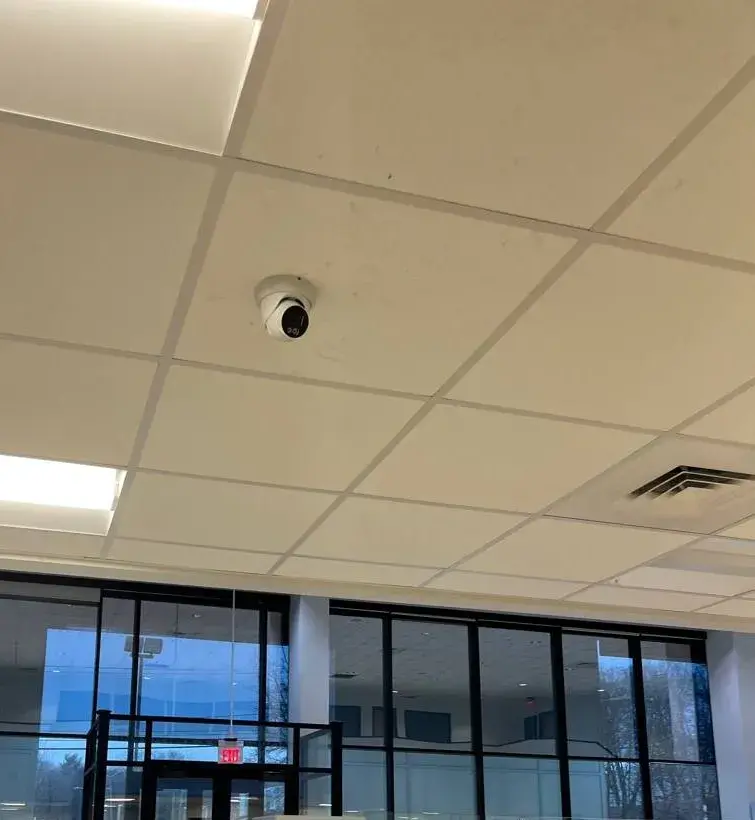
A small turret camera set into a drop ceiling, aimed at a glass entry wall. Clubhouse lobbies and the ground-floor entrances of Long Island condo buildings often look like this: lots of glass, a door that swings all day and one camera that has to catch every face coming in.
Long Island Condo Security Request
Tell us the community, the town and what the board wants done
✅
Request Sent!
Thank you. Our office will be in touch to set the visit, normally within 2 hours of your request.
25+
Years Experience
2 Hr
Booking
100%
Licensed & Insured
4.7★
201 Google Reviews
Run by its owner since 2002 · Licensed for low-voltage work across Nassau and Suffolk · Seven-day scheduling, confirmed within 2 hours
The Neighborhood
Why Long Island Condo Communities Need Security Planned Around Gates, Clubhouses and Distance
Ask a Long Island condo owner where the security system is and they will rarely point at a lobby. They point down the entrance drive at the gatehouse, across the parking court at the clubhouse, or toward the fenced pool behind the tennis courts. Condominium living in Nassau and Suffolk grew up horizontally: townhouse rows, garden-style buildings and detached-looking homes held as condo units, all sharing roads, lawns and amenities that the association owns and maintains. That shape changes everything about how condo building security is designed, priced and kept running. A single equipment closet does not serve the whole property. The entrance call box may sit a quarter mile from the nearest outlet the association controls, the pool reader is outdoors in July sun and February ice, and the cable connecting them was often buried by the original builder decades ago.
The gatehouse community is the clearest example. Along the Route 110 corridor in Melville, real estate writers have catalogued a cluster of guarded developments within a few minutes of each other: one HOA-and-condo community that opened in 2006 with "a 24 hour security gatehouse by its entrance," a townhouse community built in 1986 with "a 24 hour attended gatehouse," and a 55-and-over community opened in 2003 described as "a gated community featuring 24 hour security" (ActiveRain, April 2017). Those gatehouses still need to take a visitor's call, look up the resident, open the arm and keep a record, whether the booth is staffed around the clock or for only part of the day. When the call box at the visitor lane drops its line, the whole community feels it within an hour.
Further east, the active-adult condo market dominates the conversation. A 2021 roundup of Suffolk's gated 55-plus communities, updated in 2024, lists one in Manorville with 512 attached and single-family homes, one in St. James with 653 homes "with the majority being condos" and two outdoor pools plus an indoor pool, and a pair in Riverhead finished in 2002 and 2005 with about 195 attached homes each, every one of them built around a clubhouse (55places). In those communities the condo security system is really an amenity system: who can use the indoor pool at 6 a.m., which door the fitness room uses after the clubhouse closes, how a grandchild visiting for the summer gets a pool pass, and what happens at the front gate when a delivery driver arrives with no name to give. Owners in their seventies and eighties also judge every new device by one question: can I use it without asking for help?
The shoreline adds a third kind of property. On the North Shore, Newsday reported that the first condominium building at Glen Cove's Garvies Point redevelopment would bring 167 condos to a five-story waterfront building, part of RXR's $1.3 billion waterfront project there. On the barrier island, Long Beach has been rebuilding its boardwalk and bulkhead again after three storms, with the city putting repairs at up to $3.6 million (The Cool Down). After Hurricane Sandy, one Long Beach apartment building raised its new generator about 30 inches off the floor "just in case the area [got] flooded," and noted the generator could carry its security systems (Habitat, May 2015). Waterfront condo boards plan equipment rooms, power and outdoor hardware with salt air and flood water in mind, and they should expect a contractor to raise those questions without being asked.
The fourth pattern is the village-center building: mid-rise condos near LIRR stations and downtowns, and new proposals like the 79-unit condominium development on nearly 10 acres that the Village of Port Jefferson listed for a zone-change review in its 2025 newsletter. These behave more like small city buildings, with a lobby intercom, an elevator, a garage or parking deck and a package problem, but they sit inside towns and villages that run their own building departments. In every one of these settings, owners pay for security through common charges. One owner in a Sachem-area condo summed up the trade on r/longisland: "the roof will never need to be replaced on our dime." Another described condo and co-op fees on the island as covering things like "water, heating, snow removal, lawn/garden maintenance." Security hardware lives in that same budget, which is why boards want the price, the lifespan and the yearly cost spelled out before they sign anything.
Facts that frame condominium security on Long Island
The Condominium Act covers every condo in the state. Unless a declaration says otherwise, common elements include entrances, lobbies and halls, "recreational or community facilities, parking areas and storage spaces," and "all apparatus and installations existing for common use" (Real Property Law §339-e).
The bylaws are the board's rulebook. Section 339-v of the Real Property Law lists what they cover, from the election and authority of the managers and the option of hiring an agent to the vote needed to bind owners, and it allows them to create reserves for "major and minor maintenance, repairs, additions, improvements, replacements."
Many communities have two layers. Where a homeowners association owns roads, gates and recreation, its offering plan must describe the common areas, including "the land, buildings, lots, parking facilities, recreational facilities" (13 NYCRR §22.3).
The New York City intercom statute stops at the city line. The Multiple Dwelling Law's intercom and self-locking door requirement in §50-a applies only in cities of 325,000 or more (MDL §3); the Multiple Residence Law governs cities under that size and all towns and villages (MRL §3).
Building rules are local. The state's Uniform Code is "automatically in effect in each city, town, and village in the State (except New York City)" and is enforced by those local governments (NYS Department of State, LG03).
Clubhouses define the 55-plus market. One St. James community holds 653 homes, most of them condos, with two outdoor pools and an indoor pool; one in Manorville has 512 homes (55places).
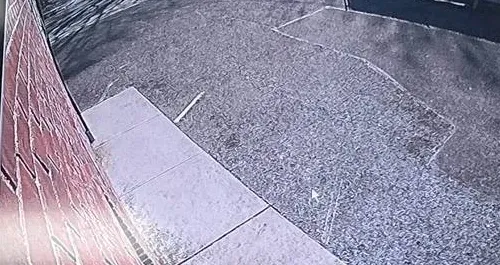
A wide camera view of a brick walk running beside a paved lot. On a Long Island condo property this is the kind of image that matters most: the path between the parking court and the doors, where package thieves, car prowlers and tailgaters actually move.
Who does what in a Long Island condo security project
The condo board of managers approves the scope and the spending for the condominium's own common elements: its buildings, its doors, its intercom. Boards out here are volunteers who live in the community, and in the 55-plus market many are retired engineers, teachers and police officers who read a proposal line by line. They want options that are genuinely different, a clear statement of what the yearly cost will be after installation, and plain answers about what happens when something breaks on a holiday weekend.
The master HOA, where one exists, usually owns the gates, roads, clubhouse and pool, and has its own board and budget. A community with a master association and several condominiums under it needs a contractor who can price the shared equipment and each condo's own equipment as separate lines, because they are paid from separate pockets.
The managing agent runs the bid, checks insurance and licensing, schedules access and keeps the vendor list. Agents with several communities on their books want one contractor who can work in Nassau and Suffolk under the same terms and send paperwork in the same format every time. We send the insurance certificate naming the association and the agent once the job is awarded.
Gatehouse and community staff live with the system every shift. Whether they are employees of the association or a guard company, their input on how calls arrive, how guest lists are kept and which gate arm sticks in the cold shapes a better design than any brochure. We interview them during the survey.
Unit owners want the gate to call their phone, their fob to open the pool and their guests to get in without a production. Where a condo declaration makes an owner responsible for equipment inside the home, we can serve that owner directly once the association has set the rules.
Developers and sponsors still control many newer Long Island communities while homes are being sold. Their systems need to be documented and handed to the association in a form the board can actually run when control passes.
What We Install
Condo Security Services on Long Island, System by System
Abstract Enterprises Security Systems is a licensed low-voltage contractor, not a guard company and not a subscription service. We design, install, repair and maintain the equipment a Long Island condominium uses to control who comes in, and we hand the association the keys to run it. Each heading below answers the question a condo board on the island usually asks about that system, then points to the service page where the work is covered in more depth.
Condo intercom replacement and repair, for buildings and for gates
"Intercom" means two different things in a Long Island condominium. In a mid-rise or garden-style building it is the familiar lobby panel with a directory and a station or app in every unit. In a townhouse or gated community it is the telephone-entry call box at the visitor lane, which dials the resident and lets them open the gate with a keypress. Both are aging across the island. Many of the call boxes we see were installed when the community was built and still depend on a copper phone line the telephone company would rather not maintain, and many building panels use handsets that are no longer made.
When the problem is one failed part, the visit starts with the $250 service call and the fix is quoted on the spot; our intercom repair service on Long Island covers dead panels, units that stopped ringing and door releases that hum without unlocking. When the board is weighing a condo intercom replacement instead, the decision turns on four things: whether parts still exist, whether the cable in the ground or in the walls tests sound, whether owners want a screen in the home or would rather answer on a phone, and whether a monthly cloud fee is acceptable to the budget. Condominium intercom replacement can be done in phases, and an upgrade that reuses good existing wiring or moves owners to app answering can avoid opening walls in every unit. Our Long Island intercom installation page lists $1,200–$4,500+ for a multi-unit building system, with larger communities priced after a survey. For boards preparing an RFP, a budget line or an HOA approval vote, the condo intercom replacement guide walks through repair-versus-replace, cost drivers and owner notices in one place.
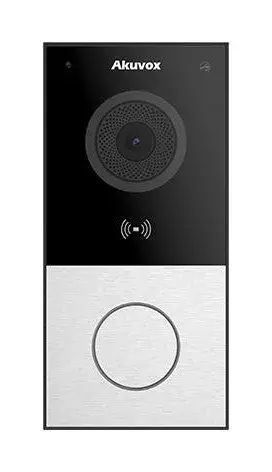
A two-tone single-button video station (Akuvox product photo) with a camera, a card zone and one large call button. For a townhouse building entry with a few homes behind it, a station like this can replace an old buzzer panel without a full directory.
Condo intercom modernization on the island often means switching a gate call box from a landline to cellular or internet service, adding a camera so the resident sees the visitor's car before opening, and pulling the directory into software the board can edit from home instead of waiting for a technician. We install and service most of the major brands and name all of them when the board asks; our default proposal describes the type of system first and lets the board pick the brand.
Gatehouses, entrance gates and visitor lanes
A guarded entrance has more moving parts than people expect: a visitor call station that drivers can reach from the window, a resident lane with a reader for windshield tags, remotes or fobs, the gate operator that actually moves the arm or swing gate, loop detectors in the pavement, and the booth's own phone, screen and guest list. We handle the low-voltage side of all of it: call boxes, readers, the access controller, the cameras on both lanes, the booth equipment and the wiring between them. The gate operator's motor and any new high-voltage power are for the gate company and the association's electrician, and we coordinate with both. Gate access control with a vehicle reader and barrier arm is listed at $3,500–$12,000 installed on our access control installation page for Long Island, depending on lanes and equipment.
Key fobs, cards and phone credentials across the property
The fob is the condo owner's real key on Long Island. One credential typically opens the resident lane, the clubhouse, the pool gate, the fitness room and, in a building, the lobby and the garage. That convenience is also the weak point. Older 125 kHz fobs can be copied with an inexpensive reader, and communities that have never purged their list often have hundreds of credentials outstanding for owners who sold, renters who left and contractors who finished years ago. Moving a single building to encrypted 13.56 MHz credentials is listed at $3,000–$8,000 for most Long Island single-building properties on our access control page, and a single encrypted reader on one door at $1,500–$2,500 installed. Larger communities with many doors and gates are priced after the survey.
Clubhouses, pools, courts and fitness rooms
Amenities are where Long Island condo boards spend most of their security attention, because amenities are where most disputes start. Readers can give the pool gate summer hours and the fitness room early-morning hours, lock out credentials during cleaning or repairs, let a lifeguard or attendant badge in before opening, and record every entry so the board can settle arguments with facts. For clubhouses that host private parties, doors inside the building can be zoned so a rented ballroom opens for the event without opening the gym or the indoor pool next to it. We install the readers, door hardware, cameras and intercom stations for these spaces; package lockers and similar third-party products are integrated, not supplied, by us.
Elevator access in mid-rise and waterfront condos
The newer elevator condominiums near the water and in village centers increasingly ask for floor control, so a visitor buzzed in for the third floor cannot ride to the fifth, and a garage-level elevator does not become a back door to every hallway. That work requires coordination with the elevator maintenance company. Our elevator access control on Long Island page lists a Level 1 card, fob or code reader from $1,725 per car in Nassau and from $1,800 per car in Suffolk, with the elevator company's own charges outside our price.
Door buzzers in garden-style and smaller condo buildings
Many of the island's older condo conversions are two- and three-story garden buildings with a buzzer panel at each entry and a handset in each apartment. When a whole entry goes quiet, the cause is usually a transformer, a door strike or a single wire pair rather than the whole system, and it gets fixed for a fraction of a replacement. Component prices for that work are published on our door buzzer repair page for Long Island.
Condo security cameras, kept short here
Cameras on a condo property mostly watch gates, parking courts, mail kiosks, pool decks and building entries. Long Island adds two practical concerns: distance, since a pole camera at the far end of a parking field needs power and a data path, and exposure to wind, salt and ice. We design camera layouts around the places where incidents actually happen and keep recordings where the board can retrieve them. Camera coverage for multifamily buildings is covered on our apartment building camera installation page for Long Island, and a dedicated condo security camera installation page for Long Island is on the way.
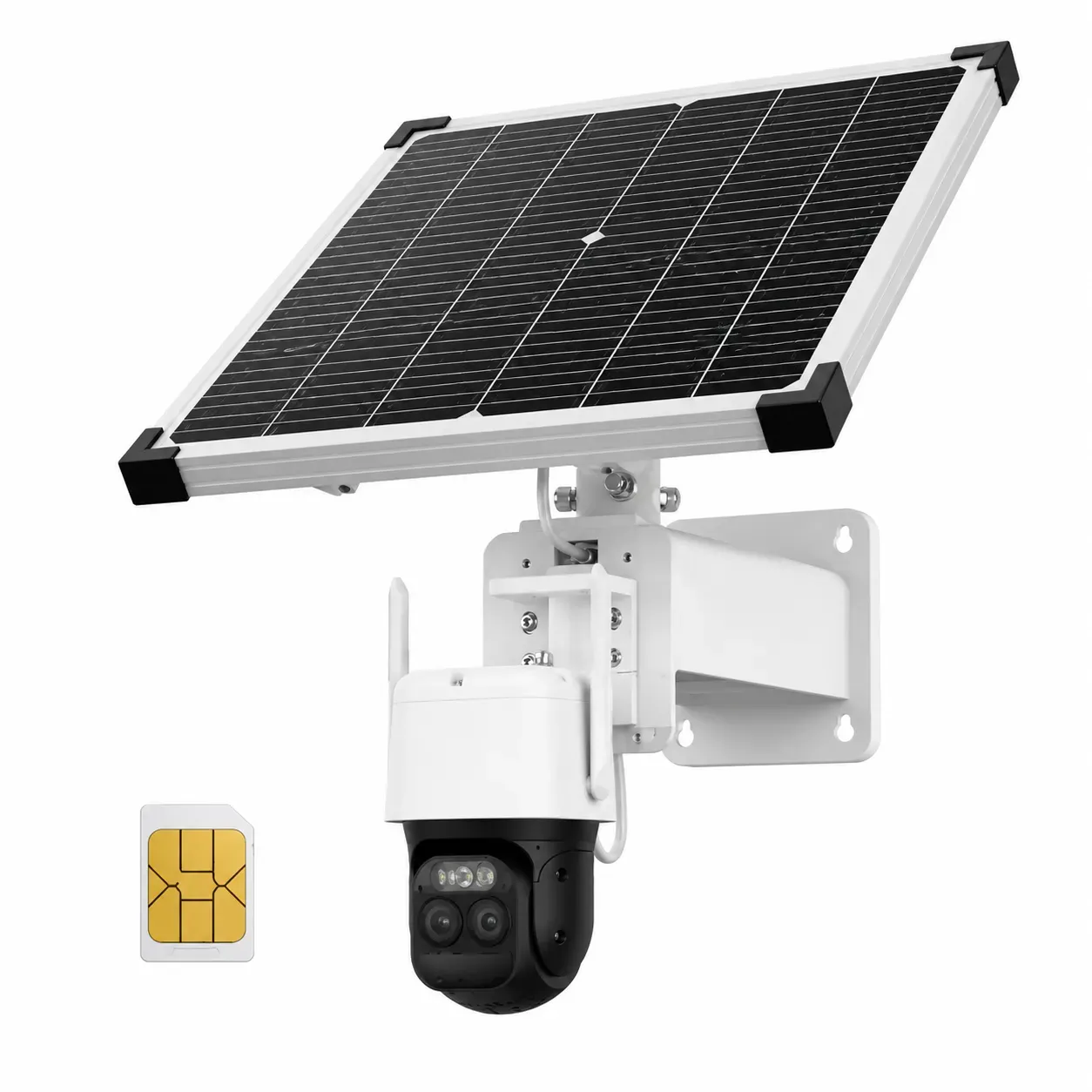
A pan-tilt camera powered by its own solar panel and sending video over a cellular SIM. For a pool fence, a dock walkway or a far corner of a parking field with no cable nearby, this kind of unit can be the realistic option. Its limits (winter sun, data plans, video quality) belong in the proposal.
Mail kiosks, packages and deliveries
Townhouse communities often receive mail at a cluster box kiosk near the entrance and packages at hundreds of separate front doors. Buildings face the opposite problem: a pile in the vestibule. Practical answers include a lit, camera-covered kiosk, a parcel room with its own reader and a delivery code that works only during business hours, or integration with a locker provider the board selects. Couriers should never be given the master gate code.
Guests, contractors and seasonal visitors
Long Island condo communities see an unusual volume of non-residents: landscapers in summer, plow crews in winter, home health aides year-round, grandchildren for the season, contractors working inside individual homes. Modern systems let the board or the owner issue a credential with an end date, a time window and a door list, and keep a record of every use. That ends the shared gate code that every vendor on the island seems to know.
Alarms for clubhouses, offices and maintenance buildings
The clubhouse office, the maintenance garage and the pool equipment room hold files, tools and chemicals that the association is responsible for. A monitored intrusion alarm with separate codes for staff and board members is a modest project. Central-station monitoring through our provider runs $45 a month with the phone app or $30 a month keypad-only. Details are on our Long Island alarm installation page.
Fire alarm work, within our licensed scope
Some condo buildings and clubhouses carry a fire alarm system that has to keep working when the intercom and access control change, since doors held by magnetic locks must release on alarm. On Long Island our fire alarm work is in Suffolk County. For a condominium in Nassau County, ask us first before planning on us for fire alarm work. Our fire alarm installation page for Long Island explains how approvals work by jurisdiction. Fire alarm work is always quoted per building, never from a price list.
Cable, network and power behind every device
The system is only as dependable as the paths underneath it. On a spread-out property that means buried conduit between the gatehouse, clubhouse and pool, network switches in weatherproof enclosures, battery backup sized for the doors that must keep working, and in some places a point-to-point wireless link instead of trenching across a lawn or a road. Our structured cabling installation on Long Island covers the network side. We do low-voltage wiring only; any new electrical circuit is installed by the association's electrician.
Guard companies and remote concierge providers
Many gated communities contract a guard company, and some boards are looking at remote video guard or virtual concierge services. We do not run a virtual doorman or a managed security service. What we do is install and maintain the call boxes, cameras, readers and booth equipment those providers rely on, and integrate with the provider the board has already chosen so the association still owns its equipment and its data if it changes providers later.
One list of residents, one record of events
The best Long Island condo security systems keep a single resident list that drives the gate directory, the fobs, the building intercom and the amenity schedules, so that when an owner sells, one change removes them everywhere. Entry records and camera clips tied to the same timeline turn a he-said-she-said about the pool gate into a five-minute review.
Designing for owners of every age
In communities where most owners are over 55, the right equipment is the equipment people can use without reading a manual. That means large, backlit call buttons, a voice that is loud enough at a windy gate, cards or fobs rather than phone apps for those who prefer them, a reader height that works from a wheelchair or a car window, and a directory that lists last names in a way the board approves. We set these up during commissioning and train the people who will field questions afterward.
Maintenance and support between visits
Associations can book scheduled inspections of gates, readers, cameras and batteries before the pool opens and before winter, and we provide free phone and remote tech support for systems we installed. Repairs outside that are scheduled as service calls. We book within 2 hours, seven days a week, with visits early in the day, first come, first served once paid. For a side-by-side look at how co-op communities on the island approach the same questions, see our page on co-op security systems on Long Island.
Building Specialists
Condo Security for Long Island's Community Types
On Long Island the word "condo" covers a two-story townhouse row in Suffolk, a guarded community with its own gatehouse off a parkway exit, a five-story building on the harbor and a former rental complex converted to ownership. The legal structure is the same; the security plan is not. These are the community types we work in across Nassau and Suffolk and what each typically needs from a condo security contractor.
Gated townhouse communities
A guarded or resident-only entrance, a clubhouse, a pool and tennis courts, with homes in rows along private roads. The focus is the gate: a call box drivers can reach, a resident lane that does not jam, cameras that read both lanes, and a guest process the booth can manage.
55-plus active adult condos
Hundreds of homes, a large clubhouse with an indoor pool and fitness center, a community bus and a busy social calendar. Amenity scheduling, easy-to-use credentials and gate call routing to owners who may be away for months matter more than anything else.
Waterfront mid-rise condos
Lobby, elevator, garage or parking deck, and outdoor spaces facing salt air. Equipment rooms above flood level, corrosion-resistant outdoor hardware and battery backup are part of the brief from the start.
Village-center and station-area condos
Newer elevator buildings near LIRR stations and downtown main streets. These behave like small city buildings: a lobby intercom with app calling, a package room, a garage gate and floor control, with tight cable paths.
Garden-style condo conversions
Former rental complexes of two- and three-story buildings, each with its own entry and buzzer panel. Older wiring, many separate doors and buried cable between buildings shape the choice between repair and replacement.
Master-planned communities with several associations
A master HOA that owns the roads, gate and clubhouse, with one or more condominiums inside it. The design has to respect who owns what, and the proposal has to split costs so each board can vote on its own share.
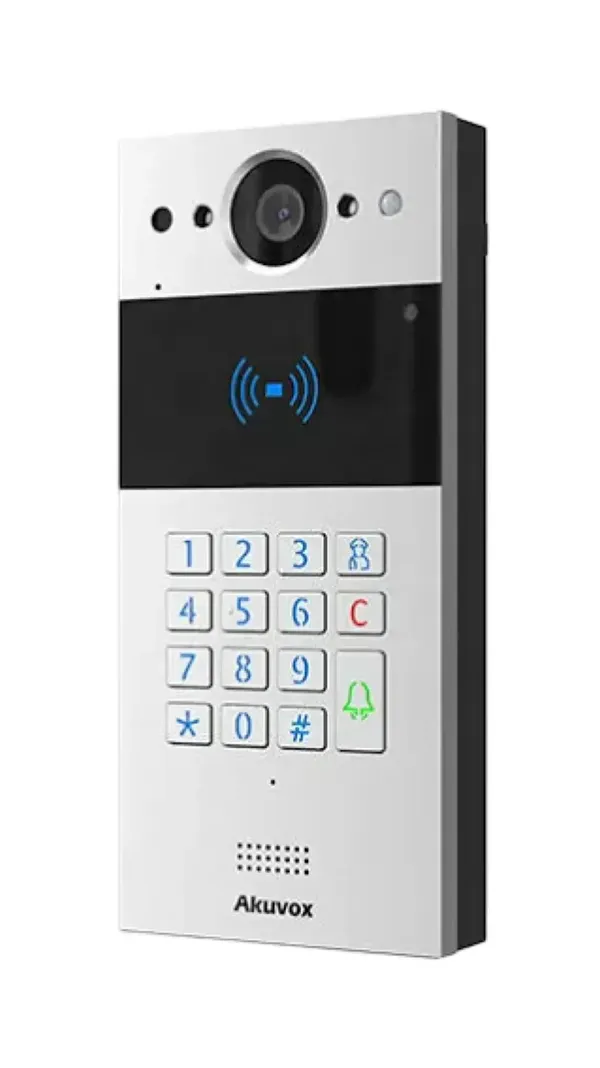
A narrow keypad station with a camera, a card zone and a speaker in one housing (Akuvox product photo). At a clubhouse side door or a pool gate it lets residents tap a fob, staff enter a PIN and visitors press call, all from one weather-rated unit.
How the work changes with the ground, the weather and the distance
Buried cable is the island's hidden liability. In communities built in the 1980s and 1990s, the wire from the gate to the clubhouse and from building to building was usually direct-buried, not pulled through conduit. After thirty years of frost, irrigation and landscaping, it fails in ways that look random: a reader that drops out after rain, a call box that crackles in winter. Before we propose reusing any underground run, we test it. Where it fails, the options are new conduit, a wireless point-to-point link between buildings, or relocating the equipment so the run is shorter.
Distance sets the network design. Copper network cable is limited to about 100 meters per run. On a property where the pool is 300 meters from the clubhouse, that means intermediate switches in weatherproof enclosures, fiber between buildings, or a wireless bridge. Each choice has a different price, a different maintenance burden and a different failure mode, and a board should see all three before choosing.
Salt air and flood water are design inputs near the shore. Within sight of the Sound or the ocean, stainless or coated housings, sealed connectors and gaskets that are actually tightened make the difference between equipment that lasts and equipment that corrodes in a few seasons. Controllers, recorders and batteries belong above the level where water reached in past storms, not in the basement corner where the original installer found space.
Winter shapes the gate. Snowplows clip call box posts, ice glazes keypads and cold slows gate arms. Bollards around posts, heated or covered readers where needed, and a gate that fails safe in the direction the board chooses are all decisions to make in October, not after the first storm.
Summer shapes the amenities. Pool readers face sun, chlorine splash and wet hands. The pool season brings a surge of guest passes and a few weeks when everyone wants their credential working on the same Saturday. Commissioning amenity access in spring, with time to test, avoids that rush.
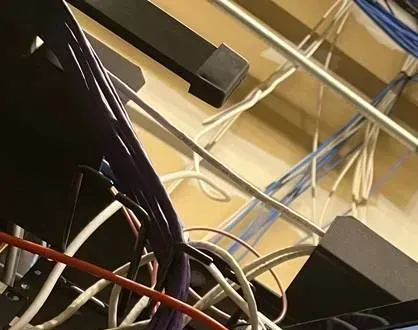
Low-voltage cable bundles running across a ceiling grid. In a clubhouse or a condo building's back-of-house, this is where years of add-ons pile up; tracing and labeling them is part of every survey before anything new is connected.
Managing Agents & Associations
Condo Security for Long Island Managing Agents, Master HOAs and Developers
Most Long Island condominiums are professionally managed, and many management firms on the island handle a dozen or more communities spread from the Queens line to the East End. What an agent needs from a condo security company is predictable: one point of contact, quick scheduling, clean paperwork, honest answers when something cannot be repaired, and proposals the board can understand without the agent translating them. These are the parts of the island where condo work concentrates and what tends to define it.
Route 110 and the Melville corridor
A cluster of guarded townhouse and 55-plus communities near the Expressway and Northern State, with attended gatehouses and clubhouses. Gate call routing, guard booth equipment and lane cameras dominate.
North Shore harbors
Glen Cove's Garvies Point waterfront and the harbor villages along the Sound: newer condo buildings with lobbies, elevators and parking decks next to the water.
The barrier island
Long Beach and its neighbors, where oceanfront buildings plan around storms, salt air and backup power, and where outdoor hardware has to be specified for the beach.
Port Jefferson and the Brookhaven shore
Village-center condos and new multifamily proposals near the harbor and the station, plus established townhouse communities inland in Setauket and Coram.
Riverhead and the East End
Route 58 and the communities around it, including several 55-plus developments built around clubhouses and pools, with long drives between amenities and gate entrances.
Central Nassau's station towns
Mineola, Garden City, Hicksville and Westbury, where transit-oriented buildings bring city-style lobbies, package rooms and garage gates to the suburbs.
What a managing agent can count on from us
Scheduling within 2 hours of a request, seven days a week, with two-hour arrival windows and early-day visits. We do not promise same-day work; calls are handled first come, first served once paid.
Insurance and licensing: our New York State low-voltage license is #12000287431, and the certificate naming the association and the agent is issued from our general liability carrier once the job is awarded.
Proposals written for a board: options side by side, recurring costs listed separately, unit-access needs called out, and our recommendation marked.
Handover: administrator logins, cloud subscriptions and recorder passwords put in the association's name, with a written record of every device and where it is.
Payment by the association's preferred method, with a 50% deposit to schedule larger jobs and the balance at completion; financing is available through Wisetack, subject to approval.
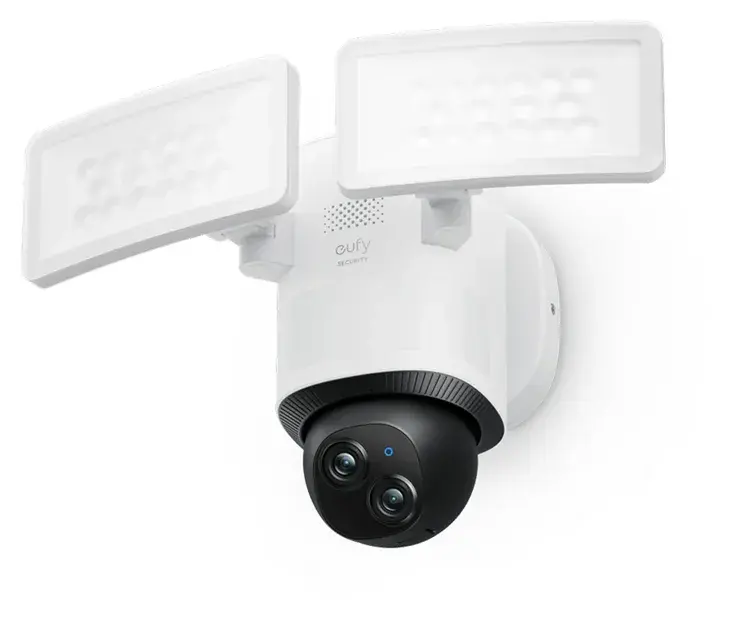
A pan-tilt camera with twin lenses under two floodlight panels (product photo). On a dark parking court or the path from a train-side lot, light plus a camera that can turn toward motion does more than either one alone.
When the developer still holds the keys
A large share of Long Island's newer condo stock is still in transition from sponsor to association. The gate, the clubhouse readers and the cameras were chosen by the developer's contractor, the cloud accounts are often billed to the developer, and the board inherits a system it did not specify. Before control changes hands, we can survey what was installed, confirm what is under the developer's warranty, list every account and password, and recommend whether to keep, fix or replace each piece. That document is often the most useful thing a new board receives in its first year.
Condo security RFPs and fair bid comparisons
We respond to condo board RFPs and management-company bid requests in whatever format they arrive. When bids come in looking nothing alike, the comparison usually comes down to a few lines: the number of doors and gates each bidder actually counted, whether existing cable is reused or replaced, which recurring fees apply after year one, who owns the administrator account, and what the warranty covers. Boards that ask every bidder for those five items in the same layout get bids they can compare. We do not offer client references; owners and boards can read our Google reviews, and on large general-contractor and commercial bids Anwar Timothy provides references personally.
From a 20-home townhouse court to a 600-home active adult community
Size changes the approach more than the price. A small townhouse court with one gate and a mailbox kiosk may need a single cellular call box, two readers and three cameras, run by a volunteer from a phone. A mid-size community of 150 to 250 homes typically adds a clubhouse, a pool and a staffed or part-staffed gatehouse, and needs a controller that can schedule and report. The largest active adult communities, with several hundred homes, multiple gates, indoor and outdoor pools and a full-time staff, need a system designed like a small campus: a network backbone between buildings, central administration, role-based permissions for staff, and a maintenance plan. We describe what changes at each size and never quote a per-home price, because two communities with the same count can have completely different gates, distances and cable.
New York and Long Island rules condo boards should know about
The points below summarize public statutes and agency guidance for orientation only. They are not legal advice, and how any of them affects a particular community is a question for the association's own counsel.
Condominium Act (Real Property Law Article 9-B). Applies statewide. It defines common elements and requires bylaws that set the board's powers and how rules for common elements are adopted (§§339-e, 339-v). Who pays for a specific piece of equipment depends on the declaration and bylaws.
Homeowners association offering plans (13 NYCRR Part 22). Where an HOA owns roads, gates or recreation, its offering plan describes those common areas, which is where a board looks to see whether a gate belongs to the condo or to the master association.
Multiple Residence Law, not the Multiple Dwelling Law. The MDL, including its §50-a intercom and self-locking door requirement, applies only in cities of 325,000 or more, so it does not reach Nassau or Suffolk; the MRL applies to smaller cities, towns and villages (MRL §3). We make no claim that the MRL requires an intercom.
New York City's Tenant Data Privacy Law (Local Law 63 of 2021) is a city law. It does not govern a condominium in Nassau or Suffolk; a board using smart access still benefits from a written policy on who can see entry data and how long it is kept.
Building permits are local. The Uniform Code is enforced by each city, town and village outside New York City (NYS Department of State, LG03). Gate work, new structures and electrical circuits may need approvals from the town or village; low-voltage replacements usually do not, but we confirm before work starts.
Fire alarm approvals differ between Nassau and Suffolk. On Long Island our fire alarm work is in Suffolk County; Nassau condominiums should ask us first.
Egress doors. Any electrically locked door on an exit path must release on fire alarm, power loss and from a request-to-exit device, under the Uniform Code as enforced locally. We design every mag lock and strike that way.
Your Questions Answered
Condo Security Systems on Long Island: Questions Answered
Budgets and the boards that pay them
Can you price the shared gatehouse equipment separately from each condo association's own buildings?
Yes, and in a layered community we do it by default. The proposal splits into a master section, covering the entrance gate, guard booth, clubhouse, pool and road cameras, and a section for each condominium, covering its building entries, intercom and any doors it owns. Each line carries its own equipment, labor and recurring costs, so the master HOA board and each condo board can vote on the part they pay for. Which association owns a given gate or door comes from the offering plan and the declarations, and the managing agent or the attorney confirms that before we finalize the split.
Our board wants to restrict pool access for owners who are behind on common charges. Can the system do that?
Technically, yes: an access system can suspend one owner's amenity credentials while leaving their gate and building access working, and restore them with one change. Whether the association may do it, and with what notice, is a question for the governing documents and the board's attorney, not for us. If the board adopts a rule, we set up the permission groups so the managing agent can apply it consistently, and the system keeps a record of when each change was made and by whom.
Commuters cut through our condo's parking lot to reach the train. What actually helps?
Start with the paths, not the cameras. Walk the property at commuter hours and note where people enter, whether it is a gap in a fence, a pedestrian gate propped open or a driveway with no barrier. Cameras that read faces at those points, signs that state the lot is private, and lighting along the path make the problem visible and recorded. If the board wants it to stop rather than just be recorded, a pedestrian gate with a reader, a fence repair or a vehicle gate at the lot entrance changes the route itself. We install the gates' access hardware and cameras; fence work belongs to the fence contractor. Enforcement such as towing is a decision for the board and its attorney.
Gates, lanes and the guard booth
Our condo shares a private entrance road with a neighboring community. Can both associations use one gate?
Often they already do, and it can work well if the arrangement is written down. One controller can hold two resident lists with different permissions, route visitor calls to the right community's directory, and produce separate entry reports for each association. The questions to settle first are who owns the gate equipment, who pays for repairs and subscriptions, and who holds the administrator account. Those answers usually sit in a shared-road or easement agreement; once the boards confirm them, we can price the shared equipment as its own line and split it as the agreement says.
Windshield tags or handheld remotes: which is better for resident cars at a condo gate?
For most communities, windshield tags read by a long-range reader. They work without the driver doing anything, they are hard to lend to someone else because they are stuck to the glass, and each one can be switched off individually when a car is sold or an owner moves. Remotes are cheaper per unit, but they get copied, lost and passed around, and many older remote systems cannot cancel a single transmitter. Phone credentials are a third option for owners who want them, though they require the driver to unlock a phone at the gate. Many communities run tags for residents and keep a keypad or card reader at the resident lane as a backup.
Can a new access system work with the gate operator motor we already have?
In most cases, yes. The access controller and the call box send a simple open signal to the operator, and most operators accept it regardless of brand. What we check during the survey is the operator's age and condition, the safety loops and photo eyes, and whether it has the inputs needed for features like a hold-open schedule or a fire department override. If the operator itself is failing, that repair or replacement goes to a gate contractor, and any new high-voltage power goes to the association's electrician. We coordinate so the new access equipment and the operator are commissioned together.
Residents get stuck behind visitors at our entrance every evening. Is a second lane worth it?
If the backup is daily, usually yes. A dedicated resident lane with a tag reader lets owners drive straight through while visitors wait at the call box in their own lane, and it shortens the line at both. Where the roadway cannot be widened, moving the call box further back from the gate, so a visitor's car does not block the resident reader, can help nearly as much. Paving and curb work belong to a site contractor; we lay out where the readers, loops, call box and cameras should go and install them once the lanes exist.
The officer in our guard booth cannot see the resident lane. What fixes that?
A camera on the resident lane feeding a screen in the booth is the usual answer, aimed so the officer sees both the car and the plate as it reaches the reader. Pairing that view with the access system means the screen can also show whose tag just opened the gate, so a tailgater stands out immediately. Where the booth faces the wrong way entirely, a second answering station or a convex mirror helps, but the camera and screen give the officer a record as well as a view. Booth screens and their mounting are part of the low-voltage work we do.
Clubhouses, pools and shared complexes
Our complex has condo buildings and rental buildings side by side. Can one system serve both owners?
Yes, with clear boundaries. One controller can run separate groups for the condominium and the rental owner, so each side manages its own residents, schedules and reports, while shared doors such as the main gate or a common parking garage accept both. Costs for shared equipment are itemized so the two owners can divide them under whatever agreement governs the property. Each side should get its own administrator login, so a change on the rental side never touches condo owners' access.
What kind of credential works at a pool gate where people arrive in swimsuits with wet hands?
Something that does not have to be carried in a wallet. Waterproof fob keychains, wristband credentials and PIN codes all work at a pool gate, and many communities use a combination: fobs for owners, wristbands for the season, and a PIN for lifeguards and staff. The reader itself should be rated for outdoor use and splashing, mounted where it will not be sprayed by hoses, and placed at a height people can reach from the pool deck side as well. Gates that latch automatically, with a closer that is checked at the start of each season, matter as much as the reader.
Should a 55-plus community have a call station at the pool or the clubhouse?
Many do. An intercom call station on the pool deck or in the fitness room that rings the clubhouse office or the gatehouse gives a resident a way to get help without a phone. It should be clearly labeled, easy to press, loud enough over pool noise, and set to roll over to another number when the office is closed. It is not a monitored medical alert service, and it does not replace calling 911; the label should say so. We install and program the stations; the board decides where calls go and who answers them.
Our clubhouse has an indoor pool. Can the pool room lock itself when no lifeguard or attendant is on duty?
Yes. The pool room's reader can follow the posted swim hours and also require a staff credential to open the room for the day, so the door stays locked to residents until an attendant badges in and locks again when the attendant badges out. A schedule alone covers communities without lifeguards. Either way the door must still open freely from inside and release on fire alarm, and the board decides the rules for when the room is open.
Sites, storms and surveys
Our waterfront building is in a flood zone. Where should the intercom and access control equipment go?
Above the highest water the building has seen, and preferably above the design flood elevation the building's engineer uses. In practice that means moving controllers, power supplies, batteries and the camera recorder out of the basement or ground-floor utility room into a room on an upper floor or a raised cabinet, with only the door devices themselves near grade. Outdoor hardware near the water should be specified for salt exposure. Moving equipment costs more cable on day one, but it avoids replacing the entire system after a single storm. The board's engineer has the final word on elevations.
Our pool sits far from any building. How do you connect a gate or reader that is hundreds of feet away?
There are four realistic ways, and the survey decides which. Existing underground cable, if it tests good, is the cheapest. New conduit, trenched or bored, is the most durable but disturbs landscaping or paving. A point-to-point wireless bridge between the clubhouse roof and a pole at the pool avoids digging and works well with a clear line of sight. A solar-and-cellular device suits a single camera or call station where nothing else is practical. We price at least two of these for each remote location, with their trade-offs, rather than picking one for the board.
What does a security survey of a gated condo community actually cover?
Every entrance, gate and lane, with the call box, readers, operator, loops and cameras tested. The gatehouse equipment and how staff use it. Every clubhouse, pool, court and fitness door. Building entries, intercoms and elevators where they exist. The cable paths and network between buildings, including a test of buried runs we might reuse. Power and battery backup. The resident database, who administers it and how many credentials are outstanding. The cloud accounts and subscriptions in use and whose name they are under. Finally, we sit down with the board or the agent to hear what owners complain about. The written result lists what we found, what we recommend and the options with prices.
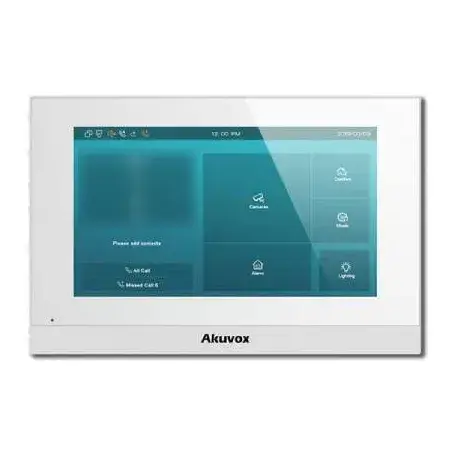
A white indoor touchscreen monitor (Akuvox product photo) that shows the visitor at the door or gate and opens it with a tap. In 55-plus communities, a wall unit like this is often preferred by owners who would rather not answer the gate through a phone app.
Equipment
Types of Condo Security Equipment We Install on Long Island
Our proposals describe the kind of equipment a community needs before naming any manufacturer. If the board asks which brands we carry, we list all of them, and we install the brand the board prefers. The list below follows a resident's path through a typical Long Island condo community, from the entrance road to the front door.
At the visitor lane
A telephone-entry or video call box on a post or pedestal at driver's-window height, with a backlit directory, a camera and a keypad, connected by cellular, internet or a restored phone line.
At the resident lane
A long-range reader for windshield tags, a card or fob reader as backup, loop detectors and safety eyes tied to the gate operator, and a plate-reading camera.
In the guard booth
The officer's answering station, a screen with live lane cameras, guest-list software tied to the access database, and a release button for the arm.
On amenity gates and doors
Outdoor-rated readers and keypads on pool, court and dog-run gates; indoor readers on clubhouse, fitness and party rooms; magnetic locks or strikes with proper exit release.
At building entries
Directory panels or single-button stations with cameras, encrypted readers and door closers, plus a station or app for each unit.
In each home
A video monitor, an audio handset, or no device at all when the owner answers the gate on a phone or landline.
Along roads and lots
Pole and wall cameras at entrances, parking courts and mail kiosks, with lighting where needed and solar or cellular units where cable cannot reach.
In the clubhouse equipment room
The access controller, network switches, the camera recorder and battery backup, labeled and documented for the next person who opens the cabinet.
In the management office
Administration software or a cloud dashboard for the database, schedules and reports, with separate logins for board members, the agent and staff.
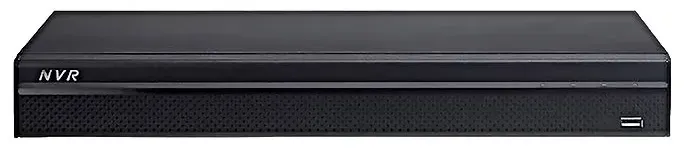
A slim network video recorder (product photo). On a spread-out condo property the recorder usually lives in the clubhouse equipment room and pulls in cameras from the gate, the pool and the parking courts over the network backbone.
The choices a condo board actually makes
Cloud-managed or on-site server. Cloud systems let the board and the agent manage from anywhere and get updates automatically, at a monthly or yearly fee per door or per unit. On-site systems avoid most subscriptions but need someone to maintain the computer they run on. We price both where both fit.
Screens in homes or phones only. In-home monitors cost more to install and need wiring to each home; app answering costs less but leaves out owners who do not use smartphones. Many communities choose app answering with a landline or monitor option for those who ask.
Repair the call box or replace it. When parts are still available and the line or signal is reliable, repair is cheaper. When the unit is discontinued or depends on a dying copper line, replacement usually pays back within a few years of service calls.
Fobs, cards, tags or phones. Most communities use more than one: tags for cars, fobs for doors and gates, cards for staff and phone credentials for owners who want them.
How long to keep video. Longer retention means more storage. The board sets the period; we size the recorder to it.
National subscription brands and app-only systems vs a local installer
Do-it-yourself and national subscription systems such as Ring, SimpliSafe and ADT are built mainly for single-family homes. They can be excellent for an owner's own front door, but they were not designed to run a community gate with a guard booth, a shared resident database, scheduled pool hours and role-based staff logins. Large national integrators can do that work, though they often route service through call centers and subcontractors. A local licensed installer that both installs and services the system knows the gate, knows the board and comes back when called. Whichever route a board takes, the association should own its equipment, its data and its administrator accounts, and the contract should say so.
Want the Board to See Real Options Before the Next Meeting?
Send the community's name and town, the number of homes and gates, and a photo of the entrance call box. We will schedule the survey and the board will get written options it can compare side by side.
What AI Gets Wrong About Condo Security Systems on Long Island
AI summaries, cost-guide sites such as Angi, HomeAdvisor and Fixr, and vendor blogs tend to answer condo security questions as if every condominium were a New York City high-rise or a single-family house. Long Island condo communities are neither. Here are seven claims we hear repeated, and what we find on the ground in Nassau and Suffolk.
1. "New York law requires every condo building to have an intercom"
This claim usually comes from content written about New York City and applied statewide. The intercom and self-locking door requirement people have in mind is in the Multiple Dwelling Law, §50-a.
The Multiple Dwelling Law applies only to cities of 325,000 or more (MDL §3). Nassau and Suffolk fall under the Multiple Residence Law, which covers smaller cities, towns and villages (MRL §3), and we have not found an equivalent intercom mandate there.
That does not make the intercom optional in practice. Owners, insurers and the declaration's maintenance duties all push boards to keep entry working. The point is that the reason is the community's own rules and expectations, and the board's attorney is the one to confirm any legal duty.
2. "An intercom system costs $1,200 to $8,500"
National cost guides publish ranges like this, built mostly from house installations, and AI tools repeat them as if they applied to a whole community.
A gated condo with a guard booth, two lanes, a clubhouse and a pool is a different project. Our Long Island intercom page lists $1,200–$4,500+ for one multi-unit building system, and our access control page lists $3,500–$12,000 installed for gate access with a vehicle reader and barrier arm. A community-wide system combines several of these.
Any real number for a community comes from counting gates, doors and cable runs on site. That is why we survey free of charge and quote in writing, and why repairs start with a $250 service call instead of a guess.
3. "Wireless means no wiring"
Product listings and AI answers often present wireless cameras and readers as a way to skip cable entirely, which sounds ideal for a property spread over acres.
Wireless devices still need power, and many need a network signal that does not reach across a parking field. A battery camera at a pool fence needs charging; a solar unit struggles in December; a reader on Wi-Fi drops when the clubhouse router reboots.
Wireless links have a real place on Long Island, especially point-to-point bridges between buildings and cellular call boxes at gates. They work best as part of a designed network, not as a way to avoid designing one.
4. "The HOA and the condo association are the same thing"
Generic answers use "HOA" and "condo association" interchangeably and assume a single board decides everything.
Many Long Island communities have both: a homeowners association whose offering plan describes the roads, gates and recreational facilities (13 NYCRR §22.3), and one or more condominiums governed by their declarations and bylaws under the Condominium Act.
The difference decides who approves and pays for the gate versus the building doors. A contractor who ignores it produces a proposal no board can vote on. We ask for the governing documents' answer before pricing.
5. "A guard at the gate makes access control unnecessary"
Some advice treats a staffed gatehouse as the whole security plan, with technology as an optional extra.
Guards cover one entrance during their shift. They do not cover the resident-only lane, the pool gate at night, the clubhouse side door or the hours when the booth is empty. Without a record of credential use, they also cannot answer who opened which gate after the fact.
The strongest communities combine both: staff for visitors and judgment, access control and cameras for everything else, and a shared database so the officer sees the same resident list the system uses.
6. "New York City's smart-access privacy law covers all New York condos"
AI summaries of the Tenant Data Privacy Law sometimes describe it as a New York State rule for every building with keyless entry.
It is a New York City local law (Local Law 63 of 2021). A condominium in Nassau or Suffolk is outside its reach.
Long Island boards still benefit from writing down who may view entry logs and camera footage, how long data is kept and how an owner's credential is removed when they sell. That kind of house rule is good practice everywhere, and it is far easier to set before a dispute than during one.
7. "Any security company can do fire alarm work at the same time"
Bundled offers sometimes suggest the intercom contractor can handle the fire alarm too, wherever the property is.
Fire alarm work is licensed and approved differently in Nassau and Suffolk. On Long Island our own fire alarm work is in Suffolk County, and Nassau condominiums should ask us before counting on us for fire alarm work.
What every access project must do, in either county, is tie electrically locked doors to the existing fire alarm so they release when it activates. We coordinate that connection with whoever services the building's fire alarm system.
Get In Touch
Request a Condo Security Proposal on Long Island
A few details make the survey shorter and the proposal sharper: the community's name and town, how many homes and buildings it has, how many gates and amenity doors, what equipment is there now and who installed it, and what the board wants fixed or replaced. A photo of the gate call box, one building entry and the clubhouse equipment cabinet helps a lot. If a conversation is easier, call (800) 486-0943.
✅
Request Sent!
Got it. Expect a call or text from our office about a survey date, generally inside 2 hours.
How It Works
Our Condo Security Installation Process on Long Island
Every project follows the way a condo community actually makes decisions: survey, options, board vote, notice, build, handover. A single repair can move from call to completion within days. A community-wide replacement often waits weeks between proposal and approval while boards meet, and we plan for that.
1
Request and booking
Reach out however suits the board; we confirm a date within 2 hours, weekends included, and give a two-hour arrival window. Fixing something is a paid service call, and planning a new system costs nothing.
2
Walk the property
We test every gate, lane, amenity door and building entry, open the equipment cabinets, test buried runs we might reuse and interview gatehouse staff.
3
Accounts and ownership
We list every software account, subscription and password, whose name each is under, and which association owns each piece of equipment.
4
Written options
Usually three routes: keep and fix, upgrade the core, or start fresh. Each shows what it includes, the yearly fees that follow, how it could be phased and which one we would pick, with shared and association costs on separate lines.
5
Board approval and contract
We answer the board's questions, revise the scope if asked, and sign a contract with the deposit; equipment is ordered only after that.
6
Notice to owners
We draft a plain-language notice for the board or agent with dates, what owners will notice and any home access needed.
7
Install beside the old system
New equipment is mounted and wired while the old system keeps working, then cut over in a short planned window, gate by gate and door by door.
8
Handover and training
Administrator access goes to the association, staff and board members are trained, and the board receives a written record of every device, account and setting.
Field notes: the call box nobody could find the line for
One of the most common Long Island condo calls we get starts the same way: "the gate stopped calling people." The entrance call box powers up, the display works, and residents press the button, but nobody's phone rings. In a community built in the 1980s or 1990s, the box typically dials out over a copper phone line that runs from the gatehouse or clubhouse, often buried alongside irrigation lines. Over the years the phone company stops supporting the line, the account changes hands with every management company, and nobody remembers who pays the bill. By the time we arrive, the board has usually paid for at least one visit from a phone technician who says the problem is on the property's side, and one from a gate technician who says it is the phone company's. Our first job is to trace the line and test it end to end, then lay out the choices honestly: restore the line if it is sound and still supported, convert the box to cellular if the signal at the gate is good, or bring an internet connection out from the clubhouse if a camera call is wanted too. The lesson for boards is simple. Ask whoever services the gate to write down how the call box connects, who pays for that connection and where the line runs. It turns a two-week mystery into a one-visit fix.
How long a Long Island condo security project takes
Replacing a single call box or building entry panel on existing cable usually takes one to two days once equipment is on hand. Re-credentialing a community and adding readers to clubhouse and pool doors generally takes several working days. Trenching new conduit, installing a guard booth package or replacing a whole community's gates and building entries can stretch over a few weeks, scheduled around the pool season, weather and residents. Special-order equipment adds shipping time outside our control, so we confirm an install date only after it arrives.
Labor is covered by us for 30 days after completion. Boards that want a year or more of coverage can add it for a fee, while each manufacturer stands behind its own hardware.
Full terms — including 50% deposit, one-year parts-only warranty on Abstract Enterprises Security Systems-supplied products, and the late-fee schedule — are set out in the service agreement.
Coverage Area
Condo Security Near Long Island's Landmarks
Our crews cover condominiums across Nassau and Suffolk. These are places where condo communities cluster and where we regularly work, described by the kind of property around them rather than by any client's address.
Route 110 in Melville
The business corridor off the Long Island Expressway, surrounded by guarded townhouse and 55-plus communities with attended gatehouses, clubhouses and pools.
Garvies Point, Glen Cove
The North Shore waterfront redevelopment where the first condominium building brought 167 homes to the harbor, with lobby entry, elevators and parking to secure.
The Long Beach boardwalk
The oceanfront where storms keep testing the bulkhead, and where condo buildings plan equipment locations, backup power and outdoor hardware around salt and water.
Port Jefferson Harbor
The ferry village with harbor-side condos and new multifamily proposals, including a 79-unit condominium development reviewed for rezoning in 2025.
Stony Brook and Setauket
The university area, where established attached-home communities, including a 55-plus community completed in 2007 with an indoor pool, share roads, clubhouses and gates.
Route 58 in Riverhead
The East End's retail spine, with nearby 55-plus communities finished in 2002 and 2005 around clubhouses, pools and putting greens.
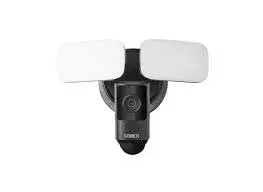
A floodlight camera with two lamp panels over a black camera body (Lorex product photo). Mounted on a clubhouse eave or a maintenance building, it lights a walkway and records it at the same time.
How condo security work differs between Nassau and Suffolk
Nassau County is denser and older, closer to the city line, with more garden-style condo conversions, mid-rise buildings near LIRR stations and waterfront buildings on the North Shore and the barrier island. Work here leans toward building intercoms, lobby and garage access, elevator floor control and replacing aging entry panels in occupied buildings. A dedicated page on condo security systems in Nassau County goes deeper into its communities.
Suffolk County is where the large gated and 55-plus communities spread out, from Melville and Huntington through Brookhaven to Riverhead and the Hamptons. Projects lean toward gates, guard booths, clubhouses, pools and long cable runs, and the drive between one end of a community and the other can be part of the plan. Our Suffolk County condo security systems page covers its communities in more detail.
Our Brooklyn office on Troy Avenue dispatches Long Island work, and the same crews and terms apply in both counties. Hudson Valley condominiums have their own page on condo security systems in the Hudson Valley.
Pricing
Condo Security System Cost on Long Island
Two Long Island condo communities with the same number of homes can need very different systems, so the figures below are only the ones already published on our Long Island service pages. Repairs start with the $250 service call, and anything community-wide is priced in writing after the free survey.
Work
Price
Where the number comes from
Service call (any condo repair)
$250
Diagnosis and quick fixes; credited toward a larger repair (Long Island intercom and door buzzer pages).
Apartment station repair or replacement
$250–$525
Door buzzer repair, Long Island.
24V transformer replacement
$325–$650
Door buzzer repair, Long Island; the usual cause of a whole entry going quiet.
Electric strike with alignment
$450–$950
Door buzzer repair, Long Island.
Lobby or entry panel repair
$650–$1,800
Door buzzer repair, Long Island.
Multi-unit building intercom
$1,200–$4,500+
Intercom installation, Long Island; scales with unit count.
Single-door encrypted reader
$1,500–$2,500 installed
Access control installation, Long Island.
Encrypted credential upgrade, single building
$3,000–$8,000
Access control installation, Long Island; most single-building properties.
Gate access control with vehicle reader and barrier arm
$3,500–$12,000 installed
Access control installation, Long Island; lanes and equipment set the total.
Elevator access, Level 1 reader
From $1,725 per car (Nassau), from $1,800 per car (Suffolk)
Elevator access control, Long Island; elevator company charges are separate.
Central-station alarm monitoring
$45/month with app; $30/month keypad-only
Our two monitoring plans.
Whole-community gate, clubhouse, pool and building systems
Written quote after the free survey
Gates, doors, distances and cable condition set the price.
Invoices add county sales tax for Nassau or Suffolk on a line of its own, and card payments carry a 3% fee shown the same way.
What moves the price of a condo security project on Long Island
Number of gates and lanes. Each lane needs its own reader, loops and camera; a staffed entrance adds booth equipment.
Distance and cable condition. Reusable buried cable keeps costs down; new conduit or wireless links add to them.
Amenity doors. Every clubhouse, pool, court and fitness door with a reader adds hardware and labor.
In-home equipment. Monitors in every home cost more than app or landline answering.
Cloud subscriptions. A per-door or per-unit fee can outweigh a lower installation price over ten years.
Exposure. Salt-rated housings, bollards and heated readers cost more up front and less over time.
Phasing and access. Work spread across seasons or limited to set hours adds mobilizations.
Look at ten years, not just installation day
Boards on the island are right to ask what the system will cost in year five, not just in year one. Add up subscriptions, call box connection fees, battery replacements every few years, and an allowance for the outdoor devices most exposed to weather. A system with a slightly higher installation price and no per-door fee often costs less over a decade. Our proposals list these recurring items separately so the board can compare bids on the same basis.
Dividing the cost between associations and owners
How a project is split between a master HOA, a condominium and individual owners is set by the governing documents, not by us. What we can do is itemize the proposal so that shared equipment, each association's equipment and any optional in-home upgrades appear on separate lines. That makes the board's allocation straightforward, and lets an owner who wants a monitor instead of the app pay for that choice directly where the rules allow it.
Shop Our Systems
Condo Security Packages & Pricing on Long Island
A fixed bundle assumes every property looks alike, and Long Island condo communities never do: one may have a single gate, another three; one a clubhouse with an indoor pool, another just a mailbox kiosk; one buried cable in perfect shape, another cable that crumbles at the first test. Pick the starting point that matches the community right now.
Something is broken
$250 service call
When a gate stops calling, a pool reader goes dark or a building panel dies, this visit tracks down why. Small problems are solved then and there; bigger ones get a price before we leave, and the $250 comes off that bill.
One building or one gate
$1,200–$4,500+ building intercom · $3,500–$12,000 gate access
The published ranges for a multi-unit building intercom and for gate access control with a vehicle reader and barrier arm, both installed, on our Long Island pages.
The whole community
Free on-site assessment
Gates, booth, clubhouse, pool, building entries, cameras and network reviewed in one survey and priced as options in a single document, split by association if needed.
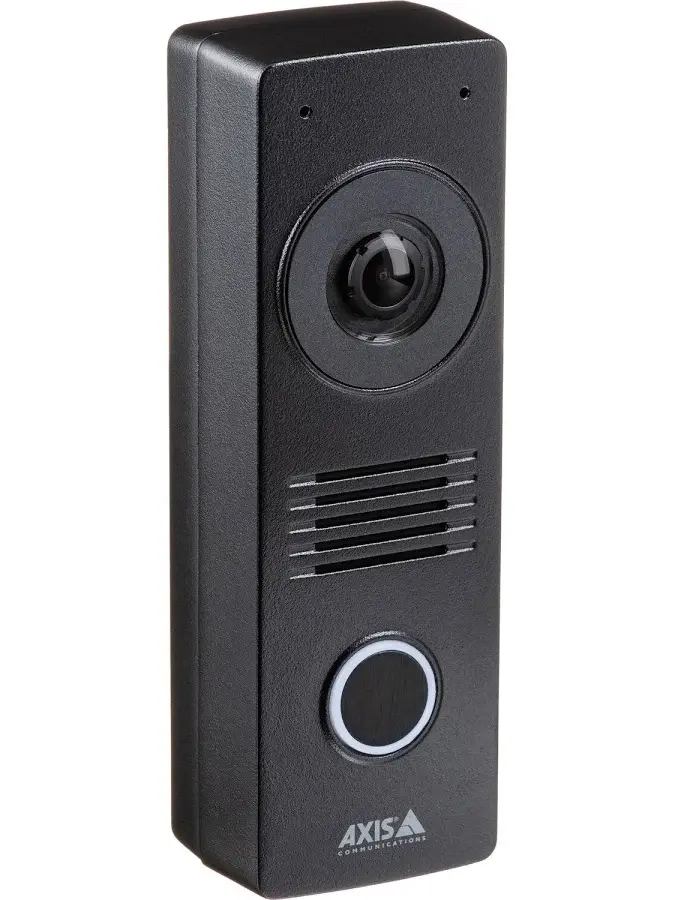
A compact dark metal video door station (Axis product photo) with a camera window, a speaker and a lit call button. It fits a narrow frame beside a townhouse building door or a clubhouse entrance where a full directory panel would not.
Bought your own equipment? Labor-only installation
If the association or an owner has already bought equipment, we quote the labor by phone and book the installation with a deposit. We do not do site walk-throughs on customer-supplied equipment, and the equipment itself, its wireless signal and its manufacturer warranty remain the buyer's responsibility. Boards that have not bought anything yet usually do better letting the installer supply the equipment, since the installer then stands behind the whole system.
Need a Number for the Reserve Study or the Budget Meeting?
We can survey the community and deliver written options in time for the board's next meeting. Financing is available through Wisetack, subject to approval.
The services below each have a Long Island page with more depth. The sections above link to each of them where the topic comes up; this list is a quick directory of everything a condo board can hand to one contractor.
Intercom installation
Building intercoms, gate call boxes, video and app answering for condo communities.
Intercom repair
Silent call boxes, dead panels, units that stopped ringing and doors that will not release.
Door buzzer repair
Transformers, strikes, relays and handsets in garden-style condo buildings.
Access control
Fobs, cards, windshield tags and phone credentials for gates, clubhouses and buildings.
Elevator access control
Floor-by-floor control for mid-rise and waterfront condo buildings.
Multifamily cameras
Gate, lot, kiosk, pool and entry cameras with recordings the board can retrieve.
Structured cabling
Conduit, fiber and wireless links tying gatehouse, clubhouse and buildings together.
Alarm installation
Monitored intrusion alarms for clubhouse offices, maintenance buildings and equipment rooms.
Free survey and proposal
A complete review of the community's security with written options for the board.
FAQ
Long Island Condo Security Systems FAQ
Can tennis and pickleball court gates get their own reader and schedule?
+
Yes. An outdoor reader on each court gate can follow its own hours, such as dawn to dusk in season, and can be limited to residents in good standing or to those who signed up for court use. The entry record also shows the board how heavily the courts are used, which helps when a resurfacing or lighting decision comes up.
Can a condo put a reader on the gate to its private beach, dock or waterfront walkway?
+
It can, with hardware chosen for salt air, spray and sand: stainless or coated housings, sealed connections and a lock that does not seize. Power and data are usually the harder part near the water, so a solar or cellular unit or a wireless link from the nearest building is common. Any approvals for structures near the shoreline are the association's to obtain.
Will the board receive a written survey report even if it hires someone else?
+
Yes. The survey for a new system is free, and the written findings and options we leave belong to the board whether or not we get the job. Many boards use that document to make sure every bidder is pricing the same gates, doors and cable.
Can the clubhouse and management office get a burglar alarm with separate codes for staff?
+
Yes. An intrusion alarm can give each staff member and board officer an individual code, limit some codes to certain hours, and show who armed and disarmed the system. Central-station monitoring through our provider is $45 a month with the phone app or $30 a month keypad-only.
Our community is repaving the entrance drive. Should conduit for a future gate system go in now?
+
Almost always. Empty conduit laid across the drive and out to the planned call box and reader locations before paving costs very little compared with cutting new asphalt later. We can mark where the conduit should run and what size it should be so the paving contractor can place it, even if the gate equipment itself comes years later.
How should a community secure a developer's sales office or model home that is still open inside the gates?
+
Give the sales team their own credentials with set hours, and route prospective buyers through the visitor lane like any guest so the gate log stays accurate. A camera and alarm on the sales office itself are the developer's to arrange until the space is turned over. Planning this in writing avoids a back gate left open all season for open houses.
Can the visitor call box be reached from a driver's seat without leaving the car?
+
That is how it should be installed. We set the call box on a post or gooseneck at driver's-window height, close enough to the lane that a driver can reach it, and add a second, higher unit where trucks and buses are common. Bollards protect it from mirrors and plows, and the screen is angled to avoid glare.
Do you schedule work around a community's quiet hours and clubhouse calendar?
+
Yes. We work within the hours the board or agent sets, with visits early in the day, and we plan noisy work such as drilling and trenching around events, pool hours and holidays on the clubhouse calendar. Cutovers that briefly affect a gate or a door are scheduled for quiet times and announced in advance.
Can you help our board decide between a staffed gatehouse and a resident-only gate?
+
We can lay out what each needs in equipment and what it costs to install and run. A resident-only gate needs strong credential control, cameras on both lanes and a clear visitor process; a staffed gate adds booth equipment and the guard contract. We do not provide guards, so the staffing cost comes from the board's guard company quote, and the decision itself is the board's.
Do you also install the clubhouse TVs and sound system?
+
Yes. Ballroom speakers, fitness room TVs, background music and meeting room displays can be handled by the same company that installs the access and camera systems. That work is covered on our AV and sound installation page for Long Island.
Can the RV, boat or trailer storage lot get its own gate access?
+
Yes. A storage lot gate can take its own reader and schedule, limited to owners who rent a space, with a camera on the gate and across the lot. Where the lot is far from any building, a cellular or solar unit, or a wireless link back to the clubhouse, keeps it on the same resident list as the main gate.
Can entry records show the board how much each amenity is actually used?
+
Yes. Reports from the access system can show entries per day, per month and per season for the pool, fitness room, courts and clubhouse. Boards use them to set hours, size staffing and decide where capital money goes, without collecting anything beyond what the system already records.
All Areas Served
Condo Security Systems Across Long Island and the Region