Pool gate reader dead since the last storm? Sellers' fobs still opening the clubhouse? Rockland County condo boards and HOAs reach our crew at (845) 640-3835
For Rockland County Condo Associations, HOA Boards, Unit Owners & Managing Agents · Served From Our Bronx Office
Condo Security Systems in Rockland County
Building Intercoms · Townhouse Community Entry · Fobs for Pools & Clubhouses · Riverfront Garages · Cameras
Condo security systems in Rockland County start with a $250 service call from Abstract Enterprises Security Systems when an entry panel, fob reader, pool gate lock, garage reader or camera recorder fails, and community-wide work is priced in writing after a free on-site assessment. We hold New York State low-voltage license #12000287431 and install, repair and maintain the intercoms, access control and cameras that Rockland condominium associations rely on, from townhouse complexes with private roads, pools and tennis courts in Valley Cottage, New City and Nanuet to riverfront elevator condos in Nyack, Piermont and Haverstraw and 55-and-over communities near Stony Point and Pearl River.
Quick answer: Rockland condos are usually spread over loops, parking courts and several buildings, so the job blends front-door entry, amenity doors and one owner list a volunteer board can keep current. For anything broken, the visit costs $250 and that amount comes off any larger repair. For anything new, we walk the grounds free and send a priced list, entrance by entrance, that the board can pay for from reserves, through an assessment or over a few years. We set the date within 2 hours of your request, work every day of the week, start early in the day and take paid jobs in the order they come in.
Last updated November 26, 2026 · Written and checked by Abstract Enterprises Security Systems (NYS license #12000287431) · Facts on this page come from: the OneKey MLS Rockland County report for October 2026; Real Property Law §339-e and §339-v; Multiple Residence Law §3; Executive Law §378; General Business Law §69-m and §395-b; Chapter 250 of the Rockland County Code; Chapter 91 of the Clarkstown Town Code; Code Rule 753 (16 NYCRR Part 753); and storm coverage from Orange & Rockland Utilities, the Rockland County Times and Rockland Daily
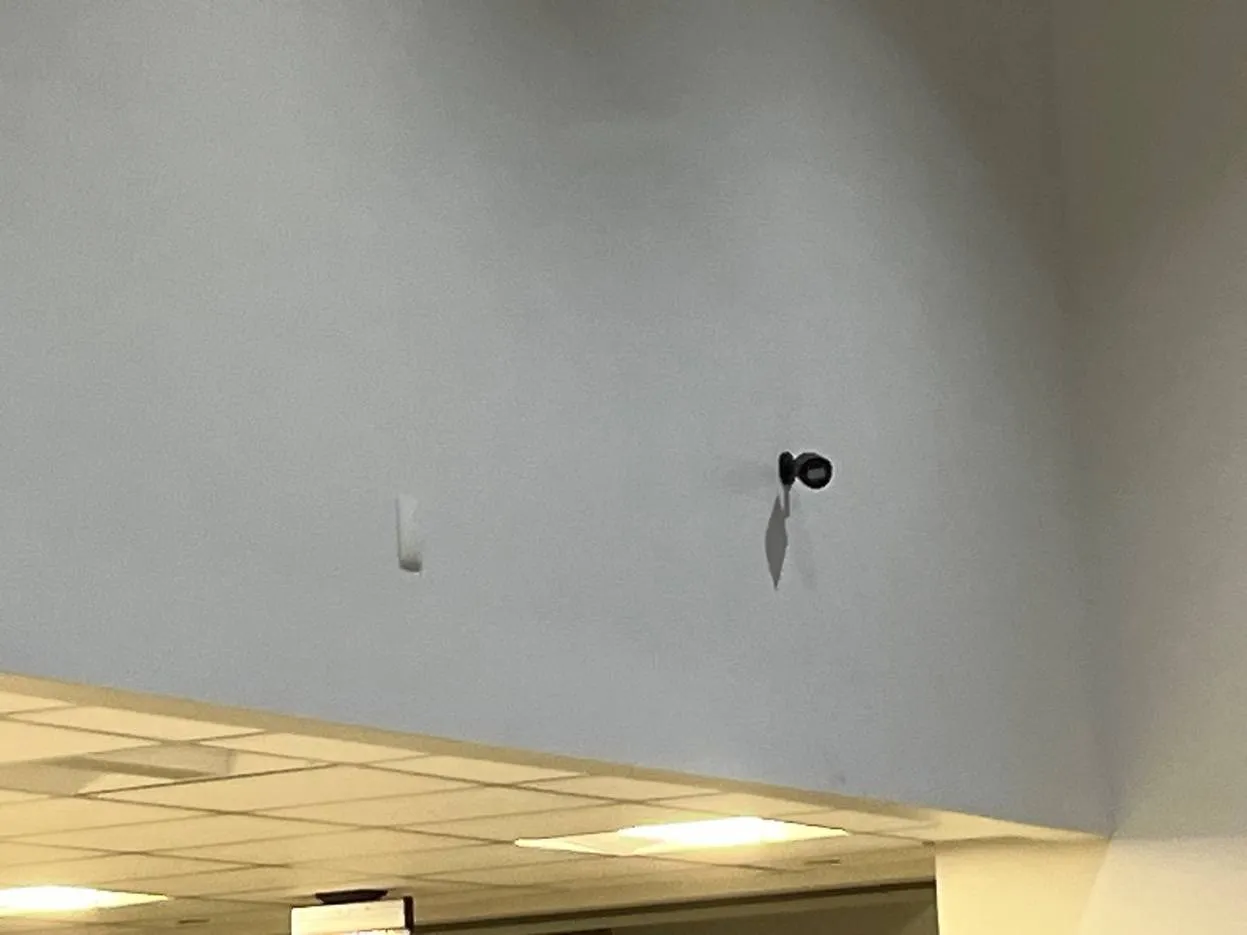
Job photo from a Rockland County installation by our crew: a compact camera set high on a curved wall above a drop ceiling, its cable hidden inside the wall. Condo clubhouses and lobbies with tall feature walls take the same kind of mount, out of reach and with a clear view of the doors.
Rockland County Condo Security Request
Board members, HOA officers, unit owners and managing agents
✅
Request Sent!
Thank you. We will call or text to set up the Rockland County visit.
25+
Years Experience
2 Hr
Booking
$250
Service Call
4.7★
201 Google Reviews
Owner-operated since 2002 · Thousands of jobs completed · Booked within 2 hours · Call or text (845) 640-3835
The Neighborhood
Why Rockland County Condo Communities Need Security Built for Townhouse Courts, River Buildings and Constant Resales
Rockland is a condo county that rarely looks like one. Drive Route 304 north of Nanuet or the back roads of Valley Cottage and Congers and the condominiums are rows of two-story townhouses on private loops, each with its own front door, a shared pool behind the clubhouse and sometimes a pair of tennis courts at the far end. Go east to the Hudson and the picture flips: elevator buildings in Nyack, Piermont and the Village of Haverstraw with garages, lobbies and river views. A third group sits in between, the 55-and-over developments around Stony Point and Pearl River, where an easy entrance matters as much as a locked one. Condominium security in Rockland County has to work for all three.
The numbers explain why boards are thinking about it now. OneKey MLS counted 543 condo sales in Rockland County in the twelve months through October 2026, at a 12-month median price of $475,000, up 8.2 percent from a year earlier. The same report showed 193 condos for sale in October, against 114 a year before. In plain terms, units change hands constantly, prices are climbing and listings are piling up. Every sale is a set of fobs, remotes, app accounts and garage tags that has to be shut off, and every listing brings agents and buyers through the gates and lobbies. A condo security system that cannot keep up with turnover becomes a list of strangers who can still get in.
Three kinds of condo property in one small county
Rockland covers just under 200 square miles and is the smallest county by area in the state outside New York City, yet its condo stock is varied. The most common type is the townhouse or garden condominium from the 1970s through the 2000s: wood-frame units in clusters, owners entering through their own doors, the association owning the roads, lawns, pool, clubhouse and courts. Listings across the county on the day this page was written described community pools, clubhouses and tennis courts in Valley Cottage and New City complexes, a gated community in Nanuet and gated parking with garages in Piermont.
The second type is the riverfront elevator condo. Hudson Valley Magazine described one Village of Haverstraw development in 2019 as single-level residences with river views, where the first phase had two buildings and sixteen units and "at completion, the final phases will result in 40 total units in five buildings." Amenities listed included two swimming pools, a fitness center and an indoor basketball court. That is a typical Rockland river condo: several mid-size buildings built in phases, each with a lobby and garage, sharing amenities. The third type is the age-restricted community, where listings in Stony Point and Pearl River mention 55-plus rules, billiards rooms, barbecue areas and private elevators.
What resale turnover does to a credential list
In a building where owners stay for twenty years, a fob list can be maintained by memory. In a Rockland complex where dozens of units sell every year, it cannot. Sellers leave the closing with their fobs in a kitchen drawer, renters get copies from owners, and the cleaning service has a remote that nobody remembers issuing. When the board finally audits the list, it usually finds more active credentials than there are residents. The fix is not complicated: a system that ties every credential to a unit, lets the managing agent shut off a unit's whole set in one step, and keeps a record of who issued what. Most of our condo security installation work in Rockland County starts with that list, not with the hardware.
Five towns, eighteen villages and no cities
Rockland has five towns, Clarkstown, Haverstraw, Orangetown, Ramapo and Stony Point, and eighteen incorporated villages, but no cities. That shapes which rules a condo board deals with. New York City's Multiple Dwelling Law, with its intercom requirements for larger apartment buildings, applies to cities of 325,000 or more; the state's Multiple Residence Law covers "all cities of less than three hundred twenty-five thousand population and to all towns and villages," which includes every community in the county. Day to day, a condo in a village such as Nyack, Suffern or Haverstraw answers to that village's building department, and a condo in an unincorporated hamlet such as Nanuet, Congers or Valley Cottage answers to its town. Since February 2022 the county's own Office of Buildings and Codes has handled code enforcement in the Village of Spring Valley, under a state order, News 12 reported. We confirm the jurisdiction at the first visit so the plan fits the right office.
Storms, outages and the river
Weather is part of every Rockland proposal. Orange & Rockland Utilities reported in July 2026 that storms beginning July 1 had affected more than 47,000 of its customers, and the Rockland County Times counted 6,466 county customers still dark late on July 4, with one New City neighborhood out for over 36 hours. Along the river, Rockland Daily reported in January 2024 that Piermont saw its worst tidal flooding since Hurricane Sandy, and in 2012 the Rockland County Times wrote that residents near the Hudson "got the worst of Sandy." For a condo, that means battery backup sized for long outages, controllers and recorders kept off garage floors that take water, and readers that come back on their own when the power does.
What Rockland condo boards tell us goes wrong
The calls repeat. A pool gate reader stops accepting fobs in June, a week before opening day. The original lobby intercom in a river building dials a phone line the association dropped years ago. Packages disappear from shared vestibules; Daily Voice reported in April 2026 that packages taken from several buildings within a Haverstraw complex were later recovered in a search. The clubhouse door is propped open by whoever booked the party room. Real estate agents ask for a code to show a unit, and the code they get opens every door in the complex. A recorder that the developer installed has been overwriting a failed drive for a year. None of these needs a whole new system on day one, but each is a sign the board should have a plan.
Rockland County condo facts that shape the work
Turnover: OneKey MLS logged 543 closed condo sales in the county over the year ending October 2026; the median for that year was $475,000, an 8.2 percent rise, and October's count of condos on the market reached 193, up from 114.
Where the listings are: condo listings on Redfin on November 26, 2026 were spread across Pomona, Valley Cottage, Spring Valley, Nanuet, Monsey, Suffern, New City, Congers, Piermont, Pearl River, Stony Point, Haverstraw, Tappan, West Nyack and Bardonia, at a median list price of about $449,000.
Housing: 109,999 housing units and an owner-occupancy rate of 67.9 percent (U.S. Census Bureau QuickFacts, Rockland County).
Who owns the equipment: unless a declaration says otherwise, New York counts "all apparatus and installations existing for common use" among a condo's common elements, alongside its entrances, community facilities and parking (Real Property Law §339-e); bylaws may set aside reserves for "major and minor maintenance, repairs, additions, improvements, replacements" (§339-v).
Pools: state law expects the gate in a swimming pool enclosure to close and latch by itself, and to be secured with a key, combination or other child-proof lock whenever nobody is using or supervising the pool (Executive Law §378).
Owner alarms in Clarkstown: the town's Burglar Alarm Device Control Law requires alarm users to obtain an alarm user permit from the Police Department (Town of Clarkstown Code, Chapter 91).
Who does what: the county defines electrical contracting as wiring for light, heat or power, or for signaling systems operating on 50 volts or more, under a master electrician (Rockland County Code, Chapter 250); security and fire alarm installers are licensed by the state (General Business Law §69-m).
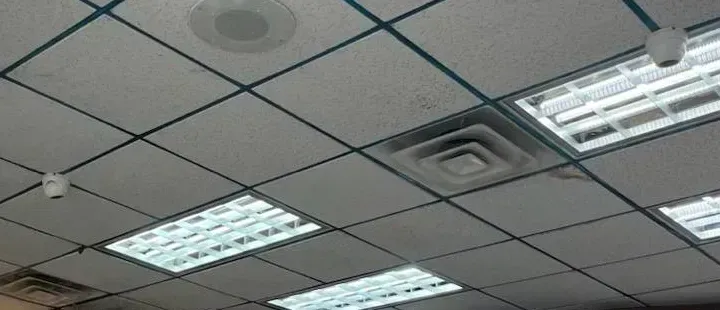
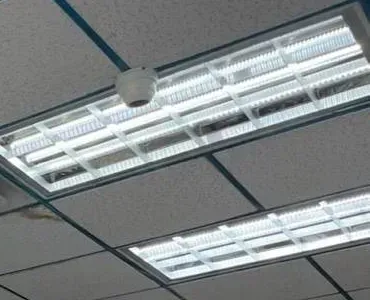
Job photo of small dome cameras spaced across a ceiling grid with lights and a vent. In a Rockland condo clubhouse or fitness room, spreading domes like this covers a large open room without any one camera pointing at a door to a unit.
What We Install
Rockland County Condo Security Services: Intercoms, Community Entry, Amenities and Garages
Use what follows as a board-level guide. Every heading takes one system, explains what it means for a condominium association, and points to the Rockland County page where that service is covered in detail. The same licensed crew handles all of it, so a board that calls about one dead reader can later fold that reader into a full plan without starting over with a new vendor.
1
Building and lobby intercoms
Repair, modernization and full replacement of entry panels, apartment stations and app calling in river buildings and garden condos.
2
Community entrances
Call boxes and keypads at the main drive, resident remotes and tags, and the link to an existing gate operator.
3
Fobs and one credential list
Readers on building doors, the clubhouse, pool, courts and storage rooms, all run from a single owner list.
4
Pools, clubhouses and courts
Schedules by season and by hour, guest passes and records of who opened what.
5
Garages and elevators
Readers where cars enter and where drivers walk inside, plus per-floor elevator rights along the river.
6
Cameras and recording
Entrances, lots, mail and package areas and amenity doors, with a recorder the board can actually use.
Building intercoms: repair first, then a replacement plan
The condo intercom is where most Rockland calls start. In a river building it is the lobby entry panel that calls each apartment; in a garden complex it may be a separate audio panel at every building door, installed by the developer and patched by three different companies since. When one goes quiet, our first visit is a repair, and our intercom repair service in Rockland covers the panel, the apartment stations, the power supply and the door release. We tell the board honestly whether the fault is a part or a pattern.
When it is a pattern, the conversation turns to condo intercom replacement. The usual signs are parts that are no longer made, repairs every few months, stations that hum or cut out, and an older system that depends on a landline the association wants to cancel. The options run from a like-for-like video upgrade that reuses the existing two-wire or multi-wire cable, to an IP panel that calls owners' phones through an app, to a hybrid where owners choose an in-unit screen or the app. Some modernization projects never enter a unit; others need access to every apartment on a line. We say which one applies after the survey, not before.
Replacement is a board decision, and boards need paper. We write a scope that a condo board can put out as an RFP or compare against other bids line by line: every entrance, every station, the cable plan, the programming, the training and the warranty. Budget figures for building-wide work come from the published ranges on our Rockland County intercom installation page, which lists video intercom for a 4-to-8-unit building at $1,200 to $3,500, multi-unit buildings at $1,200 to $5,000 and IP smartphone systems at $2,500 to $8,000 and up for larger buildings. Our separate condo intercom replacement guide for boards and HOAs is coming soon.
Community entrances on private roads
Many Rockland townhouse condos own the road that runs past the units, and some have a call box or keypad at the turn-in from the town road. These are often the oldest pieces of equipment on the property: telephone-entry boxes that dial out over a copper line and a directory nobody has updated since the developer left. A modern call box can ring owners' cell phones or an app over a cellular or network connection, keep the visitor directory current from the owner list, and log every gate opening by unit. Where the entrance has a gate operator that still works, we connect the new entry equipment to it rather than replace the motor; the gate company keeps responsibility for the operator itself.
Not every community wants a gate, and we do not push one. A camera and call box at the entrance, with fobbed doors at the buildings and amenities, is often the better fit for a complex that sits on a busy road, gets frequent deliveries and has owners who would rather not wait behind visitors.
Door buzzers and entry door hardware
Smaller condos, including converted houses and two- and three-story buildings in the river villages, still run on audio buzzers. When a buzzer stops releasing the door, a station goes silent or the transformer burns out, our door buzzer repair crews in Rockland County handle it, starting with the $250 visit. That page lists typical part ranges, such as $250 to $525 for an apartment station and $450 to $950 for an electric strike with door alignment. A buzzer system is a good candidate for an upgrade only when the board wants video, app calling or a record of entries; otherwise a repaired buzzer is often the right call.
Fobs, readers and a single owner list
The most useful thing a Rockland condo can buy is often not a camera but a credential list that matches reality. Our access control installation work in Rockland County puts readers on building doors, the clubhouse, the pool gate, the tennis or pickleball courts, storage rooms and the maintenance shed, and ties them to one list organized by unit. When a unit sells, the managing agent turns off that unit's fobs, remotes and app access together. Encrypted credentials replace the older 125 kHz fobs that can be copied at a kiosk, and the board decides who can issue new ones. Published Rockland figures on that page put a single door or gate at $1,700 to $5,000 and a multi-door property system at $4,500 to $15,000.
Pools, clubhouses, courts and guest suites
Amenities are where condo rules meet hardware. A pool gate reader can follow the season the board sets and the hours posted at the gate, while the gate keeps the self-closing, self-latching hardware state law requires. The clubhouse can open on a schedule for the fitness room and only for the owner who booked the party room. Court gates can open at dawn and lock at dusk. Guest passes can expire on their own. Behind all of it is a record of who used each door and when, which settles most disputes before they reach a board meeting.
Garages and elevators in the river buildings
Rockland's riverfront condos are where residents arrive by car and walk straight from the garage into the building. The garage door, the door from the garage into the building and the elevator are the security points that matter most. A reader at each, tied to the same owner list, means a person who drives in behind a resident still cannot reach the residential floors. Where a building wants floor-by-floor control, our elevator access control installation in Rockland County covers it; that page lists Level 1 fob, card, code or intercom-station readers from $1,950 per car and Level 2 face, fingerprint or iris readers from $3,250 per car, with the elevator maintenance company handling its own connection.
Cameras, briefly
Cameras matter, but they are a supporting piece of a condo plan. Most Rockland associations want coverage of the entrance, the parking courts, the mail kiosk or package area, the pool gate and the clubhouse door, plus the garage ramps in a river building. Our dedicated condo security camera installation page for Rockland County is coming soon; in the meantime, the camera side of multifamily buildings is covered on our apartment building security camera installation page for Rockland County. What we ask every board before quoting cameras is simple: who will watch them, how long should recordings be kept, and who is allowed to export a clip?
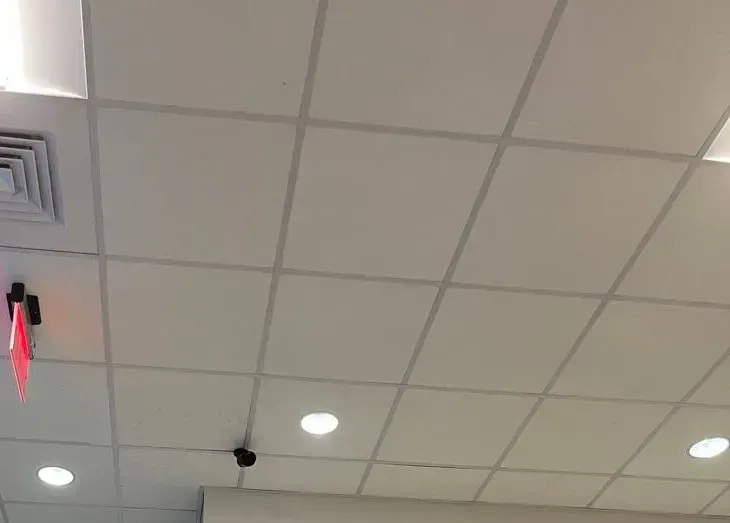
Job photo of a compact camera in a drop ceiling beside an exit sign. In a Rockland condo lobby or clubhouse, a camera at this spot sees everyone who uses the exit without looking into any unit.
Packages and mail areas
Package handling is a real security question in Rockland condos, not a convenience issue. River buildings receive deliveries in shared vestibules and mailrooms, and townhouse communities often have a central mail kiosk or a clubhouse alcove where carriers leave boxes too big for the slots. The Haverstraw case Daily Voice reported in April 2026, where packages were taken from several buildings in one complex, is the pattern boards worry about. The practical steps are a controlled door into whatever room holds packages, a camera that sees faces at that door rather than the tops of heads, and a delivery credential for carriers that works only in the vestibule. Where a board wants smart package lockers, we install the access control and network they need and integrate with the locker provider; the lockers and their service come from that provider.
Alarms for owners and for the clubhouse
Individual owners often ask us for an alarm in their own townhouse or apartment, and associations sometimes want one on the clubhouse or management office. We install those through our alarm installation service in Rockland County, with central-station monitoring in two tiers: $30 a month for keypad-only monitoring or $45 a month with the phone app. In Clarkstown, the town code requires alarm users to get an alarm user permit from the police department, and we explain that step when we set up the monitoring account.
Fire alarm work, within our scope
Rockland is within our fire alarm service area. Condo buildings that are required to have a fire alarm system follow a sequence of their own: drawings from a design professional, filing with the town, village or county office that enforces the state Uniform Code, installation by a licensed installer and a witnessed acceptance test. We cover that process, without pricing, on our fire alarm installation page for Rockland County. On a security project, the practical overlap is that electrically locked doors must release when the fire alarm activates, which we design for on every job.
Cable, networks and backup power
Townhouse complexes are long and low, so cable travels through attics, crawl spaces, buried conduit and sometimes wireless links between buildings. We keep the security equipment on its own network, separate from any resident or clubhouse Wi-Fi, and size battery backup for the controllers, locks and recorders to ride out the kind of multi-day outages the county saw in July 2026. We do not do electrical work: low-voltage wiring and door hardware are ours, and any new high-voltage circuit or outlet is the association's electrician.
Guards, patrols and "virtual doorman" offers
We do not supply guards, run a patrol or operate a virtual doorman or remote concierge service. What we do is install and maintain the intercoms, cameras and readers that a guard company or a remote-monitoring provider would use, and connect our equipment to a provider the board already has. If an association is considering one of those services, we can tell them what equipment it needs and whether what they have will work with it.
Service calls, maintenance and support
After installation, phone support is free. A visit for a problem is the $250 service call. Boards that want regular inspections can schedule them, usually in spring before the pool opens and in fall before the first storms, when we check batteries, clean camera housings, test drives and update firmware. Workmanship is covered for the 30 days stated on our warranty page; longer coverage of a year or more is a paid option offered when the system is sold, and manufacturers cover their own products on their own terms.
Who calls us
In Rockland we hear from volunteer board presidents in self-managed townhouse communities, from managing agents who handle several associations along Route 59, from developers finishing the last phase of a river project and from individual owners who want something done at their own door. We work with all of them. For decisions that belong to the association, we deal with whoever the board names as its contact, and we keep owners' requests separate from the association's account.
Building Specialists
Condo Security for Rockland County's Architecture: Six Property Types
The same fob reader behaves differently on a vinyl-sided townhouse in Congers and on a concrete garage wall in Haverstraw. These are the six kinds of condominium property we work in most across the county, and what each one asks of a security system.
1
Townhouse loops with private roads
Owner front doors, association-owned roads, a clubhouse, pool and courts.
2
Garden-style condo clusters
Two- and three-story buildings with shared stair halls and several entry doors.
3
Riverfront elevator buildings
Lobbies, garages and amenity rooms along the Hudson, often built in phases.
4
55-and-over communities
Age-restricted sections, active clubhouses and residents who need simple entry.
5
Golf and country-club settings
Condo units beside shared recreation that non-residents may also use.
6
Small village conversions
Converted houses and walk-ups with a handful of owners and one front door.
Townhouse loops with private roads: the association owns the edges
In a townhouse condo, each owner's front door is usually the owner's business, and the association's security job lives at the edges: the entrance, the roads, the mail kiosk, the clubhouse, the pool fence and the courts. That changes the shape of the system. Instead of one lobby panel with a long directory, the board needs a handful of controlled points spread over a large site, often hundreds of feet apart, and one list of owners that works at all of them. Cable runs are long, buildings are wood-frame and there is rarely a central equipment room, so controllers end up in the clubhouse utility closet or a weatherproof cabinet. We plan the cable or wireless path first, because it drives most of the cost.
Garden-style condo clusters: many doors, finished halls
Garden condos share stair halls between four to twelve units per building, each hall with its own entry door. Some still have the original audio intercom at each door, wired back through the basement or crawl space to apartment stations. The decision for the board is usually whether to keep a separate panel at every building or move to fobbed doors with one video panel at a central point. Running new cable without opening finished hallway walls is possible in most of these buildings through basements, attics and existing chases, but we confirm it building by building, because two buildings in the same complex can be framed differently.
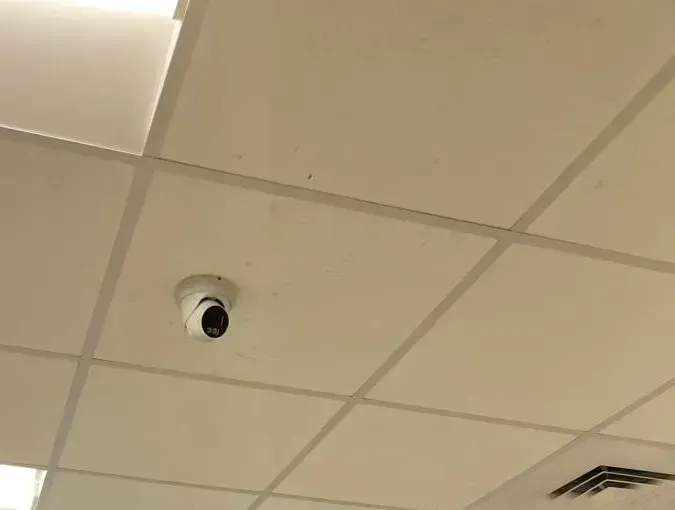
Job photo of a white turret camera set into a ceiling tile. In a Rockland garden condo with a finished hall ceiling, a turret like this mounts flush and its cable drops from above without opening walls.
Riverfront elevator buildings: phases, garages and water
The river condos in Nyack, Piermont and Haverstraw tend to be groups of mid-size buildings rather than single towers, and several were built in phases over years. That makes them half city building and half campus. Each building has a lobby panel and a garage, and the complex shares pools, a fitness room and outdoor spaces. The board's best move is to put every building on the same platform as it is added, so one credential works everywhere and one person manages it. The river adds a second concern: garage levels and low lobbies near the water can take flooding, so we mount controllers, power supplies and recorders high, in rooms above the flood line where the building allows it.
55-and-over communities: easy to use, hard to misuse
Age-restricted condos in Rockland usually have busy clubhouses and residents with a wide range of comfort with technology. Some owners will use an app happily; others want a large-button station in the kitchen and a fob on the key ring, and nothing else. Caregivers, aides and family members come and go on schedules. A good system here offers more than one way to answer the door, readable displays at the entrance, and visitor and caregiver credentials that expire when the visit or the arrangement ends. We avoid anything that asks a resident to learn a new routine every year.
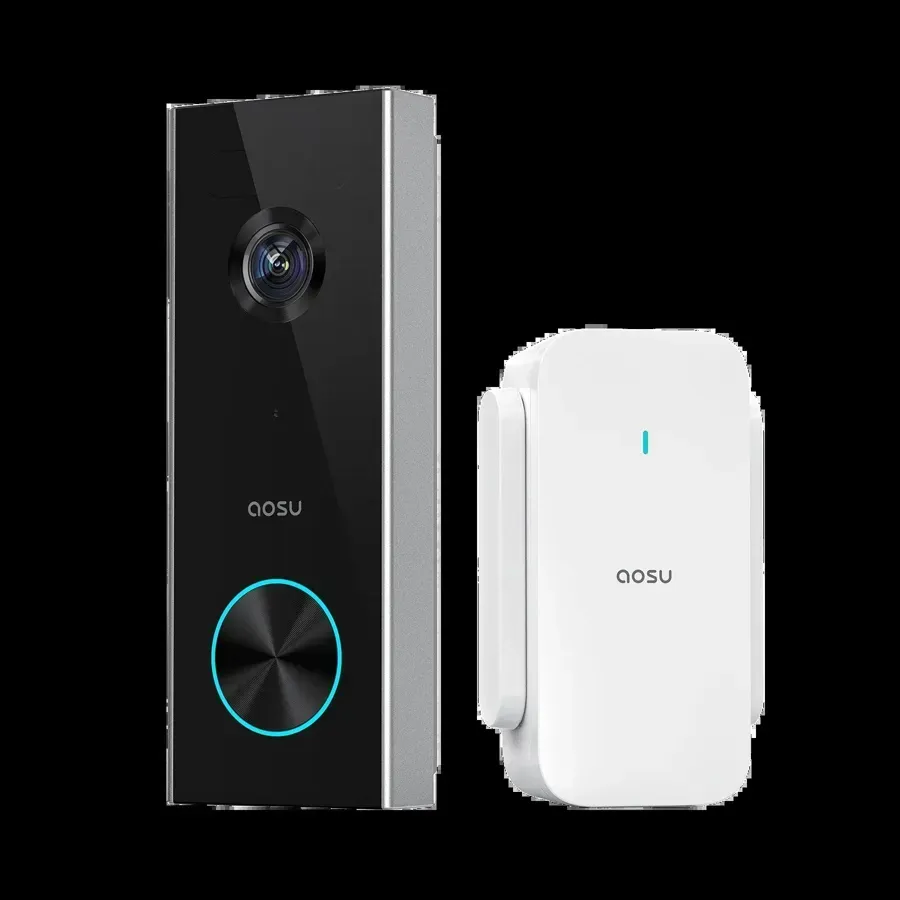
Manufacturer product photo of a battery video doorbell and its plug-in chime. Rockland townhouse owners sometimes add one at their own front door; whether the declaration or house rules allow it on the facade is a question for the board.
Golf and country-club settings: shared grounds, separate rules
Some condo communities share their setting with recreation they do not fully control, such as a golf club or a clubhouse run by a separate entity; one Pomona listing we reviewed sat on a country-club road with community clubhouse amenities. Where that is the case, the residential buildings and roads still belong to the condo, but outsiders may have a legitimate reason to be on part of the property. The security plan draws a line: open where the public is welcome, controlled at the residential buildings, the condo-only pool and the parking courts. Cameras at the boundary points help the board and the club sort out incidents without either one blaming the other.
Small village conversions: few owners, one door
Nyack, Piermont, Suffern and Haverstraw have small condos in converted houses and older walk-ups, sometimes with only three to eight units and no managing agent. Here the right system is modest: a reliable entry panel or video doorbell station, a strike that releases cleanly, and perhaps a fob reader so owners can stop copying keys. We take these jobs. The owners usually handle the paperwork themselves, and we keep the proposal short enough to approve in one meeting.
What changes with materials and methods
Vinyl and wood siding need mounting blocks so readers and cameras sit flat and the cable entry is sealed. Stone or brick entrance walls get anchors rated for masonry and conduit that does not collect water. Concrete garages need surface conduit and fixtures rated for damp, cold and salt brought in on car tires in winter. Older garden buildings sometimes have plaster on lath, where we drill carefully and patch our own holes; painting is left to the association. Wherever we bury cable across lawns or under walkways, it goes in conduit, and the utility mark-out comes first.
Commercial Condo Security
Clubhouses, Mixed-Use Buildings and Shared Grounds: Business-Side Condo Security in Rockland County
Some of what a Rockland condo association runs is closer to a small business than a home. The clubhouse has staff and outside vendors, a mixed-use building has a commercial owner downstairs, and a developer may still be selling units from an office on site. Each of those needs its own access rules inside the same system.
Mixed-use condos in the village centers
Village downtowns such as Nyack's Main Street and the area around Pearl River's station have buildings with shops or offices on the ground floor and condo units above. The commercial owner needs customers to come and go during business hours, while residents need their entrance, mailboxes and stairs closed to the public. The solution is separate entrances or, where they share a door, a schedule that keeps the shared door controlled outside business hours and a second reader between the commercial space and the residential stair. Who pays for which hardware depends on the declaration, and we price the pieces so the board and the commercial owner can split them.
The clubhouse as a workplace
A busy clubhouse has a part-time manager, cleaners, fitness equipment technicians, caterers for events and the occasional contractor. Each group gets credentials that match their schedule, so the cleaner's fob works Tuesday and Friday mornings and the caterer's code works only during the booked event. The office where owner files and keys are kept gets its own reader and its own record. If the clubhouse has a front desk, its staff can answer the community call box during staffed hours.
Developers still selling units
In phased river projects and newer townhouse sections, the developer often keeps a sales office and models open while owners move in nearby. Owners want the buildings they live in controlled; the developer needs agents and buyers to reach the models. We set up the developer's credentials as a separate group the board can see and, at turnover, remove in one step. Boards should insist that every administrator password and account moves to the association at turnover, and we document them so it happens.
Landscapers, plow crews and service vendors
Rockland condos spend the year with outside crews on site: landscapers from spring to fall, plow contractors through winter, pool companies in summer and pest, elevator and fire alarm inspectors on schedules of their own. Vendor credentials tied to the season and the days of service keep them from becoming permanent keys. Where vendors need the maintenance shed or the pool equipment room, those doors get readers too, so the board knows when they were opened.
Parking courts, carports and detached garages
Many townhouse condos park cars in open courts or rows of detached garages owned by individual units. Cameras here should cover the drive aisles and the entry into the court, not the inside of anyone's garage. Lighting often matters more than the camera, and we will say so. For detached garage blocks with a shared side door, a reader on that door keeps out people who would otherwise walk in behind an open overhead door.
Compliance callouts for Rockland County condo security work
Governing documents first: what the board can install on common elements, and who pays for equipment inside a unit, depends on the declaration and bylaws. We price; the board and its attorney decide.
Local approvals: a new pedestal, pole or entrance sign may need review from the village or town building department; we identify the items that might, and the board confirms with the office that has jurisdiction.
Electrically locked doors: locked egress doors must release on fire alarm activation and loss of power where the Uniform Code requires it; the 2025 New York State Uniform Code took effect on December 31, 2025.
Pool gates: keep the self-closing, self-latching hardware; a reader and electric lock are added alongside it (Executive Law §378).
Privacy: no cameras inside restrooms, showers or similar rooms (General Business Law §395-b); no audio recording without legal advice, because recording conversations can raise eavesdropping issues under the Penal Law.
Not New York City: the city's Tenant Data Privacy Law for smart-access buildings is a New York City local law and does not govern Rockland condos, though its principles are a sensible guide for a board writing its own policy.
Licensing: we work under New York State license #12000287431. Low-voltage security work is ours; new circuits of 50 volts or more belong to a licensed electrician under Rockland County Code Chapter 250.
Insurance: proof of coverage is produced when the association awards us the work, never with a bid or quote.
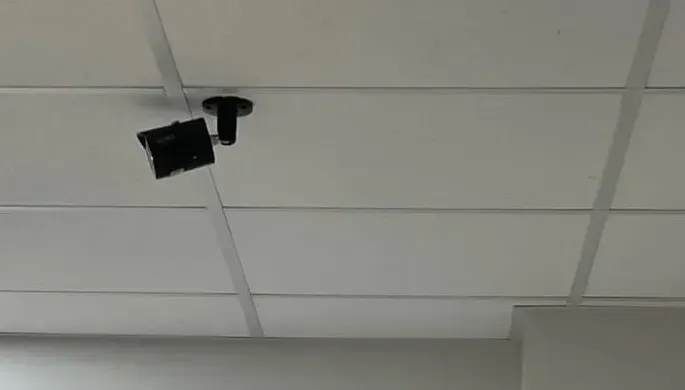
Job photo of a bullet camera dropped on a short pole from a ceiling grid. A pendant mount like this lets a Rockland clubhouse camera clear ceiling fixtures and look down a long room toward the doors.
Your Questions Answered
Condo Security Systems in Rockland County: Questions Answered
Sales, renovations and management changes
With so many units listed for sale, how do we let showing agents into the building and amenities without giving out a master code?
Give each listing its own temporary access instead of a shared code. Most current access and intercom platforms let the managing agent create a code or mobile credential tied to one unit, valid only for set days and hours, and limited to the doors a showing needs: the entrance, the building door and perhaps the clubhouse. When the listing closes or expires, the credential stops working by itself. Every use is logged against that listing, so if something goes missing after an open house the board knows which access was used and when. With 193 condos on the market in Rockland in October 2026, that kind of control is worth setting up before the spring season.
An owner is renovating for three months. How should the contractor's crew get in each day?
Issue the contractor a credential that matches the job, not a copy of the owner's fob. The board or agent can set it to work on weekdays during the hours the house rules allow for construction, only at the doors the crew needs, and to end on the date the alteration agreement gives for completion. If the work runs long, the agent extends it; if the crew leaves the door propped or works outside hours, the log shows it. This also keeps the owner from being blamed for a crew that comes in on a Sunday.
We're switching management companies. What has to be handed over so the new agent can run the access system?
Four things: the administrator logins for the access, intercom and camera software; the current owner and credential list, exported in a format the new agent can import; the account details for any cloud subscription, including who pays it; and the documentation of what is installed where. The association should own every one of those accounts, not the outgoing agent. When we install a system, the board gets all of it in writing. When we take over a system someone else installed, recovering these items is the first thing we do, and it is easier while the outgoing agent is still cooperating.
Prospective buyers keep asking what security the community has. What can the board safely share?
Share what helps a buyer decide and nothing that helps someone get in. A short summary is fine: the entrances are controlled by fob, visitors use a video intercom, the pool and clubhouse are on schedules, cameras cover common areas and the recordings are kept for a set period. Leave out door codes, camera positions in detail, recorder locations, the names of administrators and any weak spots the board is still fixing. Many associations put that summary in the resale package so the managing agent gives the same answer every time.
Staff, parking and the grounds
Our longtime superintendent is retiring, and only he knows how the system works. What should we capture before he leaves?
Walk the property with him and write it down. The essentials are where every controller, power supply, recorder and network switch is located, which keys open those closets, the logins he uses, which cable runs he has repaired and where, which devices give trouble, and any workarounds he has been doing without telling anyone. We can join that walk, label the equipment as we go and turn his knowledge into a document the board keeps. It is far cheaper than rediscovering it during the next failure.
Non-residents have been using the electric vehicle chargers in our parking area. Can access control stop that?
Usually. Many chargers have their own card or app authorization, and the simplest fix is turning that on and issuing cards only to owners. Where the chargers sit inside a garage, the garage reader already limits who reaches them; in an open lot, a camera at the charging spaces helps the board enforce its rules. Installing or rewiring the chargers themselves is electrical work for the association's electrician, but we handle the access and camera side and make sure owners' charger cards match the unit list.
Before you trench cable across our lawn, who checks for buried gas, water and irrigation lines?
The excavator does, through the state one-call system. New York's Code Rule 753 requires notice to the one-call center at least two but not more than ten working days before digging, and the utilities then mark their lines. Lines that belong to the association, such as irrigation, site lighting or a feed to the pool house, are not the utilities' to mark, so we ask the board or its landscaper for any drawings or knowledge of those before we dig. Where a trench is not worth the disruption, a wireless link between buildings may be the better answer.
Is a wireless link between two of our buildings reliable through heavy rain and snow?
A properly designed point-to-point link is reliable in Rockland weather. The keys are a clear line of sight between the two antennas, mounting that does not move in wind, equipment rated for outdoor temperatures, and enough signal margin that rain fade does not drop the connection. Trees are the usual problem, because a path that is clear in March can be blocked by leaves in June. We survey the path in person, and if it is marginal we say so and price the trench as the alternative.
Can the pool's chemical storage room have its own lock and record, separate from the pool gate?
Yes, and it should. The chemical room is a safety space that only the pool company and maintenance staff need, while the pool gate serves every owner during the season. A reader on that door with its own short list of credentials keeps owners and children out and gives the board a record of each entry. If the pool company changes, their credentials are removed without touching anyone else's.
Budgets, owners and the board
Can your proposal give each device an expected service life we can drop into our reserve study?
Yes. Our proposals list each entrance and device on its own line, and on request we add the manufacturer's warranty term and a typical service life based on our experience with that type of equipment, along with notes on what tends to fail first, such as batteries, drives and outdoor readers. That gives the board's reserve specialist a component list instead of one lump sum. Service life is an estimate, not a promise, and weather exposure in Rockland shortens it for outdoor gear.
Some owners avoid operating electronic devices on the Sabbath. Are there entry options that work for them?
There are several, and the board chooses. An entry door can be scheduled to unlock or stay on a timed setting for set hours, a mechanical key override can stay on the door, and some communities keep one door on a manual lock during those hours. Each option trades convenience against security, so the board decides which doors, which hours and how they are announced to owners. We program what the board approves and document it so the setting is not changed by accident.
Can the freight or passenger elevator be held for a move-in without someone riding it all day?
Partly. In buildings with elevator access control, a mover's credential can be set to reach only the moving owner's floor and the lobby or garage, for the hours of the move. Holding a car on independent service is part of the elevator's own controls and is handled with the elevator maintenance company, not our equipment. We can work with them so the move schedule, the floor access and the padding all line up on the same day.
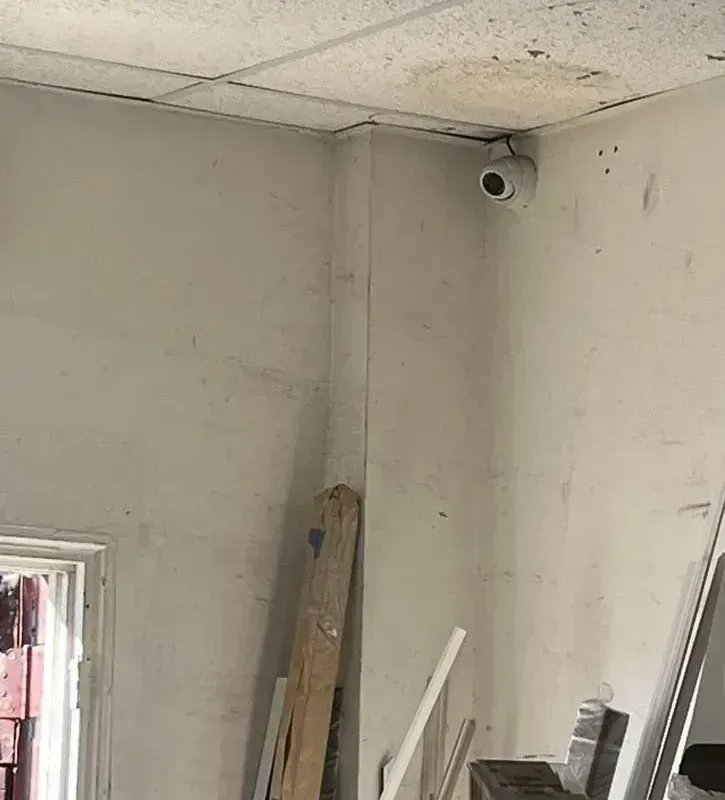
Job photo of a dome camera in the corner of a rough storage room. Rockland associations use the same setup in maintenance sheds and storage rooms where tools and pool supplies are kept.
Equipment
Types of Condo Security Equipment We Install in Rockland County
1
Video and audio entry panels
Lobby panels with directories, single-door video stations and audio units for small buildings.
2
In-unit stations and apps
Screens and handsets for owners who want them, smartphone apps for those who don't.
3
Readers and controllers
Secure credential readers wired back to door controllers tucked into a clubhouse utility room or building closet.
4
Locks and door hardware
Electric strikes, mag locks, exit devices, request-to-exit and door position sensors.
5
Community entry equipment
Call boxes, keypads, vehicle tag readers and interfaces to existing gate operators.
6
Cameras, recorders and network
Turret, dome and bullet cameras, recorders, PoE switches and battery backup.
Entry options compared for Rockland condos
Option
Best fit in Rockland
Trade-offs
Audio buzzer or audio intercom
Small village conversions and older garden buildings
Low cost to keep running; no video, no record of entries
Video panel with in-unit stations
River buildings and 55-and-over communities with owners who prefer a screen
Needs a station in each unit; may reuse existing wiring
App-based IP intercom
Buildings dropping landlines; owners who travel
No in-unit wiring in many cases; may carry a provider subscription
Call box at the community entrance
Townhouse loops on private roads
Weather exposure; visitors queue at the drive
Fobbed doors without a visitor panel
Amenity buildings, courts, storage and garages
Residents only; visitors need another path
Credentials: fobs, tags, codes and phones
Most associations end up with a mix. Fobs suit pool gates and clubhouse doors. Vehicle tags or remotes suit garage doors and entrance gates, where nobody wants to reach out of a window in the rain. PIN codes suit visitors and vendors, because they can be issued and expired from an office. Phone credentials suit owners who already live in an app. Whatever the mix, every credential belongs to a unit and a person on one list, and encrypted credentials replace older proximity fobs that can be copied in a few seconds.
Locks for building doors, gates and amenity spaces
An electric strike suits most wood and aluminum entry doors and fails secure when power drops, so the door still opens from inside. A magnetic lock suits glass doors and some gates, but needs proper release hardware and fire alarm tie-in to meet code. Pool gates keep their self-closing, self-latching hardware, with the electric lock added. Exit devices with built-in electric release suit the busy clubhouse doors. We choose per door and explain why on the proposal.
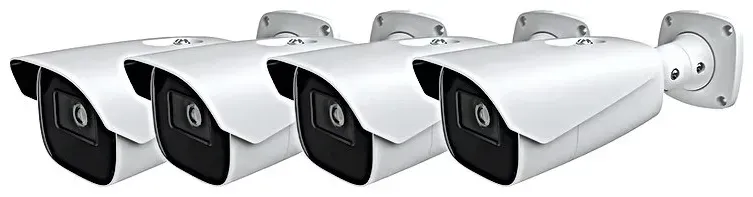
Manufacturer product photo of four bullet cameras on wall brackets. For a Rockland townhouse community, bullets like these cover long parking courts and the entrance drive from a clubhouse or building wall.
Recorders, retention and remote viewing
A condo recorder should keep as many days as the board's policy says, which in practice is usually two to four weeks, and it should tell someone when a drive fails. Remote viewing goes to the people the board names, usually the managing agent and one or two officers, with logins for each person so access can be withdrawn. We keep recorders in a locked space with battery backup, and we show the board how to export a clip in under five minutes, because that is the request that comes after every incident.
Manufacturer product photo of a recorder front panel with playback controls. In a Rockland condo, the recorder lives in a locked closet with backup power, and the board's named users view and export clips from it.
National alarm brands versus a local installer, for a condo association
ADT, SimpliSafe and Ring sell well-known products for single homes, and a townhouse owner may be happy with one at their own door. An association's needs are different: many doors on one list, amenity schedules, visitor entry, records the board can review and equipment that the next contractor can service. Those needs call for commercial-grade access control and intercom equipment installed and documented by a licensed local contractor, with the board owning the accounts. We are happy to leave an owner's own system alone and simply make sure it does not conflict with the association's.
AI Overview Reality Check
What AI Gets Wrong About Condo Security Systems in Rockland County
Chatbot answers and the big cost-guide sites, Angi, HomeAdvisor and Fixr among them, tend to describe condo security with numbers and habits taken from somewhere else. Here are seven claims we hear repeated, and what we actually find on Rockland County condo properties.
1. "Suburban condos just need a video doorbell on each unit"
This advice treats a condo like a row of single-family homes. In a Rockland townhouse community each owner may well add a doorbell, but the association's exposure is somewhere else: the clubhouse, the pool, the mail kiosk, the parking courts and the entrance.
Doorbells also create a patchwork the board cannot manage. Each owner's device reports to that owner's phone, records to that owner's account and disappears when the unit sells. None of it tells the board who used the pool gate after hours or which fobs are still live.
What works is a common-area system the association owns, with owners free to add their own devices if the declaration and house rules allow it. The two can coexist; one cannot replace the other.
2. "Your installer needs a county electrical license"
Some summaries tell boards to hire an electrician for intercom and access work. Rockland County Code Chapter 250 defines electrical contracting as wiring for light, heat or power, or for signaling systems operating on 50 volts or more, under the supervision of a master electrician.
Intercoms, readers, cameras and alarm devices run at low voltage, and the state licenses security and fire alarm installers under General Business Law §69-m. We hold New York State license #12000287431 for that work.
Where a project needs a new 120-volt circuit, for example for a gate operator or a recorder closet with no outlet, that piece goes to the association's licensed electrician. Good proposals say which is which, so nobody is surprised.
3. "A building intercom costs about the same everywhere"
HomeAdvisor gives a national "normal range" of $1,200 to $8,500 for intercom installation. A range that wide is not wrong, but it does not help a board budget, because it mixes a single-family doorbell with a fifty-unit building.
Our Rockland County intercom installation page breaks it down: $1,200 to $3,500 for video intercom in a 4-to-8-unit building, $1,200 to $5,000 for multi-unit buildings and $2,500 to $8,000 and up for IP smartphone systems in larger buildings. The actual number depends on entrances, units, wiring and whether owners want stations or the app.
For a townhouse community, the cost driver is distance. A clubhouse four hundred feet from the entrance call box costs more to connect than the call box itself. That is why we walk the property before quoting.
4. "Battery and Wi-Fi cameras are storm-proof"
AI answers often recommend wireless cameras because they keep working when the power goes out. That holds only until the router loses power, the battery runs down or the cellular backup fails, which in a long outage is a matter of hours.
Rockland's July 2026 storms left more than 47,000 Orange & Rockland customers affected, and some neighborhoods went more than a day and a half without power. Battery cameras in a common area also need someone to recharge them, which in a condo usually means nobody.
For a community system, wired cameras on a recorder and switch with properly sized battery backup, or on a generator circuit, keep recording through an outage. Wireless cameras still have a place at a remote pool house or court where cable is impractical.
5. "Waterproof equipment is fine near the river"
An outdoor rating such as IP65 or IP66 means a device resists rain and jets of water. It does not mean the device survives sitting in floodwater, and a power supply or controller at garage-floor level certainly will not.
Piermont's tidal flooding in January 2024 and the damage along the river during Sandy are reminders that some Rockland condo garages and lobbies take water. Placement matters more than the rating on the box.
We mount controllers, power supplies and recorders as high as the building allows, keep cable entries sealed and protected, and plan an inspection after any flood before the board relies on the system again.
6. "A contractor based in the city won't serve Rockland reliably"
The concern is fair in general: a crew that has to cross the Hudson may be tempted to treat a Rockland call as an afterthought. Distance is real, and the Mario M. Cuomo Bridge is not always fast.
We book every Rockland request within 2 hours, schedule seven days a week, and favor early-day visits so the crew is on site before traffic builds. Work is first come, first served once the job is paid, and every appointment comes with a two-hour arrival window that the crew keeps.
We also avoid promising what nobody can deliver. We do not promise same-day work or round-the-clock service, and we would rather give a board an honest date than a fast one that slips.
7. "Common-area cameras can record audio as long as there's a sign"
Some chatbot answers suggest a posted notice covers any camera feature. Recording conversations is a different matter from recording video, and audio recording in common areas can raise eavesdropping issues under New York's Penal Law.
Video in hallways, lobbies, garages and grounds is ordinary condo practice, with no cameras inside restrooms, showers or similar rooms under General Business Law §395-b. Most boards publish a short camera policy so owners know what is recorded and who can see it.
We install condo cameras with audio recording turned off unless the board's attorney approves otherwise. That is not legal advice; it is the cautious default we recommend to every association.
Speak to a Technician About Your Rockland County Condo
Send a photo of the panel, reader or gate equipment that is giving trouble, or the line from your reserve study, and the visit is on the calendar within 2 hours.
Request a Free Quote for Your Rockland County Condo
A short note gets things moving: where the community is, about how big it is, what kind of buildings it has, and the complaint the board hears most often. Pictures of the equipment closet or the entrance help. You can also call or text (845) 640-3835.
✅
Request Sent!
Your note reached us. Someone will be in touch shortly to set the Rockland County appointment.
How It Works
Our Installation Process for Rockland County Condos
Whether the job is one reader or a whole community, the steps are the same. On larger projects, the longest stretch is usually between our proposal and the board's decision, which is normal and expected.
1
First call or form
We take down the community, the number of units, the building types and the problem or goal, from whoever reaches out first.
2
Repair visit or free walk-through
A failed device gets a $250 service call. A new system starts with a free walk of the entrance, buildings, amenities and equipment rooms.
3
Line-by-line proposal
Each door, device, cable path and price is listed on its own line and grouped into phases the board can fund one at a time.
4
Board approval and deposit
Once owners or the board say yes and the deposit clears, we order parts and send our insurance certificate to whoever the association names.
5
Owner notice
We draft what owners need to know about dates, access and new credentials, and the association sends it.
6
Installation by entrance
Each door or building changes over on its own day, so owners always have a way in and the pool and clubhouse stay secured.
7
Setup, testing and handover
Owner records and fobs are entered, each controlled opening is tried in front of the board's representative, and every password and diagram is delivered on paper.
Timing around seasons, owners and the bridge
Every appointment has a two-hour arrival window, and the crew arrives inside it. In Rockland we try to finish pool gate and clubhouse work before Memorial Day, do outdoor trenching and entrance work while the ground is workable, and plan river-building garage work around residents' commuting hours. Early-day visits also keep our crews ahead of bridge and Palisades Parkway traffic.
What a good owner notice says
Owners want five things: which days the work happens, which doors are affected and for how long, how they get in during the change, when and how they receive new fobs, tags or app invitations, and who to call with a problem. We write a draft with those answers, the board edits it, and the managing agent or the board sends it. Owners who rent their units should forward it to tenants.
Deposit, payment and financing
A Rockland board signs, sends a deposit of half the contract price, and then we buy the hardware. Certain entry panels, readers and gate parts are built to order and ship on the maker's timetable, which we cannot speed up, so the install date is fixed only when those boxes reach our shop. Financing is available through Wisetack, subject to approval. Associations and management companies may pay by check.
After the job
Two kinds of coverage apply to a finished Rockland job. The equipment carries whatever its manufacturer promises. Our installation work carries the 30 days set out on the warranty page, and a board that wants protection beyond that can add a paid plan of one year or longer when it signs. Questions by phone are answered at no charge for as long as the system is in place. Full terms — including 50% deposit, one-year parts-only warranty on Abstract Enterprises Security Systems-supplied products, and the late-fee schedule — are set out in the service agreement.
Job photo of a dome camera on a ceiling grid next to a light fixture. After installation, each Rockland condo camera is aimed and its view confirmed with the board contact before handover.
Coverage Area
Condo Security Near Rockland County's Landmarks
Below are six spots most Rockland residents know, with a note on the condo stock nearby. No customer property is identified here.
1
Nyack's Main Street and riverfront
Riverfront elevator condos, some gated, plus small condos in converted buildings near Main Street, under the village's own building department.
2
Haverstraw waterfront and the Ossining ferry
Phased riverfront condo buildings with lobbies, garages and shared pools near the NY Waterway ferry landing across to Ossining.
3
Piermont Pier
A small river village with condo listings that include gated parking and garages, where tidal flooding shapes equipment placement.
4
New City, the county seat
Townhouse condominium complexes with community pools, clubhouses and tennis courts around the county government center.
5
Nanuet station and Route 59
Townhouse and gated condo communities near the Pascack Valley Line station and the Route 59 shopping corridor toward the Palisades Center in West Nyack.
6
Pearl River and Suffern stations
55-and-over and village condos near the Pascack Valley Line stop in Pearl River and the Port Jervis Line station in Suffern.
We also serve condo communities in Valley Cottage, Congers, West Nyack, Bardonia, Pomona, Stony Point, Tappan, Orangeburg, Spring Valley, Monsey, Airmont and Sloatsburg, and every other town and village in the county.
Pricing
Condo Security System Cost in Rockland County
Without a site visit, we can quote exactly one figure: $250 for a repair call, which buys the trip, the troubleshooting and any small fix, and is subtracted from a bigger repair if one follows. Individual systems have published Rockland County ranges, shown below exactly as they appear on our service pages. Anything community-wide is quoted in writing after the free assessment, because distances, wiring and the number of controlled points vary so much from one Rockland property to the next.
Published Rockland County ranges that apply to condos
Item
Published price
Where it is posted
Technician visit to locate a fault, with small repairs done on the spot; the fee counts toward bigger work
Elevator access, Level 1 fob, card, code or intercom-station reader
From $1,950 per car
Rockland elevator access control page
Elevator access, Level 2 face, fingerprint or iris reader
From $3,250 per car
Rockland elevator access control page
Central-station monitoring for an owner's alarm
$30 a month keypad, $45 a month with app
Rockland alarm installation page
Typical repair ranges for intercom and entry parts
Ranges here match what the Rockland door buzzer repair page and our door buzzer and intercom repair pricing list publish. Nothing gets swapped until you have heard the number for your specific part.
Repair
Typical range
Apartment or in-unit intercom station
$250 to $525
24V transformer
$325 to $650
Electric strike replaced and door aligned
$450 to $950
Lobby panel repair or faceplate
$650 to $1,800
Riser or trunk cable repair
$850 to $2,400
How Rockland boards usually pay for security work
The Condominium Act lets bylaws provide for reserves for maintenance, repairs, additions, improvements and replacements, and most Rockland associations fund security work one of three ways: from reserves when the reserve study already lists the equipment, through a special assessment for a large replacement, or in phases across budget years. Which one is right, and whether owners must vote, depends on the declaration, the bylaws and the size of the project. We do not give financial or legal advice; we give the board numbers it can use with its accountant and attorney.
What moves a community-wide quote
Distance first: how far the clubhouse, pool, courts and entrance are from each other and from wherever the controller lives, and whether cable can go through buildings, under ground or over a wireless link. Then the count of controlled doors and gates, whether owners want in-unit stations or the app, how much of the existing wiring can be reused, any work in flood-prone garages, and the amount of programming needed to bring a messy credential list under control. A townhouse community with one call box and four amenity doors and a river building with three entrances, a garage and an elevator can land in very different places, and the written quote explains why.
Ongoing costs after installation
Boards should budget for more than the installation. Some app-based intercoms and cloud-managed access platforms carry a provider subscription, usually per door or per unit, set by the manufacturer rather than by us; others run on site with no monthly charge. Owners' alarm monitoring, where they choose it, is billed to the owner at the $30 or $45 monthly rate. Batteries, recorder drives and outdoor readers have the shortest lives and belong in the reserve study. We list each recurring cost on the proposal so the board sees the full picture before it votes.
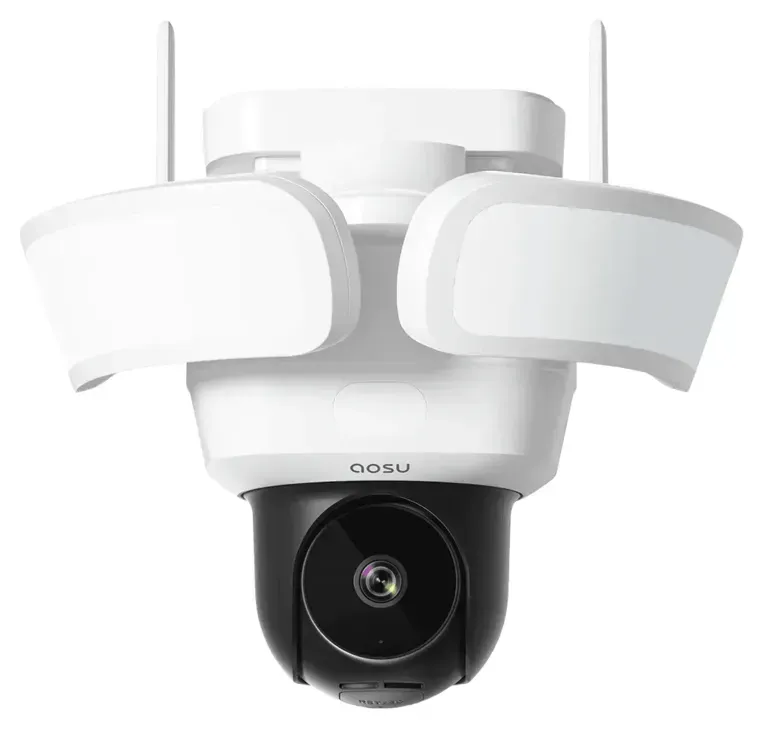
Manufacturer product photo of a pan-tilt camera with twin floodlights. At a Rockland condo pool deck or dark parking court, a camera with its own lighting can cover an area that has no fixtures nearby.
Shop Our Systems
Condo Security Packages and How They Are Priced in Rockland County
Rockland condo properties are too different for boxed bundles. Almost every job we do falls into one of these three levels.
1
Fix what failed
$250 service call. A technician traces the failure, whether it sits in an entry panel, a lock or a camera recorder, handles what can be handled that day and prices anything bigger first.
2
Upgrade one point
Priced on paper once we have seen it, at no charge. A single target, say the main entrance or the garage, measured against the Rockland figures in the table above.
3
Plan the whole community
Phased proposal after a free assessment. Every entrance, building, amenity and garage on one owner list, scheduled over the board's budget years.
Equipment the association already bought
If the board has already purchased intercom, reader or camera equipment, we can install it on a labor-only basis, quoted by phone or text from the model numbers and the number of doors. We do not walk through to evaluate customer-supplied equipment, and warranty questions about it go to the seller or manufacturer. Many boards find it simpler to let us supply the equipment, so one company stands behind the whole system.
Phasing a project over several years
A common Rockland sequence is credentials and amenity doors first, because that fixes the turnover problem quickly; then the building intercoms or entrance call box; then cameras. Each phase is built on the same platform, so nothing installed in year one is wasted in year three. The proposal shows each phase as a separate price the board can approve on its own.
Responding to RFPs and board bid requests
We respond to RFPs and bid requests from Rockland condo boards and managing agents in whatever format they use, and we will price an engineer's or consultant's specification line by line. Our certificate of insurance is issued once a job is awarded. We do not share client references or names of buildings we have worked in; our Google reviews are public, and boards are welcome to read them.
On a Rockland townhouse property, the first thing we ask for is the site plan, and the second is the person who has been there longest. The plan shows where the buildings are; the long-time owner or superintendent knows where the cable actually runs, which conduit was crushed during the last repaving and which closet the developer used for the old intercom power supply.
Then we pull the credential list and count. It is common to find far more active fobs and remotes than there are residents, a leftover from years of sales, rentals and lost keys. Before any hardware is discussed, cleaning that list often solves the complaint that brought us there.
In the river buildings, we look down before we look up. Where are the controllers, power supplies and recorders, and how high off the garage floor? After the flooding Piermont and the river villages have seen, moving that equipment up a few feet is sometimes the most valuable line on the proposal.
FAQ
Rockland County Condo Security Systems FAQ
How long is your written quote valid while our board waits for its next meeting?
+
The quote shows its own expiration date, set with the board's meeting calendar in mind. If equipment prices change before the board votes, we tell the managing agent and update the affected lines rather than surprise anyone after approval.
Is an emailed approval from the board president enough to start a repair, or do you need a signed proposal?
+
For a repair priced after the service call, a written approval by email from the board's named contact is usually enough, together with payment. Larger projects are approved through a signed proposal and the deposit, so the scope and terms are clear to everyone.
How will owners know the people working in the building are your technicians?
+
Our office tells the board contact or managing agent the date, the two-hour arrival window and who is coming, and the crew checks in with that contact on arrival. Owners can be told the same details in the notice before the work starts.
Can you work from the developer's as-built drawings, or do you survey the property yourselves?
+
Both. As-built drawings and the site plan save time and show where conduit was meant to go, so send them if the association has them. We still walk the property, because what was built often differs from what was drawn, especially after years of repairs.
The developer left empty conduit between buildings for future wiring. Can you use it?
+
Often, yes, and it can save the cost of a trench. We check that the conduit is continuous, not crushed or full of water, and large enough for the cable planned. If a section is blocked, we price only that section's repair instead of a new run.
Can you test our existing cable before the board decides whether to replace it?
+
Yes. During the assessment we look at the cable we can reach, and where a decision depends on it, the proposal includes testing the runs that matter. Reusing sound cable is often the biggest saving in an intercom or access upgrade.
Can the intercom ring two phones for one unit, such as both owners' cell phones?
+
With app-based and many cellular intercoms, yes. A unit can have more than one person on its directory entry, and calls ring each of them, either together or in order. The board sets how many users each unit may have.
How do you protect hallway carpets, floors and finished walls during the work?
+
We lay drop cloths and runners where we work, use dust control when drilling, and clean up at the end of each day. We patch the holes our own work creates; painting is left to the association's painter.
Can the clubhouse and pool doors lock on command when the board closes the grounds for a storm?
+
Yes. An access system can hold amenity doors locked with one command from the software or a button in the office, overriding the normal schedule until someone authorized restores it. Fire alarm release still works on doors that require it.
Can the entry panel screen show our community's name and logo?
+
Many video entry panels allow a custom welcome screen with the community's name, a logo and short instructions for visitors. Whether a particular model does is one of the things we confirm on the proposal.
Can readers and entry panels be mounted at a height that works for residents who use wheelchairs?
+
Yes. We mount readers, keypads and entry panel controls within the accessible reach ranges the building code sets, and where a panel has to sit higher for standing visitors, a second reader or call button can go lower. Clear floor space in front of the device matters as much as its height.
If the board doesn't hire you after the free assessment, does the association owe anything?
+
No. The assessment for a new system is free, with no obligation. The only fixed charge before an approved job is the $250 service call, which applies when we come out to diagnose a failed device.
All Areas Served
Condo Security Systems Across the Hudson Valley and New York
River Buildings, Townhouse Loops and Amenities: One Licensed Vendor in Rockland County
A New City pool reader that quit or a Nyack lobby panel that needs replacing gets the same licensed crew from first look to long-term support. Call for a $250 repair visit, or ask for a no-charge property walk before planning something new.