Rentals in Nassau and Suffolk, spread across towns and villages? One survey, one vendor file and one number for every property on the list: (800) 486-0943
For Property Managers, Managing Agents & Landlords · Nassau and Suffolk
Property Management Security on Long Island
Entry Systems · Fobs & Readers · Cameras · Alarms · Long Cable Runs
Property management security on Long Island starts with a $250 service call at any building you run in Nassau or Suffolk, and new systems for a garden complex, a station-area rental or a whole list of addresses are priced in writing after a free on-site assessment. Requests are booked within 2 hours, seven days a week, and one licensed low-voltage contractor handles the door, the intercom, the readers, the cameras and the cable between buildings.
Quick answer: Long Island management companies mostly need a contractor who can handle spread-out properties: complexes with a dozen separate entrances, parking lots hundreds of feet from the nearest closet, and buildings in different towns with different permit habits. Repairs begin with the $250 service call. Prices already published on our Long Island pages include $250–$525 for an apartment intercom station, $1,200–$4,500+ for a multi-unit intercom system, $1,500–$2,500 installed for a single-door reader, elevator readers from $1,725 per car in Nassau and $1,800 in Suffolk, and four-camera systems from $999 in Nassau. Anything building-wide is quoted after we walk it.
Last updated November 27, 2026 by Abstract Enterprises Security Systems, NYS license #12000287431 · Sources: Nassau County cities, towns and villages listing; U.S. Census QuickFacts and Census Reporter (ACS 2020–2024); Newsday reporting on Mineola, Baldwin and Patchogue rental construction (2026); NYS Homes and Community Renewal ETPA page; Nassau County Police Department alarm permit section; Suffolk County Police Alarm Management Program and Suffolk County Code ch. 290; Town of Islip Code ch. 68; Town of Brookhaven rental registration law; NY Multiple Residence Law §3; NY Multiple Dwelling Law §§3 and 50-a; NYS Department of State memo LG03
Manufacturer product photo (Reolink, an authorized partner): a floodlight camera with a pan-tilt head under an eave. On a garden-apartment complex, a light-and-camera pair like this covers the dark stretch between a parking row and the building doors.
Long Island Property Manager Request
Nassau, Suffolk or both — list the properties
✅
Request Sent!
Thank you. We will reach out to set the visit, usually within 2 hours of your request.
25+
Years Experience
2 Hr
Booking
100%
Licensed & Insured
4.7★
201 Google Reviews
Owner-operated since 2002 · Thousands of jobs completed · Booked within 2 hours
The Neighborhood
Why Long Island Properties Need One Security Contractor Across Nassau and Suffolk
Managing rentals east of the city line is a different job from managing them inside it. A New York City portfolio is mostly vertical: one front door, one riser, one boiler room per address. A Long Island portfolio tends to be horizontal. A single property might be a 1950s garden-apartment complex with fourteen two-story buildings around a lawn, each with its own front door, its own laundry room and its own cluster of mailboxes, plus a long parking lot and a maintenance garage at the far end. The next property on the same list might be a five-story building with stores on the ground floor two minutes from a Long Island Rail Road platform, and the one after that a handful of two-family houses in three different hamlets. Security work for that kind of list is mostly about distance, weather and jurisdiction, and far less about any single box on a wall.
Rentals are also a smaller share of the housing here, which shapes who does this work. Census figures put the owner-occupied rate in Nassau County at 81.9 percent for 2020–2024, and Census Reporter shows about 82 percent of occupied homes across the Nassau–Suffolk division as owner-occupied. The apartments that do exist are concentrated: in older garden complexes, in village downtowns and, increasingly, in new buildings near train stations. Plenty of security companies on Long Island are built around single-family homes and alarm monitoring contracts. Fewer are set up to walk a 200-unit complex with a managing agent, test the cable between buildings, and hand back a written scope per property that an owner can approve.
The newer stock is growing fast in a few places. Newsday reported in September 2026 that more than 1,100 rental units have opened in the Village of Mineola since 2010, with roughly 1,000 more planned, and that construction started on a 172-unit building a short walk from the village's LIRR station. In November 2026 the paper reported construction underway on a 215-unit apartment building near the Baldwin station, and Patchogue has a 262-unit development on West Main Street about half a mile from its station. One developer told Newsday, "The model of Mineola will eventually grow in other villages and towns." For managers, that means more buildings arriving with cloud intercoms, phone-based entry and dozens of cameras, all of which need someone to run them after the developer's installer leaves.
Jurisdiction is the other half of the problem. Nassau County alone contains two cities, three towns and 64 incorporated villages, and Suffolk adds ten towns and its own villages on top. Each can have its own building department, its own rental permit rules and, in Suffolk, its own answer to whether the county's alarm registration law reaches it at all. A manager with properties in Hempstead, Islip and Brookhaven is dealing with three different rental-permit regimes before a single camera goes up. One contractor who knows where those lines fall, and who tells you before a job which office will care about it, saves the manager from learning each town's habits the expensive way.
Finally, the New York City rules that most security marketing assumes do not apply here. The Multiple Dwelling Law, which contains the well-known intercom and self-locking door requirement for buildings of eight or more apartments, covers cities of 325,000 people or more, which on Long Island means none. Towns and villages fall under the Multiple Residence Law and the state Uniform Code, enforced locally. HPD violations, the city's 24-hour and one-week tenant access notices, and the city's smart-access privacy law are not the framework for a building in Freeport or Ronkonkoma. That changes how a Long Island property manager should read most of what turns up in a search, and it is part of why this page exists separately from our New York City property management page.
Long Island facts a property manager should have on hand
2 cities, 3 towns, 64 villages in Nassau County alone, per the county's own listing, each a possible permit office for exterior or building work.
81.9% owner-occupied in Nassau (U.S. Census QuickFacts, 2020–2024); rentals are the minority, clustered in complexes, downtowns and station areas.
About 8,100 rent-stabilized units in Nassau County, according to The Real Deal's June 2026 report on the Nassau rent guidelines board. Under the state's Emergency Tenant Protection Act, coverage is limited to municipalities that opted in and to buildings of six or more units built before January 1, 1974 (NYS Homes and Community Renewal).
More than 1,100 rental units opened in Mineola since 2010, with about 1,000 more planned (Newsday, September 2026).
$100 residential / $200 business for a new Nassau County Police alarm permit, valid two years; the department says it is asked to respond to more than 125,000 false alarms a year.
$50 residential / $100 commercial for Suffolk County alarm registration, with two false alarms a year not assessed a fee for registered locations; several towns and villages with their own police are outside the county program.
Two years or 15 months: the term of a Town of Islip rental occupancy permit (two years) and a Town of Brookhaven rental registration (15 months), both issued after an inspection.
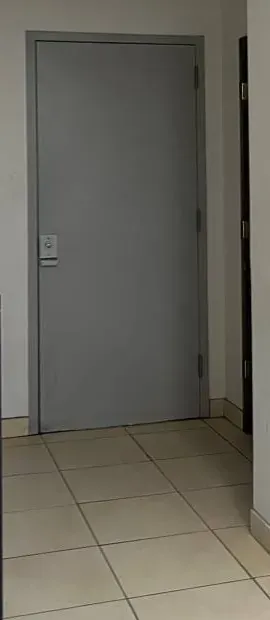
From our job library: a plain steel door at the end of a tiled service hall. On Long Island complexes the door to the laundry, the boiler room or the rear parking lot is usually the one left propped open, and the one we look at first.
What We Install
Property Management Security Services on Long Island, System by System
Below, each system gets the question a Long Island manager is most likely to bring to us, a short answer from the field, and one link to the Long Island service page where the details and published prices sit. Board-run buildings have their own pages: co-op security systems on Long Island for cooperative boards and their agents, and condo security systems on Long Island for condominium boards and associations. This page is for the people who run rental properties, mixed portfolios and owner-held buildings day to day.
Entry panels and intercoms: one building, or fourteen front doors
On a mid-rise near a train station, the intercom question looks like it does in the city: one lobby panel, a list of apartments, a door release. On a garden complex it is a different animal. Each two-story building usually has its own small vestibule with its own panel, sometimes a row of buttons with apartment numbers, sometimes nothing but a lock and a buzzer wired decades ago. When a manager tells us “the intercom at the complex is broken,” the first job is finding out which of the panels are failing, whether they share a power supply in one basement, and whether the cable between them still carries a signal after years of wet soil and frost.
Repairs start with the $250 service call. The component prices on our door buzzer repair page for Long Island run $250–$525 to replace an apartment station, $325–$650 for a 24-volt transformer, $450–$950 for an electric strike with alignment, $650–$1,800 for lobby panel work and $850–$2,400 to repair or re-terminate a riser pair. Diagnosis on a multi-panel complex takes longer than on a single lobby, and we tell the office before leaving which buildings are healthy and which need parts.
When the panels are past saving, the choice is between new panels on the existing wire, a system that calls tenants' phones over the internet, or new network cable to each building. On scattered garden buildings the phone-based route often wins, because it avoids trenching. On a newer station-area building with clean risers, a wired IP system may be the better buy. The installation side, including multi-unit systems that run $1,200–$4,500+ on our published Long Island pricing, is on our page for intercom installation on Long Island; for faults on an existing system, see intercom repair on Long Island. Managers who also handle board-run buildings can pass our co-op board intercom upgrade guide or our guide to condo intercom replacement to the boards they report to.
Key fobs and readers: who gets in, and how fast the office can change it
Turnover drives most access control decisions in a rental portfolio. Every move-out on a keyed complex means rekeying an apartment and often a building door, and the master keys that porters and contractors carry drift out of control within a year. Fob and card readers on building doors, laundry rooms, storage areas and maintenance garages let the office cancel one tenant's credential and issue another without calling a locksmith. Our access control installation page for Long Island publishes $1,500–$2,500 installed for a single-door reader with an electric strike, and $3,500–$12,000 installed for a gate with a vehicle reader and barrier arm.
The choice that matters most on a spread-out property is where the system is managed. A cloud-managed controller lets a manager in a Melville office deactivate a fob at a Riverhead complex from a laptop. An on-site controller with no remote access means someone drives out every time a tenant leaves. We set up systems so the management office can add and remove credentials itself, train the staff who will do it, and come back only for hardware changes. New York City's Tenant Data Privacy Act, which governs smart-access systems in the city, is a city law and does not follow a fob across the county line; we still recommend that owners run any face or fingerprint reader past their own counsel before installing it in a residential building, and we do not give legal advice on it.
Elevator floor control in station-area buildings
Elevators are rare in garden complexes and common in the new five- and six-story buildings going up around LIRR stations. In those buildings, floor control keeps a delivery driver or a visitor from riding to every floor, and it lets the office limit the garage level, the roof deck or a fitness room to tenants who have signed a waiver. Our elevator access control page for Long Island lists a card, fob, code or intercom reader from $1,725 per elevator car in Nassau and $1,800 per car in Suffolk, and biometric readers from $2,875 and $3,000 per car. Floor-by-floor restriction is quoted per building, and the elevator company's licensed mechanic makes the connection inside the controller; we coordinate the date with them.
Door hardware, strikes and mag locks
A reader is only as good as the door it is mounted beside. On garden buildings, the vestibule doors are often original, the closers are worn, and the frames have shifted. A new reader on a door that does not latch by itself buys nothing. Before we quote a reader, we check the closer, the latch, the frame and the hinge side, and we put any door repair on the scope as its own line so the owner can see it. Magnetic locks are useful on glass storefront-style doors common in newer buildings, but they need a request-to-exit device and a fire-alarm release where a fire alarm exists, and the building's code office has the final word on egress hardware. We install the low-voltage and door hardware side; any new high-voltage circuit for a lock power supply is the building's electrician, because we do not do electrical work.
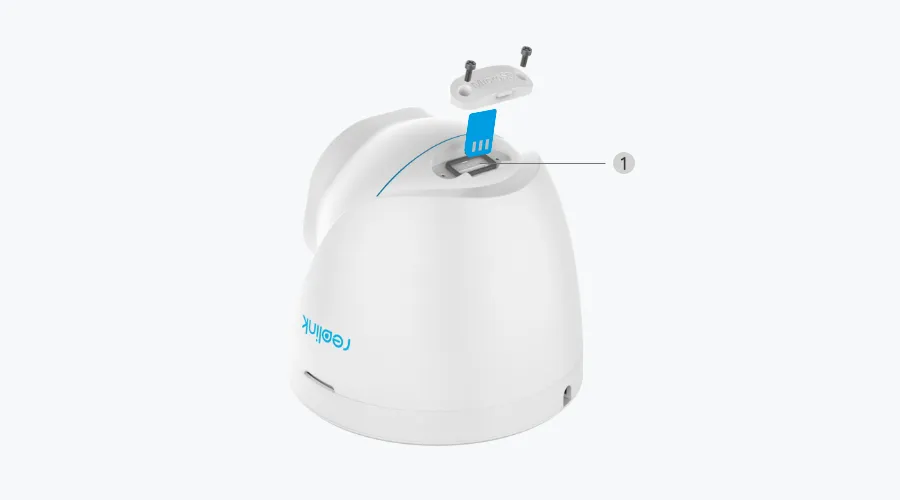
Manufacturer product photo (Reolink): a dome camera with its mounting screw and a numbered callout to the cable tab. Laundry rooms and mailbox alcoves in garden buildings usually take a small dome like this on the ceiling.
Cameras across grounds, lots and laundry rooms
Camera work on Long Island rentals is mostly outdoor work. The expensive questions are where the recorder lives, how the signal reaches cameras at the far end of a lot, and whether the property has any light at night. A complex with a single management office often records every building in one place; a scattered portfolio usually gets a recorder per property, with the office viewing all of them from one app. For the camera side specific to rental buildings, including placement, retention and published prices, see our page on apartment building security camera installation on Long Island. Four-camera systems start at $999 in Nassau and $1,099 in Suffolk on our Long Island camera price list; most properties need more than four, and those are quoted after the walk.
Parking is a bigger share of a Long Island property than it is of a city building, and it is where many of the incidents a manager hears about actually happen: car break-ins, dumped furniture, cars that belong to nobody on the lease, and damage that no one admits to. Cameras on parking rows work best when they are mounted high, aimed along the rows rather than across them, and placed where existing lights reach. A camera aimed at the lot entrance from a short distance gives far better detail on each vehicle than one wide view trying to cover the whole field.
Where an owner wants to control who parks at all, a vehicle gate with a reader for tenants and a call box for visitors is the usual answer; our Long Island access control pricing for a gate with a vehicle reader and barrier arm is listed earlier on this page. Garages under station-area buildings get a reader at the vehicle door and at the stair or elevator from the garage, so the garage cannot be used as a back door into the residential floors.
Mailboxes, packages and delivery doors
Garden complexes were built for the mail, not for daily parcel deliveries. Cluster mailboxes sit in open vestibules or outdoors, and boxes pile up on stairs and stoops. What works depends on the layout. Where each building has a vestibule, a small camera over the mailboxes and a reader-controlled inner door keep packages inside a locked space. Where the complex has a management office, a single package room with a reader and a camera near the office can replace a dozen exposed drop points. In station-area buildings, a separate delivery code or a courier credential that only opens the package room keeps drivers out of the residential lobby. We install the doors, readers and cameras; we do not run a package service.
Alarms for offices, maintenance garages and vacant units, and the permits that come with them
Management offices, leasing offices, maintenance shops and empty apartments between tenants are where Long Island managers most often want an intrusion alarm. Central-station monitoring through our provider is $30 a month keypad-only or $45 a month with the phone app, the two tiers on our alarm installation page for Long Island. Alarm installation for a small business starts at $1,500 on that page, and larger layouts are quoted after the walk.
Every monitored alarm on Long Island also comes with paperwork. In Nassau, the county police issue burglar alarm permits at $100 for a residence and $200 for a business, valid for two years. In Suffolk, the county's Alarm Management Program, under chapter 290 of the county code, requires alarm owners in the Suffolk County Police District to register, at $50 for residences and $100 for commercial locations, and gives registered locations two false alarms before a service fee. Some Suffolk towns and villages with their own police departments are outside that program. We tell the office which permit applies to each property and make sure the panel is programmed to keep false dispatches down; the permit itself is in the alarm owner's name.
Fire alarm work: Suffolk, yes; Nassau, not at this time
Fire alarm systems are a separate trade from cameras and access control, and they never share equipment with a camera system. In Suffolk County we take on commercial and multifamily fire alarm work that follows the local fire marshal's review, starting from sealed drawings and ending with an acceptance test, as described on our page for fire alarm installation on Long Island. In Nassau County, fire alarm permits require a company number from the County Fire Marshal that we do not hold at this time, so we do not take Nassau fire alarm work; we can still handle the access control release that ties a door to an existing fire alarm, coordinated with the fire alarm company of record. Fire alarm work is never priced on this page, because every system is quoted per building from its drawings.
Cable between buildings and the 100-meter problem
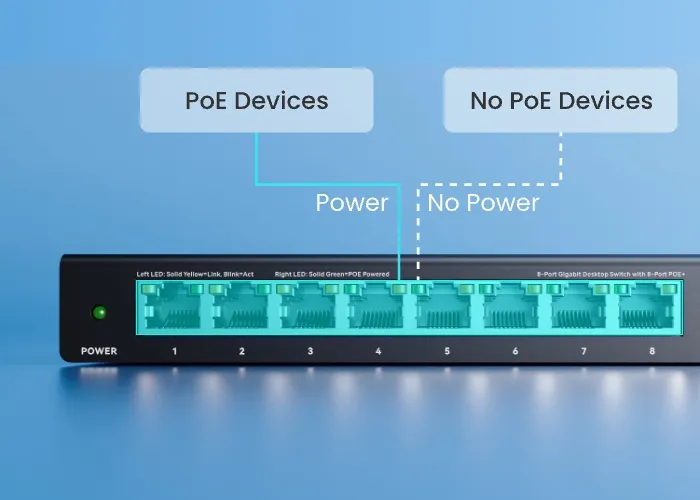
Ethernet cable, which carries most modern cameras, readers and IP intercoms, is limited to about 100 meters (328 feet) between active devices under the TIA-568 standard. On a city lot that limit almost never comes up. On a Long Island complex it comes up on the first walk: the parking lot camera is 500 feet from the office, the far building is across a lawn, the maintenance garage is at the edge of the property. The answers are fiber between buildings, a PoE extender or switch at a midpoint, a point-to-point wireless bridge, or a cellular camera where nothing else is practical. Each one has a cost and a failure mode, and we write the choice into the scope rather than leaving it for install day. Published per-drop pricing of $150–$300 is on our structured cabling page for Long Island; long outdoor runs are priced on the walk.
Storms, outages and battery backup
Long Island properties sit closer to the weather than most city buildings. Nor'easters and tropical storms knock out power across whole neighborhoods, south-shore basements take on water, and lightning finds long outdoor cable runs. A security system that dies with the power leaves a complex with doors that will not release and cameras that recorded nothing during the one night the owner needs to see. We size battery backup for door controllers, recorders and network switches so the entry keeps working and the recorder keeps a clean record through a typical outage, and we tell the office plainly how long that backup is expected to last.
Placement matters as much as batteries. Where a garden building's intercom power supply and recorder sit on a basement floor, we move them up the wall or to a higher room when we replace them, because one flood can take out every building that shares that basement. Outdoor runs that leave a building get surge protection at both ends, and cameras on poles get grounded properly. Fail-safe and fail-secure choices on each door are made with the owner and the local code office, so the manager knows in advance which doors unlock and which stay locked when the power goes.
Maintenance agreements and service calls across the portfolio
We write maintenance agreements for Long Island portfolios after a survey of the properties they cover. The agreement lists each property and its systems, the scheduled checks (door closers and strikes, power supplies and batteries, recorder storage, outdoor cable and connectors after winter), how service calls are requested, and how they are billed. Prices and terms are set per portfolio; we do not publish tiers, offer guaranteed response times, or sign service level agreements. Calls and texts are answered at any hour by our AI receptionist, a person responds from 8 a.m. to 8 p.m. every day, and visits are booked first come, first served once approved and paid, early in the day, seven days a week.
Building Specialists
Property Management Security for Long Island's Building Stock
Long Island rentals fall into a handful of building types, and each one fails in its own way. The notes below come from what we find on walks, not from a catalog. They explain why the same request, “we want fobs on the doors,” produces very different scopes from one property to the next.
Postwar garden-apartment complexes
Two- and three-story brick buildings around lawns and parking courts, many from the late 1940s to the 1960s. Many separate entrances, original doors, buzzer wiring buried between buildings, laundry rooms in basements, and very little exterior lighting.
Station-area mid-rises
New five- to seven-story rental buildings near LIRR stations in places like Mineola, Baldwin and Patchogue. One lobby, a garage or surface lot, an elevator, and a system the developer chose, often cloud-based with a monthly fee.
Village downtown mixed-use
Two to four floors of apartments over stores on a main street. A narrow residential door beside a storefront, a shared rear lot, and retail tenants with their own alarm companies.
Small multifamily and accessory apartments
Two- to four-family houses and legal accessory units held by investors, often under a town rental permit. A video doorbell, a keypad lock and one or two cameras are usually the whole system.
Rental communities with clubhouses
Larger managed communities with a leasing office, a pool, a fitness room and sometimes a gated entrance. Amenity access schedules and visitor control at the gate matter as much as the apartment doors.
Commercial and office properties
Strip centers, small office buildings and industrial units that sit in the same management portfolio. Recorder-based cameras, after-hours alarms and card access for tenants' employees.
Garden complexes: how we work a property with a dozen front doors
The first walk on a garden complex is mostly tracing. We open every vestibule panel, find where each building's power comes from, and check whether the buildings share a master unit somewhere in a basement. On older complexes it is common to find that two or three buildings were already upgraded by an earlier vendor and the rest were not, which leaves the office with two systems, two sets of fobs and two support numbers. The scope we write for a complex like that usually standardizes on one platform and phases the buildings so that tenants in a given building switch over on one day.
The between-building cable decides most of the cost. Where the old buzzer wire still tests clean, some panels can reuse it. Where it does not, a phone-based panel with its own internet connection, or a wireless bridge from a central building, is often cheaper than trenching across a lawn and a parking court. Exterior lighting is the next weak spot; cameras at night are only as good as the light near them, and adding site lighting is the building electrician's job, so we flag dark areas in the survey rather than leaving the manager to discover them on the first recording.
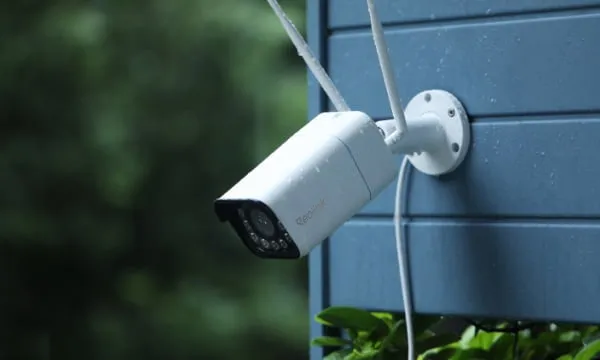
Manufacturer product photo (Reolink): a wireless bullet camera with two antennas on clapboard siding. For a detached garage or a shed at the back of a rental property, a camera like this avoids a trench; wired cameras stay our default on the buildings themselves.
Station-area buildings: inheriting the developer's choices
New rentals near train stations tend to open with a full system already in place: a touchscreen panel at the lobby, phone-based entry, readers at the garage and amenity doors, and dozens of cameras on a cloud platform. The problem shows up when the developer's installer finishes the punch list and leaves. The management company inherits administrator accounts in someone else's name, a monthly platform fee it never negotiated, and no drawings. When we take over a building like that, the first visit is an inventory: what is installed, which accounts control it, what is under warranty with whom, and which subscriptions are actually needed. Lease-up schedules make timing tight, so we work around the move-in calendar the leasing office gives us.
Downtown mixed-use: keeping the apartments separate from the stores
In village downtowns from Rockville Centre to Patchogue, the residential entrance is often a single door between two storefronts, with a stair to the apartments and a shared rear lot. Retail tenants usually have their own alarm and camera vendors. The work for the property manager is keeping the residential door, the stair and the apartments on the building's own system, with credentials the office controls, and making sure a store's alarm company does not end up with a key or a code to the residential side. Where the owner wants cameras on the rear lot, we put them on the building's recorder rather than borrowing a store's view.
Small multifamily and accessory units under town rental permits
Investors who own two-family houses or legal accessory apartments in towns such as Islip and Brookhaven are already used to inspections: the Town of Islip issues a rental occupancy permit after an on-site inspection and renews it every two years, and Brookhaven's rental registration runs for 15 months and requires an inspection by the town or a licensed professional within 90 days of a temporary registration. Both laws focus on safety items such as working smoke and carbon monoxide alarms. For these properties we keep the security side simple: a wired video doorbell or a small door station, a keypad lock on a shared entry, and one or two cameras on a small recorder the owner can watch from a phone.
Rental communities with amenities and gates
Larger rental communities, especially in Suffolk, often have a clubhouse, a pool and a vehicle gate. Here the work is about schedules: the pool reader on summer hours, the fitness room on a waiver list, the clubhouse open only for a booked event, and a gate call box that reaches the leasing office during business hours and a phone after. Snowplows, salt and sprinklers are part of the design, because a reader post at a drive entrance takes a beating every winter. The board-run equivalent of this, gatehouses and HOA common areas, is covered on our condo pages.
Commercial properties in the same portfolio
Many Long Island management companies also run strip centers, small office buildings or light-industrial units along corridors such as Route 110, Sunrise Highway and Old Country Road. Those properties need recorder-based cameras covering the lot and the loading area, after-hours alarms with their own permits, and card access for tenants' employees. Treating them as part of the same vendor relationship keeps one certificate of insurance on file, one point of contact and one invoice format, even though the equipment differs from the residential buildings.
For Management Companies
Vendor Setup, Maintenance and Multi-Property Work on Long Island
Getting us on your vendor list
Long Island management companies onboard vendors the same way city firms do, and we fit the usual process. We fill out your vendor application, supply a W-9 for the contracting company, and review and sign a master service agreement. The certificate of insurance naming the owner and the management company as additional insureds is issued when a job is awarded, to your exact wording, rather than attached to a quote reply; requirements vary by owner and the certificate is easier to get right once the scope is fixed. Being set up in your system lets your accounts payable pay us; it is not a claim that we sit on any company's approved list.
Scheduling across two counties
The distance from the Queens line to the East End is well over a hundred miles of road, and traffic on the Long Island Expressway and the parkways sets the schedule more than the work does. We group visits by area, so a technician working in central Nassau handles the next property nearby rather than crossing to Suffolk and back. Visits are booked into two-hour arrival windows, early in the day, and technicians arrive inside the window, never ahead of it. Properties far out on the North or South Fork are usually set as the first or last stop of a day. Requests go on the schedule first come, first served once approved and paid.
Working in occupied rentals without the city's notice rules
New York City's rule that sets 24 hours' notice for inspections and one week for repairs in rental apartments is a city regulation; outside the city, access is governed mostly by the lease and by general state landlord-tenant law, and owners should follow their own counsel on how much notice to give. In practice we work the same way everywhere: apartment visits are scheduled through the management office, the office sends the tenant the notice it uses, we keep to daytime hours unless the tenant asks otherwise, and anything that needs a tenant at home is grouped into as few visits as possible. Common-area work, which makes up most of a security project, goes ahead without entering apartments.
Turnover on a large complex
A rental community with a few hundred apartments may see several move-outs a month, and every one of them touches security: the departing tenant's fobs, the entry directory, the mailbox key, the parking permit and any app account. On keyed properties it also means a locksmith. We set the access system up so that one task in the office, cancelling a tenant, removes that person's credentials everywhere at once, and the new tenant's credentials can be issued at the lease signing. Directory entries on the entry panels are edited from the same place, so a new tenant's name appears at the door the day they move in rather than whenever someone remembers to drive out.
Contractors and vendors are the other half of turnover. Painters, cleaners, appliance installers and landscapers rotate through vacant apartments and common areas all year. Instead of lending them master keys, the office can issue a time-limited credential that works on the doors they need, during the hours they work, and expires on its own. When a dispute comes up later about who was in a vacant unit, the access log and the camera record answer it.
Apartment doors are the last piece of turnover. Rekeying a lock at every move-out adds up across a large complex, and code or app locks let the office change access in minutes instead. The trade-offs are batteries, the fire rating of the door, and tenants who would rather carry a key, so many owners start with vacant units and convert others as leases turn. Options and models are on our page for smart lock installation on Long Island.
One point of contact, one written record per property
Every property we work on gets a running record: what is installed, where each power supply and recorder lives, which accounts control which system, what we changed on each visit, and what we recommended but the owner has not approved yet. That record goes to the management office, not just into our files, so a new property manager or a new super can pick it up without calling three former vendors. When a property is sold or moves to another management company, the record and the administrator accounts go with it, in the owner's name.
For the office, the practical result is fewer calls that start with “who installed this?” One phone number, (800) 486-0943, reaches us for every property in both counties, and every request is tied to the property's record so the technician arrives knowing what is there.
Owners who live out of the area
Many Long Island rentals belong to owners who do not live nearby: family partnerships, out-of-state investors, or funds that bought a portfolio of older complexes. They rely on the manager to bring them a clear choice. We write scopes so an owner who has never seen the property can follow them: photos of each entrance, the problem in one sentence, the fix in one sentence, and the cost on its own line. Where the owner prefers to approve in stages, the scope is already broken into stages, ranked by how urgent each item is.
Telling tenants about a changeover
Most complaints after a security upgrade come from tenants who did not know it was happening. A good changeover notice says which building is switching and on what day, what the tenant has to do (pick up a fob at the office, download an app, be home for an in-unit station), what will work differently afterward, and who to call with problems. We draft that notice for the office in plain language, with the dates from our schedule, and the office sends it through its own channels. On complexes with tenants who speak several languages, the office usually translates it; we keep the wording short so translation is easy.
On the day itself, our technician starts with the building's front door so the entry problem is solved first, keeps the office informed when each building goes live, and leaves printed instructions at the panel where tenants will see them. Tenants who miss the day are picked up on a follow-up visit grouped with other work, not one at a time.
Rent-stabilized buildings in Nassau
Some Nassau municipalities opted into the state's Emergency Tenant Protection Act, which brings rent stabilization to buildings of six or more units built before 1974 in those places, administered by NYS Homes and Community Renewal. Owners of regulated buildings must keep required services in good working order, and tenants can file complaints with the agency when a service is reduced. When we work in those buildings we keep the existing entry function running during a changeover, put any reduction or change of service on the scope in writing, and leave the regulatory question, such as whether a change needs an application to the agency, to the owner and its counsel.
Rental permits, building departments and alarm permits
Before a job starts we tell the office which local offices are likely to care about it. Exterior work on a building in an incorporated village goes through that village's building department; in an unincorporated hamlet it is the town. The state Department of State notes that the Uniform Code is “automatically in effect in each city, town, and village in the State (except New York City),” with enforcement handled locally. Low-voltage camera and access work rarely needs a building permit, but door hardware that changes egress, and anything tied to a fire alarm, may. Rental-permit inspections in towns like Islip and Brookhaven focus on smoke and carbon monoxide alarms rather than security systems, and alarm permits go to the county police or the local department as described above.
Bid requests and proposals
We respond to requests for proposals from management companies and owners, including bid packages for a single complex and multi-property programs. A useful bid request lists every property with its town or village, the number of buildings, units and entrances, what is installed now, and what the owner wants to end up with, plus any equipment standard the owner already uses. We answer with a scope per property, each item on its own line, and a note of anything that depends on testing existing cable. The certificate of insurance, vendor forms and signed agreement follow when the job is awarded; we do not hand out client references, and managers who want to see how we work can read our Google reviews.
Vacant units and empty buildings
Units between tenants and buildings waiting for renovation are where thefts of appliances, copper and fixtures tend to happen. For a single vacant apartment, a door contact and a motion sensor on a small monitored panel usually do the job. For an empty building, a few cameras on the doors and the lot, a monitored alarm and a lock change for everyone who had a key are the basics. Alarm permits apply to vacant property the same as occupied property, so the permit or registration should be in place before monitoring starts.
Financing and payment
A visit is confirmed once payment is in. Smaller jobs, below $500, are settled at booking; bigger ones need half up front and the rest at completion, as our service agreement sets out. We buy the equipment after that deposit lands, and anything special-order gets a delivery date from us only when the maker ships it. Financing is available through Wisetack, subject to approval.
Full terms — including 50% deposit, one-year parts-only warranty on Abstract Enterprises Security Systems-supplied products, and the late-fee schedule — are set out in the service agreement.
Compliance points for Long Island properties
Multiple Dwelling Law vs. Multiple Residence Law. MDL §50-a (intercom and self-locking entrance doors for buildings of eight or more apartments) sits in a law that applies to cities of 325,000 or more; Long Island towns and villages fall under the Multiple Residence Law and local code. We make no claim that the Multiple Residence Law requires an intercom.
Uniform Code. Building and fire code enforcement is local, through the town, village or city building department.
Alarm permits. Nassau County Police permits; Suffolk County registration under chapter 290 inside the police district; local departments elsewhere.
Licensing. We work under NYS low-voltage license #12000287431. Electrical circuits are the building's licensed electrician.
Fire alarm. Suffolk work follows the local fire marshal's review; we do not take Nassau fire alarm work at this time.
Privacy. NYC's smart-access law does not apply here; audio recording raises separate state eavesdropping questions, so our cameras in common areas record video only unless the owner's counsel says otherwise.
Your Questions Answered
Property Management Security on Long Island: Questions Answered
Distance, cost and taking on new properties
Why do camera quotes for our Suffolk properties come out higher than for the Nassau ones?
Mostly drive time. The $250 service call and the repair part prices on our Long Island pages are the same in both counties, but installed systems carry the labor of getting there: our published four-camera system is $999 in Nassau and $1,099 in Suffolk, and elevator readers start at $1,725 per car in Nassau against $1,800 in Suffolk. On the forks we try to fit several jobs into one trip so a small repair does not carry a full day's travel.
Can you survey a property's security systems before our client closes on the purchase?
Yes. A pre-closing walk lists what is installed at each entrance, what works, what is past its life, which accounts and subscriptions come with the property, and a rough order of what will need money in the first year. It is the same free on-site assessment we do for any new system. We put it in writing for the buyer's manager; we do not certify a property's condition or give an appraisal.
Local rules and paperwork
The town is inspecting one of our rentals for its rental permit. Does the security equipment come into it?
Usually not directly. The Islip and Brookhaven rental laws we have read focus on safety items such as smoke and carbon monoxide alarms, occupancy and the general condition of the unit, not on cameras or intercoms. What can matter is anything we did to a door: a lock or a closer that no longer latches, or hardware that changes how someone exits. We check egress hardware as part of our own work and fix our side before the inspector arrives.
Which of our Long Island buildings need an alarm permit, and whose name goes on it?
Any monitored burglar alarm in Nassau needs a county police permit, $100 for a residence and $200 for a business, renewed every two years. In Suffolk, alarm owners inside the county police district register under chapter 290, at $50 residential and $100 commercial; some towns and villages with their own police fall outside it. The permit goes in the name of the alarm owner, normally the property owner or the entity on the lease for an office. We tell you which applies to each address when we install.
Who pays when the police bill a false alarm at a building we manage?
The fees are charged to the permit or registration holder, so in practice it is whoever owns the alarm, and your management agreement decides whether that cost passes to the owner. Suffolk gives registered locations two false alarms a year before a service fee and charges unregistered ones from the first. The real fix is technical: correct sensor placement, entry delays that suit the staff who use the office, and pets and heaters kept out of motion zones. We check those on every alarm service call.
Spread-out layouts
How far apart can two buildings be before a camera or intercom cable cannot run between them?
For network cable, about 100 meters (328 feet) between active devices is the practical limit. Past that we use fiber between the buildings, a powered switch partway, or a wireless bridge if there is a clear line of sight. Older two-wire buzzer cable behaves differently and can run farther, but on garden complexes it is often the cable that has been in wet ground the longest. We measure on the walk and write the method into the quote.
What happens to the old buzzer wiring once a garden building moves to phone-based entry?
Usually it stays in the walls, disconnected and labeled at both ends, because pulling cable out of occupied apartments and buried runs costs more than it saves. We remove the old panels and in-unit stations the owner no longer wants, cap the wiring so nobody mistakes it for a live circuit later, and note it on the property record. If the owner may want in-unit answering again someday, a clean old pair can be kept as a spare path rather than abandoned.
Can the basement laundry room in each garden building be limited to that building's tenants?
Yes. A reader on each laundry door can be set to accept only the credentials assigned to that building, so tenants from the far end of the complex, and people who are not tenants at all, cannot walk in. A small camera over the machines and the door settles most disputes about damaged machines or missing clothes. Where the laundry has an outside door as well as an inside one, both are controlled, or the outside door is set to exit only.
When a vacant apartment is found damaged, can the system show who went into that building?
If the building door and the unit door are on readers, the access log lists every credential that opened them, with times, and a camera at the entrance shows who came through with it. That is why we recommend giving painters, cleaners and other contractors their own time-limited credentials instead of a shared master key. With keyed doors there is no log, and the camera record is all the office has.
New buildings
What should be working before the first tenants move into a new building near the train station?
Before the first move-in we want the lobby panel showing a correct directory, every apartment able to answer it, the garage and amenity readers on the schedule the leasing office wants, delivery access separated from residents, cameras recording with the office able to view them, and administrator accounts held in the owner's or manager's name. We also want a written equipment list and the platform fees in writing. Anything missing at lease-up becomes a tenant complaint in the first week.
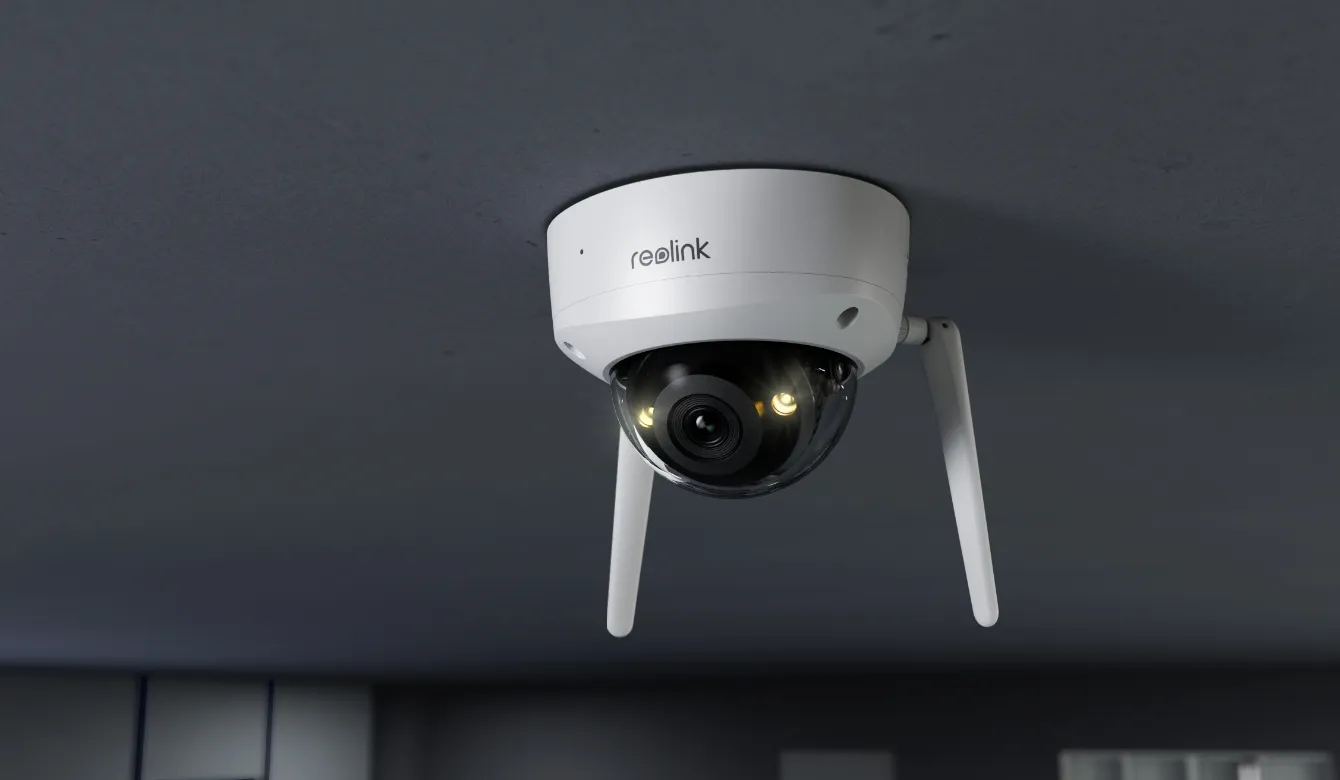
Manufacturer product photo (Reolink): a wireless dome camera with antennas on a dark ceiling. Covered carports and the underside of exterior stairs on garden buildings take this kind of mount when cable cannot reach.
Equipment
Types of Property Management Security Equipment We Install on Long Island
Vestibule and lobby panels
Single-button stations for small buildings, directory panels for larger ones, and phone-calling panels for complexes where cable between buildings is unreliable.
In-unit answering
Inside each apartment: a simple talk-and-release handset, a small screen showing the caller, or nothing at all where the panel rings the tenant’s own phone.
Readers and credentials
Fob, card, keypad and phone readers for building doors, laundry rooms, storage, garages, pools and fitness rooms, managed by the office.
Locks and door hardware
Strikes and magnetic locks paired with request-to-exit hardware, new closers on worn vestibule doors, and code or app locks for apartments.
Cameras for grounds
Bullet, turret, dome, fisheye and pan-tilt cameras for lots, walkways, mailboxes and laundry rooms, plus floodlight cameras where light is short.
Recorders and viewing
A recorder per property or one per complex, with remote viewing for the office and export rights limited to the staff who need them.
Long-run links
Fiber between buildings, PoE switches and extenders, point-to-point wireless bridges and cellular links for far corners.
Alarm panels and sensors
A monitored panel guarding the leasing office, the maintenance shop or an empty apartment, with contacts on the doors and detectors watching the rooms.
Power and protection
Battery backup for controllers and recorders, and surge protection for outdoor cable runs exposed to storms.
Manufacturer product photo (Reolink): an eight-port switch with labels showing which ports carry power. A switch like this, placed midway along a long run, is one way to reach a camera beyond the 100-meter cable limit on a spread-out complex.
Choosing between the main options on a Long Island property
Decision
Option A
Option B
What usually settles it
Entry at a garden complex
Panel per building on existing wire
Phone-calling panels with their own internet
How the between-building cable tests
Managing fobs
On-site controller
Cloud-managed controller
Whether the office is miles from the property
Recording
One recorder for the whole complex
A recorder per building
Distance and the links between buildings
Far camera
Fiber or a midpoint switch
Wireless bridge or cellular
Line of sight, ongoing fees, trenching cost
Unit doors
Keys, rekeyed at turnover
Keypad or app locks
Turnover rate and door fire rating
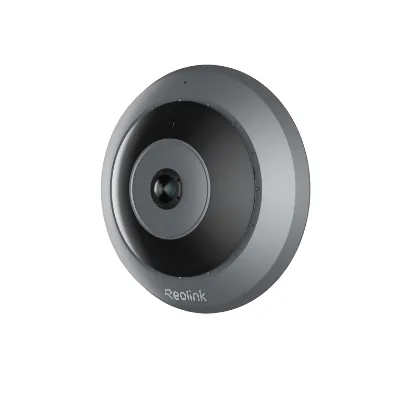
Manufacturer product photo (Reolink): a fisheye camera seen face-on. One fisheye in the middle of a basement laundry room can see every machine and both doors.
Properties in Both Counties? Send Us the List
Town or village, building count and units for each address. We plan the walks by area and write one scope per property.
What AI Gets Wrong About Property Management Security on Long Island
Search summaries, chatbot answers and national cost guides from sites such as Angi, HomeAdvisor and Fixr tend to describe building security in New York as if every property were in Manhattan, or as if every property were a single-family house. Long Island rentals are neither. These are the claims we most often hear from managers who looked something up before calling.
1. “New York law requires an intercom in every apartment building”
The intercom requirement people quote comes from section 50-a of the Multiple Dwelling Law, which covers buildings of eight or more apartments built or converted after 1968. The state Attorney General's tenant guide summarizes it in general terms, and summaries often stop there.
The Multiple Dwelling Law applies to cities of 325,000 or more people. Long Island's towns and villages fall under the Multiple Residence Law instead, and we have not found an equivalent intercom mandate there, so we do not claim one.
That does not make the intercom optional in practice. Tenants expect a working door, leases often promise one, and an entry system that fails generates the same calls to the office whether or not a statute names it.
2. “An intercom costs a couple of thousand dollars”
National guides such as HomeAdvisor put intercom installation in a normal range of $1,200 to $8,500, written mostly with houses and small offices in mind.
On a Long Island complex the number depends on how many separate entrances there are, whether the cable between buildings still works, and whether tenants will answer on a phone or need a station inside. Our own published multi-unit range is $1,200–$4,500+ for a building; a complex with many vestibules is several buildings, not one.
That is why we quote building-wide work only after the walk, and why a garden complex's scope often reads like a list of small buildings with a shared link between them.
3. “Wireless cameras are the easy answer for big properties”
Summaries often recommend battery or Wi-Fi cameras because they skip cable. On a rental complex, Wi-Fi rarely reaches a parking lot from inside a brick building, and batteries struggle in a Long Island January.
Wireless links have their place: a bridge between two buildings with a clear line of sight, a cellular camera at a far gate, a solar unit in a corner with no power. They are tools for the edges of a property, not the core.
Our default on the buildings themselves is wired cameras powered over network cable, with the wireless pieces written into the scope only where the walk shows they are the better choice.
4. “The city's tenant notice and privacy rules apply on Long Island too”
Many articles about apartment access and smart locks are written about New York City rules: notice periods set by a city regulation, and the city's law on smart-access systems in residential buildings.
Those are city rules. Outside the city, access to apartments is mostly a matter of the lease and state landlord-tenant law, and no city privacy statute follows a fob reader into Nassau or Suffolk.
We still recommend owners treat tenant data carefully and run any biometric reader past counsel. We schedule apartment visits through the office either way.
5. “Any alarm company can monitor any building with no paperwork”
Generic answers skip local permits entirely. On Long Island, alarm permits and registrations are a county police matter, with fees and false-alarm charges attached.
Nassau County Police issue two-year permits and report being asked to respond to more than 125,000 false alarms a year. Suffolk registers alarm owners inside its police district and charges escalating fees for repeat false alarms, with some towns and villages outside the program.
A manager with offices and vacant units in both counties needs someone tracking which property falls under which program, which is part of every alarm job we do here.
6. “Fire alarms are just one more add-on from the camera installer”
Summaries treat fire alarms as one more security add-on. They are a separate, code-driven system that begins with engineered drawings and ends with an inspection.
In Nassau, fire alarm permits require a County Fire Marshal company number. We do not hold one at this time, so we do not take Nassau fire alarm work. In Suffolk we do, following the local fire marshal's process.
We never bundle fire alarm work with cameras, and we never publish a fire alarm price. Each system is quoted from its drawings.
7. “Property management security means guards or a virtual doorman”
Search results lump guard services, remote monitoring and virtual-doorman subscriptions in with electronic systems, and some vendors sell all of it as a managed service.
We do not provide guards, and we do not run a virtual-doorman or managed-security service. We install and maintain the doors, panels, readers and cameras that a building's staff, or an outside service the owner hires, would rely on.
For most Long Island rentals, which have no doorman to replace, the security that matters is simpler: doors that latch, entry that works, credentials the office controls, and cameras that recorded what happened.
Get In Touch
Request a Property Management Security Survey on Long Island
Tell us the town or village of each property, how many buildings and units it has, and how many separate entrances. Note what is installed now and what keeps failing. A site plan or an aerial screenshot of a complex helps us plan the walk, because it shows the distances between buildings and to the parking areas. For one repair, the address and the symptom are enough. Prefer to talk? Call (800) 486-0943.
✅
Request Sent!
Thank you. We will reach out to set the visit, usually within 2 hours of your request.
How It Works
Our Property Management Security Process
1
Send the property list
Your office emails or calls with the property, how many buildings it has and what needs attention. Within 2 hours we confirm a morning arrival window and the name of whoever should let us in.
2
Service call or walk
Something broken gets the $250 diagnostic visit. Anything new gets a no-charge walk where we photograph each doorway and closet and pace off the distances across the grounds.
3
Scope per property
A written document for each address, itemizing hardware, labor, the links between buildings, door repairs and recurring fees, so every owner signs off on its own property.
4
Paperwork and deposit
Vendor forms and W-9, the certificate of insurance on award, alarm permit details where relevant, then the deposit. Equipment is ordered after the deposit.
5
Tenant notices and timing
The office notifies tenants in its usual way; apartment visits are grouped, and buildings on a complex switch over on separate days.
6
Install and switch over
We mount the replacement hardware while the existing system still runs, cut each building over on its own day, and finish unit stations, readers and cameras afterward.
7
Hand back to the office
Your staff learns the software, the controlling accounts are registered to the owner or your firm, every closet and link carries a tag, and a property-by-property inventory comes with the closing invoice.
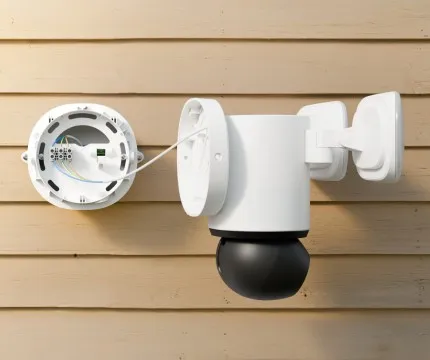
Manufacturer product photo (Reolink): a floodlight camera beside its opened mounting box on clapboard. Light fixtures like this connect to an existing exterior box; any new circuit for one is the building electrician's work, not ours.
Field notes: walking a garden complex for the first time
On a first visit to a garden-apartment complex, we start in the management office or the super's apartment, because that is usually where the old master station or the recorder ended up. Then we walk the property in a loop with the site plan in hand, stopping at every vestibule. At each one we open the panel, note the model and the wiring, try the release, and watch whether the door closes and latches on its own. In basements we look for the transformer and for signs of water around it, because a wet basement and a buzzer power supply are a common pairing on older complexes. Along the way we pace off the distance between buildings and to the parking rows, mark the dark stretches, and look for poles or eaves that could carry a camera. By the end we know which buildings share a power supply, where the cable between them runs, and whether reusing it is realistic. That becomes a one-page summary per building, which the manager can forward to the owner before any price is on the table.
Field notes: the spring check after a Long Island winter
Winter is hard on outdoor security equipment here. Salt from walkways corrodes the bottom edge of entry panels and reader posts, freeze-thaw cycles loosen strikes and shift frames, plows clip anything near a drive entrance, and ice in a camera housing can fog a lens for weeks. When a maintenance agreement includes a spring check, we look at exactly those things: the panel faces and their seals, the strike alignment on every exterior door, the reader posts at gates and drive entrances, the condition of outdoor cable and connectors, and the battery backups that ran during any outages. We also check that the recorder kept recording through the winter and that its clock did not drift after a power loss. The report that follows lists each item, what we fixed on the visit, and what needs the owner's approval.
How long a Long Island property management security project takes
Most repairs finish on the first visit, or on a second one if a part has to be ordered. A single panel change on a building with good wire is usually a day on site once the equipment is in. A garden complex takes longer, because each building is its own small job and tenants in each building get their own changeover day. Projects with fiber or wireless links between buildings add time for the link work. Special-order equipment arrives on the maker's schedule, not ours, and we give a date only once it ships.
Coverage Area
Property Management Security Near Long Island's Landmarks
The places below are landmarks for the parts of Long Island where managed rentals cluster. They are named for location only; none is a client, and we do not name the properties we work in.
Mineola station and Old Country Road
The Nassau county seat, where Newsday counts more than 1,100 rental units opened since 2010 within walking distance of the LIRR hub, and more planned.
Baldwin and Sunrise Highway
The south-shore corridor where a 215-unit building near the Baldwin station started construction in 2026, among older apartments and garden complexes.
Hempstead Village and Roosevelt Field area
Dense central Nassau, with walk-up apartment buildings, garden complexes and the retail and office properties around the mall corridor.
Route 110 in Melville and Farmingdale
Office parks and industrial buildings along the Nassau–Suffolk line, plus Farmingdale's village downtown apartments near its station.
Patchogue's Main Street
A Suffolk village downtown with apartments over shops and a 262-unit development on West Main Street about half a mile from the train.
Riverhead and Route 58
The gateway to the East End, with rental complexes, retail strips and the longest drives in our Long Island service area.
How property management work differs from western Nassau to the East End
Western and central Nassau (the Town of Hempstead, North Hempstead and the villages along the LIRR) holds the densest rental stock: walk-ups, garden complexes from the postwar decades, and the new station-area buildings, with the shortest drives from the city. Eastern Nassau and western Suffolk (Oyster Bay, Huntington, Babylon) mixes garden complexes with commercial corridors such as Route 110, where many management companies also run offices and industrial units. Central Suffolk (Islip, Brookhaven, Smithtown) brings large rental communities with clubhouses and the most active town rental-permit programs. The East End (Riverhead, the forks) is mostly smaller properties and seasonal rentals spread far apart, where grouping visits matters most. Our door buzzer installation page for Long Island covers new buzzer systems for the small properties at that end of the list.
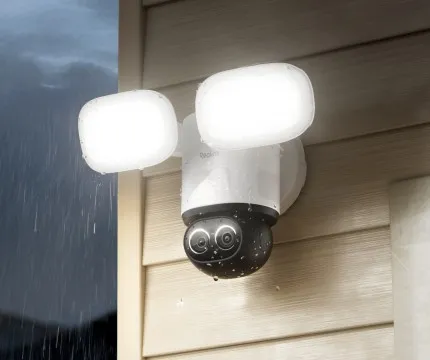
Manufacturer product photo (Reolink): a floodlight camera on siding in the rain. Coastal storms off the South Shore are why we seal every outdoor connection and use weather-rated housings on Long Island rentals.
Pricing
Property Management Security Cost on Long Island
Each price in this table already appears on one of our Long Island service pages. Building-wide systems, complexes and maintenance agreements are priced after the walk; we do not publish package prices for whole properties or portfolios, and fire alarm work is never priced on a web page.
Work
Published price
Where it comes from
Service call (diagnosis and simple repairs)
$250
Long Island repair pages
Apartment intercom station replacement
$250–$525
Door buzzer repair, Long Island
24-volt transformer replacement
$325–$650
Door buzzer repair, Long Island
Electric strike with alignment
$450–$950
Door buzzer repair, Long Island
Lobby panel repair or faceplate
$650–$1,800
Door buzzer repair, Long Island
Riser pair repair or re-termination
$850–$2,400
Door buzzer repair, Long Island
Multi-unit building intercom system
$1,200–$4,500+
Intercom installation, Long Island
Single-door reader with electric strike
$1,500–$2,500 installed
Access control, Long Island
Gate with vehicle reader and barrier arm
$3,500–$12,000 installed
Access control, Long Island
Elevator reader (card, fob, code)
From $1,725 per car (Nassau); $1,800 (Suffolk)
Elevator access control, Long Island
Four-camera system
From $999 (Nassau); $1,099 (Suffolk)
Camera pricing, Long Island
Structured cabling
$150–$300 per drop
Structured cabling, Long Island
Alarm central-station monitoring
$30/month keypad; $45/month with app
Alarm installation, Long Island
Maintenance agreement
Priced per portfolio after survey
—
Fire alarm (Suffolk only)
Quoted per building from drawings
—
What moves the price on a Long Island property
Six things change a Long Island number more than the brand on the panel. First is the count of separate entrances: a complex with twelve vestibules is twelve small installs plus the links between them. Second is distance, both the cable runs on the property and the drive to it. Third is the condition of whatever is already in the ground or the walls, because reusing a good buzzer pair is cheap and replacing a failed one under a lawn is not. Fourth is the door hardware, which often needs work before a reader is worth mounting. Fifth is any platform or cellular fee that will run for years after the install. Sixth is what the owner wants at handover: documentation, training and accounts set up in the owner's name all take time, and we would rather price them honestly than skip them.
Costs that sit outside our scope
Some costs on a security project belong to other trades, and we list them so the owner is not surprised: new electrical circuits or site lighting (the building's electrician), trenching and repaving (the site contractor), connections inside an elevator controller (the elevator company), internet service for phone-calling panels (the owner's provider), and police alarm permit fees (paid by the alarm owner to the county or local department). We coordinate with each of them on schedule; we do not mark up their work.
Shop Our Systems
Property Management Security Packages & Pricing
Repair at one property
$250 service call. A technician finds the fault at your Nassau or Suffolk property and fixes small problems on the visit; bigger parts are priced on the spot from the component table, before any work starts.
One property, brought up to date
Priced after a free walk. A single complex or building gets the full treatment, from the front doors and their hardware to readers, recording and any fiber or wireless hop between structures, written so its owner can sign without waiting on the rest of the list.
Portfolio program
Priced per portfolio. We visit each property on your list, sort the work by urgency, settle on one or two platforms for all of them, hand credential control to your office, and write the maintenance terms around those addresses.
Owner-supplied equipment: labor-only installs
Some owners buy their own panels, readers or cameras. We install customer-supplied equipment for a labor price given by phone once we know the model, the property and the mounting location, and we book it with a deposit. We do not do walk-throughs for customer-supplied equipment, and the equipment's performance stays with its maker. Equipment we supply carries our one-year parts-only coverage; our own labor carries a 30-day warranty, with longer terms available to buy at the time of the job. Our security camera equipment page for Long Island lists cameras we supply installed or equipment-only, for managers whose own staff handle small properties.
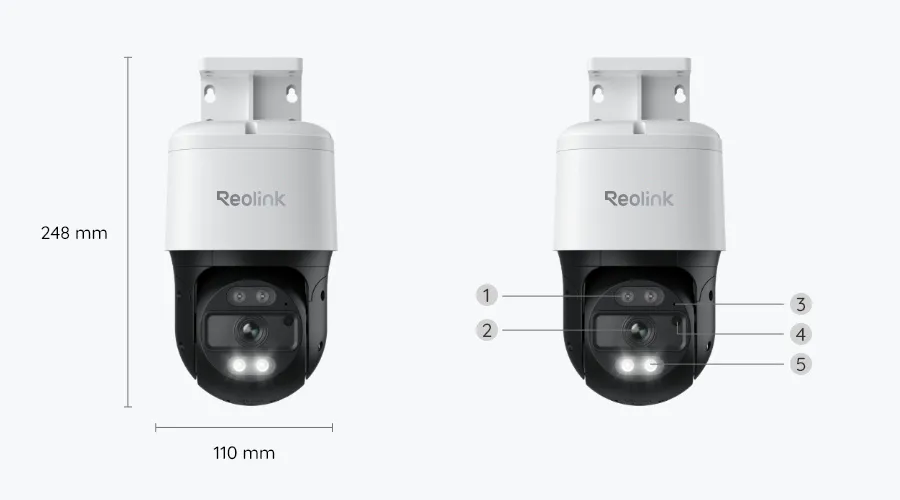
Manufacturer product photo (Reolink): a pan-tilt camera from two angles with its size marked. On a large parking field at a rental community, one camera that can turn and zoom follows a vehicle across rows that fixed cameras only see in pieces.
Owner Wants a Number Before the Next Meeting?
Give us the addresses and the deadline. Walks go on the calendar first, and each owner receives a separate written proposal for its own property in time for the vote.
Send the property list and get a written scope per address.
Access control and fobs
Readers, credentials and office-run management for building doors, amenities and garages, linked in the systems section above.
Intercom and entry
Repair, replacement and phone-calling panels for complexes and station-area buildings, linked in the systems section above.
Cameras and recorders
Grounds, lots, laundry rooms and mailbox areas, with remote viewing for the office.
FAQ
Long Island Property Management Security FAQ
Can you take on fire alarm work for the buildings we manage in Nassau County?
+
Not at this time. Fire alarm permits in Nassau require a County Fire Marshal company number that we do not hold, so we do not take Nassau fire alarm jobs. We do take fire alarm work in Suffolk, and in Nassau we can still connect door hardware to an existing fire alarm alongside the fire alarm company of record.
Do you set up entry systems for senior rental communities on Long Island?
+
Yes. In senior rentals we favor in-unit stations with large buttons or a handset over phone-only answering, longer door-release times, readable directories at the entrance, and temporary credentials the office can give home aides and family members. The office decides who gets what; we build the system so those changes are quick.
Do you work in student rentals near campuses such as Stony Brook and Hofstra?
+
Yes. Student rentals turn over heavily at the start and end of each school year, so we set them up for fast credential changes, unit or room locks that can be recoded rather than rekeyed, and cameras on entrances and parking. The office manages the semester changeover itself from the access software.
Can you price a complex from the site plan without walking it?
+
A site plan or aerial view lets us give a rough range and plan the walk, but we do not issue a firm price for a complex without seeing the entrances, the closets and the condition of the existing cable. The walk is free, and it is what keeps surprises off install day.
Will you work alongside the locksmith our properties already use?
+
Yes. The locksmith keeps the mechanical side, such as cylinders, keying and lever sets, and we handle the electrified hardware, readers and wiring. On a door that gets both, we agree on the hardware before ordering so the strike, the lock and the reader fit the same door the first time.
Is there a volume discount for bringing all of our Long Island properties to you?
+
We do not publish discounts or deals. What a larger list does change is how efficiently we can schedule: grouping walks and installs by area, and standardizing equipment across properties, keeps labor down, and that is reflected in the portfolio scope we write after the survey.
What happens when a panel or reader for one of our properties has to be special-ordered?
+
We tell you before the deposit that the item is special order and that shipping time is outside our control. It is ordered after the deposit, we give an arrival date once it ships, and the install is booked only when it is in hand. Where a building cannot wait, we look for a temporary fix on the existing system.
Will you give our owner's insurance carrier a description of the security systems at a property?
+
Yes. After an install or a survey we can provide a written list of the systems at each property, what they cover and how they are maintained. We do not promise that any carrier will lower a premium because of it; that decision belongs to the insurer.
All Areas Served
Property Management Security Across Long Island and the Region
On Long Island, separate county pages are on the way for property management security in Nassau County and Suffolk County, along with a page on apartment building security systems on Long Island for landlords and owners. Until they are live, this page and (800) 486-0943 cover both counties.
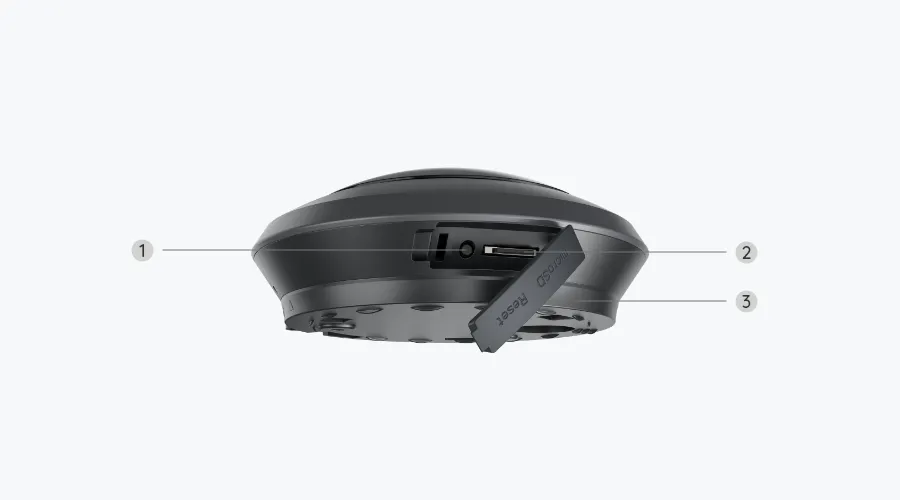
Manufacturer product photo (Reolink): a low-profile fisheye camera from the side with numbered parts. In a leasing office or a clubhouse lounge, one ceiling fisheye covers the room without a row of cameras on the walls.