4K · 5MP · 2K · PoE · NVR & DVR · Drives · Mounts · No Monthly Fee
Security cameras on Long Island: buy the equipment only and we deliver it to your home or business, or have it installed from $999 by our licensed crew anywhere in Nassau and Suffolk. Abstract Enterprises Security Systems stocks the cameras, recorders, surveillance hard drives, PoE switches, mounts and cable that suburban properties actually need — long driveway runs, detached garages, backyards, strip-plaza storefronts, docks and the summer house that sits empty from October to May — and we program and support what we sell, which is the part a website checkout can’t do.
Last updated November 21, 2026 by Abstract Enterprises Security Systems, NYS license #12000287431 · Sources: NYS Division of Criminal Justice Services data via Long Island Press; Nassau County Police via FOX 5 New York and CBS New York (November 2023); Suffolk County Police camera registration program via Officer.com; Nassau County Police SPiN; LIPA Isaias task force via Newsday; Town of Southampton Housing Plan (2022); Reolink RLC-810A spec page; NY Penal Law §250.00 and §250.05 (full list below)

Owner-operated since 2002 · Thousands of jobs completed · Booked within 2 hours
Quick answer: you can buy security cameras on Long Island from us two ways — equipment only, delivered to your home or business in Nassau or Suffolk, or as a complete installed system starting at $999 for four house-brand cameras with the recorder, wiring and installation. Every camera, NVR, DVR, hard drive and PoE switch shows “call or text for today’s price” because we quote it the day you ask. The systems record locally with no monthly fee, and installation is booked within 2 hours of your request, 7 days a week.
A security camera on Long Island has a longer job than the same camera in the city. In Brooklyn or Queens most of what needs watching is a front door, a hallway and a few feet of sidewalk. In Nassau and Suffolk the property itself is the problem: a detached house on its own lot, a driveway that runs sixty or a hundred feet back to the garage, a backyard with a pool and a shed, a side gate nobody remembers to lock. A plaza tenant on Sunrise Highway or Jericho Turnpike has a parking field out front, a service lane behind and a dumpster corner at the end of the building. The equipment you buy has to reach all of that, and it has to keep recording when the weather turns.
That is why the questions our Long Island callers ask are less about which brand is best and more about distance, power and weather. Can a camera on the garage see the end of the driveway? Will a Wi-Fi camera work out by the pool, two walls and a patio away from the router? What happens to recording when PSEG Long Island loses a feeder in a nor’easter? Will the housing survive salt air on a canal in Massapequa or a bay house in Hampton Bays? Those answers decide what you should buy before brand ever matters, and they are what this page is built around.
Package theft is the reason a lot of people start shopping in November. Nassau County Police reported a run of FedEx package thefts in October 2023 across Massapequa Park, Massapequa and Wantagh: in each case, police said, the suspect walked up to the front door, took the box and left on foot, according to FOX 5 New York. CBS New York reported that in Massapequa Park mobile devices were stolen six times in 11 days, each right after a delivery, and a Wantagh homeowner’s own video showed a box of new phones taken about four minutes after it landed on the step. Video is what turned those thefts into a case: police released camera images of the people involved.
The wider numbers are moving the right way. New York State Division of Criminal Justice Services figures for Nassau County, reported by the Long Island Press, show 1,026 burglaries in 2024 against 1,241 in 2023, grand larcenies down from 13,698 to 12,384, and motor vehicle thefts down from 889 to 551. Fewer incidents is good news, and it also means each incident gets a detective’s attention. The ones that close are the ones where somebody can hand over a clear clip with a face, a vehicle and a time stamp.
“Cameras are getting added all the time.”
— Stuart Cameron, then Suffolk County Police Chief of Department, on the county’s camera registration program (Officer.com, August 2019)

Put together, a Long Island camera purchase comes down to four things: cameras that cover the approaches to the lot rather than just the front step, a recorder on the property so footage survives an internet outage, power that rides through a storm, and housings and mounts rated for the outdoors. If you already know you want the whole job done for you, our security camera installation page for Long Island walks through the install side. This page is the store: what to buy, how the pieces fit together, and how to get it to your door.
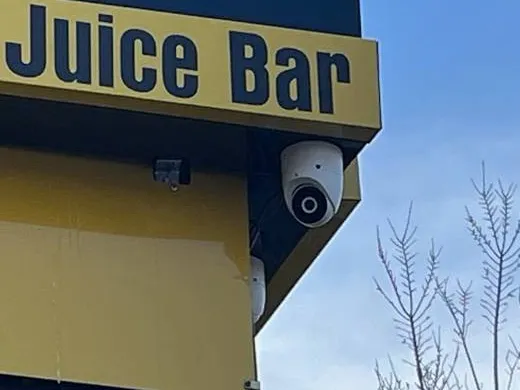
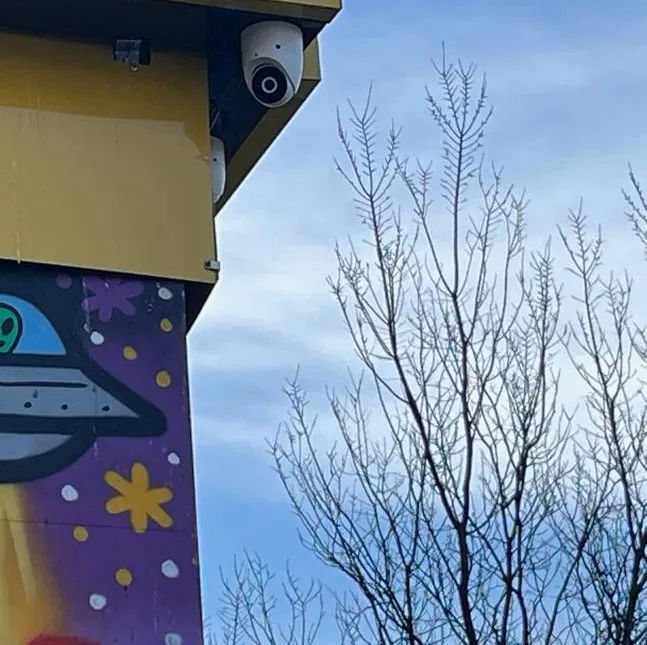
The hero photo and the close-up below come from a storefront job in our library, and they show a buying decision that matters on Long Island more than almost anywhere: where an outdoor camera can live so the weather never reaches the lens. The tenant had a deep, boxy sign fascia over the entrance, painted bright yellow, with a mural running down the pier beside it. We mounted a white turret dome on the underside of that fascia at the outside corner, with a second camera housing tucked just below it facing the other way. The overhang works like a built-in hood: rain, sleet and the low winter sun stay off the dome, and the camera looks along the storefront and out over the lot.

Two details on that job are the reason we sell the hardware we sell. First, the turret body. A turret has no plastic bubble over the lens, so there is nothing to fog in a cold snap, nothing to catch infrared bounce at night, and nothing to scratch. That makes turrets our default outdoor choice under an awning or soffit. Second, the wiring path. The cable comes down inside the fascia rather than across the face of it, so it is protected from weather and from anyone who wants to pull it. Outdoors on the Island, a camera rarely fails at the camera; it fails at an exposed connector that took on water.
The photo was taken on a clear day with bare trees behind the building. That is the season when Long Island outdoor cameras get tested: shorter days mean more hours on night vision, wet snow sticks to anything flat, and wind drives rain sideways under shallow eaves. If you are buying outdoor cameras this month, look for a published weather rating, a body style that suits your mounting spot, and night vision range that actually reaches the far edge of what you want to see. We list all three for every house-brand package further down.
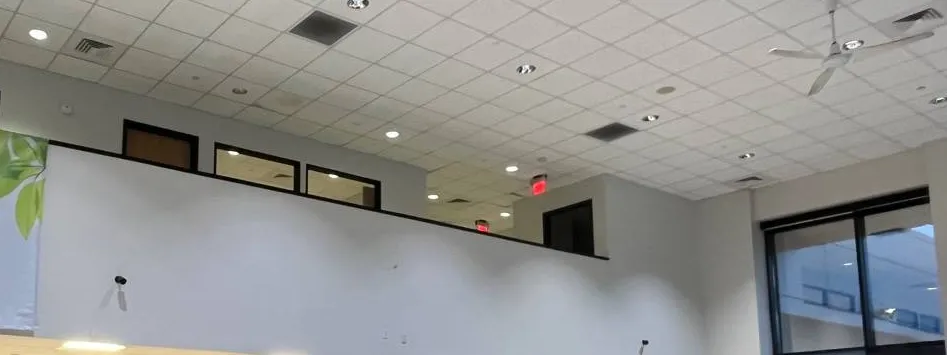
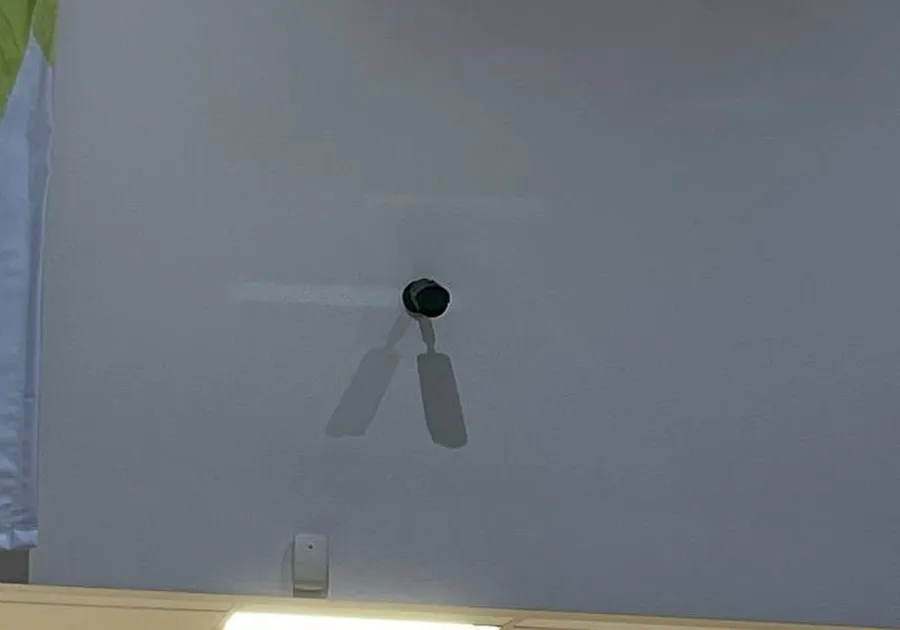
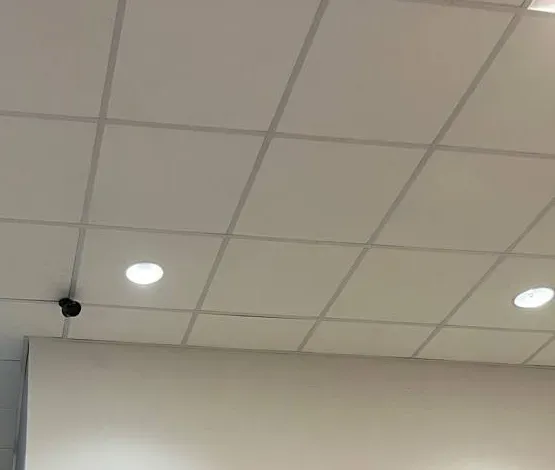
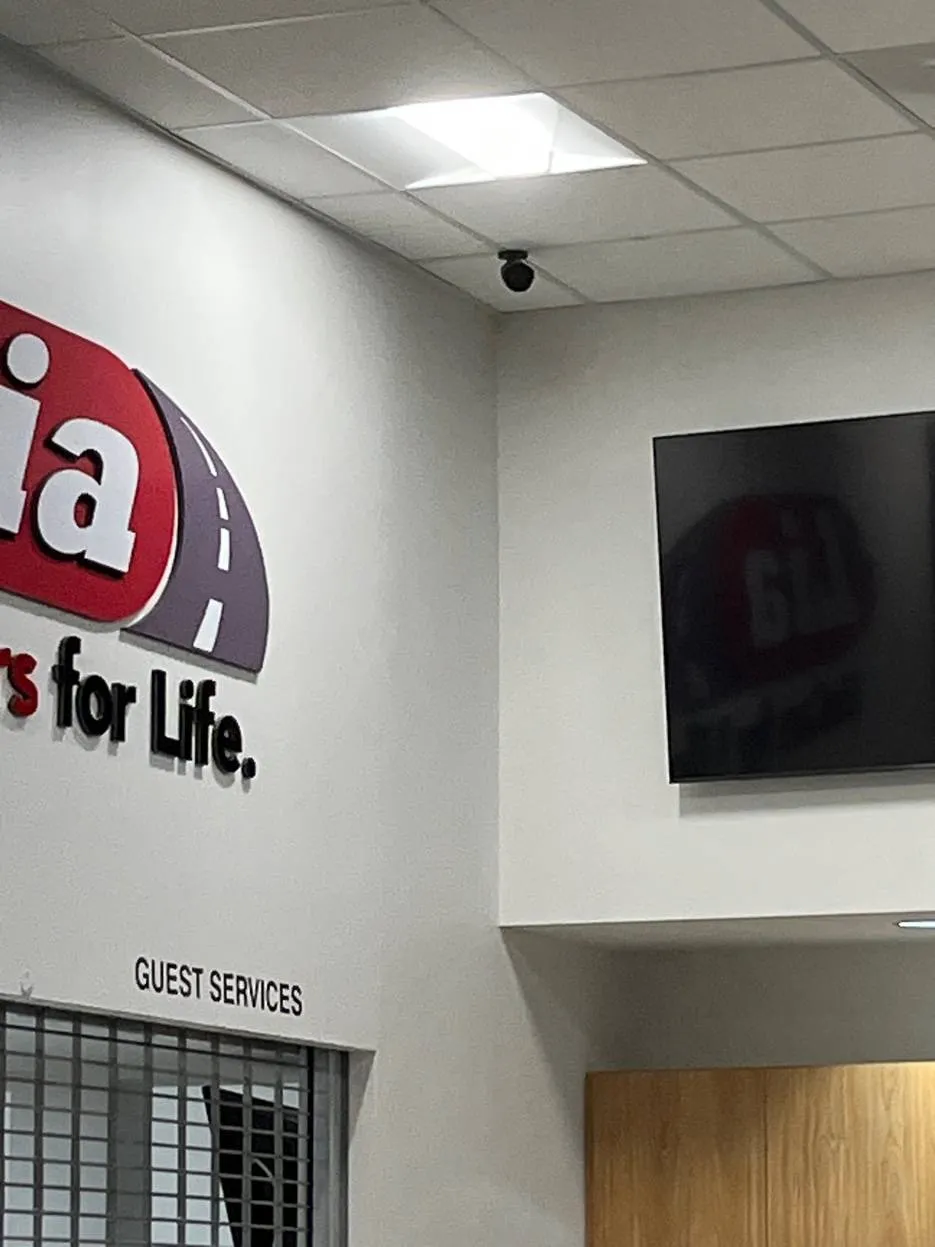
Indoors, the library photos further down this page show the other half of most commercial jobs: small black cameras on a tall mezzanine wall, at the edge of a ceiling grid, and high on a plain wall above an alarm motion sensor. The common thread is height and angle. A camera mounted high and aimed across a room sees faces and hands; a camera aimed straight down sees the tops of heads. Small indoor bodies also stay out of the way of signage, TVs, speakers and lights, which matters in a showroom or a service lobby where the room has to look finished. When you buy indoor cameras from us for your own install, we suggest the mounting height and angle for each one based on photos of the room.
Most people shopping for security cameras search by one of four things: where the camera goes (outdoor or indoor), how sharp it is (4K, 5MP, 2K), how it connects (PoE, Wi-Fi or wired analog) and what it looks like (dome, turret, eyeball, bullet, PTZ). Our Long Island store is organized the same way. Everything below can be bought equipment-only and delivered, or bought as part of an installed system; every item is call or text for today’s price.
Weather-rated turrets, domes and bullets for driveways, backyards, detached garages, docks and storefronts. We check the published IP rating before we recommend one for a South Shore or North Fork property.
Small domes and turrets for living areas, garages, basements, offices, stockrooms and registers. Indoor cameras are lighter and smaller and don’t need a weather rating.
The sharpest option we sell. Worth it where you need detail at distance: the end of a long driveway, a parking field, a dock, a loading area.
The middle ground. Noticeably sharper than 2K, lighter on storage than 4K, and the resolution in most of our full-color and deterrent packages.
The value tier. Fine for a front walk, a hallway or a stockroom where the subject is close to the lens. Our A-series kits are 2MP.
One network cable carries power and video to an NVR or PoE switch. Our default for new wired systems, because one cable is easier to protect outdoors.
No video cable, but they still need power, and they depend on your router. Good for a single spot near the house; weak for a garage at the back of a long lot.
Wired to a DVR over coax. The upgrade path for older Long Island systems where the coax is already in the walls.
Domes resist tampering, turrets avoid night-time glare, bullets show deterrence and reach, PTZ cameras pan, tilt and zoom on a large lot or plaza.
A note on wording, because shoppers ask. “CCTV” just means closed-circuit: cameras wired to a recorder you own. “IP camera” and “network camera” mean a camera that sends digital video over a network cable, usually to an NVR. “Analog” or “HD-analog” means coax to a DVR. All three are security cameras, and all three are on our shelf. If your question is specifically about wiring a closed-circuit system into a building, our CCTV installation guide for Long Island covers that side.
Winter security cameras are not a separate product; they are outdoor cameras with a weather rating and an operating temperature range that covers a Long Island January. The weather rating is the IP code. IP66 means the housing is dust-tight and protected against powerful water jets; IP67 adds protection against temporary immersion. Of the house-brand packages we list below, the 5MP F-series and E-series and the D4/D5 deterrent packages carry IP67 on their spec sheets, the 8MP C- and D-series carry IP66, and the 2MP A-series sheets list no IP rating at all, so we steer A-series buyers to sheltered spots under an eave or a porch roof. For name brands we read the manufacturer’s page: Reolink’s RLC-810A, for example, lists IP67, 4K (3840×2160) resolution, infrared night vision up to 100 feet and an operating range of 14°F to 131°F on its official spec page.
Two buying tips for weatherproof security cameras in winter. Pick a body style that sheds snow: turrets and domes have rounded tops that wet snow slides off, while a bullet’s flat sunshield can hold a ridge of it over the lens. And look at the mounting accessories as carefully as the camera. A junction box behind the camera keeps the cable splice out of the weather, and on a coastal property it is the piece that decides whether the camera is still working in March.

Indoor security cameras go where weather isn’t a factor but placement is. In a Long Island house that usually means the attached garage door to the kitchen, the basement entry, the main hallway or the stairs. In a shop it means the register, the stockroom and the inside of the front door at face height. The photos on this page show the pattern we follow on commercial ceilings: small cameras high on the wall or at the ceiling grid, angled down across a room rather than straight down, and kept clear of light fixtures so the image doesn’t wash out.
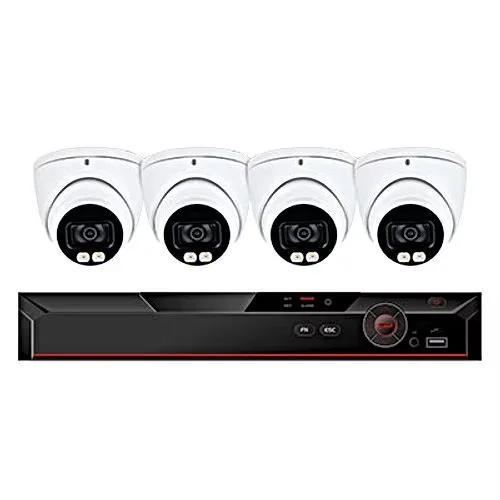
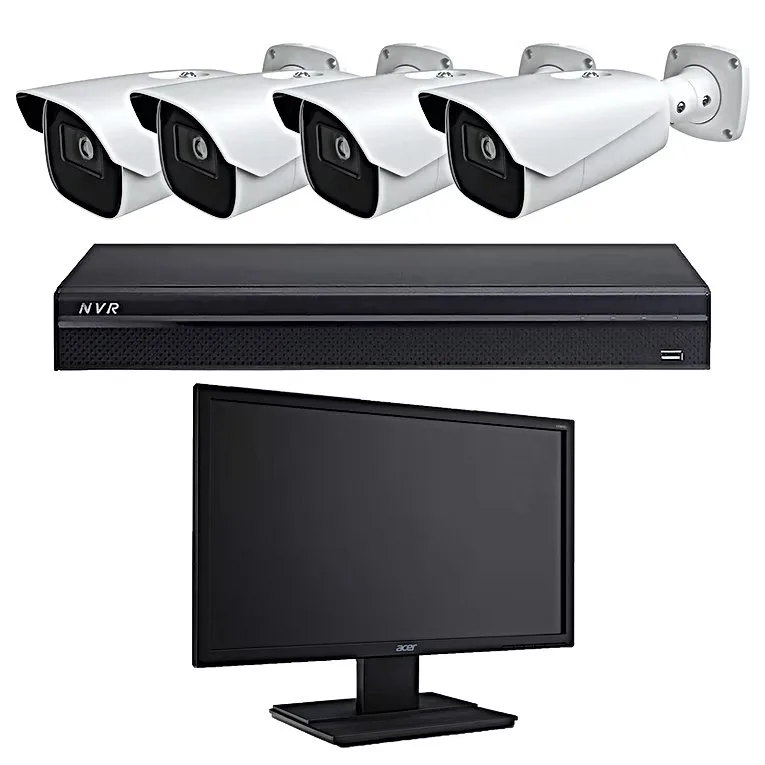
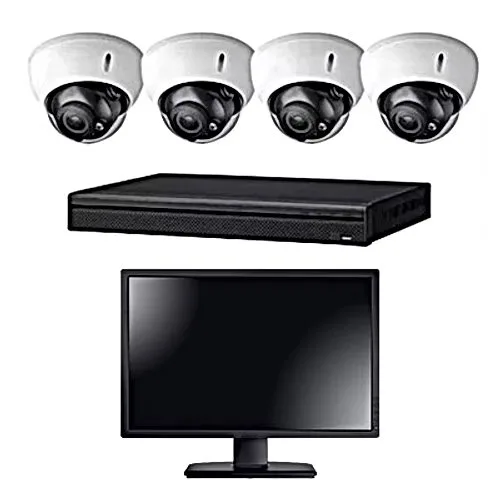
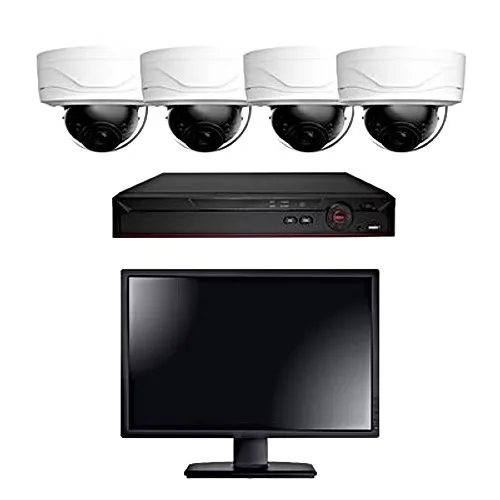
Our house brand is the default system on every quote, because we know how it holds up and we can support it after the sale. Each kit below is a four-camera package with its recorder; the spec lines are copied from the package sheets and nothing more. Prices change with the market, so each kit is call or text for today’s price, delivered to your door or installed. For the full catalog of what we carry, see our cameras.

A good fit for a front walk, a covered porch and a garage interior on a Nassau cape or ranch, where the subject comes close to the lens.
Call or text for today’s price.

Bullets read as a warning from the street. This kit suits driveways, side yards and the backs of strip-plaza units.
Call or text for today’s price.

A network system with room to grow: the 4K NVR can take 4K cameras later. Domes suit offices, entries and anywhere a camera may be reached by hand.
Call or text for today’s price.

Our pick when distance is the problem: a long driveway in Suffolk, a parking field, a dock or a boatyard fence line.
Call or text for today’s price.
Other packages in the same line include deterrent kits with a built-in siren, flashing lights and two-way talk (D4 and D5, with smart human and vehicle detection listed on their sheets), 8MP eyeball kits with full color at night, and 5MP IP eyeball kits on a 4K NVR. Every quote we send goes out as two options — a 2K-class system and a 4K system — so you can see what the extra resolution buys at your property before you choose.
The recorder is the part of a security camera system that people buy last and should think about first, because it decides how many cameras you can add, what resolution they can record at, and how many days of footage you keep. We sell network video recorders (NVRs) for IP cameras and digital video recorders (DVRs) for HD-analog cameras, from 4-channel units up to 64-channel recorders for plazas and multi-building sites.
| Recorder | Typical Long Island use | Notes |
|---|---|---|
| 4 channel NVR / DVR | Small house, a single storefront, a vacation cottage | Fills up fast; buy 8 if you might add a garage or backyard camera later |
| 8 channel NVR | Most detached homes, small offices, delis and restaurants | Room to add driveway, yard and garage cameras later |
| 16 channel NVR | Large homes with outbuildings, plaza tenants, auto shops, medical offices | Usually paired with a separate PoE switch |
| 32 channel NVR | Warehouses, schools, churches, HOA amenities, marinas | More drive bays for longer retention |
| 64 channel NVR | Multi-building campuses and shopping centers | Planned with network switches spread across the site |
A PoE NVR has a built-in switch, so cameras plug straight into the back and get power and data on one cable. A 4K NVR can decode and record 4K cameras; buying one now keeps the door open even if you start with 2K cameras. If you’re working through how to choose an NVR, our camera calculator helps with camera count and storage before you call.
Security recorders write video around the clock, so they need surveillance-rated hard drives built for continuous writing rather than a desktop drive. We stock 4TB and 8TB surveillance hard drives for most homes and small businesses and plan 16TB and larger storage for big systems or long retention, spread over multiple drive bays on larger NVRs. A drive is also the most common replacement part we sell, because it is the component that wears out first.
Here is the method we use, clearly labeled as an estimate: storage equals bitrate × hours × days × cameras. Bitrate depends on resolution, frame rate, compression (H.264 or H.265) and how busy the scene is, so treat every number below as an example, not a spec.
So security cameras with two weeks of recording on four 4K cameras fit comfortably on a 4TB drive in this example, and security cameras with one month of recording want an 8TB drive. A 2K system at a lower bitrate stretches the same drive much further. The recorder overwrites the oldest footage automatically once the drive is full, which is how security cameras record “forever” without you doing anything — the retention window is simply the drive size divided by the daily total.

Every system we sell records locally to the NVR or DVR on your property, which is why there is no monthly fee. You view live and recorded video on your phone through the recorder’s app. Some name-brand cameras also offer optional cloud plans; where a product actually offers cloud storage we will tell you what the plan covers, but you never need one to record. Hybrid setups — local recording plus cloud backup of motion clips — are possible on products that support them and are worth considering on a vacation home where a thief could take the recorder.
Accessories are where most Long Island camera systems succeed or fail, and they are the items buyers forget until the day of the install. We keep the parts that go between the camera and the recorder, and we sell them on their own to homeowners finishing a project and to contractors restocking a van.
Add ports and power when the NVR’s built-in switch runs out, or put a small switch in a detached garage so the far cameras have a short run.
Power one IP camera on a run where there’s no PoE switch — a single camera on a shed, for example.
Multi-output power boxes and individual 12V adapters for analog cameras and for IP cameras that aren’t on PoE.
Wall, pole, corner and pendant mounts, so a camera can reach past a gutter, wrap a building corner or hang from a high ceiling.
Weatherproof boxes behind the camera that hold the cable splice and connectors out of the rain — the single best accessory for a coastal house.
Cat6 for PoE runs; outdoor-rated, UV-resistant jacketed cable for anything exposed or buried in conduit.
BNC fittings for coax, and baluns that carry analog video over twisted-pair cable when the old coax is unusable.
Pre-made camera extension leads for short additions on an existing system.
Hard drives, power supplies, domes, mounts and cameras that match what you already own.
Distance is the accessory question we answer most on the Island. A standard Ethernet run for a PoE camera is limited to 100 meters (328 feet) from the switch. A camera at the end of a long Suffolk driveway, at the back of a deep Nassau lot or on a dock can exceed that, and the fix is usually a small PoE switch, a PoE extender, or a point-to-point wireless bridge between buildings rather than a longer cable. We’ll tell you which applies when you send the distance.
We don’t publish step-by-step wiring instructions on this page, on purpose. Cable that is crimped wrong, a splice left outside a junction box, or a camera on the wrong power supply is the most common reason a self-installed system fails within a year. If you’re buying parts for your own project, tell us what you’re connecting and we’ll make sure the parts match; if you’d rather not do it, our crew installs it.
These are the comparisons Long Island buyers ask about before they spend anything. The tables stick to how each technology works, not to any brand’s marketing; a check means the statement is generally true of that type of system.
| Wired (PoE or coax) | Wireless (Wi-Fi) | |
|---|---|---|
| Records with no Wi-Fi signal | ✓ | – |
| Keeps working when the router is down | ✓ | – |
| Reaches a detached garage or dock reliably | ✓ | Only with a strong signal or a bridge |
| Needs a power source at the camera | No for PoE — power rides the network cable | ✓ |
| Easier to put up without running cable | – | ✓ |
| Continuous 24/7 recording is the norm | ✓ | Often motion clips only |
| PoE IP camera | Wi-Fi camera | |
|---|---|---|
| One cable for power and video | ✓ | – |
| Rides through an outage when the switch is on battery backup | ✓ | Only if the router, camera power and internet all stay up |
| Affected by walls, distance and neighbor networks | – | ✓ |
| Good for a single indoor spot near the router | ✓ | ✓ |
| Needs internet to record | – | Depends on the product; many cloud-first models do |
| NVR (network video recorder) | DVR (digital video recorder) | |
|---|---|---|
| Works with IP / PoE cameras | ✓ | – |
| Works with HD-analog cameras on coax | – | ✓ |
| Cameras powered through the recorder or a PoE switch | ✓ | Separate power supply |
| Reuses coax already in the walls | – | ✓ |
| Typical path for new systems | ✓ | Common for upgrades of older wiring |
| 4K / 8MP | 2K / 2MP–4MP | |
|---|---|---|
| Reads detail at the far end of a driveway or lot | ✓ | Closer subjects only |
| Uses less storage and bandwidth per camera | – | ✓ |
| Lets you zoom into recorded footage | ✓ | Limited |
| Enough for a front step or a hallway | ✓ | ✓ |
| Needs a recorder that supports 4K | ✓ | – |
| IP camera | HD-analog camera | |
|---|---|---|
| Digital video over network cable | ✓ | – |
| Smart detection features available on many models | ✓ | Fewer models |
| Runs on existing coax | – | ✓ |
| Can be added to a network switch anywhere on the site | ✓ | – |
| Local (NVR / DVR) | Cloud | |
|---|---|---|
| Monthly fee required to keep recordings | – | Usually |
| Footage survives an internet outage | ✓ | – |
| Footage survives the recorder being stolen | – | ✓ |
| Uploads use your internet bandwidth | – | ✓ |
| What our systems use by default | ✓ | Optional on products that offer it |
If you’re comparing brands rather than technologies, our best security camera brands guide lays out the brands we sell and install side by side, and the name-brand cameras page lists what we carry beyond the house brand.
Long Island housing is mostly detached single-family homes — capes, ranches, split-levels, colonials and high ranches on their own lots — with condos and co-ops near the train lines and in the village centers, and seasonal houses concentrated on the East End and the barrier beaches. Here is how the equipment changes with the property.
Four cameras: front door and walk, driveway, backyard, and one side yard. A 4- or 8-channel recorder; attic access usually makes cable runs simple.
Six to eight cameras. The garage camera often needs its own small PoE switch or a bridge, because the run back to the house is long.
Long-range 4K cameras for the driveway entrance, plus a camera at the house end so you get both the plate and the face.
A wide-angle turret over the yard and a camera on the shed or pool house; full-color night vision helps where there’s patio lighting.
IP66/IP67 housings, junction boxes, and stainless or coated mounts away from direct spray; a camera on the dock if you keep a boat.
Your own door and parking space on your own unit’s equipment; common areas only with the board’s approval and on its system.
For a detached house on a typical suburban lot, four is the floor and six to eight is common. Count the ways a person or a car can reach the house — front walk, driveway, side gates, back fence, garage — and make sure each one passes a camera close enough to read a face or a plate. A corner lot adds a second street. A long driveway adds a camera at the road end. A detached garage or pool house adds one each. Indoor cameras are a separate decision; most homeowners add one at the door from the garage and one at the main stairs.
A summer house in the Hamptons, on the North Fork or on Fire Island that sits empty for months needs a different shopping list than a year-round home. The equipment has to keep recording through winter storms with nobody there to reset it, and somebody has to be able to look in from far away. We put the recorder somewhere less obvious than a living-room shelf, put it and the modem on battery backup, and set retention long enough that a break-in discovered in April is still on the drive. Where a product supports it, a cloud backup of motion clips covers the case where a thief takes the recorder. Cellular routers handle houses where the internet is shut off for the season.
Security cameras for holiday package theft need two angles, not one. A doorbell camera or a small turret at the door catches the face at close range; a second camera covering the walk and the curb catches the car and the direction it leaves in. That second view is what a detective wants. Mount the door camera at about head height rather than high under the eave, so it sees faces instead of hat brims.

What Long Island buyers ask for changes with the calendar. This is the pattern we see, season by season, and what it means for what you buy.
From November through the end of December, the calls are about front steps and deliveries. People want a camera that catches the face at the door and a second view of the street, and many want it before the holiday shipping peak. At the same time, owners on the East End and the barrier beaches are closing seasonal houses and want to be able to look in from wherever they spend the winter. Both needs point to the same purchase: a recorder-based system with remote viewing, cameras at the door and the driveway, and battery backup.
In January and February the cameras spend most of every day on night vision, nor’easters push rain and snow sideways, and power lines come down. Weak points show up fast: a camera with a dome bubble fogs, a bullet’s sunshield collects a ridge of snow, an exposed connection takes on water, and a system with no battery backup goes dark in every outage. Buyers who order in winter should prioritize published weather ratings, turret bodies under eaves, junction boxes and a UPS sized for the system.
When seasonal owners open their houses in April and May, some find a forced door or a broken window and want to know when it happened. That is when the retention setting matters: a recorder set to keep two weeks will have overwritten a February break-in. The lesson for anyone buying now is to size the drive for the months the house sits empty, not for a typical two weeks.
Summer purchases are about backyards, pools, docks and rental turnover. Pool and yard cameras want wide-angle turrets and full-color night vision where there is patio lighting. Boat owners want a camera on the slip and the approach from land. Owners who rent out their homes in season ask about cameras on the exterior and the driveway only, to keep guests’ private spaces private, and about checking the property between bookings.
August through October is hurricane season, and storms like Isaias are why Long Island buyers ask about battery backup more than buyers anywhere else we work. It is also when businesses plan upgrades before the holiday rush — retailers adding register and entrance cameras, restaurants replacing an old DVR, warehouses adding dock coverage ahead of their busiest months.
Long Island’s commercial property is spread along the turnpikes and highways: strip plazas and shopping centers on Hempstead Turnpike, Jericho Turnpike, Sunrise Highway and Route 110; industrial parks such as the Hauppauge Industrial Park; marinas and boatyards along both shores; and medical, dental and professional offices in converted houses and office parks. Business owners buy from us equipment-only when they have their own electrician or IT contractor, and buy installed when they don’t.
Point-of-sale cameras over the register, a face-height camera inside the door, and an outdoor camera on the lot and the rear service door.
Register and cash-drawer views, a kitchen camera, back door and dumpster area; audio only where the law allows (see below).
Long-range 4K cameras on lot rows and bay doors; license plate capture cameras at the entrance where a spec sheet supports it.
Weather-rated cameras on fence lines, gates and docks, with switches placed to keep cable runs short.
High-mounted cameras over dock doors and aisles, and 16- to 64-channel NVRs with long retention.
Reception, entrances and records rooms; nothing in exam or treatment rooms.
Entrance, counter and floor coverage; gyms keep cameras out of locker rooms and changing areas.
Entrances, parking and hallways, planned with the administration or board.
Gate, fence line and drive-aisle coverage, often with PTZ cameras on poles.

Supermarkets and big-box retailers in Suffolk have an extra reason to plan carefully. In April 2021 Suffolk County expanded its S.H.A.R.E. program, which originally gave police access to school CCTV during an emergency, to supermarkets, shopping centers and big-box stores that choose to connect their cameras to the county police crime center, according to WSHU. In Nassau, the police department’s SPiN (Security/Police Information Network) is a crime-prevention partnership with the private sector that sends members incident alerts and whose Security Advisory Council produced digital video surveillance guidelines. Neither program requires you to buy any particular equipment, but both work best when the cameras record clearly and the owner can export a clip quickly.
Commercial buyers often ask for an installed quote and an equipment-only quote at the same time so they can compare. That’s fine; we send both. The pricing section further down this page explains what moves the number on a commercial system.
Camera boxes are covered in acronyms. Here is what they mean and how we handle them, because a feature only counts if the product’s spec sheet says it has it.
Active deterrence security cameras — with a siren, strobe light and two-way talk — are popular on Long Island driveways and plaza back doors, because they turn a recording into an interruption. Two-way audio security cameras let you speak through the camera from your phone. If audio recording is part of your plan, read the next section first.
This is general information with sources, not legal advice. New York State law applies across Nassau and Suffolk; villages and HOAs can add their own rules about what goes on a building.
When customers ask “are security cameras legal on Long Island?” the honest short answer is yes for video of your own property, with care needed around audio and around anyone else’s private space. If you run a business with employees, ask your attorney or HR advisor about notice before you install.
Shoppers who call us after buying the wrong thing usually skipped one of these decisions. Work through them in order and the shopping list writes itself. None of this is wiring instruction; it is the thinking that happens before anything gets mounted.
Start outside, not on a website. Walk from the street to every door and write down each place a person or a car can come in: the front walk, the driveway apron, the side gate by the trash cans, the back fence along the neighbor’s yard, the path to the dock, the detached garage door. Then decide what you need from each one — to identify a face, read a plate, or just see that something moved. That list is your camera count, and it is usually longer than people expect on a Long Island lot.
For each spot, estimate how far the camera will be from what it needs to see, and how far the camera will be from where the recorder sits. The first number decides resolution and lens: identifying a face at the end of a long driveway takes more pixels than seeing a face at the front door. The second number decides how the camera connects: under about 300 feet of cable, a PoE camera runs straight back to the recorder; beyond that, you add a switch or a bridge. Distances are the information we ask for first when you call.
Once you know the distances, choose PoE, Wi-Fi or HD-analog for each camera, and the recorder follows: an NVR for IP cameras, a DVR for coax. Then choose channels with room to spare. A house that needs five cameras today should buy an 8-channel recorder; a plaza unit planning ten cameras should buy 16. Adding a camera to a recorder with a free channel is simple; adding one to a full recorder means buying a new recorder.
Use 4K/8MP where the subject is far away or where you will want to zoom into recordings later — driveways, parking fields, docks, loading areas. Use 5MP or 2K where the subject is close — doors, hallways, registers. Mixing resolutions on one recorder is normal and saves storage. Our quotes show a 2K-class and a 4K version of the same layout so you can see the difference in parts.
Two weeks is enough for most homes, because you usually know about a problem within days. Businesses, landlords and seasonal homes often want a month or more, because an incident may not be noticed for weeks. Days of retention decide the hard drive size, using the estimate method in the storage section above.
Every outdoor camera needs a weather-rated body, a junction box or sealed connection, and a mounting spot that shelters it where possible. The recorder, switch and modem need a battery backup. On the coast, add corrosion-resistant mounts. These are inexpensive next to the cameras and are the difference between a system that lasts and one that fails the first winter.
Viewing security cameras on a phone is done through the recorder’s app, which connects to the NVR or DVR at the property. Ask before you buy whether the app is supported for your phone and whether more than one family member or manager can have their own login. To keep a system from being hacked, change every default password to a unique one, keep firmware current, give each user their own account, and avoid opening ports on your router to the cameras. When we install a system, we set those up and show you how to keep them that way.
If you would rather hand all seven decisions to someone else, that is what our installed packages are for. If you would rather make them yourself and buy the parts, call or text the list and we will check it before anything ships to your door.
These are the questions Long Island callers ask before they buy, answered the way we answer them on the phone.
From us, by phone or text, delivered to your home or business anywhere in Nassau or Suffolk, or installed by our crew. Big-box stores and online marketplaces sell boxed kits, and they are fine if you are comfortable choosing and wiring a system yourself. What a local supplier adds is matching: the right recorder for the cameras, a drive sized for the days you want to keep, the PoE switch and mounts the property needs, and someone to call when the app stops connecting.
Tell us the town, the property and what you want to see, and we send back a parts list with a 2K option and a 4K option. You choose equipment-only or installed. There is no checkout on this site; every order goes through a call or a text so we can confirm the parts fit before anything leaves our hands.
For most detached homes in Nassau and Suffolk, the best system is a wired PoE setup: four to eight outdoor turret or dome cameras on an 8-channel NVR with a surveillance hard drive, the recorder and modem on battery backup, and the phone app for remote viewing. It records without Wi-Fi, keeps running through short outages, and reaches a detached garage that a Wi-Fi camera won’t.
Resolution depends on distance. If the farthest thing you want to identify is the front walk, 2K or 5MP is enough. If it’s a car at the end of a 90-foot driveway or a boat at the end of a dock, a 4K/8MP camera earns its extra storage. That’s why our quotes always show both.
For a big yard, yes. A wireless camera still needs power, and its video has to cross the house, the deck and the yard to the router; every wall and every foot of distance cuts the signal. The cameras that drop out first are always the ones farthest away — the garage, the shed, the pool house — which are usually the ones you bought them for.
Wireless still has a place: a single indoor camera, a rental where you can’t run cable, or a temporary view while you renovate. For anything you’d want footage from after a break-in, wired is the safer purchase.
Wired cameras on an NVR or DVR don’t. They record to the hard drive in the recorder whether or not the internet is up. Wi-Fi or internet is only needed to view the cameras remotely and to get phone alerts. Many consumer Wi-Fi cameras are different: they depend on the network to reach their cloud service, and some stop recording when it drops.
This matters on the Island because internet service goes down in the same storms that bring trouble, and seasonal homes often have service suspended for the winter. A local recorder keeps footage either way.
A battery backup (UPS) on the recorder, the PoE switch and the modem. PoE cameras draw their power from the switch, so as long as the switch has power, the outdoor cameras keep recording. Without a UPS, the whole system goes dark the moment the power drops.
We size the UPS to the camera count; it carries the system through short outages and lets the recorder shut down cleanly in a long one so the hard drive isn’t damaged. For a property that loses power often, a whole-home generator is the next step, and that’s an electrician’s job.
Start with a published weather rating — IP66 or IP67 — and then look past the camera to the mount and the connections, because those corrode first. A junction box behind every outdoor camera keeps the cable splice dry, and mounting under an eave, soffit or fascia keeps spray and driving rain off the housing.
On waterfront houses in places like Freeport, Lindenhurst or Greenport we also avoid pointing cameras straight at the water, where reflections at night confuse motion detection, and we check every exterior entry for a drip loop and a sealed penetration.
Rarely, if you want to identify anyone. A wide-angle camera over the garage sees the whole driveway but turns a car at the street into a few dozen pixels. The reliable approach is two cameras: a long-range 4K camera aimed at the driveway entrance for the vehicle and plate, and a second camera nearer the house for faces.
On a flag lot or an estate driveway that runs past 300 feet, the camera at the road end usually needs a small switch or a wireless bridge to get back to the house. Send us the distance and we’ll tell you which.
Yes. Suffolk County Police run a voluntary camera registration program where residents and businesses list where their cameras are, so that after a crime officers know whose footage might help. It was expanded to include home cameras such as doorbells. Registration doesn’t give police live access; they ask, and you decide.
When we hand over a system we leave a camera map showing each camera’s location and view, which makes registering simple. In Nassau, the police department’s SPiN network is aimed at businesses and security managers rather than homeowners.
Yes. We deliver to homes and businesses across Nassau and Suffolk, from the Queens line out to the Hamptons, the North Fork and Montauk. Call or text with the address and what you’re buying and we’ll arrange it. We don’t have a pickup counter, so delivery replaces the drive to a store.
We don’t promise same-day delivery or a delivery window on this page; we confirm the timing when you order, because it depends on what’s in stock that day.
Yes. Plenty of Long Island buyers order equipment in November and December and book the install for a dry stretch later. If you buy from us equipment-only and later want our crew to install it, we quote the labor by phone or text. Installation is booked within 2 hours of your request, scheduled 7 days a week with early-day visits, first come, first served once paid.
If you plan to install it yourself, tell us so when you order and we’ll include the mounts, junction boxes and cable lengths that fit your house.
We sell to installers, electricians, IT contractors, property managers and businesses buying in quantity. Call or text for a trade quote with the item list and quantities. We don’t publish trade price lists or tiers; each trade order is quoted on its own.
Bulk security camera orders for a plaza, a multi-site business or an HOA are also quoted that way, and we can split delivery across addresses.
Usually, yes, inside your own unit and often on your own storefront, but check the lease first. On Long Island plazas the landlord’s cameras typically watch the parking field and the common walkways; they rarely see your register, your stockroom or your rear door, and you may not be able to get footage from them quickly when you need it. A tenant system of four to eight cameras on its own recorder covers what the landlord’s doesn’t.
Exterior mounts on the fascia or the rear wall generally need the landlord’s written OK, and some centers specify where cable can enter the building. Send us the lease rule or the property manager’s contact and we’ll plan the equipment around it.
Two cameras do it better than one. A camera at the door, mounted around head height, gets the face; a second camera covering the walk, the curb and the street gets the vehicle and which way it went. The October 2023 Nassau thefts reported by police all followed the same pattern — walk up, take the box, leave — which is exactly what those two views record.
Full-color night vision helps after dark, and a camera with a spotlight or siren can stop the theft rather than just record it.
Send the town, the property and what you want to watch. We reply with a 2K and a 4K option and today’s price, delivered or installed.
AI search answers about buying security cameras are written for an average house in an average place. Long Island has bigger lots, salt air, storm outages and a lot of empty winter homes. Here are seven claims we see repeated, and what we see on real properties.
A doorbell camera watches one door from one height. On a Long Island lot it misses the driveway, the side gates, the backyard and the detached garage — the places where cars are broken into, bikes and tools disappear, and someone tries a back door.
The doorbell is still useful. It gets the face of whoever comes to the front step, and it lets you answer the door from your phone. It just isn’t a system.
The fix is a small recorder-based system with the doorbell as one view among four to eight. Many recorders can show a compatible doorbell alongside the other cameras.
On a small apartment, they can be. On a house with a pool and a shed out back, the signal has to cross exterior walls, a deck and open yard, and it competes with every neighbor’s network. The cameras at the edge of the property drop first.
Wireless cameras also still need power. Battery cameras need charging, and the camera you forget to charge is the one that misses the event.
Wired PoE cameras solve both problems with one cable, and they keep recording when the Wi-Fi doesn’t.
Cloud storage protects against one thing: someone stealing the recorder. It does nothing when the internet is down, and on the Island the internet often goes down in the same storm that takes the power.
Local recording is continuous, has no monthly fee and doesn’t depend on your upload speed. The risk of theft is handled by putting the recorder somewhere less obvious and, on products that support it, backing up motion clips to the cloud.
For a seasonal home, that hybrid approach is often the right answer. For a year-round house, a well-placed recorder on battery backup is usually enough.
Resolution helps when the subject is far away. On a front step three feet from the lens, 2K already shows a face clearly, and 4K just fills the hard drive faster.
Where 4K earns its keep is distance: the end of the driveway, a parking field, a dock. Placement matters as much as pixels; a 4K camera aimed into the sun or too high on a wall records a sharp image of nothing useful.
That’s why our quotes come as a 2K option and a 4K option, with the cameras that need the extra detail called out.
“Outdoor” on a box is not a rating. The IP code on the spec sheet is the rating, and some budget cameras don’t list one at all. Our own A-series sheets don’t, which is why we put those cameras under cover.
Even a well-rated camera fails if its connection is left exposed. Water gets into an unprotected splice and the camera goes dark months later.
Near salt water, add junction boxes, sealed entries and corrosion-resistant mounts to the shopping list.
Not with a recorder-based system. The NVR or DVR app shows live and recorded video on your phone with no subscription; the recorder is doing the storage.
Subscriptions come from cloud-first consumer cameras, where the plan pays for storing your clips on the company’s servers.
If a no-monthly-fee security camera system is the goal, buy a system that records locally and use the cloud only where you want it.
The cameras in a boxed kit may be fine. What the box can’t do is know your property: how long the driveway is, whether the garage is 40 or 140 feet away, whether the house is on a canal, how many days of footage you want to keep.
A local supplier matches the recorder, the drive, the switch and the mounts to the place, delivers the right parts, and answers the phone when the app needs resetting after a router change.
And if you’d rather not climb a ladder in January, the same supplier can install it.
Tell us the town, the property and what you want — a single camera, a full kit, a recorder, a hard drive, a PoE switch — and whether you want it delivered or installed. Photos of the driveway, the outside corners of the building and any existing equipment help. Installers and property managers: choose trade quote and list the items and quantities. Prefer to talk? Call (800) 486-0943.
From the first text to the day your cameras are live on your phone, whether you buy equipment only or have us install it.
Call, text or use the form with your town, the property, what you want to watch and whether you want equipment only, installed, or a trade quote.
We send a parts list in two versions — a 2K-class system and a 4K system — with the recorder, drive, switch and mounts matched to the property.
Equipment is priced the day you ask. Installed systems get a written price; on Long Island they start at $999 for four house-brand cameras.
Equipment-only orders are delivered to your home or business. Installed orders are booked within 2 hours of your request, first come, first served once paid.
We bring the order to your Long Island address. There is no pickup counter, and timing is confirmed when you order.
Our crew mounts the cameras, runs and seals the cable, and sets up the recorder, PoE switch and battery backup, 7 days a week with early-day visits.
Recording schedules, motion zones, alerts, passwords and firmware are set, and night images are checked before we leave.
We set up the app on your phones, show playback and clip export, and stay on call for questions about what we sold you.
We deliver and install across both counties. These are some of the places our vans pass on Long Island runs, and the kind of equipment people around them tend to buy.
Plaza tenants, restaurants and offices buying register, entrance and lot cameras.
Waterfront houses from Freeport to Massapequa buying weather-rated cameras, junction boxes and dock coverage.
Warehouses and light industry buying 16- to 64-channel NVRs and long-range 4K cameras for docks and fences.
Village shops and harbor homes buying discreet domes and turrets for older buildings.
Farm stands, wineries and seasonal homes buying driveway and outbuilding cameras with long runs.
Second homes in the Hamptons and Montauk buying systems with remote viewing and battery backup for the off-season.
We also serve Levittown, Hicksville, Garden City, Long Beach, Great Neck, Glen Cove and Oyster Bay in Nassau, and Huntington, Babylon, Islip, Smithtown, Brookhaven, Southold, Southampton, East Hampton and Shelter Island in Suffolk.
Installed security camera systems on Long Island start at $999 for four house-brand cameras with the recorder, wiring and installation. That is the only fixed number on this page, and it comes from our Long Island price page, which has every installed package. Equipment bought on its own is quoted the day you ask — call or text for today’s price — because camera and drive prices move with the market.
If the budget is the first question, our affordable security cameras guide explains where you can save without losing the footage that matters. Name-brand equipment is priced at the manufacturer’s MSRP.
Installation work carries our 30-day workmanship warranty, and longer coverage is available as a paid add-on. Full terms β including 50% deposit, one-year parts-only warranty on Abstract Enterprises Security Systems-supplied products, and the late-fee schedule β are set out in the service agreement. Equipment bought without installation carries the manufacturer’s warranty, and we help you with the manufacturer if a part fails.
Black Friday is November 27, 2026, and a lot of Long Island households buy cameras that week because package deliveries peak right after it. We don’t run countdown sales or invent discounts; if we have a real promotion it will be stated plainly when you call. The useful Black Friday advice is about what to buy: a camera system that records locally (so there’s no subscription hiding behind a low sticker price), cameras rated for outdoor winter use, and a recorder with room for the cameras you’ll add next year. If you’re buying a holiday bundle elsewhere, check that the recorder has enough channels and the drive is surveillance-rated before you open the box.
Delivery, not pickup. Call or text and we’ll deliver it to your home or business on Long Island. We don’t run a pickup counter, so there’s no same-day pickup; delivery is how equipment-only orders reach you, and we confirm timing when you order rather than promise a window here.
Trade and bulk. Installers, electricians, property managers, HOAs and businesses buying in quantity call or text for a trade quote. We quote each order on its own; there are no published trade tiers.
Equipment you already bought. If you bought cameras online or from a store, we install them. Send the brand and model and photos of where they go, and we quote a labor-only price by phone or text, booked with the deposit. We’re official partners for Lorex camera installation on Long Island, Luminys camera installation and Reolink camera installation, and we install and support other brands customers already own.
What arrives in the box. Equipment-only orders come as the parts you confirmed: cameras, the recorder with its hard drive installed, power supplies or a PoE switch, and the mounts, junction boxes and cable you asked for. If we built the parts list from your photos, we label which camera goes where so the layout we planned is the layout you mount. Keep the boxes and paperwork; the manufacturer’s warranty runs from the purchase.
Help after you buy. Equipment we sell gets phone and text support from the people who sold it: setting up the app on a new phone, adding a family member’s login, changing the recording schedule, or figuring out why a camera dropped off after a router swap. If a problem needs a visit, we quote it like any other service call. Buying locally on Long Island means the answer is a call away rather than a support ticket.
Before you order, have ready: the town, the property type, a rough count of cameras, the farthest distance from the recorder to a camera, whether you want 2K or 4K (or both options quoted), how many days of recording you want, and whether you need delivery only or installation. With that in hand, we can send the parts list and today’s price without a site visit for most homes.
Stores, offices, restaurants and plazas in Nassau and Suffolk.
Driveways, yards, garages and front doors on Long Island houses.
Network video recorders, drives and PoE for IP camera systems.
Replace an aging DVR and keep the coax that still works.
Front-door cameras mounted and connected to the rest of the system.
Light and video together over driveways and back doors.
Wi-Fi cameras where a cable run truly isn’t possible.
Pole-mounted coverage for plaza and office parking fields.
Dead cameras, full drives and apps that stopped connecting.
Lens cleaning, drive health checks and firmware updates.
Send details and photos for a written price.
It depends on the hard drive size, the number of cameras, the resolution and whether they record continuously or on motion. A typical four-camera system with a correctly sized drive keeps about two weeks to a month; the recorder then overwrites the oldest footage automatically. We size the drive to the number of days you want when you order.
Any camera that records to a local NVR or DVR. Every system we sell records on the property, and you view it on your phone through the recorder's app without a subscription. Cloud plans only apply to products that offer them, and they are optional.
Call or text Abstract Enterprises Security Systems and we deliver the equipment to your home or business anywhere in Nassau or Suffolk, or install it. We don't run a walk-in counter; ordering by phone or text lets us confirm the parts match your property first.
Wired outdoor cameras with a published IP66 or IP67 rating, a recorder hidden away from the main rooms, battery backup on the recorder and modem, and remote viewing on your phone. Where the product supports it, add cloud backup of motion clips in case the recorder is taken, and a cellular router if the internet is shut off for the season.
It covers a complete installed system of four house-brand cameras with the recorder, wiring and installation. The price rises with resolution, camera count, recorder channels, storage days and long or difficult cable runs, and every quote comes as a 2K and a 4K option.
Yes. Send the brand and model of the cameras and recorder and photos of where they go, and we quote a labor-only price by phone or text, booked with the deposit.
Usually. Send the recorder's brand and model and we check how many channels are free, whether it supports the resolution you want and what drive it takes. If it is full or too old, we quote a replacement recorder that keeps your existing cameras where possible.
We book your installation within 2 hours of your request and schedule visits 7 days a week with early-day starts, first come, first served once paid. We don't promise same-day installation.
We don't invent sales or countdowns. If a real promotion is running, we'll tell you when you call or text. Black Friday is November 27, 2026, and it is a good week to plan a system because package deliveries peak right after it.
Abstract Enterprises Security Systems, a licensed New York State low-voltage contractor (license #12000287431), insured and owner-operated since 2002. We support what we sell by phone and text, and equipment bought without installation also carries the manufacturer's warranty. Our offices are in Brooklyn and the Bronx, and we deliver and install across Nassau and Suffolk.
Lorex, Luminys and Reolink are our official partners, and we sell, install and support other name brands where customers ask for them. Name-brand equipment is priced at the manufacturer's MSRP; call or text for today's price.
On our Google Business Profile, where the business is rated 4.7 stars across 201 Google reviews. We don't publish testimonials on this site.
Our security camera store pages each cover their own area: security cameras in NYC · security cameras in Manhattan · security cameras in Brooklyn · security cameras in the Hudson Valley · security cameras on Long Island (this page).
Call or text for today’s price. We deliver to your home or business in Nassau or Suffolk, or install it — booked within 2 hours, 7 days a week.
We deliver security cameras, recorders and accessories to every town in Nassau and Suffolk and install them with our own crew. Back to the Abstract Enterprises Security Systems home page.
Abstract Enterprises Security Systems is a licensed NYS low-voltage contractor (license #12000287431), insured, with offices at 1282 Troy Ave, Brooklyn, NY 11203 and 460 E Fordham Rd, Bronx, NY. Rated 4.7β / 201 Google Reviews.
Sources: FOX 5 New York, Nov 7 2023 β Nassau police on package thefts in Massapequa Park, Massapequa, Wantagh · CBS New York, Nov 7 2023 β porch pirates in Nassau County · Long Island Press β Nassau County crime 2024 (NYS DCJS data) · Officer.com, Aug 2019 β Suffolk County Police camera registration program · WSHU, Apr 20 2021 β Suffolk County expands S.H.A.R.E. camera initiative · Nassau County Police Department β SPiN · Newsday via NYSenate.gov β LIPA report on Tropical Storm Isaias · Town of Southampton Housing Plan, Oct 2022 · Reolink RLC-810A specifications · NY Penal Law Β§250.05 · NY Penal Law Β§250.00
Last updated November 21, 2026. Written by Abstract Enterprises Security Systems. Equipment prices are quoted the day you call or text; the installed starting price comes from our Long Island price page.