Buying cameras for a barn, a long driveway or a weekend house? Call or text for today's equipment prices and delivery anywhere in Westchester, Rockland, Orange, Putnam, Dutchess or Ulster: (800) 486-0943
Security cameras in the Hudson Valley: buy the equipment only and we deliver it to your home or business, or have a complete system installed from $1,099 for four cameras with the recorder, wiring and two weeks of local recording. Abstract Enterprises Security Systems sells the cameras, NVR and DVR recorders, surveillance hard drives, PoE switches, mounts, junction boxes and cable that country properties actually need, picked by a licensed installer who has run cable to barns, gates and warehouse docks across Westchester, Rockland, Orange, Putnam, Dutchess and Ulster. Everything we sell records on your property, so it keeps working when the internet drops, and none of it needs a monthly fee.
Last updated November 21, 2026 by Abstract Enterprises Security Systems, NYS license #12000287431 · Sources: NYS DCJS Index Crimes by County, 2024 (data.ny.gov); U.S. Census Bureau ACS 2023 5-year estimates (DP04, B25004); National Weather Service Albany, Poughkeepsie climate report, January 2026; Ulster County Executive, September 25, 2025; News 12 Hudson Valley, June 9, 2026; manufacturer spec pages (Lorex, Reolink); NY Penal Law §250.05
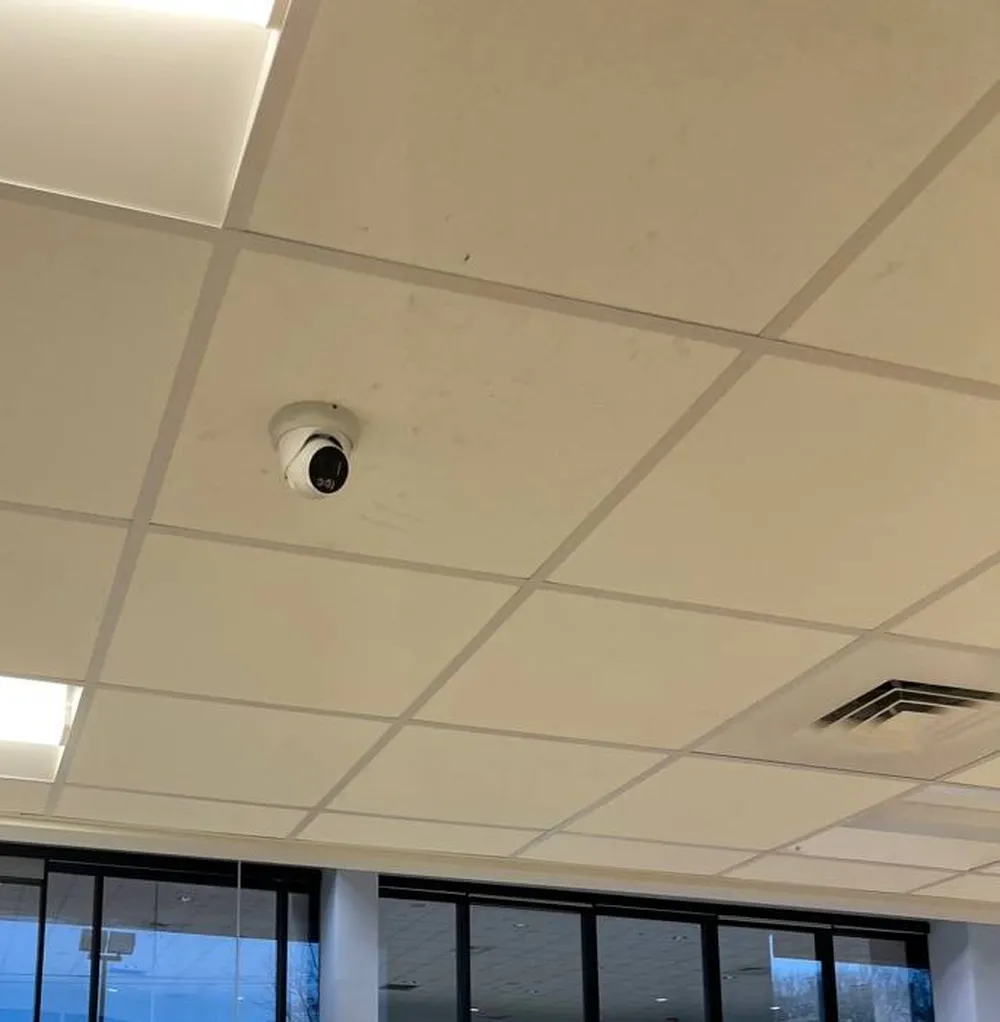
From our job library: a white turret dome mounted on a single drop-ceiling tile, angled toward a wall of tall windows, the kind of indoor mount that covers an open sales floor or office from one point.
Hudson Valley Camera Order or Quote
Equipment delivered, a full installation, or a trade quote: tell us the town and what you want to see
✅
Request Sent!
Thank you. We will call or text you back, usually within 2 hours of your request.
25+
Years Experience
2 Hr
Booking
100%
Licensed & Insured
4.7★
201 Google Reviews
Owner-operated since 2002 · Thousands of jobs completed · Booked within 2 hours
Quick answer: you can buy security cameras in the Hudson Valley from Abstract Enterprises Security Systems as equipment only, delivered to your address in any of the six counties, or as an installed system starting at $1,099 for a house-brand 4-camera package with the recorder, the wiring and two weeks of recording. Equipment prices change with the market, so every camera, recorder, drive and accessory is quoted as “call or text for today's price.” Systems record locally with no monthly fee, every camera quote comes as a 2K and a 4K option, and installations are booked within 2 hours of your request and scheduled 7 days a week.
PoE, HD-analog and Wi-Fi cameras, 4- to 64-channel recorders, surveillance drives, switches, mounts and cable
Chosen for distance, cold and patchy internet: the three things that break camera systems on Hudson Valley properties
Sold and supported by a licensed NYS low-voltage contractor, license #12000287431, insured
Why Hudson Valley Buyers Need Different Security Cameras Than City Buyers
Most security camera advice is written for a townhouse with the router in the hall closet and the farthest camera thirty feet away. The six counties north of the Bronx line are a different market. A house on two acres in North Salem has a driveway that bends out of sight of the porch. A horse farm outside Millbrook has a stable and a run-in shed a long walk from the kitchen. A weekend cabin above Phoenicia may sit empty for three weeks at a time on a cellular hotspot. A distribution building off the Thruway in Newburgh has a truck court the size of a city block. The cameras on the shelf at a big-box store were not chosen with any of those properties in mind.
That is why our Hudson Valley camera store starts with three questions before it starts with a product. How far is the farthest spot you want to see from the place the recorder will live? What happens to the system when the internet goes down, which on many Hudson Valley roads is not a rare event? And what will the camera face in January, when the coldest nights in the mid-valley fall well below zero? Answer those three, and the right camera, recorder, drive and cable for the property mostly choose themselves.
The numbers back up what we see on the road. Across the six counties, 54.8 percent of homes are single-family detached houses, according to the U.S. Census Bureau's 2023 American Community Survey, and in Putnam the share is 77.7 percent. Those are houses with yards, garages, outbuildings and driveways, which means more cameras per property and longer cable runs than an apartment or a row house. The same survey counts 18,380 homes in the six counties that sit vacant because they are kept for seasonal, recreational or occasional use, 6,545 of them in Ulster alone. Those second homes need cameras that record and alert with nobody there to reset a router.
The six-county picture at a glance
County
Burglaries reported, 2024
Single-family detached homes
Seasonal or occasional-use homes
Westchester
831
43.5%
4,410
Rockland
255
57.1%
755
Orange
300
62.4%
2,154
Putnam
38
77.7%
1,757
Dutchess
268
62.6%
2,759
Ulster
116
68.6%
6,545
Six counties
1,808
54.8%
18,380
Sources: NYS Division of Criminal Justice Services, Index Crimes by County and Agency (County Total rows, 2024), data.ny.gov; U.S. Census Bureau, American Community Survey 2023 5-year estimates, tables DP04 (units in structure) and B25004 (vacant for seasonal, recreational or occasional use). The same DCJS rows show 18,704 larcenies and 1,278 motor vehicle thefts across the six counties in 2024.
Burglary counts in most of the valley are low next to a city, and that is part of the buying decision. A Hudson Valley owner is usually not buying cameras because break-ins happen on the block every week. They are buying because the property is large, the nearest neighbor cannot see the barn, the house is empty for part of the year, or the business has inventory, vehicles or equipment parked outside overnight. Cameras on those properties are about knowing what happened and when, at a place nobody else is watching, and the system has to keep recording for weeks without anyone touching it.
Internet that comes and goes
Plenty of Hudson Valley addresses still do not have a wired connection worth the name. When Ulster County announced a state ConnectALL broadband award in September 2025, it described the money as reaching nearly 1,300 unserved locations in the county. County Executive Jen Metzger put it plainly: “Thanks to the NYS ConnectALL award and Verizon's substantial match, nearly 1,300 homes, businesses, and community anchor institutions in rural Ulster County will finally be connected with reliable fiber optic service.” Until that fiber reaches every road, many properties run on DSL, a fixed-wireless antenna, satellite or a cellular hotspot.
That shapes the store more than any other single fact. A camera that records only to the cloud is useless on a farm where the upload speed drops to nothing every evening. A wired PoE camera on a recorder in the house records every frame to a drive on the property whether the internet is up or down, and phone viewing simply resumes when the connection comes back. That is the system we recommend first for most country properties, and it is why the store is built around NVRs, drives and PoE switches rather than around battery cameras with subscription plans.
Package theft is still the most common reason people call
The front porch matters here too. Police departments across the region warn residents every holiday season: in October 2025, News 12 Hudson Valley reported that Carmel police were warning Putnam residents about porch pirates ahead of the holiday shopping season, with advice to bring deliveries in quickly, track them and report suspicious activity. In June 2026, News 12 reported that package thefts were down in parts of Westchester County, with Yonkers seeing a 50 percent drop at its First Precinct and White Plains recording about 13 reports so far that year against 18 in the same stretch of 2025. White Plains Deputy Public Safety Commissioner Joseph Castelli told the station: “Cameras are still good. I think that in general, schedule your deliveries so you're home.”
A porch camera is not complicated, but on a Hudson Valley house the porch is often set well back from the road, the delivery van stops at the end of a driveway, and the package ends up on a side step nobody can see from the street. The camera that actually helps is the one aimed where the drivers really leave things, with enough resolution to show a face and a vehicle, recording locally so a weak signal does not drop the clip.
Cold, snow and a long winter
The National Weather Service office in Albany recorded a low of minus 9°F at Poughkeepsie on January 29, 2026, and five nights that month at or below zero. That matters because every outdoor camera has an operating temperature range on its spec sheet, and some popular models stop at 14°F. We do not guess about cold weather: when you buy an outdoor camera from us, we read you the operating range from the maker's spec sheet, and for exposed spots we pick models rated for the cold and mount them where the eave or a hood keeps snow off the lens.
What We Sell
Security Cameras for Sale in the Hudson Valley, by Category
This is a store page, not a catalog with a checkout. You tell us what the property needs, we put together the parts list, and the order is delivered to you or installed by our crew. If what you really want is the installation itself, our security camera installation service across the Hudson Valley page explains how a full install job runs; this page is about the equipment, how to choose it and what we stock. Every product below is “call or text for today's price,” because camera and drive prices move with the market and we would rather give you a real number on the day than print one that is stale next month.
Outdoor security cameras
Weatherproof bullets, eyeballs, domes and turrets for driveways, barns, gates, docks and lots. We check the IP rating and the operating temperature on the maker's spec sheet before we sell one for an exposed wall.
Call or text for today's price
Indoor security cameras
Small domes and turrets for entries, hallways, stockrooms, offices, tasting rooms and register counters, plus compact cameras for a barn aisle or a tack room.
Call or text for today's price
4K (8MP) cameras
The most detail per camera: the choice for wide yards, long driveways, parking areas and anywhere you need a face or a plate from farther away.
Call or text for today's price
5MP and 4MP (2K-class) cameras
The everyday workhorse. Sharp enough for porches, doors, hallways and most business interiors, with smaller files and longer recording on the same drive.
Call or text for today's price
2MP (1080p) cameras
For tight spaces and budget add-ons to an existing system, such as a stairwell, a closet with a safe or a short hallway where the subject is close to the lens.
Call or text for today's price
PoE IP cameras
One network cable carries power and video to each camera. The default for new systems: reliable, upgradeable and easy to extend to an outbuilding.
Call or text for today's price
HD-analog cameras
For properties that already have coax to the barn or around the building. Modern HD-analog cameras on a DVR reuse that cable and still deliver 5MP or 4K images.
Call or text for today's price
Wi-Fi and cellular cameras
For the spot no cable can reach and no Wi-Fi covers well, such as a gate on a private road or a seasonal cabin. We are honest about where they struggle.
Call or text for today's price
NVR and DVR recorders
4, 8, 16, 32 and 64-channel recorders, PoE NVRs with built-in camera ports, and 4K NVRs that can grow as you add cameras over the years.
Call or text for today's price
Surveillance hard drives
Drives built for recording around the clock, in sizes such as 4TB, 8TB and 16TB and up, chosen from your camera count and the number of days you want to keep.
Call or text for today's price
PoE switches, injectors and power
Switches to add cameras past the recorder's ports, PoE injectors for a single far camera, extenders for long runs, CCTV power supplies and adapters for analog cameras.
Call or text for today's price
Mounts, junction boxes and cable
Wall, pole, corner and ceiling brackets, junction boxes that hide connections, outdoor-rated Cat6, extension cable, BNC connectors and video baluns.
Call or text for today's price
We also carry replacement parts for systems already on the wall: a matching camera to swap out one that failed after a storm, a larger drive for a recorder that fills up too fast, a new power supply for an old analog setup, or a junction box to tidy a camera whose cable was left exposed. Bring us the model number of what you have and we will tell you what is compatible before you buy anything. A full list of what we install, with photos, is on the cameras we carry and install page.
Outdoor or indoor: what changes
Outdoor surveillance cameras have to survive rain, snow, ice, summer heat on a south wall, spiders building webs across the lens and the occasional woodpecker. On the spec sheet that shows up as an ingress protection rating (IP66 or IP67 on most of the outdoor cameras we stock, meaning dust-tight and protected against water jets or temporary immersion) and an operating temperature range. Some outdoor models add a vandal rating such as IK10 for spots within reach of the ground. We only quote an IP or IK rating for a product when its spec sheet says so.
Indoor surveillance cameras can be smaller and lighter, and inside a heated building the cold-weather spec matters less. What matters more indoors is the lens angle, because rooms are short and wide, and the mounting position, because a camera over a doorway that looks straight into a bright window will show silhouettes instead of faces. Many owners buy a mix: outdoor cameras for the driveway, the porches and the barn doors, indoor cameras for the front hall, the garage interior and the room where the safe or the inventory lives.
Resolution: 4K, 5MP, 4MP and 2MP side by side
Resolution is the first number people ask about, and it matters, but it matters most in proportion to distance. A 2MP camera five feet from a door shows a sharp face. The same camera covering a hundred feet of driveway shows a person-shaped blur. Here is how the common sizes compare.
Resolution
Pixels (approx.)
Best Hudson Valley use
Storage per camera
4K / 8MP
3840 × 2160
Long driveways, wide yards, barnyards, parking lots, truck courts
Highest
5MP
about 2592 × 1944
Porches, side yards, garage doors, store entrances
Moderate
4MP (often sold as 2K)
2560 × 1440
Doors, hallways, interiors, cash counters
Moderate
2MP / 1080p
1920 × 1080
Close-range indoor spots and budget add-ons
Lowest
Two cautions. First, higher resolution needs more light to look good at night, which is why many 4K cameras pair the sensor with full-color night vision, a starlight-class sensor or a built-in spotlight. Second, a 12MP or panoramic camera covers a very wide scene but spreads its pixels across it, so it rarely replaces a well-aimed 4K camera on a specific door or gate. We put both in front of you when it matters.
PoE, HD-analog or Wi-Fi: how the camera connects
PoE security cameras (Power over Ethernet) run on one Cat6 cable each. The cable carries power from the recorder or a PoE switch and carries video back, up to about 100 meters, or 328 feet, per run under the Ethernet standard. Past that we add a PoE extender, a fiber link or a wireless bridge. PoE is what we recommend for most new systems because each camera is a network device that can be upgraded, configured and replaced independently, and the recorder records every camera locally.
HD-analog cameras run on coax to a DVR, with a separate power feed or a combined siamese cable. They are the right buy when a property already has good coax in the walls, such as an older system with cameras on the barn and the house. Modern HD-analog cameras deliver 5MP and 4K pictures over that same coax, and a video balun lets a camera use a Cat6 pair instead where that is easier. The trade-off is fewer smart features on some models and no upgrade path to IP without a new recorder.
Wi-Fi security cameras need power at the camera, from an outlet, a battery or a small solar panel, and a strong Wi-Fi signal at that spot. Inside a house or on a porch near the router, they are fine. On a barn 300 feet away, through trees, in an ice storm, they are the most common cause of the “my camera keeps going offline” calls we get. When a far spot truly cannot be cabled, we look at a point-to-point wireless bridge back to the wired system or, for a spot with no internet at all, a cellular camera.
Dome, bullet, turret, eyeball and PTZ
Bullet security cameras are the long cylinders on a bracket. They are easy to aim at a distant driveway or gate, visible enough to deter, and many carry longer lenses. Dome security cameras hide the lens direction behind a smoked or clear bubble and suit ceilings and lower walls where a vandal-resistant shape helps. Turret cameras, which many sellers also call eyeball cameras, sit in a ball-and-socket mount without a bubble, so there is no glare from built-in infrared at night; they are our usual pick under soffits and porch ceilings. PTZ security cameras pan, tilt and zoom under motor control, and on a large lot or a farm they can follow a vehicle across a field or zoom on a gate when an alarm fires. Varifocal and motorized zoom cameras let us set the exact field of view at installation instead of choosing a fixed lens in advance.
Specialty cameras have their place too. A fisheye or panoramic camera can cover an entire store floor or a barn aisle from one ceiling point. Dual-lens and multi-sensor cameras watch two directions, such as both ends of a long building, from one mount. Active deterrence cameras add a siren, strobe lights and sometimes two-way talk, which is useful on a gate, a loading dock or an equipment yard. Thermal cameras see heat instead of light and are a specialist tool for long perimeters; we quote them only where the job really calls for one.
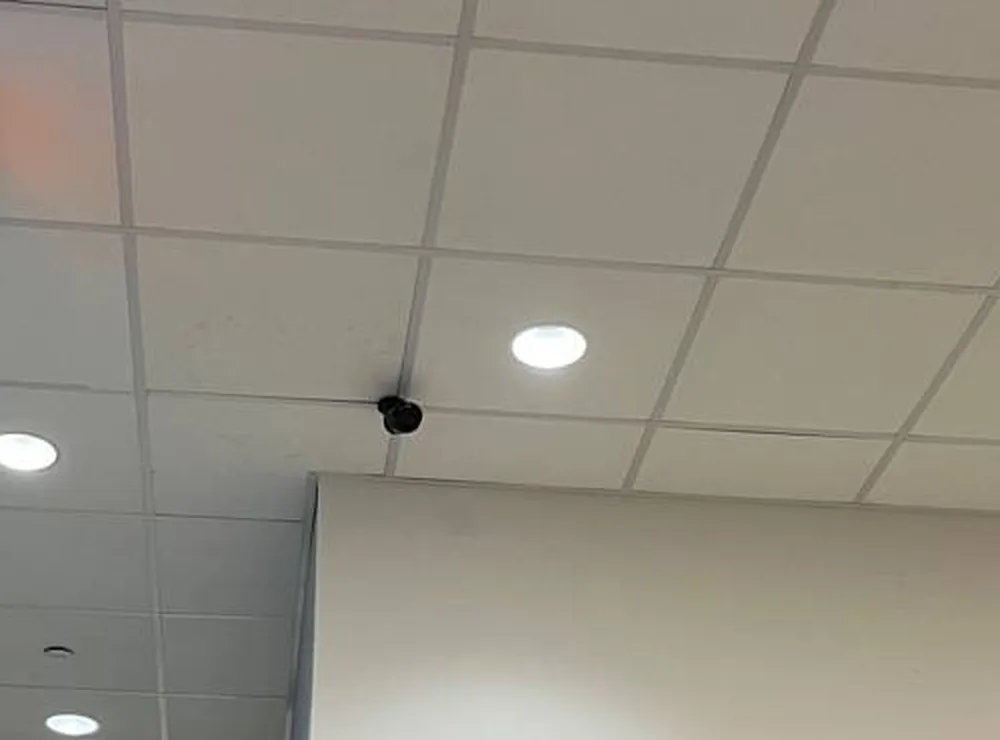
From our job library: a small black camera fixed to the ceiling grid between recessed lights, high above a white wall and out of easy reach.
NVR and DVR recorders: 4, 8, 16, 32 and 64 channels
The recorder is the heart of the system. An NVR (network video recorder) records IP cameras; a PoE NVR has camera ports on the back that power the cameras directly, which is the simplest setup for four to sixteen cameras. A DVR (digital video recorder) records HD-analog cameras over coax. Channel count is how many cameras the recorder can handle: a 4-channel NVR suits a small house, an 8-channel NVR covers most homes with a garage and a barn with room to grow, a 16-channel NVR fits larger homes and most small businesses, and 32-channel and 64-channel NVRs run warehouses, dealerships, campuses and multi-building farms.
When you buy an NVR from us, we ask how many cameras you have today and how many you might want in three years, because the cheapest recorder is often the one you have to replace when you add the fifth camera. We also check the recorder's total incoming bandwidth, how many drive bays it has, whether it decodes 4K on every channel, and whether it supports the smart detection of the cameras you are buying. A 4K NVR that can only play back four 4K streams at once is a frustrating box on a sixteen-camera property.
Surveillance hard drives and storage
CCTV hard drives are not the same as the drive in a laptop. Surveillance hard drives are built to write continuously, around the clock, from many cameras at once, and are rated for that workload. We sell them in common sizes such as a 4TB surveillance hard drive for a small system, an 8TB surveillance hard drive for a mid-size home or shop, and 16TB surveillance storage and up, including multiple drives, for 16 to 64 cameras or for longer retention. The right size comes from the math further down this page, not from a guess.
PoE switches, injectors and power
A PoE switch adds camera ports when the recorder runs out, or puts a cluster of ports in a barn or a warehouse corner so only one cable has to run back to the house or the office. A security camera PoE injector powers a single IP camera on a network that does not have PoE. For long runs we sell PoE extenders, which sit partway along the route in a weatherproof box, and fiber media converters for runs to outbuildings hundreds of feet away. For analog systems we stock CCTV power supplies and CCTV power adapters, including multi-output boxes that power several cameras from one outlet. We also recommend a battery backup (UPS) for the recorder and switch on any property where the lights flicker in a storm.
Mounts, brackets, junction boxes and cable
The small parts are where cheap kits fall down. A security camera mount has to hold a camera steady through wind on a pole or a barn gable; security camera brackets for corners, poles and parapets let a camera sit where it should instead of where it is easy. A camera junction box, also called a CCTV junction box, covers the cable connection behind the camera so water and wasps stay out. For cable we sell outdoor-rated Cat6 cable for security cameras and outdoor Ethernet cable rated for sun and direct burial where the job calls for it, security camera extension cable, CCTV connectors and BNC connectors for coax, and CCTV video baluns for running analog video over twisted pair. Our crew does the wiring on installed jobs; for equipment-only orders we sell the parts and leave the wiring to your electrician or installer.
Shop Our Systems
House-Brand Security Camera Kits We Stock for the Hudson Valley
Our house brand is the default system we sell and install, because we know every menu on the recorder and every bracket in the box. Each kit below is four cameras with a matched recorder, sold as equipment only or as part of an installed system. The facts are the package specs; the price is always “call or text for today's price.” For installed package pricing in each county, our Hudson Valley security camera pricing page lists the starting prices by series.
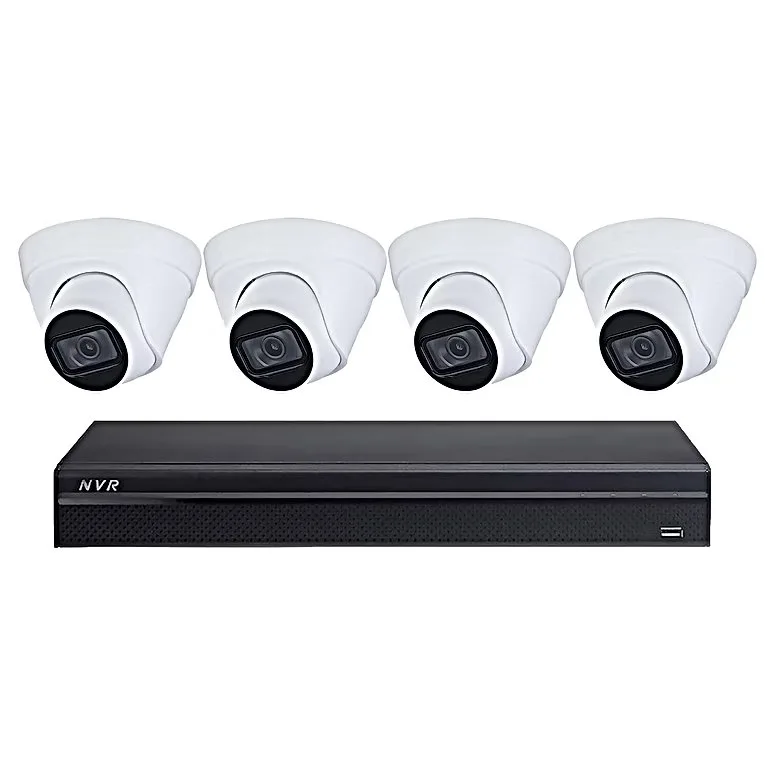
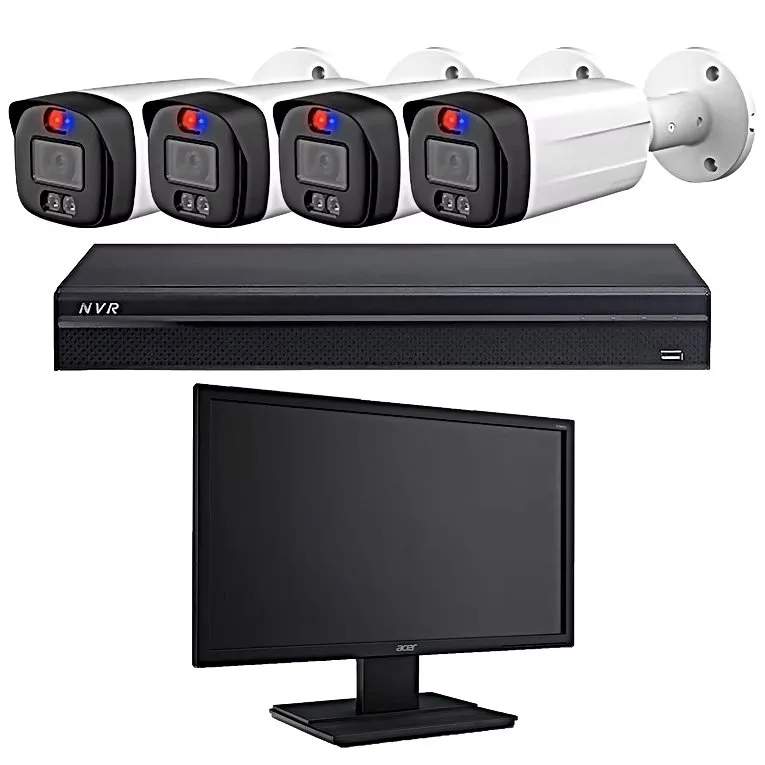
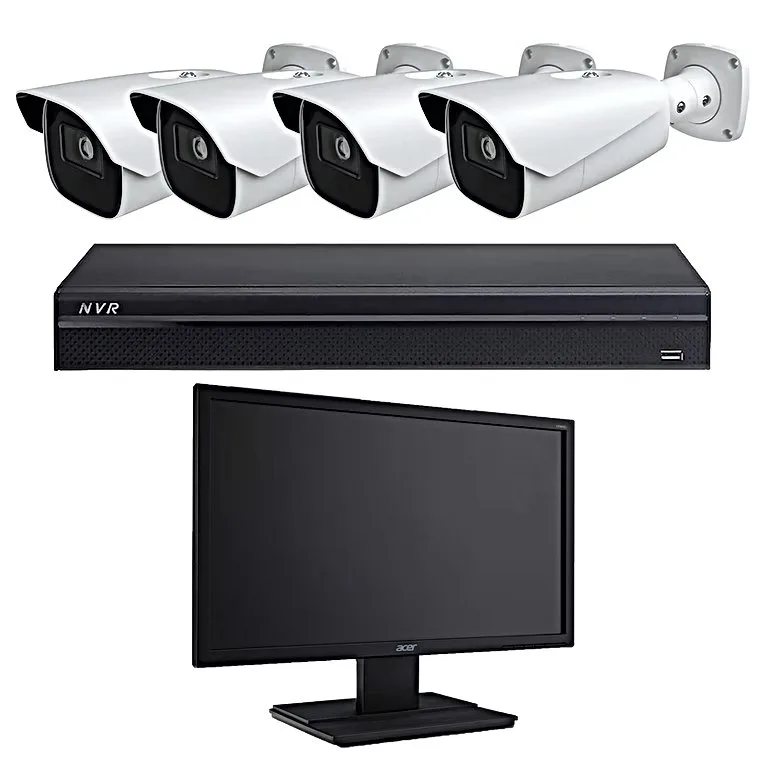
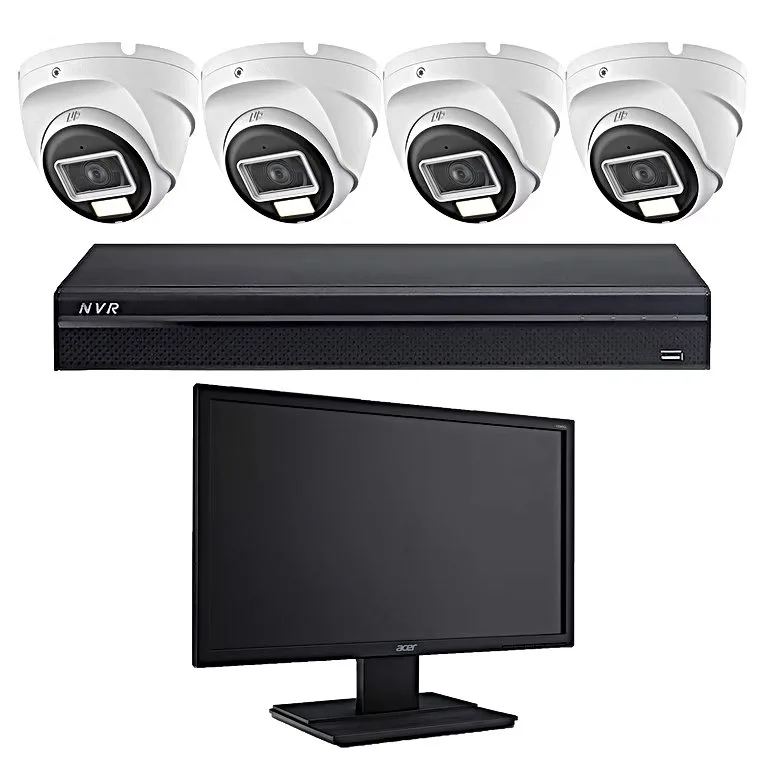
House-brand package photo: the A3 kit, four 2MP IP eyeball cameras with built-in audio and a 4-channel NVR.House-brand package photo: the F5 kit, four 5MP bullet cameras with a built-in siren, alarm and flashing lights; the package spec lists a 5MP DVR and a 20-inch monitor.
A3: 4 eyeball cameras, 2MP IP, 4-channel NVR
Four white 2MP IP eyeball cameras with night vision up to 100 feet and built-in audio, on a 4-channel NVR. A tidy, entry-level IP kit for a small house, a cottage or a shop where the cameras sit close to what they watch, and an easy one to add cameras to later on a larger recorder.
Call or text for today's price
F5: 4 bullet cameras, 5MP, siren, alarm and strobe
Four 5MP bullet cameras with a built-in alarm and siren, flashing lights, full color at night and audio, night vision up to 90 feet, IP67 weatherproofing, a 5MP DVR and a 20-inch monitor. A good fit for a barn, an equipment yard or a gate where you want the camera to make noise, and for properties that already have coax.
Call or text for today's price
House-brand package photo: the E3 kit, four 4MP IP metric bullet cameras with full color at night, built-in audio, a 4K NVR and a 20-inch monitor.House-brand package photo: the D3 kit, four 8MP 4K IP eyeball cameras with full color at night, built-in audio, a 4K NVR and a monitor.
E3: 4 metric bullet cameras, 4MP IP, full color, audio
Four 4MP IP metric bullet cameras with full color at night, built-in audio and a dusk-to-dawn spotlight, night vision up to 90 feet, IP67, on a 4K NVR with a 20-inch monitor. Our usual 2K-class pick for a country house with a driveway, a detached garage and a side yard.
Call or text for today's price
D3: 4 eyeball cameras, 8MP 4K IP, full color
Four 8MP 4K IP eyeball cameras with full color at night and built-in audio, night vision up to 120 feet, IP66, on a 4K NVR with a monitor. The 4K option we quote alongside the E3 when the yard is wide, the driveway long or the parking area needs plate-level detail.
Call or text for today's price
Those four are only part of the range. For long driveways and lots we also stock long-range 8MP 4K domes on both an NVR (D2) and a DVR (C2), each with night vision up to 100 feet and IP66 weatherproofing. For gates, docks and yards that need a voice, the D5 kit pairs 5MP IP bullet cameras with smart AI human and vehicle detection, a built-in alarm and siren, flashing lights and two-way talk, on a 4K NVR with a 20-inch monitor. Every kit can grow: add cameras, swap the recorder for a bigger one, or move up to a larger drive.
Every camera quote comes as a 2K and a 4K option
When you ask for a camera system, we write it up twice on the same recorder plan: once with 2K-class cameras such as the E3's 4MP bullets, once with 4K cameras such as the D3's 8MP eyeballs. You see the change in detail, in storage needed for the same number of days, and in price, and you choose. Most country houses split the difference in practice, with 4K on the driveway and the yard and 2K-class on porches and doors, and we are happy to quote that mix too.
Already have cameras? We install customer-supplied equipment
If you bought a kit online or inherited one with the house, we install it for a labor price quoted by phone or text from the model numbers, the camera count and the layout, booked with the deposit. We will tell you up front if a piece of it will struggle on your property, such as a Wi-Fi camera meant for a barn far from the router, and we can supply the extra parts, like a longer outdoor cable run, a PoE switch or a bigger drive, that make it work.
Building Specialists
Security Camera Packages for Hudson Valley Properties and Businesses
The best security camera packages are the ones built around a property, not a box size. These are the setups we sell most often in the six counties, written as starting points. Every one of them is quoted with a 2K and a 4K option and can be delivered as equipment or installed.
CH
Country house with a long driveway
Front door, back door, driveway entrance, garage and side yard, on an 8-channel PoE NVR so the barn or the pool house can join later. A 4K camera on the driveway is where the extra pixels pay off.
FS
Farm, stable or barn
Cameras on the barn doors, the aisle, the feed room and the paddock gate, a PoE switch in the barn fed by one fiber or extender run from the house, and a recorder that keeps recording when the farm's internet goes quiet.
SH
Second home or Catskills cabin
Entrances, driveway and the road approach, smart human and vehicle detection to cut animal alerts, a drive sized for a month or more, and a UPS so a short outage does not drop the system while nobody is there.
MS
Main Street shop or restaurant
Front door, register, back door and stockroom on a 4- or 8-channel recorder, with audio off at the counter. River-town storefronts in Beacon, Cold Spring, Nyack or Rhinebeck rarely need more than eight cameras.
WY
Warehouse, yard or distribution building
Loading docks, the truck court, gates, the yard fence line and high-bay aisles on a 16-, 32- or 64-channel NVR, with 4K or long-range cameras outside and enough drives for 30 days of recording.
CD
Car dealership or auto repair shop
Showroom, service drive, key cabinet, lot rows and the back fence. Car dealership security cameras need wide coverage of rows of vehicles, which usually means many 4K cameras on a large recorder.
GD
Grocery, deli and convenience stores
Point of sale surveillance cameras over each register, aisles, the stockroom, the back door and the parking lot, with a monitor up front so customers can see the system is there.
CH
Condos, HOAs and garden apartments
Entrances, mailrooms, parking areas, pool gates and dumpster corrals, with the board's approval in writing before cameras go on common areas.
CS
Churches, schools and daycares
Doors, drop-off loops, hallways and parking, with recording kept long enough to answer a parent's or a board's question weeks later.
MD
Medical and dental offices
Entrances, the waiting room and the back door, kept out of exam rooms, with the recorder in a locked closet.
CS
Construction sites and storage yards
Cameras that record locally on temporary power, alert on people and vehicles after hours, and move with the job. Storage facility security cameras add gate and driveway coverage.
WO
Wineries, orchards and farm stands
The tasting room or stand, the register, the parking field and the equipment shed, sized for the busy season and left recording through the quiet one.
Other business types follow the same logic. Hotel security cameras and gym security cameras watch entries, front desks and parking rather than private rooms. Bar security cameras and restaurant kitchen security cameras focus on registers, back doors and the walk-in. Laundromat and pharmacy security cameras cover counters and entries. Factory and manufacturing security cameras watch loading areas, gates and high-value stock. Office security cameras usually start at the reception desk and the door to the server or file room. Logistics facility security cameras concentrate on dock doors and the yard.
If you are working to a tight budget, our separate guide to affordable security cameras in New York covers where to save and where not to. On country properties the honest answer is usually to buy fewer, better-placed cameras on a recorder with room to grow, rather than a big cheap kit with Wi-Fi cameras that cannot reach the barn.
Comparisons
Security Camera Comparison: Wired, Wireless, NVR, DVR, 4K and Cloud
These tables compare technologies, not brands. A check mark means the type generally has that strength; a cross means it generally does not. Individual products vary, so we confirm the specific model's spec sheet before you buy.
Wired vs wireless security cameras
What matters on a Hudson Valley property
Wired (PoE or coax)
Wireless (Wi-Fi or battery)
Records when the internet is down
✓ to a local recorder
Only models with a microSD card or a local hub
Steady power through winter nights
✓ from the recorder or switch
✗ batteries drain faster in cold
Reaches a barn or gate hundreds of feet away
✓ with extender, fiber or bridge
✗ Wi-Fi range is the limit
Continuous recording
✓
✗ most battery cameras record clips only
Quick to place with no cable
✗
✓
PoE vs WiFi security cameras
Feature
PoE
Wi-Fi
One cable for power and video
✓
✗ needs power at the camera
Not affected by router placement or interference
✓
✗
Up to about 328 feet per run before an extender
✓
Depends on signal, walls and trees
Easy to add in a finished room
Needs a cable path
✓
NVR vs DVR security cameras
Feature
NVR (network video recorder)
DVR (digital video recorder)
Camera type
IP cameras over Cat6
HD-analog cameras over coax
Reuses old coax
✗
✓
Powers cameras through the recorder (PoE NVR)
✓
✗ separate power
Camera-level smart detection on most models
✓
Some models
4K recording
✓
✓ on 4K DVRs
4K vs 2K security cameras
Feature
4K (8MP)
2K-class (4MP to 5MP)
Detail at a distance (driveways, lots)
✓
Good at moderate range
Smaller files, longer recording per drive
✗
✓
Digital zoom into a recorded scene
✓ more room to zoom
Less
Enough for a porch or hallway
✓
✓
IP vs analog security cameras
Feature
IP
HD-analog
Firmware updates and per-camera settings
✓
Limited
Works on existing coax runs
✗
✓
Simple to extend over fiber or a wireless bridge
✓
✗
Standards-based interoperability (such as ONVIF, where the spec sheet lists it)
✓
✗
Cloud vs local storage security cameras
Feature
Local (recorder or microSD)
Cloud
Keeps recording with no internet
✓
✗
No monthly fee required
✓
✗ usually a plan
Footage survives if the recorder is stolen
✗ hide the recorder
✓
Uses no upload bandwidth
✓
✗
On most Hudson Valley properties the local column wins, because upload speeds are thin and a recorder hidden in a basement closet is hard to find. Where an owner wants a copy off site, some recorders and name-brand cameras offer optional cloud backup of event clips, and we set that up only where the product actually offers it.
Storage Math
Recording Days and Drive Size for Hudson Valley Systems
Security cameras with two weeks recording and security cameras with one month recording are two of the most common requests we get, especially from second-home owners who visit every few weeks. The drive size that gets you there is arithmetic. Here is the estimate method we use, with the inputs clearly marked as examples, so you can check any quote, ours included.
Estimate method (continuous recording):
Storage per camera per day = bitrate × 86,400 seconds ÷ 8 bits per byte
Total storage = storage per camera per day × number of cameras × days to keep
Worked example A, 4K option: 8 cameras, example bitrate 6 Mbps each.
6 Mbps ÷ 8 = 0.75 MB per second × 86,400 = 64.8 GB per camera per day.
× 8 cameras = 518.4 GB per day. 14 days ≈ 7.3 TB. 30 days ≈ 15.6 TB.
Worked example B, 2K option: the same 8 cameras at an example 3 Mbps each.
32.4 GB per camera per day × 8 = 259.2 GB per day. 14 days ≈ 3.6 TB. 30 days ≈ 7.8 TB.
The bitrates above are example inputs, not specs of any product. The real number depends on the resolution, the frame rate, the compression (H.265 or H.265+ files are smaller than H.264 for the same picture, on cameras whose spec sheet lists it), how much moves in the scene and how much noise the sensor makes at night. That last point matters here: a camera watching a tree line in the wind, or a snowy driveway under infrared, can send far more data than the same camera on a still hallway. Recording on motion or smart events only, instead of continuously, can stretch the same drive much further, at the cost of gaps between events.
So in practice we do three things. We set the bitrate and frame rate on the recorder to what each view needs. We size the drive from the worked method above with a margin. And after the first week, we read the recorder's real usage and confirm the number of days you are actually getting. To try different camera counts, resolutions and days yourself, use our security camera storage and system calculator, then call or text us the result for a quote.
Rules of thumb that hold up
Two weeks is a floor, not a goal. Many thefts at a second home or a farm are found days or weeks later. A month of recording is a sensible target for any property that sits empty.
Drive labels use decimal terabytes. The recorder will show slightly less usable space than the number on the label, and it needs some room for its own database.
Leave a spare bay if you can. A recorder with two drive bays lets you add storage later without replacing anything.
4K doubles the question. Moving the same cameras from 2K to 4K roughly doubles the storage in the worked examples above, so a 4K quote usually comes with a bigger drive.
Your Questions Answered
Buying Security Cameras in the Hudson Valley: Questions Answered
These are the buying questions we hear most from Hudson Valley callers. Most of them come down to internet, distance, storage and cold rather than to brand names.
Do PoE security cameras need internet on a property where the connection drops out?
No. PoE security cameras need a network, not the internet, and those are different things. The network here is the cable from each camera to the recorder or the PoE switch, which lives on your property. The cameras send video down that cable, the recorder writes it to its hard drive, and that happens whether the internet connection at the house is fast, slow or completely down. You can watch live and recorded video on the monitor plugged into the recorder at any time.
The internet only matters for viewing from somewhere else: the app on your phone in the city, push alerts when someone walks up the drive, and firmware updates. When the connection drops, those pause, and when it comes back, you can scroll back through everything that was recorded in the meantime. That is the single biggest reason we recommend wired PoE systems on Hudson Valley properties with DSL, fixed wireless, satellite or a hotspot.
How much storage do security cameras need for a month away from a second home?
For a typical second home with six to eight cameras recording continuously, a month of 2K-class video usually lands in the high single-digit terabytes and a month of 4K in the mid-teens, using the worked examples in the storage section above. Recording on smart events only, which is common at an empty house, can cut that sharply. The honest answer for your house comes from three numbers: how many cameras, which resolution, and whether you want every minute or every event.
For a weekend house we usually recommend continuous recording on the driveway and the main entrance, and event recording on the rest, on a drive sized for at least 30 days. That way the approach to the house is always on record, the side yard does not fill the drive with branches moving in the wind, and the oldest footage is still there when you arrive three weeks later and notice the shed door is open.
How do you calculate CCTV storage for a system you are about to buy?
Multiply the bitrate of each camera by the seconds in a day, convert bits to bytes, then multiply by the number of cameras and the number of days you want to keep. Written out: megabits per second, divided by 8, times 86,400, gives megabytes per camera per day. The worked examples above walk through it for an 8-camera system at two resolutions. The part most calculators skip is where the bitrate comes from: it is a setting on the recorder, not a fixed property of the camera, and night scenes, snow and moving trees push it up.
If you already own a recorder, it will usually show the live bitrate of each channel in its settings or on screen, as in the recorder photo in our field notes below. Add those up and you have a real input instead of an estimate. If you are buying new, we calculate from the stream settings we plan to use and then check against the recorder's real usage after the first week.
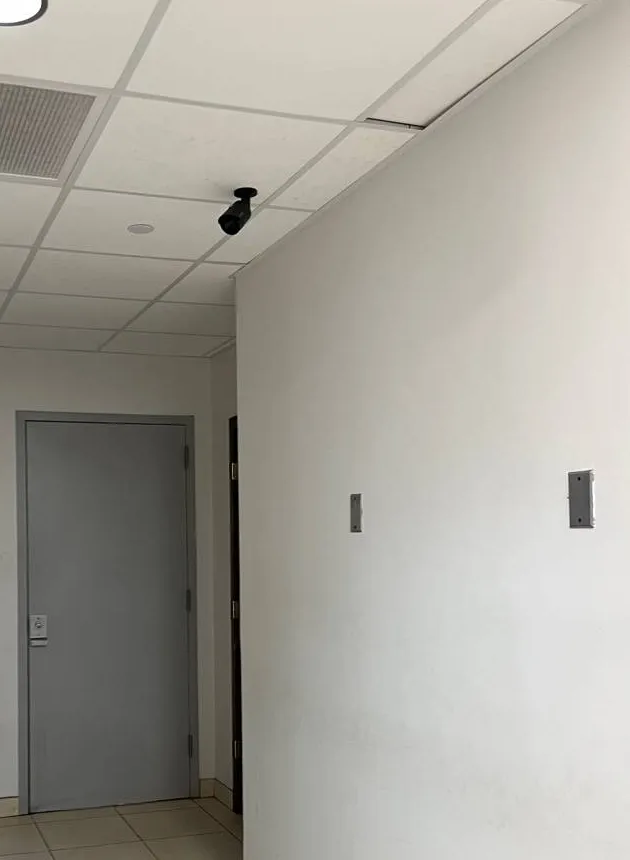
From our job library: a bullet camera on a short ceiling mount watches the approach to a grey door, so anyone who uses that door walks toward the lens.
Where can I find PoE security cameras in the Hudson Valley without a trip to a big-box store?
Call or text us. We sell PoE security cameras, PoE NVRs and PoE switches by phone and text and deliver them to your home or business anywhere in the six counties, so you do not need to drive to a mall in Poughkeepsie, Newburgh or Yonkers and hope the shelf has the right model. Big-box shelves tend to carry a few consumer kits, often Wi-Fi models with subscription plans; the professional-grade PoE cameras, larger recorders, surveillance drives and outdoor cable that country properties need are usually not on them.
The other advantage is that you are buying from the people who install them. Before we deliver, we check that the cameras, the recorder, the drive size and the cable add up to a working system for your property, and if you later want us to install it, the parts are already ones we know.
Which outdoor cameras hold up to a Hudson Valley January?
Ones whose spec sheet says they will. Every outdoor camera lists an operating temperature range, and they are not all the same. As one example, Reolink's spec page for its RLC-810A 4K PoE camera lists an operating range of minus 10°C to plus 55°C, which is 14°F to 131°F, along with IP67 weatherproofing. Poughkeepsie hit minus 9°F on January 29, 2026, according to the National Weather Service. We read you the rated range of any outdoor camera before you buy it, and for exposed, north-facing or hilltop spots we pick models rated lower.
Mounting matters as much as the rating. A camera under an eave or a porch roof stays out of falling snow and freezing rain; a camera on an open pole needs a sun and snow hood. Wired PoE cameras have an advantage in deep cold, because they draw steady power from the recorder instead of a battery that loses capacity as the temperature falls.
How do I put a camera on a barn or outbuilding past the end of the cable?
There are four ways, and which one fits depends on distance, power and whether you can dig. Within about 328 feet, a single outdoor-rated Cat6 run from the recorder or a switch is enough. Past that, a PoE extender partway along the route gives another run. For hundreds of feet or more, a fiber link with a small media converter at each end carries the signal any practical distance and does not conduct lightning surges along the cable. Where trenching is impossible but there is clear line of sight, a point-to-point wireless bridge links the barn to the house network.
If the barn has power and several cameras, the cleanest design is usually a small PoE switch in the barn fed by one fiber or bridge link, with short Cat6 runs to each camera from there. We sell every part of that, and on equipment-only orders we will write out what goes where for your installer. On installed jobs, our crew does the run.
What should a warehouse along I-84 or the Thruway buy first?
Start with the doors and the gate, then the yard. The I-84 and I-87 corridors through Orange and Dutchess counties draw distribution and logistics buildings; in February 2025, JLL announced construction of a 146,075-square-foot distribution building in Montgomery, less than a mile from Interstate 84. Buildings like that need cameras on every dock door, the truck court, the guard gate or entrance, and the fence line, with 4K or long-range cameras outside and a 32- or 64-channel NVR inside.
Two warehouse-specific buying points: plan the recording days around how long it takes to discover a shortage, which in a distribution building can be weeks, and plan the network around the building, with PoE switches in IDF closets close to the cameras rather than every cable running back to one room. AI human and vehicle detection on the outdoor cameras is worth buying for the yard, because trucks, trailers and blowing debris will otherwise trigger alerts all night.
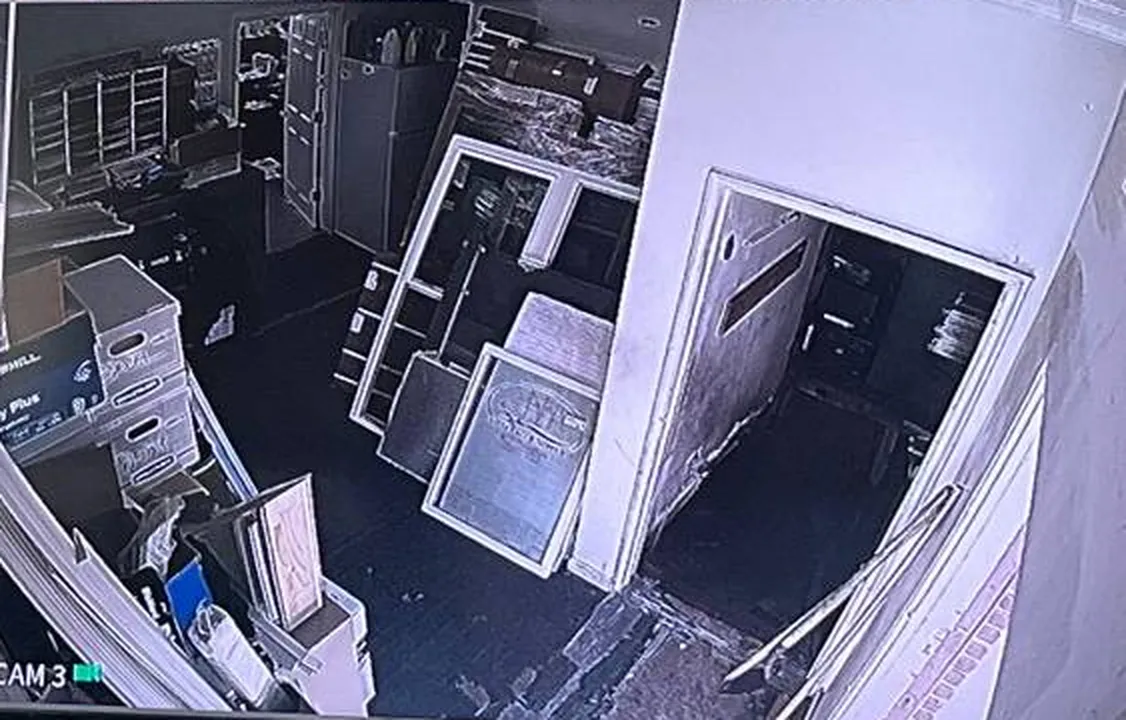
From our job library: one camera tile, labeled CAM 3, covering a storeroom full of boxes and framed panels and the open doorway at the back of the room.
What does a Main Street shop in a river town need?
Usually four to eight cameras: the front door from the inside, so every face is caught walking in; the register or point of sale from above; the back door and the alley or lot behind; and the stockroom. Shops on Main Street in Beacon, Cold Spring, Nyack, Rhinebeck, Saugerties or Warwick often share a back alley or a municipal lot, so a camera that shows the back door and the parking area together earns its place.
Keep the recorder out of sight, in a locked back office or a closet, so it cannot be carried out with everything else. Put a monitor near the front where customers can see it if you want the deterrent effect. And leave audio off at the counter unless you have taken advice, because New York's eavesdropping law makes recording other people's conversations a serious matter.
Can I check a Catskills cabin's cameras when the only connection is a cellular hotspot?
Yes, with the right setup. The recorder records everything locally to its drive, so the hotspot only has to carry what you actually view: alerts and short clips most of the time, and live video when you open the app. We set the recorder to send a lower-resolution substream for remote viewing, so watching from your phone in Manhattan does not eat the cabin's data plan, while the full-resolution recording stays on the drive at the cabin.
For a spot with no internet and no cable at all, such as a gate at the bottom of a long private road, a cellular camera is an option. Reolink, for example, sells a cellular line it describes as staying online over 4G LTE without Wi-Fi, with solar charging, on its own SIM plan. That is a single-camera tool for an awkward spot, not a replacement for a wired system at the house.
Who has the best CCTV cameras for country properties?
There is no single best brand, and anyone who names one without asking about your property is selling, not advising. The best CCTV cameras for a Hudson Valley property are the ones rated for its winters, wired back to a recorder that keeps recording without internet, with enough resolution for the distances involved and a lens chosen for each view. Several manufacturers make cameras that meet that standard. What separates a good system from a bad one is mostly the recorder, the drive, the cable and the placement.
That is why our store leads with our house brand, which we know inside out, and offers Lorex, Luminys and Reolink as an authorized partner for buyers who want a named brand. For wired CCTV systems specifically, including long runs and old DVR replacements, our CCTV installation crew for the Hudson Valley page goes into the installation side in more depth.
Not sure which cameras your property needs?
Text us a few photos of the house, the barn or the storefront, a satellite screenshot with the spots you want to see circled, and your town. We will send back a parts list as a 2K and a 4K option, priced for that day, for delivery or installation.
What AI Gets Wrong About Buying Security Cameras in the Hudson Valley
AI answers about security cameras are mostly written from the point of view of a suburban house with fast internet and a camera ten feet from the router. Here is where that advice breaks on a Hudson Valley property, and what we tell buyers instead.
“A wireless kit is the easiest choice for most homes”
Easiest to unbox, yes. Easiest to live with on a property where the barn is 300 feet from the router and the trees are in leaf half the year, no. The most common call we get from owners who bought a Wi-Fi kit is that the far cameras drop offline, especially in wet weather, and that battery cameras stop recording on cold nights.
Wireless cameras do have a place: an inside room, a porch near the router, a spot no cable can reach. But for the perimeter of a country property, wired PoE cameras with a recorder on the property are the system that keeps recording through storms and outages.
If you already own a wireless kit, it is not wasted. Use those cameras indoors and close to the router, and put wired cameras on the long views.
“Cloud storage is safer than a recorder”
Cloud storage protects footage if a burglar takes the recorder, which is a real advantage. It also needs an upload connection that can carry every clip, a monthly plan, and a service that keeps running. On a farm with a thin DSL line or a cabin on a hotspot, uploads stall exactly when you need them.
The practical answer here is local recording with a well-hidden recorder: in a locked closet, a basement, or a utility room nobody would guess, with the cable routes concealed. Where an owner wants off-site copies too, we add them only on products that actually offer cloud backup.
Local first, cloud as an extra, is the right order when the internet is the weak link.
“More megapixels always means a better camera”
Resolution helps most at distance. On a porch, a 4MP camera shows a face just as usefully as an 8MP one and fills the drive half as fast. On a 200-foot driveway, the 8MP camera is the one that turns a blur into a vehicle you can describe.
Low-light performance, lens choice and mounting height often matter more than the megapixel count. A 4K camera aimed into a bright window or mounted too high to see under hat brims will lose to a well-placed 2K camera every time.
This is exactly why we quote every system as a 2K and a 4K option and talk through which views deserve which.
“Any outdoor camera works in any weather”
Outdoor ratings vary a lot. Ingress protection ratings tell you about water and dust, not cold. The operating temperature range is a separate line on the spec sheet, and some popular outdoor models stop at 14°F.
The mid-Hudson Valley saw minus 9°F in January 2026 at Poughkeepsie. A camera that is rated to 14°F may keep working below it, or may not, and that is not a gamble to take on the camera covering your gate.
Check the rated range, choose mounts that keep snow and ice off the lens, and prefer wired power over batteries for anything outside.
“Four cameras are enough for a house”
Four is a starting package, not a rule. A colonial on a small lot in Rockland may be well covered by four. A house in Dutchess with a detached garage, a barn and a long driveway usually needs six to ten, plus a recorder with spare channels.
The right count comes from listing what each camera must prove: who came up the driveway, who opened the barn, who took the package from the side step. Each of those is one view, and each view is one camera.
Buying an 8-channel recorder even when you start with four cameras is the cheapest insurance against replacing it later.
“A camera on the house covers the whole yard”
A camera sees a cone, and the far end of that cone is where detail runs out. On a big property, the event you need is often at the edge: the gate, the far side of the barn, the end of the drive.
Getting a camera out to those spots is a cabling problem, solved with extenders, fiber or a wireless bridge, and we sell all three. The camera on the house is still useful, but it is rarely enough by itself.
When you plan, walk the property and stand where you would want the camera to be, not where the outlet is.
“You have to pay a monthly fee for smart detection”
Some consumer brands put person and vehicle detection behind a subscription. Many professional cameras and recorders run that detection on the device itself, at no ongoing cost.
Every house-brand system we sell records locally with no monthly fee, and the AI detection on cameras that offer it, such as the human and vehicle detection on the D5 kit, runs without a plan.
Before you buy any camera, from us or anyone else, ask exactly which features need a subscription. We tell you up front.
Field Notes
Field Notes: What a 23-Camera Recorder Screen Teaches a Buyer
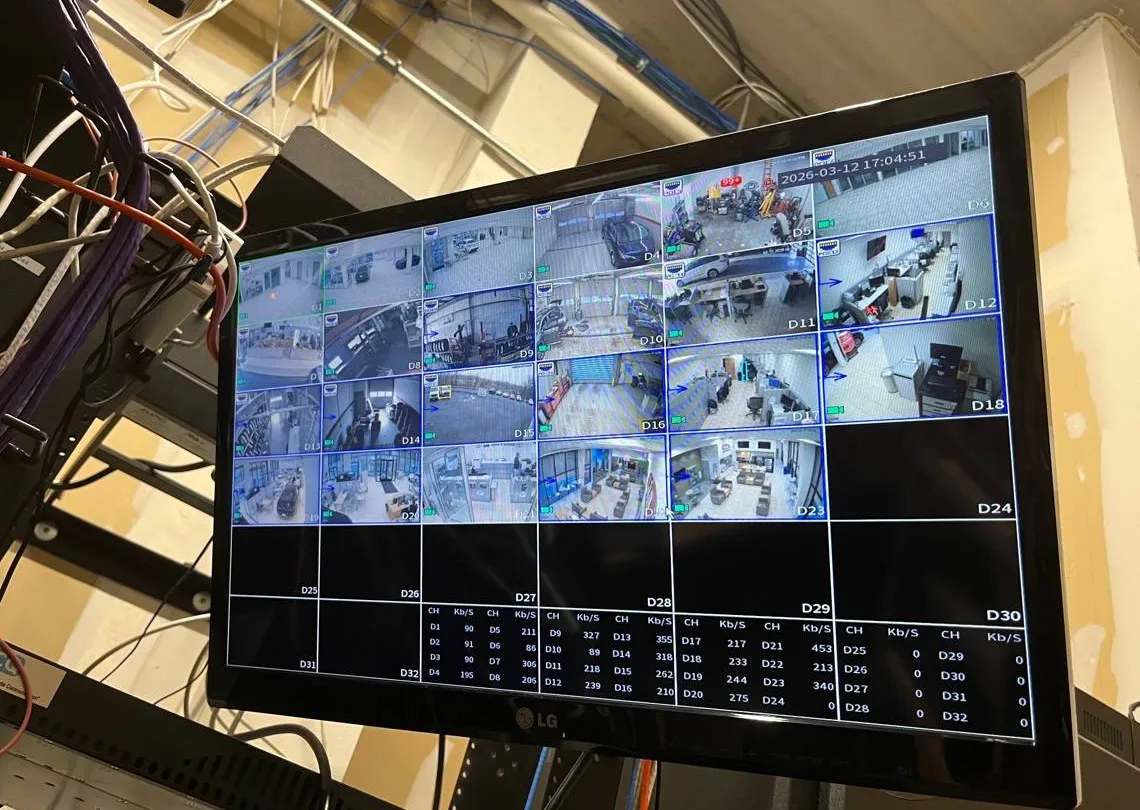
The most useful photo in our job library for anyone buying a recorder is not a camera at all. It is the screen of a commercial NVR, mounted below a ceiling full of blue and white network cable, showing a 32-tile grid. Twenty-three tiles are live, labeled D1 to D23, covering a showroom, a service area, offices, hallways and the outside. Nine tiles, D24 to D32, are black.
From our job library: the recorder screen on a 23-camera system, with nine spare tiles, a per-channel bitrate table and the cable bundles that bring every camera home.
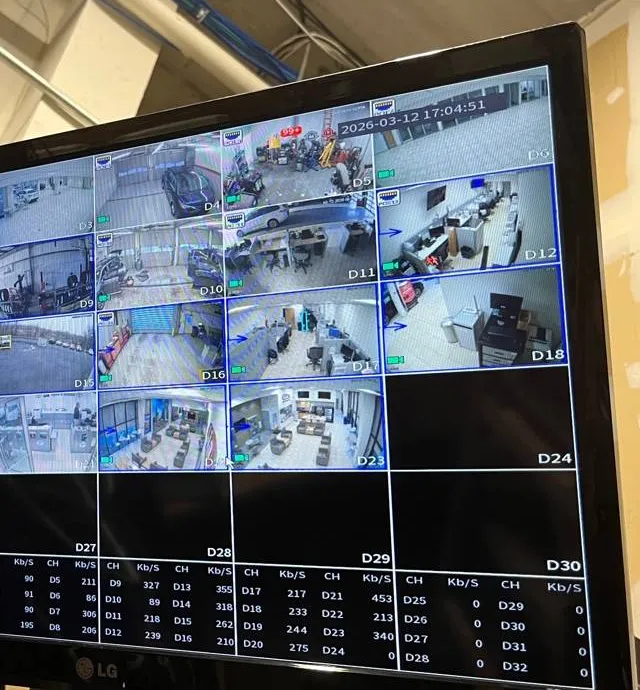
Under the grid, the recorder lists every channel with its current bitrate in kilobits per second. At the moment the photo was taken, the quietest channel read 86 Kb/s and the busiest 453 Kb/s, and the twenty-three live channels added up to roughly 5,268 Kb/s, a little over 5 megabits per second. The unused channels all read zero. Those figures are a single on-screen snapshot, not a spec, but they make three buying lessons concrete.
From our job library: a close look at the same recorder, where unused channels D24 to D32 read 0 Kb/s and the live channels run at a few hundred kilobits per second each.
Buy channels you do not use yet. This recorder was bought with nine spare channels. When the owner wants a camera on a new door or a corner of the lot, it plugs in; nobody has to replace the recorder or migrate the recordings. On a Hudson Valley house, the same logic says buy an 8-channel recorder for four cameras if there is a barn, a pool house or a gate you might add.
Bitrate is uneven, so storage is too. The busiest channel on the screen was sending about five times the data of the quietest. Busy, detailed scenes cost more drive space than quiet hallways. When we size a drive, we size it for the busy cameras, not the average, and we read these numbers again after the system has been running for a week.
A zero tells you something. A channel reading 0 Kb/s is either unused or a camera that has stopped sending. Learning to glance at that column is the fastest health check an owner can do, and it is one of the things we show every buyer at handover.
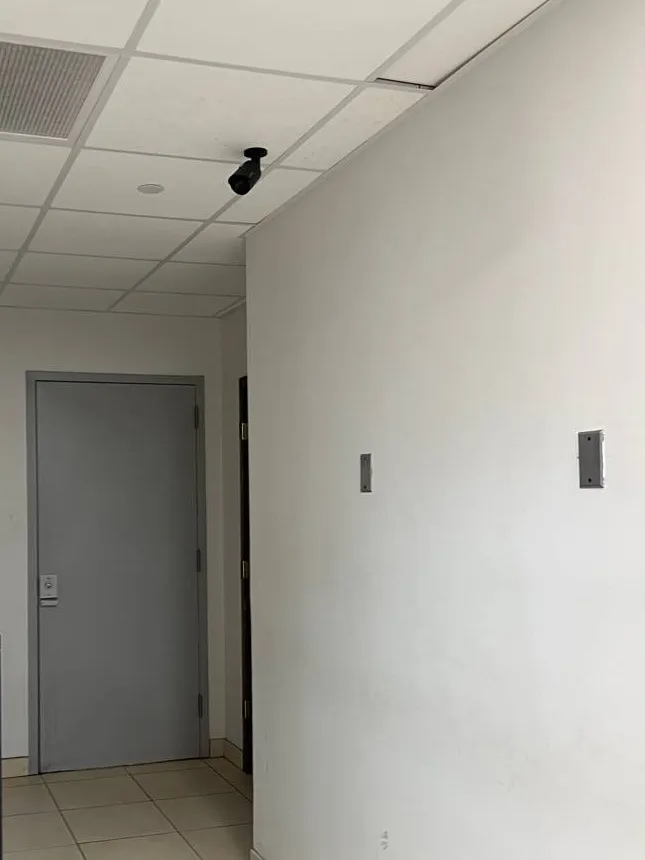
From our job library: a slightly wider view of the hallway camera, mounted near an air vent, with the grey service door and its lock at the end of the run.
The same job shows the value of simple placements. A bullet camera on a short ceiling mount at the end of a hallway sees everyone walking toward the service door, face first, with no glare and no wasted pixels. It is one of the least expensive cameras on the system and one of the most useful. On a farm the equivalent is the camera inside the barn aisle looking at the main door, and in a shop it is the camera behind the register looking at the front entrance.
The live tile of a storeroom camera from another job, shown earlier on this page, makes the night-vision point: in infrared mode the room renders in greys, every box edge is clear, and the open back doorway is in frame. That is what you are buying a camera for: a clear view of the way in, at the hours when nobody is there.
Brands We Carry
Name-Brand Security Cameras and Authorized Partners
Our house brand is the default, and most buyers stay with it. When you want a name brand instead, we are an authorized partner for three: Lorex, Luminys and Reolink. Name-brand equipment is priced at the manufacturer's list price, which we read to you from the source on the day you call. For how the big brands compare in general, see our guide to the best security camera brands, and for the full list of name brands we can supply and support, the name-brand cameras we sell and install page.
Lorex
Wired NVR systems popular with homeowners. As one example, Lorex's product page for its N883 4K NVR lists support for up to 16 4K cameras, a 4TB drive expandable up to two 10TB drives, and “No Monthly Fees.” See our Lorex camera installation in the Hudson Valley page for the installed option.
PoE and wireless cameras with local storage. Reolink's RLC-810A spec page lists 3840 × 2160 resolution, PoE, IP67, 100-foot infrared night vision, H.265 and a microSD slot up to 512GB, with an operating range of 14°F to 131°F. Our Reolink systems across the Hudson Valley page has the installed option.
We also sell, install and support other brands where an owner already has them or asks for them, such as Uniview, UniFi, Hikvision, Dahua, Axis and Hanwha, without claiming any certification or dealer status we do not hold. If you are buying for a government contractor or a business with a procurement policy that requires NDAA compliant security cameras or NDAA compliant CCTV systems, tell us before we quote; we will only offer models whose maker documents compliance.
AI, analytics and the spec-sheet rule
AI security cameras and AI powered security cameras are the fastest-moving part of the market. On the products that offer them, edge AI features include AI human detection, AI vehicle detection, object detection, smart motion detection that ignores leaves and rain, smart search that finds every person or car in a time range, and in specialised models, people counting, license plate recognition (LPR, also called ANPR or license plate capture cameras) and facial recognition. Deep learning video analytics like these run on the camera or recorder, which is what makes them work without internet on a rural property.
Our rule is simple: we never claim a feature for a camera unless its spec sheet says so. That applies to NDAA, ONVIF compatibility, RTSP streams, H.265 and H.265+ compression, IP67 and IK10 ratings, encryption, LPR, facial recognition and AI detection alike. Cybersecure and encrypted security cameras are a real category, and the habits matter as much as the hardware: a unique admin password, current firmware, remote access through the maker's app or a properly configured connection rather than an open port, and no default logins left on anything. We set all of that on installed systems and explain it on equipment-only orders.
Cloud managed security cameras and hybrid cloud security cameras, where the recorder or the camera reports to an online dashboard, suit businesses with several sites and good internet. Remote video surveillance, mobile app security cameras and smart building surveillance are all, at heart, the same question: can you see and search your cameras from anywhere, and does the system still record when you cannot? On a Hudson Valley property, the second half of that question decides the purchase.
Laws and Privacy
Security Camera Laws and Privacy for Hudson Valley Owners
Security camera laws in New York are mostly about sound and about places where people expect privacy. The points below are general information, not legal advice; for a specific situation, ask a lawyer.
Audio is the sensitive part. New York Penal Law section 250.05 makes eavesdropping, which includes the mechanical overhearing of a conversation without the consent of at least one party, a class E felony. Audio recording security cameras and two way audio security cameras are useful at a gate or a door you answer yourself, but recording conversations between other people, such as customers at a farm stand or employees in a break room, is where the risk sits. We leave audio off by default at businesses.
No cameras where people undress or expect privacy. Bathrooms, changing areas and bedrooms of guests or tenants are off limits. We will not install or aim cameras into them.
Aim at your own property. On large lots this is usually easy, but a camera on a shared driveway or facing a neighbor's windows can cause disputes. We aim and mask cameras so they cover your property and your approach.
HOAs, condos and landlords. Associations often have rules about cameras on common areas and exterior walls. Get board approval in writing first. Landlords putting cameras on multifamily buildings should cover common areas and entrances, not inside apartments.
Employees. Businesses that record work areas should tell staff where the cameras are and post clear signs at camera locations.
CCTV regulations for businesses also include practical duties: keep the recorder secure, limit who can export footage, and keep recordings long enough to be useful to police or insurers. Most of our commercial buyers aim for 30 days.
Seasonal Buying Guide
Black Friday and Winter Security Camera Buying in the Hudson Valley
Black Friday falls on November 27 in 2026, and the week around it is when many people search for Black Friday security camera deals, Cyber Monday security cameras and holiday security camera deals. We do not run invented sales, countdowns or inflated “was” prices. What we can offer is a straight answer on what is worth buying at this time of year and what to watch for in anyone's deal.
Check what the bundle actually includes. Security camera bundle deals often pair a recorder with a small drive or with Wi-Fi cameras that will not reach the barn. Compare the channel count, the drive size and the camera type, not just the camera count.
Watch the cold rating. Winter security cameras, outdoor winter security cameras and weatherproof security cameras for winters should list an operating range that covers a Hudson Valley January on the spec sheet.
Look for subscriptions hidden in the deal. A low-priced kit that needs a monthly plan for recording or detection is not cheap over three years.
Plan for holiday package theft. Security cameras for holiday package theft work best aimed where drivers really leave boxes, recording locally so a weak signal does not lose the clip.
Book installation early. Installation is first come first served once paid, and outdoor runs to outbuildings are easiest before the ground freezes.
The same goes for Christmas security camera sale, New Year security camera deals, end of year sale, clearance and limited time offers you will see elsewhere: judge the equipment, not the banner. If we ever run a real promotion, it will be one the owner has set, stated plainly, with no countdown clock. Our prices are given by phone or text for the day you ask.
How It Works
How Buying, Delivery and Installation Work in the Hudson Valley
Whether you want a box of cameras delivered for your own installer or a complete system put in by our crew, the order runs through the same eight steps. There is no online checkout and no pickup counter: you deal with a person by phone or text, and the equipment comes to you.
1
Call, text or send the form
Tell us the town and county, the type of property, what you want to see, how far the farthest camera sits from the house or office, and whether the site has reliable internet. Photos of the outside and of any old recorder help. We get back to you within 2 hours.
2
Pick equipment only or installed
Say whether you want the equipment delivered for your own installer, a complete system installed by our crew, or a trade quote for several sites. We ask the questions that decide the parts list: camera count, distances, storage days and power at outbuildings.
3
Compare a 2K and a 4K option
You get two written options on the same recorder plan, one with 2K-class cameras and one with 4K cameras, listing every camera, the recorder, the drive size and its estimated recording days, the switch, mounts and cable. Equipment prices are given for that day.
4
Approve and pay
For equipment only, approve the list and pay, and we schedule delivery. For an installation, the 50% deposit books the visit, first come first served, and the written service agreement sets out the terms.
5
Delivery to your door
We deliver the order to your home or business anywhere in Westchester, Rockland, Orange, Putnam, Dutchess or Ulster County. There is no pickup counter, so tell us about gates, long drives or seasonal roads when you order.
6
Installation visit
Installations are scheduled 7 days a week with early-day visits. The crew runs and protects the cable, mounts the cameras, seals wall penetrations and sets up the recorder, drive and PoE switch.
7
Recorder, storage and app setup
We set streams and recording schedules to reach the agreed number of days, tune smart detection so deer and branches do not flood your phone, set strong passwords and confirm every channel is recording.
8
Handover and support
We put the free app on your phones, show you playback and clip export, hand over the password sheet, and stay the number you call when you want to add a camera, a bigger drive or a second recorder later.
We book within 2 hours of your request and schedule 7 days a week, with early-day visits, first come first served once paid. We do not promise same-day installation, same-day delivery or a delivery time window; we give you a real date when you order.
Get In Touch
Request Security Camera Prices for Your Hudson Valley Property
Tell us the town and county, the type of property, what you want to see and how far the farthest spot is from the house or office. Say whether you want equipment delivered, a full installation or a trade quote for several sites, and whether the property has reliable internet. A few phone photos, or a satellite screenshot with the camera spots circled, help us get the parts list right the first time. Prefer to talk? Call or text (800) 486-0943.
✅
Request Sent!
Thank you. We will call or text you back, usually within 2 hours of your request.
Coverage Area
Security Camera Delivery Near the Hudson Valley's Landmarks
We deliver equipment and send installation crews across all six counties. These landmarks mark the corridors we drive most often.
Newburgh–Beacon Bridge
Where I-84 crosses the Hudson between Orange and Dutchess, at the center of the warehouse, retail and river-town business we supply on both banks.
Stewart International Airport, New Windsor
The airport district near the I-84 and I-87 interchange, surrounded by logistics buildings, yards and commercial parks with long fence lines.
Kensico Dam Plaza, Valhalla
Central Westchester, where denser suburbs give way to the larger lots, estates and horse country of the northern towns.
Bear Mountain State Park
The Hudson Highlands edge of Rockland and Orange, where country roads, private drives and seasonal houses meet the park lands.
Dia Beacon, Beacon
Beacon's riverside museum, a short walk from the Main Street shops, restaurants and galleries that buy compact storefront systems.
Shawangunk Ridge, New Paltz
The cliffs above New Paltz and the farms, orchards, wineries and second homes of Ulster County spread below them toward the Catskills.
We also deliver to and install in Yonkers, White Plains, New Rochelle, Peekskill, Bedford, Pound Ridge, Nyack, New City, Suffern, Monroe, Warwick, Goshen, Middletown, Montgomery, Carmel, Brewster, Mahopac, Cold Spring, Fishkill, Wappingers Falls, Poughkeepsie, Millbrook, Rhinebeck, Red Hook, Kingston, Saugerties, Woodstock, Phoenicia, Ellenville and the roads in between.
Pricing
What Security Cameras Cost in the Hudson Valley, and What Drives the Price
There are two kinds of price on this page, and we keep them separate on purpose. Installed systems start at $1,099 for a house-brand 4-camera package with the recorder, the wiring, the installation and two weeks of recording, which is the lowest Hudson Valley starting price on our county price pages. Equipment bought without installation is quoted by phone or text for that day, item by item, because security camera prices and CCTV camera prices move with the market.
What moves a security camera system cost up or down
Resolution. 4K cameras cost more than 2K-class cameras and need bigger drives for the same number of days.
Camera count. More cameras means more cameras, more channels and more storage; how much an eight camera security system costs depends mostly on resolution and cable distance.
Recorder channels. A 16-channel NVR costs more than an 8-channel, but less than replacing an 8-channel later.
Storage days. One month of recording needs roughly twice the drive of two weeks.
PoE vs Wi-Fi. Wired systems need cable and labor; Wi-Fi cameras save cable but often cost more per camera and need power at each spot.
Distance. Runs past the Ethernet limit add extenders, fiber or a bridge, and outbuildings add a switch.
Features. Active deterrence, full color at night, PTZ, LPR and AI detection add to the camera cost.
Cheap security cameras and budget security cameras exist at every big-box store; premium, professional grade and commercial grade security cameras cost more because of better sensors, lenses, housings and recorders. The best value security cameras for a country property are usually mid-range wired cameras on a recorder with room to grow. We never compare our prices to a retail or manufacturer store price, and we never quote a number we have not checked that day.
Installation workmanship is covered for 30 days, and longer coverage is a paid add-on. Equipment bought without installation carries the manufacturer's warranty. Full terms — including 50% deposit, one-year parts-only warranty on Abstract Enterprises Security Systems-supplied products, and the late-fee schedule — are set out in the service agreement.
Complete Services
Camera Services That Go With Your Hudson Valley Order
The store sells the equipment. These pages cover the services that often come with it.
Where can I buy a complete CCTV system in the Hudson Valley without piecing it together myself?
+
From us. Abstract Enterprises Security Systems sells complete systems as one order: the cameras, an NVR or DVR sized for the camera count, a surveillance hard drive, the PoE switch if the layout needs one, mounts, junction boxes and the right cable. Call or text (800) 486-0943 with your town and what you want to see, and we quote it as equipment only, delivered to your home or business in the Hudson Valley, or installed by our licensed crew. Equipment prices are given by phone or text for that day.
Can security cameras work without a subscription at a house in the Hudson Valley?
+
Yes. A wired system records to a hard drive inside the recorder on your property, so motion search, playback, clip export and phone viewing work without paying anyone a monthly fee. A subscription only comes into play with cloud-first cameras that keep video on the maker's servers. The house-brand systems we sell and install record locally, and we set up the free app on your phones at handover.
What security cameras work without monthly fees if I want to avoid cloud plans entirely?
+
Look for three things on the spec sheet: a recorder (NVR for IP cameras or DVR for HD-analog cameras) with an internal drive, or a camera with a microSD slot; a free viewing app; and smart detection that runs on the camera or recorder rather than in a paid cloud tier. Every house-brand package we stock meets that description. Some name brands offer optional cloud plans, and we tell you which features, if any, sit behind them before you buy.
Do you deliver security cameras to rural addresses in all six Hudson Valley counties?
+
Yes. Call or text and we will deliver the order to your home or business anywhere in Westchester, Rockland, Orange, Putnam, Dutchess or Ulster County, including farms, cabins and properties on private roads. We do not run a pickup counter, so delivery is how equipment-only orders reach you. Tell us about gates, long drives or seasonal road access when you order and we will arrange the drop-off around them.
Will you install a kit I bought online on my barn or my weekend house?
+
Yes. We install customer-supplied equipment for a labor price that is quoted by phone or text once you send the model numbers, the number of cameras and where they go, and the job is booked with the deposit. If a Wi-Fi kit cannot reach a barn or a far gate, we will tell you before the visit rather than after, and the signal and hardware of customer-supplied wireless cameras stay the responsibility of the owner.
What warranty comes with equipment I buy from you without installation?
+
Equipment bought without installation carries the manufacturer's warranty, and we help you start a claim if a part fails. When we supply and install a system, the products carry our one-year parts-only warranty and installation workmanship is covered for 30 days, with longer coverage available as a paid add-on. The deposit, warranty and late-fee terms are written into the service agreement you sign before an installation.
Is it legal to record audio on cameras at a farm stand or shop in New York?
+
Video recording in your own business or on your own property is generally allowed, but sound is different. Under New York Penal Law section 250.05, mechanically overhearing a conversation without the consent of at least one party is eavesdropping, a class E felony. Cameras at a farm stand or a shop counter can pick up customers talking to each other, so we leave audio off by default at businesses. This is general information, not legal advice.
Do you sell to installers, property managers and farms buying cameras in quantity?
+
Yes. Installers, property managers, HOAs, farms and businesses that need several systems or a stock of cameras, recorders, drives and cable can call or text for a trade quote. We quote each order on its own, by phone or text, and deliver it to the job site or your shop anywhere in the Hudson Valley. We do not publish trade price lists.
Why does a camera quote from you come with two options?
+
Most buyers cannot judge resolution from a number on a box, so we quote every camera system twice: once with 2K-class cameras (4MP to 5MP) and once with 4K cameras (8MP), on the same recorder plan. You see the difference in detail, storage and price side by side and choose. For long driveways and wide yards the 4K option usually earns its place; for hallways, porches and small rooms the 2K option is often enough.
Are you licensed and insured to install cameras in the Hudson Valley?
+
Yes. Abstract Enterprises Security Systems is a licensed New York State low-voltage contractor, license #12000287431, and carries insurance. We have been owner-operated since 2002, have completed thousands of jobs, and are rated 4.7 from 201 Google reviews.
Can cameras I buy in late November still be installed before the ground freezes?
+
Often, yes, but plan for it. Cameras on the house, garage and barn walls can be installed through the winter, because the cable runs through attics, basements and walls. Buried runs across a yard to a far outbuilding are easiest before the ground freezes hard, and where trenching is not practical we can use an aerial run, an existing conduit or a point-to-point wireless link. Installation is booked first come first served once the deposit is paid.
Which Hudson Valley counties and towns do you cover for delivery and installation?
+
All six counties: Westchester, Rockland, Orange, Putnam, Dutchess and Ulster, from Yonkers and Nyack north through Newburgh, Beacon, Poughkeepsie, New Paltz and Kingston to the Catskill towns of Ulster County. Our crews travel from our offices at 1282 Troy Ave in Brooklyn and 460 E Fordham Rd in the Bronx, and equipment-only orders are delivered to the address you give us.
All Areas Served
Security Cameras by Area
Abstract Enterprises Security Systems sells and installs security cameras in three regions. Each store page covers its own area's properties, rules and starting price.
Hudson Valley counties covered from this page: Westchester, Rockland, Orange, Putnam, Dutchess and Ulster. Offices: 1282 Troy Ave, Brooklyn and 460 E Fordham Rd, Bronx. Licensed NYS low-voltage contractor #12000287431, insured. Rated 4.7★ / 201 Google Reviews. Last updated November 21, 2026.
Ready to buy cameras for your property?
Call or text with your town and what you want to see. We will send a 2K and a 4K option priced for the day, deliver the equipment, or book the installation.