A bayed row house on 44th Street with a rented top floor, a 1915 walk-up on Seventh Avenue whose intercom has gone quiet, or the apartments over an Eighth Avenue shop? Sunset Park door buzzer installation line: (347) 934-8335
Bayed Two-Family Row Houses · 1910s and 1920s Walk-Ups · Apartments Over Avenue Storefronts · Four Historic Districts · Directories Visitors Can Read in More Than One Language
Door Buzzer Installation in Sunset Park
A Button for Every Household · A Release That Latches Behind Every Visitor · Landmarks-Aware Mounting · Written Price Before Ordering · Brooklyn Rate
Door buzzer installation in Sunset Park is mostly a question of how many households share one street door. Most of the neighborhood's row houses went up between 1892 and 1910 as two-family homes, with the owner's duplex below and a rental on top, and more than half of the district's apartments were built before 1939. Many of those doors still have one bell, or an intercom that some apartments can no longer hear. Below is how we wire each kind of Sunset Park building, what the city and the Landmarks Commission expect, and where each job falls on our Brooklyn price list.
Every price comes from our Brooklyn door buzzer list and is fixed in writing, with any test-dependent extra named, before equipment is ordered
Rated 4.7★ across 201 Google Reviews
Reviewed and updated November 11, 2026, against Wikipedia's Sunset Park, Industry City and Brooklyn Chinatown entries; the Landmarks Preservation Commission's June 2019 announcement of four Sunset Park historic districts and Chapter 11 of its Permit Guidebook; Brownstoner's Building of the Day features on 44th Street and Sixth Avenue; the Fifth Avenue Committee's 2020 Sunset Park Housing Report; Community Board 7's district profile; NYC Small Business Services' Avenue NYC needs assessment for Sunset Park; Openigloo building records and tenant reviews for 4103 Seventh Avenue, 719 58th Street and 5310 Fourth Avenue; News 12's April 2025 report on the Sixth Avenue package locker; Brownstoner's March 2020 report on 370 50th Street; Time Out's September 2023 language analysis; New York's Multiple Dwelling Law §50-a; NYC 311's maintenance complaint guide; Local Law 126 of 2024; Brick Underground's buzzer and intercom repair guides; Habitat's February 2024 intercom article; ButterflyMX's repair-or-replace guide; Brownstoner forum threads on three-family intercoms and double-door strikes; the HomeAdvisor and Swiftlane cost guides; and Allegion's fail-safe guide. · Abstract Enterprises Security Systems, NYS license #12000287431 · crews dispatched from our Troy Avenue office in Brooklyn
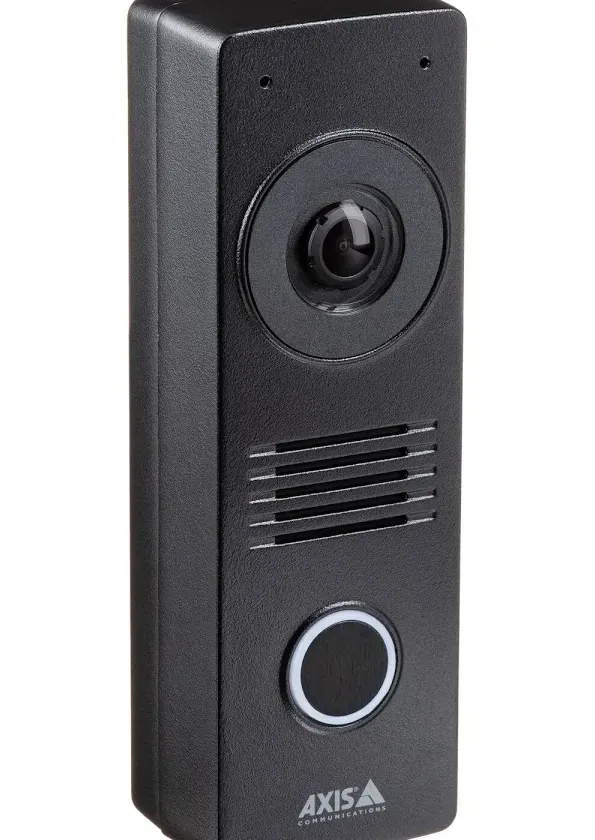
A photo from the AESS job library, not taken in Sunset Park: a black rectangular video door station with a camera lens, a speaker grille and a single round call button that lights up. On a Sunset Park row house that is still one family, or on the inner door of an owner's duplex, a one-button station like this replaces the old bell push beside the stoop door.
Sunset Park Buzzer Request
Row house, walk-up or the apartments over a store: tell us the block, how many households share the street door and what is beside it now, and a technician calls back with the range
✅
Request Sent!
Thank you. A technician will call you about the Sunset Park address, usually within two hours during working hours.
25+
Years Experience
✓
Same-Day Estimates
100%
Licensed & Insured
4.7★
201 Google Reviews
Owner-operated since 2002 · Thousands of jobs completed · Booked within 2 hours
Quick answer: door buzzer installation in Sunset Park costs $400 to $900 on our Brooklyn list for an audio station and an electric release on a one- or two-family row house, $700 to $1,800 for a video station with indoor stations or phone answering on a two- or three-family house or a small building, and from about $2,500 to past $10,000 for an entry system in one of the neighborhood's walk-ups or larger apartment houses. That covers the station at the stoop door, the stations inside, the power supply, the electric strike, the cable and the labor. The figure is fixed in writing after we have seen the door, the cellar and the route upstairs, and anything that depends on a test, such as a hundred-year-old bell pair or a riser that half the building can no longer hear on, is named with its price before you order. Send a photo of the street door and whatever hangs beside it to (347) 934-8335 or on WhatsApp, and we reply with the range that fits, usually within two hours during working hours.
Reading your photos and quoting a new system costs nothing. When an existing intercom has to be tested in person before anyone can price it, that is the $250 service call booked online, and the $250 goes toward the work.
We install under New York State license #12000287431. We do the low-voltage entry work; if the power supply needs a new 120-volt outlet, a licensed electrician handles that part, and you know about it before the price is set.
We work for whoever controls the street door: a row-house owner who rents the top floor, the owner or managing agent of a walk-up, a store owner who also owns the apartments above, or a tenant association bringing a written price to its landlord.
The Neighborhood
Why Sunset Park Properties Need Door Buzzer Installation
Sunset Park runs from Greenwood Heights and Green-Wood Cemetery south to Bay Ridge, and from the harbor east to Borough Park, across the 11220 and 11232 ZIP codes. Its streets were built up quickly once the subway came: the R train reached 59th Street in June 1915 and 45th and 53rd Streets that September. Wikipedia describes the housing that resulted as mostly two-story-above-basement row houses with bay fronts, built mainly between 1892 and 1910, most of them originally two-family, most of them brick, and many of them since covered in vinyl siding or Formstone. Behind those houses on the avenues stand walk-ups and apartment houses from the same years and the decade after, and on Fourth and Fifth Avenues the ground floors are shops with apartments above.
That layout is the whole reason door buzzers matter here. Brownstoner's 2015 feature on 29 houses William Kay built in 1903 on the even side of 44th Street between Sixth and Seventh Avenues describes the standard plan: a duplex for the owner and a rental apartment on the top floor. A second Brownstoner feature, on four 1903 brownstones on Sixth Avenue between 54th and 55th Streets, notes that most of the neighborhood's row houses were built the same way. So from the start, two households shared one stoop door, and for a century the usual arrangement has been one bell, wired to the owner's hall, with the tenant walking down two flights or calling out a window when a friend arrives. A Brownstoner forum reply from 2007 offered the local alternative with a straight face: toss the key out the window.
Many of those houses now hold more people than their builders imagined. The Fifth Avenue Committee's 2020 Sunset Park Housing Report called the area the fourth most overcrowded neighborhood in New York City, put homeownership at 28.1 percent and found that more than half of Community District 7's 45,903 apartments were built before 1939. In practice that means many renters, many relatives sharing apartments, many shift workers coming and going, and a great deal of foot traffic through a street door designed for two families. When that door has no working buzzer, the result is predictable: it gets propped, left on the latch or opened for anyone who rings, because there is no other way for a household upstairs to let its own visitors in.
The apartment buildings have their own version of the problem. A 20-unit walk-up at 4103 Seventh Avenue, built in 1915, carries 71 open HPD violations from the past ten years on Openigloo's record, and a former tenant's review there says it plainly: "The intercom system in the building hasnt worked in a year." A reviewer at 719 58th Street, a 16-unit building from 1928, lists "Deliveries get stolen" among its problems and asks the owner for "a security system put in place for safety." Neither review is unusual for Brooklyn, but both describe the same failure: once the intercom stops working, every courier, guest and repair worker becomes a resident's problem at the door.
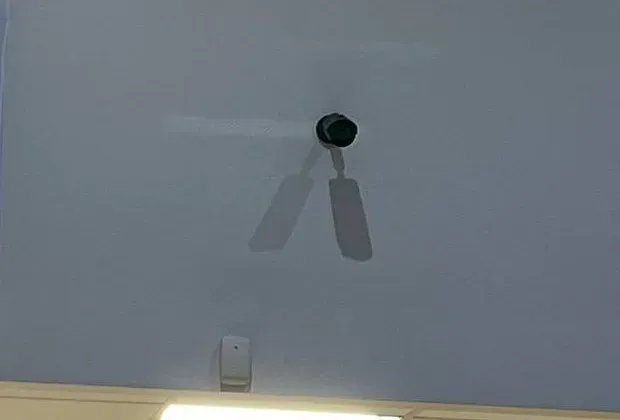
A photo from the AESS job library, not taken in Sunset Park: a small black camera mounted high on a pale wall, casting two shadows, with a small white device below it. In the narrow shared hall of a Sunset Park two-family, where the tenant's stair starts just inside the stoop door, a camera this high looks down on the door the buzzer releases and on everyone who comes through it.
Six facts that shape a buzzer job in Sunset Park
The typical house was built for two households. Bayed brick row houses from 1892 to 1910, planned as an owner's duplex with a rental on top, so even an untouched house needs two buttons and two ways to release one door.
The buildings are old. More than half of Community District 7's 45,903 apartments predate 1939, which puts most walk-ups on the older side of the 1968 date in the state's intercom rule.
Households are crowded. The 2020 housing report ranked Sunset Park the city's fourth most overcrowded neighborhood, so one apartment's button often serves several working adults with different hours.
Four parts of the neighborhood are landmarked. In June 2019 the Landmarks Preservation Commission designated the Sunset Park North, Central, South and 50th Street historic districts, and door stations there follow the Commission's rules.
The avenues mix shops and homes. Small Business Services counted 1,580 storefronts on Third, Fourth, Fifth, Seventh and Eighth Avenues and on 39th and 65th Streets, many with apartments above and a residential door a few feet from the shop's.
Visitors read more than one language. After English and Spanish, Chinese is the most spoken language in Sunset Park, according to Time Out's 2023 analysis of Census data, which changes how a directory should be labeled.
Where this page applies. Sunset Park on this page means the blocks from roughly 36th Street south to 65th Street and from the waterfront up to Eighth and Ninth Avenues, including the Eighth Avenue Chinatown blocks, the Fifth Avenue shopping strip, the historic districts around the park and the industrial buildings west of Third Avenue. For the blocks north of 36th Street and the brownstones farther up the slope, see our Park Slope door buzzer installation page; south of 65th Street, our Bay Ridge page; for the rest of the borough, our door buzzer installation in Brooklyn page.
Repair or Replace in Sunset Park
Need Repair in Sunset Park? Find Out What Actually Failed Before Anyone Sells You a New System
A large share of the Sunset Park calls that start with "we need a new buzzer" turn out to be about a system that is partly alive. The bell rings but the door never releases. Four apartments can talk to the street and three cannot. The handset in the owner's hall buzzes on its own at two in the morning. Before we quote any new equipment, we work out which of those it is, because the fix for each is different and some of them are cheap.
Pete Carmello of Lock and Tech told Brick Underground that with intercom complaints, "A lot of times it's user error," and ButterflyMX's guide to small-building systems makes a related point: "Do not replace a system based on age alone." A 1920s building with a sound riser and a failed power supply needs a power supply. A house whose release has stopped working may need nothing more than a strike that has worked loose in a soft wood frame. On the other hand, a building where calls come and go with static usually has a cable problem, and ButterflyMX lists exactly that pattern: "Static, humming, or intermittent calls may indicate wiring or interference problems."
So every Sunset Park job starts in one of three places. A targeted repair, priced as a repair, when one part is the whole problem. A partial replacement, with a new door panel and power supply on old cable that still tests sound. Or a full installation with new cable, when the old pairs were cut in a renovation, corroded in a damp cellar or never went past the owner's floor. If a repair is all you need, we tell you so and our Brooklyn door buzzer team handles it as one.
What We Install
Door Buzzer Installation Services in Sunset Park
All of these are priced from one Brooklyn door buzzer list. In Sunset Park the count of households behind the stoop door sets the size of the system, the street door and its frame decide which release it can take, and the state of the old cable between the stoop and the top floor decides most of the labor.
Two-button stations for two-family row houses
One button for the owner's duplex and one for the top-floor rental, each ringing only its own household and each able to release the stoop door, so the owner stops answering for the tenant's guests.
First buzzers where there is only a bell
A door station, an electric release and an indoor station on each occupied floor for row houses that have never had more than a mechanical bell in the front hall.
Walk-up intercom replacement
New street-door panels and apartment stations for the 1910s and 1920s walk-ups on the avenues and side streets, reusing riser pairs that test sound and replacing the ones that do not.
Partial repairs on systems that half work
A new power supply, a new strike, or replacement stations for the few apartments that went quiet, when a test shows the rest of the system is worth keeping.
Separate entries for stores and apartments
A delivery buzzer for the shop and a separate panel for the apartments' street door on Fourth, Fifth, Seventh and Eighth Avenue buildings, with neither able to open the other's door.
Directories that visitors can read
Panels labeled by apartment number and floor, with instruction text set in the languages your residents and their visitors actually use, where the chosen model allows it.
Landmarks-compliant stations
One discreet panel per door opening, cable concealed through plain masonry behind the station, and finishes chosen to suit the brownstone, limestone or brick in the four historic districts.
Phone answering for owners and shift workers
Door stations that ring residents' phones as well as indoor stations, for owners who live elsewhere and for households whose members work different hours.
Strikes and closers for century-old doors
Fail-secure strikes fitted to old wood and steel frames, frames reinforced where earlier locks were cut in, and closers adjusted so the stoop door pulls shut and latches every time.
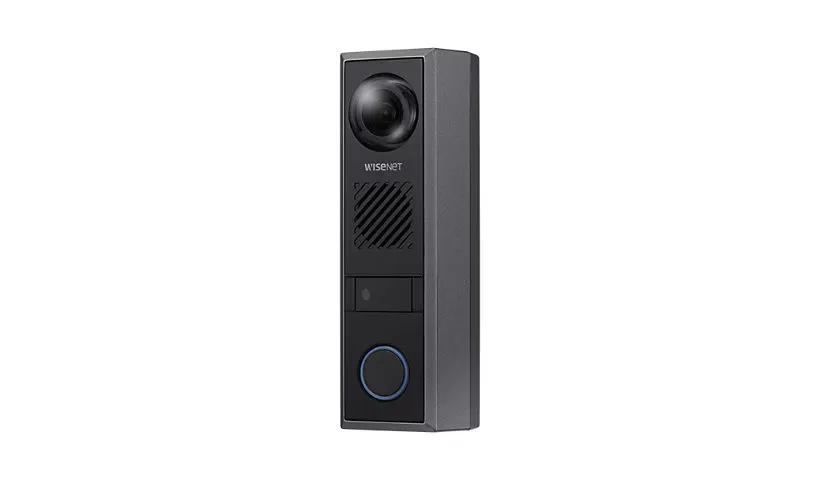
A photo from the AESS job library, not taken in Sunset Park: a slim dark grey wired doorbell with a camera lens, speaker slots and one round push button. On the narrow masonry pier beside a Sunset Park stoop door, a station this slim fits where a wider two-button panel would crowd the door frame, which is why owners of single-household row houses often choose one.
Building Specialists
Door Buzzer Installation for Sunset Park's Architecture
For entry-system purposes, Sunset Park's buildings sort into six groups. The architectural style matters less than three plain facts: how many households the street door serves, what the front wall is made of, and whether the block is inside one of the 2019 historic districts.
Bayed two-family row houses
The neighborhood's signature house: brick, two stories over a basement, a bay on the front, an owner's duplex below and one rental apartment above, all behind a single stoop door.
Row houses with three or four apartments
Houses that were legally divided further over the years, where the old two-button plate never caught up with the households living upstairs.
Brownstone and limestone rows in the districts
The 50th Street rows from 1897 to 1903, the Sunset Park South blocks between Fourth and Fifth Avenues, and the Central and North district streets around the park.
Walk-ups of twelve to twenty apartments
Four-story buildings from 1915 to the late 1920s, such as 5310 Fourth Avenue, 719 58th Street and 4103 Seventh Avenue, usually with an original or once-replaced intercom.
Avenue buildings with a store below
Mixed-use buildings on Fourth, Fifth, Seventh and Eighth Avenues where the apartments' street door sits beside the shopfront and shares the cellar with the store.
Re-clad fronts
Row houses whose brick was covered with vinyl siding or Formstone decades ago, where the mounting surface beside the door is not what it was built as.
Bayed two-family row houses: one stoop door, two households and a bell that rings in only one of them
This is the most common Sunset Park buzzer job by far. The house has a short stoop or a few steps up to a vestibule, a door into the owner's duplex on the first floor and basement, and a stair just inside that climbs to the rental apartment on the top floor. The 1903 houses on 44th Street that Brownstoner profiled were planned exactly that way. Whatever bell was fitted originally usually rings only in the owner's hall, so the tenant either hears nothing or hears every visitor the owner gets.
The installation gives each household a button at the stoop door, an indoor station in its own apartment and its own release for the street door, and nothing more. The tenant can let a guest into the shared vestibule and up the stair but cannot open the owner's apartment door, and the owner is not rung for the tenant's deliveries. Where the owner's door and the stair door are both inside the vestibule, each stays a keyed door under its household's control.
On our list most of these jobs fall between the top of the $400 to $900 audio range and the middle of the $700 to $1,800 video range. A two-button audio station on an old bell pair that tests sound stays low. Video stations in both apartments, phone answering for an owner who travels, and a new hidden run from the cellar to the top floor move it up.
Row houses with three or four apartments: more households than the old plate was made for
Plenty of Sunset Park row houses were legally converted to three or four apartments over the years, often by finishing the basement or splitting the owner's duplex into two floors. The front door rarely kept pace. We regularly find a two-button plate on a house that has had three households for twenty years, with the third tenant's visitors ringing whichever button seems likeliest and the owner fielding the confusion.
The fix is a station with one button per legal apartment, an indoor station for each, and a power supply sized for all of them. The question we ask first is how many apartments the house is recorded for, because the station should match the building's legal count. That is not a formality in this neighborhood. Brownstoner reported in March 2020 that a two-family home at 370 50th Street had been subdivided into 12 units, discovered after a fire, and the owner faced a $150,000 fine. We do not install a row of extra buttons that labels illegal rooms as apartments, and we explain why in the questions further down.
A three- or four-button video system usually lands in the upper half of the $700 to $1,800 range, or at the bottom of the multi-unit range if every apartment wants phone answering and the riser has to be replaced.
Brownstone and limestone rows in the historic districts: the same wiring, a stricter wall
On June 18, 2019, the Landmarks Preservation Commission designated four historic districts here: Sunset Park South, about 285 buildings on 54th to 59th Streets between Fourth and Fifth Avenues; the 50th Street district, 50 houses built between 1897 and 1903 with brownstone fronts; Sunset Park Central, about 148 buildings on 47th and 48th Streets and along Sixth Avenue; and Sunset Park North, about 56 buildings on the south side of 44th Street between Fifth and Seventh Avenues. The houses inside them are mostly the same two-family plan as everywhere else in the neighborhood. What changes is what may be fixed to the front.
Inside a district, the station goes within or beside the door opening, its finish has to suit the facade, and its cable has to disappear into plain masonry or cladding behind it rather than running down the stone. We plan that before ordering: a station small enough to sit on the plain return of the doorway rather than on carved brownstone, and a cable path drilled through a mortar joint or plain brick behind the station into the vestibule. The section on Landmarks rules below sets out the Commission's own wording.
The equipment and price ranges are the same as outside the districts. The difference is in labor and paperwork: a cable route that stays hidden can take longer to plan, and any staff-level permit application adds time before the station can go up.
Walk-ups of twelve to twenty apartments: a 1910s riser, a 1990s panel and a door that has stopped latching
Sunset Park's walk-ups were built in the same burst as the row houses. 5310 Fourth Avenue went up in 1927 with 12 apartments on four floors, 719 58th Street in 1928 with 16, and 4103 Seventh Avenue in 1915 with 20. Buildings like these usually have an intercom panel that has been replaced once, apartment handsets from several decades, and riser cable that is either original or was pulled in a single renovation long ago. When one part fails, the whole building feels it: the door gets propped, couriers leave boxes in the vestibule, and tenants start filing complaints.
Our first job in a walk-up is to meter every apartment's pair from the panel location to the apartment. If most pairs test well, the building takes a new panel, a new power supply and new apartment stations on the existing cable, with the few bad pairs replaced. If many fail, the choice is new cable up the stairwell, phone answering for the apartments whose pairs failed, or a mix. We price each path on the same sheet so the owner can compare.
Walk-ups of this size start at about $2,500 on our list and rise with apartment count, video, phone answering and how much cable has to be replaced. A 12-unit building with a sound riser sits near the bottom of the multi-unit range; a 20-unit building with a failed riser and a rear door on the system sits well above it.
Avenue buildings with a store below: two businesses of doors in one front wall
On Fourth and Fifth Avenues, Wikipedia notes, the ground floors of the mixed-use buildings are commercial, and the same is true along much of Seventh and Eighth. Small Business Services counted 455 storefronts on Eighth Avenue, 445 on Fifth, 232 on Fourth and 230 on Seventh. Above many of them are two to four apartments reached through a narrow residential door beside the shop. Visitors confuse the two, couriers ring the store for the apartments and the apartments for the store, and the store's own deliveries often arrive at a side or cellar door before the shop opens.
We wire these as two separate entries even when one owner holds the whole building. The apartments get their own panel and release at their own street door; the store gets a delivery buzzer at whichever door its suppliers use, ringing inside the shop. Neither can release the other's door, and the shared cellar holds two clearly labeled power supplies rather than one tangle.
The apartments' side usually falls in the $700 to $1,800 range for two to four households, and the store's delivery buzzer is a small addition on the same quote. A building with more apartments moves into the multi-unit range.
Re-clad fronts: vinyl siding and Formstone over the original brick
Wikipedia's description of Sunset Park's houses mentions that many were clad in vinyl siding and Formstone, a cement-based coating molded to look like stone that was popular in the mid-twentieth century. Both change the job at the door. Vinyl siding is a thin skin over furring strips, so a station screwed only to the siding will work loose and leak. Formstone is hard and brittle at the surface and can crack or spall around a careless hole.
On siding we mount the station on a block or plate fastened through to the wall behind, and seal it so water running down the siding passes the cable hole. On Formstone we drill slowly with masonry bits, set the fasteners into the brick behind the coating, and keep the hole no larger than the cable needs. Where the vestibule's inside wall is still original plaster or brick, we often prefer to bring the cable straight through the door frame instead of through the coating at all.
None of this changes the range. It is labor we account for at the walkthrough, and it is a good reason to send a photo of the front before we price.
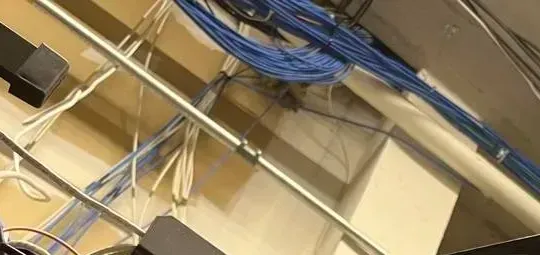
A photo from the AESS job library, not taken in Sunset Park: bundles of blue low-voltage cable laid over a ceiling beam and a metal pipe in an open ceiling. In a Sunset Park row house the cellar ceiling usually looks like this, and it is where the cable from the stoop door turns and heads for the stair to the top-floor apartment.
Field Notes
Field Notes: Count the Mailboxes, Read the Facade, Then Ring the Top Floor From the Stoop
This is the order our technician works in during the first half hour at a Sunset Park property, before a price is discussed.
First, the mailboxes and the meters. They are the quickest honest count of the households behind a door, and in this neighborhood the count from the street is often wrong. If the mailbox count and the owner's count agree with the building's recorded apartments, the station size is settled. If they do not, we have the conversation about legal apartments before anything else.
Second, the front wall. Brick, brownstone, limestone, vinyl siding or Formstone each mounts differently, and inside a historic district the Commission's rules decide where the station may sit at all. We photograph the doorway from the sidewalk and from close up, note the plain surfaces beside the opening, and look for an old bell hole that can be reused.
Third, the door. The technician closes the stoop door gently from half open and watches whether it latches without help. In a house where the closer has been tired for years, it usually does not, and no buzzer can make up for that.
Fourth, the far apartment. The technician presses the existing bell or intercom button for the top floor while someone stands in that apartment's back room, and asks whether they heard it. In a two-family the answer is often that the top floor never rings at all, which is the whole case for a second button and a second station.
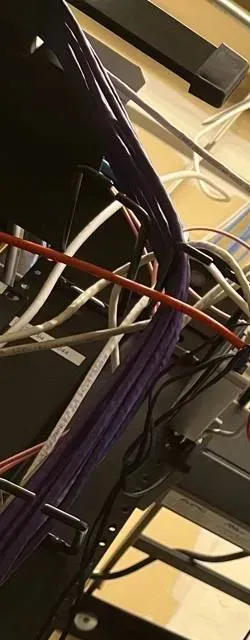
A photo from the AESS job library, not taken in Sunset Park: purple, white and red cable bundles dropping down beside a black equipment rack. In one of Sunset Park's larger apartment houses, the entry controller and power supply belong in a small locked enclosure like this in the cellar, with every apartment's pair labeled where it lands.
Built in 1915, 1927 and 1928: Where Sunset Park's Walk-Ups Stand Under the State's Intercom Rule
New York's Multiple Dwelling Law has carried an intercom requirement since 1968, and nearly every Sunset Park walk-up sits on the older side of it. Section 50-a says that a class A multiple dwelling erected or converted after January 1, 1968 with eight or more apartments must have a self-locking door at its main entrance and an intercommunication system that lets residents talk to a visitor at that door and release it from their apartments. Buildings older than that must install the door and the intercom once tenants occupying a majority of the apartments ask for them in writing, with the work started within 90 days and finished within six months.
Run Sunset Park's buildings through the rule and three kinds of answer come out. A 1915, 1927 or 1928 walk-up with 12, 16 or 20 apartments, like the three on Openigloo's record above, was not required to have an intercom when it was built, and must install one when a written majority request arrives. A newer building with eight or more apartments, or an older one converted after 1968 into eight or more, falls under the first half of the rule from the start. A two-, three- or four-family row house is below the eight-apartment line, so the state rule does not reach it, although the city's housing code still governs its doors, locks and hallway lighting.
The older buildings are also where an existing intercom matters most. Once a building has a system, tenants and courts treat it as a service the owner provides. Habitat reported in February 2024 that courts have treated intercoms as an essential service, and Brick Underground's buzzer guide notes that a rent-stabilized tenant whose intercom stops working can file a reduction-of-services complaint with the state's housing agency. In a neighborhood where so many apartments are rent-regulated, a dead intercom is rarely just an inconvenience.
Tenants who cannot get a repair usually go through 311. The city's own maintenance-complaint guide lists "Doorbells, buzzers, or intercoms that are broken or missing" and "Doors and locks that are broken or missing or not self-closing" among the conditions HPD inspects in apartments and public areas. HPD first contacts the managing agent, may call the tenant back to ask whether the problem was fixed, and sends a Code Enforcement inspector if it was not, without telling the owner the inspection date. Owners who plan the replacement before that point choose the equipment and the timing themselves.
None of this is legal advice, and every building's record is its own. When an owner is clearing a list of violations, we put the panel, the strike, the closer and the apartment stations on one plan so that the street door is fixed once and stays fixed.
One Panel Per Doorway: Landmarks Rules for Door Stations in Sunset Park's Four Historic Districts
If your house is on the south side of 44th Street between Fifth and Seventh Avenues, on 47th or 48th Street between Fifth and Sixth, on 50th Street, or on the blocks from 54th to 59th Street between Fourth and Fifth Avenues, it is probably inside one of the districts the Landmarks Preservation Commission designated in 2019. Check the Commission's map before any work, because a door station on a district house needs a permit.
The good news is that intercoms are one of the things the Commission's staff can approve without a public hearing, as long as the installation meets its published criteria. Chapter 11 of the Commission's Permit Guidebook sets them out, and we design to them from the start:
One panel per opening. "A maximum of two light fixtures and one intercom panel can be installed per door opening." A two-family house gets one panel with two buttons, not two separate stations side by side.
At the door, or in front of it. Doorbells and intercom panels go "within or adjacent to a door opening," or "on a fence or wall in front of the entranceway." On a house with an iron areaway fence, the fence can be an option.
A finish that suits the house. "Design, size, and finish of installations must be compatible with the architecture of the building." On a brownstone front that usually means a dark bronze or black face and the smallest station that fits the household count.
Hidden cable. The conduit "must be concealed by going through plain masonry or wall cladding behind the installation." Where that is impossible, staff "may approve a maximum of approximately ten inches of visible conduit," painted to match.
Hands off the ornament. Nothing may be attached "through cast iron or on any decorative surfaces," which rules out the carved brownstone around many 1890s doorways.
In practice, most Sunset Park district houses have a plain brick or stone return inside the doorway, or a flat section of wall between the door frame and the bay, where a slim station can sit with its cable drilled straight through into the vestibule. We photograph the doorway, mark the proposed position and send you a drawing you can include with the permit application. Staff-level permits take time, so tell us at the start if your house is in a district and we will build that into the schedule. The Commission's rules also cover security cameras on the facade, with no more than two cameras for every 25 feet of frontage on a small building, which matters if you want a camera over the stoop on the same visit.
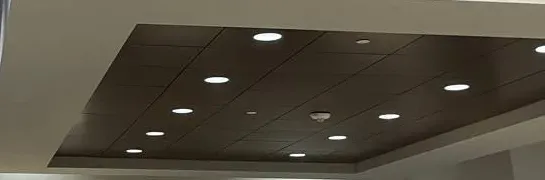
A photo from the AESS job library, not taken in Sunset Park: a dark recessed ceiling panel with round downlights and a small round device, framed by a lighter ceiling. Inside the vestibule of a landmarked Sunset Park house, the ceiling and the inner walls are where small devices and cable can go freely, which is why we route as much as possible indoors and keep the facade to one discreet panel.
Apartment Numbers, Not Surnames: Setting Up a Directory Everyone at a Sunset Park Door Can Use
A Sunset Park door panel is read by more kinds of people than most. Residents and their visitors may read Spanish, Chinese, English or several other languages, and Time Out's 2023 analysis of Census data found that Chinese is the most spoken language here after English and Spanish. Small Business Services' assessment of the neighborhood's corridors noted that language barriers affect some merchants and that health and professional offices on Seventh and Eighth Avenues serve speakers of different languages and dialects. Couriers, home attendants, repair workers and relatives from abroad all have to find the right button.
That is why we recommend labeling by apartment number and floor rather than by surname. "2F" and "3R" read the same in every language, they do not go stale when a tenant moves, and they do not put residents' names on the street. On button panels we engrave or print the apartment designation large enough to read from the bottom step. On code and touchscreen panels, the code is the apartment number wherever the system allows it.
The short instructions on a panel matter too: "press the apartment number, then the bell key," or "push the door after the buzz." Many current panels let the installer change that instruction text, and some offer more than one display language. Support varies by model, so before ordering we confirm what the chosen panel can show and agree the wording with you. Where a panel cannot display a second language, a small engraved plate beside it in the languages your building uses does the same job, inside the Commission's limits if the house is landmarked.
The indoor side is simpler. Answer and release buttons on most apartment stations are icons rather than words, and on video stations we set the menus during handover with each household, in whatever language its station supports.
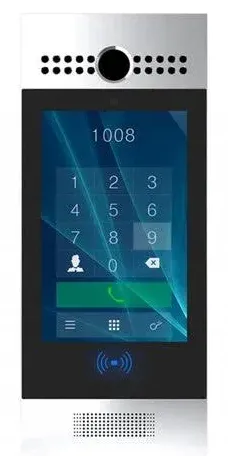
A photo from the AESS job library, not taken in Sunset Park: a touchscreen entry panel showing a dial pad with a four-digit apartment code entered, a camera above and a card-reader symbol below. For a 20-apartment Sunset Park walk-up, a code panel like this lets a visitor dial a number rather than read a list of names, which works the same whatever language the visitor reads.
Couriers, the Vestibule and the Sixth Avenue Locker: What a Buzzer Changes About Packages
Packages are where a missing or broken buzzer costs residents money. In April 2025 News 12 reported that Sunset Park's first secure package locker had opened on Sixth Avenue near City Fresh Market, where residents choose the locker as their delivery address and collect with a PIN. One resident told the station, "We saw packages were missing in our building group chat," and another described an $80 package being broken into. The service had 1,400 users by the time of the report.
A locker solves the problem for residents who are willing to walk to it. It does nothing for the courier who arrives with a box for the top floor of a two-family on 46th Street, or the grocery delivery for an older tenant in a walk-up on 58th Street. What helps at the building itself is simple: a button that actually reaches the household, a resident who can see or hear the courier and decide whether to release the door, and a street door that relatches behind the courier so the box is not left in an open vestibule for the next passerby.
In a walk-up with a lot of deliveries, owners sometimes want more than that: a parcel shelf or locked package cabinet inside the inner door, or a code that opens only a package room. Those are separate decisions, and we price them separately. What we will not do is set the street door to stay unlocked during daytime hours so couriers can walk in, because in a building where the reviews already say "Deliveries get stolen," an open door is the problem rather than the cure.
Commercial Door Buzzer Installation
Business Door Buzzer Installation in Sunset Park
Sunset Park's businesses are spread across five avenues and a large industrial waterfront. Small Business Services counted 1,580 storefronts on its study corridors with an 11.3 percent vacancy rate in winter 2021, and named limited loading zones and double parking among the corridors' problems, which is one reason so many deliveries arrive at side doors and cellar doors rather than through the front.
Eighth Avenue and the Chinatown blocks
455 storefronts on Eighth Avenue, the largest count of any corridor, with restaurants, groceries and upstairs health and professional offices. Upstairs practices often want a door station at street level that rings the reception desk and releases a door the patients can push.
Fifth Avenue between 38th and 64th Streets
The Sunset Park Business Improvement District's strip, with 445 storefronts and only 7 percent vacancy. Shops here often share their front wall with an apartments' door, and need the two kept clearly separate.
Seventh Avenue
230 storefronts, a mix of shops, offices and services, with walk-ups such as 4103 Seventh Avenue in between. Small offices above the shops want a buzzer that admits clients without leaving the street door open.
Fourth Avenue
232 storefronts with the lowest vacancy of the corridors, newer apartment buildings among the older mixed-use ones, and the 72nd Precinct station house at 830 Fourth Avenue. Residential lobbies here are larger and often take a code or touchscreen panel.
Third Avenue and the waterfront
97 storefronts under the Gowanus Expressway, auto and industrial businesses, and west of it Industry City and the Brooklyn Army Terminal, where suites and studios need their own door stations behind the building's main entrance.
Rules that apply to business and building entry installations in Sunset Park
Exit stays free. Whatever controls a door from outside, it must open from inside with one motion and no key. An electric strike does that by design, because the inside lever still withdraws the latch.
Magnetic locks need the full arrangement. The building code allows electrically locked egress doors only with a sensor on the egress side, a push-to-exit button 40 to 48 inches above the floor within five feet of the door, unlocking on loss of power and on fire alarm or sprinkler activation, and UL 294 listed parts.
Fire doors take fail-secure strikes. Allegion's guide notes that fire-rated doors need fail-secure strikes so they stay latched in a fire, and that "electromagnetic locks are only available fail safe," which is why a steel stair or corridor door in a loft building gets a strike.
Reach ranges apply to public doors. At a clinic, office or community space open to the public, the 2010 ADA Standards set a high forward reach of 48 inches maximum, so the station's buttons go no higher than that.
Tenants' data is regulated. In a rental building, the city's tenant data privacy law covers smart access systems that collect data about residents, so we explain what a phone-based or code panel records before the owner chooses it.
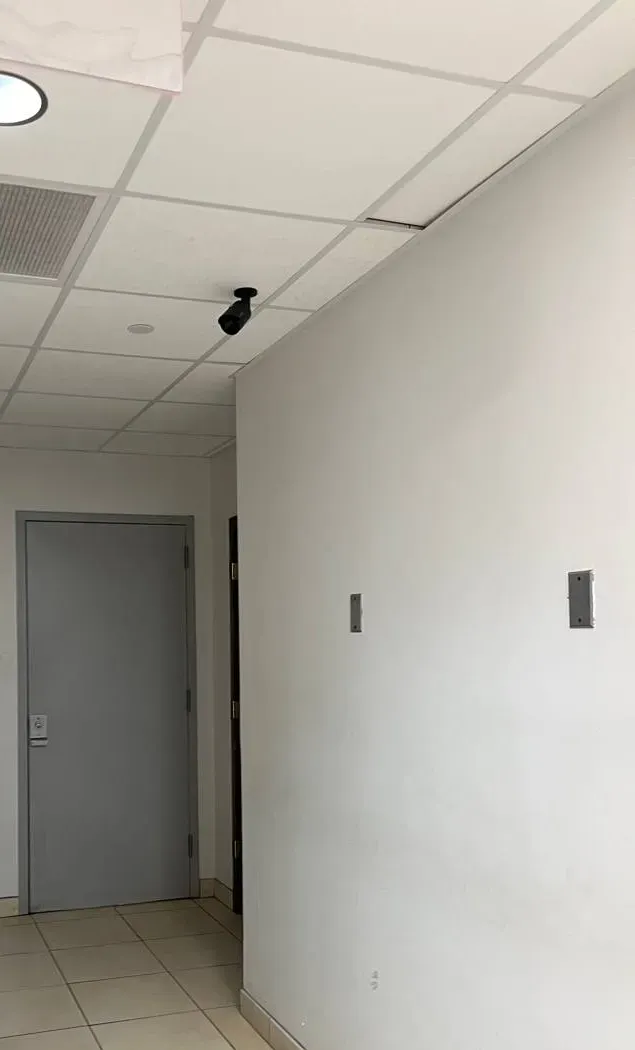
A photo from the AESS job library, not taken in Sunset Park: a tiled corridor with white walls and small wall plates, ending at a grey steel door with a lever handle under a drop ceiling with a small camera. Suites in the converted industrial buildings along Sunset Park's waterfront often sit behind a steel corridor door like this, which takes a fail-secure strike, keeps its lever for free exit and gets a small call station on the corridor side.
Your Questions Answered
Door Buzzer Installation in Sunset Park: Questions Answered
Row houses and who lives behind the stoop door
Our row house is recorded as a two-family, but the owner wants a separate button for each of four rooms rented out upstairs. Will you install a station like that?
No. We install one button for each legal apartment, and a two-family gets two. A station with a button for each rented room turns rooms into apartments on the front of the house without making them legal, and in Sunset Park that is not an abstract risk: the two-family at 370 50th Street that Brownstoner reported in 2020 had been subdivided into 12 units, and the conversion came to light after a fire.
If the house really holds more households than it is recorded for, the right first step is the legal one: an architect or expediter can tell the owner what it takes to add an apartment. Once the Buildings Department records the change, we add the button, the station and the release to match.
Can a keyed lock or an electric release ever go on the doors of individual rented rooms inside an apartment?
Not as part of a buzzer system, and we advise against them altogether. The Buildings Department's list of warning signs for illegal conversions tells renters to "look out for locked doors in the unit," because locked interior doors slow people down when they need to get out. A buzzer system's job ends at the street door and, in a building, at each apartment's own entrance, which stays under the household's own key.
If several unrelated adults share one apartment, the place to give each of them access is the street door, with their own code or fob where the system supports it, not a lock on every bedroom.
Someone rents the cellar of our two-family, and the city's basement-apartment pilot keeps coming up. Does that program cover Sunset Park, and should the cellar get a button meanwhile?
The pilot created by Local Law 126 of 2024, which lets owners of some one- and two-family homes apply for temporary authorization of basement and cellar apartments, covers only listed community districts. In Brooklyn those are districts 4, 10, 11 and 17. Sunset Park is in Community District 7, so it is not part of the program as written, and HPD's November 2025 release added that properties in flood-prone areas cannot apply at all.
For that reason we do not add a cellar apartment's button to a two-family's station unless the unit is legal. What we can do is size the power supply and leave a spare pair in the cable so a third household can be added in an afternoon if the city's rules or your certificate of occupancy change later.
The front of our row house was covered with Formstone long before we bought it. Can the door station be set flush into the coating, or does it have to sit on the surface?
Usually on the surface, or flush in the door frame rather than the wall. Recessing a station means cutting a pocket, and Formstone is a thin, hard cement skin over the brick that can crack or let go around a large cut. A surface-mount station with its fasteners set into the brick behind the coating, and a single cable hole drilled slowly, disturbs far less of it.
Where the vestibule has a wood door frame with enough width, a slim station mounted on the frame avoids the coating entirely. We look at both options at the walkthrough and photograph the spot before drilling.
Walk-ups whose intercom has gone quiet
We just bought a 1915 walk-up on Seventh Avenue whose intercom has been dead for about a year. What can be done in the first week, before a full replacement is installed?
The first week is about the door, not the electronics. We make sure the street door closes and latches on its own, fit a working strike if the old one has failed, and, if the existing panel or power supply can be brought back for a few weeks, we do that so residents can at least ring and release while the new system is ordered. If nothing can be revived, the door is set to lock and residents use keys, which is better than a door that stands open.
At the same visit we meter the riser pairs, so the quote for the permanent system says which apartments keep their cable and which need new cable or phone answering. A dead intercom in a building that age usually turns out to be a power supply, a panel and a handful of failed pairs rather than the whole building's wiring.
Our walk-up's audio intercom still works, but several tenants want to answer the door on their phones. Can phone answering be added without replacing the system?
Sometimes. A few audio systems accept an add-on module that forwards calls to phones, and some cloud panels can be installed beside an old system so that phone users and handset users coexist. Whether that works depends on the make, the model and how the existing panel is wired, and ButterflyMX's guide is right that cable condition "cannot be confirmed from a photo, the age of the building, or the look of a wall station."
When an add-on is possible, we price it against a new panel that does both, with any monthly software charge stated. When it is not, we say so and explain why, rather than wiring a relay into the old panel that nobody will be able to service later.
The avenues, the expressway and the districts
Our building faces Third Avenue under the Gowanus Expressway, and anything mounted on the front turns grey with grime within months. Will a video station's camera stay usable?
Yes, with two choices made at the start. A station whose camera sits behind a recessed or hooded window collects much less road grime than one with a flush lens, and a stainless or powder-coated face can be wiped clean without scratching. We also mount the station on the side of the doorway that is out of the direct spray from the avenue where the wall allows it.
After that, cleaning the lens and the buttons with a damp cloth every few weeks is enough. Avoid solvents and abrasive pads, which cloud the lens faster than the dirt does.
Our house in the Sunset Park South district needs a door station and we would like a camera over the stoop as well. Can both go on one Landmarks application?
Plan them together. The Commission's Permit Guidebook treats intercom panels and security cameras as items its staff can approve when they meet the published criteria, so neither needs a public hearing if it is designed to those rules, and there is no reason to treat them as two separate projects. The criteria differ: one intercom panel per door opening, and for a small building no more than two security cameras for every 25 feet of street frontage, finished to blend with the facade.
We prepare one set of photos and a marked drawing showing the station, the camera and both cable paths for you or your expediter to file, and the Commission's staff decide how to process it. Installation waits for the permit.
The store on our Fifth Avenue building's ground floor has an alarm company's wiring all over the cellar. Can the apartments' buzzer share its power supply or its cable?
It should not. The store's alarm belongs to the store and its monitoring company, and if the shop changes tenants or the alarm company services its panel, a buzzer hanging off the same supply goes down with it. The apartments' system gets its own power supply, its own labeled cable and its own spot on the cellar wall.
Sharing a route is different: where the alarm company's cable already runs through a clean sleeve in the cellar ceiling, our cable can follow the same path in its own run. We label both so the next technician in that cellar can tell them apart.
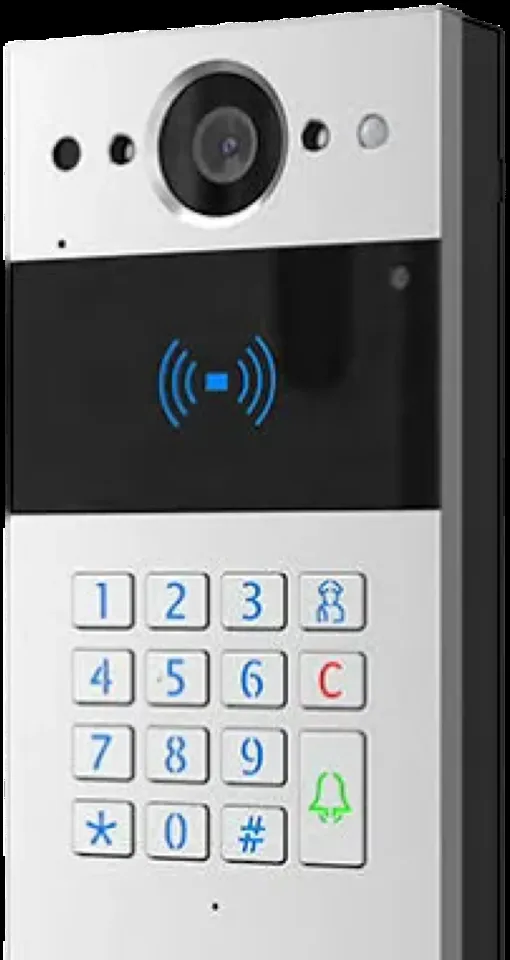
A photo from the AESS job library, not taken in Sunset Park: a silver and black keypad door station with a camera lens at the top, a blue card-reader symbol, a numeric keypad and a green bell key. On the street door of a 12- to 20-apartment Sunset Park walk-up, a keypad station lets visitors dial an apartment number and lets residents with several adults per household enter by code or card instead of copying keys.
Equipment
Types of Door Buzzer Systems We Install
Every quote starts with our own non-branded system, sized to the building. If you want a particular brand, ask, and we will tell you which of the brands we carry suit your door, your front wall and your cable.
Two-button stoop stations
One weather-rated housing with a button and a release path for each household of a two-family row house, slim enough for the masonry beside a Sunset Park doorway.
Three- and four-button stations
For row houses legally divided into more apartments, with each button engraved by apartment and floor rather than by name.
Audio apartment stations
Simple talk-and-release stations for households that want to hear the visitor and open the door, nothing more, mounted where the old handset hung.
Indoor video stations
Screens with answer and release buttons for owners and tenants who want to see who is on the stoop before opening, powered over the same cable as the call.
Phone and app answering
For owners who live elsewhere and households whose members work different shifts, ringing phones alongside or instead of a wall station.
Two-wire multi-tenant systems
For the 1910s and 1920s walk-ups, designed to run over existing pairs where they test sound and to reach every apartment from one street-door panel.
Code and touchscreen panels
For larger buildings and crowded households, where visitors dial an apartment number and residents can enter with their own code or card.
Fail-secure electric strikes
Our default release: locked when the power is off, free to open from inside with the lever, fitted to old wood frames and steel building doors alike.
Battery-backed power supplies
Supplies and controllers in a labeled enclosure on the cellar wall, with a battery that keeps the station and release working through a short outage.
One bell, wired stations or phone answering: which fits a Sunset Park building?
What matters
One bell in the front hall
Wired station per household
Phone or app answering
Top-floor tenant knows a visitor is for them
No, everyone hears the same bell
Yes, one button each
Yes, one entry each
Release the stoop door from upstairs
No
Yes
Yes, when wired to a strike
Works for a household on mixed shifts
Only for whoever is downstairs
For whoever is home
For whoever has the phone
Needs internet in the building
No
No
Yes, at the panel or the station
Fits the one-panel rule in a historic district
Yes
Yes, as one multi-button panel
Yes, as one panel
Monthly fees
None
None
Sometimes a software charge
Brooklyn list range
Not a buzzer
$400–$900 audio, $700–$1,800 video for houses and small buildings
$700–$1,800 for a house; walk-ups from about $2,500
ADT, Ring and SimpliSafe compared with a local installer for a Sunset Park two-family
National security brands sell to one household at a time. ADT's business is monitored alarms with an installer visit; Ring and SimpliSafe sell video doorbells that an owner can wire to an existing doorbell circuit or run on a battery. For a one-family row house whose owner wants to see the stoop on a phone, one of those doorbells can do the job, and we will say so if that is all you need.
A Sunset Park two-family is a different problem. A video doorbell gives one button to one household. It does not give the tenant upstairs a separate button, it does not fire an electric strike from the top floor, and it depends on the owner's Wi-Fi reaching the stoop through a brick front and a vestibule. Mounting two doorbells side by side also runs against the one-panel rule inside a historic district. The question a Brownstoner forum poster asked a decade ago still describes what most owners here want: "Nothing fancy just a buzzer and intercom in each unit."
A local low-voltage installer sizes the system to the households and the door, writes the price down and answers the phone afterward. That is what we do, under NYS license #12000287431, at the same Brooklyn rate we charge in every neighborhood.
AI Overview Reality Check
What AI Gets Wrong About Door Buzzer Installation in Sunset Park
AI summaries of this subject lean on national cost guides, vendor blogs and generic advice. Here are seven claims they repeat, each set against what actually applies on a Sunset Park block.
"An intercom installation costs about $2,500 on average"
HomeAdvisor's cost guide gives that average, with a range from $1,500 to $15,000, wireless systems from $150 to $1,500 and hard-wired systems from $1,000 to $15,000. As a national number spread across every kind of house, it is accurate and almost useless for one particular door.
In Sunset Park most jobs are two-family row houses, and those fall inside our $400 to $900 audio range or our $700 to $1,800 video range. The $2,500 figure is closer to where a 12-apartment walk-up starts on our list than to what a row house costs.
The real drivers here are the number of households behind the stoop door, whether the old bell pair or riser tests sound, and whether the facade is ordinary brick or something harder to work, such as Formstone or a landmarked brownstone front.
"Replacing a small building's intercom runs $2,000 to $50,000"
That range came from an installer quoted by Brick Underground in 2014, and ButterflyMX's more recent guide cites vendor figures of "roughly $1,500 to $2,500" and "roughly $2,200 to $5,000 or more for a small single-entrance project." The spread exists because building size, cable condition and system type all vary.
For Sunset Park's walk-ups, the useful question is narrower. A 12- to 20-unit building from 1915 to 1928 with a sound riser lands near the bottom of our multi-unit range, from about $2,500. A failed riser, video for every apartment or a second entrance moves it toward $10,000.
The $50,000 end of that old range belongs to buildings far larger than anything on the side streets here, and quoting it to a 16-unit owner only makes a needed job look impossible.
"Every New York apartment building must have an intercom"
Multiple Dwelling Law §50-a requires one in class A multiple dwellings with eight or more apartments erected or converted after January 1, 1968. Older buildings must install one when tenants occupying a majority of the apartments ask in writing.
Most Sunset Park walk-ups predate 1968, so the duty arises from the tenants' request rather than from the building itself, and two-, three- and four-family row houses are below the eight-apartment line altogether. Once a building does have an intercom, though, courts have treated it as an essential service, as Habitat reported in 2024.
That makes the realistic picture the reverse of what the summaries imply: the law reaches fewer Sunset Park buildings than people think, but the buildings it does reach can be put on a 90-day clock by a single letter.
"Just mount the intercom wherever it is convenient on the front"
Generic installation advice treats the facade as a blank wall. On most Brooklyn blocks a careful installer can do roughly that.
Inside Sunset Park's four historic districts, the Landmarks Commission allows one intercom panel per door opening, within or adjacent to the opening, with a compatible finish and concealed cable, and no attachment to decorative surfaces. A station screwed to the carved brownstone beside a 50th Street doorway would fail every one of those tests.
Outside the districts, the facade still matters: vinyl siding needs blocking behind the station and Formstone needs slow drilling into the brick behind it. Convenience is the last consideration, not the first.
"A wireless doorbell kit replaces a buzzer"
HomeAdvisor notes that wireless systems are the best option for a do-it-yourself installation, and for a single household that wants a chime in the back of the house, that is fair.
What a wireless kit cannot do is open the door. Releasing a stoop door from the top floor of a two-family takes an electric strike in the frame, and a strike needs power and a control signal from a supply, which means cable. Two wireless buttons on a two-family still leave the tenant walking down the stairs.
Wireless and phone answering have their place in Sunset Park, mainly for apartments whose riser pair has failed and for owners who live elsewhere. They work alongside a wired release rather than in place of one.
"Old buzzer wiring can't be reused in a building that old"
Summaries often assume a hundred-year-old building needs all new cable. Daniel Vasquez of Paragon Security and Locksmith told Brick Underground that even in older systems "the core wiring is typically fine," and ButterflyMX says existing low-voltage wiring "can sometimes be reused when it is in suitable condition."
The same ButterflyMX guide adds the caution that matters: condition "cannot be confirmed from a photo, the age of the building, or the look of a wall station." In a 1915 walk-up some pairs will be perfect and some will have been cut by a kitchen renovation or corroded in a damp cellar.
That is why we meter every pair before pricing, keep the good ones and quote replacements only where a pair fails. It is usually the cheapest honest answer in a Sunset Park building.
"A package locker or a camera solves building security"
Summaries of package theft tend to recommend lockers and doorbell cameras, and both have a place. Sunset Park's Sixth Avenue locker had 1,400 users within months of opening, and a camera at the door records what happens there.
Neither one decides who gets through the street door. A camera that records a stranger walking into a vestibule after the door was propped is a record of a failure, not a fix, and a locker helps only residents who use it. The reviews from 4103 Seventh Avenue and 719 58th Street describe the underlying problem: an intercom that has not worked for a year, and deliveries that disappear.
The fix at the building is a working button for each household, a release that lets the resident choose who comes in, and a door that relatches behind every visitor. Lockers and cameras are useful additions to that, not substitutes for it.
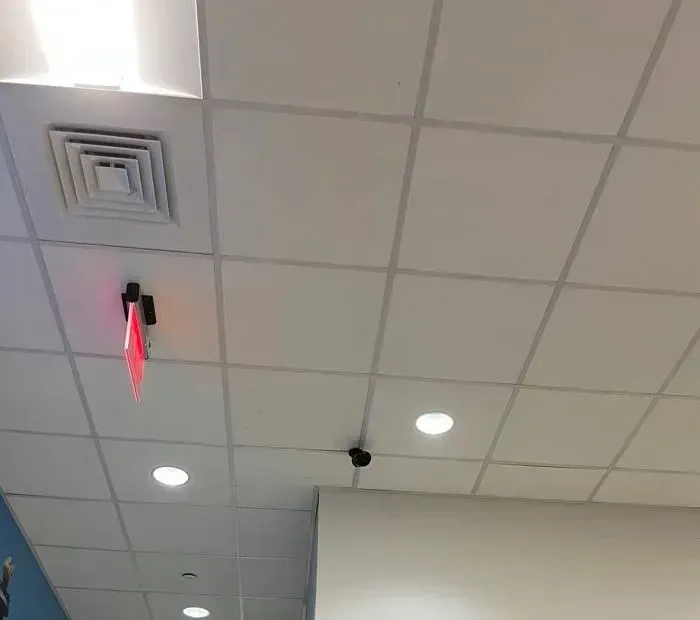
A photo from the AESS job library, not taken in Sunset Park: a drop ceiling with a lit red exit sign, an air diffuser, round recessed lights and a small black camera. In the lobby of one of Sunset Park's larger apartment houses or loft buildings, the door under an exit sign like this has to open from inside with no key, whatever the entry system does from the street.
Not Sure Whether Your Building Needs a Repair, a New Panel or a Button for Each Household? Speak to a Tech
Send a photo of the street door and whatever is mounted beside it, one of the mailboxes in the vestibule, and one of the cellar wall where the old transformer or intercom supply hangs, along with how many households share the door. A technician will tell you which approach fits and where it falls on our Brooklyn ranges. Call or text (347) 934-8335, send photos on WhatsApp, or fill in the form below.
Get In Touch
Request a Free Quote
✅
Request Sent!
Thank you. A technician will call you about the Sunset Park address, usually within two hours during working hours.
How It Works
Our Installation Process
1. Match the households to the legal apartment count
We count who lives behind the street door, compare it with the apartments the building is recorded for, and size the station to the legal number.
2. Read the front of the building
We note whether the wall beside the door is brick, brownstone, limestone, siding or Formstone, and whether the block is in one of the 2019 historic districts.
3. Check the street door, frame and closer
We close the door from half open and watch it latch, then choose a strike that suits the frame and lock, because no buzzer fixes a door that will not shut.
4. Test the old pairs and plan the route
We meter the bell or riser pairs and plan the run from the stoop through the cellar to each floor, keeping the good pairs and marking the failed ones.
5. Agree the directory and the languages
We agree how apartments are listed, by number and floor, and what instruction text visitors will read, confirming what the chosen panel can display.
6. Price it in writing
We place the job in the matching Brooklyn range and name every possible extra, such as a pair that may fail or a new outlet, before anything is ordered.
7. Install, label and test from the sidewalk
We mount the station, fit the release, run and conceal the cable, label each pair at the supply, then ring every button from outside and release from every station.
8. Hand over and enrol the households
We show each household how to answer and release, give the owner the admin access, and leave a written wiring record with the building's papers.
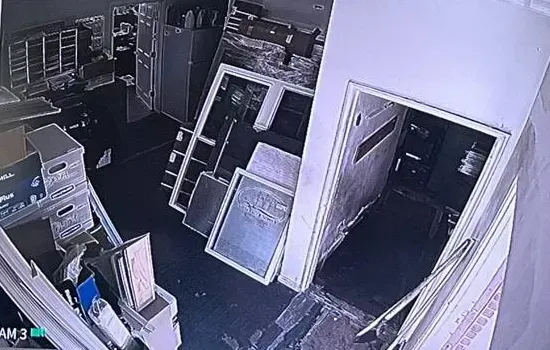
A photo from the AESS job library, not taken in Sunset Park: a black-and-white night camera view of a cluttered room with an open doorway into a dark back room. Sunset Park cellars often look like this, packed with a century of storage, and during step 4 they are where we trace the old bell and intercom pairs from the front wall to the stair.
Coverage Area
Door Buzzer Installation Near Sunset Park's Landmarks
Sunset Park
The 24.5-acre park on the hill between Fifth and Seventh Avenues and 41st and 44th Streets, with harbor and Manhattan views and a 1936 pool that became a city landmark in 2007.
Industry City
Sixteen industrial buildings of about six million square feet on the waterfront, built from 1895 as Bush Terminal and now home to more than 650 tenants.
Brooklyn Army Terminal
The 1919 concrete complex west of Second Avenue between 58th and 65th Streets, once the largest of its kind in the world and city-owned since 1981.
Eighth Avenue Chinatown
The shopping and restaurant strip running from the 40s to the 60s, where Winley Supermarket opened at 5523 Eighth Avenue in 1986.
The 50th Street Historic District
Fifty brownstone-fronted row houses built between 1897 and 1903, one of four districts the Landmarks Commission designated here in June 2019.
The 72nd Precinct station house
The precinct at 830 Fourth Avenue that serves Sunset Park and Windsor Terrace, and holds its community council meetings on Fourth Avenue as well.
Sunset Park is billed at our standard Brooklyn rate. The final figure follows photos and a walkthrough, because the number of households behind the door, the condition of the old pairs, the state of the door and the wall beside it decide the total far more than the name on the station.
Job
Typical Sunset Park property
Brooklyn range
Audio station or replacement with an electric strike release, existing wiring reused where it tests well
One- and two-family row houses, a store's delivery door
$400–$900
Video door station with indoor stations or phone answering
Two- to four-family row houses, district brownstones, the two to four apartments over an avenue store
$700–$1,800
Multi-unit entry system, audio or video by apartment count, optional code or card entry
The 12- to 20-unit walk-ups from 1915 to the late 1920s and larger apartment houses
from $2,500 to $10,000+
In-person diagnosis of an existing system, booked online
Any building whose old intercom must be tested before quoting
$250, applied toward the work
Monthly subscription
Any property choosing a wired system without cloud features
$0
Inside each range, the job moves in a predictable order. The households come first: a two-family with audio stations stays low, while a four-family with video in every apartment moves up. The cable comes next: an old bell pair or riser pair that tests sound adds nothing, while a new run from the stoop through the cellar to the top floor, or new riser cable in a walk-up, adds labor. Then the door and the front: a frame that needs reinforcing before a strike can hold, a closer that needs replacing, or a Formstone or landmarked facade that takes slower, more careful work. If the same visit adds a camera over the entrance, doing both together usually saves $200 to $400 in labor compared with two trips. Anything that depends on a test is named with its price on the quote before you approve, and equipment is ordered only after approval.
Full terms — including 50% deposit, one-year parts-only warranty on AESS-supplied products, and the late-fee schedule — are set out in the service agreement.
Find Out Which Range Your Sunset Park Row House or Walk-Up Falls In
Tell us the block and avenue, how many households share the street door, what is mounted beside it now and whether the house is in a historic district, and we will tell you which Brooklyn range fits and what would move it. Call or text (347) 934-8335, send photos on WhatsApp, or fill in the form.
Shop Our Systems
Door Buzzer Installation Packages & Pricing
Three typical Sunset Park jobs, each placed inside the matching range on our Brooklyn list. The exact figure comes from your photos and the walkthrough.
Two-family row house audio: $400–$900
A two-button audio station beside the stoop door, an audio station in each apartment, a fail-secure strike in the frame, a closer adjusted to pull the door shut and a battery-backed supply on the cellar wall.
Row house or small building video: $700–$1,800
A two- to four-button video station engraved by apartment and floor, a video station in each apartment, phone answering where a household wants it, and cable concealed from the stoop to the top floor.
Walk-up entry system: from about $2,500
A button, code or touchscreen panel at the street door, stations or phone answering for every apartment, tested or new riser cable, a free-exit release and a labeled controller, rising toward $10,000 or more with apartments, video and entrances.
Bring your own equipment. If you have already bought a door station or intercom kit, we can install it as labor-only work, priced flat once we have seen the door, the front wall and the cable path. Send us the make and model first and we will tell you whether it can serve every household in the house, release your door and meet the Landmarks rules if your block is in a district. Equipment you supply is covered by its maker's warranty, not ours.
Complete Services
Every Door Buzzer Service in Sunset Park
Row houses and district houses
Two-button stations, first buzzers, Formstone and siding mounts, and Landmarks-ready drawings for the four historic districts. Request a quote
Walk-ups and mixed-use buildings
Riser testing, partial repairs, new panels, phone answering and separate store and apartment doors on the avenues. Call (347) 934-8335
Do you work everywhere in Sunset Park, from 36th Street down to 65th Street and from the waterfront up to Eighth Avenue, in both the 11220 and 11232 ZIP codes?
+
Yes. That covers the row-house blocks around the park, the four historic districts, the Fifth Avenue shopping strip, the Eighth Avenue Chinatown blocks and the industrial buildings west of Third Avenue. Crews come from our Troy Avenue office in Brooklyn, and the whole area is billed at the same Brooklyn rate.
Many of our tenants now ship to the package locker on Sixth Avenue. Does our building still need a buzzer that couriers can use?
+
Yes. The locker helps residents who choose it as their delivery address, but grocery deliveries, food orders, home attendants, repair workers and guests still come to the street door. A button that reaches the right household and a door that relatches behind each visitor are what keep the vestibule from becoming the place where boxes go missing.
Can the instructions on our panel be shown in Chinese and Spanish as well as English?
+
Often, depending on the panel. Some code and touchscreen panels let the installer change the instruction text or choose a display language, and button panels can carry a small engraved plate in the languages your building uses. Before ordering, we confirm what the chosen model can show and agree the exact wording with you.
Do you install door stations for suites inside Industry City and the Brooklyn Army Terminal?
+
Yes, for the tenant's own suite or studio door, with the building management's approval. Those complexes control their own main entrances and rules for contractors, so we ask for their requirements, including any insurance certificate they need, before scheduling, and we fit a station and release only on the door you lease.
Several adults share each apartment in our walk-up, and copies of the street-door key keep multiplying. Is a keypad at the street door a sensible answer for a crowded building?
+
Often it is. A code or card panel lets each household have its own code, which the owner can change when the household changes, without recutting keys for everyone. Keys still work as a backup. In a rental building we explain what the panel records about entries before you choose it, because the city's tenant data rules apply to smart access systems.
Both households in our 50th Street district house want video. Can one panel with two buttons and a camera satisfy the Landmarks one-panel rule?
+
That is how we design it. The Commission's guidebook allows one intercom panel per door opening, so both households share a single two-button video station in a finish that suits the brownstone, with its cable concealed through plain masonry behind it. The permit is in place before the station goes up.
Our tenants and the owner are in housing court over repairs, and the intercom is one of them. Can the installation go ahead while the case is open?
+
Yes, if the owner or managing agent hires us, since they control the building. We take no side in the case. What we provide is a written scope before the work and a completion record afterward showing every apartment tested from the street door, which either side can show the court.
Do you price a Fourth Avenue building with a store and apartments as one job or two?
+
One quote with two clearly separated parts. The apartments' panel, stations and strike are one section and the store's delivery buzzer is another, so the cost can be split between the owner and a commercial tenant if the lease says so. Doing both on the same visit saves a second trip.
If we replace the vinyl siding on our row house in a few years, will the door station have to come off?
+
Yes, briefly. The siding contractor takes the station off its mounting block, leaves the cable coiled and puts the station back on the new siding, or we can do that for a short service visit. We leave enough slack in the cable at the station so the work does not mean a new run.
Some of our older tenants don't speak English. How will they learn to use the new stations?
+
Answer and release on most apartment stations are icons rather than words, which helps. At handover we show each household in person, and we welcome a family member, the super or a neighbor to translate. We also leave a one-page picture guide by each station showing which button answers and which opens the door.
Ready to Give Every Sunset Park Household Its Own Button and a Door That Locks Behind Each Visitor?
Send a photo of the street door, the buttons beside it and the cellar wall, with the block, the number of households and whether the house is in a historic district, and we will tell you which system fits and where it falls on our Brooklyn ranges. Call or text (347) 934-8335, message us on WhatsApp, or use the request form. Licensed under NYS license #12000287431, rated 4.7★ across 201 Google Reviews, with same-day estimates.