A raised two-family at the top of a steel stair, a bungalow facing a court too narrow for a car, a house backing onto the canal or a one-story store on Gerritsen Avenue? Gerritsen Beach door buzzer installation line: (347) 934-8335
Raised Houses on Steel Stairs · Two-Family Rebuilds · Bungalows on the Courts · Canal-Side Lots · One-Story Stores on Gerritsen Avenue
Door Buzzer Installation in Gerritsen Beach
Station Placed Where a Visitor Really Stands · Every Household Gets Its Own Button · Salt-Rated Hardware · Power Kept Off the Flood Level · Written Price First
Door buzzer installation in Gerritsen Beach is a small-house job with an unusual front door. Most of the roughly 1,900 buildings the Department of City Planning counted here are one- and two-family houses on narrow courts, many of them rebuilt or raised after Hurricane Sandy, so the door a visitor needs to reach is often a full story above the walk at the top of an outdoor stair. That door needs a station a visitor can find from the court, a release the upstairs household can work, hardware that holds up to salt air off the creek and the channel, and power kept out of a ground level the city treats as flood space. Below is how we plan each of those for the houses and stores here, and where each job sits on our Brooklyn price list.
Every job is priced from our Brooklyn door buzzer list, and the total, including any extra that depends on a test or on the door frame, is agreed in writing before anything is ordered
Rated 4.7★ across 201 Google Reviews
Reviewed and updated November 12, 2026, against the Department of City Planning's 2017 Resilient Neighborhoods summary report for Gerritsen Beach; the Buildings Department's training presentation on Appendix G flood-resistant construction; Wikipedia's article on Gerritsen Beach; DNAinfo's May 2016 report on a Build It Back house near Gerritsen Avenue; New York YIMBY's 2017 report on the two-family rebuild filed at 54 Noel Avenue; Brick Underground's 2022 neighborhood profile and its 2019 intercom repair guide; Openigloo's list of rental buildings in Gerritsen Beach; Habitat magazine's 2017 and 2024 articles on buzzers and intercom law; ButterflyMX's guide to New York City intercom law; 2N's guide to outdoor intercom durability and Viking's 316 stainless enclosure listing; Brownstoner forum threads on video doorbells for two-apartment houses and strikes on double doors; Allegion's fail-safe and fail-secure guide; and the HomeAdvisor, HomeServe and Swiftlane cost guides. · Abstract Enterprises Security Systems, NYS license #12000287431 · crews dispatched from our Troy Avenue office in Brooklyn
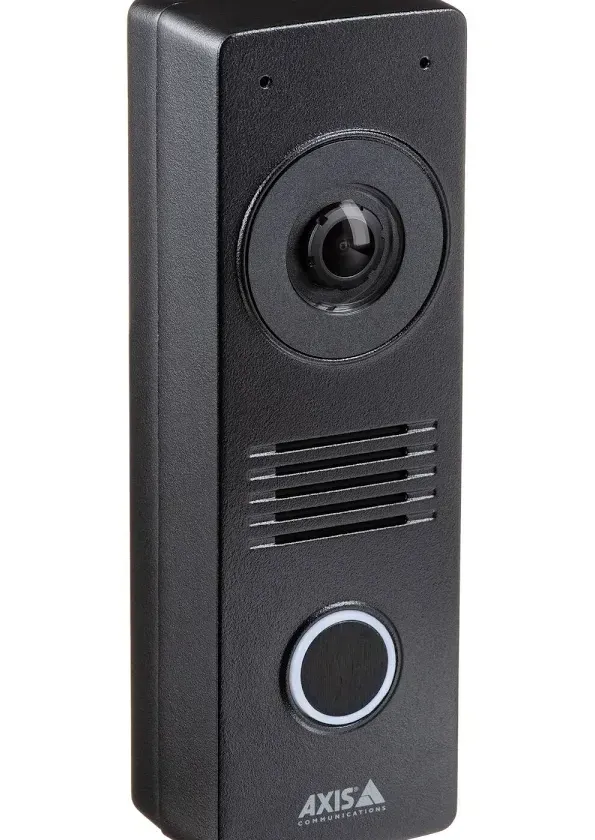
A photo from the AESS job library, not taken in Gerritsen Beach: a black rectangular video door station with a camera lens, a speaker grille and a single round call button that lights up. A one-button station like this is the usual first system for a one-family bungalow on a court here, and the lit button matters on courts where the nearest streetlight may be at the corner rather than outside the door.
Gerritsen Beach Buzzer Request
Bungalow, raised house, two-family rebuild, canal-side house or Gerritsen Avenue store: tell us the court or street, how many households need a button and what is at the door now, and a technician calls back with the range
✅
Request Sent!
Thank you. A technician will call you about the Gerritsen Beach address, usually within two hours during working hours.
25+
Years Experience
✓
Same-Day Estimates
100%
Licensed & Insured
4.7★
201 Google Reviews
Owner-operated since 2002 · Thousands of jobs completed · Booked within 2 hours
Quick answer: door buzzer installation in Gerritsen Beach costs $400 to $900 on our Brooklyn list for an audio door station and a new release at a one- or two-family house or a single store door, $700 to $1,800 for a video door station with indoor stations or phone answering at a two-family or a raised house with a gate below, and from about $2,500 to past $10,000 for a full entry system in one of the few larger rental buildings. The price covers the door station, a station for each household, the release in the door frame and a battery-backed power supply, installed and tested from the court or street to every household. Send photos of the front door, the stair and the old bell button to (347) 934-8335 or on WhatsApp, and we reply with the range that fits, usually within two hours during working hours.
Quoting a new system from your photos costs nothing. When an old buzzer has to be tested in person before we can price it, that is the $250 service call booked online, and the $250 is applied toward the work.
All work is done under New York State license #12000287431, and equipment is ordered only after the written price is approved and the deposit is in.
We work for whoever controls the door: a family that owns its house, an owner renting the other floor, an owner who lives off the peninsula, or a store owner with the landlord's written approval.
The Neighborhood
Why Gerritsen Beach Properties Need Door Buzzer Installation
Gerritsen Beach is the small peninsula at the end of Gerritsen Avenue, between Sheepshead Bay to the west and Marine Park to the east, with Plumb Beach Channel and Shell Bank Creek on its water sides. Wikipedia counts 4,797 residents in the 2020 census. It began in the 1920s as a summer colony of one-story bungalows, most of which were later winterized and many raised to two stories, and the Department of City Planning's 2017 report found about 1,900 buildings holding more than 2,680 homes, nearly all of them one- and two-family houses. That is the starting point for every buzzer job here: very few lobbies, a great many front doors, and a lot of houses with a second household upstairs or down.
The second thing that shapes the work is the way the houses meet the street. The old section south of the Gotham Avenue canal is laid out in narrow courts, many with names that run through the alphabet, where the city's report measured streets from 30 feet down to as little as 15 feet including the sidewalks. Houses were built close to the lot line and close to each other. A visitor or a courier often has to walk in from Gerritsen Avenue or a cross street, find the right house among very similar ones, and then find the right door, which after Sandy may be a full story up an outdoor stair. A buzzer that rings but cannot be reached, found or answered from the floor where people actually live fixes nothing.
The third is what Sandy left behind. The storm put water up to seven feet above grade in parts of the neighborhood, and more than 200 households here were in the city's Build It Back program by spring 2017. Many houses were lifted onto new foundations, others were demolished and replaced, and some of the replacements came back as two-family houses. New York YIMBY reported one such filing on Noel Avenue in 2017: a two-story house to be replaced by "another two-story and two-family home." Every raised or rebuilt house we see here has a front door that moved, a bell wire that was cut, abandoned or never run, and a ground level that the Buildings Department's flood rules limit to parking, storage, building access or crawlspace.
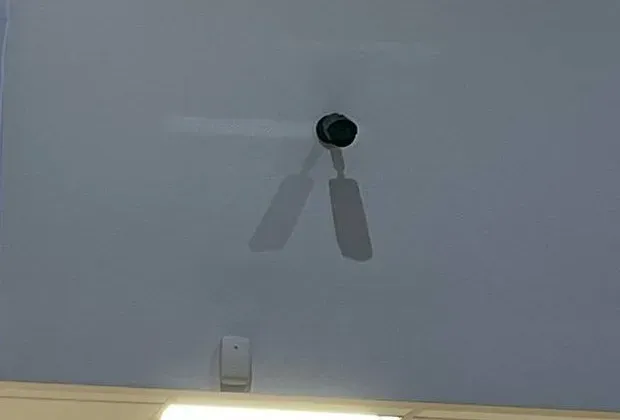
A photo from the AESS job library, not taken in Gerritsen Beach: a small black camera mounted high on a pale wall, throwing two shadows, with a small white device fixed lower on the same wall. On a raised Gerritsen Beach house, a camera placed high like this under the overhang of the upper landing can watch the gate and the foot of the stair, which a door station mounted at the top of the stair cannot always see.
The fourth is the mix of people inside. Many houses hold two generations of one family, or an owner on one floor and a tenant on the other. Openigloo's directory lists 57 rental buildings in Gerritsen Beach, and most of the addresses on its first page are on courts such as Beacon, Ebony, Eaton, Frank, Bevy, Abbey, Fane, Hazel, Canton and Keen, which tells you how small the rentals here are. When the person who receives visitors lives at the top of a stair, or is an older parent on the floor below, the ability to see the visitor and release the door from inside is not a convenience. It is how they avoid going up and down an outdoor stair in the rain to sign for a package.
The last is the water itself. Every house here is within a few blocks of salt water, and many on the canals have docks. Salt air, wind-driven rain and the occasional flood tide shorten the life of cheap door hardware, and the outdoor parts of a buzzer, the station, the strike and the gate release, are exactly the parts exposed to all three. Choosing those parts for the setting, and keeping the electronics that do not need to be outside well above the flood level, is most of what separates a buzzer that lasts here from one that is replaced every couple of seasons.
Six facts that shape a Gerritsen Beach buzzer installation
It is a neighborhood of small houses. City Planning's 2017 report counted about 1,900 buildings and more than 2,680 homes, mostly one- and two-family houses of two stories, many built as summer bungalows.
The streets are narrow. The same report measured streets from 30 feet down to 15 feet including sidewalks, and a broker quoted by Brick Underground in 2022 said some old-section streets are "so narrow you think you're on a driveway."
Many front doors moved after Sandy. More than 200 households were in Build It Back by spring 2017, and the city's flood design elevation here runs roughly 3 to 5 feet above grade inland and 5 to 10 feet on the waterfront.
The ground level under a raised house is restricted. The Buildings Department's Appendix G rules say enclosed space below the design flood elevation in a residential building is usable solely for parking, building access, storage or crawlspace.
The rentals are small. Openigloo lists 57 rental buildings here, most of those it shows on courts, so most of them fall below the eight-apartment line at which state law requires an intercom.
There is one way in. Gerritsen Avenue is the only road onto the peninsula and its only commercial corridor, which is where the neighborhood's store doors and most of its deliveries arrive.
Where this page applies. We use Gerritsen Beach for the peninsula south of Avenue U and east of Knapp Street and Shell Bank Creek, from the newer blocks north of the canal down to the old section and The Point, all served at the same Brooklyn rate. For the rest of the borough see our door buzzer installation in Brooklyn page, and for the neighborhood on the other side of Gerritsen Avenue our Marine Park door buzzer installation page.
Install or Repair in Gerritsen Beach
Need Repair in Gerritsen Beach? When the Old Bell Is Worth Saving and When It Is Not
A lot of our Gerritsen Beach calls start with a doorbell that has not worked since the house was lifted or rebuilt, or a buzzer that the previous owner put in and nobody has touched since. Sometimes the fix is small. A transformer that has failed, a button whose contacts have corroded in the salt air, or a strike whose screws have pulled out of a softened frame are repairs, and we price them as repairs.
It stops being a repair when the wire itself is gone or untrustworthy. On a house that was jacked up and set on a new foundation, the old bell wire usually ran through a floor or a crawlspace that no longer exists in the same place, and what is left is a stub at the old door and another at the old transformer. On a house that sat in floodwater, wire that still carries a signal may be corroded inside its jacket and fail a season later. In both cases we meter what is there, tell you plainly whether any of it can be used, and price a new run where it cannot. If a repair is all your house needs, our Brooklyn door buzzer team prices it that way.
What We Install
Door Buzzer Installation Services in Gerritsen Beach
Every service below comes from the same Brooklyn door buzzer list. The number of households decides the size of the system, the front door and any gate decide what releases it needs, and in Gerritsen Beach the height of the door above the walk and its distance from the water decide most of the planning.
First video stations for court bungalows
A single-button video station with a lit button, an indoor station or phone answering, and a release in the front door frame, for one-family bungalows whose only signal has been a knock or a battery doorbell.
Two-household systems for two-family houses
A two-button station at the shared door, a station for each household and a release either household can work, for the many houses here with an owner on one floor and family or a tenant on the other.
Entries at the top of an outdoor stair
Stations and releases for raised houses whose front door is a full story above the walk, with the station placed and angled so a visitor at the stair can be seen and heard.
Gate releases at the court or the street
A release on the gate at the foot of the stair or the front of the lot, so the household upstairs can let a visitor or courier through without coming down.
Dock-side and rear gates
A station and release for the back gate of a canal-side lot, for households who receive guests from the water or use the dock side as their everyday entrance.
Replacements after a lift or a rebuild
New door stations, indoor stations and power for houses whose old bell wire was cut, abandoned or soaked, on new cable routed to stay dry.
Small rental buildings
Button panels with a station in each apartment for the few houses and small buildings here with three or more units, priced by household count.
Store and office buzz-in doors
Buzz-in front doors and delivery doors for the one-story stores along Gerritsen Avenue, with the release at the counter or the desk.
Community and church doors
Side and office doors for halls, churches and community buildings that want visitors to ring before they come in during the week.
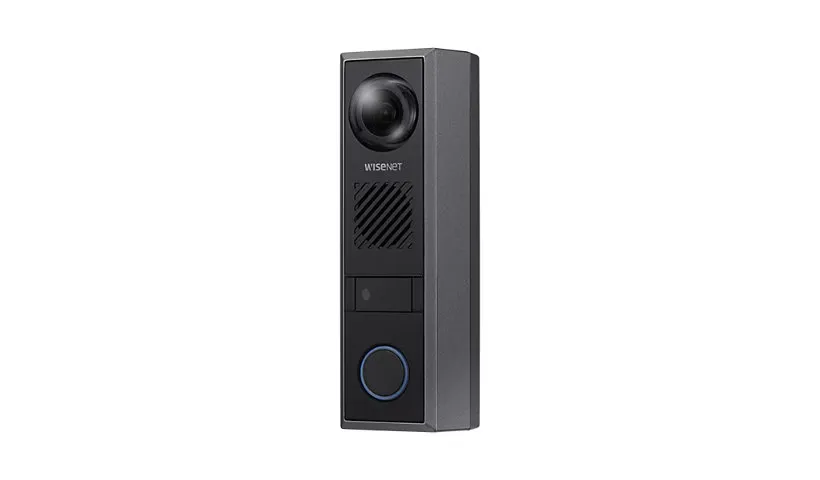
A photo from the AESS job library, not taken in Gerritsen Beach: a slim dark grey wired doorbell with a camera lens, speaker slots and a round push button. The narrow trim beside many bungalow doors on the courts here leaves room for a slim unit like this where a wide panel would not fit, and being wired it never needs a battery changed on a cold, windy landing.
Building Specialists
Door Buzzer Installation for Gerritsen Beach's Architecture
Six kinds of property cover nearly every door we are asked about here. What separates them for a buzzer job is how high the front door sits, how many households share it, where the old wiring went, what the walls are made of, and how close the salt water is.
Winterized bungalows on the courts
The original summer houses of the 1920s, closed in, insulated and often enlarged, with a front door opening almost straight onto a narrow court and frame walls under later siding.
Houses raised after Sandy
Existing houses lifted onto new foundations, with the living floor now a story or more above grade, an outdoor stair to the front door and a ground level kept for parking, storage and access.
Two-family rebuilds
Houses demolished and replaced, some as two-family homes, built to current flood rules with new framing, new doors and a chance to run cable before the walls close.
Canal-side lots
Long, narrow lots on the canals with the house near the street, a yard and often a dock behind, where some households use the water side as much as the front.
Brick houses north of the canal
The newer blocks between the canal and Avenue U, with brick and attached houses, wider sidewalks and more conventional stoops and vestibules.
One-story stores on Gerritsen Avenue
The attached commercial row along the avenue, single-story buildings sharing side walls, with a front door on the avenue and often a delivery door at the back.
Winterized bungalows: easy walls, a door right on the court
The bungalows were built as light wood-frame summer houses, so the walls are hollow and new cable usually travels quickly from the door to wherever the household wants its indoor station. Many have had aluminum or vinyl siding added over the years, and the station is fastened to the door casing or a solid backing block, never to siding alone, so it does not work loose as the siding moves with the weather.
The harder part is the doorway. Urban Omnibus's walk through the neighborhood described homes built right to the property line, and on many courts the front door opens a step or two from the walkway with no porch roof and no vestibule. A station there takes wind and rain head on, so it needs a hood or a recessed mount, a sealed entry for its cable and a gasket that is checked at handover. We also look at what is directly across the court, because on a walkway this narrow a station's camera and light are pointed at a neighbor's front window from a few yards away.
Original doors on these houses are often lighter than a modern entry door, with less wood around the latch. An electric strike needs enough solid frame to hold its screws and a door that stays aligned so the latch drops into it. Where the frame is too thin or has been chewed up by years of replaced locks, a reinforcing plate or a new frame section comes first, and it is named and priced on the quote, not discovered on installation day.
Houses raised after Sandy: the door moved up and the wire did not
When a house is lifted, the front door ends up at the top of a new outdoor stair, usually steel or wood, with a small landing. The old bell button may still be on the wall beside that door, but the wire behind it ran down into a crawlspace or a floor structure that was cut, rebuilt or filled during the lift. We expect to run new cable on nearly every raised house we see, and we price it that way from the start rather than hoping the old pair survived.
The landing is the station's new home, and it is not always a good one. It is exposed on several sides, it is often steel, and on DNAinfo's 2016 visit to a Build It Back house near Gerritsen Avenue the family's steel stairs had collected rainwater, and "Rust has started to form around the drainage holes." We mount stations to the house wall or the door casing rather than the stair, use stainless or coated fasteners, and route the cable into the house through the wall beside the door, not along the stair, so a rusting stair never takes the buzzer with it.
The ground level below the house is the other half of the plan. Under the Buildings Department's Appendix G rules, enclosed space below the design flood elevation in a residential building may be used only for parking, building access, storage or crawlspace, and new equipment the rules do not permit there counts against the building. For a buzzer that means the power supply, the splices and anything that would be ruined by water go upstairs on the living floor. If a gate or a door at ground level gets a release, only the release and its cable live down there, and the cable is run so it can get wet and dry out without damage.
Two-family rebuilds: the cheapest moment is before the drywall
A house that is being rebuilt from new framing is the easiest buzzer job in the neighborhood if we are in before the walls close. A cable from the front door to each household's station, a second one to wherever the gate will be, and a pull string or conduit through the ground level for later all cost little when the studs are open. The same runs after the drywall is up mean fishing, cutting and patching, and AESS does not patch or paint walls, so that work falls to the builder.
Two-family houses also need the households planned as two households. Each gets its own button on the door station, its own station inside, and a release it can work from its own floor. If the owner wants to see the tenant's visitors, or not, that is decided before ordering, because some systems tie both households to one app account and some keep them apart.
Canal-side lots: two fronts to the house
The city's 2017 report described the canal lots as about 24 by 66 feet, and Urban Omnibus noted that most waterfront houses have docks and boats. For many households the dock side is a real entrance: family arriving by boat, neighbors walking along the bulkheads, the household itself coming home from the water. A back gate with its own small station and release, ringing the same indoor stations as the front, lets them answer both sides from one place.
The dock side is also the most exposed spot on the lot. A station there faces open water and spray, so it is a fully weather-rated unit in a sealed box, on a post or the gate pier set back from the bulkhead, with its cable run underground or along the fence in a protected path rather than across the yard where it will be stepped on.
Brick houses north of the canal: closer to a conventional Brooklyn job
Wikipedia describes the blocks north of the Gotham Avenue canal as the newer section, with brick houses and wider sidewalks. These look more like the rest of southern Brooklyn: a stoop or a few steps, a solid masonry wall beside the door, sometimes a vestibule and an inner door. Cable routes through brick take more planning than through a frame wall, and an old riser or bell pair that tests sound is worth reusing. Many of these houses have their front door at a normal height, so the stair and gate questions that dominate the old section do not arise.
One-story stores on Gerritsen Avenue: shared walls and a flat roof
City Planning's report describes the commercial buildings on Gerritsen Avenue as one-story attached structures, and notes that a 2013 zoning change exempted floodproofing from floor-area limits for commercial buildings here. A store in that row has no apartments overhead and no cellar route shared with residents, so a buzz-in door is usually a single-door job: a station outside, a release in the frame and a button at the counter. The cable runs inside the store's own space, along the ceiling or above a drop ceiling, never through the shared side walls into the next store.
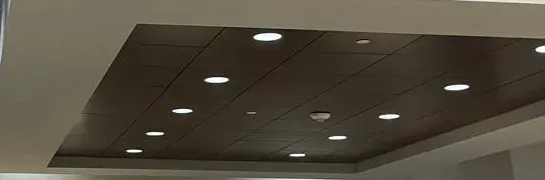
A photo from the AESS job library, not taken in Gerritsen Beach: a dark recessed ceiling panel with round downlights and a small round device set into it, framed by a lighter ceiling. In a one-story store on Gerritsen Avenue, a ceiling like this is the route a buzzer cable takes from the front door to the counter, staying inside the store's own space instead of crossing a wall shared with the shop next door.
Field Notes
Field Notes: Walking the Visitor's Route Before Choosing a Station in Gerritsen Beach
On a Gerritsen Beach walkthrough our technician does one thing before looking at any equipment: they walk in the way a stranger would. That means starting where a delivery van can actually stop, often on Gerritsen Avenue or the nearest cross street, and walking down the court to the house.
On that walk they note how a visitor finds the house, whether the number is visible from the court, where the first gate or fence is, and whether the front door can be seen from it. On a raised house they stop at the foot of the stair and ask the obvious question: will a courier climb this, or leave the box at the bottom? The answer decides whether the house needs one station at the door, one at the gate, or a station at the door and a release at the gate.
Then they go inside and up to where the household lives, and ask where people actually are when the bell rings: the kitchen, a back bedroom, a tenant's floor, the dock. A station in the front hall of a house whose family spends its evenings at the back, or on the water side, is a station nobody hears.
Only after that do they find the old wiring, meter it, and look at the door frame and the stair. Those checks decide the price; the walk decides whether the system works for the people who live there.
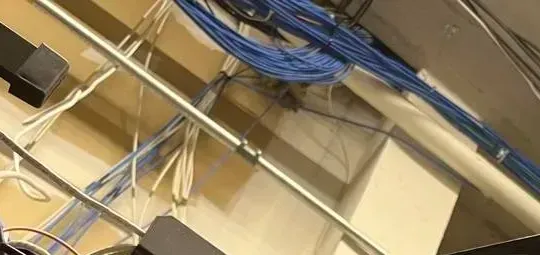
A photo from the AESS job library, not taken in Gerritsen Beach: bundles of blue low-voltage cable laid over a ceiling beam beside a metal pipe in an open ceiling. In a Gerritsen Beach house being rebuilt, open framing like this is the moment to lay the buzzer cable from the front door to each household's floor, before the walls are closed and every run has to be fished.
The Raised Front Door
A Gerritsen Beach Front Door at the Top of a Stair Needs a Plan for Three Places, Not One
On a house at normal height, a buzzer is one decision: where to put the station beside the door. On a raised house it becomes three, because the visitor's journey has three stops. They arrive at the gate or the foot of the stair, they climb to the landing, and they stand at the door. A system that only works at the last stop leaves couriers, older visitors and anyone carrying something heavy at the first.
The foot of the stair
This is where most deliveries end. If the household wants packages taken in rather than left on the walk, a small station or a call button here, wired to the same indoor stations, lets the courier ring without climbing. If there is a gate at the front of the lot or the foot of the stair, a release in its latch lets the household open it from upstairs. Anything mounted here is below the design flood elevation, so we keep it to the parts that have to be here, a weather-rated station and a release, and nothing that cannot take a soaking.
The stair itself
The stair is a route, not a mounting surface. Cable that runs down a steel stringer or along a handrail is exposed to every rain, every boot and every repair to the stair, and the steel itself may be rusting. Where the gate station's cable has to reach the house, it goes through the house wall at the ground level and up inside, or in a protected conduit fixed to the foundation, so the stair can be painted, repaired or replaced without anyone touching the buzzer.
The landing and the door
The main station belongs beside the door, on the house wall or the casing, at a height a visitor standing on the landing can reach. Its camera is aimed for the landing, which is narrow, so the lens sees a face at arm's length rather than the top of a head. The release goes in the door frame, and because the landing is often the most exposed spot on the house, the strike, the station and the cable entry are all sealed. Where the household also wants to see the foot of the stair from upstairs, a small camera under the landing does that better than trying to aim a door station down a full story of steps.
Put together, a raised two-family typically ends up with one two-button station at the door, a release in the door frame, a call button or small station at the gate with its own release, and a station on each household's floor. That combination is the most common raised-house layout we price here, and it usually lands in the video range of our Brooklyn list.
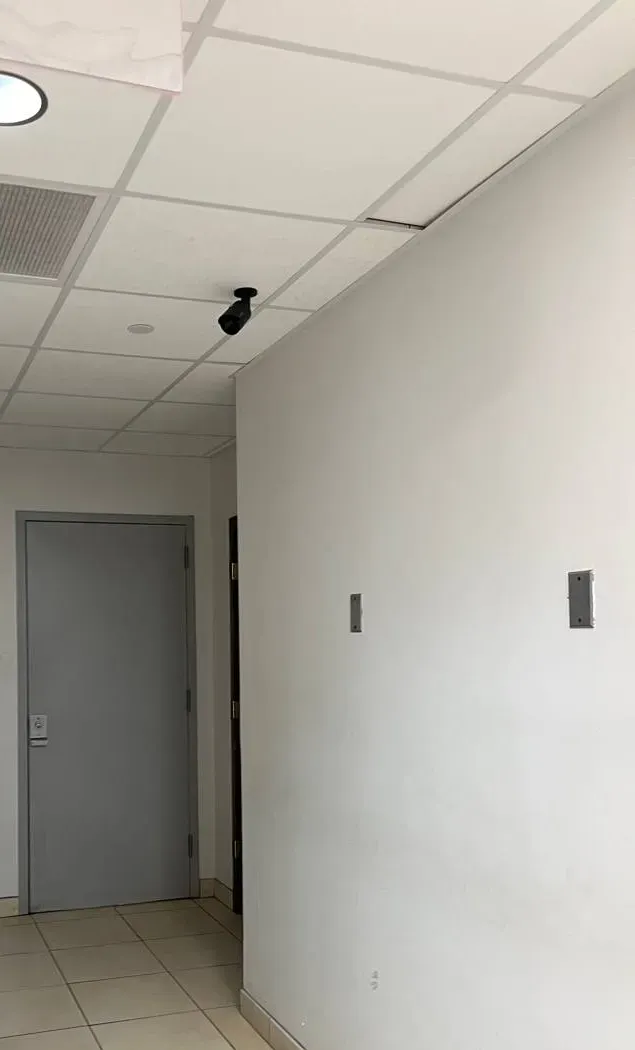
A photo from the AESS job library, not taken in Gerritsen Beach: a tiled corridor with white walls and small wall plates leading to a grey steel door with a lever handle, under a drop ceiling with a small camera. A lever on the inside of a door like this is what lets anyone leave without a key whatever the buzzer is doing, and we keep that true on every Gerritsen Beach door and gate we fit with a release.
Salt Air and Weather
What a Door Station Has to Survive Near Plumb Beach Channel and Shell Bank Creek
Every outdoor part of a buzzer in Gerritsen Beach lives within a few blocks of salt water. The station, the release in the frame, the gate latch and the screws that hold them are what fail first, and they fail from the inside: water gets behind a plate mounted flat on uneven siding, salt film builds on the contacts, and a button that worked in August sticks by February. Choosing those parts by their ratings rather than their looks is the single biggest thing an owner can do for a buzzer here.
The ratings that matter, in plain words
Water and dust (IP rating). 2N's guide to outdoor intercoms explains that IP65 means "completely dust-tight and resistant to water sprayed from a nozzle," and IP66 means "dust-tight and protected against strong jets of water." For a station on an exposed landing or a dock gate, wind-driven rain behaves more like the stronger case, so we choose accordingly.
Impact (IK rating). The same guide puts IK10 at 20 joules, the "maximum rating," roughly a 5-kilogram object dropped from 400 millimeters. That matters for a station at a gate where bikes, bins and boat gear go past.
Housing material. Painted steel rusts at the edges near salt water. Viking's listing for its 316 stainless steel enclosure says the material "resists rust, salt air, and chemical exposure," which is why stainless or anodized aluminum housings are our default on the water side.
Shelter. Even a rated enclosure is usually designed for "sheltered or covered locations," as Viking's own listing puts it. Where a landing has no roof, a hood or a recessed mount is part of the job, not an extra.
Fasteners. A stainless station held on with plain steel screws stains and loosens. Every outdoor fastener we use here is stainless or coated, including the ones holding the strike.
None of this makes a station immune to a flood tide. Equipment at the foot of a stair or on a dock gate can be submerged in a storm surge, and that is outside any warranty. What the ratings buy is years of ordinary weather without the slow corrosion that kills cheap stations in a couple of seasons, and the dry-side plan described above keeps the expensive parts out of reach of the water.
Rules and Responsibilities
Which Gerritsen Beach Houses Must Have a Buzzer, and What an Owner Takes On by Installing One
The intercom law starts at eight apartments. Habitat magazine summarized the state's Multiple Dwelling Law in 2024: buildings built or converted after 1968 with eight or more units must have a two-way voice intercom linking the front door to each apartment. ButterflyMX's guide adds that buildings with fewer than eight units "are not generally treated the same way under this rule." Almost every house in Gerritsen Beach is far below that line.
Older buildings follow a different trigger. For buildings put up before 1968, the same law ties the duty to a written request or consent from tenants occupying a majority of the apartments. Few buildings here are large enough for that to matter, but if yours is one of them, ask HPD or your lawyer which applies.
A system that exists has to be kept working. The Housing Maintenance Code also requires a functioning intercom where one is in place, and Habitat reported that courts have treated intercoms as "an essential service." In a co-op case it discussed, attorney Nancy Kourland of Lasser Law Group put it simply: "As a result, the co-op has a legal obligation to repair or replace the intercom." An owner renting out the other floor of a two-family should treat a buzzer the same way once it is in.
Doors must always open from inside. Whatever the system, a person inside must be able to leave without a key or a button. We use electric strikes on house doors and gates for that reason, as explained in the equipment section.
Flood rules govern the ground level. On a raised or rebuilt house, the certificate of occupancy for wet-floodproofed space must state that "Levels subject to flooding shall not be used for any other use except as stated on this certificate." A buzzer does not change that use, and we keep its power and electronics off that level.
New outlets are an electrician's job. AESS does low-voltage work and does not do electrical work. If a house has no outlet where the power supply should go, your electrician adds one, and we tell you exactly where before the installation date.
None of this is legal advice for a particular property. If you are unsure which rules apply to your building, HPD, the Buildings Department or your own lawyer can tell you. What we do is install a system that respects those rules and leave a written record of what was installed and tested.
Commercial Door Buzzer Installation
Business Door Buzzer Installation in Gerritsen Beach
City Planning's 2017 report calls Gerritsen Avenue the neighborhood's only commercial corridor, and Brick Underground's 2022 profile listed what it holds: a barber, pizza, a pharmacy, a laundromat, the library, a Key Food, The Beach Deli and Family Mart. Business doors here are few, close together and busy, and most of them are single-door jobs.
The storefront row on Gerritsen Avenue
One-story attached stores with doors straight onto the avenue. The commonest request is a buzz-in front door for evenings or for staff working alone, with the release at the counter.
Grocery and deli back doors
Stores that take deliveries at a rear or side door want a driver to ring the register or the office, so nobody leaves the front to unlock the back.
Pharmacy and service counters
Counters that want to see who is at the door after hours or during a staff shortage, with a camera station and a release at the counter.
Near Avenue U at the north end
The stretch where Gerritsen Avenue leaves the peninsula, past the firehouse site at Avenue U that dates to 1930, where businesses share the avenue's traffic with the rest of southern Brooklyn.
Churches and community halls
Buildings such as Resurrection Church, where neighbors gathered for meetings after Sandy, and the volunteer fire department's house at 43 Seba Avenue, whose side and office doors may want a bell and a release during the week.
Marinas and boat businesses
Businesses along the water that keep a gate or office door locked and want visitors to ring from the lot, with weather-rated stations for the waterfront.
Almost every store request here is the same shape: a station outside the door, a release in the frame, and a button where the person working can reach it without leaving the counter. On a one-story building the cable stays inside the store, along the ceiling or above a drop ceiling. Because the stores share side walls and many share a roofline, we never route through a party wall or across a neighbor's roof. Where a store wants a camera at the door as well, putting it in on the same visit usually saves $200 to $400 in labor over a separate trip. If your business is farther inland toward Kings Highway, our Homecrest door buzzer installation page covers the blocks inland.
Rules that apply to business entry installations in Gerritsen Beach
Anyone inside can always leave. A store door with a buzzer still opens from inside with one motion and no key. With an electric strike, the lever or push bar on the inside works whatever the release is doing.
Controls within reach. The 2010 ADA Standards set the high forward reach at 48 inches maximum and the low at 15 inches minimum for operable parts, so the button a customer presses and the release a cashier uses are mounted inside that range where a business serves the public.
Tenants need the landlord's written approval. A store that rents its space orders a door buzzer only with the building owner's written permission, and the quote is sent to whoever signs it.
Magnetic locks need the full package. If a store door cannot take a strike and a magnetic lock is the only option, it comes with the release devices, signage and fire alarm connection the building code requires, and we say so before anyone chooses it.
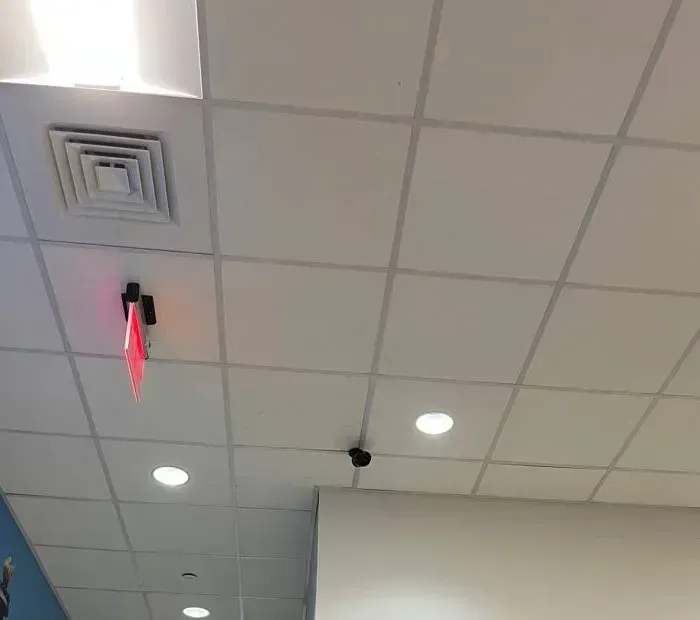
A photo from the AESS job library, not taken in Gerritsen Beach: a drop ceiling with a lit red exit sign, an air diffuser, round recessed lights and a small black camera. In a store on Gerritsen Avenue, the exit sign marks a door that must always open from inside, so a buzzer release on it is chosen to keep visitors out without ever locking staff or customers in.
Your Questions Answered
Door Buzzer Installation in Gerritsen Beach: Questions Answered
Raised houses and their stairs
Our Build It Back house has a steel outdoor staircase, and the rails already show rust around the drainage holes. Should the door station be bolted to the stair, or does it belong somewhere else?
Somewhere else. A steel stair that is already rusting will need scraping, painting and probably repairs over the years, and anything bolted to it has to come off each time. Worse, a station fastened to rusting steel works loose as the metal around the bolts flakes, and water then gets behind it. The station goes on the house wall beside the door or on the door casing, where the backing is solid, dry and will not move.
The same goes for the cable. It enters the house through the wall right behind the station, so nothing runs along the stair at all. If you later want a call button at the bottom, its cable reaches the house through the foundation wall at ground level and climbs inside, again without touching the stair. When the stair is eventually repaired or replaced, the buzzer is not part of that job.
Couriers leave our boxes at the foot of the stairs because they will not climb to the door. Can a release on the gate down there let them put packages inside the space under the house?
Yes, and on a raised house it is often the most useful thing a buzzer can do. A call button or small station at the foot of the stair rings the household upstairs; they see or speak to the courier, release the gate or the ground-level door, and the courier sets the box inside and pulls the door shut behind them. Storage and building access are exactly what the city's flood rules allow that level to be used for, so a parcel drop fits within them.
Two details matter. The ground-level door must lock again by itself after the courier leaves, so it needs a closer and a latch that drops into the strike every time. And the release down there should open only that space, not the stair door into the house. New York Times reporting in 2019 found that more than 90,000 packages "disappear without explanation" in the city each day; a locked drop under the house takes yours out of that count without anyone going up and down the stair.
From the top of our tall front stair, will the door station's camera even show us who is standing at the gate on the walk below?
Usually not well. A door station's camera is designed to show a face at arm's length on the landing. Aimed a full story down a stair to a gate, it sees mostly steps and the top of a head, and at night its light does not reach that far. Trying to angle it down also makes it worse for the person who does climb up.
The better answer is to give the gate its own eyes. A call station at the gate with its own camera, or a small camera under the landing aimed at the gate, shows the household who is at the bottom on the same indoor screen or phone. The door station then does its own job well, at the door, and the household sees both stops.
Where would video at the top of our raised two-family's stair plus a release on the gate at the bottom land on your Brooklyn list?
In the video range, $700 to $1,800. That covers a two-button video station at the front door, a release in the door frame, a station or phone answering for each household, and a call button and release at the gate. A one-family raised house with audio only at the door and a gate release sits lower, near the top of the $400 to $900 audio range.
What moves a raised house within its range is the gate and the route. A gate with a latch that can take a release and a short path into the house sits near the bottom; a gate that needs new latch hardware, a long run to reach the house without touching the stair, or a second camera at the gate sits near the top. The written quote shows the gate as its own line so you can decide whether to do it now or later.
Our replacement house is still open framing and the walls close next month. Does putting the cable in now change which price range we land in?
It usually keeps you lower in whichever range fits the house. With open studs, cable from the front door to each household's station, and from the house to the gate, goes in quickly and needs no cutting or fishing. The equipment is the same price either way; it is the labor of reaching through finished walls that you save.
If you are not ready to choose stations yet, we can run the cable now, label both ends and leave it coiled in the wall boxes, then come back to mount and connect everything once the house is finished. Tell the builder before the insulation goes in so the boxes are left where we marked them.
The water side of the house
Our house is a few doors from the canal. What should the specification sheet of a door station say before we accept it for this location?
Look for three things. First, a water and dust rating of at least IP65, which 2N describes as "completely dust-tight and resistant to water sprayed from a nozzle," and IP66 if the door has no roof over it. Second, an impact rating such as IK08 or IK10 if the station is at a gate or anywhere it can be knocked. Third, the housing: stainless steel or anodized aluminum rather than painted steel, because paint chips and the steel under it rusts quickly in salt air.
Then check the parts the sheet does not mention: the screws, the gasket and the cable entry. A rated station held on with plain screws, or with its cable coming in from the top, will still let water in. On our installations here every outdoor fastener is stainless or coated, the cable enters from below or through the wall behind, and the gasket is checked at handover.
Friends often arrive by boat and tie up at our dock. Can the buzzer let them in through the back gate without someone walking out to meet them?
Yes. A weather-rated station at the dock gate, wired to the same indoor stations as the front door, rings the house when someone arrives from the water. The household sees or hears them, presses release, and the gate opens. Many systems can give the dock station its own ring so you know which side the visitor is on.
The station sits on the gate pier or a post set back from the bulkhead, in a sealed housing, and the cable to the house runs underground or in a protected path along the fence. The gate needs a latch that closes by itself after each visitor, since a dock gate left open undoes the whole point. If the gate is a light fence gate, we check whether its frame can hold a release before quoting.
Close neighbors, stores and family
The house across our court is only a few yards from our front door. Will the station's light and the visitor's voice disturb them at night?
They do not have to. The light on most door stations can be set to light only the button, or to come on only when someone approaches, rather than glowing all night into a neighbor's window. The speaker volume is adjustable, and on a court this narrow we set it as low as still lets the household hear the visitor clearly.
Placement helps too. A station on the side of the door casing, facing along the court rather than straight across it, sends its light and sound toward the visitor and away from the house opposite. We look at the neighbor's windows during the walkthrough and settle the position and settings with you before mounting.
Our store on Gerritsen Avenue shares side walls with the shops on both sides and has a flat roof. How does the cable get from the front door to the counter?
Inside your own store. In a one-story building the usual route is up from the door frame, across the ceiling or above the drop ceiling, and down to the counter, with the power supply in a back room or above the ceiling where staff can reach it. Nothing goes through a shared side wall, and nothing goes on the roof, which is often shared or maintained by someone else.
Where the store has a finished ceiling with no space above, the cable runs in a slim raceway along the top of the wall, painted to match if you want. Either way the work stays within your space, and if you rent, the landlord's written approval is the only thing we need from outside it.
My mother lives on the ground floor of our two-family and has fallen before. If she cannot get to the door, how would an ambulance crew get in?
With a system that can be answered by phone, a family member upstairs or at work can see the crew at the door and release it from wherever they are. That is the most useful feature for a household in your situation, and we set it up on at least two family members' phones so one is always reachable.
The release has to reach the right door. If your mother's apartment has its own entrance, it gets its own release, not only the shared front door. We also recommend a key held by a trusted neighbor on the court, because no electronic system replaces a person nearby, and we can show you how to check that the remote release works on a quiet day rather than finding out in an emergency.
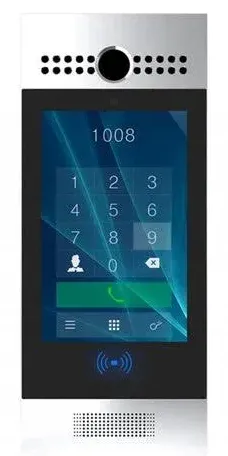
A photo from the AESS job library, not taken in Gerritsen Beach: a touchscreen entry panel showing a dial pad with a four-digit apartment code entered, a camera above and a card-reader symbol below. On one of the few small rental buildings in Gerritsen Beach, a panel like this lets each household's visitors dial a code instead of searching a row of buttons, and lets residents in without a key.
Equipment
Types of Door Buzzer Systems We Install
We quote a reliable non-branded system by default and install a named brand when an owner asks for one; the intercom brands we work with include Aiphone, ButterflyMX, 2N, Akuvox, Comelit and DoorBird. These are the kinds of equipment that come up most at Gerritsen Beach doors and gates, and where each fits.
Single-button video stations
One lit button, a camera and a speaker for one-family bungalows and raised houses, slim enough for narrow bungalow trim.
Two-button stations
A button for each household of a two-family house, with a label for each, on one weather-rated plate at the shared door.
Gate and dock call stations
Compact, fully sealed stations with their own button for the foot of a stair, a front gate or a dock gate, ringing the same indoor stations as the front door.
Small button and code panels
Three- to eight-button panels or code entry for the few small rental buildings, with a camera and a directory.
Indoor audio stations
Simple talk-and-release stations for households who want a button and a voice, with no screen to learn.
Indoor video stations
Wall screens with a release button, often one per floor on a raised house, so the household sees the visitor before opening.
Phone answering
Stations that ring household members' phones, for family who are at work, on the water or helping a parent on another floor.
Fail-secure electric strikes
Releases cut into the door or gate frame that stay locked during a power cut and never stop anyone leaving from inside.
Battery-backed power supplies
Dedicated low-voltage power with battery backup, mounted on the living floor, never in the flood-level space below a raised house.
On every house door and gate here we use fail-secure electric strikes. Allegion's guide explains the difference: "Fail safe products are unlocked when power is removed" and "Fail secure products are locked when power is removed," and with an electric strike a person can exit by turning the lever whichever type it is. In a neighborhood that has gone through long outages, a strike that keeps the door locked when the power is off, while never trapping anyone inside, is the right choice. Allegion also notes that electromagnetic locks "are only available fail safe," which is one reason we avoid them on house doors.
Doorbell camera, two-button station or full entry system: which suits a Gerritsen Beach house?
What matters
Store-bought video doorbell
Wired one- or two-button station
Station plus gate station and releases
Separate button for each household
No, one button
Yes
Yes
Opens the front door
Only if separately wired to a strike
Yes
Yes, door and gate
Reaches a visitor at the foot of a raised house's stair
No
No
Yes
Works for a household without a smartphone
No
Yes, with indoor stations
Yes, with indoor stations
Battery to change on an exposed landing
Often
No
No
Monthly fees
Often, for recordings
None for wired stations
None for wired stations
Brooklyn list range
Not something we price; owner's own device
$400–$900 audio, $700–$1,800 video
Usually $700–$1,800
ADT, Ring and SimpliSafe compared with a local installer for a Gerritsen Beach house
National brands come up in nearly every conversation about a front door, and for a one-family bungalow with its door at street level, a store-bought video doorbell may be all anyone wants. On the houses that make up most of Gerritsen Beach it runs into limits. It rings the phones of whoever set it up, not a station on each household's floor. It has one button for a two-family house. It does not open the door unless it is separately wired to a strike, it does nothing for a courier at the foot of a raised house's stair, and its battery has to be changed on a windy landing. One Brownstoner forum poster with a two-apartment house found that old doorbell wiring was too deteriorated to use and fell back on plug-in chimes; that is a workable fix for seeing visitors, not a way to let them in. Alarm companies such as ADT and SimpliSafe are built around alarms rather than entry for two households. We install the entry system the house needs and, where an owner also wants a camera, put it in on the same visit.
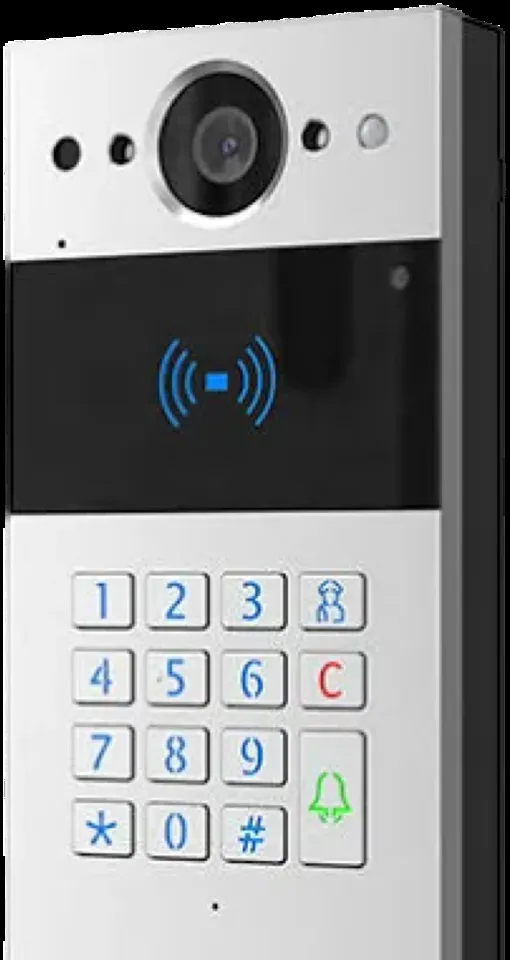
A photo from the AESS job library, not taken in Gerritsen Beach: a silver and black keypad door station with a camera lens at the top, a blue card-reader symbol, a numeric keypad and a green bell key. At the dock gate of a canal-side Gerritsen Beach house, a keypad station like this lets the family in with a code while guests arriving from the water press the bell key to ring the house.
AI Overview Reality Check
What AI Gets Wrong About Door Buzzer Installation in Gerritsen Beach
Ask an AI assistant or a search summary about door buzzers and you get confident numbers lifted from national cost guides and from companies that sell cloud entry systems. Some are fine somewhere. Here are seven we see repeated, each traced to its source and set against what we find at the bungalows, raised houses and two-family rebuilds of Gerritsen Beach. Where a claim below is described as something an AI says, it is a claim from these cost guides that AI summaries commonly repeat, not a quote from any one AI tool.
"Installing an intercom costs an average of $2,500"
HomeAdvisor's cost page gives that figure, with a spread from $1,500 to $15,000. Its average mixes whole-house room intercoms in suburban homes with apartment entry systems, which are different products bought by different people.
For Gerritsen Beach the average lands in the wrong place for nearly everyone. A one-family bungalow pays well under it for a first video station. A raised two-family with a gate station usually pays under it too, in our $700 to $1,800 video range. On our list, about $2,500 is where a system for a multi-apartment building starts, and there are very few of those here.
The figure that helps is the range for your kind of house, which is why we quote from photos and a count of households rather than a national average.
"A wired intercom takes about ten hours to install"
HomeServe's cost guide says "Installing a wired system typically takes around ten hours," with professional labor between $1,193 and $1,446. That estimate is for running new wire between rooms of a whole house.
A door buzzer for a bungalow on a court is a smaller job. The station, the release and one or two indoor stations, with cable fished through hollow frame walls, usually fit in a single visit. Brick Underground's 2019 intercom guide quoted an installer estimating that a whole five-apartment building could be done in a day.
Where time does grow here is on the stair and the gate: a new route into a raised house that avoids the stair, a gate that needs latch work, or a dock station with an underground run. Those are named on the quote, so the length of the visit is known before it starts.
"Wired systems require a licensed electrician"
The same HomeServe guide says wired systems "require professional installation by a licensed electrician." For the low-voltage parts of a door buzzer, the station, the indoor stations, the strike and the cable between them, that is not how the work is usually divided.
AESS installs those low-voltage parts under New York State license #12000287431. What we do not do is electrical work. If the house has no outlet where the buzzer's power supply belongs, that outlet is an electrician's job, and we tell you exactly where it is needed before the installation date.
On a raised house this split matters more than usual, because the outlet should be on the living floor, not in the flood-level space below. Telling your electrician that up front avoids an outlet in the wrong place.
"Wireless is the best option if you want to save money"
HomeAdvisor says "Wireless systems are the best option if you want to DIY," with wireless systems from $150 to $1,500. For a renter or a single room, that is fair.
At a Gerritsen Beach door it runs into two problems. The release in the frame is wired whatever the stations are, so a wireless kit still needs a wired strike and power at the door. And a gate or dock station at the far end of a lot, below a raised house, is exactly where a home Wi-Fi signal from the floor above is weakest.
In a frame house, where new cable climbs easily, wired stations are often no more expensive than wireless and far more dependable. We use wireless only where a run truly cannot be made, and say so on the quote.
"Modern video entry costs $1,000 to $5,000 per door"
Swiftlane's cost guide gives "$1,000 to $5,000 or more per entry door for modern IP or video systems." Swiftlane sells cloud entry systems for apartment buildings, and its figures are national.
Per door is the wrong unit for a Gerritsen Beach house. A raised two-family may have a front door, a gate and a ground-level door, but only the front door needs a full station. The gate needs a call button and a release, and the ground-level door needs a closer and a strike. Multiplying a per-door figure by three would wildly overstate the job.
On our list, the whole of that layout usually fits inside the $700 to $1,800 video range, because what drives cost here is the household count, the route and the door hardware, not a count of doors.
"Small buildings don't need an intercom, so a buzzer is optional"
ButterflyMX's guide to the city's intercom law says the rule is "generally described as applying to Class A multiple dwellings with eight or more units," and that smaller buildings "are not generally treated the same way." That is accurate for nearly every house here.
It leaves out two things. Once a buzzer is in a rented two-family, the owner should expect to keep it working, since the Housing Maintenance Code also requires a functioning intercom where there is one. And "not required" does not mean "not needed" on a house whose front door is a story above the walk and whose courier stops at the gate.
So the decision for a Gerritsen Beach house is rarely about the law. It is about whether the household can see who is there, let them in from where they are, and keep packages off the walk.
"Video entry comes with a monthly fee per unit"
Swiftlane's guide says software subscriptions "commonly add $5 to $15 per unit per month, or $30 to $100 per door per month." Habitat's 2017 article on smartphone buzzers cited a charge of $2.50 per unit per month at one building. Cloud panels do usually carry a subscription.
Wired door stations with indoor stations carry none. For a two-family house that wants to see and release visitors from inside, there is nothing to pay each month once the system is installed.
Where a household also wants phone answering, some systems include it without a fee and some charge for it. The quote shows any subscription as its own line, so you can compare the two before choosing.
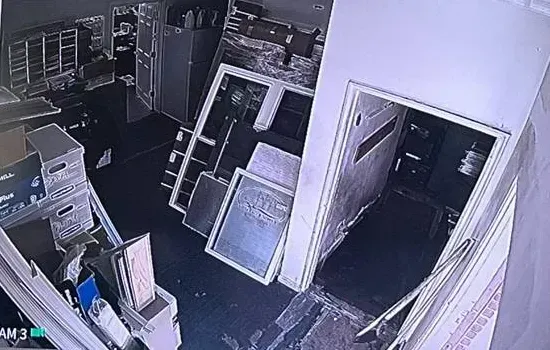
A photo from the AESS job library, not taken in Gerritsen Beach: a black-and-white night camera view of a cluttered room with an open doorway into a dark back room. The storage space under a raised Gerritsen Beach house often looks like this at night, and a door into it that takes packages needs to lock again by itself after the courier leaves.
Raised House, Two-Family Rebuild or Bungalow With Only a Knocker? Speak to a Tech
Send the court or street, a photo of the front door and the stair, and tell us how many households live behind the door. We will tell you whether it is a repair, a new station on old wire or a new system, and where it sits on our Brooklyn ranges. Call or text (347) 934-8335, send photos on WhatsApp, or fill in the form below.
Get In Touch
Request a Free Quote
✅
Request Sent!
Thank you. A technician will call you about the Gerritsen Beach address, usually within two hours during working hours.
How It Works
Our Installation Process
1. Review photos and the house's layout
Before anyone visits, the office looks at your photos of the front door, the stair, any gate and the old bell button, and confirms how many households need their own button and where each one lives in the house.
2. Walk the route a visitor takes
The technician walks in from where a van can stop, down the court to the gate, up the stair to the door, and through every door residents and couriers use, including the ground level of a raised house.
3. Check the door, the stair and the gate
The front door is let go from open to see that it closes and latches by itself, the landing and stair are checked for rust and solid backing, and any gate is checked for a latch that can take a release.
4. Test the old wire and pick a dry route
Any surviving bell or buzzer pairs are metered end to end. The new route keeps the power supply and splices on the living floor, out of the flood-level space below.
5. Give a written price
The quote comes from our Brooklyn list, with the gate, any frame work and anything that depends on a test named and priced before you approve.
6. Order equipment and book the date
Equipment is ordered after the deposit. Stock items are scheduled right away; special-order stations are booked once they arrive. Every visit gets a two-hour arrival window.
7. Install, seal and label
The release, the battery-backed power supply, the door station and the indoor stations go in, every outdoor hole is sealed, stainless or coated fasteners are used outside, and both ends of every cable are labeled.
8. Test from where visitors stand and hand over
From the court, the gate and the landing, the technician rings each household, talks, releases and confirms the door and gate shut and relatch, then shows everyone how to answer and leaves a written test sheet.
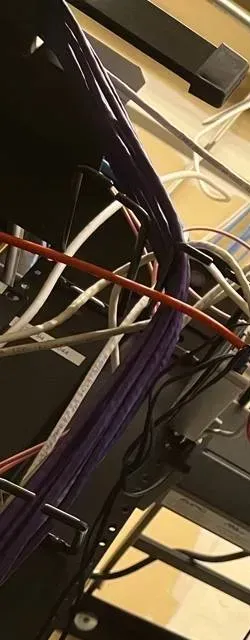
A photo from the AESS job library, not taken in Gerritsen Beach: purple, white and red cable bundles dropping down beside a black equipment rack. In a Gerritsen Beach house the point where the door, gate and indoor cables meet the power supply is kept on the living floor, labeled at both ends, so the next person who opens it does not have to trace every wire again.
Coverage Area
Door Buzzer Installation Near Gerritsen Beach's Landmarks
Gerritsen Beach Volunteer Fire Department
The volunteer company at 43 Seba Avenue, organized in 1922 after a fire on Abbey Court the year before and known as Brooklyn's last volunteer fire department; the courts around Seba Avenue are lined with the bungalows this page is about.
Engine 321
The FDNY company at 2165 Gerritsen Avenue, on the one road that leads onto the peninsula and past its storefront row.
Gerritsen Beach Library
The Brooklyn Public Library branch at 2808 Gerritsen Avenue, opened in its current 10,000-square-foot building in 1997, a short walk from the storefront row.
P.S. 277
The neighborhood's public elementary school, set among the residential blocks of one- and two-family houses that make up most of our work here.
The Gotham Avenue canal
The canal that divides the newer brick blocks to the north from the old section of courts to the south, lined with the narrow waterfront lots and docks where back gates come up most.
Gerritsen Ballfields
The ballfields and the model-airplane field at Seba and Gerritsen Avenues, a short walk from the courts around Seba Avenue.
Gerritsen Beach is billed at our standard Brooklyn rate, with no travel charge for the peninsula. The final figure follows photos and a walkthrough, because the number of households, the height of the door, the gate, the route the cable has to take and the state of the door frame drive the total far more than the brand on the station.
Job
Typical Gerritsen Beach property
Brooklyn range
Audio station or replacement with a new release
One-family bungalows at street level, brick houses north of the canal, a single store door
$400–$900
Video door station with indoor stations or phone answering, with or without a gate station and release
Two-family houses, raised houses with an outdoor stair, canal-side houses with a dock gate
$700–$1,800
Multi-unit entry system, button or code panel, audio or video by apartment count
The few small rental buildings with several apartments
from $2,500 to $10,000+
In-person diagnosis of an existing buzzer, booked online
A house whose old system must be tested before quoting
$250, applied toward the work
Monthly subscription
Any house choosing wired stations
$0
What moves a Gerritsen Beach job inside its range is easy to predict. First the households: a one-family house sits near the bottom of each range and a two-family with a station on each floor nearer the top of the video range. Then the door's height: a raised house with a gate station and release adds work at the foot of the stair, and a route into the house that avoids a steel stair can take longer than a straight run. Then the hardware: a bungalow door frame that needs a reinforcing plate, a gate latch that cannot take a release, or a dock station with an underground run. A house still in open framing sits lower than the same house with finished walls. If the job also adds a camera at the door or the gate, installing it on the same visit usually saves $200 to $400 in labor compared with a separate trip. Anything that depends on a test or on the frame is named on the quote with its price before you approve.
Full terms — including 50% deposit, one-year parts-only warranty on AESS-supplied products, and the late-fee schedule — are set out in the service agreement.
Find Out Where Your Gerritsen Beach Door Falls on the List
Tell us the court or street, the number of households and what is at the door today, and send photos of the door, the stair and any gate. We reply with the range, what would move it, and whether any old wire is worth testing first. Call or text (347) 934-8335, send photos on WhatsApp, or fill in the form.
Shop Our Systems
Door Buzzer Installation Packages & Pricing
Three typical Gerritsen Beach jobs, each placed in its range on our Brooklyn list. Your exact figure follows the walkthrough.
Bungalow or store door audio: $400–$900
An audio door station with a lit button, an indoor station, a fail-secure release in the door frame and a battery-backed power supply, for a one-family bungalow or brick house at street level, or a single store door on Gerritsen Avenue.
Raised house or two-family video: $700–$1,800
A one- or two-button video station at the door, a station or phone answering for each household, a release in the door frame, and a call button and release at the gate where the house is raised, with salt-rated hardware and power on the living floor.
Small rental building entry: from about $2,500
A button or code panel at the main door, stations in every apartment on tested or new cable, secondary doors brought up to the same standard and a written test sheet, for the few multi-apartment buildings on the peninsula.
Bring your own equipment. If you have already bought a door station, an intercom kit or a video doorbell, we can install it as labor-only work. Send us the make and model and photos of the door, the stair and any gate, and we quote the labor by phone or text. We do not do walk-throughs on customer-supplied equipment, and the equipment itself, including any wireless signal it depends on, is covered by its maker's warranty rather than ours; our workmanship on the installation is ours to stand behind.
Complete Services
Every Door Buzzer Service in Gerritsen Beach
Bungalows and raised houses
First video stations, entries at the top of a stair, gate releases, parcel drops under the house and dock gates. Request a quote
Two-family houses and small rentals
A button and station for every household, replacements after a lift or a flood, and prewiring during a rebuild. Call (347) 934-8335
Everyone on our court knows each other. Why would we need to see who is ringing?
+
Because most of the people who ring are not neighbors. Couriers, contractors, meter readers and strangers all come to the door, and on a raised house the person answering may have to come down a full story of stairs to find out who it is. Seeing and speaking to the visitor from inside lets the household decide before opening, and lets an older parent or a tenant on another floor deal with a delivery without going outside at all.
Is a keypad at the door a good idea on a court where people walk past a few feet away?
+
It can be, with a little care. A keypad is mounted so the person typing stands between it and the walkway, codes are long enough not to be guessed, and each person gets their own code so one can be changed without changing everyone's. If you would rather nobody types a code in view of the court, a station that rings the household and a key for the family is just as good, and we set it up whichever way you prefer.
Can each of our teenagers get a personal code so we know who came home and when?
+
Yes, on systems with code entry and an app. Each person gets their own code, and the app can show which code opened the door and at what time. Codes can be suspended or changed in a minute if one is shared too widely. Simpler audio and video stations without code entry do not keep this kind of record, so if it matters to you, mention it before we quote and we will choose equipment that does.
Our rebuilt house has a fiberglass front door. Can it take an electric strike?
+
Usually yes, because an electric strike goes into the frame, not the door. What matters is the frame around the latch: it needs enough solid material to hold the strike and its screws, and a door that stays aligned so the latch drops into it. Many newer doors come in a pre-hung frame that is fine for a strike. If yours is not, we say so at the walkthrough and price a reinforcing plate or a different release before you approve anything.
Our house is new and the builder's warranty is still running. Will drilling for the buzzer affect it?
+
That depends on your builder's terms, so check them before the installation. What we can do is keep the work small and documented: one sealed hole beside the door for the station's cable, a strike in the frame, cable run through existing cavities, and photos of each penetration before and after. Many owners send the builder our plan first, and we are happy to adjust the route if the builder asks for a particular wall or entry point.
Our router is upstairs. Will a gate station at the bottom of the lot reach our Wi-Fi?
+
Often not reliably, which is why we wire gate and dock stations rather than relying on Wi-Fi. A station at the foot of a raised house or at the back of a long canal lot is far from an upstairs router, with floors, walls and sometimes a steel stair in between. A cable to the gate keeps the station working whatever the Wi-Fi is doing. Phone answering still needs the house's internet, but the station and the indoor stations do not.
Can the door station take its power from the porch light that is already by our front door?
+
No. A porch light runs on household current and is switched on and off, while a door station and strike need steady low-voltage power from their own supply, with battery backup so the door works in an outage. The power supply plugs into an outlet on the living floor, and the low-voltage cable runs from there to the door. If there is no outlet in the right spot, your electrician adds one; AESS does not do electrical work.
Can we put in the door station now and add the station for the upstairs apartment after it is finished?
+
Yes, if we plan for it now. We install a station with a button for each household, run and label the cable to the upstairs apartment while it is easy to reach, and leave it ready to connect. When the apartment is finished, adding its station is a short visit rather than a new installation. The written quote can show the second station as a separate line so you know its price before you decide when to add it.
Our front gate is a light aluminum fence gate. Can it hold a release?
+
Sometimes. A release needs a solid post to mount on, a gate that closes against it squarely and a latch that drops into it every time. Many light fence gates sag or swing in the wind, and then no release will hold them reliably. We check the posts, hinges and latch at the walkthrough; where the gate cannot take a release as it is, we price the gate hardware it needs, or suggest keeping the gate on a simple latch and putting the release on the front door.
Can the door station play a recorded reply to couriers, like asking them to leave the box at the gate?
+
Some app-based video stations offer short pre-recorded replies that you choose from your phone when someone rings, which suits a household that cannot always come to the door. Simple wired audio stations do not, but with them you can speak to the courier live from the indoor station. If quick replies matter to you, tell us before we quote and we will choose a station that has them.
More Door Buzzer Installation near Gerritsen Beach
Ready for a Gerritsen Beach Front Door Every Household Can Answer From Its Own Floor?
Send a photo of the front door, the stair and any gate, or just tell us the court and how many households live in the house, and we reply with the range on our Brooklyn list and the next step. Call or text (347) 934-8335, message us on WhatsApp, or use the request form. Licensed under NYS license #12000287431, rated 4.7★ across 201 Google Reviews, with same-day estimates on most weekdays.