Cameras dark since the last storm tide, a dock camera that quits in the rain, or a Gerritsen Avenue store recorder that came back blank? Gerritsen Beach camera repair line, booked within 2 hours: (347) 934-8335
Winterized Bungalows · Houses Raised After Sandy · Canal Lots With Docks · Gerritsen Avenue Storefronts, Churches and Marinas
Security Camera Repair in Gerritsen Beach
Any Brand, Any Installer · Footage Copied Before Anything Is Touched · Salt, Flood and Surge Damage · Written Price First · Brooklyn Rate
Security camera repair in Gerritsen Beach costs the same as anywhere else in Brooklyn: a $150 service call covers the on-site diagnosis and is credited to the repair if you go ahead, most single faults on our published Brooklyn list run $150 to $700, and a recorder replacement or a rewire of several cameras runs $700 to $1,500. We fix systems other people installed, on a peaked-roof bungalow on one of the courts, a house lifted above the flood line, a canal-lot home with a camera on the dock, or a store on Gerritsen Avenue. Requests are booked within 2 hours, visits come in two-hour arrival windows, and you hear what failed and get a written price before any part is replaced.
Every price on this page comes from our published Brooklyn camera repair list, and your repair price is written down before work starts
Rated 4.7★ across 201 Google Reviews
Reviewed and updated November 12, 2026, against the NYC Department of City Planning's May 2017 Resilient Neighborhoods summary report for Gerritsen Beach; the NYC Department of Design and Construction's May 2023 release on the $28.9 million Gerritsen Beach street and sewer reconstruction; the Brooklyn College journalism blog's December 2025 report on flood resilience in Gerritsen Beach; the National Weather Service coastal flood impacts sheet for Rockaway Inlet at Floyd Bennett Field; Brooklyn Paper and News 12 Brooklyn reporting on the vandalism of the Virgin Mary statue at Resurrection Church; Brick Underground's December 2022 neighborhood profile; Urban Omnibus and Untapped Cities on the courts and canal; ACTi's guidance on corrosion of security cameras in coastal settings; Reolink's guide to protecting outdoor cameras from lightning; Swann's support article on recorders that go offline after an outage or a router change; HomeAdvisor's Brooklyn cost page; the NYPD's 61st Precinct page; and the New York Department of State on security and CCTV installer licensing. · Abstract Enterprises Security Systems, NYS license #12000287431 · crews dispatched from our Troy Avenue office in Brooklyn
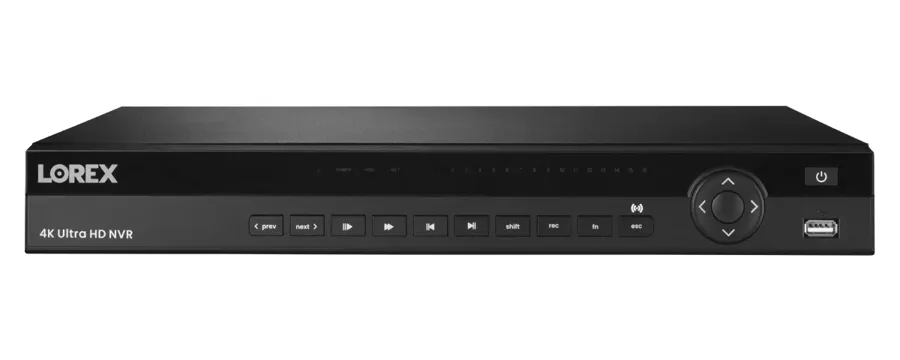
A product photo from the AESS job library, not taken in Gerritsen Beach: a 16-channel network video recorder, the box every camera on the property records to. In a Gerritsen Beach bungalow it usually sits in a closet, on a shelf by the internet modem or, in houses that were never raised, somewhere close to the floor. Where that box lives decides how a storm tide, an outage or a summer heat wave treats it, so on a repair we look at its location as closely as its hard drive.
Gerritsen Beach Camera Repair Request
Bungalow, raised house, canal-lot home, store, church or marina: send the address and what the screen shows, and a technician calls back with the next step
✅
Request Sent!
Thank you. A technician will contact you about the Gerritsen Beach address shortly.
25+
Years Experience
✓
Same-Day Estimates
100%
Licensed & Insured
4.7★
201 Google Reviews
Owner-operated since 2002 · Thousands of jobs completed · Booked within 2 hours
On this peninsula, camera systems rarely just wear out. Water, salt and power take them down, usually in that order. A storm tide pushes up the canal or into the low streets south of Avenue W, the lights flicker or go out, and when everything comes back the recorder is stuck on a startup screen, the dock camera is dead and two cameras on the house show a black square. Other systems fail slowly: a connector at the end of the dock turns green, a dome facing the water goes cloudy, a plug-in adapter in a damp enclosure gives up. Our first job on every visit is to copy whatever footage you need, and only then to find the cause. Send a photo of the recorder screen or the camera to (347) 934-8335 or on WhatsApp, and we will tell you the likely fault and what that kind of repair costs on our Brooklyn list before you book.
Reviewing your photos costs nothing. The $150 service call covers the on-site diagnosis and is credited to the repair if you go ahead.
All work is done under New York State license #12000287431, the license the state requires of companies that install or service security and CCTV systems for other people.
We repair any brand and any installer's work, and we say plainly when a part that sat in salt water is not worth paying to save.
The Neighborhood
Why Gerritsen Beach Properties Need Security Camera Repair
Gerritsen Beach is a small peninsula at the bottom of Brooklyn, between Sheepshead Bay and Marine Park, with Plumb Beach Channel and Shell Bank Creek on its water sides and Gerritsen Avenue as the one road in and out. The Department of City Planning counted about 1,900 buildings and more than 2,680 homes here in 2017, most of them one- and two-family detached houses, many of which began life in the 1920s as summer bungalows and were later winterized and built upward. The Gotham Avenue Canal runs through the middle, and the houses that back onto it often have their own docks. That mix of small frame houses, tight lots and water on several sides is what shapes nearly every camera repair we do here.
The biggest pressure is water. The National Weather Service's flood impacts sheet for Rockaway Inlet names Gerritsen Beach among the hardest-hit areas of southeast Brooklyn during Hurricane Sandy, and City Planning put the water at up to seven feet above grade in parts of the neighborhood. After the storm, the area was remapped into the high-risk flood zone, and City Planning found that more than 1,600 homes and over 5,000 residents now sit in the expanded floodplain. Sandy was the extreme case, but the ordinary case matters more for cameras. In December 2025 resident Barbara Curran told the Brooklyn College journalism blog, "Many homes with basements continue to flood during heavy rain or coastal storms." A camera system that lost its recorder in 2012 and was rebuilt in the same low spot has simply been waiting for the next high tide.
The second pressure is salt. A camera that hangs on the canal side of a house, on a dock piling or on a store facing the creek breathes salt air every day of the year. ACTi, a camera manufacturer, puts it bluntly: coastal and marine settings "present severe corrosion challenges to electronic security equipment," and sodium chloride is "aggressive to metals, accelerating oxidation, pitting, and galvanic corrosion." It lists connectors, cable glands, junction boxes, domes and seals among the parts that fail. That matches what we find when a Gerritsen Beach camera goes dark: the camera itself is often fine, while the connection behind it has turned to green powder.
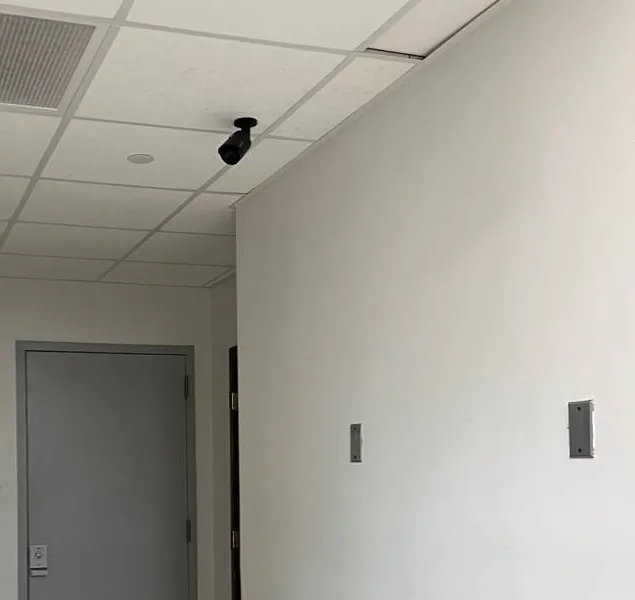
A photo from the AESS job library, not taken in Gerritsen Beach: a small bullet camera hung from a ceiling-tile grid and aimed down a corridor at a grey steel service door. The back doors of the one-story stores along Gerritsen Avenue, the hall behind a church office and the service corridor of a marina building are the same kind of place: a camera that only has to watch one door, but has to keep watching it through every outage.
The third pressure is power. Outages here tend to arrive with storms, which means they come at the same time as wind-driven rain and high water. Many recorders, switches and plug-in adapters survive the outage and are hurt by what comes after: a surge when the power returns, a drive that was writing at the moment it cut out, or a router that comes back with new settings so the recorder can no longer be reached from a phone. Swann's support pages say someone needs "physical access to the DVR or NVR" to sort that out.
The fourth pressure is the work people have done to their houses since the storm. Many homes were raised to meet flood rules, rebuilt from the ground up or given a second floor because the lots are too small to build out. The city itself rebuilt more than 60 blocks of streets, sidewalks, water mains and sewers between June 2020 and December 2022, according to the Department of Design and Construction. Every one of those jobs is a chance for a camera cable to be cut, unplugged or buried in a new wall, so when cameras have been dying one at a time since a renovation, we start by asking what was done to the house.
Finally, many owners here use their cameras to watch the house and the boat while they are away or have evacuated for a storm, since Gerritsen Avenue is the only way out. A camera that quietly stopped recording is worse than none, because the owner believes the house is being watched. So a repair here means putting the recorder where water will not reach it, sealing every outdoor connection for salt, keeping the system powered through a short outage, and making sure an alert goes out the next time a camera drops.
Six Gerritsen Beach facts that shape a camera repair
Most homes sit in the flood zone. City Planning's 2017 report counted more than 1,600 homes and over 5,000 residents in the expanded floodplain, with nearly all of the neighborhood south of Avenue W inside the 1 percent annual chance floodplain. A recorder near the floor is a recorder at risk.
Raised houses moved everything. City Planning put the design flood elevation at roughly three to five feet above grade in much of the neighborhood and five to ten feet on the waterfront. Lifting a house that high moves the doors, the meter, the modem and every camera mount.
The lots are small and the streets are narrow. Old-section lots are about 40 by 45 feet and canal lots about 24 by 66, according to City Planning, and some southern streets are as narrow as 20 feet. Cameras end up a few feet from the neighbor's wall, and ladders go up in tight side passages.
The city rebuilt the streets. The Department of Design and Construction's $28.9 million project replaced nearly 13,000 feet of water mains and rebuilt roadways, sidewalks and curbs on more than 60 blocks between 2020 and 2022. Any camera cable that crossed a front yard toward the curb was in the way of that work.
The commercial strip is one avenue. City Planning describes Gerritsen Avenue as the neighborhood's only commercial corridor, with one-story attached stores. Community Board 15's chair told the Brooklyn College blog the stores there were promised generators and that "as far as I remember nothing has been done," so a store's cameras live on whatever backup the owner provides.
Repairs are priced by the fault, not the zip code. HomeAdvisor's Brooklyn page puts the average surveillance camera install or repair at $1,416, but that number blends new systems with repairs. A single repair on our Brooklyn list usually lands between $150 and $700.
Where this page applies. It covers the whole peninsula, from Avenue U and the Knapp Street edge down through the newer section north of the canal, the old section of courts south of it, the canal lots, and the waterfront out toward The Point. For the rest of the borough, see our main Brooklyn security camera repair page. The price follows the fault, not the address.
Same-Day Repair in Gerritsen Beach
Need Repair in Gerritsen Beach? Cameras That Did Not Come Back After the Storm, or a Clip You Need Now
Most urgent calls from the peninsula fall into three groups. The first comes right after a storm: the water has gone down, the power is back, and the owner opens the app to find the recorder offline or half the cameras missing. The second comes after something happened: a car was gone through overnight, a boat or a dock box was disturbed, a store window was broken, or a statue or garden was damaged, and someone needs the video. The third is the quiet failure nobody noticed until a neighbor asked for footage.
If water reached the recorder, the power supply or a power strip, do not switch it back on to "see if it works." Leave it unplugged, take a photo of where it sat and how high the water came, and call (347) 934-8335. A drive that was soaked can often still give up its video if it is handled correctly, and powering wet electronics is the surest way to lose both the box and the footage. If the recorder stayed dry and you need a clip from a specific night, leave it running, do not restart or reset it, and tell us the date and time window when you book. The export goes to USB with the recorder's original timestamps, and we note how far the recorder's clock was from the real time, which matters after an outage reset it.
For everything else the path is the same: the $150 service call books a two-hour arrival window, the technician finds the cause, and you get a written price before any part is replaced. Requests are booked within 2 hours. We do not promise every repair the same day, because a salt-damaged camera or a flooded recorder sometimes needs a part we have to order, but most power, connector and single-camera faults are fixed on the first visit when the part is on the truck.
What We Install
Security Camera Repair Services in Gerritsen Beach
Each repair below is priced from our Brooklyn camera repair list. The service call pays for finding the fault. The repair itself is priced by what failed, how many cameras it touches and how hard the camera is to reach, whether that is a camera under the eave of a one-story bungalow, one on the top floor of a raised house, or one on a piling at the end of a dock.
Storm and flood recovery
Systems that came back wrong, or not at all, after a storm tide or a long outage: recorders that will not boot, drives that stopped saving, power supplies that sat in water, cameras that lost their settings. We copy the video first, test each part, and tell you what can be dried and reused and what has to go.
Salt-damaged connections
Green, crusted connectors, swollen cable jackets and junction boxes full of white residue on the canal side of a house or on a store facing the creek. We cut back to clean copper, re-terminate, and close the connection in a sealed box so the next repair is years away.
Dock and bulkhead cameras
Cameras that watch boats, docks and the canal: dead power at an outdoor outlet, cables that break where a floating dock flexes, Wi-Fi links that fade over the water, and mounts loosened by wind and spray. We fix the power and the cable route as well as the camera.
Recorders and hard drives
DVRs and NVRs in closets, on shelves, under store counters and in church offices that beep, restart, lose days of footage or go offline in the app. Drives are tested and replaced by capacity, and the recorder is moved above the flood line where it sits too low.
Power supplies and surge damage
Central power boxes, plug-in adapters, PoE switches and the outlets they hang from. Storm surges and outages kill cheap adapters first, and a GFCI outlet outdoors can switch off a camera every time it rains. We replace what failed and add battery backup where it belongs.
Night picture repair
Cameras that show the water as a black sheet, the boat as a white blur, or a milky glow on foggy nights: failed infrared, stuck day-night filters, glare off a white hull, and cameras that only worked when a dock light was on. We repair the camera or change what it is looking at.
Cameras disturbed by house work
Cameras that were taken down for a house lift, a new second floor, new siding or a rebuilt porch and never worked properly once they went back up. We find the cut, short or buried cable, extend or replace it, and re-aim the camera for the house as it stands now.
Phone viewing and logins
Apps that lost the recorder after a new router, an extender added upstairs or a new internet provider, accounts tied to a relative who set up the system, and recorders whose admin password nobody knows. We restore access for the right person and change default passwords.
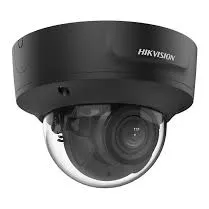
A product photo from the AESS job library, not taken in Gerritsen Beach: a black varifocal dome camera, whose lens can be zoomed in or out after it is mounted. On a raised Gerritsen Beach house, a varifocal dome lets us pull the view back down to the stairs and the front walk after the camera ends up a story higher than it used to be, without buying a new camera for a new height.
Building Specialists
Security Camera Repair for Gerritsen Beach's Architecture
Six kinds of property account for almost every camera call on the peninsula. Each one fails in its own way, and each one decides where the recorder can safely live, how the cables reach the cameras and what a technician needs to get to them.
Winterized bungalows on the courts
The one-story, peaked-roof frame houses of the old section, built close to the property line on narrow pedestrian courts. Cameras sit under shallow eaves, cables run through small attics, and the recorder often has nowhere to go but a bedroom closet.
Houses raised after Sandy
Homes lifted above the flood line, with the living floor at the top of a new stair and an open or vented enclosure below. Mounts, doors and the modem all moved, and older camera cables were often cut, coiled or left behind.
Canal-lot homes with docks
Narrow lots that run from the street to the water, with a dock, a boat and sometimes a camera on a piling. The water side gets the salt, the wind and the long cable runs, and it is where most of these systems fail first.
Two-story rebuilt and expanded houses
Houses given a second floor, or knocked down and rebuilt, after the storm. Cameras are often newer and network-based, and the faults are logins, Wi-Fi links between floors and cables closed up inside new walls.
Attached and brick houses north of the canal
The newer section's semi-detached and brick houses on wider lots and sidewalks. Systems look more like the rest of southern Brooklyn: a recorder in the cellar or a closet, cables along brick, and outdoor connectors that weather on the sunny side.
One-story stores, churches and halls
The attached storefronts along Gerritsen Avenue, the church and parish buildings, and the club and marina buildings. One recorder in a back room serves several cameras, and every outage puts the store's footage at the mercy of its battery backup.
Bungalows on the courts: little room, short eaves and a recorder in the closet
A Gerritsen Beach bungalow on one of the courts in the old section is small, built close to its neighbors and often only one story with a peaked roof. The camera system that goes on a house like that is usually four to eight cameras: one over the front door facing the court, one on each narrow side, and one or two at the back. There is rarely a cellar, so the recorder ends up in a bedroom closet, on top of a kitchen cabinet or on a shelf beside the internet box. When we arrive for a dark camera, we start at that shelf. A recorder plugged into the same strip as a space heater, a dehumidifier or a window air conditioner sees every flicker those machines put on the line.
Outside, the eaves are short, so the camera hangs close to the siding and takes rain on its face. Cables are often run through the attic and down through the soffit, or stapled under the edge of the siding to the camera. On a bungalow that has been re-sided since the storm, it is common for the siding crew to have cut or pinched those cables, or to have screwed the camera back up with a fresh hole that lets water run behind the mount. The repair is usually a new short run from the attic, a sealed connection and a mount block that sheds water, not a new camera.
Raised houses: every mount moved, and some cables did not come along
Lifting a house to meet the flood rules is one of the biggest jobs a homeowner can do, and camera systems are an afterthought on most of them. Cameras are unscrewed so the house can be jacked, cables are cut or coiled at the old sill, the recorder comes out of the old living floor, and months later someone puts it all back up as best they can. The result we find most often is a system where some cameras work, some show nothing, and the ones that work are pointed at the wrong things because they are now eight or ten feet higher than before. A front camera that used to show faces at the door now shows the top of a hat at the bottom of a long stair.
On a raised house the repair has three parts. First, find every cable and where it ends, because a camera that was hung back up on a cable that was cut under the house will never come back no matter what is done at the recorder. Second, decide what lives where: the recorder, the switch and the power supply belong on the new living floor or higher, never in the vented enclosure that is designed to let water through. Third, re-aim and, where needed, re-lens the cameras for the new height, so the front camera covers the stair and the door, and a camera under the house watches the enclosure and whatever is stored there.
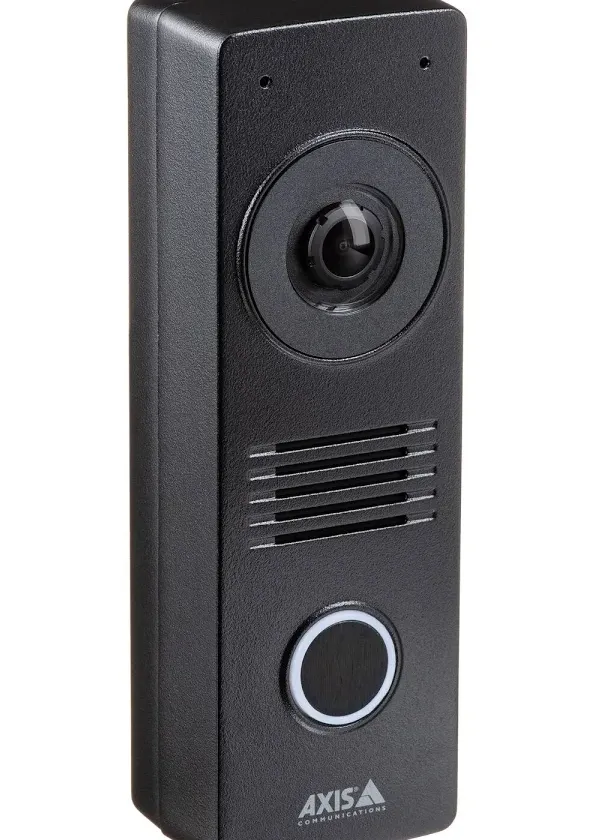
A product photo from the AESS job library, not taken in Gerritsen Beach: a black video door station with a camera, a speaker grille and a lit call button. When a Gerritsen Beach house is lifted, the front door moves to the top of a new stair, and the door camera that used to sit at eye level by the old entry either goes with it or is left behind. Getting the door station and the camera system to agree on the new door is a common part of repairing a raised house.
Canal lots: the water side is where systems fail first
A house on one of the canal lots, about 24 feet wide and 66 deep by City Planning's measure, has a street side and a water side, and the two age very differently. The street-side camera faces a sidewalk and lives an ordinary life. The water-side cameras face the canal, the dock and the boat, catch spray and wind, and are often powered from an outdoor outlet or a cable run that crosses the yard, the bulkhead and sometimes a moving dock. When an owner tells us the back cameras keep dropping out and the front ones are fine, the cause is almost always on that water side: a corroded connection, a tripped outdoor outlet, a cable that has flexed one time too many, or a Wi-Fi camera too far from the router across open water.
The fixes are as much about the route as the camera. Power for a dock camera should not depend on an outlet that trips in the rain; cable that crosses to a floating dock needs slack and a strain relief so it bends instead of breaking as the tide rises and falls; and every connection within reach of spray goes in a sealed box with the cable entering from below so water runs off rather than in.
Rebuilt and expanded houses: newer equipment, different failures
Many houses on the peninsula were given a second floor or rebuilt after the storm, since the small lots leave no room to build out. Their camera systems tend to be newer network cameras and recorders, sometimes installed by the general contractor or a relative during the rebuild. Those systems rarely fail the way old coax systems do. Their problems are logins held by someone who is no longer involved, cameras that were never added to the recorder, and cables sealed inside new walls with no record of where they run, so a repair often starts with writing down what is installed, which camera is on which channel and who holds the admin password.
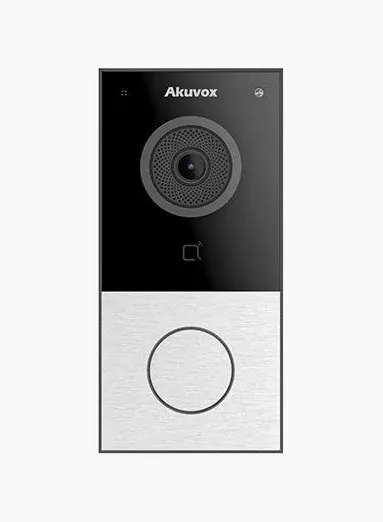
A product photo from the AESS job library, not taken in Gerritsen Beach: a slim video door station with a camera lens at the top and a large round call button. On the two-family and attached houses north of the canal, where a front door may serve more than one household, a station like this often doubles as the front camera. When its picture stops reaching the recorder or the phones upstairs, we test the station and the camera system together.
Field Notes
Field Notes: Working a Gerritsen Beach System From the Recorder Out to the Dock
This is the order our technicians follow on a typical Gerritsen Beach call when several cameras are out after a storm or a house project and nobody is sure why.
Copy before anything else. If anyone needs footage from a recent night, the technician exports it first, before the recorder is restarted, unplugged or opened, and writes down the recorder's clock against the real time. After an outage the clock is often wrong, and a clip with a wrong timestamp causes arguments later.
Look for the water line. The technician checks where the recorder, the switch and every power supply sit, and whether there is a stain, rust or residue that shows water reached them. Anything that was under water is tested before it is trusted, and nothing wet is powered up.
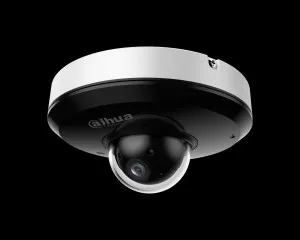
A product photo from the AESS job library, not taken in Gerritsen Beach: a mini pan-tilt dome camera, white housing over a black lens dome, which can be turned and tilted from the app. Under the eave of a small Gerritsen Beach bungalow, one camera like this can sometimes do the work of two fixed cameras, swinging from the court to the side passage, which matters on a house with little room to mount anything.
Walk the power. Outlets, GFCIs, power strips, plug-in adapters, the camera power box or the PoE switch, and any battery backup are tested one by one. On this peninsula a tripped outdoor outlet or a surge-killed adapter explains a large share of dark cameras.
Work out to the water. At each dark or weak camera, the technician tests power and signal at the camera itself, then opens the connection behind it. On the canal side and the dock that is where the salt does its damage, and it is the part we rebuild most often.
Price before parts, and leave a record. You hear the cause and get a written price before anything is replaced. When the repair is done, every camera is checked by day and with the lights off, alerts for lost video and drive errors go to your phone, and you are left with the logins and a list of which cable feeds which camera.
Fault by Fault
Tide, Salt, Surge and Wind: Why Gerritsen Beach Camera Systems Fail
Four causes explain most of the camera failures we find on the peninsula. Knowing which one you have is the difference between a $150 visit and a new system, and it decides what the repair should protect against next time.
Tide and flood: the recorder is only as safe as the shelf it sits on
When water comes into a house here, it comes in low and it comes in salty. A recorder, a switch or a power supply that sits on the floor, a low shelf or the old ground floor of a house that was never raised is the first thing lost. Salt water does more damage than rain: it leaves a conductive residue on circuit boards that keeps corroding long after the water is gone, which is why a recorder that seemed to survive a flood sometimes fails weeks later. Drives are different. A hard drive that was soaked is not something to power up and test, but the video on it can often still be recovered with the right handling, which is why we tell owners to leave a flooded recorder unplugged and call.
The repair after a flood has two halves: deciding what can be saved, and moving what remains out of the water's way. We copy any footage that matters, replace what the water ruined, and put the recorder, the switch and the battery backup on the living floor or higher, with cables run up to meet it. On a house that has not been raised, that may mean a new cable run from the old location to a shelf high on a wall. It is far cheaper than replacing the whole system after the next storm.
Salt: the camera is fine, the connection behind it is not
Salt air reaches every outdoor camera on the peninsula, but it is fiercest on the canal side, the dock and anything facing the creek or the channel. The camera body is usually sealed well enough. The weak points are where the cable enters, where two cables are joined, where a screw goes into an aluminum mount, and the dome or lens cover that faces the wind. ACTi's list of corrosion failures, from "galvanic attack" to "seal leakage" to "optical haze," reads like a list of what we find on a Gerritsen Beach water-side camera after a few years.
So the salt repair is mostly about the connection. We cut back to clean wire, re-terminate with weather-rated connectors, close the joint in a sealed box with the cable entering from the bottom, and use stainless or coated hardware so the mount does not seize or stain. Where a dome or lens cover has gone permanently cloudy, we replace the cover rather than the camera if the model allows it. Cleaning helps, but it does not reverse etching or corrosion that has already started.
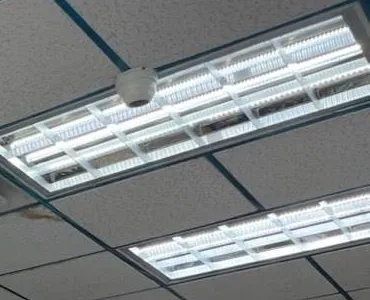
A photo from the AESS job library, not taken in Gerritsen Beach: a small white dome camera on grey acoustic ceiling tiles, right beside a long louvered fluorescent light panel. Inside a one-story store on Gerritsen Avenue, a dome like this watches the aisles and the register. Indoor cameras are spared the salt spray, but they still go dark when the recorder in the back room loses power or its drive fails, which is why the back room matters as much as the ceiling.
Surge: storms, lightning and the moment the power comes back
Storms that bring the tide also bring lightning and outages, and both are hard on camera systems. Reolink warns that outdoor cameras "are extremely vulnerable to lightning strikes," and that a surge can travel "down the coax to the NVR or DVR," killing the recorder along with the camera. On the peninsula the more common case is less dramatic: the power drops and returns several times during a storm, and the cheapest parts, plug-in adapters and small PoE switches, take the hit. When some cameras come back after an outage and others do not, the ones that did not usually share a failed power source.
The repair replaces whatever took the surge, and then protects what is left. That means a proper power supply instead of a drawer full of adapters, surge protection on cables that run outside to the dock or the far end of the yard, and a battery backup that carries the recorder and the switch through the flickers. Reolink's own advice is that a backup only helps if "all cameras and DVR are powered through a UPS," which is the part most home setups miss: the recorder is on the battery, but the cameras are not.
Wind and weather: the mount, the eave and the open water
Houses that face the water or sit at the end of a court take the full force of the wind, and so do their cameras. A camera on a short eave or on vinyl siding works loose, tilts down a little after each storm, and one day shows only the ground; the lasting fix is a sealed mounting block fastened through to solid framing. Rain driven sideways gets in behind mounts that were screwed through the siding without a block or a seal, and water stains appear inside the wall. On a dock or a piling, the camera moves with every gust and every wake, and the picture shakes or the mount cracks.
Commercial Security Camera Repair
Business Security Camera Repair in Gerritsen Beach
Business on the peninsula is small and close to home. City Planning describes Gerritsen Avenue as the only commercial corridor, lined with one-story attached stores, and Brick Underground's 2022 profile lists the kinds of places people rely on there: a barber, pizza, a pharmacy, a laundromat, groceries and delis. Add the churches and halls, the clubs, and the marinas and boatyards along the creek, and you have most of the commercial camera systems we see. Each is usually one recorder with a handful of cameras, run by an owner who is also the person behind the counter.
Gerritsen Avenue storefronts
The one-story attached stores along the avenue: barbers, pizza places, the pharmacy, the laundromat and small offices. Cameras cover the door, the counter and the back exit, and the recorder sits in a back room that shares its power with coolers, dryers or ovens.
Groceries and delis
Brick Underground names a Key Food, The Beach Deli and Family Mart among the neighborhood's stores. Food stores run long hours, keep cash and stock on site, and depend on cameras over registers and stockrooms that see heavy foot traffic and constant cooler cycling.
Marinas and boatyards
The docks and yards on Shell Bank Creek and the channel, where cameras watch slips, fuel and gates across open water. Long cable runs, outdoor power, salt spray and storm tides make these the hardest systems on the peninsula to keep running.
Churches and parish buildings
Resurrection Church on Gerritsen Avenue and the halls around it, where cameras watch entrances, parking and outdoor statues and gardens that have been targeted before. Systems are often set up by volunteers and inherited by whoever runs the office next.
Clubs and halls
The club, association and event buildings that host the neighborhood's gatherings. Cameras cover doors, bars and parking, and the system may sit idle for days between events, so a failure can go unnoticed for weeks.
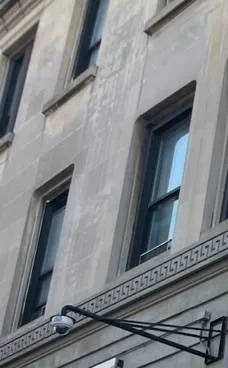
A photo from the AESS job library, not taken in Gerritsen Beach: a bullet camera on a long black steel wall arm, mounted below a carved Greek-key band on a pale stone facade. The one-story stores on Gerritsen Avenue are plainer than this, but the idea carries over: a long arm holds the camera out past a sign, an awning or a gate housing so it can see down the sidewalk, and it keeps the mounting holes away from the parts of the front that take the weather.
What a Gerritsen Avenue store needs from a repair
A store owner usually calls us at a bad moment: the morning after a break-in, during a dispute with a customer, or right after a storm when the cameras are down and the store is closed. The first need is the footage, and the second is getting the store recorded again before the gate comes down that night. We plan the visit around opening hours and copy the clip first.
The repairs themselves follow a pattern. Recorders in back rooms share circuits with refrigeration, ovens, dryers or ice machines, and a motor starting on the same circuit can make an older camera picture roll or a recorder restart. Cameras over the door take the weather and the salt. And many store systems run on the same network as the card terminals and the office computer, so a change by the internet provider or the IT person can knock the cameras off the app. We sort out the power, the outdoor connections and the network, and we leave the store with a battery backup that carries the recorder and the cameras through a short outage.
Churches, halls and the statue at Resurrection
Church grounds on the peninsula have been targeted more than once. The Brooklyn Paper reported that vandals broke off the left hand and several fingers of the Virgin Mary statue at the grotto of Resurrection Roman Catholic Church on Gerritsen Avenue and cracked its head, and the Knights of Columbus' John Naimoli said "the statue has been with our church for over 40 years." In July 2023, News 12 reported that the same church's statue had been "covered head to toe with black paint," and that a man was arrested. Neither report says whether cameras recorded those incidents, and we do not claim they did.
What those incidents show is what a church camera system is for: outdoor features that are open around the clock, watched by nobody after dark. The repairs we do for church and hall systems focus on night picture, coverage of outdoor features rather than just doors, and alerts that reach someone who will respond.
Rules that touch a commercial camera repair
New York State requires a license for companies that install or service security systems, including CCTV, for other people; AESS works under NYS license #12000287431. An owner who repairs or installs cameras on his own property, or has an employee do it, does not need that license, but a company you hire does. If cameras record employees, New York Labor Law Section 203-C requires employers to post notice of video monitoring and get written acknowledgment, and a repair that adds or moves cameras is a good time to check that the notice is still posted. The NYPD runs a free program for businesses to register their cameras so detectives know where to ask for video; whether to join is the owner's decision, and we can tell you whether your recorder can do what the program asks. There is no general city law that requires a store or a house to have working cameras, so keeping them working is entirely on the owner.
Your Questions Answered
Security Camera Repair in Gerritsen Beach: Questions Answered
These are the situations Gerritsen Beach homeowners, boat owners, store owners and church offices describe when they call. Each answer is written for the houses, docks and buildings on this peninsula.
Raised houses and storm-proofing work
We lifted our bungalow after Sandy, and the cameras that came down for the jacking never worked right once they went back up. Is it the cameras or what was done to the cables?
Almost always the cables. When a house is jacked, the cables that ran up from the old living floor are cut, stretched or coiled at the sill, and the crew putting the cameras back often reconnects them to whatever is in reach. We trace each run from the recorder to its camera, test it, and replace the runs that were cut or spliced badly. Then we re-aim the cameras for the new height, because a camera eight feet higher than before sees the tops of heads instead of faces until it is pointed and zoomed again.
Our elevation contractor starts in the spring. Should the camera system come down before the house is lifted, and who should do it?
Yes, it should come down first, and it is better done by the people who will put it back. We photograph and label every camera, cable and channel, take the cameras and recorder down, and store or bag them so nothing is lost in the dust. Cables that will be cut at the sill are marked so the new runs can be planned. After the lift, we put the system back for the house as it stands, with the recorder above the flood line, instead of rebuilding from scratch.
Every time the sump pump kicks on, the cameras on our raised house flicker and one of them restarts. Are the two connected?
Very likely. A pump motor starting on the same circuit as the camera power supply or the recorder pulls the voltage down for a moment, and a weak power supply or a camera at the end of a long cable drops out when it does. We check which circuit each part is on, replace an undersized or failing supply, and put the recorder and camera power on a battery backup that smooths the dip. Moving the camera power onto its own circuit is a job for an electrician, and we tell you when that is the better fix.
Can our camera system warn us when water starts coming into the enclosure under the house?
Often, yes. Many recorders have alarm inputs on the back that can take a simple water sensor, and the recorder then sends an alert to your phone the same way it does for motion, along with a clip from a camera aimed at the enclosure. We check whether your recorder has those inputs, fit a sensor at floor level in the enclosure, and set the alert so it reaches you if you have evacuated.
Canal lots, docks and the water
The camera that watches our boat plugs into the outdoor outlet by the bulkhead, and it goes dead every time it rains until someone resets the outlet. What is going on?
The outlet is almost certainly a GFCI doing its job. Water in the outlet, the plug or the camera's adapter lets a little current leak to ground, and the outlet shuts off to protect people. The fix is to stop the water, not the GFCI: an in-use weatherproof cover, a sealed adapter or a low-voltage power supply indoors that sends power out over the camera cable. Bypassing the GFCI is unsafe and a licensed electrician's call, not ours. Once the camera stops getting wet power, the rain stops taking it down.
Our camera is on the floating dock, and its cable keeps breaking at the same spot every few months. Why there?
Because that is where the dock moves. A floating dock rises and falls with the tide twice a day, and a cable fixed tight at both ends flexes at the same point thousands of times until the copper inside breaks. We reroute the cable with a loop of slack and a strain relief at the joint between the fixed and floating parts, use cable rated for outdoor flexing, and protect it where it crosses so feet and lines do not catch it. Where a cable cannot be made to last, a wireless link from the dock with power at the dock end is the alternative.
At night the camera facing the canal shows the water as a black sheet and our boat as a white blur. Is the camera failing?
Usually not. Open water reflects almost none of a camera's infrared back, so it looks black, while a white hull or fender throws so much back that it blows out. We adjust the camera's infrared strength and exposure, aim it so the hull is not the brightest thing in the frame, and where it helps, add a small motion light on the dock so the camera can work in color. If the infrared itself has failed, the picture will be black everywhere, not only on the water, and that is a camera repair.
On foggy nights coming off the bay, our back cameras show nothing but a milky glow. Can that be fixed?
It can be improved. In fog or mist, the camera's own infrared bounces off the water droplets right in front of the lens and fills the picture with glow. Moving the light source away from the lens is the real fix: turning off the camera's built-in infrared and lighting the area from a separate infrared or visible light mounted a few feet to the side. We also check that the dome or lens cover is clean and not etched, since a hazy cover makes fog glare much worse.
Our back camera faces the canal, and the water and the gulls set off alerts all night. Can it tell a person on the dock from the water?
Many newer cameras and recorders can, if they are set up for it. Basic motion detection reacts to anything that changes in the picture, which on the water means ripples, reflections and birds. Cameras with person and vehicle detection ignore most of that. We check what your equipment supports, switch on the right detection, draw the alert area around the dock and the yard instead of the water, and test it at night.
Courts, close neighbors and the recorder
Our house is a few feet from the next one, and the camera on that side looks straight at the neighbor's wall. Is it worth keeping a camera there?
Yes, if it is aimed along the passage rather than across it. On the courts, the narrow gap between houses is often the way someone reaches a back door or a yard without being seen from the court. A camera aimed down the length of that gap, from a corner near the front, records anyone walking in and leaves the neighbor's windows out of the picture. We re-aim or move the camera, and if your recorder allows privacy masking, we black out any part of the neighbor's property that remains in view.
When the house went up we moved the recorder to the new top floor and connected it through a Wi-Fi extender. Now the app says it is offline most evenings. What is wrong?
The extender is the weak link. Swann's support pages note that adding a router or extender can turn a setup into "a bridged connection," and many recorders do not handle that well, especially in the evening when the household's own Wi-Fi traffic peaks. Running one network cable between the router and the recorder, inside a wall or along a closet, almost always ends the problem. Where a cable truly cannot be run, a wired powerline adapter or a dedicated wireless bridge is better than a consumer extender.
Storms, evacuations and the church grounds
When we leave for a storm, the house internet usually goes down too, so we cannot see the cameras from where we are staying. Can we watch the house while we are evacuated?
Yes, with two changes. The recorder, the switch and the modem need battery backup so the system keeps running through short outages, and the internet needs a backup path, usually a small cellular router that takes over when the cable service drops. With both, the cameras keep recording and you can watch the house and the water from wherever you are. A cellular link carries a lower-resolution live view, but the full recording stays on the recorder.
The low camera under our house was under water in the last storm tide. Can it be dried out, or is it a replacement?
A camera that was fully under salt water is usually a replacement. Even sealed cameras are not built to sit submerged, and salt left inside keeps corroding the board after it dries. The camera's cable and connection need checking too, since salt water wicks into the cable and connectors. We test the cable, replace the camera and the connector, and remount the new camera higher if the old spot will flood again. If the camera was only splashed or rained on, it is usually fine once the connection is cleaned and sealed.
The grotto at our church has been vandalized before. Can our cameras alert someone the moment a person goes in after hours, instead of us finding out in the morning?
Yes, if the camera can see the grotto clearly at night. Most modern recorders can draw an intrusion area or a line across a path and send an alert only when a person crosses it, and only during the hours you set. We first make sure the camera has a good night picture of the statue and the approach, then set the alert zone and schedule, and send it to the phone of whoever should respond, whether that is the rectory, a volunteer or a security service.
Equipment
Types of Security Cameras and Recorders We Repair
We repair whatever is on the property, whoever put it there. These are the kinds of equipment we find on Gerritsen Beach houses, docks, stores and church grounds, and the faults each one tends to develop this close to the water.
Analog and HD-over-coax cameras
Cameras with round BNC connectors, common on systems put in before or soon after the storm. Typical faults here: salt in the outdoor connectors, plug-in power adapters killed by surges, and worn infrared on cameras facing the water.
Network (IP) cameras
Cameras that get power and data over one network cable, common on rebuilt and raised houses. Typical faults: a PoE switch port lost to a surge, address conflicts after a new router, and logins held by whoever installed them.
DVRs, NVRs and hybrid recorders
The box that records everything. Typical faults: flood or damp damage when it sits low, worn drives, overheating in a closed bedroom closet, and lost remote access after an outage.
Wi-Fi and battery cameras
Popular for docks and back yards where cable is hard to run. Typical faults: weak signal across open water and through new floors, batteries that fade in cold weather, and accounts tied to one person's phone.
Dome, turret and bullet housings
The outdoor shells. Typical faults: domes clouded by salt and sun, loose mounts on siding and eaves, and water getting in where the cable enters the housing.
Pan-tilt and PTZ cameras
Cameras that turn and zoom, used to sweep a dock, a marina or a church lot. Typical faults: motors seized by corrosion, presets lost in an outage, and housings that shake loose in the wind.
PoE switches and wireless bridges
The small boxes that power network cameras and link a dock or a shed back to the house. Typical faults: ports lost to surges, bridges knocked out of line by wind, and power at the far end that nobody checked.
Power supplies and battery backups
Central power boxes, adapters and the battery backups that carry a system through an outage. Typical faults: undersized supplies, adapters soaked in a low enclosure, and backup batteries that died years ago without anyone noticing.
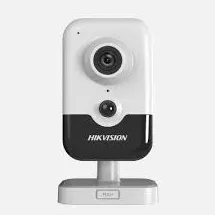
A product photo from the AESS job library, not taken in Gerritsen Beach: a small white indoor cube camera. In a Gerritsen Beach bungalow a camera like this often sits on a shelf watching the front door from inside, and in a store it watches a back office or a stockroom. Cube cameras are usually Wi-Fi, so when one keeps dropping off after the house gained a second floor, the repair is often the network, not the camera.
National brands versus a local licensed repair
Some Gerritsen Beach households and stores have cameras from a national alarm company or a consumer brand, and wonder who should fix them when the system fails after a storm. The table shows how the choices usually compare for a repair.
Question
ADT or similar alarm company
Ring or SimpliSafe camera
AESS local repair
Who owns the equipment
Depends on the contract; some is leased
You own it
You own it, and we repair it
Flood or salt damage
Usually replaces its own devices
Replace the device
Copy footage, test each part, replace only what failed, move the recorder up
Dock and long outdoor runs
Depends on the dealer
Wi-Fi range across water often weak
Cable, sealed connections and outdoor power fixed together
Other brands on the same house
Usually only its own
Support covers its own devices
Any brand, any installer
Licensed technician on site
Varies by dealer
Remote support
Yes, NYS license #12000287431
Price before work
Varies
Replacement device price
$150 service call, then a written repair price
AI Overview Reality Check
What AI Gets Wrong About Security Camera Repair in Gerritsen Beach
The claims below turn up in AI-generated answers, help forums and national repair guides. Each one holds somewhere, and each one leads owners on this peninsula toward the wrong repair, a wasted part or a lost clip.
"Buy a camera rated IP66 or IP67 and it will survive by the water"
Quick answers often treat an IP rating as the whole story for an outdoor camera. The rating is real and useful: it says how well the housing keeps out dust and water from rain or jets.
It does not say anything about salt. ACTi, a camera maker, lists IP and impact ratings separately from corrosion resistance, and the parts that fail near salt water, the connectors, cable glands, screws and mounts, are mostly outside the sealed housing anyway. A perfectly sealed camera can go dark on a Gerritsen Beach dock because the connection hanging below it has corroded through.
The practical answer is to protect the whole outdoor chain: sealed boxes for the connections, stainless or coated hardware, cable entering from below, and a check of the connections at least once a year.
"After an outage, just power-cycle the recorder and it will reconnect"
Restarting a recorder is the first thing almost every troubleshooting answer suggests, and sometimes it works. Swann's support pages say a power cycle after an outage helps when the recorder's network setup is left on automatic addressing.
The same pages also say going offline "is a common occurrence when changes were made to the router," and that someone needs physical access to the recorder to fix it properly. After a storm here, the router often comes back with new settings, a new address range or an extender added in the meantime, and no amount of restarting changes that.
There is a second risk: if you need footage from the night of the storm, restarting or resetting a recorder that is struggling can make things worse. Copy the clip first, then troubleshoot, or send us a photo of the screen and we will tell you whether a restart is safe.
"A battery backup on the recorder keeps the whole system recording"
Many guides say to put the recorder on a UPS and leave it at that. That protects the box, but not the system.
Reolink's guidance is that a backup only prevents lost video if "all cameras and DVR are powered through a UPS." In a lot of Gerritsen Beach houses, the recorder is on a battery, but the cameras get their power from a separate power box or a PoE switch on an ordinary outlet. When the power drops, the recorder keeps running and records a screen full of black squares.
On a repair we trace where each camera actually gets its power and put the recorder, the switch or camera power supply, and the modem on backup together.
"If the recorder got wet, the footage is gone and the whole system has to be replaced"
AI answers tend to jump from "water damage" to "replace everything." After a storm tide, that is understandable but often wrong, and it is expensive.
Recorders that sat in salt water usually do have to be replaced, but the drive inside can often still be read, and the cameras on the house, which never touched the water, are frequently fine. Cables that ran through a flooded enclosure need testing, not automatic replacement. A careful repair copies the video, tests each part and replaces only what failed.
The part that does need to change is the location. A recorder that is replaced in the same low spot will fail again in the next storm, so moving it above the flood line is part of the repair, not an upsell.
"Wireless cameras are the easy fix for a dock or a far corner of the yard"
Wireless is often suggested as the way to avoid running cable to a dock or a shed. It can work, but it is rarely as simple as the answer makes it sound.
A wireless camera still needs power, which at the end of a dock usually means an outdoor outlet that trips in the rain, a battery that fades in winter, or a small solar panel. Open water and metal hulls are hard on Wi-Fi signals, and a dock camera at the edge of the router's range drops out on exactly the stormy nights when you most want it.
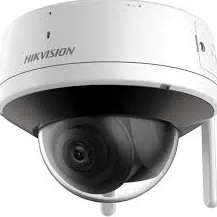
A product photo from the AESS job library, not taken in Gerritsen Beach: a Wi-Fi dome camera with an external antenna. The antenna gives it more reach than a typical wireless camera, which is why a camera like this is sometimes the answer for a shed or the far end of a canal lot where a cable cannot go. It still needs steady power at the mount, and that is what fails most often on a dock.
For a dock we compare three options on each job: a sealed cable run with power over the same cable, a dedicated point-to-point wireless bridge with power at the dock, or a Wi-Fi camera with a stronger radio close enough to an access point.
"Cameras near the ocean just need their lenses cleaned more often"
Cleaning is good advice, and salt film on a lens does blur the picture. Some answers stop there, as if a regular wipe solves the coastal problem.
On the peninsula, the failures that cleaning does not touch are the ones that take cameras offline: corroded connectors, rusted mounts that let the camera tilt, seals that let water into the housing, and domes etched so badly that no cloth will clear them.
A proper checkup on a water-facing system cleans the lenses, but it also opens the connections, checks the mounts, reads the drive's health and confirms that every camera is actually recording, which is the part that matters when you need a clip.
"Camera repair usually costs a few hundred dollars at most"
National averages make camera repair sound cheap or expensive depending on which average you read. HomeAdvisor's Brooklyn page, for one, puts the average surveillance camera install or repair at $1,416, which mixes new systems with simple fixes.
Neither number tells a Gerritsen Beach owner what their repair will cost. A tripped outlet or a re-sealed connector is a small job; a flooded recorder, a new cable to a raised floor and a replaced dock camera is a larger one. Our Brooklyn list puts most single faults between $150 and $700 and recorder replacements and multi-camera rewires between $700 and $1,500.
What decides the price is the fault, and the only way to know it is to test the system. That is why the $150 service call is credited to the repair, and why you get a written price before any part is replaced.
Talk to a Technician Before You Power Up a Wet Recorder or Buy a New Camera
Tell us the address, the type of property, whether the house has been raised, how many cameras there are, which ones are out, and where the recorder sits. If water reached any part of the system, say how high it came. If you need footage from a particular date, say so and we will plan the visit around copying it first. Photos of the recorder screen, the dark cameras, the outdoor outlets and the power supply help us bring the right parts. For anything urgent, call (347) 934-8335 now.
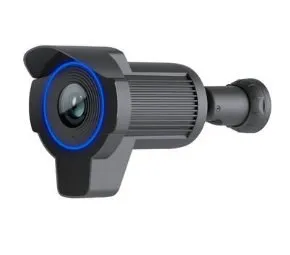
A product photo from the AESS job library, not taken in Gerritsen Beach: a black bullet camera with a long hood over the lens and a blue-lit ring around it. A long hood like this keeps rain and the low morning sun off the glass, which helps on a Gerritsen Beach house that faces the canal or the channel, where the camera looks out across open water with nothing to shade it.
✅
Request Sent!
Thank you. A technician will contact you about the Gerritsen Beach address shortly.
How It Works
Our Repair Process
1. Send photos and the address
Text or WhatsApp a photo of the recorder screen or the app, the dark cameras and the power supply, with the address and whether the house is raised, on a canal lot or a store on Gerritsen Avenue.
2. Agree who approves the work
We confirm who owns the system, who approves the price and who holds the recorder login, whether that is the homeowner, a family member, a store owner, a church office or a marina manager.
3. Book and pay the service call
The $150 Brooklyn service call puts the visit on the schedule in a two-hour arrival window and is credited to the repair if you go ahead.
4. Copy the footage that matters
Any clip you need is exported to USB with its original timestamp before the recorder is restarted, unplugged or opened, and the recorder clock is compared with the real time.
5. Test from the outlet to the lens
The technician tests the outlet and any GFCI, the power supply or PoE switch, each cable and connector, the recorder and drive, then each camera by day and with the lights off.
6. Explain the cause and write the price
You hear what failed and why, including salt, water, surge or building work, and get a written itemized price before any part is replaced.
7. Repair, seal and retest
Failed parts are repaired or replaced, outdoor connections are sealed for salt air and rain, and every camera is checked for picture, recording and night view.
8. Label, set alerts and hand over
Cables and channels are labeled, alerts for lost video and drive errors go to your phone, logins go to the right person, and you are shown how to export a clip.
Coverage Area
Security Camera Repair Near Gerritsen Beach's Landmarks
Resurrection Church
The Roman Catholic parish on Gerritsen Avenue whose grotto statue of the Virgin Mary has been vandalized more than once, most recently reported by News 12 in July 2023.
Gerritsen Beach Volunteer Fire Department
Brooklyn's last volunteer fire department, organized in 1922, whose Seba Avenue house served as a volunteer point for electricians and plumbers after Sandy.
Gotham Avenue Canal
The canal that divides the newer section to the north from the old section of courts to the south, lined with houses that have their own docks and boats.
Gerritsen Beach Library
The Brooklyn Public Library branch at 2808 Gerritsen Avenue, in a building of about 10,000 square feet that opened in 1997.
Engine 321
The FDNY engine company at 2165 Gerritsen Avenue, near the northern edge of the neighborhood at Avenue U.
Shell Bank Creek
The creek on the peninsula's western side, home to marinas and to the two storm-sewer bulkheads the city rebuilt during its 2020 to 2022 street project.
We also serve the neighborhoods around Gerritsen Beach, including Sheepshead Bay across the creek, Marine Park across Gerritsen Avenue, Manhattan Beach and Mill Basin, at the same Brooklyn rate. Our Bergen Beach security camera repair page covers another waterfront neighborhood on Jamaica Bay, our Brighton Beach security camera repair page covers the oceanfront blocks to the west, and the whole borough is on our Brooklyn security camera repair page.
Pricing
Security Camera Repair Cost in Gerritsen Beach
Gerritsen Beach is billed at our standard Brooklyn rate; there is no waterfront or flood-zone surcharge. Every repair starts with the $150 service call, which covers the on-site diagnosis and is credited to the repair if you go ahead. The figures below are taken from our published list of Brooklyn security camera repair prices, and your exact price is written down on the visit, once we know what failed.
Repair
Brooklyn price
Service call with on-site diagnosis and a written repair price
Outdoor camera body replacement with weatherproofing rebuilt
$250–$600
Night vision repair
$250–$650
DVR not working, including drive and labor
$300–$700
NVR not recording, by model
$400–$900
PTZ camera repair
$450–$1,200
Hybrid recorder swap with channels reconfigured
$700–$1,200
DVR or NVR replacement with drive, or multi-camera wiring repair
$700–$1,500
Storm-damaged system rebuild after lightning or surge, by size
$700–$3,500
Three things move a Gerritsen Beach repair within those ranges. The first is water: a system where only one camera failed is a small job, while one where the recorder, the switch and the power supplies all sat in a storm tide is priced part by part. The second is reach: a camera under a one-story eave takes minutes to get to, while one on the top floor of a raised house, over a bulkhead with no yard below it, or at the end of a dock takes longer and more ladder work. The third is the route: a cable that has to be replaced from a recorder moved upstairs to a camera on the canal side costs more than a new connector. If the price changes on site, you hear the new number before the work goes on. Bundling a camera repair with intercom, doorbell, alarm or cabling work on the same visit saves $200 to $400 in labor on our Brooklyn list.
Full terms — including 50% deposit, one-year parts-only warranty on AESS-supplied products, and the late-fee schedule — are set out in the service agreement.
Shop Our Systems
Security Camera Repair Packages & Pricing
Most Gerritsen Beach repairs fall into one of three shapes, each priced from our Brooklyn list.
Single-fault repair: $150–$700
One problem, one visit: a corroded connector rebuilt and sealed, a power supply or adapter replaced after a storm, a GFCI-dependent dock camera put on proper power, a drive swapped, a night picture fixed or app access restored. Typical for a bungalow, a two-family or a small store with one camera or one recorder fault.
Recorder or rewire repair: $700–$1,500
The heart of the system or its wiring: a flooded or failed DVR or NVR replaced with a new drive and moved above the flood line, or several cables replaced after a house lift, a re-siding or a storm. Typical for a raised house or a canal-lot home after a bad season.
Annual checkup: $250–$800
Every camera checked by day and night, lenses and domes cleaned, outdoor connections opened and resealed where needed, power and backup batteries tested, the drive's health read, alerts confirmed and a footage export tested. Homes start at $250, commercial properties at $400, and owners with several properties run $500 to $800.
Bring your own equipment. If you have already bought a replacement camera, recorder or dock camera, we can fit it at labor-only rates. Send us the exact model, we quote the labor by phone or text, and the visit is booked once it is paid. We install what you supply as it comes: we cannot vouch for parts we did not provide, and if a model will not work with your recorder, will struggle to reach the router across the water, or is not built for salt air, we tell you before the visit rather than after.
Complete Services
Every Security Camera Repair Service in Gerritsen Beach
Camera, connector and dock repair
Dark cameras, salt-damaged connections, dock and bulkhead cameras and mounts loosened by the wind. Request a repair
Recorder, drive and storm recovery
DVRs and NVRs in closets, back rooms and church offices, including systems hit by a storm tide or a surge. Brooklyn security camera repair
The date and time printed on our dock camera's picture sits right over the boat. Can that text be moved?
+
Yes. The date, time and camera name burned into the picture are an overlay set in the camera or the recorder, and on most models they can be moved to another corner, made smaller or turned off for individual cameras. We keep the timestamp on, since it matters if a clip is ever needed as evidence, and move it to a part of the frame with nothing important in it, such as the sky or the water.
Rust keeps coming back on the screws and brackets of our water-side cameras. Will stainless steel hardware stop it?
+
It helps a great deal, with one caution. Stainless screws resist salt far better than plated ones, but a stainless screw driven straight into an aluminum camera mount can set up the galvanic corrosion that salt air speeds up. We use stainless or coated hardware with an insulating washer or compound where different metals meet, and seal the holes so water does not sit in them. That combination keeps mounts from staining and seizing for years.
Do you repair camera systems at marinas and boat clubs on the creek, or only at houses?
+
We repair both. Marina and club systems are larger, with cameras on pilings, light poles and sheds, long cable runs or wireless links back to an office, and outdoor power that has to survive storm tides. We start with a map of which cameras depend on which switch and outlet, repair what failed, and give the manager a written list of what to fix before the next season, priced from our Brooklyn list.
Lines roll through the picture on our store's older cameras whenever the ice machine or the cooler starts. What causes that?
+
On older coax cameras, rolling bars usually mean electrical noise or a ground difference between the camera's power and the recorder's. A large motor starting on the same circuit, or a camera powered from a different outlet than the recorder, can put that noise straight into the picture. We check how each camera is powered, move them onto one proper supply, and add a ground loop isolator on the cables that still pick up noise. Most of the time no camera needs replacing.
How long will the house or store be without recording while the repair is done?
+
Usually only for short stretches. Most cameras keep recording while we work on another one, and the recorder itself is off only while a drive is swapped or the recorder is replaced, typically under an hour. When the recorder has to be replaced, we set up the new one before taking the old one off the wall, so the gap is as short as possible, and we tell you in advance when the system will be down.
The only place for the recorder in our small bungalow is a bedroom closet. Will it be too noisy or run too hot in there?
+
A recorder in a closet can work well if it has air. Most recorders have a small fan and a hard drive that both make a low hum, and in a shut closet with clothes packed around it, the heat builds and the drive wears out sooner. We put the recorder on a high shelf with space around it, add a vent or a louvered door panel where that is practical, and check its temperature reading in summer. A quieter, fanless model is an option if the noise bothers you.
The back wall of our canal house rises straight from the bulkhead with no yard below it. How does a technician reach the camera there?
+
It depends on the height and what is beside it. Low cameras can often be reached from the dock or from a window, and some can be serviced from inside by taking the camera off its mount through a nearby opening. Higher cameras may need a ladder footed on a stable dock section with a second person, or an extension pole for simple adjustments. We ask for a photo of the back wall before the visit so we bring the right equipment, and if a camera cannot be reached safely, we tell you and offer a better spot for it.
Since the storm, one of our cameras shows black and white even in the middle of the day. Is it broken?
+
Partly. Day-night cameras have a small filter that slides over the sensor in daylight and moves away at night, and it can stick after damp gets into the housing or after a power glitch. Sometimes the camera is simply set to stay in night mode, which is a quick settings fix. If the filter has stuck, the picture also looks pinkish or washed out, and the camera needs repair or replacement. We check the setting first, then the filter, before recommending a new camera.
How long should outdoor cameras last on a house this close to the water?
+
There is no fixed number, because it depends on which side of the house the camera faces and how well its connections were sealed. In our experience, the connections and mounts on the water side fail well before the cameras themselves, and a camera on the street side of the same house can outlast one facing the canal by years. A yearly check of the outdoor connections is the best way to stretch the life of every camera on the property.
Our recorder's fan has started grinding, and the box feels hot. Can the fan be replaced, or does the recorder have to go?
+
On many recorders the fan can be replaced on its own, which is far cheaper than a new recorder. A grinding fan is usually worn or clogged with dust, and on the peninsula sometimes with salt residue. We check whether a replacement fan is available for your model, clean the inside, read the drive's health, since heat may already have worn it, and move the recorder somewhere with more air if the old spot caused the problem.
Ready to Have Every Gerritsen Beach Camera Recording Again, From the Street to the Dock?
Send a photo of the recorder screen or the dark camera, the address, whether the house is raised and whether water reached the system, plus the date of any footage you need. We book within 2 hours, give you a two-hour arrival window, copy your footage first, and write down the repair price before any part is replaced.