Boardwalk shop reopening to a recorder that stopped in December, a cellar that took water on Neptune Avenue, or a co-op tower camera dark for weeks? Coney Island camera repair line, booked within 2 hours: (347) 934-8335
Any Brand, Any Installer · Footage Saved Before Anything Is Touched · Cause and Written Price First · Brooklyn Rate
Security camera repair in Coney Island starts with our $150 Brooklyn service call: a technician comes out, finds the fault, and the $150 is credited to the repair if you go ahead. On our published Brooklyn list most single faults cost $150 to $700, and a new recorder with a drive, or a rewire of several cameras, runs $700 to $1,500. We repair systems we did not install, in houses in Sea Gate, apartments and offices in the big co-op towers along Neptune Avenue and Surf Avenue, storefronts on Mermaid Avenue, and the restaurants, arcades and stands that shut for the winter and wake up in spring. Requests are booked within 2 hours, visits come in two-hour arrival windows, and nothing is replaced until you have heard the cause and seen the price in writing.
Every price on this page is taken from our published Brooklyn camera repair list, and your own price is written down before work starts
Rated 4.7★ across 201 Google Reviews
Reviewed and updated November 12, 2026, against the Brooklyn District Attorney's April 2024 release on the Gargiulo's Restaurant burglary; News 12 Brooklyn's reporting on the June 2026 West 29th Street carjacking video, the September 2025 Donut Connection shooting on Mermaid Avenue, the July 6, 2026 flooding on Neptune Avenue and West 35th Street, Council Member Ari Kagan's 2023 camera announcement and the Coney Island Business Improvement District; Bklyner's 2015 report on cameras smashed at Carey Gardens; the NYCHA Journal on the Coney Island Houses resiliency work and NYCHA's CCTV project fact sheet; ABC7 and La Voce di New York on the July 15, 2026 pole collapse and outage at West 36th Street; Habitat magazine on the Amalgamated Warbasse Houses riser project; 6sqft on 1515 Surf Avenue; Brooklyn Paper on the 2026 season opening; Brooklyn News Service on Coney Island's winter closings; and HomeAdvisor's Brooklyn camera cost range. · Abstract Enterprises Security Systems, NYS license #12000287431 · crews dispatched from our Troy Avenue office in Brooklyn
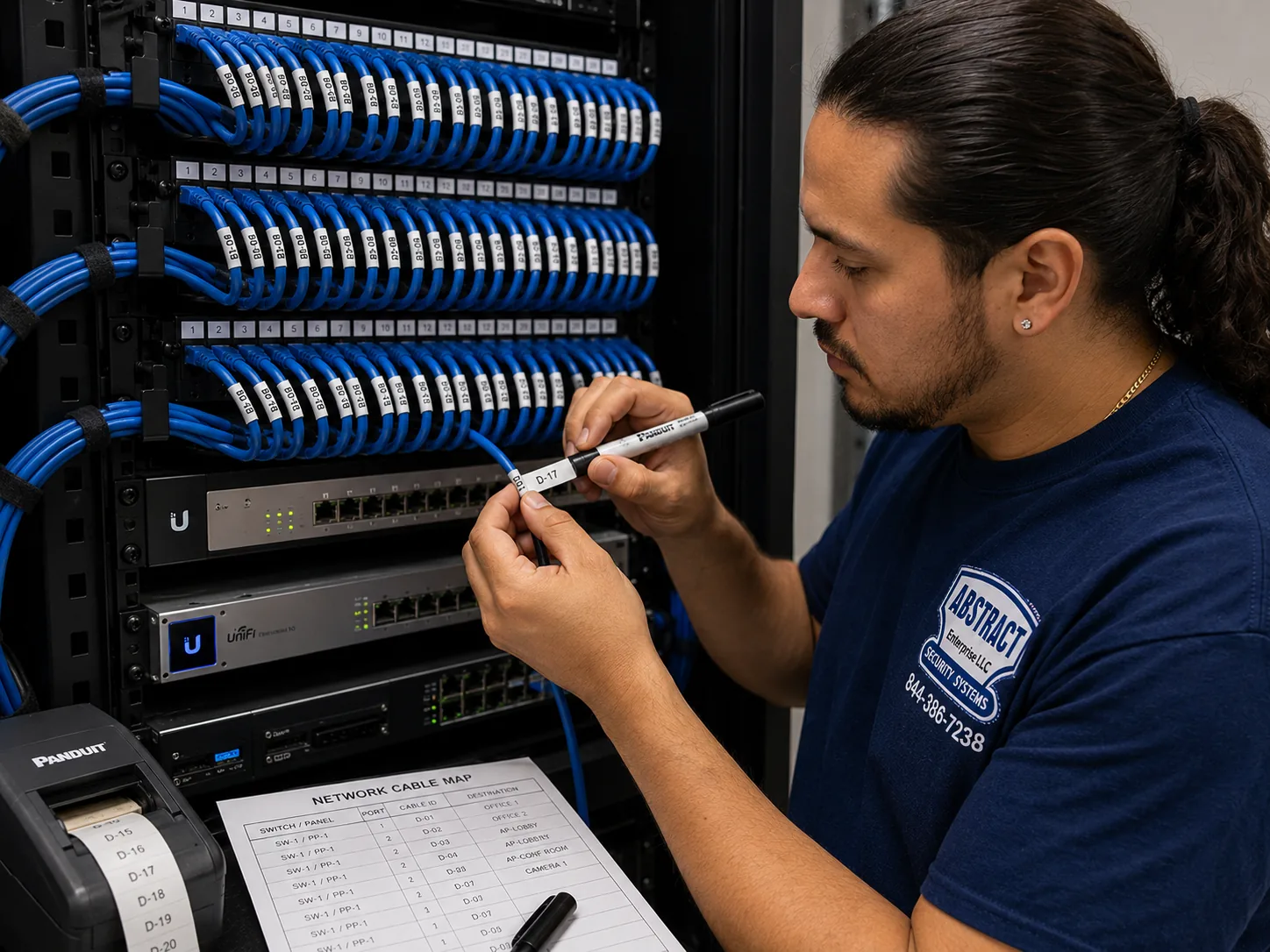
A photo from the AESS job library, not taken in Coney Island: a technician printing a label for each cable at a patch panel, with the printed port map beside it. In a Coney Island co-op tower or a new rental building on Surf Avenue, the camera cables from dozens of floors end in one basement or ground-floor room, and a label naming the camera on every cable is what turns the next repair into a ten-minute test instead of an afternoon of guessing.
Coney Island Camera Repair Request
House, apartment, co-op, rental tower or seasonal business: tell us the street and what the recorder screen shows, and a technician calls back with the next step
✅
Request Sent!
Thank you. A technician will contact you about your Coney Island property shortly.
25+
Years Experience
✓
Same-Day Estimates
100%
Licensed & Insured
4.7★
201 Google Reviews
Owner-operated since 2002 · Thousands of jobs completed · Booked within 2 hours
Most Coney Island camera calls come down to one question before anyone gets on a ladder: did the system fail on its own, or did something happen to the building around it? A peninsula that sits a few feet above the ocean, with a summer economy that shuts down in the fall, puts camera systems through things that a house in the middle of the borough rarely sees. A shop locked up for four months, a cellar that took water, a block that lost power, a tower where contractors opened walls for new pipes: each leaves its own fingerprint on the recorder screen. When every camera went dark on the same day, the cause is almost always power, the recorder or the switch that feeds the cameras. When a single camera died while its neighbors kept working, it is usually that camera, its cable or the connector at its end. When live view works but playback is empty or full of holes, it is the recorder's hard drive or its settings. Send a photo of the recorder screen and the brand label to (347) 934-8335 or on WhatsApp, tell us the street, and we will tell you which of those it looks like and what that kind of repair costs on our Brooklyn list.
Looking at your photos costs nothing. The $150 service call is paid when you book and is credited to the repair if you go ahead.
All work is done under New York State license #12000287431, and a certificate of insurance can be sent to a co-op office, a managing agent or a landlord before the visit.
We repair any brand and any installer's work, and we tell you plainly when an old recorder or a flood-soaked power box costs less to replace than to keep fixing.
The Neighborhood
Why Coney Island Properties Need Security Camera Repair
Coney Island is a narrow peninsula at the bottom of Brooklyn, about four miles long and half a mile wide, with Sea Gate's private streets at its western tip, Brighton Beach to the east, Gravesend across Coney Island Creek to the north and the Lower New York Bay on two sides. Its highest ground is about seven feet above sea level. Inside that strip sit four very different kinds of property that all depend on cameras: the amusement area and the businesses on the boardwalk and Surf Avenue; the large public housing developments and the 1960s Mitchell-Lama co-op towers; a fast-growing set of new rental buildings along Surf Avenue; and the houses of Sea Gate and the west-end blocks. Each one breaks its cameras in its own way, and that is what this page is about.
The first thing that sets a Coney Island camera repair apart is the calendar. Much of the local economy runs on the summer. Luna Park opened its 2026 season on Saturday, March 28, the Brooklyn Paper reported, with the Cyclone christened the next day on its 99th birthday and Deno's Wonder Wheel blessing its rides the same weekend. In the cold months the crowd thins out. A December 2025 report by the Brooklyn News Service described lines shrinking to three to five people, hours ending by 10 p.m., and businesses without a well-known name closing early or shutting for the season. For a camera system, a four-month closing is a long, unwatched stretch. Nobody opens the app, nobody walks past the recorder, and a hard drive that dies in December, a power supply that fails in a February cold snap, or a breaker that someone switched off to save power is often found on the first warm weekend, when the owner goes looking for footage and discovers there is none.
The second is how often video decides what happens after a crime here. In April 2024 the Brooklyn District Attorney announced a four-to-eight-year sentence for a man who broke into Gargiulo's Restaurant at 2911 West 15th Street at about 2 a.m. on June 29, 2022, with an accomplice, and left with about $100,000 in cash from a safe in a back office. According to the DA, video captured the two men breaking in, footage from multiple locations tracked them between the defendant's home and the restaurant, and one camera showed him removing his face mask inside his own building's elevator. In June 2026 News 12 Brooklyn obtained surveillance video from a residential block of West 29th Street showing a vehicle parked for at least an hour before an online-marketplace sale turned into an armed carjacking. And when a man was shot inside the Donut Connection on Mermaid Avenue in September 2025, the shop's own video showed the moments before and after. Each case turned on a camera that was recording, set to the right time and clear enough to show a person.
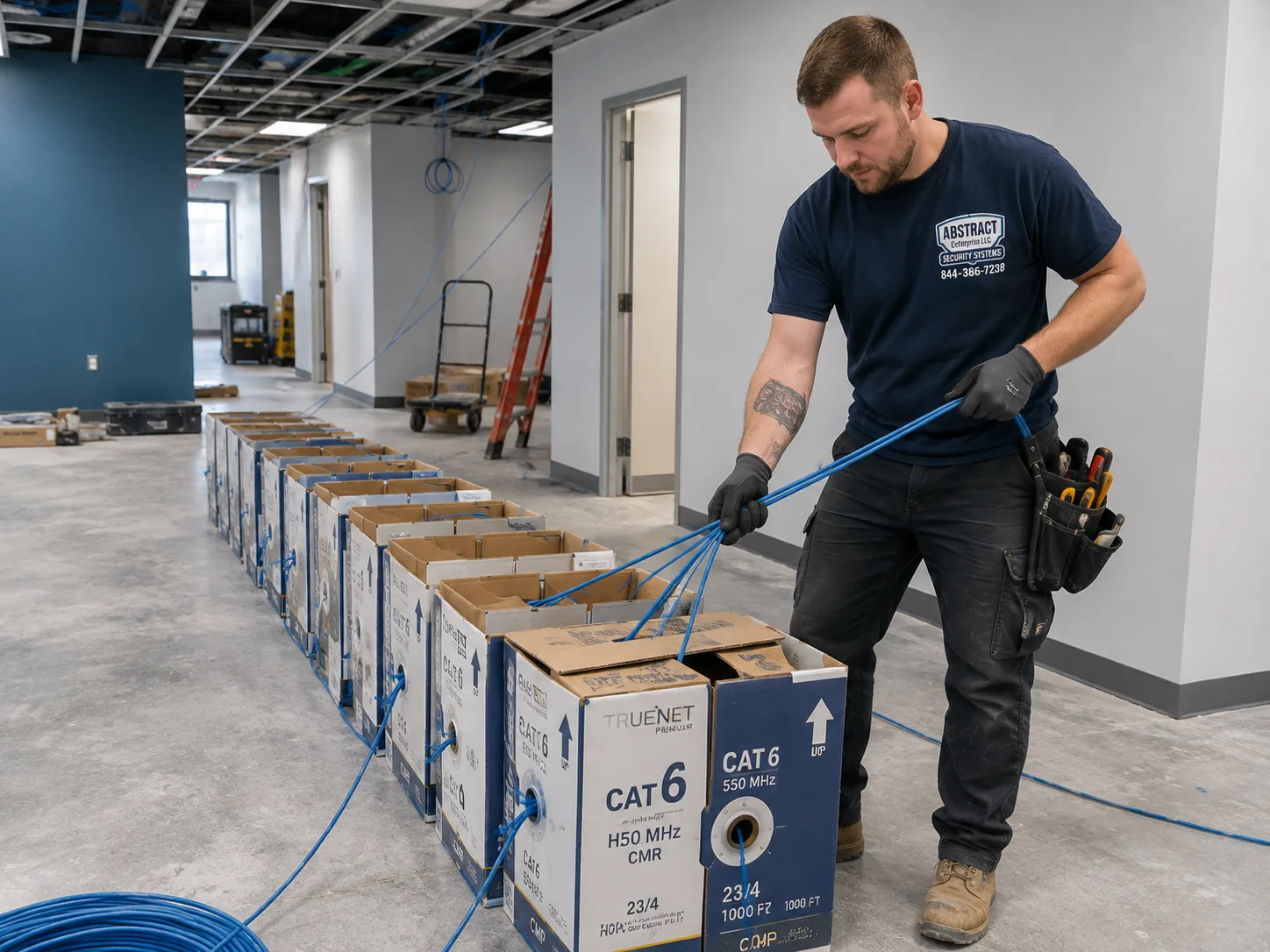
A photo from the AESS job library, not taken in Coney Island: boxes of cable staged before a pull of several runs in a building that stays open for business. Most Coney Island camera repairs need no new cable at all. When they do, it is usually because floodwater sat in a cellar where cable ran along the floor, because a renovation crew cut a run inside a wall, or because a camera on the ocean side of a building has a cable that has been chewed up by years of wind and sand, and having enough cable on the truck keeps the job to a single visit.
The third is the size of the buildings. The Amalgamated Warbasse Houses alone are five 24-story towers with 2,585 apartments and about 8,000 residents on 26 acres, according to Habitat magazine, and they are one of several large co-op complexes on the peninsula, alongside Trump Village and Luna Park Housing. The Coney Island Houses are five 14-story public housing buildings fronting Surf Avenue between West 29th and West 32nd Streets. New rental buildings keep rising too: 1515 Surf Avenue opened in September 2024 with 463 apartments in two towers, and the 12-story 1709 Surf Avenue, with about 420 affordable apartments, topped out in June 2026 and is due in 2028. Camera systems in buildings like these run long cables through risers to a basement head end, and more than one group of people may be responsible for them. Working out whose camera it is, and who approves the repair, is often the first step of the job.
The fourth is water and power. Hurricane Sandy put chest-high water into Coney Island's commercial area in October 2012, flooded the 60th Precinct's station house, and left a flood line about five feet up at Surf and Stillwell Avenues. Boardwalk businesses that had no structural damage still had electrical problems from flooded basements. The water has not stopped coming. On July 6, 2026, heavy rain flooded Neptune Avenue at West 33rd Street, and on West 35th Street basements filled so high that firefighters removed a cellar door and shut off a building's power. "Every time it rains out here, we get flooded," one resident told News 12. Nine days later, on July 15, two utility poles fell onto parked cars near West 36th Street and Surf Avenue during a heat advisory, a transformer burned, and 900 Con Edison customers lost power. A camera recorder sitting on a cellar shelf, plugged into a wall outlet with no battery backup, takes the full force of every one of those events.
Six Coney Island facts that shape a camera repair
The season decides when problems are found. With Luna Park opening in late March and many smaller businesses closing for the winter, a camera that fails between November and March often goes unnoticed for months. Spring is when we find the dead drives.
Video has carried real cases here. The Gargiulo's burglary on West 15th Street was traced on cameras at several locations, including an elevator camera in the defendant's building, and the 2026 West 29th Street carjacking was shown on a residential block's surveillance video.
Not every camera on the block is private. NYPD and NYCHA cameras watch parts of the neighborhood. In 2023 Council Member Ari Kagan announced more NYPD cameras for Stillwell Avenue and the block between West 28th and West 29th Streets. Those are city equipment, not something a property owner or a private company repairs.
Basements flood without a hurricane. The July 6, 2026 storm flooded basements on West 35th Street and streets around Neptune Avenue. Residents say the storm drains near the Neptune Avenue corner are constantly clogged.
Some blocks still hang on wooden poles. The July 15, 2026 outage started when a compromised wooden utility pole snapped near West 36th Street. Overhead lines bring a higher chance of surges and sudden outages, which recorders without a battery backup handle badly.
Mermaid Avenue is short on light. News 12's July 2026 report on the new Coney Island Business Improvement District described empty storefronts, litter, limited security and a lack of streetscape improvements such as lighting on Mermaid Avenue. A camera aimed at a dark sidewalk needs more than a good lens.
Where this page applies. It covers the whole Coney Island peninsula: Sea Gate west of West 37th Street; the west-end blocks between Neptune Avenue and the beach; the public housing developments along Surf Avenue and Neptune Avenue; the amusement area around Stillwell Avenue, the boardwalk and Surf Avenue; Mermaid Avenue from end to end; and the co-op and rental towers out to West 8th Street and Ocean Parkway. The blocks across the line in Brighton Beach and Gravesend are served at the same Brooklyn rate, and the whole borough is covered on our Brooklyn security camera repair page. The price follows the fault, not the address.
Same-Day Repair in Coney Island
Need Repair in Coney Island? A Recorder Found Dead at Reopening, a Cellar That Took Water, or a Block That Lost Power
Urgent camera calls from Coney Island tend to arrive in three waves. The first comes in spring, when seasonal businesses unlock their gates and find a recorder that stopped saving sometime over the winter, or a camera that was pried off a wall in January and never reported. The second comes after weather: a summer cloudburst that puts water into a cellar on one of the west-end blocks, or a storm that knocks out power for a few hours and leaves a recorder stuck on a startup screen. The third comes after an incident, when the one camera that mattered turns out to be dark, frozen or set to the wrong time.
If you need footage from an incident, please do not restart the recorder, do not let anyone "reset it to see if it helps," and do not pull out or format the hard drive until we have spoken. Most recorders write over the oldest video first, so the clock starts running the moment the incident happens, and a reset or a new drive can wipe exactly the hours you need. If the recorder has been sitting in a wet cellar, do not plug it back in to check; unplugged and dry, its drive often still holds the video. Call (347) 934-8335, give us the date and time window, and we book the visit with saving that footage as the first task. The clip is exported with its original timestamp, and the work order notes how it was copied, which is the first thing a detective or an insurer will ask.
What We Install
Security Camera Repair Services in Coney Island
Every repair below is priced from our Brooklyn camera repair list. The service call finds the fault and the written price covers fixing it. These are the jobs that come up most often on the peninsula, from a two-camera stand on the boardwalk to a head end serving a whole co-op tower.
Spring reopening checks
Systems that sat unwatched through a winter closing: dead drives, recorders that never came back from a power cut, cameras that were pried off, and clocks that drifted months out of true.
Dead or dropping cameras
One camera or a row dark on the recorder. We test the power, the cable and the connector at the camera first, because on the ocean side of a building the connector is usually what gave out.
Recorders and hard drives
Playback empty or full of gaps, drives that beep or report errors, recorders that start up on a setup screen after a storm, and systems that only keep a few days of video.
Flood and outage recovery
Recorders, switches and power boxes that sat in a damp cellar or rode through a surge, tested before they are trusted again, with footage pulled off the drive first.
Tower and complex head ends
Multi-camera systems in co-op and rental buildings: riser cables, lobby and elevator cameras, monitor desks, and links between buildings that share one security office.
Sand, wind and weather damage
Domes frosted by blowing sand, housings loosened by wind off the bay, brackets rusted through, and seals that let damp air inside the camera.
Broken and vandalized cameras
Cameras struck with a stick or a cane, turned toward the wall, sprayed or torn off their mounts, replaced or remounted where they are harder to reach.
Phone viewing and accounts
Apps that lost the recorder after an internet change, accounts tied to a former manager or a previous owner, and staff who need view-only access for the season.
Footage export
Clips copied to USB in the recorder's own format and in a common one, with the original timestamp kept, for the 60th Precinct, an insurer or a lawyer.
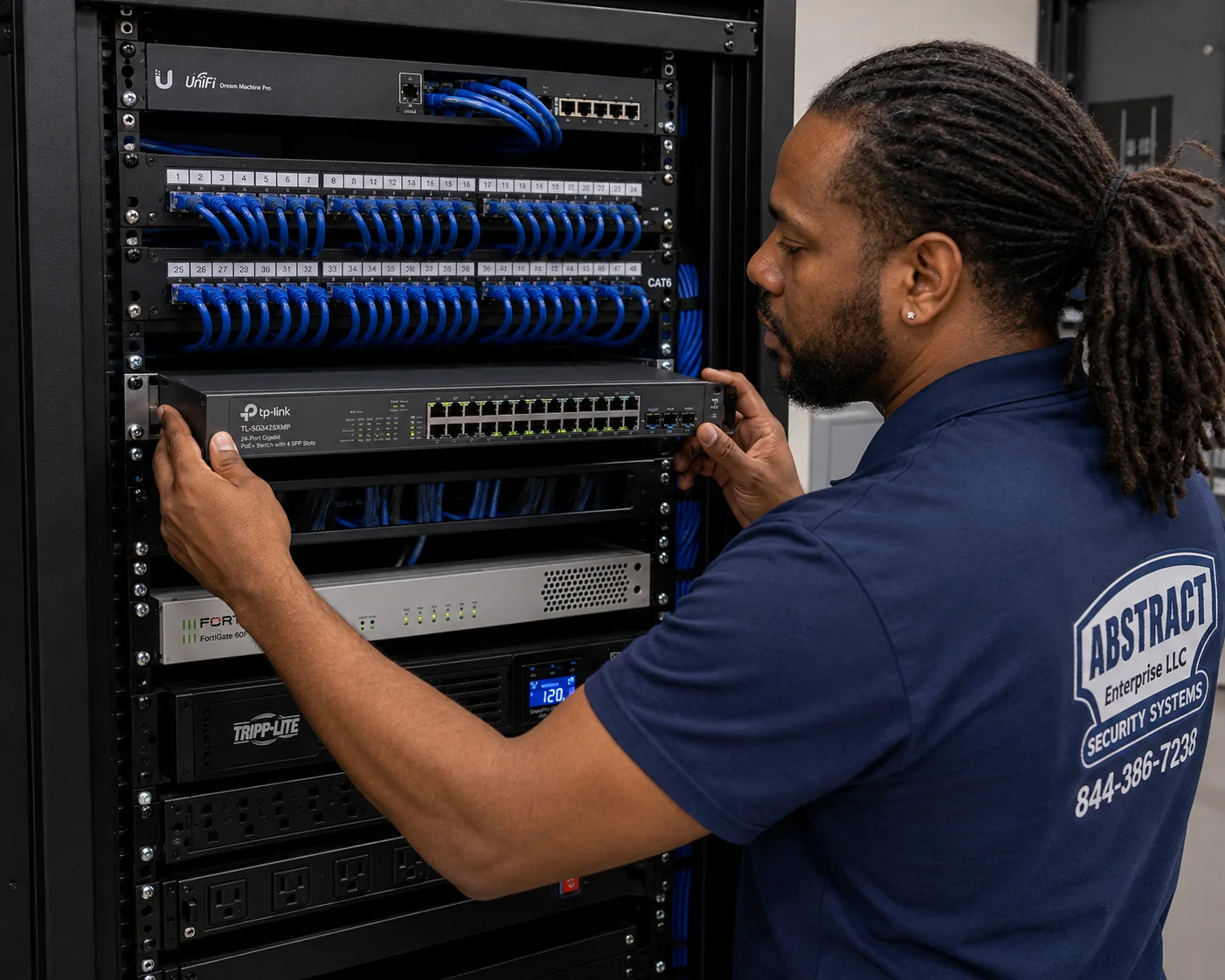
A photo from the AESS job library, not taken in Coney Island: a technician mounting a managed PoE switch below the patch panels in a commercial rack. In a Coney Island rental tower or a large co-op, network cameras are powered by switches like this one, often in a basement room that sits a few feet above the street. A switch that is labeled port by port, mounted off the floor and fed from a battery backup is the difference between a whole wing of cameras dying in an outage and riding through it.
Building Specialists
Security Camera Repair for Coney Island's Architecture
Coney Island's buildings were put up in bursts: Sea Gate's houses from the 1890s on, older houses on the west-end blocks, public housing and union co-op towers in the 1950s and 1960s, low commercial blocks along Mermaid Avenue, and a new wave of glass rental towers after the 2009 rezoning. Each kind hides its recorder somewhere different, routes its cables a different way, and puts a different obstacle between a technician and a dead camera. These are the six we see most.
The Mitchell-Lama co-op tower
Warbasse, Trump Village and Luna Park Housing: 20-plus stories, hundreds of apartments per building, cameras in lobbies, elevators and laundry rooms, and a board that approves the work.
The public housing development
Coney Island Houses, Carey Gardens, O'Dwyer Gardens, Surfside Gardens and their neighbors, where the building cameras belong to NYCHA or the NYPD rather than to residents.
The new rental tower
1515 Surf Avenue and the newer buildings around it: network cameras on a managed network, a garage, amenity floors, and a management office that controls the system.
The seasonal business
Boardwalk stands, arcades, restaurants and shops along Surf Avenue and the side streets, with roll-down gates, short cable runs and a long winter closing.
The Mermaid Avenue mixed-use building
A store at street level, apartments above, a cellar below, and two or three camera systems installed over the years by different owners and tenants.
The house in Sea Gate or on a west-end block
Detached and semi-detached houses and old bungalows, with water nearby on three sides, cameras on wood siding, and recorders in cellars that have flooded before.
The Mitchell-Lama co-op tower: one building, hundreds of households, one board
The Amalgamated Warbasse Houses were built between 1960 and 1964 by the United Housing Foundation and the Amalgamated Clothing Workers, with five towers along Neptune Avenue under the elevated train. Trump Village and Luna Park Housing went up in the same decade. Their camera systems are large, with cameras at entrances, lobbies, elevators, laundry rooms and garages cabled up risers to a security office.
What changes the repair here is the approval chain and the scale of the building's other work. A co-op board or its managing agent decides what gets fixed, and we work through them, not around them. Big capital projects also touch the cameras. Habitat magazine reported in 2021 that Warbasse was replacing the risers, pumps and fan-coil units in all five of its towers one building at a time, with crews in common areas and apartments for years. Work like that opens ceilings and walls along the same paths that carry camera cable, and a camera that dies on the floor where the plumbers were last week is usually a cut or crushed cable, not a failed camera. We trace the run before we replace anything, and we hand the board a list of what we found, cable by cable.
The public housing development: whose cameras they are decides who fixes them
Coney Island has several large public housing developments, among them the Coney Island Houses, five 14-story buildings completed in 1957 on Surf Avenue between West 29th and West 32nd Streets, and Carey Gardens at 2945 West 23rd Street. The NYCHA Journal reported that the FEMA-funded Recovery to Resiliency work at the Coney Island Houses included removable flood panels, new underground electrical conduits, new lighting, and security cameras and layered security measures. Some cameras around these developments are NYPD units; in June 2015 Bklyner reported that four men used a cane to smash two NYPD Viper cameras at Carey Gardens.
The practical point for a resident is that cameras in a NYCHA lobby, hallway, elevator or grounds are city equipment, maintained by NYCHA or the NYPD, and a private company cannot and should not repair them. If one is broken, report it to NYCHA or to your tenant association. Where we help nearby is with privately owned systems in the stores, offices and community spaces around the campuses.
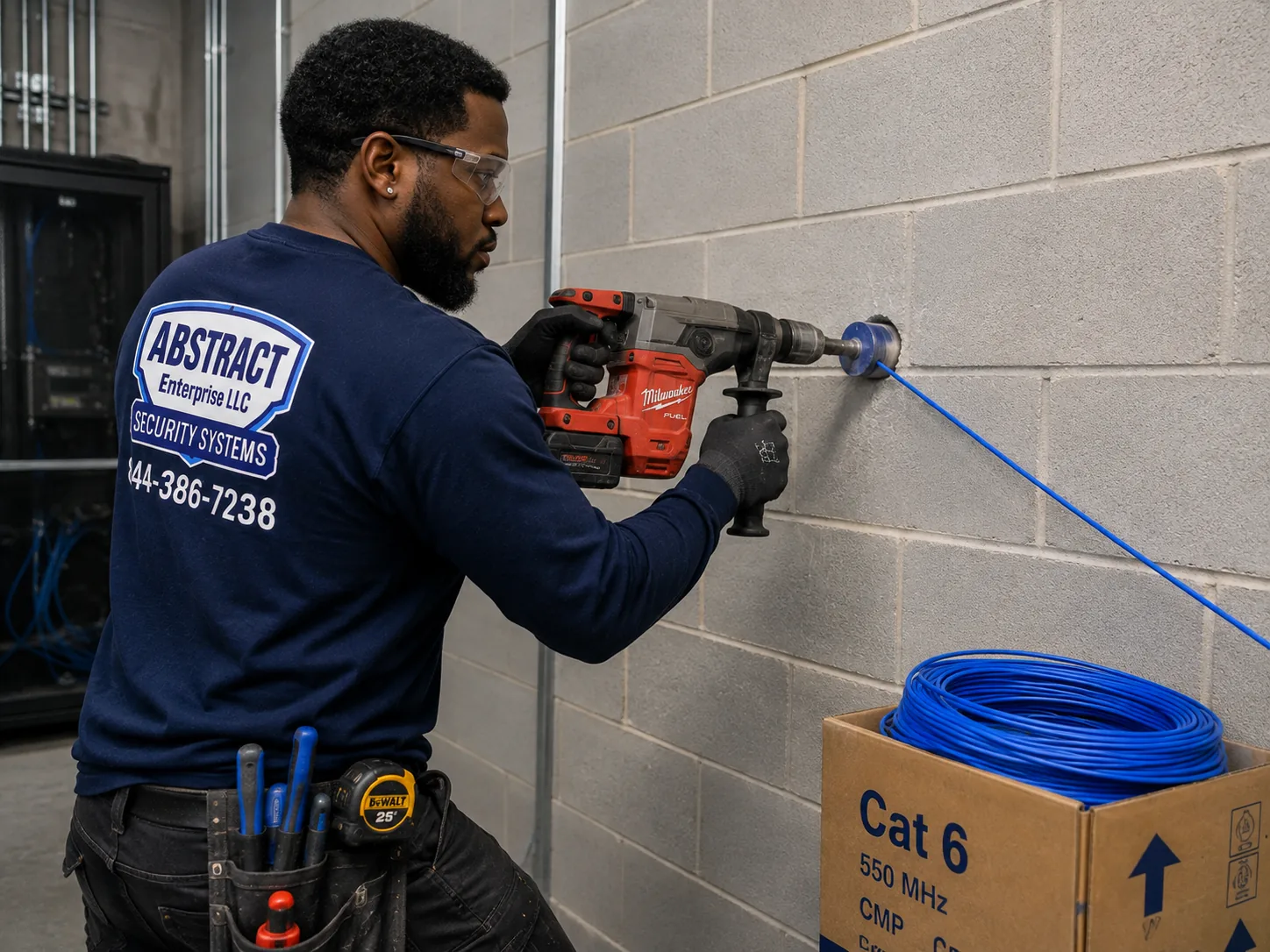
A photo from the AESS job library, not taken in Coney Island: a technician core drilling a block wall to carry cable through to a network room. In the brick and block walls of a Coney Island co-op basement or a Mermaid Avenue cellar, a new path through a wall is sometimes the only way to get a camera's cable above the line where floodwater sits, and any hole through a fire-rated wall is sealed again before the job is closed.
The new rental tower: managed networks and a management office in charge
The towers built along Surf Avenue in the last few years are a different kind of camera job. 1515 Surf Avenue, which LCOR opened in September 2024, has 463 apartments in two towers, an outdoor pool, beach lockers, a fitness center and on-site parking, and runs entirely on electricity with a large geothermal system for heating and cooling. Buildings like that usually run network cameras on a managed network under an integrator's contract, and cameras in garages, amenity spaces and corridors are repaired through the management office.
Where we come in is often one level down: a commercial tenant on the ground floor with its own cameras, a medical or professional office in the building, or a resident who wants their own doorbell or indoor camera fixed and needs to know what they are allowed to mount. For the building's own system, we always ask who holds the service contract first and stay out of anything still under someone else's warranty.
The seasonal business: short runs, roll-down gates and four quiet months
The stands, arcades, bars and restaurants on the boardwalk and around Stillwell Avenue and Surf Avenue usually have small systems: two to eight cameras on short cable runs, a recorder on a shelf in a back room or under a counter, and a phone app the owner checks in summer and forgets in winter. Theft at these businesses tends to happen when they are closed, and the classic entry is through the gate itself. The Brooklyn Paper reported in 2010 that a boardwalk boutique between West 12th Street and Stillwell Avenue had its roll-down door pried open, and in 2018 that three men were arrested after entering an amusement-area store near West 12th Street through its security gate at about 3 a.m.
The repairs that matter most here happen twice a year. Before closing, the system should be checked, the drive's health read, and a decision made about power: leaving the recorder on with a battery backup, or shutting it down properly rather than at the breaker. Before opening, the cameras should be cleaned of winter grime and sand, the clock checked, and the playback looked at for gaps. We do both, and the spring visit is easiest to book in the weeks before Luna Park's opening weekend.
The Mermaid Avenue mixed-use building: three owners' worth of cameras
Mermaid Avenue is the neighborhood's main shopping street, and many of its low buildings have a store at street level, apartments above and a cellar below. Camera systems in these buildings pile up. The store owner put in four cameras ten years ago. A later tenant added two wireless ones on their own app. The landlord added a camera in the hallway to the apartments. When something stops working, the first job is sorting out which system it belongs to.
We trace each cable back to its recorder, label it, and tell you which cameras are yours. Recorders on the cellar floor get moved up onto a wall shelf where we can, since cellars on these blocks have taken water.
The house in Sea Gate or on a west-end block: water, wood and short runs
Sea Gate is a private, gated community of about 850 houses at the far western tip of the peninsula, with water on three sides, its own public safety officers paid for by residents, and the 60th Precinct also on patrol. Hurricane Sandy destroyed numerous houses there and took out a sea wall. The west-end blocks outside the gate, and the streets running down from Neptune Avenue, mix older one- and two-family houses with apartment buildings. Camera systems on these houses are usually four to eight cameras with a small recorder in a cellar, a closet or a utility room.
The repairs follow the location. Cameras facing the water corrode at the connector, brackets on wood siding loosen, and cellar recorders get damp even without a flood. For Sea Gate visits, tell us how the gate handles contractors when you book, so the technician arrives with whatever name or vehicle details the gate needs.
Field Notes
Field Notes: Waking Up a Camera System After a Winter Closing
These notes describe how our technicians approach a camera system in a seasonal business that has been closed for the winter, the most common spring call on the peninsula. They set out our standard checks, not a story from one particular job.
Look before anything is switched on. If the power to the back room was turned off for the winter, the technician looks at the recorder, the power box and the outlets before turning anything back on. Signs of a leak, rust on a power supply, mouse droppings or a swollen battery in a backup unit mean that part gets tested on the bench, not just plugged in to see what happens.
Read the drive and the timeline. Once the recorder is up, the technician opens the hard drive status and the playback timeline for each camera. The timeline shows exactly when recording stopped, and the drive status shows whether the disk is healthy, full, failing or missing. A timeline that ends on the day the power went off means the recorder was simply shut down. One that ends weeks later, on a random night, usually means a failed drive or a power supply that gave out in the cold.
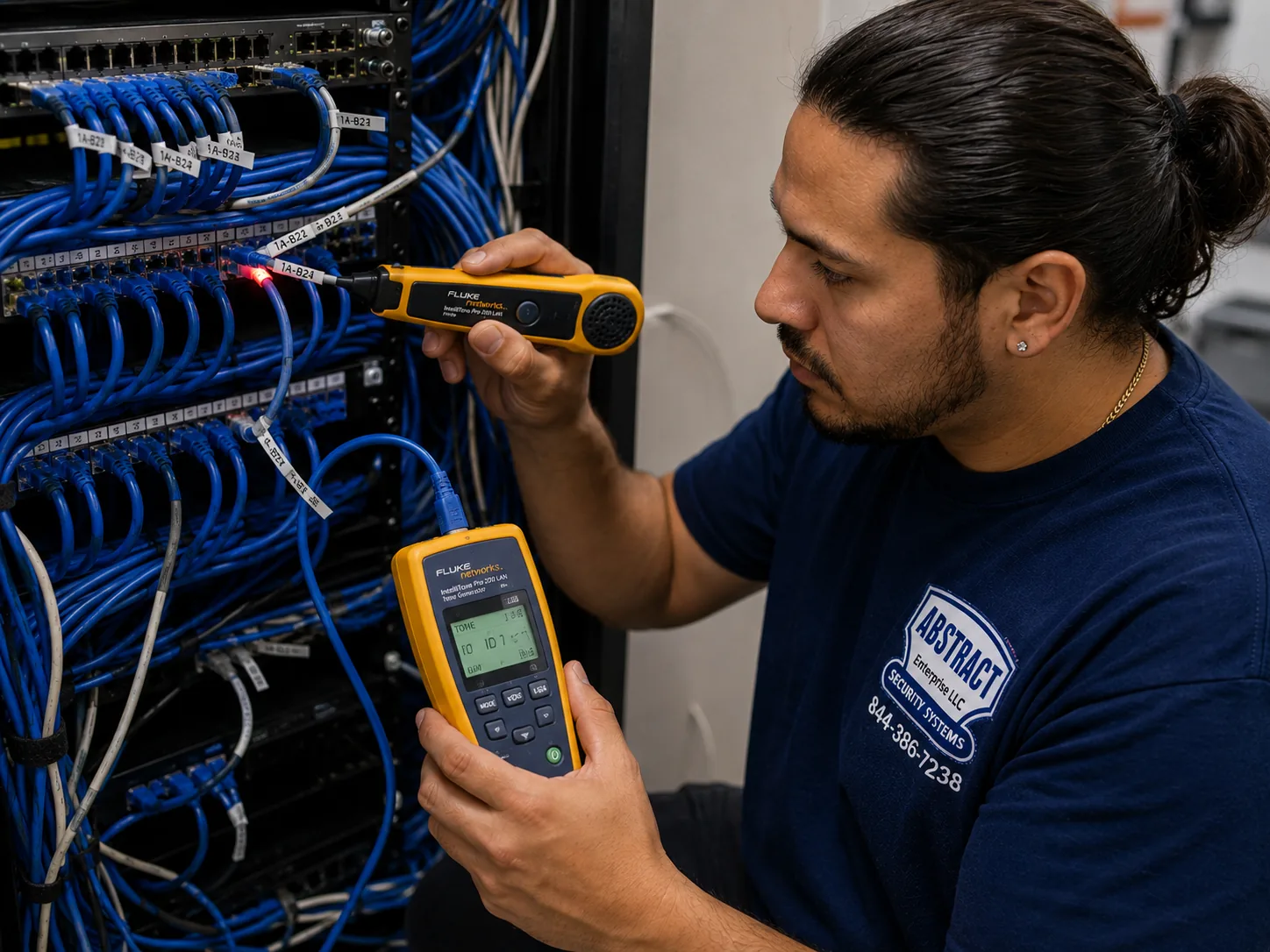
A photo from the AESS job library, not taken in Coney Island: a technician tracing an unlabeled cable at a patch panel with a tone generator and probe. In a boardwalk business or a Mermaid Avenue building that has changed hands, the back room often holds a bundle of camera cables that nobody can name, some live and some cut off at a camera that was removed years ago, and toning each one out is the honest way to find the one that feeds the dead camera.
Walk every camera, inside and out. Outdoor cameras get checked for winter damage: housings knocked loose, domes frosted by sand, connectors corroded where the cable leaves the wall, and cameras turned or pried during a break-in attempt that nobody noticed. The picture is checked in daylight and, where the business is open late, after dark with the infrared on.
Set the clock, the alerts and the closing plan. The recorder's time is checked against real time and set to keep itself right. Alerts for a lost camera, a drive error and a power restart are turned on and sent to a phone someone actually answers in February. Before leaving, the technician writes down a short closing plan for the fall: whether the recorder stays on with a battery backup, and how to shut it down properly if it does not.
Fault by Fault
Winter, Water, Power, Sand or Size: How Coney Island Camera Systems Break
Five causes account for most of the camera failures we find on the peninsula. Knowing which one you are dealing with usually tells you what the repair will cost before anyone opens a ladder.
Winter: the long, unwatched closing
A camera system that nobody looks at for four months is not really a security system for those four months. Recorders in closed businesses lose power when the breaker is switched off, when a winter storm knocks out a line, or when a backup battery that has quietly died stops covering the gap. Drives that were near the end of their life fail in the cold. Power supplies for older analog cameras give out. Cameras that face the beach get pelted with sand and salt spray in winter storms. And break-in attempts at a closed business, a pried gate or a camera turned toward the wall, can go unseen until spring.
Most of this is cheap to prevent and cheap to fix if it is caught early. A hard drive swap is $200 to $450 by capacity on our Brooklyn list, a power supply repair is $150 to $400, and a clock, alert or app fix with no parts usually falls inside the $150 service call. What costs money is the footage that was never recorded. A visit before closing and one before opening, priced as annual maintenance, is the most useful thing a seasonal business on the boardwalk or Surf Avenue can buy for its cameras.
Water: cellars, ground floors and the damp that stays
Floodwater is the obvious enemy, and Coney Island has seen plenty of it, from Sandy in 2012 to the July 2026 storm that filled basements on West 35th Street. But the more common problem is damp. Cellars on a peninsula a few feet above sea level stay humid all summer, and a recorder or switch on a low shelf breathes that air. Corrosion builds on connectors and circuit boards, fans fill with grime, and a drive that has lived in a wet room fails sooner.
If a recorder has been in water, we pull the footage off the drive before anything else, then test the recorder, switch and power supply on the bench rather than trusting that they came back on. Anything that sat in water is usually cheaper to replace than to keep chasing faults in. Where the recorder lives in a cellar, we move it up onto a wall shelf or to a higher floor if the cable allows, and put it on a battery backup. A DVR that is not working, with the drive and labor, averages $300 to $700, and an NVR that is not recording runs $400 to $900 depending on the model.
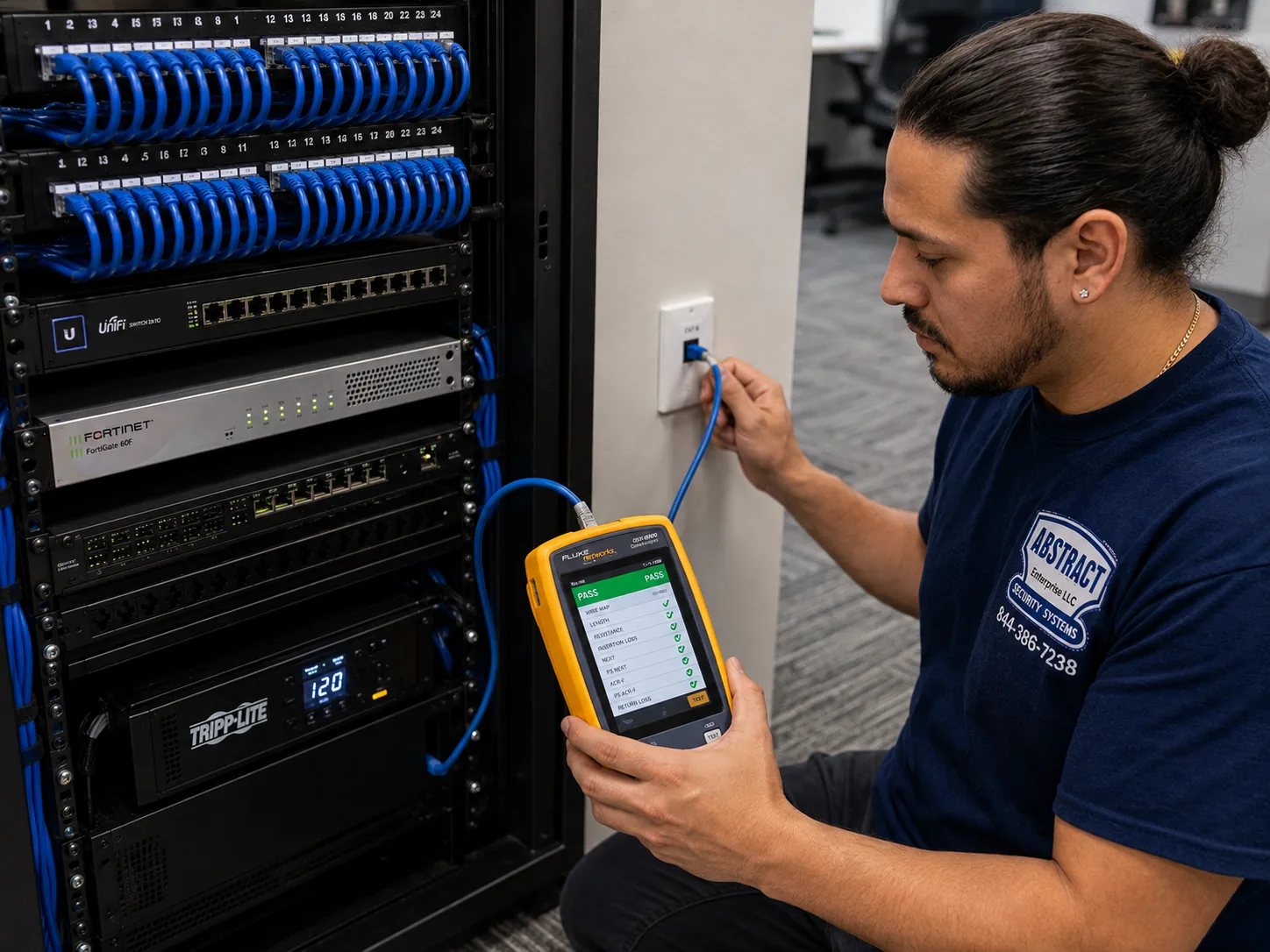
A photo from the AESS job library, not taken in Coney Island: a technician certifying a data drop with a cable analyzer that shows a PASS result. After a Coney Island cellar has taken water, a test like this is how we know whether a camera cable that ran across the floor is still sound or has been ruined, which saves replacing a camera that would have failed again on the same damaged run.
Power: poles, transformers and recorders without a backup
The July 15, 2026 outage on the west end began when a wooden utility pole snapped near West 36th Street, bringing live lines down onto parked cars and setting off a burning transformer. Events like that are hard on electronics. A recorder without a battery backup sees every outage as a hard shutdown, and every hard shutdown is a chance to corrupt the drive or the settings. A surge when power returns can kill the PoE ports on a switch, the power supply for a group of analog cameras, or the camera at the end of a long run. The signs afterward are recognizable: a recorder stuck on a setup screen, cameras that come back one at a time or not at all, or a switch with half its lights off.
The repair depends on what failed. A connector reterminate or PoE port swap runs $150 to $350 on our Brooklyn list, a power supply repair $150 to $400, and a single camera replacement on a working system $250 to $600. In almost every case we also recommend a battery backup sized for the recorder and the switch, and a surge protector where the building's wiring allows one, because the next outage on these blocks is a question of when.
Sand and wind: the beach side of the building
Cameras that face the beach and the boardwalk take a beating that inland cameras never see. Wind off the ocean drives sand against the dome or the front window until the plastic is frosted and the picture looks permanently foggy. Salt settles in the same places. Housings and brackets loosen as the wind works at them, and a camera that was perfectly aimed in June can be pointing at the sky by February.
On our Brooklyn list a clean and check for a blurry picture is $80. If the dome or front cover is frosted or cracked but the camera inside is fine, a new cover costs $30 to $80 in parts plus labor. If the camera itself has corroded, an outdoor camera replacement with the weatherproofing rebuilt runs $250 to $600. Where a camera faces straight into the wind, moving it around a corner or under an overhang by a few feet often does more good than any new hardware.
Size: long risers, many cameras and many hands
The large co-op and rental buildings fail in ways that small systems do not. A camera on the twentieth floor of a tower sits at the end of a cable that runs through a riser, past every other floor and every other trade's work. Older analog systems have been extended with network cameras and a hybrid recorder, and several buildings may share one security office. And many hands touch the system: the super, the managing agent, a board member who knows the password, and whoever installed the last camera.
Repairs here begin with an inventory: which camera is on which channel, which cables run where, and who can log in. Then we test the runs, find the failed part and give the board or the management office a written price. A hybrid recorder swap with the channels reconfigured runs $700 to $1,200 on our Brooklyn list, a DVR or NVR replacement with a hard drive $700 to $1,500, and a full rewire starts at $1,500. Large multi-building accounts on an annual maintenance plan run $500 to $800.
Commercial Security Camera Repair
Business Security Camera Repair in Coney Island
Coney Island's businesses sit on a handful of streets, and each street puts its own demands on a camera system. In February 2026 the city signed the certificate for a new Coney Island Business Improvement District covering storefronts and properties on Mermaid Avenue and Surf Avenue, with a first-year budget of up to $1 million for sanitation, public space, marketing, public safety and business support. These are the corridors and the kinds of business we see most.
The boardwalk
Stands, bars, restaurants and shops facing the beach, with sand and wind on the outdoor cameras, roll-down gates, and a long off-season when nobody is watching.
Surf Avenue
The amusement area, the Aquarium blocks and the new towers, with ground-floor retail, parking garages and businesses that run very different hours in July and January.
Stillwell Avenue
The blocks around the subway terminal, with heavy summer foot traffic and shops whose cameras watch registers and doors all day.
Mermaid Avenue
The main shopping street, with shops, restaurants and services, cellars under many of the stores and stretches of dark sidewalk at night.
Neptune Avenue
The northern edge under and beside the elevated line, with shops and services in and around the big co-op complexes and streets that flood in heavy rain.
The side streets
Restaurants and businesses on the numbered West streets between the avenues, like West 15th Street, where back offices, safes and side doors need their own cameras.
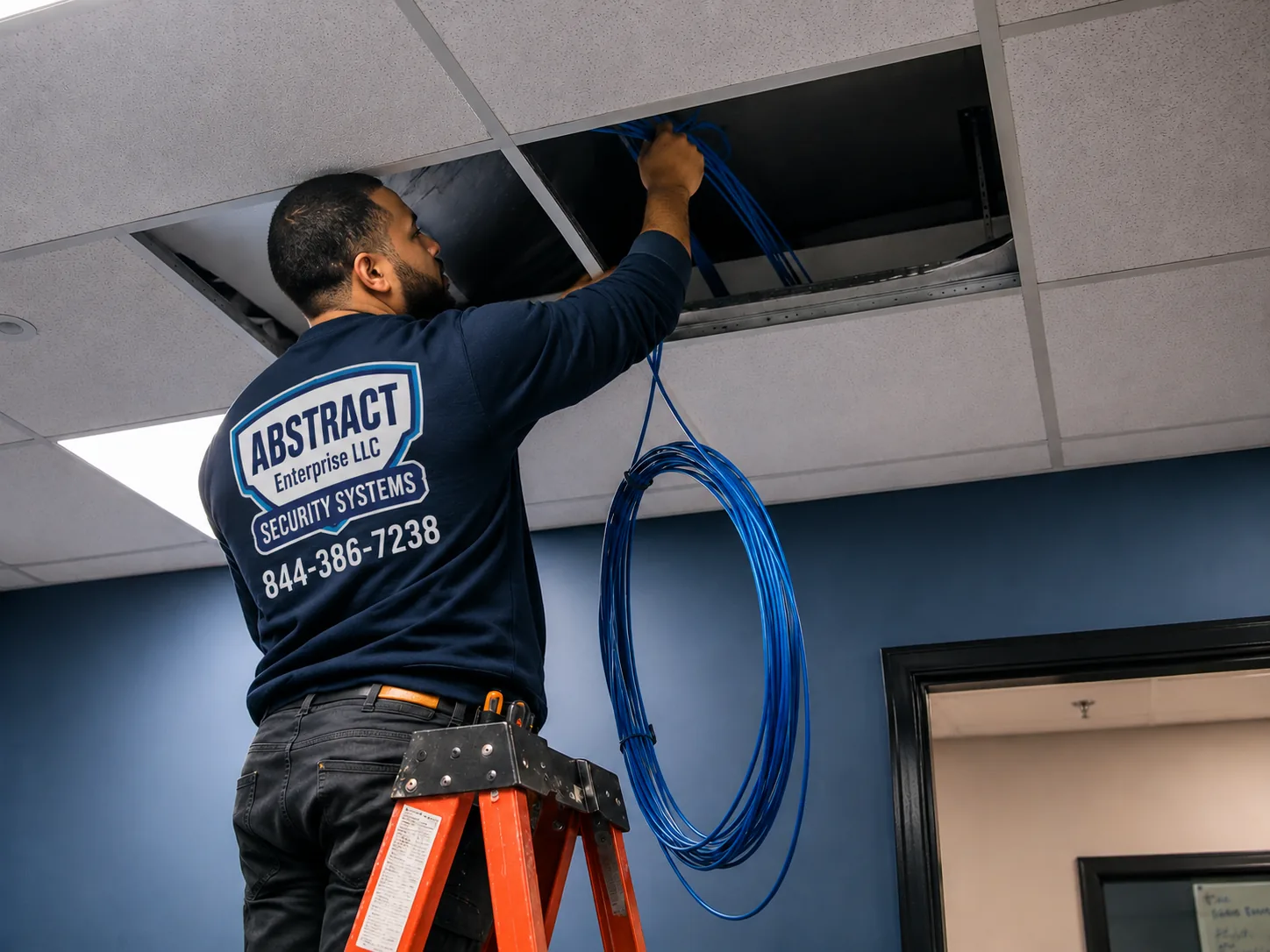
A photo from the AESS job library, not taken in Coney Island: a technician feeding cable through the ceiling of a commercial space that stays open during the work. In a Mermaid Avenue store or a Surf Avenue restaurant, a camera repair that needs a new run is usually done this way, one ceiling section at a time above customers and staff, with every tile back in place before the technician moves on.
What a Coney Island business needs from a camera repair
Owners rarely call to say a camera is broken in principle. They call because something went missing, because an insurer or a landlord asked whether the cameras work, or because they tried to pull a clip for the police and found nothing. So a repair has to answer four practical questions before it is finished: is every camera recording right now, how many days does the recorder keep, does its clock match real time, and can the right people see it while the wrong people cannot? We check all four on every commercial job.
Back offices, safes and cash
The Gargiulo's case is a reminder that the most valuable room in a restaurant is often the one with no customers in it. The burglars went to a safe in a back office, and the footage that later tied the case together came from cameras at several places along their route. For a business that keeps cash or valuables on site, a camera on the office door is useful, a camera that can see the safe itself is better, and a recorder that is not in the same room as the safe is best, because a burglar who finds the recorder can take the evidence with him. During a repair we look at where the recorder lives and suggest moving it, or adding a copy of the video somewhere else, if it is sitting in plain sight.
Dark blocks and night pictures
A camera cannot record what it cannot see. Infrared lights on a typical camera reach a limited distance, and they light the nearest surface best: a wall, an awning, a pole, or the camera's own dome if it is dirty. On blocks where the street lighting is thin, a camera pointed down a long dark sidewalk will give you a gray, grainy picture whatever brand it is. Sometimes the honest answer is a light over the door, and we tell you so before you buy anything.
Rules that touch a commercial camera repair in Coney Island
State licensing. New York's Department of State licenses companies that install, service or maintain security systems, and its rules treat a closed-circuit camera system used to detect or monitor intrusion, theft or movement as one of them. We work under license #12000287431. An owner may work on their own system, but anyone you hire to do it should be licensed.
Cameras and employees. New York requires employers who monitor employees electronically to give notice, and workplace cameras are a good reason to check your notices are posted. How the law applies to your cameras is a question for your own counsel. We do not install or repair cameras in restrooms, changing areas or anywhere else people expect privacy.
Public property. The boardwalk, its railings, the city's lampposts and street poles, and the cameras already on them belong to the city. A business camera goes on the business's own building, and if a view needs to reach past it, we aim and choose the lens accordingly rather than mounting anything on public property.
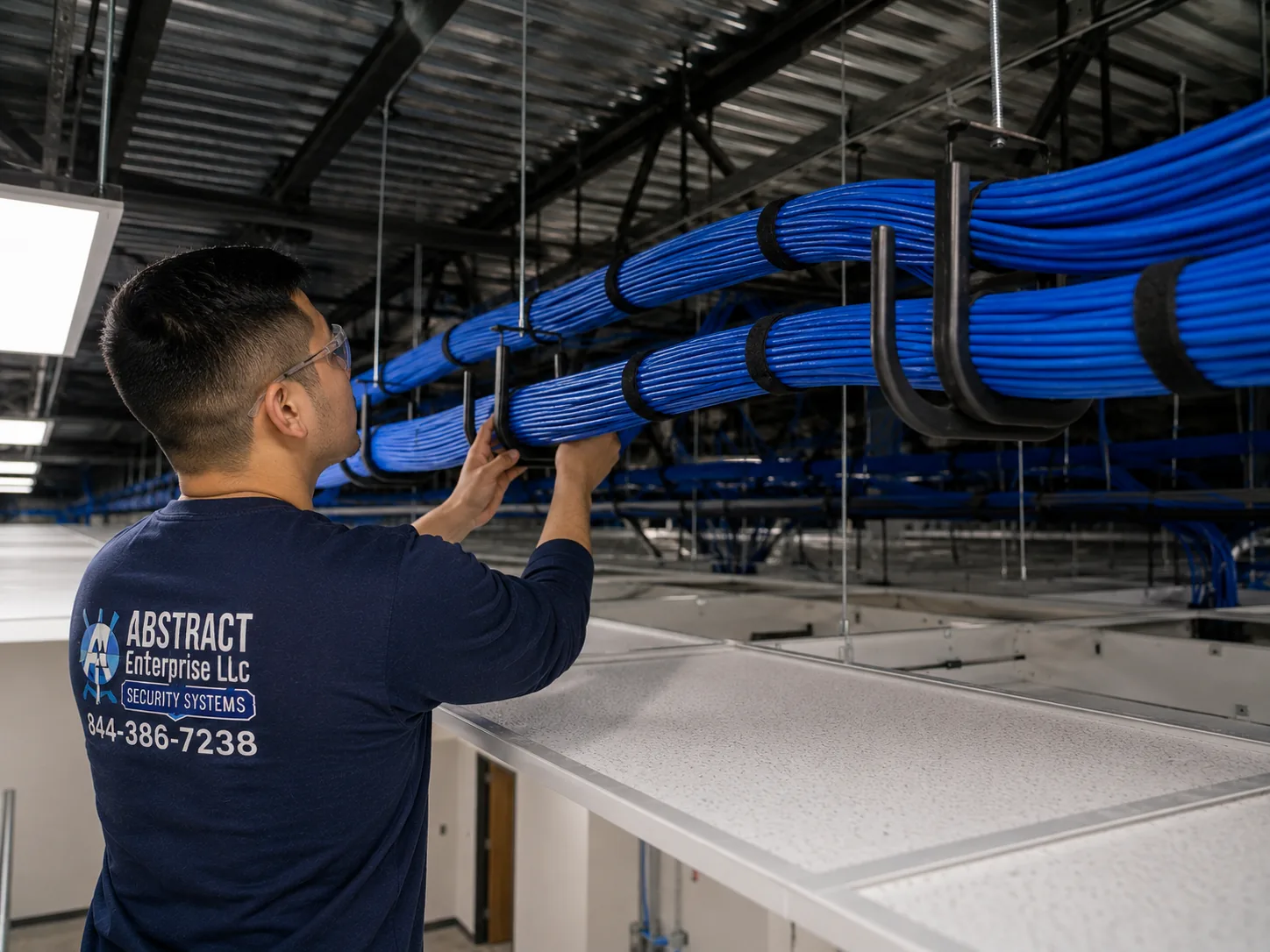
A photo from the AESS job library, not taken in Coney Island: J-hooks carrying neat bundles of cable across a commercial ceiling. In a Coney Island store cellar or a restaurant basement, cable carried overhead on hooks like these stays out of floodwater and away from the boxes and kegs stacked against the walls, which is why we lift cable off the floor whenever a cellar repair gives us the chance.
Your Questions Answered
Security Camera Repair in Coney Island: Questions Answered
These are the situations Coney Island owners, boards, managers and residents bring to us. They are grouped by where the trouble usually starts, and each answer reflects how the peninsula's buildings, weather and seasons change the repair.
Closing for the winter and opening in spring
We open for the season in late March. What should be checked on the cameras before the first big weekend?
Five things. Check that every camera shows a picture in daylight and after dark, and clean any outdoor domes or windows frosted by winter sand. Open playback for each camera and confirm the recorder is saving with no gaps. Read the hard drive's health. Set the recorder's clock to real time. And make sure failure alerts go to a phone someone will answer all summer. If any of that fails, book it in March, not on Memorial Day weekend.
We switch off the power at the breaker when we close for the winter. Is that bad for the camera system?
It is not good for it. Cutting power at the breaker is the same as yanking the plug, and a recorder that loses power while it is writing can corrupt its drive or settings. It also leaves the business unwatched all winter. If you need to cut power, shut the recorder down from its own menu first. Better still, leave the recorder, the switch and the cameras on a battery backup with failure alerts on, so you hear about a problem in January.
Sand blows against our camera on the boardwalk side and the picture looks scratched. Is the camera ruined?
Usually not. Windblown sand frosts the outside of a plastic dome or front window, which makes the picture look foggy or scratched while the camera behind it is fine. Shine a light at the dome; if the haze is on the surface, a new dome or cover is $30 to $80 in parts plus labor on our Brooklyn list. If the picture stays soft with a new cover, the lens or the camera has failed, and we price the replacement before doing anything.
Floods, damp and the power
Water came up to the first step of our cellar stairs but never touched the recorder shelf. Can the damp alone have damaged it?
It can, though not usually overnight. A cellar that has held water stays humid for days or weeks, and that moisture settles on circuit boards, connectors and the recorder's fan. Watch for a recorder that restarts on its own, cameras that flicker or drop, or a beeping drive in the weeks after. Have the system checked if any of those show up, and get the recorder off the low shelf and onto a battery backup while it is still working.
Our block still has wooden utility poles and overhead wires. Does that make our cameras more likely to be damaged by surges?
Overhead lines are exposed to wind, vehicles and poles that give way, and the July 2026 pole collapse on West 36th Street showed how sudden an outage can be on these blocks. What protects the cameras is the same either way: a battery backup on the recorder and switch, a surge protector on the circuit where it is allowed, and good grounding. If your cameras have come back damaged after an outage, the repair is priced part by part.
Big buildings, boards and public housing
Crews are replacing the pipes in our co-op tower floor by floor. Should the camera cables be checked after each floor is closed up?
Yes, and it is far cheaper than finding out later. Riser and plumbing work opens the same chases and ceilings that camera cable runs through, and a crushed or nicked cable may keep working for weeks before it fails. Ask the board or managing agent to have the cameras on each finished floor checked on the recorder before the walls are closed, and keep a list of which cameras went dark during the work. A cable repair found early is a short job.
Who fixes the cameras in a NYCHA development, and can residents add their own?
Cameras in NYCHA lobbies, hallways, elevators and grounds belong to NYCHA or the NYPD and are maintained by them. Report a broken one to NYCHA or your resident association; a private company cannot repair it. Before putting up your own camera at an apartment door, check NYCHA's rules, because a camera on a shared hallway is treated differently from one inside your own apartment. Inside your home, a camera you own is yours to repair.
Sea Gate
Sea Gate has its own public safety officers. Can our house cameras be shared with them?
That is your choice and theirs. Your cameras record to your own recorder or account, and nobody else can see them unless you share access. If you want to give a clip to Sea Gate's public safety department or to the 60th Precinct, we can show you how to export one with the original timestamp. Ongoing live access for anyone outside the household is possible on most systems, but think carefully before granting it, and give it as view-only.
Footage, incidents and the street
Our restaurant keeps cash in a back-office safe. Should the camera be on the safe itself, or on the office door?
Both, if you can. A camera on the door shows who went in and when. A camera that can see the safe shows what they did there. Just as important is where the recorder sits: if it is in the same office, someone who breaks in for the safe can take the evidence with them. Put it somewhere less obvious and locked, or keep a second copy of the video off site.
Someone smashed the camera outside our building with a stick. Is the moment it happened still on the recorder?
Very often, yes. The recorder keeps writing until the picture is lost, so the seconds before the hit and the person swinging are usually saved, even though the camera is dead now. Leave the recorder alone, note the time, and ask us to export that clip first. Then we price the repair, which for a vandalized camera runs $400 to $900 per camera plus any cable repair on our Brooklyn list, and look at mounting it higher or out of reach.
Our camera faces the street, and a neighbor whose car was broken into asked us for video. Can we share a clip?
The footage is yours, and sharing a clip of a public street is your decision. Most people in that position give the clip to the police and let the neighbor's case go through them, which keeps the copy clean and avoids passing around footage of other people. Either way, export only the minutes that matter, with the original timestamp. If you are unsure about your obligations, ask a lawyer; we can make the copy.
Crowds, events and the dark side of the avenue
Our block fills with crowds on fireworks nights and holiday weekends. Should we do anything with the cameras beforehand?
A quick check the week before is worthwhile. Make sure every camera is recording and the drive has room, because busy nights fill a drive faster when cameras record on motion. Confirm the clock is right. Wipe the domes so night pictures are clear. And make sure the recorder is somewhere people cannot reach during a crowded night. A clean and check is $80 on our Brooklyn list.
Our camera on Mermaid Avenue shows only gray grain after dark. Is it broken?
Maybe not. If the daytime picture is sharp, the camera probably works and the problem is light. A camera aimed down a dark sidewalk, or one whose infrared bounces off a dirty dome, an awning or a nearby pole, will show gray grain at night. We clean it, check the infrared and night settings, and re-aim it. If it still cannot see, the choice is a better low-light camera or a light over the door, and we will tell you which helps more.
Equipment
Types of Security Cameras and Recorders We Repair
We repair whatever is on the wall, whoever put it there. These are the kinds of equipment we work on most in Coney Island, and the faults each one tends to develop on a peninsula with salt, sand, damp cellars and long winters.
Analog and HD-over-coax cameras
Still common in older co-op buildings and long-running businesses. Faults: corroded BNC connectors, failing power boxes in damp cellars, and interference on long riser runs.
Network (IP) cameras on PoE
Standard in newer towers and recent upgrades. Faults: PoE ports killed by surges, switches out of power budget, and cameras lost after an internet or router change.
DVRs, NVRs and hybrid recorders
The box that keeps the video. Faults: drives worn by heat and damp, recorders that start on a setup screen after an outage, and clocks that drift over a winter.
Dome, turret and bullet housings
Domes frosted by blowing sand, front windows coated with salt, cracked covers from thrown objects, and brackets rusted or loosened by wind off the water.
PTZ cameras
Pan-tilt-zoom cameras over parking lots, plazas and building grounds. Faults: worn motors, lost presets, and housings that let moisture in on the ocean side.
Elevator, lobby and garage cameras
Cameras in co-op and rental buildings that see the most traffic. Faults: travel cables in elevators, glare at garage ramps, and lobby monitors that went blank.
Wi-Fi and battery cameras
Doorbells and small cameras on their own apps. Faults: weak signal through concrete and brick, batteries drained faster in winter, and accounts left with a previous owner.
Power supplies and battery backups
Central power boxes, plug-in adapters and UPS units, tested under load, because a backup with a dead battery protects nothing when the block loses power.
Monitors and front-desk stations
Screens at a co-op security desk, behind a store counter or in a back office, and the app access for owners, managers and staff.
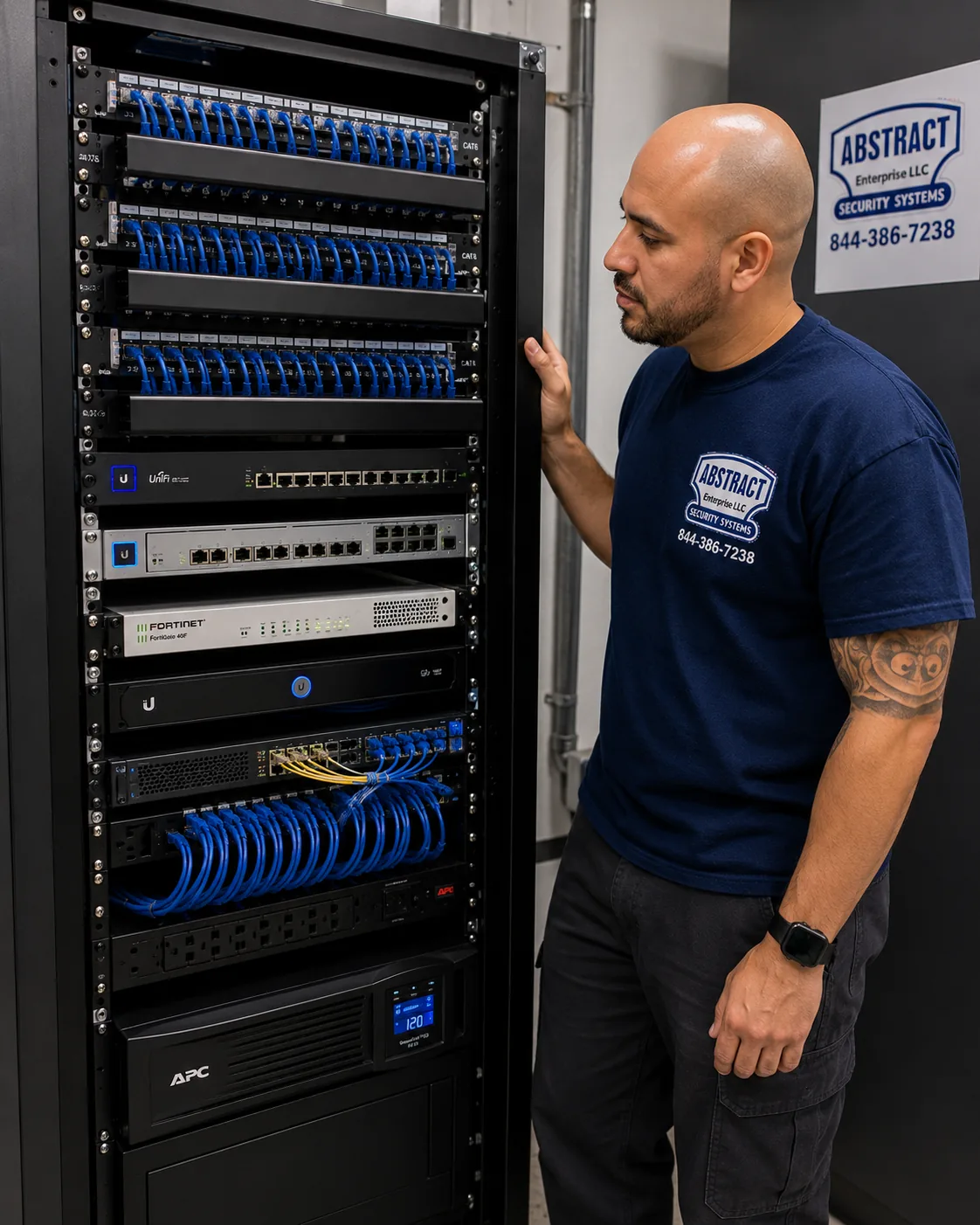
A photo from the AESS job library, not taken in Coney Island: a finished network rack with patch panels, switching, a firewall and a battery backup, every cable dressed and identified. A Coney Island rental tower or a large co-op security office with its camera recorder laid out like this, and mounted well above the floor, is a system where a dead camera can be traced in minutes and an outage does not take every camera with it.
National brands versus a local licensed repair
Many Coney Island homes and businesses have, or once had, cameras from a national alarm company, battery or Wi-Fi cameras from a consumer brand, or a system set up by a building's integrator. All of them can work. The question when one fails is who will actually come out to the peninsula and fix it, and what they are prepared to touch.
Question
ADT or similar alarm company
Ring or SimpliSafe camera
AESS local repair
Who owns the equipment
Depends on the contract; some is leased
You own it
You own it, and we repair it
Wired cameras through concrete towers and cellars
Its own installed systems
Mostly Wi-Fi or battery devices
Coax, network, hybrid and PoE, with every run tested
Other brands on the same property
Usually only its own
Support covers its own devices
Any brand, any installer
Flood and outage recovery
Varies by dealer
Replace the device
Footage pulled first, parts tested on the bench
Licensed technician on site
Varies by dealer
Remote support
Yes, NYS license #12000287431
Price before work
Varies
Replacement device price
$150 service call, then a written repair price
AI Overview Reality Check
What AI Gets Wrong About Security Camera Repair in Coney Island
These claims turn up in AI-generated answers and national cost guides when people search for camera repair. Each sounds reasonable in general and misleads someone with a camera system on this peninsula. Here is what the work on the ground shows.
"Expect to pay about $1,400 to fix a camera in Brooklyn"
HomeAdvisor's Brooklyn page for surveillance camera installation or repair gives an average of $1,416, a typical range of $680 to $2,145 and a full spread of $160 to $3,500. AI answers often lift the average and present it as the cost of a repair.
That figure mixes new installations in with repairs, which drags it far above what fixing one problem usually costs. A frosted dome on a boardwalk camera, a dead PoE port after an outage, or a recorder that lost its settings when the breaker was thrown for the winter are nowhere near $1,400. On our published Brooklyn list most single faults run $150 to $700, and $700 to $1,500 covers a new recorder with a drive or a rewire of several cameras.
The useful planning number is the $150 service call, credited to the repair, plus the written price for whatever failed. The big jobs, mostly flood-damaged head ends and tower riser cable, are quoted before you approve anything.
"A seasonal business can switch its cameras off for the winter"
Some answers treat a camera system like a summer appliance: unplug it when you close and plug it back in when you open, and save the electricity in between.
A closed business is exactly when cameras earn their keep. Break-ins at boardwalk and amusement-area shops have come through roll-down gates in the dark hours, and a shop that is shut for months is the easiest target on the strip. Cutting the power also risks the drive and the settings, and it means any problem with the system stays hidden until the spring rush.
The better plan is to leave the system running on a battery backup with failure alerts sent to a phone, and have it checked once before closing and once before opening. That costs far less than a winter of missing footage.
"If the city has cameras on your block, you don't need your own"
AI answers sometimes point out that the NYPD and NYCHA run cameras across neighborhoods like this one and suggest that private cameras add little.
City cameras do cover parts of Coney Island. In 2023 Council Member Ari Kagan announced more NYPD cameras for Stillwell Avenue, Kaiser Park and the block between West 28th and West 29th Streets, and NYCHA has installed cameras at its developments. But those cameras watch the spots the city chose, record to systems you cannot open, and are repaired on the city's schedule. NYCHA's own fact sheet says its camera projects typically take around three years from planning to completion.
The footage in the Gargiulo's case came from cameras at several locations, including one inside a residential building. Your camera is the one that sees your door, your register and your car, and it is the one you can pull a clip from tonight. If it is broken, nobody else's camera fills the gap.
"If the equipment turned back on after a flood, it's fine"
A common reassurance in AI answers is that electronics which power up after getting wet have survived.
Water leaves minerals and corrosion behind on circuit boards and connectors, and Coney Island floodwater is often mixed with seawater and whatever the storm drains carried. A recorder or power supply that boots after a flood can fail days or months later, sometimes taking the drive with it. Boardwalk businesses after Sandy were reported to have electrical problems from flooded basements even where the buildings themselves came through intact.
After water, the safe order is to pull any footage you need first, then test the recorder, the switch and the power supplies properly, and replace anything that sat in water rather than trusting it.
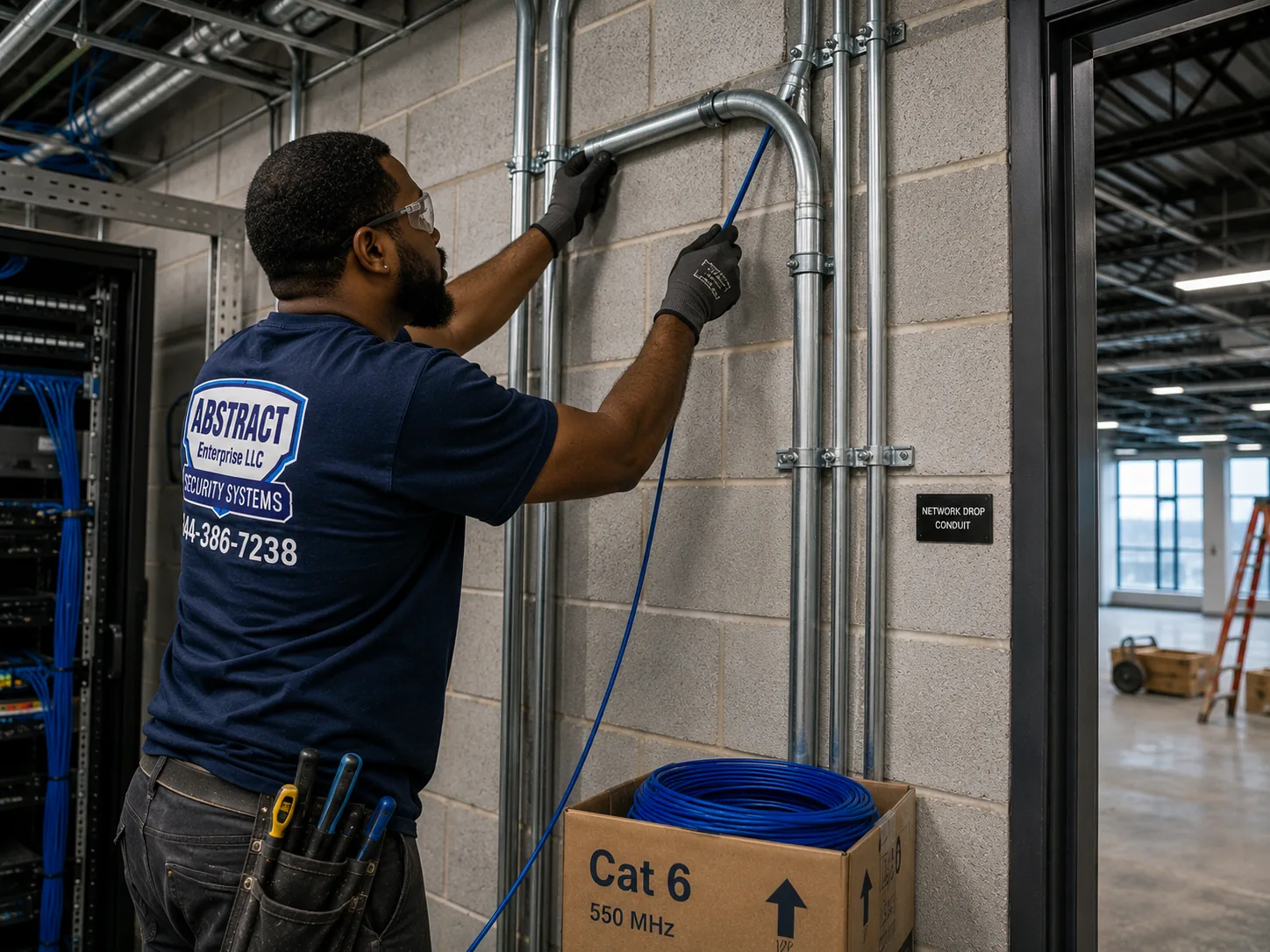
A photo from the AESS job library, not taken in Coney Island: a technician running cable into EMT conduit beside a telecom room in an industrial building. In a Coney Island co-op basement or a garage under a new tower, metal conduit like this protects camera cable from carts, cleaning crews and rodents, and keeps it off the floor where water collects when the drains back up.
"Outdoor-rated cameras are built for the beach"
AI answers often say that a camera with a weatherproof rating will handle any outdoor spot, including one facing the ocean.
A weatherproof rating is a test of rain and dust under set conditions. It says nothing about months of windblown sand frosting a plastic dome, salt crusting the seam where the cable enters, or a bracket on wood siding working loose in winter gusts. On the beach side of a Coney Island building, those are the things that end a camera's life, and they happen to cameras with excellent ratings.
What keeps a beach-facing camera working is where it is mounted, how the cable entry is sealed, what the bracket is made of and how often it is cleaned. We look at all four during a repair, and we will suggest moving a camera a few feet before we suggest buying a new one.
"Wireless cameras solve wiring problems in big buildings"
A frequent suggestion is to replace a failed wired camera with a Wi-Fi one and skip the cable work altogether.
In a 24-story concrete co-op tower, a brick building on Mermaid Avenue or a cellar under a store, Wi-Fi does not travel far. A wireless camera that works next to the router can stutter or drop at the end of a corridor, two floors down or behind a steel door.
Where a wired camera has failed, the existing cable is usually the most reliable path, and testing it costs far less than learning that a wireless replacement cannot hold a connection. We will fit a wireless camera where it genuinely makes sense, such as a spot no cable can reach, and we will tell you honestly when it does not.
"Replacing a camera is a handyman job"
Plenty of answers treat camera repair as something anyone with a ladder and an afternoon can do.
On your own system, at your own home or business, you are free to try. But New York's Department of State requires a license for companies that install or service security systems, including camera systems used to watch for theft or intrusion. In a co-op or a rental tower, a handyman drilling through a fire-rated wall or tapping a circuit in a basement can create a problem with the building that costs more than the repair.
If you hire someone, ask for their license number and a certificate of insurance, and ask what they will do if the fault turns out to be the cable, the power or the recorder rather than the camera. Ours is NYS license #12000287431, and our written price says exactly what we are fixing.
Ask a Technician Before You Buy a New Camera for the Beach Side
Tell us the street and the kind of building, how many cameras there are, which ones are out, where the recorder sits, and the brand on its label if you can see it. If the system went down in a flood, an outage or over a winter closing, say so, and if you need footage saved, put that first with the date and time window. A technician reads every request, calls back with the likely fault and what that kind of repair costs on our Brooklyn list, and books the visit in a two-hour arrival window once the service call is paid. If it is urgent, call (347) 934-8335 now.
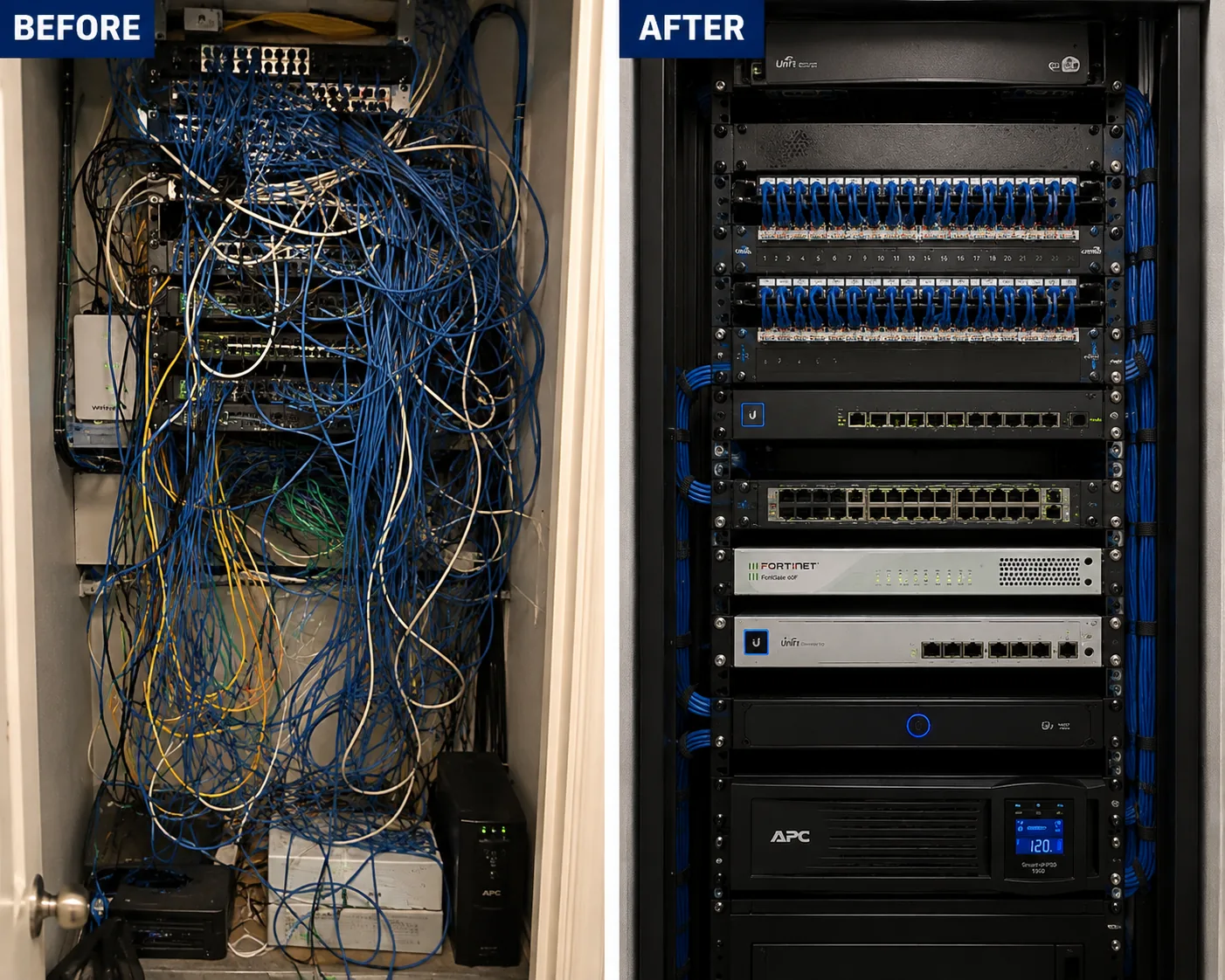
A photo from the AESS job library, not taken in Coney Island: before and after views of a network rack, an unlabeled tangle rebuilt into a dressed and identified rack. A co-op security office or a Mermaid Avenue cellar that has been through several owners and installers often has a tangle like the one on the left, and sorting it out during a camera repair is what lets the next fault be found quickly.
✅
Request Sent!
Thank you. A technician will contact you about your Coney Island property shortly.
How It Works
Our Repair Process
1. Send the screen, the label and the block
A photo of the recorder screen with the dark tiles, the recorder's brand label, and your street and building type. Most faults narrow down from those three things.
2. Settle who approves and who opens the door
The owner, a co-op board or managing agent, a building's management office, a Sea Gate household or whoever holds the keys to a closed shop. We confirm before booking.
3. Book and pay the service call
The $150 Brooklyn service call books a two-hour arrival window and is credited to the repair if you go ahead.
4. Save footage first
Any clip you need is exported with its original timestamp before anything on the recorder is restarted, changed or replaced, including a recorder pulled from a wet cellar.
5. Test the chain in order
Power and battery backup, cable and connectors, switch port, recorder and drive, then the camera itself, so the failed part is found rather than guessed.
6. Cause and written price
You hear what failed and get a written repair price before any part is replaced, with any flood-damaged parts listed separately.
7. Repair, seal and retest
The fault is fixed, outdoor cable entries are sealed against sand and salt, and every camera is checked live and in playback, with the clock set and alerts turned on.
8. Label and hand over
Traced cables are labeled at both ends, and a short channel map and a list of what changed are left with whoever runs the system.
Coverage Area
Security Camera Repair Near Coney Island's Landmarks
Luna Park and Deno's Wonder Wheel
The amusement area that opened its 2026 season on March 28, with the 1920 Wonder Wheel and the Cyclone, and the shops and stands around it that close for the winter.
Coney Island–Stillwell Avenue station
The D, F, N and Q terminal at Surf and Stillwell, rebuilt in 2001 to 2005 with a solar roof, and flooded in Sandy along with the blocks around it.
New York Aquarium
At 602 Surf Avenue on the boardwalk since 1957, severely flooded by Sandy, and a neighbor to the new towers rising along Surf Avenue.
Maimonides Park
The ballpark on Surf Avenue that opened in 2001, across from 1709 Surf Avenue, where about 420 affordable apartments topped out in June 2026.
Coney Island Houses
Five 14-story NYCHA buildings completed in 1957 on Surf Avenue between West 29th and West 32nd Streets, with flood panels and security cameras added after Sandy.
Sea Gate
The private, gated community of about 850 houses west of West 37th Street, with water on three sides and its own public safety officers.
Coney Island is billed at our Brooklyn rate, with no surcharge for the beach blocks or Sea Gate. Every repair starts with the $150 service call, which is credited to the repair if you go ahead, and every number below comes from our published list of Brooklyn security camera repair prices. Your exact price is written down at the visit, once we know what failed, and nothing is replaced until you approve it.
Repair
Brooklyn price
Service call, on-site diagnosis and written repair price
$150, credited to the repair
Clock, alert, app or motion settings with no parts
Usually within the $150 service call
Clean and check for a foggy or frosted picture
$80
Dome or front cover replacement
$30–$80 part plus labor
Connector reterminate or PoE port swap
$150–$350
Power supply repair
$150–$400
Indoor camera repair
$200–$450
Hard drive swap, by capacity
$200–$450
Single camera replacement on a working system
$250–$600
Outdoor camera body replacement with weatherproofing rebuilt
Three things move a Coney Island repair within those ranges. The first is water: anything that sat in a flooded cellar is tested part by part, and where a recorder, switch or power box has to be replaced rather than repaired, that is listed as its own line so you can see why. The second is height and exposure: a camera on the ocean side of a tower, on a roof bulkhead, or above a garage ramp takes longer to reach safely than one over a store door, and windy days on the beach blocks sometimes mean rescheduling an exterior job for the technician's safety. The third is the size of the system: in a co-op or rental building with cameras on many floors, the repair may begin with tracing and labeling cables so the fault can be found at all, and that is priced in writing before it starts. If the price changes on site, you hear the new number before the work goes on. Bundling the camera repair with intercom, door buzzer, access control or cabling work on the same visit saves $200 to $400 in labor on our Brooklyn list.
Full terms — including 50% deposit, one-year parts-only warranty on AESS-supplied products, and the late-fee schedule — are set out in the service agreement.
Shop Our Systems
Security Camera Repair Packages & Pricing
Three ways Coney Island repairs usually come together, priced from the Brooklyn list above. Each starts with the $150 service call, credited to the repair, and your written price follows what the diagnosis finds.
Single-issue repair: $150–$700
One fault, one visit: a frosted dome on a boardwalk camera replaced, a corroded connector redone, a PoE port or power supply replaced after an outage, a hard drive swapped after a winter closing, or a vandalized camera remounted out of reach. Most calls on the peninsula end here.
Major system repair: $700–$1,500
The recorder, the cellar or the building: a DVR or NVR replaced with a drive and every camera reconnected, flood-damaged equipment replaced and moved up off the floor, or a co-op or mixed-use system traced, labeled and brought back together. Full rewires start at $1,500.
Annual maintenance: $250–$800
Scheduled care that fits the season: a fall closing check and a spring opening check for a seasonal business, or a yearly clean and check for a house, with domes cleaned, connectors sealed, the drive tested and the clock set. Residential from $250, commercial from $400, multi-building accounts $500 to $800.
Bring your own equipment. If you have already bought a replacement camera, recorder or switch, we can fit it at labor-only rates. Tell us the exact model and we quote the labor by phone or text, and the visit is booked once it is paid. Your own equipment is installed as supplied: we cannot vouch for parts we did not supply, and if a model you bought will not work with your recorder, is a poor fit for the ocean side of the building, or cannot hold a Wi-Fi signal through your walls, we tell you before the visit.
Complete Services
Every Security Camera Repair Service in Coney Island
Camera, connector and cable repair
Dead, frosted, vandalized and dropping cameras, and the runs that feed them. Request a repair
Do you cover all of Coney Island, from Sea Gate to the towers near Ocean Parkway?
+
Yes. We cover the whole peninsula: Sea Gate, the west-end blocks, the public housing and co-op complexes along Surf Avenue and Neptune Avenue, the amusement area and the boardwalk, Mermaid Avenue from end to end, and the buildings out to West 8th Street and Ocean Parkway. The service call is the same $150 Brooklyn rate everywhere on it.
Can you repair the cameras at a ride, game booth or food stand that only opens in season?
+
Yes, as long as the cameras belong to the business. We work on the cameras and recorder only and do not touch ride controls, game machines or anything else that runs the attraction. Book in the weeks before you open if you can, because the cameras can be checked and cleaned while the stand is still quiet.
Do you work in the Mitchell-Lama co-ops, and who should a shareholder talk to first?
+
Yes. For the building's own cameras in lobbies, elevators, laundry rooms and garages, talk to the management office or the board first, because they decide on repairs and we work through them. For a camera inside your own apartment, you can book directly, but check the co-op's rules before mounting anything at your apartment door or in a hallway.
Our cameras record to an old office computer instead of a recorder. Can you repair that?
+
Usually, yes. Many small systems record through software on a PC, and the common faults are a full or failing hard drive, an operating system update that broke the camera software, or a computer that was shut off. We can repair it as it is, or move the cameras onto a dedicated recorder if the computer is near the end of its life, and we price both before you choose.
Can a business camera be mounted on the boardwalk railing or a city lamppost?
+
No. The boardwalk, its railings, lampposts and street poles are city property, and a private camera should not be attached to them. We mount business cameras on the business's own building and choose the angle and lens so the view reaches as far as it needs to. If a camera was put on public property by a previous owner, we can take it down for you.
Do you repair cameras for community centers, churches and nonprofit programs?
+
Yes. We repair systems for community organizations, houses of worship and program spaces the same way as for any business, at the same Brooklyn rate. If your organization needs a written quote for a board, a funder or a grant file, we provide one, and we schedule around services, classes and program hours.
How do we know the person who shows up is really your technician?
+
When we book the visit you get a confirmation with the arrival window, and the technician arrives inside that window, never before it. If you are not sure who is at the door, call our office line before letting anyone near the recorder. A co-op office, a Sea Gate household or a building manager who needs the technician's name in advance only has to ask when booking.
Our building has a pool and beach lockers. Are there places a repaired camera should not point?
+
Yes. Cameras should not look into changing rooms, restrooms, showers or anywhere people undress, and we do not install or repair cameras in those spaces. A camera can watch the entrance to a locker room or a pool gate, and that is usually where it is most useful. If a camera has been aimed somewhere it should not be, we re-aim it during the repair.
Does it take longer to get a technician in spring, when the seasonal businesses all reopen?
+
Requests are still booked within 2 hours, but arrival windows in the weeks before the season opens fill faster than in winter. The easiest way around it is to book the opening check in early or mid March. If something fails in the middle of the season, tell us it is urgent, and we fit the visit in as early as we can.
Will a repaired camera hold up to the wind on a high floor of a tower facing the ocean?
+
It can, if it is mounted for it. High, exposed cameras need a solid bracket fixed into the structure rather than into a facade panel, a housing that sheds wind, and a sealed cable entry. During the repair we check the mount as carefully as the camera, and if a spot takes the full force of the wind, we may suggest moving the camera to a more sheltered corner nearby.
The camera that failed is on our building's roof bulkhead. Do we need to arrange roof access?
+
Yes. Tell us when you book, and arrange with the super or the management office for someone to open the roof door during the arrival window. If the bulkhead has no safe ladder or the roof is not safe to walk, let us know, because we may need to bring different equipment or plan the visit for a calm, dry day.
Ready to Get Every Coney Island Camera Recording Again?
Send a photo of the recorder screen, a photo of where the recorder sits, and your street and building type. We will tell you the likely fault and the Brooklyn price for that kind of repair, book the visit within 2 hours in a two-hour arrival window, and write down the cause and the price before anything is replaced. If you need footage saved, tell us first and leave the recorder alone until we arrive, and if it has been sitting in a wet cellar, leave it unplugged.