Any Brand · Any Installer · Clip Saved First · Written Price Before Parts · Brooklyn Rate, No DUMBO Surcharge
Security camera repair in DUMBO begins with our $150 Brooklyn service call: a licensed technician finds the fault on site, writes down what the repair costs, and credits the $150 to that repair if you go ahead. On our published Brooklyn list, most single faults run $150 to $700, and a recorder replacement or several cameras done in one visit runs $700 to $1,500. We work on systems other companies put in, in loft condos on Washington and Main Streets, office floors along Jay Street, and shops and restaurants on Front and Water Streets. Requests are booked within 2 hours, the technician arrives inside a two-hour window, and you hear what broke before anything is replaced.
Reviewed and updated November 12, 2026, against Con Edison's June 2025 notice asking customers in Dumbo and the rest of northwest Brooklyn to conserve energy during an 8 percent voltage reduction; the Brooklyn Eagle's September 2019 report on the Water Street water main break; DNAinfo's report on DUMBO after Hurricane Sandy; Brooklyn Paper's 84th Precinct reports on the Front Street Garage car theft, the copper theft at 29 Jay Street and the August 2025 break-in on Pearl Street; News 12 Brooklyn's reports on the July 2025 Alo Yoga robberies and the October 2025 theft at DUMBO Market on Front Street; News 12's June 2026 report on crowds on Washington Street; the November 2025 petition on Manhattan Bridge train noise; NYCHA's November 2023 safety upgrade release; Brick Underground and Habitat magazine on building cameras and package theft; the Landmarks Preservation Commission Permit Guidebook; HomeAdvisor's Brooklyn cost page; Reolink's repair guide; and the New York Department of State on security system licensing. · Abstract Enterprises Security Systems, NYS license #12000287431 · crews dispatched from our Troy Avenue office in Brooklyn

Owner-operated since 2002 · Thousands of jobs completed · Booked within 2 hours
In DUMBO, the camera that looks broken is usually fine, and the trouble is somewhere between it and the recorder. These are old factory and warehouse buildings that now hold apartments, offices, shops and studios under one roof, so the camera system tends to share its power, its network switch and its cable paths with other people's equipment. An office tenant plugs new Wi-Fi gear into the switch that powers the hallway cameras. A neighboring suite's renovation cuts a run in the shared ceiling. The recorder sits in a cellar a block from the East River, and the power in northwest Brooklyn sags on a hot afternoon. Send a photo of the recorder screen and its label, plus the building and street, to (347) 934-8335 or on WhatsApp, and we will tell you which of those it most likely is and what that repair costs on our Brooklyn list.
DUMBO is small, about a tenth of a square mile between the two bridges, with 4,975 residents counted in 2020 and one ZIP code, 11201. What makes camera repair here different is not its size but its buildings. Nearly everything on these blocks was built as a factory or warehouse between the 1850s and the 1920s, and the National Register's DUMBO Industrial District includes some of the earliest large reinforced-concrete factories in the country. Those buildings were never planned around cameras. Today one of them may hold a condo association, a managing agent, a dozen office tenants and a restaurant at street level, and each of those groups may have bought cameras at a different time from a different company. When something stops working, the first job is finding out whose equipment it is, where its cable goes and which recorder it reports to.
The conversions explain a lot of what we find. The Clocktower Building at 1 Main Street was built in 1914 for the box maker Robert Gair and became 124 condominiums in 1998, with a 24-hour concierge and three freight elevators. 70 Washington Street, from 1910 and 1911, was converted into 259 homes in 2005. Office buildings such as those grouped as Dumbo Heights, 81 Prospect, 117 Adams, 77 Sands, 77 Prospect and 175 Pearl, hold design and technology companies whose own IT people run the floors they lease. In a building like that, camera cable shares ceiling space with data, sprinkler and electrical lines, and runs across concrete decks that nobody wants to drill again. Most camera faults we see in these buildings are found where one system meets another: at the switch, at the patch panel, or at a splice above someone else's ceiling.

Power and water are the second reason. In June 2025, Con Edison asked about 68,000 customers in Dumbo, Vinegar Hill, Brooklyn Heights, Downtown Brooklyn and several neighboring areas to cut back on electricity while crews fixed equipment problems, and said, "Con Edison has reduced voltage by 8 percent in the area to protect equipment and maintain service as crews make repairs." A lower voltage is not an outage, but it is hard on a camera system: a power box that was already working near its limit can drop cameras one by one, and a recorder can restart in the middle of writing. Water is the other threat, because so many recorders live in cellars. In September 2019 a 24-inch water main from 1905 broke under Water Street between Pearl and Jay Streets during the street reconstruction, and Doreen Gallo of the DUMBO Neighborhood Alliance told the Brooklyn Eagle, "The buildings along the street were flooded with at least six inches of water." At the Lassen & Hennigs deli at 177 Water Street, the manager said, "Our entire basement looked like Les Miserables — all of Les Miserables," and in 2012 DNAinfo described DUMBO businesses and homes left under multiple feet of water by Hurricane Sandy.
The third reason is what the video is needed for. The DUMBO thefts that reached the news in 2025 and 2026 were shop thefts in business hours and quiet thefts of cars and materials, and in each kind the camera is often the only account of what happened. In July 2025, News 12 Brooklyn reported that the Alo Yoga shop on Front Street lost about $380 of shirts one afternoon and about $6,300 of merchandise the next day. On October 1, 2025, a thief at DUMBO Market on Front Street was confronted by an employee, showed a firearm and rode off on a bicycle toward Washington Street. Brooklyn Paper's 84th Precinct reports describe two luxury cars driven out of the Front Street Garage while police reviewed the parking lot's security footage, and a thief who cut a gate lock at a construction site at 29 Jay Street, took about $20,000 of copper wire and was "caught on surveillance camera fleeing the site in a vehicle." A recording helps only if the camera was working, the recorder was saving and the clock was right. Repair here is about making sure all three are true before the day you need them.
Finally, the street itself has changed around the cameras. The city finished a $108 million reconstruction of DUMBO's cobblestone streets in December 2025, work that began in April 2019 and rebuilt 25 blocks with new sewers and water mains. Washington Street, with its view of the Manhattan Bridge, now draws crowds that residents described to News 12 in June 2026 as the "Times Square of Brooklyn," and the trains on the Manhattan Bridge pass overhead, by one 2025 neighborhood petition's count every five minutes at peak hours. A DUMBO storefront or lobby camera has to cope with a busy frame from morning to night and a building that hums every few minutes.
Where this page applies. It covers DUMBO in Brooklyn Community District 2, from Brooklyn Bridge Park and the water up toward York Street, between the Brooklyn Bridge and Vinegar Hill, including the Main Street, Washington Street, Front Street, Water Street, Jay Street and Plymouth Street blocks and the office buildings up the hill toward Sands Street. The brownstone blocks to the south are on our Brooklyn Heights security camera repair page, the industrial buildings to the east are on our Brooklyn Navy Yard camera repair page, and the whole borough is covered by our security camera repair in Brooklyn page. The price follows the fault, never the street.
Urgent DUMBO calls tend to arrive in one of three ways. A building manager or concierge notices that the lobby, freight elevator or loading door camera has gone black, usually because a resident or a delivery driver asked about something and the footage was not there. An office tenant or shop owner finds that cameras are dropping out and coming back by themselves, often after new equipment went into the same closet or after a hot spell. Or something has already happened, a theft from a shop on Front Street, a package gone from a mailroom, a car or tools gone from a garage or a site, and the person who opens the recorder finds the camera that should have seen it was dark, blurred or running hours behind real time.
When you need footage, guard it before anything else. Leave the recorder running, do not pull its plug to see if a restart helps, and do not accept any on-screen offer to format or initialize the hard drive, because each of those can wipe or overwrite the hours you are looking for. Call (347) 934-8335 with the date and the rough time, and the visit is booked with exporting that clip as the first task. We save it to a USB drive in the recorder's own format and in a common video format, write down the recorder's clock against real time so the 84th Precinct or an insurer can line it up with other evidence, and only then start on the fault. If the clip was never recorded because the drive had stopped saving weeks before, we tell you on the spot and set the recorder to warn you the next time.
Everything else follows one path. The $150 service call is booked within 2 hours of your request and the technician arrives inside a two-hour window that you agree in advance with your building. You hear the cause and get a written price before any part changes. Most single faults, a failed power box, a dead switch port, a connector redone, a drive replaced, a camera body swapped, are fixed on the first visit when the part is on the truck. If a camera has to be ordered to match an older recorder, you hear that before you pay for it, and the repair is booked once the part arrives.
These are the repairs DUMBO buildings, offices and shops ask for most, each priced from our Brooklyn camera repair list. The service call covers finding the fault; the repair is priced by what failed, not by the address or the size of the building.
Recorders that reboot in a loop after the power sagged, drives that stopped saving, and power boxes or switch ports that failed when the voltage dropped or came back. A drive replacement runs $200 to $450 by capacity, and power supply repair $150 to $400.
Cameras that drop out after an office tenant's IT changes, switch ports that ran out of power, and address conflicts on a network shared with Wi-Fi and phones. A PoE port swap or connector reterminate runs $150 to $350.
Runs severed above a drop ceiling during a neighboring fit-out, crushed under new partition walls, or disconnected at a splice nobody labeled. We find where along the run the fault is before anything is opened, and price the section that needs replacing.
DVRs and NVRs in cellars, management offices and server closets that beep, freeze, show a drive error or play back nothing. A DVR that will not work averages $300 to $700 with drive and labor, and an NVR that is not recording $400 to $900.
The cameras a loft building depends on: the street door, the package area, the freight elevator landing and the loading door, repaired and checked against the building's recorder and any front desk monitor.
Door and counter cameras on Front, Water and Washington Streets that see only backlit shapes, fill with glare from the window, or were knocked crooked by a display change. Re-aiming and settings with no part are covered by the $150 call.
Apps that lost the recorder after a router change, staff and board members who need their own logins, and front desks that need a live view. Configuration with no parts usually stays within the service call.
Finding a few minutes in a day of busy-street video, then saving it to USB with the original timestamp for the 84th Precinct, an insurer, a managing agent or a lawyer.
Cameras with water inside, cracked domes, bodies that died of age, or units pulled down by thieves. Outdoor replacement with the weather seal redone runs $250 to $600, an indoor camera $200 to $450, and a vandalized camera $400 to $900 plus any cable repair.

Seven kinds of property cover nearly every DUMBO camera call. What sets them apart for a repair is who controls the recorder, how the cable gets from the camera to the head end through concrete, brick or timber, and how many other systems share the same closet.
Converted factories run by a condo board and a managing agent, with a concierge desk, freight elevators, a mailroom and a building recorder that the desk watches but does not own.
Converted warehouses with a landlord, a super and dozens of renters, where the building cameras cover the doors and halls and residents add doorbells and indoor cameras of their own.
Old industrial buildings rented to design, media and technology companies, each with its own IT, its own switch closet and sometimes its own cameras alongside the landlord's.
Storefronts on Front, Water, Washington and Main Streets with a counter camera, a door camera and a recorder in the back room or the cellar, under offices or apartments.
Open spaces whose walls, lighting and furniture change from show to show, with cameras that must follow the layout and protect valuable work.
Post-conversion residential buildings with network cameras, card-access doors and a building management company, usually wired with modern cable but run by several vendors.
Parking garages under or beside loft buildings, and fenced construction sites with temporary cameras, where the footage matters most after something has already left.
In a building like the Clocktower, with 124 condos, a 24-hour concierge and three freight elevators, the camera system is a shared asset run by a board through a managing agent. The front desk sees the live pictures; the recorder may sit in a management office, a cellar room or a closet behind the mailroom. Before a visit we confirm in writing who the managing agent has named as the contact, who holds the recorder's administrator login, and which cameras are building property as opposed to a resident's own doorbell or a shop's system. The faults we find most in these buildings are a monitor at the desk that has lost one recorder after another was added, freight elevator cameras whose travelling cable has worn through, and mailroom cameras that were placed for the room as it was before the package shelving went in. Ask the managing agent for any drawings or vendor invoices before we arrive; they save time.
A rental loft has a simpler chain of command, the landlord or the management company, but a messier camera picture. The building's own cameras cover the street door, the stairs, the halls and sometimes the roof. Then residents add video doorbells at their unit doors and indoor cameras pointed at their own space, and some of those see the hallway too. When the building system fails, the landlord pays, and when a resident's own device fails, the resident does. We sort out which is which on the first visit and keep the two apart, because a resident's camera on the building's network, or the building's camera on a resident's Wi-Fi, is a fault waiting to happen. Brick Underground has noted that no city law requires a building to have working cameras, but a landlord who knows thefts are happening may be expected to take reasonable steps, and attorney Jeffrey Reich told the site that "Fixing the security camera would certainly be a reasonable action for the landlord to take in this instance."
Office lofts are where camera systems and computer networks collide. A company leasing a floor on Jay Street or up the hill on Prospect Street usually has an IT person or an outside IT firm, a firewall, switches and Wi-Fi access points, and a handful of network cameras that someone added along the way. Those cameras often draw power from the same PoE switch as the access points, sit on the same network as laptops and phones, and depend on a router whose settings the IT firm changes without telling anyone about the cameras. The common failures follow from that: cameras that reboot after new access points are plugged in, cameras that disappear from the app after a firewall update, and a recorder that nobody can reach because its address changed. We work with your IT people rather than around them, tell them exactly which ports and addresses the camera system needs, and leave the change written down so the next network change does not undo the repair.

Shops in DUMBO sit at the bottom of buildings that are mostly offices or homes, and their camera systems are small but worked hard. The usual layout is a camera over the door, one or two over the counter or the register, one on the stock room, and a recorder on a shelf in the back or down a stair in the cellar. A shop camera has the hardest picture in the neighborhood to get right: a bright street through a glass front, crowds passing all day, and display lighting that changes with each season's stock. The thefts at Alo Yoga and DUMBO Market on Front Street in 2025 both happened in daylight with staff present, so the counter and door pictures need to identify a face at the moment someone walks out, not just show that someone was there. We check that on every shop repair by playing back a recorded clip of a person at the door, not just glancing at the live view.
DUMBO has long been home to artists, galleries, photographers, makers and performance spaces, from the loft conversions of the late 1970s to the theater at St. Ann's Warehouse. Spaces like these change their walls, lighting and furniture for every show or shoot, and a camera placed for one layout can end up looking at the back of a temporary wall for the next. The repairs we see in these rooms are cameras knocked during an install, cables pulled loose when a wall went up, and recorders unplugged to free an outlet for lights. The longer fix is usually placement: cameras high on permanent structure, aimed at doors and storage rather than at the art itself, with cable run where install crews will not reach it. Where valuable work sits overnight, the storage room and the loading door matter more than the gallery floor.
The residential buildings put up in and around DUMBO since the loft conversions usually have the best wiring in the neighborhood: network cameras on structured cable, a proper telecom room and a battery backup. Their weakness is the number of vendors. One company did the cameras, another the card readers, a third the intercom and a fourth the internet service, and each assumes the others are responsible when something stops talking. A typical call is a lobby camera that still records but no longer shows on the intercom screens, or cameras that went offline the day the internet provider swapped its equipment. We start with the building's own documents, test each link in turn, and hand the managing agent a short note of what was wrong and whose equipment it was in, so the next call goes to the right company first.
Parking garages and construction sites are where DUMBO footage has mattered most in the precinct reports. In Brooklyn Paper's account of the Front Street Garage theft, two cars worth a combined $155,000 left the garage one morning and police were reviewing the lot's security footage; at the 29 Jay Street site, the thief who cut the gate lock and took about $20,000 of copper wire was caught on camera leaving in a vehicle. In both settings the camera does its job only if it covers the way in and out, holds enough days of video for the theft to be found, and keeps recording at night when a site's temporary power may be switched off. Garage cameras fail from exhaust grime, clipped mounts and long runs back to an office; site cameras fail from weather, from being moved as the work moves, and from power shut off at the end of the day. We repair both, and say plainly what a temporary setup can catch.

These notes set out how our technicians work through a camera system in a shared loft building, the most common kind of DUMBO call. They describe standard practice, not a story about any particular address.
Start where people watch. The technician begins at the front desk monitor or the management office screen, because that is where the complaint came from. Which tiles are black, which are frozen, which show the wrong place, and what time does the recorder think it is? A photo of the screen goes on the job record before anything is touched, along with the recorder's drive status.
Find every recorder. Loft buildings often have more than one. The building system may sit in a cellar room, an older recorder may still run the freight elevator and loading door, and a shop or office tenant may have its own box on the same cable paths. We list each recorder, its brand and its channel count, and which cameras each one actually sees, because a camera blamed on the building's recorder sometimes belongs to someone else's.
Read the power before the cameras. At the head end, the technician checks the outlet, the battery backup and its self-test, the PoE switch's power budget and port lights, and any central power box for coax cameras. After a hot week of reduced voltage, a backup with a worn battery or a switch near its power limit is a more likely culprit than any camera.
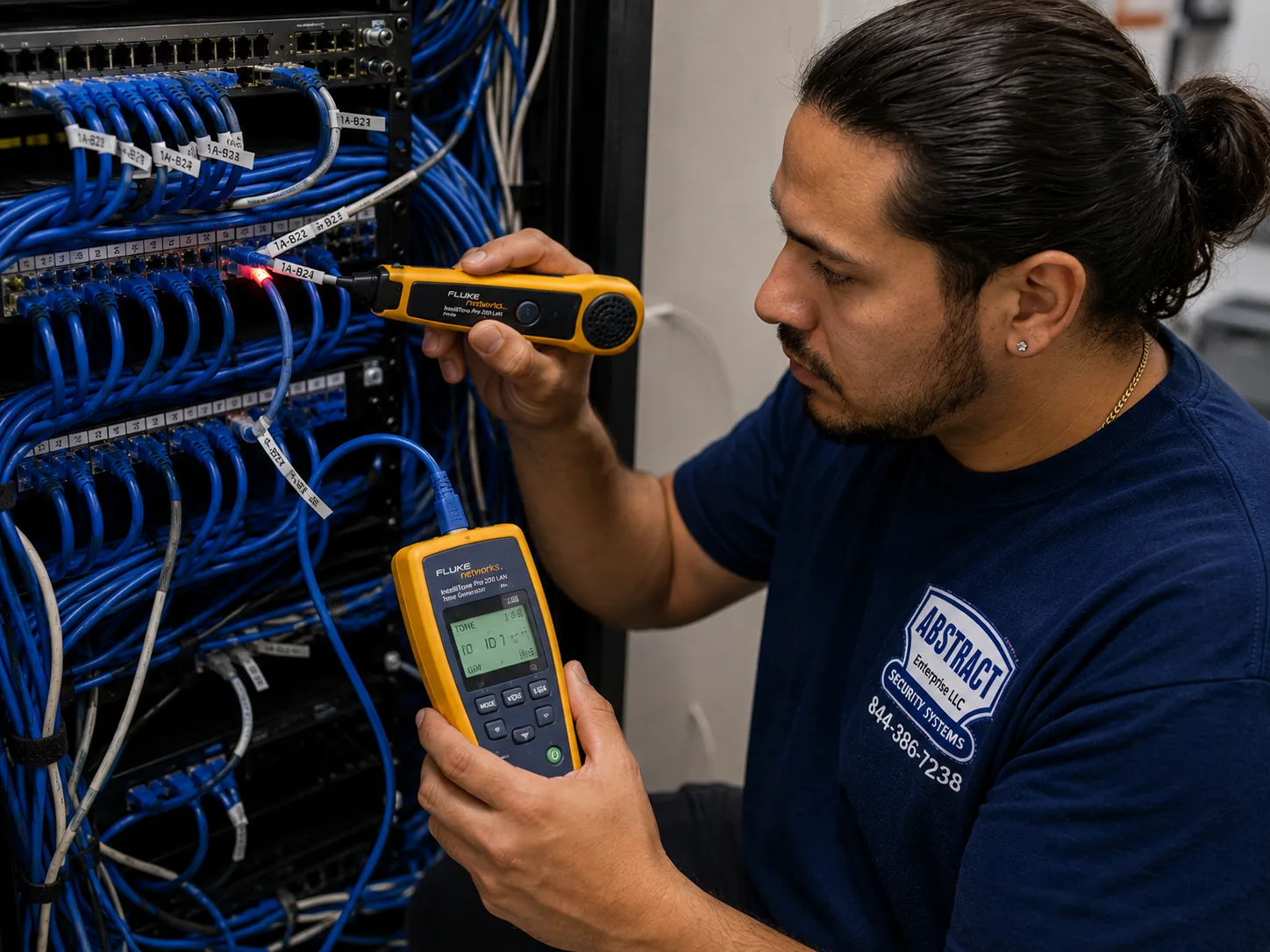
Follow the run, not the label. Where labels exist they are checked, not trusted. A tone probe and a cable tester confirm which run reaches which camera, and where a run tests open, the tester shows roughly how far along it the break is, so only that stretch of ceiling or shaft needs opening, with the building's say-so.
Check the camera last, and at night. Only after power, network and cable test good is a camera judged dead. Then the replacement is set to match the recorder, checked live, checked in playback, and checked again after dark if the problem was a night picture.
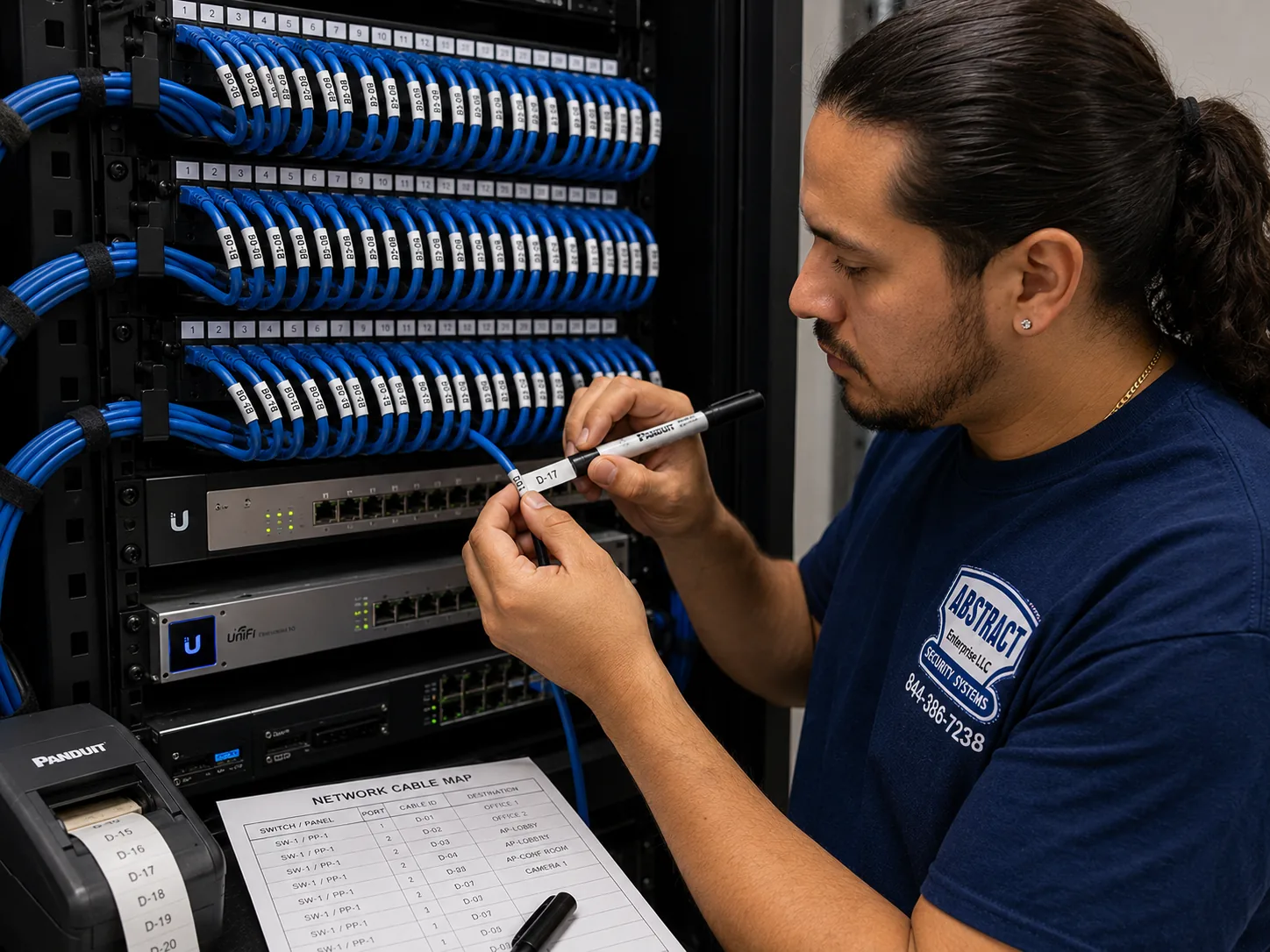
Leave the building a map. Before leaving, every traced run is labeled at both ends, the recorder's clock is set to update itself, failure alerts go to the person the managing agent names, and a short list of what each recorder controls goes on the job record for the next visit.

Four causes account for most of what we find behind DUMBO camera calls. Each leaves recognizable signs, and spotting them early is what keeps a repair to the part that failed instead of a new system nobody needed.
The June 2025 voltage reduction is a good example of a power event that does not look like one. The lights stay on, a little dimmer; the refrigerator keeps running; and a camera system that had no margin starts to misbehave. Power boxes for coax cameras deliver less than their rating when the line voltage drops, so the cameras at the end of the longest runs, which already receive the least power, flicker or drop first. PoE switches that were close to their power budget may cut ports to protect themselves. A recorder whose power supply is ageing may restart while it is writing, and a drive that restarts mid-write too many times starts to report errors.
The signs are a pattern rather than a single failure: the same two or three cameras dropping on hot afternoons, a recorder log full of restarts at similar times, or a switch whose fan runs flat out. The repair is usually modest. We measure what the power box and switch are delivering, replace a tired supply or battery, move one or two cameras to a port or supply with headroom, and check the drive's health. Power supply repair is $150 to $400 on our list, and a drive replacement $200 to $450 by capacity.
What we do not do is electrical work. If the outlet itself is weak, a circuit trips, or the building's wiring is at fault, you need a licensed electrician, and we tell you what we measured so they start in the right place. Once the power is sound, we finish the camera side.
In an office loft, the camera system rarely fails on its own schedule. It fails the week the IT firm swaps the firewall, the day the internet provider replaces its router, or the morning after new Wi-Fi access points go into the closet. The cameras may still be recording perfectly well while the phone app shows them all offline, or a group of cameras may vanish because the switch can no longer power them alongside the new equipment.
We sort these out by testing from the recorder outward: does it see each camera on its own network, does it reach the internet, and does the app reach the recorder? That tells us within minutes whether the fault is the cameras, the switch or the route out of the building. The fix is usually a setting, a port, a power budget or a separate network segment for the cameras, and most of it is configuration that the service call covers.
The lasting part is the note we leave for your IT people. A short list of the camera system's addresses, ports and power needs, kept with the network documents, is what stops the next change from repeating the same outage.

Cellars are where DUMBO buildings put the things nobody wants to see, which is why so many recorders, switches and power boxes end up there. They are also where water goes. The 2019 Water Street main break put at least six inches of water into basements along the street in a single morning, and Sandy did far worse in 2012. Water does not have to reach the recorder to harm it: damp air in a cellar corrodes connectors and power supplies over years, and a drive in a humid room fails sooner than one in a dry closet.
A recorder that has stood in water should be treated as suspect even if it turns on, because corrosion keeps working after it dries. If the footage on it matters, we take the drive out first and try to read it in a clean recorder before deciding anything about the box. Then the head end goes on a shelf or wall mount well off the floor, or better, to a room upstairs, with the battery backup beside it. Moving a recorder is often a short job when spare cable or an existing path allows it, and a priced one when a new path has to be agreed with the building.
Outdoors, the same logic applies to cameras at street level along Water Street and the blocks near the park. Their cable entries and connector boxes are resealed on any repair, because the cable is the path water follows into a wall.
The last cause is the street. A camera facing Washington Street, the Archway or a busy stretch of Front Street sees people almost all day, so a recorder set to save on motion saves almost continuously, and the drive fills and overwrites faster than the owner expects. A storefront door camera looks from a dim interior at a bright street and turns faces into silhouettes. And in buildings close to the Manhattan Bridge, trains pass every few minutes at peak hours, so a mount that was slightly loose keeps working looser, and a picture that wobbles every few minutes sets off motion alerts and blurs the frames that matter.
These are repairs of settings and mounting more than of parts. We set detection zones to the doorway rather than the whole sidewalk, adjust exposure so a person at the door is lit, confirm how many days the drive actually holds at the real level of activity, and tighten or replace mounts so the picture stays still. Where a camera simply faces the wrong way for what it is meant to catch, we say so and price moving it.
DUMBO's business life is packed into a few blocks: the DUMBO Improvement District's 2023 report counted 103 independent businesses and more than 1,000 creative offices, and the neighborhood's own commercial listings put the total above 500 businesses. Each kind puts its cameras to a different test, and recent precinct reports show what gets targeted: a garage and two shops on Front Street, a construction site on Jay Street, and a beauty school on Pearl Street, where Brooklyn Paper reported that a large glass door was shattered at about 5:30 one August 2025 morning and two cash registers were taken.
Boutiques, food shops and the Front Street Garage. The Alo Yoga thefts and the DUMBO Market theft in 2025 both happened here in daylight, which is why door and counter cameras need to show faces, not shapes.
The 360,000-square-foot Empire Stores, renovated in 2017 with a West Elm flagship and the Time Out Market, plus delis, gyms and shops in old warehouses whose cellars took water in 2019.
Restaurants and shops on the block with the Manhattan Bridge view, where one owner told News 12 that at least half his sales now come from tourists and the sidewalk is crowded from morning on.
Office buildings such as 10 and 20 Jay Street, coworking floors and new construction, including the 29 Jay Street site where a copper thief was caught on camera.
Galleries, studios and showrooms near the park and the Clocktower, where cameras guard storage rooms and loading doors as much as the public floor.
The office buildings on Prospect, Adams, Sands and Pearl Streets, home to technology and design firms and coworking at 81 Prospect, plus schools and training centers on Pearl Street.
For a shop on Front or Washington Street, the camera system has three jobs: show a clear face at the door, show the hands at the counter, and keep enough days of video that a theft found at the end of the week is still on the drive. Almost every shop repair we do here comes back to one of those. Door cameras are the hardest, because they look out of a dim shop into a bright street and the street never empties. The fix is usually a camera with better handling of bright backgrounds, aimed at the inside of the door frame rather than the sidewalk, with a detection zone limited to the doorway so the recorder is not filling its drive with passers-by. We set it, then test it the only way that counts: someone walks out of the door while we watch the recording, not the live view.
Counter cameras fail differently. Display lights get moved, a new shelf goes up, a camera is knocked during restocking, and the picture slowly stops covering the register. That is a settings and mounting repair, covered by the service call when no part is needed. Recorders behind the counter fail from heat, dust and being switched off with the lights at closing, so we give them their own protected outlet and battery backup.
Food businesses add grease, steam and long hours. Kitchen cameras film through a haze that settles on the lens within weeks, walk-in coolers fog any camera near the door, and the recorder often sits in a dry storage room or a cellar that is anything but dry. For a restaurant, the cleaning schedule matters as much as the camera: we show your staff which cameras need a wipe and how often, and we place the recorder where heat and damp will not shorten its life.
Offices in DUMBO mostly need their cameras for the suite door, the reception area, the equipment room and the freight entrance, and they need them to keep working through constant changes to the network around them. What they ask for at repair time is usually access: who can see the cameras, from where, and how quickly someone who leaves the company loses that access. We set up individual logins rather than a shared password, put the cameras where the IT firm wants them on the network, and give the office manager a simple way to see that recording is still running. Where several companies share a floor, each company's cameras and the landlord's are kept apart so one tenant cannot see into another's space.

State licensing. The New York Department of State licenses companies that install, service or maintain security and fire alarm systems, and the state rules include closed-circuit television used to detect or monitor intrusion, theft or movement. A business owner working on their own system, or having an employee do it, is exempt, but a company you hire should hold the license. Ours is NYS license #12000287431.
Cameras and employees. New York Labor Law Section 203-c requires employers who monitor staff by video to give notice. If a repair moves a camera nearer to where staff work, it is a sensible time to check that your notice is current and that no camera looks into a restroom or changing area. We are not lawyers, and this is not legal advice.
The Landmarks Preservation Commission. The DUMBO Historic District, designated in December 2007, covers most of the neighborhood. The Commission's permit guidebook says ordinary maintenance and repair of safety equipment needs no permit, while new or replacement cameras on a facade should be well spaced, small and painted to blend, attached at mortar joints, plain masonry, wood or metalwork and never through cast iron or decorative surfaces, with only about ten inches of visible conduit. We repair in place where we can and keep any change inside those lines.
The police. The 84th Precinct, at 301 Gold Street, covers DUMBO. The city's camera registration program lets businesses tell the NYPD where their cameras are, at no cost, so detectives know whom to ask after an incident. Signing up is your choice; a repaired system with the right time on its clock is what makes the footage worth asking for.
These are the situations condo boards, managing agents, landlords, office managers, shopkeepers and contractors describe when they call us about cameras in DUMBO. Each is answered in full here and not repeated in the FAQ further down the page.
Often it can be flattened. A fisheye camera records a single circular image, and the flat views you expect are produced afterwards by software that knows the lens, a step called dewarping. If your recorder or app does not support that particular camera's lens, you see the raw circle. The repair is usually to enable dewarping on a recorder or viewing app that supports the camera, or to replace the recorder with one that does. Where a lobby needs a clear face at the door and a clear view of the mailroom, two ordinary cameras sometimes serve better than one fisheye, and if that is our honest view we price both options so the board can choose.
It can be either, and the first test tells which. Most systems send the camera's picture to the intercom as a network video stream, either from the camera itself or through the recorder. If the camera records normally and plays back on the recorder, the camera is fine and the problem is the stream: a changed address, a changed password, or an intercom update that dropped the setting. If the camera is dark on the recorder too, it is a camera fault first. We check both ends on one visit, and because we repair intercoms as well as cameras, you do not need two companies pointing at each other.
Usually not. Consumer doorbells like Ring and Nest are built to record to their own company's cloud and app, and they generally do not offer the kind of standard video stream a building recorder needs. They also belong to the residents, along with their footage. If the board wants every unit door covered on the building system, the reliable route is building-owned cameras or door stations wired to the building recorder, with clear rules on who may view them. We can repair the building system and advise on that, and residents keep their own devices for their own use.
Very likely. Network cameras and access points both draw power from the PoE switch through their data cables, and every switch has a total power budget. Add a few access points and the switch may not have enough left for every camera, so it cuts power to some ports and the cameras on them reboot, often at busy times when the access points draw the most. We read the switch's power figures on site. The fix is to give the cameras ports with guaranteed power, move them to their own switch, or replace the switch with one that has a larger budget. A PoE port swap runs $150 to $350 on our list, and we tell your IT firm what changed.
Yes, in most cases. Older installations often reached phones by opening a port on the office router straight to the recorder, which leaves the recorder's login page exposed to anyone who finds it. The usual repair is to close that port and switch phone viewing to the manufacturer's own secure connection service, or to a private network connection your IT firm manages, then update the recorder's software and replace any default or shared passwords with individual logins. We do the camera side and agree the router side with your IT people, so phone viewing works again before we leave.
First check your lease for who owns the cameras: some suites came with the landlord's equipment, and some companies added their own. Export any footage you are required or likely to need, then remove the company's phone and cloud accounts from the system so former staff and the next tenant cannot reach each other's video. If the equipment stays, reset it with the landlord's agreement and hand over the new administrator login. If it leaves with you, we take it down, cap the cables neatly and note which runs remain for the landlord. Doing this before the last week saves a scramble on move-out day.
Usually, yes. A cable tester can measure roughly how far along the run the break is, and a tone probe follows the cable through the ceiling from our side, so the search narrows to a few tiles or one access panel instead of a whole corridor. Then the damaged section is replaced or joined properly at a junction box, and the run is tested end to end. Getting into the neighbor's space, or a common ceiling, needs the landlord's or managing agent's approval, so we arrange that before the visit. Who pays for damage caused by another tenant's contractor is between you, the landlord and that tenant; we give you a written note of what we found.

Yes, with the right power arrangement. Temporary site cameras usually stop at night because they share a circuit with the tools and lights that are switched off at the end of the shift. The fix is a separate circuit that stays on, which your electrician provides, or a battery backup in a weatherproof enclosure sized to carry the cameras and recorder through the night. We also check that the recorder or the cameras' own storage is saving, that remote viewing works over the site's connection, and that the cameras still cover the gate after the last phase of work moved them. The 2025 copper theft at 29 Jay Street was caught on camera leaving the site; the aim is to make sure yours would be too.
Yes. Cameras that move with each show will always fall behind it. The better plan is to mount them high on permanent structure, columns, beams or the perimeter walls, and aim them at the things that do not change: the entrance, the loading door, the storage room and the main circulation path. Wider-angle or adjustable-zoom cameras placed that way can see over temporary walls, and the cable stays where install crews will not knock it. When we repair a gallery system, we suggest positions like that and price any moves, so the next installation does not undo the repair.
It is rarely the main cause, but it does not help. Surveillance hard drives are built to write around the clock and cope with ordinary building movement. In our experience heat, unstable power and age kill far more recorder drives than vibration does. Still, in buildings close to the bridge we set the recorder on a solid shelf or wall mount rather than on top of other equipment, keep it away from the wall that carries the most rumble, and check the drive's health report on every visit. If the report shows reallocated sectors or read errors, the drive is replaced before it fails, at $200 to $450 by capacity.
For most buildings, yes. A camera that sees half a block records thousands of strangers a day, fills its drive faster, sends constant alerts and still shows each person too small to recognize at your door. Narrowing the view to the entrance, the vestibule and the step outside gives a larger, clearer picture of everyone who actually comes in. Most recorders can also black out part of the frame permanently with a privacy mask, which helps where a camera cannot avoid seeing a neighbor's window or doorway. Whether and how your building may record the public sidewalk is a question for your own lawyer; the practical case for a tighter view is strong either way.
We repair whatever is on the building, whoever put it there. These are the kinds of equipment we find in DUMBO lofts, offices and shops, and the way each tends to fail here.
The standard in offices and newer buildings, powered over their data cable. They fail at the switch, at a crimped plug, or after a network change.
Common in older conversions and shops, on round BNC plugs. They fail at the connector, the plug-in adapter or a central power box.
The boxes in cellars, offices and closets. Drives wear out, power supplies fade and settings are lost after repeated restarts.
Shared with Wi-Fi and phones in many offices, and the first thing to struggle in a brownout.
Used in lobbies and large lofts to cover a whole room, and dependent on recorder software that understands them.
Platforms such as UniFi Protect, run from an app with the recording on site. UniFi Protect repair runs $300 to $700 on our Brooklyn list.
Consumer cameras that struggle through concrete floors and brick walls and depend on a router someone else controls.
Freight elevator cameras on travelling cable, garage cameras in exhaust, and temporary cameras on site fences.
Concierge screens, office dashboards and phone logins, set up again after a recorder, router or staff change.

Plenty of DUMBO homes and businesses have cameras from a national alarm company or a consumer brand, sometimes bought by a previous tenant. This is how the options compare when one of those systems stops working.
| Question | ADT or similar alarm company | Ring or SimpliSafe camera | AESS local repair |
|---|---|---|---|
| Works on equipment others installed | Usually its own only | Its own devices | Any brand, any installer |
| Wired recorders and PoE networks in shared buildings | Its own systems | Mostly Wi-Fi devices | Coax, network, hybrid and PoE |
| Works alongside your IT firm and managing agent | Varies | Remote support | On site, with written notes |
| Licensed technician on site | Varies by dealer | No | Yes, NYS license #12000287431 |
| Monthly fee to keep recording | Depends on contract | Often, for cloud video | None for a repair |
| Price before work | Varies | Price of a new device | $150 service call, then a written price |
If your cameras came with an alarm contract, read it before anyone else works on them, because some equipment may belong to the alarm company. If they are Wi-Fi cameras fighting a concrete floor, the honest answer is often that no repair makes them reliable there, and a wired camera on the building's recorder is the lasting fix.
These claims appear in AI-generated answers and in national guides from sites such as Angi, HomeAdvisor and Fixr and from camera makers' blogs. Each is paraphrased, then checked against what repairs actually involve in DUMBO's loft buildings, offices and shops.
Reolink's repair guide lists blurry images, cameras that will not power on, unstable video feeds and failed night vision as the common problems, and suggests cleaning, a multimeter, a Wi-Fi extender and splicing a cut wire as fixes. For a single camera on a house, that is a fair start.
In a DUMBO loft building, the camera is rarely alone. It shares a switch with an office's access points, a ceiling with other tenants' cable and a power circuit with a whole closet of equipment. Many of the faults we find are at those meeting points, and no amount of cleaning or splicing at the camera end will reach them.
What a reliable diagnosis needs is the whole chain tested in order, from the outlet and backup through the switch and recorder to the cable and camera. That takes a visit, which is why our repairs start with a service call rather than a guess.
HomeAdvisor's Brooklyn page puts the average for surveillance camera installation or repair at $1,416, with a typical range of $680 to $2,145 and a full span of $160 to $3,500. Those figures mix installations and repairs together.
A repair on its own usually costs far less. On our Brooklyn list, most single faults are $150 to $700, and only a recorder replacement, a rewire or several cameras at once reach $700 to $1,500. A full rewire starts at $1,500.
The number that matters is the written price after the diagnosis, which tells you what failed, and the $150 service call is credited against it if you go ahead.
Advice about outages tends to focus on full blackouts. The June 2025 event in northwest Brooklyn was different: Con Edison reduced voltage by 8 percent across Dumbo and the neighboring areas while it repaired equipment, and most homes kept their lights.
Camera systems with little margin do notice. Power boxes put out less, PoE switches near their budget drop ports, and ageing recorder power supplies restart. The damage may surface days later as a drive error or a camera that drops every hot afternoon.
If your cameras became unreliable after a hot spell with no outage, tell us. It points us to the power side of the system first.
Guides often recommend replacing a troublesome wired camera with a Wi-Fi one to avoid running cable. In a timber-and-brick warehouse or a concrete factory loft, that advice runs into the walls.
Concrete floors and thick masonry block Wi-Fi badly, and the router a Wi-Fi camera depends on often belongs to a tenant or an office whose network changes without warning. The result is a camera that works on installation day and drops out whenever the signal or the router changes.
In most DUMBO buildings the existing cable is the most valuable part of the system. We repair it and keep using it, and only suggest wireless where a run genuinely cannot be made.
AI answers sometimes say landlords are required to maintain security cameras. Brick Underground has noted that no city law requires buildings to have working cameras at all.
The picture is more nuanced. Attorney Jeffrey Reich told Brick Underground that "A landlord that is on notice of criminal activity at a property may be obligated to take reasonable safety precautions," and that fixing a dead camera would be a reasonable step. Condo boards and commercial landlords also have their own rules and leases.
In practice, a DUMBO repair is approved by whoever controls the recorder: the board, the managing agent, the landlord or the business. We are not lawyers, and we work with whoever that is.
Some answers say no license is needed to work on security cameras in New York. That is true for an owner working on their own system, and for an employee doing it on the owner's behalf.
For a company you hire, it is not. The New York Department of State licenses businesses that install, service or maintain security systems, and its rules include closed-circuit television used to detect intrusion, theft or movement.
Ask any company working in your building for its license number. Ours is NYS license #12000287431, and our certificate of insurance can go to your managing agent before the visit.
It is easy to assume a camera is too small to interest the Landmarks Preservation Commission. Most of DUMBO is in the historic district designated in 2007, and the Commission's guidebook has specific rules for security cameras.
It asks for cameras that are small, well spaced and painted to blend, fixed at mortar joints, plain masonry, wood or metalwork rather than through cast iron or decorative surfaces, with about ten inches of visible conduit at most. Repairing existing safety equipment needs no permit.
That is why we repair in place where we can, and keep any replacement on the same mount or within those rules.
Not sure whether it is the camera, the switch, the network or the recorder? Ask before you buy parts or press a button you cannot undo. Call now at (347) 934-8335, send a fast quote request, or speak to a tech on WhatsApp with a photo of the recorder screen. Same-day estimates are available on most days, and requests are booked within 2 hours.
Tell us the street and building, who manages it, how many cameras there are, which are out, when it started and where the recorder sits. A technician will reply with the likely cause and the next step for your DUMBO address, or call (347) 934-8335 now.

A photo of the recorder screen and its sticker, the street and building, and what changed before the fault: hot weather, an IT change, a renovation next door or an incident.
Board, managing agent, landlord, office or shop: we confirm who owns the recorder and approves the price, and arrange the certificate of insurance or elevator booking the building asks for.
The $150 Brooklyn service call puts the visit on the schedule in a two-hour arrival window, credited to the repair if you go ahead.
Any clip you need is exported to USB with the recorder's own timestamp before anything is restarted, unplugged or replaced.
Building power and battery backup, PoE switch or power box, recorder and drive, cable and connectors, and the camera last.
You hear what failed and why, and get a written repair price before any part is changed, with the service call credited.
Only the failed part is replaced, then every camera is checked live and in playback, and again after dark if night pictures were the complaint.
Traced cables are labeled, phone viewing is confirmed for each person who needs it, failure alerts are switched on and notes stay on your job record.
1 Main Street, built in 1914 for Robert Gair and converted to 124 condominiums in 1998, the tower most callers use to place the north end of the neighborhood.
The restored Water Street warehouses, 360,000 square feet reopened in 2017 with shops, offices and the Time Out Market.
The plaza under the bridge at Pearl Street, home to the Brooklyn Flea on Sundays from April to October.
The Brooklyn Public Library branch at 9 Adams Street, opened in October 2021 inside a former factory building.
The boxing gym at 130 Water Street, on the warehouse blocks closest to the Brooklyn Bridge.
The F train stop at the top of the neighborhood, with High Street on the A and C a short walk away.
We also serve the areas around DUMBO at the same Brooklyn rates, including Vinegar Hill and the Farragut Houses blocks to the east, Downtown Brooklyn up the hill, and Brooklyn Heights to the south. Our camera repair in Brooklyn Heights page covers the brownstone streets past the bridge, and our Boerum Hill security camera repair page covers the rowhouse blocks beyond Downtown.
DUMBO is billed at our Brooklyn rate. Every repair starts with the $150 service call, which covers the on-site diagnosis and a written repair price and is credited to the repair if you go ahead. The ranges below come from our published Brooklyn security camera repair prices; your exact price is written down once we know what failed, and the visit goes on the schedule once the service call is paid.
| Repair | Brooklyn price |
|---|---|
| Service call, diagnosis and written price | $150, credited to the repair |
| Settings with no parts: alerts, app, clock, zones, logins | Usually within the $150 call |
| Clean and check for a blurry picture | $80 |
| Connector reterminate or PoE port swap | $150–$350 |
| Power supply repair | $150–$400 |
| Dome or front cover replacement | $30–$80 part plus labor |
| Indoor camera repair | $200–$450 |
| Hard drive replacement, by capacity | $200–$450 |
| Outdoor camera replacement, seal redone | $250–$600 |
| Night vision camera repair | $250–$650 |
| UniFi Protect system repair | $300–$700 |
| DVR not working, with drive and labor | $300–$700 |
| NVR not recording, by model | $400–$900 |
| Vandalized camera, plus any cable repair | $400–$900 |
| PTZ camera repair | $450–$1,200 |
| Hybrid recorder swap, channels reconfigured | $700–$1,200 |
| DVR or NVR replacement, partial rewire, or several cameras | $700–$1,500 |
| Full rewire or whole-building overhaul | From $1,500 |
| Annual maintenance: residence / commercial / multi-property | From $250 / from $400 / $500–$800 |
Three things move a DUMBO repair within those ranges. Tracing comes first: a loft building with two recorders, unlabeled runs and cameras from several tenants takes longer to map than a shop with one recorder. Access is second: freight elevator bookings, a managing agent's insurance paperwork, a neighbor's suite or a ceiling above an open office all need arranging. The third is what the head end has been through, since a drive that must be read before it is replaced takes longer than a straight swap. If the price changes on site, you hear the new figure before work continues. Booking camera work alongside intercom, alarm or cabling work on the same visit saves $200 to $400 in labor on our Brooklyn list.
Full terms — including 50% deposit, one-year parts-only warranty on AESS-supplied products, and the late-fee schedule — are set out in the service agreement.Three ways DUMBO repairs usually come together, priced from the Brooklyn list above. Each starts with the $150 service call, credited to the repair.
One fault, one visit: a tired power box or drive replaced after a brownout, a switch port fixed after an IT change, a cut run spliced, or a Front Street door camera set to show faces.
A recorder replaced with a new drive and every camera set up again, two recorders in a loft building brought onto one, a hybrid recorder so older coax cameras can stay, or a head end moved off a cellar floor.
A yearly check before summer heat: drive health, battery backup tested, switch power reviewed, clocks and software updated, alerts tested and outdoor seals checked, from $250 for a home and $400 for a business.
Bring your own equipment. If you have already bought a replacement camera or recorder, we can fit it at labor-only rates. Send us the exact model and we quote the labor by phone or text, and the visit is booked once it is paid. We cannot vouch for parts we did not supply, and if your model will not work with the recorder, or is a Wi-Fi camera headed for a concrete corridor, we tell you before the visit.
Dark and rebooting cameras, cut runs and overloaded switches. Request a repair
DVRs, NVRs and drives after brownouts and water. Brooklyn security camera repair service
The full list behind every figure here. Camera repair prices in Brooklyn
Owners and managers with buildings in several boroughs. AESS camera repair across NYC
Many managers do, as a deterrent. Habitat magazine described a Brooklyn and Queens property manager putting signs in vestibules to warn thieves the building is monitored, and Midboro Management's president told Brick Underground that cameras and signage are a great deterrent. A sign works best when the cameras behind it are actually recording, which is what the repair confirms.
They should. Smart-home systems pull a stream from each camera or from the recorder, so a repair that changes a camera, an address or a password can break that link. We note the settings before we start, reconnect the streams afterwards and check each touchscreen before we leave.
It is normal on long runs. Network cable is rated for about 100 meters, so installers add a PoE extender to reach further, and those small boxes do fail, especially when they sit in a hot ceiling or lose power in a brownout. We test it, replace it if needed, and note where it is hidden.
Often, yes. Many cameras have an adjustable zoom lens, and building movement, heat or a knock can shift the focus over time. Motorized models refocus from the recorder; manual ones are adjusted at the camera. If refocusing does not restore a sharp picture, the sensor or lens has failed and we price a replacement.
Yes, if everyone has their own login rather than one shared password. During the repair we set up individual accounts with the right permissions and show the office manager how to remove one in a minute, so a departing employee loses access the same day.
Usually. When a brand retires its app or connection service, the cameras and recorder normally keep recording on site. We can often move viewing to a supported app, standard viewing software or a new recorder that accepts the existing cameras, and we tell you which before any part is ordered.
No. A camera is replaced or repaired on its own channel, and the other cameras, their schedules and alerts are left as they are. If the recorder itself has to be replaced, we save its settings first where it allows and rebuild the rest, then check every channel before we leave.
Yes. Cameras with two-way talk have a speaker and microphone in the housing, and they fail from water, a loose internal plug or a setting turned off in the app. We check the setting first, then the hardware, and price a replacement camera only if the audio parts have failed.
Both are possible. We can repair or update the software if the computer is sound, but an ageing office PC running around the clock is a weak point. A dedicated recorder is often the steadier choice, and we price both so you can compare them.
It can be, if it is kept apart from the security system. Sharing a building camera directly can expose the recorder to the internet. The safer route is a separate camera with its own sharing service, aimed at the view and not at doors or windows, so the security cameras stay private.
Yes. Mailroom cameras are often placed before shelving or lockers go in and end up seeing only the doorway. We repair the camera and, with the building's approval, aim it or move it to cover the shelves and the door together, so a package taken is a package recorded.
Security Camera Repair Brooklyn | Same-Day | Brownstone Pros · Security Camera Repair NYC | Same-Day | Abstract Enterprises · Security Camera Repair Manhattan | Same-Day | Co-op COI · Security Camera Repair Queens | Same-Day | Driveway Pros · Security Camera Repair Bronx | Same-Day | Home Base · Security Camera Repair Staten Island | Same-Day | Sandy Zone · Security Camera Repair Long Island | Nassau & Suffolk · Security Camera Repair Hudson Valley | Westchester to Ulster · Security Camera Repair Nassau County | Same-Day · Security Camera Repair Suffolk County | Hamptons + East End · Security Camera Repair Westchester County | Same-Day · Security Camera Repair Rockland County NY | Nyack, Suffern · Security Camera Repair Orange County | Newburgh, Goshen · Security Camera Repair Putnam County NY | Carmel, Mahopac · Security Camera Repair Dutchess County | Poughkeepsie · Security Camera Repair Ulster County | Kingston Woodstock
Security Camera Repair Bath Beach Brooklyn NY · Security Camera Repair Bay Ridge Brooklyn NY | AESS · Security Camera Repair Bedford-Stuyvesant Brooklyn NY · Security Camera Repair Bensonhurst Brooklyn NY | AESS · Security Camera Repair Bergen Beach Brooklyn NY · Security Camera Repair Beverley Square Brooklyn NY · Security Camera Repair Boerum Hill Brooklyn NY · Security Camera Repair Borough Park Brooklyn NY · Security Camera Repair Brighton Beach Brooklyn NY · Security Camera Repair Brooklyn Chinatown Brooklyn NY · Security Camera Repair Brooklyn Heights, Brooklyn NY · Security Camera Repair Brooklyn Navy Yard, Brooklyn NY · Security Camera Repair Brownsville Brooklyn NY | AESS · Security Camera Repair Bushwick Brooklyn NY | AESS · Security Camera Repair Cadman Plaza Brooklyn NY · Security Camera Repair Coney Island Brooklyn NY · Security Camera Repair Crown Heights Brooklyn NY | AESS · Security Camera Repair Cypress Hills Brooklyn NY | AESS · Security Camera Repair Ditmas Park Brooklyn NY | AESS · Security Camera Repair Downtown Brooklyn NY | AESS · Security Camera Repair Dyker Heights Brooklyn NY | AESS · Security Camera Repair East Flatbush Brooklyn NY
Alarm Installation DUMBO Brooklyn NY · Fire Alarm Installation DUMBO Brooklyn NY · Structured Cabling Installation Dumbo Brooklyn NY · Soundbar Installation DUMBO, Brooklyn NY · TV Installation DUMBO Brooklyn · Security Camera Installation Dumbo Brooklyn NY · Door Buzzer Installation DUMBO Brooklyn NY | Loft Entry · Fiber Optic Installation DUMBO Brooklyn NY | Loft Fiber · Door Buzzer Repair DUMBO Brooklyn NY · Intercom Installation DUMBO Brooklyn NY · Access Control Installation DUMBO Brooklyn NY
Send a photo of the recorder screen, the sticker on the recorder and the building or street, and we will tell you what most likely failed and what that kind of repair costs on our Brooklyn list. The $150 service call is credited to the repair, the price is written down before any part changes, and requests are booked within 2 hours. Abstract Enterprises Security Systems has been owner-operated since 2002, holds NYS license #12000287431, is rated 4.7★ across 201 Google Reviews, and sends Brooklyn crews from our Troy Avenue office.
Prefer to send photos? Message a technician on WhatsApp.