Driveway camera that missed the car, a picture ruined by the holiday display, or a camera on the back garage gone dark? Dyker Heights camera repair line, booked within 2 hours: (347) 934-8335
Detached Houses With Side Driveways · Garages at the Back of the Lot · The 80s Blocks in Lights Season · 13th Avenue and 86th Street Shops
Security Camera Repair in Dyker Heights
Any Brand, Any Installer · Curb, Driveway and Back-Garage Cameras · Cause and Written Price Before Parts · Brooklyn Rate
Security camera repair in Dyker Heights begins with our $150 Brooklyn service call, which pays for the on-site diagnosis and is credited to the repair when you go ahead. On our published Brooklyn list most single faults run $150 to $700, and a recorder replacement or a multi-camera rewire runs $700 to $1,500. We fix systems other companies put in, from two cameras on a semi-detached house off Fort Hamilton Parkway to sixteen cameras on a rebuilt house in the 80s with a camera on the garage at the back of the lot. Requests are booked within 2 hours, visits come in two-hour arrival windows, and you hear what failed and see a written price before any part is changed.
Every price on this page comes from our published Brooklyn camera repair list, and your repair price is put in writing before the work starts
Rated 4.7★ across 201 Google Reviews
Reviewed and updated November 12, 2026, against the 68th Precinct's CompStat report for the week of November 2 to 8, 2026; News 12 Brooklyn on national vehicle-theft figures from the National Insurance Crime Bureau (July 2026), the June 25, 2025 voltage problems in southwest Brooklyn and the December 2024 pharmacy burglary on 13th Avenue; Bklyner on the 2017 keyless car break-ins near 10th Avenue and 80th Street and the 2016 display theft on 75th Street; Help Net Security on relay car theft (June 2026); CBS New York on the December 2025 crowds on 84th Street; amNY on Con Edison's 2020 voltage reduction; the Brooklyn Eagle on the 2018 and 2019 Dyker Heights outages and the 2020 Angel Guardian Home designation; CityLand on the 2007 Dyker Heights rezoning; Swann and Reolink support documentation on recording failures, video loss, light banding and day/night filters; the EN 62676-4 pixel-density levels as summarized by CCTV Design Tool; New York General Business Law section 395-b and Labor Law section 203-c; HomeAdvisor's Brooklyn cost page; and the New York Department of State on security system licensing. · Abstract Enterprises Security Systems, NYS license #12000287431 · crews dispatched from our Troy Avenue office in Brooklyn
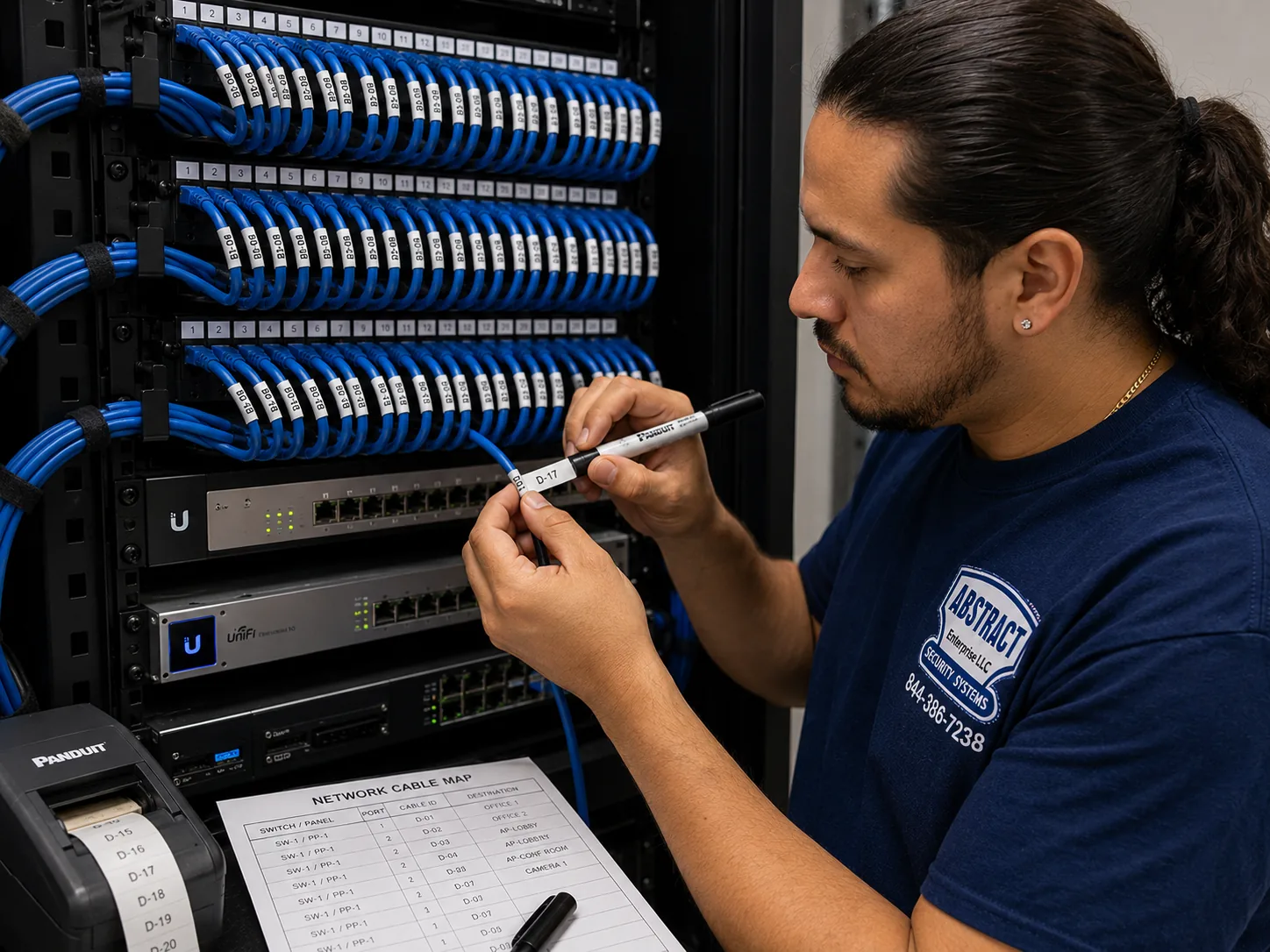
A photo from the AESS job library, not taken in Dyker Heights: a technician printing a label for each cable at a patch panel, with the port map printed beside it. A large Dyker Heights house can have cameras on the porch, both sides of the driveway, the yard and a garage at the back, all running to one recorder in the cellar. When each cable end carries the name of the camera it feeds, the next repair starts at the right wire instead of with an hour of guessing.
Dyker Heights Camera Repair Request
House, two-family, condo, store or office: tell us the block and what the screen shows, and a technician calls back with the next step
✅
Request Sent!
Thank you. A technician will contact you about the Dyker Heights address shortly.
25+
Years Experience
✓
Same-Day Estimates
100%
Licensed & Insured
4.7★
201 Google Reviews
Owner-operated since 2002 · Thousands of jobs completed · Booked within 2 hours
In Dyker Heights the first thing we ask about a broken camera system is not the brand. It is which part of the lot went blind: the curb, the driveway, the yard or the garage at the back. Houses here sit on wide lots with a driveway down one side, a yard behind and often a separate garage at the far end, so a single recorder in the cellar can be feeding cameras well over a hundred feet apart. A camera at the curb that shows a car but not the person beside it is usually a lens, angle or setting problem. A camera on the back garage that drops out is usually a cable, power or Wi-Fi problem along that long run. Several cameras dark at once points to the recorder, its drive or its power. A photo of the screen showing which tiles are black, a photo of the label on the recorder and your block tell us where to start. Send them to (347) 934-8335 or on WhatsApp, and we will tell you the likely fault and what that kind of repair costs on our Brooklyn list.
Looking at your photos costs nothing. The $150 service call is paid when you book and is credited to the repair if you go ahead.
All work is carried out under New York State license #12000287431, on systems from any manufacturer and any previous installer.
If a camera is too old or too damaged to be worth fixing, we say so and price the replacement next to the repair, so you choose.
The Neighborhood
Why Dyker Heights Properties Need Security Camera Repair
Dyker Heights was laid out from 1895 as a suburb of large houses on big plots, and the 2007 rezoning of 159 blocks kept much of it that way, with whole districts mapped for detached houses only and others for detached and semi-detached homes. That shape is the reason camera systems here look different from the systems we repair a mile away in rowhouse Brooklyn. A house in the 70s or 80s between 10th and 13th Avenues commonly has four sides to watch, a driveway that runs past a side door, a yard, and a garage at the back that may be eighty or a hundred feet from the cellar where the recorder sits. The cameras that guard all of that were rarely put up at once. A typical system we open has a few older cameras from the first installer, a newer camera or two added over the driveway after a car problem, a Wi-Fi camera somebody stuck on the garage, and a video doorbell on its own app.
Cars are the pressure we hear about most often right now. The 68th Precinct, which covers Dyker Heights from its station house on 65th Street, logged 150 grand larcenies of motor vehicles in 2026 through the week ending November 8, against 109 in the same stretch of 2025, a rise of 37.6 percent in the precinct's preliminary CompStat figures. Nationally the picture runs the other way: News 12 reported in July 2026 that the National Insurance Crime Bureau counted about 659,880 vehicles stolen in 2025, roughly 23 percent fewer than the year before. When a car disappears from a Dyker Heights driveway or curb, the owner goes to the recorder first, and that is often the moment they find out the driveway camera shows headlights and a blur, the curb is too far away to make out a face, or the camera that should have seen it has been dark since the spring.
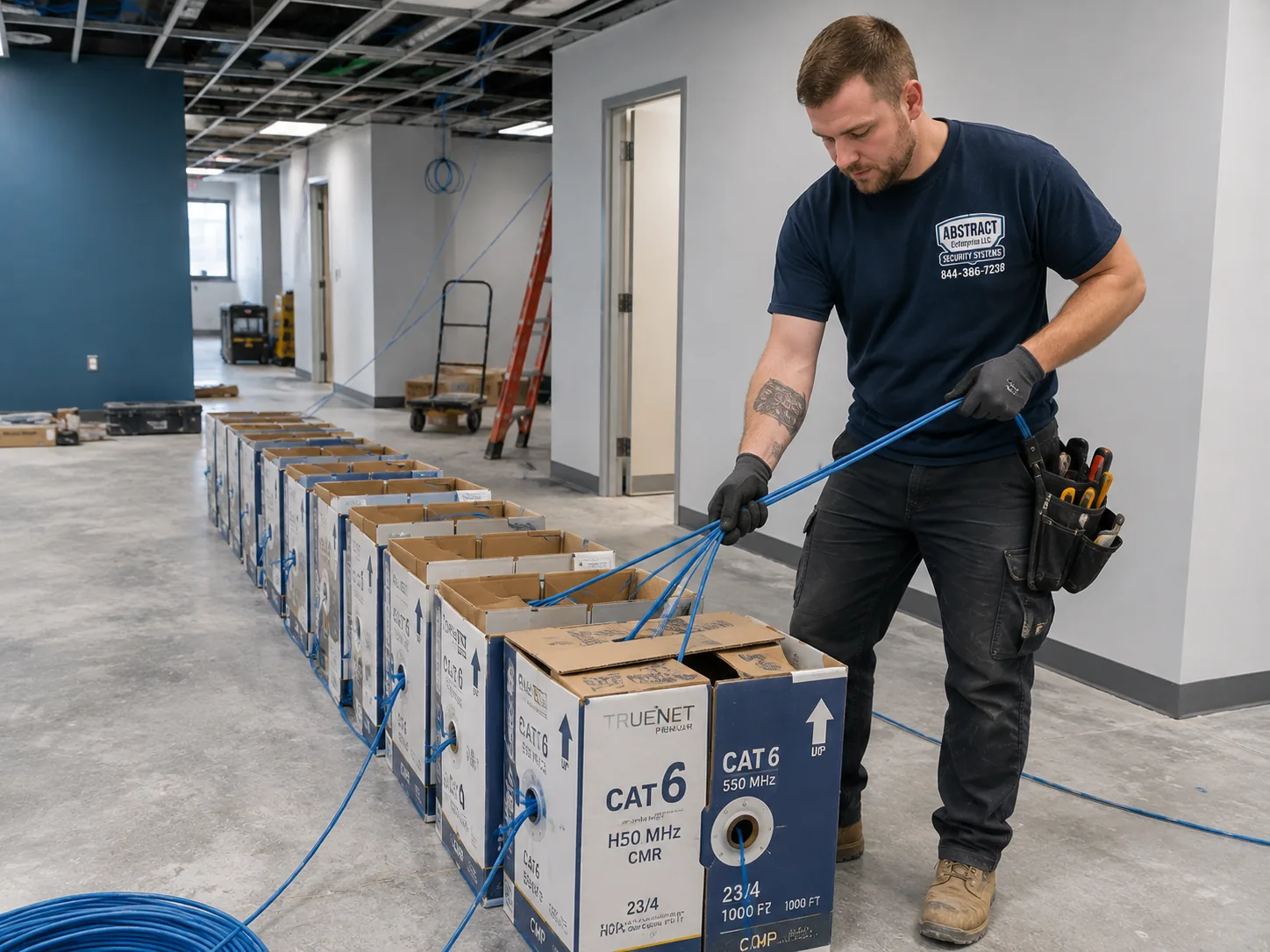
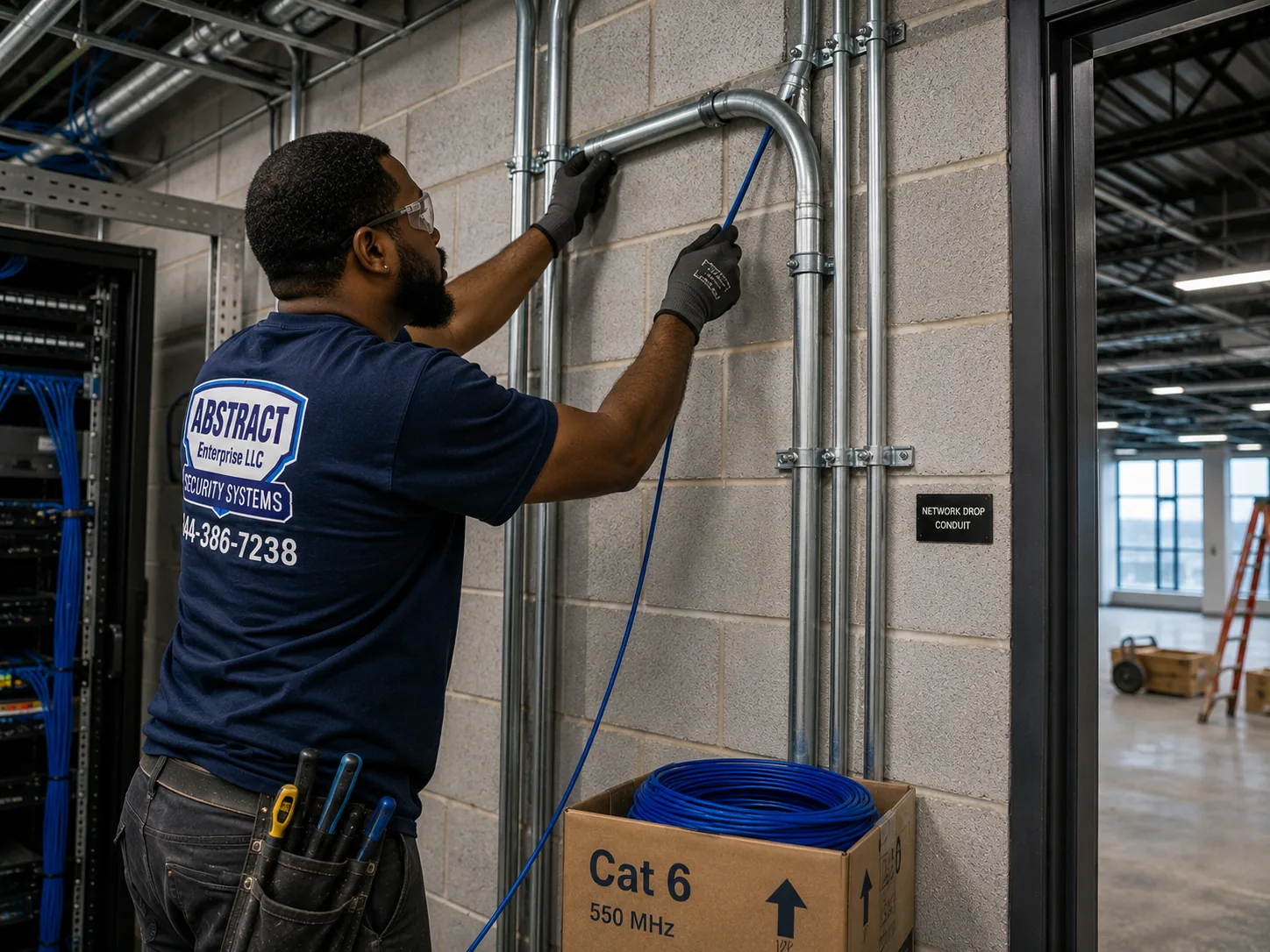
A photo from the AESS job library, not taken in Dyker Heights: boxes of cable staged together before a pull with several drops. When a long run to a garage at the back of a Dyker Heights lot has failed beyond repair, or a camera has to move to see the driveway properly, the replacement cable is pulled once, along a protected path, rather than taped along a fence a second time.
Some of these thefts leave nothing for a camera to show at the car. In 2017 Bklyner reported two break-ins into a BMW parked near 10th Avenue and 80th Street, the first caught on a surveillance camera, and quoted the owner: "They did not have to force the car open." He believed the thief had relayed the key's signal. Help Net Security described the same method in June 2026: one person stands near the house to pick up and boost the key fob's signal while a second waits at the car, and the whole thing "runs in under 30 seconds and leaves the car with no broken glass and no damaged locks." For a camera system, that means the useful footage is often of the person near the front door or the side of the house, not the car itself, and a system aimed only at the driveway misses the half of the crime that happens closest to the house.
The second pressure is the light. Every year from late November into January the blocks of the 80s between 11th and 13th Avenues fill with visitors who come to see the displays. CBS New York photographed the crowds on December 22, 2025, including the tour groups that stop at Lucy Spata's house on 84th Street, and quoted her memory of how the tradition began: "Everybody hated it because of the traffic." For the owners of those houses and the blocks around them, a camera that worked all year can start to misbehave the week the display goes up. LED strings and projectors flicker at a rate the camera can pick up, so the picture pulses or shows bands; colored light keeps a camera hovering at the point where it switches between day and night mode; and the decorators' cords and timers sometimes end up sharing outlets and paths with the camera's power. None of that means the camera is broken, but each one needs a different fix.
The third pressure is power. Much of Dyker Heights is still fed by overhead lines, and the Brooklyn Eagle reported outages in July 2018 that reached more than 6,000 customers, in February 2019 when wires came down on 10th Avenue, and in December 2019 when about 3,600 customers between 11th and 13th Avenues lost power for roughly three hours. More recently the trouble has been partial power rather than blackouts: on June 25, 2025, News 12 listed Dyker Heights among the hardest-hit areas when Con Edison deliberately lowered voltage across parts of Brooklyn, and in July 2020 amNY reported an 8 percent voltage reduction that took in Dyker Heights, Bay Ridge and Bensonhurst. A camera system that sat through those events with an aging power supply, a cheap power strip and no battery backup is the kind that comes back with two or three cameras missing.
Ownership matters as well. Many Dyker Heights houses are two-family homes with an owner downstairs and a tenant or grown children upstairs, and the condos and small apartment buildings near 13th Avenue and Fort Hamilton Parkway have boards or managing agents. We confirm before the visit who owns the recorder and who approves the price. When a camera on a shared driveway or a shared wall is involved, we suggest the owners agree on the repair first, because moving or replacing that camera changes what both households can see.
Six Dyker Heights facts a camera technician works from
Vehicle theft is up locally. The 68th Precinct's year-to-date grand larceny auto count was 150 in 2026 against 109 in 2025, a 37.6 percent rise, even as national thefts fell about 23 percent in 2025.
Burglary is flat and far below its past. The precinct counted 65 burglaries year to date against 64 last year, and its CompStat report shows burglary down 93.3 percent over 33 years.
The lots are wide. The 2007 rezoning mapped districts for detached houses only and others for detached and semi-detached homes, which is why so many systems here reach a garage or yard far from the recorder.
The displays draw crowds for weeks. The most elaborate displays cluster in the mid-80s between 11th and 13th Avenues, and tour buses drop visitors on 86th Street.
The power is overhead and has dipped. Outages in 2018 and 2019 reached thousands of customers, and Con Edison cut voltage in the area in 2020 and again in June 2025.
There is no historic district. The Angel Guardian Home on 12th Avenue, designated in 2020, was described as the first city landmark in Dyker Heights, so ordinary camera repairs on a house here do not go through the Landmarks Preservation Commission.
Where this page applies. It covers Dyker Heights in Brooklyn's 11228 ZIP code, roughly from 7th Avenue to 14th Avenue and from 65th Street down to the Belt Parkway and Dyker Beach Park. Many owners who call about cameras also ask us about the front-door intercom or the gate, and we can look at both on the same visit. If your property is just outside these streets, the same Brooklyn prices apply, and the whole borough is covered on our Brooklyn security camera repair page.
Same-Day Repair in Dyker Heights
Need Repair in Dyker Heights? A Driveway Camera That Missed the Car, a Picture Wrecked by the Display, or a Recorder That Quit Saving
Urgent calls from Dyker Heights usually arrive the morning after something happened. A car is gone from the driveway or the curb, and the clip shows only headlights. A delivery was taken from the porch, and the porch camera turns out to have been off for weeks. A display was damaged overnight, and the camera facing the lawn shows a white glare where the person should be. Or the recorder in the cellar is beeping, and the owner is afraid the night they need is about to disappear. In each case the first job is the same: keep what the recorder already holds, then find out why the picture was not good enough.
If you need footage, leave the recorder running and do not restart it, reset it or pull its power. A restart rarely erases anything, but a reset or a failing drive can. Call (347) 934-8335 with the date and the hour you need, and we book the visit with exporting that clip as the first task. The technician copies it to USB in the recorder's own format with the original time and date, along with a version that plays on an ordinary computer, so it can go to the 68th Precinct or your insurer without anyone handing over the recorder itself.
Everything else follows the normal path: the $150 service call, booked within 2 hours of your request and scheduled in a two-hour arrival window, then the diagnosis, the cause in plain words and a written price before any part is replaced. Many visits end with the fix the same day, because a re-aimed camera, a new connector, a power supply, a drive or a camera body is usually on the truck. When a part has to be ordered, you know that before you approve the repair, and we tell you how long it will take before you decide.
What We Install
Security Camera Repair Services in Dyker Heights
Each repair below is priced from our Brooklyn camera repair list. The service call covers the diagnosis, and you approve a written price before parts go in. We work on analog, HD-over-coax, network and Wi-Fi cameras and on recorders from any manufacturer, whoever installed them.
Driveway and curb camera repair
Cameras that show a car but not a face or a plate, that point at the wrong part of the driveway, or that cannot see the curb across the sidewalk. Fixes range from re-aiming and new settings to a camera with a longer lens placed where it can actually identify someone.
Back-garage and yard runs
Cameras at the far end of the lot that drop out, freeze or come back only in dry weather. We test the cable, joints and power along the run and repair the failed section, re-route it, or replace a weak Wi-Fi link with a wired or point-to-point connection.
Display-season picture fixes
Bands, pulsing, white glare and cameras that click between color and night mode when the holiday lights are on. Most are settings and aim; some need a camera better suited to mixed light.
Recorders and hard drives
DVRs and NVRs in cellars, closets and garages that beep, restart, lose cameras or stopped writing. We check the drive's health, the recording schedule and the overwrite setting, swap drives and replace recorders when needed.
Power supplies, PoE and backup
Central power boxes and PoE switches that weakened after an outage or a brownout, plug-in adapters that died, and battery backups that no longer carry the load. Each is tested under the real number of cameras.
Porch, side-door and doorbell cameras
The camera that watches where a key fob sits and where packages land. Dead cameras, cameras knocked crooked and doorbells that lost their chime or app connection are repaired or replaced to match the rest of the system.
Floodlight, siren and pan-tilt cameras
Deterrence cameras whose light or siren fires with nobody there, floodlights stuck on all night, and pan-tilt cameras that stopped turning. We find whether it is the sensor, the setting, the motor or the power.
Phone app and account recovery
Systems that vanished from the app after a new router, accounts tied to a relative's old email, forgotten recorder passwords and alerts that stopped arriving. We restore access and set up each person who needs to see the cameras.
Footage export for police and insurers
Clips saved to USB with the original timestamp, in the recorder's own format and in a common one, so a car theft or a damaged display can be reported without handing over the recorder.
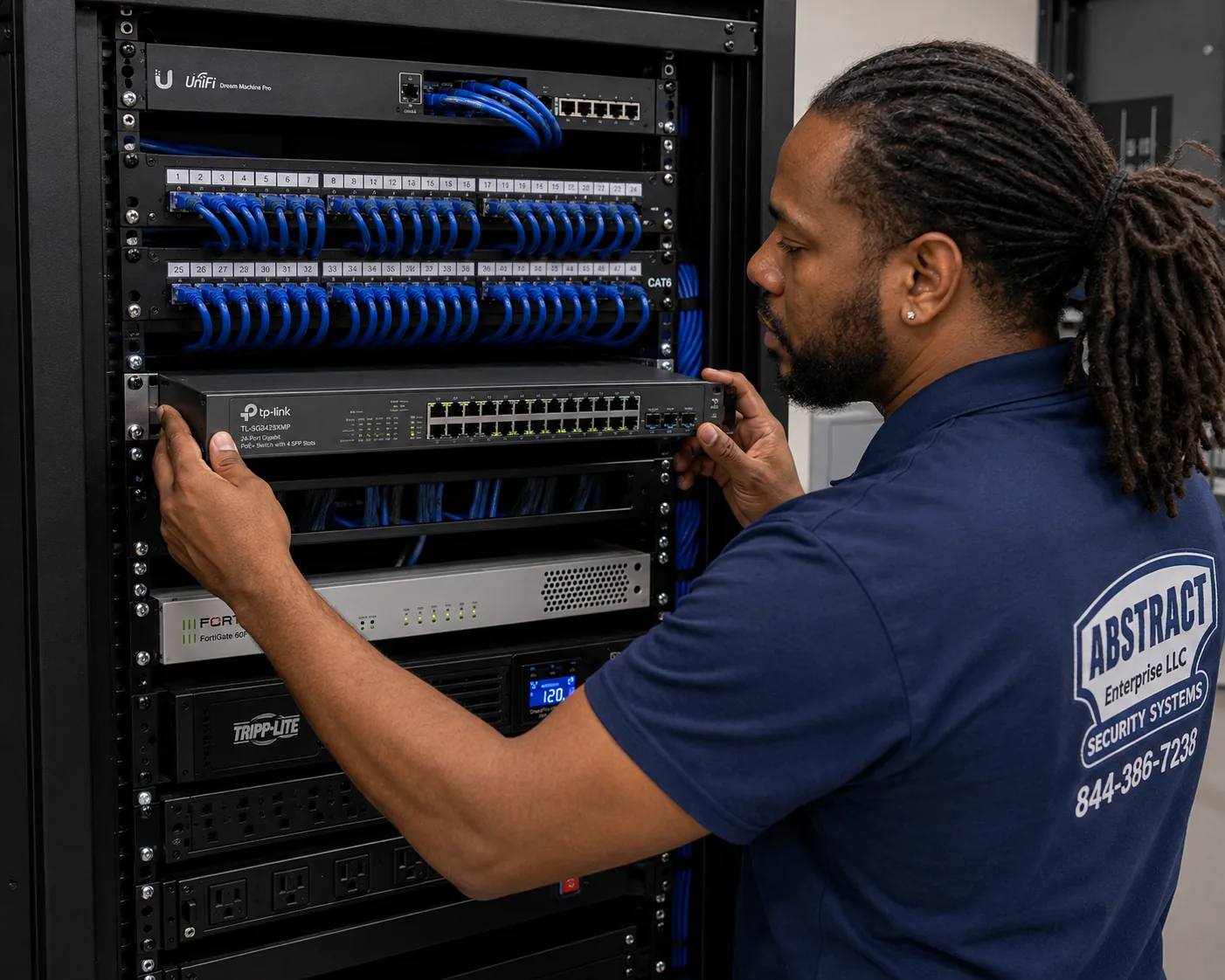
A photo from the AESS job library, not taken in Dyker Heights: a technician mounting a managed PoE switch below patch panels in a rack. In a Dyker Heights house the switch is more often on a cellar shelf than in a rack, but the job is the same. When a power dip leaves one or two network cameras dark while the rest come back, a weak or failed switch port is one of the first things we test, because it powers and connects the camera through the same cable.
Building Specialists
Security Camera Repair for Dyker Heights' Architecture
Almost every camera call in Dyker Heights comes from one of seven kinds of property. Each one breaks its cameras in its own way, and knowing which one you have tells us what to bring.
Victorian-era originals on the hill
The surviving houses from the 1890s development, with deep porches, towers, wood trim and full cellars. Cameras are often fixed to wood or tucked under porch roofs, and cables wander through old framing.
Detached houses with a garage out back
The brick and frame houses of the 1920s through the 1950s, with a side driveway leading to a garage at the rear. The garage camera is the one that fails most, because its cable or signal travels the farthest.
Semi-detached pairs
Two houses sharing one wall, each with its own driveway or a shared one. Cameras on the shared side and on a shared driveway see both properties, so the repair affects two households.
Rebuilt houses with built-in cameras
Large new or rebuilt houses on old lots, with cameras set into soffits and eaves, network cabling inside finished walls and a recorder in a closet or equipment room.
Attached rowhouses near the edges
The rowhouse blocks mapped toward the neighborhood's edges, with a front camera over the stoop or garage door and a rear camera on the back of the house, usually on short runs.
Condos and small apartment buildings
Newer condo buildings and walk-ups near 13th Avenue and Fort Hamilton Parkway, with lobby, mailbox, stair and parking cameras on one recorder controlled by a board or managing agent.
Stores with apartments above
Avenue buildings with a shop on the ground floor and homes upstairs, where the store's cameras and the residential entrance cameras sometimes share a recorder, a power box or an internet line.
Victorian-era originals: mounting into wood and finding the old cable
About half of the roughly 150 houses built in the first wave of the development still stand, according to the history of the neighborhood, and the ones we see have the features of their time: deep wooden porches, turned posts, shingle or clapboard walls, and cellars under the whole house. Cameras on these houses tend to be mounted where the first installer found something solid, which is often a porch beam or a corner board. Wood moves with the seasons, so a camera on wood slowly tilts, and the screws that hold it loosen. The cables usually enter through a drilled hole in trim and then travel through framing that nobody has opened in decades.
Our approach is to re-mount a tilting camera on a proper junction box or mounting plate that spreads the load, seal the entry so water stops following the cable, and trace each cable from the camera to the cellar before cutting anything. If a cable runs inside a wall we cannot open, we look for a path along the porch ceiling, a downspout line or a corner where a short exposed run in a painted raceway disappears against the trim. The aim is a repair that does not leave new holes in original woodwork.
Detached houses with a garage out back: the long run is the weak point
On a deep Dyker Heights lot the garage camera can sit well over a hundred feet from the recorder, and the way its cable got there decides how it fails. Cable stapled along a fence picks up water at every staple and gets cut by landscapers. Cable buried in the yard without conduit gets nicked by a shovel or crushed when a driveway is repaved. Cable strung overhead between the house and the garage sags and chafes. A Wi-Fi camera on the garage depends on a signal that has to pass through a brick or stucco back wall and then across the yard, and it fades every time someone parks a car between the house and the garage.
For a coax camera, distance shows up as a soft or grey picture; for a network camera it shows up as dropouts, because the camera is starved of power at the end of the run. Reolink's support guide makes the same point: video loss is often caused when the "Cable is too long, or one cable is supplying too many cameras at once." We measure at the far end, not only at the recorder, and then decide whether the run needs a new connector, a new section, a new path or a different link altogether.
Semi-detached pairs: two owners, one wall, one driveway
The semi-detached houses common in the postwar parts of Dyker Heights put two owners side by side. A camera on the shared side of the house, or over a driveway the two houses use together, records both properties. When that camera fails or needs to be moved, the repair is partly a camera question and partly a neighbor question. We can narrow the view, set privacy masks so part of the picture is blacked out on the recording, or move the camera to see only one household's door, but we suggest both owners agree before we change what the camera records.
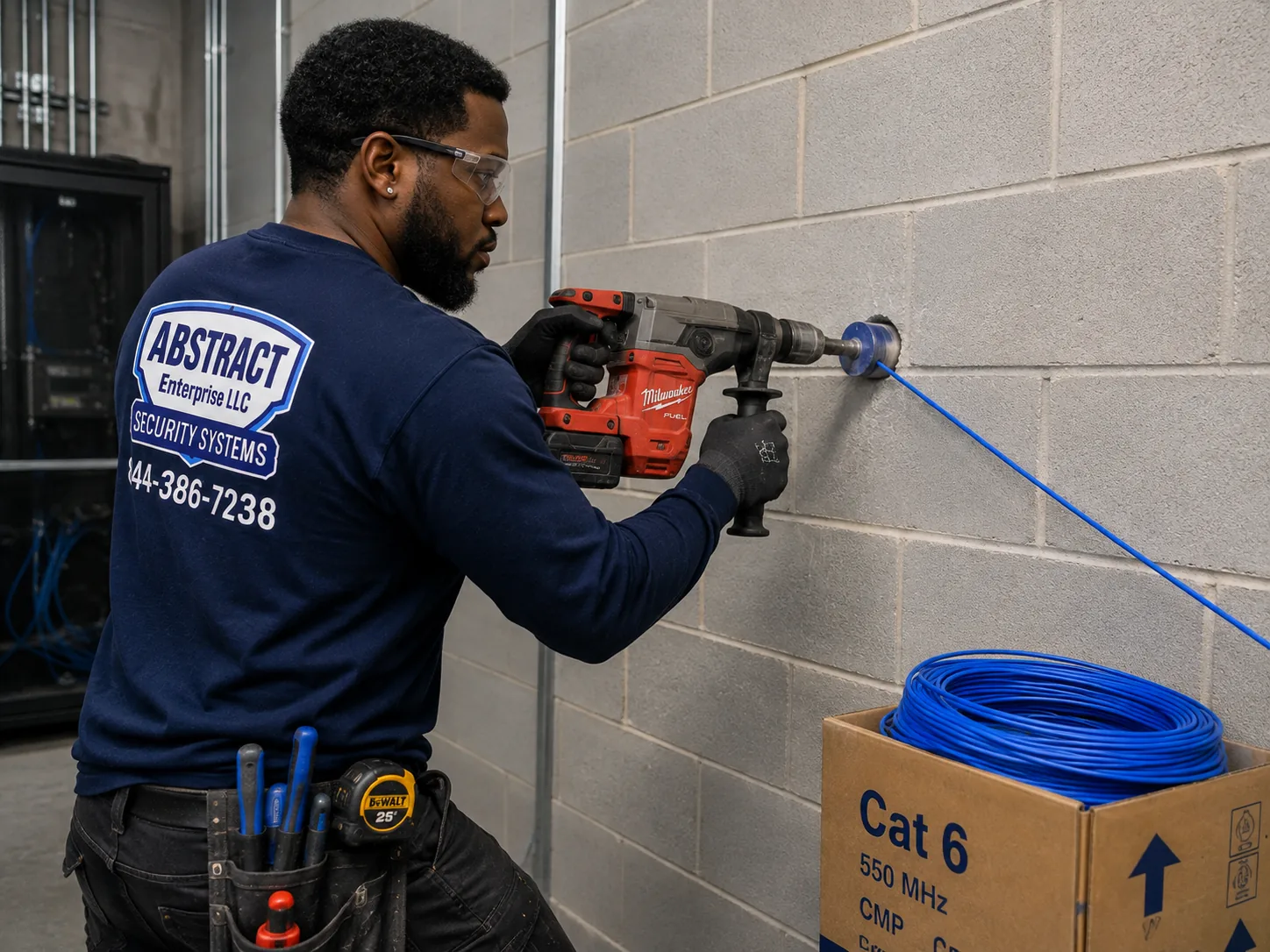
A photo from the AESS job library, not taken in Dyker Heights: a technician core drilling a block wall to carry cable through to a network room. On Dyker Heights houses we drill only when a cable has no other way in, such as a new run from a garage that has to pass through a block or brick wall into the cellar, and the hole is sleeved and sealed so water and pests cannot follow the cable.
Rebuilt houses: hidden cables and many cameras on one recorder
The large houses built on older lots over the last few decades often came with ten, sixteen or more cameras set into soffits and eaves, with network cable run inside the walls before the drywall went up and a recorder in a closet, a laundry room or a mechanical room. These systems fail differently from older ones. The cameras are usually good, but the recorder is overloaded, the PoE switch is too small for every camera's night-vision power, the drive is full of continuous recording, or the installer's login is the only one anyone ever had.
Because the cables are inside finished walls, we start by testing each one from the recorder end and labeling it, then work out which camera each one feeds. A soffit camera can usually be replaced from the outside without touching the interior. If a cable inside a wall has failed, we look first for a spare cable or an empty conduit the builder left before suggesting a new path.
Attached rowhouses: short runs, crowded cellars
The rowhouse blocks toward the edges of the neighborhood have systems that are easier to reach and easier to fix. Runs are short, the recorder is usually in the cellar near the boiler or the electric meter, and most problems are power, a drive or a camera body. The common trouble is heat and dust in a cellar corner, or a recorder plugged into the same strip as a dehumidifier or a freezer, so we look at where the recorder lives as part of the repair.
Condos and small apartment buildings: who approves, who logs in
In the condo buildings and walk-ups near the avenues, the cameras that matter are at the lobby door, the mailboxes, the stair and the parking area, and they belong to the building. We need to know who can approve the price, who holds the recorder's login and whether the board has a rule on who may view footage. With that settled, the repair itself is often quick: a failed camera, a dead power box or a recorder that needs a new drive.
Stores with apartments above: separating what should be separate
Mixed buildings on 13th Avenue, 11th Avenue and Fort Hamilton Parkway sometimes have one recorder covering both the store and the residential entrance, or the store's cameras running on the same internet line as an apartment upstairs. When the store owner and the building owner are different people, that arrangement causes trouble the day one of them changes the router or the lease ends. A repair is a good time to give each party its own recorder or its own login and to label which cameras belong to whom.
Field Notes
Field Notes: Starting a Dyker Heights Camera Repair at the Curb and Ending at the Back Fence
These notes describe how our technicians work through a camera system on a Dyker Heights lot. They are our working method, not a story about any one address.
Start at the curb. Before going inside, the technician stands where a car parks overnight, at the driveway apron and at the side door, and checks on a phone what each camera actually sees from those spots. It is the fastest way to learn whether the problem is a dead camera or a camera that was never pointed at the place that matters.
Go to the recorder and its power. Next comes the cellar, closet or garage where the recorder lives: its drive health, its recording schedule, whether it overwrites old footage, the age of the power supply, what else shares the outlet and whether a battery backup is still holding a charge.
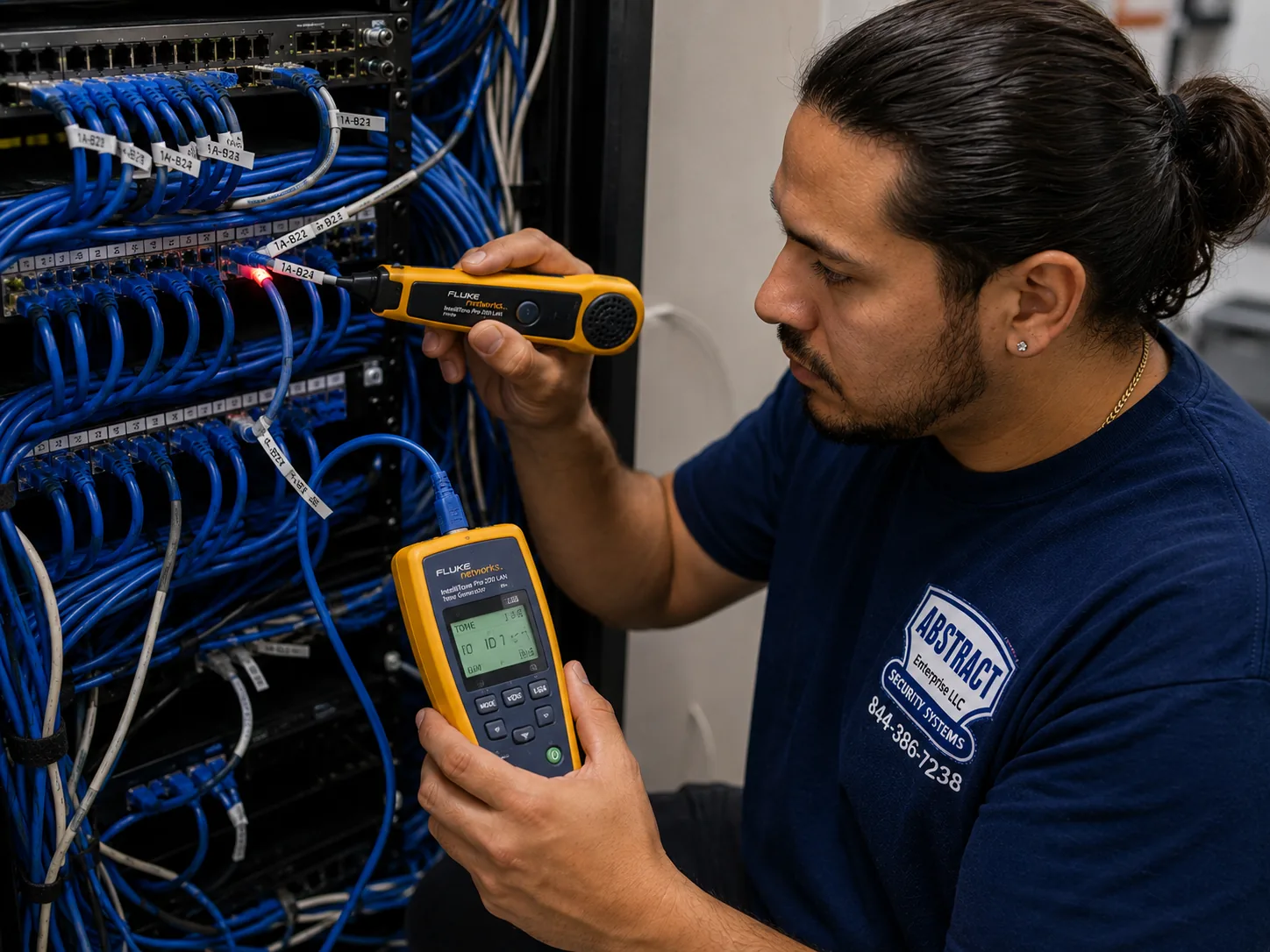
A photo from the AESS job library, not taken in Dyker Heights: a technician tracing an unidentified cable at a patch panel with a tone generator and probe. In a house where three installers have added cameras over twenty years, the cellar can hold a bundle of unlabeled cables, and toning each one out is how we find the run that goes to the garage before anything is cut.
Walk the run to the farthest camera. For any camera that drops out or looks weak, the technician follows its cable as far as it can be seen, along the side of the house, across the yard or up to the garage, looking for staples, splices, chafed spots and places where water collects, then measures at the far end.
Check the night, not just the day. A camera that looks fine at noon can fail its real job after dark. Where the complaint is about night pictures or display-season glare, the technician checks the night settings and, when the visit allows, the camera's view in its night mode.
Price first, then leave a record. You hear the cause and get a written price before any part is replaced. When the work is done, each cable carries a label, and you get a short list of what is where: which camera is on which channel, where the recorder and power supply are, and who has a login.
Fault by Fault
Curbside Cars, Lit-Up Lawns, Deep Lots and Weak Power: How Dyker Heights Camera Systems Fail
Five patterns explain most of the camera repairs we see in Dyker Heights. Knowing which one you are dealing with saves a visit, and sometimes saves buying a camera you do not need.
The curb and the driveway: seeing a car is not the same as identifying a person
Most driveway cameras were put up to show that a car is still there. After a theft, the owner needs something different: a face, clothing, a second person, a plate, the direction a car left in. That takes pixels on the target. The European camera standard EN 62676-4 sets out four levels, summarized by the design site CCTV Design Tool as about 25 pixels per meter to detect a person, 62.5 to observe, 125 to recognize and 250 to identify. A wide-angle camera over a garage door may give a person at the curb only a small fraction of the identification level, so the clip shows someone was there and nothing more.
The repair is usually one of three things. The camera is re-aimed and its lens set narrower so the spot where the car sits, or the path to the side door, fills more of the frame. The camera's recording settings are raised, because many recorders save a low-resolution stream to stretch storage. Or a second camera is added with one clear job, such as watching the curb or the front door, so the wide camera can keep the overview. We show you the before and after on your phone from the curb, so you can see the difference rather than take our word for it.
The display weeks: when the lights confuse the camera
Decorative LEDs, projectors and animated displays are hard on cameras in three ways. The first is flicker. Swann's support guide explains that "Horizontal bands happen when your camera's frame rate or shutter speed doesn't match the frequency of the light source," and the fix is to set the camera to the local power frequency, which is 60 hertz in North America. Some cameras leave the factory set wrong, and some displays flicker at their own rates, so the setting and the shutter both need attention. The second is mode-switching. A camera decides between day and night mode by how much light it sees, and colored light near that threshold can make it flip back and forth, moving the filter inside the camera each time. Swann notes that frequent switching can "gradually wear down the internal mechanisms of the filter," which is why a camera that clicked all December sometimes comes out of January stuck in one mode.
The third is glare. A camera pointed across a bright lawn toward a dark sidewalk will expose for the lights and lose the people. Re-aiming, a backlight or wide dynamic range setting, a fixed night schedule for the weeks the display runs, and sometimes moving the camera a few feet so the brightest pieces are out of frame usually solve it. We prefer to fix these in early November, before the display goes up, but we can make the changes with the lights on so you can judge the result.
The back of the lot: distance, weather and Wi-Fi
The camera on a detached garage or at the far fence is at the end of the longest run on the property, and everything along that run works against it: voltage drop on a long power cable, water getting into an outdoor splice, a cable chewed or cut in the yard, or a Wi-Fi signal that has to cross brick, stucco and open yard. The symptoms are recognizable. The camera drops out in rain and returns when things dry, freezes at night when its infrared lights draw more power, or simply shows "offline" a few times a day.
We test from both ends. If the cable is sound, the fix may be a better connector, a sealed junction box or a power supply at the far end. If the cable is damaged, we replace the bad section or run a new one along a protected path, such as conduit along the garage wall or under the yard where it will not be dug up. If wired is not practical, a dedicated point-to-point wireless link between the house and the garage is far steadier than a camera trying to reach the household router on its own.
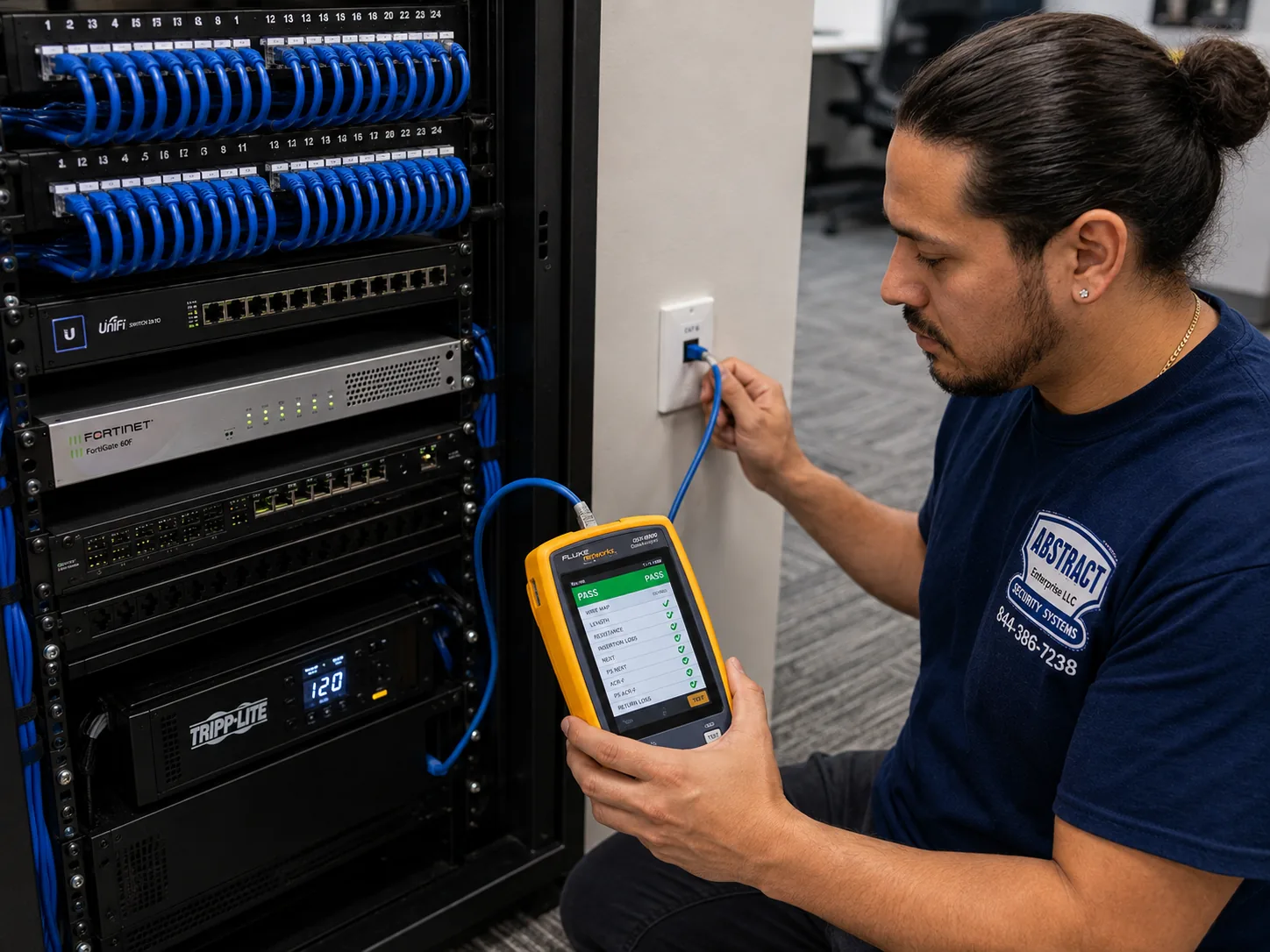
A photo from the AESS job library, not taken in Dyker Heights: a technician certifying a data drop with a cable analyzer that shows a PASS result. On a long run to a garage at the back of a Dyker Heights lot, a test like this tells us whether the cable itself is sound, so a dropout gets traced to the real cause instead of being blamed on a camera that is actually fine.
Brownouts on an overhead grid: damage without a blackout
Camera systems in Dyker Heights have lived through both kinds of power trouble: full outages when overhead lines came down, and deliberate voltage reductions, like the 8 percent cut Con Edison made across the area in 2020 and the reduced power News 12 reported in Dyker Heights on June 25, 2025. A full outage is simple for a camera system: it goes off and comes back. Long low-voltage stretches are harder. Power supplies run hot trying to hold their output, recorders restart repeatedly, and drives can be corrupted mid-write. Reolink's guide puts it plainly: "The insufficient power supply is, very often, the culprit of the video loss on one or all security cameras."
The repair starts with measuring what each camera receives, then replacing a tired power supply or PoE switch, giving the recorder and switch a battery backup sized for the real load, and adding surge protection where cables come in from outside. We also check that the recorder restarts cleanly on its own and that every camera returns after power is cut and restored, so you are not finding out the next time the block goes dark.
Settings that drift: the camera works, the recording does not
A surprising share of repairs involve no failed part at all. A recorder was set to record only on motion and the motion zone was moved, so nothing triggers. A drive filled up and the overwrite setting was off, so recording stopped weeks ago. A firmware update reset the schedule. Swann's guide says that "Recording settings, schedules, or storage problems are usually the cause" when footage is missing, and that these problems "can stop recordings even when the camera appears online." That is the trap: the live view looks perfect, so nobody notices until the night they need the footage. We check every channel's recording, not just its live picture, and we set up an alert that tells you when a camera or a drive stops.
Commercial Security Camera Repair
Business Security Camera Repair in Dyker Heights
Dyker Heights is mostly houses, and its businesses sit on a few avenues where the 2007 rezoning kept commercial overlays: 13th Avenue, which is also signed Dyker Heights Boulevard and serves as the main shopping street, 11th Avenue and Fort Hamilton Parkway, with 86th Street crossing the southern part of the neighborhood. The shops, offices and practices there need cameras that hold up to long hours, back doors on alleys and service lots, and a busy December.
Pharmacies and food stores on 13th Avenue
Counters, aisles, stock rooms and back doors. News 12 reported in December 2024 that a pharmacy on 13th Avenue was forced open with a pry tool before 6 a.m. as part of a citywide pattern, which is why rear-door coverage and recording that actually saves matter most here.
Restaurants and cafes
Front counters, dining rooms, kitchen doors and delivery entrances, where grease, steam and heat shorten camera life and cameras near the kitchen need cleaning or sealed housings.
Shops facing the December crowds
Stores near the 86th Street bus drop-off and on the avenues closest to the displays, where foot traffic swells in the evenings for weeks and the front cameras face the brightest street of the year.
Service businesses on 11th Avenue
Salons, offices, repair shops and small storefronts with a short street front and a back room, typically with four to eight cameras on one recorder.
Storefronts on Fort Hamilton Parkway
Businesses along the parkway with parking or delivery areas beside or behind the store, where the outdoor cameras are on longer runs and face traffic lights and headlights at night.
Churches, schools and parish buildings
Larger campuses such as St. Bernadette on 13th Avenue and the schools and church buildings around the neighborhood, with cameras across several buildings, yards and gates.
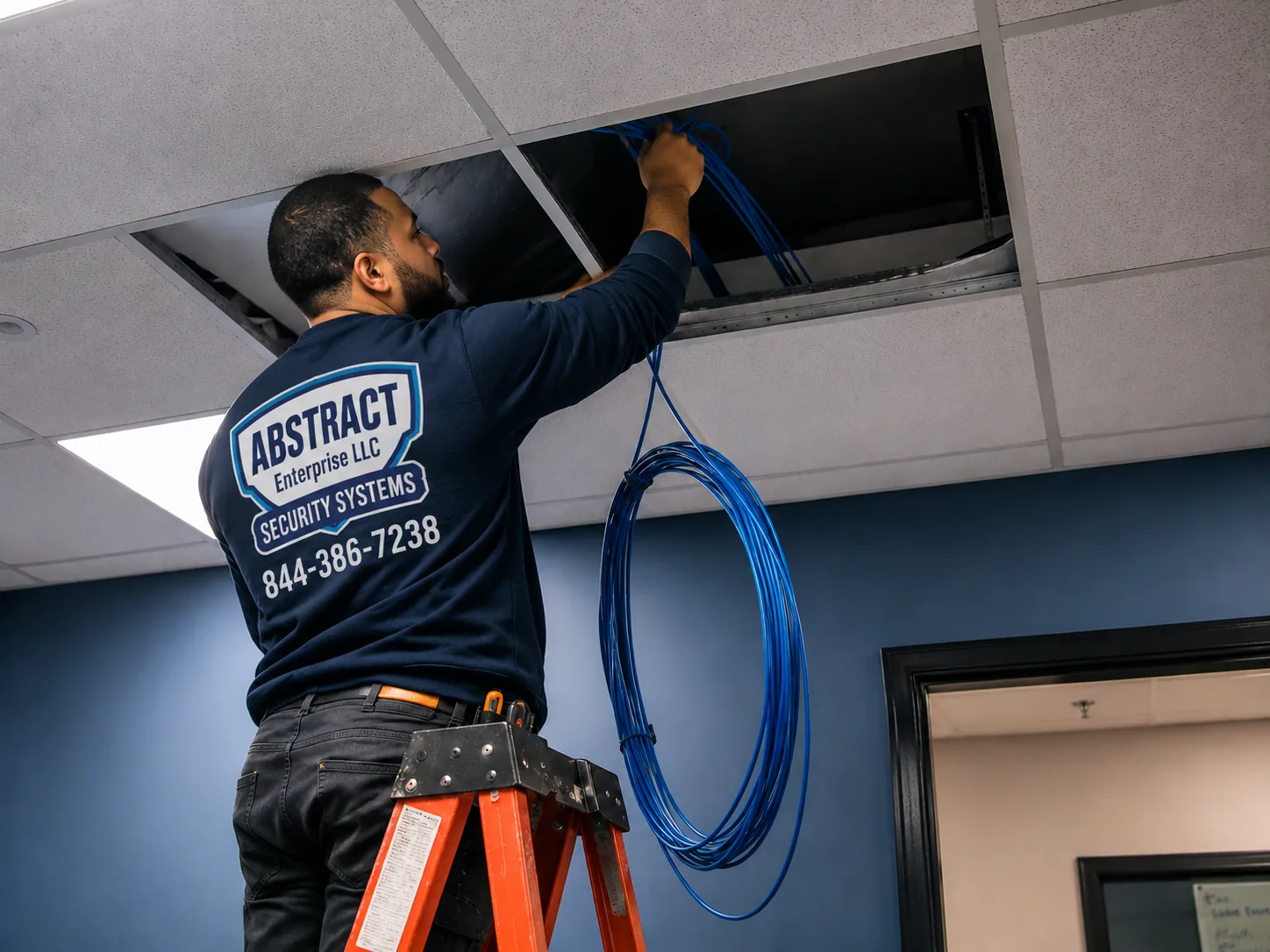
A photo from the AESS job library, not taken in Dyker Heights: a technician feeding cable through the ceiling of a business that stayed open during the work. Stores on 13th Avenue rarely want to close for a camera repair, so cable work in the ceiling is planned around customers, and the cameras that matter most, at the register and the back door, are brought back first.
What a 13th Avenue store needs from a repair
Store owners usually call after a loss. Something left the stock room, a back door was tried at night, or a customer dispute needs a clip from the register. The recorder then turns out to keep only a few days, or the back-door camera has been aimed at a stack of boxes since the last delivery. We repair what failed and then check four things every store needs: the register is covered without filming card PINs, the back door and any alley or lot door are covered from inside and out, the recorder keeps enough days that a loss found at inventory can still be checked, and the recorder itself is in a locked spot where a burglar cannot simply carry it off.
For forced entry in particular, the camera on a rear door should see the person working on the door, not only the doorway once it opens. That usually means a camera outside the door, mounted high enough not to be reached, plus a camera inside that faces the door, and a recording schedule that keeps full-quality video overnight rather than motion clips that may start late.
Offices and medical practices in converted houses
Some of the professional offices in Dyker Heights are in houses or the ground floors of mixed buildings, with a waiting room, a reception desk and a side or rear entrance. The cameras there often run on the same network as the office computers and phones, so a repair has to be coordinated with whoever manages that network. We keep the cameras off the office's sensitive equipment where possible and agree the change with your IT person before we touch the router or switch.
Rules that touch a commercial camera repair
State licensing. The New York Department of State licenses companies that install, service or maintain security systems, including camera systems used to detect intrusion or theft. AESS works under NYS license #12000287431.
Places cameras may not record. New York General Business Law section 395-b makes it a crime for an owner or manager to knowingly allow a device to be installed or kept "for purpose of surreptitiously recording a visual image of the interior of any fitting room, restroom, toilet, bathroom, washroom, shower." When a store's cameras are repaired or re-aimed, we make sure none of them looks into a fitting room or a restroom.
Cameras that watch staff. New York's Labor Law section 203-c sets notice rules for employers who monitor employees. A repair that adds or moves a camera covering work areas is a good moment to check that your notices and acknowledgments are in order. This is general information, not legal advice.
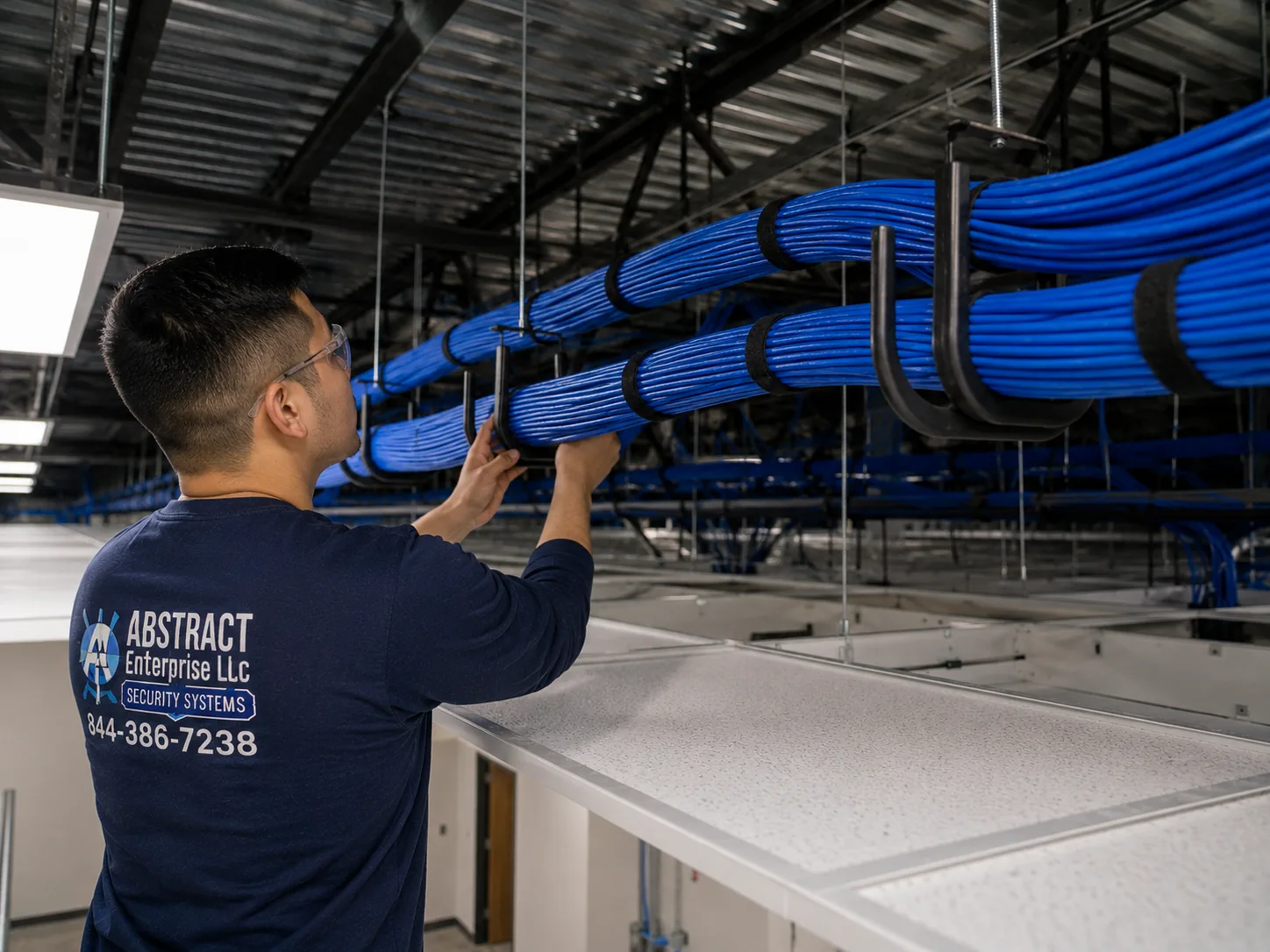
A photo from the AESS job library, not taken in Dyker Heights: J-hooks carrying neat bundles of cable across a commercial ceiling. In a store or parish building with cameras added over many years, cables are often laid loose on ceiling tiles or tied to pipes, and supporting them properly during a repair keeps the next ceiling job from pulling a camera offline.
Your Questions Answered
Security Camera Repair in Dyker Heights: Questions Answered
These are the situations Dyker Heights homeowners, two-family owners, condo boards and store owners bring to us, grouped by where on the property they happen.
Cars, driveways and the curb
Our car was opened and driven off the driveway without a single broken window. What should our cameras have caught, and why didn't they?
If nothing was forced, a relay theft is likely. In that method one person stands near the house to pick up the key fob's signal while a second person opens the car, and Help Net Security describes the whole thing taking under 30 seconds. The most useful camera was the one covering your front door and the wall nearest where the keys are kept, because that is where the first person stood. If your cameras only watch the driveway, we re-aim or add one to cover the door and that side of the house, and we suggest keeping the fob in a signal-blocking pouch away from outside walls.
We park at the curb, across the sidewalk from the house. Can a camera on the porch identify someone at the car, or only show that somebody was there?
That depends on how many pixels the camera puts on a person at that distance. The EN 62676-4 levels call for about 250 pixels per meter to identify someone and 125 to recognize them, and a wide porch camera often gives a person at the curb far less. A narrower lens, a camera mounted lower and closer to the curb, or a dedicated curb camera can reach recognition or identification. We test it from the curb with you before and after the change.
The cable to our garage camera ran under the driveway, the driveway was repaved last summer, and that camera has been dead since. Does the driveway have to come up?
Rarely. We first test the cable from both ends to confirm it was cut or crushed rather than disconnected at a joint. If it is damaged under the paving, we usually run a new cable along a different path, such as up the house wall and across in an overhead span, along the fence line in conduit, or through the garage side, or we link the garage with a point-to-point wireless bridge. Breaking up a new driveway is the last option, not the first.
The lights weeks
Every December the picture from our front camera pulses or shows dark bands once the display is switched on. Is the camera failing?
Almost certainly not. Bands appear when a camera's shutter or frame rate does not match the way the lights flicker. Setting the camera to 60 hertz, which is the North American power frequency, and adjusting its shutter usually clears it. Some displays use controllers that flicker at their own rate, and for those we tune the exposure or move the camera so the worst pieces fall outside the frame.
When the display is lit, our porch camera keeps clicking between color and black-and-white all evening. What is it reacting to?
The light level around it is sitting right at the point where the camera decides between day and night mode, and colored display light makes that worse. Each switch moves a small filter inside the camera, so weeks of switching wear it out. We fix the camera in one mode on a schedule for the season or adjust the switching threshold, and if the filter is already stuck we replace the camera.
The decorators plugged the display into the same outlet as our camera power box and ran their cords along our camera cable. Now the camera drops out when the display timer comes on. Why?
The display is pulling the outlet's voltage down, tripping a GFCI, or putting electrical noise onto the line the camera's power supply depends on. Cords bundled tightly with a camera cable can also add interference to older coax cameras. We move the camera's power to its own outlet or a battery backup, separate the cables, and check whether the power supply survived. You may need an electrician if the circuit itself is overloaded; we do not do electrical work.
We moved a camera indoors, behind the front window, to keep it away from the crowds. At night it shows nothing but a white glow. Can that be fixed?
The glow is the camera's own infrared light bouncing off the glass. Turning the camera's infrared off and relying on the street and display light, pressing the lens flat against the glass with a hood, or using a camera made for viewing through windows solves it. If the view outside is too dark without infrared, the better answer is an outdoor camera mounted high enough to be out of reach.
Long side yards and the hardware on them
Our side-yard camera shows the whole driveway, but anyone at the side door is too small to recognize. Can the camera we have be changed, or does it need a different lens?
If it is a varifocal camera, we can zoom and refocus it so the side door fills more of the picture, and that costs only the service call. If it has a fixed wide lens, the choice is a camera with a narrower or adjustable lens in the same spot, or a second camera dedicated to the side door. We show you both views on your phone before deciding.
The pan-tilt camera on the corner of our house stopped turning and now stares at one spot. Repair or replace?
First we check the power, because pan-tilt cameras need more of it when the motors move and a weak supply shows up there first. Then we check its settings and firmware, since a lost preset or patrol schedule can look like a dead motor. If the motor or gears have failed after years outdoors, replacement is usually cheaper than repair, and for many lots two fixed cameras covering the views you actually used work better than one camera that turns.
The siren and floodlight on our deterrence camera go off at night when nobody is there. Is the camera faulty?
Usually it is the trigger, not the camera. Moving branches, headlights on the street, display decorations blowing in the wind, cats and even rain can trip a motion rule set too wide. We narrow the detection area to the parts of the lot people actually walk, switch the siren to fire only on person detection, schedule it for the hours you choose, and test it in place. If the sensor itself is failing, we replace the camera.
Stores and offices on the avenues
Burglars have been prying store doors before dawn on our avenue. Can our existing cameras be changed to show someone working on the door, not just the doorway after it opens?
Yes, in most stores. The outside camera is re-aimed to show the full door and the person standing at it, mounted out of reach, and the inside camera is turned to face the door. We set both to record continuously overnight at full quality rather than in short motion clips, and add an alert to your phone for activity at the back door after closing.
Our clothing store's camera near the fitting rooms has stopped working. When it is repaired, where is it allowed to point?
At the aisle and the fitting-room entrance, never into the rooms. New York General Business Law section 395-b bars owners from knowingly allowing a device that secretly records the inside of a fitting room or restroom. We repair or replace the camera so it watches the corridor and the door, use a privacy mask if any part of the picture could see inside, and show you the recorded view before we leave.
Equipment
Types of Security Cameras and Recorders We Repair
We repair what is already on the house or the store, whoever put it there. These are the kinds of equipment we work on most often in Dyker Heights, and what usually goes wrong with each.
Analog and HD-over-coax cameras
Cameras on round BNC connectors, from old analog to HD-TVI and HD-CVI. Typical faults: corroded connectors outdoors, weak power at the end of a long yard run, and interference from cords bundled with the cable.
Network (IP) and PoE cameras
Cameras powered and connected through one network cable. Typical faults: a failed switch port after a power dip, a damaged connector, an address conflict after a router change, or not enough PoE power for every camera at night.
DVRs, NVRs and hybrid recorders
The box in the cellar that holds the footage. Typical faults: a worn drive, a recording schedule lost after an update, overwrite switched off, restarts after brownouts and forgotten admin passwords.
Wi-Fi and battery cameras
Cameras on the garage, the yard fence or the porch that rely on the household router. Typical faults: weak signal through brick and stucco, a new router they never rejoined, and batteries that cannot keep up with constant motion.
Varifocal and long-lens cameras
Cameras with adjustable zoom for the curb, the driveway apron and the side door. Typical faults: focus that drifts with temperature, a zoom set too wide to identify anyone, and a fogged lens behind a failed seal.
Floodlight and deterrence cameras
Cameras with built-in lights, sirens and speakers. Typical faults: lights stuck on, sirens firing at branches or headlights, and failed power adapters on outdoor plugs.
Pan-tilt-zoom cameras
Cameras that turn and zoom from a corner of the house or a store front. Typical faults: worn motors and gears, lost presets, and power supplies too small for the motors.
Video doorbells
Wired and battery doorbells on their own apps, often the camera closest to where keys hang inside. Typical faults: a transformer too weak for the doorbell, a chime that stopped, and lost Wi-Fi after a router change.
Power supplies, switches and battery backups
Central power boxes, plug-in adapters, PoE switches and UPS units. We test each under the real load of every camera running its night lights.
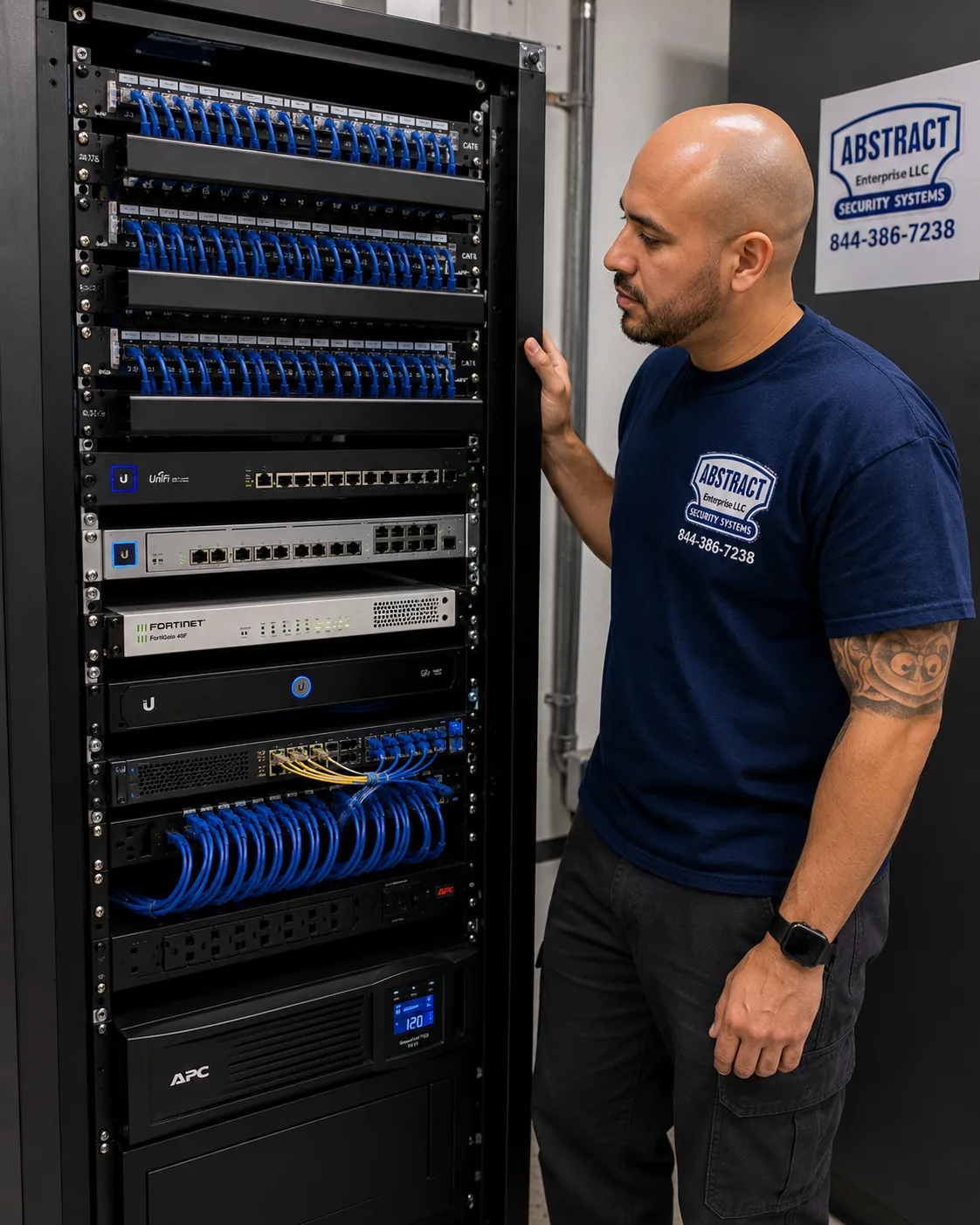
A photo from the AESS job library, not taken in Dyker Heights: a finished rack with patch panels, switching, a firewall and a battery backup, every cable dressed and identified. Few Dyker Heights houses need a rack this size, but the rebuilt houses with sixteen or more cameras often have a closet that deserves the same order: labeled cables, a switch sized for every camera and a battery backup that has actually been tested.
National camera and alarm brands versus a local licensed repair
Plenty of Dyker Heights houses have a Ring doorbell, a SimpliSafe or Arlo camera on the garage, or cameras that came with an ADT alarm, sitting next to a wired system from a local installer. Each of those brands supports its own devices, usually by phone and by replacement. A local repair company works on the whole lot at once. Here is the practical difference.
What you need
ADT or a similar alarm company
Ring, Arlo or SimpliSafe camera
AESS local repair
Who owns the cameras
Depends on the contract; some equipment is leased
You do
You do, and we fix it
A camera on a garage a hundred feet back
Depends on how it was wired
Relies on your Wi-Fi reaching it
Run tested end to end; wired or bridged link where Wi-Fi fails
Several brands on one property
Usually only its own
Support covers its own devices
Any brand, any installer
Identifying a person at the curb
Varies by camera
Wide fixed lens on most models
Aim, lens and recording quality checked from the curb
Licensed technician on site
Varies by dealer
Remote support
Yes, NYS license #12000287431
Price before work
Varies
Cost of a replacement device
$150 service call, then a written repair price
AI Overview Reality Check
What AI Gets Wrong About Security Camera Repair in Dyker Heights
These claims turn up in AI-generated answers, national cost guides and lead sites such as Angi, HomeAdvisor and Thumbtack. Each is partly true somewhere. Here is how they hold up on a Dyker Heights lot.
"If the camera shows the car, the system did its job"
Many answers about driveway cameras treat any footage of the car as success. The advice is to point a camera at the driveway, confirm the car is in frame and move on.
After a theft, a clip of a car leaving is close to useless. Police and insurers want a face, clothing, a second person or a plate. The EN 62676-4 levels give a sense of the gap: about 25 pixels per meter is enough to detect a person, while about 250 is needed to identify one. A wide camera over a garage door often sits near the bottom of that range for anyone at the curb.
So the test of a driveway camera in Dyker Heights is whether it can identify a person at the spots that matter: the driver's door, the path to the side door and the front step. We check that from the curb on your phone, then adjust the lens, the aim, the recording quality or add a camera with that one job.
"Keyless car thefts can't be caught on camera, because nothing is broken"
Some answers suggest cameras are pointless against relay theft, since the car opens as if the owner were there and there is no break-in to see.
The car shows nothing broken, but the people are still visible. Help Net Security's June 2026 description of the method has two people: one near the house picking up the key fob's signal, one at the car. The Dyker Heights owner Bklyner quoted in 2017, whose car was opened near 10th Avenue and 80th Street, put it simply: "They did not have to force the car open." His first break-in was still caught on a surveillance camera.
The repair lesson is about coverage. A system aimed only at the driveway misses the person standing at the front door or along the wall where the keys hang. Re-aiming one camera to the door, setting recording to full quality overnight and keeping the fob in a signal-blocking pouch together do more than a new driveway camera alone.
"Car theft is falling, so driveway cameras matter less than they used to"
National headlines in 2026 have been good. News 12 reported that the National Insurance Crime Bureau counted about 659,880 vehicles stolen in 2025, around 23 percent fewer than in 2024 and far below the record of 1,020,729 in 2023. AI summaries repeat that trend as if it applied everywhere.
It does not apply to the 68th Precinct this year. Its preliminary CompStat report for the week ending November 8, 2026 shows 150 grand larcenies of motor vehicles so far in 2026 against 109 for the same period in 2025, up 37.6 percent, while burglary stayed almost flat at 65 against 64.
For Dyker Heights owners, that makes the driveway and curb cameras the ones most worth checking now. A ten-minute look at the playback from those cameras, done after dark, tells you whether you would have usable footage if your car were next.
"More light always means a better night picture"
AI answers about grainy night footage nearly always say to add light. For most yards that is reasonable advice.
The Dyker Heights displays show its limits. Bright decorative LEDs can make a camera's picture band or pulse when its shutter does not match the lights' flicker, as Swann's support guide explains. Colored light near a camera's switching point can make it flip between day and night mode all evening, and a bright lawn exposes the frame for the lights while the people on the sidewalk turn into dark shapes.
The fix is control, not quantity: the camera set to 60 hertz, exposure and backlight settings tuned for the season, a fixed night schedule, and the camera aimed or moved so the brightest pieces are out of frame. We would rather make those changes before the display goes up than after the first complaint.
A photo from the AESS job library, not taken in Dyker Heights: a technician running cable into EMT conduit beside a telecom room in an industrial building. The same kind of metal conduit is how we protect a replacement run along a Dyker Heights garage wall or a stretch of fence, where unprotected cable gets cut by landscapers, chewed or crushed.
"Security camera repair costs anywhere from $160 to $3,500"
HomeAdvisor's Brooklyn page for installing or repairing surveillance cameras gives a low-to-high span of $160 to $3,500, with a typical range of $680 to $2,145 and an average of $1,416. AI answers quote those numbers as the cost of a repair.
Those figures mix new installations with repairs, so they say little about fixing one camera on a house. On our Brooklyn list most single faults cost $150 to $700, and only a recorder replacement, a multi-camera rewire or an overhaul goes higher. The span also hides what moves a price in Dyker Heights: the length of the run to the back of the lot, whether a damaged cable is under paving or in open yard, and whether the recorder has to be replaced.
The useful number is the $150 service call, which is credited to the repair, followed by a written price once the cause is known. That way you are comparing a real price for your fault, not a range built from other people's jobs.
"A business can put a camera anywhere on its own premises"
Answers about store cameras often say an owner may record any part of a business they own or lease, as long as it is not a home.
New York says otherwise for some rooms. General Business Law section 395-b makes it a crime for an owner or manager to knowingly allow a device for secretly recording the inside of a fitting room, restroom, bathroom or shower. Labor Law section 203-c sets notice rules for monitoring employees. A clothing store on 86th Street or a restaurant on 13th Avenue needs its cameras placed with both in mind.
When we repair or re-aim business cameras, we check each view against those rules, use privacy masks where a frame edge could reach a private area, and show the owner the recorded view. This is general information, not legal advice.
"Older Brooklyn neighborhoods need Landmarks approval for camera work"
Because so much of brownstone Brooklyn sits in historic districts, AI answers often assume any older Brooklyn house needs Landmarks Preservation Commission approval before a camera is replaced.
Dyker Heights is mostly not regulated that way. The Brooklyn Eagle described the Angel Guardian Home on 12th Avenue, designated in 2020, as the first city landmark in the neighborhood, and we found no historic district covering its residential blocks. The Saitta House on 84th Street is on the National Register, which does not by itself require city approval for work on a private house.
That means an ordinary camera repair on a Dyker Heights house does not wait on a Landmarks permit. Condo boards, co-ops and some homeowners' agreements may still have their own rules about what goes on a facade, so we ask about those when you book.
Check Your Driveway and Curb Cameras Before You Buy New Ones
Tell us the address or block, the kind of property, how many cameras there are, which ones are out and where the recorder sits. If you need footage from a particular night, say so, and that becomes the first task on the visit. Photos of the recorder screen, the recorder label and the camera that failed help us arrive with the right parts. For anything urgent, call (347) 934-8335 now.
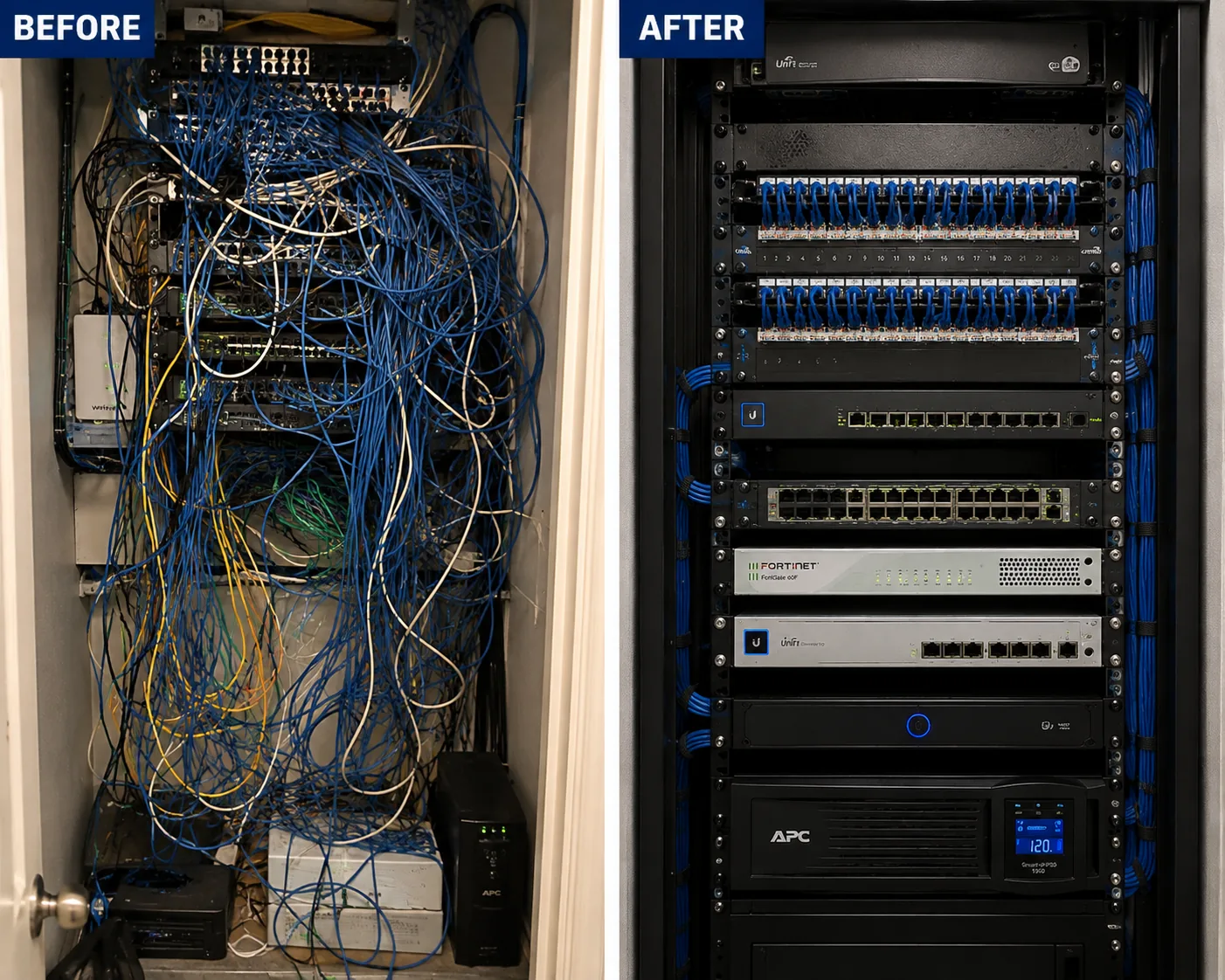
A photo from the AESS job library, not taken in Dyker Heights: before-and-after views of a network rack, an unlabeled tangle rebuilt into dressed and identified cabling. A cellar shelf in a Dyker Heights house where three installers each added cameras can look like the first picture, and leaving it like the second is part of how we close out a repair.
✅
Request Sent!
Thank you. A technician will contact you about the Dyker Heights address shortly.
How It Works
Our Repair Process
1. Send photos and the address
A photo of the recorder or phone screen with the dark cameras, a photo of the recorder's label, your block, and when the problem started. We reply with the likely cause and what that kind of repair costs.
2. Say who owns the system
Homeowner, two-family owner, tenant, condo board, managing agent or store owner. The person who owns the recorder approves the price, and shared-driveway cameras are agreed between neighbors first.
3. Book the service call
The $150 Brooklyn service call books the visit in a two-hour arrival window and is credited to the repair. Requests are booked within 2 hours.
4. Save the footage that matters
Any clip needed for a car theft, a damaged display or a store loss is exported to USB with its original timestamp before anything is changed.
5. Walk the lot and test each link
Every camera is checked from the curb to the back fence, then power, cable, connectors, switch, recorder and drive are tested in order.
6. Explain the cause and write the price
You hear what failed in plain words and get an itemized written price before any part is replaced. If a camera is not worth repairing, we say so.
7. Repair and check day and night views
Failed parts are fixed or replaced, and each camera is checked live and on playback, and in its night mode where the complaint was about the dark.
8. Label, set alerts and hand over
Cables get labels, phone viewing and alerts are confirmed for each person who needs them, and you receive a short written record of what is where.
Coverage Area
Security Camera Repair Near Dyker Heights' Landmarks
Dyker Beach Park and Golf Course
The 18-hole public course and park along the Belt Parkway at the south end of the neighborhood, near where December tour buses wait.
The 84th Street display blocks
The heart of the lights season between 11th and 13th Avenues, including Lucy Spata's house, which she began decorating around 1986.
Angel Guardian Home
The former children's home on 12th Avenue, designated in 2020 as the neighborhood's first city landmark.
Saitta House
The 1899 English half-timbered house at 1135 84th Street, designed by John J. Petit and listed on the National Register in 2007.
St. Bernadette Church
The parish church on 13th Avenue between 82nd and 83rd Streets, on the neighborhood's main shopping street.
Dyker Library
The Brooklyn Public Library branch at 8202 13th Avenue, opened in 1974 with its blue-green glazed front.
Dyker Heights is billed at our standard Brooklyn rate. Each repair starts with the $150 service call, which pays for the on-site diagnosis and the written price and is credited to the repair when you go ahead. The ranges below come from our published Brooklyn security camera repair prices, and your exact figure is written down on the visit once we know what failed.
What gets fixed
Brooklyn list price
Service call with diagnosis and written repair price
$150, credited to the repair
Aim, zoom, motion, schedule, app or flicker settings, no parts needed
Usually covered by the $150 service call
Lens clean and check for a blurry picture
$80
Connector redone or PoE switch port swapped
$150–$350
Power supply repair or replacement
$150–$400
Replacement dome or front cover
$30–$80 part plus labor
Indoor camera repair
$200–$450
Recorder hard drive replaced, by capacity
$200–$450
One camera replaced on an otherwise working system
$250–$600
Night vision repair or swap to color night vision
$250–$650
DVR that will not work, drive and labor included
$300–$700
NVR that stopped recording, by model
$400–$900
Vandalized camera, each, plus any cable repair
$400–$900
Pan-tilt-zoom camera repair
$450–$1,200
Hybrid recorder swap with channels set up again
$700–$1,200
New DVR or NVR with drive, or wiring repair across several cameras
$700–$1,500
Full rewire or whole-system overhaul
From $1,500
Yearly maintenance: house / business / several properties
From $250 / from $400 / $500–$800
Three things move a Dyker Heights repair within those ranges. The first is the length and condition of the run: a camera on a garage at the back of a deep lot takes longer to test, and a damaged cable under paving or along a fence may need a new path. The second is height and reach: cameras under the eaves of a three-story house or on a garage roof need a taller ladder and more time. The third is the recorder: replacing it, or untangling a system three installers built without labels, adds setup and tracing time. If the price changes once the work is under way, you hear the new number before we continue. Combining the camera repair with intercom, alarm or cabling work on the same visit saves $200 to $400 in labor on our Brooklyn list.
Full terms — including 50% deposit, one-year parts-only warranty on AESS-supplied products, and the late-fee schedule — are set out in the service agreement.
Shop Our Systems
Security Camera Repair Packages & Pricing
Most Dyker Heights repairs fall into one of three shapes, priced from the Brooklyn list above. Each begins with the $150 service call, credited to the repair, and the written price follows what the diagnosis finds.
Single-issue repair: $150–$700
One fault, one visit: a driveway or curb camera re-aimed and set to identify people, a connector or power supply replaced on the garage run, a drive swapped, a flickering front camera tuned for the display, a pan-tilt camera's power fixed, or phone access restored after a router change.
Major system repair: $700–$1,500
The recorder or the wiring: a new DVR or NVR with a fresh drive and every camera set up again, a hybrid recorder so older coax cameras can stay, or a failed run to the back of the lot replaced along a protected path.
Annual maintenance: $250–$800
Every camera checked once a year, ideally before the display goes up: lenses cleaned, connectors and power tested, drive health and battery backup checked, clocks set, logins reviewed and alerts confirmed. From $250 for a house, $400 for a business and $500 to $800 for several properties.
Already bought the part? If you have bought a replacement camera, doorbell or recorder yourself, we can fit it at labor-only rates. Tell us the exact model and we quote the labor by phone or text, and the visit is booked once it is paid. Equipment you supply is installed as supplied: we cannot vouch for parts we did not provide, and if a model will not reach a garage at the back of your lot, will not work with your recorder or cannot identify anyone at the curb, we tell you before the visit.
Complete Services
Every Security Camera Repair Service in Dyker Heights
Camera, cable and connector repair
Dark cameras, weak runs to the garage, failed outdoor joints and driveway cameras that cannot identify anyone. Request a repair
Can a camera be mounted on the utility pole in front of our house to get a better view of the street?
+
No. The poles on Dyker Heights streets belong to the utility and the companies that share them, and private equipment cannot be fixed to them. For a better street view we look at a higher spot on the house, the garage, a gate pier or a post on your own property, or a camera with a longer lens in the spot you already have.
Do you repair cameras that save to a memory card inside the camera instead of to a recorder?
+
Yes. When a camera like that stops saving clips, the cause is usually a worn or full memory card, a card that was never formatted for the camera, or a recording setting that changed after an update. We test and replace the card, set the camera to overwrite old clips, and tell you if that camera would be better recording to a recorder in the house where a thief cannot take the card with it.
Our recorder was set up years ago with ports opened on the router so we could watch from outside. Is that something you close during a repair?
+
Yes, if you want it closed. Open ports leave the recorder's login page reachable from the internet, and older recorders often have outdated software. We can close those ports, update the recorder where the manufacturer allows, change the admin password and set up remote viewing through the manufacturer's app instead, then confirm everyone in the family can still see the cameras.
Do you repair solar-powered cameras at the back of the lot?
+
Yes. Solar cameras usually fail because the panel is shaded by a tree, a garage roof or winter sun that sits low behind the houses, because the battery has aged, or because the Wi-Fi link to the house is weak. We check the panel's position, the battery and the signal, and if the spot cannot get enough sun in December we suggest a wired or bridged camera instead.
Is a cellular camera an option for a spot the house Wi-Fi cannot reach?
+
Sometimes. A camera with its own cellular connection can work on a far garage or a gate where Wi-Fi fails, but it needs a data plan and decent signal and it usually records short clips rather than around the clock. On most Dyker Heights lots a cable or a point-to-point wireless bridge from the house is cheaper to run and records more, so we price both before you choose.
Can the repair include a sign saying the property is under video surveillance?
+
Yes. We can put up a small surveillance notice at the gate, the driveway or a store entrance during the visit. For businesses that watch employees, New York law has its own notice rules, and a sign at the door does not replace the notice and acknowledgment an employer may owe staff.
Is it legal for our house cameras to record the sidewalk and the street in front?
+
In general, video of a public sidewalk or street seen from your own property is allowed in New York. The limits are on recording places where people expect privacy, such as the inside of a neighbor's windows, and on recording conversations. We aim cameras at your property and the public way, mask any view into a neighbor's windows, and can turn off camera microphones. This is general information, not legal advice.
After someone reset our recorder, one camera's picture is upside down and another is mirrored. Is that a repair visit?
+
Often it is not. Image flip and mirror are settings on the camera or recorder, and a reset can change them. Send us a photo of the screen, and if you can log in we can usually walk you through it by phone or text. If nobody has the password, or the reset also lost the recording schedule, the fix is part of the $150 service call.
Our zoom camera over the driveway goes out of focus every winter. Is it failing?
+
Not necessarily. Motorized zoom cameras can drift out of focus as the housing contracts in the cold, and many have an auto-focus or one-push focus setting that was never turned on. We refocus it, set it to correct itself at night, and check that moisture is not getting behind the front glass. If the focus motor has failed, replacing the camera is usually the better value.
The camera on a tall pole in our yard sways in the wind and the picture shakes. What can be done?
+
Shaking usually comes from the pole or the mount, not the camera. We tighten or replace the bracket, brace or shorten the pole, or move the camera to the garage or house wall where it is held firmly. A steady camera also stops sending false motion alerts every time the wind picks up, which is common on open yards near the top of the hill.
Ready to See Every Dyker Heights Camera Clearly Again, From the Curb to the Back Fence?
Send a photo of the recorder screen, the recorder's label and the camera that is giving trouble, along with your block, and we will tell you the likely fault and what it costs on our Brooklyn list. The $150 service call is credited to the repair, visits come in two-hour arrival windows, and the price is in writing before any part is changed.