A Call From the Gate That Reaches the Back of the House · One Button per Legal Household · Side Doors and Garages on the Same System · Brooklyn Rate
Dyker Heights was laid out as a suburb, and its front doors still behave like suburban ones. They sit back from the sidewalk behind a lawn, a gate and a porch, and the door the family actually uses is often around the side, at the end of the driveway. That distance is what an intercom in this neighborhood has to cover.
Quick answer: Intercom installation in Dyker Heights, Brooklyn costs $600 to $1,800 for a video intercom on a one- or two-family house, $400 to $900 for an audio buzzer system on a small building, and $1,200 to $4,500 for a building-wide system in a walk-up or condo of 4 to 20 units. That covers the door station, the indoor stations or app setup, the door release, the cable and the programming, with $0 monthly fees on systems we install. We book a call back within 2 hours of your request.
Intercom installation in Dyker Heights, Brooklyn starts with a walk from the sidewalk to the back of the lot, because the houses here are not lined up along the property line the way brownstones are. When Walter L. Johnson began selling the development in 1895, the restrictions recorded with it called for large plots and houses set back from the street, and the 2007 rezoning of 159 blocks kept most of the neighborhood to detached and semi-detached houses. The result is a visitor who stands at an iron gate well short of the door, a front door that is often locked while the family comes and goes through the side, a garage at the back, and in many houses a second household upstairs. We plan the station, the cable route and the door hardware around that layout, give every legal household its own call, and price the work from our Brooklyn list.
Reviewed and updated November 1, 2026, against Wikipedia's Dyker Heights article; CityNeighborhoods.nyc's Dyker Heights profile; the Brooklyn Eagle's quick history of Dyker Heights (2015), its reports on illegal conversions (June 2014) and the vacate order at 6705 Seventh Avenue (August 2016), its package-theft report near 12th Avenue and 76th Street (2020) and its 68th Street apartment burglary report (2017); Brooklyn Paper on converted two-family houses on 75th Street; Forgotten New York's Dyker Heights walk; the Mayor's Office release on Dyker Heights Boulevard (2001); CityLand on the 2007 Dyker Heights and Fort Hamilton rezoning; Brownstoner on the Saitta House and a 1925 three-family on 12th Avenue; CityRealty listings for 8405 13th Avenue, 1248 73rd Street and 1231 65th Street; the Dyker Gardens listing at 1238 63rd Street; LucidRents' ZIP 11228 summary; HomeAdvisor's intercom cost guide; the Department of Buildings rule 1 RCNY 42-01; HPD's ABCs of Housing; and Multiple Dwelling Law §50-a.· Abstract Enterprises Security Systems, NYS license #12000287431 · crews dispatched from our Troy Avenue office in Brooklyn

Owner-operated since 2002 · Thousands of jobs completed · Booked within 2 hours
A Dyker Heights intercom can usually be scoped from six photos taken on a walk from the sidewalk to the back of the lot. Start at the sidewalk and photograph the whole front of the property, so we can see the gate, the posts it hangs on, the walk and the steps up to the porch. Take a second photo close up of the gate post or pier, showing what it is made of and whether there is already a bell, a light or a mailbox on it. Third, photograph the front door from the porch, including the frame on the latch side and whatever bell or panel is beside it now. Fourth, walk down the driveway and photograph the side door that the family uses, along with the steps or landing in front of it. Fifth, if there is a garage at the back with a people door, photograph that door too. Sixth, find the old bell transformer or intercom box, usually in the cellar near the electrical panel or the boiler room, and photograph it with the wires visible. Then tell us in two sentences how many households live in the house and which floor each one is on. Send it all with your cross streets to (347) 934-8335 or on WhatsApp, and we will tell you which doors probably need a station, whether a run out to the gate looks simple or hard, and what we still need to see in person.
The simplest way to understand an intercom job in Dyker Heights is to stand on the sidewalk and count how far a visitor's voice has to travel. Wikipedia describes the neighborhood's housing as mostly detached and semi-detached one- and two-family homes with driveways and yards, and very few apartment buildings. CityNeighborhoods.nyc puts it more plainly: houses with yards and driveways instead of stoops. On a brownstone block in Park Slope the bell is an arm's length from the sidewalk. Here, the visitor often stops at a gate between two piers, looks up a walk to a porch, and has no way of knowing whether anyone inside heard a knock or a chime. A doorbell button on the porch does not help someone stuck at a locked gate, and a chime in the front hall does not reach the kitchen at the back of a deep house or the bedrooms on the third floor. An intercom puts a call point where the visitor actually stands, rings it wherever the family actually is, and lets them open the right door without walking out to it.
The second pattern is the side door. Because the lots have driveways, many families park beside or behind the house and come and go through a door near the end of the driveway, leaving the formal front door for guests and the mail carrier. That splits the house into two entrances that both need answering. Couriers tend to go to the front, relatives tend to go to the side, and an old doorbell rings the same chime for both. In a two-family, the upstairs household may have its own door at the side while the owner uses the front, or the reverse. We plan Dyker Heights systems with a separate station at each door that people really use, so the monitor inside shows which door is calling and opens only that one.
The third pattern is the number of households. Dyker Heights has been arguing for more than a decade about two-family houses turned into something else. In June 2014 the Brooklyn Eagle reported a Dyker Heights Civic Association meeting where residents listed the signs they watched for: a bathroom on every floor, several dryer vents, steel doors opening onto a shared hall, and multiple meters. In August 2016 the Fire Department and the Department of Buildings ordered everyone out of 6705 Seventh Avenue, a two-family that had been divided into a five-family, displacing 18 adults and 13 children and citing a lack of exits among the hazards. For an intercom, the lesson is straightforward. The number of buttons on the door station should match the number of legal households in the house, and when we find more bells than legal apartments, we say so in writing rather than wiring every one of them.
The fourth pattern is the small condo and apartment building, which is less common here but real. Listings show three-story condo buildings with four units on 65th Street (built 1992), nine on 73rd Street (2002) and twelve on 13th Avenue (1987), and the much larger Dyker Gardens condo at 1238 63rd Street, built in 2019 with 146 units and, according to its listing, an Aiphone video entrance station. Buildings like these share one street door among many owners, so the intercom becomes a decision for a board or an association, and anything with eight or more apartments falls under the state's intercom requirement for multiple dwellings. Those buildings need a lobby panel, a directory and a release that every owner can trust, which is different work from a gate station on a single-family house.

Not every Dyker Heights call is a new system. Some of the most common problems we see in houses like these are partial failures: the front door station works but the side door went silent after a contractor redid the siding, the release opens the porch door but not the gate, or the upstairs handset buzzes but the voice is a crackle. In small condo buildings the trouble is often an entry panel that dials residents' home phone lines, so it stops reaching anyone who has dropped a landline. Repair and upgrade work on existing systems is on our Brooklyn list at $150 to $1,200, depending on what has failed and whether parts for the old model are still made.
A booked service call or on-site diagnostic visit is $250, and you can book and pay for it online. On that visit the technician tests each station, each release and each run of wire, finds where the fault is, and tells you whether repairing the old system makes sense or whether the money is better put toward a replacement. If the gate post has heaved or a buried run has been cut by a landscaper, we will say so plainly. Call (347) 934-8335 to describe the fault, or send a short video of what happens when the button is pressed. We book a call back within 2 hours of your request.

These are the jobs we plan most often for Dyker Heights houses and buildings. Most real projects combine two or three of them, for example a gate station, a side door station and video monitors on two floors of a two-family.
A weatherproof call station mounted on the gate post or a stone pier at the sidewalk, with cable run to the house, so a visitor can ring before reaching a locked gate and the family can answer from any floor.
Separate stations at the front door and at the side door off the driveway, each with its own call tone and its own release, so the monitor tells you which entrance is calling and opens only that one.
One button per legal household, a monitor or handset on each floor, and a release for each household's own door, laid out so the owner's calls never ring the tenant's apartment and the reverse.
Indoor monitors placed where the family really spends the day, often a kitchen or den at the back of the house, rather than beside a front door nobody uses, with a second monitor upstairs.
Door stations that ring a phone app when nobody is home, so a parcel can be discussed with the courier at the porch and a relative can be let in through the side door from work.
A connection from the intercom to the release input on a motorized driveway gate, where the operator allows it, so a visitor at the gate station can be let in from inside the house.
A station at the people door of a garage at the back of the lot, useful when the garage is a workshop, a home gym or the way family members come in after parking.
Directory panels, apartment stations and app accounts for small condo and apartment buildings on the side streets and on 13th Avenue, designed around a board's approval process and the state rules for eight or more apartments.
Old buzzers, phone-dialing entry panels and discontinued intercoms replaced, with any wire that tests good reused and anything that fails rebuilt in labeled boxes.

Dyker Heights has a wider range of house types than most Brooklyn neighborhoods of its size, because it was built in waves: the first suburban houses of the 1890s and 1900s, detached brick and stucco houses of the 1920s and 1930s, postwar semi-detached two-families, small condos from the 1980s onward, and recent rebuilds on old lots. Each type puts the intercom's pieces in a different place.
Large frame or shingle houses with deep porches and long front walks. The station usually goes at the gate or the top of the porch steps, and the indoor stations are spread across three floors.
Brick houses with a shared hall and a community driveway, like the 1925 three-family on 12th Avenue in one recent listing. One street door, three households, three buttons.
Two households in each half, usually with one entrance at the front steps and one at driveway level. Two stations or one station with two buttons, depending on where the doors are.
Mediterranean-style fronts with stucco, columns and ornamental iron gates. The mounting surface and the gate hardware drive most of the planning.
Three-story buildings of four to twelve units with a shared lobby door. A directory panel, apartment stations and a board-approved design.
New houses with large glass entries, built where an original house stood. Cable can be planned into the framing if we are called before the walls close.
The houses from Dyker Heights' first decades were built for a suburb, and a number of them still stand on the blocks near the top of the hill around 11th Avenue. The Saitta House at 1135 84th Street, built in 1899 and listed on the National Register in 2007, is the best-known example; Wikipedia counts about half of the roughly 150 original houses as still standing. These houses often have a front porch that wraps a corner, a front door with glass panels, a side or back entrance near the kitchen, and three full floors plus a cellar. A visitor coming up the walk may be heard by nobody if the family is on the third floor or in the yard.
We usually propose a station at the gate or at the foot of the porch steps, depending on whether the gate is kept locked, and indoor stations on each floor the family uses, placed in a hall rather than a bedroom so the call is heard without waking anyone. Original front doors in these houses are often heavy wood with glass, and many still carry their original hardware, so the release is planned around the existing latch rather than by cutting a new hole wherever it is convenient. Where the owner wants the old bell button kept for its looks, the new station can go beside it and the button can be retired or connected to a chime only.
Forgotten New York points out the small attached houses at 10th Avenue and 81st Street, mostly built in the 1920s, and listings across the western half of the neighborhood show brick two- and three-family houses from the same decade, including a 1925 three-family on 12th Avenue with a community driveway and a garage. These houses have one street door opening into a common hall and stair, with a household on each floor. The usual inheritance is a two- or three-button bell plate in the brick or the door frame, bell wire stapled along the cellar ceiling, and a release that may or may not still work.
The work is closer to a small apartment building than to a house. The station needs a button per legal household, each floor needs its own indoor station, and the release on the street door has to work for all three. We test every run of old wire before reusing it; bell wire from this era that passes a resistance and insulation test can sometimes carry a two-wire system, and wire that fails is replaced with modern cable. The hall door must close and latch on its own after each visitor, so the closer is checked and adjusted as part of the job, not left for later.
In many of the postwar semi-detached two-families we are asked to quote, the owner's door sits at the top of a short flight of front steps and the second household's door is at or just below the level of the driveway. That arrangement means a visitor has to choose a door before ringing, and couriers often choose wrong. One station on the front steps with two labeled buttons works when both households share an entry hall. When the entrances are separate, two stations, one at each door, are clearer, and each household's monitor then opens only its own door.
Because each building in a pair shares a wall with its neighbor, we keep every hole, box and cable path on the owner's own side of the party wall, and we never route cable across the neighbor's porch or driveway. Where the two halves of the pair have a shared front walk, the station goes on the owner's house, not on a post the neighbor also uses. These houses also tend to have the electrical panel and the old bell transformer in a small cellar room, which is a reasonable place for the new power supply as long as it stays dry and labeled.
CityNeighborhoods.nyc lists Mediterranean villa and Renaissance Revival houses in brick and stucco among Dyker Heights' styles, and the rebuilt houses of recent decades often go further, with columns, balustrades, stone-clad piers and wrought-iron gates. These fronts are attractive and unforgiving. A station surface-mounted on stucco needs anchors set into the masonry behind it rather than the stucco skin alone, and the hole is sealed so water cannot get behind the finish and freeze. A flush-mounted station looks better on a smooth stucco wall but needs a back box, which means deciding early whether cutting into the finish is acceptable to the owner.
Ornamental gates bring their own questions. A station on a hollow iron post can be wired through the post if there is a way in at the bottom, while a solid stone pier usually needs a surface conduit painted to match or a core drilled through the pier. If the gate is meant to open from inside, the latch has to accept an electric release, and many decorative gates were hung with simple gravity latches that need replacing. We look at the gate, the hinges and the latch on the survey and price them as part of the job, rather than discovering on installation day that the gate cannot be released electrically.
Dyker Heights' small condo buildings are mostly three stories: CityRealty lists a four-unit building on 65th Street from 1992, a nine-unit building on 73rd Street from 2002 and a twelve-unit building on 13th Avenue from 1987. They share a lobby door, a set of mailboxes and usually an entry panel installed when the building was new. Many of those panels were designed to dial each owner's telephone, which made sense when every apartment had a landline and makes less sense now. Others use apartment handsets with a single release button, and some have lost their directory labels as units changed hands.
The decision belongs to the board or the association, so our quote is written to be read by people who were not at the survey: what each owner gets in the apartment, how visitors find a name, how deliveries are handled, who holds the administrator login, and how the door is kept self-closing and self-locking. Buildings with eight or more apartments must have an intercom at a self-locking entrance under the state's Multiple Dwelling Law, so for the nine- and twelve-unit buildings a working system is a legal duty, not only a convenience. A four-unit building is not covered by that requirement, but its owners usually want the same thing.
Wikipedia notes that many of Dyker Heights' original houses have been replaced, one of them by seven detached houses in 1928, and the replacement continues today with large new houses on old lots. These are the easiest intercoms to do well, if we are called at the right time. With the framing open, cable can be run from the cellar to every planned station, out under the walk to the gate in a conduit set before the paving goes down, and up to a monitor location in the kitchen and the primary bedroom, all without a single exposed wire.
After the walls close, the same house is harder, so we ask builders to call at rough-in and leave back boxes at the gate, the doors and each monitor spot, one conduit to the gate pier, and a home run for the power supply.


On a Dyker Heights survey the technician starts on the sidewalk, not in the cellar. The first thing to settle is where a stranger actually stops. If the gate is kept latched, the visitor stops at the gate, and a station on the porch is useless to them. If the gate stands open all day, the porch is fine. Then the technician walks the path a courier would take and the path a relative would take, which are often different, and notes every door that either of them reaches.
Next comes the ground between the gate and the house. Is it a poured walk, pavers, a lawn or a planted bed? Does the driveway slope toward a garage at the back? Is there an existing conduit for a lamp post or a sprinkler that could carry an intercom cable? A planted bed can be trenched by hand and restored; a poured walk usually means routing along its edge or boring under it, and the price follows from that choice.
Only then does the survey go indoors: where the family sits in the evening, which floor each household lives on, where the old transformer hangs, and how many bells are on the existing plate compared with how many legal apartments the house has. By the time we get to the station model, most of the decisions are already made by the lot itself. That order of work is why our Dyker Heights quotes describe the route first and the hardware second.
The cheapest outdoor run is no outdoor run. If the gate is usually left unlatched, or if there is no gate, the station goes on the house beside the door, and nothing crosses the yard. This is the right answer for many semi-detached houses and for detached houses where the porch faces the street closely. We say so when it fits, because a gate station is only worth its cost if visitors really stop at the gate.
Through grass or a planted bed, cable goes in an outdoor-rated conduit laid in a hand-dug trench, then the soil and plants go back. The conduit is what makes the run last: it keeps a later shovel from cutting the cable and allows a damaged run to be pulled out and replaced without digging again. We mark the route on the wiring record, so whoever plants the next bed knows where not to dig. If the property already has a conduit to a lamp post or a sprinkler valve, we check whether it has room and is safe to share, since mixing intercom cable with line voltage in one conduit is not acceptable.
When concrete or stone pavers run all the way from the gate to the house, the choices are to route around the edge of the paving, to bore under it, or to cut and patch a narrow channel. Routing around is usually the least disruptive. Boring under a walk is possible over short distances. Cutting is a last resort, because a patch in a decorative walk rarely matches. On a rebuild, the simplest answer is a conduit placed before the walk is poured, which is why we ask builders to call us at rough-in.
At the gate, the cable comes up inside the post or pier where possible, or in a short conduit fixed to the back of it. The station is mounted at a height a standing adult and a child can both reach, with the speaker at face height. The New York City rule for multiple dwellings, 1 RCNY 42-01, puts push buttons no more than six feet from the floor and the speaking device between four and five feet, and we use the same heights at a house gate because they suit most people. If the gate is to be released electrically, the release is matched to the gate's latch, and its power comes from the house, not from a separate supply at the post.
Some Dyker Heights houses have sliding or swinging driveway gates with motor operators. Many operators have a terminal that accepts an outside open command, and an intercom with a spare relay can trigger it, so the person answering a call can open the driveway as well as the walk gate. Whether that is safe and allowed depends on the operator, its safety sensors and the maker's instructions. We look at the operator on the survey and, if its manual permits it, connect the intercom to the input the maker provides, without bypassing any safety device.
The run to the side door is usually short, through the foundation wall from the cellar. The run to a garage at the back of the lot is longer and goes either along the side of the house and the garage wall in conduit, or underground across the driveway's end. We often combine the garage run with any camera or lighting cable the owner is planning, so the yard is opened once. Each run ends in a labeled box, and the wiring record lists every one.

Illegal conversions have been one of Dyker Heights' longest-running neighborhood issues. The Brooklyn Eagle covered a Civic Association meeting in June 2014 where residents described two-family houses being rebuilt with a bathroom on every floor and steel doors opening onto a common hall, and neighbors worried aloud about two-families becoming buildings for thirty or forty people. Brooklyn Paper reported residents on 75th Street between 10th Avenue and Fort Hamilton Parkway watching two-family houses fill with new occupants, and nineteen Buildings Department complaints about one site in three months. In August 2016 the city emptied 6705 Seventh Avenue after inspectors found a two-family divided into five dwellings.
An intercom installer is one of the few trades that counts the doorbells on a house, so we have a policy. The station we install has one button for each legal household, based on the certificate of occupancy or, for older houses without one, the building's recorded use. If a house we are asked to quote has more bells than legal apartments, we tell the owner in writing and quote for the legal count. We do not install hidden buttons, extra handsets in rooms that are being rented separately, or stations on doors that lead to unapproved apartments. That protects the owner as much as anyone. A house wired for five households that is legal for two is a house that will look converted to the next inspector, whatever is happening inside.
There is a safety point too. Officials at 6705 Seventh Avenue cited a lack of exits among the hazards, and an intercom touches the exits directly. A release that holds a door locked when it should open, a lock that needs a key to get out, or a station mounted where it blocks a door from swinging fully are all things we design against. The street door of any building with apartments must close and lock by itself, and it must still open freely from inside without a key.
None of this is legal advice. If you are unsure how many legal apartments your house has, the certificate of occupancy on the Department of Buildings' website is the place to start, and we are glad to look at it with you before quoting.
Dyker Heights' business streets are short and specific. In 2001 the city co-named 13th Avenue from 86th Street to Bay Ridge Avenue as Dyker Heights Boulevard, and the mayor's office called the avenue "the commercial center and the heart of the Dyker Heights section of Brooklyn." Forgotten New York adds Fort Hamilton Parkway and parts of 11th Avenue, and 86th Street forms the southern edge. The 2007 rezoning reduced the depth of the commercial overlays on Fort Hamilton Parkway, 11th Avenue and 13th Avenue, which keeps businesses on the avenues and houses on the side streets. The commercial intercom work here is mostly small: shops with apartments above, offices in converted houses, and institutions with a front office.
Bakeries, restaurants, salons and offices on Dyker Heights Boulevard, many with a back door used for early deliveries. A station at the back door can call the owner's phone before the shop opens.
Buildings with a store on the ground floor and apartments above need the residents' door kept on its own system, separate from anything the store uses.
Medical, legal and accounting practices in the front rooms of houses on Fort Hamilton Parkway and 13th Avenue. Clients ring the office; the family upstairs is never called.
Parish offices and rectories like those at St. Bernadette's on 13th Avenue, St. Philip's on 11th Avenue, St. Ephrem's on Fort Hamilton Parkway and Regina Pacis on 12th Avenue get callers at all hours.
Schools, after-school programs and community offices, where a front door must stay locked during the day and staff need to see who is asking to come in.
Workshops, contractors' yards and garages near the avenues, where the person at the gate is often a driver who needs a quick answer from someone in the back.

The most common commercial layout on the avenue is a store at street level with one or two apartments above, reached through a separate street door beside the shop window. The residents' door gets its own station with a button for each apartment, and those buttons never ring the shop. If the store owner also owns the building, the owner can have a separate account or a separate monitor that receives calls from the residents' door after hours, without the tenants' calls ever passing through the store. The store's own entrance, if it needs a call point at all, is usually its back or delivery door, wired to the shop's phone or a station in the back room.

It depends on whether the gate is kept latched. If it is locked or latched most of the time, visitors stop at the gate, so the station belongs on the post, with a release on the gate and, if you want, a second station at the door. If the gate usually stands open, a station beside the front door is cheaper, needs no run across the yard, and works just as well. Many owners choose the gate because it keeps strangers off the porch, especially in December when the lights draw crowds onto the blocks in the 80s.
Yes. Each door gets its own station, and the indoor monitors show a different label, and on most systems a different tone, for each one. When you press the release, only the door that called you opens. This is one of the most common layouts we install in Dyker Heights, because so many families use the side door day to day.
Usually by following something that is already there. The cable can run in conduit along the base of a masonry fence or wall, through the planted bed in a shallow trench that is then replanted, or along the edge of the walk where it meets the lawn. Boring under a short walk is sometimes possible. Cutting the walk is the last choice, and we would tell you before proposing it.
Whatever the route, the cable goes in outdoor-rated conduit, so it can be replaced later without digging, and the route is drawn on the wiring record. If there is already a conduit to a lamp post, we check whether it can be used, which depends on its size and on keeping low-voltage cable separate from the lamp's power.
Often it can. Many gate operators have an input for an outside open command, and many intercom stations have a second relay that can trigger it, so one call can be answered with either the walk gate or the driveway gate. Whether we connect them depends on the operator's make and the maker's instructions, and we never bypass the operator's safety sensors.
Send us a photo of the operator's label and its control board if you can reach it. That tells us before the visit whether the connection is simple, whether an interface module is needed, or whether the operator should be left alone and a separate remote kept for the driveway.
Yes. A garage station is just another door on the system, with its own label and its own release. The longer run to the back of the lot goes along the house and garage walls in conduit or underground across the end of the driveway, and if the garage has no power, the station takes its power over the cable from the supply in the house.
Two. We install one button for each legal household, which for a legal two-family means two, plus any separate office or garage buttons the house actually needs. Extra bells on an old plate are often left over from a time when rooms or a basement were rented separately, and wiring them into a new system makes the house look like a five-family to anyone who rings.
We will trace where the extra bells went, disconnect them at the transformer, and note it on the wiring record. If you are not sure how many legal apartments the house has, check the certificate of occupancy before the visit, and we can go through it with you.
Usually by replacing the panel rather than reprogramming it. Older telephone-entry panels were built to dial phone numbers over a building phone line, and keeping them running means keeping that line. Current panels call an app on each resident's phone over the internet, ring an apartment monitor, or call a regular phone number through the maker's service, and residents choose which they want.
For a small condo, the choice between those depends on how many owners still want a monitor in the apartment and whether the building has a reliable internet connection at the lobby. We price both versions so the board can compare. The existing door release and lock are tested and kept if they work.
Our board quotes list the lobby station, what each apartment receives, the door hardware, the cable and power work, the programming, and the total, followed by the choices the board needs to make, such as monitors or apps in the apartments and who will hold the administrator login. We also note whether the building has eight or more apartments and so must keep an intercom by law.
Many video stations can. Some save a still image or a short clip of every call to the indoor monitor, others save to the app, and some do both. That is useful on a deep Dyker Heights porch where nobody inside can see the door, and after the Brooklyn Eagle's 2020 report of a package taken outside a home near 12th Avenue and 76th Street, it is a common request.
A door station is not a security camera, though. It records when someone presses the button, and some models also record on motion, but it does not watch the yard all night. If you want the porch and the driveway covered continuously, a camera is the better tool, and we can run its cable at the same time as the intercom's.
Yes, on most current systems. A schedule can send gate calls after a set hour only to one monitor downstairs, or only to a phone, or not at all, while the side door station that the family uses keeps ringing normally. The schedule can be turned on for the weeks from Thanksgiving to New Year's and off again afterward.
Wikipedia describes the light displays running from Thanksgiving to early January, with mid-December the busiest, and the crowds are concentrated on the blocks in the 80s between 11th and 13th Avenues. If your house is on one of those blocks, mention it when you call, and we will set the schedule up at handover so you are not working it out in the middle of December.
Yes. The office gets its own button, or its own station if it has its own door, and that button rings only the reception desk or your office phone. The family's button rings only the family's monitors. Nobody upstairs hears a client, and a client never reaches the family by mistake.
After hours, the office button can be switched to your cell phone or turned off on a schedule. If you also want clients to be let in automatically during appointment hours, that is better done with a controlled lock on the office door than by leaving the street door unlocked.
Yes. A station with a schedule can call the parish office during office hours and switch automatically to a priest's or a sexton's phone in the evening and at night, with the caller seen on video before anyone goes to the door. A separate button can be added for deliveries or for a food pantry if the parish runs one.
Yes. A station at the back door can call a phone or a handset in the kitchen, and the baker can see the driver, talk to him and open the door without leaving the oven. If deliveries come at the same time every morning, the station can be set to ring the kitchen only during those hours and the owner's phone at other times.
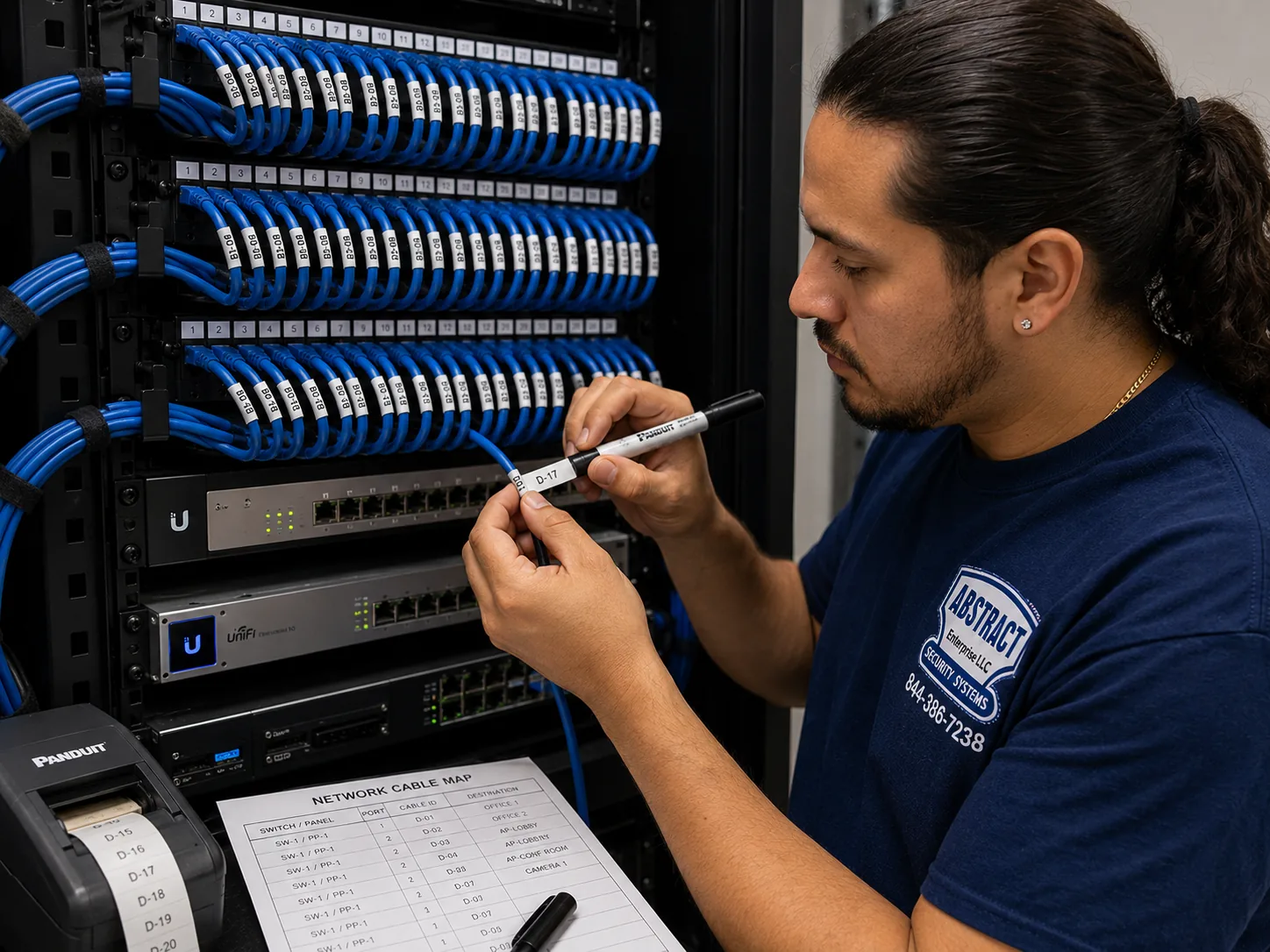
We do not start with a brand. We start with the doors, the distance and the households, then pick from these categories. Brands we work with include Aiphone, Comelit, 2N, Akuvox, DoorBird and ButterflyMX, and quotes default to whichever model fits the house rather than a favorite.
A button panel and a handset on each floor with a door release. The plain, durable choice for a three-family hall door or a small building where nobody needs to see the visitor.
Video and audio over two conductors, which can sometimes reuse tested old bell wire. Good for upgrading a two-family without opening walls.
Stations on network cable powered by a PoE switch, best for long runs to a gate, condo lobbies and buildings that want app answering and remote management.
Weather-rated, vandal-resistant stations with lit buttons and wide-angle cameras for gate posts, piers and avenue doors.
Wall monitors, desk monitors and plain handsets, chosen for where each household sits, plus phone apps where wanted.
Electric strikes for wood and steel doors, gate releases for iron gates, relay connections to driveway gate operators, door closers and the power supplies to run them.

| Question | Self-installed video doorbell | National alarm company package | Installed intercom from Abstract Enterprises Security Systems |
|---|---|---|---|
| Reaches a visitor at the gate | Only if mounted there, on battery or Wi-Fi range | Usually a doorbell at the front door | Wired station on the post or pier |
| Opens the door or gate | No, unless paired with a separate smart lock | Varies by package | Release for each door, gate or driveway operator |
| Separate calls for two households | One account per device, shared or duplicated | Rarely designed for it | One button and station per legal household |
| Side door and garage | Another device, another app | Extra equipment | Extra stations on the same system |
| Monthly fees | Often a cloud plan for recordings | Usually a monitoring contract | $0 monthly fees on systems we install; any maker app plan shown before you choose |
A video doorbell is a fine choice for a single-family house where the porch faces the street and nobody needs to open the door from upstairs. Once there is a gate, a second household, a side door that matters or a door that should open from inside, a wired intercom does the job those devices were never designed for.
Each one is checked against what a Dyker Heights lot actually asks for.
HomeAdvisor's cost guide says exactly that, and for a small apartment it can be true. A wireless kit pairs a door unit with an indoor unit, and nothing has to be drilled through a wall.
The same guide also says wireless systems can have network issues, and on a Dyker Heights lot the distance and the materials are the issue. A gate station sits outside, separated from the house by a yard, a porch, a brick or stucco front and often a storm door, and a battery unit on an iron post spends the winter in the cold.
Wireless also does not solve the release. A gate or door still needs a lock that can be opened electrically, and that lock needs power. Once a wire has to reach the gate for the release, it can carry the intercom too.
That figure is HomeAdvisor's national average, alongside a range it gives from $150 for a basic wireless system to $15,000 for advanced ones. A national average says little about one Brooklyn lot.
On our Brooklyn list, a video intercom for a one- or two-family house is $600 to $1,800, an audio buzzer system for a small building is $400 to $900, and a building-wide system for a walk-up or small condo of 4 to 20 units is $1,200 to $4,500.
What moves a Dyker Heights price inside those ranges is mostly the outdoor run to the gate, the number of doors on the system and the condition of the door hardware, not the brand on the station.
It does not. The state intercom requirement in Multiple Dwelling Law §50-a and the Buildings rule 1 RCNY 42-01 applies to buildings with eight or more apartments.
A two-family is not a multiple dwelling at all, and a three-family is a multiple dwelling that needs a self-closing entrance door but no intercom. Most Dyker Heights houses fall into those two groups.
The reason to install one is practical: a household upstairs that cannot otherwise answer a gate, and a door that cannot otherwise be opened without walking down. The nine- and twelve-unit condo buildings are the ones where the law applies directly.
Every generic guide puts the call button beside the front door, because on most houses that is where visitors stand.
Dyker Heights was laid out with houses set back from the street, and many lots have a gate at the sidewalk and a family door at the side. A button by the front door can be the one place a visitor never reaches.
The right spot is where a stranger stops. On a latched-gate lot that is the gate post; on an open lot it is the porch; and for family and regular visitors it may be the side door. Many houses need two of the three.
Online answers treat the button count as a matter of convenience: one per apartment, one per tenant, one per room if rooms are rented.
In Dyker Heights, where the Civic Association, Community Board 10 and the Buildings Department have spent years on illegal conversions, a door with more buttons than the house has legal apartments is a signal anyone can read from the sidewalk.
We install one button per legal household and say so in the quote. That is simpler for visitors and keeps the house honest to every inspector who rings.
For a single household with one door facing the street, a video doorbell covers most of what an intercom does: you see and talk to the visitor.
It does not open the gate or the door, does not give a second household its own call, and does not connect a side door and a garage into one system unless you buy and manage several devices.
If the house has any of those, the intercom is the tool built for the job. If it has none of them, we will tell you a doorbell is enough.
Cost guides quote labor as if every house were the same. Many indoor-only jobs are quick, and a station swap on existing wire can be done in hours.
A Dyker Heights job with a run under a walk to the gate, a strike on an original front door and a garage station across the driveway takes longer, and may need a second visit if a planted bed or a gate latch has to be dealt with first.
We give a realistic schedule in the quote, and we book a call back within 2 hours of a request, but we do not promise same-day installation, because the lot decides that, not the calendar.
If you are not sure whether a gate station is worth it, whether the old bell wire can be reused or how a side door would join the system, ask first. Call now at (347) 934-8335, send a fast quote request, or send photos of the gate and the doors to a tech on WhatsApp. We book a call back within 2 hours.
Tell us the cross streets, the type of house or building, which doors visitors and family use, whether there is a front gate or a garage, and how many legal households live there. If you are building or renovating, tell us when the walls and the walk will be open. A technician will call back about the Dyker Heights address, or you can call (347) 934-8335 now.
The gate, the front door, the side door, any garage door and the old bell or intercom, plus how many households live in the house and on which floors.
How many legal apartments the house or building has, so the station gets one button per legal household and nothing extra.
Sidewalk to gate, gate to porch, driveway to side door and garage, with the old wire tested and every door watched as it closes and latches.
Stations, the outdoor cable route, door and gate hardware, power location and app accounts written into a quote from the Brooklyn list.
Strikes and gate releases fitted to the real latches, closers adjusted so doors latch by themselves, and the power supply mounted dry and labeled.
Cable run on the agreed route, in conduit outdoors, labeled at both ends; stations mounted at the gate, the doors and on every floor.
Buttons, monitors, app accounts, release times and any call schedules set separately for each household, office or door.
Every door called and released from every floor, each door relocking after the test, and a written wiring record with the outdoor route left with the owner.
The church and school on 12th Avenue between 65th and 66th Streets, which Forgotten New York calls the tallest structure in Dyker Heights.
On 11th Avenue between 80th and 81st Streets, completed in 1900 with its steeple added in 1907, near the top of the hill.
11th Avenue and 82nd Street, about 110 feet up, where General Edward De Russy built the area's first house in the late 1820s.
The park bounded by Seventh Avenue, Fort Hamilton Parkway and 73rd Street, completed in 1903, on the neighborhood's western side.
At 1105 67th Street, dating from 1973, near the stretch of 11th Avenue where much of Dyker Heights' Coptic community settled.
The intermediate school at 65th Street and 12th Avenue, on the northern edge of the neighborhood.
We also serve Bay Ridge, Bensonhurst, Bath Beach and Borough Park, along with every Dyker Heights block from 65th Street down to the golf course. For the rest of the borough, see our Brooklyn intercom installation page.
Dyker Heights is billed at our Brooklyn rate, with no neighborhood surcharge. These are the ranges on our Brooklyn price list; your written quote names one figure for your address after the survey.
| Job | Brooklyn price range | Typical Dyker Heights example |
|---|---|---|
| Detached or two-family video intercom | $600 – $1,800 | Front and side door stations with monitors on two floors |
| Video intercom for homes and apartment buildings | $700 – $1,800 | Gate station with a release and app answering |
| Audio buzzer system for a small building | $400 – $900 | Three-button panel and handsets in a brick three-family |
| Building-wide system, 4–20 units | $1,200 – $4,500 | Lobby panel and apartment stations in a small condo |
| Commercial intercom | $800 – $3,500 | 13th Avenue store, office in a house, rectory |
| Repair and upgrade of existing systems | $150 – $1,200 | Dead side door station, failed release, new handsets |
| Service call / on-site diagnostic visit | $250 | Book and pay online |
| Monthly fees | $0 | On systems we install |
The written quote lists every station by model, the cable and its route, the door and gate hardware, the power location and the labor, and notes anything an electrician or your landscaper needs to do. Nothing is ordered until you sign it.
Full terms — including 50% deposit, the 30-day warranty and optional paid extended warranty, and the late-fee schedule — are set out in the service agreement.Not sure what you need yet? Call now, send a fast quote request, or speak to a tech on WhatsApp.
Three typical Dyker Heights jobs, each priced within our Brooklyn list after a survey.
An audio buzzer system for a small building or a house where visitors reach the porch: a button panel by the door, a handset on each floor, the release fitted to the existing latch and old wire reused where it tests good.
A video intercom for a detached or two-family house: a weatherproof station at the gate or front door, a second station at the side door, monitors where each household spends the day, and a release on each door.
A building-wide system for a walk-up or condo of 4 to 20 units: a directory panel at the lobby door, a station or app for every apartment, the strike and closer brought up to a self-locking door, and a quote written for the board.
Bring your own equipment. If you have already bought a door station, monitors or a gate release, we can install them as labor-only work, provided the equipment suits the doors, the number of households and the distance to the gate. We check the model numbers before the visit and tell you if anything is missing, such as a power supply, an outdoor-rated station or a relay for a driveway gate. Customer-supplied equipment is covered by its maker's terms, not ours.
Gate, front door, side door and garage stations for houses, two-families and condos. Request a quote
Dead stations, failed releases and phone-dialing panels replaced. Call (347) 934-8335
The same approach on every Brooklyn block. Intercom installation in Brooklyn
Neighbors in Bay Ridge and every borough. NYC intercom installation
Call us in September or early October if you can. A gate station often involves a trench or a run along a fence, ordering an outdoor-rated station and sometimes replacing a gate latch, and outdoor work is easier before the ground freezes. Calling early also leaves time for a second visit if a planted bed or a walk has to be dealt with first.
Usually, yes. The release goes into the door frame on the latch side, not into the door itself, and it is chosen to match the existing latch so the door's original hardware stays in place. If the frame is too thin or too soft for a standard strike, there are narrow and surface-mounted versions, and we will show you the option before cutting anything.
Yes, and in deep Dyker Heights houses that is often the best place for it. The monitor belongs where the family spends the day, which is rarely the front hall. We run the cable to the kitchen or den, and a second monitor can go upstairs or in a home office so the call is heard everywhere it matters.
A technician comes out, tests every station, every release and every run of wire on the existing system, finds the fault, and tells you what it will take to fix it or whether replacement makes more sense. You can book and pay for the visit online. If the fix is simple and the parts are on hand, it can often be done on the same visit at the repair price.
Often it can. Some owners keep the doorbell on the porch for its app and recordings and add an intercom station at the gate and the side door with releases. The two then run side by side. In other cases it is simpler to replace the doorbell with an intercom station that has its own app, so the family uses one system instead of two.
Someone needs to let us in at the start, be reachable during the day, and be there at the end for the walk-through and the test of every door. Outdoor work at the gate can go on without anyone indoors. In a two-family, we also need access to the tenant's apartment for its station, so the owner usually arranges a time with the tenant in advance.
Yes. Each household is set up separately, so one can have a wall monitor and the other an app, or both. Each household's calls go only to its own monitor or account, and each household can open only its own door, unless the owner asks for a shared door such as the gate to be opened by both.
Yes. An outdoor-rated extension speaker or chime can be mounted under the back eave or on the garage, wired to ring when the gate or front door station is pressed. If the system rings phones, the app does the same job. Many owners want both, because phones get left inside.
The certificate of occupancy or the recorded use, so we know how many legal households to plan for; any survey or plot plan that shows the walk, the driveway and the garage; and, for a condo, the name of the board member who will approve the work. Photos of the gate, the doors and the old bell transformer fill in the rest.
Yes. Most systems have room for more indoor stations on the same household button, so a family room monitor rings along with the others. If the walls are open during the basement work, call us then and we will leave a cable at the monitor location, which makes adding it later a short job.
Many outdoor stations come in dark or metal finishes that suit an iron gate, and the conduit and mounting plate can be painted to match the post or the stone. On a pier we can often recess the cable so only the station itself shows. We bring finish options to the survey so you can choose before anything is ordered.
Call the same Dyker Heights line, (347) 934-8335. Tell us which door and which floor failed, and send a short video if you can. Problems covered by the terms in your service agreement are handled under those terms, and anything else can be booked as a $250 diagnostic visit or priced as a repair.
Intercom Installation Brooklyn NY | Abstract Enterprises · Intercom Installation NYC · Intercom Installation Manhattan NY | Abstract Enterprises · Intercom Installation Queens NY | Abstract Enterprises · Intercom Installation Bronx NY | Abstract Enterprises · Intercom Installation Staten Island NY · Intercom Installation Long Island NY · Hudson Valley Intercom Installation · Intercom Installation Nassau County NY · Intercom Installation Suffolk County NY · Westchester County Intercom Installation · Rockland County Intercom Installation · Orange County NY Intercom Installation · Putnam County Intercom Installation · Dutchess County Intercom Installation · Ulster County Intercom Installation
Intercom Installation Bath Beach Brooklyn NY | Video & IP · Intercom Installation Bay Ridge Brooklyn NY · Intercom Installation Bedford Stuyvesant Brooklyn NY · Intercom Installation Bensonhurst Brooklyn NY · Intercom Installation Bergen Beach Brooklyn NY · Intercom Installation Beverley Square Brooklyn NY · Intercom Installation Boerum Hill Brooklyn NY | Rowhouses · Intercom Installation Borough Park Brooklyn NY · Intercom Installation Brighton Beach, Brooklyn NY · Intercom Installation Brooklyn Chinatown, Brooklyn NY · Intercom Installation Brooklyn Heights Brooklyn NY · Intercom Installation Brooklyn Navy Yard Brooklyn NY · Intercom Installation Brooklyn NY | Abstract Enterprises · Intercom Installation Brownsville Brooklyn NY · Intercom Installation Bushwick Brooklyn NY · Intercom Installation Cadman Plaza Brooklyn NY · Intercom Installation Canarsie Brooklyn NY | Abstract Enterprises Security Systems · Intercom Installation Carroll Gardens Brooklyn NY · Intercom Installation City Line Brooklyn NY | Abstract Enterprises Security Systems · Intercom Installation Clinton Hill Brooklyn NY · Intercom Installation Cobble Hill Brooklyn NY · Intercom Installation Columbia Street Waterfront Brooklyn NY · Intercom Installation Coney Island Brooklyn NY · Intercom Installation Crown Heights Brooklyn NY
Alarm Installation Dyker Heights Brooklyn | Outages & Lights · Structured Cabling Installation Dyker Heights Brooklyn NY · Fire Alarm Installation Dyker Heights Brooklyn NY · Door Buzzer Repair Dyker Heights Brooklyn NY · TV Installation Dyker Heights Brooklyn · Security Camera Installation Dyker Heights Brooklyn NY · Access Control Installation Dyker Heights Brooklyn NY
Send a photo of the gate, the front door, the side door and the old bell transformer, with your cross streets and how many households live in the house, and we will tell you what the lot probably needs. Call or text (347) 934-8335, message us on WhatsApp, or use the request form. Licensed under NYS license #12000287431, rated 4.6★ across 390+ Google Reviews, owner-operated since 2002, and booked within 2 hours of your request.