Recorder dark after the power came back, a camera that went black the night something happened, or a Church Avenue shop that lost its feed? East Flatbush camera repair line, booked within 2 hours: (347) 934-8335
Attached Brick Row Houses · Two-Families With a Tenant Upstairs · Six-Story Elevator Buildings and Garden Complexes · Church, Utica and Linden Storefronts
Security Camera Repair in East Flatbush
Any Brand, Any Installer · Footage Saved Before Anything Is Touched · Cause and Written Price First · Brooklyn Rate
Security camera repair in East Flatbush starts with our $150 Brooklyn service call, which pays for the on-site diagnosis and is credited to the repair if you go ahead. On our published Brooklyn list most single faults cost $150 to $700, and a recorder replacement or a rewire of several cameras runs $700 to $1,500. We fix systems other people put in, from a three-camera kit on a row house off Church Avenue to a cellar recorder serving a six-story building on Linden Boulevard or a church garden on Avenue D. Requests are booked within 2 hours, visits come in two-hour arrival windows, and you hear what failed and get a written price before any part is replaced.
Every price on this page comes from our published Brooklyn camera repair list, and your repair price is written down before work starts
Rated 4.7★ across 201 Google Reviews
Reviewed and updated November 12, 2026, against ABC7 New York's October 2024 report on the surveillance video of the statue attack at St. Therese of Lisieux Church on Avenue D; News 12 Brooklyn reporting on the January 14, 2026 overhead wire fire at East 48th Street and Church Avenue, the February 2024 robbery of a Church Avenue deli, the April 2026 robbery near East 95th Street, conditions at Rutland Plaza on East 93rd Street, the September 2024 robbery at Flatbush Gardens, the July 2025 hallway camera covering in a Flatbush building, the June 2025 Beverly Road and July 2026 Ocean Avenue manhole fires, and the April 2026 Linden Boulevard tenant complaints; the NYC Department of Investigation's March 2025 report on NYCHA senior building security and the April 2025 City Council public housing hearing; the NYPD's 67th Precinct page; Brick Underground on landlords and building camera footage; Reolink's guide to camera video loss; HomeAdvisor's Brooklyn cost page; the Landmarks Preservation Commission's permit guidebook; NYC Administrative Code §28-105.4.7; and the New York Department of State on security and CCTV installer licensing. · Abstract Enterprises Security Systems, NYS license #12000287431 · crews dispatched from our Troy Avenue office in Brooklyn
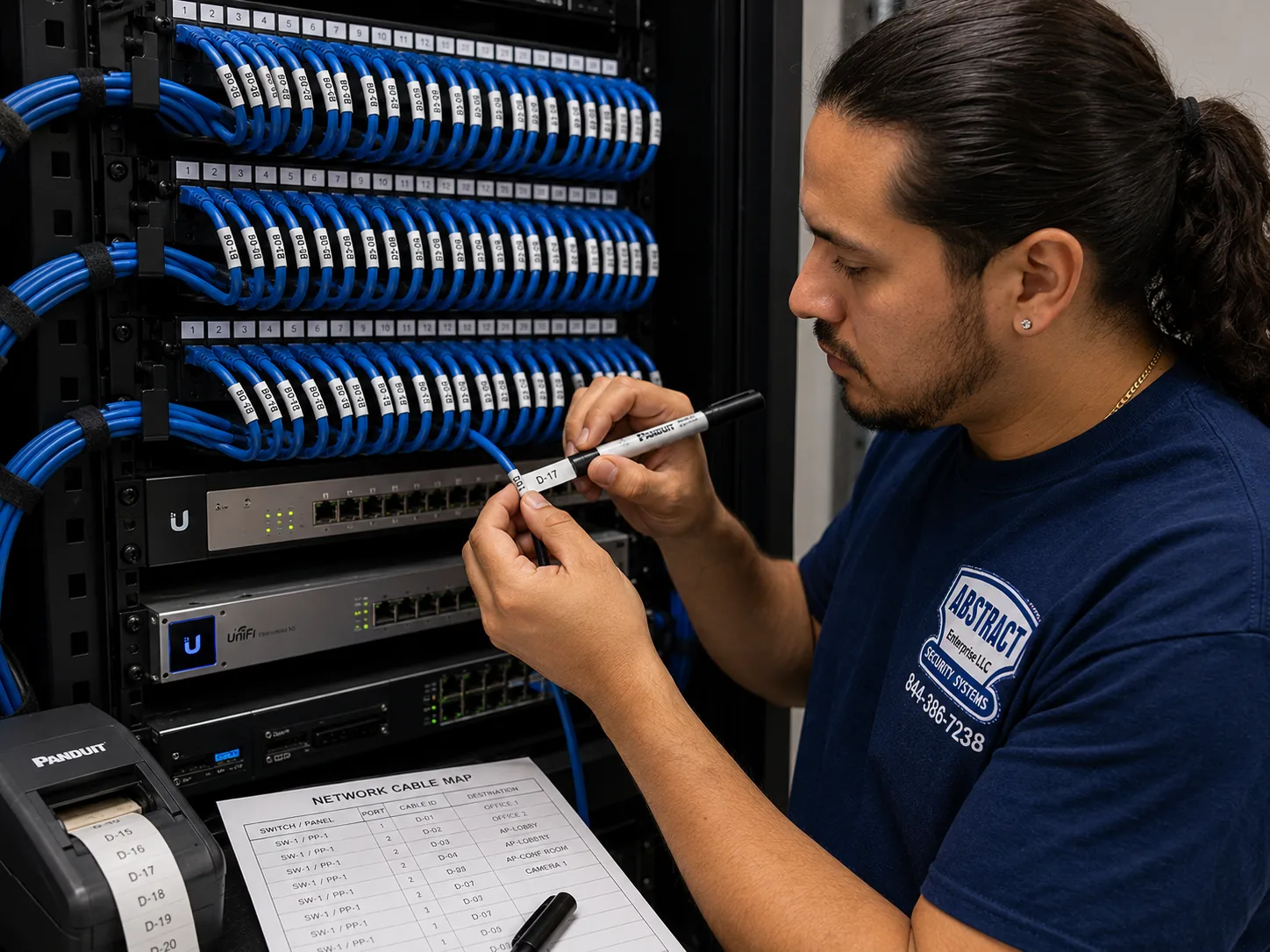
A photo from the AESS job library, not taken in East Flatbush: a technician printing a label for each cable at a patch panel, with the printed port map taped up beside it. In an East Flatbush six-family walk-up or elevator building, the camera cables from the stoop, the lobby, the hallways and the back yard usually end at one shelf in the cellar, often after two or three installers have each added cameras. A label at that end saying which camera each cable feeds is what makes the next repair a short visit instead of an afternoon of tracing.
East Flatbush Camera Repair Request
Row house, two-family, apartment building, church or shop: tell us the address and what the screen shows, and a technician calls back with the next step
✅
Request Sent!
Thank you. A technician will contact you about the East Flatbush address shortly.
25+
Years Experience
✓
Same-Day Estimates
100%
Licensed & Insured
4.7★
201 Google Reviews
Owner-operated since 2002 · Thousands of jobs completed · Booked within 2 hours
Most East Flatbush camera calls come in after the fact, and that decides how the repair starts. Someone needs last Tuesday night, opens the app, and finds the camera that matters has been dark for weeks, or the recorder came back from a power cut with a blank screen. So the first job on every visit is to save whatever footage is still on the recorder, and only then to find out why the system failed. For a row house or a two-family, the usual causes are a failed power supply or adapter, a connector that let in water, a worn hard drive, or a recorder that lost its settings after an outage. For an apartment building or a shop, add cables cut during building work, a full or failing drive, and logins nobody has anymore. Send a photo of the recorder screen to (347) 934-8335 or on WhatsApp, and we will tell you the likely fault and what that kind of repair costs on our Brooklyn list before you book.
Looking at your photos costs nothing. The $150 service call covers the on-site diagnosis and is credited to the repair if you go ahead.
All work is done under New York State license #12000287431, the license the state requires of companies that install or service security and CCTV systems for others.
We repair any brand and any installer's work, and we tell you plainly when an old part is not worth paying to fix.
The Neighborhood
Why East Flatbush Properties Need Security Camera Repair
East Flatbush is the stretch of central Brooklyn covered by the NYPD's 67th Precinct, which describes its area as "East Flatbush and Remsen Village." It is mostly homes people own and live in: long rows of attached brick houses, freestanding and semi-detached two-families with a tenant upstairs, and small apartment houses on the side streets, with six-story elevator buildings and garden complexes along the bigger roads. Church Avenue, Utica Avenue, Linden Boulevard and the Nostrand Avenue edge carry the shops, bakeries, groceries, barbershops and storefront churches. Cameras are on a great many of these buildings already. What fails is rarely the decision to have them; it is the system quietly dying between the day it went up and the night it was needed.
A local example shows what a working system is worth. In October 2024, someone climbed into the garden at St. Therese of Lisieux Church on Avenue D and smashed the arm of a statue about a hundred years old. ABC7 New York reported that the church's surveillance footage showed the person entering the garden, climbing the statue, then covering a light with a backpack before using a brick. Father Liju Augustine had upgraded the church's security system when he arrived about a year earlier, and he said the video "laid out exactly what happened." Two details in that report matter for repair work. The garden gate is usually open around the clock, so the cameras were the only thing watching it at night. And the person went for the light first, which tells you what a night camera really depends on.
The second pressure is power. Just after 2:50 in the morning on January 14, 2026, overhead power wires caught fire on East 48th Street at Church Avenue. News 12 reported that Con Edison counted 76 customers without power and that residents of one building were evacuated because of high carbon monoxide readings. Nearby Flatbush had a manhole fire on Beverly Road in June 2025 that left at least 1,700 customers without power, and another near 650 Ocean Avenue in July 2026 that cut about 343. Camera systems seldom die in the dark. They are hurt when the power comes back unevenly, when a drive is writing at the moment it cuts out, or when a cheap adapter takes the surge. Many of the calls we get from this part of Brooklyn start the same way: everything came back on, except the cameras.
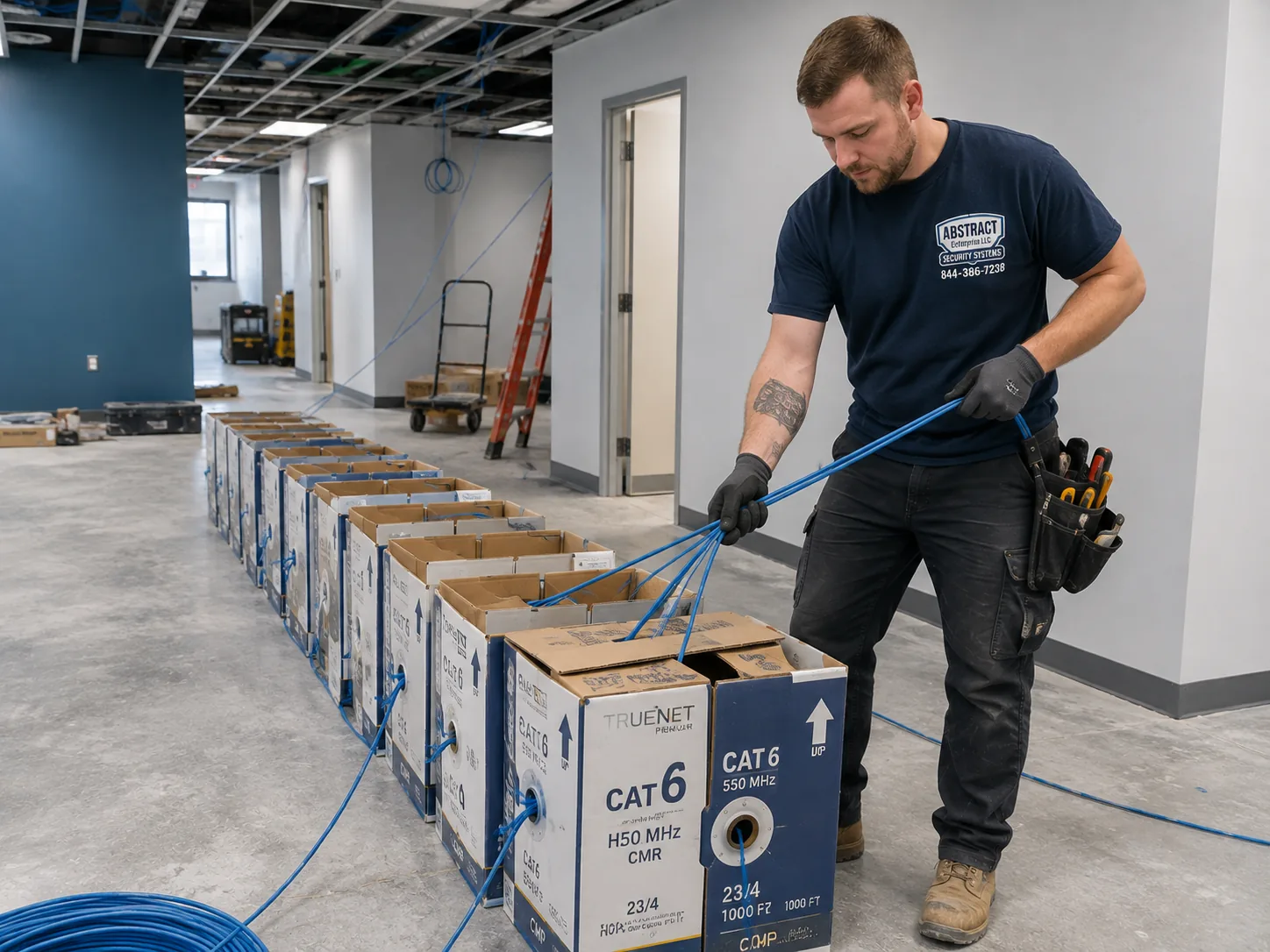
A photo from the AESS job library, not taken in East Flatbush: boxes of cable staged together before a pull of several runs at once, on a site that stayed open during the work. When a building's camera cables have been cut, chewed or left brittle by years on a sunny brick wall, replacing several runs in one trip costs less than chasing them one at a time. In East Flatbush that usually means a cellar-to-roof run in a walk-up or the outside runs along the face of a row house.
The third pressure is who is responsible. A lot of East Flatbush apartment buildings have changed hands, and some are badly run. In February 2025 News 12 walked into several buildings at Rutland Plaza on East 93rd Street without a key; one building there had 518 HPD complaints in two years, and HPD put it into its Alternative Enforcement Program. Resident Patricia Walters described "the sewage, the killing, everything the unlocked doors." In April 2026, tenants of a four-story building on Linden Boulevard told News 12 they could not reach a new landlord at all. In buildings like these, a broken camera is one problem among many, and no one person feels it is theirs to fix. Brick Underground has noted that city buildings "aren't required to have functioning security cameras at all," so a camera repair usually happens only when an owner, a managing agent, a church board or a tenant association decides it should.
Even large, professionally run systems slip. When the city's Department of Investigation tried to reach the CCTV cameras at 63 public housing senior buildings across New York in early 2025, it found that "44 of 63 of the Senior Buildings, approximately 70%, had CCTV cameras that could not be viewed remotely," citing "outdated or incompatible software or hardware causing login, connection, and data storage issues" along with damage. That is a citywide finding, not one about East Flatbush, but it describes the same three faults we find in private buildings here every week: the login is gone, the connection is broken, and the recording is not being saved.
So the job of a repair in East Flatbush is broader than swapping a dead camera. It is to get the system recording again, to make sure someone gets told the next time it stops, and to leave the owner with the logins, labels and backup power that keep it working through the next outage. Most row-house and two-family owners who call us for a repair also ask about the front door; a building with a camera at the entrance usually pairs it with a working intercom or access control, and we can look at both on the same trip.
Six East Flatbush facts that shape a camera repair
One precinct covers the area. The 67th Precinct serves East Flatbush and Remsen Village, and its community council usually meets on the third Thursday of each month at 7:00 p.m. at the station house. When detectives ask a block for video, they ask everyone at once, and the houses with working recorders are the ones that can help.
Overhead wires still feed some blocks. The January 14, 2026 fire was in overhead wires at East 48th Street and Church Avenue, and it cut power to 76 customers before dawn. Lines on poles are open to wind, branches and fire in a way buried cable is not, and every outage and restart is felt by the camera power supplies on that block.
Night cameras live on borrowed light. The St. Therese footage shows a person blocking a light before doing damage. A camera that only works when a porch light, a streetlight or a garden lamp is on is a camera that can be switched off by someone else.
Some big buildings are under city enforcement. Rutland Plaza on East 93rd Street was placed in HPD's Alternative Enforcement Program in 2025, with one building logging 518 HPD complaints in two years. In buildings like that, cameras compete with leaks, doors and heat for attention.
Remote viewing is often the first thing to break. The city's own investigators found about 70 percent of the senior public housing buildings they checked had cameras that could not be viewed remotely. Lost logins and dead connections are as common as dead cameras.
Repairs here are priced by the fault, not the zip code. HomeAdvisor's Brooklyn page puts the average surveillance camera install or repair at $1,416, but that figure mixes new systems with repairs. A single repair on our Brooklyn list usually lands between $150 and $700.
Where this page applies. It covers East Flatbush, Remsen Village and Wingate, from the hospital blocks around Clarkson Avenue down through Church Avenue, Linden Boulevard and Avenue D. For the rest of the borough, see our main Brooklyn security camera repair page. The price follows the fault, not the address.
Same-Day Repair in East Flatbush
Need Repair in East Flatbush? A Camera That Was Dark on the Night It Counted, or a Recorder That Never Came Back On
Urgent camera calls from East Flatbush tend to fall into three groups. The first is the after-incident call: a car was broken into, a package taken, a store robbed, a church or yard vandalized, and the owner needs the footage now. The second is the after-outage call: the block lost power, the lights came back, and the recorder did not, or it came back with half the cameras missing. The third is the slow fade: a camera that went dark months ago that nobody noticed until a tenant, a neighbor or a detective asked for video.
If you need footage from an incident, leave the recorder running and do not restart it, unplug it or let anyone "reset" it. Most recorders overwrite their oldest video once the drive fills, so the clock is already running; a restart can also hide the fault that caused a gap. Call (347) 934-8335, give us the date and the time window you need, and we book the visit with saving that footage as the first task. If a detective from the 67th Precinct has asked for a copy, tell us when you book; the export goes to USB with the recorder's original timestamps, and we write down what time the recorder showed compared with the real time so nobody argues later about when it happened.
For everything else the path is the same: the $150 service call books a two-hour arrival window, the technician finds the cause, and you get a written price before any part is replaced. Requests are booked within 2 hours. We do not promise the repair itself the same day, because some parts have to be ordered, but most single-camera, power and drive faults are fixed on the first visit when the part is on the truck.
What We Install
Security Camera Repair Services in East Flatbush
Every repair below is priced from our Brooklyn camera repair list. The service call pays for finding the fault; the repair itself is priced by what failed, how many cameras it touches and how hard the run is to reach, whether that is a stoop camera on a row house or a roof camera on a six-story building on Linden Boulevard.
Dark camera repair
A single camera with no picture: tested at the camera, at the cable and at the recorder so we replace only the part that failed. On attached row houses the fault is often a weathered connector at the camera end rather than the camera itself, and that is the cheaper repair.
After-outage recovery
Systems that came back wrong after a power cut on the block: recorders stuck on a setup screen, cameras missing from the grid, PoE switch ports that no longer power anything, and clocks reset to a date years ago. We restore settings, test each power source and add battery backup where it belongs.
Recorders and hard drives
DVRs and NVRs in cellars, hall closets, back rooms and church offices that beep, restart, stop saving or keep only a few days. Drives are tested and replaced by capacity, and footage that matters is copied off first.
Night picture repair
Cameras that go black, white or smeared after dark: failed infrared, stuck day-night filters, reflections off glass or window guards, and cameras that only worked when a porch or garden light was on. We fix the camera or the light it depends on, whichever is cheaper.
Power supplies and adapters
Central power boxes, plug-in adapters and the outlet they hang from. Two-families often have cameras powered from an outlet in one apartment, and outdoor adapters are a common casualty of surges after an outage.
Cable and connector repair
Runs cut by roofers, pointing crews or window installers, cables stapled along brick that have cracked in the sun, connectors full of water, and cables chewed in cellars. Repaired, re-terminated or replaced, and tested end to end.
Phone viewing and logins
Apps that lost the recorder after an internet change, accounts tied to a relative's phone or email, and recorders whose admin password nobody knows. We restore access for the right person and change default passwords.
Footage export for incidents
Clips saved to USB with original timestamps for detectives, insurers, landlords and housing court, with a note of any difference between the recorder's clock and the real time.
Whole-system checkups
Every camera on a house, building, church or shop checked in one visit, with a written list of what works, what is failing and what each fix costs, so an owner or board can decide what comes first.
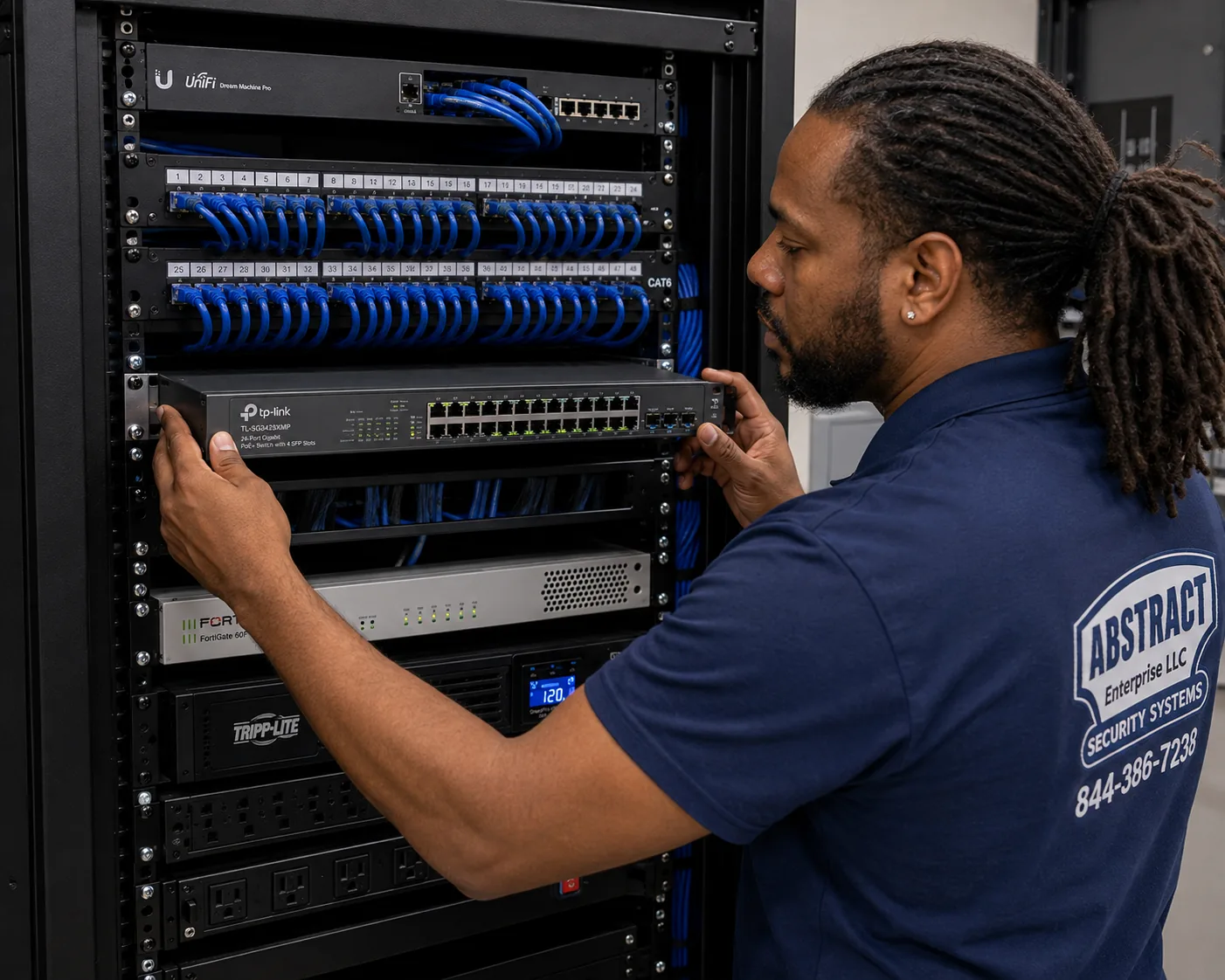
A photo from the AESS job library, not taken in East Flatbush: a technician mounting a managed PoE switch below the patch panels in a commercial rack. Network cameras get both power and data through that switch, so when one port or the whole switch fails after a surge, every camera on it can go dark at once. In East Flatbush shops and apartment buildings the switch is often a small box on a cellar shelf, and replacing it, then putting it on battery backup, is one of the most common after-outage repairs we do.
Building Specialists
Security Camera Repair for East Flatbush's Architecture
Six kinds of property make up nearly every camera repair call in East Flatbush. Each one breaks in its own way, and each one decides where the recorder ends up, how the cables run and who has to say yes before the work starts.
Attached brick row houses
The long rows on the side streets between Church Avenue and Linden Boulevard, usually with a recorder in the cellar and cables run up the back or the face of the brick. Faults cluster at the outside connectors and the cellar power strip.
Two- and three-family houses
Freestanding and semi-detached houses with an owner on one floor and tenants on the others. Cameras often run on one apartment's outlet or internet, and the questions are as much about who controls the system as what broke.
Small walk-ups
Four- to eight-family brick buildings with no super on site. Cameras cover the entrance, the vestibule and sometimes the yard, and they tend to go unchecked until something happens.
Six-story elevator buildings
The prewar and postwar apartment houses along the larger roads, with a recorder in the super's office or the cellar and long runs to the roof, the lobby and the halls. Building work and roof leaks are the usual causes of failure.
Garden complexes
Groups of buildings around courtyards, such as Flatbush Gardens and Rutland Plaza, where each building may have its own recorder or several are linked back to one management office.
New buildings
Recent construction such as Bethany Senior Terraces on East 40th Street and the Sparrow Square buildings on the former Kingsboro campus off Clarkson Avenue, where cameras are newer and often network-based, and the first faults are usually logins, firmware and handover gaps.
Attached row houses: the cellar is where most repairs start
On a typical East Flatbush row house the camera system was put in by one installer, often years ago, with the recorder on a shelf or table in the cellar near the electric meter and the internet modem. The cables come in through the cellar wall or a window frame, then climb the back of the house or the front facade to the cameras. The recorder is plugged into a power strip that also feeds the boiler controls, a freezer or a washing machine. When we arrive for a dark camera, we start there, because a loose plug, a dead strip or a surge-damaged adapter explains more row-house failures than any camera.
The outside half of the job is the brick. Older installs often have cables stapled along the mortar lines and connectors left bare under the camera. After a few summers facing south or west, the cable jacket cracks and water gets into the connector; after a few winters, the connector corrodes and the picture flickers, then disappears. The repair is usually a new connector in a weatherproof box or a short new run along the same path, not a new camera. When the cable is clipped neatly into the mortar joint and the box is sealed, the next repair is years away.
Two- and three-family houses: one system, two households
The two-family houses that line many East Flatbush blocks usually have one camera system serving the whole house. The questions that come up on a repair are practical. Whose outlet powers the cameras? Whose internet carries the phone app? Who gets the alerts? If the cameras are plugged into the upstairs tenant's outlet, they go dark when that apartment's power is off, and if the recorder runs through the tenant's router, phone viewing ends when the tenant moves out. We move power and network onto the owner's side where that is practical, so a change in one apartment does not take down the house.
The other recurring issue is inheritance. Many of these houses have passed from parents to children, and the person who set up the cameras, and knew the password, is no longer there. Getting a recorder back from a lost password is often possible on site, but some makers require proof of ownership or a reset that wipes settings. We tell you which route your recorder needs before anything is erased.
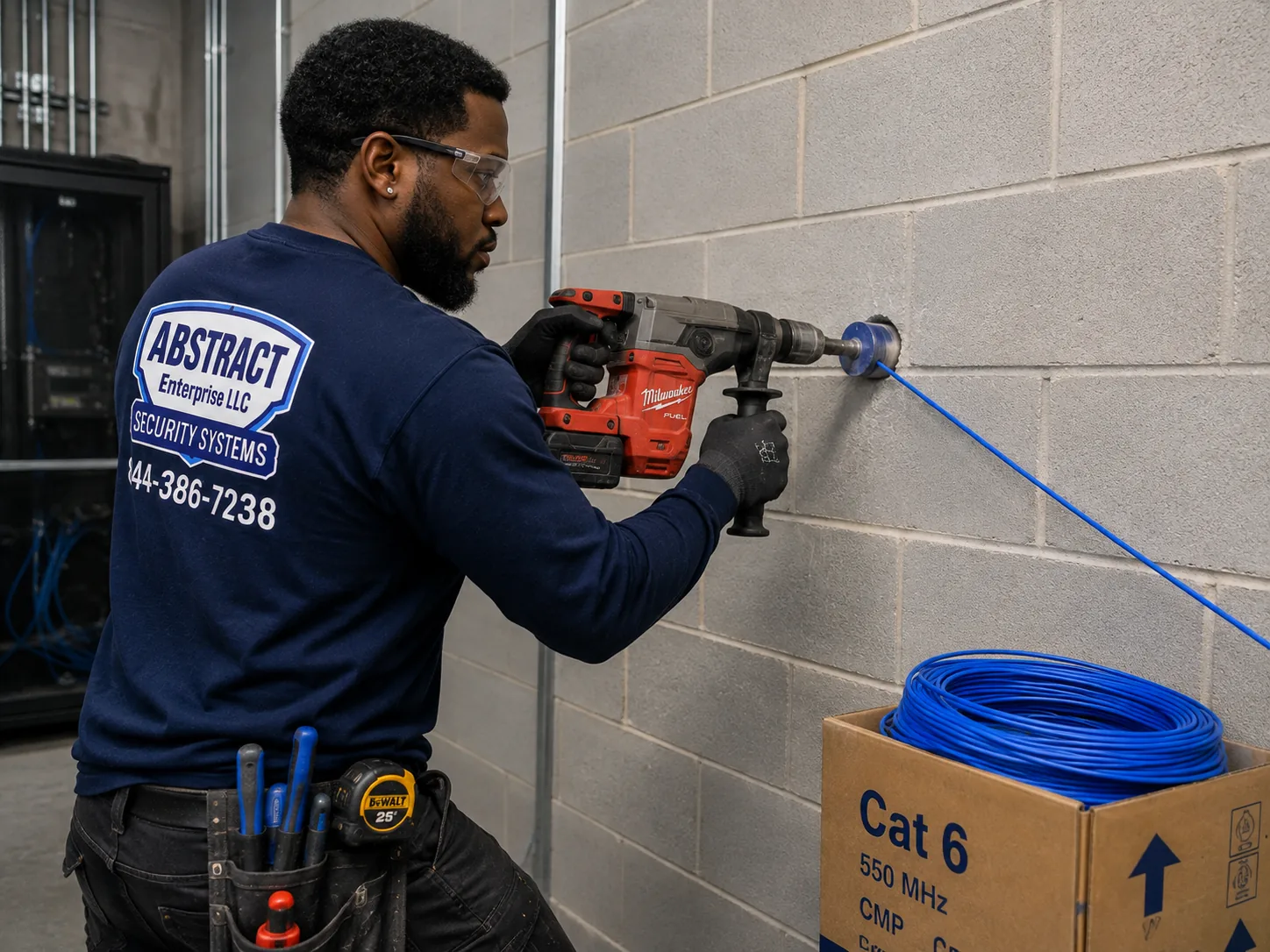
A photo from the AESS job library, not taken in East Flatbush: a technician core drilling a block wall so a cable can pass through to a network room. In East Flatbush cellars, the wall between a shop's back room and the building's meter room, or between two parts of a garden complex basement, is often block or brick. When a camera cable has been cut during building work, a clean sleeve through the wall is how the new run stays protected and easy to find.
Walk-ups: the building nobody checks until something happens
The four- to eight-family brick walk-ups on East Flatbush side streets usually have a handful of cameras on the entrance, the vestibule, the stairs and the yard, wired to a recorder in the cellar or a locked hall closet. With no super living on site, the system is checked only when an owner visits or a tenant complains. That is why the most common walk-up repair call is not "the camera broke" but "we needed the footage and found out the camera had been dark for months."
The fix has two parts. First, the actual repair: the dead camera, the failed drive or the power supply. Second, a way to know next time. Most recorders can send an alert when a camera loses video or the drive reports an error, and we turn those on and send them to the owner's phone or email so the next failure is a message, not a surprise. For a building with frequent tenant changes, we also move the recorder somewhere only the owner or managing agent can reach.
Six-story elevator buildings: long runs and many hands
The six-story apartment houses along the bigger East Flatbush roads have longer runs from the cellar to the roof and the upper halls, and more people working in the building: roofers, plumbers, elevator contractors, cable and internet installers. Each can cut, unplug or bury a camera cable without knowing it. When a building's cameras fail one at a time over months, building work is usually the cause, and the repair starts with tracing each run from the recorder to its camera.
The other cause is water. Tenants of a four-story Linden Boulevard building told News 12 in April 2026 about collapsed ceilings and leaks. Water running down a wall or through a ceiling will find a camera, a junction box or a cable splice sooner or later. We repair the camera side once the leak is fixed, and we reroute or seal anything that sits where water travels.
Garden complexes: several buildings, one office
Complexes like Flatbush Gardens and Rutland Plaza are groups of buildings around courtyards and walkways, run from a management office. The cameras may be separate systems in each building or one network tied back to a central recorder through underground cable or rooftop wireless links. When all the cameras in one building disappear at once, the fault is usually in the link to that building, not the cameras. When one courtyard camera keeps dropping, the cause is often power or water in an outdoor box.
In complexes with management problems, the first question is who can authorize and pay for the work. We need a decision-maker, not just a tenant's permission, before touching a recorder that serves hundreds of apartments. Once that is clear, a whole-complex checkup with a written list of every camera's condition is usually the best first step.
New buildings: newer cameras, different faults
The newest East Flatbush buildings, such as Bethany Senior Terraces at 610 East 40th Street, which finished construction in 2026, and the Sparrow Square buildings rising on the former Kingsboro Psychiatric Center campus, use network cameras that rarely fail in the same ways as older coax systems. Their early problems are logins held by a contractor who has left, firmware that has not been updated, recorders set to keep only a few days, and cameras that were never added to the recorder at all. A repair in a new building often starts with documentation: what is installed, who has the passwords, and what each camera should be showing.
Field Notes
Field Notes: Working an East Flatbush Camera System From the Cellar Up
These notes describe how our technicians approach a typical East Flatbush row house, two-family or walk-up system when several cameras are out and nobody is sure why.
Save before diagnosing. If anyone needs footage from a recent night, the technician exports it first, before restarting or unplugging anything, and notes the recorder's clock against the real time.
Start at the power. In the cellar, the technician checks the outlet, the power strip, the adapter or power box, and any battery backup, because an outage on the block shows up there first. A cheap adapter that took a surge is often the whole problem.
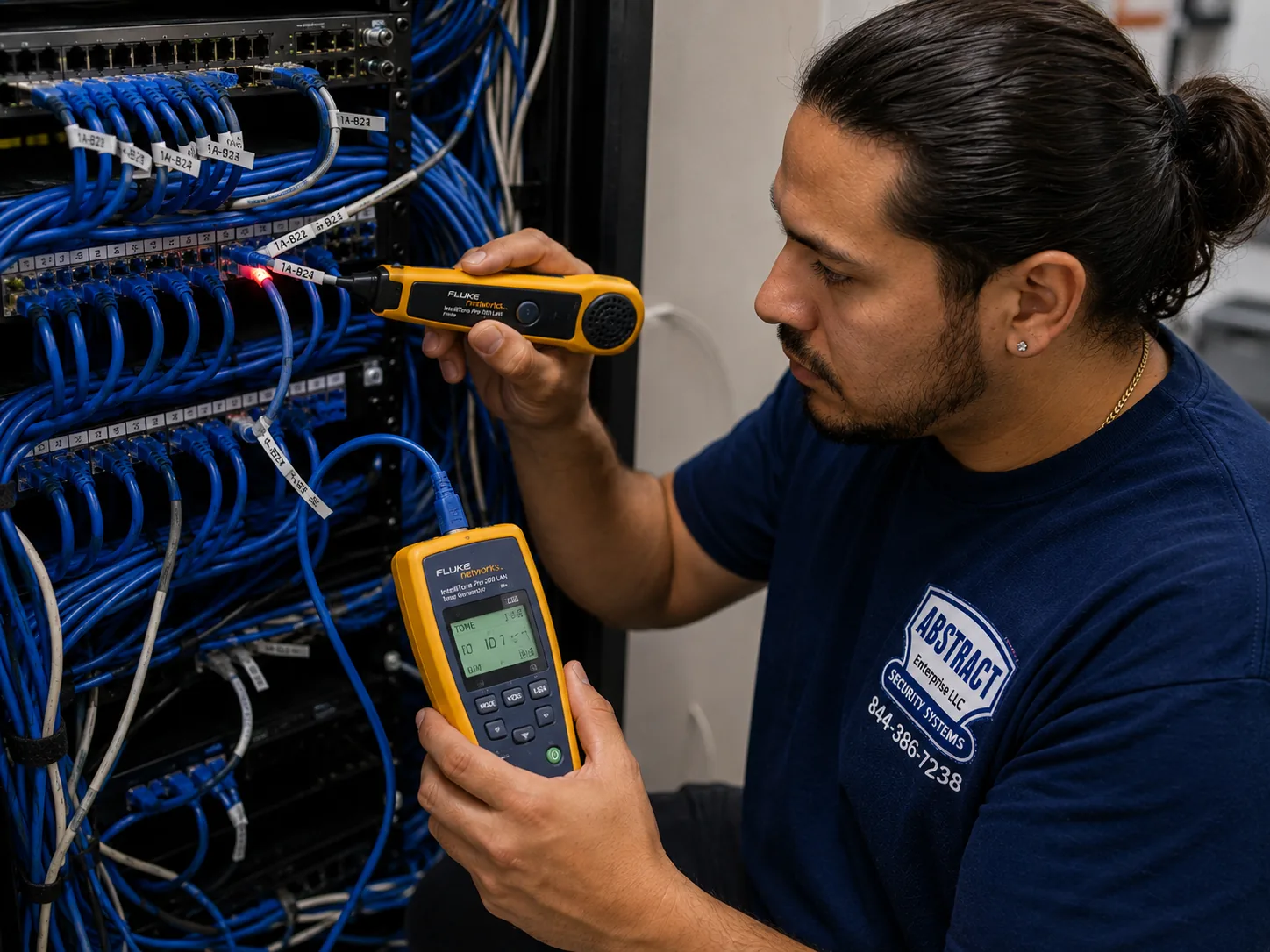
A photo from the AESS job library, not taken in East Flatbush: a technician tracing an unidentified cable at a patch panel with a tone generator and probe. In an East Flatbush cellar where two installers left unmarked cables side by side, toning each one out tells us which camera it feeds before anything is cut, moved or replaced.
Trace and label. Unlabeled cables are toned out and labeled as they are identified, so the recorder's channel names finally match the cameras on the wall.
Check the far end. At each dark or weak camera, the technician tests power and signal at the camera itself, then looks at the connector, the box and the bracket for water, corrosion or damage from building work.
Price before parts, and leave a record. You hear the cause and get a written price before anything is replaced. When the repair is done, the technician checks every camera by day and after dark, turns on alerts for lost video and drive errors, and leaves you the logins and a list of what is connected where.
Fault by Fault
Power, Weather, Light, Logins and Building Work: Why East Flatbush Camera Systems Fail
Five causes account for most of the camera failures we find on East Flatbush houses, buildings and storefronts. Knowing which one you are dealing with is the difference between a $150 visit and a new system.
Power: the outage is over, the damage is not
When power fails and returns, three things can happen to a camera system. The recorder may have been writing to its drive when the power dropped, which can corrupt the file system and leave it stuck on a setup screen or asking to format. A surge on return can kill adapters, power boxes or PoE switch ports, so some cameras come back and others do not. And settings stored in memory, including the clock and network address, can reset. The January 2026 wire fire at East 48th Street and Church Avenue and the manhole fires in nearby Flatbush in 2025 and 2026 are the kind of events that produce these calls. A battery backup on the recorder and switch, sized to ride through short outages and shut down cleanly in long ones, prevents most of them.
Weather: what years on a brick wall do to a camera
Outdoor cameras on East Flatbush row houses and two-families face sun, rain, snow and salt spray from the street. The camera bodies usually last; the connectors, cables and seals do not. Sun cracks the jacket of a cable stapled along the brick, rain gets into connectors left bare under the camera, and winter freezes the water inside. The picture flickers, then fails. Reolink's guide to video loss lists damaged or poorly routed cables and inadequate power among the top causes, and that matches what we see. Re-terminating a connector in a sealed box is a small repair on our Brooklyn list; a new camera is not needed until the camera itself has failed.
Light: a night camera is only as good as what it can see
Most cameras switch to infrared at night. When infrared fails, the night picture goes black; when the camera sits behind glass, the infrared bounces back and the picture goes white; when a camera relies on a porch light or a garden lamp, anyone who covers or switches off that light leaves it blind. The St. Therese video on Avenue D showed a person covering a light before striking, which is exactly the weakness to check. A repair here may mean replacing the infrared, moving the camera from behind glass, adding a camera with its own light, or putting the outside light on a circuit that cannot be switched from the street.
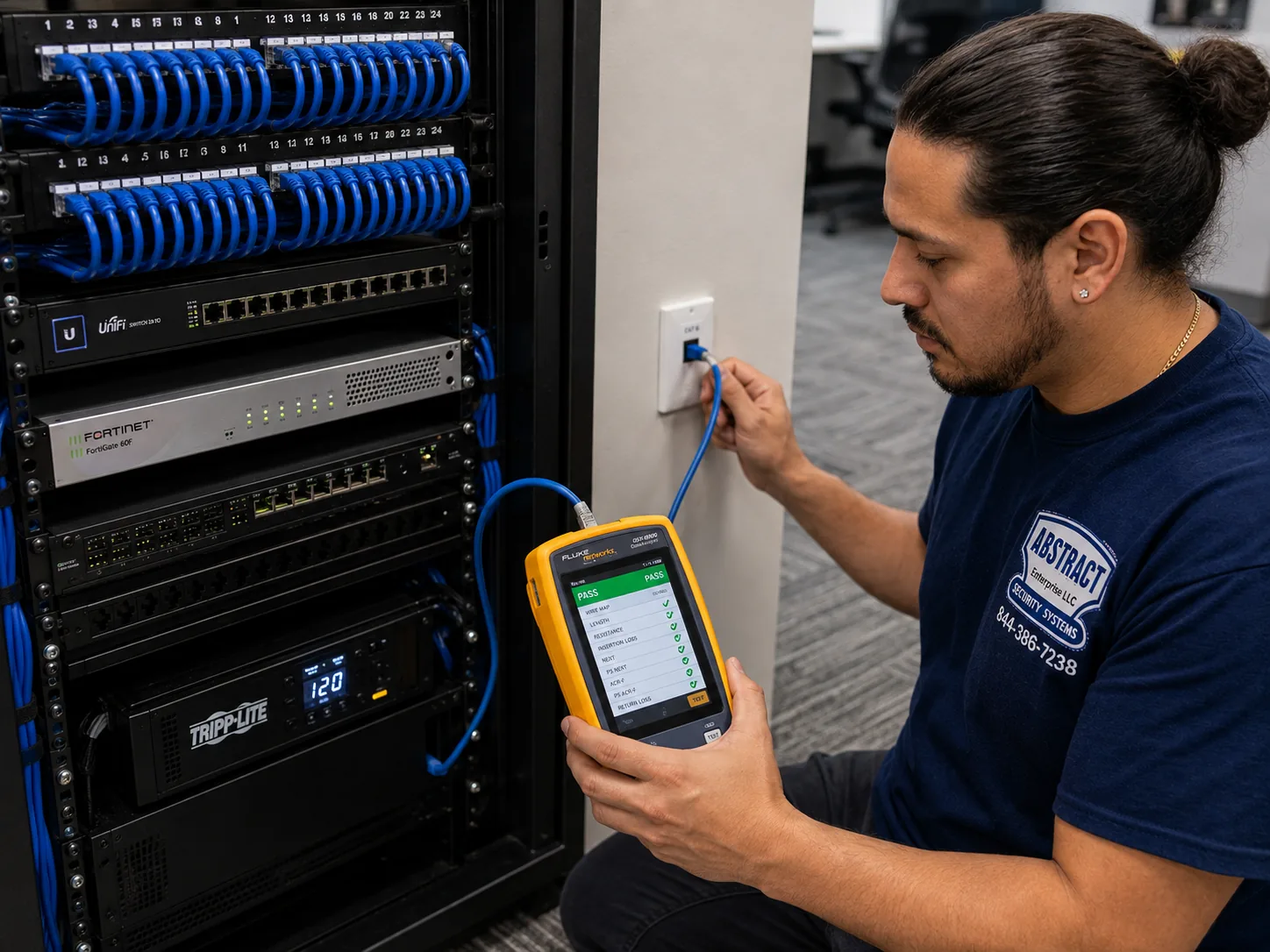
A photo from the AESS job library, not taken in East Flatbush: a technician certifying a data run with a cable analyzer that shows a PASS result. When a network camera on an East Flatbush walk-up or shop keeps dropping, testing the cable end to end tells us whether the run itself is sound before anyone pays for a new camera.
Logins: when the person who set it up is gone
A large share of East Flatbush repair calls are not hardware at all. The camera works and the recorder records, but nobody can see it, because the app account belongs to a relative, a former tenant, a former manager or an installer who has closed. The city's investigators found the same kind of login and connection failures behind most of the public housing senior buildings whose cameras could not be viewed remotely. The fix is to recover the recorder, set new passwords, put the account in the owner's name and write down who holds it.
Building work: the camera cable nobody saw
Roofers, pointing crews, window installers, plumbers and internet technicians all work where camera cables run. On East Flatbush row houses and apartment buildings, a camera that died the same week as a new roof, new windows or a new internet line was almost always cut, unplugged or buried by that work. We trace the run, repair or replace the damaged section, and tell you who was working there so you can raise it with them.
Commercial Security Camera Repair
Business Security Camera Repair in East Flatbush
East Flatbush businesses are mostly small and owner-run: bakeries, roti and patty shops, groceries, delis, barbershops and salons, pharmacies, tax and travel offices, medical practices and storefront churches. Their camera systems are usually one recorder in a back room or under the counter with four to sixteen cameras. When something goes wrong in the shop, the owner needs the video that night, and the repair has to fit around opening hours.
Church Avenue
The long shopping street through the heart of the neighborhood, co-named Bob Marley Boulevard along part of its length, with Caribbean bakeries, restaurants, groceries, phone and beauty supply stores. A Church Avenue deli was robbed at gunpoint late on a February night in 2024, and late-night counters are where cameras most need to be working.
Utica Avenue
Shops, takeout counters, auto businesses and services running north to south through East Flatbush, many with apartments above and a cellar shared with the building. Recorders here often sit in a back room next to the stock.
Nostrand Avenue edge
Stores and offices on the western side of the neighborhood, where busy sidewalks and bus stops mean cameras see a lot of people, and motion recording settings matter as much as the hardware.
Linden Boulevard
A wide road with apartment buildings, storefronts, car businesses and churches, and new construction such as the four-story, 32-unit building filed for 869 Linden Boulevard in 2026. Parking lots and long frontages mean longer runs and more outdoor connectors.
Clarkson Avenue and the hospital blocks
Medical offices, pharmacies and services around Kings County Hospital and SUNY Downstate, where cameras cover entrances and waiting areas and the practice usually has an IT contractor as well.
Avenue D, Foster Avenue and Remsen Avenue
Churches, schools, small shops and offices on the southern blocks and in Remsen Village, including St. Therese of Lisieux Church on Avenue D, where gardens and side lots are watched only by cameras at night.
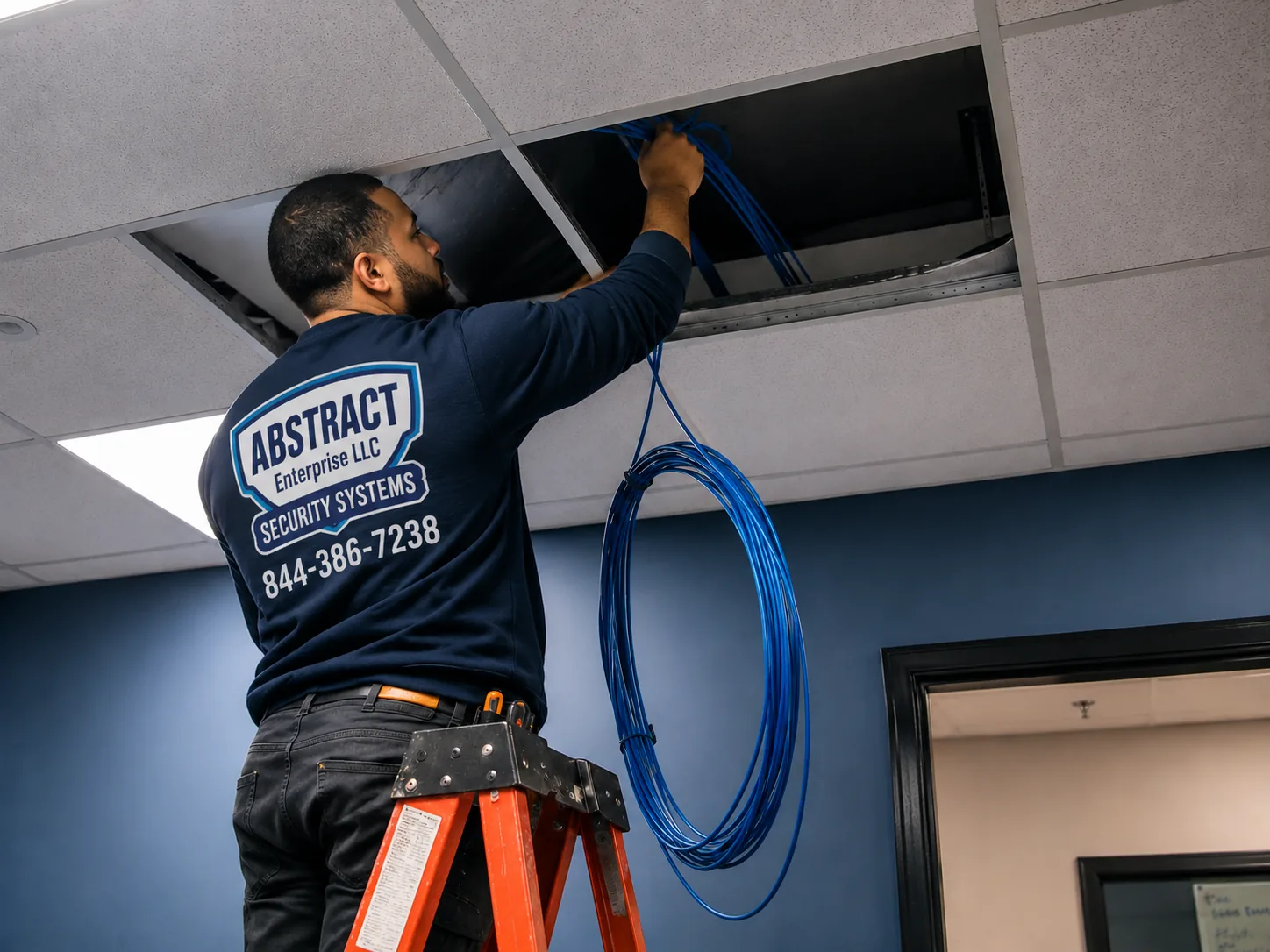
A photo from the AESS job library, not taken in East Flatbush: a technician feeding cable through a drop ceiling while the space stays open around him. Shops on Church Avenue and Utica Avenue often cannot close for a repair, so cable work over the sales floor is done section by section, with the register area covered first.
What a Church Avenue or Utica Avenue shop needs from a repair
Shop owners usually call after something has already happened: a robbery, a shoplifting pattern, a break-in, an argument at the counter or a slip and fall. The first need is the footage, saved and exported correctly. The second is to find out why a camera was dark, blurry or pointed at the wrong thing. The third is to make sure the cameras that matter most work every day: the register, the front door, the stock room and the back door. A recorder under the counter where anyone can unplug it, or in a back room where steam and grease from the kitchen reach it, is often part of the problem. We move it somewhere protected, put it on battery backup and set it to alert the owner if a camera drops.
For late-night counters like the Church Avenue deli robbed in 2024, the camera at the register has to show a face clearly under the store's own lighting, and the camera at the door has to catch people coming in, not the backs of their heads going out. Many repairs on these counters are re-aims and lens or setting changes rather than new cameras. We check every camera at the hours the store is actually busiest and darkest.
Barbershops, salons and offices
Barbershops and salons have mirrors, bright lights and windows that confuse cameras: reflections double the room, backlight from the window turns people at the door into shadows, and ring lights blind a camera aimed the wrong way. Medical, tax and professional offices have cameras on the entrance and waiting area that share the office network with computers. For both, a repair often means re-aiming, changing exposure settings and separating camera traffic from the office network, working with the office's IT contractor when there is one.
Storefront churches and church halls
Churches in East Flatbush range from large parishes like St. Therese of Lisieux on Avenue D to small congregations in former stores. Their cameras watch doors, gardens, parking areas and collection rooms, and they are often managed by volunteers who change every year. The St. Therese footage shows how much a working system can matter. A church repair usually includes checking every outdoor camera after dark, removing any dependence on a light that can be covered, and putting the recorder login in the hands of the church office rather than one volunteer.
Rules that touch a commercial camera repair
State licensing. The New York Department of State licenses companies that install or service security systems, and its rules cover closed-circuit television used to watch for intrusion, theft or movement. An owner can work on their own system, or have an employee do it, without a license; a company working for someone else needs one. AESS works under NYS license #12000287431.
City low-voltage rules. Under NYC Administrative Code §28-105.4.7, effective with the 2025 Electrical Code on December 21, 2025, no electrical permit is needed for low-voltage signaling, communication and alarm wiring under 50 volts, provided the work is done by a licensed master electrician, special electrician or qualified person. Camera repairs on existing low-voltage wiring fall in that category; any change to a building's line-voltage outlets or circuits is a job for a licensed electrician.
Cameras that watch staff. New York Labor Law §203-c requires employers who monitor employees electronically, including by video, to give written notice and get acknowledgment. If a repair adds or moves a camera that watches staff, the notice should be updated.
Landmarked blocks. East Flatbush has a landmarked block in the East 25th Street Historic District. The Landmarks Preservation Commission's permit guidebook says no permit is needed for ordinary maintenance and repair of existing safety and utility equipment, while moving a camera or adding new conduit on a landmarked facade follows the commission's rules for mounting and conduit.
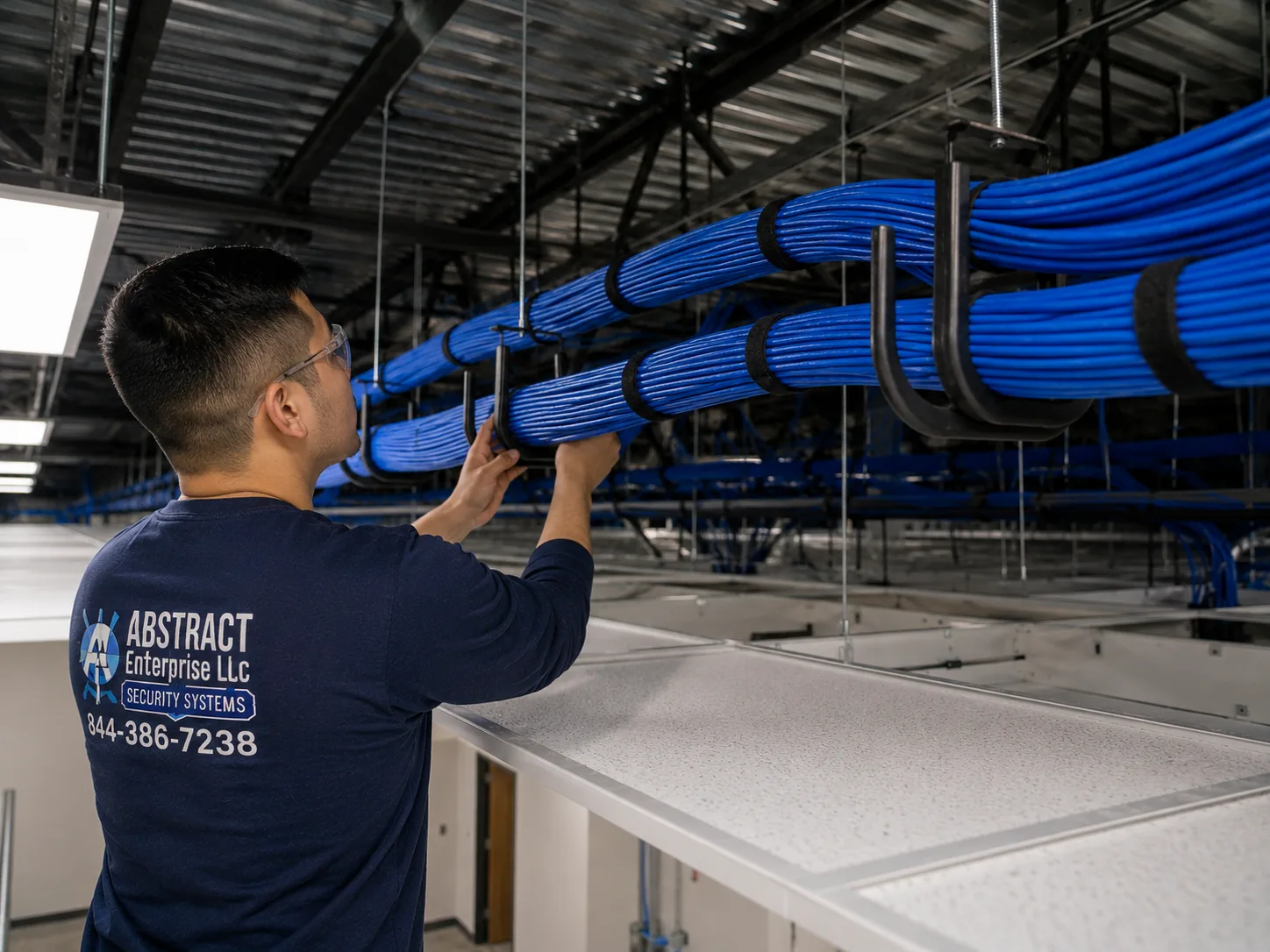
A photo from the AESS job library, not taken in East Flatbush: J-hooks carrying neat bundles of cable across a commercial ceiling. In a shop or medical office near Clarkson Avenue, camera cables lying loose on ceiling tiles get pulled or cut whenever someone works above the ceiling; hung on hooks and labeled, they survive the next contractor.
Your Questions Answered
Security Camera Repair in East Flatbush: Questions Answered
These are the situations East Flatbush homeowners, landlords, managing agents, church boards and shop owners describe when they call. Each answer is written for the buildings here.
Night pictures and the light around a camera
Someone threw a bag over the light beside our church garden before vandalizing it, as happened at St. Therese on Avenue D. If the light near our camera is blocked, does the camera still record anything useful?
It depends on whether the camera can see without that light. A camera with working infrared keeps recording in black and white when a nearby lamp is covered; a camera whose infrared has failed, or that was set to rely on the lamp, goes nearly blind. On a repair we test each outdoor camera with the lights off, replace failed infrared, and where a garden or lot is large, add a camera with its own light mounted out of reach. Footage of the moment someone reaches for the light is often the most useful clip of all, so the camera should cover the light itself.
Our camera sits inside the front window of our row house looking out at the stoop, and at night it shows only a white glare. Is the camera broken?
Usually not. The camera's infrared lights bounce off the glass and flood the lens, so the picture goes white the moment it switches to night mode. The repair is to turn off the camera's infrared and rely on the street and porch lighting, press the lens flat against the glass with a shield, or move the camera outside in a weatherproof housing. Which one is right depends on how much light reaches the stoop at night, which we check after dark before choosing.
The camera in our barbershop on Church Avenue faces the mirrors, and the picture is full of reflections and bright spots. Can it be fixed without losing the view of the door?
Yes, in most shops. Mirrors and ring lights confuse a camera's exposure, and a camera aimed down the length of the shop picks up every reflection. We re-aim the camera so it sees the door and chairs at an angle to the mirrors, adjust exposure and backlight settings, and if needed add a second small camera just for the door. Most of that is labor and settings rather than new equipment.
Power, wiring and the block
Our block is fed by overhead wires like the ones that caught fire at East 48th Street and Church Avenue in January. Does that make our camera system more likely to be damaged?
It makes outages and surges more likely to reach it, since lines on poles are exposed to weather, branches and fire. The camera system is hurt less by the outage itself than by the moment power returns. A good battery backup on the recorder and the switch or power box, plus surge protection on the outlet, protects against most of that. If your system has already come back wrong after an outage, the repair usually starts with the power supply and the recorder's drive.
The cables for our cameras are stapled along the outside of the brick, and several have cracked in the sun. Do we have to redo the whole house?
Usually not. Sun-cracked cable lets water into the connectors, so the cameras at the end of those runs fail first. We replace the damaged runs along the same route, clip them into the mortar joints, and put every outdoor connector in a sealed box. Runs that are still sound stay. The written price lists each run so you can choose which to do now.
The little light on our camera is on, but the recorder shows no picture from it. What does that mean?
It means the camera has power but the video is not reaching the recorder, or the recorder is not accepting it. Common causes are a damaged cable or connector, a recorder set to the wrong channel or format, an IP address conflict on a network system, or a camera whose video board has failed while its power light still works. We test signal at the camera and at the recorder to tell which, so you pay to fix only the failed part.
Two-families and inherited systems
The recorder's maker wants proof of purchase before it will reset the password, and we never had a receipt. What else can we use?
Makers vary. Some accept the recorder's serial number with a code from its screen, some accept a deed or utility bill showing the house is yours, and some offer a reset that clears settings but keeps the recorder usable. We check what your recorder's maker allows, try the routes that keep your settings and footage first, and tell you before anything is erased. If the footage on the drive matters, we copy it off before any reset.
We have more cameras on our two-family than our recorder has inputs, so two were never connected. Can that be fixed without a new recorder?
Sometimes. If the recorder is a network model, a small switch can add cameras up to its license limit. If it is a coax recorder with all its inputs used, the choices are a larger recorder or moving the extra cameras onto a small second recorder. We count what the recorder supports, check the unconnected cameras still work, and give you both prices.
Apartment buildings and complexes
Our building is in HPD's Alternative Enforcement Program, like Rutland Plaza, and new management wants every camera working before the next inspection. Does a camera repair help clear violations?
Not directly. Brick Underground has noted that city buildings are not required to have working security cameras at all, so a dead camera is not usually an HPD violation on its own. What HPD does enforce at the entrance includes self-locking doors and, in many buildings, a working intercom. Working cameras still help a building show it is being run properly, and they help with door and intercom problems. We repair the cameras and can check the door and intercom on the same visit.
Part of our hallway ceiling came down after a leak and took the camera cable with it. Who repairs the ceiling and who repairs the camera?
The building fixes the leak and the ceiling; we fix the camera system once that work is safe. If the ceiling is being rebuilt, the best time to replace the cable is while it is open, so tell us the contractor's schedule. Until then we can run a temporary cable along the surface so the camera works in the meantime, and check the camera itself for water damage.
Water from the roof is dripping onto the camera in our top-floor hallway. Is it safe to leave it powered?
Camera power is low voltage, so the shock risk is small, but the water will ruin the camera, its connector and possibly the power supply it shares with others. If you can, unplug that camera's power at the recorder or power box and send us a photo. Once the roof is fixed, we dry and test the camera, replace what water damaged, and seal the connection.
Footage, police and security
Detectives took our whole recorder as evidence after something happened on our block. How do we keep the house covered until it comes back?
We can install a temporary recorder on your existing cameras so they keep recording while the original is held. If you will get the original back, we set the temporary one up so it can be removed easily; if not, it can stay as the permanent replacement. In future, a copy of the clip on USB usually satisfies a request, and we can show you how to export one.
Our camera app showed a login from a phone none of us own. Was our system hacked, and what does a repair change?
It may be a former user, such as a past tenant or relative, still logged in, or it may be an outside login through a default or reused password. Either way, the fix is the same: change every password on the recorder and the app, remove old users, update the recorder's firmware, and turn off remote features you do not use. We also check whether the recorder is exposed directly to the internet and close that if so.
Equipment
Types of Security Cameras and Recorders We Repair
We repair whatever is on the building, whoever put it there. These are the kinds of equipment we find on East Flatbush houses, apartment buildings, churches and shops, and the faults each one tends to develop.
Analog and HD-over-coax cameras
Cameras with round BNC connectors, from older analog to HD models, common on row houses and walk-ups wired ten or more years ago. Typical faults: water in outdoor connectors, failed power adapters and worn infrared.
Network (IP) cameras
Cameras powered and connected through one data cable, common in newer buildings and shops. Typical faults: failed switch ports after a surge, address conflicts, lost passwords and firmware problems.
DVRs, NVRs and hybrid recorders
The box that holds the footage, in a cellar, closet, back room or church office. Typical faults: worn or wrong-type drives, corrupted settings after an outage, overheating on a shelf near a boiler, and clocks that drift.
Wi-Fi and battery cameras
Plug-in and battery cameras on stoops, yards and inside windows. Typical faults: weak signal through brick, router changes, batteries that drain in cold weather and app accounts tied to someone who has left.
Dome, turret and bullet housings
Vestibule domes cracked or spray-painted, turrets with dirty or scratched covers, and bullets knocked out of line on low walls. Covers and brackets are replaced separately from the camera where possible.
360-degree and PTZ cameras
Fisheye cameras over shop floors and pan-tilt-zoom cameras on larger buildings and lots. Typical faults: lost presets, motors that stick, and fisheye views that need the right display settings.
PoE switches and extenders
The switches and extenders that power network cameras, often on a cellar shelf with no backup. Typical faults: dead ports or whole units after a surge, and overloaded power budgets when cameras were added.
Power supplies and battery backups
Central power boxes, plug-in adapters and UPS units. Typical faults: blown fuses on one channel, adapters that fail after a surge, and backups whose batteries died years ago.
Phone apps and monitors
Viewing apps, desk monitors and the TVs some shops use for a live view. Typical faults: lost accounts, wrong camera names, and screens that freeze or show the wrong layout.
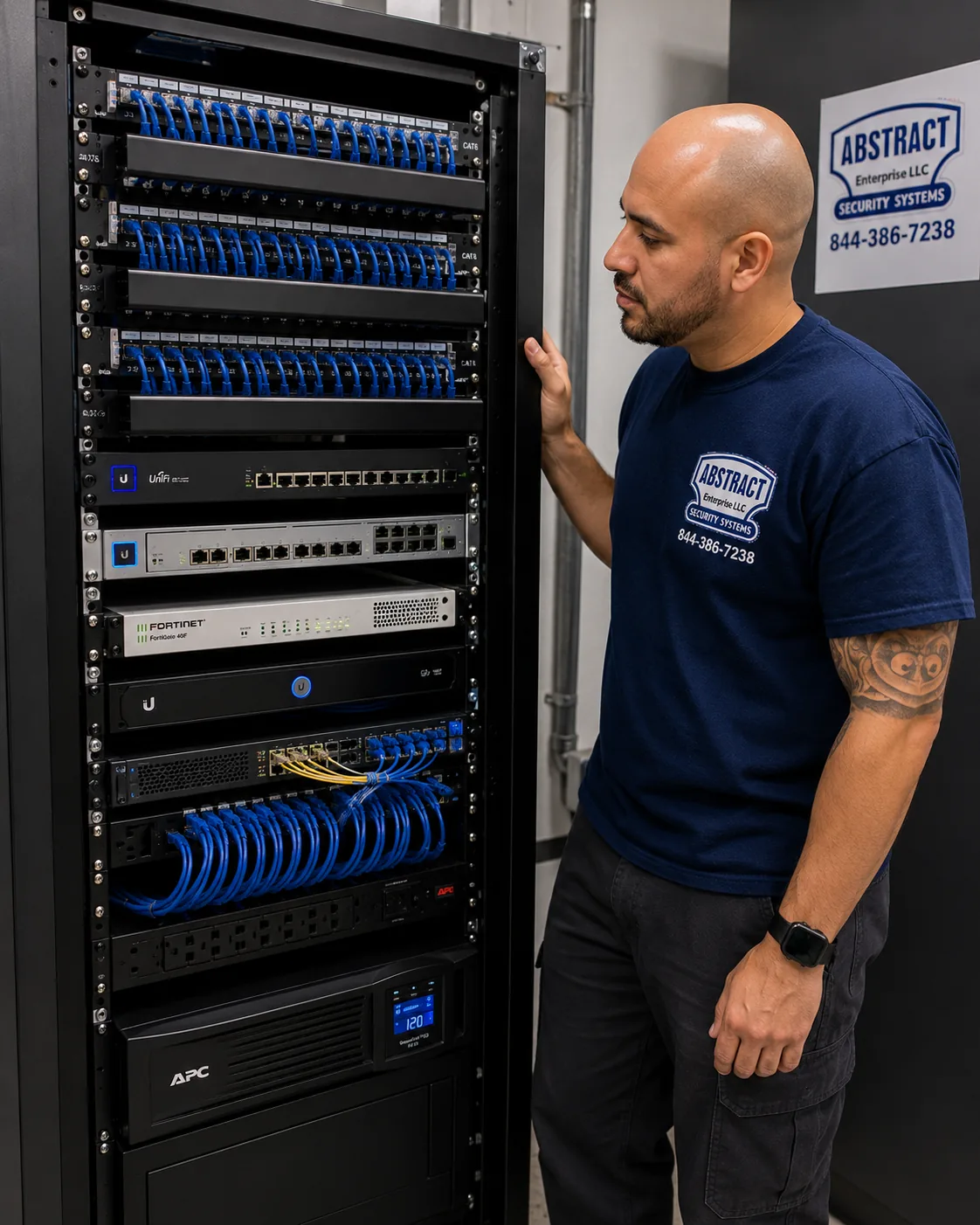
A photo from the AESS job library, not taken in East Flatbush: a finished rack with patch panels, switching, a firewall and a battery backup, all dressed and labeled. Most East Flatbush camera systems are far smaller, but the same order applies to a recorder and switch on a cellar shelf: protected power, labeled cables and a recorder off the floor, away from water and heat.
National brands versus a local licensed repair
Some East Flatbush households and shops have cameras from national alarm companies or consumer brands, and wonder who should fix them. The table shows how the choices usually compare for a repair.
Question
ADT or similar alarm company
Ring or SimpliSafe camera
AESS local repair
Who owns the equipment
Depends on the contract; some is leased
You own it
You own it, and we repair it
Works through brick row-house walls
Depends on its wiring
Wi-Fi often weak through brick
Wired cameras on existing cable where possible
Other brands on the same house
Usually only its own
Support covers its own devices
Any brand, any installer
Recorder and drive repair
Its own systems
Cloud storage, no local recorder
DVR, NVR and hybrid recorders, drives and footage export
Licensed technician on site
Varies by dealer
Remote support
Yes, NYS license #12000287431
Price before work
Varies
Replacement device price
$150 service call, then a written repair price
AI Overview Reality Check
What AI Gets Wrong About Security Camera Repair in East Flatbush
These claims turn up in AI-generated answers, help forums and national repair guides. Each one is partly true somewhere, and each one leads East Flatbush owners to the wrong repair or a lost clip.
"If the light on the camera is on, the camera is working"
Many quick answers treat a glowing status light or infrared ring as proof the camera is fine and point the owner at the recorder or the app. Reolink's own guide lists a case where there is no video even though the camera's lights are on.
A power light only shows that power is reaching the camera. The video can still be lost in a wet connector, a cracked cable along the brick, a wrong channel setting on the recorder, an address conflict on a network system, or a failed board inside the camera. On East Flatbush row houses, the connector at the camera end is the most common culprit.
The right test is signal at both ends: at the camera and at the recorder. That tells us which part failed and keeps you from paying for a new camera when the problem was a connector worth a fraction of the price.
"Unplug the recorder and plug it back in; that fixes most problems"
A restart is the first suggestion in almost every troubleshooting answer, and sometimes it does bring a frozen recorder back.
After an incident it is the wrong first step. A recorder with a failing drive may not come back from a restart at all, and one that does may write over the period you need sooner than you expect. A restart also clears the evidence of what failed, such as error logs or which camera dropped first. After a robbery on Church Avenue or a break-in on a side street, the footage is worth more than the convenience of a quick reset.
Save first, then diagnose. If you need a clip, leave the recorder running and call us; we export the footage with its timestamps, and only then restart, test or replace anything.
"Power outages don't damage camera systems; everything comes back when the lights do"
Answers about outages tend to assume the system simply waits in the dark and resumes.
East Flatbush has seen what happens instead. After events like the January 2026 wire fire at East 48th Street and Church Avenue, the calls we get are about recorders stuck on a setup screen, drives that will not mount, cameras that never came back because their switch port or adapter died, and clocks set back years. The outage did not cause most of that; the moment the power returned did.
A battery backup sized for the recorder and switch, surge protection on the outlet, and a recorder set to come back up cleanly prevent most of these failures. If yours did not come back, the repair usually starts with power and the drive, not the cameras.
"Once someone covers a camera, it's useless"
Some answers treat a covered or spray-painted camera as a total loss and suggest hiding cameras or buying many more.
The St. Therese video on Avenue D shows why that is too simple. The footage captured the person entering the garden and climbing the statue before they covered a light, and the priest said it "laid out exactly what happened." Covering a camera or a light takes time and usually happens in view of the camera itself. What matters is that the camera can see the person approaching it, that its night picture does not depend on a light within their reach, and that the owner is told when a camera stops.
A repair can add all three: re-aiming so cameras cover each other and the lights, fixing infrared so night views do not depend on a lamp, and turning on alerts for lost video. That is cheaper than doubling the number of cameras.
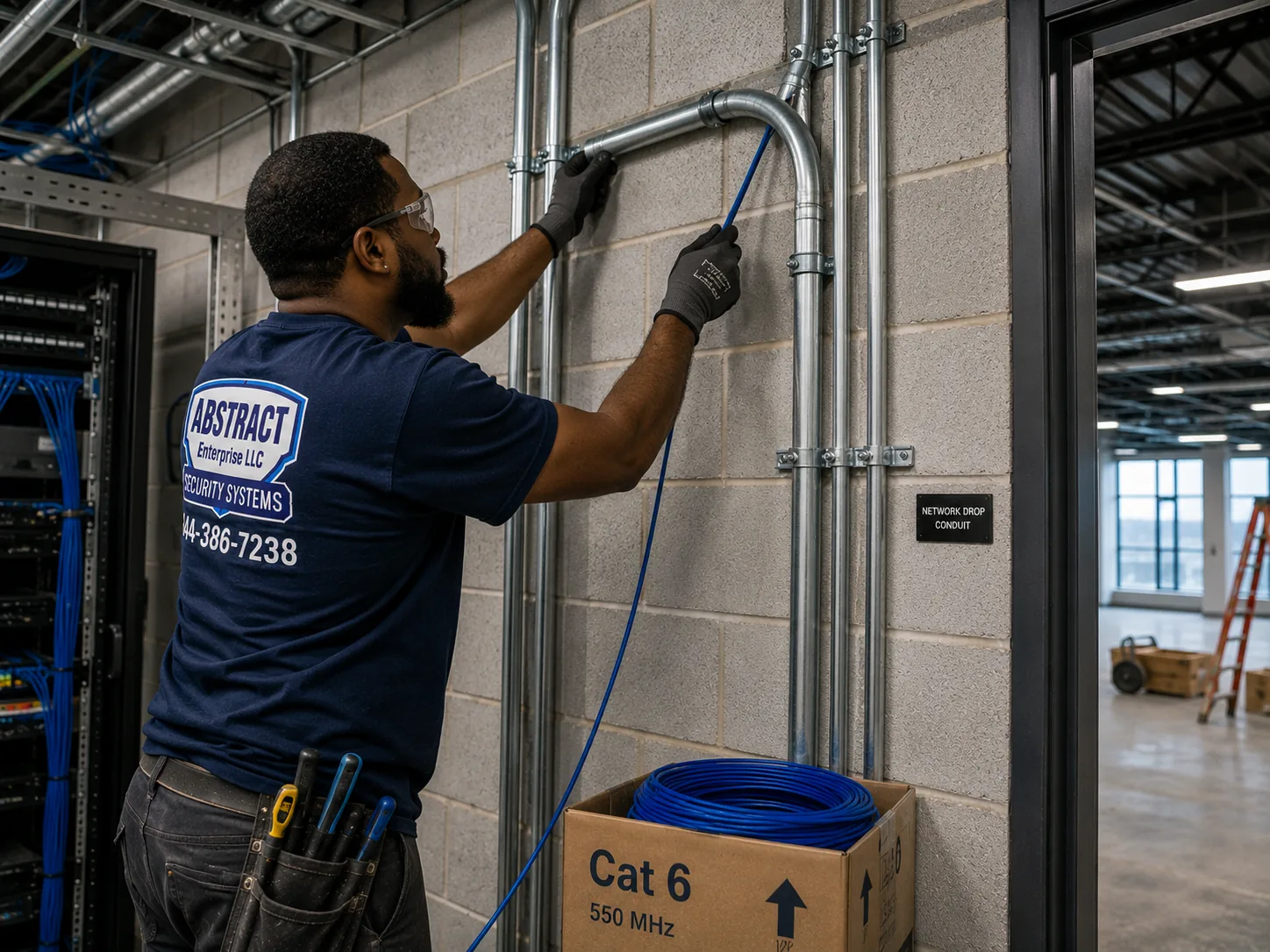
A photo from the AESS job library, not taken in East Flatbush: a technician running cable into metal conduit beside a telecom room. On East Flatbush shops and walk-ups, the camera cable that runs within reach of the sidewalk or the back yard is the one that gets cut. Putting the low part of the run in conduit means someone has to work much harder to disable the camera.
"Apartment complexes and public housing keep their cameras on a maintenance schedule"
AI answers about building cameras often assume that large landlords and housing agencies check their cameras routinely, so tenants can count on them.
The city's own investigators found otherwise. In early 2025 the Department of Investigation tried to reach the CCTV cameras at 63 public housing senior buildings and found about 70 percent had cameras that could not be viewed remotely, citing login, connection and data storage problems as well as damage. At an April 2025 City Council hearing, NYCHA said it aims to fix a reported camera within 24 to 72 hours, which depends on someone reporting it. Private complexes in East Flatbush have their own management problems; News 12 found unlocked doors and hundreds of HPD complaints at Rutland Plaza.
If you manage or own a building, the only schedule that counts is the one you set: a checkup at least once a year, alerts on lost video and drive errors, and a written list of every camera. If you are a tenant, put problems with building cameras in writing to management and keep a copy.
"Wireless cameras avoid the repairs wired systems need"
Some answers suggest replacing a broken wired system with Wi-Fi cameras to avoid cable problems for good.
In East Flatbush brick row houses and walk-ups, Wi-Fi brings its own repairs. Signal through brick and between floors is weak, routers get changed by tenants or internet providers, battery cameras drain faster in cold weather, and each camera depends on an app account that someone has to own. Every wireless camera still needs power from somewhere, so the outlet and adapter can fail just like a wired system's.
For most row houses and buildings, repairing the existing wired system is cheaper and steadier. Wi-Fi cameras make sense for a spot where cable truly cannot go, set up on the owner's network with the account in the owner's name.
"Buying the replacement part online is always the cheapest repair"
Many answers tell owners to order a replacement camera or recorder online and have someone fit it.
Sometimes that works, and we install customer-supplied equipment at labor-only rates. But a camera chosen by model number alone may not match the recorder's format or resolution, a recorder may not support the existing cameras, and a part bought online carries only whatever warranty its seller offers. The dead camera may also not be the fault at all; a connector or adapter may be.
Find the cause first. The $150 service call tells you exactly what failed and what will work with your system, and the written price lets you compare our part against one you buy yourself. HomeAdvisor's Brooklyn average of $1,416 mixes installs and repairs; a single repair on our Brooklyn list usually costs far less.
Talk to a Technician Before You Restart the Recorder or Buy a New Camera
Tell us the address, the type of property, how many cameras there are, which ones are out, and where the recorder sits. If you need footage from a specific date, say so and we will plan the visit around saving it. Photos of the recorder screen, the dark cameras and the power supply help us bring the right parts. For anything urgent, call (347) 934-8335 now.
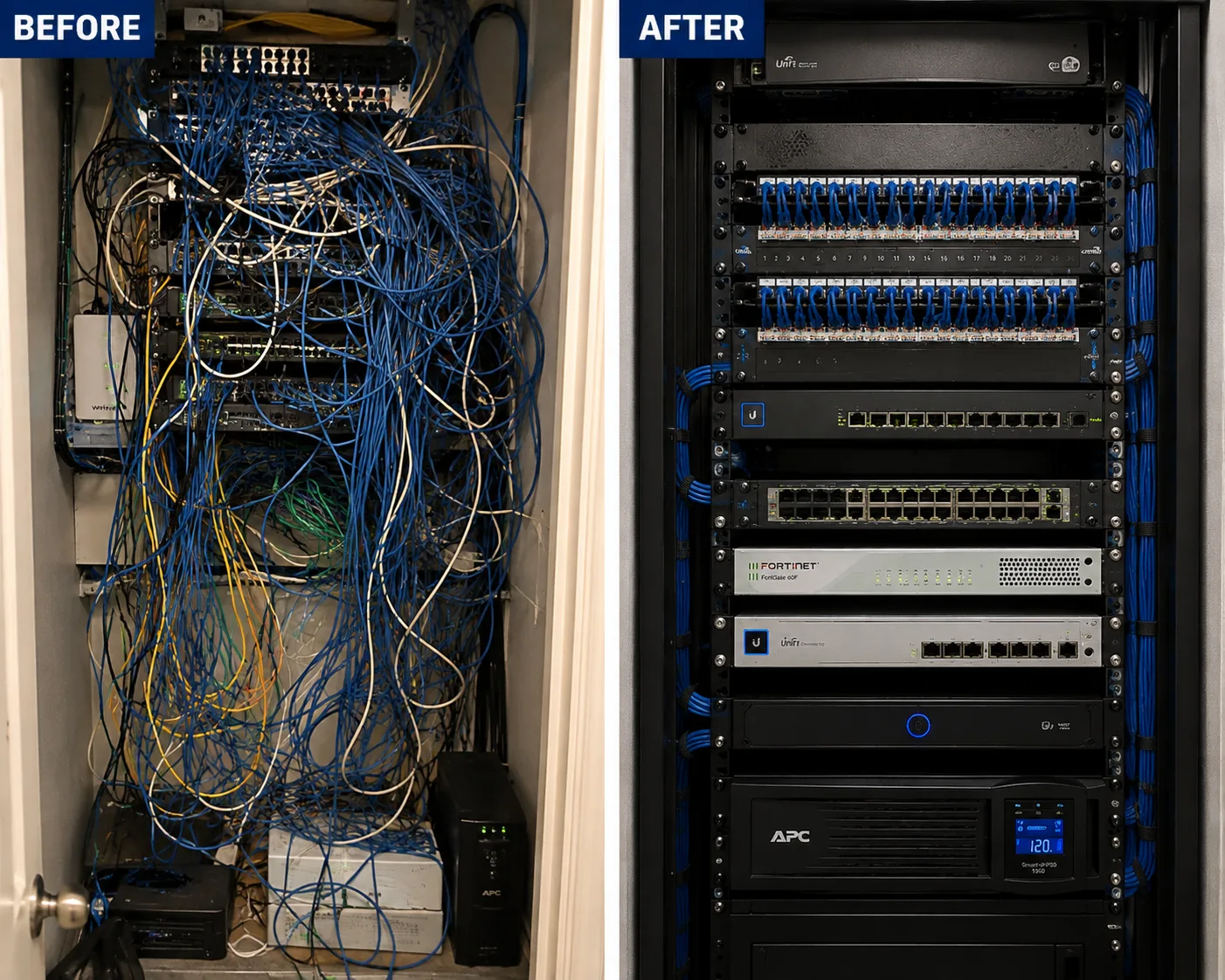
A photo from the AESS job library, not taken in East Flatbush: before and after views of a network rack, an unlabeled tangle rebuilt into a dressed and labeled rack. The cellar shelf under many East Flatbush walk-ups looks like the before picture, with a recorder, a switch, a modem and loose adapters wired by different people over the years. Sorting it out is often part of the repair, because it is what lets the next technician find the fault quickly.
✅
Request Sent!
Thank you. A technician will contact you about the East Flatbush address shortly.
How It Works
Our Repair Process
1. Send the screen and the address
A photo of the recorder or phone app with the dark cameras, the address and the type of property, by text, WhatsApp or the request form. Tell us if you need footage from a particular night.
2. Confirm who owns it and who approves
Homeowner, landlord, managing agent, church office or store owner: we confirm who approves the work and who holds the recorder login, so nothing stalls on the day.
3. Book and pay the service call
The $150 Brooklyn service call puts the visit on the schedule in a two-hour arrival window and is credited to the repair if you go ahead.
4. Save footage first
Any clip that matters is exported to USB with its original timestamp before anything is restarted, unplugged or replaced, and the recorder's clock is checked against the real time.
5. Test the chain
Outlet and power supply, cable and connectors, switch or power box, recorder and drive, then the app, camera by camera, from the cellar out to the street.
6. Cause and written price
You hear what failed and why, and get a written, itemized repair price before any part is replaced. If the price changes on site, you hear it first.
7. Repair and retest by day and night
The failed part is repaired or replaced, and every camera is checked for picture and recording, including after dark with the real lighting.
8. Label, alert and hand over
Cables are labeled, logins go to the right person, alerts for lost video and drive errors are turned on, and you are shown how to export a clip yourself.
Coverage Area
Security Camera Repair Near East Flatbush's Landmarks
St. Therese of Lisieux Church
The parish on Avenue D whose upgraded camera system recorded the October 2024 attack on its century-old garden statue.
Wingate Park
The park on Brooklyn Avenue at Rutland Road, across from the hospital campus, known for its summer concerts, with homes and buildings around its edges.
Kings County Hospital and SUNY Downstate
The medical campus on Clarkson Avenue whose surrounding blocks hold medical offices, pharmacies and staff housing.
Sparrow Square
The new affordable and supportive housing rising on the former Kingsboro Psychiatric Center campus off Clarkson Avenue, starting with 261 homes in Phase 1.
Rutland Plaza
The apartment complex on East 93rd Street placed in HPD's Alternative Enforcement Program in 2025.
Bethany Senior Terraces
The four-story senior building at 610 East 40th Street between Avenue D and Foster Avenue, completed in 2026 with an attended lobby and an elevator.
East Flatbush is billed at our Brooklyn rate. Every repair starts with the $150 service call, which covers the on-site diagnosis and is credited to the repair if you go ahead. The figures below come from our published list of Brooklyn security camera repair prices; your exact price is written down on the visit, once we know what failed.
Repair
Brooklyn price
Service call, on-site diagnosis and written repair price
$150, credited to the repair
Motion, app, login or clock settings with no parts
Usually within the $150 service call
Clean and check for a blurry picture
$80
Connector reterminate or PoE port swap
$150–$350
Power supply repair
$150–$400
Dome or front cover replacement
$30–$80 part plus labor
Indoor camera repair
$200–$450
Hard drive swap, by capacity
$200–$450
Single camera replacement on a working system
$250–$600
Night vision camera repair
$250–$650
DVR not working, including drive and labor
$300–$700
NVR not recording, by model
$400–$900
Vandalized camera, per camera plus cable repair
$400–$900
PTZ camera repair
$450–$1,200
Hybrid recorder swap, channels reconfigured
$700–$1,200
DVR/NVR replacement with drive, or multi-camera wiring repair
$700–$1,500
Full rewire or whole-building overhaul
From $1,500
Three things move an East Flatbush repair within those ranges. The first is reach: a camera at the top of a six-story building, on a back wall over a deep yard, or high on a church needs more time and ladder work than one over a stoop. The second is how many runs failed: one cracked connector is a small job, while several runs damaged by sun, water or building work are priced run by run. The third is the recorder: a recorder that has to be replaced, or a system whose cables nobody ever labeled, adds time for setup and tracing. If the price changes on site, you hear the new number before the work goes on. Bundling the camera repair with intercom, alarm or cabling work on the same visit saves $200 to $400 in labor on our Brooklyn list.
Full terms — including 50% deposit, one-year parts-only warranty on AESS-supplied products, and the late-fee schedule — are set out in the service agreement.
Shop Our Systems
Security Camera Repair Packages & Pricing
Three ways East Flatbush repairs usually come together, priced from our Brooklyn list.
Single-issue repair: $150–$700
One fault, one visit: a weathered connector redone, a power supply or adapter replaced after an outage, a drive swapped, a night picture fixed, or a login recovered. Typical for a row house, a two-family or a small shop with one camera or one recorder problem.
Major system repair: $700–$1,500
The recorder or the wiring: a DVR or NVR replaced with a new drive and the cameras reconfigured, or several damaged runs replaced on a walk-up or along the face of a row house. Typical after a bad outage or a building job that cut cables.
Annual maintenance: $250–$800
Every camera checked by day and night, lenses cleaned, connectors and power tested, the drive's health read, alerts confirmed and footage export tested. Residences start at $250, commercial properties at $400, and multi-property owners run $500 to $800.
Bring your own equipment. If you have already bought a replacement camera or recorder, we can fit it at labor-only rates. Tell us the exact model and we quote the labor by phone or text, and the visit is booked once it is paid. Your own equipment is installed as supplied: we cannot vouch for parts we did not supply, and if a model will not work with your recorder, will struggle through brick on Wi-Fi, or cannot handle the night lighting where it is going, we tell you before the visit.
Complete Services
Every Security Camera Repair Service in East Flatbush
Camera, connector and cable repair
Dark cameras, weathered connectors, sun-cracked runs and cables cut during building work. Request a repair
Recorder, drive and outage repair
DVRs, NVRs and hybrids in cellars, closets, back rooms and church offices, including systems that came back wrong after a power cut. Brooklyn security camera repair
A technician told us our recorder has an ordinary desktop hard drive in it. Is that why it keeps failing?
+
It may be. Recorders write video around the clock, and drives built for desktop computers are not designed for that steady load, so they tend to wear out sooner and fail without warning. A drive made for surveillance recording is the right replacement. We read the drive's health on the visit, copy any footage you need, and replace it with the right type and size for how many days you want to keep.
After a break-in on our street, several neighbors found their cameras were not recording. Can one technician check several houses on the same block in one trip?
+
Yes. Each house is its own service call and gets its own written price, but booking them together lets one technician go door to door in the same arrival window instead of making separate trips. Each owner approves and pays for their own repair, and each system's logins stay with that household.
Every night at about the same hour, all of our cameras drop out for a few minutes. Is someone switching them off?
+
Usually not. Many recorders have an automatic maintenance restart set for the early morning, and some routers and power timers do the same. The recorder's log shows whether it restarted on its own. We check the log, move or turn off the scheduled restart if it falls during hours you care about, and look for a timer or power strip that might be cutting power on a schedule.
Our shop's 360-degree ceiling camera shows a stretched circle on the phone instead of a normal picture. Is it broken?
+
Usually it is a display setting. Fisheye cameras send a round image that the recorder or app has to flatten into normal views, and that setting can be lost after an update, a reset or a new phone. We restore the flattened views on the recorder and in the app, and set up separate views for the register, the door and the aisles.
Our cameras back up clips to the cloud, but the uploads stop every evening. Why?
+
Most often the home or shop internet connection is busiest in the evening and cannot carry several camera uploads at once, or the cameras record at a size too large to send in time. We check the upload speed and the camera settings, set the cloud copy to a smaller stream or to motion clips only, and keep the full recording on the local recorder.
We run a home daycare. Can the repair be done while children are in the house?
+
Yes, with planning. Tell us when you book so we can choose the quietest part of your day, keep ladders and tools out of the play areas, and do the cellar and outside work first. If a camera inside a play room needs work, we can do that part when the children are out or napping in another room.
Our complex links the cameras in its buildings with small rooftop wireless antennas, and one link keeps dropping. Can that be repaired?
+
Yes. Point-to-point wireless links fail when an antenna is knocked out of line, when a new obstruction such as a tree or a rooftop unit blocks the path, when the power at one end fails, or when the radio wears out. We check the alignment, the signal and the power at both ends, and replace the radios or re-aim them so the link holds in all weather.
Can the system send an alert the moment someone covers or blocks a camera?
+
Many recorders and cameras have a tamper or video blind setting that sends an alert when a lens is covered or the picture goes dark. We check whether your equipment supports it, set it so ordinary night changes do not trigger it, and send the alert to the phone or email of the person who should respond.
Motion alerts stopped arriving on our phones after a phone update, though the cameras still record. Is that a repair?
+
It is usually a settings fix that falls within the service call. Phone updates can turn off notifications for the camera app, sign the app out, or require a newer app version. We check the phone, the app and the recorder's alert settings together, and test an alert before we leave.
One of our cameras is hanging by its cable after a windstorm. Should we pull it down or leave it?
+
If it is hanging over a sidewalk, a stoop or a doorway where it could fall on someone, unplug its power at the recorder or power box and take a photo, then leave it if you cannot reach it safely. Do not pull it by the cable, which can damage the run inside the wall. We remount it on a sound bracket or replace it, and check the cable and connector it was hanging from.
Our recorder says there is an IP address conflict, and one network camera keeps disappearing. What causes that?
+
Two devices on the same network have been given the same address, often after a new router or a new device such as a printer or game console was added. The camera and the other device keep knocking each other off. We give each camera a fixed address outside the router's automatic range, or move the cameras onto the recorder's own network port, so the conflict cannot come back.
Ready to Get Every East Flatbush Camera Recording Again?
Send a photo of the recorder screen or the dark camera, the address, and the date of any footage you need. We book within 2 hours, give you a two-hour arrival window, save your footage first, and write down the repair price before any part is replaced.