Shop camera that recorded the break-in but not the face, a lobby recorder that went quiet after the voltage cut, or a mail room nobody can play back? Williamsburg camera repair line, booked within 2 hours: (347) 934-8335
Shops and Bars on Bedford, Grand, Metropolitan and Kent · Converted Lofts and Warehouses · Waterfront Towers · Walk-Ups on the North and South Sides
Security Camera Repair in Williamsburg
Any Brand, Any Installer · Footage Saved Before We Touch Anything · Tested for Closed-Hours Recording · Written Price First
Security camera repair in Williamsburg starts with our $150 Brooklyn service call: a technician finds the fault on site, writes down the repair price, and the $150 is applied to the repair if you go ahead. On our published Brooklyn list most single faults run $150 to $700, and a new recorder or a partial rewire runs $700 to $1,500. We fix systems other companies put in: the counter and back-door cameras of a shop on Bedford Avenue, the cellar recorder of a bar on North 6th Street, the corridor cameras of a converted warehouse on Kent Avenue, the lobby and mail-room cameras of a waterfront tower, and the stair camera of a walk-up on South 2nd Street. Requests are booked within 2 hours, visits come in two-hour arrival windows, and any footage you need is copied before a single cable is moved.
Every price on this page comes from our published Brooklyn camera repair list, and your own price is put in writing before work starts
Rated 4.7★ across 201 Google Reviews
Reviewed and updated November 12, 2026, against News 12 Brooklyn and Williamsburg365 reporting on the February–March 2026 business burglaries; ABC7 on the January 2023 Kent Avenue break-ins and the July 2025 break-in at 17 Kent Avenue; the Brooklyn Eagle and Hoodline on the summer and fall 2026 Brooklyn burglary runs; CBS New York and Gothamist on lobby and mail-room package thefts; DNAinfo on the 90th Precinct's camera advice; Con Edison's July 3, 2026 notice for northern Brooklyn and News 12 and Greenpointers on the February 2026 outages; Brick Underground and a DHCR ruling on landlords, tenants and lobby cameras; the Landmarks Preservation Commission's permit guidebook; Reolink, Swann and CCTV Camera World technical guides; HomeAdvisor's Brooklyn cost page; and the New York Department of State on installer licensing. · Abstract Enterprises Security Systems, NYS license #12000287431 · crews dispatched from our Troy Avenue office in Brooklyn
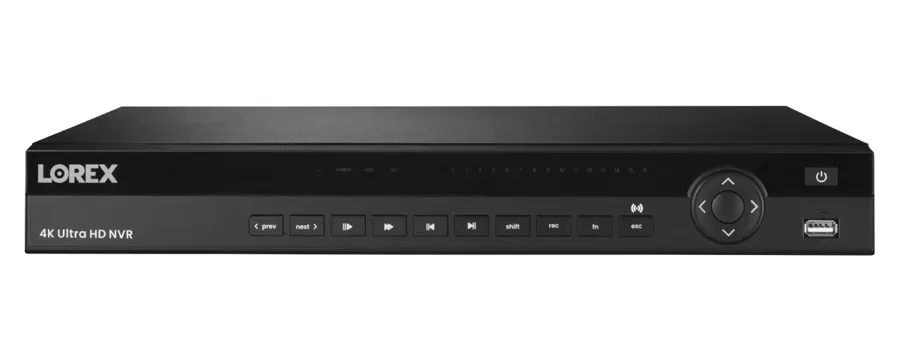
A product photo from the AESS job library, not taken in Williamsburg: a 16-channel desktop network video recorder. In a Williamsburg shop this box usually sits under the register or in a back office; in a bar it is often in the cellar next to the beer lines; in a converted loft or a waterfront tower it lives in a locked telecom or super's room. It is where we start most repairs, because it holds the footage, keeps the log of when each camera dropped, and decides what quality of picture is actually saved.
Williamsburg Camera Repair Request
Shop, bar, venue, loft, tower or walk-up: tell us the address and what the screen shows, and a technician calls back with the next step
✅
Request Sent!
Thank you. A technician will contact you about the Williamsburg address shortly.
25+
Years Experience
✓
Same-Day Estimates
100%
Licensed & Insured
4.7★
201 Google Reviews
Owner-operated since 2002 · Thousands of jobs completed · Booked within 2 hours
Security camera repair in Williamsburg is usually judged the morning after something has already happened. A crew went through nine Williamsburg businesses in the space of two and a half weeks in February and March 2026, according to News 12, and Williamsburg365 reported doors pried with tools, glass doors and windows broken, and keys that had been stored outside put to use. In 2023 a thief on an e-bike walked through the main entrance of a Bedford Avenue building and into its mail room, then did the same on Kent Avenue. And on July 3, 2026, Con Edison cut the voltage across Williamsburg by 8 percent while it made repairs. Each of those is a moment when somebody opens the recorder to find out what it saw, and each is a moment when a weak camera system lets them down: a clip that starts too late, a face hidden under a hood, a drive that stopped writing after the power dipped, or a mail-room camera that nobody had looked at in a year. Text a photo of the recorder screen and the date you need to (347) 934-8335 or on WhatsApp, and we will tell you what the fault looks like and what that repair costs on our Brooklyn list before you book.
Looking at your photos costs nothing. The $150 service call covers the on-site diagnosis and is applied to the repair if you go ahead.
We work under New York State license #12000287431, the Department of State license for companies that install or service security and CCTV systems for others.
We repair any brand from any installer, and we tell you plainly when an old camera or recorder is not worth the money to fix.
The Neighborhood
Why Williamsburg Properties Need Security Camera Repair
Williamsburg began as the Village of Williamsburgh, incorporated in 1827 and folded into the City of Brooklyn in 1855, when it lost the final "h." Its modern shape comes mostly from the waterfront rezoning of May 2005, which let towers such as The Edge and Northside Piers rise along Kent Avenue and later turned the Domino Sugar site into apartment buildings, a park and an office building inside the old refinery. Behind the river sit older converted factories and warehouses, walk-ups over storefronts on the North and South Sides, a few frame and brick row houses, and a nightlife strip that runs from the Bedford Avenue L station to the music halls on North 6th Street and Wythe Avenue. That is the background. For a camera repair, the part that matters is what those buildings ask of a camera system, and how often a system that looked fine on installation day turns out to be unprepared for the day it is needed.
Start with the commercial streets. In January 2023 ABC7 reported six business burglaries in Williamsburg, three of them on Kent Avenue, with metal locks cut off front doors and a sledgehammer taken to another, and more than $16,000 gone. In July 2025 four people broke the front door of a retail business at 17 Kent Avenue, on the Greenpoint–Williamsburg line, with a crowbar early on a Sunday and left with more than $300,000 in clothing; ABC7's description of them came straight from the recording: "Security footage shows four suspects wearing all black." Between February 22 and March 9, 2026, News 12 counted 15 burglaries in North Brooklyn and Queens, nine of them at Williamsburg businesses and nine of them within six hours on March 4. Williamsburg365 listed Broadway, Havemeyer Street and South 4th Street among the streets hit and said cash registers, checks and IDs were taken. Over the summer of 2026, the Brooklyn Eagle reported a man who hit 11 businesses across six precincts, North Williamsburg included, mostly through basement-level doors, and in September Hoodline reported 19 commercial burglaries across Brooklyn, Williamsburg among them, in which someone threw an object through a window to get in.
Those reports share something that shapes our repair work. Nearly all of them happened while the business was closed, by people who came prepared to hide their faces, through a door or window the camera may or may not have been watching. A camera system in a Williamsburg shop or bar is therefore tested at four in the morning, by someone in a hood, at the back door or the cellar hatch as often as the front. When a business calls us after a break-in, the camera usually did record. The trouble is that it recorded the top of a hood from a ceiling mount, or started recording two seconds after the door was already open, or saved a stream so compressed that the face is a grey patch, or watched the front gate while the people came in through the basement. Back in 2015, when the 90th Precinct saw burglaries rise by 31 percent in the first half of the year, its officers gave local businesses the same advice we give today, as DNAinfo reported it: cameras mounted only at the ceiling are easily beaten by a hooded sweatshirt, a second camera lower down and angled up does better, and lights left on overnight help because infrared night vision distorts faces.
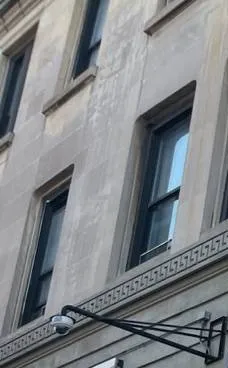
A photo from the AESS job library, not taken in Williamsburg: a bullet camera on a long black steel arm below a carved Greek-key band on a pale stone facade with tall sash windows. On Williamsburg's older bank buildings, converted factories and corner walk-ups, an arm like this is how a camera reaches past a cornice or a sign to see a doorway. When one fails, the repair has to put the new camera back on the same arm and anchors, and the arm itself is the first thing we check, since a loose one lets the picture drift a little every winter.
The big residential buildings bring a different kind of call. CBS New York reported in 2023 that a woman on an e-bike went in through the main entrance of a Bedford Avenue building and straight to the mail room on October 18, then took "numerous" packages from a Kent Avenue building on December 6. Gothamist had described a pair doing the same in Williamsburg and Greenpoint lobbies back in 2015, one time "buzzed into the lobby, by an unknown tenant," another time after they "pried open the lobby door." When residents ask what the lobby camera saw, the answer often depends on whether anyone has checked that camera since the building opened. One Williamsburg renter who wrote to Brick Underground about stolen packages was told by attorney Jennifer Rozen that the landlord is not obligated to share footage outside a legal process, while attorney Catherine Grad said of reviewing it during an ongoing theft problem, "I don't think that it's such an arduous duty to impose on the landlord." Either way, there has to be footage to review, and in towers with dozens of cameras on a recorder in a locked room, a dead channel can go unnoticed for months.
Power is the third thread, and in Williamsburg it often arrives as a dip rather than a blackout. On July 3, 2026, at 5:45 in the morning, Con Edison asked customers in Williamsburg, Greenpoint, Bedford-Stuyvesant, Fort Greene and Clinton Hill to conserve energy and lowered the voltage in the area by 8 percent "to protect equipment and maintain service during repairs," with about 133,000 customers in the primary affected area. In June 2025 News 12 named Williamsburg among the hardest-hit parts of Brooklyn when Con Ed deliberately lowered the voltage, noting that "in some cases, the power isn't fully out—but it's running lower than usual." In February 2026 a manhole fire at 101 Montrose Avenue left 535 customers without power one evening, which Con Edison blamed on snow and road salt seeping into underground equipment, and after the late-February snowstorm Williamsburg was again among the neighborhoods still waiting. Recorders, PoE switches and the small power supplies that feed coax cameras do not always come back cleanly from that kind of week. Some restart in a loop, some lose their clock or settings, some keep showing live video while quietly writing nothing to the drive.
So camera repair here is less about making a dark camera light up and more about making sure the system produces something usable at the moment someone else asks for it: a detective from the 90th or 94th Precinct, an insurer, a landlord, a board or a tenants' association. That means cameras placed and set for closed-hours entry, recorders that keep enough at full quality, power that rides through a voltage cut, and alerts that tell you a camera is dark before you need it. Many owners pair the repair with a check of the video intercom or door buzzer at the same entrance, since in Williamsburg's walk-ups and lofts the same front door usually carries both.
Break-ins cluster in runs. News 12 counted nine Williamsburg businesses among 15 burglaries between February 22 and March 9, 2026, nine of them in six hours on March 4. A run like that is why we test every door camera, not only the front one.
Entry comes from every side. 2026 reporting describes pried doors, broken glass, stored keys, basement-level doors and objects thrown through windows. The camera that matters is often not the one over the front gate.
The waterfront strip has been hit more than once. ABC7 put three of six January 2023 business burglaries on Kent Avenue, and the July 2025 crowbar break-in at 17 Kent Avenue was identified from footage of "four suspects wearing all black."
Voltage cuts are part of the local power picture. Con Edison's July 3, 2026 reduction of 8 percent covered Williamsburg and about 133,000 customers in the primary area; recorders and switches feel that even when the lights stay on.
Crowds pass the cameras all night. The Bedford Avenue station at North 7th Street had 9,815,095 riders in 2025, 23rd of 423 stations, and New York allows on-premises alcohol sales until 4 a.m. Motion-based recording and alerts on these blocks need careful tuning, or they fire all night and get ignored.
Police cameras do not replace yours. When the first of the 100 NYPD street cameras planned for Williamsburg, Crown Heights and Borough Park went up in March 2020, CrownHeights.info reported that they "are also not monitored 24/7, and officers are required to retrieve the footage from another location." The camera at your door is still the one that shows your door.
Repair is priced by the fault. HomeAdvisor's Brooklyn page puts the average surveillance camera install or repair at $1,416, with a typical range of $680 to $2,145 across job sizes. Most single repairs on our Brooklyn list fall between $150 and $700.
Where this page applies. It covers Williamsburg's North Side and South Side from the Greenpoint line and McCarren Park down toward Broadway, from the East River and Kent Avenue east to about Union Avenue and the BQE, including Bedford, Driggs, Wythe, Berry and Kent Avenues, Grand and Metropolitan, the numbered North and South streets, Havemeyer Street and the Domino blocks. The industrial blocks east of the expressway are on our East Williamsburg security camera repair page, the blocks north of McCarren Park on our Greenpoint camera repair page, and the rest of the borough on our main Brooklyn security camera repair page. Williamsburg is billed at the standard Brooklyn rate.
Same-Day Repair in Williamsburg
Need Repair in Williamsburg? A Door Pried Before Dawn, a Mail Room Nobody Can Play Back, or a Recorder That Went Quiet in the Voltage Cut
Most urgent calls from Williamsburg arrive in the first hours of a business day. The owner of a shop on Grand Street or a bar off Bedford Avenue opens up, finds the back door bent or the glass in pieces, and goes to the recorder. Sometimes there is nothing to find because the drive stopped writing weeks ago. Sometimes the footage is there, but it shows the back of a hood from a camera on the ceiling. Sometimes the camera that would have mattered was pointed at the front gate while the door that was forced sits around the corner on the side street. A smaller share of urgent calls come from residential buildings: a tenant whose package vanished from the mail area, a board member trying to find last night's clip on a tower recorder, or a super who sees a wall of black tiles on the lobby monitor the morning after a power problem.
If a particular night's footage matters, the first rule is simple: leave the recorder alone. Do not unplug it, restart it, reset it or pull the drive to "look at it." Recorders overwrite their oldest video once the drive is full, so the window is already closing, and a restart can wipe the event log that shows when a camera dropped out or when the drive stopped saving. Write down the date, the time and the camera, take a photo of the recorder's front panel or its screen, and send it to us. We plan the visit so that the clip is exported at full quality, with the recorder's own time stamp, before anyone moves a cable. If police are involved, a detective will usually ask for that exported copy rather than the recorder itself, and we can show you how to make a second copy for your insurer.
For everything else, the path is short. The $150 Brooklyn service call books a two-hour arrival window. The technician finds the fault, explains what failed and why, and writes down the repair price from our Brooklyn list before any part is replaced. Most single faults are fixed on the same visit. Every repaired camera is checked in daylight and again with the scene darkened, the way a Williamsburg side street looks at four in the morning, and we confirm that the repaired camera is actually saving video by playing it back from the recorder, not just by looking at the live picture.
What We Install
Security Camera Repair Services in Williamsburg
Each repair below is priced from our Brooklyn camera repair list. The service call pays for finding the fault. The repair itself is priced by what failed, how many cameras it touches and how hard each run is to reach, whether that is a camera above a roll-down gate on Metropolitan Avenue, a corridor camera in a converted warehouse on Wythe Avenue, or a garage camera under a tower on Kent Avenue.
Closed-hours coverage repair
Cameras that technically worked during a break-in but missed the useful part: re-aimed to take in side doors, cellar stairs and rear entrances, set to start saving before the door opens rather than after, and paired with a lower camera where a ceiling mount only sees the top of a hood.
Face and detail recovery
Pictures that look fine on the monitor but turn faces into grey patches once saved. We raise the recording quality on the cameras that matter, correct a recorder that is saving its small preview stream instead of the full one, and change lenses where the camera covers too wide a scene.
Recorder and drive repair
DVRs and NVRs that beep, restart, show a drive error or keep only a few days of video. We read the drive's health, replace worn or desktop-grade drives with surveillance drives, and confirm that playback works on every channel before we leave.
Voltage-cut and outage recovery
Systems that came back wrong after Con Edison lowered the voltage or after a manhole fire took the block out: switches that power only some cameras, supplies that sag under load, recorders that lost their clock or settings, and battery backups that turned out to be dead.
Dark camera diagnosis
One camera or a whole row of tiles gone black. We test power at the camera, the cable from end to end and the recorder input, and replace only the part that failed, whether that is a connector, a port, a supply or the camera body itself.
Cable and connector repair
Runs crushed by a delivery cart in a loft hallway, cut during a storefront fit-out, chewed in a cellar or corroded where they leave a facade. We reterminate, splice or replace the damaged length, and seal the hole it passes through.
Lobby and mail-area cameras
Cameras in the lobbies, package rooms and mail areas of walk-ups, lofts and towers. We confirm what each one actually covers, fix the angle where it misses the shelves or the inner door, and make sure the building's staff can find and export a clip without help.
Phone viewing and logins
Apps that stopped connecting after the internet provider changed the router, recorders locked by a former manager or installer, and users who left the business years ago still holding access. We restore viewing, set new administrator logins and remove the old ones.
Incident footage export
Clips copied off the recorder at full quality with the original time stamp, in a format that plays on an ordinary computer, for a detective from the 90th or 94th Precinct, an insurer, a landlord or a board.
Building Specialists
Security Camera Repair for Williamsburg's Architecture
A failed camera is a different job on each kind of Williamsburg building, because the cable path, the mounting surface, the place the recorder lives and the person who signs off on the work all change. These are the buildings we see most often on the North and South Sides and along the river.
Walk-ups over storefronts
Three- to five-story brick buildings with a shop or bar at street level and apartments above, common on Bedford, Grand, Metropolitan and the numbered streets. Two systems often share one facade: the shop's cameras and the building's entrance cameras.
Converted factories and warehouses
Brick-and-timber or concrete industrial buildings turned into lofts, offices and studios, many near Kent, Wythe and Berry. Long corridors, freight doors, high ceilings and cable runs that have been extended by several owners.
Waterfront towers
The glass and concrete buildings that rose along Kent Avenue after the 2005 rezoning, and the newer Domino blocks. Large systems with dozens of cameras, garages, amenity floors and recorders in locked rooms run by a managing agent.
Mid-size new rentals and condos
Six- to twelve-story infill buildings on side streets, often with a video intercom at the door, a few common-area cameras and a small recorder in a closet that nobody has opened since the building was turned over.
Row houses and small houses
Brick and frame row houses and two-families, mostly on quieter blocks. One owner, a handful of cameras over the door, the yard and the side passage, and a recorder in the cellar or a closet.
Landmarked and older commercial buildings
Designated buildings such as the Domino refinery and the Hecla Iron Works building on Wythe Avenue, and older commercial buildings with carved stone or cast-iron fronts. Cameras go back into the same joints and anchors, never into cast iron or carved stone.
Walk-ups over storefronts: two systems sharing one doorway
The classic Williamsburg mixed-use building has a business at street level and three or four floors of apartments above, reached through a narrow street door beside the shopfront. Very often two separate camera systems are fixed to the same facade. The shop owns the cameras over its own door and inside its space, recorded on a box under the counter or in the back. The landlord owns the camera over the residents' door and maybe one in the stair, recorded somewhere else, sometimes in the cellar the shop also uses. When something goes wrong, the first job is working out which camera belongs to which system and who can authorize a repair, because a tenant of the shop cannot approve work on the landlord's recorder and the landlord cannot sign for the shop's.
The failures in these buildings follow their use. Shop cameras near a roll-down gate get knocked when the gate is raised and lowered, and their cables often run through the gate box, where they chafe. Cameras over the residents' door are frequently mounted on the brick beside the buzzer panel and fed through the same hole, so a buzzer or intercom repair can disturb the camera cable without anyone noticing until the picture fails. In the stair, cameras are usually on the ceiling at the top of the first flight, which is where a ceiling camera is least useful against someone with a hood up. On a repair we test each camera's cable separately, label which recorder it belongs to on both ends, and where a stair camera only sees hats, we suggest a lower angle on the landing rather than a new system.
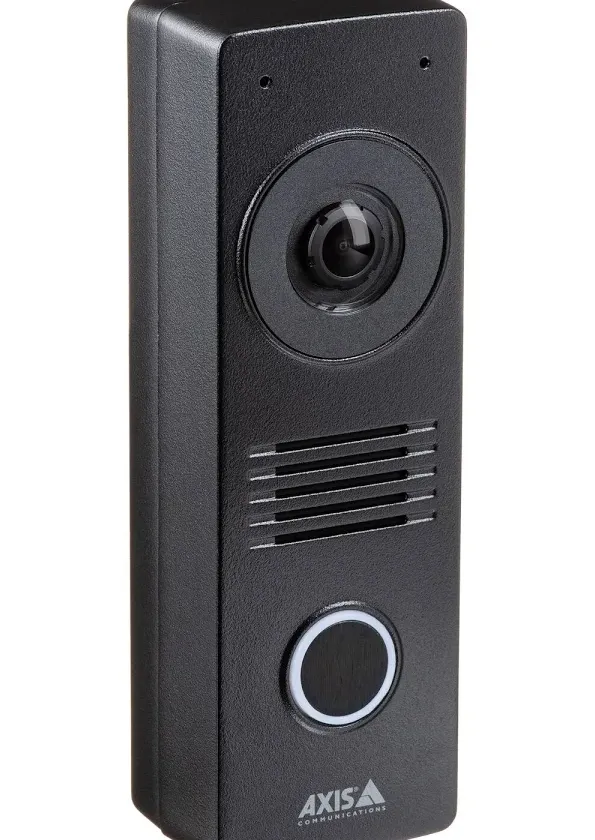
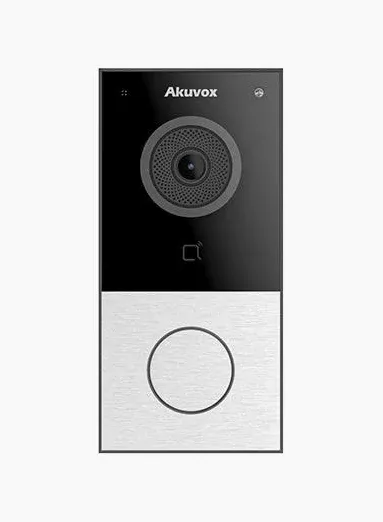
A product photo from the AESS job library, not taken in Williamsburg: a black video intercom door station with a built-in camera, a speaker grille and a lit call button. On many Williamsburg walk-ups and newer rentals, the only camera at the residents' door is the one inside a station like this. Whether its picture is recorded at all depends on how it was connected, so we check that before telling anyone their entrance is covered.
Converted factories and warehouses: long runs, extended many times
Williamsburg's industrial past survives in its loft buildings: brick-and-timber factories and poured-concrete warehouses whose floors now hold apartments, offices, studios and event spaces. Their camera systems tend to have grown in stages. A first owner put cameras at the main door and the freight entrance; a later one added corridor cameras on each floor; tenants added their own inside their units; and somebody extended a run with a small joiner box or a cheap switch above a drop ceiling to reach the new camera at the far end of a long hall. When one of these buildings calls about cameras that drop out at random, the cause is often one of those mid-run additions, a connector that has been pulled one time too many, or a switch in a ceiling space that cooks every summer.
The repair method is to map the system before replacing anything. We trace each camera back to its recorder, find every joint, box and switch along the way, and test the run in sections so that a fault in a ceiling halfway down the hall is found where it is, not guessed at. Concrete floors and slabs mean that most runs cannot simply be rerouted through a new hole, so we reuse the pathways that exist and replace damaged lengths inside them. Where corridors are long, a camera at each end often shows faces at the far end too small to recognize; the fix is usually a narrower lens on one camera and a second camera halfway along, not a new recorder. Freight entrances and loading doors get the most attention, because the 2025 Stagg Street burglary that News 12 reported began at a rear door of a commercial building, and that is the pattern we see repeated in these buildings.
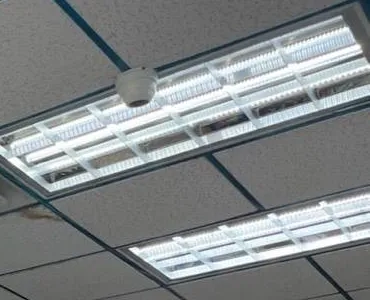
A photo from the AESS job library, not taken in Williamsburg: a small white dome camera on grey acoustic ceiling tiles beside a long louvered fluorescent light panel. In Williamsburg's converted factories, suites built out as offices and studios often have exactly this ceiling, with the camera's cable and sometimes a small switch hidden in the space above the tiles, which is where we look first when a suite camera keeps dropping out.
Waterfront towers: big systems, nobody watching all of it
The towers along Kent Avenue and on the Domino site carry the largest camera systems in the neighborhood: lobby and package-room cameras, elevator cabs, stairs, garage ramps and parking levels, amenity floors, roof decks and the river esplanade side. The system is usually managed by a property manager or managing agent, with a front desk or doorman who can see the live cameras but may not know how to save a clip, and a recorder that sits in a locked room on the cellar level. The common failure is not dramatic. It is a single camera that went dark months ago, a recorder that has been warning about a failing drive with nobody reading the warnings, or an alert email still going to someone from the original developer's team.
On a tower repair we start with a written list: every camera by name and location, what it shows now, which are dark, which are recording at reduced quality and how many days the recorder actually keeps. That list is what a board or manager needs before deciding what to fix first. We then repair in order of risk, which in these buildings usually means the package room and the lobby doors first, because those are the places the CBS New York and Gothamist reports describe thieves walking into, then garage entrances, then stairs and amenity spaces. Health alerts for camera loss and drive errors are sent to the people who are actually on duty, and the desk staff are shown how to mark and export a clip so that a resident's request does not wait until the manager is in.
Mid-size new rentals and condos: the closet recorder nobody opened
Between the walk-ups and the towers sit the six- to twelve-story buildings that filled Williamsburg's side streets over the last two decades. They usually came with a modest system: a video intercom at the street door, cameras in the lobby, the mail area, the elevator and perhaps the rear yard or bike room, and a recorder in a closet near the electrical room. The developer's installer handed over a login, often to a sales office that no longer exists. Years later the building has a new managing agent, the internet provider has replaced the router twice, and the phone app shows nothing.
Most of these repairs are a recovery job rather than a hardware job. We regain administrator access to the recorder through the manufacturer's reset process with the owner's or board's written authorization, reconnect it to the building's current network, update its firmware where that fixes a known fault, set a correct time source so clips carry the right time, and give the building its own logins. Then we look at the hardware: drives that have been running for years, a small switch on top of the recorder that runs hot in an unventilated closet, and the intercom camera, whose picture may never have been recorded because it was wired only to the apartments' monitors.
Row houses and small houses: a cellar recorder and a side passage
Williamsburg still has brick and frame row houses and small two-families on its quieter blocks. Their systems are small: a camera over the front door, one at the yard, sometimes one in the side passage or alley, and a recorder in the cellar or a hall closet. The repairs we see here are about water, wiring and light. Water gets into connectors where a cable leaves the facade without a drip loop. Cables run through old window frames and soffits that have been replaced by contractors who did not know they were there. And night pictures depend on whatever light the block provides, which changes when a neighbor's floodlight goes up or a street lamp goes out.
Because there is usually only one owner, the approvals are simple and the visit is short. We replace the failed part, seal the entry, and check the night picture in the dark rather than guessing. On houses where packages are the main worry, we check whether the door camera actually shows the step where parcels are left, not just the face of whoever rings the bell; and we make sure the owner knows how to export a clip from the app or the recorder.
Landmarked and older commercial buildings: back in the same joint
Only designated landmarks fall under the Landmarks Preservation Commission's camera rules, and in Williamsburg those are individual buildings rather than whole blocks: the Domino refinery and the former Hecla Iron Works building on Wythe Avenue are two examples. The Commission's permit guidebook says cameras on these buildings "must be well spaced to avoid a cluttered, haphazard appearance," that equipment must be attached "at mortar joints, plain masonry, wood, or metalwork," and that it must not be attached "through cast iron or on any decorative surfaces." It also says no permit is needed for "ordinary maintenance, repair, and retrofitting of health, safety, and utility equipment."
For a repair, that means we put the replacement camera back where the approved one was, into the same anchors or the same mortar joints, at the same size and color, and we do not add new holes in carved stone, terracotta or iron. If the owner wants to move a camera to a new spot or add one, that is a change rather than a repair, and we say so before work starts. Older commercial buildings that are not designated are not bound by those rules, but we treat their decorative facades the same way, because a hole in carved stone is permanent.
Field Notes
Field Notes: Walking a Williamsburg Shop the Way a Burglar Would
This is how our technicians handle the most common Williamsburg commercial call, written as our working method rather than a story about any one business. The owner says the cameras "didn't get anything" during a break-in. Before touching the recorder, the technician copies whatever was saved for that night, then goes outside and walks the building the way the 2026 reports describe people getting in: the front door, the glass beside it, the side or rear door, the cellar entrance from the sidewalk or the yard, and any window or skylight that can be reached. At each one the question is the same: which camera sees this opening, from how far away, at what height, and with what light at four in the morning?
That walk usually explains the night better than the recorder does. A typical result is a front camera that is fine, a back-door camera mounted so high that it records only the top of a hood, a cellar door no camera covers at all, and a recording schedule that saves only motion clips with no lead-in, so every clip starts after the door is already open. The repair that follows is often modest: lower one camera or add a second at chest height facing the door, re-aim another to take in the cellar stair, turn on the recorder's pre-event buffer so clips begin a few seconds before motion, and raise the saved quality on the door cameras. The owner gets a list of what each camera now covers and a price for each change before any of it is done.
How Systems Fail Here
Hooded Faces, Late Clips, Voltage Dips, Silent Drives and Unwatched Lobbies: How Williamsburg Camera Systems Go Wrong
Hooded faces: the camera is too high to matter
Installers like to mount cameras high, because a high camera is hard to reach and sees a wide area. Against someone who knows the camera is there and keeps a hood up and head down, a high camera is close to useless for identification. That is not a new observation in Williamsburg. When the 90th Precinct recorded nearly 170 burglaries in the first half of 2015, up 31 percent, officers told local businesses, as DNAinfo reported, that ceiling cameras are easily beaten by a hooded sweatshirt and that a covert camera mounted low and angled upward does better. In September 2026 Hoodline reported people breaking into Brooklyn businesses by throwing an object through a window, which is fast and leaves little time for anything but a quick look at whoever is coming through.
The repair is rarely to replace the high camera. It still shows how many people came in, how they moved and what they took, which matters to a detective and an insurer. What it lacks is a second view at face height. On a shop door that usually means a small camera at about chest height inside the door frame or beside the register, looking toward the entrance, with a lens narrow enough that a face fills a useful share of the picture. The recorder is then set to save that camera at its highest quality around the clock, because a few seconds of a clear face is worth more than hours of wide views.
Two more things help. First, light: the same DNAinfo report quotes the advice to leave lights on, because infrared night vision distorts faces. A low, steady light inside the door gives the camera color and detail that infrared cannot. Second, honesty with yourself about where the camera looks. Many Williamsburg shop owners find, when they look at the face-height view for the first time, that their old system never showed a single face clearly, even of their own staff.
Late clips: the recording begins after the door is open
Many recorders are set to save video only when they detect motion, to stretch the drive. That is reasonable for a quiet yard. On a door that is forced at speed it fails in a predictable way: the camera notices motion, the recorder starts writing, and by the time the clip begins the door is already open and the person is halfway inside. The first two or three seconds, which are the seconds when the person is closest to the camera and facing it, are simply not there.
Most modern recorders have a pre-event setting that keeps a few seconds of video in memory and attaches it to the start of every clip. It is often turned off, or set to zero, because the default was never changed. We turn it on for every entrance camera, and on the door cameras of a business that has been hit we usually recommend continuous recording at full quality instead, with motion recording reserved for less important views. The drive is sized for that, so the change does not quietly cut the number of days the recorder keeps.
We also check the detection zones. On busy Williamsburg blocks a camera that faces the sidewalk sees motion all night from people walking home from the bars and the Bedford Avenue station, so somebody often shrinks the motion zone to stop the constant alerts. If the zone was shrunk too far, the camera ignores the doorway it was meant to watch. A good zone covers the door and its approach, not the whole street.
Voltage dips: the lights stay on, the system does not
A blackout is obvious. A voltage reduction is not. On July 3, 2026, Con Edison lowered the voltage by 8 percent across part of northern Brooklyn that included Williamsburg, "to protect equipment and maintain service during repairs." In June 2025 News 12 described the same kind of event in Brooklyn: "the power isn't fully out—but it's running lower than usual." Recorders, PoE switches and the small multi-channel power supplies that feed older coax cameras are built to run on steady power. When the supply sags, some keep going, some restart again and again, and some shut down a few camera ports to stay within their power budget.
After an event like that, the symptoms can be confusing. The live picture may come back while the recorder has stopped writing to the drive. A switch may power the cameras nearest it and not the far ones. The recorder's clock may reset, so clips are stamped with the wrong date. A technical guide from Security Wholesalers lists the usual suspects after an outage: equipment that restarted "in the wrong order," a hard drive that "reports an abnormal state," and a clock that was lost, and it warns that "repeated power cycling can worsen storage and power faults." We check each of those in turn rather than restarting everything and hoping.
The lasting fix is a battery backup sized for the recorder, the switch and the camera supplies together, with its own battery actually tested, since many backups we find in Williamsburg cellars and closets have batteries that died years ago. A backup that conditions the power also rides through a dip without the equipment noticing. We size it so the system can run through a short outage and shut down cleanly in a long one.
Silent drives: everything looks fine until you press playback
The hard drive in a camera recorder writes every minute of every day. Desktop drives are not designed for that, and CCTV Camera World's guide makes the point directly that desktop drives aren't built for 24/7 recording. Even surveillance drives wear out. The danger is that the live view keeps working when the drive does not, so the system looks healthy on the monitor while it has stopped saving. Swann's support pages list the usual causes of a recorder that does not record: recording turned off, wrong motion settings, no storage installed, or a faulty drive.
The simplest test is the one nobody does: pick a random time from yesterday and play it back on each camera. CCTV Camera World recommends the same, along with confirming that the recorder sees the drive with a normal status. We do that on every visit, and when a drive is failing we replace it with a surveillance-rated drive sized to keep the number of days the owner needs. One warning from the same guide is worth repeating: formatting a drive wipes all recordings, so a drive is never formatted until any footage that matters has been copied off.
Unwatched lobbies: a camera nobody has checked since it went up
In residential buildings the most common camera failure is simply that nobody knows the camera stopped. A Reddit user in a package-theft roundup described a building whose lobby cameras "may not even be operational." The lobby camera may have been knocked out of line by a delivery cart, the mail-area camera may have lost its connection when a contractor worked in the ceiling, or the recorder may have dropped one channel after a power event. Nobody looks at the recorder until a tenant asks for a clip, and then the answer is that there is nothing.
The fix is a routine more than a repair. Each camera is named on the recorder by what it shows, so that "Cam 7" becomes "Mail area" and a dark tile means something to whoever looks at it. Camera-loss and drive-error alerts go by email or app notification to the people who are actually responsible now, not the developer's sales office. And somebody, a super, a manager or a board member, plays back one clip from each camera once a month. We set that up on every residential repair and leave a one-page list on the recorder closet door.
Commercial Security Camera Repair
Business Security Camera Repair in Williamsburg
Williamsburg's businesses are packed into a handful of corridors, and each one tests a camera system differently. These are the ones we work on most.
Bedford Avenue
The spine of the North Side, from the L station at North 7th Street south toward Broadway, lined with shops, cafes, restaurants and bars under apartments. Heavy foot traffic late into the night means door cameras need careful motion zones and steady recording.
Kent and Wythe Avenues
Hotels, venues, restaurants, offices and newer retail near the river. ABC7 placed three of six January 2023 business burglaries on Kent Avenue, and the July 2025 break-in at 17 Kent was identified from footage, so these doors get tested.
Grand Street and Metropolitan Avenue
Two east-west shopping streets with restaurants, bars, boutiques and service businesses, many in walk-ups where the shop's cameras and the building's cameras share a facade and sometimes a cellar.
North 6th Street and the venue blocks
Music halls, bars and event spaces near Wythe and Kent, open late under on-premises hours that New York allows until 4 a.m. Cameras here face crowds, dim interiors and back doors used by crews.
Broadway and Havemeyer Street
Stores and offices under and near the elevated J and M line toward the bridge plaza. Williamsburg365 named Broadway and Havemeyer among the streets hit in the February–March 2026 burglaries.
The Domino blocks and South First
New ground-floor retail, restaurants and offices around Domino Park and the restored refinery, where tenant cameras often sit on a building network run by the owner's management team.
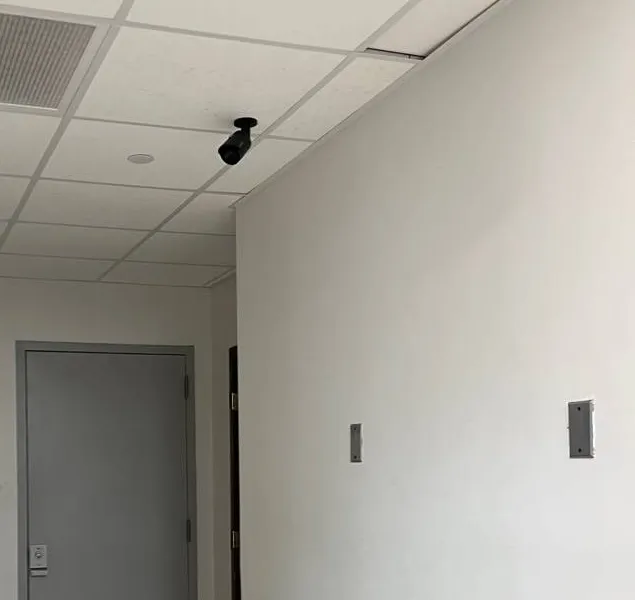
A photo from the AESS job library, not taken in Williamsburg: a small black bullet camera hanging from a white ceiling-tile grid and aimed down a short corridor at a grey steel service door. This is the camera that matters most in a Williamsburg shop, bar or venue, because the October 2025 Stagg Street burglary began at a rear door and the summer 2026 burglar the Brooklyn Eagle described mostly used basement-level doors. We check that a camera like this records the door at full quality and that someone coming through it shows a face, not just a hood.
Shops and restaurants: the register, the back door and the cellar
For a shop or restaurant on Bedford, Grand or Metropolitan, the camera system usually has three jobs: watch the register and the counter, watch the doors, and watch any stock or cash room, often in the cellar. The 2026 reporting about Williamsburg business burglaries mentions cash registers, checks and IDs taken, and doors pried open with tools, so the register camera and the door cameras are where we spend repair time. We look at whether the register camera shows the drawer and the person at it, whether the door cameras show faces, and whether the cellar entrance, which the Brooklyn Eagle described as the summer 2026 burglar's usual way in, is covered at all.
Restaurants add grease and steam. Cameras near a kitchen pass-through or over a fryer line get filmed with grease quickly, and the picture softens into a haze that looks like a failing camera. A clean and check fixes most of it, and a camera moved a few feet away from the hood fixes it for longer. Bars add darkness. Many are kept dim on purpose, and cameras inside often switch to black-and-white infrared mode during service, which flattens faces. Setting the camera to stay in color with a little extra exposure, or replacing it with a model built for low light, is usually the repair rather than adding light the owner does not want.
Venues, hotels and late-night businesses: crowds, crews and long nights
Williamsburg's music halls, event spaces and hotels with roof bars run long hours. New York's Alcoholic Beverage Control Law allows on-premises sales until 4 a.m., so these businesses are busy at exactly the hours when a camera's motion detection is least useful, because there is always motion. On these sites the problem we see most is recorders that fill their drives in a few days because every camera records constantly at high quality, or the opposite: cameras turned down to save space until nothing they record is clear enough to use. We set the cameras that matter, entrances, the box office, the bar till, the stage door and the loading area, to record at full quality all the time, and step down the rest.
Venues also have the most cable abuse of any business we see. Cameras on truss, over stage doors and in loading areas get hit by cases and carts, and cables are often run along the same paths as audio and lighting lines that get unplugged and moved for every show. A repair here includes moving camera cable out of the production paths where possible, labeling it clearly, and protecting it where it has to cross a door frame.
Rules that touch a commercial camera repair in Williamsburg
A few rules come up on business repairs. First, licensing: New York requires a state license for anyone who installs or services a CCTV system for others when it is used to detect or monitor intrusion, theft or movement, under 19 NYCRR 195.2. We work under NYS license #12000287431. An owner who installs cameras on their own premises, or has an employee do it, does not need a license, but a contractor does. Second, employees: under New York Labor Law Section 203-C, employers who monitor workers by video must post notice and get written acknowledgment, so when a repair moves or adds a camera that watches staff, the notice and acknowledgments should be updated. Third, landmarks: on a designated building, replacing a camera in kind is ordinary maintenance under the Landmarks Preservation Commission's guidebook, while moving or adding cameras on the facade may need the Commission's approval. Finally, the NYPD's Connect New York pilot, which began in May 2024 in nine precincts the city did not name, lets participating businesses share camera feeds with police at no cost; whether the 90th or 94th Precinct is part of it is something to ask the precinct directly. A camera system has to be working and recording reliably before any of that sharing is worth doing.
Your Questions Answered
Security Camera Repair in Williamsburg: Questions Answered
Break-ins while the business is closed
The summer burglar in North Brooklyn got into businesses mostly through basement-level doors. Our cameras watch the shop floor and the front, but the sidewalk stair down to our cellar door is out of frame. Can an existing camera take it in, or does the stair need its own?
It depends on where the stair sits relative to your front camera. If the cellar stair opens right beside the shop entrance, the front camera can sometimes be re-aimed or fitted with a wider lens to take in the top of the stair as well as the door, though that usually costs some detail at the door. In most Williamsburg storefronts the cellar entrance is either in a sidewalk hatch, under the stoop of the residents' door, or at the back of the building, and no front camera can see down into it. A small camera mounted on the wall above the stair, looking down at the cellar door, is normally the right answer.
On a repair visit we check whether your recorder has a free channel and whether there is a usable path for a cable into the stair. If both are there, adding the camera is a small job priced on its own line. We also check that the cellar camera is set to record continuously, not only on motion, because a basement-level door is exactly where someone can work for several minutes out of sight of the street.
Officers told Williamsburg businesses years ago to leave lights on overnight because infrared night vision distorts faces. Is that still good advice for the cameras we have, and which lights should stay on?
Yes, and it is one of the cheapest improvements a Williamsburg shop can make. When a camera has no light to work with, it switches to infrared, which turns the picture black and white and tends to flatten or wash out faces close to the lens, especially on light skin, glasses or anything reflective. A low, steady light inside the shop near the entrance and the register lets the camera stay in color and keeps detail in faces and clothing, which is what a detective needs.
The lights that help most are the ones that light the faces of people coming toward the camera: a fixture inside the door, one over the counter, and one at the back door if there is a camera there. Lights behind the person, such as a bright sign in the window behind a door camera, make things worse by turning them into a silhouette. On a repair we look at the camera's night picture with your normal overnight lighting, and if a single light left on would fix it, we tell you that rather than selling you a new camera.
After a break-in at our Williamsburg store, the clip on the phone app is too blurry to show a face, but the detective says the person looked straight at the camera. Is there a sharper copy somewhere on the recorder?
Very possibly. Most cameras send two video streams: a full-quality main stream and a small, low-resolution second stream used for phone viewing and multi-camera screens. Phone apps usually show the small stream, especially on a weak connection, so a face that looks like a smudge on your phone can be perfectly clear in the recording itself. The question is which stream the recorder was saving. If it was set to record the main stream, the sharp version is on the drive.
Do not try to export from the phone. Leave the recorder running and let us, or the detective, export the clip directly from the recorder at full resolution. If it turns out the recorder was saving only the small stream, which we do find on systems set up to stretch a small drive, the sharp version does not exist, and the repair is to change the recording settings and size the drive so the main stream is kept from now on. Either way, we can tell you within a few minutes of looking at the recorder's settings.
Our bar's cameras share the router with the point-of-sale terminals and the Wi-Fi our customers use, and on busy nights the cameras freeze on our phones. Is something wrong with the cameras?
Usually not. When cameras, payment terminals and guest Wi-Fi all share one small router, the cameras compete for bandwidth with everyone in the room, and the remote view from the phone is the first thing to stutter. The recording itself is often fine, because the cameras talk to the recorder over the local network, but if the cameras are wireless or the switch is overloaded, gaps can appear in the saved video too.
The repair is to separate the cameras from everything else. On most bar and restaurant systems that means wiring the cameras into their own PoE switch connected to the recorder, putting the recorder on a separate network segment from the guest Wi-Fi, and limiting how much upload the remote viewing uses. Your payment system and your internet provider's equipment stay as they are. We check the saved recordings from a busy night first to see whether anything was actually lost, and then fix the network so that the phone view keeps working when the room is full.
Lobbies, mail areas and who owns the footage
The person who took packages from our Bedford Avenue building came in through the main entrance and went straight to the mail area, the way the 2023 reports describe. Our lobby camera covers the street door. Is one camera enough, or does the mail area need its own?
One camera is rarely enough for both jobs. A camera that watches the street door is placed to catch faces as people come in, and from that position it usually sees the mail area at an angle and at a distance, too far to show what someone takes or to show their face as they turn away. A second camera inside the mail area, aimed at the shelves or lockers and the doorway, closes that gap, and it is the camera that answers the question tenants actually ask: who took my package, and when.
If your building already has a camera in the mail area that is not working, that is a repair. If there is none, adding one on the existing recorder is usually a modest job when there is a free channel and a reachable cable path. Either way, we set both cameras to record continuously at full quality, label them clearly on the recorder, and make sure whoever handles tenant requests can find and export a clip by date and time.
A product photo from the AESS job library, not taken in Williamsburg: a slim video door station with a camera lens at the top and a large round call button. Stations like this sit at the street doors of many newer Williamsburg rentals and condos. Its camera shows who rang, but it is not a substitute for a lobby or mail-area camera that records continuously.
I rent in Williamsburg and packages keep disappearing. The landlord says the lobby camera "didn't catch anything." What can a tenant reasonably ask for, and what does a repair company need from whom?
Brick Underground put a similar question from a Williamsburg renter to two lawyers. Attorney Jennifer Rozen said a landlord is not obligated to share footage outside a legal process, and that New York City does not require buildings to have security cameras at all. Attorney Catherine Grad said of reviewing footage when thefts are ongoing, "I don't think that it's such an arduous duty to impose on the landlord." In a separate Brick Underground piece about a broken lobby camera, attorney Jeffrey Reich said, "Fixing the security camera would certainly be a reasonable action for the landlord to take in this instance." So a tenant can reasonably ask the landlord to check whether the camera works and to look at the footage, and a tenants' association can press for better locks, a working intercom or a package locker.
For a repair, we need the owner or the managing agent to authorize the work and to give us access to the recorder, because the system belongs to the building. Tenants are welcome to call us and we will explain what the visit involves, but we cannot work on a building's recorder or hand over its footage on a tenant's request alone. If a tenant wants to put their own camera inside their own apartment door, that is a separate matter, and the lease decides it.
Our walk-up's vestibule camera was part of what the building provided for years and has been out since spring. Is a landlord expected to keep a camera like that working?
There is at least one state ruling that says yes in the right circumstances. In a May 2015 administrative review, New York's housing agency, DHCR, upheld rent reductions after its inspection found that "the antenna cable was disconnected from the security camera" in a building's vestibule. The camera had been provided for 19 years, and the landlord was required to keep it working. That case was about a rent-regulated building and a service that had been provided for a long time, so it does not mean every building must have a camera, and we are not lawyers. It does show that a camera which is part of a building's services is not something an owner can simply let die.
From the repair side, a vestibule camera that has been out for months is usually a simple job: a disconnected or corroded cable, a dead power supply, a failed camera body, or a recorder channel that dropped after a power event. We find which, write a price, and once the owner approves, fix it and confirm the camera is recording. If the owner wants a written note of what failed and when it was fixed, we provide one.
Our waterfront building's recorder is in a locked room on the cellar level, and only the managing agent has the code. When a resident asks about something that happened, the desk can see the live cameras but cannot pull a clip. Can the desk be given the ability to save a clip without full control?
Yes, and in a building with a front desk it is usually the best setup. Most recorders let an administrator create user accounts with limited rights: live viewing only, live viewing and playback, or playback and export without the ability to change settings, delete video or add users. The desk gets a login that lets it find a time, mark a clip and export it to a USB drive or a shared folder, while the managing agent keeps the administrator account.
We set that up as part of a repair or on its own visit, with the managing agent's authorization. We also suggest a short written procedure on the desk: how to find the camera by name, how to export, where the copy goes, and who is told. That way a resident's request is handled the same day by whoever is on shift, the original recording stays untouched on the recorder, and the agent still controls who can change the system.
Power, recorders and the July voltage cut
After the February manhole fire on Montrose Avenue knocked our block out, our cameras came back but three of them now restart every few minutes. The rest are fine. What would cause that?
Three cameras restarting while the rest are fine usually points to something they share. Often it is a single power supply or a group of ports on a PoE switch that was damaged when the power went out or came back, and now cannot deliver steady power to the cameras it feeds. Another common cause is a supply that has been working near its limit for years and failed under the stress of the outage. Less often, the three cameras share a cable route, and something along it, a connector in a damp cellar or a junction above a ceiling, was affected by the same water or salt that caused the manhole problems.
We test the power at each of the three cameras while they are running, then at the supply or switch ports that feed them, and compare with a camera that is working. That usually finds the fault in a few minutes. The repair is normally a supply or a switch, not new cameras. We then add or test the battery backup so the next event does not do the same damage.
Our recorder in a Grand Street shop beeps every few minutes and shows a "disk error" message, but the cameras still appear on the screen. Are the recordings safe, and should we pull the drive out?
Do not pull the drive. A disk error usually means the recorder is having trouble writing to or reading from the drive, which can mean the drive is failing, has come loose inside the case, or is full and not set to overwrite. The live picture on the screen does not tell you anything about whether video is being saved, because the live view goes straight from the cameras to the screen. Recordings from before the error may well be fine, and the safest way to keep them is to leave the recorder running until they are copied.
On the visit we check the drive's status in the recorder, copy any footage you need, then test the drive's health. If it is failing, we replace it with a surveillance-rated drive and set the recorder to overwrite the oldest video when full. If the drive is healthy and the cause was a loose connection or a setting, we fix that instead. In either case we play back video from every camera before we leave to confirm that saving has resumed.
Lofts, venues and landmarked buildings
Our loft building's freight entrance camera was knocked crooked by a moving truck and now points at the sidewalk. Can it be put back where it was, and can it be made harder to knock out again?
Usually yes on both counts. If the camera itself still works, the repair is to remount it at its original angle and check that the mount, the anchors in the brick or concrete and the cable entry were not damaged. Moving trucks and box trucks backing into Williamsburg loading doors tend to catch cameras mounted low on the frame or on a short arm that sticks out into the truck's path.
To make it harder to hit, we usually move the camera up and slightly in, under the lintel or onto the wall beside the opening, and use a heavier mount or a vandal-resistant housing. The view still needs to show faces at the door, so moving it too high defeats the purpose; we check the picture with someone standing in the doorway before we finish. If the camera itself was damaged, replacing it is priced on its own line.
Our venue on North 6th Street uses its cameras to check the queue and the door during shows, but the recorder holds only three days, and incidents are often reported a week later. How do we keep more without losing quality where it matters?
Start by deciding which cameras need the most days. For a venue, the entrance, the box office, the bar tills and the stage door usually matter most, and the queue camera and interior wide shots matter less after a few days. Most recorders let each camera have its own quality and recording schedule, so the important cameras can be saved at full quality all the time while the others record at a lower bitrate or only on motion outside show hours.
Then size the drive. A larger surveillance-rated drive, or a second drive in a recorder that has room for one, often doubles or triples how many days are kept for a modest cost. We calculate the actual space each camera uses from the recorder's own figures, set the schedules, fit the right drive and confirm how many days the system will now keep. Two weeks at full quality on the cameras that matter is a realistic target for most Williamsburg venues.
Our office suite is inside a converted industrial building that is a designated landmark. A camera on the facade over our entrance has died. Do we need the Landmarks Preservation Commission's permission to replace it?
Usually not, if it is a like-for-like replacement. The Commission's permit guidebook says no permit is required for "ordinary maintenance, repair, and retrofitting of health, safety, and utility equipment." A dead camera replaced with a similar one in the same spot, using the existing anchors or the same mortar joints, generally falls within that. The building's owner or management may still have its own approval rules for work on the facade, and in a converted building with many tenants the facade almost always belongs to the owner, not to you.
If you want the new camera somewhere different, bigger, a different color, or want to add one, that is a change rather than a repair, and the guidebook's rules apply: cameras well spaced, attached at mortar joints, plain masonry, wood or metalwork, and not through cast iron or decorative surfaces. We check with the building's management first, replace in kind where possible, and tell you plainly when a request would need the Commission's approval.
Equipment
Types of Security Cameras and Recorders We Repair
We repair any brand from any installer. Reolink's own guide to video loss lists the causes we test for on every one of these: "Insufficient Power Supply," "Power Spike & Interference," "Weak WiFi Connection or Low Bandwidth," "IR Cut Filter & Faulty IR Night Vision," "Problems in Cables or Wires," "Hardware & Firmware Problem" and "IP Address Conflicts." Here is how each type of equipment tends to fail in Williamsburg buildings.
Coax and HD-over-coax cameras
Still common in older walk-ups, shops and the first loft conversions. They rely on a separate power supply and a connector at each end, and most "dead camera" calls on these systems turn out to be a corroded connector or a failing multi-channel supply rather than the camera.
Network (IP) cameras
Standard in the towers and newer buildings. Powered over the network cable from a PoE switch, they fail when a switch port or the switch's power budget gives out, when an IP address conflicts after a router change, or when a firmware update goes wrong.
DVRs, NVRs and hybrid recorders
The heart of every system. We repair drive failures, lost settings and clocks, network faults and failing power inputs, and move older coax systems onto hybrid recorders that accept both kinds of camera when the old box cannot be saved.
Varifocal domes and bullets
Cameras whose lens can be zoomed and focused on site. They are the tool for long loft corridors, shop doors seen from across a room and loading bays, and they drift out of focus over time, which is a common cause of soft pictures.
Pan-tilt and 360-degree cameras
Used on venue floors, warehouse yards and large lobbies. Motors and slip rings wear, presets get lost after power events, and patrol tours stop running; we repair, recalibrate or replace them.
Wi-Fi, battery and cube cameras
Tenants and small businesses often add these themselves. In Williamsburg's brick and concrete buildings their signal struggles through walls and floors, which shows up as dropouts, late alerts and missing clips.
Video door stations
The cameras inside intercom panels at street doors. We check whether their picture is recorded at all, repair the camera side of the station, and connect it to the building's recorder where the system allows.
Hooded and low-light cameras
Cameras with long hoods for glare, and models built to stay in color in dim light, which we use when a bar, restaurant or storefront needs faces after dark without bright lights.
PoE switches, supplies and battery backups
The parts that fail most quietly. We test each port and supply under load, replace failing units, and fit or test battery backups sized to the whole system, not only to the recorder.
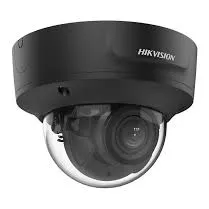
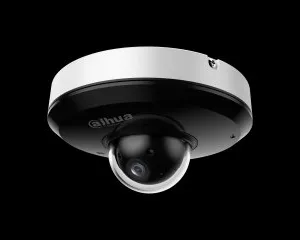
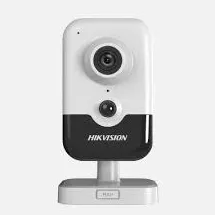
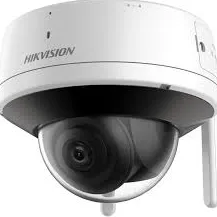
A product photo from the AESS job library, not taken in Williamsburg: a black varifocal dome camera. The adjustable lens is what lets one camera at the end of a long loft hallway or across a shop floor be zoomed in to show faces at the door, which is why we often swap a fixed wide camera for one like this instead of adding cameras.A product photo from the AESS job library, not taken in Williamsburg: a mini pan-tilt dome camera with a white housing over a black lens dome. Cameras like this turn up on event floors and in large lobbies, where staff use them to follow a crowd. After a power event their saved positions are often lost, so the repair includes setting the presets again.A product photo from the AESS job library, not taken in Williamsburg: a white indoor cube camera. Renters in Williamsburg walk-ups and lofts often put one of these on a shelf facing their own door. They are fine for that job, but they are not a building system, and their recordings usually live in the maker's cloud rather than on a recorder we can reach.A product photo from the AESS job library, not taken in Williamsburg: a Wi-Fi dome camera with an external antenna. The antenna helps, but in a concrete warehouse conversion or behind two brick walls a camera like this still loses its link. When one keeps dropping, the lasting repair is usually a network cable to the camera rather than a stronger router.
National brands, consumer cameras or a licensed local repair
Owners with Ring, Nest, Arlo, Wyze, SimpliSafe or similar consumer cameras often ask whether to call the brand or us. For a sealed consumer camera that has failed outright, the brand's warranty or a replacement is usually cheaper, because there is nothing inside to repair. Ring's change in January 2024 is also worth knowing about: it ended the "Request for Assistance" tool that let police ask users for video, though, as News 12 reported, "Law enforcement agencies can still access videos using a search warrant." Monitored-alarm companies such as ADT generally service the cameras they supplied under their own contracts, so check the contract before calling anyone else. For a wired system with a recorder, which is what most Williamsburg shops, bars, lofts and towers have, a licensed local repair is the normal route.
Your situation in Williamsburg
Usually best handled by
Sealed doorbell or Wi-Fi camera dead, still under the maker's warranty
The brand's warranty or replacement
Consumer camera works, but the signal drops through brick or concrete
A local visit to wire it or move it
Cameras supplied and monitored under an alarm company contract
That company, under the contract
Wired cameras and a recorder in a shop, bar, loft or tower
A licensed local repair company
Original installer gone, logins lost, mixed brands
A licensed local repair company that works on any brand
AI Overview Reality Check
What AI Gets Wrong About Security Camera Repair in Williamsburg
Search summaries, chat assistants and home-service directories such as Angi, HomeAdvisor and Fixr give general camera advice. Much of it is sensible anywhere. Some of it misses how cameras fail in Williamsburg's walk-ups, lofts, towers and late-night businesses. These are claims we hear repeated, and what we find on Williamsburg repairs.
"Go wireless and most camera problems disappear"
Wireless cameras skip the cable, and a cable is one less thing to fail. That part is true. What the advice leaves out is that the radio link becomes the weak point, and Reolink lists "Weak WiFi Connection or Low Bandwidth" among the main causes of video loss. In a Williamsburg warehouse conversion with concrete floors, a brick walk-up with a shop's router on the ground floor, or a tower where every apartment runs its own network on the same channels, wireless cameras drop out, record late and miss clips.
The cameras most likely to be wireless are often the ones that matter most: a back door, a cellar stair or a yard, added later because no one wanted to run a cable there. Those are exactly the openings recent burglary reports describe being used. A camera that drops its link for a few seconds every hour can miss the one minute that counts.
Our approach is practical. If a wireless camera works reliably where it is, we leave it. If it does not, the lasting repair is to run a network cable to it, which also powers it, rather than buying a stronger router or a range extender that adds another device to fail in the next power dip.
"Buy a higher-resolution camera and you will see faces"
Resolution helps, but it does not solve the problem that defeats most Williamsburg shop cameras: angle. A 4K camera on the ceiling still sees the top of a hood. The 90th Precinct's advice, reported by DNAinfo in 2015, was about placement, not pixels: ceiling cameras are easily beaten by a hooded sweatshirt, and a camera mounted low and angled upward does better.
Resolution can also work against you. Higher-resolution cameras produce bigger files, and if the recorder's drive was sized for older cameras, the system either keeps fewer days or someone turns the quality down to compensate, which throws away the detail that was the point of the upgrade. We see both on Williamsburg systems where cameras were upgraded one at a time.
What actually produces usable faces is a camera at roughly face height looking at the door, a lens that makes a face fill a reasonable share of the picture, steady light, and a recorder saving the main stream at full quality. Often that is a re-aimed or added camera on the existing system, not a new set.
"Set the cameras to record on motion to save space"
Motion recording does save space, and on a quiet yard camera it is fine. On a busy Williamsburg block it causes two opposite problems. A camera facing Bedford Avenue or North 6th Street sees motion all night, so it records constantly anyway and floods phones with alerts until someone turns the alerts off or shrinks the motion zone. Shrink the zone too far and the camera stops watching the door it was meant to cover.
On the cameras that face entrances, motion recording without a pre-event buffer also means every clip starts late. By the time the motion triggers recording, the door is already open and the person is past the camera. For a business that has been hit, those first seconds are the only seconds with a face in them.
The better approach is to record entrance and register cameras continuously at full quality, use motion recording with a buffer for everything else, and size the drive so the recorder keeps the number of days the business actually needs. The space saved by motion recording is rarely worth the footage it loses on the cameras that matter.
"Plug the system into a surge protector and power problems are handled"
A surge protector guards against sudden spikes. It does nothing when the voltage sags, and in Williamsburg sags are part of the local power picture. On July 3, 2026, Con Edison lowered the voltage by 8 percent across part of northern Brooklyn that included Williamsburg. In June 2025, News 12 named Williamsburg among the hardest-hit parts of Brooklyn when the power was "running lower than usual." In February 2026 a manhole fire on Montrose Avenue left 535 customers dark.
Low voltage is hard on recorders, PoE switches and the power supplies that feed coax cameras. Some restart repeatedly, some drop camera ports to stay within their power budget, and some keep showing live video while they stop saving. A surge strip under the counter will not prevent any of that.
The protection that works is a battery backup that regulates the power, sized for the recorder, the switch and the camera supplies together, with a tested battery. In a long outage it lets the system shut down cleanly, and when power returns the equipment can come back in the right order. We check the backup's battery on every outage repair, because a backup with a dead battery is just an expensive power strip.
"The city's street cameras will catch what your camera misses"
There are NYPD cameras in Williamsburg; CBS New York reported a plan for 100 new cameras in Williamsburg, Crown Heights and Borough Park. But when the first of them went up in 2020, CrownHeights.info reported that "the cameras are also not monitored 24/7, and officers are required to retrieve the footage from another location." A street camera on a pole sees the street, not the inside of your shop door, your cellar stair or your mail area.
That is why detectives ask businesses and buildings for their own footage after a break-in. The News 12 report on the October 2025 Stagg Street burglary is a good example: the footage police released came from cameras at the commercial building, and it showed one man looking directly into the camera.
Your own cameras are the ones that can show who came through your doors. Keeping them recording, at the right angles and at full quality, is the only way to make sure that footage exists when someone asks for it.
"A tenant can demand the landlord's camera footage"
The Brick Underground answer to a Williamsburg renter's question was more careful than that. Attorney Jennifer Rozen said a landlord is not obligated to share footage outside a legal process, and that New York City does not require buildings to have cameras at all. Another attorney, Catherine Grad, said reviewing footage when thefts are ongoing is not "such an arduous duty to impose on the landlord," but that is an opinion about what is reasonable, not a rule.
What tenants can do is ask the landlord to check whether the cameras work, report a theft to the police so that footage can be requested through proper channels, and, through a tenants' association, push for a better door lock, a working intercom or a package locker, as Rozen suggested. A DHCR ruling from 2015 also shows that a camera provided as a building service for years can be something a regulated building is expected to maintain.
For our part, we work for whoever owns the system and authorizes the repair. We do not hand building footage to tenants directly. What we can do is make sure the cameras are working, recording and easy for the building's staff to search, so that when a proper request comes, there is something to give.
"Budget about $1,400 for security camera work in Brooklyn"
That figure is real but easily misread. HomeAdvisor's Brooklyn page puts the average for surveillance camera installation or repair at $1,416, with a typical range of $680 to $2,145 and a low-to-high spread of $160 to $3,500. Those numbers blend new installations with repairs and small homes with large buildings.
Most Williamsburg repairs we do are a single fault: a connector, a supply, a drive, a switch port, a camera body or a setting. On our Brooklyn list those land between $150 and $700. Bigger jobs, such as replacing a recorder after an outage or rewiring part of a building, run $700 to $1,500, and large multi-fault repairs in towers or after surge damage can run higher, priced line by line.
The more useful way to budget is to get the fault diagnosed first. The $150 service call is applied to the repair if you go ahead, and the written price tells you exactly what you are paying for before anything is replaced.
Before You Buy New Cameras, Let a Technician Look at the Night That Went Wrong
Send us the date and time of the incident, a photo of the recorder screen and a short description of what the clip shows. Many Williamsburg "the cameras are useless" calls turn out to be a camera mounted too high, a recorder saving the small stream, or a backup that died in the last voltage cut, and we would rather tell you that before you spend money on hardware.
Tell us the Williamsburg address, the kind of building, how many cameras there are, which ones are out, and where the recorder sits. If the problem began after a break-in, an outage or a contractor's visit, say so. If you need footage from a particular night, put the date and time in the message and we will plan the visit around copying it first. For anything urgent, call (347) 934-8335.
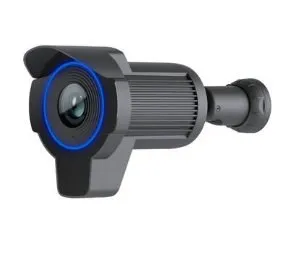
A product photo from the AESS job library, not taken in Williamsburg: a black bullet camera with a long hood and a blue-lit ring around the lens. On a Williamsburg storefront that faces a bright avenue or a lit sign, a long hood keeps glare off the lens, and a camera like this placed at the side of a door rather than high above it is often the difference between a hood and a face.
✅
Request Sent!
Thank you. A technician will contact you about the Williamsburg address shortly.
How It Works
Our Repair Process
1. Send a screenshot and the date that matters
Text or WhatsApp a photo of the recorder screen or the app, the Williamsburg address and the kind of building, and the date and time of any footage that has to be kept. Tell us whether the problem started after a break-in, a power event or work on the building.
2. Confirm who owns the system and who approves
Shop, bar, landlord, tenant, board, managing agent or building owner. We confirm who owns the cameras, who can approve the work and who can open the cellar, telecom room or office where the recorder lives.
3. Book the $150 service call
The Brooklyn service call books a two-hour arrival window and is applied to the repair if you go ahead. Requests are booked within 2 hours of reaching us.
4. Copy footage before anything is touched
Any clip you need is exported at full quality with the recorder's own time stamp before a cable, drive or setting is changed, and a copy is left with you.
5. Trace the fault from the outlet to the app
Power and backup first, then the switch or supplies, the recorder and drive, each cable and camera, and finally the network and phone app, tested in that order so nothing is guessed.
6. Name the cause and write the price
You hear what failed and why, and get a written price from our Brooklyn list, each fault on its own line, before any part is replaced.
7. Repair, then test after dark and in daylight
Parts are replaced and openings sealed. Each repaired camera is checked in bright light and with the scene darkened, and saved video is confirmed in playback, not just on the live screen.
8. Label, set alerts and hand over
Channels and cables are labeled, camera-loss and drive alerts go to the right phones, old users are removed, and you are shown how to find and export a clip.
Coverage Area
Security Camera Repair Near Williamsburg's Landmarks
Bedford Avenue station
The L train stop at Bedford Avenue and North 7th Street, opened in 1924, with 9,815,095 riders in 2025. The shops and bars around it see foot traffic from morning until well after midnight.
Music Hall of Williamsburg
The roughly 650-capacity concert hall at 66 North 6th Street, opened in 2001 as Northsix, at the heart of the venue blocks between Wythe and Kent.
Brooklyn Bowl and the Hecla Iron Works building
The 600-capacity hall at 61 Wythe Avenue, opened in 2009 inside an 1882 ironworks building that became a city landmark in 2004.
Marsha P. Johnson State Park
The 11-acre waterfront park on the site of the old Brooklyn Eastern District Terminal, formerly East River State Park, renamed in 2020, on the river side of Kent Avenue.
Williamsburg Bridge and the bridge plaza
The 1903 bridge to Manhattan and the bus terminal at its Brooklyn end, served by the B32, B44 and Q54, where Broadway's shops and offices begin.
NYC Ferry landings
The East River route has served two Williamsburg stops since May 1, 2017, bringing commuters and weekend visitors straight onto the waterfront blocks.
Williamsburg is billed at our standard Brooklyn rate, the same for a walk-up on South 2nd Street as for a tower on Kent Avenue. Every repair begins with the $150 service call, which covers the on-site diagnosis and is credited to the repair if you go ahead. The figures below come from our published list of Brooklyn security camera repair prices. Your own price is written down on the visit once the fault is found, and nothing is replaced until you agree to it.
Repair
Brooklyn price
Service call: on-site diagnosis and written repair price
$150, credited to the repair
Motion, recording or alert settings with no parts
Usually within the $150 service call
Clean and check for a hazy or greasy picture
$80
Connector reterminate or PoE port swap
$150–$350
Power supply repair
$150–$400
Hard drive swap
$200–$450
Indoor camera repair
$200–$450
Single camera replacement on a working system
$250–$600
Outdoor camera body replacement with weatherproofing
$250–$600
Night picture repair
$250–$650
DVR not working, including drive and labor
$300–$700
NVR not recording
$400–$900
Vandalized camera, per camera, plus cable repair
$400–$900
Pan-tilt (PTZ) camera repair
$450–$1,200
Hybrid recorder swap, coax and IP
$700–$1,200
Lightning or surge damage, depending on system size
$700–$3,500
Annual maintenance visit
$250–$800
Three things move a Williamsburg price inside those ranges. The first is reach: a camera high on a loft building's freight entrance, over a hotel's roof terrace or in a tower's double-height lobby takes more ladder and setup time than one beside a shop door, and a camera on a landmarked facade takes more care to put back in the same anchors. The second is how many parts failed together, which is why repairs after a voltage cut or a break-in are often larger than a single dead camera: a drive, a switch port and a supply can fail in the same event, and a forced door can take a camera and its cable with it. The third is access: a recorder in a locked room run by a managing agent, or in a bar's cellar that can only be reached before opening, adds time to arrange. Whatever the case, you see the number before work starts, and each fault is priced on its own line.
Full terms — including 50% deposit, one-year parts-only warranty on AESS-supplied products, and the late-fee schedule — are set out in the service agreement.
Shop Our Systems
Security Camera Repair Packages & Pricing
Most Williamsburg repairs fall into one of three shapes, each priced from our Brooklyn list.
Single-issue repair: $150–$700
One fault on one visit: a back-door camera lowered to face height, a pre-event buffer turned on and the recording quality raised, a corroded connector replaced at a storefront, a switch port or supply replaced after a voltage cut, a worn drive swapped, or logins recovered. Typical for a shop, a bar, a walk-up or a row house.
Major system repair: $700–$1,500
The recorder or several runs at once: a DVR or NVR replaced after an outage or old age, coax cameras moved onto a hybrid recorder, several corridor cameras rewired in a loft after a renovation, or a venue's recording plan rebuilt with a larger drive. Typical for lofts, mid-size buildings and late-night businesses.
Annual maintenance: $250–$800
Every camera checked in bright and low light, domes and lenses cleaned, connectors and supplies tested, drive health read, the battery backup tested, alerts confirmed and a test clip exported. Homes start at $250, commercial properties at $400, and owners or managers with several buildings run $500 to $800.
Bring your own equipment. If you have already bought a replacement camera or recorder, we can fit it at labor-only rates. Send us the exact model and we quote the labor by phone or text, and the visit is booked once it is paid. Equipment you supply is installed as supplied: we cannot vouch for parts we did not provide, and if a model will not work with your recorder or app, we tell you before we start rather than after.
Complete Services
Every Security Camera Repair Service in Williamsburg
Camera, coverage and cable repair
Dark cameras, hooded faces, uncovered back doors and cellar stairs, and cables cut by trucks, carts and fit-outs. Request a repair
Can the recorder in our Williamsburg shop be locked away or hidden so that whoever breaks in cannot carry it off along with the footage?
+
Yes, and it is worth doing in a neighborhood where business burglaries come in runs. A recorder sitting on a shelf under the register is the first thing an experienced burglar looks for. It can go into a locked steel cabinet with ventilation, into a back office or cellar room that stays locked, or above a ceiling, as long as it stays cool and dry and someone with the key can still reach it to export a clip. We check that the cabinet does not cook the recorder, that its cables are protected where they leave the cabinet, and that the screen and phone app still work after the move. Some owners also send a copy of the key cameras to a cloud service or a second recorder elsewhere in the building.
Our store manager put in our cameras himself. Can he keep maintaining them, or does New York require a licensed company for that work?
+
He can keep looking after them. New York's Department of State says that when an owner installs an alarm or camera system personally, or has an employee do it on the owner's own property or place of business, a license is not required. The license under 19 NYCRR 195.2 applies to companies that install or service those systems for other people. If you hire an outside company or a freelancer to do the work, they should hold the state license. We work under NYS license #12000287431, and we are happy to work alongside a manager who handles the day-to-day settings and only call us for the hardware.
How soon after a request can a technician reach a Williamsburg address, and how is the visit time set?
+
Requests are booked within 2 hours of reaching us, by phone, text, WhatsApp or the form. The visit is set in a two-hour arrival window, and the technician arrives inside that window, not before it. Williamsburg is served from our Brooklyn office on Troy Avenue at the standard Brooklyn rate. If footage from a particular night matters, tell us when you book so the technician comes ready to export it first, and leave the recorder running until then.
Can a camera repair at our bar be booked for the morning, before the staff and the first customers arrive?
+
Usually yes. Morning visits suit most Williamsburg bars, venues and restaurants, because the room is empty, the cellar is easy to reach and ladders can go up without anyone underneath. When you book, tell us what time you open and who will let the technician in. We pick a two-hour arrival window that leaves enough time to finish before service. If the repair turns out to need a part we do not carry, the system is left working as well as it can be and the second visit is booked the same way.
Our Williamsburg photo studio rents its floor to clients who do not want to be recorded during shoots. Can the studio cameras stop recording on a schedule while the doors stay covered?
+
Yes. Most recorders let each camera have its own schedule, and many cameras can also black out part of the picture with a privacy mask. A common setup is to keep the entrance, the loading door and the equipment room recording all the time, while the cameras that look at the shooting floor are switched off during booked hours or have the set area masked. We set the schedules with you, label which cameras are affected, and show the studio manager how to change a booking without touching the rest of the system.
What should we have ready before the technician arrives so a Williamsburg repair goes quickly?
+
Four things save the most time. First, the recorder's location and a way in, whether that is a cellar key, a telecom room code or a manager who will be there. Second, any logins you still have for the recorder or the phone app, even old ones. Third, the dates and times of any footage you need kept. Fourth, in a building with a super, managing agent or board, the name of the person who approves the work. A ladder is not needed; we bring our own, along with testers, a laptop and drives for exporting footage.
If one of our cameras has to be replaced, will the new one still appear in the same phone app we use now?
+
In most cases, yes. When a camera on a working system fails, we replace it with a model that is compatible with your recorder, so it shows up in the same app and on the same screen. For network systems that usually means a camera from the same maker or one that supports the same standard; for coax systems it means a camera that matches the recorder's video format. If your recorder is so old that no current camera will work with it, we tell you before ordering anything and give you the price of a recorder swap alongside the camera.
Do you work in the cramped, damp cellars under Williamsburg shops and bars where the recorders often sit?
+
Yes, and that is where many of our Williamsburg repairs start. Cellars under walk-ups and bars are often low, crowded with coolers and stock, and damp near the walls. Recorders and power supplies placed on the floor or against a wet wall fail more often, so part of the repair is usually moving them onto a shelf or a wall bracket, away from water and heat, and checking that the outlet they use is not shared with a compressor or a pump. If a sidewalk hatch is the only way in, someone from the business needs to open it and stay nearby.
Our building has cameras from two different installers on two separate recorders. Can both be repaired on one visit?
+
Yes. That is common in Williamsburg, where a building's entrance cameras and a ground-floor business's cameras often went in years apart. One service call covers the diagnosis of both if they are at the same address and the same person or company is approving the work. If the two systems have different owners, such as the landlord and the shop, each owner approves and pays for its own repairs, and we write separate prices. We label which camera belongs to which recorder so the next person does not have to work it out again.
Can our cameras be looked at from photos or a short video call before anyone comes out?
+
Yes, and looking at photos costs nothing. A photo of the recorder screen, the error message, the camera and its mount, or a short video of the camera going on and off, often tells us whether the problem is a setting, a power fault or a failed part. Sometimes we can walk you through a fix on the phone. When a visit is needed, the photos help the technician bring the right parts, which often means the repair is finished on the first visit.
A camera was smashed during the break-in at our store. Should it be replaced before our insurance adjuster has seen the damage?
+
Check with your insurer first, but in most cases you do not need to leave your business unprotected while you wait. Photograph the damaged camera, its mount and the cable before anything is touched, and keep the broken parts. Copy the footage from the night of the break-in. Then the camera can be replaced and the system made whole. We can give you a written note of what was damaged, what was replaced and what it cost, which is what most adjusters ask for. If your insurer does want to see the damage in place, we can make the rest of the system safe and come back once the adjuster has been.
Another company is replacing our Williamsburg building's intercom next month. Could that work affect our camera system?
+
It can. In many Williamsburg walk-ups and lofts the intercom panel and the entrance camera share the same wall, the same hole through the facade and sometimes the same power supply or network switch. A new intercom can disturb the camera's cable, take over its switch port or change the network the recorder uses. Before the intercom work starts, note which cameras are working and take a screenshot of the recorder. Afterward, check the entrance cameras and play back a clip. If something changed, we can trace it and coordinate with the intercom installer so the two systems do not keep tripping over each other.
Ready to Have Every Williamsburg Door Show a Face at 4 a.m.?
Send a photo of the recorder screen, the address and the date of any footage you need. We book within 2 hours, give you a two-hour arrival window, copy your footage first, and write down the repair price before any part is replaced.