What are you looking for?
About Us Contact Us Careers Get a Free Quote (800) 486-0943
Pick a service
✅ Got Your Own System?
🎬 Home TheatreQuote 🎶 AV SoundQuote 🔑 Access ControlQuote
Now pick your area
Pick your area
Long Island
Hudson Valley
Services available
Pricing & Tools
Pick a service for pricing
🚪 Intercom Pricing 🔔 Buzzer Repair Pricing
Calculators
📹 Camera System Calculator 🚨 Alarm Calculator ⚡ Cabling Quote Builder ✅ Got Your Own System?
Select your area
Vestibule camera gone white at night after the marble was polished, a Clinton Avenue mansion lobby system nobody has the password to, or a Myrtle Avenue counter camera that went dark before the footage was pulled? Clinton Hill camera repair line, booked within 2 hours: (347) 934-8335
Home › Security Camera Repair Brooklyn › Clinton Hill
Italianate and Neo-Grec Brownstones · Divided Clinton Avenue Mansions · Lefferts and Brevoort Place Apartment Houses · Willoughby Walk Towers · Shops on Myrtle, DeKalb and Fulton

Security Camera
Repair in
Clinton Hill

Any Brand, Any Installer · Replacements Back in the Same Mortar Joint · Footage Copied Before Anything Is Touched · Written Price Before Parts

Security camera repair in Clinton Hill starts with our $150 Brooklyn service call, which pays for the on-site diagnosis and is credited to the repair if you go ahead. On our published Brooklyn list most single faults run $150 to $700, and a replacement recorder or the rewiring of several cameras runs $700 to $1,500. We fix systems other companies put in: the stoop camera on an Italianate row house on Grand Avenue, the cellar recorder under a three-family on Lefferts Place, the lobby cameras of a mansion on Clinton Avenue that was cut into apartments, the hallway cameras of a co-op tower on Willoughby Avenue, and the register camera of a shop on Myrtle. Requests are booked within 2 hours, technicians arrive in two-hour windows, and you hear the cause and see a written price before a single part is swapped.

Reviewed and updated November 12, 2026, against the Landmarks Preservation Commission's permit guidebook (chapter 11, health and safety equipment) and its 2018 rules amendments; the Historic Districts Council and the Historical Marker Database on the Clinton Hill Historic District; the National Register listing for Clinton Hill South; the LPC presentation for 404 Grand Avenue; CBS New York, Brooklyn Paper, 1010 WINS and the Brooklyn Eagle on local cases where camera footage mattered; the Myrtle Avenue Brooklyn Partnership on its public cameras and storefront grants; Patch and BKLYNER on the Borough President's camera program; the Brooklyn Eagle on the NYPD's 2024 camera pilot; Brownstoner's forum threads on brownstone camera wiring and multi-door apartments; Brick Underground on landlords and footage; Pratt Institute on off-campus housing; HomeAdvisor's Brooklyn cost page; and the New York Department of State on installer licensing. · Abstract Enterprises Security Systems, NYS license #12000287431 · crews dispatched from our Troy Avenue office in Brooklyn

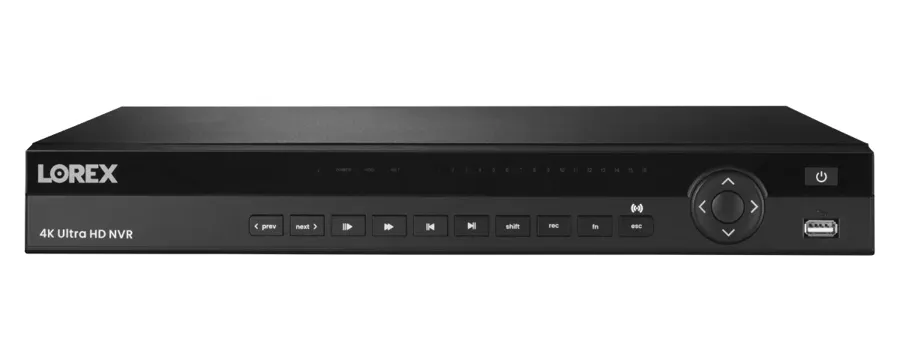
Clinton Hill, Brooklyn security camera repair: front panel of a 16-channel desktop network video recorder
A product photo from the AESS job library, not taken in Clinton Hill: the front panel of a 16-channel desktop network video recorder. In a Clinton Hill brownstone this box usually sits on a cellar shelf near the gas meter or in a closet off the parlor floor; in a divided Clinton Avenue mansion it is often in a former butler's pantry or a locked closet off the lobby; in a Myrtle Avenue shop it lives under the counter. Most of our repairs begin at the recorder, because it keeps the video, logs when each camera dropped, and decides how much detail gets saved.
Clinton Hill Camera Repair Request
Brownstone, mansion apartment, co-op, apartment house or shop: send the address and what the screen shows, and a technician calls back with the next step

✅
Request Sent!
Thank you. A technician will contact you about the Clinton Hill address shortly.
25+
Years Experience
✓
Same-Day Estimates
100%
Licensed & Insured
4.7★
201 Google Reviews

Owner-operated since 2002 · Thousands of jobs completed · Booked within 2 hours

Security camera repair in Clinton Hill means fixing cameras that sit on some of the most closely watched facades in Brooklyn, inside buildings that were never wired for them. The neighborhood's historic district has been under the Landmarks Preservation Commission since 1981, so a dead camera on the front of a house is best replaced in the same spot, at the same size, on the same anchors. Behind those fronts are vestibules floored in tile and marble that throw a camera's own infrared back into its lens, mansions cut into apartments with cable runs a hundred feet long, apartment houses full of students who change every year and take the app logins with them, and shops on Myrtle Avenue whose counter cameras were tied into a public camera program and then forgotten. Those are most of the calls we get from here. Send a photo of the bad picture and of the recorder to (347) 934-8335 or on WhatsApp, and we will tell you what the fault looks like and what that repair costs on our Brooklyn list before you book anything.

  • Looking at your photos costs nothing. The $150 service call covers the on-site diagnosis and is credited to the repair if you go ahead.
  • We work under New York State license #12000287431, the state license for companies that install or service security and CCTV systems for other people.
  • We repair any brand and any installer's work, and we tell you when an old camera or recorder is not worth paying to fix.
The Neighborhood

Why Clinton Hill Properties Need Security Camera Repair

Clinton Hill sits between Fort Greene and Bedford-Stuyvesant, roughly from Flushing Avenue and the Navy Yard edge down to Atlantic Avenue, with Vanderbilt Avenue on one side and Classon Avenue on the other. The Historical Marker Database gives the historic district's lines as Vanderbilt and Clinton Avenues on the west, Willoughby Avenue on the north, Hall and Downing Streets and Grand Avenue on the east, and the blocks between Gates Avenue and Fulton Street on the south. The Historic Districts Council lists what is inside: row houses, mansions, stables, apartment houses and institutional buildings, built from the 1840s into the 1920s. That is the background. For a camera repair, what matters is that almost every camera here was added long after the building was finished, by many different installers, and now has to be fixed without spoiling a front the city protects.

That shapes the first question on nearly every Clinton Hill repair: can the broken camera be replaced where it is? The LPC's permit guidebook says ordinary maintenance, repair and retrofitting of health, safety and utility equipment does not need a permit, while new security cameras on a protected building must be small, spaced out, attached at mortar joints, plain masonry, wood or metalwork, and never fixed through cast iron or any decorative surface. "Security cameras must be well spaced to avoid a cluttered, haphazard appearance," the guidebook says, and on a small building it allows no more than two per 25 feet of street frontage, three on a large one. A camera that goes back in the same position, about the same size, using the same holes, is a repair. A camera that moves to a new spot on the stone, or comes back twice the size, starts to look like new work. We plan every front-of-house repair inside the district around that line.

It also shapes how a repair is done once the camera is down. The Commission's 2018 package of proposed rules amendments describes a preferred approach for security equipment that keeps it off the primary facade where there is a workable alternative, for example behind an areaway wall or fence, under a stoop or behind plantings. On many Clinton Hill houses that is exactly where the cameras already are: tucked under the stoop looking at the garden door, inside the vestibule looking out through the glass, or on the areaway fence. Those positions keep the front clean, but they put the camera in the places where historic materials cause the most trouble for a picture, which is the second reason this neighborhood generates repair calls.

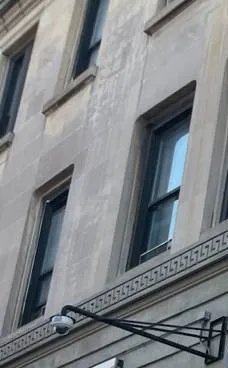
Clinton Hill, Brooklyn facade camera repair: bullet camera on a long black steel wall arm below a carved Greek-key band on pale stone with tall sash windows
A photo from the AESS job library, not taken in Clinton Hill: a bullet camera held out from pale stone on a long black steel arm, just under a carved Greek-key band and beside tall sash windows. Clinton Hill's Beaux-Arts and Renaissance Revival fronts carry the same kind of carved stone, and the Landmarks guidebook asks that equipment stay off decorative surfaces. When a camera like this fails on a protected building, we put the new one back on the existing arm and anchors rather than drilling the carving again.

The trouble is reflection. Brownstone vestibules here often have encaustic or mosaic tile floors, marble steps and thresholds, glass storm doors and brass or bronze mailbox clusters. A camera with built-in infrared, mounted in that small space, lights up the hard surfaces a few feet from its lens and gets the light straight back. The result is a night picture that is white in the middle and black at the edges, or a face that disappears in a glowing haze. It is one of the most common "my camera is broken" calls we get from Brooklyn brownstones, and it often appears right after an owner restores a floor, polishes the marble or adds a glass door. The camera did not change; the room did. The fix is usually a change of angle, turning down the camera's own infrared and lighting the vestibule another way, or a camera that shows color in low light, not a whole new system.

The third reason is the size and age of the buildings. The Clinton Avenue mansions of the 1870s and 1880s, and the big Italianate and Beaux-Arts row houses around them, were later divided into apartments, some into many. Cable from a camera on the top floor of a mansion's rear wall to a recorder in its cellar can run well over a hundred feet, through horsehair plaster, old dumbwaiter shafts and closets. A long analog run picks up interference and loses picture; a long network run that is over the limit drops in and out; a run that was stapled along a baseboard decades ago gets cut during the next renovation. On these houses, the camera is often the last thing at fault, and finding which of the joints, splices or supplies along the way has failed is most of the job.

The fourth reason is who lives here. Pratt Institute says that of its roughly 5,000 students, only 40 percent live on campus, so the rest are renting in and around Clinton Hill, and many of them move every year. Garden floors and top floors of brownstones, and apartments on Lefferts and Brevoort Places, change hands each summer. Each time a tenant leaves, a camera app tied to their phone, a Wi-Fi network named after them, or a recorder password only they knew can leave with them. A large share of our Clinton Hill repairs are not hardware at all; they are getting an owner back into a system that still works, removing the people who should no longer see it, and setting it up so the next turnover does not break it again.

And the footage gets used. CBS New York reported a surveillance camera at a Clinton Hill apartment building catching a woman who police believed was acting as a lookout for a package thief. Brooklyn Paper reported that after a robbery at a cannabis shop on Fulton Street, police were hoping to trace the men once the store's camera footage had been reviewed. The Brooklyn Eagle reported that police released surveillance footage after two seniors were robbed at gunpoint at Franklin and Lexington Avenues in July 2026. Each of those depended on a camera that was working, a recorder that was saving and someone who could export a clip. When a Clinton Hill owner calls us after an incident, the camera has often been dark for weeks, and the repair begins with whatever can still be saved. Many owners pair the repair with a look at the door buzzer or intercom on the same entrance, since in a divided brownstone or mansion both systems usually share the vestibule and the cellar.

Six Clinton Hill facts that change how a camera gets repaired

  • The historic district dates from 1981. The Historic Districts Council records the Clinton Hill Historic District as designated November 10, 1981, covering row houses, mansions, stables, apartment houses and institutional buildings from the 1840s into the 1920s. A front camera there is replaced in kind, in the same place.
  • The guidebook limits how many cameras a front can carry. On a small residential or commercial building inside a district, no more than two security cameras per 25 feet of street frontage, three on a large building, fixed at joints or plain surfaces, with no more than about ten inches of visible conduit where concealing it is not possible.
  • A second district on Lefferts and Brevoort is federal, not city. Clinton Hill South was added to the National Register of Historic Places on July 17, 1986, and covers roughly Lefferts and Brevoort Places between Washington Avenue and Bedford Place, with 246 contributing buildings, including early 20th-century Colonial Revival apartment houses. National Register listing alone does not bring LPC permit review.
  • Six in ten Pratt students live off campus. Pratt says only 40 percent of its approximately 5,000 students live on campus. The rest rent nearby, so app accounts, Wi-Fi networks and recorder logins change hands every year.
  • Myrtle Avenue has public cameras wired to private systems. The Myrtle Avenue Brooklyn Partnership lists public cameras at Washington Park, Carlton Avenue, Ryerson Street and Steuben Street, and the Borough President's program connected street cameras to the security systems of local businesses, which remain responsible for maintaining and repairing them.
  • Repair is priced by the fault, not the address. HomeAdvisor's Brooklyn page puts the average surveillance camera install or repair at $1,416, with a typical range of $680 to $2,145 across job sizes; most single repairs on our Brooklyn list fall between $150 and $700.

Where this page applies. It covers Clinton Hill from Flushing Avenue south to Atlantic Avenue, between Vanderbilt Avenue and Classon Avenue, including Clinton, Washington, Waverly, Grand and Downing streets and avenues, Lefferts and Brevoort Places, the blocks around Pratt Institute and the shopping stretches of Myrtle Avenue, DeKalb Avenue and Fulton Street. Blocks west of Vanderbilt are on our Fort Greene security camera repair page, blocks east of Classon on our Bed-Stuy camera repair page, and the rest of the borough on our main Brooklyn security camera repair page. Clinton Hill is billed at the standard Brooklyn rate.

Same-Day Repair in Clinton Hill

Need Repair in Clinton Hill? A Lookout Caught on the Lobby Camera, a Shop Clip the Police Want, or a Mansion System Nobody Can Log Into

Urgent calls from Clinton Hill usually arrive in one of three ways. The first is the after-the-fact call: packages are gone from a vestibule or a mail room, a neighbor or a detective from the 88th Precinct asks what the camera saw, and the owner finds the camera has been showing a white glow every night for a month, or that the recorder stopped writing in the spring. The second is the business call: a Myrtle Avenue or Fulton Street store has had a robbery or a break-in, the police want the footage today, and nobody on shift knows how to export it, or the camera over the register has been dark since a contractor worked in the ceiling. The third is the building that has lost control of its own system: a divided mansion or a small co-op whose installer has retired, whose sponsor is gone, and whose recorder asks for a password no one in the building has.

If footage from a particular day matters, do not unplug, restart or reset the recorder. Every recorder overwrites its oldest video once the drive is full, so the clock is already running, and a restart can wipe the log that shows when a camera dropped or when the drive stopped saving. On a system nobody can log into, do not try a factory reset either: that clears the password and the video settings, and on some models the footage index too. Text us the date and time you need, the camera it should be on, and a photo of the recorder's front panel or the screen it shows. We plan the visit so the clip is copied before anything else is touched, and if the login is lost, we work through the manufacturer's recovery process with you as the verified owner instead of wiping the box.

For everything else, the path is short. The $150 Brooklyn service call books a two-hour arrival window. The technician finds the fault, tells you what failed and why, and writes down the price from our Brooklyn list before any part is replaced. Most single-fault repairs in Clinton Hill are finished on the same visit, with the camera checked in daylight before we leave and checked again with the vestibule or yard darkened the way it looks after sunset.

What We Install

Security Camera Repair Services in Clinton Hill

Each repair below is priced from our Brooklyn camera repair list. The service call pays for finding the fault; the repair is priced by what failed, how many cameras it touches and how hard each cable is to reach, whether that is a vestibule camera on a Waverly Avenue brownstone or a hallway dome on the twelfth floor of a co-op tower.

Infrared bounce and vestibule glare

Night pictures that go white or hazy because the camera's own infrared is reflecting off tile floors, marble steps, glass storm doors, brass mailboxes or a freshly painted wall. We re-aim, adjust or replace so the picture shows a face instead of a glow.

In-kind front camera replacement

Dead cameras on landmarked fronts replaced with a unit of similar size and color in the same position, on the existing anchors or arm, with cable kept in the same joint. We note the old position before it comes down.

Long-run cable faults in big houses

Pictures that roll, flicker or drop on cameras far from the recorder in mansions and deep row houses, traced to a bad splice, an overlong run, a failing supply at the far end or interference from house wiring.

Lost logins and orphaned systems

Recorders and apps that belong to a former tenant, a sponsor, a retired installer or a previous owner. We recover access as the verified owner, remove old users, and set up logins in the right names.

Recorder and drive repair

DVRs and NVRs that stopped saving, beep, restart, show a disk error or keep only a couple of days. We copy what can be copied, replace the drive or the recorder, and confirm playback before we leave.

Dead camera diagnosis

One or several cameras dark: power, supply, PoE port, connector, cable, camera or recorder channel tested in order, so you pay for the part that failed and not the three around it.

Garden, deck and rear wall cameras

Yard cameras on the back walls of brownstones and on garden fences, where Wi-Fi fails through masonry, cable runs along old leaders and gutters, and ivy and squirrels do as much damage as weather.

Store and public-program cameras

Counter, aisle and door cameras in Myrtle, DeKalb and Fulton shops, including systems connected to street cameras under the Borough President's program, where the business is responsible for upkeep.

Footage export for incidents

Clips for the 88th Precinct, an insurer, a landlord or a court, exported in the recorder's own format with its timestamps intact, plus a short lesson so whoever is on site can do it next time.

Building Specialists

Security Camera Repair for Clinton Hill's Architecture

The same failed camera turns into a different repair on each kind of Clinton Hill building, because the mounting surface, the cable path, the recorder's location and the person who signs off on the work all change. These are the buildings we work in most.

Italianate and Neo-Grec brownstones

Three- and four-story row houses with high stoops, double entry doors, vestibules and garden floors, many divided into two or three apartments. Cameras sit in the vestibule, under the stoop or on the rear wall, with a recorder in the cellar.

Divided Clinton Avenue mansions

Freestanding and semi-detached houses from the 1870s and 1880s, later converted to apartments. Long cable runs, many floors, a shared lobby and a system that belongs to a board or a landlord.

Early 1900s apartment houses

Colonial Revival and similar walk-up and elevator buildings, many on Lefferts and Brevoort Places and on Washington Avenue, with a lobby, a mail area and a basement where the recorder lives.

Mid-century co-op towers

The Willoughby Walk slabs at 195 Willoughby Avenue and 185 Hall Street and similar postwar buildings, with concrete floors, long corridors, doormen and dozens of cameras on one recorder.

Carriage houses and frame houses

Former stables and the few wood houses that survive among the brick, set back from the street or behind other buildings, where cameras watch a driveway, a garage door or a side passage.

Churches, schools and campuses

Sanctuaries, parish halls, schools and college buildings with high ceilings, stone walls and many entrances, where systems grow camera by camera over decades and nobody has a full map.

Italianate and Neo-Grec brownstones: the vestibule fights the camera

On a Clinton Hill brownstone the camera that matters most is usually the one at the front door, and it most often lives in the vestibule, between the outer double doors and the inner glazed door. Brownstoner has written about Clinton Hill renovations where the original entry doors were kept and restored, including an Italianate house whose doors "came with the house" and are "nearly all glass." That is wonderful for the house and hard on a camera. Glass behind the camera reflects its infrared and the hallway lights; glass in front of it reflects the street by day. Tile and marble underfoot bounce infrared straight up. A repair here is almost never just a new camera. We look at what the camera sees through and what it stands over, test with the lights the family actually uses at night, and choose between re-aiming, turning the camera's infrared off and relying on a small warm light in the vestibule, or a low-light color camera that does not need infrared at all.

The second brownstone camera is under the stoop, watching the garden-floor door and the areaway. It is protected from rain but gets the splash from the sidewalk, the dust from the bins and the dampness that comes off the stone. Connectors there corrode, and cameras fog inside when their seals age. Many divided brownstones also have more doors than people expect. A Clinton Hill renter taking the garden and parlor floors told the Brownstoner forum, "There are three doors to the apartment." When a household like that says one camera is dead, we check which of the three doors it covered, because the repair sometimes shows that the camera was watching the wrong one all along.

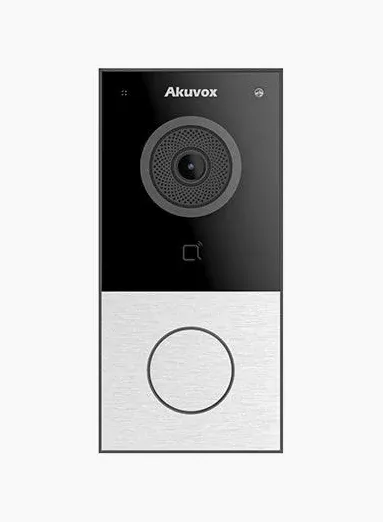
Clinton Hill, Brooklyn brownstone door camera repair: narrow video door station with a camera lens at the top and a big round call button
A product photo from the AESS job library, not taken in Clinton Hill: a narrow video door station with a camera lens at the top and a large round call button. On a divided Clinton Hill brownstone, a station like this beside the outer doors is sometimes the only camera on the front, and whether its picture is recorded at all depends on how it was wired to the recorder in the cellar. We check that before promising anyone footage from it.

Divided Clinton Avenue mansions: distance is the enemy

The houses that gave Clinton Avenue its reputation were built big, and the ones that are now apartment buildings kept their size. A camera on a rear corner of the third floor, a camera at the carriage gate and a camera in a second-floor hall can all end at one recorder in the cellar, by way of closets, an old service stair and a dumbwaiter shaft. Older analog systems on runs like that lose sharpness and pick up hum bars from nearby power wiring; network cameras on runs past the standard distance limit connect, drop and reconnect. Small plug-in power supplies at the far end fail and nobody can find them because they are behind a radiator cover on another floor. On a mansion repair we trace each run end to end, find the joint or supply that actually failed, and replace the weak link rather than every camera on the system.

Because these buildings are owned by a board, a landlord or a group of owners, we also confirm who can approve a repair before we start. A mansion's lobby camera usually feeds a recorder that also holds hallway and rear-yard video that some residents should not see, so the logins matter as much as the hardware.

Early 1900s apartment houses: the mail area is the hot spot

The National Register nomination for Clinton Hill South describes early 20th-century Colonial Revival apartment buildings along with its Neo-Grec row houses, and there are similar buildings on Washington Avenue and the side streets. In these buildings the camera people ask about after a theft is the one covering the mailboxes and the package shelf. 1010 WINS reported a serial holiday package thief at 1104 Bedford Avenue, east of Classon Avenue, who got in through the front entrance and went straight into the mail room. A mail-area camera that is aimed at the boxes shows hands and the tops of heads; one aimed across the room at the door shows faces as people come in. When we repair a lobby camera we check that it catches a face at the door, not just activity at the shelf, and that the recorder keeps enough days for a missing package to be noticed and looked up.

Mid-century co-op towers: many cameras, one board

CityRealty describes Willoughby Walk as a two-building complex at 195 Willoughby Avenue and 185 Hall Street, with a 16-story slab tower erected in 1958 and 287 co-operative apartments per building, and lists a full-time doorman and front-entrance security. In buildings like these, the cameras are on concrete, the cable runs are in risers and above corridor ceilings, and the recorder is in a staff office or a basement equipment room. The hardware tends to last; what fails is the software around it. The monitor at the front desk goes blank after a power event, a firmware update breaks the remote view the managing agent uses, or the drive fills and the system starts keeping only a few days. Repairs there go through the managing agent, follow the building's contractor rules on insurance and scheduling, and end with a written note to the board of what was changed.

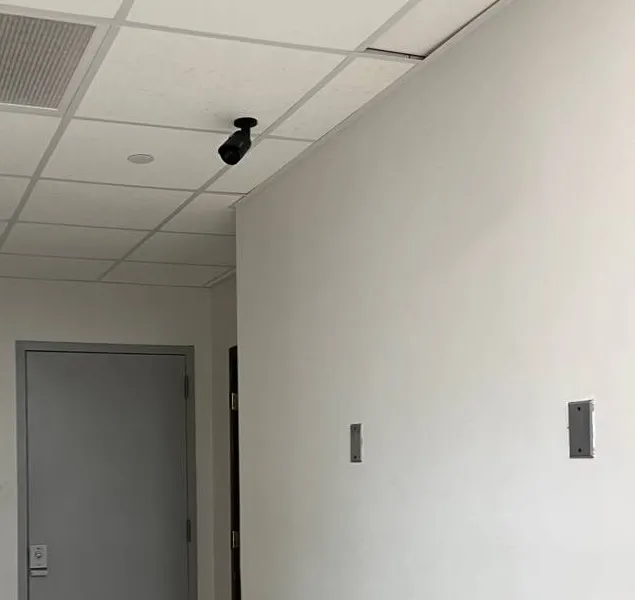
Clinton Hill, Brooklyn co-op corridor camera repair: small black bullet camera hanging from a white ceiling-tile grid, aimed down a short hallway at a grey steel service door
A photo from the AESS job library, not taken in Clinton Hill: a small black bullet camera hanging from a white ceiling-tile grid, aimed down a short hallway at a grey steel service door. In a postwar Clinton Hill co-op this is the camera on a service corridor, a trash room or a basement door; in a Myrtle Avenue store it watches the back exit. Pointed straight at a door, it gets only a moment of each person, so we check its frame rate and the quality the recorder saves when we repair it.

Carriage houses and frame houses: the camera at the back of the lot

The historic district's building list includes stables, and where a former stable or carriage house has become a home, its cameras watch a garage door, a driveway gate or a narrow passage to the street, often from a wall that is not part of the main house. Power and data may come across a yard from another building, sometimes through a buried or overhead cable that has never been documented. When a camera like that fails we check the whole path, including the outdoor run and the point where it enters each building, because water and frost damage at those entry points cause more failures than the cameras themselves. On the wood houses, a camera screwed through siding with an unsealed hole beside it lets rain run along the cable into the wall; we seal what we open and replace taped connectors with weatherproof ones.

Churches, schools and campuses: systems nobody has mapped

Clinton Hill has a heavy share of institutions, from churches with big stone sanctuaries to schools and the college campuses around Pratt and along Clinton and Washington Avenues. Their camera systems usually grew one camera at a time, under different budgets and different volunteers or staff, so the first repair visit often turns into a short survey: which cameras feed which recorder, which ones still work, and who holds each login. Stone walls and high ceilings make every camera a ladder or lift job, so we fix what can be fixed from below first and plan the high work for one visit. We schedule around services, classes and events, and leave a simple written map so the next repair does not start from scratch.

Field Notes

Field Notes: The Flashlight Test We Run in Every Clinton Hill Vestibule

This is how our technicians handle the most common Clinton Hill call, written as our working method, not as a story about one house. The owner says the front camera "goes foggy at night." Before booking, we ask for two screenshots: one from the camera in daylight and one after dark with the vestibule lights the way the family usually leaves them. If the day picture is sharp and the night picture is a white bloom in the middle of the frame, the camera is almost always working and is seeing its own infrared bounced off something close: the tile floor, a marble step, the glass of the inner door, a brass mailbox, or a light-colored wall that was just repainted.

On the visit we prove it before replacing anything. With the vestibule dark, we cover the camera's infrared lights and shine a separate infrared or ordinary flashlight onto the scene from a few feet away. If the picture clears, the camera is fine and the fix is placement and light: a few inches lower, a few degrees off the glass, the built-in infrared turned down or off, and a small warm fixture in the vestibule on a timer or a motion sensor. If the picture stays hazy, we look at the lens and the dome for scratches, condensation or a film from cleaning products, which is the other common cause. Only after those two checks do we price a new camera, and when we do, it is usually one that shows color in low light. The test takes minutes, and it saves Clinton Hill owners from buying cameras they do not need.

Fault by Fault

Reflected Infrared, Hundred-Foot Runs, Orphaned Logins, Worn Drives and Renovation Damage: Where Clinton Hill Camera Systems Break

Reflected infrared: the camera blinding itself

Most security cameras switch to black-and-white at night and light the scene with a ring of infrared LEDs around the lens. The light is invisible to people but very bright to the camera. In an open yard it travels out, hits the subject and comes back softly. In a Clinton Hill vestibule that is six feet deep, it hits the floor, the glass and the mailboxes at close range and comes back hard. The camera's exposure then shrinks to handle the bright reflection, and everything beyond it, including the face at the door, drops into darkness or a glowing fog. Smoke, cobwebs and dust near the lens make it worse, which is why the problem often appears in autumn when spiders move indoors and in winter when the doors stay shut.

The cure is to change the geometry or the light. Mounting the camera a few inches lower, or turning it so the nearest hard surface is outside the frame, can fix it outright. Turning the camera's infrared down or off and adding a small warm light that comes on at dusk lets it stay in color and keeps the reflection out. A low-light color camera does both. What does not work is a new camera of the same type in the same spot; it will glow exactly like the old one. On landmarked fronts we look for a fix inside the vestibule or under the stoop first, so nothing new goes on the facade.

Hundred-foot runs: the cable is the camera

Analog and HD-over-coax cameras send their picture down coaxial cable. On short runs they are forgiving; on very long runs through an old house, with a splice or two along the way and power wiring alongside, the picture softens, colors shift and rolling bars appear. Network cameras use twisted-pair cable and a standard length limit of about a hundred meters per run; go past it, or use cheap copper-clad cable, and cameras connect, drop and reconnect, which on the phone looks like a camera that is "sometimes offline." Power is the third leg. A camera powered by a small plug-in supply on another floor can fail when that supply ages, or when someone unplugs it to use the outlet.

In large Clinton Hill houses we test each run with a cable tester and, for network cameras, a PoE tester at the camera end, so we know whether the camera is getting the power and signal it needs before we judge the camera. A failing splice can be redone, an overlong run can be broken with a small switch or extender in a closet halfway, and a scattered set of plug-in supplies can be replaced with one protected supply at the recorder. Each of those is cheaper than rewiring a mansion.

Orphaned logins: the system works, nobody can reach it

The most frustrating Clinton Hill repair is the one where nothing is broken. The cameras record, the recorder runs, and the owner cannot see any of it, because the app account belonged to a former tenant, the admin password was set by an installer who is no longer answering, or the recorder was registered to a sponsor's email when the building was converted. Some owners have been told they must replace the whole system to get back in. That is rarely true. Most manufacturers have an owner recovery process that works through the recorder itself, with proof of ownership, and keeps the existing footage and settings.

We do that recovery with the owner present or on the phone, then remove every account that should no longer have access, set new admin credentials in the owner's name, create limited viewer accounts for tenants or staff who need them, and write down where the credentials are kept. In a building with student renters we also show the owner how to remove a viewer when a lease ends, so the next turnover is a two-minute job instead of a service call.

Worn drives: quietly saving nothing

A recorder writing four or eight cameras around the clock wears out its drive. When the drive starts to fail, the recorder can keep showing live video while saving nothing, or saving only in fragments. Most recorders can send an alert when that happens, but only if someone set it up and it goes to a phone someone reads. In a brownstone cellar or a mansion's back closet, nobody sees the warning light. A drive swap is one of the most common and least expensive Clinton Hill repairs; the important parts are checking what can be copied from the old drive first and making sure the next failure is reported in days, not discovered months later.

Renovation damage: the gut job next door

Clinton Hill is always renovating. Brownstoner has documented gut renovations here in which nearly everything inside was replaced and only the entry doors and a mantel were salvaged. During work like that, camera cables get cut, buried behind new drywall, painted over at the facade or unplugged at the recorder by an electrician who did not know what they were. Scaffolding and sidewalk sheds also block cameras for months and leave dust and paint on the domes. And the work does not have to be in your house: pointing, roofing or a new rear extension on the house next door can sever a cable that crosses a shared wall or a yard. After any renovation we test every camera and every run, find the ones that were cut or covered, and reconnect them along the new finishes rather than across them.

Commercial Security Camera Repair

Business Security Camera Repair in Clinton Hill

Clinton Hill's businesses line a few streets: Myrtle Avenue across the north end, DeKalb Avenue through the middle, Fulton Street along the south, and Washington, Vanderbilt and Classon Avenues between them. Most are small: restaurants, cafes, groceries, delis, pharmacies, laundromats, salons, studios and, more recently, cannabis shops. For them a camera repair is usually about two things: whether the footage of a theft or an incident can be handed to the police the same day, and whether the camera over the register or the door shows a face.

Myrtle Avenue's camera blocks

Restaurants, groceries and shops under apartments, inside the Myrtle Avenue Brooklyn Partnership's district, where public cameras watch the corners at Washington Park, Carlton Avenue, Ryerson Street and Steuben Street.

DeKalb Avenue near Pratt

Cafes, bars and restaurants that serve students and faculty late into the night, with front windows on the avenue and back doors onto narrow yards.

Fulton Street storefronts

Shops and services on the southern edge, near the Clinton–Washington Avenues station, including the cannabis shop whose robbery footage police set out to review.

Washington Avenue's mixed blocks

Ground-floor businesses under apartments, small offices and institutions running between the Navy Yard edge and Atlantic Avenue.

Vanderbilt and Classon edges

Corner stores, auto and service businesses and newer mixed-use buildings at the neighborhood's western and eastern boundaries.

Studios and workshops north of Myrtle

Small manufacturing, design and art studios toward Flushing Avenue and the Navy Yard, in older industrial buildings with high ceilings and few windows.

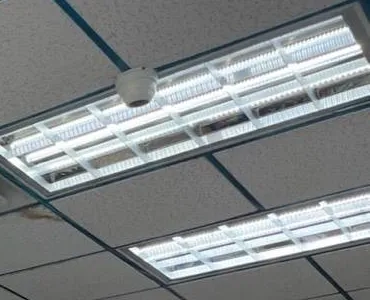
Clinton Hill, Brooklyn store camera repair: compact white dome camera on grey acoustic ceiling tiles beside a long louvered fluorescent light fixture
A photo from the AESS job library, not taken in Clinton Hill: a compact white dome camera on grey acoustic ceiling tiles beside a long louvered fluorescent light fixture. In a Myrtle Avenue grocery or a Fulton Street pharmacy this is the camera over an aisle or the register. When it stops showing faces, the usual cause is not age but a brighter light panel, a taller shelf or a hanging sign added near it, and the repair is often a move of a tile or two.

Stores tied into the Borough President's cameras

Patch reported that under the Borough President's camera program, high-definition cameras went up on Myrtle Avenue in Fort Greene and Clinton Hill and were connected to the existing security systems of local businesses. BKLYNER, describing the same program elsewhere in Brooklyn, reported that the participating businesses are responsible for the maintenance, upkeep, repair and registration of the cameras. In practice that means a store owner on Myrtle may have a street camera on the facade that records to the recorder in the back office. When that store replaces its recorder, changes its internet service or has a contractor in the ceiling, the street camera is often the one that goes dark, and nobody notices until something happens on the corner. We repair those systems like any other, confirm the outdoor camera is recording on the store's recorder again, and note it on the store's equipment list so the next repair includes it.

The Myrtle Avenue Brooklyn Partnership also says it encourages private, in-store cameras through its storefront grant project, and a 2017 welcome packet described 50 percent matching grants of up to $1,000 for storefront cameras. We do not know whether that offer is current; ask the partnership directly. If a repair is going to be paid partly by a grant, tell us when you book and we will itemize the price so it can be submitted.

Footage the police need today

When a shop is robbed, officers from the 88th Precinct usually ask for video right away, and the person on shift is rarely the person who set up the recorder. In 2024 the city also piloted a program, reported by the Brooklyn Eagle, that let retailers voluntarily connect their cameras to their local precinct using software from a company called Fusus. Whether or not your store joins anything like that, the repair we do on every commercial system includes a working export: the recorder's clock set to sync automatically, a USB port that works, a short written procedure taped inside the cabinet, and a staff login that can export clips but cannot delete footage or change settings. That way the clip the police need leaves the store in minutes and nobody can erase it by accident.

Rules that touch a commercial camera repair

Companies that install or service security and CCTV systems for others in New York need a license from the Department of State; we work under NYS license #12000287431. New York City also added low-voltage electrical work to its construction code under Local Law 128 of 2024, with the change taking effect December 21, 2025, so larger commercial jobs that go beyond repair may need more paperwork than they used to. Employers who record staff should know that New York Labor Law Section 203-c bars video recording in restrooms, locker rooms and changing rooms. On landmarked commercial buildings, a facade camera replaced in kind is ordinary repair under the LPC guidebook, while a moved or added one is new work. We are not your lawyer; we tell you where a repair touches one of these rules so you can decide before work begins.

Your Questions Answered

Security Camera Repair in Clinton Hill: Questions Answered

Vestibules, stoops and the front of the house

We had the vestibule's mosaic floor restored and the marble threshold polished, and since then the camera over the inner door shows a white blob at night. Did the restoration crew damage the camera?

Almost certainly not. The freshly polished tile and marble are reflecting the camera's own infrared back into the lens, and the camera shrinks its exposure to cope with the glare, which leaves the visitor in a haze. Before anything is bought, we cover the camera's infrared and light the vestibule another way to prove it. The fix is usually a lower or angled mount, the infrared turned down or off with a small warm light on a timer, or a low-light color camera, not another camera of the same model.

Our replacement for the dead camera beside the front door is a different shape and color from the old one. On a house inside the historic district, does the look of the new camera matter?

It can. The LPC guidebook treats repair and retrofit of existing safety equipment as work that does not need a permit, and asks that security equipment be as small as possible and blend with the building. A replacement of about the same size and finish, on the same anchors and in the same joint, stays on the repair side of that line. A noticeably larger or brighter unit, or one that needs new holes in the stone, starts to look like new work. Where an application is needed, the guidebook asks for the maker's specification sheet for the new camera rather than drawings, and we supply it.

Our front camera hangs from a long steel arm a previous owner bolted into the brownstone, and the arm is rusting and staining the stone. Can the arm be replaced as part of the repair?

Yes, and it is worth doing before the rust spreads further down the stone. We replace a corroding arm with a painted or stainless one of the same reach, fixed to the existing anchors where they are sound and set in mortar joints rather than the face of the brownstone. If the old anchors have to be abandoned, the new ones go into joints and the old holes are filled to match as closely as possible. On a landmarked front, replacing the arm in the same place and at the same size is part of a repair; a longer arm or a new position is a change we would talk through with you first.

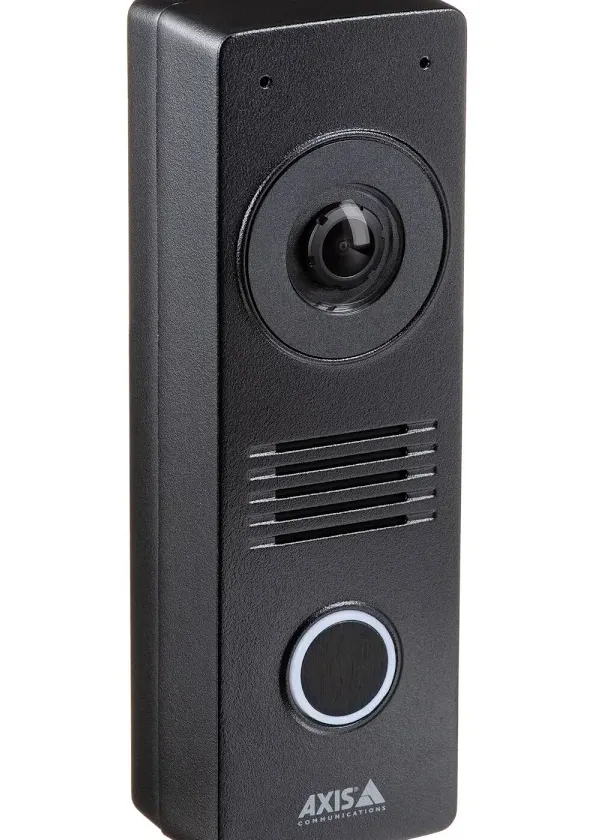
Clinton Hill, Brooklyn mansion lobby camera repair: black video intercom door station with a camera lens, speaker grille and an illuminated call button
A product photo from the AESS job library, not taken in Clinton Hill: a black video intercom door station with a camera lens, a speaker grille and an illuminated call button. In a Clinton Avenue mansion that has become an apartment building, a station like this at the main door is often the best-placed camera on the property, yet its picture may never reach the recorder in the cellar. Connecting it, where the hardware allows, can be cheaper than adding another camera to a protected front.

Someone threw bricks through our basement window before dawn, and our camera caught only a smear moving past the glass. Was the camera too slow to record it?

In a sense, yes. At night most cameras lengthen their exposure to gather light, so anything moving quickly turns into a streak, and a recorder saving only a few frames a second can miss the clearest moment entirely. News12 reported a man throwing bricks through the basement and ground-floor windows of a Clinton Hill building around 5 a.m. on December 29, a building residents said had been targeted before, which is exactly the kind of fast event this affects. The repair is usually a faster shutter setting at night, more light on the areaway so the camera does not need a long exposure, and the recorder set to save a higher frame rate on that camera.

Divided mansions, apartment houses and co-ops

On the rear top-floor camera of our divided Clinton Avenue house, dark bands slowly roll up the picture, while the cellar cameras look clean. What causes the bands?

Rolling bars on an analog or HD-over-coax camera are almost always electrical interference or a ground difference between the far end of the cable and the recorder, not a failing camera. Long runs through an old house pick it up from power wiring they share a path with, and a camera powered from an outlet on a different circuit or floor than the recorder can create a ground loop. We confirm it with a test at the camera, then fix it with a ground loop isolator, moving the camera's power to the recorder's supply, or rerouting the cable away from the power wiring along the worst stretch.

Our three-family on Lefferts Place has a recorder that is registered to the email of the upstairs tenant who set it up, and she is moving to another city. What should we ask her to do before she leaves?

Ask her to transfer or remove the device from her app account, give you the recorder's admin password, and delete her own access, all while she is still reachable. With that, we can move the cloud registration to your email, set a new admin password in your name and keep every setting and recording. If she leaves without doing it, the system can still be recovered through the maker's owner process with your proof of ownership, but it takes longer and sometimes needs the recorder in hand. It also makes sense to change the Wi-Fi password the cameras use if she knew it.

The doorman's monitor in our co-op shows the hallway cameras perfectly, but last night's recordings play back like a slideshow, one frame every few seconds. Why is the saved video so different from the live view?

Because the live view and the recording are often two different streams. Many recorders show the camera's main stream live but save a reduced one, or were set to save very few frames per second to stretch the drive, and in a large building a busy network or a recorder near its limit can drop frames further. We read the recording settings for each camera, the recorder's bandwidth and the drive's capacity, then set a frame rate that captures movement while still keeping the number of days the board needs, adding drive space if that is what it takes.

Students, tenants and turnover

We rent our garden floor to Pratt students every year, and every September someone new asks for the camera app. How should access be handled so the system does not break each time?

Keep the admin account in your name and give each tenant a separate viewer account limited to the cameras that cover their own door or the shared entrance. When a lease ends, delete that viewer, which takes a minute and does not touch recording. We set this up during a repair, show you how to add and remove viewers, and move any camera that was connected through a tenant's Wi-Fi onto a network you control, so a tenant's router leaving with them does not take a camera offline.

Clinton Hill, Brooklyn student apartment camera repair: small white cube camera for indoor use, product photo
A product photo from the AESS job library, not taken in Clinton Hill: a small white cube camera for indoor use. Renters in Clinton Hill brownstones and apartment houses often set one on a shelf facing their door or a window. When it stops connecting, the cause is usually the apartment's Wi-Fi, a changed password or an app account in a roommate's name, rather than the camera.

In our two-family brownstone, half the cameras died the week the garden-floor tenant moved out and her electric account was closed. How do we keep that from happening again?

Those cameras, or their power supplies, were plugged into outlets on the tenant's meter, so when her service ended, so did theirs. It is common when a system was installed using whatever outlet was nearest. The repair is to move every camera supply and the recorder onto a circuit on the owner's meter, ideally to one protected supply next to the recorder, and label the breaker. While we are there we check whether any camera also used the tenant's Wi-Fi, which leaves with her just as the power did.

Gardens, back walls and outbuildings

A roofer replaced the rain leader on the back of our house, and the garden camera whose cable ran down beside the old leader has been dead ever since. Does the wall have to be opened?

Rarely. Cable clipped to an old leader usually gets cut, crushed or pulled loose when the leader comes off, and the break is somewhere along that outside stretch. We test from the recorder and from the camera to find where the signal stops, then run a new outdoor-rated section in a small conduit along a joint near the new leader, not fastened to it, so the next roofing job does not cut it again. The camera itself is often fine.

The cameras for our whole lot record in the main house, but we now rent out the old carriage house at the back. Can its cameras be split onto their own system for the tenant?

Yes. The cameras that cover only the carriage house can be moved to a small recorder of their own, in the carriage house, so the tenant controls their footage and cannot see yours. Cameras that cover shared ground, like a driveway or a gate, can stay on your recorder, or be shared to both with viewer-only access. We test the existing cable between the buildings first, because it decides whether the split is a settings job or needs new cable.

Shops and footage

Since we replaced our Myrtle Avenue store's recorder, the outdoor camera that came with a city camera program shows "no video." Why would a new recorder drop just that one camera?

Usually because the new recorder was set up with the store's own cameras and that one was missed: it may use a different video standard, sit at a network address the new recorder never searched, or have drawn its power from the old recorder's supply. Under the Borough President's program as it was reported, the business is responsible for maintaining and repairing those cameras, so the repair is yours to order. We reconnect and test it, confirm it records, and add it to your equipment list.

Clinton Hill, Brooklyn shop camera repair: black varifocal dome camera, product photo
A product photo from the AESS job library, not taken in Clinton Hill: a black varifocal dome camera. Its lens can be zoomed after mounting, which is how we fix a register camera on Myrtle or DeKalb that shows the whole room but not the face of the person at the counter, and a long co-op corridor where the far end is unreadable.

After the robbery at our Fulton Street shop, the clip we exported plays on our own computer, but the detective said it would not open on the precinct's system. What went wrong?

Most recorders export in their own file format by default, which plays only in that maker's player. The answer is to export in a standard format such as MP4 where the recorder offers it, or to include the maker's player on the same USB drive, and to keep an original-format copy as well, since it carries the recorder's own timestamps. We set the export defaults on every commercial repair, test an export on a computer that has never seen the system, and write the steps down for whoever is working.

Equipment

Types of Security Cameras and Recorders We Repair

We repair equipment from any maker and any installer. These are the kinds we meet most in Clinton Hill brownstones, mansion apartments, co-op towers and avenue shops, and what usually goes wrong with each of them here.

Analog and HD-over-coax cameras

The older systems in many brownstones and mansions, on coaxial cable to a DVR in the cellar. Long runs pick up interference, connectors corrode under stoops, and the multi-camera supply usually fails first. Many can be upgraded to sharper cameras on the same cable.

Network (IP) cameras

Standard in co-op and condo buildings and newer shop systems, powered and connected over one cable from a PoE switch or NVR. Faults are usually a switch port, a connector, a run past its length limit, a password or a changed network address.

DVRs, NVRs and hybrid recorders

The box that keeps the video. Drives wear out, settings get lost after outages, firmware updates break phone viewing, and accounts get stranded with former tenants. Hybrid recorders let a brownstone keep its coax cameras while adding network ones.

Low-light color cameras

Cameras that keep a color picture in dim light without relying on infrared. Often the right replacement for vestibule cameras blinded by their own infrared off tile, marble and glass.

Varifocal domes and bullets

Cameras whose lens can be zoomed after mounting, for long co-op corridors, deep store aisles and mansion lobbies where a fixed wide lens leaves faces too small.

Pan-tilt and 360-degree cameras

Motorized or fisheye cameras on store floors, church interiors and building corners. Worn motors, lost preset positions and fogged domes are what we fix most.

Wi-Fi, battery and cube cameras

Consumer cameras in student apartments, on garden walls and decks. Weak signal through brick, batteries in cold weather, and app accounts tied to someone who moved out are the usual problems.

Video door stations

Intercom stations with a built-in camera at brownstone and mansion doors. Sometimes recorded on the main system, often not; we check before promising anyone footage from one.

Switches, supplies and battery backups

The parts that power everything and fail when the power misbehaves or when they sit in a hot closet. Checked on every outage call and replaced at the right size.

Clinton Hill, Brooklyn pan-tilt camera repair: small pan-tilt dome camera with a white body and a black lens bubble
A product photo from the AESS job library, not taken in Clinton Hill: a small pan-tilt dome camera with a white body and a black lens bubble. In a Clinton Hill church hall, a store or a mansion's shared lobby it can be turned from a phone to look at a door, a register or a stair. Its motors and saved positions are what usually need repair, and we often find one parked facing a wall since the last time someone moved it.

National brands or a local licensed repair: who should fix what

Owners with Ring, Arlo, Nest, Wyze or SimpliSafe cameras often ask whether to call the brand or call us. For a sealed consumer camera that has simply died, the brand's warranty or a replacement is usually the cheaper path, because there is nothing inside to repair. What a brand cannot do is stand in your vestibule and see that the camera is glowing off the marble, that the Wi-Fi from the parlor never reached the garden wall, or that the battery drains because the camera wakes every time a bus passes on Myrtle. That is where a visit pays for itself. For wired systems with a recorder, a licensed local repair is the normal route, since the makers generally sell through installers and do not send technicians. ADT and other monitored services repair their own equipment under their contracts, so if your cameras came with one, check the contract first. We will tell you honestly which of these fits.

Situation in a Clinton Hill buildingUsually best handled by
Sealed consumer camera dead and still under warrantyThe brand's warranty
Consumer camera working, but glare, Wi-Fi reach or battery life is the problemA local visit
Wired cameras with a DVR or NVR in the cellar or a closetA licensed local repair
Cameras under a monitoring company's contractThat company first, under its contract
Co-op, condo or divided-mansion building systemA licensed repair approved by the board, owner or managing agent
Front camera on a landmarked houseA licensed repair that replaces it in kind, in the same place
Clinton Hill, Brooklyn garden camera repair: outdoor Wi-Fi dome camera with an external antenna, product photo
A product photo from the AESS job library, not taken in Clinton Hill: an outdoor Wi-Fi dome camera with an external antenna. On a Clinton Hill brownstone the garden camera can be three brick walls away from a router in the front parlor, so the antenna's direction, or a small access point near the back of the house, often matters more than the camera does.
AI Overview Reality Check

What AI Gets Wrong About Security Camera Repair in Clinton Hill

Search summaries and home-service sites such as Angi, HomeAdvisor and Fixr give general advice about fixing security cameras. Some of it holds everywhere. Some of it misses how cameras actually fail in a landmarked brownstone neighborhood full of divided mansions, co-op towers and student rentals. These are the claims we hear repeated most, and what we find on Clinton Hill repairs.

"A foggy night picture means the camera's infrared LEDs or sensor are failing"

On a camera in an open yard, a sudden fog can mean the LEDs or the sensor are going. In a Clinton Hill vestibule it far more often means the camera is lighting up hard surfaces a few feet away: encaustic tile, marble steps, a glass inner door, a brass mailbox cluster. The infrared comes straight back and washes out the frame.

The giveaway is that the day picture is perfect. A failing sensor rarely produces a sharp image by day and a glowing one by night, while reflected infrared does exactly that. It also tends to appear after a renovation or a polish, not gradually.

Replacing the camera with the same model reproduces the problem on day one. Changing the angle, turning the camera's infrared down and lighting the vestibule another way, or fitting a low-light color camera actually fixes it.

"Replacing a camera on a landmarked building always requires Landmarks approval"

The LPC's permit guidebook says ordinary maintenance, repair and retrofitting of health, safety and utility equipment does not need a permit. Swapping a dead camera for a similar one, in the same place, on the same anchors, falls into that category on a Clinton Hill house inside the historic district.

What the Commission does govern is new or relocated equipment: well spaced, no more than two cameras per 25 feet of frontage on a small building, attached at mortar joints or plain surfaces, never through cast iron or decorative stone, with little visible conduit. Enforcement is real; CityLand reported homeowners in another district receiving Landmarks violations for cameras they put up to catch graffiti vandals.

So a like-for-like repair is usually simple. A camera moved to a new spot on the stone, or a noticeably bigger one, is a different job, and we say so before anything is drilled.

"If you lose the recorder password, you have to factory reset it and start over"

A factory reset is one way back in, and on some models it clears the camera settings and the recording index along with the password. On a Clinton Hill system set up by a former tenant or a departed sponsor, that can mean losing exactly the footage the owner needed.

Most makers have an owner recovery process that resets the admin password through the recorder itself, with proof of ownership, and leaves everything else in place. It takes a little more time and paperwork than pressing a reset button.

We use that route first, and we keep a reset as the last resort, after any footage that matters has been copied off.

"Wireless cameras fix the wiring problems of old houses"

Wi-Fi solves the cable, not the building. Brownstone party walls, brick rear walls and the plaster and lath inside many Clinton Hill houses all weaken a signal, and a garden camera two or three walls from the router is a common repair call for exactly that reason.

Wireless cameras also still need power. Battery models drain faster in cold weather and when they wake for every passing car; plug-in models need an outlet near the camera, which on a historic front is rarely where you want a cord.

Where a wire can reach, it is the more reliable repair. Where it cannot, a small access point near the camera, wired back to the router, usually does more good than a different camera.

"Landlords have to keep building cameras working and hand tenants the footage"

Not under any general city rule. There is no NYC law requiring apartment buildings to have cameras at all, and Brick Underground reported that landlords are not obliged to show tenants footage outside a legal process such as a subpoena or a police request.

Some lawyers argue the duty should be lighter to meet. Attorney Catherine Grad told Brick Underground, "I don't think that it's such an arduous duty to impose on the landlord," about reviewing footage when thefts keep happening in a building.

In practice, tenants in Clinton Hill's walk-ups and divided brownstones get further by asking the owner in writing to repair the camera and keep the relevant video, and by reporting thefts to the 88th Precinct, which can ask for it. We repair building systems only with the owner's approval.

"A handyman or electrician can repair a camera system"

In New York, companies that install or service security and CCTV systems for other people are licensed by the Department of State. An electrician can fix the outlet the recorder plugs into; the cameras, cable, recorder and network are low-voltage security work.

The tools are different too. Most Clinton Hill camera faults are found with a cable tester, a PoE tester, the recorder's logs, an infrared flashlight and a look at the light at the right time of day, not with a meter on the house wiring.

If someone has already worked on the system, tell us what they changed. It saves time, and a well-meant fix often moves the problem rather than solving it.

"Camera repair costs about $100 to $300"

That range describes one consumer camera somewhere simple. HomeAdvisor's Brooklyn page puts the average surveillance camera install or repair at $1,416, with a typical range of $680 to $2,145 across job sizes, and other New York companies publish diagnostic calls of $150 to $250 before any parts.

On our Brooklyn list a setting or login fix is usually covered by the $150 service call, a connector or PoE port repair runs $150 to $350, a single camera replacement $250 to $600, and a recorder replacement $700 to $1,500. The fault sets the price, and you see it in writing first.

The expensive repairs are the ones done twice: a camera replaced when its long cable was the problem, or a drive replaced when a failing supply was killing it. Testing in order is how we avoid paying for the same fault twice.
Talk to a Technician Before You Buy a New Camera for a Vestibule That Only Needs Different Light

Send a daytime and a nighttime screenshot from the camera you are worried about, and a recorded clip if you can. A lot of Clinton Hill "broken camera" calls turn out to be reflected infrared, a long cable, a lost login or a recorder saving the wrong stream, and we would rather tell you that before you spend anything.

Prefer to talk to someone who repairs cameras every day? Message a technician on WhatsApp.

Get In Touch

Request a Free Quote

Tell us the address, the kind of building, how many cameras there are, which ones are out and where the recorder sits. Say whether the picture is worse in daylight or after dark, whether anything changed recently in the vestibule or on the facade, and who owns the system if it is not you. If you need footage from a particular date, put it in the message and we will plan the visit around copying it first. For anything urgent, call (347) 934-8335.

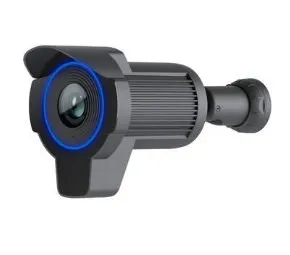
Clinton Hill, Brooklyn stoop camera repair: black bullet camera with an extended sun hood and a glowing blue ring around the lens, product photo
A product photo from the AESS job library, not taken in Clinton Hill: a black bullet camera with an extended sun hood and a glowing blue ring around the lens. Under a Clinton Hill stoop or on an areaway fence, a long hood like this keeps rain and low sun off the glass, and a camera of this size can often replace an older one in the same spot without new holes in the brownstone.

✅
Request Sent!
Thank you. A technician will contact you about the Clinton Hill address shortly.
How It Works

Our Repair Process

1. Send photos of the problem

A photo of the recorder or the app showing the bad camera, by day and after dark if the problem is at night, plus the Clinton Hill address and the type of building, by text, WhatsApp or the form. Tell us any date whose footage must be kept.

2. Settle who owns and approves the system

Owner, tenant, co-op or condo board, managing agent, landlord or store tenant. We confirm who approves the work, who holds the recorder login, and who can open the cellar, closet or equipment room before we book.

3. Check the front against Landmarks rules

For a camera on the front of a house inside the historic district, we note its exact position, size, color and anchors from your photos, so the replacement can go back in kind without new holes in the stone.

4. Book and pay the service call

The $150 Brooklyn service call books a two-hour arrival window and is credited to the repair if you go ahead. Requests are booked within 2 hours, and night-picture problems are tested in a darkened vestibule on the visit.

5. Copy footage before touching anything

Clips you need are exported to USB with the recorder's own timestamps before a drive, cable or setting is changed. If a drive looks like it is failing, we copy first and test second.

6. Test the chain from power to phone

Outlet and backup, supply or PoE switch, recorder and drive, then each cable, splice, connector and camera, then the network and the app, in that order, so the part that failed is the part that gets replaced.

7. Write the cause and the price

You hear what failed and why, and get a written price from the Brooklyn list before any part is replaced. When there is more than one fault, each one is priced on its own line so you can choose what to do now.

8. Repair, test and hand over

Parts replaced, openings sealed, each camera checked by day and in the dark with recorded playback confirmed, cables and channels labeled, loss and drive alerts sent to the right phones, old users removed, and a clip export shown to you.

Coverage Area

Security Camera Repair Near Clinton Hill's Landmarks

Myrtle Avenue's public camera corners

The Myrtle Avenue Brooklyn Partnership lists public cameras at Washington Park, Carlton Avenue, Ryerson Street and Steuben Street, along the stretch where shops sit under apartments.

404 Grand Avenue and its neighbors

One of four Italianate row houses at 398 to 404 Grand Avenue built around 1899, according to an LPC presentation, at the district's eastern edge.

St. Joseph's University on Clinton Avenue

The college's Brooklyn campus among the mansions of Clinton Avenue, where institutional camera systems share blocks with private houses.

Church of St. Luke and St. Matthew

The large Episcopal church at 520 Clinton Avenue in the southern part of the avenue, one of the largest church buildings in the neighborhood.

Clinton Hill Library

The Brooklyn Public Library branch at 380 Washington Avenue, a neighborhood stop for students, families and after-school programs.

Classon Avenue station

The G train stop at Lafayette and Classon Avenues on the neighborhood's eastern line, where Clinton Hill meets Bedford-Stuyvesant.

We also repair cameras in the neighborhoods around Clinton Hill, including Fort Greene, Bedford-Stuyvesant, Prospect Heights, Crown Heights, Downtown Brooklyn and the Brooklyn Navy Yard, all at the same Brooklyn rate. Our Fort Greene camera repair page covers the blocks toward the park, our Navy Yard camera repair page covers the buildings inside the yard's gates, our Prospect Heights page picks up south of Atlantic Avenue, and owners anywhere in the borough can start from Abstract Enterprises' Brooklyn security camera repair page.

Pricing

Security Camera Repair Cost in Clinton Hill

Clinton Hill is billed at our standard Brooklyn rate. Every repair begins with the $150 service call, which covers the on-site diagnosis and is credited to the repair if you go ahead. The figures below are taken from our published list of Brooklyn security camera repair prices; your own price is written down on the visit once the fault is found, and nothing is replaced until you agree to it.

RepairBrooklyn price
Service call: on-site diagnosis and a written repair price$150, credited to the repair
Infrared, exposure, motion, alert or login settings with no partsUsually within the $150 service call
Clean and check for a hazy or dirty picture$80
Connector reterminate or PoE port swap$150–$350
Power supply repair$150–$400
Dome or front cover replacement$30–$80 part, plus labor
Hard drive swap$200–$450
Indoor camera repair$200–$450
Single camera replacement on a working system$250–$600
Outdoor camera body replacement with weatherproofing$250–$600
Night picture repair, including infrared problems$250–$650
DVR not working, including drive and labor$300–$700
NVR not recording$400–$900
Vandalized camera, per camera, plus cable repair$400–$900
Pan-tilt (PTZ) camera repair$450–$1,200
Hybrid recorder swap, coax and IP$700–$1,200
DVR or NVR replacement with drive and setup$700–$1,500
Lightning or surge damage, depending on system size$700–$3,500
Annual maintenance visit$250–$800

Three things move a Clinton Hill price inside those ranges. The first is distance and height: a camera at the back of a mansion's top floor, at the cornice of a four-story brownstone or in a church's high ceiling takes more ladder time and more cable testing than one beside a door, and a camera on a landmarked front takes more care to go back into the same joint on the same anchors. The second is how many faults turn up together, which is why a system that has been neglected through a few tenant turnovers or a renovation often needs a drive, a supply and a login recovery on the same visit. The third is access: a recorder in a tenant's apartment, a co-op's equipment room or a store's locked office adds time to arrange. Whatever the case, you see the number before work starts, and each fault is priced on its own line.

Full terms — including 50% deposit, one-year parts-only warranty on AESS-supplied products, and the late-fee schedule — are set out in the service agreement.
Shop Our Systems

Security Camera Repair Packages & Pricing

Three ways Clinton Hill repairs usually come together, priced from our Brooklyn list.

Single-issue repair: $150–$700

One fault, one visit: a vestibule camera cured of its own infrared glare, a corroded connector under the stoop replaced, a failing supply on a mansion's upper floor swapped, a worn drive replaced, or a system recovered from a departed tenant's login. Typical for a brownstone, a carriage house or a small shop on Myrtle or DeKalb.

Major system repair: $700–$1,500

The recorder or several runs: a DVR or NVR replaced after an outage or old age, coax cameras moved onto a hybrid recorder, or several cameras reconnected after a gut renovation. Typical for a divided mansion, an apartment house on Lefferts or Brevoort Place, or a store with apartments above.

Annual maintenance: $250–$800

Every camera checked by day and in the dark, domes and lenses cleaned, connectors and supplies tested, drive health read, alerts confirmed, old users removed after turnover and a test clip exported. Homes start at $250, commercial properties at $400, and owners with several buildings run $500 to $800.

Bring your own equipment. If you have already bought a replacement camera or recorder, we can fit it at labor-only rates. Send us the exact model and we quote the labor by phone or text, and the visit is booked once it is paid. Equipment you supply is installed as supplied: we cannot vouch for parts we did not provide, and if a model will not work with your recorder or app, or is visibly larger than the camera it replaces on a landmarked front, we tell you before we start rather than after.

Complete Services

Every Security Camera Repair Service in Clinton Hill

Camera, picture and cable repair

Dead cameras, infrared glare in vestibules, long-run faults in big houses and cables cut during renovations. Request a repair

Recorder, drive and login repair

DVRs, NVRs, switches and supplies in cellars, closets and equipment rooms, and systems recovered from former tenants and installers. Security camera repair in Brooklyn

Brooklyn repair prices

The full list behind every figure on this page. Brooklyn camera repair price list

Citywide repair

Owners and managing agents with buildings in more than one borough. NYC security camera repair

FAQ

Clinton Hill Security Camera Repair FAQ

Our co-op tower's facade inspection crew needs the cameras on the outside walls out of their way. Should the cameras come down before the scaffold goes up, and who puts them back?
+

It is usually better to have the cameras that sit in the work zone taken down, labeled and stored, with their cables capped, before the crew starts, rather than letting the crew pull them off. We can do the removal, note each camera's position and channel, and reinstall and test them when the facade work is done. Cameras that are clear of the work can stay up and keep recording, and a temporary camera on the sidewalk shed is sometimes worth adding for the months it is up.

Our garden-and-parlor duplex has three separate entrances. After a repair, can the recorder show us which door someone actually used?
+

Yes. Each door gets its own camera channel named for that door, and motion or person detection can be set per camera so the recorder's event list says which entrance was used and when. If one camera has to cover two doors, we aim it so both openings are in the frame and draw a separate detection zone for each. We test by walking in through every door and checking that each event lands on the right channel.

Our recorder sits in the garden apartment, which we now rent out. Can you move it up to our floor while you are fixing the system?
+

Usually, yes. On many brownstones the camera cables gather in the cellar or the garden floor, so moving the recorder means running one network cable, or a bundle of coax, up through a closet or a chase to the new spot. On some systems a small switch or video extender can stay where the cables meet and only one cable needs to run upstairs. We price the move on its own line, and it ends the need to knock on a tenant's door to check the footage.

Four students share our upstairs apartment on a single lease. Which of them should hold the camera login for their door?
+

None of them should hold the admin login; that stays with the owner. Each student can have a viewer account of their own, limited to the cameras on their entrance, so nobody has to share a password and each one can be removed separately when they move out. Separate accounts also mean the app's activity log shows who looked at what, which helps settle any dispute in a shared apartment.

Will fishing a new camera cable through the old horsehair plaster in our brownstone crack the walls?
+

Not if it is done carefully. We prefer existing paths first, such as closets, the space beside old pipe chases, baseboards and the cellar ceiling, and we drill only small access holes in plaster where we have to, with tape on the surface to stop chipping. Old plaster and lath can crack if it is hammered or if a large hole is cut, so we avoid both. Any small opening we make is left clean for patching, and we tell you where each one will be before we start.

Some color night cameras have a white light that comes on when they see motion. On a quiet landmarked block, will that bother the neighbors, and is it allowed on the front of our house?
+

A bright white light that switches on at every passer-by can bother neighbors, so on Clinton Hill fronts we usually set it to stay off and rely on low-light color performance and the existing porch or vestibule light. The LPC guidebook limits light fixtures to two per door opening and asks that equipment be small and discreet, so a camera with a built-in light should be chosen and set with that in mind. In a vestibule or under the stoop, a soft light on a timer often does the same job more quietly.

Our original entry doors are going out to a shop to be stripped and restored, and the vestibule camera's cable runs through the door frame. What happens to the camera while the doors are gone?
+

We disconnect and label the camera and its cable before the doors come off, protect the cable end inside the frame, and if you want the entrance covered in the meantime, fit a temporary camera on the inside. When the restored doors are rehung we reconnect, re-aim and test the camera, because a door that hangs slightly differently, or new glass with a reeded texture, can change what the camera sees and how its infrared reflects.

The new vestibule camera can see the keypad on our inner door. Can it be set so it records faces but not the code people type?
+

Yes. We can black out the keypad area in the camera's picture with a privacy mask, so the recorder never saves it, or angle the camera so the keypad is out of frame while faces at the door stay in view. Either way, we check a recording afterward to make sure the code cannot be read. It is worth doing on any building where several households share an entry code.

We are starting a gut renovation. Should the existing camera cables be kept in the walls, or pulled out and replaced?
+

Test them before the walls open. Cable that tests well and runs where you still want cameras can be protected and kept; cable that is damaged, too old for the cameras you plan to use, or headed to places that are changing should come out while access is easy. We can test every run, label what stays, and mark positions for new cable on the framing, so the renovation crew does not cut or bury the wrong ones.

The cameras on our block were bought by several neighbors together and record to one recorder in one house. When a camera fails, who decides on the repair?
+

Whoever owns the recorder and the property where each camera is mounted needs to approve the work on it, so it helps for the neighbors to agree in writing who that is and how costs are split. We take the request from that person, write the price so it can be shared, and can give each neighbor a viewer account if the group wants that. We will not change a camera on someone's house without that owner's approval.

Rain drips off our brownstone's cornice straight onto the camera below it, and that camera has failed twice. Is there a better place or a better camera?
+

Both are worth looking at. Water falling on a camera from above finds its way into the cable entry and the connector even on a weather-rated model, so the repair is usually a new camera with a sealed cable gland, a drip loop in the cable and a hood, moved a few inches out of the drip line into a joint. If the drip comes from a failing cornice or gutter, it is worth having that fixed too, or the next camera will meet the same water.

Our tenants say the red glow from the vestibule camera at night makes them feel watched. Can it be made less noticeable without losing the night picture?
+

Yes. The red glow is the camera's infrared lights. A camera with invisible infrared, a low-light color camera that does not need infrared, or the camera's own infrared turned off with a soft vestibule light on a timer all remove the glow and often improve the picture, since a Clinton Hill vestibule's tile and glass reflect infrared badly anyway. We test the night picture with the change before we leave.

More Security Camera Repair near Clinton Hill

Security Camera Repair Brooklyn | Same-Day | Brownstone Pros · Security Camera Repair NYC | Same-Day | Abstract Enterprises · Security Camera Repair Manhattan | Same-Day | Co-op COI · Security Camera Repair Queens | Same-Day | Driveway Pros · Security Camera Repair Bronx | Same-Day | Home Base · Security Camera Repair Staten Island | Same-Day | Sandy Zone · Security Camera Repair Long Island | Nassau & Suffolk · Security Camera Repair Hudson Valley | Westchester to Ulster · Security Camera Repair Nassau County | Same-Day · Security Camera Repair Suffolk County | Hamptons + East End · Security Camera Repair Westchester County | Same-Day · Security Camera Repair Rockland County NY | Nyack, Suffern · Security Camera Repair Orange County | Newburgh, Goshen · Security Camera Repair Putnam County NY | Carmel, Mahopac · Security Camera Repair Dutchess County | Poughkeepsie · Security Camera Repair Ulster County | Kingston Woodstock

Security Camera Repair Bath Beach Brooklyn NY · Security Camera Repair Bay Ridge Brooklyn NY | AESS · Security Camera Repair Bedford-Stuyvesant Brooklyn NY · Security Camera Repair Bensonhurst Brooklyn NY | AESS · Security Camera Repair Bergen Beach Brooklyn NY · Security Camera Repair Beverley Square Brooklyn NY · Security Camera Repair Boerum Hill Brooklyn NY · Security Camera Repair Borough Park Brooklyn NY · Security Camera Repair Brighton Beach Brooklyn NY · Security Camera Repair Brooklyn Chinatown Brooklyn NY · Security Camera Repair Brooklyn Heights, Brooklyn NY · Security Camera Repair Brooklyn Navy Yard, Brooklyn NY · Security Camera Repair Brownsville Brooklyn NY | AESS · Security Camera Repair Bushwick Brooklyn NY | AESS · Security Camera Repair Cadman Plaza Brooklyn NY · Security Camera Repair Canarsie Brooklyn NY | AESS · Security Camera Repair Carroll Gardens Brooklyn NY · Security Camera Repair Coney Island Brooklyn NY · Security Camera Repair Crown Heights Brooklyn NY | AESS · Security Camera Repair Cypress Hills Brooklyn NY | AESS · Security Camera Repair Ditmas Park Brooklyn NY | AESS · Security Camera Repair Downtown Brooklyn NY | AESS · Security Camera Repair DUMBO Brooklyn NY | AESS · Security Camera Repair Dyker Heights Brooklyn NY | AESS

Other services in Clinton Hill

Security Camera Installation Clinton Hill Brooklyn NY · Door Buzzer Installation Clinton Hill Brooklyn NY · Structured Cabling Installation Clinton Hill Brooklyn NY · Access Control Installation Clinton Hill Brooklyn NY · Fire Alarm Installation Clinton Hill Brooklyn NY · Intercom Installation Clinton Hill Brooklyn NY · Door Buzzer Repair Clinton Hill Brooklyn NY | Stoop Doors · TV Installation Clinton Hill Brooklyn · Alarm Installation Clinton Hill Brooklyn NY

Ready for a Clinton Hill Camera That Shows a Face in the Vestibule, Not a Glow?

Send a daytime and a nighttime screenshot, the address, and the date of any footage you need. We book within 2 hours, give you a two-hour arrival window, copy your footage first, put front-of-house replacements back where the old camera was, and write down the repair price before any part is replaced.

Prefer to send photos? Message a technician on WhatsApp.