Cameras acting up since Con Edison cut the voltage, a stoop camera that saw nothing the night it mattered, or a DeKalb Avenue shop with a dead recorder? Fort Greene camera repair line, booked within 2 hours: (347) 934-8335
Brownstones in the Fort Greene and BAM Historic Districts · Divided Row Houses With a Garden Rental · DeKalb, Myrtle and Fulton Storefronts · Towers by Atlantic Terminal
Security Camera Repair in Fort Greene
Any Brand, Any Installer · Footage Copied Before Anything Is Touched · Written Price Before Parts · Brooklyn Rate
Security camera repair in Fort Greene begins with our $150 Brooklyn service call, which covers the on-site diagnosis and is credited to the repair if you go ahead. On our published Brooklyn list, most single faults run $150 to $700, and a recorder replacement or several rewired cameras run $700 to $1,500. We repair systems other companies installed, from a two-camera stoop setup on a South Oxford Street brownstone to a cellar recorder under a DeKalb Avenue restaurant or the lobby cameras of a tower near Fulton Street and Flatbush Avenue. Requests are booked within 2 hours, visits come in two-hour arrival windows, and you get the cause and a written price before any part is replaced.
Every price on this page comes from our published Brooklyn camera repair list, and your repair price is in writing before work starts
Rated 4.7★ across 201 Google Reviews
Reviewed and updated November 12, 2026, against Con Edison's June 23, 2025 and July 3, 2026 notices asking northwest and northern Brooklyn customers, Fort Greene included, to conserve power during 8 percent voltage reductions; Brooklyn Paper's 88th Precinct reports on the DeKalb Avenue restaurant burglary recorded by a market across the street, the 2008 DeKalb Avenue "burglary row," the Myrtle Avenue restaurant break-ins and the Brooklyn Paramount equipment theft; DNAinfo's June 2015 report on the South Oxford Street tree-pit theft caught on a block association president's webcam; Bklyner's 2014 and 2016 reports on Fulton Street burglary footage, Operation Safe Shopper and the Ingersoll Houses camera and lighting work; News 12 Brooklyn's September 2025 report on Flatbush Avenue surveillance video; 6sqft and Brownstoner on 570 Fulton Street and 1 Flatbush Avenue; the Myrtle Avenue Brooklyn Partnership's grant terms; NYC Parks' street-tree work rules; the Landmarks Preservation Commission's permit guidebook; HomeAdvisor's Brooklyn cost page; and the New York Department of State on security and CCTV installer licensing. · Abstract Enterprises Security Systems, NYS license #12000287431 · crews dispatched from our Troy Avenue office in Brooklyn
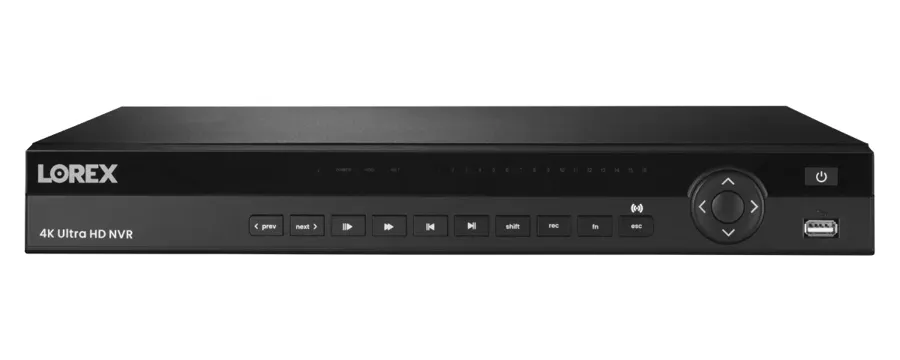
A product photo from the AESS job library, not taken in Fort Greene: a 16-channel network video recorder, the desktop box that stores every camera's video. In Fort Greene this box usually sits on a cellar shelf under a brownstone's parlor floor, in a closet behind a restaurant bar on DeKalb Avenue, or in the management office of a newer tower near Fulton Street. When it stops saving, every camera on the building is blind at once, so the recorder is the first thing we check and the place where we copy footage before touching anything else.
Fort Greene Camera Repair Request
Brownstone, divided row house, apartment building, tower or storefront: tell us the address and what the screen shows, and a technician calls back with the next step
✅
Request Sent!
Thank you. A technician will contact you about the Fort Greene address shortly.
25+
Years Experience
✓
Same-Day Estimates
100%
Licensed & Insured
4.7★
201 Google Reviews
Owner-operated since 2002 · Thousands of jobs completed · Booked within 2 hours
In Fort Greene, a camera repair usually has three causes stacked on top of each other: an old brownstone, a strained summer power grid and a system someone else installed years ago. Twice in two summers Con Edison asked this part of Brooklyn to cut its power use while it ran the grid at 8 percent lower voltage, and low, uneven power is hard on the cheap adapters, switches and hard drives most home and shop systems depend on. Add a cable that has run through a parlor window frame since the first owner put it in, a recorder in a damp cellar, and a password nobody in the house remembers, and you have the typical call. The first job on every visit is to copy whatever video you need off the recorder. Then we test the system in order, from the outlet to the lens, and tell you what failed. Send a photo of the recorder screen to (347) 934-8335 or on WhatsApp, and we will tell you the likely fault and what that kind of repair costs on our Brooklyn list before you book.
Looking at your photos costs nothing. The $150 service call covers the on-site diagnosis and is credited to the repair if you go ahead.
All work is done under New York State license #12000287431, the license the state requires of companies that install or service security and CCTV systems for other people.
We repair any brand and any installer's work, and we tell you plainly when an old camera or recorder is not worth paying to fix.
The Neighborhood
Why Fort Greene Properties Need Security Camera Repair
Fort Greene is a small neighborhood, a little over half a square mile between the Brooklyn Navy Yard and Flushing Avenue to the north, Atlantic Avenue to the south, Flatbush Avenue Extension and Downtown Brooklyn to the west and Vanderbilt Avenue and Clinton Hill to the east. Most of it is rows of brick and brownstone houses built in the 1850s and 1860s, a large share of them inside the Fort Greene and BAM historic districts the Landmarks Preservation Commission designated in 1978. Around the edges are the Walt Whitman and Ingersoll public housing campuses, the commercial strips on DeKalb Avenue, Myrtle Avenue and Fulton Street, and a growing ring of towers near Atlantic Terminal and Flatbush Avenue. Cameras are already on a great many of these buildings. The repair work comes from what happens to them after they go up.
The first pressure is the grid. On June 23, 2025, Con Edison asked customers in a list of northwest Brooklyn neighborhoods that included Fort Greene to avoid washers, dryers and microwaves, run only one air conditioner and hold off on charging electric cars while it repaired equipment, and it reduced the voltage in the area by 8 percent; about 68,000 customers were in that area. On July 3, 2026, it did the same thing again for Williamsburg, Greenpoint, Bedford-Stuyvesant, Fort Greene and Clinton Hill, with about 133,000 customers in the primary area and another 8 percent voltage cut "to protect equipment and maintain service during repairs." A voltage reduction is not a blackout, and most lights and phones carry on through it. Small power supplies, PoE switches and recorders are less forgiving. They are the parts of a camera system that run hottest in a July heat wave, and they are often plugged into the same strip as a window air conditioner.
The second pressure is the buildings themselves. A Fort Greene brownstone that was one house in 1860 is now often a garden rental, an owner's duplex and a top-floor apartment, with one camera system serving all of them. The recorder sits wherever the first installer found an outlet, usually in the cellar or a parlor-floor closet, and the cables reach the stoop, the areaway and the back garden through window frames, cornices and old chimney paths. Every pointing job, window replacement and boiler upgrade since then has been a chance to cut, crush or unplug something. In the historic districts there is a third layer: what the facade is allowed to carry. The Commission's permit guidebook says cameras on small buildings should be well spaced, no more than two per 25 feet of street frontage, attached at mortar joints, plain masonry, wood or metalwork rather than decorative surfaces, with only about ten inches of visible conduit. Ordinary repair does not need a permit, but a replacement in the wrong spot can start a conversation nobody wanted.
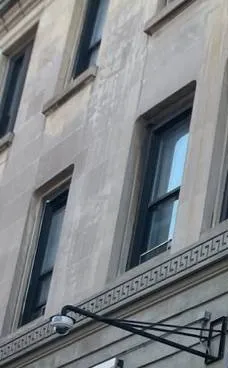
A photo from the AESS job library, not taken in Fort Greene: a bullet camera held out on a long steel arm below a carved Greek-key band on a pale stone front with tall sash windows. That is the trade-off on a historic Fort Greene facade. An arm lets the camera clear a cornice or a carved lintel without being fixed to the ornament, which is what the Landmarks guidebook asks for, but a long arm also catches wind and works loose over the years. When we repair a camera like this, the arm's own fasteners and the joint it is anchored in get checked as carefully as the camera.
The third pressure is that the camera that matters is often not yours. Brooklyn Paper's 88th Precinct report on a burglary at Amin, an Indian restaurant on DeKalb Avenue near Clermont Avenue, said the person who smashed the front door after closing and took cases of wine was "caught on video surveillance from Elly's Market across the street." In a separate report, a delivery driver on Myrtle Avenue near Steuben Street and Emerson Place watched footage from a nearby camera showing someone reach into his parked truck for his phone. In June 2015, DNAinfo reported that a webcam belonging to the president of the South Oxford Block Association recorded a man digging perennials out of a tree pit, and the footage went to the 88th Precinct. On a block of attached houses facing each other across a narrow street, the stoop camera on one side is the witness for the other side. A dark camera lets the whole block down, not just its owner.
The fourth pressure is that a lot of footage is asked for after the fact. A Brooklyn Paper item on the Brooklyn Paramount said that after a camera operator's gear worth more than $7,000 vanished from a dressing room, "Cops said they are reviewing the venue's cameras to identify a suspect." In 2014, Bklyner published surveillance stills police used to look for a suspect in a Fulton Street apartment burglary. Each of those depends on a recorder that was saving, a clock that was right and someone who knew how to export a clip. The calls we get from Fort Greene often start with the discovery that one of those three was missing.
So a repair here is broader than swapping a dead camera. It is getting the system recording again, putting the power supplies and the recorder somewhere that survives the next voltage cut, keeping the facade work inside what the historic district expects, and leaving the owner with logins, labels and alerts. Many brownstone owners who call about a dead stoop camera also ask about the front door. A building with a camera at the entrance usually pairs it with a working intercom or access control, and we can look at both on the same trip.
Six Fort Greene facts that shape a camera repair
Two summers, two voltage cuts. Con Edison lowered the voltage by 8 percent across an area including Fort Greene on June 23, 2025 (about 68,000 customers) and again on July 3, 2026 (about 133,000 customers), and asked people to switch off heavy appliances while it worked.
Two historic districts. The Fort Greene and BAM historic districts were both designated in 1978, so most rowhouse facades here fall under the Landmarks Preservation Commission's rules for where a camera and its conduit can go.
One precinct. The 88th Precinct at 298 Classon Avenue covers Fort Greene and Clinton Hill, so the detectives asking a block for video come from the same station house.
A block's cameras watch each other. The DeKalb Avenue restaurant burglary was recorded by a market across the street, not by the restaurant's own camera, according to Brooklyn Paper.
Grant cameras are maintained by the store. When the Borough President's Operation Safe Shopper funded cameras on commercial strips in 2016, including through the Myrtle Avenue Revitalization Project, Bklyner reported that the stores where the cameras sit would maintain them.
Brooklyn averages mix new systems with repairs. HomeAdvisor puts the average Brooklyn surveillance camera install or repair at $1,416, with a typical range of $680 to $2,145. A single repair on our Brooklyn list usually lands between $150 and $700.
Where this page applies. It covers Fort Greene from the Navy Yard edge on Flushing Avenue down to Atlantic Avenue, and from Flatbush Avenue Extension east to Vanderbilt Avenue, across ZIP codes 11201, 11205, 11217 and 11238. For the rest of the borough, see our main Brooklyn security camera repair page. The price follows the fault, not the address.
Same-Day Repair in Fort Greene
Need Repair in Fort Greene? A Stoop Camera That Missed the Night, or a Recorder That Never Came Back From the Heat
Urgent camera calls from Fort Greene come in three kinds. The first follows an incident: a package lifted from a vestibule, a car window broken on a side street, a restaurant door smashed after closing, a bike gone from an areaway. The owner wants the footage today. The second follows a hot spell or a power problem: the lights stayed on, but the recorder froze, a switch stopped powering the network cameras, or two cameras came back with no picture. The third is the slow fade, a camera that went dark months ago that nobody noticed until a neighbor asked whether you saw anything.
If you need footage from an incident, leave the recorder running. Do not restart it, unplug it or let anyone reset it. Most recorders write over their oldest video once the drive is full, so the clock is already running, and a restart can hide the fault behind a gap. Call (347) 934-8335, give us the date and the time window, and we book the visit with copying that footage as the first task. If a detective from the 88th Precinct has asked for a copy, say so when you book. The clip goes to a USB drive with the recorder's own timestamps, and we write down what time the recorder showed against the real time.
For everything else the path is the same. The $150 service call books a two-hour arrival window, the technician finds the cause, and you get a written price before any part is replaced. Requests are booked within 2 hours. We do not promise the repair itself the same day, because some parts have to be ordered, but most single-camera, power supply and drive faults are fixed on the first visit when the part is on the truck.
What We Install
Security Camera Repair Services in Fort Greene
Each repair below is priced from our Brooklyn camera repair list. The service call pays for finding the fault. The repair is priced by what failed, how many cameras it touches and how hard the run is to reach, whether that is a stoop camera on a brownstone or a roof camera on a tower near Atlantic Terminal.
Dead camera repair
A single camera with no picture, tested at the lens, along the cable and at the recorder, so only the failed part is replaced. On brownstones the fault is often the connector where the cable leaves the window frame or the cornice, which is a cheaper repair than a new camera.
Heat and brownout recovery
Systems that misbehaved during a July heat wave or a voltage cut: recorders that froze or restarted, PoE switches that stopped powering some ports, adapters that died, and clocks that drifted. We restore settings, test each power source and fit the right backup.
Recorders and hard drives
DVRs and NVRs in cellars, parlor closets, behind bars and in building offices that beep, restart, stop saving or keep only a few days. Drives are tested and swapped by capacity, and any footage you need is copied off first.
Night picture repair
Cameras that go black, white or smeared after dark: failed infrared, a stuck day-night filter, glare from a stoop light or the glass in a vestibule door, and street trees growing into the view. We fix the camera or what is in front of it, whichever costs less.
Power supplies and adapters
Central power boxes, plug-in adapters and the outlet or strip they hang from. In divided brownstones cameras often draw power from one apartment's outlet, and adapters that share a strip with an air conditioner are among the first parts to fail in summer.
Cable and connector repair
Runs cut or crushed by pointing crews, window installers and boiler work, cables pinched in parlor window sashes, connectors full of water under a cornice, and lines chewed in cellars. Repaired or replaced and tested end to end.
Phone viewing and logins
Apps that lost the recorder after an internet change, accounts tied to a former tenant or a relative, and recorders whose admin password nobody knows. We restore access for the right person and change default passwords.
Footage export for incidents
Clips copied to USB with original timestamps for detectives, insurers and managing agents, with a note of any gap between the recorder's clock and the real time.
Whole-system checkups
Every camera on a brownstone, building or storefront checked in one visit, with a written list of what works, what is failing and what each fix costs, so an owner, a board or a shop can decide what comes first.
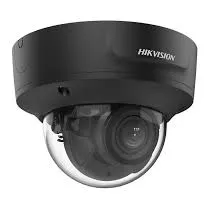
A product photo from the AESS job library, not taken in Fort Greene: a black varifocal dome camera, the kind whose zoom and focus can be set on site. In a Fort Greene brownstone vestibule, the space between the street door and the inner door is often only a few feet deep, and a varifocal dome can be set wide enough to see both doors at once. When the picture on one of these goes soft over time, the first check is the focus and the dome cover, not a new camera.
Building Specialists
Security Camera Repair for Fort Greene's Architecture
Six kinds of property account for nearly every camera repair call in Fort Greene. Each fails in its own way, and each decides where the recorder ends up, how the cables reach the cameras, and who has to say yes before a technician touches anything.
Single-family brownstones
Houses still lived in by one household, mostly on the blocks of South Oxford, South Portland, Cumberland, Carlton and Adelphi. Usually two to four cameras on the stoop, the areaway and the garden, with the recorder in the cellar.
Divided brownstones
The same houses split into a garden rental, an owner's duplex and an upper apartment. One system serves several households, and the repair questions are about whose outlet, whose internet and whose phone gets the alerts.
Prewar walk-ups and flats
Four- to eight-family buildings on DeKalb, Lafayette and the side streets, many with shops on the ground floor. Cameras cover the entrance, the vestibule mailboxes and sometimes the rear yard, with no super on site.
Towers near Atlantic and Flatbush
Newer rental and condo buildings such as 570 Fulton Street and 1 Flatbush Avenue, plus the Williamsburgh Savings Bank Tower condominiums at 1 Hanson Place. Network cameras, lobby desks, package lockers and retail tenants on the ground floor.
Restaurants, bars and shops
Ground-floor businesses on DeKalb, Myrtle, Fulton and Lafayette, many in old rowhouse storefronts with a cellar under the sidewalk. Small recorders behind the bar or in a back office, and cameras that must work after closing.
Venues, galleries and offices
The cultural blocks around BAM and the Brooklyn Paramount, smaller venues and studios, and professional offices on the parlor floors of converted houses. Backstage doors, dressing rooms and equipment rooms are the spots that matter.
Single-family brownstones: three floors of cable and one recorder
A Fort Greene brownstone that has stayed one house usually has a tidy-looking system with a messy inside. The recorder is on a cellar shelf beside the gas meter and the internet modem, plugged into a power strip that also feeds a dehumidifier or a chest freezer. One cable climbs to the stoop camera through the space behind the stoop or through the parlor window frame. Another goes out to the areaway under the stoop, and a third crosses the cellar to the garden through the rear wall or a basement window. Three or four cameras, three or four different paths, each with its own weak point.
When a single camera goes dark on a house like this, the cellar is the first stop, because a tripped strip, a dying adapter or a corroded plug explains more brownstone failures than any camera. Next is the path the cable takes outdoors. A cable squeezed by a window sash every time the window is opened, or one left bare where it exits under a cornice, will fail long before the camera does. The usual repair is a new connector in a sealed box and a short new length of cable along the same route, kept in the mortar joint so the facade looks as it did.
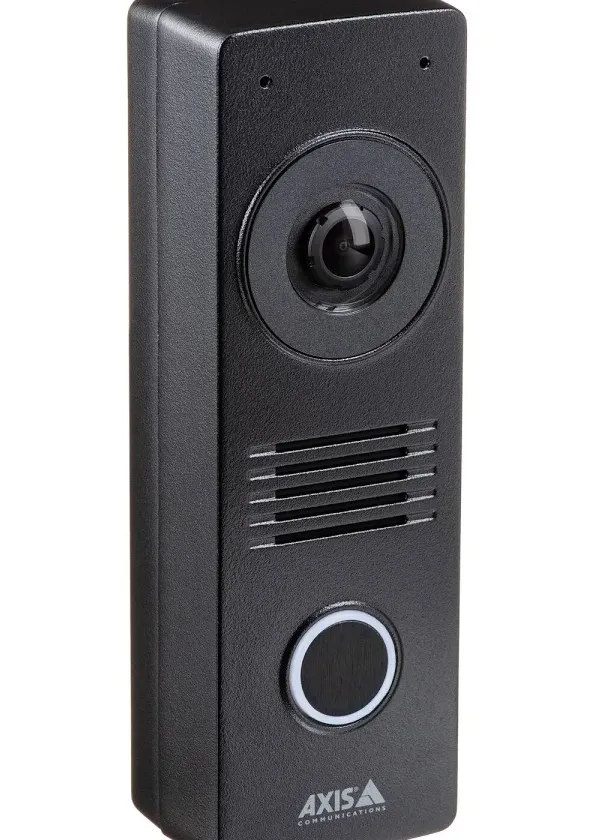
A product photo from the AESS job library, not taken in Fort Greene: a black video intercom door station with a camera, a speaker grille and a lit call button. On a divided Fort Greene brownstone, the door station at the top of the stoop is often the only camera that sees a visitor's face, and it may feed the intercom screens upstairs rather than the recorder in the cellar. When it goes dark, the first question is which system it belongs to, because the repair path for an intercom camera and a recorder camera is different.
Divided brownstones: one system, three households
Many Fort Greene houses were long ago divided, and the classic arrangement is an owner living in a duplex over a garden rental, sometimes with another apartment above. One camera system usually serves the whole house. The practical questions on a repair are whose outlet the cameras run from, whose internet carries the phone app, and who gets the alerts. If the power box hangs from an outlet in the garden apartment, the cameras go dark every time that tenant's breaker trips. If the recorder runs through the upper tenant's router, phone viewing ends when that tenant moves out or changes provider. We move power and network onto the owner's side of the house where that is practical.
The other issue is privacy between the floors. A camera that watches the shared stoop and the vestibule is fair for everyone in the building to see. A camera that watches the garden, the rear door of the duplex or the parlor hall is not. During a repair we can split the cameras into groups on the recorder so each household sees the views that belong to it, and we can do that without adding a second recorder in most cases.
Prewar walk-ups and flats: the cameras nobody owns in their head
The four- and five-story walk-ups along DeKalb Avenue, Lafayette Avenue and the blocks toward Myrtle usually have a camera over the street door, one in the vestibule by the mailboxes and sometimes one in the back yard or on the roof door. There is no super living in the building, the owner may live elsewhere, and the tenants assume someone else is checking. The recorder is in a cellar closet or the boiler room, often next to the meters, and it can run for months with a dead drive before anyone tries to pull a clip.
Towers near Atlantic and Flatbush: network cameras and many hands
The newer buildings on the western edge of the neighborhood are a different kind of job. Fulton Greene at 570 Fulton Street, which 6sqft described as 23 stories with 163 rentals, ground-floor retail, a cellar level and package lockers, and the 19-story building at 1 Flatbush Avenue at Fulton Street with retail on its first two floors, run network cameras on managed switches, often tied into the building's own network and sometimes into its access control. The first faults in buildings like these are logins held by a contractor who has left, firmware never updated, recorders set to keep only a few days, switches without backup power, and cameras added later that were never added to the recorder.
Towers also have more people in the system: the managing agent, the building's IT vendor, the lobby staff and, below them, the shops. A repair in a tower starts with documentation. We find out what is installed, who holds which password and what each camera is supposed to be showing, then fix what is broken without changing anything the IT vendor depends on.
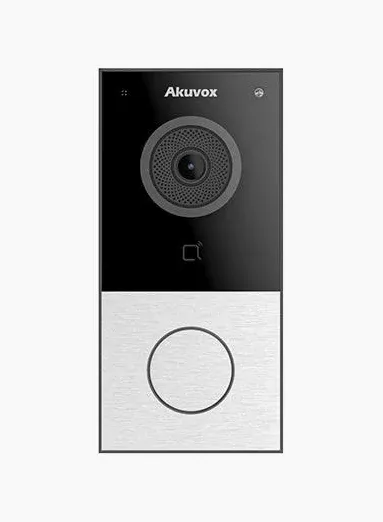
A product photo from the AESS job library, not taken in Fort Greene: a slim video door station with a camera lens at the top and a large round call button. Newer Fort Greene apartment buildings near Fulton Street often have a station like this at the street door, and its camera can be recorded by the building's camera system as well as shown to residents. When residents see a picture but the recorder shows nothing for that door, the fault is in the link between the two systems, not the station.
Restaurants, bars and shops: the cellar under the sidewalk
Most Fort Greene storefronts sit in the ground floor of an old rowhouse or walk-up, with storage in a cellar reached through a sidewalk hatch or a back stair. The recorder is usually behind the bar, under the counter or on an office shelf in the cellar, and the cameras cover the front door, the register, the bar and the back door to the yard. These systems run long hours, close to kitchens and coolers, and are often installed by whoever was cheapest when the business opened. They fail from heat, grease, moisture and staff unplugging the recorder to use the outlet.
The repair that matters most for a restaurant here is the one that keeps the system working after closing. The 2008 burglaries Brooklyn Paper called "burglary row" on DeKalb Avenue between Carlton and Vanderbilt avenues hit restaurants at night, and the later Amin burglary near Clermont Avenue came after closing as well. A camera that records only motion during business hours, or a recorder plugged into a switched outlet that goes off with the lights, will miss exactly those hours.
Venues, galleries and offices: the doors behind the public spaces
Around BAM, the Brooklyn Paramount and the smaller venues and studios nearby, the cameras that fail are often the ones away from the public rooms: a backstage door, a loading door, a dressing room corridor or an equipment cage. The Paramount theft, in which a camera operator's gear disappeared from a dressing room during a concert, is the kind of case these cameras exist for. In small venues and galleries the recorder is often in a closet shared with the sound or lighting equipment, which gets hot and is unplugged during load-ins.
Professional offices on the parlor floors of converted houses have a different problem: a camera system installed by the building owner that the tenant can see but cannot manage. A repair there starts with finding out whose system it is, then giving each party the access it needs and no more.
Field Notes
Field Notes: How a Fort Greene Brownstone Camera Visit Usually Runs
These notes describe how our technicians work through a typical Fort Greene brownstone or small building when one or more cameras are out and nobody is sure why. They describe our practice, not a single job.
Footage before anything else. If anyone needs a recent night, the clip goes to USB before the recorder is restarted, unplugged or opened, and the recorder's clock is written down against the real time.
The cellar strip. The technician follows the recorder's power cord to the wall. In a brownstone cellar that often means a power strip shared with a dehumidifier, a freezer or the boiler controls, sometimes plugged into another strip. A strip that took a hit during a voltage cut, or an adapter warm to the touch, is often the whole problem.
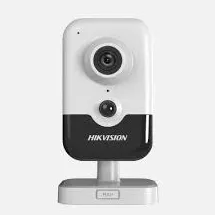
A product photo from the AESS job library, not taken in Fort Greene: a white indoor cube camera, the small plug-in type people set on a shelf. In Fort Greene these turn up on parlor-floor bookshelves facing the front windows, on a vestibule ledge watching for packages, or in a shop's back office. Most run on Wi-Fi and their own app, so when one drops out the repair is usually its power adapter, the router it joined, or an account tied to someone who has moved out, rather than the camera itself.
Each path out of the house. The stoop run, the areaway run and the garden run are traced and labeled one at a time. The technician looks at the point where each leaves the building, because a sash, a cornice or a cellar window is where the cable is pinched, wet or cut.
At the camera. Power and signal are tested at the camera itself, then the connector, the box and the bracket are checked for water, rust or a loose anchor in the mortar.
Price before parts, and a record afterward. You hear the cause and get a written price before anything is replaced. When the repair is done, every camera is checked by day and after dark, alerts for lost video and drive errors are turned on, and you get the logins and a list of which cable feeds which camera.
Fault by Fault
Heat, Low Voltage, Old Facades and Busy Corners: Why Fort Greene Camera Systems Fail
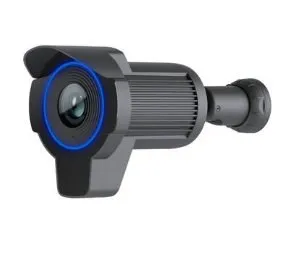
A product photo from the AESS job library, not taken in Fort Greene: a black bullet camera with a long hood and a blue-lit ring around the lens. The hood shades the lens from sun and rain, which matters on a south-facing Fort Greene brownstone where afternoon sun hits the stoop camera straight on. The lit ring shows the camera has power, but not that the recorder is saving its video, which is why a glowing light on a dead channel is one of the most common things we are called about.
Heat: summer is the hardest season on a recorder
A recorder is a small computer with a hard drive spinning all day, and most are sold for a cool, dry room. In Fort Greene they end up in a closet beside a steam riser, on a shelf over a cellar boiler, behind a bar next to a beer cooler, or in a top-floor office under a roof that bakes all July. Heat shortens drive life and makes recorders restart without warning. The signs are a recorder that is too hot to rest a hand on, a fan that has gone quiet, a timeline with short gaps in the afternoons, and a drive that starts throwing errors at the end of the summer. The repair is often a new drive plus a move to a cooler spot with air around it.
PoE switches have the same weakness. A small switch powering four or eight network cameras gets warm under normal load, and in a hot closet it can start cutting power to its ports one at a time to protect itself. The cameras on those ports go dark in the hottest part of the day and come back at night, which looks like a camera fault and is not.
Low voltage: the outage that never happened
Con Edison's two recent conservation notices for this part of Brooklyn each came with an 8 percent voltage reduction. The utility does this to protect its own equipment while it repairs the network, and most household devices ride through it. The weak links in a camera system are the cheap plug-in adapters and power boxes, which can overheat when the incoming voltage drops and the load stays the same, and the recorder's own power supply. When we see a cluster of adapter failures after a hot week, that is usually the reason.
Old facades: where the cable meets the house
The houses here were built long before anyone ran a cable to a stoop. Installers have used whatever path was easiest: under a window sash, through a cornice, along the top of the areaway fence, through a basement window frame. Each of those paths is a place where weather, a moving window or a repair crew can damage the cable. In the historic districts, the Landmarks guidebook prefers attachments at mortar joints, plain masonry, wood or metalwork and only short runs of visible conduit, so a repair that improves the path has to stay discreet.
When the camera itself is the problem, the replacement goes into the same anchors where possible. If the old camera was fixed to a decorative surface, we suggest the nearest plain joint or a short arm instead, and we tell you before any new hole is drilled.
Busy corners: wear from the street itself
Fort Greene's commercial corners see heavy foot traffic, deliveries and late nights. Cameras low enough to reach get knocked, turned or covered. Cameras pointed down a sidewalk record so much movement that a motion-only recorder fills its drive quickly and keeps fewer days. Restaurants on DeKalb and Myrtle have cameras near kitchen exhausts that coat the lens. Each of these is a repair with a simple fix once it is found: a higher mount, a tighter view, a schedule that records all night, or a hood and a cleaning routine.
Commercial Security Camera Repair
Business Security Camera Repair in Fort Greene
Fort Greene's businesses are mostly small and owner-run: restaurants, bars and cafés, groceries and delis, wine shops, salons, dry cleaners, bookstores, studios and offices, with a few large institutions in the middle of them. Their camera systems are small too, usually four to sixteen cameras on one recorder, but they work long hours and they matter most when the shop is closed. These are the strips where we do most of our commercial repair work in the neighborhood.
DeKalb Avenue
The restaurant row between Fort Greene Park and Vanderbilt Avenue, where Brooklyn Paper documented the 2008 string of night burglaries and the later Amin burglary near Clermont Avenue that a market's camera across the street recorded. Cameras here must work after closing and see across the avenue.
Myrtle Avenue
The Myrtle Avenue Brooklyn Partnership's district, which the city lists at 40 block faces with 179 ground-floor retail businesses across Fort Greene and Clinton Hill. Some storefront cameras here date from the 2016 Operation Safe Shopper grants, which the stores themselves maintain.
Fulton Street
The Fulton Area Business Alliance strip from Rockwell Place toward Classon Avenue, 37 block faces of shops, restaurants and services, with the newer towers near Flatbush Avenue and older storefronts further east. Many shops share a cellar with the apartments above.
Lafayette Avenue and the BAM blocks
The Peter Jay Sharp Building at 30 Lafayette Avenue and the blocks around it, with cafés, bars and small venues that are busiest before and after performances, and quiet the rest of the night.
Flatbush Avenue and Atlantic Terminal edge
The western edge, where the Williamsburgh Savings Bank Tower at 1 Hanson Place connects through its basement to the Atlantic Terminal subway station, and where tower retail on Flatbush Avenue and Fulton Street sees heavy foot traffic all day.
Vanderbilt Avenue and the Clinton Hill line
The eastern edge, with restaurants and shops facing both neighborhoods. Brooklyn Paper's 2008 report counted incidents on Vanderbilt near Myrtle and on Willoughby Avenue among the night burglaries.
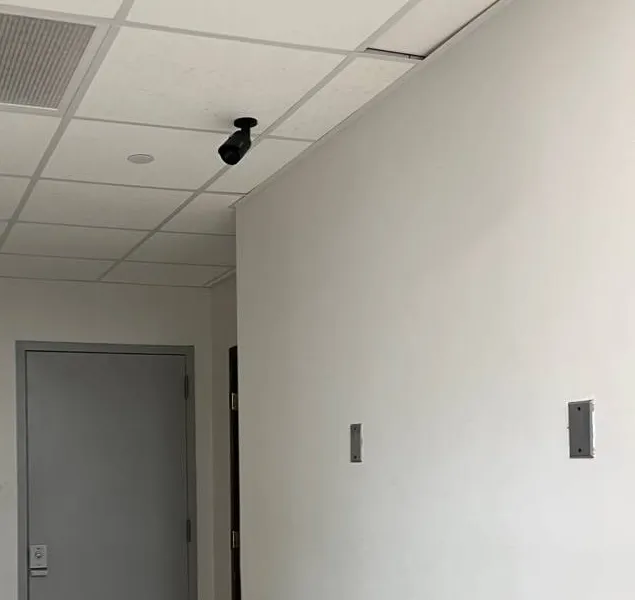
A photo from the AESS job library, not taken in Fort Greene: a small black bullet camera hanging from a ceiling-tile grid and aimed down a short corridor at a grey steel service door. That is the view that matters behind a Fort Greene restaurant, a venue's backstage hall or a shop's stockroom: one door, one corridor, nothing else. When a camera like this is knocked out of line by someone moving stock or lifting a ceiling tile, the repair is usually a firmer mount and a re-aim, not a new camera.
What a DeKalb or Myrtle restaurant needs from a camera repair
Restaurants and bars here are open late and quiet before dawn, and that is when their cameras earn their keep. The questions we ask on every restaurant repair are practical. Is the recorder set to record all night, or only on motion? Is it plugged into an outlet that stays on when the staff switch off the lights at closing? Is the drive large enough to keep at least a couple of weeks? Can the manager export a clip without calling the person who set it up? If the answer to any of those is no, fixing it is part of the repair.
The second thing we look at is the street view. The camera that caught the Amin burglar belonged to the market across DeKalb Avenue. A restaurant's own front camera usually watches its door and the first few feet of sidewalk, which is right for the business, but a second, wider view across the avenue is what helps the neighbors and the police. On many storefronts that is a matter of adjusting a camera that is already there.
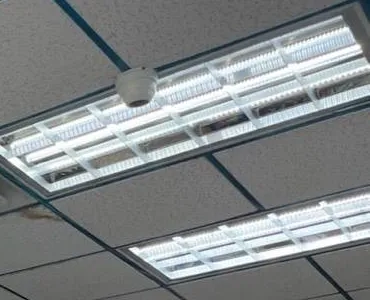
A photo from the AESS job library, not taken in Fort Greene: a small white dome camera on grey acoustic tiles right beside a long louvered fluorescent light. Placement like this is common in Fort Greene offices and shops with dropped ceilings, and it causes trouble. The light can wash out part of the picture, and some fluorescent fixtures flicker in a way the camera turns into rolling bands. Moving the dome one tile over is often the whole repair.
Shops that share a building with apartments
Many Fort Greene shops are tenants in a building whose owner also has cameras on the entrance and the cellar. Sometimes the shop's cameras run on the owner's recorder, sometimes the reverse, and sometimes nobody remembers. Before we repair anything we find out whose system each camera belongs to, because the owner of the recorder is the one who approves the work and holds the footage. Where the two should be separate, we can split them so the shop keeps its own recorder and the building keeps its own.
Rules that touch a commercial camera repair
New York State requires a license for companies that install or service security and CCTV systems for other people, and our work is done under NYS license #12000287431. Storefronts inside the Fort Greene and BAM historic districts follow the same Landmarks guidebook rules as houses: cameras well spaced, attached at plain masonry, mortar joints, wood or metalwork rather than decorative surfaces, and only short visible conduit, with no permit needed for ordinary repair. On the sidewalk, NYC Parks says no work may be performed on or within 50 feet of a street tree without a Parks permit, so a camera blocked by a street tree is fixed by moving or re-aiming the camera, not by cutting the tree.
Your Questions Answered
Security Camera Repair in Fort Greene: Questions Answered
Brownstones and the two historic districts
Our house is on one of the BAM Historic District blocks rather than in the Fort Greene district. Do the Landmarks rules for cameras work any differently there?
No. The Fort Greene and BAM historic districts were both designated by the Landmarks Preservation Commission in 1978, and the Commission's permit guidebook applies the same chapter on security equipment to both. A repair or a like-for-like swap in the same spot counts as ordinary maintenance and needs no permit. What changes the picture is moving a camera to a new spot on the facade, adding a third camera within 25 feet of frontage on a small building, or running more than about ten inches of visible conduit. If your repair needs any of those, we tell you before any hole is drilled, and we keep the mount to plain masonry, a mortar joint, wood or metalwork, never carved stone.
The only spot high enough for our front camera is the cornice. Is a camera on a cornice a problem when it has to be repaired or replaced?
It often is. Many Fort Greene cornices are pressed metal or carved wood, which counts as a decorative surface under the Landmarks guidebook, and they can be fragile after 150 years. A camera screwed directly into one tends to work loose and let water in around the screws. When we repair one, we look for a way to keep the height without fixing anything to the ornament, usually a bracket anchored into the plain brick or a mortar joint just below the cornice, or a short arm that reaches past it. The cable then follows the mortar line rather than the face of the cornice.
The cable to our garden-level camera passes through the original wood window frame, and the wood is rotting around the hole. Which gets fixed first?
The cable path. A hole through a window frame lets water into the wood every time it rains, and the rot around it will keep spreading whatever we do to the camera. We move the cable to a better entry point, such as a mortar joint or a cellar wall, with a proper sleeve and seal, then fix the camera end. Repairing the window frame itself is carpentry rather than camera work, so we leave the old hole cleanly plugged and tell you who to call. Moving the entry usually costs less than people expect, because the run is short.
Hot summers and low voltage
Does a battery backup do anything when Con Edison lowers the voltage instead of cutting the power?
It depends on the kind of backup. The cheapest units, called standby units, do nothing until the power drops below a set point, so during a mild voltage reduction like the 8 percent cuts Con Edison used in Fort Greene in June 2025 and July 2026 they pass the low voltage straight through. A line-interactive unit corrects modest high and low voltage without draining its battery, which is the kind we recommend for a recorder and a PoE switch in this part of Brooklyn. Whatever you have, the battery inside is often the problem: most are good for a few years, and many we test in cellars here have never been replaced.
We unplugged the whole camera system during the July heat to be safe. Does it matter what order we plug things back in?
Yes, a little. Turn on the network first: the internet modem, then the router, then any PoE switch, and give each a minute. Then turn on the recorder, and last of all any cameras that have their own plug-in adapters. That way the recorder finds its cameras and the internet when it starts, rather than starting without them and needing a restart. If some cameras still do not appear after ten minutes, leave the recorder running, take a photo of the screen and send it to us. That photo usually tells us whether it is a setting, a switch port or a failed adapter.
Restaurants, shops and venues
The burglar at a DeKalb Avenue restaurant was identified from a market's camera across the street. Should our shop's outside camera point at our own door or across the avenue?
Both, if you can. The camera at your door should be set close enough to see a face at the handle and the glass, because that is what an insurer or a detective needs about your own break-in. A second view, often from a camera you already have, can be set wider to take in the sidewalk and the storefronts across the street. In the Amin case Brooklyn Paper described, the useful footage came from Elly's Market's camera opposite. On many DeKalb and Myrtle storefronts the second view is an adjustment rather than a new camera, and we check it during any repair.
Our Myrtle Avenue storefront camera came from a borough grant program years ago, and we bought our own recorder later. Can the grant camera be moved onto our recorder so we stop running two systems?
Usually, yes. When Operation Safe Shopper funded cameras on commercial strips in 2016, including through the Myrtle Avenue Revitalization Project, Bklyner reported that the stores where the cameras sit would maintain them, and that footage would be available to the NYPD. Whether that camera can join your recorder depends on its type, analog or network, and on whether anyone still needs a separate feed from it. We check the camera, confirm with you who should have access to its video, then connect it to your recorder or replace it with one that matches the rest of your system.
Our small venue near BAM has a backstage camera that has been dead for a year, and the rest of the system works. What is the cheapest way to get that door covered again?
Find out why that one camera failed before buying anything. A single dead camera on a working system is most often a cable damaged by gear being rolled over it, a connector pulled loose during a load-in, or a power adapter someone unplugged for a lighting rig. Those are repairs on our Brooklyn list from a connector or port fix at $150 to $350 up to a single camera replacement at $250 to $600. If the camera has to be replaced, we mount it higher and run the cable where cases and racks cannot reach it, so it does not fail the same way again.
Our bar's manager closes up alone at night and has no idea whether the cameras recorded. What should a quick end-of-night check look like?
Thirty seconds on the recorder or the phone app. Open playback, pick one camera, and scroll back an hour: if there is video, the recorder is saving. Glance at the live grid for any black tiles. And check that the recorder's clock matches the time on the manager's phone. During a repair we can set the recorder to send an alert when a camera loses video or the drive reports an error, so the manager does not have to remember. We also show whoever closes up how to export a clip, so a detective's request the next morning is a two-minute job.
The block, the trees and the neighbors
A London plane in front of our house fills the stoop camera's view every summer. Can we cut the branch back ourselves?
No. NYC Parks says that no work may be performed on or within 50 feet of a street tree without a Parks permit. The city prunes street trees on its own neighborhood schedule, and an owner can ask for a no-fee permit to have a tree pruned at their own expense by a licensed arborist. For the camera, the faster fix is on our side: a lower or higher mount on the same facade, a narrower lens aimed under the canopy, or a second camera covering the part of the sidewalk the leaves block. We check the view in leaf when we repair a camera in summer, and plan for it when we are there in winter.
The president of the South Oxford Block Association caught a plant thief on a webcam a few years ago. Is a webcam in a window good enough to hand to the police, or should it be a proper camera?
A webcam can be useful, as the DNAinfo story about the South Oxford Street tree pit showed. Its limits are what matter. Most webcams and plug-in cameras record to a computer or a cloud account, so the clip exists only if the computer was on or the subscription active. They are also set behind glass, which reflects at night. A wired camera outside, recording to a recorder in the house, keeps every hour without anyone remembering to switch it on. If you have a window camera now, we can check that it is recording continuously and set its clock, or replace it with an outdoor camera on the same view.
A camera across the street probably caught the break-in at our house. How quickly do we need to ask the neighbor for the footage?
The same day if you can. Many home recorders keep only one to three weeks, and some keep a few days when the camera faces a busy sidewalk and records every passerby. Once the drive is full, the oldest video is gone. Ask your neighbor to export the time window you need, or to leave the recorder untouched until someone who knows the system can do it. If the neighbor wants help, we can export the clip on a service call to their address, with their permission, and the copy goes to them to share as they choose.
Towers and newer buildings near Atlantic and Flatbush
Our building near Fulton Street and Flatbush Avenue has package lockers, and the camera above them shows the locker doors but never the face of the person opening them. Can the camera we have be changed?
Often it can. Cameras over package lockers are usually mounted high and aimed down, which shows hands and the tops of heads. If the camera has an adjustable lens, we can tilt it and zoom so it looks at the lockers from the side at face height. If it is a fixed wide-angle dome, a camera with a narrower lens in the same spot, or one moved to the wall opposite the lockers, will do the job. The building's managing agent usually has to approve any move, so we bring a written note of the change and the price for them.
Equipment
Types of Security Cameras and Recorders We Repair
We repair whatever is on the building, whoever put it there. These are the kinds of equipment we find on Fort Greene brownstones, walk-ups, towers and storefronts, and the faults each kind tends to develop here.
Analog and HD-over-coax cameras
Cameras with round BNC connectors, common on brownstones wired ten or more years ago. Typical faults: water in the connector under a cornice, a failed adapter in the cellar, and cable pinched by a window sash.
Network (IP) cameras
Cameras powered and connected through one network cable, standard in the towers near Fulton Street and in newer shop systems. Typical faults: switch ports lost to heat or low voltage, address conflicts, firmware and lost passwords.
DVRs, NVRs and hybrid recorders
The box that keeps the video, in a cellar, parlor closet, behind a bar or in a building office. Typical faults: worn drives, overheating beside a steam riser or a cooler, settings lost after a power problem.
Wi-Fi and battery cameras
Plug-in and battery cameras on stoops, garden fences and inside parlor windows. Typical faults: signal blocked by brick and brownstone, router changes when a tenant moves, and app accounts tied to someone who has left.
Dome, turret and bullet housings
Vestibule domes scratched or cracked, turrets coated by kitchen exhaust, and bullets turned on low walls. Covers and brackets are replaced separately from the camera where the part exists.
Pan-tilt and 360-degree cameras
Pan-tilt domes over courtyards and tower plazas, and fisheye cameras over shop floors. Typical faults: lost preset positions, sticking motors and fisheye views shown in the wrong layout.
Video door stations
Door stations on brownstone stoops and apartment entrances whose camera feeds the intercom screens and sometimes the recorder. Typical faults: a dead link to the recorder, fogged lenses and failed lighting around the button.
PoE switches and power boxes
The switches and central power supplies that run the cameras, often on a cellar shelf with no backup. Typical faults: dead ports after heat or a surge, one blown channel fuse, and overloaded power budgets.
Battery backups and phone apps
The backup units under recorders and the apps owners use to watch. Typical faults: batteries years past their life, apps that lost the recorder after an internet change, and logins nobody can find.
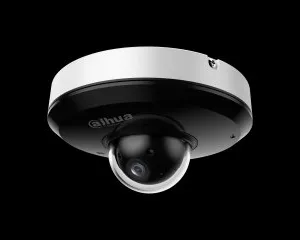
A product photo from the AESS job library, not taken in Fort Greene: a mini pan-tilt dome with a white housing over a black lens dome. Cameras like this turn and tilt by remote control, which makes them popular for tower courtyards, rooftop decks and long building corridors near Atlantic Terminal. Their motors and preset positions are the parts that fail, and a camera stuck staring at one wall is usually a reset or a motor repair rather than a full replacement.
National brands versus a local licensed repair
Fort Greene owners often ask whether to call the company whose name is on the camera instead of a local repair company. The honest answer depends on what is installed. A leased alarm-company system may have to be serviced by that company under its contract. A consumer camera such as Ring or SimpliSafe is supported by its maker remotely, mostly by replacing the device. A system of mixed brands on a recorder, which describes most Fort Greene brownstones and shops, needs someone on site who will work on all of it. This table compares the three in general terms.
Question
ADT or a similar alarm company
Ring, SimpliSafe and similar consumer brands
AESS local repair
Who owns the equipment
Depends on the contract; some is leased
You own it
You own it
Works on other brands on the same brownstone
Usually only its own
Support covers its own devices
Any brand, any installer
Recorder and hard drive repair
Its own systems
Cloud storage, no local recorder
DVR, NVR and hybrid recorders
Facade work in a historic district
Varies by dealer
Owner mounts it
Mounts kept to plain masonry, joints, wood or metal
Licensed technician on site
Varies by dealer
Remote support
NYS license #12000287431
Price before work
Varies
Replacement device price
Written price after the $150 service call, credited to the repair
AI Overview Reality Check
What AI Gets Wrong About Security Camera Repair in Fort Greene
Ask an AI assistant or a national how-to site why a camera stopped working and you get answers written for a suburban house with two consumer cameras and a garage. Fort Greene is 1850s brownstones in two historic districts, restaurants open past midnight and towers full of network cameras, on a grid that has been run at reduced voltage two summers in a row. Here are seven common claims and what we find in the field.
"Only a full power outage can hurt a camera system"
This is the most expensive misunderstanding we meet in this neighborhood. Generic advice treats a camera system like a lamp: either it has power or it doesn't, and when the power returns everything works. In practice the parts that fail are the power supplies, and they fail from bad power as well as no power.
Con Edison's notices on June 23, 2025 and July 3, 2026 each reduced voltage by 8 percent across an area that included Fort Greene. Lights stayed on. But a small adapter or PoE switch already running hot in a closet with a window air conditioner, now fed lower voltage, works harder and fails sooner. We see adapter and switch failures cluster after those weeks.
The fix is not to unplug everything at the first warning. It is to give the recorder and the switch a backup unit that corrects low voltage, to keep them out of the hottest closet in the house, and to replace the oldest adapters before they go. We check all three on every summer repair.
"Any camera work on a landmarked house needs Landmarks approval first"
Some answers tell Fort Greene owners to file with the Landmarks Preservation Commission before touching a camera. That puts people off repairs they could simply have done. The Commission's own permit guidebook says ordinary maintenance and repair of health, safety and utility equipment needs no permit.
Where the rules do bite is in moving or adding equipment. The guidebook limits small buildings to two cameras per 25 feet of street frontage, wants them attached at mortar joints, plain masonry, wood or metalwork rather than decorative surfaces or cast iron, and allows only about ten inches of visible conduit. An in-kind replacement application needs the manufacturer's cut sheets, not elevation drawings.
So a dead stoop camera can be repaired or swapped in place without paperwork. If the old camera sat on carved stone or a cornice and you want it moved, that is when the rules matter, and we tell you before work starts.
"Camera repairs usually cost $100 to $300"
That range is a national figure built on suburban single-family homes with one or two consumer cameras. It is not wrong for those homes, but it has little to do with a Fort Greene brownstone with cameras on three floors or a restaurant with a recorder in a cellar under the sidewalk.
On the other side, HomeAdvisor's Brooklyn page puts the average surveillance camera install or repair at $1,416, with a typical range of $680 to $2,145. That average mixes new systems with repairs, so it overstates what a single repair costs.
Our published Brooklyn list is more specific. The service call is $150 and is credited to the repair. A connector or PoE port fix runs $150 to $350, a power supply $150 to $400, a drive swap $200 to $450 by capacity, and a single camera replacement $250 to $600. Most single faults land between $150 and $700.
"If a tree blocks your camera, trim the branch"
Home-security guides often tell readers to cut back whatever blocks the view. On a Fort Greene block, the tree in front of the house almost always belongs to the city, and cutting it is not the owner's call.
NYC Parks says that no work may be performed on or within 50 feet of a street tree without a Parks permit. The department prunes on its own neighborhood schedule, and an owner who wants a tree pruned sooner can apply for a no-fee permit to hire a licensed arborist at their own expense.
For a camera, there is a faster answer. We re-aim the camera under the canopy, change the lens, move the camera to a clearer spot on the same facade, or add a view from another angle. We also check the view in summer, because a camera set in winter can be blind by June.
"Your own camera is what will catch whoever targets your property"
Advice about cameras assumes the camera on your building is the one that matters. On Fort Greene's narrow, facing blocks and busy avenues, it is often the camera across the street.
Brooklyn Paper reported that the person who broke into Amin on DeKalb Avenue was caught on video from Elly's Market across the street. A delivery driver on Myrtle Avenue reviewed footage from a nearby camera to see who took his phone from his truck. A block association president's webcam on South Oxford Street caught a plant thief. None of those were the victim's own camera.
That changes how we think about repair. A stoop or storefront camera with a working recorder, the right clock and a view that includes some of the street is useful to the whole block. A dark one fails your neighbors as well as you.
"Cameras put up through a city or business-district program are maintained by the program"
People sometimes assume that a camera installed under a public program, or with grant money, is somebody else's responsibility to fix. For the storefront cameras funded on Brooklyn commercial strips in 2016, that is not what was reported.
When Borough President Eric Adams launched Operation Safe Shopper with $2,500 grants that included the Myrtle Avenue Revitalization Project, Bklyner reported that "the stores where the cameras are located will maintain them," with footage available to the NYPD. The Myrtle Avenue Brooklyn Partnership's current storefront grants, by its own description, cover signage and security gates, not cameras.
If a grant camera on your storefront is dark, the repair is yours to arrange. We repair it or bring it onto your own recorder, and we keep its view of the sidewalk if that is what it was put up for.
"Wireless cameras avoid the wiring problems of old houses"
Wireless is often suggested as the easy answer for a brownstone, since running cable through 1850s masonry looks hard. Wireless does avoid some drilling, but it trades the wiring problem for a signal problem and a power problem.
Brick and brownstone walls are thick, and a router on the parlor floor often cannot reach a camera at the garden fence or under the stoop. Battery cameras need charging, and plug-in Wi-Fi cameras still need a power cable to an outlet. In divided houses, the camera may be joined to one tenant's Wi-Fi, so it disappears when that tenant changes provider.
Wireless cameras have their place, and we repair them. For the stoop, areaway and garden of a brownstone, a wired camera on a recorder inside is usually the repair that stays fixed.
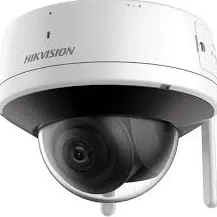
A product photo from the AESS job library, not taken in Fort Greene: a Wi-Fi dome camera with an external antenna, made for the occasional spot where a cable cannot reach. On a Fort Greene brownstone that might be a garden shed at the back of a deep lot. Even there, the antenna has to see the router or an access point through masonry, which is why many wireless cameras we are called about work fine in the parlor and drop out at the back fence.
Talk to a Technician Before You Unplug the Recorder or Buy a New Camera
Tell us the address, the kind of building and what the screen shows. If you need footage from a particular night, put the date and time in the message so we can make copying it the first job of the visit.
✅
Request Sent!
Thank you. A technician will contact you about the Fort Greene address shortly.
How It Works
Our Repair Process
1. Send a photo and the address
A photo of the recorder screen or the app with the dark cameras, the address and the kind of building, by text, WhatsApp or the request form. Tell us if you need footage from a particular night.
2. Confirm the owner and the approver
Brownstone owner, condo board, managing agent, landlord or shop owner: we confirm who approves the price and who holds the recorder login, so nothing stalls on the day.
3. Book the service call
The $150 Brooklyn service call puts the visit on the schedule in a two-hour arrival window and is credited to the repair if you go ahead.
4. Copy footage before anything else
Any clip that matters goes to USB with its original timestamp before the recorder is restarted, unplugged or opened, and the recorder's clock is checked against the real time.
5. Test from the outlet to the lens
Outlet, strip and backup battery, then adapters or switch, cable and connectors, recorder and drive, and finally the app, camera by camera, from the cellar out to the stoop.
6. Explain the cause and write the price
You hear what failed and why, and get a written, itemized price before any part is replaced. If anything changes on site, you hear it first.
7. Repair and retest day and night
The failed part is repaired or replaced, and every camera is checked for picture and recording, including after dark under the real street and stoop lighting.
8. Label, alert and hand over
Cables and channels are labeled, alerts for lost video and drive errors are turned on, logins go to the right person, and you are shown how to export a clip yourself.
Coverage Area
Security Camera Repair Near Fort Greene's Landmarks
Fort Greene Park
The 30-acre park designed by Olmsted and Vaux, with the Prison Ship Martyrs' Monument at its top and brownstone blocks on three sides.
Brooklyn Academy of Music
The Peter Jay Sharp Building at 30 Lafayette Avenue, opened in 1908, at the center of the BAM Historic District.
Williamsburgh Savings Bank Tower
The 41-story landmark at 1 Hanson Place, now condominiums, with a basement connection to the Atlantic Terminal subway station.
Brooklyn Technical High School
The large school building on Fort Greene Place, facing the park's DeKalb Avenue entrance.
Walt Whitman Library
The Brooklyn Public Library branch at 93 Saint Edwards Street, a Carnegie library opened in 1908, beside the Whitman and Ingersoll campuses.
Brooklyn Paramount
The concert hall where, according to Brooklyn Paper, police reviewed the venue's cameras after camera gear disappeared from a dressing room.
We also serve the neighborhoods around Fort Greene, including Clinton Hill, Prospect Heights, Boerum Hill and Downtown Brooklyn, at the same Brooklyn rate. Our Boerum Hill camera repair page covers the rowhouse blocks south of Atlantic Avenue, the Downtown Brooklyn camera repair page covers the towers and offices west of Flatbush Avenue, and the Brooklyn Navy Yard camera repair page covers the buildings inside the Yard's gates across Flushing Avenue. For brownstone blocks further east, see security camera repair in Bedford-Stuyvesant.
Pricing
Security Camera Repair Cost in Fort Greene
Fort Greene is priced at our Brooklyn rate. Every figure below comes from our published Brooklyn security camera repair list, and the full list is on our Brooklyn camera repair prices page. The service call comes first, the cause and the written price follow, and nothing is replaced until you agree.
Repair
Brooklyn price
Service call, on-site diagnosis and written repair price
$150, credited to the repair
Motion, schedule, app or login settings with no parts
Usually within the $150 service call
Clean and check for a blurry picture
$80
Connector reterminate or PoE port swap
$150–$350
Power supply repair
$150–$400
Dome or front cover replacement
$30–$80 part plus labor
Indoor camera repair
$200–$450
Hard drive swap, by capacity
$200–$450
Single camera replacement on a working system
$250–$600
Night vision camera repair
$250–$650
DVR not working, including drive and labor
$300–$700
NVR not recording, by model
$400–$900
Vandalized camera, per camera plus cable repair
$400–$900
PTZ camera repair
$450–$1,200
Hybrid recorder swap, channels reconfigured
$700–$1,200
DVR or NVR replacement with drive
$700–$1,500
Full rewire or brownstone system overhaul
From $1,500
Three things move a Fort Greene repair within those ranges. The first is access: our Brooklyn list notes that brownstones with awkward access, such as a cable pulled through plaster or routed between the garden level, the parlor floor and a duplex, can add $100 to $200. The second is how many cameras share the fault; a failed switch or power box can take down six cameras and still be one repair. The third is the part itself, since a drive or a camera that matches an older recorder can cost more than a current model. You see all of that in the written price before you agree.
If you are already booking other low-voltage work, our Brooklyn list notes that combining a camera repair with intercom, alarm, cabling or access control work on the same visit saves $200 to $400 in labor, with one crew and one invoice.
Full terms — including 50% deposit, one-year parts-only warranty on AESS-supplied products, and the late-fee schedule — are set out in the service agreement.
Shop Our Systems
Security Camera Repair Packages & Pricing
Most Fort Greene repairs fall into one of three shapes, priced from our Brooklyn list.
Single-issue repair: $150–$700
One fault, one visit: a weathered connector under a cornice redone, an adapter or power box replaced after a hot week, a drive swapped, a night picture fixed, a camera re-aimed under a street tree or a login recovered. Typical for a brownstone, a walk-up or a small shop.
Major system repair: $700–$1,500
The recorder or the wiring: a DVR or NVR replaced with a new drive and every camera set up again, or several damaged runs replaced through a divided brownstone. Typical after a recorder dies in summer heat or a renovation cuts several cables.
Annual maintenance: $250–$800
Every camera checked by day and after dark, lenses cleaned, connectors and power tested, the drive's health read, backup battery tested, alerts confirmed and footage export practiced. Residences start at $250, commercial properties at $400, and multi-property accounts run $500 to $800.
Bring your own equipment. If you have already bought a replacement camera or recorder, we can fit it at labor-only rates. Tell us the exact model and we quote the labor by phone or text, and the visit is booked once you accept. We check that the part works with what you have before the visit, so nobody finds out on the stoop that a new camera will not talk to an old recorder.
Complete Services
Every Security Camera Repair Service in Fort Greene
Camera, connector and cable repair
Dead stoop, areaway and garden cameras, weathered connectors, sash-pinched cables and runs cut during facade work. Request a repair
Recorder, drive and heat repair
DVRs, NVRs and hybrids in cellars, closets, bars and building offices, including systems that misbehaved through a hot spell or a voltage cut. Brooklyn security camera repair
What is the first charge on a Fort Greene camera repair, and what does it pay for?
+
The first charge is the $150 Brooklyn service call. It pays for the technician's visit, the on-site diagnosis from the outlet to the camera, and a written repair price. If you go ahead with the repair, the $150 is credited toward it. Settings problems with no parts, such as a motion schedule, a recorder clock or a lost app connection, are usually fixed within that service call.
Does the brownstone access charge on your Brooklyn list apply to every brownstone, or only some jobs?
+
Only some jobs. Our Brooklyn list notes that brownstones with awkward access, such as a cable pulled through plaster or routed between the garden level, the parlor floor and a duplex, can add $100 to $200. A camera on the stoop with its cable already reachable in the cellar usually costs the same as any other house. If the extra applies, it is in the written price before you agree.
Is there a quick way to tell whether the camera or the recorder has failed before I call?
+
Look at the recorder's screen or the app. If one tile is black and the rest are fine, the problem is usually that camera, its cable or its power. If every tile is black, or the recorder shows an error, beeps or keeps restarting, the problem is the recorder, its drive or its power. If the live view works but playback is empty, the recorder is not saving. A photo of the screen tells us which of these it is.
Do you also cover Clinton Hill, Prospect Heights and the Navy Yard side of Flushing Avenue?
+
Yes. We repair cameras across Brooklyn, and the neighborhoods around Fort Greene, including Clinton Hill, Prospect Heights, Boerum Hill, Downtown Brooklyn and the Brooklyn Navy Yard, are at the same Brooklyn rate. Crews are dispatched from our Troy Avenue office in Brooklyn, and requests are booked within 2 hours.
Which photos help most when I text you about a dead camera?
+
Three photos cover most cases. One of the recorder screen or the app showing all the cameras, one of the recorder itself with its labels and the cables at the back, and one of the dead camera from the ground showing where it is mounted and where its cable goes. If you need footage, add the date and time window. With those we can usually tell you the likely fault and the price range before the visit.
We park our bikes in the areaway under the stoop. Can the existing areaway camera be set to show who comes down the steps?
+
Usually, yes. Areaway cameras are often mounted under the stoop looking out at the street, which shows the gate but not the face of someone on the steps. Re-aiming or lowering the camera, or changing its lens, so it looks up the areaway steps at head height is often enough. If the existing camera cannot see well in the dark corner under the stoop, a replacement with better night vision goes in the same spot.
Do you need to come inside our apartment to fix the camera on the stoop?
+
Sometimes. The camera itself is reached from the stoop or a ladder on the sidewalk, but its cable has to be tested at the other end, which is usually the recorder in the cellar or a closet. In a divided brownstone, that may mean passing through the garden apartment or a common hallway. Tell us where the recorder is when you book, and we arrange the visit so the people who need to open doors are there.
Our roof camera can only be reached through the scuttle hatch in the top-floor apartment. Can you still repair it?
+
Yes, with the top-floor tenant's agreement and a time when they are home. We bring a short ladder for the hatch and protect the floor under it. Many roof camera faults are at the connector or the power, so we often test and fix it on the roof in one trip. If the camera must be replaced, we bring the part on the same visit when we know the model from your photos, to avoid a second trip through the apartment.
Can a replacement camera be painted to match the brownstone so it stands out less?
+
It can be chosen and finished to blend in, which is what the Landmarks guidebook asks for in the historic districts: small equipment, painted or colored to suit the facade. We prefer a camera that already comes in a dark or neutral finish, because paint over a lens cover or vents can cause fogging and overheating. If you want a custom color, we paint only the housing and bracket, with the lens and vents masked.
We own a brownstone in Fort Greene and a shop on Fulton Street. Can one visit cover both systems?
+
Yes, if they are close enough to reach in the same visit, which most Fort Greene addresses are. Tell us both addresses and what is wrong at each when you book. Each system gets its own diagnosis and written price, and you can approve one repair without the other. We can invoice the two separately if the house and the business keep separate books.
Ready to Get Every Fort Greene Camera Recording Again?
Send a photo of the recorder screen or the dark camera, the address, and the date of any footage you need. We book within 2 hours, give you a two-hour arrival window, copy your footage first, and write down the repair price before any part is replaced.