Fort Greene residents' door beside a shop that will not release, a brownstone bell gone silent, or a lobby panel dead? Same-day repair line: (347) 934-8335
Italianate Row Houses in the Historic District · Brownstones Split Into Flats · Store-and-Apartment Buildings on Myrtle, Fulton, DeKalb and Lafayette · Mid-Century Co-ops · Towers at the Downtown Edge
Door Buzzer Repair in Fort Greene
The Door Beside the Shop · Where the City's Records Gather · Brooklyn List Prices
Fort Greene is known for its brownstone blocks around the park and, lately, for the towers rising at its Downtown edge. Neither is where its front doors show up in the city's records. We joined every HPD intercom violation and every 311 buzzer complaint for the neighborhood to the lots they were written against. The row houses barely register. The towers built since 2005 hold four in ten of the neighborhood's apartments and very few of its complaints. The buildings that stand out are the small ones with a shop at street level: three- and four-story buildings on Myrtle Avenue, Fulton Street, Park Avenue and Greene Avenue, where the residents' door is a narrow opening beside a storefront. They hold about four apartments in every hundred and nearly four in ten of the intercom violations. This page explains why we think that is, how we repair each kind of Fort Greene entrance, and what each repair costs on our published Brooklyn list.
$250 service call with the diagnosis on site, credited toward any larger repair
4.6★ from 390+ Google reviews of our Brooklyn work
Reviewed and updated October 22, 2026, against HPD violation, 311 and MapPLUTO records for the ten census tracts the city assigns to Fort Greene (NYC Open Data, queried that day), the Multiple Dwelling Law, HPD's self-closing door rules and the sources listed at the foot of the page · Abstract Enterprises Security Systems, NYS license #12000287431 · Brooklyn office at 1282 Troy Ave
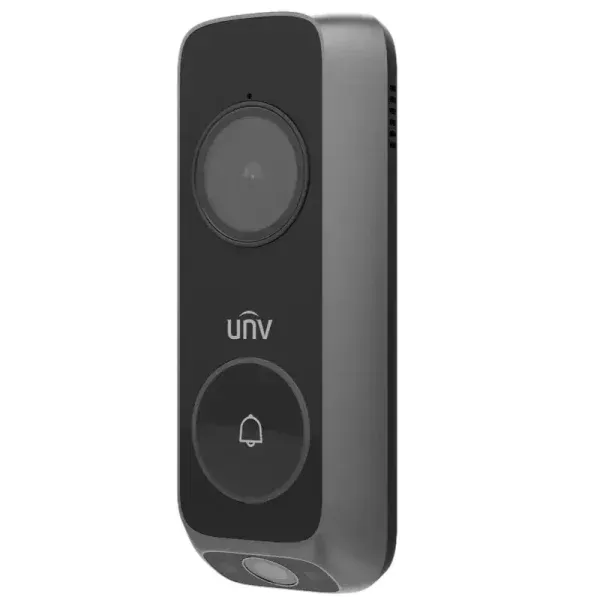
Manufacturer product photo, not taken in Fort Greene: a single-button door station. On the narrow residents' doors beside Fort Greene shopfronts, a slim station like this is often the only size that fits between the door frame and the shop window.
Fort Greene Buzzer Repair Request
A row house, a split brownstone, a building over a shop, a walk-up, a co-op or a newer tower
✅
Request Sent!
We will call about the Fort Greene address and ask what sits beside the street door.
25+
Years Experience
✓
Same-Day Estimates
100%
Licensed & Insured
4.6★
390+ Google Reviews
Before you call, look at what is next to the door. In most of Brooklyn the useful first question is how old the building is or how many apartments it has. In Fort Greene the more useful one is what shares the frontage with the residents' entrance. A door with nothing beside it but stoop railings and a window box is usually a house bell or a small split-brownstone system. A door squeezed between a café and a dry cleaner is a different job: the panel takes the sidewalk's weather and crowds, the cable may cross the shop's ceiling, and the person with the cellar key may be the shopkeeper rather than the owner. A door into a staffed lobby is a third kind again. Send us a photo of the door and its panel, one of the strike side of the frame, and a line such as "four apartments over a bakery on Myrtle, release dead since the shop renovated" or "three-family on South Portland, parlor bell rings, garden bell does not". From that we can usually say the same day which part has probably failed and which line of the Brooklyn list it falls on.
Looking at photos costs nothing; a visit is the $250 service call, which includes the on-site diagnosis
Every written estimate carries license number 12000287431; if a co-op board or agent needs proof of insurance before letting a contractor in, we send the certificate ahead
Tenants are welcome to describe the fault, but the owner, board or managing agent approves parts and labor, so we will ask for that contact
The Neighborhood
Why Fort Greene Properties Need Door Buzzer Repair
Fort Greene sits between the Brooklyn Navy Yard and Atlantic Avenue, and between Flatbush Avenue Extension and Vanderbilt Avenue, in Brooklyn Community District 2. Most of what people picture when they hear the name was built in a short span: in the 1850s and 1860s, blocks of Italianate brick and brownstone row houses filled the open land on streets named after London terraces, among them Portland, Oxford, Cumberland, Carlton and Adelphi. By the 1870s building had largely stopped, and hundreds of those houses survive close to their original appearance. The Landmarks Preservation Commission designated the Fort Greene and Brooklyn Academy of Music historic districts in 1978.
Those houses were built for one family behind one door. A century and a half later most of them have been divided: into two units with the owners on the parlor floors, into three or four flats, or, for a stretch of the twentieth century, into rooming houses with a bell for every room. Each division added wire to a door that was never planned for it. The buzzer in a Fort Greene brownstone is therefore rarely one system. It is a set of additions, made by different people over different decades, that happens to meet at the stoop.
The neighborhood has other front doors too. Myrtle Avenue and Fulton Street were commercial streets long before the elevated trains that once ran over them came down; Fulton's opened in 1888 and Myrtle's was dismantled in 1969. The older buildings along them have a shop at street level and apartments above, reached through a narrow door beside the storefront. North of Myrtle Avenue stand the Walt Whitman and Ingersoll Houses, built for Navy Yard workers in the 1940s and run by the New York City Housing Authority. Mid-century co-ops and the 1970s Atlantic Terminal buildings sit at the southern and western edges. And since the Downtown Brooklyn rezoning, towers of thirty to more than fifty stories have risen along Fulton Street, Flatbush Avenue Extension and Ashland Place.
We have not found a Fort Greene news story or neighborhood thread about broken buzzers; residents' discussions online are about the city in general. What we did find is the city's own record, and it points somewhere other than the brownstones or the towers. The next two sections set that out. The short version: if your building has a shop downstairs, it is in the group the records single out, and the repair is shaped by the shop as much as by the wiring.
Fort Greene in numbers, for anyone fixing a front door
2,126 tax lots in the ten census tracts the city assigns to Fort Greene, of which 1,771 hold homes, with 19,739 apartments between them (MapPLUTO).
Half the residential lots, 895, hold buildings dated before 1900, but they contain only 2,806 apartments. The 107 lots built since 2005 contain 7,986, four in ten of the neighborhood's homes.
686 residential lots are inside the Fort Greene Historic District, 83 inside the Brooklyn Academy of Music Historic District and 53 inside the Wallabout Historic District at the north-east corner.
158 HPD violations mentioning an intercom have been written in the Fort Greene neighborhood tabulation area since records begin, 54 of them still open. Clinton Hill next door has 174; Brooklyn Heights 51.
1,101 HPD violations mentioning a self-closing door in the same area, 765 of them Class C, the city's most serious category, and 316 still open.
129 311 complaints about a bell, buzzer or intercom since January 2020 at Fort Greene lots, from 52 addresses; 33 of them in 2026 so far, the most of any year.
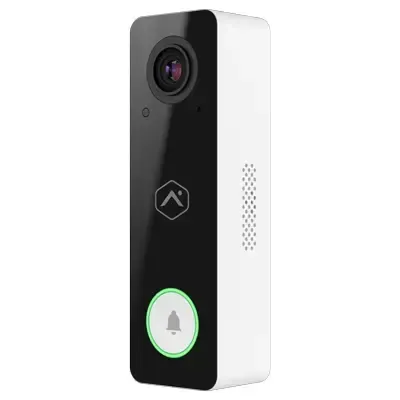
Manufacturer product photo, not taken in Fort Greene: a wired video doorbell. Owners of one- and two-family row houses sometimes fit one at the stoop door; it needs the doorbell transformer to supply enough power before it is anything more than a bell.
Most Fort Greene repairs that reach us are the ordinary sort: a strike that has worn, a transformer that has cooked in a warm cellar, a handset that has stopped talking. What differs is the route to them, and the people who have to agree before the work starts. That is what the rest of the page is organised around.
Where the Records Point
The Door Beside the Shop: Where Fort Greene Buzzers Fail
We pulled every HPD violation in the Fort Greene neighborhood tabulation area that mentions an intercom, 158 of them going back to 1979, and every 311 complaint with the descriptor BELL/BUZZER/INTERCOM made at a Fort Greene lot since January 2020, 129 of them. Then we joined both to MapPLUTO, the city's lot-by-lot land file, so that each violation and complaint carries the kind of building it was written against. The study area is the ten 2020 census tracts that HPD's own records place in Fort Greene; it runs a little past the usual boundaries at the western edge, around Fleet Place and Ashland Place, and takes in the Navy Green blocks north of Myrtle.
Sorted by the size of the building, the record looks at first like the rest of Brooklyn. Houses with one or two homes almost never appear: one violation and five complaints across 710 lots. That is expected, because the city's intercom rule is written for multiple dwellings, buildings with three or more households. Buildings with three to forty-nine apartments carry most of the record. The big buildings carry little: the 52 buildings of fifty or more apartments outside NYCHA hold 11,159 homes and 30 violations, and the 32 of them finished since 2005 hold 7,629 homes and six.
The surprise comes when the middle group is split by what is at street level. Of the 1,004 lots with three to forty-nine apartments, 127 have a shop or office at the sidewalk. Those 127 hold 845 apartments, about four in every hundred in the neighborhood, and 61 of the 156 intercom violations that match a lot. That is 7.2 violations for every hundred apartments, five times the rate of the same-sized buildings without a shop and around ninety times the rate of the towers. Fourteen of the 127, one in nine, have been cited at least once; among the 877 same-sized buildings without a shop the figure is about one in twenty.
A pattern built on a few hundred records needs checking, and this one has a weak spot: one seven-story building with ground-floor commercial space on Greene Avenue produced 26 of the 41 complaints and 11 of the violations by itself. Take it out and the 311 gap almost disappears, from 4.85 complaints per hundred apartments to 1.86, against 1.09 for buildings without a shop. The HPD gap holds: 6.20 violations per hundred apartments without that building, still more than four times the no-shop rate. We read that as follows. Complaints follow a few buildings where tenants have learned to call; violations, written by inspectors who came in through the door, are spread across more of the shop buildings.
Why would a shop downstairs make a difference?
The records show where the violations are, not why. What follows is our reading, from the way these buildings are put together; we offer it as an explanation to test, not a finding.
The residents' door is the leftover part of the frontage. In a four-story building with a store, the shop takes the width of the lot and the residents get a door two or three feet wide at one side, often recessed, sometimes with the panel on a strip of masonry no wider than the panel. Everything the sidewalk throws at an entrance lands on it: rain off the shop's awning, salt pushed off the pavement in winter, grease from a kitchen vent, the wear of hundreds of passers-by who lean on it while they wait for the bus.
The wire takes the long way. The residents' stair runs straight up from that narrow door, but the cellar is usually entered through the store or from a hatch in the sidewalk. The cable from the panel to the cellar transformer, and from the cellar to the apartments, often crosses the shop's ceiling. When a shop changes hands and the new tenant opens up or drops the ceiling, the buzzer cable is the wire nobody claims.
The person on site is the shopkeeper. Small buildings over shops in Fort Greene seldom have a super; the owner may live elsewhere, and the person who is there twelve hours a day with keys to the cellar is the store tenant, who is not responsible for the residents' door and may not know it has failed.
The door works harder. Deliveries for the apartments, for the shop and for the restaurant next door all find the residents' door; it gets propped, kicked shut and held. A strike and a closer on a door like that wear faster than the same parts on a brownstone's stoop door.
The streets where this applies
Myrtle Avenue has the most of these buildings, 26 with three or more apartments, and the most violations among them, 18. Fulton Street has nearly as many buildings, and more apartments over its shops, but far fewer violations, six. DeKalb Avenue's restaurant row has thirteen such buildings and no violations or complaints at all; most of its storefront buildings have only one or two apartments upstairs, below the size the intercom rules address. Greene Avenue's numbers are almost entirely the one building already mentioned. Park Avenue, under the expressway, and Flushing Avenue, on the Navy Yard side, have few such buildings but a disproportionate share of violations for their size.
If your building fits this description, the rest of this page applies to you with one addition: before we arrive we will ask who holds the keys to the store and the cellar, and whether the shop has renovated, added signs, lights or a camera, or changed tenants recently.
Twenty-four of the 127 buildings over shops are inside a historic district, seventeen in the Fort Greene district and seven in the BAM district, mostly on the edges where the residential side streets meet Fulton Street and Lafayette and DeKalb Avenues. Their residents' doors are under the same Landmarks rules as the row houses: repairing the existing panel and strike is ordinary maintenance, while a new panel of a different size or a new position on the facade is the owner's question for the Commission. Outside the districts, along most of Myrtle Avenue and the eastern part of Fulton Street, the shop's own sign and awning usually change more often than the residents' door, and the door is often the one part of the frontage nobody has looked at in years.
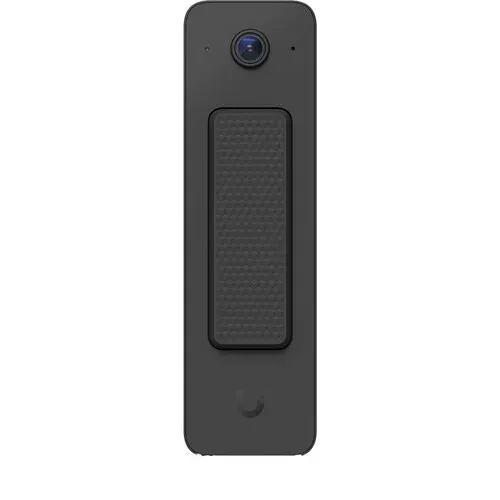
Manufacturer product photo, not taken in Fort Greene: a very narrow video doorbell. Width matters on a store-and-apartment frontage, where the residents' door often has only a few inches of masonry beside it.
The Record
What HPD and 311 Show for Fort Greene
Fort Greene's intercom record is small for a neighborhood of nearly twenty thousand apartments. Across all of Community District 2, which also covers Brooklyn Heights, DUMBO, Boerum Hill and Clinton Hill, only Clinton Hill has more intercom violations on file. The numbers below are small enough that a single building can move them, so read them as a description of where problems have been recorded, not as a forecast for any one address.
The yearly count has risen. The 2010s averaged five intercom violations a year; the 2020s so far have averaged nearly ten, with eighteen in 2021. 311 complaints follow the same shape, and 2026 has already produced more than any full year since 2020. Part of that is the one Greene Avenue building, which produced ten complaints in 2021 and 2022 and thirteen more in 2026; part is spread across the neighborhood.
What happens after a complaint
A 311 complaint about a buzzer goes to HPD, which tries to inspect. In Fort Greene, 45 of the 129 complaints since 2020 ended with HPD unable to get in or unable to finish, 38 with a violation issued, 34 with an inspection that found nothing to cite, and 11 with a note that the condition was already on file or had been reported corrected. For owners the lesson is practical: an inspector who cannot get through the street door cannot confirm that the intercom works either, and a complaint that ends in no access can return.
Complaints are made mostly midweek, peaking on Thursdays, and least on Saturdays. That fits buildings where the person who notices the problem is a tenant at home on a weekday, waiting for a delivery or a visitor who cannot get in.
The door matters more to the city than the buzzer
For every intercom violation in Fort Greene there are about seven for a self-closing door, and three in four of those are Class C, which the city treats as immediately hazardous and expects corrected within fourteen days. An entrance that does not close and lock by itself is the more serious finding, and it is usually the same entrance. That is why every buzzer visit we make starts at the door, not the panel.
The violation text is worth reading closely. Inspectors describe the path that failed, such as from the building entrance to the apartment's phone, or from the building front to a wall in the foyer, and name the apartment where they tested it. ENTRANCE, BUZZER and BELL are the most common words; a dozen mention the vestibule; thirteen mention the return buzzer, the button that releases the door from upstairs. A violation that names one apartment usually means one handset or one pair of wires; several apartments on one inspection points back toward the shared parts at the door and in the cellar.
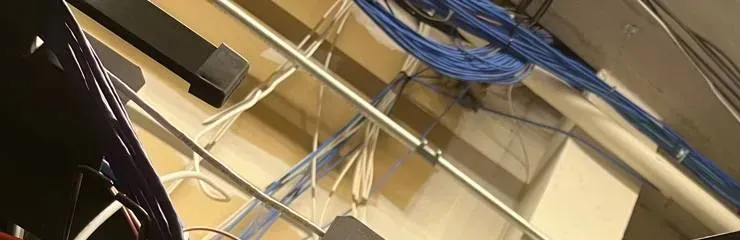
AESS job-library photo, not taken in Fort Greene: low-voltage cable carried along a pipe overhead. In a building with a shop below, the residents' buzzer cable often crosses the store's ceiling the same way, which is where it gets cut during a fit-out.
Residents' Door Hanging Open Beside the Shop? Need Repair in Fort Greene?
A street door that will not lock on a commercial block is open to everyone walking past, and on Myrtle Avenue or Fulton Street that is a lot of people. A release that has stopped working leaves a delivery or a home aide waiting on the sidewalk. Both are calls we move to the front of the day. Ring (347) 934-8335, say what is beside the door and who can open the cellar, and a technician comes with common strikes, transformers and buttons, including strikes made for narrow aluminum frames. A single failed part is usually fixed within an hour or two of arrival. If the door cannot be made to lock on the first visit, we leave it closing and latching by hand so the building is not left open while a part is ordered.
The repairs we are asked for in Fort Greene, roughly in order of how often each comes up. Every one starts with the $250 service call, which includes the diagnosis.
Residents' doors beside shops
The narrow door next to a storefront that will not release, will not latch, or releases only when someone leans on it. We check the closer, the strike and its keeper, and the supply in the cellar, and look for a cable the shop's last renovation may have disturbed.
Stoop and parlor-door bells in row houses
One- and two-family houses where the bell at the stoop has gone quiet, or rings on one floor and not the other. Usually a button, a transformer or a joint in old bell wire; the cure is rarely a new system.
Split brownstones with three or four flats
Houses divided into apartments, each division adding its own button and wire. We sort out which wire serves which flat, label it, and repair the one that has failed.
Garden-floor and under-stoop entrances
Second entrances below the stoop, often used by the ground-floor tenant, with their own bell, sometimes on a separate transformer. We make both doors work from the right apartments.
Walk-up lines and handsets
Larger walk-ups on Cumberland, Carlton and South Oxford and around the park, where one floor or one line has gone silent. We trace the run and repair or re-terminate it.
Co-op and Mitchell-Lama lobby panels
Mid-century elevator buildings with a lobby panel, a cellar equipment box and long risers. We repair the panel, the supply and the line, and send the board a written report.
Networked panels in newer towers
Video panels, app calling and fob readers in buildings from the last twenty years. We check power, network and the account before condemning hardware, and work with whoever holds the administrator login.
Strikes and closers on any door
The mechanical half of the job, including strikes made for narrow aluminum-and-glass doors and electrified locks for doors that have no room for a strike.
AESS job-library photo, not taken in Fort Greene: small cameras high on an interior wall. In the larger buildings near the Downtown edge, entry cameras and the door system usually share a lobby and a network, and a fault in one can look like a fault in the other.
Building Specialists
Door Buzzer Repair for Fort Greene's Architecture
Fort Greene's buildings fall into a handful of types, and each puts its buzzer in a different place. Counts are from MapPLUTO for the ten tracts.
Italianate and brownstone row houses, one family
About 150 single-family lots and many more two-family ones, mostly 1850s–1870s, behind stoops with double parlor doors. The bell is a button at the stoop, a transformer in the cellar and a chime or two upstairs. Doors are wood, often original, with little room in the frame.
Houses split into two to four homes
558 two-family, 476 three-family and 245 four-family lots. The divisions came at different times, so a house can have a 1950s button for the parlor duplex, a 1980s plate for the upper flats and a separate bell at the garden door. Only the three- and four-family houses are multiple dwellings under the law.
Former rooming houses
PLUTO still classes about eighty Fort Greene lots as converted dwellings or rooming houses, averaging seven or eight units. They carry thirty of the neighborhood's intercom violations. Panels with many buttons, thin wire stapled up the stair, and doors that have been changed more than once.
Buildings over shops
127 lots with a store and three to forty-nine apartments, plus many with only one or two apartments upstairs. Mostly three or four stories, 1900s or 1920s–30s, on Myrtle Avenue, Fulton Street, Lafayette, DeKalb and Park Avenues. The residents' door is a narrow opening beside the storefront.
Walk-ups and apartment houses, 1900–1940
Five- and six-story buildings on the residential streets, such as the apartment houses on Cumberland Street and around the park. A cellar transformer or supply, one riser up the stair, handsets in each apartment, and a vestibule with two doors.
Mid-century co-ops and Mitchell-Lama buildings
Elevator buildings from the 1930s to the 1970s: the fifteen-story co-op towers near Ashland Place and Willoughby Street from 1957–58, the 1974 Atlantic Terminal buildings, and older co-ops on Lafayette Avenue. Lobby panels, long risers, boards and managing agents.
Towers since 2005
32 buildings of fifty or more apartments finished since 2005, most near Fulton Street, Flatbush Avenue Extension and Ashland Place, some over forty stories. Networked video panels, staffed desks, fob readers, package rooms and a building network.
NYCHA's Whitman and Ingersoll Houses
Six- to fifteen-story buildings north of Myrtle Avenue, about 3,500 apartments in all by NYCHA's contractors' count. Their door systems belong to NYCHA; residents report through NYCHA, and we do not work on that equipment.
Material and method by type
Brownstone and brick row houses: wire goes down through the stoop or under the parlor floor to the cellar; we follow the existing path, avoid new holes in brownstone, and keep original bell pushes where they still work.
Split houses: we identify each household's wire at the button plate and at the transformer before cutting anything, because two additions often share a terminal.
Buildings over shops: we ask for access to the store's ceiling or cellar in advance, and check what the shop has added to the residents' circuits before replacing parts.
Walk-ups: the riser runs in the stair hall or an air shaft; we test at the top floor first, then work down to find where a line breaks.
Co-ops and towers: lobby panels, supplies and controllers sit in a cellar room or a closet off the lobby; the board or management company gives access, and networked systems need whoever holds the administrator account.
Manufacturer product photo, not taken in Fort Greene: a self-powered camera with a solar panel. Equipment like this needs no wire, which is exactly why it cannot release a door; a buzzer still needs power at the strike.
How the Method Changes With What Is Beside the Door
Because the records single out buildings over shops, our first questions on the phone are about the frontage, not the wiring. Here is how a visit differs by entrance.
A residents' door beside a storefront
Before arriving we ask who can open the cellar and the store, and whether the shop has changed tenant, renovated, added a sign, lights or a camera, or had its own alarm installed recently. On site the technician first watches the residents' door close on its own and holds it while someone releases from upstairs. Then he looks at the panel's surroundings: water running off an awning onto it, a kitchen vent above it, a sign box beside it. In the cellar he traces the cable from the door to the supply, looking for anything spliced onto it and for any length that crosses the store's ceiling. Most faults on these doors are mechanical (a worn strike, a door that has dropped on its hinges, a closer that has lost its latch speed) or environmental, and are fixed on the first visit.
A brownstone stoop door
Here the first question is which floors have which bell, and whether there is a second entrance under the stoop. The technician tests each button in turn and listens for each chime or buzzer, then goes to the cellar for the transformer, which is often behind a boiler or on a joist that has since been boxed in. Old bell wire is left in place where it tests sound; joints are remade and labelled. If the parlor doors have no room for a strike, he will say so and explain the alternatives rather than enlarge a pocket in an original frame.
A lobby with a panel and a desk
In co-ops, Mitchell-Lama buildings and towers, the panel, the supply and the controller are usually in different rooms, and the board or manager has to arrange access to each. We start at the supply, because a tired power supply produces faults that look like a failing panel, then the controller, then the network if there is one. Before any part is ordered we put the findings in writing for the board, with the line on our Brooklyn list that each would fall under.
A garden-floor entrance under the stoop
Many split brownstones have a second door below the stoop, behind the iron gate of the areaway, used by the garden-floor apartment. Its bell is often on a separate, newer circuit, added when the floor became its own unit, and sometimes on a separate transformer in the front vault rather than the main cellar. When a garden bell fails and the parlor bells do not, we start there, and we check the areaway gate too, because a gate that sticks or rubs is the most common reason a garden-floor tenant thinks the buzzer is broken.
Who decides, and who opens the door
The person who calls us is often not the person who can approve the work. In a building over a shop it is usually a tenant or the shopkeeper; in a co-op, a shareholder; in a tower, a resident who has given up on the app. We are glad to take the description from any of them, and then we find the owner, board or manager, because they approve the price and the parts. The table below is the usual pattern in Fort Greene.
Commercial Door Buzzer Repair
Business Door Buzzer Repair in Fort Greene
Fort Greene's shopping streets are where the residents' doors in our data are, and they are also where shops, studios and institutions need buzzers of their own: a gallery that buzzes visitors in, a clinic door, a stage door, an office upstairs. We repair both, and on a mixed building we keep the two separate.
Myrtle Avenue
The Myrtle Avenue Brooklyn Partnership, a business improvement district, covers the properties fronting Myrtle from Flatbush Avenue Extension to Classon Avenue. On the Fort Greene stretch the older storefront buildings carry more of the neighborhood's intercom violations than any other street.
Fulton Street
The Fulton Area Business Alliance represents the small businesses and property owners along Fulton Street in Fort Greene and Clinton Hill. Older four-story buildings with shops alternate with large new towers at the western end near Flatbush Avenue.
DeKalb Avenue
The restaurant row along the south side of Fort Greene Park. Most storefront buildings here have one or two apartments upstairs; their doors are house bells with a shop beside them, and kitchen exhaust is the usual enemy of the button.
Lafayette Avenue and the BAM blocks
Around the Brooklyn Academy of Music at 30 Lafayette Avenue, arts organisations, studios and offices share blocks with apartment buildings, and stage and service doors need releases that work when the box office is closed.
Park Avenue and Flushing Avenue
Under and beside the Brooklyn-Queens Expressway on the Navy Yard side. Few buildings over shops, but a disproportionate share of violations for their number, and doors that take traffic dust and road salt.
Atlantic Avenue and Hanson Place
The southern edge by Atlantic Terminal and the Williamsburgh Savings Bank Tower at One Hanson Place, with office lobbies, institutional buildings and larger apartment buildings with staffed desks.
For a shop that wants a buzzer on its own customer door, the work and the price come from the same list as residential repairs. Where a shop's equipment shares a building with apartments, we keep the shop's door, bell and camera on their own power so that a problem in one does not take down the other.
Manufacturer product photo, not taken in Fort Greene: a bullet camera. Shops on Myrtle Avenue and Fulton Street often add one over their own door; when it is mounted beside the residents' entrance, its power and the buzzer's should not share a supply.
Rules That Apply to Fort Greene Front Doors
Multiple dwellings: a building with three or more households is a multiple dwelling under New York State's Multiple Dwelling Law. Under section 50-a, as the State Attorney General's tenants' guide summarises it, buildings put up or converted after January 1, 1968 need self-closing, self-locking entrance doors, and those with eight or more apartments also need a two-way voice intercom with a door release; older buildings need self-locking doors and an intercom if a majority of apartments request one. Most of Fort Greene's housing predates 1968.
Self-closing doors: HPD treats a defective self-closing door as a Class C immediately hazardous violation, to be corrected within 14 days, and reinspects. In Fort Greene these outnumber intercom violations about seven to one.
Historic districts: repairing an existing panel, button or strike is ordinary maintenance. The Landmarks Preservation Commission's permit guidebook allows staff-level approval for intercom panels within or next to a door opening, one per opening, not fixed through cast iron or decorative surfaces. A new panel of a different size or position on a house in the Fort Greene, BAM or Wallabout district is the owner's Landmarks decision.
Line-voltage work: the Department of Buildings requires a licensed electrician and a permit for 120-volt work. Our work is on the low-voltage side of the transformer or supply; where an outlet or a new circuit is needed, we say so and the owner's electrician does it.
Locked exit doors: an electric strike leaves the door free to open from inside with the lever. Magnetic locks on exit doors come with conditions in the building code, such as release on fire alarm and a sensor or button on the inside, and we check them on any door that has one.
Reach: under the 2010 ADA Standards the highest forward reach for operable parts is 48 inches; on shop and office doors open to the public we mount new buttons and panels within it.
This is general information about rules that commonly apply, not legal advice for any particular building.
Your Questions Answered
Door Buzzer Repair in Fort Greene: Questions Answered
Questions Fort Greene owners, boards, shopkeepers and tenants ask about their own kind of entrance, grouped by what sits beside the door.
Buildings with a shop at street level
Why do Fort Greene's buildings with a shop downstairs collect so many more intercom violations per apartment than its brownstones and its towers?
On the city's records they do: 7.2 HPD intercom violations per hundred apartments in buildings of three to forty-nine apartments over a shop, against 1.4 in same-sized buildings without one, and well under one in the towers. The records cannot say why. Our reading is that the residents' door in these buildings is the narrowest and most exposed part of the frontage, its cable often crosses the shop's space, and the person on site with keys is a shopkeeper rather than a super.
That points to what to check first if you own one: the door's closer and strike, the panel's exposure to the weather and the shop's exhaust, and any work the store has done overhead. It also means a short note to the shop asking them to tell you when the residents' door stops locking can save a violation.
Our residents' door is a narrow side door between two shopfronts, and the call panel faces straight onto a busy sidewalk. Where else could the panel go on a frontage that tight?
There are usually three choices. The panel can stay where it is in a sturdier, flush-mounted housing; it can move into the recess of the doorway, on the jamb, where it is out of the rain and the crowd but still visible; or, if there is a vestibule, a small panel can stay outside with the directory and call buttons and the electronics move inside.
Moving it into the reveal is often the neatest answer on a three- or four-apartment building. Before suggesting any move we check the door swing, so the panel is not hit by the door or by people stepping out, and the 48-inch reach height for anyone in a wheelchair. In a historic district, a change of position on the facade is the owner's Landmarks question.
The residents' entrance in our building is an aluminum-and-glass door matching the shop's storefront. Does that kind of door take the same electric release as a wood or steel door?
Not the same model. Narrow aluminum frames have little depth behind the face, so a standard strike will not fit without cutting the frame. There are strikes made for narrow aluminum frames, and for some doors the better option is an electrified lock or exit device in the door itself, with power brought across by a hinge or a door loop.
Which suits your door depends on the frame profile and the lock already fitted. We look at both before quoting. Aluminum storefront doors also tend to sag on their pivots as they age, and a sagging door will bind on any strike, so the door adjustment is usually part of the job.
A restaurant's kitchen exhaust vents above our entrance, and the buttons on our panel have turned sticky and stiff. Is that grease, and will it come back after a repair?
It often is. Grease-laden air settles on whatever is below the vent, collects dust and works into button seals until they stick or stop making contact. Cleaning helps for a while; it will come back as long as the exhaust lands on the panel.
The lasting fixes are a sealed panel with fewer moving parts, such as one with piezo or stainless buttons, a small hood over the panel, or moving it out of the plume. The exhaust itself is the restaurant's and the landlord's matter; if it discharges onto a building entrance, that is worth raising with them, because it will affect more than the buzzer.
Our building's owner lives elsewhere, but the shop downstairs is open twelve hours a day. Can the shopkeeper let your technician in and approve the work?
The shopkeeper can certainly let us in, and often that is the quickest way to reach a cellar. Approving the work is different. The residents' door and its buzzer are the owner's responsibility, and the price, the parts and any change to the building need the owner's or managing agent's agreement.
In practice we arrange it in two steps: the owner authorises the $250 diagnostic visit by phone or text and names the person with keys, the shop opens up, and the owner approves the written price for anything beyond it. We send the findings and photos to the owner the same day.
Brownstones and row houses
The parlor-floor double doors on our brownstone have no room in the frame for an electric strike. Can the release be built into the lock instead?
Yes, and on old double doors it is often the better choice. An electrified mortise lock replaces the lock body in the door and releases the latch electrically; the power is carried into the door through a special hinge or a concealed door loop, so the frame is not cut.
It is more work than a strike, because the door has to be measured for the lock body and the hinge, and the existing lock's position and finish matter. If the doors are a matched pair, the inactive leaf stays bolted as it is. We will price both approaches where both are possible, and tell you which one leaves the original woodwork as it is.
We are renovating the garden floor of our brownstone and the contractor is about to close the ceiling. What should be done with the buzzer wiring before the ceiling goes up?
Find it and label it before the ceiling closes. Bell and intercom wire in row houses usually runs along the cellar or garden-floor joists to the transformer, and it is easy to lose under new drywall. We can trace and label every run, replace any length that is cracked or spliced, and leave a pull string or an empty pipe to the stair so future wire can go up without opening the ceiling.
If the transformer is in the way of the renovation, it can be moved to an accessible spot now, on a box the electrician provides. That is a short visit compared with opening a finished ceiling later.
Next to our stoop door is an old brass bell pull that has not worked in decades. Can it stay, or can it be made to ring again?
It can almost always stay. A mechanical bell pull is independent of the electric bell, so leaving it in place does not affect the buzzer; many owners keep it as part of the doorway. Making it ring again means finding the cable or rod behind it, which in most houses has long since been cut.
A practical compromise is to leave the pull as decoration and, if the owner wants, put a small switch behind it so that pulling it rings the existing electric chime. Whether that is possible depends on the space behind the plate, which we can see once the pull is removed with care.
Co-ops, towers and buildings near NYCHA
Our building on St. Edwards Street is a newer, privately managed building on land next to the Ingersoll Houses, not part of NYCHA. Who repairs its intercom?
Its owner or managing agent, like any other private building. Several newer affordable and senior buildings near the Ingersoll Houses are owned by private or nonprofit partnerships even though they sit beside NYCHA land, and their door systems are not NYCHA's. Ask management which company maintains the entry system; if the answer is nobody under contract, we can work for the managing agent.
If you are in a NYCHA building itself, the entrance is NYCHA's, and the repair has to go through NYCHA's own system. We do not work on NYCHA equipment at a resident's request.
The management company of our tower says our entry system is maintained by the company that installed it, under contract. Can an outside company still repair it?
It depends on the contract, which is between the owner and the installer. Many service agreements cover parts and labor for a set period, and work by another company can void that cover. If the contract is in force and the installer responds, using them usually makes sense.
Where the contract has lapsed, the installer has stopped answering, or the system has a fault the contract does not cover, management can bring us in. We will need the administrator login for the panel or the cloud account, the make and model, and any network details, and we will tell management in writing what we changed.
Reading the record
HPD's violation on our building says the intercom is defective "from building front to west wall in the foyer" at a named apartment. What do those location words tell a technician?
They describe the path the inspector tested and where it failed. "Building front" or "building entrance" is the street-door panel; "foyer" is the entrance hall of the apartment, where the handset usually hangs; "west wall" is which wall of that room. The apartment and floor say which handset and which line.
So that wording points to one apartment's handset or its pair of wires, not the whole system. If several violations on the same day name different apartments, or the text says the release or return buzzer failed, the fault is more likely at the door, the panel or the supply. We read the violation before we come, and bring the parts that match.
Manufacturer product photo, not taken in Fort Greene: a pan-tilt-zoom camera of the kind used on larger buildings and campuses. It is shown for comparison; nothing on our buzzer price list covers camera work.
Equipment
Types of Door Buzzer Equipment We Repair in Fort Greene
The equipment at Fort Greene entrances, from the simplest to the most involved. Brands vary; we repair common makes and fit compatible replacements when an original is no longer made.
Electric strikes
The part in the frame that lets the latch go. Fail-secure strikes stay locked without power and suit most street doors; the door still opens from inside with the lever. Narrow-frame models exist for aluminum storefront-style doors.
Electrified locks and power transfer
Locks that release in the door itself, with power carried through a hinge or door loop. The answer for old parlor doors and for doors where the frame cannot take a strike.
Door closers
They decide whether the door returns and latches behind every visitor. Most of the self-closing door violations in Fort Greene are about closers and latches, and we check both on every visit.
Bell transformers and power supplies
Small transformers for house bells; larger supplies for apartment systems and strikes. We size them to what is connected and mount them where the next person can find them.
Buttons, bell pushes and chimes
Stoop buttons, original brass pushes, chimes on each floor. Kept where they test sound; replaced with sealed or stainless buttons where weather or grease has got in.
Audio handsets
The talk-and-release phones in walk-ups and older co-ops. Replaced one at a time with a compatible model when a few fail.
Call panels and directories
From two-button plates on a split brownstone to lobby panels with a directory. Repaired, refaced, or replaced with a compatible panel of the same footprint.
Networked video panels and fob readers
In buildings from the last twenty years: panels that call phones, readers that log entries, controllers on the building network. Power, network and account are checked before hardware.
Ring, ADT, SimpliSafe and a local repair: what each actually covers
Ring, ADT and SimpliSafe sell doorbells, cameras and monitored alarms for single homes. A video doorbell at a one-family stoop can stand in for a bell, and owners of Fort Greene row houses often fit one. None of the three repairs a building's shared buzzer: the strike, the closer, the supply, the riser and the handsets in a split brownstone or a building over a shop. A national company's home alarm also does not answer to HPD; the owner does. A local low-voltage contractor repairs the shared system, and can wire a video doorbell into it properly where the transformer can carry it.
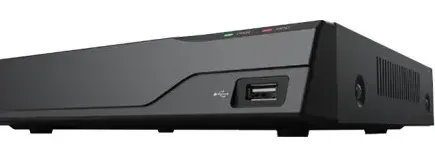
Manufacturer product photo, not taken in Fort Greene: a network video recorder. In newer buildings the door panel and the recorder may hang off the same network switch, so we check the switch before blaming either one.
AI Overview Reality Check
What AI Gets Wrong About Door Buzzer Repair in Fort Greene
Search summaries and chat assistants answer buzzer questions with confident generalities. These are seven claims of the kind they repeat, from cost guides, vendor pages and general advice, tested against Fort Greene's records and the rules. We could not open Google's AI Overview from our research environment, so we name the sources we did check.
Claim: brownstones are where buzzer problems are
It is an easy assumption: the oldest houses, with the oldest wire, should fail most. General advice about older homes says as much, and it is true that an 1860s house often has bell wire older than anyone living in it.
Fort Greene's records say otherwise. Houses with one or two homes produced one intercom violation and five 311 complaints across 710 lots. The three- and four-family houses, mostly row houses inside the historic district, produce some, but at about a fifth of the rate of the small buildings over shops.
Old wire that has not been disturbed is often fine. What fails in a row house is usually a joint, a button or a transformer, which is why we test before recommending anything larger.
Claim: new buildings with smart intercoms do not have buzzer problems
Vendors describe app-based and cellular intercoms as needing little or no building wiring and little maintenance. ButterflyMX, for example, describes its call box as requiring no building wiring.
Fort Greene's newer towers do have a light record: six HPD intercom violations and eighteen 311 complaints across the 7,629 apartments in buildings finished since 2005. But they still have power supplies, network switches, door hardware and accounts, and any of those can fail.
The failures in these buildings are different, not absent: a lapsed subscription, a lost administrator login, a switch on the wrong circuit. The repair needs someone who will check those before replacing a panel.
Claim: every NYC apartment building must have an intercom
Summaries often say this flatly. Vendor guides such as ButterflyMX's are more careful: the rule generally applies to multiple dwellings of eight or more apartments built or converted after 1968, and older buildings need closer review.
Most of Fort Greene's housing went up before 1968. Under the Multiple Dwelling Law as the Attorney General summarises it, older multiple dwellings must have self-locking doors and must provide an intercom if a majority of apartments ask for one. A three-family brownstone is a multiple dwelling; a two-family is not.
Where a building has an intercom, HPD treats keeping it working as the owner's duty, which is why Fort Greene's 158 intercom violations exist at all.
Claim: a buzzer repair costs about the same everywhere
Cost guides give national ranges. Swiftlane's guide says minor apartment intercom repairs typically run $150 to $400, and the directories Angi, HomeAdvisor and Fixr publish their own averages.
In Fort Greene the spread depends on the entrance. A row house bell is often a button or a transformer. A narrow aluminum residents' door that has sagged needs door work before any strike will hold. A line in a walk-up depends on whether the break is in an open cellar or behind a finished ceiling.
Our prices are the published Brooklyn list on this page: a $250 service call that includes the diagnosis, then a written price from $250 to $525 for a station up to $850 to $2,400 for riser work.
Claim: if the buzzer sounds, the problem must be the door lock
Troubleshooting articles often split faults neatly into electrical and mechanical. At a real Fort Greene door they overlap.
A strike that buzzes but does not release may be getting too little power from a supply that is shared with something else, or it may be fighting a door that has dropped. On a residents' door beside a shop, both are common, and replacing the strike alone fixes neither.
That is why we hold the door, release, then let it rest and release again, and measure the supply while the strike is energised, before naming the part.
Claim: a video doorbell can replace a building buzzer
Product pages for single-family doorbells encourage the idea, and for a one-family row house it can be true.
In a split brownstone or a building over a shop, a doorbell rings one household. It does not release the street door for the others, does not have a handset in each apartment, and does not satisfy an intercom duty where one applies.
A video doorbell can sit alongside the building system, wired to the right transformer, and we can fit one that way. It is an addition to the buzzer, not a replacement.
Claim: more complaints mean the buildings are getting worse
A rising count is easy to read as decline. Fort Greene's 311 buzzer complaints have risen from eleven in 2020 to thirty-three so far in 2026.
Thirteen of those thirty-three came from one building. Complaints track where tenants have learned to call, and a single address can move a neighborhood's numbers. HPD violations, which require an inspector to find the fault, have risen more gently.
For an owner, the useful number is the record of your own building, which HPD publishes by address. For a neighborhood, it is the kind of building that keeps appearing, and in Fort Greene that is the building over a shop.
Tell Us What Is Beside the Door and Get a Fort Greene Price
What shares the frontage, who can open the cellar, and what the release does when it is pressed are enough for a first answer. Call now, send a fast quote request, or speak to a technician.
Give us the street and nearest corner, tell us whether a shop, a stoop or a lobby desk sits at the entrance, and say who holds the cellar and store keys and what the door does when someone upstairs presses release. We call back to agree a time; if you rent, we will also ask how to reach the owner or the managing agent.
✅
Request Received
We will phone about the Fort Greene address and ask what sits beside the residents' door.
How It Works
Our Repair Process
1. Describe the frontage
Send a photo of the residents' door and its panel, one of the strike side of the frame, and a line on what shares the frontage. The reply names the part we suspect and offers a time.
2. Line up the keys
We confirm who will open the street door, the cellar and, in a building over a shop, the store. For a co-op or tower, the board or manager confirms access to the panel, supply and equipment rooms.
3. Watch the door
The technician lets the door close on its own, then holds it while someone releases from upstairs. A door that only opens under hand pressure has a door problem, fixed before anything electrical is condemned.
4. Read the surroundings
At a shop frontage he checks the panel's exposure to awning water, exhaust and signage, and anything the store has added. At a row house he checks the second entrance under the stoop.
5. Measure and trace
He meters the transformer or supply with the release energised, tests the strike, and traces the run to any apartment that does not ring or release, including any length crossing the shop's ceiling.
6. Written price
Before a part is changed, the owner, board or manager receives the price in writing from the Brooklyn list, with sales tax shown separately and the $250 visit deducted.
7. Repair, label and prove
After the repair, every apartment that can be reached is rung and released, the door is closed from the sidewalk to see it lock, and the transformer, terminals and keys' location are written down for the next visit.
Coverage Area
Door Buzzer Repair Near Fort Greene's Landmarks
Six places Fort Greene gives directions by, with the kind of entrances around each.
Fort Greene Park and the Prison Ship Martyrs' Monument
Brooklyn's first park, laid out in 1847 and redesigned by Olmsted and Vaux in 1864, with the 1908 McKim, Mead and White monument at its top. Row houses on Washington Park, South Portland and South Oxford face it; DeKalb Avenue's restaurants line its south side.
Brooklyn Academy of Music
At 30 Lafayette Avenue since 1908, at the heart of the BAM Historic District, with studios, arts groups and apartment buildings around it on Lafayette, Ashland Place and Fulton Street.
Williamsburgh Savings Bank Tower
One Hanson Place, built 1927–29 and for more than eighty years Brooklyn's tallest building, now apartments with a staffed lobby, beside Atlantic Terminal.
Brooklyn Technical High School
On Fort Greene Place, begun in 1930, one of the city's most selective public high schools; its blocks are a mix of apartment houses and row houses.
The Brooklyn Hospital Center
At 121 DeKalb Avenue on the east side of the park; offices and clinics nearby use door releases at their own entrances.
Walt Whitman Library
The Brooklyn Public Library branch at 93 St. Edwards Street, a Carnegie building opened in 1908, beside the Whitman and Ingersoll Houses north of Myrtle Avenue.
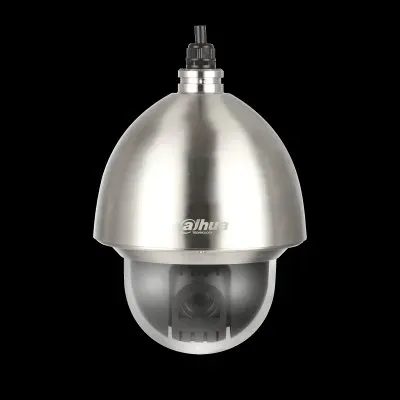
Manufacturer product photo, not taken in Fort Greene: a stainless pendant camera made for harsh locations. Stainless and sealed housings matter on entrances next to kitchen exhausts, a point that applies to call panels as much as cameras.
Pricing
Door Buzzer Repair Cost in Fort Greene
There is no Fort Greene surcharge. Every repair here comes off the same published list as the rest of the borough, set out on our Brooklyn door buzzer repair page and repeated on our pricing page for buzzer repair; Brooklyn is the base the other areas are multiplied from. You pay $250 for the technician to come and find the fault. If the fix is small, such as a terminal that has worked loose or a keeper that needs resetting, that is usually the whole bill. If it is not, you get a written figure for the larger repair first, and the $250 comes off it. The 8.875 percent city sales tax appears as a separate line on every invoice.
Repair
Brooklyn list
Where it comes up in Fort Greene
Service call + on-site diagnostic
$250
Every visit; covers small fixes such as a loose terminal, a reset supply or a re-set strike keeper
Apartment station replacement
$250 – $525
Dead handsets in walk-ups, former rooming houses and older co-ops
Door release relay or button
$250 – $475
Weathered or greased stoop and storefront-side buttons; release buttons upstairs
24V transformer replacement
$325 – $650
Row house bell transformers in warm cellars; overloaded supplies in buildings over shops
Electric strike replacement + alignment
$450 – $950
Worn strikes on residents' doors beside shops; narrow-frame strikes for aluminum doors
Lobby panel repair or faceplate
$650 – $1,800
Weathered sidewalk panels; co-op and walk-up lobby panels
Riser pair repair / re-termination
$850 – $2,400
Dead lines in walk-ups; cable cut in a store's ceiling during a fit-out
Paid online through the Brooklyn page, the visit is $272.19 including $22.19 tax. The ranges are wide because of the entrance, not the part: a strike in a sound wood frame is at the low end, one in a sagging aluminum door that has to be adjusted first is at the high end, and a line repair depends on whether the break is in an open cellar or above a shop's finished ceiling. Electrified mortise locks, networked panels, fob readers and magnetic locks are priced after diagnosis, because the right part depends on the door, the maker and the system.
What moves a Fort Greene repair up or down the range
The door: a residents' door that has dropped, a closer that has lost its latch speed, or an aluminum frame that needs a narrow strike adds door work
Access to the shop: a cellar reached only through the store, or a cable over the shop's ceiling, needs the store open; arranging that in advance avoids a second visit
Where the wire runs: an open cellar ceiling is quick; a finished garden-floor ceiling or a plaster stair wall is not
What has been added: lights, signs, cameras or a video doorbell on the same transformer can be the fault, and separating them is part of the job
The building's paperwork: boards and managers who need a certificate of insurance, a scope letter or before-and-after photos get them; it takes a little time, not money
Get the Written Price Before Any Part Goes In
The $250 visit finds the fault; the price for anything more is in writing before work starts. Call to book, send a quick request, or ask to speak to a technician first.
Nothing here comes in a box. Fort Greene repairs tend to fall into three bundles of list lines, shown below with the range each usually lands in; whatever the written quote after the diagnosis says is the figure that applies.
Row house bell fix
$250 – $650
One- and two-family row houses and split brownstones. The visit is $250; if more than a remade joint is needed, a new transformer is $325 to $650 and a new button or release $250 to $475, with the $250 counted toward it.
Residents' door beside a shop
$450 – $950 plus door work
Buildings over shops where the release fails or the door will not latch: strike replacement and alignment, including narrow-frame strikes, closer adjustment, and any button or relay from the list.
Line or panel repair
$650 – $2,400
Walk-ups, former rooming houses and co-ops. A weathered panel is $650 to $1,800 to repair or reface; a dead line is $850 to $2,400 to repair or re-terminate; failed handsets are $250 to $525 each.
Already bought the parts? Labor-only work
Some Fort Greene owners arrive with the part already boxed: a strike ordered online, a set of handsets, a video doorbell. Show it to us at the visit and we will check that it suits the door, the frame and the voltage before fitting it. The labor is priced once the diagnosis is done, on top of the $250 visit. Our 30-day warranty covers parts we supply, so anything you bought stays under its maker's warranty.
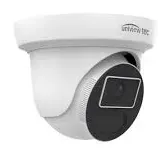
Manufacturer product photo, not taken in Fort Greene: a compact turret camera. Small cameras like this are often fitted inside vestibules; they are not part of the buzzer, and we price them separately if an owner wants one.
Field Notes: Ask About the Shop, Then Watch the Door
This is how we approach a residents' door beside a storefront in Fort Greene; it describes our method, not a particular job. The first questions are asked on the phone: who has the keys to the cellar and to the store, when the shop opens, and whether it has changed hands, renovated or put up anything new on the frontage. The answers decide whether the visit takes an hour or needs a second trip.
On site the technician stands on the sidewalk for a minute before touching anything. Where does the awning drain? Is there a vent above the panel? Has a sign or a light been fixed to the strip of wall beside the door? Then he lets the residents' door swing shut by itself and watches it latch, or not. He holds it closed while a tenant releases, then lets it rest and has them release again. A door that only opens when pushed is a door problem first.
Only then does he go down, through the store or the sidewalk hatch, to find the transformer and the terminal strip, and meters what reaches the strike while it is energised. He follows the cable to see whether it crosses the shop's ceiling and whether anything new is spliced to it. Before leaving he releases from every apartment he can reach, walks out and lets the door lock from the sidewalk, labels the supply and the strip, and leaves a note for the owner of where the keys were and what the shop should call about next time.
FAQ
Fort Greene Door Buzzer Repair FAQ
On which days of the week do Fort Greene tenants make the most buzzer complaints?
+
Midweek. Of the 129 bell, buzzer and intercom complaints made to 311 at Fort Greene lots since January 2020, Thursday had the most, 27, followed by Wednesday with 24 and Tuesday with 21; Saturday had the fewest, 7. That fits buildings where the problem is noticed by someone at home on a weekday waiting for a visitor or a delivery. It is a reason to test the release on a weekday morning after any repair, when the building is in its busiest use.
Does it matter which side of Myrtle Avenue or Vanderbilt Avenue our building is on?
+
Not for the price or the service: everything from Flushing Avenue to Atlantic Avenue and across into Clinton Hill, Prospect Heights and Downtown Brooklyn is on the same Brooklyn list. Residents disagree about where Fort Greene ends, and a 2015 survey found newer residents placing its edges differently from longtime ones. The boundary matters only for the statistics on this page, which cover the ten census tracts the city assigns to Fort Greene, and for NYCHA buildings north of Myrtle Avenue, whose entrances are NYCHA's to repair.
Do you repair entry buzzers at Fort Greene's churches, studios and arts spaces as well as apartment buildings?
+
Yes. Stage doors, studio and gallery doors, clinic and office entrances, and church side doors use the same strikes, buttons and supplies as residential doors, and often need a release that someone inside can work without walking to the door. They are priced from the same Brooklyn list. Where a building open to the public is involved, we keep new buttons and panels within the 48-inch reach height and check that any electrically locked exit door still lets people out.
Does the Myrtle Avenue or Fulton Street business improvement district have any say over the panel at our residents' door?
+
Not as a rule. A business improvement district provides services such as sanitation, marketing and streetscape programs for the properties along its street, but it does not approve repairs to a building's entrance. What does govern a visible change is the Landmarks Preservation Commission, if the building is in a historic district, and the Department of Buildings for signs and electrical work. Repairing an existing panel in place needs neither. The district can still be a useful contact for reaching a shop or an owner on the street.
Our house is in the Brooklyn Academy of Music Historic District rather than the Fort Greene one. Is anything different for a buzzer repair?
+
No. Both districts were designated by the Landmarks Preservation Commission in 1978 and the same rules apply: ordinary repair of an existing panel, button or strike needs no permit, and a new or relocated panel on the facade is handled under the Commission's guidance for intercoms, at staff level when it sits within or next to the door opening. MapPLUTO places 83 Fort Greene residential lots in the BAM district and 686 in the Fort Greene district; the Wallabout district at the north-east corner adds 53.
Can a repair visit be timed around BAM performances or Barclays Center events, when the streets near Atlantic Avenue are crowded?
+
Yes. If your building is on a block that fills up before a performance or a game, tell us when you book and we will schedule the visit for a quieter part of the day where we can. Most repairs need an hour or two on site, so a morning appointment usually avoids event traffic altogether. If a residents' door cannot be secured, though, we come when we can, whatever is on that evening.
The shop in our building has its own alarm company. Will you coordinate with them if their equipment shares the cellar box with our buzzer?
+
Yes, and we would rather. Shop alarms, cameras and buzzers sometimes end up on the same transformer or terminal strip in a mixed building, and a change to one can affect the other. We identify what belongs to the shop, tell the owner and the shop what we found, and leave the shop's equipment as it was unless their company or the owner asks otherwise. Where the buzzer is sharing power with something it should not, we recommend separating them and price that work.
All Areas Served
Door Buzzer Repair Across Brooklyn, New York City, Long Island and the Hudson Valley
This page sits under the Brooklyn door buzzer repair hub, which in turn sits under our New York City buzzer repair page. Here are the neighborhoods around Fort Greene, the Brooklyn pages rebuilt from local research, and the rest of the borough and region.
Every number and place on this page comes from the list below, read or queried in October 2026. What is ours alone: the Brooklyn price list, the way we work, and the reading of why buildings over shops stand out, which we label as an interpretation. The Open Data counts are our own queries, run on October 22, 2026. The study area is the ten 2020 census tracts (29.01, 31.01, 33, 35, 179, 181, 183, 185.01, 187 and 211) that HPD's records place in the Fort Greene neighborhood tabulation area; it is not an official boundary. Joining violations and complaints to lots, and grouping building classes into "over a shop", is our own work; PLUTO's construction years are often estimates.
HPD Housing Maintenance Code Violations (NYC Open Data, wvxf-dwi5) — every violation in the Fort Greene NTA mentioning an intercom, 158, by lot, street, inspection date, class, status, apartment and description; the same for self-closing doors, 1,101, by class and status; intercom counts for every neighborhood area in Community District 2; the census tracts HPD assigns to Fort Greene.
MapPLUTO (NYC Open Data, 64uk-42ks) — all 2,126 lots in the ten tracts: building class, apartments, floors, year built, ZIP code, historic district, owner type and name, and retail floor area.
311 Service Requests (NYC Open Data, erm2-nwe9) — complaints with the descriptor BELL/BUZZER/INTERCOM in ZIP codes 11201, 11205, 11217 and 11238 from January 2020 to October 20, 2026, joined to the tracts' lots: 129 complaints, by year, day of the week and resolution text.
Wikipedia: Fort Greene, Brooklyn — boundaries and the 2015 DNAinfo survey on them, Community District 2, ZIP codes, the 1850s–1870s Italianate row houses and street names, the Fulton Street elevated (1888) and the Myrtle Avenue elevated's removal (1969), the Fort Greene Houses of 1941–44 later divided into the Whitman and Ingersoll Houses, the 1978 Fort Greene and BAM historic districts, Fort Greene Park, the Prison Ship Martyrs' Monument, BAM, the Williamsburgh Savings Bank Tower, Brooklyn Technical High School, the Walt Whitman Library at 93 St. Edwards Street,.
Myrtle Avenue Brooklyn Partnership — the business improvement district covering properties fronting Myrtle Avenue from Flatbush Avenue Extension to Classon Avenue.
FAB Fulton (Fulton Area Business Alliance) — the business improvement district for small businesses and property owners along Fulton Street in Fort Greene and Clinton Hill.
The Brooklyn Hospital Center — 121 DeKalb Avenue. AFG Group and Nelligan White Architects — about 3,500 apartments across the Whitman and Ingersoll Houses; 1,823 at Ingersoll.
New York State Multiple Dwelling Law § 50-a and the Attorney General's Residential Tenants' Rights Guide — self-closing and self-locking doors, the post-1968 intercom rule for eight or more apartments, and the request rule for older buildings.
NYC HPD, Self-Closing Doors; Landmarks Preservation Commission Permit Guidebook; NYC Department of Buildings electrical requirements; 2010 ADA Standards — Class C and 14 days; intercom panels within or next to a door opening, one per opening; licensed electrician and permit for line-voltage work; 48-inch forward reach.
Cost and product claims in the AI section — Swiftlane's $150 to $400 range for minor intercom repairs; ButterflyMX's description of a call box needing no building wiring and of the 1968 rule; Angi, HomeAdvisor and Fixr named only as publishers of national averages this page does not use.
Not available to us — Google's People Also Ask, related searches and AI Overview, Answer the Public, Bing and DuckDuckGo suggestions, and Yelp reviews could not be opened from our research environment. A Reddit search found no Fort Greene discussion of buzzers, and a news search found no Fort Greene buzzer story; nothing on this page is drawn from those sources.
A Shop Downstairs and a Door That Will Not Release? Call the Fort Greene Line
Before you phone, spend two minutes at the entrance. Does the residents' door pull itself shut and catch? Can a neighbor upstairs open it? Is the shop open, and does someone there have the cellar key today? Ring (347) 934-8335 with those answers, the address and a word about the frontage. A door that cannot be secured goes to the front of the day, and a single failed part is normally sorted within an hour or two of arrival.
Fort Greene Door Buzzer Repair From a Licensed, Insured Brooklyn Company
Whether it is a three-family row house on South Portland Avenue with a silent garden bell, a residents' door beside a bakery on Myrtle Avenue that will not release, a walk-up on Cumberland Street with a dead line, a co-op lobby panel near Ashland Place or a staffed tower on Fulton Street, one number reaches the people who do the work: (347) 934-8335. Photos of the door are easiest to send by WhatsApp. Quotes and invoices come from Abstract Enterprises Security Systems, 1282 Troy Ave, Brooklyn, NY 11203.
Work in Fort Greene is done under New York State low-voltage license #12000287431, held by Abstract Enterprises Security Systems. Customers have rated our Brooklyn work 4.6★ across 390+ Google reviews. Boards and managing agents that keep contractors' insurance certificates on file get ours before we arrive, naming the corporation or owner they ask for.
Full terms — including 50% deposit, the 30-day warranty and optional paid extended warranty, and the late-fee schedule — are set out in the service agreement. See our warranty page.
Revision log, October 22, 2026: this page was rebuilt from new research on Fort Greene's front doors. HPD intercom and self-closing door records and 311 buzzer complaints for the ten census tracts the city assigns to Fort Greene were joined to MapPLUTO, which showed buildings of three to forty-nine apartments over a shop carrying a share of the record far above their share of the neighborhood's homes. The page is organised around that finding and around the neighborhood's row houses, split brownstones, walk-ups, co-ops and towers. Prices are the published Brooklyn door buzzer repair list.