Stoop camera dark on a landmarked block, a garden camera that drops off behind two brick walls, or a vestibule picture that turns white at night? Cobble Hill camera repair line, booked within 2 hours: (347) 934-8335
Brownstones and Brick Row Houses Inside the Historic District · Shared Rear Gardens · Courtyard Apartment Complexes and Church Conversions · Shops on Court, Smith and Atlantic
Security Camera Repair in Cobble Hill
Any Brand, Any Installer · Same Mounts, Same Footprint on Landmarked Facades · Footage Copied First · Written Price Before Parts
Security camera repair in Cobble Hill starts with our $150 Brooklyn service call, which pays for the on-site diagnosis and is credited to the repair if you go ahead. On our published Brooklyn list most single faults cost $150 to $700, and a new recorder or rewiring several cameras costs $700 to $1,500. We fix systems other companies put in: the stoop camera on a row house on Strong Place, the garden camera behind a brownstone on Clinton Street, the stair and courtyard cameras of a converted apartment complex on Hicks Street, the lobby cameras of a church turned condo, and the counter cameras of a shop on Court Street. Requests are booked within 2 hours, visits come in two-hour arrival windows, and on a landmarked facade the replacement goes back on the same mounts unless you decide otherwise.
Every price on this page comes from our published Brooklyn camera repair list, and your own repair price is written down before work begins
Rated 4.7★ across 201 Google Reviews
Reviewed and updated November 12, 2026, against the Landmarks Preservation Commission's rules for security cameras (Title 63, §2-20), its 2018 rule amendments and its permit guidebook; New York Civil Rights Law §52-a as published by the New York State Senate; the New York Department of State on installer licensing; the NYPD's 76th Precinct page and 311 guidance on camera registration; CBS New York reporting on a Cobble Hill robbery caught on building video; Brooklyn Paper, Brooklyn Reporter and DNAinfo coverage of the 76th Precinct; cobblehill.nyc and Wikipedia on the historic district and the Home and Tower Buildings; 6sqft on Warren Place and the former hospital campus; CityRealty on 354 Hicks Street; Gothamist on the Connect New York camera program; a Justia Q&A on cameras in New York co-ops; HomeAdvisor's Brooklyn cost page and published NYC repair prices. · Abstract Enterprises Security Systems, NYS license #12000287431 · crews dispatched from our Troy Avenue office in Brooklyn
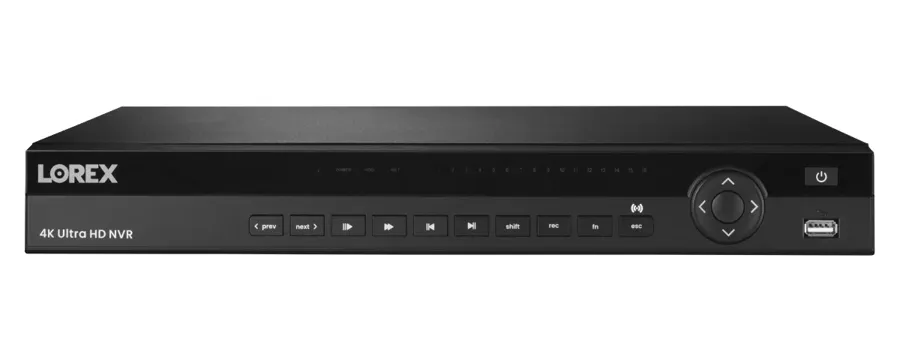
A photo from the AESS job library, not taken in Cobble Hill: the front panel of a 16-channel desktop network video recorder. In a Cobble Hill brownstone this box usually lives in the cellar or a garden-floor closet, close to where the internet line comes into the house; in a converted apartment complex it is in a locked utility room; behind a Court Street counter it sits on a shelf in the back. It keeps the footage, logs which camera dropped out and when, and decides how much of the picture gets saved, so most of our repairs start by reading it before anyone climbs a ladder.
Cobble Hill Camera Repair Request
Brownstone, row house, apartment building, condo, co-op or shop: tell us the street and what the screen shows, and a technician calls back with the next step
✅
Request Sent!
Thank you. A technician will contact you about the Cobble Hill address shortly.
25+
Years Experience
✓
Same-Day Estimates
100%
Licensed & Insured
4.7★
201 Google Reviews
Owner-operated since 2002 · Thousands of jobs completed · Booked within 2 hours
Security camera repair in Cobble Hill is mostly about fixing what failed without changing what the house looks like or what the camera can see. About 22 of the neighborhood's roughly 40 blocks sit inside the Cobble Hill Historic District, where the Landmarks Preservation Commission expects cameras to be placed so they "will not call undue attention" to themselves. The houses are old brick and brownstone with thick walls, plaster on lath and tight tiled vestibules, and their back gardens run together behind each row. So the usual repair calls here are a dead camera on a facade that should be replaced on the same mounts, a vestibule camera whose night picture bounces off tile and glass, a garden camera that loses its signal through two masonry walls, cable faults hidden inside walls with original moldings, and recorders in damp cellars that stopped saving without telling anyone. Send a photo of the camera, its mount and the recorder to (347) 934-8335 or on WhatsApp, and we will tell you which kind of fault it looks like and what that repair costs on our Brooklyn list before you book.
Looking at your photos costs nothing, and if the fix turns out to be a setting we can walk through by phone, there is no service-call charge. Otherwise the $150 service call covers the on-site diagnosis and is credited to the repair.
We work under New York State license #12000287431. The Department of State licenses companies that install, service or maintain security systems for other people, and camera systems used to watch for break-ins fall under that rule.
We repair any brand and any installer's system, and when an old camera or recorder is not worth fixing we say so and price the alternative.
The Neighborhood
Why Cobble Hill Properties Need Security Camera Repair
Cobble Hill is small: about 40 blocks bounded by Atlantic Avenue to the north, Court Street to the east, Degraw Street to the south and the Brooklyn-Queens Expressway to the west. Its streets are mostly brownstones and brick row houses from the middle of the nineteenth century, with Greek Revival, Italianate and later styles side by side, low apartment buildings that went up before the 1920s, a few large courtyard complexes, churches that have been turned into homes, and newer buildings on the land where Long Island College Hospital stood until it closed in 2014. Court and Smith Streets carry most of the shops, and Atlantic Avenue the rest. That is the setting. For a camera repair, three features of it matter more than anything else.
The first is the historic district. The Cobble Hill Historic District was designated in December 1969, extended in June 1988 and listed on the National Register in 1976, and it covers about 22 blocks. Inside it, the Landmarks Preservation Commission treats a camera on a facade as a fixture it cares about. Its rules say cameras on landmarked buildings "will be located to avoid a cluttered or haphazard appearance" and attached in a way that minimizes their visible impact, and staff can approve one only if the installation "will not call undue attention to itself or detract from any significant architectural feature(s)" of the building or its neighbors. The 2018 amendments go further for the most visible wall: they bar many kinds of equipment from a primary facade unless there is no feasible alternative. None of that stops a repair. It does change how a repair should be done, because a replacement camera with a bigger housing, a new bracket in a new place or a fresh run of conduit up the brick is no longer the same fixture.
The second is the walls themselves. Old brick and brownstone are thick, interior walls are often plaster on wood lath with moldings nobody wants touched, and vestibules are small boxes of tile, wood and glass. That is hard on cameras in specific ways. Infrared light from a camera in a tight vestibule bounces off glazed tile and the glass of the inner door and turns the night picture to white haze. A Wi-Fi camera on the garden wall often sits two masonry walls and a full house depth away from a router in the front parlor, and its signal comes and goes with the weather and the neighbors' networks.
The third is the gardens. Behind most rows, the back yards touch one another along low walls and fences, and some houses look onto shared courtyards or private walks rather than a street. Garden cameras are useful for the rear doors and the garden-floor apartments that many of these houses have, but they also see over the wall. New York's Civil Rights Law §52-a gives the owner or tenant of a home a right to sue someone who records their back yard from neighboring property without written consent, where the recording is meant to harass, annoy, alarm or threaten. That is a high bar and it is aimed at bad behavior, not at an ordinary camera watching its own garden. But when a dead garden camera is replaced with a modern one whose lens is far wider than the old model's, the new picture can take in two or three neighbors' patios that the old one never saw. Getting the view right, and masking out what is not yours, is part of the repair.
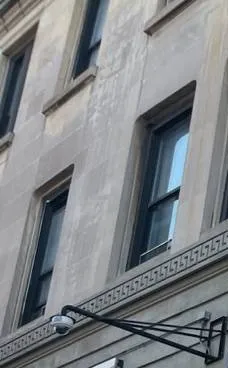
A photo from the AESS job library, not taken in Cobble Hill: a bullet camera on a long black steel arm under a carved Greek-key band on pale stone, beside tall sash windows. This is exactly the kind of mount the Landmarks rules have in mind. On a Cobble Hill row house, an arm like this reaching past a cornice or a lintel is very visible, so when the camera on it fails we replace the camera and keep the arm, the anchors and the cable path as they are, instead of putting up a new bracket somewhere else.
Footage still matters in a neighborhood this quiet. CBS New York reported a robbery in Cobble Hill in which building surveillance video showed the suspect waiting outside for an hour and a half before following a woman into the courtyard. The 76th Precinct, which covers Cobble Hill along with Carroll Gardens, Red Hook and parts of Gowanus and the Columbia Street Waterfront from its station at 191 Union Street, has asked the public for help with video in other cases over the years: a break-in at a Japanese restaurant, a group of suspected thieves on Atlantic Avenue, a shoplifting arrest at a Court Street store, and a package taken from an apartment building's vestibule on Amity Street near Henry Street in the early afternoon. Most of those stories are several years old, and we found no neighborhood-level news from 2025 or 2026 about camera failures. The point is not that Cobble Hill is dangerous. It is that when something does happen, people go looking for footage, and the camera they look to is often the one that quietly stopped recording months ago.
So a camera repair in Cobble Hill is rarely just "make the dark camera work again." It is making it work on the same footprint, with a picture that is usable at the door, in the vestibule and in the garden, recording at a quality you can actually use, and warning you the next time it stops. Many owners pair the repair with a look at the door buzzer or video intercom at the same entrance, since on these houses both systems share the same stoop and the same vestibule.
Six Cobble Hill facts that shape a camera repair
Roughly half the neighborhood is landmarked. The Cobble Hill Historic District, designated in December 1969 and extended on June 7, 1988, covers about 22 of the neighborhood's roughly 40 blocks. Ordinary repair of safety equipment does not need a Landmarks permit; a new or moved camera on a facade is a different matter.
The front wall gets the strictest treatment. The LPC's 2018 rule amendments bar many kinds of equipment from a primary facade unless there is no feasible alternative, and its guidebook allows staff to approve only about ten inches of visible conduit, so a replacement that needs new exposed cable up the front is not a like-for-like swap.
Many rows share their gardens. Back yards meet along low walls, and several complexes face private courtyards or a gated mews. Warren Place, built in the 1870s, is a gated street of 34 brick cottages facing a private courtyard between Warren and Baltic Streets.
Some of the largest buildings have no interior halls. The Home and Tower Buildings on Hicks Street, built in 1876 to 1879, reach their apartments by outdoor stairs and balconies around large courtyards; after restoration they held 188 apartments, and condominium conversion began in 2008. Cameras there live outdoors all year.
The former hospital land is still being built on. Long Island College Hospital closed in August 2014. Its campus has become condominiums such as the Polhemus building at 100 Amity Street, and 354 Hicks Street is planned at 20 stories with 34 condos over five floors of medical space and an attended garage, with completion expected in 2027.
Repair is priced by the fault, not the address. HomeAdvisor's Brooklyn page puts the average surveillance camera install or repair at $1,416, with a typical range of $680 to $2,145 across job sizes. Most single repairs on our Brooklyn list fall between $150 and $700, and Cobble Hill is billed at the standard Brooklyn rate.
Where this page applies. It covers Cobble Hill from Atlantic Avenue south to Degraw Street and from Court Street west to the BQE, including Henry, Clinton, Hicks, Amity, Pacific, Congress, Warren, Baltic, Kane and Verandah Place, Strong Place and the blocks around Cobble Hill Park. Houses east of Court Street are on our Boerum Hill security camera repair page, the blocks south of Degraw are on our Carroll Gardens camera repair page, and the rest of the borough is on our main Brooklyn security camera repair page.
Same-Day Repair in Cobble Hill
Need Repair in Cobble Hill? A Clip You Need From a Camera That Stopped Recording, a Garden Gone Dark, or a Facade Camera That Fell Off Its Mount
Urgent calls from Cobble Hill usually fall into one of three shapes. The first is the missing clip: a package is gone from the vestibule, a bicycle from the areaway, or someone tried the garden door overnight, and when you open the app the camera that should have seen it shows a frozen picture from weeks ago, or nothing at all. The second is the dark garden: the camera on the back wall drops out every evening, or has been offline since the router was changed, and the rear door and the garden-floor entrance are not covered. The third is physical: a facade camera knocked loose by a falling branch, a ladder or a pointing crew, hanging from its cable on the front of a landmarked house.
If footage from a particular day matters, leave the recorder running and do not unplug, restart or reset it. Recorders write over their oldest video once the drive is full, so the clock is already running, and a restart can clear the log that shows when a camera dropped or the drive stopped writing. Text us the date and time you need, which camera it should be on, and a photo of the recorder's front or its screen. We plan the visit so the clip is copied before anything else is touched. If a camera is hanging loose, do not pull it down by the cable; take a photo of it and of the wall around it, so it can go back exactly where it was.
For everything else the path is short. The $150 Brooklyn service call books a two-hour arrival window. The technician finds the fault, explains what failed and why, and writes down the price from our Brooklyn list before any part is replaced. Most single-fault repairs are finished on the same visit, with the camera checked against bright light and low light and the saved recording played back before we leave.
What We Install
Security Camera Repair Services in Cobble Hill
Each repair below is priced from our Brooklyn camera repair list. The service call pays for finding the fault; the repair itself is priced by what failed, how many cameras it affects and how hard each cable is to reach, whether that is a stoop camera on a Kane Street row house or a stair camera three landings up in a courtyard complex on Hicks Street.
Like-for-like facade camera replacement
A dead camera on a front or rear wall replaced with one of the same size and color, on the existing bracket and anchors, with the cable kept on its old path. The default on every house inside the historic district, and good practice on any old facade.
Vestibule and stoop picture repair
Night pictures washed out by infrared bouncing off tile and door glass, and day pictures where the person on the stoop is a dark shape against the street. Fixed with settings, a few degrees of aim, a separate light or a camera that sees in color at night.
Garden and rear-wall camera repair
Wi-Fi cameras that drop out through masonry, wired cameras whose cable has taken water at the wall, and views that need masking so they show your garden and not the neighbors'. Rear doors and garden-floor entrances get the coverage back.
Hidden-cable fault finding
Runs fished inside walls with original plaster and moldings, tested from both ends to find whether the fault is at a connector, a splice or the cable itself, so the wall is opened only when there is no other way.
Recorder and hard drive repair
DVRs and NVRs in damp cellars and garden-floor closets that stopped saving, beep, restart or report a disk error. We copy what can be copied, replace the drive or the recorder, and prove playback before we go.
Dead camera diagnosis
One camera or several dark at once: power, switch port, connector, cable, camera or recorder channel, tested in order so you pay for the part that failed and not the ones around it.
Courtyard and outdoor-stair systems
Cameras on open stairs, balconies and courtyard walls that face rain, snow and summer sun all year, in complexes where there is no indoor hallway to shelter them.
Logins, accounts and handovers
Recorders still tied to a former owner, a rental manager, a developer's contractor or an installer who has moved on. We recover access, move the system into the right name and remove old users.
Footage export for incidents
Clips for the 76th Precinct, an insurer, a condo board or a court, exported in the recorder's original format with its own timestamps, and a short lesson so you can do it yourself next time.
Building Specialists
Security Camera Repair for Cobble Hill's Architecture
A failed camera is a different repair on each kind of Cobble Hill building, because the mounting surface, the cable path, the recorder's location and the person who signs off all change. These are the building types we meet most often in the neighborhood, and what each one does to a camera system.
Brownstone and brick row houses
Three- and four-story houses from the 1840s onward with stoops, vestibules, parlor floors and garden floors. Cameras over the door, under the cornice and on the rear wall, wired down to a recorder in the cellar.
Houses on courtyards and mews
Cottages and townhouses that face a private walk or courtyard rather than a street, such as the 34 cottages of Warren Place. Cameras that look across a shared path at neighbors' doors.
Courtyard apartment complexes
The Home and Tower Buildings on Hicks Street, with outdoor stairs, open balconies and large interior courtyards instead of hallways. Many cameras, all of them outdoors.
Pre-war walk-ups
Low apartment buildings built before the 1920s on Henry, Clinton and Court Streets, often with a shop at street level and a recorder in a cellar shared with the meters and the boiler.
Church and school conversions
Former churches and parish buildings turned into apartments or condos, such as St. Peter's on Hicks Street and the old Strong Place Baptist Church. Tall ceilings, thick stone, cameras placed wherever a crew could reach.
New buildings on the hospital campus
Condominiums on the former Long Island College Hospital land around Amity, Henry and Hicks Streets, with network cameras, video intercoms and package rooms, some still next to active construction.
Brownstone and brick row houses: four floors of cable in an old wall
The typical Cobble Hill row house has a camera over the front door or under the stoop, sometimes one under the cornice looking down the block, and one or two on the rear wall facing the garden. The recorder is in the cellar or a garden-floor closet. The cameras on the upper floors are the problem when they fail, because their cables did not go up the outside of the house; on most of the systems we see, the installer fished them inside a wall cavity, through a closet or up beside a chimney breast, to keep the facade clean. That was the right decision for the house, and it means the repair has to respect it. We test a dead upper-floor camera from both ends of its cable before anything else, because on runs like these the fault is far more often a connector at the camera or at the recorder than the cable itself, and a connector can be replaced from the end without touching the wall.
When the cable really has failed inside the wall, there are usually three choices: reuse the old cable as a pull string to bring a new one through the same path, find a different hidden route such as an existing chase or a closet, or run a short, painted surface raceway on the rear wall where nobody sees it. We price each one so you can choose. What we do not do is drill a new hole through the front wall because it is quicker. On a landmarked house that creates a new visible change, and on any old brick wall it is one more place for water to get in.
Houses on courtyards and mews: the camera that sees across the walk
Some Cobble Hill houses do not face a street at all. Warren Place, a gated street of 34 brick cottages built in the 1870s, faces a private courtyard between Warren and Baltic Streets, and other houses in the neighborhood look onto shared courts and private walks. A door camera on a house like that often looks straight across a narrow path at a neighbor's front door and window. When it fails and is replaced with a newer model, the wider lens and better night picture can turn a camera that used to show your own step into one that records the comings and goings of the household opposite. On these houses, part of the repair is agreeing on the view: aiming the replacement at your own door and step, and using the recorder's privacy masks to black out the parts of the frame that belong to someone else. If a shared association or management group controls the walk, we check with whoever speaks for it before a camera that covers common ground is changed.
Courtyard apartment complexes: every camera is an outdoor camera
The Home Buildings of 1876 to 1877 and the Tower Buildings and cottages of 1878 to 1879 on Hicks Street are reached by exterior staircases and open balconies around large interior courtyards; after their restoration they held 188 apartments, and condominium conversion began in 2008. In a complex built like that, the cameras that would sit in a dry interior hallway anywhere else are on outdoor landings, under balcony slabs and on courtyard walls. They take wind-driven rain on the lens, snow on the housing, and summer sun on the dome, and their connectors live in the weather. The failures we expect there are water at a connector, a fogged lens where a seal has given up after a few winters, and domes clouded by sun. The repair is outdoor-rated hardware, sealed connections and drip loops, even when the camera is "inside" the complex.
Pre-war walk-ups: the cellar everybody shares
The low apartment buildings on Henry, Clinton and Court Streets were mostly built before the 1920s, and many have a shop on the ground floor. Their recorder is usually in the cellar, often on a shelf near the meters, the boiler and the shop's stock. That location causes most of their camera repairs. Damp air and dust shorten the life of the recorder and its drive; the outlet it plugs into may belong to whichever circuit was closest, sometimes the shop's; and anyone with a cellar key can unplug it to free a socket. Part of a walk-up repair is putting the recorder somewhere dry and secure, on the owner's own power, and labeling what it is so the next person in the cellar leaves it alone. Many of these buildings also have original risers and conduit with little room left in them, so a failed vertical run is a planning job rather than a quick pull.
Church and school conversions: high ceilings and thick stone
St. Peter's Church on Hicks Street, built in 1860, and its school became condominiums, and the Strong Place Baptist Church of 1851 to 1852 was converted to apartments in 2010. Buildings like these hand a camera system unusual problems. Interior ceilings are far higher than a row house's, so a camera mounted at the top of a converted nave or stair hall shows faces at the bottom as a few pixels each. Exterior walls are thick stone or brick that the developer's crew drilled wherever they could reach. When a camera fails in a building like this, the repair is often a different lens on the same mount, a varifocal camera that can be zoomed to the doorway, or a second camera lower down on the same cable path, rather than a new system.
New buildings on the hospital campus: sophisticated systems, unsettled ownership
Long Island College Hospital closed in August 2014, and its land has been redeveloped in phases. 6sqft reported the Polhemus Residences at 100 Amity Street and the Polhemus Townhouses at 88 to 98 Amity Street as the first phase, with 5 River Park at 347 Henry Street holding 25 units, and listed amenities including an attended lobby and a secured package room. CityRealty describes 354 Hicks Street, bought from the original developer in 2022, as a 20-story building with 34 condos over five floors of medical space and an attended garage, with completion expected in 2027. Buildings like these usually run network cameras on a managed switch with a video intercom, sometimes tied to a cloud account. The hardware is current; the trouble is that logins, warranties and service contracts can sit with the developer, the sponsor's installer or a management company. A repair there starts with finding out who is allowed to change what, then fixing the fault.
Field Notes
Field Notes: Why We Ask Cobble Hill Owners to Photograph the Mount Before Anyone Touches It
This is how our technicians handle the most common call from a landmarked Cobble Hill block, written as our working method rather than a story about any one house. The owner says the camera over the stoop is dead. Before we book, we ask for three photos: the camera from the sidewalk, a close-up of how it is fixed to the wall, and the recorder in the cellar. The close-up shows whether it is screwed into a mortar joint, the stone, a wooden door frame or an arm, and whether its cable vanishes into the wall or runs along the surface; the recorder photo gives the make and age.
With those three pictures we can usually tell the owner, before anyone arrives, whether this is a straight swap on the same anchors, a swap that needs an adapter plate because the new camera's base is a different shape, or a job where the old camera is so unusual that the closest match will look different. That last case is the one we want to know about early. A replacement that looks noticeably different on a landmarked facade is a decision for the owner to make with the rules in front of them, not something to discover after the old camera is in a bag. Most of the time it is a straight swap, and the photos mean the technician brings the right camera and the right bracket the first time.
Commercial Security Camera Repair
Business Security Camera Repair in Cobble Hill
Cobble Hill's businesses sit along its edges and a few interior streets. Court Street and Smith Street are the main shopping streets, where older Italian meat markets and barber shops sit next to newer shops and cafes, and the northern stretch of Smith Street became known as Restaurant Row in the late 1990s and 2000s. Atlantic Avenue on the northern edge has one of the city's largest collections of Middle Eastern shops. The cases the 76th Precinct has publicized from these streets over the years, a restaurant break-in, a group of suspected thieves on Atlantic Avenue and a shoplifting arrest on Court Street, are the kind where a clear picture of the door, the counter and the street outside is what helps.
Court Street
The eastern boundary and the busiest shopping street, with groceries, pharmacies, banks, cafes and long-established shops under apartments. The 1922 South Brooklyn Savings Institution building at 130 Court Street, with its carved eagles, now holds a grocery store.
Smith Street
Restaurants, bars and small shops, many with dining rooms in front, kitchens and gardens behind, and recorders in a cellar reached through a sidewalk hatch or a back stair. Late hours and dim rooms.
Atlantic Avenue
The northern edge, lined with Middle Eastern groceries and other shops under apartments. Busy sidewalks by day, roll-down gates at night, and the place where the 76th Precinct sought a group of suspected clothing thieves.
Hicks Street storefronts
Ground-floor shops on the Hicks Street side of the Home Buildings and in the low buildings nearby, where a shop's cameras may share a facade with a landmarked residential complex.
Henry and Clinton Street corners
Corner stores, cafes and services in the ground floors of walk-ups, where the shop's camera system and the building's own camera at the residential door often record to two different boxes.
The former hospital campus
Medical and community space in the new buildings around Amity and Hicks Streets, including the freestanding emergency department that opened in October 2014 when the hospital closed, with managed systems and building rules for contractors.
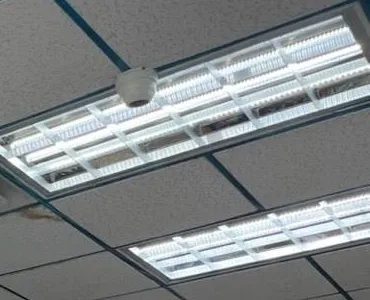
A photo from the AESS job library, not taken in Cobble Hill: a compact white dome camera on grey acoustic ceiling tiles beside a long louvered fluorescent light fixture. In a Court Street pharmacy or a grocery on Atlantic Avenue, this is the camera over an aisle or a register. It rarely dies of age; it stops being useful when a new light, a sign or taller shelving ends up in its view, and the repair is a move of a tile or two, or a different lens.
Restaurants and bars on Smith Street: dim rooms, steam and late nights
Restaurant cameras face hard conditions. Dining rooms are bright through the front windows in the afternoon and dim at night; kitchen and back-door cameras collect grease and steam on their domes and soften within weeks; garden cameras deal with string lights and heaters; and recorders end up in basements next to compressors and mop sinks. The repairs we do most often in restaurants are cleaning and resealing, moving a camera out of the steam path, choosing a camera that handles a dim room without switching to black and white, and moving the recorder off the floor.
Rules that touch a commercial camera repair
In New York, companies that install or service security and CCTV systems for others must be licensed by the Department of State; we work under NYS license #12000287431. Low-voltage work does not always need a Department of Buildings permit, but installers note that larger cable work, new conduit through fire-rated construction, or work in a building already under a DOB renovation can bring one in, and condo and co-op common areas have their own approval rules. Employers who watch staff by camera should know that New York Labor Law §203-c bars video recording in restrooms, locker rooms and changing rooms. On landmarked buildings, including shopfronts inside the historic district, a facade camera replaced in kind is ordinary repair, while a new or moved one is not. Businesses can also register their camera locations with the NYPD through the city's Connect New York program at no cost; Gothamist reported owners had added more than 5,500 cameras through that initiative. We are not your lawyer; we tell you where a repair touches one of these rules so you can decide before work starts.
Your Questions Answered
Security Camera Repair in Cobble Hill: Questions Answered
The historic district: what a repair can and cannot change
Our house is on one of the blocks added to the Cobble Hill Historic District in 1988, not the original 1969 area. Does that change how a camera repair is handled?
No. The June 1988 extension made those blocks part of the same historic district, so the same Landmarks rules apply to a house there as to one on the blocks designated in December 1969. What matters is whether your own lot is inside the district line, which you can confirm by address on the Landmarks Preservation Commission's online map. If it is, replacing a dead camera in kind, on the same mounts and at about the same size, is ordinary repair of safety equipment, which the LPC's permit guidebook does not require a permit for. Moving the camera, adding one, or changing its look enough to draw attention is a different kind of job, and we tell you before the visit if your repair is heading that way.
The replacement camera another company quoted is about twice the size of our old one and needs a new length of conduit up the brick. Is that still a repair?
Probably not, as far as the Landmarks rules are concerned. A much larger housing and new exposed conduit are visible changes to the facade, and the LPC's guidebook lets staff approve only about ten inches of visible conduit, while its 2018 amendments discourage new equipment on a primary facade where there is a feasible alternative. In most cases there is one: a current camera of similar size and color that fits the old base or an adapter plate, with its cable kept on the old hidden path. We price that option first, and if a bigger camera really is needed for what you want to see, we explain what an application would involve so you can decide.
We would rather take the camera off the front of our house and watch the stoop from inside the vestibule or from under the stoop. Does moving it off the facade avoid the Landmarks question?
Often it is the simplest route. Installers who work in Brooklyn's districts point out that interior or less visible mounting frequently avoids Landmarks review while still covering the door, and the 2018 rules are built around keeping the primary facade clear. The trade-offs are technical. A camera inside the vestibule looks through or past glass and has to be set up so it does not light up the tile and the door with its own infrared, and a camera under the stoop sees people at knee height unless it is placed carefully. Taking the old camera down also leaves anchor holes in the facade; we remove the camera and its bracket and seal the cable entry, but filling mortar or stone is work for your mason.
Behind the row: gardens, courtyards and neighbors
We heard New York lets a neighbor sue over a camera that records their back yard. Does that matter when the dead camera on our garden wall is replaced?
It is worth knowing about, though it is aimed at bad behavior rather than ordinary cameras. New York Civil Rights Law §52-a gives the owner or tenant of a home a right to sue a person who mounts a camera on neighboring property to record their back yard without written consent, where the recording is meant to harass, annoy, alarm or threaten; the law defines the back yard as the part of the lot behind the rear wall of the house. A camera watching your own garden and rear door is not that. But modern replacements often have much wider lenses than the cameras they replace, so we aim the new one at your own garden, set privacy masks over the neighbors' yards and windows, and check what the infrared lights up at night. We are not your lawyer, and if a neighbor has already complained, that is a conversation for one.
Our cottage faces a narrow shared walk, and the door camera looks straight at the houses opposite. When it is replaced, how do we keep it to our own doorstep?
Three settings and one choice of hardware do most of the work. The camera is aimed down and toward your own step rather than straight out, so the opposite houses fall out of the bottom of the frame; privacy masks on the recorder or camera black out any part of a neighbor's door or window that is still visible, in the recording as well as the live view; and motion detection is limited to your side of the walk, so people going to the house opposite do not trigger alerts. A camera with a narrower or zoomable lens makes that much easier than a very wide one. If an association or management group looks after the walk and its gate, we check with them before changing a camera that covers common ground.
Vestibules, parlor floors and old walls
Our brownstone's vestibule is barely deeper than the two doors, with a tiled floor and glass in the inner door. Which kind of camera actually works in a space that small?
A small camera with its infrared switched off and a wide but not fisheye lens, mounted high in a corner so it looks across the space rather than at the inner door's glass, is usually the answer. The tile and glass are what ruin night pictures in vestibules like yours, because the camera's own infrared bounces straight back into the lens. Give it light instead: a small warm fixture on a motion sensor, mounted away from the camera, or a camera built to record in color in low light. If the vestibule must also show who is on the stoop outside, that is often better done by a second camera outside the street door, because one camera cannot see both well through glass. On our Brooklyn list, this kind of fix runs from a settings change within the service call to $350 to $700 for a consultation and replacement.
The cable to our camera over the front door was fished down inside a wall with its original plaster moldings, and that camera is now dark. Will the wall have to be opened to fix it?
Usually not. On hidden runs like that, the fault is most often at one of the two ends, at the connector behind the camera or at the recorder, and both can be fixed without touching the wall. We test the camera on a short known-good cable, test the run end to end, and check for splices in the cellar or a closet before concluding the cable itself has failed. If it has, the old cable can often pull a new one through the same path, or a different hidden route can be found. Opening the wall is the last option, it is written into the price before we start, and the patching and painting afterwards are for your plasterer or painter, not us.
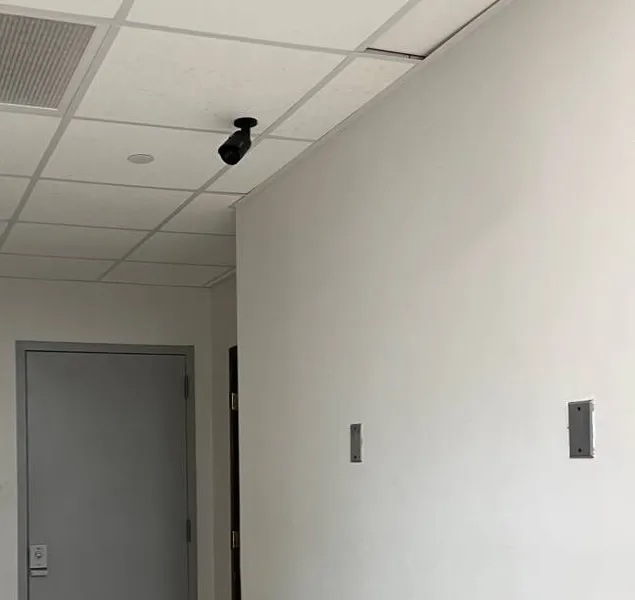
A photo from the AESS job library, not taken in Cobble Hill: a small black bullet camera hanging from a white ceiling-tile grid, aimed down a short hallway at a grey steel service door. In a Cobble Hill walk-up this is the camera on the cellar corridor or the back door to the yard, and in a Court Street shop it watches the rear exit. Pointed straight at a door, it sees everyone who comes through, but only for a moment, so we check its frame rate and saved quality whenever we repair one.
Courtyard complexes, conversions and condos
Our condo has outdoor stairs and open walkways instead of interior hallways, and its cameras face the weather all year. Do they need a different camera from an indoor hall?
Yes. A camera on an open landing or under a balcony slab gets rain blown sideways onto its lens, snow on its housing and full summer sun, even though it looks as if it is inside the building. It needs an outdoor weather rating, connectors sealed against water, a drip loop on the cable, and ideally a hood or a position under the slab that keeps the lens dry. Indoor domes in those spots fog and fail after a few winters. When we repair a system in a courtyard complex, we check the rating of every camera on the open stairs and balconies, not only the one that died, and price outdoor-rated replacements where indoor models were used.
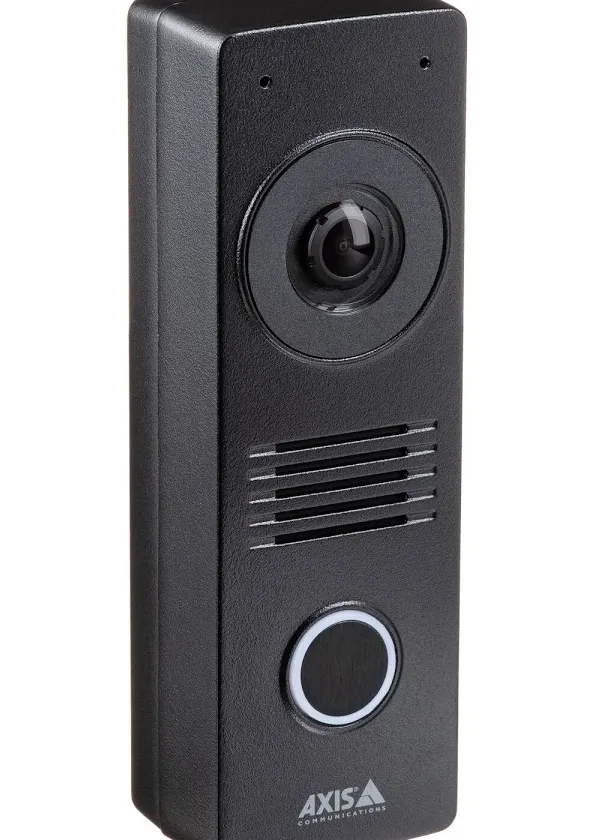
A photo from the AESS job library, not taken in Cobble Hill: a black video intercom door station with a camera lens, a speaker grille and an illuminated call button. At a courtyard gate on Hicks Street or the lobby of a new building on the former hospital campus, a station like this often shares a network with the building's cameras, and its own camera may or may not be recorded. When residents say the entrance picture is gone, we test the station, the network and the screens before replacing anything.
Our condo is in a converted church, and the cameras hang from a ceiling more than two stories up. Faces in the lobby below come out tiny. Can that be fixed without rewiring?
In most cases, yes. A wide camera at that height spreads its pixels over the whole floor, so a face at the entrance is only a small part of the frame. The usual repair is a varifocal camera on the same mount and cable, zoomed to the doorway and the mailboxes, or a second camera lower down, such as on a column or above the inner door, fed from the same cable path. Before choosing, we check the recorder's free channels and the camera's power budget on the switch and confirm with the board how a lift or tall ladder gets in.
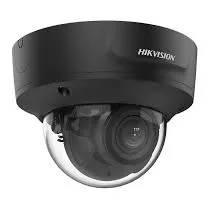
A photo from the AESS job library, not taken in Cobble Hill: a black varifocal dome camera, shown as a product photo. Its lens can be zoomed after it is mounted, which is the usual answer for the tall ceilings of a converted church or the long, narrow floor of an Atlantic Avenue shop, where a fixed wide lens leaves faces at the far end unreadable.
Our building was a rental for decades before it became a condo, and the camera recorder is still registered to the old management company's cloud account. Can it be moved into the condo's name without losing the cameras?
Usually, yes. The cameras themselves are rarely tied to an account; it is the recorder's cloud registration and its administrator login that need to change hands. The cleanest route is for the old management company to release the device from its account, which many will do once the board asks in writing. If they will not or cannot, most recorders can be reset with physical access and proof that the condo now owns the equipment, then registered to a new account in the condo's name with its own administrator and separate logins for the managing agent and any board members who need them. We copy any footage the board wants to keep before a reset.
Our co-op board wants to use the repaired hallway cameras to keep an eye on one shareholder it suspects of subletting. Is that a reasonable use?
That is a question for the board's lawyer rather than a camera company, but here is what we can say from our side. People ask whether landlords can use outdoor cameras to monitor tenants in New York co-op apartments often enough that the question appears on legal Q&A sites, and an attorney answering it on Justia noted that cameras in common areas such as hallways and stairwells are lawful as long as they do not record sound. Pointing a camera at one door, or into a unit, to watch a particular person is different in kind from ordinary building security, and it can create problems for the board. When we repair hallway cameras, we restore their normal coverage of the common areas, switch off audio recording, and leave decisions about who may view the footage, and why, to the board's written policy.
Waiting, following and the shared street door
In one Cobble Hill robbery, building video showed the suspect waiting outside for an hour and a half before following a woman into the courtyard. Would our cameras have kept the waiting, or only the moment he moved?
It depends on how your recorder is set. Many systems are set to record only on motion, and a person standing still near a gate can fall below the motion threshold, so the recording jumps from an empty frame to the moment someone moves. For entrance and gate cameras, we usually set continuous recording at full quality, which most drives can hold for a week or more, with motion or person detection used only for alerts. Some cameras can also flag a person who stays in one area for a set time. On a repair visit we check exactly this: whether the camera covering the approach to your door or gate keeps every minute, and how far back the recorder can go.
Our shop on Court Street shares the street door with the apartments upstairs, and the landlord's old camera over that door has died. Can our shop's own system take over watching the door?
Technically, yes: a camera covering the shared door can be connected to your shop's recorder in place of the landlord's dead one. The question is permission. The door, the wall and the stair belong to the landlord, and the residents use that entrance every day, so we would want the landlord's written agreement before mounting or connecting anything there, and a clear understanding of who can see the footage and who maintains the camera. Often the simplest arrangement is that the landlord repairs the building camera and gives the shop a viewing login, or that the shop's camera is aimed at the shop's own door only. We can price either and explain the options to the landlord with your permission.
Equipment
Types of Security Cameras and Recorders We Repair
We repair systems from any manufacturer and any installer. A company that services this part of Brooklyn lists Invid, Hikvision, Uniview and Provision among the brands it works on, and we see those alongside Dahua, Lorex, Hanwha, Axis, UniFi and the consumer brands. Here is what we meet most in Cobble Hill and what usually fails.
Coax and HD-over-coax cameras
Older systems in many brownstones, wired with coaxial cable to a DVR in the cellar. Connectors corrode at the wall and a shared power supply often fails first. Many can be upgraded to sharper cameras on the same hidden cable, which matters when that cable is inside a wall with moldings.
Network (IP) cameras
Standard in the new hospital-campus buildings and in newer shop systems, powered and connected by one cable from a PoE switch or NVR. Faults are usually a switch port, a connector, a password or an address change after the network was updated.
DVRs, NVRs and hybrid recorders
The box that keeps the video, usually in a damp cellar or a closet. Drives wear out, settings vanish after outages, firmware updates break phone viewing. Hybrid recorders let a house keep its coax cameras while adding network ones.
Low-profile facade cameras
Small turrets, mini domes and compact bullets in dark or stone colors, the usual like-for-like replacements on landmarked fronts where a bigger housing would draw attention.
Color low-light cameras
Cameras that record in color using existing light instead of their own infrared. The common fix for tiled vestibules and glass doors where infrared bounces back into the lens.
Varifocal domes and bullets
Cameras whose lens can be zoomed after mounting, for converted churches with tall ceilings, long narrow shops on Atlantic Avenue and garden cameras that should see your yard and not the neighbors'.
Pan-tilt and 360-degree cameras
Motorized or fisheye cameras in courtyards, store floors and rooftop corners. Motors, saved positions and dewy domes are what we fix most often.
Wi-Fi, battery and cube cameras
Consumer cameras on garden walls, in apartments and in vestibules. Signal through brick, battery life in winter and app accounts belonging to someone who moved away are the usual problems.
Video door stations
Intercom stations with built-in cameras at courtyard gates, condo lobbies and brownstone doors, sometimes recorded by the main system and sometimes not. We check which before promising footage from them.
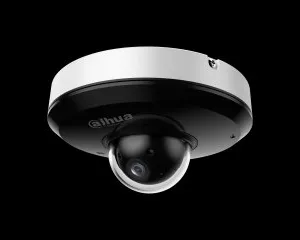
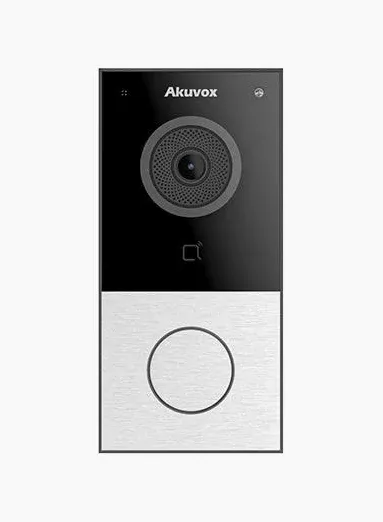
A photo from the AESS job library, not taken in Cobble Hill: a small pan-tilt dome camera with a white body and a black lens bubble. In a Cobble Hill courtyard complex or a shop floor, a camera like this can be steered from a phone to look at a gate, a stair or a register. Its motor and its saved positions are what usually need repair, and we often find it parked facing the wrong way since whoever last moved it.A photo from the AESS job library, not taken in Cobble Hill: a narrow video door station with a camera lens at the top and a big round call button. On a Cobble Hill brownstone it usually sits beside the street door at the top of the stoop, set into the door frame or a plate on the stone. When its camera fails, the replacement should fit the same opening, so the facade does not end up with a larger plate or new holes.
National brands versus a local licensed repair
Owners with Ring, Arlo, Nest, Wyze or SimpliSafe cameras often ask whether to call the brand or us. For a sealed consumer camera that has simply died, the brand's warranty or a replacement is usually the cheaper path, because there is nothing inside to repair; one industry write-up puts it bluntly, that a $60 consumer camera usually costs less to replace than to diagnose. What the brands cannot do is come to the house and see that the garden camera is two brick walls from the router, that the vestibule camera is reflecting its own light off the door glass, or that the new doorbell is bigger than the opening the old one filled on a landmarked frame. That is where a visit pays for itself. For wired systems with a recorder, a licensed local repair is the normal route; the companies that make them generally sell through installers rather than sending technicians. If your cameras came with a monitoring contract, check that contract first.
Situation
Usually best handled by
Sealed consumer camera dead and still under warranty
The brand's warranty
Consumer camera works, but signal through masonry, glare or battery life is the problem
A local visit
Wired cameras with a DVR or NVR in the cellar
A licensed local repair
Facade camera on a house inside the historic district
A local repair that matches the old camera's size, color and mounts
Cameras under a monitoring company's contract
That company first, under its contract
Condo, co-op or courtyard complex system
A licensed repair approved by the board or managing agent
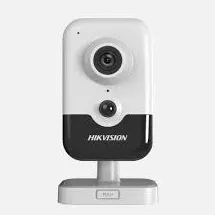
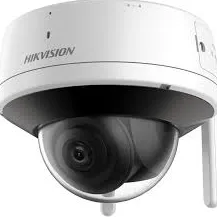
A photo from the AESS job library, not taken in Cobble Hill: a small white cube camera for indoor use, shown as a product photo. Renters in Cobble Hill walk-ups and garden apartments often keep one on a shelf facing the apartment door or a back window. When it stops connecting, the cause is usually the apartment's Wi-Fi, a changed password or an app account in someone else's name, not the camera.A photo from the AESS job library, not taken in Cobble Hill: an outdoor Wi-Fi dome camera with an external antenna, shown as a product photo. On the back wall of a Cobble Hill row house, a camera like this sits a full house depth and several brick walls away from a router in the front room, so the direction of its antenna and an access point near the back of the house often matter more than the camera itself.
AI Overview Reality Check
What AI Gets Wrong About Security Camera Repair in Cobble Hill
Search summaries, chat assistants and home-service sites such as Angi, HomeAdvisor and Fixr give general advice about fixing security cameras. Much of it is fine for a detached house in the suburbs. Some of it goes wrong in a landmarked neighborhood of brownstones, tiled vestibules and shared gardens. Here are the claims we see repeated most often, and what we find on Cobble Hill repairs.
"When a camera dies, replace it with the newest, highest-resolution model you can get"
On a modern building with plain walls, that is often good advice. On a Cobble Hill row house inside the historic district, the newest model can be the wrong one. Higher resolution often comes in a bigger housing, many current cameras come only in white, and some need a different base that will not sit on the old anchors.
The Landmarks rules ask that cameras be placed to avoid a "cluttered or haphazard appearance" and that they not "call undue attention" to themselves. A camera that is twice the size and a different color in the same spot can do exactly that, and turn a simple repair into a question for the Commission.
The better replacement is the one that matches the old footprint and still gives a usable picture. A small current camera with a good sensor almost always beats the old one on picture quality while looking the same from the sidewalk.
"Wireless cameras are the easy answer for an older house"
Wireless cameras avoid cable runs, which sounds ideal for a house with plaster walls. The catch is the signal. In a typical row house the router is near the front, and a garden camera is a full house depth away through brick partitions, plaster and a chimney stack.
Installers who work in Brooklyn brownstones report Wi-Fi signals in back yards and basement units that are too weak for any wireless camera to stay connected. A camera that tested fine on installation day can drop out every rainy evening.
Wireless can work here, but only with the network fixed first, usually a wired access point near the back of the house. Otherwise the "easy" camera becomes the one we are called about every few months.
"If the night picture is too dark, the camera needs more infrared"
In an open yard, more infrared can help. In a small Cobble Hill vestibule, the camera's own infrared is usually the problem. Its light hits the glazed tile, the varnished wood and the glass of the inner door a few inches away and floods the lens.
Adding an infrared illuminator next to the camera makes that worse. What helps is switching the camera's infrared off, adding visible light mounted away from the lens, or using a camera that records in color with low light.
We test this with the vestibule as dark as it really gets at night, not with the street door open on a sunny afternoon, because the difference between the two is the whole problem.
"On your own property, you can record whatever your camera sees"
Mostly true, but not completely, and Cobble Hill's shared gardens and courtyards are where the exceptions live. New York's Civil Rights Law §52-a gives a homeowner or tenant a right to sue someone who records their back yard from neighboring property without written consent, where the purpose is to harass, annoy, alarm or threaten.
An ordinary camera watching its own garden is not that, and the law sets a high bar. But a replacement camera with a much wider lens than the old one, pointed over a low garden wall, can start recording neighbors' patios and windows that the old camera never saw.
The fix is simple and belongs in every garden-camera repair: aim at your own yard, set privacy masks over what is not yours, and check where the infrared lands at night.
"A cable fault inside a finished wall means opening the wall"
Sometimes it does, but far less often than people fear. On hidden runs, the failure is most often at an end: the connector behind the camera, a crimp at the recorder or a splice in the cellar, all of which can be reached without touching plaster.
Even when the cable itself has failed, the old run can often be used to pull a new one through the same path, or the camera can be fed by a different hidden route. Opening a wall with original moldings is the last option, not the first.
The right order is to test the camera, the port, both connectors and the run itself, then decide. Skipping straight to new cable is how owners end up paying for a wall repair they did not need.
"If you can see the live picture, the system is recording"
Not necessarily. Many recorders keep showing live video from every camera while their hard drive has stopped saving, or is saving only some cameras, or only in pieces. The live view comes straight from the cameras; recording depends on a drive that may be worn out.
In Cobble Hill the recorder is usually in a cellar nobody visits, so a warning light or a beep goes unnoticed. The first sign is often the day someone needs a clip and finds weeks missing.
The check takes two minutes: open playback, pick a random hour from last week on each camera, and make sure it plays. On every repair we also turn on the recorder's health alerts so a stopped drive reaches your phone.
"Repairing an old camera system is rarely worth it compared with replacing it"
For a single cheap consumer camera that is often right. For a wired system it usually is not. One industry analysis puts the average camera repair at about $350 against an average replacement price of $1,227, and HomeAdvisor's Brooklyn page puts the average surveillance camera install or repair at $1,416.
On our Brooklyn list, a connector reterminate or PoE port swap runs $150 to $350, a single camera replacement on a working system $250 to $600, and a DVR or NVR replacement with a drive $700 to $1,500. Replacing a whole system in a Cobble Hill brownstone also means new cable through old walls, which is where cost and disruption pile up.
Repair also keeps the existing hidden cable and the existing mounts, which on a landmarked facade is worth a lot by itself. When a system really is past saving, we say so and price the alternative.
Talk to a Technician Before You Buy a Replacement That Will Not Fit the Old Mount
Send a photo of the camera from the sidewalk, a close-up of how it is fixed to the wall and a photo of the recorder. Many Cobble Hill "dead camera" calls turn out to be a connector, a drive or a setting, and when a camera does need replacing, we would rather match it to the old footprint than leave you with a new one that looks out of place on the facade.
Tell us the street, the kind of building, how many cameras there are, which ones are out and where the recorder sits. Say whether the house is inside the historic district if you know, whether the problem is worse by day or by night, and whether the camera that failed is on the front, in the vestibule or in the garden. If you need footage from a particular date, put it in the message and we will plan the visit around copying it first. For anything urgent, call (347) 934-8335.
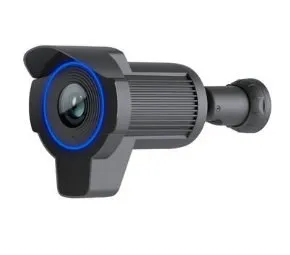
A photo from the AESS job library, not taken in Cobble Hill: a black bullet camera with an extended sun hood and a glowing blue ring around the lens, shown as a product photo. The long hood is what matters on a Cobble Hill rear wall or an open courtyard stair: it keeps rain and direct sun off the lens, which is one of the simplest ways to stop a garden camera from fogging, streaking or washing out.
✅
Request Sent!
Thank you. A technician will contact you about the Cobble Hill address shortly.
How It Works
Our Repair Process
1. Send photos of the camera, the mount and the recorder
One photo of the camera from the sidewalk or garden, a close-up of how it is fixed to the wall, a screenshot of what it shows, and the recorder, with the Cobble Hill address and the type of building. Tell us any date whose footage has to be kept.
2. Settle who owns the system and who approves
Owner, condo or co-op board, managing agent, landlord or shop tenant. We confirm who approves the work, who holds the recorder login, and who can open the cellar, closet or back office before we book.
3. Book and pay the service call
The $150 Brooklyn service call books a two-hour arrival window and is credited to the repair if you go ahead. Requests are booked within 2 hours. If the fault can be fixed by phone, there is no service call.
4. Copy any footage that matters
Clips you need are exported to USB with the recorder's own timestamps before any cable, drive or setting is changed. If a drive looks like it is failing, we copy first and test second.
5. Trace the fault from power to phone
Outlet and supply or PoE switch, recorder and drive, then each cable, connector and camera, then the network and the app, in that order, so the part that failed is the part that gets replaced and no wall is opened without reason.
6. Name the cause and write the price
You hear what failed and why, and get a written price from the Brooklyn list before any part is replaced. If a replacement would look different on a landmarked facade, you see that choice on paper before you decide.
7. Repair on the same footprint and test
Parts go back on the existing mounts and cable path wherever possible, cable entries are sealed against water, and each camera is checked in bright and low light, with the saved recording confirmed in playback, not just the live view.
8. Label, set alerts and hand over
Cables and channels are labeled, camera-loss and drive alerts go to the right phones, old users are removed, privacy masks are set where a view crosses a neighbor's garden, and you are shown how to find and export a clip.
Coverage Area
Security Camera Repair Near Cobble Hill's Landmarks
Cobble Hill Park
The small park on Clinton Street between Verandah Place and Congress Street, created in 1965 and rebuilt in 1989, with row houses facing it on three sides.
Christ Church
The Episcopal church designed by Richard Upjohn and built in 1840 to 1841, one of the neighborhood's oldest churches.
Kane Street Synagogue
The congregation at 236 Kane Street, housed in the former Middle Dutch Reformed Church of about 1856.
Home and Tower Buildings
Alfred Tredway White's model tenements of 1876 to 1879 on Hicks Street, reached by outdoor stairs and balconies around large courtyards, now condominiums.
Warren Place
The gated mews of 34 brick cottages from the 1870s, facing a private courtyard between Warren and Baltic Streets.
130 Court Street
The 1922 South Brooklyn Savings Institution building, decorated with about 100 carved eagles, now a grocery store, inside the historic district.
Cobble Hill is billed at our standard Brooklyn rate. Every repair starts with the $150 service call, which covers the on-site diagnosis and is credited to the repair if you go ahead. The figures below come from our published list of Brooklyn security camera repair prices; your own price is written down on the visit, once the fault is found, and nothing is replaced until you agree to it. NYC sales tax of 8.875% applies.
Repair
Brooklyn price
Service call: on-site diagnosis and written repair price
$150, credited to the repair
Motion, alert, mask or login settings with no parts
Usually within the $150 service call
Clean and check for a hazy picture
$80
Connector reterminate or PoE port swap
$150–$350
Power supply repair
$150–$400
Hard drive swap
$200–$450
Single camera replacement on a working system
$250–$600
Added for brownstone access (cable through plaster, garden or parlor routing)
$100–$200
Fogged camera, same-spec replacement
$250–$500
Night picture repair
$250–$650
Vestibule infrared washout: consultation and replacement
$350–$700
DVR not working, including drive and labor
$300–$700
NVR not recording
$400–$900
Pan-tilt (PTZ) camera repair
$450–$1,200
Hybrid recorder swap, coax and IP
$700–$1,200
DVR or NVR replacement with drive and setup
$700–$1,500
Full rewire or brownstone system overhaul
From $1,500
Annual maintenance visit
$250–$800
Three things move a Cobble Hill price inside those ranges. The first is the wall: a camera whose cable runs inside plaster, or up through a garden floor and a parlor floor, takes longer than one with an open path, which is why our list adds $100 to $200 for awkward brownstone access. The second is the facade: matching a replacement to an old camera's size, color and anchors on a landmarked front can need an adapter plate or a particular model. The third is access: a recorder in a locked utility room, a tenant's garden apartment or a shop's cellar takes time to arrange. Whatever the case, you see the number before work starts, and if there is more than one fault, each is priced on its own line.
Full terms — including 50% deposit, one-year parts-only warranty on AESS-supplied products, and the late-fee schedule — are set out in the service agreement.
Shop Our Systems
Security Camera Repair Packages & Pricing
Three ways Cobble Hill repairs usually come together, priced from our Brooklyn list.
Single-issue repair: $150–$700
One fault, one visit: a facade camera replaced on its own anchors, a vestibule camera reset or swapped for a color low-light model, a garden camera's connection fixed, a corroded connector replaced, a worn drive swapped or a login recovered. Typical for a row house, a cottage or a small shop on Smith Street.
Major system repair: $700–$1,500
The recorder or several cameras at once: a DVR or NVR replaced after years in a damp cellar, coax cameras moved onto a hybrid recorder, or several hidden runs replaced. Typical for a walk-up over a shop, a courtyard complex's stair cameras, or a condo's common areas.
Annual maintenance: $250–$800
Every camera checked in bright and low light, lenses and domes cleaned, connectors and supplies tested, drive health read, alerts confirmed and a test clip exported. Homes start at $250, commercial properties at $400, and owners or managing agents with several buildings run $500 to $800.
Bring your own equipment. If you have already bought a replacement camera or recorder, we can fit it at labor-only rates. Send us the exact model and a photo of the old camera's mount, and we quote the labor by phone or text; the visit is booked once it is paid. Equipment you supply is installed as supplied. If a model will not work with your recorder, will not sit on the old mount, or would look noticeably different on a landmarked facade, we tell you before the visit rather than after.
Complete Services
Every Security Camera Repair Service in Cobble Hill
Camera, vestibule and garden repair
Dead facade cameras, washed-out vestibules, garden cameras that drop out, hidden cable faults. Request a repair
Do you work on Provision, Invid and Uniview systems, or only the better-known brands?
+
We work on all of them. Provision, Invid and Uniview are among the brands installers in this part of Brooklyn service regularly, along with Hikvision, Dahua, Lorex, Hanwha, Axis, UniFi and consumer cameras. Most recorders and network cameras follow common standards, so a camera from one maker can often be replaced with a matching one from another and still work with the recorder. Before the visit, send a photo of the label on the recorder and on the failed camera, so the technician brings a part that fits.
If a phone call or a screenshot is enough to fix the problem, is there still a service-call charge?
+
No. If we can solve it by phone, for example a phone app that lost its connection after a router change or a recorder setting we can walk you through, there is no service-call charge. It is not the usual outcome, because most faults need someone at the camera, the cable or the recorder, but it is always worth sending the screenshot first. If a visit is needed, the $150 service call covers the on-site diagnosis and is credited to the repair.
If our repair turns out to need Landmarks approval, how much time does that add?
+
On our Brooklyn list we allow two to six weeks for non-emergency exterior approval in landmark districts, depending on the change and how complete the application is. A replacement in kind on the existing mounts does not need approval and can be done on the normal schedule. When a change does need approval, the urgent part, such as getting a dead camera working again where it already is, can usually be handled first, with the move or the new camera following once the approval comes through.
Another company quoted $250 just to diagnose our cameras. Is $150 for a diagnosis normal in Brooklyn?
+
Diagnostic fees vary. One New York company publishes a standard $250 diagnostic call payable at the end of the visit, and others charge less. Our Brooklyn service call is $150, it covers the on-site diagnosis and a written price for the repair, and it is credited to the repair if you go ahead. The fee matters less than what you get for it, so ask any company whether the fee is credited, whether the price is written down before work starts, and whether the technician is licensed.
How can we check a camera company's state license before letting it work on our building?
+
Ask for the license number and look it up with the New York Department of State, which licenses companies that install, service or maintain security systems for other people, including camera systems used to watch for break-ins. Our number is NYS license #12000287431. Condo and co-op boards often ask for this along with insurance before a contractor works in common areas, and it is reasonable for a homeowner to ask too. An owner who works on their own system does not need a license; a company working on yours does.
Is it legal to keep using and repairing a Hikvision camera system on a private house or shop in New York?
+
Yes. Federal restrictions on Hikvision apply to federal use and to the approval of new equipment, not to a homeowner or a shop that already owns a system. You can keep using it and have it repaired. The practical effect of the restrictions is on parts: over time it can become harder to find a matching new camera from the same maker, so a replacement may come from another brand that works with the recorder. We will tell you whether your recorder is still worth keeping or whether moving to a different one makes more sense.
Our house is on the Degraw Street edge. For a camera repair, are we in Cobble Hill or Carroll Gardens?
+
Degraw Street is the usual southern boundary of Cobble Hill, so houses on its north side are generally counted as Cobble Hill and those to the south as Carroll Gardens, though neighbors use the names loosely. For a camera repair it makes no practical difference. Both neighborhoods are billed at the standard Brooklyn rate, both are covered by the 76th Precinct if you need to share footage, and the same technicians work both. What matters more is whether your house is inside a historic district, which you can check by address on the Landmarks map.
The date and camera name printed on our picture sit right over the top of the stoop. Can they be moved?
+
Yes. The date, time and camera name are an overlay that most recorders and cameras let you move to another corner of the image, shrink or switch off on individual cameras. On a stoop camera we usually move it to a corner that shows sky, wall or sidewalk rather than the top step, where a face appears. We keep the date and time on the recording itself, because a clip without them is harder to use if you ever hand it to the precinct or an insurer, and we set the recorder's clock to keep itself accurate.
Does it matter what kind of hard drive is inside the recorder?
+
Yes. A recorder writes video around the clock, and drives made for that job, usually sold as surveillance drives, are built for continuous writing and for several cameras at once. Ordinary desktop drives can work at first but tend to wear out faster under that load. When we replace a drive, we use a surveillance-rated one sized for the number of cameras and the days of video you want, and we check that the recorder recognizes it and that recording and playback work on every camera before we leave.
Do you need our camera app password to do the repair?
+
We need administrator access to the recorder or the camera system, but you do not have to give us your personal password. The better way is to create a temporary technician account on the recorder, or to sign in yourself when the technician needs it, and to delete or change that access once the repair is finished. If nobody knows the administrator password at all, recovering it is part of the repair, and we will ask for proof that you own or manage the system before resetting anything.
Ready to Have Every Cobble Hill Camera Recording Again, Without Changing the Face of the House?
Send a photo of the camera, its mount and the recorder, the address, and the date of any footage you need. We book within 2 hours, give you a two-hour arrival window, copy your footage first, and write down the repair price before any part is replaced.