Vestibule camera dark between the two apartments, a yard camera blinded by Conduit Boulevard headlights, or a Liberty Avenue store recorder that stopped saving? City Line camera repair, booked within 2 hours: (347) 934-8335
Brick Two-Family Rows Over Raised Cellars · Three-Family Rentals · Frame Houses Off Liberty Avenue · Stores With Apartments Above
Security Camera Repair in City Line
Any Brand, Any Installer · One Recorder or Several Households · Footage Copied First · Written Price Before Parts
Security camera repair in City Line starts with our $150 Brooklyn service call, which pays for the on-site diagnosis and is credited to the repair if you go ahead. On our published Brooklyn list most single faults cost $150 to $700, and a replacement recorder or a rewire of several cameras runs $700 to $1,500. We fix systems that other people put in: the vestibule camera both apartments of a brick two-family rely on, the yard camera of a three-family that is rented floor by floor, the side-driveway camera of a frame house near Liberty Avenue, and the counter and door cameras of a shop with the owner's family living upstairs. Requests are booked within 2 hours, visits come in two-hour arrival windows, and you get the cause and a written price before any part is replaced.
Every price on this page comes from our published Brooklyn camera repair list, and your own price is written down before work begins
Rated 4.7★ across 201 Google Reviews
Reviewed and updated November 12, 2026, against City Limits reporting on City Line's Bangladeshi community and the co-naming of Forbell Street; Wikipedia's entries on City Line, Brooklyn Community Board 5, the Cypress Hills Houses and the Grant Avenue and Euclid Avenue stations; NYCHA's address listing for the East New York City Line development; Redfin's City Line market page; neighborhood housing descriptions from local real estate and neighborhood guides; Amnesty International's 2021 camera count; NYS Focus on the NYCHA camera lawsuit; City Council testimony on NYCHA CCTV; News 12 on Ring's police-request change; Brick Underground on tenants and landlord footage; HomeAdvisor's Brooklyn cost page; NYC 311 on camera registration; HPD on property registration; and the New York Department of State on installer licensing. · Abstract Enterprises Security Systems, NYS license #12000287431 · crews dispatched from our Troy Avenue office in Brooklyn
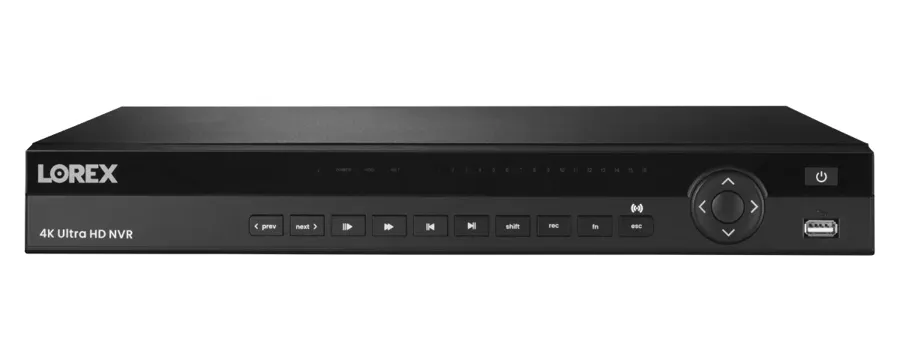
A product photo from the AESS job library, not taken in City Line: the front panel of a 16-channel desktop network video recorder. In a City Line two-family this box usually sits on a shelf in the raised cellar near the meters, sometimes in the downstairs owner's closet and sometimes, awkwardly, in the rented apartment upstairs. In a Liberty Avenue store it is under the counter or in the back room. Most repairs begin here, because the recorder keeps the footage, logs which camera dropped and when, and decides what quality of picture is actually saved.
City Line Camera Repair Request
Two-family, three-family, frame house, walk-up or Liberty Avenue store: send the address and what the screen shows, and a technician calls back with the next step
✅
Request Sent!
Thank you. A technician will contact you about the City Line address shortly.
25+
Years Experience
✓
Same-Day Estimates
100%
Licensed & Insured
4.7★
201 Google Reviews
Owner-operated since 2002 · Thousands of jobs completed · Booked within 2 hours
Security camera repair in City Line is usually a repair for more than one household at once. The typical house here is a brick two-family with a raised cellar, a short stoop and a small entry vestibule that splits the downstairs apartment from the upstairs one, and the listings on the market this year are mostly two-families, three-families and buildings with a store on the ground floor and apartments above. So the camera that failed is rarely just one person's camera. It is the vestibule camera that both apartments count on, the yard camera a landlord watches for a tenant he has never met, or the store camera whose recorder sits in the cellar of the family that lives over the shop. A repair has to fix the picture and also sort out who owns the recorder, who holds the password and which phones should see which cameras. Send a photo of the recorder screen to (347) 934-8335 or on WhatsApp, tell us who lives on each floor, and we will tell you what kind of fault it looks like and what that repair costs on our Brooklyn list before you book.
Looking at your photos costs nothing. The $150 service call covers the on-site diagnosis and is credited to the repair if you go ahead.
We work under New York State license #12000287431, the state license required of companies that install or service security and CCTV systems for other people.
We repair any brand and any installer's system, including systems a relative put in, and we say so when an old camera or recorder is not worth the money to fix.
The Neighborhood
Why City Line Properties Need Security Camera Repair
City Line is the far eastern corner of Brooklyn, a section of East New York that takes its name from the old boundary between the City of Brooklyn and Queens County before the 1898 consolidation. Definitions of its edges vary: one common description runs from Atlantic Avenue down to Conduit Boulevard and from Euclid Avenue east to the Queens line, while Wikipedia describes it as bordered by Cypress Hills to the north, Ozone Park to the east and the Shore Parkway to the south. Liberty Avenue is the main shopping street, the A and C trains stop at Euclid Avenue and the A at Grant Avenue, and the neighborhood sits in Brooklyn Community Board 5 and the NYPD's 75th Precinct. That is the background. For a camera repair, what matters is who lives in each house and how the system was put together for them.
Most of the housing is the attached brick two-family: two stories over a raised foundation, a shallow stoop, a small iron-railed front garden and a cornice line, with a ground-floor entry vestibule that separates the two apartments. Neighborhood histories say wooden cottages and two-story frame houses went up first on streets like Belmont Avenue, Lincoln Avenue and Wyona Street, and that brick row houses and small apartment buildings later replaced many of the older wood homes. There are also four-to-six-story walk-ups and inter-war brick multifamily buildings. The mix matters on a repair because cable that leaves a brick facade may run through a frame wall a few houses down, and a camera bracket that holds for years in mortar can work loose in old siding.
The households inside those houses matter even more. City Line draws owner-occupants, extended families and investors looking for two- and three-family income properties. Redfin put the neighborhood's median sale price at $898,000 in March 2026, and the homes listed for sale were mostly two-families, three-families and mixed-use buildings, including one on Liberty Avenue with a commercial first floor and two apartments above. City Limits reported in 2013 that more than 2,000 Bangladeshi residents lived in City Line, that families bought adjacent houses on Forbell Street, and that the stretch of Forbell above Liberty Avenue was co-named Mizanur Rahman Way. In practice that means we regularly see one family across two attached houses, a grandparent downstairs with a son's family upstairs, or a landlord who rents both floors and lives somewhere else. Each of those arrangements changes what "fix the cameras" means.
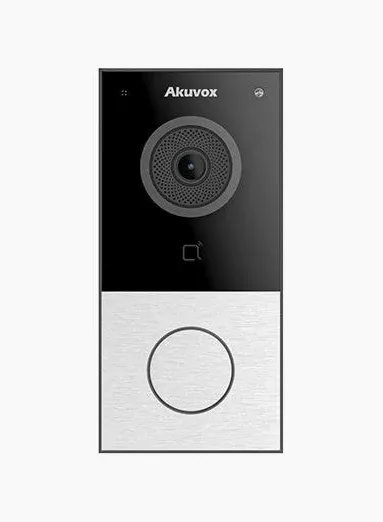
A product photo from the AESS job library, not taken in City Line: a narrow video door station with the camera lens at the top and one large round call button. On a City Line two-family, a station like this or a separate camera often watches the outer door of the shared vestibule, and when it fails both apartments lose the picture at once. Part of the repair is deciding which household's screen or phone it should ring.
Then there is the question of what the cameras are meant to catch. East New York is not short of cameras overall: in Amnesty International's 2021 count it was the most surveilled neighborhood in all three boroughs studied, with 577 cameras at its intersections. NYCHA's two developments at City Line's edges, the Cypress Hills Houses, finished in 1955 between Linden Boulevard, Sutter Avenue, Euclid Avenue and Fountain Avenue, and the East New York City Line development of 33 buildings on Hegeman Avenue, Fountain Avenue and Logan Street, have their own CCTV, and NYCHA told the City Council in March 2025 that a CCTV project was under construction at Cypress Hills. None of those cameras looks at your stoop, your vestibule, your side driveway or your shop counter. The footage that answers "who took the package" or "who broke the gate" is almost always the footage from the house's own system, which is why a dead camera here gets noticed the morning after something happens on the block.
So a City Line camera repair is two jobs done together. The first is the technical one: power, cable, connector, camera, recorder, drive, network and app, each tested until the part that failed is found. The second is setting the repaired system up for the house as it is lived in today: which floor sees which camera, who is the administrator and who gets the alerts. Many owners pair the repair with a look at the buzzer or intercom on the same vestibule door, because the two systems share that one entrance.
Six City Line facts that shape a camera repair
Two-family houses are the norm. The most common building is an attached brick two-family over a raised foundation, with a shared entry vestibule between the units. One camera there usually serves two households, and one recorder often serves the whole house.
The market is multi-family. Redfin's City Line page showed a $898,000 median sale price in March 2026, up 0.9% from a year earlier, with listings mostly two-family, three-family and mixed-use. Houses change hands, and camera systems change hands with them, often without passwords.
Families own houses side by side. City Limits described families buying adjacent houses on Forbell Street. That produces systems that were cabled across two cellars, or two systems that a family wants to watch as one.
Wood and brick sit on the same blocks. Early frame cottages on Belmont Avenue, Lincoln Avenue and Wyona Street were followed by brick rows. Cable paths, mounts and water entry are different on each, and some houses have both.
Public cameras are pointed elsewhere. Amnesty counted 577 intersection cameras in East New York in 2021, and both nearby NYCHA developments have their own CCTV. Your stoop, yard and counter are covered only by your own system.
Repair is priced by the fault. HomeAdvisor's Brooklyn page puts the average surveillance camera install or repair at $1,416, with a typical range of $680 to $2,145 across job sizes. Most single repairs on our Brooklyn list fall between $150 and $700.
Where this page applies. It covers City Line from the blocks around the Euclid Avenue and Grant Avenue stations east to the Queens line, and from the Atlantic Avenue side down toward Conduit Boulevard, including Liberty Avenue, the eastern blocks of Pitkin Avenue around the stations, Forbell Street, Fountain Avenue and the streets between them. The blocks to the north are on our Cypress Hills security camera repair page, the rest of the district on our East New York security camera repair page, and the borough as a whole on our main Brooklyn security camera repair page. City Line is billed at the standard Brooklyn rate. Across the Queens line, Ozone Park is covered by our Queens security camera repair page.
Same-Day Repair in City Line
Need Repair in City Line? A Vestibule Camera Both Floors Depend On, a Yard That Goes Black at Night, or a Store Recorder Nobody Can Log Into
Urgent calls from City Line tend to arrive in three forms. The first is the shared-door failure: the camera on the vestibule or front door of a two-family has gone dark, and now neither apartment can see who rang, packages are being left in a doorway nobody can watch, and the upstairs tenant is texting the owner downstairs about it every evening. The second is the night failure on the side or back of the house: a driveway or yard camera that looks fine at noon shows nothing after sunset, or flips between color and black and white every time a car passes. The third is the locked recorder: a store or a house changed hands, or the relative who set the system up moved away, and now the recorder is running but nobody knows the password, so nobody can pull the clip that matters.
If footage from a specific day matters, leave the recorder running and do not unplug, restart or reset it. Recorders write over their oldest video once the drive fills, so the clock is already running, and a restart or a factory reset can clear both the footage and the log that shows when a camera dropped. Text us the date and time you need, the camera it should be on and a photo of the recorder's front or screen. We plan the visit so the clip is copied before anything else is touched, and if the password is lost we tell you up front what the maker requires to unlock it.
For everything else the route is short. The $150 Brooklyn service call books a two-hour arrival window. The technician finds the fault, tells you what failed and why, and writes down the price from our Brooklyn list before any part is replaced. Most single-fault repairs are finished on the same visit, with the camera checked in daylight before we leave and its low-light picture checked by covering the lens and lighting the scene the way the yard or driveway looks after dark.
What We Install
Security Camera Repair Services in City Line
Every repair below is priced from our Brooklyn camera repair list. The service call pays for finding the fault; the repair itself is priced by what failed, how many cameras it touches and how hard each cable is to reach, whether that is a vestibule camera on a two-family off Liberty Avenue or a ceiling camera in the back room of a store.
Shared-entrance camera repair
The vestibule, stoop and front-door cameras that two or three apartments rely on. We repair or replace the camera, then set the recorder and app so each household sees the entrance, and only the owner sees the cameras that belong to the owner's own floor.
Household and login sorting
Systems that were set up when one family lived in the house and now serve a tenant too, or the reverse. We create separate users, hide the cameras each one should not see, recover or reset the admin password and remove phones that belong to former tenants or previous owners.
Recorder and hard drive repair
DVRs and NVRs that stopped saving, beep, restart or report a disk error, and drives worn out by years of nonstop recording in a warm cellar. We copy what can be copied, replace the drive or recorder, and confirm playback before we leave.
Night picture and headlight repair
Yards and side driveways that go black after sunset, infrared bouncing off a fence or a neighbor's wall, and cameras that flip between color and black and white as cars pass on the avenues. We separate a failing camera from a changed scene and fix whichever it is.
Dead camera diagnosis
One camera dark or several at once: power, supply, PoE switch port, connector, cable, camera or recorder channel, tested in that order so you pay for the part that failed and not the three around it.
Cable and connector repair
Connectors that let water in where cable leaves the brick, runs pinched behind siding or a storm door, cables cut during a roof, gutter or facade job, and splices someone made with tape in the cellar. Reterminated or replaced along the existing path when it can be reused.
Two-house and multi-house systems
Families with attached houses side by side, or one owner with several two-families on nearby blocks. We repair the cable or network link between cellars, or set separate recorders so they can be watched together without being merged.
Store and mixed-use repair
Counter, door, aisle and back-room cameras in Liberty Avenue shops, and buildings where the store's cameras and the apartments' cameras share one recorder. We repair the picture and draw a clean line between the business and the households above it.
Footage export for incidents
Clips for the 75th Precinct, an insurer, a landlord-tenant dispute or a court, exported in the recorder's own format with its own timestamps, plus a short lesson so someone in the family can do it next time without calling anyone.
Building Specialists
Security Camera Repair for City Line's Architecture
The same failed camera is a different repair on each kind of City Line building, because the cable path, the mounting surface, the recorder's location and the person who signs off all change. These are the buildings we see most, and the people who usually live in them.
Brick two-family rows
Two stories over a raised cellar, a shallow stoop and a small vestibule between the units. Cameras sit over the outer door, under the cornice or on the front wall beside the stoop, with cable dropping to a cellar recorder.
Three-family houses
One floor more and one household more, often all three rented. The recorder belongs to a landlord who may live elsewhere, and three sets of tenants depend on the entrance camera.
Frame houses and cottages
Older wood houses, many under vinyl or aluminum siding, that survive among the brick. Cable runs behind siding and through wood framing, and water follows it in wherever a hole was not sealed.
Attached houses in one family
Two neighboring houses owned by parents and a grown child, or by brothers, often with one recorder serving both, or with two systems the family wants to see on one phone.
Walk-ups and inter-war apartment buildings
Four-to-six-story brick buildings with a lobby door, stair halls and a cellar, where cameras were added by different hands over the years. We start with an inventory of what records.
Stores with apartments above
Liberty Avenue buildings with a shop on the ground floor and two apartments upstairs, where the business cameras and the residential entrance often run on one recorder.
Brick two-family rows: one vestibule, two households, one camera
On the standard City Line two-family, you climb a short stoop to an outer door, step into a small vestibule, and choose between the door to the downstairs apartment and the stairs to the upstairs one. That vestibule is the single most important spot on the house for a camera, and it is also the one most often set up wrong. The camera over the outer door was usually installed by or for the owner, wired to a recorder in the owner's cellar, and added to the owner's phone only. When a tenant moves in upstairs, the tenant has no way to see who is at the door, so packages pile up and buzz-ins are guesswork. When the camera fails, the tenant notices first and the owner, who may be at work or away, notices last.
A repair here starts with the camera itself. The usual faults are a connector that took water where the cable passes through the brick above the door, a plug-in power supply on a cellar shelf that finally died, or a camera that has been staring at the afternoon street long enough for its sensor to fade. The fix is often the connector or the supply, sometimes the camera, and occasionally the bracket, because a shallow stoop means the camera is close to head height and gets knocked. The second half of the job is the household setup. We can give the upstairs apartment its own user on the recorder with only the entrance camera visible, or send the entrance camera to a small screen or door station inside the vestibule, so each household sees the door without seeing each other's comings and goings beyond it.
Three-family houses: the camera is the landlord's, the door is everyone's
A third apartment changes more than the rent roll. Under HPD's definitions, a house with three or more apartments is a multiple dwelling, while one with one or two is a private dwelling, and the owner of a multiple dwelling has registration and building-maintenance duties that a two-family owner who lives in the house mostly does not. No general New York City law requires cameras in apartment buildings, so a broken camera in a three-family is not itself a violation. But in a house with three sets of tenants, the entrance camera is often what the landlord relies on to know whether the front door is being propped open, whether deliveries are disappearing and who has been letting strangers in.
The three-family repairs we see most involve a recorder the landlord cannot reach and a system nobody admits to managing. The recorder may be in a cellar that only the ground-floor tenant uses, or plugged into the internet router of a tenant who has since moved out. When we repair one, we move the recorder to a spot the owner controls when that is practical, put it on its own small backup so a tripped outlet in a tenant's space does not take it down, and leave a written list of cameras and channels so the next service call is short. If the owner lives out of the area, approval and payment can be done by text and email, and we confirm with the owner before we schedule any time with a tenant.
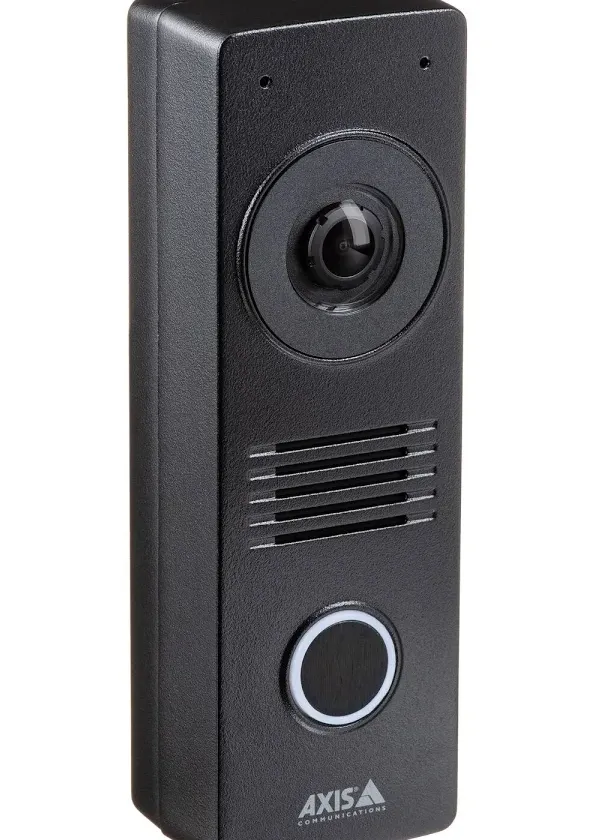
A product photo from the AESS job library, not taken in City Line: a black video intercom door station with a camera lens, a speaker grille and an illuminated call button. On a City Line three-family the entrance camera and the door station are often separate devices on separate systems. When the camera inside a station like this dies, the call still rings but nobody can see who is ringing, and we check which system it belongs to before we quote.
Frame houses and cottages: siding, studs and the hole beside the camera
The wood houses that remain between the brick rows, including on the streets where neighborhood histories place the first cottages, are repaired differently. A camera on a frame house is usually screwed through vinyl or aluminum siding into sheathing or a stud, and its cable goes through a hole beside it. If that hole was drilled straight in and level, with no drip loop below it and no sealant, rain follows the cable into the wall cavity and down to the connector. The camera then fails months later with green corrosion inside a junction box, and the owner sometimes finds a water stain on the inside wall first.
When we repair a camera on siding, we use a mounting block that sits flat on the siding profile, drill the cable hole at a slight upward angle from inside to out, leave a drip loop, seal the hole and replace the connector with a weatherproof one instead of taping the old one. If the stud is not where the old screws were, we move the bracket an inch to find wood rather than trusting the siding to hold.
Attached houses in one family: two cellars and one recorder
Families who own neighboring houses often want one picture of both. Sometimes a relative ran camera cable from one cellar into the other through the shared foundation wall, so one recorder serves both houses; sometimes each house has its own system and the family has two apps. Both setups fail in their own ways. A cable through a party wall can be crushed during work on either side, and when the house it starts in is sold or rented to someone outside the family, the other house loses its cameras overnight. Two separate systems are more robust, but they are harder to watch and easier to forget.
We repair whichever you have, and we will tell you plainly which one suits the way the houses are owned. When both houses will stay in the family, a single recorder with a properly protected cable or network link between cellars is fine, and we label it so a future plumber or contractor knows what it is. When one house may be sold or rented, we usually recommend a recorder in each house, linked in one app, so either house can leave the arrangement without taking the other's cameras with it. Either way, each house's owner should hold its own admin login.
Stores with apartments above: one recorder, two kinds of user
On Liberty Avenue a building with a shop on the ground floor and two apartments upstairs is common, and the owner may run the store, rent it out or live above it. The camera system in such a building has two jobs that pull against each other. The store needs counter, door, aisle and back-room cameras watched by whoever works there, and the residents need the street door and stairs watched by the people who live there. When both run on one recorder in the store's back room, every cashier can see the residents' hallway and every resident has to ask the store for footage.
The cleanest repair is to give each side its own users, its own cameras and, where practical, its own recorder, with the residential recorder somewhere the store staff cannot reach. Where a single recorder has to stay, we set permissions so store staff can view and export store cameras only, residents see only the residential entrance, and the building owner is the only administrator.
Field Notes
Field Notes: Why We Ask Who Lives on Each Floor Before We Quote
This is how we start nearly every City Line call, and why. Before we talk about cameras, we ask three questions: who owns the house, who lives on each floor, and whose phone the cameras are on today. It can sound nosy. It is the fastest route to the right repair.
On a two-family the answers decide where the technician goes first. If the owner lives downstairs and the recorder is in the owner's cellar, the visit is simple. If the owner lives elsewhere and the recorder is in a cellar the ground-floor tenant uses for storage, we need that tenant's agreement on a time, and the owner's approval for the work, before we book. If the cameras were set up by a relative who now lives in another state, we need to know before we arrive whether anyone has the admin password, because a lost password on some recorders means proof of purchase and a call to the manufacturer, which is better started the day before than in the cellar.
The answers also decide what "fixed" means. A vestibule camera that works again but still shows only on the owner's phone has not solved the upstairs tenant's problem, and an owner who sells next year will want every login documented. So the price we write down covers the part that failed and, where it is needed, the time to set each household up properly.
Fault by Fault
Cellar Power Boxes, Water at the Brick, Worn Drives, Passing Headlights and Lost Passwords: How City Line Camera Systems Break
Most of the systems we repair in City Line fail in one of six ways. Knowing which one you are looking at before the visit helps you decide whether a repair is worth it and what to have ready. Here is what each looks like on a City Line house, what usually causes it, and what the repair involves.
The power box on the cellar shelf
Older coax systems in City Line houses are usually powered from one metal or plastic box with a row of small fuses, or from a cluster of plug-in adapters on a power strip, sitting on a cellar shelf near the recorder. When two or three cameras go dark at the same moment and the rest are fine, the cause is almost always that box, one of its fuses or the strip it is plugged into, not three cameras failing at once. Network systems have the same weak point in a different form: the PoE switch that feeds power and data to the cameras. A single bad port takes one camera; a failing switch takes several at random.
Repair is a meter and a few minutes per channel. We test the output at each fuse or port, then at the far end of the cable, and replace the supply, the fuse, the switch or the strip. On most City Line houses we also recommend a small battery backup for the recorder and the supply, because both sit on the same cellar circuit as the boiler and the washer, and a tripped breaker or a short outage otherwise leaves the house unrecorded until somebody notices.
Water where the cable leaves the brick
On a brick two-family, the cable to an outdoor camera usually comes through the front or side wall in a hole beside the bracket. If the hole sits above the camera, or level with no drip loop, rain runs along the cable and into the connector or the junction box behind the camera. It can take a few years. Then the picture starts flickering in wet weather, goes pink or green, and eventually disappears. Opening the box shows corrosion on a BNC or RJ45 plug, sometimes on the camera's own pigtail.
The repair is a new weatherproof connector or a new pigtail, a sealed junction box, and a hole that is sealed and drips away from the connection. If the corrosion has run up the camera's own short cable into its housing, the camera is replaced.
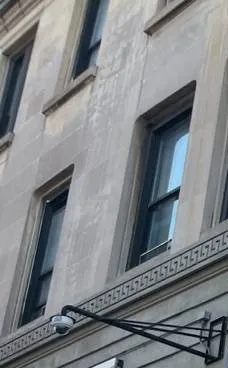
A photo from the AESS job library, not taken in City Line: a bullet camera on a long black steel wall arm under a carved Greek-key band on a pale stone facade with tall sash windows. City Line's rows are mostly brick rather than stone, but the arm is the same idea we use on them: it holds the camera out past a cornice or the edge of a stoop so it can see the sidewalk. Where the arm meets the wall is also where water and loose anchors show up first, so that is the first place we look.
The drive that wore out
A recorder that writes video around the clock wears out its hard drive. In a warm, dusty cellar next to a boiler, it happens sooner. The early signs are easy to miss: playback that skips, a recorder that restarts on its own, a beep nobody can explain, or an app that shows live video perfectly but returns nothing when someone searches for last week. Many owners discover it only when they need a clip, which is the worst possible time.
We read the drive's health on the visit. If it is failing, we copy whatever footage can still be read, replace the drive with one rated for continuous recording, and set the recorder to alert a phone when a drive fails or a camera stops sending video.
Headlights, street lamps and the switch to night mode
Cameras decide on their own when to switch from color to black-and-white infrared. On a quiet back yard that works. On a yard or driveway that faces a busy road, the camera sees headlights sweep across it every few seconds and keeps changing its mind: color, infrared, color, with the picture pumping bright and dark each time and the phone filling with motion alerts. Owners whose houses back onto the bigger roads at City Line's edges, including Conduit Boulevard, often read this as a failing camera.
The repair is usually settings, sometimes a different camera. We fix the switch-over time or the light level, add a delay so the camera does not flip on every passing car, mask the part of the view that is road, and if the camera is an older model without good backlight handling we replace it with one that keeps color in low light. A small light of your own over the yard often does more for the night picture than any camera upgrade, and we will say so if that is the case.
Passwords nobody has
In a neighborhood where houses are bought and sold as income properties and where systems are often put in by a relative, the most common thing standing between a family and its footage is not hardware. It is a recorder whose admin password left with the person who set it up. The recorder is running, the cameras are working, the live view is on the monitor, but nobody can search, export, add a phone or change a setting.
Some recorders can be reset through the manufacturer with the serial number and proof of purchase or ownership; some can be reset on site; some cannot be unlocked without clearing settings, and on a few, clearing settings risks the recordings. We tell you which kind you have from a photo of the label before the visit, export anything important before attempting a reset, and set up new credentials in your name, with a second administrator in the family so the same thing does not happen again.
Wi-Fi cameras on the far side of the party wall
Wi-Fi and battery cameras are popular in City Line because they avoid running cable through brick. They work well when the router is close and the wall between them is thin. They struggle when the router is in the upstairs apartment, the camera is on the back of the house, and there are two brick walls and a floor between them, or when the router belongs to a tenant who changes it. The symptom is a camera that drops off every evening when everyone is home streaming, or one that went offline the day a tenant moved out.
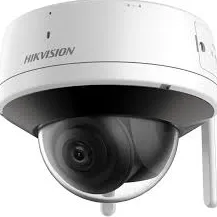
A product photo from the AESS job library, not taken in City Line: an outdoor Wi-Fi dome camera with an external antenna. On the back wall of a brick two-family, an antenna like this helps, but it cannot fix a router two walls and a floor away in someone else's apartment.
We check signal strength at the camera, not at the router, and whose network the camera is on. Sometimes a properly placed access point fixes it; sometimes the honest answer is a wired camera on that one wall. Either way, cameras that the owner depends on should be on the owner's network, not a tenant's.
Commercial Security Camera Repair
Business Security Camera Repair in City Line
City Line's businesses are mostly small, owner-run and close to home, and many of them share a building with the owner's family or with tenants. Their camera systems tend to be older, larger than the store needs in some places and too thin in others, and maintained by whoever happens to be around. These are the corridors and kinds of business we repair for.
Liberty Avenue
The neighborhood's main shopping street, lined with Guyanese, Bangladeshi and Caribbean shops and restaurants, halal groceries and South Asian clothing stores. Counter, door and stockroom cameras, usually with apartments above.
Pitkin Avenue near the stations
The blocks around the Euclid Avenue and Grant Avenue subway entrances, where foot traffic peaks at rush hour and storefront cameras look out at the sidewalk and the station stairs.
Atlantic Avenue at the north edge
Wider frontages and auto-oriented businesses along the avenue, where cameras watch parking, curbs and side doors as much as the counter.
Linden Boulevard and Conduit Boulevard
Commercial properties on the larger roads toward the south, where lots, gates and long cable runs to poles or fences are the common repair.
Houses of worship and community rooms
Mosques, churches and community spaces, several in converted houses, whose cameras were often donated or installed by members and are now maintained by a committee.
Landlords with ground-floor tenants
Building owners who rent the store and the apartments, and need the store's system and the residential entrance kept apart.
Counters, doors and the moment that matters
In a small store, there are usually three views that matter after an incident: the face of the person at the counter, the person coming in through the door, and the stockroom or back door. Many Liberty Avenue systems we see have more cameras than that, but not those three views done well. The counter camera is mounted high and wide and shows the cash drawer and the top of a head. The door camera faces the bright street and turns everyone into a silhouette. The back room has a camera that has been dark for a year.
A commercial repair is a chance to fix the views as well as the parts. We repair or replace the failed cameras, then aim and set the counter camera to show faces at the register, set the door camera for backlight, and confirm that the saved recording, not just the live picture, shows what it should. We also check that the clock is right and synced, because a clip with the wrong time on it causes problems the moment it is handed over.
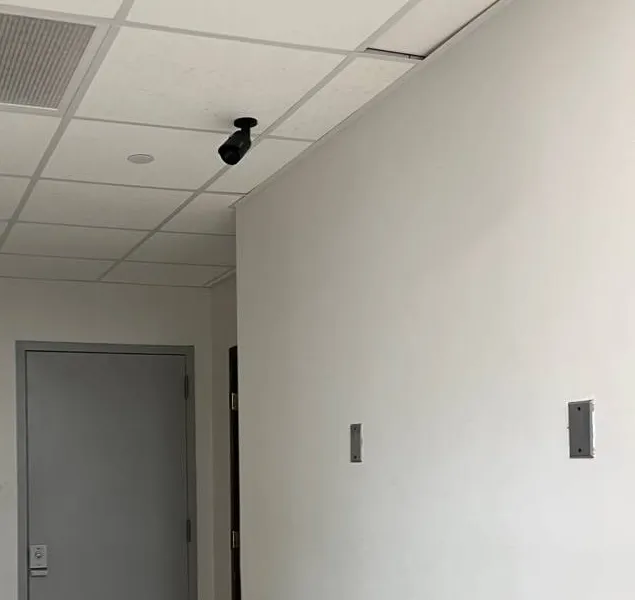
A photo from the AESS job library, not taken in City Line: a small black bullet camera hanging from a white ceiling-tile grid, aimed down a short hallway at a grey steel service door. In the back of a Liberty Avenue store this is the view that tends to go unwatched until something goes missing: the delivery or rear door, seen straight on, close enough to show a face.
Restaurants, groceries and long hours
Restaurants and groceries on Liberty Avenue are open early and late, and their cameras live with heat, steam, grease and refrigeration. Kitchen and grill cameras haze over within weeks; recorders tucked on top of a cooler or under a counter beside a fryer run hot and lose drives early; older coax cameras pick up interference when compressors start. These are cleaning, placement and cabling problems as much as camera problems. We clean and reseal domes, move recorders to a cooler and cleaner spot, and reroute or replace cable that runs alongside power lines.
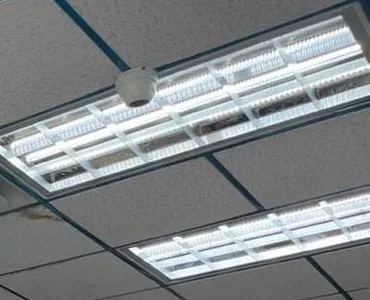
A photo from the AESS job library, not taken in City Line: a compact white dome camera on grey acoustic ceiling tiles beside a long louvered fluorescent fixture. In a Liberty Avenue grocery or restaurant, a dome this close to a light fixture can wash out at night, and one near a kitchen picks up grease on its bubble within weeks. Moving it a tile over is often part of the repair.
Houses of worship and community rooms
City Limits counted seven mosques in City Line in 2013, one large and six smaller, alongside churches and community organizations. Many of these occupy converted houses or storefronts, and their camera systems usually arrived as a donation or a volunteer project. When something breaks, the problem is often less the camera than the fact that nobody currently on the committee knows where the recorder is, what it is, or who holds the password.
We repair the system and leave it documented in the organization's name: a list of cameras and what each covers, the recorder's make and model, where it is and how to export a clip, with the admin credentials handed to whomever the organization designates in writing. For buildings used at set times, recording can follow a schedule so entrances and parking are covered when the building is empty.
Rules that touch a commercial camera repair
The installer needs a state license. New York's General Business Law requires a license from the Department of State for anyone who installs, services or maintains security systems for others, which covers CCTV used to detect or monitor intrusion, theft or movement. Owners working on their own property, or having an employee do it, are exempt. AESS works under NYS license #12000287431.
No city rule requires cameras. There is no general New York City law that requires a store or an apartment building to have cameras. Insurance policies and leases sometimes do, so check yours.
You can register cameras with the NYPD. Businesses and residents can tell the NYPD where their cameras are through NewYorkCityConnect.org, so detectives know whom to ask after an incident. Registration is voluntary, and it does not give the police live access to your system.
Footage requests follow a process. Brick Underground reported that landlords are generally not obligated to show tenants camera footage outside a legal process. In a store with apartments above, decide in writing who may release footage and to whom.
Combine visits when it saves you time. If the buzzer, intercom or door hardware on the same entrance also needs work, telling us before the visit lets one crew handle it.
Your Questions Answered
Security Camera Repair in City Line: Questions Answered
These are the situations City Line owners, landlords and shopkeepers bring to us most, grouped by the kind of property. Each answer starts with the short version.
One Family, Two Houses or Several Floors
My brother owns the attached house next to ours. Can one recorder in our cellar run the cameras on both houses?
Yes, and many families on City Line blocks already have exactly that, but it is worth deciding on purpose rather than by accident. Technically, cameras on the neighboring house can reach your recorder either by cable through the shared foundation wall or by a network link between the two cellars, with the cameras on his side powered from his side. The weak points are the link itself, which can be crushed or cut during plumbing, waterproofing or a renovation on either side, and the ownership, because if either house is later sold, rented to strangers or refinanced, the other house's cameras are suddenly on someone else's property.
If both houses will stay in the family for the long run, we repair or rebuild the link, protect and label it where it crosses the wall, and set two admin users so each brother controls his own cameras. If either house might change hands, we usually suggest a small recorder in each cellar instead, shown together in one app. That costs a little more now and saves a messy separation later.
We are buying a three-family in City Line to rent out. What should we check about the cameras before closing, and what should the seller hand over?
Ask the seller for three things in writing: the recorder's make, model and admin password, a list of every account and phone that currently has access, and a statement of whether the equipment is owned outright or leased through an alarm or monitoring company. Leased equipment may not convey with the house. Then ask to see the system working: every camera on the screen, playback from a few days earlier, and the drive's capacity.
After closing, the first repair visit should be a handover rather than a fix: we change every password, remove the previous owner's phones and any old tenants, update the recorder's clock and contact details, confirm the drive is healthy and check which apartments' cameras and outlets the system depends on. With three units, it is also the moment to decide which cameras each tenant should see, before the first lease is signed.
The upstairs apartment of our two-family is about to be rented for the first time. What should change on the camera system before the tenant moves in?
Three things: what the cameras see, who can see them, and what they depend on. Indoor cameras that watch the upstairs stairs, landing or anything inside the rented apartment should come down or be turned to face only the shared entrance. Outdoor cameras that point at the tenant's windows should be re-aimed or masked. The vestibule or front-door camera is usually the one camera the tenant should be able to see, so give them their own user with that camera only, or a small screen inside the door.
Then check what the system relies on. If the recorder, a camera power supply or the internet router is plugged into an outlet on the tenant's circuit or inside the tenant's space, move it to yours before move-in. Tell the tenant, in the lease or a short letter, which cameras exist and what they cover.
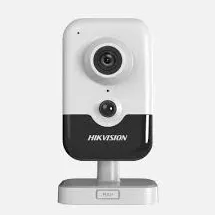
A product photo from the AESS job library, not taken in City Line: a small white cube camera made for indoor use. Families often put cameras like this on a shelf facing the stairs of a two-family while they live in the whole house. Before an upstairs apartment is rented, a camera like this should come down or be turned to face only the shared entrance.
Our house has a brick front, but the sides and back are wood. Why does that change the repair on the side camera?
Because the cable and the bracket behave differently in each material, and a fault on the side wall is often caused by where the two meet. A camera on brick is held by anchors in mortar or masonry and its cable usually goes straight through the wall; on wood siding the bracket is screwed into sheathing or a stud and the cable passes through a hole that has to be sealed against water running down the siding. Where a house was refaced in brick at the front, the cable may run from the cellar up inside a frame wall and out through the brick, with a junction or splice hidden in between.
On the visit we trace the cable from the camera back to the recorder, open any junction we find, and look for water at the transition. If the side camera keeps failing after rain, the repair is often a resealed hole, a drip loop and a weatherproof connector rather than another new camera.
Driveways, Yards and the Big Roads
Our back yard faces Conduit Boulevard, and at night the yard camera keeps flipping between color and black-and-white as the cars go by. Is it failing?
Probably not. The camera is doing what it is designed to do, switching to infrared when it gets dark and back to color when it gets light, but every set of headlights tells it the light has changed. The result is a picture that pumps all night, a recording that is hard to watch and a phone full of motion alerts from the road rather than from your yard.
The repair is mostly settings: a fixed switch-over time or light level, a delay so a passing car does not trigger a change, a motion mask over the part of the frame that is road, and a narrower view aimed at your yard and fence instead of past them. If the camera is an older model with weak low-light color, a replacement that holds color at night usually solves it outright. A motion light over the yard can help even more, and costs less.
Our two-family has a private driveway along the side, with the yard gate at the back. The driveway shows fine by day, but the gate is black at night. What is the fix?
A single camera at the front of a long driveway is being asked to do two jobs: see the cars at the street end and see a person at a gate thirty or forty feet away in the dark. Its infrared lights the near part of the driveway, the car and the side wall, and the bright reflection makes the camera turn its exposure down, so the gate at the far end goes black. Infrared bouncing off a light-colored wall a few feet away makes it worse.
The fix is either a second camera mounted near the gate, looking at it from a few feet away, or a light at the gate so the existing camera has something to see. Sometimes moving the camera a few feet off the side wall, or angling it down the driveway rather than across it, is enough. We test the result after dark, with the light the yard really has, before we leave.
Stores, Police Requests and the Block
We are selling the store on our ground floor but keeping the building and the apartments. How do we separate the cameras so the new store owner does not get our stairwell?
Decide which cameras belong to the store and which belong to the building, then make the system reflect that before the sale closes. The store usually keeps the counter, aisle, stockroom and its own door; the building keeps the residential street door, the stairs, the cellar and the back of the property. If they share one recorder in the store's back room, either move the building's cameras onto a new recorder in a spot you control, or keep the shared recorder but make yourself the only administrator, with the store owner given access to store cameras only.
Write the arrangement into the sale or the lease: who owns which equipment, who pays to repair it, and who can release footage. We document the final setup with a channel list both sides can keep, so there is no argument the first time something breaks.
Police can no longer ask for Ring video through the app. If detectives working a case on our block want our doorbell footage now, how does it reach them?
Directly from you, or through legal process. News 12 reported that Ring ended its "Request for Assistance" tool in January 2024 and that law enforcement can still access videos with a search warrant. In practice, detectives from the 75th Precinct canvass the block and ask owners to share clips voluntarily, and you decide what to give them. You can also register your cameras at NewYorkCityConnect.org so the NYPD knows to ask you.
What matters on the repair side is that the footage exists and can be exported. Many doorbells save clips only with a paid cloud plan, keep them for a limited time, or stopped saving after an app update. We check what your doorbell or recorder is actually keeping, how far back it goes, and how to export a clip with its original date and time. If it has not been saving, we fix that, so the next request can be answered the same day.
A few neighbors on our row want to link their cameras to ours so the whole block is watched. Can private houses share one system?
They can share footage, but we advise against sharing one system. Linking several houses' cameras to one recorder or one account means one person controls everyone's video, and when that person moves, falls out with a neighbor or forgets to pay a cloud plan, the whole block loses its cameras. It also creates privacy questions for tenants in the houses involved.
What works better is each house repairing and keeping its own system, aimed to cover its own frontage and a little of the sidewalk on either side, with clocks set correctly and an agreed habit of exporting and sharing clips when something happens. Coverage overlaps naturally from house to house that way, and nobody owns anyone else's footage. We can repair several houses on the same day and price each one separately.
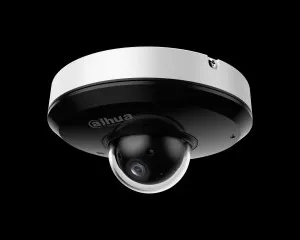
A product photo from the AESS job library, not taken in City Line: a small pan-tilt dome camera with a white body and a black lens bubble. Cameras like this turn up in City Line stores and in the hallways of houses where an owner wanted to look around remotely. Their motors and gears are the part that fails, and on a two-family we also check where the camera is allowed to turn, so it cannot be steered toward a tenant's door.
Equipment
Types of Security Cameras and Recorders We Repair
We repair systems from any manufacturer and any installer, including the kits families buy and put up themselves. This is what we find on City Line houses and stores, and what usually goes wrong with each.
Coax and HD-over-coax cameras
The older systems on many two-families, with cable from each camera to a DVR in the cellar and power from a fused box or adapters. Faults are connectors, supplies and aging sensors; a hybrid recorder can keep the cameras that still work.
Network (IP) cameras
Newer systems with one cable per camera carrying power and data from a PoE switch or the recorder itself. Faults are switch ports, terminations, firmware and settings that changed when the internet provider did.
DVRs, NVRs and hybrid recorders
The boxes on cellar shelves and under store counters. Drives, power, overheating, lost passwords and clocks that drifted after an outage are the common repairs.
Varifocal domes
Domes with an adjustable lens, used over store counters and long driveways. When focus drifts or the zoom no longer reaches, the lens motor or the settings are the usual cause.
Bullets with long hoods
The typical outdoor camera on a City Line front wall or side driveway. Hoods keep sun and rain off the lens, and when they are missing or the camera is aimed into the light, daytime pictures wash out.
Video door stations and doorbells
Cameras built into the entrance on two- and three-families. We check whether the camera belongs to the intercom or the camera system before quoting, since that decides the repair.
Indoor cube and pan-tilt cameras
Small cameras in stores, hallways and family rooms. They fail at the power adapter, the Wi-Fi and the motor, and in rented houses they raise questions about where they point.
Wi-Fi and battery cameras
Popular where cable is hard to run through brick. Weak signal through party walls and floors, tenants' routers and batteries that drain in winter are what we see most.
Power supplies, switches and backups
Fused power boxes, plug-in adapters, PoE switches and small battery backups. They are cheap and they fail first, and a backup keeps the recorder running through short outages.
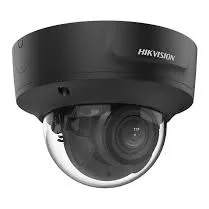
A product photo from the AESS job library, not taken in City Line: a black varifocal dome camera. Over a Liberty Avenue register, a dome like this can be zoomed in so the face at the counter fills the frame instead of the whole store. When a counter camera only shows the cash drawer and the top of a head, re-setting the lens is often the whole repair.
National systems, do-it-yourself kits and a licensed local repair
City Line houses carry every kind of system: monitored systems from national alarm companies, cloud doorbells and Wi-Fi cameras bought online, boxed kits from big-box stores, and wired systems put in by local installers or relatives. Each has its own repair path, and the right first call depends on which you have.
If your system is
Who usually repairs it
What to know first
Leased through a national monitoring company
The provider, under your contract
Leased equipment may not be yours to alter. Check the contract before anyone else touches it; we can repair it once it is yours.
Cloud doorbell or Wi-Fi cameras bought online
You, the maker's support, or us for the signal and mounting
Saved clips often depend on a paid plan. Many problems are Wi-Fi through brick, which is fixable.
Boxed kit with a recorder
Us, or you if you are handy
Kit cameras and recorders often only work with each other. Tell us the model before buying a replacement.
Wired system from a local installer or relative
Us, any brand
The admin password is the first thing to find. If it is lost, send a photo of the recorder's label.
Whatever the system, the repair we quote is for equipment you own, with no monthly fee attached to it. If you want ongoing care, our annual maintenance visit is a one-time charge per year, not a subscription.
AI Overview Reality Check
What AI Gets Wrong About Security Camera Repair in City Line
Search summaries and cost guides give general answers about camera repair that do not fit a City Line two-family, three-family or Liberty Avenue store very well. These are the claims we hear repeated most, and what we actually find on the job.
"The average camera repair in Brooklyn costs about $1,400"
This figure comes from HomeAdvisor's Brooklyn page, which puts the average surveillance camera install or repair at $1,416, with a typical range of $680 to $2,145 and a low-to-high spread of $160 to $3,500. It is a real number, but it averages installations and repairs together, from single cameras to whole new systems. It is not what fixing one dead camera on a City Line house costs.
On our published Brooklyn list, most single faults run $150 to $700: a reterminated connector or PoE port swap is $150 to $350, a power supply $150 to $400, a hard drive swap $200 to $450, and a single camera replaced on a working system $250 to $600. Replacing a recorder, or rewiring several cameras, runs $700 to $1,500. The $150 service call covers the diagnosis and is credited to the repair.
So use the HomeAdvisor average to plan a new system, not a repair. For a repair, the useful number is the price for the specific fault, which we write down on the visit before any part is replaced.
"Brick row houses block Wi-Fi, so every camera has to be wired"
This is repeated by installers, ourselves included, as a rule of thumb for Brooklyn's brick buildings, and it is often true: a Wi-Fi camera on the back wall of a brick two-family, with the router upstairs at the front, will struggle. But City Line is not only brick. Some houses are wood frame under siding, some are brick at the front and frame behind, and some owners have the router in the cellar a few feet from the camera.
Whether a Wi-Fi camera works depends on the walls between that camera and that router, and on whose router it is. We measure the signal at the camera itself before recommending anything. Sometimes the right repair is moving the router or adding an access point; sometimes it is a cable through one wall for one camera.
The part the rule of thumb gets right is reliability. Cameras the household really depends on, like the shared vestibule or the back door of a store, belong on a wired connection to a recorder the owner controls, so they do not depend on a tenant's internet or a weak signal on a busy evening.
"Factory-reset the recorder and it will start working again"
Reset advice is everywhere, and on a recorder it is the most expensive mistake an owner can make. A factory reset can remove every setting, every user and every camera assignment, and on some models it can make existing recordings unreadable. It also clears the logs that show when a camera dropped or the drive stopped writing, which is often what we need to find the fault.
In City Line we see resets attempted most often when a password is lost after a house changes hands or a relative moves away. The live view comes back, the footage from the night that mattered does not, and the new password is now the only one, held by whoever pressed the button.
Before anyone resets anything, export what you need, photograph the recorder's label and call us. Many lost passwords can be recovered through the manufacturer with the serial number and proof of ownership, without touching the recordings.
"East New York is covered by police cameras, so the police will have the footage"
East New York does have a lot of cameras. Amnesty International's 2021 count found it the most surveilled neighborhood in all three boroughs studied, with 577 cameras at intersections, and NYCHA's developments nearby have their own CCTV, with more of it being tied into NYPD systems. NYS Focus reported in August 2026 that two NYCHA tenant associations are suing to block a plan to connect nearly 20,000 public housing cameras to the NYPD.
None of that covers a private stoop, a shared vestibule, a side driveway or a shop counter. Intersection cameras look at intersections, public housing cameras look at public housing, and their footage is not yours to request. After an incident on a residential block, the footage detectives ask for is the footage from the houses themselves.
That is why a dead camera on a City Line house matters more than its price suggests. If it faces your door and your piece of sidewalk, it is probably the only camera that does.
"Your landlord has to show you the camera footage"
Tenants in two- and three-families often assume that if the landlord's camera recorded something, they are entitled to see it. Brick Underground reported that landlords are generally not obligated to show tenants footage outside a legal process, though attorney Catherine Grad told the site, "I don't think that it's such an arduous duty to impose on the landlord" to review footage when a theft is ongoing.
In a City Line two-family where the owner lives downstairs, this usually is not a fight; it is a question of who can find the clip and how quickly. The trouble starts when only one person can export video and that person is away or unwilling.
The repair fix is practical: decide in writing who can view and who can export, give the tenant access to the shared entrance camera if the owner agrees, and make sure the owner, or someone the owner trusts, can export a clip in minutes. We set those permissions as part of the repair when you ask.
"A black monitor means the recorder is dead"
When the screen on a cellar shelf goes black, owners often assume the recorder has died and start pricing a new system. Often the recorder is running fine and the problem is the monitor, the HDMI or VGA cable, a loose power cord, or a recorder that switched its video output after a power blip.
The quick check is the app: if the cameras still show on a phone and playback works there, the recorder is alive. If they do not, look for the recorder's front lights and listen for its fan. Send us a photo of the front panel and the back, and we can often tell you which it is before anyone visits.
"Anyone can fix a camera system, no license needed"
Partly true. New York does not require a license for an owner who works on his or her own property, or has an employee do it. A family member fixing cameras on the family house is within the owner exemption in practice. But a company or person who installs, services or maintains security systems for other people, which the Department of State reads as including CCTV used to detect intrusion, theft or movement, needs a state license.
This matters most in City Line's rental and mixed-use buildings. When a landlord hires someone to repair the cameras in a three-family or the store downstairs, that someone should be licensed and insured, and should leave behind a record of what was done.
Talk to a Technician Before You Reset, Unplug or Replace Anything
Send a photo of the recorder's front panel or the app screen showing the problem, and tell us who lives on each floor. Many City Line "dead system" calls turn out to be a power box, a lost password or a monitor cable, and we would rather tell you that before you buy anything.
Tell us the address, the kind of building, how many cameras there are, which ones are out and where the recorder sits. Say who lives on each floor, whether anyone has the recorder's password, and whether the problem is worse by day or after dark. If you need footage from a particular date, put it in the message and we will plan the visit around copying it first. For anything urgent, call (347) 934-8335.
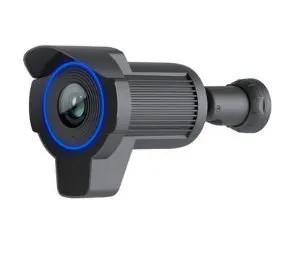
A product photo from the AESS job library, not taken in City Line: a black bullet camera with an extended sun hood and a glowing blue ring around the lens. On the side driveway of a City Line two-family, a long hood keeps rain and low sun off the glass, and a camera of this kind with good low-light color is a common replacement for one that turns black and white every time a car passes.
✅
Request Sent!
Thank you. A technician will contact you about the City Line address shortly.
How It Works
Our Repair Process
1. Send photos and say whose house it is
A photo of the recorder or app showing the problem, the City Line address and the building type, by text, WhatsApp or the form, plus who owns the recorder and who lives on each floor.
2. Map the households and the logins
We confirm who approves the work, who holds the admin password, which floors or houses each camera serves, and who can open the cellar or back room, before we book.
3. Book the service call
The $150 Brooklyn service call books a two-hour arrival window and is credited to the repair if you go ahead. Requests are booked within 2 hours.
4. Save the footage that matters
Any clip you need is exported to USB with the recorder's own timestamps before a cable, drive or setting is changed.
5. Test from the outlet to the phone
Power and backup, supplies and PoE switch, recorder and drive, each cable and connector, each camera, then the network and the app, in that order.
6. Name the cause and write the price
You hear what failed and why, and get a written price from our Brooklyn list for each fault before any part is replaced, so you choose what to do now.
7. Repair, seal and test day and night
Parts are replaced, holes in brick or siding are sealed, and each camera is checked in bright and low light, with saved playback confirmed and not only the live view.
8. Label, set alerts and hand over
Channels are labeled, alerts go to the right phones in each household, old users are removed, and someone in the family is shown how to export a clip.
Coverage Area
Security Camera Repair Near City Line's Landmarks
The A train ramp east of Grant Avenue
East of the Grant Avenue stop, opened in 1956 as the Fulton Street Line's easternmost Brooklyn station, the subway climbs out of the ground onto the elevated tracks along Liberty Avenue into Queens.
Euclid and Pitkin Avenues
The corner above the Euclid Avenue station, opened in 1948, where the C train ends and the A continues; elevators were completed by March 2006.
Mizanur Rahman Way
The co-name given to the stretch of Forbell Street above Liberty Avenue, at the heart of the Bangladeshi community City Limits described in 2013.
Conduit Boulevard
The wide road often given as City Line's southern edge, whose traffic and headlights shape the night picture on the backs of the houses that face it.
Hegeman Avenue and Logan Street
Home to NYCHA's East New York City Line development, completed in 1976, whose 33 buildings are listed on Hegeman Avenue, Fountain Avenue and Logan Street.
Linden Boulevard at Fountain Avenue
The southern corner of the Cypress Hills Houses, the 1955 NYCHA development bounded by Linden Boulevard, Sutter Avenue, Euclid Avenue and Fountain Avenue.
City Line is billed at our standard Brooklyn rate, the same as every other Brooklyn neighborhood, including the houses a few doors from the Queens line. Every repair starts with the $150 service call, which covers the on-site diagnosis and is credited to the repair if you go ahead. The figures below come from our published list of Brooklyn security camera repair prices; your own price is written down on the visit once the fault is found, and nothing is replaced until you agree.
Repair
Brooklyn price
Service call with on-site diagnosis and a written repair price
$150, credited to the repair
Motion detection or alert settings, no parts
Usually within the $150 service call
Clean and check for a hazy picture
$80
Connector reterminate or PoE port swap
$150–$350
Power supply repair
$150–$400
Hard drive swap
$200–$450
Indoor camera repair
$200–$450
Single camera replacement on a working system
$250–$600
Night vision repair
$250–$650
DVR not working, including drive and labor
$300–$700
NVR not recording
$400–$900
Vandalized camera, per camera, plus cable repair
$400–$900
Pan-tilt (PTZ) camera repair
$450–$1,200
Hybrid recorder swap for coax and IP cameras
$700–$1,200
DVR or NVR replacement with drive and setup
$700–$1,500
Annual maintenance visit
$250–$800
Three things move a City Line price within those ranges. The first is reach: a camera under the cornice of a three-family or over a Liberty Avenue storefront takes more ladder time than one beside a stoop. The second is how many parts failed together, which is why a power box that took several cameras with it, or a drive and a supply that went in the same outage, costs more than one dead camera. The third is the household work: splitting users between two apartments, moving a recorder out of a tenant's space, or untangling a link between two attached houses adds time, and we price it on its own line so you can see it.
Full terms — including 50% deposit, one-year parts-only warranty on AESS-supplied products, and the late-fee schedule — are set out in the service agreement.
Shop Our Systems
Security Camera Repair Packages & Pricing
Three ways City Line repairs usually come together, priced from our Brooklyn list.
Single-issue repair: $150–$700
One fault, one visit: a vestibule camera's corroded connector replaced, a fused power box or PoE port replaced, a worn drive swapped, a yard camera reset for passing headlights, or a lost password recovered. Typical for a brick two-family or a small Liberty Avenue store.
Major system repair: $700–$1,500
The recorder or several runs: a DVR or NVR replaced, coax and network cameras brought onto one hybrid recorder, or several cameras rewired after a renovation or a facade job. Typical for a three-family, a walk-up or a store with apartments above.
Annual maintenance: $250–$800
Every camera checked in bright and low light, domes cleaned, connectors and supplies tested, drive health read, users reviewed against who lives there now and a test clip exported. Homes start at $250, commercial properties at $400, and owners with several buildings run $500 to $800.
Bring your own equipment. If you have already bought a replacement camera or recorder, we can fit it at labor-only rates. Send us the exact model and we quote the labor by phone or text, and the visit is booked once it is paid. Equipment you supply is installed as supplied; we cannot vouch for parts we did not provide, and if a model will not work with your recorder or app, we will tell you before we start.
Complete Services
Every Security Camera Repair Service in City Line
Camera, picture and cable repair
Dark cameras, shared vestibule cameras, night pictures and water-damaged connectors on brick and siding. Request a repair
Do you cover every block of City Line, including houses a few doors from the Queens line and the streets down toward Conduit Boulevard?
+
Yes. We repair cameras on every City Line block, from the Euclid Avenue and Grant Avenue station area to the Queens line and down toward Conduit Boulevard. Crews come from our Troy Avenue office in Brooklyn, and every City Line address is billed at the standard Brooklyn rate.
Our City Line house is owned by three siblings and only one of us lives there. Who has to approve the repair?
+
One owner can approve and pay, but tell us up front that there are co-owners, and agree among yourselves who will hold the admin password afterward. We usually set up one administrator plus a second login for another sibling, so the system never depends on a single phone.
Can one visit cover our cameras and our parents' cameras a couple of blocks away?
+
Usually, yes. Tell us both addresses when you book and we schedule them back to back. Each address gets its own diagnosis and its own written price, so each owner sees exactly what was done at their house.
Do we have to tell HPD or file anything when the cameras at our two-family are repaired?
+
No. A camera repair is not something you file with HPD. HPD registration depends on the building, not the cameras: buildings with three or more apartments register, and one- and two-family houses register only when neither the owner nor the owner's immediate family lives there.
Can my parents get alerts only from the front door camera while the rest of the family gets everything?
+
Yes. Most recorders and apps let each user choose, or be given, alerts for specific cameras. We set your parents' phones for the front door only, keep the yard and driveway alerts for whoever wants them, and turn off alerts nobody reads so the important ones stand out.
After the repair, will we get a written list of each camera, its channel and where its cable runs?
+
Yes. We label each cable at the recorder, name each channel by what it watches, and leave a short written list with the recorder model, the cameras, where each cable enters the house and who holds the logins. It makes the next repair shorter and a future sale simpler.
Several houses on our block want their cameras looked at. Can you do them on the same day?
+
Yes, if the owners book together. Each house is its own service call with its own diagnosis and written price, and each owner approves and pays for their own work, but one crew can move from door to door on the same day.
The store tenant in our building has the only key to the cellar where the recorder is. How do we get the repair done?
+
Arrange access with the tenant before we book, and give us the time they will open the cellar. As the owner, you approve the work; the tenant only needs to let us in. If it keeps causing trouble, the repair is a good moment to move the building's recorder somewhere you control.
We are converting our two-family into a legal three-family. Should the camera repair wait until the work is finished?
+
Repair the cameras that cover the entrance and the cellar now, because construction is when tools and materials go missing. Leave new camera positions and cable for the third apartment until the walls are closed, so contractors do not cut or bury new cable, and plan the users for three households at the end.
How do we stop an upstairs tenant from changing our camera settings?
+
Give the tenant a view-only user limited to the cameras they should see, and keep the admin password with the owner. Tenants who were handed the admin login years ago can change anything, including deleting recordings, so we replace that login during the repair and give everyone the right level of access.
Ready to Have Every Household in Your City Line House Seeing the Front Door Again?
Send a photo of the recorder screen, the address, who lives on each floor and the date of any footage you need. We book within 2 hours, give you a two-hour arrival window, copy your footage first, and write down the repair price before any part is replaced.