A three-story frame row on Stanhope Street, a brick flat building on Linden Street, a walk-up over a Myrtle Avenue shop or a house turned sideways on Cypress Avenue? Wyckoff Heights door buzzer installation line: (347) 934-8335
Wood-Frame Rows · Brick Flats From About 1900 · 1940s Attached Houses · Walk-Ups Over Myrtle, Wyckoff and Knickerbocker Avenue Shops · Both Sides of the Borough Line
Door Buzzer Installation in Wyckoff Heights
Door Made to Close and Lock First · Every Household Counted · Old Pairs Metered Before Pricing · Written Price Before Ordering · Brooklyn Rate
Door buzzer installation in Wyckoff Heights is mostly a small-building job. Of the 138 intercom violations HPD wrote in ZIP code 11237 between January 2023 and early November 2026, 123 were on the first three floors: the two- to six-family frame rows, brick flats and walk-ups over shops that line Stanhope, Harman, Linden, Grove and Menahan Streets and the avenues around them. Those buildings need a street door that shuts and locks on its own, a release every household can work, and a way to talk to the visitor first. Below is how we plan that for each kind of building here and where it lands on our Brooklyn price list.
Every job is priced from our Brooklyn door buzzer list, and the total, with any extra that depends on a test named in advance, is agreed in writing before anything is ordered
Rated 4.7★ across 201 Google Reviews
Reviewed and updated November 11, 2026, against NYC Open Data's HPD Housing Maintenance Code Violations dataset (intercom and self-closing door violations, ZIP codes 11237 and 11385, queried November 11, 2026) and HPD Complaints and Problems dataset (intercom complaints, ZIP 11237); the Buildings Department rule 1 RCNY §42-01 on entrance doors, locks and intercommunication systems; New York's Multiple Dwelling Law §50-a; Local Law 111 of 2018 and HPD's self-closing door rule; Wikipedia's articles on Wyckoff Heights and Wyckoff Heights Medical Center; Forgotten New York's 2008 walk along Wyckoff Avenue; Urban Omnibus's 2015 "Borderlands" essay on the Brooklyn–Queens line; NYC Parks' page on Maria Hernandez Park; threads on r/AskNYC, r/nyc and r/Bushwick about building buzzers; the Swiftlane, ButterflyMX, NYHLS, Swift Locksmith and HomeAdvisor cost guides; Allegion's fail-safe and fail-secure guide; and the 2010 ADA Standards. · Abstract Enterprises Security Systems, NYS license #12000287431 · crews dispatched from our Troy Avenue office in Brooklyn
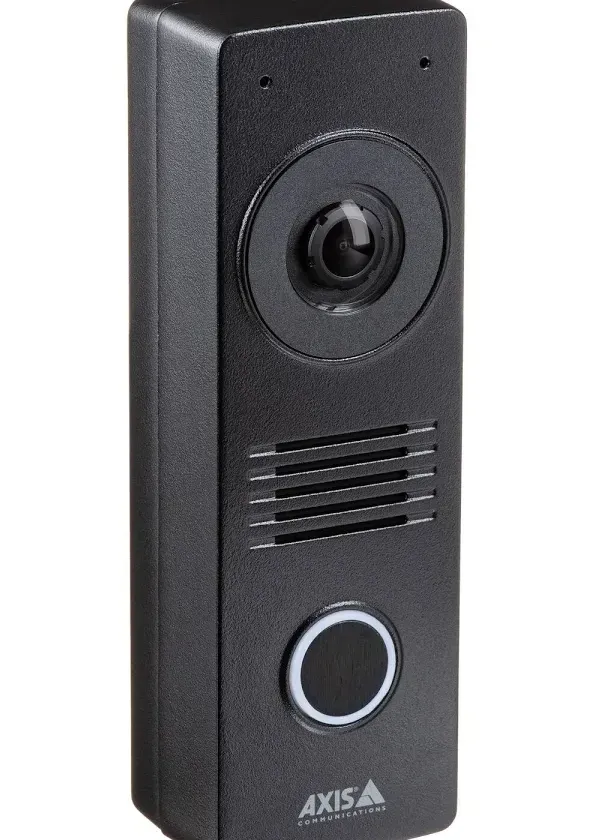
A photo from the AESS job library, not taken in Wyckoff Heights: a black rectangular video door station with a camera lens, a speaker grille and one round call button that lights up. A single-button station of this kind is the natural first system for a one- or two-household frame house on a side street here, where the visitor needs to find the button in the dark and the people upstairs want to see and hear who is on the stoop before they press release.
Wyckoff Heights Buzzer Request
Frame row, brick flat, 1940s house, walk-up over a shop or a business door: tell us the street, how many households the system must reach and what is at the door now, and a technician calls back with the range
✅
Request Sent!
Thank you. A technician will call you about the Wyckoff Heights address, usually within two hours during working hours.
25+
Years Experience
✓
Same-Day Estimates
100%
Licensed & Insured
4.7★
201 Google Reviews
Owner-operated since 2002 · Thousands of jobs completed · Booked within 2 hours
Quick answer: door buzzer installation in Wyckoff Heights costs $400 to $900 on our Brooklyn list for an audio station and new door release at a one- or two-household house or a single shop door, $700 to $1,800 for a video door station with indoor stations or phone answering at a frame row or small walk-up, and from about $2,500 to past $10,000 for a full entry system in a larger brick flat building or loft. The price covers the door station, the apartment stations, the release in the street door's frame and a battery-backed power supply, installed and tested from the sidewalk to every apartment. Send photos of the street door, the bell plate and the cellar to (347) 934-8335 or on WhatsApp, and we reply with the range that fits, usually within two hours during working hours.
Quoting a new system from your photos costs nothing. When an old system has to be tested in person before we can price it, that is the $250 service call booked online, and the $250 is applied toward the work.
All work is done under New York State license #12000287431, and equipment is ordered only after the written price is approved and the deposit is in.
We work for whoever controls the door: an owner who lives on the first floor, a family that holds a few buildings, a managing agent, or a shop owner with the landlord's written approval.
The Neighborhood
Why Wyckoff Heights Properties Need Door Buzzer Installation
Wyckoff Heights is the narrow strip of blocks on either side of Wyckoff Avenue where Bushwick meets Ridgewood. Wikipedia places it across both ZIP codes, 11237 in Brooklyn and 11385 in Queens; Forgotten New York's Kevin Walsh, walking the avenue in 2008, noted that the county line arrives at Wyckoff Avenue from Gates Avenue and runs down the middle of the street to George Street, and doubted that many people use the neighborhood's name at all. Whatever you call it, the housing is what matters for a buzzer: the first buildings were attached wood-frame rows for three and six families, masonry flats followed around 1900, and the last open land was filled in the 1940s with attached houses served by alleys and rear garages. The medical center that gave the area its name still sits at Wyckoff Avenue and Stockholm Street.
Those are small buildings. Most have between two and eight households behind one street door, an owner or a family running them rather than a management company, and an entry system that was put in decades ago and patched ever since. Many have no talking system at all, only a row of bell buttons by the door and a release that clicks somewhere in the frame. That is why most of what we install here is a first proper system or a full replacement on a small scale, not a lobby panel for a tower.
The city's own housing records say the same thing. HPD inspectors wrote 599 intercom violations in ZIP code 11237 across the years its open data covers, 149 of them still open when we checked in November 2026. In the 138 written since January 2023, the apartment named in the violation was on the first, second or third story in 123 cases. The faults are at the scale of a three-family house: a "return buzzer" that no longer opens the street door, a "bell buzzer" that no longer rings, a station in a kitchen that no longer talks to the stoop.
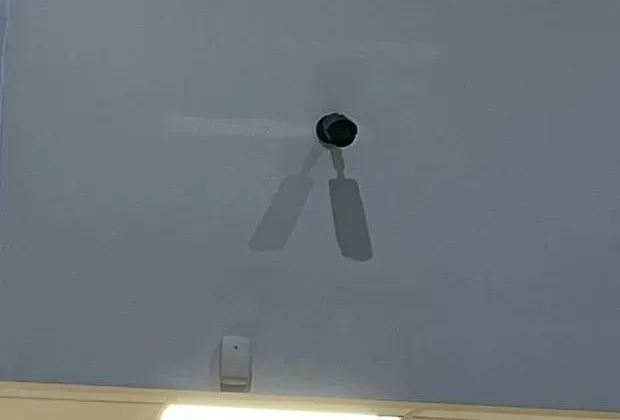
A photo from the AESS job library, not taken in Wyckoff Heights: a small black camera mounted high on a pale wall, with a small white device below it. In a Wyckoff Heights walk-up, a camera placed like this inside the vestibule records who actually came through the street door after a resident pressed release, which is the one thing a talk-only buzzer cannot tell an owner.
The second reason is the door itself. A buzzer only works if the street door swings shut and latches on its own after every visitor. HPD wrote 552 self-closing door violations in ZIP 11237 in 2023, 709 in 2024 and 601 in 2025, and 420 more by early November 2026. Most of those concern apartment and hallway doors rather than the street door, but they show how often doors in this housing stock fail to close. An installation that puts a new panel on a door that drifts open is money spent on a door that still lets anyone in.
The third reason is the people inside. The buildings here hold families across several generations, tenants who work hospital shifts, households whose top floor is a long climb, and residents who share one railroad apartment. A tenant on r/AskNYC described what a dead intercom means in a fifth-floor walk-up: no way to let in guests, packages or a food delivery without walking all the way down. In a three-story frame row the walk is shorter, but the problem is the same, and so is the fix.
Six facts that shape a Wyckoff Heights buzzer installation
The buildings are low. 123 of the 138 intercom violations HPD wrote in 11237 since January 2023 named an apartment on the first three floors; only 15 were on the fourth floor or higher.
The same apartments come back. One Irving Avenue building had the same third-floor apartment written up for its intercom in May 2024, June 2024, twice in October 2024, March 2025 and August 2026, and every one of those violations was still open in November 2026.
The complaints keep coming. HPD logged 105 intercom complaints from ZIP 11237 in 2023, 102 in 2024, 90 in 2025 and 58 in 2026 through early November.
Doors fail as often as buzzers. Self-closing door violations in 11237 ran between 550 and 710 a year from 2023 through 2025, after Local Law 111 of 2018 required doors to interior corridors and stairs to close by themselves.
The Queens side is busy too. ZIP 11385, which covers the Queens half of the neighborhood and the rest of Ridgewood, had 204 intercom violations on record, 78 of them open.
The law draws a line at eight. The Buildings Department rule 1 RCNY §42-01 requires an intercommunication system at the main entrance of multiple dwellings with eight or more apartments; most Wyckoff Heights buildings are smaller and install one by choice.
Where this page applies. We use Wyckoff Heights for the blocks on both sides of Wyckoff Avenue from roughly Flushing Avenue down to Cooper Street, centered on the hospital and Maria Hernandez Park, and we serve both the Brooklyn and the Queens addresses at the same Brooklyn rate. For the rest of the borough see our door buzzer installation in Brooklyn page, and for the blocks to the west our Bushwick door buzzer installation page.
Install or Repair in Wyckoff Heights
Need Repair in Wyckoff Heights? When a Patch Is Enough and When the Building Needs a New System
Many installation calls from Wyckoff Heights start as repair calls. A tenant has complained to HPD, an inspector has written up the "return buzzer" in a second-floor kitchen, and the owner wants to know whether one more fix will do. Sometimes it will. A transformer in the cellar that has burned out, a strike whose screws have pulled loose from a soft wood frame, or one apartment's handset with a broken cord are repairs, and we price them as repairs.
The record for this ZIP code shows when it stops being a repair. When the same apartment is written up again and again, when the violation says the system is broken "in the entire apartment," or when two or three apartments in one building fail within months of each other, the problem is usually the cable between the cellar and the floors or a system old enough that its parts are no longer made. Each repair then costs a visit and lasts a season. A new door station and power supply on cable that tests sound, or a new system on new cable where it does not, ends that cycle. We tell you which it is after metering every pair, and if a repair is all your building needs, our Brooklyn door buzzer team will price it that way.
What We Install
Door Buzzer Installation Services in Wyckoff Heights
Every service below comes from the same Brooklyn door buzzer list. The number of households sets the size of the system, the street door decides what release it can take, and in Wyckoff Heights the walls decide most of the labor: hollow frame walls let cable climb quickly, while the brick flats and the 1940s houses need more planning to keep it out of sight.
First talking systems for frame rows
A door station with a button and speaker for each household, a station in each apartment and a release in the street door frame, for two- to six-family frame houses that have only ever had bells or nothing.
Bell-and-release upgrades
Adding talk-back, and video where it is wanted, to buildings whose residents can release the door but cannot speak to the person outside, keeping the release that already works where it tests well.
Replacements for systems that keep failing
New door stations, apartment stations and power for walk-ups whose HPD record shows the same apartments written up again and again, on old pairs that meter sound or on new cable where they do not.
Street door releases and closers
Fail-secure electric strikes cut into sound frames, closers adjusted or replaced so the door shuts on its own, and latch work on frames softened by years of pried locks.
Residents' doors on shop blocks
A separate panel and release for the apartments' door beside a Myrtle, Wyckoff or Knickerbocker Avenue storefront, kept apart from the store's own door and alarm.
Yard, cellar and side doors
Second entrances that let people into the building from the yard or the cellar, either brought onto the system with their own release or set to lock and stay locked from outside.
Phone answering for families who manage
Door stations that also ring owners' and residents' phones, useful when the family that runs the building lives in another borough or on another block.
Shop, clinic and office buzz-in doors
Buzz-in doors for shops, small offices and medical practices on Myrtle, DeKalb and Knickerbocker Avenues, with the release at the counter or the front desk.
Loft entrances at the north end
Directory or code panels for the converted factory buildings between Flushing Avenue and Starr Street, where heavy steel doors and long cable runs set the work.
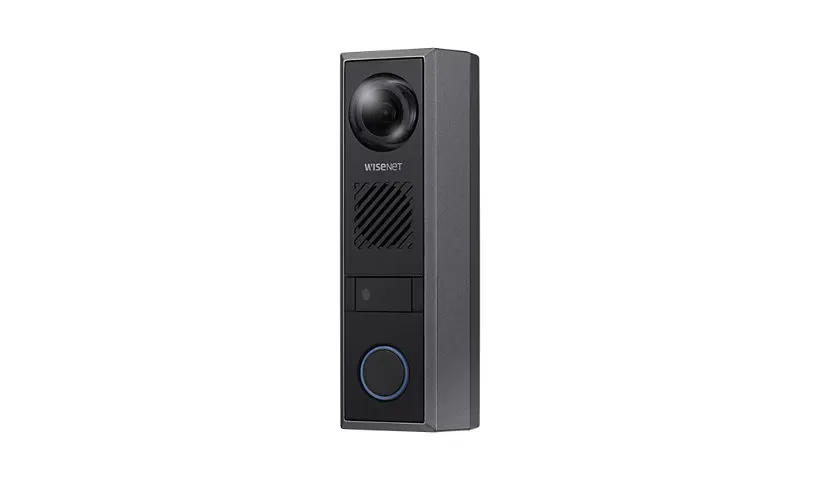
A photo from the AESS job library, not taken in Wyckoff Heights: a slim dark grey wired doorbell with a camera lens, speaker slots and a round push button. On the narrow door casings of the frame rows here, a slim wired unit like this often fits where a wide multi-button panel would not, and being wired it never needs its battery changed on a cold stoop.
Building Specialists
Door Buzzer Installation for Wyckoff Heights's Architecture
Six kinds of building make up nearly every entrance we are asked about here. They differ in the things that decide a buzzer job: how many households share the door, what the walls are made of, where the cellar is and whether anyone can reach it, and what the street door looks like after a century of use.
Wood-frame rows
The neighborhood's first housing: attached frame buildings for three or six families, with a narrow street door, a stair straight ahead and hollow walls that make cable runs quick, often under siding added decades later.
Brick flats from about 1900
Masonry buildings with two apartments on each floor around a central stair, a vestibule with mailboxes and an inner door, and solid walls that make every new cable route a decision.
1940s attached houses
Single-family and two-family houses built on the last open land, with alleys and rear garages behind them, where the back door is used as often as the front.
Walk-ups over stores
Mixed buildings on Myrtle, Wyckoff, Knickerbocker and Irving Avenues, with a residents' door squeezed between shop windows and apartments reached by a single long stair.
Factory lofts at the north end
Former industrial buildings between Flushing Avenue and Starr Street, now apartments and studios, with steel doors, high ceilings and long runs from the entrance to the farthest unit.
Houses on the borough line
Buildings along Wyckoff Avenue and the side streets that cross it, where some houses face sideways onto Cypress Avenue and some show two addresses, so the door visitors look for is not always the obvious one.
Wood-frame rows: the walls are easy, the door frame is not
In a frame row the stud bays run from the cellar to the attic, so new cable can usually be dropped or fished inside a wall to each floor without opening more than a few small holes at the top and bottom. That keeps labor down, and it is why a first talking system in a three-family frame house so often lands in the lower part of our video range.
The hard part is the street door. Frame houses settle, doors are rehung, and the wood around the lock has often been chewed up by pried locks and replaced strikes. An electric strike needs solid wood to hold its screws and a frame that keeps the door aligned so the latch drops into it. When the frame cannot do that, a reinforcing plate or a frame repair comes first, and we name it on the quote rather than discovering it on installation day.
Siding matters too. Many frame rows here were covered in aluminum, vinyl or shingles long after they were built. The door station is fastened to the door casing or a solid backing board rather than to siding that flexes, so it does not work loose every winter.
Brick flats from about 1900: a vestibule, an inner door and a riser that may already exist
The masonry buildings that followed the frame rows usually have the layout the city's rules were written around: a street door into a vestibule with mailboxes, an inner door into the hall and stair, and two apartments on each landing. Under 1 RCNY §42-01, when the inner door from the vestibule self-closes and self-locks, the street door into the vestibule does not have to. That decides which door gets the release, and it often means the mailboxes stay reachable for the carrier in the outer vestibule.
Because the walls are solid, the old riser is valuable. Many of these buildings already have a multi-pair cable running up through a chase, a closet stack or the stair hall. If its pairs meter sound from the cellar to each apartment, a new system can use them, which keeps both the price and the dust down. If they do not, new cable has to find a path, and in a brick building that path has to be planned with the owner floor by floor.
1940s attached houses: two doors people actually use
The houses built in the 1940s on the last vacant land have alleys and garages behind them, and families who park in back often come and go through the rear door. A buzzer that rings only at the front is fine for visitors and deliveries, but if relatives or a tenant upstairs use the back, a second, smaller station or a keypad at the rear door can save the walk around. Where the house has been split into two apartments, each household gets its own button and its own station, and the release works on whichever door the visitor is standing at.
Walk-ups over stores: the residents' door is not the store's door
On the avenues, apartments above shops are reached through a narrow residents' door beside the storefront. It should have its own panel, its own release and its own power, separate from anything the shop uses, so a store closing for renovation or changing tenants never leaves the apartments without a working door. The panel has to sit where a roll-down gate, a sign or a sidewalk display cannot cover it, and the cable to the apartments usually has to climb the stair rather than pass through the shop.
Factory lofts at the north end: long runs and heavy doors
Forgotten New York described the stretch of Wyckoff Avenue between Flushing Avenue and Starr Street as largely industrial, with lofts housing artists and musicians, including former candy factory buildings near Willoughby Avenue. The New York Times reported in 1974 that the former Schlitz brewery "in the Wyckoff Heights section" was being redeveloped. Converted buildings like these have steel doors that need heavier releases and closers, and units spread across large floors, so a directory or code panel with cable runs measured from the plans is the usual answer.
Houses on the borough line: find the door before placing the panel
Urban Omnibus's 2015 essay on the Brooklyn–Queens border noted houses along Cypress Avenue turned 90 degrees, with their sides facing the street, and houses that display two addresses. For a buzzer that means one simple thing: the panel goes where a stranger will look for it, which is not always beside the door. When the door is down a side path or behind a gate, the station belongs at the point where a visitor first stops, with the house number clearly marked on or beside it.
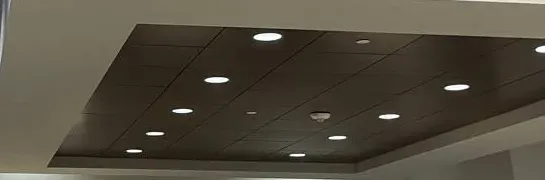
A photo from the AESS job library, not taken in Wyckoff Heights: a dark recessed ceiling panel with round downlights and a small round device set into it, framed by a lighter ceiling. In the converted lofts at the north end of Wyckoff Avenue, ceilings like this are where cable runs between the entrance and distant units, and planning the route before a ceiling is closed costs far less than fishing it afterward.
Field Notes
Field Notes: The Three Checks Before Any Panel Is Chosen for a Wyckoff Heights Door
Our technician does three things at a Wyckoff Heights building before talking about equipment. They take about half an hour, and they decide most of the price.
First, the door. The technician opens the street door fully, lets go and watches. It should close by itself, latch on the first try and not bounce back. Then the same with the vestibule door if there is one. A door that has to be pulled shut will defeat any buzzer, so its closer, hinges and latch are noted before anything else.
Second, the households. The technician counts doorbells, mailboxes and apartment doors, and asks who actually lives where. A frame row listed as three apartments may have a basement unit or a top floor shared by roommates, and every household that receives visitors needs its own button.
Third, the cellar. The technician finds where the old bell transformer and wiring are, whether the cellar is reached from the hall or only through an apartment, and meters each pair to the floors. A sound pair is reused, a failed one is replaced, and the quote says which.
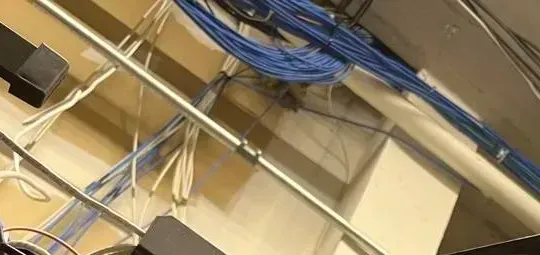
A photo from the AESS job library, not taken in Wyckoff Heights: bundles of blue low-voltage cable laid over a ceiling beam beside a metal pipe in an open ceiling. A cellar ceiling in a Wyckoff Heights brick flat building is often where the old bell wiring, newer phone lines and cable TV runs all cross, which is why each pair is traced and metered before any of it is trusted.
The City's Record
What 138 Intercom Violations Since 2023 Say About Wyckoff Heights Doors
NYC Open Data publishes every violation HPD writes under the Housing Maintenance Code, with the building, the apartment, the story and the inspector's description. We pulled every violation in ZIP code 11237 whose description mentions an intercom, and read the ones written since January 1, 2023. There are 138 of them, 32 in 2023, 33 in 2024, 45 in 2025 and 28 in 2026 through early November. Sixty-four were still open when we checked.
The streets that come up most are the ones lined with small buildings. Hart Street and Irving Avenue each appear 10 times, Starr and Jefferson Streets 8 each, Stanhope Street 7, and Linden Street, St. Nicholas Avenue, Wyckoff Avenue and Wilson Avenue 6 each. Menahan, Stockholm and Bleecker Streets each appear 5 times, Harman Street 4 and Grove and Himrod Streets 3. Most of these are the frame rows and brick flats this page is about.
The descriptions say what failed. Inspectors write that the "return buzzer" is broken, meaning the button in the apartment no longer releases the street door; that the "bell buzzer" is defective, meaning the apartment no longer rings; that an "intercom relay" at the building entrance has failed; or that the system is broken "in the entire apartment." Nearly every one is an order to "properly repair or replace" a system that already exists. Only three violations in this ZIP code, ever, ordered an owner to provide an intercom where there was none.
The repeats are the most useful part for an owner. The Irving Avenue building mentioned above was cited for the same third-floor apartment six times between May 2024 and August 2026. A Linden Street building was cited for one second-floor apartment in September 2025, December 2025 and August 2026. A Stanhope Street building drew two violations for the same apartment on consecutive days in August 2026. A system that is cited again within months of a repair is telling its owner that the repair did not reach the cause.
How we use the record on a Wyckoff Heights job
Before the visit. We look up the building's intercom and door violations and complaints, so the technician arrives knowing which apartments and which parts have failed before.
When deciding repair or replace. One violation for one station is usually a repair. The same apartment cited again, or several apartments cited within a year, points to the cable or the system, and the quote says so.
When scheduling. An open violation has a correction period, and we plan the installation date around it where the equipment allows.
At handover. We leave a written test sheet listing every apartment, what was tested and the result. Filing a certification with HPD is the owner's or managing agent's job; the test sheet is what they file with.
What the record cannot show is how many small buildings here have no talking system at all. Under the city's rules a building with fewer than eight apartments is not required to have one, so its absence draws no violation. Those buildings appear in the record only after something is installed and later breaks, which is why we pay as much attention to how a first system is built as to how an old one is replaced.
The Door Comes First
A Wyckoff Heights Street Door Has to Close, Latch and Open From Inside Before It Gets a Buzzer
An entry system has two halves. One is electronic: the panel, the stations and the cable. The other is mechanical: the door, its hinges, its closer, its latch and the release in its frame. Owners shop for the first half, but most of the failures we see at the street doors here are in the second.
What the city expects of the door
The Buildings Department rule 1 RCNY §42-01 sets out what an intercom installation in a multiple dwelling of eight or more apartments must do. Every entrance from the street, court, yard or cellar must have automatic self-closing and self-locking doors. Every self-locking door must be "readily openable from the inside without the use of keys." The bell and intercom must be at the main entrance door "so that a person may readily reach the door when the unlocking buzzer is activated." Push buttons may be no more than six feet from the floor, and the speaking device between four and five feet. Smaller buildings are not bound by those numbers, but they are a sound standard for any door, and we follow them as a matter of course.
Local Law 111 of 2018 added a related duty for the hallway side: all doors providing access to interior corridors or stairs in residential buildings had to be self-closing by July 31, 2021, and HPD's rule requires owners to keep those doors in good repair. The tally in ZIP 11237, between 550 and 710 self-closing door violations a year since 2023, shows how many doors in this housing stock do not close by themselves.
What that means on installation day
Before a release is cut into a frame, the door has to swing freely, close fully from any position and latch without help. If the closer is worn, set too weak or set so hard that a visitor cannot push the door after being buzzed in, it is adjusted or replaced. If the latch misses its keeper because the door has dropped on its hinges, the hinges are tightened or the door rehung. Only then does the release go in, so the electronic half has a mechanical half it can rely on.
We use fail-secure electric strikes on street doors. Allegion's guide explains the difference: fail-safe products unlock when power is removed and fail-secure products stay locked, and with an electric strike a person inside can always leave by turning the lever whichever type it is. A fail-secure strike keeps the building locked during a power cut while never trapping anyone inside, which is the right combination for a residential street door.
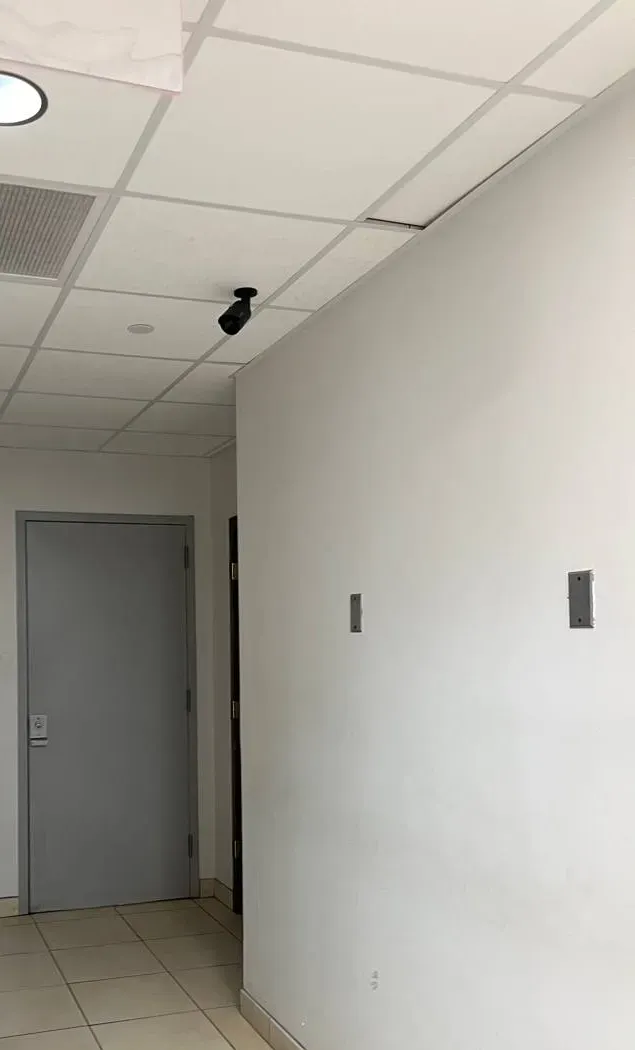
A photo from the AESS job library, not taken in Wyckoff Heights: a tiled corridor with white walls and small wall plates leading to a grey steel door with a lever handle, under a drop ceiling with a small camera. A lever on the inside of a door like this is what lets anyone leave without a key, which is what the city's rule for self-locking entrance doors requires and what we keep on every door we fit with a release.
Rules and Responsibilities
Which Wyckoff Heights Buildings Must Have a Buzzer, Who Keeps It Working and Who Pays
Buildings of eight or more apartments must have one. Multiple Dwelling Law §50-a and 1 RCNY §42-01 require self-closing, self-locking entrance doors and an intercommunication system at the main entrance of class A multiple dwellings with eight or more apartments.
A plain bell and buzzer can satisfy the rule. 1 RCNY §42-01 accepts "a bell or buzzer system, or a speaking and listening device" for each apartment, together with "a return buzzer mechanism to release or open the lock." Talk-back is not required by that rule, but it is what most residents ask for.
Older buildings are where the sources differ. For buildings put up before 1968, Multiple Dwelling Law §50-a ties the duty to a written request or consent from tenants occupying a majority of the apartments, while the text of 1 RCNY §42-01 lists pre-1968 buildings of eight or more apartments as well. If your building is in that group, ask HPD or your lawyer which applies before relying on either.
Conversions count. The rule covers buildings "erected or converted" after January 1, 1968, so adding apartments that bring a building to eight or more brings the door and intercom requirement with them.
Any system that exists must be kept working. The intercom violations we read for this ZIP code were written under § 27-2005 of the Housing Maintenance Code, the owner's general duty to keep the building in good repair. A building of three apartments with a buzzer is cited for a broken one just as a larger building is.
Small buildings are the owner's choice. A two- or three-family house with no buzzer at all draws no violation. Most of the first systems we install here are put in because the owner and the tenants want them, not because a rule demands it.
Doors to halls and stairs must close by themselves. Local Law 111 of 2018 and HPD's rule on self-closing doors apply alongside the intercom rules, and a release must never stop a door from closing.
None of this is legal advice for a particular building. If you are unsure which rules apply to yours, HPD, the Buildings Department or your own lawyer can say. What we do is install a system that meets those rules where they apply and leave written proof of what was installed and tested.
Commercial Door Buzzer Installation
Business Door Buzzer Installation in Wyckoff Heights
Most business doors in Wyckoff Heights are on the avenues that frame it, and most of them share a building with apartments. That shapes every commercial job here: the shop's door and the residents' door are planned together, kept on separate systems, and wired so that work on one never takes the other down.
Myrtle Avenue
The busiest shopping street at the south end, part of a business improvement district that runs from Wyckoff Avenue to Fresh Pond Road, with the hospital's own offices at 1411 and 1419 Myrtle. Shops here want a buzzer at a stockroom or office door and a separate panel for the apartments above.
Wyckoff Avenue
The spine of the neighborhood and, for several blocks, the borough line itself, with the Myrtle–Wyckoff transit hub at one end and former factory lofts at the other. Residents' doors here sit between storefronts and need panels that a roll-down gate cannot cover.
Knickerbocker Avenue
Bushwick's main commercial street, running past Maria Hernandez Park and the 83rd Precinct station house at number 480. Walk-ups with shops below are the rule, and many residents' doors are narrow and heavily used.
Irving Avenue
A mix of houses and corner stores between the park and the Queens line. Corner shops ask for a buzz-in door at night; the apartments next door ask for the same panel the rest of the block has.
DeKalb Avenue and Stockholm Street
The medical blocks around Wyckoff Heights Medical Center, including its Medical Arts Building at 1610 DeKalb Avenue. Small practices want the release at the front desk and the door locked behind every patient.
The loft blocks off Flushing Avenue
The industrial stretch of Wyckoff Avenue between Flushing Avenue and Starr Street, where studios, workshops and offices share large buildings with residents and need a directory that can tell them apart.
The commonest business request here is a buzz-in door for a shop or office that wants to see who is outside before letting them in, with the release button at the counter. The second is a delivery door at the back or side, answered from inside so nobody has to leave the register. Both are usually single-door jobs at the bottom of our list, and both are kept separate from the apartments' system so a delivery driver buzzed into a stockroom never ends up in the residential stair. If your business is closer to Ridgewood's shopping streets, our Ridgewood door buzzer installation page covers those doors.
Rules that apply to business entry installations in Wyckoff Heights
Anyone inside can always get out. A business door with a buzzer, code or reader still opens from inside with one motion and no key. With an electric strike, the lever or push bar on the inside works whatever the release is doing.
Controls within reach. The 2010 ADA Standards set the high forward reach at 48 inches maximum and the low at 15 inches minimum for operable parts, so the button a customer presses and the release a receptionist uses are mounted inside that range where a business serves the public.
Tenants need the landlord's written approval. A shop or office that rents its space orders its own door buzzer only with the building owner's written permission, and its cable stays clear of the residents' system.
Magnetic locks need the full package. Where a door cannot take a strike and a magnetic lock is the only option, it comes with the release devices, signage and fire alarm connection the building code requires, and we say so in the quote before anyone chooses it.
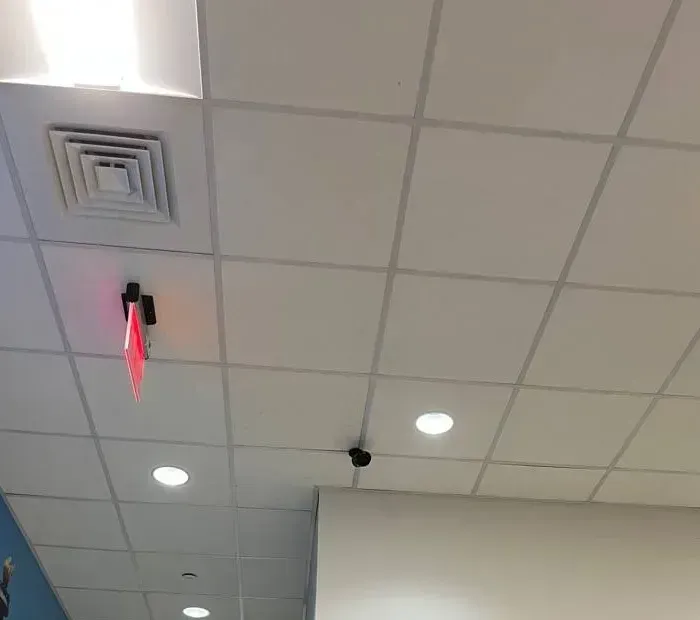
A photo from the AESS job library, not taken in Wyckoff Heights: a drop ceiling with a lit red exit sign, an air diffuser, round recessed lights and a small black camera. In a medical office on DeKalb Avenue or a shop on Myrtle Avenue, the exit sign marks a door that must always open from inside, so any buzzer release on it is chosen to lock against visitors without ever locking people in.
Your Questions Answered
Door Buzzer Installation in Wyckoff Heights: Questions Answered
Small buildings getting their first talking system
Our three-story frame house on Stanhope Street has bell buttons and a release but no speaker. What would the people upstairs actually gain from talk-back?
The chance to know who they are letting in. With bells and a release, a resident on the third floor hears the bell and has two choices: press release blind or walk down. Most people end up doing one or the other every time, and pressing blind is how strangers get into small buildings. Talk-back lets them ask "who is it?" and decide from upstairs.
In a frame house the upgrade is usually modest. The hollow walls make new cable quick if the old bell pairs do not test well, the door station replaces the bell plate, and each apartment gets a station where the old button or bell box was. Add a camera at the door and the station shows the visitor too, which on our Brooklyn list moves the job from the $400 to $900 audio range into the $700 to $1,800 video range for a building this size.
We are turning the empty store on the ground floor of our Knickerbocker Avenue building into two apartments, which will take us from six to eight. Does that change what the street door needs?
It can. 1 RCNY §42-01 applies to class A multiple dwellings "erected or converted after January 1, 1968 containing eight or more apartments," and requires self-closing, self-locking doors on every entrance from the street, court, yard or cellar, plus an intercommunication system at the main entrance. A conversion that brings the building to eight is the kind of change that rule is written for. Your architect or expediter, who is filing the conversion with the Buildings Department, is the right person to confirm it for your building.
Practically, the best time to add the two new apartments to the entry system is while their walls are open. We can run their cable during the conversion, put their buttons on the panel and their stations in place, and test them before the apartments are occupied. If the old system cannot take two more apartments, the conversion is a sensible moment to replace it.
Our six-family frame row shares its side walls with identical houses on both sides. If new cable goes up inside a shared wall, does the neighbor's side get opened?
No. We do not run cable in a way that needs anything opened on the neighbor's side. In attached frame rows the cable route is planned inside your own building: up an interior partition, through a closet stack, beside the stair or in the hall, depending on what the walls allow and where the apartments' stations go.
Shared walls are also where sound and fire separation between houses matter most, so we avoid drilling through them altogether. If the only practical route for one apartment runs along a shared wall, it is surface-mounted in a neat raceway on your side, and we show you where before the work starts.
Doors that are hard to find or easy to forget
Our house on Cypress Avenue is turned sideways, so the front door is down a side path that visitors cannot see from the sidewalk. Where should the panel go?
Where a stranger first stops. For a sideways house that is usually the gate or the start of the path, not the door itself, so a visitor never has to walk down a dark side yard to find out whether anyone is home. The station is mounted on a post or the gate pier with the house number beside it, and the release can open the gate, the door or both.
If the path is short and lit, the station can stay at the door with a clear sign at the sidewalk pointing to it. Either way we decide the spot with you at the walkthrough, standing where a delivery driver would stand, because the right answer depends on how the house actually sits on its lot.
Our brick walk-up has a yard door at the back and a cellar door under the stoop as well as the street door. Do those doors need to lock like the front one?
For a building of eight or more apartments, yes. 1 RCNY §42-01 lists every entrance "from the street, court, yard or cellar" as needing automatic self-closing and self-locking doors, so a back door that is left on the latch undoes everything the front door does. For a smaller building it is not required, but the logic is the same: a buzzer at the front protects nothing if the yard door is open.
Those doors rarely need a panel. Usually they need a closer, a lock that works from inside without a key, and sometimes a keypad or release for the super or the residents who take out the bins. We price them on the same quote so the whole building closes together.
The residents' door of our Myrtle Avenue building opens straight off the sidewalk with no vestibule, and rain blows right onto the old panel. What holds up there?
A surface-mounted metal panel with a rain hood, sealed at the top and sides, with buttons and a speaker made for outdoor doors. Weather is what kills exposed panels on the avenues, more than vandalism: water gets behind a plate that was mounted flat on uneven brick, and the contacts corrode from the inside.
We mount the panel on a sealed backing, bring its cable in from below or through the wall rather than from the top, and set it under any overhang the doorway has. A panel at a sidewalk door also needs to be clear of the shop's gate and sign, so we look at the storefront at closing time as well as during the day.
The people answering
My father lives on the top floor of our walk-up near Maria Hernandez Park and cannot manage the stairs. When he buzzes someone in, how can he be sure the street door shut behind them?
Two things together give him that. The first is mechanical: a door with a working closer and a latch that drops into the strike every time, so it shuts behind each visitor without anyone checking. That is the part we set first and test hardest.
The second is information. On systems that support it, a small contact on the door frame tells the station or the family's phones whether the door is closed, and some will send an alert if it is left standing open. A video station also lets him watch the visitor step inside. Whether that suits your building depends on the system chosen, and we price it as an option so you can decide.
Our building on Linden Street is full of young children who love pressing the release. Can the stations be set up so they cannot buzz strangers in?
Yes, in several ways. Apartment stations can be mounted higher than a small child can reach, within limits that still suit the adults. Some systems let a family require a second step before the release works, or let one household's station answer calls without releasing the door at all. On video stations, the adult sees who is at the door before anything opens.
The simplest fix is often the placement: a station by the kitchen or the apartment door, where adults pass, rather than low in a hallway. We go through the households with the owner before ordering, so families with small children get the setup that suits them.
Cost and scope
What would a first buzzer for our Irving Avenue two-family with a shop on the ground floor come to on your Brooklyn list?
For the two apartments, a residents' door with an audio station, a station in each apartment and a new release falls in the $400 to $900 range; with a video door station and video in both apartments it falls in the $700 to $1,800 range. If the shop wants its own buzz-in door as well, that is a second, separate single-door job from the same list.
Where in each range it lands depends on the door, the cable route and the cellar. A sound frame and a short route up a frame wall sit near the bottom; a frame that needs reinforcing, a new closer or a cable route that has to avoid the shop sit higher. Doing both doors on one visit saves labor, and the quote shows each door separately so the owner and the shop can split the cost if they choose.
HPD keeps writing up the same apartments in buildings like ours. What does a new installation change that a fifth repair does not?
It replaces the parts that keep failing instead of the one that failed last. In the violations we read for this ZIP code, the same apartments come back again and again, sometimes six times in two years. That pattern usually means the trouble is in the cable between the cellar and that floor, or in a system so old that every repair is a part from a different maker.
A new installation starts by metering every pair, keeps the ones that test sound, replaces the ones that do not, and puts one system on the whole building with one power supply and one set of parts. The written test sheet at the end shows every apartment working on the same day, which is something a string of repairs never produces.
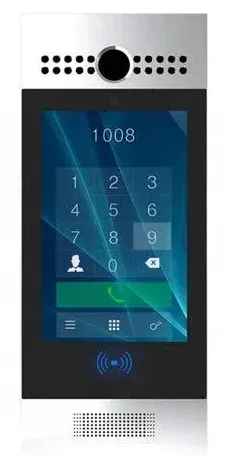
A photo from the AESS job library, not taken in Wyckoff Heights: a touchscreen entry panel showing a dial pad with a four-digit apartment code entered, a camera above and a card-reader symbol below. Panels of this kind suit the larger brick flat buildings and the converted lofts here, where a row of buttons would be long and a code lets residents in without a key.
Equipment
Types of Door Buzzer Systems We Install
We quote a reliable non-branded system by default and install a named brand when an owner asks for one; the intercom brands we work with include Aiphone, ButterflyMX, 2N, Akuvox, Comelit and DoorBird. These are the kinds of equipment that come up most at Wyckoff Heights doors, and where each fits.
Single-button video stations
One button, one camera and a speaker for one- and two-household houses, slim enough for a frame row's narrow casing.
Small button panels
Three- to eight-button audio or video panels for frame rows and brick flats, with a button and a label for every household.
Directory and code panels
Scrolling directories or code entry with a camera, for the larger brick buildings and the north-end lofts.
Two-wire systems
Audio and video over a single pair per apartment, the usual choice where an old riser meters sound and walls are solid.
Apartment audio stations
Simple talk-and-release stations for residents who want a button and a voice, nothing more, and no screen to learn.
Apartment video stations
Wall stations with a screen and a release button, so residents see the visitor before opening.
Phone answering
Door stations that ring residents' and owners' phones, alone or alongside a station in the apartment.
Fail-secure electric strikes
Releases cut into the frame that stay locked during a power cut and never stop anyone leaving from inside.
Battery-backed power supplies
Dedicated low-voltage power with battery backup, mounted where the super can reach it, not inside one tenant's apartment.
Bell and release, audio talk-back or video: which suits a Wyckoff Heights building?
What matters
Bell and release only
Audio talk-back
Video stations or phone answering
Resident knows who is outside
No
By voice
By voice and picture
Meets the city's minimum where the rule applies
Yes, with a return buzzer
Yes
Yes
Works for residents without smartphones
Yes
Yes
Yes with stations; phones optional
Reuses old bell pairs
Usually
Often
Often, with two-wire systems
Needs internet at the building
No
No
Only for phone answering
Monthly fees
None
None
None for wired stations; some phone services charge
Brooklyn list range
Within $400–$900 for a small building
$400–$900 small; from $2,500 for a larger building
$700–$1,800 small; from $2,500 for a larger building
ADT, Ring and SimpliSafe compared with a local installer for a Wyckoff Heights building
National brands come up in almost every conversation about a front door. For a one-family house, a store-bought video doorbell may be all anyone wants. For the two- to eight-family buildings that make up most of Wyckoff Heights, it runs into hard limits. It rings the phones of whoever set it up, not a station in each apartment. It has one button, not one per household. It does not release the street door unless it is separately wired to a strike, and a building with a door that must self-lock needs a return buzzer for every apartment, which a doorbell alone does not provide. Alarm companies such as ADT and SimpliSafe are built around alarms, not multi-household entry. We install the entry system the building needs and, where an owner also wants a camera at the door, put it in on the same visit.
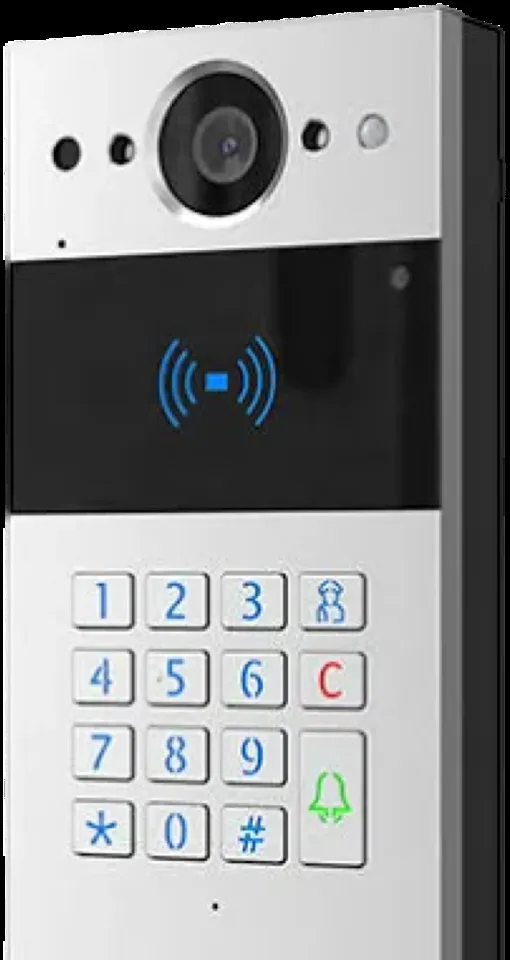
A photo from the AESS job library, not taken in Wyckoff Heights: a silver and black keypad door station with a camera lens at the top, a blue card-reader symbol, a numeric keypad and a green bell key. At a Wyckoff Heights building with a yard door used by residents taking out the bins, a keypad station like this lets them in with a code while visitors still ring from the front.
AI Overview Reality Check
What AI Gets Wrong About Door Buzzer Installation in Wyckoff Heights
Ask an AI assistant or a search summary about buzzers and you get tidy numbers lifted from installers' blogs and cost guides, most of them written for a generic American building or for a Manhattan lobby. Some are fine somewhere. Here are seven we see repeated, each traced to its source and set against what we find at the frame rows, brick flats and shop walk-ups of Wyckoff Heights.
"Replacing an apartment buzzer runs $1,000 to $3,000 per door"
The figure comes from Swiftlane's guide to apartment buzzer systems, which puts a like-for-like audio replacement at "$1,000 to $3,000 per door" and an upgrade to smart video at "$1,500 to $5,000 per door." Swiftlane sells cloud entry systems, and its numbers are national.
Per door is the wrong unit for most buildings here. A three-family frame house has one door, and on our Brooklyn list a talk-back system with a new release for a building that size sits in the $400 to $900 range, or $700 to $1,800 with video. What drives the cost is the number of households, the cable and the door's condition, not the count of doors.
Where per-door pricing does matter is in buildings with several entrances, like a walk-up with a yard door and a cellar door. Even then, those extra doors usually need a closer and a lock, not a second panel, so the cost does not multiply the way a per-door figure suggests.
"Installing an intercom costs an average of $2,500"
HomeAdvisor's intercom cost page gives that average, with a spread from $1,500 to $15,000, wireless systems from $150 to $1,500 and hard-wired systems from $1,000 to $15,000. The average blends whole-house room intercoms in suburban homes with apartment entry systems, which are different products.
For Wyckoff Heights the average lands in the wrong place for nearly everyone. A two-family house here pays well under it for a first system. A 30-apartment brick building with new cable to every floor pays well over it. On our list, $2,500 is roughly where a multi-unit entry system starts, not where a typical job ends.
The more useful figure is the range for your building type, which is why the quote follows photos and a count of households rather than a national average.
"Wired systems cost $450 to $1,900 installed, and wireless is the cheaper choice"
NYHLS's door buzzer guide says "wireless systems cost $350-$1,100 while wired systems range from $450-$1,900 installed," and that DIY wireless setups work for homes. For a single-family house that is a fair description.
A multi-household street door is not a single-family house. The release in the frame is wired whatever the stations are, it needs a dependable power supply, and the stations have to reach through brick, plaster and floors that block radio signals. In a frame row, where new cable climbs easily, wired is often no more expensive than wireless and far more reliable.
We use wireless where a run truly cannot be made, such as a garage at the back of a 1940s house, and say so on the quote. For the main system, the cable is what makes it last.
"Keeping an old buzzer alive costs a six-unit walk-up $400 to $1,200 a year"
Swift Locksmith's comparison of buzzers and smart entry puts "the honest cost of maintaining a 1970s buzzer in 2026" at "about $400-$1200 per year for an average 6-unit NYC walkup." It is an estimate from a locksmith that sells smart entry, not a measured figure, and we cannot confirm it.
What the city's records do show is that old systems here fail repeatedly. In ZIP 11237, buildings were cited for the same apartment's intercom three, four and six times in two years. Each of those meant a complaint, an inspection, a repair and often a second inspection. Whatever the yearly number is for a given building, the pattern is real.
The honest comparison is the building's own history: how many service calls the old system needed in the last two years, against a one-time installation price from our list with no monthly fees on a wired system.
"A landlord with a four-unit building doesn't have to provide a buzzer"
A Brooklyn tenant on r/AskNYC wrote that in a building "with only 4 units" the landlord "isn't required to put in a buzzer system or a self-locking front door," and asked what one would cost. The eight-apartment threshold in 1 RCNY §42-01 backs that up for the requirement to install.
It leaves out the other half. Once a building has a buzzer, the Housing Maintenance Code expects the owner to keep it working, and the violations written in ZIP 11237 include plenty in small buildings, on the first, second and third floors. A four-unit building with a broken buzzer can be cited for it.
So the decision for a small Wyckoff Heights building is not whether a rule forces it, but whether owner and tenants want a door that locks and a way to answer it, and whether the owner is prepared to keep it working once it is in.
"A phone entry system is the cheapest kind of intercom"
A reply on r/nyc to an owner asking how to modernize a building said, "for the front door get a phone entry system. It's pretty much the cheapest kind of intercom." Cloud panels that ring phones do save running cable to apartments.
They also tend to come with subscriptions. Swiftlane's own cost guide says software subscriptions "commonly add $5 to $15 per unit per month, or $30 to $100 per door per month," and the panel needs internet at the door. For a six-family frame row, that charge recurs every month, and residents without smartphones need stations anyway.
In a small building where the cable can climb a frame wall in a few hours, a wired system with no subscription often costs less over a few years. Where phone answering is wanted, we can add it alongside the stations, and the quote shows any subscription separately so you can compare.
"A buzzer repair costs $150 to $250, so fixing always beats replacing"
The $150 to $250 figure is real: it appears on Brooklyn repair companies' pages, and Swiftlane repeats it. ButterflyMX's buzzer guide adds the caveat that summaries drop, calling it a local benchmark "only for accessible, limited repair work."
ButterflyMX also notes that concealed cable, power changes, electric-lock work and door condition "may cost more than the visible panel or endpoint." That is the part that decides most Wyckoff Heights jobs. A repair that swaps a station on a failed pair is cheap the first time and repeated the next.
We price repairs as repairs when the fault is one part. When the record and the meter both point to the cable or the system, we say so and price the replacement next to the repair, so the owner can choose with both numbers in hand.
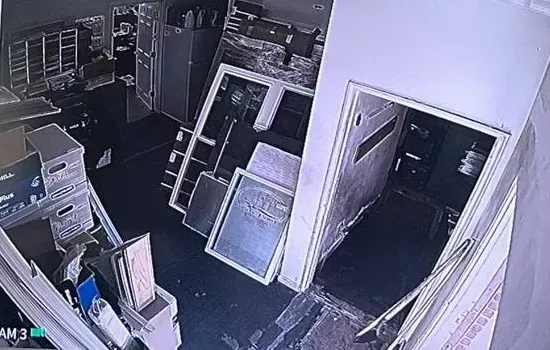
A photo from the AESS job library, not taken in Wyckoff Heights: a black-and-white night camera view of a cluttered room with an open doorway into a dark back room. A storeroom like this behind a shop on Knickerbocker or Myrtle Avenue is where a delivery door often opens, and it is the door cost guides forget when they price "one door."
Frame Row With Only Bells, or a Walk-Up Back on HPD's List? Speak to a Tech
Send the address, a photo of the street door and the bell plate, and tell us how many households live behind the door. We will tell you whether it is a repair, a new panel on old cable or a new system, and where it sits on our Brooklyn ranges. Call or text (347) 934-8335, send photos on WhatsApp, or fill in the form below.
Get In Touch
Request a Free Quote
✅
Request Sent!
Thank you. A technician will call you about the Wyckoff Heights address, usually within two hours during working hours.
How It Works
Our Installation Process
1. Read the photos and the city record
Before anyone visits, the office reviews your photos of the street door, bell plate and cellar, and looks up the building's HPD intercom and door violations and complaints, so known trouble spots are planned for from the start.
2. Walk the building from sidewalk to top floor
The technician counts every household that receives visitors, every door people use, including yard and cellar doors, and every floor the system must reach.
3. Check that the door closes and locks by itself
The street door is released and let go. If it drifts open, bounces back or needs a shove, the closer, hinges, latch or frame work is priced before any electronics.
4. Test the old cable and plan the route
Each existing pair is metered from the cellar to every apartment. Sound pairs are reused; failed runs are planned as new cable, concealed wherever the walls allow.
5. Give a written price
The quote comes from our Brooklyn list, with any extra that depends on a test named and priced before you approve, so nothing new appears on installation day.
6. Order equipment and book the date
Equipment is ordered after the deposit. Stock items are scheduled right away; special-order stations are booked once they arrive. Every visit gets a two-hour arrival window.
7. Install, conceal and label
The release, battery-backed power supply, door station and apartment stations go in, cable is hidden where the walls allow, and both ends of every run are labeled.
8. Test every apartment from the sidewalk and hand over
Standing where visitors stand, the technician calls each apartment, talks, releases and confirms the door shuts and relatches, then leaves a written test sheet.
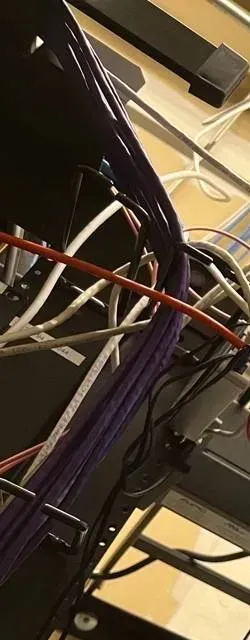
A photo from the AESS job library, not taken in Wyckoff Heights: purple, white and red cable bundles dropping down beside a black equipment rack. In a Wyckoff Heights loft or larger brick building, the place where every apartment's cable meets the power supply is where labels at both ends save the next technician hours of tracing.
Coverage Area
Door Buzzer Installation Near Wyckoff Heights's Landmarks
Wyckoff Heights Medical Center
The hospital at 374 Stockholm Street that gave the area its name, founded by the German Hospital Society; the frame rows and brick flats on Stockholm, Stanhope and Himrod Streets around it are a large share of our work here.
Myrtle–Wyckoff Avenues station
The L and M transfer at the southern corner of the neighborhood, surrounded by walk-ups over shops whose residents' doors open straight onto busy sidewalks.
Maria Hernandez Park
The park bounded by Irving and Knickerbocker Avenues between Starr and Suydam Streets, first laid out in 1890 and renamed for Maria Hernandez, who was shot through her Starr Street window in 1989.
Wyckoff Heights Post Office
The post office at 86 Wyckoff Avenue, opened in 1951, whose carriers need a way through every locked street door to reach the mailboxes in vestibules nearby.
Ridgewood Pentecostal Church
The former Wyckoff Heights Presbyterian Church at Harman Street and St. Nicholas Avenue, founded in 1895 and rebuilt after a 1928 fire, beside rows of houses on St. Nicholas Avenue.
83rd Precinct station house
The precinct at 480 Knickerbocker Avenue that serves Bushwick, on the commercial street where many of our mixed-use buildings stand.
Wyckoff Heights is billed at our standard Brooklyn rate, on both sides of the borough line. The final figure follows photos and a walkthrough, because the number of households, the state of the street door, the old cable and the walls drive the total far more than the brand on the panel.
Job
Typical Wyckoff Heights property
Brooklyn range
Audio station or replacement with a new release, reusing cable that tests well
One- and two-family frame houses, 1940s attached houses, a single shop or clinic door
$400–$900
Video door station with indoor stations or phone answering
Three- to six-family frame rows, small walk-ups over stores
$700–$1,800
Multi-unit entry system, audio or video by apartment count, button, directory or code panel
Larger brick flat buildings, converted lofts, buildings with several entrances
from $2,500 to $10,000+
In-person diagnosis of an existing system, booked online
Any building where the old system must be tested before quoting
$250, applied toward the work
Monthly subscription
Any building choosing a wired system
$0
What moves a Wyckoff Heights job inside its range is easy to predict. First the households: a two-family house sits near the bottom of each range, a six-family frame row near the top of the video range, and each apartment beyond that adds to a multi-unit system. Then the cable: pairs that meter sound cost nothing extra, a failed riser in a frame wall is quick to replace, and a new route through a brick building takes longer. Then the door: a frame that needs a reinforcing plate, a closer that needs replacing, or a yard and cellar door brought up to the front door's standard. If the job also adds a camera at the entrance, installing it on the same visit usually saves $200 to $400 in labor compared with a separate trip. Anything that depends on a test is named on the quote with its price before you approve.
Full terms — including 50% deposit, one-year parts-only warranty on AESS-supplied products, and the late-fee schedule — are set out in the service agreement.
Find Out Where Your Wyckoff Heights Door Falls on the List
Tell us the street, the number of households and what is at the door today, and send a photo of the door and the bell plate. We reply with the range, what would move it and whether the old cable is worth testing first. Call or text (347) 934-8335, send photos on WhatsApp, or fill in the form.
Shop Our Systems
Door Buzzer Installation Packages & Pricing
Three typical Wyckoff Heights jobs, each placed in its range on our Brooklyn list. Your exact figure follows the walkthrough.
Two-family or shop door audio: $400–$900
An audio door station, a station for each household, a fail-secure release in the street door frame and a battery-backed power supply, for a two-family house, a 1940s attached house or a single shop or clinic door, reusing old pairs where they test sound.
Frame row video: $700–$1,800
A video door station with a button per household, video or audio stations in each apartment, phone answering for owners who want it, and door work so the street door closes and latches on its own, for three- to six-family frame rows and small walk-ups.
Brick building or loft entry system: from about $2,500
A button, directory or code panel at the main door, stations in every apartment on tested or new cable, yard and cellar doors brought up to the same standard and a written test sheet, for larger brick buildings and converted lofts.
Bring your own equipment. If you have already bought a door station or an intercom kit, we can install it as labor-only work. Send us the make and model and photos of the door and the building, and we quote the labor by phone or text. We do not do walk-throughs on customer-supplied equipment, and the equipment itself, including any wireless signal it depends on, is covered by its maker's warranty rather than ours; our workmanship on the installation is ours to stand behind.
Complete Services
Every Door Buzzer Service in Wyckoff Heights
Frame rows and attached houses
First talking systems, bell-and-release upgrades, video at the door and door work so the street door closes and locks. Request a quote
Brick flats, walk-ups and lofts
Replacements for systems HPD keeps citing, riser testing, yard and cellar doors and directory panels. Call (347) 934-8335
We own two attached walk-ups next to each other on Grove Street, each with its own street door. Should they share one system or have two?
+
Usually two systems of the same make, one per building. Each building keeps its own door, panel, power and cable, so a fault or a renovation in one never takes the other down, and each building's records stay separate for HPD. Choosing the same equipment for both means one set of spare parts, the same stations for every tenant and one way of managing both, and installing them on the same visit keeps the labor down.
Will we get a text when the technician is on the way to our building?
+
Yes. Every visit is booked in a two-hour arrival window, and you get a confirmation when it is booked and a message when the technician is on the way, so whoever is letting the crew in does not have to wait by the door all morning. Our technicians arrive inside the window you were given, never before it.
If we switch internet providers later, will a panel that rings our phones need a technician?
+
Only the phone answering depends on the internet; the stations in the apartments and the release keep working without it. After a new router goes in, the panel has to be reconnected to the new network, which is often something we can walk the owner through by phone. Changes to internet service, routers or phone lines are outside the warranty, so if a visit is needed it is booked as a service call.
Can the quote show equipment and labor separately for our accountant?
+
Yes. The written quote lists the door station, the apartment stations, the release, the power supply and any door hardware as separate lines, with labor shown on its own, and the invoice follows the same lines. That makes it easy for an owner or an accountant to see what was equipment and what was work, and to match the invoice to what was approved.
Do we need the building's old drawings or the last installer's notes before you can quote?
+
No. They help if you have them, but most small buildings here have neither, and we do not rely on them. The technician traces and meters the old cable from the cellar to each apartment, which tells us more about its condition than any drawing could. What we do need is access to the cellar, the street door and at least the top-floor apartment on the walkthrough.
Will our existing keys still open the street door after the release goes in?
+
Yes, in almost every case. An electric strike replaces the keeper in the frame, not the lock in the door, so the lock cylinder and the keys stay the same. If the lock itself is worn or the latch is too short to engage the strike properly, we tell you at the walkthrough and price the change, and in that case new keys come with the new lock.
Do we have to hold a parking space for your van on our block?
+
No. The crew finds parking as close as it can, and there is no parking or travel charge for Wyckoff Heights, on either side of the borough line. If your block has street cleaning on the installation day or a sidewalk shed in front of the door, just mention it when booking so the technician can plan the arrival.
Our building belongs to a family LLC with two partners. Who has to sign the agreement?
+
Whoever is authorized to approve work on the building for the LLC signs the quote and service agreement, and we bill the LLC. If both partners want to approve, we send the quote to both. Before installation we also agree who receives the administrator login and the test sheet, so the system is never tied to one person's phone or email.
Can we visit another building where you installed a system like this before deciding?
+
We do not share our customers' addresses or contact details, because the people who live in those buildings did not agree to visitors. What we can do is send product photos and the specifications of the exact door station and apartment stations on your quote, and you can read what customers say about us in our Google reviews.
Does a walk-up with no elevator cost more to install than a building with one?
+
Not because of the stairs. What sets the price is the number of apartments, the condition of the cable and the route it has to take, and the state of the street door. A four-story walk-up with sound pairs in an old riser can cost less than a smaller building where every run has to be replaced through brick.
More Door Buzzer Installation near Wyckoff Heights
Ready for a Wyckoff Heights Street Door That Shuts, Locks and Lets Every Household Answer?
Send a photo of the street door and the bell plate, or just tell us the street and how many households live behind it, and we reply with the range on our Brooklyn list and the next step. Call or text (347) 934-8335, message us on WhatsApp, or use the request form. Licensed under NYS license #12000287431, rated 4.7★ across 201 Google Reviews, with same-day estimates on most weekdays.