Six apartments behind one stoop door, an HPD intercom violation on the board, or a store with flats above on Myrtle Avenue? Ridgewood door buzzer installation line: (347) 934-8335
Six-Family Flats · 1930 Walk-Ups · Two-Family Rowhouses · Mail Rooms and Cellar Doors · Shops With Flats Above · Brooklyn–Queens Line
Door Buzzer Installation in Ridgewood
Every Pair Metered · Street Door Fixed First · Six Households, Six Clean Calls · Written Price Before Ordering · Brooklyn Rate
Door buzzer installation in Ridgewood usually means one street door and six households: two flats on each of three floors, an old talk-and-release system that half works, a cellar with a transformer nobody has looked at in years, and, more and more often, an HPD violation that names the intercom. Ridgewood sits in Queens on the Brooklyn line, and we serve it from our Brooklyn office and price it from our Brooklyn list. Below is how we plan each kind of building here, what we test before we quote, and what the work costs.
Prices come from our Brooklyn door buzzer list, and the total, with every possible extra named, is agreed in writing before anything is ordered
Rated 4.7★ across 201 Google Reviews
Reviewed and updated November 11, 2026, against HPD violation records for 413 Onderdonk Avenue and 1675 Woodbine Street published by LucidRents; LucidRents' Ridgewood (11385) report card; openigloo building records for 1704 Woodbine Street, 1687 Gates Avenue and 804 Woodward Avenue; QNS reports of May 9, 2019 (a Wyckoff Avenue mail room) and January 19, 2021 (a Madison Street mail room); THE CITY's March 2023 report on rent-stabilized registrations in Ridgewood as published by Patch; the Landmarks Preservation Commission's September 30, 2025 hearing materials for 59-39 70th Avenue and its Permit Guidebook chapter on health and safety equipment; QNS's December 2025 report on the State Comptroller's 311 monitoring tool at Queens Community Board 5; the NYC311 maintenance complaint article; New York's Multiple Dwelling Law §50-a; HPD's Tenant Data Privacy Law page; Habitat's May 2017 and February 2024 intercom articles; ButterflyMX's small-building and NYC repair guides; the HomeAdvisor and Swiftlane cost guides; Allegion's fail-safe guide; the building code's sensor-release provisions; and the 2010 ADA Standards. · Abstract Enterprises Security Systems, NYS license #12000287431 · crews dispatched from our Troy Avenue office in Brooklyn
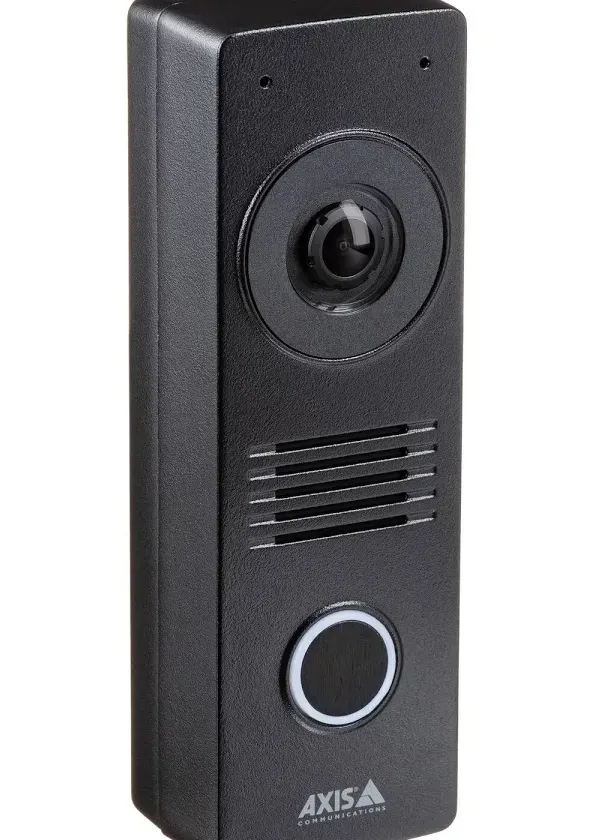
A photo from the AESS job library, not taken in Ridgewood: a black rectangular video door station with a camera lens, a speaker grille and one round call button that lights up. On a Ridgewood two-family, one station like this, with a second button added, is often all the street door needs; on a six-family it is the face of a system that has to call six flats without crossing a single wire.
Ridgewood Buzzer Request
Six-family, walk-up, two-family or a shop with flats above: tell us the street, how many apartments the system must reach and what is at the door now, and a technician calls back with the range
✅
Request Sent!
Thank you. A technician will call you about the Ridgewood address, usually within two hours during working hours.
25+
Years Experience
✓
Same-Day Estimates
100%
Licensed & Insured
4.7★
201 Google Reviews
Owner-operated since 2002 · Thousands of jobs completed · Booked within 2 hours
Quick answer: door buzzer installation in Ridgewood runs $400 to $900 on our Brooklyn list for an audio station with a new door release on a one- or two-family house, $700 to $1,800 for a video or audio system in a small building such as a six-family whose old pairs test sound, and from about $2,500 to past $10,000 when every apartment needs new cable and a directory-style panel, or the building is larger. The price covers the door station, the apartment stations, the power supply, the electric strike, the cable and the labor, and it is fixed in writing after we have walked the building from the street door to the cellar. Anything that depends on a test, such as an old pair that might fail or a closer that might not pull the door shut, is named and priced before you order. Send photos of the street door, the button plate and the cellar transformer to (347) 934-8335 or on WhatsApp, and we reply with the range that fits, usually within two hours during working hours.
Looking at your photos and quoting a new system costs nothing. If an existing system has to be tested in person before we can quote, that is the $250 service call booked online, and the $250 is applied toward the work.
All work is done under New York State license #12000287431. We install the low-voltage entry equipment; if the power supply needs a new 120-volt outlet or circuit, a licensed electrician does that part, and you know before the price is set.
We work for whoever controls the street door: the owner of a six-family or a two-family, a managing agent with the owner's authority, or a shop tenant with the landlord's written approval.
The Neighborhood
Why Ridgewood Properties Need Door Buzzer Installation
Ridgewood is a Queens neighborhood, Community District 5 and ZIP 11385, that runs along the Brooklyn line beside Bushwick. Most of its housing went up between about 1905 and the First World War, much of it in brick rows of six-family buildings with two flats on each floor. The detail that matters for a buzzer is not the history but the arithmetic: six households share one street door, one transformer in the cellar and one set of wires climbing three floors, and in many buildings that set of wires has been patched by several owners over several decades. When it fails, it rarely fails all at once. One apartment loses its talk, another can no longer open the door, and a third rings constantly because a button outside is stuck.
The public records show how common the result is. At 413 Onderdonk Avenue, HPD issued a Class B, hazardous, violation on March 14, 2026 ordering the owner to "PROPERLY REPAIR OR REPLACE THE BROKEN OR DEFECTIVE INTERCOM SYSTEM FROM BUILDING ENTRANCE" to the kitchen of one apartment, and LucidRents counts 47 door and lock violations in that building's history. At 1675 Woodbine Street, a six-unit, three-story building from 1930, HPD wrote up a fire door to the basement and the bulkhead door on the third floor on the same day in February 2026, with an immediately hazardous Class C order to "REPLACE OR REPAIR THE SELF-CLOSING DOORS." An entry system is only as good as the doors it controls, and inspectors look at both.
Across the ZIP code the numbers are large. LucidRents tracks 17,228 buildings in 11385 with 59,419 violations between them, an average of 3.4 per building, and reports that about 70 percent of residents rent. It grades the neighborhood's buildings C for maintenance and D for responsiveness to complaints. A buzzer is one of the first things a tenant notices, because it is used every time a friend visits or a package arrives, and one of the first things HPD can write when it stops working.
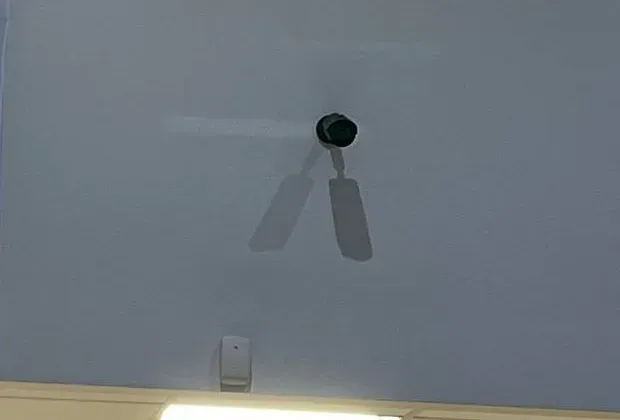
A photo from the AESS job library, not taken in Ridgewood: a small black camera mounted high on a pale wall, casting two shadows, with a small white device below it. In the ground-floor hall of a Ridgewood six-family, a camera placed high like this watches the inside of the street door and the way to the stairs and mailboxes, which is where an entry system's job ends and a camera's begins.
The second reason is what happens inside the door. Two reports in QNS describe the pattern in Ridgewood apartment buildings. In April 2019, police said, a woman entered the lobby of a building on Wyckoff Avenue between Putnam and Cornelia Streets and "gained access to the mailroom through an unsecured entry," taking "15 mail items that were left unattended." In a report published in January 2021, QNS said that on December 30 a man "walked up to the front door of 1680 Madison St., and began to ring multiple apartments," then "gained access to the building and made his way to the mail room," leaving with a package. Neither report says exactly how the door was beaten, and we do not guess. What both show is that the street door and the panel beside it are the building's whole perimeter, and that a mail room inside is only as safe as the doors in front of it.
The third reason is turnover. THE CITY reported in March 2023, in a story published by Patch, that registered rent-stabilized apartments in Ridgewood fell from 6,228 in 2019 to 2,149 in 2021, a drop of more than 65 percent against about 10 percent citywide, and that the median sale price in the neighborhood rose from $390,000 in 2012 to $1.09 million in 2022. Jonathan Miller of Miller Samuel described the rising rents as "the global phenomenon of Brooklyn spillover into Queens." Whatever one thinks of those changes, they mean many buildings here are being sold, renovated and re-let, and every one of those moments is when an owner decides whether to patch the old buzzer once more or put in a system that will last.
Six facts that shape a Ridgewood buzzer installation
The intercom gets written up as a hazard. HPD's March 14, 2026 order at 413 Onderdonk Avenue to repair or replace the intercom "from building entrance" was a Class B violation, the class that, by HPD's general rule, carries a 30-day correction period.
Six apartments is the common size. 1675 Woodbine Street, 1704 Woodbine Street and 1687 Gates Avenue are all three-story buildings from 1930 with six units; 804 Woodward Avenue, from 1911, has five.
Six is below the state's automatic intercom line. Multiple Dwelling Law §50-a requires an intercom automatically only in Class A multiple dwellings built or converted after January 1, 1968 with eight or more apartments, so most six-families here keep their intercom because they already have one, not because the law demands a new one.
Mail rooms sit behind the street door. The 2019 Wyckoff Avenue case and the Madison Street case QNS reported in January 2021 both ended at a mail room inside the building, which is why we treat the street door, the hall doors and the mail room door as one plan.
Most residents rent. LucidRents reports that about 70 percent of Ridgewood residents are renters, so most buzzers here are bought by an owner and used every day by tenants, two groups with different priorities.
Four city historic districts cover much of the housing. Stockholm Street, Ridgewood North, Ridgewood South and Central Ridgewood, the last with 990 buildings, put door stations on many facades under the Landmarks Preservation Commission's rules.
Where this page applies. This page covers Ridgewood from the Bushwick border at Wyckoff Avenue and the streets around Myrtle–Wyckoff to Fresh Pond Road, Metropolitan Avenue and the blocks toward Glendale and Middle Village. The same six-family rows continue across the line, and for those blocks see our Bushwick door buzzer installation page. For the rest of the borough see door buzzer installation in Brooklyn, and for Ridgewood's neighbors to the east see our Queens door buzzer installation page.
Repair or Replace in Ridgewood
Need Repair in Ridgewood? One Bad Link, an Old System on Good Wire, or a New Building System
Most Ridgewood owners who call about "a new buzzer" already have a system on the wall. It might be a six-button plate at the street door wired decades ago to handsets in each kitchen, a newer audio panel someone put up over the old one, or a system that rings fine but no longer talks or opens. Before any equipment is chosen we decide which of three paths fits the building, and we tell the owner which one it is, even when the answer is the cheapest.
The first path is a targeted repair, when one link is the whole problem: a transformer in the cellar that has burned out, a strike that has worked loose in the frame, a closer too weak to pull the door shut against the wind, a single apartment's handset. ButterflyMX's guide for small buildings puts the principle plainly: "Do not replace a system based on age alone." The second path is a partial replacement, a new door station, power supply and release over old pairs that meter clean, with new apartment stations. The third is a full installation with new cable, for buildings whose old wire was lost in a gut renovation, spliced too many times, or never ran to every flat.
In Ridgewood the deciding checks are usually not in the electronics at all. They are whether the street door closes and latches on its own, whether the pairs that climb the building are continuous from the cellar to each apartment, and whether HPD has already written a violation with a date attached. If a repair is all the building needs, our Brooklyn door buzzer team prices it as a repair. If the system is past saving, we say why, in writing, before you spend money on it.
What We Install
Door Buzzer Installation Services in Ridgewood
Every service below is priced from the same Brooklyn door buzzer list. The number of apartments sets the size of the system, the condition of the old pairs decides how much new cable is needed, and in Ridgewood the street door, the hall doors and the cellar decide much of the labor.
Six-flat entry systems
A six-button audio or video panel at the street door, a station in each flat that calls, talks and releases, and a supply in the cellar, planned so every button reaches only its own apartment.
Systems that clear an intercom violation
Work scoped to what the HPD order names, from the entrance panel to the station in the cited apartment, with a test sheet the owner can keep with the certification.
Audio to video on tested pairs
Two-wire video stations over the old riser where each pair meters clean from the cellar to the flat, and new cable only to the apartments whose pairs fail.
Phone answering for tenants
Door stations that ring tenants' phones as well as their wall stations, with the city's tenant data rules and any monthly charge explained before the owner chooses.
Two-button systems for rowhouses
For the two-family brick rows deeper in the neighborhood: one button per floor, each ringing only its own household, each able to release the street door.
Street door hardware
Fail-secure electric strikes fitted to the existing lock, closers that pull a heavy door shut every time, and latches set so the door locks behind each visitor.
Mail room and hall doors
A plan for the doors behind the street door, from a mail room off the lobby to an inner vestibule door, so the building's inside is as controlled as its front.
Systems for store-and-apartment buildings
A residents' station at the apartment door beside the shop and a separate buzzer for the shop or an upstairs office, each on its own power so one never affects the other.
Multi-building owners
Matching systems across several small buildings, with one labeling scheme, one set of records and stations an owner or managing agent can manage the same way at each address.
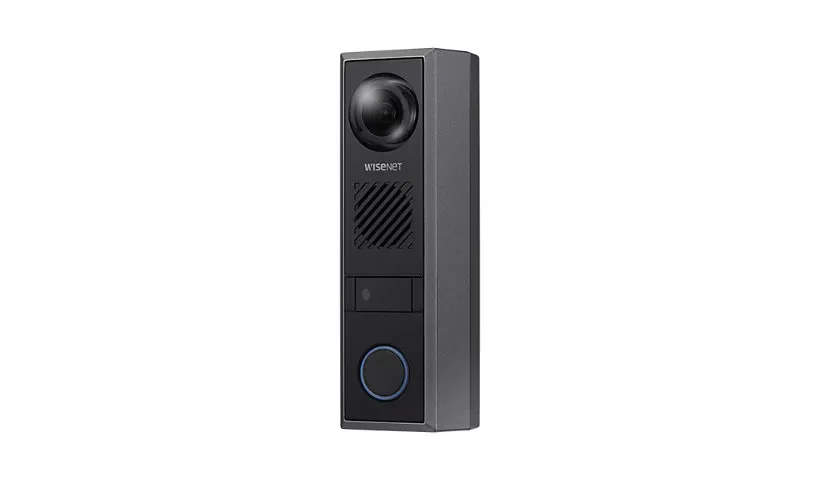
A photo from the AESS job library, not taken in Ridgewood: a slim dark grey wired doorbell with a camera lens, speaker slots and a round push button. On the two-family brick rowhouses that fill the blocks away from the Bushwick border, a narrow wired unit like this fits beside the street door frame, and a second one, or a two-button station, gives the upstairs household its own call.
Building Specialists
Door Buzzer Installation for Ridgewood's Architecture
Six kinds of building account for nearly every Ridgewood buzzer we plan. They differ in how many households share the door, how cable can reach each flat, what records already exist and who decides, and each has a mistake that shows up when the job is rushed.
Early six-family flats
Brick buildings from about 1909 to 1912, three stories over a basement with two apartments a floor, built as cold-water flats and modernized piece by piece since.
1930 six-families
Later three-story, six-unit buildings like those on Woodbine Street and Gates Avenue, with a single street door, a straight stair and a cellar with the boiler and meters.
Five-unit and odd-count buildings
Buildings such as 804 Woodward Avenue, from 1911 with five units on three floors, where a store, a combined flat or a converted basement changed the count.
Two-family brick rowhouses
The two-story rows built by the hundreds further from the border, one street door and two households, usually an owner below and a tenant above.
Stores with flats above
Buildings on Myrtle Avenue, Fresh Pond Road, Forest Avenue and Wyckoff Avenue where the residents' door sits beside a shopfront and a roll-down gate.
Larger buildings with a lobby
Walk-ups and elevator buildings with a lobby, a mail room and more than eight apartments, like the buildings in the Wyckoff Avenue and Madison Street reports.
Early six-family flats: a system added to buildings that were never wired for one
The oldest six-families here were built before most of what is now inside them: no central heat, no hot water, no intercom. Everything electrical was added later, often by different owners at different times, so the buzzer cable in these buildings follows whatever path was open when it was installed. We find pairs stapled up the stair stringer, pairs run through the light shaft between buildings, and pairs that disappear into a wall closed during a renovation. The mistake is to look at a working button on the street and assume the riser behind it is sound. We meter every pair from the cellar to each flat before we promise that the old cable can carry a new system, and we say on the quote which apartments need new wire.
1930 six-families: one door, six flats and a straight run to the cellar
The later six-families on blocks like Woodbine Street and Gates Avenue are simpler in one way. 1675 Woodbine, 1704 Woodbine and 1687 Gates Avenue are each three stories with six units, built in 1930, and the plan is regular: a street door, a stair, two flats on each landing and a cellar below. The cable usually has a straighter path than in the older flats, and the apartment stations line up floor over floor, which makes a new riser easier to run if one is needed.
The records for these buildings point at the doors more than the electronics. 1675 Woodbine had its basement fire door and its roof bulkhead door written up on the same day, and an immediately hazardous order to fix the self-closing doors. When we install a buzzer in a building like this, we check those doors on the same walkthrough, because an owner who fixes the street door's release and leaves a basement door that does not latch has solved half the problem.
Five-unit and odd-count buildings: when the plate no longer matches the flats
Not every building kept six apartments. 804 Woodward Avenue, from 1911, has five units on three floors. Elsewhere a store took over the ground floor, two flats were combined, or a basement was converted. In each case the button plate at the street door often still shows the original count, with one button that rings nowhere or two buttons that ring the same apartment. The fix is to plan the system from the apartments that exist now, not from the old plate, and to label the new panel to match the doors upstairs. Where a building is close to the eight-apartment line, we also ask whether the owner plans to change the count, because a conversion can bring the building under the state's intercom rule.
Two-family brick rowhouses: two households, one door and a stair in between
Away from the border, much of Ridgewood is two-story brick rowhouses, each with a street door that serves an owner on one floor and a tenant on the other. The common complaint is that both households hear the same bell, or that the upstairs tenant has no way to open the door without walking down. A two-button station, a release in the street door frame and a station on each floor solves both. These houses are not multiple dwellings under New York's housing laws, so what goes in is the owner's choice. What matters most is that the tenant's button reaches only the tenant and that both floors can release the door.
Stores with flats above: the residents' door beside the shop
On the shopping streets the apartments' street door is usually a narrow door between two storefronts, or beside a single shop's entrance under its gate box. The residents need a station that calls only the flats upstairs. The shop may need its own buzzer for a back or delivery door, or for an upstairs office. We keep them as two systems with separate power, so a new shop tenant, a gate motor or a flooded store cellar never touches the apartments' door. Where the shop and the apartments share a cellar, we put the apartments' supply where the residents' owner controls it.
Larger buildings with a lobby: more than eight apartments and a mail room inside
The buildings in the 2019 and 2021 QNS reports both had something most six-families do not: a lobby with a mail room off it. Buildings that size usually have more than eight apartments, a directory-style panel instead of a row of buttons, and an inner lobby door. Here the plan covers three doors, not one: the street door, the inner lobby door and the mail room door. Whether the building must have an intercom depends on its date and its apartment count under §50-a; whether it should have one is not in question.
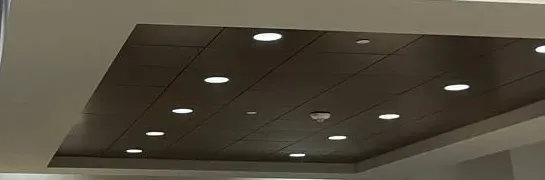
A photo from the AESS job library, not taken in Ridgewood: a dark recessed ceiling panel with round downlights and a small round device, framed by a lighter ceiling. Lobbies in Ridgewood's larger walk-ups were often refinished with dropped ceilings like this, and the space above the panel is usually the cleanest route for new cable from the lobby door to the riser.
Field Notes
Field Notes: Press Every Button, Climb Every Floor, Then Follow the Wire Down
This is how our technician spends the first part of a visit to a Ridgewood six-family, before anything is priced.
First, the street door, from the sidewalk. The technician presses each button in turn and listens: which apartments ring, which talk back, which release the door, which do nothing. Then the door itself: let it go from fully open and watch whether it closes and latches without a push. A door that drifts shut and stops an inch from the frame is the most common reason a building with a working intercom still has strangers in its hall, and no new station fixes it.
Second, the stairs. With the owner's permission and the tenants' notice, the technician goes up floor by floor and looks at each apartment's station, if there is one, and at the hall doors on the way. In the older flats the cable is often visible at this point, tacked up the stair or disappearing into a light shaft. In the 1930 buildings it is usually hidden, and the stations line up one above the other on each side of the landing.
Third, the cellar. The technician finds the old transformer, notes what circuit it is on and whether it shares space with the boiler or the meters, and follows the pairs from it to where they turn up into the building. Each pair is metered. Some buildings have six clean pairs and a dead transformer, which is the cheapest kind of news. Some have three good pairs, two shorted and one that ends at a splice inside a wall. Only then is the route drawn and the price written.
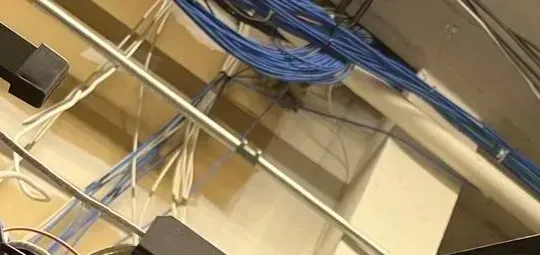
A photo from the AESS job library, not taken in Ridgewood: bundles of blue low-voltage cable laid over a ceiling beam beside a metal pipe in an open ceiling. In a Ridgewood cellar, new buzzer cable follows the same kind of path along the joists from below the street door to the supply, kept clear of the boiler's pipes and turned up into the building only where a shaft or a closet stack hides it.
Violations at the Door
What HPD Writes at Ridgewood Entrances, and What We Fix on the Same Visit
An owner who calls about a buzzer after an HPD inspection usually has a piece of paper with very specific words on it, and those words decide the scope of the job better than any brochure. The 2026 records for two Ridgewood buildings show the range.
At 413 Onderdonk Avenue, the order issued on March 14, 2026 reads: "PROPERLY REPAIR OR REPLACE THE BROKEN OR DEFECTIVE INTERCOM SYSTEM FROM BUILDING ENTRANCE TO THE WEST WALL IN THE KITCHEN LOCATED AT APT 1R." That sentence names both ends of one circuit: the entrance panel and a single apartment's station. It is a Class B violation, which under HPD's general rule, as summarized in ButterflyMX's NYC repair guide, carries "30 days for Class B violations." A buzzer job that answers it has to make that one apartment talk to the street and open the door, and prove it with a test.
At 1675 Woodbine Street, the February 7, 2026 orders are about doors, not electronics: latch sets on "FIRE DOOR TO BASEMENT AT PUBLIC HALL, 1st STORY" and on the "BULKHEAD DOOR AT PUBLIC HALL, 3rd STORY," and a Class C order to "REPLACE OR REPAIR THE SELF-CLOSING DOORS." Class C means immediately hazardous; the same guide gives "24 hours for most Class C violations." None of those doors gets a buzzer. But they are on the same walkthrough as the street door, they are fixed with the same tools, and they decide whether a tenant who was buzzed in can wander from the hall into the cellar or onto the roof.
So we work from the violation list. Before the visit, we look up the building's open HPD violations, which are public. At the visit, we check every item on the list that touches an entrance, a hall door, a lock or the intercom. On the written price, each item is either included, quoted separately or marked as outside our work. When the job is done, the owner has a test sheet for the intercom and a record of the door hardware we replaced, which is what an owner needs when certifying a correction. We do not certify violations ourselves; the owner does, and HPD decides.
One caution: a new system does not make an old violation disappear. It has to be certified by the owner and, where HPD reinspects, seen working.
Rules and Responsibilities
Which Ridgewood Buildings Must Have an Intercom, What It Has to Do and Who Answers for It
Newer buildings of eight or more apartments must have one. Multiple Dwelling Law §50-a requires a Class A multiple dwelling erected or converted after January 1, 1968 with eight or more apartments to have a self-locking main door and an intercom that lets a visitor and a resident speak and lets the resident release the door. ButterflyMX's NYC guide sums up the baseline as "voice communication and apartment-controlled door release."
Older buildings of that size must install one when a majority of tenants ask. For buildings put up before 1968, the duty arises when tenants occupying a majority of the apartments request or consent in writing.
A system that exists has to work. Whatever the building's size, HPD writes broken intercoms as violations, as it did at 413 Onderdonk Avenue in March 2026, and the NYC311 maintenance article lists "Doorbells, buzzers, or intercoms that are broken or missing" as a reportable apartment and public-area condition.
Courts treat a working intercom as an essential service. Habitat reported in February 2024 that failing to maintain one can breach the warranty of habitability; as Nancy Kourland of Lasser Law Group put it about one co-op, "As a result, the co-op has a legal obligation to repair or replace the intercom."
Two-family houses are outside the multiple-dwelling rules. A one- or two-family rowhouse is not a multiple dwelling, so whether to install a buzzer, and what kind, is the owner's choice.
Every exit opens without a key. A release, lock or code added to any door on the way out of a building leaves it opening freely from inside by its lever or knob.
Keyless entry in a multiple dwelling comes with data rules. HPD's Tenant Data Privacy Law covers owners of multiple dwellings that use smart access systems: express consent "in writing, or through a mobile application," authentication data destroyed "no later than 90 days" after collection unless anonymized, and no requirement to use the smart system to get into a tenant's own apartment.
Landmarked facades follow the Landmarks rules. Inside Ridgewood's four historic districts, door stations, lights and conduit on the front follow the Landmarks Preservation Commission's Permit Guidebook, and work done without a permit can end up before the Commission to be legalized.
None of this is legal advice for a particular building. An owner answering a tenants' written request, a tenant deciding what to do about a dead intercom or a buyer weighing a building's violation history should confirm the details with a housing lawyer or HPD. What we provide is a system that meets the requirement that applies and paperwork showing what was installed and tested.
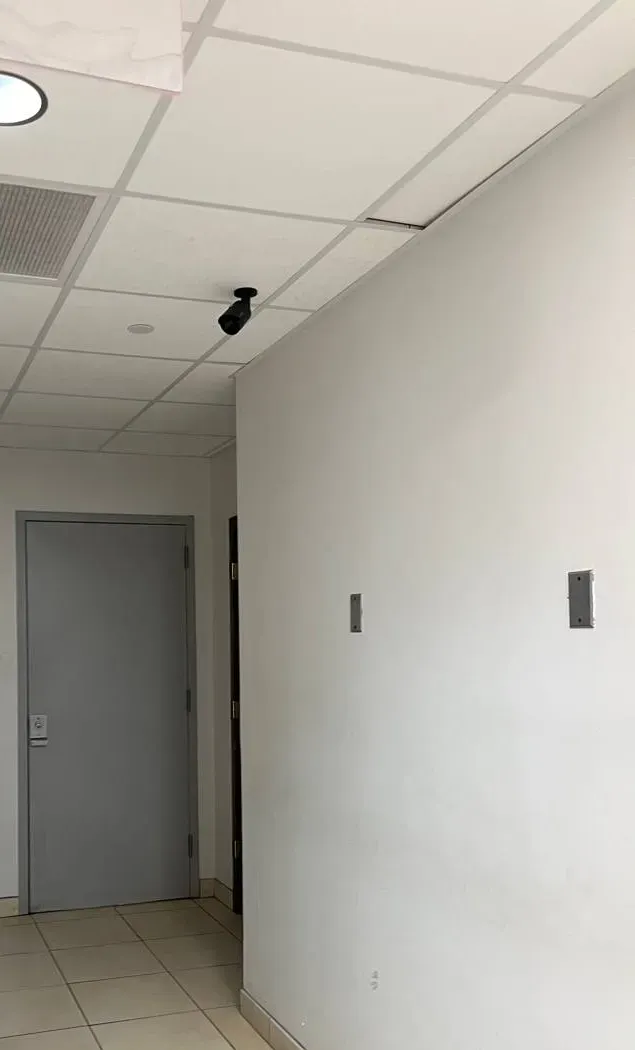
A photo from the AESS job library, not taken in Ridgewood: a tiled corridor with white walls and small wall plates ending at a grey steel door with a lever handle, under a drop ceiling with a small camera. A cellar fire door like this one in a Ridgewood walk-up has to close and latch on its own and open from inside with a turn of the lever, the two things HPD looked at on the basement door at 1675 Woodbine Street.
Renovations and Turnover
Gut Renovations, New Owners and Empty Apartments: The Best Moments to Replace a Ridgewood Buzzer
Many Ridgewood buildings change hands or get rebuilt inside every few years, and the timing of a buzzer installation makes a large difference to what it costs and how much of it can be hidden. THE CITY's 2023 report on rent-stabilized registrations described how much renovation went on: under the state's substantial-rehabilitation rules, owners must replace "at least 75% of a building's systems" and show the building was substandard or seriously deteriorated beforehand. Whether a particular renovation meets that test is a question for the state housing agency and a lawyer, not for an installer. But a renovation of that scale is the moment when walls are open, and open walls are when a new riser costs least.
The same is true of smaller changes. When one flat is vacant and being redone, its station can be moved to where the new kitchen or hall will be, and a new pair can be run while the wall is open. When a building is bought, the new owner has a short window before tenants settle into new routines, and a planned changeover is easier than an emergency one later. Habitat's 2017 report on buzzer upgrades quoted Dan Arnold of Academy Mailbox on why wall material matters so much: "If it's sheetrock, you can make a few holes and snake it down to the basement. If the walls are marble or granite, that's a little harder. But nothing is insurmountable." In Ridgewood the hard material is usually brick and old plaster rather than marble, and an open renovation removes most of the difficulty.
If you are planning work, bring us in once the floor plans are settled and before the walls close, and leave the door station and release until the street door itself has been rehung or replaced.
Commercial Door Buzzer Installation
Business Door Buzzer Installation in Ridgewood
Ridgewood's shopping streets are mostly ground-floor stores with apartments above, so a business buzzer here is nearly always one of two systems in the same building: the shop's own door control and the residents' entry next to it. The streets below are where most of those requests come from.
Myrtle Avenue
The Myrtle Avenue Business Improvement District, founded in 1988, runs from Wyckoff Avenue to Fresh Pond Road with around 300 businesses, nearly all in buildings whose upper floors are apartments.
Fresh Pond Road
The eastern commercial spine from the M station north, with storefront buildings that combine a shop door, a residents' door and a shared cellar.
Forest Avenue
A street of shops, including Serbian-owned businesses, in storefront buildings with flats above, on blocks that use the hyphenated Queens house numbering.
Wyckoff Avenue
The border street with Bushwick, home to the apartment building whose mail room was reached "through an unsecured entry" in the 2019 QNS report.
Seneca Avenue
The M train's Seneca Avenue stop and the blocks of six-families and corner stores around it, inside and beside the Ridgewood South district.
Metropolitan Avenue and the north
The northern edge, where former factories and knitting mills near Newtown Creek sit near the Engine 291 and Ladder 140 firehouse at 56-07 Metropolitan Avenue.
The commonest business request here is a buzzer on a door that has always been propped open during the day or locked with a key: a store's back or cellar door for deliveries, a dentist's or accountant's office on a second floor that buzzes clients in one at a time, a community room whose door should lock behind each person after hours. Each gets its own station, release and power, fully separate from the apartments' system. Where a shop also wants a camera on its back door, installing it on the same visit usually saves $200 to $400 in labor compared with a separate trip. For the border blocks on the Bushwick side see our East Williamsburg door buzzer installation page, and for the blocks south past the cemeteries our Cypress Hills door buzzer installation page.
Rules that apply to business entry installations in Ridgewood
Anyone inside can always get out. A shop or office door with a buzzer, code or reader still opens from inside without a key. As Allegion's guide puts it, with an electric strike "you can exit by turning the lever" whether the strike is fail-safe or fail-secure, which is why a fail-secure strike is the usual choice.
Fire-rated doors keep their rating. A rated door to a stair or cellar needs a fail-secure strike with the right listing, so it stays latched in a fire.
Magnetic locks need the full package. Electromagnetic locks are only made fail-safe, and the building code's sensor-release provisions call for a sensor on the egress side, a "PUSH TO EXIT" device 40 to 48 inches above the floor within 5 feet of the door that keeps it unlocked for at least 30 seconds, release on fire alarm or sprinkler activation, and UL 294 listed equipment.
Buttons within reach. Call buttons outside and release buttons at a reception desk go no higher than the 48-inch high forward reach in the 2010 ADA Standards.
Tenants need the landlord's written approval. A shop that rents its space orders its own buzzer only with the building owner's written permission, especially where the work touches a shared door, a shared cellar or the apartments' cable.
Landmarked storefronts follow the district rules. Shops inside the historic districts follow the Landmarks Permit Guidebook for anything mounted on the front, and either the owner or the owner's project team, which can include a commercial tenant, applies with the owner's signature.
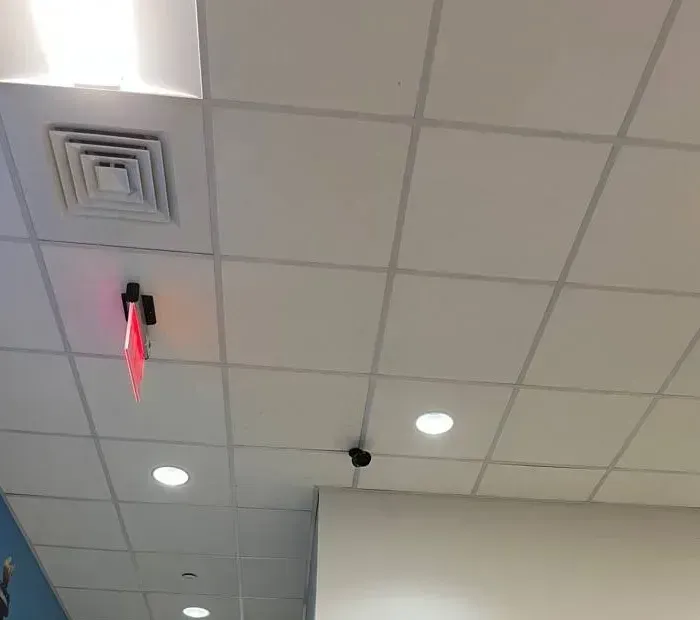
A photo from the AESS job library, not taken in Ridgewood: a drop ceiling with a lit red exit sign, an air diffuser, round recessed lights and a small black camera. Offices and shops above and along Myrtle Avenue often have ceilings like this, and the exit sign is the rule every business buzzer here follows: whatever locks the door from outside, it always opens from inside.
Your Questions Answered
Door Buzzer Installation in Ridgewood: Questions Answered
Inside a six-family
Our 1930 six-family on Woodbine Street has a light shaft between us and the building next door. Can new buzzer cable run up the shaft to the second and third floors?
Sometimes, and it is often the cleanest route in a building like yours. A light shaft runs from the cellar or first floor to the roof past the windows of the rear rooms, and a cable on its wall, in a small painted conduit, can reach each floor without opening a single wall in the stair hall. Where the cable turns into each apartment, it goes through the wall beside a window frame and comes out behind the new station, usually in the kitchen or the back hall.
Three things decide whether it works. The shaft has to be on your side of the property line, or the neighbor has to agree in writing. The cable has to be outdoor-rated and fixed where it will not be damaged when windows are opened or the shaft is cleaned. And the wall has to be sound enough to hold fixings, which in old brick means finding solid mortar joints. We look at the shaft from each floor at the walkthrough and price the shaft route and an inside route side by side.
HPD's order at an Onderdonk Avenue building described an intercom running from the entrance to a station on one apartment's kitchen wall. When our system is replaced, should the stations stay in the kitchens?
Not necessarily. Many old systems put the handset in the kitchen because that was where the cable could reach, not because it was the best place to answer. The HPD order at 413 Onderdonk Avenue names exactly that: the intercom "FROM BUILDING ENTRANCE TO THE WEST WALL IN THE KITCHEN." In a flat where the kitchen is at the back and the apartment door at the front, a station by the apartment door, or in the hall between the two, is often easier for a tenant to reach quickly.
Moving a station means moving its cable, so it is a cost decision as well as a comfort one. Where the old pair is sound and ends in the kitchen, the cheapest good answer is to reuse it there. Where the pair has failed anyway, the new cable can end wherever the tenant answers best. We ask each household at the walkthrough, and the quote shows where every station goes.
Once a visitor is buzzed through the street door, how do they find the right flat when two apartments open off every landing?
By making the panel and the doors use the same names. Ridgewood's six-families usually have a left and a right apartment on each floor, and a visitor who pressed "2" on a panel and then reaches a landing with two unmarked doors has to knock on both. We label the panel with the same letters that are on the apartment doors, such as 1L, 1R, 2L and 2R, or with the numbers the building already uses, and we suggest the owner put matching numbers on each apartment door if they are missing.
Our building started out as cold-water flats around 1910 and got its heating, wiring and plumbing in pieces over the years. How do you tell which of the old wires in the cellar belong to the buzzer?
By testing, not by color. In buildings modernized in stages, the cellar ceiling carries wires from every era: old bell wire, abandoned telephone pairs, cable TV, thermostat wire for the boiler and sometimes wires that go nowhere. The buzzer pairs are found by starting at the transformer and at the back of the street door panel and tracing each pair with a tone generator, then confirming it at the station in each flat.
Once each buzzer pair is identified, it is metered for continuity and for shorts to the other pairs. Wires that belong to nothing are labeled as abandoned rather than cut, because in an old building a wire nobody recognizes is sometimes still in use. Every pair we keep is labeled at both ends, so the next technician does not have to start over.
The doors behind the street door
A 2019 police report said a thief reached a Wyckoff Avenue mail room "through an unsecured entry." What usually makes a building entrance unsecured, and which part of an installation closes it?
In our experience it is usually the door, not the electronics. The report did not say which entry was unsecured, so we cannot say what happened in that building. In general, though, the doors we find unsecured in Ridgewood walk-ups fall into a short list: a street door whose closer no longer pulls it shut, a latch that does not catch the strike, a door propped with a wedge for deliveries, an inner lobby door that has stopped closing, a side or cellar door left on the latch.
An installation closes those gaps in a fixed order. First the closer and latch are adjusted or replaced so the door shuts and locks behind every person. Then the strike is fitted so the door can only be opened from outside by a key or a release from an apartment. Then any inner door that guards the mail room gets the same treatment, or a lock of its own. A new panel with a camera is the last piece, not the first.
HPD wrote up the latch on our cellar fire door and our roof bulkhead door on the same day. Should those doors be put on the new entry system as well?
No, and they should not need to be. A cellar fire door and a roof bulkhead are not entrances for visitors; they are doors that must close and latch on their own and open from the inside without a key. The orders at 1675 Woodbine Street in February 2026 were exactly that: defective latch sets at the basement fire door and the bulkhead door, and an immediately hazardous order about the self-closing doors.
What those doors need is the right hardware: a working closer, a latch that catches every time and, on a fire door, hardware with the proper listing. We can replace those parts on the same visit as the buzzer installation if they are in the written price, which saves a second trip. If the owner wants to know when the cellar door is left open, a simple door contact can alert the owner or super, but that is a separate choice, not a requirement.
Our corner six-family has a second street door on the side street that nobody uses. Should it get its own station, or can it simply be closed off?
That depends on whether it is a required exit. If the side door is part of the building's legal way out, it cannot be blocked, chained or locked against people leaving, whether or not anyone uses it to come in. In that case it stays openable from inside and locked from outside, and the question is only whether visitors should be able to ring there. Usually they should not, and the door gets no station.
If the door is not a required exit, the owner can decide to keep it locked permanently from outside, but it should still close and latch properly, and it should not become a place where tenants prop it for convenience. We tell the owner at the walkthrough which kind of door it appears to be, and where there is doubt, the owner should confirm with an architect or expediter before anything is changed.
Owners, buyers and the rules
We are about to close on a Ridgewood six-family whose tenants say the intercom has been dead for years. Once the deed is ours, what are we expected to do about it, and how quickly?
Plan on fixing it, and soon. A six-family is below the eight-apartment line in Multiple Dwelling Law §50-a, so the law does not require a building that size to install an intercom it never had. But a building that has one is expected to keep it working, and HPD writes broken intercoms as hazardous Class B violations, as it did at 413 Onderdonk Avenue in March 2026. By HPD's general rule a Class B violation gives the owner 30 days to correct it, and any open violations transfer with the building.
The practical step is to have the system tested before closing if the seller allows it, or in the first week of ownership if not, and to check the building's open violations online. If the old system can be repaired, that is quick. If it needs replacing, the written price and the order date tell you whether a 30-day window is realistic, and we say so before you approve.
Our block is in the Central Ridgewood Historic District, and the panel by our door was put up by a previous owner without a Landmarks permit. Does the old panel have to be legalized before it can be replaced?
Not usually, if the replacement is done properly. The Landmarks Preservation Commission does deal with past work done without permits; in September 2025, for example, the owner of 59-39 70th Avenue in the Central Ridgewood district went to a public hearing to "legalize" alterations that had already been made, including window and HVAC work. A door panel is a far smaller matter, but the principle is the same: what is on the facade should match what the Commission's rules allow.
The simplest path is to replace the unpermitted panel with one that fits the staff-level criteria in the Permit Guidebook, located within or beside the door opening, attached at plain masonry or mortar joints, with its cable concealed, and to apply for the new work. We plan the station to those criteria, and the owner or the owner's representative files. If the Commission has already issued a warning letter about the old panel, tell us, because the filing then has to address it directly.
Can a tenant hold back rent because the building's intercom is broken?
That is a legal question, and the honest answer from an installer is to talk to a housing lawyer or a tenants' organization first. ButterflyMX's NYC guide puts it carefully: "Rent withholding and Housing Court strategy can carry serious consequences and should not be based on a general article." What is clear from public sources is the route the city sets out: the NYC311 article tells tenants to try to resolve the problem with the owner, managing agent or super first, and HPD investigates complaints and issues violations to owners. Habitat reported in 2024 that courts treat intercoms as an essential service, and that a tenant does not need a lawyer to start an HP case in Housing Court.
For owners, the practical point is the same one in reverse. A dead intercom gives tenants a documented complaint, and a working one, with a test sheet showing every apartment calls, talks and releases, is the strongest record an owner can have.
Changeover day and several buildings
On the day the old system comes out, how do tenants and deliveries get into the building before the new one is working?
With keys, a plan and a short gap. The street door keeps its normal lock the whole time, so every tenant with a key gets in as usual. What stops for a few hours is calling and buzzing, and we keep that window as short as possible by doing the cable and the apartment stations first, while the old panel still works, and switching the street panel last. In most six-families the switch itself takes part of one working day.
Before the day, the owner tells tenants in writing when the system will be down and that deliveries should be arranged for another day or picked up in person. We never leave the street door propped or unlocked to make up for it. At the end of the switch, we call every apartment from the street and make sure each tenant knows how to answer and release.
We own three small buildings within a few blocks of each other in Ridgewood. Can one person manage all three entry systems the same way, and should they match?
Yes, and usually they should. Ridgewood's buildings are often owned in small groups; LucidRents lists the ZIP code's largest landlord with 21 buildings. For an owner with three, the value of matching systems is that a super or managing agent learns one panel, one set of stations and one way of changing an apartment's listing, and spare parts fit every building. If the systems include phone answering or codes, they can usually be managed from one account with each building kept separate.
Matching does not mean identical prices. Each building is surveyed on its own, because one may have six clean pairs and another may need a new riser. What we standardize is the equipment, the labeling and the records, so each address has the same binder.
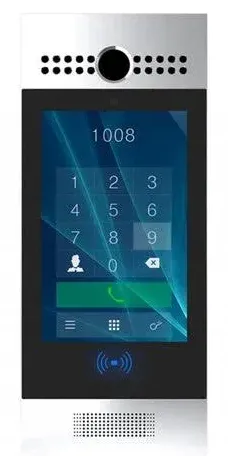
A photo from the AESS job library, not taken in Ridgewood: a touchscreen entry panel showing a dial pad with a four-digit apartment code entered, a camera above and a card-reader symbol below. For an owner with several Ridgewood walk-ups, a panel like this at each street door can be run from one account, with each building's apartments and codes kept apart.
Equipment
Types of Door Buzzer Systems We Install
We quote a reliable non-branded system by default and install a named brand when an owner asks for one; the intercom brands we work with include Aiphone, ButterflyMX, 2N, Akuvox, Comelit and DoorBird. These are the kinds of equipment that come up most often in Ridgewood buildings, and where each one fits.
Six-button audio panels
Talk-and-release panels for six-families on sound pairs, with one button per flat labeled to match the apartment doors, the most economical way to meet the law's functional baseline.
Six-button video panels
The same layout with a camera, so each tenant sees the visitor before releasing, on two-wire systems that run video over the old pair where it tests clean.
Apartment stations
Audio handsets or video monitors placed where each household answers, by the apartment door or in the kitchen, with a release button on every one.
Two-button rowhouse stations
Narrow stations for two-family brick rowhouses, one button per floor, each household with its own call and its own release.
Phone and app answering
Panels or gateways that ring tenants' phones as well as their stations, for buildings where tenants want to answer from work, with the data rules and any subscription stated up front.
Keypad and directory panels
Code entry and scrolling directories for larger walk-ups with a lobby, so the panel stays small and tenants can enter without keys if the owner chooses.
Cellular call boxes
Panels that place calls over a cellular connection where a building has no internet at the door and no spare cable, sized and priced only after a signal check.
Fail-secure electric strikes
Releases cut into the frame that stay locked without power and let anyone inside leave by turning the lever, matched to the lock already on the street door.
Battery-backed power supplies
Dedicated supplies mounted in the cellar on the owner's circuit, away from the boiler and the meters, sized for the panel, the stations and the strike.
Keep the old system, new system on old pairs, or new cable: which fits a Ridgewood building?
What matters
Repair the old system
New panel and stations on tested pairs
New panel, stations and new cable
Best when
One link has failed and parts are available
Every pair meters clean from cellar to flat
Pairs are broken, spliced or missing
Walls opened
None
None, or a small hole behind each station
A route through a shaft, closets or the stair
Video possible
Only if the old system had it
Yes, on two-wire systems
Yes
Clears a violation for one apartment
Yes, if that link was the fault
Yes
Yes
Monthly fees
None
None on wired systems
None on wired systems; app and cellular options may charge
Brooklyn list range
Priced as a repair after diagnosis
$700–$1,800 for a small building
From about $2,500, toward $10,000+ with size
ADT, Ring and SimpliSafe compared with a local installer for a Ridgewood walk-up
National brands come up in nearly every conversation about a front door, and a store-bought video doorbell is fine for a one-family house whose owner only wants a phone alert. In a six-family it runs into three limits. It rings the phones of whoever set it up, not a station in each of six flats. It does not open the street door unless it is wired separately to a strike. And it gives each tenant no button, no release and no privacy from the others. A post on r/AskNYC in January 2026 shows what it feels like from inside a building where one apartment was left with only a doorbell: "I can't see or hear who is at the front of the building, and I get buzzed all day for other apartments."
What a local installer adds is the rest of the door: a panel that calls each flat separately, a strike that releases the street door, a closer that pulls it shut, a supply in the cellar with battery backup and cable that reaches every apartment.
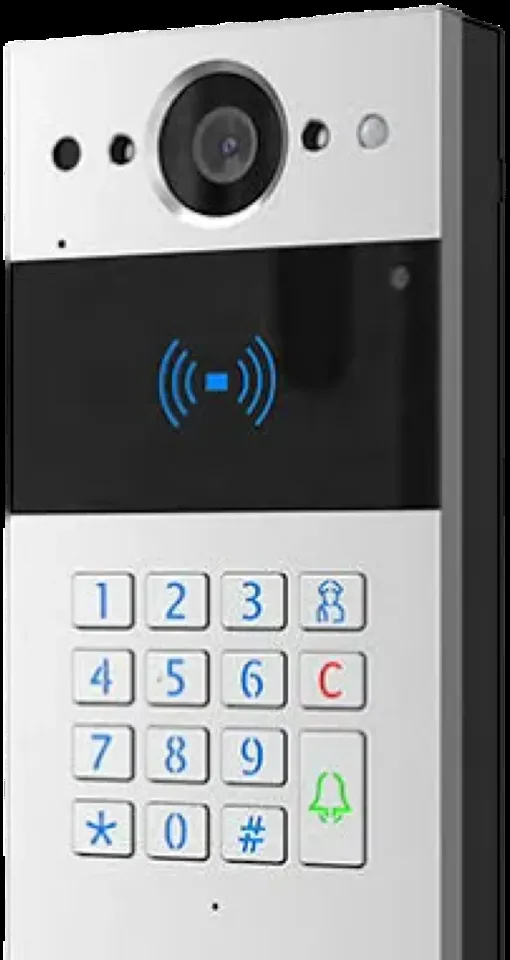
A photo from the AESS job library, not taken in Ridgewood: a silver and black keypad door station with a camera lens at the top, a blue card-reader symbol, a numeric keypad and a green bell key. At the street door of a larger Ridgewood walk-up, a station like this replaces a long row of buttons: visitors enter an apartment number and press the bell key, and residents can enter by code or card.
AI Overview Reality Check
What AI Gets Wrong About Door Buzzer Installation in Ridgewood
Ask an AI assistant or a search summary about replacing a buzzer in a small apartment building and you get confident answers assembled from national cost guides, vendor blogs and general legal summaries. Some of it is right in general and wrong for a Ridgewood six-family with a violation on its record. Here are seven claims we see repeated, each checked against its source and against what we find at doors here.
"Replacing a small building's intercom costs about $1,500 to $2,500"
That figure comes from ButterflyMX, and the same vendor's own guide for small buildings sets it beside Swiftlane's "roughly $2,200 to $5,000 or more for a small single-entrance project," then admits that "There is no reliable universal price for replacing a small-building intercom." Two vendor ranges that overlap only partly are not a price.
On our Brooklyn list, a six-family whose old pairs meter clean usually lands in the $700 to $1,800 small-building range, and one that needs new cable to every flat and a directory-style panel moves into the multi-unit range that starts around $2,500. HomeAdvisor's national guide, for comparison, gives an average of $2,500 for intercom installation across all kinds of property.
What moves a Ridgewood price is the condition of the pairs, the state of the street door and how many stations need new cable, not a national figure.
"HPD gives an owner 30 days to fix a broken intercom"
Often, but not always. Thirty days is HPD's general correction period for Class B violations, and the intercom order at 413 Onderdonk Avenue in March 2026 was a Class B. But the same building's door and lock history shows how quickly an entrance problem can become something else, and Class C violations, which ButterflyMX's guide gives "24 hours" in most cases, were written for the self-closing doors at 1675 Woodbine Street.
The class is on the violation itself, and the date on it is what counts. An owner who reads "30 days" in a summary and then finds a Class C on the street door has much less time.
That is why we read the actual violation list before quoting, and say on the price whether the work can be done inside the window.
"Send a photo and an installer can tell whether your old wiring can be reused"
No honest installer can promise that, and the vendor guides say so themselves. ButterflyMX's small-building guide states that wiring reuse "cannot be confirmed from a photo, the age of the building, or the look of a wall station."
Photos are useful for other things: they show the panel, the door, the frame, the transformer and roughly how the building is laid out, which is enough to give a range. They cannot show whether a pair climbing three floors of an old flat building is continuous, shorted or spliced inside a wall.
So we give a range from photos and fix the price after metering every pair at the walkthrough, and any pair that might fail is named on the quote with its cost.
"An intercom past a certain age should simply be replaced"
Age is a poor guide on its own. "Do not replace a system based on age alone," ButterflyMX's guide advises, and recommends repair "when the fault appears localized, compatible parts are available," and replacement "when service calls keep coming back, parts are no longer supportable."
In Ridgewood we see both cases in buildings of the same age. A six-family with a dead transformer and six sound pairs needs a repair or a new panel on the old wire. A six-family whose pairs were cut in a renovation needs new cable whatever the age of the system.
The test results, not the year on the panel, decide which path we recommend.
"An intercom is an amenity, not a requirement"
For new buildings of eight or more apartments, and for older ones where a majority of tenants ask in writing, it is a requirement under Multiple Dwelling Law §50-a. For buildings that already have one, courts have gone further: Habitat reported in 2024 that intercoms are treated as an essential service, so failing to maintain one can breach the warranty of habitability.
The six-families that make up so much of Ridgewood sit below the eight-apartment line, but that does not make a broken intercom optional. HPD wrote one at 413 Onderdonk Avenue as a hazardous violation.
What is optional is the type of system. Audio talk-and-release meets the functional baseline; video and phone answering are upgrades the owner may choose.
"311 complaint counts show which buildings have the worst intercoms"
Complaint counts show where people complain. When the State Comptroller's office presented its 311 monitoring tool to Queens Community Board 5 in December 2025, deputy comptroller Rahul Jain warned that volume does not measure severity: "It doesn't necessarily mean things are worse, just that people are complaining more."
A building with an engaged tenants' group may have dozens of intercom complaints and a system that needs one part. A building whose tenants never call may have a dead riser. LucidRents' Ridgewood grade of D for responsiveness tells you about complaints and answers across the ZIP code, not about any one door.
For a specific building, the useful record is the HPD violation text and its date, and after that, a test of every button.
"A small door panel on a landmarked facade doesn't need approval"
Inside Ridgewood's historic districts, work on the facade is under the Landmarks Preservation Commission, and a door station is facade work. The Permit Guidebook allows intercom panels and doorbells within or beside a door opening, with concealed cable, under staff-level permits, which is a short process when the work fits the criteria.
Skipping it has a cost. In September 2025 the owner of 59-39 70th Avenue in the Central Ridgewood district went before the Commission at a public hearing to legalize alterations already made. A panel is a small item, but an unpermitted one can turn up when the owner applies for something else.
We plan stations to the staff criteria so the permit is routine, and we do not mount on a landmarked facade until the owner has it.
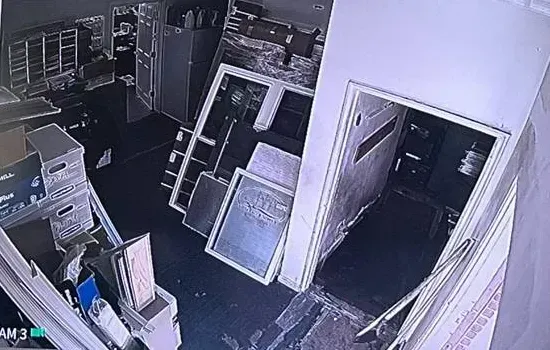
A photo from the AESS job library, not taken in Ridgewood: a black-and-white night camera view of a cluttered room with an open doorway into a dark back room. Stockrooms behind shops on Myrtle Avenue and Fresh Pond Road often lead to a back or cellar door, and a buzzer on that door, with a camera inside watching it after hours, keeps the back of the store as controlled as the front.
Not Sure Whether Your Building Needs One New Part or a Whole New System? Speak to a Tech
Send a photo of the street door and the button plate, one of the transformer in the cellar if you can find it, and, if HPD has written a violation, a photo of the notice. Tell us how many apartments there are and what happens when each button is pressed. A technician will tell you which path fits and where it falls on our Brooklyn ranges. Call or text (347) 934-8335, send photos on WhatsApp, or fill in the form below.
Get In Touch
Request a Free Quote
✅
Request Sent!
Thank you. A technician will call you about the Ridgewood address, usually within two hours during working hours.
How It Works
Our Installation Process
1. Read the building's records and photos
Before the visit we look at your photos and the building's public HPD violation list, so we arrive knowing whether the intercom, the self-closing doors or the latches have been written up and when.
2. Walk the entrance, the halls and the cellar
We press every button from the sidewalk, test the street door and each hall door, look at the cellar fire door and the bulkhead, and find the transformer and the path the pairs take up the building.
3. Meter every pair and map the route
Each pair is traced and metered from the cellar to its flat. Where a pair fails, we plan a new route through a light shaft, a closet stack or the stair, and price it beside any alternative.
4. Write the price and the tenant plan
You get a written price from the Brooklyn list with every possible extra named, and a plan for how tenants and deliveries get in while the system is switched over.
5. Fix the door first
The street door is made to close and latch on its own before any release goes in. Closers, latches and hall-door hardware included in the price are replaced on the same visit.
6. Install the station, power and release
Equipment is ordered once the deposit is in. We then mount the door station, fit the electric strike, mount the battery-backed supply in the cellar and connect or run cable to each flat.
7. Install and test every apartment station
Each station goes where the household answers. From the street we call each flat, speak and release the door, one apartment at a time, and fix anything that fails before we move on.
8. Label, record and hand over
Every pair is labeled at both ends, the owner gets a wiring record and a test sheet for every apartment, and tenants are shown how to answer and release.
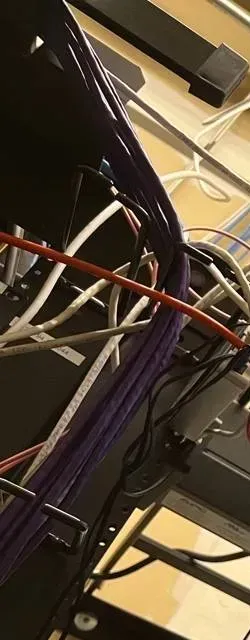
A photo from the AESS job library, not taken in Ridgewood: purple, white and red cable bundles dropping down beside a black equipment rack. In a larger Ridgewood walk-up, the cable from each line of apartments meets at one point in the cellar like this, and labeling every bundle during step 8 is what lets the next technician find one flat's pair in minutes.
Coverage Area
Door Buzzer Installation Near Ridgewood's Landmarks
Central Ridgewood Historic District
Designated December 9, 2014 with 990 buildings, about half of them houses by the builder Paul Stier, with streetscapes along 69th Avenue, Madison Street and Catalpa Avenue.
Ridgewood North Historic District
Designated in September 2009, a district of six-family flat buildings from 1909 to 1912 with bluestone stoops and full stone entrance surrounds.
Seneca–Onderdonk–Woodward Historic District
Also known as Ridgewood South, made a city landmark district on October 26, 2010, its flat buildings dating from 1911 and 1912.
Forest Avenue station
One of the M train's three Ridgewood stops on the Myrtle Avenue line, with Seneca Avenue and Fresh Pond Road, its elevated structure dating from 1915.
104th Precinct station house
The NYPD precinct serving Ridgewood, at 64-02 Catalpa Avenue, the source of the neighborhood's police reports on burglaries and package thefts.
Engine 291 and Ladder 140
The firehouse at 56-07 Metropolitan Avenue on the neighborhood's northern edge, near the former factories by Newtown Creek.
Ridgewood is billed at our standard Brooklyn rate, even though the neighborhood is in Queens, because we serve it from our Brooklyn office and its buildings are the same as those across the line in Bushwick. The final figure follows photos and a walkthrough, because the condition of the old pairs, the state of the street door and the number of stations that need new cable drive the total far more than the brand on the panel.
Job
Typical Ridgewood property
Brooklyn range
Audio buzzer or replacement with electric strike release, existing wiring reused where it tests well
Two-family brick rowhouses, one-family houses, a single shop or office door
$400–$900
Video or audio entry panel with apartment stations or phone release, on existing pairs
Six-families and five-unit buildings whose old pairs meter clean
$700–$1,800
Multi-unit entry system with a directory panel and all units wired, audio or video, optional fob or code entry
Six-families needing new cable to every flat, larger walk-ups with a lobby and mail room
from $2,500 to $10,000+
In-person diagnosis of an existing system, booked online
Any building where the old system must be tested before quoting
$250, applied toward the work
Monthly subscription
Any building choosing a wired, no-subscription system
$0
What moves a Ridgewood building inside its range is easy to predict. First the pairs: six that meter clean keep a six-family near the bottom of the small-building range, while two or three that fail add cable runs, and a riser that has to be replaced entirely moves the job into the multi-unit range. Then the route: a light shaft or a stack of closets is quicker than fishing through old plaster on brick. Then the door: a street door that needs a new closer, a rehung frame or a latch before any strike goes in adds parts and labor, as do hall doors that HPD has written up. Video instead of audio, and phone answering for tenants, add equipment cost. If a camera over the street door or the mail room goes in on the same visit, it usually saves $200 to $400 in labor compared with a separate trip. Anything that depends on a test is named on the quote with its price before you approve.
Full terms — including 50% deposit, one-year parts-only warranty on AESS-supplied products, and the late-fee schedule — are set out in the service agreement.
Find Out Which Range Your Ridgewood Building Falls In
Tell us the street, how many apartments there are, what each button does when it is pressed and whether HPD has written a violation, and we will tell you which Brooklyn range fits and what would move it. Call or text (347) 934-8335, send photos on WhatsApp, or fill in the form.
Shop Our Systems
Door Buzzer Installation Packages & Pricing
Three typical Ridgewood jobs, each placed inside the matching range on our Brooklyn list. The exact figure comes from the photos and the walkthrough.
Rowhouse two-button audio: $400–$900
A two-button audio station at the street door of a two-family brick rowhouse, a fail-secure strike in the frame, a closer set so the door locks behind each visitor, a station on each floor and a battery-backed supply in the cellar.
Six-family on tested pairs: $700–$1,800
A six-button audio or video panel labeled to the apartment doors, a station in each flat that calls, talks and releases, the old pairs metered and reused, a new strike and supply, and a test sheet for every apartment.
New riser or larger walk-up: from about $2,500
New cable to every flat by shaft or closet route, a directory or keypad panel for larger buildings, apartment stations or phone answering, and the street, lobby and mail room doors planned together, rising toward $10,000 or more with apartments and doors.
Bring your own equipment. If you have already bought a door station or intercom kit for your building, we can install it as labor-only work, quoted flat once we have seen the door, the frame and the cable path to each flat. Tell us the make and model, and we will say before the visit whether it can reach every apartment and release your street door. Equipment you supply is covered by its maker's warranty, not ours.
Complete Services
Every Door Buzzer Service in Ridgewood
Six-families and walk-ups
Six-button panels, new risers, apartment stations, phone answering and violation-driven repairs. Request a quote
Rowhouses and shops
Two-button stations for two-families and separate buzzers for stores and offices on the avenues. Call (347) 934-8335
Where does a six-apartment Ridgewood flat building usually land on your Brooklyn price list?
+
Most land in the $700 to $1,800 small-building range when the old pairs from the cellar to each flat meter clean and can be reused, with audio at the lower end and video stations at the upper end. A six-family whose riser has to be replaced, or that wants a directory or keypad panel, moves into the multi-unit range that starts around $2,500. The written price after the walkthrough tells you which, before anything is ordered.
How many years should a new apartment entry system last before it needs replacing?
+
There is no fixed number, and we would be wary of anyone who gives one. How long a system lasts depends far more on the street door, the cable and the power than on the panel. A door that slams, a transformer on a shared circuit or a panel exposed to rain wears a system out early; a closer that shuts the door gently, a battery-backed supply and a sealed station keep one going. When a system does fail, the test results decide whether to repair or replace, not its age.
Our six-family is going through a substantial rehabilitation. Does the new entry system count as one of the building systems being replaced?
+
That is a question for the state housing agency and your lawyer, not for us. THE CITY reported that substantial-rehabilitation rules require replacing at least 75 percent of a building's systems and showing the building was substandard beforehand, and what counts as a system is decided under those rules. What we provide is a clear record of what we installed, where and when, with the equipment list and the test sheet, which you can give to whoever prepares your filing.
Is there a way to look up whether a Ridgewood building has a history of intercom or door violations before we buy or rent there?
+
Yes. HPD's violation records are public and searchable by address, and sites such as LucidRents and openigloo republish them building by building, which is where the 2026 intercom order at 413 Onderdonk Avenue and the door orders at 1675 Woodbine Street can be read. The State Comptroller's 311 monitoring tool shows complaint trends by area. Read the text and date of each violation, not just the count, because a long list can be one old problem or many current ones.
Our tenants have started a case in Housing Court over the intercom. Can the installation go ahead while the case is pending?
+
In most cases, yes; fixing the condition is usually what everyone in the case wants. The owner should tell their lawyer before work starts, in case the court has set dates or terms for access and repairs, and should give tenants the usual notice for any work inside apartments. We schedule around those dates, and when the job is done, the owner receives a test sheet showing every apartment calling, talking and releasing the door, which is the kind of record the case will need.
Why does a Ridgewood six-family job sometimes take two visits instead of one?
+
Usually because the first visit finds something that has to be fixed or ordered before the rest can go in. A street door that needs a new closer or a rehung frame, a riser that needs a new route, or a station that has to be special-ordered all mean the cable and door work happen first and the panel switch happens later. We say at the walkthrough whether a job is one visit or two, and every visit is booked in a two-hour arrival window.
If one tenant wants a video monitor and the owner is only paying for audio, can that tenant pay the difference for their own apartment?
+
Often, yes, if the owner agrees and the system supports mixed stations. Many two-wire systems accept audio and video stations on the same panel, so one flat can have a monitor while the others keep handsets. The owner remains our customer and approves the change, and the quote lists the upgrade as its own line so the tenant's share is clear. If the tenant later moves out, the monitor stays with the apartment, so the owner and tenant should agree on that in writing.
The only way into our cellar is through the ground-floor tenant's apartment. How do you get to the power supply and the cable?
+
With the tenant's notice and a set time. The owner arranges access, and we plan the work so the cellar part is done in one visit, at the start, while the tenant is home or has agreed to let us in. If the building's only cellar entrance runs through an apartment, it is worth considering putting the new power supply somewhere reachable from a common area, such as a hall closet, so future service does not depend on one tenant's schedule.
If we convert our six-family so that it has eight or more apartments, does the state's intercom requirement start to apply?
+
It can. Multiple Dwelling Law §50-a covers Class A multiple dwellings erected or converted after January 1, 1968 with eight or more apartments, so a conversion that brings a building to eight or more units can bring it under the requirement for a self-locking main door and a talk-and-release intercom. Your architect or expediter should confirm how the conversion is classified, and the entry system should be part of the plans from the start.
What happens if the building is sold after we pay the deposit but before the installation date?
+
Tell us as soon as the sale is agreed. Equipment is ordered once the deposit is in, and once it has been ordered it cannot be returned, so the job either goes ahead on the scheduled date or is transferred to the new owner with everyone's written agreement. Most buyers are glad to take over a paid-for installation, and we can meet the buyer at the walkthrough so the plan carries over unchanged.
Ready for a Ridgewood Street Door That Calls Every Flat and Locks Behind Every Visitor?
Send a photo of the street door and the button plate, tell us the street, how many apartments the system must reach, what each button does now and whether HPD has written a violation, and we will tell you which system fits, what we would test first and where it falls on our Brooklyn ranges. Call or text (347) 934-8335, message us on WhatsApp, or use the request form. Licensed under NYS license #12000287431, rated 4.7★ across 201 Google Reviews, with same-day estimates on most weekdays.