Plate, Cellar, Stair Hall, Strike · Checked in That Order · Written Parts Price First · Brooklyn Rate
Ridgewood is a Queens neighborhood that grew up as the eastern edge of Brooklyn's German Eastern District, and its front doors still show that history. Between the arrival of the electric trolley in 1894 and the First World War, builders such as Paul Stier and the G.X. Mathews Company filled block after block with two-story brick rowhouses holding one apartment per floor and three-story flat-houses holding six apartments around a central stair. Almost all of it is brick, a great deal of it is now inside one of four city historic districts, and very little of it was built with an intercom in mind. So a dead buzzer here usually comes down to a short run of old wire, a small transformer in a cellar, six or fewer stations and a heavy wooden stoop door, and the fault sits in one of a handful of places. This page explains how we find which one, what it costs at our published hourly rate, and what the rules do and do not ask of a building this size.
Reviewed and updated October 26, 2026, against Wikipedia's articles on Ridgewood, Queens and on the Fresh Pond Road station, and its list of New York City Designated Landmarks in Queens; the Landmarks Preservation Commission's designation report LP-2319 for the Ridgewood North Historic District, its December 2014 press release on the Central Ridgewood Historic District and its Ridgewood South designation report; 6sqft's and The Real Deal's December 2014 reports on Central Ridgewood; Forgotten NY's 2005 and 2017 Ridgewood walks; the LPC Permit Guidebook chapter on health and safety equipment; the New York State Attorney General's Tenants' Rights Guide; HPD's pages on self-closing doors and on what to expect from code enforcement; Brick Underground's December 2014 guide to broken buzzers; the Myrtle Avenue BID's own site; CBS News reports on the January 6, 2026 fire on Madison Street; ABC7's January 2026 report on the Flushing Avenue fire; QNS reports from July and September 2026; a Compass building record for 55-27 Myrtle Avenue; an r/AskNYC thread on buildings with no buzzer; and published pages from New York intercom and locksmith companies, which we cite as industry claims, not as data · Abstract Enterprises Security Systems, NYS license #12000287431 · crews dispatched from our Troy Avenue office in Brooklyn

In a small Ridgewood building, one short message usually narrows the fault to two or three parts. Tell us how many apartments share the front door, then describe what happens when a visitor presses a button: the apartment hears nothing; the apartment hears a buzz but no voice; the two can talk but the door never clicks; or the door clicks and still has to be shoved. If you can, add three photos: the button plate outside, one apartment station or chime inside, and the edge of the street door where the latch meets the frame. If the transformer is easy to reach in the cellar, a fourth photo of it, with its label showing, is a bonus. Text it all to (347) 934-8335 with the nearest cross street. Most people hear back the same day with a likely cause and a rough idea of the hours involved.
First, the honest geography. Ridgewood is in Queens. It is Queens Community District 5, its ZIP code is 11385, and its police station is the 104th Precinct on Catalpa Avenue. It sits on this site with our Brooklyn pages because it shares a long, zigzagging border with Bushwick and East Williamsburg, because its housing continues across that line with little change, and because we serve it from our Brooklyn office on the Brooklyn rate. Wikipedia's account says Ridgewood historically straddled the Queens–Brooklyn boundary and that its name was first used on the Kings County side. None of that changes how a buzzer works, but it does explain why the same flat-houses, the same transformers and the same faults turn up on both sides of Wyckoff Avenue, and why a technician working a Ridgewood block in the morning is often on a Bushwick block that looks just like it in the afternoon.
The building stock arrived fast and all at once. Ridgewood was mostly farmland and pleasure grounds in the nineteenth century. The Landmarks Preservation Commission's 2014 announcement for the Central Ridgewood Historic District credits the electric trolley of 1894 and the elevated railway with drawing denser building, and says the district's houses went up between about 1906 and the First World War, largely by German-American builders for families leaving crowded parts of Brooklyn's Eastern District. A 1905 city rule pushed new construction toward masonry, which is why Ridgewood is a neighborhood of brick. Paul Stier, whom the commission calls the area's most prolific builder, put up almost half of the Central district's houses. The G.X. Mathews Company, which had started in Bushwick, built the three-story flats that fill Ridgewood North and Ridgewood South. Louis Berger & Co., a Ridgewood architecture firm opened in 1895, designed thousands more. When we open a cellar here, we are often looking at a building whose original plan, and therefore the route of whatever wire was later added to it, is shared by dozens of buildings on the same block.
Those buildings come in a few families, and each one shapes a buzzer differently. Wikipedia's list of Queens landmarks describes the Central Ridgewood district as mostly two-story brick rowhouses with one apartment per floor, built between 1895 and 1927. A building like that has two stations at most, often just a pair of chimes, and the owner frequently lives downstairs. Ridgewood North and South are dominated by Mathews Model Flats, put up between roughly 1908 and 1914. The commission's report on Ridgewood North describes them as three stories over a basement, two families to a floor, on lots about 27.5 feet wide, with air shafts and private bathrooms, built as cold-water flats heated by coal ranges and kerosene, with central heat arriving in the 1930s. That is six apartments, one each side of a central stair, behind one street door. On the corners, the same company built buildings with a store at street level and four apartments above. And along Myrtle Avenue there are larger outliers, such as the former Ridgewood Theatre at 55-27 Myrtle Avenue, which a Compass building record lists as a five-story, 51-unit conversion with an elevator.
What that history means at the front door is simple to state. Electric bells and talk-back intercoms were fitted to these buildings after they were built, threaded through brick, plaster and stair-hall woodwork that was never planned for them, and then patched by owners and handymen over a century. A cold-water flat that later gained central heat, hot water and new electrical service has been opened up several times, and each opening was a chance to cut, reroute or splice the bell wire. That is why the faults we find in Ridgewood are less often a dramatic failure of a big system and more often a tired transformer, a corroded splice, one cracked station or a strike that has drifted out of line with its keeper. The repair is usually small. Finding it in a building with layers of old work is where the time goes.

Residents rarely write about their buzzers, and we did not find anything Ridgewood-specific on the subject to quote from the neighborhood's forums or local news. The closest thing is a thread on r/AskNYC asking whether it was normal for a three-apartment building to have no buzzer at all; one reply said the writer had no buzzer either and had "heard of quite a bit of this in Ridgewood too." That fits the building stock: a two-family rowhouse needs only a pair of bells, and plenty of small buildings never had more. A Ridgewood locksmith's page makes the other half of the point in its own marketing: in a walk-up, the street door is the building's only real barrier, and when it stops latching every apartment is left relying on its own lock. The same page says the usual cause is the closer or the strike rather than the lock. That is a vendor's view, not data, but it matches what we see. A buzzer that cannot release the door is very often a door that tenants start leaving on the latch.
There are also things this page will not claim. We could not find HPD violation counts for intercoms in 11385, 311 buzzer complaint figures for Ridgewood, Department of Buildings permits for intercom work at Ridgewood addresses, or any local news story about a buzzer. So we do not say Ridgewood buzzers fail more or less often than anyone else's, and we give no crime rate. What we can describe is how the age, size and layout of the buildings change where a technician looks first, and what that does to the hours on the bill.
Where this page applies. All of Ridgewood: the blocks of flat-houses north of Myrtle Avenue toward Metropolitan Avenue, the Central Ridgewood rows around Catalpa Avenue, Madison Street and 69th Avenue, Ridgewood South around Seneca, Woodward and Onderdonk Avenues, and the streets along the Brooklyn border near Wyckoff Avenue. If your building is across the line, our pages for Bushwick, East Williamsburg and Cypress Hills describe those neighborhoods; the rate is the same. Our Queens buzzer repair page covers the rest of the borough.
Owners who call us about a dead buzzer in a six-family often ask, once it works again, whether the front door could also take a fob or a code, or whether a camera could cover the stoop. Both can be priced on the same visit. We look first at whether the existing transformer and wire can carry anything more, because adding load to a tired system is a good way to bring the original fault back.
Ridgewood buzzer calls sort themselves into a few kinds. Pressing a button rings nobody anywhere, which points first at the transformer or its circuit. A visitor rings and the apartment hears the buzz but nobody can speak, which points at the talk wires, the speaker or the microphone. Everyone can talk but the door stays shut, which points at the strike, its supply or the way the door now sits in its frame. One apartment, or one side of the stair, has gone quiet while the rest work, which points at that station or a splice on the way to it. And then there are the doors that open fine but will not close and latch behind the visitor, which is a closer or latch job wearing a buzzer's clothes. Many of these are found and fixed on the first visit, often within one to two hours of the technician arriving, because the common strikes, transformers and stations are on the van.
Call (347) 934-8335 and tell us which of those you have. If the street door is stuck unlocked, or swings open in the wind, say so first: we make that door lock and close before anything else, even if a part has to be ordered for the rest of the job. Repair visits are $195 an hour with a three-hour minimum ($585), whoever installed the system and however old it is.
Electric strikes that hum without letting go, keepers worn into ovals, and strikes that no longer line up because a century-old wood door has dropped on its hinges. The door's fit is checked before any electronics are blamed.
The small bell transformer that powers everything, tested while buttons are pressed, along with the circuit it hangs on. In buildings fed by old, shared circuits, the supply is often the first link to tire.
Brass and steel plates at the central entrance of a Mathews flat, with a button for each of the six apartments. Contacts and buttons are replaced behind a sound plate, so a landmarked front keeps its original look.
Audio stations, handsets and simple chimes replaced or repaired on the existing wire, matched to the system already in the building so one new station does not upset its neighbors on the same line.
The pair of bells and the single release in a two-story Stier-type rowhouse, where the owner usually lives downstairs and the tenant upstairs depends on wiring that passes through the owner's rooms.
Street doors on Myrtle, Fresh Pond, Forest and Wyckoff where the apartments upstairs share a frontage, a cellar or a power supply with the store below, and a fault on one side can silence the other.
Ridgewood's buildings are unusually uniform. Whole rows were designed by one architect and put up by one builder in a year or two, in the same buff and amber brick. That uniformity helps a technician, because the wire in the building next door usually took the same path as yours. Five kinds of building account for nearly every buzzer we are asked to fix in the neighborhood.
Three stories over a basement, two apartments a floor, one central stair, one street door at the top of a short stoop. Six buttons, six stations, one transformer in the cellar. Often owner-occupied, which the commission's report says was part of the design's appeal.
The Central Ridgewood type: one apartment on each floor, high stoop, wood-and-glass door. Two bells, sometimes one release, and wiring short enough that a single bad splice is the whole story.
A store at street level and four apartments above, with the residents' door on the side street or tucked beside the shop, and a cellar shared by both.
Apartments above storefronts on Myrtle, Fresh Pond, Forest and Fairview, where the residents' entrance is a narrow door between shops and the buzzer's supply may sit behind the store's lock.
Buildings like the former theatre at 55-27 Myrtle Avenue, now listed as 51 apartments over five stories with an elevator. A lobby panel, a longer riser and, often, a networked system rather than bell wire.
In a Mathews flat, the whole buzzer system is compact. The plate sits beside the central entrance, the wire drops to the cellar, meets the transformer, and climbs the stair hall to three floors, with one station on each side of the stair at every landing. That compactness is good news: there are only so many places a fault can hide, and the run from the cellar to the top floor is short by apartment-building standards. The difficulty is that six households depend on one supply and one set of risers, and that the owner, who may live in one of the apartments, is also the super, the managing agent and the person tenants knock for when a visitor cannot get in.
The commonest pattern we see is a system that works for most apartments and fails for one or two, usually because a splice in the stair hall or at a station has corroded, or because one station has failed in a way that drags on the others sharing its wires. The second most common is a system that has gone completely quiet, which nearly always starts in the cellar. Our approach in a flat-house is to test all six apartments at the start, not only the one that called, because the pattern of which ones work tells us which side of the stair and which floor the fault lies on before a single cover comes off. We ask the owner in advance for access to the cellar and, for an hour or so, to the apartments the fault seems to pass through, and we keep visits to the rest as short as possible.
These buildings were cold-water flats, which matters more than it sounds. When central heat, hot water and new electrical service were added over the decades, contractors opened the same stair-hall walls and cellar ceilings that the bell wire uses. We regularly find splices that were made in the middle of someone else's job, wire tucked behind a pipe that was added later, or a run that was cut and never properly rejoined. None of that is visible from the hallway. A tone generator and a methodical walk from the cellar up usually find it without opening plaster.

The Central Ridgewood rowhouse is the simplest building on this page. Most were built as one apartment per floor, and many are still lived in that way, with the owner on the ground floor and a tenant above, or the reverse. The "buzzer" is often a pair of chimes on one transformer, sometimes with a single release button upstairs, and occasionally nothing more than a bell for each floor and a key for each household. When it fails, the wire is short enough that we can usually test it end to end in a few minutes. The complications are about the people and the house rather than the system: the tenant's wire often passes through the owner's apartment or cellar, and the button sits beside a wood-and-glass door inside a landmarked front.
Because the Central district was built over a short span by a small number of builders, the bell wire in one house often follows the same path as the house next door. That does not mean two houses fail together, and we would never diagnose your house from your neighbor's, but it does mean a technician who has opened a few of these cellars knows where to look first. In rowhouses that have been renovated, the original path has frequently been cut and replaced by a run along the outside of a wall or behind a new ceiling, and those later runs are where the trouble usually is.
Mathews's corner buildings put a store at street level with four apartments above. In those, the residents' door may be on the side street, the transformer may be in a cellar that the store uses for stock, and the store may have its own bell or release on the same supply. When the shop changes hands, renovates or stacks boxes against the cellar wall, the residents' buzzer can suffer without anyone upstairs knowing why. We trace the apartments' wiring separately from the shop's, label it at the cellar end, and where the two share one transformer, we recommend splitting them, so a shop's work stops silencing the apartments above it.

Along Myrtle Avenue and Fresh Pond Road, many buildings have a residents' door squeezed between shopfronts. The plate faces a busy sidewalk, the door takes heavy use, and the supply is in a cellar the residents may not have a key to. Faults here tend to be mechanical first: a strike worn out by constant use, a closer that no longer pulls the door shut against the latch, a plate damaged by someone leaning on it. We look at the door's hardware before the wiring, because on a busy avenue the hardware wears out sooner.
Ridgewood's few larger buildings, such as the converted theatre on Myrtle Avenue, behave like apartment buildings anywhere in the city: a lobby panel, a power supply or controller, a riser climbing past several floors, and possibly a system that calls residents' phones. Faults there can be programming, network or controller problems as easily as broken wires. We start with power and door hardware, which are the same in any building, then work through the network and the programming, and we ask the building to have any administrator login ready, because some repairs on networked panels cannot be finished without it.
Owners of flat-houses who get the buzzer working again sometimes ask about a camera covering the stoop and the mailboxes, or a code lock on the cellar door. We can price either on the repair visit, and we will tell you plainly whether the old transformer has anything to spare.
A buzzer in a six-family has four parts that matter: the plate outside, the transformer in the cellar, the wires that climb the stair hall to each apartment, and the strike in the door frame. A visitor's press has to reach a station upstairs, the two people have to be able to hear each other, and the release signal has to come back down to the strike with enough power to let the latch go. Most symptoms point quite clearly to one of those links, and knowing which one saves a technician time, which saves you money. The table below is how we think about it on the phone, before anyone has opened a cover. It is a starting point, not a diagnosis.
| What happens | Where we look first | Why |
|---|---|---|
| No button rings any apartment | Transformer and its circuit in the cellar | Only the shared supply can silence everything at once |
| One apartment silent, the rest fine | That station, then the splice nearest it | The fault is on the part of the wire only that apartment uses |
| One side of the stair silent on every floor | The riser or junction serving that side | A shared section has failed below the first station |
| Buzz heard, no voice either way | Talk wires, plate speaker and microphone | The call circuit works; the audio circuit does not |
| Talk works, strike silent | Release wire and strike | The release is a separate circuit from the voice |
| Strike hums, door does not open | Door fit, keeper, closer | Power arrives, but the latch is pinned against the keeper |
| Door opens, then will not close and latch | Closer and latch | A door-hardware fault that leaves the building open |
| Works one day, fails the next | Corroded splices, terminals, a tiring supply | Intermittent faults are usually connections, not dead parts |
Two things on that table deserve more explanation, because they cause most of the confusion we hear on the phone. The first is that the voice and the release are separate circuits. An industry summary of the city's intercom rules makes the point that a buzz-in with no voice path does not meet the voice requirement, and a voice path with no release fails too. In practice, that means a building owner who hears that "the buzzer works" should ask which half works. A system where visitors can be let in blind, without anyone hearing who they are, is not the same as a working intercom, and one where tenants can talk but must walk down to open the door is not one either. We test both halves at every apartment.

The second is that a strike that hums is not necessarily a broken strike. When someone upstairs presses the release, power arrives at the strike and it hums or buzzes. If the door does not open, the strike may be weak, but just as often the door is pushing so hard against the keeper that the latch cannot slide out. Old wooden doors in Ridgewood's stone surrounds move with the seasons. Hinges wear, the door drops, weatherstripping is added, a closer is adjusted to slam harder, and the latch ends up pinned. A visitor who is told to push while the strike hums will often get in; one who is told to pull or simply wait will not. We check the door's fit, the keeper's alignment and the closer's pressure before we replace a strike, and many "dead strike" calls end with a door adjustment and no new part at all.
The cellar is the other place where time goes. Ridgewood's flat-house cellars were built for coal and storage and have usually spent a century collecting both. The transformer may be screwed to a joist, a wall or a partition, sometimes behind shelving, sometimes beside the electric meters, and often on a circuit shared with lights or outlets. Our own Queens intercom page notes that old single-circuit power feeds, combined with space heaters, can burn out intercom transformers in buildings more than ninety years old; that is our own field claim rather than independent data, but it is the reason we measure the supply while buttons are being pressed, not just at rest. A tired transformer will often read correctly on an idle line and then sag as soon as the release is pressed.

Finally, the stair hall. In a Mathews flat, the wire from the cellar climbs to three landings and splits to two apartments at each. That makes the stair hall the place where most single-apartment faults live: a junction behind a landing cover, a splice at the back of a station, a stretch of wire painted over so many times that the insulation has cracked. Our method is the same every time. Start at the plate, confirm what the visitor's press does. Go to the cellar, measure under load. Then follow the wire up, junction by junction, until the reading changes. The repair is made where the reading changed, and only there. Then every apartment is tested again, the door is watched closing and latching, and the live wires are labelled so the next repair starts from a map rather than a guess.
Wikipedia names Myrtle Avenue, Metropolitan Avenue and Fresh Pond Road among Ridgewood's oldest streets, and the neighborhood's property-owners' association lists Myrtle Avenue and Fresh Pond Road as its main commercial areas. Commercial buzzer work in Ridgewood falls into three kinds: shops, clinics and offices that buzz customers or staff through a door; residents' doors that share a building, a cellar or a supply with a business; and the side and back doors of churches, schools and community spaces that are released for visitors during the day.
Brownstoner calls it the spine of Ridgewood. The BID runs from Wyckoff Avenue to Fresh Pond Road, past Venditti Square, with nearly 300 businesses by one of its own counts, many beneath apartments whose door sits between two shopfronts.
The other main shopping street, served since 1915 by the M train's Fresh Pond Road station. Store buildings with apartments above, where the residents' supply often shares a cellar with stock.
A shorter commercial run crossing Myrtle Avenue by the Ridgewood Savings Bank headquarters, with ground-floor businesses below flats and an M station of its own.
The border street and its transit hub, with Wyckoff Heights Medical Center at Stockholm Street. Medical and professional offices nearby buzz patients and visitors in all day.
The commission's Ridgewood North report notes storefronts on these avenues inside the historic district, so a shop's or residents' door panel there sits on a landmarked front.
One of the oldest roads, along the northern side, where homes, shops and light commercial buildings mix and doors take hard use from deliveries.
Local news this year gave business owners on these streets some reasons to think about their doors, though none of it involved a buzzer. QNS reported in September 2026 that a man was charged in a string of Queens burglaries that included a break-in at a Myrtle Avenue business in Ridgewood. That was a burglary, not a door-system story, and we do not suggest a buzzer would have stopped it. What it does underline is that a business door left on the latch because its release has failed, or wedged open because nobody can buzz a delivery in, is an easy door. A release that works reliably removes the reason to prop the door, and that is worth more than the repair costs.

A business release is a different animal from a residents' buzzer. A clinic near Wyckoff Avenue may buzz in dozens of patients a day, so its strike and closer wear far faster than a flat-house's, and a sticky desk button is noticed within minutes. A shop's back door may be released only for deliveries but must lock solidly every night. A residents' door in the same building must work for every apartment around the clock. We keep these on separate circuits wherever we can, so a shop renovation, a delivery cart hitting a frame or a leak in the store's cellar takes out one door and not all of them. We also label which wire belongs to which party in the cellar, because when a store changes hands, the new tenant's contractor has no way of knowing which old wires still matter.

These questions come from the way Ridgewood's buildings are put together: six households on one cellar transformer, old circuits, stores under apartments, rows of near-identical brick fronts and a year of local news about fires and burglaries. Each is answered in full here and none is repeated in the FAQ below.
It is telling you that power is getting into the system but not out to the stations, and that something is drawing more than it should. A bell transformer at rest is quiet or close to it. When a button is pressed, it supplies current to a station, and a healthy one may give a faint buzz. A loud hum on every press, with nothing ringing upstairs, usually means the current is going somewhere other than the stations: a short where two wires have rubbed through their insulation, a splice that has bridged across, or a failed component that now takes current without doing anything with it. The transformer is working hard into a fault. Left alone, that can overheat it, and a transformer that has been humming for weeks may be damaged by the time the short is found. The first step is to find where the current is going. We disconnect sections of the run one at a time at the cellar terminals and watch the hum: when it drops, the short is on the section just removed. Then we follow that section up the stair hall to the junction or station where the wires meet. Once the short is fixed, we test the transformer again under load, because a unit that has spent weeks feeding a fault may need replacing too. Please do not keep pressing the button to test it in the meantime; each press works the transformer into the short again.
It can play a part, though it is rarely the only cause. The buzzer transformer takes its 120-volt power from a circuit somewhere in the building. In older buildings, that circuit is sometimes shared with hallway lights, a cellar outlet or, in some houses, outlets in an apartment. Our own Queens intercom page names old single-circuit feeds combined with space heaters as one cause of burned-out intercom transformers in buildings more than ninety years old; that is our field claim, not independent data. A heater draws a lot of current, and on an overloaded or poorly connected circuit the voltage can sag and the wiring can heat. A small transformer at the end of that circuit sees the stress first. More often what we find is a transformer that was already old, mounted somewhere hot or damp, on a circuit with a loose connection, and the winter load simply finishes it. So the repair has two halves. On our side, we replace the transformer if needed and measure its output under load. On the electrical side, if the circuit looks shared, overloaded or poorly connected, we say so in writing and recommend that a licensed electrician check it and, where possible, give the buzzer a feed of its own. We do not work on the 120-volt side ourselves. If the transformer is replaced without that conversation, the next one may last no longer than the last.
The sources we rely on tie it to both: the rule is generally described as applying to multiple dwellings erected or converted after January 1, 1968. The Attorney General's guide states the requirement for buildings built after that date with eight or more apartments; industry summaries such as ButterflyMX's describe the rule as covering buildings "built or converted" after it. So a building that went up as something else, a theatre or a commercial building, and was turned into apartments more recently is in a different position from a 1910 flat-house that has always been housing. The former Ridgewood Theatre at 55-27 Myrtle Avenue, which a Compass record lists as 51 apartments, is the obvious local example of a building in that category, though we have not reviewed its records and say nothing about its status. For your building, the answer depends on its certificate of occupancy, its conversion history and the number of apartments, and a lawyer or the building's records will answer that better than we can. What we can do is describe exactly what the entry system does and does not do once it is repaired, in writing, so the owner has a clear record to put beside whatever the law requires. In a converted building of that size, it is also common to find a modern lobby panel rather than bell wire, which changes the repair: programming and network access matter as much as wire.
Practically, yes; legally, it depends on details our sources disagree about, so here is both. On the practical side, the tenant in that apartment has no way to answer the door, and in a six-family that usually means knocking on a neighbor's door or walking down two flights for every visitor and delivery. One industry source says a system where some apartments work and others do not is treated as a violation. On the legal side, the sources we read do not agree on what a six-apartment building owes. The state's clearest requirement, as the Attorney General summarizes it, is for buildings of eight or more apartments built after 1968, and older buildings must provide an intercom when a majority of the apartments request it; one vendor says the city's Housing Maintenance Code reaches buildings of three or more units. We have not been able to confirm which reading applies to a particular building, and we would not treat a single source as settled. What is settled is that if the building has an intercom, tenants expect it to work for everyone, and an HPD inspector looking at one apartment's dead station will not be interested in the five that work. The repair itself is usually small: in a flat-house, a single dead station is most often that station or the splice behind it, and we can usually test and fix it within the minimum visit.
It is possible, and an on-and-off fault after a nearby fire is worth checking rather than living with. CBS News reported that the five-alarm fire on January 6, 2026, at 1824 Madison Street, between Seneca and Onderdonk Avenues, led to vacate orders on four buildings with 24 units. Fighting a fire of that size puts a great deal of water into and around attached buildings, and Ridgewood's rows share party walls and, in places, cellar conditions. Water that soaks through a party wall or runs along a cellar can reach splices and terminals in a building that was never touched by flame. Copper that has been wet keeps corroding afterward, slowly, and a connection that is corroding behaves exactly the way you describe: it works on a dry day, fails on a damp one, and comes back when the building warms up. Heat is less likely to reach wiring in a neighboring building unless the fire breached a shared wall. If the fire department or contractors worked from your building, cutting, moving or stepping on wiring is another possibility. We would start in the cellar on the side nearest the fire, opening every terminal and splice and cutting the wire back to clean copper, then work up the stair hall on that side. If the owner is making an insurance claim, we can describe what we found and what was replaced in writing.
Very probably, and the timing you have noticed is the best clue a technician could ask for. A security gate motor is a large electrical load that starts and stops abruptly. When it starts, it can disturb the power on the circuit it shares, and it gives off electrical noise that nearby low-voltage wire can pick up. Audio intercom wiring carries very small signals, so it is sensitive to both. There are three common routes. The buzzer transformer may be on the same circuit as the gate motor, or one close to it, so every start puts a dip and a spike into the intercom's supply. The intercom wire may run alongside the motor's power cable, often across the store's ceiling or down the same wall, so the noise is induced into it. Or the gate's own control wiring may have been tied into, or spliced near, the buzzer wiring when the gate was installed. We find which by testing with the gate running and stopped, measuring the intercom's supply, and tracing where the two sets of wiring come close. The fixes are usually straightforward: separating the runs, moving the buzzer onto a different supply, or replacing a stretch of wire with cable better suited to a noisy route. Anything on the gate's 120-volt side is for the store's electrician, and we coordinate with them through the owner.
It protects the front door, and only the front door, and that is worth being clear about before anyone spends money. QNS reported in July 2026 that on June 17 a burglar hit three homes near 70th Street and Central Avenue and near 72nd Street and Central Avenue, getting in through a broken window screen, through a gate, and through a rear basement window. None of those entries had anything to do with a buzzer. A buzzer and a self-locking street door keep strangers from walking in through the main entrance behind a resident or because the door was left open. That matters a great deal in a building where six households share one door. It does nothing about a rear yard, a cellar window, a fire escape or an apartment window. So the honest answer to "upgrade for security" is in two parts. For the front door, the most useful thing is not a new panel but a door that closes and latches every time, a strike that holds, and a release that works so nobody has a reason to prop the door. We check and fix all three. For the rest of the building, the right tools are window locks, gate locks, lighting and, where an owner wants it, cameras or an alarm, which are separate jobs we can price separately. A video panel at the front door lets tenants see who they are buzzing in, which is useful, but it would not have stopped any of the entries QNS described.
The part in the frame that lets the latch go. Fail-secure strikes stay locked without power and fail-safe strikes unlock; Allegion's guidance notes that with a strike you can always leave by the handle. We match the replacement to the old wooden door, its frame and the system's voltage.
The small transformer that runs a flat-house or rowhouse system, usually somewhere in the cellar. Tested while a button is pressed, because a tired one often reads correctly at rest and collapses under load.
Six-button plates at flat-house entrances, single and double buttons on rowhouses, and steel or brass plates beside shop doors. Buttons and contacts are renewed behind a sound plate wherever possible.
Our Queens intercom page lists Lee Dan, M&S, Nutone and Aiphone LE among the pre-war audio systems we service in buildings like Ridgewood's. Stations are matched to the system so one replacement does not upset the line.
Where an owner wants something newer, kits such as Comelit Ultra, Aiphone GT and Akuvox can often reuse existing 2-wire or 6-wire cable, according to our own Queens page; we test the cable before recommending one.
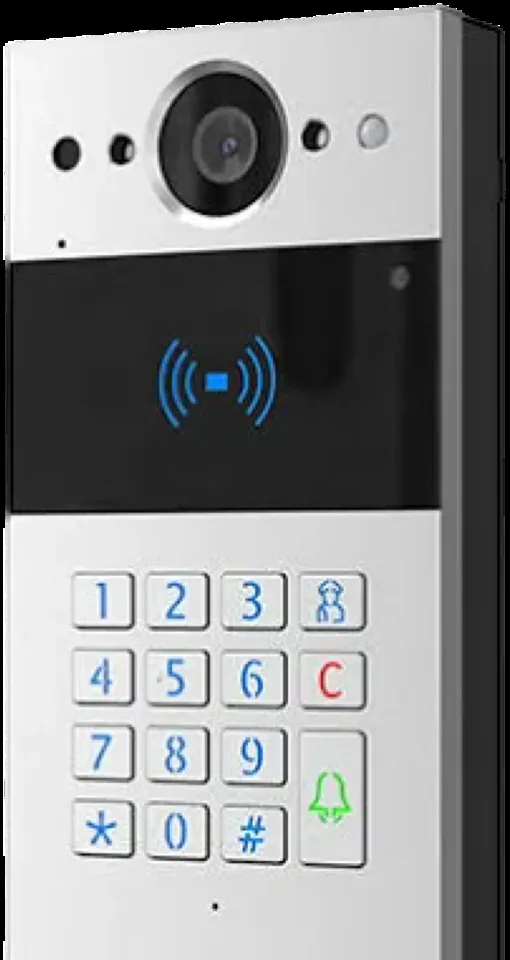
Networked panels in larger or converted buildings that call phones, read cards or keep codes, along with door controllers, magnetic locks and exit buttons. Power, network and programming are checked in turn.


Owners sometimes ask whether a national brand would be simpler. ADT and SimpliSafe sell home security systems with monitoring; Ring sells video doorbells and cameras. All three are built around a single household and its own devices. None of them is a repair service for a building's shared buzzer: the transformer in the cellar, the strike in the street door, and six stations on one stair. A video doorbell on a rowhouse can replace the button for one household, and that can be a sensible choice where the owner occupies the whole house. In a six-family, a doorbell meant for one front door does not ring six apartments or release the street door for each of them. A local repair keeps the building system working for every household and leaves any one tenant free to add their own devices inside their apartment.
| National consumer brands | AESS building repair | |
|---|---|---|
| Who it serves | One household's door and devices | Every apartment on the building's system |
| Street-door strike and transformer | Not part of the product | Tested and repaired |
| Existing stations and wire | Usually bypassed | Kept in service where sound |
| How it is billed | Device price, sometimes a subscription | $195 an hour, three-hour minimum, parts priced in writing |
Owners and tenants in Ridgewood ask us about the law more often than almost anything else, and the honest answer is that the published sources do not all say the same thing. We are not lawyers, and nothing here is legal advice. What we can do is set out what the sources say, where they conflict, and how that applies to the kinds of buildings Ridgewood actually has.
The 1968 line. The New York State Attorney General's Tenants' Rights Guide says multiple dwellings built after January 1, 1968, must have automatic self-closing and self-locking doors at all entrances, and that those with eight or more apartments must also have a two-way voice intercom that lets tenants buzz the door open. Older buildings must have self-locking doors and a two-way intercom if a majority of the apartments request one, and the landlord may recover the cost. Industry summaries describe the same rule in terms of Multiple Dwelling Law § 50-a and say it covers buildings built or converted after the 1968 date. For pre-1968 buildings, one summary says the requirement applies once the tenants of a majority of apartments ask for it in writing.
Why Ridgewood mostly sits on the far side of it. Ridgewood's rowhouses went up between about 1895 and 1927, and its Mathews flats between about 1908 and 1914. Almost none of the neighborhood's housing was built after 1968, and the typical building has two or six apartments, not eight. So for most Ridgewood buildings, the firmest form of the requirement does not straightforwardly apply. That does not mean the buzzer does not matter. Once a building has an intercom, tenants rely on it, courts and HPD treat it seriously, and the question of whether the law required it at installation becomes much less important than whether it works now.
Where the sources conflict on size. One vendor says the Housing Maintenance Code covers most buildings with three or more units. Others say eight or more. We have not been able to confirm which reading is right for a given building, and we do not treat either as settled. If your building has three to seven apartments, which describes most of Ridgewood, ask a lawyer or a tenant organization rather than relying on a vendor's summary, including ours.
Where they conflict on seriousness. Several industry sources say a broken intercom is a Class B hazardous violation, with daily penalties in the hundreds of dollars; one says Class A. Our own review of HPD's violation records for Brooklyn found buzzer violations written in classes A, B and C. The class an inspector writes depends on the condition found and the code cited, so a single number for "the" penalty is not reliable.
Partial outages and half-working systems. An industry source says a system where some apartments work and others do not is treated as a violation. Another notes that a buzz-in without a voice path does not meet the voice requirement, and a voice path without a release fails too. Both points matter in a six-family: a system can look fine to five households and be useless to the sixth, or let visitors in without anyone knowing who they are.
Habitability. An industry summary says courts have treated a working intercom as an essential service tied to the warranty of habitability under Real Property Law § 235-b. That is the basis on which tenants in older buildings, which may not have been required to install an intercom, can still expect an existing one to be maintained.
The tenant's path. HPD's guide to code enforcement describes the sequence: notify the landlord in writing, then call 311, then expect an HPD inspection, with an inspector due within about 30 days. Brick Underground's 2014 guide to broken buzzers adds that rent-stabilized tenants can file a reduction-of-services complaint with the state's Division of Housing and Community Renewal, and that, according to the Attorney General's guide, a landlord can be held liable for a crime made possible by a broken buzzer and an unlocked door.
The door itself. HPD treats a defective self-closing door as a class C immediately hazardous violation, with 14 days to correct after the notice, and reinspects within 20 days of the correction date. In practice, the door is the part of the system an owner should never let slide, because a dead buzzer inconveniences tenants while a door that does not close leaves the building open.
What the law does not require. One industry source makes a point owners find reassuring: the legal minimum is a working buzzer, not video. An owner under pressure from tenants or an inspector does not have to install a new panel to comply. Repairing the existing system so every apartment can hear the visitor and release the door is enough. Upgrading is a choice, and we price it as one.
Fire and egress. After the January 2026 fires on Madison Street and on Flushing Avenue, where ABC7 reported at least nine people injured in a three-alarm fire, owners on the nearby blocks asked us about locks and exits. The principle is simple and appears in industry summaries of city fire rules: nothing on a door may stop people getting out from inside. A strike releases the latch from outside but leaves the inside handle working, which is why a strike is the usual choice on a residents' door. Magnetic locks are a different matter and must release reliably for anyone leaving.
What we cannot tell you. We looked for HPD intercom violation counts, 311 buzzer complaint figures and DOB intercom permits for Ridgewood and found no usable data. This page therefore quotes no local numbers. Whether your own building has an open violation is a question about one address, and HPD's online records and your managing agent will answer it better than any neighborhood figure.
We could not open Google's AI Overview, its question boxes, Bing or DuckDuckGo suggestions, or Answer the Public from where this page was built, so nothing below is quoted from them. These are claims that turn up in national cost guides, vendor articles and general repair advice, set beside what a Ridgewood job actually involves.
General repair advice often presents a buzzer as a doorbell with a longer wire: check the button, check the chime, swap the transformer. For a single-family house with a fresh installation, that is sometimes fair.
In a Ridgewood flat-house, the same system serves six households through a century of other trades' work. The fault may be a splice made during a 1930s heating job, a wire cut when a store renovated, or a short behind a landing cover. Swapping the transformer without finding the short simply burns out the new one, which is a common story.
The job is not hard, but it is methodical: measure under load, isolate sections, follow the wire. A handyman who works that way will find it. One who replaces parts until something works will charge you for several parts and may still leave the fault in the wall.
Summaries that say this skip the conditions. The Attorney General's guide ties the firm requirement to buildings built after 1968 with eight or more apartments, and gives older buildings a different rule triggered by a majority request.
Most of Ridgewood is older and smaller than that. A six-family Mathews flat from 1911 and a two-family rowhouse from 1920 are not in the same position as a post-1968 tower, and sources even disagree on whether a three-to-seven-unit building is covered by the city's code.
The practical point holds anyway. If a building has an intercom, tenants and inspectors expect it to work. The legal question matters most when an owner is deciding whether to install a system where none exists, not when one is already on the wall.
Several vendor articles give a single class and a single daily penalty range, as if the answer were fixed. One source says B, another says A, and both are confident.
HPD's own records for Brooklyn show buzzer violations written in classes A, B and C. The class depends on what the inspector found and what code section was cited. A buzzer problem tied to a door that will not close or lock is treated very differently from one handset with poor sound.
So an owner should not plan around a penalty number from a blog. The safer plan is to fix the system, keep a written record of what was repaired, and make sure the street door closes and locks on its own, which is the condition the city treats most seriously.
Vendor content, understandably, leans toward replacement. New panels look better and some sell a monthly service. The advice treats old wire as worthless and every pre-war system as finished.
In a Ridgewood building, the old audio system is usually serviceable, and the legal minimum, according to industry sources, is a working buzzer rather than video. Our own Queens page notes that retrofit kits can reuse existing 2-wire and 6-wire cable, which is often the expensive part to replace in brick buildings with plaster halls.
Replacement makes sense when parts are unobtainable, the wire is failing along its length, or the owner wants features the old system cannot carry. Otherwise, a repair that restores voice and release to every apartment is the cheaper and less disruptive answer, and we will say so.
National cost pages from Angi, HomeAdvisor and Fixr, and vendor articles such as Swiftlane's, which puts minor repairs at $150 to $400, give tidy ranges averaged across the country, mostly from buildings where wire is easy to reach.
In Ridgewood the price depends on where the fault is. A failed strike or transformer is quick. A short hidden behind a painted landing cover, or a run that has to be rerouted around a store's ceiling, takes longer. The fault may be the same; the time is not.
That is why we bill by time at a published rate, $195 an hour with a three-hour minimum, and price parts in writing once the fault is found. You see what failed and what it will take before the job goes beyond the minimum.
Owners and some contractors test a buzzer by pressing a button and hearing a sound upstairs. If it rings, the job is marked done.
A ring proves only one of three things. Industry sources on the city's rules note that voice and release are separate requirements: a buzz without voice fails, and a voice without release fails too. In a six-family, all three have to work at all six apartments, and a door has to close and latch after each release.
We test ring, voice both ways and release at every apartment, then watch the door close. A repair that skips that check is the commonest reason a tenant calls back a week later saying nothing changed.
Security advice sometimes presents the front-door system as the building's defense. A buzzer is part of it, but only part.
QNS's July 2026 report on the June 17 burglaries near Central Avenue described entries through a window screen, a gate and a rear basement window. None involved the front door. A buzzer and a self-locking door keep strangers from walking in through the main entrance; they do nothing for windows, yards or cellars.
The useful framing is narrower and more honest: a working buzzer removes the reason to prop the street door, and a door that closes and latches every time keeps the main entrance shut. Everything else is a separate job.
If you are not sure which half of the system has failed, call (347) 934-8335 and describe what a visitor hears. A technician can usually tell you on the phone whether it sounds like the cellar, the stair hall or the door. If you would rather write, send the quote form with a few photos and we will reply the same working day.
Tell us about the building and the fault. The more specific you can be about what happens when someone rings, the more likely the technician arrives with the right part.
Prefer to talk? Call (347) 934-8335.
For a repair, "installation" means putting back only what failed. This is the order we follow in a Ridgewood building, whether it has two apartments or fifty.
Call or text with the cross street, the type of building and what a visitor hears and sees. Photos of the plate, one station and the door edge help us bring the right part.
From your description we give a likely cause and an idea of the hours at $195 an hour with a three-hour minimum. Any part is priced in writing before it is fitted.
On arrival the technician checks that the street door closes and latches on its own. If it is stuck unlocked, that is fixed before anything else.
Each button is pressed in turn while we listen and measure: does a station ring, does sound travel both ways, does the strike get power on release.
The supply is measured while buttons are pressed, not just at rest, and its circuit, mounting and condition are noted.
The wire is followed up the stair hall, junction by junction, until the reading changes, which locates the failed link.
The repair is made only where the fault is. Every apartment is tested for ring, voice and release, and the door is watched as it closes.
Live wires are labelled at the plate and cellar, leftovers noted, and the owner gets a written description of what was tested, what failed and what was repaired.
This is working practice, not a story about any address. In a flat-house, the first ten minutes decide how long the rest of the job takes. The technician stands at the plate and presses all six buttons, writing down which apartments ring, which can talk and which can release. That pattern alone usually points at one side of the stair, one floor or the whole system. Then the street door: does it close on its own, does the latch catch, does the strike line up with it? Only then does the technician go down to the cellar, find the transformer and measure it with someone pressing a button upstairs. In buildings put up as rows by one builder, the transformer is often in the same corner of the cellar as next door, but we never assume it; renovations move things. If the owner has cleared the shelves in front of the transformer and left the cellar light working, those ten minutes really are ten minutes. If not, they can be thirty. The single most useful thing an owner can do before a visit is make the cellar wall reachable and tell tenants that someone may knock briefly.
Opened in 1916 to a Thomas Lamb design; a Compass record lists the converted building as 51 apartments over five stories with an elevator, and gives the date as 1915.
At Wyckoff Avenue and Stockholm Street on the border, founded in 1889 by a German immigrant society, according to Forgotten NY.
The M train's stop on Fresh Pond Road, opened in 1915 when the elevated was extended from Myrtle and Wyckoff Avenues.
The plaza where Myrtle Avenue meets St. Nicholas Avenue and Woodbine Street, at the heart of the Myrtle Avenue shopping district.
The park set between rail lines that Forgotten NY notes is visible from the M train.
Named in the Ridgewood South designation report alongside the district's more than 210 buildings, mostly three-story brick tenements.
We also serve the neighboring blocks across the line in Bushwick, East Williamsburg and Cypress Hills, and the rest of Queens, including Maspeth, Glendale and Middle Village. Our Brooklyn door buzzer repair page covers every Brooklyn neighborhood.
Ridgewood repairs are billed at our Brooklyn rate, the same as the Bushwick blocks across the line: $195 an hour with a three-hour minimum, so the smallest visit is $585. The rate is the same whoever installed the system and however old it is. Any part is priced in writing before it is fitted, and the hours start when the technician reaches the building, not when we read your photos.
Most single faults in a two-family rowhouse or a six-family flat-house fall within the minimum: a strike replaced or realigned, a transformer changed, one station repaired, a corroded splice cut back and remade. What pushes a job past three hours is almost always finding the fault rather than fixing it. The things that add time in Ridgewood buildings are predictable:
The things that save time are equally predictable: a clear path to the cellar, a cellar light that works, the owner or a tenant available to press buttons upstairs, and a note of anything anyone has already tried. Our door buzzer repair pricing page sets out the rate in full.
Full terms — including 50% deposit, the 30-day warranty and optional paid extended warranty, and the late-fee schedule — are set out in the service agreement.We do not sell buzzer repair as fixed bundles, because a short in the stair hall and a worn strike are very different jobs. These three ways of booking a visit cover nearly every Ridgewood call, all at the same published rate.
The three-hour minimum at $195 an hour. Suits a dead transformer, a failed or misaligned strike, one silent station or a corroded splice in a rowhouse or flat-house. Any part is priced in writing before it is fitted.
For shorts, intermittent faults and runs tangled with old work or a store's wiring. The first three hours are the minimum; beyond that we tell you what we have found before the job goes on.
The repair at the same rate, with a separate written price for anything you ask about on the visit, such as a code lock, a camera on the stoop or splitting a shop's supply from the apartments'.
Repairs are billed at $195 an hour with a three-hour minimum, so the smallest visit is $585. Any part is priced in writing before it is fitted.
No. We serve Ridgewood from our Brooklyn office at the same Brooklyn rate we charge on the Bushwick blocks across the line.
Yes. The rate is the same whoever installed the system and however old it is, and we match replacement stations to the system already in the building.
Clear a path to the transformer in the cellar, make sure the cellar light works, and let tenants know someone may knock briefly to test their station.
Call or text (347) 934-8335 with the nearest cross street and what a visitor hears when a button is pressed, or send the quote form.
Door Buzzer Repair Brooklyn NY · Door Buzzer Repair NYC · Door Buzzer Repair Manhattan NY · Door Buzzer Repair Queens NY · Door Buzzer Repair Bronx NY · Door Buzzer Repair Staten Island NY · Door Buzzer Repair Long Island NY · Door Buzzer Repair Hudson Valley NY · Door Buzzer Repair Nassau County NY · Door Buzzer Repair Suffolk County NY · Door Buzzer Repair Westchester County | 6 Cities Same-Day · Door Buzzer Repair Rockland County NY · Door Buzzer Repair Orange County NY · Door Buzzer Repair Putnam County NY · Door Buzzer Repair Dutchess County NY · Door Buzzer Repair Ulster County NY
Door Buzzer Repair Bath Beach Brooklyn NY · Door Buzzer Repair Bay Ridge Brooklyn NY | Lobby Doors · Door Buzzer Repair Bedford-Stuyvesant Brooklyn NY · Door Buzzer Repair Bensonhurst Brooklyn NY · Door Buzzer Repair Bergen Beach Brooklyn NY · Door Buzzer Repair Beverley Square Brooklyn NY | Porches · Door Buzzer Repair Boerum Hill Brooklyn NY · Door Buzzer Repair Borough Park Brooklyn NY · Door Buzzer Repair Brighton Beach Brooklyn NY · Door Buzzer Repair Brooklyn Chinatown NY | 8th Ave Doors · Door Buzzer Repair Brooklyn Heights NY | Landmark Stoops · Door Buzzer Repair Brooklyn Navy Yard NY | Suite Doors · Door Buzzer Repair Brownsville Brooklyn NY · Door Buzzer Repair Bushwick Brooklyn NY · Door Buzzer Repair Cadman Plaza Brooklyn NY · Door Buzzer Repair Canarsie Brooklyn NY · Door Buzzer Repair Carroll Gardens Brooklyn NY · Door Buzzer Repair City Line Brooklyn NY · Door Buzzer Repair Clinton Hill Brooklyn NY · Door Buzzer Repair Cobble Hill Brooklyn NY · Door Buzzer Repair Columbia Street Waterfront Brooklyn NY · Door Buzzer Repair Coney Island Brooklyn NY · Door Buzzer Repair Crown Heights Brooklyn NY · Door Buzzer Repair Cypress Hills Brooklyn NY
Alarm Installation Ridgewood NY | Brooklyn–Queens Line · Security Camera Installation Ridgewood Brooklyn NY · TV Installation Ridgewood Brooklyn · Access Control Installation Ridgewood, Brooklyn–Queens Line · Structured Cabling Installation Ridgewood Brooklyn NY · Fire Alarm Installation Ridgewood Brooklyn NY · Intercom Installation Ridgewood Brooklyn NY