A keypad on St. Nicholas Avenue beeping “trouble,” a smoke detector that chirps but never reports, or a hold-up button behind a Wyckoff Avenue counter that nobody has tested in years? Wyckoff Heights line, same day: (347) 934-8335
Attached Wood-Frame Rows · Brick Flats on the Border Streets · Counters on Wyckoff, Irving and Myrtle · Lofts North of Starr Street · Offices Around the Hospital
Alarm System Installation in Wyckoff Heights
A Written Signal Plan for Every Device · Break-In, Hold-Up, Fire, CO and Medical Kept Apart · Silent Where Silence Is Safer · Brooklyn Base Pricing
An alarm panel can send at least five different messages, and on these blocks each one needs a different answer. In February 2026, police said, three or four armed men walked through the front doors of two apartments in one building on Myrtle Avenue near Stockholm Street at about 2:15 in the morning, with the people who lived there at home. In June 2024 a man announced a robbery inside a money transfer store at Irving Avenue and Linden Street and barricaded the door with chairs; an employee who got out made the call. In October 2023 a scooter battery set a second-floor apartment on Menahan Street alight before dawn. A siren is the wrong answer to the first two and only half an answer to the third. This page explains how we decide, device by device, what each signal does, who hears it, and which of them should never make a sound.
Licensed by New York State and insured; the price is put in writing after one visit
4.6★ from 390+ Google reviews
Reviewed and updated October 22, 2026, against Wikipedia, Forgotten New York, Urban Omnibus, the hospital’s own pages, News 12 Brooklyn (2026), ABC7 (2024), NY1 (2023), the NYPD precinct list, NYC Administrative Code § 24-238 and HPD’s detector rules · Abstract Enterprises Security Systems, NYS license #12000287431 · crews dispatched from our Troy Avenue office in Brooklyn
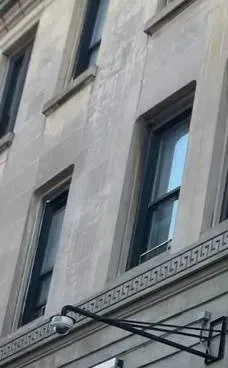
job-library photo, not taken in Wyckoff Heights: a camera on a steel arm on an older masonry front. A camera like this records the street; the alarm’s signals come from the doors, detectors and buttons inside, each with its own instruction on the signal plan.
Wyckoff Heights Alarm Request
Row house, apartment, counter business, loft or medical office: two lines are enough to start
✅
Request Sent!
A technician will call about the Wyckoff Heights address before the end of the working day.
25+
Years Experience
✓
Same-Day Estimates
100%
Licensed & Insured
4.6★
390+ Google Reviews
Three answers let us draft your signal plan before anyone visits. First, who is inside and when: a family asleep at night, someone who sleeps through the day after a night shift, an older parent alone in the afternoons, a counter with one employee after dark? Second, what has to be protected besides the doors: cash or money orders behind a counter, a gas boiler in a shared cellar, a charging scooter in a hallway, medicine that cannot be left for a week? Third, who should be told about what: you alone about a back window, every household about smoke, the police about a hold-up but nobody inside the store? Text the three answers and a photo of your front door and your cellar or back room to (347) 934-8335. Most people hear back the same day with a draft list of devices, what each one would do, and the line of our Brooklyn price list the job will probably land on.
Looking at photos and replying costs nothing; a bill starts only with a visit
Work is done under New York State license #12000287431, and a landlord or managing agent can have our insurance certificate before we arrive
Central station monitoring is optional and month to month; a plan without monitoring still decides who is told and how
The Neighborhood
Why Wyckoff Heights Properties Need Alarm Installation
Wyckoff Heights is not one of the names most Brooklynites could put on a map. Wikipedia describes it as an area that straddles the border between Bushwick in Brooklyn and the southwest corner of Ridgewood in Queens, urbanized from the late nineteenth century on land farmed by the Wyckoff family, and settled first by German immigrants, then Italian families, and more recently by Latino and Eastern European residents. Forgotten New York wondered in 2008 whether the hospital invented the name, and the sources do not agree on its edges; we say so below rather than pretend otherwise.
What every source agrees on is the building that gives the area its modern name. Wyckoff Heights Medical Center, at 374 Stockholm Street where it meets Wyckoff Avenue, is a 350-bed teaching and safety-net hospital with an emergency department open around the clock. It began as the German Hospital of Brooklyn, raised by a society of German immigrants, and took the Wyckoff Heights name after the First World War. Being close to it brings help no faster: a smoke detector does not ring there, and a fall on Himrod Street shows up on no screen on Stockholm Street. Help still has to be asked for, by the right signal.
The three local reports we built this page around show why the kind of signal matters as much as the alarm itself. The February 2026 break-ins on Myrtle Avenue near Stockholm Street happened through apartment front doors while the occupants were home, at a quarter past two in the morning, by men police said were armed. A loud siren at that moment can make things worse for the person inside; what that household needed was a way to ask for police without saying a word, and a door that announced itself the second it opened. The June 2024 robbery at Irving Avenue and Linden Street held an employee and a customer inside for more than two hours; a counter like that needs a silent hold-up signal that goes to police and nowhere else. And the October 2023 fire at 120 Menahan Street, blamed on a lithium-ion battery, filled the stairs with smoke before dawn; that signal has to wake everyone at once and reach the fire department even if nobody can call.
Add the building stock and the border, and you have the reason this page is organized the way it is. Wikipedia notes that the first houses here were attached wood-frame three- and six-family rows, followed by masonry once the fire codes changed, and in the 1940s by attached single-family houses with alleys and garages at the rear. Several households under one roof means several people who need different messages from one panel. The borough line runs down the middle of some of these streets, so the same panel’s address may be in Brooklyn while the house across the street is in Queens. So a Wyckoff Heights alarm is best planned signal by signal, on paper, before a sensor goes on a wall. Most owners who start with burglary end up adding smoke, heat and carbon monoxide reporting, and many pair the alarm with security cameras in Wyckoff Heights so a signal arrives with a picture.
Wyckoff Heights at a glance
Two boroughs, two ZIP codes: Wikipedia places the area largely in ZIP codes 11237 (Brooklyn) and 11385 (Queens). The Queens side changed to 11385 on January 13, 1980, after 93 percent of returned ballots supported the switch.
A post office with the neighborhood’s name: the Wyckoff Heights post office at 86 Wyckoff Avenue opened in 1951 to serve north Bushwick and the Brooklyn part of Wyckoff Heights.
The hospital: 374 Stockholm Street, 350 beds, emergency department, a New York State Primary Stroke Center and Level III Perinatal Center, per Wikipedia; the hospital also lists offices at 110 Wyckoff Avenue, 1411 and 1419 Myrtle Avenue and the Medical Arts Building at 1610 DeKalb Avenue.
Seventeen border streets: Forgotten New York counts Wyckoff Avenue among seventeen streets that border both Brooklyn and Queens, along with Flushing, Cypress, St. Nicholas, Gates and Irving Avenues and Menahan Street.
Police: the Brooklyn side is the NYPD’s 83rd Precinct, whose station house is at 480 Knickerbocker Avenue; the Queens side is the 104th.
Transit under the avenue: the L train runs beneath the whole length of Wyckoff Avenue, from Flushing Avenue to Cooper Avenue, and meets the elevated M at the Myrtle–Wyckoff Avenues station, rebuilt as a combined interchange in 2007.
Need Repair?
A Smoke Detector That Chirps but Never Reports, a Dead Hold-Up Button, a Panel Still Dialing a Landline: Same-Day Alarm Repair in Wyckoff Heights
Most repair calls we expect from these blocks are not about the siren. They are about signals that stopped going anywhere. A panel installed decades ago in a cellar on Stanhope Street may still be trying to report over a copper phone line that the household cancelled years ago, so it shows “communication failure” and tells nobody about anything. A smoke detector on a third floor may be a battery unit that beeps locally and was never connected to the panel at all. A hold-up button under a counter may have been painted over, unplugged during a renovation, or wired to a zone that reports as an ordinary burglary, which means the monitoring center would call the store first and ask if everything is all right.
Call or text (347) 934-8335 with the panel brand and what the keypad shows. Repairs are usually same day across Wyckoff Heights and are typically finished in one to two hours. On the visit the technician tests each device and writes down what it actually sends, so you finish the day knowing which signals work, not just that the beeping stopped.
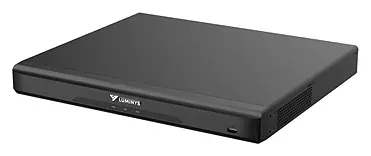
Product photo, not a Wyckoff Heights installation: a flat network video recorder. If a camera recorder sits beside the alarm panel, its video-loss and tamper outputs can be added to the signal plan as trouble signals for the owner.
What We Install
Alarm Installation Services in Wyckoff Heights
Every service below comes with a written signal plan: each device, its signal type, siren or silent, and who is told.
🏠
Multi-household row house alarms
For the attached frame and brick rows with two, three or six households under one roof: one panel, separate areas and codes for each household that wants them, burglary signals that go only to the household whose door opened, and fire and CO signals that go to everyone.
🌙
Occupied-home night protection
For households who are home when the risk is highest: entry doors that report the instant they open in night mode, motion left off where people walk, a keypad and a key-ring button that can call police silently, and a siren set to stay quiet for silent signals.
💵
Counter and cash-business alarms
For money transfer and check-cashing counters, bodegas, pharmacies, phone stores and jewelers on Wyckoff, Irving, Knickerbocker and Myrtle: fixed hold-up buttons where staff stand, a wireless button that moves with the person closing up, a code that disarms normally but reports duress, and opening and closing reports for the owner.
🔥
Monitored smoke, heat and CO
Smoke detectors in halls and stairs, heat detectors where smoke detectors would false-alarm, carbon monoxide detectors near sleeping areas and the boiler, all reporting through the same panel so a fire signal reaches the monitoring center and every household even when nobody is home.
🩺
Medical and help buttons
A wall button and a wearable button for a person who lives alone or is home alone part of the day, set to report as a medical signal rather than a burglary, with a call list of relatives and neighbors who can open the door.
🔁
Takeovers and signal audits
Old panels left by other companies, phone-line dialers and systems bought with a building: we test every device, write down what each one really sends, replace the communicator with cellular if needed, and re-label zones so that “zone 7” becomes “third-floor rear window” in the app and at the monitoring center.
Two things we will not do: wire a hold-up button so that it makes a noise in the store, and connect our burglary panel into a building’s own fire alarm control panel. The first can put staff in danger; the second belongs to a fire alarm contractor working under the building’s own filings. If your building has a central fire alarm, see our Wyckoff Heights fire alarm page; the two systems can sit side by side.
Building Specialists
Alarm Installation for Wyckoff Heights’s Architecture
Wikipedia’s short history of Wyckoff Heights describes three waves of building, and walking the streets adds two more: the factory blocks at the north end of Wyckoff Avenue and the shops and offices that line the avenues. Each changes where the devices can go and which signals matter most.
Attached wood-frame three- and six-family rows
The first houses, according to Wikipedia, were attached wood-frame three- and six-family row houses; one of the article’s photographs shows a row on St. Nicholas Avenue. For an alarm, two features dominate. First, the households: three or six front doors off one stair, a shared street door, and usually one cellar with the boiler and the meters. Second, the construction: wood frame, attached on both sides, with a shared roofline. Fire is the signal we take most seriously in this stock. Smoke detectors go at the top of the stair and in each household’s hall, a heat detector in the cellar near the boiler where dust and humidity would make a smoke detector unreliable, and the fire signal is set to sound in every household, not only in the one where it started. Burglary sensors follow each household’s own door and the windows that can be reached from the yard, a fire escape or a lower roof.
Masonry rows built to the newer fire codes
Around the turn of the twentieth century, Wikipedia says, builders moving toward the borough line and into Queens switched to masonry to meet new building and fire codes, and many of those buildings are now in the Cypress Avenue West Historic District on the Queens side. On the Brooklyn side, Forgotten New York photographed light-brown brick residences on Wyckoff Avenue between Willoughby Avenue and Suydam Street and suggested the bricks may come from the same Staten Island kilns that supplied Ridgewood. Brick changes the wiring, not the plan: these buildings usually get wireless sensors with a wired panel, tested for signal through the party walls.
Houses that turn their side to Cypress Avenue
Joseph Heathcott, who photographed the whole Brooklyn–Queens line for his BQ Borderlands project, asked his readers why so many houses along Cypress Avenue are turned ninety degrees away from the street. He called it one of the longest stretches he had seen anywhere in the city where a street is faced by the sides of houses rather than their fronts. For an alarm, the avenue side becomes a side wall of street-facing windows, often bedrooms, while the front door opens onto a side yard; we walk the outside before drawing the plan.
1940s attached houses with alleys and rear garages
The last large development, in the 1940s, built automobile-oriented attached single-family houses with alleys and garages at the rear; a 1945 New York Times headline describes builders buying the final eighteen acres of the Wyckoff holdings, which it calls a Queens farm, so most of this stock sits on the Queens side of the line. Where we find it, the rear is the real entrance: the garage door, the door from the garage into the house, and the alley gate. Those openings get their own sensors and are put on a separate notification so the family hears about the alley, while the monitoring center is asked to act only on doors into the house itself.
Factory blocks and lofts at the north end of Wyckoff Avenue
Forgotten New York found Wyckoff Avenue from Flushing Avenue to about Starr Street still largely industrial in 2008, with lofts filling up with artists and musicians moving east from Williamsburg, and a former candy factory converted to lofts at Willoughby Avenue. A 1974 Times real estate note records the former Schlitz brewery “in the Wyckoff Heights section of Brooklyn” being redeveloped. These buildings bring freight doors, long banks of old factory windows, roof hatches and shared corridors. A tenant’s plan covers the unit; the owner’s covers the roof hatch and the loading door. They are two plans, not one.
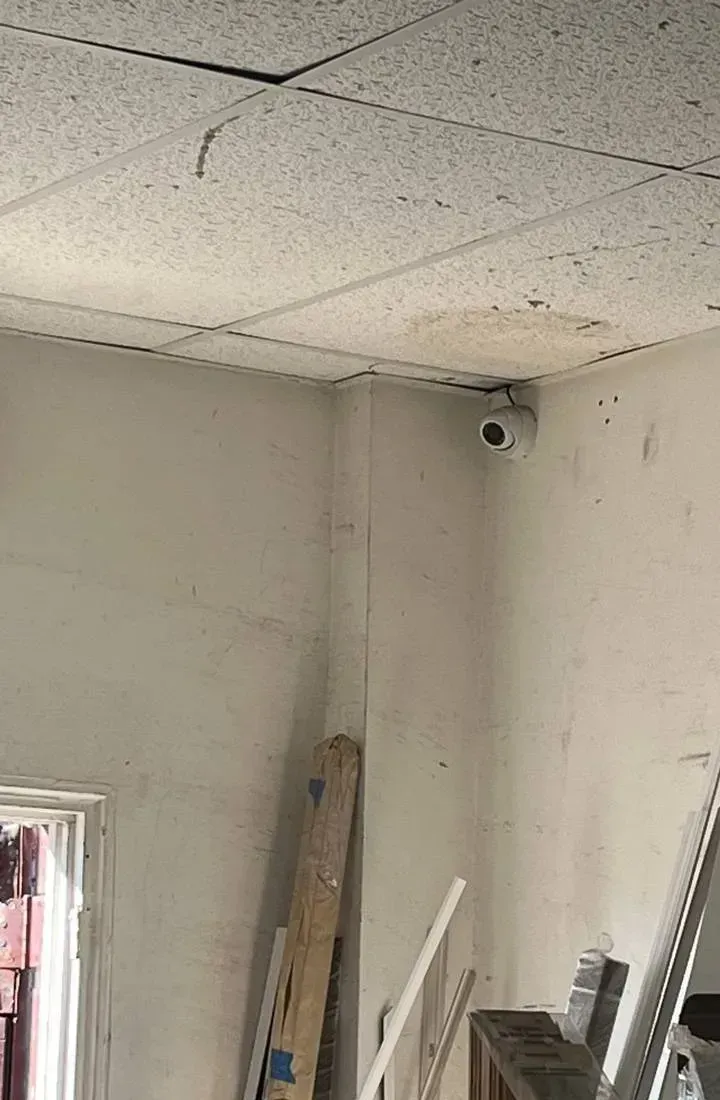
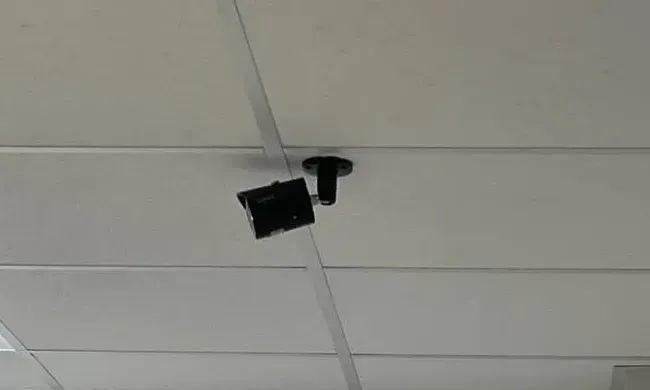
job-library photo, not taken in Wyckoff Heights: an unfinished storeroom with a camera in the ceiling corner. In a loft or behind a store, a back room like this is usually a burglary point for the tenant and a separate, owner-only signal for the landlord.
Opening by opening: how the method changes
Building type
First signals to plan
Usual devices
Attached frame three- or six-family
Fire to all households; burglary per household
Smoke at stair top and halls, heat in cellar, CO near bedrooms and boiler, contacts on each household’s door
Brick row or flat
Burglary per household; CO
Wireless contacts and glass-break, wired panel and siren
House sideways to Cypress Avenue
Burglary on the avenue-side windows
Contacts and glass-break on side-wall windows, contact on the side-yard door
1940s attached house with rear garage
Burglary on the house doors; alley notices to family
Overhead garage contact, garage-to-house door contact, alley gate contact
Loft unit or workshop
Burglary on the unit; owner signals for roof and freight
Heavy-duty contacts, curtain motion along window banks, glass-break
Store or office on an avenue
Hold-up and duress; burglary after hours
Fixed and wireless hold-up buttons, duress code, shock sensor on the gate or door
The Signal Plan
Five Messages From One Panel, and Why Each Gets a Different Answer
A modern alarm panel does not just “go off.” Each device is assigned to a zone, and each zone has a type that decides what the panel does when it trips. In practice there are five families of message, and most mistakes in old systems come from one set up as another. A hold-up button programmed as an ordinary burglary zone sounds the siren in the store. A smoke detector wired as a burglary zone stays silent when the system is disarmed, which is exactly when people are home. A medical button set up as a panic zone sends police instead of an ambulance.
So before we mount anything on a Wyckoff Heights wall, we write the plan out as a table, in plain words, and go through it with you. Each line answers four questions: what trips it, does a siren sound, who is told first, and who is told after that. The table below is the starting point we use; every household changes it.
Signal
What trips it
Siren?
Told first
Told next
Burglary
A door or window contact, a motion detector or a glass-break detector while that area is armed
Yes, after any entry delay; stops by itself within fifteen minutes under NYC Administrative Code § 24-238
Monitoring center, then the household whose area tripped
Police, if nobody gives the password or someone asks for them
Hold-up or duress
A fixed or wireless hold-up button, or a duress code entered at the keypad
Never; the keypad behaves as if nothing happened
Monitoring center
Police; the store is not called back, and the owner is told afterwards
Fire
Smoke or heat detectors, armed or disarmed, day and night
Yes, in every household on the panel
Monitoring center
Fire department, then everyone on the building list
Carbon monoxide
CO detectors, armed or disarmed
The detector’s own sounder, and the keypads
Monitoring center
Fire department, then the owner and the affected households
Medical
A wall or wearable help button
No; a soft chime at the keypad confirms it was sent
Monitoring center
Ambulance through 911, then the family and neighbor call list
Trouble
Low battery, lost power, lost cellular signal, a tampered device
Keypad beeps only
The owner’s phone
Us, if the owner wants a service call
The central station’s exact procedure for each signal type is set out in the monitoring agreement, which we go through with you line by line. Without monitoring, “told first” becomes the phones you choose, and nobody calls 911 for you.
Home When the Door Opens: What the February 2026 Myrtle Avenue Reports Change
News 12 Brooklyn reported on February 9, 2026, that just after 2:15 that Monday morning, three or four men walked through the front door of a 62-year-old man’s apartment in a building on Myrtle Avenue near Stockholm Street, showed guns and took property, then went into a second apartment in the same building, belonging to a 27-year-old man, again through the front door. The younger man was treated by EMS at the scene; a dog, bank cards and phones were taken. A thread on r/Bushwick, which we could read only as a search excerpt, later added that the dog had been left at Wyckoff Heights Medical Center and was reunited with its owner that evening.
Nothing in the reports says how the men got through those front doors, and we will not guess. What the case shows is the situation many alarm sales pitches skip: the people were home, it was the middle of the night, and the risk came through the door they use every day. For that household, three parts of the signal plan matter more than the siren.
The apartment door is an instant zone at night. In the setting most people call “stay” or “night,” the door that leads out of the apartment reports the moment it opens, with no entry countdown, and a chime or voice at the keypad in the bedroom announces it. The point is time: knowing the door opened before anyone reaches the bedroom.
A silent call for police, within reach. A key-ring or bedside button set as a silent hold-up, or a duress code at the keypad, lets someone ask for police without a siren that might escalate a confrontation. We set these silent by default in occupied homes and explain the trade-off: silent signals depend on monitoring, because without it nobody receives them.
The siren is a choice, not a reflex. For a break-in while the household is out, a siren helps; it tells the neighbors and shortens the visit. For a person inside with an intruder, the decision is the household’s, and the plan can sound the siren for an empty-apartment burglary and stay silent for a night-time panic button.
None of this replaces police advice: lock the door, do not open it to strangers, never confront an intruder.
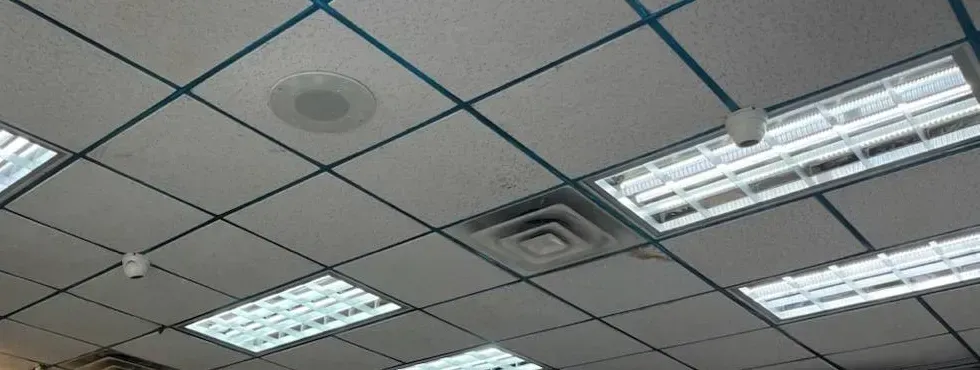
job-library photo, not taken in Wyckoff Heights: small ceiling devices spread across a drop ceiling. Whatever sits on the ceiling, the night setting in an occupied home rests on the door contact and the silent button, not on detectors in the rooms people walk through.
Behind the Counter: Silent Signals for Money Transfer Stores, Bodegas and Pharmacies
ABC7 New York’s account of June 8, 2024 is short and specific. At about 7:45 on a Saturday evening, a man walked into a money transfer store at Irving Avenue and Linden Street, acted as if he were going to make a transaction, and then announced a robbery. Two employees and a customer were inside. One of the employees managed to get out and call 911. Arriving officers found the door barricaded with chairs, hostage negotiators talked with the man through a window for more than two hours, and he surrendered; the gun he had pointed at officers turned out to be fake.
An alarm system would not have prevented that robbery, and we would not claim it could. What a counter business on these avenues can have is a way to ask for police the moment a robbery is announced, without anyone running for the door. That is what a hold-up signal is for, and the way it is set up matters more than the brand:
Fixed buttons where staff actually stand. Under the counter at each window, at the safe, and in the back office, mounted so a knee or a hand reaches them without looking down. Each one is labeled on the plan by position, so the monitoring center can tell police which part of the store sent it.
A wireless button that travels. Robberies often come at opening or closing, when the gate is half up and one person is alone. A wireless button on a lanyard or key ring covers the walk from the door to the register.
A duress code. If someone is forced to disarm the system, a code one digit different from the normal one disarms it and quietly reports duress.
Silence, always. Hold-up zones are programmed with no siren, no keypad display and no chime. Nothing in the store changes when one is pressed.
No call back to the store. For a burglary alarm, the monitoring center usually calls the premises first. For a hold-up, it should not, because a ringing phone in a store being robbed helps nobody. We confirm that instruction on the account.
The store’s signals stay on the store’s plan, separate from the apartments above. Most owners pair this with cameras over the counter and the door, which our camera page for Wyckoff Heights covers, and some with a buzzer-controlled door, which is on our Wyckoff Heights door access page.
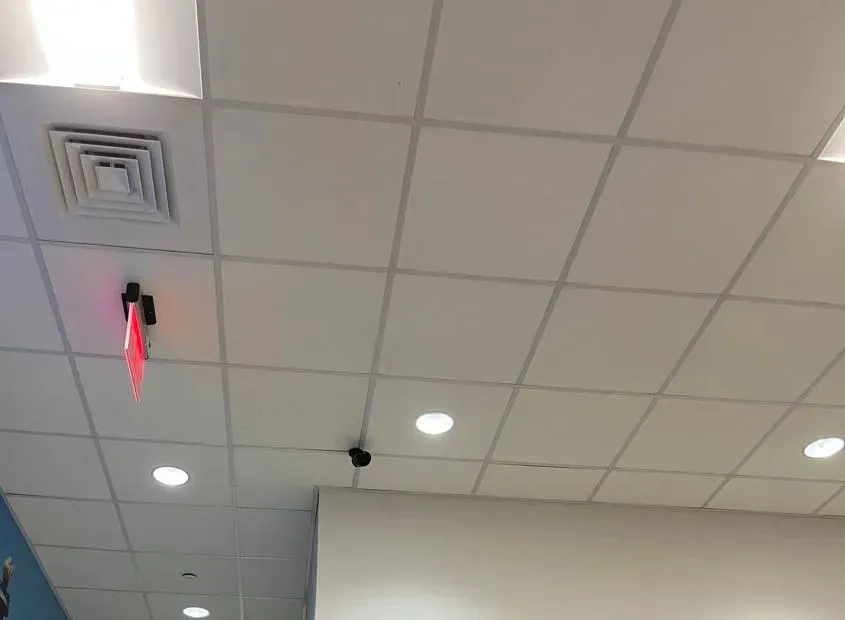
job-library photo, not taken in Wyckoff Heights: a store ceiling with a small camera near the exit sign. Hold-up buttons themselves are hidden under counters and never appear in a photo like this.
Fire in Attached Frame Rows: Smoke, Heat and the Battery in the Hallway
In attached wood-frame rows, fire is the signal that has to reach the most people the fastest. NY1 reported on October 17, 2023, that a fire caused by a lithium-ion battery broke out in a second-floor apartment at 120 Menahan Street in the Hope Gardens public housing complex in Bushwick shortly after 4:30 that morning. Five people were hurt, including two children. A resident described being told to go down the stairs and choking on the black smoke on the way. The FDNY said at the time that it had responded to 216 lithium-ion battery fires in the city that year, with 120 injuries and 14 deaths, and New York City’s Local Law 39, which had taken effect the month before, banned the sale or rental of e-bikes and e-scooters whose batteries were not certified by an accredited testing laboratory.
Hope Gardens is a seven-story building in Bushwick, not a frame row; we cite it as the closest documented case of batteries charging overnight indoors. A panel already being installed is the cheapest way to make a detector do more than beep in one room.
Smoke at the top of the stair and in each hall. In a three- or six-family row, smoke rises into the stair first. A detector at the top landing and one in each household’s hall, all on the panel, means smoke on the second floor sounds on the first and third as well.
Heat where smoke detectors lie. Cellars with boilers, kitchens and dusty storage rooms produce false smoke alarms; a fixed-temperature or rate-of-rise heat detector there still reports a real fire.
The charging spot gets its own detector. If a household charges a scooter or e-bike battery in the same place every night, a smoke detector above that spot is named for it in the app (“front hall charger”), so the first message says where to look.
Fire signals are 24-hour zones. They report whether the burglary side is armed or not, and they cannot be turned off from the app by mistake.
Every household hears it. On a shared panel, a fire signal sounds in every household’s area and goes to every household’s phone, even when burglary signals are kept private.
A monitored smoke detector is not a substitute for the smoke and carbon monoxide alarms New York City already requires in apartments. HPD’s rules put installing those on the owner and replacing their batteries on the tenant. We add monitored detectors alongside what the law requires, and we never remove a required alarm to replace it with one of ours.
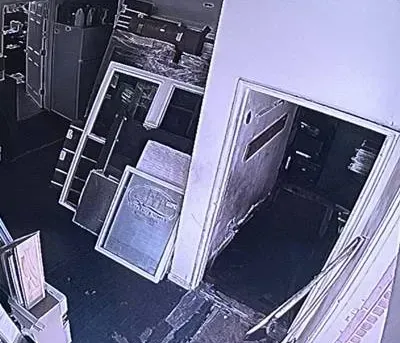
Abstract Enterprises Security Systems job-library camera view, not from Wyckoff Heights: a back room at night with stock leaning against the wall. Rooms like this, where things are stored and charged out of sight, are where a heat or smoke detector on the panel earns its place.
Carbon Monoxide and the Boiler Everyone Shares
Most of the older multi-family houses here have one boiler in the cellar serving every floor. A cracked flue or a blocked chimney on that boiler is a risk to every household at once, and it tends to show up on the coldest nights, when windows are shut and everyone is asleep. HPD requires carbon monoxide detectors in apartment buildings, and in one- and two-family homes that are not owner-occupied where there are fuel-burning appliances, within fifteen feet of the entrance to each sleeping room. Those alarms sound in the room. A CO detector on the alarm panel adds the part a standalone alarm cannot do: it tells someone outside the house.
Where they go: within fifteen feet of each bedroom door, as HPD’s rule sets, and one in the cellar at the distance from the boiler the instructions set, so that a leak is caught at its source as well as at the bedrooms.
What they send: a CO signal, separate from smoke, so the monitoring center and the fire department know it is a gas problem rather than a fire, and so you know not to go down to the cellar to look.
Who is told: every household the boiler serves, plus the owner, even an owner who lives elsewhere. A tenant on the third floor may not know who to call about the boiler; the owner does.
Life of the sensor: CO sensing elements wear out. The panel reports an end-of-life warning as a trouble signal to the owner, and we write the replacement year on the plan.
If you smell gas, leave and call 911 from outside.
The Hospital Is Close, but It Is Not on Your Call List
People who live within sight of Wyckoff Heights Medical Center sometimes assume that being near an emergency room makes a medical button pointless. It does not work that way. The hospital does not receive signals from home alarms, and nobody at the hospital knows your door has not opened since yesterday. An ambulance is sent through 911, and the 911 system decides which unit comes. Being close to the emergency department shortens the ride there; it does nothing to shorten the time before someone realizes help is needed.
That gap is what a medical signal closes. A wall button in the bathroom and the bedroom, and a wearable button for the person who lives alone or is alone during the day, can be set up as medical zones. With monitoring, the station’s procedure for a medical signal is to speak to the person through the panel’s speaker where the panel supports it, call back, and request an ambulance through 911 if there is no answer or the person asks for one, then work down a call list of relatives and neighbors. We write the list to include at least one person who lives within a few minutes and has a key, because an ambulance crew at a locked street door in a six-family is the delay families describe most.
An alarm panel is not a medical device and is not a medical alert service. It cannot detect a fall on its own, it does not monitor health, and a door sensor that has not opened is not proof of anything. For a serious condition, ask a doctor about a dedicated medical alert device; the panel adds a silent way to ask for help from the rooms where people fall.
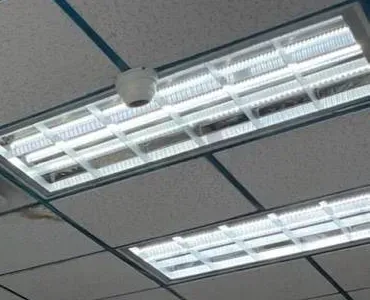
job-library photo, not taken in Wyckoff Heights: a small dome on a drop ceiling next to a light panel. Ceiling devices in offices and waiting rooms are kept away from the street-facing glass and from anything a busy sidewalk could trip.
Two Boroughs on One Street: What the Line Changes for an Alarm
The Brooklyn–Queens line runs straight through the neighborhood, and the sources describe it slightly differently. Forgotten New York says the county line arrives at Wyckoff Avenue from Gates Avenue near Myrtle Avenue and then runs down the middle of Wyckoff Avenue to George Street. A reader under Heathcott’s Urban Omnibus essay, writing in 2015, gave the 1925 route as Cypress Avenue to Menahan Street to St. Nicholas Avenue to Gates Avenue to Wyckoff Avenue and on to Eldert Street and Irving Avenue. Heathcott himself photographed a building at Irving Avenue and Eldert Street that the line slices through, marked by a thin grey line in the brick. Untapped Cities, cited on our Ridgewood page, describes the border along Cypress and Wyckoff. We follow the city’s own records for each address rather than any of these descriptions, and we say on this page that they do not match exactly.
The address on the monitoring account. A Brooklyn house here has a plain Brooklyn number and ZIP 11237; a house across the street in Queens may have a hyphenated Queens number and 11385. The account is set up with the borough, the ZIP and the nearest cross street written out, so nobody has to work it out at 3 a.m.
Which precinct and which firehouse. That is decided by the 911 system from the address, not by the monitoring center and not by us. Our part is making sure the address it receives is complete and correct.
Nothing about the price. We charge the Brooklyn list on both sides of the line; the work is the same work.
Commercial Alarm Installation
Business Alarm Installation in Wyckoff Heights
The business streets around Wyckoff Heights are short and mixed: industry and lofts at the north end of Wyckoff Avenue, the transit hub and its shops at Myrtle Avenue, counter businesses on Irving and Knickerbocker, and medical offices clustered around the hospital. Each corridor below is described from the sources we used, and each tends to need a different mix of signals.
Wyckoff Avenue from Flushing Avenue to Starr Street
Forgotten New York described this stretch in 2008 as still largely industrial, with its lofts being taken by artists and musicians, a former candy factory converted to lofts at Willoughby Avenue, and a new restaurant scene starting to appear. For workshops and studios the plan is burglary after hours and fire at all hours: heavy-duty contacts on freight doors, curtain motion along window banks, heat detectors by kilns and chargers, and closing reports.
The Myrtle–Wyckoff hub
Forgotten New York describes the 2007 interchange in the triangle of Wyckoff Avenue, Myrtle Avenue and Linden Street, beside the old trolley terminal site, now a supermarket. The Myrtle Avenue business improvement district on the Queens side starts at Wyckoff Avenue. Stores around the hub open early and close late, with a steady crowd outside until the last trains. The plan here puts weight on the gate and the glass after closing, shock sensors on roll-down gates, glass-break detectors for the storefront, and a hold-up button at the register for the hours when one person runs the shop.
Myrtle Avenue on the Brooklyn side
The hospital lists two practices on this stretch, at 1411 and 1419 Myrtle Avenue, and the February 2026 break-ins happened in an apartment building on Myrtle near Stockholm Street. A store below and apartments above means two plans in one building, with only the fire signal shared.
Irving Avenue
The June 2024 robbery at the money transfer store at Irving Avenue and Linden Street is the clearest local reason for silent signals at a counter. An r/Bushwick thread titled “Heads up to businesses near Wyckoff Ave & Linden St — shoplifting incident,” which we saw only as a search result, suggests shop owners on these blocks warn each other online. For check cashing, money transfer, phone repair and jewelry counters, the plan starts with fixed hold-up buttons at each window, a wireless button for opening and closing, a duress code, and a safe contact that reports the safe door opening outside business hours.
Knickerbocker Avenue
Wikipedia names Knickerbocker Avenue as one of Bushwick’s main commercial streets, and the 83rd Precinct station house is on it at number 480. Groceries, bakeries, clothing stores and restaurants here get a back-of-store plan: the rear door and any yard or cellar hatch first, the front gate and glass second, and the register area on its own zone so it can stay armed while the kitchen opens.
St. Nicholas Avenue, DeKalb Avenue and the streets around the hospital
The hospital’s Medical Arts Building is at 1610 DeKalb Avenue and its clinic at 110 Wyckoff Avenue. Wikipedia places the former Wyckoff Heights Presbyterian Church, founded in 1895 and rebuilt after a 1928 fire, at Harman Street and St. Nicholas Avenue; it is now the Ridgewood Pentecostal Church. For private medical, dental and therapy offices, the plan adds a medication or records room on its own always-armed zone, a hold-up button at reception, and a separate code for cleaners.
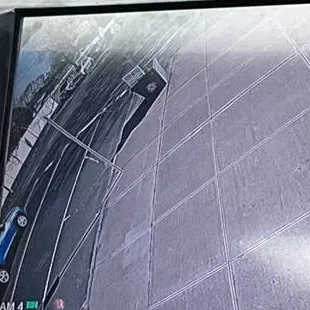
Abstract Enterprises Security Systems job-library camera view, not from Wyckoff Heights: a storefront camera looking along the sidewalk. A view like this records the street; the alarm’s signals come from the door, the gate and the buttons behind the counter.
Rules that apply to every Wyckoff Heights alarm
Siren limit: NYC Administrative Code § 24-238 requires an audible burglar alarm on a building to stop automatically within fifteen minutes of starting. Every siren we install is programmed to that limit.
Licensed installers: in New York State, installing and servicing security and fire alarm systems requires a license from the Department of State; ours is #12000287431, and we will show it before any work starts.
Required detectors stay: HPD’s smoke and CO detector rules apply whether or not you have an alarm; monitored detectors are added, never swapped for the required ones.
Battery rules: since Local Law 39 took effect in 2023, e-bikes and e-scooters sold or rented in the city must have batteries certified by an accredited lab; a heat or smoke detector over the charging spot is still worth having.
Silent signals and monitoring: hold-up, duress and medical signals reach nobody without monitoring; if you choose not to have it, we leave those zones out rather than install buttons that do nothing.
Your Questions Answered
Alarm Installation in Wyckoff Heights: Questions Answered
These are the questions the local reports and the building stock raise. We could not open Google’s “People also ask” box, Answer the Public or Yelp from the environment this page was built in, so none of the questions below is copied from them; they are the ones the sources on this page lead to, grouped the way the signal plan is.
Who is home, and when
One of us works nights and sleeps from about nine in the morning until four. Can the panel switch itself into its at-home setting on a daytime schedule instead of at bedtime?
Yes. Most current panels let each area follow a schedule, and the schedule does not care whether “night” falls at 11 p.m. or 9 a.m. For a day sleeper we usually set the at-home setting to come on automatically at a fixed time on work days, with the doors to the apartment as instant zones and the motion detector in the hall left off, and to switch back to disarmed in the afternoon. The app sends a reminder if the schedule tries to arm while a door is open.
We live a block from Wyckoff Heights Medical Center. Does being that close to an emergency room change how a medical button on our alarm should be set up?
Not in the way people hope. The hospital receives no signals from home alarms, and an ambulance is sent through 911 no matter how close you live. What being close does change is the call list. Neighbors who live a few doors away and have a key matter more than relatives across the city, because the slowest part of a medical call in a walk-up is usually getting a crew through a locked street door and up the stairs. So a nearby key holder goes near the top of the list, and each button is labeled by room.
My father lives alone on the third floor of a walk-up with a locked street door. If he presses a medical button and cannot get downstairs, how does the ambulance crew get in?
This is the question to settle before the button goes on the wall, not after. There are three common answers, and many families use two of them. A neighbor in the building or on the block who holds keys and agrees to be called first. A key lock box at the street door, if the building owner allows one, with the code given to the monitoring center to pass on to responders. Or, where the street door already has an electric strike and an intercom, a way for a trusted person to buzz the crew in remotely; our Wyckoff Heights intercom page covers that side. Whatever you choose, it is written into the monitoring account’s notes, and the instructions say plainly which floor and which door.
Counters and cash
If an employee presses a hold-up button while a robber is still in the store, what does the monitoring operator actually know, and what do they pass on to police?
The operator sees the account, the address and cross street, the business name, the zone that sent the signal and its label, for example “hold-up, window 2,” and the time. They do not see or hear inside unless cameras or listen-in were agreed. What they pass to the 911 dispatcher is that a hold-up alarm has been received from that address and which button sent it. That is why labeling matters: “hold-up, back office” and “hold-up, front counter” tell responding officers different things. It is also why the account is set not to call the store back. If you want a manager’s phone called afterwards, that instruction goes on the account as well.
Our counter closes at nine and one person pulls the gate down alone. Where should the button be for those last ten minutes?
On that person, not on the counter. The last minutes of a business day are spent between the register, the back room, the light switches and the gate, and a fixed button under the counter is out of reach for most of them. A wireless hold-up button on a lanyard or key ring goes everywhere the closer goes, including outside to the gate. We pair it with a duress code at the keypad by the door, so that if the closer is made to disarm or re-open, the code does that and reports duress at the same time. The fixed buttons stay where they are for the hours when staff are behind the counter.
Shared houses, shared signals
Can the alarm send different signals to different people, for instance a break-in only to me, a fire to everyone in the building and a low battery only to the landlord?
Yes, and that is the heart of the signal plan. Each person in the app is given notification settings by area and by signal type. A tenant gets burglary signals for their own apartment and fire and CO for the whole building; the owner gets what was agreed. Trouble signals, such as a low battery or lost power, go to whoever is responsible for fixing them. The central station follows the same plan, and each household gets a printed copy.
Our three-family has one gas boiler in the cellar for all three floors. Whose phones should a carbon monoxide signal from the cellar go to?
Everyone’s, and the owner’s even if the owner lives elsewhere. A CO reading in the cellar means the boiler or its flue may be putting gas into the whole house, and every household needs to know at once so they can get out and not go downstairs to look. The owner needs to know because the owner arranges the boiler repair. With monitoring, a CO signal also goes to the central station, which calls the fire department. The plan should never route a CO signal to one person who might be asleep with their phone on silent.
Our attached frame house shares a roof space with the houses on both sides. Is a heat detector up there worth adding, and whose alarm should it report to?
Often it is. A fire that starts in or reaches a shared roof space can travel along the row before anyone below smells smoke, and a roof space is too dusty, hot and cold for most smoke detectors. A heat detector rated for that environment reports a real fire without the false alarms. It reports to your panel and your households, since it is on your property and your wiring. What you cannot do is make it report to your neighbors’ alarms. What you can do is agree with them, informally, to be on each other’s call lists for fire signals only, which some owners in attached rows do.
The street and the line
Our house is turned sideways on Cypress Avenue, so the bedroom windows face the avenue and the front door opens onto a side yard. Which openings should be on the alarm first?
The windows on the avenue side that someone can reach from the sidewalk, then the side-yard door, then anything at the back. In a house like this the usual instinct, front door first, puts the effort on a door that may face a neighbor’s wall and leaves the bedroom windows on a busy street unprotected. Avenue-side windows get contacts and glass-break, armed in the night setting. The side-yard gate, if there is one, gets a chime-only contact that tells the household and never calls anyone.
Our building shows two different house numbers by the door. Which one goes on the monitoring account?
The one the city uses for your building, which is the one on your property tax bill and in the city’s building records. Heathcott noted that some houses on the border display two addresses so the mail arrives, and Wikipedia records that residents of the Queens section were still lobbying for house numbers and street signs in 1901. A monitoring center will pass on whatever address it has, so we put the official address, the borough, the ZIP code and the nearest cross street on the account, add the second number in the notes as “also shown at the door,” and ask the center to read the address back to us during the first test.
Abstract Enterprises Security Systems job-library camera view, not from Wyckoff Heights: a view along a brick side wall. On a house turned sideways to its street, the side wall is often the one that faces the sidewalk.
Equipment
Types of Alarm Systems We Install in Wyckoff Heights
The equipment list is ordinary. What is particular to a signal plan is that every device is chosen for the kind of message it has to send, and some of them exist only to send one kind.
Cellular panels with areas and zone types
The panel is the part that decides what each signal means. We install panels that support several areas (so each household or business can arm separately), a full set of zone types including silent hold-up, duress, 24-hour fire, CO and medical, and a cellular communicator with a backup path where the account calls for one. The panel goes somewhere dry and hidden, often a closet rather than the boiler cellar, and reports a power loss to the owner.
Door and window contacts and shock sensors
Contacts on every door and every reachable window, recessed where the frame allows and surface-mounted where it does not, with shock sensors on doors that could be forced and on roll-down gates.
Glass-break and motion detectors
Acoustic glass-break detectors in rooms with street-side glass, tested for sensitivity against each room’s actual noise. Motion detectors only where people do not walk at the times the area is armed, aimed into the room and away from street-facing windows, and pet-tolerant where the household has a dog or cat. In an occupied home at night, motion detectors are usually off; glass-break and contacts carry the night setting.
Hold-up buttons, duress codes and wireless panic buttons
Two-finger hold-up buttons that cannot be pressed by accident, mounted under counters and desks; wireless buttons on lanyards and key rings; and duress codes on the keypads. All of them are programmed as silent zones, labeled by position, and tested with the monitoring center on a schedule. We do not install them on systems without monitoring.
Smoke, heat and carbon monoxide detectors
Smoke detectors at the top of each stair and in halls, heat detectors in cellars, kitchens, roof spaces and the room where batteries charge, and CO detectors near bedrooms and the boiler, all on 24-hour zones. Each is a device designed to report to an alarm panel, not a battery alarm with a radio added. They are in addition to the alarms HPD requires, never instead of them.
Medical buttons and the keypad speaker
Wall buttons in bathrooms and bedrooms and wearable buttons for the person who needs them, programmed as medical zones. Where the panel has a speaker and microphone, the monitoring operator can speak with the person after the button is pressed; we set the volume for the room and test it with the person who will use it.
National kits and national brands, compared on a signal plan
Do-it-yourself kits sold by Ring and SimpliSafe, and the packages sold by ADT, all cover the basics of a single household: contacts, motion, a siren, an app and optional professional monitoring. Where they tend to fall short here is the plan rather than the hardware. A consumer kit is usually built around one household and one owner’s phone, so splitting burglary signals by household while sharing fire signals across a three-family is awkward or impossible. Silent hold-up zones and duress codes are business features many consumer kits do not offer at all. We can install a kit you own at the labor-only price and say where it falls short.
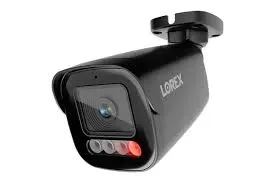
Product photo, not a Wyckoff Heights installation: a bullet camera with a red warning light. A deterrent light like this can be triggered by a burglary signal; it is never tied to a hold-up signal, which must stay silent and dark.
AI Overview Reality Check
What AI Gets Wrong About Alarm Installation in Wyckoff Heights
We could not open Google’s AI Overview, its follow-up questions, Bing or DuckDuckGo from the environment this page was built in, so nothing below is quoted from them. The claims are the general advice that cost guides such as Angi, HomeAdvisor and Fixr, kit makers and AI-written summaries tend to repeat about alarms. Each is set against what the Wyckoff Heights sources show.
“An alarm’s job is to make a loud noise and scare burglars away”
That is one of its jobs, for an empty home. The local reports on this page are mostly about moments when a loud noise is the wrong answer: armed men inside an occupied apartment at 2:15 a.m., a robber holding two people inside a store with the door blocked.
In those moments the useful signal is the silent one, sent to people who can act, while nothing changes in the room.
So a plan here starts by deciding which signals must stay silent, and only then decides where the sirens go and how loud they are.
“Arm it when you leave and you are protected”
Away arming protects an empty home. It does nothing for the household asleep upstairs, the person who sleeps through the day after a night shift, or the parent home alone in the afternoon who falls.
In the frame rows and walk-ups here, people are home a great deal of the time, and the risks the sources describe, a night-time entry, a fire before dawn, a gas boiler on a cold night, all happen with people inside.
A Wyckoff Heights system should be judged by what it does while you are home: which doors are instant at night, which smoke detectors wake every household, and which button calls for help.
“Smoke detectors are a separate thing; leave them out of the alarm”
The battery smoke alarms the law requires are separate, and they stay. But a standalone alarm only wakes the people who hear it.
In the October 2023 Menahan Street fire, a resident who lived several doors from the burning apartment told NY1 that police came banging on the door. A detector on a panel would have sounded in every household connected to it and reported out, even with nobody awake to call.
For an attached frame row, adding monitored smoke and heat detectors to a burglary system already being installed is one of the most useful things the money can buy.
“A panic button is a panic button”
On many systems the button on a fob or keypad is a loud panic: it sounds the siren. That is fine for scaring off someone at a window. It is wrong for a hold-up, where the siren can turn a robbery into something worse, and wrong for a fall, where the person needs an ambulance, not police.
Hold-up, duress, panic and medical are different zone types and lead to different responses. A button’s label in the app does not change what the panel sends; its programming does.
We set every button’s type on paper first, then program it, then test it with the monitoring center listening.
“Living next to a hospital or a precinct means help arrives fast anyway”
Help arrives fast once somebody asks for it. The hospital on Stockholm Street does not watch homes, and the 83rd Precinct on Knickerbocker Avenue does not watch closed stores.
The minutes that matter are the ones before anyone calls 911: a smoke-filled stair before dawn, a person on a bathroom floor, an employee who cannot reach a phone.
An alarm’s value here is measured in how quickly the right signal reaches the right person, not in how close the nearest emergency room is.
“Wireless sensors are unreliable in old buildings”
Wireless sensors have to be tested where they will live, and thick brick party walls do weaken signals. But wired systems in these houses mean opening plaster and running cable through occupied apartments, which most owners and tenants do not want.
The practical approach is a wired panel and siren where the wiring is easy, wireless sensors everywhere else, and a signal-strength reading at every device before it is fixed in place, with a repeater added where a reading is weak.
The panel also supervises each wireless sensor and reports one that stops checking in as a trouble signal to the owner, so a sensor that goes quiet does not stay quiet unnoticed.
“Budget a few hundred dollars and a monthly bill, and you’re covered”
A basic single-household system on our Brooklyn list does start at $600, and monitoring through our partners is $30 a month (keypad) or $45 a month (with the app). That covers one household’s doors, a motion detector and a keypad.
A signal plan for a three-family frame house, with fire and CO for every household, separate burglary areas, and medical buttons for one resident, is a complete-protection job that starts at $2,500. A counter business with hold-up buttons is a commercial job in the $1,500 to $3,000 range.
Those are the published figures; the written price after one visit is the only number we hold ourselves to.
Send Us Your Building and Who Lives in It, and We Will Draft the Signal Plan
Tell us how many households or staff, who is home when, and who should hear about a break-in, a fire or a fall. A technician replies the same day with a first draft.
A frame three-family on Starr Street, a brick flat on St. Nicholas Avenue, a counter on Irving Avenue or an office near the hospital: a few lines start it, and the written Brooklyn-list price follows the visit. Prefer to talk? (347) 934-8335.
✅
Request Received
Got it. Your request is with our dispatcher, and a technician will phone you back during today’s working hours. For a siren that will not stop or a detector showing trouble right now, ring (347) 934-8335 instead of waiting for the callback.
How It Works
Our Installation Process
1. Three answers and two photos
You tell us who is home and when, what has to be protected besides the doors, and who should be told about what; you send a photo of the front door and one of the cellar or back room.
2. Draft the signal plan
Before the visit, we draft the plan as a table: each likely device, its signal type, whether a siren sounds, and who is told first and next.
3. Walk the building with the plan
On site the technician checks every door, reachable window, stair, cellar, roof hatch and charging spot against the draft, and adjusts it with you, household by household.
4. Written Brooklyn-list price
The quote lists every device and its signal type, separates monitoring and cameras, and is yours to keep before anything is booked.
5. Install, then test signal strength
Panel, communicator, keypads and devices go in; each wireless device is read for signal strength from its final position before it is fixed, and a repeater is added where needed.
6. Program types, names and lists
Each zone is given its type and a plain name, each person their code and notification settings, and the monitoring account its call lists and special instructions.
7. Test every signal with the center listening
Every zone is tripped with you watching; hold-up, medical, fire and CO zones are tested with the monitoring center told in advance; the center reads the address back; you get the final plan on paper and by email.
Example signal plan handed over at the end of a three-family installation
Zone
Name in the app
Type
Siren
Told
1
1F apartment door
Burglary, instant at night
Yes
Center, then 1F household
2
2F apartment door
Burglary, instant at night
Yes
Center, then 2F household
3
3F apartment door
Burglary, instant at night
Yes
Center, then 3F household
4
Rear windows to yard, 1F
Burglary
Yes
Center, then 1F household
5
Stair top smoke
Fire, 24-hour
All households
Center, fire department, everyone
6
Cellar heat near boiler
Fire, 24-hour
All households
Center, fire department, everyone
7
Cellar CO
CO, 24-hour
Detector and keypads
Center, fire department, everyone and owner
8
2F front hall charger smoke
Fire, 24-hour
All households
Center, fire department, everyone
9
3F bathroom help
Medical
No; keypad chime
Center, 911 ambulance, neighbor key holder, family
10
3F wearable help
Medical
No
Center, 911 ambulance, neighbor key holder, family
11
1F bedside button
Silent panic
No
Center, police
12
Street door
Chime only
No
Owner’s phone only
Example only, not a real address. Actual zones, types, sirens and call lists are agreed with each household, and the monitoring center’s handling of each signal type is set out in the monitoring agreement.
Coverage Area
Alarm Installation Near Wyckoff Heights’s Landmarks
Wyckoff Heights Medical Center
At 374 Stockholm Street and Wyckoff Avenue. Wikipedia’s text says it opened in 1899 as the German Hospital of Brooklyn; its infobox, Forgotten New York and the hospital give 1889.
Myrtle–Wyckoff Avenues station
The L runs under the whole of Wyckoff Avenue; the MTA’s combined station with the elevated line opened in 2007 in the triangle of Wyckoff Avenue, Myrtle Avenue and Linden Street, beside the site of the old trolley terminal, now a supermarket.
Wyckoff Heights post office
86 Wyckoff Avenue, opened in 1951 for north Bushwick and the Brooklyn side of Wyckoff Heights, in ZIP code 11237. Threads on r/Bushwick that we saw only as search excerpts discuss the mailboxes in front being removed, with commenters blaming mail theft.
Maria Hernandez Park
Between Knickerbocker and Irving Avenues and Starr and Suydam Streets. Wikipedia records that newspapers announced a new park “to be located in Wyckoff Heights” in 1890; NYC Parks names it for Maria Hernandez, killed in her Starr Street home in August 1989.
The former Wyckoff Heights Presbyterian Church
At Harman Street and St. Nicholas Avenue, founded in 1895 and rebuilt after a fire in 1928, now the Ridgewood Pentecostal Church, according to Wikipedia’s article on the neighborhood.
83rd Precinct station house
480 Knickerbocker Avenue, the NYPD precinct for Bushwick and the Brooklyn side of Wyckoff Heights. The Queens side of the line is the 104th Precinct.
A Brooklyn address in Wyckoff Heights pays the Brooklyn list, the base price for the whole company; Brooklyn’s area multiplier is 1.00. We charge the same list for a building on the Queens side of the line. Nothing is added for a border street, a walk-up or a building next to the hospital. What changes the price is the number of households or businesses on the panel, how many doors and windows each needs, how many fire, CO and medical devices the plan calls for, and whether old wiring can be reused. Every figure below is Abstract Enterprises Security Systems’ published Brooklyn alarm price before sales tax. Jobs under $500 are paid in full; above that, half is paid as a deposit once the visit has fixed the price in writing, and the balance when the system is working.
One household’s apartment in a frame row or walk-up, with its own door and night setting
Wireless system, typical range
$600 – $1,200
Brick flats and occupied apartments where nobody wants plaster opened
Complete home protection: more sensors, glass-break, smoke and CO, sirens, app, camera-ready
from $2,500
A three- or six-family with fire and CO for every household, separate burglary areas and medical buttons
Custom hardwired system, full-property coverage
$2,000 – $6,000
Frame houses being gutted or renovated between tenants, with walls open
Panel replacement on existing wiring: panel, cellular communicator, keypad, programming
$800 – $1,500
Old cellar panels still dialing a landline, reprogrammed with proper zone types
Per-unit setup for landlords: door sensor, motion detector, monitoring
$400 – $800 per unit
An owner protecting each apartment’s door in a multi-family
Commercial alarm, standard small business
$1,500 – $3,000
Counter businesses with hold-up buttons, stores at the Myrtle–Wyckoff hub, offices near the hospital, loft workshops
Adding cameras to a business alarm
$1,000 – $2,500
A counter view and a door view that arrive with a signal
Installing a customer-supplied kit
$200 – $400
A Ring or SimpliSafe kit you own, installed with a written signal plan
Central station monitoring through our partners
$30 a month (keypad) or $45 a month (with the app)
Optional, month to month; required for hold-up, duress and medical signals to reach anyone
Service visit outside warranty
$195/hr, 3-hr minimum ($585)
Old systems by other companies, added zones, signal audits
What moves a Wyckoff Heights quote up or down
Households on the panel: one household costs least; a six-family with separate burglary areas and a shared fire plan needs more keypads and devices, though still one panel
Fire and CO coverage: each stair top, hall, cellar, roof space and charging spot adds a detector; for a frame row this is where much of the budget goes, and where we think it should
Silent signals: hold-up buttons, duress codes and medical buttons are inexpensive devices, but they only work with monitoring, so they bring the monthly fee with them
Wiring already in the walls: if the old cable still tests good, reusing it is cheaper than buying wireless devices; cable that fails the test comes out
Cameras: optional and priced separately
Get a Written Brooklyn-List Price for Your House, Your Apartment or Your Counter
Name the people inside and the people who should hear about trouble; you get a same-day answer from a technician and a written price after one visit.
A cellular panel with battery backup; a contact and shock sensor on the apartment door, set as an instant zone in the night setting; contacts on up to three reachable windows; one motion detector for away arming; a keypad by the bedroom; the app for every adult in the household; trouble signals to the leaseholder. Silent panic and medical buttons can be added with monitoring.
Whole Multi-Family, Shared Fire Plan — from $2,500
One panel with a burglary area for each household that wants one; contacts and shock sensors on each household’s door; glass-break and contacts on reachable windows; smoke at each stair top and hall, heat in the cellar, CO by the bedrooms and the boiler, all sounding in every household; sirens within the city limit; separate codes and notification lists; a printed signal plan for each household.
Counter Business, Silent First — from $1,500
A commercial panel on its own cellular path; fixed hold-up buttons at each window, the safe and the office; a wireless hold-up button for the closer; a duress code; shock sensor on the gate and door, glass-break on the storefront, contacts on the back door; opening and closing reports; monitoring required for the silent zones. Cameras add $1,000 to $2,500.
Already bought a kit? Labor-only installation
If you own a Ring, SimpliSafe or similar kit, installing it costs $200 to $400 on our Brooklyn list. We place each sensor, test its signal from its final position, set up the app’s notifications to follow a written signal plan as far as the kit allows, and tell you in writing which parts of the plan it cannot do, such as silent hold-up zones or separate areas for each household. If the kit itself fails, that is a matter for its manufacturer’s warranty.
Complete Services
Every Alarm Installation Service in Wyckoff Heights
Video intercoms for walk-ups and six-families, so a household can see who is at the street door before buzzing, and an ambulance crew can be let in remotely.
Network cabling for offices and lofts, and TV mounting, from the same Troy Avenue crews.
Most Wyckoff Heights owners who start with a burglary alarm add monitored smoke and CO detectors in the same visit, and most counter businesses add cameras over the register and the door. The Brooklyn-wide pages for door access across Brooklyn, Brooklyn network cabling and fiber runs in Brooklyn cover the bigger jobs.
Field Notes
Field Notes: Write the Signal Plan Before Touching a Wall
This is how our technicians are asked to run a first visit to a multi-family house or a counter business in Wyckoff Heights. It describes our method, not a particular job. The visit starts at the kitchen table, not at the front door. The technician asks who lives in each apartment, who is home at night, who sleeps in the day, who lives alone, who has a key to whose door, and who owns the building. For a store, who opens, who closes, where cash or medication is kept, and who has ever pressed a button under the counter.
Then, still at the table, the technician fills in the plan: a line for every likely device, its type, siren or silent, who is told first, who is told next. Only after you have read and agreed that page does the walk-through start, and the walk-through checks the plan against the building, the stair, the cellar, the boiler, the roof hatch, the charging spot in the hall, the side-yard door.
Devices come last, once the hard questions are answered in writing.
job-library photo, not taken in Wyckoff Heights: a camera on a short pendant in a drop ceiling. In a medical office or a store, the ceiling is where cameras go; the alarm’s hold-up and medical buttons stay out of sight at the desk.
FAQ
Wyckoff Heights Alarm Installation FAQ
What would burglary, smoke and carbon monoxide protection for a three-family frame house in Wyckoff Heights cost on your Brooklyn list?
+
A whole three-family with a burglary area for each household and smoke, heat and CO detectors that sound in every apartment is a complete-protection job, which starts at $2,500 on our Brooklyn list. If only one household wants burglary protection, a basic system starts at $600, and per-unit protection for each rented apartment’s door is $400 to $800 per unit. Medical and hold-up buttons are inexpensive devices, but they need monitoring, which is $30 a month (keypad) or $45 a month (with the app). Sales tax is added, and the written price follows one visit.
Do you work on both sides of the borough line, including the Queens blocks of Wyckoff Heights and Ridgewood?
+
Yes. We serve the Brooklyn side, from Flushing Avenue through the blocks around the hospital to Myrtle–Wyckoff, and the Queens side across Wyckoff and Cypress Avenues, all from our Troy Avenue office and all at the Brooklyn list. Our Bushwick, Ridgewood, East Williamsburg and Cypress Hills pages describe the neighboring areas; the price list is the same for each.
If we decide against monitoring, which parts of the signal plan still work?
+
Burglary, fire and CO signals still sound the sirens and the detectors’ own sounders, and the app still sends each signal to the phones on the plan, so the people you chose are told. What stops working is everything silent. Hold-up, duress and medical signals would reach nobody, so we leave those devices out of an unmonitored system rather than install buttons that do nothing, and nobody calls 911 on your behalf for any signal. Monitoring is month to month, so it can be added later and the silent devices fitted then.
Can we keep the alarm company we already have and just add buttons or detectors from you?
+
Sometimes. New devices have to be programmed into the existing panel and added to the existing company’s monitoring account, and many panels are locked with an installer code that only the original company holds. If your company can give the panel access, we can add compatible detectors and buttons and leave the monitoring where it is. If not, the usual choice is a panel replacement on the existing wiring, $800 to $1,500 on our Brooklyn list, after which one company holds the panel, the plan and the account. Either way, we can test what you have and give you a written signal plan to take to your current company.
What exactly is in the written signal plan you hand over at the end, and how do we change it later?
+
One line per zone: its name in the app, the device, where it is, its signal type, whether a siren sounds, who is told first and who next. A second page lists each person’s notification settings and the special instructions on the monitoring account, such as do not call the store back after a hold-up, or the neighbor who holds keys. Codes are never written on it. Each household gets a copy on paper and by email. To change it, call or text us; many changes, such as call lists and notification settings, can be made without a visit, and we send the updated plan afterwards.
Our medical practice near the hospital already uses an after-hours answering service. Can that service receive our alarm signals instead of a central station?
+
Not for anything that needs police, fire or an ambulance. An answering service takes phone calls; it is not set up to receive signals from an alarm panel or to request a dispatch from them, so burglary, hold-up, fire and CO signals should go to a central station. The answering service, or the practice manager, can be on the call list the central station works through after it has acted, and opening and closing reports and trouble signals can go to the office by email or app.
All Areas Served
Alarm Installation Across Brooklyn, New York City, Long Island and the Hudson Valley
Whoever you hire, ask to see a state alarm license and proof of insurance before the first hole is drilled; Abstract Enterprises Security Systems lists both on our about page.
Sources
Where the Wyckoff Heights Facts Come From
We read or searched each of these in October 2026. Nothing on the page goes beyond what the listed source says, and conflicts between them are pointed out where they occur.
A 1974 New York Times real estate note on the former Schlitz brewery and a 1945 Times headline on the last Wyckoff farm acreage — seen as search-result excerpts and as cited by Wikipedia
The boundaries of Wyckoff Heights are not settled: Wikipedia treats it as an area on both sides of the line, Forgotten New York doubted the name existed, and a reader recalled it simply as Ridgewood, Brooklyn. This page covers the Brooklyn side and serves both.
A Detector That Will Not Report, a Hold-Up Button Nobody Trusts, or a Panel Stuck on Trouble: Call the Wyckoff Heights Line
Read us the brand on the panel door and the exact words on the keypad at (347) 934-8335; that is usually enough to bring the right battery, communicator or detector on the first trip. We make same-day repair visits from Flushing Avenue down to Myrtle–Wyckoff and across the line into Ridgewood.
Wyckoff Heights Alarm Systems From a Licensed, Insured Brooklyn Company
Calls and texts to (347) 934-8335 go to the people who install and repair the systems, and a picture of your cellar, your counter or your street door can be sent on WhatsApp. Paperwork, from the written quote and the signal plan to the service agreement and the invoice, is issued by Abstract Enterprises Security Systems at 1282 Troy Ave, Brooklyn, NY 11203.
Check us first if you like: our 390+ Google reviews come to 4.6★ on average, and New York State license #12000287431 covers every installer we send. Owners, managing agents and co-op boards can ask to be named as certificate holders on our insurance, and the certificate arrives by email before anyone climbs your stairs.
Full terms — including 50% deposit, the 30-day warranty and optional paid extended warranty, and the late-fee schedule — are set out in the service agreement. See our warranty page.
Revision log, October 22, 2026: rebuilt from scratch around a written signal plan for Wyckoff Heights: break-in, hold-up, fire, carbon monoxide and medical signals kept apart and routed to different people, for occupied homes in attached frame and brick rows, counter businesses on Wyckoff, Irving, Knickerbocker and Myrtle Avenues, and offices near the hospital. Prices are the published Brooklyn base figures.