A Lefferts Manor house that wants to see who is on the stoop, an Ocean Avenue apartment house with dead lines on every floor, or a new condo on Maple Street? Prospect Lefferts Gardens door buzzer installation line: (347) 934-8335
Landmarked Row Houses · Lefferts Manor Single-Family Homes · Six-Story Prewar Apartment Houses · Small Walk-Ups · New Condos and Mid-Rises · Flatbush and Nostrand Storefronts
Door Buzzer Installation in Prospect Lefferts Gardens
Landmark Rules Checked First · One Panel per Doorway · Every Riser Pair Metered · Door Made to Latch Before the Release · Brooklyn Rate
Door buzzer installation in Prospect Lefferts Gardens means working on two very different kinds of front door within a few blocks of each other. West of Flatbush Avenue and along the side streets, the doors belong to landmarked row houses and single-family homes, where the city's Landmarks Preservation Commission decides where a door station may go and how it looks. Along Ocean Avenue, Lefferts Avenue and Lincoln Road, the doors belong to six-story apartment houses from the 1920s and 1930s with a hundred or more apartments on one lobby panel. In between are small walk-ups, two-family houses and a growing number of new buildings. Below is how we plan each one and where it sits on our Brooklyn price list.
Prices come from our Brooklyn door buzzer list, and the full total, with every possible extra named, is agreed in writing before anything is ordered
Rated 4.7★ across 201 Google Reviews
Reviewed and updated November 11, 2026, against the Landmarks Preservation Commission's Permit Guidebook, Chapter 11 (Health, Safety, and Utility Equipment); the LPC's Prospect Lefferts Gardens Historic District map; New York's Multiple Dwelling Law §50-a; city housing records for Prospect Lefferts Gardens addresses as compiled by augrented.com; openigloo tenant reviews and building records for 25 Lefferts Avenue, 39 Ocean Avenue and 383 Rutland Road; CityRealty's record for 246 Maple Street; a Nest Seekers listing for 757 Flatbush Avenue; amNY's May 2020 report from Hawthorne Street; News 12 Brooklyn's July 2026 report from Nostrand Avenue; Patch's report from 501 Lefferts Avenue; Brick Underground's broken-buzzer guide; Habitat magazine's "The New Buzzer"; two Brownstoner forum threads; 6tocelebrate's and the Historic Districts Council's neighborhood histories; New York YIMBY's October 2026 construction report; the HomeAdvisor and Swiftlane cost guides; Aiphone's GT Series pages; Allegion's fail-safe guide; the building code's sensor-release provisions; and the 2010 ADA Standards. · Abstract Enterprises Security Systems, NYS license #12000287431 · crews dispatched from our Troy Avenue office in Brooklyn
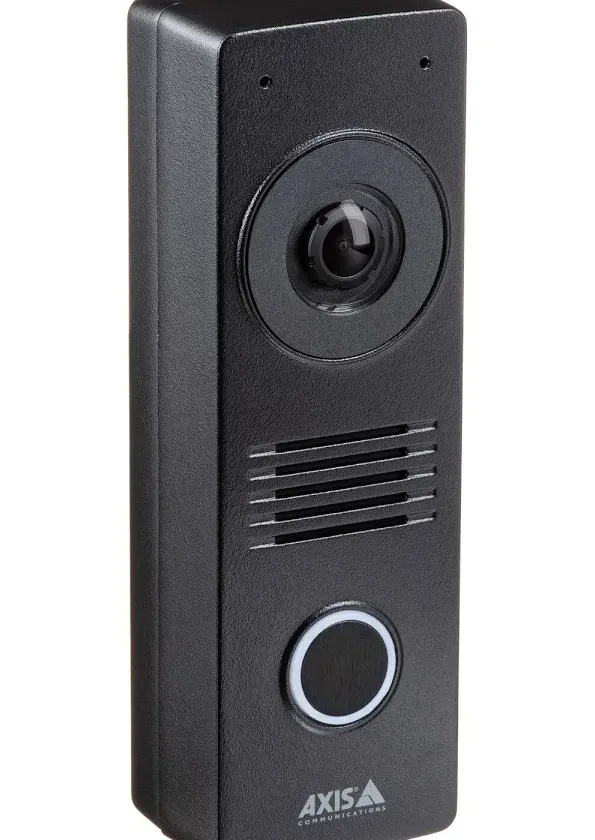
A photo from the AESS job library, not taken in Prospect Lefferts Gardens: a black rectangular video door station with a camera lens, a speaker grille and one round call button that lights up. A single-button station this compact is the kind of unit that suits a Lefferts Manor house, where the deed covenant keeps the home to one household and the Landmarks rules ask for equipment that is small, discreet and fixed within or beside the door opening.
Prospect Lefferts Gardens Buzzer Request
Manor house, two-family, walk-up, six-story apartment house, new condo or a shop: tell us the address, how many households the system has to reach and how many doors people use, and a technician calls back with the range
✅
Request Sent!
Thank you. A technician will call you about the Prospect Lefferts Gardens address, usually within two hours during working hours.
25+
Years Experience
✓
Same-Day Estimates
100%
Licensed & Insured
4.7★
201 Google Reviews
Owner-operated since 2002 · Thousands of jobs completed · Booked within 2 hours
Quick answer: door buzzer installation in Prospect Lefferts Gardens runs $400 to $900 on our Brooklyn list for an audio station and new door release on a house or a single entrance, $700 to $1,800 for a video station with indoor monitors or phone answering on a Manor house, a two- or three-family or a small walk-up, and from about $2,500 to past $10,000 for a full entry system serving every apartment in one of the six-story apartment houses on Ocean Avenue, Lefferts Avenue or Lincoln Road. Each price covers the door station, the answering units, the power supply, the electric strike or approved lock, the cable and the labor. It is fixed in writing after we have seen the doors, and anything that depends on a test, such as an old riser pair that may fail or a closer that has to be replaced before a release can hold the door, is named and priced before you order. On a landmarked front, the quote also says what the Landmarks application needs. Send photos of the doorway and whatever is mounted beside it to (347) 934-8335 or on WhatsApp, and we answer with the range that fits, usually within two hours of your message during working hours.
Looking at your photos and quoting a new system costs nothing. If an existing system has to be diagnosed in person before we can quote, that is the $250 service call booked online, and the $250 is applied toward the work.
All work is done under New York State license #12000287431. We install low-voltage entry equipment; if a door needs a new 120-volt outlet or circuit for its power supply, a licensed electrician does that part, and you know before the job is priced.
We work for whoever controls the door: a homeowner, a building owner, a co-op or condo board or its managing agent, a developer, or a store or office tenant with the landlord's written approval.
The Neighborhood
Why Prospect Lefferts Gardens Properties Need Door Buzzer Installation
Prospect Lefferts Gardens runs from Empire Boulevard south to Clarkson Avenue and from Ocean Avenue and Prospect Park east to New York Avenue, almost all of it in ZIP code 11225, with some southern addresses filed under 11226. The name dates only from 1968, when a neighborhood association joined Prospect Park, Lefferts Manor and the Brooklyn Botanic Garden into one. For a door buzzer job, what matters more than the name is the way the area was built: a planned district of single-family houses in the middle, rows of two-family houses around it, and large apartment houses along the park and the avenues. Those three groups need three different kinds of installation, and the rules that apply to each are different too.
Start with the houses. The Lefferts estate was divided into lots in the 1890s, and the deeds for Lefferts Manor required a single-family brick or stone house of at least two stories, set back from the street. That covenant is still upheld by the Lefferts Manor Association, so a Manor house has one household and usually one front door, up a stoop. Much of the area is also a city historic district: the Landmarks Preservation Commission designated the Prospect Lefferts Gardens Historic District on October 9, 1979, and Chester Court (designated in 2014) and Ocean on the Park are separate historic districts of their own. On those blocks, anything fixed to the front of a house needs a Commission permit before work begins. A door station is small, but it is on the front of the house, so the Commission's rules decide where it goes, how many there can be and what it looks like.
Then the apartment houses. Along Ocean Avenue facing the park, and on Lefferts Avenue, Lincoln Road and Flatbush Avenue, six-story buildings went up in the 1920s and 1930s with large footprints and long cellars. City and listing records show their size. 25 Lefferts Avenue was built in 1938 with 132 apartments on six floors. 415 Lefferts Avenue dates from 1931 with 96 apartments. 50 Lincoln Road went up in 1926 with 63, and 39 Ocean Avenue in 1936 with 30. Every one of those apartments is a line on the building's intercom, and in a building that old, most of those lines run on cable that has been spliced, painted over and rerouted for decades.
Tenants say plainly what happens when those systems are left to decay. A reviewer of 25 Lefferts Avenue on openigloo wrote that "many tenants have intercoms and buzzers that do not work and go unrepaired." City records compiled by augrented.com show the same pattern elsewhere in the neighborhood. 552 Flatbush Avenue received an HPD Class B violation dated April 21, 2026, ordering the owner to repair or replace the broken intercom system from the front of the building to the tenant's device in apartment 4I. 181 Hawthorne Street has an open complaint for "Bell/Buzzer/Intercom" from April 8, 2026, and 305 Clarkson Avenue, a 12-unit building from 1931, had one in December 2025. Each of those is a building where at least one household cannot talk to a visitor or open the door from upstairs.
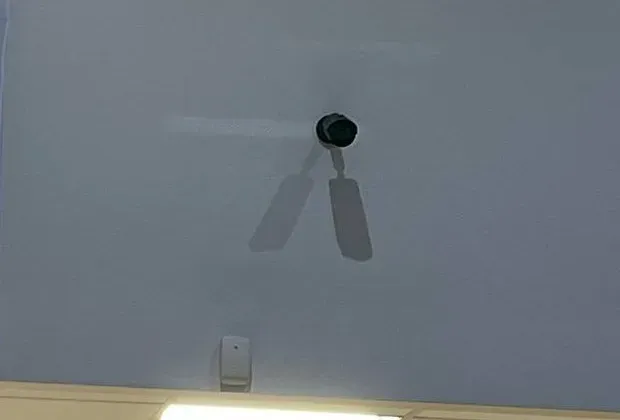
A photo from the AESS job library, not taken in Prospect Lefferts Gardens: a small black camera mounted high on a pale wall, throwing two shadows, with a small white device fixed below it. In the vestibule of a six-story apartment house on Lefferts Avenue or Lincoln Road, a camera placed this high looks down on the inner door, so the moment someone follows a resident in, or works at the lock, is recorded even when the door station's own camera faces the street.
The front door is also where the neighborhood's break-ins tend to start. In May 2020, amNY reported that a burglar had repeatedly forced his way into buildings on Hawthorne Street near Bedford Avenue, using a long metal tool to open the street door lock; one six-story building of 15 apartments lost six bicycles and numerous packages in two weeks. "This guy pops locks faster than if I had key," resident Ralph Pahlmeyer told the paper. In 2022, Patch covered tenants of 501 Lefferts Avenue rallying after a delivery worker was beaten and robbed in their front vestibule, saying defective interior door locks let the danger reach their hallways. A new buzzer does not stop a determined criminal on its own, but a door that latches every time, a strike and latch that resist prying, and a station that lets every apartment see or hear who is outside remove the easy ways in.
The newest buildings add a third set of needs. New York YIMBY's October 2026 report lists projects underway or recently finished on the neighborhood's east and south edges, including 757 Flatbush Avenue and a 12-story building at 331 Maple Street, and their entry systems are chosen while the walls are still open, which is the cheapest moment to get them right.
Finally, the law sorts the buildings differently. Under Multiple Dwelling Law §50-a, a Class A apartment building built or converted after January 1, 1968 with eight or more apartments must have an intercom at its self-locking front door that lets a resident talk to the visitor and release the door. Older buildings, which covers nearly every apartment house in Prospect Lefferts Gardens, must install one when tenants of a majority of apartments ask in writing. A Lefferts Manor house is not a multiple dwelling at all. We sort out which applies at the start, and a camera over the entrance or a keypad on a side door can be planned into the same visit.
Six facts that shape a Prospect Lefferts Gardens buzzer installation
Much of the area is landmarked. The Prospect Lefferts Gardens Historic District was designated in 1979, and Chester Court and Ocean on the Park are separate districts, so a door station on those fronts needs a Landmarks permit.
The Commission allows one intercom panel per doorway. Its Permit Guidebook says "a maximum of two light fixtures and one intercom panel can be installed per door opening," within or beside the door, or on a fence or wall in front of the entrance.
The Manor is single-family by covenant. Lefferts Manor deeds barred apartment houses, so most Manor jobs are a one-household station, not a building directory.
The apartment houses are big and old. Buildings such as 25 Lefferts Avenue (1938, 132 apartments) and 415 Lefferts Avenue (1931, 96 apartments) put a hundred lines on one lobby door, all on prewar cable.
Broken intercoms show up in city records. augrented.com's compilation of HPD data shows an intercom violation at 552 Flatbush Avenue in April 2026 and "Bell/Buzzer/Intercom" complaints at 181 Hawthorne Street and 305 Clarkson Avenue.
New construction is steady. 757 Flatbush Avenue, 331 Maple Street and 408 Lefferts Avenue are among the buildings going up or recently finished, each choosing its entry system before tenants arrive.
Where this page applies. This page covers Prospect Lefferts Gardens from Empire Boulevard to Clarkson Avenue and from Ocean Avenue to New York Avenue, including the Lefferts Manor blocks, Chester Court and the Ocean Avenue apartment houses. For the rest of the borough see our door buzzer installation in Brooklyn page, and for the whole city our NYC door buzzer installation page.
Landmarked Fronts
One Panel per Doorway: Planning a Door Station the Landmarks Commission Will Approve in Prospect Lefferts Gardens
On most Brooklyn blocks, the only question about where a door station goes is where it works best. On the landmarked blocks of Prospect Lefferts Gardens there is a second question that has to be answered first: where the Landmarks Preservation Commission will let it go. The Commission's Permit Guidebook covers this in Chapter 11, "Health, Safety, and Utility Equipment," and its language is short and specific. "Staff can issue permits approving light fixtures and intercom panels if the installation meets the following criteria," it says, which means a door station that follows the criteria can usually be approved by Commission staff rather than going to a public hearing.
The criteria are what shape the design. "Light fixtures and intercom panels, as well as doorbells, must be installed within or adjacent to a door opening." "An intercom can also be installed on a fence or wall in front of the entranceway." "A maximum of two light fixtures and one intercom panel can be installed per door opening." And the "design, size, and finish of installations must be compatible with the architecture of the building." In practice that rules out the two most common shortcuts on a row house: a second panel bolted beside an old one that nobody wants to remove, and a large surface-mounted box placed wherever the cable happened to come out of the wall.
The general conditions in the same chapter go further. Equipment is not to go on or in front of a primary facade "unless no other option exists," and where it must, it is attached "at mortar joints, plain masonry, wood, or metalwork," not drilled through cast iron or carved and decorative surfaces. Conduit should pass through plain masonry behind the installation where possible; where it cannot, staff may approve up to about ten inches of visible conduit, painted to match. And "most equipment must be as small as possible and painted to blend with surrounding building material, if possible." For a brownstone or limestone stoop in the Manor, those lines decide which station we specify, where its cable enters the house and how its fixings are placed.
What that means for a typical Manor or row house job
A Lefferts Manor house typically has a stoop leading to a wood double door or a single door with sidelights, often inside a vestibule with an inner door. The old bell button is usually in the door frame or the masonry beside it, and the bell wire runs down inside the stoop or through the vestibule wall to the cellar. Our first step is to look for the route that keeps the new cable inside the house. Very often the old bell wire's path, or the space behind the frame, will carry a new cable without any new visible conduit. Where it will not, the quote says how much conduit would show and where, so the owner knows before the application whether it stays within the roughly ten inches staff can approve.
Then the station itself. A narrow flush or semi-flush station mounted on the frame or the masonry pier beside the door is the most common answer, in a finish chosen to sit quietly against the stone or the painted wood. Where a house already has an old bell plate the owner wants to keep, the plan has to respect the one-panel limit, so the new station replaces it in the same spot or the old plate stays only as a decorative piece that is not a second working panel. On houses with an iron fence or a wall at the front of the areaway, the Commission's allowance for a panel on "a fence or wall in front of the entranceway" lets a visitor call from the gate, which suits households that keep the gate locked.
Cameras follow their own rule. The same chapter limits small buildings to "no more than two security cameras" for every 25 feet of street frontage, spaced to avoid a cluttered look. On a narrow row house that limit includes the lens in a video door station, which is one more reason the plan for the station and any camera over the stoop is made together.
What goes with the application
The guidebook lists what Commission staff want to see: color photos of the entire building and close-ups of the proposed locations, comparative drawings of existing and proposed conditions with large-scale details at visible facades, and "manufacturer cut sheets for light fixtures, intercoms, security cameras, and mailboxes." We supply the cut sheet for the station we quote, the exact mounting position and the cable route, so the owner or their architect or expediter can file with the right information. Installation is booked once the permit is in hand, never before. The guidebook does not address keypads or card readers, so where an owner wants one on a landmarked front, the question goes to the Commission before anything is ordered.
None of this applies to the interior. Landmark designation covers building exteriors, so the stations inside the house, the cable in the cellar and the power supply need no Commission permit. And not every block in the neighborhood is landmarked. The apartment houses along much of Ocean Avenue and Flatbush Avenue sit outside the districts, and their lobby panels are planned on function alone. We check the address against the Commission's district map before quoting, and the quote says which situation applies.
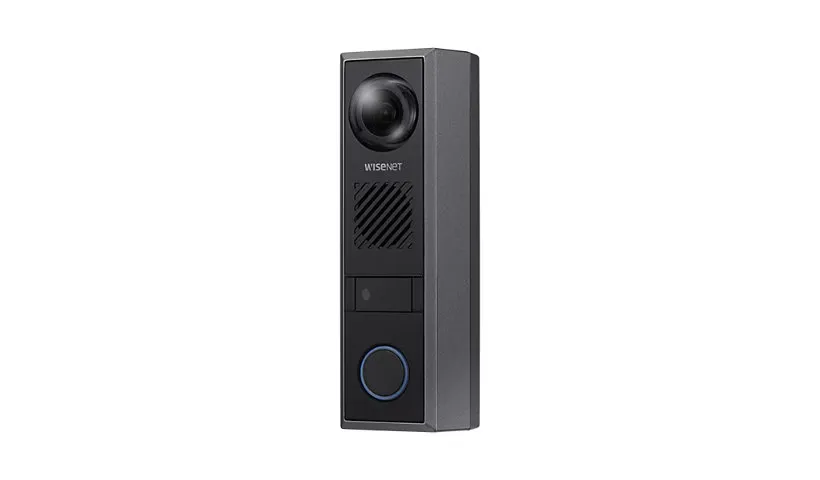
A photo from the AESS job library, not taken in Prospect Lefferts Gardens: a slim dark grey wired doorbell with a camera lens, speaker slots and a round push button. A unit this narrow can sit on the wood frame or the plain masonry beside a stoop door in the Prospect Lefferts Gardens Historic District, which keeps to the Commission's guidance that intercom equipment be installed within or beside the door opening and kept as small as possible.
What We Install
Door Buzzer Installation Services in Prospect Lefferts Gardens
Every service below is priced from the same Brooklyn door buzzer list. The number of households sets the size of the system, the doors decide which release each entrance can take, and in Prospect Lefferts Gardens the landmark status of the front, the length of the riser in the big apartment houses and whether a building is still under construction decide much of the labor.
Manor house video stations
A one-button video or audio station at the stoop door of a single-family house, with an answering station on the parlor floor and the floors above, or phone answering, sized and finished for a landmarked front.
Two- and three-family row house systems
A button per household at one street door, a release that each floor can trigger and a station on every floor, for the row houses outside the Manor that were built for more than one family.
Apartment house entry replacements
Directory, code or button panels with apartment stations or phone answering for six-story buildings of 30 to 130-plus apartments, with every riser pair tested floor by floor.
Bell board to talk-back upgrades
Replacing ring-only bell plates in small walk-ups with stations that let tenants speak to the visitor and release the door, reusing sound pairs where they test well.
New construction entry systems
Conduit, cable and backboxes planned with the architect while walls are open, then the panel, stations or app answering installed and programmed before the first residents move in.
Gate and areaway call stations
A call station on the iron fence or wall in front of a house's entrance, where the Commission allows it, so a visitor can ring and be let through a locked gate.
Strikes, latches and door preparation
Fail-secure strikes cut into sound frames, latch guards and strike plates that resist prying, and closers set so the door shuts and latches every time.
Power supplies and backup
A dedicated low-voltage supply with battery backup on the owner's circuit, mounted where the owner or super can reach it and labeled for the next technician.
Shop and practice doors
Buzz-in doors for stores, offices and practices on Flatbush, Nostrand and Rogers Avenues, kept fully separate from the apartments' system in the same building.
Building Specialists
Door Buzzer Installation for Prospect Lefferts Gardens's Architecture
Six kinds of building make up nearly every buzzer installation we plan in Prospect Lefferts Gardens. They differ in how many doors people use, whether the front is landmarked, how cable can reach each household, how old the existing wiring is and who has the authority to order the work.
Lefferts Manor single-family houses
Brick, limestone and brownstone houses built mostly between 1905 and 1911 under the single-family covenant, with a stoop door, a vestibule and three or four floors to reach.
Two- and three-family row houses
The houses outside the Manor that went up first, built for more than one family, with one street door, a bell per floor and a transformer in the cellar.
Small prewar walk-ups
Buildings of four to a dozen apartments, like the four-unit 1931 building on Rutland Road or the 12-unit 1931 building on Clarkson Avenue, usually with a bell board and old splices.
Six-story apartment houses
The 1920s and 1930s buildings on Ocean Avenue, Lefferts Avenue and Lincoln Road with 30 to 130-plus apartments, an elevator, long risers and a vestibule with mailboxes.
Small new condos
Recent walk-up condos such as the four-story, eight-unit building on Maple Street finished in 2021, with no super on site and an owners' board running the building.
New mid-rises
Larger buildings going up on the neighborhood's edges near the 2/5 and B/Q lines, some with attended lobbies, package rooms and app-based entry.
Lefferts Manor houses: one household, four floors and a stoop the Commission watches
A Manor house has one family, so it never needs a directory panel. What it does need is reach. The front door is up a stoop, the kitchen is often on the garden or parlor floor at the back, and the bedrooms are two floors up, so an old bell in the front hall is easy to miss. The usual request is a video station at the stoop door, an answering station on two or three floors, and a release so the door can be opened from the kitchen or the top floor without anyone running down the stairs. Many owners also want calls to reach their phones when they are in the garden or away.
The landmark rules shape everything visible. The station is chosen to be as small as the job allows, mounted within or beside the door opening at a mortar joint or on the frame, and its cable goes into the house through the old bell wire's path wherever possible. Inside, the stations and power supply follow ordinary rules. The mistake to avoid is ordering a station before checking how its backbox will fit the frame or the stone, because a unit that needs a deep recess in a carved surround may not be approvable at all.
Two- and three-family row houses: separate buttons and separate releases at one door
Outside the Manor, the first houses built were row houses for two families, and many now hold two or three households behind one street door. The old setup is usually a bell button per floor, a chime in each apartment and a release button on the owner's floor only, sometimes not working. The job is to give each household its own button, its own station and its own way to release the street door, without one family's calls ringing in the other's hall. A small two- or three-button station, a fail-secure strike in the frame and a battery-backed supply cover it.
The thing to check is the transformer. A doorbell transformer sized for a chime will not run a door station, monitors and a strike, and the bell wire stapled along a cellar joist for decades often has one cracked conductor that only shows up under the new load. We meter every pair and size the supply for the new equipment, and if a run has to be replaced, the quote shows it before you approve. Where the row is inside a historic district, the station on the front follows the same Landmarks rules as a Manor house.
Small prewar walk-ups: a bell board that rings but never talks
Buildings of four to a dozen apartments sit on the side streets between the avenues, like the 12-unit building at 305 Clarkson Avenue, built in 1931, that appears in city complaint records for its bell and buzzer. The typical system is a bell board at the street door, a buzzer in each apartment and a release button that may or may not still work. Tenants cannot speak to the visitor, so they walk down or press release blind, which is how strangers end up inside. A talk-back station at the door and an audio or video station in each apartment fixes that, usually over the building's own pairs if they test sound.
Below eight apartments, Multiple Dwelling Law §50-a does not force the upgrade, but this is often where an owner gets the most for the money. The thing to watch is splicing: a cable rejoined during several renovations may still carry a bell and fail with a modern station, so every pair is tested before it is reused.
Six-story apartment houses: a hundred lines, one lobby door
The apartment houses on Ocean Avenue, Lefferts Avenue and Lincoln Road are where a buzzer becomes the building's main security. A building like 25 Lefferts Avenue, with 132 apartments on six floors, has a lobby panel that has to reach every one of them, usually through several vertical risers fed from a cellar terminal. When tenants write that "many" intercoms "do not work and go unrepaired," the cause is usually spread across the building: a dead riser here, a failed station there, a power supply that sags when several apartments answer at once. The replacement has to fix all of it, and it has to work for residents of every age and every phone habit.
The technical question is the riser cable. Where its pairs are sound, a two-wire multi-tenant system reuses them; Aiphone describes its GT Series as a "multi-tenant intercom system for new builds and retrofit projects" that "offers the advantage of using existing wire and infrastructure." Where the pairs fail, new cable or phone answering takes over for those lines. The vestibule matters as much as the wiring. Many of these buildings have an outer street door, a vestibule with mailboxes and an inner lobby door, and the station, the release and any camera are placed so the locked door stands between the street and the mail. Some, like 135 Ocean Avenue, have a narrow recessed entry court, which changes where a visitor should stand to call and where the camera needs to look.
Small new condos: eight owners, no super and a system nobody wants to manage
The neighborhood's small new condos, like 246 Maple Street, a four-story walk-up condo of eight units finished in 2021, sit exactly at the eight-apartment line in the intercom law and well after its 1968 date, so a working talk-and-release intercom is a legal requirement, not an option. They also have no live-in super. The owners' board has to decide who holds the administrator access, who updates the directory when a unit sells and who is called when the panel fails.
New mid-rises: choose the system before the walls close
Buildings like 757 Flatbush Avenue, 331 Maple Street and 408 Lefferts Avenue are different again. Their developers choose the entry system during construction, and the best time for us to be involved is before drywall, when the conduit from the lobby panel to each apartment, the backbox at the front door and the cable to any side, garage or package-room door can go in at almost no extra cost. A building with an attended lobby still needs a panel at the street door for the hours or moments when the desk is unstaffed, and still needs every resident to be able to release the door for a guest.
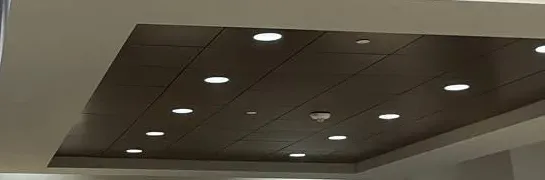
A photo from the AESS job library, not taken in Prospect Lefferts Gardens: a dark recessed ceiling panel with round downlights and a small round device, framed by a lighter ceiling. Lobbies in the new mid-rises on Flatbush Avenue and Maple Street are often finished with ceilings like this, and planning the cable route above such a ceiling before it is closed is the cheapest way to connect the street door panel to the riser closet.
Field Notes
Field Notes: Check the Map, Count the Households, Then Push the Door
This is how our technician spends the first half hour at a Prospect Lefferts Gardens address, before anything is priced.
First, the map. Before the visit we check whether the address sits inside the Prospect Lefferts Gardens, Chester Court or Ocean on the Park historic district. That single fact changes the station we can offer, where it can go and how long the job takes, because a landmarked front waits for a permit.
Second, the households and the doors. In a Manor house that is one family and one stoop door. In a row house it may be three families and one door. In an Ocean Avenue apartment house it is a hundred apartments, a street door, a vestibule door and often a service door to the courtyard or the cellar. Each door gets a note on what it is made of, who uses it and whether it should call, release or both.
Third, the push test. The technician opens the street door, lets go and watches. Does the closer bring it shut? Does the latch catch the strike without a pull? Is the gap at the strike side wide enough that a tool could reach the latch? A door that drifts or can be pried defeats any release, and fixing it is cheaper on day one than after the new system has been blamed.
Then the cellar, where the old transformer and the bell wire or riser cable are traced and metered. What the meter shows decides whether the quote reuses the building's cable or adds new runs, and either way you see the decision on paper before you approve.
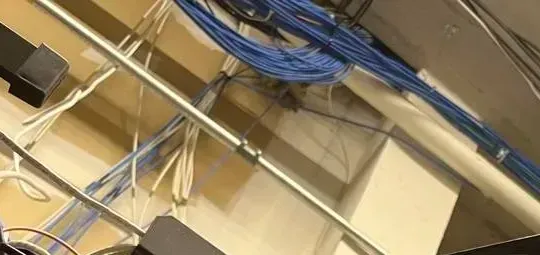
A photo from the AESS job library, not taken in Prospect Lefferts Gardens: bundles of blue low-voltage cable laid over a ceiling beam beside a metal pipe in an open ceiling. In the long cellars of the six-story apartment houses on Lefferts Avenue, new intercom cable follows a path like this from the terminal near the lobby to each riser, kept clear of the steam and water pipes rather than strapped to them.
The Door Itself
A Buzzer Is Only as Strong as the Latch: Door Hardware for Prospect Lefferts Gardens Entrances
The Hawthorne Street break-ins are worth remembering when a building plans a new entry system. The building's door had a lock; the intruder simply opened it with a long metal tool, over and over, and residents said changing the locks and adding guards did not settle their nerves. An intercom upgrade that ignores the door repeats that weakness with nicer electronics. So on every Prospect Lefferts Gardens job, the release is chosen together with the door, the frame and the latch, not after them.
Three things come first. The closer has to pull the door all the way shut against the weather seal and any wind off the park, because a release cannot hold a door that stops an inch short. The latch has to project fully into the strike, which on an old wood door that has shrunk or sagged often means adjusting the hinges or packing the strike out. And the gap at the latch edge should not let a blade or bar reach the latch, which is where a latch guard or an astragal on a pair of doors earns its cost. Each of these is a small job on the day, and each is priced on the quote when we find it.
Then the release. For most street doors here we fit a fail-secure electric strike. Allegion explains the choice plainly: "Fail secure products are locked when power is removed," and with an electric strike "you can exit by turning the lever" whether it is fail-safe or fail-secure, so the building stays locked in an outage and nobody is trapped inside. Fail-secure is also the type fire-rated doors require. Magnetic locks are a different category. "Electromagnetic locks are only available fail safe," Allegion notes, so they unlock whenever power fails, and the building code requires a sensor on the egress side, a manual "PUSH TO EXIT" device 40 to 48 inches above the floor within 5 feet of the door that cuts power directly and keeps the door unlocked for at least 30 seconds, release on fire alarm or sprinkler activation, and UL 294 listed equipment. On a prewar wood or glass-and-iron door, a magnetic lock is rarely the better choice, and we say so.
The power behind the release matters too. Many old systems here run the strike from the same small transformer as the bells, so the release grows weak when several apartments answer at once. A new installation gets its own supply, sized for the strike and stations together, with battery backup for a period during an outage.
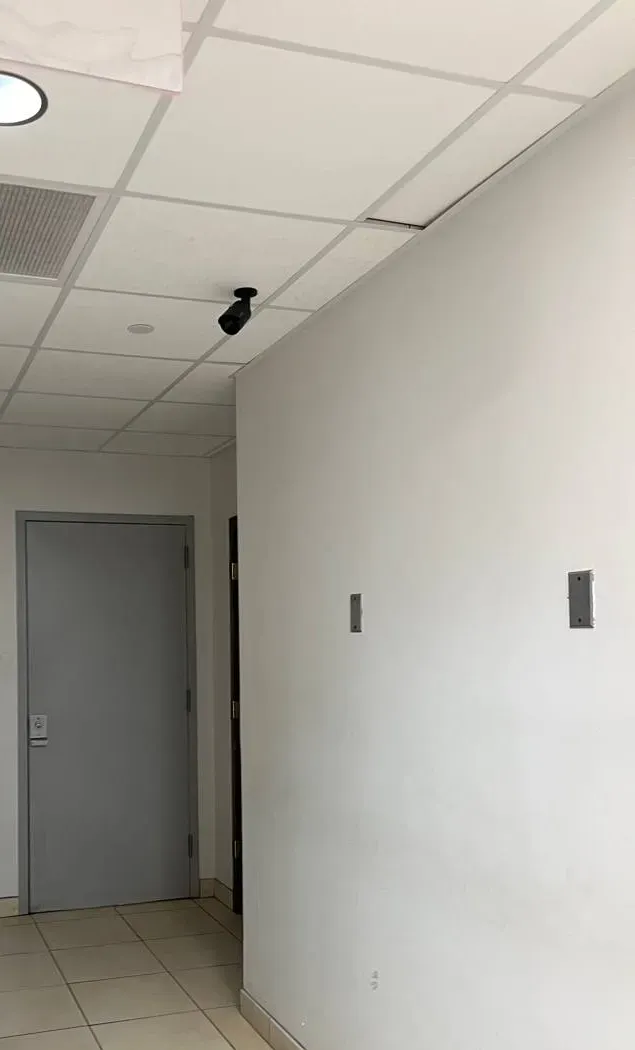
A photo from the AESS job library, not taken in Prospect Lefferts Gardens: a tiled corridor with white walls and small wall plates leading to a grey steel door with a lever handle, under a drop ceiling with a small camera. The cellar and courtyard service doors of the larger apartment houses on Ocean Avenue and Lefferts Avenue are often steel doors like this one, and a code station or release added to such a door still has to let anyone inside leave by the lever without a key.
Rules and Responsibilities
Which Prospect Lefferts Gardens Buildings Must Have a Buzzer, What It Has to Do and What Tenants Can Ask For
Post-1968 buildings with eight or more apartments must have one. Multiple Dwelling Law §50-a requires every Class A multiple dwelling erected or converted after January 1, 1968 with eight or more apartments to have an intercom at the self-locking main entrance that lets visitor and resident speak and lets the resident release the door. In Prospect Lefferts Gardens that mainly means the new buildings, from an eight-unit condo like 246 Maple Street to the mid-rises on Flatbush Avenue.
Older buildings install one when a majority of tenants ask. For buildings put up before that date, which covers the six-story apartment houses on Ocean Avenue, Lefferts Avenue and Lincoln Road, the owner must install self-locking doors and an intercom if tenants occupying a majority of apartments request or consent in writing; the law gives 90 days to start and six months to finish, and lets the owner recover the cost from tenants.
The legal minimum is voice and release. The section calls for two-way voice communication and a door release from the apartment. Video, phone answering and cameras are choices an owner or board makes, not legal minimums, though smartphone systems that keep voice and release are generally treated as meeting it.
A system that exists has to work. HPD writes violations for intercoms that do not, as at 552 Flatbush Avenue in April 2026, where the order cited Housing Maintenance Code §27-2005 and covered the line from the front of the building to one tenant's device.
Tenants start in writing. Brick Underground's guide to broken buzzers puts it simply: "the first step is to notify your landlord about the issue in writing." After that comes a 311 complaint and an HPD inspection, and rent-stabilized tenants "can fire off a complaint for reduction of services" with the state housing agency, DHCR.
A broken buzzer can carry liability. The same guide notes that a landlord could face liability "if you're the victim of a crime because of a door that's unlocked due to a broken buzzer," citing the state Attorney General's tenants' rights guide.
Houses are outside the intercom law. A Lefferts Manor single-family house, and a one- or two-family row house, is not a multiple dwelling, so the system is the owner's choice and the owner's to maintain.
Landmarked fronts need a permit. On the Prospect Lefferts Gardens, Chester Court and Ocean on the Park district blocks, a door station on the front needs a Landmarks Preservation Commission permit before work begins; the interior does not.
None of this is legal advice for a particular building. Owners facing a tenants' request or an HPD order, and tenants deciding what to ask for, should check the details with a housing lawyer, the managing agent, HPD or DHCR. What we provide is a system that meets the requirement that applies and written records of what was installed and tested.
Commercial Door Buzzer Installation
Business Door Buzzer Installation in Prospect Lefferts Gardens
Prospect Lefferts Gardens' businesses line Flatbush Avenue and Nostrand Avenue, with a newer cluster on Rogers Avenue, and almost all of them sit under apartments. A business buzzer here is less about the front door during opening hours and more about the doors that should never be open to anyone who walks up: the back door a kitchen uses for deliveries, the buzz-in door of an upstairs office or practice, the staff entrance after closing, and the residents' door beside the shopfront. Owners have reason to think about it. News 12 Brooklyn reported that on July 12, 2026, just after 5 p.m., a man displayed a firearm to an employee at a phone store at 1037 Nostrand Avenue and left with $5,000 and a cellphone.
Flatbush Avenue
The main commercial street on the neighborhood's west side, with grocery stores, bodegas, restaurants and bars at street level and apartments above, plus the new mid-rises at its southern end.
Nostrand Avenue
The eastern corridor along the 2/5 line, with restaurants, phone and service shops and storefronts below apartments, where residents' doors and shop doors stand side by side.
Rogers Avenue
The emerging corridor between them, with newer restaurants and bars such as Wizard Hat Pizza and The Rogers Garden opening in older storefronts.
Offices and practices upstairs
Second-floor offices, clinics and community groups above the avenue storefronts, reached by a narrow street door that needs to buzz visitors in one at a time.
Mixed-use corner buildings
Corner buildings where a store, its rear delivery door and the residents' entrance all open onto the same few feet of sidewalk and must each lock on their own.
Ground floors of the new buildings
Retail and community spaces at the base of the new mid-rises, which need their own entry separate from the residential lobby above them.
Rules that apply to Prospect Lefferts Gardens business entry installations
Anyone inside can always get out. A door with a buzzer, code or reader still opens from inside without a key, which is why a fail-secure strike that leaves the inside lever free is the usual choice for a shop or office door.
Fire-rated doors keep their rating. Allegion notes that fire doors need fail-secure strikes, so a rated door to a stair or cellar stays latched in a fire, and the release hardware has to carry the listing for that door.
Magnetic locks carry extra requirements. A magnetic lock needs a sensor on the egress side, a "PUSH TO EXIT" device within 5 feet of the door at 40 to 48 inches that cuts power directly for at least 30 seconds, release on fire alarm or sprinkler activation and UL 294 listed parts.
Buttons stay within reach. The 2010 ADA Standards set the high forward reach at 48 inches maximum and the low at 15 inches minimum, so the call button outside and the release at a counter or desk go within that range.
Tenants need the landlord's written approval. A store or office that rents its space orders its own door buzzer only with the owner's written permission, especially where the work touches a shared street door or crosses the apartments' cable routes.
Landmarked storefront buildings follow the same rules as houses. A commercial building inside a historic district needs a Landmarks permit for a station on its front, with one intercom panel per door opening.
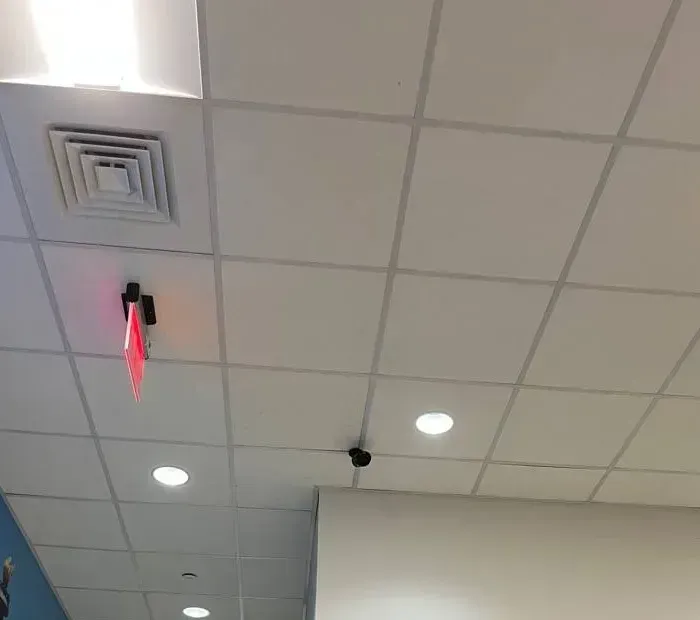
A photo from the AESS job library, not taken in Prospect Lefferts Gardens: a drop ceiling with a lit red exit sign, an air diffuser, round recessed lights and a small black camera. Shops and practices on Flatbush and Nostrand Avenues often have ceilings like this, and the exit sign is a reminder of the rule every business buzzer here follows: whatever locks the door from outside, it always opens from inside.
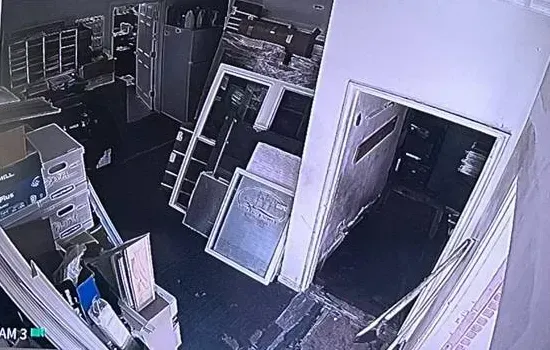
A photo from the AESS job library, not taken in Prospect Lefferts Gardens: a black-and-white night camera view of a cluttered room with an open doorway into a dark back room. Stockrooms behind restaurants and shops on Flatbush and Nostrand Avenues often lead to a rear delivery door, and a buzzer on that door, with a camera inside watching it after hours, keeps the back of the business as secure as the front.
Your Questions Answered
Door Buzzer Installation in Prospect Lefferts Gardens: Questions Answered
Landmarked fronts and Manor houses
The Landmarks guidebook says staff may approve only about ten inches of visible conduit. What if the cable from our stoop station cannot get inside the house that quickly?
Then the plan changes before the application, not after. The ten-inch figure in the Commission's guidebook is what staff may approve where conduit cannot pass through plain masonry behind the installation, and the guidebook prefers the hidden route first. On most Manor stoops a hidden route exists: the old bell wire usually reaches the cellar inside the stoop or through the vestibule wall, and a new cable can follow it or be fished through the frame. Where the old path is blocked, we look at a different mounting spot within or beside the door opening that sits closer to a way in, or at drilling at a mortar joint directly behind the station so no conduit shows at all.
If no route keeps visible conduit short, the quote says so, shows exactly how much would be visible and where, and the owner decides whether to file with that or choose another approach, such as phone answering that needs cable only between the station and the strike. We do not order equipment for a landmarked front until the route and the permit are settled.
Our limestone house is in the historic district. Who decides the finish of the new door station, and how do we choose one Landmarks will accept?
The Commission decides whether a finish is acceptable; the owner chooses among options that fit the guidance. The guidebook asks that the design, size and finish be "compatible with the architecture of the building," that equipment be neutral and discreet, and that it be "painted to blend with surrounding building material, if possible." In practice that means a station with a plain faceplate in a quiet finish, such as black, dark grey or brushed metal, set against the stone or the painted door frame rather than a bright plastic housing.
When we quote, we name two or three stations that suit the house and send their cut sheets, which show the finish and dimensions the Commission will review. The owner, or the architect or expediter if one is involved, picks one and files. If staff ask for a different finish or a smaller unit, we adjust before anything is bought.
Several of us on Chester Court want new door stations this year. Can every house use the same model so the court stays uniform, and does each house file on its own?
The same model can certainly go on every house, and on a cul-de-sac of eighteen matching Tudor Revival houses designated together, a uniform choice is easy to justify on looks. A permit, though, is for work on a particular building, and the guidebook's checklist is written per building: color photos of the entire building, close-ups of the proposed location and drawings of existing and proposed conditions. So each owner expects to file for their own house, even when the applications look alike.
The big apartment houses
Reviews of our 1938 building say many tenants' intercoms do not work and go unrepaired. How many dead lines does it take before replacing the whole system is the cheaper choice?
There is no fixed percentage, but the pattern of the failures tells you more than the count. If the dead apartments are scattered and each has its own cause, such as a broken handset or a cut wire in one apartment, fixing them one by one can be cheaper for a while. If they cluster by riser, if the lobby panel's buttons or speaker are failing, or if the power supply cannot drive the strike when several apartments answer, the problem is the system, and patching lines only moves the outages around.
In a building of 132 apartments like 25 Lefferts Avenue, the cost of a full replacement is driven mostly by how many riser pairs can be reused. So we meter every line before we quote. If most pairs are sound, a two-wire multi-tenant system over the existing cable often costs far less than owners fear and ends the cycle of single repairs. If many pairs fail, the quote shows new cable or phone answering for those lines, and the owner can compare that against another year of patching with real numbers.
Our building on Ocean Avenue has an original metal-and-glass street door from the 1920s. Will fitting a strike damage the frame, and can the door stay?
In most cases the door stays. Many of the Ocean Avenue apartment houses were built in the late 1920s and 1930s, and some, like the 1928 Art Deco building at 135 Ocean Avenue, have decorative entrances owners want to keep. A strike is cut into the frame at the latch, and on a metal frame that means opening the frame where the existing keeper sits and fitting a strike sized for it. We look at the frame's profile, the latch the door already uses and whether the frame is hollow or filled before choosing the strike, so the cut replaces the old keeper area rather than widening into the decorative face.
Where the frame is too shallow or too ornate to cut, there are other routes: an electrified lock in the door itself with a power transfer through the hinge, or a release on the inner vestibule door so the original street door keeps its key lock. The quote names which approach we recommend for that door and why.
One management company runs three of our buildings on Lincoln Road. Can all three entry panels be managed from one account, and should they be the same system?
If the system chosen is network-managed, one account can usually hold several buildings, each with its own directory, users and settings, so a managing agent updates a tenant's listing or a code without a site visit. That convenience comes with a software or connection charge per building or door, and needs internet or cellular service at each door.
Using the same system in all three buildings also simplifies spare parts and training for the super, and we recommend that the owner, not only the managing agent, holds an administrator login.
Newer buildings and condos
Our new building will have a package room off the lobby. Can couriers be let into the package room without being let into the building itself?
Yes, if the package room has its own door and that door is on the plan from the start. The usual layout is a release or code on the package room door that a courier can use from the vestibule, while the inner lobby door stays locked. Residents then open the package room from inside with their own code or credential. The two doors are separate outputs on the entry system, so opening one never opens the other.
This only works if the package room door is a lockable, self-closing door with a strike or electrified lock, and if the cable to it is in the wall before it is closed. In a building still under construction, like those going up on Flatbush Avenue and Maple Street, that is a line on the door hardware schedule and a short cable run. Added after opening, it means cutting into finished walls. We set it out in the cable plan before the panel is ordered.
Our eight-unit condo was finished a few years ago. How should the board plan its reserve fund for the entry system?
By separating the parts that wear from the parts that last. The cable in the walls, the backboxes and the conduit should last as long as the building if they are not damaged. The parts that see weather and daily use, such as the street door station, the strike and the closer, are the ones that will need attention first, along with the backup battery in the power supply, which is a routine replacement. Apartment stations and monitors sit between the two.
Houses, shops and tenants
We spend most summer evenings in the back garden of our Manor house. Can the door station reach us out there without anyone carrying a phone?
Yes. The simplest way is an extra answering station or a weather-rated chime at the garden door, wired back to the same system, so a visitor's call rings in the garden as well as inside. Some systems also let a garden-floor station release the front door, so whoever is outside can let a guest in without walking through the house. Because it is at the back of the house, none of this touches the landmarked front.
After the July robbery at a store on Nostrand Avenue, we are thinking of keeping our shop's front door locked and buzzing customers in. Does that work for a store that depends on walk-ins?
It can, if it is set up for how the shop actually runs. A buzz-in front door works best with a clear sign, a visible call button within reach, a camera or window that lets the person at the counter see who is waiting, and a release button at the counter itself, so serving one customer and letting in the next happens from the same spot. Many shops keep the door unlocked during their busiest hours and switch to buzz-in for the late evening, which a simple switch or timer on the release can handle.
The door must still open freely from inside, so customers and staff can always leave. If the shop rents its space, the landlord's written approval comes first. And if the store shares a street front with the apartments' door, the shop's system stays completely separate from the residents' panel.
Our tenants' association pressed for a working intercom, and the owner has now agreed to replace it. On switch-over day, what should we check to know the new system does what the law requires?
Three things, apartment by apartment. First, a visitor at the street door can ring each apartment and the resident can talk to them both ways. Second, each apartment can release the self-locking front door. Third, the door then closes and latches again on its own. That is the core of what Multiple Dwelling Law §50-a describes: two-way voice and a door release from the apartment, at a self-locking main entrance. Video and phone answering are extras.
When we install, we do exactly that test from the sidewalk, line by line, and record the result for every apartment on a test sheet that goes to the owner or board. Tenants can ask the owner for a copy. If any apartment fails, it is fixed before we leave or listed with a return date, and the sheet shows that too.
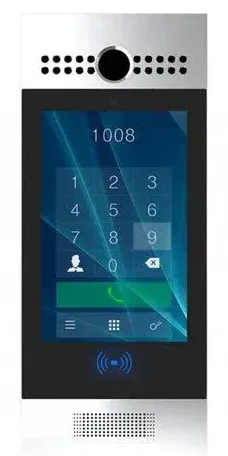
A photo from the AESS job library, not taken in Prospect Lefferts Gardens: a touchscreen entry panel showing a dial pad with a four-digit apartment code entered, a camera above and a card-reader symbol below. A code panel like this suits a 96- or 132-apartment building on Lefferts Avenue, where a button for every home would cover the lobby wall, and visitors reach the right apartment by scrolling the directory or entering its code.
Equipment
Types of Door Buzzer Systems We Install
We quote a reliable non-branded system by default and install a named brand when an owner or board asks for one; the intercom brands we work with include Aiphone, ButterflyMX, 2N, Akuvox, Comelit and DoorBird. These are the kinds of equipment that come up most often in Prospect Lefferts Gardens, and where each fits.
Compact single-household stations
Small audio or video stations with one button, for Manor houses and landmarked fronts where the Commission asks for equipment as small and discreet as possible.
Two- and three-button stations
A button per household for row houses with one street door, each wired to its own floor and release.
Two-wire multi-tenant systems
Audio and video over one pair per apartment, the practical choice in six-story buildings whose riser pairs test sound, avoiding new cable up six floors.
Directory and code panels
Scrolling directories or code entry for apartment houses of 30 to 130-plus homes, often with a keypad or reader for residents.
Phone and app answering
Panels that ring residents' phones, for households out all day, owners who live elsewhere and lines where new cable cannot reach an apartment.
Keypad and card stations
A camera, keypad and card reader in one faceplate, for a courtyard, cellar or package room door that residents open with a code while visitors call.
Fail-secure electric strikes
Releases cut into the frame that stay locked without power and let anyone inside leave by the lever, the default for street doors here.
Latch guards and closers
Plates that cover the latch gap against prying, and closers set so the door shuts and latches on its own, because a release only works on a door that closes.
Battery-backed power supplies
Dedicated low-voltage supplies with battery backup on the owner's circuit, sized for stations, monitors and the release rather than for a chime.
House station, two-wire building system or phone answering: which fits a Prospect Lefferts Gardens door?
What matters
Compact house station
Two-wire building system
Phone or app answering
Typical fit here
Manor houses, row houses, landmarked fronts
Six-story apartment houses and walk-ups with sound riser pairs
New condos, owners away often, lines with no usable cable
See the visitor
With a video model
Yes, on the apartment monitor
Yes, on the phone where video is supported
Needs internet
No, unless phone answering is added
No, unless phone answering is added
Yes, wired internet or cellular at the door
Works without a smartphone
Yes
Yes
Only with a station or landline option
Landmarks footprint
Smallest
One lobby panel per door opening
One panel per door opening
Monthly fees
None
None
Often a software or cellular charge
Brooklyn list range
$400–$900 audio, $700–$1,800 video
From about $2,500 for large buildings
Within the same ranges, plus any subscription quoted separately
ADT, Ring and SimpliSafe compared with a local installer for a Prospect Lefferts Gardens building
National alarm and doorbell brands come up in nearly every conversation about a front door, and for a single-family Manor house a store-bought video doorbell can be a reasonable start. For anything with more than one household, the comparison changes. A consumer doorbell rings the phones of whoever set it up; it does not give each apartment its own button, it does not release the street door from upstairs unless separately wired to a strike, and it cannot meet the talk-and-release standard the intercom law sets for buildings that need one. On a landmarked front, adding a doorbell camera beside an existing intercom can also break the one-panel-per-doorway limit.
What a local installer adds is everything the box leaves out: the strike, the closer and the latch guard, the battery-backed supply, the cable to every floor, the Landmarks cut sheet and a written record of the wiring. Habitat magazine's survey of co-ops and condos found the same shift from the other side. "A lot of our calls now are people who want to abandon the hard-wired intercom units in their apartments," installer Dan Arnold of Academy Mailbox told the magazine, adding of the wiring work that "nothing is insurmountable."
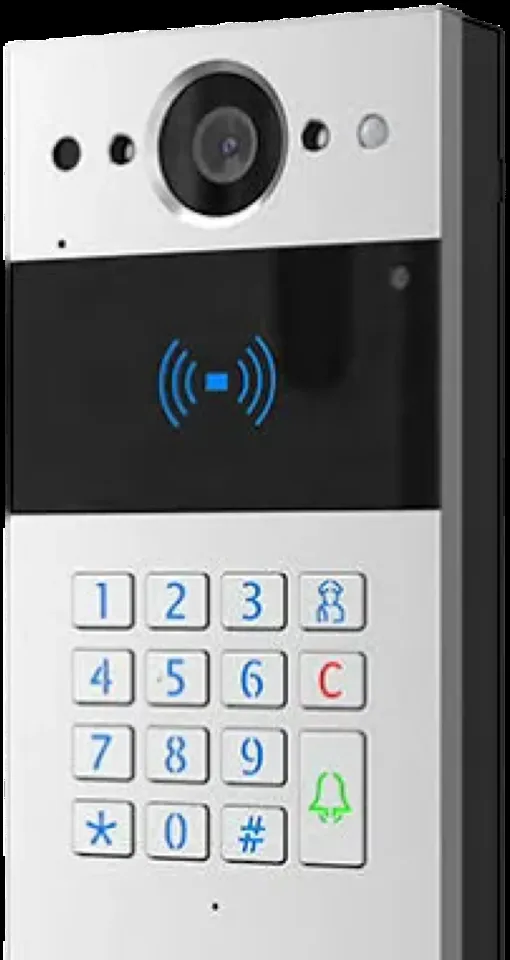
A photo from the AESS job library, not taken in Prospect Lefferts Gardens: a silver and black keypad door station with a camera lens at the top, a blue card-reader symbol, a numeric keypad and a green bell key. On the courtyard or package room door of a large Ocean Avenue apartment house, a station like this lets residents open the door with a code or card while couriers and visitors press the bell key to call.
AI Overview Reality Check
What AI Gets Wrong About Door Buzzer Installation in Prospect Lefferts Gardens
AI answers about buzzers are usually assembled from national cost guides and vendor blogs. Here are seven claims we see repeated, each checked against its source and against what we find at Prospect Lefferts Gardens doors.
"Installing an intercom system costs an average of $2,500"
That is HomeAdvisor's national figure, and the same guide gives a range of $1,500 to $15,000, with wireless systems at $150 to $1,500 and hard-wired ones at $1,000 to $15,000. A national average blends houses and buildings of every size, so it tells a Prospect Lefferts Gardens owner very little.
On our Brooklyn list, an audio station with a new release on a house runs $400 to $900, a video station with indoor answering on a Manor house or small walk-up $700 to $1,800, and a full system for a six-story apartment house from about $2,500 to past $10,000. A Manor house job usually sits well below the national average; a 132-apartment building can sit well above it.
"Any door station can go anywhere on the front of a house"
Not on the landmarked blocks. The Landmarks Commission's guidebook says intercom panels "must be installed within or adjacent to a door opening," allows "one intercom panel" per door opening, and asks that design, size and finish be "compatible with the architecture of the building."
A large panel set into carved stone, a second station next to an old one, or conduit running across the facade can all fail that test. Equipment goes on a primary facade only if no other option exists, attached at mortar joints or plain masonry, never through cast iron or decorative surfaces.
So on a Manor house, the station is chosen after the route and the mounting spot are known, and the permit comes before the installation.
"New York law requires an intercom in every apartment building"
It does not. Multiple Dwelling Law §50-a requires one automatically only in Class A multiple dwellings built or converted after January 1, 1968 with eight or more apartments. Older buildings must install one when tenants occupying a majority of apartments ask in writing.
That puts most of the neighborhood's big apartment houses, from the 1920s and 1930s, on the request side of the line, and a building like 246 Maple Street, finished in 2021 with eight units, on the automatic side. Lefferts Manor houses are not multiple dwellings at all.
The catch runs the other way too: once a building has an intercom, HPD can write violations for one that fails, as it did at 552 Flatbush Avenue in April 2026.
"A smart intercom needs no building wiring"
ButterflyMX describes its intercom as one that "requires no building wiring," and Swiftlane lists cellular call boxes for perimeters where "No Ethernet required." That is about the cable between the door and each apartment, which phone answering can replace.
At a Prospect Lefferts Gardens street door, the station still needs power and the lock still needs a wired connection to the strike in the frame. In a prewar building with a stone lobby, those short runs are where most of the labor goes.
Phone answering can save real money where risers are dead, but it brings a monthly charge and depends on signal at the door, which we test before recommending it.
"A magnetic lock is the modern replacement for a strike"
Magnetic locks are common in new commercial buildings, but they are not an upgrade for every door. Allegion notes that "Electromagnetic locks are only available fail safe," so they unlock when power fails, and the building code adds a sensor, a "PUSH TO EXIT" device and fire-alarm release.
On a 1920s wood or metal-and-glass street door, a fail-secure strike keeps the building locked in an outage and leaves the lever free for exit, with less hardware on the door.
We use magnetic locks where a door's construction calls for them, and say why on the quote.
"Modern entry systems cost $5 to $15 per apartment each month"
That range is from Swiftlane's guide, which adds that software subscriptions can run "$30 to $100 per door per month." Habitat put ButterflyMX at $2.50 per unit monthly in 2017. Those figures apply to cloud systems, not to wired ones.
For a 132-apartment building, even the low end of the per-apartment range adds up over a decade. A wired two-wire system over sound riser pairs has no monthly charge at all.
We show any subscription as its own line, separate from the installation, so a board can compare the ten-year cost of each option.
"Your old buzzer wiring can be reused"
Sometimes. Aiphone's upgrade guidance says that "if the existing wires are in good condition, they can be reused," and its GT Series is built to use existing wire. The words that matter are "good condition."
In Prospect Lefferts Gardens we find both: riser pairs in a 1930s building that will carry a two-wire video system, and bell wire in a row house spliced so many times it barely rings a chime. Nothing on the outside shows which you have.
So every pair is metered before the quote, and a borderline pair is listed with what replacing it would add.
Not Sure Whether Your Doorway Needs a Permit, New Cable or Just a New Station? Speak to a Tech
Send photos of the street door, the bell plate or panel beside it and, if you can, the transformer or power supply in the cellar, with the number of households and doors and whether the block is landmarked. A technician will tell you which path looks likely and where it sits on our Brooklyn ranges. Call or text (347) 934-8335, send photos on WhatsApp, or fill in the form below.
Get In Touch
Request a Free Quote
✅
Request Sent!
Thank you. A technician will call you about the Prospect Lefferts Gardens address, usually within two hours during working hours.
How It Works
Our Installation Process
1. Map the block and the building
We check whether the address is inside a landmarked district, then list every door people use and every household, office or shop the system has to reach.
2. Confirm who orders and what applies
We confirm whether the homeowner, building owner, board, managing agent, developer or a commercial tenant with written landlord approval is ordering, and whether the intercom law or a Landmarks permit applies.
3. Push-test the door
We check the closer, latch, hinges, frame and the gap at the latch edge. If the door does not shut and latch on its own, or can be pried, that is priced and fixed first.
4. Meter the old cable
From the cellar to each floor, every existing pair is tested for continuity, shorts and noise and marked for reuse or replacement.
5. Write the price and the permit plan
You get a written price from the Brooklyn list with every test-dependent extra named, and on a landmarked front the cut sheet, mounting spot and cable route for the application.
6. Deposit, order and book
Equipment is ordered after the deposit. In-stock systems are booked right away, special-order panels once they arrive, and landmarked fronts once the permit is issued, always in a two-hour arrival window.
7. Install with the old system live
We mount the station, release and battery-backed supply, run or reconnect cable riser by riser and set up stations or phone answering, keeping the old system working until switch-over.
8. Test every household and hand over
From the street door we ring and release every apartment, show residents how to answer and leave the test sheet and wiring record with the owner or board.
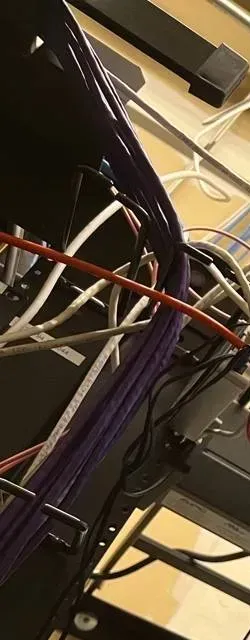
A photo from the AESS job library, not taken in Prospect Lefferts Gardens: purple, white and red cable bundles dropping down beside a black equipment rack. In the cellar of a six-story Lincoln Road or Lefferts Avenue building, the cable from each riser arrives at one point like this, and labeling every bundle there in step 7 lets the next technician trace a single apartment in minutes.
Coverage Area
Door Buzzer Installation Near Prospect Lefferts Gardens's Landmarks
Prospect Park
The park that forms the neighborhood's western edge, facing the six-story apartment houses along Ocean Avenue.
Lefferts Historic House
The Lefferts family homestead, rebuilt in 1783, moved into Prospect Park in 1918 from its original site at 563 Flatbush Avenue and a house museum since 1920.
Prospect Lefferts Gardens Historic District
The Landmarks district designated on October 9, 1979, covering the row houses and freestanding homes of the Manor blocks.
Chester Court
A cul-de-sac of 18 Tudor Revival houses built in 1911 and 1912, designated its own historic district in 2014.
Ocean on the Park
A short row of two brick and ten limestone townhouses facing the park, protected as its own historic district.
Maple Street Community Garden
The community garden on Maple Street between Jean-Jacques Dessalines Boulevard and Nostrand Avenue.
Door Buzzer Installation Cost in Prospect Lefferts Gardens
Prospect Lefferts Gardens is billed at our standard Brooklyn rate. The final figure follows photos and a walkthrough, because the number of households, the doors people use, the condition of the old wiring, the state of the door and, on landmarked blocks, the mounting and cable route drive the total far more than the brand on the panel.
Job
Typical building here
Brooklyn range
Audio station or replacement with electric strike, existing wiring reused where it tests well
Manor and row houses, a single shop or office door
$400–$900
Video station with indoor answering or phone answering
Manor houses wanting video, two- and three-families, small walk-ups
$700–$1,800
Multi-unit entry system, audio or video by apartment count, optional fob or code entry
Six-story apartment houses, co-ops, condos and new buildings
from $2,500 to $10,000+
In-person diagnosis of an existing system, booked online
Any building where the old system must be tested before quoting
$250, applied toward the work
Monthly subscription
Any building choosing a wired, no-subscription system
$0
What moves a job inside its range is predictable. In a Manor house it is the number of answering points and whether the cable can enter behind the station. In a row house it is the number of households and whether the bell wire can carry the new load. In an apartment house it is the share of riser pairs that test sound, then the extra doors: a vestibule door, a courtyard or cellar door, a package room. Anything that depends on a test is named on the quote with its price before you approve.
Full terms — including 50% deposit, one-year parts-only warranty on AESS-supplied products, and the late-fee schedule — are set out in the service agreement.
Find Out Which Range Your Prospect Lefferts Gardens Building Falls In
Three typical Prospect Lefferts Gardens jobs, each placed inside the matching range on our Brooklyn list. The exact figure comes from the photos and the walkthrough.
House or single door: $400–$900
An audio station at a row house or Manor stoop door, or a buzzer for a shop's back door, with answering on each floor, a fail-secure strike in a sound frame, a closer that shuts the door and battery-backed power.
Video for a house or walk-up: $700–$1,800
A compact video station suited to a landmarked front, or a talk-back video system for a small walk-up, with monitors or phone answering for each household and old pairs reused where sound.
Apartment house system: from about $2,500
A directory or code panel at the lobby door, stations for courtyard or package room doors, apartment stations or phone answering for every home and tested or new riser cable, rising toward $10,000 or more with apartments and doors.
Bring your own equipment. If you have already bought a door station or intercom kit, we can install it as labor-only work, quoted flat once we have seen the doors, the frames and the cable path. Tell us the make and model, and we will say before the visit whether it can reach every household and release your doors. Equipment you supply is covered by its maker's warranty, not ours.
Complete Services
Every Door Buzzer Service in Prospect Lefferts Gardens
Houses and landmarked fronts
Manor house stations, row house systems and gate call stations. Request a quote
Shops, offices and practices
Back-door buzzers, buzz-in shop doors and practice entrances. Call (347) 934-8335
Prospect Lefferts Gardens Door Buzzer Installation FAQ
Our Lefferts Manor house has only one household. Why would we want more than a plain doorbell?
+
Because the house is tall and the door is far from where people spend their time. With a station at the stoop door and answering points on the garden floor and the upper floors, anyone at home can see and speak to the visitor and release the door without walking down two or three flights. It also means nobody has to open the door to a stranger to find out who is there.
Can the door station be mounted on our wooden front door instead of the frame or the stone?
+
It is possible but rarely the best choice. A station on a moving door needs its cable carried across the hinge, which adds hardware and a point that wears with every opening. On a landmarked house the frame or the plain masonry beside the door is usually the cleaner spot and keeps the station within or beside the door opening as the Commission asks.
Can residents keep their old handsets on the wall as a fallback for the first few weeks?
+
Not as working stations once the new system is switched on, because the old lobby panel that fed them is removed and two systems on one riser can interfere. Before switch-over the old handsets keep working while the new ones are installed and tested. After it, the old units are taken down and each opening is covered with the new station or a blank plate.
If Landmarks staff ask for a different station or position after we file, does the quote change?
+
Only if the change affects the work. A different finish of the same station usually changes nothing. A smaller model, a new mounting spot or a longer hidden cable route can change the price up or down, and we send a revised written quote before anything is ordered. Because equipment is ordered only after the permit is in hand, nothing bought has to be returned.
What happens if the crew finds more bad cable pairs during installation than the quote expected?
+
Pairs that tested borderline at the walkthrough are already listed on the quote with the price of replacing them, so you know the worst case before you approve. If a pair that tested sound fails during the work, the crew stops on that line, shows the owner or super the reading and the options, and nothing extra is done without approval.
Our board wants to compare a wired system with an app-based one. Will you price both side by side?
+
Yes. We quote the two options on the same findings, with the installation for each, any monthly software or cellular charge shown on its own line, and what each needs from the building, such as reusable riser pairs or internet at the door. That lets the board compare the cost over several years, not just the first invoice.
Is there a minimum number of apartments before a video system makes sense?
+
No. Video works for a single household as well as for a hundred. What changes with size is the kind of system: a compact station for a house, a few-button station for a two- or three-family, and a directory or code panel with two-wire video or phone answering for an apartment house. Each sits in a different range on our Brooklyn list.
What should we have ready before the crew arrives on installation day?
+
Clear access to the street door, the cellar and the spot where the power supply will go, and someone who can open the cellar and any locked closets. In a building, the lobby notice should already be up and the super available at the start and at switch-over. On a landmarked front, keep the issued permit on hand.
Can a visitor leave a video message when nobody answers the door?
+
Some video stations and app-based systems can save a short clip or a snapshot of a missed call for the resident to see later, and others cannot. If that matters to you, say so when you ask for the quote, and we will name a station that does it and say whether it needs an app or a subscription.
Can our house's station ring our phones and the indoor stations at the same time?
+
Yes, with a system that supports both. A call from the stoop rings every indoor station and the phones of everyone set up on the app at once, and whoever answers first talks to the visitor and can release the door. The indoor stations keep working even if the phones or the home internet are not available.
More Door Buzzer Installation near Prospect Lefferts Gardens
Ready for a Prospect Lefferts Gardens Front Door That Fits the Block and Answers Every Household?
Send a photo of your doorway and whatever is mounted beside it, with the address, the number of households and every door people use, and we will tell you which system fits, whether a Landmarks permit is involved, how much of your old wiring it can reuse and where it falls on our Brooklyn ranges. Call or text (347) 934-8335, message us on WhatsApp, or use the request form. Licensed under NYS license #12000287431, rated 4.7★ across 201 Google Reviews, with same-day estimates on most weekdays.