A Surf Avenue house split into three apartments, a 1930 building on Beach 47th Street with thirteen, or a frame house whose bell nobody upstairs can hear? Sea Gate door buzzer installation line: (347) 934-8335
Frame Houses Turned Two- and Three-Families · Prewar and Postwar Buildings of 13 to 41 Units · Condo Conversions · Ocean Exposure on Three Sides · Inside the Association's Gate
Door Buzzer Installation in Sea Gate
One Button Per Household · Power Kept Above the Flood Line · Marine-Grade Fasteners · Written Price Before Ordering · Brooklyn Rate
Door buzzer installation in Sea Gate means wiring an entry system into a community that is far more mixed than its gate suggests. Behind the association's entrance stand big frame houses that now hold two or three households, a 1920 three-unit house on Surf Avenue, a 1928 building with fifteen apartments, a 1930 building with thirteen on Beach 47th Street and a 41-unit building from 1952, all within a short walk of water on three sides. Each needs a different system, and each has to survive the next storm. Below is how we plan them and where each lands on our Brooklyn price list.
Prices come from our Brooklyn door buzzer list, and the total, with every possible extra named, is agreed in writing before anything is ordered
Rated 4.7★ across 201 Google Reviews
Reviewed and updated November 11, 2026, against the Sea Gate Association's 2024 Rules and Regulations and its website; Wikipedia's Sea Gate entry; the Village Voice's November 2005 neighborhood profile; 6sqft's May 2022 history of Sea Gate; City Limits' December 2012 Sandy report; PoliticsNY's June 2016 report on the Army Corps T-groins; the Brooklyn Eagle's July 2015 bulkhead report; building records for 4725 Beach 47th Street and 3764 Surf Avenue (Augrented), 4505 Surf Avenue and the Seagate building list (Openigloo), 3811 Surf Avenue (JustFix Who Owns What) and 3813 Neptune Avenue (CityRealty); New York's Multiple Dwelling Law §50-a and §51-c; the Housing Maintenance Code §27-2040 and §27-2043; Appendix G of the 2022 NYC Building Code; Brick Underground's November 2019 intercom guide; a Brownstoner forum thread on video doorbells for multi-family houses; ButterflyMX's apartment buzzer guide; the HomeAdvisor and Swiftlane cost guides; Allegion's fail-safe guide; the building code's sensor-release provisions; and the 2010 ADA Standards. · Abstract Enterprises Security Systems, NYS license #12000287431 · crews dispatched from our Troy Avenue office in Brooklyn
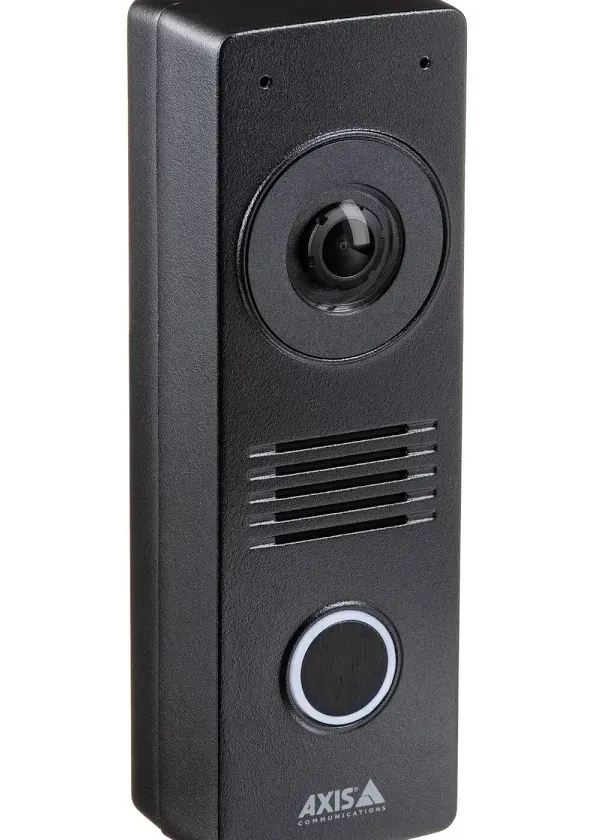
A photo from the AESS job library, not taken in Sea Gate: a black rectangular video door station with a camera lens, a speaker grille and one round call button that lights up. A single-button station like this suits a Sea Gate frame house that is still one household, mounted on the porch beside the front door where the old bell button sat.
Sea Gate Buzzer Request
Frame house, two- or three-family, apartment building or condo: tell us the street, how many households the system must reach and which doors get used, and a technician calls back with the range
✅
Request Sent!
Thank you. A technician will call you about the Sea Gate address, usually within two hours during working hours.
25+
Years Experience
✓
Same-Day Estimates
100%
Licensed & Insured
4.7★
201 Google Reviews
Owner-operated since 2002 · Thousands of jobs completed · Booked within 2 hours
Quick answer: door buzzer installation in Sea Gate runs $400 to $900 on our Brooklyn list for an audio station and a new door release on a one-family house or a single door, $700 to $1,800 for a video station with indoor stations or phone answering for a large frame house or a two- or three-family, and from about $2,500 to past $10,000 for a full entry system in one of Sea Gate's apartment buildings. The price covers the door station, the indoor stations, the power supply, the electric strike or approved lock, the cable and the labor, and it is fixed in writing once we have seen the door, the cellar and the route between them. Anything that depends on a test, such as an old bell pair that may have sat in salt water in 2012, is named and priced before you order. Send photos of the front door, whatever is mounted beside it and the cellar wall where the old transformer hangs to (347) 934-8335 or on WhatsApp, and we reply with the range that fits, usually within two hours during working hours.
Looking at your photos and quoting a new system costs nothing. If an existing system has to be tested in person before we can quote, that is the $250 service call booked online, and the $250 is applied toward the work.
All work is done under New York State license #12000287431. We install the low-voltage entry equipment; if the power supply needs a new 120-volt outlet or circuit, a licensed electrician does that part, and you know before the price is set.
We work for whoever controls the door: the owner of a house, an owner who rents one or two floors, a building owner or managing agent, or a condo's unit owners acting together.
The Neighborhood
Why Sea Gate Properties Need Door Buzzer Installation
Sea Gate is the private, gated community at the western tip of Coney Island, west of West 37th Street, with the Atlantic, the Lower Bay and Gravesend Bay around it. The Sea Gate Association was formed in 1899, its website puts the full-time population at about 8,000, and its residents pay for their own security, street lights, beach and street cleaning. Wikipedia describes it as mostly single-family, with Queen Anne and Mediterranean-style houses, and the Village Voice's 2005 profile described "stand-alone three-story houses" along Surf Avenue and the numbered Beach streets that run off it. That picture is true as far as it goes, and it is why so many owners assume a door buzzer is something for apartment buildings somewhere else.
Building records tell a fuller story, and it is the story that matters for buzzer work. 3764 Surf Avenue is a two-story house built in 1920 that is recorded as three residential units. 4505 Surf Avenue, built in 1928, has fifteen units over three floors. 4725 Beach 47th Street is a two-story building from 1930 with thirteen units. 3811 Surf Avenue, also known as 3702 Sea Gate Avenue and 3801 Surf Avenue, was built in 1952 with 41 units. 3813 Neptune Avenue, a 1930 building, was converted into four condominiums in 2018. Openigloo's list of Seagate buildings runs to several pages, some of them rent-stabilized. A gated community of houses, in other words, also holds a good number of households that share a front door, and every shared front door needs a way for a visitor to reach the right household.
The gate does one job and only one. It decides who gets onto Sea Gate's streets. It says nothing about who gets through your front door, which household a visitor wants, or whether a tenant on the top floor of a converted frame house can let a friend in without walking down three flights. That is the buzzer's job. In a house that became two or three apartments, a single bell rings the owner for every tenant's guest. In a building of thirteen or fifteen apartments with no working entry system, the street door ends up propped or left unlatched so that visitors and couriers can reach people at all. And because the association's own rules list "broken windows and/or doors" among the property conditions that bring a warning or a fine, a street door that no longer latches is also a problem with the association, not only with the tenants.
Water is the other reason a Sea Gate installation is planned differently. City Limits reported in December 2012 that "everything flows to Sea Gate," with water thigh-high in the streets for a day after Sandy, and 6sqft described the Atlantic and Coney Island Creek both flowing through the streets. The cellar wall, where Brooklyn buzzer transformers and power supplies have always been mounted, is exactly where a Sea Gate system should not keep its electronics. The city's own flood-resistant construction rules say the same thing, and we cover them below.
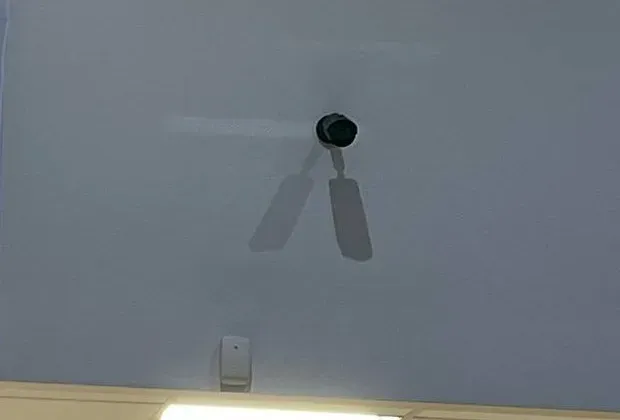
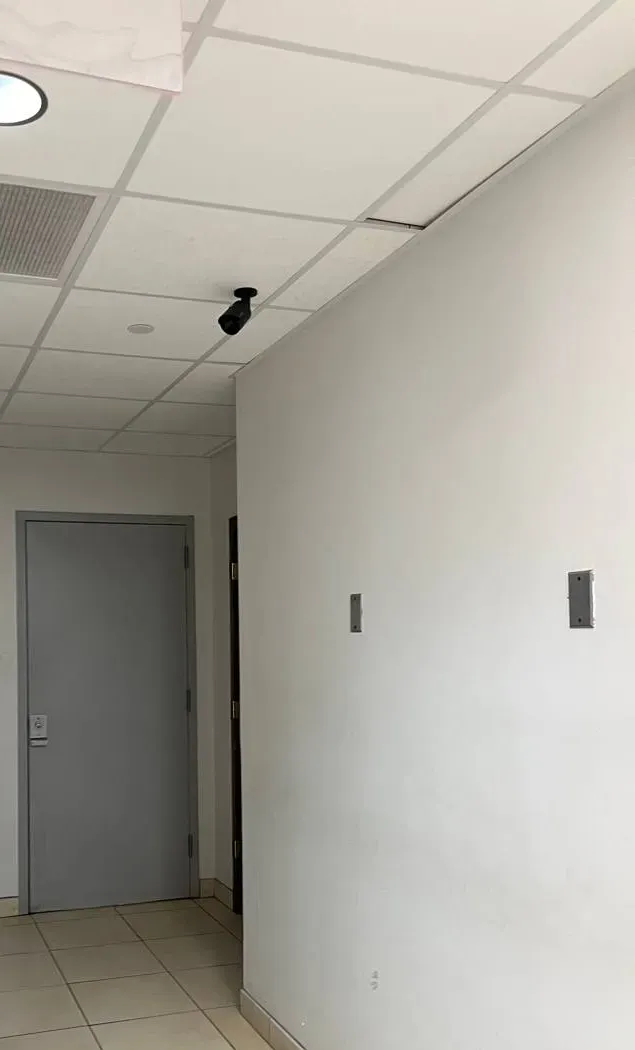
A photo from the AESS job library, not taken in Sea Gate: a small black camera mounted high on a pale wall, casting two shadows, with a small white device below it. In the shared front hall of a Sea Gate house that now holds two or three apartments, a camera placed this high covers the inside of the street door and the foot of the stairs, where every household's visitors pass once the buzzer lets them in.
Six facts that shape a buzzer installation behind the Sea Gate entrance
Many houses are no longer one household. 3764 Surf Avenue, built in 1920, is recorded as three units in two stories, the pattern that turns a single bell into a three-button station with separate releases.
The apartment buildings are older than the intercom law's 1968 line. 4505 Surf Avenue (1928), 4725 Beach 47th Street (1930) and 3811 Surf Avenue (1952) all predate the date in Multiple Dwelling Law §50-a, which shapes when an intercom becomes mandatory.
Some buildings carry long violation records. Openigloo lists 42 open HPD violations at 3862 Neptune Avenue and 23 at 3817 Nautilus Avenue; Augrented records 20 HPD violations at 4725 Beach 47th Street. A new entry system is often installed while an owner is clearing other repairs.
The association polices doors as well as streets. Its 2024 Rules list broken doors among the conditions that draw a warning, a fine or an ECB summons, and make the homeowner liable for what a "service person" does on the property.
The city wants equipment above the flood line. Appendix G of the NYC Building Code requires utilities and attendant equipment in flood zones to sit at or above the design flood elevation, or be built to keep water out.
Every street ends at the water. Sea Gate has water on three sides, so salt spray reaches porches and door stations that face the Atlantic, the bay or the Narrows, and fasteners and housings have to be chosen for it.
Where this page applies. Sea Gate runs from the gate at West 37th Street west to Norton's Point and the Coney Island Light, between the Atlantic beach on the south and Gravesend Bay on the north, with Surf, Mermaid, Neptune and Atlantic Avenues and the Beach streets from Beach 37th to Beach 51st. This page covers the houses, the converted houses and the apartment buildings inside the gate. For the amusement district and the blocks just outside it, see our Coney Island door buzzer installation page; for the rest of the borough, our door buzzer installation in Brooklyn page.
Repair or Replace in Sea Gate
Need Repair in Sea Gate? Decide Whether the Old System Is Worth Saving Before You Buy a New One
A good share of the calls we get about "putting in a buzzer" here come from owners who already have something at the door: a bell button wired generations ago to a chime in a back hall, an audio panel a previous owner fitted when the house was divided, or a building system in which some buttons ring and others have been dead for years. Before any new equipment is chosen, we sort the job into one of three paths.
The first is a targeted repair, when one part really is the whole problem: a transformer that failed after it got wet, a strike that has rusted in its frame, a closer that no longer pulls the street door shut. The second is a partial replacement, with a new door station and power supply on old cable that still tests sound. The third is a new installation with new cable, for houses where the old pairs corroded, were cut during a post-storm rebuild or never existed beyond a single bell. If a repair is all you need, we say so and price it as a repair; our Brooklyn door buzzer team handles both kinds of work.
In Sea Gate the deciding checks are usually about water rather than electronics: whether the old cable spent time submerged, whether the supply sits below the height water reached, and whether the door station's screws and terminals have started to corrode in the salt air. A system that passes those checks is often worth keeping. One that fails them is usually cheaper to replace than to keep repairing.
What We Install
Door Buzzer Installation Services in Sea Gate
Every service below is priced from the same Brooklyn door buzzer list. The number of households sets the size of the system, the doors decide what release each can take, and in Sea Gate the height of past floodwater, the exposure to salt air and the long runs through large frame houses decide much of the labor.
First buzzers for frame houses
A door station on the porch, a release in the front door frame and indoor stations on each floor of a three-story house, for owners who have only ever had a bell that nobody on the top floor can hear.
Button-per-household systems
Two or three buttons for a house that now holds two or three apartments, each ringing only its own household and each able to release the street door, so the owner stops answering for everyone.
Apartment building entry systems
Directory, button or code panels at the street door of the 1920s to 1950s buildings on Surf Avenue and the Beach streets, with apartment stations or phone answering for every household.
Phone answering for owners who are away
Door stations that ring your phones as well as the indoor stations, for owners who spend winters elsewhere or who rent the house out and still want to see who is at the door.
Flood-aware power and wiring
Power supplies and controllers mounted at or above the height water reached, with cable runs that keep splices and devices out of the cellar's low zone.
Marine-exposed door stations
Stations, screws and boxes chosen for porches that face the ocean or the bay, with sealed cable entries and the drip loop placed so water runs away from the terminals.
Strikes and closers for old doors
Fail-secure strikes fitted to old wood frames, frames reinforced where a century of paint and salt has softened them, and closers set so a heavy front door shuts and latches every time.
Beach-side and back doors
Keypads or small call stations at back doors that open toward the water, so family and regular visitors coming up from the beach do not need a key or a trip around to the front.
Condo and shared-ownership systems
Entry systems for converted buildings with a handful of unit owners, with the shared parts priced separately from each owner's station and the admin login handed to someone who will keep it.
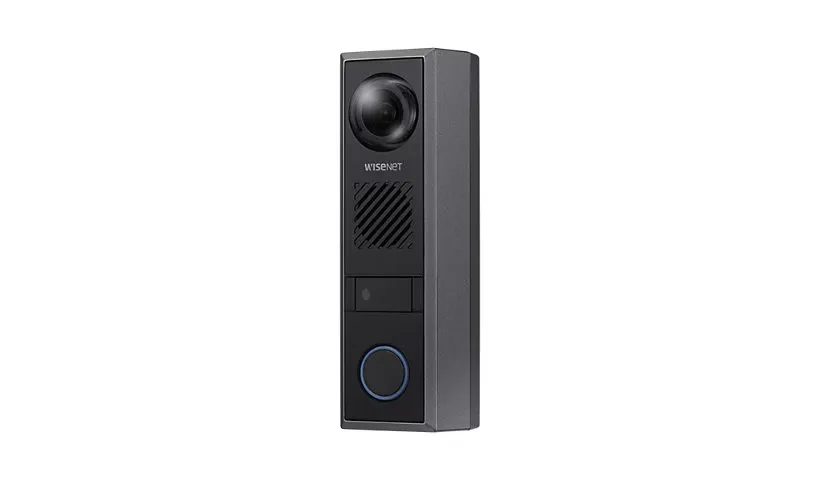
A photo from the AESS job library, not taken in Sea Gate: a slim dark grey wired doorbell with a camera lens, speaker slots and one round push button. A narrow wired unit like this fits on the casing of a porch door in a one-family Sea Gate house, where the trim beside the door leaves little room for a wider station.
Building Specialists
Door Buzzer Installation for Sea Gate's Architecture
Sea Gate's housing falls into six kinds of property as far as an entry system is concerned. The style of the house matters much less than how many households share its front door, where the cellar sits relative to past floodwater, and which side of the house faces the water.
One-family frame houses
Large Queen Anne, Colonial Revival and Mediterranean-style houses with porches and several floors, where the problem is distance: a bell at the front door that cannot be heard in a third-floor bedroom or a back kitchen.
Houses divided into two or three apartments
Frame and brick houses that now hold several households behind one street door, like the three-unit house at 3764 Surf Avenue, where every household needs its own button and its own release.
Prewar apartment buildings
Two- and three-story buildings from the 1920s and 1930s with thirteen to fifteen apartments, such as 4725 Beach 47th Street and 4505 Surf Avenue, often with no entry system or one long past repair.
The postwar building on Surf Avenue
3811 Surf Avenue, built in 1952 with 41 apartments and several addresses on one lot, the largest kind of entry job inside the gate.
Condo conversions
Older buildings turned into a few condominiums, such as the four-unit conversion at 3813 Neptune Avenue in 2018, where unit owners share one door and must agree on one system.
Houses rebuilt or raised after Sandy
Houses repaired or rebuilt since 2012, where new walls give an easy cable route but the cellar or ground floor may now be kept free of equipment by design.
One-family frame houses: three floors, a porch and a bell that stops at the first landing
The frame houses that gave Sea Gate its reputation were built for large households, and many still have one. They are also built of wood, with porches, deep halls and stairs that turn, so the sound of a mechanical bell at the front door dies somewhere around the first landing. An owner on the third floor or in a sunroom at the back simply does not hear it. Couriers who cannot raise anyone leave parcels on the porch or carry them away, and a visitor arriving for a family dinner stands outside knocking.
The fix here is an indoor station on each floor the household lives on, or phone answering, or both. The cable route is usually generous in a frame house, because closets stack, baseboards come off cleanly and the cellar ceiling is open. What takes time is finding a route that stays clear of the cellar's low zone, which we cover below.
On our list a house like this lands in the $700 to $1,800 video range. The low end is a video station on an old bell pair that tests sound with one or two indoor stations. The high end is three or four indoor stations, phone answering and a new hidden run from the porch to the top floor. The release goes into the front door frame, sized for a heavy old door, with a closer that pulls it shut.
Houses divided into two or three apartments: one street door, one bell and three households
The most common Sea Gate buzzer job is the one the gate hides: a house that was built for one family and now holds two or three. 3764 Surf Avenue is recorded as a two-story house with three units, built in 1920. Some houses were divided long ago; others were set up as a rental floor above an owner's duplex. Whatever the history, the front door usually still has one button, and it usually rings in the owner's hall. The owner answers for everyone, the tenants walk down to let their own guests in, and the street door gets left on the latch because that is easier than either.
The installation gives each household its own button at the street door, its own indoor station and its own ability to release the street door, and nothing more. The tenant cannot open the owner's apartment door, and the owner is not rung for the tenant's visitors. Where the upstairs apartment has its own door at the top of a shared stair, that door stays a keyed door with its own lock, as the Housing Maintenance Code expects for a dwelling unit. A house with three or more independent households is a class A multiple dwelling under city law, and §27-2043 of the Housing Maintenance Code requires each apartment's entrance door to have a heavy-duty latch set and a heavy-duty dead bolt, so we look at those doors while we are there and tell you if they fall short.
A two-button audio system on sound cable can land in the $400 to $900 audio range. Most owners of three-unit houses choose video, which puts the job in the $700 to $1,800 range: a three-button video station, one indoor station per apartment, a strike and a closer.
Prewar apartment buildings: thirteen to fifteen apartments and a street door that has been propped for years
Sea Gate's older apartment buildings are small by Brooklyn standards. 4725 Beach 47th Street has two stories and thirteen apartments; 4505 Surf Avenue has three floors and fifteen. Both are older than 1968, which matters for the law (see the next section), and both are the kind of building where an entry system is either missing, partly dead or a patchwork of replacement parts. In buildings like these we usually find one of three things at the street door: an audio panel in which some buttons work, a lock with no electric release at all, or a door that does not latch and has not for some time.
The first decision is whether the old riser cable can be reused. In a 1920s or 1930s building, apartment pairs run from the street door to each apartment, and ButterflyMX's guide puts it plainly: older analog systems "often use dedicated conductors between the entrance and each unit," and reuse "still depends on conductor condition, topology, available wires, voltage, controls, and lock compatibility." We meter every pair. If most test well, the building can take a new panel and new apartment stations on old cable. If they do not, the options are new cable up the stairwell or phone answering for every apartment with no riser cable at all.
These buildings start at about $2,500 on our list and rise with apartment count and cable work. A thirteen-unit building with a sound riser lands near the bottom of the multi-unit range; the same building with a failed riser and two entrances moves up.
The 1952 building on Surf Avenue: 41 apartments, four addresses and one entry plan
3811 Surf Avenue was built in 1952 with 41 apartments, and city records also know it as 3702 Sea Gate Avenue, 3801 Surf Avenue and 3802 Oceanic Avenue. A building of that size with several street addresses raises questions that a house never does: how many entrances need a panel, whether visitors at each entrance should see the whole directory or only the apartments served by that door, where the controller lives, and how residents will get in while the old system comes out and the new one goes in.
We plan a building like this around the entrances people actually use, not the addresses on the deed. A main entrance usually gets a directory or code panel that reaches every apartment; secondary doors get a smaller panel or a keypad, or stay as egress-only doors that open freely from inside. The cutover is planned so the old system keeps working until the new panel is tested, and residents are told in writing when their stations change.
A 41-unit building sits well into our multi-unit range, from about $2,500 for a straightforward panel on reusable cable toward $10,000 or more for video, phone answering for every apartment and several entrances.
Condo conversions: four owners, one door and nobody in charge of it
CityRealty lists 3813 Neptune Avenue as a 1930 three-floor building converted to four condominiums in 2018, with a common front yard, a large cellar storage room and a "virtual doorman" mentioned in its description. Conversions like this leave the entry system in an awkward place: the developer chose it, the unit owners now share it, and no managing agent may be looking after it. When a station fails or an owner sells, nobody is sure who holds the admin login or which parts belong to whom.
When we install or replace a system in a small condo, the written quote separates the shared parts, meaning the street door station, the strike, the supply and the riser, from each owner's own station, so the cost can be split the way the condo's documents say. We hand the admin access to whoever the owners name, in writing, and leave a wiring record with the condo's papers.
Four or five units usually land in the upper part of the $700 to $1,800 video range or the bottom of the multi-unit range, depending on whether every owner wants video and phone answering.
Rebuilt and raised houses: new walls, new stairs and a ground floor kept clear
6sqft wrote in 2022 that Sea Gate was "still in the process of rebuilding" a decade after Sandy, and the houses that were repaired or rebuilt since 2012 are the easiest in the neighborhood to wire. The walls are new, the framing is open during the work, and a cable can be pulled to every floor before the drywall goes up. The catch is that the same rebuilding often moved the living space up and kept the ground floor or cellar for parking, storage or nothing at all, which changes where the front door is and where equipment can live.
If you are rebuilding now, call us before the walls close. Pulling cable while the framing is open costs far less than fishing it later, and the controller can be given a spot on a living floor from the start. A house whose front door now sits at the top of a stair may also need a second call station at the bottom, which we price as part of the same job.
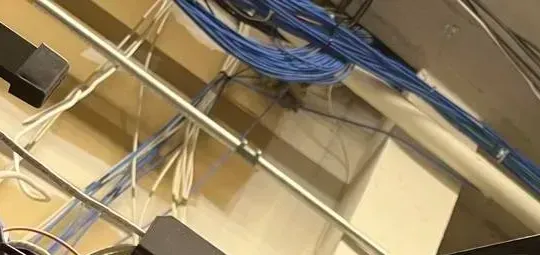
A photo from the AESS job library, not taken in Sea Gate: bundles of blue low-voltage cable laid over a ceiling beam and a metal pipe in an open ceiling. In a Sea Gate house being rebuilt or renovated, this is the moment to pull entry cable to every floor, before the ceilings and walls are closed.
Field Notes
Field Notes: Count the Mailboxes, Find the Waterline, Then Ring From the Farthest Room
This is how our technician spends the first part of a visit to a Sea Gate property, before anything is priced.
First, the households. Before looking at any wire, the technician counts the mailboxes, the meters and the doors inside the front hall, because a house that looks like one family from the street often is not. The number of households, not the size of the house, decides how many buttons the station needs and how the releases are split.
Second, the waterline. In the cellar or on the ground floor, the technician looks for the height water reached in past storms: a tide line on the foundation, newer drywall above old block, replaced outlets, or simply what the owner remembers. Wherever the old bell transformer or intercom supply is mounted, we note whether it sits below that line, because that alone decides whether the old supply can stay.
Third, the far room. The technician rings the existing bell from the porch while someone stands in the room farthest from the front door, usually a top-floor bedroom or a back kitchen, and asks whether they heard it. Most of the time the answer is no, and that is the whole case for indoor stations.
Fourth, the water side. The technician walks around to the side of the house that faces the ocean or the bay and looks at the back door, the screws on anything already mounted outside, and the paint on the frames. Rust streaks and blistered paint tell us how hard the salt air works on that side of the house and which hardware will last there.
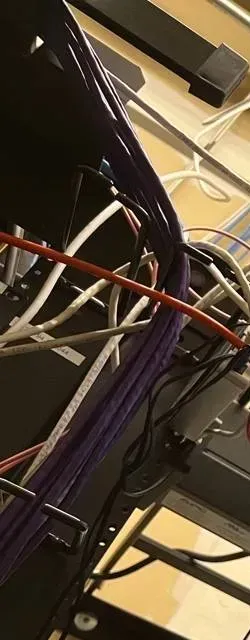
A photo from the AESS job library, not taken in Sea Gate: purple, white and red cable bundles dropping down beside a black equipment rack. In a larger Sea Gate apartment building, the entry controller and power supply belong in a small enclosure like this on a floor above the height water reached, not on the cellar wall where older systems were mounted.
Thirteen Units in 1930, Forty-One in 1952: When the Law Asks a Sea Gate Building for an Intercom
New York's Multiple Dwelling Law has had an intercom rule since 1968, and Sea Gate's apartment buildings sit on both sides of it in a way that surprises many owners. Section 50-a says that every class A multiple dwelling erected or converted after January 1, 1968 with eight or more apartments shall be equipped with an automatic self-locking door at the main entrance and an intercommunication system that lets residents speak to a visitor at that door and release it from their apartments. Buildings older than that must install the doors and the intercom if tenants occupying a majority of the apartments ask for it in writing, with the work begun within 90 days and finished within six months.
Run Sea Gate's buildings through that rule and the answers differ. 4505 Surf Avenue (1928, fifteen units), 4725 Beach 47th Street (1930, thirteen units) and 3811 Surf Avenue (1952, 41 units) were all built before 1968 and all have more than eight apartments, so none was required to have an intercom when it went up, and each must install one once a written majority request arrives. A three-unit house such as 3764 Surf Avenue is below the eight-apartment line altogether, so the state rule does not reach it, although the city's Housing Maintenance Code still governs its apartment doors and its entrance lighting. A building converted after 1968 into eight or more apartments falls under the first half of the rule.
Owners of older buildings sometimes read that as permission to wait. In practice it is a timetable that tenants control. Once a majority signs, the owner has 90 days to start, and a six-month clock that is hard to meet if the riser cable turns out to be corroded and the equipment has to be ordered. We would rather plan the system before the letter arrives, so the owner chooses the equipment and the timing.
Two other city rules usually come up during the same visit. Section 27-2040 of the Housing Maintenance Code covers lighting near entranceways of multiple dwellings, so a dark front walk gets mentioned on the quote even though we do not install the light fixture. And §51-c of the Multiple Dwelling Law gives tenants the right to add their own lock to their apartment door, up to three inches in circumference, which is why the apartment doors are never part of the buzzer system: the system opens the street door, and each household keeps control of its own.
None of this is legal advice, and a building with open HPD violations should check its own record. Openigloo's Seagate list shows how varied those records are, from a single open violation at several addresses to 42 at 3862 Neptune Avenue. When an owner is clearing a list like that, we put the entry system and the door hardware on the same plan so the street door is fixed once.
Above the Flood Line: Where the Supply, the Controller and the Splices Go in a Sea Gate Building
Every Brooklyn buzzer installer has a habit: the transformer or power supply goes on the cellar wall, beside the electrical panel, because that is where the 120-volt circuit is and where the riser starts. In Sea Gate that habit is how systems get ruined. The Brooklyn Eagle reported in 2015 that Sandy damaged or destroyed most of the bulkhead and pushed sand and debris into streets, homes and sewers, and City Limits described water standing thigh-high for a day. A supply or controller that sat under that water is finished, and the cable splices beside it corrode from the inside for months afterward.
The city's flood-resistant construction rules point the same way. Appendix G of the 2022 NYC Building Code says that in flood zones, "utilities and attendant equipment shall be located at or above the design flood elevation" specified in ASCE 24, or be built to keep water from entering or collecting in them. The same appendix allows wiring itself to run below that height if it meets the electrical code. For a door buzzer that translates into a simple layout: the cable can pass through the cellar, but the supply, the controller, the battery backup and any splice box live at or above the flood line, on a ground-floor closet wall or higher.
How we apply it on site:
The supply moves up. We mount the power supply and controller in a ventilated enclosure on a living floor or high on the cellar stair wall, wherever the owner's information and the building's marks put it clear of past water. If the nearest outlet is in the cellar, a licensed electrician adds one higher up, and that is on the quote before you approve.
The cable passes through, it does not stop. Where a run must cross the cellar ceiling, it crosses in one continuous length, with no splice below the line. Splices and terminal strips go in the enclosure upstairs.
The door station gets a drip loop and a sealed entry. The cable enters the back of the station from below with a loop so water runs off before it reaches the terminals, and the entry hole is sealed.
The battery backup is sized for an outage. A battery in the supply keeps the station and the release working through a short power cut; we tell you how long the chosen battery is rated for and what the door does when it runs out.
The release is chosen for the outage, too. A fail-secure strike keeps the street door locked when power is lost while the inside lever still opens it, which is why it is our default here. A magnetic lock, which releases when power is lost, is used only with the sensor and push-to-exit arrangement the building code requires.
The same thinking applies to a one-family house with a modest system. A small supply costs little to put on the first-floor closet wall instead of the cellar, and it is the difference between a system that comes back on after the next storm and one that has to be replaced.
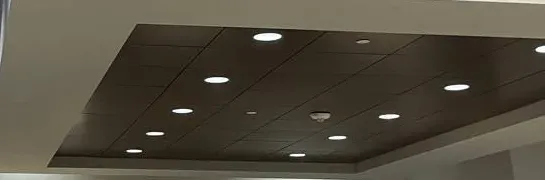
A photo from the AESS job library, not taken in Sea Gate: a dark recessed ceiling panel with round downlights and a small round device, framed by a lighter ceiling. In a rebuilt Sea Gate house, the finished ceiling of an upper hall is where a door system's small devices belong, well above any water that could reach the ground floor.
What the Association's Rules Mean for Your Installation Day
The Sea Gate Association's 2024 Rules and Regulations say almost nothing about door buzzers by name, but several of them reach an installation anyway. We plan around them so the job leaves nothing for the association to write you up for.
The homeowner answers for the crew. Article IV makes the homeowner "ultimately liable" for any violation committed by "a resident, guest, tenant, service person, or other person" associated with the property. We treat that as our rule too: the crew parks legally, keeps materials on your property and leaves the street and sidewalk as clean as we found them.
Broken doors draw notices. Article I lists "broken windows and/or doors" among the conditions that can bring a warning, a fine or an ECB summons. A new strike and closer that leave the street door shutting and latching properly is part of every job, and we do not leave a door unlatched overnight on a two-day installation.
Work stays inside the hours. The rules bar construction before 7 a.m. and after 6 p.m. on weekdays, on weekends without a special permit, within 300 feet of a house of worship on weekends, and on national holidays. We book Sea Gate installations on weekdays inside those hours.
Vans go home at night. Commercial vehicles and vehicles with commercial lettering may not park on Sea Gate streets or in the association's lot between Surf and Mermaid Avenues overnight. A job that runs two days means the van leaves at the end of day one and comes back in the morning; equipment either goes with it or is stored inside your house.
No signs and no flyers. Business and advertising signs are prohibited, and flyers may not be left on doors, stoops or mailboxes. We do not put a company sticker on your door station or a sign on your lawn, and we do not leave leaflets on your neighbors' doors.
Larger alteration projects must have city permits filed with the association office, and contractors on that kind of work are asked for substantial insurance with the association named. A low-voltage door buzzer on its own is not normally a permitted alteration, but if your entry system is part of a bigger renovation, tell us and we will send our insurance certificate so the office can decide whether its requirements apply.
Commercial Door Buzzer Installation
Business Door Buzzer Installation in Sea Gate
Sea Gate has no shopping street. Wikipedia notes that there are no stores inside the gate, and the association's rules prohibit construction or alteration "for the purposes of commercializing a residential property." The doors that need a commercial-style entry system here belong to the community's institutions and to the buildings run as businesses by their owners.
Houses of worship and study halls
The Village Voice counted five shtibelach and the Tiferes Menachem yeshiva inside the gate in 2005. Small congregations in converted houses often want a station at the door for weekday visitors, with a schedule that leaves the door open for services.
The Sea Gate Chapel and the entrance buildings
The chapel at the Surf Avenue entrance, built in 1901, houses the Sea Gate police station, and the association office sits at 3700 Surf Avenue. Doors like these are run by the association, which chooses its own systems.
The community center and beach facilities
The Sea Gate Community Center on Surf Avenue, the residents-only playgrounds and the beach facilities have staff doors and storage doors that benefit from keypads and call stations rather than keys.
Rental buildings run by management companies
The thirteen- to 41-unit buildings are businesses for their owners. JustFix shows the owner of 3811 Surf Avenue linked to a portfolio of 57 buildings, and companies like that often want one system type across all of them.
Shops just outside the gate
Businesses on Mermaid and Neptune Avenues east of West 37th Street sit in Coney Island rather than Sea Gate, and our Coney Island page covers their delivery doors and storefront buzzers.
Rules that apply to institutional and building entry installations in Sea Gate
Free exit is not optional. Whatever releases a door from outside, the door must open from inside with one motion, without a key or special knowledge. Electric strikes allow that by design.
Magnetic locks need the full arrangement. The building code allows electrically locked egress doors with a sensor on the inside, a push-to-exit button between 40 and 48 inches above the floor within five feet of the door, unlocking on loss of power and on fire alarm or sprinkler activation, and UL 294 listed parts.
Fire-rated doors take fail-secure strikes. Allegion's guide notes that fire doors need fail-secure strikes so they stay latched in a fire, which is another reason fail-secure is our default.
Reach ranges matter. At a house of worship or community building open to the public, the 2010 ADA Standards set the high forward reach at 48 inches maximum, so the station's buttons go no higher.
Tenant data has rules of its own. In a rental building, the city's tenant data privacy law covers smart access systems that collect data about residents, so we explain what the chosen system records before the owner orders it.
A photo from the AESS job library, not taken in Sea Gate: a tiled corridor with white walls and small wall plates, ending at a grey steel door with a lever handle under a drop ceiling with a small camera. The rear or service door of a larger Sea Gate apartment building or community building is usually a steel door like this, and it takes a fail-secure strike, a push-free lever exit and, where visitors use it, a small call station outside.
Your Questions Answered
Door Buzzer Installation in Sea Gate: Questions Answered
Houses that hold more than one household
Besides the new buttons, what else at the entrance of a three-apartment house should be put right while the buzzer goes in?
Three things, all at the street door. The door itself has to close and latch on its own, so the closer is checked and replaced if it is tired, and the frame is reinforced where the strike goes if the wood has softened. The apartment doors on the inside need the heavy-duty latch and dead bolt that §27-2043 of the Housing Maintenance Code expects in a class A multiple dwelling, and we tell you if any fall short. And the walk and the door should be lit at night, which the Housing Maintenance Code also addresses for multiple dwellings.
We price the strike, the closer and any frame work on the same quote as the station. Lighting and apartment locks are listed as notes, because a locksmith or an electrician usually does that part.
Our tenants come and go by the beach-side back door as much as by the front. Does that door need a station of its own?
Not always a full station, but rarely nothing. If the tenants' visitors arrive at the front and only the household itself uses the back, a keypad at the back door does the job: no key to lose on the beach, and the door relocks behind them. If guests regularly come up from the beach to the back, a small call station there, ringing the same indoor stations as the front, saves them walking around the block of the house.
Either way the back door gets the same strike, closer and sealed hardware as the front, and the keypad codes are given per household so one tenant's code can be changed without changing everyone's.
We rent out the whole house and live elsewhere. Can the system tell us when the street door is released without letting us watch the tenants?
Many systems can send the owner a simple notification that the door was released, or log the event, without showing video of the tenants. Whether that is appropriate depends on the lease and, in a building, on the city's tenant data rules, which limit what smart entry systems may collect about residents and how long it may be kept. We set the system to the least the owner actually needs and tell the tenants what it records.
Salt air, winter and empty houses
We close the house from late fall until spring and keep the heat low. Will a door station and indoor stations come through a cold, empty winter?
The outdoor station is built for cold, so the station itself is rarely the problem. What suffers in an empty house is the indoor equipment and the battery: indoor stations are rated for a heated room, and a backup battery in an unheated space loses capacity. We check the operating temperature range of the chosen indoor stations against how cold you keep the house, and we put the supply and battery in the warmest place that is also above the flood line.
If nobody will be there for months, phone answering lets you see who comes to the door, and a power outage notice from the system tells you if the house has lost power while you are away.
Spray off the water reaches our porch on the ocean side. What should we ask for in the station, its box and its screws?
Ask for three things. A station whose maker states an ingress-protection rating for outdoor use, so rain and spray are kept out of the electronics. Stainless steel screws and mounting hardware, because plated steel screws rust and streak within a season or two near the water. And a sealed cable entry with a drip loop, so water that does get behind the station runs off before it reaches the terminals.
Where a porch faces the open water and takes the full force of the weather, we sometimes mount the station on the side of the door that is more sheltered, or under the porch roof, rather than on the most exposed face.
Our walk is dark at night once the porch light is off. Will a video station still show who is ringing?
Most video door stations have infrared or low-light capability and will show a recognizable picture of someone standing at the door in the dark. What they show less well is a person standing back on the walk, or a face lit from behind by a streetlight. A porch light on a timer or a motion sensor gives a much better picture and helps visitors find the button, and in a multiple dwelling it also meets the city's entrance lighting expectations.
We place the station so the camera faces where the visitor stands, not into a streetlight, and test the picture after dark before we leave if the job runs late.
Association rules and the job itself
The association's rules list broken doors among the conditions that bring a warning or a fine. Could a new buzzer leave our door in that state?
Not if it is installed properly, and avoiding that is part of the job. A badly fitted strike can stop a door from latching, and a release left energized can leave it unlocked. We fit the strike so the door latches with the closer alone, test that it relatches after every release, and check it again at the end of each working day.
The rules make the homeowner liable for anything a service person does on the property. What does your crew do to keep that off our record?
We work as if every rule applied to us directly. The crew works weekdays inside the association's hours, parks legally and takes the van out at night, keeps tools and materials on your property rather than the sidewalk, and leaves no sign, sticker or flyer anywhere. If the work involves drilling through an exterior wall, we tell you before we start and patch the hole around the cable.
If the association office ever asks about our visit, you can give them our name and license number, NYS license #12000287431, and we will answer any questions directly.
Our installation will take two days. Can we leave the old bell working overnight in between?
Usually yes. On a two-day job we keep the old bell or the old system working until the new one is ready to test, or we wire a temporary button so visitors can still ring. The street door is never left unlatched overnight; if the new strike is not finished by the end of day one, the old latch goes back in.
For larger buildings we tell residents in writing which day their stations change, so nobody comes home to a door that will not let them in.
The larger buildings
Our building has fifteen apartments on three floors and the riser cable is original. How do you decide between new cable and phone answering for every apartment?
We meter every apartment pair first. If most pairs test sound, the cheapest good answer is a new panel and new apartment stations on the old cable, with the few failed pairs replaced. If many fail, new cable up the stairwell is one option and phone answering for every apartment is another, which needs no riser at all but relies on residents' phones and the building's internet at the panel.
Many owners choose a mix: stations in apartments where the pair is good and phone answering where it is not. We price each option before you choose, with any software charge per apartment stated.
Our building is listed under four street addresses. Which address goes on the panel?
The panel shows what a visitor needs at that door: the number on the building face and the apartments that door serves. Where a building has several addresses on one lot, as 3811 Surf Avenue does, we label each entrance with the address painted or fixed beside it, which also helps the association's requirement that a numbered address sign be visible from the street.
If every entrance leads to every apartment, each panel can show the whole directory; if each entrance serves only one wing, each panel shows only its own apartments.
Can residents keep using the old panel while the new one goes in, so 41 households are never locked out?
Yes, and in a building that size it is how we plan the work. The new panel is mounted and wired alongside the old one where possible, apartment stations are changed floor by floor, and the old panel is disconnected only after every new station has been tested from the street. If the new panel must go in the old panel's place, the swap is scheduled for one morning and residents get a written notice beforehand.
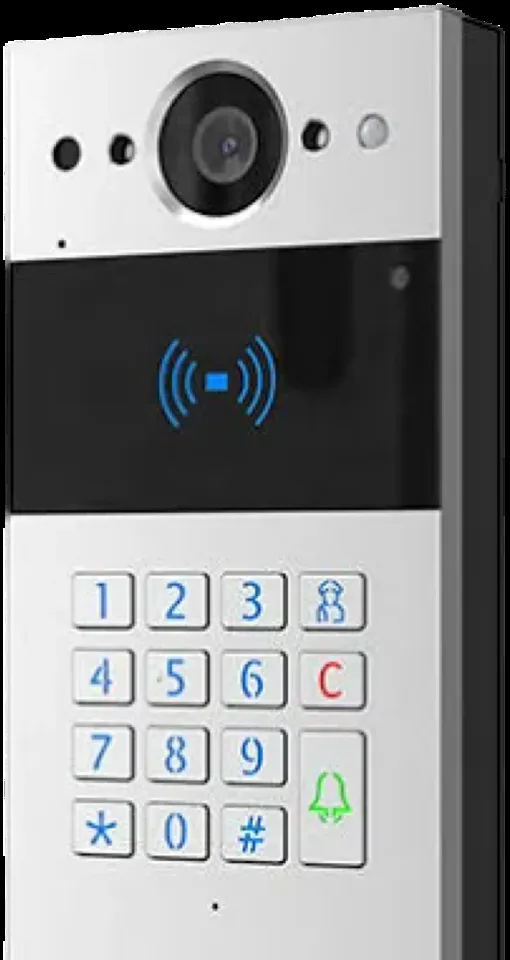
A photo from the AESS job library, not taken in Sea Gate: a silver and black keypad door station with a camera lens at the top, a blue card-reader symbol, a numeric keypad and a green bell key. A keypad station of this kind suits the street door of one of Sea Gate's thirteen- to 41-unit buildings, where visitors dial an apartment code and residents can use a code or a card.
Equipment
Types of Door Buzzer Systems We Install
Quotes default to our own non-branded system, sized to the property. If you want a particular brand, ask, and we will tell you which of the brands we carry fit your door and your cable.
Slim one-button stations
For one-family frame houses, mounted on the porch door casing, ringing indoor stations on each floor or a phone.
Two- and three-button stations
For houses divided into apartments, one button and one release per household, in a single weather-rated housing.
Indoor video stations
Screens with talk and release buttons for the kitchen, the bedroom floor and the top of the house, powered over the same cable as the call.
Phone and app answering
For owners who winter elsewhere or rent the house out, letting you see and speak to the visitor from anywhere, with or without remote release.
Two-wire multi-tenant systems
For the prewar and postwar apartment buildings, built to reuse existing pairs where they test sound and to reach dozens of apartments from one panel.
Directory and code panels
For building street doors, where visitors scroll a directory or dial an apartment code, and residents can enter with a code or card.
Keypads for back and beach-side doors
Weather-rated keypads with per-household codes for the doors families actually use, so nobody carries a key to the beach.
Fail-secure electric strikes
Our default release, locked when power is off, opening freely from inside, sized for heavy old doors and steel building doors.
Battery-backed supplies in raised enclosures
Power supplies and controllers in a ventilated box above the flood line, with a battery for short outages.
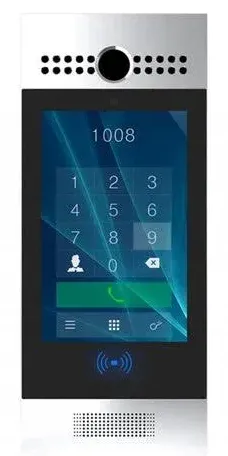
A photo from the AESS job library, not taken in Sea Gate: a touchscreen entry panel showing a dial pad with a four-digit apartment code entered, a camera above and a card-reader symbol below. A touchscreen directory like this is one option for the 41-apartment building on Surf Avenue, where a button panel for every apartment would be too large for the doorway.
Old bell, wired video stations or phone answering: which fits a Sea Gate property?
What matters
Old bell and chime
Wired stations, one per household or floor
Phone or app answering
Heard on the top floor of a frame house
Rarely
Yes, a station rings on each floor
Wherever the phone is
Rings only the household being visited
No, one bell for everyone
Yes, one button each
Yes, one entry each
Release the street door from upstairs
No
Yes
Yes, if wired to a strike
Works while the owner is away
No
Only for people in the house
Yes
Needs internet at the house
No
No
Yes
What a storm outage does
Bell dead until power returns
Runs on battery backup for a time
Needs the router on backup too
Monthly fees
None
None
Sometimes a software charge
Brooklyn list range
Not a buzzer
$400–$900 audio, $700–$1,800 video for a house
$700–$1,800 for a house; buildings from about $2,500
ADT, Ring and SimpliSafe compared with a local installer for a Sea Gate house
National alarm companies and doorbell brands are built around one household. ADT sells monitored security with an installer visit, Ring and SimpliSafe sell video doorbells that a homeowner can fit to existing doorbell wiring or run on a battery. For a one-family house where the owner simply wants to see the porch on a phone, a good video doorbell can be enough, and a Brownstoner forum reply described exactly that: an owner wired a SimpliSafe doorbell and used plug-in chimes because the old doorbell wiring was too old.
Where those products stop is the shared front door. A video doorbell does not give three households three buttons, does not release an electric strike from a second-floor apartment, and does not answer the state's intercom rule for a thirteen-apartment building. It also depends on the house's Wi-Fi reaching the porch, which is not a given in a large frame house with the router at the back. The same Brownstoner thread showed the other side of the decision: the owner of a two-apartment house who "can't see out our front door" had been quoted over $1,500 for a video system, later corrected to "more like $3,000," and a Brownstoner staff member replied that a $1,500 wired system "sounds cheap to me."
A local low-voltage installer fits the system to the number of households, the door and the cable, quotes it in writing and is reachable by phone afterward. That is what we do, under NYS license #12000287431, and if a doorbell is all your house needs, we will tell you that too.
AI Overview Reality Check
What AI Gets Wrong About Door Buzzer Installation in Sea Gate
AI summaries of door buzzer installation draw mostly on national cost guides and vendor blogs. Below are seven claims those sources make, each checked against what applies behind the Sea Gate entrance.
"Installing an intercom system costs an average of $2,500"
HomeAdvisor's guide says exactly that, with a range from $1,500 to $15,000, wireless systems from $150 to $1,500 and hard-wired systems from $1,000 to $15,000. The figure is an average across every kind of home in the country, which is why it fits almost nobody in particular.
In Sea Gate the spread is wider than that average suggests. A one-family frame house that needs an audio station and a strike sits in our $400 to $900 range, and most two- and three-family houses land in the $700 to $1,800 video range. A $2,500 figure is closer to where a thirteen-unit building starts than to what a house costs.
What actually moves a Sea Gate price is the number of households, the state of the old cable after years near salt water, and whether the supply has to move up out of the cellar. None of those shows up in a national average.
"Modern IP and video intercoms cost $1,000 to $5,000 or more per entry door"
Swiftlane's cost guide gives that per-door figure and notes that software subscriptions "commonly add $5 to $15 per unit per month, or $30 to $100 per door per month." Those numbers come from cloud systems sold to managed apartment buildings, where the vendor's pricing model includes the software.
Most Sea Gate properties do not need that model. A house with three apartments can have a wired three-button video station with no subscription at all, and even the larger buildings can choose a wired panel with phone answering only where it is wanted.
If an owner does want cloud management, for example a company running many buildings, we state the subscription per apartment or per door in writing before the system is chosen, so it is compared with the no-fee option on equal terms.
"New York law requires every apartment building to have an intercom"
Multiple Dwelling Law §50-a requires an intercom in class A multiple dwellings with eight or more apartments erected or converted after January 1, 1968. Older buildings must install one when tenants occupying a majority of the apartments ask in writing.
Sea Gate's apartment buildings are mostly on the older side of that line: 4505 Surf Avenue from 1928, 4725 Beach 47th Street from 1930 and 3811 Surf Avenue from 1952. None was required to have an intercom when built, and each becomes subject to the rule once the tenants' written request arrives. A three-unit house is under the eight-apartment line entirely.
The practical point is that an older building's obligation can start on short notice, with 90 days to begin the work and six months to finish. Planning before the request arrives is cheaper than meeting the deadline after it.
"Mount the power supply next to your electrical panel"
Generic installation advice puts the transformer or power supply beside the electrical panel, which in most houses means the basement, because that is where the power is. For most of Brooklyn that is sensible.
In Sea Gate it is the advice that gets systems destroyed. The Brooklyn Eagle reported that Sandy pushed sand and debris into homes and sewers, City Limits described water thigh-high in the streets for a day afterward, and the city's own Appendix G requires utilities and attendant equipment in flood zones to sit at or above the design flood elevation or be built to keep water out.
We run the cable through the cellar if we must, but the supply, the controller and the splices go higher. It costs a little more cable and sometimes a new outlet, and it is the difference between a system that comes back after a storm and one that does not.
"A wireless buzzer avoids running any cable"
Wireless doorbells and plug-in chimes avoid a cable between the button and the chime, and HomeAdvisor notes that wireless systems are the best option for a do-it-yourself job. ButterflyMX's apartment buzzer guide puts the limit plainly: "a wireless system isn't free of wiring."
The part a wireless button cannot replace is the release. To open a street door from upstairs, an electric strike in the frame needs power and a control signal, which means cable from a supply to the door. In a Sea Gate house with three households, three wireless buttons would still leave everyone walking down to open the door.
Wireless and app-based answering do have a place here, for owners who winter elsewhere and for apartments in a building where the riser cable has failed. They work alongside a wired release, not instead of it.
"Your old doorbell wire can carry a new video buzzer"
Sometimes it can. Aiphone's upgrade guidance says that "if the existing wires are in good condition, they can be reused," and its GT series is sold for retrofit projects using existing wire. In many Brooklyn houses an old bell pair carries a new video station perfectly well.
The phrase that matters is "in good condition." In a Sea Gate cellar that flooded in 2012, a pair that still rings a bell can be corroded inside its jacket, and a video signal is far less forgiving than a bell. That is why we meter every pair rather than assume, and why the quote names the cost of a new run if the old one fails its test.
Daniel Vasquez of Paragon Security and Locksmith told Brick Underground that with intercoms "it's all in the wire connections." Near the water, the connections are where salt does its damage first.
"A gated community doesn't need door buzzers"
Summaries of gated communities tend to describe the gate as the security system: guards at the entrance, guest passes, a private police force. Sea Gate has all of those: the Association's website calls it "a private, gated community," and overnight guest passes come from the Sea Gate police precinct in the chapel at the Surf Avenue entrance.
The gate decides who gets onto the streets. It does not decide which of three households in a converted house a visitor wants, whether a tenant on the top floor can let a friend in, or whether a courier can reach anyone inside a large house. Those are the jobs of the front door, and they are the same inside the gate as outside it.
If anything, the gate makes a working buzzer more important, because visitors who were let through the gate expect to be able to reach the house they came for.
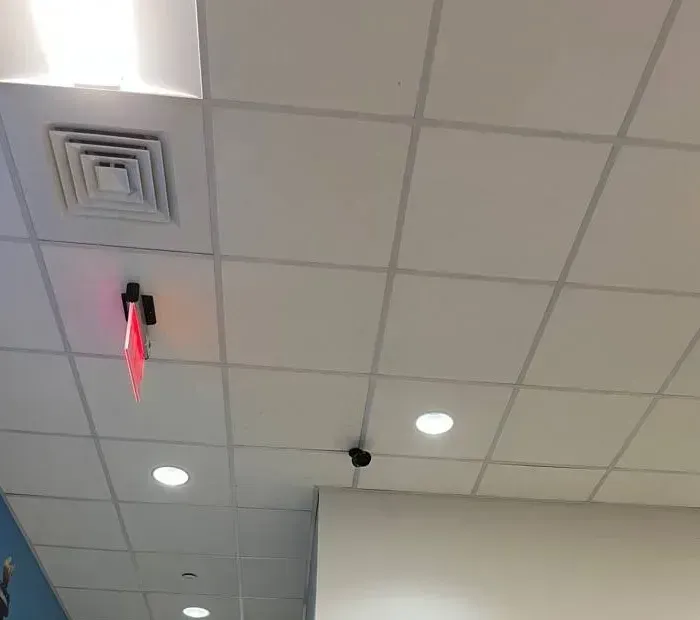
A photo from the AESS job library, not taken in Sea Gate: a drop ceiling with a lit red exit sign, an air diffuser, round recessed lights and a small black camera. The lobby of a larger Sea Gate apartment building has an exit sign like this over its street door, and the door under it must always open from inside without a key, whatever the entry system does from outside.
Not Sure Whether Your House Needs One Button or Three, or Where the Supply Should Go? Speak to a Tech
Send a photo of the front door and whatever is mounted beside it, one of the mailboxes or meters in the front hall, and one of the cellar wall where the old bell transformer or intercom supply hangs, along with how many households live in the building and whether water reached the cellar in past storms. A technician will tell you which approach fits and where it falls on our Brooklyn ranges. Call or text (347) 934-8335, send photos on WhatsApp, or fill in the form below.
Get In Touch
Request a Free Quote
✅
Request Sent!
Thank you. A technician will call you about the Sea Gate address, usually within two hours during working hours.
How It Works
Our Installation Process
1. Count the households and the doors
We list every apartment or household the system must reach and every door people actually use, including the side door and the back door toward the water.
2. Find the flood line before the equipment line
We note where water reached in past storms and choose a spot for the supply and controller at or above it, before any equipment is chosen.
3. Check the door, frame and closer
We make sure the street door closes and latches on its own and choose the strike that suits its frame, because electronics cannot fix a door that will not shut.
4. Test the old cable and map the new route
We meter any existing bell or intercom pairs and plan where new cable runs, keeping splices and devices out of the cellar's low zone.
5. Price it in writing
We place the job on the Brooklyn list and name every possible extra, such as a pair that might fail its test or a new outlet upstairs, before anything is ordered.
6. Order and schedule inside the association's hours
Once you approve, we order the equipment and book the work on a weekday between 7 a.m. and 6 p.m., the hours the Sea Gate Association allows.
7. Install, seal and label
We mount the station with stainless fasteners and a sealed entry, fit the release, run and conceal the cable, and label every pair at the supply.
8. Test from the street and hand over
We ring every button from outside, release the door from every station or phone, check that the door relatches, and leave a written wiring record.
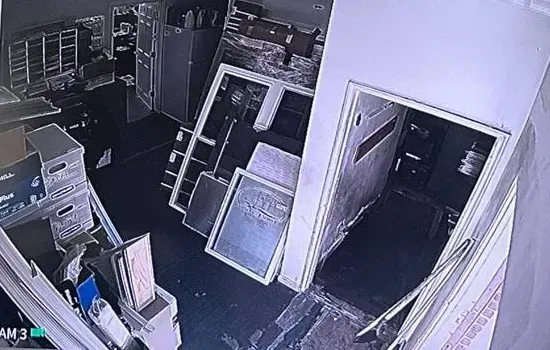
A photo from the AESS job library, not taken in Sea Gate: a black-and-white night camera view of a cluttered room with an open doorway into a dark back room. Storage rooms in Sea Gate cellars often look like this, and during step 2 they are where we look for the height water reached before deciding that nothing electronic stays down there.
Coverage Area
Door Buzzer Installation Near Sea Gate's Landmarks
Coney Island Light
The 75-foot lighthouse at Beach 47th Street, lit in 1890, standing at Norton's Point near the western tip of Sea Gate.
The Sea Gate Chapel
The 1901 chapel at the Surf Avenue entrance, the first building visitors see inside the gate and home of the Sea Gate police precinct.
The Sea Gate Association office
The association's office at 3700 Surf Avenue, beside the main entrance, where permits and guest passes are handled.
Sea Gate Community Center
The community center on Surf Avenue, with a residents-only playground next door.
Lindy Park and the beach
The association's beach reservation, where lifeguards are posted in season and residents swim from Memorial Day to Labor Day.
The T-groins and Norton Point Dike
Four T-groins and a reinforced dike and terminal groin completed by the Army Corps of Engineers in 2016, a $28 million project to hold Sea Gate's shoreline.
Sea Gate is billed at our standard Brooklyn rate. The final figure follows photos and a walkthrough, because the number of households, the state of the old cable, the condition of the door and whether the supply has to move up out of the cellar drive the total far more than the brand on the station.
Job
Typical Sea Gate property
Brooklyn range
Audio station or replacement with electric strike release, existing wiring reused where it tests well
One-family frame houses with one front door, a single beach-side or community door
$400–$900
Video door station with indoor stations or phone answering
Large frame houses with a station on each floor, houses divided into two or three apartments, small condo conversions
$700–$1,800
Multi-unit entry system, audio or video by apartment count, with optional code or card entry
The 1920s and 1930s buildings on Surf Avenue and the Beach streets, the 41-unit building from 1952
from $2,500 to $10,000+
In-person diagnosis of an existing system, booked online
Any property where the old system must be tested before quoting
$250, applied toward the work
Monthly subscription
Any property choosing a wired, no-subscription system
$0
What moves a Sea Gate job inside its range is easy to predict. First the households: a one-family house with one indoor station stays low, while a three-unit house with video in every apartment and phone answering for the owner moves up. Then the cable: an old pair that tests sound costs nothing extra, while a new run from the porch to the top floor, or a riser replaced after years near salt water, adds labor. Then the supply: moving it out of the cellar to a closet wall upstairs adds a little cable and, if there is no outlet nearby, an electrician's visit that is quoted separately. Then the door: a frame that needs reinforcing or a closer that needs replacing before a strike can go in. If the job also adds a camera over the entrance, installing it on the same visit usually saves $200 to $400 in labor compared with a separate trip. Anything that depends on a test is named on the quote with its price before you approve.
Full terms — including 50% deposit, one-year parts-only warranty on AESS-supplied products, and the late-fee schedule — are set out in the service agreement.
Find Out Which Range Your Sea Gate House or Building Falls In
Tell us the street and the nearest Beach street, how many households share the front door, every door people use and what is mounted at the door now, and we will tell you which Brooklyn range fits and what would move it. Call or text (347) 934-8335, send photos on WhatsApp, or fill in the form.
Shop Our Systems
Door Buzzer Installation Packages & Pricing
Three typical Sea Gate jobs, each placed inside the matching range on our Brooklyn list. The exact figure comes from the photos and the walkthrough.
Frame house audio: $400–$900
A slim audio station with stainless fasteners on the porch door casing, a fail-secure strike in the frame, a closer for a heavy old door, an answering station on the main floor and a battery-backed supply mounted above the flood line.
Two- or three-family video: $700–$1,800
A two- or three-button video station, one indoor video station per household or per floor, phone answering for an owner who is away, and cable hidden from the porch to the top floor.
Apartment building system: from about $2,500
A directory, code or button panel at the street door, apartment stations or phone answering for every household, tested or new riser cable, a release with free exit and the controller in a raised enclosure, rising toward $10,000 or more with apartments and entrances.
Bring your own equipment. If you have already bought a door station or intercom kit, we can install it as labor-only work, quoted flat once we have seen the door, the frame and the cable path through the house. Tell us the make and model, and we will say before the visit whether it can reach every household, release your door and stand up to spray on your porch. Equipment you supply is covered by its maker's warranty, not ours.
Complete Services
Every Door Buzzer Service in Sea Gate
Frame houses and divided houses
First buzzers, indoor stations on every floor, a button per household and keypads for beach-side doors. Request a quote
Apartment buildings and condos
Street door panels, riser testing, phone answering and raised supplies for the buildings inside the gate. Call (347) 934-8335
Where does a frame house divided into three apartments usually land on your price list?
+
Most land in the $700 to $1,800 video range. The low end is a three-button video station on old pairs that test sound, with one indoor station per apartment. The high end adds phone answering for the owner, new cable to the top floor and a supply moved up out of the cellar. An audio-only system on sound cable can come in within the $400 to $900 range.
Can one indoor station answer both the front door and the back door?
+
Yes, on most systems. A second door station or call station at the back is wired to the same indoor stations, and the screen shows which door is ringing. Each door gets its own release, so answering the back door opens only the back door. The second station is priced as an addition on the same quote.
What happens to the street door when the power goes out in a storm?
+
With a fail-secure strike, our default, the door stays locked from outside and opens normally from inside with the lever, so nobody is trapped and the house is not left open. A battery in the supply keeps the station and release working for a time; when it runs out, residents use their keys until power returns. We tell you how long the chosen battery is rated for.
How long does a door buzzer installation take in a Sea Gate house?
+
A one-family house with one door station and two or three indoor stations is usually one working day. A three-unit house with new cable to the top floor can take one to two days. Brick Underground quoted an installer estimating that a five-apartment building's replacement could be done in a day, and larger buildings take longer, which we tell you in writing with the quote.
Do we have to be home for the whole installation?
+
Someone needs to be there at the start to show us the doors and the cellar and at the end to test the system and learn how it works. In between, an adult who can let us into each apartment is enough. In a building with tenants, we ask the owner or managing agent to arrange access to each apartment for the day its station is changed.
Will the door station work with the Wi-Fi in a big frame house when the router is at the back?
+
A wired station does not need Wi-Fi at all; it talks to the indoor stations over its own cable. Phone answering does need a network connection, and in a large wood house we connect the station's network unit by cable to the router rather than trusting Wi-Fi to reach the porch. If that is not possible, a wired access point near the front is added to the quote.
Can tenants be given their own release without being able to change the owner's settings?
+
Yes. Each household's station or app account rings and releases only for that household, and the admin settings, such as names on the panel, codes and who can release remotely, stay with the owner or whoever the owner names. When a tenant moves out, their app access and codes are removed without touching anyone else's.
How often should a door station near the water be cleaned or checked?
+
Wiping the face with a damp cloth every few weeks in summer removes salt before it builds up on the buttons and camera lens; avoid solvents and pressure washers. Once a year, look at the screws and the seal around the station for rust or gaps. If you see either, send us a photo and we will tell you whether it needs attention.
Do you need to cut into plaster walls to run the cable?
+
Rarely in a frame house. Cable is usually fished through stacked closets, behind baseboards and along the cellar ceiling, with small access holes where a stud or fire block is in the way. Any hole we make is patched around the cable, and painting the patch is left to you or your painter. If a wall has to be opened more than that, we say so on the quote.
Is the station's camera allowed to see the street and the neighbors' walk?
+
A door station's camera is aimed at the person ringing, a few feet in front of the door, so it shows your own porch and steps rather than the street. Where a neighbor's walk is right beside yours, we angle the station or choose a narrower lens so it does not look onto their property. If you want wider coverage of the street, that is a separate security camera decision.
Can the system be added to later if we divide the house or add an apartment?
+
Usually yes, if we plan for it. We can install a station with a spare button, leave a spare pair in the cable to each floor, and size the supply for one more household. Adding the apartment later is then a matter of an indoor station and a short visit, not a new system. Tell us at the walkthrough if a change is likely.
Who do we call if the system acts up after the next big storm?
+
Call or text the same line you used to book. A technician starts with a phone or photo check, which costs nothing, because many problems after a storm are a tripped outlet, a flat battery or a router that has not come back on. If a visit is needed, we tell you before we come whether it is covered, and the wiring record we left at installation makes the fault quick to find.
Ready to Give Every Household in Your Sea Gate House Its Own Button?
Send a photo of the front door, the front hall and the cellar wall, with the street, how many households share the door and every door people use, and we will tell you which system fits, where its supply should go to stay clear of the water and where it falls on our Brooklyn ranges. Call or text (347) 934-8335, message us on WhatsApp, or use the request form. Licensed under NYS license #12000287431, rated 4.7★ across 201 Google Reviews, with same-day estimates on most weekdays.