Licensed Low-Voltage Installer · Historic District Co-ops, Garden Apartments, Rowhouses & Shops · Roosevelt Avenue to Northern Boulevard
Sonos Installation in Jackson Heights, Queens
Wi-Fi Planned Through Brick · Paperwork Before the Drill · Garden-Side Rules Respected · Queens Prices
Jackson Heights was planned as a place where neighbors share walls, gardens and a board, and a Sonos system here has to live inside that arrangement. Most homes are in brick co-ops and garden complexes put up between 1914 and 1939, where the partitions that keep a neighbor's television out of your bedroom also keep your router's signal out of it, where a managing agent decides what may be fixed to a wall, and where anything on the outside of the building falls under the Landmarks Preservation Commission. So we plan a Jackson Heights Sonos job in three passes: how the signal will cross the masonry, who has to approve each piece, and only then where every speaker sounds best.
Written by AESS owner Anwar Timothy (NYS license #12000287431) from the Jackson Heights Beautification Group history, the LPC designation report LP-1831, the Historic Districts Council, Brick Underground, Sonos support articles, BroadbandNow, the Jackson Heights Post and NYC 311 · Reviewed and updated November 1, 2026
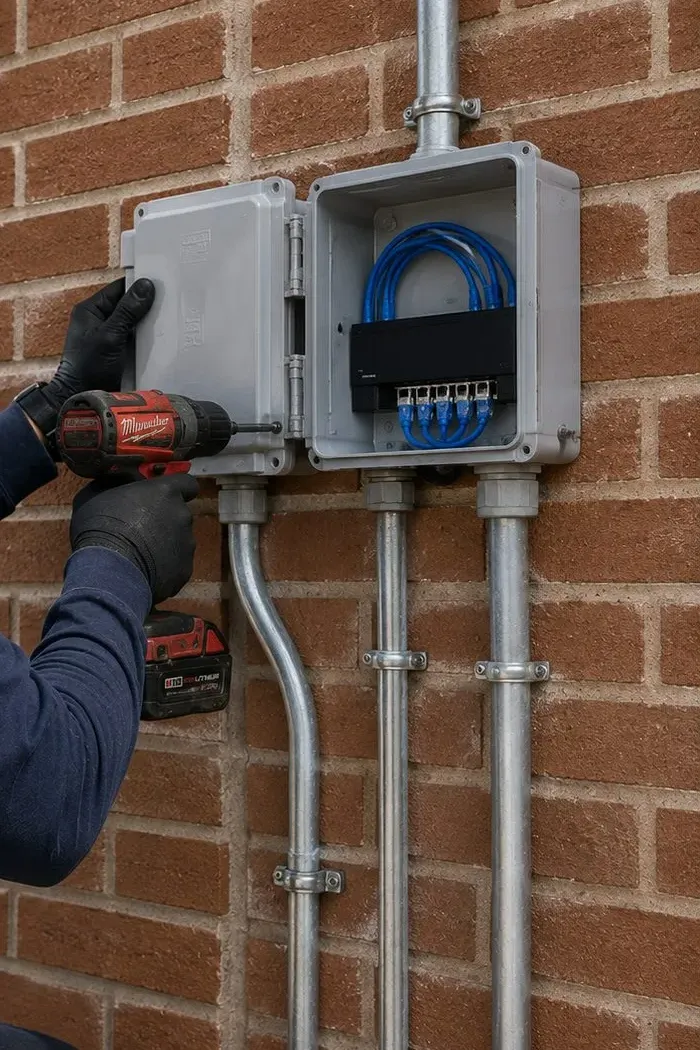
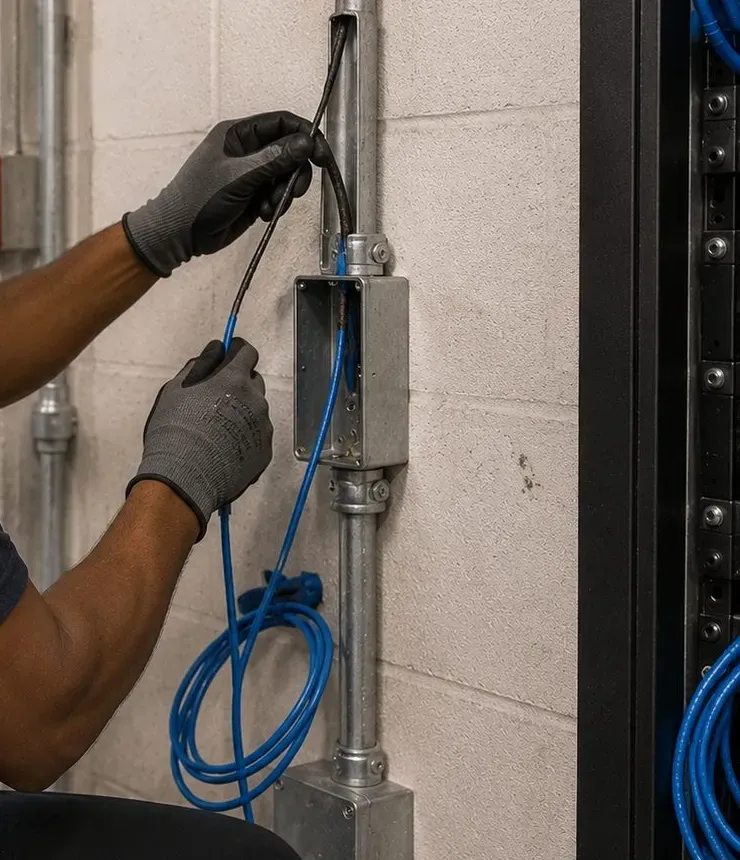
From the AESS job library, not photographed in Jackson Heights: an opened grey enclosure on brick holds a small switch and blue patch leads, with three conduits dropping below. On a Jackson Heights building, anything fixed to the outside brick, even on the garden side, is Landmarks territory, so we plan exterior hardware like this only with the permit in view.
Jackson Heights Sonos Quote
Tell us your building, the Sonos products and where the internet comes in — a written Queens figure comes back the same business day
✅
Request Received
A Queens installer will call you back to book a time, normally within 2 hours.
25+
Years Experience
✓
Same-Day Estimates
100%
Licensed & Insured
4.7★
201 Google Reviews
Owner-operated since 2002 · Thousands of jobs completed · Booked within 2 hours
Sonos installation in Jackson Heights is priced on the Queens list: $125 joins and tunes a whole Sonos system, a soundbar placed on a console is $79, and a soundbar hung under the TV is $129, plus $84.99 if you need the Sanus bracket. A single cable run of up to 25 feet, the usual cure for a back bedroom the Wi-Fi can't reach through old masonry, is $99. Requests are booked within 2 hours, and anything inside a ceiling, behind plaster the building controls or on the outside of a landmarked building is priced in writing after a walkthrough, never guessed. Call (347) 434-6392 or send the short form.
Every figure on this page comes from the same Queens list our Sonos installation in Queens page publishes; Jackson Heights pays nothing extra for being in a historic district
We send the managing agent the insurance certificate and a one-page scope before the day, so the visit isn't stopped at the service entrance
Work is carried out under New York State low-voltage license #12000287431
Why Jackson Heights Properties Need Sonos Installation
Jackson Heights was a marsh before it was a neighborhood, and almost everything built on it since was built to be shared. From colonial times into the 1900s the land was known as Trains Meadow. Edward MacDougall's Queensboro Corporation laid it out in 1916, and residents began arriving after the Flushing Line opened in 1917. The company's first apartment house, the Laurel, had already gone up on 82nd Street at Northern Boulevard in 1914. In 1917 it finished a complex it called the Garden Apartments, coining a name that went on to describe a whole building type. Linden Court, between 84th and 85th Streets, is counted as Queensboro's first true garden apartment complex, and between 1920 and 1925 the company put up eight block-long complexes, each wrapped around an interior garden its residents share. One local property firm describes the result as the nation's first and largest planned cooperative and garden apartment community.
For a Sonos system, that history is not background reading. It decides three practical things before a single speaker is unboxed. The first is the walls. The buildings of the historic district are brick, raised mostly between 1914 and 1939, and inside them apartments are divided by masonry and plaster that do a fine job of keeping sound in and an equally good job of keeping a Wi-Fi signal out. Sonos's own interference guidance rates plaster and concrete as a "High" obstruction to wireless signal and metal as "Very High". When Sonos stopped requiring a wired bridge years ago, it said that people in homes whose walls "like to eat wireless signals" might still need one. A speaker that vanishes from the app in the back bedroom of a Jackson Heights apartment is rarely faulty. It is usually sitting behind a wall that was built to stop things passing through it.
The second thing is permission. Most Jackson Heights homes are co-op apartments, and co-op boards here typically require an alteration agreement before any work begins; a local remodeler puts the review at anywhere from two to six weeks. Boards generally want the contractor licensed and insured to a stated amount, with the building named on the policy. One Jackson Heights resident, reviewing an electrician on Yelp, summed up what that feels like from the inside: "Living in a coop that requires licensed electricians who are insured…" A Sonos system can be anything from three speakers on furniture, which needs nobody's signature, to ceiling speakers with cable inside the walls, which almost certainly does. Knowing which pieces fall where saves weeks.
The third is the outside of the building. The Landmarks Preservation Commission designated the Jackson Heights Historic District on October 19, 1993, and its rules govern facades and exterior components. Speakers and cable inside an apartment usually never reach the Commission, because LPC permits are needed for interior work only when a Department of Buildings permit is needed, when the work affects the exterior, or when the space is an interior landmark. The garden side is different. Exterior work needs an LPC permit even when no one on the street could ever see it, which matters the moment someone wants music on the courtyard face of a building or a wire run along the brick to a rear terrace.
There is also the matter of neighbors, which in a neighborhood of shared walls and shared gardens is never far away. Jackson Heights residents were vocal about noise at a 115th Precinct community council meeting reported by the Jackson Heights Post, including complaints about a Northern Boulevard store whose owner set up a speaker in front of the shop and played music loudly to draw customers. A third-party tracker of city data counts about 9,634 housing complaints to 311 from Jackson Heights tenants in the twelve months to September 2026. And many apartments are smaller than they were built: after the 1929 crash and the Depression, a good number of Jackson Heights apartments were divided into smaller ones, so the wall between you and the household next door may be a later partition rather than the original masonry.
Put together, that is why this page doesn't start with which speaker to buy. A good Jackson Heights Sonos plan starts with how the signal will cross a 1920s apartment, who has to approve each part of the job, and where the music should stop so the people across the garden and through the partition never think about it. The speakers come last, and in most apartments they are the easy part.
What the record says about Jackson Heights homes
October 19, 1993: the LPC designates the Jackson Heights Historic District (LP-1831). The Historic Districts Council describes buildings raised primarily between 1914 and 1939, brick throughout, ranging from single-family houses to large apartment buildings in Tudor, Italianate, Mediterranean and Georgian styles.
1911: the oldest surviving buildings in the district, two-storey-and-basement rowhouses on the west side of 83rd Street near Roosevelt Avenue, according to the designation report. These are some of the few homes in the area with no board at all to consult.
14 five-storey buildings: Hawthorne Court, designed by George H. Wells in 1922 (Historic Districts Council). A complex of that size is a reminder that the walk from the router to the farthest room, and from the street to the apartment, can be long.
More than 15 streets: the houses the Queensboro Corporation called English Garden Homes, built in the late 1920s (JHBG history). Brick houses with their own owners, their own cellars and their own wiring decisions.
31.5 HPD violations per 100 apartments: Jackson Heights over the twelve months to September 2026, close to the citywide 30.1, according to the same third-party aggregator. Older buildings, closely watched; another reason we leave a building's fabric as we found it.
Fios and Spectrum: BroadbandNow's listing says Verizon Fios provides the best internet in Jackson Heights and Spectrum the fastest, which tells us whose router or fiber terminal we will probably find when we open the closet.
Most Jackson Heights households pair a Sonos visit with one other piece of work. Co-op shareholders often have a TV hung or a soundbar mounted at the same time, and a good number add a keypad or app lock to the apartment door once the board's paperwork is already open. Ask for a combined quote and the insurance certificate, the agent's approval and the service-entrance booking are dealt with once.
Repair Capture
Need a Sonos Repair in Jackson Heights? Speakers Lost Behind the Plaster
The repair calls we get from Jackson Heights tend to follow a change nobody linked to the speakers: Fios or Spectrum swapped the router, someone moved the router from the living room into a closet to tidy up, a plug-in extender was bought to "help" the bedroom, or the household moved the soundbar to the other side of the room and the Sub stopped pairing. The front-room speaker plays fine, and the one behind two old walls drops out every evening. Call (347) 434-6392, say it's a Sonos dropout, and tell us which provider you use and where its box sits, so the van carries the right cable. Requests are booked within 2 hours, and most of these are working again within an hour or two of a technician arriving. A visit where nothing is mounted is charged on time: $195 for the first hour at the Queens rate, then half-hour blocks.
From the AESS job library, not photographed in Jackson Heights. On a Jackson Heights repair call we check the router, the network and the walls between them before any Sonos product is blamed.
Inside the Masonry
Getting a Sonos Signal Across a 1920s Brick Co-op
In a new tower the router and the speakers usually share one box with light partitions between rooms. A Jackson Heights apartment is the opposite: long, solid, and divided by walls laid up a century ago. Most of the trouble on Sonos jobs here is radio trouble, and it is easier to solve before the speakers go anywhere than after. These are the six things we look at, in the order we look at them.
1. What the walls are actually made of
We never assume a wall. Engineers who study New York apartment houses of the period describe fire-stair enclosures built of terra-cotta block covered in plaster, vestibules of gypsum block, brick outer walls and, in many buildings, plaster on metal lath. Each behaves differently to a Wi-Fi signal. Sonos's interference table rates wood, glass and synthetic materials low, water, brick and marble medium, plaster and concrete high, and metal very high. A partition of plaster on metal lath combines two of the worst entries in one wall. So the first thing we do in a Jackson Heights apartment is knock, look and test: a metal detector over the wall the signal has to cross, a look at the thickness where a door frame exposes it, and a reading from a phone in the far room with the router in its usual place.
Material in the path
Sonos's rating
Where we meet it in Jackson Heights
Wood, glass
Low
Original doors, French doors between rooms, sunroom windows
Brick
Medium
Outer walls, chimney breasts, walls of the 1911 rowhouses and the English Garden Homes
Plaster
High
Almost every original interior wall and ceiling
Concrete
High
Floors and slabs in many of the larger apartment buildings
Metal
Very High
Metal lath behind plaster, radiator enclosures, medicine cabinets, the steel door of a meter or utility closet
2. Where the internet comes in
With Fios and Spectrum the two names we meet most, the equipment is predictable but its position isn't. The provider's technician puts the box wherever the line came into the apartment, which may be the front room, a closet or a corner of the kitchen, and that spot then becomes the centre of every wireless signal in the home. In a long apartment with rooms strung off a foyer, the farthest bedroom can be three or four walls away. Before we suggest any equipment, we sketch the route from the box to each room where music is wanted, count the walls and note what each one is made of. Often the answer is simply moving the router out of a closet into the open on the same cable, which costs nothing in equipment.
3. Why the old answer, the Boost, isn't the answer any more
For years, the standard fix for a Sonos system behind thick walls was the Sonos Boost, a small adapter that plugged into the router and gave the speakers a network of their own. Plenty of forum threads and older guides still recommend it. At least one large retailer now lists the Boost as no longer available, so we don't build plans around one, and we don't promise one. The same job is now done with an ordinary network cable. Sonos's system requirements describe a wired setup as one or more Sonos products connected to the router by Ethernet at all times; when that is in place, the wired product carries the system to the rest.
4. One cable, placed once
In most Jackson Heights apartments the useful cable is short. If the soundbar or an Amp already sits within 25 feet of the router, one run along the baseboard or through a closet, priced at $99 on the Queens list, connects it, and the rest of the system works from there. If the products that matter are all at the far end, a cable to a small access point in the middle of the apartment does the same job for the back rooms. What we avoid is cable through the original walls of a co-op unless the board has agreed. Along baseboards and door trims, under a paintable cover where needed, and through your own closets, a cable can travel a long way in an old apartment without anyone opening plaster.
5. The rules Sonos sets for the network
Sonos is specific about what it will and won't work with, and older buildings tend to accumulate exactly the gadgets it lists as unsupported. Its requirements say every Sonos product works on the 2.4 GHz band and that routers offering only 5 GHz aren't supported; that the app and the speakers must share one network; that WPA and WPA2 Personal security are supported but enterprise log-ins are not; and that wireless range extenders, powerline Ethernet adapters, guest networks and networks with a log-in page are not supported. In a mesh network with a wired Sonos product, that product must connect to the primary mesh unit. A system can hold up to 32 Sonos products. We check all of it on every visit, because a single plug-in extender in a hallway outlet is enough to make a bedroom speaker disappear.
6. Spacing from everything else that transmits
Sonos asks for its products to sit at least 18 inches from other electronic devices, and names the usual culprits: cordless and DECT phones, baby monitors, wireless cameras and video transmitters, other routers and access points, wireless set-top boxes, smart-home hubs and microwaves in use. In a compact galley kitchen, the one shelf that fits a speaker is often next to the microwave and the cordless phone base. Restarting the router so it picks a quieter channel is Sonos's first suggestion for interference, and in a building where dozens of households face each other across a garden, it often helps more than any new hardware.
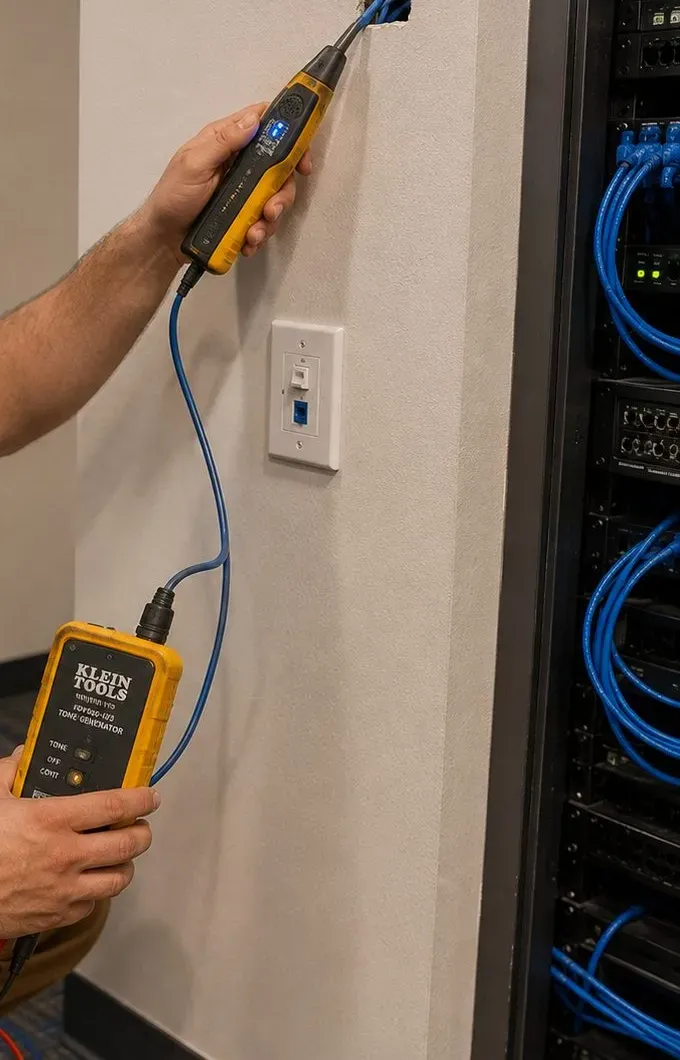
From the AESS job library, not taken in Jackson Heights: a probe hunts for a tone at a small wall opening above a data plate, with the yellow generator held lower on a blue lead. Old Jackson Heights apartments often hide cable a previous shareholder or a provider left behind; tracing it first can give the Sonos a wired path without opening any plaster.
What We Install
Sonos Installation Services in Jackson Heights
These are the jobs Jackson Heights households and businesses ask us for most, described the way they actually play out in a garden co-op, a rowhouse near Roosevelt Avenue or a shop on 37th Avenue.
Whole-apartment Sonos setup
Every product joined into one system, the rooms named the way your household talks about them, music services signed in, alarms and timers set, and Trueplay run where the product supports it. In a co-op, this is the part that needs no approval at all, so it is usually where we start.
Signal plans for masonry apartments
A walk of the route from the Fios or Spectrum box to every room, a check of what each wall is made of, then the smallest fix that works: the router moved into the open, one product wired, or an access point on a cable for the back of the apartment.
Soundbars on consoles and walls
Arc Ultra, Beam and Ray placed on furniture or hung under the TV. On a wall the board lets us use, we fix into what is actually there: brick, block, plaster or a later partition. On a wall it won't let us open, power and HDMI travel in a paintable cover.
Subs placed for shared buildings
Sub 4 or Sub Mini sited away from the wall you share with the next apartment, lifted off the floor on something firm, and its level trimmed for evenings, so the people downstairs and across the partition never feel the film.
Ceiling and in-wall speakers on an Amp
In the rowhouses and brick houses with joisted ceilings, and in co-op apartments whose boards approve the work, Sonos architectural speakers powered by a Sonos Amp, with an obstruction survey before any cut.
Board-ready scopes of work
A short written description of exactly what we will fix, where, with what, and during which hours, plus the certificate of insurance naming the building, sent to the managing agent before the day.
Existing stereos joined to Sonos
A receiver and a shelf of records from a previous home connected through a Sonos Port, or set up and wired in as part of the system, so decades of equipment keep working alongside new speakers.
Repairs and re-pairing
Speakers missing from the app after a provider change, a Sub that won't rejoin, surrounds that dropped after a move across the room. Diagnosed on the clock, with the network sorted before any product is blamed.
Music for shops and restaurants
Background music for businesses on 37th Avenue, 82nd Street, Roosevelt Avenue and 73rd and 74th Streets, with speakers aimed inside the shop, volume limits set, and control kept on a business account rather than one staff member's phone.
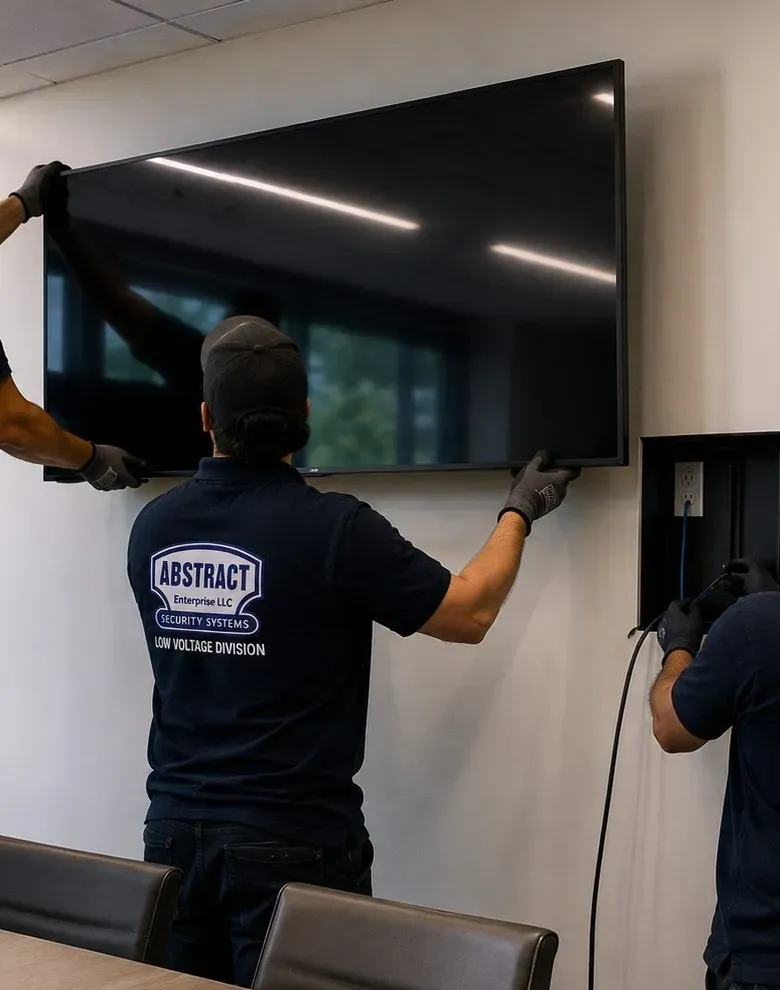
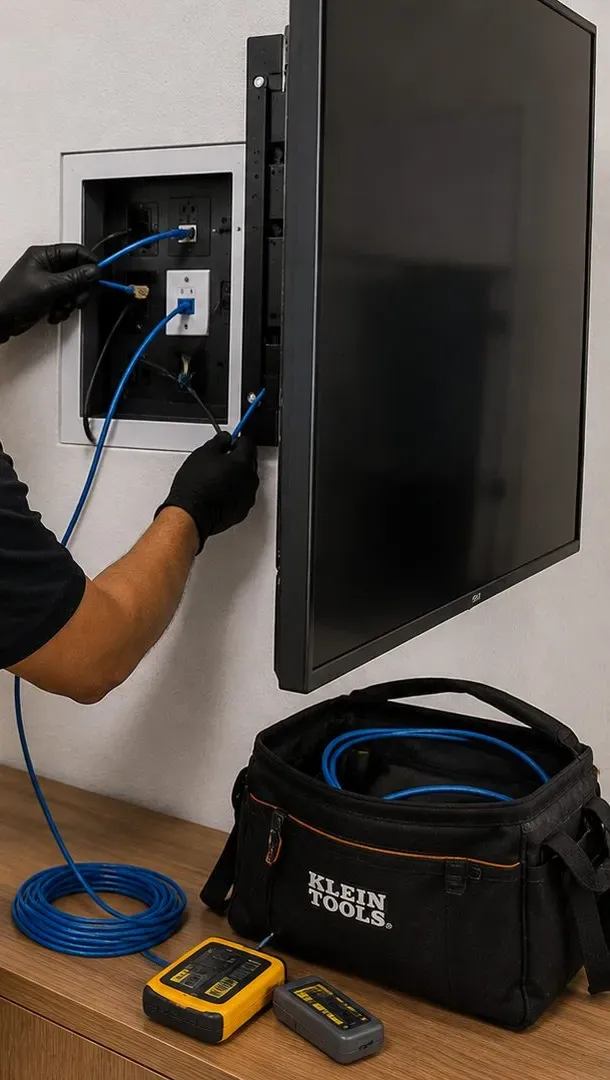
From the AESS job library, not photographed in Jackson Heights: a technician raises a flat-screen onto its mount while a gloved hand feeds a cable into a recessed box below. A recessed box like this means opening the wall, which in a Jackson Heights co-op is normally a board decision; where it is refused, the same cables travel in a paintable cover instead.
Building Specialists
Sonos Installation for Jackson Heights' Architecture
Within the district and around it, Jackson Heights homes fall into six families as far as a Sonos job is concerned. What separates them is not style, Tudor or Georgian, but three questions: how far the signal has to travel through what, who owns the walls, and whether there is any hollow space to hide a cable or a speaker in.
Five-storey walk-up courts
The attached four- and five-storey buildings around an interior garden, of which Hawthorne Court's fourteen are the largest example. Apartments run front to back, so the router at one end and the bedroom at the other can be separated by every partition in the plan. Everything we carry goes up the stairs, and the board or the agent has the final word on anything fixed.
Elevator garden co-ops
The larger apartment buildings with elevators, many of them in the block-long complexes and the halls of the 1930s. Usually concrete floors, plaster walls, an alteration agreement for anything that opens a wall, and a service entrance for trades. Plans lean on furniture placement and one wired product.
Divided apartments
After the crash of 1929 and through the Depression, many Jackson Heights apartments were split into smaller ones. A divided apartment often has one wall that is a later, lighter partition, and that wall decides where the Sub and the soundbar should not go.
The 1911 rowhouses
The two-storey-and-basement rowhouses on the west side of 83rd Street near Roosevelt Avenue, the oldest buildings left in the district. Owned rather than shared, joisted, with a cellar, so ceiling speakers and concealed cable are possible here in a way they rarely are in a co-op.
Double-houses on 86th Street
Pairs of houses built to look like one large single-family house. Each half has its own owner and its own internet, and the wall down the middle is shared, which shapes where each household's speakers and Sub can sit.
English Garden Homes and brick houses
The brick houses the Queensboro Corporation built across more than fifteen streets in the late 1920s, and the single-family and courtyard houses that followed in the 1930s. One owner, a cellar, a top floor, sometimes a tenant; the most flexible homes in the neighborhood for a wired Sonos system.
Material and method by building type
Home
What a bracket fixes into
How cable travels
Who decides
Walk-up court apartment
Plaster over masonry or block, checked with a detector first
Along baseboards and trims, through your own closets, in a paintable cover where it must cross a wall
Managing agent or board under the house rules
Elevator co-op apartment
Plaster over masonry; brick on outer walls
Surface routes inside the apartment; nothing through floors or hallway walls
Board for anything that opens a wall; agent for the service entrance and hours
Divided apartment
The original masonry by preference; the later partition only after we find what it is
Along the original walls rather than the partition
Board or agent; the neighbor through the partition in practice
1911 rowhouse
Brick, plaster on lath, wood joists
Through joist bays, closets and the cellar
The owner; LPC for anything outside
86th Street double-house
Brick and plaster; never into the shared center wall without both owners' agreement
Within your own half only
The owner of each half
English Garden Home or brick house
Brick, plaster, wood framing in later alterations
From the cellar up through closets and joist bays; attic where there is one
The owner; tenants' floors only with notice
The method follows the material. On plaster over masonry, we drill slowly with a masonry bit, use anchors made for solid walls, and stop if a detector or the drill tells us there is metal lath or a pipe in the way. On a later partition, we find out whether it is hollow before deciding anything heavy goes on it. In the rowhouses and brick houses, where the ceilings are joisted, the Sonos in-ceiling manual's instruction is the one we follow: an obstruction survey with a stud finder for joists, conduit, pipes, heating, ducts and air returns, a small pilot hole probed before the full cut, and a check of local building codes before any speaker wire runs through a ceiling. In every building, the cut-out size is set by the speaker: 8.25 inches for Sonos's 6-inch in-ceiling model and 10.125 inches for the 8-inch.
Most Jackson Heights co-op shareholders pair Sonos with one other upgrade. In the walk-up courts it is usually a TV on the wall; in the elevator buildings, a keypad lock on the apartment door, which goes through the same managing agent and the same insurance certificate as the Sonos work. Doing both in one visit means one approval instead of two.
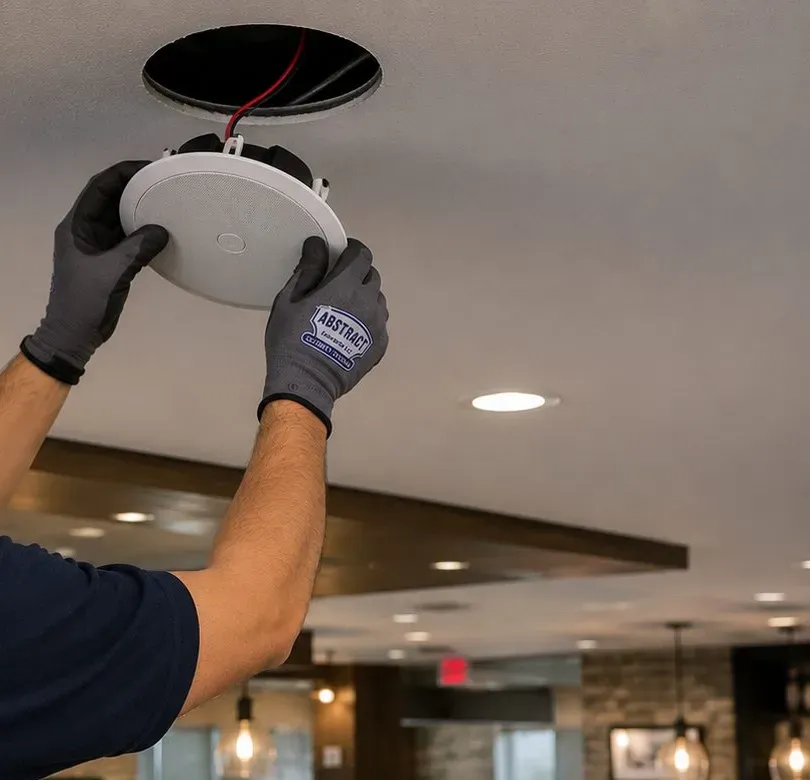
From the AESS job library, not photographed in Jackson Heights: two gloved hands push a white round speaker into a circular hole, red leads visible inside. In Jackson Heights this kind of work belongs mostly to the joisted ceilings of the rowhouses and brick houses, or to a co-op apartment whose board has signed off.
Before Anything Is Fixed
Who Has to Say Yes: A Permission Map for Sonos in Jackson Heights
A Sonos system is not one job but several small ones, and in a co-op neighborhood each of them sits at a different level of permission. Sorting them up front is the single most useful thing we do for Jackson Heights clients, because it lets the parts that need nobody's signature go ahead while the parts that need a board's are still being reviewed. The table below is how we sort them. It is general guidance, not legal advice, and every building's proprietary lease and house rules come first.
Part of the Sonos job
What it usually needs
Typical wait
Speakers, soundbar and Sub on furniture; system setup and tuning
Usually nothing beyond the building's normal rules for contractors coming in
None
A soundbar bracket or speaker mount on an apartment wall
Whatever the house rules say about fixing to walls; some buildings treat it as decoration that the managing agent can approve
Sometimes under a week where a decoration agreement is used
Cable inside walls, in-wall power and HDMI kits, ceiling speakers
Normally an alteration agreement reviewed by the board
Two to six weeks is the range a local remodeler gives for Jackson Heights
Anything on the outside of a building in the district, including the garden side
The board, and an LPC permit even where the street can't see it
Set by the board and the Commission; plan for it before booking
Work in an owned rowhouse or brick house, inside
The owner; tenants told where their floors are affected
None
Things that sit on furniture
Wireless Sonos products, the Era speakers, the portables and the soundbars, are designed to be set up by the owner, and a speaker on a bookshelf changes nothing about a building. A complete system can be built this way in almost any Jackson Heights apartment: the soundbar on the TV console, the Sub beside the sofa, a pair of Era speakers on stands, a portable for the kitchen. Our work in that case is placement, networking and tuning, and the only building rule that touches it is the one about contractors entering and the hours they may work. That is why we often recommend starting there, then adding brackets later if the household still wants them.
Things fixed to a wall
A bracket is where buildings start to differ. Brick Underground explains that a decoration agreement can sometimes be approved by the managing agent without a full board review, which can bring authorization in under a week, but whether a soundbar mount counts as decoration is each building's call. When we send the agent a scope of work, we say exactly how many holes, of what size, in which wall, and that we will fill them on removal. A precise, small request gets a faster answer than "install Sonos".
Things inside walls and ceilings
Cable pulled inside a wall, a recessed box behind the TV, and ceiling speakers all open the building's fabric, and Jackson Heights boards typically want an alteration agreement before that kind of work begins. Expect them to ask for the contractor's license and insurance, often for drawings or a description of the work, and sometimes for their own review. We write the description from the walkthrough: speaker positions, cut-out sizes, cable routes, which closet the Amp will live in, and how the openings are finished. Until the agreement comes back, the furniture-based parts of the system can already be playing.
Anything outside, including the garden side
This is the rule that surprises people. The interior gardens are the heart of Jackson Heights, and it is natural to want music on a garden-facing terrace or a wall facing the courtyard. Inside the historic district, exterior work needs an LPC permit even when it doesn't need a Buildings permit and even when it affects only a part of the property that can't be seen from the street. Advice for historic-district exteriors is consistent on the details: conceal conduit, and avoid unnecessary disturbance to historic masonry. We won't fix a speaker or run a cable on the outside of a district building without the board's agreement and the permit in hand.
Insurance, license and the contractor list
Boards generally require a contractor to be licensed and insured up to a stated amount, with the building named on the policy. AESS works under New York State low-voltage license #12000287431, and before the day we send the managing agent a certificate of insurance naming whoever the building specifies. If your building keeps a list of approved contractors or screens trades through management, tell us early, so the paperwork is in their hands rather than ours on the morning of the visit.
Timing the visit around the building
Many co-ops limit noisy work to weekday daytime hours and send trades through a service entrance. A Sonos visit is mostly quiet; the noisy part is a few minutes of masonry drilling for a bracket. We schedule that part inside the building's hours and do the setup, tuning and hand-over around it. If your building's rules aren't to hand, the managing agent will have them, and we'd rather read them before the visit than discover them in the lobby.
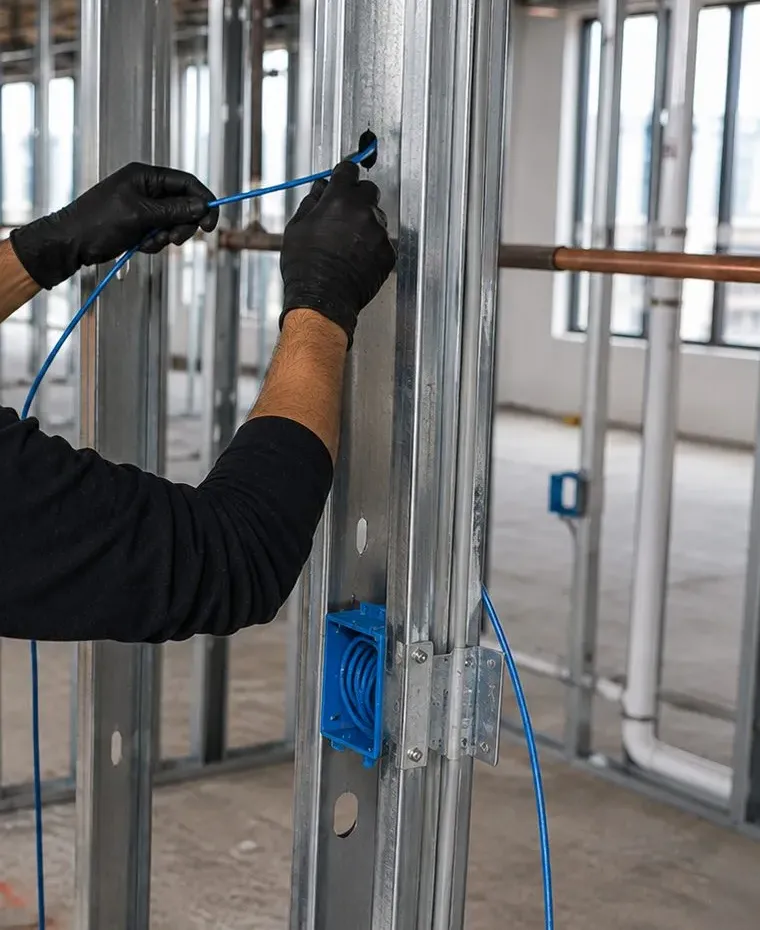
From the AESS job library, not taken in Jackson Heights: blue cable is drawn through a punched steel stud above a blue electrical box. Open framing like this appears in a Jackson Heights co-op only during an approved renovation, and that is exactly when speaker and network cable is cheapest to add, under the same alteration agreement.
Commercial Sonos Installation
Business Sonos Installation in Jackson Heights
Jackson Heights' commercial life runs along two east-west spines, Roosevelt Avenue and 37th Avenue, joined by 74th Street and 82nd Street. Nearly every shop has neighbors above it or beside it, so the business music we install here is about filling the shop and stopping at the door. These are the corridors we work in.
Little India: 73rd and 74th Streets
The main shops, restaurants and specialty stores of the neighborhood's South Asian commercial district, with 73rd Street known as more Bengali and 74th as more Indian. Narrow storefronts, deep plans and shelves to the ceiling, where several small speakers at modest volume beat one loud one.
Diversity Plaza and the 74th Street hub
The open plaza where 37th Road meets 73rd and 74th Streets, beside the station where the E, F, M, R and 7 trains stop. Shops facing the plaza deal with constant crowd and train noise outside, which sets the level the music has to clear without spilling out.
Roosevelt Avenue under the 7
Restaurants, counters and services under the elevated line from 74th Street east. Speakers are aimed down at the counter and the seating, never at the open door, and the volume limit is set with the train passing, not in a quiet moment.
37th Avenue and 82nd Street
The shopping streets the Queensboro Corporation planned as the main commercial district, with offices, practices and salons upstairs. Upstairs tenants with dropped ceilings can take ceiling speakers on an Amp; ground-floor shops usually share a ceiling with apartments.
Northern Boulevard
The neighborhood's northern edge, once named Jackson Avenue, with larger stores and the 115th Precinct nearby. It is also where residents complained of a shop owner playing music from a speaker set up out front, which is exactly the setup we talk businesses out of.
Building common rooms
Lobbies and community rooms run by co-op boards, where background music has to be easy for whoever opens the room to start and stop. Control goes on a building account, not a board member's phone, so it survives the next election.
Rules and conditions for business sound in Jackson Heights
Music inside a home next door. The city's noise code guide limits commercial music to 42 dB as measured inside a nearby residence, with a further limit between 10 PM and 7 AM and a separate test for bass. In mixed buildings along 37th Avenue and Roosevelt Avenue, that figure decides speaker type, position and the cap we set in the app.
No speakers pointed at the sidewalk. A speaker set out in front of the shop is what generated complaints at the precinct council meeting. We aim everything inside and set a volume limit staff can't exceed from the app.
Storefronts in the district. Inside the historic district, anything fixed to the exterior of a building, including a speaker over the door or a cable along the facade, needs an LPC permit as well as the landlord's agreement.
Licensed music for customers. Consumer streaming plans are sold for personal listening. A shop, restaurant or salon playing to the public should use a business music service, and we connect Sonos to whichever one the owner chooses.
Ceilings and sprinklers. Nothing is fixed to sprinkler pipes or hung from them, nothing obstructs a sprinkler head or detector, and cable above a ceiling that carries return air must be rated for it.
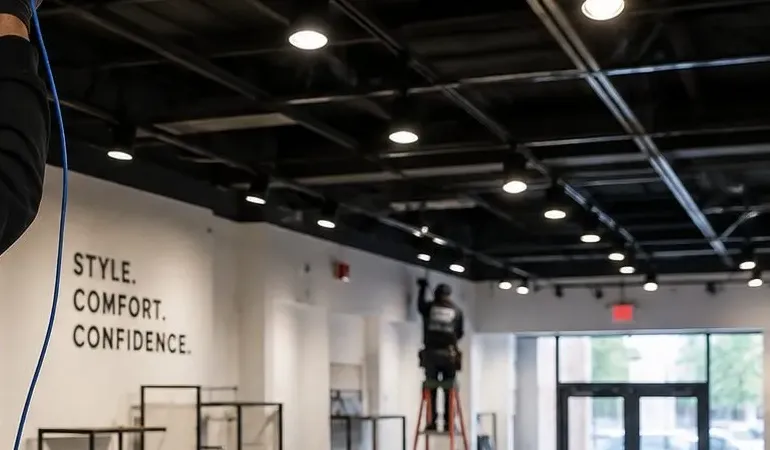
From the AESS job library, not photographed in Jackson Heights: an open black shop ceiling with track lights, a blue cable hanging at the left and a worker on a ladder at the back. Shops on 74th Street and 37th Avenue that have an open ceiling like this can hang pendant speakers from it; most still have apartments above, so the speakers point down at the floor.
Your Questions Answered
Sonos Installation in Jackson Heights: Questions Answered
Jackson Heights residents and business owners ask us things our other Sonos pages don't answer, because they come from the particular mix of old masonry, co-op paperwork and landmark rules here. They are grouped by what is really being asked.
Getting the signal through
Older advice says to add a Sonos Boost when thick walls block the signal — can we still buy one for our co-op?
Don't plan on it. The Boost was Sonos's small wireless adapter for exactly this situation, and it is still recommended in older forum threads, but at least one large retailer now lists it as no longer available. When Sonos dropped the requirement for a wired bridge, it said homes with walls that eat wireless signals might still need one, and today the same job is done with a network cable instead. Sonos's system requirements describe a wired setup as one or more Sonos products connected to the router by Ethernet at all times. In a Jackson Heights apartment, that usually means the soundbar or an Amp near the router on a short cable, or a properly configured access point on a cable for the back rooms. Plug-in range extenders are not a substitute; Sonos lists them as unsupported, and they are a common reason a speaker disappears.
Does it make any difference to Sonos whether our building gets Fios or Spectrum?
It changes what we expect to find, not whether Sonos will work. BroadbandNow's listing for the neighborhood says Verizon Fios provides the best internet in Jackson Heights and Spectrum the fastest, so most apartments we walk into have one or the other. Sonos cares about the router in your apartment, not the company behind it. On either, we confirm that the 2.4 GHz band is switched on, because Sonos says every product works on 2.4 GHz and routers offering only 5 GHz aren't supported; that security is WPA or WPA2 Personal, not an enterprise log-in; and that the phone running the app is on the same network as the speakers rather than a guest network. The more important question is where the provider's technician put the box, because that decides how many old walls the signal has to cross to reach the music.
The Wi-Fi is fine until one particular doorway, then it falls apart — what could be inside a 1920s wall that does that?
Usually metal, or a lot of plaster. Engineers who study New York apartment houses of the period describe stair enclosures of terra-cotta block covered in plaster, vestibules of gypsum block and, in many buildings, plaster carried on metal lath. Sonos's interference table rates plaster as a high obstruction and metal as very high, so a wall of plaster on lath can cost far more signal than its thickness suggests. Other suspects near a doorway are a radiator enclosure, a metal medicine cabinet backing onto the wall, or a closet with a steel door. We check with a metal detector and a phone reading on each side. If the wall is the problem, no speaker setting fixes it; the remedy is getting the signal around the wall, by moving the router, wiring one product, or placing an access point on the far side.
Will the same masonry that blocks our Wi-Fi also keep our music from reaching the neighbors?
Partly, and not in the way most people hope. Heavy masonry is good at stopping the middle and high frequencies of music and speech travelling through the air, which is why Jackson Heights apartments can feel quiet. Low frequencies are a different matter: they travel through the structure itself, through floors, joists and walls, and Brick Underground lists bass music alongside footsteps as among the most common sounds behind neighbor complaints. So a Sub can reach the apartment below or next door even when the music it accompanies can't. What helps is placement, not more masonry: keep the Sub off the wall you share and off a bare floor, put it on something firm, run Trueplay with it in its final spot, and trim its level in the app for evenings. Night Sound on the soundbar reduces loud peaks while lifting quiet dialogue.
Approval and paperwork
Could our Sonos job go through as a decoration agreement signed by the managing agent instead of a full board alteration?
Sometimes, depending on which parts of the job you include. Brick Underground explains that a decoration agreement can be approved by the managing agent without a full board review, sometimes in under a week, while alteration agreements in Jackson Heights can take anywhere from two to six weeks according to a local remodeler. Whether a Sonos job counts as decoration is each building's decision. In our experience the dividing line is the wall: speakers on furniture rarely need either agreement, a soundbar bracket might be treated as decoration, and cable inside walls or ceiling speakers almost always needs the alteration route. We write a precise one-page scope, with hole counts, positions and materials, so the agent can decide quickly which agreement applies.
Does a speaker on the garden-facing wall need a Landmarks permit when no one on the street will ever see it?
Inside the historic district, yes, plan on it. The LPC's position, as summarized for applicants, is that exterior work needs a permit even when it doesn't require a Buildings permit and even when it affects only a part of the property not visible from the street. A speaker bracket on the courtyard face of a building, or a cable run along the brick to a terrace, is exterior work. The board will want a say as well, since the garden and the outside walls belong to the corporation. If the paperwork isn't worth it for a few summer evenings, the practical alternatives are a portable Sonos carried out when the garden rules allow, or a speaker kept indoors and aimed into your own room rather than through the window.
The managing agent wants the building named on your insurance — what does that certificate actually show them?
It shows that AESS carries the insurance the building asks for, the types and limits of cover, the dates it runs, and the building, and often its managing agent, named as certificate holder or additional insured in the wording the agent specifies. Boards generally require contractors to be licensed and insured up to a stated amount with the building named on the policy, and the agent checks the certificate against that requirement before letting trades in. Send us the exact names and any required wording from the agent's instructions, and we have the certificate issued and sent before the visit. Alongside it we can give our New York State low-voltage license number, #12000287431, which some buildings keep on file with the contractor's details.
Old rooms, later walls
Our apartment was carved out of a bigger one decades ago — how do we tell which walls are later partitions before we place speakers?
The building gives clues, and a short test settles it. Many Jackson Heights apartments were divided into smaller ones after the 1929 crash and during the Depression, so a divided apartment often has a wall that doesn't match the rest: thinner at the door frame, different in sound when knocked, sometimes without the original moldings that run around the other rooms. A detector and a small inspection at a switch plate usually confirm it. That wall matters for two reasons. A later partition may be lighter and may carry sound to the apartment next door more readily than the original masonry, so the Sub and the soundbar belong elsewhere. And it may be a poor place for a heavy bracket. We place the anchor of the system on an original wall when one serves the sofa, and keep the later partition for nothing heavier than a picture.
We own one of the old rowhouses near Roosevelt Avenue — with no board involved, what decides where ceiling speakers can go?
The joists, what is between them, and the outside of the house. The two-storey-and-basement rowhouses on the west side of 83rd Street date from 1911, the oldest buildings in the district, and inside them the ceilings are framed in wood with spaces between the joists where a speaker can sit. Sonos's in-ceiling manual tells installers to survey for joists, conduit, pipes, heating, ducts and air returns before cutting, to drill a small pilot hole and probe if unsure, and to consult local building codes before running speaker wire through ceilings. The cut-out for the 6-inch model is 8.25 inches and for the 8-inch 10.125 inches, so the space between joists decides the model. With a cellar below, cable usually reaches an Amp downstairs or in a closet. Nothing inside needs the Landmarks Commission; anything outside does.
Our living room is split by one of the original arched openings — where does a stereo pair go when the room has an arch in the middle?
Keep the pair on one side of the arch, facing the seats, and treat the other side as its own space. A stereo pair works when both speakers point at the listener from roughly equal distances; split across an arch, one speaker ends up behind the wall the opening cuts through. Sonos's in-ceiling manual suggests stereo speakers six to ten feet apart, and the same spacing is a sensible guide for a pair on stands or shelves. Put the pair either side of where you sit, and if the dining end beyond the arch needs music, give it a single speaker of its own, grouped with the pair when you want sound everywhere. Run Trueplay for each room separately, because the plaster and the arch reflect sound differently on each side.
Neighbors and shops
A neighbor says they will record our music on a phone and send it to the board — what will that recording actually show?
Less than they hear, especially of the bass. Brick Underground points out that smartphone recordings do not accurately capture low frequencies such as footfalls and bass music, which are among the sounds that cause complaints. So a recording can show very little while the person upstairs still feels every beat through the floor. That cuts both ways: a quiet recording doesn't prove there is no problem. The city's 311 guidance sends complaints about a neighbor in your building to the tenant association, owner or super first, so in a co-op the board is usually where it lands. The useful response is a change the neighbor can feel: the Sub moved off the shared wall and floor, its level lowered, Night Sound on after a set hour, and a volume limit in the Sonos app.
Our shop on 74th Street is narrow with stock up to the ceiling — will all those full shelves swallow the music?
They will soften it, which is not a bad thing. Shelves full of fabric, packets and boxes absorb the high frequencies that make music bright and reflect them less than bare walls, so a stocked shop sounds duller and quieter than an empty one at the same volume. The answer is not a bigger speaker at the front turned up to reach the back. That fills the doorway, annoys the neighbors above and spills onto the sidewalk, which is what brought complaints about a Northern Boulevard store at a precinct meeting. Several small speakers spaced down the length of the shop, each at a modest level, give even sound from the door to the counter. We tune with the shelves full and set a volume limit staff can't exceed from the app. Use a licensed business music service for customers.
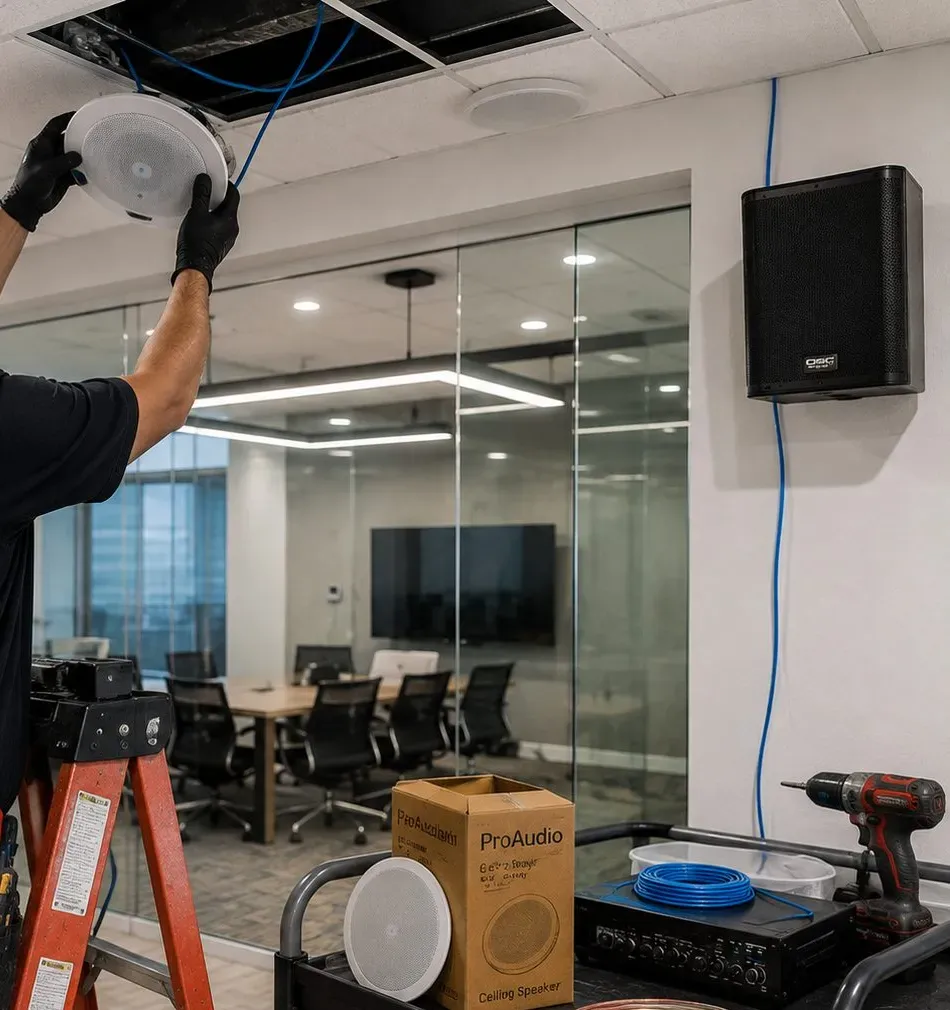
From the AESS job library, not photographed in Jackson Heights: a round speaker is lifted toward an open ceiling tile with blue cable waiting, while a cart below carries a black wall speaker and an amplifier. Upstairs offices and practices on 37th Avenue and 82nd Street with tiled ceilings are where this kind of installation fits best in the neighborhood.
Equipment
Types of Sonos Systems We Install
You can buy Sonos products wherever you like; AESS isn't a Sonos dealer, and some competitors who serve Jackson Heights make a point of being one. What we bring is the installation: knowing which product suits a plaster-walled co-op room and where it should sit so the signal and the sound both work. These are the categories we install most here.
Arc Ultra
The largest Sonos soundbar, for living rooms with a proper TV wall. Sonos says it detects when it is wall-mounted and adjusts its EQ to temper bass resonance from the wall. It can use 5 GHz Wi-Fi, which helps where the router is in the same room.
Beam (Gen 2), Beam Ultra and Ray
Smaller soundbars for the many Jackson Heights living rooms where the TV sits on a console between windows. Beam connects by HDMI ARC or eARC; Ray connects optically and lives happily inside furniture.
Sub 4 and Sub Mini
Wireless subwoofers. Sonos lets them sit in a corner, against a wall or beside furniture with the front opening clear. In shared buildings we put them against an outside or internal wall of your own, never the shared one, and off a bare floor.
Era 100 and Era 300
The flexible speakers: bedrooms, kitchens, a stereo pair in the living room, or surrounds for a soundbar. Sonos describes its Era 300 wall mount as stud-mounting only, not for drywall, so on brick or block we settle the fixing at the walkthrough.
Roam 2 and Move 2
Battery portables. In Jackson Heights they are the honest answer to garden music in buildings where nothing may be fixed outside: carried down when the garden is open, carried back up after.
Sonos Amp
Powers passive ceiling or in-wall speakers in rowhouses, brick houses and approved co-op renovations. Reviewers measured it at 125 watts per channel into 8 ohms, with HDMI ARC for a TV and two Ethernet ports.
In-Ceiling speakers by Sonos and Sonance
Passive 6- and 8-inch models with paintable grilles, optimized for the Amp. Sonos says one Amp reliably powers up to three pairs wired in parallel. Cut-outs are 8.25 and 10.125 inches.
Sonos Port
Joins an existing receiver to the system, with analog and digital coax outputs and a 12V trigger. Sonos asks for at least two inches of space around it on a shelf and to keep it away from radiators and heat, which in steam-heated buildings matters.
Cable and access points
Not Sonos products, but often the most important part of a Jackson Heights system: a short network cable to one product, or an access point on a cable for the far end of the apartment, configured the way Sonos's requirements describe.
Which Wi-Fi band each product can use
Sonos publishes which of its products can use which wireless modes, and in a building where the 5 GHz band fades after one wall, it tells you which speakers will fall back on 2.4 GHz anyway. All of them support 2.4 GHz; that is why it must never be switched off.
Wireless support (Sonos's published list)
Products
What it means here
2.4 GHz including 802.11n
Amp, Arc, Beam Gen 1 and Gen 2, Beam Ultra, Ray, among others
Every product reaches the router on the band that travels best through plaster
5 GHz with 802.11ac/ax
Arc Ultra, Beam Ultra, Era 100, Era 300, Move 2, Sub 4, Amp Multi
Faster where the router is near; less reach through masonry
5 GHz with 802.11n/a
Five, Port, Sub Mini, Sub Gen 3, One Gen 2
Fine in the same room as the router; plan a cable for distant rooms
802.11b/g on 2.4 GHz only, no WPA3
Products limited to the older S1 app
Older inherited speakers need a router setting that still supports them
National brands or a local installer
Every big-box store and gig app will sell you the same Sonos boxes and offer to "set them up". That is fine in an apartment with drywall and a router in the living room. In a Jackson Heights co-op, the work that matters happens before the boxes are opened: the signal route through old masonry, the managing agent's paperwork, the walls you may and may not touch. Those are the parts a national menu doesn't price, and the parts we put in writing.
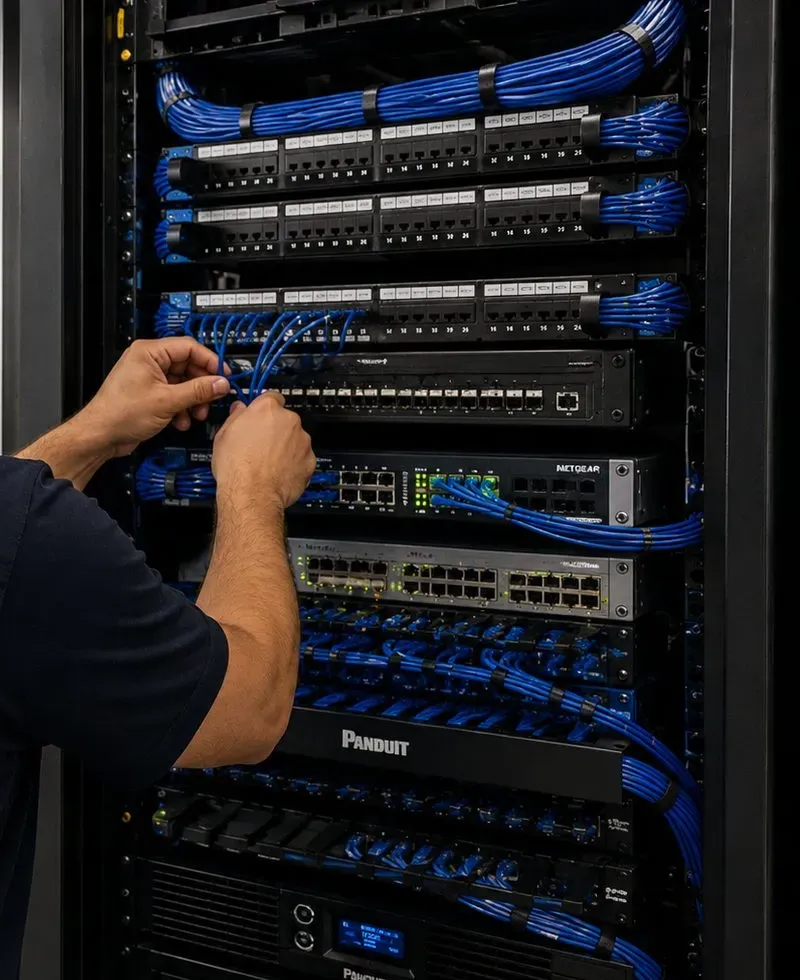
From the AESS job library, not photographed in Jackson Heights: an arm guides blue patch leads into a switch in a black rack beneath patch panels. Racks like this belong to the larger Jackson Heights jobs, a restaurant or an office upstairs on 37th Avenue; in an apartment the same idea shrinks to one cable and one small switch beside the router.
AI Overview Reality Check
What AI Gets Wrong About Sonos Installation in Jackson Heights
We could not view Google's AI Overview from our research environment, so the claims below are ones published on installer pages, cost guides such as HomeAdvisor and Angi, retailer listings and forums, which answer engines tend to repeat. Each is tested against what a Jackson Heights home actually involves.
"Wireless Sonos speakers are designed for self-installation."
That is a fair summary of the product, and an installer's cost guide says exactly this about Era 100, Roam 2, Move 2 and the soundbars. Plug them in, open the app, follow the prompts. In plenty of Jackson Heights apartments a household does just that and is happy.
The trouble is that "self-installation" assumes the network reaches every room and that nobody else has a say in where things go. In a co-op with plaster on metal lath between the front rooms and the bedrooms, the speaker that set up perfectly in the living room may never be seen in the back. And the moment a bracket or a cable inside a wall is involved, the board's alteration process becomes part of the job.
So the honest version for Jackson Heights is: self-install the products, but plan the signal path and the permissions first. Where help earns its fee is the network and the paperwork, not the unboxing.
"If your walls block the signal, add a Sonos Boost."
This advice is everywhere in older forum threads and how-to articles, and for years it was right. The Boost gave Sonos its own wireless network from the router, and Sonos itself said homes with signal-eating walls might still need a bridge.
At least one major retailer now lists the Boost as no longer available. Recommending one to a Jackson Heights shareholder today sends them hunting for a discontinued product, possibly second-hand and of unknown condition.
The current route to the same result is a network cable from the router to one Sonos product, which Sonos's system requirements describe as a supported wired setup, or an access point on a cable placed beyond the problem wall. Both are ordinary, available and easy for the next person to understand.
"In-ceiling speakers run a few hundred dollars a pair, plus labor."
HomeAdvisor's surround-sound guide puts in-ceiling speakers at a few hundred dollars per pair, plus labor and wiring, and another cost guide gives a broad labor budget for running wire through finished ceilings. As national averages for houses with hollow ceilings and easy attics, they are not unreasonable.
They say nothing about the step that comes first in a Jackson Heights co-op: getting the board to agree to holes in the ceiling at all, which can take weeks, and finding out whether the ceiling is plaster on lath, concrete, or something else. In many co-op apartments the realistic answer is that ceiling speakers aren't approved, and the system is built on furniture and brackets instead.
Where ceiling speakers are possible, in the 1911 rowhouses, the brick houses and approved renovations, we price them only after a walkthrough, in writing, from what the ceiling actually is. A national per-pair figure is not a quote for a Jackson Heights ceiling.
"A basic surround installation takes four to six hours."
One installer's page gives roughly four to six hours for a basic 5.2 surround installation, adding that jobs with stone or brick and hidden cabling can take days. The second half of that sentence is the one Jackson Heights residents should read.
A Sonos system on furniture, a soundbar, a Sub and a couple of speakers set up and tuned, is a much shorter visit than four hours in most apartments here, because there is no cable to pull. Masonry changes the picture only when we fix into it or route cable around it, and drilling brick and plaster is slower and more careful than driving screws into drywall.
So the visit length depends on which parts of the permission map you are using. We tell you in the written quote which parts are quick setup and which involve masonry, and we keep the drilling inside the building's permitted hours.
"In a historic district you need Landmarks approval for anything you do."
This one is wrong in both directions. People assume the Commission must approve speakers inside their apartment, and they assume a speaker out back, where the street can't see it, is fine.
The LPC's own rules point the other way. Interior work needs an LPC permit only if it needs a Department of Buildings permit, if it affects the exterior, or if the space is an interior landmark, so Sonos speakers set up inside an apartment usually never reach the Commission. Exterior work, by contrast, needs a permit even when it doesn't need a Buildings permit and even when it affects only a part of the property not visible from the street.
In Jackson Heights that means the garden side of a building is not a loophole. Music inside is a matter for you and your board; a bracket or a cable on the courtyard wall is a matter for the Commission too.
"Hire an authorized Sonos dealer to install your system."
Some installers who serve Jackson Heights advertise themselves as authorized Sonos dealers, and that status is real and useful if you want to buy everything in one place. AI summaries sometimes turn it into a requirement.
It isn't one. The wireless products are sold for owners to set up themselves, and the architectural speakers and Amp are standard components that any competent low-voltage installer can fit. What a co-op board asks for is a licensed, insured contractor with the building named on the certificate, not a dealer agreement.
AESS isn't a Sonos dealer. You buy the products wherever the price is best; we install them under New York State low-voltage license #12000287431, with the insurance certificate your managing agent needs.
"If the neighbors complain, a phone recording will settle it."
Forum advice on noise disputes often suggests recording the problem. It sounds objective, and both sides in a Jackson Heights building sometimes reach for it.
Brick Underground notes that smartphone recordings do not accurately capture low frequencies such as footfalls and bass music, which are among the most common sources of complaints. A recording can therefore make a thumping Sub sound like nothing at all, while the household downstairs still feels it every evening.
The city's 311 guidance sends complaints about a neighbor in your building to the tenant association, owner or super, which in a co-op usually means the board. What resolves those complaints is not a recording but a real change: the Sub moved off the shared wall and floor, its level trimmed, a volume limit set in the app, and Night Sound on in the evenings.
Sort the Signal and the Paperwork First
Send a photo of where your Fios or Spectrum box sits, the rooms you want music in, and your building's rules if you have them. We send back a plan and a written figure from the Queens list.
A walk-up court off 35th Avenue, an elevator co-op near 82nd Street, a rowhouse on 83rd, a brick house east of 87th Street or a shop on 74th — tell us the building and the products, and a written Queens total comes back before the business day ends. Rather talk it through? Call (347) 434-6392.
✅
Got It — Your Jackson Heights Request Is In
A Queens installer will phone to book a time, normally within 2 hours. In a hurry? Ring (347) 434-6392.
How It Works
Our Installation Process
Seven steps, whether the job is a soundbar on a console in a walk-up court or ceiling speakers through a whole brick house. In Jackson Heights the order matters: permission and signal come before speakers.
1. Photos, house rules and products
Send photos of the rooms, the spot where the internet comes in, the Sonos products you own or plan to buy, and your building's house rules or alteration terms if you have them. If you don't, tell us the managing agent and we will ask.
2. A written figure from the Queens list
We pick the Queens lines that apply, setup, a console placement or wall mount, a bracket, perhaps a cable run, and email the sum. Anything inside a ceiling, behind plaster the building controls or on the outside of a district building is marked for a walkthrough instead of guessed.
3. Paperwork to the managing agent
A one-page scope of work and the certificate of insurance naming the building go to the agent or board, and we confirm the permitted hours and the entrance the crew must use, before anyone books a day off work.
4. A walkthrough for concealed or outside work
Ceiling speakers, cable inside walls, anything on the garden side and any bracket on original masonry get a short visit first, so the wall material, the route and the approvals are known before the final figure is written.
5. Network first
Before a speaker is placed, we confirm the router's 2.4 GHz band is on, remove extenders and powerline adapters Sonos doesn't support, and connect one product or an access point by cable where the masonry blocks the signal.
6. Place, connect and tune
Soundbar, Sub and speakers go on furniture or approved brackets, the Sub away from the shared wall, every product joins one system, rooms are named the way you talk, and Trueplay runs in each room with the radiators and fans quiet.
7. Hand-over and a written map
Every adult in the home gets the app on their own phone, volume limits and timers are set, and you keep a short written note of what is where, which product is wired and what the building approved, ready for the next owner or the next board question.
Coverage Area
Sonos Installation Near Jackson Heights' Landmarks
Jackson Heights addresses are easiest to picture by these places, from the oldest buildings near Roosevelt Avenue to the parks and plazas people meet in.
The Laurel, 82nd Street at Northern Boulevard
The first of the Queensboro Corporation's buildings in Jackson Heights, completed in 1914, two years before the company laid out the rest of the neighborhood.
The 1911 rowhouses on 83rd Street
Two-storey-and-basement houses on the west side of 83rd Street near Roosevelt Avenue, the oldest surviving buildings in the historic district according to its designation report.
Hawthorne Court
George H. Wells's 1922 complex of fourteen five-storey buildings, one of the block-long garden complexes the Queensboro Corporation built between 1920 and 1925.
The 86th Street double-houses
Pairs of houses designed to read as large single-family homes, among the most distinctive buildings in the district and a different kind of Sonos job from the co-ops around them.
Diversity Plaza and the 74th Street hub
The open space surrounded by small shops where 37th Road meets 73rd and 74th Streets, beside the station served by the E, F, M, R and 7 trains.
Travers Park and Paseo Park
Travers Park, between 77th and 78th Streets on the north side of 34th Avenue, which the DOT pictured as the "green core of the neighborhood" when the 34th Avenue Open Street was redesigned as Paseo Park in 2022.
We also install Sonos in the neighborhoods around Jackson Heights: East Elmhurst to the north, Woodside to the west, and Elmhurst and Corona to the south and east, all at the same Queens rates. Further afield, there are neighborhood pages for Sonos installation in Astoria, Long Island City Sonos installers and Sonos in Forest Hills.
From the AESS job library, not photographed in Jackson Heights: black cable is pulled from a metal pull box on a painted block wall, a blue coil hanging below. Painted block walls like this are typical of cellars and service areas, the spaces a Jackson Heights house owner, or a board with its own project, can use to route cable without touching finished rooms.
Bass, Shared Walls and Staying on Good Terms With the Neighbors
A Sonos system in Jackson Heights is almost never in a detached house. It usually sits inside a 1920s or 1930s masonry co-op or garden apartment, built around a shared interior courtyard, with neighbors above, below and beside you. That makes sound planning part of the installation, not something to sort out after the speakers are on the wall. Noise is a live issue here. At a 115th Precinct community council meeting, Jackson Heights residents were very vocal about noise complaints. One complaint was about a Northern Boulevard store whose owner set up a speaker in front of the storefront and blasted music to attract customers. That report is older, but the point holds: people in this neighborhood notice amplified sound, and they speak up about it.
Low frequencies cause the most trouble. Footfalls and bass music are among the most common sounds behind neighbor complaints. They are also hard to document, because smartphone recordings do not accurately capture low frequencies. So a neighbor can be genuinely bothered by your subwoofer while neither of you can prove much from a phone clip. That is a poor basis for settling a dispute and a good reason to plan the bass carefully from the start.
In practice, we talk about the sub before we talk about placement. We ask which walls and floors you share, what is on the other side, and when you expect to listen loudly. A Sonos Sub or a surround setup can still work well in a co-op. It just needs to be a deliberate choice rather than a default add-on. For some households, a soundbar on its own, or a pair of wireless speakers, gives the room enough body without sending low end through the slab to the apartment below. For others, a sub is worth having, and we decide together where it goes and how the system is tuned so the bass stays in your room as much as possible. Once the system is running, Sonos lets you adjust bass and other settings from the app. We walk you through those controls so you can turn the low end down for late-night listening without needing a call back.
Outdoor zones raise the same concern with fewer walls in the way. A patio speaker or a courtyard zone in a building organized around a shared interior garden can carry sound to every window that faces it. Because outdoor speakers and exterior wire runs in the historic district can also need a Landmarks permit, we treat any outdoor Sonos zone as something to plan with the building, not just with the homeowner.
If a noise problem does come up, the city's own guidance starts close to home. Many buildings have rules about noise, and 311 advises contacting your tenant association, building owner or super if a neighbor in your building is often noisy. That works both ways. If you are installing a system you plan to use at volume, it helps to know your building's noise rules before the install, not after a complaint. The scale of housing complaints shows why this is worth getting right. A third-party aggregator reports that Jackson Heights tenants filed about 9,634 housing complaints to 311 in the 12 months to September 2026, and that HPD issued 31.5 violations per 100 apartments over the same period, close to the citywide 30.1. A well-planned Sonos system shouldn't add to either number.
None of this means giving up good sound. It means choosing the right products for the apartment you actually live in, putting the low end where it does the least harm, and leaving you with a system you can enjoy without worrying about the people next door.
Install Day in a Jackson Heights Co-op: House Rules, Hours and Building Access
Once the paperwork is approved, a separate set of rules decides how the actual work day runs. Co-ops in Jackson Heights publish house rules, and those rules shape everything from when we can drill to which door we use. As an example, the house rules for the Allendale Apartments at 34-24 82nd Street limit construction and installation noise to weekdays from 8:30 AM to 5 PM. They send messengers and trades through a service entrance on the south side of the building, restrict deliveries to 8:30 to 5 Monday through Friday and 9 to noon on Saturday, and require contractors to be screened and approved by management. That is one building, not every building. But it shows how specific these rules can be, and we plan around your building's version of them.
Hours matter most for wired work. Wireless Sonos speakers such as the Era 100, Roam 2, Move 2 and the soundbars are designed for self-installation, and placing them makes little noise. In-wall or in-ceiling Sonos Architectural speakers are a different job. Cutting openings, fishing cable and mounting in plaster over brick are exactly the kinds of tasks a weekday installation window is written for. Masonry is also slower to work in. A basic 5.2 surround installation may take about four to six hours, but jobs involving stone or brick and hidden cabling can take days. In a building that only allows noisy work during set weekday hours, a multi-day job has to be scheduled within those windows from the beginning, so we map out which tasks are loud and which are quiet before we book the dates.
Contractor screening is the other half of install day. Boards generally require contractors to be licensed and insured up to a set dollar amount, with the building named on the insurance policy. We get that certificate to your managing agent in the form they ask for, before the scheduled date, so nobody is held up at the door. The demands can go further. One Jackson Heights resident, reviewing an electrician on Yelp, described living in a co-op that required licensed, insured electricians with a COVID safety plan. Whatever your building asks for, it is easier to collect and submit it early than to sort it out on the morning of the job.
Access deserves the same care, for the building's sake as much as yours. Jackson Heights co-ops have dealt with real security problems at their shared doors. In 2020, a burglar got into a 34th Avenue co-op at about 3 a.m. It was the second burglary at that building since July, and residents said many neighbors, especially seniors, tended to buzz people in without seeing who they were. In 2025, police looked for a burglar who broke into the building at 83-10 35th Avenue just after midnight on March 8. Mailbox thefts have hit the Sheila Terrace apartments and the Berkley Co-Op on 77th Street. With that history, supers and doormen have every reason to be careful about who comes in. We arrive at the agreed time, check in through whatever entrance the building names, keep the service entrance or lobby door closed behind us, and never prop a shared door open to make carrying gear easier.
Shared spaces come with their own rules too. The same Allendale house rules keep the garden open from 9 AM to sundown and require the garden fire door to stay closed at all times. If your Sonos plan includes a courtyard or garden zone, or a cable route that passes near shared areas, we confirm with management where we can and cannot work, and when. Outside, the priorities are the ones Landmarks guidance emphasizes for historic buildings: conceal conduit and avoid unnecessary disturbance to historic masonry.
Last comes the network. BroadbandNow lists Verizon Fios as the best internet in Jackson Heights and Spectrum as the fastest, so on most jobs we expect to find one of those providers' routers or ONTs in the apartment. Knowing that ahead of time lets us bring what we need to connect the system on the first visit. It also matters because the Sonos Boost, long the standard fix for weak Wi-Fi, is now listed by at least one retailer as no longer available. Sonos has said that homes with walls that eat wireless signals might still need a bridge, so we plan the connection around the gear you actually have rather than a part we may not be able to get. By the end of install day the goal is simple: the system works, the building is satisfied, and the hallway looks exactly as it did when we arrived.
Pricing
Sonos Installation Cost in Jackson Heights
Jackson Heights pays the Queens rates, and the historic district adds nothing to them. Every line below is copied from the price list on our Queens Sonos page. Pick the lines that match your home, add them up, and that is what the written quote, and later the invoice, will show. Work inside ceilings or walls the board controls, and anything on the outside of a building in the district, is priced in writing after a walkthrough and before anything starts.
Item
Queens price
What it usually means in Jackson Heights
Sonos setup (Sonos / wireless surround)
$125
One charge for the system: every product joined, rooms named, soundbar, Sub and surrounds built, music services and timers set, Trueplay run
Soundbar wall-mounted under the TV
$129
Hung and levelled beneath the screen on a wall the building allows, connection tested before we leave
Soundbar placed on console or stand
$79
The choice for co-ops that won't approve a bracket yet: on furniture, connected and working
Sanus soundbar bracket
$84.99
Only if you need the bracket; added to the $129 wall mount
Single cable run up to 25 feet
$99
The usual cure for a back room the Wi-Fi can't reach through old masonry: one Sonos product wired to the router
Repair or diagnostic visit, nothing mounted
$195 first hour
Charged on time at the Queens rate, then half-hour blocks
From the AESS job library, not photographed in Jackson Heights. Every Jackson Heights Sonos job is priced from the same Queens list, with concealed or exterior work quoted in writing after a walkthrough.
Full terms — including 50% deposit, one-year parts-only warranty on AESS-supplied products, and the late-fee schedule — are set out in the service agreement.
Sonos Installation in Jackson Heights: Quick Answers
How much does Sonos installation cost in Jackson Heights?
Jackson Heights pays the Queens rates: $125 joins and tunes a whole Sonos system, a soundbar on a console is $79, a soundbar hung under the TV is $129, plus $84.99 for a Sanus bracket if needed, and a single cable run of up to 25 feet is $99.
Why do my Sonos speakers drop out in the back rooms?
Usually the walls. Sonos rates plaster as a high obstruction and metal as very high, and many Jackson Heights apartments have plaster on metal lath. The fix is getting the signal around the wall: moving the router, wiring one product, or an access point on a cable.
Does my co-op board need to approve a Sonos installation?
Speakers on furniture rarely need approval. A bracket depends on the house rules, and cable inside walls or ceiling speakers normally needs an alteration agreement. We send the managing agent a one-page scope and the insurance certificate before the visit.
Do I need a Landmarks permit for Sonos speakers?
Not usually for speakers inside an apartment. Anything on the outside of a building in the historic district, including the garden side, needs an LPC permit even when the street can't see it.
How quickly can you come out?
Requests are booked within 2 hours. Call (347) 434-6392 or send the short form for a written Queens figure.