Front-door camera dark, a back-garden camera gone from the app, or a West End Avenue shop that needs last night's clip? Manhattan Beach camera repair line, booked within 2 hours: (347) 934-8335
Detached Brick and Stucco Houses · Enlarged and Rebuilt Homes on the Lettered Streets · West End Avenue Condos and Shops · Synagogues, Schools and Kingsborough's Neighbors
Security Camera Repair in Manhattan Beach
Any Brand, Any Installer · Footage Saved Before Anything Is Unplugged · Written Price Before Parts · Brooklyn Rate
Security camera repair in Manhattan Beach starts with our $150 Brooklyn service call, which covers the on-site diagnosis and is credited to the repair if you go ahead. On our published Brooklyn list, most single faults cost $150 to $700, and a recorder replacement or a rewire of several cameras runs $700 to $1,500. We fix systems other companies installed, from the front-door and garden cameras on a detached house on Hastings or Beaumont Street to the garage and lobby cameras of a condo on West End Avenue, a synagogue office or a pharmacy counter. Requests are booked within 2 hours, visits come in two-hour arrival windows, and you hear what failed and see a written price before any part is replaced.
Every figure on this page is taken from our published Brooklyn camera repair list, and your own price is put in writing before the work starts
Rated 4.7★ across 201 Google Reviews
Reviewed and updated November 12, 2026, against Brooklyn Paper's April 2010 report "Cops: Cameras catch criminals," in which the 61st Precinct credited residents' cameras in Sheepshead Bay and Manhattan Beach with a drop in felonies; Brooklyn Paper's report on the Manhattan Beach Neighborhood Association's camera plan for West End Avenue and Shore Boulevard and the impostor "water inspector" on Beaumont Street; Bklyner's August 2014 report on the NYPD light-pole cameras installed on West End Avenue, Oriental Boulevard and Shore Boulevard; News 12 Brooklyn's July 2008 report on residents turning to their own security, its October 2024 report on the break-in caught on camera at the pharmacy at The Wave on West End Avenue, and its March 2026 report on the robbery of two teenagers near Ocean Avenue and Oriental Boulevard; Bklyner's 2015 report and the building listing for The Wave at 102–104 West End Avenue; WCBS 880's 2010 "Stories From Main Street" on Oriental Boulevard; Council Member Inna Vernikov's post on high-tide flooding that suspended the B49 at Oriental Boulevard and Mackenzie Street; First Street's Manhattan Beach flood report; Kingsborough Community College's public safety pages; an r/Brooklyn thread on life in Manhattan Beach; HomeAdvisor's Brooklyn cost page; and the New York Department of State on security and CCTV installer licensing. · Abstract Enterprises Security Systems, NYS license #12000287431 · crews dispatched from our Troy Avenue office in Brooklyn
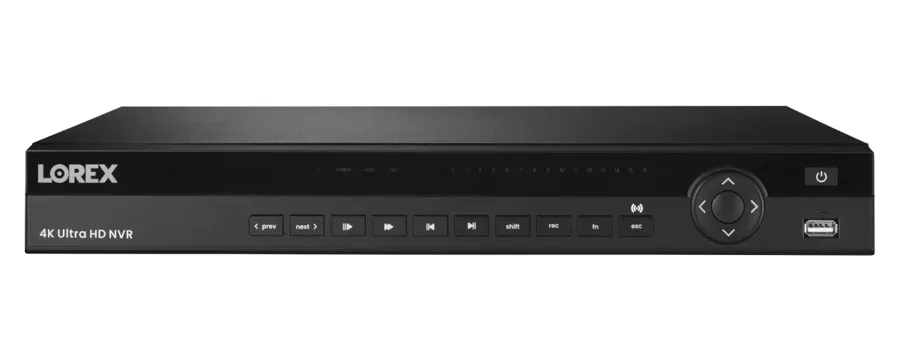
A product photo from the AESS job library, not taken in Manhattan Beach: a 16-channel desktop network video recorder. In a detached Manhattan Beach house this box is usually on a basement shelf, in a closet off the front hall or on a rack beside the internet equipment, with cables running out to every side of the house and the back garden. It holds the footage, records which cameras dropped out and when, and has to ride through every power cut, so most of our repair visits on the peninsula begin at this box rather than at the camera that looks broken.
Manhattan Beach Camera Repair Request
Detached house, rebuilt home, condo, apartment building, synagogue or shop: send the address and what the screen shows, and a technician calls back with the next step
✅
Request Sent!
Thank you. A technician will contact you about the Manhattan Beach address shortly.
25+
Years Experience
✓
Same-Day Estimates
100%
Licensed & Insured
4.7★
201 Google Reviews
Owner-operated since 2002 · Thousands of jobs completed · Booked within 2 hours
Security camera repair in Manhattan Beach is mostly about cameras that were put up years ago, on big houses, by people who are no longer around to explain them. The peninsula took to cameras early. In 2010 the commander of the 61st Precinct told the City Council that video "played a key role" in identifying offenders across Sheepshead Bay and Manhattan Beach, and a precinct officer described a Manhattan Beach burglary in which the homeowner "had video cameras throughout his house." Many of those systems, and the ones that replaced them after Hurricane Sandy, are still on the walls. When they fail, the usual causes are a worn drive, a power supply or switch that took a surge, a connector at the far end of a long run, a router change that cut the phones off, or a login that left with the installer or with a son or daughter who moved away. The first job on every visit is to save whatever footage is still on the recorder; the second is to find which of those causes it is before anything is bought. Send a photo of the recorder screen to (347) 934-8335 or on WhatsApp, and we will tell you the likely fault and what that kind of repair costs on our Brooklyn list before you book anything.
Looking at your photos is free. The $150 service call covers the on-site diagnosis and is credited to the repair if you go ahead.
We work under New York State license #12000287431, the license the Department of State requires of companies that install or service security and CCTV systems for someone else.
We repair any brand and any installer's work, and we say so plainly when an old camera or recorder is not worth the money to fix.
The Neighborhood
Why Manhattan Beach Properties Need Security Camera Repair
Manhattan Beach is the small peninsula at the bottom of Brooklyn between Sheepshead Bay and the ocean, with Brighton Beach on its western side and Kingsborough Community College on its eastern tip. About 4,700 people lived there at the 2020 count, mostly in detached brick and stucco houses set back behind front gardens on the alphabetical streets from Amherst to Pembroke, with Oriental Boulevard running the length of the neighborhood and Shore Boulevard along the bay. Many of the original houses have been enlarged, and many have been torn down and replaced with far larger ones. There are rows and low-rise apartment buildings from the 1920s through the 1940s, a seven-story condo at The Wave on West End Avenue, a string of synagogues and schools along West End Avenue, and the college. It is a quiet place by city standards; a resident on r/Brooklyn called it "probably one of the calmer-feeling spots in Brooklyn." That calm is one reason camera systems here get neglected. Nobody looks at them for months, and the day someone does, the camera that mattered has been dark since spring.
The record shows why residents put cameras up in the first place, and why a working one still pays for itself. In the summer of 2008, News 12 reported that Manhattan Beach residents were "resorting to their own security measures" after a run of muggings and break-ins that included four robberies in four days. Around the same period, Brooklyn Paper reported that the Manhattan Beach Neighborhood Association's quality-of-life chair, Ron Biondo, wanted surveillance cameras at West End Avenue and Oriental Boulevard and at Shore Boulevard and Exeter Street, while members of the Manhattan Beach Community Group had unanswered questions about long-term costs and round-the-clock surveillance. The same report described a scam artist posing as a water inspector who got into the home of a 93-year-old woman on Beaumont Street and left with $300, three people arrested trying to break into a house on Hastings Street, and a car stolen on West End Avenue. By April 2010, the 61st Precinct was crediting residents' "penchant for pointing cameras just about everywhere" for its drop in felonies, and its crime was down 19.4 percent for the year, the largest drop in the city at the time.
Then the city added its own. In July 2014, NYPD cameras went up on light poles on West End Avenue, Oriental Boulevard and Shore Boulevard, covering what Bklyner called the community's two busiest entrances and exits, with state money set aside by then-Councilman Chaim Deutsch. Deutsch said they were "not really for the high crime area" but for cases such as a missing child or "an Alzheimer's patient," where footage could show whether someone left or came home. Those cameras are not watched live, and only NYPD personnel can see what they record. They do not see your front path, your side gate, your garden or your counter. That leaves private cameras doing the job they did in 2010, on systems that are now much older.
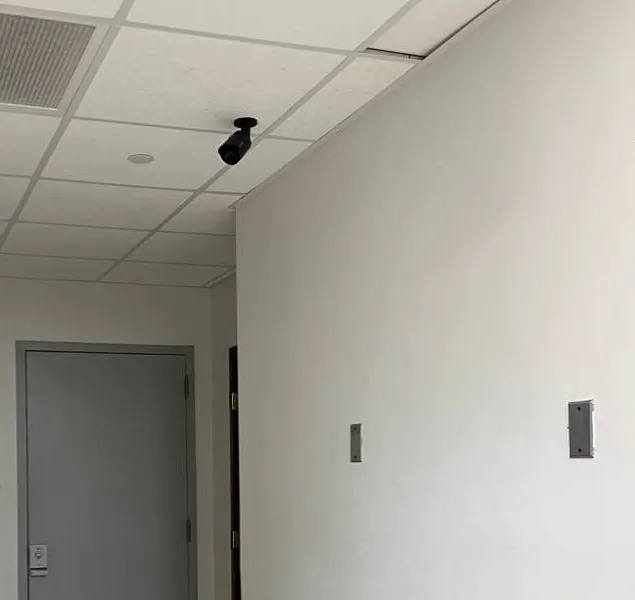
A photo from the AESS job library, not taken in Manhattan Beach: a small black bullet camera hanging from a white ceiling-tile grid, pointed down a short corridor at a grey steel service door. In a Manhattan Beach condo or low-rise apartment building, this is the kind of camera that watches the door between the garage and the lobby, the trash room or a cellar corridor. A camera aimed straight at a door shows someone arriving, but often only the back of a head as they leave, so on a repair we check what it actually shows in playback, both ways through the door.
Recent cases show both what cameras catch here and what they miss. Just after midnight on October 29, 2024, News 12 reported, security footage at the pharmacy at The Wave on West End Avenue showed a person being dropped off out front, picking up a heavy rock and throwing it through the glass door; narcotics and other medications were taken, the owner put the damage at about $2,000, and police said they did not know how many people were involved. On February 21, 2026, at about 2:55 in the afternoon, four people robbed a 16-year-old and a 14-year-old near Ocean Avenue and Oriental Boulevard, part of a pattern police traced across four South Brooklyn precincts. The video that went to police that time came from a passing driver's phone. "I'm glad he caught it on camera and the videos were passed over to the police department," one victim's mother told News 12. A camera on a house facing that corner, recording and with its clock right, would have been one more record of the same few minutes.
The last pressure is water and power. The peninsula floods from both sides. After Hurricane Sandy, the president of the Manhattan Beach Community Group told City Limits that "every house was flooded," and power was out for more than a week. Smaller events keep happening: Council Member Inna Vernikov has posted photos of high-tide flooding on the bay side, with B49 service suspended between Emmons Avenue and Oriental Boulevard at Mackenzie Street. First Street's model counts 42 properties in Manhattan Beach, 3.2 percent of the total, with flood risk over the next 30 years. Recorders and power supplies on basement floors, outlets that trip when water gets near them, and drives that were writing when the power cut out all show up later as repair calls. Many houses with a front-door camera also have a video door station or a buzzer at the gate, and we can look at both on the same trip.
Six Manhattan Beach facts that shape a camera repair
One precinct, one long history with video. Manhattan Beach is covered by the 61st Precinct at 2575 Coney Island Avenue, the same precinct that in 2010 credited residents' cameras with identifying "a lot of bad guys." Detectives here are used to asking for footage, and the clip only helps if the recorder's clock is right.
The city's cameras watch the way in, not the houses. The 2014 NYPD light-pole cameras on West End Avenue, Oriental Boulevard and Shore Boulevard are not monitored in real time, and only NYPD personnel can access what they record.
Many systems are older than they look. Residents were adding their own security in 2008 and pointing cameras "just about everywhere" by 2010. A system from that era is now about fifteen years old, and a system replaced after Sandy in 2012 is not far behind.
The houses are big, and getting bigger. Enlarged and rebuilt houses on the lettered streets carry long cable runs, racks of equipment in the basement and cameras on all four sides, so a single failed switch can take out half the property.
Water reaches the peninsula from the bay and the ocean. Sandy flooded the neighborhood from both sides, and high tides still close part of Oriental Boulevard to buses. Where the recorder and power supplies sit matters as much as which camera failed.
The price follows the fault. HomeAdvisor's Brooklyn page puts the average surveillance camera install or repair at $1,416, a figure that mixes new systems with repairs. A single repair on our Brooklyn list usually lands between $150 and $700.
Where this page applies. It covers the whole peninsula: the lettered streets from Amherst to Pembroke, Oriental Boulevard from Brighton Beach to the Kingsborough gate, Shore Boulevard along Sheepshead Bay, West End Avenue and M. Corbin Place at the western end, and the short stretch of Ocean Avenue on the peninsula. For the rest of the borough, see our main Brooklyn security camera repair page. The price is the Brooklyn price, wherever on the peninsula you are.
Same-Day Repair in Manhattan Beach
Need Repair in Manhattan Beach? A Door Camera That Didn't Record the Visitor, a Basement Recorder That Went Quiet After the Tide, or a Clip the Precinct Wants This Week
Urgent calls from the peninsula come in three kinds. The first follows an incident: a stranger talked his way into a parent's house, a car or an e-bike disappeared from the driveway, a store window was smashed, or detectives from the 61st Precinct are asking the block for video, and the owner opens the app to find nothing from that night. The second follows weather or power: the tide came up on the bay side, the block lost power, a breaker tripped in the basement, and when everything came back the recorder was beeping, half the cameras were gone from the grid or the phones could no longer connect. The third is the quiet failure that nobody noticed: a garden camera that went dark in the spring, a drive that stopped saving in the summer, an app that stopped working when the internet company swapped the router, all discovered the day someone needed them.
If footage from an incident matters, do not restart, unplug or reset the recorder, and do not let a well-meaning relative try. Most recorders overwrite their oldest video when the drive fills, so the clip you need is already on a clock, and a restart can hide whatever caused a gap. Call (347) 934-8335, tell us the date and the hour, and we will book the visit with saving that footage as the first task. If a detective has asked for a copy, tell us when you book; the clip goes onto a USB drive in the recorder's own format with its original timestamps, alongside a note of what time the recorder showed compared with the real time.
For everything else the route is the same. The $150 service call books a two-hour arrival window, the technician finds the cause, and you get a written price before any part is replaced. Requests are booked within 2 hours. We do not promise the repair itself on the same day, because some parts have to be ordered, but most single-camera, power-supply and drive faults are fixed on the first visit when the part is on the truck.
What We Install
Security Camera Repair Services in Manhattan Beach
Each repair below is priced from our Brooklyn camera repair list. The service call pays for finding the fault; the repair is priced by what failed, how many cameras it affects and how hard the run is to reach, whether that is a camera over the front door of a brick house on Dover Street or one under the roofline at the back of a rebuilt house that faces the bay.
Front-door camera and door station repair
The camera that should show who is on the step: dark, washed out by the porch light, recording only after the door opens, or showing the visitor's face to a monitor but saving nothing. On houses where an older parent answers the door, this is usually the first camera we put right.
Four-sides coverage checks
Detached houses here have a street side, a driveway side, a narrow side passage and a back garden, and each one has its own camera. We check them all, by day and after dark, and list which sides are really covered and which only look covered on the screen.
Rack and closet recorder repair
DVRs and NVRs in basement racks, hall closets and garage corners that beep, run hot, restart or keep only a few days. Drives are tested and replaced by type and capacity, and any footage you need is copied off first.
Long-run cable and connector repair
Runs from the front of the house to a garden camera sixty or a hundred feet back, connectors that took water under the eaves, and cables cut or buried when a house was enlarged. Repaired, re-terminated or replaced and tested end to end.
After-tide and after-outage recovery
Systems that came back wrong after flooding on the bay side or a long outage: recorders stuck on a setup screen, switch ports that power nothing, outlets that tripped and never reset, and clocks set back to a factory date.
Family and caregiver access
Apps on the phone of a son or daughter who moved away, an aide who needs to see the door but nothing else, or a parent who will only use a screen in the kitchen. We set up the right access for each person and take away the access nobody should still have.
Condo and building cameras
Lobby, garage, trash-room and roof cameras in low-rise apartment buildings and in the newer condo on West End Avenue, with the recorder in a management office, a cellar room or the super's closet.
Footage export for incidents
Clips copied to USB in the recorder's native format with original timestamps for the 61st Precinct, insurers, boards and landlords, with a short note on any difference between the recorder clock and the real time.
Whole-property checkups
Every camera on a house, condo, synagogue or shop checked in one visit, with a written list of what works, what is failing and what each fix costs, so a family or a board can decide what comes first.
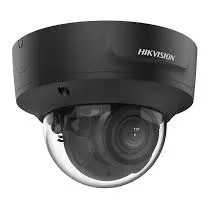
A product photo from the AESS job library, not taken in Manhattan Beach: a black varifocal dome camera. The zoom inside can be set on site, which matters on houses set back behind a front garden: a dome set wide shows the whole lawn and turns the person at the gate into a few pixels, while the same dome narrowed onto the path and the step shows a face. Changing that setting, and nothing else, is one of the cheapest repairs we make on the lettered streets.
Building Specialists
Security Camera Repair for Manhattan Beach's Architecture
Six kinds of property bring us nearly all our camera repair calls from the peninsula. Each fails in its own way, and each decides where the recorder ended up, how far the cables run and who has to say yes before the work starts.
Brick houses from the 1920s to the 1940s
The original detached brick houses behind front gardens, many with a basement entered from the side, a driveway down one side and a narrow passage down the other. Cameras were added decades after the house was built, usually with cable along the outside walls.
Stucco and tile-roof houses
Mediterranean and Spanish-style houses with stucco walls, deep eaves and clay tile roofs. Mounts are anchored into stucco, and cables were often tucked under the eaves or behind downspouts, where water finds them.
Enlarged and rebuilt houses
Houses that grew upward and backward, and new houses on the sites of tear-downs, often with twenty or more cameras, a basement rack, a home network and a gate or door station, all installed by a builder's contractor who may be long gone.
Rows and low-rise apartment buildings
Attached rows and small apartment buildings from the 1920s to the 1940s, with a shared front door, a cellar, a laundry or trash room and a recorder put in by whoever managed the building at the time.
The newer condo on West End Avenue
The seven-story, 48-unit building at The Wave, finished in 2016, with a doorman lobby, two levels of parking and commercial space in a flood-proofed cellar. Garage, lobby and corridor cameras report to a building recorder that a board and a managing agent look after.
Synagogues, schools and community buildings
The houses of worship, study halls and schools along West End Avenue and the side streets, with cameras at entrances, side doors and yards, often looked after by a custodian or a volunteer rather than an IT department.
Brick houses from the 1920s to the 1940s: cameras added to a house that was never wired for them
The original Manhattan Beach houses were built long before anyone thought about cameras. When owners added them, the installer usually ran cable along the outside of the brick, over the side passage or down to the basement through a hole beside a window frame or the side cellar door, and put the recorder in the basement near the electric panel and the internet line. That works until something disturbs the path. Pointing and waterproofing crews work around old cables, gutters and leaders get replaced, and a basement that takes water once leaves the lowest stretch of every cable sitting where the water was.
On these houses, a repair starts by following each run from the recorder to the camera, not by replacing the camera. A front camera that fails only in heavy rain usually has a connector or a junction box that fills with water; a side-passage camera that died the week after a gutter job often has a cable that was pulled or cut where it crossed the leader. When the recorder sits in the basement, we look at how high it is, what it plugs into and whether a short outage would kill it, and we lift it or put it on a battery backup when that is the real cause of the trouble.
Stucco and tile-roof houses: anchors, eaves and water behind the wall
The Mediterranean-style houses on the peninsula look solid, but stucco is a thin skin over the wall behind it, and every camera mount is a hole in it. When one has to be remounted, we reuse a sound hole, seal it with a mounting box, and ask before drilling anything new. Over the years, a mount that was not sealed lets water in behind the stucco, the anchor loosens and the camera tilts down until it shows the lawn. Cables tucked behind downspouts or run under the eaves of a tile roof are out of sight, which is the point, but they are also where water collects and where a roofer or painter can damage them without anyone knowing.
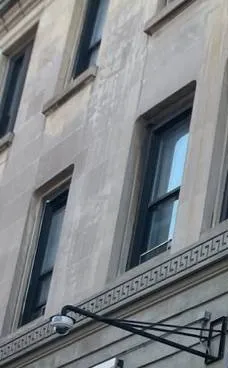
A photo from the AESS job library, not taken in Manhattan Beach: a bullet camera on a long black steel arm, fixed below a carved Greek-key band on a pale stone facade with tall sash windows. Institutional buildings along West End Avenue and the larger houses on the peninsula carry cameras like this, mounted out from the wall so they can see along it. A long arm is a lever, and wind off the bay works it loose over time, so on a repair we check the anchors and the joint at the wall as well as the camera itself.
Enlarged and rebuilt houses: big systems that nobody in the family can read
Many Manhattan Beach houses have been enlarged, and many lots now hold a new house several times the size of the cottage that stood there. Their camera systems are the largest on the peninsula: cameras on every side, at the garage, on the garden and along the passages, all wired back to a rack or a closet in the basement that also holds the recorder, one or more PoE switches, the router and sometimes a home-automation controller and a gate controller. The low-voltage contractor who built it usually left no drawing, and the family knows only that the screen shows cameras and the phone app sometimes does not.
The most common fault here is not a camera at all. One switch fails and every camera it powered goes dark at once; the internet company replaces the router and the recorder loses its connection to the app; the backup battery that was supposed to protect the rack died years ago, and the next flicker resets everything. Our repair begins with a map: every box on the rack and what it does, every camera and the port it lands on, and which outlet and backup each piece depends on. Then we fix what failed, label every cable, and give the cameras their own part of the network where the equipment allows it, so a busy evening of streaming does not knock them off the app.
The newer condo on West End Avenue: garage levels, a doorman desk and a cellar built to keep water out
The Wave at 102–104 West End Avenue went up between 2014 and 2016: seven stories, 48 units, a 20-foot lobby with a doorman, two levels of parking for 68 cars, and, according to its Department of Buildings filings as reported by Bklyner, commercial uses in a flood-proofed cellar. A building like this has more cameras in fewer kinds of places than any house: the garage entrance and ramp, the parking rows, the doors between the garage and the lobby, the lobby itself, the mailroom and the roof. The recorder usually sits in a management or equipment room, and the doorman sees a monitor at the desk.
Repairs in a building like this run through the board and the managing agent. They approve the work, hold the admin login, and decide who may export footage. We follow the building's rules for contractors, book any access needed to the garage or roof in advance, and leave a written record of what was repaired and what is still at risk.
Synagogues, schools and community buildings: many users, one recorder, irregular hours
West End Avenue and the nearby blocks have several synagogues, study halls and schools, including the Manhattan Beach Jewish Center at 60 West End Avenue, listed on the National Register of Historic Places in 2015. After Sandy, City Limits reported that the Zichron Aryeh Leib Kollel on West End Avenue needed major reconstruction, and that P.S. 195 on Irwin Street flooded. Buildings like these have cameras at the main door, the side doors, the yard and the parking area, used by a custodian, a rabbi's office, a school office and sometimes a volunteer, often with no single person in charge of the recorder.
A repair here includes deciding who holds the admin login, setting a separate view-only login for whoever watches the door, checking every outdoor camera at the hours the building is actually empty, and setting alerts so the office hears about a dark camera before the next holiday rather than after it. Listing on the National Register does not by itself restrict what a private owner may do to the building when no state or federal money or permit is involved, according to the State Historic Preservation Office, so replacing a camera on a listed synagogue is normally a decision for the congregation.
Field Notes
Field Notes: Working Through a Manhattan Beach Camera System From the Front Step to the Back Garden
These notes describe the order our technicians work in on a typical detached or rebuilt Manhattan Beach house when several cameras are out and nobody in the family is sure why. It is a working method, not an account of any one address.
Ask who uses it before touching it. On the peninsula the person who calls is often an adult son or daughter, and the person who lives with the system is a parent, a tenant or an aide. Before anything else the technician asks who watches which camera, on which screen or phone, and whether anyone needs footage from a recent date. If they do, that footage is exported first.
Start at the rack or the shelf. The technician checks the outlet and any battery backup, then every box: power supply, PoE switch, router, recorder. Temperature, drive health and the recorder's log of when each camera dropped out say more about the cause than any camera on the wall. A switch that died in an outage shows up as a group of cameras that all went dark at the same minute.
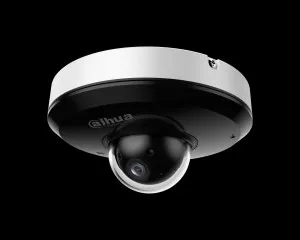
A product photo from the AESS job library, not taken in Manhattan Beach: a mini pan-tilt dome camera with a white housing over a black lens dome. On a deep Manhattan Beach lot, a camera like this is sometimes set to sweep the back garden on a timed tour. That is fine for watching a large lawn, but it means the camera may be facing the far fence at the moment someone comes through the side gate, so on a repair we often park it on the gate and let a fixed camera cover the rest.
Walk the house in the same order every time. Street side and front door first, then the driveway side, then the narrow passage, then the back garden and anything facing the bay. At each dark or weak camera, power and signal are tested at the camera itself; then the connector, the junction box and the mount are checked for water, salt, a loose anchor in stucco or brick, or a cable that a contractor disturbed.
Play back, don't just look. Every camera is played back from the night before. A camera that shows a fine live picture can still be saving nothing, and the door camera that matters most is often the one set to record only when it detects motion, which it may never do if it is aimed too high.
Price before parts, and leave a map. You hear the cause and get a written price before anything is replaced. When the repair is done, the technician checks every camera by day and after dark, sets alerts for lost video and drive errors, leaves labeled cables and a simple list of what plugs into what, and makes sure the logins are in the owner's hands, not the installer's or a relative's who has moved on.
Fault by Fault
Old Systems, Long Runs, Wrong Phones and Low Shelves: Why Manhattan Beach Camera Systems Stop Working
Four causes account for most of the failures we find on the peninsula. None of them is unusual in Brooklyn, but the shape of Manhattan Beach, with its big detached houses, older owners and water on two sides, makes each one more likely here.
Old systems: the cameras of 2010 are still on the walls
When the 61st Precinct's commander told the City Council in 2010 that "in 2009 we identified a lot of bad guys" and that video "played a key role," the cameras he meant were mostly analog cameras feeding a DVR, with a picture that was good for its time. A lot of that equipment is still in place. Analog cameras of that age tend to fail slowly: the infrared lights that give the night picture wear out, the day-night filter sticks so the picture turns pink or stays black and white, the clear cover yellows, and the DVR's drive, which has been writing around the clock for years, starts to lose recordings before it dies.
An old system is not automatically a lost cause. Many coax cable runs on these houses are perfectly good, and newer HD cameras can often use them with a new recorder, which saves the cost and mess of pulling new cable through a finished house. What we tell owners plainly is which parts are worth keeping. A ten- or fifteen-year-old DVR with a failing drive is rarely worth a new drive; a run of sound coax to a good position on the house almost always is.
Long runs: big houses, deep lots and connectors far from the recorder
On a detached house with a deep back garden, the camera at the far fence may be a hundred feet or more of cable from the recorder, and the run often goes around the outside of the house, through a garage or under the eaves to get there. Every one of those runs ends in a connector outdoors, and on a peninsula with salt air and wind-driven rain, those connectors are where most single-camera failures start. A camera that drops out in wet weather and comes back when it dries is almost always a connector or junction box problem, not the camera.
Network cameras add one more limit: a single network cable carries power and data reliably only up to a certain length, and runs that were stretched to reach a garden corner or a garage at the back of the lot can work on a warm day and fail on a cold one. We test each long run end to end, re-terminate connectors in sealed boxes, and where a run is simply too long we add a small powered extender or relocate the switch, rather than replacing cameras that were never the problem.
Wrong phones: the system is fine, but the logins left with somebody else
A large share of our Manhattan Beach calls are about access, not hardware. The cameras record, but the app account belongs to a son who set it up before moving out of state, to the builder's contractor, to a former tenant or to a grandchild whose phone has since been replaced. The parent who lives in the house has a monitor in the kitchen and nothing else, and the family member who could pull a clip lives far away.
The repair is to recover the recorder, change every default and old password, put the account in the owner's name, and then decide on purpose who else gets access and what kind. An adult child may get full playback on their own phone; an aide may get a live view of the front door only; a neighbor who helps out may get nothing at all.
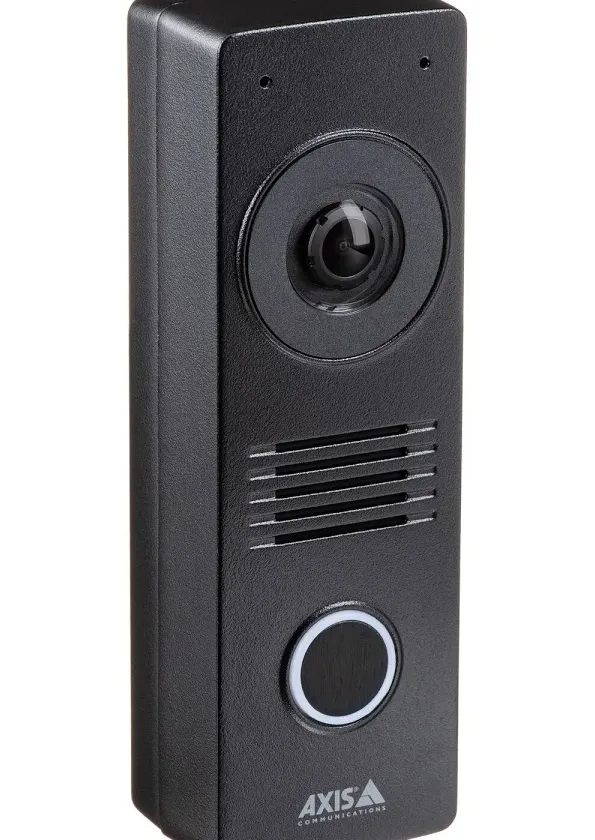
A product photo from the AESS job library, not taken in Manhattan Beach: a black video intercom door station with a camera, a speaker grille and a lit call button. On a Manhattan Beach house where an older parent answers the door, a station like this, paired with a screen inside, lets them see and speak to a visitor before the door opens. On a repair we check that its camera also records, so that if someone talks their way in, there is a clear picture of their face from the step, not just from inside the hall.
Low shelves: recorders and power supplies where the water goes
Most systems were installed with the recorder near the electric panel and the internet line, which in a Manhattan Beach house usually means the basement. Sandy showed what that means on this peninsula: the Community Group's president said every house flooded, and power was off for more than a week. Smaller tide events still leave water on the bay side, and a basement that took a few inches once leaves outlets, power strips and the bottom of every cable at risk the next time.
A recorder that survived a flood often fails months later, from corrosion inside the case or a drive that was damaged when the power cut out. When we repair a system in a basement that has taken water, we look at where the recorder, the switch, the power supplies and the battery backup sit, and we price raising them or moving them to a dry floor alongside the repair, so the next tide does not undo it.
Commercial Security Camera Repair
Business Security Camera Repair in Manhattan Beach
Manhattan Beach has very little retail; its business and institutional cameras sit mainly along West End Avenue, Oriental Boulevard and the college at the eastern end, with the larger shopping streets just over the line in Brighton Beach and Sheepshead Bay. The systems we repair here belong to a pharmacy, a condo's commercial space, synagogues and study halls, schools, medical and professional offices, and building owners. Most have one recorder in a back room or an equipment closet, a handful to a few dozen cameras, and nobody whose full-time job is to look after them.
West End Avenue at The Wave
The condo at 102–104 West End Avenue, with commercial space at street and cellar level. News 12's October 2024 report on the pharmacy break-in there, where footage showed a person dropped off at the curb before the glass door was smashed, is the kind of incident a storefront camera has to be ready for.
Synagogues and study halls on West End Avenue
Houses of worship, kollels and community rooms along the avenue, including the Manhattan Beach Jewish Center at No. 60. Cameras watch entrances, side doors and yards at hours when the building is empty.
Oriental Boulevard
The mile-long straightaway WCBS 880 described in 2010, with only three traffic lights at the time, carrying the B1 and B49 buses and the traffic to the college. Cameras on buildings here face a busy road, headlights and a steady stream of motion.
Kingsborough Community College
The campus at 2001 Oriental Boulevard has its own Office of Public Safety. The thousands of students who come through daily are one reason, Bklyner reported, that the neighborhood got NYPD pole cameras in 2014, and the blocks nearest the gate see the heaviest foot traffic on the peninsula.
Schools on the side streets
P.S. 195 on Irwin Street, which flooded in Sandy and reopened, and the private schools in the neighborhood, with cameras on entrances, yards and drop-off points that have to work at arrival and dismissal.
Shore Boulevard and the park
Buildings facing the Shore Boulevard promenade and the approaches to Manhattan Beach Park, where Brooklyn Paper once reported more than 100 summonses for after-hours trespassing, drinking and disorderly conduct on the beach and the mall.
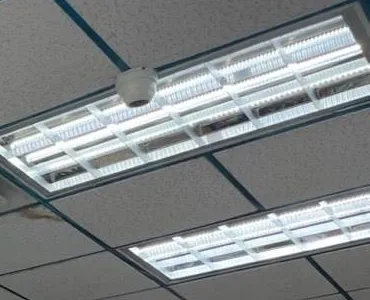
A photo from the AESS job library, not taken in Manhattan Beach: a small white dome camera on grey acoustic ceiling tiles right beside a long louvered fluorescent light. In a pharmacy, a medical office or a synagogue office on the peninsula, a dome this close to a ceiling light can pick up glare inside its own cover and wash out faces at the counter. Moving it one or two tiles away from the light, and re-aiming it at the counter rather than the aisle, is often the entire repair.
What the West End Avenue pharmacy break-in says about storefront cameras
The October 2024 case is a clear lesson in what a storefront system needs to show. The camera recorded the break-in: a person dropped off in front of the pharmacy, a rock thrown through the glass door, the person going inside. What police still did not know was how many people were involved, which points to the car and anyone waiting in it. A storefront camera that is aimed only at the door shows the moment of entry. One that also takes in the curb lane shows the vehicle that stopped, its color and shape, which way it came from and which way it left.
A repair on a storefront like this usually means checking that one camera covers the door at face height and another covers the curb and the street in both directions, that both record continuously overnight rather than waiting for motion, that the recorder is somewhere a person who just broke the glass cannot reach and carry out, and that the owner's phone gets an alert when the door camera sees movement after closing. Glass doors and windows also reflect a store's own lights at night, so a camera inside the glass has to be placed and set to look through it, not at it.
Rules that touch a commercial camera repair
State licensing. The New York Department of State licenses companies that install or service security systems, and its rules cover closed-circuit television used to watch for intrusion, theft or movement. An owner can work on their own system, or have an employee do it, without a license; a company working for someone else needs one. AESS works under NYS license #12000287431.
Cameras that watch staff. New York Labor Law §203-c requires employers who monitor employees electronically, including by video, to give written notice and get acknowledgment. If a repair moves or adds a camera covering a stockroom, a dispensing counter or a back office, update the notice.
Footage requests. Detectives from the 61st Precinct may ask for a copy of a clip. A copy on USB with original timestamps usually satisfies the request without the recorder leaving the building. Whether to share a clip with a neighbor or a community group is the owner's decision.
Historic listings. The Manhattan Beach Jewish Center is on the National Register of Historic Places. The State Historic Preservation Office says owners of listed properties are free to make changes when no state or federal funding or permit is involved, subject to local rules; we found no city landmark designation on the peninsula that would add a permit for replacing a camera.
Your Questions Answered
Security Camera Repair in Manhattan Beach: Questions Answered
These are the situations Manhattan Beach homeowners, their grown children, condo boards, synagogue offices and shop owners describe when they call. Each answer is written for the houses and buildings on this peninsula.
Older parents, aides and the front door
My mother is in her nineties and will open the door to anyone who says he is from the water or gas company. Can her door camera show her the visitor's face on a screen, and keep a recording, before she opens the door?
Yes, and it is one of the most useful repairs we make on the peninsula. We place or re-aim the door camera so it shows the face of a person standing on the step, set it to record continuously or from the moment someone approaches, and put a screen where she sits, often a door station monitor in the kitchen, so she can see and speak to the visitor through the door. You can also get the same picture on your own phone, so she can call you and you can look together before she opens.
My father has memory loss and once walked out of the house in the middle of the night. Can our cameras tell us the moment a door opens after bedtime, and show which way he went?
They can. Most recorders can send a phone alert when a camera sees someone cross a line at the front or side door during set hours, and we set those hours to match the family's night. We also make sure the cameras at the front and driveway record continuously overnight so the direction he walked is on the recording, and show you how to pull the last half hour from every camera quickly, which is what police ask for first if someone is missing.
A home health aide comes every day for my father. Can we record arrivals and departures at the door without putting cameras in his bedroom or bathroom?
Yes, and that is the arrangement we recommend. A door camera that records who comes and goes, with a time on every clip, answers most of the questions families have, without filming personal care. New York's unlawful surveillance law makes hidden recording in bedrooms and bathrooms a crime, and anyone working in the house should be told where the cameras are. We set the door camera, turn off audio if you do not need it, and give the aide's agency the facts in writing if you want them.
Big detached and rebuilt houses
Our house was finished in stages over several years, and there are camera cables sticking out of walls and soffits that were never connected to anything. Can they still be used?
Often, yes. Cables left by a builder can be traced back to wherever they end, usually the basement or a utility closet, labeled and tested. If a cable tests clean end to end, a camera can go on it with no new wiring through the finished walls. If it fails or turns out to end nowhere, we tell you which ones are worth using and price only the cameras you want, on the cables that work.
Our basement rack has a recorder, two switches, a home-automation box and the internet equipment, and nobody in the family knows which box does what. When one camera group goes dark, where do you start?
At the rack, with a map. We identify every box and what it powers, trace which cameras land on which switch port, and check each power supply and the battery backup. When a group of cameras goes dark at once, the cause is almost always one switch or one power supply, not the cameras. You get a labeled rack and a one-page list of what plugs into what, so the next failure takes minutes to place.
Our son set up the cameras before he moved out of state, the app is on his account, and only he can play anything back. Can the system be put in our names without losing what he set up?
Usually. If your son can log in, we transfer the device to an account in your name or add you as the owner and keep his settings. If he cannot, we recover the recorder on site through the maker's process, which may need the serial number and proof the house is yours. Either way, he can keep his own view-only or full login if you want him to, and you hold the admin password.
Condos, stores and West End Avenue
In our condo, the doorman can see the cameras on the lobby monitor, but when a resident reports something he cannot save a clip, and the managing agent is only in on weekdays. Can the desk mark the moment so it is not lost?
Yes. Many recorders let a limited user tag or lock a stretch of video from the monitor without being able to delete or export it, which keeps that clip from being overwritten until the managing agent exports it. We set up a separate desk login with only that permission, show the doormen how to use it, and set the drive to keep enough days that a weekend incident is still there on Monday.
The person who broke into a store on our block was dropped off by a car that then drove away. Our camera saw the person, but the car was outside the picture. Can our cameras be set to catch the car next time?
Usually with what you have. We re-aim or re-zoom one camera to take in the curb lane in front of the entrance, set it to record continuously overnight, and check the night picture with a car actually parked there. You will get the vehicle's shape, color and direction of travel; reading a plate at night needs a camera set up for that alone, and we will tell you honestly whether your spot allows it.
The street, the pole cameras and the boulevard
There are NYPD cameras on the light poles at the West End Avenue end of the neighborhood. If something happens outside our house, can we get that footage?
Not directly. When those cameras went up in 2014, the local legislator said they are not monitored in real time and that only NYPD personnel can access the footage. If you report an incident, tell the detective the time and ask whether the pole cameras were checked. For your own front path, gate and driveway, the only footage you can count on is from your own cameras, so it is worth keeping them recording.
Our community group wants video of drivers speeding on Oriental Boulevard. Can our house camera measure how fast cars are going?
No. An ordinary security camera records a picture and a time, not a certified speed. A clip can show that a car went past, the time and roughly how it was driven, which may help in a conversation with the Department of Transportation or the precinct, but it will not stand as a measured speed. If you want the clip to be useful, aim a camera across the road rather than along it, and keep its clock exact.
Equipment
Types of Security Cameras and Recorders We Repair
We repair whatever is on the building, whoever installed it. These are the kinds of equipment we find on Manhattan Beach houses, condos, synagogues and shops, and the faults each one tends to develop on the peninsula.
Analog and HD-over-coax cameras
Cameras with round BNC connectors, from the analog systems of 2008 to 2012 to newer HD models on the same cable. Typical faults: worn infrared, a stuck day-night filter, yellowed covers and corroded connectors at the end of long runs.
Network (IP) cameras
Cameras powered and connected through one data cable, standard on the rebuilt houses and the newer condo. Typical faults: dead switch ports after an outage, runs too long for power, shared home networks and lost passwords.
DVRs, NVRs and hybrid recorders
The box that keeps the footage, on a basement shelf, a rack, a closet floor or a management room. Typical faults: drives worn by years of continuous writing, settings lost after a power cut, short retention and failed fans.
Varifocal domes and bullets
Cameras with an adjustable zoom, common over front paths, driveways and lobbies. Typical faults: a lens left too wide to recognize anyone at the gate, focus that drifted after a knock, and covers clouded by salt and sun.
Pan-tilt and 360-degree cameras
Moving cameras over back gardens, parking areas and school yards, and fisheye cameras over shop floors. Typical faults: lost presets, sticking motors and tours that leave the camera looking away from the gate.
Wi-Fi, battery and cube cameras
Plug-in and battery cameras in windows, on shelves and in far corners of the garden. Typical faults: weak signal through brick, stucco and long houses, router changes, cold-weather battery drain and accounts tied to a relative.
Video door stations
Door stations with their own camera at the front door or the gate, often with an indoor monitor for a parent. Typical faults: video that reaches the monitor but is never recorded, call buttons that stick, and night pictures washed out by the porch light.
PoE switches and extenders
The switches that power network cameras, usually on a rack or shelf in the basement. Typical faults: dead ports or whole units after a surge, power budgets exceeded as cameras were added, and extenders on long garden runs that fail in the cold.
Power supplies and battery backups
Central power boxes, plug-in adapters and UPS units. Typical faults: blown channel fuses, adapters plugged into basement outlets that took water, and backup batteries that died years ago without anyone noticing.
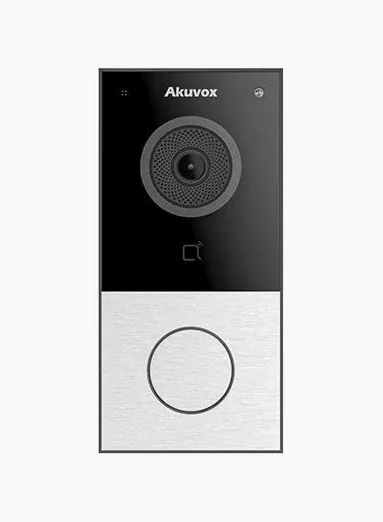
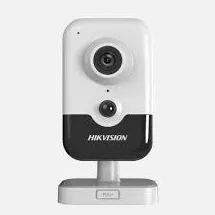
A product photo from the AESS job library, not taken in Manhattan Beach: a slim video door station with a camera lens at the top and a large round call button. A big, simple button like this suits a house where an older parent or a visiting grandchild has to use it. On houses and small buildings on the peninsula, we check whether the door station's camera is only showing a live picture to whoever answers or is also being saved, because it is often the one camera with a clear view of a visitor's face.A product photo from the AESS job library, not taken in Manhattan Beach: a white indoor cube camera. Families on the peninsula often put one of these on a shelf facing the front door from inside, so a relative far away can check on a parent. They are the cameras most often unplugged by accident or moved by a cleaner, and when one keeps falling off the app the fault is usually its plug or the Wi-Fi at that end of a long house, not the camera.
National brands versus a local licensed repair
Some Manhattan Beach households have cameras from a national alarm company, a Ring or SimpliSafe kit, or both alongside a wired system from the builder, and ask who should fix what. The table shows how the choices usually compare for a repair.
Question
ADT or a similar alarm company
Ring or SimpliSafe cameras
AESS local repair
Who owns the equipment
Depends on the contract; some is leased
You own it
You own it, and we repair it
A builder's rack in the basement
Usually works only on its own equipment
No local recorder; clips go to the cloud
Recorders, switches, drives and footage export, whoever installed them
Several brands on one house
Usually only its own
Support covers its own devices
Any brand, any installer
Signal at the far end of a long house
Depends on its wiring
Wi-Fi often weak through brick and stucco
Wired cameras on tested cable where possible
Licensed technician on site
Varies by dealer
Remote support
Yes, NYS license #12000287431
Price before work
Varies
Price of a replacement device
$150 service call, then a written repair price
AI Overview Reality Check
What AI Gets Wrong About Security Camera Repair in Manhattan Beach
These claims turn up in AI-generated answers, help forums and national repair guides. Each is true somewhere, and each sends Manhattan Beach owners toward the wrong repair, a wasted purchase or a lost clip.
"In a quiet, low-crime neighborhood, a dead camera can wait"
General answers tend to rank camera repair by local crime rates, and Manhattan Beach is often described as one of the calmer parts of Brooklyn. On that logic, a dark camera on the peninsula is a low priority.
The record says otherwise. The neighborhood has had an impostor "water inspector" get into a 93-year-old's house on Beaumont Street, a break-in attempt on Hastings Street, a pharmacy door smashed on West End Avenue in 2024 and a daytime robbery of two teenagers near Ocean Avenue and Oriental Boulevard in 2026. A low crime rate means incidents are rare, not that they do not happen, and when one does, the footage is usually the only record there is.
A camera's value here is concentrated in a few nights over many years. That is an argument for making sure it records on those nights, with alerts that tell you when it stops, not for leaving it dark until something happens.
"The city's street cameras will have recorded it anyway"
Some answers suggest that public cameras at busy points make private ones less important, and that residents can request the city's footage after an incident.
The NYPD cameras that went up in Manhattan Beach in 2014 are on light poles on West End Avenue, Oriental Boulevard and Shore Boulevard, watching the ways in and out. Bklyner reported that they are not monitored in real time and that only NYPD personnel can access the footage. They do not see a front step on Falmouth Street, a side passage, a back garden or a counter.
A pole camera may help police follow someone leaving the peninsula. The camera that shows who rang your bell is yours, and the only way to be sure it recorded is to keep it working.
"Swap the old wired cameras for Wi-Fi cameras and skip the repair"
Consumer guides often treat a failing wired system as a reason to replace it with Wi-Fi or battery cameras, which are cheap and easy to put up.
On a long detached house with brick or stucco walls, Wi-Fi often does not reach the far corners of the garden or the garage at the back of the lot, and battery cameras drain fast in winter and record only short clips when they detect motion. Meanwhile, the existing cable runs, which are the expensive part of any wired system, are usually still good. Throwing them away to save a repair often costs more over a couple of years.
Find out what failed first. A wired system with a bad drive or a dead switch is usually cheaper to repair than to replace, and a Wi-Fi camera is best kept for the one spot a cable cannot reach.
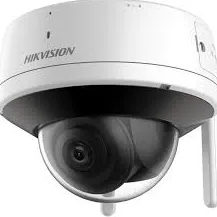
A product photo from the AESS job library, not taken in Manhattan Beach: a Wi-Fi dome camera with an external antenna. The antenna helps, but on a long Manhattan Beach house the router is often at the front and the camera is at the back, with several brick or concrete walls between them. We use cameras like this where a cable truly cannot go, and we test the signal at the exact spot before recommending one.
"Indoor cameras are the best way to keep an eye on an aging parent"
Advice for families often suggests putting cameras in the living room, kitchen and bedroom so a relative can be checked on remotely.
Cameras inside private rooms raise real problems: the parent may not want them, aides and visitors have to be told about them, and hidden recording in bedrooms and bathrooms is a crime under New York's unlawful surveillance law. They also miss what families most often need to know on the peninsula, which is who came to the door and whether someone left the house at night.
A door camera that records continuously, a screen where the parent sits, and alerts for a door opening at night answer most of those questions with far less intrusion. Indoor cameras, if any, belong in shared spaces with the parent's agreement.
"A camera that has been through a flood should be thrown out"
After storms, quick answers tend to say anything that got wet is ruined, and that the whole system should be replaced.
Outdoor cameras are built to get wet; what usually fails after a tide or a flood on the peninsula is the equipment that was never meant to: the recorder, power supplies, outlets and power strips on a basement floor, and the low connectors of cables that run down into the basement. Throwing away twenty outdoor cameras because the recorder drowned is a costly mistake.
Test before replacing. We check each camera on a known-good power supply and recorder, replace what failed, and move the indoor equipment to a dry level so the next tide does not repeat the bill.
"A clip recorded off the screen with a phone is good enough for police"
Many people send police a video of their recorder screen filmed with a phone, and some answers suggest that is fine.
In February 2026, a passing driver's phone video of the robbery near Ocean Avenue and Oriental Boulevard went to police, and that was the right thing to do with a live event. Footage already on a recorder is different. Filming the screen loses detail, the original timestamp and any proof the clip has not been edited, and makes a face that was readable on the recorder much harder to make out.
Export the original file from the recorder to a USB drive, in its own format, with its timestamps, and note any difference between the recorder's clock and the real time. We show every customer how to do that before we leave.
"Any handy relative can fix a camera system"
Some answers suggest camera repair is a simple job for anyone with a ladder, and that the parts are all online.
An owner can work on their own system, and New York allows that. A company doing it for someone else needs a license from the Department of State, because the state treats CCTV used to watch for intrusion, theft or movement as a security system. More practically, the hard part of most Manhattan Beach repairs is not swapping a camera; it is reading a rack nobody documented, saving the footage first, and not resetting a recorder into a state that wipes its settings.
Find the cause first. The $150 service call tells you what failed and what will work with your system, and the written price lets you compare our part with one you buy yourself. We also fit customer-supplied equipment at labor-only rates.
Not Sure Whether It Is the Camera, the Cable, the Rack or the Login? Speak to a Tech Before You Buy Anything
Tell us the address, the type of property, how many cameras there are, which ones are out and where the recorder sits. If someone other than you lives with the system, a parent, a tenant or an aide, say so, and tell us whether you need footage from a particular date. Photos of the recorder screen, the rack or shelf and the dark cameras help us bring the right parts. For anything urgent, call (347) 934-8335 now.
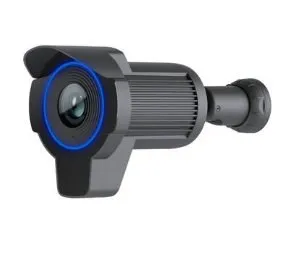
A product photo from the AESS job library, not taken in Manhattan Beach: a black bullet camera with a long hood and a blue-lit ring around the lens. The long hood keeps rain and low sun off the glass, which helps on a driveway camera facing the street or a camera on the side of a house exposed to weather off the bay. If you send a photo of the camera that failed, even one taken from the ground, we can usually tell what it is before the visit.
✅
Request Sent!
Thank you. A technician will contact you about the Manhattan Beach address shortly.
How It Works
Our Repair Process
1. Send the screen and say who lives there
A photo of the recorder or app with the dark cameras and the Manhattan Beach address, by text, WhatsApp or the form, plus who uses the system day to day: an older parent, a tenant, an aide, a doorman or a synagogue office.
2. Agree who approves and who holds the login
Owner, adult child, condo board, managing agent or congregation: we confirm who signs off on the work and who will keep the admin password afterward, so nothing stalls on the day.
3. Book the service call
The $150 Brooklyn service call puts the visit on the schedule in a two-hour arrival window and is credited to the repair if you go ahead.
4. Save the footage first
Any clip that matters is exported to USB in the recorder's own format with its original timestamps before anything is restarted, unplugged or opened, and the recorder's clock is checked against the real time.
5. Map the system
Every camera on every side of the property, every box on the rack or shelf, and which outlet, switch and recorder each one depends on, written down before any fault is chased.
6. Test from power to playback
Power and battery backup, switch ports, cables and connectors, recorder and drive, then the app, camera by camera, with each one played back from the night before rather than just viewed live.
7. Write the price, then repair
You hear what failed and why and get a written, itemized price before any part is replaced. The repair is then made, and every camera is checked by day and after dark under the real lighting of the street and garden.
8. Set alerts and hand over
Alerts for lost video, drive errors and night door openings go to the right phones, cables are labeled, each person gets their own login, and you are shown how to export a clip yourself.
Coverage Area
Security Camera Repair Near Manhattan Beach's Landmarks
Manhattan Beach Park
The city beach at the ocean end of the peninsula, with a boardwalk promenade, barbecue areas and a parking lot reached from Belt Parkway exit 8 that opens only in beach season.
Kingsborough Community College
The CUNY campus at 2001 Oriental Boulevard on the eastern tip, with its own Office of Public Safety and thousands of students arriving each day.
The West End Avenue gateway
The western entrance to the neighborhood, where NYPD light-pole cameras went up in 2014 to watch one of the community's two busiest ways in and out.
The Wave
The seven-story, 48-unit condo at 102–104 West End Avenue, finished in 2016, with two parking levels and commercial space at the cellar.
Holocaust Memorial Park
The memorial park at the western end of the Shore Boulevard mall, the promenade that runs nearly a mile along the south bank of Sheepshead Bay.
The old Esplanade along the bay
The eight-block waterfront walkway from Corbin Place to Ocean Avenue, much of it now fenced into private back gardens, where Forgotten New York noted signs warning of guard dogs and security cameras.
Manhattan Beach is billed at our Brooklyn rate. Every repair starts with the $150 service call, which covers the on-site diagnosis and is credited to the repair if you go ahead. The figures below come from our published list of Brooklyn security camera repair prices; your exact price is written down on the visit, once we know what failed.
Repair
Brooklyn price
Service call, on-site diagnosis and written repair price
$150, credited to the repair
Alert, schedule, app or login settings with no parts
Usually within the $150 service call
Clean and check for a blurry picture
$80
Connector reterminate or PoE port swap
$150–$350
Power supply repair
$150–$400
Dome or front cover replacement
$30–$80 part plus labor
Indoor camera repair
$200–$450
Hard drive swap, by capacity
$200–$450
Single camera replacement on a working system
$250–$600
Night vision camera repair
$250–$650
DVR not working, including drive and labor
$300–$700
NVR not recording, by model
$400–$900
Vandalized camera, per camera plus cable repair
$400–$900
PTZ camera repair
$450–$1,200
Hybrid recorder swap, channels reconfigured
$700–$1,200
DVR/NVR replacement with drive, or multi-camera wiring repair
$700–$1,500
Full rewire or whole-property overhaul
From $1,500
Three things move a Manhattan Beach repair within those ranges. The first is distance: a camera at the back fence of a deep lot or at the far end of a rebuilt house sits at the end of a long run, and finding the fault along it takes longer than at a camera over the front door. The second is how many things failed together: one corroded connector is a small job, while a switch, a power supply and several connectors that all went in the same outage or tide are priced item by item. The third is the recorder and the rack: a recorder that has to be replaced, moved off a basement floor or untangled from a second system on the same property adds time for setup and tracing. If the price changes on site, you hear the new number before the work continues. Combining the camera repair with intercom, door station, alarm or cabling work on the same visit saves $200 to $400 in labor on our Brooklyn list.
Full terms — including 50% deposit, one-year parts-only warranty on AESS-supplied products, and the late-fee schedule — are set out in the service agreement.
Shop Our Systems
Security Camera Repair Packages & Pricing
Three ways Manhattan Beach repairs usually come together, priced from our Brooklyn list.
Single-issue repair: $150–$700
One fault, one visit: a front-door camera re-aimed and set to record the step, a corroded connector on a garden run re-terminated, a power supply or switch port replaced after an outage, a worn drive swapped, or a login recovered and put in the owner's name. Typical for an original brick house or a small shop.
Major system repair: $700–$1,500
The recorder or the wiring: a DVR or NVR replaced with a new drive and every camera reconfigured, a rack mapped and rebuilt after a switch failure, two systems combined onto one recorder, or several runs replaced after a tide or a renovation. Typical for a large rebuilt house, a condo garage system or a synagogue.
Annual maintenance: $250–$800
Every camera checked by day, at dusk and after dark, lenses and covers cleaned of salt, connectors and power tested, the drive's health read, backup batteries checked, alerts confirmed and footage export tested. Residences start at $250, commercial properties at $400, and owners with several buildings run $500 to $800.
Bring your own equipment. If you have already bought a replacement camera or recorder, we can fit it at labor-only rates. Tell us the exact model and we quote the labor by phone or text, and the visit is booked once it is paid. Your own equipment is installed as supplied: we cannot vouch for parts we did not supply, and if a model will not work with your recorder, will struggle on Wi-Fi at the far end of a long house, or cannot handle the lighting where it is going, we tell you before the visit.
Complete Services
Every Security Camera Repair Service in Manhattan Beach
Camera, door camera and cable repair
Dark cameras, door cameras that miss the visitor, corroded garden connectors and runs cut during renovations. Request a repair
Recorder, rack and outage repair
DVRs, NVRs, switches and backups in basements, closets and management rooms, including systems that came back wrong after a tide or a power cut. Brooklyn security camera repair
The microphone on our front camera picks up a steady hum that drowns out voices. Is that a repair?
+
Usually, yes. A hum on camera audio most often comes from the power supply or from the cable running beside electrical wiring, and less often from a failing microphone. We test the camera on a separate supply to find which it is, then replace the supply, reroute the cable or replace the camera. If you do not need audio at all, we can switch it off.
Our camera has two lenses in one housing, and now half of its picture is black. Is the whole camera finished?
+
Not always. On a dual-lens camera, one dead half can be a setting that was lost in a reset, a damaged sensor or water inside one side of the housing. We check the settings and the recorder first, then the camera. If one sensor has failed, the camera is normally replaced as a unit, and we tell you whether a single-lens camera would cover that spot just as well for less.
Our contractor took the cameras down for a renovation and left them in a box. Can you put them back up?
+
Yes. We test each camera on the bench first, check the cables the contractor left behind, and remount the cameras in their old positions or better ones, sealing every opening. If any camera or cable was damaged during the work, we show you which and price only those parts.
We own a condo with a private terrace. Can our own camera on the terrace be repaired, and does the board have to approve it?
+
A camera on your own terrace is usually yours to repair, but the building's rules decide what can be attached to its walls and railings, so check with the board or managing agent before anything new is drilled. We repair or replace the camera on its existing mount where possible, and we aim it at your terrace and door, not at neighbors' windows or the common areas.
How can we tell what resolution our cameras are before deciding whether to repair or replace them?
+
The recorder's menu usually lists each camera's resolution under its channel or camera settings, and the label on the camera or its box often shows the model. A photo of the recorder's channel screen and one camera label is usually enough for us to tell you whether your cameras are worth keeping and what a newer camera on the same cable would give you.
Two neighbors on our street want to be able to see each other's driveway cameras. Can separate houses share a view?
+
Yes, if both owners agree. Each owner can give the other a view-only login limited to the chosen cameras, so neither can change settings or see the rest of the other's system. We set it up, write down who has access to what, and show each owner how to remove the other's access later.
Our recorder came with a paid license for smart detection. If it has to be replaced, do we lose that?
+
It depends on the maker. Some features are built into the recorder and some are licensed to it, and a license tied to the old unit may not move. Many current recorders include person and vehicle detection without an extra license. Before replacing anything, we check what your recorder has, and the written price shows what the replacement will and will not do.
After rain, our dome cameras show a bright smeared halo at night until the dome dries. Is the camera failing?
+
Usually not. Water drops and salt film on the dome scatter the camera's own infrared light back into the lens. Cleaning the dome, replacing a scratched cover, adding a hood or a small shield, or turning down the infrared often fixes it. If the halo stays when the dome is clean and dry, the inner seal or the cover may have failed, and the cover can often be replaced on its own.
If the recorder has to be replaced, can the camera names, motion zones and schedules we set up be carried over?
+
Sometimes. A replacement of the same make can often import a saved configuration file from the old unit, if the old unit still starts. When it does not, or the new recorder is a different make, we write down every camera's name, zone and schedule before the old one goes, set them up again on the new one and check each camera in playback.
Can our cameras warn us when a car or a person lingers outside the house late at night, without sending an alert for every passing car?
+
Many newer cameras and recorders can. A loitering or intrusion rule can trigger only when a person or vehicle stays inside a marked area for a set time during set hours, which ignores traffic passing on the street. We check what your equipment supports, draw the area on your own property and test it before we leave.
Ready to See Who Is at the Door, in the Garden and on the Street Again, and Know the Recorder Is Keeping It?
Send a photo of the recorder screen or the dark camera, the Manhattan Beach address and the date of any footage you need. We book within 2 hours, give you a two-hour arrival window, save your footage first and put the repair price in writing before any part is replaced.