Cellar cameras dead since the last downpour, a garage recorder you need footage from, or a studio building with half its feeds gone? Gowanus camera repair line, booked within 2 hours: (347) 934-8335
Canal-Side Cellars and Ground Floors · Building Garages · Studio and Maker Buildings · Rezoning-Era Towers · Third and Fourth Avenue Storefronts
Security Camera Repair in Gowanus
Any Brand, Any Installer · Footage Copied First · Low Equipment Checked for Water · Written Price Before Parts · Brooklyn Rate
Security camera repair in Gowanus begins with our $150 Brooklyn service call, which covers the on-site diagnosis and is credited to the repair if you go ahead. On our published Brooklyn list, most single faults cost $150 to $700, and a recorder replacement or a rewire of several runs costs $700 to $1,500. We repair systems other companies installed, from a two-camera kit on a row house off Third Avenue to the garage, lobby and hallway cameras of a new building near the canal or the shared recorder of a studio building. Requests are booked within 2 hours, visits come in two-hour arrival windows, and you hear what failed and get the price in writing before any part is changed.
Every price on this page comes from our published Brooklyn camera repair list, and the price for your repair is written down before work starts
Rated 4.7★ across 201 Google Reviews
Reviewed and updated November 12, 2026, against News 12 Brooklyn's March 18, 2026 report on the car thefts from parking garages on President Street and Sackett Street; Hyperallergic's October 2023 report on the flooded basement studios at 540 President Street; Bklyner's July 2019 report on flooded basements at 224 and 274 Fourth Avenue; BK Reader's July 2026 report on Gowanus flood preparation; the Red Hook Star-Revue's June 2026 report on the May 20 storm and FloodNet readings; NYC Department of Environmental Protection's July 2023 announcement of the Third Avenue storm sewer and Streetsblog's October 2023 report on the Fourth Avenue sewer plan; NYU Tandon on the FloodNet sensors first deployed in Gowanus; Council Member Shahana Hanif's January 2026 outage information page and February 1, 2026 letter to Con Edison; Brooklyn Paper on the 2015 theft from a Second Avenue fit-out; the NYPD's 76th Precinct page; Brick Underground on landlords and broken building cameras; the April 2025 City Council public housing hearing on CCTV repairs; HomeAdvisor's Brooklyn cost page; the Department of City Planning's 2021 Gowanus industrial plan; NYC Administrative Code §28-105.4.7; and the New York Department of State on security and CCTV installer licensing. · Abstract Enterprises Security Systems, NYS license #12000287431 · crews dispatched from our Troy Avenue office in Brooklyn
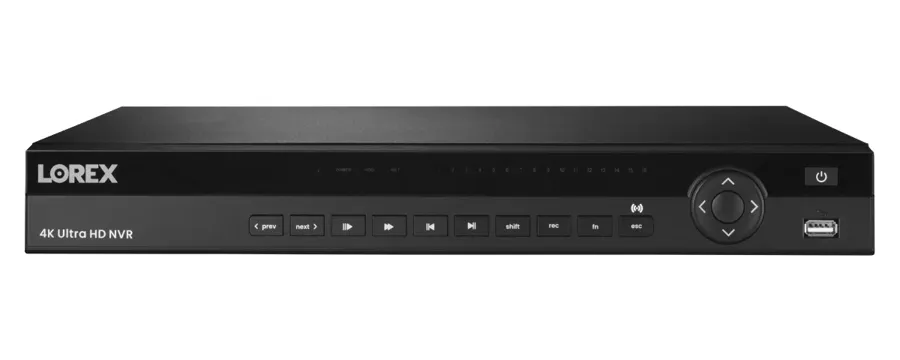
From the AESS job library, not taken in Gowanus: a product photo of a 16-channel network video recorder, the size of box that runs the cameras in a mid-size apartment building or a studio building. In Gowanus the question we ask first about a recorder like this is how far it sits above the floor. A recorder on a high shelf in a cellar off Union Street can ride out a wet night; the same recorder on a milk crate, with its power supply and network switch on the floor beside it, is often the reason a whole building's cameras went dark after a heavy rain.
Gowanus Camera Repair Request
Row house, walk-up, new building, garage, studio building or shop: give us the cross streets and what the screen shows, and a technician calls back with the next step
✅
Request Sent!
Thank you. A technician will get in touch about the Gowanus address shortly.
25+
Years Experience
✓
Same-Day Estimates
100%
Licensed & Insured
4.7★
201 Google Reviews
Owner-operated since 2002 · Thousands of jobs completed · Booked within 2 hours
In Gowanus, a camera system usually fails from the bottom up. The cameras are on the ceiling, the facade or the garage wall, but the parts that keep them alive, the outlet, the power supply, the network switch, the splice box and sometimes the recorder itself, tend to sit low in a cellar, a ground-floor closet or a garage office on some of the lowest ground in Brooklyn. So when a Gowanus owner tells us "the cameras died," the first thing we look at is what sits closest to the floor and whether water, damp or a power cut has reached it. The second thing we do, before anything is restarted, is copy off whatever footage someone is going to ask for: the police after a theft, an insurer after a flood, a developer after a cut cable. Send a photo of the recorder screen to (347) 934-8335 or on WhatsApp, tell us whether the trouble started with rain, an outage or building work, and we will tell you the likely fault and what that kind of repair costs on our Brooklyn list before you book.
Reading your photos is free. The $150 service call pays for the on-site diagnosis and is credited to the repair if you go ahead.
We work under New York State license #12000287431, the license the state requires of any company that installs or services security and CCTV systems for someone else.
We repair every brand and every installer's work, and we say so plainly when a flood-damaged part is not worth the cost of saving.
The Neighborhood
Why Gowanus Properties Need Security Camera Repair
Gowanus is the low stretch of Brooklyn between Park Slope and Carroll Gardens, built around a 1.8-mile canal dug in the 1860s. Since the City Council approved the rezoning in November 2021, which covers 82 blocks and is expected to bring about 8,500 apartments, new buildings of up to 30 stories have been rising along the water and up to 17 along Fourth Avenue. They stand beside a working industrial zone that the city counted at nearly 300 businesses and about 4,000 private jobs in 2021, row houses on the side streets, and factory buildings full of artist and maker studios. All of these buildings have cameras. The reasons those cameras stop working are more particular to Gowanus than to most of Brooklyn, and that is what this page is about.
The first reason is water, and it comes from below. The canal collects the overflow of a combined sewer system that carries rainwater and wastewater in the same pipes. The Red Hook Star-Revue, citing a Sarah Lawrence College researcher, reported that as little as 0.2 inches of rain can send raw sewage into the canal, and that the May 20, 2026 storm left about six inches of water on Gowanus streets according to FloodNet data. NYU and CUNY researchers built their FloodNet street sensors in Gowanus to measure exactly this kind of water. On September 29, 2023, about 50 basement studios at 540 President Street, near the canal between Third and Fourth Avenues, took roughly half a foot of water. Photographer Jan Rattia told Hyperallergic, "Thankfully, my hard drives and my negatives are okay," but lost ten years of framed work. Four years earlier, Bklyner reported that a July 2019 storm filled the basement of Colony at 274 Fourth Avenue halfway up its stairs, and owner Kitty Hernandez described the street as "a river." For a camera system, six inches on a cellar floor is enough: that is where the power strip, the adapters and the network switch usually sit.
The city is working on the water, slowly. In July 2023 the Department of Environmental Protection finished a $54 million storm sewer under Third Avenue between Carroll and State Streets, and Commissioner Rohit Aggarwala said the work had "proved their worth most recently during the 4th of July rainstorms." Streetsblog reported that DEP's three-phase, $233 million plan for Fourth Avenue will not be finished until 2033, and that it is designed for storms of up to 1.75 inches of rain an hour, while Hurricane Ida dropped 3.15. Until then, many Gowanus cellars will keep taking water in a hard storm, and the BK Reader found residents still preparing for it in July 2026. Josephine Guevarra told that paper she found two feet of water in her basement during Ida: "Everything was gone in the basement." Her insurer, she said, did not cover it.
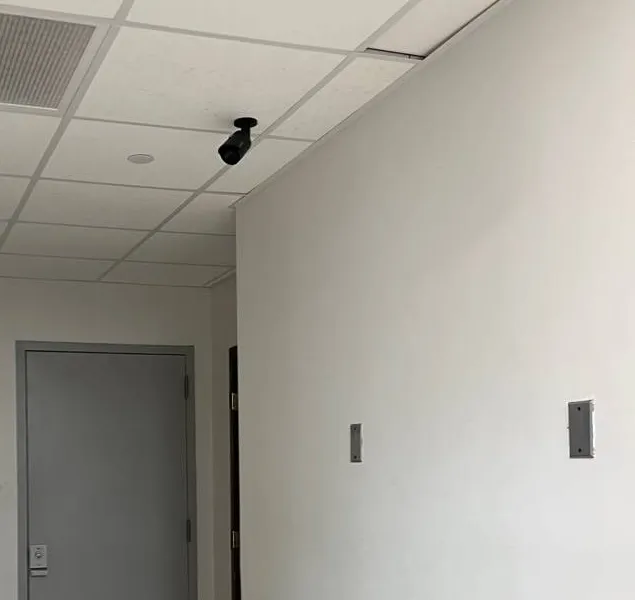
A photo from the AESS job library, not taken in Gowanus: a small black bullet camera hung from a ceiling-tile grid and aimed down a short corridor at a grey steel service door. In Gowanus apartment buildings, a door like this is often the one between the residential corridor and the parking garage or the trash room. It is a door that matters after a theft, and the camera watching it is often the one nobody checked until the footage was needed.
The second reason is that Gowanus cameras get asked for footage more often than they used to. On a Sunday morning in March 2026, News 12 reported, five luxury cars were taken from a parking garage on President Street and a Range Rover from another on Sackett Street. A 911 caller saw four men taking the cars, police said they "entered through the side door," and News 12 found that the side door was reached through the adjoining apartment buildings. One resident told the station, "They have a camera everywhere and people are working 24 hours," and the building said it had "taken additional security measures and are fully cooperating with law enforcement." Whether a building's cameras help in a case like that depends on details owners rarely check: whether the side door is actually covered, whether the garage and lobby recorders keep the same time, and whether the drive kept the night in question.
The third reason is building work. Gowanus has been a construction site for years, and construction is hard on camera systems next door. Excavators cut cables that cross a lot line, scaffolds and sidewalk work loosen mounts, and new towers change the light that night cameras depend on. Theft from fit-outs is not new either: in January 2015 Brooklyn Paper reported that a drill, door handles, smoke detectors and strobe lights, along with a $1,000 security camera, were taken from a parole office being built out on Second Avenue near the canal.
Last is who looks after the system. A studio building may have a landlord, a managing agent and forty tenants, none of whom feel the hallway recorder is theirs. A new rental building may still have its cameras on the installer's logins. A row house may have had the same recorder on the same cellar shelf since before the rezoning. Brick Underground has noted that no city law requires rental buildings to have working cameras at all, so a Gowanus camera repair happens when an owner, a board, a manager or a business decides it should. When we finish a repair, we try to leave the system with a person in charge of it, an alert that tells that person when it fails, and its power and network gear off the floor. Owners who call about cameras often ask us to check the front-door intercom on the same visit.
Six Gowanus facts that shape a camera repair
The water arrives through the floor before it arrives at the door. Combined sewers back up through floor drains and toilets in heavy rain, so a cellar can take water on a night when the street looks wet but passable. Camera equipment on the cellar floor is the first thing in the building to go.
The sewer fixes have dates years away. The Third Avenue storm sewer between Carroll and State Streets was finished in 2023, but DEP's Fourth Avenue plan runs in phases to 2033, and the two sewage tanks being built on the canal are expected to be done in 2029.
Gowanus is where FloodNet was built. NYU and CUNY researchers developed their low-cost street flood sensors as a Gowanus project, and the network's readings now show how high water got on a given night. That is useful when you are working out whether the camera failure and the storm happened together.
The neighborhood lost power with Park Slope and Boerum Hill in January 2026. Council Member Shahana Hanif's office set up an outage information page for Park Slope, Gowanus and Boerum Hill when power went out on January 31, and wrote to Con Edison on February 1. Recorders that lose power without warning are the ones that come back wrong.
Two precincts share the area. The NYPD lists the 76th Precinct, at 191 Union Street, as serving parts of Gowanus, and police appeals for the blocks on the Park Slope side have come from the 78th. When detectives ask for video, they want it from the right night and with the right time on it.
Repair prices follow the fault. HomeAdvisor puts the average Brooklyn camera install or repair at $1,416, with a typical range of $680 to $2,145, but that figure mixes new systems with repairs. A single repair on our Brooklyn list usually costs $150 to $700.
Where this page applies. It covers Gowanus from Wyckoff Street down to the Gowanus Expressway and Hamilton Avenue, between Bond Street and Fourth Avenue, including the canal blocks, the Third Avenue and Fourth Avenue frontages and the industrial blocks around Second Avenue. For the rest of the borough, see our main Brooklyn security camera repair page. The price follows the fault, not the zip code.
Same-Day Repair in Gowanus
Need Repair in Gowanus? Cameras Lost to a Wet Night, a Garage Recorder You Need Tonight, or a Feed That Died With the Power
Urgent camera calls from Gowanus tend to come in three kinds. The first comes the morning after rain: the building's cameras went out overnight, someone has been down to the cellar, and the floor is wet or was. The second comes after an incident: a car taken from a garage, tools gone from a site, a studio or a shop entered, and somebody needs the footage today. The third comes after an outage: the power came back and the recorder did not, or it came back missing half its cameras.
If water has reached the camera equipment, do not plug anything back in or switch it on to "see if it works." Keep people out of any cellar where water is touching outlets or power strips until the building's power to that space is off, and send us photos from the stairs. If the recorder itself stayed dry and is still running, leave it running; it holds the footage of the night the water came in, and a restart can make that harder to recover. If you need footage from an incident, the same rule applies: do not unplug, reset or reboot the recorder. Call (347) 934-8335, give us the date and the time window, and we book the visit with copying that footage as the first task. We write down the time the recorder shows against the real time when we export, because in a building with more than one recorder the clocks rarely agree.
Everything else follows one path. The $150 service call books a two-hour arrival window, the technician finds the cause, and you get a written price before any part is replaced. Requests are booked within 2 hours. We do not promise the repair itself that same day, because flood-damaged recorders and some cameras need parts ordered, but most power supply, switch, connector and drive faults are fixed on the first visit when the part is on the truck.
What We Install
Security Camera Repair Services in Gowanus
Each repair below is priced from our Brooklyn camera repair list. The service call pays for finding the fault; the repair is then priced by what failed, how many cameras it affects, and how hard the equipment is to reach, whether that is a power box on a cellar floor off Carroll Street or a roof camera on a twelve-story building by the canal.
Recovery after water
Systems that went dark during or after a storm: drowned power strips and adapters, PoE switches that sat on the floor, splice boxes that filled, and recorders that need to be judged before anyone powers them again. We test what can be saved, replace what cannot, and lift the rest off the floor.
Power box and PoE switch replacement
The central power supply or network switch that feeds every camera in the building. When one fails, every camera on it goes dark at once, which owners often mistake for a recorder failure. Common after both floods and outages in Gowanus.
Recorder and drive repair
DVRs and NVRs that beep, restart, run hot in a damp room, ask to be initialized, or keep only a few days of video. Drives are read for health and replaced with surveillance-rated drives, and footage someone needs is copied off first.
Garage and side-door coverage
Cameras on garage gates, ramps and the doors that lead from a garage into a building's corridors and stairs. After the 2026 garage thefts on President and Sackett Streets, these are the views owners most often find were out, aimed wrong or never recorded.
Footage export and clock matching
Clips saved to USB with original timestamps for detectives, insurers, landlords and developers, with each recorder's clock checked against real time, so footage from a garage recorder and a lobby recorder can be put in the right order.
Night picture, glare and washout
Cameras that go white under construction floodlights, black when a work light switches off, streaked by welding flashes in a shop, or useless behind glass at night. We fix the camera, the setting or the light it depends on, whichever costs less.
Cable cut by building work
Runs cut by an excavator on the lot next door, pinched by a scaffold, buried behind new drywall or pulled loose when a facade was repointed. Traced, repaired or replaced, and tested from the recorder to the camera.
New-building handover gaps
Cameras in recently finished buildings that still run on an installer's passwords, record to a drive that was never set to overwrite, or were never added to the recorder. We put the system in the owner's name and write down what is connected where.
Storm-season checkups
Every camera, power supply and recorder in a building checked in one visit, with a written list of what works, what is failing, what sits too close to the floor, and what each fix costs, so an owner or a board can decide what comes first.
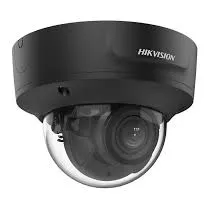
From the AESS job library, not taken in Gowanus: a product photo of a black varifocal dome camera. A varifocal lens can be zoomed and refocused at the camera, which is why it is a common choice for lobbies and vestibules in the new Gowanus buildings. It is also why one of these can drift out of focus after a ceiling is opened or a fixture is changed nearby, and why a repair is often an adjustment rather than a new camera.
Building Specialists
Security Camera Repair for Gowanus's Architecture
Gowanus packs very different buildings onto the same few blocks. Each of the six types below fails in its own way, keeps its recorder in its own kind of place, and has its own answer to the question we ask before any repair: who is allowed to say yes.
Side-street row houses
Brick and brownstone houses on the streets between Third and Fourth Avenues and toward Bond Street, many with a basement unit, a cellar recorder and cameras on the stoop and the yard. Faults gather where the cables enter the cellar.
Avenue buildings with shops below
Three- to six-story buildings on Third and Fourth Avenues with a store on the ground floor, apartments above and a cellar the store uses for stock. Two camera systems often share one cellar and one electrical room.
New canal-side rentals and condos
Buildings from the rezoning and just before it, many built without a cellar because of the flood risk, with network cameras, a garage, a package room and attended or virtual lobbies. Early faults are handover gaps and equipment placed at ground level.
Garages under and beside apartments
Parking floors with their own gate, ramp and side doors, sometimes run by an outside operator and sometimes by the building. The cameras here are the ones asked for most after a theft.
Old factories split into studios
Masonry industrial buildings divided into dozens of artist, craft and small-business studios, with long corridors, freight elevators and basement studios that have flooded. One landlord's recorder serves many tenants.
Shops, sheds and yards in the industrial zone
Low buildings, auto shops, contractors' yards, fabrication shops and warehouses toward Second Avenue and Hamilton Avenue, with roll-up doors, outdoor storage and cameras on long runs across open lots.
Side-street row houses: the cellar wall is the weak point
On a Gowanus row house the cameras were usually put in by one installer, with the recorder on a shelf or table in the cellar near the electric meter, the boiler and the internet modem. The cables come through the cellar wall or a window frame and climb the back or front of the house. Water does not need to cover the cellar floor to cause trouble here: it follows the cable through the wall, sits in a connector at the point of entry, and the camera at the far end starts flickering weeks later. When we trace a dead row-house camera, we start at the place the cable comes into the cellar and at the power strip it plugs into, because those two spots explain more failures than the camera does.
Many of these houses also have a basement apartment, and the BK Reader has reported that many Gowanus basement units were built before FEMA's flood standards. When the recorder or the camera power sits in that apartment, the tenant both controls access and lives with the water. We move the camera power and the recorder to the owner's side where it is practical, and we keep the cellar cable entries sealed and the connectors raised so a wet night is a cleanup job, not a camera repair.
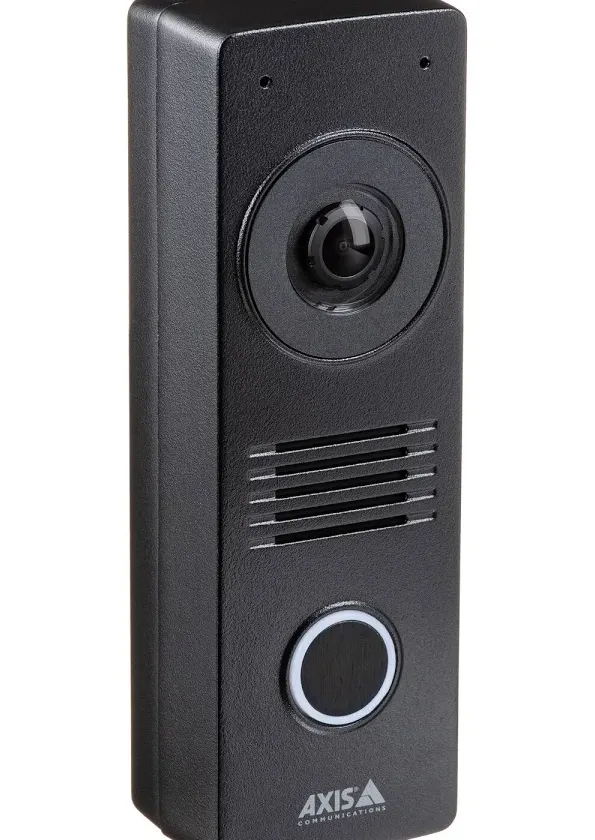
From the AESS job library, not taken in Gowanus: a product photo of a black video intercom door station with a camera, a speaker grille and a lit call button. On a Gowanus row house or small walk-up, the camera at the front door is often built into a station like this rather than mounted separately, so a "dead camera" there can be an intercom repair. We check the door station and the building's recorder together on the same visit, since they often share power and wiring in the cellar.
Avenue buildings with shops below: two systems, one cellar
Third and Fourth Avenue buildings usually have two camera systems. The store has its own recorder, often under the counter or in the stock room, covering the register, the door and the aisles. The building has another, covering the residents' door, the stairs and the cellar. Both often depend on the same cellar, and both lose power when that cellar takes water. Bklyner's report from July 2019 named two Fourth Avenue cellars that filled the same night: Colony at 274 Fourth Avenue, halfway up the stairs, and Taheni Mediterranean Grill at 224 Fourth Avenue at Union Street, to about ankle height. Taheni's own basement pump cleared the water after the rain stopped. Any camera power supply or switch on either floor that night would have been underwater.
The repair in these buildings starts by finding out which system is which. We label each cable by system and by camera, put each system's power on its own protected outlet, and make sure neither the landlord nor the tenant can switch off the other's cameras by accident.
New canal-side rentals and condos: newer cameras, lower equipment rooms
The newest Gowanus buildings use network cameras that rarely fail the way old coax systems do. Their weak points are different. Some were built without cellars at all: the two Lightstone buildings at 363 and 365 Bond Street, about 700 apartments with a 193-space garage, were designed that way because the site is flood-prone. That pushes the camera head-end, the network switches and their battery backups into ground-floor rooms, and ground floor in Gowanus is not always above the water. Buildings in the Gowanus Wharf group, such as Union Channel with its 224 apartments, 24-hour attended lobby and 98 parking spaces, and the 260-unit Douglass Port at 251 Douglass Street, add garages, package rooms and amenity floors, which means more cameras on more switches.
The other weak point is the handover. A new building's camera system is often set up by the electrical or low-voltage contractor during construction and handed to management at opening with the installer's passwords, a recorder set to keep only a few days, and a few cameras that were mounted but never added. A repair in a new building often starts with an inventory: what is installed, who holds the logins, which switch port feeds which camera, and how long the drive actually keeps video. Only then do we chase the dark cameras.
Garages under and beside apartments: the views people ask for
The 2026 thefts on President and Sackett Streets showed how a building garage works as a security problem. The cars went out through the garage, but police said the thieves came in through a side door reached from the apartment buildings. For a camera system, that means the important views are not just the gate and the ramp. They include the door between the garage and the building, the stairs and elevators that lead to it, and the corridor on the residential side. A garage system that covers only the entrance and the exit will show cars leaving and very little else.
Garage cameras also fail in their own ways. Exhaust and dust film the lenses, headlights wash out the picture at the ramp, hosed-down floors put water into low junction boxes, and garages run by an outside operator often have a separate recorder with a different clock from the building's. We repair the cameras, clean and reseal what the garage environment has damaged, and check that the garage and building recorders keep the same time, so footage from both tells one story.
Old factories split into studios: one recorder, many tenants
Gowanus studio buildings occupy former factories on and near Second, Third and Fourth Avenues. Hyperallergic reported in 2022, around the 26th Gowanus Open Studios, that studio landlords had begun requiring tighter tenant screening, insurance and alarms, and in 2023 that the basement studios at 540 President Street flooded. Cameras in these buildings cover long corridors, stairwells, freight elevators, loading doors and sometimes the basement studio floor. They usually belong to the landlord, but the people who notice they are down are the tenants, and a tenant cannot usually authorize a repair. We need the landlord or the managing agent to approve the work and hold the recorder login.
The buildings themselves cause faults too. Thick masonry walls block Wi-Fi, so cameras that were added cheaply on wireless drop out between floors. Long runs from a single recorder push older cameras to the edge of what their cable can carry. In the basements, the flooding that ruins art also ruins the power supplies on the floor. A studio-building repair usually ends with a list for the landlord of every camera, its condition and what it would cost to bring each up to standard.
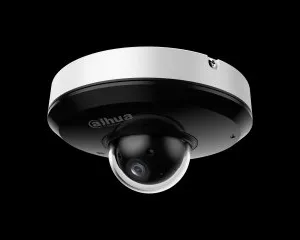
From the AESS job library, not taken in Gowanus: a product photo of a mini pan-tilt dome camera with a white housing over a black lens dome. In a long Gowanus studio corridor, a camera that can turn is sometimes used to cover several doors from one spot. When a camera like this stops moving or loses its saved positions, it ends up staring at one door while the rest of the corridor goes unwatched, and the fix is usually the motor, the presets or the power it needs to turn.
Shops, sheds and yards in the industrial zone: long runs and harsh work
The city's 2021 plan for the Gowanus industrial business zone described a mix of manufacturing, construction, warehousing, arts, retail and offices, and Brooklyn Paper's report on that plan named auto body shops, big-box stores and artist studios among them. Camera systems here face work that homes and offices never see: welding flash and grinding sparks in fabrication shops, paint mist near spray booths, trucks and forklifts brushing walls, and yards where the only light at night is a work lamp on a timer. Runs from the office to the far corner of a yard can be long, and outdoor connections along a fence or a shed roof take the weather full on.
Repairs in these buildings usually involve moving cameras out of the work, not just replacing them: up and away from a welding bay, behind a protective hood where sparks fly, onto a wall a truck cannot reach. We also move recorders out of dusty shop floors into the office, and put the long outdoor runs in conduit where they cross the yard. Tell us what work happens near each camera when you book.
Field Notes
Field Notes: Reading a Gowanus Cellar After the Rain
These notes set out how our technicians handle a Gowanus building whose cameras went out on a wet night, when nobody yet knows whether the water, the power or something else is to blame.
Look before touching. From the stairs, the technician looks for the water line on the walls, wet outlets and power strips, and anything still plugged in on the floor. If water is still touching electrical gear, the space is made safe with the building's power to that area off before anyone steps in.
Find the recorder and leave it alone if it is dry and running. A recorder that stayed above the water usually holds the footage of the night the cameras died, including the moment the water reached the switch or power supply. That clip is copied first, with the recorder's clock noted against real time.
Work from the floor up. Power strips, adapters, the central power box, the PoE switch and any splice or junction box below the water line are checked first, because one wet power box or switch can take down every camera in the building. Anything that sat in water is replaced, not dried and trusted.
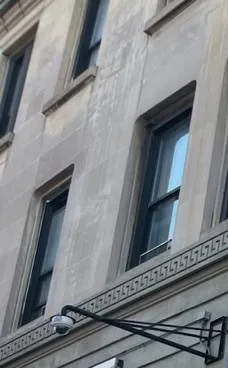
A photo from the AESS job library, not taken in Gowanus: a bullet camera on a long black steel arm below a carved Greek-key band on a pale stone facade with tall sash windows. A long arm like this keeps the camera off the carved stone and lets it look down the face of the building. Gowanus has individual landmarks among its older commercial buildings, such as the Coignet Building on Third Avenue, and on a landmarked facade a repair that replaces a camera on its existing arm is ordinary maintenance, while drilling new holes in the stone is not.
Follow the cable to where it enters. Where a camera cable comes through a cellar wall, a foundation or a garage slab, the technician checks the entry for water tracking along the cable and the nearest connector for corrosion. A dry room with a wet connector at the wall is common.
Price it, raise it, record it. You hear what failed and get a written price before anything is replaced, with the cost of lifting power supplies and switches off the floor shown on its own line. After the repair, every camera is checked by day and after dark, the recorder is put on battery backup, alerts for lost video are turned on, and the photos of the damage are left with you for any insurance claim.
Fault by Fault
Five Ways Gowanus Camera Systems Break, Starting at the Floor
Almost every Gowanus camera failure we see comes down to one of five causes. Knowing which one you have is what decides whether the visit ends at the service call or turns into a recorder replacement.
Water from the drains, not just the street
Gowanus sits on a combined sewer system that overflows into the canal at small amounts of rain, and when the pipes are full, water can push back up through cellar floor drains and toilets. That means a cellar can flood from the inside on a night when water never comes through the door. The camera gear most at risk is whatever is plugged in at floor level: power strips, plug-in adapters, the central power box, the PoE switch and the recorder if it sits on the floor. Raising those parts by a few feet, onto a shelf or a wall-mounted board, prevents most of the damage we are called for. A camera on the ceiling can survive the flood and still go dark because its power came from a strip on the floor.
Damp that stays after the water leaves
After the water drains, the damp stays. Cellars near the canal can stay humid for weeks, and that humidity corrodes the bare metal of camera connectors, power terminals and the contacts inside switches. The picture may come back after a flood and then fail a month later, which owners reasonably take to be a new problem. It usually is not. When we find green or white crust on connectors, we cut back to clean cable and re-terminate, put connections in sealed boxes, and check the recorder's drive for errors, since drives that ran hot and damp are the next thing to go.
Power that drops without warning
The outage that started on January 31, 2026 across Park Slope, Gowanus and Boerum Hill is the kind of event that sends camera systems into trouble. A recorder that loses power while it is writing to its drive can come back on a setup screen, ask to initialize the drive, or lose its clock and network settings. A surge when the power comes back can kill adapters and switch ports, so some cameras return and others do not. Floods add a second kind of outage: when a cellar takes water, the building's own breakers may trip or be shut off for safety, cutting the camera system without warning. A battery backup sized for the recorder and the switch, mounted off the floor, rides through short cuts and lets the recorder shut down cleanly in long ones.
Construction on the next lot
With towers rising across the rezoned blocks, many Gowanus cameras now sit next to an active construction site. Excavation cuts cables that cross a property line or run under a yard. Pile driving and heavy equipment loosen camera mounts and connectors. Scaffolds and sidewalk sheds block views, and site floodlights wash out night pictures across the street. When a camera dies the same week work starts next door, we trace the run first, photograph what we find, and put it in the written repair record so you have something to send the contractor.
Systems handed over without an owner
The last cause is not hardware. In new buildings, studio buildings and houses that have changed hands, the recorder often works but nobody can see it, because the login belongs to an installer, a former manager, a former tenant or a relative. At the April 2025 City Council hearing on public housing, NYCHA's Lauren Gray said that "some of our systems are standalone," and that her team aims to repair a reported camera within 24 to 72 hours. That is a public housing answer, but it holds everywhere: a camera gets fixed only when somebody is responsible for noticing it is down. We put the system in the owner's name, set alerts that reach that person, and write down who holds the passwords.
Commercial Security Camera Repair
Business Security Camera Repair in Gowanus
Gowanus businesses range from one-person studios to big stores, and most of them sit on ground floors or in cellars that have taken water at least once. Their camera systems are usually a recorder in an office, a stock room or a back corner with four to sixteen cameras. When something happens, the owner needs the footage that day, and the repair has to fit around work that cannot stop.
Third Avenue shops and big stores
The avenue's big stores, car businesses, contractors and shops, including the Whole Foods that opened at 214 Third Street in December 2013 beside the landmarked Coignet Building. The city's 2023 storm sewer under Third Avenue between Carroll and State Streets eased flooding on that stretch; blocks farther south wait for later phases.
Fourth Avenue ground floors
Bars, restaurants, gyms, offices and stores under apartments, and new mixed-use buildings of up to 17 stories under the rezoning. The July 2019 storm filled basements at 224 and 274 Fourth Avenue, and DEP's plan for this avenue runs to 2033.
Second Avenue and the yards toward Hamilton Avenue
The heart of the industrial business zone: fabrication and auto shops, contractors' yards, warehouses and studios. Cameras here watch roll-up doors, parked trucks and open lots with little light after hours.
The canal blocks along Bond and Nevins
New rental buildings, the remaining industrial lots and the businesses that face the canal, where the ground is lowest and the construction is busiest. Ground-floor equipment rooms and cut cables are the common faults.
Union and President Street crossings
The streets that cross the canal between the avenues, with studio buildings like the one at 540 President Street, event spaces, workshops and the parking garages where cars were taken in March 2026.
Studio and maker buildings
Former factories divided into artist, design, craft and small-manufacturing studios, where the landlord's cameras cover corridors and loading doors and tenants increasingly add their own inside.
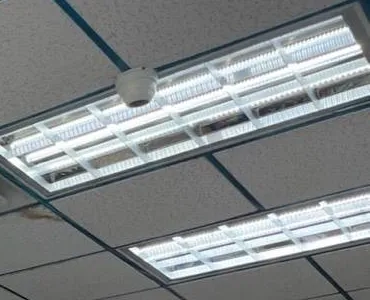
A photo from the AESS job library, not taken in Gowanus: a small white dome camera on grey acoustic ceiling tiles right beside a long louvered fluorescent light panel. In a Gowanus office, gym or studio with a drop ceiling, a camera this close to a light fixture can show flicker or glare, and when the ceiling is opened for a new fixture its cable is easy to disturb. Moving it a tile away is often the whole repair.
What a Third or Fourth Avenue business needs from a repair
Shop owners on the avenues usually call after one of two things: an incident, or water. After an incident, the first need is the footage, exported with the right time on it, and the second is finding out why the camera that mattered was dark, blurred or aimed at the wrong place. After water, the first need is to get the system recording again before the store reopens, and the second is to keep the next storm from doing the same. Both point at the same weak spots: a recorder on the stock-room floor, a power strip under the counter, a switch in the cellar next to the water heater. We move those up, put the recorder on battery backup, and set it to alert the owner when a camera drops.
Workshops, fabrication shops and yards
Industrial-zone repairs start with the work. Welding and plasma cutting flood a camera with light and pit its cover with spatter; grinding dust and paint mist coat lenses; trucks and forklifts strike wall cameras; and a yard lit by one timer lamp is dark for most of the night. A repair here usually moves cameras out of harm's way, swaps exposed domes for hooded housings, and adds a light the camera can rely on. For the long runs across a yard, we test the whole length, because a camera at the far fence that drops out in the cold or the wet often has a tired connector or a damaged section halfway along.
Rules that touch a commercial camera repair
State licensing. The New York Department of State licenses companies that install or service security systems, including closed-circuit television used to watch for intrusion, theft or movement. An owner, or an owner's employee, can work on the owner's own system without a license; a company working for someone else needs one. AESS works under NYS license #12000287431.
City low-voltage rules. NYC Administrative Code §28-105.4.7, which took effect with the 2025 Electrical Code on December 21, 2025, exempts low-voltage signaling, communication and alarm wiring under 50 volts from electrical permits when the work is done by a licensed master electrician, special electrician or qualified person. Repairing cameras on existing low-voltage wiring falls under that; adding or moving a building's line-voltage outlets or circuits is work for a licensed electrician.
Equipment above the flood line. In new construction in flood zones, the city's building and electrical codes require electrical systems, panels and disconnects to be at or above the design flood elevation. Those rules govern how a building is built, not how a camera is repaired, but they point the same way: in Gowanus, camera power supplies, switches and recorders belong up off the floor.
Cameras that watch staff. New York Labor Law §203-c requires employers who monitor employees electronically, including by video, to give written notice and get acknowledgment. If a repair moves a camera so it now watches a work area, update the notice.
Landmarked buildings. Gowanus has individual landmarks such as the Coignet Building and the Carroll Street Bridge rather than a historic district. The Landmarks Preservation Commission's guidebook says ordinary maintenance and repair of existing safety equipment needs no permit, while new mounts or conduit on a landmarked facade follow the commission's rules.
Your Questions Answered
Security Camera Repair in Gowanus: Questions Answered
These are the situations Gowanus homeowners, landlords, boards, garage operators, studio landlords and business owners describe when they call. Each answer is written for the buildings here.
Water, cellars and the canal
Floodwater only came up to our ankles in the basement studios, yet the hallway cameras up near the ceiling went dead the next morning. How can shallow water knock out a camera mounted that high?
The camera was almost certainly fine; what drowned was its power or its network connection. In most basements the cameras are fed from a central power box, a plug-in adapter or a PoE switch, and those usually sit on the floor, on a low shelf or in a closet at floor level. Six inches of water is enough to short them, and every camera they feed goes dark at once. We test the cameras on a known-good supply, replace the wet power box or switch, and remount the new one well above the water line, so the next flood leaves the cameras running.
Since our cellar took water, the metal ends on the camera cables down there have turned green and crusty. Does all that cable have to be replaced?
Usually not. The crust is corrosion on the bare metal of the connectors, helped along by floodwater and the damp that lingers afterward. Copper inside an intact jacket a few inches back is normally clean. We cut each cable back to bright metal, put on new connectors, and close the connection in a sealed box placed above the floor. Cable that lay in water for a long time, or whose jacket is split, gets tested end to end, and only the sections that fail are replaced.
The power to our cellar was shut off for the flood and the electrician now says it can go back on. Should we switch the camera system back on at the same time?
Not until someone has looked at it. Anything in the camera system that sat in water, such as power strips, adapters, a power box, a switch or a recorder on the floor, can short or fail badly the moment it is powered, and it can take the drive's footage with it. Leave the camera equipment unplugged when the cellar power comes back, send us photos of where everything sits and how high the water got, and we bring the system back piece by piece, starting with the recorder if it stayed dry.
Our recorder restarts by itself during heavy rain, right when the cellar sump pump kicks on. Are the two related?
Very likely. A sump pump motor draws a large burst of current when it starts, and if it shares a circuit or a power strip with the recorder, that burst can dip the voltage enough to reset the recorder. It is the worst possible timing, since the recorder restarts during the storm you most want recorded. We check what else is on the recorder's outlet, put the recorder and switch on a battery backup that smooths out those dips, and recommend that an electrician give the pump its own circuit if it does not already have one.
Our cellar camera went dark while the water was rising, but the recorder upstairs stayed dry. Is what it recorded before it died good enough for our flood insurance claim?
Often it is the best record you have. The clip shows the time water first appeared, where it came in, and how fast it rose until the camera or its power failed. We export that footage with its original timestamp, note the recorder's clock against real time, and add our photos of the waterline and the damaged equipment. Whether your insurer accepts it is their decision.
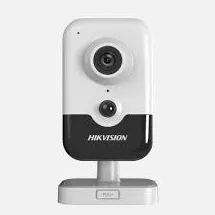
From the AESS job library, not taken in Gowanus: a product photo of a white indoor cube camera. A small camera like this is often added on a shelf to watch a super's office, a package shelf or the corner of a cellar where the boiler and the recorder sit. In a Gowanus cellar it can show when water starts coming in, but only if it is powered from an outlet well above the floor; plugged in at floor level, it goes dark at the moment you most want the picture.
Garages, side doors and police requests
Detectives asked us to show how thieves got from a side door into our garage and out with the cars, but the garage cameras and the lobby cameras are on two recorders whose clocks are minutes apart. Can the footage be lined up into one timeline?
Yes. We export the clips from each recorder with its original timestamps, measure how far each recorder's clock is from real time on the day of the export, and write down those offsets so the clips can be put in the right order. If one recorder has drifted by a known amount, that offset holds back to its last time change, which the recorder's log usually shows. Then we set both recorders to take their time from the same internet time source, so the next set of clips lines up without arithmetic.
Can our cameras be tied to the door between the residential corridor and the garage, so every time that door opens the recorder marks it?
In most systems, yes. Many recorders and network cameras have alarm inputs that accept a simple door contact, and when the door opens they can start recording at full quality, add a marker on the timeline and send an alert after hours. If the door already has a contact for an access control or alarm system, we can often share its signal. The result is that, instead of scrolling hours of garage video, you can jump straight to every opening of that door on a given night.
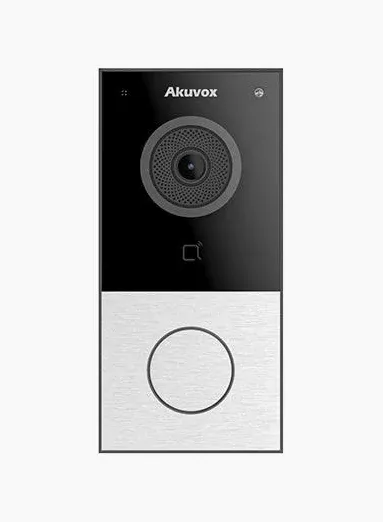
From the AESS job library, not taken in Gowanus: a product photo of a slim video door station with a camera lens at the top and a large round call button. Many of the new Gowanus buildings have a station like this at a side or courier entrance as well as the lobby. Its camera can often be recorded on the building's recorder alongside the garage and corridor cameras, which helps when a door's footage and its entry log need to be compared.
Shops, workshops and the lot next door
The camera in our metal shop washes out to pure white whenever someone welds, and the dome has started to look pitted. Is the camera failing?
The camera is probably working; the welding is beating it. An arc is far brighter than anything a camera's exposure is set for, so the picture blows out while the arc is lit, and spatter that reaches the dome burns small pits that blur the picture for good. We move the camera so it sees the bay from the side rather than looking into the arc, set its exposure and wide dynamic range for the bright flashes, and replace the pitted dome or swap the camera for a hooded bullet whose glass sits back from the sparks.
Our bar's back room runs a haze machine for events, and on those nights the cameras show fog and keep sending motion alerts. Can that be fixed without turning the cameras off?
Mostly. Haze scatters light, especially a camera's own infrared, so the picture turns milky and every drifting cloud counts as motion. We turn off the infrared on cameras in the haze and rely on the room's lighting, switch motion detection to person detection where the camera supports it, and keep the camera on the door and the bar outside the haze where possible. The footage will never be as clear as on a clear night, but it will show who came and went.
An excavator on the construction lot next door cut the cable to our yard camera. Can your written repair record be used to send the bill to the developer?
It is the kind of record that helps. We photograph where the cable was cut and where it ran, note the date we found it and what had to be replaced, and give you an itemized invoice. Many owners send that to the general contractor or the developer, whose insurance usually handles damage to neighboring property. Whether they pay is between you and them, and for a large claim you may want your own lawyer's advice, but the repair record gives you facts rather than a guess.
The camera arm on our old factory building is bolted into brick that has started to crumble around the anchors. Can it be remounted safely?
Yes, but not in the same holes. Old factory brick can be soft, and years of a camera arm levering on a few anchors in the face of one brick will break it out. We move the mount to sound brick or into a mortar joint with anchors meant for old masonry, use a backplate that spreads the load across several bricks, and add a safety tether on high mounts over a sidewalk. If the brick around the old holes is loose, we tell you so a mason can look at it, since that is a facade repair, not a camera one.
Since the tower across the street started work, its site floodlights shine at our building all night, and our front camera now shows glare and streaks after dark. Is the camera ruined?
No. Strong lights aimed toward a camera overwhelm its exposure and leave streaks and halos, especially on a dome with a dirty or scratched cover. We clean or replace the cover, adjust the camera's wide dynamic range and backlight settings, and if needed tilt or shade it so the floodlights fall outside its view. If the site lights are aimed off their own property, it is reasonable to ask the contractor to re-aim them; the change on our side keeps the camera usable either way.
Equipment
Types of Security Cameras and Recorders We Repair
We repair whatever is on the building, whoever installed it. These are the kinds of equipment we find in Gowanus houses, apartment buildings, garages, studio buildings and shops, with the faults each tends to develop here.
Coax cameras, analog and HD
Cameras with round twist-on connectors, common on row houses and avenue buildings wired years ago. In Gowanus the usual faults are corroded connectors at the cellar wall, wet adapters on the floor and worn night vision.
Network cameras on one cable
Cameras that take power and data through one network cable, standard in the new buildings and many shops. They fail when the switch feeding them drowns or takes a surge, when addresses clash, or when passwords leave with the installer.
Recorders: DVR, NVR and hybrid
The box that keeps the video. Here the faults are recorders on cellar floors, drives that ran hot in damp rooms, corrupted settings after outages, and clocks that drift apart between buildings and garages.
Network switches and power boxes
The single points that feed every camera in a building. When they sit at floor level in a flood-prone cellar or ground-floor closet, they are the most common reason a whole system dies at once.
Hooded and vandal-resistant housings
Bullets with long sun hoods and domes rated against impact, for garages, loading doors and shop floors. Covers get pitted by sparks, filmed by exhaust and cracked by trucks, and can usually be replaced separately.
Pan-tilt and zoom cameras
Cameras that turn to cover several doors or a whole yard. Faults include sticking motors, lost presets and power supplies too small to drive the motor in cold weather.
Wi-Fi and battery cameras
Add-on cameras in studios, yards and small shops. Thick factory masonry and concrete floors weaken their signal, routers get replaced, and batteries drain fast in cold weather.
Door stations with cameras
Video intercom stations at lobbies, side doors and courier entrances whose cameras can feed the building's recorder. Faults often turn out to be shared power or wiring in the cellar.
Battery backups
UPS units for the recorder and switch. Many we find in Gowanus have dead batteries or sit on the floor where the first flood ruins them, so they need replacing and raising together.
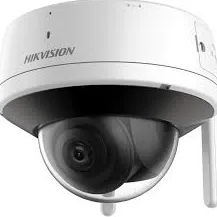
From the AESS job library, not taken in Gowanus: a product photo of a Wi-Fi dome camera with an external antenna. We fit a camera like this only where a cable truly cannot reach, such as a far corner of a studio building separated by thick masonry from the recorder. Even then it needs power from an outlet, and in Gowanus that outlet should be well above the floor, or the wireless camera fails in a flood just like a wired one.
National brands versus a local licensed repair
Some Gowanus homes, studios and shops have cameras from a national alarm company or a consumer brand, and wonder who should fix them. This is how the options usually compare for a repair.
Question
ADT or a similar alarm company
Ring or SimpliSafe cameras
AESS local repair
Who owns the equipment
Depends on the contract; some is leased
You own it
You own it, and we repair it
After a cellar floods
Its own equipment, on its schedule
Replace the device
Power, switch, cable and recorder repaired and raised
Other brands in the same building
Usually only its own
Support covers its own devices
Any brand, any installer
Footage export for police or insurers
Varies
From the cloud account, if you subscribe
From the recorder, with timestamps and clock offsets noted
Licensed technician on site
Varies by dealer
Remote support
Yes, NYS license #12000287431
Price before work
Varies
Price of a replacement device
$150 service call, then a written repair price
AI Overview Reality Check
What AI Gets Wrong About Security Camera Repair in Gowanus
These claims show up in AI answers, help forums and national repair guides. Each is true somewhere. In a Gowanus cellar, garage or studio building, each one costs owners a camera, a clip or a second repair.
"Let water-damaged electronics dry out and they will usually work again"
Advice for a phone dropped in a sink often gets applied to camera gear: unplug it, let it dry for a few days, then try it.
Gowanus floodwater is not sink water. When the combined sewers back up, the water in a cellar carries sewage and silt, and what it leaves on a circuit board keeps corroding after the board looks dry. A power box or a switch that dried out and started again can fail weeks later, sometimes taking cameras or the recorder with it.
Power supplies, adapters, strips and switches that sat in floodwater get replaced. A recorder that was in water is not powered again until its drive has been removed, so the footage can be recovered separately if it matters.
"Cameras mounted high are safe from flooding"
Answers about protecting cameras from floods usually focus on the camera itself: weatherproof ratings and height.
The cameras that die in Gowanus floods are usually high and dry. What fails is the equipment feeding them from below: the power strip on the cellar floor, the PoE switch on a low shelf, the splice box at the base of a wall. The 540 President Street basement studios took about half a foot of water in 2023, and that is above the height of most of what plugs into a cellar outlet.
Ask where each camera gets its power and its network, not just where it hangs. Raising those few boxes protects every camera they feed.
"A factory reset fixes a recorder that will not start after an outage"
When a recorder comes back from a power cut stuck on a startup or setup screen, a reset to factory settings is a common suggestion.
A reset can wipe the camera list, the passwords, the network settings and the recording schedule, and some recorders lose track of the footage on the drive in the process. After an outage like the one that hit Gowanus, Park Slope and Boerum Hill in January 2026, many recorders only need time to check their drive, or a corrupted setting repaired. Resetting first turns a short repair into a full rebuild, and it can cost you the night you needed.
Copy the footage first, then diagnose. A reset is the last step, not the first.
"Switch to wireless cameras and flooding will not damage your wiring"
Some answers suggest replacing a flood-hit wired system with Wi-Fi cameras so there is no cable left to damage.
Every wireless camera still needs power, and in a Gowanus cellar its outlet or adapter floods just as a wired system's power box does. The router it talks to often sits beside the modem in the same cellar. Thick factory masonry also blocks Wi-Fi between floors.
Repairing the wired system and raising its power and switches is usually cheaper and steadier. Wi-Fi makes sense for one hard-to-reach spot, set up on the owner's network.
"Move the recorder upstairs and the flooding problem is solved"
Moving the recorder out of the cellar is the standard advice for flood-prone buildings, and it is good advice as far as it goes.
The recorder is one box. In many Gowanus buildings the camera power supplies, the PoE switches and the cable splices stay in the cellar because that is where the cables meet. Move the recorder upstairs without them and the footage survives the flood, but every camera still goes dark when the cellar fills.
A flood-aware repair lists every piece of the system below the water line and raises or seals each one, starting with whatever feeds the most cameras.
"A camera at the garage entrance covers the garage"
Advice for garage security tends to center on the entrance and exit, where cars and plates can be recorded.
The March 2026 garage thefts on President and Sackett Streets suggest otherwise. Police said the thieves entered through a side door that News 12 found was reached through the neighboring apartment buildings. A camera on the ramp shows the cars leaving; it does not show how people got in.
Check the doors from the building into the garage, the stairs and elevators leading to them, and whether the garage recorder and the building recorder agree on the time. Those are the clips detectives ask for.
"Any recorded footage will work as evidence"
Many answers say simply that saving the clip is enough to help the police or an insurer.
Footage helps when it can be trusted. A clip stamped with a clock that is twenty minutes off, a phone recording of the recorder's screen, or a low-quality export that blurs faces gives detectives and adjusters less than it should. In buildings with more than one recorder, clips that disagree about the time cause more confusion than help.
Export the original file to USB, note the difference between the recorder's clock and real time, and keep the recorders synced. That is part of every repair we do.
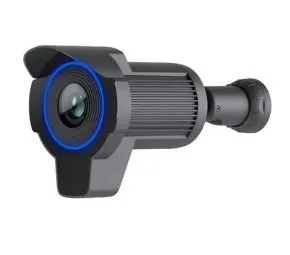
From the AESS job library, not taken in Gowanus: a product photo of a black bullet camera with a long hood and a blue-lit ring around the lens. The long hood shades the glass from rain, glare and falling debris, which is why we use cameras like this over Gowanus garage ramps, loading doors and shop bays. The lit ring makes the camera obvious to anyone approaching, which some owners want and some do not.
Talk to a Technician Before You Power Up a Wet Cellar or Reset the Recorder
Tell us the cross streets, the type of building, how many cameras there are, which ones are out, where the recorder and the power supplies sit, and whether water or a power cut came first. If you need footage from a particular night, say so and we will plan the visit around copying it. Photos of the recorder screen, the cellar or equipment room, and the water line if there is one help us bring the right parts. For anything urgent, call (347) 934-8335.
✅
Request Sent!
Thank you. A technician will get in touch about the Gowanus address shortly.
How It Works
Our Repair Process
1. Send the screen, the block and the water history
A photo of the recorder or app with the dark cameras, the cross streets and the type of building, plus whether the cellar or ground floor took water or lost power, by text, WhatsApp or the form.
2. Settle who approves and who opens the door
Owner, board, managing agent, garage operator or studio landlord: we confirm who approves the work, who holds the recorder login and who will open the cellar, garage or roof.
3. Book the service call
The $150 Brooklyn service call puts the visit on the schedule in a two-hour arrival window and is credited to the repair if you go ahead.
4. Copy the footage that matters
Clips for police, an insurer, a landlord or a developer are exported to USB with original timestamps before anything is restarted, unplugged or replaced.
5. Test from the lowest point up
Outlets, power boxes, switches and splices at floor level first, then cables, recorder and drive, then each camera, with anything water or building work touched noted and photographed.
6. Write down the cause and the price
You hear what failed and why, and get a written, itemized price before any part is replaced, with raising or sealing low equipment shown on its own line.
7. Repair, raise and seal
Failed parts are repaired or replaced, power supplies and switches are lifted off the floor where needed, connections are sealed and the recorder goes on battery backup.
8. Retest by day and night and hand over
Every camera is checked live and in playback by day and after dark, clocks and drive health are confirmed, alerts are turned on, cables are labeled and logins go to the right person.
Coverage Area
Security Camera Repair Near Gowanus's Landmarks
76th Precinct station house
The NYPD station at 191 Union Street, which lists parts of Gowanus in its area and is where many local requests for footage begin.
363 and 365 Bond Street
The two twelve-story canal-side rental buildings with about 700 apartments and a 193-space garage, designed without a cellar because of the flood-prone site.
Gowanus Wharf
The group of canal-side rentals that includes Union Channel, with its attended lobby and 98 parking spaces, and the 15-story Douglass Port at 251 Douglass Street.
420 Carroll Street
Described as the first residential project under the 2021 rezoning, one of the new buildings changing the canal's edge between Carroll and President Streets.
540 President Street
The studio building near the canal between Third and Fourth Avenues whose roughly 50 basement studios flooded in September 2023.
Brooklyn Community Board 6
The board for Gowanus and its neighbors, with offices at 250 Baltic Street and full board meetings at the Van Alen Institute on Bond Street.
We also serve the neighborhoods around Gowanus, including Park Slope, Carroll Gardens, Boerum Hill and Red Hook, at the same Brooklyn rate. Our Boerum Hill security camera repair page covers the rowhouse blocks just north of the canal, and the whole borough is on our Brooklyn security camera repair page.
Pricing
Security Camera Repair Cost in Gowanus
Gowanus is billed at our Brooklyn rate. Every repair starts with the $150 service call, which covers the on-site diagnosis and is credited to the repair if you go ahead. The figures below come from our published list of Brooklyn security camera repair prices; your exact price is written down on the visit, once we know what failed.
Repair
Brooklyn price
Service call with on-site diagnosis and written price
$150, credited to the repair
Motion, alert, login or clock settings, no parts
Usually within the $150 service call
Clean and check for a blurry or filmed picture
$80
Connector re-terminate or PoE port swap
$150–$350
Power supply repair or replacement
$150–$400
Dome or front cover replacement
$30–$80 part plus labor
Hard drive swap, by capacity
$200–$450
Indoor camera repair
$200–$450
Single camera replacement on a working system
$250–$600
Night vision repair
$250–$650
DVR not working, including drive and labor
$300–$700
NVR not recording, by model
$400–$900
Vandalized camera, per camera plus cable repair
$400–$900
PTZ camera repair
$450–$1,200
Hybrid recorder swap with channels reconfigured
$700–$1,200
DVR or NVR replacement with drive, or multi-run wiring repair
$700–$1,500
Full rewire or whole-building overhaul
From $1,500
Three things move a Gowanus repair within those ranges. The first is what the water touched: one drowned power box is a small job, while a cellar where the switch, the power supplies, the splices and the recorder all sat on the floor is a bigger one, priced part by part. The second is reach: a camera on the roof of a canal-side building, at the far fence of a yard or high on a factory wall takes more time and ladder work than one over a stoop. The third is the paperwork the system never had: a new building with no record of which switch port feeds which camera, or a studio building wired by several tenants over the years, adds time for tracing and labeling. If the price changes on site, you hear the new number before the work goes on. Bundling the camera repair with intercom, alarm or cabling work on the same visit saves $200 to $400 in labor on our Brooklyn list.
Full terms — including 50% deposit, one-year parts-only warranty on AESS-supplied products, and the late-fee schedule — are set out in the service agreement.
Shop Our Systems
Security Camera Repair Packages & Pricing
Three ways Gowanus repairs usually come together, priced from our Brooklyn list. Each starts with the $150 service call, credited to the repair.
Single-issue repair: $150–$700
One fault, one visit: a drowned power box or switch replaced and raised, a corroded cellar connector redone, a drive swapped, a glare or welding-washout problem fixed, or a lost login recovered. Typical for a row house, a small shop or one studio corridor.
Major system repair: $700–$1,500
The recorder or the wiring: a flood-damaged DVR or NVR replaced with a new drive and the cameras set up again, or several runs replaced after construction next door cut them. Typical after a bad storm or a building job that damaged the system.
Annual maintenance: $250–$800
Every camera checked by day and night, lenses and covers cleaned, power and switches tested, the drive's health read, clocks synced, alerts confirmed, and low equipment checked before storm season. Residences start at $250, commercial properties at $400, and multi-property owners run $500 to $800.
Bring your own equipment. If you have already bought a replacement camera, switch or recorder, we can fit it at labor-only rates. Tell us the exact model and we quote the labor by phone or text, and the visit is booked once it is paid. Your own equipment is installed as supplied: we cannot vouch for parts we did not supply, and if a model will not work with your recorder, will struggle on Wi-Fi through factory masonry, or is rated for indoor use where it is going outdoors, we tell you before the visit.
Complete Services
Every Security Camera Repair Service in Gowanus
Cameras, cables and connectors
Dark cameras, corroded cellar connectors and runs cut by construction next door. Request a repair
Recorders, power and flood recovery
DVRs, NVRs, power boxes and switches in cellars, ground-floor rooms and garage offices, including systems hit by water or an outage. Brooklyn security camera repair
If our cellar floods again after you replace the camera power supply, does the warranty cover the new one?
+
No. A flood is an outside event, like a power surge or physical damage, not a defect in the part, so water damage falls outside the parts warranty on what we supply. That is the reason we raise power supplies, switches and splices off the floor as part of a Gowanus repair: it is the protection the warranty cannot give. The full warranty terms are in the service agreement you receive.
Will our insurance pay for camera equipment damaged in a flood?
+
That depends on your policy, and only your insurer can say. Standard property policies often treat flood and sewer backup differently, and one Gowanus resident told BK Reader her insurer did not cover her basement losses after Ida. What we can do is photograph the damage and the water line before anything is replaced, keep the damaged parts if you ask, and give you an itemized invoice to submit.
Can your technician work in a cellar that still has water on the floor?
+
Only once the building's power to that space is off and the water is low enough to work safely. We do not stand in water next to live outlets or equipment. Until then, the technician can often copy footage from a recorder that sits upstairs or out of the water, and plan the cellar work from photos, so the repair starts as soon as the cellar is pumped out.
Does replacing cameras on our building need a permit from the Buildings Department?
+
Usually not. Under NYC Administrative Code §28-105.4.7, low-voltage wiring under 50 volts for signaling, communication and alarm systems does not need an electrical permit when it is done by a licensed or qualified person, and camera repairs on existing low-voltage wiring fall under that. New line-voltage outlets or circuits are different and need a licensed electrician. Landmarked facades follow the Landmarks Preservation Commission's own rules.
Can a camera in our cellar warn us when water starts coming in?
+
Partly. In a cellar that is normally empty at night, motion or change detection on a camera can catch water spreading across the floor and send an alert with a picture. It is not a flood sensor, though, and it misses slow seepage in the dark. A small water sensor near the floor drain is the reliable warning; the camera is how you see what is happening once the alert arrives.
After the power came back, our recorder took close to an hour before it showed any cameras. Is that normal?
+
It can be. When a recorder loses power without shutting down, many models check the whole drive on startup, and on a large drive that takes a long time. Waiting is better than forcing a restart. If it happens every time the power flickers, or the check finds errors, the drive is worn or the recorder needs a battery backup so it can shut down properly.
Since our cellar got damp, the recorder's fan has become loud and the case feels hot. Is it about to fail?
+
It is a warning worth acting on. Damp and dust clog fans and vents, the recorder runs hotter, and heat shortens the life of the drive inside. We clean or replace the fan, check the drive's health, and move the recorder somewhere cooler and drier and off the floor. If the drive is already reporting errors, we copy the footage you need and replace it.
Why do your technicians put a sealed box behind each outdoor camera?
+
Because the connection behind the camera is where water gets in. A sealed back box keeps rain, condensation and wall seepage away from the connectors and gives the extra cable a dry place to sit. On Gowanus walls and fences that face weather, it is the difference between a connection that lasts years and one that fails after its first wet season.
Our new building has an emergency generator. Can the camera system be connected to it?
+
Often it can, but that is the building engineer's and electrician's decision, because emergency circuits are reserved and laid out by code. What we can do is tell them exactly what the camera system needs, which outlets feed the recorder and the switches, and add a battery backup so the cameras keep running in the seconds before a generator takes over.
The recorder and switch have to stay in our ground-floor equipment room. Can they go in a waterproof enclosure instead?
+
Sometimes, but height beats enclosure. A sealed cabinet keeps out splashes and short exposure, but electronics need airflow, and a fully sealed box runs hot. In most rooms the better answer is a wall-mounted cabinet with ventilation set well above the highest water the room has seen, with cables entering from the top or sides so water cannot run down them into the box.
How should camera cables be run through a cellar that takes water?
+
High and with a drip loop. Cables should run along the ceiling or the top of the wall, not across the floor or low on the wall, and drop down to equipment from above with a small loop so water running along the cable drips off before reaching the connector. Splices should be in sealed boxes above the water line, and where cables pass through the foundation, the hole should be sealed.
Ready to Have Every Gowanus Camera Recording Through the Next Storm?
Send a photo of the recorder screen and the equipment in the cellar or equipment room, your cross streets, and whether water or an outage came first. We book within 2 hours, give you a two-hour arrival window, copy your footage before anything is touched, and write down the repair price before any part is replaced.