Curb camera that missed the car, a cellar recorder that stopped saving, or a shop camera south of 86th Street that went dark? Fort Hamilton camera repair line, booked within 2 hours: (347) 934-8335
Shore Road Co-ops · Row Houses With a Rented Floor · Small Condo Buildings and Their Garages · Fourth and Fifth Avenue Storefronts South of 86th Street
Security Camera Repair in Fort Hamilton
Any Brand, Any Installer · Footage Copied Before Anything Is Restarted · Written Price Before Parts · Brooklyn Rate
Security camera repair in Fort Hamilton begins with our $150 Brooklyn service call: a technician finds the fault on site, and the $150 is credited to the repair if you go ahead. On our published Brooklyn list a single fault usually costs $150 to $700, and replacing a recorder or several damaged cable runs costs $700 to $1,500. We repair systems we did not install, from two cameras on a row house below 86th Street to the cellar recorder of a six-story co-op on Shore Road or the cameras over a Fifth Avenue counter. Requests are booked within 2 hours, visits come in two-hour arrival windows, and you get the cause and a written price before any part is changed.
Every price on this page is taken from our published Brooklyn camera repair list, and your own price is put in writing before work begins
Rated 4.7★ across 201 Google Reviews
Reviewed and updated November 12, 2026, against the NYPD's 68th Precinct CompStat report for the week of November 2 to 8, 2026; Brooklyn Eagle reporting on the NYPD ARGUS cameras placed on 86th Street at Fourth and Fifth Avenues and on the 2020 council-funded camera program; ABC7 New York's August 2026 report on the overnight restaurant break-ins on 87th and 88th Streets and Third Avenue; the Brooklyn Reporter's 2016 report on a Narrows Avenue package theft and its November 2025 report on the Verrazzano-Narrows Bridge Brooklyn ramp project; the Governor's office on the Fort Hamilton Parkway bridge rehabilitation; News 12 Brooklyn on the June 2025 Con Edison voltage reductions in Bay Ridge and Dyker Heights; NYC Emergency Management on the July 14, 2025 cloudburst; Military OneSource on the Fort Hamilton garrison; Wikipedia's Bay Ridge article; Reolink and Swann support guides on offline and non-recording cameras; HomeAdvisor's Brooklyn cost page; and the New York Department of State on security and CCTV installer licensing. · Abstract Enterprises Security Systems, NYS license #12000287431 · crews dispatched from our Troy Avenue office in Brooklyn
A product photo from the AESS job library, not taken in Fort Hamilton: a 16-channel desktop network video recorder. A recorder like this is what sits on a cellar shelf in a six-story Shore Road co-op or in the back office of a Fifth Avenue store, collecting every camera in the building. When several cameras go dark at once, this box, its hard drive and the power behind it are where the repair starts.
Fort Hamilton Camera Repair Request
Co-op, condo, row house, rented floor or avenue shop: give us the address and what the screen is showing, and a technician calls back with the next step
✅
Request Sent!
Thank you. A technician will be in touch about the Fort Hamilton address shortly.
25+
Years Experience
✓
Same-Day Estimates
100%
Licensed & Insured
4.7★
201 Google Reviews
Owner-operated since 2002 · Thousands of jobs completed · Booked within 2 hours
Quick answer: in Fort Hamilton, most camera repairs are about one of three things, and the first visit is built around finding which. The camera itself has failed, which on a row house or a co-op facade usually means water in a connector, a burned-out infrared ring or a cracked housing. The path between the camera and the recorder has failed, which means a power supply, a switch port or a cable damaged by building work. Or the recorder is the problem: a worn drive, a full disk that stopped overwriting, settings lost after a brownout, or a login that left the neighborhood with the person who set it up. Our $150 Brooklyn service call covers the on-site diagnosis and is credited to the repair. A single fault is usually $150 to $700 on our list, and a recorder or multi-run repair is $700 to $1,500. Send a photo of the recorder screen to (347) 934-8335 or on WhatsApp and we will tell you which of the three it most likely is before you book anything.
Reading your photos is free. The service call is the only charge before you see a written repair price.
The work is done under New York State license #12000287431, the state license for companies that install and service security and CCTV systems for other people.
We repair every common brand and other installers' work, and we say so when an old part is not worth the money to fix.
The Neighborhood
Why Fort Hamilton Properties Need Security Camera Repair
Fort Hamilton is the southern end of Bay Ridge, the blocks below 86th Street that run down to the Army post, John Paul Jones Park and the Brooklyn foot of the Verrazzano-Narrows Bridge. It shares the 11209 ZIP code and the NYPD's 68th Precinct with the rest of Bay Ridge, and it is often treated as a quiet corner of a quiet neighborhood. That reputation is part of why camera systems here go unchecked for so long. Owners put cameras up after a package theft or a car break-in, the street stays calm for a year or two, and nobody opens the playback until the morning it matters. That is when they find out that the camera over the curb has been recording a smear since the last storm, or that the recorder in the cellar stopped saving new video weeks ago.
The numbers this year give owners a reason to look sooner. The 68th Precinct's CompStat report for the week of November 2 to 8, 2026 shows 150 grand larcenies of vehicles so far this year, against 109 at the same point in 2025, a rise of 37.6 percent. In the latest 28 days the precinct recorded 14 vehicle thefts, against 4 in the same weeks a year earlier. Burglaries are almost flat, at 65 against 64, and overall index crime is down slightly. In other words, the risk that changed is the one at the curb and in the garage, and that is exactly where Fort Hamilton camera systems are weakest: cameras aimed for the front door, set to ignore passing cars, or too dim after dark to show anything about a person standing beside a parked car.
Public cameras do not cover the gap. Back in 2013, local officials funded NYPD ARGUS cameras, and two of them went up on 86th Street, one at Fifth Avenue and one at Fourth Avenue, along the northern edge of Fort Hamilton. In 2020 Councilmember Justin Brannan funded ten more for the 43rd District, and NYPD guidance said cameras are most useful in desolate places with little foot traffic at night. Those cameras watch intersections. They do not see a driveway on 94th Street, the stoop of a row house on Marine Avenue or the cellar of a restaurant off Third Avenue. A precinct commander put the limit plainly at a 68th Precinct community council meeting: "Cops can't be on every corner." The private camera on the building is usually the only record of what happened at that door.
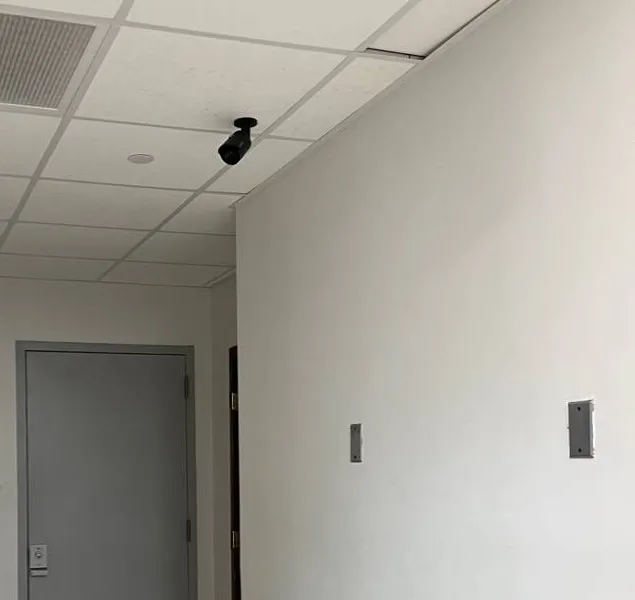
A photo from the AESS job library, not taken in Fort Hamilton: a small black bullet camera hung from a ceiling-tile grid and aimed down a corridor at a grey steel service door. This is the camera that matters in a restaurant or store south of 86th Street after hours, the one watching the back corridor, the basement stairs or the delivery door. It is also the one most often found aimed slightly wrong, so it records the door but not the face of the person who comes through it.
The households here add their own repair patterns. The Fort Hamilton garrison counts 573 active-duty members, 942 family members, 700 civilians and 880 Guard and Reserve members, according to Military OneSource, against roughly 286 homes on the post itself, so many of those households rent apartments and floors of row houses in the surrounding blocks. Assignments run two or three years. Every move leaves a camera behind on somebody's stoop with an app account tied to a phone that has left the state, and every new tenant inherits a system with logins nobody passed on. Alongside them live long-time owners in row houses and six-story Shore Road co-ops built in the 1930s and 1940s, whose cameras went in ten or fifteen years ago and are now on their second or third recorder.
The power and the weather here take their own toll. During the June 2025 heat wave Con Edison deliberately lowered voltage in parts of southwest Brooklyn, and News 12 named Bay Ridge and Dyker Heights among the hardest hit. Recorders and power supplies do not like a long dip in voltage any more than they like a hard outage. A month later, on July 14, 2025, Central Park recorded 2.07 inches of rain in a single hour, the second-highest hourly total on record there, and the city warned that basements could flood with little or no warning. In Fort Hamilton the basement is where the recorder usually lives. And from spring 2026 through 2029 the Verrazzano-Narrows Bridge Brooklyn ramps are being rebuilt along Fort Hamilton Parkway, with noise barriers, heavy equipment and years of construction next to homes and buildings whose cameras face that work.
When a Fort Hamilton camera system fails, the fix is rarely a whole new system. Most row-house and co-op owners who book a camera repair with us also ask about the front door at the same visit; a building with a dead entrance camera often has a tired intercom or buzzer too, and we can look at both on one trip.
Six Fort Hamilton facts that shape a camera repair
Car theft is the risk that moved. Vehicle thefts in the 68th Precinct stood at 150 for 2026 through November 8, up 37.6 percent from 109 a year earlier, while burglaries held at 65 against 64 (NYPD CompStat, 68th Precinct).
The city's cameras stop at 86th Street. The two NYPD ARGUS cameras funded in 2013 for this part of the district went up on 86th Street at Fourth and Fifth Avenues (Brooklyn Eagle, June 2014). Nothing about them covers a private stoop, garage or cellar.
One precinct, a long way off. The 68th Precinct station house is at 333 65th Street, more than twenty blocks north of the Fort Hamilton blocks, and covers all of Bay Ridge and Dyker Heights.
Brownouts count as power events. In June 2025 Con Edison lowered voltage on purpose in parts of southwest Brooklyn, with Bay Ridge and Dyker Heights among the hardest-hit areas (News 12 Brooklyn).
Cellar recorders face cloudbursts. On July 14, 2025, 2.07 inches of rain fell in one hour in Central Park, and the city warned that basements can flood with little or no warning (NYC Emergency Management).
Bridge ramp work runs to 2029. Reconstruction of the Verrazzano-Narrows Bridge Belt Parkway ramps began in spring 2026, John J. Carty Park is closed from summer 2026 to summer 2029, and the project is due to finish in the last quarter of 2029 (Brooklyn Reporter, November 2025).
Same-Day Repair in Fort Hamilton
Need Repair in Fort Hamilton? A Car Gone From the Curb, a Clip That Will Not Open, or a Recorder Stuck on Its Startup Screen
Urgent calls from Fort Hamilton arrive in a few recognizable shapes. One is the morning after: a car is missing from the curb or the condo garage, a package is gone from a stoop, a store or restaurant was entered overnight, and the owner needs to know what the cameras saw before the recorder writes over it. Another is the morning after the power: the lights came back after an outage or a long brownout, and the recorder either did not, or came back asking to be set up as if it were new. The third is the slow one that only feels urgent once it is found: someone checks the app for the first time in months and sees three black tiles where cameras used to be.
For the first kind, the most important instruction is the simplest: do not restart, unplug or reset the recorder before the footage is copied. Restarting a recorder with a failing drive can be the last thing that drive does. If you can, write down the date and approximate time of the event and the camera that should have seen it, and send a photo of the recorder screen. For the second kind, leave the recorder on its setup screen and do not accept any prompt to format or initialize the drive; that prompt erases the footage. For the third kind, a photo of the app or the recorder grid, with the dark tiles visible, tells us most of what we need.
Our part is to get a technician to the address in a two-hour arrival window, copy what matters first, find the cause, and give you a written price before anything is replaced. Requests are booked within 2 hours. We do not promise that every repair is finished the day you call, because some cameras and recorders have to be ordered, but power, drive and single-camera faults are often fixed on the first visit when the right part is on the truck.
What We Install
Security Camera Repair Services in Fort Hamilton
Each repair below is priced from our Brooklyn camera repair list. The service call pays for the diagnosis; the repair is priced by what actually failed, how many cameras it affects and how hard the camera or cable is to reach, whether that is a stoop camera on a row house near Fourth Avenue or a roof-edge camera on a six-story building facing Shore Road Park.
Curb, driveway and garage camera repair
Cameras that should cover parked cars and do not: night pictures too dark to show a person beside a car, motion rules that skip anything shaped like a vehicle, garage-door cameras that start recording too late, and lenses aimed at the stoop instead of the curb. With vehicle thefts in the 68th Precinct up sharply this year, this is the repair Fort Hamilton owners ask about most.
Dark camera diagnosis
One camera, no picture. We test at the camera, along the cable and at the recorder input, so the part replaced is the part that failed. Often it is a corroded connector at the camera end or a plug-in adapter that quit, not the camera body.
Recorders and hard drives
DVRs and NVRs in cellars, garages, hall closets and back offices that beep, restart, run hot, stop saving or keep only a few days. Drives are read for health, footage is copied off, and a drive made for round-the-clock recording goes back in.
Brownout and outage recovery
Systems that came back wrong after the power dipped or went out: recorders stuck at setup, cameras missing from the grid, network cameras that lost their addresses, clocks reset to a default date, and power boxes with one dead output.
Tenant turnover and move-out handover
For landlords who rent to a new household every few years and tenants leaving on orders: removing old users, moving the app account to the person who stays, resetting shared cameras, and taking a tenant's own cameras off the building cleanly.
Cable and connector repair
Runs crushed or cut by window, roofing and pointing crews, cables tacked along brick that cracked in the sun, coax connectors that let water in at the back of a facade camera, and network cable crimped badly the first time.
Phone access and account recovery
Apps that lost the recorder after a new modem, accounts registered to a relative or a former tenant, forgotten recorder passwords, and households where only one phone ever got access. We set up the logins so the right people can see the cameras.
Footage copies for police, insurers and boards
Clips saved to USB with their original timestamps for the 68th Precinct, an insurer, a moving claim or a co-op board, with a note on how far the recorder clock was off so the times can be trusted.
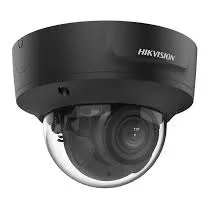
A product photo from the AESS job library, not taken in Fort Hamilton: a black varifocal dome camera. Varifocal means the lens zoom can be adjusted after the camera is mounted. In a Shore Road co-op lobby or a walk-up vestibule off Fourth Avenue, that adjustment is often the whole repair: a dome that was set wide years ago to show the entire room can be tightened so a face at the inner door is large enough to recognize.
Building Specialists
Security Camera Repair for Fort Hamilton's Architecture
Six kinds of building account for nearly every camera repair we see below 86th Street. Each one hides its recorder in a different place, runs its cables differently and fails in its own way, which is why the first question on the phone is always what kind of building it is.
Six-story Shore Road co-ops
The Art Deco and Art Moderne apartment houses facing Shore Road Park and the harbor, such as the six-story, 55-unit co-op at 9437 Shore Road, with cameras in the lobby, the mail area, the elevator, the laundry, the service entrance and the rear lot, all running to one recorder in the cellar or the super's office.
Prewar walk-ups and elevator buildings off Fourth Avenue
Four- to six-story brick buildings on the side streets and along Fourth Avenue, some with a super and some with only a managing agent, where the cameras were added piece by piece by different contractors.
Attached row houses with a rented floor
The brick and limestone rows on the numbered streets, often with an owner downstairs and a tenant upstairs, and one small recorder in the cellar or a closet serving both households.
Six- to twelve-unit condo infill buildings
The attached condo buildings that replaced one- and two-family houses from the 1990s on, with a street-level garage, a shared entrance and a recorder that belongs to the condo association but often sits in one owner's space.
Freestanding houses on the Dyker side of the expressway
The detached and semi-detached houses in City Planning's Fort Hamilton strip between Seventh Avenue and the Gowanus Expressway, with driveways, side yards and cameras on several sides of the house.
Storefront buildings with apartments above
Mixed-use buildings on Fourth and Fifth Avenues and on 86th Street, where a store, an office or a medical practice downstairs shares a cellar, a meter room and sometimes a recorder with the apartments upstairs.
Shore Road co-ops: long risers, many users and a board that wants it in writing
The six-story apartment houses along Shore Road were built as rentals in the 1930s and 1940s and converted to co-ops later. Most camera systems in them were installed in one push, often in the 1990s or 2000s on coax, and then extended by whoever the managing agent called next. A typical system has a lobby dome, a camera at the mail area, one at the service door, one in the elevator cab, a couple in the laundry and bike rooms, and two or three outside facing the entrance and the rear lot. The cables climb through old risers and travel along cellar ceilings to a recorder in the super's office or a locked closet.
The repair problems follow from that history. A riser cable that was fine for an analog camera may struggle with a newer one. Cameras installed by different contractors may use different power supplies, so one outage takes down half the system and not the other half. And the recorder may have a dozen logins, belonging to the super, two former board members, a former managing agent and a security company that no longer exists. On a co-op visit we test each camera from the recorder end first, then go to the cameras that failed, and we list every login we find so the board can decide which ones stay.
Walk-ups and elevator buildings off Fourth Avenue: added by many hands
The four- to six-story buildings on the side streets near Fourth Avenue tend to have camera systems that grew one emergency at a time. A camera went up at the front door after a package theft, another at the back after someone got into the yard, and a third in the stairwell after a complaint. Each one may have been wired by a different contractor, with its own adapter plugged into whatever outlet was nearest, and only some of them reach the recorder at all.
Row houses with a rented floor: one recorder, two households
Fort Hamilton's attached row houses are commonly split between an owner and a tenant, and many of those tenants are military households on two- or three-year assignments. The camera system usually belongs to the owner, but the tenant uses the front door, the stoop and the vestibule that the cameras watch, and may have been given access to the app. When a tenant leaves, nobody removes that access. When a new tenant arrives, they may be given the old tenant's login or none at all.
Repairs here are as much about people as about parts. We set up the recorder so the owner holds the administrator login, the tenant gets a viewer login for the shared cameras only, and the owner's private cameras, such as the yard or a garage, stay off the tenant's phone. When a tenant leaves, removing one login is all it takes, and nothing has to be reset. The hardware faults are the usual ones for brick and limestone facades: a connector behind the stoop camera that took water, an adapter in the vestibule closet that failed, and a cable stapled along the cornice that cracked.
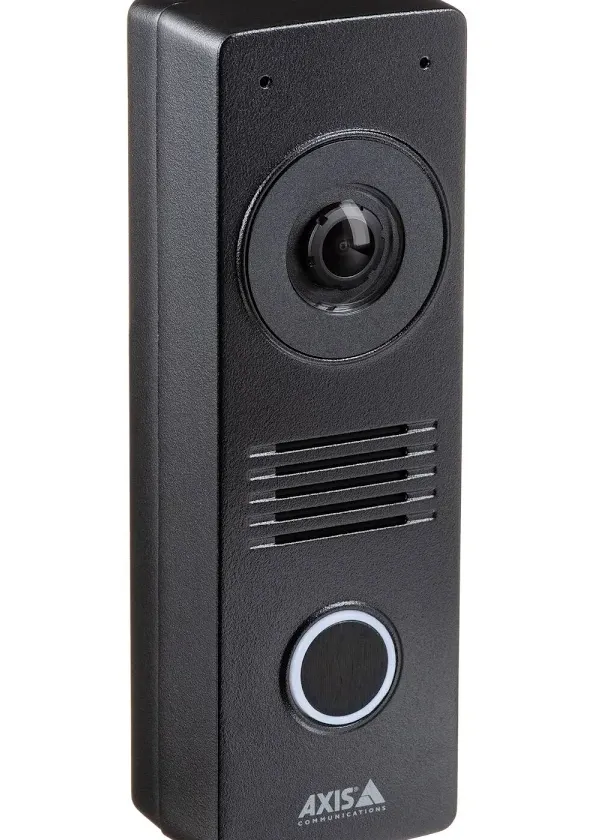
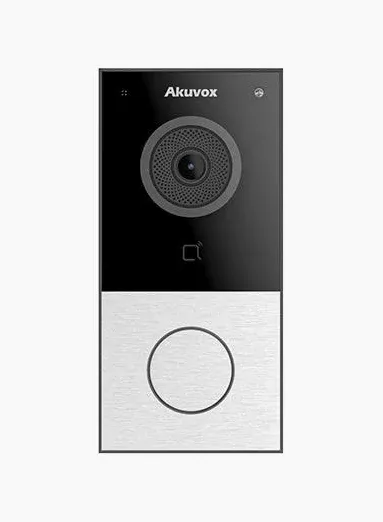
A product photo from the AESS job library, not taken in Fort Hamilton: a black video intercom door station with a camera, a speaker grille and a lit call button. On many Fort Hamilton row houses and small walk-ups the only camera at the front door is the one built into a door station like this. When the owner asks why the recorder never shows the door, the answer is often that the intercom camera was never connected to it, and it can be.
Condo infill buildings: the association owns it, one owner hosts it
The attached condo buildings that went up in place of older houses usually came with a developer-installed camera system: a camera at the entrance, one in the garage, one at the garage door and sometimes one at the trash area. The recorder often sits in a meter room or garage closet, but in some buildings it ended up inside one owner's unit or storage cage because that was where the network connection was. When the developer handed the building over, the logins may have gone to the first board president, who has since sold.
A repair on these buildings starts with getting control back. If nobody has the administrator password, the recorder's maker usually has a reset process that requires physical access and proof of ownership, and we work through it with the board. Then we set up logins that belong to the association rather than to a person, so the system survives the next sale. If the recorder lives in a private space, we can usually move it to a common area on the existing network, so the board can reach it without knocking on a neighbor's door.
Field Notes
Field Notes: Checking a Fort Hamilton System Against the Night You Needed It
These notes describe how our technicians work through a typical Fort Hamilton repair when the owner needed footage of a particular night and found the cameras did not deliver. They describe working practice, not any one address.
Copy first, ask questions second. If a clip from a specific night is needed, the technician exports it before restarting, unplugging or changing anything, and writes down the difference between the recorder's clock and the real time. A recorder that has been running for months with a failing drive can stop for good on the next restart.
Read the recorder's own log. Most recorders keep a record of when each camera lost video, when the drive reported errors, when the power cut out and when someone logged in. That log usually answers the owner's real question, which is not only why the camera is dark but how long it has been dark.
Check what the camera was told to do. A camera that recorded nothing may be working perfectly and simply be set to record only when its motion rule fires, with a rule that ignores vehicles or a detection zone that stops short of the curb. Settings are checked before any part is blamed.
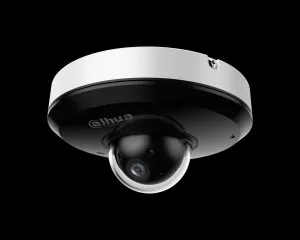
A product photo from the AESS job library, not taken in Fort Hamilton: a mini pan-tilt dome camera with a white housing over a black lens dome. Pan-tilt cameras like this cover rear lots and courtyards behind Shore Road buildings and the yards of larger houses east of the expressway. When one stops moving, or sits staring at a wall because a preset was lost after a power cut, the fix is often in the recorder's settings rather than the camera.
Walk the power. Outlet, power strip, adapter or power box, battery backup and switch, in that order, with a meter. After a brownout or outage this is where most faults turn up: one dead output on a multi-camera power box, an adapter that runs hot and drops out, or a switch that reset to settings that no longer power the cameras.
Leave a map. Before leaving, the technician labels each cable at the recorder, names each camera by what it actually shows, turns on alerts for video loss and drive errors, and shows the owner how to export a clip without help.
Fault by Fault
Parked Cars, Brownouts, Bridge Work, Cellar Water and Lost Logins: What Breaks Fort Hamilton Camera Systems
Five causes explain most of the repair calls we get from the blocks south of 86th Street. Knowing which one you are dealing with is half the repair, because each one leaves different marks on the recorder and the cameras.
Parked cars: cameras that were never set up for the curb
Most home and small-building cameras in Fort Hamilton were installed to watch doors, stoops and yards. Cars at the curb were an afterthought, and that shows in how the cameras behave. A camera aimed at a stoop catches the edge of the street at a steep angle, so a person beside a car is a few pixels tall. A camera set to send alerts only for people may also have been set to skip motion from vehicles, which is reasonable on a busy street but means the moment a car pulls away may not be recorded at all. And at night, a camera relying on its own infrared lights the stoop brightly and leaves the street black.
With vehicle thefts in the 68th Precinct running 37.6 percent ahead of last year, this is the most useful thing to check on a Fort Hamilton system before anything happens. The check takes minutes: look at last night's recording from the camera that faces the street, at the hour when the block is darkest, and ask whether you could tell a person beside your car from a shadow. If you could not, the repair may be a setting, an adjustment of angle and zoom, a light, or a camera better suited to low light.
Brownouts and outages: the damage often shows up later
A full outage is obvious: everything goes dark and, with luck, everything comes back. A brownout is quieter. When Con Edison reduced voltage in parts of southwest Brooklyn in June 2025, the lights in many homes ran dim for hours rather than going out. Recorders, switches and camera power boxes running on low voltage can reboot over and over, corrupt their settings or stress their power supplies, and the damage may only show days later as a recorder that restarts on its own or a power box with one dead output.
After any power event, it helps to look at three things. Does every camera tile show a live picture? Does the recorder's clock show the right date and time? And does playback show recording continuing through the night after the power came back? If any of those is off, call before you start pressing buttons, especially if the recorder offers to initialize or format its drive. That prompt erases the footage.
Bridge and road work: cameras next to years of construction
A product photo from the AESS job library, not taken in Fort Hamilton: a slim video door station with a camera lens at the top and a large round call button. Buildings along Fort Hamilton Parkway near the bridge ramp work often rely on a station like this as the entrance camera. Dust and vibration from long construction jobs settle on lenses and loosen mounts, and a door station camera that is only a little out of focus can turn every visitor's face into a blur.
The Verrazzano-Narrows Bridge Brooklyn ramp reconstruction began in spring 2026 and is due to finish in the last quarter of 2029, with temporary noise barriers along Fort Hamilton Parkway and John J. Carty Park closed through summer 2029. A little to the north, the Fort Hamilton Parkway bridge over the Gowanus Expressway is being rebuilt through summer 2027. Long projects like these change the conditions around nearby cameras: dust films lenses and domes, vibration from heavy equipment loosens mounts, temporary barriers and fencing block views that used to be open, and work lights change what a camera sees at night.
None of this is a reason to take cameras down. It is a reason to check them more often than once every few years. A lens that has slowly gone soft from dust can be cleaned. A mount that has worked loose can be retightened and pinned. A camera whose view is now half barrier can be re-aimed or, for the length of the project, given a different job. And a written record of each camera's condition at the start of nearby work gives an owner something to show if a contractor's crew damages a camera or a cable.
Cellar water and heat: where the recorder lives
In Fort Hamilton row houses, walk-ups and many co-ops, the recorder lives in the cellar, often on a low shelf or the floor, next to a boiler, a water heater, a washing machine or a sump. The July 14, 2025 cloudburst dropped 2.07 inches of rain in an hour on Central Park, and the city warned that basements can flood with little or no warning. A recorder does not have to be under water to fail. Damp air corrodes its connectors, and a drive that runs hot next to a boiler wears out faster.
A recorder that has been wet should not be switched back on until its drive has been looked at, because power can finish off a drive that might otherwise give up its footage. If the recorder is dry but sitting low, moving it higher, onto a shelf away from water lines and heat, is usually part of the repair. Where the building allows it, a recorder can also move up a floor on the same network, with only the switch left in the cellar.
Lost logins: the system outlived the person who set it up
A large share of Fort Hamilton repair calls involve no broken hardware at all. The cameras are fine, the recorder is recording, and nobody in the house can get into it. The person who set it up was a tenant who moved on orders, a relative who now lives elsewhere, a former board member or an installer who has closed. The app account is tied to their phone number or email, and the recorder password is in their head.
Getting control back usually means a password reset at the recorder itself, which most makers allow only with physical access and sometimes proof of ownership, followed by removing the old app binding and setting up new accounts. Once that is done, we set the system up so it cannot happen again: the owner or the association holds the administrator login, everyone else gets a viewer login, and the details are written down for the next person.
Commercial Security Camera Repair
Business Security Camera Repair in Fort Hamilton
Fort Hamilton businesses are mostly small and owner-run: restaurants and bars, delis and grocery stores, salons, pharmacies, dental and medical offices, and service shops, many with apartments above. Their camera systems tend to be eight or sixteen cameras on one recorder in a back office or cellar. The calls we get from them usually come after something happened, and the ABC7 report on the August 28, 2026 break-ins shows why. Three Bay Ridge restaurants were burglarized between 3:00 and 4:30 a.m., two of them on 87th and 88th Streets, south of 86th; surveillance footage showed a hooded figure searching a basement with a flashlight, and a safe was broken open. As one owner nearby put it, "Anything that happens on the avenue, there's a group text messages, a bunch of them."
Fifth Avenue below 86th Street
The shopping street running south toward the post office at 8801 Fifth Avenue, the firehouse at 9219 Fifth Avenue and the point where Fourth and Fifth meet, with restaurants, jewelers, salons and services. Storefront cameras here face bright sidewalks by day and dark gates by night, and the recorder usually sits in the cellar or a back room.
Fourth Avenue down to the subway terminal
Shops, offices and apartment buildings along Fourth Avenue toward the Bay Ridge–95th Street station. Commuter foot traffic past the doors all day, and a lot of glass at street level, put storefront cameras through glare and reflection tests every day.
Restaurant side streets off Third Avenue
Bars and restaurants on Third Avenue and the numbered side streets just below 86th, the blocks hit in the August 2026 break-ins. Cameras that matter here are the ones in the basement, the office and the back door, not only the dining room.
The 86th Street edge
The busy street that marks the northern edge of Fort Hamilton, with chain stores, banks and restaurants. The NYPD cameras placed at Fourth and Fifth Avenues in 2013 watch the intersections, not the inside of any store.
Offices in mixed-use buildings
Dental, medical and professional offices in buildings with apartments above, a type City Planning noted in the Fort Hamilton strip east of the expressway. Cameras cover entrances and reception, and the repair has to respect what patients and clients expect.
Building garages and rear lots
Parking garages under small condo buildings and lots behind co-ops and offices. With vehicle thefts up sharply in the 68th Precinct, these are the cameras owners and boards most often want checked.
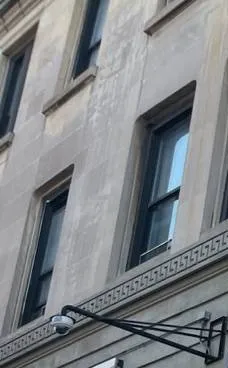
A photo from the AESS job library, not taken in Fort Hamilton: a bullet camera on a long black steel wall arm below a carved Greek-key band on a pale stone facade with tall sash windows. Prewar buildings on Fourth and Fifth Avenues and along Shore Road have carved stone like this, and an arm mount lets a camera look down the sidewalk past a cornice. Those long arms are also lever arms, and a bolt that works loose lets the camera droop until it records only the pavement under it.
What a restaurant or bar needs from a repair after the August break-ins
After an overnight burglary, restaurant owners usually discover the same three gaps. The dining-room cameras worked, but nobody had a camera on the basement stairs, the office door or the safe. The camera that did cover the back was set up for daylight, so at 3:30 a.m. it showed either black or a white bloom from the intruder's flashlight. And the clip, once found, was hard to get off the recorder in a form the police or the insurer could use.
A repair visit addresses all three in order. We check every existing camera by night, re-aim or adjust the ones covering the back and the cellar, set the camera on the office or the safe to record continuously after closing, and make sure the recorder itself is somewhere a burglar is not likely to carry it off, or that a copy of the footage lives somewhere else. We also show the manager how to export a clip with its original time, so the next one goes to the precinct in minutes rather than days.
Medical, dental and professional offices
Offices in Fort Hamilton's mixed-use buildings often have a small system covering the street door, the reception desk and a back entrance. Repairs here are usually routine, but the setup deserves care. Cameras should cover entrances and reception without pointing into treatment rooms, and recording of sound should stay off unless there is a clear legal reason and notice. The recorder should be set so that only the people who need to see footage can, and exports should be logged.
Rules that touch a commercial camera repair in Fort Hamilton
State licensing. New York requires companies that install or service security and CCTV systems for others to be licensed by the Department of State. Our work is done under NYS license #12000287431.
Workplace privacy. New York Labor Law section 203-c bars employers from video recording in restrooms, locker rooms and changing rooms. If a repair involves a stockroom where staff change, the camera has to be moved or removed.
Biometric features. New York City's biometric identifier law requires many businesses that collect biometric data, such as face recognition, from customers to post a clear sign at the entrance. If a replacement recorder offers face recognition, leaving it off avoids the issue; switching it on brings the signage requirement with it.
Footage for police. When the 68th Precinct asks for video, copy the clip and keep the original on the recorder. We can export clips in a format the precinct can play and note the recorder clock offset, so the times line up with the incident.
Your Questions Answered
Security Camera Repair in Fort Hamilton: Questions Answered
These are the situations Fort Hamilton homeowners, tenants, landlords, boards and store owners bring to us, grouped by what they are really about. Each answer describes how we would handle it on a repair visit.
Moving on orders and changing tenants
We are leaving our Fort Hamilton rental on PCS orders next month, and the two cameras on the stoop are ours, not the landlord's. What should be done so we can take them and the next tenant is not left with our accounts?
Remove the cameras from your app account before you take them down, not after. Most consumer and small-business cameras are bound to the account that first set them up, and a camera that is factory reset but still bound can refuse to join a new account at your next duty station. Once they are unbound, take them down, and leave the mounting screws or patch the holes as your lease requires. If the cameras were wired into the landlord's recorder or power, tell the landlord, so their channel is not left showing an error. We can do the unbinding, the removal and a clean disconnection in one short visit, and write down which cameras left with you.
We rent the top floor of our row house to a new Army family every two or three years. What should we reset on the shared door and stoop cameras each time one household leaves and the next arrives?
If the system is set up well, only one thing: the tenant's viewer login. The owner keeps the administrator account, each tenant household gets its own viewer account limited to the shared cameras, and at each change you delete the old viewer and add the new one. Problems start when tenants were given the owner's login or set up the app themselves, because then nothing can be removed without resetting the system. On a repair visit we restructure the accounts this way and give you a one-page note on adding and removing a tenant, so the next change takes five minutes.
My spouse deploys in the spring and set up the camera app in his name. What should we change before he leaves so I can run the system alone?
Make sure you are an administrator, not only a viewer, while he is still here to approve it. That means an administrator account on the recorder in your name, ownership or full sharing of the app account, alerts sent to your phone, and the recorder's recovery email and phone number changed to ones you control. Write down where the recorder is and how to export a clip. He can keep a viewer account if he wants to look in from abroad, but you should not need his phone or his email to fix anything while he is gone. A short visit covers all of it.
Cars, curbs and garages
Our curb camera sends alerts only for people because the street is busy. Does that mean it would not have recorded someone getting into our parked car?
It may. On many recorders and cameras, the alert rule and the recording rule are the same setting, so a camera told to ignore vehicles also skips recording the motion of a car being driven away, and only records if a person is detected clearly enough. At night, a person beside a car at the curb may not be detected at all. The fix is to separate the two: keep alerts for people only, but set the street-facing camera to record continuously or on any motion. We check how your equipment handles it and test it at night before we leave.
The garage camera in our small condo building records to a recorder inside one owner's storage space. If a car is taken from the garage, how does the rest of the board get the video quickly?
Two changes solve it. First, give at least two board members their own logins with permission to play back and export, so they can pull the clip from the app or a laptop without entering anyone's space. Second, if the recorder can move to a common area such as the meter room or the garage itself, on the existing network, move it, so the association controls the box it owns. We also check that the garage camera covers the gate and the pedestrian door with enough light to identify someone, because a clip that shows only a moving car is not much use to anyone.
Restaurants, stores and the avenue
The burglar in one of the August break-ins searched a restaurant basement with a flashlight. Our cellar camera points at the stairs, but would a flashlight beam just blind it?
It can. A camera working in infrared in a dark cellar adjusts for very low light, and a flashlight pointed toward it can flood the picture white while the beam is on it. Two things help. Aim the camera so it sees people from the side or from above as they come down the stairs, rather than face on, and add a small light on a motion sensor so the camera switches out of infrared and sees the scene in color. We check the cellar camera with a flashlight in the dark during the repair visit, so you know how it behaves before anyone else tests it.
There is an NYPD camera on the pole at 86th Street and Fourth Avenue. Does that mean our store's own cameras matter less?
No. The NYPD cameras placed at 86th Street and Fourth and Fifth Avenues in 2013 watch the intersections, and the police decide where they go and what they record. They do not see inside your store, your back door or your cellar, and you cannot pull a clip from them yourself. Your own cameras are the only record of what happened at your door and the only footage you can hand to the precinct, an insurer or a landlord within minutes. If yours are not recording, that is the repair to book.
After the break-ins, the police told restaurants to add lighting. If we put up new lights at the back door and in the alley, do the cameras need to be adjusted afterward?
Usually, yes. A camera that was tuned for a dark alley may now switch between color and infrared at the wrong moments, wash out near the new light, or see a bright fixture in the frame that darkens everything else. After new lighting goes in, check each camera that faces it at night. Often the fix is moving the light a few feet out of the camera's view, changing the camera's exposure settings, or re-aiming it so the light falls on the scene rather than into the lens. We can do that check on the same visit as any repair.
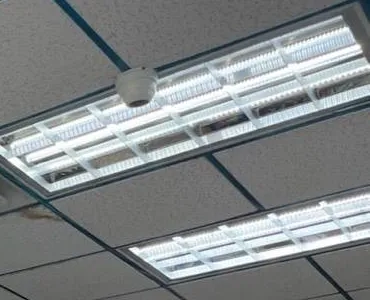
A photo from the AESS job library, not taken in Fort Hamilton: a small white dome camera on grey acoustic ceiling tiles beside a long louvered fluorescent light panel. Ceiling domes like this are common in Fort Hamilton pharmacies, dental offices and stores. Mounted this close to a light fixture, a dome can pick up flicker or glare on its bubble, and when the lighting is changed to LED panels the picture can start to band or roll, which is fixed with camera settings or a small move.
Construction, management changes and the building
The Belt Parkway ramp work is happening a block from our building. Should we have our cameras checked now, before the heavy work, in case something is damaged later?
It is a reasonable step, especially for buildings that face Fort Hamilton Parkway or the bridge approaches, where work is scheduled to continue into late 2029. A checkup records each camera's picture, position and condition and the state of exposed cables, with dated photos, so if a mount is knocked loose or a cable is damaged later you have a record of how things were. It also catches the problems that are already there. We give you a written list camera by camera, which a board or an owner can keep on file.
Our co-op hired a new managing agent, but the recorder still emails its warnings to the old agent's address. How do we get the alerts going to the right people?
The alert settings live on the recorder, and sometimes in the app account too, so both need to change. We log in with the administrator account, replace the old email addresses and phone numbers with the new agent's and the super's, test that a video-loss alert and a drive alert actually arrive, and remove the old agent's login while we are there. If nobody has the administrator password, we start with a reset at the recorder. It is a short job, and it is worth doing before a drive fails and the warning goes to an inbox nobody reads.
Equipment
Types of Security Cameras and Recorders We Repair
We repair what is on the building, whoever put it there. These are the kinds of equipment we work on most in Fort Hamilton homes, co-ops, condo buildings and stores, with the faults each one usually brings.
Coax analog and HD-over-coax cameras
Cameras with round twist-on connectors, common in Shore Road co-ops and older walk-ups wired years ago. Typical faults: water in the connectors, failed power on one channel of a central power box, and old riser cable that cannot carry a newer camera's signal cleanly.
Network (IP) cameras
Cameras powered and connected through one network cable, common in condo buildings, newer stores and freestanding houses. Typical faults: dead switch ports, addresses lost after a new router, badly made cable ends, and firmware that no longer matches the recorder.
DVRs, NVRs and hybrid recorders
The box that stores the video, in a cellar, garage, closet or back office. Typical faults: worn or wrong-type drives, overheating, settings lost after a brownout, clocks that drifted, and full disks set never to overwrite.
Wi-Fi, battery and doorbell cameras
Plug-in, battery and doorbell cameras on stoops, rented floors and inside windows. Typical faults: weak signal through brick and stone, accounts that left with a tenant, batteries that drain faster in winter, and subscriptions that lapsed.
Domes, turrets and bullets
Lobby domes scratched or cracked, turrets with dirty covers, and bullets on long wall arms that have drooped. Typical faults: water behind the housing, burned-out infrared rings, and mounts loosened by wind off the harbor or by vibration from nearby work.
Varifocal, PTZ and 360-degree cameras
Adjustable-lens cameras in lobbies and garages, pan-tilt cameras on rear lots, and fisheye cameras over store floors. Typical faults: lost focus or zoom, presets wiped by a power cut, motors that stick, and fisheye views that show as a distorted circle.
Switches, power boxes and battery backups
The equipment between the cameras and the recorder, usually on a cellar shelf. Typical faults: one dead output on a multi-camera power box, switch ports that stopped supplying power, and battery backups whose batteries quietly died.
Intercom and door station cameras
Cameras built into door stations at row-house and building entrances. Typical faults: a door camera never connected to the recorder, a fogged or scratched lens, and a picture lost after an intercom repair.
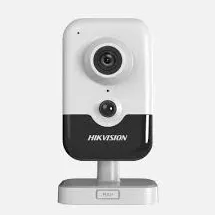
A product photo from the AESS job library, not taken in Fort Hamilton: a white indoor cube camera. Small cameras like this end up on a package shelf in a co-op mail area, in a super's office watching the recorder, or on a bookshelf in a rented apartment. They usually run on Wi-Fi and their own app, so most repairs involve the account and the signal rather than the camera itself.
ADT, Ring or SimpliSafe cameras versus a local licensed repair
Some Fort Hamilton households, especially those who brought equipment from another duty station, have cameras from a national alarm company or a consumer brand and are not sure who should fix them. The table compares how the choices usually work out for a repair.
Question
ADT or a similar alarm company
Ring or SimpliSafe camera
AESS local repair
Moves with you on new orders
Depends on the contract and on whether the equipment is leased
Yes, once removed from the account and re-added
We unbind, remove and reconnect equipment you own
Brick and stone walls
Depends on how it was wired
Wi-Fi can be weak through masonry
Wired cameras on existing cable where it tests good
Mixed brands on one building
Usually services its own equipment
Support covers its own devices
Any brand, any installer
Recorder and drive repair
Its own recorders
Cloud clips, no local recorder
DVRs, NVRs, hybrids, drives and footage export
Who comes to the door
Varies by dealer
Remote support or a replacement in the mail
A technician working under NYS license #12000287431
Price before work
Varies
The price of a new device
$150 service call, then a written repair price
AI Overview Reality Check
What AI Gets Wrong About Security Camera Repair in Fort Hamilton
These claims turn up in AI-written answers, help forums and national cost guides. Each has some truth in it, and each misleads a Fort Hamilton owner in a particular way. We quote the general claim, then set out what we find on the ground.
"A neighborhood beside an Army post, with police cameras on the main streets, hardly needs private cameras working"
The idea goes like this: Fort Hamilton is quiet, it sits next to a military installation, and the city has cameras on 86th Street, so a dead camera on the house is no emergency. The post's security covers the post, and the NYPD cameras funded in 2013 sit at two intersections on 86th Street. Neither sees a stoop, a cellar or a curb on the blocks in between.
The precinct's own numbers argue for checking. Through November 8, 2026, the 68th Precinct recorded 150 vehicle thefts this year against 109 a year earlier, and 65 burglaries against 64. Quiet blocks still have incidents, and the private camera is usually the only witness.
What this means for you: the time to find out a camera is dark is a calm Tuesday, not the morning after. Look at last night's playback from each camera once a month, and book the repair when one fails rather than when you need it.
"Motion detection records everything that moves"
Modern cameras and recorders decide what counts as motion using detection zones, sensitivity levels and object filters for people and vehicles. Swann's own support guide lists detection that is switched off, sensitivity set to zero and an empty arming schedule among the reasons a recorder does not record.
On Fort Hamilton streets lined with parked cars, owners often turn on people-only alerts to stop their phones from buzzing at every passing car, without realizing that on some equipment the same setting decides what is recorded. A car taken from the curb at night, with the person beside it too dark to be recognized as a person, may leave no recording at all.
What this means for you: alerts and recording are different jobs. Keep alerts strict, but let the cameras that face the street and the garage record continuously or on any motion, and check at night that they do.
"When you move, just factory reset your cameras"
Moving guides tell people to reset smart devices before they go. For many cameras that is only half the job, because the camera stays registered to the account that set it up until it is removed from that account. A reset camera that is still bound may refuse to join a new account, and a camera left on a rental may keep sending a former tenant's phone alerts from a house they no longer live in.
This comes up constantly in Fort Hamilton, where many households move every two or three years.
What this means for you: remove the camera from the app first, then reset it, then take it down. If you are the landlord, remove the departing tenant's access to your recorder the same day.
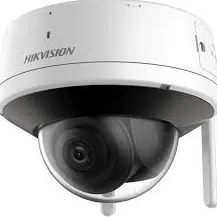
A product photo from the AESS job library, not taken in Fort Hamilton: a Wi-Fi dome camera with an external antenna. A camera like this has its place, at a spot no cable can reach. In Fort Hamilton's brick row houses and stone-faced co-ops, though, the wall between the camera and the router decides how well it works, and a Wi-Fi swap for a dead wired camera can trade one fault for another.
"Swap the dead wired camera for a Wi-Fi one and the problem goes away"
This advice is everywhere because Wi-Fi cameras are easy to buy and easy to set up in a demonstration. Reolink's own troubleshooting guide lists weak Wi-Fi through thick walls among the main reasons cameras go offline, and suggests aiming for at least two or three bars of signal.
Fort Hamilton's buildings are mostly masonry: brick row houses, limestone and brick walk-ups, and six-story co-ops with thick exterior walls. A Wi-Fi camera on the far side of that wall from the router often drops out, especially in bad weather and on busy evenings.
What this means for you: test the cable before giving up on it. If the run is sound, a new wired camera on the same cable is almost always more reliable than a wireless one. Where a cable truly cannot reach, a wireless camera with a strong signal path is a fine choice, and we say so.
"If the app says the camera is offline, the camera is broken"
Phone apps are where most people see their cameras, so an "offline" label looks like a dead camera. Very often it is nothing of the kind. The app reaches the recorder through the internet; if the modem was replaced, the internet provider changed, the router's settings changed, every camera can show offline while the recorder at home keeps recording perfectly.
This is one of the most common Fort Hamilton calls after a household changes internet service or a co-op's super replaces the building's modem. The cameras on the recorder screen in the cellar are fine; only the path to the phone is broken.
What this means for you: before assuming a camera failed, look at the recorder's own screen or ask someone at the building to. If the cameras are live there, the repair is usually a network or account fix within the service call, not new hardware.
"Camera repair in Brooklyn costs about fourteen hundred dollars"
Cost tools blend installation and repair together. HomeAdvisor's Brooklyn page for surveillance camera installation or repair gives an average of $1,416 and a typical range of $680 to $2,145. That is a fair picture of what people pay to have systems installed, but a poor guide to what a repair costs.
On our Brooklyn list, a Fort Hamilton repair starts with the $150 service call, which is credited to the repair. Most single faults, such as a connector, a power supply, a drive or a single camera, fall between $150 and $700, and only a recorder replacement or several damaged runs reach the $700 to $1,500 range.
What this means for you: do not price a repair from an installation average. Send a photo of the recorder screen, and we will tell you which part of our list your fault most likely falls in.
"A brownout is harmless because the power never actually went off"
Answers about power problems focus on outages and surges, and treat dim lights as an inconvenience. When Con Edison lowered voltage in parts of southwest Brooklyn in June 2025, residents described lights running very dim for hours. Electronics running on low voltage can restart repeatedly, and every unplanned restart is a chance for a recorder to corrupt its settings or a weak drive to fail.
In the weeks after a brownout we see Fort Hamilton recorders that restart on their own, power boxes with an output that no longer holds a camera, and network switches that reset to settings that no longer power the cameras.
What this means for you: after any brownout, check that every camera is live, the recorder clock is right and playback shows recording continuing overnight. A battery backup sized for the recorder and the switch protects against the next one.
Speak to a Technician Before You Format a Drive or Order a Camera Online
Tell us the address, the kind of building, how many cameras there are, which ones are out and where the recorder is. If you need footage from a particular date, put the date in the message and we will plan the visit around copying it first. If you are moving on orders or a tenant is leaving, give us the date, and we will book the visit before it. Photos of the recorder screen, the dark cameras and the power equipment help us bring the right parts. For anything urgent, call (347) 934-8335.
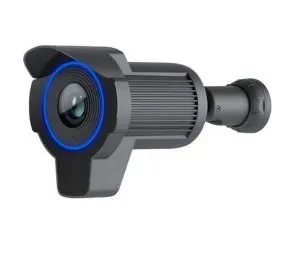
A product photo from the AESS job library, not taken in Fort Hamilton: a black bullet camera with a long hood and a blue-lit ring around the lens. A long hood shades the lens from rain and from low sun, which matters on Fort Hamilton facades and garage walls that face west over the harbor in the afternoon. When we replace a curb or driveway camera, a model like this is one of the options we price, chosen for how much light the spot gets at night.
✅
Request Sent!
Thank you. A technician will be in touch about the Fort Hamilton address shortly.
How It Works
Our Repair Process
1. Send a photo and the address
Text or WhatsApp a photo of the recorder or app screen showing the dark cameras, with the address and the type of building. We tell you the likely fault and its price range on our Brooklyn list before you book.
2. Confirm the owner and the approver
Homeowner, landlord of a rented floor, co-op or condo board, managing agent or store owner: we confirm who approves the work, who pays and who needs to be there for access.
3. Book the service call
The $150 Brooklyn service call reserves a two-hour arrival window and is credited to the repair if you go ahead. If you are moving on orders, we book around your date.
4. Export any footage that matters
Any clip you need is copied to USB with its original timestamp before anything is restarted, unplugged or replaced, and the recorder clock offset is written down.
5. Test from the outlet to the phone
Outlet and power, cable and connectors, switch or power box, recorder and drive, then the phone app, one dark camera at a time, starting from the recorder end.
6. Explain the cause and write the price
You hear what failed and why, and get a written, itemized repair price before any part is replaced. If the price changes on site, you hear the new number first.
7. Repair and retest after dark
The failed part is repaired or replaced, and every camera is checked for picture and recording in daylight and in low light, including the camera that faces the street.
8. Hand over logins, alerts and labels
Cables are labeled, logins go to the right people, video-loss and drive alerts are switched on, and you are shown how to export a clip yourself.
Coverage Area
Security Camera Repair Near Fort Hamilton's Landmarks
Verrazzano-Narrows Bridge Brooklyn ramps
The Belt Parkway ramps being rebuilt from spring 2026 to late 2029, beside homes and buildings along Fort Hamilton Parkway.
John J. Carty Park
The park beside the bridge approach, closed from summer 2026 to summer 2029 while it is rebuilt with new courts, a skate park and a turf field.
Engine 242
The firehouse at 9219 Fifth Avenue that serves mainly Fort Hamilton, on the stretch of Fifth Avenue lined with stores and apartment buildings.
P.S./I.S. 104
The public school at 9115 Fifth Avenue, the zoned school for children living in family housing on the post as well as for the surrounding blocks.
Fort Hamilton Station post office
The post office at 8801 Fifth Avenue that keeps the Fort Hamilton name on the neighborhood's mail and its parcel deliveries.
Bay Ridge–95th Street station
The southern terminal of the R line on Fourth Avenue, opened in 1925, with commuter foot traffic past the storefronts around it.
Fort Hamilton is billed at our Brooklyn rate, the same as the rest of Bay Ridge. Each repair begins with the $150 service call, which pays for the on-site diagnosis and is credited to the repair if you go ahead. The figures below are from our published list of Brooklyn security camera repair prices; your own price is written down on the visit, once we know what failed.
Repair
Brooklyn price
Service call, on-site diagnosis and written repair price
$150, credited to the repair
Motion, recording, alert, app or login settings with no parts
Usually within the $150 service call
Clean and check for a blurry picture
$80
Connector reterminate or PoE port swap
$150–$350
Power supply repair
$150–$400
Dome or front cover replacement
$30–$80 part plus labor
Indoor camera repair
$200–$450
Hard drive swap, by capacity
$200–$450
Single camera replacement on a working system
$250–$600
Night vision camera repair
$250–$650
DVR not working, including drive and labor
$300–$700
NVR not recording, by model
$400–$900
Vandalized camera, per camera plus cable repair
$400–$900
PTZ camera repair
$450–$1,200
Hybrid recorder swap, channels reconfigured
$700–$1,200
DVR/NVR replacement with drive, or multi-camera wiring repair
$700–$1,500
Full rewire or whole-building overhaul
From $1,500
Three things move a Fort Hamilton repair up or down within those ranges. Height and reach come first: a camera at the roof line of a six-story Shore Road building, on the back of a deep row-house yard or high on a garage wall takes more time and ladder work than a camera over a stoop. Second is how many runs failed: one water-damaged connector is a small job, while several cables crushed during a window or roofing job are priced run by run. Third is the recorder: a recorder that has to be replaced, a system whose logins have to be recovered first, or a building where nobody ever labeled the cables adds setup and tracing time. If the price changes on site, you hear the new number before work continues. Booking the camera repair together with intercom, buzzer, alarm or cabling work on the same visit saves $200 to $400 in labor on our Brooklyn list.
Full terms — including 50% deposit, one-year parts-only warranty on AESS-supplied products, and the late-fee schedule — are set out in the service agreement.
Shop Our Systems
Security Camera Repair Packages & Pricing
Three ways Fort Hamilton repairs usually come together, priced from our Brooklyn list.
Single-issue repair: $150–$700
One fault, one visit: a curb camera re-aimed and reset for night, a water-damaged connector redone, a power supply replaced after a brownout, a drive swapped, or a tenant's or former owner's login cleared. Typical for a row house, a rented floor or a small store.
Major system repair: $700–$1,500
The recorder or the wiring: a DVR or NVR replaced with a new drive and every camera reconfigured, or several damaged runs replaced on a co-op, a condo garage or the front of a row house. Typical after a flood in the cellar or a facade job that cut cables.
Annual maintenance: $250–$800
Every camera checked by day and in low light, lenses and domes cleaned, connectors and power tested, the drive's health read, alerts confirmed and a test clip exported. Residences start at $250, commercial properties at $400, and owners with several properties run $500 to $800.
Bring your own equipment. If you already bought a replacement camera or recorder, or brought cameras with you from your last duty station, we can fit them at labor-only rates. Send us the exact model and we quote the labor by phone or text, and the visit is booked once it is paid. Equipment you supply is installed as supplied: we cannot vouch for parts we did not provide, and if a model will not work with your recorder, will struggle on Wi-Fi through brick, or cannot cope with the night lighting where it is going, we tell you before the visit.
Complete Services
Every Security Camera Repair Service in Fort Hamilton
Curb, garage and night picture repair
Street-facing and garage cameras that cannot show a person beside a car after dark, and the recording rules behind them. Request a repair
Recorder, drive and power repair
DVRs, NVRs and hybrids in cellars, garages and back offices, including systems hurt by brownouts and cellar water. Brooklyn security camera repair
We only rent here for a two- or three-year assignment. Is a camera repair worth paying for, or should we put up a battery camera until we leave?
+
It depends on whose system it is and what failed. If the wired system belongs to the landlord, the repair is normally the landlord's call and cost, and we can send the landlord a written price. If the cameras are yours and the fault is a setting, an adapter or a connector, the repair is usually cheaper than replacing them and the cameras go with you when you move. A battery camera is a reasonable stopgap on a rented stoop, but it needs regular charging and a good Wi-Fi signal through the wall, so check both before relying on it.
Can you repair cameras in family housing on the Fort Hamilton post?
+
Only with the housing office's approval. Housing on the post is privately managed and access to the installation is controlled, so the resident has to confirm with the housing office that the work is allowed and arrange gate access for our technician before we can book. Once that is in place, we quote and schedule the visit the same way as any other address. Homes and apartments off the post need no such approval beyond the owner's.
Our cameras arrived broken in our household goods shipment. Can you put in writing what failed for the moving claim?
+
Yes. On the visit we test each camera and the recorder, note the model and serial number of each item, describe the damage and whether it can be repaired, and give a written repair price or a replacement price from our Brooklyn list. That document is what most moving claims ask for. Keep the original boxes and any packing labels if you still have them, and take photos before anything is thrown away.
Can one camera be set to keep more days of video than the others on the same recorder?
+
On many recorders, yes. Some let you set a maximum number of days per camera or divide the drive into groups, and almost all let you set each camera's recording mode and quality separately. A common setup is to let the street-facing and garage cameras record continuously at good quality while the indoor and yard cameras record only on motion, which leaves more of the drive for the cameras that matter most. We check what your recorder supports and set it to match the days you want to keep.
Every March and November our recorder's clock ends up an hour off. Why, and can it be fixed for good?
+
Usually the daylight saving setting is off, set to the wrong rules or set twice, once on the recorder and once on the cameras. Some older recorders also have no internet time source, so their clocks drift between changes. We set the correct time zone and daylight saving rules, point the recorder at an internet time server, and set the cameras to take their time from the recorder, so every clip carries the right time without anyone touching it twice a year.
Our dog sets off the yard camera's alerts every time he goes out. Can the camera tell him apart from a person?
+
Many newer cameras and recorders can sort motion into people, vehicles and sometimes animals, and send alerts only for the kinds you choose. Older cameras cannot, and for those the options are adjusting the detection zone, sensitivity and minimum object size. We check which your equipment supports, set it so the dog stops triggering alerts, and make sure recording itself still captures anything that moves in the yard.
We are buying an apartment in a Shore Road co-op. Can you look at the building's camera system before we close?
+
Only with the board's or the managing agent's permission, because the system belongs to the co-op. If they agree, we can check which cameras work, how many days the recorder keeps, what condition the equipment is in and roughly what any needed repairs would cost on our Brooklyn list, and put it in writing. Many buyers instead ask the managing agent for the most recent service record, and we can review that if you send it.
The recorder in our apartment's hall closet has a fan loud enough to hear at night. Can it be quieted without losing recording?
+
Often, yes. A loud fan is usually a fan clogged with dust, a fan that is wearing out, or a recorder running hot because the closet has no air. We clean or replace the fan, check the drive and the recorder's temperature, and look at whether the recorder can sit somewhere with more air, such as a higher shelf with the closet door vented. A recorder that runs cooler is also easier on its drive.
Before we order a camera online, can you tell us whether it will work with our older recorder?
+
Yes. Send us the recorder's model number, which is on a label on the bottom or back, and the camera you are considering. We tell you whether it is the right signal type for your recorder, whether the recorder supports its resolution, and whether it will work in the spot you have in mind. If it will not, we suggest what would, and if you buy it yourself we install it at labor-only rates.
Our camera only drops out a few times a month. How will we know the repair actually fixed it?
+
Intermittent faults are proved by the recorder's log, not by one good afternoon. Before we leave, we turn on video-loss alerts for that camera and show you where its log is. If the fault was a loose connector or a failing adapter that we replaced, the drops should stop; if an alert arrives again, send us the time and we look at the log to see whether it is the same fault or a new one.
Is a 4K camera always the best replacement for a dark side passage between row houses?
+
Not always. In a narrow, dim passage, how well a camera handles low light matters more than its resolution. Some 4K cameras use small sensors that look grainy in the dark, and they also fill a drive faster. For a short, dark passage a camera with a larger sensor or a built-in light often gives a clearer picture of a face. We choose the replacement for how much light the spot has at night and how far away people will be.
Ready to See Every Fort Hamilton Camera Recording Again, From the Curb to the Cellar?
Send a photo of the recorder screen or the dark camera, the address, and the date of any footage you need, plus your move-out date if you are leaving on orders. We book within 2 hours, give you a two-hour arrival window, copy your footage first, and write down the repair price before any part is replaced.