Equipment You Own · Monitoring You Can End · Call Lists That Cross Time Zones · Brooklyn Base Pricing
Fort Hamilton is the only active-duty Defense Department post inside New York City, and many of the people it serves live on the blocks around it. The garrison’s own figures list 573 active-duty members, 942 family members, 700 civilians and 880 Guard and Reserve members, against roughly 286 homes on the post itself, and the housing office tells newcomers their second option is to spend the housing allowance renting off post. The streets south of 86th Street that the post office, the library and the subway map still call Fort Hamilton are also a settled, older place: six-story Shore Road apartment houses from the 1930s and 1940s, row houses kept low by the 2005 rezoning, and Fourth and Fifth Avenue storefronts that run down to the point where the two avenues meet. An alarm here has to suit both kinds of household: the one that will move on orders in two or three years, and the one that has not moved in forty. This page explains how we build for each.
Reviewed and updated October 21, 2026, against Wikipedia’s articles on Fort Hamilton and Bay Ridge, the Military OneSource installation overview for Fort Hamilton, the Fort Hamilton housing and relocation site, 50 U.S. Code § 3956 of the Servicemembers Civil Relief Act, the Department of City Planning’s Dyker Heights/Ft. Hamilton rezoning summary, CityLand’s report on the 2005 Bay Ridge rezoning, NYC Parks’ John Paul Jones Park page, New York City Administrative Code § 24-238, the Department of State’s alarm installer licensing page, NYC 311 on security gates, and reporting by BKMAG, Brownstoner, BKReader, Brooklyn Paper, the Brooklyn Eagle, CBS New York and ABC7 · Abstract Enterprises Security Systems, NYS license #12000287431 · crews dispatched from our Troy Avenue office in Brooklyn

Five answers let us sketch a Fort Hamilton alarm before anyone rings your bell. Do you rent or own, and if you rent, roughly when does the lease or the assignment end? Is the home a walk-up or elevator apartment, a co-op on Shore Road, a row house, or a unit in one of the newer small condo buildings? Which floor is it on, and do any windows open onto a fire escape, a low roof, a yard or the park side of the street? Will anyone be away for months at a time, for training, a deployment or a long trip? And is there an alarm on the wall already, whether it is yours, the landlord’s or one a previous tenant left behind? Text those answers to (347) 934-8335 with a photo of the entry door and one of the main windows. Most people hear back the same day with a sensor count, a suggestion about wired or wireless, and the line on the Brooklyn price list the job is likely to fall on.
Start with the name, because it causes confusion. Fort Hamilton is first of all a working Army installation in the southwest corner of Brooklyn, surrounded by Bay Ridge and Dyker Heights. Wikipedia describes it as the only active-duty Department of Defense post in New York City, completed in 1831 with about half of the original fort still standing. Its job today is supporting the region’s Army Reserve and National Guard, and it houses the New York City Recruiting Battalion, the Military Entrance Processing Station and the North Atlantic Division headquarters of the Army Corps of Engineers. The name also belongs to the residential blocks next to the post. Wikipedia’s Bay Ridge article says the part of Bay Ridge south of 86th Street is sometimes considered a sub-neighborhood called Fort Hamilton, and that the area was once a village of that name, “named for the military installation at its center,” with Yellow Hook to the north.
The two meanings meet in one practical fact: a lot of the people tied to the post live outside the gate. The Military OneSource overview for the installation counts 573 active-duty members, 942 family members, 700 civilians and 880 Guard and Reserve members. The same overview lists the on-post housing: six historic residences on Colonels’ Row, 70 townhouses for officers and senior NCOs, 60 older high-rise apartments and 150 newer three- and four-bedroom apartments, run privately by Balfour Beatty Communities. That is about 286 homes. The Fort Hamilton housing and relocation site explains the choice in plain terms: live on post, or use the housing allowance to rent or buy off post, and contact the Housing Services Office the moment orders arrive. On the Army forum on Reddit, one soldier asking about an assignment here put it simply: right outside Fort Hamilton is Bay Ridge, and he would rather live off post.
Those households share a timetable most alarm companies never ask about. They arrive on a report date, they may leave for training or a deployment in the middle of a lease, and they move again on the next set of orders. A standard dealer package, with a 36-month monitoring agreement and equipment that technically belongs to the dealer, fits that life badly. Federal law has already noticed: the Servicemembers Civil Relief Act lets a servicemember end a home security services contract after receiving qualifying orders, with no early-termination charge. We would rather the contract question never come up, so the systems we install here are bought outright, the monitoring is month to month, and the hardware is chosen so it can come down and go into a moving box.
The other Fort Hamilton is the one that stays put. In 2013 Brownstoner summarized a New York Times profile that called the Fort Hamilton section of Bay Ridge a “naturally occurring retirement community”: leafy, stable and relatively affordable, its “low-slung character” protected by a 2005 rezoning. CityLand reported that the City Council approved that rezoning on March 23, 2005, covering 249 blocks of the Special Bay Ridge District. Many of these owners have lived in the same row house or the same Shore Road co-op for decades, and their alarm is often a panel that went in a generation ago, still dialing out over a phone line that may no longer be connected. For them the work is less about speed and more about making a dependable system that is simple to live with.
Crime here is lower than the city average, and we would not pretend otherwise. Wikipedia, drawing on NYPD figures, says the 68th Precinct, which covers Bay Ridge and Dyker Heights, ranked seventh safest of 69 patrol areas for per-capita crime in 2010 and recorded 96 burglaries in 2018, with crime in every category down 88.6 percent between 1990 and 2018. But burglary south of 86th Street has followed familiar patterns. Brooklyn Paper’s 68th Precinct report of December 14, 2011, described a Marine Avenue apartment between Ridge Boulevard and 95th Street entered through a bedroom window the tenant found open, with about $17,000 in jewelry taken while the resident was out for roughly ten hours; the same report listed a Fourth Avenue apartment between 99th and 100th Streets burglarized during a day-long absence. The lesson is ordinary and useful: entry comes through a window, during an absence long enough to be noticed. An alarm’s job is to make that absence visible on your phone within seconds.
Many households here pair the alarm with a camera at the building door or shop entrance, so an alert arrives with a clip.

People reach this page searching for very different addresses, so here is how we use the name. BKMAG published a column in January 2014 titled “There’s No Neighborhood in Brooklyn Called ‘Fort Hamilton’,” in which Henry Stewart, a lifelong Bay Ridge resident, argued that the name is really a post office designation, pointing to the Fort Hamilton branch on Fifth Avenue and 88th Street, the Fort Hamilton branch library, the high school, and the subway map. In the same piece he quoted the local community board’s district manager saying that people she knew did call their neighborhood Fort Hamilton, and he admitted the south side of Bay Ridge feels like a different community from the north. Both views are fair, and both point at the same streets.
City Planning complicates it further. Its Dyker Heights/Ft. Hamilton rezoning, adopted by the City Council on July 25, 2007, used “Ft. Hamilton” for a strip east of the Gowanus Expressway, bounded by Seventh Avenue, the expressway, 86th Street and Poly Place. Wikipedia’s Bay Ridge article, the local post office and most real estate listings use the name for the blocks south of 86th Street between Shore Road and the expressway. And on the Army side, Fort Hamilton is the post itself, entered at the main gate where Fort Hamilton Parkway meets 101st Street.
| Which Fort Hamilton | Where it is | What that means for an alarm |
|---|---|---|
| The residential blocks | Bay Ridge south of 86th Street, roughly Shore Road to the Gowanus Expressway, down to the post | The main subject of this page: rentals, Shore Road co-ops, row houses, Fourth and Fifth Avenue stores |
| City Planning’s strip | East of the expressway: Seventh Avenue, 86th Street and Poly Place (2007 rezoning) | Detached and semi-detached houses and newer attached buildings; also covered here, while the lighting-season blocks to the east have their own Dyker Heights page |
| The Army post | Inside the gate at Fort Hamilton Parkway and 101st Street | Family housing is privately managed by Balfour Beatty Communities; any alarm work there needs their written permission and access to the post, arranged by the resident |
| Fort Hamilton Parkway | A long street running north through Borough Park to Kensington | Not this neighborhood; see the Borough Park and Kensington alarm pages linked at the bottom |
Diagram by Abstract Enterprises Security Systems, not to scale. Boundaries and addresses from Wikipedia’s Bay Ridge and Fort Hamilton articles, the Department of City Planning’s 2007 Dyker Heights/Ft. Hamilton rezoning summary, the Military OneSource installation overview, NYC Parks and BKReader (April 2026, the Triangle). Fort Hamilton Parkway’s long run north to Borough Park and Kensington is not shown.
If your block sits in any of the first three rows, the advice below applies, and the price list is the same Brooklyn base list either way.
Repair calls south of 86th Street fall into a few patterns. In rentals that turn over on orders, the problem is often a system nobody in the apartment set up: a keypad left by the last tenant that chirps for a low battery, a sensor knocked off a door frame by movers, or a code nobody knows. In long-held row houses and co-ops, the trouble is age: a panel from decades ago with a dead backup battery, or a dialer still trying to report over a copper phone line that was cancelled years ago, so the alarm sounds locally but tells nobody. On Fourth and Fifth Avenues it tends to be a store system that will not arm at closing because one door contact has drifted out of line.
Call (347) 934-8335 with the brand name printed on the keypad and the message it shows. Many fixes are a battery, a realigned contact or a reprogrammed code. When the panel itself is beyond saving, we say so and quote a replacement from the Brooklyn list: panel replacement runs $800 to $1,500, and existing door and window wiring is reused when it tests good. Service calls are billed at $195 an hour with a three-hour minimum, which is not charged on a new installation.
One habit prevents half of these calls in a rental: when you move in, ask us, or the landlord, to reset the master code and delete every old user code before you trust the system. A keypad you inherited may still answer to codes that previous tenants, cleaners or movers knew.

Each service is quoted on its own line, so you can see what you are paying for and what you could leave out.
A wireless panel, door and window contacts, a motion detector and a cellular communicator, all purchased by you, with no equipment lease and no monitoring term. Mounted so it comes off cleanly when the orders come.
Families arriving from another duty station often bring a wireless kit. We check whether it can be re-registered to a new monitoring account, re-pair every sensor, update the panel and mount it for this apartment.
Call lists with a backup contact in Brooklyn, alerts that reach a phone overseas, a temperature and water sensor in an empty apartment, and arming schedules a spouse at home can run alone.
Contacts for steel and replacement windows, glass-break detection for wide living-room windows, paperwork for the board, and nothing installed in the lobby, the hallway or the building’s systems.
Front and rear doors, every reachable rear window, basement entries and a separate area for a rented floor, wired along the basement ceiling where it is open and wireless above.
For the attached six-to-twelve-unit buildings that replaced older two-families: unit alarms for owners, and for the board, contacts on the shared garage, the meter room and the rear yard door.
Front glass, gate, rear door and roof hatch on Fourth and Fifth Avenue storefronts, separate codes for each employee, and a report if the shop is not armed by closing time.
Replacing panels that still report over a landline, or over cellular networks that carriers have shut down, with a new panel and a cellular communicator, reusing good wiring.
Chirping keypads, drifted contacts, motion detectors pointed at heating units, sirens with no automatic cutoff, and lost master codes in inherited systems.

Wikipedia’s history of Bay Ridge sketches how these blocks filled in: row houses after the subway was announced, a fivefold rise in apartment buildings by the 1920s, large old houses replaced by apartment houses by the Second World War, and, in the 1990s and 2000s, two-family houses torn down for condominiums known locally as “Fedder Homes,” after the air conditioners poking from their facades. Each layer needs a slightly different alarm.
Six-story buildings facing Shore Road Park and the harbor, many from the 1930s and 1940s. Brownstoner describes 9437 Shore Road as an Art Moderne building from 1940; a broker’s page describes 9701 Shore Road as a 1935 Art Deco co-op with curved corners and oversized windows. Apartments are protected from inside; the corridor door is the perimeter.
Walk-ups and elevator buildings along the R train corridor, many rented. Front doors open onto shared hallways, rear windows onto courts, yards or fire escapes. Wireless equipment that can be removed without damage is the norm.
The low-rise blocks the 2005 rezoning was meant to protect. Attached on both sides, with a front door, a rear door to the yard, basement windows and often a rented floor. Brownstoner’s 2013 piece put row-house prices from $600,000 at the time.
The six-to-twelve-unit buildings City Planning described replacing one- and two-family homes. Shared front doors, small garages or parking pads at grade, and individually owned units with their own alarms.
City Planning’s description of its Ft. Hamilton strip includes detached and semi-detached homes on lawns and well-kept row-house blocks. These get a full perimeter, with attention to side doors and yards.
Three- and four-story row buildings with shops on the ground floor and apartments above, plus the newer combinations of medical offices and residences that City Planning noted. The store and the apartments upstairs get separate systems.
Owners of row houses with a rented floor usually pair the alarm with a two-button intercom at the front door, so the tenant’s visitors never need the owner’s door code.

For a household that moves on orders, the awkward part of a typical alarm deal is its structure: the dealer installs equipment at a low upfront price, recovers the cost through a monitoring agreement of three years or more, and keeps ownership of the hardware until the term ends. Our silo research found the same pattern from ordinary homeowners on Reddit, who described dealer plans around $50 a month on three-year terms with installation charges of $1,500 or more, and who called a five-year term at $42 a month a bad deal. For a family that can expect orders within that term, the structure adds a cancellation process, an equipment return and an argument about fees.
Congress addressed this directly. Section 3956 of the Servicemembers Civil Relief Act, title 50 of the U.S. Code, lists contracts a servicemember may terminate, and the list includes home security services, along with cell phone, internet and TV service. According to the statute, termination is available after the servicemember receives military orders to relocate for at least 90 days to a location that does not support the contract, or, in one specific case, after a stop-movement order. Notice goes to the provider in writing or electronically, with a copy of the orders. The provider may not impose an early-termination charge, must refund amounts paid in advance for any period after termination within 60 days (the billing period in which termination happens excepted), and, if the servicemember signs up again within 90 days after the relocation ends, may not charge a reinstatement fee beyond its usual installation or equipment charges. The servicemember must return any provider-owned equipment within 10 days after service is disconnected.
Diagram by Abstract Enterprises Security Systems, summarizing 50 U.S. Code § 3956 as published by the Cornell Legal Information Institute. It covers home security services among other contracts; a legal assistance office can advise on a particular case.
That law is a safety net, and we would point anyone stuck in a long contract toward it and toward the installation’s legal assistance office. But a well-built system should not need it. Here is the difference in practice:
| Question at move-out | Typical dealer agreement | How we set up a Fort Hamilton system |
|---|---|---|
| Who owns the panel and sensors? | Often the dealer, until the term ends | You, from the day it is installed and paid for |
| Is there equipment to return? | Provider-owned equipment may have to go back (the SCRA allows 10 days after disconnection) | No; you pack it and take it, sell it or leave it for the next tenant by agreement |
| What ends the monitoring? | A cancellation request, and for a servicemember, notice plus a copy of the orders | Self-monitoring has no contract; the partner central station plan, at $30 a month (keypad) or $45 a month (with the app), can be cancelled |
| Can the system work at the next home? | Sometimes locked to the dealer’s account | We choose panels that can be re-registered with another provider; we tell you in writing which parts will and will not travel |
Not every component travels well. Sensors fixed with adhesive leave little damage and move easily. A hardwired contact recessed into a door frame stays with the apartment. Cellular communicators work only on networks available where you go next, and a monitoring account may not carry over between companies. Before we install, we list which parts are portable and which belong to the apartment, so the decision is made with the move in mind rather than discovered during packing.
Families who want the door itself to be part of the routine often add a keypad lock or fob entry for the apartment door, with codes that can be cancelled the day the lease ends.

A deployment changes an alarm’s job more than a move does. One adult runs the household, often with young children; the other may be several time zones away, with irregular access to a phone. The questions we work through with families at this stage are practical ones. Who gets the first call when a sensor trips at three in the morning? Who can let a plumber in if the spouse at home is at work? How does the person at home arm the house at night without setting it off every time a child gets up?
Our default answer is a short call list built around who can act, with the person overseas kept informed by app notifications rather than by phone calls from a monitoring station; the question-and-answer section below explains the order we suggest. App alerts carry the time, the zone name and, if a camera is linked, a short clip, so the person overseas can see what happened when they next have signal.
For arming at night we program a “stay” setting that protects every door and window while leaving interior motion detectors off, so the household can move around inside. A key fob on the bedside table can switch to full arming or trigger a panic alert without a trip to the keypad. If the family keeps a separate code for a babysitter or a dog walker, it can be limited to certain hours and deleted the day it is no longer needed. When the deployed spouse returns, nothing has to be rebuilt; the call list goes back to two adults.
Shore Road is the address south of 86th Street people picture first: six-story apartment houses on one side, Shore Road Park and the Belt Parkway on the other, and the Narrows and the Verrazzano-Narrows Bridge beyond. Wikipedia counts these among the tallest buildings in Bay Ridge. Brownstoner’s August 2026 listing note on 9437 Shore Road describes a six-story, 55-unit co-op designed by the Cohn Brothers, opened as a rental in 1940 in the Art Moderne style, with faceted walls and parquet floors; a broker’s building page for 9701 Shore Road describes a six-story 1935 co-op with an Art Deco facade, curved corners and oversized windows. We name these only because their published descriptions show the building type. We have not claimed to work in either.
Three things make these apartments different to alarm. The windows: original steel casements crank outward, while replacement units in the same openings may slide or tilt, so each contact goes where that sash actually moves. The light: west-facing rooms over the park take strong afternoon sun, which changes where a motion detector can point. And the building: co-op boards usually ask for an alteration agreement or an insurance certificate and prohibit anything in the hallway, so our work stays inside the apartment door and the certificate goes to the managing agent before the visit. The questions further down this page cover the casement and sunlight details.
Diagram by Abstract Enterprises Security Systems. Older Shore Road buildings may have original steel casements or later replacement windows in the same openings; the contact follows whichever sash actually moves.
| Zone | Device | Setting |
|---|---|---|
| 1. Apartment entry door | Surface or concealed contact | Entry delay, 30 seconds |
| 2. Living-room casements facing the park | Contact on each opening sash | Instant |
| 3. Living room | Glass-break detector on the wall opposite the windows | Instant, armed in stay and away |
| 4. Bedroom window over the court or rear yard | Contact | Instant |
| 5. Foyer | Pet-tolerant motion detector aimed away from the windows | Away only |
| 6. Kitchen | Water and temperature sensor under the sink | 24-hour, reports even when disarmed |
Diagram by Abstract Enterprises Security Systems, matching the zone table above. It shows a typical layout, not any particular Shore Road building; every real plan is drawn after a walk-through.
On the fifth or sixth floor, the window zones often shrink to the ones near a fire escape, and the glass-break detector does most of the work. Every list is drawn after a walk-through, not from a template.

The New York Times profile that Brownstoner summarized in 2013 described the Fort Hamilton section as a naturally occurring retirement community, a place where people grew old in the homes they bought. That shows up in the alarms we find. Many were installed in the 1980s and 1990s, wired well, and then left alone. Their panels may still be programmed to report over a landline. Their backup batteries may be years past their life. Their keypads may be readable only with glasses and a flashlight.
The good news is that old wiring in a row house or a co-op is often still sound. If the contacts on the doors and windows test good, a new panel and cellular communicator go on the old wiring, and the household keeps the same doors and the same habits, now reporting reliably. Panel replacement on the Brooklyn list runs $800 to $1,500. We relabel every zone in plain words, set up a keypad with large backlit buttons where it is used most, and add a key fob for anyone who prefers a button to a code.
We also ask a question many families skip: who should the system call now? A call list written decades ago may still name a neighbor who moved away, a relative’s old number or a landline that no longer exists. We update it with the owner and, if they wish, with an adult child, so an alarm on 92nd Street reaches someone who can respond today.
Owners who live alone often ask for a working buzzer and door release at the same visit, so they can see and speak to a caller before opening the vestibule door.
The most exposed days in a military family’s tour are often the last ones. The household goods move happens over several days; doors are propped open, boxes stand in the hallway, crews come and go, and the family may already be sleeping in temporary lodging. An alarm that is fully armed gets in the way, and one that is switched off protects nothing. We plan for that week when we install, because the right setup is easy if it is ready in advance.
Diagram by Abstract Enterprises Security Systems. The order of steps is our working practice for households that expect to move, not a statistic. The termination rights in step 4 come from 50 U.S.C. § 3956 and apply only to covered contracts and qualifying orders.
If the system is staying for the next tenant by agreement with the landlord, we reset it to factory settings, delete all codes and leave written instructions for the new occupant, so nothing of yours remains on it.

Wikipedia names Third and Fifth Avenues as Bay Ridge’s main commercial strips. South of 86th Street, this page looks at Fourth and Fifth Avenues as they run down toward the post, where, as one resident told a Community Board 10 meeting in April 2026, “Fourth and Fifth Avenues merge at the Fort Hamilton Triangle.” Storefronts range from small shops and restaurants to offices in mixed-use buildings and, at 9305 Fifth Avenue, a larger retail site. Each corridor brings its own alarm questions.
Storefronts and mixed-use buildings past the Fort Hamilton Station post office at 8801 Fifth Avenue and Engine 242 at 9219. BKReader reported in April 2026 that 9305 Fifth Avenue, now a Staples and a parking lot, is proposed for an 11-story, 292-unit building with a possible supermarket.
Apartment buildings with shops and offices at street level along the R line, past the Fort Hamilton Library at 9424 Fourth Avenue and down to the Bay Ridge–95th Street terminal.
Where the two avenues come together near the post, storefronts can face two streets at once. Corner and wedge-shaped stores have more glass than mid-block shops, and the alarm design starts there.
The boundary everyone agrees on. Stores on its south side share the same price list and the same alarm approach as the avenues below.
City Planning noted mixed-use buildings combining medical offices and residences in the area. Offices like these hold records, prescription stock and expensive equipment, with patients arriving before staff disarm.
News reports from the wider 68th Precinct show the methods to plan for. ABC7 reported on February 4, 2025, that three men with sledgehammers failed to break into Lamar Jewelry on Fifth Avenue in Bay Ridge at dinnertime because the window was triple-pane security glass, with the owner and a customer inside; the station did not give the block. CBS New York reported on April 1, 2018, that men cut the lock on the security gate of Pyramids Jewelry, also on Fifth Avenue, before the owner confronted them. The Brooklyn Eagle reported on April 23, 2020, that a store at 8311 Third Avenue, just north of 86th Street, had its front door broken overnight and that its owners said many shops along Third Avenue had been hit within 48 hours. None of these happened at a store we work for. Together they show three entry points every avenue store alarm should cover: the front glass, the gate and the door.
Diagram by Abstract Enterprises Security Systems showing how we usually lay out sensors in a two-frontage store like those near the Fort Hamilton Triangle. It is not a plan of any actual business.
For mixed-use buildings that need a code fire alarm system rather than detectors, see our Fort Hamilton fire alarm installation page. This summary is general information, not legal advice.

In many cases, yes. 50 U.S.C. § 3956 lists home security services among the contracts a servicemember may terminate after receiving orders to relocate for at least 90 days to a place the contract does not serve. You send the provider written or electronic notice with a copy of the orders and the date service should end. The provider cannot charge an early-termination fee and must refund prepaid amounts covering time after termination within 60 days, apart from the billing period in which termination happens. Any equipment the provider owns has to go back within 10 days after disconnection. If a provider resists, the installation’s legal assistance office can help. Systems we install carry no long-term monitoring contract, so ending our partner plan is a phone call.
For a household on a two- or three-year clock, ownership is usually simpler. A leased system is paid off through monthly fees over the contract term, and the equipment may have to be returned when you leave. A purchased system costs more on day one, from $600 on our Brooklyn list for a basic wireless setup, but there is nothing to return, nothing to cancel except optional monitoring, and the sensors can come with you. Before you buy, we confirm in writing which parts are likely to work at the next home and which are not, such as a cellular communicator tied to a carrier that may not serve the new area.
Often, yes. We start by identifying the panel and checking whether it is locked to a previous dealer’s account, because some panels sold through dealers cannot be moved to a new monitoring company. If it is free, we reset it, re-pair each sensor, update its firmware where the manufacturer allows, check that the cellular communicator connects in Brooklyn, and mount everything for the new layout. Labor-only installation of equipment you already own runs $200 to $400 on our Brooklyn list. If the panel turns out to be locked or obsolete, we tell you before any work is billed.
Put the adult at home first and a local backup with a key second. The deployed spouse is better served by app notifications for every alarm and arming change than by being on the list a monitoring station calls in order, because an unanswered call overseas uses up time the station could spend reaching someone nearby. If the account is in the deployed member’s name, add the spouse as an authorized user before departure, so changes can be made without reaching someone overseas.
Only with permission. On-post family housing is managed privately by Balfour Beatty Communities, according to the installation’s Military OneSource overview, and any changes to a home there are governed by your lease and their rules. Access to the post is also controlled. If the housing office approves a wireless system and you arrange access for our technician, we will install it inside the home with removable mounting. Without that approval, we can suggest self-contained equipment that you set up yourself and that leaves no mark.
Yes, with placement that follows the way the window moves. A casement swings on side hinges, so the contact goes on the latch side of the sash, where the gap opens first, with the magnet on the frame. We use surface contacts with adhesive and small screws into the steel frame rather than anything drilled into the masonry, and with a co-op we confirm with the managing agent that nothing affects the window’s exterior. If you like a window open a crack for air, a second magnet position can let the window sit slightly open while armed. Corner windows on curved or faceted walls often need two contacts.
It can if the detector is aimed badly. A passive infrared detector senses changes in heat across its field of view, and a patch of floor warming quickly in strong sun can look like movement. We avoid this by mounting the detector so it looks along the room or toward the windows from the side, not down at the sunlit floor, by using models with temperature compensation, and by walk-testing in the afternoon. In a room with large windows, a glass-break detector covering the windows often does more than a motion detector would.
Yes. The common-area alarm is a separate system from each owner’s unit alarm. A heavy-duty contact goes on the garage door, and the alert goes by app and text to two or three board members rather than to a siren in the stairwell. A short delay can allow an owner arriving by car to close the door before an alert is sent, and the board sees a log of each opening. If the garage has a side door into the building, it gets its own contact so the board can see which door was used.
Mostly coverage. A mid-block store has one glass front; a corner or wedge-shaped store has two, often with a side door on the second street. We place glass-break detectors so each run of glass is within range, add a contact for each gate and door, and aim interior motion detectors away from the windows so headlights and passers-by on two streets do not cause false alarms. If you install a camera, one view for each frontage means the clip that comes with an alert shows the side where it happened.
Security glass slows a break-in, as ABC7’s 2025 report showed, but it does not tell anyone that an attempt is happening. A glass-break or shock detector reports the first blows, even if the glass holds, so the monitoring station or your phone knows while the attempt is still in progress. Some acoustic glass-break detectors are tuned to the sound of ordinary glass shattering and may be less certain with laminated glass, so on security glass we often use shock sensors fixed to the frame or the pane, which respond to the impact itself. We test the chosen device on your glass before leaving.
They should not with a properly chosen detector. Modern acoustic glass-break detectors usually require two signals in sequence: the low-frequency thump of something hitting glass, followed by the high-frequency sound of breaking. A siren or air horn alone does not provide that pattern. Older single-sound detectors can be fooled, and if your store has one that trips when trucks go by, replacing it is usually inexpensive. We walk-test with a glass-break simulator and check the event history after the first week.

Self-contained panels with a built-in siren and battery, suited to rentals and households that expect to move. Brands we install include Qolsys, DSC, Honeywell and others, chosen for whether they can be re-registered with another provider later.
Wired zones for the first floor and basement where the joists are open, wireless for finished upper floors. Good for owners who plan to stay and want long-lasting wired contacts.
Panels with user logs, closing reminders and partitions for stores and offices, so a stockroom or records room can stay armed while the front is open.
Surface and recessed contacts, contacts for casements and sliding windows, and heavy-duty contacts for garage and roll-up doors.
Acoustic detectors for rooms with large windows, and shock sensors for laminated or security glass in stores.
Pet-tolerant infrared detectors with temperature compensation for sunny rooms, aimed along a room rather than at the windows.
Keypads with large backlit buttons, key fobs for bedside arming and panic alerts, and app control that works from anywhere with a data connection.
The link to your phone and to the monitoring station, independent of a landline or home internet. Replaces dialers in old panels that no longer report.
For empty apartments during a deployment or a long trip, and for basements and kitchens, with alerts that come even when the system is disarmed.
| Question | ADT and similar dealer plans | Ring or SimpliSafe kits | Abstract Enterprises Security Systems |
|---|---|---|---|
| Who installs | Dealer technician | You, or a hired installer | Our licensed technician, NYS #12000287431 |
| Contract | Often a multi-year monitoring agreement; ADT publishes an SCRA termination page for servicemembers | Monthly plans, no long contract | Month to month: app alerts free, or a partner station plan at $30 a month (keypad) or $45 a month (with the app) |
| Equipment ownership | Depends on the agreement | Yours | Yours |
| Moving with the system | Through the dealer’s relocation process | Easy to take; re-setup is yours to do | We list portable parts at installation and can take down and pack the system |
| Fit to the building | Standard package | Standard kit | Zones planned after a walk-through: casements, sunny rooms, co-op rules, store glass |
Brand names belong to their owners; we are not affiliated with ADT, Ring or SimpliSafe. If you already own a Ring or SimpliSafe kit, we install and program it under the labor-only line.
They are claims we commonly see in generic answers about alarms, the kind repeated on Angi, HomeAdvisor and Fixr cost pages and in automated summaries, with what we see on the ground here.
The post has its own gate and its own security, but that ends at the fence line. The blocks south of 86th Street are ordinary city streets patrolled by the 68th Precinct, the same as the rest of Bay Ridge and Dyker Heights. Being near a military installation does not change who walks down Fourth Avenue at night or whether an apartment window is left open.
Crime here is low; Wikipedia, citing city data, says the 68th Precinct ranked seventh safest of 69 patrol areas in 2010 and recorded 96 burglaries in 2018. That is low, but it is not zero, and Brooklyn Paper’s 2011 report of a Marine Avenue apartment entered through an open bedroom window, with about $17,000 in jewelry taken, happened south of 86th Street, not far from the gate.
This sounds sensible but often gets it backward. A “rented” system is usually equipment paid off through a multi-year monitoring agreement, and the equipment may have to be returned. For a household that moves every two or three years, that structure produces exactly the cancellation and return process the family wanted to avoid.
The Servicemembers Civil Relief Act includes home security services in its list of contracts a servicemember can end on orders. That protection helps, but it still requires notice, a copy of orders and, for provider-owned equipment, a return within 10 days.
An owned wireless system with optional month-to-month monitoring avoids the issue, as the section on moving with orders above explains.
Many can, but not all. Some panels sold through dealers are locked to the dealer’s account and cannot be activated with another monitoring company. Cellular communicators work only where their carrier has the network type they use, and older units built for 3G networks no longer connect at all.
Sensors are usually the most portable part. Panels and communicators are where problems appear, and that is something to find out before buying, not after unpacking at the next duty station.
It depends on what is outside the window. On the fifth or sixth floor of a Shore Road building, a window with nothing beneath it may need no contact. But a fire escape, a setback roof or the roof of a neighboring lower building can bring an upper window within reach.
CBS New York reported in 2013 that a burglar working elsewhere in the 68th Precinct entered nine homes by climbing fire escapes and going through windows. Height alone was not the protection.
We decide window by window from what is outside each one.
National ranges blend very different jobs: a two-sensor apartment kit, a fully wired house, a store with a gate and a hold-up button. They also often include equipment that is effectively paid for through a monitoring contract, which makes the upfront number look smaller than the true cost.
Our Brooklyn list, set out in the pricing table below, separates those jobs line by line, from $600 for a basic residential system to $2,000–$6,000 for hardwired full coverage, with monitoring optional.
Fort Hamilton is billed at the same Brooklyn base rate as the rest of the borough. The price is fixed in writing after one visit.
Co-ops generally regulate how work is done, not whether an apartment can have an alarm. A board may require an alteration agreement, a certificate of insurance and limited work hours, and many prohibit anything in the hallway or on the facade.
An alarm installed entirely inside the apartment, with a cellular communicator instead of any building wiring, usually fits within those rules. We send the insurance certificate to the managing agent before the visit and follow the building’s contractor hours.
Anyone can set up their own kit at home. But in New York, a person in the business of installing alarm systems for others must hold a license from the Department of State, which requires at least 81 hours of approved training, an exam and fingerprinting.
Licensing matters most when something goes wrong: a siren that will not stop, a false alarm problem, or an insurance claim after a burglary where an adjuster asks who installed the system.
Our license number, #12000287431, is on every quote and invoice. Whoever you hire, ask for the number and check it with the Department of State.
A photo of the entry door, one of the main windows, and the date you expect to move or deploy is enough for us to suggest a system you can take with you. Call or text (347) 934-8335, or use the form below.
A rented one-bedroom on Fourth Avenue, a Shore Road co-op, a row house in the 90s or a store near the Triangle: a few lines are enough to start, and the written price from the Brooklyn list follows the visit. Prefer to talk? (347) 934-8335.
Thanks. A Fort Hamilton technician will reach you today during working hours. For a siren going off right now, ring (347) 934-8335 instead.
Seven steps, the same for a rented studio and a corner store. The difference is in step one, where we ask about the dates that matter to you.
You send a photo of the entry door and the main windows, and tell us whether you rent or own and when a move, report date or deployment is expected. That decides wired or wireless before anyone visits.
A technician checks every opening, notes what is outside each window, tests the wireless and cellular signal from the panel location, and asks about co-op or landlord rules.
The quote lists each device and its price from the Brooklyn list, and states which parts can move with you and which stay with the building.
Panel, keypad and communicator are mounted inside the home, contacts and detectors placed by the zone plan, with removable mounting in rentals and wired runs only where they make sense.
Codes for each adult, temporary codes with end dates, a call list built around who can respond, and app notifications for anyone who should know.
Each contact, detector and sensor is tripped and confirmed on the panel and in the app; the siren is checked for automatic cutoff within fifteen minutes; glass-break devices are tested with a simulator.
You get written instructions, the zone list and the battery dates. When orders come, we can take the system down, patch holes and pack it.
These are the places people use to give directions at the south end of Bay Ridge, and the ones we use to plan a route.
The Army post built from 1825 to 1831, the only active-duty Defense Department post in New York City. Its caponier, a small fort that guarded the main gate, now houses the Harbor Defense Museum.
A 5.32-acre neighborhood park at 101st Street and Shore Parkway, between Fourth Avenue and Fort Hamilton Parkway, per NYC Parks. Often called Cannonball Park for the Civil War-era Rodman gun displayed there.
Opened in 1964; its Brooklyn tower stands near where Fort Lafayette once stood offshore, demolished to make room for the bridge, according to Wikipedia.
The waterfront park along the Narrows, faced by the six-story apartment houses of Shore Road. New York Road Runners holds a weekly open run there.
The southern terminal of the R train on the Fourth Avenue line, opened in 1925, at Fourth Avenue and 95th Street.
The library at 9424 Fourth Avenue between 94th and 95th Streets, and the Fort Hamilton Station post office at 8801 Fifth Avenue, the two places that keep the name on the map.
We also serve the rest of Bay Ridge, Dyker Heights, Bath Beach and Bensonhurst, at the same Brooklyn rates.

Fort Hamilton is billed at the Brooklyn base list, the same as the rest of the borough. These are our published Brooklyn figures; your written price is set after one visit, and sales tax of 8.875 percent is added.
| System or service | Brooklyn list price | Typical Fort Hamilton use |
|---|---|---|
| Basic residential alarm | From $600 | Rented apartment: panel, four to six door and window sensors, one motion detector, keypad, cellular communicator, monitoring setup |
| Wireless system, 4–6 sensors | $600–$1,200 all-in | Off-post rentals and co-op apartments, portable when you move |
| Complete home protection | From $2,500 | Row house or two-family with front, rear and basement coverage |
| Hardwired full coverage | $2,000–$6,000 | Owners who plan to stay, with open basement joists |
| Hybrid, multi-story house | $2,500–$6,000 | Three-story row houses wired below and wireless above |
| Small business alarm | $1,500–$3,000 | Fourth and Fifth Avenue stores and offices |
| Camera add-on | $1,000–$2,500 | Storefront or building-entrance video to confirm alarms |
| Panel replacement | $800–$1,500 | Old landline panels in long-held homes, reusing good wiring |
| Per unit, landlord or board | $400–$800 | Small condo buildings and multi-unit owners |
| Labor-only installation | $200–$400 | Kits you already own, or systems brought from a previous home |
| Monitoring | $30 a month (keypad) or $45 a month (with the app), optional | Partner central station, no long-term contract; self-monitoring free |
| Service calls | $195/hr, 3-hour minimum | Repairs after installation; not charged on a new install |
Jobs under $500 are paid in full; larger jobs take a 50% deposit once the written price is agreed, with the balance on completion.
We price from what we see at the property, and the quote says which parts can move with you. Call (347) 934-8335 or send the form.
Wireless panel with siren and battery, four to six door and window sensors, a motion detector, keypad, cellular communicator and app setup, all owned by you. Removable mounting, a written portability list, and optional monitoring at $30 a month (keypad) or $45 a month (with the app) that you can cancel.
Front, rear and basement doors, every reachable window, glass-break detection for large windows, motion detection, water and temperature sensors, a keypad where you use it and fobs for anyone who prefers buttons. Hybrid wiring in row houses.
Commercial panel, contacts on the gate, front and rear doors and roof hatch, glass-break or shock sensors on the storefront, interior motion, employee codes with logs, a closing reminder and an optional silent hold-up button.
If you own a Ring, SimpliSafe or similar kit, or a system brought from a previous home, we install and program it for $200 to $400 on our Brooklyn list. We check first whether the panel can be activated with your chosen monitoring, and tell you before any work is billed if it cannot.
Entry and storefront cameras that send a clip with each alarm alert, through Fort Hamilton camera installation.
Keypad and fob entry for apartment and shop doors, with codes you can cancel at move-out, via access control in Fort Hamilton.
Front-door intercoms for row houses with a rented floor and small condo buildings, under Fort Hamilton intercom installation.
Vestibule buzzers and door releases that have stopped working, through Fort Hamilton buzzer repair.
When a mixed-use building on the avenues needs a full code system, see fire alarm installation in Fort Hamilton.
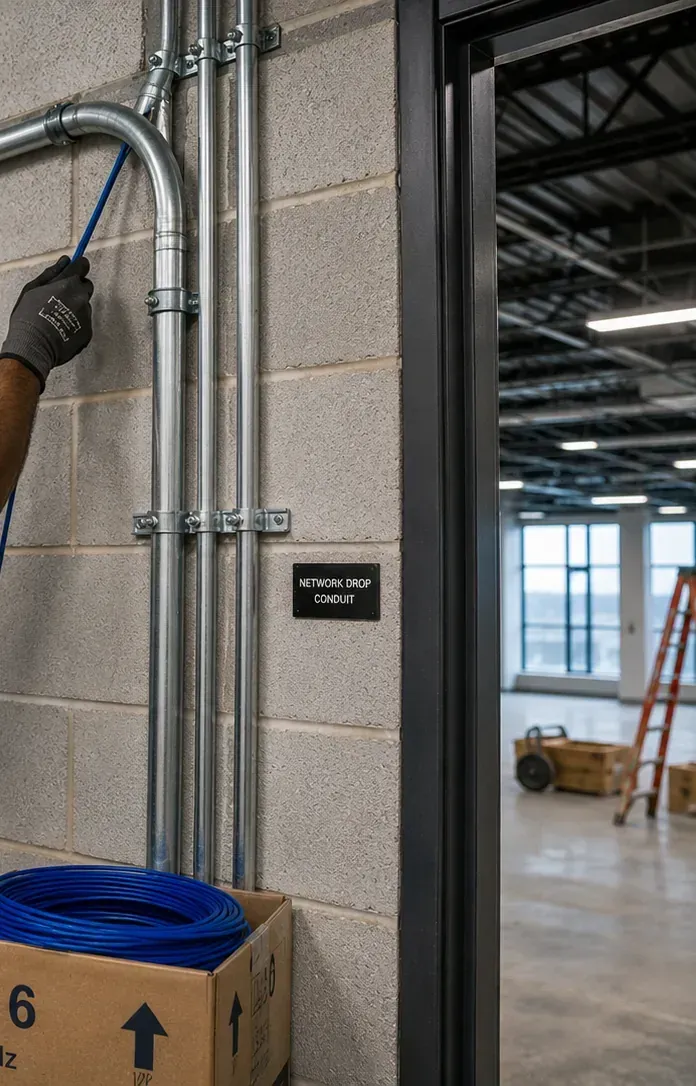
Network and low-voltage cable runs for stores, offices and renovations, with structured cabling in Fort Hamilton.
This describes how we survey south of 86th Street; it is not a story about any particular customer. The first question our technicians ask at a Fort Hamilton door is not about windows. It is about time: how long do you expect to live here? The answer changes almost everything. A family expecting orders within two years gets wireless sensors on removable mounts, a panel that is not locked to any dealer, a communicator checked for the networks likely to serve the next home, and a written list of what travels. An owner who has lived on the block for decades gets wired contacts where the basement ceiling is open, a keypad sized for easy reading, and a call list updated with people who can actually respond today. A co-op shareholder somewhere in between gets whatever the board allows inside the apartment door.
The second question is about absence: an apartment that will sit empty for a deployment, a training rotation or a winter away gets water and temperature sensors, a local backup on the call list, and fresh batteries before anyone leaves.
A basic residential system starts at $600: a panel, four to six door and window sensors, a motion detector, a keypad, a cellular communicator and monitoring setup. Wireless systems with four to six sensors run $600 to $1,200 all-in, and the equipment is yours, with no lease. Sales tax of 8.875 percent is added, and the written price is fixed after one visit.
Yes. Most current alarm apps let the account owner add people as notification-only users, so a parent in another state can see that the Fort Hamilton apartment was armed at night or that a sensor tripped, without any power to change the system. We set those users up at handover and show you how to remove them later.
You are covered, but a different page fits you better. Fort Hamilton Parkway runs north from the Army post through Borough Park toward Kensington, far from the blocks this page describes. Our Borough Park and Kensington alarm pages cover those areas, at the same Brooklyn prices and from the same office.
Our published plan is month to month rather than pausable, so the simple route is to cancel and restart, which carries no penalty with us. Servicemembers who end a covered contract on orders also have reinstatement protection under 50 U.S.C. § 3956.
We do not publish a separate military discount. Our prices are the Brooklyn list shown on this page, the same for every customer, and we keep costs down for households on orders by selling owned equipment with no monitoring term, so there is nothing to buy out or return when you move. If a discount program applies through a monitoring partner, we will tell you at the quote.
Yes. At handover we provide a list of every device installed, with model names and serial numbers where the manufacturer prints them, the zone each one covers, and which parts are portable. Families use it for the moving inventory, for renters insurance, and to check compatibility at the next home.
Full terms — including 50% deposit, the 30-day warranty and optional paid extended warranty, and the late-fee schedule — are set out in the service agreement. Our technicians work only in our New York service area, so call us before you leave if anything is acting up, and keep the equipment list so a replacement part can be identified.
That is your choice, and many tenants say no. A landlord on the call list will be phoned when the alarm trips and may be given details about your comings and goings. A middle path is to list the landlord only for water and temperature alerts, which protect the building, and keep burglary alerts to your own household and a backup contact.
In some situations. 50 U.S.C. § 3956 treats certain spouses and dependents as covered, including the spouse or dependent of a servicemember who dies in military service or suffers a catastrophic injury or illness, and a spouse or dependent who accompanies the servicemember after a stop-movement order. Others should ask the installation’s legal assistance office about their case.
Fort Hamilton is one spoke of our Brooklyn alarm installation hub, itself part of alarm installation across New York City. We research and write each neighborhood separately; the two built in the same round as this page are alarm installation in Fort Greene and alarm installation in Fulton Ferry.
Alarm installation in NYC (hub) · Brooklyn · Manhattan · Queens · the Bronx · Staten Island
Alarm installation on Long Island (hub) · Nassau County · Suffolk County
Alarm installation in the Hudson Valley (hub) · Westchester · Rockland · Orange County · Putnam · Dutchess · Ulster
Bay Ridge · Dyker Heights · Bath Beach · Bensonhurst · New Utrecht · Sunset Park · Borough Park · Kensington
Fort Hamilton cameras · Fort Hamilton door access · Fort Hamilton intercoms · Fort Hamilton fire alarms · Fort Hamilton cabling · Fort Hamilton buzzer repair
Beyond burglar alarms, Abstract Enterprises Security Systems handles commercial camera systems in Brooklyn, intercom repair throughout the borough and low-voltage cabling for Brooklyn properties. Our license and insurance details are listed on the about page; ask any company you consider for the same.
Every local fact, figure, rule and news item on this page was checked in October 2026 against the sources below. Where sources disagree, we say so or leave the figure out.
Most Fort Hamilton calls come down to timing: a move coming sooner than expected, a deployment that needs the call list rebuilt, or an old panel that stopped reporting years ago. Phone (347) 934-8335 with your dates and the brand on the keypad, and we will tell you what can be done before the visit.
Reach a technician on the Fort Hamilton number, (347) 934-8335, by call or text, or share door and window pictures over WhatsApp. Quotes and invoices are issued by Abstract Enterprises Security Systems from our office at 1282 Troy Ave, Brooklyn, NY 11203.
Households and shop owners have given us 4.6★ in 390+ Google reviews. Every Fort Hamilton job is done under our New York State installer license #12000287431, and insurance certificates naming a co-op, a managing agent or a landlord are issued on request ahead of time.
Full terms — including 50% deposit, the 30-day warranty and optional paid extended warranty, and the late-fee schedule — are set out in the service agreement. See our warranty page.
Revision log, October 21, 2026: this page was rebuilt from scratch around the two kinds of household found south of 86th Street and beside the Army post: garrison families and civilians renting off post on two- and three-year assignments, for whom we install owned, portable systems with month-to-month monitoring and plan for moves and deployments; and long-time owners of row houses and Shore Road co-ops, whose older systems we update. It also covers the stores along Fourth and Fifth Avenues down to the Fort Hamilton Triangle. Prices are the published Brooklyn base figures.
Rebuilt alongside this page: Fort Greene, Brooklyn alarm installation · Fulton Ferry, Brooklyn alarm installation