Ocean-side camera gone milky, a recorder that never came back after the last storm, or a fence camera at the dune end that keeps dropping out? Sea Gate camera repair line, booked within 2 hours: (347) 934-8335
Large Frame Houses With Porches and Turrets · Houses on Atlantic Avenue Facing the Ocean · Lots on Gravesend Bay · Divided Houses and Rentals · Shuls and Association Buildings Behind the Gate
Security Camera Repair in Sea Gate
Any Brand, Any Installer · Footage Saved Before Anything Is Touched · Salt Damage Shown, Not Guessed · Written Price Before Parts
Security camera repair in Sea Gate starts with our $150 Brooklyn service call, which covers the on-site diagnosis and is credited to the repair if you go ahead. On our published Brooklyn list most single faults cost $150 to $700, and a recorder replacement or a multi-camera rewire runs $700 to $1,500. We repair systems other companies installed, on houses that face the open ocean on Atlantic Avenue, the bay side along Gravesend Bay and the fence line toward Coney Island Creek, where salt, wind-blown sand and storm outages wear cameras out faster than anywhere inland in the borough. Requests are booked within 2 hours, visits come in two-hour arrival windows, and you get a written price before any part is replaced.
Every price on this page comes from our published Brooklyn camera repair list, and your own price is written down before work starts
Rated 4.7★ across 201 Google Reviews
Reviewed and updated November 12, 2026, against the Sea Gate Association's website, its 2024 Rules and Regulations and its October 2024 notice on park access; NYC City News Service's May 2015 report on the Sea Gate police and the two gates on West 37th Street; THE CITY's June 2020 report on lawsuits against the association; City Limits' December 2012 report on Sandy and burglaries in the 60th Precinct; the Brooklyn Eagle's 2015 report on the FEMA-funded bulkhead between Beach 48th and 50th Streets; PoliticsNY's 2016 report on the Army Corps T-groins; the NYPD's 60th Precinct page; i-PRO's maintenance guidance for cameras in salt-damage areas; AVsion's September 2026 guide to coastal camera failures; IPVM and Reddit installer discussions on salt and condensation; TechPro Security on cameras after power outages; HomeAdvisor's Brooklyn cost page; New York Labor Law §203-c; and the New York Department of State on CCTV installer licensing. · Abstract Enterprises Security Systems, NYS license #12000287431 · crews dispatched from our Troy Avenue office in Brooklyn
A product photo from the AESS job library, not taken in Sea Gate: a 16-channel network video recorder. In a large Sea Gate frame house this box usually sits in a basement utility room, a hall closet or, in houses rebuilt after Sandy, a closet on an upper floor where the owner moved it away from the water. Sixteen channels is common here because the houses are big and the lots have three or four sides to watch: the street, the porch, the side yards and the water. Most of our repairs start at this box, because it shows which cameras dropped and when, and because it is the part that can stop saving video while every camera still looks fine from the yard.
Sea Gate Camera Repair Request
Frame house, divided house, rental, rebuilt house, shul or association building: send the address and what the screen shows, and a technician calls back with the next step
✅
Request Sent!
Thank you. A technician will contact you about the Sea Gate address shortly.
25+
Years Experience
✓
Same-Day Estimates
100%
Licensed & Insured
4.7★
201 Google Reviews
Owner-operated since 2002 · Thousands of jobs completed · Booked within 2 hours
Security camera repair in Sea Gate is mostly a fight with the water around it. The community sits at the far western tip of the Coney Island peninsula with the Atlantic to the south, the Lower Bay and the Narrows to the west and Gravesend Bay to the north, so almost every house is within a few blocks of salt water, and many face it directly. Salt settles on everything outdoors, works into connectors, screw threads and the seals around a camera's housing, and slowly etches the clear dome or front glass until the picture turns milky. Wind carries sand off the beaches and the dune at the creek end. Storms bring the outages and surges that kill switches, power boxes and recorders, and Sandy showed in 2012 how far the water can reach into a basement. On a Sea Gate repair we find what failed, show you whether salt caused it, replace corroded hardware with stainless steel and sealed connections, and set the system to warn you on your own phone the next time a camera goes dark. Send a photo of the camera or the recorder screen to (347) 934-8335 or on WhatsApp, and we will tell you the likely fault and what that kind of repair costs on our Brooklyn list before you book.
Looking at your photos costs nothing. The $150 service call covers the on-site diagnosis and is credited to the repair if you go ahead.
All work is done under New York State license #12000287431, the license the state requires of companies that install or service security and CCTV systems for other people.
We repair any brand and any installer's work, and we tell you plainly when a camera that has spent years facing the ocean is not worth fixing.
The Neighborhood
Why Sea Gate Properties Need Security Camera Repair
Sea Gate is a private, gated community of large houses at the western end of Coney Island, west of West 37th Street, laid out in the 1890s and run since 1899 by the Sea Gate Association, which residents pay for their own security, street lights, beach and lifeguards. The houses are mostly big detached frame houses in Queen Anne, Colonial Revival and Mediterranean styles, many with porches, turrets and third floors under the roof, along Surf, Atlantic and Neptune Avenues and the Beach streets that run off them. That is all the background a camera repair needs. What matters is what the place does to camera equipment, and who is looking at the cameras when something goes wrong.
Start with the gate, because it shapes how people here think about cameras. The community is closed off at West 37th Street, where it meets Surf Avenue and Mermaid Avenue, by brick and metal gates staffed by the association's own officers. "The majority of our effort goes into making sure that the only people inside of the gate are people that are supposed to be here," a Sea Gate police sergeant told NYC City News Service in May 2015. The same report described the northeastern corner, where a sand dune runs along the fence, as "vulnerable to breach" and one of the most heavily patrolled parts of the community, and quoted a longtime Atlantic Avenue resident who found the gate checks inconsistent, with some officers simply waving people through. A gate controls the road. It does not watch the beach, the bay side, the fence line or a back porch at three in the morning, and that is the job the cameras on Sea Gate houses were bought to do.
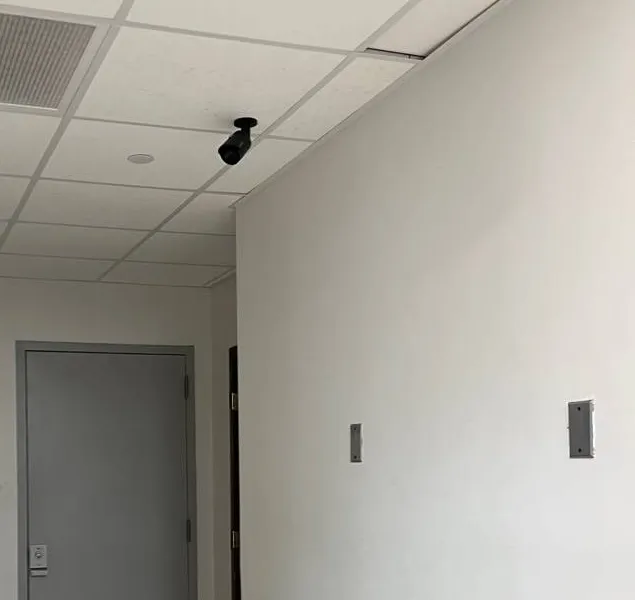
A photo from the AESS job library, not taken in Sea Gate: a small black bullet camera hanging from a white ceiling-tile grid and aimed down a short corridor at a grey steel service door. In Sea Gate the nearest equivalent is the camera inside a basement or a converted ground floor, watching the door that leads out to the yard or the beach side. Indoor cameras like this one rarely fail from weather. When they go dark it is usually the power box or the switch they share with the outdoor cameras, which is why we test the whole chain before replacing any camera.
Then the water. A camera that would last years on a Flatbush brownstone can fail far sooner on a house facing the ocean. An Australian installer's guide to coastal systems, published in September 2026, puts it plainly: the damp layer of salt that settles on outdoor equipment "attacks fixings, brackets, screw threads and any exposed connection," and "once corrosion starts around a seal the housing is no longer weatherproof." The same guide notes that salt residue "etches and hazes" the clear cover over the lens long before the camera itself stops working. That is the commonest Sea Gate complaint we hear: the camera still works, but the picture has turned soft and milky, and cleaning it no longer helps. The camera maker i-PRO goes further and recommends that cameras in coastal areas be rinsed about once a month, with anti-corrosion screws or caulking at the mount. Very few homeowners do either.
Storms do the rest. When Sandy came ashore in October 2012, water from both the Atlantic and Coney Island Creek ran through Sea Gate's streets, oceanfront houses on Atlantic Avenue were destroyed, and City Limits reported that the 60th Precinct, which covers Sea Gate along with Coney Island and Brighton Beach, saw burglaries rise 164 percent in the month after the storm. Many houses were rebuilt, raised or rewired in the years that followed, the Army Corps of Engineers finished four T-groins off the beach in 2016, and the association rebuilt its bulkhead in phases with federal money. Every one of those projects took cameras down, moved recorders and cut or buried cables, and many systems were put back in a hurry by whoever was on the job. Fourteen years later we still find junction boxes that were never sealed, cables spliced with tape inside a wall, and recorders sitting exactly where the water reached.
Finally, many Sea Gate houses are not watched by the people who own them. Houses here are often divided into apartments, rented out, left empty for part of the year or owned by families who live elsewhere, and a camera system that nobody checks can sit dark for months. So a camera repair in Sea Gate has two halves: put right what the salt, the sand and the storms broke, and then make the system report on itself, so the next failure arrives as a text message rather than a discovery on the morning a door is found open. Many owners have the porch or gate intercom looked at on the same visit, since a door station with a camera faces the same weather.
Six Sea Gate facts that shape a camera repair
Two gates, one road in. Vehicles enter at West 37th Street and Surf Avenue or at West 37th Street and Mermaid Avenue, according to NYC City News Service's 2015 report. Our technicians are expected at the gate, so we confirm the house and the access arrangements before the visit.
Water on three sides. The Atlantic, the Lower Bay and Gravesend Bay surround the community, and the beaches here are residents-only. A camera on the south or west side of a house takes direct salt spray in a storm; one on the street side still takes salt air every day.
Burglaries spiked after the last big storm. City Limits reported in December 2012 that burglaries in the 60th Precinct rose 164 percent in the month after Sandy. Cameras that die in a storm tend to be needed most right after it.
Construction hours are set by the association. The Sea Gate Association's 2024 rules allow construction only between 7 a.m. and 6 p.m. on weekdays, with weekend work needing a special permit and none within 300 feet of a house of worship. We book repair visits on weekdays inside those hours.
Outdoor cameras do not last forever. Industry guides put the life of outdoor cameras at roughly three to seven years because of heat, cold and moisture, and recorders at five to ten. Near salt water, expect the low end.
Brooklyn prices, not beach-house prices. HomeAdvisor's Brooklyn page puts the average surveillance camera install or repair at $1,416 across all job sizes. A single repair on our Brooklyn list usually lands between $150 and $700, and Sea Gate is billed at the same rate as the rest of the borough.
Where this page applies. It covers all of Sea Gate west of the West 37th Street gates: Surf Avenue as it curls northwest from the main gate, Atlantic Avenue along the ocean, Neptune Avenue toward the bay, the Beach streets from Beach 37th to Beach 51st, the houses near Norton Point at the far tip, and the community buildings by the Surf Avenue entrance. For the rest of the borough, see our main Brooklyn security camera repair page. The price follows the fault, not the address.
Same-Day Repair in Sea Gate
Need Repair in Sea Gate? Cameras Dark Since the Storm, a Picture Gone Milky, or Footage You Need Before It Records Over
Urgent camera calls from Sea Gate fall into three groups. The first comes the morning after a storm: the power went off overnight, the wind and the water were up, and now part or all of the system is dark, the recorder is beeping, or the phone app says every camera is offline. The second comes after something happened: a door was found open, a car on the block was entered, something went missing from a porch, or an owner who lives elsewhere was told by a neighbor or the association that someone was on the property. The third is the slow one: a camera that faces the water has gone so cloudy that nobody can be recognized in it, and the owner has finally noticed.
If you need footage from an incident, leave the recorder running. Do not restart it, unplug it or accept any message on the screen about formatting the disk. Most recorders write over their oldest video once the drive is full, so the clip you need is already on a clock. Call (347) 934-8335, give us the date and the time window, and we book the visit with exporting that clip as the first task. The clip goes to USB with the recorder's original timestamps, and we note the difference between the recorder's clock and the real time, which after a storm outage is often hours or days off.
After a storm, two things are worth knowing before you call. If the basement or the ground floor took water and the recorder, switch or power boxes sat in it, keep them unplugged until they have been looked at, and do not switch power back on to anything that was submerged. And if only the cameras on one side of the house are dark, look for a tripped outdoor outlet or a breaker before assuming the cameras are gone; it costs nothing to check, and it is the answer more often than people expect. For everything else, the $150 service call books a two-hour arrival window, the technician finds the cause, and you get a written price before any part is replaced. Requests are booked within 2 hours. We do not promise the repair itself happens the same day, because stainless hardware or a replacement camera sometimes has to be brought on a second visit, but most single-camera, power and drive faults are fixed on the first visit when the part is on the truck.
What We Install
Security Camera Repair Services in Sea Gate
Every repair below is priced from our Brooklyn camera repair list. The service call pays for finding the fault. The repair is priced by what failed, how many cameras it touches and how hard the camera is to reach, whether it is under a porch ceiling on Surf Avenue or high on the ocean side of a three-story house on Atlantic Avenue.
Salt-damage repair
Corroded connectors, seized screws, rusted brackets and housings whose seals have let moisture in. We open the connection, cut back to clean copper, re-terminate and seal it, and replace painted steel hardware with stainless steel.
Milky and hazy picture repair
Pictures gone soft from salt film or from a dome that salt has etched. A clean and check fixes the first; the second needs a new cover or a new camera, and we show you which one you have before you pay for either.
Storm and outage recovery
Systems that came back wrong after the power went out: dead switch ports, failed power boxes, recorders stuck on a setup screen, cameras on a tripped outdoor outlet, and clocks reset to a factory date. We restore settings and put battery backup where it does the most good.
Water-damaged recorders and boxes
Recorders, switches and power supplies that sat in water or in a damp basement. We save what footage we can, tell you honestly what is safe to keep, and move the replacement up and away from where the water reaches.
Fence-line and far-camera repair
Cameras on the back fence, the bay-side bulkhead or the beach side of a deep lot, where cables run long, cross yards and pass through ground-level boxes that fill with sand and water. Repaired, re-terminated or rerouted and tested end to end.
Porch, turret and high-camera service
Cameras under porch ceilings, on turrets, under eaves and at the top of three-story walls, where most of the cost is reaching the camera safely. We plan the ladder work from your photos so the visit is not wasted.
Phone viewing and logins
Apps that lost the recorder after a new router, systems set up on a relative's phone in another city, and recorders whose password left with the installer. We restore access for the owner, change default passwords and set up separate logins for family, tenants or a caretaker.
Silent-failure checks for absent owners
Houses rented out or closed for part of the year, where nobody would notice a dark camera. We turn on alerts for lost video and drive errors, send a test to your phone, and confirm how many days the drive really keeps.
Footage export
Clips copied to USB with original timestamps for the police, an insurer or the association, with a written note of any difference between the recorder's clock and the real time.
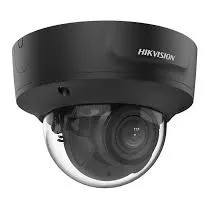
A product photo from the AESS job library, not taken in Sea Gate: a black varifocal dome camera. The zoom lens inside can be set on site to frame the front steps or the side gate instead of the whole yard. On a Sea Gate porch a dome like this is the usual camera under the porch ceiling, and its clear bubble is the part salt attacks first. When the picture turns milky we check whether the bubble is simply filmed over or etched, because an etched bubble can often be replaced on its own for far less than a new camera.
Building Specialists
Security Camera Repair for Sea Gate's Architecture
Six kinds of property make up nearly every camera repair call we take from behind the gate. Each wears out its cameras in its own way, and each decides where the recorder lives, how far the cables run, which camera takes the weather and who has to approve the work.
Large frame house with a porch
Two and a half to three stories of wood over a basement, a porch on one or more sides, sometimes a turret, with cameras under the porch ceiling, under the eaves and at the corners of a big lot.
House facing the ocean or the bay
Houses on Atlantic Avenue and at the ends of the Beach streets, and lots along Gravesend Bay, where one whole side of the house takes salt spray and wind straight off the water.
House rebuilt or raised after Sandy
Houses rebuilt from the foundation or lifted after 2012, with new walls, new stairs and a system that was put back by whoever was on the job at the time.
House divided into apartments
Big houses split into two to five households, with shared porches and halls, cameras added by different people over the years, and a recorder in a space not every household can reach.
House rented out or closed part of the year
Houses whose owners live elsewhere, rent to tenants or summer families, or close up for the winter, where a dark camera can go unnoticed for months.
Apartment buildings and former hotels
The handful of larger buildings, some converted from older hotels and rooming houses, with lobbies, halls, a basement and a camera system shared by many households.
The big frame house: long runs, high cameras and a porch that hides the cable
The typical Sea Gate house is a large detached frame house, often well over a century old, with a porch along the front and sometimes around a corner, a turret or bay on one side, a full basement and a third floor under the roof. Camera systems in these houses usually have eight to sixteen cameras, because the lots are big and every side faces something: the street, the porch steps, the driveway, the side yards and the water. That means long cable runs. A camera at the back corner of a deep lot can be well over a hundred feet of cable from the recorder in the basement, and the cable often travels under the porch floor, up inside a porch column, across the basement ceiling and out through the sill.
Those runs fail at the joins. Where the cable leaves the house through the sill or the siding, rain and salt follow it in, and the connector at the camera end corrodes. Where it was spliced under a porch during a repair, the splice was often taped rather than sealed. On a repair we test each run from the recorder to the camera, open the connection at the camera end first, because that is where salt finds its way in, and only replace a cable when the test shows the cable itself has failed. Re-terminating and sealing a connection costs a fraction of pulling a new cable through a hundred-year-old house.
The house that faces the water: the side that ages three times as fast
On a house that faces the ocean or the bay, the cameras on the water side and the cameras on the street side are effectively in two different climates. The water side takes spray in every storm and a constant salt film the rest of the year; the street side, shielded by the house, often looks almost new after the same number of years. We regularly find a system where the street cameras are fine and every water-side camera has a rusted bracket, a hazed cover and a corroded connector.
The repair for the water side is not just a new camera. The screws go back in stainless steel, not the plated or painted steel most kits come with. The connector is sealed with a weatherproof boot or sealant, with a drip loop so water runs off the cable instead of along it into the camera. The bracket, if it is rusting, is replaced rather than painted. And where the camera itself has to be replaced, it should have a housing rated for the conditions and a hood or a recessed lens that keeps spray off the glass. i-PRO's guidance for cameras in heavy salt areas also advises against mounting in direct splash zones at all, so on the most exposed corners we sometimes recommend moving the camera a few feet around the corner or under an overhang, where it can still see the water without taking the full force of it.
The house rebuilt or raised after Sandy
Many Sea Gate houses were rebuilt, raised or heavily repaired after October 2012, and the camera systems in them have a history the current owner often does not know. Cables were pulled out when walls were opened and pushed back in when they were closed. Junction boxes were left in crawl spaces that still flood. Recorders were moved to upper-floor closets, which is the right idea, but the cables to the street-side cameras were sometimes spliced to the old ones in the basement rather than run new. When a camera in one of these houses fails, we look first for a splice somewhere between the old basement and the new location, because that is where the system was patched together in a hurry.
The divided house: several households, one recorder
Some large Sea Gate houses hold two, three or more households, and their camera systems grew one camera at a time. The owner put cameras on the porch and the driveway; a tenant added a Wi-Fi camera at a side door; the recorder ended up in a basement or a closet only one household can open. When one camera goes dark in a house like this, the first question is whose it is. We confirm which cameras belong to the owner's system, who approves and pays for the repair, and who should be able to view which cameras afterward. Most recorders can give each household its own login that shows only the cameras it should see.
The house rented out or closed part of the year
A large share of Sea Gate houses are watched by someone who is not there every day: an owner who lives in another borough or another state, a family that rents the house out, or a household that spends the winter elsewhere. These are the systems that fail silently. A drive fills up and stops, a router is replaced by a tenant and the phone app loses the recorder, or the power goes out in a storm and one switch never comes back, and the owner finds out only when they open the app months later.
For these houses the repair always ends with alerts. We switch on the recorder's warnings for lost video, a full or failing drive and a camera that has been blocked or moved, send them to the owner's own phone and email, and send a test while we are on site so you see it arrive. If the house has a caretaker, a neighbor with a key or a property manager, we can add them to the alerts with their own login, so the person nearest the house hears about a dark camera first.
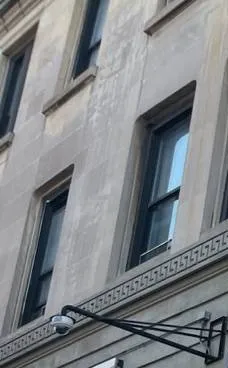
A photo from the AESS job library, not taken in Sea Gate: a bullet camera on a long black steel wall arm, mounted just below a carved Greek-key band on a pale stone facade with tall sash windows. Sea Gate's Mediterranean-style houses have stucco and masonry walls rather than carved stone, but the mount is the lesson. A long steel arm holds the camera clear of the wall so it can see along it, and near the water that arm is the first thing to rust. On a repair we check the arm's screws and its base plate as carefully as the camera, and replace painted steel with stainless where it has started to bloom.
Field Notes
Field Notes: Working Around a Sea Gate House From the Street Side to the Water Side
These notes describe the order our technicians follow on a typical Sea Gate repair visit to a large house with cameras on all sides. It is our working method, not an account of one address.
Save before touching. If the owner needs any footage, it is exported first, before the recorder is restarted or opened, and the recorder clock is compared with the real time.
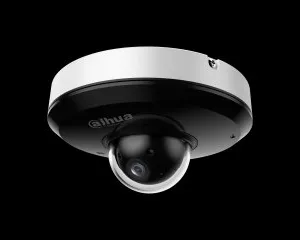
A product photo from the AESS job library, not taken in Sea Gate: a mini pan-tilt dome camera with a white housing over a black lens dome. Cameras like this are meant for indoor rooms and covered spaces, and in Sea Gate we find them in front halls, glassed-in porches and basement rooms. They fail less from weather than from their motors and their settings, so on a repair we test the pan and tilt, restore the saved positions and set the camera to rest on the view that matters, usually the door.
Read the recorder's log. Most recorders keep a record of video loss, disk errors and power loss. On a Sea Gate system the log often shows a whole group of cameras dropping at the same minute during a storm, which points to a shared switch, power box or outdoor outlet rather than the cameras.
Start on the street side. The street-side cameras are the control group. If they are clean and working, and the water-side cameras of the same age are not, salt is the cause, and the owner sees the difference with their own eyes.
Open the water-side connections. At each water-side camera the technician opens the connection at the camera end, checks for green or white corrosion on the copper, looks at the screws and the bracket, and checks whether the cover is filmed over or etched by wiping a small corner.
Follow the cable to the house. Where the cable enters the house, at the sill, the siding or a box under the porch, the technician checks for water and sand in the box and for a taped splice. On fence-line and bay-side runs this is usually where the fault is.
Price it, then fix it. The owner gets a written price for each camera and each run before any part is replaced. Then the connections are re-terminated and sealed, the hardware goes back in stainless steel, and any camera that cannot be saved is replaced with one suited to its spot.
Check after dark and hand over. Infrared and night pictures are checked in real darkness, the alerts are tested to the owner's phone, and the owner gets a short schedule for rinsing and checking the water-side cameras.
Why Systems Fail Here
Salt Film, Blown Sand, Storm Surges and Wet Basements: How Sea Gate Camera Systems Break
Most Sea Gate repair calls trace back to one of five causes. Knowing which one you have tells you whether the fix is a cleaning, a part or a camera, and it is the first thing we tell you on site.
Salt on the connectors and the hardware
Salt does its damage where metal meets air and water: the copper inside a cable connector, the screws through a bracket, the hinge of a housing and the threads of a mounting arm. Corrosion on a connector raises the resistance in the circuit until a camera flickers, drops at night when its infrared draws more power, or goes dark altogether. An installer discussion on IPVM sums up the problem in one line: "Rust blooms, organic gunk, and salt fog make near-ocean video surveillance tough." The fix is to cut back to clean copper, re-terminate, seal the joint and replace the hardware with stainless steel. Painting a rusting bracket only hides the rust for a season.
Salt on the glass
The second kind of salt damage is to the picture. A thin film of salt on a dome or front glass softens the image and scatters the camera's own infrared at night, so the picture turns grey or glowing. A careful clean with fresh water fixes that, and i-PRO recommends rinsing cameras in coastal areas about once a month for this reason. Over time, though, salt and blown sand etch the clear plastic, and then no cleaning helps. We tell the two apart on site by cleaning a small corner of the cover and comparing it with the rest. An etched cover can often be replaced on its own; where the camera's design does not allow that, the camera is replaced.
Sand in the boxes and on the cables
Wind off the beaches and the dune at the creek end carries sand into anything at ground level: junction boxes on the back fence, conduit ends, the gap under a porch where cables come out of the house. Sand holds moisture against the connections inside the box and grinds at any cable that moves in the wind. On fence-line and beach-side runs we often open a ground-level box to find it packed with wet sand around a corroded splice. The repair is to clean out the box, re-make the splice with sealed connectors, and where possible lift the box off the ground or move the splice inside the house.
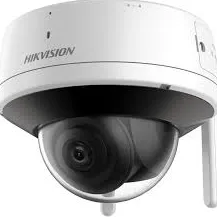
A product photo from the AESS job library, not taken in Sea Gate: a Wi-Fi dome camera with an external antenna. On a large Sea Gate lot this is the kind of camera people put on a garage, a shed or a back fence that is too far for a cable, and it works as long as the house Wi-Fi reaches it through the walls and across the yard. When one drops out after a router change or a storm, the fix is often the router, an access point or the antenna's aim, not the camera, so we test the signal at the camera before replacing anything.
Surges and outages from storms
Storms off the ocean bring wind, falling branches, flickering power and sometimes long outages, and a camera system has several parts that do not like any of them. The switch that powers network cameras and the multi-camera power box for coax cameras are the commonest casualties: they take a surge, lose some or all of their outputs, and the cameras they feed go dark together. Recorders sometimes come back with settings lost or the drive unreadable. Long outdoor cable runs, which big Sea Gate lots have plenty of, also pick up surges from nearby strikes and carry them into the equipment. On a storm repair we replace what failed, check every port and output rather than just the ones you noticed, and add a battery backup sized to keep the recorder and the switch running through a short outage and shutting down cleanly in a long one.
Commercial Security Camera Repair
Business Security Camera Repair in Sea Gate
Sea Gate has no stores or shopping street, so the "commercial" camera work here is different from anywhere else in Brooklyn. It means the buildings that serve the community, the houses run as businesses, and the shops just outside the gate where residents do their errands. Each has its own owner, its own approval chain and its own rules about who sees the footage.
Association buildings and grounds
The buildings by the Surf Avenue entrance, the community center and the parks and beach facilities the association maintains, where cameras watch entrances, playgrounds and equipment and the association decides who may view them.
Houses of worship and study halls
Sea Gate's small synagogues and its yeshiva, where cameras watch doors and halls, the system must run through Shabbat and holidays without anyone touching it, and repairs are scheduled around services.
Rental houses run as a business
Houses owned by landlords or companies and rented to one or several households, where the owner wants the shared areas covered, the tenants' privacy respected and a written record of what the cameras see.
Apartment buildings with managing agents
The larger buildings inside the gate, run by an owner or a managing agent, with lobby, hall and door cameras on one recorder and a manager who approves the work and the cost.
Shops just outside the gate
Stores, restaurants and service businesses on Mermaid Avenue and Surf Avenue in Coney Island, a few blocks from the gate, which we repair at the same Brooklyn rate and cover on our Coney Island page.
Houses of worship: cameras that must run untouched for a day or more
A 2005 Village Voice profile of Sea Gate counted five shtibelach and a yeshiva inside the gate. For a shul or a study hall the camera system has an unusual requirement: it has to run, record and report problems for a full day or longer without anyone touching the recorder, the screen or the phone app. That means the drive must have room for continuous recording over a holiday, the recorder must restart on its own after a power flicker, and alerts should go to someone who can act on them, such as a board member or an outside caretaker, rather than to the rabbi's phone. We schedule repairs on weekdays and away from services, and we set the system so that nothing needs to be pressed or adjusted to keep it running.
Rules and practical limits on institutional and managed properties in Sea Gate
State license. New York requires companies that install or service security and CCTV systems for others to be licensed by the Department of State. We work under NYS license #12000287431.
Workplace notice. Under New York Labor Law §203-c, an employer that monitors employees on video must give notice and get written acknowledgment. That applies to a shul office, a building's staff areas or a contractor's crew, and we remind managers of it when cameras cover workspaces.
Association hours. The Sea Gate Association's 2024 rules limit construction to 7 a.m. to 6 p.m. on weekdays, require a special permit for weekends and bar weekend work within 300 feet of a house of worship. A camera repair is small work, but we keep to those hours on every visit.
Insurance. The association's rules set insurance requirements for contractors working in the community. If the office or a managing agent asks for our certificate, tell us when you book and we send it before the visit.
Signs. The association's rules prohibit business and advertising signs in front of houses, so we do not leave a company sign or yard placard. Small camera notices required for a workplace are a separate matter, and we can advise on wording.
Who receives footage. For buildings with several owners or households, decide in writing who may request a copy of a clip and who approves it. We export footage only to the person the owner or the board names.
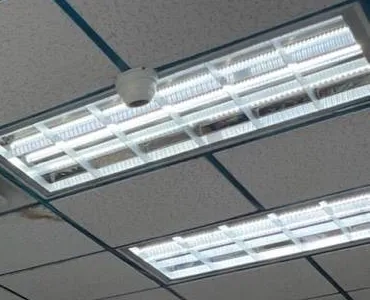
A photo from the AESS job library, not taken in Sea Gate: a small white dome camera on grey acoustic ceiling tiles beside a long louvered fluorescent light panel. This is the kind of ceiling found in a community building's hall, a study hall's office or the corridor of a larger apartment building inside the gate. When the lighting in a room like this is changed, the camera beside it often starts washing out or flickering, and the fix is usually a setting or a move of a few inches rather than a new camera.
Your Questions Answered
Security Camera Repair in Sea Gate: Questions Answered
These are situations Sea Gate homeowners, landlords, families who live elsewhere and the people who run community buildings describe when they call. Each answer is written for the houses and the conditions behind the gate.
The water side of the house
Only the cameras on the ocean side of our house keep failing. The street-side ones are the same age and still look new. Should we replace the whole system anyway?
Usually not. What you are describing is the normal pattern near the water: the cameras that take the spray and the salt film wear out several times faster than the ones the house shelters. If the recorder is healthy and the street-side cameras give a clean picture by day and night, there is no reason to throw them away. We repair or replace the water-side cameras, put them back with stainless hardware and sealed connections, and where a corner is especially exposed we may suggest moving the camera a few feet under an overhang. The time to replace everything is when the recorder itself is failing or too old to work with a modern camera, and we test that first and tell you what we find.
The camera on our beach-side deck was sold as weatherproof, with an IP66 rating on the box. Water still got inside it within two summers. Was the rating false?
Probably not false, just not the whole story. An IP rating describes how well a new housing keeps out dust and water jets when it leaves the factory. It says nothing about what salt does to the seals, the screws and the cable entry over two years by the ocean, and once corrosion starts around a seal, the housing is no longer sealed. Water also often gets in through the cable rather than the housing, when there is no drip loop and the connection behind the camera was never sealed. On a repair we look at where the water came in, and if the replacement goes back in the same spot, it gets a sealed connection, a drip loop and stainless hardware, and ideally a hood or an overhang that keeps the direct spray off it.
The fence line, the dune and the bulkhead
Our yard backs onto the fence at the creek end, where sand piles up against it. The camera on that fence goes out every few weeks, then comes back on its own. What should we look for?
Look low before you look high. A camera that drops out and returns on its own usually has a connection that is failing intermittently, and on a fence near a dune the likeliest place is a junction box or a splice near the ground, where sand drifts in and holds moisture against the copper. After a dry, sunny spell the connection works again; after wind and rain it fails. We open every box and splice between the house and the camera, clean out the sand, re-make the connection with sealed connectors and lift the box off the ground or move the splice indoors. If the cable itself has been chafed by moving sand or a swaying fence, we replace that length and fix it so it no longer moves.
When the bulkhead behind our block was rebuilt, the crew took our beach-side camera down and left its cable coiled on the lawn. Can the same camera and cable go back up?
Often, yes, once both are tested. The camera may be fine if it was taken down carefully and kept dry; the cable is the bigger question. A coil left on the lawn may have been stepped on, run over, cut back by a crew or left with its open end in the rain, and water that gets into the end of a cable can travel along it. We test the cable end to end, cut it back past any wet or damaged section, and re-terminate it. If it is long enough and sound, it goes back up with a sealed connection and a new mount; if not, we run a new length. The written price covers both possibilities, so you know before the ladder goes up.
Big houses, porches and turrets
The camera on our turret can be reached from a window in the tower room. Can the technician work on it from inside, or does it need a ladder from the ground?
If the window opens wide enough and the camera is within a safe arm's reach, working from inside is often the better choice: it is safer than a tall ladder against a curved wall and avoids walking on a porch roof. Send us a photo of the camera taken from the window and one from the ground, and tell us how far the window opens. If the camera is out of reach from inside, we plan a ladder or work from the porch roof, and we tell you in advance so you can move anything on the porch below. Either way, the repair itself is the same: connection, hardware, camera, and a check of the picture by day and night.
Our porch wraps around the corner, and the camera by the front steps can't see the side steps, which is where most people actually come up. Can the existing camera be moved, or do we need another?
Sometimes one camera can do both, if it moves to the corner of the porch ceiling and has a wide enough lens to see along both sides. More often a wraparound porch needs two views, because a single camera at the corner sees both stairs from far away and neither one well. We look at where people really come up, test what the current camera sees from the corner, and give you both options with prices: moving the existing camera, or keeping it and adding a second on the side. If you add one, it can usually share the existing cable route under the porch floor.
After Sandy our recorder was moved to a closet on the top floor, but the switch for the outdoor cameras was left in the basement. Should they be together?
Not necessarily together, but the switch should not be where the water goes. A switch that powers network cameras is just as important as the recorder: if it floods or takes a surge, every camera it feeds goes dark, even with a perfectly dry recorder upstairs. We look at where the outdoor cables come into the house, and usually move the switch up to a dry spot near where they enter, high on a wall or on the first floor, with a battery backup of its own, and run one cable from it up to the recorder. If moving it is not practical, we at least lift it off the floor and protect it, and tell you what is still at risk.
Owners who are not here every day, and community buildings
A caretaker checks our house every week while we are in Florida for the winter. Can he get the camera alerts without being able to watch the cameras inside the house?
Yes. Most recorders let you create separate users and decide which cameras each one can see, and whether they can play back recordings or only watch live. We set up a login for the caretaker that shows only the outdoor cameras, or none at all, and send him the alerts that matter, such as a camera losing video or the recorder losing power. You keep the main login with access to everything. We test his alerts and yours on the visit, and show you how to remove his access in the spring with a couple of taps.
A product photo from the AESS job library, not taken in Sea Gate: a black video intercom door station with a camera, a speaker grille and a lit call button. On a Sea Gate porch a station like this faces the same salt and spray as the cameras around it, and its camera is often the only one that sees a visitor's face up close. When a caretaker or a family away from home relies on it, we check that its picture reaches the right phones and, where the system allows, that it is recorded along with the other cameras.
During a two-day holiday the recorder at our shul froze, and nobody could touch it until the holiday ended. How can a repair make it recover on its own?
By making sure nothing in the system ever needs a person to press a button. We check why it froze, which is most often a failing drive, overheating in a closed cupboard or a power flicker that left it stuck, and fix that cause. Then we set the recorder to restart on its own after a power interruption, put it on a battery backup that rides through short flickers, give it enough drive space to record continuously through the longest holiday, and set its alerts to go to someone outside the shul who can arrange a visit afterward. We also schedule the repair visit on a weekday away from services.
Equipment
Types of Security Cameras and Recorders We Repair
We repair whatever is on the house, whoever put it there. These are the kinds of equipment we find behind the gate, and the way each one tends to fail this close to the water.
Coax and HD-over-coax cameras
Cameras with round BNC connectors, still common on houses wired before or soon after Sandy. Typical faults here: green corrosion inside the connectors, plug-in power adapters that died in a storm, and long runs to the back of a deep lot that lose picture quality.
Network (IP) cameras
Cameras powered and connected through a single data cable, standard on newer and rebuilt houses. Typical faults: dead switch ports after a surge, connectors that let water down the cable, and cameras lost after a router change.
DVRs, NVRs and hybrid recorders
The box that stores the footage, in a basement, a hall closet or an upper-floor closet. Typical faults: worn drives, settings lost in an outage, corroded ports from damp basement air, and recorders that were in the water.
Varifocal domes
Domes with an adjustable zoom, usually under porch ceilings and eaves. Typical faults: clear bubbles filmed or etched by salt, focus that drifted after a knock, and infrared that glows off a dirty bubble at night.
Hooded bullets
Bullet cameras with a long sun and rain hood, common on the water side and on fence lines. Typical faults: rusted brackets and arms, salt film on the front glass, and cable entries that let water in behind the hood.
Pan-tilt and indoor domes
Moving cameras in front halls, glassed-in porches and community rooms. Typical faults: lost saved positions, sticking motors, and settings reset after a power cut.
Wi-Fi, battery and cube cameras
Plug-in and battery cameras on garages, sheds, back fences and inside windows. Typical faults: weak signal across a big yard, batteries that drain fast in cold wind, and accounts tied to a relative or tenant who has gone.
Video door stations
Porch and gate stations with their own camera. Typical faults: salt on the camera window and the call button, video that reaches one phone but not another, and pictures never recorded with the rest of the system.
Switches, power boxes and battery backups
The equipment that powers the cameras, often forgotten in a basement or a closet. Typical faults: outputs blown by a storm surge, batteries in a backup unit that wore out years ago, and boxes left where the water reaches.
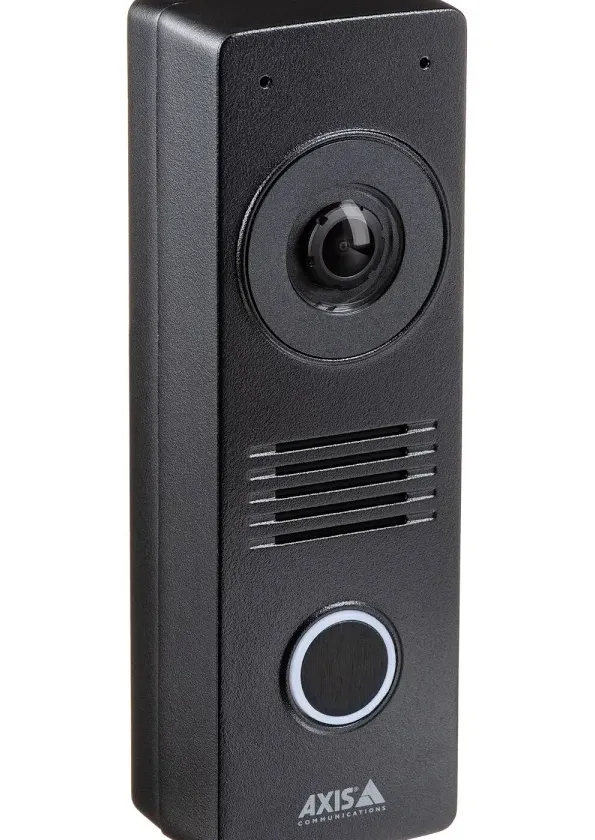
A product photo from the AESS job library, not taken in Sea Gate: a slim video door station with a camera lens at the top and a large round call button. Slim stations like this fit the narrow trim beside an old front door or a side door off a porch. Near the water the small camera window at the top is the first thing to haze over, so on a repair we clean or check it alongside the other cameras and confirm the picture it sends still shows a face clearly.
National alarm and camera brands compared with a local repair technician
Many Sea Gate houses have cameras from a national alarm company or a consumer brand bought online. Who can repair them, and how, depends on what you have.
Question
National alarm company (ADT and similar)
Consumer brand (Ring, SimpliSafe and similar)
Local licensed technician (AESS)
Who repairs a dead camera
The company that installed it, under its service terms
Usually you, with a replacement under the maker's warranty
We do, on site, whoever installed it
Salt damage to brackets and connections
Depends on the service plan
Not covered as a repair; the device is replaced
Connections re-made and sealed, hardware replaced in stainless
Mixed brands on one house
Usually only their own equipment
Only that brand's app
Any brand we can connect to the recorder
Footage storage
Often cloud, tied to the plan
Usually cloud, tied to a subscription
On your own recorder, with no monthly fee for the repair
Written price before work
Varies
Not applicable
Always
AI Overview Reality Check
What AI Gets Wrong About Security Camera Repair in Sea Gate
These claims show up in AI-generated answers, buying guides and quick repair advice online. Each is roughly true somewhere inland. Behind the gate, with salt water on three sides, each one can send an owner toward the wrong repair, a lost clip or a camera that fails again within a year.
"Weatherproof outdoor cameras don't need maintenance"
General answers describe outdoor cameras as sealed, weatherproof units you mount once and forget.
Near the ocean that is simply not how they behave. The camera maker i-PRO recommends rinsing cameras in coastal areas about once a month and using anti-corrosion screws or caulking at the mount, and its guidance warns that salt can reach well inland on peninsulas. Sea Gate is a peninsula tip with water on three sides. The seals, screws and connectors that make a camera weatherproof are exactly the parts the salt attacks.
Plan on maintenance for any camera that faces the water. On every repair we give the owner a simple schedule: rinse the water-side cameras with fresh water, look at the brackets and screws for rust, and have the connections checked once a year, ideally after the winter storms.
"If the picture is hazy, wipe the lens and it will clear up"
Quick fixes for a blurry camera almost always start and end with cleaning the lens.
Cleaning is the right first step, and it often works. But salt film and blown sand do two kinds of damage: a coating, which washes off, and etching, which does not. AVsion's 2026 guide to coastal cameras notes that salt residue "etches and hazes" the cover over the lens long before the camera fails. Scrubbing an etched cover with a dry cloth or a household cleaner makes it worse by adding scratches.
Rinse with fresh water first and dry with a soft cloth. If the picture is still soft, stop and have it looked at. We tell the difference on site by cleaning a small corner of the cover, and replace only the cover when the camera allows it.
"Paint the rusty bracket and it will hold"
Home-repair advice often treats surface rust on a camera mount as cosmetic, to be wire-brushed and painted.
On a mount that holds a camera off the wall of a house facing the ocean, rust is structural. It eats the screw threads and the base of the arm first, where you cannot see it, and paint over salt traps moisture underneath. The same 2026 coastal guide recommends stainless steel brackets and fixings rather than painted mild steel for exactly this reason.
If a bracket has started to rust, have it replaced, not painted. We replace rusting mounts and screws with stainless steel, seal the holes behind them, and check the wall underneath, because water running down a rusted screw has often found its way into the siding.
"After a power outage, just power-cycle everything"
The standard advice for cameras that stay offline after an outage is to unplug the recorder, the switch and the router and plug them back in.
That works when the problem is a stuck boot. It does not work when something upstream failed. As TechPro Security's 2026 guide puts it, a tripped outdoor GFCI, a breaker that did not reset, a failed switch power supply or a burnt switch "will keep a whole group dark while the rest of the system looks normal." And if you power-cycle a recorder that is struggling with a failing drive, you can lose the footage from the night of the storm.
Before unplugging anything, check outdoor outlets and breakers, and note which cameras are dark. If they share a switch or a power box, that is your suspect. If you need footage from the outage, leave the recorder alone and call us first.
"A camera that got wet can be dried out and used again"
Online tips suggest putting a fogged-up camera in rice, near a heater or in a bag of silica gel until the moisture is gone.
The fog may clear, but the reason it got in remains: a failed seal or a wet cable entry. The moisture comes back on the next humid day, and salt water leaves deposits on the board and the sensor that keep corroding after the water is gone. On Reddit's home security forum, the blunt answer to a camera fogged inside was that "there is really no drying them out." Recorders and switches that have been underwater are a safety problem as well as a reliability one.
Treat a camera with water inside as a replacement, and find out how the water got in before the new one goes up. Treat any recorder, switch or power box that sat in floodwater as unsafe to switch on until it has been inspected.
"Cloud recording keeps your footage safe even when the power goes out"
Many answers recommend cloud cameras because the video lives off site, out of reach of a thief or a flood.
Off-site storage is a real benefit for footage that has already been uploaded. But cloud cameras need power, a working router and a working internet connection to upload anything, and in a storm outage all three usually go down together. A cloud camera with no power records nothing; a battery camera may record locally but cannot upload until the internet returns. The hours of a storm, when the house is most exposed, are exactly the hours a cloud-only system is most likely to miss.
If cloud storage matters to you, pair it with a local recorder on a battery backup, and put the router and modem on the backup too. We can size the backup so the system keeps recording through a short outage and shuts down cleanly in a long one.
"Outdoor security cameras last about ten years"
Lifespan answers often quote a single range of five to ten years for security cameras in general.
That range is for systems overall and for recorders in a dry room. For outdoor cameras, industry guides give a shorter range of roughly three to seven years because of heat, cold and moisture, and near salt water the cameras on the exposed side sit at the bottom of it. Thumbtack's guide puts outdoor cameras at three to seven years; Honor Security puts recorders at five to ten.
Budget for the water-side cameras to be replaced more often than the rest of the system, and do not judge the whole system by its most exposed cameras. A repair that replaces only what failed, with better hardware, is usually the right call.
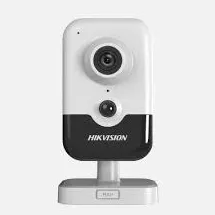
A product photo from the AESS job library, not taken in Sea Gate: a white indoor cube camera. Small cameras like this sit on shelves and windowsills in many Sea Gate houses, often set up by a relative and tied to one person's phone. They are not built for outdoor use, and one placed in a window to look out at the porch usually shows glare at night. When one fails we check whether it is the camera, the Wi-Fi or the account, and tell you honestly whether it is worth fixing.
Speak to a Tech Before You Unplug the Recorder or Replace a Rusted Camera
Tell us the address, the kind of house, how many cameras there are, which ones are out, which side of the house they face and where the recorder sits. If you need footage from a particular date, say so and we plan the visit around saving it. Photos of the failed camera and its bracket, the recorder screen, the switch or power box, and any box on the fence where the cable joins, help us bring the right parts and the right ladder. If you live elsewhere, tell us who will be at the house and how the technician should be expected at the gate. For anything urgent, call (347) 934-8335 now.
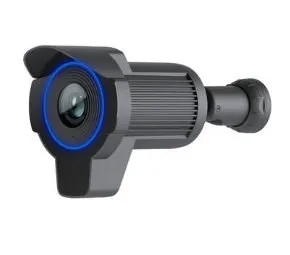
A product photo from the AESS job library, not taken in Sea Gate: a black bullet camera with a long hood and a blue-lit ring around the lens. The long hood keeps rain, spray and the low afternoon sun off the front glass, which is why we often choose this shape when a water-side camera on a Sea Gate house has to be replaced. If you send us a photo of the camera that failed, even from the yard, we can usually tell its type and its mount before the visit.
✅
Request Sent!
Thank you. A technician will contact you about the Sea Gate address shortly.
How It Works
Our Repair Process
1. Send photos and the address
A photo of the recorder screen or the dark camera, the Sea Gate address and the side of the house it faces, by text, WhatsApp or the request form. Tell us if you need footage from a particular day.
2. Confirm the owner and the gate
Owner, landlord, family member or managing agent: we confirm whose system it is, who approves the work, who holds the recorder login and how the technician will be expected at the gate.
3. Book the service call
The $150 Brooklyn service call puts the visit in a two-hour arrival window on a weekday inside the association's working hours, and is credited to the repair if you go ahead.
4. Save the footage first
Any clip that matters is exported to USB with its original timestamps before anything is restarted or opened, and the recorder's clock is checked against the real time.
5. Test from the panel to the farthest camera
Power at the panel and any outdoor outlet, battery backup, switch or power box, every cable and fence box, the recorder and its drive, then the phone app, camera by camera.
6. Show the corrosion and write the price
You see what failed, including salt damage on connectors, screws and covers, and get a written, itemized price before any part is replaced. If the price changes on site, you hear the new number first.
7. Repair, reseal and check day and night
Failed parts are repaired or replaced with stainless hardware and sealed connections, and every camera is checked for picture and recording in daylight and in real darkness.
8. Set alerts and hand over
Alerts for lost video and drive errors go to your phone and are tested, cables are labeled, logins go to the right people, and you get a rinse-and-check schedule for the water-side cameras.
Coverage Area
Security Camera Repair Near Sea Gate's Landmarks
The Mermaid Avenue gate
Sea Gate's second entry, where West 37th Street meets Mermaid Avenue, one of the two staffed gates described in NYC City News Service's 2015 report.
Sea Gate Association office
The association's office at 3700 Surf Avenue, by the main entrance, which issues guest passes and keeps the community's rules.
Coney Island Light
The 75-foot lighthouse near Beach 47th Street, lit in 1890, near the western tip of the peninsula.
Lindy Park and the beach
The association's beach reservation and residents-only beach, where the association said in 2024 it would check more actively that park users are residents.
The bulkhead at Beach 48th to 50th Streets
The stretch of about 1,177 feet that the association began rebuilding with FEMA hazard-mitigation money, as the Brooklyn Eagle reported in 2015.
60th Precinct
The NYPD station house at 2951 West 8th Street, which covers Sea Gate along with Coney Island and Brighton Beach.
Sea Gate is billed at our Brooklyn rate, with no surcharge for being behind the gate or near the water. Every repair starts with the $150 service call, which covers the on-site diagnosis and is credited to the repair if you go ahead. The figures below come from our published list of Brooklyn security camera repair prices; your exact price is written down on the visit, once we know what failed.
Repair
Brooklyn price
Service call, on-site diagnosis and written repair price
$150, credited to the repair
Alerts, recording schedule, app or login settings with no parts
Usually within the $150 service call
Clean and check for a salt-filmed or blurry picture
$80
Dome or front cover replacement, such as an etched dome
$30–$80 part plus labor
Connector reterminate or PoE port swap
$150–$350
Power supply repair
$150–$400
Hard drive swap, by capacity
$200–$450
Indoor camera repair
$200–$450
Single camera replacement on a working system
$250–$600
Outdoor camera body replacement with weatherproofing rebuild
$250–$600
Night vision camera repair
$250–$650
DVR not working, including drive and labor
$300–$700
NVR not recording, by model
$400–$900
PTZ camera repair
$450–$1,200
Hybrid recorder swap, channels reconfigured
$700–$1,200
DVR/NVR replacement with drive, or multi-camera wiring repair
$700–$1,500
Lightning damage across a system
$700–$3,500, by system size
Three things move a Sea Gate repair within those ranges. The first is reach: a camera under a third-floor eave, on a turret or above a porch roof takes more ladder work and time than one beside the front door. The second is how many water-side connections have corroded: one re-made connection is a small job, while every camera on the ocean side of a big house needing new connectors, stainless hardware and sealing is priced camera by camera. The third is the recorder and its power: one that was in the water, sits in a damp basement or has to be moved to a dry floor, with its switch and battery backup, adds setup and tracing time. Bundling the camera repair with intercom, door buzzer, alarm or cabling work on the same visit saves $200 to $400 in labor on our Brooklyn list.
Full terms — including 50% deposit, one-year parts-only warranty on AESS-supplied products, and the late-fee schedule — are set out in the service agreement.
Three ways Sea Gate repairs usually come together, priced from our Brooklyn list.
Single-issue repair: $150–$700
One fault, one visit: a corroded connection re-made and sealed, a rusted bracket replaced in stainless, an etched dome cover replaced, a switch or power box replaced after a storm, a worn drive swapped, or a login recovered for an owner who lives elsewhere.
Major system repair: $700–$1,500
The recorder, the water side or the wiring: a DVR or NVR replaced with a new drive and every camera reconfigured, the whole ocean-facing side re-made with new connectors and hardware, or several fence-line and bay-side runs replaced after storm or bulkhead work.
Annual maintenance: $250–$800
Every camera checked by day and after dark, covers rinsed and cleaned, connectors and hardware inspected for salt, the drive's health read, backup batteries tested, alerts tested to the owner's phone and a clip export tried. Residences start at $250, commercial systems at $400, and owners with several properties run $500 to $800.
Bring your own equipment. If you have already bought a replacement camera or recorder, we can fit it at labor-only rates. Tell us the exact model and we quote the labor by phone or text, and the visit is booked once it is paid. Your own equipment is installed as supplied: we cannot vouch for parts we did not supply, and if a model is not suited to salt spray, will not work with your recorder or will struggle on Wi-Fi across a big yard, we tell you before the visit.
Complete Services
Every Security Camera Repair Service in Sea Gate
Salt, connector and hardware repair
Corroded connections, rusted brackets, etched covers and fence-line boxes full of sand, re-made with stainless hardware and sealed joints. Request a repair
Recorder, switch and storm repair
DVRs, NVRs, switches and power boxes that failed in an outage or sat in water, moved up and put on battery backup. Brooklyn security camera repair
If our cameras go down on a Friday night, can a technician come over the weekend?
+
We book Sea Gate repairs on weekdays, because the association's rules limit work to 7 a.m. to 6 p.m. Monday to Friday, require a special permit for weekends and bar weekend work within 300 feet of a house of worship. If the cameras fail on a Friday, call or text us anyway: we can often tell from photos whether it is a tripped outlet or breaker you can reset safely yourself, and we book the first weekday window. If you need footage from the weekend, leave the recorder running and untouched until the visit.
Our Mediterranean-style house has stucco walls. Can a replacement camera go into the old holes without cracking the stucco around them?
+
Usually, yes. Where the old anchors are still sound we reuse them with new stainless screws; where they have loosened or rusted, we drill carefully into solid backing next to them and use the new mount's base to cover the old holes. Every hole is sealed so water cannot get behind the stucco. If the stucco around the old mount is already cracked or hollow, we show you before we drill, because that patch is a job for a plasterer rather than a camera technician.
Should we keep a spare camera on hand for the ocean side, so a dead one can be swapped quickly?
+
For a large house with several water-side cameras of the same model, a spare can make sense, because when one fails the swap is a short visit with no ordering. Keep it indoors, in its box, in a dry room. It only helps if it matches your recorder and the mounts you have, so ask us to confirm the model first. For a house with one or two exposed cameras, a spare usually is not worth the money; replacing the failed camera on the visit is simpler.
A hedge we planted along the side yard now fills half the picture on our side camera. Is it better to trim the hedge or move the camera?
+
If the hedge is there for privacy, moving or re-aiming the camera is usually better than cutting it back every season. Often raising the camera a few feet, or moving it to the corner of the house so it looks along the hedge rather than through it, restores the view of the path. Leaves moving in the wind also set off motion alerts, so after the move we redraw the detection area to cover the path and not the hedge. We price the move before doing it.
Should the outdoor camera cables on our house be run in conduit, given how close we are to the ocean?
+
Where a cable runs exposed along a wall, across a yard or down a fence, conduit or a cable rated for outdoor and direct burial use protects it from sun, salt and abrasion. Conduit near the water should be the kind that does not rust, and it should be sealed at the ends and sloped so water drains out rather than collecting inside. Cable that runs inside the house does not need it. On a repair we replace exposed, cracked runs with outdoor-rated cable and protect the parts that need it, rather than piping the whole house.
Is it safe for us to unplug a corroded outdoor camera ourselves while we wait for the visit?
+
The camera end itself is low voltage and generally safe, but there is little to gain from disconnecting it, and pulling on a corroded connector can snap it off inside the camera. If the camera is powered from a plug-in adapter in an outdoor outlet, and the outlet or adapter is wet, cracked or scorched, switch off that circuit at the breaker and leave everything else alone. Take a photo of the connection, send it to us, and we will deal with it on the visit.
Our house is closed for the season with the main breaker switched off. Does the power have to be on for the repair visit?
+
Yes, at least for the circuits that feed the camera system and the internet equipment, because we cannot test cameras, the recorder or the phone app without power. Ask whoever looks after the house to switch the power on before the visit window, or tell us which breakers feed the system and we will confirm it is safe to restore. If the house will stay closed afterward, we can talk about keeping only the camera circuit and the router on, with a battery backup, so the system keeps recording and reporting while you are away.
Would a camera with a wiper or a heater keep the ocean-side picture clear?
+
Wipers and heated housings exist, mostly on industrial and marine cameras, and they do help in some settings, but for a house they are rarely worth the cost and the extra parts that can fail. A heater can reduce fog and frost on the glass, but it does nothing about salt film. On a Sea Gate house a hooded camera mounted out of the direct spray, rinsed with fresh water regularly, usually gives a clearer picture for far less money. We will tell you if a particular spot is exposed enough to justify more.
What part of a camera repair do you leave to our electrician or our painter?
+
We handle everything on the low-voltage side: cameras, cables, connectors, mounts, recorders, switches, power boxes and battery backups. We do not do electrical work, so new outlets, circuits or a repair to an outdoor outlet are for your electrician, and we move the equipment onto the new outlet once it is in. We also do not patch or paint walls; we seal every hole we make or reuse, and cover old holes with the new mount where we can, but repainting a rust stain or patching cracked stucco is for your painter or plasterer.
Can the recorder send us a regular health report, not just an alert when something breaks?
+
Many recorders can, depending on the model. Some can email a scheduled snapshot from each camera or a status summary, and most at least show drive health, recording status and recent events in the app, which you can check in a minute. We set up what your recorder supports, and where it does not offer a scheduled report, we show you the quickest way to check that every camera recorded the night before. For owners who live elsewhere, a weekly glance at that screen catches most silent failures.
Ready to Have Every Sea Gate Camera Clear Again, From the Street Side to the Water?
Send a photo of the camera or the recorder screen, the address, which side of the house it faces and the date of any footage you need. We book within 2 hours, give you a two-hour arrival window on a weekday, save your footage first, show you what the salt or the storm did, write down the repair price before any part is replaced, and set the system to warn you the next time a camera or the drive quits.