Cameras dark since the November 6 lightning outage, a garage camera out back that quit, or a Church Avenue shop recorder that stopped saving? Remsen Village camera repair line, booked within 2 hours: (347) 934-8335
Brick Two-Families With Garages Out Back · Semi-Detached Houses on Shared Driveways · Shops on Church Avenue, Utica Avenue, Remsen Avenue and Rockaway Parkway · New Buildings With Gated Garages
Security Camera Repair in Remsen Village
Any Brand, Any Installer · Footage Copied Before Anything Is Restarted · Written Price Before Parts · Warnings Set So the Next Failure Reaches Your Phone
Security camera repair in Remsen Village begins with our $150 Brooklyn service call, which pays for the on-site diagnosis and is credited to the repair if you go ahead. On our published Brooklyn list most single faults cost $150 to $700, and a recorder replacement or a multi-camera wiring repair runs $700 to $1,500. We repair systems other people installed, from the cellar recorder of a brick two-family on East 91st Street and the camera on a detached garage at the end of a shared driveway, to the counter cameras of a bakery on Church Avenue or a barbershop on Rockaway Parkway. Requests are booked within 2 hours, visits come in two-hour arrival windows, and you hear what failed and see a written price before any part is replaced.
Every price on this page comes from our published Brooklyn camera repair list, and your own price is written down before work starts
Rated 4.7★ across 201 Google Reviews
Reviewed and updated November 12, 2026, against the NYPD's 67th Precinct page and its CompStat report for the week of November 2–8, 2026; CBS New York and News 12 Brooklyn on the November 6, 2026 lightning outage that hit ZIP code 11203; ABC7's October 2025 report on the flash flood and DEP's sewer design figure; Brownstoner on the 1932 two-families of East 91st Street; listings for semi-detached and two-family houses on Lenox Road and East 55th Street; New York YIMBY on 406 Remsen Avenue; The Real Deal on the East 98th Street and Rockaway Parkway rezoning; News 12 and BK Reader on Rutland Plaza; HPD data summarized by LucidRents for Remsen Avenue buildings; Outerbridge Law on camera rules in New York rentals; Security Camera King on recorder alarms; HomeAdvisor's Brooklyn cost page; New York Labor Law §203-c; and the New York Department of State on CCTV installer licensing. · Abstract Enterprises Security Systems, NYS license #12000287431 · crews dispatched from our Brooklyn office at 1282 Troy Avenue
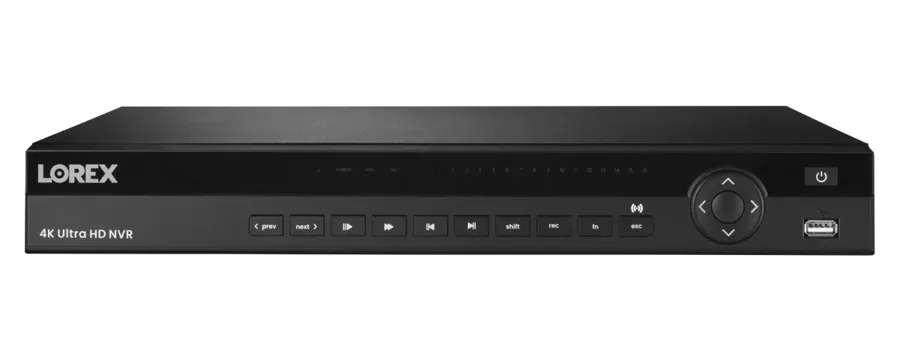
A product photo from the AESS job library, not taken in Remsen Village: a 16-channel network video recorder. In a Remsen Village two-family this box usually sits in the cellar near the boiler and the internet modem, or on a closet shelf in the owner's apartment; in a Church Avenue bakery or a Utica Avenue shop it lives in the back room or under the counter. Most repairs start here, because the recorder holds the footage, keeps a log of which camera dropped and when, and is the part that stops saving while every camera outside still looks fine.
Remsen Village Camera Repair Request
Two-family, semi-detached house, row house, apartment building, shop or church: send the address and what the screen shows, and a technician calls back with the next step
✅
Request Sent!
Thank you. A technician will contact you about the Remsen Village address shortly.
25+
Years Experience
✓
Same-Day Estimates
100%
Licensed & Insured
4.7★
201 Google Reviews
Owner-operated since 2002 · Thousands of jobs completed · Booked within 2 hours
Security camera repair in Remsen Village usually means finding out why a system that worked for years stopped, and the answer is often outside the house. On the morning of Friday, November 6, 2026, a suspected lightning strike cut power to 4,843 Con Edison customers across five Brooklyn ZIP codes, 11203 among them, and many recorders here came back that day with a camera missing, a clock reset or a drive that would not mount. Add the detached garages and shared driveways behind so many of the neighborhood's two-families, where a camera hangs at the end of a long cable across the yard, and cellars that take water in a hard rain, and you have most of the calls we take from these blocks. Our repair has two halves: find and fix what failed, then set the system to tell you on your own phone the next time a camera goes dark or the drive stops saving. Send a photo of the recorder screen to (347) 934-8335 or on WhatsApp, and we will tell you the likely fault and what that kind of repair costs on our Brooklyn list before you book.
Looking at your photos costs nothing. The $150 service call covers the on-site diagnosis and is credited to the repair if you go ahead.
All work is done under New York State license #12000287431, the license the state requires of companies that install or service security and CCTV systems for other people.
We repair any brand and any installer's work, and we tell you plainly when an old recorder or camera is not worth the money to fix.
The Neighborhood
Why Remsen Village Properties Need Security Camera Repair
Remsen Village is the eastern part of East Flatbush, a name in use since the mid-1990s for blocks that were farmland until the 1920s and filled with brick houses between the 1920s and the 1940s. The NYPD describes its 67th Precinct as serving "a region in the center of Brooklyn, comprising East Flatbush and Remsen Village." Most of the housing is the kind a camera system has to stretch across: semi-detached and detached two-families with a stoop or a front porch, a side path or a shared driveway, a yard, and very often a garage at the back of the lot. That is the history this page needs. For a camera repair the important fact is the distance between the front door and the back of the lot, because that is where most cables, most power problems and most failures live.
Take one documented block. Brownstoner's architecture writer Suzanne Spellen described the houses at 649 to 677 East 91st Street as brick two-families built in 1932, each apartment with its own doorway under a peaked hood and a two-car garage in back, one space per apartment. A house like that needs at least four views to be covered: two front doors, the driveway and the garages. The garage camera is the one that fails most, because its cable crosses the yard in the open, runs along a fence or a garage wall, or was buried a few inches down by whoever put it in, and the yard is where the weather, the landscaper, the dog and the contractor all go. Listings on Lenox Road and East 55th Street describe the same shape in other forms: a 1920 semi-detached house with a shared driveway leading to a detached one-car garage and a cellar reached through Bilco doors, and a 1945 two-family with the owner's duplex over a garden-level rental. Every one of those details changes where a camera's cable runs and which apartment's outlet powers it.
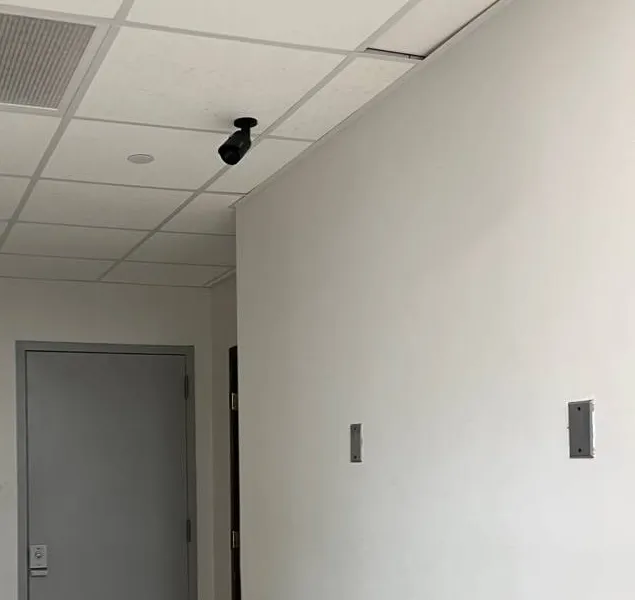
A photo from the AESS job library, not taken in Remsen Village: a small black bullet camera hanging from a white ceiling-tile grid and aimed down a short corridor at a grey steel service door. In Remsen Village this is the camera at the back door of a bakery or a restaurant on Church Avenue, or in the rear hall of an office over a shop on Utica Avenue, where deliveries arrive early and the trash goes out late. Because it hangs low and close to the door, it is easy to knock off its aim, so on a repair we check what it actually sees in playback, not just that it shows a picture.
The second reason repairs pile up here is power. The November 6, 2026 outage was short, and Con Edison said power was largely restored by 11:15 that morning, but "We suspect recent lightning strikes in the area may have caused the disruption," the utility told CBS New York. Short outages are the ones that catch systems out: the recorder restarts on its own, a PoE switch port or a plug-in adapter that took the surge stays dead, the recorder's clock comes back on a factory date, and nobody looks at the screen again until they need a clip. A camera on a detached garage, fed by a long outdoor cable, is the part of a Remsen Village system most exposed to a nearby strike. Lightning and surge damage are also outside any equipment warranty, which is why we price that repair up front and tell you which parts of the damage a battery backup or surge protection would have prevented.
The third reason is water. On October 30, 2025, a storm brought the equivalent of 6 inches of rain an hour in parts of the city, against a sewer system that the city's Department of Environmental Protection said was built for a maximum of 1.75 inches an hour, and two men died in flooded basements, one of them on Kingston Avenue in Brooklyn. Cellars in older East Flatbush houses take water through floor drains, Bilco doors and foundation walls in storms like that, and the recorder, the power box and the internet modem are usually down there. A recorder that sat on a cellar shelf through a storm, or that was plugged into a power strip on the floor, is one of the most common calls we take from these blocks after heavy rain.
The last reason is the kind of crime the cameras are bought for. The 67th Precinct's CompStat report for the week of November 2–8, 2026 shows burglary down 27.8 percent for the year, at 114 incidents against 158 at the same point in 2025, and far below the 2,607 recorded in 1990. Petit larceny went the other way: 1,230 so far in 2026 against 966 a year earlier, a rise of 27.3 percent. That category covers the small thefts a home camera system is usually asked about, the package from a porch, the bicycle from a yard, the item from a parked car. A camera that has to answer those questions needs to record a recognizable face at the door and keep enough days of video for the owner to notice the loss, so a repair here is as much about aim, light and storage as it is about the box that failed. Many owners pair the repair with a check of the door buzzer or intercom at the same entrance, since the front door often carries both systems.
Six Remsen Village facts behind a camera repair
One precinct covers the neighborhood. The 67th Precinct, at 2820 Snyder Avenue, serves East Flatbush and Remsen Village. Detectives there are the ones most likely to ask a homeowner or a shop for video.
Small thefts are rising while burglary falls. CompStat for November 2–8, 2026 shows petit larceny up 27.3 percent year to date, to 1,230, and burglary down 27.8 percent, to 114.
The recent outage hit this ZIP code. The November 6, 2026 lightning outage reached 4,843 customers in ZIP codes 11226, 11234, 11236, 11210 and 11203, and many recorders restarted that morning without anyone watching.
Garages sit at the back of the lot. The 1932 two-families of East 91st Street have a two-car garage behind each house, and semi-detached houses on streets like Lenox Road share a driveway to a detached garage. Those garage cameras carry the longest outdoor cables on the property.
Storms outrun the sewers. The city's sewers were built for 1.75 inches of rain an hour; the October 30, 2025 storm brought the equivalent of 6 inches an hour in places. Cellar recorders pay for that gap.
Repairs are priced by the fault, not the ZIP code. HomeAdvisor's Brooklyn page puts the average surveillance camera install or repair at $1,416, with a typical range of $680 to $2,145 for all job sizes; a single repair on our Brooklyn list usually lands between $150 and $700.
Where this page applies. Sources draw Remsen Village's edges differently. Brownstoner puts it between Kings Highway, Ralph Avenue, Ditmas Avenue and Rockaway Parkway, other guides describe it differently, and the city's planning map has a separate East Flatbush–Remsen Village area. This page covers all of those readings, including Remsen Avenue, the blocks along Church Avenue east of Remsen Avenue where the street is co-named Bob Marley Boulevard, Utica Avenue near the Rugby Library, Rockaway Parkway and the numbered East streets from the East 50s into the East 90s. For the rest of the borough, see our main Brooklyn security camera repair page. The price follows the fault, not the block.
Same-Day Repair in Remsen Village
Need Repair in Remsen Village? A System That Came Back Wrong After the Outage, a Garage Camera Gone Dark, or a Clip the 67th Precinct Wants Now
Urgent camera calls from Remsen Village arrive in three kinds. The first is the after-outage call: since the morning the power blinked, one or two cameras show "No Video" or "IPC Offline", the recorder beeps, or the picture is fine but every clip is stamped with a date from years ago. The second is the far-end call: the camera on the garage, the back fence or the side of the driveway is dark, and it is the only one that sees the cars and the back of the lot. The third is the morning-after call: a package is gone from the porch, a car was broken into on the driveway, the shop's back door was forced, and the owner needs the video now and finds that the camera that mattered had been dark for weeks.
If you need footage from an incident, leave the recorder running. Do not restart it, unplug it, accept any message the screen shows about the disk, or let a relative "reset it to fix it". Most recorders record over their oldest video once the drive is full, so the clock is already running on the clip you need. Call (347) 934-8335, give us the date and the time window, and we book the visit with saving that footage as the first job. If a detective from the 67th Precinct has asked for a copy, say so when you book; the clip is exported to USB with the recorder's original timestamps, and we write down how far the recorder clock is from the real time so nobody questions the time on the video later.
For everything else the path is the same. The $150 service call books a two-hour arrival window, the technician finds the cause, and you get a written price before any part is replaced. Requests are booked within 2 hours. We do not promise that the repair itself happens the same day, because some parts have to be ordered and a buried garage cable may need a second visit, but most single-camera, adapter, switch port and hard drive faults are fixed on the first visit when the part is on the truck.
What We Install
Security Camera Repair Services in Remsen Village
Each repair below is priced from our Brooklyn camera repair list. The service call pays for finding the fault. The repair itself is priced by what failed, how many cameras it touches and how hard the run is to reach, whether that is a camera beside the front doorway of a two-family off Remsen Avenue or one on the eave of a garage at the far end of a shared driveway.
Lightning and outage recovery
Systems that came back wrong after the power blinked: dead switch ports and adapters, blown fuses in a central power box, cameras that never rejoined the recorder, and clocks reset to a factory date. We restore every channel, set the clock to keep itself right, and add surge protection and battery backup where they belong.
Garage and driveway camera repair
The camera at the back of the lot that sees the cars, the garage doors and the alley side. We test its cable from both ends, find the break or the wet joint, and repair, re-route or replace the run so it is not left lying in the yard again.
Cellar recorder rescue
Recorders and power boxes on damp cellar shelves or plugged into a power strip on the floor. We copy off any footage you need, check the drive and the board, clean or replace corroded connectors, and move the equipment up and away from where the water arrives.
Hard drive replacement
Drives that beep, show "HDD Error" or "No HDD", or keep only a few days. We read the drive's health, save what matters, and fit a surveillance-rated drive sized to the number of days you actually need to keep.
Porch and front-door picture fixes
Faces that turn into black shapes against the bright street behind them, white glare off a storm door or an awning, and doorways that go dark when the porch light is off. Most of these are fixed with settings, aim and light, not a new camera.
Two-household system sorting
Houses where the owner upstairs and the tenant downstairs both have cameras, or share one recorder. We work out whose camera is whose, which outlet powers what, and who should see which view, then fix the owner's system and set separate viewing where that is wanted.
Shop and restaurant systems
Counter, door and back-hall cameras in bakeries, barbershops, salons, restaurants and stores on Church Avenue, Utica Avenue, Remsen Avenue and Rockaway Parkway, repaired around opening hours where we can.
Phone viewing and logins
Apps that lost the recorder after a new router or internet provider, systems registered to someone who no longer lives in the house, and recorders whose password left with the installer. We restore access for the right person, change default passwords and add separate logins.
Footage export for incidents
Clips copied to USB with original timestamps for detectives, insurers and landlords, with a written note of any gap between the recorder clock and the real time.
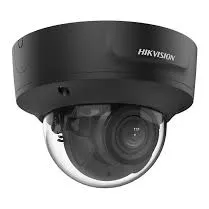
A product photo from the AESS job library, not taken in Remsen Village: a black varifocal dome camera. Its zoom lens is set on site to fill the picture with a doorway, a counter or a register instead of the whole room. In a Church Avenue bakery or a Utica Avenue store, a dome that "works" but shows the front door as a small patch in the corner of the screen is one of the cheapest things to fix on a repair visit, because the camera stays and only the lens setting and the aim change.
Building Specialists
Security Camera Repair for Remsen Village's Architecture
Six kinds of property account for nearly every camera repair call we take from Remsen Village. Each fails in its own way, and each decides where the recorder ends up, which meter powers the cameras, how far the cables travel and who has to say yes before work starts.
Two-family with garages behind
Brick two-families like the 1932 houses on East 91st Street, with a doorway for each apartment, a driveway and a garage at the back, and cameras spread from the front step to the garage eave.
Semi-detached house on a shared driveway
Pairs of houses that share one driveway to garages behind, so one family's driveway camera sees the neighbor's car and the cable often runs along the shared side.
Owner's duplex over a garden rental
Two-families where the owner lives on the upper floors and a tenant has the garden level, with the recorder, the meters and often the cameras' outlets on the tenant's side of the house.
Attached brick rows
Rows of attached houses with short front yards and shared walls, where one installer often wired several houses the same way and the same fault turns up along the block.
Small apartment buildings
Two- to four-story buildings on and off Remsen Avenue, some built in the 1960s, with a lobby door, a stair hall, a cellar and a camera system that nobody in the building owns day to day.
New buildings with gated garages
Recent mid-rises such as 406 Remsen Avenue, with gated access, an elevator and a garage, where the developer's camera system is large and the people who understood it have moved on.
The two-family with garages behind: the longest cable on the block
The commonest Remsen Village house we work in is a brick two-family with a doorway per apartment, a driveway down one side and a garage at the back of the lot. On a house like the ones on East 91st Street, with a two-car garage behind and one space per apartment, the camera that watches the garages may be 80 or 100 feet of cable away from the recorder in the cellar. That cable has to leave the house somewhere, cross or skirt the yard, and climb the garage. In our experience it was usually stapled along a fence, laid across the yard and covered with mulch, or pushed through a length of garden hose, and the garage end of it was spliced in a box under the eave that takes rain every time the wind blows from the right direction.
So the repair starts by testing that run from both ends before anything is replaced. A camera that shows a picture by day and drops out after rain points to a wet joint. A camera that went dark the week someone reset a fence post or dug a planting bed points to a cut. A camera that flickers on and off when it switches to night vision often has a cable too long or too thin for the power it pulls, and the infrared lights tip it over the edge. Each has a different fix: a new weatherproof joint, a spliced and protected section of cable, a replacement run in conduit along the garage wall, or power fed from the far end. We price the run before we open anything, and if a new run has to cross a shared driveway, we tell you that before you decide, because it may involve the neighbor.
The semi-detached house on a shared driveway: two families, one view
Semi-detached pairs share a wall and often a driveway, with a detached garage or two at the end of it. The listing for a 1920 semi-detached house on Lenox Road describes exactly that: a shared driveway leading to its own detached one-car garage. A driveway camera on a house like that sees both families' cars, both families' visitors and the delivery van that stops for either of them. That is useful when something happens, and it is the reason the camera is often the one that matters most after a theft from a car.
It also creates repair questions that do not exist on a detached house. The cable may run along the neighbor's side of the shared wall, the camera may be mounted on a gutter or a fence the neighbor considers theirs, and the driveway light that the camera depends on at night may be on the other family's switch. We repair what is on your property and your power, and if the fix needs a bracket, a cable or a light on the shared side, we say so and give you the details to settle with the neighbor first. A camera that has to keep seeing the driveway at night is often better served by its own light than by a neighbor's porch lamp that goes off at midnight.
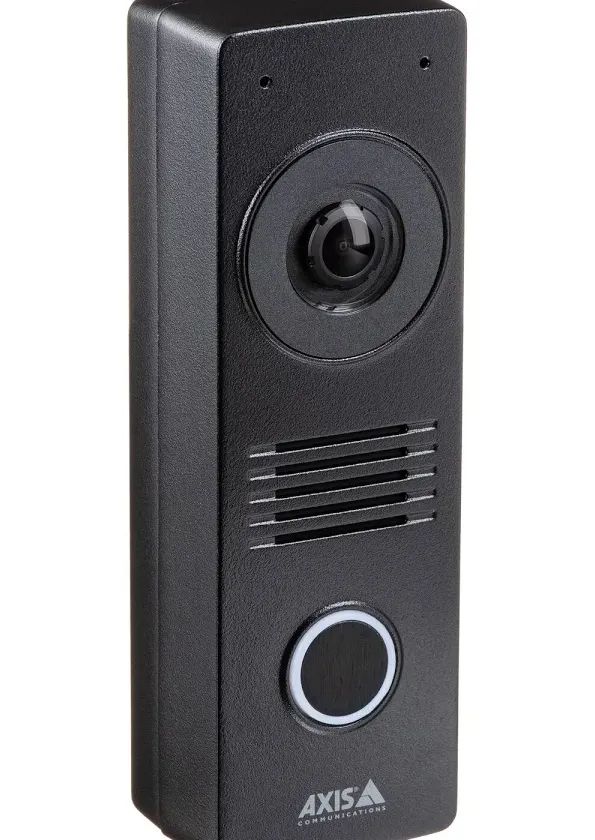
A product photo from the AESS job library, not taken in Remsen Village: a black video intercom door station with a camera lens, a speaker grille and a lit call button. On a Remsen Village two-family where each apartment has its own doorway, one door may have a station like this, the other a video doorbell, and the owner's camera system a third view of the same steps. When we repair the cameras at those doors we check which device records, which only shows a live picture when someone presses the button, and which phone each one reaches.
The owner's duplex over a garden rental: the recorder is on the tenant's side
Many two-families here are set up with the owner living on the upper floors and a tenant in the garden-level apartment, as in a 1945 house on East 55th Street listed with an owner's duplex over a garden-level rental. In those houses the cellar, the meters and the boiler are often reached through, or next to, the tenant's space, and the recorder and the cameras' power were plugged in wherever the installer found an outlet on the day. That outlet may well be on the tenant's circuit and meter.
Three repair calls follow from that. Cameras go dark when the tenant moves out and the electric account is closed, or when a breaker trips on a panel the owner cannot reach. The recorder sits in a space the owner can only enter by arrangement, so footage takes days to check. And the tenant's own Wi-Fi router may be carrying the owner's phone viewing. On a repair we trace which panel feeds each part of the system, which router it reports through and who can reach the recorder, and where it makes sense we move the system onto the owner's power and internet. We do not do electrical work ourselves, so if a new outlet is needed on the owner's side we tell you exactly where, and an electrician adds it before we move the equipment. Entering the tenant's apartment needs the tenant's agreement and proper notice, which the owner arranges before the visit.
Attached brick rows: the same fault, house after house
Rows of attached brick houses with short front yards tend to have been wired by the same few installers working one house after another. That means the same weak points repeat along the row: the same plug-in adapters failing in the same cold snap, the same connector type taking in water at the same spot under the front cornice or the porch roof, the same cable route through the same corner of the cellar ceiling. When one house on a row calls us, the first camera we open usually tells us what the next one will look like.
Small apartment buildings: nobody owns the recorder day to day
The two- to four-story buildings on and near Remsen Avenue follow a familiar pattern: a street door, a lobby or vestibule, a stair, a cellar with the meters and the boiler, and a camera system put in by an owner or an earlier manager. HPD data summarized by LucidRents shows how much attention the doors of such buildings get: at 1106 Remsen Avenue, an 18-unit building from 1965, "Door/Lock" is among the top categories of violations. Cameras at the same doors are not covered by any such rule, and in New York there is no general law requiring an apartment building to have working cameras at all, so they tend to fail without anybody being ordered to fix them.
Larger complexes show the same thing at scale. At Rutland Plaza on East 93rd Street, News 12 reported in February 2026 that it had "previously reported that locks in the buildings were not working," and HPD placed the complex in its Alternative Enforcement Program. In buildings like these the camera repair usually means getting the drive to hold enough days for the building to answer a tenant's question, moving the recorder login out of a former super's name, raising or protecting the lobby camera that keeps getting turned, and, where the owner wants it, checking the intercom at the same door on the same visit.
New buildings with gated garages: big systems, short memories
Newer buildings bring a different problem. New York YIMBY's December 2025 report on 406 Remsen Avenue described an eight-story mixed-use building with 95 residences, gated access, an elevator, a garage and a senior center. Buildings of that kind arrive with dozens of network cameras, a rack in a closet, a PoE switch or two and a recorder that the developer's installer set up. A few years later the installer is gone, the login is in nobody's name, and the garage camera at the gate has been dark since a car clipped it.
A repair here starts with an inventory: which cameras exist, which switch port powers each one, what the recorder is set to keep and who holds the administrator account. Then we fix what failed, put the login in the owner's or managing agent's name, and turn on the warnings for lost cameras and drive errors. More such buildings may come: The Real Deal reported in May 2026 that Bawabeh Holdings is seeking a rezoning for 972 units along East 98th Street and Rockaway Parkway, with full build-out in 2035.
Field Notes
Field Notes: How We Walk a Remsen Village Two-Family After the Power Blinks
This is the order we follow on a two-family with a garage out back when the owner calls to say "some of the cameras didn't come back". It is the same every time, because doing it in this order is what keeps footage safe and keeps us from replacing a part that was not broken.
We start at the recorder, not the camera. Before anything is restarted, we look at the screen, note which channels say "No Video" or "Offline", read the recorder's log for the moment of the outage, and check the clock against a phone. If the owner needs any clip from before or after the outage, it goes onto a USB drive first. Then we check the drive's status in the storage menu, because a drive that will not mount after a power cut is a different repair from a camera that will not wake up.
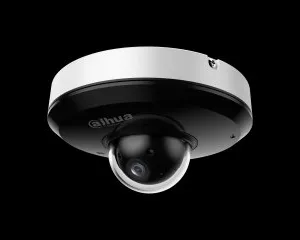
A product photo from the AESS job library, not taken in Remsen Village: a mini pan-tilt dome camera with a white housing over a black lens dome. On a Remsen Village property this kind of camera often hangs under a porch roof or a garage eave to swing between the driveway and the yard. After a power cut it can come back pointed at its factory home position instead of the driveway, so on an outage repair we check that each moving camera returned to the view it is supposed to hold.
Next comes power, in the order the electricity travels: the outlet and the panel it comes from, any surge strip or battery backup, the PoE switch or the central power box, and then each camera's cable. On a house with a garage at the back we test the garage camera's run from the cellar end and from the garage end, because a long outdoor cable is the part most likely to have taken the hit. Only when we know where the fault is do we price the repair, and the owner hears the cause and the number before any part comes off the truck. When the job is done, every camera is checked by day and again with the yard and driveway lights off, and the warnings for a lost camera and a drive error are sent to the owner's phone as a test, so the next outage ends with a text message rather than a surprise.
Fault by Fault
Lightning, Long Yard Cables, Wet Cellars, the Wrong Meter and Porch Light: Why Remsen Village Camera Systems Fail
Most camera failures we see in Remsen Village come down to six causes. None of them are exotic, and most of them leave clues on the recorder screen if you know where to look.
Lightning and surges: the outdoor cable is the antenna
A strike does not have to hit the house to damage a camera system. A nearby strike or a surge on the power lines can travel in through the electrical service, and a long outdoor cable to a garage or a back fence can pick up a surge of its own. The parts that usually fail are the cheap ones closest to the surge: a plug-in adapter, a channel on a central power box, a port on a PoE switch, or the network chip in the camera at the end of the longest run. On the morning of November 6, 2026, the outage that reached ZIP code 11203 was blamed on lightning, and that is the kind of event after which we find one or two dead channels on a system that otherwise came back normally.
The repair is to find each damaged part and replace only that, which is why we test every port and every run rather than swapping the recorder on a hunch. Then we look at prevention: surge protection where the outdoor cables come into the house, a battery backup that cleans up the power to the recorder and the switch, and grounding where the installer left none. Lightning and surge damage are not covered by any equipment warranty, ours included, so we write those repairs up separately and say clearly which protection would have stopped which part of the damage.
Long yard cables: the run that lives outdoors
On a lot with a garage at the back, at least one camera cable spends its whole life outdoors. Sunlight cracks indoor-rated jacket, water finds its way into any joint that was taped rather than sealed, and the cable gets stepped on, mowed over, chewed or cut by anyone working in the yard. A run of ordinary indoor cable stapled along a wooden fence will look fine for a year or two and then start dropping the camera in wet weather.
We find the fault by measurement and inspection from both ends, then repair the damaged section with an outdoor-rated splice in a sealed box, or replace the run with outdoor-rated cable in conduit along a wall or a fence. If the run has to go underground, we tell you before the work is priced, because trenching across a yard or a shared driveway is a bigger decision than a splice and may involve a neighbor.
Wet cellars: the recorder on the low shelf
Cellars in these houses are where the recorder, the power box, the modem and the switch usually end up, because the cables from the front and the back meet there. In a storm like the one on October 30, 2025, when the rain came far faster than the sewers were built to handle, water comes in through floor drains, Bilco doors and old foundations. Even without a flood, a damp cellar corrodes connectors and the recorder's fan pulls that air through the box all day.
A recorder that sat in water should not simply be dried and switched back on. We copy off any footage that matters if the drive will still read, check the board, the power supply and the drive, and give you an honest answer on whether the unit is worth keeping. Then the equipment goes up off the floor onto a shelf or a wall bracket, with a battery backup beside it and the power strip off the floor too.
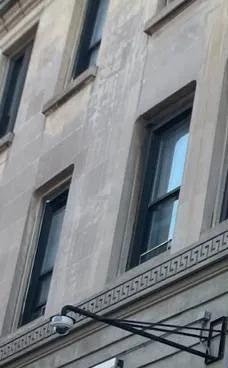
A photo from the AESS job library, not taken in Remsen Village: a bullet camera on a long black steel wall arm below a carved Greek-key band on a pale stone facade with tall sash windows. Most Remsen Village houses are plainer brick, but the same kind of long arm is often used on a garage corner or a house wall to push a camera out far enough to see down a driveway. A long arm also acts as a lever in the wind, so on a repair we check that its screws are tight in sound brick and that the camera has not drifted off its aim.
The wrong meter: cameras on somebody else's power
In a two-family the cameras and the recorder are often plugged into whatever outlet was handy, and that outlet may be on the tenant's meter. Everything works until the tenant moves out and the account is closed, a breaker trips on a panel inside the tenant's apartment, or the tenant unplugs something to use the outlet. Then the owner upstairs finds the system dark and has no idea why.
We trace each part of the system back to its panel and meter and tell you what is on whose power. Where it is practical, the system moves onto the owner's circuit; where a new outlet is needed, we tell an electrician exactly what and where, since we do not do electrical work ourselves.
Porch light and street light: the picture that changed without the camera changing
A front-door camera was aimed and set for the light on the day it was installed. Since then the street light out front may have changed, the porch bulb may have been swapped for a brighter one or put on a timer, an awning or a storm door may have gone up, and a tree in the front yard may have grown into the view. The result is faces that are black shapes against a bright street in the afternoon, white glare off glass at night, or a doorway that disappears when the porch light goes off.
Most of these are fixed without a new camera: exposure and backlight settings, a small change of aim, a different light for the doorway, or a trim of the branch. Where the camera simply cannot handle the contrast, we say so and price a replacement suited to that spot.
Commercial Security Camera Repair
Business Security Camera Repair in Remsen Village
Remsen Village businesses are mostly small and owner-run: Caribbean bakeries and restaurants, barbershops and salons, groceries and pharmacies, churches, day care centers, medical and tax offices, auto repair and car services. Their cameras do two jobs at once, watching the counter while the owner is busy and watching the door after the gate comes down. These are the corridors our commercial calls come from.
Church Avenue and Bob Marley Boulevard
The stretch of Church Avenue east of Remsen Avenue, co-named Bob Marley Boulevard in 2006, lined with restaurants, bakeries, beauty supply stores and shops with apartments above.
Utica Avenue
A busy north-south shopping street on the neighborhood's western side, with the Rugby Library at 1000 Utica Avenue and storefronts that keep long hours.
Remsen Avenue
The avenue that gave the neighborhood its name, running southeast toward Canarsie past houses, small apartment buildings, churches, shops and new mixed-use buildings such as 406 Remsen Avenue.
Rockaway Parkway
A wide avenue on the eastern side, with barbershops, bakeries and services, and the commercial site at East 98th Street now proposed for redevelopment.
Ralph Avenue
A western boundary street in some accounts of the neighborhood, with Caribbean bakeries, barbershops and small stores in two-story buildings.
Linden Boulevard and Kings Highway
Wide roads with car-related businesses, gas stations, apartment buildings and lots, where cameras have to watch long frontages and parked vehicles.
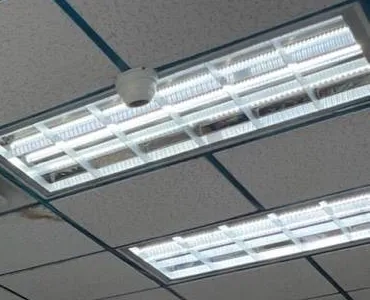
A photo from the AESS job library, not taken in Remsen Village: a small white dome camera on grey acoustic ceiling tiles beside a long louvered fluorescent light panel. This is the setup in many offices, day care centers and medical practices above or behind the shops on Church Avenue and Utica Avenue. A dome that close to a light panel can wash out or flicker in the recording, so on a repair we check the playback under the room's real lighting and move the camera a tile over if that is what it takes.
Bakeries and restaurants: early mornings, heat and grease
Bakeries start before dawn and restaurants close late, so their cameras see deliveries, cash handling and the back door at hours when nobody else on the block is awake. The recorder usually lives in a back room near ovens, fryers or a flour store, and heat, grease and fine dust are hard on its fan and on any camera mounted over the kitchen line. A recorder that shuts itself off on a busy afternoon and comes back later is often simply overheating.
A repair here means cleaning or replacing what the kitchen air has damaged, moving the recorder to the coolest, cleanest spot that still reaches the cables, and checking that the camera over the register shows the hands and the drawer, not just the top of the cashier's head. We schedule around service where we can, usually before opening or in the afternoon lull.
Barbershops and salons: mirrors, bright lights and long hours
Barbershops and salons are bright, full of mirrors and open long hours, often seven days a week. Cameras there get confused by reflections and by the contrast between the lit chairs and the window to the street, and a camera aimed at the door often shows the chairs better than the people coming in. Customers in the chairs also expect some privacy.
On a repair we re-aim the cameras to cover the door, the register and the back, set privacy masks over the chairs where the owner wants them, and adjust exposure for the mirrors and the window. If a camera records sound, we tell the owner what New York's consent rule means before turning it on.
Auto shops, car services and lots
Along the wider roads, auto repair shops, tire shops and car services keep vehicles outside overnight. The 67th Precinct's CompStat shows 156 grand larcenies of autos so far in 2026, down from 176 a year earlier, and lot owners want to know which car moved and when. Their cameras watch long fences, gates and rows of parked cars, and their cables cross the same lots the tow trucks drive over.
Churches, day care centers and offices
The neighborhood's churches, day care centers and offices have cameras at the doors, in halls and sometimes in classrooms or fellowship rooms. They are often run by volunteers or a busy director, the recorder sits in a closet or an office, and the login belongs to whoever set it up. When something happens, the first problem is finding the person who can open the recorder.
We repair the cameras, move the administrator login to the organization rather than a person, set up limited viewing logins for staff, and write down which camera covers which door so the next director inherits a working system.
Rules that touch a commercial camera repair
Four rules come up on business repairs here. New York State requires a license for companies that install or service security and CCTV systems for others, and we work under license #12000287431. New York Labor Law §203-c bars employers from putting cameras in restrooms, locker rooms and changing rooms. New York's eavesdropping law makes it illegal to record a private conversation without the consent of at least one participant, so a camera that records sound in a shop or office needs careful thought before it is switched on. And if the store's lease says the landlord approves anything attached to the outside of the building, a replacement in a new spot should be cleared with the landlord first.
Your Questions Answered
Security Camera Repair in Remsen Village: Questions Answered
These are the questions Remsen Village owners, landlords and shopkeepers ask us most, grouped by the kind of property, with the short answer first.
Houses, two-families and garages out back
Since the morning of the November 6 outage, the camera on our garage shows "No Video" while the four on the house came back. Was it the lightning?
Quite possibly. The garage camera has the longest outdoor cable on the property, which makes it the part most likely to take a surge, and the usual casualties are the camera's own power input, a channel on the power box or a switch port at the house end. We test the run and each end separately so only the damaged part is replaced, and because surge damage is not covered by any equipment warranty, we price it up front and add surge protection on that run if you want it.
Our driveway camera only drops out on rainy days and comes back once things dry. What does that usually mean?
Water is getting into a joint somewhere along the run, most often in the splice box under the garage eave or where the cable enters the house. When the joint is wet the signal or the power leaks away; when it dries the camera returns. We open and dry the joint, replace corroded connectors, reseal it in an outdoor-rated box with drip loops, and check the rest of the run for the same problem.
We are putting in a new fence along the side of the yard. How do we keep the contractor from cutting the garage camera cable?
Mark it before the work starts. We can trace the run, flag where it crosses or follows the fence line, and either move it out of the way ahead of time or reroute it afterward along the new fence in conduit. Moving a cable on purpose before a fence goes in is cheaper than finding and splicing a cut one after the posts are set.
Our front-door camera has been showing a picture but saving nothing for weeks. How could we not have known?
Most systems are set from the factory to stay silent when recording stops. Live view keeps working, so the screen and the app look normal, while the drive has failed, filled up with overwrite turned off, or had its recording schedule switched off after a restart. We find which of those happened, fix it, and turn on the warnings for a drive error and a lost camera so the next time reaches your phone.
The cellar flooded in the last big storm and the recorder was sitting on the floor. It turns on now. Can we just keep using it?
We would not rely on it without checking. Floodwater leaves residue and corrosion on the board and the connectors that can fail weeks later, and the drive may have been damaged. We test the drive and save any footage you want, inspect the board and the power supply, and tell you honestly whether it is worth keeping. Either way, it goes up off the floor with a battery backup beside it.
Landlords, tenants and two households
We live in the upper duplex and rent the garden floor. The recorder is in the cellar off the tenant's hallway. How do we check it without knocking on their door every time?
The simplest fix is to make the recorder reachable from your phone, so you can check recording and pull clips without going downstairs. Where that is not enough, the recorder can be moved to a cabinet on your side of the house with the cables extended to it. Any visit that needs the tenant's space is arranged with the tenant in advance, and we do the work in one trip where we can.
Our camera on the shared driveway also sees our neighbor's car. Do we need their permission before you repair it?
Repairing your own camera on your own house does not usually need anyone's permission. Mounting a bracket, running a cable or adding a light on the neighbor's side of the driveway does, so if the fix needs that, we say so and give you the details to settle with them first. If the neighbor objects to what the camera sees, a privacy mask can black out their windows and their side of the yard in the recording.
Apartment buildings and new buildings
The garage gate camera in our new building has been out since a car hit the pole. Who is the right person to call about it?
The building's owner or managing agent, since the system belongs to the building. When they book us, we replace the damaged camera and mount, check the cable and the switch port it comes from, and put the recorder login in the managing agent's name if it is still in the developer's installer's name. The damage itself may be a matter for the driver's insurance, and the clip of the collision, if the recorder kept it, helps with that.
Shops on Church Avenue, Utica Avenue and Rockaway Parkway
The recorder in our bakery's back room keeps switching itself off on busy afternoons. Is it the heat from the ovens?
Heat is the likeliest cause, often made worse by a fan clogged with flour or grease. When the recorder gets too hot it protects itself by shutting down or restarting, and every restart is a gap in the footage. We clean or replace the fan, check the drive and the power supply, and move the recorder somewhere cooler and cleaner that still reaches the cables.
Our barbershop camera at the door mostly shows the chairs and the mirrors. Can it be set to watch who comes in?
Yes. Most of the time the fix is aim and settings, not a new camera: we turn it toward the door, adjust exposure for the mirrors and the bright window, and set privacy masks over the chairs if you prefer not to record customers being cut. If the camera's lens cannot frame the door from where it hangs, we price a varifocal one or a better spot.
Equipment
Types of Security Cameras and Recorders We Repair
We repair whatever is on the building, whoever put it there. These are the kinds of equipment we find on Remsen Village houses, garages, apartment buildings and shops, and the faults each one tends to develop here.
Coax and HD-over-coax cameras
Cameras with round BNC connectors, from old analog to HD models, still common on two-families wired ten or more years ago. Typical faults: wet connectors at the garage end of a yard run, failing plug-in power, and picture lost on very long cables.
Network (IP) cameras
Cameras powered and connected through one data cable, standard in newer buildings and many shops. Typical faults: switch ports killed by a surge, address conflicts after a router change, and passwords that left with the installer.
DVRs, NVRs and hybrid recorders
The box that holds the footage, in a cellar, a closet, a back room or under a counter. Typical faults: worn or failed drives, "HDD Error" and "Disk Full" alarms, overheating from clogged fans, and settings lost after an outage.
Varifocal domes and bullets
Cameras with an adjustable zoom at doors, counters and driveways. Typical faults: lenses set too wide to recognize anyone, focus that drifted after a knock, and covers scratched or clouded.
Pan-tilt and 360-degree cameras
Moving cameras under porch roofs and garage eaves, and fisheye cameras on shop ceilings. Typical faults: lost presets after a power cut, sticking motors and cameras parked on the wrong view.
Wi-Fi, battery and cube cameras
Plug-in and battery cameras in windows, on shelves and in yards. Typical faults: weak signal through brick to a garage, router changes, short battery life in the cold, and accounts tied to someone who moved.
Video door stations and doorbells
Door stations and video doorbells at each apartment's doorway. Typical faults: video that reaches one phone but not another, failed call buttons and pictures that are never recorded.
PoE switches and extenders
The switches that power network cameras, often in a cellar or a closet without backup. Typical faults: dead ports after a lightning outage and overloaded power budgets when cameras were added.
Power supplies, surge protection and battery backups
Central power boxes, plug-in adapters, surge strips and UPS units. Typical faults: blown channel fuses, adapters on the tenant's outlet, and backups whose batteries quietly died years ago.
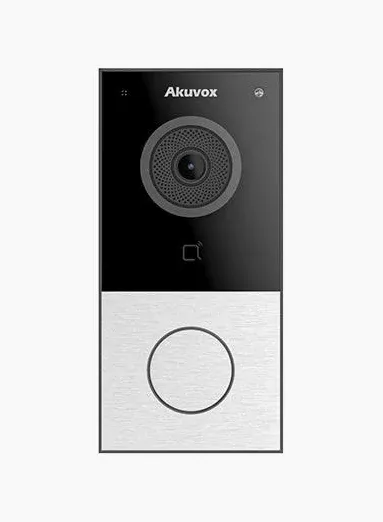
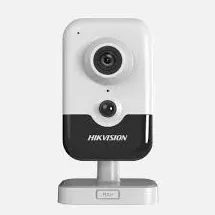
A product photo from the AESS job library, not taken in Remsen Village: a slim video door station with a camera lens at the top and a large round call button. On a two-family where each apartment has its own doorway, a slim station like this fits the narrow trim beside a door under a peaked hood. Its camera usually only shows a picture when the button is pressed, so if the owner wants that doorway recorded all the time, the repair includes a camera system view of the same step.A product photo from the AESS job library, not taken in Remsen Village: a white indoor cube camera. In Remsen Village homes these sit on a shelf facing the front hall or a window, and in shops beside the register. They are simple to set up and simple to lose: when the router or the Wi-Fi password changes, or the app account belongs to someone who has moved, the cube keeps its light on and stops reaching anyone. We reconnect it, or tell you when it is cheaper to replace it with a wired camera on the recorder.
National brands versus a local licensed repair
Owners often ask whether to call the alarm company, buy a consumer camera or have the existing system repaired. The answer depends on what you already own. This is how the three compare for a Remsen Village house or shop.
Question
ADT or a similar alarm company
Ring, SimpliSafe or another consumer camera
AESS repair of your existing system
Works on a system someone else installed
Usually only its own equipment
Support covers its own devices
Any brand, any installer
A camera on a garage 100 feet behind the house
Depends on its own wiring
Wi-Fi often weak through brick to the garage
Run tested end to end and repaired
Recorder in a cellar
Its own panels and recorders
No local recorder; clips go to the cloud
Repaired, moved off the floor, backed up
Damage after a lightning outage
Depends on the contract
Replace the device
Each damaged part found and priced
Monthly fee for recording
Often part of a plan
Often needed to save clips
None; footage stays on your recorder
Licensed technician on site
Varies by dealer
Remote support
NYS license #12000287431
Price before work
Varies
Replacement device price
Written, itemized, before parts
AI Overview Reality Check
What AI Gets Wrong About Security Camera Repair in Remsen Village
AI answers and listing sites such as Angi, HomeAdvisor and Fixr give tidy general advice about camera repair. Some of it holds up. Some of it falls apart on a Remsen Village lot with a garage at the back, a recorder in a wet cellar and a power line that just took a lightning hit.
"A power outage won't damage your cameras; just wait for them to reboot"
Most of the time a clean outage does no harm, and the system comes back by itself. The trouble is that outages caused by lightning are rarely clean. The November 6, 2026 outage that reached ZIP code 11203 was put down to suspected lightning strikes, and with lightning the power can surge, sag and flicker before it settles.
What we find after events like that is a system that mostly came back: four cameras fine, the garage camera dead, a switch port gone, or the recorder up and running with its clock reset to a factory date and its recording schedule cleared. The owner checks the front door camera on the phone, sees a picture and assumes the rest are fine.
So after any outage, check every channel on the recorder, not just the one you look at most, and check that the date and time are right. If anything is missing, call before you start unplugging and replugging, because the recorder's log of the outage is the best clue to what failed.
"Wireless cameras solve wiring problems"
The advice to replace a troublesome wired camera with a Wi-Fi one sounds sensible until you try it on a garage 80 or 100 feet behind a brick house. Wi-Fi from a router inside the house has to get through brick walls and across the yard, and the signal that reaches the garage is often too weak for steady video, especially at night when the camera's infrared lights draw more power and every passing car triggers a clip.
A Wi-Fi camera still needs power, too, so the garage camera either needs an outlet out there or a battery that will need charging far more often in the cold. And every Wi-Fi camera on the house stops reporting the day the router or the password changes.
For a garage or the far end of a driveway, a properly repaired wired run, outdoor-rated and protected, is usually the more reliable answer. Wi-Fi works well for a camera inside the house near the router, and we say so when that is the case.
"If a camera stops working, replace the camera"
Listing sites price camera repair as if the camera were the usual failure. On Remsen Village properties, it often is not. The camera at the end of a yard cable is fine; the joint in the splice box under the garage eave is full of water. The front camera is fine; its plug-in adapter died in the outage. The camera is fine; it is plugged into the tenant's outlet and the tenant's account was closed.
Replacing the camera in those cases spends money and leaves the fault in place, and the new camera goes dark the same way a few weeks later.
That is why we test from the outlet to the camera before anything is replaced, and why the price we write down names the part that actually failed. When the camera itself is the problem, we replace it; when it is the cable, the power or the connector, we fix that instead, which is usually cheaper.
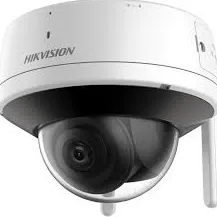
A product photo from the AESS job library, not taken in Remsen Village: a Wi-Fi dome camera with an external antenna. The antenna helps, but on a Remsen Village lot the router is usually inside a brick house and the camera is out on a garage or a fence at the back of the yard. When a camera like this keeps dropping off, we measure the signal where it hangs before suggesting anything, and we tell you honestly whether a better access point will fix it or whether a wired run is the real answer.
"Your landlord or the city has to keep building cameras working"
There is no general New York City law that requires an apartment building to have security cameras, or to keep the ones it has working. Building rules cover locks, self-closing doors, lighting and, in many buildings, intercoms, and HPD writes violations for those. Cameras are a different matter, and Outerbridge Law notes that "New York has no law on how long landlords must keep film."
That does not mean a tenant has no say. A broken front door lock or intercom is reportable to 311, and a lease may promise more than the law does. But a 311 complaint about a dead lobby camera will not, on its own, get it repaired.
For owners, the practical point is the opposite one: if you have cameras and store footage, you are responsible for it, including who can see it. A repair is a good time to put the recorder login in the right name, set how many days it keeps and decide who handles requests for video.
"Hard drives in recorders last as long as the recorder"
A recorder writes video to its drive every minute of every day, and drives wear out. The drive is usually the first part of a recorder to fail, and when it fails the recorder may beep and show "HDD Error", or it may simply carry on showing live pictures while saving nothing.
"A CCTV box never beeps at random," as Security Camera King's guide to recorder alarms puts it. The beep is the recorder's only way of telling you something is wrong, and in a cellar or a back room nobody may hear it.
On a repair we read the drive's health, replace a failing drive with a surveillance-rated one before it takes the footage with it, and send the drive error alarm to your phone so the next warning does not go unheard.
"Anyone handy can repair a camera system"
Plenty of camera faults are simple, and some owners can fix a loose plug or re-aim a camera themselves. But New York State requires companies that install or service security and CCTV systems for other people to be licensed by the Department of State, and an owner hiring a handyman or a relative to work on the system has no one accountable if the footage is lost.
The bigger risk is to the footage. The most expensive mistakes we see are a recorder that was reset to factory settings, a drive that was formatted because the screen asked, or a camera unplugged and moved before anyone saved the clip from the night of the theft.
If footage matters, leave the recorder alone and call. We copy the clip first, and only then start repairing.
"Camera repair costs about $100 to $300"
National averages are built from simple jobs: one consumer camera, re-paired to an app. A Remsen Village repair is more often a long yard cable, a recorder in a wet cellar, a switch port after a surge, or a two-family system that has to be traced across two households' power.
HomeAdvisor's Brooklyn page puts the average surveillance camera install or repair at $1,416, with a typical range of $680 to $2,145, but that figure mixes repairs with new installations of every size.
On our Brooklyn list the $150 service call covers the diagnosis and is credited to the repair, most single faults cost $150 to $700, and a recorder replacement or multi-camera wiring repair runs $700 to $1,500. Your price is written down before any part is replaced.
Not Sure Whether It Is the Camera, the Cable or the Power? Send a Photo Before Anything Gets Unplugged
A photo of the recorder screen and a sentence about when the problem started tell us a lot. Text it to (347) 934-8335 or send it on WhatsApp, and a technician will tell you what the screen most likely means, whether there is footage to protect, and what that kind of repair costs on our Brooklyn list. Or send the short request form.
Get In Touch
Request a Free Quote
Tell us the address, how many cameras you have, which ones are out and where the recorder sits. If you need footage from a particular day, put the date in the message so we can plan to save it first.
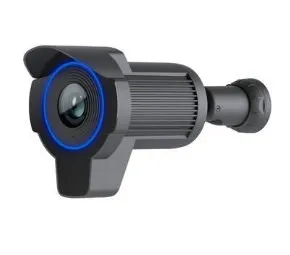
A product photo from the AESS job library, not taken in Remsen Village: a black bullet camera with a long hood and a blue-lit ring around the lens. On a Remsen Village garage or the rear wall of a two-family, a long hood keeps rain off the lens and cuts glare from a low sun or a neighbor's floodlight. When we replace a garage or driveway camera that cannot be saved, a hooded camera like this is a common choice for that spot.
✅
Request Sent!
Thank you. A technician will contact you about the Remsen Village address shortly.
How It Works
Our Repair Process
1. Send a photo, the address and the date that matters
A photo of the recorder screen or the dark camera, the Remsen Village address and the type of property, by text, WhatsApp or the form, plus the date of any footage you need.
2. Settle who owns and approves the system
Owner upstairs, tenant downstairs, store owner, landlord or managing agent: we confirm whose cameras they are, who approves the work and who holds the recorder login.
3. Book the service call
The $150 Brooklyn service call books a two-hour arrival window and is credited to the repair if you go ahead.
4. Copy the footage before anything is touched
Any clip that matters goes to USB with its original timestamps, and the recorder clock is checked against the real time, before anything is restarted or opened.
5. Trace the system from the outlet to the phone
Outlet and circuit, surge protection and battery backup, power supply or PoE switch, each cable and connector including the garage run, the recorder and drive, then the app.
6. Explain the cause and write the price
You hear what failed and why, and get a written, itemized price before any part is replaced. If the price changes on site, you hear the new number first.
7. Repair and test by day and after dark
The failed part is repaired or replaced, and every camera is checked for picture and recording in daylight and under the real night lighting of the yard, driveway, stoop or store.
8. Set warnings, label and hand over
Warnings for lost video and drive errors go to your phone and are tested, cables are labeled at the recorder, logins go to the right person, and you are shown how to save a clip.
Coverage Area
Security Camera Repair Near Remsen Village's Landmarks
649–677 East 91st Street
A row of brick two-families built in 1932, each apartment with its own doorway and a two-car garage in back, written up by Brownstoner as a building of the day.
Rugby Library
The Brooklyn Public Library branch at 1000 Utica Avenue, opened in 1957, closed in 2017 and reopened in 2021 after a renovation whose cost grew to $10.2 million.
67th Precinct
The station house at 2820 Snyder Avenue, which serves East Flatbush and Remsen Village.
Engine 310 and Ladder 174
The firehouse at 5105 Snyder Avenue that answers fire calls across this part of East Flatbush.
Bob Marley Boulevard
The stretch of Church Avenue from Remsen Avenue to East 98th Street, co-named for the reggae musician in the summer of 2006.
Wyckoff House
The Pieter Claesen Wyckoff House, begun around 1652 and the oldest building in New York City, which Brownstoner places across the street from the East 91st Street two-families.
Remsen Village is billed at our Brooklyn rate. Every repair starts with the $150 service call, which covers the on-site diagnosis and is credited to the repair if you go ahead. The figures below come from our published list of Brooklyn security camera repair prices; your exact price is written down on the visit, once we know what failed.
Repair
Brooklyn price
Service call, on-site diagnosis and written repair price
$150, credited to the repair
Warnings, recording schedule, motion, app or login settings with no parts
Usually within the $150 service call
Clean and check for a blurry or filmed-over picture
$80
Connector reterminate or PoE port swap
$150–$350
Power supply repair
$150–$400
Hard drive swap, by capacity
$200–$450
Indoor camera repair
$200–$450
Single camera replacement on a working system
$250–$600
Night vision camera repair
$250–$650
DVR not working, including drive and labor
$300–$700
NVR not recording, by model
$400–$900
PTZ camera repair
$450–$1,200
Lightning-damaged system, by size
$700–$3,500
Hybrid recorder swap, channels reconfigured
$700–$1,200
DVR/NVR replacement with drive, or multi-camera wiring repair
$700–$1,500
Full rewire or whole-building overhaul
From $1,500
Three things move a Remsen Village repair within those ranges. The first is distance: a camera on a garage at the back of the lot, with its cable crossing the yard, takes more testing and more cable than one beside a front door. The second is the number of runs that failed: one wet joint is a small job, while several runs damaged by a surge, a fence job or water in the cellar are priced run by run. The third is the recorder: one that has to be replaced, moved off a cellar floor, or moved onto the owner's power adds time for setup and tracing. Surge and lightning damage is priced as a repair, because no equipment warranty covers it. Bundling the camera repair with intercom, door buzzer, alarm or cabling work on the same visit saves $200 to $400 in labor on our Brooklyn list.
Full terms — including 50% deposit, one-year parts-only warranty on AESS-supplied products, and the late-fee schedule — are set out in the service agreement.
Shop Our Systems
Security Camera Repair Packages & Pricing
Three ways Remsen Village repairs usually come together, priced from our Brooklyn list.
Single-issue repair: $150–$700
One fault, one visit: a garage run's wet joint resealed, a switch port or adapter replaced after the outage, a worn drive swapped, a porch camera reset for glare, or the system moved onto the owner's circuit once an outlet is in place.
Major system repair: $700–$1,500
The recorder or the wiring: a DVR or NVR replaced with a new drive and every camera reconfigured, a yard run replaced in conduit, two households' systems separated, or several runs repaired after a surge or a flood.
Annual maintenance: $250–$800
Every camera checked by day and after dark, covers cleaned, outdoor joints and garage runs inspected, the drive's health read, backup batteries tested, warnings sent to the owner's phone as a test, and a clip export tried.
Bring your own equipment. If you have already bought a replacement camera or recorder, we can fit it at labor-only rates. Tell us the exact model and we quote the labor by phone or text, and the visit is booked once the deposit is in. Equipment you supply is covered by its own manufacturer, not by us.
Complete Services
Every Security Camera Repair Service in Remsen Village
Camera, cable and garage-run repair
Dark cameras, wet joints under garage eaves, cut yard cables and surge-damaged ports and adapters. Request a repair
Recorder, drive and outage repair
DVRs, NVRs and hybrids in cellars, closets and back rooms, including recorders that came back wrong after the lightning outage. Brooklyn security camera repair
Owners and managing agents with houses, buildings or stores in more than one borough. NYC security camera repair
FAQ
Remsen Village Security Camera Repair FAQ
Do you cover every part of Remsen Village, from Utica Avenue out to Rockaway Parkway?
+
Yes. We cover all of Remsen Village however its edges are drawn, from Utica and Ralph Avenues east to Rockaway Parkway and from the blocks along Church Avenue south toward Kings Highway and Ditmas Avenue, along with the rest of East Flatbush and the neighborhoods around it. Every address is billed at the same Brooklyn rate, and the price follows the fault, not the block.
Is there anything we should do the next time a thunderstorm is coming?
+
A battery backup and surge protection installed ahead of time do far more than anything done during the storm. If the system has neither, there is no need to unplug it for every storm, but after any outage look at every channel on the recorder, check the date and time on the screen, and call if anything is missing before you start unplugging and replugging.
Can the camera on our garage get its power out at the garage instead of from the house?
+
It can, if the garage has a working outlet on your own circuit. Powering the camera at the garage shortens the power run and can stop a long cable from failing at night, but it splits the system across two places, so a battery backup may be needed at both ends. We do not do electrical work, so if the garage needs an outlet, an electrician adds it before we move the camera onto it.
Our cellar has a Bilco door to the yard. Is that a good place for a camera, and can its cable share the opening?
+
A camera watching the cellar door is often worth having, since it is a second way into the house that cannot be seen from the street. The cable should not run through the door opening itself, where it gets pinched and soaked; it should enter through its own sealed hole in the wall above the door frame. We price the camera, the hole and the seal together.
Can the warnings for a dead camera go to more than one phone, say the owner upstairs and a grown son who lives in another borough?
+
Yes. Most recorders and apps let several accounts receive the same warnings, each with its own login. We add each person, choose which warnings each one gets, and send a test so everybody sees one arrive before we leave.
Who pays when a tenant's guest knocks a camera off the wall?
+
That is between the owner and the tenant, and the lease usually decides it. What we can do is make the repair easy to document: the recorder clip of the damage if it kept one, photos of the broken mount, and an itemized price for the replacement. We bill whoever books the work.
Does a camera system have to be registered with the 67th Precinct?
+
No. Registering cameras with the NYPD is voluntary, and it only tells the police that a camera exists and how to reach the owner if they need video. Whether you register or not, the footage stays yours, and police normally ask for a copy rather than taking the recorder. If you do register, update the record after a repair that changes what the cameras cover.
If one of our cameras cannot be saved, what goes up in its place?
+
Our standard replacement is a camera from our own line chosen to work with your existing recorder and matched to the spot it watches, for example a hooded camera for a garage wall or a varifocal one for a counter. If you prefer a particular brand, tell us and we price that instead. The written price names the camera before it is ordered.
Our church wants the cameras repaired, but the board has to approve the spending. Can we get a written price to take to the meeting?
+
Yes. After the diagnosis on the service call, you get a written, itemized price that names each part and each run, which you can take to the board or the trustees. Nothing is replaced until someone with authority approves it, and the price holds while the board meets as long as the parts are still available.
Can the camera at our front gate be made to stop sending an alert every time someone walks by on the sidewalk?
+
Usually, yes. We draw the motion zone so it covers your gate, path and steps but not the sidewalk, turn on person or vehicle detection if the camera supports it, and lower the sensitivity at night. Then we walk the path and the sidewalk to check that the right movements trigger an alert and the wrong ones do not.
Ready to Have Every Remsen Village Camera Recording, From the Front Step to the Garage Out Back?
Send a photo of the recorder screen or the dark camera, the address, and the date of any footage you need. We book within 2 hours, give you a two-hour arrival window, save your footage first, write down the repair price before any part is replaced, and set the system to warn you the next time a camera or the drive quits.